You can file Monkey Poo Flinger.. again, no really.. under novelty games. It has no real value as a game. On my most generous day, I would call its gameplay mediocre. On a less than generous day, I would probably just flip the bird and make fart noises with my mouth. But seriously, you don’t buy a game called Monkey Poo Flinger expecting the next Spec Ops – The Line. You get it because monkeys are hilarious, poo is hilarious, and monkeys throwing poo is the greatest comedy goldmine of all time.
BUT, if your game is going to be themed around a monkey throwing poo at people, it has to at least look good. Covering some gawking human with feces should be a visually satisfying experience. That’s not the case here. The graphics look crude, so any successful shot doesn’t have any zing to it. I mean, you just absolutely plastered some asshole in the face with a handful of shit. When I do that to Brian, it’s the highlight of my day. Here, it’s just hollow. I mean, look at it.
It looks horrible. It’s actually not as bad as it appears from a gameplay perspective, but it’s still not fun. Monkey Poo Flinger is a pretty basic gallery shooter. Press the right trigger to shoot. Targets walk in front of you and you shoot them. Sometimes there are barriers between you and then. Sometimes they throw stuff back. Sometimes the game forgets to take its brain pills and takes away your ability to shoot altogether in a level that is, I shit you not, themed around being constipated. Not that I’m offended. I’ve played games where you have to feed cows prune juice to give them diarrhea and games where you use yellow snowballs as weapons. Do you know what all those games have in common? The novelty wore thin pretty fast, and you’re left with a game that was average at best (Conker) or pretty terrible (South Park 64). The novelty is a non-factor in Monkey Poo Flinger because the graphics just don’t do the concept justice. Thus, it’s boring right from the get-go.
I’ll say this: I thought I would be playing something utterly broken, and that’s not the case. There’s a real game here. It’s just not fun at all. There’s other problems too, like projectiles (especially from the seagulls) being too hard to see, or the targets not being large enough. Probably the best thing about the game is the dialog, which is like saying the best part about getting hypothermia is you get a souvenir blanket. The between-the-levels banter offers, at best, a smirk and a shake of the head. But you have to play a dull as dirt game to get those meager crumbs of entertainment. So I can’t really recommend Monkey Poo Flinger. I also have to ask a couple of questions that really ought to be addressed: where the hell is that monkey getting all that shit from? Does his anus contain a fucking zip-drive? And why does the zoo leave this monkey in such a high foot-trafficked area? I think a better concept would have been a mad monkey won’t stop throwing shit at people and we have to stop it, with the ultimate goal of dropping it off at the state department so that we can send it to North Korea as a, ahem, diplomatic gift.
It’s strange how Defender, one of gaming’s iconic titles of the Golden Age of arcades, hasn’t been cloned to death by modern indie developers. I’m cool with that. Having played an endless supply of uninspired-inspired neo-retro games, I’m not keen on seeing Defender done wrong. Still, how did Defender fall through the cracks? Here’s a game that was predicted to be a huge bust, but went on to become the seventh-best selling coin-operated game ever. Maybe it’s because it was eclipsed by Pac-Man and Donkey Kong. Or maybe because Defender’s track record since its original release has been mediocre at best. It got one of the laziest sequels of all time (which was called “Stargate” because of some legal posturing by Williams. James Spader was unavailable for comment). There was an unofficial sequel by Midway that nobody I’ve spoken with has ever played. There was an all-but-forgotten update to the format on Atari Jaguar of all systems, which means it probably sold like six copies. And finally, there was a 2002 3D remake for sixth-generation consoles that quickly found its way into clearance bins. Your average child actor has a more graceful flame-out than Defender has had as a franchise.
You know, for a spry young whippersnapper with a reputation for hating classic games, I sure do seem to have a love for Defender. I even have a Defender homage in my top 25. Then again, Orbitron: Revolution only mimics the flight and shooting mechanics of the arcade classic. You’re actually not defending anything So I guess it’s not really Defender More like Aggressor. Was there a game called Aggressor? No? Well, there ought to have been.
Aqua Kitty on Xbox Live Indie Games. AKA the really good version.
If you’re looking for a modern Defender-based indie, Aqua Kitty is probably a closer knock-off. I still prefer Orbitron’s faster pace and modern graphics. But let it be said, Aqua Kitty is a damn fine game. You’re a cat in a submarine that must defend little aquanauts while shooting wave after wave of enemy. And the cat smokes a pipe, which means he’s one cultured pussy. But, other than the setting and a couple of power-ups, this really is Defender.
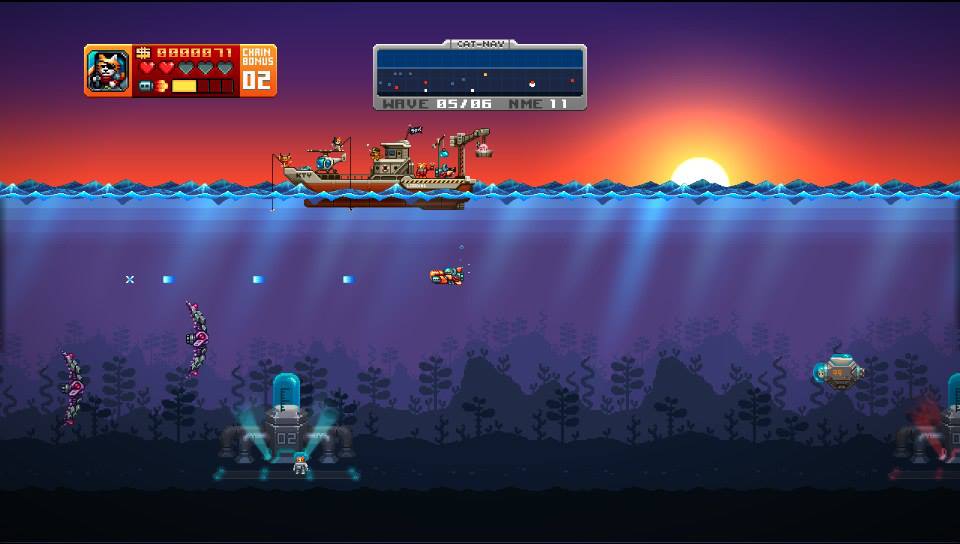
Despite being a bit on the bare-bones side, Aqua Kitty is really well produced. I played both the XBLIG and PlayStation Mobile versions. I prefer the XBLIG port, which plays faster. The Vita version has the advantage of being mobile, but it seems clunkier in both framerate and controls. Don’t get me wrong: it’s still a pretty good game. But I would go with the XBLIG port.
It’s not perfect by any stretch. What really bugs me about Aqua Kitty is the total lack of ambition. Defender is an old formula in need of renovation. Aqua Kitty does some things to smooth that over, but it’s just not enough. Turbo shots? Good idea. But only have one type of turbo shot? Not so ambitious. Power-ups? Good idea. But having only three power-ups, one of which is a bomb, one of which is a health-up, and one of which adds flankers to your ship? Not so ambitious. Plus, the flankers are time-limited. This was presumably done to preserve the difficulty. Given that the screen gets utterly spammed with enemies and projectiles in later levels, this was unnecessary, as those guys really aren’t that effective at combating it. So where’s the wild, more modern weapons and items? Nowhere to be found, and that’s a shame.
The PlayStation Mobile version. Which, as it turns out, I could have got for free a few weeks ago but I mistook it for another, less epilepsy-friendly title. Instead, I ended up paying more for this version than I did for the superior XBLIG port. Smooth, Cathy.
Don’t let that all discourage you. Aqua Kitty is probably the best pure Defender clone in years and a genuinely good game. Near-perfect difficulty curve. Distinctive enemies. Cutesy themes. Solid play-control. What’s not to love here? I’m not sure why the inferior PlayStation Mobile is priced $0.50 higher than the XBLIG version. Some kind of temporary insanity brought on by the awesomeness of a pipe-smoking kitten perhaps. Happens to the best of us. I saw the pipe-smoking kitten and totally blacked out. The next thing I know, I’ve got a tattoo and I attempted to marry my Wii U.
240 Microsoft Points (XBLIG) and $3.49 (PlayStation Mobile) were unaware of the existence of a Defender song until some bastard sent it to me. It shall never leave my head now in the making of this review.
Both versions of Aqua Kitty are Chick-Approved, and the XBLIG version is ranked on the Indie Gamer Chick Leaderboard. Even the developers admitted to me that they prefer the XBLIG port. Go with that one.
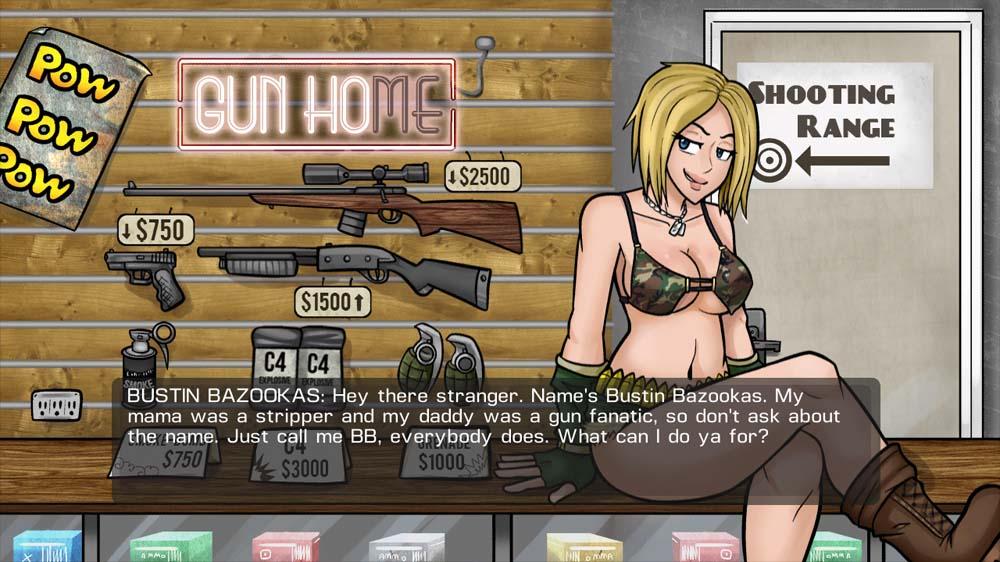
Boob games. They’re all over Xbox. They make more money than most of the top-ranked games on my Leaderboard do. Other XBLIG developers hate them. I’m tolerate of them, and sometimes even award them my Seal of Approval. All I want to do is be entertained, which isn’t as hard as people think. Take the Trailer Park King series. The three main releases (Trailer Park King 1, 2, and 3) all made the Leaderboard. The first spin-off, Cherry Poke Prison, did not. In part, because of burnout on the, ahem, humor, which is exactly what hurt Trailer Park King 3 as well. DERP of Duty is the second spin-off, and now I’m so burned out that I need a fucking skin-graft.
Ha, BB! That’s a gun too! Brilliant! And the place has Bazookas in the name! That’s a euphemism for tits! I haven’t seen this many plays on words since I last played Scrabble!
DERP of Duty was developed by Freelance Games (80 Microsoft Points still think Trailer Park King is begging to be made into an animated series in the making of this review)
I want to say something in defense of Sean Doherty, the developer of the TPK games: he’s a genuinely cool dude. He was the first developer I ever talked directly with as Indie Gamer Chick. I also think he’s probably as burned out on this series as well. DERP of Duty feels like it’s trying too hard. As cringe-inducing and skin-crawly as the dialog could be in the early TPK games, at least it felt somewhat organic. Maybe Sean felt the need to top those efforts with even more shocking banter, but this time it feels hollow. Without a compelling narrative, the overly-simple pointing and clicking simply can’t carry the game. I think even the most staunch fans of Trailer Park King will be letdown by DERP of Duty. It’s time to retire this series. Sean has established he has the talent to make, ahem, interesting characters and accompanying mythology. Now, I want to see him apply all this towards a more involved game.
And I don’t mean more involved as in getting guys to spank their monkeys harder than they already do. XBLIG has enough games that do that, as seen in this collage by Mount Your Friends developer Daniel Steger. Which I’m sure he compiled for market research and not as part of his newest cardio-vascular workout routine.
But, the real question is: how well do they sell? Really, boobs seems like no more a sure bet than recent Minecraft clones do. Judging by the success of Mount Your Friends, it would seem there’s an emerging market for penis-themed games that you guys are missing out on. So stop being boobs and start dicking around.
And while I’m on the subject of boob games, Team Shuriken is back. The guys behind such classics as Temple of Dogolrak and Mystic Forest return with a game that has, gasp, actual gameplay! I know they’ve tried that in the past with Dream Divers, but I still thought the gameplay felt sloppy in execution. Here, Team Shuriken took no risks. Uncraft Me ! is a bare-bones punisher with the hook being instead of just jumping, you use a jetpack to thrust around. And this is Team Shuriken we’re talking about, so beating levels means unlocking risque anime girls with breasts so large I believe they’re medically considered cancerous.
It’s also their first game to win my Seal of Approval and get ranked on the Leaderboard.
Yea.
Pretty sure this was spoken of in Revelations.
Or maybe it’s not a jetpack and the main guysis hovering around using highly-pressurized urine. Which I’m sure is another fetish but I’m too cowardly to Google it.
Look, all I’ve ever cared about is being entertained. If a game is 50.000001% entertaining and 49.999999% shit, it wins my seal of approval. On balance, I had more fun with Uncraft Me ! than not, so it gets it. Sometimes the levels have clever design. Other times they go for precision-platforming involving, simultaneously mind you: buzz saws, missiles, and timed-barriers that stay closed permanently if you’re not fast enough. There’s no margin of error for these sections, and the controls aren’t exactly perfect enough to validate their existence. I had Uncraft Me penciled in as yet another Team Shuriken failure when I played it last week. As often is the case when I dislike a game by a razor-thin margin, I boot it up one last time just to make sure. And, what do you know, I was able to finish the nearly-impossible stages. Barely. My amigo from TheXBLIG.com Tim didn’t like it it, but I thought overall it was Shuriken’s first decent game. Not spectacular, mind you. I could probably name thirty better platformers for XBLIG off the top of my head. But your money isn’t totally wasted here, nor is Team Shuriken’s talent.
Uncraft Mewas developed by Team Shuriken (80 Microsoft Points recommend these girls get a mammogram ASAP in the making of this review)
I guess that’s the most gratifying part. Yes, they have talent. Not just talent to lure in the horny teenage demographic. Actual game design talent. They’re like Larry Flint. Peel away the filthy exterior that makes you feel like you need a shower and you discover something downright decent in them. Do I expect them to focus on gameplay instead of mammary glands? No. Then again, I don’t expect to get struck by lightning while holding the holy grail in one hand and a winning lottery ticket in the other.
People are always asking me what I think of certain indie games that existed before I started Indie Gamer Chick. The two most commonly asked about titles are Fez and Limbo. I couldn’t finish Fez because of my epilepsy, so Limbo is the only one I’m really qualified to speak of. (UPDATE: I did end up reviewing it!) But seriously, it’s like a daily thing. “What did you think of Limbo?” As if Limbo is the be-all, end-all of console-based indies.
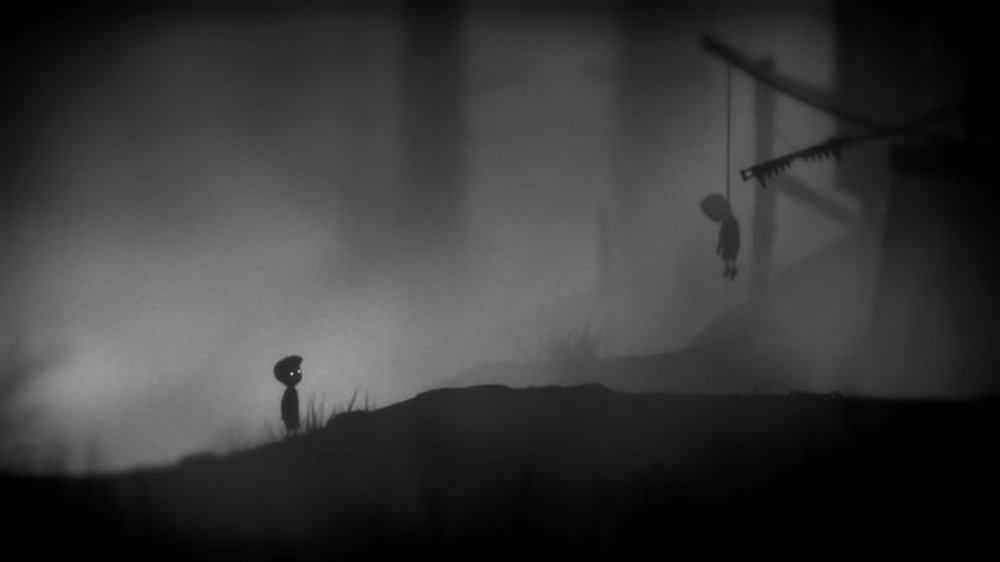
I liked Limbo. I really did. I also feel the game is fairly overrated. When you strip out of the visuals and bleakness, it’s just a good, but not great, platformer. A trend I’ve noticed is that a lot of people only played through the early part of the game. When you first enter Limbo, you can be left shell-shocked by the dark tone, spooky visuals, and the fact that one of the first things that happens is an awesome, intense encounter with a giant spider. It perhaps gives the false impression that all those emotions will retain their impact through-out the game. They don’t. At least for me, I found myself desensitized to the whole concept not even half-way in. Once Limbo started focusing more on twitchy-platforming instead of physics-based puzzles, I started finding myself almost bored. It never fully becomes a chore, but once it starts becoming a platforming cliché, it does sort of burn out.
I filled in the blanks by pretending that the game starred Schroeder from The Peanuts. Here he is, learning of Charlie Brown’s final fate.
Also, it was hard to get worked up about the setting when the game was using the all-deflecting “it’s an art game” shield, which pretty much guaranteed an ending “left open to interpretation.” Never been a fan of that. Especially when the game was abstract to begin with. So I guess the idea is the kid, or kids, are dead. How they died or when or where or why is never explained. Theories range from a car wreck to falling out of the tree house to being murdered. I guess from a marketing point of view, it works, because at least people are talking about the game. But I found the ending unsatisfying, because it offered no closure at all. When you invest hours into a game hoping to get some kind of explanation for all the fucked up happenings and the payoff is more questions, it almost feels like the director himself didn’t really know where to go with it. I’ll call this the “Tim Burton’s Planet of the Apes Effect.”
Yea, sometimes the questions are more fun than the answers, but in the case of Limbo, you’re playing characters that have no characterization at all. The boy has no back story, no dialog, no personality, no facial expressions, or anything else going for him. The girl is no different. You’re forced to fill in the blanks yourself, but most of the symbolism is in the background and can be easily missed on account of you playing the game. Because the actual gameplay starts to dull towards the end, Limbo really doesn’t lend itself well to replaying to look for the clues that you missed.
Limbo’s ending. I apologize for comparing it to Burton’s Planet of the Apes. That’s a low-blow.
I don’t mean to be too negative here. Sometimes Limbo is brilliantly designed from a gameplay perspective. The bits with the spider early on are one of my all-time gaming highlights. Unfortunately, Limbo pretty much shot its wad in the first twenty minutes. Nothing that followed the sequence where you’re hopping in the spider’s cocoon came remotely close to the thrills and chills that section offered. All that’s left is solid physics-based platforming that I almost wish was in a more cheerful setting, because too much dark shit can get exhausting. But hey, dark is in right now. Any product that aims to be joyful is setting itself up for failure. If an indie game isn’t so bleak that you want to bury your face in your hands and cry, the developer must be mentally ill. Or possibly not mentally ill enough.
1200 Microsoft Points honest to God can’t believe they just ported this thing to iOS. There is no fucking way this can be played well with fake virtual buttons in the making of this review.
So I’m making the transition from an XBLIG-centered site to more sweeping coverage of indies across all platforms. It’s kind of scary. I’ve spent two years focusing on this little unsung platform that is Xbox Live Indie Games. But I’m not the only one braving new waters. Hundreds of Xbox Live Indie Game developers are exploring new development formats such as Unity or Monogame, with the intent of going multi-platform. With both Sony and Nintendo aggressively courting indies, not to mention upstart Ouya and the existing (and thriving) PC indie community, there’s no shortage of places to go. Well, so far Microsoft hasn’t said anything. My theory is they’re in a medically-induced coma after sustaining life-threatening whiplash following the quick and reckless 180 they pulled. Again, just a theory. But if you see any Xbox guys wearing neck braces, just nod knowingly.
Anyway, with this move I’m making, which has me a little on the jittery side, I was curious how the development community that has supported me for the last two years is handling the transition. What plans they have for the future, and what lessons they’ve learned from Xbox Live Indie Games that they’ll be applying to the future. Here’s what they had to say.
I’ve always hated using the cop-out “it’s just not for me” in relation to anything. It just seems so non-committal. And yet, after putting a few hours into Hotline Miami and simply not getting what everyone else is raving about, I feel “it’s just not for me” is the only answer I can give, because it really isn’t for me.
And that has nothing to do with the violence. I like violence. I’m proud that I live in a time where the violence on television is so awesome that it makes even the most grizzled of war veterans become physically ill. People are talking about the violence in Hotline Miami like we’ve reached the zenith of virtual murders. Where have you people been the last few years? There’s shit in the latest Mortal Kombat that would make even the most fetishistic psychopath go limp with shame. Hell, I’ve played a game that gives you an achievement for tying a nun to railroad tracks and letting her get hit by a train. And I loved it. Sorry Hotline Miami, but your eight-bit violence is just not cutting it with me.
The typical after-party at the MTV Music Video Awards.
I think the raving is based mostly on the novelty factor. Violence was never this masterful when games looked like this. With modern indie gaming, we can take all the theatrical bloodshed we’ve accumulated from years of premium cable shows and modern M rated titles and apply it to games that seem like they could have existed in the 80s. So the thrill comes from “hey, it’s an old game but it’s really gory. Neat!” But it’s not an old game. I’m not saying Hotline Miami isn’t extraordinarily fucked up. It is. What I’m saying is, shouldn’t everyone over the age of twenty be desensitized to this type of shit by now?
What turned me off most about Hotline Miami was the difficulty. I just could not make any progress, often repeating stages several dozen times to no avail. Hypothetically, the game is a bit of a puzzler, a bit of a brawler, a bit of a shooter, and a bit of a stealthy dungeon crawler type of thing. It’s a cavalcade of ideas and it doesn’t always blend together smoothly. This also helps mute the violence that is, let’s face it, the chief selling point of the game. For example, the scalding water thing. Everyone had been telling me about the water thing for the last year. Grab a pot of boiling water off a stove and throw it on some dude. Pretty brutal, right? But the act of throwing boiling water loses its sting when you have to repeat that upwards of fifty times because of any number of reasons, such as having one of the enemies randomly move off its preset path and blow you away. Or having enemies that can turn and fire on you faster than you can react. Or clearing out a room only to miss one dude who gets up and casually blows you away with a shotgun.
My guess is Hotline Miami would have played better if I could have played it with a mouse and keyboard. Using the PS3 controller was an exercise in frustration. Locking on to an enemy requires lining up a cursor somewhere near them. Of course, sometimes enemies bunch together, so trying to line up exactly the right is tough. The game probably needed something along the lines of Metroid Prime’s lock-on system that generally lined up the closest person to you. Not that it would have mattered. The AI is a crack shot every time from seemingly all distances, and it can process information faster than you. Thus the moment one centimeter of your body is exposed, you’re dead. The puzzle aspect doesn’t really work right because the AI can be so brutally unfair but also prone to fits of randomness where guys break off their preset paths. Or sometimes they just wouldn’t play along at all. I would play rounds where I would fire a shotgun through a door and set off every single dude in the place to come and murder me. At other times I could fire from the exact same location, killing the exact same guy, and have nobody react to it. There was no consistency from one life to the next.
As a full disclosure type of deal, I had to play Hotline Miami in shorter play sessions (about 30 to 45 minutes at a time) due to epilepsy concerns. But I was never bummed when it was time for a break. The repetition can be exhausting.
I will say this: if you absolutely do not want to play the PC version and you have Vita as an option, go with it. It’s a trend I’ve noticed with these cross-platform PS3/Vita releases. The Vita version always has superior control. For Miami, movement isn’t as loose, aiming is more efficient because targeting is handled via the touch screen, and scrolling is done by dragging your finger around. By comparison, the PS3 port is clunky, cumbersome, and imprecise. As if the too smart, too quick, too accurate AI isn’t enough of a problem, you have to deal with controls that never feel intuitive or smooth.
I can’t really explain how I could enjoy a game like Spelunky and not enjoy Hotline Miami. Both had control issues. Both are based around frequent dying, trial-and-error gameplay and unfair design. I wish I could explain it. It would probably save me a lot of grief that I’m already getting from fans of this game. I can’t even say I hate the game. Maybe it’s been the year of crushing hype that everyone has been showering me with. People talked about Hotline Miami like it was the second coming of Grand Theft Auto. But I don’t think it’s that. I really don’t think this game is as good as everyone is saying. What it does do is meet the three rules for an indie game to get critical acclaim no matter how flawed or broken it is. They are:
1. Have retro graphics. Because if you hate a game with retro graphics, you’re pissing on gaming’s heritage and thus your opinion is invalidated. Even if you’re talking about a brand new game released this year (or the port of a PC game released last year).
2. Be insanely, unfairly, unreasonably difficult. Because if you hate a game that’s all of those, you’re just a low-skill gamer whose opinion is invalidated by the sheer force of your sucking. Or you’re too young to remember a period when all games were this hard (there’s no such thing) and thus your opinion is invalidated because you’re a whippersnapper used to be coddled by games that hold your hand from start to finish.
3. Be gratuitously violent and shocking in ways so brazen that if you were to describe them to a psychiatrist out of context, you would be committed. Disliking games like this means you’re a prude at best, and an anti-gaming sissy in league with the Jack Thompsons of the world at worst. Clearly someone whose opinion isn’t valid.
Me? I’m a neo-retro loving, violence embracing gamer. Okay, fine, I’ve never understood the whole “be as insanely difficult as possible” thing that some people thrive on, but I can put up with it if I’m having fun. I didn’t have fun with Hotline Miami. Not just for the controls or the unfair AI. I just didn’t like it. It was boring to me. Almost everyone else seems to like it. Which is fine, because the groundwork for something spectacular is laid here. I just couldn’t get into it. So I’ll chalk this one up to “it’s not for me” and move on. By the way, Brian is noting right now that I’ve used the “it’s not for me” excuse to avoid watching F1 with him, so I can’t claim this is my first use of it. Fine. I’ll you what Brian: when drivers start throwing scalding water on each-other and are allowed to use firearms during the race, get back to me.
$9.99 admits that I didn’t make it very far, but not for a lack of trying. Having said that, I spent five hours failing again and again, so I feel I have enough room to talk about this game in the making of this review.
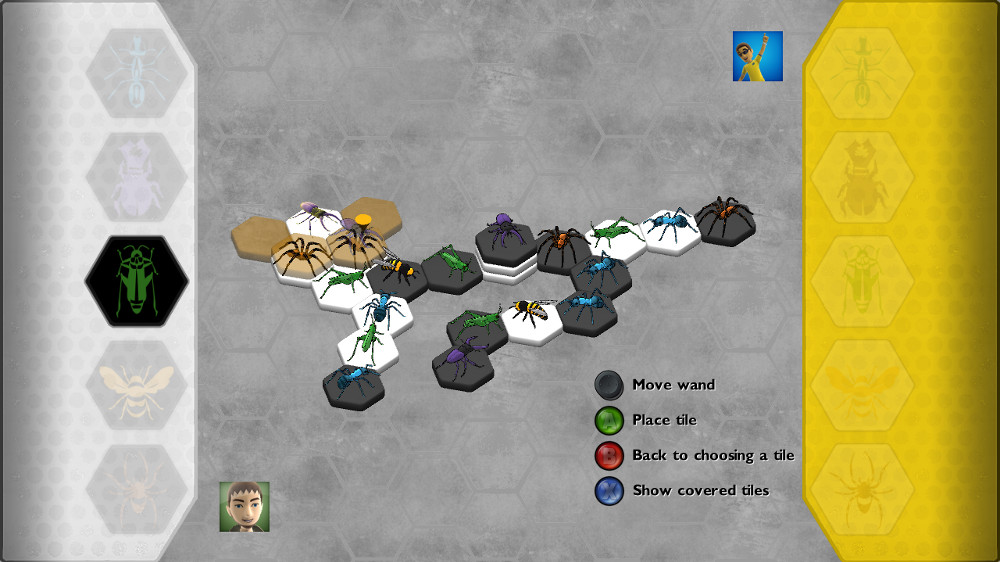
After Indie Gamer Chick said that our game, Hive, was the best game since Tetris (okay, I’m seriously over-exaggerating heavily paraphrasing here), she brought up that there seem to be a decent number of game developers starting out by making video versions of board games.
It was no accident that I chose to start with our first major offering being a board game. There are quite a few advantages of starting your game company with board games, and today I’m going to share some of them because it’s IGC’s anniversary and I’m an Indie Game Developer so I’m too cheap/skinflint to buy her team a real gift.
Faster to Market
Probably the single biggest obstacle that I’ve seen keeping people out of the game industry is that they can’t finish their game. We all love games and tend to have big visions (eyes) and finite amounts of time (stomaches). So it’s really a race to finish a game before we lose motivation or come up with a more distracting idea to pull us away.
Acknowledging this tendency, we should set ourselves up for success by choosing projects where the total amount of work is smaller. Starting with an existing engine (eg: Unity) or releasing a very simple game are good strategies. Similarly, you can cut down the scope of your game drastically by choosing something – such as board games – where thousands of hours of playtesting have already been done on the concept.
Many people forget to bake this into their time-estimates for the game, but the playtesting needed to make a game actually fun and with high replayability, is far trivial. For some examples, I was playing a paper-prototype of Chess: The Gathering around a year ago and I think Tim has been playing it every time I’ve seen him since then. It was a little awkward that one time during yoga class, but let’s just all be thankful that using Warrior Pose to summon pieces didn’t make it in the game. Similarly, I played Cannon Brawl about a year ago and the gameplay was what many would call “done”, but Pete and his testers kept at that thing and now there’s awesome new units that are like magic missiles and ba-bombs!
We certainly had to do a bunch of playtesting of our interface for Hive, but the literally-thousands of games of gameplay playtesting by John Yianni (the developer of the Hive board game), made it so that we could spend a decent chunk of time polishing visuals and AI while still being able to complete the game before we died of old age, went broke, gave up, etc..
Market Recognition
Additionally, when you’re starting out nobody knows/cares who you are. If you start with a board game, all of its fans already know what your game is about! On our very first blog post where we announced Hive, we almost immediately had a commenter (who was a complete stranger as far as I know) telling us that they were looking forward to it! That kind of instant fanbase doesn’t happen on its own.
This is probably the point where someone digs up that quote from one of the Team Meat guys that goes something like ‘if you have a good game, the internet will make sure everyone finds it’. Those meaty fellows are wrong. They make great games and I love them to itty bitty pieces, but they built up a following from about a decade of games prior to Super Meat Boy and even had a specific MB following from their flash game “Meat Boy”. If they didn’t have their presence built up, SMB would not have sold as well. This buildup is the same for many of the indies that we think of as overnight successes: Behemoth cranked on several Alien Hominid releases before the (mainstream) world learned their name from Castle Crashers, Rovio released around 35 games before they ‘launched’ (ba-dum-cha) Angry Birds, and Notch (Minecraft) has been making games since the mid-80s.
Are you still not convinced? Wow, you’re stubborn. Allow me to predict the future! Ian Stocker made Escape Goat which Indie Gamer Chick reviewed as the best XBLIG of all time (no joke) and currently reigns #1 as the king-goat of the Leaderboard. He’s also released Soul Caster I & II and is finishing up Escape Goat 2 with Waking Mars artist Randy O’Connor, at the time of this writing. My prediction: even though EG1 was critically acclaimed, the reputation-snowball is going to make EG2 sell more than twice as much as EG1. I’m so confident that if it doesn’t, I’ll give out all of my remaining free-codes to Coagulate on a first-come-first-serve basis.
Now that I’ve beaten this dead-horse back into stardust… we all agree that your sales suck until people know you. Here’s where boardgames come in: board game fans will buy your game without knowing who you are. Now, you won’t get all “board game fans” but fans of Hive didn’t need to hear of BlueLine Games before they bought our first game. After 100 repetitions of our splash-screen, now they’re fully borgified and will probably buy our next title, Khet 2.0, even if they haven’t played that specific board game.
Attainable IP
Other than the very mainstream board games whose rights have been bought up by Mattel and Hasbro, many board games creators are still willing to deal with indie developers. The board game industry itself is parallel to the video game industry in many ways and most of their developers are “indies”. One of the larger challenges in working with these developers is that most of them aren’t going to want to put an up-front financial investment in. You’ll have to be prepared to eat through your savings just to take the gamble at releasing another game to market that may or may not be successful. That’s just part of the job though.
In addition to indie IP, there are a ton of games that don’t even require a license. For example, BoardGameGeek lists of over 600 public domain board games. These come with their own challenges too, of course; every platform seems to have 3 versions of Chess, Checkers and Go within a week of launch.
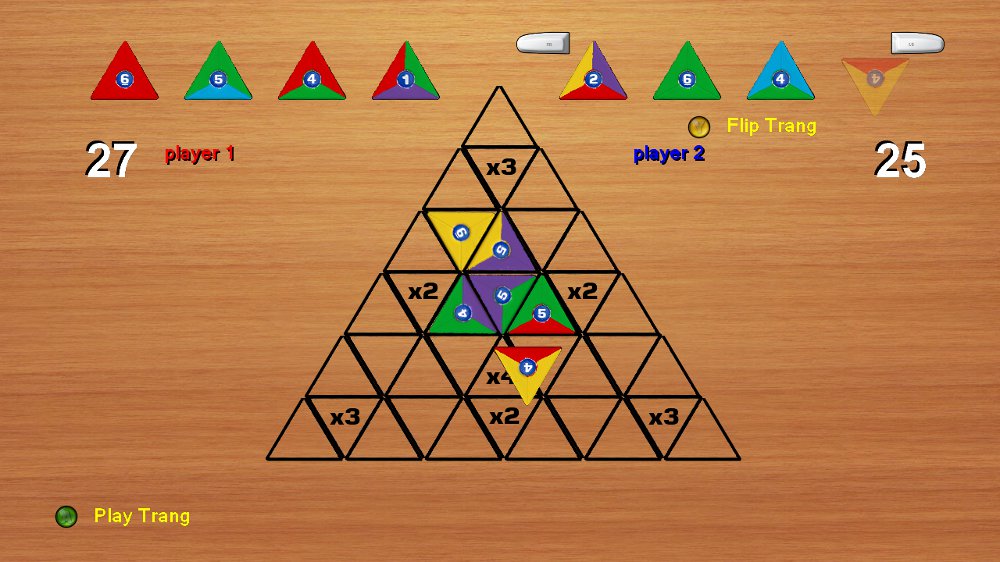
Spectrangle360 was another Chick-Approved board game based on an existing property.
Reusable Code
Board games have a lot of re-usable concepts in them. Players, pieces, boards, plies, AI based on Minimax, etc.. If you do it right, you can make your second game far more quickly than your first. We had hoped we could make our second game in half the time of the first. So far, it looks like Khet 2.0 will take one-quarter of the dev-time that Hive took.
One huge caveat here is that making reusable code is a huge difference from writing a general-purpose board-game engine. If you want to start your project by making the most universal, extensible board game engine in the world, then you’re almost certainly never going to finish your project (see the first section of this post!). However, as you create things you need, it’s fairly easy to plan ahead and make sure that anything general you’re writing (such as Minimax AI), is made in a reusable way.
Now, Step Off!
If you’re looking to make a game to break into the industry, board games can be a great way to start! However, if you try to knock off Hive or Khet, I may have to go all Dr. Karate on you!
But seriously, have fun making games and whatever game you decide to make – best of luck finishing it!
– Sean Colombo
If you like board games or indie game development, please follow our twitter @BlueLineGames, or our Facebook page to see behind the scenes!
A couple of months ago I reviewed a game for iPhone called Year Walk, and stated my opinion that I don’t think horror can be done properly on a platform like iPhone. Well, a few days ago, a fairly popular PC indie made the jump over to iOS, and it happens to be a horror game. People were telling me “even if I think you were wrong about Year Walk, you have got to try this. It really is scary.”
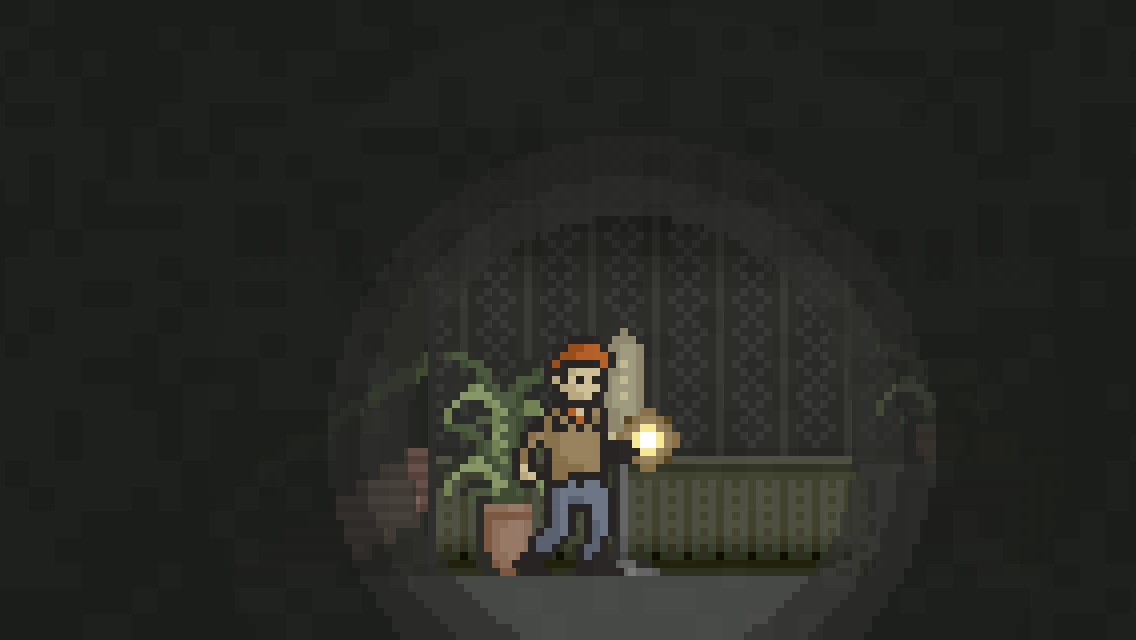
No. Home isn’t really scary. It’s creepy. It does creepy well, but I feel there’s a difference between that and scary. The basic idea is you play as Conan O’Brien (that’s who it looks like, and until someone says otherwise, I’m pretending it’s him) who wakes up with no memory of how he got to where he is. His leg is injured and he has no idea how it got that way. Oh, and there’s at least one dead body nearby. I don’t know why he’s so fussy over it. It’s basically how every Sunday morning begins for me.
Other candidates besides Conan O’Brien: Ron Howard pre-baldness, my boyfriend (though I’ve never seen him wear a sweater in my life), or Andy from Toy Story.
All of this is told through a pixel-art point-and-click adventure. If it sounds interesting, you’re right, it is. The problem with Home is that it’s one of those fireworks where you light the fuse and nothing happens. It took me all of five minutes to guess what the big plot twist would be. Was I right? I don’t know. The solution to what happened I guess changes depending on how many clues you find throughout the hour-long play-through. At the end of my session, the game saw fit to give me no ending at all. It didn’t crash or anything. It just ended with no resolution. Conan walked to the final door, some text pondering the nature of what just happened popped up, and then BAM, credits. The fuck?
All choices you can make happen in the form of questions. Like if you find a knife, the game will ask you what happened in a past tense form. “Did you pick up the Knife? Yes/No.” Here’s the weird part. Near the end of the game, I was asked if I thought one of the other characters in the game was the murderer. I said no, because all the clues from the get-go said otherwise. But now I’m mildly curious whether that would have become the solution if I had said yes. Not so curious that I’ll play through it again. Once was enough.
The thing is, there’s no actual game here. You walk, you click stuff, and stuff happens. There’s no real puzzles to solve besides typical lock-and-key stuff. At most, you might have to hit a switch. So while the graphics are pretty good, the atmosphere hits the mark, and even the dialog is well done, Home is actually kind of boring. Mechanically speaking, at least. It tells a story well, but it’s not a game in the strictest sense. It’s a visual novel where paragraph breaks come in the form of having to walk around trying to figure out where to go next. It does very little to take advantage of the medium, and that’s a shame. Unlike a lot of misfires I deal with here, I can’t chalk this up to poor writing or over ambition. It’s just a dull game.
I took this picture at the worst possible time.
One last thought on the whole “multiple ending” thing which I’ve never been a big fan of. Here’s why I’m against it: because I don’t know if I’m going to end up with the same ending if I play through again. I played once and the end result was NO ending. I felt I played pretty well the first time. I clicked everything. I backtracked occasionally to place items where they belonged. What the fuck more do I need to do, Home? Well whose to say if I do things differently that I won’t fall into that one and only trap that sets off the exact same ending I just got? If a game is going to base itself around having multiple endings, it needs to set up a way to take advantage of that besides “replay the whole thing again.” Especially stuff like point and click adventures, which just don’t lend themselves to multiple play-throughs. My usual way around this is to simply look up the other endings online, but as it turns out, a game called “Home” isn’t the most Google-friendly title.
I was a bit on the fence about this one. On one hand, I think the game successfully achieved its goal of having a well written story with genuine suspense and chills. On the other hand, the gameplay is boring and the hook requires multiple play-throughs, which will certainly mute those chills and shrink the suspense. I’ve spent more time trying to figure out if I liked Home than I spent actually playing Home. For that reason, I can’t recommend it. The deciding factor was if I had a magic “undo” button that would give me the hour I spent playing it back, would I do it? I can quickly answer that: yes, because the ending sucked. Results will vary by player, but for me, I felt borderline cheated by the ending I got. It literally had no closure at all. Every single question left unanswered. That’s just plain stupid. If the power had gone out while I was watching the series finale of Lost, I probably wouldn’t have called that a brilliant ending. Though in retrospect, that would have been an upgrade.
$2.99 admits that I hate replaying games anyway and thus the odds of me playing through Home again was probably slim to begin with in the making of this review.
Do you know what the very toughest thing I have to do as Indie Gamer Chick is? Find people to play XBLIGs with or against. It’s my fault. My friends.. well Brian’s friends actually.. have had to deal with nearly two years of complaining. They have bad timing. They never bump into me when I’m playing really awesome games. Oh no, they run into me when I’m playing stuff that would better be used during enhanced interrogation. So when the time comes to say “hey guys, I have a shiny new XBLIG party game” they all seem to have better stuff to do. Wash the car. Run a marathon. Return over-due library books. It’s total bullshit of course. None of my friends read books.
But, sometimes I can wrangle them together. The results aren’t always pretty, but every once in a while a game provides us with a level of entertainment that we can’t get from a movie or, quite frankly, some mainstream games. Take Chompy Chomp Chomp. It was a smash hit last year during a Memorial Day party, and since then, has been on the top ten in my leaderboard. But it wasn’t without issue. The game could spawn players unfairly, and some of the maps were poorly conceived. It’s been a year since I last sat down with it. I know the game got patched, but I never got around to trying it again. Well, on Sunday I had the chance. And guess what? Chompy Chomp Chomp is better than ever. It is, unquestionably, the best party game on Xbox 360, indie or otherwise.
Pictured: absolute multiplayer bliss.
First off, go check out my original review. Nothing has changed with the core gameplay. What’s different is nearly every complaint has been fixed. For starters, spawns are significantly more fair. Before, it wasn’t rare for you to spawn too close to someone that’s designated to eat you. In a couple hours of playtime, that never once happened. Nor did the game ever spawn me or anyone else playing into a live trap. That alone makes Chompy Chomp Chomp so much more fun to play. In our previous play sessions, fits of laughter and general happy chatter would occasionally be interrupted by the random scream of “that’s bullshit!” when the game would screw you with a shitty spawn. Now, it’s all happiness all the time. The only other way that could have been accomplished was with laughing gas, but that wouldn’t have been cost efficient. Fixing it was much easier.
Chompy Chomp Chomp was developed by Utopian World of Sandwiches (80 Microsoft Points admit that the Xbox 360 hasn’t exactly been the best platform for party games, but regardless, this is still the best on it in the making of this review.)
Yea, there’s still some really horrible levels where you can get cornered with no hope of escape. The guys at Utopian World of Sandwiches insist that there are people who swear those are the best stages. They’re not. They’re unfair and stupid. Thankfully, they made up for their continued existence by throwing in more stages. These new levels, based on classic gaming themes, are fricking awesome. Finally, some of the dumber traps, such as gaseous time bombs that drain your score away, can outright be turned off. Previously, turning off items was an all or nothing type of deal. Now, you can select which ones you want to use. That’s perfect. The online play was totally hiccup-free as well. I can’t stress how amazing this game is. You simply have to play it, whether you do it locally or online. Make sure you’re playing with real players though. The AI goes from being too easy to too hard. When I was playing with my buddies, it was probably the single best multiplayer experience I’ve had since I’ve known them all. Chompy Chomp Chomp is Fuckity Fuck Fuck excellent.
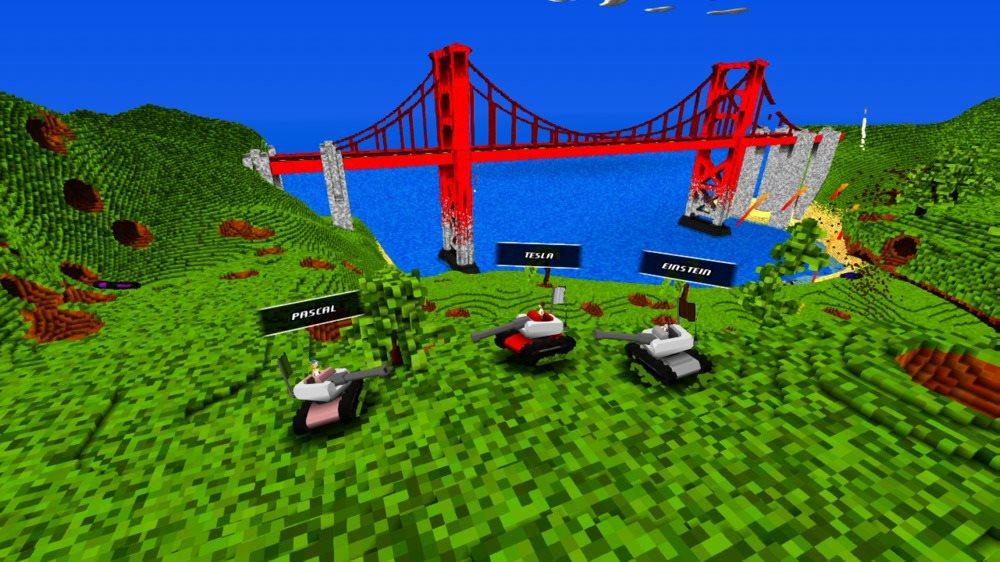
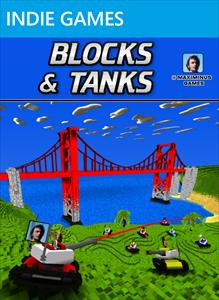
But, if the whole “no shooting, cutesy characters” stuff is an affront to your heterosexuality (seriously, at least one moron on Twitter said of Chompy Chomp Chomp that it “looked like gay children’s shit”. How this guy is an expert in gay children’s shit is beyond me), you can try Blocks and Tanks instead. In a way, it’s getting a bad shake here, because I’m comparing it directly to Chompy Chomp Chomp. Both are simple party games for XBLIG with online play. But while Chompy’s gameplay reminds me of old school arcade games, Blocks is more like a Nintendo 64 era arena-shooter. Not a whole lot to it. Aim and shoot, one shot kills (with the cannon), most kills wins. The fact that it revels in its simplicity is part of the charm. It’s a shooter stripped down to its purest, most refined fun.
Of course, Blocks and Tanks is also a voxel game. When I announced that this game was on deck and next to be reviewed, people immediately dismissed it as yet another Minecraft clone. It’s not. But, the voxel angle is a neat one, as the environments are destructible and it opens some pretty neat strategies. In addition to the tank shells and machine gun, you can shoot blocks from your turret, which immediately cling to the environment and change colors to fit that. In a way, this crippled one versus one multiplayer, as whoever was able to get the first kill could immediately burrow a hole and fill it in to remain hidden until time ran out. Of course, only a total coward would do that.
Don’t shake your head at me, Brian. You’re only mad because you didn’t think of it first.
Pictured: the developers of games I was less than kind to waiting for my car to get within range. It’s a Honda Fit! Do your worst!
Blocks and Tanks is a lot of fun and does a lot right. The controls are very responsive. There is a bit of a learning curve to aiming, but once you get over it, it does the trick. It also has some very well designed arenas, many of which take after famous locations. It handles eight players online. I was never once able to get into an eight player game, but when I had six players going, it was super fast-paced and very enjoyable. But, the game has more problems than an algebra book.
We’ll start with the spawns. They’re among the most unfair I’ve ever seen. Sometimes the game will respawn you right in front of someone else. You’ll literally die immediately upon respawning. More often than not, you’ll be put back to life in the thick of a battle. There’s no rhyme or reason to it. The game needs to place you away from the action. Movement speed is decent, and maps are not that big, so there’s no reason to have to drop people in the middle of a firefight. It gives the game an unpolished feel.
But the biggest problem, as of this writing, is online stability. The developer is aware of the issues and asked me to go forward with this review, as long as I note that he will continue to improve the game. Duly noted. Over the course of seven play sessions and about three hours of total play, I experienced a magnitude of connectivity problems. Players would be dumped at random. Brian got a rare “code 3” error on his Xbox, while mine simply froze solid. Again, the developers are on top of it, and the current build is easily the most stable yet. The first time I played, we had problems with synchronization, where shots would register as a hit and a kill on my end, but on my opponent’s side of things, they would still be alive and actively fighting. This is no longer a problem. Actually, the weirdest problem is totally out of the hands of the developer. It’s the type of people playing. I kept finding myself in sessions where players were not trying to kill each other, but instead building stuff. When I would go in to attack, they would boot me out. Huh. I mean, sure. It’s not like there are different, more appropriate voxel-based games on XBLIG that cater to that type of gameplay.
We had a ton of fun on stages that had cliffs, trying to blow the ground out from underneath each-other. What would have been really neat is if the game had to rely on structural integrity and you could cause massive cave-ins. Hint hint Maximinus Games.
Blocks and Tanks was developed by Maximinus Games(*NOW DELISTED* 80 Microsoft Points wish the build-gun worked better on water in the making of this review. Yea, that’s not a joke, but I had to squeeze that in somewhere.)
Having said that, if you look around enough, you should be able to find a real game where people have the courtesy to kill each other like civilized people. It’s not as supported as, say, Shark Attack Deathmatch, but Blocks and Tanks does seem to have a growing community. There’s a reason for that. It’s quite good. I feel bad for the guys behind it, that it’s going to be ignored by a lot of people who feel it’s just another generic Minecraft clone. It’s almost unbelievable that such an art style can now be considered a handicap on XBLIG, but that’s what it is now. If Blocks and Tanks had come out three years ago, it would probably be one of the biggest sellers on the platform. Talk about bad timing. It’s a genuinely good game that is worth your time and money. Unless you want to use it to build stuff. It’s not made for that you block heads. Tanks for nothing.
Blocks and Tanks is Chick Approved and Ranked on the Indie Gamer Chick Leaderboard. Chompy Chomp Chomp already was, but hey, it moved up five spots!
Review copies were provided for both games by the developers. The copies played by Cathy were paid for by her with her own money. The review copies were given to a friend to test online play. That person had no feedback in this review. For more on this policy, consult the Indie Gamer Chick FAQ.
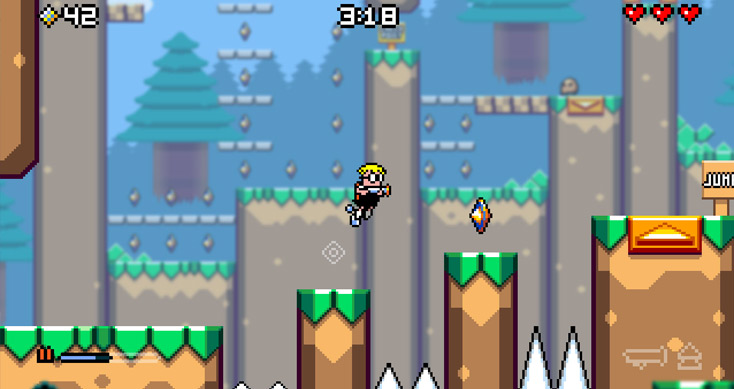
Warning: anyone born before 1987 will hate me for this review. That’s because Mutant Mudds Deluxe seems to bask in the rule that anything retro is good simply because it’s retro. I don’t subscribe to that theory myself. I happen to like neo-retro stuff. Look at my top ten. They’ll all cut from that same old-school cloth. But those games all have fun hooks and entertaining gameplay. Mutant Mudds looks the part. In fact, it’s one of the best looking games I’ve seen done in this style since starting this blog. I just wish the actual game matched its beautiful graphics. It doesn’t. It’s one of the dullest platformers I’ve come across.
Can’t stress this enough: Mutant Mudds looks like it will be really fun. But instead, it settled for “playable.”
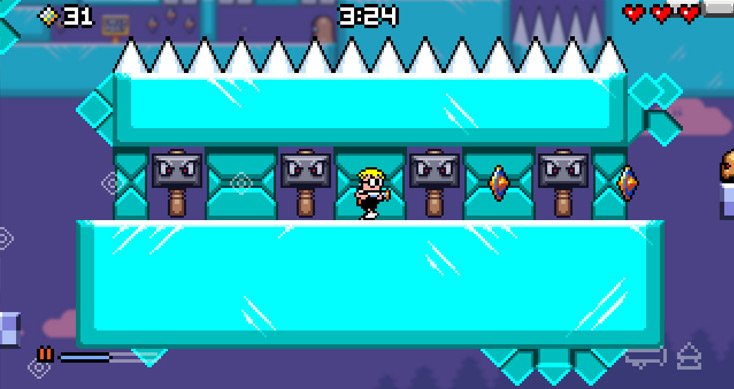
You’re a dude with a gun. There are coin-things to collect and enemies to shoot. Instead of a double-jump, you can float briefly. The big hook is the ability to bounce off specially marked springboards that send you into the foreground or background. Neat idea, but it seemed like something that would be better tailored for the Nintendo 3DS, which this is actually available for as well. Also, I tweeted that the idea seemed original, but apparently it was lifted from Virtual Boy Wario Land or so my readers say. I wouldn’t know. I was six years old when that piece of shit game machine was released and my parents wouldn’t even let me try the store’s kiosk out of fear for my eyeballs. And this is before I had epilepsy, mind you. But I’m going off topic.
Mutant Mudds mostly controls fine. Mostly. The only times I had problems were when the game over-used disappearing/reappearing platforms. I’ve never been a fan of those. The weird thing is, most retro gamers I know don’t seem to be either. They seem to be one of the prime reasons why Mega Man 2 is more beloved than the original. In Mutant Mudds, the jumping is a bit stiff when you don’t use the Princess Peach like floating, and thus the physics don’t lend themselves well to platforms that appear and disappear quickly. Using the floating doesn’t help much either, because it screws the timing up. Deactivating the floating requires another press of the button, but it forces you to get stabby with the controls. It wasn’t until a couple of hours in that I had collected enough coins to buy the extended floaty hover jump thing. This did almost completely solve my problems with the disappearing shit. But, by this point I had spent hours getting frustrated by them, because they’re way over-used. It’s never so bad that it reaches hair-ripping aggravation, but it does serve to slow things down and damper what is already a pretty snore-inducing experience.
Mutant Mudds seems to hit all the platforming clichés. There’s fire. There’s ice. There’s clouds. Actually, I never ran into an underwater level, so maybe the game didn’t quite hit a blackout on its platforming cliché bingo card.
When it comes to aesthetics, Mutant Mudd is nearly flawless. Beautiful graphics, era-appropriate sounds and music. It’s an extraordinarily well-produced game. But once you get into the things that make a game fun, it just comes up empty. Level design is very basic. Enemies are generic and fighting them is repetitive and boring. And that’s the prime fault of this game. It’s visually pleasing, but unambitious. Well produced, but safe and samey. I’ve played games like this before. I want to play something wild and new, but Mutant Mudds is content to stay firmly grounded in tradition. After finishing all the basic rooms and a couple of the “mirrored” levels that are more like punisher versions of the originals, I found out I couldn’t play on until I had found X amount of hidden trinkets and doors. Um, nah. I’m good. After a couple of hours, I hadn’t really had any fun at all. I was hopeful after seeing the dimensional hook, but I was still waiting for the game to do something cool and it never came. I’m guessing older gamers will be satisfied enough just because Mutant Mudds is a really great homage to generic “me-too” platformers from back in the day. For me, playing through this was no less tiresome than sitting through any average 80s movie or television series where I just can’t get how you children of the Reagan era could accept this as entertainment. Hey, don’t look at me like that, and don’t say my generation has no taste. We’re not the ones who made David Hasselhoff a star. That was you guys.
$9.99 suggests that if you must buy Mutant Mudds, you should probably get it for 3DS instead since it’s more suited for a 3D screen, plus it would have been nice to not be tethered to a TV for no reason while playing this in the making of this review.
 Monkey Poo Flinger was developed by Derf ‘N’ Derf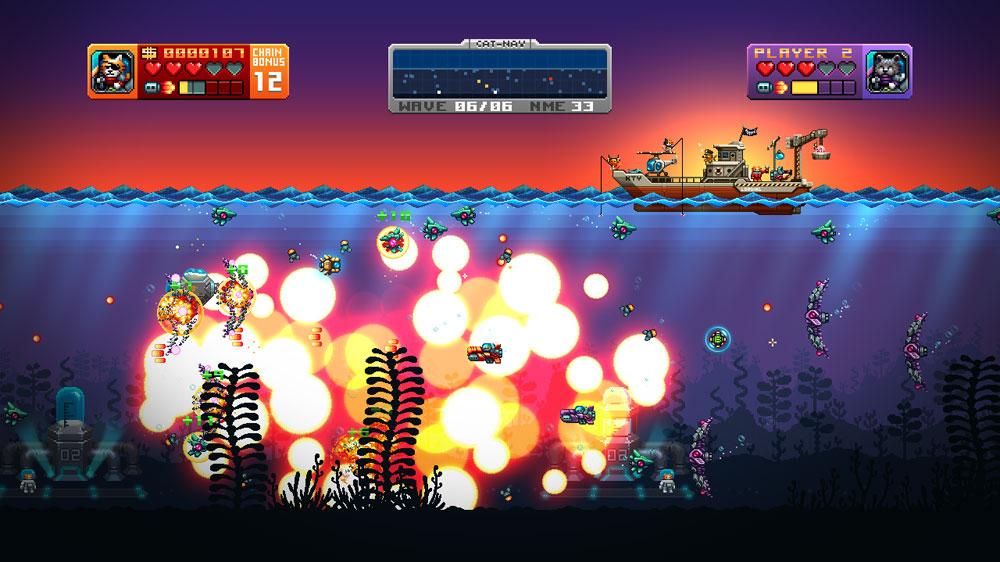



















 Indie Gamer Chick
You must be logged in to post a comment.