A Madman’s Guide To Happiness.

Trying to keep regular updates on my site can be a bit of a bitch at times.  Clearing 200+ reviews in under a year was probably not the best idea, because finding time to keep up that established pace can be trying.  I had to put a slight delay on my planned massacre of Sonic The Hedgehog 4, and here it is, 11:00PM and I still haven’t done a review today.  Thank Christ for Xbox Live Indie Games, where titles that can be beaten in five minutes or less are as abundant as McDonalds, although not nearly as healthy for you.

Well, it is Thursday, and thus it’s time for a Katch-Up.  I had been given a heads-up that A Madman’s Guide To Happiness was short, shitty, and insane enough for me to get a good review out of it.  Well, they got two out of the three right.  I wouldn’t go so far as to say it’s shitty.  That’s mostly because it doesn’t last long enough to leave any impression on me at all, really.  I hate to call any game I play a Mulligan, but Jesus, five minutes isn’t a lot to go on.

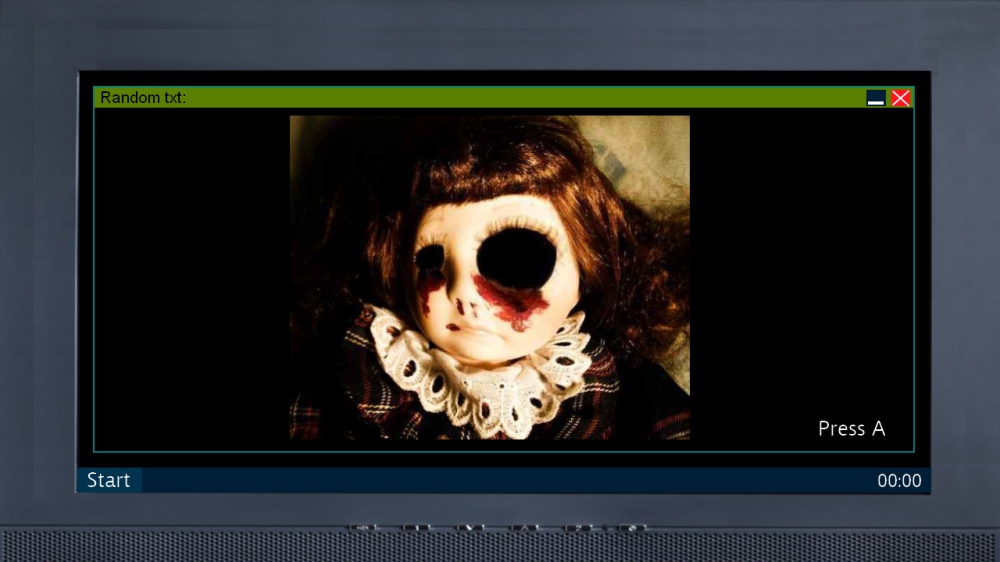
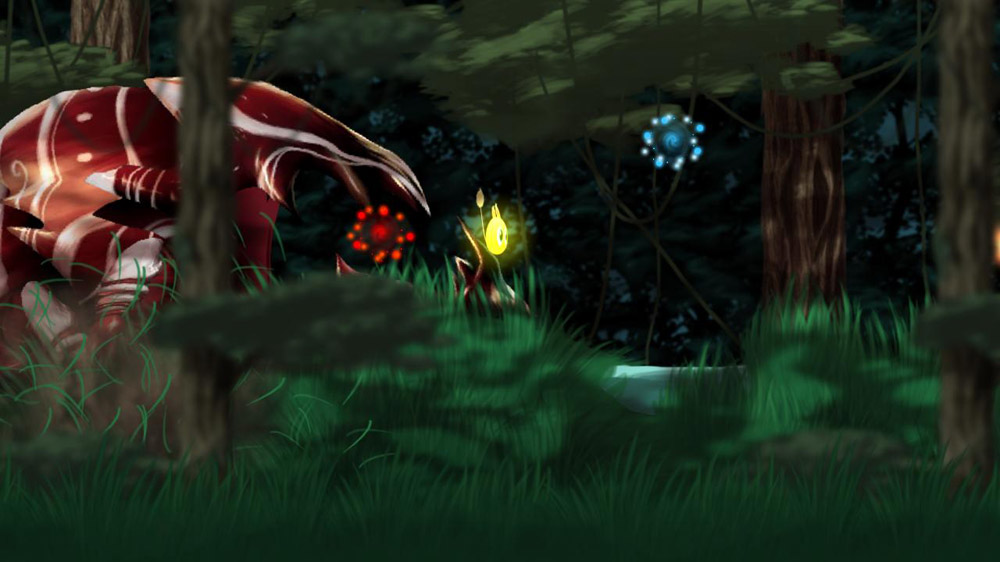
Are there any annoying kids in your life that you never want to have to speak to again? Show them that picture, tell them you turn into that whenever there’s a full moon, and you won’t have that problem ever again.

The basic idea is you’re reading the computer of some psychotic dude who sets up a couple of puzzles for you to solve.  And by puzzles, I mean stuff that seems like it was copied straight out of Highlights for Children that had its innocence stripped away by being forced to watch Nicolas Cage’s snuff film collection.  Basic math questions, a trick-question style riddle, and even one of those “count the triangles pictured, but don’t forget that small triangles make big ones” things.  It’s as if John Wayne Gacy was forced to repeat the first grade.

Between all these brain teasers that are about as stimulating as a medically induced coma, you get to read these rambling, incoherent ravings by the titular madman.  I have to say, at first I figured the game was trying to be weird for the sake of being weird, but actually I was sort of taken in by the creepiness of it all, the same way I was with Silver Dollar Games’ Fatal Seduction.  I became a little invested in it.  And then it ended in roughly half the time my average bowel movement takes.  The really weird part?  Like a good bowel movement, it was oddly satisfying.  I don’t know if that makes it worth the $1 it costs, but hell, people pay more than that for X-Lax.  Sometimes you just need a nice, satisfying dump.

A Madman’s Guide to Happiness was developed by Jaded Horizon

80 Microsoft Points honestly, truly cannot believe I ended up liking this weird ass piece of shit enough to give it a positive review in the making of this review.

Pendulous

I’m sure there are games out there similar to Pendulous, where the idea is to swing from pendulum to pendulum trying to reach a goal in the shortest time possible.  I already had someone tell me that it’s not all that different from Jungle Hunt, a game I never played.  Jungle Hunt was a product of the Golden Age of Arcades, circa 1982.  I’m a product of unprotected sex, circa 1988.  However, as it turns out, Jungle Hunt is included in Tatio Legends for the original Xbox, which I actually own.  So I fired it up and discovered that the person was totally wrong.  Well, that was a waste of an opening paragraph.

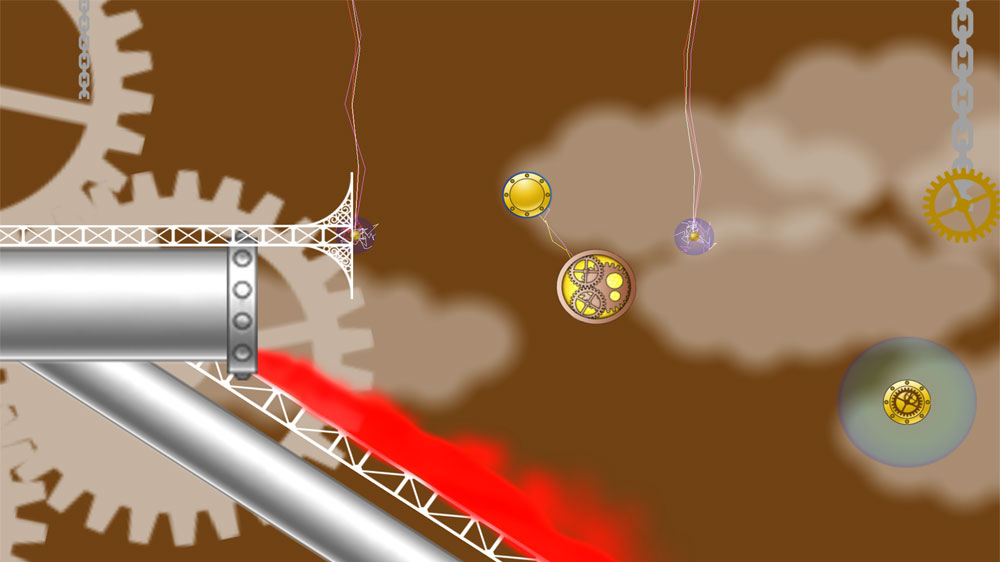
The idea is you swing from spot to spot as a little cog thing, latching onto the nearest swing-point automatically.  Using the left and right triggers (or the stick if you’re an idiot, more on that later), you build up momentum to launch yourself to the next spot.  As you progress through the meager fourteen stages, various traps and obstacles pop up, including one annoying section featuring a red gunky sludge stuff that seemed to bubble up at random and was the only bit of  true frustration in the game.  Well, that and the fact that the developers made a liar out of me.

Dear Datura loving twats: that shit was NOT art. Now THIS is art.

When I reviewed Cuddle Bear, I noted that I would immediately discontinue playing any game at the first instance of a leap-of-faith moment.  So naturally Pendulous was full of those types of moments.  Only I didn’t quit the game.  I kept going.  And thus I’m a big liar.  At least my excuse is good one: Pendulous is a really well done game.  The problem is, there was no need to map the swinging mechanics to both the sticks and the trigger buttons.  The triggers work just fine, so the stick should have been used to move the camera.  There’s just too many spots where you can’t see the next object you’re swinging to.  Or traps that move up and down are off-screen, so you can’t possibly calculate when the appropriate time to jump is.  This was probably related to the porting of this game over from Windows Phone, which the developer noted to me had been the cause of a few issues.

This is where being The Chick is tough, because I have to say something that is probably devastating for a developer to hear: this game was so good that it had a spot on the leaderboard all locked up.  I really loved it.  This is exactly the kind of original, quirky type of game I expected to find in the XBLIG channel when I started this site, and it’s worth your money right now.  The length of the game didn’t bother me at all.  Fourteen quickie stages that are sublime (plus another 14 mirrored ones, snore)  is preferable to a four-hour game that struggles to tread water.  But that damn camera issue was like the iceberg to Pendulous’ Titanic.  Its chances were sunk.  All is not lost.  They already planned to add more levels, and Do Better Games are aware of my concerns, because I sent them a singing telegram.  Only I misread the job description.  It was actually a singeing telegram, who knocked on their door and proceeded to set himself on fire.

Well, they got the message.  The game needs a camera, and then they need to issue what could be the most important Second Chance with the Chick challenge in the history of this site.  They would probably get to it sooner, but because of my screw-up, they first have to clean up a hell of a mess on their porch.

Pendulous was developed by Do Better Games

80 Microsoft Points noted Polish is a nationality, not a race, so that technically makes me xenophobic, not racist, in the making of this review.

You can also read my buddy Hurley’s review at Gear-Fish for this very title.

What I Learned From James Petruzzi

Long before I asked James Petruzzi, developer of Take Arms and 48 Chambers, to do his excellent Tales from the Dev Side editorial for my site, I sought out his help for a planned article that never really panned out.  Although that didn’t come to pass, the hours Brian and I spent talking with James completely altered my perception of how certain Xbox Live Indie Games should be judged.  Before that conversation, I didn’t appreciate the absurd difficulty and almost unbelievable sounding limitations that Xbox Live Indie Game developers are saddled with.  As someone who has never developed games, I couldn’t grasp just how hard it was.  Mind you, I was (and really still am) new to the XBLIG scene.  I was told that XNA was one of the simplest development tools many long-time indie developers had worked with.  So it was like “well if that’s the case, why is putting online in your game such a big deal?”

Well, obviously I was wrong.  I quietly backed away from my “games should have online functions” policy.  Sure, I will still say that games can benefit from online play, or having online leaderboards, but I’m not going to let that be the focus of any review, which I had done in the past.

I’ve reviewed multiple games with online functions, and about two months ago, Brian and myself came to a realization: not a single online XBLIG we’ve played has ever been without some really serious glitches.  That is without exception.  It is universally true.  Most of these games I review shortly after their release, and it’s not unusual for me to have to accept a review code to give to someone else to test the online feature because of the lack of other active players.  This is  only time I do accept review tokens.  The code is given to someone else, while my copy is purchased by me.

Bug Ball was the game that created a change in my online review policy. It’s a good game, but networking issues greatly hampered its online playability.

I have a reputation as being the harshest critic on the XBLIG scene, and I’ve certainly earned it.  I’ve been told I’m overly brutal, too nit-picky, and sometimes even mean.  That might all be true, but there is one thing you can’t deny: I’m fair.  Every game I review starts with a clean slate.

Back in February, a developer requested that I play their latest game, Bug Ball.  A review code was provided, which I gave to Brain and his roommate.  We really enjoyed the game, but unfortunately, it was riddled with multiple glitches related to online play.  Characters would disappear from one player’s screen, the ball would disappear from one player’s screen, or sometimes the game would just stop working on one of our sides.  I believe this was the first online game I reviewed following my conversation with James, and thus it was the first time I was aware that the developer had no way of knowing that these kind of glitches were happening.  After all, they could not truly test the game over Xbox Live.

Brian and I talked about it, and we both decided that if I was to publish a review noting the glitches and how it ruined the experience for us, it would eliminate my right to claim that, no matter what I’m accused of, I’m always fair.  Because slamming a game for issues a developer could not possibly have been aware of would not have been fair.  Thus, we decided it was time for a change in Indie Gamer Chick policy.  I contacted the developer and told them what issues we had, and that I would hold off on my review until they had a chance to fix the problems.  Shortly there after, I added this policy to my FAQ.

I am often asked if I could help playtest games, or join the AppHub.  I’ve had more than a dozen people generously offer to stake my XNA membership fee.  But it’s not something I’m interested in, nor is it something I think I should be doing.  As a critic, I feel it’s important that I stay separate from the development process.  Although I understand that developers do want honest feedback in their games before they reach the marketplace, and I really do sympathize for them when they can’t get that, it shouldn’t come from me.  Doing so would compromise the entire point of my site.

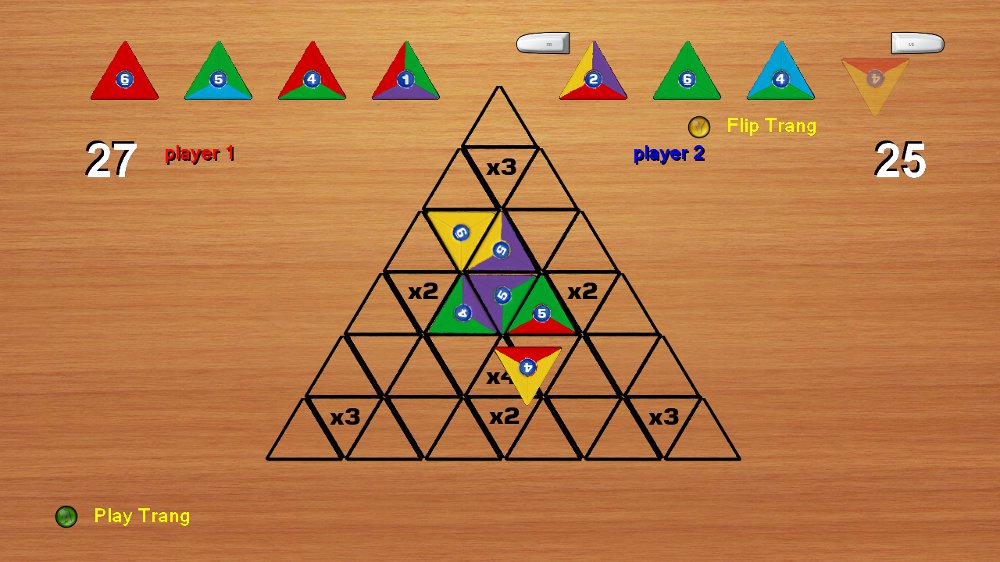
I had a lot of fun playing Spectrangle360, but multiple issues with online play has caused my review of it to be delayed while its developer works to figure out what is going wrong.

But, I am willing to help once the game reaches the marketplace.  I am aware that, for many games, I’m the first person that will play it once it goes on sale.  Since I’ve never talked about this policy outside my FAQ, I want to lay it out here.  It goes as follows.

What I will do.

  • I will contact the developer and list all glitches related to the networking parts of their game, explaining as clearly as I can what happened, both on my end and on the end of whoever my playing partner was.
  • I can take any follow-up questions asking for clarification if necessary.
  • I will leave it up to the developer whether they want me to go forward with writing the review immediately or if they would like me to hold off on it until they have a chance to fix the game.
  • If the developer asks for me to hold off on the review, I will not count that as their Second Chance with the Chick, and they retain the right to request a second review once the original review is published and further patches are added to the game.

What I won’t do.

  • I’m not willing to try an re-create any issues I come across for the developer.  Besides, I usually play the game long enough to see the same glitch happen multiple times.  Once the game returns to development, it’s up to them to figure out how to test it.
  • I’m not willing to test the game with the developer to try to set off the issues.  Again, once I’ve sent the information back to the developer, I consider the game to be back in development, which I should have no part of.
  • I’m not willing to continue to play the game some more to try to find even more issues.  Once the game is in the market and thus playable by the developer on the network it was designed for, they should be busy themselves looking for issues.  Asking me to do your work for you takes time away from me being able to play games from other developers who are eager to get their games reviewed here.
  • Once the developer tells me they’ve fixed the problems and are ready for the game to be replayed for its review, I will not inform them of any further glitches that come up.  The game will be reviewed as is, and any further fixes will have to use up your Second Chance with the Chick.  So make sure that when you tell me the game is ready, you’ve tested it thoroughly and are sure it’s as ready as it can be.

By the way, I certainly hope nothing here or in James’ Tales from the Dev Side discourages developers from trying to add online components to their games.  Yes, doing so is extremely challenging, and maybe even not worth the effort.  However, if you came to the scene looking to challenge yourself, why sell yourself short?  It’s almost like what John F. Kennedy said of going to the moon.  You choose to put online in your games.  Not because it is easy, but because it is hard.  A developer who can make a game with online play on Xbox Live Indie Games is a skilled developer indeed.

I have nothing but respect for the Xbox Live Indie Game community, and I’m always willing to offer advice when someone wants it.  I know a lot of you wish I was willing to help more in the development process, and given how crappy the playing testing and peer review system you guys have to deal with is, I can’t blame you.  Because I feel that doing so is a conflict of interest, I regretfully have to turn you down.  But, when it comes to online play, I am willing to lend you a teeny tiny hand.  I’m still the same Indie Gamer Chick I’ve always been.  I call it like I see it.  I’ve absolutely demolished games here.  I show no mercy.  But with online XBLIGs, I’m willing to cut you some slack and give you a chance to make things better.  Why?  Because it’s the right thing to do.

SEAL Team 12

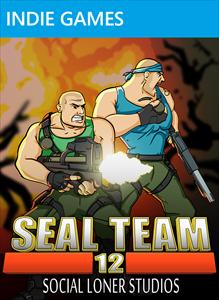
SEAL Team 12 comes to us via Social Loner Studios, the nutjobs behind the hilariously absurd Bird Assassin.  I have to admit, I didn’t think SEAL would be any good.  I think my exact words to Brian were “oh great, another TwickS on XBLIG that tries to ape some 80s shooter I never played.”   Plus it was overpriced at 240 Microsoft Points, because some developers hold on to their belief that their game will sell despite that price point.  It’s kind of cute in a demented “twenty-year-old still believes in Santa Claus” kind of way.

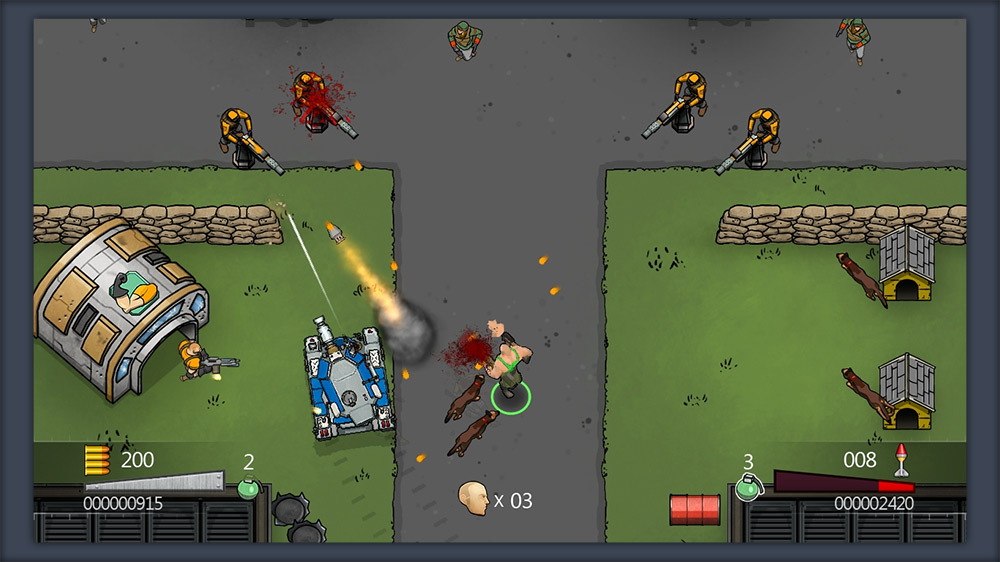
So I was pleasantly surprised to find SEAL Team 12 to be a pretty decent game.  The idea is the world is being threatened by the Guardians Of Devastation, or GOD for short.  Ah, I see what you did there, Social Loner Studios.  Actually, Stevie Wonder can see what you did there on account of the joke being run into the ground about half-way through the game.  Sure, there’s enough anti-GOD puns to make Christopher Hitchens’ corpse obtain the rare status of “double rigor” if you catch my drift, but damn do they lay it on a little too thick.  The rest of the humor mostly works.  Every stage begins with an NPC character (that is wearing a red-shirt for double the geek points) being killed by whatever is the newest enemy added to the game.  This actually caused me to laugh out loud a few times.  The only time it fell flat was when the dead man walking was named Kenny.  I accurately predicted a horrible “oh my God, they killed Kenny” joke, and then watched in disgust as the prophecy was fulfilled.  Jesus Christ, people!  When the guys who created the joke realize it’s not funny anymore and drop it, maybe it’s time to get a fucking clue.

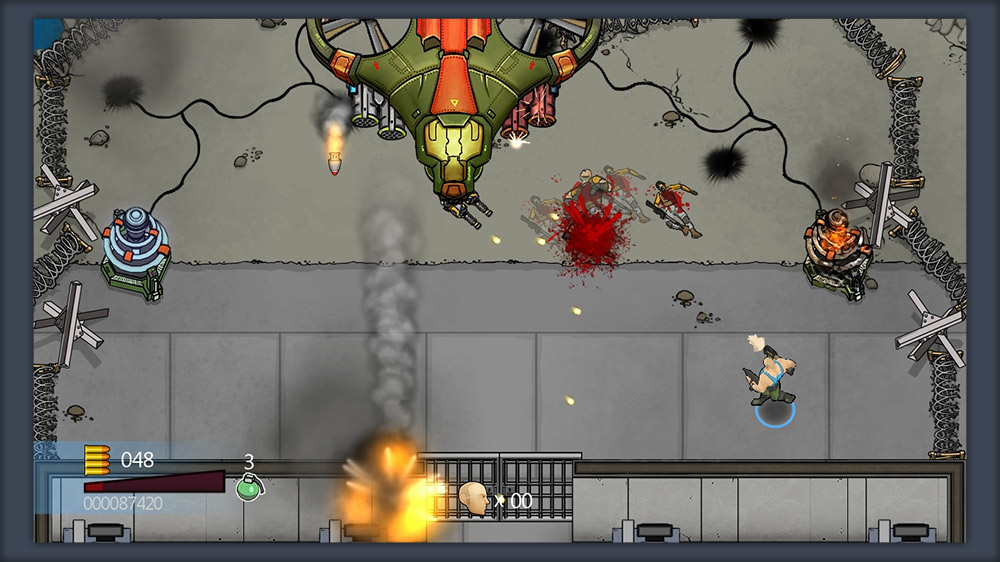
The game itself is a typical Commando-style “walk upwards, kill dudes, walk upwards a little more, kill more dudes” twin-stick shooter .  If this was done straight-laced, it would have been boring.  Thankfully, the game has what so many XBLIGs don’t: personality.  The witty dialog that opens every stage, the moments where you see enemy conversations, and the well done cast of characters.  Considering that the genre couldn’t possibly be more tired if it took an entire bottle of Valium, the effort to dress it up is admirable.  When you strip away all the ascetics, SEAL Team 12 is as generic as it gets.  Walk, shoot, throw grenades, pick up weapons, occasionally hop in a tank, fight a few bosses, end credits.  Quite frankly, everyone should approach a game like this with skepticism.

And it’s not like what is here is done perfectly either.  There are a few problems.  The weapon selection is limited and clichéd.  All weapon pick-ups are done via duel-wielding, mapped to the left trigger to fire, while your right hand always retains the default machine gun.  The setup works, but there’s not enough weapon drops, and what is here is limited.  Some of the guns, particularly the flame-thrower, are worthless.  You get an unlimited amount of normal grenades, but you can’t stack any special ones you pick up.  Given how outlandish the plot and characters were, they should have gone nuts with the variety of guns.  But they didn’t, and the game suffers a lot for it.

A bigger problem is the game becomes a bit of a bullet-hell in the final stages.  Let’s be clear about something:  bullet-hells work in space-shooters when you’re a nimble ship and the battlefield leaves plenty of room to maneuver.  They tend not to work if you’re a clunky, slow-moving steroid freak that has various obstacles you have to walk around.  The game got so ridiculous at the end that we had to swallow our pride and set the difficulty to easy.  Shameful for sure.  Not as shameful as, say, announcing a fake contest for a popular new release on Twitter, then creating a fake account designed to be the “winner” five minutes after you announce the contest.  Then retweeting posts from people your original account follows to pad things out.  And not remembering to try to type different than you typically do.  Or even more brazenly, only retweeting one person’s “wow, I’m so excited, I hope I win!” tweet out of the dozens you receive from gullible people who think you actually have something to give away, and having it be from the fake account you just made five minutes after your fake contest began, making the fix so obvious that a person could accurately predict to multiple witnesses the outcome of the “drawing” for the second straight contest you’ve held.  I mean, theoretically, if your contest was a real random drawing, nobody could possibly predict the outcome of the winner once, never mind twice in a row.  Finally, as soon as your fake contest is over, you never Tweet from that fake account again, just to finally and officially confirm what an oblivious loser you are for thinking nobody would catch on.  Hypothetically speaking, of course.

Despite a few hang-ups, SEAL Team 12 is really well done. Yea, it offers nothing new as a game, but it’s still fun.  In fact, I’m kind of surprised at how well it works in both single player and co-op.  Yea, the price point is kind of stupid.  Sure, some of the jokes fall flat.  You know, Social Loner Studios have been off my radar, but they’re actually 2 for 2 here at Indie Gamer Chick.  But, they haven’t made a leaderboard contender yet.  They probably have the talent to do so, so I’ll be keeping an eye on them.  Well, I’m also doing that because I think they’re fucking insane and might kill and eat me if I turn my back on them.

SEAL Team 12 was developed by Social Loner Studios

IGC_Approved240 Microsoft Points noted that nobody’s fake contest was mentioned in particular, so if you think I’m talking about you, that really says more about you than me in the making of this review.

SEAL Team 12 is also available for PC on Desura for $2.99.  This version is unverified by Indie Gamer Chick.  The XBLIG version is Chick Approved and Ranked on the Indie Gamer Chick Leaderboard.

Curse of the Crescent Isle

Do you know what the key to critical acclaim is on Xbox Live Indie Games?  No, it’s not having a good game.  Don’t be silly.  It’s having a retro-style graphics and gameplay that borrows mechanics from a popular 80s NES hit.  If you have that, you have a game that will have more praise dumped on it than a parrot that sings Let the Bodies Hit the Floor.  Which is ironic given that most of these new-retro titles just poorly mimic the classics the same way a parrot mimics a song.  Sometimes praise is deserved.  Stuff like Escape Goat or Aesop’s Garden comes to mind.  Most of the time, the end result is cute and charming but ultimately just kind of exists as a weird novelty.

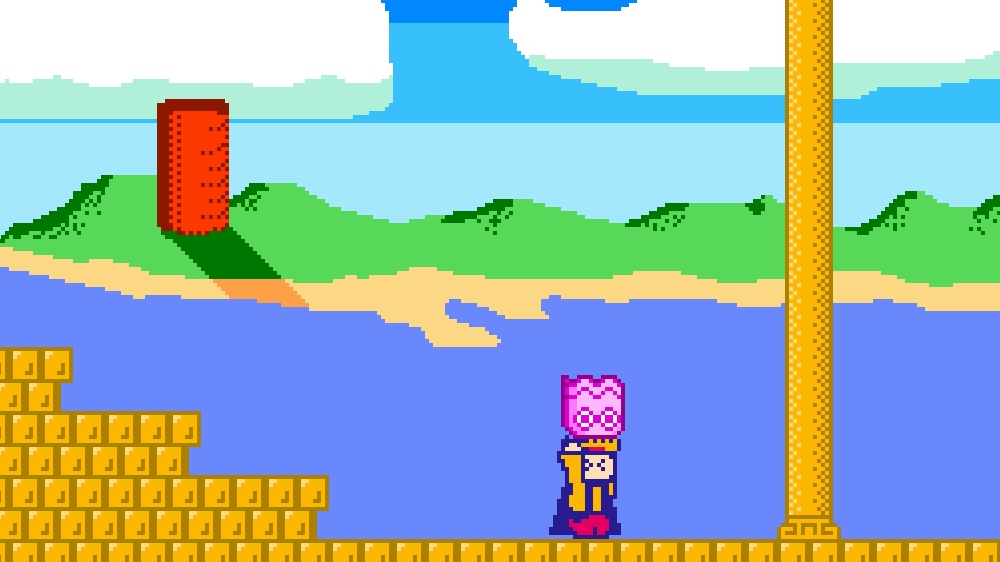
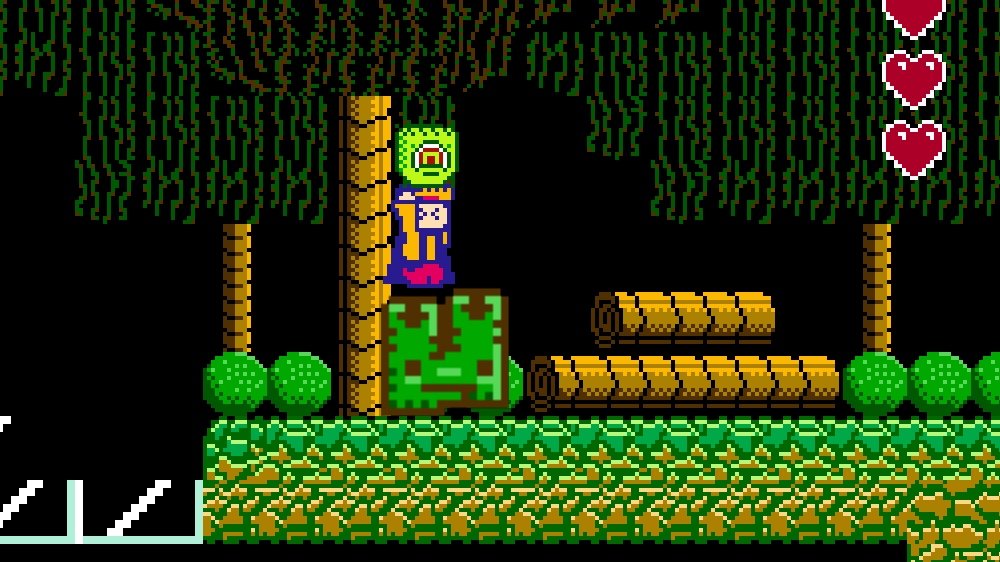
Take today’s Katch-Up game, Curse of the Crescent Isle.  It has pretty good NES style graphics without the slightest taint of anything modern to ruin the effect.  The story is appropriately insane.  You take the role of a King who has to save the people of his land from a, um, something or another that has turned them into, some.. things.  Honestly, I’m not sure what the fuck happened, but who cares?  I couldn’t figure out why anything happened to anyone in any 8-bit game, so why should I expect to start now?  It’s all about the gameplay, which is modeled after the platforming and lifting mechanics of Super Mario Bros. 2.  Only here, the enemies you pick up can be used as tools.  It’s a sensible evolution on the established concept.

It’s hard to lift with your knees when all you have is a beet-red anus for legs.

Here’s the problem: the game sucks.  Allow me to elaborate.  Super Mario 2 overall controlled decently, as long as you picked the right character.  I never used Mario, because his jumping was too weak.  I stuck with Luigi, who wasn’t quite as pitifully slow as the Princess, but could also jump higher and further than her.  In a game that is all about jumping, it made sense to me.  Unfortunately, Crescent Isle is all about jumping too, but you’re stuck with someone who controls like Mario did.  Oddly enough, the gravity feels strong, but the controls overall feel way too loose.  I can’t tell you how many times I would jump for a vine, grab it, but then coast straight off the side of it.  It was like the King lubed his hands up with Vaseline before jumping.

The biggest issue with Crescent Isle is how badly implemented the mechanics are.  The control scheme is very clunky.  You pick up enemies with the X, but you also use X to switch between lifting them over your head or putting them below your feet.  You jump with A and throw with B.  It’s messy and never feels intuitive.  There’s also problems with the physics of lifting and throwing.  Enemies can’t really die.  If you throw them into each-other, it just knocks one out.  Once they hit each-other, they ricochet back and typically cause damage if they float anywhere close to you.

The only thing Crescent Isle does well is puzzles.  There are some clever ones that make neat use of the enemies’ skills.  Sadly, the impact of those puzzles is lost due to the lack of check-points combined with the horrible play control.  And that’s not even taking into account when the game glitches out on you.  During the second stage, there are puzzles that require you to use an ice monster to freeze fireballs shot out of a pipe, then use them as stepping-stones.  It was clever the first time they used it.  After a dozen times, it was tedious and lame.  Especially since the fireballs sometimes would just go away instead of staying in place as a block.  Or there was the time that I froze a fireball, it disappeared, and the pipe never spit out another one.  I was stuck there, and that fucking sucks.  Sure, you can pause the game and restart the level, but it had taken me around ten minutes to get to that point.  And that was just that one attempt, not counting all the lives I lost trying to get there before that.  The puzzles lose their zing when the game’s lack of debugging causes you to replay them over and over again.  Hell, I lost count of how many times an enemy pushed me through a solid wall and to my death.  No wait, I didn’t.  It was ELEVEN FUCKING TIMES!

Why does the King always look like he’s constipated?

Ultimately, Curse of the Crescent Isle just isn’t that fun.  The controls are bad, the levels are too sprawling, and the concept is just kind of boring.  Of course, Crescent Isle has 8-bit style graphics and is almost kind of like Super Mario 2, so it got critical acclaim.  When I read how this was received by other critics, I was kind of flabbergasted.  You know, there was another 8-bit clone of Super Mario 2 once upon a time.  It was called Bible Adventures.  I never played it, but I certainly know of its reputation.  I have a theory that if that game came out today and was on Xbox Live Indie Games, it would be considered really good.  Why?  Because it meets all the criteria for critical acclaim on the platform.  8-bit?  Check.  Clone of a flagship title?  Check.  Actually fun?  Who cares?  Oh, don’t scoff!  You know I’m right.

Curse of the Crescent Isle was developed by Adam the Otaku

80 Microsoft Points never played Duck Tales on the NES so I can’t accurately compare this to that in the making of this review.

Droppin’ Ballz

Droppin’ Ballz is one of those “fall as far as you can” games.  My gut tells me it was designed with tilt-controls in mind.  Because Microsoft opted to not go with a motion-controller like everyone and their mom and instead decided to create a device that plays like Minority Report as invented by the chronically unambitious, Ballz is stuck using the trigger buttons instead.  I guess this control scheme works, but it never feels quite right.   My biggest complaint, that the game moves too slowly, is easily corrected by adjusting the difficulty.  The game is set to easy on default, but it’s only really tolerable on normal or higher.  And that’s assuming you play the game on its classic mode, where you just fall from one platform to another.  I was ready to write off Droppin’ Ballz as just another phone-style faller that has no place on a console.

I think the developers were droppin’ something, but it wasn’t ballz.

And then I tried Fever mode, which feels like you’re falling through the rabbit hole from Alice in Wonderland, only without having to drop acid.  Actually, I imagine if you dropped acid while playing this, it would be pretty fucking bad ass, but probably a little too difficult to play.  The idea is still  the same: fall from platform to platform, try to not miss the platforms, and try not to land on the black platforms.  Only in this mode, the background changes color and tries to distract you, plus there are perspective-altering “power-ups” that shift what angle you view the game from.  This is what the whole game should have been like.  It’s as if developers flipped a coin to decide if they would go the generic route or the trippin’ on mushrooms route, and the coin fell down a sewer grate.  And they couldn’t flip another because then they wouldn’t have enough change left to get a Mountain Dew, so they said “fuck it” and continued working on the inferior classic mode as well.

I actually did like Droppin’ Ballz, but I have a tough time recommending it.  There’s no online leaderboards, so there’s really no point in playing it.  Hell, even the local leaderboards are all kinds of fucked up.  In theory, there should be six boards: one for each game mode on each difficulty level.  The point values increase on the higher difficulty stages, so ranking a game played on the tedious easy mode over the medium mode is silly.  But that’s how it’s done in Droppin’ Ballz.  Even worse, it ranks games played in Classic mode against games played in the wacky Fever mode, which makes no sense at all.  I guess Fever Mode is good for a twenty-minute distraction and priced accordingly, so I do mildly recommend it.  I would rather see this game on iPhone, with online leaderboards.  I could see it being a big, word-of-mouth hit on there.  It would be a perfect fit on a platform developed by an acid-dropping, corporate hippie.  They could rename it “Jobs Ball.”

Droppin’ Ballz was developed by He-3 Software

80 Microsoft Points heard Hurley gave his hopes up when he heard that there was a way to make your balls drop for just 80MSP in the making of this review.

Gameplay footage courtesy of

Cuddle Bear

Cuddle Bear received a Second Chance with the Chick. Vast improvements have changed it from one of the worst games ever made to merely terrible. I kid. It’s not really that bad anymore.  Read the new review.

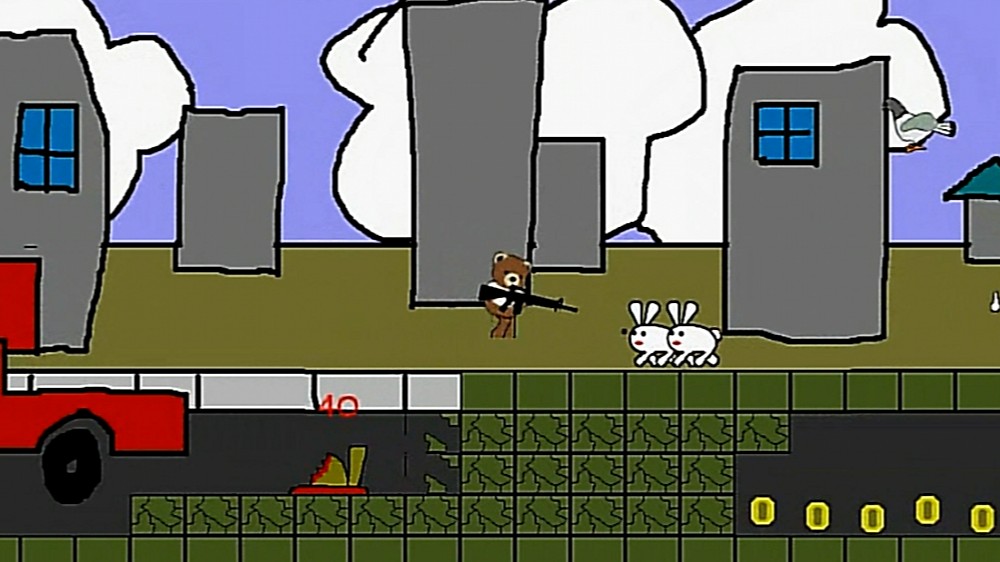
In order for Cuddle Bear to be as bad as it looks, it would have to walk around kicking puppies and luring children into discarded refrigerators. I’m not sure if it does those things, but I can’t swear it doesn’t. This is one of the worst Xbox Live Indie Games of the year. It didn’t start that bad. You play as a psychotic teddy bear that goes around killing various bugs and animals. You’re armed with a gun, you have the ability to buy more guns, and levels are usually filled with plenty of God’s creatures for you to gleefully murder.

No really, that is what the game looks like.

The first world, set inside a house, is actually not too bad. Yes, the MS Paint graphics are embarrassing, the amusement level of the sound effects gets old fast, and the floaty jumping I just fucking knew would be problematic later, but it was still kind of cute in a “oh, look at the three-legged kitten” kind of way. And then I got to the suburb level, where the game took a turn for the worst. The platforming started to rely heavily on leap-of-faith gameplay. You know what I’m talking about. It’s where you have to jump to a platform you can’t see, possibly into enemies that you can’t defend yourself against. Some levels from that point on are completely centered around that concept. You jump, wait for the platform to appear, see an enemy next to the ledge, hit the enemy, recoil hugely off it, and fall to your death. Or even worse, you don’t die, fall to the ground, and have to walk all the way back to the start of the level to try again. At this point, if I had a button in front of me that would have detonated the developer’s head, I can’t say I wouldn’t have pushed it. Actually, I probably would have had someone else push it for me. Never hurts to have a second set of fingerprints on head-popping buttons.

I’m not sure how a game gets made in this day and age with gameplay like this. Did nobody play this far and tell the developer “you know, this is kind of just a series of dick moves that isn’t fun in the slightest bit?” I’m guessing not. It sucks that it falls to me to tell the developer that Cuddle Bear is just a series of dick moves that isn’t fun in the slightest bit. At least the leap of faith stuff isn’t the only thing to complain about. The graphics are shitty, but the game somehow still comes in at 241.5MB, necessitating an insulting 240 Microsoft Point price tag. Truth be told, that’s probably a good thing. It means nobody is likely to waste any time or money on this piece of shit. The enemies end up being bullet sponges, it takes too long to upgrade guns, and the game is kind of too long and samey for what it has to offer. I was getting bored with it long before I was getting angry at it.

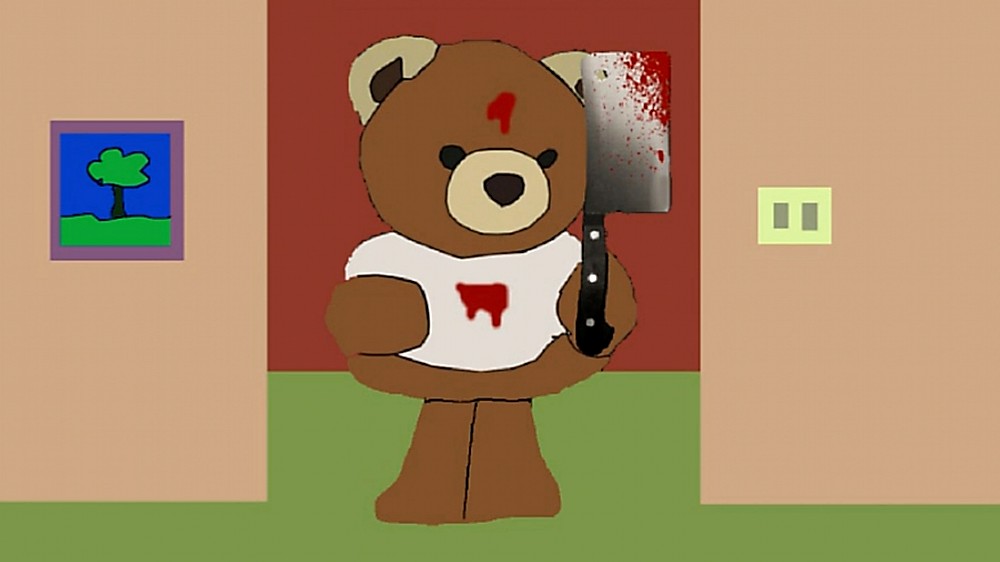
Pictured: Cuddle Bear after he murdered fun itself.

Cuddle Bear isn’t the first title here that featured leap-of-faith platforming, but it will be the last one that I make any effort to finish. If developers don’t want to put in any effort into their level designs, I’m not going to make any effort to play them. I did excuse the first couple dozen instances of blind jumping in Cuddle Bear, but it became apparent during the second beach level that I was wasting my time. Nothing good had come of the game by this point. It was just getting worse and worse. This kind of stuff worked in old school games where the enemies didn’t spawn until you reached the point they were meant to appear. In this game, and many other XBLIGs for that matter, the enemies are just there, walking back and forth. You can’t prevent them from being close enough to the ledge, and thus all platforming is left completely to chance. I find it odd that the developer requested I review this game. Maybe he wasn’t aware how bad it was.  Well, hopefully he knows now.  If not, I’m not sure how else to say it.  I could sing it.

Beneath the knees, hopefully nobody pees.

He’ll slurp and gag and gargle the sea.

Because that’s the day the Cuddle Bear sucked a big dick.

Cuddle Bear was developed by Happy Sock Entertainment

240 Microsoft Points read that the developer has Cuddle Bear 2 planned, says this is confirmation of the existence of evil in the making of this review.

Tales from the Dev Side: Why is Conflict Fun? by Adam Spragg

Although his Hidden in Plain Sight was not an overwhelming success on Xbox Live Indie Games, Adam Spragg still received near-universal kudos from critics for his efforts.  Even my infamously cold heart warmed to it as I played with three interns who probably hate me and call me mean names behind my back.  I’m betting on “Take-a-Bath-rine” although I won’t rule out “Catheterine.”  If they had known my alias was “Kairi” I’m sure it would have been “Cry-ri.”  Which is absurd.  I beat them like 20 games to 1.  If anything, I made them cry.  Or maybe I’m being paranoid.  They probably didn’t call me anything too mean.  I can deal with Catheterine.  I’ll call off the hits.  Well, maybe.  I’m guessing I won’t get my deposit back.

Okay, so maybe I don’t handle conflict (real or imagined) as well as I should.  Adam views conflict differently.  In this very philosophical installment, Adam shares his thoughts on how conflict is the chief reason for a game being fun.  And you know what?  I think he’s on to something.

Read more of this post

An Untitled Soapbox on Game Difficulty

I want to once against note before I begin this monologue that I’m not a game developer.  I’m just a chick who plays games.  Because of this, I’m not sure how well any advice I offer towards the process of development will be received.  That’s especially true when you consider that I haven’t been involved in Xbox Live Indie Games for a full year yet.  However, I have something I think needs to be said and I have reviewed nearly 200 XBLIGs.  That’s probably more than most developers have played.  So I feel somewhat qualified to offer you advice in the politest way possible.  Let’s see, how should I start this?

You guys are stupid dickweeds.

That’s usually what I think when I play a game where the difficulty curve spikes straight up out of nowhere like it just popped some digital Viagra.  I won’t go so far as to say it’s the biggest problem on Xbox Live Indie Games, but it is the one that has ruined the most good games.  This also isn’t a plea to dumb down your titles.  I like a challenge as much as anyone.  But I like a fair challenge, one that I feel tests me on the level of which I have progressed.  Often, XBLIGs play out at a rate equal to instructing a child on proper cap-gun safety, then shipping them off do front-line infantry duty in Baghdad.

Games should challenge a player.  A game that is too easy has to be exceptional to leave an impression on the player.  On the flip side of that, a game that is too hard is more than likely to leave impressions on a player.  And also the player’s controller, couch, television, walls, etc.  Now granted, some gamers want that.  But those that do have a genre all to their own for that.  This isn’t an editorial on punishers.  I’ll leave them out of it.  This is about any average game where a developer loses track of reality.

Lumi's difficulty curve could be more accurately described as a straight horizontal line immediately followed by a straight vertical line, and it ruined the game.

I’ve spoken with many guys on the XBLIG scene, and we all agree that developers often forget that they are the best player at their own game.  What happens is they play the game themselves hundreds of times, to the point where they know every little nuance about it.  They know the best ways to defeat enemies, the best angles to clear jumps, the best places to camp, or the best places to situate your defenses.  In no time at all, the game suddenly seems too easy.  The worried developer tries to correct this by beefing up the difficulty in a way to challenge themselves.  As a result, the finished project is an impenetrable mess fueled by swearing and rage quits.  The perplexed developer doesn’t realize this, because they could still beat the game, so everyone else should be able to as well.

Of course, the developer forgot that they were making a game to challenge everyone.  That’s really what it boils down to.  They created a game that was challenging for them but not impossible.  By time the game enters peer testing and peer-review, the developer is (perhaps rightfully) full of pride.  After all, they just made their very own video game.  Unfortunately, the resulting ego trip usually makes them oblivious to real concerns of difficulty that are brought up.

From what I’ve gathered from my time on the scene, there seems to be three types of peer-review testers in existence.  The first is the genuine tester who will play a title all the way through and give honest feedback.  The second is the cheerleader.  These are the guys who are just a little too in love with the scene and treat every game they come across like the mother of a spoiled child with a sense of entitlement.  They offer no constructive criticism, because that might hurt someone’s feelings.  Chances are they probably don’t even play a game all the way through to begin with, and if they dislike it, they’ll still slap on the pom-poms and congratulate you for whatever miniscule thing they can come up with.  “Way to not misspell the title of your game.  Man, XBLIG’s fucking rule!”  The third is the kickback reviewer.  They also probably don’t play games all the way through, nor do they offer any feedback.  They’re simply trying to pass games so that when their title is up for review, they can get it passed with minimum resistance.

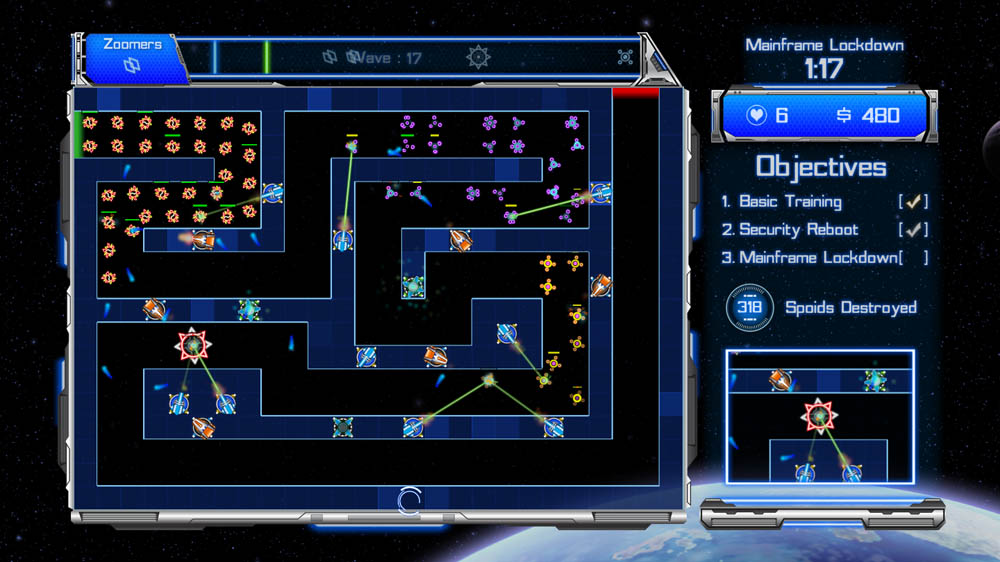
The next-to-be-reviewed Spoids is a genuinely fun game that morphs into a lump of digital hatred for humanity in its final act.

So basically, two-thirds of peer-reviewers out there don’t actually do any work.  If someone with real concern over a game’s difficulty says something, the developer ignores it.  After all, nobody else said anything, and they were still able to beat their own game.  Maybe the guy who said the game is too hard simply has no skills.  I’m guessing there is also the occasional tester that’s too embarrassed to admit they found a game overly hard.  Guys, don’t worry about it.  I admitted I couldn’t throw a Dragon Punch in Street Fighter II and was able to weather the gentle barbs that followed.

Dragon Punch? Ha Ha!

Developers often don’t realize how difficult their games are.  It comes down to play testing for this to sort itself out.  It also comes down to expecting straight-forward honesty in the process.  Do your due-diligence in the testing process.  How reliable are the testers you’re getting?  If they lean too much towards the cheerleader set, make note of it, and don’t look to them for the real answers to the questions you should be asking.  Stuff like “is my game too difficult?” or “do the controls feel right?”  Don’t rely on just your fellow developers either.  Bring your friends into it, and be clear to them that they can’t possibly hurt your feelings if they think your game sucks.  Even if that’s not true.  I concede that getting people outside of the scene to play an XBLIG is tough.  But hell, you’ve already spent X amount of dollars.  What’s spending $20 more on a pizza and some soda?  Gather your friends.  Gather their friends.  And when they play the game, keep your mouth shut and your eyes open.  Don’t offer any tips or pointers.  If possible, don’t even tell them that it’s your game.  Just watch it play out.  You’re about to find out exactly how good it is.

There are some developers out there who truly don’t give a shit what anyone has to say and want no feedback outside of kudos and congratulations.  There’s no point in reaching out to them, because there is no helping them.  This goes out to everyone else: you can do better.  You deserve better too.  Developers need to ask for blunt honesty before their game goes on the marketplace, because the last thing they want is to hear it first from me.

See those buttons below that allow you share this review with the world?  If you enjoy my stuff, do me a favor and use them.

48 Chambers

48 Chambers received a Second Chance with the Chick.  Click here to read it.  Consider the new review the definitive one.

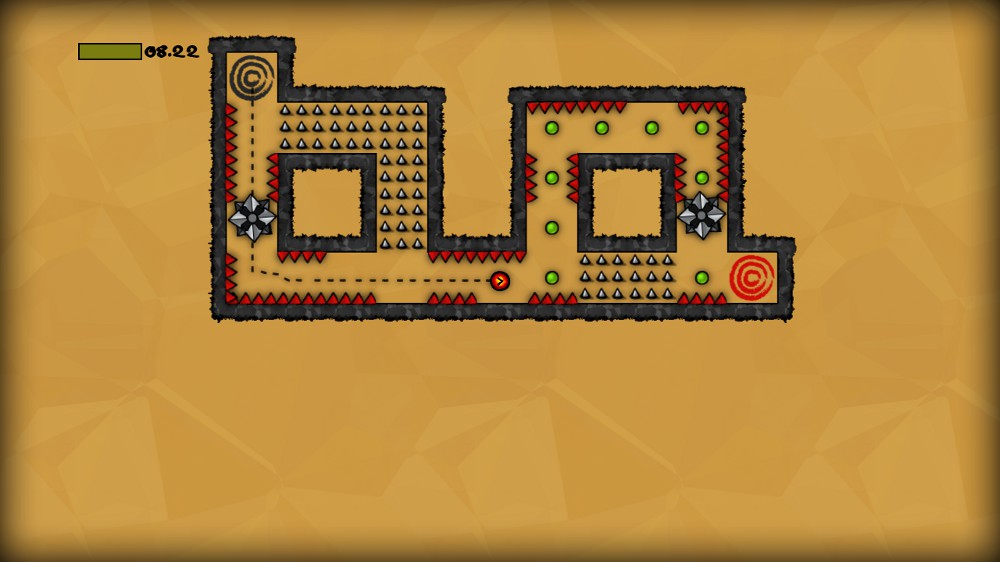
48 Chambers is kind of fun.  It can also fuck off.  I don’t take telling stuff to fuck off lightly.  I reserve it for things that I might care about.  In the case of 48 Chambers, it has clean graphics and an interesting hook.  Think of it as a top down dexterity-tester, sort of like N or maybe a little like a previous game I reviewed here, Crazy Balloon Lite.  The idea is to navigate a ball past obstacles and to an exit before you run out of time.  If you pick up any dots along the way, they add to the timer.  Sometimes you have to first pick up keys that open doors.  All really straight-forward maze type of stuff.  But it can be fun.  I actually wish I could try it with an old-timey trackball like coin-ops had back in the day.  Apparently I could, if I bought the PC version.

But I didn’t buy the PC version.  I bought it on Xbox Live Indie Games.  And it can fuck off.  Not because of the controls, which surprisingly work well on a joystick.  When Brian and I previewed this for Indies in Due Time, my biggest fear was having loose control that would render the game unplayable.  Totally unfounded.  The controls actually lean towards the heavy side, and this works.  It makes it very unlikely that you’ll accidentally skid off into a spike.  It’s not a perfect solution to a mouse, or especially a trackball, but it does the trick.

No, the game can fuck off because it lacks two very key ingredients.  One, there’s no continues.  Once you game over, you get to start all over from level one.  I’m not a big fan of this concept for gaming.  Continuing is kind of a big deal to me, because I have an aversion towards playing things I’ve already done before.  I want to finish something and be done with it.  I don’t want to keep starting over from scratch.  48 Chambers is a game that relies somewhat heavily on trial-and-error, yet if I run out of lives twenty levels in, I have to play the previous 20 levels before I can continue to trial and error my way any further.  Fuck that.  It’s 2012.  The concept of being able to continue a game was kind of established around 1980.  I don’t see how it makes me a bitch to expect a gaming convention that has proven to be effective and valuable for over thirty fucking years.

But, I could have put up with that if 48 Chambers had online leaderboards.  Which it does.  If you have the PC version.  Which I don’t.  The excuse for the lack of one on XBLIG is the same old shit.  It’s not a real leaderboard, it’s a crappy peer-to-peer one, blah blah blah.  Who cares?  Ghettoized XBLIG leaderboards are better than none at all.  In some games, like for example the #1 game on this site, the presence of one can make the difference between being a leaderboard game and myself arranging a picket at the developer’s house.  With no continuing, the only reason I would have to press forward and continue playing the game is trying to land a spot on that board.  So 48 Chambers can go fuck off.  No continues.  No leaderboards.  It needed one or the other, and it has neither.  Why would I keep playing?  Pride?  Right, because being able to beat a video game that will have a user base somewhere south of the membership of the Mother Teresa Erotic Fan-Fiction group on Google will provide me with a real ego boost.

48 Chambers was developed by Discord Games

80 Microsoft Points would have rather had DLC for Take Arms in the making of this review.