Iota

Protip: when naming your game, don’t give it a name that is just asking to be mocked.  Such is the case with Iota.  If I wanted to be an unoriginal wiseass, I could say “I didn’t like Iota one iota.”  But I’m above such laziness.

Well, then again, I’ve been updating only like once a week for a couple of months now.  So fuck it.  Laziness for the win.

I didn’t like Iota one iota.

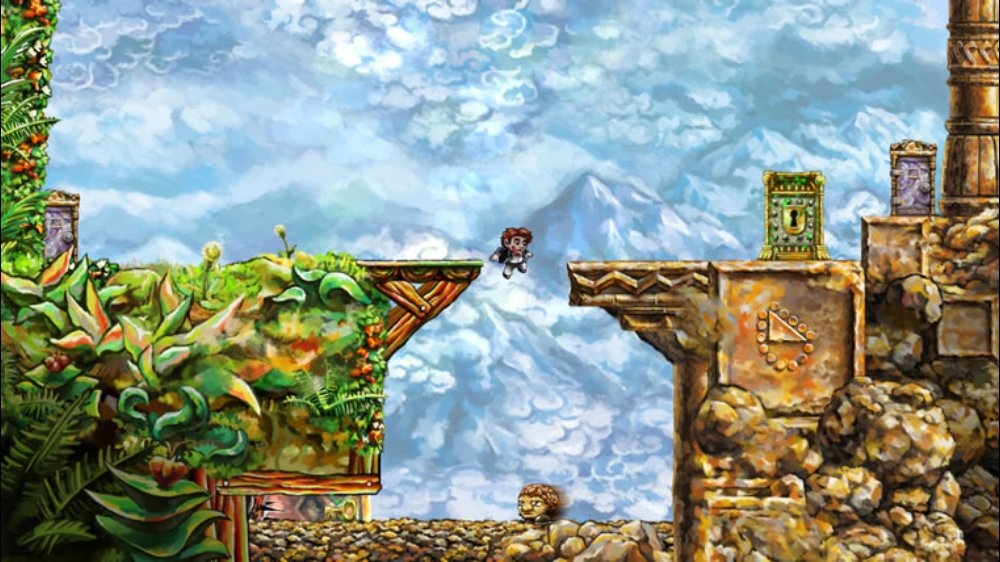
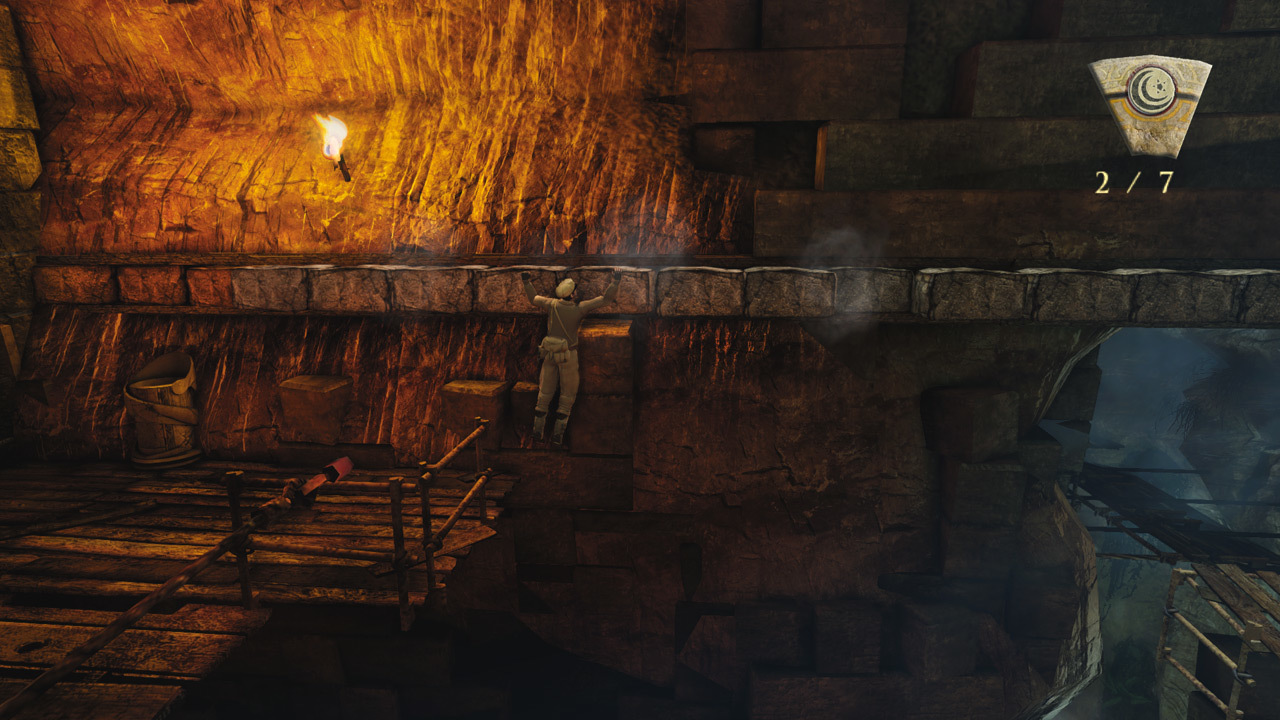
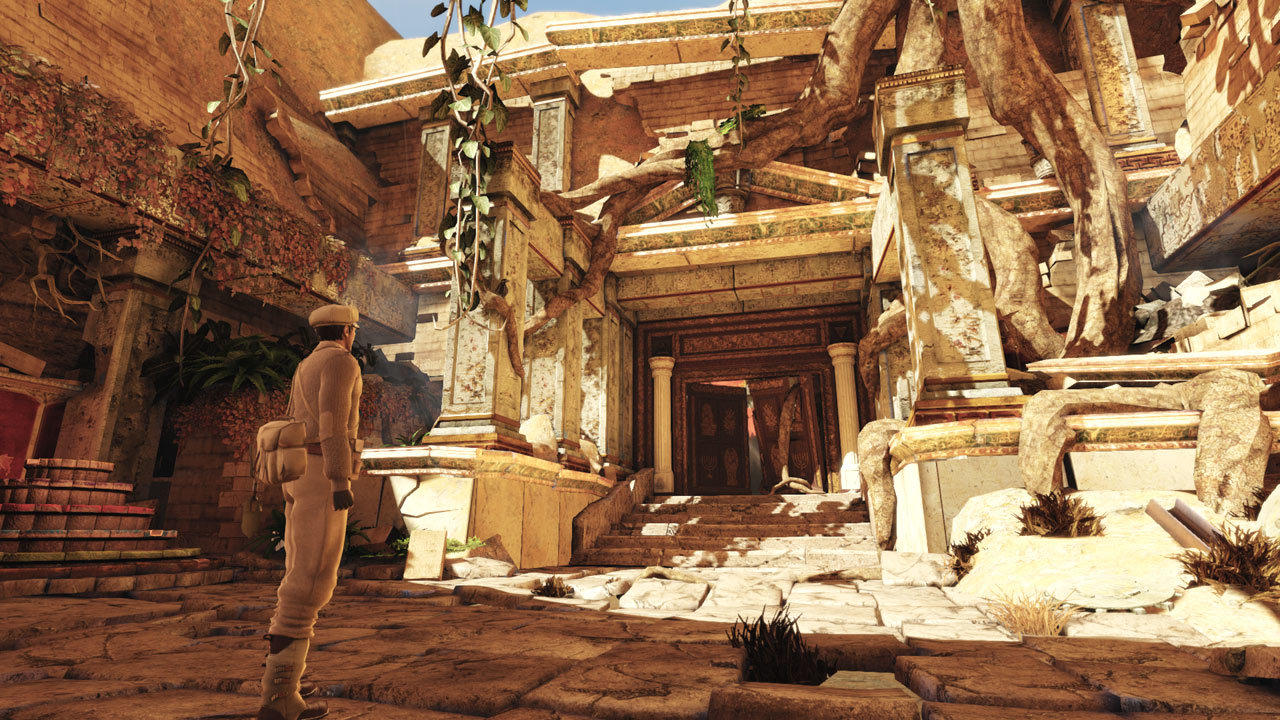
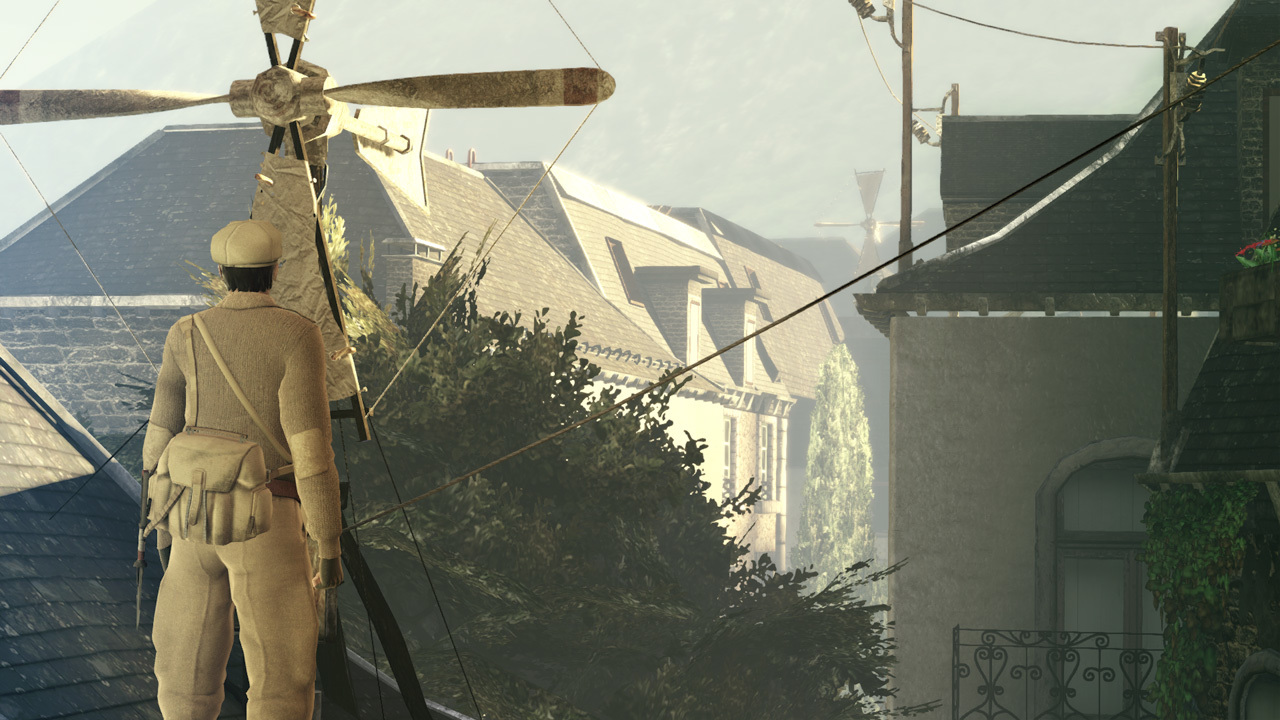
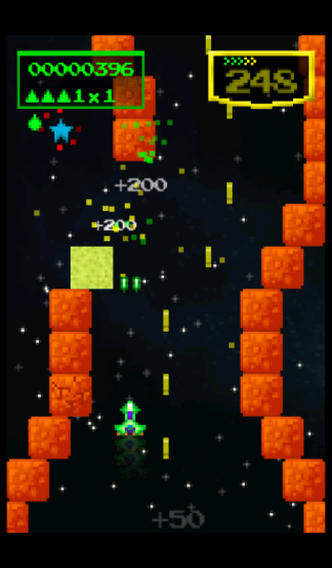
Iota looks really good.. for an XBLIG. But typically, really good XBLIGs would look merely decent on Sega Dreamcast.

Iota looks really good.. for an XBLIG. But typically, really good XBLIGs would look merely decent on Sega Dreamcast, which you’ll note is fifteen years old.

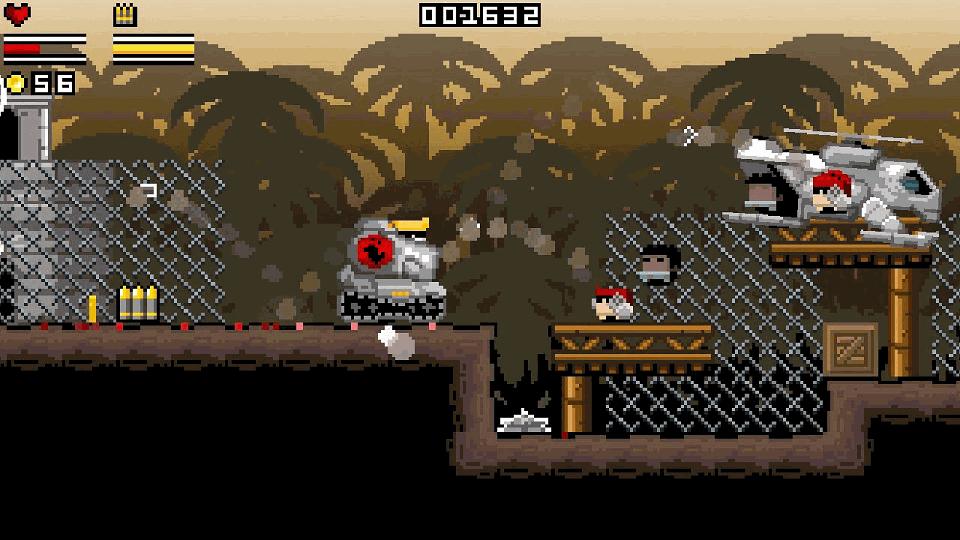
Iota is one of those XBLIGs that falls into the category of “looks too good.”  It’s the curse of the platform.  With only a few exceptions, the better an XBLIG looks, the worse it plays.  Iota looks pretty dang good, which means the curse is especially potent here.  The idea is you play as a robot that must go around stages collecting shiny balls of light.  Collecting all of them opens up a shinier ball of light, clearing the stage.  Oh, and the platforming is sort of like a stripped-down Outland, which itself could best be described as “Ikaruga with jumping.”

In the interest of fairness, I’ll disclose that I’m not wired to really like Iota all that much to begin with.  I don’t like bullet hells, and I don’t like platformers that drink the bullet-hell Kool-Aid.  But, in the case of Iota, the stuff I dislike the most has nothing to do with the bulletly hellness of it, and honestly the bullet-hell stuff isn’t even that bad, at least up to the point where I determined that I would never have fun with this and quit.  Quick: what’s the most important thing a precision-based platformer OR a bullet hell would need?  Tight controls, right?

Guess what Iota doesn’t have?

If Sega hit the Sake too much and made a platformer that controlled exactly like Sonic the Hedgehog, only heavier and starring Juggernaut from X-Men, that’s what Iota would feel like.  Starting movement is too slow, stopping isn’t instantaneous, jumping feels too heavy or sometimes just doesn’t respond in time at all.  In just the first three levels, I lost count of how many times I went to jump, hit the button long before I got to the cliff, and then watched as my character didn’t jump and plunged to his death.  If it was less than ten times, I’ll eat my hat.

I didn't like it, but it did help to pretend this was a modern ReBoot game :P

The 2.5D perspective also made calculating distances and heights annoying at times, but that’s hardly Iota’s biggest problem.

Another issue is the inconsistency of the color-swapping bullet hell gimmick.  You switch the robot from red to blue, which allows you to pass harmlessly through bullets.  Using the triggers as a sort of dash-attack, you can also knock out the enemies.  Except the game is a bit fickle about the timing of it.  Switching mostly allows you to instantaneously pass through the bullets with relative ease, but upon landing on the platform and dashing into the robot (which has to match your color in order to kill it), sometimes it would register me as still changing colors, resulting in a death.  I experimented with this a lot (probably more than any play-tester did, judging by how bad it is), and it was bizarre how the bullets could be passed through instantaneously, but there was a lag in using it to kill enemies.  I found out that the jumping and landing had nothing to do with the lag.  I could situation myself on a platform, wait for the robot to come at me, switch colors, to the point that my robot looked fully like he had switched, dash, and die because it thought I was still the wrong color.

Level design was nearly my biggest issue, which is really impressive considering that I only played four stages.  I don’t think the idea of collecting all the trinkets in a level to open up an exit works in a game like this.  Maybe it was worth experimenting to find out, but really, a game based around one-hit kills and a broken checkpoint system should have simply been about getting from point A to point B.  With all the backtracking, it bogs the game down, makes it less exciting.  And then there was the third level, which is almost entirely done in the dark.  It’s not a particularly hard stage, but because you have very limited visibility, you have to heel-toe it, nudging the stick one tiny bit at a time, like you’re masturbating the microscopic penis of a Ferrari owner.  It’s shameful that the developers didn’t recognize this as BORING design.  Because, above all else, your games should not bore.  Every other aspect of Iota has potential to be a pretty decent platformer.  But a stage like this, which can’t be played at a speed above molecular-degradation of an atom, never had potential to be anything but the most boring level in platform history.  It’s only purpose is now to point and it and say “for fuck’s sake, don’t ever make a stage like this” to other developers.

Although I found nothing to like about Iota, I don’t deny this could have been something good.  Certainly a foundation has been laid for something that could be entertaining.  But Iota put a premium on graphics, and didn’t focus on the stuff that really matters in a platformer of this sort, and the result is a game with limited value.  Tighter controls would have made a world of difference here.  And stuff like the all-dark level should have never entered into the thoughts of the developer.  Ten seconds of research would have shown that the number-one gripe of the vast majority of Spelunky player  are the dark stages, and in Iota, the visibility a player has is much worse.  Thus, Iota serves as a reminder that, with the freedom indie developers have, the flip side is you end up with level design such as this that nobody in their right fucking mind would attempt.  I absolutely can’t believe the developers didn’t second-guess some of the design choices here.  Ultimately, Iota’s only hope is to lure people in with its impressive graphics.  Except, Iota really only looks good for an XBLIG.  And that’s like saying melanoma looks good as far as cancer goes.

xboxboxartIota was developed by Cashie Brothers

$1 will be keeping an eye on the Cashie Brothers, as I suspect they’ll get things right in their next game in the making of this review.

Gameplay footage courtesy of Splazer Productions

Contrast

Do you know what the irony of Contrast is?  It became the replacement PlayStation Plus PS4 launch game when Driveclub didn’t make its deadline.  That makes me laugh, because there is no way that Driveclub could have been more unfinished than Contrast.  Here’s a game whose concept I loved before I even tried it, and even while I was playing it, I so wanted to love it.  And, in a sense, I did.  But, like someone with an elderly dog that keeps making a doodoo on the carpet, at some point you have to admit it’s over and put it down.

Really, there isn't a whole lot of contrast in contrast. Levels range from dank and dark to dank and dark.

Contrast at least fills the indie quota of being dark enough to cause clinical depression.

Contrast takes place in a stylized 1930s art-deco world.  The idea is you play as on over-imaginative young lady named Didi, who defies her mother’s wishes by sneaking out of the house and going on an adventure of sexual intrigue, betrayal, and discovery.  Honestly, I thought the story was heavy-handed and boring.  The setting did nothing for me, mostly owing to how damn empty and artificial it all seems.  Perhaps if the world had seemed more alive, I could have gotten into it.  But the world of Contrast seems so drab and lifeless, as if nothing fun or whimsical has ever graced it.  Which is really fucking bizarre because of how damn cool the hook is.

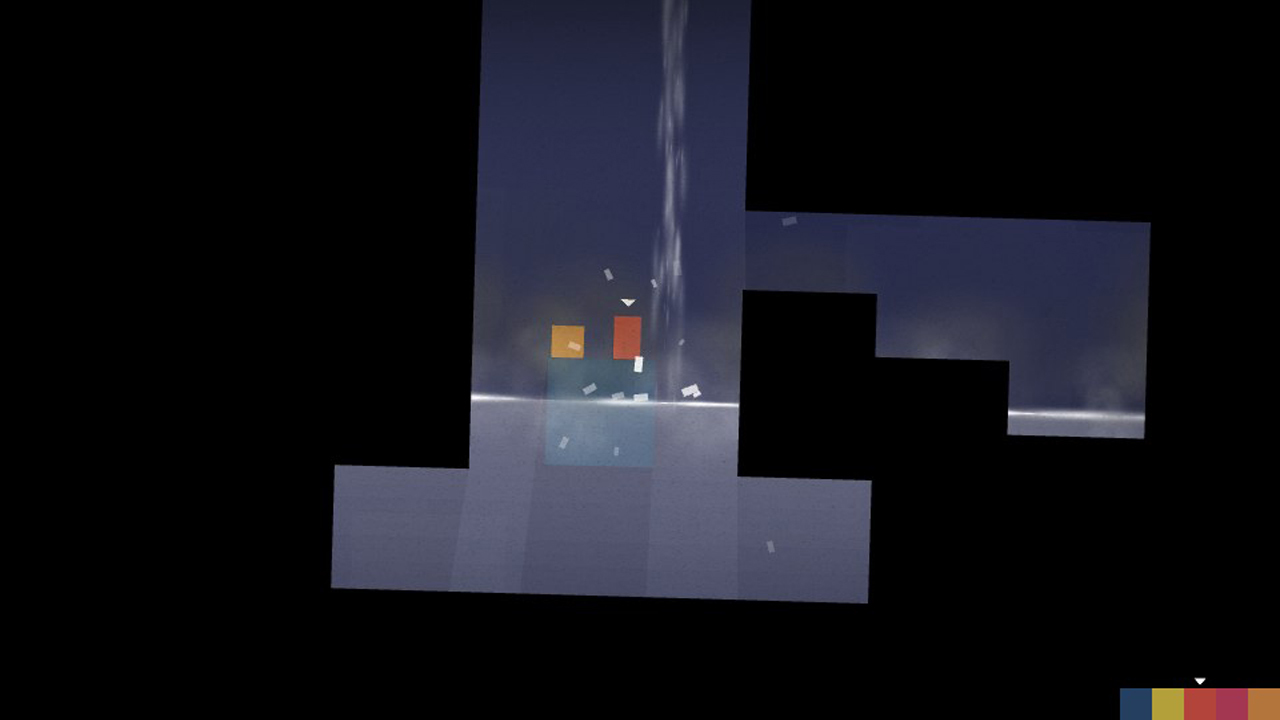
The idea is, gameplay can shift entirely into your shadow on a surface as long as there’s a light projecting it.  I love this idea, even if it’s so shamelessly convoluted in the ways they had to implement it.  I call this “Aquaman Syndrome” because it reminded me of how the Super Friends scriptwriters had to come up with the most roundabout ways imaginable to include Aquaman in the show, like having Lex Luthor steal the plans for a Doomsday Device that was hidden underneath a fish store.  So, you’ll spend a lot of time in Contrast moving light fixtures around, so as to make sure all the shadows cast are exactly the right height and right size that they can be platformed across.  Then you’ll spend the next three weeks readjusting them over and over again while cursing the Gods that Watch Dogs fell behind schedule and you’re stuck doing this instead.

I have no idea why, but at times this game made me think of Castlevania 64. For no reason at all, but that's what popped into my brain.

I have no idea why, but at times Contrast made me think of Castlevania 64. For no reason at all, but that’s what popped into my brain.

I can’t stress enough how tough it is to properly calculate where to line up those shadows when it’s up to you to project them.  Maybe it was just me, but I often could not get a feel for the sense of scale the game required.  It also doesn’t help that many of the puzzles are timed, with the shadows reverting back to their original positions if you don’t move quickly enough.  Early in the game, one of the puzzles took place in an enormous, sprawling room where I had to position lights, elevators, and platforms just right, or else I would have to go back and position them all again.  Gateways had similar puzzle designs, but at least there the controls were tight and objectives and end goals were more clear, thus making the complex puzzles boil down to simple reverse-engineering.  Here, I typically was never sure exactly where the final landing point was, and the controls were loose and sloppy at best.

I didn’t make it much further past that room at the hotel, in the first fucking chapter.  Yes, shameful as hell of me, I admit.  I should hang up my critic card and shoot myself or something.  But here’s the thing: Contrast is clearly not finished, and since it’s not, I don’t really feel under any obligation to complete the game myself.  It was not ready for prime time.  While running around, looking for things to dash into, I got stuck in walls no less than one hundred times over the course of a couple of hours of wandering around.  I honestly don’t remember any game where I clipped into walls even 10% as much as I did here.  More over, sometimes the glitches are just super random.  While running around a fire escape, she started jumping, without me pushing any buttons besides the control stick.  She just started springing up and down like she was busting for a piss while using a pogo stick.  Not only that, but she seemed to be jumping much higher than the natural jump mechanics allow for.  It’s one of the most randomly bizarre bugs I’ve ever come across.  It didn’t kill the game or impede my progress in any way, but just having it there made me feel like I was wasting my time at amateur hour.

Apparently, nobody told her that only monkeys point.

Apparently, nobody told her that only monkeys point.

Plus, as a showcase game for PlayStation Plus and PS4, Contrast sure is ugly.  It would have been ugly on PS3.  It looks more like an early PS2 game, and not a good-looking one.  Completing the “just now released after twelve years in the can” feel of Contrast is an unstable camera and clippy character models.  There is nothing “next-gen” on display here.  I’m so disappointed because the gimmick was solid and the setting could have held a lot of promise, even if the Film Noir thing is getting dangerously close to over-saturated.  This was a weird one for me, because I loved it for the first hour or so, even if I spent a lot of that aimlessly wandering around the lifeless city.  But as I came to realize how unpolished Contrast was, my love quickly was replaced by loathing, and I suddenly noticed how broken so much of it is.  How the phasing into the walls was touchy, slow in response, and not suited for the types of quick-actions the game sometimes requires.  Or how sometimes I would have to stab the square button multiple times to activate a switch, even though I was lined-up correctly enough to have the context-sensitive “PRESS SQUARE YOU IDIOT!!” prompt on the screen.  Or how I spent more time bouncing off invisible walls than I did navigating successfully to the next area.  So sadly, I must ask Contrast to take a seat next to Mortal Kombat Gold, NFL Fever, and Evergrace in the “victims of a launch deadline rush” memorial wall.  Contrast wasn’t quite as dead on arrival as those titles, but the last rites have been administered and its time to go all Old Yeller on it.  Bang.  Tears.  Fade out.

ContrastContrast was developed by Compulsion Games

Contrast was free with PlayStation Plus, normally priced $14.99. 

Booyah for Ouya?

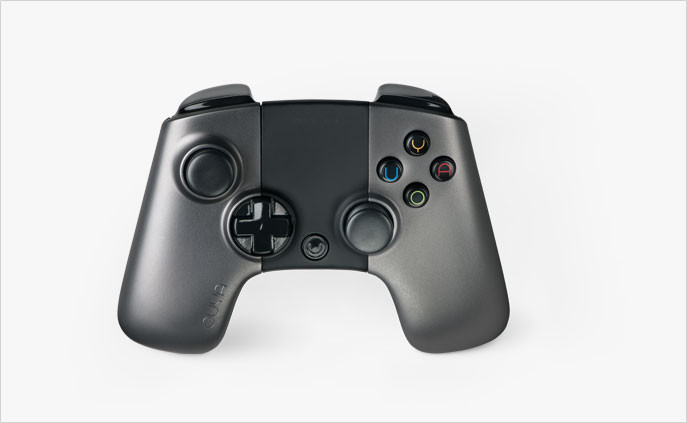
Let’s get one thing out of the way really quick: the Ouya controller is horrible. One of the worst gaming controllers I’ve ever encountered. Now granted, I wasn’t around for such unworkable inputs as the Intellivision pad, the Atari 5200 floppy stick, the Jaguar, etc. The closest thing I could compare the Ouya’s controller to is a generic plug-and-play controller I picked up from a Walgreens for under a dollar on clearance. Laggy. Unresponsive. Cheap-feeling. Tough to corner with. The bumpers are horrendous. And the way you put batteries in it is just fucking absurd. This controller SUCKS! There’s word going around that Ouya kiosks are being set up, and I can think of no quicker way to sink the system for good. If they don’t fix the controller, they’ll drive away more people than they’ll convince to purchase. Almost every game I tried out for it, I was immediately aggravated by. I almost wrote the machine off entirely.

And then I plugged in a PS3 controller. I swear to God, it became an entirely different experience. Games were suddenly playable on the damn thing. I can’t stress enough: as soon as convenient, dump the Ouya controller for a PS3 or Xbox pad. Then find the nearest hammer and take it to the Ouya pad, so as to never be tempted by it again. If a game comes out that doesn’t have alternative controller support? Fuck it. Not worth your time. Not that the PS3 support is perfect. I couldn’t turn the fucking controller off when I put the system to sleep. The option that says “turn off controller” in fact does not turn off the controller. The only way to turn it off was to physically unplug the Ouya. And not every game has support for it, despite the fact that developers told me including support is super easy. For a few games, the mapping seemed to either not work or be off in some way.

Fuck you.

Fuck you.

With the PS3 pad, my Ouya became a perfectly fine little Android-based gaming device. But the controller is hardly the only problem it has. The interface is missing a lot of key things that most consumers care about. Like, oh, THE FUCKING PRICE OF THE GAMES! There is no listing for the prices for anything on the market, or even on Ouya’s website. Instead, you have to download the demo for the game first. Only it’s not called a demo. It’s called a “free download.” Now, if you’re not familiar with the system, someone might think they’re pulling a bait and switch here. But this is also bad for people on a budget. Let’s say you only have $10 to spend. You can’t sort out anything that costs more. It’s something that dreamy-eyed idealists would probably think is a good idea. In practice, players are not going to wade through games of unknown price until they finally stumble upon one they can afford. They’ll just spend their budget on a different platform. This is yet another “what were they thinking?” moment, of which Ouya has plenty of.

It’s especially annoying for me because I don’t sample anything I intend to review at Indie Gamer Chick. I select games for review based on how they look and sound in concept, or maybe a trailer. That’s just my preferred style. It’s often not possible on Ouya. There’s too much emphasis on demos and not enough on sales. Another problem is there is no way to sort games by new releases. A lot of people, myself included, enjoy looking through new releases. The lack of such a tab really hurts the novelty of digital distribution, where any given day could be the day that a platform’s new best title hits. Instead, you have to poke around the genre tabs. If “what were they thinking?” is the number one running theme of the Ouya, inconvenience is the number two theme.

Again, I hate demos. But hey, when in Rome, do as the Romans do. So here are all the demos I downloaded, and my thoughts on them.

TowerfallTowerfall: By far the most talked about Ouya game. And naturally, I can’t play it. It’s not compatible with my epilepsy. Thankfully, the developers are talking about adding an effects switch for the PlayStation 4 port. Oddly enough, this is the second console I’ve gotten this month where the most hyped game was unplayable by me. I couldn’t play Resogun on PS4 for the same reason.

Amazing FrogAmazing Frog? The Hopping Dead: The idea is kind of like Pain for PS3 meets a sandbox game. Walking around a pretty decent sized world, you want to crash your frog into as many things in a single jump as possible. Nice concept, and the full single-player experience is mostly free. But Amazing Frog is hugely glitchy, which wrecked the experience for me. Scoring is based on how much shit you crash into before you stand yourself up. But, while you’re limp and rag-dolling around, you can still move pretty much indefinitely. Plus, there are lots of issues with clipping, slowdown, or your character just plain falling down as you move around, because it registers him as bumping into something. And why is the jumping so weak in this? You would think a game based around a frog character would at least let your initial jump be pretty high, but that’s just not the case. I wouldn’t consider spending a dime on this until it’s cleaned up.

GlobulousGlobulous: Globulous looks like a clone of unsung N64 gem Tetrisphere. There’s a game that nobody talks about today, and I have no idea why. I was very excited by this. But, after downloading it, I discovered the PS3 controller support is broken. None of the buttons work, just the sticks. Weirdly enough, if I also turn on a Ouya controller, the buttons on that work but not the movement. In theory, I could play it with my left hand controlling movement on the PS3 pad and the right hand controlling all the action on the Ouya pad. This seemed to be a bit sloppy though. Then again, the controls seem sloppy all around no matter which way you try to play it.  I didn’t get too deep, because the only option to play it without looking like a tool was to put down the PS3 controller and slum it with the Ouya pad. I wasn’t kidding earlier. I absolutely refuse to use the Ouya controller. No game is worth it.

RedRed: A really bland and basic twin-stick-shooter. I’ve played so many of these since starting IGC that, without a really novel hook, I can’t get into them. And this one’s starting gun requires you to repeatedly press the fire button instead of just shooting, which wears on your fingers quickly. Easy pass.

ittle Dewittle Dew: The winner of the “worst timing on Ouya” award goes to ittle Dew, a homage to classic 2D Zelda games. Which I unfortunately played right after starting A Link Between Worlds. It’s hard to get excited about this after playing the first real, authentic 2D Zelda since Minish Cap (the DS games don’t count. Zelda is not meant to be played with a plastic stick). Not that ittle Dew would be perfect if not for those circumstances. Even with a PS3 controller, the controls are sloppy and the combat is clumsy. I also didn’t love the hand-drawn graphics, but at least it seems to place an emphasis on puzzle design. I still would have probably bought it, but now that my Zelda itch has been scratched, I might not ever touch it again.

A Ride into the MountainsA Ride into the Mountains: I get flack sometimes for picking on free games. I don’t think I’m being a bitch about it, but often free games just plain aren’t fun or worth a look at. A Ride in the Mountains is totally free, and the concept of a chick on horseback shooting enemies with a bow & arrow is solid. But the aiming controls are horrible. This originally started out as an iPhone/Android game, meant to be played on a touch screen. The iPhone port was 99 cents, and I immediately recognized it as a superior game. In a game about aiming, ease of the aim mechanic is paramount, and the Ouya port just doesn’t have that. I might end up doing a full review of the phone game at some point. The Ouya version should be skipped.

ReaperReaper: Another theme of Ouya games are ones that show their mobile roots. Reaper is an action-RPG, one that handles some of the hacky-slashy button mashy stuff automatically. Unfortunately, not enough was done in porting this over to Ouya. All movement is so slow and floaty, it’s as if the game takes place underwater. This would probably be fine if playing on a flimsy, buttonless phone screen, but it doesn’t work well at all on a console. Of all the games I played that I disliked, this one probably has the most potential to be worthwhile in a short amount of time. But for now, it’s probably better off as a phone port.

SurvivalSurvival: The only buttons on the PS3 controller that worked were the shoulder buttons. This meant I would have to use the Ouya pad. No thanks. We need to get the Geneva Convention involved in this. Survival looked neat in a classic Atari game type of way, but I will never use the Ouya controller ever again. After asking developers I know, they agree that implementation of PS3 controller support is super easy. There really is no excuse.

Deep Dungeons of DoomDeep Dungeons of Doom: This was, as of yet, the only game reviewed by Indie Gamer Team member Michael. He was slightly leaned against purchase. Oddly enough, this was the first Ouya game I spent money on. It was fun, in a simple, stripped-down to bare essentials type of way. The give-and-take combat reminded me a little of Super Mario RPG mixed with Punch-Out, in that enemies telegraph their moves and the object is to memorize their patterns so that you can effectively dodge-and-counter. Of course, DDOD is a roguelike, and I get along with those like a chihuahua soaked in blood would get along with a school of piranhas. But I’m cautiously optimistic about its chances enough that I took a chance and bought it. Don’t get me wrong though: this is not going to be the killer app system mover Ouya needs. Just a solid title. Maybe.

MeltdownMeltdown: No, this is not a game based on my recent PS4 experience. It’s an isometric shooter-adventure. But, for whatever reason, the trigger buttons when using the PS3 controller did not seem to work. All the face buttons worked fine, as they are assigned to do, but the triggers, which you need to shoot with, did not work. I begrudgingly checked with the standard Ouya controller, just long enough to confirm the triggers on that worked. They did. I switched back to the PS3 controller, only to find that none of the buttons now worked. I turned the game off, turned it back on, and all the buttons worked fine, except the triggers again. An interesting looking game, but I am not going to play it with the Ouya pad.

Mystery CastleMystery Castle: By far the Ouya game with the highest Indie Gamer Chick Leaderboard potential, Mystery Castle is a Lolo-inspired puzzler. But it does so much more than Lolo, or really any other homage to Lolo I’ve played, and that includes some spectacular titles. Control is a little stiff, but that’s par for the course with this sub-genre. The demo includes 36 free levels, but what’s really bizarre is that, instead of having the first couple levels on each “world” be free, the lineup seems to be totally random, as if selected by lottery. I guess this is done to show how the difficulty progresses. This will probably be my first full Ouya review.

Yes, there are plenty of solid niche games for Ouya. But many of the system-exclusives are underwhelming or mediocre. The issues with alternate input are found across multiple titles. I initially had a more detailed feature planned here where I would advocate Ouya charging smaller royalties to developers in an attempt to lure in higher quality exclusives. But, the truth is, Ouya has almost no life left in it. Regretfully, I think the system is a failure. Yea, most consoles these days launch with underwhelming lineups. But the problems with Ouya run so much deeper. The controller issues are too great, the point of sale is to sloppy, and the business model isn’t set up for success. I’ve spoken with developers of solid titles that have moved around a dozen copies on the platform. A dozen.

When I think of Ouya, I’ll think of why I never was a fan of Kickstarter to begin with. Kickstarter is free money without discipline. It never asks of its pitchers to present a solid business plan. Ouya received 8.5 *million* dollars. That’s a lot of money to throw at a start-up with this kind of risk, especially when nobody bothered to ask them how they’re going to keep the company afloat once the well runs dry. Sure, they lured in a couple of Triple-A throw-away titles like Sonic 4 or a port of a remake of a Final Fantasy game that came out when I was less than a year old. Games that any rational person would recognize were sent out to die. Meanwhile, developers are being bled for a 30% royalty, which is the industrial average, on a console found hidden beneath the rack with PC gift cards at Target. You can’t charge industrial average when you have less than a 1% market share. You just can’t. The best the Ouya team could come up with was their ridiculous “Free the Games” fund, which demonstrated the lack of discipline their team has. Ouya is a microcosm of the game industry run amok. For all the talk of how evil console giants Sony, Microsoft, and Nintendo are, those dark-hearted policies of theirs assure a vital and thriving library and a platform for profitability. Gaming is a business. Someone should have reminded the Ouya team and their 8.5 million dollars worth of contributors about this a year ago.

Triviador fixed and Seal of Approval Reinstated

A quick update to Monday’s post about Triviador.  The developers of the game quickly got in touch with me and assured me that they would get to the bottom of the problem.  It would appear that they’ve fixed the majority of the problems and that Triviador is back to being the awesome Trivial Pursuit meets Risk game I fell in love with.  I re-award it my Seal of Approval and have re-ranked it on the Indie Gamer Chick Leaderboard.

IGC_ApprovedSee, the squeaky wheel gets the grease.

Triviador was developed by THX Games

Produce Wars

I’m an Angry Birds fan of sorts.  I admit, I lost interest with the Rio and Seasons editions, but they totally hooked me back in with the innovative Space and Star Wars versions.  Along with Mario Galaxy, they prove that when characters get over-saturated and boring, just fire their asses into space and wait for the cash to come rolling it.  It never fails.

Jason X

Okay, well, almost never.

Angry Birds is also probably the most knocked-off game of this century.  Anyone perusing the iOS or Android markets runs into one clone after another, none of which really aspire to do more than create marketplace confusion.  They can’t really claim to be the cheap, off-brand, dollar-store versions either.  Angry Birds is only a dollar per edition, or even has ad-supported free versions.  At least the XBLIG clones of Angry Birds, horrible as they can be, have the mandate of not having a full, cheap version on a console.  Seriously, $40 fucking dollars for Star Wars Angry Birds?  Are they high?  Hey Rovio, you’re supposed to light CIGARS with those stacks of $100 bills, not smoke the C-notes themselves.

I would prefer someone take the basic concept behind Angry Birds and tweak it enough to make something original and compelling.  Early on in my Indie Gamer Chick existence, I discovered a wonderful title called Star Ninja that did just that.  It still holds up as one of my favorite XBLIGs.  And now we have Produce Wars.  On first look, anyone would mistake it for a bad Angry Birds clone with a different theme.  Sometimes it’s animals.  Sometimes it’s fish.  Here, it’s fruits and vegetables.  Yawn, right?  Actually, the game has a personality of its own.  Not amazingly so or anything, but at least an effort was made.  Still, I wasn’t expecting much from Produce Wars except a basic, been-there, done-that Angry Birds clone.

Wrong.

Though anyone looking at just screen shots wouldn't know that.

Though anyone looking at just screen shots wouldn’t know that.

Produce Wars combines Angry Birds’ flinger-gameplay with Donkey Kong Country style barrel-platforming.  And then the game gets meaner than the groundskeeper of the golf course next to me on employee happy-hour night.  Kidding, Harv.

There’s no question Produce Wars strives to be a more intelligent, difficult Angry Birds.  The problem is, Produce Wars is too intelligent for its own good.  Unlike the relatively straight-forward, knock-the-structures-over gameplay of Angry Birds, stages in Produce Wars can be complex and sprawling.  Although check-points are provided, Produce Wars has all the frustration and demoralization of the most brutal punisher-platformers.  It doesn’t take too long either.  The game jumps from a relatively simple opening tutorial to precision shooting and timing puzzles.  There is no difficulty curve.  There’s a difficulty corner.  One that bends straight up and reaches the heavens.

It’s still fun, but Produce Wars lacks that pick-up-and-play addictive quality that can lead to what is legally classified as a “gaming bender.”  I offer my kudos to the guys at Gigaloth for managing to almost completely eliminate the luck-aspect of the genre.  The levels are well laid out, thoughtful, and the solutions aren’t always self-evident, which is something I look for in a puzzler.  However, I’m not entire convinced that the genre lends itself to this type of gameplay.  I swayed back and forth between being awed by the intelligence of Produce Wars to being bored by the slowness and frustration of it.  Imagine if the best athlete in school was also the biggest egghead, and you showed up to watch him dunk basketballs.  At first, that’s what he’s doing, and everyone is amazed.  Then he takes the podium and starts lecturing on quantum physics, while all the doors and emergency exits get chained shut.  Sure, it’s still kind of interesting to hear, and occasionally he’ll pick up the ball and do a fabulous between-the-legs dunk out of nowhere, but it’s not what you were expecting when you showed up, and your only way out is for it to end, or for a fire to breakout in the gymnasium.

If more than 1% of all players stick around long enough to see this stage, I'll eat my hat.

If more than 1% of all players stick around long enough to see this stage, I’ll eat my hat.

That’s what Produce Wars is.  It’s original for sure, or at least the way it combines parts from other games is.  But it suffers from bad pacing issues and improper difficulty scaling, and even when it is fun (which can be quite often), it’s fun in a slow, methodical type of way.  Even the scoring and unlocking system feels a bit off.  Sometimes, you’ll reach a level where the stage’s star is unobtainable until later in the game when you unlock a different support character.  I’ve always felt games like this should not have levels that you can’t ace immediately.  Forcing a replay later just artificially pads the play-time, and Produce Wars certainly didn’t need that.  The game’s 100 stages will take you several hours to slog through, and by the end, it will have felt longer.  I still kind of liked it, but it felt like I should have liked it more.  Mechanically, everything works just fine, and the destruction-physics are easily the most accurate of their breed on XBLIG.  I really wish I could pin down why I didn’t fall in love with Produce Wars.  Some games can be well made and still a bit dull.  Maybe if it wasn’t so hair-pullingly evil in short-order, I could have fallen into a groove with it.  Many XBLIGs have difficulty nailing the learning curve, but Produce Wars is perhaps the most tragically off in that regard.  So yea, these fruits and veggies are a bit rotten, but they’re still fun to throw at stuff.

xboxboxartProduce Wars was developed by Gigaloth Games

IGC_Approved$1 thinks Watermelon tastes like lightly sugared water and tofu in the making of this review.

Produce Wars is Chick Approved and Ranked on the Indie Gamer Chick Leaderboard. Because I had fun 50.28% of the time with it. Yes, I counted. Okay, no I didn’t.

Triviador stripped of Indie Gamer Chick Seal of Approval

Update: Triviador is fixed and the Seal of Approval has been reinstated.

Well, this is a first.  Last month, I reviewed a really fun Facebook game called Triviador, which I awarded the Indie Gamer Chick Seal of Approval to.  I’ve never had to retract my Seal of Approval from a game after it won it.  Unfortunately, I have no choice but to do so with Triviador.  In November, the game received an update, taking it from its beta stage into a more polished, final version.

Unfortunately, the updated graphics are the only positive thing that came from the change over (and they’re not really that much better).  Triviador is so full of glitches now that unfair losses or cheap wins earned when another player gets dumped out of the game are sometimes more prevalent than a fully functional round.  The chief problem is disconnects.  Triviador frequently hangs up and disconnects players.  At least once every four games I was disconnected.  On games where it didn’t happen to me, it would typically happen to one of the other players, which eliminates the thrill of victory and the entire point of the game all at once.  This only happens during the fastest-finger tie-breaker questions, but it happens constantly.  This problem also doesn’t seem to discriminate between different operating systems or web browsers.  Often, the disconnects seem to be tied to using the premium boosters that you can either acquire through gameplay or purchase with real money.  I spent $9 to buy a stockpile of parrot and telescope boosters, but the game most frequently locks up when attempting to use those.  At the time I bought them, Triviador was stable and playable.  I wouldn’t have bought them in the game’s current state.  Nobody would have.

Such a shame.  Triviador was a wonderful game.  But the latest update is unstable.  In a game where experience points are based around winning streaks, making sure wins and losses are achieved via fair means is very important.  Unfortunately, those streaks are impossible to maintain because you’re unlikely to be able to play too many games before getting taken out via a disconnect.  For this reason, I have to strip Triviador of its Indie Gamer Chick Seal of Approval and remove it from the Leaderboard.  I have never seen a game so thoroughly ruined by an attempt at improving it in my life.

ChickStarter – Episode 1: A Rewarding Experience

Welcome to ChickStarter: Indie Gamer Chick’s advice column on making your crowd funding pitches better.  Successfully securing a pledge will require a promising game and a good pitch.  I can’t help you with the game.  That’s up to you.  But taking pitches is something I have a ton of experience with.  ChickStarter is about refining your pitches, not critiquing the games being pitched. 

You Forgot to Carry the One

You’re a game developer and you’re in need of funding.  You turn to Kickstarter. You’re seeking $10,000.  You’ve also recently spent several hours huffing paint fumes and stabbing your brain with a cotton swab because the total cost of the absurd rewards you’ve picked (everything ranging from t-shirts to a personalized stool sample complete with certificate of authenticity) is going to cost you well over 10% of the money you bring in.  You also forgot that Amazon and Kickstarter will combine to take 10% off the top already.  Also, funds received through Kickstarter are considered a form of income and subject to income tax, which you could end up on the hook for and might have to pay at some point.

Suddenly, that limited edition art book that will cost you $60 off a $100 pledge looks mighty stupid.  And, just so we’re clear, IT WAS!

Look, perspective Kickstarter starter, sit down and let’s have a quick talk.  I know you’re anxious to get up and running and watch those pledges come in, like some kind of demented, less charitable, game-playing Jerry Lewis, but you’re going about it wrong.  People are coming to your Kickstarter trying to create a game, not purchase premium items they may or may not get (many rewards never come through) for a game that may or may not ever come out.  The primary concern of a pledger is helping to assure a game that looks interesting to them comes out.  They don’t require art books or hoodies or a private party with you to be enticed into making it.  They just want assurance that you’ll deliver the game and not fuck about with other distractions.  What’s ironic is, having expensive, overly-complicated rewards suggests that you will do just that.

People will pledge based on the potential of your game and the likelihood you can finish your project as stated in your pitch.  The more costly and impractical the rewards you pile on, the less likely a consumer will view that as happening.

King Voxel probably won't reach its goal, possibly on account of looking like yet another 3D Dot Heroes game. I think it looks just fine. More importantly, the rewards are all completely plausible in-game stuff. Well, besides a giant LEGO figure for the top tier. Sure, it's already built and the developer just has to eat the shipping cost, but still, lame.

King Voxel probably won’t reach its goal, possibly on account of looking like yet another 3D Dot Heroes game. I think it looks just fine. More importantly, the rewards are all completely plausible in-game stuff. Well, besides a giant LEGO figure for the top tier. Sure, it’s already built and the developer just has to eat the shipping cost, but still, lame.  Click the image to check out the full pitch.

Giving Away the Orchard to Sell a Few Apples

The above example of the art book costing $60, which came from a pledge of $100?  I didn’t pull it out of thin air.  In fact, I’m pretty friendly with the developer who did it.  He shared it with me on the condition that I wouldn’t reveal his name and make fun of him.  But while I admit that I broke half of our agreement, I will give him at least enough credit that he wasn’t totally at fault.  He got some bad price quotes and didn’t do his due diligence.  He also didn’t take into account the classic and true saying all businesses taking on start-up costs fail to account for: shit happens.  In this case, it took a couple attempts to print that damn thing right, and they had to swallow the cost of each printing fuck-up.

So, if you insist on having physical rewards, your first step should be to get an exact cost of those rewards.  Do your due diligence.  Shop around.  Get quotes.  Take bids.  Don’t be afraid to ask for samples.  Find out if you’re on the hook for misprintings or bad runs.  Once you have an actual cost, make sure you’re squeezing the maximum value of those items by placing them in tiers that generate a high multiple of the actual cost of the item.  It makes no sense to have reward #1 be $10 netting a free copy of the game (at a cost of $1 to you after the royalty), then having reward #2 be a copy of the game and a tee-shirt if the shirt costs $17 to manufacture and ship, netting you a grand total of $3.  And that’s before Kickstarter’s royalty and tax liabilities.

You have to quit looking at the rewards as an item you’re selling.  You’re asking for donations, and segmenting cool treats, but not products, to higher bidders.  So save those physical rewards for higher tiers.  A tee-shirt should probably be reserved for the $50 range.  An art book that will cost you $20 to make and produce should be in the $100 or over range.  But before making physical items, ask yourself what exactly you need from Kickstarter.  If you tally up the exact cost to be $10,000, you need to factor in the royalty you owe Kickstarter and the cost of any physical items you wish to include to bring people in.  Then, you need to ask yourself if the risk of having those physical rewards potentially putting your goal out of reach is worth it.  Maybe it’s not.

Oh, and don’t purchase the rewards ahead of time.  They should all be made-to-order.  It’s going to be humiliating enough when nobody funds your game about cybernetic chickens busting crack dens on the wrong side of the tracks.  It will only sting worse if you’re sitting on a pile of hundreds of unwanted “Clucking Crack Crusaders” shirts that even the fucking homeless shelter won’t take off you.

It’s in the Game

As a game developer, you have a unique advantage over some other companies that use crowd funding: your most attractive rewards can cost you nothing.  Rewards can come in the form of including the donor as an NPC in the game.  Or a boss.  Or an alternate skin.  Or just in the background, as a statue, a painting, or unseen as townspeople gossip.  And, of course, the reward most people who frequent Kickstarter are looking for is simply a copy of the game when it’s finished.  It adds up quickly.  Let’s say you’re making an RPG.  You could segment the rewards as follows.

Tier One: $10 for a copy of the game upon completion.  Potential raised: $5,000 if you get 500 pledges at this level.

Tier Two: $20 for a copy of the game and early access (possibly in the form of a beta).  Potential raised: $4,000 if you get 200 pledges at this level.

Tier Three: $50 Appearance in the game as a town-person.  Limit: 50.  Potential raised: $2,500

Tier Four: $100 Appearance in the game as a hero or companion. Limit: 10. Potential raised: $1,000.

Tier Five: $250 Appearance in the game as a major plot point, boss character, or central figure.  Limit: 4.  Potential raised: $1,000.

Total raised: $13,500, which is about $12,150 after Kickstarter’s royalty.

If you set a goal of $5,000 for your project, the types of people attracted to Kickstarter would probably be more receptive to those kind of rewards.  If your game looks promising enough, you should be able to raise the money without spending a dime.  Also, in the event that your Kickstarter is a modest ask, somewhere in the $25,000 range, physical rewards probably should never enter into the discussion.

 Tales of Descent also doesn't look like it will reach its goal, though I've heard from friends and readers that might be because the demo was underwhelming at best. Still, I appreciated the realistic rewards, all of which come at no cost to the developer. Though really, development streams are the types of things anyone should have access to when promoting your game. They shouldn't be held for ransom when they're promotional in nature. Click the image for the full pitch.

Tales of Descent also doesn’t look like it will reach its goal, though I’ve heard from friends and readers that might be because the demo was underwhelming at best. Still, I appreciated the realistic rewards, all of which come at no cost to the developer. Though really, development streams are the types of things anyone should have access to when promoting your game. They shouldn’t be held for ransom when they’re promotional in nature. Click the image for the full pitch.

Now You’re Just Being Silly

Sometimes, rewards are just so absurd that you can’t help but laugh.  A common one is the meet and greet with the developer.  Now, if you’re someone with name-recognition, that might mean something.  If your previous release sold three-hundred copies on Desura, asking for $10,000 to hang out with you is narcissistic and delusional.  Even if you had “name value” in the form of a modest Steam hit, I don’t think I would want to hang out with anyone who thinks their mere presence alone is worth a few thousand dollars.  They would probably be kind of douchey, don’t you think?  This is yet another thing we get to thank Tim Schafer for, because he got $40,000 from four pledgers at 10K a pop to have lunch with him.  That worked for him, because he’s Tim fucking Schafer.  You’re someone whose game reached #358 on the Xbox Live Indie Games top-selling chart.  You would be lucky to have someone eat lunch with you and pick up the check, let alone get $10,000, or $1,000, or even $100.  If the reward involves anyone flying out to meet you, save it.  I don’t know who you are, but I assure you, you’re not worth it.

This also applies to developer lessons, Skype calls, personalized phone messages, or anything that involves what you perceive to be your own star power.  Is there really any game developer, great or small, that’s recognizable just by their voice?  If Shigeru Miyamoto left a message on my phone that he was going to disembowel me with a urine-soaked samurai sword, I wouldn’t know it was him!  But even if I did, very few people I know would appreciate that I just got a threat from the master himself.  If I have to explain to them who the person is, it’s really not that big a deal.  So while motion picture related pitches can get away with having a star create a custom message for you, you’re not a movie star.  You’re not even a game development star.  You’re an indie.  Seriously, what are you doing?

Here's an example. Really good looking game, truly. But I haven't heard of DIGITLUS. Why are they worth $10,000? Unless the meet-up with them involves mountains of cocaine and the world's most flexible prostitutes, I seriously doubt anyone will get $10,000 worth of entertainment out of it.  Click the image for the full pitch.

Here’s an example. Really good-looking game, truly. But I haven’t heard of DIGITLUS. Why are they worth $10,000? Unless the meet-up with them involves mountains of cocaine and the world’s most flexible prostitutes, I seriously doubt anyone will get $10,000 worth of entertainment out of it. Click the image for the full pitch.

It Doesn’t Have to End with Kickstarter

One thing about funding anyone, whether it’s though a crowd-funding or venture capital, is that the person receiving the money always ends up needing more than they think they do.  That’s why you end up seeing people with successful campaigns go back for seconds.  This only serves to shake the confidence of those that already backed you and give you the appearance that you can’t manage money.  Your initial pitch should probably ask for 1.3x what you need, and that’s BEFORE factoring in tax liability and Kickstarter’s royalty.  If you earn more than you ask for, don’t think about stretch goals.  Put that money aside, because shit will come up, and you’ll want to have that money handy when your best laid schemes go astray.

But, funding doesn’t have to begin and end with Kickstarter.  If you included physical rewards as part of your campaign, there’s no reason why you can’t have those physical rewards be sold separately on the side to earn you a little extra cash for your project.  Take tee-shirts.  The margin that you get for each shirt sold, we’ll round off and say is $10.  So why not go through a shirt-person and keep the availability of those shirts going long after your project ends?  Sell ten shirts, get $100, potentially pay off a professional artist for one more day of work.  You can increase your margins and make the shirts more attractive by bundling a copy of the game with them.  For most shirt people, all you have to do is provide them the art work and they’ll handle the rest, including the shipping.  For Indie Gamer Chick, I’m going through a gentlemen named Wally Hawk, who will handle the orders as they come in and donate my cut of the shirts to the Epilepsy Foundation for me.  I don’t have to lift a finger.  All you have to do is promote your own website, and link to it somewhere on there.  Drop the link occasionally on social media, noting that all your proceeds from the shirt will be funneled directly into the game.  It couldn’t be simpler.

Rewards Won’t Make You

Ultimately, rewards will not make you.  They might break you, if they’re lame or egotistically overpriced.  But, really, whether or not your game gets funding will probably come down to the potential of your project, the price of your ask, and properly articulating why the game can’t happen without funding.  I picked rewards to kick-off Chickstarter because it’s where I see the entrepreneurial tendencies of indie game developers to do a face-plant most often.  Where you show your naivety.  You guys typically aren’t businessmen, but sometimes you have to think like one.  Structure them in a realistic, plausible, producible way.  The ultimate litmus test is this: will any of the rewards you plan on offering make you second guess whether you can deliver them?  If the answer is yes, even for a split-second, you shouldn’t have them.

Special thanks to Jesse Chounard for being my Kickstarter guru, and to IndieReleaseList.com.

OMG HD Zombies

When the Indie Gamer Chick Leaderboard went multi-platform a couple of months back, OMG Zombies for PlayStation Mobile was the biggest surprise for me, and for most of my readers.  It landed #12 on the board.  It’s especially surprising considering that my previous review of it was a grand total of two paragraphs done as part of a shitty PlayStation Mobile round-up.  When the time came to start ranking every single game I had reviewed that qualified as an Indie, nobody was as surprised as me when I got to OMG Zombies.  I rank the games by comparing each game to the bottom game on the list. If I like it more than that game, I move up to the next game, and so forth, and so forth.  As it turned out, I would rather play OMG Zombies more than all but eleven other indie games.  That’s pretty significant.
This is either a picture of OMG HD Zombies or a picture of Wal Mart an hour after Black Friday begins.

One thing I’ve always wondered about zombie apocalypses: who cleans up the mess after all the zombies are gone? Seriously.  There are seven billion people on the planet, and all but a rag-tag group of ethnically-diverse outcasts with hearts of gold manage to survive.  What then?  Can you imagine the stench of seven billion corpses? I imagine it would be like E3, times seven billion. I would fucking kill myself just to avoid that. “Cathy, your turn for clean-up duty. Put on some rubber gloves and head to Topeka and get rid of..” BANG!!  “Oh.  Um.  Hey, Larry, another one shot themselves! Guess you’re working overtime again!”

OMG HD Zombies just hit Vita, for the modest price of $4.99.  It’s been out in Europe for months now.  The delay is probably some kind of payback for dragging our feet on the whole Hitler thing.  Hey, our President at the time was a cripple.  We couldn’t do anything but drag our feet.  Meanwhile, I’m curious why they delayed it.  I mean, yea, a zombie game releasing a couple of days before Halloween I guess means something.  Or it would, if there wasn’t a new zombie game every fucking day of the year and twice on Christmas.  Also, despite the “HD” tag, it doesn’t really look all that much better from the PlayStation Mobile version.  Maybe a little cleaner, but not so much so that I would call it a significant upgrade.

And with this new port comes some added technical issues.  Nothing directly tied to the gameplay, but navigating the menus was bothersome because the area of the touch screen that actually registers your touches seems too small.  I would poke and jab at the X in the corner of the dialog box trying to close the fucking thing and had to keep stabbing at it until the game was satisfied that yes, indeed, I wanted to close the dialog box.  This also happened sometimes with the larger “restart stage” box and the “back to the map” box.  Why make such a big fucking buttons if only small parts activate them?  Finally, I crashed the game a few times.  I’m used to this phenomenon, but OMG Zombies threw in the added twist of crashing so badly that the whole Vita had to be given a hard reset.  I think this happened while the game was saving, because when I rebooted it, the game had an error appear between every level, which caused a minute-long pause.  My attempts to run through the game a second time were officially dead, so I had to delete the save file and start over from scratch.  This certainly makes me wonder if the HD port is the one to go with right now.  The other two versions have less features, but they’re stable.  OMG HD is not.

In case you don’t know, the concept is you fire upon a crowd of zombies, who then explode like giant anamorphic piñatas.  Any zombies caught in the splash damage also explode, setting off a chain reaction.  Thus, you can clear an entire screen of zombies in a couple of shots.  OMG Zombies isn’t the first game to do this, but it’s the first one I played that I got completely hooked on.  When I played the PSM original, it became the first game I was so locked on that I ran the battery completely out trying to finish.  OMG HD Zombies became the second game I’ve done that with.  So potently addictive is this that, even with multiple crash issues, I kept coming back to it.

This is either a picture of OMG HD Zombies or Wal Mart an after hour Black Friday sales begin.

This is either a picture of OMG HD Zombies or Wal Mart an after hour Black Friday sales begin.

What’s really bizarre about the time sinkyness of OMG Zombies is that this isn’t exactly a game that puts your skills to the test.  Most of my best rounds of OMG came down to just plain stupid luck.  The placement of the zombies, the exploding barrels, which direction the last remaining stragglers walked, or which direction they fired off their splash damage. While talking with Cyril Lachel of Defunct Games, we genuinely questioned the amount of skill the game required.  Cyril went a little nuts with the concept, laying out exactly how well he was able to do on specific levels, blind versus aimed.  It’s actually a fascinating read, and I highly recommend it.  I didn’t take quite as many notes as him, but I did make a few observations on this.  If I had my zombies leveled up enough, so that the screen was filled with them, I might do as good closing my eyes and randomly poking a spot on the screen as I would taking my time and aiming.  Maybe.  But, at best I could do equally as good.  Never better, no matter what level.  And if the level contained exploding barrels?  Forget about it.  I always did better aiming.  So, you can’t really play OMG Zombies better blindfolded.

That doesn’t mean luck isn’t the prime factor in success with OMG Zombies.  Unless you possess super-hero like perception, there is no way you can keep track of the placement and aiming of every zombie on-screen.  Once you fire that initial volley, you’re kind of at the mercy of the chaos that ensues.  On top of that, many of the ways the zombies detonate each-other is based entirely on chance.  When the solider zombies die, they squeeze off a round of gunfire that sprays in a random direction.  When the head-popping zombies die, their head lands randomly somewhere on the screen.  When the electric zombies die, they shoot electricity off in a random direction.  When the acid-melty zombies turn into a puddle, you have to hope against hope that none of the zombies walking that way change direction and miss it entirely.  It’s never boring, but damned if there wasn’t multiple times I was left screaming “TURN AROUND AND FACE THE OTHER GUY YOU FUCKING SKIDMARK!” while waiting for a zombie shamble around in the right direction.  Above all else, OMG Zombies really needs a fast-forward option.  Waiting for the slow-pokes to move into position is the only time the game becomes tedious.

Yea, the addition of new zombies was cool, but it doesn’t do enough to freshen up the experience.  Is OMG HD Zombies a good game?  Absolutely.  One of the most satisfying games I’ve come across since starting Indie Gamer Chick.  The problem is, OMG Zombies was already a good game.  I guess it’s like comparing Street Fighter II to Street Fighter II Championship Edition.  Is the latter version good?  Sure, but you’re just fine if you only have access to the previous version.  And really, Laughing Jackal, you need to clean up those crashes.  Everyone is having them, and in all kinds of spots.  Cyril crashed twice from the stage select screen.  I crashed three times trying to skip the tally and either replay a stage or return to the stage select screen.  This never came up in the four and a half years (at least it felt that way) it took to get this from the UK to the US?  And why did you make this in the first place?  Shouldn’t you be working on Cubixx 2: Cube Harder?

OMG HD Zombies was developed by Laughing Jackal

OMGIGC_Approved$4.99 think this game is begging to be remade as an ad-supported title sponsored by the team of Coca-Cola and Pop Rocks in the making of this review.

OMG HD Zombies is Chick-Approved, but I’m lumping it in with the original review of OMG Zombies on PlayStation Mobile and keeping it where it was on the Leaderboard.  Because laziness is the American Way.

MULLETMAN

MULLETMAN (has to be written in all caps, like it’s being screamed), is the latest title from Total Commitment Games.  My only previous experience with them was briefly playing their Escape from Robot Doom, a very good-looking 3D title that I had to quit playing after around ten minutes because it wasn’t compatible with my epilepsy.  But, from what little I did play of it, I honestly thought it had the worst play control of any 3D game I’ve ever played.  Like someone played Bubsy 3D and tried to emulate it, only they made it worse.  I’m not exaggerating.  It’s one of those games where, if I had been able to put more time in it, might have been a contender for the worst game I’ve ever played.

MULLETMAN is not quite that bad, but it is one of the worst games I’ve played in 2013.  Like Escape From Robot Doom, it comes down to terrible play control.  Essentially a run-and-gun platformer, MULLETMAN stars a very close Mega Man lookalike, which is what attracted me to the game in the first place.  Having played the truly amazing Vintage Hero just a few months ago, a game I consider to be, as of this writing, the best XBLIG ever made, I figure that games inspired by the Blue Bomber might generally be of higher quality.  But beyond having a similar character design, including a blatant copy of Mega Man’s iconic jumping posture, MULLETMAN is nothing like Capcom’s franchise.  There’s only one type of enemy, along with various traps and timed-jumping areas.  Good character models are really the only positive thing to say about the graphics.  They’re not bad or anything, but it’s very bland and drab.  Certainly not something that gets you excited to be playing it.  Atompshere matters.  If you don’t believe that, go live on the moon.

For some reason, the main character's arms flail up and down, like he's trying to fan his armpit BO at enemies.

For some reason, the main character’s arms flail up and down, like he’s trying to fan his armpit BO at enemies.

Where MULLETMAN really falls apart is the jumping physics.  Apparently by design, a game centered around running and jumping requires you to stop moving before attempting to jump.  This is a mind-boggling choice.  As a result, I often slipped off ledges while attempting to maneuver from platform to platform.  When you go to jump and you don’t stop moving, your character does a silly little bunny hop thing.  Mind you, because the controls are slightly unresponsive, sometimes you will stop moving and hit the jump, only to not jump.  Responsive controls are an absolute must for any platformer.  If you can’t get those right, the game should not be released.  MULLETMAN feels like the child of one of those parents that shoves their kids out the door at the stroke of midnight on their 18th birthday.  Ready or not, you’re out of here.

The controls don’t exactly lend themselves to the level design, either.  Many sections are single-block platforms that fire missiles vertically after you land on them.  These sections require tight jumping controls and fast movement physics, neither of which MULLETMAN possesses.  The jumping is slow and floaty, reminiscent of the Bubble Man sections of Mega Man 2.  It worked there, in stages designed around avoiding spiky walls.  Here, damage is almost inevitable.  The game is generous in the sense that you have infinite lives and checkpoints are liberally scattered around, but it never helps ease the frustration brought on by the terrible control.  On top of all that, the game has problems with choppy, stuttering frame-rate on occasion.  The developer was puzzled by this one, though every player I’ve spoken with has had issues with it.  Splazer Production’s gameplay footage shows it a few times.  For me, it was frequent, nearly every time I jumped with any other moving object on-screen.

You can see the choppiness early on in the vid. It seems to hit different, but consistently, among most players. By buddy Kyle, whose Extra Life charity events you should totally check out, also had issues with MULLETMAN.

Even without the problems, I don’t think MULLETMAN has a particularly high ceiling in terms of potential.  It only took me thirty minutes to complete the game.  At least I think I did.  I ended up in a jail cell with “The End” written above it.  If not for the bad controls, bland graphics, unfair level design, floaty physics, and technical issues, I’m not sure MULLETMAN would have been much better than mediocre.  Though I must say, the developer seems to have something resembling talent.  Escape from Robot Doom, horrible as it was, at least looked really good.  Very few XBLIGs look like they could pass as honest-to-goodness professional games, and it did.  And MULLETMAN would catch on just by being a Mega Man lookalike, if it could spread by word-of-mouth, which it simply can’t in the state it’s in.  Both games were ruined by poor control, which tells me that Total Commitment Games needs to bring someone in that can handle that aspect.  As it stands, their games are good for little more than causing players to invent entirely new swear words.  MULLETMAN controls are Fruckenrchist and the game is Arserunoff.

I know the feeling, buddy. If I had to play ten more minutes of MULLETMAN, I would have handed my boyfriend some nails and a mallet myself.

I know the feeling, buddy. If I had to play ten more minutes of MULLETMAN, I would have handed my boyfriend some nails and a mallet myself.

MULLETMAN was developed by Total Commitment Games

$1 said “watch, Fruckenchist is probably German for “Dazzling to the Senses” or something in the making of this review.

The Walking Dead: Chapters 2 – 5 and 400 Days DLC

There will be so many spoilers here that it will cause a national spoiler shortage, causing an epidemic of cars lifting off the ground as they accelerate. Do not read under any circumstance if you don’t want the rest of Walking Dead to be spoiled. 

I begrudgingly give the entire Walking Dead: Season One game (sans the horrible DLC, called 400 Days because “70 Dull Minutes” was frowned upon by marketing) my Seal of Approval. My rule is, if I enjoy an experience with a game more than I don’t, it gets the Seal, and that certainly applies to Walking Dead. Having said that, I would like to paraphrase the great Bill Simmons and ask the following publications to shove their own heads up their own asses.

USA Today

Wired

Complex

GamesRadar

The Official Xbox Magazine (granted, Xbox didn’t have Journey in 2012, but still..)

I’m only asking because you already shoved your head up your ass once and I want to see you do it again. Thanks Bill.

All these publications and many more declared Walking Dead to be 2012’s Game of the Year. This is apparently part of a larger conspiracy by Human-Emu hybrids to rid video games of actual gameplay. Plus, Walking Dead was riddled with technical problems, at least on PlayStation 3. Often, making a decision would result in the game freezing up while it loaded the next dialog tree. The audio would play but the image would be locked. Then the animation would be out of synch with the audio until it caught up. This happened quite a lot, and it broke the immersion. When a game is 98% story and 2% actual gameplay, immersion is all you have. If you don’t have that, you don’t have shit, and Walking Dead often didn’t have shit.

All the screenshots on Sony's site are of the DLC, so you're stuck with those.  Trust me, looking at the pictures is way better than experiencing the agony that is the DLC.

All the screenshots on Sony’s site are of the DLC, so you’re stuck with those. Trust me, looking at the pictures is way better than experiencing the agony that is the DLC.

Beyond that, the only real game play complaints I have are minor, which is what happens when a game isn’t really a game in the strictest sense. The button mashing stuff has got to go, or Telltale has to include a free visit to a carpal tunnel specialist or a controller with autofire with every purchase. Whichever is cheaper. And finally, if a stage requires a lot of backtracking with nothing between point A and point B that you haven’t seen, I wouldn’t be bothered too much with some kind of auto-get-there option. In one scene, you’re trying to raid a medicine cabinet. In order to do this, you have to get the combination to the safe. You’re going to get it by watching a video tape of a doctor performing an abortion. Ooooh, edgy and mature. But the problem is, the doctor is a zombie now, and one that was already beaten to a bloody pulp. He’s far away from where you’re at, and it’s fucking boring to get there. Yea, we should be able to skip to him. Really, Walking Dead doesn’t need as much actual walking, yet there’s a lot of it present. And it’s especially annoying because the walking animation isn’t exactly life-like. When you get pinned up against an invisible wall, it’s almost like a reverse-moonwalk. Which.. yea I guess that’s actually known as just walking, but it looks really weird.

But nobody cares because the story is a cut above your average video game, so let’s talk about that.

Yes, I enjoyed the writing in Walking Dead. I mean, when it wasn’t awful. The battery bit in chapter one was so very bad. It’s almost obnoxious when the game gets self-depreciating about how bad it was in chapters two and three. If they were going to acknowledge it, they could have come up with a better way of doing it than making fun of it, especially since the game is almost entirely devoid of humor. I don’t know how. Perhaps they could have done something really heavy-handed, like an elaborate back story involving Carley’s baby brother choking to death on a Duracell when she was supposed to be babysitting him but instead she was listening to the radio.

But otherwise, wow. There were times when my jaw dropped. There were times when I shook my head in disbelief. I even teared up at the end when I had Clem cap Lee before he turned into a zombie. Though I was kind of puzzled as to why they didn’t have Lee tell Clem he loved her, or even give the option for it. Some people have argued with me that it didn’t need to be said. Fuck that, says I. Some things need to be said. And the dynamic between Lee and Clem was one of the most moving I’ve ever experienced between two characters in a game-like experience. I kind of wanted to hear one or the other say it.

Once I soaked in the end credits and the final scene where Clem strolled through Ico land before spotting him and Yorda up on the hill (hey, that’s what it looked like), I sat back to ponder what I had just done. It’s been a year since I played chapter one. I hated chapter two (yes yes, I know that’s everyone’s favorite chapter. I guess you guys like your stories predictable and your twists visible by Stevie Fucking Wonder) and figured I was done with the series. Then I was left wanting more by Wolf Among Us, and having no other alternative, I decided to finish Walking Dead. Although I’m very glad I did, it was shortly after I finished the game that I realized what a load of bullshit it is.

Dude's arm looks like a cross between severe sunburn and leprosy from Hell.

Dude’s arm looks like a cross between severe sunburn and leprosy from Hell.

The whole moral choice thing is a farce. If I had real choice in the outcome of the game, I would have shot Kenny, used his wife as zombie bait, and eaten Duck the first time I encountered them. I actually DID try to kill Duck in the first chapter by letting the zombie at the farm eat him, but it didn’t take. Oh no. I had to wait two more chapters to achieve that, and I wasn’t directly involved in his demise. I mean, I got to shoot him, but he was dying anyway and it took the zest out of it. Even more sadly, Kenny had the nerve to keep on living instead of owning up to his failure as a father, husband, and Tony Clifton look-alike and killing himself like any honorable person would do in the same situation. Again, if I had any actual control over the game, I would have murdered him at the start of chapter 3, when it was just us alone in the city, when nobody would have known. Because who has time to deal with a brain-dead redneck whose short temper endangers the entire group in the middle of the Apocalypse? I would have been totally justified, damn it.

Other than my Kenny and clan hatred, I generally played the game straight, keeping Lee as a good man looking for redemption. I put up with Larry’s bullshit, tried to be the level-headed one in every conversation, and stayed out of any argument I figured I couldn’t win. Maybe this is why I found Lee so boring. Also, it turned out that most players did exactly what I did. Over the course of the five chapters, there are twenty-five decisions you can make (five per chapter) that are ranked against the choices of every other player in the world. Of those twenty-five, I went against the majority exactly twice: once when I tried to kill Duck and once when I left Lilly on the side of the road. Then you realize that not one single decision you make ultimately matters because the game will still end one of two ways: with Clem alone and you dead or Clem alone and you as a zombie. To put in perspective how inconsequential your choices are, I was as shitty as humanly possible to Kenny. I shouted him down in every argument. I made every choice possible that I hoped would result in either his death or the death in someone in his family. If it had given me the option to call his wife a ho at one point I would have taken it. BUT, when the time came to convince members of the group that were still alive to follow me as I tried to rescue Clem, it took a single fucking line of dialog chosen correctly to convince him to come along. And I only did it because I figured he was more likely to get eaten with me than without.

I haven’t checked, but I’m not even sure it’s possible to have Kenny not follow you. I mean, he’s vital to a later sequence where he saves a character he was previously butt hurt against. There’s no way that sequence gets cut, I’m guessing. Then he’s all self-sacrificial and the zombies get to finish him instead of me. I watched in horror while this happened. “Oh my God. After all that hard work, the zombies killed Kenny. You bastards.”

And finally, I hated the whole sequence in the hotel room where you have to face the consequences of the choices you made. I mean, I was pretty fucking cool for the most part, so this sequence made no sense. I didn’t steal the dude’s food, yet the guy was extremely bent at me over it. A lot of people raved to me about this spot, but the problem is, the whole sequence only really would have fit in if you played the game like a dickhead, which myself and most of the players apparently did not. Maybe Telltale just assumed every fan of Walking Dead was an asshole and would play accordingly. They didn’t, and thus the big finale made about as much sense as a blood-solvent tampon.

I only complain loudly about those parts because I generally enjoyed everything else Walking Dead had to offer. At least in terms of story. Or until I downloaded the bonus chapter, 400 Days. Here you get micro-sized back stories for the characters that Season Two will center around. So boring were all these twats, with one exception, that any interest I had in season two dropped down to around nil. Two boring pot heads in a car. One boring black kid getting picked up by an obnoxious redneck. A bunch of boring people in a diner. A boring former drug addict teasing a fling with a boring old rich dude and his boring wife. The only person mildly interesting was the convict who escapes from custody.. as the outbreak.. hey wait a second.

"Hey, you guys ever get the feeling that you'll soon end up as the guardian to a little girl with creepy yellow eyes? Because I totally have that going right now."

“Hey, you guys ever get a feeling that you’ll soon end up as the guardian to a little girl with creepy yellow eyes? Because I totally have that going right now.”

Not that it matters. Season Two will sweep Game of the Year awards from people who haven’t played a game since Zaxxon was a thing and get critical acclaim as long as Clem and her creepy yellow eyes looks all adorable as she brandishes a gun and shoots the occasional human. God damn it, yes, I liked the Walking Dead. But its success is a bad thing for games. It represents such a titanic step backwards in game play. Remember game play? When you had actual control over your character and you did things and things mattered and it felt interactive instead of like you’re just taking inventory on shit to do while you wait for the next cut-scene to unfold? You know, the reason why you spend hundreds, or possibly thousands, of dollars towards equipment just to play the fucking things? Walking Dead or Wolf Among Us might be an evolution of sorts in story telling, but games should do a lot more than what Walking Dead does. It’s okay to enjoy it. It’s okay if it becomes a best seller. But let’s not let gaming devolve into a series of interactive novels. That would be a downgrade. Not to mention it would make Madden really fucking weird.

Walking Dead logoThe Walking Dead was developed by Telltale Games

IGC_Approved$19.99 (season pass) and $4.99 (400 Days) noted that there actually was a horrible interactive novel type of Madden already called NFL Head Coach that was the worst thing of all time in the making of this review. Plus it had Bill Cowher on the cover. Shudder.

The Walking Dead is Chick Approved, but not Leaderboard Eligible (non-indie). And if I had fucking waited until today I would have saved $2.45 on the DLC. (head-desk) Oh and you can get the whole season for $2.99 right now if you have PlayStation Plus. 

I swear, I’m back to XBLIG next.