Droppin’ Ballz

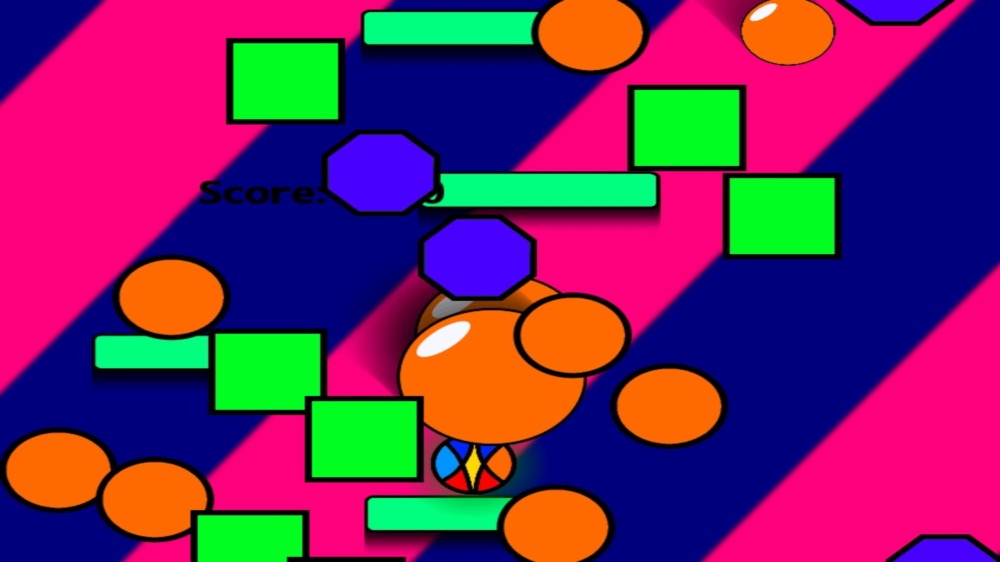
Droppin’ Ballz is one of those “fall as far as you can” games.  My gut tells me it was designed with tilt-controls in mind.  Because Microsoft opted to not go with a motion-controller like everyone and their mom and instead decided to create a device that plays like Minority Report as invented by the chronically unambitious, Ballz is stuck using the trigger buttons instead.  I guess this control scheme works, but it never feels quite right.   My biggest complaint, that the game moves too slowly, is easily corrected by adjusting the difficulty.  The game is set to easy on default, but it’s only really tolerable on normal or higher.  And that’s assuming you play the game on its classic mode, where you just fall from one platform to another.  I was ready to write off Droppin’ Ballz as just another phone-style faller that has no place on a console.

I think the developers were droppin’ something, but it wasn’t ballz.

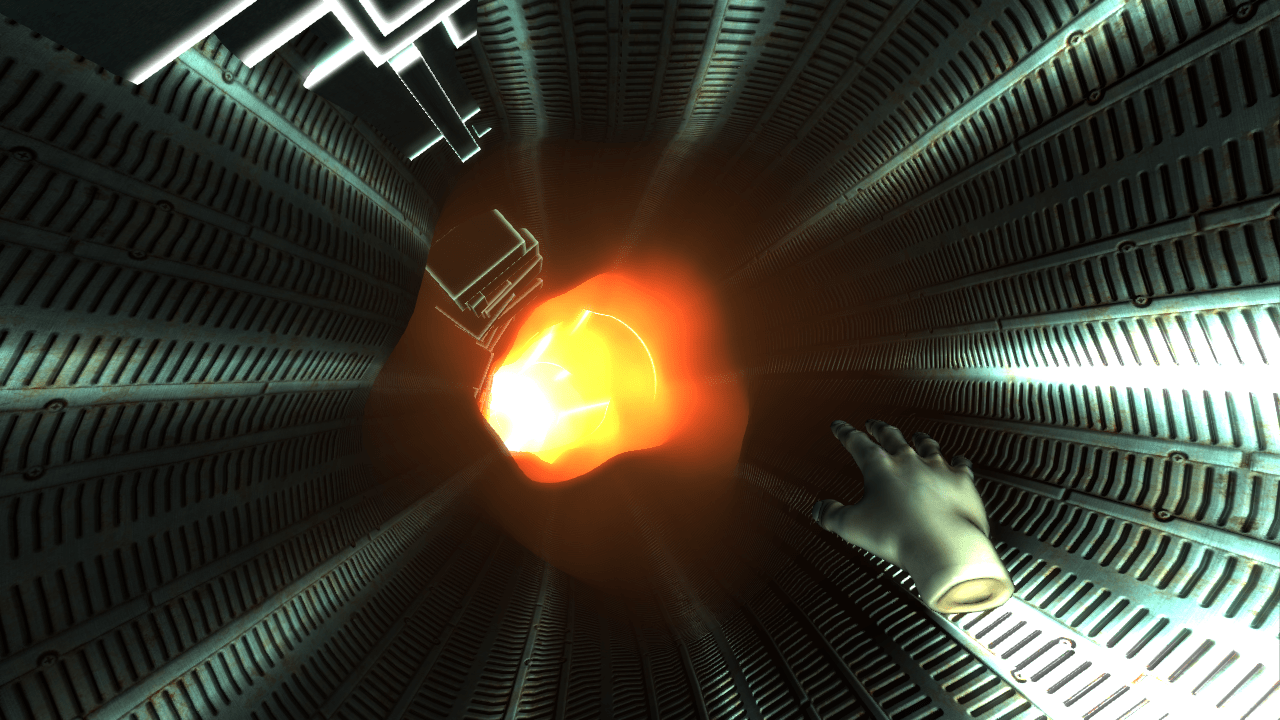
And then I tried Fever mode, which feels like you’re falling through the rabbit hole from Alice in Wonderland, only without having to drop acid.  Actually, I imagine if you dropped acid while playing this, it would be pretty fucking bad ass, but probably a little too difficult to play.  The idea is still  the same: fall from platform to platform, try to not miss the platforms, and try not to land on the black platforms.  Only in this mode, the background changes color and tries to distract you, plus there are perspective-altering “power-ups” that shift what angle you view the game from.  This is what the whole game should have been like.  It’s as if developers flipped a coin to decide if they would go the generic route or the trippin’ on mushrooms route, and the coin fell down a sewer grate.  And they couldn’t flip another because then they wouldn’t have enough change left to get a Mountain Dew, so they said “fuck it” and continued working on the inferior classic mode as well.

I actually did like Droppin’ Ballz, but I have a tough time recommending it.  There’s no online leaderboards, so there’s really no point in playing it.  Hell, even the local leaderboards are all kinds of fucked up.  In theory, there should be six boards: one for each game mode on each difficulty level.  The point values increase on the higher difficulty stages, so ranking a game played on the tedious easy mode over the medium mode is silly.  But that’s how it’s done in Droppin’ Ballz.  Even worse, it ranks games played in Classic mode against games played in the wacky Fever mode, which makes no sense at all.  I guess Fever Mode is good for a twenty-minute distraction and priced accordingly, so I do mildly recommend it.  I would rather see this game on iPhone, with online leaderboards.  I could see it being a big, word-of-mouth hit on there.  It would be a perfect fit on a platform developed by an acid-dropping, corporate hippie.  They could rename it “Jobs Ball.”

Droppin’ Ballz was developed by He-3 Software

80 Microsoft Points heard Hurley gave his hopes up when he heard that there was a way to make your balls drop for just 80MSP in the making of this review.

Gameplay footage courtesy of

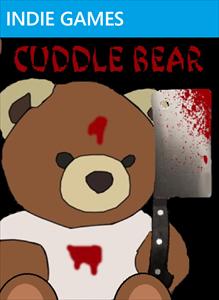
Cuddle Bear

Cuddle Bear received a Second Chance with the Chick. Vast improvements have changed it from one of the worst games ever made to merely terrible. I kid. It’s not really that bad anymore.  Read the new review.

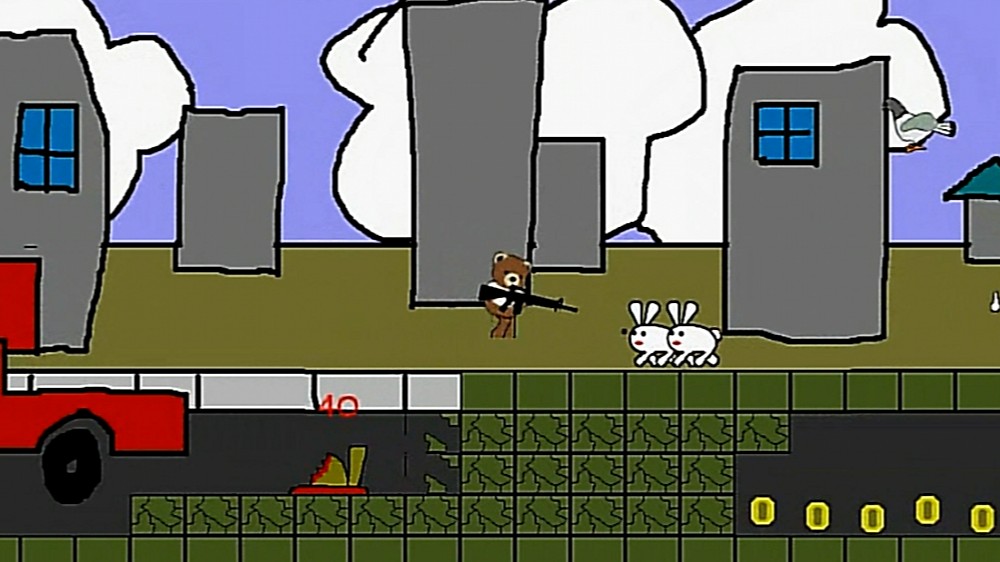
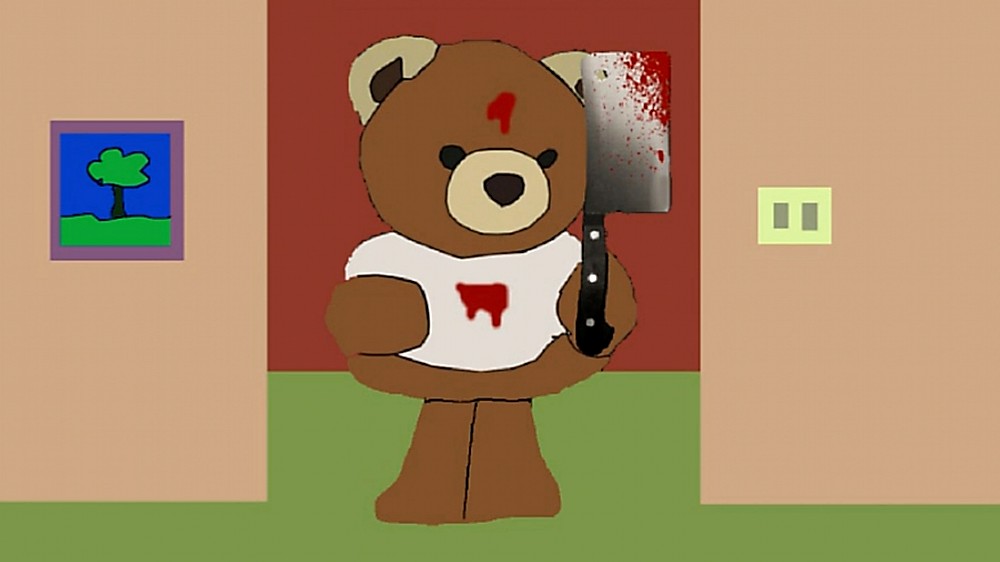
In order for Cuddle Bear to be as bad as it looks, it would have to walk around kicking puppies and luring children into discarded refrigerators. I’m not sure if it does those things, but I can’t swear it doesn’t. This is one of the worst Xbox Live Indie Games of the year. It didn’t start that bad. You play as a psychotic teddy bear that goes around killing various bugs and animals. You’re armed with a gun, you have the ability to buy more guns, and levels are usually filled with plenty of God’s creatures for you to gleefully murder.

No really, that is what the game looks like.

The first world, set inside a house, is actually not too bad. Yes, the MS Paint graphics are embarrassing, the amusement level of the sound effects gets old fast, and the floaty jumping I just fucking knew would be problematic later, but it was still kind of cute in a “oh, look at the three-legged kitten” kind of way. And then I got to the suburb level, where the game took a turn for the worst. The platforming started to rely heavily on leap-of-faith gameplay. You know what I’m talking about. It’s where you have to jump to a platform you can’t see, possibly into enemies that you can’t defend yourself against. Some levels from that point on are completely centered around that concept. You jump, wait for the platform to appear, see an enemy next to the ledge, hit the enemy, recoil hugely off it, and fall to your death. Or even worse, you don’t die, fall to the ground, and have to walk all the way back to the start of the level to try again. At this point, if I had a button in front of me that would have detonated the developer’s head, I can’t say I wouldn’t have pushed it. Actually, I probably would have had someone else push it for me. Never hurts to have a second set of fingerprints on head-popping buttons.

I’m not sure how a game gets made in this day and age with gameplay like this. Did nobody play this far and tell the developer “you know, this is kind of just a series of dick moves that isn’t fun in the slightest bit?” I’m guessing not. It sucks that it falls to me to tell the developer that Cuddle Bear is just a series of dick moves that isn’t fun in the slightest bit. At least the leap of faith stuff isn’t the only thing to complain about. The graphics are shitty, but the game somehow still comes in at 241.5MB, necessitating an insulting 240 Microsoft Point price tag. Truth be told, that’s probably a good thing. It means nobody is likely to waste any time or money on this piece of shit. The enemies end up being bullet sponges, it takes too long to upgrade guns, and the game is kind of too long and samey for what it has to offer. I was getting bored with it long before I was getting angry at it.

Pictured: Cuddle Bear after he murdered fun itself.

Cuddle Bear isn’t the first title here that featured leap-of-faith platforming, but it will be the last one that I make any effort to finish. If developers don’t want to put in any effort into their level designs, I’m not going to make any effort to play them. I did excuse the first couple dozen instances of blind jumping in Cuddle Bear, but it became apparent during the second beach level that I was wasting my time. Nothing good had come of the game by this point. It was just getting worse and worse. This kind of stuff worked in old school games where the enemies didn’t spawn until you reached the point they were meant to appear. In this game, and many other XBLIGs for that matter, the enemies are just there, walking back and forth. You can’t prevent them from being close enough to the ledge, and thus all platforming is left completely to chance. I find it odd that the developer requested I review this game. Maybe he wasn’t aware how bad it was.  Well, hopefully he knows now.  If not, I’m not sure how else to say it.  I could sing it.

Beneath the knees, hopefully nobody pees.

He’ll slurp and gag and gargle the sea.

Because that’s the day the Cuddle Bear sucked a big dick.

Cuddle Bear was developed by Happy Sock Entertainment

240 Microsoft Points read that the developer has Cuddle Bear 2 planned, says this is confirmation of the existence of evil in the making of this review.

Little Monsters

I loves me some physics-based puzzlers.  That’s why you won’t catch me bitching about what Angry Birds has done to the iOS market.  I couldn’t be happier.  It’s a genre that lends itself perfectly to killing time.  If I’m stuck waiting for something, I can spend five minutes with it or an hour, being able to jump in and out without consequence.  That’s why I don’t think the genre works well for consoles.  It lacks that “killing time” feel.  There’s a big difference between playing Angry Birds while waiting at the doctor’s office and playing Angry Birds on your couch.  The only time I get bored playing these games is when I have nothing to do.

By the way, that has nothing to do with why I don’t like Little Monsters.  I don’t because the game sucks.  But if it had been good, that would be the excuse of why I didn’t recommend it more.  Figured it would be fair to let you know that.

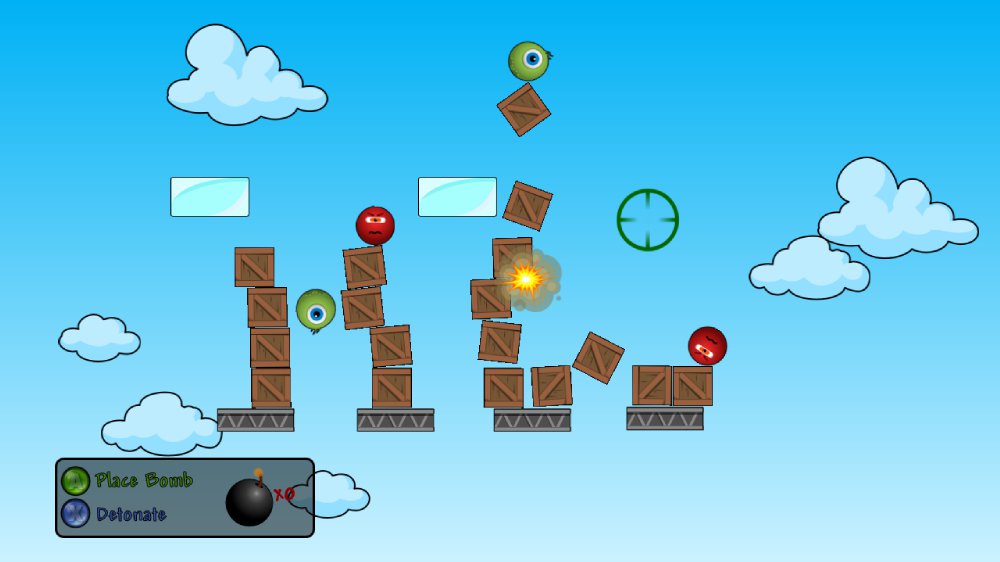
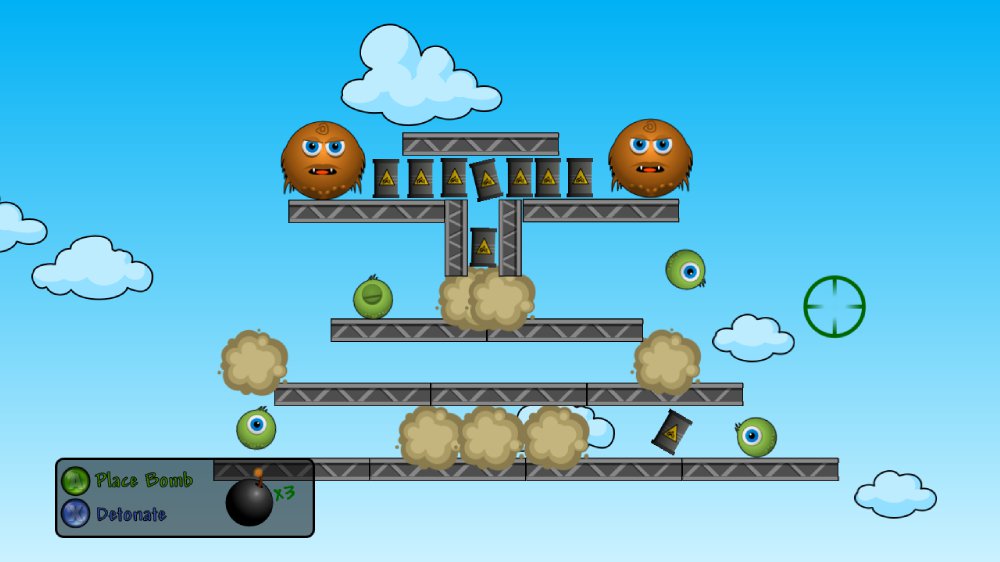
In Little Monsters, you’re given a limited number of bombs in each stage to blast all enemies off the their platforms and into oblivion.  There’s a variety of enemies, some of which jump, some of which are heavy, some of which float in the air, and some of which melt ice blocks and detonate explosives.  They’re used in clever ways through-out all 30 puzzles included.  The game scores on a 3-star system, much like Angry Birds.  The fewer bombs you use, the more stars you get.  The concept is solid.  The execution is so not solid it’s practically vapor.

Having bad physics in a physics-based puzzler is like entering a horse into a drag race with a Ferrari.  You’re just asking to be destroyed.  In Little Monsters, the enemies are round in shape and roll when they get moved.  Sometimes they would be rolling at a pretty decent speed, with nothing in their way, and just come to a complete stop for no reason.  This was especially a problem with the big monsters.  For no reason, they would stop on the edge of a cliff, stop in the middle of a platform, or once even briefly while rolling down a slope, negating all momentum it had built up.  It was weird and hugely annoying.  I can’t tell you how many times I had a stage beaten only to see the physics crap out and enemies stop moving for no reason. Oddly enough, this never seemed to happen with the “cute monster” that you have to avoid killing.  By God, if anything came remotely close to it, it seemed to scoot its ass off a cliff like it thought it was starring in Lemmings.

Maybe the big dudes lactate super glue. That sounds like something a monster would do.

The bombs aren’t accurate either.  It feels like something is off in the collision detection, or there’s an issue with the gravity.  I would set bombs on the bouncing enemies, wait for them to line up, and detonate, only for the bomb to not even budge them.  This happens way too often.  There are a few stages that involve timing, but whether the bomb would actually work the way it’s supposed to was never consistent from one attempt to the next.  It’s never fun to have to replay levels when you know the solution but have to wait until the game is willing to behave correctly.

The bombs also lack “oomph” to them.  From one stage to the next, the strength of their blasts never feels uniform.  These problems all add up to a game that feels like it’s still in the Beta stage of development.  Maybe something good can come of it, but by time it does, people will have given up and Little Monsters will lose its potential audience.  Think of every sad picture you’ve seen of a premature baby being hooked to life support, with tubes and wires all over its body.  That’s what a developer does to its own game when it releases it too soon.  Little Monsters is that sad, premature baby.  All the potential in the world, but barely a fighting chance of survival.  Again, I love this genre.  I love it.  But Little Monsters has about as much stability as a bridge being suspended by twine.

Little Monsters was developed by WhiteHawk Games

80 Microsoft Points said naming a game after a movie starring Howie Mandel was probably a sign it would be no good in the making of this review.

Dot Dash: episode 1

I’ve been stoked to play Dot Dash: episode 1 since last month when it was previewed in the return edition of Indies in Due Time.  Unfortunately, sometimes I psych myself up a little too hard before a game.  I was convinced that I would adore Dot Dash, as long as it got the controls right.  Despite somewhat succeeding there, I really am hard pressed to give Dot Dash a recommendation.  This is a tough one for me, because I really did have fun, but this game has more problems than an algebra text-book.

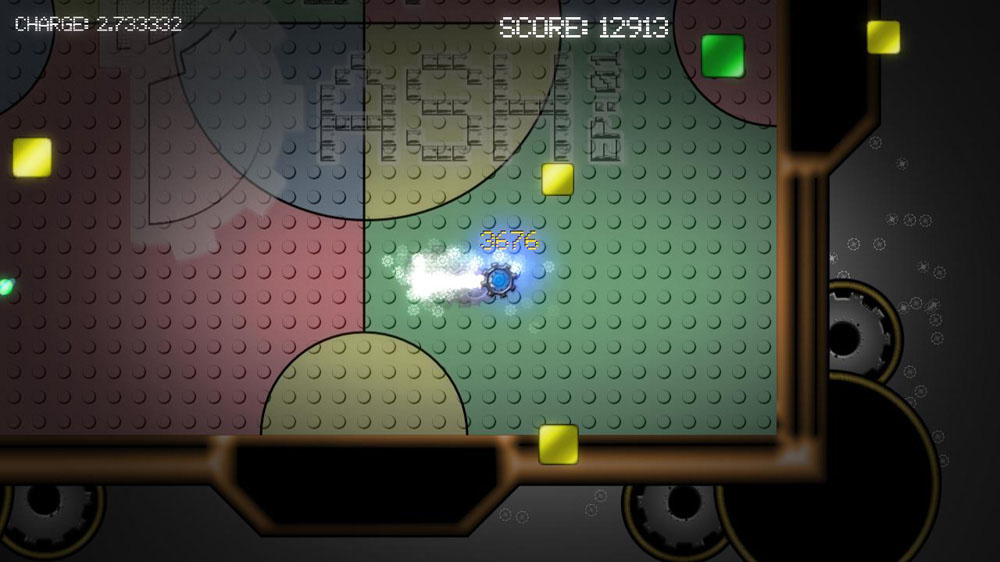
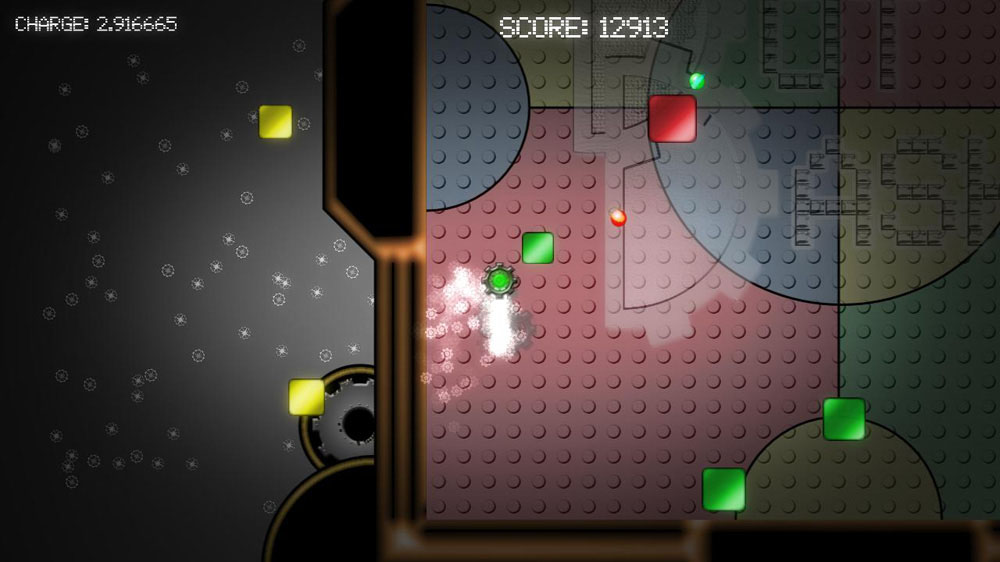
The idea is you’re a little wheel-thingie that has to avoid blocks that come at you from all sides.  In Marathon mode, if you touch a colored orb, you gain the temporary ability to absorb blocks of that color, for points.  Your goal is to score as many points as you can.  This is the only color-matching mode, but it’s also probably the most fun.   Time Extension is the second mode.  Grabbing colored orbs is replaced with avoiding the blocks altogether and looking for orbs that extend the time you have remaining.  Finally, there is Zone mode.  Here, a scoring zone randomly teleports around the play field and  you have to stay inside of it to rack up points.

All three modes are fun enough, but my desire to keep playing them was dulled once the problems with the game became more clear.  Fairness is the chief complaint I have.  Blocks and orbs spawn randomly, sometimes creating no-win situations and making Dot Dash require a little too much luck to truly be a game of skill.  During my best rounds of Marathon, I would get into a wonderful groove and show escape skills that would make Houdini proud.  Then the game would throw out a dick move by having blocks come at me from all sides with no space to escape.  This happens way too much, and it owes to the random nature of the blocks.  Dot Dash has to have a random algorithm.  I mean, it would suck if it didn’t have one.  But it has to be random in a smart way, and this is where the developers failed.  There’s no fail-safe that prevents inescapable situations.  At first, it was just annoying.  When I was closing in on a two million point game, only to be surrounded by blocks with the only gaps being smaller than my wheel, I let out what could only be described as a primal scream.  It was so loud that my parents assumed I was becoming a werewolf and shot at me with a silver bullet, but missed and hit my friend instead.  Thankfully she was a werewolf, because the silver bullet did kill her.  Huh, Hortense was a werewolf.  Who knew?

A totally different, but hugely annoying problem was highlighted in Time Extension and Zones, and funny enough, it’s something that’s meant to help.  It’s the speed-up orb.  In theory, it gives you the speed necessary to outrun the blocks.  In reality, it destroys the accuracy of the controls and makes you extremely more likely to run into a block.  In Zone, it’s worse because it makes lining up in the zone overly difficult, especially the smaller ones.   I played Dot Dash for over an hour and at no point was the speed-up ever useful.  Not even once.  And the game gets a little too generous with spitting them out.  Any game where you try to avoid getting power-ups like they’re the plague has serious problems.

As the blocks zoom by faster, you don’t always have a way of avoiding them.  It also doesn’t help that they’re not distinctive enough from the time extender orbs.   Let’s say you’re poisoned and you have five seconds to choose an antidote.  You’re given five options and told that the white ones will kill you faster, while the white one with the black stripe will save your life.  Choosing the correct one probably isn’t as easy as you think it sounds, especially when you’re under pressure and can only focus on so many separate things at once.  Chances are you’re going to be as dead as the dodo, just like I would be.

The pictures are a little misleading, because at times the entire screen seems to be filled with blocks. I did sometimes question the legitimacy of the game’s randomness. In Marathon mode, I swear most of the time the game would put only one color orb out, then throw at you nothing but blocks of the other three colors. This happened almost every time.

There’s a few minor annoyances.  The background is colorful, but it can get in the way.  I almost wish it had been shades of gray.  The blocks are colorful enough that it would be a neat visual contrast.  There’s also no online leaderboards, which is the type of thing that can make or break any score-based arcade game.  Ultimately, the biggest problem is the game just doesn’t play fair.  I don’t mean to sound like a crybaby, but when I die in a game, I want it to be because I fucked up, not because the game throws something at you that is impossible to avoid.  I have no problem with luck factoring into a game, but I would rather such situations only be to your benefit.  Bad luck in games is only good for making me want to play something else.

I still do very meekly recommend Dot Dash: episode 1 because it is genuinely fun.  But it has the potential to be so much better.  With the right adjustments, it could be something special.  As it stands, you might enjoy it, but it might give you as much trouble as my parents are having trying to fit Hortense into the crawl space.

Dot Dash: episode 1 was developed by Drop Dead Interactive

80 Microsoft Points said this shit happens every full moon and we’re running out of  space in the crawl space in the making of this review.

Adventures of Lolo, Aesop’s Garden, and Crystal Hunters

Update: Crystal Hunters is now 80 Microsoft Points.

For the first time, I’m doing a multi-review with games from different developers. This is because both of today’s titles, Aesop’s Garden and Crystal Hunters, are new takes on a classic NES game called The Adventures of Lolo, a game 82 days older than me. It actually was released on the Wii’s Virtual Console back in 2007, but I was in the middle of a World of Warcraft bender that year and missed it. I’ve dealt with a lot of clones over the last month, and my attempt at playing a game that I had no reference point on (Boulder Dash clone Gems N Rocks) left me feeling a bit weird. Yes, I do believe a game should be able to stand on its own, but if a game sets out to pay tribute to a classic, you should also measure it against the original. Was True Grit a fantastic movie because it was a remake, or in spite of it? Would anyone have known how truly awful Tim Burton’s Planet of the Apes was without the Charlton Heston original? Would New Coke have caught on if people didn’t have the classic formula to compare it to?

In that spirit, let’s compare these three games.

Concept

All three games are action-logic puzzlers where you must collect a set number of things in a room that open an exit. In Lolo, it’s hearts. In Aesop, it’s weeds. In Crystal Hunters, it’s crystals. In Lolo and Crystal, the items are in plain sight, and it’s up to you to figure out how to safely reach them. In Aesop, the weeds have not yet sprouted. You have to first turn on a sprinkler. This is because the rival of the main character wanted to ruin his chances of winning some kind of gardening contest, so he went around planting weeds. Good lord, that’s spiteful. I mean, it could have been more so. The guy could have salted the ground so that nothing would ever grow back. Besides that, there’s 50 levels in this game, so how big exactly is this plot of property that Aesop has? It’s hard to feel bad for the guy when he owns so much land that you can almost call it a kingdom. At least it beats “guy just wants to get a lot of crystals” or “monster kidnaps girlfriend, presumably so he can fuck her.” What do all these evil monsters want with princesses? With all the inbreeding that takes place among royalty, they can’t be THAT good in the sack.

Aesop’s Garden

Game Play

Lolo and its offspring play like more actiony-versions of Sokoban, the crate-shoving puzzle genre that has been reviewed a few times here at Indie Gamer Chick with titles such as Puzzled Rabbit or HACOTAMA. The difference in these games are the addition of enemies, firepower, and environment-based puzzles. In Lolo, there’s a handful of enemies that are all carefully integrated into each level. Some of them chase you, some of them shoot fireballs at you, and others remain stationary but kill you if you cross their path. These are called “Medusas” and they are also found in both Aesop’s Garden and Crystal Hunters, albeit as scarecrows and evil treasure-chest-things that zap you like you’re a Nazi watching the opening of the Ark of the Convenient.

In Lolo, you often have to use enemies to your advantage. In some rooms, the hearts you collect give you two shots. If you shoot an enemy, it turns into an egg for a few moments. You can then shove it into place and use it as a block, or push it in the water and use it as a temporary bridge. If you shoot an enemy a second time, it dies, but it will respawn. In other rooms, you might collect the ability to create a bridge or smash a rock. Aesop’s Garden has a feature similar to the hammer.  At the halfway point in the game, carrots are introduced to summon hungry rabbits that destroy all walls in whatever line you’re standing in.

Both Lolo and Aesop’s Garden rely much more on trial and error than Crystal Hunters. In that game, crystals that give you shots are red instead of blue. In Lolo, only some hearts give you shots, and there is nothing that distinguishes them from normal hearts. In Aesop, you’re never sure where exactly weeds will sprout up. It’s never too annoying, and both games allow you to commit suicide with the select button if you fuck up. If you die in Crystal, it doesn’t take you back to the beginning of the stage, but rather to the last point you were safe, which is a cool feature. It would have come in handy in Lolo and Aesop for sure. Fuck ups there usually resulted in me dropping cyanide. Lame. If I was the hero in a puzzle game and I had to kill myself, I would totally go with seppuku.

Adventures of Lolo

Playability

This is where all three games stumble, as the control is not so smooth in any title. It’s never bad enough to be a deal breaker, but it will lead to some very aggravating moments. Lolo probably plays the best, which is appropriate given that it’s the only game that was made by professionals. Still, the controls in it felt a little loose. Whether I was using a standard Wii remote or the classic controller, I would often push blocks one half-space too far, necessitating a suicide. This led to me heel-toeing it one tap of the D-Pad at a time whenever I moved a block around. This wasn’t always an option. If you’re moving an egg, you only have a few seconds before it hatches and whatever enemy you’re pushing is frozen in place. Or maybe you’re being chased that by an enemy. Or both. In the later stages, the game demands precision movement from a controller that is anything but precise.

Aesop’s Garden is even worse. The controls feel very loose, which is partially to blame on the crappy D-Pad of the Xbox. Using the stick is no use, because it doesn’t have proper analog control. I have the silver, transforming D-Pad and even it wasn’t satisfactory. This led to multiple instances of steering off from a straight line and into the path of a scarecrow, shoving blocks to far, or in boss fights, steering myself right into the path of a projectile. It never felt quite right, and that did hurt the game.

Crystal Hunters is hurt by the game’s lack of movement parameters. In Lolo and Aesop, you move one half-space at a time, using the background to guide you. In Crystal Hunters, it’s not always clear how far you’re moving, because the game doesn’t have a “grid” feel to it like the other two do. The background doesn’t draw out spaces for you, so you’re kind of left to your own judgement, which can often be unreliable. I ended up going back to the heel-toe method of block shoving, but like Lolo, that’s not always an option here either. Sometimes enemies will be chasing you, or sometimes you’ll be moving a tree-stump and have to rush it to the spot it belongs in before it puts its roots down. In the later stages, this can be maddening. The lack of parameters also gets annoying as more Wind Waker-like light beam reflecting puzzles are incorporated, all of which require nothing short of perfect movement from an imperfect control scheme.

Puzzle Design

If there was one word I could use to describe all three games, it would be “smart.” In the case of Lolo, it’s a game made by Hal studios, the guys who later went on to make the Kirby series, Earthbound, and Smash Bros. They obviously have their shit together. Aesop’s Garden and Crystal Hunters were developed by amateur game designers, so you wouldn’t expect such a degree of sophistication from them. Then again, I wouldn’t have expected that from games like Alien Jelly or Escape Goat either. It never fails to surprise me how clever some Xbox Live Indie Game developers can be. Both games have absolutely stellar puzzle design, so much so that it actually rivals the game that inspired them. At times, they can feel a bit sprawling, especially Crystal Hunters, but it never feels like busy work. The only game I can toss a complaint at is Aesop’s Garden, which throws boss fights into the mix that are annoying, given the crappy control scheme.

What I love best about any puzzle game is that “ta da!” moment where, after staring at the screen for ten minutes, you finally figure out the solution. The difficulty of all three games here ramps up as you go along (something that Indie Gamer Chick favorite Escape Goat doesn’t do), which leads to many of those moments. I crave those like a junkie craves smack. They top an awesome headshot in a shooter, a come-from-behind victory in a sports game, or a leveling-up victory in an RPG. For my money, nothing else in gaming tops that feeling of achievement.

Crystal Hunters

Conclusion

I know a lot of readers come here for the spectacle of a bad game getting trashed by me. I realize this wasn’t my funniest of reviews, but don’t worry, I’m sure a crappy zombie game can’t be too far off in the distance. If you come here looking to read about good games, I’ve got three right here for you. At 22 years of age, I missed the NES era and never had a chance to play Lolo. If you’re around my age, you probably missed it too. Or maybe you were one of those weird families that owned a Sega Master System instead of an NES. Either way, it’s worth your $5. For fans of the game already out there, don’t go back and replay it. Nothing about it has changed in the 23 years since its release. But, there are two brand new Xbox Live Indie Games that will satisfy your Lolo-cravings. Both Aesop’s Garden and Crystal Hunters are what you’re looking for, and they’re a bargain and $3 a pop. Yea, I probably could nit-pick them a little more. Like how Crystal Hunters has a completely needless time-system tacked on, presumably to add replay value. Why did they even bother? The fun in these games comes from solving a puzzle and moving on to the next. Once it’s solved, it’s done. You don’t expect replay from crossword puzzle books, so why should you expect replay from a logic puzzle in a video game? Just finish it and be happy. Yea, the controls are crippled, but you feel like a genius, so who cares? It’s just like being Stephen Hawking!

Aesop’s Garden was developed by Excalibur Studios

Crystal Hunters was developed by DreamRoot Studios

The Adventures of Lolo was developed by HAL Laboratory

500 Wii Points (Adventures of Lolo) and 240 Microsoft Points apiece (Aesop’s Garden and Crystal Hunters) had to remind Kairi that getting frustrated and banging her head the coffee table was probably not the best way to keep the amount of brain cells needed to play these games in the making of this review.

Indies in Due Time: 150,000 Served Edition – May 2, 2012

150,000 page views in ten months.  Wowzers.  I know I do this every milestone and I’m sure you’re all sick and tired of it by now, but I have a lot of people to thank.  Thank you Dave Voyles of Armless Octopus and Kris Steele of Fun Infused Games.  They ran the 2011 Indie Game Summer Uprising, and without their support and suggestions, I strongly doubt anyone would have ever found this site.  Both guys encouraged me to get involved in the Uprising by interviewing participating developers.  I admit, my interview skills were mediocre at best, but it helped me find an audience, and I will forever be grateful to them.  Dave especially, who has offered so much support.  Funny enough, I met Dave back in 2000 when we used to play NBA 2K1 against each other on the Sega Dreamcast.  I was 11 years old, and he knew me as “that annoying person who plays as the Golden State Warriors and quits whenever she’s losing by more than 20 points.”  Thankfully I’ve since matured into the well-respected chain-cussing, dick and fart joke pseudo-critic I am today.  Maybe “mature” wasn’t the right word.

I would like to thank two people who interviewed me for their websites, giving people a chance to see a slightly different side of me.  That would be Bruno Barbera of Italian gaming blog Recenopoli and Taylor Iscariot of Albatross Revue.  I would like to thank all those people who have linked to me on their blogs, websites, and forums.

I want to thank my incredible boyfriend Brian.  I don’t know why you put up with me, or where you find the infinite patience you have in dealing with me, but I’m so lucky that you have it.  I am the luckiest person in the world, and you’re proof of that.   I love you Brian, with all my heart.

I want to thank all the developers who have accepted me as a part of their community.  I’ve heard a couple of them use the term “valuable” with me in a non-hostage/mail-order-bride context, which is pretty cool.  Big thanks to Ian Stocker, Alex Jordan, Scott Tykoski, George Clingerman, Shahed Chowdhuri, and Adam Spragg for their contributions to my site, Tales from the Dev Side.  It’s because of the encouragement of developers like them that I strive to do better for the Xbox Live Indie Game community that has treated me so well.  You guys make me feel special, and I won’t forget that.

Finally, I want to thank all the new friends I’ve made through Indie Gamer Chick.  I’ve never been the most social person, and don’t have a lot of what you would call “friends.”  But I’ve met some awesome people through here, and I think I could call them my friends.  Guys like Alan C (tea drinking limey bastard), who never fails to make me laugh.  Tim Hurley of Gear-Fish, who is like the ultimate little ego-booster, and a hell of a writer too.  Nate Graves, who is like the big brother I never had, and you should send him stink bombs until he returns to writing at Gear-Fish.  Cyril of Defunct Games, who is always there to argue over silly bullshit with me.  I don’t know what the future holds for my site, other than continued growth (fingers crossed) and maybe a Pulitzer Prize for best use of vaginal jokes.  But, no matter what, I know you guys will be my friends long after Indie Gamer Chick ceases to be.

Alright, I’m done now.  No more sappy bullshit.  Onto the trailers!

Read more of this post

Honey Badger – Slayer of Memes

Some XBLIGs should probably only exist as free browser-based flash games.  Honey Badger – Slayer of Memes is such a game.  It’s a fairly low-quality Punch-Out!! clone with the gimmick of being able to beat-up a handful of internet running gags.  This leads to problem #1: none of the jokes in here are funny anymore.  You can usually tell when something stops being funny because they make an episode of South Park about it.  This leaves Honey Badger to stand on its own as a game, which it simply can’t do.  Problems #2 through #891 are easy to figure out during the first fight: the game sucks.

Wow, it's the Leave Britney Alone thing. That NEVER gets old.

I’m a huge Punch-Out!! fan.  I would assume anyone who would attempt to clone it must be a fan too, but Honey Badger completely misses the point of the series.  Punch-Out!! is all about pattern recognition and quick reaction times.  Your opponent telegraphs a move in a variety of different ways.  You dodge it, then lay into your stun-locked opponent.  Honey Badger has none of that.  Your opponents don’t really telegraph moves, they’re not stun-locked when you dodge a punch, and there really is no method to the madness.  Just mash buttons, hope something lands, and pray like hell the game doesn’t get unfair later on.  Which it does.  I beat the Leave Britney Alone and Tron dudes pretty easily.  Then I ended up against a parody of the Star Wars Light Saber kid.  He just spins around, randomly jabbing at you.  If there was any pattern to it or hint of when he would stop spinning and swing at you, I couldn’t catch it.  He blocked nearly every punch I threw, and I couldn’t block his because it’s impossible to see them coming.

I didn’t really care to keep trying either.  The graphics are okayish and some of the sound effects are mildly amusing, but otherwise this game is horrible.  The controls are unresponsive, especially dodging.  There’s a noticeable delay in it, which would have been annoying if it was useful.  Since you can’t predict when a punch is coming, what use is it?  Then again, why bother blocking?  It doesn’t work either.  I went to block punches, held my gloves up, and the opponent’s punch would still seem to cause as much damage.  Ultimately, this feels like a joke game that would be free on Adult Swim’s website.  And not a very good one.  If you want to talk about memes, you might as well call this One Cup: The Game, because all it will do is feed you shit.

Honey Badger – Slayer of Memes was developed by Dream Wagon

80 Microsoft Points actually wouldn’t mind playing a GOOD clone of Punch-Out!! given that Nintendo only releases a new one every 10 years in the making of this review. 

The Walking Dead: Episode 1 – A New Day

Warning: there will be major spoilers for the game in this review. Not for the TV show or the comic book, just the game. I figure everyone who reads me falls into two camps: those not interested in The Walking Dead at all, and those who already finished the game. But if you’re generally interested in the game and don’t wish to have this spoiled, I strongly advise you to read something else. If my personal recommendation is what hinges on your decision, I thought the first episode was just alright. Sorry if that’s not helpful.

Yea, yea. It’s not exactly an indie game. The thing is, I think I’ve found myself in a unique situation and I figured I should capitalize on it. According to my research, I’m the last standing regular gamer in North America who hasn’t watched The Walking Dead. That’s probably because my interest in zombies on film is nil. They’re all the same. Somehow a virus or bacteria spread by the bite of a slow-moving bipedal predator with no survival instincts causes the complete collapse of civilization in a matter of hours, leaving a rag-tag group of survivors to put aside their differences and struggle to stay alive. As far as end of world scenarios go, I just find it too implausible.

I don’t know how The Walking Dead television series (or the comic book, which the game is more directly based on) handles the initial outbreak, but the video game version makes the start of the apocalypse seem almost instantaneous. You’re a dude named Lee who is being transported to the state prison after being convicted of killing his best friend for sleeping with his wife. The game makes it pretty clear that you’re guilty of the crime, but the police officer who you chit-chat with in the opening minutes thinks you’re likely innocent, mostly because you didn’t deny that you did it. Well, um, that’s logical I suppose. Hey Brian, I don’t deny that I spread my ass cheeks and farted in your mouth while you slept.

Why the fuck is Short Round in this game? Is this some kind of receipt against Lucasfilm for not granting Telltale an Indiana Jones license?

You end up hitting a zombie, crashing the car, mangling your leg, the cop somehow becomes zombified in process, and the game properly begins. A sign that I wasn’t going to like the protagonist very much becomes clear early on when you reach for a shotgun and fumble putting the shell in it. This wasn’t user error on my part. You actually fumble the shotgun shell. As it turns out, Lee is a total stumble-fuck. There’s at least three parts in the game where he gets knocked dizzy from hitting his head on something after being startled by a zombie. Fucking guy reminded me of Norberg from the Naked Gun.

Telltale Games has as a reputation as the best makers of adventure games these days. I’m not particularly a fan of the genre, so their stuff usually has to be pretty good for me to get into them. Lord knows I’ve tried. The problem with Telltale is they’re a farmhouse for fan-service type stuff, so chances are a person’s enjoyment of their titles will be directly in proportion to how much you like the source material. For example, I thought Tales of Monkey Island fucking sucked. I never previously played any of the Monkey Island games, which was apparently a requirement to enjoy these ones. Judging by the way fans of the series reacted, I expected something special. Ultimately, I thought the puzzles were lame and the jokes were not funny.

On the other hand, I enjoyed their take on Back to the Future. Even with some writing assistance from the creators of the movie franchise, I figured it would come across like glorified fan fiction. Nothing could have been further from the truth. But, and this is a big but, I liked the movies enough that any decent continuation of the series would have been welcome by me. If I found the source material to be just marginally entertaining, I don’t know if I would have liked it so much. If only I had such an example to go off of.

Oh snap. That’s right, Telltale also made Jurassic Park. Borderline entertaining popcorn flicks with enough plotholes to fill dinosaur DNA gene sequence gaps, but a truly horrible adventure game.

Given my track record with Telltale, I didn’t think I would enjoy Walking Dead at all. My general dislike of adventure games combined with my lack of interest in the source material certainly spelled doom for the fifteen combined hours the series will eat up of my time over the next five months. But actually, I kind of dug what Walking Dead had to offer. Sure, Lee is a completely uncharismatic, boring lump of a man. It doesn’t help that the voice actor sounded like he was so fucking bored while reading the lines that he might just release live scorpions into the recording booth to liven things up.

I’ve discussed my hatred of Lee with others that have played Walking Dead, and what cracks me up is how all the fanboys make excuses for him. More than one person has described him as “soft-spoken.” Which is a polite way of calling someone boring. First-hand experience talking. When I point out that he’s a klutz, people tell me that it’s how someone would realistically behave in such a situation. I thought we chucked realism out the door when we started talking about zombies, but fine. So let’s talk realism. The dude has a very broken leg to begin the game. He enters a house and slips a little on a puddle of blood. Then he gets attacked by a zombie. While he tries to escape, he slips again on the puddle of blood, hits his head on the counter, and would be fucking zombie chow by this point. Instead, you can kick at the zombie with your non-broken leg and finish her off with a hammer. Oddly enough, he never learns the from this experience. When a zombie shows up, chances are good Lee will be scooting his ass across the floor.

“Hey, wait a second!” cries the fanboys. “He has a broken leg! You can’t expect him to fight zombies standing on that!” Why not? He gets around just fine when zombies aren’t attacking. He doesn’t even really limp. You know what?  I don’t think it’s broken. I think the son of a bitch is milking it. Notice how it’s always somebody else doing the tough stuff when the zombies attack. I pull the same trick every time someone asks me to help them move stuff. “Oh, I would love to, but my old football knee is acting up.” Nobody says “why you lazy bitch!” At least at a volume higher than under their breath. I don’t deny Lee has a leg injury, but it only seems to bug him at the most convenient times. Well, unless the little girl he’s watching is being grabbed by a zombie.

Oh yes, the girl. Her name is Clementine. She has yellow eyes. So help me God, yellow eyes! Why didn’t anyone shoot her before the zombie apocalypse? If I give birth and the doctor says he or she has yellow eyes, I’m shoving it back up my uterus and taking a handful of morning-after pills. But she tags along and proves to be smarter than half of the adults, also known as “Steven Spielberg Syndrome.” As an example of what she’s up against intellectually, you meet a girl later in the game who is a good shot with a gun but can’t understand why a radio that has no batteries won’t turn on. She sits there fucking around with it, then you take it and discover it has no batteries. If ever there was a scene that called for the protagonist to absolutely bitch-slap the loving shit out a supporting character, this was it. Later, you find her the batteries and she puts them in backwards. You have to take the radio from her, turn the batteries around, and pull the antenna up. Unless an upcoming chapter explains that she recently underwent a full frontal lobotomy, I do believe that one scene completely destroyed any sense of credibility the writing built to that point.

I swear to God, if at any time over the next four chapters anyone makes a “my darlin’ Clementine” joke, I will fucking stab something small, cute, and furry.

Everyone is talking about the writing in this game like it was penned by Mario Puzo. I don’t get it. Maybe if you grade it on a curve, given how low the radio bit sunk the whole script, the rest of it seems sublime. But really, the cast is made up entirely of stock characters stumbling through one zombie cliché after another. I suppose the game did make a bold choice by having the star possess the agility of a drunken circus clown, but otherwise you have the gruff farmer, the asshole with a heart condition who makes people wait on him hand and foot, the loyal good ole boy and his wife, their hyperactive child with a decidedly trailer-trashy name (Duck. I’m not joking.), the tough as nails reporter chick with trust issues, etc, etc. I’m half shocked that at no point a shopaholic bimbo and a militaristic ex-jock didn’t show up, but I suppose we have four chapters left for that.

I did like the idea that, instead of playing off like a checklist of things to do, you get exactly one chance to make most of the decisions in the game, and the ramifications in conversations and actions will be felt in the upcoming chapters. You even get a couple of chances to decide if someone gets to live or die. At the end of the game, you are forced to choose between saving the reporter chick or a character named Doug. I liked Doug. He was helpful. He was nice. He rigged a universal remote to turn on televisions in an electronics store across the street from us as a zombie distraction. The chick couldn’t even grasp how batteries work. But, she had gun and Doug didn’t, so bye-bye Doug.

I suppose The Walking Dead must be pretty good as a game, because I’m very tempted to play through it again. I never do that, even if a game has multiple branching paths and endings. I’m actually curious how the game plays if I answer every question like I’m a total asshole. I do regret letting Doug die and I want to go back and save him. I’m a little curious if I can save the cop at the beginning of the game. I’m WAY curious if I can let Clementine die. Yes, the writing is mediocre, the voice acting is terrible, the plot is one giant cliché, I wish death on every character with as much hatred as my heart can muster, and I couldn’t give a squirt about the source material, but I still want to see what happens next. That has to count for something.

The Walking Dead: Episode 1 – A New Day was developed by Telltale Games

$19.99 was spent on a subscription to the series on PlayStation Network in the making of this review. Rats. I should have just bought it by the episode on Xbox Live because I just lost out on a chance to make a Microsoft Points joke. Silly me. Well, Sony hasn’t figured out how to properly set up their online store, so I’m linking to the Xbox version. 

Tales from the Dev Side: Why is Conflict Fun? by Adam Spragg

Although his Hidden in Plain Sight was not an overwhelming success on Xbox Live Indie Games, Adam Spragg still received near-universal kudos from critics for his efforts.  Even my infamously cold heart warmed to it as I played with three interns who probably hate me and call me mean names behind my back.  I’m betting on “Take-a-Bath-rine” although I won’t rule out “Catheterine.”  If they had known my alias was “Kairi” I’m sure it would have been “Cry-ri.”  Which is absurd.  I beat them like 20 games to 1.  If anything, I made them cry.  Or maybe I’m being paranoid.  They probably didn’t call me anything too mean.  I can deal with Catheterine.  I’ll call off the hits.  Well, maybe.  I’m guessing I won’t get my deposit back.

Okay, so maybe I don’t handle conflict (real or imagined) as well as I should.  Adam views conflict differently.  In this very philosophical installment, Adam shares his thoughts on how conflict is the chief reason for a game being fun.  And you know what?  I think he’s on to something.

Read more of this post

Gems N Rocks

Yesterday, I reviewed a Lode Runner clone.  Today, I review a Boulder Dash clone.  Both were early-80s computer titles that received dozens of remakes, re-skins, and ports over the years.  The difference?  I’ve never played Boulder Dash or any of its offspring.  It wasn’t even on my radar, mostly because I’ve never heard it described as a holy shit must-play industry altering super game.  It just sort of exists as one of those “did you ever play that one game” titles that gets brought up from time to time.  No matter the game, if the answer is “yes” the conversation likely ends on the spot.  If the answer is “no” the questioner usually follows up with “it was alright.”  Then the conversation ends.  Boulder Dash was one of those.

I’m kind of glad I’m going into Gems N Rocks with no experience of the franchise it’s bastardizing.  It means I’ll have no frame of reference for how the game should play and thus I’ll better be able to grasp if it can stand out on its own.

The idea is you’re a dude that has to mine for gems.  In each stage you must collect all the gems to win.  You excavate through stages like you’re Dig Dug, only instead of trying to drop rocks on dragons or balloons wearing goggles, you just have to avoid dropping them on yourself.  Whenever you dig around a boulder, it creates a cascade that takes it and all other boulders it’s holding in place with it.  This leads to hilarious situations where you can pin yourself in while collecting the last gem.  You still beat the stage, but if you’re like me and you dwell on these things, you realize your little miner dude is trapped and will slowly starve to death.  Life can be cruel.

There are forty stages here, unevenly divided into three categories.  There’s easy stages.  All you need to know about those is the very last one beats itself for you.  I guess for some developers “easy” is interpreted as “for the recently lobotomized.”  The medium and hard stages are often neither, with the solutions relatively straight forward and often based on some kind of “outrun the enemies” situation.  My favorite levels involved little heat-seeking robots that go all Terminator on your ass.  These are genuinely tense stages, made more so by how fucking horrible the controls in Gems N Rocks are.  Seriously, it’s as if the game comes bundled with an asshole that dips your controller in molasses between stages.  Movement is slow and sticky, and figuring out how to deal with it is literally the only thing that challenged me the entire game.

This is the stage that beats itself like a masochistic dominatrix.

I’m told that Gems N Rocks adds new concepts to the Boulder Dash formula like liquid puzzles based around water, bacteria, and mercury.  Again, I have no reference point to whether it’s an upgrade over the conventional design.  I will say that I would have probably enjoyed the game more if the controls were not so painfully unresponsive that my best strategy involved placing my control on a table and poking the direction I wanted to go on the D-Pad with my finger tip.  If the main challenge your game offers is fighting the controller, you should probably let it cook in development longer.

I never bothered with the included level editor, because I think those are for nerds, and I’m more of a dweeb.  Going off just the included levels, I honestly thought Gems N Rocks was mediocre, with the potential to be decent if the controls had been accurate.  When I brought up my concern to the developer, it took him by surprise, although he conceded that it was probably an example of him playing his own game so much that he never noticed there was a problem.  What he needed was a canary for his mine.  Someone like me, armed with a fork, sitting next to him while they played the game for the first time.  He would have known there was a problem when the fork became embedded in his temple.  Oddly enough, this is the absolute only way I would ever volunteer to test games myself, but nobody is willing to sign the liability waver.  Shame.  I think the Fork You method of testing could revolutionize Xbox Live Indie Games.

Gems N Rocks was developed by Fuzzy Duck Entertainment

80 Microsoft Points think Fuzzy Duck sounds like some kind of Kama Sutra thing in the making of this review.

Gameplay footage courtesy of