Sushi Castle

Sushi Castle sounds like the logical spinoff of Panda Express, but actually it’s the latest game by Milkstone Studios.  Apparently, it’s supposed to be like the XBLIG version of The Binding of Isaac, a popular independent game available on Steam.  I haven’t played it and I have no plans to, so I can’t really comment on that.  Thus, Sushi Castle has to stand on its own for this review.  And stand it does, albeit with the aid of 20lb leg braces and something sturdy to lean on.  It would seem the game has been crippled by a case of video polio.

Sushi Castle is a roguelike twin-stick shooter where you explore various randomized levels looking for trinkets and shooting  enemies.  It can be fun, when the amount of enemies you have to fight is manageable.  When they’re not, which is all too often, the game gets kind of boring.  It’s not that the enemies are difficult.  They typically have simple-to-memorize patterns and are about as easy to avoid as vegetarians at KFC.

The red stuff is blood. The green stuff is acid. Don’t touch the acid. You probably shouldn’t touch the blood either. It’s not sanitary.

The difficulty really comes from the sheer volume of them.  Some rooms throw too many at you, all shooting at you from different sides, which makes taking damage unavoidable.  Despite the setup as a TwickS, you can only fire in eight-directions, and thus you’re forced to put yourself into a direct line-of-fire with the enemies.  Sometimes there are enemies that spawn other enemies.  And every single baddie in the game is a total bullet sponge.  The biggest challenge with the combat in this game is staying awake.  In rooms where there’s only a couple of guys to take out, it’s not bad at all.  When you have a half-dozen or more, the action is so boring, so repetitive, and so unfair that Sushi Castle jumps in and out of being a bad game, like it’s indecisive about whether it wants to suck or not.

Levels are relatively small and straight-forward, which probably owes greatly to the random nature of the game.  There are tons of items to be had, although you generally have no fucking clue what they do before using them.  Some of them outright screw you over.  Don’t you love it when games do that?  “Hey fellas, being trapped in a room with unavoidable artillery isn’t enough.  Let’s make the items be potentially hazardous too.  That shit is always a crowd-pleaser!”  I don’t understand the logic of it.  I can’t understand the logic of it.  Given that the game would be pretty fucking swell without them, I don’t think Sushi Castle is on the fence about whether it wants to suck or not.  I think it made its choice.  I think it wants to suck.

But, these are the guys who did Raventhorne, so it should be no surprise that they even failed at that.  Sushi Castle honestly isn’t bad.  Despite the barrage of items that are really dick moves or the spongy enemies, I had fun with it.  Sort of.  I mean, it sucked that I could build up my gun’s strength to fuck-you levels of badassery, have twenty points of health, a stockpile of bombs, and a cloud-thing that let me float over blocks, yet it just takes one room with a hateful random spawn to fuck everything up.  I mean, come on.  Four guys who have every possible angle of fire covered, AND they spawn little fireball dudes, and all of them take more bullets to kill than Rasputin?  That’s just spiteful.
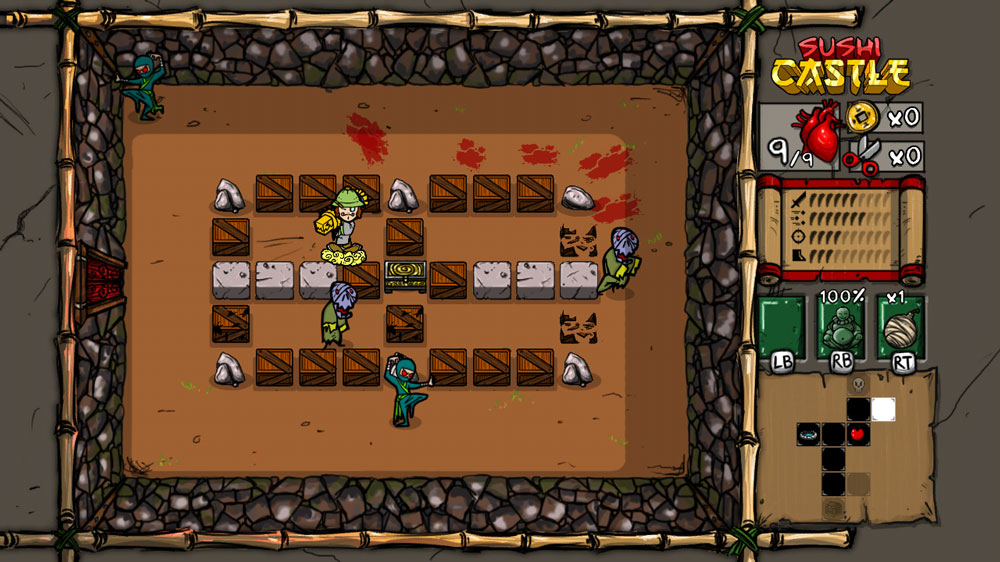
This screen-shot alone is enough to send fans of the Binding of Isaac into a rage if the comments on YouTube are any indication.

Okay, so Sushi Castle isn’t great or anything, nor is it a game that will stick with you after you either finish it or get pissed off and rage-delete it from your hard drive.  But, it can be a perfectly fine waste of an hour or two.  It’s funny though, because the guys at Milkstone do obviously have the chops.  Their games are always a tier or two above the average XBLIG in terms of audio-visual standards, and the games are at least decent in concept.  Yet, there’s always something about them that reels the game back into mediocrity.  I’m telling you guys, I think I’m on to something about the “minimal shittiness quota” that Xbox Live Indie Games seems to have.  If it actually turns out to be a real thing, props to Milkstone for their skillfulness.  It takes a real mastery of your craft to subtly crap-up your games.  Even Nintendo couldn’t do it properly, which is why they said “oh fuck it, let’s just make the controller an unresponsive piece of shit and call it a day.”

Sushi Castle was developed by Milkstone Studios

80 Microsoft Points said “Jesus, even the fireballs bleed in this game?  Quentin Tarantino has more restraint than that!” in the making of this review.

Sushi Castle is ranked on the Indie Gamer Chick Leaderboard.  Click here to see where it landed.

Spectrangle360

Board games.  I love them.  But as video games?  I’m not so sure.  Some games, like chess, are way over-produced.  Did I really need chess on my PlayStation Vita?  Do I really need two version of Scrabble on my iPhone?  That’s ignoring that most of the best board games use “house rules” that aren’t generally an option when you play them digitally.  No money for Free Parking, no starting in a room in Clue, no increasing the value of V in Scrabble.  But what really irks me is how few video board games there are out there that could only exist as video games.  Mario Party is still around, which I really adored as a kid.  As an adult, I see that it’s a game that doesn’t put a heavy premium in skill.  In fact, outcomes are generally determined by plain old luck to such a degree that it might as well be called Mario Bingo.  However, there are nine console Mario Parties now.  Obviously there is a market for this thing, and not just because it has “Mario” in the title.  Let’s say Nintendo marketed the shit out of a multiplayer game where Mario and his friends performed tax audits on people.  Ain’t nobody buying that game, let alone enough people to spawn more sequels than Friday the 13th.  Nintendo already proved my theory by releasing Wii Party, which sold 7.5 million copies.

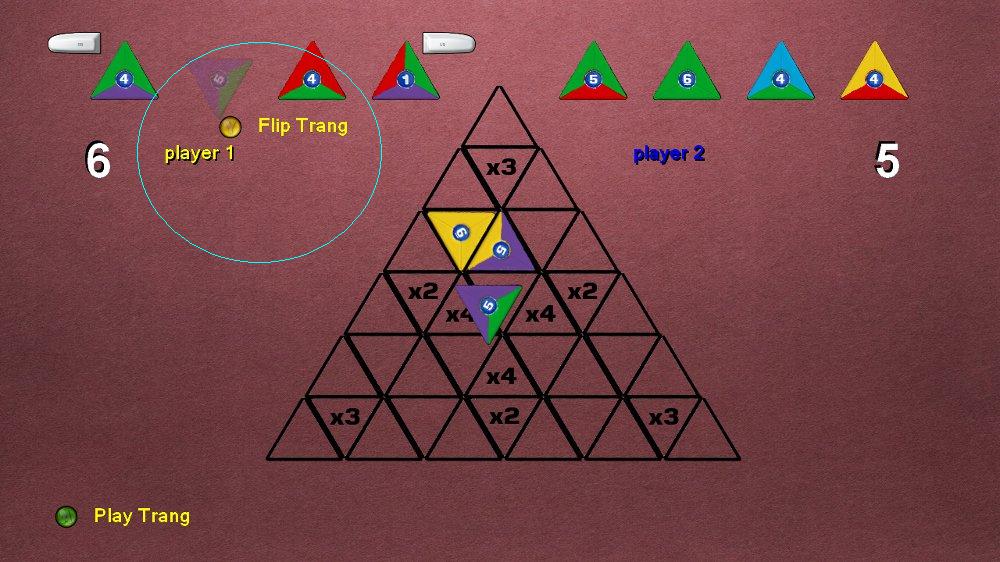
Spectrangle isn’t one of those “it has to be a video game” type of deals.  Think of it as a color-coated version of dominoes.  You have a grid of 36 interlocking triangles, some of which have multipliers on them.  Each player draws four tiles, which are visible to each-other.  The first player must place a tile on one of the spaces that does not have a multiplier.  The next player then must build off of the placed tile by matching the colors.  Each tile has a value to it, and scoring is based on the value of the tile multiplied by the amount of other tiles it is touching.  Play continues until there are no more moves open to either player or until someone runs out.

It’s a pretty simple concept, and it is fun.  The guys at IronReaverGames have done a fine job of porting it over to XBLIG.  Even the AI is kind of balanced.  Kind of.  I could slaughter the game on easy, while normal took a little bit of thinking power.  I lost a few games to the computer on hard, although I would like to say that luck factored into that.  Actually, it factored in so much that Brian started laughing hysterically while I quietly stewed and wondered if there was any spot on my Xbox that I could safely stab without killing it or myself.  And then I played the game on its insane difficulty and absolutely demolished it twice in a row.  At first I thought “damn, I’m just fucking awesome!”  But then I went back to the hard difficulty, which was the only setting that beat me, and I lost another two out of three games.  So maybe “insane” in this context meant “the game plays like it is in an abnormal mental state.”  Because although it had to pause to think, it still made DUMB moves.  It’s less “Bobby Fischer playing chess” insane and more “Bobby Fischer doing anything but playing chess” insane.

Despite not being very impressive from a visual standpoint, Spectrangle360 works well.  It even has online play, which I was able to enjoy without any glitches.  I’m not a big fan of the fact that it dumps you out to the menu after every game, but otherwise I have no complaints.  Ultimately though, it has limited appeal.  If you’re not into these types of board games, this won’t sway you.  It’s not unique enough to be something you just HAVE to try, nor does it need to exist as a video game.  Is it fun?  It was for me.  I can’t tell you if it will be fun for you though.  Spectrangle360 is what it is.  If you’ve never played anything like it, it’s at least worth trying.  Otherwise, you already know whether you will like this game or not just by reading how it works.

I added a circle to this picture to highlight something that does bug me a lot about some XBLIGs: that damn font that constantly shows up. I’m pretty sure it’s the default font that comes in the XNA starter kit or something, because it’s in so many games. It’s ugly, it’s often blurry, it’s cheap looking, and it always makes a game seem somehow badder. Always. Spectrangle360 looks just fine without it. With it, it looks ten times worse than it really is. Guys, if you’ve made it this far in the development process, you would be doing yourself a big favor by taking the time to make any on-screen text look better than stock.

Board games will always be ported over to gaming devices.  Spectrangle360 is a port itself.  And these types of games will always have their place.  But maybe if you’re going to port it, you should think about spicing it up a little.  Include modes that contain content that can’t be done with boards and dice and luck of the draw.  Board games are limited by the laws of physics.  Video games are only limited by the amount of cocaine the developer has snorted.  I want games to take advantage of this.  I want to see Monopoly where you don’t just buy Baltic Avenue.  I want to see one where you load up on rifles and take the fucker by force.  I don’t want to eat marbles while playing Hungry Hungry Hippos.  I want to be eating something adorable and fluffy that looks like it feels pain.  I don’t want to just bump a guy off a slide on Sorry!  I want to bayonet them in the back, drag their corpse to my home, and eat it raw.  Hey, why am I telling you guys this?  Yo, Hasbro, get on the ball with this shit.  If you could get away turning Transformers from children’s toy into ultra-violent testosterone flick featuring a pot-brownie eating mother, you can get away with making a version of Operation where no anesthetic is used.

Spectrangle360 was developed by IronReaverGames

80 Microsoft Points noted that the corporeal version of this game costs anywhere between $10 and $50, so obviously this version is the one to get, unless you just really hate money in the making of this review. 

Spectrangle360 is ranked on the Indie Gamer Chick Leaderboard.  Click here to see where it landed.
Puzzle Cubicle

It’s a bitch trying to think of ways to keep puzzle reviews interesting.  Even if the game is decent, which Puzzle Cubicle is, it really is hard to get emotional over it.  Emotions are the fuel of my writings.  I use them as the compass for what direction I take with my reviews.  But when a game offers absolutely no stimuli and has the personality of a piece of chalk laying on top of a loaf of tofu, writing about it can be almost painful.  I’ve been staring at my monitor for an hour now trying to come up with someway to spice this review up.  It just didn’t provide me with any material to start with.  I guess I could go back and try it some more, but after a few hours with it I feel about as emotional as a corpse.

Puzzle Cubicle is sort of like one of those “make a shape out of other shapes” thingies.  The hook here is that you’re given only a small point of reference to what exactly the final look of the design is supposed to be.  Pieces are arranged on a grid, with a small “example” in the left corner that shows the location of a couple of the blocks.  Using this as a reference point, you must create an enclosed cubicle (or more).  I almost activated a case of narcolepsy in myself trying to describe it.  Some games just sound boring on paper.

Oddly enough, I really liked Puzzle Cubicle.  It’s not for everyone, and it’s probably out-of-place on XBLIG, but the mechanics are solid and I could finish all 50 puzzles without the game crashing on me.  I do have a few complaints.  First off, the explanation screen is terrible.  The goals of the game needed to be articulated better.  Second, I hate how it’s sometimes possible to create the desired pattern exactly how it’s supposed to look, but you don’t actually win because the alignment is off.  Who gives a shit?  Is that the pattern?  Yes?  Good, I beat it.  Next!  Third, the game’s timer keeps going if you pause the game.  Why?  I wasn’t using it to cheat.  I was using it to piss or to answer the phone.  You know, the type of thing people need to do from time to time.  Not that the timer matters at all, but I was using it to measure my own intelligence and it really irked me.  Although it did prove my theory that phone calls from my mother drop my IQ.  Finally, why aren’t the pieces that are shown in the example just locked into place at the start of each round?  That would have hastened the pace of the game and maybe made it more attractive to our cro-magnon population.  No, really!  I’m being serious here.  Stop laughing!

If you haven’t fallen asleep by this point, Puzzle Cubicle might just be for you.  It’s not exactly exciting, but it got my attention.  Mechanically it’s functional and the puzzles are well made.  Will it be the kind of game you talk about with your friends?  No.  Will you remember it after you’ve finished it?  No.  Is it worth your dollar?  Probably.  You can safely liken it to Ben Stein: impressively intelligent, but duller than a butter knife.

Puzzle Cubicle was developed by Geek Mode Games

80 Microsoft Points turned your Cubicle into a Youbicle in the making of this review.

Puzzle Cubicle is ranked on the Indie Gamer Chick Leaderboard.  Click here to see where it landed.

Win 1600 Microsoft Points, a free Xbox Live Indie Game, and your name in the credits of a game.  It’s the Name the Game contest.  Click here for details.

Andy’s Notepad [Saucers]

Despite not being an artsy-fartsy graphics junkie, I do appreciate games that have a sense of style.  Yea, I’ve said that gameplay is all that matters to me, and that is still true, but I have to admit that good graphics will get you my attention.  Andy’s Notepad [Saucers] has a style that’s not totally original on XBLIG.  It reminded me of Robot Platformer, which I reviewed way back in August of 2011.  It had the same casual-doodle look, which helped to push aside the fact that it was as utterly generic and basic as a platformer could be.  It’s like the difference between a guy who dies in his sleep and one who dies while driving his Ferrari over endangered jaguars before crashing into a maternity ward at a veteran’s hospital.  Which dude do you think people will talk about in the morning?  Style counts.

The heat ray weapon is so slow, even when it’s fully upgraded, that I think starvation is actually a quicker form of death.

Andy’s Notepad takes the sketchbook look and applies it to the classic space warfare genre.  It’s sort of like the granddaddy of all of gaming, Spacewar!, with twin-stick shooting thrown into the mix.  You select one of nine flying saucers that dogfight each other.  In single player, you have to go through 20 matches, earning upgrades to your various weapons along the way.  Matches take place with near a moon of which gravity is centered around.  If this sounds boring, it is.  The game is as dull as a plastic spoon.  Mechanically, it works fine.  The physics and controls are difficult to work with, but that’s sort of the point of Spacewar!.  Cycling through the various weapons is what the real problem is.  The AI ships can change-up on the fly, while you have to fumble around with buttons.  After the first half-dozen battles, even after upgrading my stats to their max, AI ships were able to stun-lock me and fire without giving me a nano-second to fight back.  Cheap?  Oh yea.  This is the boxed wine served in Dixie cups of XBLIG.

I gave up after nine or so levels, because I simply could not make any progress against the unreasonably perfect AI.  But, Andy’s Notepad is unquestionably made with multiplayer in mind.  Since the game does play like an updated version of an antiquated gaming treasure, I conned my father and his best friend A.J. to play a few rounds with me.  Both are in their sixties and I figured they must have played something like this at some point in their lives.  They even probably had to walk uphill in three feet of snow and work for six days to earn the quarter it took to play a single round of it too.  As it turns out, A.J. hadn’t.  Daddy had played stuff like Spacewar! though, and both guys had enjoyed playing Chompy Chomp Chomp with me.  I figured why not?

Well, it was a semi-bust.  Andy’s Notepad can be fun, but the game gives too much power to the person who wins the first round.  The winner gets more upgrade points than the losers, and the obvious strategy is to pour everything into those God damned stun-lock bombs, which can cause you to crash into the moon.  Contact with the surface causes your health to drain faster than anything else (I think), so all you really need is those stun-lock bombs, and one good shot.  Since there’s no limit on the amount you can fire, you just have to keep shooting them until the person bangs themselves to death on the planetoid.  Even guys that don’t spend all day and night philosophizing about games could figure that out, as evidenced by the fact that A.J. handed my father and me our asses.  Even then, the old guys really didn’t enjoy the game.  In fact, I liked it more than they did, which was a surprise.  What the game needed is balance, or some form of a counter attack.  There is a tractor beam thing which you can use to drag someone onto the moon, but it’s clunky as hell and only works at a short-range, and quite frankly you’re just as likely to kill yourself trying to use it.

There’s other problems.  The bullets are too small for one thing.  I have a television that could comfortably double as a highway billboard, yet the bullets are so small that they might as well be invisible.  Also, the nine different ships you can choose from are not distinctive enough, and since they’re all drawn in black and white, it becomes too easy to lose which one you are.  Again, I appreciate the art style, but ease of gameplay should never take a backseat to art.  Adding color to the things would have completely fixed the problem, but of course doing so would have gone against the whole sketchbook thing.  I guess Andy’s parents were too cheap to buy him colored pencils.

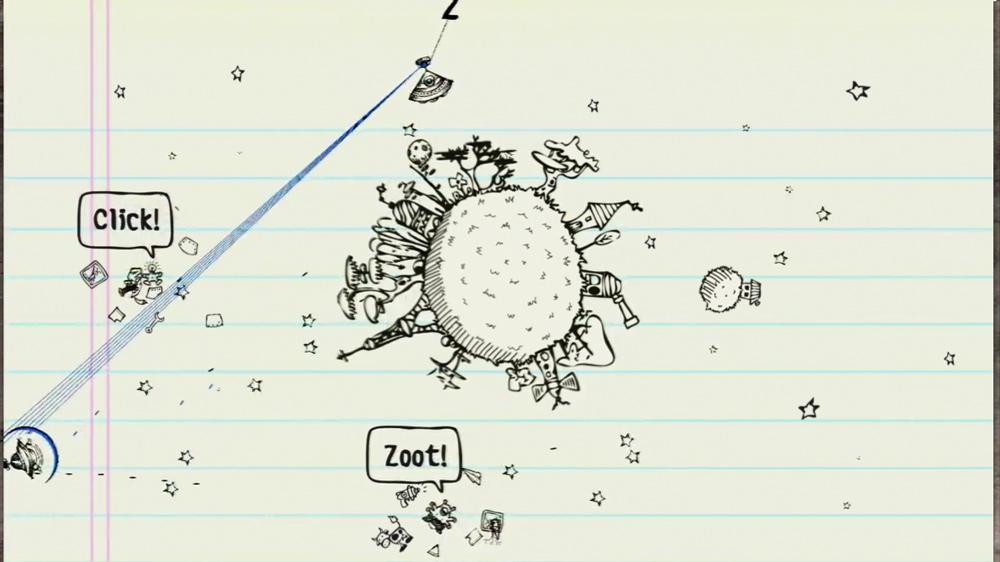
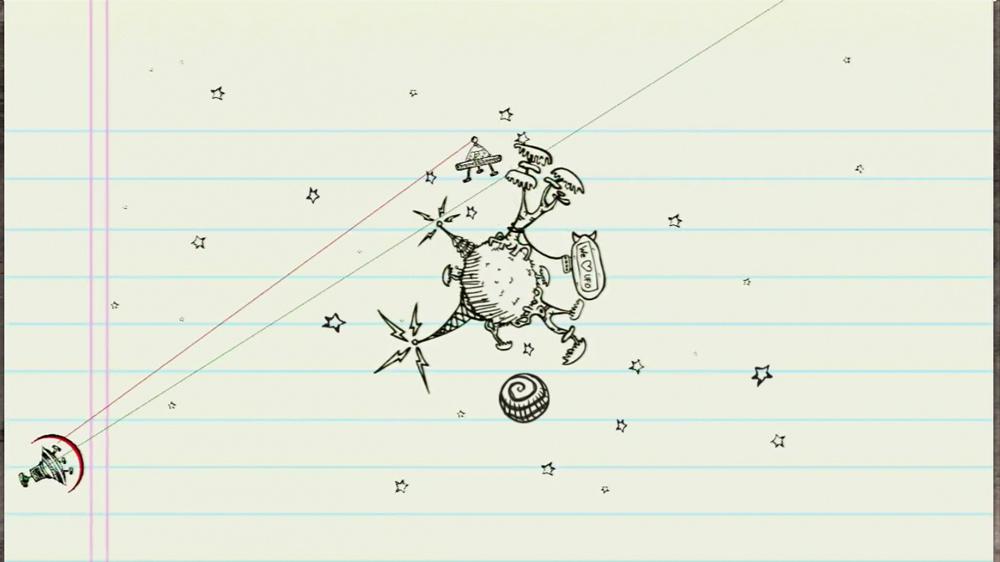
I do love the character and planet design. It’s almost Dr. Seuss-like.

Andy’s Notepad is not entirely without merit.  There’s a good game somewhere in this mess, but the horrible AI destroys the single player experience and the imbalance of weapons cripples the multiplayer mode.  With some small fixes, this could be a leaderboard game, but right now Andy is a doodle of a smelly turd, stink lines and all.  I guess I should be thankful that Andy is drawing UFOs instead of tits made out of guns like a normal teenager.

Andy’s Notepad [Saucers] was developed by Coneware

80 Microsoft Points used to make doodles of praying mantis-spider hybrids in the making of this review.  Can you picture one?  Scary, huh?  Well, sweet dreams!


Super Amazing Wagon Adventure

Update: Super Amazing Wagon Adventure recieved a Second Chance with the Chick to cover the Steam build of the game. Click here for my updated thoughts.

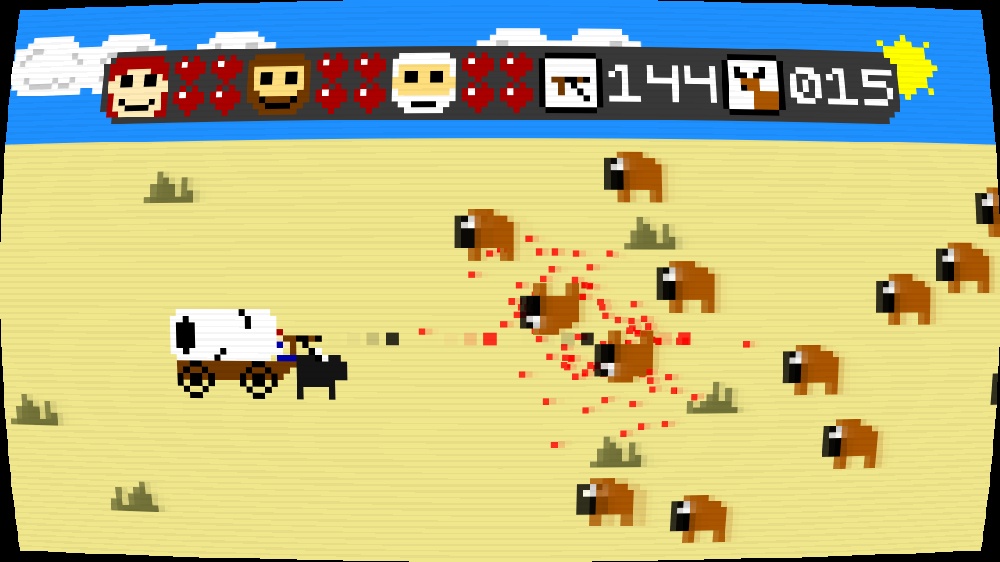
Super Amazing Wagon Adventure is alleged to be an Oregon Trail homage.  And it is, only you actually have to fight your own battles, there’s blood and gore, intentional humor, and it’s actually fun to play.  Okay, so that means it’s absolutely NOTHING like Oregon Trail, but that’s what people are comparing it to.  Basically, take everything that made Oregon Trail educational and strip it out.  Replace it with sadism and adult situations, and you have Super Amazing Wagon Adventure, a game that is most certainly NOT educational.  In fact, I think it might actually make you stupider while you play it.  I went from being a reasonably smart person to putting my shoes on the wrong feet and watching Jersey Shore in just a matter of hours.  Potent is the derp in this one.

I’m changing my name from Kairi Vice to Kairi Buffokill.

As a game, Wagon has little going for it.  It’s part space-shooter (well, minus the space part.. mostly) and part TwickS.  Both variations are fairly primitive in their play style, and other than the occasional power-up, this is really as basic as you can get.  Calling it Atari-esq would be fair.  Where it won me over was with its personality.  From the dead-pan descriptions of your frequent failures to the gleeful mass slaughter of indigenous animals,  this is a game that revels in its absurdity.  But never to the point that it becomes obnoxious, like Torque Quest did.  Thus a game that is very fundamental in its design actually becomes something you want to press on with, just to see what crazy shit will happen next.

What’s really cool is Wagon has so many different possible scenarios built into it, all of which are chosen at random.  I played it for over two hours and I never once had the same experience.  It doesn’t mean they’re all good ones.  Sometimes I would start a game and the first thing that would happen was one of the people in my wagon would get some kind of illness and immediately lose all their health but one.  Sometimes my wagon would break and I would have to walk to the nearest outpost to fix it, which might be one screen away, or it might be three screens away.  Either way, the enemies tend to move faster than your bullets shoot, so you’re pretty fucked.  Actually, a lot of the boards tend to overwhelm you with too many enemies, and you’re often not equipped to avoid them.  There’s even scenarios where you spawn and are almost immediately fired upon, before you even realize the round has begun.  As quirky as Wagon is, it can be pretty brutal as well, and that saps the fun out of it.  I probably would have kept playing, but I was so pissed by time I finally beat the damn thing that I didn’t want to see what I missed.

And they said Sputnik was the first thing in orbit. Psssh, historians. What do they know?

I missed a lot too.  Again, over the course of two hours the game never repeated itself in the same way twice.  I still had alternative wagons to unlock.  I kind of wanted to, because they actually have different abilities.  You can ride a dinosaur and hurl eggs at enemies.  You can fly a space shuttle that moves quickly.  My personal favorite was a wagon pulled by a buffalo where you send a falcon to attack enemies.  But, there were a lot of things I missed.  And I will continue to miss them.  Yes, I had fun playing Super Amazing Wagon Adventure, but sometimes it’s too damn frustrating for its own good.  One time I was close to the end, only to lose one member to disease and one member to artistically poor play control brought on alcoholism.  This is a game that does not want you to ever be comfortable.  You’ll have laughs, but you’ll also gnash your teeth when the game decides you’re doing just a little too good and pulls a dick move.  I suppose this is what the settlers went through, which means it actually is educational.  Wait, did the settlers really fight off pterodactyls and do mushrooms?  Wow.  History is way cooler than Little House on the Prairie made it seem.

Super Amazing Wagon Adventure was developed by Sparsevector
Point of Sale: SteamDesuraXbox Live Indie Games
Port played for this review: Xbox Live Indie Games.

IGC_Approved$1 Died of dysentery in the making of this review.

 Super Amazing Wagon Adventure is ranked on the Indie Gamer Chick Leaderboard.  Click here to see where it landed.

Happy Birthday Brian.  I love you with all my heart.

Obsessive Collecting Disorder

I had a problem with Obsessive Collecting Disorder.  It was the name.  The name is all wrong.  It should have been called Obsessive Collective Disorder.  You see, the name is a play on the anxiety disorder known as obsessive-compulsive disorder.  It’s not obsessive compulsing disorder, because there is no such word as compulsing.  But there is a word called collective, so the game should have used it.  Sure, Obsessive Collective Disorder sounds like something that happens to a cult that undergoes a mass suicide in order to catch a ride on a UFO, but it works better as a pun.

Welcome back to Xbox Live Indie Games: Your source for self-hating gameplay.

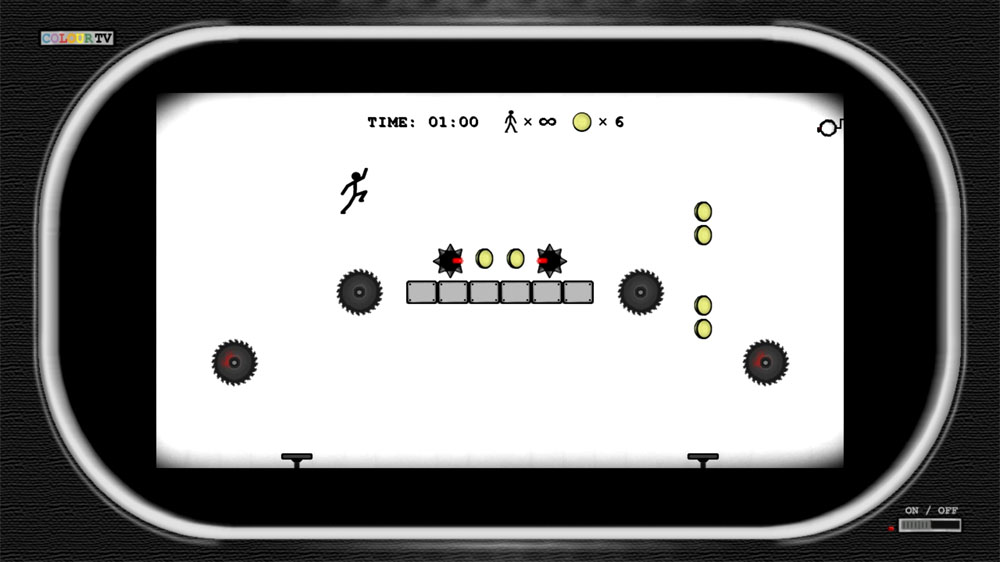
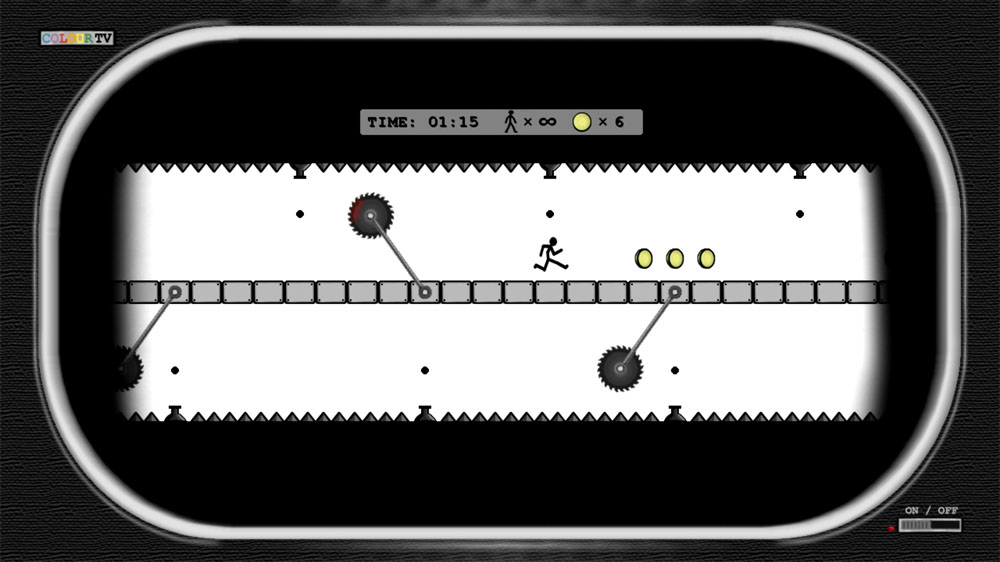
I had one other problem with Obese Cauliflower Disorder: the game is a punisher, and I hate those fucking things.  They seem like they’re some kind of repressed anger stemming from not getting enough love as a child, manifested in video game form.  The idea is you’re a stick figure who is being put through various test chambers owned by the, and I’m not making this up, the CrAperture Corporation.  Isn’t it ironic how one of the most clever and original games to come around in a long time has somehow managed to kill the creativity of an entire generation?  Let me guess, the game will end with some kind of reference to the cake being a lie.  Oh, yep, there it is.  Very nice, guys.  What, you couldn’t work in a psychotic artificial intelligence while you were at it?  Well, at least the ending was good for a small giggle.  You know what?  I guess kleptomania falls into the OCD spectrum, so we’ll just say they were running with the theme and move on.

As a game, Opal Chin Disorder is pretty much just like any other punisher.  The idea is similar to N+.  You run around, avoiding traps and collecting coins.  The platforming mechanics are pretty basic.  A jumps, X or the right trigger run, and that’s it.  There’s no double jumps, wall jumps, ducking, sliding, doing short-form taxes, or breaking out into the chorus line from Oklahoma.  It’s just you, jumping, and shit that wants you dead, like some ingenious Olympic Committee person combined the hurdles and archery events.

Platformers live and die on controls.  If a game wants you dead, like Omnipotent Cactus Disorder does, it’s typically because the controls are shit and it’s an over-compensation thing.  In Octogenarian Colon Disorder’s case, I don’t think the controls are shit.  Brian suggested the word “serviceable” to me, but that sounds a bit too generous.  I think I’ll go with “tolerable.”  That sounds unhating yet highly critical.  The controls are just so strange.  The jumping is simultaneously too floaty yet too stiff, like a cloud on Viagra.  You do get used to it, in the same way you would probably get used to hitting your thumb with a hammer if you kept it up long enough, though it would be preferable to not do that.

The developer assured me that people told them Ornery Cardinal Disorder had tight controls. Ha. Where did they get that from? A game of Scattergories? “Things that are tight that start with the letter ‘C’. And GO!” “Oh gee um, collar! Um, cage! Uh uh uh, controls!” BUZZ! “Yes, we challenge ‘control’ and also we can’t believe you guys didn’t come up with cu..”

Everything about Obsessive Collective Disorder does just enough to not suck but not enough to wow me.  The minimalist graphics are tiring and bland.  The level design freshens things up with new obstacles every ten stages, but some of the challenges are copied and pasted far more than needed.  If this makes it seem like I hated the game, I actually didn’t.  It’s short enough to not feel like you’re taking a vacation on death row.  The level design is fair, I guess.  Ultimately, it never feels like you’re trying to shout at the tide to turn back.  It’s a punisher that feels doable.  Assuming you don’t play on Hardcore mode which gives you a limited amount of lives.  Some whack jobs might give that a chance.  Me?  Ha ha ha, no.  Still, I recommend Obsessive Collective Disorder.  Not a ringing endorsement or anything.  I guess it’s like saying “if you want to forfeit your dignity to just one Xbox Live Indie Game this week, make it this one!”

Obsessive Collecting Disorder was developed by Super Smith Bros.

80 Microsoft Points washed their hands seven times, flicked the light switch on an off seven times, then washed their hands seven more times in the making of this review.

Obsessive Collective Disorder is ranked on the Indie Gamer Chick Leaderboard.  Click here to see where it landed

The Top 25 Xbox Live Indie Games of All-Time: Part 5

And finally we wrap things up with the top five titles you can get on Xbox Live Indie Games.  Of course, you could buy the other twenty to go along with these.  Check out the previous parts, starting with part one.  Remember to click the name of each game to read my review.

#5: Antipole

Developed by Saturnine Games

Sort of like: Bionic Commando, only with better controls and God-like powers over gravity.

Why I liked it: Antipole takes a passé genre, the platform-shooter, and invigorates it with a clever hook: the ability to reverse gravitational pull.  The result is a game that is steeped in tradition, but feels fresh and original.  You’ll even encounter some homages to gaming’s past, like a boss fight that will be familiar to fans of Super Metroid.  Antipole has some of the most clever platforming-level design on XBLIG.

How it could have been better: I don’t think Antipole ever reaches its fullest potential.  For the most part, the gravity features never extend outside the most obvious uses.  I don’t know if you could do more with it, but what is here is very basic (and very spectacular).

Who will like it: Manufacturers of red trench coats, would-be superheroes, Michael Jackson.

Who won’t like it: Galileo, Sir Issac Newton, the guys who have to clean ceilings.

#4: Chester

Developed by Brilliant Blue-G

Concept: Take a basic platform-shooter and include the ability to alter the presentation in ways that affect the gameplay.

Sort of like: Mega Man mixed with Nicktoons.

Why I liked it: Chester had the potential to be one of those annoying collect-a-thons that grew old for me around the time Donkey Kong 64 came out.  But Chester avoids that by providing one of the most original gameplay hooks I’ve seen in a while.  The idea is that you collect various backgrounds as you make your way through the game.  Using the bumpers, you can change the entire art style of a level on the fly.  Doing so might also change the strength of your character, or the enemies, or the frequency of which special items are dropped.  You also collect new forms for your character, all of which have different modes of attacks and special abilities.  Combine all that with what is probably the most stylized and breathtaking art of any XBLIG, and the end result is Chester is a winner.

How it could have been better: The conditions for unlocking some of the cool stuff really requires too much time and effort.  I’ve never looked at Xbox Live Indie Games as a source for games that can (or should) take ten or more hours to complete.  With all the crap to find or buy that Chester has packed in it, it will probably take several multiples of that.

Who will like it: Schizophrenics, Ralph Bakshi, Stalwarts.

Who won’t like it: Unemployed Cheetos mascots, grammar teachers, Green Lantern.

#3: Dead Pixels

Developed by CSR Studios

Concept: Zombie apocalypse gone old-school.

Sort of like: River City Ransom (NES) with guns.  And zombies.

Why I liked it: Having never been a huge fan of zombie games, I have to admit that I was pretty leery of Dead Pixels.  Shooting zombies?  Whoopee!  8-bit graphics?  Wow, you don’t ever see that on XBLIG!  But actually my snotty sarcasm was unjustified.  Dead Pixels is amazing.  It’s one of the few zombie survival games I’ve played that actually puts an emphasis on the whole “survival” part.  Yea, you have guns, but they’re limited in ammunition, and you can only buy so much from stores.  Sure, there is a huge variety of items and weapons, but the more you carry, the slower you get.  Yes, you can engage a mob of the undead, but maybe sometimes it’s best to just leg it.  These all combine to make a zombie game that doesn’t feel like a glorified gallery shooter, which has always been one of those things that bug me about zombie games.  They’re more about the body count.  Dead Pixels, on the other hand, is simply about making it out alive.

How it could have been better: A wider variety of settings and enemies would have been nice.  It does have a tendency to feel a little samey after a while.

Who will like it: People unaware that The Zombie Survival Guide is not an actual zombie survival guide, that one stock character that has his shit together in every single fucking piece of zombie fiction ever created, barterers.

Who won’t like it: Hoarders, the Commerce Department, zombies.

#2: We Are Cubes

Developed by 1BK

Concept: You’re a cube and you shoot spheres, because fuck spheres, am I right?

Sort of like: Tempest crossed with Pang.

Why I liked it: I was born in 1989, so the Golden Age of Arcade Gaming was pushing up daisies long before I came around.  I need games like this to make me ponder what I missed out on.  Featuring absolutely lightning-fast gameplay with remarkable wire-frame style vector graphics, We Are Cubes is a neo-retro game that does it right, taking traditional mechanics and using them in original ways that retain a familiarity about them.  It strips gaming down to its core: twitchy, reflexive, fast-paced fun in its purest form.  If this had come out in 1982, it would be remembered as one of the all-time classics.

How it could have been better: The multiplayer modes are pretty weak.

Who will like it: L-7s, neon enthusiasts, teachers trying to find fun ways to explain cell division to students.

Who won’t like it:  People who use the circle when they play Tic-Tac-Toe, things that don’t have corners, Kevin Flynn.

#1: Escape Goat

Developed by Magical Time Bean

Concept: Help a wrongly-convicted (or least I hope so) goat bust out of the clink.

Sort of like: Solomon’s Key.

Why I liked it: I’ve been playing XBLIGs for a year now.  After 240 games, nothing has remotely touched Escape Goat for overall quality.  The two most important factors to me in games are always play control and level design.  Escape Goat is the best in both of those areas.  Play control?  Escape Goat is without peer on the platform.  Level design?  The puzzles are clever, whether they’re logic based or dexterity based, they are so smart and so intuitively constructed that you never feel lost.  And they’re accessible to everyone, not just brainiacs.  It never made it to #1 on my site, because sometimes you don’t know a good thing when it’s staring you right in the face.  I realized that tonight.  While Dead Pixels changed my perceptions on how conventional gameplay mechanics can be retooled for the modern era, and We Are Cubes made me regret that I didn’t grow up in an era where a quarter bought you a chance at glory on a high score table, the one game that will stick with me long after the Xbox 360 is put out to the pasture is Escape Goat.  It is the greatest Xbox Live Indie Game ever made.

How it could have been better: Escape Goat features the Mega Man-ish ability to choose the levels in any order.  Although this works fine, it means that the difficulty can never truly ramp up, and thus there really is never any true head-scratching stages.

Who will like it: Satyrs, Thor, the Sorting Hat.

Who won’t like it: The guy in this video, Steve Bartman, actually the Sorting Hat now that I think about it.  Fucking thing doesn’t even have hands.

The Top 25 Xbox Live Indie Games of All-Time: Part 4

We’ve reached the top 10.  Which are featured right there on the sidebar of this very site.  So much for building anticipation.  Oh well.  You can read parts 1, 2, and 3.  Here are games #10 through #6.  Click the names to read my full review.

#10: Star Ninja

Developed by Bounding Box Games

Concept: Throw bouncy throwing-stars at pirates.

Sort of like: Angry Birds, only better.

Why I liked it: Star Ninja was an early review on this site, but it remains my personal barometer for the potential of Xbox Live Indie Games.  If I had to bet on which of the 240 previous games I’ve reviewed had the greatest chance to be a major world-wide commercial success, it would be this.  It does the “aim & fire” action-puzzler genre better than Angry Birds, and it also features better characters, puzzles, humor, and graphics.  If Bounding Box Games can get this on iPhone, it could very well be the next big runaway hit.

How it could have been better: It’s not always clear what is something that the ninja star will bounce off of and what it will get stuck in, so building the stages out of a more distinctive material is probably necessary.

Who will like it: People who take the “ninja” side in the pirates or ninjas debate, the guys at Disney making a movie where Steven Seagal discovers Flubber, Splinter.

Who won’t like it: Butters, Honus Wagner, Oroku Saki.

#9: Cthulhu Saves the World

Developed by Zeboyd Games

Concept: Help Cthulhu get his mojo back in this comedic 16-bit RPG.

Sort of like: H. P. Lovecraft as read by Mel Brooks.

Why I liked it: Although Zeboyd’s technical masterpiece was Penny Arcade, I thought the writing in that was often mediocre.  In Cthulhu, the idea that you’re playing as the Great Old One kind of wears thin quickly, but the overall story and humor remain strong through-out.  In that sense, it made a hypocrite of me, because I’ve always said gameplay is king.  Penny Arcade plays better, but Cthulhu Saves the World is the better game.  Not that CStW is a slouch in the gameplay department.  The battles are fast paced, the insanity system is fun, and it packs bonus content like developer commentary and an original second quest, all for $4 less than their recent title.

How it could have been better: Zeboyd didn’t realize fast enough that random encounters are a thing of the past.  If you could combine Penny Arcade’s gameplay with Cthulhu’s story, it would have been the #1 game on this site.

Who will like it: People who can spell “Cthulhu” without having to check Wikipedia, Metallica, unimaginative Scribblenauts players.

Who will dislike it: The Roivas family, Hastur the Unspeakable, Megazord.

#8: Miner Dig Deep

Developed by Substance Games

Concept: Dig for precious metals that you use to buy equipment that you use to dig for more precious metals.

Sort of like: Dig Dug – Enemies + Minecraft = Heroin.

Why I liked it: You’ll either grow to like Miner Dig Deep or you’ll hate it immediately.  For months, I had people telling me that I had to play Miner Dig Deep, but they wouldn’t tell me why.  It was suspicious, and a bit ominous.  After a while, I caved in (no pun intended) and bought it.  Then, six hours later, I emerged from a dazed stupor after I accidentally beat the game.  Thank Christ it had an ending, or I would still be playing it.  If you want an actual explanation of why I liked Miner Dig Deep, I can’t really offer you any reason other than “I honestly don’t know.”  The gameplay is repetitive, grindy, and the game is nothing more than a time sink.  Its appeal exists on an almost primal level.  Or maybe it’s a Freudian thing relating to me just wanting to get drilled.

How it could have been better: As I stated, you can beat the game, and then it gives you the option to start over or keep digging up your currently map.  I wish it offered something more.

Who will like it: Geologists, people attracted to shiny things, Solomon.

Who won’t like it: OSHA, environmentalists, canaries.

#7 Chompy Chomp Chomp

Developed by Utopian World of Sandwiches

Concept: Eat-or-be-eaten party game.

Sort of like: Bomberman meets Pac-Man.

Why I like it: With the exception of Worms, I’ve never really been into party gaming.  Chompy Chomp Chomp must have something going for it, because I spent hours playing this online and off, with friends and family, colleagues and acquaintances.  Chompy keeps things simple enough that anyone can pick-up-and-play it.  Vast improvements have been made since the original build, fixing problems with spawning, and thus negating frustration.  With more fixes planned, Chompy has the potential to climb up these rankings.

How it could have been better: A lot of the stages are just no damn good for the type of game offered here, making it too easy to get cornered.  Try to figure out for yourself which ones don’t work before playing this with friends, because they can really kill the mood.

Who will like it: Social butterflies, hospitable hippos, the Donner Party.

Who won’t like it: Dieters, vegans, Katniss Everdeen.

#6: LaserCat

Developed by MonsterJail Games

Concept: Guide a cat around a castle in search of keys.

Sort of like: A 1980s PC -styled Metroidvania.

Why I liked it: I guess I’m a sucker for exploration-based platforming.  LaserCat takes a minimalist approach to this concept.  You have no offensive options at your disposal, there are no secondary items to collect, no cut scenes to sit through, and the whole game takes about two to three hours to finish.  It sounds limited, but LaserCat’s focus on pure gameplay works.  This is one of the most enjoyable experiences on a modern console.

How it could have been better: In order to collect keys, you have to answer trivia questions, some of which are non-nonsensical riddles.  This was done to meet XBLIG’s unwritten minimal shittiness quota.

Who will like it: Subscribers of Cat Fancy, Eleanor Abernathy, YouTube.

Who won’t like it: People with ailurophobia, Saturday Night Live, Mumm-Ra.

Continue to the Final Part

The Top 25 Xbox Live Indie Games of All-Time: Part 3

Continuing from Part 1 and Part 2, here are the best Xbox Live Indie Games, #15 through #11.  Click the names to read the full reviews.

#15: Blocks That Matter

Developed by Swing Swing Submarine

Concept: Solve puzzles and reach an exit by collecting blocks and then linking chains of four of them.  Oh, and it’s a platformer.

Sort of like: Mario mixed with Crafting mixed with Tetris.

What I liked about it: My top 25 might be a little bit on the brain-bendy-heavy side, but I can’t help it.  I’ve seen so many examples of very good puzzle design on the XBLIG platform and yet it I’m still always surprised by how smart they can be.  Blocks That Matter ups the ante by adding a clever hook (pausing the game to arrange platforms) that uses a trendy mechanic (material harvesting) to go with good (if somewhat unintuitive) play control and highly intelligent level design.  This won the grand prize of Dream-Build-Play 2011, and it deserved it.

How it could have been better: While movement and jumping physics are spot on, the controls for opening up the menu and placing blocks on the board never feel natural.  I’m not actually sure how they could do better, but that’s why they’re the game designers and I’m the.. point out what’s wrong.. person.

Who will like it: Blockheads (as in fans of blocks), miners who take the daily Sudoku down into the shaft with them for their breaks, Johnny 5.

Who won’t like it: Blockheads (as in people who skipped to #14 as soon as they read the word “puzzle”), miners who take whiskey down into the shaft with them for their breaks, Slimer.

#14: DLC Quest

Developed by Going Loud Studios

Concept: Satire of the game industry’s over-reliance on up-selling additional content for games you already paid for.

Sort of like: Super Mario Bros. mixed with Idiocracy.  You’re not sure if this is really a comedy or a bleak look into our future.

Why I liked it: DLC Quest mixes parody with an amusement park ride.  It’s not about what you do, but rather just taking in the experience.  The game only lasts anywhere between 30 minutes to an hour, enough time to make its point.  The jokes work, and we know they do because these are the exact same gags we think about when we kid around about the subject matter.  DLC Quest is a send-up, but one made because it feels your pain.

How it could have been better: It really couldn’t have been better.  The things people request most, like more gags or a longer length, would have just made it worse.  DLC Quest did it’s bit and walked away before the joke stopped being funny.

Who will like it: You must pay $1 to unlock this line.

Who won’t like it: Anyone who didn’t laugh at the previous line.

#13: Aesop’s Garden

Developed by Excalibur Studios

Concept: Extract weeds from your prize-winning lawn.  That actually sounds like something children spin on the chore wheel, but trust me, it’s fun.

Sort of like: The Adventures of Lolo, only more so than Crystal Hunters.

Why I liked it: Aesop’s Garden mixes 8-bit aesthetics with some absolutely stunning puzzle design.  Maybe I’ve over-saturated this list with logic-puzzlers, but when judging the top games on the basis of quality, you have to go with the games that are designed the smartest, and the funnest.  Aesop’s Garden probably is the best of the “hard-puzzler” breed on XBLIG.

What could have been better: The controls are touchy as hell, leading to all kinds of unnecessary deaths.

Who will like it: Green thumbs, Nebuchadnezzar II, people who can declare they enjoy hoeing without giggling to themselves about it.

Who won’t like it: Weed-Whacker advocates, migrant workers, Eve.

#12: Pixel Blocked!

Developed by Daniel Turong

Concept: Create patterns using a block gun.  Sigh.  I hate games that sound more boring than they really are when you write about them.

Sort of like: Picross mixed with Bust-a-Move (that’s Puzzle Bobble outside of the US).

Why I liked it: Pixel Blocked! was one of the first games I reviewed, and it stuck with me long after I finished writing about it.  Then the developer drastically altered the game mechanics, and it got even better.  It was the first (and so far only) game to be ranked in my top-ten list, fall off the list, and then return back to it.  The finished product is a very sharp puzzler that is probably the most professionally designed of any XBLIG I have played so far.  Dare I say it, Pixel Blocked! is primed for acquisition from a major developer.

How it could have been better: Although they are unnecessary towards making progress, the game offers some rewards that are borderline unobtainable.  These are typically related towards speed-runs, which have no place in logic-based puzzlers.

Who will like it: People with an abundance of grey-matter, people who don’t have an abundance of grey-matter and wish to grow some, people who have recently destroyed their grey-matter when they decided to give that whole paint-sniffing craze a try and now have buyer’s remorse.

Who won’t like it: People who don’t know what grey-matter is, people who think grey-matter is the stuff between your toes, people who tried to color their grey-matter purple by shoving a magic marker up their nose.

#11: Penny Arcade’s On the Rain-Slick Precipice of Darkness 3

Developed by Zeboyd Games

Concept: Sequel to the previous Penny Aracde RPGs, only this time it’s 16-bit, and on Xbox Live Indie Games.

Sort of like: The Far Side meets Final Fantasy.

Why I liked it: Games that try to look and feel retro often rely on archaic game mechanics and don’t take risks with the established formula.  Rain-Slick 3 takes everything Zeboyd knows has no place in modern gaming and chucks it out the window.  The battles are fast paced, the mechanics are hugely customizable, and the dialog can be very funny.  This is probably the most enjoyable “retro” RPG I’ve ever played from a technical perspective.

How it could have been better: The dialog can be very funny, but it often falls flat, and the banter between the characters can drone on and on forever.

Who will like it: LARPers, Walt Disney’s head, people who always wondered where the guys in RPGs keep all those fucking potions at.  Their pockets?  Where the fuck are black mage pockets at?

Who won’t like it: Tim Buckley, the rest of Walt Disney, that noise that happens when you get a random encounter in games that is now out of a job.

Continue to Part 4

The Top 25 Xbox Live Indie Games of All-Time: Part 2

Continued from Part 1, here are the best Xbox Live Indie Games, #20 through #16.  Click the names to read the full reviews.

#20: Alien Jelly

Developed by Collective Mess

Concept: Sci-fi logic-puzzler where you move a group of gelatinous aliens around a maze.

Sort of like: Cuboid (PSN) as directed by Tim Burton.  Only it doesn’t suck, unlike everything Tim Burton has done over the last decade.

Why I like it: I know logic-puzzle games are not extraordinarily popular.   I would say they are an especially tough-sell on XBLIG, but Alien Jelly really shines brightly with great graphics to go along with some absolutely brilliant (and difficult) level design.

How it could have been better: The camera was terrible, leading to all kinds of problems with perspectives and depth-perception.

Who will like it: Puzzle fans, Sci-Fi fans, you know what?  Fuck it, let’s just save time and say “nerds.”

Who won’t like it: SETI personnel, Martians, Travis Walton.

#19: Flight Adventure 2

Developed by CAVOK Games

Concept: Pilot a P-51 Mustang across a beautiful landscape in this shockingly detailed flight simulator that is officially licensed by Boeing.

Sort of like: Take your pick of any flight sim out there.  It’s like that.

Why I like it: I’m not into this genre.  At all.  But Flight Adventure 2 absolutely hooked me.  Don’t get me wrong, it’s anything but newb friendly.  Yet the game has no actual “goals” in the strictest sense, freeing you to not feel any pressure to perform.  It’s just about flying around and enjoying the sights.  But it’s done in a very impressive way.  It was released before the file size limit for XBLIGs was increased to 400MB.  I’m actually scared what these guys could do with the extra space, considering that Flight Adventure 2 had incredible draw distance, mostly realistic physics, and even online multiplayer (with a tacked on and somewhat dull race mode).  It’s also worth mentioning that this is Brian’s favorite XBLIG by a vertical mile.

How it could have been better: More landscapes, planes, or modes.  I sure hope Flight Adventure 3 is on the way.

Who will like it: Amateur aviators, armchair pilots, people with pteromerhanophobia.

Who won’t like it: People with pteromerhanophobia, Germans, The Big Bopper.

#18: TIC Part 1

Developed by RedCandy Games

Concept: A mechanical robot man thingie tries to save the environment from evil oil drillers.

Sort of like: Any non-threatening, Nintendo-esq platformer.  For some reason it reminded me of Super Princess Peach (DS).

Why I like it: XBLIG is populated by platformers that want you to suffer, but TIC is a tender loving game that would rather you enjoy the experience instead of cursing the day the spike was invented.  The production values are nothing short of spectacular, but the smooth gameplay and excellent level design really put this one over the top as one of the best of its genre on the format.

How it could have been better: As the name implies, TIC: Part 1 an incomplete game.  It’s been a year since I played the original and there has been no word on when Part 2 can be expected, which does sour the experience.

Who will like it: People who try to live “green”, Greenpeace, The Jolly Green Giant.

Who will dislike it: Sarah Palin, Texans, Hoggish Greedly.

#17: Minigame Marathon

Developed by Battenberg Software

Concept: Fast-paced minigames that you try to complete in as minimal time as possible.

Sort of like: Nintendo’s WarioWare series done with old-school game concepts.

Why I liked it: WarioWare, Inc.: Mega Microgame$ was undoubtedly my favorite Game Boy Advance game (and I would consider calling it the absolute best game I’ve ever played.  Feel free to ponder that for a while), and Minigame Marathon is as close as I’ve seen an XBLIG come to that.  But while WarioWare focuses on absurd themes and juvenile humor, Marathon looks to gaming’s distant past for inspiration.  Bite-sized versions of Pong, Frogger, Breakout, and their kin are sandwiched together in a game that’s potently addictive.

How it could have been better: In split-screen multiplayer, the graphics get too scrunched down, rendering some of the games nearly unplayable.  The game features online leaderboards, but not multiplayer, and that’s a shame.

Who will like it: People with short attention spans, speed-run enthusiasts, people with short attention spans.

Who won’t like it: Fans of the color blue, Pheidippides, Rosie Ruiz.

#16: Orbitron: Revolution

Developed by Firebase Industries

Concept: Try for combos as you shoot down enemies while under a huge time crunch.

Sort of like: Defender if it was remade today like Pac-Man Championship Edition.

Why I liked it: Orbitron: Revolution has professional-level graphics, a true rarity on XBLIG.  But that has nothing to do with why I like it.  The gameplay is pure white-knuckle, high-pressure, score-driven, golden-age era fun.  It really is like Defender, only with a time limit and without any little dudes to rescue.  I never liked those guys much anyway.  The constant rescuing of them really harshed my mojo.  Orbitron is currently priced at 80MSP, but the price goes up to 240MSP on July 9, so get it now.

How it could have been better: Each wave of enemies spawns in different positions on the board, and sometimes achieving a high score is dependent on having a wave spawn in a way that is just perfectly set up to string together a combo.  Success in Orbitron is not totally dependent on luck, but that unquestionably factors in, perhaps too much.

Who will like it: High-score fans, Eugene Jarvis, guys who have Buckner & Garcia’s “The Defender” on their iPod.

Who won’t like it: People who like the ability to reverse, guys waiting for Radarscope: Championship Edition, Darth Vader.

Continue to Part 3