Bloodstained: Curse of the Moon

This is almost not fair. Bloodstained: Curse of the Moon probably shouldn’t be listed alongside stuff like Escape Goat 2 or Axiom Verge or even Fez. I mean, Fez had close to an entire movie devoted to its development, something most indies could only dream of. And yet, it still feels more on the same level as its peers than Curse of the Moon. It seems somehow wrong that today’s game competes head-to-head with it for a spot on the IGC Leaderboard, along with Dead Cells or SteamWorld Dig 2 or Sportsfriends. In case you didn’t know, Bloodstained is produced by Koji Igarashi. As in “the guy who made Castlevania: Symphony of the Night.” To say doors would open to him that wouldn’t open to your average indie developer is a bit of an understatement.

To put it in perspective, Curse of the Moon is the result of a $5,545,991 Kickstarter campaign. But, Curse of the Moon wasn’t even the focus of that campaign. This is the game that got made because the campaign made so much money. This is a stretch goal. The game that people actually backed is coming out next year. That’s fucking insane.

The moon is visible in every stage and slowly develops into a full moon that frames the final level. This doesn’t make Curse of the Moon better, but it shows a wonderful attention to detail that demonstrates how much care and consideration was given during the design. Meanwhile, Link is like “the moon.. gets full? That’s adorable. For me, the moon tried to crash into the planet, obliterating all life as we know it. Enjoy your Castlevania cosplay. It’s precious.”

Curse of the Moon was promised to be a “retro mini-game prequel” or something along those lines. But it ain’t mini. This is a full-fledged NES-style game so convincing that you would swear this is the missing link between Castlevania III: Dracula’s Curse and Super Castlevania IV. And it truly is an NES Castlevania in everything but name. Enemies are almost all reskinned versions of Castlevania staples. The four characters are very similar to Dracula’s Curse. There’s no Grant Danasty, and the main character doesn’t feel like a Belmont, but the first ally you gain certainly does, whip and everything. The second character is a close approximation to Sypha Belnades. Finally, they just pretty much said “fuck it” and stuck Alucard in as the third ally, bat-transformation fully intact. It’s the moment where you feel the team said “we’re either going to get sued or we’re not. Might as well go big or go home.”

If you think of Bloodstained: Curse of the Moon as Castlevania 3.5, that tells you everything you need to know about the game. It controls slightly better than the NES series, and it’s especially nice that the stairs aren’t a complete nightmare to use anymore. But otherwise, it feels like a really great ROM hack. Everything has this creepy familiarity, but that doesn’t mean some inspired bits of originality don’t seep through. In fact, not being married to the Castlevania mythos allows for some of the most creative boss designs in the series. The series that Curse of the Moon isn’t part of, but kind of is anyway. Sorta. It’s complex.

“Excuse me, have you by any chance seen my wife? Last time I heard from her, she said she had to go fight bears. Bears that ‘care’ whatever that means. Kinda sexy in a bald, creepy, evil spirit kind of way?”

Another way to look at it is someone shot Castlevania with the same modernization ray Shovel Knight used on classic NES Capcom games. 2010s 2D gameplay conventions are here. Optional difficulty? Check. A save system besides a password? Check. Tons of extras and multiple endings? Check. It’s actually an impressive, fully-realized package and it’s strange that people still think it’s some sort of throwaway Kickstarter bonus. Let’s say Ritual of the Night never sees the light of day and Curse of the Moon is as far as the franchise makes it out of the crib. As much as that would suck, the one thing we wound up getting is very, very good on its own merit.

Having said that, the big issue is the difficulty and the lack of flexibility. Curse of the Moon has two difficulty options: Casual and Veteran. There’s no toggles to adjust how hard the game is between these, and that’s sort of a problem. “Veteran” is Castlevania exactly as you grew up on. A lives system and that infamous Castlevania “getting hit by a bat somehow causes your character to dramatically curl up and fly six feet backwards, more than likely into a god-damned fucking pit” recoil that resulted in many a hurled controller. It also nerfs the value of item-pickups. Casual eliminates both the lives and the recoil. Consequently, the normal mode is too hard and the casual mode is too easy. But there’s also a chance that the normal mode is too easy for most Castlevania veterans. Despite the fact that I’ve beaten Castlevania I & III (fuck Simon’s Quest, it sucks, it’s  boring, and it has too much downtime), I wasn’t really looking to challenge myself here and so I opted for casual mode. But when I dipped my toes in the putrid water that is Veteran mode, I actually did clear the first few levels with almost no effort. I’m getting reports from Castlevania fans that this would be the easiest of the NES Castlevanias if it was legitimately part of the series. Take that for what it’s worth.

This was my favorite boss fight. And yet, as cool as it was, I couldn’t stomp out the earworm that kept humming the theme to DuckTales in my head.

But, I kind of wish I could have played the unlimited lives version of the game with the option to turn the recoil on and off. Just to give a whirl. Oh, I wouldn’t have left it on. I actually kept a running count of how many times I would have almost certainly died as a result of that recoil: 57 times. That’s 57 times I didn’t scream myself hoarse in anger. But what if I wanted at least that much challenge without having to deal with starting full levels over because I ran out of lives? That’s not possible with Bloodstained, and maybe it should have been. The lack of Goldilocks options means everything is too hot or too cold, and we never get a chance at making things “just right” before the bears show up to eat her face off.

You can actually make your own challenges, though the game doesn’t remotely advertise this. I didn’t even know about this stuff until well after I had beaten the game and was replaying it for the sake of grabbing extra screenshots for this review, but you can murder the allies you acquire over the game’s first three levels by attacking them instead of talking to them. If you do this, you gain an extra ability for the main character. Killing the Belmont wannabe gains you a wider-ranged jumping-slash maneuver. Killing the Sypha clone gains you a double-jump. Killing not-Alucard allows you to dash. Mind you, the main character is easily the most boring to use, so it’s actually not-desirable to kill the allies to gain these moves. It would make more sense if killing them gained you something the ally did. Kill the not-Belmont, gain her higher jumping. Kill not-Alucard, get the ability to fly. Something, ANYTHING other than the way they did it. You also unlock different endings, depending on which allies you kill and which ones you don’t. By the end of the game, I was using all of them except the Sypha clone, who would be almost worthless. Except for the fact that I killed the last boss by, you guessed it, using the Sypha clone. That dude became the friend you drag around with you on a night on the town because he’ll pick up the check at the end of the night.

I giggled when I reached this scene. Yes, it’s a character based on Elizabeth Báthory, the infamous “Blood Countess” accused of killing over 600 girls and bathing in their blood to maintain her youth. But this is also a wonderful satire of the final room of the original Castlevania. Instead of coming across Dracula’s coffin, you come across a bathtub. And yes, I’ve confirmed this was deliberate. Now THAT is how you do an in-joke.

Otherwise, I really liked Curse of the Moon. It’s probably not as good as Castlevania III, where I feel the level design is stronger and more inspired. Curse of the Moon brings a lot of great ideas to the table, but the levels themselves feel more like direct homages that didn’t stray far enough from tradition to feel like the “lost sequel” that it aspires to be. Given the fact that the bosses stand out for their creativity, it’s a crying shame that the levels almost never do. There are multiple branching paths in each stage, but they’ll all bring you from one level to the next in linear fashion and only give you a couple new areas to explore, though those few extra rooms have the same look and feel to them that the other paths do anyway. Don’t get me wrong: the levels are never boring, and actually it’s a treat that not one of them sucks the fun out of the game. But while the themes can be fun and the reskins of existing Castlevania enemies are nifty, the levels all feel like stages we’ve already played from previous games. Well, besides the last stage where an army of bugs destroys the walls, but that feels more like Heat Man’s stage in Mega Man 2, so the familiarity is still there.

And also, it’s worth noting that the fifth boss is so absurdly flashy that I’m honestly lucky I didn’t have a seizure. All the bosses do a final “last hurrah” attack once defeated, and that one was probably the most flashy, dangerous-for-my-epilepsy moment I’ve had in seven years as IGC. It made people without epilepsy sick too. I normally defend these types of artistic decisions, but this one I feel crosses the line where it’s unnecessary. But don’t let that discourage you. The bosses are creative and cool. Just exercise caution.

What makes Curse of the Moon truly unique is I don’t have to say “it’s an NES Castlevania, and if you didn’t enjoy those, you won’t enjoy this.” Because that might not be entirely true. The casual mode might make it so players who liked the concept but not the prohibitive difficulty of the originals can actually take-in this game from start to finish and not give up in frustration. And they’ll probably have more fun with doing so than they ever did with the 80s/90s originals. Bloodstained: Curse of the Moon is an accessible NES Castlevania that gives players broken by Dracula’s Curse a pair of crutches. Isn’t that the best way to pay tribute to a classic? And it goes so much further than that. Teenagers who grew up with the NES are now adults in their 40s with all the fun that can come with that. Slower reaction times. Waning skills. Maybe those who ate through the originals once upon a time but can barely get past the Mummies/Cyclopes/Gargoyle combination now that they’re decrepit can feel like they’ve come home again. Curse of the Moon can tickle the nostalgia of that crowd, but also be something they share with their kids. This, my friends, is how you do a classic franchise tribute. Polish the spirit of the game and plaster-over the unsightly holes. You know, the holes you made when you threw your controller through a wall after being knocked backwards into a pit.

The real question is whether or not Bloodstained: Curse of the Moon and next year’s Bloodstained: Ritual of the Night are indies at all. It’s not as if Igarashi was some nameless, faceless coder working at Konami who finally worked up the courage to go off on his own. He’s a legend of game development. Oddly enough, even after seven years of running a moderately popular indie game review blog, I still couldn’t tell you exactly where you draw the line between “indie” and “not indie.” For Bloodstained, it just seems off to me that the guy who went from making real Castlevania games leaves Konami to make games that are still Castlevania games in every way a game can be except the name and characters, and that counts as an indie. This isn’t someone taking a huge risk trying to mimic a game designed by his hero. He’s already the hero, making exactly the kind of game we would expect from him if had never gone off on his own and Konami mandated a direct sequel to Castlevania III with NES-style graphics. I put Curse of the Moon to a vote among my fans. 88% said this should count as an indie, but I was going to go against this and make a judgement call that this isn’t right.

Real super quick: see that whip? It sort of implies that you’ll have full eight-way attack options, just like in Super Castlevania IV. I think that’s why this picture is literally the first picture shown on the Steam page. But actually, this is a special attack that uses the game’s weapon-juice that you might not even be carrying because the game’s version of the holy water could fill its spot. This character’s default weapon is a short-range sword that fucking sucks. When myself and others bought this, we thought there’d be eight-way attack options based on these screens, so it’s kinda skeezy on their part. Also, this is the best sub-weapon for most bosses besides the Sypha clone’s magic homing missiles, which completely make bosses a cakewalk.

And then something unexpected happened: developers started contacting me, some I had never previously interacted with, saying they wanted the game ranked on the Leaderboard. Why? So they could aim to beat it. It was universal. They wanted Bloodstained: Cursed of the Moon to be declared by me an indie game and placed where I felt it should be (in this case, as the eighth-best indie I’ve ever reviewed as of this writing) so they had something to aim at. I like that. And, if this could serve to bring out the best in a new generation of game development heroes, hell, why not? So Bloodstained: Curse of the Moon is an indie. And now I’ll remind those who pushed for this that next year, the real Bloodstained will arrive. A game in my favorite genre (Metroidvania) by one of my favorite producers (Igarashi) that will presumably take all the best parts from those classic games, clear up the warts inherit to those, and combine what’s leftover with modern game design principles. You want to be compete with that? Hey, your funeral.

Bloodstained: Curse of the Moon was developed by Inti Creates
Point of Sale: Xbox One, PlayStation 4, Vita, Nintendo Switch, Steam

$6.99 (normally $9.99) sang ♪ this isn’t the greatest game in the world, this is just a stretch goal ♪ in the making of this review. Thanks @luvcraft

Bloodstained: Curse of the Moon is Chick-Approved and Ranked on the Indie Gamer Chick Leaderboard.

Sonic Mania (Review)

I don’t like Sonic. That’s kind of obvious at this point. Five months into my tenure as Indie Gamer Chick, in December 2011, I wrote a review of Sonic CD. Now, it was quite stupid of me to review a non-indie that I was fairly certain I wouldn’t like (though I swear I went into it with an open mind, just like I do with every game I review) that would certainly get me hate mail for the rest of my existence. This is one of those things you have to learn growing up. I was 22-years-old when I wrote that, and I wouldn’t do something like that today. It’s a “look at me” review and a bush league move, even if I stand by my opinion that it’s not a very good game. The funny thing is, at the time of its resurrection on XBLA, everyone knew FOR SURE that Sonic CD was the legendary “really good one” of the series. They never actually played it back in the day, because their parents didn’t fork over $300 for a Sega CD. And let’s be real here: if their parents could have afforded that, they’d been a Super Nintendo house anyway. You know it’s true.

Okay, maybe I didn’t completely grow up.

Then Sonic CD came out on Xbox Live for the astonishing price of 400 Microsoft Points (that’s $5 for you kids that didn’t have to suffer through Microsoft Points). What a steal, right? Finally a chance to get your hands on the holy grail of Sonic. I mean, it was also already released on GameCube/PlayStation 2 in a compilation called Sonic Gems Collection, but that would have required owning Sonic R and Sonic Fighters (AKA Virtua Fighter with Sonic) and even the most slobbering Sonic fans aren’t willing to go that far so nobody bought it. $5 for Sonic CD though? Sold. And then consensus from the Sonic super-fans was “it was alright. Seemed like it probably should have been better given the hype and vaunted status. Actually, it wasn’t really that good. In fact, it’s toothless and kind of sucks.” I’m guessing no game has ever failed to live up to its own towering reputation quite like Sonic CD did. It does have some fans, but for the most part people had the same reaction they did to any Sonic game for the last two decades: incredible hype, a dopamine-fueled ecstatic honeymoon period, and then the realization that what they just experienced really wasn’t what they were hoping it would be.

Well, that didn’t happen with Sonic Mania. It released a year ago, and those who liked it in 2017 aren’t struggling to convince themselves in 2018 that it actually had merit and didn’t suck as much as their brain is trying desperately to tell them it did. That’s probably a good sign that they might have actually made a decent game for once. In fact, I’ve heard people accuse me of deliberating ignoring it because I was afraid to admit there was finally a good Sonic game. Two things: (1) I’m guessing they don’t realize what they’re saying when they say that. It’s kind of hilarious when you think about it. (2) They actually made a good point that I should have reviewed it, if I fancy myself as an indie enthusiast.

Mutliplayer is done in Squish-O-Vision™ and isn’t really all that entertaining. I hated it, and can’t imagine anyone enjoying it unless all players are equally familiar with most of the levels available. Someone who played through the game will have a significant and unavoidable advantage over someone who hasn’t. What’s fun about that? It’s like beating someone with Osteoporosis at Twister. The odds were kinda stacked in your favor.

So, in case you didn’t know, after Generations face-planted, Sega sort of threw up their hands and had a guy named Christian Whitehead, an up-jumped fangame creator who they hired previously to do porting work, round-up a posse to make the ultimate fan-service Sonic game in time for the little blue shit’s 25th anniversary. Which was a smart move. If a franchise is struggling and recent installments of it feel like cynical hatchet jobs that totally miss the mark because the people in charge have zero passion or attachment to the IP, the logical thing to do is find people who will bring that passion and desire to do right by fans to the table. Christian Whitehead (I love that name, it makes me think of a pimple on its knees in prayer) and his crew were like “we have a lot of ideas, and can make you a whole new Sonic game!”

And then Takashi Iizuka (who I picture being the type of guy that has to be jabbed in the ribs with a pen during meetings by his assistant because he keeps nodding off) was like “uh.. that sounds like a lot of work. Can’t you guys just do half that? And, like, cut and paste the rest from old games? Maybe tweak them a bit. Not too much though. Just enough that we can legally get away with calling them remixes? That cool? Cool, I’m going back to my nap now.”

Okay he probably didn’t say that, but really, this guy claims with a straight face that Sonic fans are “hard to please.” Dear reader, have you played a recent Sonic game? Yes? And have you ever had a digital mob show up with pitchforks and torches to explain to you that the physics you just complained about are supposed to be bad? Yea, he claims those people are hard to please. I know, right?

Besides stuff like beating the game or getting all the Chaos Emeralds, most achievements in Sonic Mania are based around mundane tasks, such as burning one of those twisty spiked bridges. This is either more laziness or a scathing commentary on achievement hunting culture.

For Sonic Mania, there’s twelve zones (plus another that you unlock by getting all the Chaos Emeralds, which I didn’t, but I hear it’s brand new). Two of them are completely original and one of them is a deleted zone from Sonic 2. For returning zones, one act is a very Iizukaized remix of an old Sonic stage while the other act let the actual development team (that required Iizuka’s supervision so that THEY didn’t “take the series off the rails.” He’s the guy that made Sonic Lost World and they’re worried about someone else taking the series off-the-rails?) show off what someone who actually gives a shit about the subject matter can do.

Right from the first act of Sonic Mania, you should have a relatively good feel for what to expect. The first level is a nearly beat-for-beat remake of Green Hill 1 from the original Sonic. Because by God, Sega is fucking proud of that stage and will keep throwing it back into everyone’s face until the end of time. If you’re not a really big Sonic fan, or especially if you didn’t grow up with the series, you might not be able to tell what exactly about the first stage was remixed. I couldn’t, and I have played Sonic 1 a few times. The boss at the end is different (and better, but we’ll get to that), but otherwise it has the same loops and same springs that send you up in the air into the same cluster of rings. Yawn.

And then in the second stage, the new team took over. I must have said “hey, wait” four or five times playing it. It wasn’t that new, but it certainly felt like a fresh approach to Green Hill and made me optimistic about Sonic for the first time in this decade. That optimism was paid off in the second area of the Chemical Plant Zone, which introduced ideas like injecting Flubber into water to make it bouncy, all while keeping the focus squarely on high-speed platforming. These stages tend to be clever and sometimes even original, but pay proper homage to Sonic at his most idealized: fast-paced, white-knuckle platforming action.

The game literally ends with you going to the Church of Sonic or something like that. Which makes sense. If your fans are going to behave like a cult, you might as well go all the way with it and then file for tax-exempt status.

Unfortunately, the decision was made to bring all the warts of the original series along for the ride. The primary way to keep players from doing too good is by placing enemies in a way that nobody could reasonably be expected to dodge on their first play-through. This sort of “gotcha” level design displays a lack of talent and vision. It’s creating a challenge not through ingenious use of traps or precision-jumps but by putting up a brick wall for players to crash into, then implying this somehow adds replay value by forcing players to memorize where the enemies are. Great games notable for difficulty don’t need to do this. Dead Cells didn’t, and I don’t think anyone can accuse that of holding hands. For how Sonic creates difficulty, they might as well put gateways throughout levels that automatically take all the rings you’ve accumulated up to that point. I mean, why not? That’s essentially what it does anyway.

And here “gotcha” really can be insanely unreasonable, like enemies that burrow up from the ground with no animation warning, or rocks that fall from the ceiling with no warning. That is NOT challenging. That’s just stopping the action and making a player start-over. That doesn’t mean the player sucks. It means the game sucks. If I walk up behind someone and shoot them with a signal-flare, I can’t tell them they suck at not catching fire. Or so my probation officer says. And Sonic diehards defend this shit. It’s baffling to me. They use terms like “it doesn’t hold your hands” or “it’s what Sonic is supposed to be about.” I want them to put their money where their mouth is and pay someone $19.99 to periodically jump them from behind and steal their wallet.

Because when Sonic doesn’t do this stuff, it can be quite breathtaking. But it constantly wants to unfairly fuck players over, to the point that you have to wonder if the developers want to make a good game or if they just want to troll players. You’ll notice that the Super-Speed Shoes or Invincibility power-ups are usually located in places designed for players to get as little quality use of them as possible, placing rocks or spikes or gotcha-enemies in the path directly in front of them. It’d be like offering someone to let you take their Porsche out for a test drive, and letting them go through all the motions of getting in the driver’s seat, turning on the ignition, offering you a high-five, and then right as you’re pulling out of the driveway they slash the tires to their own car. Why go through all that effort of making people think they’re about to go through a level at blazing speed just to be a dick? And how can anyone defend this type of design? I don’t get it.

That’s what I don’t understand about Sonic’s level design in most of the 2D games, especially this one. Sonic is at his best when he gets to run really fast and do all sorts of unexpected momentum-based progress. Corkscrews, loops, being shot out of a revolver, etc. That shit is crazy fun. But then they want to rope players back and remind them that life is shit by putting up wall after wall, and the stop-and-go gameplay starts to wear thin. Sonic doesn’t do exploration or basic-platforming all that well. The mechanics aren’t suited for it. He’s wired for adrenaline, and that’s what people are here for. If fans are saying they like it when the game just shits in their face, ask yourself if that fan is someone you value over the people who are giggling with delight while running at warp speed through your levels. And while I’m tempted to say that NASCAR would be a lot more entertaining if they made the tracks spring-up brick walls on the drivers at random, Sonic isn’t NASCAR. People come for the speed, not the crashes.

This is not a bonus game included with the package (though you can apparently unlock it if you do well enough in the special stages). This is a boss fight. And that’d be neat, but it’s like playing Mean Bean Machine against the computer with the difficulty set to “very easy.” And actually, inconsistent boss difficulty is a major issue with Sonic Mania. Hell, during the Robo-Sonic battle’s first phase, my NPC Tails kept killing the enemy that I needed to knock-back at the boss, making the fight roughly a million times more frustrating than it should have been. But then, during the final phase of the same boss, the NPC Tails got stuck in his ball-bouncy motion up against the wall while doing all the damage against the boss. So, while I was completely shitting the bed and doing terrible in the fight, Tails was accidentally beating it for me. It was so weird to watch.

Being married to Sonic when he was relevant (IE twenty-years-ago) was probably more of a curse than a blessing here. There’s a lives system, which gets annoying as all fuck. If you run out of lives on the second section of a zone, you have to go back to the first section. Again, this doesn’t really increase replay value or difficulty. It just creates busy work. Quality developers figured this out a while back. Lives were created so that players couldn’t park themselves on an arcade machine all day (but also so they didn’t spend a quarter only to game-over in five seconds). If developers great and small want penalize dying, how about instead incentivizing surviving? Remove the lives from Sonic Mania and instead reward players who ace stages with achievements or access to bonus stages. If you’re going to force replaying stages, those stages better be amazing. And for Sonic Mania, about half of them are. The other half? Well..

Even those who’ve turned their love of Sonic into a fetish tend to hate the underwater stages, and why wouldn’t they? They turn a fast, twitchy-reflex platformer into a slog. It feels less like water and more like you’re moving through invisible jelly, controls lose their responsiveness, and deaths become even cheaper and more agonizing. Insisting these type of stages be included in a game that’s supposed to be Sonic at it’s best is fucking absurd, but yet again, the diehards say that it wouldn’t be Sonic without them. Are you fucking kidding me? That’d be like telling someone who barely squeaked into college with a 2.0 GPA “you better not make the honor roll there, or I’m cutting you out of my will. I expect consistency, even when you fucking suck.”

Mostly, I was just left with a lot of questions. Like “why do they still have large sections of the game that can be cleared by not pressing anything?” Or “why can’t I change which character I’m using between levels? You know, that thing that Super Mario 2 did in 1988, three years before Sonic even came out?” Or “did anyone play-test this fucking thing?” One time I died a crushing death when the platform wasn’t anywhere near me, or sometimes I would just straight-up not blink when taking damage. Or “why are the Chaos Emerald bonus stages based around a shitty Mario Kart clone (Sonic R for the Sega Saturn, which really did suck) with horrible control and uglier graphics? I thought this was supposed to be a 2D platformer?” Speaking of the bonus stages, what were they thinking using the awful “special” stages from Sonic 3/Sonic & Knuckles where you navigate a sphere trying to collect blue balls? Maybe it’s a metaphor for Sonic fans being blue-balled by one disappointing Sonic release after another. Why not let the development team do something truly inspired with them? I know Iizuka wants to earn that lifetime achievement award from AT&T for unwavering devotion towards phoning it in, but why force that upon people who actually do give a shit? Oh, because he’s horrible and should have been fired a long time ago. I forgot.

Sonic Mania is brought to you by the good people at BALCO!

Oh, and there’s DLC, which costs $5, further “remixes” the stages and gives you two more characters. One of them does a butt-stomp (you know, that thing Mario does in every game without having to pay extra to do it) and one can glide using the same mechanics Mario does when he has a cape in Mario World (which again, doesn’t cost extra money to do). The Encore mode does have a nifty idea of letting you accumulate all five characters and switching between them, but really, that should have been an option from the start. Also it turns the horrible 3D special stage from Sonic 3 into one of the worst video-pinball games in recent memory. This is supposed to be a bonus, mind you. It makes me think Sega is one of those households that gives trick-or-treaters Tootsie Rolls. I beat the normal mode with Sonic & Tails and really felt happy and satisfied (and to all those that say my hatred of Sonic is based around sucking at it, hey, I beat the final boss on my first try. Did you?) and really had no desire to go back and get all the Chaos Emeralds. Maybe if the method of getting them had been fun, I’d been all for it. It wasn’t, so I wasn’t.

Having said all that (and trust, I could go on), I’m nothing short of floored by the fact that I enjoyed Sonic Mania more than I disliked it. The good parts are really good. I especially loved most of the boss fights, which is shocking because I never liked any in previous Sonic games. Here, they can be pretty fricken awesome. There’s one where you take on a giant capsule-toy-dispenser that unleashes mini-versions of original Sonic bosses that made me smile so hard it caused the corners of my mouth to hurt. And, once again, the worst ones are stuff lifted from the original games. Like the first boss of Titanic Monarch Zone, which has nearly invisible spikes that are so hard to see that I honestly thought Sonic had suffered massive heart failure. I was livid. Why copy anything at all, especially when the new stuff is so damn entertaining? It’s astonishing that at no point during the production of Sonic Mania, someone in charge didn’t say “these boys sure seem to know what they’re doing. Maybe we should step back and let them make their full Sonic dream game like they originally wanted.” Because Sonic Mania ain’t that, and that’s a fucking shame because it should have been.

For all the snark I’ve said in this review, I do want to say completely sincerely that I’m so happy for long-suffering Sonic fans. Sonic Mania is fun game, and you don’t even need to quality that statement. It’s just true. Period.

Ultimately, it just feels like the new team prioritized fun above all else. Playing Sonic Mania is like being part of a sports team that snaps a losing streak. You feel relief that something good finally happened, but then you remember that winning was what you were supposed to be doing this whole time. There’s no reason Sonic should have taken this long to put out a game that even a hater like me must concede is good. And to think, all it took was having the guy who has no passion for the character or the franchise hand over the reins to a team of programmers who do. Funny how that works. It should be no surprise that Sonic Mania is as good as it is. It’s a product of love. And it’ll keep getting better, unless Sega keeps caving into fan demands that all the bad shit be kept intact, or else. That’d be like the Warriors fans insisting we shitcan everyone who can shoot 3s, because it was better back in the old days of Nellie-Ball, when we never won anything. If your fans demand you not reach your fullest potential, you need to go out and find new fans. And just keep appeasing the ones who will never grow up by re-releasing the same old shit that’s slightly tweaked so it can be sold as “new”, and just hope Nintendo doesn’t sue you for stealing their shtick.

Sonic Mania was developed by a lot of very talented people. Kudos, gang.
Point of Sale: Xbox One, Nintendo Switch, PlayStation 4, Steam

$19.99 + $4.99 (DLC) suggests for the sequel that the development team consider a viewing of the barely watchable 1980 “comedy” 9 to 5 and take notes on how to deal with Iizuka’s “supervision” in the making of this review.

And I looked as the lamb opened seventh seal, and there was silence in Heaven for half an hour, and Indie Gamer Chick awarded her seal of approval to a Sonic The Hedgehog game.
Revelations 8:1

Sonic Mania, despite being half-made by indies, is not a true indie and not ranked on the Indie Gamer Chick Leaderboard. It’d be in the top 100 or so, probably.

Jack N’ Jill DX

Auto-runners aren’t exactly my thing. Once upon a time, it was cool when developers figured out the solution to getting platformers on buttonless mobile phones without the use of a fake controller on the screen. “Why don’t we just have the game move for you, and the player can tap the screen to do all the jumping?” And this worked well enough. But then everyone was getting in on the auto-runner fad. Even Mario did, though that should be a surprise to nobody. Mario being the most insecure of all gaming heroes, OF COURSE he would do an auto-runner if that’s what’s popular. He has no shame. He’s golfed, he’s go-karted, he’s raced Sonic The Hedgehog at the actual Olympic games, he became a drug pusher, a baseball player, a street fighter, a typing tutor, etc, etc. If games where you performed back-alley abortions became a popular genre, I promise you within twelve months you’d see Nintendo fans lining up to play Super Mario Coat Hanger and talking about how Nintendo would finally show these newbs how to do a proper unlicensed pregnancy termination game.

What point was I trying to make again?

Oh, that I’m over auto-runners. Well that sort of went off the rails a bit.

It’s my policy to know as little about a game as possible when I go to play it. That rule has bit me in the ass more times than bed bugs and it struck again here. When I bought Jack N’ Jill DX, I didn’t know it was an auto-runner. I didn’t know anything about it besides the fact that it was black-and-white and the screenshots gave off a Game Boy Kirbyish vibe. Then I fired it up and discovered it was an auto-runner with one AND ONLY ONE action button that was almost certainly going to be another lazy console port of a mobile game. Then I went through the level-select screen to see how many stages there were, counted 140, wept for the next twenty minutes, then bit my lip and sat down to play.

Probably the best thing I can say about the graphics is that if I had to guess who made this, without any prior knowledge, I’d guess Nintendo. Isn’t it strange how so many people hate me for assuming I hate Nintendo when the best compliment I can give a game is that it could be mistaken for a Nintendo-developed title? But hey, I occasionally notice when Nintendo does something sucky or lazy and actually say that out-loud instead of doing logic-yoga to bend my way of thinking so much that shit like naming their 3DS follow-up “NEW 3DS” seems like a good idea. Clearly I must hate Nintendo, right? Anyway, Jack N’ Jill DX is Nintendoish, and that’s a good thing.

And honestly, I don’t know what I was worried about. Jack N’ Jill DX ain’t bad at all. I’m prepared to go so far as saying it’s the best auto-runner to make its way to consoles ever. And why wouldn’t it be? It’s like a “best-of” compilation of the genre, all wrapped up in one package and then polished to a mirror-shine. Responsive controls. Forgiving collision-detection. Very forgiving. There were times I should have died when jumping onto clouds but didn’t because the game gave me a pity hug and said “that’s okay, you really should have stuck that landing like a champ, so look, there you are. You made it! You’re a winner!” when really I shorted it by a good foot or two. And Jack N’ Jill DX keeps adding new mechanics from start to finish to keep things fresh even after 100 levels have come and gone. Actual effort was put into this one. It’s a keeper.

Especially the level design, which often left me saying “well that was clever.” Jack N’ Jill is really fond of making a player hit a wall to reverse their direction, and often utilizes the entire length of a map to go back-and-forth as you make your way to the goal. Of course, when you get down to it, you’re really only pressing the A button and doing nothing else, which means you’re playing a game that’s barely more interactive than a Sega CD FMV game with command prompts of when to press the button to make the actors do something replaced with the appearance of being a platformer but HEY SHUT UP it’s better than one of those. A lot less Corey Haim among other things.

Oh, it’s not perfect. And actually, this is one of the strangest complaints I’ve had to say about any game, but Jack N’ Jill DX has too many levels, and most of them just repeat the same concepts. It gets to the point where sections of it feel cut-and-pasted to the point of skimming the line of being dull. Ideas repeat themselves so much and players get so much practice at perfecting them that Jack N’ Jill’s first 110 levels are far too easy. I never once needed more than three tries to beat any of those stages. Hell, the tension was removed entirely when, about halfway through the game, I said “you know what? I wish this game had checkpoints just because I wouldn’t have to sweat every jump that way.”

And then suddenly the game had checkpoints starting the very next level after I said that. I’m not even kidding. This is not a joke I came up with for comic effect. I wished for checkpoints and suddenly there were checkpoints. Then I realized the Golden State Warriors have become a championship dynasty and Brian’s penis miraculous grew four inches overnight and I realized that I probably had acquired three wishes at some point over the last five years without knowing it and had just used up the last one. Damn. I swear everyone, if I had known, I would have used that third wish on ending world hunger. But hey, for those of you starving out there, take comfort in knowing that halfway through Jack N’ Jill DX you won’t have to start from the beginning of levels if you mistime a jump.

The mini-games all feel like they were mechanics that were considered for inclusion in the main game but didn’t make it past the drawing board. All of them suck, but thankfully they’re optional. And I didn’t even realize you could unlock new costumes or colors playing them. The game doesn’t call attention to the presence of a shop. You access it through the mini-game menu, with a teeny-tiny little icon in the bottom right corner that looks like a shopping bag that has “X” next to it being the only thing to alert you of its existence. It’s weird.

The biggest issue with Jack N’ Jill DX is the sameness starts to wear thin and by time I was five worlds into the game, I was sort of ready for it to be over with. And then, with thirty levels left to go, something weird happened. The level design, which was already more than acceptable (if insanely repetitive), dialed up a few more notches and was suddenly an enthralling experience. Some stages even took on a puzzle-game feel, where you had to figure out a way to hit buttons to change the position of cannons (functionally the same as barrels in Donkey Kong Country) in order to reach the next area of a stage. Funny enough, Jack N’ Jill DX started life as a mobile game (hence the DX part) and these longer levels would not be suitable for the type of “knock a level or two out while in-line at the supermarket” style that the best mobile action games tend to have. But that’s fine, because Jack suddenly grew teeth, required concentration, and went from an acceptable time waster to a genuinely good game. Of course, this consequently made every level that came before it feel like a glorified tutorial. 110 levels of tutorial. Yeesh.

That’s what makes it so hard to quantify the value of Jack N’ Jill DX. Its biggest problem is poor pacing, but never in a way that’s a deal breaker. The first twenty levels are a bit of a bore, but not painfully so. The final thirty levels were my favorites in any auto-runner ever, easily. Everything in-between is decent, but never great. And when the game finally goes for the throat, it still has to take the time to point out every single button you have to press, as if it has no faith in players to be able to figure out that if there’s a button on stage, it’s probably a good idea to figure out how to press it. And then it tucks you in at night and reads you a bedtime story. It’s really condescending like that.

Jack N’ Jill DX doesn’t really do anything original. Instead, it’s like it took every notable platform game mechanic, retooled it to work in a single-button game, and then polished it to make it play near flawlessly. It’s impressive. Really and truly.

There’s seven optional minigames that you can unlock by beating each world, though they cost 100 coins to play and range from terrible (the first minigame, where you must control the baddies as they jump, has unresponsive controls and was just awful) to bleh (like one that’s a near-copy of the bonus levels from Balloon Fight). Playing minigames earns tickets which let you customize Jack & Jill’s appearance or change the black-and-white graphics to some other pallet, similar to Super Game Boy. Hell, beating the game even unlocks a mirror mode, were you can play all 140 stages in reverse. $5 gets you a LOT of game. That’s why I had to sock it to VideoKid, which costs the same but has only one level and doesn’t work half the time. You’ll speed through the first 100 or so stages of Jack with minimum effort, then spend the same amount of time finishing the final two worlds. It paces like a marathon runner with narcolepsy.

Still, I have to give developer Rohan Narang credit. Jack N’ Jill DX is the best auto-runner ever made. Which is like saying Wonder Woman was the best DCEU movie, but still. It’s never fully boring, and when it finally starts to come to life, it’s actually a very fun game. Does it belong on platforms like Xbox One? Probably not. I’d recommend the Switch or Vita versions. I played on the Switch and spent about a week knocking it out. Even then, I probably played it wrong. Jack N’ Jill is meant to be played a couple of levels at a time. Maybe the sloginess would have been muted if I had played through the 140 stages over the course of a few months instead of just under one week. But hey, Indie Gamer Chick played a game wrong. Not exactly something you stop the presses over. And yea, I’m known for complaining that people shouldn’t have to tread water waiting for a game to “get to the really good stuff”, which Jack N’ Jill unquestionably does. But, at least everything here that comes before the really good stuff is still enjoyable. Maybe someone should buy a copy of this for David Cage so he can take notes.

Jack & Jill DX was developed by Rohan Narang
Point of Sale: Nintendo Switch, Vita, Xbox One, PlayStation 4, Steam

$4.99 rhymed:

Jack and Jill
Is hardly swill
To quench a fail spotter
Some levels let down
But I can’t go to town
Great ones follow thereafter

In the making of this review.

Jack N’ Jill DX is Chick-Approved and ranked on the Indie Gamer Chick Leaderboard.

Dead Cells

Before I get to the review, I want to take Dead Cells to task on how it promotes itself. Dead Cells calls itself a hybrid of a roguelike and a Metroidvania, or a “RogueVania” to be specific. Apologists for it will say that it’s NOT trying to invoke a Metroidvania, despite that term being thrown around everywhere. And I take it issue with that, because it’s just not true. Oh, the roguelike part is. The difficulty is high, the randomness is, well, random. Especially the level design, which can be so nonsensically assembled that you’d swear the game is set in the Winchester Mystery House. Doors open into empty rooms. Hallways can wind around only to lead to a dead-end. Chains and vines lead to nowhere. It never really gets as absurd as Spelunky’s “damsel behind ten feet of rock when you can’t possibly have enough bombs by this point to get to her” stupidity, but the algorithm leaves a lot to be desired. Still, Dead Cells is quintessentially roguelike. Nobody would deny that.

But saying or suggesting this marries that genre to Metroidvanias is utter hogwash. All runs in Dead Cells are fully linear, with no back-tracking. You can unlock runes that permanently upgrade your character, but once you have them you can’t go back to the stuff you missed in previous levels unless you die or finish the game. Dead Cells has levels, not one big, sprawling map. Some stages have more than one exit, but once you’ve used that exit, you continue on a linear path and can’t take a mulligan if you don’t want to play the stage you exited to. Calling the levels “interconnected” seems intellectually dishonest. It’s factually true, in the sense that if you beat level one, you play level 2 next. But going by that logic, you’re saying Super Mario 1 is a Metroidvania. Its levels are interconnected, after-all. Beat level 1-1, move on to level 1-2. Doesn’t get more connected than that, right?

I can’t possibly imagine where they got the “Vania” part from.

I’m fine if they want the “Vania” part to mean “in the NES sense of things”, because Dead Cells feels an awful lot like the Castlevania games of yore, where you would play one linear level at a time and there was no gigantic map to explore. The protagonist even looks like a Belmont, sometimes uses a whip as a weapon, and fights the undead. Really, it’s the closest an indie game I’ve played has come to feeling like a modern twist on a 2D Castlevania, especially Castlevania III: Dracula’s Curse on the NES. Replace switching between different characters with switching between different weapons and make the game a roguelike and it would fit right in. But that’s clearly not what the implication is behind the “rogueVANIA” thing, and I find that to be a bit dirty. It’d be like saying the Chicago Cubs are essentially a basketball team. I mean, they wear uniforms and they play a game with a ball and the team with the highest score wins, so it’s pretty much indistinguishable, right? Well, no. Of course not. And it’s shitty of Dead Cells to imply in any form that it’s a Metroidvania.

Got that?

Good. Now onto the review.

Dead Cells is the best indie game ever made.

Yep. As of this writing, I’ve been Indie Gamer Chick seven years, three months, and twelve days. I’ve previously reviewed 568 indie games, and played thousands more that I never transferred my opinions over into review form. And Dead Cells is the one. I have never put more time into a game before I sat down to write the review. I’ve never cussed a game I intended to review more. I’ve never had an indie utterly own my psyche to the degree it has. When I thought I had played enough to write this, I deleted the game from my Xbox One and Switch in a futile attempt to force myself to sit down and start typing. But then I decided I “needed more media”, reinstalled it, and ended up tripling my time-in. I took my Twitter followers on a roller-coaster of eutrophic glee and bitter contempt, wondering out-loud if Dead Cells was the best indie I’d ever played or unworthy of my Seal of Approval at all. I’ll give it this: it was never uninteresting.

Magical Source, Mystic Force!

A big part of the reason I had trouble beginning the actual writing process was because I honestly don’t know where to begin. By this point, I’m sure anyone reading this review has heard of Dead Cells, gets the gist of it, and is here to figure out exactly why I enjoyed it more than any indie game I’ve ever played.

Would you believe I don’t fully understand it myself?

I hate roguelikes. In fact, I generally hate games where the difficulty is the main attraction. I don’t see the fun in it. I’m sure I could tunnel through my bedroom door with a spoon if I wanted a genuine challenge. It’d be dull and tedious and time consuming to do so, but it would be a legitimate challenge. Or, I can just open the door and avoid all that shit, and spend my time doing fun stuff. A lot of developers don’t get that. Many indies look at something like Dark Souls, where the first thing any fan brings up is how damn hard it is, and assume that’s attraction. But it’s not. If Dark Souls wasn’t entertaining, nobody would care about the difficulty. It’d just be another inaccessible game that blowhards use to claim they’re “real gamers” and everyone else is just a “casual”.

Motion Twin got it, and Dead Cells is never boring no matter how far you’re into it. The 2D sword-and-shields combat is exhilarating from the get-go. The initial grind of fighting enemies and collecting enough “cells” to unlock getting a random starting weapon or starting bow could have reduced the opening hours into a hacky slog. Instead, the first three or four hours, where grinding up cells is the focus, might be the most cathartic introduction to a game since Resident Evil 4. Attacking feels like it has an authentic weight behind it, while dodging, blocking, or countering feels like there’s actual urgency behind every move you make. Even low-level zombies can take you out if your mind wanders just a little bit (trust me, I was felled by them more than once, even 100+ hours into the game, just because I got distracted). You feel like there’s stakes behind every encounter. When does that ever happen in gaming anymore?

Combining fire and ice is surprisingly effective. Someone ought to write a song about it or something.

But then, as you unlock more weapons, you start to realize the depth and nuances of Dead Cells. So much time was given to differentiate most of them that utilizing them makes it feel like you’re playing an entirely different game. But, and this is the key, it almost always feels so natural and right and you would swear Dead Cells was meant to specifically be that kind of game all along. If you equip the infantry bow, which scores damage most from point-blank range, Dead Cells feels like it was designed specifically to be a 2D gun combat game where you’re busting a cap in someone’s melon. The heavy bow feels like a shotgun that appropriately scatters baddie-chunks all over the stage. You might pick up weapons like the lightning bolt, frost blast, or fire blast that make Dead Cells feel like it was designed to be a superhero action-platformer that you could believe is a 2D version of Infamous. I’ve never experienced this phenomena in any game I’ve ever played. It’s astonishing how natural it is no matter what you’re wielding. Don’t get me wrong, not all the weapons are satisfying. The broadsword is so slow and impractical that it became the white elephant of the game. I kept succumbing to the temptation of picking it up, especially when super-charged versions of it were dropped by bosses, and always ended up regretting it. I’m not sure why I kept giving it a chance, given how often I died as a direct result of trying to use it. It’s not like I have a penis that necessitates making up for the inadequacy of.

Cloud ought to sue.

The wide variety of unlockable weapons is supposed to help highlight Dead Cells’ “make due with what you’re given” core gameplay. But this can also be problematic. There were a lot of less-than-fun items that I regretted unlocking. Once unlocked, you can’t prevent items from coming up in the randomized rotation. Items are broken up into three different colors: red, purple, and green. Red is brutality (and also grants you arbitrary leadership of the Power Rangers), purple is tactics (and also indicates you stand in support and dignified solitude with the gay Teletubbie), and green is for survival (and prevents you from being pinched on St. Patrick’s Day).

Because the best secondary weapons (IE turrets and traps) are purple, plus the best “mutation” (which shrinks the cooldown time on those traps) gets better the more you boost your purple, I preferred to combine the Ice Bow or Frost Blast (which are purple and freeze enemies) with a colorless melee weapon (colorless/gold weapons have their stats dictated by whatever color you’ve boosted the most), or with the “Frantic Sword” which is the only practical sword-type of weapon that purple boosts. In my early runs on Dead Cells, putting together a reasonable four-weapon combo based around these was relatively easy. But, as the game went on I started to acquire blueprints for more items that I could then unlock. And being the curious type of chick I am, I succumbed to that curiosity and wanted to take the new items out for a spin. Well, my friends call me Cat, so I guess it’s fitting what curiosity did to me.

One thing I realized when trying to get screenshots of Dead Cells for this review: action-screens are incomprehensible. This COULD be a screenshot of Dead Cells, or perhaps I just dumped paint onto a canvas and then blasted it with a highly-pressurized air-cannon. YOU CAN’T KNOW FOR SURE!

So basically, Dead Cells punishes you for unlocking stuff. The fact that you fuck yourself over for having the unmitigated gall to want to gain new abilities and items is just one of many insanely frustrating aspects, but it’s easily the one that stings the most. I’m to a point now in Dead Cells where I have so much shit unlocked that coming into possession of a truly exhilarating, fun-to-use loadout is rare. Too rare. And this is not helped by the algorithm for weapons apparently having no intelligence at all. During one of my last runs, the random starting bow I was given was the Duplex Bow, which is my choice for the most boring weapon in the game. But that’s okay, because I would certainly be able to change that as I went along, right? Well, I did.. with four other Duplex Bows. I’m not even kidding. The chest I opened in the first level had one, then I got one from a hidden pit in the second stage, one from a cursed chest in Stilt Village, and finally the second boss dropped a hyper-charged one. Each weapon has sub-abilities as well, but those are also based on random chance. Between stages, you can pay gold to randomly switch the sub-abilities, but the cost increases each time you do it and can drain your account fast. At no point during this entire run did I get the desirable “arrows pierce all enemies” ability, or even the “arrows leave a trail of fire” one. It kept assigning me the least useful traits for the most boring weapon, again and again. It was like Dead Cells was trolling me.

“What are you going to do, bitch? Stop playing?”

“Sigh…….. no. You fuck.”

And I didn’t. Nor did I when any of dozens of other issues crept up. Lots of technical ones, especially. Some of them have been corrected, but there’s an annoying one on Xbox One centered around the Daily Challenge. Every day a new pre-set challenge is presented, always a timed-race through a maze where you are given one starting weapon. Beating X amount of these challenges is supposed to unlock new items and abilities. I got one for beating my first daily challenge. But then the game lost the ability to count how many I’d finished. It keeps telling me I need to finish four more to unlock another reward, despite the fact that I’ve beaten the challenge every day for weeks now. Dead Cells released over two months ago, and the fact that this relatively simple glitch hasn’t been fixed yet is beyond shameful.

If you can get the machine-gun crossbow with piercing arrows, man are you in for a treat.

So are the hiccups with movement, where sometimes you’ll seemingly skip ahead several frames from where you should be. The overwhelming majority of the time, this was of no consequence, but I did die more than once as a direct result of this. Finally, sometimes the game would just shit the bed and dumped me back to the Xbox main menu. This screwed over a couple good runs I was having, as I had to start over from whatever stage I was on, but it also gave me a chance to correct a few bad runs, so we’ll call it a wash.

Besides the random weapon fiasco, the biggest issue is by far the cheapness. I’ve had decent runs ended instantly by having enemies juggle me from full health to no health in a matter of seconds. Sometimes its on me, like when I went so heavy on the purple boosts that the last boss was able to take me from full health to dead in under 10 seconds. But sometimes the RNG would spawn enemies who attacked in sync enough to unfairly end my run in a way I couldn’t possibly hope to defend. I’m sure I’d been laughing my ass off if it wasn’t me it was happening too. Hell, one time I opened a cursed chest (which always give you a booster, a colorless weapon, and money in exchange being “cursed” by having to kill 10 enemies in a row without taking any damage, or else you die instantly), certain that I’d have clean, easily sailing to lift the curse. Then I ran smack-dab into shielded enemies who can teleport around. My primary weapons were slow on the draw, so my only option was to leg it.

Now mind you, Dead Cells unlocks even harder modes when you beat it the first time around. I question whether it really needed to be this unforgiving at all. For anyone that says I suck at games and am a pussy or whatever, hey, guilty as charged. But I was able to beat Dead Cells and even score a few rare achievements along the way. The first time I beat the 1st boss, I took no damage doing it. And when I finished the game for the first time, I still held a “mutation” that brings you back to life if you lose all your health, something 95% of all people never did. Considering that I just named Dead Cells the best indie I’ve ever played, maybe I’m onto something when I say there should be two difficulty options from the start: the one I beat, and an easier version, and let people progress beyond that. I finished the normal difficulty of Dead Cells twice but could make almost no progress on the next difficulty. But hey, I’m satisfied. I just feel bad for those who will pass on the game because of the prohibitive difficulty. They’re missing out, but at the same time, I can’t blame them at all. When I got to the point that I wanted to make progress, the cheap deaths and the outright unfairness that sometimes rears its ugly head made me angry to the point that I questioned whether everything that led to that moment was worth it.

For me at least, answer was “yes”, of course. That’s what separates Dead Cells from something like, say, Cuphead. For all the effort that was put into Cuphead by StudioMDHR, and for all the effort I made to be good at it, I didn’t enjoy my time with it at all. Even as I was being gobsmacked by the presentation, the actual gameplay of Cuphead bored me to death. I was never bored with Dead Cells. Even when I had the most uninteresting items. Even when I couldn’t get into a good rhythm during a run. It was always entertaining. I think that’s because Dead Cells is whatever you want it to be. If you’re craving a fast-paced sword-and-platforming whack-em-up, Dead Cells can be that. If you want a slow, exploration-based adventure, Dead Cells can be that too. Hell, if you’re feeling silly and in the mood to just run around and literally boot enemies in their asses, kicking them off their perch and to their deaths like a Loony Tunes cartoon, Dead Cells still has you covered. It’s a “fill in the blank” game and it adapts to you just as much as you adapt to it. So many games promise to “never be the same game twice” but Dead Cells is one of those rare games that feels like it has the potential to that live up to that promise. If you want it to, that is.

I really should stop posting screens at this point. It looks so much uglier in pictures. Just watch videos. The graphics are more than satisfactory.

I got Dead Cells in August but didn’t truly get into it until September. Or, more accurately, it got into me. I’ve put so much time into it that my friends and family went from joking about me to being addicted to genuine concern that I was. I feel like I’m, at best, a day or two a way from “no, seriously Cathy, put down the controller. This is an intervention.” I’ve already asked myself questions like “if I shoot those who try to take Dead Cells away from me, would the cops let me finish the run I’m on before slapping the cuffs on me? Will they let me take my Switch with me so I can play more Dead Cells?” According to my lawyer, the answer to both questions is no, which is why I have to plan to leave nobody alive and then turn myself in later, after I play more Dead Cells. I’m planning on using the “Your Honor, as you can see, they interrupted me when I had a gold Ice Bow, a gold Balanced Blade, and two gold turrets” defense that’s going to rock the nation.

1,292 days before I published this review, I named Axiom Verge the best indie game I’ve ever played, and its held that title ever since. It’s stood #1 for over 48% of my game critic existence. If you had told me on March 31, 2015 that the game that would finally dethrone it would be a 2D roguelike action-platformer that I only gave a whirl because it erroneously claimed to be Metroidvania-like, I’d thought you were off your rocker. But, here we are. Dead Cells is frustrating, and unfair, and maddening.. And brilliant. And breathtaking. I choked up a bit when I beat the final boss for the first time. I never imagined I’d play games like this when I started this blog in July of 2011. Dead Cells is the best indie game of all-time. And I can’t wait to play the game that will unseat it. It’ll be spectacular.

But seriously Motion Twin, fix your fucking game. You have the word “motion” in your name. You shouldn’t be sitting still on this for this long.

Dead Cells was developed by Motion Twin
Point of Sale: Xbox One, Nintendo Switch, PlayStation 4, Steam

$24.99 (really $49.98 since I bought it on XB1 & Switch) noted, and this really shouldn’t mean anything, but Dead Cells also has the single best trailer in gaming history in the making of this review. Watch it below.

Dead Cells is Chick-Approved and ranked on the Indie Gamer Chick Leaderboard. I mean, fucking duh. It’s #1. Kind of hard to miss its ranking.

Like the new Indie Gamer Chick Seal of Approval? It was designed by Kevin Willingham Creative. Hit them up for reasonable rates for your artistic needs.

Sigi: A Fart for Melusina

Everyone loves a good fart joke. I think it says something about us as a species. That we’ve designated this thing our bodies do that can’t be stopped as being both hilarious and offensive, mostly on the grounds that it comes out of the same hole we shit from. As a mental exercise, imagine if it was some other involuntary bodily function that we decided was “one of the rude ones.” Like blinking. We all blink, even those with most forms of blindness do it. On average, a person blinks every six seconds. Imagine if we decided collectively as a society that blinking was somehow crass but also comedy gold. Would Adam Sandler movies that are bombing with the audience fall back on blinking to get a reaction? Would bad ideas go over “like a blink in church”? These are the things that keep me up at night.

Anyway, the above paragraph was complete filler and totally unnecessary for the purposes of this review, but shit, this game is so simple and so easy that I had to talk about something. Sigi: A Fart for Melusina has the word “Fart” in the title and our hero (who looks exactly like Mario if Mario put on a suit of armor) farts at the end of every stage. Oh and the place you’re going to is called “Mount Stinkup” because “lulz, farts smell.” BUT, that’s the entirety of fart joke in a game that implies it’s going to center around fart jokes. Our hero does NOT use a fart based offense, enemies do NOT fart in retaliation or even when they die. So, like, I don’t get it? What did the fart stuff have to do with anything besides grabbing your attention on the marketplace page? Not that I’m a complaining. Farts are like the ninjas of humor: they strike so fast you barely realize you’ve been hit until it’s too late. That’s what’s funny about them. If you try to stretch that out longer than the length of a fart (my Dad once did one that lasted at least sixteen seconds. I wish I had a stopwatch at the time. It was truly dazzling, even if he walked funny for at least five minutes afterwards), the joke stops being funny. Sigi isn’t really all that funny. The hero sees a mermaid, farts, she flees, and then you give chase, until you rescue her from Hulk Hogan.

Ha, he’s old and racist. That’s somehow hilarious, I guess.

Yes, you read that correct. The last boss is Hulk Hogan. Because “LOL references!” I don’t get the correlation with farts. I mean, he is an old fart, but not famous for farting. I think. I’m not entirely sure if his sex tape is loaded with them. For all I know, maybe he’s dropping more than just N-bombs in it. Frankly, I really don’t care to watch to find out. If I wanted to see a decrepit old person have disgusting sex without knowing they’re being watched, I’ll hide in my parents closet. And I got over that phase a few months ago.

So, Sigi. The Mario in armor thing is fitting because it plays like a combination of Super Mario and Ghosts ‘n Goblins (what is with me and Ghosts ‘n Goblins tributes in 2018?), only without any semblance of difficulty at all. This might be the breeziest wide-release console platformer of the generation. You can use your Sir Arthur-style arsenal to hurl projectiles at enemies, or you can jump on their heads like Mario. You get three hits per a life, but extra lives are so common and the stages so short and easy that you’re likely to finish the game with a fairly large surplus. It’s like baby’s first platformer, only because of the barely existent fart-based humor, it has a T rating that would be discouraging for some prudish parents to let their young children play a game that is pretty much suitable only for them. God forbid Little Johnny learn that people break wind before he starts 1st grade.

There’s only twenty stages, four of which are boss fights, which even someone making no effort at all can finish easily in under 30 minutes. My very first run clocked in at under 24 minutes of total playtime. When I went back to find the S-I-G-I icons and hidden caves in the non-boss stages (each stage has one, except level 17 for some reason), plus four hidden treasures, I still only needed under 35 minutes to achieve a 100% finish with minimal effort and 900 total achievement points. And I realized during that run that Sigi: A Fart for Melusina really just isn’t very fun.

The screen is so shaky they should have called this “Ghosts ‘n Wobblins.”

I don’t know who Sigi was made for. Gaming veterans will find it too easy. Young children might not be allowed to play due to the T rating and the farting humor. There’s no adjustable difficulty, nor is there any option to disable an obnoxiously violent screen-shake that happens when you beat enemies. When I tweeted out a short video of the game, a lot of people questioned whether they’d even be able to play Sigi without getting a headache or motion sickness from it. I have photosensitive epilepsy and I had no issue with it, but not making this optional is an absurd oversight. But I’m not going to take that into consideration at all when making this verdict: Sigi is too easy, too simple, too stripped-down, and just such a nothing of a game. Visually, it looks great, and it’s cheap, and it’s quick. I had to think for quite a while whether I ultimately would give my readers the thumbs-up on it. It’s toeing the line of average, but sadly, I must ultimately conclude it’s toeing it from the wrong side. Sigi is fine, but in a way so unremarkable that I can’t recommended it over anything that aspires higher. On a scale of epic farts, Sigi is one of those tiny ones that someone could easily mistake for a shoe scuff.

Sigi: A Fart for Melusina was developed by Pixel.lu
Point of Sale: Xbox One, Steam, Nintendo Switch, PlayStation 4

$4.99 asked if they must have used a wrestler for the final boss, why not Andre the Giant? His gas was so legendary that HBO made a documentary about it in the making of this review. Well it was about other things he did, but we all watched for the farts.

Oh…Sir!! The Insult Simulator and Oh…Sir! The Hollywood Roast

I found the existence of the Oh…Sir! franchise to be potentially refreshing. It harkens back to a simpler time when Yo Mama jokes were practically a national pastime. My father pointed out that In Living Color had a recurring sketch called The Dirty Dozens that turned Mama jokes into a gameshow. It’s actually still pretty fun to watch.

The Oh…Sir series is sort of trying to be like that, only they’re framed as fighting games where damage is done by hurling insults at your opponent. To create the insults, the fighters are given a seemingly random selection of parts of speech that you take turns selecting to form sentences out of. It seems like it would be deliciously crass and with the right algorithm it could be really great, right?

Actually, without hyperbole, these are the very worst indie games I’ve ever played. The absolute worst of the worst.

The concept is fine, and if the parts of speech were generated in a way where you could always form something resembling a coherent sentence, they’d be great. But that’s not the case at all. There seems to be no rigging done of the options, and since you and your opponent alternate selections, I found that you were more likely to produce something that sounds like gibberish than an actual sentence that sounds insulting.

So let me show you an example. Here’s the first set of speech options I was given for this match.

Alternating turns, we have to assemble those into “insults”. The two options in the bottom left-hand corner are only usable by me, and I can change them into two different, random options once each word-bank. If there’s a (…) that means you can carry the sentence you’re assembling over to the next word-bank, at a cost of not doing any damage that turn. That wasn’t an option here, so myself and the AI had to assemble an insult using just these meager options. Here’s what the AI came up with.

What.. the.. fuck was that? And that did six points of damage to me! Why? That is not an insult. That’s a person having a stroke. And they’re both British it seems like, so, like, your country smells like my face too, idiot! And why six points? The scoring system seems arbitrary and disassociated from the happenings.

Here was my retort. This was the best I could come up with given the limited options.


Now I’ll be honest: I had no clue what “ruttish” means. I’m an American, so I don’t speak the Queen’s English. But apparently it means “lustful.” Okay. So this was the best I could do, and it worked to the tune of causing ten points of damage, putting me four points up on the AI opponent. But again, I have to ask, why? Maybe this is a cultural thing and this would kill on the other side of the pond, but I don’t get how this is insulting. I’m didn’t say or even imply that the wife was doing anything inappropriate with the fishmonger. And a fishmonger (which is person who sells raw, typically freshly-caught fish) is a perfectly respectable job. Since the female version of “fishmonger” is “fishwife” which is a common insult, maybe the implication is that by working with the fishmonger, the gentleman’s wife is actually a fishwife? But that can’t be, because it completely ignores the “ruttish” part of the sentence. A few people told me that it’s supposed to be like Monty Python and make no sense and that’s what makes it work. Um, I’ve watched Monty Python. The stuff they say mostly makes sense to me and doesn’t come across like someone trying to assemble a script using what they found while emptying a paper-shredder.

And I’m guessing the above paragraph put more thought into the logic of the game’s insults than the developers did during the entire developmental cycle.

That example is not some kind of outlier from an otherwise perfectly logical system. It’s the norm. After spending a few hours with each game, I found that maybe one-in-twenty word banks would allow me to form a coherent, non-gibberish insult that sounds like something an angry person would say to someone else. For the most part, even your best efforts will produce a garbled word-salad that not even the most thin-skinned douchebag on the planet could take offense to. I know this, because I tested it on my own friends, who are all thin-skinned douchebags, the whole lot of ’em. I selected twenty at random and sent them the following verbatim insults that was generated by me or my AI opponent during my play-sessions, all of which scored damage:

Your mother and your hat change into this conversation!

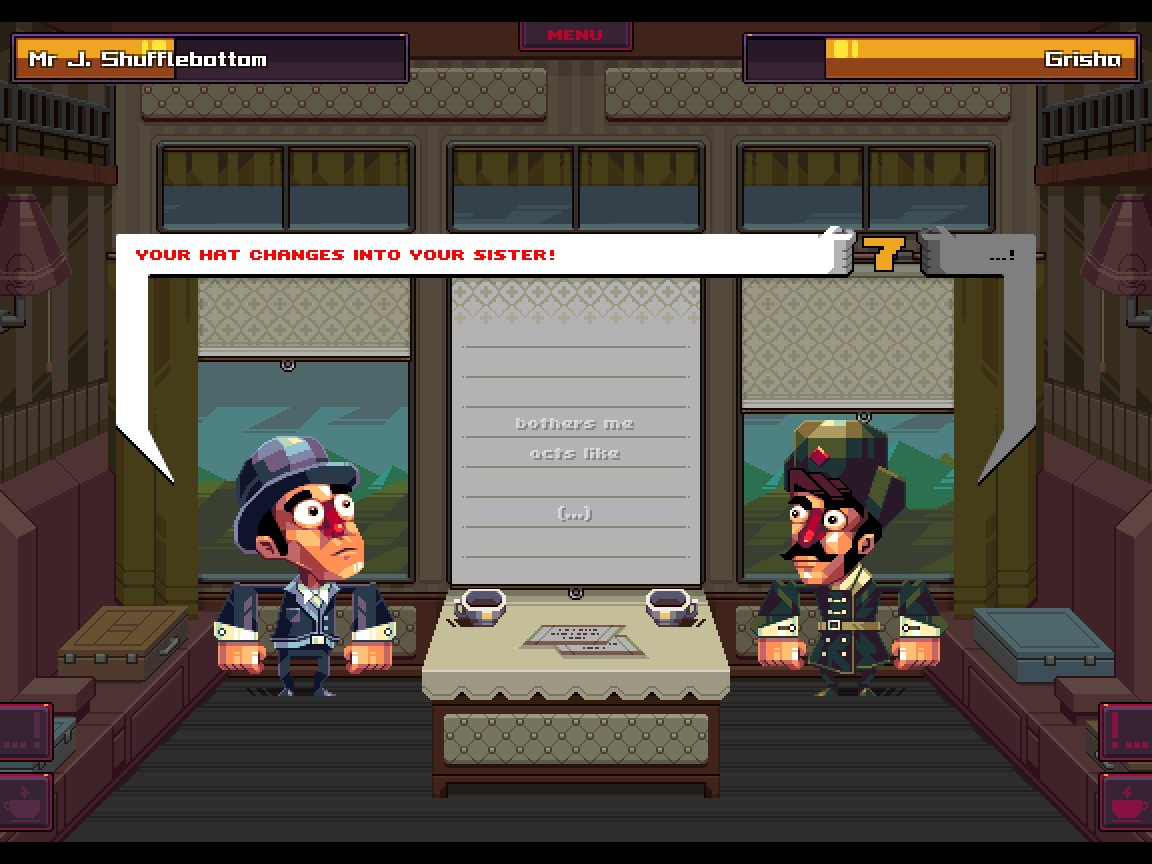
Your Hat changes into Your Sister!

Your Son and Your Husband are not Part of Europe!

A Hamster is this Conversation and wanted to be your husband, Tovarishch!

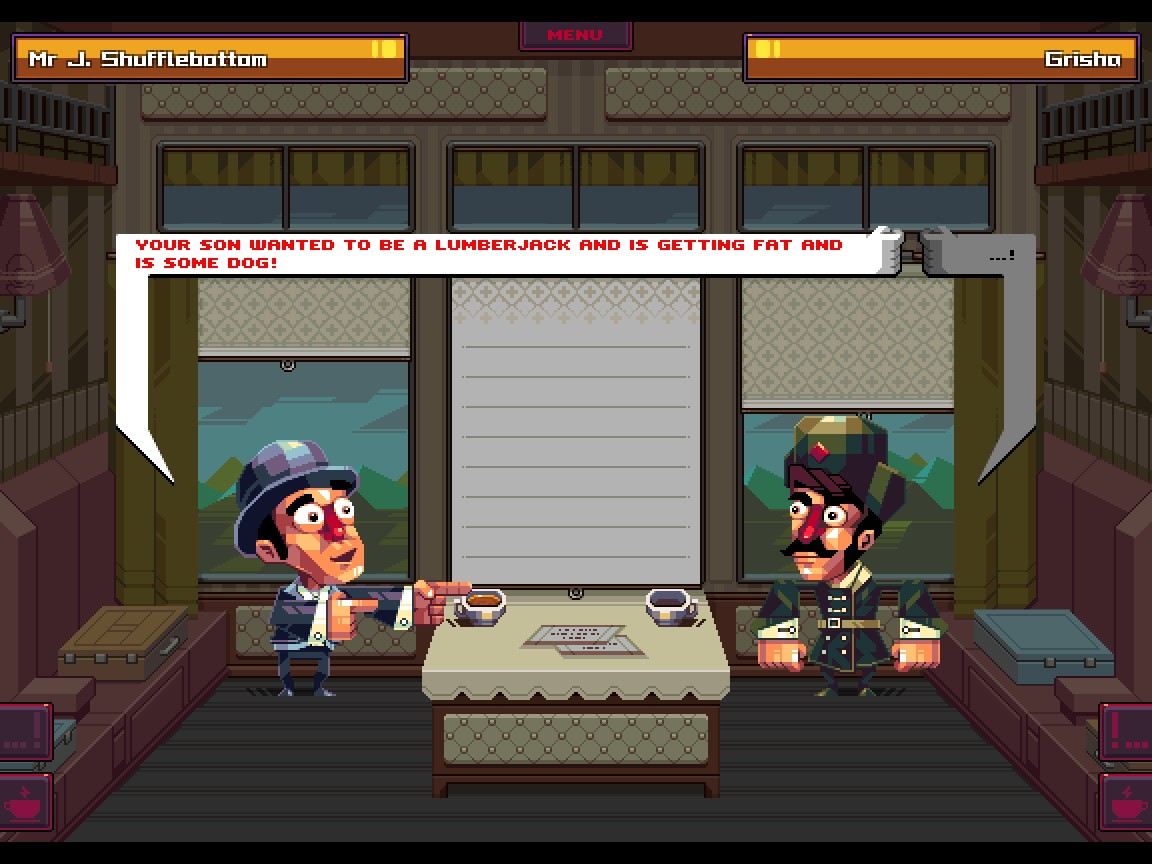
Your Son wanted to be a Lumberjack and is Getting Fat and is Some Dog!

Your Cousin’s Car Admires Pictures of this Place and was Born in Your Seat and is an Old Bugger!

By the way, the game that produced the above insults? It has 2,000 plus positive ratings on Steam. Yea.

My friends took my attempts at ending our friendship rather well. 4 out of the 20 asked if I had relapsed. 3 asked if had just had a seizure or was recovering from one. The other 13 were just confused. When I explained to all 20 of them that these were insults and asked them to rate how hurt their feelings were on a scale of 1 to 10, seven of them said “1”, five said “0”, two were still too confused to even comment on what they had just read, and the four people who asked if I had relapsed again asked if I had relapsed, and two other people joined them in asking if I was on something. None of the twenty unfriended me, though six were kind enough to take pity on me. That sure was nice of them.

It was ALMOST clever to cross Harry Potter with Dirty Harry. Almost.

The lobotomized dialog is hardly the only problem. If you perform a “combo” by using the same subject-matter in two or more straight insults, you deal extra damage. But because of the random nature of the speech options, you can’t remotely plan a strategy for this. If you choose the person’s hat as the target of your venom, you can’t get a combo if the game doesn’t include “hat” the next go around, or if your opponent chooses it first. I’m notoriously unlucky when it comes to random chance in games, and that was hugely noticeable during my play sessions with Oh…Sir and Oh…Sir Hollywood, where my AI opponents had an uncanny knack of going first and stealing my combos with their first selection on the off-chance they were put on the board. It further removes strategy from the games and reduces winning and losing to luck. And that’s especially true when you play with an actual human who knows what they’re doing as opposed to the often brain-dead AI that would come close to winning only to mess up and fail to enter a proper sentence at all, causing a loss of turn. This happened a lot. It’s how I finished the game on Xbox.

But the way the game reads the parts of speech has just as much potential to fuck  you over. Especially when trying to use the word “and”. The game seems to only let you use “and” to start an entirely new insult and not to compound an existing one by lumping two subject matters together with it. The majority of times the game gave me a score of zero, it was because I misused “and” even though my intent for its use couldn’t have been more clear. Take this example:

And the game even further fails at strategy with character-specific weaknesses that cause extra damage. Like, maybe one is especially insulted by age jokes. A perfectly good idea for a series that aspires to be a fighting game where you trade insults instead of fisticuffs. But again, you’re completely at the mercy of the random word bank, which doesn’t seem to spit out the extra-damage words enough. But it’s logically even worse, because you also have your own extra-damage weakness that you have to defend against. So if you’re playing as a character that hates having his manhood insulted and a word that targets machismo is on the board, you pretty much have to take it or face receiving a disproportionate amount of damage. So both you and your opponent will score lower, in a game where matches tend to be slogs already.

The only fast-paced aspect of Oh…Sir is yet another strike against it: you only get fifteen seconds to read, process, and assemble-in-your-head the parts of speech before making a selection. That sounds like enough time until you remember what an incomprehensible word-vomit you have to work with. If you’re anything like me, you’ll eventually give up on trying to make sentences sound like English and just focus on scoring damage, something you have to rely entirely on random chance to excel at.

I needed a full week of processing and replaying Oh…Sir and Oh…Sir: The Hollywood Roast (which technically I bought first for XB1) trying to find something redeeming to say about the games. Besides the fact that whoever they got to do the Arnold Schwarzenegger impression for the Hollywood Roast is quite convincing, to the point that I wondered if they got the real guy (hey, have you seen how his recent movies have done in the box office? Dude needs a job!), I came up short. Playing the Oh…Sir games is like combing through the rubble of a recently blown-up dictionary factory without the fun of seeing the actual explosion.

Oh…Sir!! The Insult Simulator and Oh…Sir!! The Hollywood Roast were developed by Vile Monarch
Point of Sale for Oh…Sir: Steam, Switch, Xbox One, PlayStation 4
Point of Sale for The Hollywood Roast: Steam, Switch, Xbox One, PlayStation 4

$0.79 (Oh…Sir!!, normally $1.99) and $4.99 asked if the “prepubescent teenage boy” line was really necessary in the making of this review.

Minit

It’s long been my belief that most indie devs who make games based on high death counts often forget that the fun part is not supposed to be the dying, but the surviving.

To which the team behind Minit said “hold my beer.”

Sometimes the pixel art thing is inspired. Sometimes it feels pretentious. Here, like the drunk roofer, it slightly leans towards the ladder. Get it? The ladder. Latter? I’ll move on.

Minit is a Zelda-like adventure game with the gimmick being that, no matter what you do, you die every sixty seconds and have to return to whatever your current starting base is. I actually didn’t know about this going into the game. I do my best to avoid any and all information on indies and begin playing as cold as possible. When I saw the name, I figured the key part of the name Minit was the MINI part. But no, it’s “Minit” as in “Minute.” In fact, “Minit” is the Malaysian word for “minute” and I’m jealous because it’s one letter shorter and thus 16.6% more efficient than English. At least for now. We’re slowly but surely getting to the point that English will be a series of grunts and obscene gestures.

It was actually comical because for the first few minutes of Minit, I didn’t notice the countdown timer in the corner of the screen. So when I died for the first time, I was quite miffed. There were a few crabs on the screen and an animation of grass or dust moving on the ground, so I was like, “huh, maybe an enemy burrowed into me without me having a chance to dodge. Well, that’s cheap as shit.” Then I started again, went the same direction trying to find what killed me, stood around, and died again. A parade of cuss words, each more cringey than the next, followed. Like the oblivious twit that I was, I went back one more time to the spot I died, cleared out the enemies, started getting really annoyed, and was ready to enter the Controller Shot Put event (my personal best is 11.87m). And then I noticed a timer counting down from 4 in the corner of the screen. “Huh, I wonder what that is?” Then it reached zero. And I died. Again.

“Oh. I get it. MINIT. Like MINUTE. That’s clever.”

By the way, sometimes I pull shit out of my ass for comic effect here at IGC. But all the stuff in the above paragraph, and I really hate to admit this, is 100% true. Well except the 11.87m (I was on steroids at the time so it wasn’t a legal attempt). Derp.

Maybe he’s not really dying. Maybe he just keeps throwing his back out because he’s using a sword that has more mass than he does.

Once I got the point of Minit, I found the game to be fine. I’m not the type to get caught up in speed running, which is the primary audience Minit was designed for and adopted by. For me, it would have to stand on its own merits as an exploration-based adventure game that takes place in sixty-second chunks. And it kind of does. Trying to sprint from point A to point B while working in a dash of exploring and investigating requires time management and a preset game-plan. In that sense, Minit sometimes feels more like how an actual adventure in such a situation would play out. Well, an adventure with someone who has a congenital heart defect.

Having said that, all the problems with Minit stem from the gimmick itself. In order to keep the game on point and streamlined, world design had to be kept to a simplistic minimum. Functionally, it works fine. Artistically, it’s kind of dull. Ultra-basic maps and enemies keep the tempo lower than you would expect. That’s kind of what surprises me the most. In a game based entirely around a ticking clock and speed, Minit rarely felt white-knuckle. Maybe towards the end of the game, but then again, I didn’t even realize I was at the end of the game until the ending played out. I was like “oh hey, I just cleared the first boss.” And then Minit was like “nope, that’s the only boss.” Well fuck me. I’ve how bowel movements that took me longer to work out.

Worth noting: I died a couple of times during the boss but came back with no consequence and the boss not reset to the beginning. I’m honestly not sure if that’s a good thing or a bad thing. It’s a thing.

Minit’s gimmick is clever and original, but it’s also such a major handicap. Not one aspect of the actual design besides the dying gimmick is memorable. The graphics are stark and stripped down. The enemy designs are clichéd and bland. Minit is a one trick pony. It’s a very cute pony. I’ll give it that. It’s certainly worth playing at least once. Finishing Minit opens up a second quest with a 40 second time limit and a few location changes. I barely made it into it because I was satisfied enough with my 90 minutes spent with Minit and had no desire to go forward. Which is sort of weird because there were tons of unanswered questions. There were tentacles scattered throughout the world, but I never got those. There was a dungeon with a large maze, but I never finished it. There were apparently speed shoes that you could buy, but I never found close to enough coins to buy them. Wait, did I accidentally speed run Minit? Fuck me, I’m better than I realized!

Minit was developed by Kitty Calis, Jan Willem Nijman, Jukio Kallio & Dominik Johann.. UPDATE 10/26/19: And apparently Rami Ismail. I genuinely didn’t know that and need to disclose I’m friends with him. That didn’t factor into this review.
Point of Sale: Steam, Xbox One, PS4

$9.99 was going to be the hero of the world.. and then I died in the making of this review.

Minit is Chick-Approved with the cuddly new Indie Gamer Chick Seal of Approval. Order your own Seal of Approval now. I mean, your OWN seal of approval. For your game review site. My approval of your game is not for sale. Well, at least not for cheap.

Oh and it’s ranked on the Leaderboard. And then it died.

Yoku’s Island Express

Obviously I like Metroidvanias. Two of the top three games on the IGC Leaderboard as of this writing are just that. It’s probably my favorite genre. “Tell us something we didn’t know” you’re saying. Fine, how about the fact that I love pinball? Those who only know me through my reviews and not my Twitter probably wouldn’t guess that. I mean, I have photo-sensitive epilepsy. Pinball isn’t exactly the most epilepsy-friendly pastime out there. It probably ranks just below celebrating the 4th of July on stupid things I do. I don’t even really use fireworks. I just light my parents’ bed on fire. But anyway, pinball. I shouldn’t play it. I do. And yea, we remove the strobe-lights and mute other lights when I play (I have my own collection. Going to something like the Pinball Hall of Fame in Vegas isn’t optional), but still, sometimes I’ll be out and about, run into a pinball table, and have to use every fiber of restraint to not pop a few quarters in and play. If it wasn’t obvious from the cigarettes, the multiple daily energy shots, the frankly absurd amount of soda I consume, and eating habits that would embarrass a five-year-old living out of a candy store, I was apparently born without any survival instinct. So, yea, I play a lot of pinball.

Oh, video pinball? Forget about it. Those are NEVER epilepsy friendly. Oddly enough, the one and only game I’ve ever contributed to a Kickstarter for was The Pinball Arcade, and I got *nothing* out of it. I just felt it was the best way I could contribute to preserving pinball for those out there who can’t afford $4,000 for a used, routed table that the dude selling on Craig’s List SWEARS has been shopped but really he just gave it a quick waxing and it’s ready to fall apart if someone hits a flipper twice on it. Trust me, the pinball enthusiasts reading this review know what I’m talking about and are banging their heads on their desks as we speak. But really, it sucks to be me because it’s a golden age of video pinball and I can’t play the fucking things. (By the way, don’t harass them over it. I’m really good friends with people at Zen Studios of Zen Pinball fame, and I don’t take it personally at all I can’t touch their pinball stuff.)

Well, someone finally made a pinball game I can play.

And it’s a Metroidvania. You bet your sweet ass I came when I heard about this one.

This was pretty much my reaction when we signed Kevin Durant.

Yea, you heard me right. Yoku’s Island Express is a Metroidvania and a pinball game. Which is funny because there’s been a Metroid pinball game and it was NOT a Metroidvania (though it was probably the only video pinball game I ever liked). And it’s mostly epilepsy safe (the bosses weren’t, so I had to take extra-precautions) so, hey, I should like this right?

And I did, but I’m getting ahead of myself.

In Yoku’s Island Express, you play as a dung beetle tasked with becoming a postman. I have to say, as a child I wondered what it would be like to put a dung beetle on a pinball table, and now I know without being straight-up evil. Anyway, you traverse the world of Yoku via flippers and kickbacks. No plungers, oddly enough, or at least I didn’t find any. As you make progress you’ll gain a few special abilities like a lasso type thing that lets you swing around specialized pegs, or short-cuts around the sprawling map. Despite being a genre-salad that seems risky on the surface, Yoku’s Island Express (God I hate that name, it makes it sound like a stripped-down mobile version of a bigger game) is shockingly basic.

When I saw what Yoku was, my first concern was the physics. With no jump button and all platforming done via pinball shit, bad physics would kill this game dead. Thankfully, that was never once an issue. Don’t get me wrong: it never feels like real pinball. But it didn’t need to. This wasn’t meant to be a pinball game that plays like a Metroidvania. It’s a Metroidvania that plays like a pinball game. Or wait, should that be reversed? You know, you’re jumping straight to the next sentence, but I spent a solid hour wondering about it. My point is it’s an adventure game with a pinball gimmick. And it works. I never once felt I was screwed by momentum or physics or glitches or anything that the pinball stuff might lead to. Mechanically, it’s the perfect marriage of two concepts, like peanut butter and jelly, or Poptarts with melted garlic butter. Hey, don’t wince until you try it.

Having said all that, it never gets fully exhilarating. That mostly owes to the fact that the level design is very basic. I was never once floored by any section of Yoku’s Island. It feels like they put all the risk in the concept itself and didn’t want to experiment too much with layouts. The purely pinball “stages” play and feel like 60s era electro-mechanical tables. A few bumpers, a few chutes, with the only advancement over that style of design being video-gamey pick-ups or enemies that move around.

To be clear: the levels are never boring. Just a bit bland. And it never gets too complex no matter how much progress you’ve made, which means the basic table design takes the zing out of the inspired concept after a while.

I get it. Nothing like Yoku’s Island has been done before (NES fans, no, Pinball Quest couldn’t hold Yoku’s dungball) and they just had to get the damn thing working. Everything connects well and it’s never a full-on chore to navigate it. Still, the truly pinball-based parts of the game feel so limited and safe that it makes Yoku’s Island Express feel like a really good proof of concept instead of something mind-blowingly inspired. I’ve never wanted an indie I’ve played to become a franchise more. That includes SteamWorld or Shovel Knight games. Those were pretty much amazing right from the start. Yoku’s Island feels like its potential is still somewhere off in the distance, waiting to be realized.

And the areas to improve are self-evident. The shortcut system is overly complex and even required me to grind up money for it a few times. It costs too much to use and slows the pace down too much. The writing is bland and the big plot twist final boss would have been a bigger surprise if the game hadn’t fucking outright told me it was going to happen. It hints the chosen one would be betrayed by someone on the adventure with you, and there was literally only one thing that was on the adventure with you. Gee, I wonder who is going to betray me? It was either the thing that did it or the non-sentient ball itself was going to go rogue.

Actually, the coolest part of the game is also its biggest short-coming. Yoku reminds me of an N64 era Rare Ltd game. Like, this is the type of weird, experimental genre mashup they would have cranked out along with Blast Corps or Jet Force Gemini back in the day. It even looks like a Rare game, with lush settings and PBS-ish friendly character designs. And that’s awesome. It totally took me back to being that giggling nine-year-old playing Banjo-Kazooie on my 9th birthday. But, all the warts of a Rare-inspired game are along for the ride, with far too much emphasis on collecting for the sake of collecting. Unlike something like, say, Axiom Verge, where I got excited to stumble upon new guns or weapons, or complete side missions, I was soured on the fetch-questiness (that’s a word now, write it down) of Yoku quickly.

I’ll give you an example: at one point you get three big packages that you have to take from the central hub town and deliver one at a time. I pick up one of them and have to take it to a guy on the left side of the large world map. I get it to him. The dude simply did not want to open his door to take it. It looked like maybe I could try to go through a back door or something, but every time I tried to make my way around, I fell all the way to the bottom of the map, and it took a LONG TIME to work my way back to it. Now, at this point, I was doing that thing I do with a game I’m loving where I knew I was about to finish everything and I was stalling for time because I was enjoying things so much. But after that one bad experience, I was like, fuck it, I’m ready to be done with this game. I instantly lost all interest in all other hidden trinkets and I’m never going back to get them. About twenty minutes later, the end credits were rolling and I was satisfied and happy with the experience. If the developers wanted me to actually have fun finding all the frankly insane amounts of hidden content, I don’t know what to say. Next time actually try making it fun to do it? And not a chore? Just maybe?

Insert Saved by the Bell joke -here-.

Everything else I could say is nit-picky. But fuck it, it’s my job so here we go: the game is too easy (I never died once and as far as I know I never came close to it either), I thought every multiball section was crap, I never once felt a sense of tension or awe in any aspect of exploration, and the explanation for how to use the slug vacuum was so poorly written I almost had a rage-quit trying to get the hang of using it. Having said all that, Yoku’s Island Express is never boring. It only teeters on being a slog when you’re supposed to be high up on some platform, fall down, and have to make your way back up to it. And despite the flaws probably out-numbering the good stuff, Yoku’s Island Express is just plain fun. I want a sequel that goes all Twilight Zone pinball on the layouts and focuses more on clever world building, but what’s here is perfectly entertaining for six hours. And yea, they left a lot on the table, but we can’t expect them to show extra balls on something this different, so I tilt my hat to them.

Seven years writing these things and it’s come to this: closing a review with puns. Why does anyone read me again?

Yoku’s Island Express was developed by Villa Gorilla
Point of Sale: Steam, Xbox One, PlayStation 4, Switch

$19.99 honestly asked “wouldn’t the dung beetle have been squished by the flippers?” in the making of this review.

I purchased and played the Xbox One version of the game. Villa Gorilla supplied review copies for members of Indie Gamer Team for XB1, Switch, and PS4. We’re not done talking about Yoku’s Island Express yet.

Yoku’s Island Express is Chick Approved (with the brand-spanking-new Indie Gamer Chick Seal of Approval designed by Kevin Willingham) and ranked on the Indie Gamer Chick Leaderboard

FOX n FORESTS

Hi there, Fox n Forests. Take a seat please. We need to have a talk.

First thing’s first: the name. Do you know how many times I accidentally called you Fox & Friends? The name is basically begging for mockery or to be botched when spoken by sloppy wordsmiths such as myself. Also, the name is technically FOX n FORESTS, as if it were being screamed by a narcoleptic that briefly nodded off after the first syllable. What is with that “n” anyway? It’s so clumsy and distracting. You have a gorgeous sixteen-bit era game with magic spells and upgradable weapons and treasure chests that sometimes have traps designed to unfairly screw the player and..

Oh, I get it.

You were trying to dress up like Ghouls ‘N Ghosts huh?

It’s okay, you can tell me.

As far as I can tell, the dialog with the checkpoint critter has no payoff and is just supposed to be an “LOL, this character collects games, just like the majority of Kickstarter backers did judging by the end credits” joke. Also, whoever is the person shown in this picture, I want to thank you oh so much for the nightmares I’ve been having these last few weeks, you fucking monster, you.

Well, that makes things awkward. You see, I’m a child of the 2000s. I’m not nostalgic for the type of game you aspire to be. Oh, I don’t really care if a game is neo-retro or not. Take a look at the two games I hold up as the best two indie games ever developed: Axiom Verge and Shovel Knight. Both of them aspire to invoke the era you dress yourself in. So when people will inevitably say I had it out for you from the start, obviously that’s not the case. Truth be told, I haven’t followed your story at all. I had no idea you raised over $125K USD on Kickstarter. I had never heard of the studio that birthed you. I just said “hey, neat looking game.”

And you are neat looking. Authentic SNES look and feel. Of course, that’s where the issues start. Like having melee and projectile attacks mapped to the same button. Why? Because “back in the day” games had fewer buttons? Well, you see, I don’t really buy that. The SNES had four face buttons, just like the PS4 and Xbox One controllers I used playing you, plus two shoulder buttons, select, and start. Why do you have the same attack mapped to two different face buttons, when ranged attacks and melee cause different damage and are upgraded separately? So, in order to do a melee attack, you must either be in the act of jumping (when you can’t fire your projectiles) or you must be ducking.

Now, I’m not an anthropomorphic fox. Hell, I’m not even foxy. I’m sultry at best. But if I were an anthropomorphic fox, I would think that I would be able to comprehend that if my melee ability caused more damage than my ranged attack and an enemy was within close proximity, it would make more sense to just bonk them with my magical club thing without going through the effort of ducking or jumping to do it. It is so unbelievable that you can’t just swing your weapon while standing still that I kept checking the control screen to make sure I wasn’t missing it. I did this the entire length of the game, because it is that unfathomable.

It’s not even an exaggeration to say, as I uploaded this screenshot, I gave it one final glance over to make extra, extra, EXTRA sure I wasn’t missing something. I’m not.

That was pretty much how I felt about the entire Fox n Hannity experience. For every step forward, you stepped backwards into a cow patty. You have eight levels and five boss fights, one of which isn’t even really a boss fight. Of the eight levels, six of them are platformers and two of them are shmups. I’ve never understood why platform games do that. Oh, don’t worry Fox. I mean, even Nintendo did it with Super Mario Land, a game that came out in the United States exactly three weeks after I was born. Incredibly, in the nearly twenty-nine years since then, nobody has realized mixing these two completely incompatible genres is a combination surpassed in stupidity only by teriyaki-flavored soda.

Anyway, your shmup levels are bad. Like, bad-bad. Like, seriously, go put your nose in the corner for the next ten minutes. What were you thinking? No matter how much effort I put into building my health bar up, everything in those levels is a one-hit death. Even touching floor or ceiling. It’s a jarring, cringey gameplay shift, going from a very slightly above-average platform experience into a very mediocre Gradius-type of one. Cuphead did this too, and while I hated Cuphead, at least those shmup sections felt inspired and not out-of-place. YOUR shooting stages feel so lifeless and generic that they come across more like filler. And given how much you were already dipping your toes in the lake of blandness, that type of filler is like adding sawdust to bread and then chowing down on it. Not good for you, Fox n Forests. Your poop will be all pulpy, now.

See that itty-bitty little orange plant in the bottom right corner? Yea, the tip of my bird’s feet brushed up against it and I died. These stages are brought to you by Valium because you’ll need it to get all the rage you’ll feel playing them under control.

But let’s talk about the platform levels since that’s your bread and butter here. They’re not bad at all. Mostly nice design. Cool variety. The difficulty-scaling is a bit off since I had more issues beating stage 1-2 than I did stage 4-2. That could be because I had upgraded my offense significantly by that point. But otherwise they’re fine. They’re the best part of you. And while you’re not the first game to use the “change the level on the fly” mechanic (represented here by changing the seasons), what’s here mostly works. I mean, it was kind of annoying that there’s a pause every single time the main character raised his weapon up and was frozen while he was doing the “THUNDERCATS, HOOOO” pose every time you change the season but NOT when you change it back. But even then, while it’s not exactly original, it keeps things interesting.

Or, at least, it does the first time you play through a stage. Unfortunately, you relied heavily on forced-replays of levels to pad-out your length. I’ve tried padding myself to make up for my own inadequacies, so I get it. But nobody bought that my boobs had grown four sizes overnight, and nobody is going to believe you’re actually longer than your eight stages no matter how much gauze you stuff into your shorts.

Each of your stages contains five hidden acorns. If you do not find enough of these acorns, you won’t have access to the later stages. And I don’t mean the bonus stages for each game’s world (worlds consisting of two levels and a boss fight) that you unlock by finding all ten acorns in a world. Oh no. I mean actual levels that you need to finish to, you know, beat the game. Well, that fucking sucks.

Even THAT wouldn’t have been so bad if it had been possible to get all the acorns on your first run through each stage. But you had to be a dick and not allow that. Sometimes you won’t be able to access them until you have special arrows that you acquire only from beating bosses. Stages have bullseyes of different colors scattered around them that you must shoot with the matching color arrow to unlock access to different areas of each stage. That sounds fine, but the areas you’re unlocking are teeny-tiny. It might just be an extra platform or two that gives you access to the acorn, and that’s it. So you forced myself and others to fully replay the entire stage to get to these sections, and then finish the stage to keep them. If we were unlocking vast new areas of levels that contained new and innovative gameplay mechanics, maybe this would be justifiable. But we’re not. This is one of the worst instances of forced-level replaying I’ve ever seen. It’s like being forced to sit through a rerun that promises you never-before-seen deleted scenes that are really just 20-seconds long and add fuck-all to the plot. There might be an entire extra section to the game if you get all 40 acorns (it does unlock something), but I would have to care enough to get them all to find out. And I don’t.

Actually, I only enjoyed five of the platforming stages. This vertical level (or was this the vertical non-boss boss-fight?. Meh, both are boring) is hampered by some spotty collision detection and became such a chore that it’s where I declared my status as a wuss and started the game over on easy mode, just to finish it. Which is another issue: no on-the-fly difficulty switching. Fuck that noise. And I REALLY didn’t want to have to replay this one to grab the stuff I missed the first time around. So I didn’t. Because it was boring the first time.

Fox N Forests, you have fine level design, but not so fine that I want to play the exact same fucking levels again and again. There was nothing more agonizing for me than to play a stage for the third time, get to the end of it and STILL have a missing acorn. “WELL FUCK ME” I screamed as I hit the teeter-totter to end the level and then start over AGAIN, this time making sure to push up against every single fucking wall or making blind jumps off every platform, constantly switching between seasons while looking for the hide-and-seek champion of acorns. Yea, this was adding to the game’s run-time, but it long ceased being fun. This was busy work. Fox N Forests, you would have been SO much more enjoyable if finding these things hadn’t been forced upon me and I could just play the levels one time in sequential order and only go back if I wanted to grind up money and resources for better upgrades. An optional grind is always preferable to a forced one. Your parents, Bonus Level Entertainment, apparently never got that memo.

I hated you, Fox N Forests. I really and truly hated you. Mostly because it was frustrating watching you throw away so much potential. There’s a running gag I use about “minimum indie badness” that games must achieve for their indie cred. In your case, it’s like you were worried about not meeting your quota and overcompensated. Your levels are creative (except the shooting stages, which can go fuck themselves), but get boring when you forced me to replay them. Your controls are good, except the nonsensical button-mapping. Your bosses are well designed, except one encounter with a giant spider that is more of a copy of Metroid’s escape-the-shaft finale, only longer and less interesting. Your weapon upgrades are nifty, but I only bought one of the potion-weapons, used it once, never bought another, and was no worse off for it. Plus upgrading the weapons required even more forced replays of stages to find hidden mana-cores and stone wheels, to the point that I never even got all upgrades. Everything you did right is immediately nullified by something you did wrong, to the point that I didn’t like my time with you at all.

And the Children of the Forest approached the First Men and said “on second though, you can cut down SOME of the Weirwood Trees.”

So yea, you’re grounded Fox n Forests. Go to your room. I’m not your parent or anything. But fuck it. Go to your room, think about what you’ve done, and make some DLC that rights all the wrongs you just did. Be the first indie game I’ve ever played where the DLC is better than the main game. Because you have so much potential, and the fact that THIS is what you ended up being? You’re better than this. Way, way better than this.

Even your story was bland and predictable. During the open intro, the framing plot device made the finale so easy to guess that I wrote it down on a piece of paper and sealed it in an envelope. When the final boss battle began, I told Brian he could open the envelope. He shrugged and said “did you expect something better?” Yea, I was completely right, but it wasn’t exactly impressive. Helen Keller could see the big twist coming a mile away, and she’s not even a platforming game fan.

Fox n Forests was developed by Bonus Level Entertainment
Point of Sale: Steam, PlayStation, Xbox (Coming Soon), Switch

$17.99 (normally $19.99) accidentally called the game “Fox & Friends” 8 times for those who were taking bets in the making of this review.

Pre-release review copies were supplied to Cathy by Bonus Level Entertainment. She purchased a copy of Fox n Forests upon the game’s release. All games reviewed at Indie Gamer Chick are paid for by Cathy out of her own pocket. For more on this policy, read the FAQ.

Developers who receive review copy requests from Indie Gamer Chick: make sure you’re really getting them from me and not someone pretending to be me.

Check out Indie Gamer Team’s Obscure Games and Consoles review for an alternate take.

Wonder Boy: The Dragon’s Trap

I love making my readers feel old. There’s something satisfying on a primal level about sending them to their bathrooms to cry and check their hairlines when I mention things like how I was only ten-years-old when the Sega Dreamcast released in North America. In that spirit, here’s me reviewing a remake of Wonder Boy III, a game which released for the Sega Master System in July, 1989. Do you know what else released in July of 1989?

Me.

Into the world.

From my mother’s vagina.

Yep, you’re old. I’m not. Suck it.

Of course, it’s kind of bizarre that I’m reviewing a game that was, at the time of its original release, clearly not an indie. It was a major tent-pole console exclusive. Sega’s answer to Super Mario 3. Not only am I reviewing it, but I’m counting it as an indie game. For my new readers, I have a rule: for the rare non-indies that I cover here (South Park: Stick of Truth, The Simpsons Arcade Game, or Peggle 2 among others), win or lose, I don’t count them towards the IGC Leaderboard’s percentile rankings. Wonder Boy: The Dragon’s Trap will count, and spoiler alert, I’m giving it my Seal of Approval. But wait, you say: how can a major first-party game (it was published by Sega for the Master System) that was their best weapon in their war against Nintendo before the Genesis possibly be an indie today?

I’ve been doing Indie Gamer Chick for six years. I’ve reviewed over 550 games. I was, and probably still am, the defacto face of an entire indie gaming platform (rest in peace, XBLIG). If anyone would know what exactly makes a game “indie” or not, it would be me. But the truth is, I would have an easier time defining the meaning of life than defining an indie. (By the way, the meaning of life is that cream cheese mixed with powdered sugar makes a delicious frosting. Everything else is meaningless.) At one point, the gang at Zen Studios protested that I denied their Chick-Approved genre-smörgåsbord Castlestorm a spot on the Leaderboard on the basis that they made video-pinball games using the Star Wars IP. Star Wars clearly is not and never would be considered an indie game, and I felt at the time any studio big enough or reputable enough to be selected to develop for that license shouldn’t be considered for indie status. Zen Studios challenged that and convinced me otherwise. So while their work with the Star Wars IP wouldn’t qualify, Castlestorm certainly did.

I often complain about action-adventure indies that forget to make the hero “blink” long enough after taking damage. That’s not an issue with Wonder Boy. Actually, it goes to the other extreme: sometimes you blink so long it could take as long as a minute before you stop being juggled by enemies and regain the ability to, you know, move and fight back. But at least you’re not taking damage during that shit. This is the final boss, and I spent more time recoiling from damage during it than actually fighting it. Look closely to the right of it and you can see me stun-locked.

Which brings us to Wonder Boy III’s remake. The new one, not the old one. Uh, yea, in case you didn’t know, it’s already been remade once. Because of ambiguous rights issues that practically require a flow-chart (the original Wonder Boy was remade as Adventure Island for the NES and THAT spawned a completely different series, making it the Power Rangers of video games), Wonder Boy III: The Dragon’s Trap was released a year after the SMS version on the Turbo Grafx 16 (PC Engine in Japan) under the name “Dragon’s Curse.” This is the version I bought on Wii Virtual Console in 2007, so I was already familiar with it. And I quite liked it back then. I mean, the controls were so slippery that it felt like someone had buttered the floor, and this was also around the time my epilepsy developed and I had to look away from the screen quite a bit. But still, really nice game. As someone who grew up in the PlayStation era, it was one of my favorite lost classics the Virtual Console allowed me to rediscover.

This remake is actually reverse-engineered from the SMS original. So, yea, it’s a $20 ROM hack. Only there’s never been a ROM hack like this. The guys at Lizardcube painted absolutely gorgeous facades over the original graphics. While I’m fairly sure that all the original collision boxes were retained, the effort is so admirable and so striking that you have to tip your hat to them. You can switch back and forth between the original graphics and the 2017 remake on the fly, and sometimes I found myself doing it just so I could be gobsmacked by how much work they put into it. Here’s what the game looked like in 1989.

And here’s the exact same shot, only with the 2017 graphics.

Wow.

Of course, being a ROM hack that aspires to faithfully recreate the original means all the warts are along for the ride. Wonder Boy has terrible platforming controls. Floaty, loose, laggy at times. The weird thing is, the developers did fix a few things, including the most obvious flaw. In the original game, you needed to acquire and equip a sword to break some of the stone blocks. Pausing the game to equip this killed the pace and was just tedious busy-work, especially when you acquire a sword that lets you create breakable blocks that you then have to switch back-and-forth with. Even for its time, it’s such an obviously stupid design choice that it’s astonishing it took nearly thirty years for someone to fix it. In the remake, they’ve eliminated the block-busting sword. Instead, the stone breaking thingy is a charm that, once you have it, is always equipped regardless of what sword you’re using. But besides adjustable difficulty (very welcome since the bad controls made the original a maddening experience), the block-breaking issue is the only major fix. It’s like a dermatologist saying “well, you’ve got a lot of moles, but we’re only going to remove the one on your nose. Because it’s cancerous. And also, we’re going to need you to pay in cash from now on.”

I can’t really blame the developers on some of the more glaring issues with the original. But, because they clearly recognized that some aspects of the game hadn’t aged gracefully, I can’t give them a pass on them either. While the concept of switching between different animal forms was, and still is, inspired, Wonder Boy III didn’t use the idea to its fullest. The level design varies from decent to atrocious. Each animal-form is acquired by completing a dungeon. The mouse’s dungeon is repeating a series of identical zig-zag rooms on the left side of a giant pyramid, then dropping to the bottom of it and doing a repeating series of identical zig-zag rooms from the right side of a giant pyramid.

See that? Repeat that six trillion times, or at least it feels that long. Only the enemies might change, but otherwise it’s exhausting in its dullness. But that’s not even the worst level! The lion’s stage is series of flat rooms without platforms or puzzles or anything but ninjas (random). It’s incredibly lazy and uninspired. It feels like the original developers just gave up or lost their will, or surrendered to writer’s block. I don’t know the story on it, but Wonder Boy III came out after Super Mario 2, a milestone title in the realm of level design. Even for its time, these stages are the rice cake of game design: better than tofu and edible, but certain to leave you wanting something more. It’s a stripped-down Metroidvania, and it shows its age.

The lion’s animal power is being able to swing its sword in a top-to-bottom slashing motion, allowing you to break blocks above you. So the lion’s power is awareness that “up” is a thing.

Still, there’s a lot of fun to be had in Wonder Boy: The Dragon’s Trap. Grinding up money is fun (assuming you don’t outright cheat the game by opening a treasure chest in the town, returning to the title screen and going back to the now full-again chest, which I, ahem, most certainly would not do, cough), the different animals are a blast, and the variety of weapons is nifty. I just wish instead of doing an artistic upgrade, they had just remade the whole game with new levels and new dungeons. In fact, LizardStation did add new dungeons called “The Unknown”, but they’re hidden and I didn’t find any in the three hours it took me to finish. I only discovered them because the final one unlocks after the credits and features you playing as the human Wonder Boy (or, optionally, Wonder Girl, which changes nothing but allows the game to be listed under the “female protagonist” tag on Steam, a tag which in no way feels like it’s mostly used as a cynical way of monetizing political correctness and equality. No sir or ma’am) and shows you where’s it’s located. There’s one of these new “Unknown” dungeons for each animal form, but I didn’t know they even existed when I played through it, let alone where they were hidden at. I tried to play the Human dungeon but literally the first screen was so poorly designed, requiring precision movement from a game infamous for shitty controls that I immediately lost interest in trying more. It felt like one of those, well, ROM-hacks.

When I first started playing it, I told Indie Gamer Team that this felt like a fan project that got noticed by the IP holders and made legitimate. As it turns out, that’s what 2017’s remake of Wonder Boy III actually is. That’s really cool. When we think of the nature of what makes something indie or not, something like The Dragon’s Trap doesn’t make things easier for us. It’s a fascinating anomaly that both suits and defies nearly every label. A former marquee console headliner that went on to become one of the most unsung indie gems three decades later. Just, weird. While I liked it, and I would love to see more remakes along these lines, I would have preferred Lizardbox fix the control issues and the stuff that actually matters to gameplay over painting over the problems, even though they were very good at painting. It would be like buying a 2017 Porsche 911 that has the option to transform instantly into the original 1964 Porsche 911. That would be fucking sweet, right? But what if it turned out the car’s specs, no matter which version of the Porsche it looked like, were the 1964 model’s, with the only modern concession being a CD player instead of a radio? I’m not sure that’s something most people would want. Hell, maybe not even fans of the original would want it. It’s why I have to give the nod to DuckTales Remastered as the better remake. It remembered that it had a chance to right every wrong, not just the really obvious stuff. Whereas DuckTales was a trip down memory lane for retro gamers but still modern and slick (granted over-produced to the point of annoyance), I don’t think Wonder Boy: The Dragon’s Trap 2017 will be that for gamers of all ages. I showed it to my Godfather’s 10-year-old grandson C.J. and it didn’t hold his attention. His father said “it would have probably made a good rental from the video store back in the day.”

Then C.J. asked “what’s a video store?”

What’s a video store? Why you little twerp, a video store is a place that people used to go to..

OH GOD, IT’S HAPPENING TO ME TOO NOW!

Wonder Boy: The Dragon’s Trap was developed by Lizardcube
Point of Sale: Steam, PS4, Xbox One, Switch

$19.99 just won a $100 bet that she could work in the phrase “from my mother’s vagina” seamlessly into a review in the making of this review. Pay up, Dad!

Wonder Boy: The Dragon’s Trap is Chick-Approved and ranked on the Indie Gamer Chick Leaderboard. Debate if should be eligible in the comments.