Face-Plant Adventures

I once said Portal had ruined an entire generation, at least creatively.  I was only half-serious when I said that.  At the end of the day, I’ll still insist that Portal was worth all the lame test chamber settings, cake jokes, and sarcastic AI antagonists that indie gaming has used in lieu of creativity.  But I’m not sure the same could be said about Super Meat Boy.  Look, I kind of liked it.  I wouldn’t give it a glowing recommendation or anything (at least not without a full psychological screening first), but I appreciated the fast-paced, devil-may-care attitude of it.  Plus it’s one of the only punishers that made failure rewarding, by showing replays of all the little Meat Boys you sent to Hell while trying to clear the gaps filled with buzzsaws.  When you finally beat a tough level and got to see all the dozens of ways you die play out, it was awesome.  It was something other than a counter telling you how big a fuck-up you are, and I was grateful for that.

Now I know that not every punisher is trying to be a clone of Super Meat Boy.  That would be ignorant to believe.  But the connection between some games and SMB is undeniable.  Take today’s game, Face-Plant Adventures, for example.  It’s a character-themed punisher where you have to take an Audrey II like carnivorous plant across various stages where you have to jump over spikes.  It’s pretty much all spikes, all the time in Face-Plant Adventures.  I’m not sure I fully grasp the logic of why spikes are so dangerous.  I mean, are they sharp on all ends, or just the pointy tip?  Try thinking of a sword here.  Now if you jump anus-first onto the blade of a sword, you’re going to be in for a world of pain.  However, if lean the sword up against something and put some rails on it, it would make a slide safe enough for a children’s playground.  Well, it would have to be a big sword.  Like Cloud Strife’s.
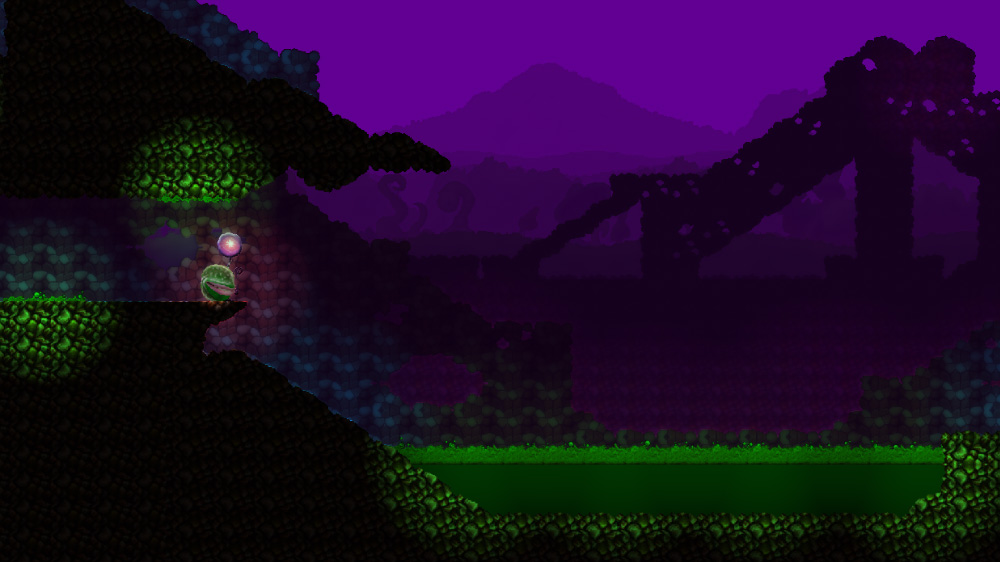
Take my word for it: set the brightness to 150% in the options. The game is ridiculously dark in many sections, making spikes almost invisible.

Wow, off topic.  Okay, so my point was that you can see Super Meat Boy influences all over Face-Plant Adventures.  The character is acrobatic, with an emphasis on wall jumping.  The game is designed around dying.  A lot.  When you die, you make a gooshy splat.  There are stages where everything is obscured in darkness and you are in control of a silhouette, navigating around the silhouettes of spikes.  Clearly there are SMB fans on Face-Plant’s team.  But those elements that it borrows from, like most games that do this, ultimately feel muted.  Less than the standards they’re aping set.  Your character isn’t as nimble, as quick, and the controls aren’t as responsive.  None of these aspects are bad, mind you.  I felt the play control was mostly adequate, with only some aspects below acceptable.  But again, a standard has already been set, and when you fail to live up to that standard, you’re not going to have a successful product.  Let’s say that everyone’s first car they had was a Ferrari.  And then someone comes along and offers you a Toyota Camry.  The Camry isn’t a bad car, but you’ve already got a Ferrari.  And you’ve already had something that is so much better than Face-Plant Adventure, at least in terms of how it plays.

To Face-Plant’s credit, it’s not just a by-the-numbers Super Meat Boy rip-off.  I almost wish it had been.  One thing I did love about Super Meat Boy was the level design.  It was designed around harrowing jumps, near-misses, and “I can’t believe I did that!” moments.  Face-Plant has those, but not as much.  Instead, the game’s pace slows down to a crawl when you have to solve button puzzles.  They’re not mind benders or anything.  Really, some of them feel kind of like busy work.  And some of the early levels of the game are sprawling, overly long, and dull in their design, with a big over-reliance on backtracking.  The effort to be different is appreciated.  I just feel in this case like one of those parents whose kid decides the best way to be different is to get a shooting star tattooed on their cheek.

I hated Face-Plant Adventures early on.  It does not hook you in quickly.  And I apparently wasn’t alone in that.  The game has online leaderboards that track the time you take to complete the stage.  The first stage had sixty names on it, including mine.  For the second stage, it drops off to forty.  Forty!  One-third of the players had such a good time playing the first stage that they didn’t bother to finish the second.  It doesn’t help that the first two stages, the ones that should be getting you excited, are so boring, and many of the elements of the game haven’t even been included in them yet.  You can’t double jump.  You can’t glide.  And they’re too long as well.  It would be like going to a Metallica concert and having to sit through Swan Lake as the opening act.
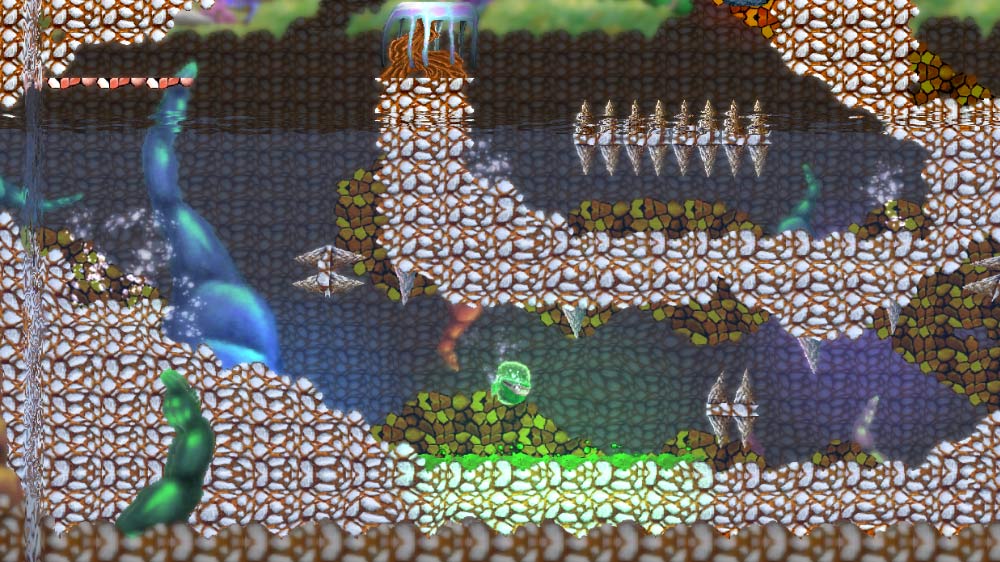
Alright, that’s it. Someone get the word out to Obama and Romney: the first one of them that pledges to outlaw water levels in platformers gets my vote. I’m not joking. Fuck the economy. Fuck foreign policy. I have my priorities.

But, BUT, it does get better.  The stages actually get shorter as you go on, which completely eliminated the “oh God, please just be over with” feeling of the game.  And there are some really fun levels, like one that centers around grinding on rails.  It was unexpected, but it was also a blast!  It almost made me forget about some of the nit-picky problems, like how sometimes you can’t tell the difference between a spike and a non-spike.  Or how sometimes there’s a piece of flat-looking terrain on a cliff’s edge that counts as a spike for some reason.  The graphics are good in a first-gen PlayStation 2D game kind of way, but sometimes Face-Plant Adventures puts more thought into being pretty than it does being playable.

By time I beat Face-Plant, I had gone from hating the game, to kind of enjoying it, and then back to hating it.  There’s one final boss fight that is hugely annoying, both in the layout of the level you fight him on, the AI of the boss (the only character you “fight” in the game), and the collision detection of it.  It flushed any remaining joy I felt out the window and I was just happy the game was over.  I then spent the next few hours having an internal debate with myself over whether or not it would go on the Leaderboard.  In its favor, Face-Plant Adventures has some genuinely wonderful moments, and does sometimes stand on its own, out of the shadow of Super Meat Boy.  And against it?  Most of the levels are boring, it’s too slow-paced (by the way, a game that challenges people to do speed-runs absolutely needs to have faster resets than Face-Plant does), the graphics obscure too much, and the last boss is so annoying that only eight people have ever bothered to finish it, on any difficulty setting.  So ultimately, Face-Plant becomes the “close but no cigar” standard for XBLIGs.  Almost worth it, but not quite.  The “if you’re better than this, you’re on the Board” game.  You know that poor schmuck who is the last cut of Spring Training?  That’s Face-Plant Adventure.  Has talent, but not good enough to ride the bench of the Houston Astros.

Face-Plant Adventures was developed by Oddworm Games

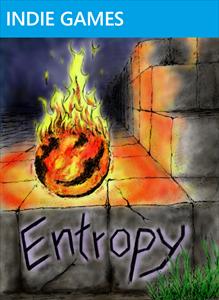
I had no idea my mother was modeling for indie game cover art.

80 Microsoft Points made it a whole review without making a Little Shop of Horrors joke in the making of this review.  Which is weird, because when I asked my mom what I should be when I grow up, do you know what she said?

♫You’ll be a critic! 

You’ll have a knack for causing things pain!

You’ll be a critic!

People will pay you to be inhumane!♫
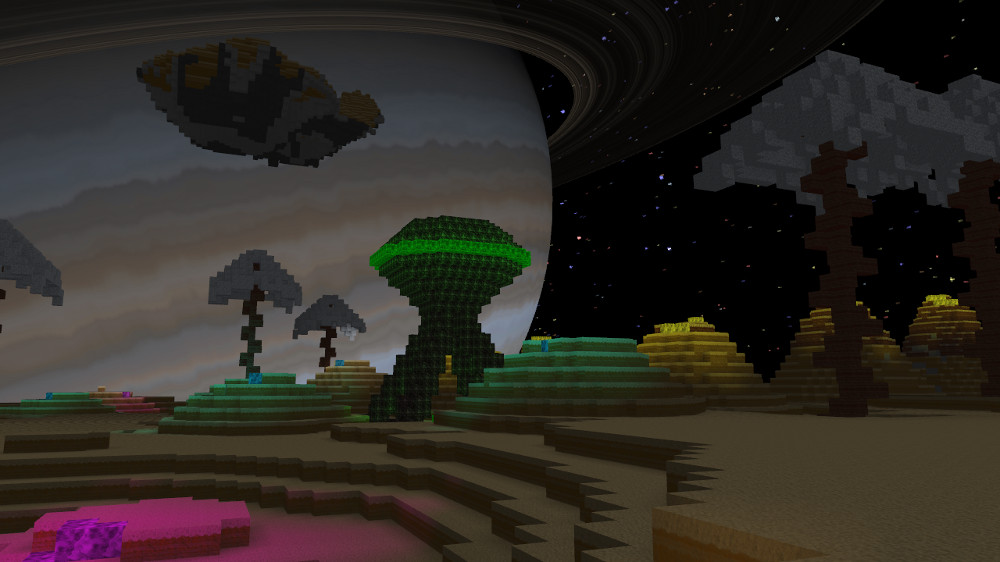
Xenominer

I’ve never played Minecraft.  Or FortressCraft.  Or CastleMiner.  Or any number of other voxel-type crafting games that are more trendy now than tramp stamps.  Incidentally, I don’t have a tramp stamp either.  I guess I’m not a very trendy person.  But, there’s no malice behind my ignorance of the crafting scene.  I just haven’t played it because it doesn’t look like something I would have fun with.  Yea, I started Indie Gamer Chick to have new experiences, but I was thinking more along the lines of games that simulate what it’s like to be a penguin in heat, or a game where you fling mashed potatoes at gophers.  Let this be said: if you hate something without playing it, you’re an idiot.  To all of you guys who denounce Minecraft, FortressCraft, CastleMiner, or any other crafting game that you haven’t even played, you’ve really lost the plot.  I know trying to appeal to the irrational core of gamers is silly, but I figure I should at least try.

Obvious joke warning: Minecraft…..IN SPAAAAAAACCCEEEEEEEEEE!!!

I can’t compare Xenominer to something I haven’t played, so this final Uprising review will be somewhat unique.  I go into it with no preconceived notions of what to expect.  I have no bias acquired from the games it borrows elements from.  This is a slate so clean you could perform surgery on it.

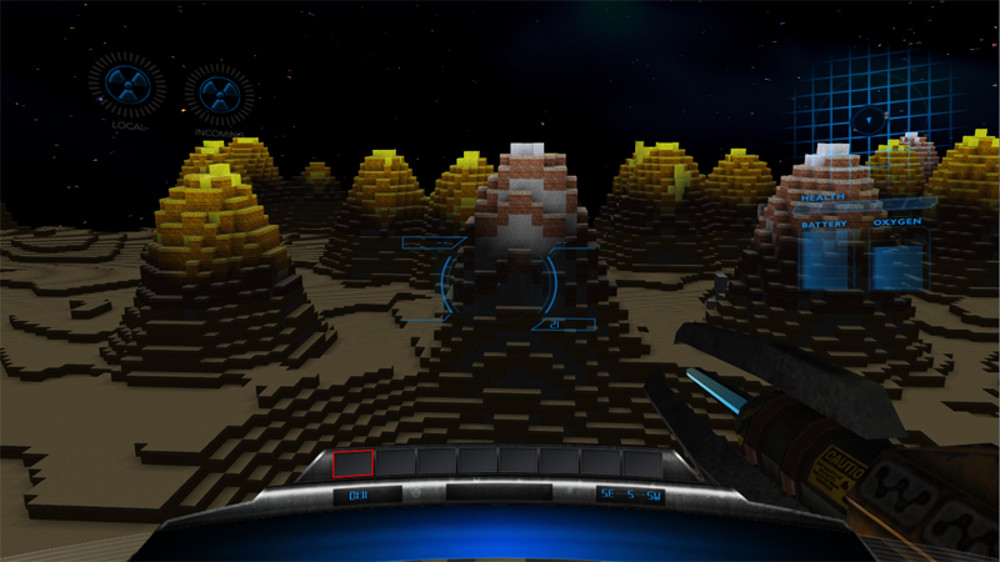
So I started the game and went through a brief tutorial that made me suck up various blocks and then reposition them in the open world.  First thing I noticed: the graphics are clean.  Second thing: the jumping is really good.  Like, almost Metroid Prime good.  Third, the frame rate was really good.  Hey, this might not be so bad, I thought.  Then the game wanted me to suck up ice to replenish my dwindling oxygen.  This was a problem.  Although I got as far as “ice = shiny” I couldn’t actually tell the difference between an ice block and a crystal block.  Even with a TV large enough that it’s one of the seven wonders of the world, the text that identifies the blocks is practically microscopic.  It’s also written in an alpha-numeric font, which never looks good when it’s smaller than an ant’s penis.

Most of the HUD displays are too small, but I was able to suck up the ice and covert it to oxygen.  And then the sun went to rise up.  This causes radiation to rain down upon you.  The game warned me to take shelter.  So I dug myself down a few blocks and covered myself up with them.  I wasn’t sure how long to wait, and I didn’t want to press my eyeballs up against the TV to find out, so I undug myself and ended up irradiated.  So I redug myself and waited for the sun to pass.  Most games that makes you wait for stuff to happen are probably not going to win any Nobel Prizes for Fun.  I did attempt to pass the time by drilling deeper, but then my battery ran out of juice, and then I ran out of oxygen, and then I expired.  Sigh.

Upon respawning, the sun was still up and I instantly started taking damage.  I did survive and was tasked with building something that required copper.  I fucking turned over half the world looking for the shit, going through more oxygen tanks than a 70-year-old chain smoker.  After an hour (including more respawns) I had found the silicon I needed, but no copper.    Xenominer was unquestionably going to be a time sink.  I tend to view such games favorably.  Hell, there’s two time sinks on my top 10 list: Miner Dig Deep and Smooth Operators.  But I had fun with those.  Once I noticed how much time had passed versus the amount of fun I had up to that point (which would be none), I couldn’t hit the power button fast enough.  I’ve talked with other XBLIG reviewers and they agree: Xenominer doesn’t get you off to a quick enough start, like all great time sinks do.  Some more direction.  Just a big enough push to get you feeling like you’re actually accomplishing stuff.  But there is none.

No, there’s no killer space bees or space ants. Too bad. That might have livened things up.

So my first real crafting game is in the books.  I didn’t really hate it, because it controlled really well (can’t stress enough how good the jumping physics feel) and the graphics held up.  Mostly.  Actually, the game starts skipping the more you walk around.  I wanted to test how bad it was, so I decided to walk in a straight line with a stopwatch and time how long it would take to start skipping.  Ready for this?  It took less than two seconds per a pause (the average was about 1.7 seconds) .  When the game freezes every two seconds, chances are it might not be quite done yet.  Maybe Xenominer is in an early beta stage, and something amazing will come of it.  I could see myself getting totally hooked into it, just like I did with Miner Dig Deep.  Xenominer’s biggest problem is that it has nothing to hook you in early.  If games are drugs, then picture Miner Dig Deep as heroin.  Every good drug pusher knows you have to hook ’em early, and that game does it.  Xenominer, on the other hand, doesn’t offer you the drug until it makes you watch a documentary on grass growing and the latest episode of the World Series of Paint Drying Watching.  Thanks, but I’ll just say no.

Xenominer was developed by Gristmill Studios

80 Microsoft Points said the Uprising had a 44.44% success rate at making the Leaderboard.  In other words, the promotion had the same success rate as any nine random XBLIGs would have had in the making of this review.

Pixel

Pixel is one of the worst names ever for an XBLIG.  Worse than Brand.  Well, probably not worse than Dark.  It doesn’t really fit with the theme of the game, and doesn’t give you a feel for what to expect.  It’s so lazy and so uninspired that, as a consumer, it makes me question whether any effort was spent making the game itself.  I mean, they phoned in the name, so it stands to reason that the game was equally half-assed.  That’s not the case with Pixel.  Despite being an ungodly piece of shit due to really horrible play control and one game-killing glitch that I couldn’t get past, there was obviously some effort made here.

I’ll step away from my typical smart-assed attitude here and make a heartfelt plea to the Xbox Live Indie Game development community.  You guys already struggle so much to get attention.  Why shoot yourself in the foot right out of the starting blocks by not trying to come up with a memorable name for your game?  Pixel is such a prime example.  It’s a 3D dexterity-shooting puzzler.  I would associate a name like Pixel with 2D sprite-based stuff.  I guess Pixel gets it from the fact that there are blocks.  Okie dokie.  I still don’t understand the logic in it, but then again, XBLIGers seem to operate on a plane of existence where logic doesn’t dare tread.  This is evidenced by the fact that so many developers determined that the best way to get attention for their new XBLIG was to launch it alongside the Uprising, even though every major XBLIG writer was committed to covering the games in the promotion.  They might as well of launched their game on a platform that works exclusively in igloos for as much attention as they ended up getting.

It looks like one of those ink-and-paint cheat modes from Turok: Dinosaur Hunter, does it not?

I guess I went so far off topic because I don’t really have a lot to say about Pixel.  I made it seven levels in before I got fed up with it.  The idea is you walk around a sterile, blocky 3D environment trying to reach a goal.  Right off the bat, the biggest problem becomes apparent: the control sucks.  Everything is too loose, causing your character to scoot along like he’s been lubricated in bacon grease.  I tried fixing this by adjusting the control stick sensitivity, but it only half-worked.  Turning around became slower, but sideways movement was still set to Warp 9 and could not be fixed.  The jumping was also unresponsive, with a noticeable delay.  When you have a game centered around precision movement, having less than precise controls is a good way to turn me (or pretty much any reasonable gamer) off.

I’ve put up with worse, but the final straw for me was a pretty noticeable glitch.  On the 7th level, there are these platforms with a red stem poking out of them, not unlike a dog’s wiener.  You shoot the red part, and the white blocks rise up around the red part, allowing you to hop to the next platform.  As established, the controls are utter shit, so messing up is not only possible, but it’s probably expected.  When you fall off the stage, you just fall back onto it, with the idea being that you’ll have a slower stage time.  Something I filed under things I don’t give a shit about.  However, once I respawned, I hopped back to the first platform and shot the red thing.  At this point, without any movement, I fell off the platform and went back to the start.  Huh.  And then it happened again.  And again.  As it turns out, this is a glitch, and you have to exit out of the stage and try again.  But if you screw up at any point in the stage, the glitch will activate again and you’ll have to once again exit the stage and restart it.  Yea, fuck that, I’m done.

Pixel was developed by Ratchet Game Studio

80 Microsoft Points took a 3 day weekend in a land where Minecraft clones don’t exist in the making of this review. 

Other Pixel reviews: Clearance Bin Review (who also noted the glitch), and hopefully more to come.

City Tuesday

Fourteen minutes, thirty-five seconds.  That’s the time it took me to beat City Tuesday, the game that I was looking.. forward..  whoa, Déjà vu.  Anyway, you go around, like, defusing bombs and stuff and I could have sworn I already did this review.

Wait, I know I did.  I thought it was too short and didn’t fulfill its promise of being something special.  I pointed out that the tutorial lasted twice as long as the actual meat of the game.  I bet any second now a screenshot will pop up saying how I hate branded screenshots.

I hate branded screenshots, but this will have to do.

See!  See!  I’m telling you guys, something fucked up is going on here.

Well, I stand by my belief that City Tuesday isn’t worth a dollar.  It’s a good idea that is unrealized.

City Tuesday was developed by Return to Adventure Mountain

80 Microsoft Points wrote this review from Punxsutawney, Pennsylvania.. oh shit.

Other City Tuesday Reviews: The Indie Ocean, Clearance Bin Review, and more to come.  I wonder if this happened to them too.

Well fuck.

Sigh.

Eleven minutes, eight seconds.  That’s the time it took me to beat City Tuesday, the game..

Serves you right for hating Apple Jack 1 & 2 ya stinkin’ bitch!

City Tuesday

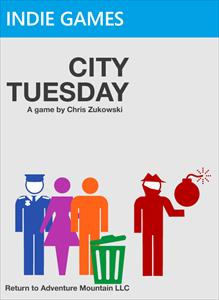
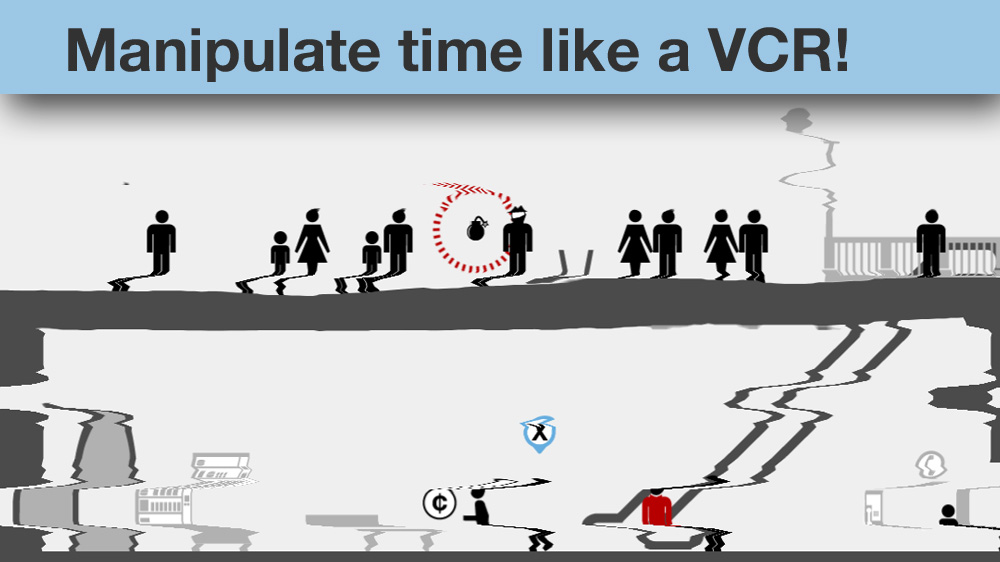
Eighteen minutes, fourteen seconds.  That’s the time it took me to beat City Tuesday, the game that I was looking most forward to during the Uprising.  Like my neighbor who entered her half rottweiler, half-some smaller terrier thing (they named it Crime, short for Crime Against Nature.  I’m not kidding) into the dog agility contest, I think my expectations were a tad bit too high.  The idea is you’re a dude who has five minutes to defuse various bombs that terrorists have scattered around a city.  The hook to that is you can repeat that five minutes as many times as you need to get all the bombs.  Whenever you rewind, everything unfolds exactly the way it did before, unless you manage to interfere.  Using this mechanic, you have to figure out ways to free yourself to snatch the bombs.

This sounds great, but I don’t feel the concept goes far enough.  The first ten minutes of City Tuesday is spent playing two glorified tutorial stages of the “throw the child in the water and see if it learns to tread water” variety.  To City Tuesday’s credit, it actually is designed in a way where you can figure stuff out on your own with minimal fuss.  There’s really not a lot to learn.  Pay attention to the dudes, follow their patterns, and figure out how to get to the bomb.

I hate branded screenshots, but this will have to do.

Once the game opens up into the more open-ended city, you have to follow multiple patterns and probably restart the day several times.  Restarting is handled by pausing the game and selecting it from a menu with no bells and whistles, a very unsatisfactory way of doing it.  Thankfully, you can also fast-forward by holding the right trigger.  There’s only a small handful of tasks to do here, followed by one final chase and platforming section.  Then the game is over.  Again, my one and only play-through took eighteen minutes to finish.

Is it worth a buck?  Well, no.  The opening tutorial levels (with the exception of a bit that involves a vending machine and payphone) offer none of the real meat that City Tuesday seemed to promise, yet they make up the largest chunk of the game.  The city section does offer those Groundhogs Day type of puzzles, but it feels more like a proof-of-concept design for a larger game than something fully realized.  Yea, sometimes a game can leave you wanting more in a good way.  City Tuesday didn’t do that for me.  I felt the game never even really warmed up.  The tasks you’re given in the city are still so fundamental in their simplicity that I didn’t feel like I had accomplished anything at all by solving them.  I love the concept of City Tuesday, but nothing here makes truly good use of it.  Such a shame.

City Tuesday was developed by Return to Adventure Mountain

80 Microsoft Points wrote this review from Punxsutawney, Pennsylvania in the making of this review.

Other City Tuesday Reviews: The Indie Ocean, Clearance Bin Review,  and more to come.

I got you Babe.

Entropy

Entropy received a Second Chance with the Chick.  Consider this the definitive review, but check here to see what they fixed.

Here’s irony for you: I played about half-way through Entropy yesterday.  Now, I know the game was making track of my progress, because at one point I left the game and checked the level-select on the menu.  I just wanted to know how far I had made it.  Then, I went back to the game.  I played for a while, got bored, hit Borderlands 2, and figured I would finish Entropy today.  Instead, I found that my save file was gone.  So a game called Entropy experienced entropy.  Awesome.  Thankfully not all games do what their names say.  Wargasm for example.  Shudder.

*Note: I’ve talked with many players and nobody else has had this happen, and in fact it didn’t happen to me when I tried to recreate it.  It’s unknown what happened, but this is not expected to be anywhere remotely a common issue. 

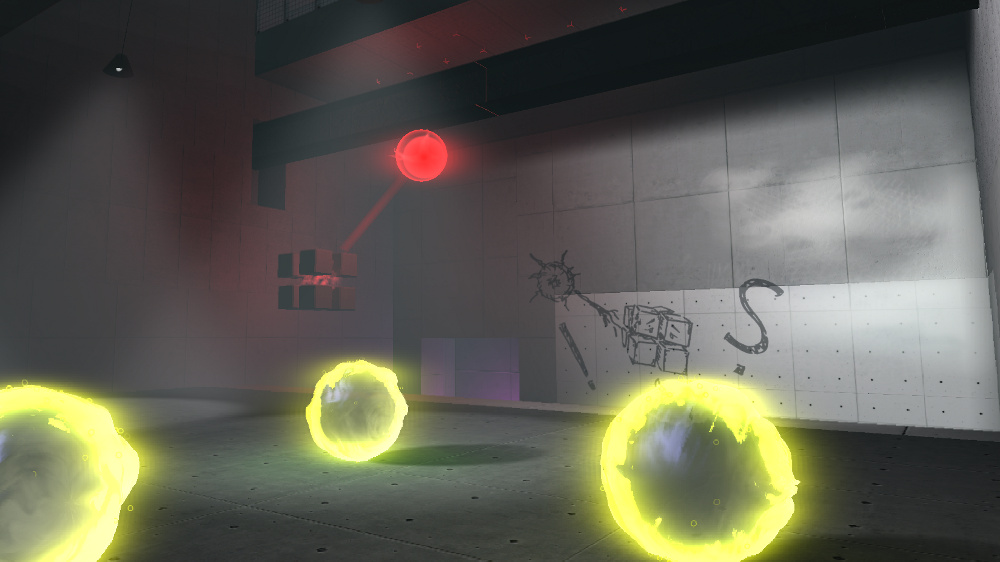
Hey look! Writing on the wall. Just like that one game!

Perhaps it was somewhat merciful that I lost my progress in Entropy.  I was downright bored by it just a few stages in.  Maybe I’ve over-loaded on puzzlers as of late.  More likely I’m just sick of test-chamber games that have the personality of a sea cucumber, which is the perfect way to describe Entropy.  The setting is so lifeless, grim, and dark that it’s exhausting to experience.  Games like this need something entertaining to drive the player forward.  So many games seem like they want to be Portal, yet their developers completely missed the point of why Portal turned out the way it did.  Portal was given personality out of necessity, because the game would have been tiring without it.  I think this is why so many players succumbed to Gateways!  As cool as the puzzles in that were, there was nothing but the promise of more puzzles to drive the game, with no reason for players to stick around and “see where they’re going with this.”

Entropy does have some kind of plot.  I guess.  But things are kept too abstract and minimalistic to get a feel for what’s going on.  You have no character yourself.  You’re just a camera that hovers five feet off the ground.  The antagonist is a pink ball of light that leads you around from room to room.  There’s no dialog, so all you get to go by is the rare pop-up hint, or a sketch on a wall that points you in the direction of a puzzle’s solution.  Forget about seeing where they’re going with this.  I don’t even know what they’re doing right now.

The hook of Entropy is that it’s a first person puzzler.  On XBLIG.  That’s pretty much it.  It doesn’t sound like much, until you remember that your average first-person XBLIG would qualify as the worst game ever played by your average gamer.  My expectations were set so low that Satan himself had to do the limbo under them.  I figured the controls would be unresponsive and the jumping mechanics would be crippled.  I was wrong about both.  Entropy actually handles reasonably well, and features the best first-person jumping physics on XBLIG.  Of course, that means absolutely squat.  It would be like being the best arm wrestler at the Center for Arthritis.

Entropy looks better in screens than it does in motion.

Unfortunately, the well done mechanics are let down by puzzles that are really a chore to solve.  Most of them revolve around pushing balls around a room.  There’s four kinds: rock, water, fire, and acid.  Your goal is typically to get these onto a scale that measures heat, pH levels, or weight.  Unfortunately, there’s no way to pick up a ball, so moving them around means clumsily shoving them around and hoping they don’t roll into a wall, off platforms, or into each-other in ways that cause them to vaporize.  It’s not totally broken, but the process is slow and clunky and makes you wish there was some other way.  I wouldn’t exactly sell my soul for the right to pick up the ball, but if I was negotiating it for a long and healthy life, I would have that thrown in.

The slowness factor really kills Entropy dead.  When a gun that sucks the orbs up in a bubble is added, it just further slogs down an already snail-like pace.  It’s kind of sad, because Entropy really is the best controlling first-person game on the platform.  It even looks good too, chugging frame rate not withstanding.  And I like how you can undo mistakes with a Prince of Persia style rewind.  It’s just too bad that the actual game here is just not fun.  Remember developers, that’s your ultimate goal: give players something entertaining to pass time.  A game should be at least as entertaining as throwing paper airplanes at the seniors waiting at the bus stop.

Oh don’t look at me like that.  It’s safe.  They’re seniors!  They all have glasses on!

Entropy was developed by Autotivity Games

80 Microsoft Points said the scoring for Airplaning Old People (aka Greatest GeneRAGEtion) is as follows: 1 point for making them flinch, 2 points if they look cross at you, 3 points if you get it stuck in their clothes or hair, 4 points if they threaten to get up at you, 5 points if they actually get up, or 10 points if you get a direct hit and they do nothing in the making of this review. 

Also reviewing Entropy: Clearance Bin Review and TheXBLIG.com

Smooth Operators

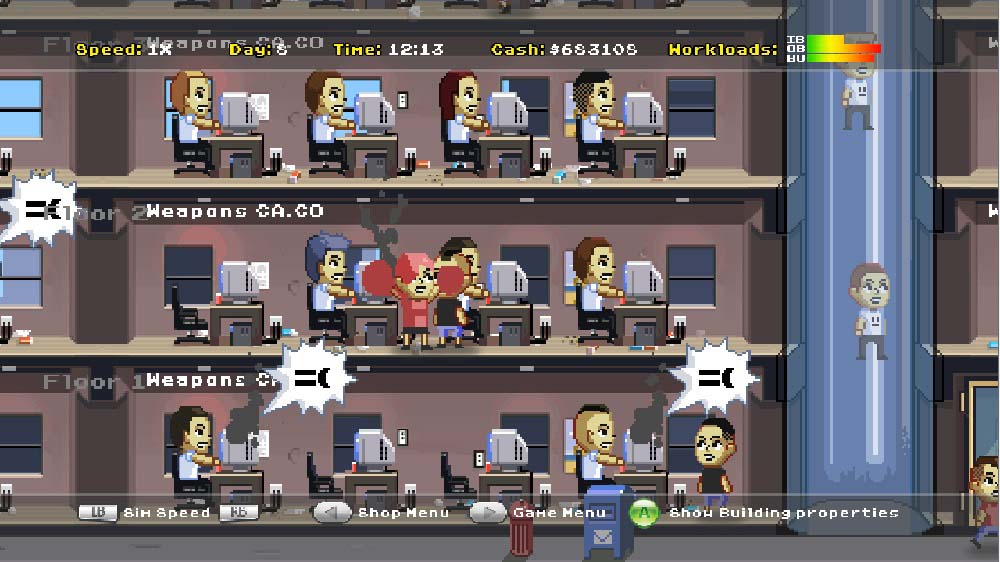
Smooth Operators is a time sink, and I mean that in a good way.  I started playing yesterday around 11:30AM, and emerged around 8:00PM wondering exactly where the day went.  Titles like this are the alien abductions of the game world.  When you try to explain to people that you just lost eight hours of your life playing a game where you operate a call center, people look at you with rapidly blinking eyes as if you just took that last step off the deep-end.  And then you try to explain your side of the story, saying “no, no!  You don’t understand!  You have to staff out buildings and hire janitors and there’s incoming calls and outgoing calls and it’s really, really fun!”  And they just nod politely while thumbing through their phone, looking for your family’s number and wondering how they’re going to break the news.

As Brian pointed out to me back in July when this very site ran a contest to give Smooth Operators its name, the idea of a Sim Call Center is not original.  A free-to-play game called Corporation Inc has been around since at least November of 2010.  Smooth Operators is perhaps uncomfortably similar to it, but hey, some companies make billions doing this.  At least the XBLIG is both a faithful tribute and a full evolution of the concept.  Just make sure you keep an eye on your wallet in its presence.  It’s a crafty bastard.

Funny how some of the most addictive games sound like weaponized boredom on paper.

Dante, in his infinite wealth.. of knowledge, couldn’t conceive what circle of Hell has sinners forced to work a call center.  But managing a virtual one is undeniably addictive.  First you have to build an operations center.  Then you have to staff it.  There’s three kinds of duties that need to be done: answer incoming calls, make outbound calls, and back office grunt work.  A helpful meter in the upper right hand corner of the screen tells you the work load and how far each occupation has to go to complete that day’s allotment.  You also have to hire janitors, IT guys, managers, and cheerleaders.  Sudden thought: wouldn’t cheerleaders be counter productive for a call center?  All that shouting and pompom waving is bound to be distracting, especially for a job that involves talking on the telephone.  “Okay, well why don’t you tell me the nature of your computer proGIMMIE AN B! GIMMIE AN E!  GIMMIE AN C!  GIMMIE AN C!  GIMMIE AN A!  WHAT’S THAT SPELL?  BECCA!”  I wouldn’t be too happy about that, even if the people in Smooth Operators seem to like it.

There’s no real goal in Smooth Operators per se.  You just build and staff buildings to earn money to build more buildings to staff to earn more money.  So yea, time sink.  But it works, and it plays relatively well.  Shockingly, I enjoyed playing it more with an Xbox controller than I enjoyed playing the PC game it was, ahem, inspired by.  BUT, I’m not totally in love with the interface.  I don’t think it gives the player enough.  One niggling little thing that bugged me was having to click on an employee’s desk and hope they were somewhere in the building to be able to upgrade them.  The process is slow and cumbersome.  Why can’t there be a drop-down menu that has a list of every employee, so that I can attend to them that way?  Smooth Operators practically demands that you micro-manage all the dudes you hire, but as your staff increases, this becomes more tiresome.

There’s no “increase all wages” or really any helpful shortcuts at all.  I figured hiring Human Resources Managers would take care of issues like schedules and vacation time for me, but it doesn’t.  In fact, all they do is make employees work longer without them becoming less happy.  In a roundabout way, this actually made my employees less happy, as they were now clogging all the facilities and elevators in my building.  I wanted to upgrade things, but even after hiring several spendy “Project Managers” that serve to unlock goodies, unlockables just take too God damn long to get, and most of the early things they get for you are as useless as a fireproof surfboard.  What the FUCK is a potted plant going to do to increase morale when people have to wait two hours to get down one story on an elevator?  If this game were made in the United States, that potted plant would be used to bludgeon the nearest authority figure.

I guess people in Kyrksten like the increased workload and have more patience. Sigh. These are getting harder to work in.

Because of the slowness of the upgrades, and the indifference of my employees to water coolers, my moral dipped to record lows and my employees started resigning on me faster than I could appease them.  Now, if this was Sim City, I would have responded in a perfectly calm and rational manner.  Meaning I would have sent Godzilla in to kill and eat all my employees and knock the building over.  Unfortunately, there’s no Godzilla, or earthquakes, or tornado, or alien invaders, or guys named Gustafsson who prefer to live on the 40th floor.  Sigh, God damn Andreas.  You couldn’t have used words like snickerdoodle or farfanoogin?  Those would have been easier to work in.

So after I lost over half my employees, including most of my janitors and IT guys, I surveyed the remains of my once beautiful office building.  Trash scattered everywhere.  Computers smoking.  Employees swearing at the slowness of the elevators.  Mangers swearing at the employees.  Cheerleaders cheering the one IT guy left who didn’t quit.  Money drying up.  Tasks being unfulfilled.  I thought to myself “really?  I spent the last eight hours of my life doing this and this is all I have to show for it?”  After a brief period of reflection, I did the only thing that seemed rational at the time.  I turned my Xbox back on and spent another eight hours doing the same thing.

Fuck you, Smooth Operators.  Fuck.  You.

Smooth Operators was developed by Andreas Heydeck

80 Microsoft points have no idea what a Bengan is or why it would help upgrade things in the making of this review.

Smooth Operators is Chick Approved!  Find out where it landed on the Indie Gamer Chick Leaderboard

Other Smooth Operators reviews: Clearance Bin Review, TheXBLIG.com, and more to come.

Looking for cheat codes for Smooth Operators?  Look more carefully 😉

Gateways!

Update: Gateways now includes an easier mode that will still eat your ass for lunch.

Halfway through Gateways, I had it pegged as the new #1 game on my site, and that Escape Goat had been slain. No joke. It has the most awesome hook of any XBLIG to date (2D Portal, enough said), a developer with big time credentials (a game on XBLA and a game already on my leaderboard), amazing retro-graphics, and some of the most clever puzzles I’ve ever seen in any game. #1? It’s a lock.

Actually, describing Gateways as essentially being a 2D Portal is way over-simplifying things. Portal was never this smart, nor did it give you this many things to do. You had two portals and maybe a cube to drag along with you. Even Portal 2, with its tractor beams, gels, and variations of the companion cubes, can’t touch Gateways for literally mind-numbing complexity. Strange as this sounds, Gateways is actually too smart, to the point of turning off some of my Uprising comrades.

See, this is why I wouldn’t make a good time traveler. I would take a razor to my old self’s throat, just to see what happens.

Once again, a puzzle game on XBLIG made me question what I thought I knew about gaming. As a kid, I always figured puzzlers were the product of a publisher pulling an Arliss Loveless, kidnapping top eggheads from around the world and forcing them to create puzzles, for profit! But no, it turns out you don’t need shackles, chloroform, or threats of bodily harm to create puzzles, meaning those things can stay in the bedroom where they belong. One dude came up with all the puzzles in Gateways. One fucking dude, presumably with a brain that outweighs a Volkswagen Beetle.

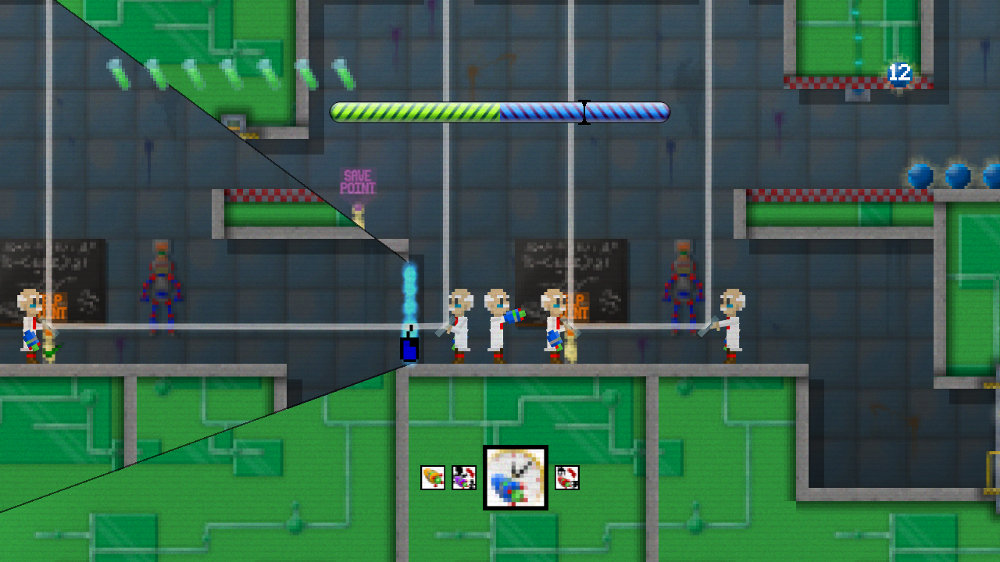
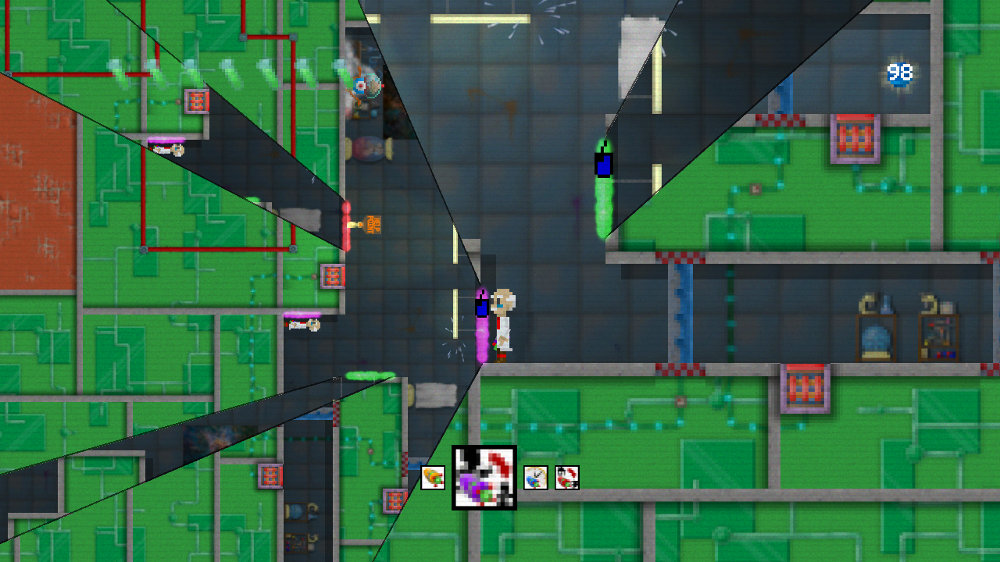
Playing as a kooky scientist who is trying to return to his lab’s command center (why doesn’t he just have Zordon teleport him?), you have to search around for new portal guns and abilities. Gateways is laid out like a Metroidvania, meaning you’ll end up doing a lot of backtracking, retracking, and teleporting around the map. This could have been hugely risky, but Smudged Cat put a big “go here” arrow on the map that appears as soon as you clear the latest puzzle. Smart. However, I still found the design somewhat problematic. Although there are special shortcuts that open up as you make progress, I feel some kid of magical “return to the starting spot” item would have cut down on some of the tedium involved. That, or include the ability to warp at your will from save point to save point, like LaserCat did.

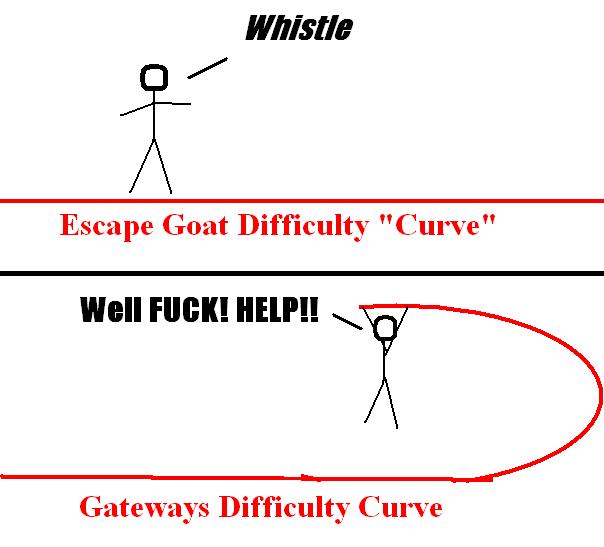
Which brings me to the puzzles. They’re genius, and this is commendable. But the difficulty of finishing them, ahem, scales. My biggest complaint with Escape Goat was that there was no difficulty curve. Because you could pick levels in any order, Mega Man-style, that game couldn’t escalate the puzzles and make them tougher as you went along.  Gateways has no such limitations. However, the curve of it was allowed to grow out of control. As a result, Gateways is possibly the most difficult platformer-puzzler in gaming history.

Things start out smoothly with the simple portal gun. It plays more or less exactly like a 2D Portal game. The first twist comes with the size portal thing, which allows you jump through one portal and come out the other end either larger or smaller. Sort of like Alice and Wonderland without having anything tell you “Eat me!” At this point, things are still pretty straight forward. And then comes the Time Travel gun. The idea behind it is you place one portal and then wait for some time to pass. Then, you place the second portal and hop through it. When you come out the other side, you travel back to that point, with your former self doing whatever it was you were doing while waiting for the time meter to fill. At this point, any sense of wonderment in the puzzles is replaced by conundrums designed to blow your cerebral cortex.

See this picture? You will be expected to recreate it at some point. If this doesn’t sound like something you think you are capable of doing, go try your hand at Diehard Dungeon. I’m not kidding. I can’t stress this enough: this game is fucking hard.  I showed this picture to Brian, Bryce, and Cameron, and the results weren’t pretty.  Brian walked out of the room, complaining of a headache.  Cameron buried his head in his lap and began to cry.  And poor Bryce keeled over dead.

Doc Brown would be thrilled with Gateways, which requires you to think 4th dimensionally. Once you’ve made “clones” of yourself, you have to use them to stand on switches and line up mirrors to deflect lasers, all within a small amount of time. Although you can get items that extend how long the time portal works, it never really eases up on the tension of getting everything absolutely fucking perfect, with no room for error. This is harder than it sounds, because moving from portal to portal is disorienting. Solving puzzles requires concentration, coordination, and cognitive thinking on a level no game in history has. That’s not hyperbole.

The first time I encountered a puzzle that used the time gun and required you to make clones of yourself that reflect a laser, I literally froze in my chair and processed the turn the game just made. Gateways wasn’t fucking around anymore. But the game wasn’t done. It added more abilities and guns. By the end of the game, puzzles require you to use multiple guns, time windows, and abilities. It’s so much to juggle that I sincerely doubt 99% of all people who play Gateways will ever actually finish it. Don’t believe me? Here’s a video of the solution to the final puzzle. Mind you, even with this video, people are having trouble finishing it. Don’t worry about spoilers either. There’s no possible way more than 5% of this will stick anyway.

I get a headache just from watching it. Now imagine trying to solve it yourself. Not just knowing the solution, but selecting the right guns, the angles of the mirror, lining them up correctly, paying attention to the orientation of the room, remembering where the already created clones will be standing, the locations of the switches and the lasers, what portals do what and lead where, and what order you’re supposed to do everything in. Hell, most people can’t stand on one foot and with their eyes closed.

Earlier puzzles offer a “help” system which really is just a “we’ll solve it for you” system. Throughout the game, you collect orbs. Every puzzle is marked with a “help” station that works in two parts. First, you have to pay five orbs just to see if you have the equipment necessary to finish it, even if you already know the answer. Then, if you get truly stuck, you can pay 40 orbs to have the game take over the control and finish the puzzle for you. I wasn’t a big fan of this set-up. I almost wish there had been some middle-ground option that steers you in the direction without outright playing the game for you. To solve some puzzles (including the final one), I cheated by putting numbered masking tape on my TV so that I would know where exactly to stand. Maybe something like that for 10 orbs would be preferable to having the game solve itself for you. Oh, and you can’t buy the solution to the final puzzle.

Needless to say, this difficulty spike makes Gateways a title that won’t be enjoyed by everyone. Or most people actually. I really, really enjoyed it, but I didn’t forget what it was. Or the many annoyances I experienced playing it. Not just the brain freezes, but little things. I found switching between the flashlight, mirror, and guns to be somewhat unintuitive, and that really makes the final few puzzles more annoying than they have to be. I found the flashlight stages aggravating. I don’t think the game really needed enemies at all, or dying, and these things could have probably been comfortably edited out. And I wish the game had a bit more personality. That’s really the difference between this and Portal: I wanted to solve the puzzles in Portal so that I could hear the next bit of hilarious dialog from GLaDOS or Cave Johnson. Gateways is played completely straight, and that’s really disappointing.

Brian wanted me to note that he did not find it difficult to cycle through the various items. Noted. Now I would like to note that he made it about 25% through the game before stopping and he never had to deal with the ultra complex stuff.

Right before publication, my buddy Tristan of Clearance Bin Review became the latest of many players I follow on Twitter that threw in the towel at some point on Gateways. I stuck it out, and I’m happy I did, but overall I believe Escape Goat is still the better game. It controls better, is more accessible to everyone, and has more personality. Gateways is hyper-intelligent, but that actually works against. It’s still, as of this writing, the second best game time I’ve ever had with an XBLIG, but such experiences will not be typical, so purchase at your own caution. You can’t possibly get a feel for how much grey matter this requires just from the demo. It catches you by surprise.

Let’s put it this way: imagine if every XBLIG had a human counterpart at a bar. Gateways would be the genius of the room who traps you in a corner, forgets who he’s talking to, and starts to practically speak in tongues. At first you feel like you’re privileged to be in the presence of such intelligence, but after an hour, with no end in sight, you start to look for any excuse to break up the conversation. By the way, Cute Things Dying Violently would be the frat boy making inappropriate dead-baby jokes, Don’t Die Dateless Dummy would be the slow, awkward kid who trips over his own tongue every time a cute girl walked into the room, and Sententia would be the guy who gets drunk, passes out, falls off the bar stool, and lands face-first into a puddle of his own vomit.

Gateways! was developed by Smudged Cat Games

240 Microsoft Points heard Raventhorne has been doing the Dance of Joy ever since Sententia came out, as it’s no longer the defacto “disappointing game in an XBLIG showcase promotion” poster child in the making of this review.

Gateways! is ranked on the Indie Gamer Chick Leaderboard.  Click here to see where it landed.

Gateways Reviews from the rest of the Uprising Crew: TheXBLIG.com and Clearance Bin Review

Diehard Dungeon

Update: Diehard Dungeon now costs 240 Microsoft Points. 

After Diehard Dungeon, it’s safe to say the Uprising is back on track.  Comparing it to Sententia is like comparing flying in a private luxury jet to having your head stuffed up the ass of a burrow and trotted across country with your legs dangling the whole time.  And here’s the funny part: unlike the Sententia, the argument of “it’s just not for everyone” is actually valid here.  Roguelikes are not for everyone.  And I’m generally among those that they’re not for.  So it might surprise you to hear that I actually kind of enjoyed Diehard Dungeon.  Then again, the only other Roguelike I tackled this year was Spelunky.  Double D wasn’t nearly as sadistic.  If both were school bullies, Diehard would be content to wedgie you and move on.  Spelunky would trap you in a locker with live tarantulas while stealing your date to the Prom.

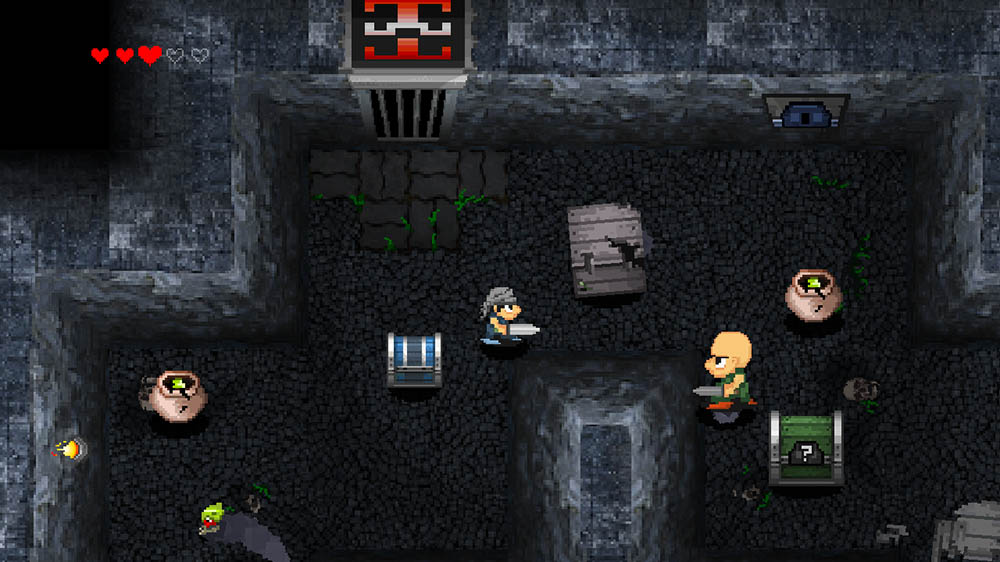
Which is not to say that Diehard Dungeon is all sunshine and lollipops.  It’s got a mean-streak that might be the result of some design flaws.  The idea is “Roguelike-meets-Zelda.”  Only instead of an obnoxious fairy following you around, you have a mute treasure chest.  Sure, why not?  Levels are randomly generated, but all adhere to the same principle: fight enemies, find key, go to next room.  Occasionally you’ll pick up items or spin a slot machine for upgrades, but really, Diehard Dungeon is all hacking, all slashing.  The mechanics of this were done well enough that somehow the part of my brain that knew I was playing a Roguelike shut off.  As a result, I was practically euphoric during my first play-through.  I had built up twelve hearts, was having good luck with the slot machines, had absolutely slayed all three “upgrade” minigames that play out like a really shitty version of Pac-Man (these have GOT to go), and had the smuggest of smiles plastered on my face.

And then something that looked like an armed Cabbage Patch Kid knocked me into a corner and drained my entire stockpile of life in about four seconds.  I had gone from not taking any damage to being dead before I could even process what was going on.  There’s no temporary “immunity” when you take damage, so if you get pinned into a corner, you’re fucked amigo.

Games give you immunity for a reason: because the other way isn’t fun.  Imagine if Mario didn’t blink after taking damage in the original Super Mario Bros.  If you went from being big Mario, getting shrunk, and then dying because of the lack of blinking, that game does not become the all-time classic that it did.  Hell, you might as well not have a life system and make all hits instant-death.  But since you numbskulls can’t seem to grasp that, I’ve arranged a deal with Microsoft.  From now on, all XNA starter kits will come with ankle monitors that must be worn to use the program.  If you even think about allowing enemies to gang-bang you in the corner without having any means of defending yourself, you get a 50-volt shock.

Of course, word is this is already getting patched out, along with a few of my other complaints.  The game frequently skips.  This formed a “fuck me over” tag team with the aforementioned killer Cabbage Patch Kids.  Well, it’s being fixed.  Keys slow you down too much when you have them.  That’s getting fixed.  Bonuses don’t stack.  That’s getting fixed too.  Grumble.  You guys are kinda ruining my schtick here.  Oooh, I have one that I don’t think is getting fixed: you can’t slash diagonally.  What the fuck is up with that?  Do we live in a world where diagonal doesn’t exist?  Bullshit.  I saw something that looked like a triangle.  You can’t have triangles without having diagonal.  But I’m being nitpicky.  Even in its present, non-patched state, Diehard Dungeon is pretty fun.  It’s not only one of the best hack-and-slashers on XBLIG, it’s also one of the best twin-stick shooters too.

Wait..

Huh?

Yea, as it turns out, the developers tacked on a seemingly half-assed (at least compared to the main game) TwickS minigame as an afterthought and it could very well be the most fun TwickS on the entire marketplace.  Go figure.  It even has online leaderboards, which is more than qrth-phyl had to offer.  I’m not complaining or anything, but it’s kind of weird.  It would be like if Lord of the Rings had 1996 Chicago Bulls highlights play over the credits.

I’m guessing they never got over the whole Garbage Pail Kids thing.

Diehard Dungeon could very well be in a Beta state right now.  Other planned changes include improving the graphics (which I had no complaints about, besides not being able to tell blood apart from hearts), fixing some of the cheap trap placement issues that happen when shit is random, improving the odds of getting the rare “gold keys”, and  a whole slew of other things I never even thought to complain about.  Mind you, Diehard Dungeon is already pretty damn good and well worth your money, but that’s not enough for the developers of it.  They want it to be better.  As opposed to deflecting critiques back with “It’s not for everyone, and I wouldn’t change anything.”  It’s actually encouraging to see a developer so much on the ball that the ball can claim its personal space is being violated.

Diehard Dungeon was developed by Tricktale

IGC_Approved80 Microsoft Points refuse to not capitalize the “T” in “Tricktale” even if they won’t do it in the making of this review. 

Diehard Dungeon is also available for PC on Desura for $4.99.  This version is unverified by Indie Gamer Chick.  The XBLIG version is Chick Approved and ranked on the Indie Gamer Chick Leaderboard.

Check out what the rest of the dorks are saying about Diehard Dungeon: TheXBLIG.com, Indie Theory, and more to come!

Oozi: Earth Adventure Ep. 4

And that’s a wrap on Oozi.  One game.  Four chapters.  $4 spent.  Four boss fights that made me question the existence of evil on this Earth.  Zero attempts at originality.  But is the overall experience worth it?  Kind of.  Let’s start by recapping the previous chapters.

Part One: AGGGGGGGGHHHHHHHHHH!!  Well, that sucked.

Part Two: AGGGGGGGGHHHHHHHHHH!! Oh hey, wait a second, it stopped sucking.

Part Three: Not bad.

Part Four: Still not bad.  Oh wait, I have to feed this thing fruit?  AGGGGGGGGHHHHHHHHHH!!  This is boring.

Best as I can see, this fucking thing has legs, so why do I have to feed him? I think this is what the Republicans have been warning us about.

Oozi’s problem is and always has been how unambitious it is.  It does the graphics thing really well, but does everything else so much by the book that the book is now claiming royalties on the series.  Oozi is the poster child for generic 90s platforming mascot.  Like Serpentor, its creators borrowed the DNA from such soulless, design-by-committee, me-too cash-ins as Aero the Acro-Bat, Bubsy the Bobcat, or Crash Bandicoot.  I was going keep that going all the way to Z, but I figured you guys would hire ninjas to insert burrowing cockroaches into my ear canal after I listed Donkey Kong Country and Earthworm Jim as soulless.  Which they are, but I probably shouldn’t say it.  Fans of those games take it too personal.

I’ll grant Oozi this: it’s not original, but it does what it does well.  Paint-by-numbers levels, almost too easy platforming, hop-on-heads cruelty to animals, double jumps, butt stomps, and every other stand-by of the genre.  If the subject is anything but sound effects, Oozi is decent.  Not spectacular.  Not memorable.  Not something you’ll enthusiastically tell your friends to try.  Just a good solid waste of 90 minutes per chapter.  All four chapters are more or less the same, with the same scaling of difficulty, same principles of level design, and a hugely tedious boss fight to cap it off.

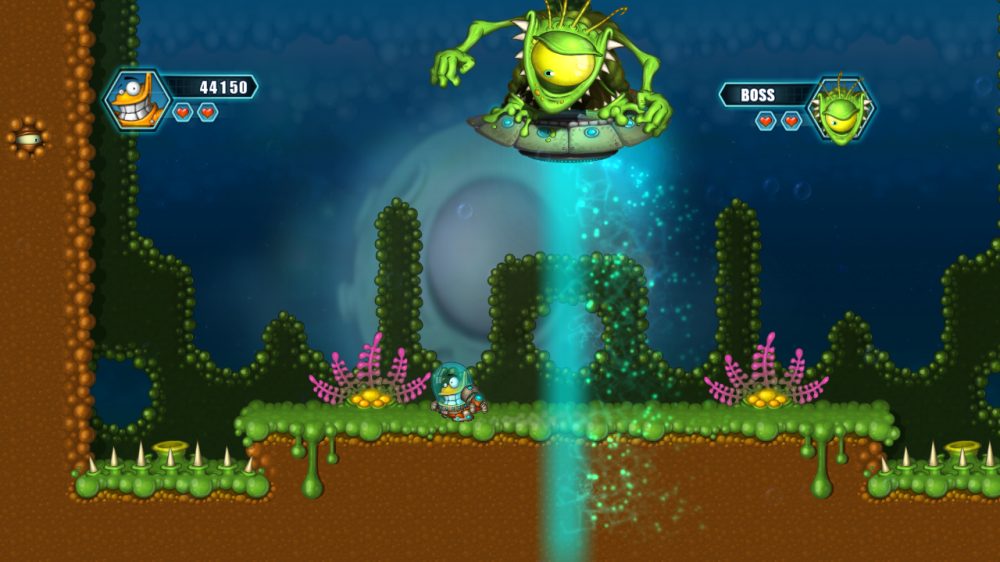
That’s probably the thing that pisses me off the most about Oozi: so many of the tasks of the game are busy work.  In chapter four, there’s a couple of sections where you have to feed fruit to a monster.  To get the fruit, you have to butt-stomp the ground by the fruit.  Then, you have to carry the fruit, tossing it between enemies, over gaps, and up platforms.  You move slow when carrying the fruit, and you can’t jump.  If anything touches the fruit, you get to start over.  It’s sooooooo boring, not at all difficult, and takes way too long to accomplish.  But, and this is the thing that almost drove me towards taking up genocide, these sections don’t immediately place checkpoints after completing them.  So let’s say you spend ten minutes getting this entitled mother fucking critter its food.  Then, a random volcano spits up a fire-ball and you die.  Guess what you get to do?  That’s right, start all the way fucking over.  And that happened to me.  Twice.  After the first time, I almost rage quit.  The second time, I seriously wanted to personally strangle a species into extinction.  I don’t care which one, but something fluffy and adorable would have been swell.

“So my agent says to me “Bob, baby, we have a part for you in the next Simpsons Halloween Special.”  But nooooooo, I have to take the starring villain role in some dry ass independent video game.  Way to go, Bob!”

Oozi did end on a bright note: the very final boss was probably the least annoying of the series.  As a result, Oozi 4 finds a spot on the leaderboard.  It’s not as good as parts two or three, but it’s way better than part one.  Then again, so is gonorrhea, so that’s not saying much.  Ultimately though, if Oozi is remembered for anything, it will be for being the ultimate uncanny valley of XBLIGs.  Oozi is a game you’ll swear you played on your SNES back in the day.  Depending on your level of gibbering nostalgia, that might be a better thing than I experienced.  As a child of a different era, I would like to put out this challenge to Awesome Games Studio: you guys are better than this and you know it.  You created a series that is amazing to look at, but when it came to gameplay you settled for functional.  I’ve seen artwork made out of feces that is more inspired.  So next time, try something new and weird.  Think of every fucked up thing you ever thought of doing with a platform game and give it a shot.  The best case is you’ll have a game that people talk about as something other than a lifeless 90s platforming clone.  The worst case is, well, you end up with a pile of shit.  But hey, your mascot already looks like the bastard offspring of the Great Mighty Poo, so the status quo remains intact!

Oozi: Earth Adventure Episode 4 was developed by Awesome Games Studio

80 Microsoft Points don’t really think the final chapter takes place on Earth in the making of this review.  Well, maybe in Oakland.

Three out of four games in the Oozi series are ranked on the Indie Gamer Chick Leaderboard.  Where do they fall