Rocket League

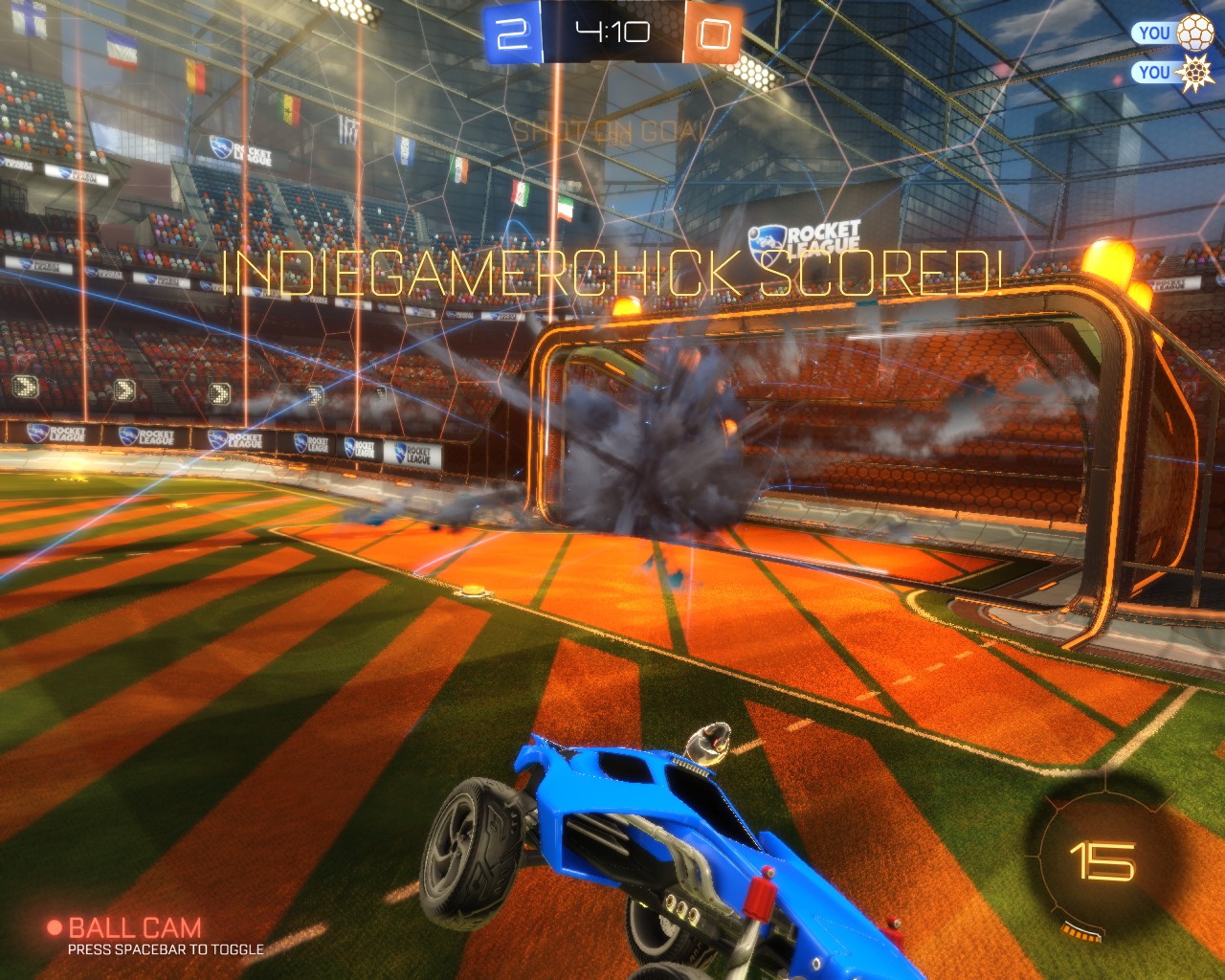
Rocket League combines cars and soccer. It’s such a simple concept that seems like it would be better suited as Mario Party minigame. Or a sport played by Wuzzles. Funny enough, and this is a true story, one of the first sketches my boyfriend showed me when he got me into Top Gear was soccer with cars. They did it a few times, and I distinctly remember saying “they should make a game out of this.” Which is a risky thing to say, frankly, since I never remember to be more specific and say “they should make a good game out of this.” Somewhere, deep down in the darker parts of my psyche, I still blame myself for not saying “good game” with the Matrix. Damn it.

My bad.

My bad.

Thankfully, the fates were less cruel this time around. In fact, Rocket League is one of the best online indies of all time. When I heard the concept, my initial thought was “it’ll probably control like shit or have massive lag.” I know there are some networking issues, but the overwhelming majority of games I played (and I put a whopping 60 hours into this) ran smoothly. And Rocket League controls really well. Using the turbo boost to pull off air-based strikes and blocks has a learning curve to it, but there’s no complex combos to pull off. The controls are responsive and instinctual.

It’s sort of tough to get more in-depth while reviewing Rocket League, because what’s here is the closest to being perfect as any game I’ve ever reviewed, even though there’s not a lot to it. There are some weird anomalies. Like playing single-player league on easy and watching my AI teammates seem to forget what team they’re on. More than once I saw them take the ball the full length of the field to own-goal themselves. I wasn’t sure if this was just happenstance until I saw the ball start to drift away from my own goal, only for them to casually dribble it back towards it before bumping it in. This happened frequently, perhaps in protest of me being a sissy and picking easy mode. I would have made a joke about it being passive resistance, but my AI teammates physically cleared me out of the way far more often than opponents did. None of this happened on the normal difficulty. I can sum up easy mode by noting that I averaged 20 goals a game during the jump balls, and a couple more a game for when I would miss. Normal difficulty was much more realistic, in the sense that I was eliminated in the semi-finals the first time I played it and won the title despite a losing record the second go-around.

#Splash

#Splash

The biggest problem with Rocket League is out of the hands of the developers: the quality of online players. Now don’t get me wrong, most Rocket League players are awesome. But, just often enough to be annoying, a game would happen where the other team will score the first goal and my two randomly assigned teammates would immediately vote to forfeit the remainder of the game. In about a third of such games, when I refused to vote with them, they either just quit out or they started own-goaling me in an attempt to force my hand, all while bitching at me for wasting their precious time. Rocket League certainly isn’t exceptional in this regard. Anyone who has ever played any team-based online game deals with this. Rocket League is only remarkable in how damn fast people are willing to quit. I had a game where we led 2 to 0, the other team scored a goal, which meant we were still up by one, and a teammate voted to forfeit. I figured there must have been some kind of achievement he was going for based around shutouts, but no such achievement existed.

Eventually I got pretty decent at Rocket League. Not great or anything, but I could hold my own. And, all credit to the quitter brigade, because they led to a couple of the most exhilarating moments I’ve had as IGC. I scored a couple moral victories by preventing shutouts by myself against full teams after I had both teammates quit after just one goal. And then there was the game where we started the game 1 to 0, had the other team tie it up, our teammate voted to forfeit and then quit seconds later, and myself and the random dude I was paired with proceeded to win the game when down a player by a score of 5 to 1. And it wasn’t like our opponents were slouches, which made our blowout so satisfying. Later, I played matches against some of my readers, and it was awesome to get to finally play a game where I could play and interact with so many of them. A couple of them hopped into ranked games with me, where we went on an extended winning streak. Which we immediately followed up with a losing streak that no one in particular was to blame.

It was me

Rocket League’s biggest successes from a design point of view come down to what the game doesn’t include. There’s a large variety of cars, but besides slightly different collision boxes, there’s no differences in performance in them. All unlockables and the DLC are purely superficial changes, which levels the play field. It makes Rocket League one of the most accessible and enjoyable games of its type in recent memory, since newbs can hop right in and not spend the next several weeks grinding up in hopes of competing with early adopters. Yea, I wish the league play had more options (and more stats, since I would have liked to know how many goals I personally scored), but otherwise, isn’t it more important to refine and perfect what you’ve built? I’ve heard it suggested that Rocket League is a glorified minigame. Fine, so be it. Because I’ve seen games ruined by leveling systems. Castlestorm‘s online mode could have solidified it as an all-time classic, but instead I found myself being matched against players 150 levels more advanced than me, with all the upgrades that are earned along the way. While you’ll still need to put time into Rocket League to get good, when you are good you won’t need to grind away an extra fifty hours just to compete. There’s something to be said about that. Restraint is perhaps something more indies need. Rocket League doesn’t do a lot, but what it does is phenomenal. By the way, if this review sounds to lovey-dovey, I should note that the next teammate of mine who bumps me out of the way of an open shot is getting a foot upside the ass, and I have Bob Lanier and his size 22s on retainer.

UPDATE: Actually, the game does keep track of stats in the Extras menu, but this doesn’t improve things. Single player stats are added to online stats, and thus it appears like I’ve scored 685 goals (ha!) when in reality I think roughly 600 of those came in one 27 game easy league season. This is a massive oversight on the developer’s part, and it ought to be changed.

Rocket League logoRocket League was developed by Psyonix
Point of Sale: Steam, PS4
igc_approved1
$19.99 said the “damn women drivers” joke from opposing players NEVER GOT OLD AT ANY POINT OVER THE COURSE OF 60 HOURS YOU CLEVER CLEVER PEOPLE in the making of this review.

Rocket League is Chick-Approved and ranked on the Indie Gamer Chick Leaderboard.

Everybody’s Gone to the Rapture (Review)

In the interest of full disclosure, my experience playing Everybody’s Gone to the Rapture was marred by probably the most unfortunate glitch I’ve ever encountered reviewing a game at Indie Gamer Chick. In what turned out to be the second to last chapter, one of the guiding orbs I was relying on to prevent aimless wandering got stuck in the ground next to a tree. This apparently happened to more players than just me in a variety of locations, but in my case, it got stuck in a way so that I couldn’t tell the game was glitching out. Thus, I spent four hours trying to figure out how to activate the special story telling tree that didn’t actually exist and wandering around a town trying to figure out if I missed something to make it work. Now, Everybody’s Gone to the Rapture has no puzzles in it, or really anything to do but watch the narrative unfold. But I was nearing the end of the game, so I figured maybe the developers had thrown a twist my way. How would I know? The game gave NO instructions up to this point. Stuff like this is sort of what you risk as a developer when you make what I’ve come to call a “Figure It Out Yourself Adventure.” But, I mean, look at it! It looks like it could be a climatic moment.
Rapture 4
But no, it was just a horrific glitch. It gets worse. Once I figured it out, I ended the game, rebooted it, and the guiding light skipped the remainder of the character’s story I was on and took me straight to the final chapter of the game. Oh, and I was unable to return and finish the previous storyline. At this point, I became like the manure farmer with Alzheimers and completely lost my shit. Four fucking hours of wandering around trying to figure out what I was missing, only to find out the game fucked up, and on top of that, I didn’t even get a conclusion to the character’s story in the chapter I was in? I think I’m totally justified in being furious.

Not that it would have made a difference on whether or not I liked Rapture overall. I didn’t. I hated Everybody’s Gone to the Rapture. I hated it, hated it, HATED IT! But I figured I should be upfront about the whole four lost hours and the lost character arc conclusion affecting my session.

The sad part is, I didn’t hate Everybody’s Gone to the Rapture initially. I was immediately sucked in by the premise, the spooky isolation, and the mystery of what happened. A town devoid of humanity, with creepy emergency broadcast sounds playing, and quarantine signage scattered all over. Some serious shit had clearly gone down, and I was positively intrigued. I won’t spoil the story, but needless to say, it didn’t last. The cause of this particular apocalypse is hugely disappointing. I remember feeling my heart sink when I realized what direction the story was going. Of the multitude of explanations and angles they could have taken, it seems like the one that had the most potential to disappoint is the route that was taken. When I realized where Rapture was going, I let out an audible “ohhhhhhh. Well, that blows.”

The game is set in England, so there's roughly two million soccer pitches in the town, give or take. And for some reason, they all have a dog shit skid mark on them. Hey, in America we made OUR version of footballs brown for that very reason. We would rather not know what exactly we're getting all over our hands.

The game is set in England, so there’s roughly two thousand soccer pitches in the town, give or take. And for some reason, they all have a dog shit skid mark on them. Hey, in America we made OUR version of footballs brown for that very reason. We would rather not know what exactly we’re getting all over our hands.

Some people are saying Everybody’s Gone to the Rapture isn’t really a game, and others are saying it is a game and those other people are casual fucktards. Both sides are right, except the casual fucktard part, because art is always in the eye of the beholder. I’ll personally side with the Not a Game crowd and call it a “Game-like Experience.” I would define a game as something where there’s at least some form of a challenge or task to overcome. Rapture does have some trophy-based challenges (of which, I unlocked none except the “finish the game” trophy, though not for a lack of effort) but really the point is to just watch cut scenes unfold, then find the next cut scene. To the best of my knowledge, you have no control over the story, and the only thing you can do to change the story you see is to take it out of order or to simply miss parts of it. Which, judging by the “find everything” trophy’s rarity, you almost certainly will.

While the turn the story makes is disappointing, given how intolerably boring the characters are, I probably should have seen it coming. These are just not interesting people. You basically do the fly-on-the-wall thing, watching their lives immediately before the start of the game. While I’ll concede that the writing does feel naturalistic and “real”, real can be pretty dull. Some of it really dull. Like, we’re in the middle of the apocalypse and there’s cattle and birds dropping dead, people suddenly becoming violently sick and/or disappearing, and government people locking the town down. So, why do conversations still sometimes sound like petty office gossip? Even though they are aware the situation is bad. It’s weird. Even worse is you never see any of the characters. Everyone is represented by gold particle ghosts that, I swear to God, look just like the beaming effects from the recent Star Trek remakes. Judge for yourself.

If you find yourself stuck with a copy of Everybody's Gone to Rapture and hate it as much as I do, pretending the story is actually about Scotty getting drunk and beaming a town full of British people into oblivion as payback for the whole lack of Scottish independence, it doesn't help at all. Trust me, I tried it.

If you find yourself stuck with a copy of Everybody’s Gone to the Rapture and hate it as much as I do, pretending the story is actually about Scotty getting drunk and beaming a town full of British people into oblivion as payback for the whole lack of Scottish independence doesn’t help at all. Trust me, I tried it.

How did that similarity never come up during production? I’m not even a Trekkie and it was the very first thing I thought when I first saw it. It was distracting. I’m guessing they did it this way because they made a beautiful (and bland, but still beautiful) town, but couldn’t quite come up with human characters to match the astonishing visuals they created. It feels like perhaps it was a cut corner. But I never could feel a connection to any of the characters. There’s too many of them, they all have generic names, many seem to have no personality, and frankly it was hard to keep track of them. Even fans of the game seem to side with me on this one, though people will say “but I found whats-his/her-face’s story to be good.” I didn’t. Not one. These are seriously dull characters. Well written I guess, in the sense that they don’t seem too outrageous or too fantastical, but I would hate being stuck with any of them.

I don’t get the appeal in games like this. I can’t even say Rapture is pretentious, because it feels genuine and heartfelt, but it’s so damn boring. Yea, it’s pretty, and yea, it has a nice soundtrack, but what games don’t these days? Also, your character moves slow, and sometimes the game glitches out on you and you start to move even slower for no damn reason. I had to pause the game to undo this multiple times. It turned out, there was a run button. Kind of. Holding R2 might make your speed eventually build up. Or maybe it won’t. Whatever. I don’t get the point of games like Rapture. Maybe it’s not a game, and more like a digital amusement park ride where you hop from one display of animatronic figures to the next. Even though I think the story took the least interesting paths possible, they still told a somewhat coherent story (with an ending as unsatisfying and lame as can be). Obvious care and effort was put forth to craft it. Everybody’s Gone to the Rapture has no instructions, puzzles, challenges, objectives, or anything else you expect from a story told through a game controller . The only thing it can do that you can’t do in any other medium is potentially miss large chunks of the story. Since Rapture only exists to deliver a story, that seems like a bad idea to me. Then again, so does BASE jumping but people are into that too.

Rapture logoEverybody’s Gone to the Rapture was developed by The Chinese Room
Point of Sale: PlayStation 4

$19.99 said, meh, still better than Left Behind in the making of this review.

The Vanishing of Ethan Carter

The Vanishing of Ethan Carter opens with a screen warning that it doesn’t “hold your hand.” So many games make this claim anymore that it’s starting to come across as kind of snotty and condescending. Ethan Carter’s lack of hand holding isn’t in the difficulty sense, like Bloodborne or 1001 Spikes. You can’t die, and there are no real stakes besides extending the delay of the unfolding story. Instead, it doesn’t hold your hands in the sense that you’re given no instructions at all. No tutorial, no hints what the game’s primary mechanics are, or what your end goal is. So, in my first attempt at playing Ethan Carter, I ended up missing the first four of ten “puzzles.” The fifth one is neither a puzzle nor possible to miss (I think). The first one I actually stumbled upon and solved was the sixth one. Of ten. This is the kind of not-hand-holding that a sadistic swimming instructor with a growing body count would believe in.

Ethan Carter is an aimless wandering simulator that occasionally gets interrupted by an interesting plot. I’ve never been into Lovecraftian type of horror, so when I found the story to be good, I was a bit surprised. However, I missed nearly the first half of it, so I decided I would break a personal rule of mine. I try to avoid using walk-throughs when I review games. Now, I had stumbled upon a couple of the puzzles, but I didn’t realize they were puzzles or would unlock the plot. The game doesn’t imply any of that. When I solved the graveyard sequence, I decided to just start over from the beginning and have someone send me a list of the general locations of the puzzles. Just having that list and the knowledge that there were puzzles to complete totally changed my enjoyment of the game. It was okay. Okay is better than “God I’m bored out of my fucking skull.

Ethan 2

Needs more Grim Grinning Ghosts.

I hate doing this with any game, because it’s 2015 and nobody should give a shit about graphics anymore unless they are mind-blowingly awesome. I don’t know if the Vanishing of Ethan Carter is quite that good, but it’s probably the most gorgeous indie up to this point. To put it in perspective, my mother walked into the room while I was making my way through a forested area and asked what movie we were watching. Movie. Until she said that, I hadn’t stopped to appreciate how damn good-looking Vanishing of Ethan Carter is. Now, that story wouldn’t have happened if I was in many of the areas of the game, especially ones that take place in a mine, or ones where there’s rushing water. The cave section looks like any other cavern level in a first-person game, and rushing water has that creepy uncanny valley effect, slightly life-like but undeniably off. Probably the most off-putting thing about the presentation is you don’t feel even close to a real person. You feel like a camera hovering six above the ground. The lack of humanity in the player-character made it nearly impossible to ever feel immersed. Which is a shame because the world created is photo-realistic at times and that kind of goes to waste.

I’ll go spoiler-free on the plot as much as possible. It’s pretty obvious early on that some kind of twist ending was coming, but Ethan Carter still manged to fool me with it while still feeling like I wasn’t cheated by the context. It wasn’t like Braid’s “deep” twist ending where, spoiler alert on a game eight years old: the main character of Braid was part of the Manhattan Project and felt guilty for creating nuclear weapons, with the world of Braid being his escapism to alleviate his guilt. Yea. I haven’t met a person yet who didn’t blurt out “where in the fuck did that come from?” when they experienced that ending. But Braid is popular and pretentious allegories pulled out of thin air are all the rage in Indieland, so I expected Ethan Carter to end on one. It didn’t. The ending was satisfactory in a Twilight Zone sort of way and felt real. I guess you can’t ask for anything more.

SPOILER WARNING – SKIP THIS PARAGRAPH IF YOU WISH TO AVOID

Not that the story doesn’t occasionally devolve into raving lunacy. The most random happening involved an encounter with an astronaut. I think it was meant to be a jump scare when it first appeared, but it was so random that all I could do was laugh. This eventually led to a section where I was floating through space in a scene I swear was ripped straight from that God awful piece of shit movie Contact. Even after finishing Ethan Carter, I’m not entirely sure what the point of that part was. The studio behind this game is named Astronauts, so maybe this was meant to be an in-joke for them. Another failed attempt at scares occurred in the cave area, where you’re being stalked by a ghost while searching a maze for five dead bodies. I wasn’t aware that this was considered the most terrifying section of the game by most people due to “jump scares” that happen during it. This is because I found all five dead bodies and solved the puzzle in it without ever having the ghost catch me. In fact, I only caught a glimpse of it once and heard it two other times. Given that Ethan Carter’s form of horror is based more on atmosphere and characterization, I’m surprised it would even try to do jump scares. I think I enjoyed the experience more than others did as a result. Jump scares are something anyone can cause with a plastic bag full of air and a floor that doesn’t squeak when you try to sneak up behind someone. Lowbrow and easy. Creeping people out with an unnerving atmosphere takes skill, and Ethan Carter pulls it off.

They should've sent a poet. So beautiful. So beautiful. I had no idea.

They should’ve sent a poet. So beautiful. So beautiful. I had no idea.

END OF SPOILERS

The writing is not bad at all. The cut scenes have pretty decent voice acting. Ethan Carter does almost nothing wrong in terms of plot and storytelling. It’s the method of delivery that I feel doesn’t serve players properly. It goes back to the “hand holding” thing. What is so wrong with pointing players in a direction? Shadow of the Colossus is similar to Ethan Carter in the sense that you have a vast open world with specific areas you need to discover. You’re not told how to discover them, or what to expect when you get there. You hold your sword up and it points the direction, and that’s it. Nobody would accuse that of being an example of hand-holding. So that opening “we don’t hold hands” bit almost feels accusatory against players. “Oh, you didn’t find the stuff we obscurely hid? What, you expect directions? What kind of pussy-whipped casual gamer are you?”

Maybe the Vanishing of Ethan Carter is a glorified tech-demo, as some of my readers on Twitter suggested. While there are a couple creative puzzles, most of them come down to finding items and returning them to their locations. A few times you’ll be required to look at a few different dioramas and place them in sequential order. If the puzzle design had matched the art quality, Ethan Carter would have been something very special. I do reject the notion that Ethan Carter is an “experience” more than a game. It’s a game, and a perfectly fine one. I don’t think it will withstand the test of time, or be particularly memorable. As technology gets better and games that look like this become more common place, its relevance will fade. Ultimately, I did enjoy it when I played it “my way”, with general instructions to the locations of the ten puzzles. Others enjoyed it without those, liking the sense of discovery. Others still got sick aimlessly wandering around without any clue what they were doing and quit. I can’t help but wonder if Ethan Carter would have benefited greatly by giving players two options: to play the game with or without direction. If they had done that, all discussion of the game would have been centered around its merits instead of its abstraction. Ethan Carter can stand on its own merits. It’s a quality game, even if it’s so militantly against holding hands that it comes across like a six-year-old afraid of catching cooties.

Ethan logoThe Vanishing of Ethan Carter was developed by Astronauts
Point of Sale: PlayStation 4, Steam

igc_approved1$19.99 walked away from Ethan Carter feelings like her eyeballs were gently massaged by the graceful hands of God himself in the making of this review.

The Vanishing of Ethan Carter is Chick-Approved and ranked on the Indie Gamer Chick Leaderboard.

White Night

Update 5/9/19: White Night has been delisted from both the Xbox One and PlayStation 4 stores. It’s available still on Switch and Steam.

This is the latest challenge from the gang at the Indie Game Riot, who matched my White Night purchase price ($14.99) as a charitable donation to the Epilepsy Foundation. I buy the game, they match the price, everyone benefits. Except my brain, because given their selection of games for me, I’m starting to think they hate me.

In the interest of fairness, I should concede that I almost certainly never had any chance of liking White Night right from the get-go. This is for a couple of reasons. I never got into horror games. As a child, my parents didn’t let me play M rated games. I guess they didn’t want me to grow up cussing a blue-streak or making obscene jokes. The results speak for themselves. By time I was an adult, I had epilepsy. Horror games are meant to be played in the dark, with all external lighting turned off. That’s the biggest epilepsy no-no there is. But, White Night was mostly done-in for me by relying on fixed camera angles. I hate those. My first Resident Evil was #4. Also known as the one that ditched the fixed camera angles in favor of, you know, anything but fixed camera angles. You’ll notice almost nobody talks about the first three Resident Evils as the pinnacle of the series. Resident Evil 4 was so good it made the first three retroactively bad. More outdated than natural aging should have made them, and that’s almost entirely on the fixed camera angles. I get the point of them, especially in horror games. Like a theme park dark ride, they direct your attention in a specific direction to optimize the terror when something scary comes into view. The problem with that is, it compromises optimized gameplay for stylized storytelling. Games aren’t movies. Gameplay should always be paramount.

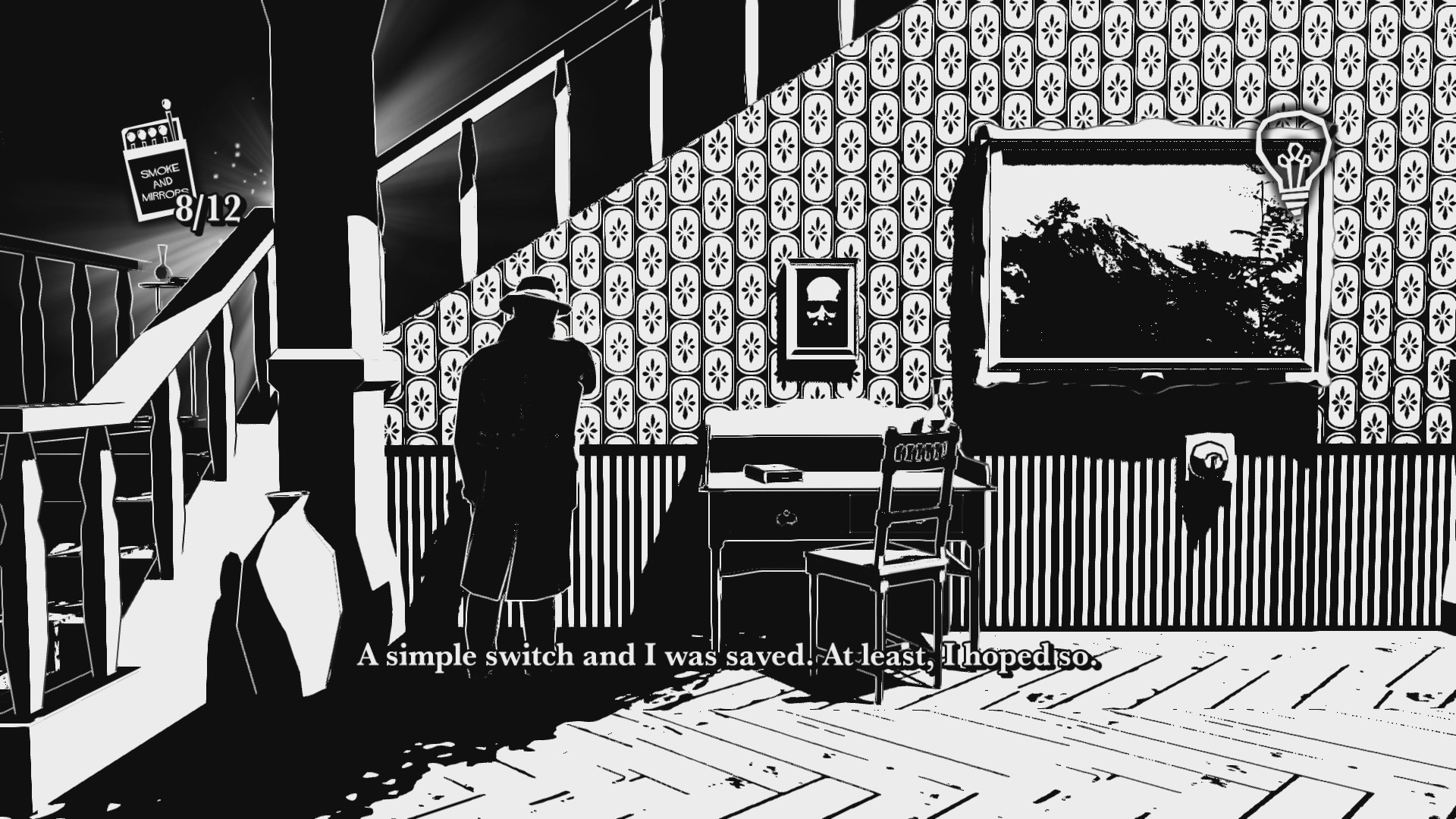
And, in the case of White Night, the graphics style does not mesh well at all with the fixed camera malarkey. This gets proven nearly every time something is introduced that’s intend to drive the plot in some way. There’s a scene in the second chapter where you’re in a dining room (I think it’s a dining room) and the game’s plot takes over: a ghost girl who needs your help. She appears suddenly and then walks through a door. When she does, the cinematics take over so you can see her walk through the door. You then return to the fixed camera you were at, and it’s almost impossible to figure out which door she just went through. The game is drawn in black and white graphics and the gimmick is most of the game is shrouded in darkness.

White Night 2

Here’s an example of how the puzzles in the game don’t work in a logical sense. See the statue casting a shadow on the grave marker? There’s a key hanging where the shadow is. It’s not an Indiana Jones type of thing where moving the shadow of the statue activates a mechanism that reveals the key. No, the key is apparently just hanging there (you can even feel it before you move the statue) but you can’t actually claim it until you move the statue and can see it. Oh COME ON! It’s right fucking there. It’s just so damn silly that it breaks immersion right off the bat. This is literally the prologue to the game and the concept is already ruined. Sigh.

It doesn’t work as a play mechanic or a storytelling device. Hypothetically, the player character saw the ghost and knows which door she went through. That’s why it’s scary. Because holy fuck that was a ghost! But the player can’t tell which door she went through, so the plot grinds to a halt once again while you stumble around slowly, lighting matches to illuminate dark areas and clicking every object hoping to make the god damn slow-as-radioactive-decay story unfold just a sliver more. This breaks immersion, because in a cinematic experience (like White Night strives to be), the guy who, again, just saw a fucking ghost crying for help and walking through a door, would know which door she went through and follow her. In the game, the players are left to stumble searching for the door that the character himself saw. Are we scared yet? No, really, we’re just bored.

Oh, and by the way, the door she went through? It was locked.

Other technical issues get in the way. Even the simple act of clicking on shit to examine wasn’t handled well. The game kicks off with a car crash that injures the main character. I’m not sure if he spends the whole game limping around, but at the point I quit (which, granted, was very early in), he staggers with all the urgency of a murderer being dragged to the gallows. The limping animation leads to making lining up with stuff that you need to click a needless exercise in frustration. I’ve slammed the examine when the magnifying glass appears on-screen, only the dipshit you control was still dragging his leg in the animation and thus by time the game acknowledges that you hit a button, the character is no longer in position to examine the thing in question. Normally I would label this “lag” but it’s not really lag. It’s just bad design.

I don’t want to call it “Style over Substance” because that implies the game’s creators made a conscious decision that the gameplay could be mediocre as long as the art work was striking (and it is). I think White Night is a victim of the development team knowing how to play their own game and forgetting that you develop games for everyone else. Like an expectation that players will play the game the way the game’s creator does. For example, save points are notoriously spread far apart. In theory, this is done to heighten tension, making players practically pray that they come across one so that all the progress they’ve made isn’t lost. In practice, players just make a tiny bit of progress, return to the last save point they found, then venture back to make a little more progress, rinse, repeat until they stumble upon a new one. Thus 10 minutes worth of gameplay takes an hour to complete. I’ve never seen a game where that’s an option and most players opt to just risk making it to checkpoints. That’s especially true with White Night, because the game unfolds so fucking slowly, with miserable play control, that fear of having to repeat the tedious activities is more terrifying than any jump-scares or creepy atmosphere the game can throw at you.

Lighting matches doesn't protect you from the more aggresive ghosts, but they'll be removed as threats by electic lights. This leads to two things. First, some of the light switches "look dangerous" and thus your character won't push them, because of course he won't. I mean seriously, you fucking pussy, you're being stalked by killer ghosts who are only scared of electricity. You're locked in the house. It's just a fucking light switch! Again, all the stuff designed to keep tension up or be a "puzzle" is handled so poorly that it breaks the immersion. In a horror game, immersion is all you have. You break that, you're left with nothing. And second, it leads to players hugging the fucking walls searching in vain for a light switch that simply does not stick out enough. Who wants to play hug the walls? White Night is a wall-hugging simulator.

Lighting matches doesn’t protect you from the more aggressive ghosts, but they’ll be removed as threats by electric lights. This leads to two things. First, some of the light switches “look dangerous” and thus your character won’t push them, because of course he won’t. I mean seriously, what a pussy. He’s being stalked by killer ghosts who are only scared of electricity. He’s locked in the house. And it’s just a fucking light switch! Again, all the stuff designed to keep tension up or be a “puzzle” is handled so poorly that it breaks the immersion. In a horror game, immersion is all you have. You break that, you’re left with nothing. And second, it leads to players hugging the fucking walls searching in vain for a light switch that simply does not stick out enough, and then when you find it, it doesn’t work. Who wants to play hug the walls? White Night is a wall-hugging simulator.

There’s not a single concept that White Night has that I feel works the way it was probably envisioned. The game gives you matches that you must use to stay in the light. You can carry 12 at a time. If you run out of matches, you die. If you can’t get a match lit in a dark area fast enough, you die. That can be problematic when you’re trying to light a match but the character is either caught in an examination animation or even a movement animation that you can’t even see. I’m guessing it’s done to be realistic, because real people would struggle to light a match in a haunted house where ghosts will fucking kill you if you aren’t able to spark the thing up. THIS ISN’T REAL LIFE! It’s a game! And besides, when the ghosts actually kill you, the death animation looks more like a mildly annoyed person trying to shoo a housefly away, not a scared-shitless person having the life force sucked out of them by a god damned mother fucking GHOST! And why the hell are the ghosts in the game instakills? And why are we even doing the ridiculous save stuff? And why in the blue fuck are matches in limited supplies? White Night has a very old, first-gen 3D horror mentality. It ignores all the major advancements in-game design that have come about over the last twenty years. A lot of people say Resident Evil 1 was scarier than Resident Evil 4. Fine, maybe it was. But horror games control better today than they did in the PS1/Saturn era. Can’t we find a healthy middle ground between good gameplay and real scares?

That’s the real shame here. White Night might actually be a really scary video game. I played it in a room with four grown men and my mother. We all had a couple “fucking game got me!” BOO moments. But typically those resulted in me dying, followed by dying several more times in a row. Then more dying. You die a lot. This is mostly because, for some reason, when a ghost spots you the movement gets even weirder and more limpy than normal. If a ghost catches you, you die. You can run away, but while doing so, you have to compete with horrible play control and the possibility that the fixed camera angles will change. Again, because of the all white and black style and the darkness versus light gimmick, the layouts of rooms are confusing at best. Often, it’s not even worth attempting to runaway.

Going off the percentages of players getting achievements for completing the second chapter, a shocking amount of people quit playing White Night at some point on the second stage, and I’m amongst them. This game is awful. Look, even scary games are supposed to be entertaining. While the game is interesting to look at, a game shouldn’t make it so easy for players to give up and quit. White Night frustrates with archaic fixed angles, clunky movement, bad play control, confusing layouts, a slow, somewhat uninteresting and far too vague story, and annoying instakills that make you replay all the annoying things. No, as someone who completely missed the fixed-camera era of horror gaming and HATES that style, I probably never stood a chance to like White Night. Was this review fair? I feel it was, because if you’re in the same boat as me, with no nostalgic affection for that style, White Night is clearly not for you. Playing White Night is practically a war of attrition, and it is in that sense only that it succeeds. I wave the white flag.

White NightWhite Night was developed by O’Some Studio
Point of Sale: Nintendo Switch, Steam

$14.99 said “who’ya gonna call?” like a schmuck in the making of this review.

Axiom Verge

Well, that didn’t take long. It was only 68 days ago that Shovel Knight dethroned Journey for the #1 spot on the Indie Gamer Chick Leaderboard. Journey had sat as king of the throne for 1,048 days. And there’s MANY more amazing looking indies coming in 2015. I tell you, we’re in the Golden Age of Indie Gaming, and ain’t it sweet?

Axiom Verge certainly had an advantage over Shovel Knight. Metroidvanias are my favorite gaming genre. They factored hugely into my gaming upbringing. Meanwhile, I can probably count the number of times I’ve even held an NES controller on one hand, and I certainly didn’t grow up playing Capcom’s NES library. So maybe it was fate that finally a Metroidvania would take the crown here at IGC. Then again, I think it speaks volumes about its quality that I was (and still am) gaga over Shovel Knight despite having no heart warming childhood stories about the time I ran through Duck Tales in a single life or the hours I spent designing fantasy Mega Man bosses. Shovel Knight holds a special place in my heart, and it does so simply by being an incredible game.

But, Axiom Verge has beaten it. And handily at that. It is the best independent video game I’ve ever played.

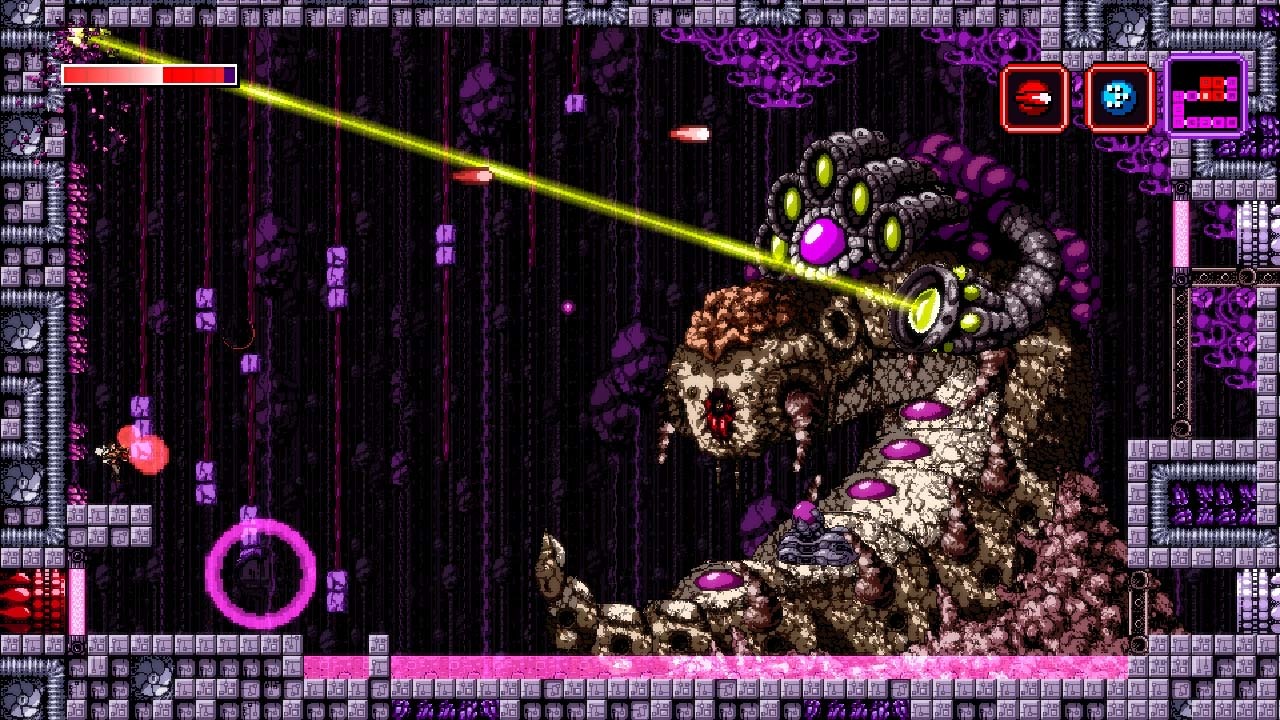
I've seen a lot of tributes to the Kraid fight in Super Metroid. This one outshines the rest.

I’ve seen a lot of tributes to the Kraid fight in Super Metroid. This one outshines the rest.

Think of Axiom Verge as the evolutionary Metroid. The same basic concept and play mechanics are present. The same enemy placement sensibility, where each corridor has the same enemies that you encounter one after the other. It’s so close that if you re-skinned the lead character Trace with Samus Aran sprites, put bubbles around each door, and replaced a drone you acquire a couple of hours into the game with the Morphing Ball, you would swear this really was a Metroid game. It’s that seamless.

Really, I can think of nothing else that speaks as great a volume as that when it comes to praising Axiom Verge: that you could believe this was an authentic Metroid game, made by a team of veteran designers working for gaming’s most prestigious house. But it wasn’t. One guy made this. And it’s better than any adventure the house of Mario has given their super heroine. Whoa!

Sacrilege, you scream. Look, we (or at least, people with similar taste to me) whine about how Nintendo turns out samey games. Every Zelda has the hookshot, the master sword, a boomerang, etc. Every Metroid has the Morphing Ball, the Grappling Beam, the Wave Beam, etc. Nintendo can get away with this because we keep eating it up year after year. I’m guilty of it too. Now here comes along a game that could be a Metroid, but it does things different. No Morphing Ball, the Bionic Commando grappling hook instead of the Grappling Beam (you can grab pretty much any platform instead of designated grappling sections once you acquire it), no bubble doors, new gun concepts, new enemies, a deeper story, but the same core gameplay. This is exactly what we’ve been asking for. For years. It’s the twist in the formula we’ve all been hoping for. The logical evolution of the Metroid mechanics.

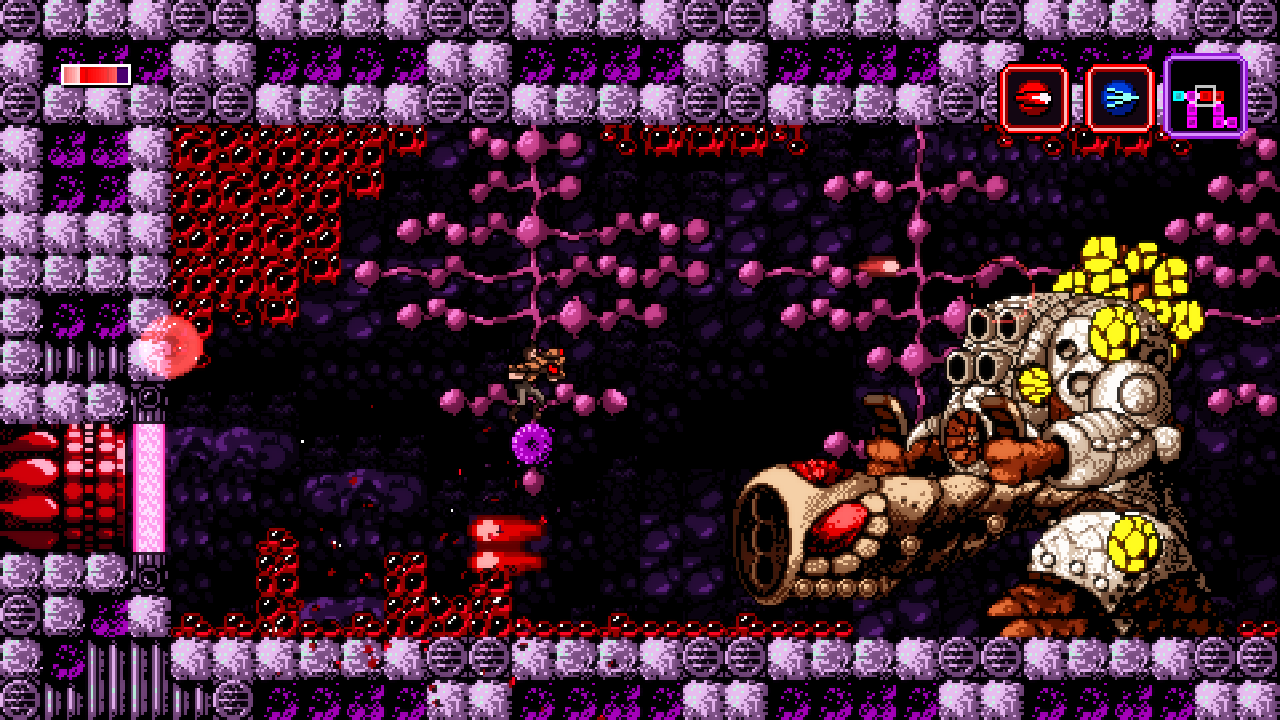
The platform Trace is standing on here is practical invisible. The game has since been patched to make it and others like it stick out more, but there's still some minor visibility issues in Axiom Verge.

The platform Trace is standing on here is practically invisible. The game has since been patched to make it and others like it stick out more, but there’s still some minor visibility issues in Axiom Verge.

And then comes the Glitch Gun. It’s not really called that. It has some stupid name like data disruptor. Just call it the Glitch Gun, everyone else does. Probably inspired by the types of graphic abnormalities that happen when you haven’t sufficiently blown on your NES cartridges enough, it’s sort of a more proactive version of Samus’s visor from Metroid Prime. When you shoot most enemies with it, you “hack” them, making them glitch out. This might make them simpler to slay, or it might make them useful, even able to open up hidden rooms. The gun will also interact with the environment, creating or destroying blocks, opening up new pathways, or unveiling secrets. It’s very clever and mostly well done. However, later in the game, once the gun is upgraded, I struggled somewhat in consistently clearing out the most advanced glitch blocks, often phasing some in while making others phase out. It’s a small niggling complaint, but it almost always happened when I was trying to clear the blocks out. Beyond that, the biggest mistake I think the developer made with the Glitch Gun was not giving it to players right out of the starting gate. It’s what sets Axiom Verge apart from its heritage more than any other play mechanic. You want to flaunt that stuff right off the bat. If someone has a flying car, I don’t want him to show it off to me by taking me on a trip down the Pacific Coast Highway. Even if it’s a nice ride, I want to see the car fly! And I want to see the Glitch Gun in Axiom Verge right from the start.

Actually, since I’m complaining about things right now, I should point out that I don’t love the graphics. The world Tom Happ has created for Axiom Verge hits similar notes to other games in this genre, but it lacks liveliness and color. The story explains it to some degree (my insane fan theory: Murky and Lurky are behind this), but the starkness of the color is kind of exhausting. And it occasionally gets in the way. It’s often hard to distinguish between the foreground and background. The problem is Axiom Verge is too married to the limited color palette of the 8 bit era. Although I’m quite fond of neo-retro games, I think developers should remember that you shouldn’t handicap your own game in the process of paying homage. Cheat the rules occasionally. Use shading and color techniques not available on classic  platforms, but do so in a clever way so that people don’t notice. Axiom Verge looks very convincing as a classic game, but that often works against it more than it helps it.

The controls are smooth. If there’s a problem with them, it’s that there’s just so much shit to do. By the end of the game you’ll be using pretty much every button on the controller, and unless you’re one of those freaks that can rub their head and pat their belly at will, you’re bound to slip up. I also felt the lack of ability to shoot at a downward diagonal angle while moving made the search for hidden rooms a bit more tedious than it had to be. I had to stop and shoot straight down, move a couple of spots forward and do it again while on the hunt for hidden stuff. It took me twenty-six hours to finish Axiom Verge, and you could probably shave at least an hour of that off just by giving me the ability to fire downward while running. Oh, and the dead zone for the right stick is too small. Combine that with my tiny hands and I kept accidentally bumping it, interrupting the game to select a new weapon. The dead zone should just stop short of maximum range, since it’s unlikely anyone is going to just nudge the stick to pause the game and choose a different gun. Then again, that might have been my fault. I have extraordinarily clumsy hands. Really clumsy. Dangerously clumsy. The last guy I gave a hand job to now goes by the name Sally.

Exploration and meaningful backtracking are the backbone of Metroidvanias. Something I’ve noticed about indies is they often just don’t fucking GET IT with that. Yea, you force players to go backwards, but when you do, you have to make it interesting by including hidden goodies along the way that were previously out of reach with the weapons and items you had access to the first time you were in that area. Huge props to Tom Happ for grasping this. There is so much hidden crap in Axiom Verge that I don’t think I went ten minutes between any pick-up. Even when I would occasionally get lost trying to figure out where the next event would take place at (some kind of Metroid Primeish GO HERE beeping spot on the map would have helped), I was stumbling upon so many goodies that I never got annoyed with it. By time I knew the game was getting ready to wrap up, I decided to take a stroll through all the previous stages just to see what I missed. Shockingly, it was a lot. Even in places where I was certain I had gotten everything, I was wrong. And I didn’t even get a 100% item pick-up, despite having 96% of the map explored. Holy fuck. As much as I’m grateful, I have to wonder if Tom has some kind of mental disorder that led to this. Dude is like a demented Easter Bunny.

I grew to love its story. The plot is problematic for some, because it fails to grab you immediately. This happened to me too. For the first several hours, when friends asked me about it, I said “you’ll want to buy this for the gameplay.” But once the story gets rolling, I actually did care. Quite a bit. I just don’t think the game handled the delivery of the story well. Part of that comes down to the lack of voice acting, because, once again, the game is married to being old school. Oh woe be it, if only we had access to the types of space-age technology that would allow voice acting in video games. Oh wait.

Notroid.

I called this the Ghostbuster gun. You’ll see why.

But, I did grow fond of lead character Trace, and skeptical of whether or not the mysterious giant mecha baby heads that drive the plot were friend or foe. I just wish it had been told better. Having said that, there’s a couple “okay, that was cool” story moments that are integrated into the gameplay that were very risky to include from a creative standpoint. They worked, grabbing my attention and leaving every gameplay moment that followed feeling like the stakes were higher, with tension added that was totally authentic. Axiom Verge might have one of the most interesting sci-fi gaming storylines I’ve ever seen. Saying it gets off to a slow start is an understatement, and I’m guessing many players will be so underwhelmed by it that they’ll blow off the remaining dialog, but they’re missing out.

I loved Axiom Verge. I can’t believe how much I loved it. I never expected to walk away from it having enjoyed it more than any of Nintendo’s entries in the Metroid series. Axiom Verge isn’t a Metroid game. It’s a tribute to Metroid. My expectations were set to “respectable tribute.” Not “better than the originals”. But it is. And yeah, I’m a whippersnapper who was in my twenties when I played Super Metroid for the first time, so I’m not nostalgic for those SNES and GBA classics. You know what? I think even those who would burn me at the stake for saying Axiom Verge is better than Super Metroid (and it is) would have to at least stop and think about whether I’m right or not. It’s that good. It’s for real. It’s the best indie of all-time, at least in this Chick’s book.

Special Note: I am friends with Axiom Verge producer Dan Adelman, whom I previously interviewed on this blog. My friendships with game developers do not and will never influence my opinions on their games. My friends are my friends because I give them my unfiltered, often blunt opinions on their games. Ask my friend Marc. They expect nothing less from me. As for me, I would never be friends with anyone whose friendship is conditional, based on me liking their stuff. That’s not the way real friends treat each other. But my readers deserve to know who I’m friends with, so I’m letting them know.

Axiom Verge logoAxiom Verge was developed by Thomas Happ
Point of Sale: PlayStation 4, Steam

igc_approved1$17.99 (normally priced $19.99) has a father who screamed at her for including the hand job joke in the making of this review.

Axiom Verge is Chick-Approved and Ranked on the Indie Gamer Chick Leaderboard

A review copy of Axiom Verge was provided to Indie Gamer Chick prior to the game’s release on March 31. Indie Gamer Chick has since purchased a copy. All games reviewed by Cathy are paid for by her with her own money. For more on this policy, check out the FAQ.

Haunt the House: Terrortown

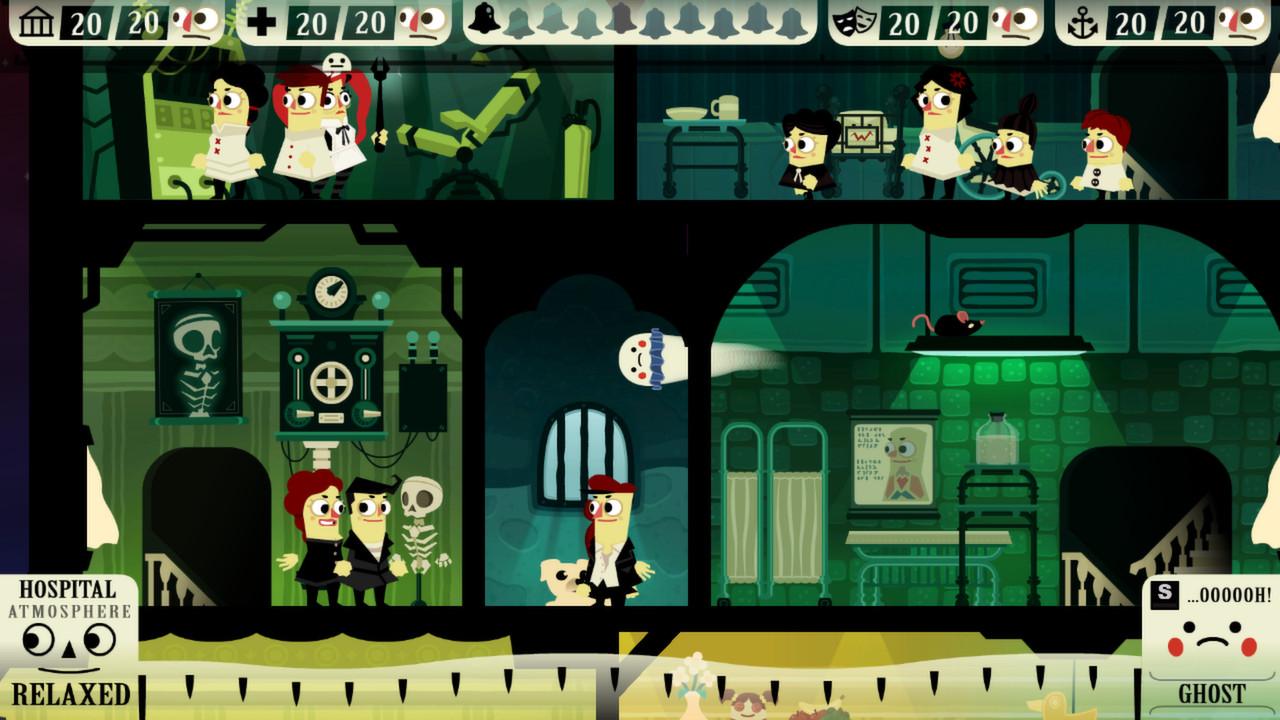
Haunt the House: Terrortown is sort of like that old GameCube title Geist, only it’s not a first person adventure, you can’t possess people, and the game doesn’t fucking suck. It’s not great either. Like Geist, the concept seems like it should lend itself well to a video game, but there’s not a whole lot you can do with it. Unlike Geist, the game doesn’t attempt to pad out a shallow, low-mileage concept. Haunt the House can comfortably be finished in under an hour. That includes the free Christmas-themed DLC. No, this doesn’t mean it qualified for Short Subject Saturdays. Being able to hypothetically finish something in under twenty minutes doesn’t make it short subject. You can beat Mario 64 in under fifteen minutes. Tell me with a straight face that makes it short subject.

Haunt the House 1

There’s actually a lot of objects to inhabit in Haunt the House, though I’m not certain how some of them are supposed to scare people. In the DLC, you can possess a bulb on the Christmas Tree and make X-Wings attack it like the Death Star. What the fuck? How is that scary? “Oh shit people, GEORGE LUCAS IS HERE! RUN!”

I guess I enjoyed Haunt the House. I mean, there’s just not a lot to it. You enter objects, you make them do something scary. As people become more terrified, you get the ability to make objects do even scarier things. To win, you have to get people so pants-shittingly scared that they flee the stage. It’s actually very family friendly, which is probably why I didn’t fall in love with it. It’s a children’s game, with just enough play time to hold their attention for an hour. I tested this theory on Brent, a friend’s ten-year-old. And then I became one of those people. You know, those people who can’t tell what forms of entertainment will be enjoyed by which age groups. The ones that buy Barbies for thirteen-year-olds, or complex LEGO sets for five-year-olds. At ten years of ages, even Brent was too old to really get an appropriate lark out of Haunt the House. I forgot that kids these days have access to shows like Walking Dead, and their video games are an orgy of terror and violence. I thought maybe I had been wrong about the kids will love it stuff, but then I tested it on seven-year-old Kelvin. He thought it was jim dandy awesome. Also, I’m using the terms like “jim dandy” and “kids these days” to describe anything. Christ, how did I get so old and out of touch so quickly?

Can adults enjoy Haunt the House? Sure, but they’ll mostly just complain that it’s too short, too shallow, or too kiddy. I liked it, but I wasn’t exactly disappointed when the game ended in less time than it takes to watch an episode of House of Cards. Hell, I even found a game-killing glitch in that short time. On one stage, one of the women you have to scare was somehow stuck running a loop on a staircase. She would get to the top of the stairs, then teleport to the bottom and run up it again. There was no way to get her out of it, and it rendered the game unbeatable. The only work around was to quit out of the game and come back. When you do this, all your progress is retained but the woman will be somewhere else on the stage. Just keep her away from the stairs. And other issues abound. When a person is terrified to the point that they’ll leave the stage, sometimes they don’t exactly take the best pathway to do so. It reminded me of Carlton’s freakout from Fresh Prince. The AI has one job: leave the fucking house. It should be more efficient at doing so.

This is the spot where the girl got stuck in the staircase.

This is the spot where the girl got stuck in the staircase. Or did she? Maybe developer Tom Vian was trying to show the theory of space and relativity, showing that if you travel faster than the speed of light, you could end up causing an endless loophole of misery and repetition. This is actually one of the best uses I’ve ever seen for gaming to explain the laws of theoretical science and natu.. oh never mind, it was just a glitch.

Is it fun? Yea. Is it on the wrong platform? Yea. I know it came out on PlayStation Mobile, but really, it belongs on Wii U or 3DS. Is it over priced? Ohhhh yea. $4.99 is too much for a game with this little going for it. But if you’ve got wee ones or you can grab it for under $2, Haunt the House isn’t bad by any means. Had I realized Haunt the House was a game best suited for the under-nine set, I wouldn’t have played it. Haunt the House wasn’t designed for me. It was made for children. I’m a sophisticated adult. One who hides clips of a Japanese children’s television show in every review she does, but, um, what were we talking about?

Haunt the HouseHaunt the House was developed by SFB Games
Point of Sale: Steam

igc_approved1$4.99 yelled at kids to get off my lawn in the making of this review.

Haunt the House is Chick Approved and ranked on the Indie Gamer Chick Leaderboard

Escape Goat 2 (PlayStation 4)

Escape Goat 2 hits PlayStation 4 on October 21. I don’t really have a lot to add to what I already said in my review of the Steam version. You can go read it, and I can sit here twiddling my thumbs.

Go ahead.

And yes, that’s what I’ve been doing for the last month. Just twiddling my thumbs.

Still twiddling.

Okay? Yeah, it’s a bit overwhelmingly positive as far as reviews of mine go. I don’t know what to say. I loved it! It’s one of my favorite indies ever. It totally tops the original Escape Goat, which is saying something, because I usually walk away from sequels that I enjoy still longing for that sense of awe and discovery the original provided. I’ll give you an example: Super Mario Galaxy. I had just turned 18 when it hit the Wii. I’m all adult and stuff for the first time in my life. I’m starting my career. And then I played it and became a giggling, practically delirious child all over again. It had a profound effect on my gaming life. From that point forward, I craved games that would do THAT to me. That regression that would leave me sitting in stunned euphoria. And when a direct sequel to Mario Galaxy was announced, well, it seemed perfectly logical that I would experience it again. But it didn’t happen. Which is not to say Mario Galaxy 2 sucked or anything. It was a very good game. But the spark was just not there. Good, but not good enough to capture the magic of the original.

For a while, Escape Goat was the benchmark of indies for me. At least of the ones I had reviewed. But, while I was excited at the prospect of a sequel, I have to admit, the cynic in me fully expected to feel like it would be more of the same. In a bad way, I mean. I got the “more of the same” part right. Escape Goat 2 doesn’t really strive to shake up the formula too much, and for that reason, I should have been underwhelmed by it. And yet, I still felt a sense of awe and discovery with every new stage. Every button press that transformed the layout of a room and slowly revealed the pathway to the exit. Every “Ta-Da!” moment when the solution to a level becomes apparent. And there’s even a sense of exploration that continues past the credits, as you experiment and search for ways to open secret passages that unlock bonus stages. Escape Goat 2 never fails to deliver the goods.

I personally chose to crank up the brightness of each stage when I played. Why did the stages have to be so dark by default? The indie scene desperately needs some Zoloft.

I personally chose to crank up the brightness of each stage when I played. Why did the stages have to be so dark by default? The indie scene desperately needs some Zoloft.

I’m pleased as punch that Escape Goat 2 has graced consoles. Hell, if not for the fact that I have about as much patience as someone strapped to the electric chair waiting for a call from the Governor, I probably would have waited for the PS4 port. Escape Goat 2 was the title that made me cave in and start reviewing games on PC. My hold out for that was every bit as silly as someone going on hunger strike until world peace is declared. So, hooray! Escape Goat 2 is on PlayStation 4! Where it belonged all along! Though I really think Magical Time Bean should have probably bundled the original with it. A lot of people don’t like to jump into sequels without playing the original, and I fear for Escape Goat 2’s chances because of that. A subtitle instead of a number might have eased that. Escape Goat: Goat Harder. Escape Goat: BahhhhhhhD Company. Escape Goat: The Horny Butthead. I’ll stop now.

So, is anything wrong with it? Yes, as it turns out, the jumping has a bit of an issue. Maybe. Not sure, really. Last time I played it, I thought it was on me. Then I played it on Twitch, and something happened that I thought was just a funny quirk of mine, only to find out everyone was doing it. So sometimes you have to jump to a single-square platform, and if you don’t stick the landing, you fall to your death. I constantly though I was going to skid off to my death, or over shoot it. Thus, when I would land on the block, I would reflexively jump again, do the mid-air mamba trying to stop my momentum and line up with the platform, and land back on the block, only to jump again and repeat the process multiple times. Again, I thought I was being a scaredy Cat, jumping up and down hysterically like I was trying to shake a spider off me. As it turns out, lots of other players are doing this. And I almost think that’s on the developer somehow. It’s weird, because gauging distance, or use of the double jump, always feel instinctual in Escape Goat 2. I never had an issue with that. Yet sticking those precise landings apparently leads itchy trigger thumb for many players. Why? Fuck if I know. I don’t recall ever skidding off a block I landed on. Not even once. Yet, my instinct told me I was going to do so, and apparently I was not alone in that. I want to stress: this isn’t a deal breaker by any means, but so many people complain about it, and I found myself doing it too, so something is going on.

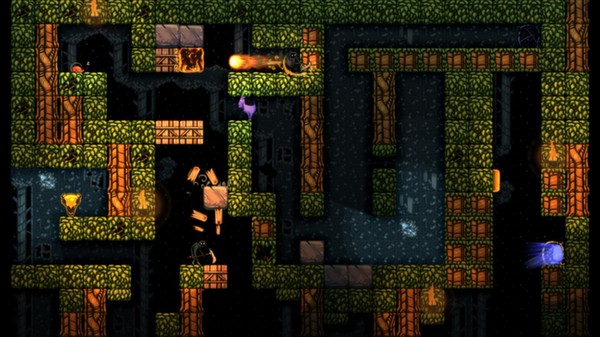
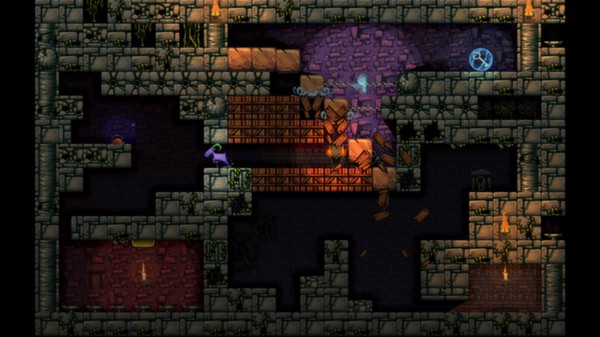
There really is no point in trying to make sense of any pictures of Escape Goat 2. Just go buy it. I doubt you'll be disappointed.

There really is no point in trying to make sense of any pictures of Escape Goat 2. Just go buy it. I doubt you’ll be disappointed.

Also, I fucking hated the skeleton dragon puzzles that cap the game off. They weren’t broken. There’s nothing really wrong with them in the strictest sense. They just felt out-of-place, and I didn’t like them. I figure I should bring that up here since I didn’t last time.

So, yes, Escape Goat 2 is finally on a console, where it belongs. If you’ve never played the series, really, you can jump in right here and you won’t have missed anything. I mean, it’s not like you play a game like this for a riveting story. No, you play it for the puzzles. The puzzles of the Escape Goat series won’t melt your brain, Gateways style by any means. Anyone should be able to complete them. In fact, I think Escape Goat, and now its sequel, strikes a perfect balance of exploration, platforming, and puzzling. It’s a game built to be enjoyed.

For real.

NO KIDDING!

😀

Get it?

God, I’m so sorry.

Escape Goat 2Escape Goat 2 was developed by Magical Time Bean
Points of Sale: PlayStation 4 (Coming Oct 21), Steam

IGC_Approved$9.99 thinks the mouse is due for its own spinoff in the making of this review.

Escape Goat 2 is Chick-Approved and ranked on the Indie Gamer Chick Leaderboard.


The Last Tinker: City of Colors

UPDATE: When I played the Last Tinker, after completing the two tutorial tasks, I didn’t have enough money to advance the plot of the game and had to grind money for thirty minutes. It turns out, I had triggered a rare glitch that led to me not having enough money to proceed. The guys at Loot Entertainment and developer Mimimi Productions finally were able to replicate what I had unwittingly done. I have an uncanny knack for finding the worst glitches in games. Because the slow pace of the game was unquestionably my biggest gripe with the Last Tinker, and the pace I played was dictated by the extremely slow start (caused by a glitch), the Last Tinker has jumped over 100 spots on the Indie Gamer Chick Leaderboard.

As a kid, Banjo-Kazooie represented a defining moment in my life. While the original PlayStation (and Crash Bandicoot specifically) was the first game that I wanted, Banjo was my first gaming obsession. I received it on July 11, 1998, and I could not put it down. I bring this up because I think there’s a strong possibility I would have had the same reaction to The Last Tinker: City of Colors if I had been a nine-year-old when it released. It’s a family friendly adventure that parents can safely let their children play without warping their minds. Then again, my parents banned me from playing most M rated games, and I think I might be a certifiable psychopath if the way I treat my Sims is any indication. Plus I use the word “fuck” so much that my dog thought that was her name for the longest time.

Actually, the comparisons to Banjo probably aren’t good ones. In terms of gameplay, Tinker reminded me a lot more of another Rare title: Star Fox Adventures. All jumping is done automatically, combat is button mashy, you rely on semi-controllable AI helpers to solve puzzles, and the pacing is so slow it can be measured by the cycles of the moon. That’s not necessarily a bad thing, at least if you’re a young’in without the accumulated experience of dozens of games that do what Tinker does, only they did it better. UPDATE: the rest of this paragraph is not accurate, as I had triggered a glitch in the game that caused these pacing issues. However, I fully expect the speed of progression to test the patience of anyone older than, say, twelve. The opening bits of the story and tutorial can take hours to get through. It simply shouldn’t take so fucking long to get into the meat of the game. And the way it feels artificially padded only serves to frustrate more. Initially, your goal is to raise money to enter a race. Players are led to believe that completing two “learn the mechanics” tasks will earn them enough money to enter. It doesn’t. Not even close. Instead, you have to walk around smashing crates and jars. I actually had smashed every crate up to this point and it still took me an extra thirty minutes of walking back and forth, smashing the same crates over and over again until I had enough money. It’s completely unnecessary busy-work and it’s incredibly boring. What were they thinking?

Update: The two tasks described above should be enough money to enter the race.  I had triggered a rare glitch that caused me to not get the money for completing one of the tasks. They are correcting the glitch. It’s almost impossible to accidentally recreate it. Ain’t I lucky?

I swear, this is NOT what it looks like.

I swear, this is NOT what it looks like.

I wasn’t sure if Tinker would recover from the disastrous opening. The only shinning spot early on was where it really did manipulate my emotion by having your best buddy, a mouthy little critter that looks like it was lifted from Viva Pinata, get punched in the nose. The game transitions to night, where you watch it lay in bed, having an unhappy dream and quivering. Then a little ghost color spirit thing talks about how your buddy isn’t doing so well. Then they show it quivering while it sleeps again. Hold on, there’s something wrong with my eyes. They appear to have some kind of leak. Wait, am I crying over this? Just a few minutes ago I was pissed that the game was dragging its ass like a dog with worms, and now I’m genuinely saddened by this little paper mache goat thing getting a little smack in the nose? Hell, I spent the last hour punching every friendly NPC way harder than that, just for the lulz. Now, I’m shedding actual tears.

Well played, Last Tinker.

And really, from this point forward, the pace does pick up. Not that it gets off to a great start. The first real stage takes place in a fortress where you have to sneak past guards, in a scene that feels as if it was lifted directly from the opening stage of Legend of Zelda: The Wind Waker. In fact, it’s so close to that game that it feels awkward. Forced stealth sections are the kidney stones of gaming, in that it feels good once you pass them, but only because enduring them is pure agony. Thankfully, that’s the last section where the tedium outranks the enjoyment. While nothing after this will surprise you or leave you thinking you’ve played something truly inspired, Tinker is an overall very decent game.

It’s also worth noting that the graphics are striking. When I played The Last Tinker on Indie Gamer Chick TV, a lot of people commented on how damn colorful the game is. Perhaps it’s because we’re used to indies being painted so bleakly that they’re responsible for a 20% increase in cutting among gamers, but seriously, The Last Tinker really stands out. It’s been a while since a game has come along that’s so cheerful that you can’t help but notice it. Yet, this is exactly the kind of game that Rare would have put out during their Nintendo 64 heyday. The story (a thinly-disguised tale about racial tolerance), characters, and setting all would feel at home on Nick Jr. or PBS, and there’s nothing wrong with that.

I can’t pretend I’m The Last Tinker’s target audience, but I liked it enough for what it was. It does a LOT wrong. The pacing is horrible, the controls merely adequate, the combat is repetitive, the enemies can be too damn spongy, and it’s even a bit unstable. They had to include a respawn option in the pause menu because it’s possible to get yourself stuck in some sections of the game, like in the screenshot below.

I have no idea how I got here, but I'm stuck. For what it's worth, this is the only time I need to use the respawn option.

I have no idea how I got here, but I’m stuck. For what it’s worth, this was the only time I needed to use the respawn option.

I don’t know if The Last Tinker’s mistakes completely off-balance what it does right. I can only speak for my own experience. And I liked it. It didn’t make me revert to a giggling, happy-go-lucky child like Super Mario Galaxy did, but it never really had the potential to. And again, this game wasn’t made for cynical gaming veterans. I suspected The Last Tinker would be an excellent “ease into gaming” title for younger children. But, I wanted to know for sure, so I secured some copies to hand out to parents with children aged 5 to 12.

My hunch was correct. Reader John Berger‘s kids (a ten-year-old son and eight-year-old daughter) enjoyed it. I included the full text of his mini-review below the trailer, but here’s the paragraph that mattered the most.

“As I type this, my son has beaten the game and is going back through it to get all of the upgrades and do everything to get all of the PlayStation trophies. And even though my daughter was with us and hasn’t played it (we let my son play it while we watched and helped), she wants to play it on her own.  Each time I asked them what they thought of the game up to that point, her response was an enthusiastic, “I LOVE IT!”

Fellow-critic Brad Gallaway wasn’t as forgiving towards the gameplay as I was, but his five-year-old son also loved it.

“The action is simple and straightforward enough for him to grasp, and the basic tasks weren’t a deterrent to him at all. While my eyes were glazing over with boredom, he’s so new to gaming that he has no idea how rote and uninspired the game can feel at times. And really, that’s just fine because it’s clear to me that Tinker was not aimed at the experienced gamer, and I’m quite happy to have age-appropriate software available for the young ones.”
It's also a great way to expose children to the horrible way adults endlessly run pop-culture references into the ground.

It’s also a great way to expose children to the horrible ways adults endlessly run pop-culture references into the ground.

I don’t base my reviews on how anyone else feels about a game, and I’m not starting here. The Last Tinker: City of Colors has more problems than a math quiz. For me at least, it was never better than decent. However, it was consistently decent enough to earn my Seal of Approval. But, if you have young kids? This is probably the type of game that you would have played as a kid. The type of game that can lead to your children being confirmed gamers for life, and I can think of no more powerful a statement to make about a game aimed at that age group. Use the Last Tinker to hook ’em while they’re young. Hey, it works for the tobacco industry!
$14.99 ($19.99 without a PlayStation Plus subscription) lost count of how many times I accidentally typed “The Last THINKER” in the making of this review.
The Last Thinker Tinker is Chick approved and ranked on the Indie Gamer Chick Leaderboard.
Here’s John’s full review.
Just for reference, my son is 10 and my younger daughter is 8. All three of us were playing/watching at the same time.
In short, the blending of the game styles of “Ratchet & Clank”, “Banjo Kazooie”, and even “Okami” — with the color brilliance of all three notched up quite a bit — made it a fun game to watch. (I let my kids play it while I sat with them.)
For the most part I let them try to figure out how to progress, although there were a few times where I basically had to order them where to go. (“No, dad, that’s not where we have to go!” “Yes, it is, so do it!” “Oh, you were right.”) A few of the solutions weren’t very obvious, even to me, to where I had to find a “let’s play” video to find out how to progress.
But otherwise, my kids love it.  As I type this, my son has beaten the game and is going back through it to get all of the upgrades and do everything to get all of the PlayStation trophies. And even though my daughter was with us and hasn’t played it (we let my son play it while we watched and helped), she wants to play it on her own.  Each time I asked them what they thought of the game up to that point, her response was an enthusiastic, “I LOVE IT!”
Just to try to get some balance, I asked if there was anything about the game that they didn’t like, and I told them that I need them to be honest about that. Neither of them had anything bad to say about it. So, it was definitely a hit with the kids.
I do kind of agree with you that it doesn’t feel like it’s meant for adults. But considering that it’s along the same gameplay lines as “Ratchet & Clank” and “Banjo Kazooie”, I think this is good enough for adults who just want to wind down and play something that’s not too demanding. After all, you could argue that the LEGO games aren’t really geared towards adults either, but I’ve bought every single one of them.

The Walking Dead: Season Two

Every single paragraph below the first picture contains spoilers. If you’re looking for a recommendation on Walking Dead: Season Two, I’ll keep all my spoiler-free critiques on the story and gameplay up here. I had fun with it. It wasn’t as good as season one (you can read my review of that here and here), and I think that’s because my words and actions seemed to be much more inconsequential this time around. One character is on the verge of cracking, and you’re given the option to defend that character or agree that they are about to snap. I went with the “about to snap” option at least a half-a-dozen times, sometimes with the same characters who I had spoken with about it before. As if I had changed my mind on the subject. I hadn’t. I had been consistent from the start: person of interest was going bonkers. I’m guessing the problem is the developers had a very specific way they wanted the players to respond to dialog, and if you didn’t go along with it, they would keep knifing you to do it until you did it their way. It took the “oomph” out of the big decisions I had to make.

Meanwhile, the play mechanics are exactly the same as last season. I did notice there seemed to be a lot less glitches and slowdown, but otherwise, this is the same as pretty much any Telltale game. If you hated the style before, nothing is improved here in the slightest bit. And that’s pretty much all I can say without spoiling the whole thing. Walking Dead: Season Two is worth the $20 season pass, but the story was weaker, the emotional weight significantly smaller, and I have no lingering interest in playing the series any further unless I don’t have to pay for it. SPOILERS FROM HERE ON OUT
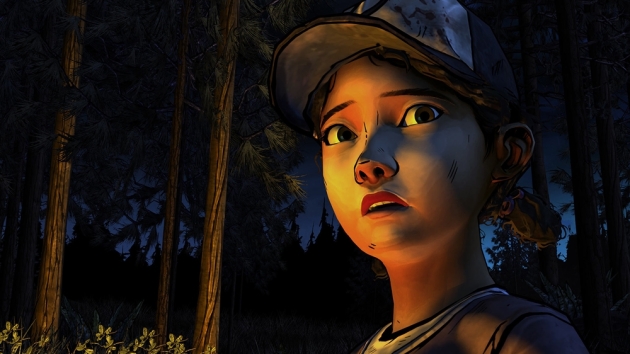
Awwww, isn't that adorable? She's completely lost her sense of innocence. Well, except later in the game when she thinks a couple that had gone off to fuck were actually "kissing and stuff." Which actually made me laugh, so kudos.

Awwww, isn’t that adorable? She’s completely lost her sense of innocence. Well, except later in the game when she thinks a couple that had gone off to fuck were actually “kissing and stuff.” Which actually made me laugh, so kudos.
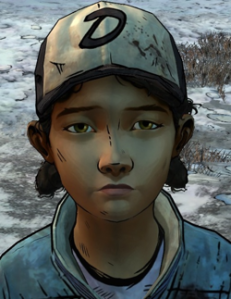
 

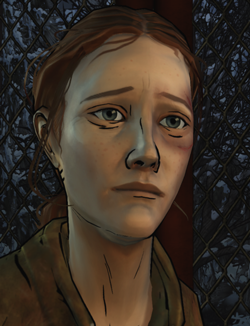
Meet the cast! This is Clem. Last season, she was Yorda. This season, she was the only person with half-a-brain. She was also a vindictive, sarcastic psychopath. At least she was the way I played.

Meet the cast! This is Clem. Last season, she was Yorda. This season, she was the only person with half-a-brain. She was also a vindictive, sarcastic psychopath. At least she was the way I played.

In Season Two, you take the role of Clementine, the yellow-eyed (so help me God, yellow eyes!) tag-along of season one, and she immediately proves herself to be more capable than last season’s protagonist/sleeping pill, Lee. A scene in chapter one requires Clem to stitch up a dog bite, and she handles it just fine. Lee would have stabbed himself in the eye with the needle, shot off his left testicle, and then knocked himself unconscious on the counter. And everyone in the group would have commented on how clever he was. This time around, your new group sort of recognizes Clem as the only person with her act together, but they’re too busy asking her the same series of questions over and over again to just shut and up collectively declare her group dictator. Which is pretty much why they all die.

There’s no real consistent plot that keeps the story moving this time around. Each chapter feels different from the one before it. In the first chapter, you let the fates quickly thin out any lingering characters you were still with at the end of season one. You get bit by a non-zombified dog, then get rescued by a group of survivors that mistake the dog bite for a zombie bite and lock you in a shed. This is the chapter where you meet all the new future zombie-chow of the season. Among them was a nervous, reckless, itchy-trigger-fingered douche named Nick. He was the nephew of the leader of the group, a dude named Pete.

This is Pete. He's the leader of the group of survivors that you meet up with in the first chapter. He's intelligent, insightful, and the only person holding the group's mental stability together. In other words, he's dead meat.

This is Pete. He’s the leader of the group of survivors that you meet up with in the first chapter. He’s intelligent, insightful, and the only person holding the group’s mental stability together. In other words, he’s dead meat.

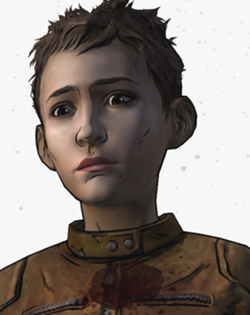
I liked Pete. He was cool. He recognized how strong Clem was. So obviously he was going to die, and it would probably be Nick’s fault. Sure enough, that happened. In chapter two, everyone spent half the game talking about how unstable Nick was. How big a danger to everyone around him he was. But, nobody (except myself) was willing to do the right thing: lead him into the woods and shoot him. Or tie him to a tree and let him lure the Walkers away from you with his girly screams. Later, you meet a stranger on a bridge who poses no threat and Nick kills him. Yeah. And again, instead of everyone shitting their pants in terror because they’re dragging this worse-than-useless human wrecking ball with them, they just talk about what a threat he is. Sigh. So I’m starting to think Nick will obviously be the season’s antagonist.
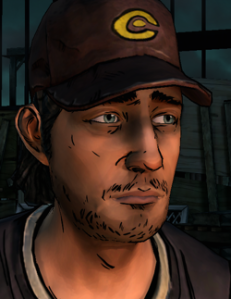
This is Nick. He's the main antagonist of the first two chapters. He's a danger to himself and others. You know, just like all the other characters. Just his prescence alone puts everyone in mortal danger, as if he's trying to get them killed. Okay, yeah, that's exactly what I was doing too. But I wasn't such a dick about. Well, actually come to think about it I was. Move along.

This is Nick. He’s the main antagonist of the first two chapters. He’s a danger to himself and others. You know, just like all the other characters. Just his presence alone puts everyone in mortal danger, as if he’s trying to get them killed. Okay, yeah, that’s exactly what I was doing too. But I wasn’t such a dick about. Well, actually come to think about it I totally was a dick about it. Okay, then. Move along.

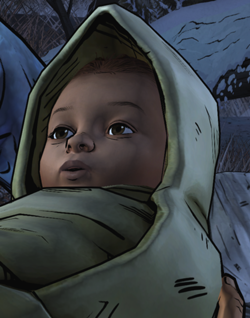
But, no. He gets killed at the end of the second chapter by the buddy of the guy who he shot on the bridge. Huh. I mean, okay. Fine. Weird pacing but obviously they had bigger plans for the season’s antagonist. This chapter also reintroduces Kenny, the short-tempered, ignorant, drunken redneck from season one who watched his whole family die. I took the option of hugging him when I met him only because I was hoping there would be a second option that allowed me to plunge my hatchet into his back while doing it. Much like season one, I spent the remainder of the game being as antagonistic towards Kenny as I could. Later, when one of the chicks you’re dragging around shits out of baby, Kenny takes a shine to it and talks about how much he’s going to protect it. At this point, I was cursing the game for not giving me more dialog options. I had been basically spending the last several hours trying to talk Kenny into suicide. If given the option, I would have needled him into kissing the end of his gun right there.

“So you’re going to protect this baby, huh? Well, that’ll be a change. Remember when I met you and you had a family? Where’s that family now, Kenny? Remember when you let your son get bit? Kenny? Do you remember that? Or then your wife shot herself? My sides still hurt over laughing at that. I mean, you totally drove her to it, Kenny. Kenny? Hey, do you think when she blew her brains out, she still had more brains in her head than you? Kenny? Hey Kenny, remember when you met that new wife, and then I showed up and cut her arm off? Kenny? Hey, Kenny, if you want, I can go back there and lend her a hand. Kenny? Come to think of it, that one was totally your fault too. Wow. What’s your body count, Kenny? Seven? Eight? Be honest Kenny, you’re just hoping someone will trade you a bottle of vodka for the baby, right Kenny? Did you drink a lot when you were ignoring your family before the outbreak, Kenny? Kennnnnnyyyyyyyy?”
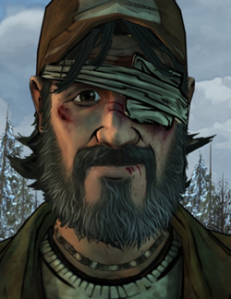
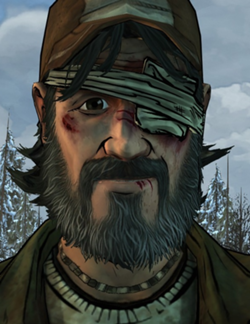
This is Kenny. His mental instability is the overall focus on the season. Maybe the other characters still had a moral compass and believed killing is wrong. Well guess what? I don't! So don't make me wait five fucking chapters to do what's right.

This is Kenny. His mental instability is the overall focus on the season. Maybe the other characters still had a moral compass and believed killing is wrong. Well guess what? I don’t! So don’t make me wait five fucking chapters to do what’s right.

Eh, not that it would have mattered. Kenny stubbornly hangs around until the end of the game. And in chapter three, you’re held prisoner by a new antagonist named Carver. He’s set up base in a hardware store and runs a tight ship. I actually liked him. I mean, he arbitrarily killed people too weak to survive, which is what I had been trying to do the entire fucking time. My kind of guy. One of the people in your group is a helpless little girl named Sarah. She had been kept in the dark about the whole zombie apocalypse thing, and it was clear once she got a glimpse of the real world, she was going to put the group in danger. So, even though my slate of trying to get people killed was full, I quickly penciled Sarah in for “be as hateful and vindictive as possible to her in an attempt to get her dead.” When we had work to do, I did her work for her, because she was too stupid/spoiled to know how to prune a tree. I was hoping Carver, who had already forced her father to viciously smack her across the face, would throw her off the building. Instead, he threw our supervisor, a Pakistani stereotype, off the roof and to his death instead. Well shit. I mean, don’t get me wrong. I was going to attempt to get him killed too. I was pretty much trying to get EVERYONE killed but myself. Well, except Carver. Yeah, the dude was an asshole, but at least he fucking got it. This is the apocalypse. You’re better off keeping the strong around. Not too long after that, I had a sit-down conversation with Carver where I told him exactly that. Except the game interpreted that as me just telling him what he wanted to hear. I wasn’t. I legitimately wanted to join him.
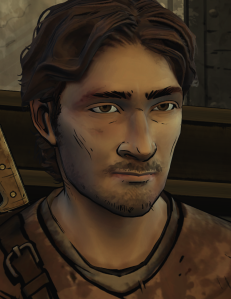
This is Luke. He's one of only two non-Pete characters that I was okay with not killing immediately. He also takes over for Lee in the human train-wreck department. Just looking at him causes his ribs to break. He somehow makes it to the final chapter, where he dies after falling through the ice of a frozen lake. Given that this is one of the only characters that had a proper build-up, his death was very anti-climatic, but hey, we had to have another reason for Kenny to beat up someone while the rest of the group pondered whether he was losing it.

This is Luke. He’s one of only two non-Pete characters that I was okay with not killing immediately. He also takes over for Lee in the human train-wreck department. Just looking at him causes his ribs to break. He somehow makes it to the final chapter, where he dies after falling through the ice of a frozen lake. Given that this is one of the only characters that had a proper build-up, his death was very anti-climatic, but hey, we had to have another reason for Kenny to beat up someone while the rest of the group pondered whether he was losing it.

Shortly thereafter, with my crew of morons having devised a plan to escape, I was asked if I was in on the plan. I was able to answer this in four possible ways. #1: yes. #2: yes. #3: say nothing, which is saying yes. #4: say “do I have a choice?” That’s the one I chose, and then I found out the answer was “no.” Holy shit, choosing your own path is FUN! I mean, there’s just so many options and so little time to choose between them that I had to pause the game and pinch myself. Seriously, Telltale, light switches have more options than you give players most of the time.

Anyway, I figure we’ll end up fucking up the hardware store, opening it to attack by the zombies, and Carver would end up stalking us for the rest of the game, picking our crew off one-by-one as we went along. But no, I ended up shooting him and then watching as Kenny caved his head in with a crowbar. Fucking seriously? Okay, fine. His itchy-triggered lieutenant named Troy is still alive and undoubtedly he’ll be the new antago.. nope, scratch that, he’s dead too. It was then I realized that Walking Dead: Season Two was the ultimate “instant gratification” game for a generation that wants instant gratification right now, or else. Nick was an annoying, dangerous little shit. He dies. Carver was a brute. He dies. Sarah was a terrified, annoying little brat. She dies. Though the way I played it, she died sooner than she did for most people. During a zombie attack on a trailer, I decided to leave her behind. I was shocked it actually worked, though I was a little disappointed that I was not given the option to kill her myself, then piss on her body.
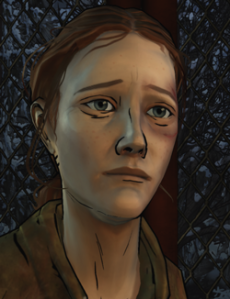
This is Bonnie. She's the only character from the 400 Days expansion that has a significant role in Season Two. All the other characters make very brief cameos, assuming you played the expasion the "right way." Really, what was the point of 400 Days again? I was under the impression that the characters and actions in 400 Days were have some kind of important impact on Season Two. They didn't. Not even Bonnie, really.

This is Bonnie. She’s the only character from the 400 Days expansion that has a significant role in Season Two. All the other characters make very brief cameos, assuming you played the expansion the “right way.” Really, what was the point of 400 Days again? I was under the impression that the characters and actions in 400 Days were have some kind of important impact on Season Two. They didn’t. Not even Bonnie, really.

The final two chapters are mostly spent talking about how unstable Kenny is. I had the exact fucking same conversation about it no less than a half-dozen times. “Do you think Kenny is cracking?” Um, yeah. Just look at him! He’s all wide-eyed, staring off into the void, lips quivering, fingers twitching, WHAT THE FUCK ELSE DO YOU PEOPLE NEED? For him to randomly just spout off “you know guys, I’ve been thinking about this for a while, and I’ve come to the conclusion that Hitler was right”? Meanwhile, the group keeps getting picked off. Pregnant chick Rebecca gives birth, then becomes a zombie. Again, I cursed the lack of dialog options. When people defended my decision to shoot her with “she had turned!” I wasn’t allowed to answer back “Wait, she did?”

Ultimately, it comes down to you, Kenny, the baby, and some chick that the game kept trying to make you feel some kind of sisterly bond with, but it was so badly handled that I never felt any true connection to her. Unlike season one, where the ultimate fate would either be Lee dies and stays dead or Lee dies and turns into a Walker, season two had multiple, completely different endings. In mine, I shot Kenny, paused the game to go masturbate for a while, then went back to listen to him have his heart-warming moment of redemption where he talked about how I had done the right thing. Oh fucking gag me with a garbage bag full of dog shit, what a crock. I did take solace in the fact that we just let him die without stabbing him in the head, so he’s now walking around as a mindless monster that will undoubtedly kill or wound every human he comes in contact with. In other words, no change. Clem, the baby, and the sister return to Carver’s hardware store, and the season ended with me telling another group of survivors to fuck off.
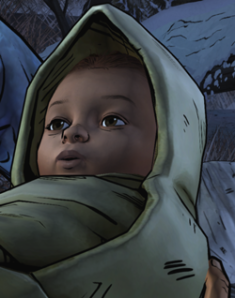
This is Alvin Jr, or A.J. for short. I only included him in this because my Godfather's name is A.J. and the "A" stands for Alvin. So I showed it to my A.J. and convinced him that I was so popular now that people were naming characters in games after my family. After seeing strangers recognize me as Indie Gamer Chick, he has no reason not to believe it. Well, unless he reads this. Yeah, sorry A.J.

This is Alvin Jr, or A.J. for short. I only included him in this because my Godfather’s name is A.J. and the “A” also stands for Alvin. So I showed it to my A.J. and convinced him that I was so popular now that people were naming characters in games after my family. After seeing strangers recognize me as Indie Gamer Chick, he has no reason not to believe it. Well, unless he reads this. Yeah, sorry A.J.

BUT, it could have also ended with both the sisterly figure and Kenny dying. OR, it could have ended with the girl dead and you and Kenny finding the mythical survivor stronghold called Wellington, where you can either leave his ass and take the baby with you, or you can continue along with the unstated suicide-pact everyone seems to have subconsciously entered into when the apocalypse began and leave with him. The vast differences all these endings offer almost certainly eliminates Clem’s chances of being the protagonist of season three. And that sucks, because she is literally the only character I liked. I even wanted to kill and eat the baby. I mean, it’s the fucking apocalypse. I’m guessing veal has been hard to come by as of late.

I liked Walking Dead: Season Two, but it’s such a deeply flawed game. And I’m not talking about the gameplay. I’ve given up all hope they’ll ever improve it. No, I’m talking about the story. It is a compelling story. That’s why I stuck it out through ten chapters and a still-useless DLC pack so far. But this idea that you have actual power over the course of the story? It’s an illusion. The writers have a very specific way they expect you to play the game. I understand that they can’t branch off the path too far, because it would make development too complicated. That’s fine. But give us a greater degree of control over how the player’s character feels about each person, and then trust our own judgment on it. Telltale wanted us to sympathize with Kenny. That’s why, after choosing to answer how I felt about Kenny with “he’s unstable. I’ve seen him like this before”, the game kept hitting me with the same question, sometimes from the same characters that originally asked me, over and over again. It’s because the writers envisioned this amazing moment of redemption. I didn’t, because I had determined that Kenny was beyond redemption. He was an unstable, psychopathic monster who endangered everyone around him. Any person in their right mind would have clipped him the moment they met him. But that wasn’t their plan. In the ending I got, Clem was tearful as Kenny said his goodbyes. Clem would NOT have been crying the way I played the game. I was as mean-spirited as possible towards him from start to finish. I always answered questions in ways that would piss him off. Yeah, the ending where you leave Kenny behind and take the baby into Wellington felt more authentic than any other bullshit chance of redemption you’re given, but it still lacked the brutal emotional weight that season one ended on.
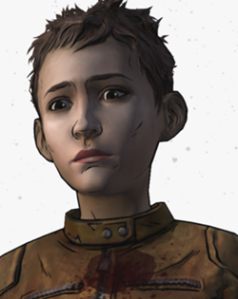
This is Jane. Her sister basically gave up on life and got eaten. Since then, Jane has been on her own. She was the other character I didn't immediately hate. In fact, I would have been perfectly fine with Clem getting killed and her becoming the main character of season three. That would have at least kept me interested. But, she actually dies in some of the endings, which renders that possibility impossible. Also, if Clem is the star of season three (which is also very unlikely at this point), that means Jane has to die early on in the first chapter. That sucks.

This is Jane. Her sister basically gave up on life and got eaten. Since then, Jane has been on her own. She was the other character I didn’t immediately hate. In fact, I would have been perfectly fine with Clem getting killed and her becoming the main character of season three. That would have at least kept me interested. But, she actually dies in some of the endings, which renders that possibility impossible. Also, if Clem is the star of season three (which is also very unlikely at this point), that means Jane has to die early on in the first chapter. That sucks.

And, the reason for that is the way I played didn’t line up with the writer’s grand vision for Kenny’s character arc. The ending I got essentially rendered my entire experience as nonsensical and irrelevant. What’s really annoying is the game kept trying to give me a chance to recant my statements. It did that when it asked if I regretted watching Kenny cave in Carver’s skull. I had to repeat that I didn’t multiple times in different chapters. The only logical reason why it would keep asking is if the choice I made wasn’t the choice Telltale wanted me to make. When people disagree with my reviews, I’m often told “you must have played the game wrong.” It’s condescending and insulting, but I get that a lot. It’s how snobs come to terms with the revelation that someone doesn’t like the things they like. But, in the case of Walking Dead, I really did seem to play the game wrong. Because the writers wanted me to feel one specific way about the characters. I didn’t, and thus the dialog at the end made no sense at all. Whatever. I still enjoyed the story, even if I had no real influence over it. I still enjoyed it even if Clem’s words and emotional state didn’t reflect the way I had played. Even when a decision had consequences, it still felt wrong because the story had no consideration for why I had made the decision in the first place, and thus Clem and I weren’t on the same page. Then again, if we had been on the same page, she would have been walking around with a necklace made out of ears and a taste for human flesh. You know, maybe I was the monster all along. Sorry, Kenny.
The Walking Dead LogoThe Walking Dead: Season Two was developed by Telltale Games
Point of Sale: PlayStation 3, Xbox Live Arcade, Steam
$19.99 just realized the Walking Dead actually refers to the survivors in the making of this review. Yeah, I’m quick.

IGC_ApprovedThe Walking Dead: Season Two is Chick-Approved, but is not leaderboard eligible.

Octodad: Dadliest Catch

I don’t mean to sound arrogant, but I think I’m the only writer out there that truly “gets” Octodad. A lot of people think it’s a quirky indie adventure game based around unworkable play control and a wacky hijinks story of an octopus trying to blend in undetected in a relatively normal society.

But it’s not.

No, my friends. Octodad is really about the grim realities of living with Parkinson’s disease.

Hear me out on this.

In Octodad, even the most mundane tasks are an exercise in frustration. Let’s say you want to, oh, open a door. In real life, you reach out and turn the door knob. It takes a second, if that. In Octodad, you have to slowly move your jittery tentacle into position, which can take a shocking amount of patience-trying effort. Then you have to click the door knob. Then you have to actually pass through the door without accidentally closing it again, or tying yourself in a knot around the hinges of the door. There were times where it took me several minutes to walk through the threshold of a passage. I wish I could say this only happened once. But it happened again and again. The whole time shaking like I had just slammed twenty pots of coffee.

I trash every wedding at a church I go to as well. Not because I have trouble moving though, just for the lulz.

I trash every wedding at a church I go to as well. Not because I have trouble moving though, just for the lulz.

Whimsical adventure game? No. A dark look into the demoralizing reality those unfortunate among us have to face on a daily basis.

And then there’s the family. The ones that never notice he’s an “octopus.” I’m sure they completely failed to realize that their father trashed the entire kitchen just trying to get a cup of coffee. Or tramples all the flowers trying to pull a couple of weeds out of a garden. Or utterly destroys an entire grocery store trying to grab a soda. No, this isn’t a family in denial. This is a family who doesn’t want Daddy to feel different. Because, if they get him down, it might destroy him emotionally. Not something you want to do when already he’s being destroyed physically.

No?

Okay, how about alcoholism?

Yea, I’ll just move on.

Not a single movement or action in Octodad isn’t a pain in the ass to pull off. Those watching me play on Indie Gamer Chick TV thought it was hilarious. Meanwhile, I went through so many different emotions that I’m sure I created a new, Octodad-based form of bipolar disorder. Sometimes I was swearing like a sailor, so angry that nobody in the room with me would have been surprised if my head suddenly exploded. Other times I came close to burying my head in my hands and crying over how utterly useless I was at moving around or interacting with anything. I’ve never been a fan of any game that’s challenge is based on how God-damn difficult it is to control, but Octodad takes that to a whole new level. Using both sticks, the triggers, and the X button to both walk and interact with objects never felt intuitive for me. Some people are better able to get the hang of it (hell, there are speed-runners that finish the whole fucking thing in twenty minutes, the freaks), but for me, it just always felt broken.

Speaking of broken, I heard from many fans of the game that the PS4 version is noted for being unstable. I noticed this a few times myself. In one section at an aquarium, you have to lead your daughter through a maze of jellyfish exhibits using only a lantern. Once you get past this, the girl is supposed to notice one of the scientists her father is scared of and ask for the lantern back, allowing you to walk up the stairs. Well, when I played, that part never happened. Even though we walked all across that area, she never hit the specific spot on the floor that promoted the next part of the story to continue. I walked around, trying to activate it, but it wouldn’t happen. My viewers who had completed the game were confused. I was angry. I restarted from my previous load and it failed to happen again. The second time had the added bonus of the daughter pinning my character up against the wall where I was unable to wiggle myself free. This did activate a prompt, though not one in the game. The prompt was in me, and it activated “lose my shit” mode. Controller thrown, console turned off, and Octodad could choke on its own suckers and die.

Actual screencap from the spot that glitched out on me. I had to turn off Octodad and turn it back on to get the girl to do what she was supposed to do. Most of my viewers insisted the PC version was nowhere near as frustrating as the PS4 version. But, I paid for the PS4 version, so that didn't really help me all that much. They really need to fix this port.
Actual screencap from the spot that glitched out on me. I had to turn off Octodad and turn it back on to get the girl to do what she was supposed to do. Most of my viewers insisted the PC version was nowhere near as frustrating as the PS4 version. But, I paid for the PS4 version, so that didn’t really help me all that much. They really need to fix this port.

When stuff like this wasn’t happening, it wasn’t rare for me to somehow get an arm tied up in an object, or get stuck between two objects, or wrapped around something and unable to untangle myself. By default, the game sets you to be transparent. I found this to be hugely unsatisfactory. It made figuring out the position of your arms difficult to determine. Without transparency, you’ll have your character obscure the view (especially since the controls necessitate the game being based on fixed-camera angles) and struggle to see stuff you’re reaching for. There’s just no comfortable way to play it, but I feel transparency is the harder way to go. The main “challenge” is actually supposed to be going about the day without making anyone suspect you’re really an octopus in disguise. A lot of this involves not causing any property damage (ha) or doing stealthy stuff (HA!).  I usually play whatever indie I’m reviewing on whatever the default difficulty is, but I gave up on that shit here and set it to easy mode, which disables the ability to get caught. Shameful? Unquestionably. But, as my neighbors who have seen me skinny dipping in my pool will attest to, I have NO shame.

BUT, I did want to see how it ended. I’ll admit, I liked the story and the characters. Especially Octodad. He clearly loves his new wife and children and wants to be a good father. Well, except when I play as him. I tried to murder my family with an axe during the tutorial, but it wouldn’t let me. Anyway, it’s a strange juxtaposition, as the octopus is posing as a human, but he’s also very sincere and sympathetic. I actually think they missed out on having more dramatic, heartfelt moments. The daddy is very expressive and able to jerk a few tears out of you when need be, but Dadliest’s Catch is primarily focused on humor. It does humor very well, and there are multiple laugh-out loud moments. I wish I could say the torturous gameplay was worth playing to see it all, but it’s not. Not even close.

Ironically, this is also what my room looked like after an hour with Octodad.

Ironically, this is also what my room looked like after an hour with Octodad.

Viewers will note that I had to have someone else play a flashback sequence on a ship. Unfortunately, I had a seizure while playing Octodad, which was my fault, and not the fault of developers Young Horses. As someone who lives with epilepsy, I always assume a risk when I play games, and sometimes that risk becomes reality. But it’s a good thing I did. A golfing buddy of mine named Jerrod volunteered to finish the section for me. After handing me back the controller, he said “you’ve really spent a couple of hours with this? Wow,  you’re way more patient than anyone gives you credit for.” I’m not really. There were multiple times where I almost quit. And despite getting a few belly laughs from the dialog or the background humor, I never once, even for a split second, enjoyed any aspect of actually playing Octodad: The Dadliest Catch. It is a game, after all. I can get humor from any source, including other games. I play games to enjoy an interactive experience. Octodad fights the concept of enjoyment every step of the way. I’m pretty surprised that it’s as popular as it is. Well, not really I suppose. It’s an indie game with an absurd concept, self-depreciating humor, funded through Kickstarter, and anyone who complains about the controls is just being a crybaby. It was practically preordained to get glowing reviews before it even released. I tip my hat to the developer for actually making me tear up a bit for the big family hug at the end. But this was one of my least favorite experiences playing a game in 2014. Octodad has one big heart but no legs to stand on. Which is ironic because it really should have three hearts and eight legs to stand on.

Octodad logoOctodad: The Dadliest Catch was developed by Young Horses

$14.99 tried to auto-correct “tentacles” when I misspelled it to “testicles” in the making of this review. I hope like hell that doesn’t give them an idea for the sequel.