Scribendus

Did you know that when they tested the first atomic bomb, those involved took bets on what they thought might happen?  Mostly it was about the amount of kilotons the explosion would be, but there were also side bets such as whether or not it would kill all present, cause the fault line to collapse, knock the Earth off its axis, or blow up the entire planet.  I’m not sure how the winner would have collected if the last option had won out, but it’s true and well documented, and only some of those bets were tongue-in-cheek.  Smart guys who, truth be told, had no fucking clue what would happen.  With some experiments, you can’t know until you push the button.

screen4

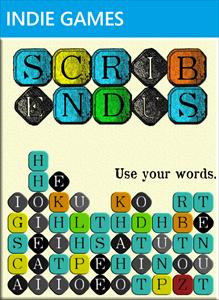
Scribendus attempts to combine Scrabble and Tetris.  I’m sure this has been attempted before (someone steered me in the direction of a Tetris-craze era title called Wordtris) but I’ve never played one.  It’s a concept that seems like it should work, but in this case, it doesn’t.  The idea is two letters at a time drop from the ceiling and you have to stack them in a way that forms a word.  You can build a word (minimum four letters) diagonally, horizontally, or vertically.   The problem of course, is being given two random letters at a time doesn’t leave you a whole lot of room for strategy or versatility.  I consider myself pretty dang good at word games, but I couldn’t make Scribendus work for me.  The only strategy that seemed to work was trying to build one decent sized (six letter or so) word across the bottom and stacking all other blocks on the side, but even this didn’t work.  I got my best score by completely ignoring the letters all together and just stacking the blocks randomly, spacing the vowels apart from each other.  Using this technique, I scored big points and multiple combos.  And I don’t even know what words I made.

I can’t really slam Scribendus too much.  It looks good, sounds good, and controls good.  It feels to me like a worthy experiment that failed.  That will happen in the land of indies.  While my enthusiastic fans might want to me to shred every game that isn’t good, now might be a good time to remind readers that it’s okay to try something new and not have it succeed.  Sometimes you can’t know if something will work until you create it and market it.  Look at Lexiv, the Scrabble-meets-Sim City game.  That could have just as well been a disaster too.  I admire creator Dave Turka for giving it a try.  His particular Manhattan Project simply failed to detonate, and now he become derp, destroyer of words.

xboxboxartScribendus was developed by Pygmalion’s Box

80 Microsoft Points noted that a man named Isidor Isaac Rabi won the Trinity test betting pool with a guess of 18 kilotons (actual explosion was 18.6 kilotons) in the making of this review.  His opponents overbid, allowing him to take both showcases. 


Platformer from Hell and Little Acorns Deluxe

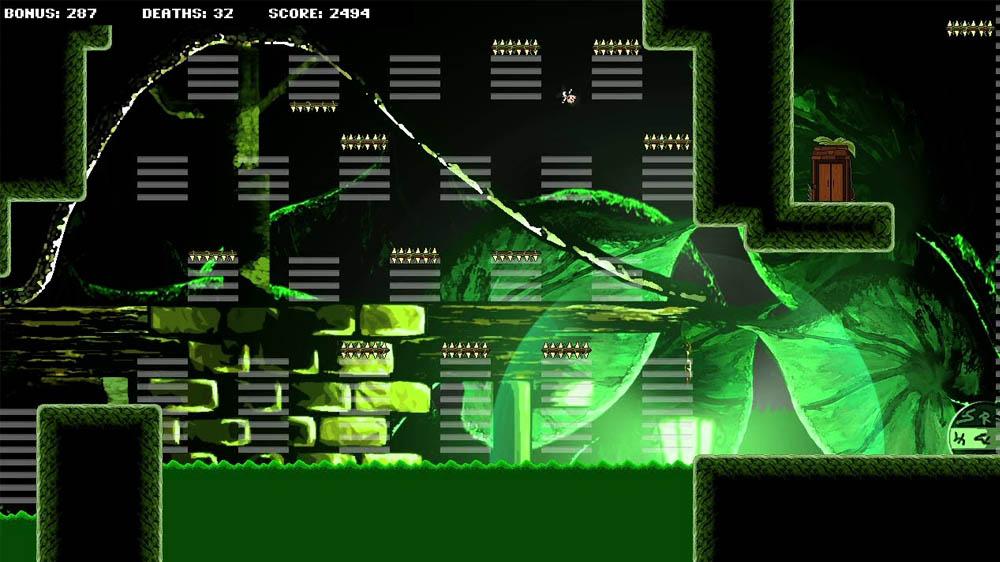
Platformer from Hell comes from Hoosier Games, a group of academics from Indiana.  I know, I know.  Academics?  In Indiana?  I went “Hah!” too, but upon further research, they do have institutes of higher learning there.  I’m not sure what is considered higher learning in Indiana.  “Cow Tipping 101” or “Why you can’t pork your sister” I would imagine are on the agenda.  I’m kidding of course.  Actually, I’m quite friendly with project manager Derrick Fuchs (I hope that’s pronounced the way I think it is) and I ranked their previous effort, Warp Shooter, on the Indie Gamer Chick Leaderboard.  It was flawed but functional and fun.  I applauded their efforts and looked forward to their next game.  Which is here.  And it sucks.  A lot.

Where's Waldo? causes less squinting.

Where’s Waldo? causes less squinting.

It’s a punisher, of course.  But it’s one of those tedious, excruciating punishers where dying and restarting levels is more of a chore than an acceptable part of the gameplay.  This is partially because levels are overly large and pathways to victory are sprawling, convoluted nightmares.  A good punisher, if there is such a thing (there is) should be fast paced and frequent deaths need to be handled in a way that doesn’t make them feel like a chore.  Well, Platformer from Hell feels like a chore, with me cast in the role of Cinderella and bad jumping physics and boring level design co-starring as the wicked step-sisters.

And then there’s the graphics.  The characters and some of the traps in Platformer from Hell are practically microscopic.  I have a TV large enough to double as King Kong’s monocle, and yet the star of the game is a teeny-tiny little spec of pixels that vaguely resembles a person.  Although this does allow you to see more of the stage and plan out which routes you’ll take faster, the drawback is you’ll suffer eye-strain and end up needing a monocle yourself.  Another problem with the graphics is sometimes the background is overly bloomy and it drowns out the ability to properly see the hazards, especially spikes.  Ultimately, it’s a game that’s intent is to frustrate and anger players, not entertain.  Derrick noted to me that any faults with the game are his fault, not his team of students.  Duly noted.  That’s why I’m teaching the next lesson, which will be “how to tar and feather a fellow human being.”  Alright guys, we’ll need 5 old feather pillows and some tar, or honey if no tar can be found.  Trust me, this will be fun.

Actually, a better lesson could probably be learned from Little Acorns Deluxe by Team Pesky.  It’s a platformer that does ramp up in challenge, but in a natural way that gives players room to grow instead of throwing them straight into the deep end on their first day of swimming lessons.  Here you play as the patriarch of a family of chipmunks.  No, not Dave Seville.  An actual chipmunk, who must go through stages collecting acorns for winter stock-up.  At first, Little Acorns might seem a tad bit on the easy side.  Enemies don’t really kill you.  They just turn you green and slow you down.  The only way to die is to drown in water, but that doesn’t show up too often.  The real challenge is the time limit in each stage, but it’s fairly generous.  As you go along, you’re given new abilities like a rope to swing on special platforms or crash through bricks with.  It’s alright.  I guess.

It’s never really too difficult.  I never had to repeat a stage more than once.  Part of that is Little Acorns got its start as a Windows Phone game.  You can’t really ramp up difficulty too much in a phone game, where players have to spend the majority of the time fighting the crappy digital-controls.  With a proper controller, the game plays relatively smoothly.  I found the rope physics to be somewhat goofy, but not a deal breaker.

screen3

Why I’m having a hard time getting excited is Little Acorns is a little on the dull side.  Whether you’re gathering acorns or rounding up your children, the game never really feels original or engaging.  There’s no real original hook to sink you into the experience, and no storyline or big twists in the gameplay to keep you going once you’ve started.  Not that games need such devices, but they go a long way on the indie scene.  Little Acorns is not outstanding on the grounds that it does not stand out.  It is a decent, solid game that will give you four to six hours of platforming that you’ll be satisfied with once it’s over and forget all about in a day or two.  The reason I reviewed it here is because the contrast between it and Platformer from Hell couldn’t be more jarring.  One game gathers up all the nuts and isolates them in a cold, hollow place.  The other is a game about chipmunks.

xboxboxart1IGC_ApprovedPlatformer from Hell was developed by Hoosier Games

Little Acorns Deluxe was developed by Team Pesky

80 Microsoft Points each can’t tell their squirrels from their chipmunks in the making of this review.

Little Acorns Deluxe is Chick Approved and ranked on the Indie Gamer Chick LeaderboardIf I was a rodent, I would be a Chickmunk. 

Gameplay footage courtesy of Aaron the Splazer.

Jumping the Kickstarter-Gun

Chick SpeaksKickstarter is not venture capital.  It’s not angel investing.  Pledgers are not looking for a monetary return on their investment.  I do understand this.  And yet, I’m still not a supporter of Kickstarter, because I think it sends the wrong message to potential developers: money is easy to come by.  I believe it’s irresponsible to teach young entrepreneurs that money should be given to them based on a concept and raw enthusiasm.  Funding should only be given on the grounds of actual ability, a proven track record of completed, competent projects, and the willingness to personally sacrifice for the benefit of your project.  It’s shocking to me how people fund games from people who meet none of that criteria.  I’m even more shocked when a developer reaches their Kickstarter goal, gets the money, and within weeks has another ask posted for even more funding.. and gets it.

I’ve already offered advice to would-be developers who wish to use Kickstarter to fund their projects.  I’m not against the idea of start-up developers seeking funding, and I have no problem with an established developer (indie or otherwise) using Kickstarter.  But I’ve also made it pretty clear that my blog doesn’t exist to plug Kickstarters.  In April of last year, shortly after Double Fine’s then record-breaking Kickstarter got huge publicity, I received over fifty requests to pledge and plug the Kickstarters from developers of all skills and backgrounds.  It got to the point where I added “Kickstarter” to my spam filter.  It doesn’t always work.  Last week, someone with no history in game design at all who read my blog sent me a request asking me to look at their concept art.  They beat my spam filter by spelling Kickstarter “I < ickstarter.”  The ask was in the five-figure range.  Grotesquely appalling to say the least.

I do not want to discourage dreamers from attempting to create their own games.  Far from it.  I encourage everyone who’s ever considered making a game of their own to give it a shot.  But there’s many options to make your games without spending thousands of dollars of other people’s money to do so.  Xbox Live Indie Games, for example.  For $100, give or take, you not only get the tools needed to develop a game, but you’re guaranteed to have your game be available commercially on the Xbox Live Marketplace.  Well not 100% guaranteed.  There are rules against games with sexual, racist, drug, or Nazi themes to them.  So if your dream game was “Smoke a Blunt with that Homo Kraut Hitler” you’re shit out of luck.

More importantly: if you decide game development isn’t for you, or if you run out of time to do it, or any of the hundreds of things that could possibly go wrong, you’re only out $100 and nobody else is out anything.  I went back to look and see what progress has been made on some of those fifty Kickstarters I got requests for back in April.  Of the seven I checked that got their funding (amounts between $600 and $3,500), exactly zero actually put the games out.  Three of the seven blogs haven’t updated in months, and one other no longer has a website.  One of the developers that hasn’t updated in months also had a second Kickstarter that didn’t meet its goal.  I’m not saying those projects will never come out, but I wouldn’t bet on it.  Sadly, many people did bet on it.
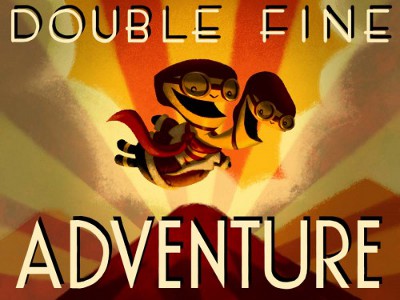
The game that started the Kickstarter plague. I'm actually excited to play it, even if my spam inbox is quite bloated from it.  I legitmately have more Kickstarter pitches in it currently than offers for boner pills or Nigerian princes.

The game that started the Kickstarter plague. I’m actually excited to play it, even if my spam inbox is quite bloated from it. I legitimately have more Kickstarter pitches in it currently than offers for boner pills or Nigerian princes.

Besides the things I noted in my previous Kickstarter piece, there are lots of things that people do wrong.  It’s stuff you also see in legitimate investing too.  Like promising stuff you can’t really promise.  I’ve taken pitches from software developers who believe if they receive funding, they will get a contract from a company to adapt their software.  As if the mere presence of a backer will push them through regardless of the quality of the final product.  The old “it’s about who you know” adage that isn’t as true as most people believe.  Obviously things don’t work that way.  If it were true, there would be no room for start-ups in this world.  For start-ups, it’s almost always about the talent on display and the quality of the product.

The Kickstarter version of that is games from start-ups who say they are aiming for, or outright guarantee, a release on platforms like Xbox Live Arcade, PlayStation Network, or Steam.  All those platforms are pretty exclusive and extremely difficult to get listings on.  A pitcher can no more promise that than a theologian can claim to prove the existence of God.  It’s okay to aim high, but be realistic about it.  Your chances of getting listed on a platform like XBLA is slim to none.

Another common problem is having a pitcher use their attempt at receiving funding to prove if there’s interest in a product.  The idea being that if someone is willing to invest money in something, obviously it’s a good idea and will catch on, sell well, and make all involved wealthy.  On the flip side, if nobody bites, obviously there’s not interest in it and it’s not something worth doing.  For some businesses, this is actually valid.  Some.  Not all.  For gaming, I don’t believe it is, and here’s why: not every concept sounds like a winner on paper.  I would think a game like Shadow of the Colossus would be a tough sell on most consumers, at least on the drawing board stage.  On the other hand, a game like NeverDead sounds fun and quirky on paper, looks good from screenshots, and seems downright fun when you watch the trailer for it.  The game itself was an unplayable piece of shit.  If I had taken a pitch for Shadow of the Colossus, I would have passed.  An experimental game formula, from a developer with a history of production delays and heavy employment turnover, whose only previous title underperformed in sales?  It would have been an easy pass.

A large-scale developer, like Double Fine, can legitimately use Kickstarter to find out if there’s interest a game.  They did, there was, and they’re making it.  But a small-time indie developer?  If I heard from one of them that they were only interested in making a game if people pledged money, I would assume they don’t have the type of passion I require to invest in someone.  Indies should make the games they want to play, not the games others want to play.  As much as I bust on punishers (as I will in my next review), if that’s where someone’s passion lies, that is what they should be developing.  Period.  End of story.

Here’s a question that is almost never asked, but it really ought to be: “have you ever had this much money?”  It’s a question that can appear to be condescending or invasive, but it’s actually a very important question to ask to anyone seeking any form of investment.  Does this person have the ability to manage money wisely?  Money spends quickly.  Typically it’s a lot quicker than anyone asking for funding realizes.  When a person receives the payment, it feels so large at first, like it will never run out.  Before you know it, it’s gone, and you haven’t accomplished any of the goals the money was obtained for.  Given the amount of developers who post additional asks, it shows that a lot of them aren’t good with money.

In my previous Kickstarter piece, I said that pitchers should get price quotes and state exactly what the money is being spent on.  Believe it or not, this point was the most contested of the entire feature.  But the reason I included it is because not having those quotes can come back to bite you in the ass.  Let’s say you ask for $10,000, with 25% of that being put towards hiring an artist.  You get a rough quote from the artist before the Kickstarter for $2,500, so you think you’re set.  But once you have the money and you sit down to hire them, they find out the project requires much more time, and thus their fee goes up.  You shop around and find similar prices from other talented artists.  Now you’re forced into either paying a talented artist more, or hiring an inferior artist, which goes against the principle of the pitch you used to get the funding in the first place.  Most start-ups are horrified to discover how little they get for what seems like an extravagant amount of money.  Small-time game developers are no different.
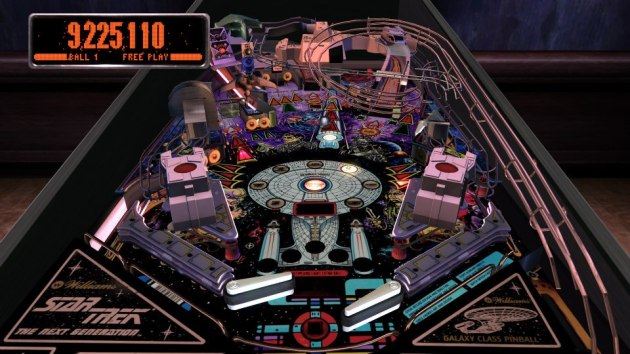
Star Trek

This is a great example of using Kickstarter right. The guys behind The Pinball Arcade asked for exactly what they needed to acquire the license for Twilight Zone and Star Trek: The Next Generation. The rewards they offered were good rewards. Most importantly, they had a track record of making very good conversions of classic pinball machines. Follow their lead.

If you’ve never made a game before, don’t use Kickstarter.  Visualizing a game, drawing concept art, and planning it out are the easy parts.  Once you receive funding, you actually have to make the game.  It’s a slow, tedious process that is anything but smooth.  Even if you have artistic gifts, making a game that looks good is complex.  Making the game play well is even tougher.  Assuming you don’t just want to rush the game out, having a game that is playable and fun requires fine tuning, concessions on your vision, and many hours of frustration.  Almost any independent developer will tell you that their final products never come out exactly how they planned.  Sometimes for better, sometimes for worse.  Others get so discouraged by the whole process that they quit.  Why do you think so many people start games that they never finish.  I promise you one thing: for most, it’s not because they run out of money.

Finish a project.  Finish multiple projects.  Learn to compromise.  Learn to take feedback.  More importantly, find out what you are capable of doing as a developer.  Find your strengths and your weaknesses.  And finally, be ready to admit if you don’t have the level of talent that someone asking for donations from strangers should have.  Not everyone has the talent to make a good game.  No amount of money will change that.  You either have talent or you don’t, and this isn’t one of those deals where you can inject talent to get ahead.

And for God’s sake, don’t open a Kickstarter with the intent of using it to quit your job to develop games.  People who have never attempted to make a game do this.  There’s no nice way of saying it: if you try that, you are a jumbo-sized stupid fucking moron.  It would be like someone who has never picked up a golf club deciding to leave their job to join the PGA tour.  You wouldn’t give them money.  You would call for the nice guys with the straight jackets to come take him to the, ahem, country club.

Storage Warfare

I had never seen Storage Wars on A&E before I picked up Storage Warfare on XBLIG yesterday.  I got it because the concept seemed weird and different.  When I tweeted that this was the next game up for review, I had a few people ask questions like “is there an annoying guy who screams “YEAAAAAH” when he bids?”  Mostly people just bitched about how this was obviously a lazy attempt to capitalize on a semi-popular, semi-obscure cable-based reality television show.  Obviously schlock like Storage Warfare will usher in the fall of gaming as we know it, rendering all previous games obsolete, and burying your Zeldas, Metal Gears, and Skyrims under a mountain of games based on Dog the Bounty Hunter or Honey Boo Boo.

I guess that means the guys behind Storage Warfare must be especially diabolical, seeing how it’s been on iPhone and Android long before it’s XBLIG release yesterday.  Not content to toil in obscurity on iPhone, they had to port to XBLIG, where their title is certain to sell at least 73 copies.  Greedy bastards.

screen2

Who in their right mind would keep a safe with stacks of cash in a storage locker? Wouldn’t that cash have been put to better use by, I dunno, using the cash to pay off the debt to the facility so that they didn’t auction off your shit?

In all seriousness, who gives a shit what the game is based on?  Is it fun should be the big question, which oddly enough, only one person out of twenty asked.  Everyone else moaned in disappointment like they just got done having fellatio performed on them by a dust buster with a broken motor.  Shouldn’t the “is it fun?” question trump all?  I’m open to a game based on pretty much any TV show, as long as it’s fun.  Dead serious.  It could be a game based on PBS’s Charlie Rose Show and I would slap my seal of approval on it if I had fun playing it.  So is Storage Warfare fun?  Kinda.

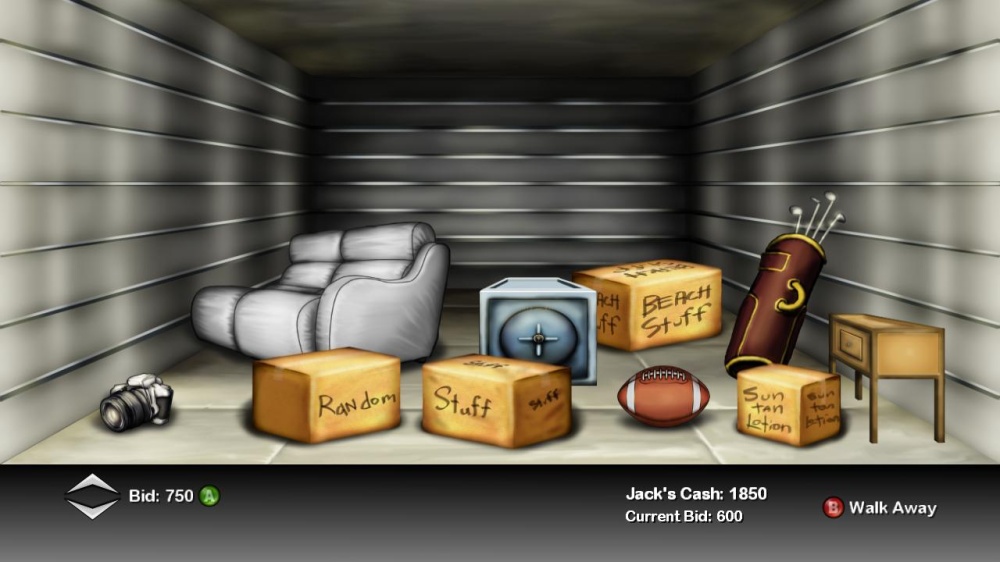
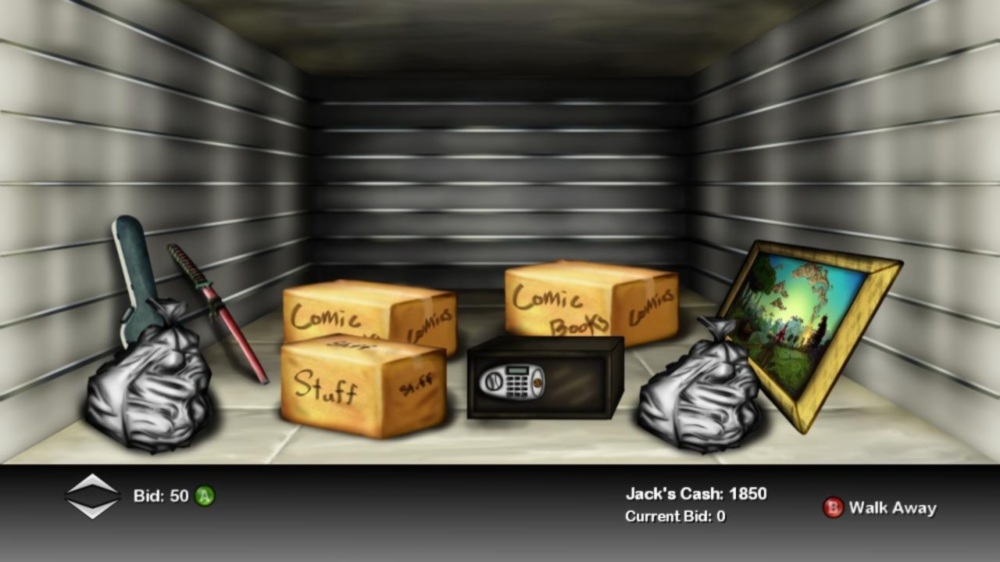
The concept is you have one year to make as great a profit as possible by bidding on storage lockers.  You start with $1,500 in seed money.  Every month, there’s three auctions, each with three lockers to bid on, and each has a different level of wealth associated with it.  The first auction every month is a skid row style storage unit, the second is the middle class one, and the third is the ritzy one.  You don’t actually get to inspect the items beforehand.  Instead, you see a graphical representation of what is found in each unit.  You bid on the whole locker, not individual items.  If you win, you get to see what you’ve won, and it tallies whether you turned a profit or lost money.  After you’ve completed one full year (36 auctions, 108 total lockers to bid on) the amount of money you have left is ranked on a local-only leaderboard.  That’s the whole game.

I like the idea and I had fun here, but the concept certainly doesn’t go as far as it should.  Among other problems, there’s not a huge variety in items.  Barely halfway through the “year” and I had seen off all but two or three items on the checklist.  Of course, the phone version has had a couple stand-alone expansions, which I’m sure will make their way to XBLIG sooner or later.  A bigger problem is how much luck factors into things.  I tried to play the game smart and cool, passing on some auctions that I felt were getting bid-up by the AI too much.  I finished the year with a profit of about $20,000.  And then I fetched my dear mommy, a fan of the source material, to let her have a go at it.  Unlike me, she bid on EVERY SINGLE LOCKER.  And she won.  She beat me by about $5,000, even though she employed nothing remotely resembling strategy or skill.  I hate that bitch.

It kind of turns Storage Warfare into a video scratch-off ticket.  No skill needed, success is totally based on chance.  The best strategy seems to be figuring out what the average bid the AI opponents will top out at and trying to hit just under that mark on your first bid.  But even then, you’re at the mercy of dumb luck.  Plus, the gameplay is shallow and the replay value is too limited.  Not to mention they missed out on an obvious local-only multiplayer mode where friends and family bid against each-other.  Even my Mom questioned why they didn’t include that.  It’s such a no-brainer that someone without a brain couldn’t understand why such a mode is not included.

I guess comic/guitar/

I guess comic/guitar/samurai sword/Rembrandt collectors have trouble paying their bills.

For all those reasons, I should have probably hated Storage Warfare.  But I didn’t.  It takes about a half-hour or so to run through an entire year and I had fun with it.  Once it was done, I wouldn’t want to play it again, but I don’t feel I wasted my dollar.  What’s here is limited, but undeniable enjoyable.  They probably could go a lot further.  My mother noted that the show (which has an official game on Facebook) is more about conflicts and possibly artificial drama than the actual auctions, none of which is really present here.  Maybe they could make a deeper, character-driven RPG-like experience, but they didn’t.  Storage Warfare is the perfect poster-child for casual gaming: a shallow, stupid time sink that you’ll ultimately ask others to join you with, like some kind of cult indoctrination.

xboxboxartStorage Warfare was developed by 24KT Studios

IGC_Approved80 Microsoft Points noted that a Charlie Rose game could be okay if they did it L.A. Noire style in the making of this review. 

Storage Warfare is Chick Approved and ranked on the Indie Gamer Chick Leaderboard.  YEEEEEEEEEEEEEEEEEEP!

Life of Pixel

Update: Life of Pixel received a Second Chance with the Chick and is now Chick ApprovedClick here for the updated review

Indie gaming fans keep asking me to look outside of Xbox Live Indie Games for material to do my reviews on.  However, my loyalty remains with XBLIG, so I only hit up other platforms when I’m suffering from complete and total burnout of XBLIG due to the endless mountain of shit that populates the platform.  That’s the only time I look elsewhere.

So um..

Let’s see what’s on PlayStation Mobile this week, shall we?  What have we here?  A Super Meat Boy-esq punisher with the hook being you’re a pixel who journeys through gaming history?  Interesting.  Of course, I’ve already played a game where you journey through game history, and if that one had been any bigger a disaster they would have to scrub the Titanic from history books just to make room for it.  However, as a concept, a stroll through gaming history is not only sound, but enticing.  That’s why I chose to pick up Life of Pixel, even though it’s one of those godforsaken punishers.

Life of Pixel

Looks Atarishi, I guess.

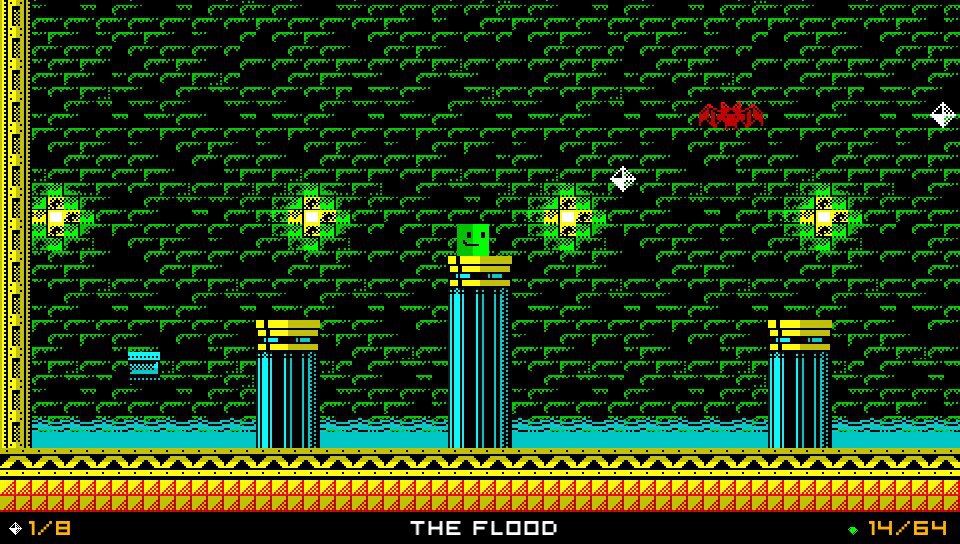
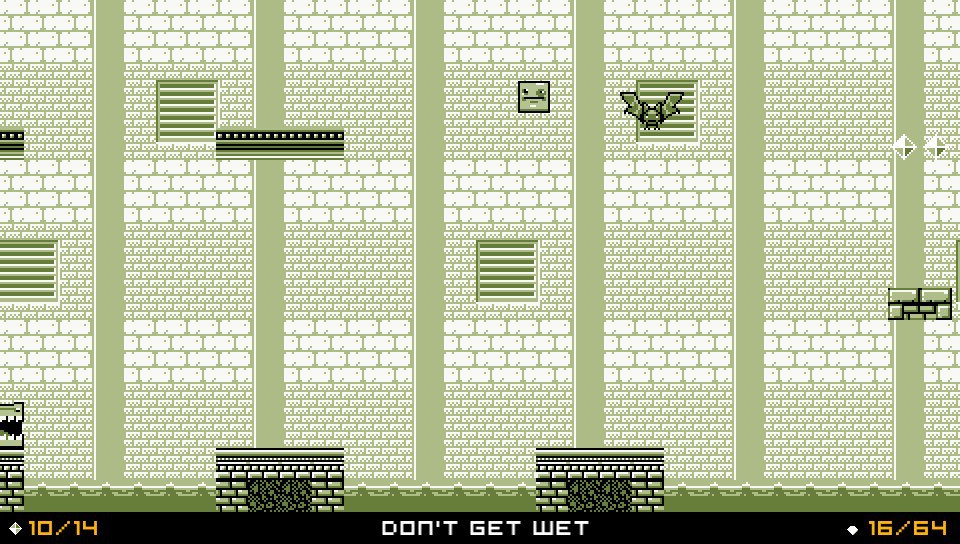
I want to start by saying that artistically, Life of Pixel is mostly a triumph.  The eight worlds presented authentically capture the look of each era they pay tribute to.  I’m guessing at least.  Some of the platforms covered are vintage UK-only PCs such as the Spectrum or the 2X81, along with such American relics as the Commodore 64.  As an American born in 1989, I have never touched those platforms, nor do I plan on it.  But, comparing screenshots to games from those devices, they look spot-on.  However, no effort at all was made for the games to sound like their respective platforms.  There’s a single awful chip-tune that plays no matter which era you’re in, and all stages make the same bleeps and bloops.  Why go so far to look authentic but not sound authentic?  It makes no sense at all.  It would be like having the most accurate-looking Elvis impersonator on the planet performing hip-hop.

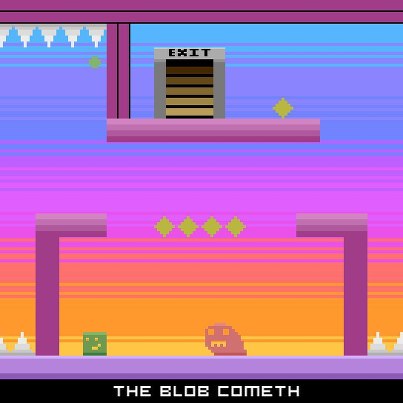
Where the game falls apart completely is level design.  There is cheap design, and then there is Life of Pixel.  Every bad possible design choice is given center-stage here.  Leap of faith platforming, blind jumps, no checkpoints in slow-paced large levels, erratic enemy movement, and an overall sense that the game really wants you to not have a good time playing it.  It ultimately comes across like a poor Super Meat Boy clone.  The main character even looks like Super Meat Boy.  But this is yet another case of a developer not grasping why that game was so popular.  Nothing in Super Meat Boy was unfair.  It required little to no guess-work from the player.  And dying wasn’t so bad because levels were fast paced and respawning was quick.  Plus, death was sort of rewarded by the fact that you got to see a replay of all your failures play out simultaneously at the end of each stage.  The only reward in Life of Pixel is seeing a new graphics style when you open a new world.  A novelty that wears off on average in about 11.3 seconds each time you get a new world.

Actually, this looks slightly different from the Spectrum ports I've seen on XBLIG, so I'm not sure how close this is to the real thing.

Actually, this looks slightly different from the Spectrum ports I’ve seen on XBLIG, so I’m not sure how close this is to the real thing.

I can’t even complain about the controls really.  They’re mostly accurate, and offer non-slippery controls and decent jumping physics.  100% of Life of Pixel’s problems are level-design related.  The game is cheaper than a dime store whore and seems to revel in that fact.  There are one or two other design flaws.  Early stages are single-screen affairs, and during these the game is quite fun.  But once you get to the Spectrum era, the game does that thing where you have to walk to the edge of the screen to scroll the level over, and it scrolls a full screen at a time.  The game doesn’t pause while it does that scroll thing, and so if you have to jump to a platform, it’s a forced blind jump that often will result in your death.  It’s something that is horrible and cheap for the sake of being horrible and cheap.  Later stages avoid the “scroll a full screen at a time” design in favor of smoother scrolling, but the level design never strays away from “be as cheap as possible.”

There’s also spikes that retract into the walls only to pop out again.  These are weird because you can walk over them as long as they are like 75% buried in the ground.  It makes getting the timing down of when you can make a run for it nearly impossible.  I’m not sure why they didn’t just have the spikes retract and pop up faster than they did, except again, because it’s aggravation just for the sake of being aggravating.  Finally, sometimes dying is a slow process.  In the best punishers, death and respawning happen quickly.  Here, if you land in water (or quicksand), you slowly sink down and have to wait for your character to reach the bottom, linger for a bit, and then blink out of existence.  It’s absolutely amazing that a game that so clearly wants to be Super Meat Boy could end up getting wrong every single thing that made Super Meat Boy the beloved cult hit that it is.  Bad level design, lack of rewarding gameplay, blind jumps, slow deaths, and boring, sprawling levels.

Don't worry. Nothing about Life of Pixel gets me wet.

Don’t worry. Nothing about Life of Pixel gets me wet.

Yea, maybe trial-and-error platforming was a big deal thirty years ago, but we’re in 2013 now.  100% authenticity was obviously not a priority for Life of Pixel, as evidenced by the half-assed sound, so why make the game so cheaply frustrating?  I’m so pissed off because these guys obviously had talent.  There’s no way they could make a game that looks this good and controls this acceptably just by sheer fucking luck.  So what happened guys?  Why did you choose to make your game so unfair and unlikable that it’s almost certain to never catch on by word of mouth?  The amount of potential squandered here makes me want to cry.  And by the way, my friends are disappointed that there’s no Life of Pi reference here, but I disagree, because this game proves there is no God.

logoLife of Pixel was developed by Super Icon Ltd

$1.99 searched for a Life of Pixel trailer on YouTube and instead found a video series about a little girl named Pixel in the making of this review.  Who the hell would name their daughter Pixel?  I look forward to meeting her siblings, Polygon and Bit-Mapping. 

In all seriousness, I couldn’t find any gameplay footage of this on YouTube.  If someone finds some, give me a heads up.

Genix

Damnit.  Damnit damnit damnit damnit damnit!!

sad-puppy

How did this happen?  Early on in my play through of Genix, I felt I was playing a pretty good game.  I tweeted that it was “fucking awesome.”  I joked about having a “chick-boner” over it.  I probably should have put more than an hour into it.  What started as a fun neo-retro space jaunt ends up turning into a tedious, sprawling mess riddled with unfairness and frustration.  It’s one of the most disastrous turns I’ve seen an XBLIG make.

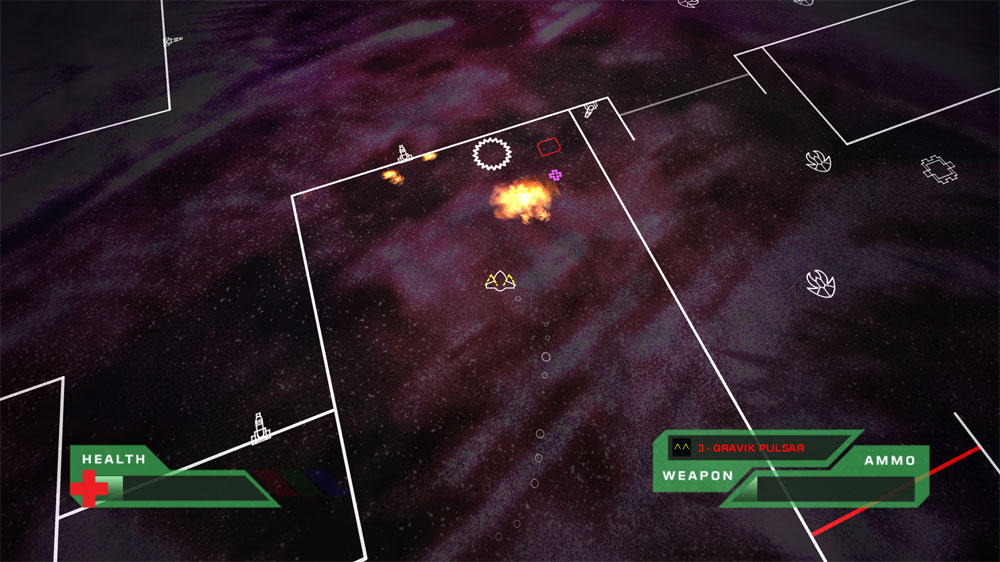
Genix’s hook is centered around its unique presentation.  The free-floating line graphics over a static background gives the game a holographic look similar to “floating image” games of the 70s and 80s like Sea Wolf, or especially Asteroids Deluxe.  This effect is also known as the “Pepper’s Ghost” and is used to create the special effects in the Haunted Mansion ride at Disneyland.  While playing this, my boyfriend commented that Genix, more than any other XBLIG covered at Indie Gamer Chick, belongs in an arcade.  Imagine a cocktail cabinet hosting Genix, using the Pepper’s Ghost effect.  It would be spectacular to look at.  Hell, it’s pretty damn nice to look at now on a television.  Even better was the amount of restraint shown by the developers to never allow the graphics to get in the way of gameplay, which is such a common mistake on games this stylistic.  It’s too bad this restraint didn’t extend to level design.  It’s like an alcoholic who triples his cigarette intake to quit drinking.

Screen shots don't do Genix justice.

Screen shots don’t do Genix justice.

Genix is all about navigating labyrinthine stages, looking for keys and doors to mate with the keys, shooting enemy ships and searching for an exit.  It’s certainly a different concept on the space shooter genre.  It’s probably been done before, but being a whippersnapper, this was new to me.  And at first, I enjoyed it.  Levels were well-organized, the mazes were clever, and the combat was.. well, that was always a bit tedious, but never annoyingly so.  The problem with the shooting is the enemies are pretty dang spongy.  Getting past early enemies isn’t so much a challenge as it is a device for killing the game’s pace.  The spongy enemies also combine with limited ammo to create a sort of puzzle effect on the game.  Although totally optional, Genix keeps track of how many enemies you take out in each stage.  It seems to give you just enough bullets in each stage to defeat every enemy.  This could have been a clever device to extend the game’s shelf-life, but the problem is it’s just not implemented in a fun way.  Enemies take so many bullets and firing them is so loosely done (even a snap-pull of the trigger fires multiple rounds) that you end up having to pump the fire button, shooting one round at a time in hopes of not wasting a single bullet.  It stretches the combat beyond boring and into the realm of torture.

But, the well designed stages more than made up for this, and I never grew tired of the beautiful graphics.

And then something happened.

About ten stages in, Genix gets teeth, and not in a good way.  Enemy turrets that fire quickly and are dead-on every shot are placed around corners in a way designed to guarantee you take damage.  Enemies are also placed just around corners in ways that force you to take damage rather than being able to strategically take them out.  Levels become more sprawling, sometimes taking ten minutes or longer to complete.  Your health drains relatively quickly and there are no checkpoints, so imagine putting ten minutes into a stage just to die because a boss appears out of nowhere and you’re trapped in close-quarters combat with a sliver of energy remaining.  That means you get to replay those ten minutes again.  Sometimes I don’t mind it, but Genix’s design doesn’t really lend itself well to forced-replays.  It also doesn’t help that weapon upgrades are dull and don’t really help so much with the sponge factor.  In early videos of the game, enemies don’t seem to be such bullet-eating bastards, so what happened?  Why do I get the feeling this is yet another example of a developer getting too good at their own game and beefing it up for their personal benefit, to the detriment of others?

screen3

An hour into Genix, I had it pegged as a top-20 game, but it’s not.  I can’t even put it onto the Leaderboard.  It has too many problems, chief of which is the game ramps up the difficulty by being a dick instead of being a fair challenge.  This dissolves the early sense of awe and makes the problems that were always present stick out much more.  Control is too loose, firing is too loose, the levels have too much needless backtracking, enemy design is basic and boring, and the game has serious pacing issues.  Like sometimes a tiny box-shaped stage with no maze elements appears at random that feels totally out-of-place.  Or sometimes you’ll get a new gun (like the plasma cannon) and realize that maybe it DOES kill enemies faster, but it also uses ammo faster, thus maintaining the status quo.  Let me stress that Genix has all the potential in the world to be something special.  Not by tearing it down and rebuilding it from scratch, but just by using some common sense and a little bit of patchwork.  This could very well be a top-10 game, but I can’t recommend it.  Like the crater that enjoys eating donkeys, Genix is too in love with being an asshole.

xboxboxartGenix was developed by Xpod Games

240 Microsoft Points (160 points too much) are practically begging for this game to get patched and ask for a Second Chance with the Chick in the making of this review.

Light Fighters

I admit, I haven’t been very productive as of late.  I think I’m suffering from some sort of XBLIG-related malaise.  Part of that comes from getting so many review requests for games that just don’t seem that interesting.  I’m not talking about games that look bad or play bad, but just the type of stuff anyone (besides those that made it) would have a tough time getting excited over.

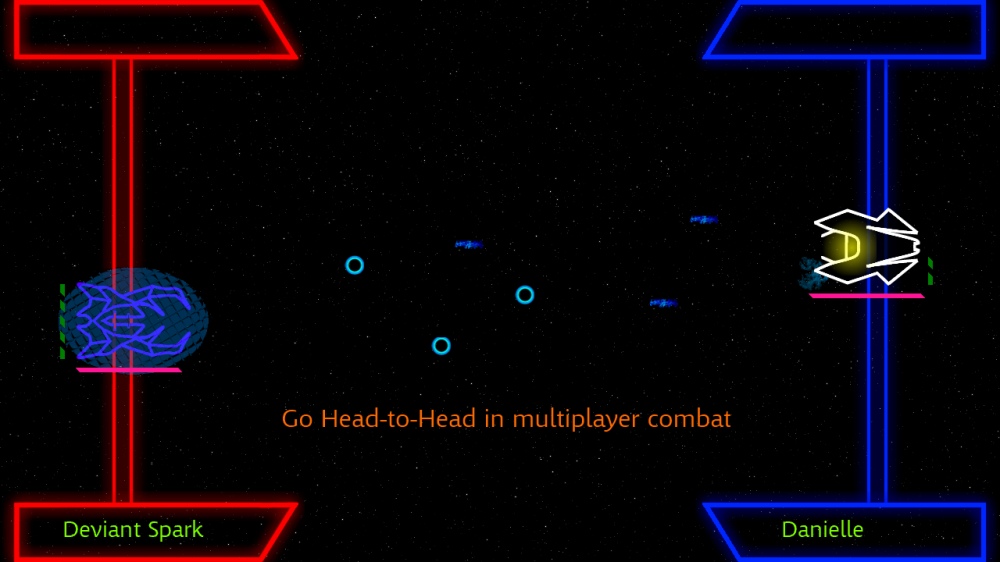
Take Light Fighters by Deviant Spark for example.  It’s not an awful game by any means.  It’s not really good either, but what’s wrong with it is so insubstantial that trying to get a full review that’s also entertaining to read is like trying to dig a canal using a plastic spoon.  The main focus of the game is local-only multiplayer combat.  This is almost never a good idea on XBLIG.  Even really great party titles on the platform, like Chompy Chomp Chomp or Hidden in Plain Sight, are tough sells for non-indie-loving nerds.  You developers really need to meditate on this fact.  Close your eyes and try to picture someone like me pitching a game like Light Fighters to my friends.

“We’re spaceships.  We try to shoot at each-other’s spaceship.  This goes on until one of us dies.  Here, look at the trailer.”

“Uhhh………huh.  And you think we should play this over Borderlands 2, why?

“Because, um, because I’m Indie Gamer Chick?”

“That’s cool.  We’re not though.”

screen2

By the way, this doesn’t include Brian, who is really supportive of this whole Indie Gamer Chick thing that I’ve fallen into.  But his support has limits.  Especially when he’s listened to me whine about how bad the single-player modes of the game are for hours.  The AI in the tournament mode is just too good at shielding shots, which can make matches drag on for ten, fifteen minutes with no progress being made.  And the meteor mode is awful too because it’s slow, your bullets get used up too fast and take too long to reload, power-ups are too slow to arrive, and yet it’s somehow still too easy.  By time it’s his turn to jump in, he knows better.

“Okay Brian, let’s try this multiplayer.”

“Is that the game you’ve been having a chick-boner over?”

“No, that’s Genix.  I’m writing that review tomorrow.  This is for Light Fighters.”

“The one you’ve been complaining about?”

“Yea.”

“I think I’ll pass.”

“But, I need to try this multiplayer.”

“Your dad is home, get him.”

“Oh come on, please?”

“No.  Cathy, if you’re not liking it at all, why would you attempt to subject your friends to it?”

“Because, um, I’m Indie Gamer Chick!”

“And I’m Nippy Nuts the Car Guy.  What’s your point?”

“Um, misery loves company?”

“I’m not really feeling like being in the company of misery today.”

“It probably won’t be THAT bad!”

“But you think it will be bad.”

“I love you.”

“I love you too, but no.”

“Please?”

“No.”

“I’ll give you a back rub!”

“Your hands are too tiny for it.”

“I’ll take you out for a rib dinner!”

“See, now that you’ve said that, you’ll be craving a rib dinner and I’ll get it anyway.”

“I’ll blow you.”

“I’ll get that anyway too.”

Okay, so such a conversation didn’t really take place.  I wouldn’t offer to blow Nippy Nuts just to get him to play a game with me, and he actually would step up if I pressed the matter.  But do I really want to?  A game’s goal is to grab you from the get-go with an interesting hook and fun gameplay, and the two hours I spent with it were, while not outright painful, pretty damn dull.

I did end up having a bit of a go with multiplayer and it was just as bland and exhausting as I suspected it would be.  Mind you, this is a perfectly functional game that features decent (if somewhat primitive) graphics and solid play control.  It’s just not fun.  It wasn’t fun to play, it wasn’t fun to explain to my friends so that I could squeeze in some multiplayer rounds, and it wasn’t fun to write about.  It took me a few weeks to get to this review, in part because Brian was on vacation, but also in part because I promised the developer I would review it and immediately had buyer’s remorse.

I would like to say that the developer of Light Fighters has been nothing short of classy, and quite patient considering that I had to put his review on hold for a couple of weeks.  So hopefully he takes the news that I didn’t enjoy his game at all with good grace, instead of accusing me of being a lying crackwhore who has failed to comprehend the genius of his game.  I’m guessing he won’t be a poo thrower though.  He actually has talent and class.  Typically it’s only the completely talentless that resort to flinging poo and making themselves a total clown for the bemusement of the community.

screen1

There is nothing really wrong with Light Fighters besides not being fun.  The game didn’t crash.  There weren’t physics glitches.  Everything wrong with it can be boiled down to “this game probably had no chance of being entertaining from the onset and the developer should have recognized that and tried something else.”  Even if the ships were more interesting, or the bullets they fired more exotic, or the AI less unfair, or the reload-rates less painfully slow, or if multiplayer matches didn’t all boil down to glorified button mashers that leave little to no room for strategy, or if it had something to keep track of what your best times are in meteor mode, or if the meteors weren’t so fucking spongy, or all of the above, Light Fighters still would have been boring.  Don’t forget to ask play testers “is this fun?”  Because that’s just as important as whether the game is functional or broken.  Don’t just ask if it’s fun, but ask follow-up questions too.  “Why is it fun?”  “Why isn’t it fun?”  “What could make it more fun?”  Which, I’ll admit, will put your fellow developers in an awkward position.  It’s the equivalent of your girlfriend asking if this dress makes her look fat.  And it does.

xboxboxartLight Fighters was developed by Deviant Spark

80 Microsoft Points would be interested in playing a game called Deviant Spark in the making of this review.  I bet it would be about a Transformer who enjoys streaking and showing people his collection of nude playing cards. 

“Ha, good one Cathy!  Hey, isn’t that.. is that Michael Bay taking notes?”

“Huh?  What?  Oh fuck, hey, NO!  DO NOT PUT THAT IN THE NEXT MOVIE!  DIDN’T YOU LEARN ANYTHING FROM MUDFLAP AND SKIDS?!!”

Trivia or Die, Trivia or Die: Movie Edition, Avatar Trivia Party 2, and What The?!

I’m into trivia, and I would like to think I’m pretty good at trivia.  How good?  I’m banned from playing any and all trivia with friends and family.  The last attempt at doing so was playing Trivial Pursuit 5 on 1, with me being by myself, plus I was banned from getting to continue my turn if I got a question right.  I still won three games to zero, and suddenly people were more interested in playing Sorry! or Uno instead.  I was also asked politely to abstain from participating in trivia night at our country club.  They said I was single-handedly responsible for a drop off in attendance, and since trivia night was one of their most profitable events, I would be doing them a big favor by not showing up.  Then they advertised that trivia night was Cathy-free.  I’m kind of proud of that.

So reviewing some trivia-based XBLIGs would be a chore, but thankfully, all of today’s games could be played single-player as well.  I then simply observed my parents play a round of each game to make sure they functioned as multiplayer efforts.  Of course, a little piece of me died every time they missed a lay-up like “how many colors are on France’s national flag?”  Sigh.  I must have been adopted.

Trivia Or Die

Like all the games featured today, Trivia or Die is pretty basic.  The only real hook is if you miss a question, the host of the game insults you.  Not only is the insult kind of poor as far as insults go, but it’s done by what I think is meant to be a stereotypical Japanese game show host.  It’s as bad as it sounds.  The other gimmick is once a game ends, the losing players are killed by being dropped into a pit of fire.  Not as cool as it sounds.

The first one of you to say "TOASTY!" is getting bayonetted right in the fucking eyeball.

The first one of you to say “TOASTY!” is getting bayonetted right in the fucking eyeball.

As far as the game goes, everything you need to know about Trivia or Die can be summed up with saying the first answer to the first question of the game was wrong.  What kills the most people: lightning strikes, earthquakes, or hurricanes?  The game says lightning strikes.  Sounded wrong to me, and a quick check on Google finds numbers for all three scenarios to be all over the board.  There doesn’t seem to be a definitive answer that has statistics and shit to back it up.  So it probably should have been left out of a multiple-choice trivia game.  It wasn’t, so I can’t recommend it.  Though if someone can find multiple sources to back up the lightning strike claim, I’ll change this to a mild recommendation.

Trivia or Die: Movie Edition

This is the exact same game as Trivia or Die, only it features movie-themed questions.  And it’s better on account of having no answers be inaccurate.  However, I should point out that there’s still some writing mistakes.  A quick example that gave me a chuckle: Goodfellas is called “Goodfellows.”  Somehow, Goodfellows is not such an interesting sounding movie.  Goodfellows sounds like it would star Woody Allen as a carpet salesman or something.  Oh, and there are issues with how questions are worded.  “What was the first animated film to be nominated for an Oscar?”  Well, that would be the Flowers and the Trees from 1932.  But, that’s not an answer, so I’m guessing they meant “What was the first animated film to be nominated for a Best Picture Oscar.”  That would be Beauty and the Beast.  Yea, I knew what they meant, but it’s still lazy.  And now I’m just being nit-picky.  Trivia or Die Movie Edition will serve as a semi-competent time waster that might barely be worth $1 if you have three friends of equal skill.

What kind of fucking moron would answer Y to tha.. DADDY HOW COULD YOU??

What kind of fucking moron would answer Y to.. DADDY HOW COULD YOU??

Avatar Trivia Party 2

It’s exactly the same game as the first one, only there’s different questions and a different board.  It’s like Mario Party, only with trivia.  Of course, actual trivia skills are not required to win.  In the original game, I lost a match to Brian where I never missed a single question and he missed significantly more than a single question.  What followed I think is legally classified as domestic assault.  Either way, I like the board in this one better than the original, and it is fun.  You can read my original review for more detailed thoughts on it.

screen2

What The?!

And I close out with the worst of the four games, which really sucks because it also had the most effort put into it.  It has full voice acting, which would be cool.  It would be, if the actors didn’t totally half-ass the whole thing.  There’s two guys: a host, and an announcer.  The announcer is actually the guy who reads the questions, and he at least seems to put some effort into his work.  It’s still awful, and the guy sounds like he’s so bored that he might fall asleep.  But he has the right voice for an announcer, so we’ll give them a half-point on it.  And then I’ll subtract a billion points for the host, who sounds like he would rather be dead than participate in this shit.  I’m not joking.  He sounds like he’s either coming out of a coma or going into one.  I’m sure some people will say they deserve props for having voice acting at all, but if it’s worth doing, is it not worth doing right?  Or with enthusiasm?

Otherwise, it’s just another bare-bones trivia game.  It’s set up to look like a 70s game show, but it doesn’t take advantage of this.  The hook here is you can occasionally “win prizes.”  They’re all gag prizes, but the weird part is, there’s no gag to go with them.  You can win the Moon as a prize, but there’s no joke or punchline to go with it.  Again, it’s another effort to give the game some personality that fails miserably.  And the bare-bones setup with the actual questions and answers, the lack of punchlines for the gag-products, and the ultra-slow pace really cripples What The?!  It has what should be the best feature of any of the games: a system in place that prevents you from being read the same questions more than once.  But that’s completely negated by how boring the overall experience is.  It would be like listening to Harry Potter’s book-on-tape and finding out the reader is Ben Stein.

Ho ho ho ho, this is so funny.  After we're done with this episode, I'm going to go sit in my garage with the car motor running and the door shut.

The host has that “I’m going to sit in my garage with the engine running and the door shut” look on his face.

So I’ve tallied it as follows: Avatar Trivia Party 2 is the best of the bunch, but if you’ve already played Avatar Trivia Party, it offers nothing new besides a new board.  Trivia or Die: Movie Edition is competent but quite bland.  The original Trivia or Die is also bland but lacking in competence so you can feel free to pass on it.  Finally, approach What The?! only as a drug-free alternative to NyQuil.

xboxboxartTrivia or Die and Trivia or Die: Movie Edition were developed by Fun Infused Games

Avatar Trivia Party 2 was developed by Red Crest Studios

What The?! was developed by Social Loner Studios

80 Microsoft Points each dug a hole in the armrest of my couch with my fingernails while watching my parents miss question after question.  I tell you, it was worse than torture in the making of this review.

xboxboxart1IGC_ApprovedTrivia or Die: Movie Edition and Avatar Trivia Party 2 are Chick Approved and ranked on the Indie Gamer Chick Leaderboard.  The other two games probably couldn’t tell you who is buried in Grant’s Tomb.

Arcade of Neon

Other than a really annoying soundtrack, Arcade of Neon seems like it would have fit right at home on the Atari 2600.  This is one of those “dodge most everything, except the stuff you’re not supposed to dodge” games.  It’s loaded with play modes and can be addictive in a hypnotic “am I really having fun or am I being brainwashed into buying products I don’t need” kind of way.  It reminds me of my parents while they watch the Vampire Diaries.  Yes, my parents, ages 63 and 44, watch the Vampire Diaries.  Shame of my life, obviously.

It's not much to look at, but really, it can be fun.

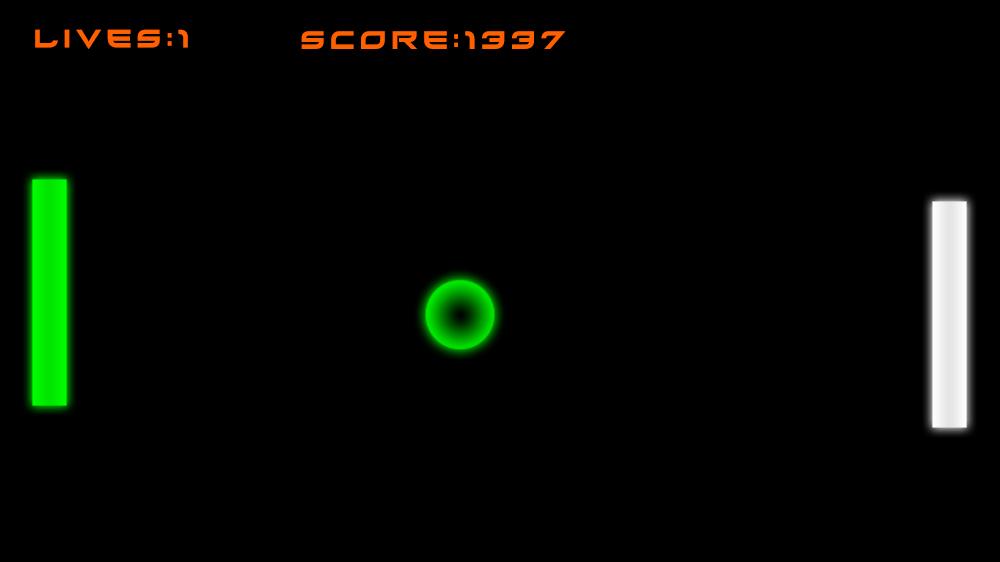
It’s not much to look at, but really, it can be fun.

The concept is you’re a circle that has to dodge other circles.  Alternatively, you can absorb like-colored circles for points.  In the main mode of play, switching which color you are is handled with the face buttons and their corresponding colors.  So Y would be white, X is black, B is like a dark grey.. hey wait a second.  Oh, that’s right.  I have one of those controllers.  Well if you have a normal controller, you can look down for reference.  For whatever reason, my brain refused to retain that Green = A.  The other colors I could use fine, but for whatever reason my personal wiring refused to allow me to adjust to green with quick reflexes.  There’s probably some complex reason for that, but I’ll just save everyone some time and say that I’m an idiot.

There’s a ton of modes here that change-up the formula, including a game that I think was funded by SPECTRE with the aim of creating the ultimate weapon of boredom.  It’s like Pong, only it’s single player, you can’t possibly hit the ball past the computer, and the object is to keep returning the volleys.  Sometimes when the AI hits the ball back, it changes color, and you have to match the color with your paddle.  The problem is, the paddles are huge and the ball NEVER GETS FASTER!  I played it for like ten minutes and it was the most excruciatingly boring ten minutes of my entire life.  That’s not hyperbolic.  I’m dead serious.  We need to get scientists off the Hadron Collider and have them study this thing.  It’s the most remarkably bad game mode I’ve ever seen in my entire life and after ten minutes I was temporarily insane from it.  I set off a small fire in my office and had an extended conversation with my coffee table.  How does anyone come up with a game like this in 2013?

Avoid having sharp objects within reaching distance when attempting to play the Pong mode.

Avoid having sharp objects within reaching distance when attempting to play the Pong mode.

The rest of Arcade of Neon isn’t nearly that bad.  In fact, it’s a perfectly acceptable waste of a few minutes and at times fun.  But there’s a couple gigantic problems here.  There are ten modes of play available, but only one hi-score slot is present.  This is one of the biggest brain farts I’ve seen from a developer in a while.  Ten unique modes, one hi-score space that they all share together.  It’s really disappointing because I know the developer reads me and I figured I at least had enough influence (ha!) to make people second-guess such no-brainer choices.  Apparently he got no feedback from people saying “you know, if there’s ten unique game modes, people might want to know what their best score in each mode is.”  I’m so pissed about this that I’m banning him from further game development until he writes “I will use my head for something other than a hat rack” 100 times on a blackboard.  I don’t think I actually have that authority, but I don’t know if he knows that.

Another problem is I sort of already played a game that’s very similar to this, called Dot Dash Episode 1.  Although Arcade of Neon offers more play modes and a larger variety of objectives, Dot Dash had better graphics and play control for the same price.  Considering that Dot Dash barely landed a spot on the Leaderboard, I guess Arcade of Neon ought to miss the cut.   But my only real criteria is having fun, and I did have fun with Arcade of Neon.  I’m into twitchy arcade-style games, and it offers that.  It offers that in a no-frills, shitty package that doesn’t even offer more than one hi-score spot for ten modes of play, which I can’t stress enough is about as dumb as asking a narcotics officer for directions to the nearest opium den.  So yea, I guess I do very, very, very mildly recommend Arcade of Neon.  Just not the Pong mode.  Seriously, don’t touch that thing.  Don’t even think about it.  The Chinese are replacing their infamous water torture with it.  True story.

IGC_ApprovedxboxboxartArcade of Neon was developed by Ivatrix Games

80 Microsoft Points heard Devil Blood and Send in Jimmy breathed a sigh of relief in the making of this review.

Arcade of Neon is Chick Approved, even though in its case the Seal is affixed with the rancid snot of a walrus with the flu, and it’s ranked on the Indie Gamer Chick Leaderboard.  Barely.

The Unfinished Swan

I’ve spent the last couple days attempting to write a game of the year piece, and when I tweeted that I was ready to name Journey my game of the year, I had a few skeptics say “what about Unfinished Swan?”

Oh yea. Forgot about that one.

Well, now I’ve played Unfinished Swan. It’s fun. It’s original. It’s got a very cool narrative. And it’s not a game of the year contender. Not even close. It would be lucky to catch a sniff of the game of the year’s stale fart.

But it’s really cool though.

TUS.E3.2012.001

What stands out about Unfinished Swan is how good a job it does of making the player revert back to childhood. It does feel like you are a child whose imagination while being read a fairy tale is running wild. This could have been mishandled so badly, but instead it comes across as totally authentic and charming. I could see why so many people would name this game of the year, especially those that put a premium on story and emotion over gameplay. My only real complaint with the story is Unfinished Swan, which seems very suited for young children, takes a bit of a dark turn during the final chapter, which doubles as the end credits. This includes a scene where you’re at a funeral and see a body inside a coffin. Jeez, guys.  Even Disney had the good taste to not show Mrs. Bambi’s bullet-ridden corpse.

So the story is really good. Not as emotionally exhilarating as Journey, or as likely to make you think deep, introspective thoughts. Instead, the game invokes a relaxing innocence. This is the first game I’ve played in a long time that feels like a sophisticated family game. No joke. Unfinished Swan seems like it would be great for little kids. Nothing here is too challenging, and even some later spooky scenes set in a dark forest aren’t too scary for young children. If you have kids, I couldn’t strongly suggest any game more. Any form of media that’s narrative can appeal to very young children or adults is rare, but such stories in video games are really, really rare.

Uniqueness extends to the gameplay as well.  In fact, the experience is so unique that if you don’t already know what it’s like, I suggest you quit reading now and just go buy it. You won’t regret it. My verdict on the gameplay? Fun, very simple, puzzles aren’t exactly puzzles, some frustrating elements, but everything here is light and breezy and could be finished in under four hours. There is absolutely no challenge at all here. None whatsoever.  

TUS.E3.2012.014

Still reading? Okay, let’s talk level design. So the game starts you in a stark white room with no indication of what to do or where to go. A common experience among people I’ve talked with about Unfinished Swan seems to be people not realizing the game has begun. But it has. Each of the three chapters has a unique take on what exactly you have to do to navigate them. In the first world, everything is white, and you find your way around by throwing water balloons filled with ink. They splatter on objects, revealing their shape and size. Using these, you paint the terrain until you can find the path to move on. It’s quirky and neat, but sometimes annoying. Often times, I had to rely on spinning around in a circle and throwing ink at everything trying to figure out where I was supposed to go next. I called this the “octopus caught in a centrifuge method” and it did work, but seemed like it shouldn’t be necessary. Occasionally, you’ll spot swan tracks on the ground that point you in the right direction, and thank Christ for that, because otherwise I think I would still be trying to find my way out of the first stage.

In the second stage, objects finally have shadows, and thus you don’t need to heel-toe your way around anymore. Your ink balloons are also replaced with water balloons. The idea here is to navigate a vast city and castle with all kinds of tall buildings and exotic locations. And actually, this is the part of the game where I did get bored at times. The design here is fairly bland. The gutsy stylized gameplay of the first stage is almost completely gone, and in its place is the type of navigation puzzles that have been done to death in games, only these ones are much easier. Later in the stage, you have to use the water balloons to grow vines used for climbing walls. The problem with these are they tend to be a bit stubborn. Sometimes I couldn’t get them to go where they were supposed to go at all.

In one spot, you’re given a fire hose that you’re supposed to use to saturate a wall to grow the vines towards another platform. I spent several minutes trying and failing to get the vines to grow in that particular direction. They simply refused to do what they were told. So I said fuck it and made a mad leap for the platform, missed, and fell to my death. When I respawned back on the platform, not only were the vines willing to cooperate, but they had already grown where they needed to go. No clue at all what happened there. I’m guessing the game’s engine crapped out on me. That, or this is the developer’s way of advocating suicide to solve all your problems.

TUS.E3.2012.010

The final proper stage is set in a dark and spooky forest where you’re attacked by spiders if you don’t stay in well-lit areas. You deal with this by hitting lights with your balloons. At one point, you need to push around a little glowing ball of light (a moment that gave me Entropy flashbacks) to keep yourself safe. Later, you have to follow the ball of light down a river. After this, you have geometry puzzles that require you to create platforms by throwing the water balloons at specially marked walls. I have to say, the efforts to change-up the gameplay are well done in general, but no one mechanic seems to reach its fullest potential. After all this, you’re given a brief epilogue where you relive past moments in the game, while the credits appear on the walls. Afterwards, you can go back and look for hidden balloons that open up various unlockables.

I really liked Unfinished Swan, and other than some dead points in the second chapter, the gameplay here is fresh and well-paced. I ultimately recommend it because there’s nothing quite like it, and because it plays well. But there’s no challenge here. After telling a friend to get this for their six-year-old kid over the weekend, I found out that the kid easily beat the game in roughly the same time I did. I hear he totally loved it too. So yea, it’s not challenging. But neither was Journey. I would say both titles would be better described as game-like experiences. Where actual gaming elements almost seem to distract from the unfolding narrative. Both could also easily ride the art-house label if they so wished, but they don’t need to. They let their art credentials speak for themselves without battering you over the head with a copy of Rudolf Arnheim’s Art and Visual Perception. If Unfinished Swan has any real failings, it’s that it feels like they didn’t do enough with the visual gameplay concepts. Maybe that’s a good thing. Maybe the whole “you can’t see anything” direction of the first level could have been maddening without the type of restraint the guys at Giant Sparrow showed. Maybe. But I can’t shake the feeling that this could have very well been called the Unrealized Swan.

The_Unfinished_Swan_logoIGC_ApprovedThe Unfinished Swan was developed by Giant Sparrow

$14.99 never did hit that blasted swan with a water balloon in the making of this review.

The Unfinished Swan is Chick Approved, but only Xbox Live Indie Games get ranking on the Indie Gamer Chick Leaderboard.  For now.