Drinkards Beer Pong

I’m not a drinker, and thus I’ve never indulged in the frat house pastime known as Beer Pong.  It’s a relatively uncomplicated game: all you need is some plastic cups, a ping-pong ball, and alcohol.  Total cost is, what, $5 + booze?  An 80MSP digital version of it might be more cost efficient, but isn’t something lost in translation when you take such a simple concept and convert it to a video game format?  I touched base on this in my review of Kick’n It, which was digital hacky sack.  Some things just don’t need to be video games.  I figured beer pong would be one of them.  Still, the extremely friendly developers of Drinkards Beer Pong assured me of two things.  First, unfamiliarity with the sport of beer pong wouldn’t be a problem because the game is pretty self-explanatory.  Second, you don’t have to be a drinker to enjoy beer pong.  Maybe that’s true, but I’m guessing you would have to be completely shit-faced to enjoy Drinkards Beer Pong because the game sucks.

To the developer’s credit, they loaded this version of beer pong down with plenty of options and house rules.  However, this is wasted on really fidgety aiming mechanics.  It’s hard to get a good perspective on depth and angles, even with a cursor that shows the entire trajectory of the ball.  This is hammered home by the fact that I was often throwing what looked like a perfect shot into one of the cups, only to watch the ball miss the cups completely and fly off the table.  The aiming rocks back and forth, but honestly the whole physics of it seem slightly tipsy.

Well, thank God that they gave us this shot of the menu. It’s good to know this isn’t one of those non-menu having games.

I was unable to try Drinkards Beer Pong online, which is probably fine seeing how the game outright warns you that many of its features won’t work on Xbox Live.  Instead, I arranged to try this using the local four player co-op.  The teams would be two people who have never played beer pong versus two beer pong veterans.  Representing the non-beer-pongers, my father and I.  Representing the veterans, two of our newest interns: Dustin and Ryan.  Hi guys!  I told you I was Indie Gamer Chick!

With the multitude of options the game offers, we left it to the vets to decide what rules would make for the most fun experience.  We played with six cups, unlimited re-racks, and a lot of other stuff that I’m still not clear on.  Despite what the developers insisted, their game is not going to be highly accessible to non-pongies.  Not that it matters, because why on Earth would someone that’s not a fan of it even want to play a digital version?  But we pressed on, and many shots were missed.  Even after almost an hour, nobody could get the hang of the aiming mechanics.  Sure, we made a shot or two, but as Dustin pointed out, you would actually have enough time to sober up between shots.  Which defeats the whole purpose of a game that’s designed to get you good and blitzed.

All four of us agreed that better, clearer aiming mechanics would greatly improve the game.  Also, we all agreed, and I can’t fucking believe I’m saying this,  that Drinkards Beer Pong is one of those extremely rare games that would be more fun to play with Wii-style motion controls.  But, my intensive review was not complete.  Like I did with Kick’n It, I wanted to compare the video game to the real thing.  So we actually played a couple of rounds of “real” beer pong.  Only without alcohol.  My excuse is I literally can’t drink, thanks to my seizure medications.  Also, we used Styrofoam cups instead of plastic, because that’s all we had handy.  I guess plastic is supposed to work better, but you have to make due with what you have.

Even our ghettoized, using water instead of alcohol and the wrong kind of cups brand of beer pong was so much more fun than the video game version.  I could see how this could be so popular among the college-going population.  And I don’t think anyone would choose the fake digital version over the real thing.  It’s something so fundamentally simple to set up that it doesn’t get the benefit of being more convenient to play on a console.  Even if Drinkards Beer Pong was absolutely perfect, it wouldn’t be better than the real thing.
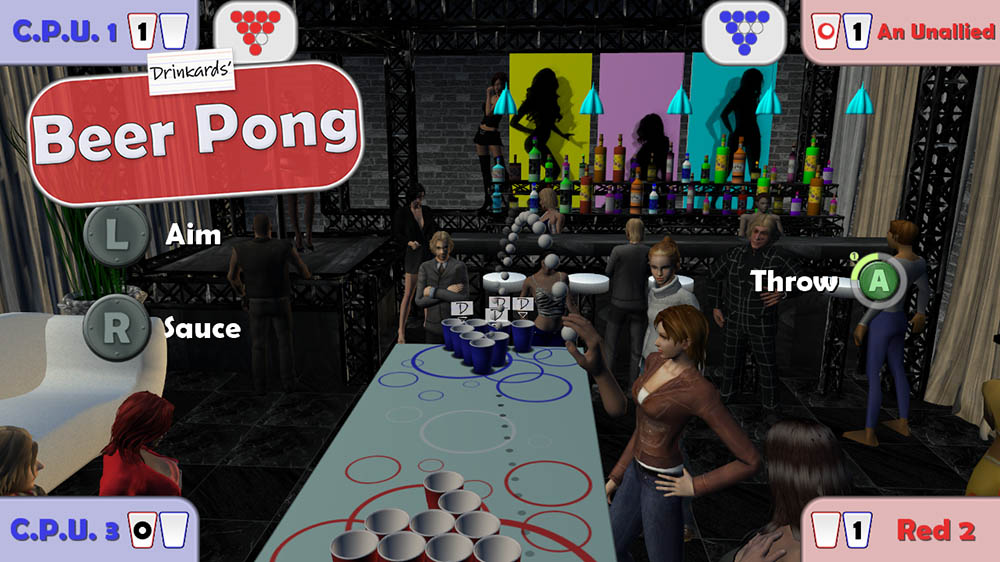
For those of you looking to get drunk using this thing, I recommend moonshine. Anything lighter than that will result in not-getting drunk on account of it taking so many tries just to make one simple shot.

It’s not absolutely perfect though.  Even with pretty dang decent graphics, the sound effects are repetitive, the voice overs are annoying and repeat themselves too often, and the shooting mechanics are really brutal to get the hang of.  There is obvious talent on display here, but I would advise the developers to give up their plans on refining what they’ve built and move onto something else.  And that something else better be something that can only be done in a video game.  If you guys turn around and make Video Tetherball I’m going to saw your heads off and re-purpose them as jack-o’-lanterns.

Dude, two hands? How fucking big is this ping-pong ball? Or how fucking small is the guy playing?

Drinkards Beer Pong was developed by The Unallied

80 Microsoft Points have just been informed that there are versions of beer pong for Wii and that they are absolute shit in the making of this review.  Well, there goes that theory. 
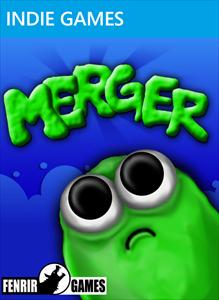
Merger

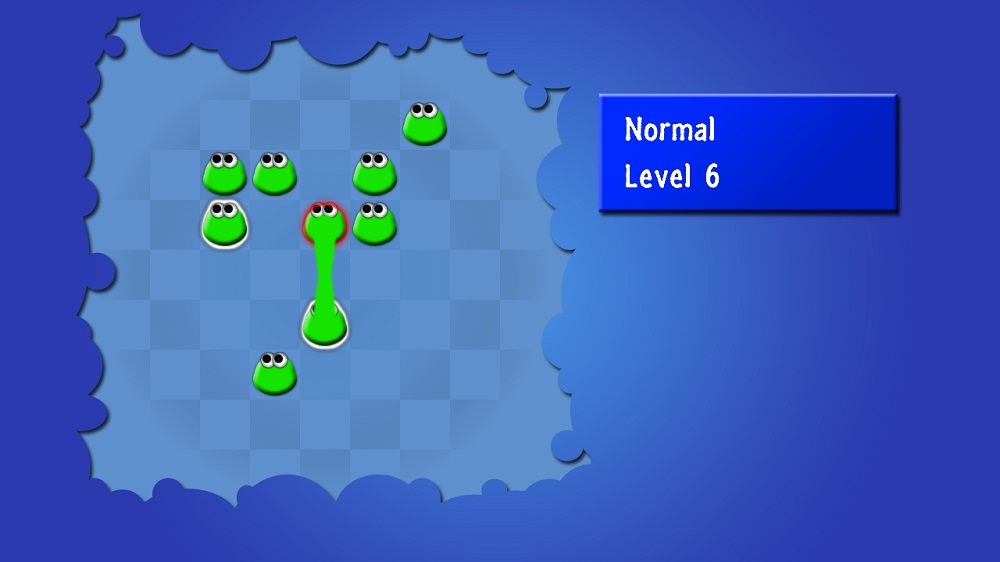
Just a quickie review here, as I don’t really have a ton to say about Merger.  It’s a grid-based puzzler where you have to merge slimeballs (that’s balls of slime, not lawyers) until only one remains.  The set-up is somewhat awkward and it takes a while to get the hang of what moves are allowed and what moves are not.  Some kind of visual tutorial would have gone a long ways towards fixing that, but instead all instructions are text-based.  This resulted in me not knowing whether or not to admit that, even after an hour of playing, I still wasn’t fully sure what the rules are.  But I decided not to admit that, because that would be embarrassing.

So, despite the fact that I fully had a grasp of the play mechanics, I wasn’t too excited by Merger.  I probably would like it more if I had, um, even better understanding of the mechanics.  Yea, that works.  But I didn’t.  Have a better grasp.  And yet I still managed to finish almost all of the 60 preset puzzles and play a couple 10,000+ point rounds of “endless” mode (which is just a few randomly generated puzzles that you tick off one at a time).

I can’t fully recommend Merger.  A better tutorial would help, but at best Merger could hope to be a somewhat dull puzzler that you’ll forget about as soon as you turn it off.   It’s crazy to say it, but the bar for what an XBLIG puzzler is capable of being is set pretty damn high.  Any new game on the platform will have to draw comparison to stuff like Escape Goat, Spyleaks, or even Asphalt Jungle 2.  By comparison to them, Merger is as boring as the World Series of Hopscotch.

Merger was developed by Fenrir Games

80 Microsoft Points said “it’s still a more successful merger than AOL and Time Warner” in the making of this review.

Imaginary

I guess Imaginary is supposed to be a representation of a child’s vivid imagination.  And so I must ask, where the fuck do the children who imagined this shit come from?  Crystal Lake?  You’re fighting giant spiders, disembodied legs (I think), and a giant fan/tornado monster thing.  Yeesh.  When I was a kid, I used to imagine being a Power Ranger, not what it was like to drop acid.  Then again, a giant/tornado monster thing sounds like exactly the type of thing the Rangers would fight, rendering my whole argument faulty.  Move along.

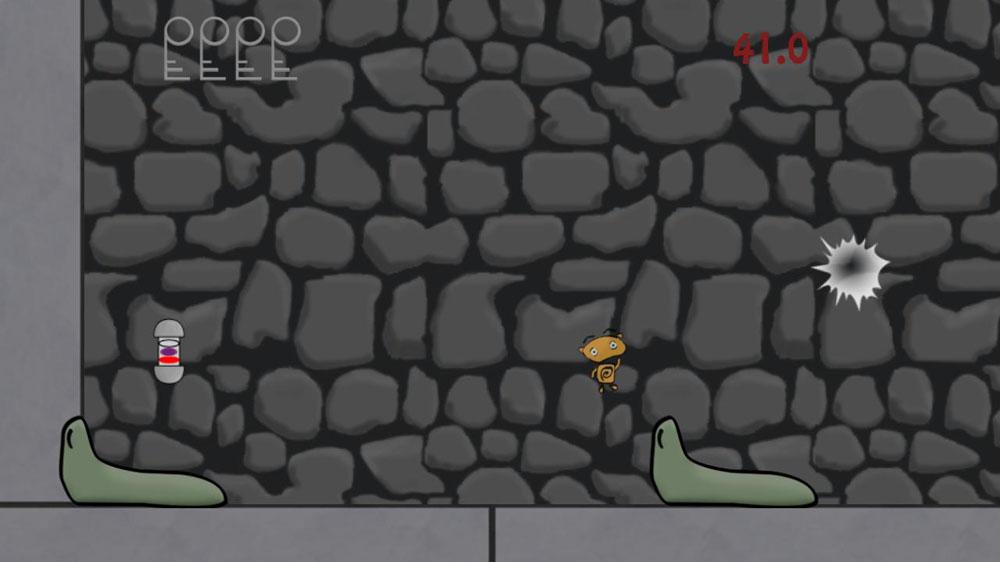
Nothing fixes a platform game with severe pacing issues like making the enemies slugs. Slugs: nature’s road runners. Well, unless you count real road runners I guess.

Imaginary is a platformer starring a little kid that had his brains removed and replaced with helium.  That’s the only way I can explain the ultra-floaty jumping physics, or the fact that he flies back the length of a football field if he takes damage.  Honestly, the controls are kind of crap but it never gets in the way of gameplay.  The deal breaker for Imaginary is it’s just not fun to play.  The only real hook is the ability to turn invisible if enemies are approaching.  I guess that means the developer was a big fan of the Tanooki Suit from Super Mario 3, only without the cool flying stuff.  Most of the game revolves around finding switches to open doors to collect keys.  To beat each stage, you must find all four keys hidden in it.  The alternate challenge is trying to stay awake.

I had a conversation the other day with the guy who created Super Amazing Wagon Adventure.  He asked me if there was any game that I wouldn’t review.  The answer is no.  He wanted to know if it was obviously a harmless one-man project that never had a chance of being good, if I would still be willing to say the game was no good.  Yes.  I bring that up because Imaginary strikes me as just that.  And while it’s not as terrible as some of the stuff I’ve played, it’s really just as boring as a game can possibly be.  The possible exception to that are the boss fights, but even they can drag on.  Like the Tornado/Fan thingie that I mentioned earlier.  You have to wait for it to hover next to one of two devices that you can activate to shock it.  However, the recharge rate for being able to fire those things is brutally slow, making the fight drag on a lot longer than it should.

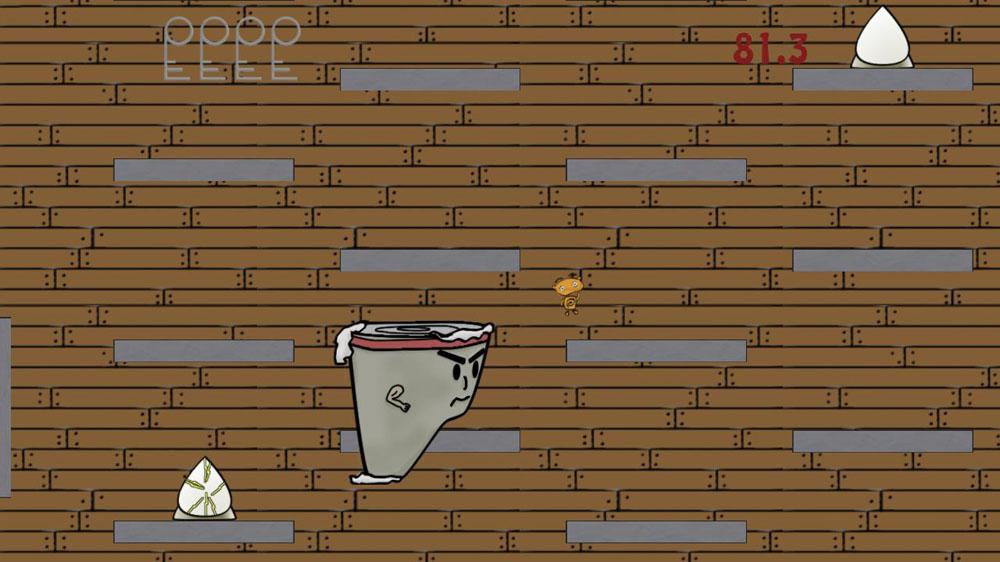
The Tornado/Fan thing I was talking about. Brian thinks it looks more like a milkshake.

Ignoring the floaty physics, the biggest issue I have with Imaginary is the way you activate switches.  You do so by shooting little balls of light at objects.  Aiming these is almost impossible, so the only way to make sure they hit their target is to be right on top of it when you fire.  But, get this, if you use your ability to activate switches too much, too quickly, you die.  Why?  I don’t know.  Maybe because that made the game suck more and this feature was implemented while the developer was observing opposites day.

So it’s not as if you can just say the game is a victim of bland design and bad physics.  A lot of the ideas here are just not good ones when your goal should be “make a fun product.”  I gave up twelve levels into Imaginary.  The level design became more tedious, the stages started to center around hard-to-use trampoline-ball-things, and I had to admit that the previous hour and change had been among the worst I’ve had since starting this site.  I guess that means I can’t recommend spending your money, real or imaginary, on Imaginary.  Emphasis on imaginary.  I’m looking at you, Microsoft Points.

Imaginary was developed by Randomly Generated Games

80 Microsoft Points resent being called imaginary in the making of this review.  We are most certainly not imaginary.  We’re simply beings that are created by taking your cash and converting it into currency with no cash value.  What of it, bitch? 

Spyleaks

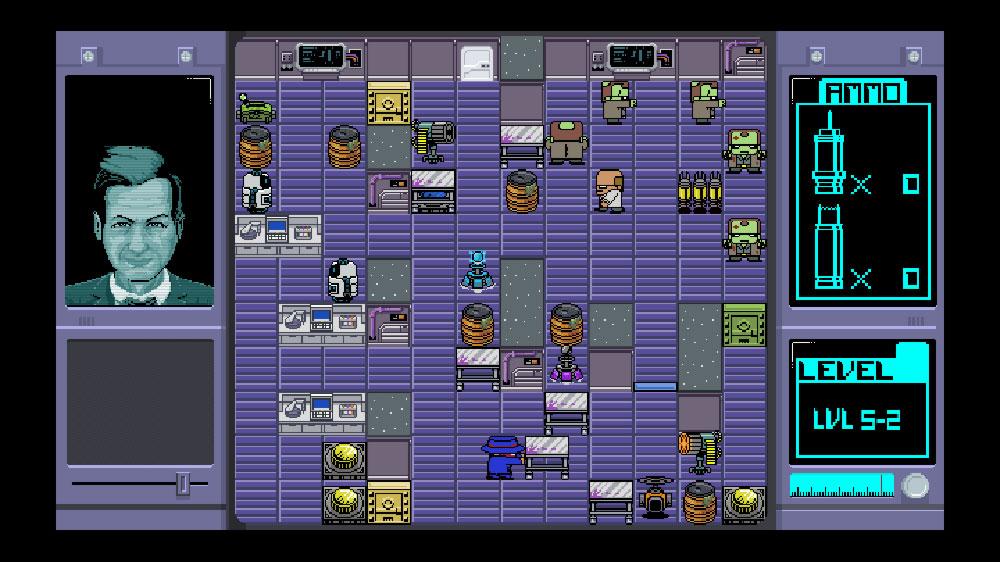
Spyleaks is part Loloish puzzler, part space shooter.  Notice I didn’t say “a cross between” or “a mix of” because it’s not.  In each of the five worlds in the game, you play five puzzle stages, then a space shooter, and then finally a timed “run the gauntlet” puzzle.  It’s weird.  I like weird, but this is a different kind of weird.  Like someone making a peanut butter and cloves sandwich, where you wonder who in their right mind would see the potential in that combination.

I’ll ignore the storyline about the exploits of the greatest spy ever known.  Spies typically being people who can blend in.  The dude in this game has buck teeth that would draw the attention of Stevie Wonder, but he makes up for it with the ability to push safes as tall as he is with minimal effort.  Not only that, but he’s so stealthy about it that he can push a safe right in front of a guy who has his eyes wide open and go completely undetected.  Dude, you’re good.  James Bond bows at your feet.  Sigh.  Obviously I did anything but ignore the story.

Of course there are zombies.  If your game doesn’t include them, you have to pay the zombie tax.  Yep, there’s a zombie tax.

As far as gameplay, Spyleaks is very similar to the Adventures of Lolo, which is as of yet the only Virtual Console game I’ve reviewed here.  And the only reason I did so was because I played two XBLIG titles that were tributes to the series: Aesop’s Garden and Crystal Hunters.  For an obscure franchise that’s gotten pretty much no love from its developer in two decades, Lolo sure has spawned some amazing games on Xbox Live Indie Games.  Aesop’s Hunters and Crystal Gardens both made my big one-year anniversary Top 25 feature.  With credentials like that, there’s no way Spyleaks could be better than Aesop’s Crystal or Garden Hunters, right?

Wrong.  Spyleaks is the best of the bunch.  I’ll get to the incredibly out-of-place shooter sections later and focus on the 25 standard puzzles presented here.  Although the game closely reminded me of the three titles I spoke of above, Spyleaks changes the formula a lot.  Sure, you still shove crates, stun-lock enemies to use as crates, and ultimately try to open up an exit.  Where Spyleaks changes things up is with its button and gate system.  Levels typically have one or more different colored switches or buttons that you have to activate to proceed.  Those switches will activate corresponding gates.  It’s not an original feature by any means, but it adds to the complexity of the puzzles in the game.  If Aesop’s Garden was too hard for you, don’t even bother trying Spyleaks unless you want your head to explode.

Oh, and if your head is in danger of exploding but you think you ought to try the game anyway, be a chum and make sure you live stream it.  What can I say?  I’m a fan of spectacles.

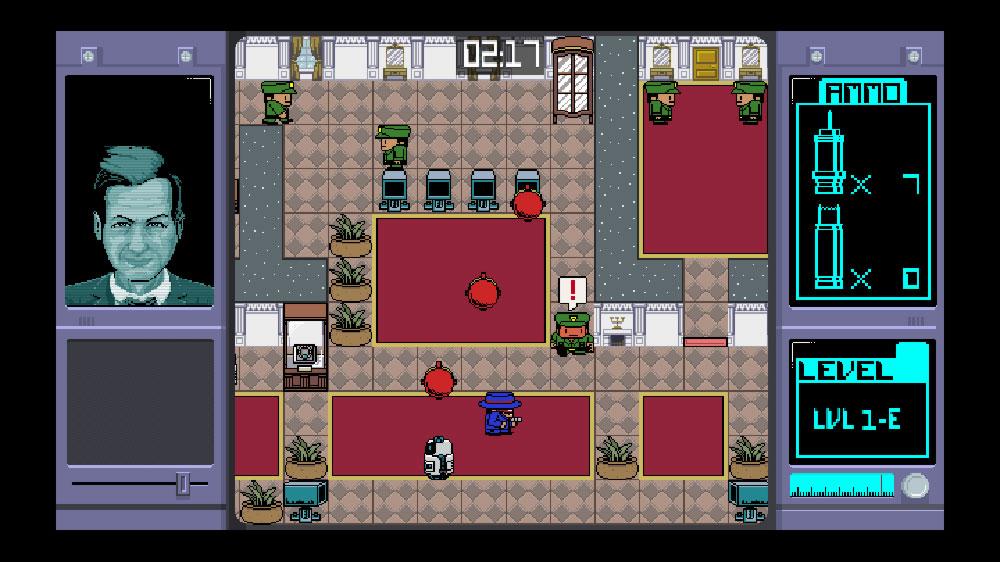
Stealth also factors in.  Some of the enemies are situated like guards who only give chase if you cross in front of them.  Whoever you’re spying on must be the most charitable mother fucker alive because he only seems to hire guards with severe visual impairments.  That’s mighty noble of him, and yet I would think a donation to the Schepens Eye Research Institute would probably be smarter, what with the fact that I can walk directly next to a guard and he won’t see me.  Now if you walk right in front of them, they start to give chase.  This mechanic is the basis for several of the timed “finale” puzzles that close each of the five game worlds.  I really enjoyed all of Spyleaks’ mind benders, but I really liked these ones.  They could have been the basis of an entire game on their own.

I’m not sure if the “!” symbol here indicates you’ve been spotted or if the guard broke wind.

Before this review turns into too much of a love-letter, I have some bones to pick with Spyleaks.  Stun-locking enemies is done by picking up tranquilizer darts (or anti-robot-shock-things if you’re shooting machines).  All movement in the game is done one full square at a time.  If you shoot an enemy while he’s moving into the square next to you, even if you shoot before he touches you, you die.  That’s bullshit.  Isn’t the time-honored tradition in these situations “tie goes to the runner”?  Thankfully, death here is treated with the dignity that typically befalls it, meaning your character does cartwheels in place and then shakes his head before flat-lining.  Same thing happened to my great-great-great-great grandfather right before he died of old age.  Cart-wheeled right on his death-bed did he.

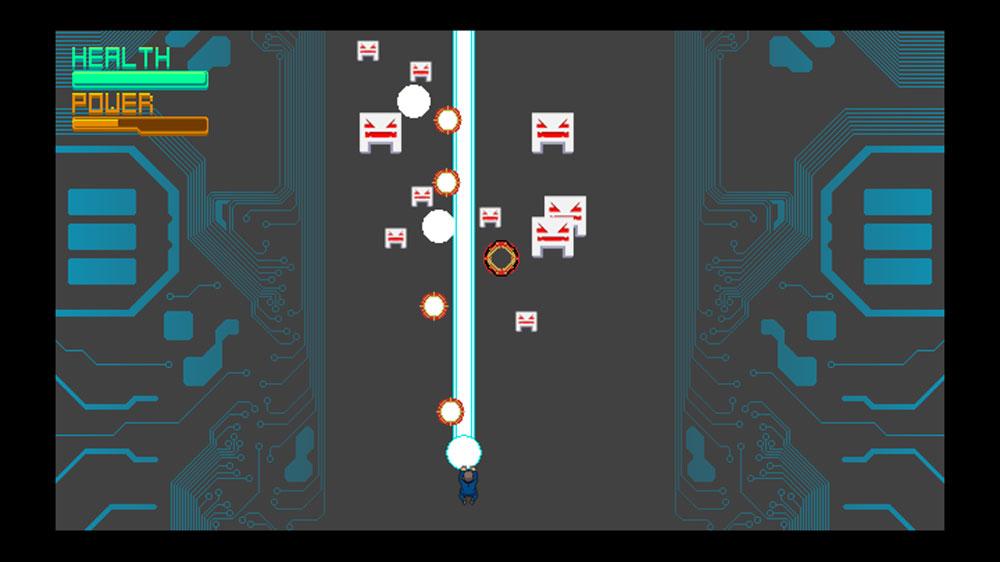
Thankfully, that’s the only complaint I have about Spyleaks. . . . . is what I would be saying if not for the space shooter stuff.  Allow me to brow-beat the developer for a few seconds: WHAT THE FUCK, DUDE?  It’s not that these sections play poorly.  They control fine, they’re handled well enough.  They’re not particularly exciting though, and if I want something to give me a break from the puzzles, I’ll take a break from the fucking game!  

I get it.  Puzzle games are a particularly tough sell on XBLIG, and not everyone wants them.  Let’s talk about a fictional, hypothetical XBLIG customer so as to not single anyone in particular out.  I’ll call him, oh, Dave Voyles.  Now let’s say Dave has rotted his brain out with too many rounds of Mega Man, coupled with all the head trauma he received as a young man banging his head into a wall when he had online games of NBA 2K1 all sewn up only to have the pathetic little shit he was playing against rage quit the game with 0:03 remaining on the clock, destroying is 35 point lead.  Remember, purely hypothetical.  So Dave’s fragile brain is no longer capable of doing puzzle games.  Yet, he’s fine with shooters.

Perhaps this was put in to prevent anyone from gaining intelligence through Spyleaks. Well, don’t worry. Any IQ points accumulated will quickly be vaporized by this shit.

Dave is NOT going to buy this puzzle game on the basis that it occasionally takes a break to play a two-minute long shooter.  He’s just not.  It’s a novel attempt at luring him in, but it’s not going to sell him.  Especially when there is no way he can experience the shooting sections in the eight minutes that is allotted for demos on XBLIG.

I’m not busting the developer’s chops for this, nor am I down-ranking his game in any way.  Spyleaks is amazing.  It’s one of 2012’s best Xbox Live Indie Games.  So intelligent, so beautifully crafted, and so infectious.  It’s also the perfect length (25 single-screen puzzles, 5 “beat the clock” puzzles, 5 brief shooting sections, and a finale) and doesn’t overstay its welcome.  Will it be accessible to people who hate the genre?  Probably not.  And no, the space stuff isn’t worth playing the puzzles to get to.  Sorry, I can’t get over it.  How is it possible that the first game to crack the Top 25 on my brand new leaderboard since its inception could have such a weird design choice in it?  I don’t get it.  Breaking up an original, highly intelligent puzzler with random bits of a shooter is like breaking up the monotony of life on the International Space Station by occasionally opening up the cabin doors.

Spyleaks was developed by HeartBit Interactive

80 Microsoft Points didn’t realize until just this very moment that this game was by the guys who did Doom & Destiny in the making of this review.  Not sure why they don’t have their own dedicated website though.

Spyleaks is ranked on the Indie Gamer Chick Leaderboard.  Click here to see where it landed.

Human Subject

♫Oobie doobie do, I want to be like you.  I want to walk like you, talk like you too!♫

That’s from Disney’s Jungle Book, where King Louie sings to Mowgli about wanting to be like him.  I was reminded of that song when I played Human Subject.  Why?  Because it wants to be like Portal so bad that it feels like it could break out into that song at any given time.  The idea is you’re a dude who is kidnapped by Aliens and is being tested by them to see how easy the planet would be to conquer.  Maybe.  Or if the incredibly stupid twist-ending is to be believed, it’s something else.  The game is narrated by a computerized female voice that sounds just like GLaDOS in every way except the being funny part.  There are fourteen levels, and each level has an opening joke and a “you died, here’s a joke about that” joke.  So 28 jokes total.  Of those, I laughed at exactly one line in the game.  That’s a 3.57% success rate.  Probably better than Everybody Loves Raymond, but still not funny.

I’ve said it before and I’ll say it again: Portal has destroyed a generation creatively.  Before Portal, people had original ideas.  Now, any sci-fi themed game that aims to be humorous has to follow Portal’s lead like it’s playing Simon Says, and Human Subject does so with particular gusto.  It’s like they took Portal and broke it off into a checklist.  Sterile environment?  Check.  Silent protagonist is a test subject?  Check.  Dead-pan, off-screen, computerized female antagonist?  Check.  Portals?  Check.  Joke about a cake?  Sigh.  Check.

That fucking cake joke.  Guys, it wasn’t really that funny in Portal.  And it hasn’t been funny even once since Portal came out.  Not in any game.  Not in any web comic.  Not on any tee-shirt.  This is the third XBLIG I’ve played where I accurately predicted that there would be a cake joke.  That doesn’t make me a psychic.  You guys are just that predictable.  STOP WITH THE FUCKING CAKE JOKES!

And to ensure that you comply with this, I’ve hired Ving Rhames to enforce this rule.  If you make a cake joke in your game, Portal clone or otherwise, Ving will show up at your door and kneecap your mother with a pistol.  If you do not have a mother, IndieGamerChick.com offers its sincere condolences, and will kneecap someone else’s mother for your convenience.

By the way, none of this plot stuff leads anywhere.  The “twist” means dick shit and there is NO ENDING at all.  When you beat the last level, you’re immediately dumped to the title screen.  And the last level has nothing climatic about it.  It’s just another level.  It’s not even the hardest one in the game.  I’m not saying they were in the wrong by trying to have some kind of story, but don’t start one, completely change it three-quarters of the way through the game, and then end the game without any closure.  That’s pretty lousy storytelling.  Imagine if the Wizard of Oz ended with Dorothy killing the witch, and then the Tin Man turning to the camera and saying “Don’t worry, this is actually just a dream” followed by “THE END”.  Without the iconic “and you were there, and you were there” ending scene, that movie doesn’t go down as one of the all-time classics.  It just doesn’t.

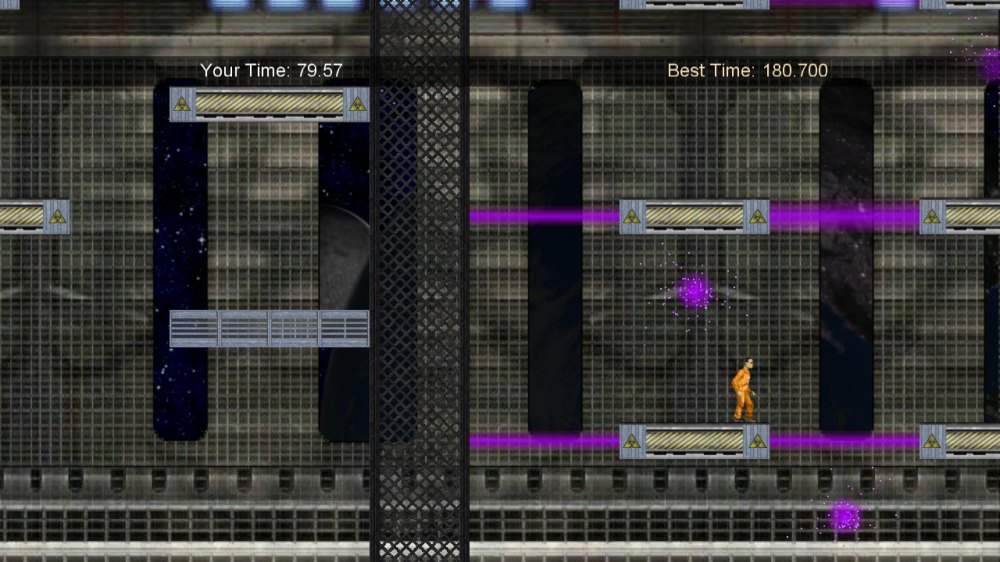
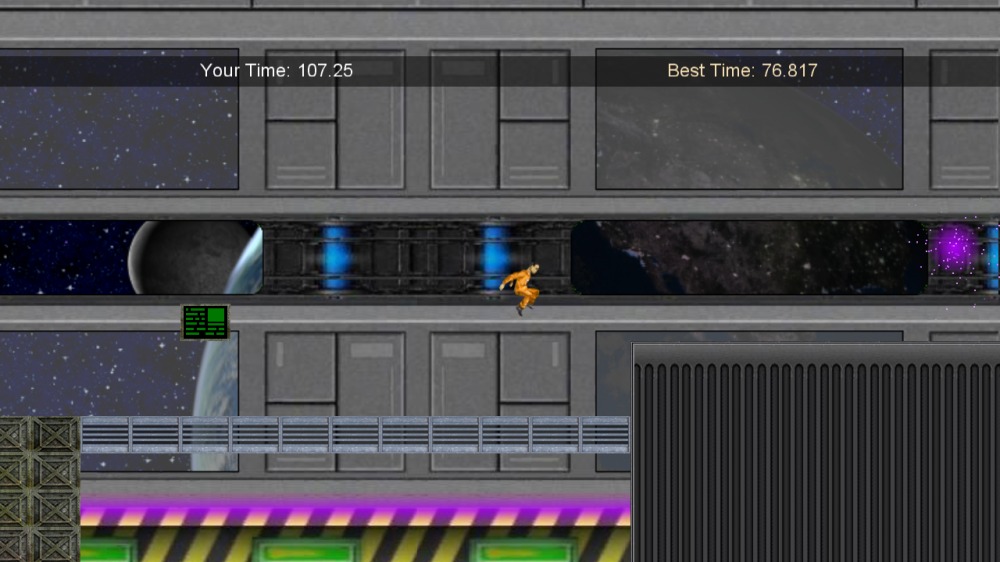
So what is the actual game like?  You run, you jump, and you occasionally hit a switch.  That’s it.  No ducking, no sliding, no wall-jumping, or any acrobatics at all.  Levels are mostly of the walk left until you reach the exit variety.  Occasionally, something will teleport you somewhere else, but that typically means the exit is somewhere else, restoring the status quo.  The hook is you can’t die.  Instead, you might hit an energy beam which teleports you backwards to various points in the stage.  Otherwise known as dying if this was any other game, but that’s Human Subject’s gimmick so I’ll roll with it.

Human Subject is not bad.  A lot of people would be thrilled to hear those words from me, but in this game’s case, it really could have been so much more.  Every good thing the game does is sunk by something incredibly stupid it does.  Level design is centered around precision platforming, not punishing platforming.  And then there are levels where you have to randomly guess which switches to hit, or which lasers to walk through that will help you progress instead of regress.  I just played a game that made a similar design mistake.  I don’t understand it.  Why would you take the time to map out so many well designed levels, and then throw in sections where you have to rely on just stupid luck?  You did everything smart up to that point.  Let’s put it this way: let’s say you’re using a Sat-Nav system, which 90% of the time tells you exactly what you want.  However, the other 10% of the time, the machine outright giggles at you and says “maybe it’s to the left, or maybe it’s to the right, or maybe it’s straight forward.  Good luck!”  You would rip the fucking box out of your car and back over it.  Human Subject was not a trial and error game, so why turn it into one?  Just a fucking dumb idea.

The controls are acceptable.  Mostly.  My biggest problem was the slightly unresponsive jumping.  My most common method of failure was running towards a ledge, hitting jump, and not having the guy jump fast enough and instead run off the platform to his doom.  Movement and jumping physics are fine, but that slight delay in jumping led to me swearing more than a sailor with his nutsack caught in a bear trap.  Also, on one level the frame rate dropped significantly, causing the game to stutter like it had just downed ten pots of black coffee.  It only happened once, but it was sure annoying when it was happening.

By far the most frustrating thing for me was the pace of the game is crippled by how slow the actual teleporting thing works.  When you miss a jump, or you intentionally hit a portal-beam-thingie as part of the level design, your dude doesn’t instantly reappear at the other side.  No, instead the game slowly crawls towards the respawn point.  This totally kills the pace of the game.  To Human Subject’s credit, the timer stops when this happens.  Oddly enough, the moving platforms don’t stop moving, which means the teleporting thing is happening in real-time.  This suggests that the aliens have perfected interstellar travel, but haven’t figured out how to send information electronically as fast as we’ve been doing since the 1830s.  They can fly thousands of light-years, but they can’t communicate faster than the speed of sound.  I’m suddenly not worried at all about being invaded by these things.  No matter what technology they have, if a two sentence phone call will take them five minutes to complete, I think we have the advantage.

The jumping thing, the slow-respawning thing, and the occasional random-chance thing really do sour the Human Subject experience.  Without them, it’s a pretty decent game.  I still mildly recommend it, but those three easily fixable hiccups really spoil it.  I don’t even care that the writing sucks and isn’t funny 96.43% of the time.  Good writing might make a game more memorable, but play mechanics are what make it worth your time.  If Portal was played straight, without the humor, it would have been as good a game as it turned out, but you might have forgotten it faster too.  The truth is, unless a game is centered around humor (like DLC Quest), writing is only icing on the.. cinnamon roll.  Back down, Ving.

EDIT: I feel this review failed to articulate that I did enjoy my time with Human Subject, flaws and all.  I issued an apology to Bryan Hendo and my readers here.

Human Subject was developed by Bryan Hendo

80 Microsoft Points said prefer their Brians to have an “I” in their name in the making of this review.

Human Subject is ranked on the Indie Gamer Chick Leaderboard.  Click here to see where it landed.

SPOILER! Highlight the invisible textSo the aliens are not planning to blow up the world.  Instead, you’re part of an alien reality show.  Whatever.  The good news is the developer clearly put more thought into the game than into the writing, because if the game was as bad as the writing it would be unplayable. END OF SPOILER!

Gameplay courtesy of Aaron The Splazer, the official best source of non-bullshit trailery gameplay footage of Xbox Live Indie Games on YouTube.

Dark Matter and Maze of Apes

Sorry that I haven’t been updating as frequently.  As it turns out, I have trouble getting motivated when my boyfriend is 2,398 miles away.  I blame his parents for choosing hurricanes over earthquakes.  It also doesn’t help that the last two XBLIGs I played are puzzlers, which I typically have difficulty writing about.  Logic puzzlers are niche enough without being put on a platform like XBLIG, where they’re only tolerated if they have a more actiony-bent to them, like Escape Goat.  Most of them probably don’t do well.  I don’t have sales figures, but I’m willing to bet a run-of-the-mill twin-stick zombie shooter sells a multiple of the copies that a really good logizzler like Alien Jelly does.  And yes, I just made up a word.  Logizzler.  I’ve almost gotten TwickS into the gaming lexicon, and I’m not stopping there.

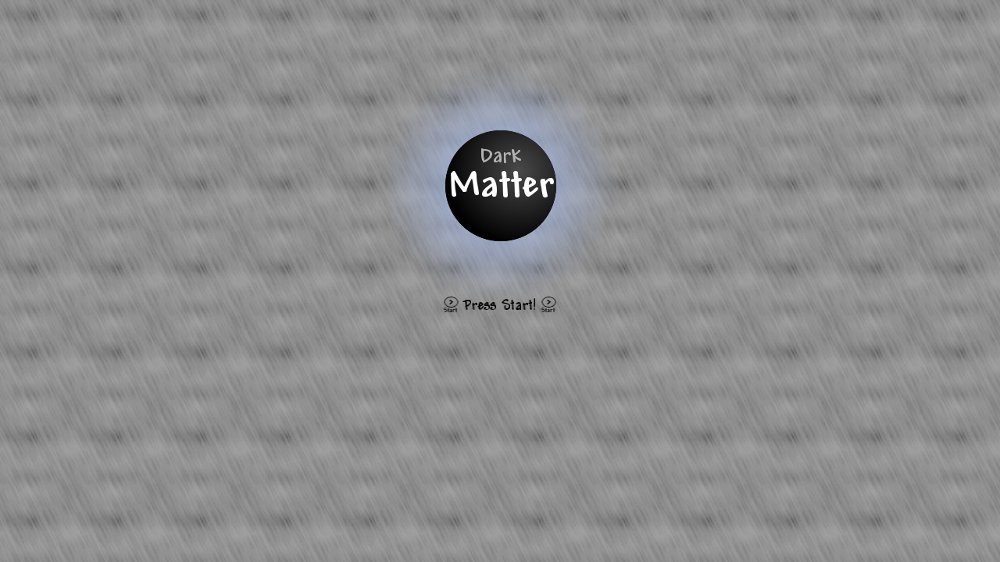
Oh thank God, THANK GOD, that they used one of their screenshots on the marketplace to show off the title screen. And there it is, so elaborate and awe-inspiring. If not for it this, I don’t think I would have purchased the game.

Instead of writing two reviews, I decided to merge recent XBLIG releases Dark Matter and Maze of Apes into a single piece.  It makes sense.  Both are grid-based puzzlers, or guzzlers as I call them.  And I somewhat enjoyed both, even thought I make no bones about it: they’re as dull as dish soap and will bore 90% of the gaming population to tears.  Hell, these type of games are up my alley and I was barely able to keep my eyelids open.

Part of that has to do with the fact that I played them all at once.  I’ve always had the most fun with these types of games when I play through them slowly.  Five or six levels at a whack, then a day or so break.  Since starting Indie Gamer Chick, games I plan on reviewing I typically try to get through as fast as I can, which might not be a good thing.  For puzzle games, that can be brutal, because it’s the same thing over and over again.  Some people like that.  Some people play through entire Sudoku books in a single sitting as well.  Weirdos for sure, but they’re out there.

Oh yea? Well WE can waste one of OUR screens on the title too. Right back at you, bitch!

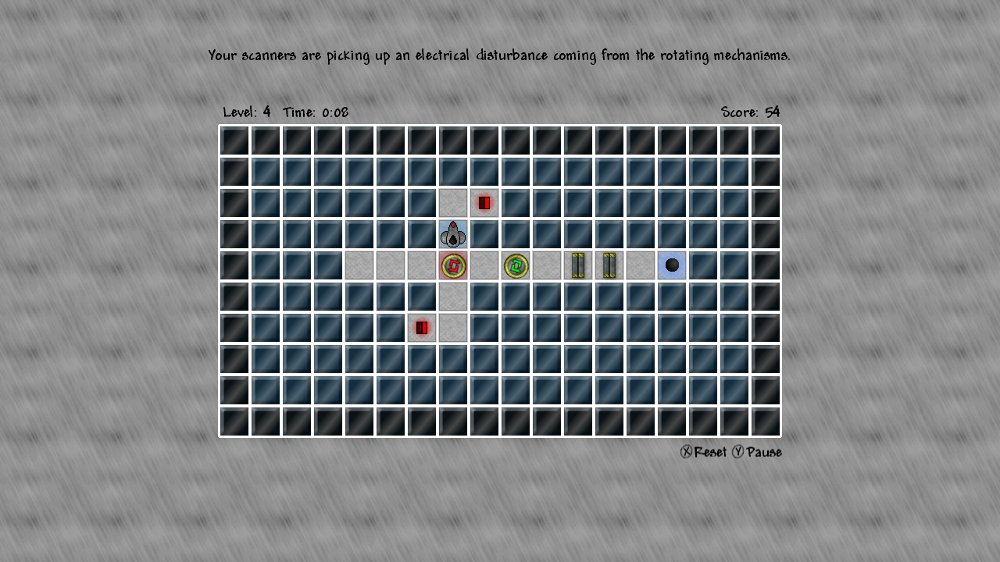
I’ll start with Dark Matter.  Here, you’re a space ship that’s running out of fuel and oh my God you don’t really need a story for this, just shut up and get me to the puzzles.  Dark Matter is an “open the exit” puzzler.  You steer your ship around, hitting switches, pushing boxes, avoiding gaps in the floor, etc.  Control at first seems a bit floaty, but you can quickly get used to it.  Dark Matter also has a couple of puzzles where the control scheme gets reversed, with up going down and down going up, cats and dogs living together, mass hysteria.  I’ll admit, it’s a bit gimmicky, but it does help to somewhat freshen up an otherwise dull game.  And if that doesn’t work, a rage-inducing brain fart of game design by the jerks at Orbonis will.

Some of the “puzzles” involve multiple switches.  Some of the switches help you, while others make the puzzle unsolvable.  The problem is, there’s no way to know which does which unless you hit them.  I’m sorry, but that is not a puzzle.  That’s a dick move.  Let’s say you give someone two identical boxes, one of which has a cake and one of which has a spring-loaded jar of flesh-eating ants.  The only way the person can get the cake is by pure chance, but if they pick the box with the cake, you don’t congratulate them on their power of deduction.  You curse the heavens that they had the luck to pick the cake box and ruin your planned YouTube video.  And that really irked the shit out of me about Dark Matter.  Because it’s an otherwise smart puzzler, only one with a really stupid play mechanic in it.  Yea, it’s kind of boring and needed anything to pull out all the stops to combat that, but having a GOTCHA! style trap in it does not make it less boring.  It just adds to the tedium, which is exactly what the game didn’t need.

Dark Matter, which should have been called “I Don’t Give a Ship” instead.

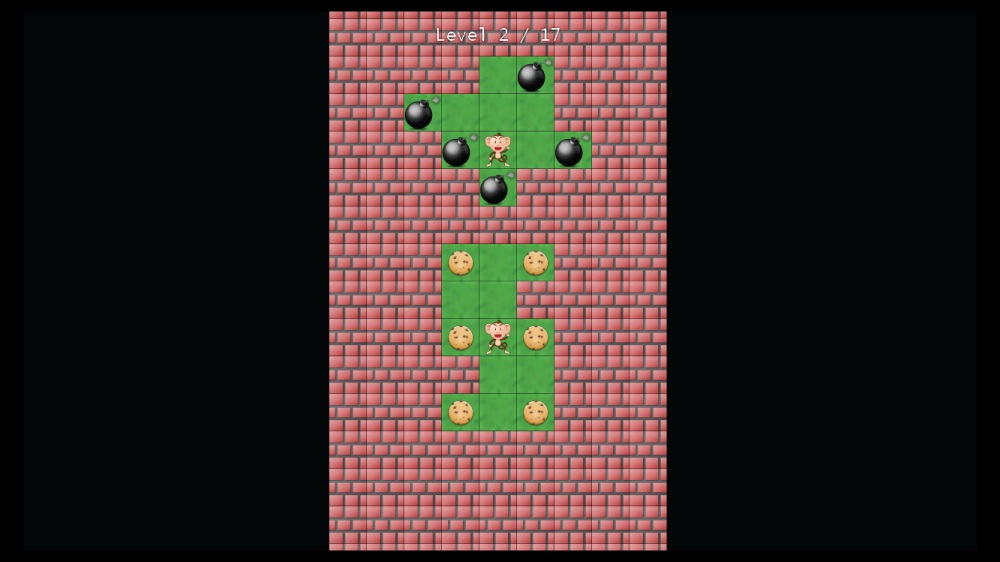
Maze of Apes is even more minimalist and snore-inducing than Dark Matter, but by no means a bad game.  This is one of those “Pick-up insignificant shit scattered on flimsy floor” puzzlers.  Or “PISS OFF” for short.  This type of game has been done a hundred zillion quadrillion gillion times (give or take), but Maze of Apes does make some effort to spice things up.  Some of the puzzles feature controlling more than one ape.  The stick moves both at the same time, so you have to figure out a way to steer both guys without killing or trapping one of them in a way where you can’t pick everything up.  Sadly, a lot of the levels don’t use this hook, and that’s a shame because that’s all Maze of Apes has going for it.  While the puzzles can be clever, they still are likely to give you a case of déjà vu, because there’s no way anyone over the age of 18 who has gamed for most of their life has not played something like this already.

Maze of Apes. Personally, I would have called it “Labyrinth of Monkeys”

Despite both games being about as exciting as picking lint out of your umbilicus, they are well made and fun if you’re into this sort of thing.  I give the edge to Maze of Apes.  Dark Matter has better art, more complex stages, and a wider variety of puzzles.  Maze of Apes looks and plays like a Windows 3.0 freeware game.  But Maze of Apes doesn’t have that fake-switch thing going for it, and Dark Matter does, so Maze of Apes wins by virtue of not being an asshole.  Which is probably how Obama is going to win in November.  Zing.

Dark Matter was developed by Orbonis

Maze of Apes was developed by Blanc Game Studio

80 Microsoft Points apiece said “oh come on, it’s just a joke.  Us Microsoft Points think both candidates are assholes” in the making of this review.

Dark Matter and Maze of Apes are ranked on the Indie Gamer Chick Leaderboard.  Click here to see where they landed.  The Leaderboard is sponsored by Count to a Billion, out now on iPhone

The 4th Wall

I don’t really know where to begin with The 4th Wall by GZ Storm.  I guess I should start by saying that I apparently was enjoying their previous game, The Vidiot Game, until it knocked me out with a seizure.  Just to be clear, I have epilepsy so such results will not be typical, but I honestly don’t remember playing the game at all.  Brian says I seemed to be having fun with it, which is weird because I don’t think there has been a single positive review of it.  Then again, I’m a sucker for Wario Ware style games.  It’s a shame, because I might have been able to figure out what to write about that game.  With GZ’s latest title, The 4th Wall, I’m truly stumped.

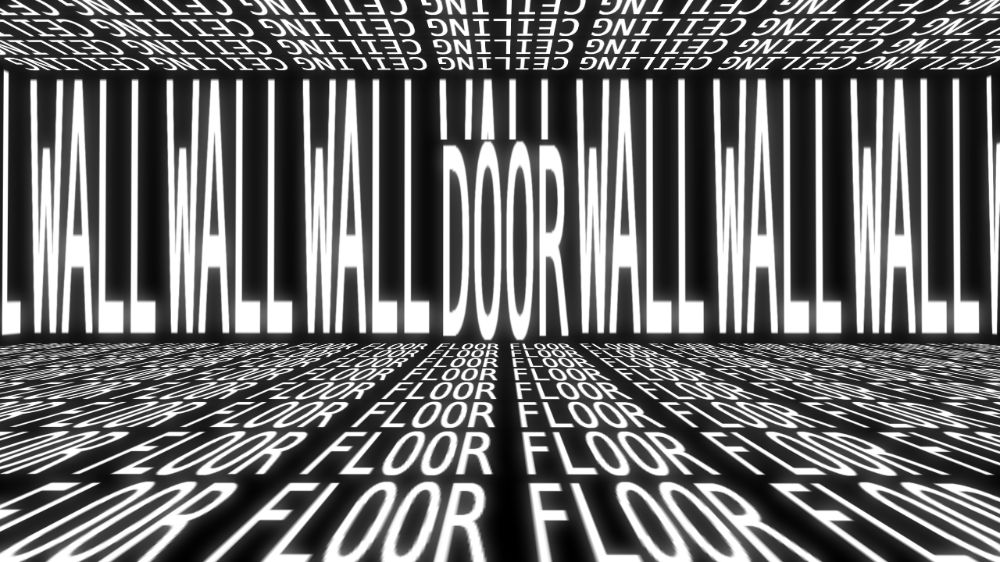
What can you say about this game?  It’s a first-person, exploration-based “adventure” thing.  It’s surreal.  It’s disorienting.  It features a thirty-foot long penis that hangs from the ceiling and seems to be dripping blood.

That only took over twenty takes to get right.

Is it fun?  Not really.  I was too busy being weirded out to have fun.  There is no plot or context for The 4th Wall.   You’re placed on a field that has a white wall, another wall made of static, and arrows on the floor that point you towards a room.  In that room, there’s a terrible high-pitched hum that made my dog walk out of the room.  You walk through a door that leads to an all-black room with various eyeballs looking around.  You see a white tunnel.  You head towards it.  Then you fall back to the starting field, which now features the aforementioned bleeding dick, plus an invisible black wall.  It took me a good half-hour of wandering around to figure out that the static wall now had a hidden door in it.  You walk through that, go through a maze, and then get dumped again back into the starting field.  You stand by the white wall and it causes the field to turn black-and-white.  You chase down a ball that’s bouncing around, touch it, and get dumped back to the starting field.  Then you let the dick bleed on you and the game is over.

You can’t see him, but presumably the person you play as has “ASSHOLE ASSHOLE ASSHOLE” written all over him.

What the FUCK was this supposed to be?  Not since I played Linger in Shadows on PlayStation Network has a game left me this perplexed.  I guess the fancy term would be “post-modern” which Moe Szyslak taught me means “weird for the sake of being weird.”  No matter what you call it, I can’t recommend The 4th Wall, the gaming version of walking into the middle of a storage park, then licking a toad and trying to find  your way out.  Enjoy.

The 4th Wall was developed by GZ Storm

80 Microsoft Points are not totally sure if this was a real game I played or if someone spiked my coffee while I was playing Sound Shapes in the making of this review.

Yes, I’ve told developers to “be weird.”  I guess I should have been more specific and added “but still coherent” to that. 

Face Slapper

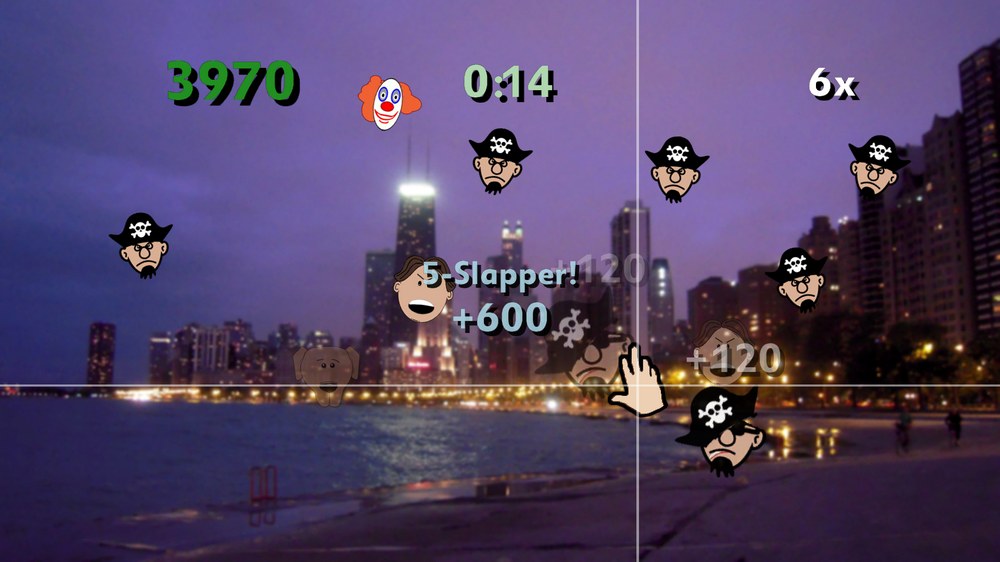
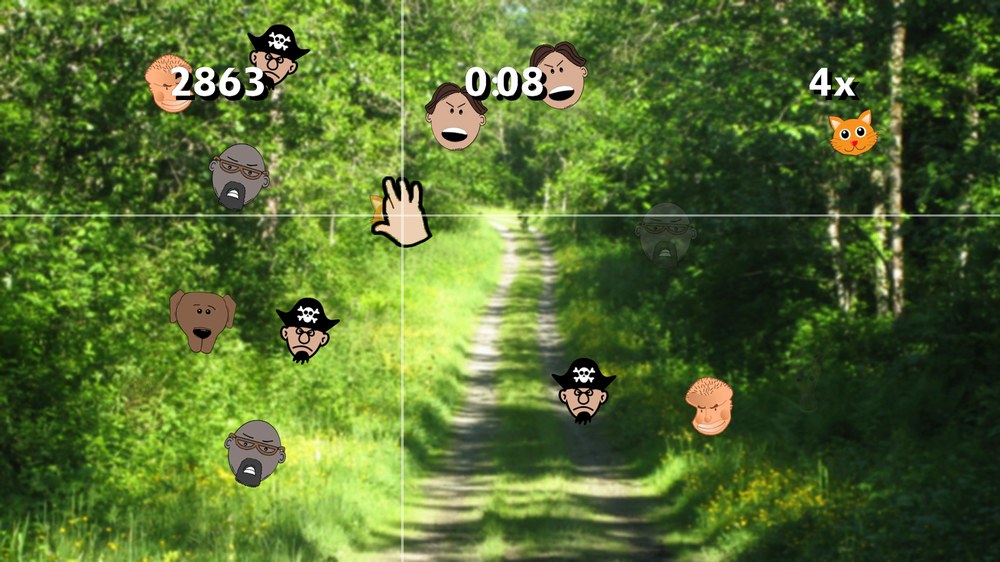
Just by hearing the description of Face Slapper, you’ll know it’s on the wrong platform.  The idea is a bunch of faces will appear on a play field.  Using the analog stick, you line up a cursor over a face and press a button to slap it.  You get points for smacking dude and lose points for hitting chicks or animals.  Yea, this was without question a game designed with a touch-screen interface in mind.  Face Slapper is also out on Windows Phone, which is likely an okay fit.  I would personally prefer a bigger screen like iPad, but WP is easier to program for, even if it has a fraction of a fraction of a fraction of the users.

On the Xbox?  Meh.  Face Slapper is actually pretty dumbed down.  The slapper is made to be pretty generous, smacking only the things that give you points, so if a bunch of faces are together, feel free to get button-stabby.  In fact, I theorized that you could chuck effort out the window and just button-mash while wiggling the controller all over the screen.  My previous, “pretend like I give a shit” efforts resulted in scores ranging from like 5,000 points to 8,000 points.  My “don’t give a shit” button-spammer approach netted me over 12,000, and I only stopped because my thumb got tired.  That, my friends, is broken game design.

Oddly enough, I did have an extremely limited amount of fun with Face Slapper, but that was had trying to unlock all the fake achievements in the game, which are pretty clever.  The real challenging one was trying to finish the game with a score of exactly negative one point.  I never actually accomplished it, but for a total of ten minutes I actually did want to.  Then the feeling passed.  It was like a bout of gaming constipation.

I can’t go out and recommend Face Slapper, just because it really is on the wrong platform.  This is a game designed with the precision of a touch screen in mind.  I can’t blame them for at least attempting to port it over the XBLIG, because as lightweight as the platform is, it’s unquestionably more viable than Windows Phone.  But Face Slapper’s problems extend beyond its control scheme.  The graphics aren’t distinctive enough, the background images can be disorienting, and I don’t feel there’s enough variety in gameplay.  If you have a Windows Phone, it might be worth a look at.  Also, ha ha, you own a Windows Phone!

Face Slapper was developed by Highbrow Games

80 Microsoft Points came this close to putting a game on the leaderboard designed by the guys who made Avatar Planking in the making of this review.


Cuddle Bear (Second Chance with the Chick)

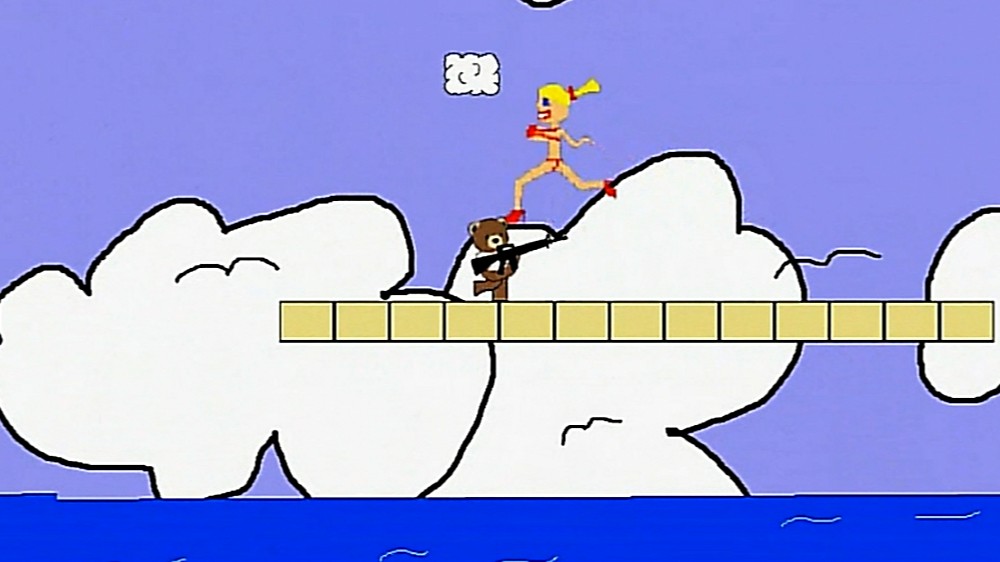
I played Cuddle Bear back in May, and it was an honest and true contender for, at best, the worst game I’ve ever played in my life. Horrible button layout. Terrible level design. Abysmal graphics.  Annoying sound effects.  Thinking of all the games I’ve played this year, I don’t think I can think of a better game that fits the “worst game of the year” description. But, to their credit, the developers read my review and responded with good humor and a vow to do better. On one hand, it’s nice to have one of those rare developers who actually intend to invoke their Second Chance with the Chick. I created the policy figuring I would be doing these types of reviews on a weekly basis, instead of the bi-monthly rate I have going right now. On the other hand, I have to admit that the thought of playing Cuddle Bear again almost drove me to take a razor to my wrists. I almost did it too, but then Brian reminded me that suicide is a mortal sin and if I bled myself out I would go to Hell and get stuck playing Cuddle Bear anyway. Well fuck, he has a point I guess.

“Cuddles, I’m impressed that you pissed the word “Redrum” in blood on my wall. BUT, I don’t think pissing blood is ever a good thing. Have you ever heard of prostate cancer?”

You know what? Happy Sock.. Christ, that sounds like something teenagers jerk off into.. actually did fix the game. They eliminated most of the leap-of-faith gameplay and dick move enemy placement that made Cuddles such a brutal chore of a game to play. Levels can actually be completed without having to trial-and-error your way through them. All other problems are still firmly present, but hey, baby steps!

♫ She’s a Barbie girl, in a shitty world. Crapped and spastic. It’s shitastic! ♫

Did that one change make Cuddle Bear more fun? A little. The problem is the enemies are still fast-moving, annoying sounding bullet sponges that gang bang you if they get close. The enemies tend to “bounce” when they hit you, turning you into one of those ball-on-a-paddle things. If you’re near a ledge when this happens, things really get fun. And getting items is still painfully slow. Yea, the developers stuck cheat codes in, but who outside of those who read the comments on this site would know about those?  I must say, once I had the one shot (or two, but who’s counting?) sniper rifle, the pace of Cuddle Bear quickened and it actually went into consideration for making the leaderboard. Then I got to the fifth stage of the Chinese themed levels, which apparently missed the “don’t do leap-of-faith platforming with enemies dickishly placed on the platforms that cause you to recoil like you just got a whiff of Roseanne Barr’s body odor” memo, and I decided to quit again. Sorry guys, you have a long ways to go. Is it a vastly improved experience? Yes. But, at the end of the day, a polished turd is still a turd.

Cuddle Bear was developed by Happy Sock Entertainment

80 Microsoft Points laughed at Indie Gamer Chick for originally spending 240 points on this piece of shit in the making of this review.

Happy Sock, I saved you the time of cherry-picking my words for the misquoted review blurb. Just copy the words in bold. Hopefully the time I just saved you can be applied towards making your next game suck significantly less. 

Sunflower Farm

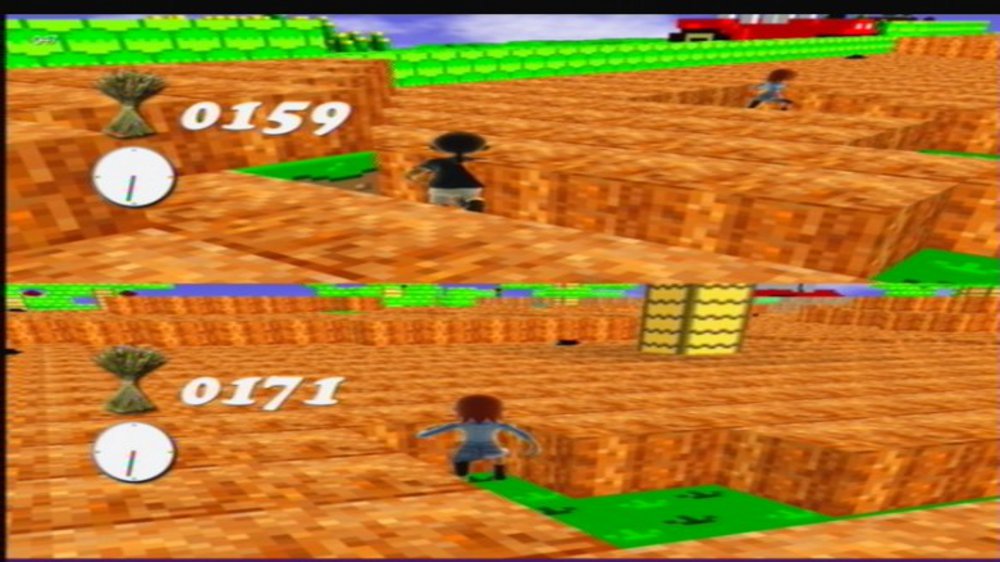
Sunflower Farm is a voxelish minigame collection where you and up to three buddies can sit down and be bored while slogging through three games that range from dull to clunky to outright abysmal.  First up is Harvest Time, where you walk around a wheat field trying to cut as much of it down as possible.  Real quick thought, guys: if the concept of your game sounds like something that you would rather hire out illegals to do while you sip piña coladas and watch Judge Judy, chances are it won’t make for the most exciting video game.

Something tells me that Sunflower Farm doesn’t fall into the “developer always dreamed of making a game about this subject matter” category.

In single player, you have an absurdly short time limit to accomplish this.  You need to unlock higher difficulties and play those in order to unlock more stages.  I’m adverse to forcing myself to be bored for longer than I have to be and thus I decided to skip effort and go with the “give it two tries and if I fail, fuck it” approach.  Items do rain down from the sky that could help, but they come down at random and not all of them are helpful.  One of them is an airhorn, and I’ll be damned if I can figure out what it is used for.  In the sheep herding game, it has a function.  In this one?  It seems to scare crows off, but I don’t think the crows actually do anything.  The useful stuff, like something that stops the clock or a thing that makes you run fast, don’t seem to spawn as much as that stupid airhorn.

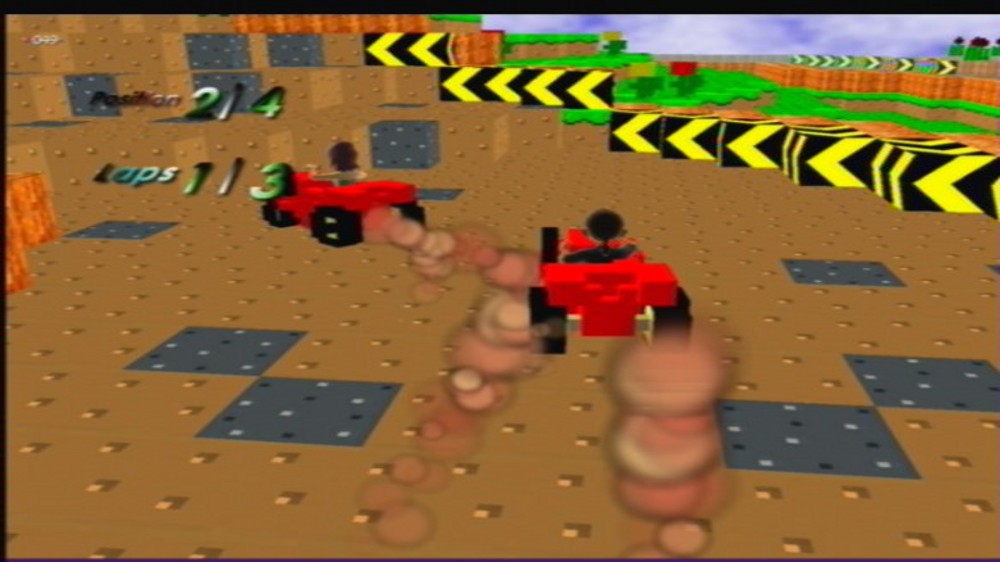
The second game is Sheep Herding.  There’s a field of sheep, and you have to run up behind them and coral them into the center of the screen.  Getting them to move is a slow, plodding, boring experience, probably not unlike real herding is.  The third game is Tractor Racing, which is a fancy way of saying kart racing.  This one is mired by terrible handling controls.  Steering is too loose, and thus driving ends up looking like a series of quick left and right swerves, like you’re watching a teenage girl test her learner’s permit out for the first time.  And she’s slightly intoxicated.  And texting while driving.  And the car is a Dodge.

For what it’s worth, if you can get used to the steering, the courses are only barely terrible.

Whether you play these single-player or with friends, Sunflower Farm is one of the worst Xbox Live Indie Games of the year.  Harvest Time and Sheep Herding sound more like things you would punish a disobedient child with.  As for Tractor Racing, I might not have realized just how bad it was if I hadn’t already played Avatar Grand Prix 2, which was a pretty dang good game.  The tractor stuff is by far the best part of Sunflower Farm, which is like saying free body piercings is the best part of being executed by firing squad.  So I can’t recommend Sunflower Farm.  You would be way better off having your car break down in front of an old farmer’s house and having sex with his virginal daughter.  And you KNOW how those things end.

Sunflower Farm was developed by Tomlin Games

80 Microsoft Points wonder why so many cars break down in front of farms in the making of this review.  Then again, I wonder why so many strange people walk into bars as well.  Or why we’re so concerned with the amount of people required to screw in light bulbs.