Tales from the Dev Side: Greenlight, Red Light by Alex Jordan

Although I’ve sworn many times that Xbox Live Indie Games have a bright future, developers are treating the platform like a freshly pruned-by-iceberg Titanic.  For many, the brass ring for distribution is now Steam.  The problem with that is Steam is a tough nut to crack.  And then hope came in the form of Steam Greenlight.  But is it really hope, or is it all smoke and mirrors?  Cute Things Dying Violently developer and Greenlight hopeful Alex Jordan  has a few thoughts.

Greenlight, Red Light

by Alex Jordan

The life of an up-and-coming indie game developer sure is a great one. I mean, think of the perks!  Scant management, vast amounts of creative control, and great appreciation for the finer things in life, e.g. ramen noodles.

And, hey, there’s also the disproportionately huge share of revenue you command!  Unfortunately, 70% or 100% of shit is still shit (roughly “shi” if you’re using the 70% model, including the dot above the i, greedy bastards), so pretty much every last indie developer has had one nagging thing on their to-do list for the past four or five years: beg for distribution on Steam.  Because, let’s face it, it’d be super nice if people had actually heard about your game and maybe would deign to buy it.  If that were the case, you could consider quitting your day job, or at least consider having something for lunch other than rehydrated noodles in sodium water.

And because the only thing out there more in abundance than ramen noodles is desperate indie developers, the guys and gals at Valve who run Steam have had to fend off these Morlocks with a stick.

Pictured: Cute Things Dying Violently creator Alex Jordan and his fiancée.

For every indie game that manages to pass through the Pearly Gates, 100 get denied or ignored. Enter: Steam Greenlight, Valve’s way of saying, “Here! You look at shitty MS Paint art.  We’ll just sit here and make decorative pants out of $100 bills.”

Having had Cute Things Dying Violently rejected by Valve back in July, Greenlight (which was announced roughly three days after I got my rejection email) seemed like a juicy consolation prize.  A community indie games voting site for a large captive audience of Steam users, designed by a developer as canny and talented as Valve? Sign me up!

And I did. Pretty much the moment it went live, back on August 30.  And that’s when the horrible truth set in: Greenlight was. . . decent.  It wasn’t great, it wasn’t terrible, it was just. . . a filter.  Pure, exhausted convenience distilled into a website.

What’s Going Right?

My first 20 minutes with Greenlight were pretty blissful.  It was streamlined and easy to use, and I managed to register CTDV with trailer, screenshots, and description inside of ten minutes.  And pretty much the moment my page went live, the unique page views started pouring in.  The “large captive audience” I mentioned earlier is nothing to sneeze at.  Just by virtue of being on the platform, my game and others like it were getting a degree of attention that was unprecedented just hours earlier.

It’s also marvelously easy to provide feedback on games.  For each game page there’s an upvote button, a downvote button, and a Favorite button.  Additionally, Collections make it easier for third parties like gaming websites to promote a series of games.

What’s Going Wrong?

I’m not going to harp much on the reviewer’s experience, since most gaming journalism outfits have already beat me to it.  The short version is that discoverability is still a problem; talented developers with attractive games are unavoidably lumped together with complete crap; trying to cast several votes efficiently is a navigational cul-de-sac; and, unfortunately, the Greenlight community is full of slack-jawed retards.

“Gameplay looks like iphone appstore level trash” said Cletus Gumtooth of Pine Knot, Kentucky. Jed Toomanytoes of Camden, TN noted “looks like a boring, bad, lazy game thats just like a multitude of other terrible and boring games. also i want to fuk my sistah.”

How obnoxious can they be? Well, many of them didn’t know what Greenlight was for.  They thought it was a way to request their favorite AAA games getting on Steam as opposed to indie games.  Plenty of people who knew what the deal actually was were scarcely better, and each game’s comments thread began racking up scattershot feedback that many YouTube vets would cringe at.  One man’s Cthulhu Saves the World is another man’s crappy RPG Maker clone, and one man’s Cute Things Dying Violently is another man’s “stupid Flash game.”  Ouch.

I’m sure the majority of Steam accounts are held by lovely people, but you can only read so many variations on “Your game sucks” or “Get fucked m8” before the scales fall from your eyes.  After all, these are the people whose votes you need.

Oh my God, I turned out to be a politician anyway.

The Developer’s Experience

Anyway, such delicate interaction proved to be a wee bit of an eye-opener.  The rest of the developer experience on Greenlight isn’t much better.

The most notable aspect of the developer’s experience is one of confusion and withheld information.  Putting a game on Greenlight, with its studied silence from Valve and its schizophrenic community, is like being asked to stand in one place and alternatively receiving either kisses or kicks to the genitalia.

And those are the only two forms of feedback.  Initially, developers (and only developers) got to privately see their game’s percentage of upvotes to downvotes, but that disappeared after a few days when it became apparent to Valve that downvoting – either legitimate downvotes or those by trolls – served no other cause than to drag down a game’s up/down ratio.  Downvotes don’t subtract from upvotes, but, initially, we didn’t know that.  For reviewers, a downvote got the game off their to-review screen.  For developers, it was a sign of dislike for the game and perhaps even a negated upvote, as Valve hadn’t told us otherwise.  We got to suffer in silence for a few days, watching our numbers degrade, before Valve put us out of our misery and yanked that wonderful feature.

And then there’s the “% of Calculated Ratings So Far” bar that shows how far along your game is on upvotes before it gets submitted to Valve.  Well, the fine folks at Valve don’t quite know yet what level of participation the Greenlight community will have, so they’ve erred on the side of caution and set the number pretty damn high.  Even standout games on Greenlight like Project Zomboid have only gotten about 20% of the votes they need, while the rest of us plebes get to hang on to single digit approval percentages.  (Granted, it’s been less than a week, so take my whining with a grain of salt.)  And since developers don’t get to see how many upvotes their games have actually gotten, there’s nothing for us to extrapolate from.  We just get to sit, and wait.  And get kicked in the balls.

Hey, I’ve Done This Before. . .

Despite its shortcomings, Greenlight still presents a big opportunity for indie developers.  Whereas previously Valve would almost certainly take a look at your game and flat-out reject it in the same split second, now we have an opportunity to land a game on their laps with some sort of critical consensus and the understanding that Valve employees will review it with the time and attention it deserves.  Gone will be the days of instantaneous judgment leading to rejection and developer misery.

Thus, Greenlight becomes a plausible shortcut.  Sure, it’s an extra step in the process (you used to be able to just fill out a form on Valve’s website and send your game in), but if your game emerges intact on the other side, odds are you’ll soon be sitting pretty.
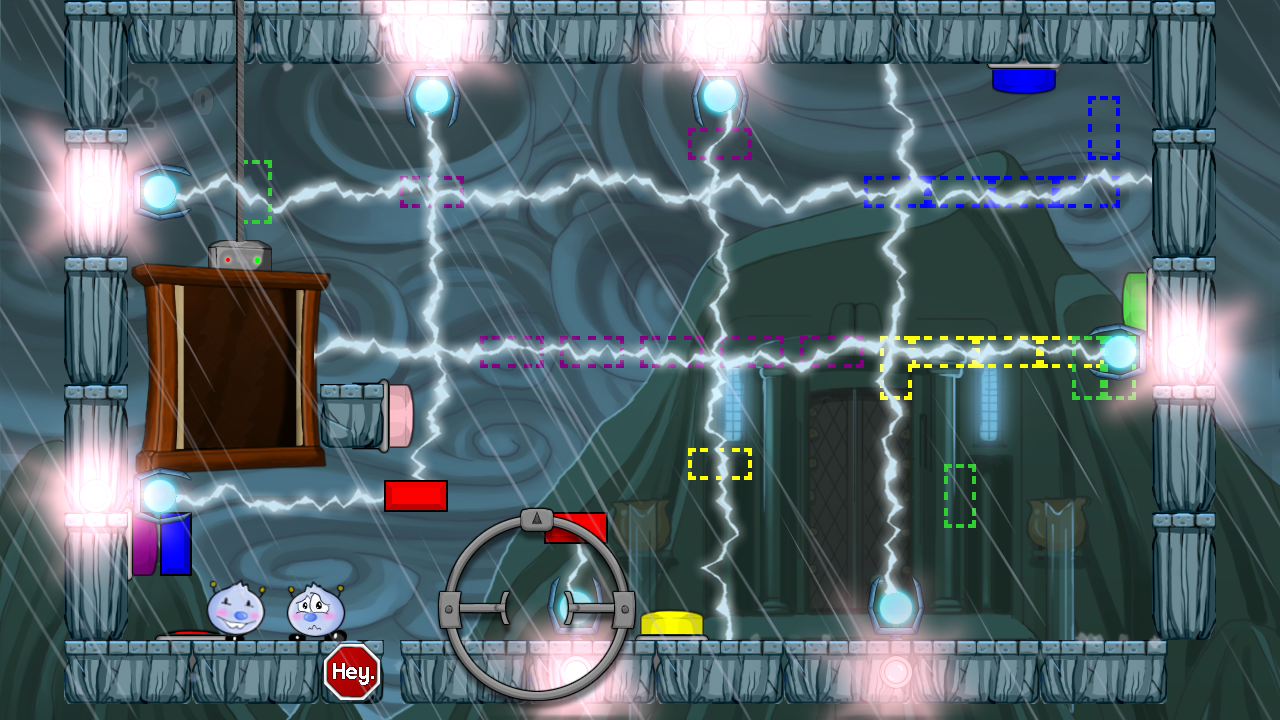
Cute Things Dying Violently has seen modest success on various platforms. Which is probably a good thing. If it did any better, you know a certain Silicon Valley mobile company would be right there with their “completely original” physics puzzler “Adorable Creatures Perishing Disturbingly.” Then they would probably sue him for stealing their idea before they thought of it.

But here’s the thing… Greenlight’s voting threshold and discoverability shortcomings mean that the developers still need to do quite a bit of hustle to gain attention and upvotes.  Which is. . . hey! I recognize that feeling!  That’s exasperation, having just realized that this is what we’ve always had to do, and will always have to do.  I don’t think any of us developers were naïve enough to think that Greenlight would be a straight ticket to success, but what we got instead was another chapter in the same story we’ve been reading for years upon years: capitalism is hard, and you gotta work for it, and in the end you still might get shafted for no fault of your own.

That means instead of spamming Kickstarter solicitation emails, now you’ll be spamming Greenlight solicitation emails.  (I’m sure gaming journos will be just as eager to read the latter!)  Developers will still be struggling to worm their way into bundles and promotions, desperate to practically give their game away just to get a little bit more recognition.  Networking will still be paramount and journalists will still need to be schmoozed at bars, but last I checked, I really like beer and I really like talking about myself, so that’s not a problem.

In the end, Greenlight represents yet another dance routine on the never-ending popularity contest that all obscure indie developers have to participate in.  It’s certainly not bad, and dare I say the vetting process still represents a good opportunity, it’s just that it’s underwhelming.  Greenlight’s another queue, another procedure, another form that needs to be filled out on the road to possible opportunity.

It is, in short, the perfect microcosm of the indie developer experience.  Does that look like a raw deal to you?   It shouldn’t.  It may seem like deferred, somewhat unlikely success, but it’s worth a shot, isn’t it?  If it wasn’t, we would’ve given up.  And judging by the growing number of games on Greenlight, that ain’t gonna happen.
Developer Interview: Count to a Billion

Count to a Billion is a bit of an anomaly in modern gaming.  It’s a pure button masher without apology.  Stand-alone button mashers have been a dead genre for decades.  Bringing out a new one in 2012 seemed almost brazen.  Developer RAWR! Interactive took it as a challenge to resurrect this style of game.  I spoke with their co-founder Mario Wunderlich about what went into creating Count to a Billion.

And yes, Count to a Billion is the official sponsor of the Leaderboard.  It doesn’t mean they’re getting all softball questions.  I enjoyed Count to a Billion, but I do have a bone or two to pick with it.

By the way, if you Tweet this interview, you’re entered into a chance to win a free copy of Count to a Billion.  Valid tweets must include the hashtag #IGCbillion fuck it, just tweet the damn interview.  We’ll be giving away not one, not two, but three copies!  Even if you can’t count to a billion, you can count to three.  Winners will be drawn on Saturday, September 1, 2012.

Kairi:  Button mashers are games that studios dress up and try to pretend they’re something else.  You guys outright embraced being a button masher and flaunt it.  How did this come about?

Mario: Count to a Billion, as a concept, was born from the desire to use the iPhone’s screen capabilities to the max. Most games use but 1 finger, sparingly, for everything. We wanted ta have players use all fingers (5 on iPhone, 10 on iPad) and do it in an intense fashion.

We worked it up from there to a pure button masher. There is no need for deceit, no need for disguise. We believe button mashers can be fun if the incentives and mechanics are well designed. And the iPhone/iPad screen is a perfect medium for it.

It is so simple, and yet it really is a lot of fun.  And exhausting.

By the way, the game was originally called Count to a Million… but we just kept escalating the game in intensity, and soon realized that big numbers accurately reflected this – and that’s how Count to a Billion came to be.

Kairi: It’s such a rarity that a game, even a small indie game, centers completely around button mashing.  I asked some gamers what was the last button masher they liked.  Most answered Track & Field, an early 80s arcade game that later got some home ports.  So it’s been a long time since this type of game resonated with gamers.  Why take the risk?

Mario: As a company, RAWR! Interactive’s vision is to explore new game mechanics for mobile platforms. Because of our vision, all our games will be risky investments by nature – but we think it’s well worth it, we might find something that players really love. Maybe it’s Count to a Billion, maybe it’ll be another game. But our mission is to find new ways to play with an iOS device.

With Count to a Billion, we wanted to get away from the super laid-back game mechanics that have been used over and over in 99% of mobile games – and explore intense game mechanisms. It this case, the intensity is quite physical. Sore arms. Numb fingers. And players have kept coming for more!

Kairi: The majority of gamers I know are super apprehensive about the potential of a button masher.  Straight honesty on my part: I thought Count to a Billion was going to suck.  I really did.  And in fact it’s very enjoyable.  So how do you go about convincing people that your button masher is different from any other button masher ever created?  Because, well, it is!

Mario: Thank you. And you’re right about that too. People have a preconceived notion of what a button masher is – the last one most gamers saw, like you noted, was probably in the 80s… and left it at that. So our job now is to show gamers what a button masher can be. It can be as fun and as involved as any other game.

So for Count to a Billion, making the game was just 50% of the journey. The other 50% is all about PR and marketing. And to keep on innovating. So yeah, Count to a Billion’s release was just the start – we have great new things planned for it. And we’re working around the clock in the hopes that it’ll be seen as more than just another “button masher.”

Kairi: As I touched on earlier, your game has no theme to it.  It’s just about smacking numbers.  Was there ever a point where you had something other than the minimalist look it has now?

Mario: The idea was always minimal, but making a game out of button mashing took a lot of experimenting. We went through 7 versions getting a feel of how best to get the gameplay mechanics, getting the look and feel right, creating a set of goals and achievements to give the game a sense of progress and of winning – it’s the details that make a game, and with a game as drastically different and minimalist as Count to a Billion, we really had to discover them from scratch.

Kairi: I’m ranked 53rd on the leaderboard, and I would be ranked better if it wasn’t for some of those damn sliders.  Especially the “C” slider.  The game is critically acclaimed, but also everyone is complaining about these.  How did this slip by?

Mario: Initially, we wanted the game to be not only fun, but also a tough, challenging experience. The “C” Slider is probably the toughest challenge in the game. After working on it for so long, however, we made the mistake of forgetting just how difficult some of these where. We even got used to the “quirks.” But we’ve listened to our players, and our next update addresses these.  The challenge will still remain, but it will be focused more on getting that high score, less on trying to avoid errors.

God Damn this fucking shape!! I officially declare war on all things that begin with the letter C! Well, except for things named Cathy. I can’t declare war on myself obviously, unless you count all the smoking and late nights spent watching Dana Carvey movies.

Kairi: The YouTube integration was a stroke of genius.  How come you guys didn’t include feature for tweeting scores?

Mario: Thanks! To be honest, we wanted to limit the number of options in exchange for a smoother User Experience. As part of this trade-off, we thought about all the available social options, and concluded that Facebook and YouTube where better platforms to brag about your skills. Twitter is a fantastic social tool, but unless you’re constantly tweeting or have a huge following, singled-out tweets simply won’t get noticed.  However, we listen to our users. If twitter is a big wish-list item for many, we’ll make room for it and include it.

Kairi: So far the game is doing well, at least critically.  Other than addressing complaints, do you have any features planned for addition?

Mario: We have many new features planned. This first release was just the beginning. One particular feature will be the addition of a 30 second blitz play-mode, where you’ll be able to create your own “decks” with challenges in a particular order so you can maximize your game. These are possible game-changers – but the core will always remain: intense tapping and sliding action for billions of points!

Kairi: Anything else you have to say to potential players who remain skeptical?

Mario: If playing an intense, challenging game that is quite different from anything else you’ve ever played isn’t enough, then how about trying to earn all 68 achievements!? And coming soon, we’ll have an in-game “store” where you’ll be able to trade in billions of points for cool, new playable stuff!

Check out Count to a Billion for sale now in the App Store.

Tales from the Dev Side: Redefining Indie Success by Shahed Chowdhuri

Back in March, I published what is probably the most optimistic edition of Tales from the Dev Side I have gotten yet. Mr. Shahed Chowdhuri is the developer of Angry Zombie Ninja Cats, a game that I boiled in oil back in November. He’s also the creator of the XBLIG Sales Data Analyzer, which has been well received among his peers. He’s also one of the most gosh-darned nice guys in the community, and his first editorial on here about gaining community acceptance was cited as being inspirational to newcomers on the Xbox Live Indie Game scene. Now, Mr. Shahed has a different, yet still insanely chirpy and upbeat message to share with everyone: success is what you make of it.

Read more of this post

Tales from the Dev Side: The Game Industry Needs More Clones by DJ Arcas

Games similar to Minecraft dominate the sales charts of Xbox Live Indie Games.  Four of the top-10 selling games in platform’s history fall into that category.  The first games on XBLIG to gross $1,000,000 USD are both what are refereed to as “Minecraft Clones.”  I’ve not yet played any of those top-selling games, but I understand why they exist.  The gaming industry has always followed-the-leader.

When Pong first hit the world in 1972, it was immediately imitated, copied, cloned, or outright pirated world-wide.  Even Atari cloned its own baby, releasing such titles as  Super Pong, Doubles Pong, Doctor Pong, Puppy Pong, Hong Pong Phooey, and Pong Arm of the Law.  This continued with Breakout (itself referred to during development as “one-player Pong”), Space Invaders, Pac-Man, Donkey Kong, Defender, Super Mario Bros., Final Fantasy, Street Fighter II, Doom, Bejeweled, Resident Evil, World of Warcraft, and Angry Birds.  Think about it.  There are major studios out there right now who saw the first trailers for Watch Dogs or The Last of Us at E3 and said “guys, we need our own version of that and we need it by Holiday of 2013.  Get to work.”

In an industry where there are few trend setters, it has kind of surprised me how much animosity there is for those that are simply doing what the major studios are doing.  But the bitterness is there.  DJ Arcas, creator of FortressCraft, has dealt with it.  Last year, FortressCraft was the first Xbox Live Indie Game to gross $1,000,000.  I really ought to get around to reviewing it.  But while the first XBLIG-made millionaire continues to tweak his creation, he also has had to deal with the criticism that his game is merely a knock-off of a game that happens to be absurdly trendy right now.  I did once joke that Xbox Live Indie Games needs some form of a 6th Day Law, but DJ has another thought.  Maybe clones aren’t so bad after all.

  Read more of this post

Tales from the Dev Side: What Xbox Live Indie Games Have Meant to Me

Trust me, nobody was more surprised that Indie Gamer Chick caught on than I was.  And I was even more caught off guard when I realized that I was starting to have an influence on the Xbox Live Indie Game community.  A positive one at that.  At most, I figured I would inspire people to raid my house with pitchforks and torches to tar and feather me while setting my dog on fire.  Instead, people actually use my reviews and my editorials as a case study on what people from my generation (gamers who started during the 32bit era) expect from gaming.  I have to admit, I never figured anyone would seek my advice when it came to game design.  I’m still a little stunned by that.  Part of me is flattered, while the other part thinks you guys need your fucking heads examined.

Realizing that I had something special going with Indie Gamer Chick, I thought about how so many people who come here previously had little to no awareness of Xbox Live Indie Games.  Obviously the lack of promotion on Microsoft’s part shares some of the blame for that.  But part of it is undoubtedly the fact that indie developers typically are faceless to the gaming population as a whole.  That’s not exclusive to XBLIGs, by the way, but I doubt anyone will be rushing to make an award-winning documentary on the trails and tribulations of creating Escape Goat.

It was in that spirit that I came up with Tales from the Dev Side.  Well, that and the fact that it would be an easy way to get content on my site without having to do much work myself.  Again, laziness prevails!  Since starting the feature in December, readers have enjoyed a wide range of topics from pricing to community acceptance.  Hell, one in particular has been cited as the definitive piece on creating online multiplayer games on the platform.  It’s really incredible to me how receptive my readers have been to the variety of topics discussed by developers here.  Thousands of views have been achieved between them.  The people want these, and I want you to contribute them.

Xbox Live Indie Games are niche.  The market is small.  The community is small.  But the people involved are wonderful human beings.  Being Indie Gamer Chick has changed my life, and all I do is write about the games.  I wondered if any developers out there would want to talk about what XBLIG has meant to them.  The results were, in a word, overwhelming.

Read more of this post