Hey. First off, it’s nice to meet you. My name is Benjamin, and I’m a gamer with bohemian ambitions. I am artsy and/or fartsy. I want to be a writer. Not a celebrated writer or anything like that. I just want to be a guy who writes at least one thing that touches at least one person. At that point, I figure I’m breaking even in the world.
But mostly, I just play games and think about writing. All sorts of games, really. The more retro inspired a game tends to be, the more I seem to be interested. I love the SNES, and I think game design and philosophy peaked somewhere around that era, before veering suddenly into a scary, daunting world of budgets and mass marketing. Fortunately, indie games have rekindled that philosophy.
So here I am, with the intent of finding games that will grip me the way Mega Man or Link to the Past did. Tirelessly hunting for games with story lines as compelling as Final Fantasy Tactics and game play as tight as the Virgin Mary, I solemnly swear to you, my reader, that we will sort through the bad and reclaim gaming’s glory,
But, if you are into all that main stream mumbo jumbo, you can find me writing about that over at Cheat Code Central and God is a Geek, you corporate tool. Or, if you’re particularly in love with me, you can stalk me via a semi-updated list of my hard hitting journalism and high caliber word stuff —that has been ruthlessly scattered across the veritable cyber cosmos of these here e-webs— by clicking the following link:
But in all seriousness, I’m psyched to be contributing here at indigamerchick.com . Been following IGC since she started this site, and stood in awe as it grew to have the influence it does. I hope I can bring something worthwhile and unique to the team, and I’m seriously hoping to click with the readership. This site would be nothing without the personality that is Cathy, and the vocal community that supports her. Follow me @benjaminmaltbie and maybe we’ll, I don’t know, play a game or something.
I chose to play Cosmic Predator to end my short-lived SHMUP September.
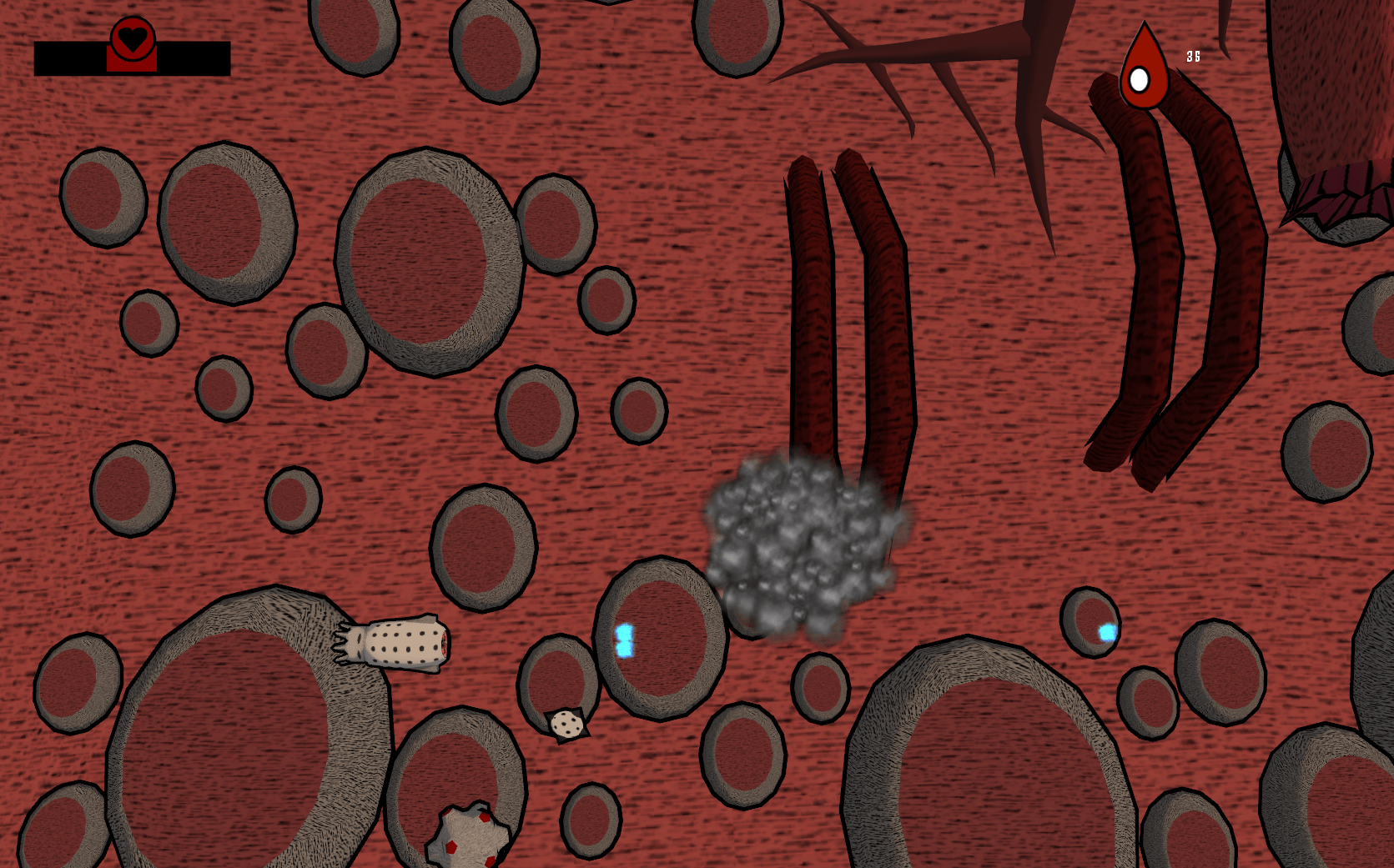
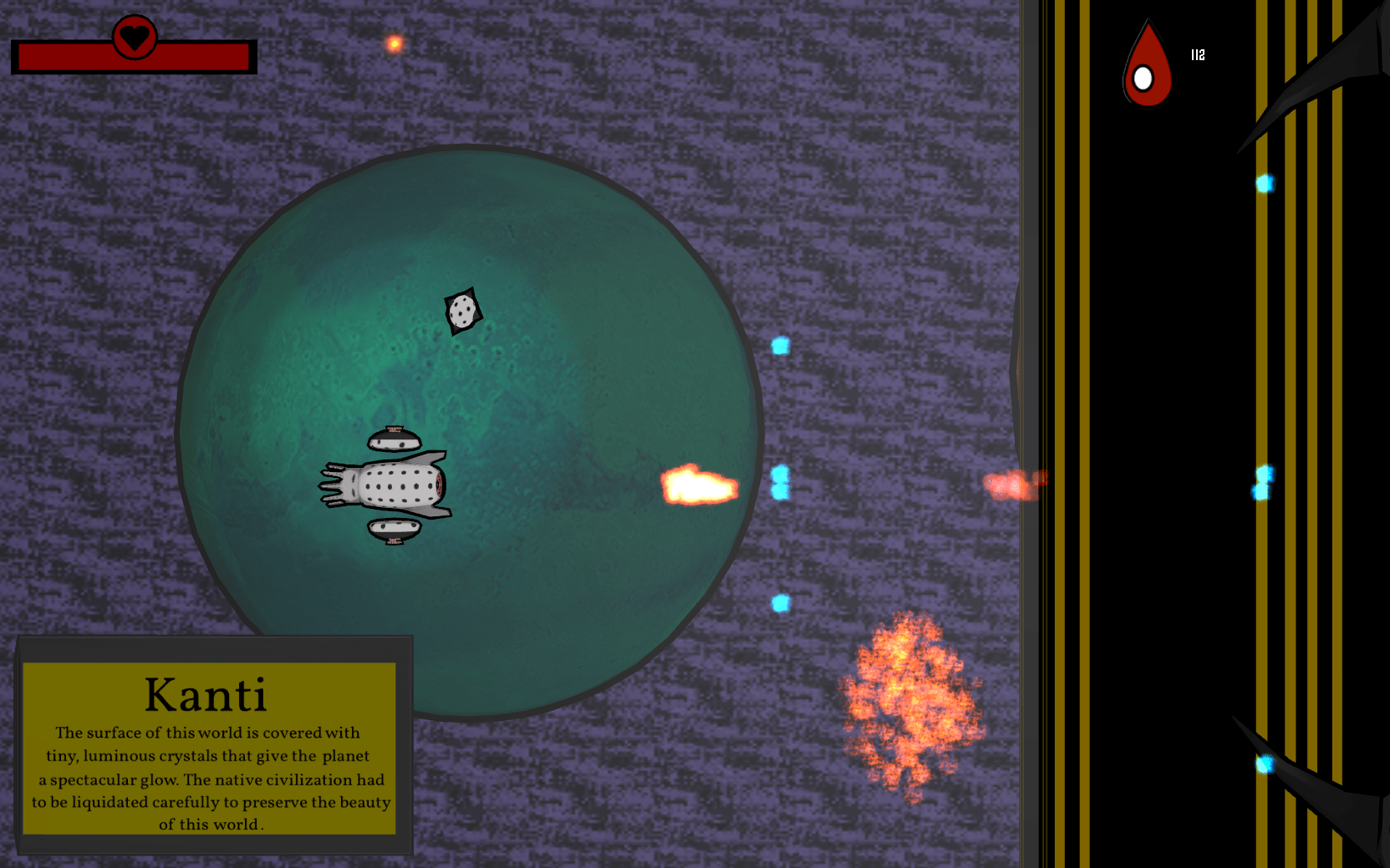
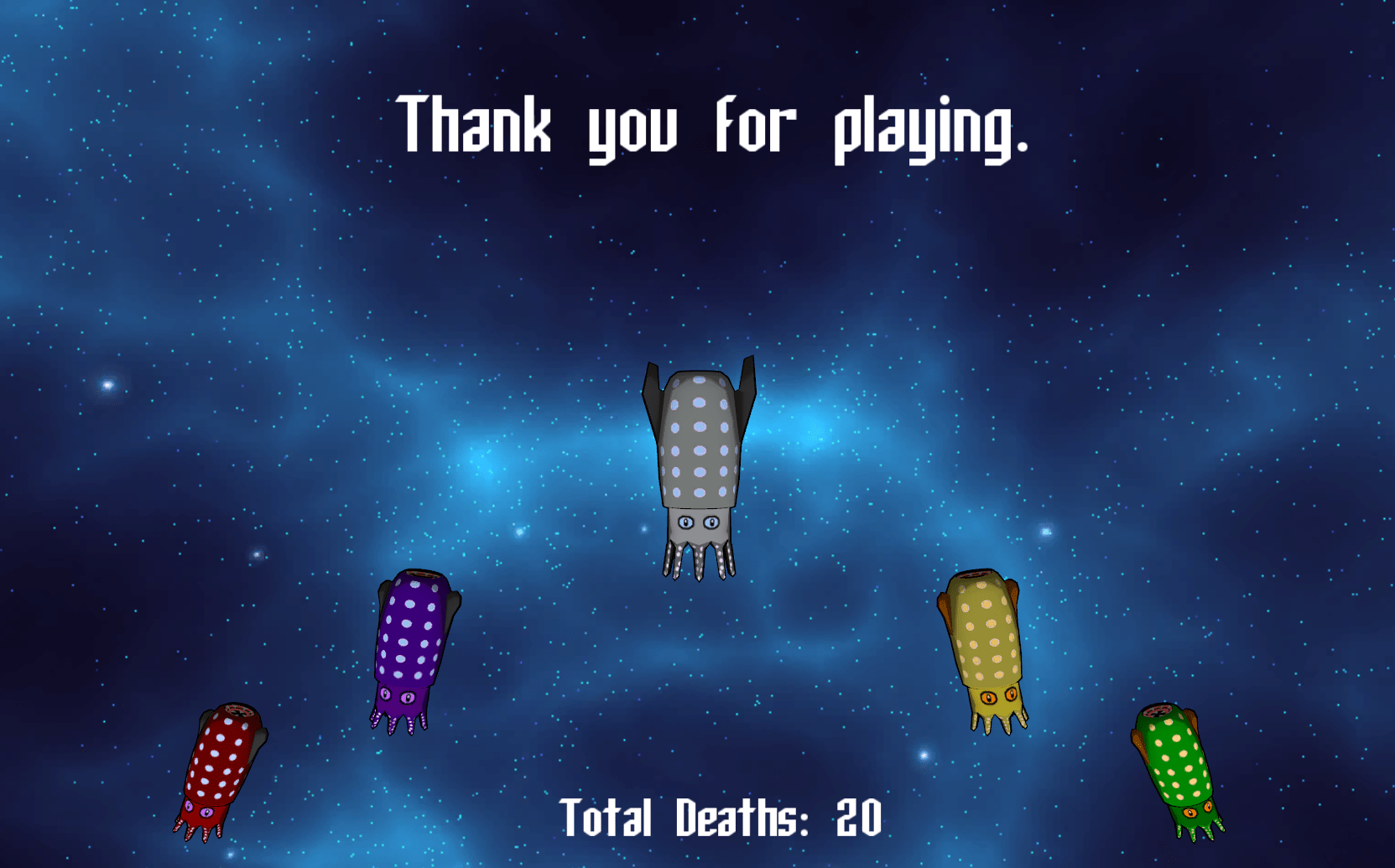
This shooter follows the traditional SHMUP format: you pilot a ship (or alien being in this case), fire at enemies, upgrade your ship, and either finish the end boss or die in a blaze of glory.
Killing creatures as a creature while in another creature.
In Cosmic Predator you are a creature of some kind, hurtling through space as you try to get the Life Stone back to save what’s left of your people (“the last of your people,” another trope of this genre). As a sort of “fuel” game mechanic, while you’re taking down the evil corporation that took the Life Stone, you are constantly bleeding or something because in order to stay alive you not only need to dodge bullets and scenery, but also drink the blood of your enemies. If your health bar empties completely, your little dude passes out and dies, left floating alone in the cold darkness of space.
The other twist in this game is that upgrades happen at the end of each mission; you get to choose from regular bonuses such as a ball of protection that hovers around you or a powered up shot that is rather self-explanatory. You cannot alter these upgrades one you have selected them, so your decisions will affect gameplay in later stages. There isn’t anything that will outright ruin the experience, though some areas would be easier depending on which upgrade you pick. One of the best quality of life improvements is an upgrade that pulls the blood of enemies you kill to you rather than making you chase it down. When this is your main way to keep being not dead, this is huge.
One major downside to the game as a whole is that there is no native controller support. The keyboard works okay, but until this I hadn’t played a full-fledged game without a controller, unless it was a first-person shooter, in ages; it felt odd to not have this as a built-in option in this day and age. I talked to a friend about this game, and the instant I mentioned the controller thing, he lost his interest in playing.
The game is funny if you look for it.
There are times, particularly during boss fights, when you know that there is no way to defeat a boss before your health bar fades into nothingness and you’re helpless to prevent this. It’s frustrating because the action moves fast enough to where you don’t watch your health meter all that closely and your character stops responding to your movements because he died at some point. Some additional enemies to refill the health meter would be an amazing improvement.
Spoiler alert?
On the positive side, you don’t have a limited number of lives; you can keep going to your heart’s content. Stages are broken up into sections, so if you die you don’t have to go all that far back to reach where you were. On the harder difficulties you will die a lot. In the later parts of the game you’ll find some good humor here and there on the evil corporation’s signs.
The game isn’t bad, really, but it doesn’t make me want to go back for more. There’s nothing groundbreaking here, but fans of the genre will likely have fun with this title.
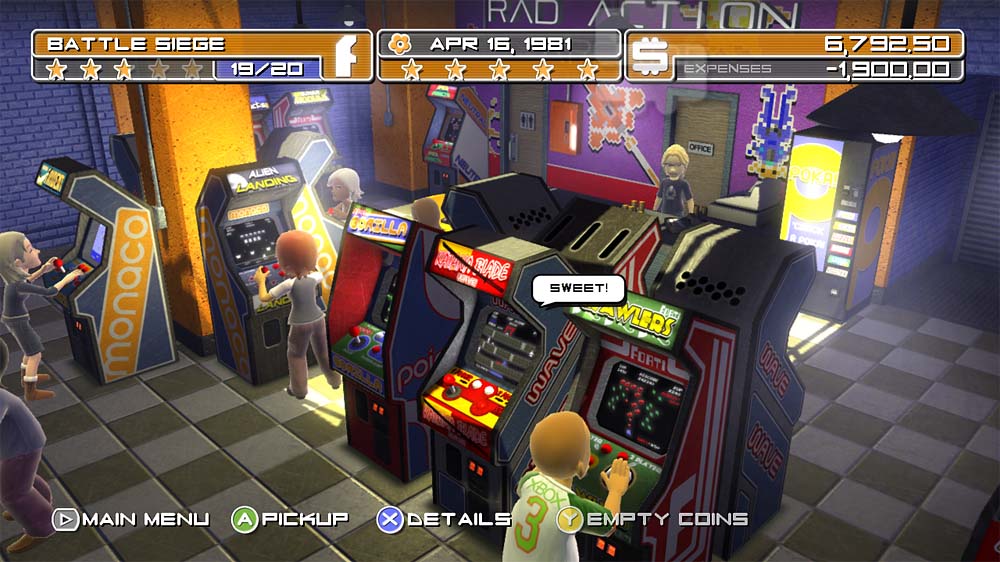
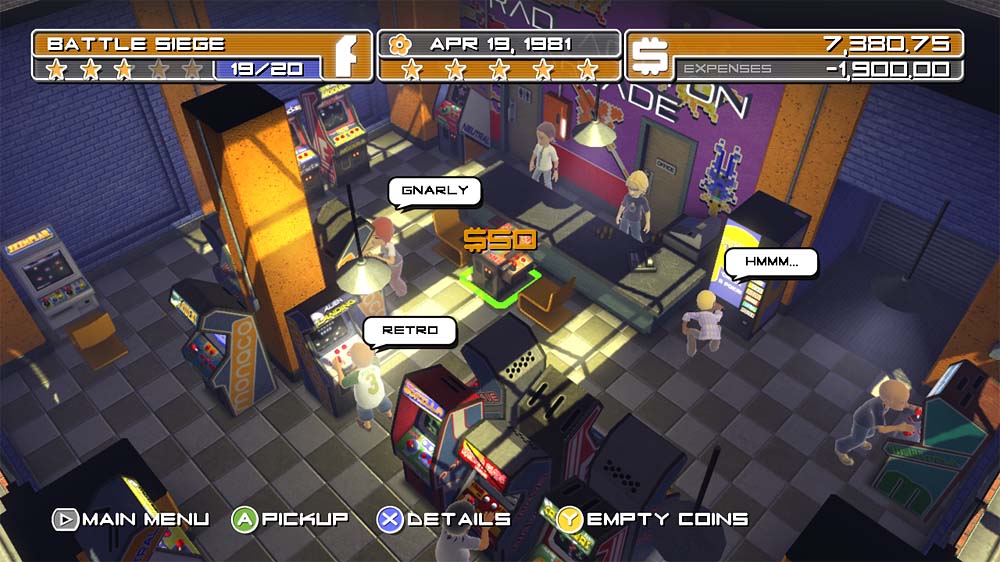
Arcadecraft has been updated three times since I last played it back in February. Not only have a few bugs been squashed, but a lot of content has been added. The length of the game has been extended by a full in-game year, with new machines being released during the course of it. To give the game a more authentic arcade feel, different machine types have been added, including 2-player upright games, pinball machines, more cocktail tables, and more options to dress up your arcade. Gameplay mechanics have been cleaned up as well, including the problematic hooligan, who is now easier to deal with. The power doesn’t go out as much, and coin doors don’t jam as much. Because the busy-work has been significantly toned down, Arcadecraft feels less like one of those plate-spinning things carnies do and more like an actual, professional sim game.
My arcade was never this organized. Nowhere near as bad as my Sim Cities were, but still..
Which is not to say the game’s shelf-life is that much longer. When Arcadecraft is done, it’s done. There isn’t a whole lot more you can do once you’ve run out the clock. Replay value is lacking sorely. Unless the developers could come up with scenario-style missions and side-quests, Arcadecraft probably won’t be the type of game you go back to again and again. It also still gets off to too slow a start, though this can be negated if you have Firebase’s other game, Orbitron, or Bad Caterpillar by Kris Steele. If you do, you can unlock cabinets for those games in Arcadecraft. Games that you can bump up to 50 cents and push the difficulty to hard without them taking a hit. Arcadecraft was a bit too easy to begin with. I can’t believe I’m saying this, given that the Bad Caterpillar cabinet has what I think is a shout-out to me in it (or possibly Donna Bailey, but the narcissist in me thinks it’s me), but avoid those two cabinets if you’re looking for a challenge.
A game set in the 1980s has characters using the word “retro”. That somehow seems wrong.
Despite the lack of difficulty, I love Arcadecraft. Love it. It no longer feels like it’s in the Beta stage of development. Arcadecraft is now a fully realized, glorious game. It’s one of the ten best Xbox Live Indie Games ever made. By all rights, this should be the next big simulation mega-franchise. Unfortunately, Firebase has no plans to put Arcadecraft on PC. Well, I simply cannot accept that. So I propose that fans of this game line up in single file to set themselves on fire in protest of that. Their charred remains are on your head, Firebase. We’ll go in alphabetical order by surname. I’ve never been happier that my real name is Cathy Zykozawitz.
The timing on being asked to look over this game was impeccable as I recently watched the movie “100 Yen: The Japanese Arcade Experience” which featured a section on the classic Japanese bullet hell shooters. I have had a craving to play one ever since, and Power-Up helped fill that need.
Power-Up is a throwback to the classic space shoot ‘em ups of yesterday such as R-Type and Gradius. There are aliens, upgrades to your ships or weapons, and bullets galore to dodge. It’s a tried and true formula and a general description of most of these games that have come out over the past thirty years.
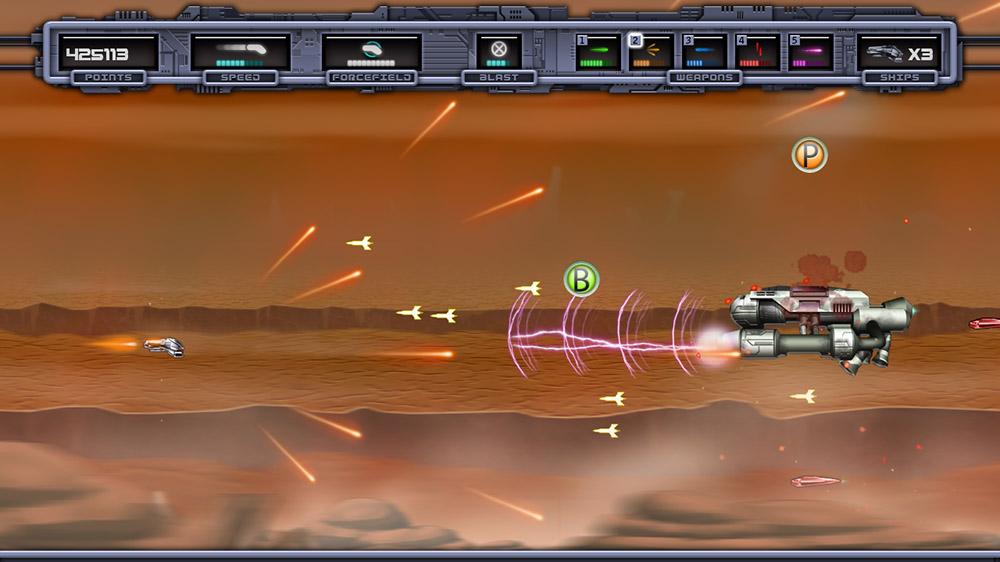
In Power-Up there are five weapon types that you can select at any time: straight ahead, straight back, straight up/down, a forward spread, and a plasma weapon that… does something? I’ll get back to that in a moment. Each weapon can be “powered-up” to give it an incremental boost from items that fly onto the screen as is tradition. From what I could tell, for the most part, these upgrades only increase the rate of fire and lengthen the beam for each shot. If weapons actually do increase in strength it was a small enough increase that they never felt stronger to me. Enemies appeared to take just as long to kill as with “weaker” weapons. The upgrades you collect also don’t appear to be based on anything such as killing a particular enemy; they appear on a set schedule. It took me a number of plays to realize this: “What did I just do to make the bonus points appear? Did I kill something to spawn that power-up?”
Although there are five weapons, you really only need two of them to advance far into the game: the forward spread and the reverse laser. I was able to cheese my way easily through the first three chapters by upgrading my spread weapon before I touched the reverse-firing weapon. It wasn’t until chapter 4, and those little assholes running around on the ground shooting at me, that I needed to work on the up/down-firing weapons. I felt severely outgunned when trying to play with only the single forward shot, and even worse, I never quite figured out what the plasma weapon was supposed to be good for. Its firing range is extremely short so you have to get very close to enemies to be able to use it. I thought perhaps it would deflect bullets like one of the weapons in the classic game 1942 but nope. It felt useless except to fill my screen with a pretty purple.
Purple lasers of ???
One final problem with the weapons: the fully-charged shots all make the outside of the screen glow white when fired — the faster the shot, the more intense the flashing. I could usually ignore it under normal conditions, but when I was playing while tired one night, the flashing really got to me to the point that I had to turn off the game.
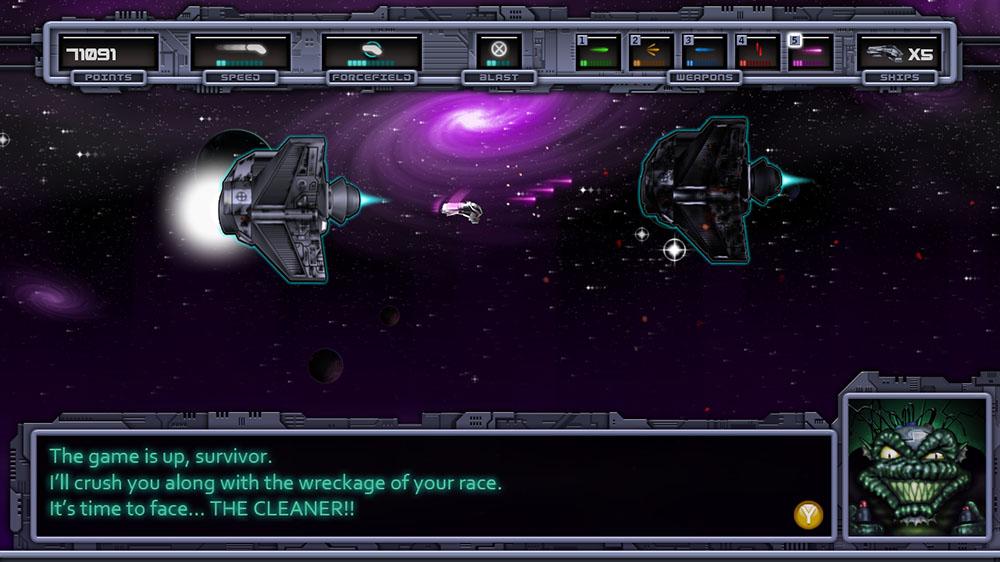
The story isn’t going to win the award for the next Lord of the Rings (that’s an award, right?), but it feels like a classic shooter tale. You’re one of the last humans alive, trying to destroy the people who destroyed Earth. The pilot is a bit easy to rile up and gets himself into trouble. It’s amusing listening to the pilot talk with his computer AI as they determine what to do next.
You don’t have access to a high score list like I would have hoped. The game keeps track of your high score, but the only time you ever get to see it is when you lose all of your lives. It would be nice either to see this score on the title screen or to be able to see a list of them somewhere.
This is beginning to sound like a long gripe-fest but to be honest, I had fun playing this game and it’s a good piece of work for a one-person entry. There are a number of things I feel could be improved upon, but it’s a good value for the price and there is plenty of fun to be had. None of the issues I describe above really make the game bad in any sense. If you’re a fan of shoot ‘em ups, definitely give this one a try.
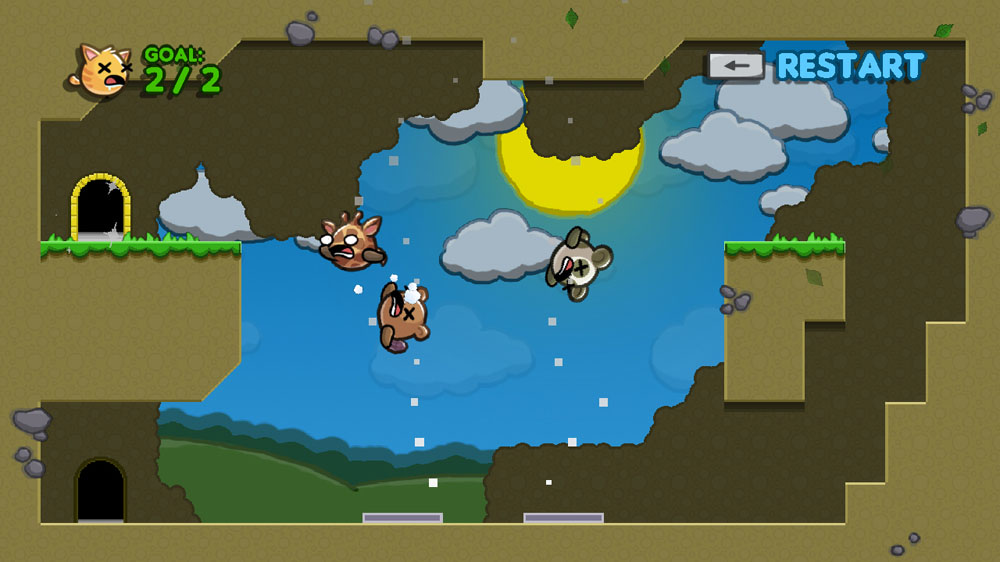
The Useful Dead is platform-puzzler where you must intentionally murder the current character you’re playing as in a way that allows the next character you get to finish the stage. Perhaps a distant, platformer cousin of Lemmings, or maybe Voodoo Vince. It’s a cool concept, but cool is as far as they get. I certainly didn’t hate Useful Dead. I like it enough to give it my seal of quality (spoiler alert). But it ultimately felt more like a really good proof of concept than a fully realized game.
The biggest problem was the puzzles. They were too damn easy. Besides the “kill yourself to use your corpse as a platform and/or crate” gimmick, the difficulty hook comes from only having ten extra-expendable creatures throughout the length of the game. In other words, if a level’s par is three creatures and you kill four before reaching the goal, you would only have nine expendable creatures left to beat the game. I actually finished the game with thirteen expendable creatures, having finished a couple of stages under par. Yea, that was in part by design, but at the same time, I’m pretty sure I was finishing more than one stage in ways the developer didn’t have in mind. This was especially true of the last stage, which I beat after the game glitched and one of the critters clung to a platform for no reason.
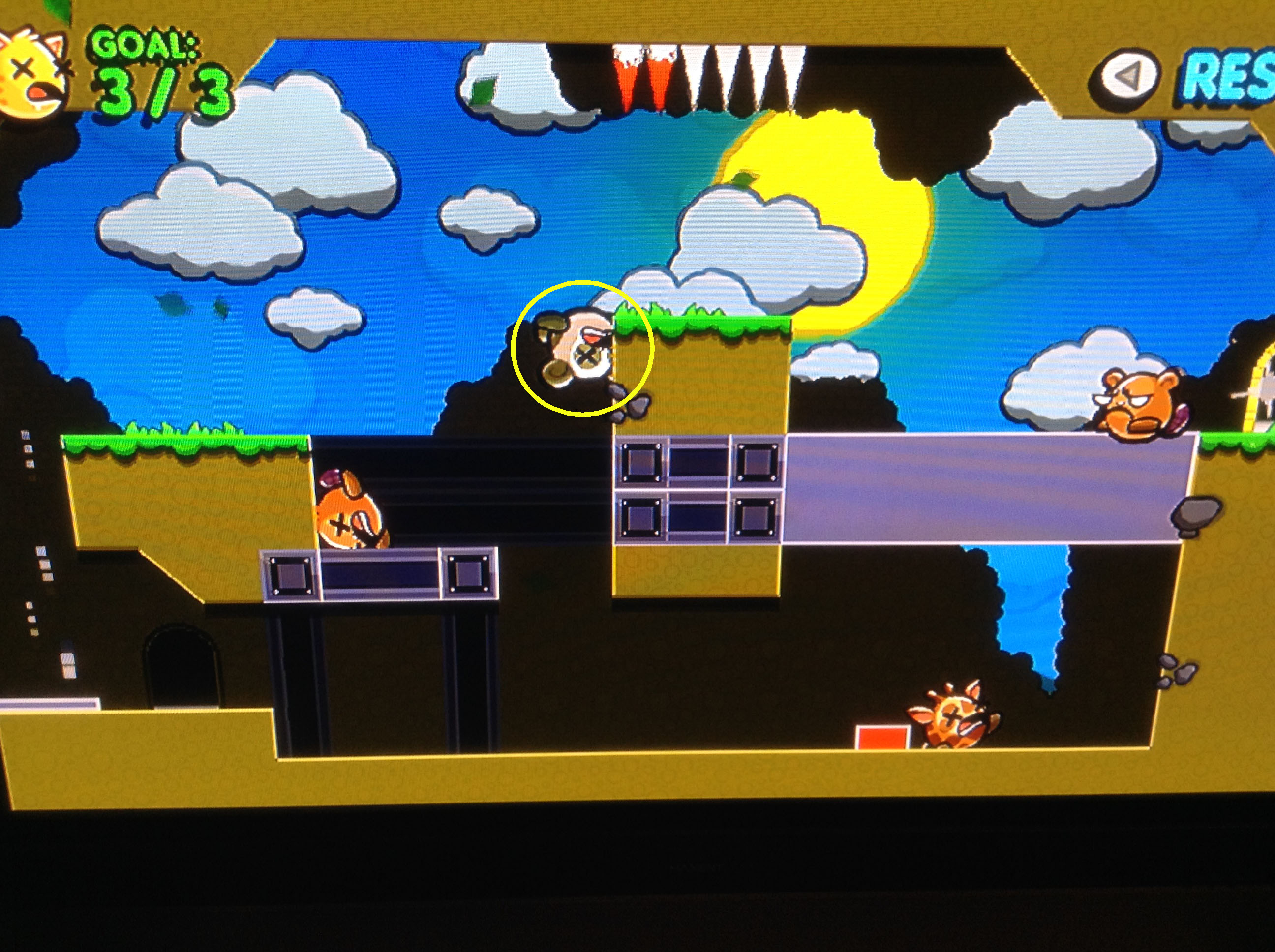
This is the final stage of The Useful Dead. The dude in the yellow circle is NOT supposed to be able to stick to the wall like that. Ironically, this would have been the only stage where I would have been incorrect about the solution if he had fallen to the ground.
The puzzles lack in variety as well. Most involve impaling yourself on a spike, then maneuvering your corpse in a way that activates a button that opens the door. Sometimes you’ll have to do this in two or three different ways. Others might involve using wind to push corpses into switches, or jumping from high ledges in a way to die and land on a switch, or kicking corpses into switches. Again, this is where the whole “proof of concept” thing kept beating me over the head like I was a baby seal. There are multiple different animals, but none of them have unique abilities. Perhaps having levels use specific animals with unique traits, weaknesses, vulnerabilities, or special maneuvers would have added to the complexity. As it stands, all the puzzles have self-evident solutions and it’s just a matter of how much time you want to put into breaking the game and coming in under par. XBLIG has been home to some of the most mind-bending puzzlers of this last console generation, such as Gateways, Spyleaks, and Pixel Blocked! By comparison, Useful Dead is mere child’s play. Easy to the point of being insulting. And I really hate saying that about any indie developer’s puzzles. I don’t know. It feels like I’m telling someone that their child has funny ears.
PETA’s favorite game.
If you think of The Useful Dead as a bare-bones prototype, possibly something you would see if you were pitching a publisher on a concept, it does soften the blow somewhat. I did like what I saw here, but not as much as I could have. Yea, my recommendation is as tepid as I’m capable of giving, but I still hope you try it. And I certainly don’t want to discourage the developer from working with this more. In fact, I would be really disappointed if The Useful Dead was a one-off experiment. Fuck that. There’s a great puzzler somewhere in here. Something with potential to short-circuit your grey matter, but absurd enough to be a big, word-of-mouth hit. The product we have here feels like something that barely made it off the drawing board. You know, Star Wars was originally about a search for a magical crystal. Sonic the Hedgehog was originally going to be a clown. Woody was originally an evil bastard trying to murder Buzz Lightyear in Toy Story. In the case of The Useful Dead, it’s like we got the early draft instead of the finished product. So help me God, this better not be the end of this project. If it is, I’ll demonstrate how useful the dead really are when I re-purpose the developer’s corpse as a morbid coffee table.
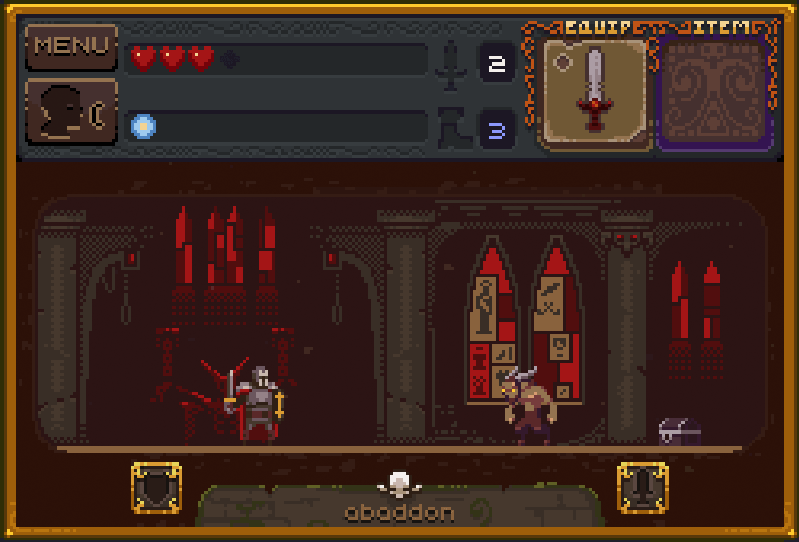
Stripping a genre down to its core has become a bit of a thing over the recent years. Half-Minute Hero, Divekick, and One Finger Death Punch all took their respective genres (RPG, fighter, brawler) and threw out the vast majority of the fluff in an effort to give you a streamlined experience containing all the fun of the large budget AAA games with fewer calories. Sometimes we end up with an experience we didn’t think possible with such a simple representation of what we’ve come to know and expect. Other times the developer’s diet version of its bigger brethren discards too much of the formula, leaving us with something that not only removes itself from its genre, it also removes itself from being able to be called “fun”. Deep Dungeons of Doom, though still somewhat fun, is not without its flaws in its effort to deliver a more focused dungeon-crawler.
Deep Dungeons of Doom (called DDD from here on out because I’m lazy) is a dungeon-crawler that has one focus and one focus only: combat. Exploration? Nope? Movement? Nada. Hoarding mountains of treasure? Not today, kid. You pick one of your three characters, go into a dungeon, kill some monsters, earn some gold along the way, kill a boss, and get the hell out. Combat is a timing and reaction affair, as your options only consist of attacking, defending, and using your one item you’re allowed to carry. Each monster has its own patterns and gorgeous pixel-art animations, which you react to with either the attack button or the defend button at the proper time. There are a few other things to combat, such as holding your attack button for a character-specific action or launching an attack right as the monster is performing an action so that you do extra damage, but that’s what you’ll be doing from the first dungeon to the last boss.
All the pixel art in this game is beautifully animated. I’d say “on the level of Symphony of the Night” but I think I’d get fired.
As far as leveling, well, you get stronger as you go deeper into each dungeon, but it’s not permanent; your stats reset the moment you step back out into the world. You can purchase skills for each character, but don’t expect to grind out an overpowered character within a few hours as gold is somewhat time consuming to build up. You can also hit up one of the two shops in the game and buy equipment or find some along the way, of which you can only have one equipped at a time. Unfortunately, if you want to keep any equipment you find along the way, you have to ditch whatever you’re wearing, meaning that you can’t actually GAIN any equipment if you already have something on. Oh, and you lose your equipment if you die (and all but 10% of your gold that you’ve gained in the dungeon), which makes bringing anything with you into a dungeon a high risk situation if said equipment is expensive or rare. Your only way of keeping your equipment upon death is, one, a roll of the dice that may or may not help you out or, two, using purchasable revive tokens and continuing your march through the doom-filled dungeon.
So, in case you haven’t noticed, I’ve been throwing out a few hints that the game is somewhat unforgiving. In truth, it needs to be. DDD is one of the rare games with RPG-like elements that can be beaten without upgrading your character at all. You could purchase no skills, equip no items, and still run through the entire game, willing that you know the patterns and animations for each monster and have solid execution and reactions. I stress that last part because, as someone who plays fighters competitively and has solid reflexes, even I had a bit of trouble with a few of the quicker enemies. Which usually resulted in me spending revive tokens in the hopes I’d finish the dungeon this time or losing my equipment I’d grown attached to and leaving with more lost than gained.
And I think that’s one of the two biggest things this game has going against it. Failing in DDD not only causes you to lose nearly everything you gained in that dungeon, but also anything you brought with you. Heck, there’s even room for losing more than that if you purchase any items during your crawl using gold you’d built up from other areas in the game. What I’d said before about DDD being beatable with zero character progression also works the other way: you could hypothetically keep spending money, losing your equipment along the way, and gain little to nothing from all your time and resources spent. There’s a bit more sting to this knowing that you can spend real money on in-game gold with the same results as, yes, DDD has an in-game shop where you can drop your 9-to-5 earnings on fake money. That you can use to buy items. That you can lose by dying. Harsh even by my masochistic gaming standards.
The other aspect of DDD that may turn players off is that, as it’s a crawler stripped down to timing-based button-pressing combat and nothing else, there’s a good chance that people will find it too repetitive. Especially since failure is so punishing. It also doesn’t help that the only instructions come in the form of in-game tutorials and occasional rooms where you’re given the option of learning something that would’ve come in handy about two dungeons earlier. For example, I went through a full three dungeons before coming across a room teaching me about character-specific charge attacks (one of the things that turns DDD into less of a drawn-out mini-game and more of a full gaming experience). The Witch will regain magic with hers, which is the only way she can deal proper damage and is otherwise strictly worse than the other two characters. Giving me the option of finding this out via selectable instructions would’ve been a kind gesture. Hoping I get far enough in the game that I could learn a vital technique? That’s just mean, guys. That’s just mean.
In fact, the more I think about this game, the more I’m afraid to play it. I finished the game, minus secrets and a post-ending dungeon, but I don’t want to lose the only two powerful items I have left. Or spend my hard-earned gold on other items only to lose them. I can’t think of any other game I’ve been afraid to play outside of, you know, games specifically designed to make me crap my pants. Deep Dungeons of Doom is not designed to make me crap my pants. It’s designed to steal them. And considering how much I value my pants, it makes it difficult to recommend this crawl.
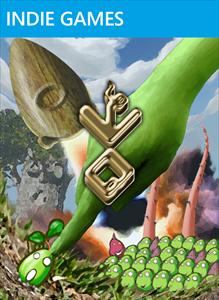
Today’s game is called 一>◇. No seriously, that’s the name. 一>◇. It’s a name that search engines and headers will not put up with, so for the purposes of today’s review, I’ll be calling this game the Strange Japanese Game. Not that anyone would actually want to Google it or see it on YouTube. It kind of sucks. Which is a shame because the concept is original and quirky, but a horrible control scheme fails the vision.
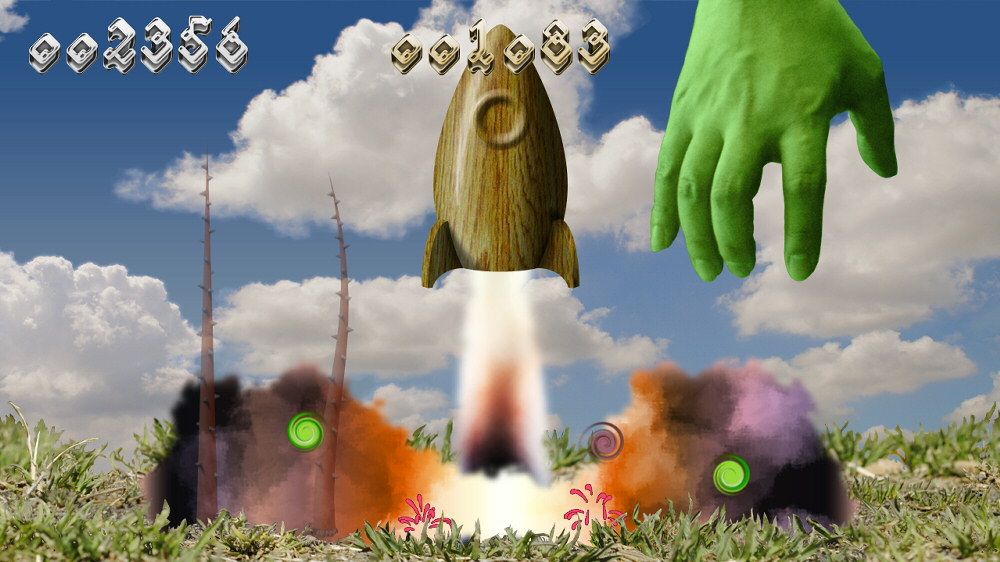
Strange Japanese Game is a God Game where you play a giant green hand. There’s little sentient beans walking around, reminiscent of Pikmin. They even grow little spouts on their head. When they have a sprout, you can poke them into the ground. Then, you grab a handful of water from the lake that is the main focal point of the game’s challenge and dump it on the sprout. The sprout then grows into a tree. You can flick the tree with your finger to knock more Pikmin-like-things out of it, but ultimately you want to masturbate the tree (I’m not joking) to shape it into a spaceship. Once you’ve beaten your bush into the shape of a shuttle, you have to load it with the Pikmin-like-things. Doing this will make the ship blast off, scoring points. The object of the game is to score as many points as you can.
After beating your bush, the tree becomes a rocket that blasts off in a shaft of fire and two black balls of smoke. Sickening thought: someone, somewhere is getting horny thinking about this.
First off, props to the developers for taking the God genre and trying to make a quick actiony arcade game out of it. That took a creative spark and balls, and I appreciate that. Having said that: why on Green Skinned God’s blue Earth did they map every action to the X button? The Xbox controller has four face buttons (six if count the clickable analog sticks) and four shoulder buttons. Strange Japanese Game only uses ten percent of the total available buttons, but the actions performed are very different from one another and possibly consequential. For example, flicking. You have to move the hand and press X to flick. If you stop moving and press X, it becomes grab instead. Except there’s a problem: there’s a slight delay in the game recognizing that you’ve stopped moving, even if you release the stick. Thus, there were times when I let go up the stick and pressed X in an attempt to grab a not-a-Pikmin and instead flicked it into the water, killing it. This isn’t the fucking Atari 2600. Why couldn’t grab had been one of the different available buttons?
There’s also no way to separate the little not-a-Pikmins from each-other. When they bunch up, even an action as simple as planting one in the ground can likely result in killing ones next to it. This gets really frustrating when the creatures turn evil if you let them sit around too long (perhaps they ate something after midnight when I wasn’t looking) and start to attack the good ones. If you let THOSE linger too long, they become tentacles (it’s Japanese, OF COURSE they become tentacles). In order to prevent that, you need to flick the critters into the water. Of course, that typically will result in killing a bunch of innocents. Really, imprecision is Strange Japanese Game’s biggest sin. If you grab a handful of not-a-Pikmins to drop them in the spaceship, it’s hard to line it up in such a way where all of them fall into the ship. Any that don’t die upon hitting the ground, even though they fall the same distance and land safely when you knock them out of the trees you grow.
There’s a really cool and quirky concept at play here. Again, an arcadey God game? Madness! But the slow pace, awful play control, and imprecision of the action kills all potential it had. I truly do feel that the groundwork for something fun and addictive has been laid with this strange Japanese game. With fine-tuning to the controls and something added to the gameplay that would speed up the pace, I think this could be a sleeper hit. Maybe. I should probably note that all the gameplay mechanics above are left up to the player to figure out on their own. There are no instructions in the game, and no on-screen indicators of what to do or how to do it. The only instructions are found on the game’s marketplace page, and in Japanese. I’m a fan of quirk, but being quirky doesn’t have to mean leaving a player to figure out stuff on their own. Then again, this is a game that involves jerking off trees. I imagine writing instructions for such things is a crime in many countries.
$1 was warned by their father that if they kept doing that, their hand would turn green in the making of this review.
Seriously: horrible name for a game. Horrible. If the game had been good, the name would have doomed it. It’s a game whose title cannot be spread by word of mouth. Sigh.
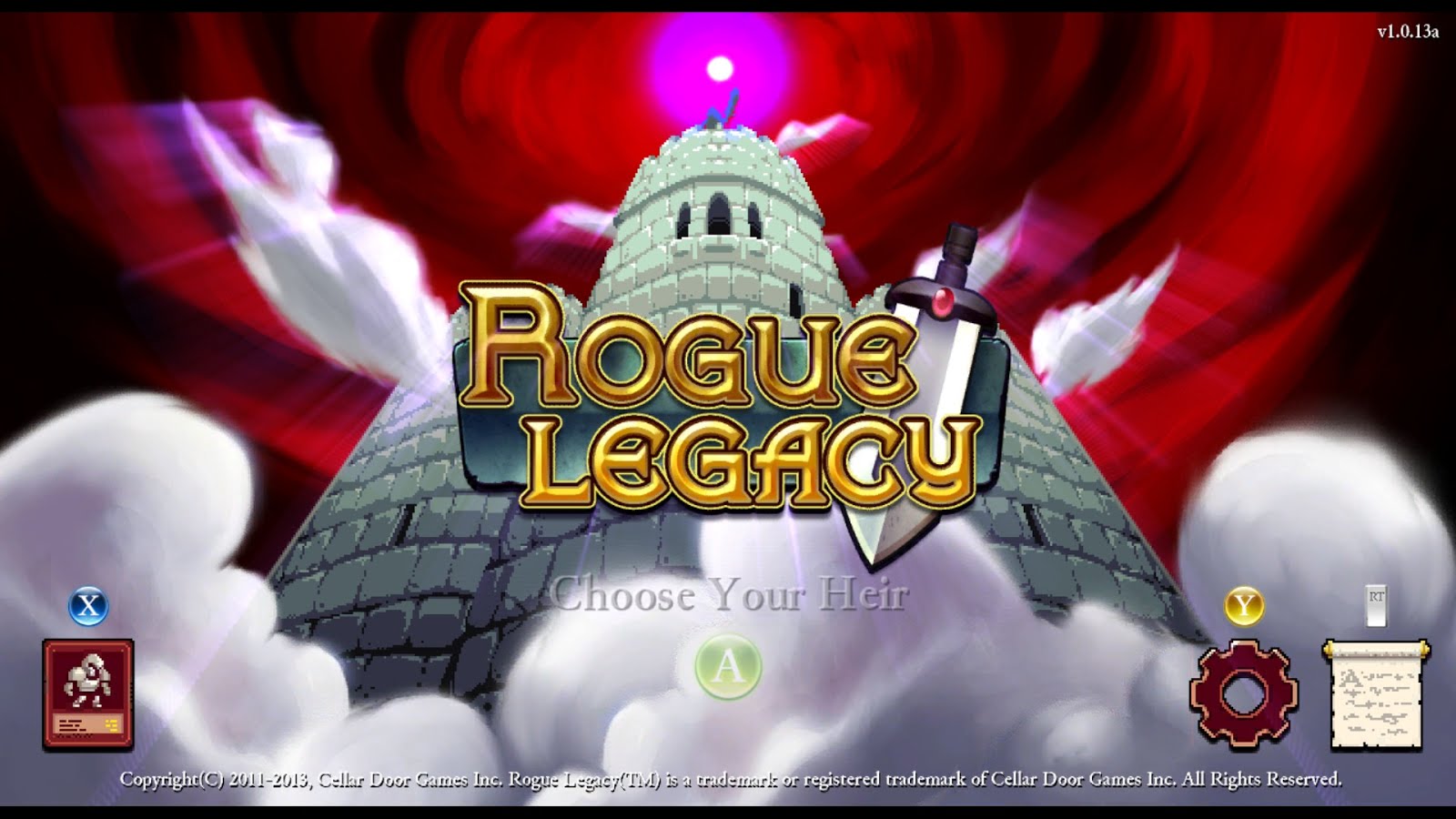
Rogue Legacy by Cellar Door Games (the group responsible for “Don’t Shit Your Pants”) has done for me what few other games have done lately: kept me coming back for more. I don’t want to put the controller down until I absolutely must.
I was mostly in the dark about this game going into it other than a few friends exclaiming, “You have to get this game!” and their repeated yelling at me that I hadn’t yet done so when they later asked again.
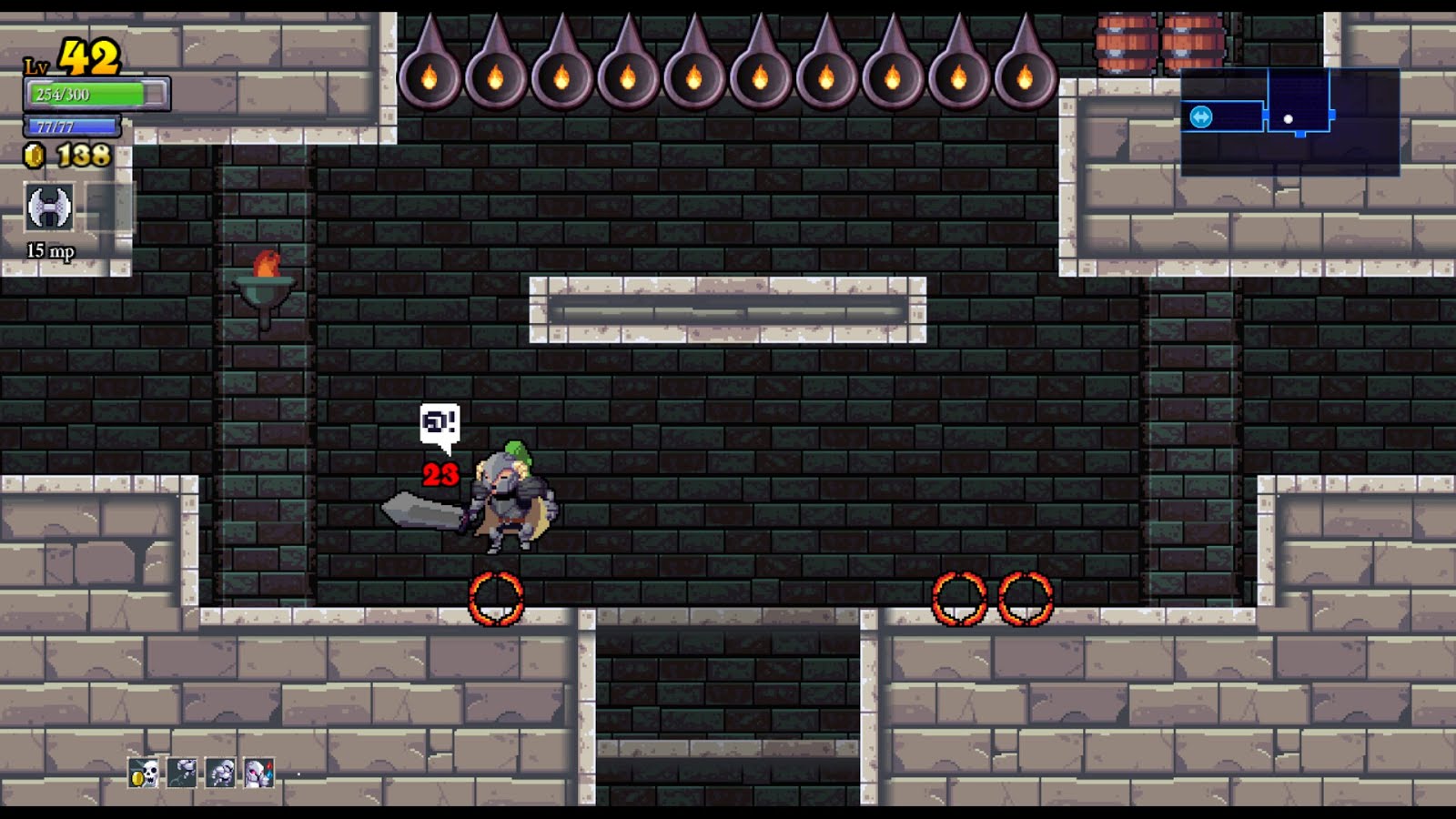
The schtick for Rogue Legacy is that you’re endlessly throwing bodies at a randomly generated castle for loot to improve yourself for the next body you throw at the castle. You’ll encounter a variety of monsters, varying colored versions of those monsters with stronger abilities, and the occasional boss. Overall, the game has a very Metroidvania feel (honestly, what game doesn’t these days?), and it’s done rather well.
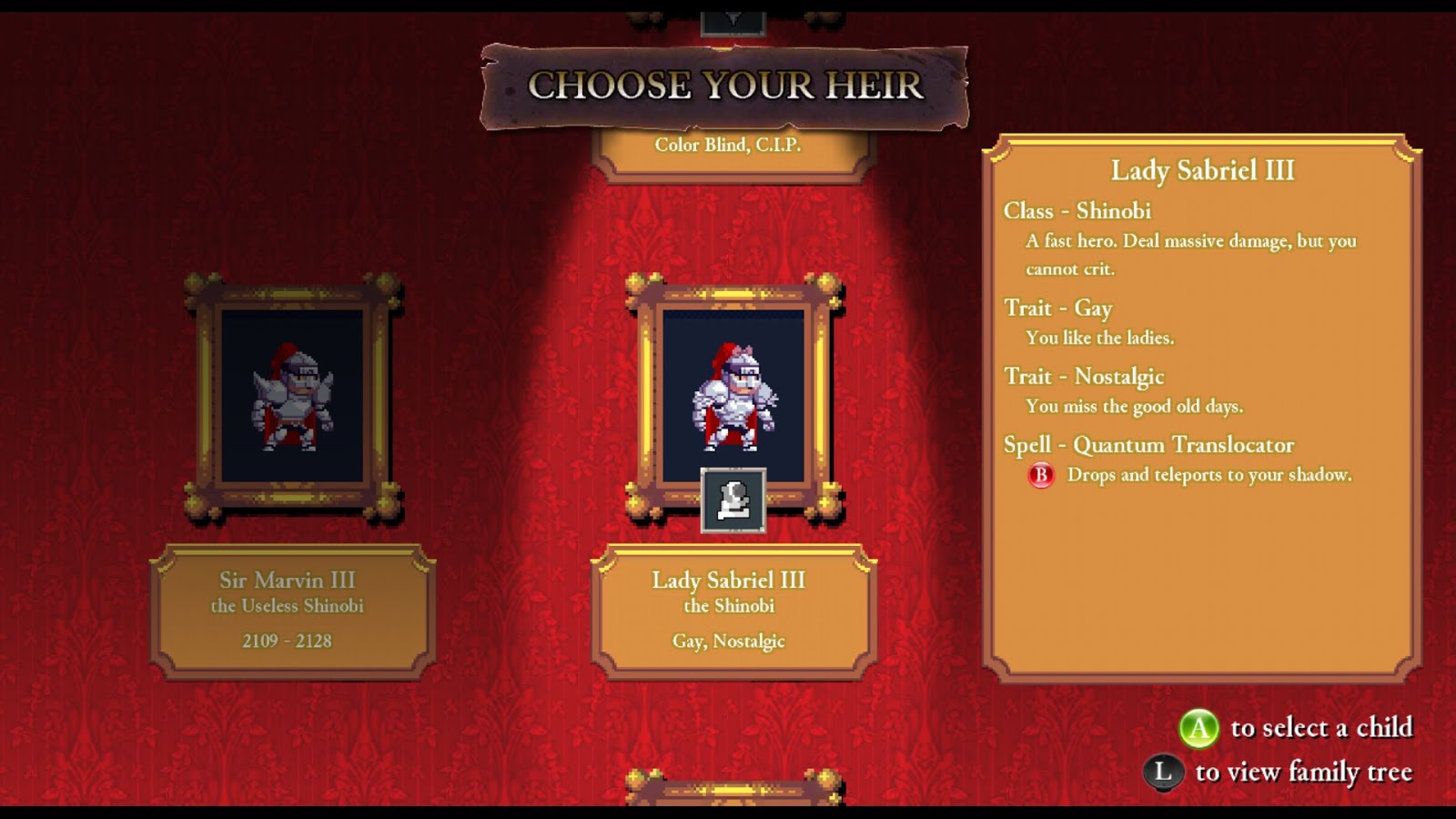
I get a kick out of how your character is chosen for each round. You’re shown three characters to choose from, all of whom are the heir to your previous character. Each is given a random character class and different traits that include but aren’t limited to “nothing spectacular” (no traits), color blindness (game is sepia or black and white), baldness (your character is bald), dwarfism (half-sized), and gay (no physical effect, who’d have known?). This gives you a little bit of variety in each playthrough, and sometimes it gives you something very beneficial to support your game. Dwarfism allows you to sneak into small hallways, having a good memory shows where enemies are on your map screen, and suffering from coprolalia makes your character swear like Q*Bert every @!#?@! time they are hit. I can’t imagine anything more useful than that!
“Miko! How do you advance in this game if everything is random? This all seems a bit pointless.”
In your travels you may reach a boss and want to take it down but wind up dying immediately, or perhaps there is a chest with a special ability to earn but the challenge the game gives you to open that chest is a bit too difficult. Once you die, you’re given an opportunity to keep the same castle layout you just encountered but with a penalty that you’re only able to keep 60% of the gold you earn. You’re also not able to farm for secrets because those areas remain used. All of this is done in the name of balance or some other probably good excuse.
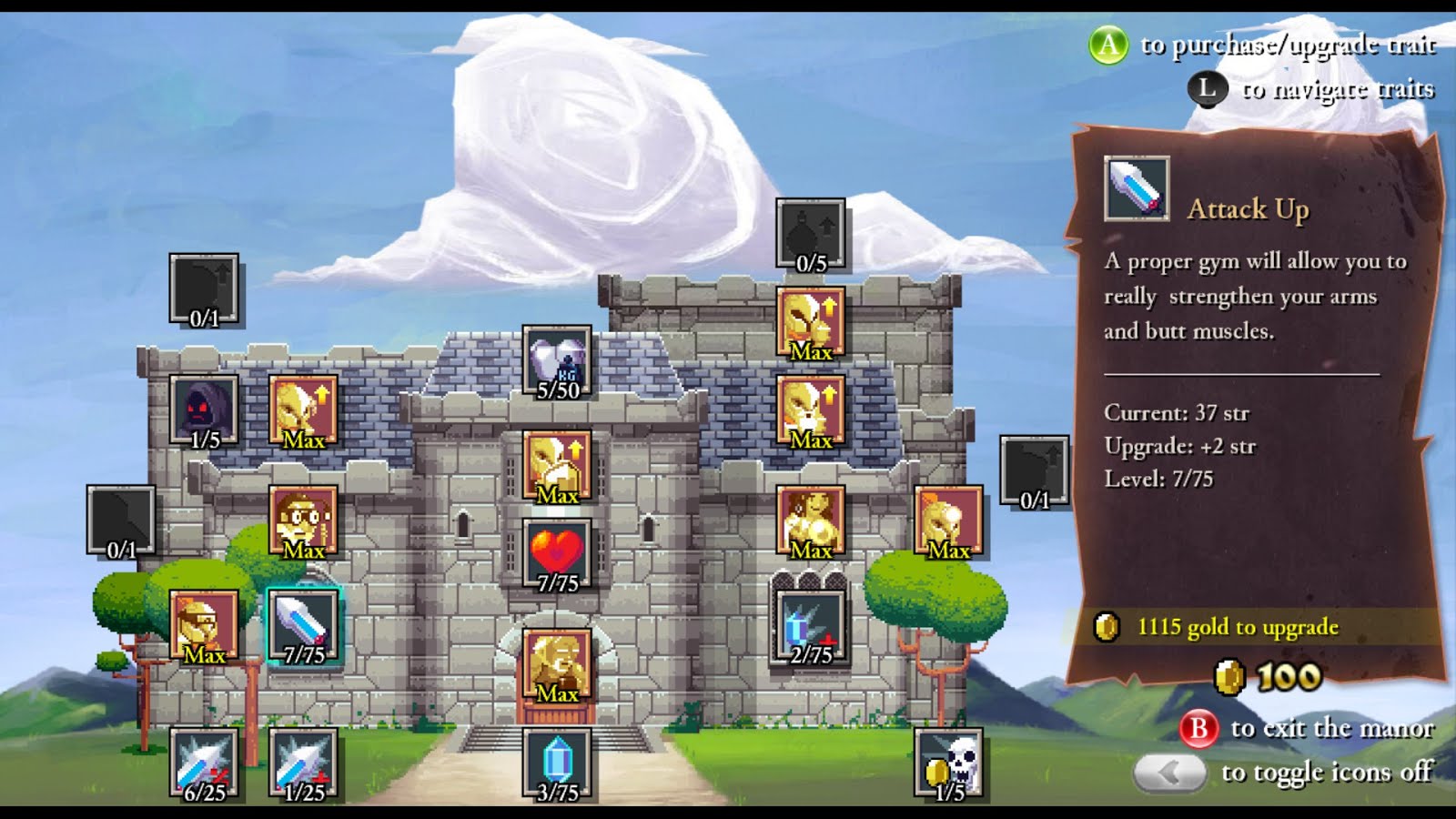
To advance your character you are given a tree of various skills and abilities to improve: More strength, increased crit chance, new character classes. It’s all the usual fare and not a very exciting portion of the game. This tree is where one of the problems with the game lies. The process of improving feels so damned slow and the cost of some of the upgrades feels too high to get anywhere. One could be having a bad streak of games or not find hordes of treasure, which will result in little to no advancement. To improve, you need to do well. To do well, you need to improve.
The music is about as bland as my taste in music. It’s nothing special or particularly memorable, but it suits the job and it isn’t annoying. What is frustrating is how the game teases you by giving you more songs to choose from if you stumble upon a jukebox in the middle of the castle but then immediately reverts to the old music once you leave the room. Why?! Troll jukebox, that’s why!
Rarely does a death in the game not seem like my fault. Controls are precise, which is something far too many devs seem to gloss over. Teleports will help you bounce around to far-explored areas, which is bloody fantastic, and the map screen is simple enough to read (assuming you didn’t wind up with a trait that leaves you map-less).
So far, the only thing to cause me to curse at my screen in anger or shake my controller in a fit of fury is when an enemy’s attack that shouldn’t be going through walls, does. It happens when a monster summons a fireball as it hugs a wall and the game figures, “Eh, close enough,” and lobs that fireball at my face when I should be safe. Not cool, man!
Ultimately, for gamers who enjoy platforming, a bit of humor from a game that doesn’t take itself too seriously, and a challenge, I would suggest picking up this title. It’s good fun! Oh, and make sure you go into the game files and add a few names in there — yours and your friends’. Whenever my name randomly appears, I make sure to choose that character no matter how terrible her traits are. Vertigo, ho!
To wrap this up, screw Cellar Door Games for not providing me ample opportunity to use more colorful metaphors in my first review. This game feels really good all-around.
I take it back: There is one thing that’s bullshit. There is not one damned rainbow is in this game to take advantage of the “gay” trait. NOT ONE RAINBOW! That said, the game did randomly recreate me accurately, especially my Quantum Translocation.
I’m baffled when unambitious games come along that strive only to look and play kind of, sort of like the classics of ye olden days. All I can think of is: why? Why not make them better, or at least give them a different hook? Especially since those old games already fucking exist and have been played to death. Hey, not everyone is creative. But even if you’re uncreative, you must have actually played the games and know what works in them and what doesn’t. I don’t expect perfection from an indie developer, but I also expect that, as gamers, they know the difference between fun and boring.
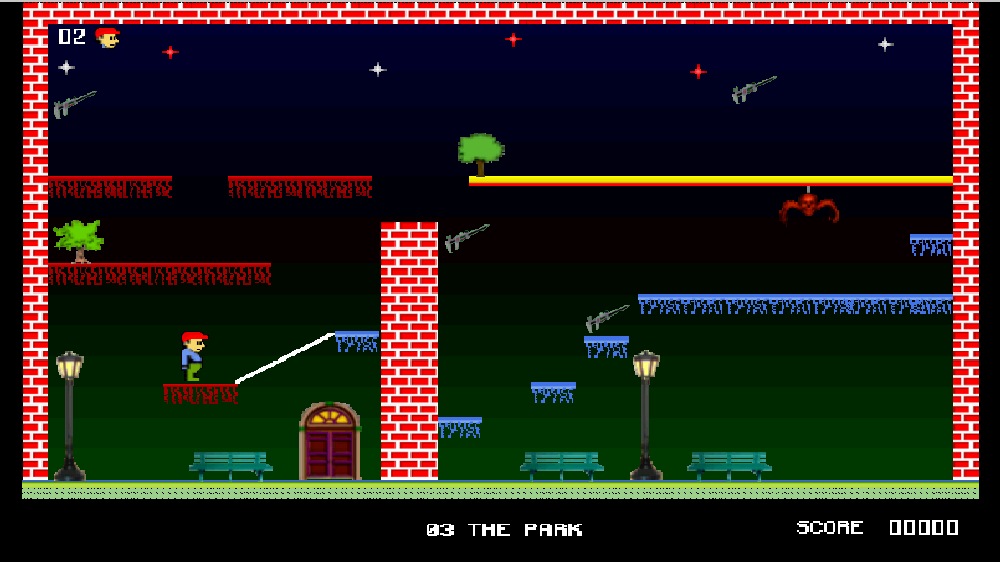
Mechanician Alex, a game from 2013 designed for fans of 80s PC games that 80s PC gaming fans would have shit on.
Then you get into the realm of pure raving insanity, where you try to ape a gameplay style that wasn’t all that good to begin with. Mechanician Alex wants to be one of those old-timey, single-screened platformers from the Commodore 64 or ZX Spectrum era. I know a lot of my readers are still gaga over them. When I reviewed the official XBLIG port of one of the all-time cherished members of that genre, Manic Miner, the old farts that read me were less than receptive to my take on it. Fine.
But would those gamers be receptive to a game that looks like it could have been a lost game in that series, and plays almost like them, only everything is a little worse? I’m guessing not. Strip away the attempt at making a player nostalgic, and Mechanician Alex is simply a bad game. The controls are atrocious. Unresponsive controls are a signature of these type of games, and getting used to the wacky delayed timing is supposed to be part of the charm. I guess if you’re playing a game legitimately made in that era, that’s acceptable. Well, at least if you’re a child of that era looking to reclaim your youth. But fans of those games aren’t in denial about the controls being shit. Why the FUCK would a game made in 2013 try to emulate that? Manic Miner fans aren’t going to Tweet each other saying “Oh my God, this game controls even worse than Manic Miner. IT’S FUCKING AWESOME!!”
Mechanician Alex was developed by 3T Games ($1 got a teeny tiny chuckle out of the level where enemies consisted of Rubik’s Cubes and the female symbol ♀. Perhaps the developers were not fans of me or Xona Games)
And the levels are poorly designed too. The game has a real issue with height. For example, on one stage you’ll be walking on a cloud that is bumpy, like clouds tend to be. There’s almost no clearance, and an enemy is scooting back and forth above your head. Unfortunately, the collision detection is spotty enough that you’re bound to burn lives just trying to get a feel for it, and there’s so many variables on the height that never seem right. It immediately stinks of a stage that was rushed through production. Beyond that, if you slip off the cloud, you can’t finish the level regardless of whether you land on a platform or not. This is really fundamental level design stuff and I shouldn’t have to have explained to you why its bad. It’s a worst game of the year contender.
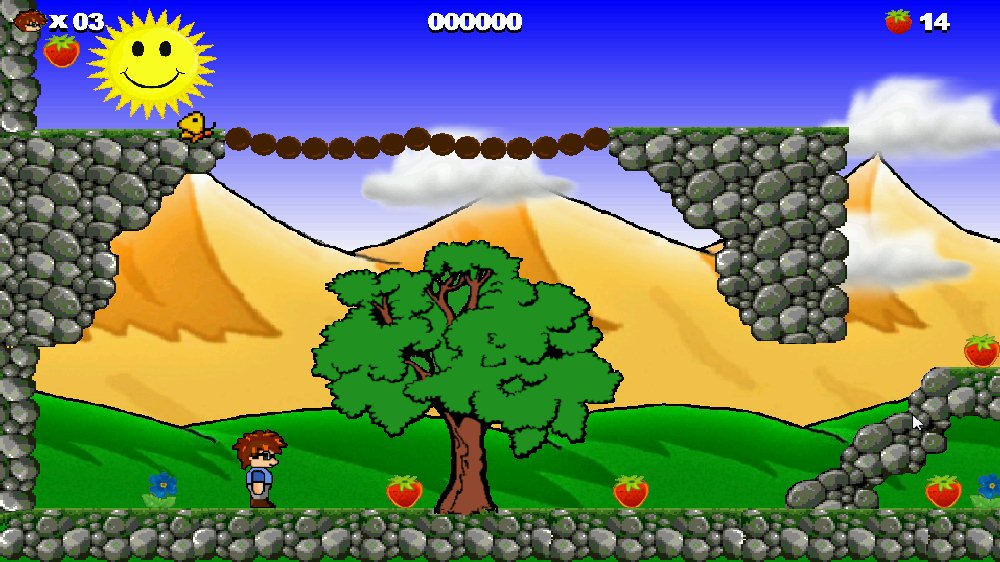
Sadly, the same developer recently went on a release spree, and they also brought out a side-scrolling platformer called Pablo’s Fruit, and it’s even worse. Taking it a step further than Mechanician Alex, it’s a contender for worst XBLIG ever made. Every gameplay aspect of Pablo’s Fruit is terrible. Here, the idea is you have to collect all of the fruit in a level to open up an exit. Movement is slow and jumping is floaty, which makes playing through the levels a tedious chore. And then you get to the technical issues. When you take damage, you don’t recoil from it, and you don’t get much (if any) invincibility to prevent further damage. Thus, it’s conceivable that you could go from 5 “lives” to 0 in a second just from getting pinned next to an enemy. That’s just utterly lazy, sloppy programming. This is coupled with poor level design. In one stage, the level opens with a fruit above your head, out of reach. At the end of the stage, by the exit, there’s a teleporter that drops you back at the start. You collect the fruit, but you have to walk all the way back to the exit. All enemies you’ve taken out are still gone, which begs the question: WHY THE FUCK WOULD YOU MAKE SOMEONE DO SOMETHING SO FUCKING BORING? Didn’t it occur to anyone making this piece of shit?
And it’s got dumb logic too. Enemies are beaten by jumping on their heads. But it’s not always clear which enemies will die when you do it and which ones you’ll pass-through, taking damage along the way. I made a video to demonstrate.
What the fuck? By the way, that vulture that’s flying back and forth? You die from jumping on it too. Why the hell does a ghost (hypothetically a transparent, dimensional being) die from being crushed but not an insect or a bird? Is this some kind of PETA subliminal message?
An annoying aspect is there are these butterflies that continuously fly around. They’re supposed to be in the background, but it’s done poorly and thus they often look like enemies in the foreground.
If I sound too negative, please keep in mind that I actively, for days, tried to think of something nice to say about these games. I came up completely empty. The sad thing is, both these games are courtesy of the developer of Naoki Tales. I didn’t like it either, but really, its only true sin was being boring. These games represent a gigantic step backwards. Pablo’s Fruit came out a day after Mechanician Alex, and those came out a few days after another game by the same guys, Paper Galactica. I’m not doing a full review on that (click the link, because Tim Hurley did), but it was pretty fucking boring as well. Three games, all released in one week. If I had to ask these guys a question besides “have you ever actually played a video game?” it would be “why didn’t you guys focus on one project?” Granted, it’s possible that all three games sat in peer review purgatory until the community came out of a coma and put them through to the market.
Actually, I would have one more question, and this is the most obvious one: would you actually want to play these games if you hadn’t made them? Would you pay money for them? Hell, would you play them if they were free? Yea, that’s three questions, not one, but all of them are valid. Look, these games suck. You’re not going to make a lot of money on them. They don’t even have the absurdity or the charm of Silver Dollar’s low-end, quick cash stuff. Bad games DO make money on XBLIG, but your stuff isn’t falling into those niches that have such potential. So don’t rush your games out. Polish up your work. Do something wild and creative. I’ve played four of your games. Not one of them managed to entertain me or any of my colleagues for a single second, nor did any of them display the slightest bit of creativity. If I had to guess, I would guess the developers were bored silly making these. Their existence seems almost cynical. Both are trying to capitalize on nostalgic memories. But unless it’s a port of something, you’re not going to lure in day-dreamy nostalgic types. Being primitive shouldn’t be confused with being a classic, and these games are so primitive that they sacrifice virgins to the sun gods.
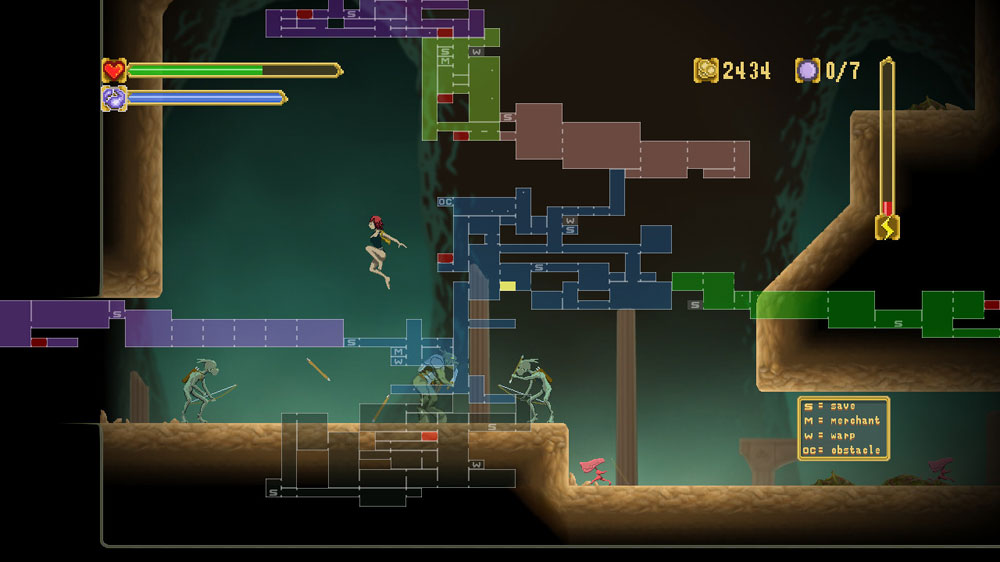
UPDATE: Magicians & Looters received a Second Chance with the Chick. To say it improved the game is an understatement. I now consider this to be the best Xbox Live Indie Game ever made. Click here for my updated thoughts.
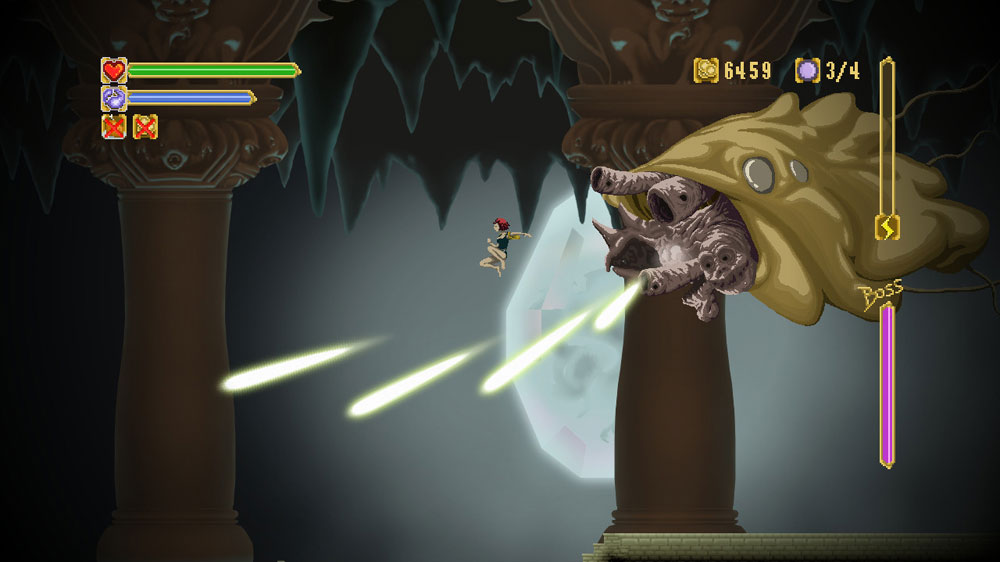
Welcome to the wonderful world of Xbox Live Indie Games, where expectations are so low that there’s not sufficient clearance for microbes to hang themselves from it. Because of this, sometimes games that are just not that good end up getting elevated beyond their actual value. Take Magicians & Looters. Here’s a really ambitious first effort by a group of developers with not a whole lot of experience, and it’s not terrible. It also has, for my money, the best comedic writing ever seen on an XBLIG.
M&L is a Metroidvania. I fucking love those, but XBLIG hasn’t been the best source for them. LaserCat is my favorite. It was the original #1 game on the old, ten-games-only Leaderboard. But it’s a different breed of Metroidvania. There’s no combat in it, only avoidance. It’s also easier than boxing a newborn paraplegic orangutang . But that was pretty much the cream of the crop. Other attempts were nowhere near as successful. There was Astroman, a Metroid-inspired adventure that came very close to hitting the mark, but wasn’t quite there. Still, this is probably the genre that, if done right, I like the most.
To get the good out of the way first: Magicians & Looters isn’t broken or glitchy or likely to physically materialize like that spooky chick from The Ring and murder you after seven days. In fact, all the ingredients seem to be here, fully functional, and primed to present one of the best values a game could have. But, for me at least, it just never came together. By far the best aspect of Magicians & Looters is the writing. The story is a sort of spoof of Harry Potter. You play as three teenagers enrolled in a wizard’s school. It gets overrun by evildoers and you must band together and save the day. They’re also all, to put it politely, type-A personalities. They spew out non-stop sarcasm, have endless disdain for one-another, and almost seem to speak in the language of a sitcom. I always hate games like that. It’s one of the things that turned me off of musical RPG Sequence. Here? It works. Even better, the jokes don’t rely on referential humor. No callbacks to bad game dialog. No “remember that movie you’ve seen? We’ve seen it too, and we’ll demonstrate that by quoting it verbatim, but you should laugh because we’re going to do it in an unexpected way” type of stuff. Hell, they don’t even directly reference Harry Potter, and the game is a send-up of it. I mean, damn. Standing ovation right here.
The sharp writing is the ONLY thing that kept me playing, though. Mechanically speaking, I just found Magicians & Looters to be boring. Mostly because of the combat. I give them props for wanting to do something different. Here, touching enemies doesn’t inflict damage on you. Everything is handled by actual hand-to-hand fighting. You attack a few times, then hold block, wait for them to miss, and then continue on. That sounds great, but there’s a reason why 2D games typically don’t do that: because it’s slow and it makes combat a plodding chore. Of course, there’s no real reason to fight enemies. The leveling-up system is handled entirely by finding hidden trinkets, which was another dumb idea. For almost any game, combat will stagnate after X amount of hours. The grind of leveling up could very well be the only thing that keeps your average player from just running past enemies. In M&L, they do drop money that you can use to buy better weapons, but progress on that is too slow as well.
The main hook is switching between three characters, each with their own unique abilities. Unfortunately, this also is bungled, because two of the characters (the guy and one of the girls) are too slow. For a game that already has severe pacing issues, this one really got to me. Most of the time, I wanted to be playing as the near-naked chick, who was faster in movement and could jump significantly higher than the other two. But she was especially crappy at combat. So, you have to switch between the three to open up the map, but playing as the other chick, who was so slow that I was wondering if she had Lou Gehrig’s disease, was torturous. Also, in order to switch characters, you need to go back to a save-station. They’re liberally scattered throughout the world, but the needless backtracking when a Castlevania III like on-the-fly switcheroo would have been so much more preferable and obvious just adds to the dullness factor.
Again, the game has all the right parts of a good Metroidvania, such as a very well done map. Unfortunately, being fun just didn’t make the cut. I think this is mostly on the dull combat. For everything it borrowed from Symphony of the Night, the thing it needed the most was pushed aside in favor of something slower and blander. If it had been remotely close to Symphony of the Night’s combat? Probably a top-5 XBLIG game.
My dislike for M&L has nothing to do with the hype I got from my buddies. If anything, I spent more time with it than I would done with any other game because I was trying to find the game they both loved so much. If you hear something unequivocally called better than one of the best games ever made, it catches your attention. I also wasn’t looking for reasons why it’s not. That’s what lifeless fanboys do. No, I wanted to see what they saw. I looked hard for it. Instead, I found dull combat, bland level layouts, and just an overall slowness that I couldn’t get into. I tip my hat to the guys at Morgopolis Studios. I typically discourage first efforts from being this ambitious. Ambition wasn’t what went wrong with Magicians & Looters. Truth be told, it’s a well designed game. Results will not be typical, I guess, considering that my colleagues are shaking their fist in anger that it’s a digital-download game and not on disc, meaning there is no hole for (remaining review censored by Brian for the sake of Cathy’s parents. I don’t want them to know I taught her what THAT is)











 RSS - Posts
You must be logged in to post a comment.