LCD Games of the 80s: Part II

INDIE GAMER CHICK’S LCD GUIDE: PART IPART IIIPART IVPART VPART VIPART VIIPART VIII

“Waaaaa, you didn’t play the good ones.” There are no good ones. But fine. Here’s eight more LCD games.

BARTMAN: AVENGER OF EVIL!!
Acclaim (1990)
Gameplay Type: Dodger

If you can do the Bartman then you’re bad like Michael Jackson. It’s true. Michael Jackson did a lot of ten-year-olds.

Okay, so this is from the early 90s. Sue me. This one sort of tries to do what the double-screened Game & Watch games do, only on one screen. Here you play as Bart Simpson. On the top of the screen, Nelson has kidnapped Maggie and is shooting rocks at you. You have to dodge them while waiting for the Bartman costume to spawn. Once you have all three pieces of it, the action moves to the bottom of the screen where you dodge watermelons and apples. Santa’s Little Helper will occasionally give you an apple that you throw back at Nelson. Ten apples and the gameplay loop resets. Once I figured out what I was doing, the game was still boring but at least playable. It’s better than the Simpsons Arcade Game because at least this is quick.

I speculated in the first set of LCD reviews that a major part of the appeal of these games was that kids thought they were getting away with something naughty by playing them. Even if the gameplay was horrible, it’s the idea that they were playing video games when they weren’t supposed to. By time Bartman came out, Game Boy was out and there were better options. BUT, in 1990 the Simpsons was considered bad for kids. Because Bart said “damn” and “hell”. Of course, like anything else, the controversy just made the Simpsons even more desirable for children. So imagine you’re a young person in 1990, sitting in church and playing a Simpsons game. You’d feel like you were the biggest little stinker in the world. I hate to break this to you, but they knew. Yes, they knew you what you were doing and you’d already gotten your punishment. You were playing this.

ZELDA!!
Nintendo Game & Watch (1989)
Gameplay Type: Adventure/Combative

“Zelda” is shorthand for either the game series or the original Legend of Zelda. But, in fact, the only actual game in the franchise that is called simply “Zelda” is this one.

This released three weeks after Game Boy in North America. So imagine going into a store and seeing this, which was relatively expensive ($34.99 in 1989 dollars, about $75 today) and Game Boy ($90 in 1989, or about $190 today). One was a permanent investment in gaming. The other you’d be lucky if a child pulled five minutes of enjoyment out of. If your parents opted not to save up for the Game Boy, I hope you didn’t follow their example of impatience and bad purchase judgment. Because it’s probably one of the worst of the Game & Watch games. You move left and right on the bottom screen, killing an enemy on the right. Then you climb stairs. This goes on until you fight a dragon on the top screen. It really does seem like it’s trying to make it feel as Zeldaish as possible with hearts and potions to use, but Zelda Game & Watch is soooooo bad. It makes the CDi titles look like game of the year contenders by comparison.

SAFARI!!
Vtech (1981)
Gameplay Type: Cross the Road

When Game & Watch became an unprecedented hit, there were a lot of companies that hopped onto the bandwagon. VTech was one of the most successful at getting shelf space. They did well. They’re still in existence today and were actually part of a massive data breach at some point. Maybe they should have stuck to the off-brand games. In fact, there’s a strong chance a lot of my older fans who THINK they had an actual Nintendo Game & Watch as a kid might have really had a VTech Time & Fun game. But unlike other companies (many of them Russian) who would just straight-up clone Game & Watch titles and slap a different name on them, VTech made their own, original games, most of which seem to retain the same “keep it simple, stupid” gameplay that made Game & Watch titles, if not good, still playable today. Safari uses the “cross the street” mechanics that were popular with LCD games. Here you’re an explorer who must.. avoid..

Is that………..

Safari (VTech, Time & Fun)-220718-130232

Oh God.
Safari (VTech, Time & Fun)-220718-130308
OH GOD!!
Safari (VTech, Time & Fun)-220718-130311
Good lord………………..

Sigh.

It was a different time.

THE TERMINATOR!!
Tiger Electronics (1988)
Gameplay Type: Gallery Shooter

“You didn’t do any Tiger Electronics games! How could you do a review of LCDs and not do a single Tiger game?”

Yeah, I’ve heard the reputation of them. I feel fear too, you know. I never claimed to be brave.

Thank god Arnie would never be associated with another bad game after this.

Tiger Electronics’ handheld LCD games are universally considered some of the worst “video games” ever made. But, honestly Terminator isn’t that bad. It’s a really simple gallery shooter. Apparently someone included Tiger in MAME, but I’m nowhere near my MAME cabinet. And the computer that runs my cabinet uses a 2010 version of the emulator and I really don’t want to update it since my understanding is it might render some ROMs non-working. It’s a lot of work. I’ll stick to the simulators. Find me more of them that require as few clicks to play as possible and I’ll gladly do them. Anyway, this is an insanely, crazy simple game that’s boring as fuck. Move left and right, shoot, rinse, repeat. If Donkey Kong 3 is the current “it must be as good as the actual arcade version of Donkey Kong 3 to not completely suck” barometer, Terminator doesn’t quite make it. It’s that boring.

Though I do appreciate that you can’t actually see (most) of the bullets you shoot. I don’t know what kind of guns they use to fight aliens in Contra, but like, that’s not how guns work! You point one, you pull the trigger, and before your brain can process that you’ve finished the task of firing the gun, the bullet has already completed doing its thing. So go figure that a Tiger Electronics handheld from 1988 would have the most accurate depiction of firearms in gaming history. Well, besides Duck Hunt, which I guess works that way too and has a muzzle flash. I guess that whole paragraph was pointless. Moving on..

MARIO’S BOMBS AWAY!!
Nintendo Panorama (1983)
Gameplay Type: Cross the Road

Mario's Bombs Away (Nintendo, Panorama Screen)-220718-131633

Another “cross the road” format game. Honestly, the best Game & Watch titles follow that formula. It’s simple and allows for the most variations without feeling like you’re just copying one game over and over. Here, you’re Mario fighting in an actual war (holy shit!), carrying bombs across enemy lines so you can blow up the camping soldiers (HOLY SHIT!!). I mean, Jesus Christ! Mario was a solider! With a body count! Do you wonder if all the “adventures” he went on afterwards were a coping mechanism fantasy to deal with the PTSD he developed from all the terrible atrocities he had to commit here? It can’t be ruled out.

This slideshow requires JavaScript.

indie-gamer-chick-approvedAnyway, this is one of the better LCD games I’ve played so far. You have to raise and lower the bomb you carry to avoid the enemy’s torches and the flame started by one of your own guys chain smoking and tossing the butts into a leaky canister of gasoline that causes a flame to go across the ground. It’s actually pretty intense. While it’s hard to get the timing down of when the torches will light the bomb fuse without being able to see motion, I’m revising my verdict and awarding Mario’s Bombs Away my seal of approval. It’s an original, intense, quality cross the road game. And also, look at Mario’s face on the device. That’s the face of a dude that’s seen things. Horrible, horrible things.

DONKEY KONG JR.!!
Nintendo Game & Watch (1983)
Game Type: Cross the Road

There’s more LCD versions of DK Jr. than there are Army of Darkness DVDs.

This is not to be confused with Donkey Kong II or the Tabletop/Panorama LCD (which was made by Nintendo but released outside of Japan by Coleco). This is like a smaller version of Donkey Kong II BUT with a larger emphasis of using the vines. Once again, you have to grab a key and zig-zag Junior to the top of the screen to unlock your Daddy. Honestly, I think this game plays better than Donkey Kong II. It combines elements from several authentic DK Jr. stages and even has the “drop a fruit on the enemy to score points mechanic” that, to be honest, I would never have expected to have been attempted in one of these.

Is it fun? Well…………… no. But I did have to think about it this time.

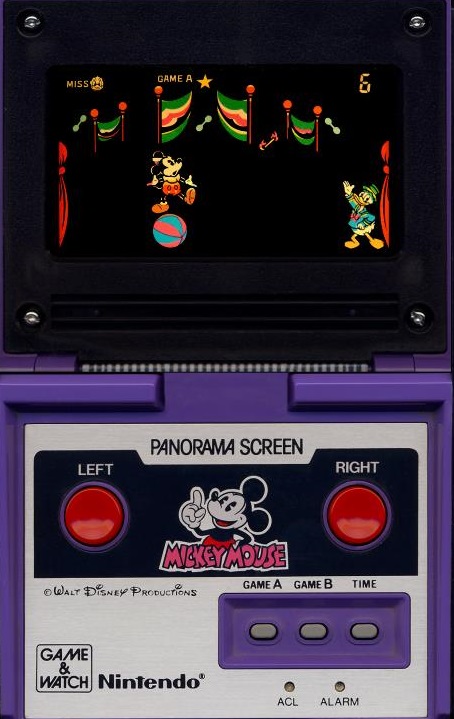
EGG!! and MICKEY MOUSE!!
Nintendo Game & Watch (1981)
Gameplay Type: Spinning-Plate

Screw eating the eggs. That hat you’re using seems to have an unlimited capacity. Patent it and feast upon filet mignon for the rest of your days.

Nintendo reskinned several Game & Watch games to star Disney’s cash rat. Thus, Egg became Mickey Mouse and Donkey Kong Circus became.. well.. Mickey Mouse. That must have been confusing. Weirdly, Egg and Mickey Mouse both came out on the same day in August, 1981. Besides cross-the-road games, the other common, easy to execute LCD gameplay style is “spin the plate” games, where you have to judge which of several objects is the next one you have to touch. Also, this might be the first ever video game where you play as the villain. Because in Egg, you play as the Big Bad Wolf, stealing eggs from chickens. Wouldn’t the Big Bad Wolf.. you know.. EAT THE CHICKENS?

Imagine a parent in 1981 trying to REALLY make their child happy and buying both Egg and Mickey Moues, thinking they’re different games. You know this had to have happened at least once.

Well, I think the issue is Nintendo was trying to get the Disney license (they’d worked together for decades when Nintendo made playing cards) but wasn’t sure if they would get it. So they made two versions of this, and had to design a character that could seamlessly replace the Mickey Mouse character if they couldn’t work with the House of Mouse. That’s my theory, at least. Anyway, I’m not a fan of these because it becomes too hard to determine the speed after a while. This is one (two) of those games where Game & Watch Gallery had a really easy time making the concept more playable. Just add motion and poof: you’re 80% less boring. 20% being purely genetic.

Does that count as eight? Only seven? Fine.

OCTOPUS!!
Nintendo Game & Watch (1981)
Gameplay Type: Cross the Road

The Octopus should seriously come back as a boss somewhere. Great character model.

I figure the surest way for a Game & Watch game, or any LCD game for that matter, to win the Indie Gamer Chick Seal of Approval, is to be a cross-the-road game that has a unique, addictive play mechanic. Octopus is almost that. That idea is you have to wait for the tentacles to coil and uncoil, move to the treasure chest in the bottom corner of the screen and scoop up as much loot as possible, then return to the ship for bonus points. The more points you score, the faster the tentacles move. And that’s really it. It’s almost fun. It’s so close, but the lack of motion hurts this one. It’s why the remake on Game & Watch Gallery is so strong. This is just short of that.

And now I feel like I’m on a quest to find a good one of these LCDs. I just bought every DSi Game & Watch release, plus the first three Game & Watch Gallery titles on Virtual Console for comparison sake. Weirdly enough, playing these games does make me feel like I missed out on something. I’m gaining an understanding of the gaming upbringing of my older fans, and a better appreciation for the era that I came into the hobby, from 1996 – 1998. By that point, I never had to worry about getting stuck with one of these crappy “games.” Nope. I just have to hear older people say that this is all they had and they walked uphill in three feet of snow both ways to get them and they liked them. Weirdos.

Arcade Archives: Mario Bros.

One thing I’ve noticed while playing Mario Bros: people either love and defend the 1983 arcade original and its direct ports, or they love and defend the numerous remakes of it, some of which happened in games like the Mario Advance series, as a competitive minigame in Super Mario 3, or even as a Virtual Boy game. Regardless of the quality of the coin-op (spoiler: it sucks), that tells me that the fundamental concept is one of Nintendo’s biggest home runs during their formative years as a game maker. Of all their early titles, it’s certainly the one with the most staying power. And that’s kind of amazing, because Mario Bros really sucks. Sorry for those that I didn’t give proper spoiler warning to above.

For those that say “you’d of had more fun if you played (name of game) co-op”, I played Mario Bros. co-op. I didn’t have fun and dragged an innocent child’s weekend down with me. I’m a monster thanks to your peer pressure. Hope you can sleep at night now, because I won’t be able to. Also, you can’t play the high-score modes or caravan modes co-op. Maybe an option for a version of both would have been nice, but so far the only game in the Arcade Archive series that seems to have gone the extra mile is Donkey Kong, which includes three different ROMs for the game.

Okay, that’s a bit unfair. Mario Bros. actually has a lot going for it, including co-op. People have complained that I don’t always play these arcade games the “best way”, IE with a partner. Because I guess miserly loves company. But the thing is, my family doesn’t really like misery. They get enough of it from me. But, I conned my nephew C.J. into playing a round with me. He couldn’t quite comprehend what the game in question was. “Mario Bros!” “Mario Maker 2?” “Mario Bros!” “New Super Mario DX?” “Mario Bros!” “Mario 3D World?” “Mario Bros!” “I uh.. Mario Maker 1?” That’s not a joke, by the way. He couldn’t compute the concept. Then I showed it to him and I’m convinced he played deliberately poorly just to escape. He’s a shifty one.

By the way, if not for how bad the emulation for Punch-Out!! seems to be, this would be by far the worst of the Arcade Archives releases. Not because the emulation is bad. It’s not, except for the sound. My understanding is that all the authentic pre-Donkey Kong 3 Nintendo arcade games had strange sound programming that requires emulators to take actual audio recordings in .wav files in order to have, you know, noise. It made the sound effects of Donkey Kong and Donkey Kong Jr. sound strange. But at least the audio was clear for those. For Mario Bros, sometimes the sound effects sound washed out, like they’re coming from another room. I’d show you a 30 second clip, but video capture is disabled for this one. It’s the first time that’s happened during this mini-series I’m doing. Which really means my fans are just being spared seeing me post roughly two-thousands videos of me dying in a fire(ball).

Probably the biggest difference between all these arcade games and their NES counterparts are the lack of cut scenes. NES Donkey Kong doesn’t have the “how high can you get” screens. Donkey Kong Jr. is missing cut scenes and animations. Mario Bros. is missing explanation screens. It made me wonder why they couldn’t do these things on the NES. The NES went on to do impressive things graphically. Well, I found out that it was a cost-cutting thing. Back in 1983, every KB cost extra money.

Yea, those fucking fireballs. I get why they’re there. Being an arcade game, Mario Bros. was expected to generate revenue for arcade operators. You can’t do that if players last too long. Ideally, you want a fun game where players last just long enough to make them think they’ve got skills, then die in a way where it sure seems like the player, or those watching, think they could have done better. They drop quarters, then die again in the same spot because it’s close to fucking impossible. That’s Mario Bros, only they forgot the fun part.

After a few stages, fireballs start to spawn with such breakneck frequency that it felt like there was no opening to flip the enemies over. I’d go to jump over the fireballs and they seemed like they’d always zag straight into me. You can kill the fireballs the same way you flip enemies over for lots of bonus points, but the vulnerable surface area of them seems very small, and the timing of even being able to stop them is so short that you’re more likely to die pursuing it than you are to succeed. And while all this is going on, the actual enemies you’re supposed to be targeting are still walking around, doing their thing.

The POW block isn’t as useful as you’d think. The crabs take two hits. The flies can’t be hit if they’re not on the floor. For the five-minute mode, I found I did better when I burned it early to shave time.

Mario Bros. goes from simple, reasonable challenge to unmanageable cluster-fuck of shit happening with so little transition in-between that I can’t believe this isn’t remembered alongside Defender or Smash TV as one of the all-time hardest arcade games. It’s insane how tough it is. And this isn’t helped by some of the most slippery, imprecise movement controls of any Golden Age of Arcades title. I actually longed for the lumbering, heavy movement of Donkey Kong Jr. multiple times while playing this steamer, because at least that was accurate. Mario Bros. actually introduces little sentient ice monsters that, if not stopped, will freeze platforms and cause slipping. To quote Dorthy Parker when she heard Calvin Coolidge died: “how can they tell?” Because this shit is already buttered-floor levels of slick to begin with.

There’s less bonus stages in the arcade version too I think. You certainly get the bonus levels faster in the NES version, which only opens with two turtle waves. The arcade game has three before you get to the first bonus round. I pictured a seedy arcade operator, shirt stained, cheap cigar hanging out of his mouth, saying “BONUS STAGES? FREE LIVES? DO YOU THINK I’M RUNNING A FUCKING CHARITY HERE?”

To Mario Bros.’s credit, the framework for something special was laid here. I didn’t like it, but at least the foundation gave rise to Super Mario Bros. and the modern game industry as a whole. And actually, the five minute caravan mode is best with Mario Bros. because it takes about four minutes for everything to become out-of-hand. When things get unplayable then, at least the game is going to end within a minute. Funny enough, I fired up the NES/Famicom version of Mario Bros. to compare to the arcade original. The graphics are a major step down on the NES, more-so than any other arcade game I’ve played so far. And, while the movement is more accurate and less slippery, the home version has a horrible Ice Climber-like glitch where you clip right through the platform if you jump in a certain way. So there were tons of times where I was trying to jump onto the platform above me and went straight fucking through it and back down to the level I was already on, or even lower. That doesn’t happen in the arcade version. That really sucks because now I have to turn my six-game marathon into a seven game one and buy Arcade Archives: Ice Climber to see if the clipping isn’t present in the arcade version of that, which I consider the NES version to be the worst Nintendo game ever. Fuck you Mario Bros. for making me do that.

Fine, but I draw the line at Clu Clu Land. I think that’s reasonable.

Arcade Archives: Mario Bros. was developed by Hamster
Point of Sale: Nintendo Switch

$7.99 said the crabs and flies sort of got the shaft in the Mario universe in the making of this review.

While all indies I review are purchased by me out of pocket, a fan paid for Arcade Archives: Mario Bros. for me. I matched their purchase price with a donation to Direct Relief. Last year, they provided relief to my home state of California, and they’ll sadly have to do it again this year. They need money though. Give them some, please.

LCD Games of the 80s

INDIE GAMER CHICK’S LCD GUIDE: PART II – PART IIIPART IVPART VPART VIPART VIIPART VIII

WE INTERRUPT INDIE GAMER CHICK’S SIX GAME ARCADE ARCHIVE MARATHON TO BRING YOU CATHY BEING SUBJECTED TO LCD HANDHELD GAMES FROM THE 1980s

We what?

Oh fuck my life.

I never owned those cheap Tiger LCDs as a kid and Game & Watch as a series was all but dead by time I was born. The Game Boy came out in the United States just a month after I did. And both of us were discolored and coated disgusting fluids. Or maybe that was just me. But you fuckers haven’t shut up about how “good” these were on Twitter since I started this retro voyage of mine.

DONKEY KONG!!
Nintendo Game & Watch (1982)
Gameplay Type: Cross the Road

Nintendo has done a series of Game & Watch Gallery games. They might as well do another round and include them with Switch online.

It took me a while to figure out that you can’t jump if there’s a girder above you. The object is to climb to the second screen, activate a crane, then jump onto the swinging hook to cut wires that support Donkey Kong. Every time you cut a wire you end up having to start at the bottom and climb your way back up, this time with faster barrels and girders that are deadly to you. The concept is fine, and honestly the gameplay, while too easy and boring, is genuinely better than the Donkey Kong 3 arcade game. This is also the game that gave birth to the plus-shaped D-Pad. But I didn’t play with an authentic device so I can’t tell you how it feels. Still, this is a pretty historic game. Crappy, but historic.

Crappy and historic.. shit, this really is a Donkey Kong game!

DONKEY KONG!!
Coleco (1981)
Gameplay Type: Cross the Road

What an absolutely terrible game. Unlike the Game & Watch game (which, to be fair, came out a year after this and could learn from this game’s mistakes), this Donkey Kong actually tried to be as faithful as possible to Donkey Kong. It failed. It failed badly. It’s a fail whale. Hail hail the fail whale. I mean, look at it.

The yellow lines are the ladders. The yellow spots on the floor are supposed to be the rivets. The packages of McDonalds french fries are supposed to be the fireballs. This is Gaming Hell, people.

It’s clunky. Without movement it’s hard to know what stuff like the fireballs in stage two (which tries to mimic the rivet board from the arcade game) will actually do. It’s even ugly to look at. At least Game & Watch releases had neat, clear looking LCD characters that had funny, distinctive faces. They were so nice looking that they became a Smash Bros. character. This? Imagine being a kid in 1981, seeing this in stores, and begging your parents for this for Christmas. It cost $60 in 1981, which is over $150 today. A lot of money for most families. And then you get it, and you play it, and you realize there’s no Santa Claus. And your parents hate you because they just spent over $150 in 2019-equivalent dollars on something you can’t possibly play for more than 10 minutes before wanting to die.

Nice cameo in Gremlins though.

DONKEY KONG II!!
Nintendo Game & Watch (1983)
Gameplay Type: Cross the Road

Again, shockingly, this is more engaging than Donkey Kong 3. It really speaks to how bad of an idea that game was.

Not to be confused with Donkey Kong Jr., though the game actually stars Junior and seems based on his game. You start on the bottom screen, jump up to get a key, then zig-zag your way to the top screen, where you have to again jump for the key, then push it into one of the locks caging Donkey Kong. Unlike Donkey Kong, where you automatically go to the bottom screen upon completing a cycle, in DK II you have to get to manually make your way back to the bottom to start the cycle over. Or, you can sacrifice a life to get there. The concept is fine, but like every other game I’ve played, getting the timing down is hard because there’s no actual motion to track. It’s guess work, and if you have no sense of timing, you’re fucked. Also, there seemed to be a few times that I don’t think surviving was possible because any direction moved, including jumping, would lead to my death based on where the enemies were. Another turd.

DONKEY KONG JR.!!
Coleco/Nintendo (1983)
Gameplay Type: Cross the Road

This slideshow requires JavaScript.

indie-gamer-chick-approvedThis is an odd cat. Unlike the Donkey Kong tabletop that was developed by Coleco, this one was made by Nintendo, presumably to show Coleco how to make a decent LCD game. Not that Nintendo’s Game & Watch games were amazing or anything, but compared to the shit Coleco seemed to have been vomiting up, they were incredible. And this is actually one of the better games. You grab a key and zig-zag Junior to the right of the screen, where you ride umbrellas downward and balloons upward to free your Daddy. It’s weird that you don’t have to locate the key and you start every level by jumping up to get it, but the twist there is, if you miss hitting the lock that Donkey Kong swings up and down, you drop the key and have to make your way back to the start to get another. I’d still rather play anything else, but if.. okay WHEN.. I go to Hell, if Satan tells me my only options are to play LCD games, if this is on the menu it won’t be so bad.

DONKEY KONG CIRCUS / MICKEY MOUSE
Nintendo Panorama (1984)
Gameplay Type: Spinning-Plate/Juggler

Mario is a cruel taskmaster. Which is the original origin story of Donkey Kong. It’s true.

It’s juggling. With Donkey Kong or Mickey Mouse. It’s boring. Please shoot me.

DUNGEONS & DRAGONS COMPUTER FANTASY GAME!!
Mattel Electronics (1981)
Gameplay Type: Minimalist Adventure

You’re warned if there’s pits nearby. ET really could have used that.

This is an interesting one that requires you to draw a map using pen and paper like a fucking savage. You’re placed in grid that’s full of pits. Somewhere in the maze is a magic arrow and a dragon. You have to find the arrow, then sort out what room the dragon is in, get next to that room, point at it and shoot the arrow. It sort of defeats the purpose of being a handheld game by needing pen & paper to play it, though I guess it’s not really D&D without those materials either. It’s an incredibly simple concept, but it works. It’s not really fun in the strictest sense but it’s a decent enough time waster. And with all the pits, I’m curious if Howard Scott Warshaw owned one of these.

MARIO BROS.!!
Nintendo Game & Watch (1983)
Gameplay Type: Spinning-Plate/Juggler

Mario Bros. (Nintendo, Multi Screen)-220718-144832

This one makes no effort to play like the arcade game, because at the time, Nintendo’s concept was that Mario would be the “every-man” who worked a variety of odd jobs. Here, you have to pass packages between Mario and Luigi up a series of conveyor belts. It’s another take on the plate-spinning style gameplay with the twist being that you have to move two characters on two different screens independent of each-other. Even with the twist, I find most of these type of games boring, and this one is no exception.

TRON!!
Tomy (1982)
Gameplay Type: Snake-Like

This slideshow requires JavaScript.

This one tries to recreate the light-cycle scene from the movie, but in over ten minutes of playing I couldn’t once beat the computer. Even when I had a speed advantage and got in front of it, it would always turn fast enough to hang in there. When I finally thought I had boxed it in, I simply died anyway. It makes me think the Donkey Kong Jr. game above had the right idea by trying to play tribute to the spirit of the game while also making something original that is more tailored to the hardware.

Shit like these games makes me appreciate my gaming upbringing a little more. I’ve had a LOT of my older fans wax nostalgically about the glory days of these things. I hope this doesn’t come across as condescending, but I feel a little sorry for them. Because these are terrible games. I honestly can’t believe they were ever considered an acceptable substitute to arcade games or even the most primitive Atari 2600 games. At least with the 2600 you could see objects move. Here they just sort of blink out of existence in one part of the screen and reemerge somewhere else. Maybe you guys from that time felt like you were getting away with something naughty by playing these at church or at school. Maybe they were bad deliberately, as part of a conspiracy. By teachers. Because compared to these, school work.. any school work.. would probably look pretty damn stimulating.

Arcade Archives: Donkey Kong 3 (Review)

I’m going a little out-of-order here, but I wanted to get all the Donkey Kong games out of the way. Then again, I sort of already did that. Because Donkey Kong 3 is such a radical departure from the first two games that it really has nothing to do with them. I look at it and I wonder if people at Nintendo sat around thinking “I can’t believe we were the only company that didn’t successfully cash-in on the Space Invaders craze. Fuck it, we’re successful now. We can do this guys!”

They couldn’t.

The beauty of a screenshot is that you can’t tell that it’s Stanley the Bugman shooting DK here. For all we know, Donkey Kong’s coconut gun just fired in spurts and Stanley is about to be Bukaked on.

Once again, Hamster has put together a well-emulated package that’s all for naught, because Donkey Kong 3 is a terrible game. How come it never comes up in the discussion of potential worst Nintendo developed titles? Because it’s pretty fucking sorry. The aim here seems to have been to combine platforming with space shooting, but the platforming elements really aren’t a major factor in the game and the shooting elements leave a lot to be desired. Instead of dealing with space bugs, you’re dealing with garden-variety Earth bugs in a greenhouse that attack in waves and sometimes just straight-up shoot you with a stinger with seemingly no visual or audio warning it’s coming. Between these and the caterpillars that serve no purpose but to block your attacks, Donkey Kong 3 really didn’t seem to have a vision for the  type of fast-paced, white-knuckle gameplay that the genre required by this point. All it has going for it is the hilarious idea of shooting bug poison up Donkey Kong’s bum. Which is funny. Don’t me wrong. I’m not a complete ogre.

But seriously, three levels Nintendo? Three? Until this point, I can’t remember playing a Nintendo-released game where it feels like they just gave up. (Okay, fine, maybe Wii Music.) Donkey Kong 3 is the “weird one” in the series, but it’s also one of the very worst Nintendo games ever made. I genuinely disliked my experience playing Donkey Kong and Donkey Kong Jr., but, I was never bored playing them. I was bitching the entire time, but they were always interesting. The one interesting mechanic of Donkey Kong 3, shooting a centralized, heavy target enough to push it past a goal, is just not well implemented. There’s a powerful bug spray that, while it only works temporarily, carries over between stages if you have enough juice left in it. Getting the bug spray in the first stage carries over to the second stage, where you can hit DK enough to beat that stage in a couple seconds.

The problem is that they wanted a “climax stage” like Donkey Kong and Donkey Kong Jr. had with the rivets and the keys. But there was no way to implement a unique finale mechanic the way they designed Donkey Kong 3. So the climax stage is just a short wave where you push DK’s head up into a beehive. It’s lame as fuck. Which means it fits-in perfectly here. Is this the low point of Shigeru Miyamoto’s career? Actually, no. But this is probably the game where he found out he can’t work miracles. Nintendo tried for years to get their hands on that sweet, sweet space-shooter cash. They had Radar Scope, a game so boring they had to turn it into Donkey Kong to save the company. They had a game called Space Firebird that allegedly Donkey Kong 3 is based on, though I honestly couldn’t see it myself when I watched gameplay videos. There was a game called Sky Skipper that was so hated by players and arcade operators that they rushed Popeye through production to convert the Sky Skipper cabinets into. Really, I think Donkey Kong 3 was the last straw before they realized where their bread was buttered. History has sort of forgotten it, and those who remember it call it the “weird one.” That’s unfair. It’s the bad one. The really, really bad one.

So, what else can I say about Donkey Kong 3? It’s $7.99, like all Arcade Archive releases. It’s not worth it. Not just because that’s too much to pay for a small, short, obscure 1984 arcade game that sucks. But because they really should have just combined all these Nintendo arcade releases into a compilation. When I was complaining about the lack of fairness of the out-of-nowhere stingers on Twitter, longtime IGC fan Tobby Watson had the following astute observation:

This is pretty much the case for all early arcade stuff. It’s the main reason I’d say compilations of these sorts of titles are the best way to experience them now. The patience required to “get good” at something that is often luck based can be miserable, and having more games to play mitigates that disappointment a bit. Quarter munching obstacles like this are just a real by-product of the time and the industry.

I was born in 1989, and by time I was into gaming, arcades were pretty much dead. I wasn’t there to experience “quarter munchers” but shouldn’t the ability to munch quarters be predicated on the game, you know, being fun?

He’s right! I blitzed through every title in Midway Arcade Origins and Capcom Arcade Cabinet earlier this year and was downright shocked by how brutal they all were. Most of the games aged poorly (especially the Capcom stuff), but as miserable as I was, at least I paid one low price for everything in those sets. With Donkey Kong 3, I’m now $24 into this six-game project I foolishly committed to that overall $48 was spent on. Each game costing $8, none of them worth it so far even with online leaderboards and special challenges like the five-minute caravan mode. Mind you, a $20 a year Switch Online subscription nets you over 50 NES games with more coming (and Famicom too if you create a JP account to download the launcher for) AND Tetris 99, my current 2019 Game of the Year front-runner. Maybe if we were talking the best games ever made, $7.99 would be a good price. For Donkey Kong 3? I feel like Stanley was pumping MY ASS full of poison.

Arcade Archives: Donkey Kong 3 was developed by Hamster Co
Point of Sale: Nintendo Switch

$7.99’s coconut gun can fire in spurts in the making of this review.

Arcade Archives: Donkey Kong Jr. (Review)

Donkey Kong Jr. is this baffling anomaly of a game. I like it even less than Donkey Kong, but I also find it so much more interesting. At least from a gameplay perspective. I think that’s because we’ve seen tons of platform games that involve jumping over stuff and climbing ladders. But the vine mechanics of Donkey Kong Jr., while not completely unique to the game, still feel like they’re exclusively the property of DK Jr’s legacy. Fundamentally, Donkey Kong Jr. isn’t as big a departure from Donkey Kong as fans of the game would have you believe. You start at the bottom left corner of the screen and zig-zag your way to the top. It’s the way you get there that feels so different. And somehow, get this, still feels fresh 37 years later. How is that even possible?

It struck me that the gameplay of Donkey Kong Jr. often feels more like trying to cross a busy highway than Frogger, a game that’s literally about trying to cross a highway. What could be done to fix the controls? I wish it was smoother to transition between vine to vine. That’s it. The idea of using two vines to climb faster and one to slide down faster is brilliant. It also creates all kind of defensive options. Donkey Kong Jr. is deceptively complex as far as early 80s games go.

Well, it’s the Super Mario 2 Rule: since nothing quite like Donkey Kong Jr. has been done by Nintendo in the nearly 40 years since the game came out, it’s able to retain the charm it had from the start. This in the face of decades of gaming evolution. That’s probably Junior’s greatest achievement. And yeah, Donkey Kong on the Game Boy (aka Donkey Kong ’94) had vines and the little alligator head things. But, you controlled a completely different Mario than you did in the early 80s arcade games. One that did backflips and handstands with silky smooth accuracy, and it was a puzzle game where you took a key to a door. It’s as far removed from Donkey Kong Jr. as a 2D platformer can be. There’s never been anything quite like Donkey Kong Jr.

And I hate it. Because movement is so slow and clunky. Now, there seems to be confusion over what that means to a game from retro enthusiasts. Yea, if you put enough time into a game with poor controls, you can get used to them. Maybe even to the point that you instinctively compensate for the shortcomings the controls have and they become a total non-factor for you. This is absolutely possible. But that a player can get good at using bad controls doesn’t change the fact that the controls are bad. Donkey Kong Jr. controls the worst of the original “trilogy” of Nintendo games. Donkey Kong and Popeye control bad, but they’re Mario Worlds apart from how bad DK Jr. feels. It’s always sluggish, and it hurt my enjoyment of it so much.

Both Donkey Kong and Donkey Kong Jr. really stand out because the best levels are the “climax” in terms of the narrative. I prefer removing the rivets in Donkey Kong’s final board to pushing the keys up into the locks in Junior’s. That’s the one gameplay mechanic from Donkey Kong that I feel has legs for more stages.

Such a shame, because it feels like it has the highest ceiling for enjoyment of any of those original Nintendo arcade games. And the most potential for more stages not yet created. Myself and others have been pondering on Twitter how viable it would be for Nintendo to bring out new releases of these arcade games, not in arcades but as downloadable titles, that simply add dozens, maybe even 100, new levels. Not like Donkey Kong ’94 did, but using the actual arcade hardware. Hell, find a ROM hacker and do it. It worked for Sega and Sonic Mania, which became probably the best 2D Sonic game ever. It sold great. It was critically acclaimed. Nintendo could do that with Donkey Kong and Donkey Kong Jr and it would get attention and sell. There’s really no reason not to do it.

I guess any discussion of Donkey Kong Jr. has to include talking about Mario being the villain. Or is he? I mean, what did we know about Donkey Kong? He apparently kidnaps women against their will and tries to murder their rescuers by crushing them with barrels or burning them alive with fireballs. That’s who you’re trying to rescue in Donkey Kong Jr. Mario is NOT the villain. Junior is! This is the first verified game where you play as the person who is trying to make the world a worse place! It’s historic in ways nobody realized!

But, I’d want more fixed with Donkey Kong Jr. than adding levels. I’d want more responsible controls. The classic gaming fans would scream bloody murder over that, saying “that’s not MY Donkey Kong Jr.” And.. yeah, it wouldn’t be. It’d be better. It’d be Donkey Kong Jr. finally realizing its potential. Actually, Donkey Kong the character is just fine. He’s a staple in gaming still, in 2019. Junior is the one that history kind of screwed. He was a racer in the original Mario Kart, but they shit canned him for Donkey Kong. He was in Mario Maker, but that was one of the most meaningless cameos ever. This concept of making a new version of Donkey Kong Jr. with the original arcade graphics but more levels and better controls would be the perfect way for him to come back. Otherwise, the character is just sort of rotting on the vine.

Arcade Archives: Donkey Kong Jr. was developed by Hamster Co.
Point of Sale: Nintendo Switch

$7.99 (too much) noted the emulation again is perfectly fine in the making of this review.

Gyro Boss DX

When I started Indie Gamer Chick on July 1, 2011, the site focused on Xbox Live Indie Games. While there were a few ambitious concepts, most of the games I covered early-on here tended to be small, simple titles that cost 80 Microsoft Points. That’s approximately $1 for the uninitiated. While I’ve since started to cover larger games, over-achieving bite-sized cheapies hold a special place in my heart. Where in my heart the special place is located I’m not sure. Probably somewhere by my cholesterol dam. Also, I want to point out that while I registered the site on July 1, the first review didn’t go up until July 2. So this totally counts as my 8th anniversary review. Or 7th anniversary for you technical kill-joys out there who point out you don’t celebrate your 1st wedding anniversary on the day you’re married. Yea? Well, I beat Cuphead so suck my asshole.

Huge props to Chequered Ink for including the option to tone down intense visual effects for the photosensitive among us. That was very uncommon when I started Indie Gamer Chick eight years ago this week. Now, I see it all the time. And it still warms my heart to see it.

People on my timeline are saying Gyro Boss DX is based on Gyruss, a terrible 1983 arcade shooter by Konami. Because, you see, it has G-Y-R as the first few letters, just like Gyruss. It might be based on that, in the same way Texas Chainsaw Massacre is based on Ed Gein (because, you see, they both involve murders where the killers did weird things with the bodies, but that would mean I’m based on Ed Gein too and my parents say I’m actually based on too much rum and the pharmacy being out of birth control pills) but it sure looks more like Atari’s vector-graphics classic Tempest to me. Of course, both those games involve shooting and in Gyro Boss DX the only shooting is being done at you. And you have to dodge it by spinning around the outside of a cylinder. That’s where my (much more accurate) Tempest comparison comes from.

So yea, the titular Gyro Boss shoots a variety of bullets and other attacks at you, and you dodge that. That’s the entirety of the game. Well, as far as I can tell. I put over an hour of playtime into it, which doesn’t sound like a lot until you remember that rounds end as soon as a bullet grazes you. Or, in my case, flying straight into a bullet because my mind wanders for 1/10th of a second. Maybe there’s an end-game where you shoot back. I don’t know. I wasn’t good enough to get that far. Yea, I wasn’t great at Gyro Boss. I did like it though. I’m a sucker for unassuming arcade scoring games. Even if I suck at them. I’m a sucking sucker that sucks.

I never once died from this wave that I lovingly called “Joey Chestnut’s favorite attack pattern.”

Every attack pattern seems fair and like you should be able to clock it eventually. I mean, I didn’t. But it seems like a competent player could. The patterns are selected at random with a larger attack that dodging causes “damage” to the Gyro Boss every 90 seconds or so. You score based on how long you last. There’s fake achievements to unlock. And, if you struggle with some patterns more than others, you’ll be totally at the mercy of the RNG. Of course, there’s no consequence for dying besides starting over with a score of zero because there are absolutely no online leaderboards. For an arcade style game driven by high scores. Maybe not all that much has changed in eight years.

I really wish devs making games like this would understand that pathetic people like myself need those leaderboards to validate our existence. No global high scores means I don’t know if I’m a better Gyro Boss DX player than XxWindowLicker420xX. What if I’m not? What if I’m not even close? Should I keep playing and hope he’s not spending half as much time as I am improving or should I seek out the next score-driven game nobody will buy and hope it’s something I have a leg-up on him? Or her. It could be a her. It’s rather sexist of me to think pothead window lickers can’t be women. We can be anything!

And that’s pretty much my only complaint. In summary: Gyro Boss DX is a perfectly acceptable indie time waster that I recommend. It might even be a good party game too. I really don’t know because my family is fucking useless at bullet dodging games. Up to four-players can be placed around the cylinder, and in multiplayer, the rules might randomly change on you. You could get a round where you can’t stop moving your ship. You might have to collect coins. You might even get to attack other players by firing missiles at them. It looked like it would be fun, but sadly the longest round my family and I played lasted approximately fifteen seconds. Even the kids that play games couldn’t cut it with Gyro Boss DX, and I ended up yelling at them because they sucked so bad that I couldn’t properly evaluate the mode. I mean, god damn family, there had to have been a baby mix-up at the hospital with me and somewhere out there is a confused family of amazing gamers wondering why their daughter is the drizzling shits at dodging hotdog-shaped bullets. Fifteen fucking seconds at most? Most of our games lasted under eight seconds. EIGHT SECONDS! On the plus side, I learned my entire family would take a bullet for me. Even if they were trying not to.

So do we pronounce it “Guh-Eye-Roe” or “You’re-roe”?

Gyro Boss DX was developed by Chequered Ink
Point of Sale: Nintendo Switch, Steam

$0.74 (normally $4.99) said “you’re not the (Gyro) Boss of me!” in the making of this review.

Gyro Boss DX is Chick-Approved and ranked on the Indie Gamer Chick Leaderboard.

After spending eight years genuinely working hard to improve my writing skills, it’s weird to throw that all out the window in an attempt to write a throwback style IGC review from 2011. I don’t recommend any other game critics celebrating their milestones try such a thing.

I Get to Play Dreams

Eight years.

It’s unreal to think about. I mean, that’s a lot of years. That’s two full Olympic cycles. That’s two full US Presidential elections. That’s the majority of the Marvel Cinematic Universe movies. Actually, Indie Gamer Chick opened three weeks before Captain America: First Avenger if you’re one of those people who now track time by super hero movie releases. It’s a long time. Of course, from my perspective, that time flew right on by. That’s what tends to happen when you’re having the time of your life.

A lot has changed over these last eight years. I’ve changed. Gaming has changed. Indie development has come so far. Imagine telling 21-year-old me on July 1, 2011 the heights some of these developers would reach. Billion dollar acquisitions. Developing franchise games for Nintendo. Being E3 showcase titles. I’d probably not believed it. Here we are, eight years later, and those statements still sound unbelievable. Yet, they’ve all happened. And they’ll continue to happen. Because, right now, we’re living in the Golden Age of Indie Games. That’s how history will remember this era. I’m doing my best to not take the position I’ve found myself in for granted.

I’ve had so much fun being Indie Gamer Chick for these last eight years. I’ve experienced so many games that I know I’d likely never played if I hadn’t found myself reviewing them. I don’t love them all, but always at least try to admire the drive and desire to get them out there. But, when I do love them, it’s a feeling so incredible that I often spend days trying to express it as a review and still walk away feeling like my words come up short. When you realize that the game you’re playing is someone else’s life-long dream coming true, it’s special. And these days, I get to experience that a lot more often than I could ever have imagined. It’s a treat. It’s an honor.

The most exciting part is that we’ll all be seeing a lot more of that in the future. The tools to create games have never been more accessible, and the ability to distribute those games has never been easier. While we all get hyped for incredible trailers or the latest tent-pole franchise releases, the games that excite me most are the ones I’ve never heard of. They’re games that will trace their origins to a young person holding their first controller, their imagination running wild. That’s what I get to do. I get to play people’s dreams. We all do. How lucky are we all?

And so, thank you to everyone, my friends, my fans, and indie developers everywhere for the best eight years of my life, and for all the amazing years of playing dreams yet to come.

-Catherine Vice
June 30, 2019

Venture Kid

I imagine many NES playing kids of the 80s drew or designed Mega Man characters and bosses. It’s probably the easiest thing in the world to do. Look around your room, find objects, and then turn them into _____ Man. Once you have eight of them, just take normal Mega Man villains, make them bigger so they can be bosses for the castle stages, then slightly redesign Wily’s skullship and BAM, you have a Mega Man sequel. So if Capcom comes to me and says “we need eight bosses for Mega Man 12” you can look forward to battling Keyboard Man, Couch Man, Ashtray Man, 5-Hour Energy Shot Man, Epilepsy Dog Man, Curtain Man, Door Man, and Hair-Tie Man. Well, we’ll make Curtain Man into Curtain Woman. Gotta remember equality.

So, it really shouldn’t be a surprise that so many indies pay tribute to the Blue Bomber. Of any iconic gaming franchise from that era, Mega Man probably lends itself most to adaption. That’s why any long-time indie watcher rolled their eyes as Mighty No. 9 was raking in a kagillion dollars in crowd funding. I know I did. Having played Vintage Hero, which actually held the #1 position on the IGC Leaderboard in the pre-multiplatform era of this blog, it occurred to me that you don’t exactly need four-million dollars to turn out a half-decent Mega Man homage. Frog The Door Games did Vintage Hero on a budget of Ramen Noodles and Basic Cable and the end result was roughly a four-million times better and more Mega Manish than the game so many rubes seeded. Even 20XX, which is based more on the Mega Man X series and did nothing for me (I never liked Mega Man X either) is infinitely more inspired than Mighty No. 9.

Honestly, if you’re more of a Mega Man X fan, you’d probably enjoy 20XX. It’s basically Mega Man X as done like a roguelike. For me, I tried multiple times to sit down and work myself into enjoying it. I just couldn’t get into it. I found everything about it to be boring. I think, above all, Mega Man style games need tight, creative level design or the formula gets dull quickly and the base concept of 20XX forbid such levels.

Do you know what other game is better? Venture Kid. Only this one has been slightly more controversial than I expected, with some people suspecting that they just took original Mega Man sprites and repainted them. If it’s true, “so what?” I say. Who cares? It’s supposed to be semi-satirical. It’s really not all that different than spoof films like Scary Movie casting actors that look like the stars of the flicks they’re lampooning, is it? It’s supposed to look like Mega Man, but not at all like Mega Man. Deliberately so. So, what’s the deal? It’s not like developer Snikkabo just changed a helmet or the shading of the armor. It’s an entirely new look. What difference does it make if they just took an outline of the original sprites or if they redesigned the whole thing but with the intent to still very, very closely invoke Mega Man without it being Mega Man? Because that happens a LOT in Indieland. I’ve had tons of people who I hold much respect for shit on Venture Kid, claiming that it’s “lazy” and a “rip-off.” Really? For fuck’s sake, less than a year ago I played Bloodstained: Curse of the Moon, which reskinned every aspect of Castlevania from the heroes to the enemies and nobody said “reskinning! BOOOOOO!” It stinks of a double standard. If Curse of the Moon can have the exact same enemies behaving the exact same way as they did in the 80s, only they look different, how is that different from what Venture Kid does?

Oh, it’s because it’s your chance to puff your chests out and shit on someone in no position to retaliate. Got it. Just so we’re clear: original game with mechanics taken verbatim from classic game with absolute no effort at all to differentiate those characters from the original characters besides base-level sprite repainting ala exactly what Bloodstained Curse of the Moon is: okay as long as the producer is a legend. Same circumstances but small, inexperienced indie dev ala Venture Kid: lazy ripoff. I’ll try to remember that in the future. Even if it makes no sense. I mean in theory, it should be the other way around and NOT okay for the experienced, legendary producer to do that but a great starting point for an inexperienced dev to pop their game making cherry, but what do I know?

If you wish, just tell yourself that Mega Man had to go off on an adventure but his suit was at the cleaner. Also the Venture Kid in the game looks significantly more rotund than the Venture Kid in the cover art and promos.

So yea, you’ll see a lot of familiar ideas in Venture Kid. Bosses that drop weapons you can then use. Eight levels followed by a handful of finale levels (actually, only two, which even I felt that was a bit lite). Enemies like the little helmet dudes that bullets bounce off of unless they rise up to shoot at you, only this time they’re crates instead of helmets. That’s fine. That’s sorta what you should expect in a tribute, right? I mean, y’all liked Shovel Knight, right? The game that played like DuckTales and even had enemies that behaved like other Capcom NES games. Again, what’s the difference? Is it that Shovel Knight and Curse of the Moon improved upon the NES originals or at least tired to feel modern and different? Because Venture Kid does that too.

Right away, you’ll notice the movement feels like you’d expect a Mega Man but not Mega Man game to feel like. And then you have to jump, and you’ll notice that feels completely different. The gravity is much lighter, but it doesn’t exactly feel floaty, either. It works. It seems like it won’t, but it was intuitive and adaptive, even if my brain doesn’t realize it. A lot of people complained about “last pixel jumps”, including me, where you had to get right to the edge of a ledge (I’m a poet and I didn’t know it) in order to clear a gap. BUT, I never once missed one of those jumps or ran into a pit attempting them, even if I was gulping when I tried them. So, was it really last pixel? Or was it my brain telling me “Mega Man can’t make that jump!” Mega Man couldn’t, but Venture Kid could.

Hell, there’s even a Castlevania stage. Venture Kid was a Kid Icarus stage away from being the Captain N: The Game Master release NES kids have been waiting almost 30 years for.

So they made not-Mega Man jump like Super Mario 2 Luigi without the floatiness. Big deal, right? And if that’s the only change that made me sit-up and take notice, that probably wouldn’t have been enough for Venture Kid to stand out. But then I noticed enemies were able to kill each-other with their bullets. It doesn’t factor into the game much, but it’s there and it’s a small touch that stood out to me and everyone else who sampled the Kid. That’s really Venture Kid in a nutshell: small changes that make the entire experience feel fresh. And really, Mega Man’s formula should absolutely NOT feel fresh after eleven primary games (twelve if you count Bass) and more spinoffs than Law & Order. Even the levels change things up with switches, locked doors, and a hidden item in every stage that unlocks the real last boss fight. There’s a store in the pause menu you can use to buy health refills, extra lives and stuff to help assure the item refills don’t go to waste. It’s like seeing someone you’ve known for years get a haircut. Sometimes it feels like they’re an entirely new person, even though really nothing has changed.

I’m not going to complain about the length. Some are. Some are saying the levels are too short and the finale sequence has less areas than a typical Mega Man game. Fine, I’ll complain about that part. Two finale stages is too little. But honestly, I prefer tributes to classic franchises to be a bit shorter. It’s so much more preferable to padding the length, which usually results in spotlighting flaws you otherwise missed while ogling the experience. If Venture Kid made any mistakes in this regard, it’d probably be with the bosses. They’re fine. They feel appropriately on-brand. BUT, then you encounter one that you fight while riding a mine cart that’s so insanely inspired that you wonder if they had that sort of potential for all the others and simply didn’t tap it. Now granted, I let Shovel Knight get away with less than stellar bosses so I have to for Venture Kid too, but I do so feeling like a judge letting an arsonist off on a technicality because the warrant was worded wrong. And now that arsonists is thanking me while ominously flicking their zippo.

I think I might be onto something with the whole Captain N joke.

In fact, up until the last two stages of Venture Kid, I figured this review would have to focus on the little things to complain about. Like how the opening menu has no clarification as to what difference there is between CLASSIC mode and ADVENTURE mode. Get this: classic mode has you play the first eight levels in sequential order while adventure mode lets you select which order to play them. Just like.. uh.. classic.. Mega Man? So why isn’t classic the one that lets you select the order and adventure the one that makes you go from point A to point B like an adventure? I don’t get it. Beyond that, I’d probably complained about how the inspired twisty-turny aspects of certain stages like the Egyptian one don’t factor into enough levels.

And then I got to the Dr. Wily’s Castle style end-game levels, and yeah, I now have something to complain about. Because these levels are a maddening torture chamber of design choices so poorly conceived that I’m convinced the developers are still stuck in the Mirror Universe and their goatee-wearing doppelgängers are causing mayhem. These stages are littered with instakill spikeballs with unforgiving collision detection, along with instakill “skull-balls” that orbit around a central point. That’s bad enough, but then you get to a section where the spikeballs blink in and out of existence with no graphical warning of them. When you encounter these, you’re almost guaranteed to die because the first time they appear. It happens like it was deliberately timed to happen at that point. That’s not challenge, people. That’s kicking someone in the nuts and then telling them you’re playing a game where you have to avoid getting kicked in the nuts and they just lost. You have to know a challenge is happening or else it’s just GOTCHA!

It really puckered my butthole when it happened because everything before this was so well-crafted. This moment was beneath the Venture Kid that I just played through. So was an auto-scrolling section leading to the true final boss that relied less on level design and more on the spikeballs. I think Venture Kid succumbed to relatively inexperienced developers not knowing how to make a game feel climatic. Another problem is they couldn’t decide if they wanted Venture Kid to feature linear levels or Mega Man style stage selecting. Including both sounds like a perfectly fine compromise, but when you think about it, having the option to do both still requires levels 1 – 8 to have little-to-no difficulty scaling. There’s a very small amount of sections that are made easier by using items acquired in other stages, but really you can beat the whole game with just the starting peashooter and it wouldn’t change all that much. Consequently, the final two levels feel like they’re the 9th and 10th levels of a game that scaled properly to get there, only without the scaling. You don’t do swimming lessons by teaching someone how to kick their feet for eight weeks, then strap a barbell to their feet and throw them into the deep end for week nine. I mean, I do that, but sane people don’t.

In fact, a lot of people on my timeline said those stages ruined the game for them. I’m not going there, because they didn’t for me. They were disappointing, but I still could beat them, and did. I just had to trial-and-error my way through them in a way that felt like it belonged to another, lesser game. It was unfortunate because you never want to finish any good game on a sour note, and Venture Kid ends with a degree of sourness normally restricted to laboratory conditions at the Warhead candy factory. But don’t let that distract from the fact that Venture Kid is a very good game. It’s sad to me that so many people are dismissing it as a clone of Mega Man or even a rip-off of someone else’s Mega Man tribute. This is the same community that gave four-million-dollars for a Mega Man tribute sitting on a 52% rating at metacritic. Nobody should be calling any indie a Mega Man tribute when you already gave more money to that steaming turd than you have to most charities.

The final levels do go a bit overboard on the instakill shit. Remember aspiring indie developer reading this: it DOES matter that people put the controller down, game beaten, in as good a mood as you put them in when you game was at its peak enjoyment. Otherwise they might be less likely to spread the word of it.

I hate to keep coming back to this, but the sheer amount of double standards on display from the blowback to Venture Kid is kind of shocking to me. I liked Venture Kid. There’s not a lot to it, but what is here is just plain fun from start to.. uh.. close enough to finish. It’s why I consider myself so lucky that I couldn’t give two shits about nostalgia. It keeps me from being weird about games and over-thinking whether they work or not. If I’d never played Mega Man, I know in my heart of hearts I’d liked Venture Kid every bit as much. That it set out to pay tribute to an iconic franchise is nothing more than trivia as far as I’m concerned. That being the case I probably shouldn’t have spent so much of the review talking about Mega Man. Hey, you have your double standards. I have mine!

Venture Kid was developed by Snikkabo
Point of Sale: Nintendo Switch, Steam

$7.50 (normally $10, but $7.50 if you own any other Switch games published by FDG Entertainment) thanked all their fans and the entire indie community for sticking with me through my first six-hundred indie game reviews in the making of this review!

Venture Kid is Chick-Approved and ranked on the Indie Gamer Chick Leaderboard!

Wonder Boy Returns Remix

2019 is truly the year of the pointless remake. First I had ToeJam & Earl: Back in the Groove, which did so little to improve the twenty-eight-year-old original that I wonder why they even bothered. And now I’m playing Wonder Boy Returns Remix, which does so little to improve the thirty-three-year-old original that I wonder why they even bothered. I don’t get it. Why would anyone remake a game from the 80s or even the 90s with the same exact levels? Why would fans of the original choose this version over the old one? Presumably, those fans would scoff at modern graphics. And the graphics of Wonder Boy Returns are not that great, to be honest. The style, animation, and even font used for the points when you kill enemies look like they belong to a free browser game designed to advertise car insurance.

I’m certain that Wonder Boy/Adventure Island was good back in the 1980s. The tropical theme is fun. You get to skateboard, and skateboards were big in the 1980s. And it was sort of like Super Mario Bros but not Super Mario Bros, and it was on Sega platforms where there was no Mario, but it was also on the NES where there was a Mario game but you were waiting for another Mario game and anything Mario-like will do. Give me a break, everyone. I’m trying really hard to get myself in the mindset where this game was ever good. Because my play session with it in 2019 was the drizzling shits. It’s so boring. And no matter what else I say after this paragraph, remember that there’s nothing worse a game can do than bore.

The timer is a hold-over from Wonder Boy’s life as an arcade game. It’s there to prevent you from sitting still, drains relatively quickly, and can only be replenished by fruit that spawn out of nowhere. Like the lives system, it no longer services the game.

If you played the 1986 Wonder Boy in arcades, the 1987 Wonder Boy for Sega Master System the 1988 Adventure Island for the NES, the 1990 Revenge of Drancon for Game Gear, and probably twenty thousand more remakes, you’ve played Wonder Boy Returns Remix. I should also probably note that you can play as Wonder Boy’s girlfriend. The girl is reserved exclusively for “practice mode.” Practice in this sense means you can’t take damage from anything (except falling in a pit, which costs you a life), never get off your Vespa, and basically get a free ride to the end of each stage. Because girls suck and they need their hands held. It’s slightly cringey. But what’s really weird is, it’s called “practice” and yet, if you’re really struggling to get past a level on normal, you can’t just jump straight to that level to “practice.” You have to do a full play through with the girl to get all the levels. Her unlocked levels are kept totally separate. Well hell, that’s not practice then. If I’m stuck on level 5 – 2 with the boy and want to “practice it” with the girl, I have to beat every between level 1 – 1 and level 5 – 1 with her. And given that you can’t just run as the girl and you apparently MUST use the Vespa (which is functionally the same as the skateboard), it’s ESPECIALLY not practice. There’s no bosses, so it’s REALLY REALLY REALLY not practice. It’s just patronizingly easy mode, starring a girl, because girls are helpless.

And yes, I’ve been abusing save states in the same way Kevin Spacey has abused age of consent laws while playing classic Castlevania games for the last week, but hey, I beat Cuphead, so suck my asshole.

(Also, I’ve been made aware that if you beat the game on hard mode, you find the girl chilling out. It would seem the whole kidnapping was staged and she was actually trying to trick Wonder Boy into rescuing her so that he could make babies with her. If my eyes rolled any more, I’d be able to cosplay as the Undertaker. I’m not offended or anything. It’s almost adorable in the same way being trapped in the a conversation with a senior citizen who casually states that he believes a woman’s place is in the home is. Now everyone, before freaking out, remember, it was a different time. May, 2019. Yea, the original basically has no ending at all.)

To the game’s credit, the only person I know named Tanya is sort of worthless. She locked her keys in her car, had a locksmith come to jimmy it open, got in the car, started the engine, remembered she left her purse or something on the sidewalk, got out of the car to get it, resulting in her locking herself out of her car AGAIN, this time with the engine on. Tanya, I’d worry that you’d see this and get mad at me, but I seriously doubt you can even read.

Now, in the interest of fairness, I fired up my MAME cabinet to give the original Wonder Boy a shot between the last paragraph and this sentence. I can attest that the controls are nominally fixed over the original. The biggest change seems to be in the skateboard. I was nailing some pretty hair-raising jumps with it. In the arcade version, the physics feel totally different and I was shorting the same jumps. So some effort was made. And Returns Remix also adds a charge shot, which can kill multiple enemies and also clear out rocks you trip over and other otherwise indestructible objects. Purists are crying foul, and it probably nerfed a lot of the challenge, but I used it, and I liked it. Given that I didn’t like a lot about the game, I’ll take whatever net-positive I can get.

There’s one more good addition, and it’s the best idea the new version offers by far: each stage is totally self-contained. There’s now a level select screen, and you start every stage with 5 lives. Honestly, it might as well of done away with the lives altogether. If you wish, you can play “one coin” mode. There’s no level select, and you have ten lives to beat all 32 stages. I stuck to normal mode, and honestly, the level select idea and implementation single-handedly kept me from going into full-blown scathing IGC mode. It’s a genuinely great improvement. If there’s Wonder Boy fans who never beat it, you can beat this one. It has the same levels from your childhood.

It probably could have used online leaderboards too. Otherwise scores are kind of pointless in 2019.

So what’s the problem? IT HAS THE SAME LEVELS AS YOUR CHILDHOOD! Wonder Boy came out three years before I was born. Games have come a long way over the past three decades. Wonder Boy runs out of ways to keep things fresh after just a small handful of levels, leaving worlds 2 through 7 and their twenty-eight stages a repetitive slog. Fighting the same enemies and clearing the same platforms, only rearranged in different orders. There’s a boss fight at the end of each world, but really they’re all the same and only the head changes. They all attack in the same way and only the speed they shuffle back and forth at changes. They remind me of the fights with Bowser in Super Mario 1, but hell, even those would do things like have him start spitting hammers or put blocks in your way to add to the challenge.

What Wonder Boy Returns Remix needed to do was, well, REMIX things. Add new challenges based on modern gameplay conventions. I’ve reviewed one other game with the word “remix” in the title: NES Remix. It stars some games even older than Wonder Boy. But it felt fresh and modern because it took the existing games, some of which were genuinely terrible games even in the mid 80s, and went full-on wackiness with them. Wonder Boy Returns Remix feels so safe and utterly devoted to faithful recreation that, while you do sorta have to tip your hat to how close it comes to feeling like the original, you also have to shake your head at what it accomplishes? Because I can track down Wonder Boy 1986 right now. Anyone can. I don’t think a level select is worth a remake. I don’t think starting each stage with five lives is worth a remake. The formula works. It’s beloved. I had so many people on Twitter saying “OMG ADVENTURE ISLAND!” even though this is Wonder Boy, but Wonder Boy is Adventure Island. My point is, people want more of it. But do they want more of the same?

I can’t tell if it’s supposed to be an axe or a hammer he’s throwing, so I’ll use both horrible puns. Pun #1: Hammer. “This boss must have been drinking last night, because now he’s hammered.” Pun #2: Axe. “Don’t feel sorry for this boss, he was axing for it.”

Hell, I even think the graphics of the original are better. They hold up pretty good for a 1986 game. The irony is the remade graphics of the new one feel more tired than the 1986 graphics. So who is this made for? I let my 12 year old nephew play it. He thought it was fine at first, but got bored after fifteen minutes. Scoff if you will, old school gamers, but he pretty much saw everything the game has to offer in those fifteen minutes. And that’s really the story of Wonder Boy to me. It seems like it’ll be decent, but it just runs out of steam too quickly. And Wonder Boy doesn’t even have all the hidden goodies that Adventure Island apparently has to keep it fresh. Just the same handful of enemies, set pieces, and jumps in different arrangements. Maybe that’s what a lot of old school games were, but maybe those games that held up are just.. I dunno.. better? Maybe Wonder Boy was limited all along. Maybe that’s why the series had to evolve as radically as it did. Can you believe that IGC Seal of Approval winner Wonder Boy III: The Dragon’s Trap was a direct sequel to this? If they were any different, there would be a horrible sitcom made about them being roommates.

Wonder Boy Returns Remix was developed CFK
Point of Sale: Nintendo Switch

$14.99 said “yes, this counts as an indie. It’s review #599 in fact” in the making of this review.

SteamWorld Quest: Hand of Gilgamech

Disclosure time: Image & Form top dog Brjann Sigurgeirsson (a name that sounds like someone began to sneeze mid-pronunciation) is a friend of mine. But I’m not sure what that does for a developer besides giving me a direct line to let them know all the numerous ways they fuck up their games. Brjann and I have an understanding: he makes the games, I review the games. No matter my opinion, our friendship remains unchanged. And since I take my critic duties seriously, I don’t talk about their projects still in development with him. I think it’s sort of unethical for a critic to get too hyped for a game that they’re going to cover. It’s not fair to the game. So I didn’t know all that much about today’s game until very recently. I think maybe he might have told me they’d be following SteamWorld Dig 2 with an RPG, but if he did I forgot. When I saw SteamWorld Quest unveiled, I was like “oh, well that’ll be different.” But I didn’t find out about the card-based attack system until right before I started playing it. When I heard about that, my first visceral thought was “well, they were due to have a game suck anyway.”

Nostradamus I ain’t. SteamWorld Quest is the most fun I’ve had playing an indie RPG. You know Brjann, it’s hard to test the legitimacy of our friendship if you don’t make a game I can dislike.

My cynicism was based their chosen combat scheme. I hate card-based attack systems in games. I loved Kingdom Hearts, but hated Chain of Memories. As a teenager who had just gotten hugely into RPGs and was starving for games for it, I couldn’t even like Baten Kaitos. I think I was the only one who didn’t. Before it, I tried Lost Kingdoms on the GameCube, was bored sick, gave the “improved” sequel a try and thought they made it worse. I even tried Eye of Judgement (the gimmicky PlayStation AR game) because, hey look, real cards! It sucked. If any card-based game had potential to hook me, it was the Metal Gear Acid games, but it turns out I was hoodwinked and they’re actually a series of load screens interrupted by a brief card-based tactical RPG snippets. The series was actually fine. Clunky, but fine. But seriously, I think the second level of Ac!d is still stuck loading.

And yes, for those who follow me on Twitter, I play Magic: The Gathering and enjoyed the Steam version of it. Do you know what the difference is? It’s based on the actual physical card game. That does make a difference, ya know?

It doesn’t help that SteamWorld Quest gets off to a start so slow that the jump from prokaryotes to eukaryotes looks tame in comparison. Part of that has to do with the writing, which I’ll get to in a bit. But first, those card mechanics. The idea is you construct a deck of eight cards for each hero you have. When a battle begins, you’re randomly dealt a mixture of six cards from all the heroes. Each turn, you pick three of them to use. They might be attacks, or defensive maneuvers, or special moves that will come into play later in the fight. The real novelty is that each card either comes free or at a cost. If the card has no cost, it adds a counter to a charge meter that you spend on the priced, more powerful cards. It’s clever and works well, but SteamWorld Quest goes the extra mile by including cards that cooperate tag team-style with each-other. Or, if you use three of a single hero’s cards, you get a bonus 4th card separate from the ones included in your deck with a desirable special effect or attack. It’s a rich, satisfying combat system that never gets boring and can be adapted to anyone’s play style. Well, at least after an hour or so.

See the blue bars in my health meters above? That’s probably the most over-powered tactic in the game. See the chick in the witch’s hat in the center? That’s her special combo card when you use three of her cards when she’s equipped with certain weapons. It essentially renders damage to all your characters null and void for a few turns. In fact, she was, to me, the true star of the game. I stacked her with no-cost cards, including one that allowed me to draw extra cards my next turn, and absolutely annihilated battles. I had to voluntarily nerf her by switching to a different weapon (which changes the bonus combo card you get) just to create my own challenge on normal difficulty.

The truth is, I was bored at the start of Quest. The combat system’s eventual wealth of complexity is nowhere to be seen at the start of the game, and what you do start with gives no sign of the greatness to come. You don’t even get a taste of the potential until you open the third and especially the fourth character of the game, at which point you can dump main character Armilly and her boring ass moves. You’ll also have acquired more cards by this point and the ability to create even more. It turns what feels like a gimmicky system into the world’s most entertaining combat laboratory. I remember when playing Hollow Knight that fans kept assuring me that I’d be “opening up the game any minute now.” Well, that really does happen in SteamWorld Quest.

I don’t know if the slow start could have been fixed. Maybe if you started with three characters instead of two (and really, there’s no reason why Galleo coudln’t have been part of your party at the start of the game instead of about thirty or so minutes in). In truth, you can probably “open the game up” in an hour, give or take fifteen minutes. Once you do, you’ll find a combat system that is deceptively deep, allowing for multiple strategies and mad-scientist levels of experimenting. I had just as much fun tinkering with loadouts one card or one accessory at a time as I did opening up new levels. That’s no joke. I’d change a single card in a deck and get positively giddy at the thought of seeing how it worked with the other twenty-three cards. And it’s super easy to grind because you can use save stations to refill your health at a “cost” of respawning all the enemies (besides sub-bosses) in a stage. SteamWorld Quest is a rare game that I enjoyed that feels like it’s going to bore for the first hour or so, warms up, and takes about three hours truly hit its stride. Once it does, I honestly can’t remember the last time I had so much fun with a no-action-prompt, turn-based RPG’s combat system. It might be my favorite ever, indie or otherwise.

If there’s a problem with Quest’s combat, it’s the rewards for beating enemies just aren’t plentiful enough. Leveling up is not the issue. You’ll do it a couple times a chapter. There’s safeguards in place to prevent screw-grinding. The issue comes from enemies not dropping enough resources to craft or upgrade cards. Especially the upgrade part, which requires tons of materials to go all the way with. My strategy for upgrading was to start by focusing on the common, cost-free attacks that most of decks consisted of. But, once I had those beefed up, I realized that I had to go get more materials for the rest of the cards, but getting enough to make meaningful upgrades took forever. It requires you to replay previous chapters, now with a presumably overpowered party, hoping against hope the enemies will drop the stuff you need. Not until very late into the game do resources seem to start to become abundant. I don’t know if I was upgrading cards ahead of schedule or not. Probably not, since some of those upgrades require you to get rare materials that don’t appear until the late game. So you do have to grind, but in the mid-late game, it sort of becomes a chore. Though even flattening enemies doesn’t completely bore. Just remember to hold the right trigger down to fast forward though attack animations.

Balance isn’t too much of an issue (besides Cope’s team-shield thing she does). Really, that they had so many cards without screwing up the balance is remarkable, especially given the rock-scissors-paper nature of enemy types.

What they should have done was had the enemies upgrade alongside with you. Quest is broken up into four acts with a few chapters in each. You’re not exploring big, open worlds. You’re playing relatively tiny levels, most of which you should be able to comfortably knock out in under 20 minutes. The bite-sized stages works, but comes at a cost of having to replay entire chapters, with all the original dialog, cut scenes, and boss fights intact, in order to do the grinding and find the treasure chests that could contain new, valuable cards that you missed before. There’s a “skip” option during cut scenes, but our definitions of “skip” seem to differ greatly. When I press “skip” I expect the cut scene to end and the action to start. For Image & Form, “skip” means “end this sentence, begin the next.” It could take over a minute of slamming the B button to finally “skip” past all dialog you’ve presumably already heard once and thus want to, you know, skip, and start playing the game. I hate it when games do this. I call it “Going Pony” because in some chapters, you’ll be screaming “SHUT THE FUCK UP!” until you’re a little hoarse. UPDATE: You apparently can skip all the dialog by pressing X. I wish I had known that. I would’ve prevented me from Going Pony 3 or 4 times. But honestly, this has no effect on the rest of the review so carry on.

The two self-evident fixes (maybe having the option of beefing up enemies when you replay chapters and being able to skip the cut-scenes entirely when you replay chapters) would have taken any sting out of grinding. Because the combat never gets boring once you start to build up your heroes and their card collections. I joke all the time about “minimum indie badness” but here that was potentially the difference between the best RPG combat system I’ve ever played and just a very, very good one.

I can’t stress enough: the combat is awesome. Eventually. But this is an RPG, the one genre where a game needs equal parts compelling story to go along with interesting and novel gameplay. SteamWorld Quest follows Armilly, lowly daughter of a grocer and fangirl of legendary hero Gilgamech. She wishes to join the hero’s guild, can’t, but ends up having a wacky adventure where she eventually teams up with a ragtag group of misfits and outcasts, including the former sidekick of her idol. It’s a good story. Suitable for all ages. There was even a nice twist that I genuinely didn’t see coming. There’s just one problem: Armilly is written horribly.

One last game design nitpick: I wish the levels felt less like glorified sidewalks. There is some hidden stuff, but it’s done via just covering chests or switches with foreground objects. It makes the environment feel like a facade or a set, instead of a big, thriving world. Like a bunch of kids LARPing at Disneyland.

Let me preface this section by noting I’m not some kind of student of literature or creative writing. I’m an investor by trade who dabbles in game criticism as a hobby. But, I’m familiar with the concept of the hero’s journey. SteamWorld Quest seems to want to take Armilly on a fairly standard hero’s journey path and checks all the boxes for it. But the dialog takes the oomph out of her adventure because she’s just too much of a smart ass with no reason to be. She also has this gee-golly-shucks way about her, especially when she goes all slobbering fandom on retired Gilgamech sidekick Orik when they meet up. The smart assery and the starstruck fangirl delivery of her dialog aren’t compatible. Usually when characters are wise asses in fiction, it’s to make up for an inadequacy. When Buffy gets smart-alecky with Giles, it’s a defensive mechanism. If Bart Simpson mouths off, it’s for attention. When Archie Bunker says something bigoted, it’s because he’s insecure. Unless you’re doing a full-on comedy, sarcasm should always be grounded as a coping mechanism. Backtalk or sass without foundation is sort of dull because instead of flavoring a character’s idiosyncrasies, the sarcasm becomes what defines the entire character. And Armilly, who is the center of attention, among friends, and the leader of her group, has no reason to be non-stop sarcasm and quips. It’s the same flaw I found with the Peter Venkman character in Ghostbusters. Perhaps the only flaw in the entire movie. He’s unlikable. And I’m sorry to say it, but Armilly is unlikable.

Plus it doesn’t help that her sarcasm isn’t remotely funny. It’s just kind of awkward.

I wasn’t sure if this direction was done because the game is meant to be lighthearted and semi-satirical. But, while it’s true that there’s a bit of Paper Mario-esq tomfoolery about SteamWorld Quest, the plot is simple and engaging, and Armilly is the only character that really feels like she betrays the gravity of the situation with her dialog. The “wannabe heroes become heroes in an unexpected way” trope usually works because you see them grow into the roles. I don’t feel a sense of growth in Armilly and wish she was written a bit more sympathetic. Imagine if Luke Skywalker had been a slobbering Jedi fanboy who fawned all over Obi-Won with bad sitcom quips when it was revealed he was a former Jedi Knight. Who could get behind someone like that? These traits need to be tempered with flaws and insecurities, or else they’re just someone who is the hero because they’re the main character. Thankfully, the other characters and even the villains have relatively sharp dialog and for me were the real stars of the game. Hey Image & Form: give us a spinoff or DLC with just the twins. Make it happen!

I complain because I love. And in the case of SteamWorld Quest, I truly love this game. But, the scary thing is that it could have been even better, and the ways it could have been better are so self-evident that a transcendent game is potentially in play for the sequel. I’d be curious how it might work in a more open, less linear format. And while I wish it had a stronger lead character, everything else is either good enough to satisfy or downright inspired. I keep going back to the balanced, joyful combat. It’s a game that relies on luck of the draw, and yet it never once felt like my battles were failing because of bad luck. It always felt like it was on me constructing bad decks. I don’t think I’ve ever had more fun tinkering in menus, outside the core gameplay than I had with Hand of Gilgamech. I’d scurry back and forth between looking at the cards I had for one character and then another and ask myself which ones complemented each other. I reverted back to being that ten year old whose parents went a little overboard getting her Magic cards in an attempt to get her to do social stuff, but the social stuff never happened because I was so busy constructing decks. For me, that’s the ultimate high a game can achieve: make me fee like a kid again. It gets off to a slow start, sure. You know who else got off to a slow start? Einstein. You’re in good company, SteamWorld Quest.

SteamWorld Quest was developed by Image & Form
Point of Sale: Nintendo Switch, Steam

$24.99 said seriously Image & Form: spinoff with Tarah & Thayne or I fart into an empty coffee can and mail it to you in the making of this review.

A review copy of SteamWorld Quest was supplied by Image & Form. Upon its release, a copy was purchased by me. All indie games reviewed at Indie Gamer Chick are paid for by me out of my own pocket. Even when friends pay for a copy for me when I tell them I have to buy my own copy because that’s how I roll. For more on this policy, check my FAQ.

SteamWorld Quest is Chick Approved and ranked on the Indie Gamer Chick Leaderboard.