Chip ‘n Dale: Rescue Rangers
Platform: Nintendo Entertainment System
Developed by Capcom
First Released June 8, 1990 Included in The Disney Afternoon Collection
This slideshow requires JavaScript.
Chip ‘n Dale: Rescue Rangers is one of the four best platformers on the NES. Yep, I went there. I rank it up there with Super Mario 2 & 3 and Castlevania III: Dracula’s Curse as the holy quadrilogy of NES platforming. It’s astonishing to me that DuckTales is held in this incredible prestige when Chip & Dale is the superior game. Not a perfect game, mind you, but it’s so close that I think a ROM hacker could make the necessary changes to create what would be a genuinely flawless 2D platformer. So, what does Rescue Rangers do that puts it so far above the insanely crowded mascot platforming field on the NES?
One major thing the game gets wrong is allowing you to circumvent as many as three levels. Rescue Rangers has one of the most nonsensical maps in video game history. Hell, look at where Level E is situated. It’s so weird. Really, the reason to play it is to bank more extra lives. That would be fine if Rescue Rangers were a hard game, but it’s actually pretty easy. I could get it if Capcom had a meeting and were like “man, some of these levels suck.” But, folks, all eleven stages in Rescue Rangers are fantastic. Don’t skip any of them. All-in, you’re looking at a little over an hour to beat the whole shebang even if you play every stage, and it’s worth it.
First off, that object-throwing combat is just delightful. Like a hyperactive version of Mario 2’s vegetable-yanking-carrying-throwing mechanic, and it’s so fun. Most of the enemies take only one shot to kill with normal-sized boxes. The act of picking them up and throwing them never gets boring. Then, there’s the non-throwing boxes that never get used up, and the gigantic fruits that weigh-down your jumping but fly through every enemy. When you defeat an enemy, it makes one of the most satisfying death noises on the NES. It sounds almost like a sloppy-wet death fart. And yet, the turd in Rescue Rangers’ punch bowl is tied to these boxes. It’s this:
This slideshow requires JavaScript.
Yea, this is a head-scratching game design decision. I can’t justify it. I’ve tried to figure out the logic, and the best I could come up with was they had other plans for how this whole “ducking in the boxes” thing would work and what’s left in Rescue Rangers is a game-wrecking relic of those initial plans. So, in case you didn’t know, in Rescue Rangers, Chip & Dale can duck inside every box they pick up, including the multi-use steel boxes. Your eyes poke out comically, and it’s adorable. So, it’s a stealth thing, right? Actually, no. If an enemy walks into you while you’re hiding in a box like this, it dies. Instantly. Well, assuming it’s a one-hit-point enemy, which most of the baddies are. If you’re holding a wooden box, all you lose is the box. If it’s a steel box, you can reuse it again and again as a no-effort-needed shield of death. It nerfs Rescue Rangers to such an absurd degree that I ended up having an extended discussion with my friends trying to justify it. It’s “wacky” and “cartoonish” but it also absolutely murders the tension in the game. It makes you wonder if Rescue Rangers originally had a stealth element that was removed early in development. Why would you ever have something like this in a combat-focused side scroller?
Most of the set pieces are fun. The hammer, found in one of the optional levels, is a bit janky. It feeds into my theory that Capcom wasn’t proud of ALL the levels, and thus was born the map. For the record, the rest of this level slaps.
That’s literally my only major complaint about Rescue Rangers. Oh, plenty of little ones. Ones so nit-picky that I feel bad for even bringing them up, but screw it, here we go. Enemies flying off the screen when you kill them is nice, but I wish they had “damage sprites” so that I knew they suffered. Also I might be unhinged. The bosses are even worse about this. The bosses that utilize NES trickery to look massive just vanish from the screen, and not in a satisfying “Thanos snapped them into ash” type of way but rather in a “poof, existence ended” type of way. Since the bosses only blink when you damage them, it leaves what should be historically amazing combat a little lacking in impact. And yea, the co-op isn’t all that, but since both myself and my sister’s first instinct was to murder each-other, we might not be the best judges of it.
I appreciate how out of f*cks to give Capcom was about symmetry with some of the levels. In the first battle with Fat Cat, they said “screw it: TWO spikes on the ground in a spot that’s designed to create maximum annoyance. Does it look pretty? Does it look sophisticated? No? WHO CARES because it adds challenge.”
Admittedly, all of my annoyances with Rescue Rangers are exceptionally petty. Hell, I’m expecting a lot of push-back on my “hiding in the crates could have ruined the game” argument. But, I’m also calling Rescue Rangers a top four platform game on a console defined by platforming games. Clearly I love it, so those complaints are out of a desire to see it rise above Mario and claim the throne. The roughly one hour of gameplay Rescue Rangers gives you is breathtaking. Each of the eleven levels feels completely different from each-other. They each throw in at least one novel set piece as well, so as to not simply feel like it’s the same gameplay over and over and it’s just the background facade changing. That’s harder to pull off than you think, especially with the limitations of the NES.
It goes without saying that the sprite work is gorgeous. While I think Castlevania III: Dracula’s Curse is the best looking overall NES game, Capcom wins the “consistently great looking” contest, hands-down.
Modern games have it a lot easier making levels feel different. File sizes are basically unlimited, so you can easily create a new setting. Retro games? They struggle with making stages feel distinguishable from one-another. Not only are you limited by fewer buttons and actions, but there’s only so much you can do with an engine that takes up less memory than any title screen from a game today. Rescue Rangers is the rare NES game that has over ten levels that all feel completely different while retaining the core gameplay. Part of the reason for this is there’s gags unique to each stage. Exposed live wires. Faucets you turn off. Machines dropping steel balls on you. A hammer that only appears once in the entire game. Rabbits who whip a carpet at you. It’s not enough they changed the backgrounds or the enemies. They gave each stage’s design logic its own personality. That’s what sets this apart from so many other quality games.
Huge variety of enemies too. I hated these ones. There’s a spot at the end of Fat Cat’s factory (the final stage) where you’re on a conveyor and I’m absolutely convinced it’s impossible to squeeze past one of these guys without taking damage.
There’s eight bosses, because three of the stages end without one. That’s disappointing, because the bosses feel like events. They have a unique combat mechanic: there’s a red rubber ball in the boss chamber that, when thrown, ricochets back and forth in a straight line off the wall, damaging the boss if it passes through it. Sometimes, you can even score two hits in a single throw. Just think: if Fat Cat hadn’t left a ball in the room with them, he would have taken over the world. Admittedly, the bosses all feel samey. This is the one area of the game where you sort of see the sausage get made and realize that it’s just the same boss with the same collision boxes, only with tiny changes to how their projectiles behave or how the collision box moves around. However, the settings and sprites do a pretty dang good job of hiding the fact that you’re fighting slight variations of the same thing over and over. The rubber ball being unique to their chambers helps with this too. If you want an example of how many alterations you can do to one style of 8-bit platformer boss, Rescue Rangers ranks right up there with Mega Man games.
This slideshow requires JavaScript.
I get why DuckTales is more revered. It’s based on a more popular, more endearing cartoon (with a much catchier theme song) and the pogo stick mechanic is probably slightly more satisfying than throwing the boxes. But, in terms of gameplay, Rescue Rangers slays DuckTales. It’s got a lot more content and never makes you replay one level three times. It’s a bigger game. It’s got better boss fights. It’s got more gags and gimmicks than DuckTales. It’s even got co-op, if you’re into that sort of thing. I wish WayForward had also remade this one. Given how they took the six ultra bland bosses of DuckTales and made them delightfully wonderful, I can’t imagine what they could do with the eight boss fights in Rescue Rangers. The fact that Rescue Rangers sits in DuckTales’ shadow leaves it feeling a bit underrated. THIS is Capcom’s one true NES masterpiece. Not Mega Man 2. Not Bionic Commando. Certainly not DuckTales. Rescue Rangers, flawed as it is, is the best 8-Bit Capcom release I’ve played. Even if they kinda hosed Monterey Jack. Verdict: YES!
OH! OH! I have another valid complaint! The bonus round that ends every stage SUCKS! There’s eight boxes on the screen, and you have roughly enough time to pick up four or five of them. One of them has an extra life. That sounds great! Exciting! Except, the order of the items is the same all ten times you can play it. The 1up is always in the top center box. Would it REALLY have been that hard to create a randomized pattern? Oh well. YES! Next!
Adventures in the Magic Kingdom Platform: Nintendo Entertainment System Developed by Capcom First Released June, 1990 NEVER BEEN RE-RELEASED
The generic cowboy character was a mistake. It probably looked confusing from a marketing perspective. “Wait, which Disney character is this?” “Well, it’s not a Disney character at all. It’s YOU, a park visitor.” “What is this? The 1950s? Kids don’t walk around dressed like cowboys anymore. It’s 1990!” “I thought it was 2023?” “Don’t be a smart ass, hypothetical 1990 game consumer.” Ah crap, people, Cathy is having a running dialog with herself. Call the white coats.
Adventures in the Magic Kingdom is one of the most bizarre and creatively frustrating games I’ve ever played in my entire life. It’s based on a cross between Tokyo Disneyland and the Magic Kingdom park at Walt Disney World in Orlando, Florida. I first played it in June of 2020, and I came to the conclusion that it was unfinished. There’s clues that more had been planned and dropped, although known prototypes of the ROM don’t seem to show it. The object of the game is to play through five Magic Kingdom attractions and collect six silver keys. Yea, I said six keys. Yes, I also said five attractions. One of the keys you get by walking around the park and answering trivia questions, which will eventually lead to you finding Pluto and having to answer TWO questions to earn one of the keys. I don’t think this was the original plan. I think there had originally been NINE attractions.
You actually don’t physically line up with the door. You’ll always be half-a-character-length on the door and half on the bricks, so it’s impossible to physically walk through it. But, maybe it wasn’t always so.
And they could have probably reused sprites from Pirates of the Caribbean for this level.
And here’s the Jungle Cruise, which you would think would lend itself perfectly to this type of game.
This is the launch building for The Jungle Cruise, which lines up perfectly with the 1990 map of the Magic Kingdom in Florida, with Pirates of the Caribbean northwest of it.
Again, it looks like it has a door, but you can’t psychically line-up with it.
Adventures of the Magic Kingdom has only two platforming levels, which are easily the highlight of the game. I have a hunch that there was originally going to be six platforming levels: Pirates of the Caribbean, the Haunted Mansion, It’s a Small World, Tom Sawyer Island, the Jungle Cruise, and Cinderella Castle. Then, either they ran out of ideas or time or budget and instead we ended up with two measly platforming sections and the bizarre hodgepodge of “events” that make up the Autopia, Space Mountain, and Big Thunder Mountain Railroad. Also missing? The Matterhorn, which is exclusive to Disneyland and would have lent itself perfectly to a snow level with an Abominable Snowman for a boss. Splash Mountain was also exclusively at Disneyland at the time this game was made (fun fact: I’m exactly six days older than Splash Mountain!) Obviously, they couldn’t do Star Tours without the Star Wars license. Still, the fact that only five attractions are actually playable is stunningly lazy for this concept.
Oddly, there is only one flat ride shown: the now extinct Rocket Jets. The Disneyland version of the Rocket Jets were torn down in 1997 to be turned into a crappier version called the Astro Orbiter. When I was a little kid, I was more scared of this ride than any other at the park. It was the same as the Dumbo ride, only it was three stories off the ground. You had to wait in line FOREVER for it, and since it had no seat belts and you were so high up, it was kind of terrifying for a little kid. Especially when their sadistic father kept the rocket at its highest point. You traumatized me, pops. Today, the Astro Orbiter sits at the ground level, and the magic is gone. Now it’s just a sci-fi Dumbo. I don’t even think it moves faster.
There’s tons of stuff that’s missing. There’s NO Fantasyland attractions here. Dark rides like Peter Pan’s Flight or Snow White’s Scary Adventures are missing entirely. Iconic flat rides like Dumbo the Flying Elephant, which is probably the most famous Disney Park flat ride EVER, is missing entirely. No graphical representation on the map. Same with the Mad Tea Party. You would think they could make nifty bonus games out of them, right? But hell, 20,000 Leagues Under the Sea, a now-torn-down but at the time very famous ride built around a large lagoon, isn’t shown on the map. Again, it would lend itself perfectly to a level in a game like this, right? I’m very curious if this started more ambitious and a lot of content got vetoed in planning. Seriously, the great Tokuro Fujiwara couldn’t come up with a Jungle Cruise level? No way. So, what DO you do in Adventures in the Magic Kingdom?
ANSWER TRIVIA QUESTIONS
This slideshow requires JavaScript.
A glorified fetch quest where you walk around the map and, when you spot an NPC, you stand in front of them and answer trivia questions. Funny enough, I thought these would be lay-ups along the lines of “what kind of animal is Goofy.” That’s an actual question in the game, by the way. It’s a kid’s game from 1990, so it’s busy work to extend the run time, right? Except, there’s also questions like “what is Donald Duck’s middle name?” Wait, Donald Duck has a middle name? “Which Winnie the Pooh character was originally named Edward?” Wait.. really? Either Winnie, Christopher Robin, or Tigger was going to be Edward? No way. “Who portrayed the younger brother in the Hardy Boys?” OH COME ON! Would a child in 1990 know that, let alone me, a grown-up in 2023? If you miss a question, it doesn’t cost you anything. You just get a different question and keep going until you get one right. I have no idea how many questions there are, but I’ve played this three times now and have seen only one repeat. So yea, some of the questions aren’t easy. It’s not as crappy as it could be, but I’d rather have a level.
THE AUTOPIA
I’m the red car.
The Autopia is a children’s ride that’s like the world’s most boring, restrictive form of go-karts. Here, it’s a stripped down version of Capcom’s Rally 2011 LED Storm (which I reviewed in Capcom Arcade Stadium 2). Don’t mistake the Autopia as a race. It’s not. It’s an action-driving sequence where you can lose a life and get dumped back to the overworld, and there’s also a time limit of 85 seconds. You can also stock-up on stars that are valuable for the other modes in the game. The whole autopia takes just over a minute and change to complete and is the easiest attraction in the game that doesn’t ask you what Disney character starred in the most shorts (Donald Duck? REALLY?) or what Mickey Mouse’s officially recognized birthday is.
This slideshow requires JavaScript.
What’s really strange is you’re incentivized to NOT do the fun stuff, like the jumps, since the stars are usually placed behind the ramps instead of in front of them. There’s a point to the stars: they’re the pause menu’s form of currency. In some of the levels, you can pause the game to restore your health, freeze the action on-screen, make yourself invincible, or give yourself an extra life. For Space Mountain and Big Thunder Mountain, trust me, you’ll want to restore your health. Too bad you can’t, because there’s no pause-menu shop on those levels. Only in the two platforming stages. Hah, suck it. The Autopia is plentiful with stars, but only if you play at the least fun pace. Technically, there is a time limit, so there is the barest of urgency. But, I had to screw around A LOT to run out of time.
There’s some genuinely exciting moments, like flying off jumps across gigantic gaps.
The other cars will bump you and provide a nuisance, but as long as you stay on the track, it’s pretty hard to die. The only parts where I came close were narrow docks and one section that has a bridge that you have to wait for to reach you. Surprisingly, if you don’t deliberately skip the jumps to scoop-up the stars, the Autopia actually is pretty fun. The jumps are exciting, the course layout is well done, and it’s satisfying to bump an enemy car off the road. The biggest problem is, like the other stages, it’s all over with far too quickly. I sort of wish the formula here had been removed from this game, then expanded into its own full game. I enjoyed my time with it enough to see the potential there. Oh, and you can replay it to bank stars until the cows come home. So play it once for fun, then come back to it if you’re struggling with other stages to bank currency. I’m just kidding. You won’t be struggling. The platform levels are a cinch and this whole game can be finished in about thirty minutes. Yea, this is one of Capcom’s shortest games, and it’s not all brilliant like DuckTales was.
SPACE MOUNTAIN
Unlike Dragon’s Lair, there’s no reason to look up at the “action” since, beside the meteors/ships, there’s no visual cues of WHERE you’re going or what the correct move is besides on this tiny little viewing window.
One of the two roller coaster-based “mountains” is going to go down as the hardest stage in Adventures in the Magic Kingdom. Most people would say Space Mountain is the worst. Space Mountain is basically an FMV-style quick-time-event game. There’s a small monitor at the bottom of the screen that gives you instructions of what to press on the controller, and you have a split-second to press it. Honestly, I don’t think it’s that hard. Once I understood the rules, I completed it on my very first legit attempt in 2020, then I did so again this go around. In fact, the media I took was so bad while I played it that I restarted and played it again and beat it again. Granted, I took damage this go around, but honestly, I don’t think it’s that hard for the majority of the level. Not until you get to the “E” section does Space Mountain find its teeth and “hit” you for not reacting fast enough. Until that point, it’s actually kind of easy. In fact, I don’t think I’ve ever taken damage outside of the “E” zone. I guess it doesn’t stand for “easy” huh?
This slideshow requires JavaScript.
The only link to the on-screen visuals are the ships and meteors. You’ll always press the B button to blow-up the spaceships, and you’ll always press A to blow up the meteors. Besides that, this is just a couple minutes of reflex-testing gameplay. There’s a few sections that have branching paths, but since there’s no real visuals to see besides which direction the stars flow, that doesn’t exactly add replay value. Is it fun? I didn’t think it would be, but you know what? I actually enjoyed this well enough because it doesn’t last very long. Also, that last “level E” section is some of the most fast-paced and exciting reflex-gameplay I’ve experienced. Better still, it actually feels like the real roller coaster’s finale. I’ve probably rode Space Mountain at Disneyland over one-hundred times (including three times with the lights turned-on in 2001. HOW LUCKY AM I?). It’s my favorite Disney thrill ride. Space Mountain’s finale in Disney Adventures in the Magic Kingdom feels very true to the real ride, with lots of unexpected twists and turns to close the experience. Besides, nobody can accuse this of wearing out its welcome. It’s done in about three minutes, and it’s exciting and challenging while it lasts.
BIG THUNDER MOUNTAIN
Look closely. Do you see the gate? I’m guessing this is one of those “CRT” things where it would have stood out easier once upon a time.
Big Thunder Mountain is a roller coaster themed like a runaway train, and also apparently the world’s funnest way to pass a kidney stone. Seriously, it’s a roller coaster. Why would this specific roller coaster be better at nudging a kidney stone through a body? I call B.S. The ride itself is a slightly overrated attraction at the park, while the game version is easily the worst event of Adventures in the Magic Kingdom. The object is to guide the train to the second station. Specifically the second one. Which one is the second one? Guess you’ll find out when you play it. It’s actually the second from the left, and in doing this review, I completely lucked into the right path by pure accident on my first attempt when I, not realizing the course was almost over, tried to go one way, missed the turn, and then pulled into the correct station anyway. This must be that “failing upwards” thing that’s all the rage these days.
This slideshow requires JavaScript.
The trick to Big Thunder Mountain is using the brakes to avoid running into dead-ends (which are an instakill) or crashing through gates that are barely visible on modern monitors. There’s also the occasional boulder that crosses the tracks. I remember hating Big Thunder Mountain when I first played the game in 2020. I didn’t so much this time, but I’m still annoyed by it. For Space Mountain, while I’d still prefer a platforming section, at least what they have feels true to the ride. Big Thunder Mountain doesn’t at all. They could have easily made this an auto-scrolling platformer based around the train. Then again, they could have done the same with Space Mountain. I can’t believe the people who made this didn’t see that the platforming stages were far and away the best aspect of the game. I also refuse to believe they weren’t creative enough to come up with platforming sections for a space-based roller coaster or a runaway mine train. I could put up with Space Mountain, but Big Thunder Mountain is just a bore.
THE HAUNTED MANSION
One of the great brain farts in 8-bit history is not making the whole game play this way. Had they taken it that direction, I think Adventures in the Magic Kingdom would be remembered as one of the greats. Up there with DuckTales and Rescue Rangers, in fact.
Now this is more like it, and it’s based on my second favorite Disney ride. For two levels, and two levels only, Adventures in the Magic Kingdom is a pretty dang decent NES platformer. In terms of the mechanics, I’d go so far to say the platforming areas of this title are some of Capcom’s best NES work. Great jumping physics. Gorgeous sprite work. Decent enough combat. Nice level design, mostly. These are easily the highlights of Adventures in the Magic Kingdom. Since you can take the stages in any order, I would totally recommend someone who has no interest at all in the previous four activities to fire this game up JUST for the two platforming sections. While they’re not amazing, they also never manage to suck. For about ten minutes combined, you get solid, enjoyable Capcom-Disney platforming goodness that feel like a proof-of-concept for a game that never happened.
Okay, so the candles aren’t the GREATEST weapon, but what could be used as a projectile weapon in both a ghost house AND a village being raided by pirates, hmm? “A gun?” Touché.
Even better is that both the platform levels play differently from each-other. Haunted Mansion is the weaker of the two, with an emphasis on combat and moving platforms. You fight enemies by throwing candles at them. Ammo is “limited” and, in the Haunted Mansion specifically, collected in bundles of five. Most of the enemies are downed by a single candle. The ones that aren’t tend to be hands sticking out of coffins, but you might as well ping them to death anyway. The candles are too abundant. You can skip collecting a couple and still never really stress running out. Well, provided your aim is true. Since the controls are crisp and the movement is silky smooth, it should be.
The boss, which I think is meant to be the “ghost host” from the ride, has a swarming attack pattern. It also doesn’t so much as blink when you hit it, let alone have an “ouch, I’ve been damaged” sprite. When you defeat it, the damn thing just falls off the screen. Then the level just hard cuts to Goofy congratulating you. It’s such an unsatisfying ending to an otherwise solid level.
The Haunted Mansion’s weakness is that it’s a simple Point A to Point B affair that uses straight hallways for the maps. It’s really uninspired, especially when the ride opens the possibilities to so much more. I would have preferred a DuckTales style maze level. If any ride at Disney World would lend itself to that, it’d be the Haunted Mansion. While it does manage to fit in lots of the best set pieces of dark ride, such as the dancers, the headstones, and even the grim, grinning ghosts, the combat is lacking and the game has too heavy an emphasis on jumping off flying chairs. The biggest problem with Haunted Mansion is it never WOWed me. It’s solid, but it has no high point, if that makes sense. It’s also too short. Takes maybe four minutes to finish. Maybe. Having said that, while it never completely reaches a crescendo, this is the second best attraction in the game.
PIRATES OF THE CARIBBEAN
This beat the film franchise to leaning on the undead, supernatural element by thirteen full years.
By far the best part of Adventures in the Magic Kingdom, and hey, it happens to be based on my favorite theme park ride. Pirates of the Caribbean has a little more going for it than Haunted Mansion. Like the Haunted Mansion, it’s too short. This wouldn’t be a problem if the game had more than two platforming stages. If that were the case, this would be just a damn fine level. Alas. This time, you don’t throw candles until the final third of the stage. Instead, you have to avoid the pirates while you search the stage for six buxom wenches to rescue from the scurvy scoundrels. Since the candle-based combat in the game is just alright, not focusing on it makes for a more exciting game. Instead, there’s a few barrels around the level that you can shove into some of the pirates. I enjoyed that so much that I kind of wish they’d done more of it. Later, when you do get the candle, you can light the fuse of cannons. You don’t even need to score a hit with these. When the cannonball lands, it knocks all the pirates off the screen. Okay, come on. That’s too overpowered. This might be Capcom’s easiest game on the NES.
This slideshow requires JavaScript.
Both platforming levels have periods of slowdown, but Pirates has the most by a large margin. Especially in the villages, where there can be a lot of enemies in one section. Pirates of the Caribbean does have one other small issue: it leans heavily into edge-of-platform jumping. This becomes especially annoying in the treasure room, where undead pirates throw six projectiles at a time AND skeletons walk around the platforms you’re standing on. Scratching out enough clearance to be able to successfully land the jumps is a bit tough. This was the only level where I lost lives. In fact, I lost four: three from jumping, and one from timing out. I missed one of the maidens and, by the time I found her, I didn’t have enough time to make it to the pile of logs you have to light to beat the stage. Also, once again, the level is too short and leaves you wanting a lot more. But, the level design, enemies, and the objectives are more interesting than the Haunted Mansion. That’s what makes this the best part of Disney Adventures in the Magic Kingdom.
WHAT A TEASE, RIGHT?
And that’s it.
Two “real” levels. That’s what this game is. The other elements of Adventures in the Magic Kingdom, despite lasting roughly the same length as each of the platform sections do, feel more like glorified mini-games. It’s a cruel game, because it leaves you feeling like they could have added much more of the “good stuff.” And mind you, I enjoyed the Autopia and Space Mountain. Not a lot, but they weren’t a complete waste of time, and hell, the Autopia could work as its own game. Big Thunder Mountain sucks and the trivia feels like a waste of time, but really, I’m endorsing 75% of a game and walking away disappointed. When does that ever happen? Well, when a game teases you with two solid platforming stages that hint at a greater potential, and then it just ends? It’s almost painful. So yea, check out Adventures in the Magic Kingdom, and join me in saying “what the hell were they thinking?” and wiping a tear or two away at all the potential squandered. Verdict: YES!
DuckTales
Platform: Nintendo Entertainment System
Developed by Capcom
First Released October, 1989 Remade in 2013 as DuckTales: Remastered
Included in The Disney Afternoon Collection
Either the theme song to the show is now stuck in your head, or the catchy music to the Amazon stage. Either way, you’re welcome. 🖕😶🖕 Yep, it’ll be there all week, and you can’t make it go away.
Look, I’ve already reviewed the 2013 remake by WayForward that was pretty good. It fixed a lot of the problems I had with the NES game, the chief of which is that the big finale of the game is going back.. for the third time, mind you.. to the Transylvania stage. The remake created a whole new level. In replaying DuckTales on the NES for what I imagine is the third and final time, I was reminded of how annoyed I was Capcom took the game in this direction TO END THE GAME. Hell though, it could have worked. The Transylvania stage, like all the stages, is essentially a maze where you have to find your way around and there’s all kinds of off-the-beaten-path places you can go to score extra loot, extra health, or extra lives. They could have put some kind of giant door that you couldn’t access the first time as a tease for where the finale would take place. But, no. It takes place in the same boss chamber as before. It feels kind of lazy.
The second time you go to Transylvania, it’s to find the key to the mines. At least here, they hid it somewhere different that’s the “wrong way” for the standard level. Of course, it’s also literally at the beginning of the stage. Takes about fifteen seconds to reach. I really hated this whole direction. It’s the only time the game does that too. WHY HIDE IT IN TRANSYLVANIA IF THEY KNOW THEY’RE GOING BACK TO THAT LEVEL IN THE FINALE? It’s so frustrating.
That one not-that-minor complaint aside, there’s no question why DuckTales has reached legendary status among the NES library. It’s the rare high-quality licensed game on the platform. It looks fantastic. It has one of the best soundtracks on the NES. Oh, it’s got a lot of head scratching ideas. Like why would you ever have Launchpad take you out of the stage? Yea, I know there’s a secret ending for banking $10,000,000, but if they tacked that on just to justify Launchpad, they didn’t have to. Launchpad is used just fine on the Amazon level to help Scrooge clear a jump.
In my entire 2023 run in DuckTales, I never had any issue with the pogo stick EXCEPT on this specific section, grabbing the Moon’s hidden treasure. For whatever reason, the damn pogo stick wouldn’t stay on as I navigated the spikes. The weird thing is, I’m almost certain I had the same problem in the same spot the first couple times I played Duck Tales on the NES.
So, why is this a legendary game? I think most players would say “the pogo stick.” Yea, it’s pretty brilliant, but I’ll take it a step further and say the cane in general just works great as a weapon. First, yes, the pogo stick jumping is awesome, but why is it awesome? Because it renders traditional head-stomping gameplay into a more immersive experience. You’re not just letting your weight and the forces of gravity do the killing for you. Oh, no. You have to perform an additional input to make it work, or you take damage. You’re activating the pogo, meaning you’re performing the action of killing enemies directly, by your own hands, and that’s just more fun! But, you can also golf-club rocks, stones, and various other blocks at the enemies, and it’s always satisfying to do so. Especially when they placed enemies out of reach, and there’s the right shaped rock to kill them just sitting so helpfully right there. DuckTales has truly wonderful, cartoonish combat. It’s why I hate how the bosses only blink instead of having injury animations.
Finding the hidden treasures OR the two extra life points adds to the thrill. I wish the game hid even more hidden trinkets or consequential secrets in it. There’s tons of hidden rooms that see Scrooge walk up into the status bar to find, but they usually only have a couple gems, or maybe a 1up. EVERY stage should have had at least one hidden treasure. Putting only two in the game is a little frustrating, because it renders them kind of arbitrary.
However, I disagree with the combat sealing it for DuckTales. I think it’s the level design that punched its ticket to Cooperstown. I think you have five spectacularly designed stages that are such a joy to explore. Inventive. Lots of exciting moments, like pogo-sticking over enemies to clear gaps, or having to rapidly pogo stick to avoid a giant ball, Raiders of the Lost Ark-style. Combine that with nice enemy placement and tons of hidden stuff. I hate to keep picking on Transylvania but it’s clearly the weakest link of the bunch. Once you know where to go, you have little incentive to explore further. That’s not true of the other stages. If I have to get further nit-picky, I kind of wish the levels incentivized exploration to a larger degree. Not just bumping up the amount of hidden treasures, but maybe lock the boss door in every stage behind keys that you have to find throughout the level. If another DuckTales game ever happens, I hope they make it like this one, only with a LOT more hidden stuff.
They vastly improved the boss fights for the remake too. Look, I had a great time with the NES version, but the 2013 remake is just plain better. Sorry to my cantankerous older readers, but it’s true. Better in every single way except the annoying dialog.
The worst part of the NES game is the bosses. They’re too easy, frankly, and they’re all kind of teeny-tiny. I get it. That’s what the NES could do. But, again, Remastered fixed them all. They all feel like epic-prolonged boss encounters that stay true to the spirit of the original battle. On the NES, they often don’t even last half-a-minute. Remastered also fixed any issues you might have with the pogo stick, which I adjusted to anyway. It fixed the finale being a retread of stuff you’ve already done. It added two extra levels and a couple other bosses, like an awesome airplane duel with Flintheart Glomgold. If it seems like I’m a little fixated on the more recent version, don’t worry, I have a point to all this: the original is still fun. That speaks volumes to me. That the same game could be done better decades later, yet the original is still a damn good game that holds up to the test of time. My nephew, who is a fan of the 2017 cartoon reboot, is exactly one day older than the remake. He had never heard of either DuckTales game. So, I tested it on him, and he LOVED it. A game that came out the year I was born. And when I told him an even better version of the game existed, he looked at me awestruck. “They made this game EVEN BETTER?” As if he couldn’t believe that was even possible. I can’t think of a better endorsement! Verdict: YES!
Mickey Mouse
aka The Bugs Bunny Crazy Castle
Platform: Game Boy
Developed by Kemco
First Released September 5, 1989 Re-Released in 1997 in Bugs Bunny Collection (Japan Only) NO MODERN RE-RELEASE
This slideshow requires JavaScript.
Thankfully, unlike the Famicom/NES review, I don’t have to consider the North American and Japanese versions of Mickey Mouse/Bugs Bunny to be separate. This time, they play identical, which means I only have to play it once! However, I’ll note that, no matter which emulator I used, the Super Game Boy version found in Bugs Bunny Collection was noticeably more sluggish and I don’t recommend trying it even if it’s an option. As for the original builds, pick your poison: Bugs Bunny or Mickey Mouse. I went with Mickey Mouse, who is 1 for 1 so far in my Disney adventures. Oh, and something I didn’t mention in my Mickey Mousecapades review: when you open-up the cart for the game, there’s a Hidden Mickey on the circuit board. WHY WOULD YOU EVEN DO THAT?
The Game Boy version leans heavier on massive door mazes that were relatively rare on the NES port. My theory is because it looks better on the colorless Game Boy screen.
So, why give this a separate review? Because, while the enemies carry over and there are some levels that feel similar to the Famicom/NES counterpart, Crazy Castle/Mickey Mouse is much different on the Game Boy. The level count is increased from 60 to 80, and allegedly all the levels are different from the NES one. Some seem similar, notably one that has a series of left-to-right staircases, but even this is slightly modified. Oddly enough, despite having twenty more stages, I actually completed the Game Boy version in roughly the same amount of time I did the NES version: about two hours and change. Curious, right? If you take the original game’s formula and add 33% more levels, you would expect to add another thirty to forty minutes of playtime. Yet, somehow I finished in roughly the same time. That hammers home how different Crazy Castle is on the Game Boy.
And, mind you, I died A LOT more on the Game Boy, too. Things are getting weird, folks.
I wondered if maybe the levels were physically smaller, but that doesn’t seem to be the case. The speed is certainly a big part of the reason. It wasn’t rare for me to fly through stages in thirty seconds or less, even late in the game. While the Game Boy Crazy Castle has similar grid based movement from the NES port, where you travel further than perhaps you’d like to just by taking a single step forward, the whole game plays much faster. Or, at least, you seem to move faster. This does factor into the gameplay, too, as enemies take the stairs slowly, while you take them very quickly. I commonly died by trying to scoot past them when I thought I had enough clearance. In fact, most of my fatalities were just the result of bad judgment of how many paces a single tap of the D-pad would take me. The issue of walking over the edge while taking stairs was even worse on the Game Boy. And, thanks to the smaller screen, the issue of having to start each stage blindly not knowing where the hearts are, or even what enemies are present, is worse.
This slideshow requires JavaScript.
Yet, I sort of liked the level design better in the Game Boy version. Whether you call it Mickey Mouse or Crazy Castle, the game is much more claustrophobic this time around than it was on the NES, which makes it more exciting and intense. The close-calls are much more plentiful and work with the faster pace instead of against it. Even the lack of color doesn’t hurt at all, and I figured it would! See the pictures above? The darker shaded Big Bad Wolf is the one who can use the stairs. The lighter one can’t. Easy peasy. There’s also a bizarre special feature where you can watch replays of the stages you just beat, though I’m not sure what the point of that is. For the memory they used with that, they could have probably bumped this up to 100 levels or more. I think it speaks volumes that I’ve finished 140 levels of Crazy Castle in the last two days and the only reason I stopped is because I ran out of levels. Thankfully, I have three more of these to go. And one better known as Kid Klown. That one probably won’t be as fun. Verdict: YES!
Roger Rabbit
aka The Bugs Bunny Crazy Castle
Platform: Famicom Disk System
Developed by Kemco
First Released February 16, 1989 NEVER BEEN RE-RELEASED
Two straight Kemco games. Total coincidence, as I’m going in chronological order.
There’s going to be a LOT of games in the “Crazy Castle” series reviewed here over the coming days, folks. Like, there’s five more to go after this. This is the first of the franchise, released in the US with Bugs Bunny instead of Roger Rabbit because LJN owned the Roger Rabbit license in the United States. I think LJN would have been better off licensing this game, but that probably wasn’t an option. Kemco wanted to establish themselves as a player in the US market. Their North American NES lineup up to this point consisted of three games, two of which were mediocre: a port of PC mainstay Spy vs. Spy, along with the Superman NES game that’s among the worst games ever made. A third game, Desert Commander, was critically well-received but wasn’t exactly an on-trend genre. The port of graphic adventure Shadowgate would release a month after Bugs Bunny Crazy Castle came out in the US, but let’s face it: this was Kemco’s best game up to this point, and they knew it. If they were going to break through in the US, this was going to be the one that did it.
The controls are so stiff that it feels like rigor mortis has settled-in.
And I really like Roger Rabbit. It’s like an easier but more fun and exciting version of Lode Runner. You have to navigate a 2D maze and collect hearts (or carrots if you’re Bugs Bunny) while avoiding a variety of enemies. What makes the game work is the enemies have fixed-behavior and attack patterns similar to the ghosts in Pac-Man. While all but one of them will give chase to you if they end up on the same floor as you, the penguin (Daffy Duck) never uses the doors, stairs, or pipes and will keep walking until he hits a wall, then reverses direction. Judge Doom (Wile E. Coyote) and the bouncer gorilla (Yosemite Sam) also skips the doors/stairs/pipes, but they’ll directly chase you. The pink weasel (Sylvester) will walk in a straight line until they reach a stair, door, or pipe, and they’ll ALWAYS take it, though they can only move upwards, never down (except via falling off a ledge). He’ll also stop moving if he reaches a wall and you’re not moving. The blue weasel (Sylvester again) repeats the “only can go up” part, but he’ll directly chase you, like Judge Doom. Finally, the green weasel (yep, Sylvester) is a wildcard because he can’t be manipulated into following you.
If not for the controls, I think I’d rank this very high on the list of NES games I’ve played. But, man, those controls.. oof. Pretty awful.
To defend yourself, there’s a variety of cartoonish gags. There’s safes, anvils, and boxes that you can drop on enemies from higher ledges. There’s a boxing glove that acts as a projectile, and finally invisible ink, which is functionally a star in a Mario game and grants you invincibility. The combat is satisfying, but it’s the level design that carries the day. There’s sixty stages and it just never gets boring, especially when the game throws in pipe mazes or hazards like the skulls that you can’t walk into. Besides the controls, my biggest problem with Roger Rabbit is the difficulty scaling is non-existent. Hard levels will immediately be followed by several that are cakewalks. But, even cinchy stages will display some truly imaginative designs. Even ones that feel “gimmicky” for lack of a better term are a delight to explore, and grabbing that last heart always put a smile on my face.
When you think they’ve stretched the game to its creative limits, it keeps pulling out the surprises, like having entirely vertically-stacked levels. I loved Roger Rabbit. Bugs Bunny Crazy Castle? Well..
Oh, it gets frustrating. The controls are so sluggish. The game has some of the largest spaces for grid-based movement I’ve seen. This is especially frustrating when judging whether or not you’re about to walk off the edge of a platform. While it’s not fatal.. unless an enemy is below you.. you might have to redo a lot of progress if you accidentally walk too far. I also didn’t love how the scrolling was handled. While this is a close cousin to Lode Runner, one thing I like about that game is you are shown the whole level before the action starts. That’s not the case here, and a lot of the time, you have to move around blindly, not sure of where the hearts are. Oh, and sometimes the enemies feel like they’re just plain puppy-guarding areas. It’s why I was conservative with my boxing gloves, since they can only be fired a single time. Despite all the problems, Roger Rabbit is one of the most underrated games on the Famicom Disk System. I couldn’t understand why the NES version wasn’t a major hit.
This slideshow requires JavaScript.
Then, I played Crazy Castle, and wow. Yea, good lord, I understand now. Besides the graphics, there is one major noticeable difference between Roger Rabbit and Bugs Bunny Crazy Castle that makes all the difference in the world. The US version has much slower enemies than the FDS original. I have no idea why Kemco made this adjustment, since it’s not like Roger Rabbit was impossibly difficult.. or difficult at all, really. Since you get a 1up after every stage AND there’s passwords that make continuing a cinch, there really was no benefit to universally nerfing the enemies like they did. I thought maybe they would speed up as you went along, but that’s not the case either. It’s completely nonsensical.
Nerfing the enemies for the US market is insane. Some games, the changes make sense. This time around, they nerfed enemies in a game that had already leaned slightly on the easy side of the puzzle genre. It’s baffling, folks. I have no answer for you, but I think the decision cost the game dearly.
The slowing down of the enemies removes the majority of the excitement from the game. The tension just isn’t there anymore. Scratching out a comfortable distance between YOU and THEM is fish in a barrel. Also, this move introduces new problems. Since Bugs still moves at the same speed and the enemies still have the same movement logic, the now arthritic Looney Tunes tend to cluster-up more, which makes the puppy-guarding situation worse. “Wait, wouldn’t that add to the difficulty?” Not really, because you can still “tempt” them away from the area, which is how I dealt with the problem if I didn’t have a boxing glove. Only now, there’s no tension in doing so. You know you’re going to outrun them. If anything, it forces you to play the game at a much, much slower pace.
I’m going to guess the odds on Roger Rabbit ever being re-released again are roughly the same as me spontaneously developing super powers. So, Kemco, if you’re listening: on the off-off-off chance you get the rights to re-release Bugs Bunny Crazy Castle ever again, PLEASE restore the original enemy speed. Don’t be stupid. Again, I mean.
It’s unfathomable. The same game with the same levels, the same combat, and the same enemies is significantly less fun because of that one brainless change that never stood to benefit anyone. I suspect we might soon see a Crazy Castle compilation with the full series released. What IP that collection will utilize I’m not entirely sure of, but I do know that the version that came out on the Famicom Disk System is one of the best 8-bit puzzlers on a Nintendo platform. The NES version was reduced to “oh yea, I remember that game” status when it should be held up as legendary. It’s a design choice so damaging it should be taught in design school. Verdict: YES! to Roger Rabbit, NO! to Bugs Bunny Crazy Castle
Donald Duck aka Snoopy’s Silly Sports Spectacular Platform: Nintendo Entertainment System Developed by Kemco First Released September 22, 1988 NEVER BEEN RE-RELEASED
The one and only time I defeated Daisy in the sack race and it wasn’t in the “compete in all events” thing. Damnit.
Donald Duck is, on the down low, a Famicom port of the Commodore 64/ZX Spectrum satire of Epyx’s “Games” series called Alternative World Games. Instead of legit Olympic events, you sack race, throw a boot (WTF?), use a pogo stick to jump over walls, balance a stack of pizzas, shove Daisy Duck off a boat (SERIOUSLY THE HELL?) or pole vault yourself over a river (Jackass: The Movie were obviously big fans of this). You can play each game individually OR you can play a full cycle of the games. I’m not remotely a fan of Epyx’s franchise, so I was dreading this going into it. My fear was founded, because like those California Games or Winter Games or Summer Games releases, the issue is THE GAMES AREN’T FUN! Which is, you know.. the object.
This slideshow requires JavaScript.
For the sack race, the brutal AI makes the game borderline unplayable. The computer opponent just doesn’t seem to make mistakes. There was ONE exception in the sack race where Daisy and I kept colliding at the start of the race. Once we did, she never recovered AND kept making mistakes. I tried to replicate this, but that was the one and only time she didn’t perfectly fly out of the gates and get a major lead on me. I’ll never understand how developers back in the day couldn’t figure out that impossibly perfect AI isn’t fun. Meanwhile, in the sumo wrestling-like boat game where you have to shove her into the water, as long as I kept centering myself in the middle of the boat (you can move up and down) I couldn’t lose. It was too easy. There’s no difficulty settings, mind you. The other games barely qualify as mini-games. The boot-throwing game literally only requires you to press DOWN three or four times to build up momentum and then press A at the right moment to hurl the boot as far as you can. I was able to consistently get 10M (30ft in the US version), which seems to be the max score. I know it was a different era, but it stinks of something thrown together in a day as a +1 to the event count.
This slideshow requires JavaScript.
The pizza game is perhaps the most boring idea for a video game ever made. You have to inch your way just past the starting screen to a finish line while balancing a stack of pizzas. If you move too fast, the top of the stack will topple over, but you can keep going. In fact, as far as I can tell, you literally cannot drop the bottom of the stack, so unless you just don’t cross the finish line, you can’tlose this one. But, if you want to keep your whole stack, you have to literally heel-toe your way across the damn screen. And, go figure, this was the only game that got my blood pumping, but only because I barely beat the timer with a full stack. When I finally made it across the finish line with the entire stack of pizza, with only 1.3 seconds to go, I literally cheered. Then I did it again on the Snoopy version and had over 25 seconds left because I now understood the timing and rhythm for the movement, rendering it too easy. So much more excitement.
This slideshow requires JavaScript.
As far as I could tell, Snoopy’s Silly Sports Spectacular!, the NES version of Donald Duck, is the same game with altered graphics. HOWEVER, it’s worth noting that I beat Spike (Snoopy’s cousin and the replacement for Daisy) on my second attempt and it was the only time I successfully completed the river jumping (pole vaulting) event, where you mash A to build up speed, then press and hold B to plant your pole in the water. You have to let go at the exact right moment, and that right moment is very fickle. I spent a solid fifteen minutes on the Famicom version and never once completed it. I finally did complete it on the Snoopy version, and was stunned to discover that was the whole event in its entirety. It didn’t want me to do it a second time. THAT ONE JUMP was it. Lastly, the pogo stick event lasted maybe fifteen seconds and is like hurdles.. on a pogo stick. Again, it’s just a matter of timing your jumps and it’s not fun at all. When the best of six games is literally “move as fast as you can in a slow way” (or is it the other way around?) it makes you wonder if the whole “satire against Epyx” was worth it. While I concede that I enjoyed Donald Duck/Snoopy’s Silly Sports Spectacular! more than Epyx’s franchise, I’m not a fan of 8-bit mini game collections. To Donald Duck’s credit, it feels like it was made for little kids of the 1980s, and that’s fine. But, I think little kids of the 2020s would be as bored as I was. Verdict: NO!
Mickey Mousecapade aka Mickey Mouse: Adventures in Wonderland Platform: Nintendo Entertainment System Developed by Hudson Soft First Released March 6, 1987 NEVER BEEN RE-RELEASED
Say CHEESE! While Minnie follows Mickey, there’s this weird delay to it. Also, she doesn’t take damage. At all. You can use these two quirks to your advantage if you can separate Minnie from Mickey. Here, she’s killing the first boss while Mickey has a break below her. Hazel the Witch’s bullets pass right through her, and they don’t go down to where Mickey is. Once again, leave it to women to do all the work.
In Japan, Mickey Mousecapade sends Mickey and Minnie on a journey to rescue Alice from the 1951 Disney animated film Alice in Wonderland. Well, except for level four, where Captain Hook shows up for no reason. While saving Alice is still the ultimate goal of the US port of Mickey Mousecapade, all other references to Alice and Wonderland, along with Captain Hook (always the real victim) have been removed. Why would they do that? I have a theory.. that it’s a demon. A dancing demon. No, something isn’t right there. Sorry. My theory is that the NES was marketed to boys and Alice in Wonderland is a “girl’s movie” and Capcom didn’t want boys of the 80s to think they’d get cooties playing on their beloved Nintendo Entertainment Systems. That’s it. It’s cynical, and I hate cynicism, but I think that’s the reason.
This slideshow requires JavaScript.
In this platformer, you have to make your way to a boss fight in each of the five stages, all of which feel relatively different from each-other. The first and last stages play out a little like a maze, where you have to first fetch a key before you’re able to finish a level. In the first stage, you also have to locate the projectiles that you use for combat. There’s two chests in the stage, one at the beginning and one near the end, that contain stars. If you get both, Minnie will be able to cheese two of the five bosses for you, since she can’t take damage. One annoyance with Mickey Mousecapade is that enemies tend to be spongy, taking many shots to wipe out. But, this is tempered by Minnie being invulnerable. Separate her from Mickey and the combat is literally free shots. The second stage is a traditional scroll-right platformer with tons of pits. While the jumping is satisfactory, you also have to jump for two characters who aren’t in sync. If Minnie falls in a pit, you both die. Mickey presumably has a broken heart, making this gaming’s most adorable death. Of course, you won’t find it adorable. If you’re anything like me, you’ll be telling Mickey to dump the bitch.
I’m dead here. By the way, this is the Japanese version, and I think it’s harder for reasons I’ll get into.
Level three is one of those abstract “pick the right path” mazes set in a forest. The seasons change, and the trick is there’s two hidden doors that you have to shoot your projectiles at to reveal. Mickey Mousecapade is FULL of these invisible goodies, though in levels 1 and 5, they could be whammies that steal Minnie from you, forcing you to find a way to rescue her before you can finish the stage. Level four is a pirate ship that’s only an embarrassing four single-screens big. Well, they sure phoned that one in. The final level is done in the style of the first stage, but it seems designed to make it harder to keep Mickey & Minnie in sync with each other. You can’t leave any room unless you BOTH leave it, and it becomes frustrating.
They’re just not seeing eye-to-eye.
Since Mickey Mousecapade can be beaten in under an hour, and I’m a compulsive moron, I played through both versions. The graphics aren’t the only difference. You start the Japanese version with a lot less life, for one thing. That’s the only 100% certain change about the difficulty, but having played through both, it sure seemed like Minnie follows you much less closely in the Famicom version. I cruised through the second level on the NES port, but in the Japanese one, Minnie simply wasn’t hitting her jumps with me. Then, in the final level, while the NES version had annoying moments, I especially struggled with getting Minnie to be able to navigate the platforms with me on the Famicom. She’s the OG Yorda from Ico in that she just plain doesn’t follow your directions. I’m open to the possibility I’m imagining this, but it seems like the NES version might have slightly adjusted the delay between your input and Minnie doing something.
The pirate ship being a whopping FOUR SCREENS is shamefully lazy. Seriously, FOUR SCREENS? Given the fact that the fourth boss is also in the final stage, why even bother with it, especially since Captain Hook has NOTHING to do with Alice in Wonderland. If the four screens was a file size issue, dump the stage and add four more screens to one of the other levels.
In general, Mickey Mousecapade is slightly harder than I expected it to be. It’s not just the spongy enemies, but there’s lots of cheap enemy design. Meanwhile, bosses, and even mini-bosses, degenerate into fire fights where you both spam projectiles at each-other until one of you drops dead. The final level repeats the Peg Leg Pete battle from the fourth level before you face off against the big bad, which is Maleficent in the US or the Queen of Hearts in Japan. I think both versions are a bit on the janky side, and I can’t stress enough how insanely the bosses spam projectiles. Of course, having three out of five bosses be cheesable to some degree takes the edge off that.
If you find a fairy on the literal final door to the final boss, you can one shot the last boss with invincibility. Whose stupid idea was it to hide a fairy there?
But, overall, Mickey Mousecapade isn’t a bad little game. Most of Hudson Soft’s output from this era didn’t age very well. Mickey Mousecapade aged better than most, and I think the level design plays a big part in that. Sure, I was very annoyed about the pirate ship. Hell, pirate-themed levels are one of my favorite gaming tropes. But, the first, third, and fifth stages are really well done. The first and fifth especially, where I wish the whole game had been done in their style. And hey, while the combat is spongy, it’s also satisfying enough. I walked away from Mickey Mousecapade having beaten it twice in a two hour span and I never got bored. I actually wish they’d do a sequel all these years later that focused on the maze aspect, and had more creative boss design. Still, not bad for a game creeping-up on forty years of age. Verdict: YES!
Gremlins 2: The New Batch Platform: Nintendo Entertainment System Released October, 1990 Designed by Yoshiaki Iwata Developed by Sunsoft NEVER BEEN RE-RELEASED
From the director of Blaster Master and using a modified version of that game’s top-down engine (the same one also used in Fester’s Quest), Gremlins 2 is often cited as one of the best NES licensed games. I don’t know if I’d go that far. It took me under two hours to finish it with minimum cheating. What little rewinding I did was used to undo some frankly bullcrap jumping design. Gremlins 2’s main challenge is based around pits, spikes, and electric fences. God knows it’s not the combat. Oh, that’s in the game, but by time you reach the final stage, you’re tank-like. No, in Gremlins 2, you die via falling, frying, or electrocution. A great licensed NES game? Hell, this Gremlins isn’t as good as the Atari 5200 game that I looked at in Atari 50: The Games They Couldn’t Include.
I think this probably stood out in 1990 because it looks dang good for an NES game. TONS of flicker, though.
Playing as Gizmo, you have to navigate a series of mazes, jumping over pits and occasionally fighting enemies. Those enemies might be giant tomatoes, or rats, bats, and eventually Gremlins. Early on, it seemed like the game would be combat-focused. By the halfway point of Gremlins 2, conveyor belts and moving platforms take over for carrying the challenge. Not just conveyor belts or moving platforms, but conveyor belts and moving platforms surrounded by pits that you must hop onto and off of, usually onto another conveyor belt or moving platform surrounded by pits. Or maybe it’ll be fire instead of pits this next time. Maybe you’ll have to hop across electric fences on a moving platform while avoiding enemies and a giant swinging spiked ball. Again, I can’t stress enough: it’s the pits and environmental hazards that completely dominate Gremlins 2 by the time you reach only the second of five worlds. That might not be so bad, except that it’s the cheapest, most infuriating series of platforming sections I’ve seen in a top-down NES game.
And since there’s only so many jumping gags you can pull off with an 8-bit engine, this style of level design grows old really fast. Thankfully, the game is over very quickly, especially if you have absolutely no scruples when it comes to cheating. What irks me is how this feels nothing like a Gremlins game. Oddly enough, for a title based around creatures that multiply with water, one environmental hazard conspicuous by its absence is water. You’d think THAT would make for an interesting challenge. Avoid water, or else you hatch a Mogwai that needs to be stopped before it reaches food (I’m assuming it’s after midnight). None of that is here. Outside of cutscenes, the actual logic or lore of the movie series is completely missing. Gremlins 2 feels distinctly like a game that was meant to be something else entirely and had the graphics modified to accommodate the license. Besides the character sprites, there’s nothing specifically Gremlins-like about it.
There are Gremlins from the second movie, such as the Fruit Gremlin shown here. But again, they could have been ANYTHING. If the Atari 5200 game could include the rules of the film franchise, why couldn’t this? I mean, the 5200 game is only one of the very best on the entire console and one of the most creative uses of a movie license ever. I sorta wish they’d just remade that with new hazards and faster gameplay.
To the credit of Gremlins 2, the combat is a lot of fun. You start by just throwing tomatoes at enemies.. including larger tomatoes. I guess because there was a giant tomato in the film? Weird. When you finish each of the game worlds, you get a more powerful weapon. Now, I figured the game would handle this upgraded weapon aspect by including more powerful, spongier enemies as you went along. While it does add a new enemy or two every stage, the old ones you’ve already fought keep showing up, and your new weapons do shred them faster. Well, that was unexpected. It gives a genuine sense of progression. You can also further purchase an upgrade to your items from a shop, but once you do it the first time, you don’t seem to need to anymore. Even though the shop keeps selling the upgrades. Okay, that was weird.
I never once short on money to buy ANYTHING in the game. What was the point of that?
In fact, the whole shop system is just beyond stupid. You can only have four hearts, but like the weapon upgrade, the ability to purchase another heart will keep showing up. Also, you can only purchase one item per a visit to the shop, and the shops only show up once per level. This, despite the fact that every enemy drops currency. I just beat the damn game, and if enemies drop health refills, I never once saw it happen. They dropped pogo sticks that work like invincibility stars or flashbulbs that clear all the enemies on the screen, but by the second half of the game, they stopped dropping those, too. It’s all currency, all the time. I suppose if you avoid combat, you might not have enough money to purchase stuff, but that never even occurred to me. Why would I skip fighting the enemies? That’s the good part! The only good part, in fact!
Update: Apparently this might have something to do with the password system, since the passwords start you off with three hearts and no upgrade to that world’s weapon. Fair enough, I guess? I forgot there was a password system, but did this really need one? It’s a very short game.
The final boss, a Blaster Master-like encounter in a black void. I really was stunned that the game ended here.
So, did I like Gremlins 2? I had to think about it, and I really didn’t. I spent most of the time hoping for more combat and less jumping. It just didn’t do enough. Again, I have to go back to the fact that, by the halfway point of the game, the entire challenge is based around jumping. And by that, I mean they created mostly small, player-character-sized platforms and minimal room for error. It’s a really boring, repetitive way of creating a game, and it feels nothing like Gremlins. Just an endless series of gaps/fire pits/electrified fences paired with moving platforms and conveyor belts. It makes me wonder if the combat and sense of empowerment as you get stronger weapons that I enjoyed so much didn’t actually ruin the game. I’ve heard this called “Blaster Master with jumping” and that’s fair, but the jumping physics are hard to gauge. Especially when so much of it is based around hopping on and off moving platforms or conveyor belts.
This slideshow requires JavaScript.
Besides the combat, the best thing I can say about Gremlins 2: The New Batch is it’s over quickly. I needed about ninety minutes to finish it, and I was ready for it to be over when it was done. There’s only ten stages divided into five worlds. While the graphics are dazzling for the era and the set pieces are nice, it feels like a game that was short on ideas. The first world doesn’t even have a boss fight, for god’s sake! As for the four bosses, they’re massive letdowns. I was hoping for Blaster Master-like gigantic creatures. Instead, I was able to cheese each of them without dying just by spamming my attack. At least those end with Gizmo triumphantly holding his new weapon. As opposed to the non-boss levels, which just suddenly end with the victory music playing, often when you reach a seemingly arbitrary location. As far as games I’ve given a NO! to, this would be in the upper-tier of them because the combat is fun and it plays well enough, I suppose. It’s not that there’s NO fun to be had, but I spent most of the game rolling my eyes as it regressed to the same jumping gags over and over. Gremlins 2 is one of the NES’ most overrated games. Good graphics, though! Verdict: NO!
I was a little startled when I saw the lineup for Taito Milestones. Taito was the company behind Space Invaders, Bubble Bobble, and Arkanoid. What’s their first collection have? Two barely memorable “oh yea, I played that one! It was fun!” all-stars and eight other games that nobody could possibly get excited over. Compared to the Taito compilation of my childhood, Taito Legends, which had a whopping 29 games. The follow-up, Taito Legends 2, had an insane 39 games (43 if you bought every version!). This feels like the junior varsity team of classic collections.
I picked up the physical version of Taito Milestones last Christmas when it was on sale for $20. As of this writing, it’s only $11.80 on Amazon. The Milestones series uses the Arcade Archives builds of ten Taito coin-ops. Good deal, right? And, while I’ve not had great luck selecting Arcade Archives games, there’s no doubt they mostly have great emulation. The only time I can think of where I didn’t enjoy the actual technicalities of one of their releases was their port of the arcade Punch-Out!! Otherwise, Hamster knows what they’re doing.. even though they stubbornly refuse to add rewind. Logically, a set of ten games at $39.99 that uses their emulators is like getting ten Arcade Archives titles for the price of five, right? BUT, you’re not getting the full Arcade Archives packages here. The cheating-proof Hi-Score and 5 minute Caravan Modes that seem to be in every Arcade Archives release are not included with this set. So, what IS included?
EMULATION EXTRAS
This slideshow requires JavaScript.
To repeat: there’s no rewind or quick save/load, so that’s annoying. There is a form of save states called “interrupt save state” that, when used, creates a save state that you have to quit the game and restart to activate. And that save state disappears when you game over. Why not just give us the option for normal, run-of-the-mill save states? What annoys me about Arcade Archives is that it has progressed very little over the last few years. Also, the save state feature they included can be used to cheat on the online leaderboards (check my review of Arcade Archives: Pinball for that) rendering those leaderboards functionally useless. Hi-Score mode and Caravan Mode in standard Arcade Archives releases end if you so much as pause the game, rendering cheating impossible. And frankly, the games included in this set could have used as much extra value as humanly possible.
The options would normally be controlled by dip switches. Here, what they are (and what’s the default setting) are clearly labeled. I appreciate that.
What you DO get is clear, detailed instructions for each game. I always appreciated that Arcade Archives has some of the most well-written instructions in the retro gaming scene. They always include photos of the items and what they do. They also include all the dip switch options for each game, and again, they’re clearly labeled. Also, this is now the only way to get Hamster’s Arcade Archives build of Elevator Action on Switch, which was delisted on the eShop (still available on PSN). Finally, there’s a variety of screen options, including being able to turn the Switch into “tate mode” and turn it on its side for a more accurate arcade experience, at least when the games used vertical monitors. For all the emulation features, I’m awarding no bonus in value and I’m not issuing any fines for the set. Call it a wash!
THE ULTIMATE VERDICT ON THE COLLECTION
For those not familiar with my way of thinking of how retro games should be reviewed, I take NO historical context into account. I don’t care how important a game was to the industry, because that doesn’t make a game worth playing today. The test of time is the cruelest test of all, but every video game must face it. I might not be here if not for Pong’s success, but I wouldn’t want to play it today. Not when there’s better options. Therefore, when I review retro games, every game gets either a YES! or a NO!
YES! means the game is still fun and has actual gameplay value when played today and is worth seeking out.
NO! means the game didn’t age gracefully and is not worth seeking out, and certainly not worth spending money on.
I’m going off the standard set by Capcom Arcade Stadium 2: if the games are sold separately, the sales price for each individual game is the value for a quality game. Since all ten of these games are sold separately for $7.99, I’m rounding it up and setting a value of $8 per quality game. Taito Milestones has a standard suggested retail price of $39.99, which I’ll round-up and call $40. That makes the break even requirement 5 YES! votes. Though, keep in mind: nobody sells it for that, which is why I no longer award my Seal of Approval to classic collections. I set a value.
YES!: 4 GAMES NO!: 6 GAMES Standard Price: $39.99 Final Value: $32
How I determined the rankings is simple: I took the full list of games, then I said “I’m forced to play one game. Pick the one I could play the most and not get bored with.” That goes on top of the list. Then I repeat the question again with the remaining games over and over until the list is complete. Based on that simple criteria, here are the final rankings. Games above the Terminator Line received a YES! Games below it received a NO!
Elevator Action
Qix
Halley’s Comet
Alpine Ski **TERMINATORLINE**
The FairyLand Story
Chack’n Pop
Space Seeker
Front Line
Wild Western
The Ninja Warriors
GAME REVIEWS
Alpine Ski Arcade Release: 1981 Unknown Designer
The collision detection seems accurate, which helps.
Ah, for the days of simple reflex-based coin-ops. In Alpine Ski, ski down a hill, pressing or alternately holding down the buttons to pick up speed while avoiding other skiers, trees, and rocks while scooping up points. Every time you crash, you lose ten seconds, and you keep playing until you run out of time. The game is divided into three segments, but really, the “ski slope course” and the “slalom course” are the same gameplay, with the only difference being you lose 100 points if you touch a flag in the slalom. The third segment, the ski jump, is the bonus stage. Here, you just have to time jumping at the end of the ramp, then not hit any trees using a radar. There is a novel twist: instead of reaching physical checkpoints on the levels, your time is reloaded when you reach scoring benchmarks. I’ve never seen a game like that, where the timer doesn’t just reload in intervals, but rather runs all the way out THEN reloads if you’ve earned it. So that’s something different!
Unless I missed it, there’s no “big points” like the 1,000/1,500 scores in the slalom course. You also don’t get a time penalty for hitting flags or just skipping the course.
Here’s my issue: nobody in their right mind expects a forty-year-old skiing game to hold up today, in the 2020s. The inclusion of Alpine Skiing in a Taito collection only really works if the set is aiming to be comprehensive. But, this Milestones series isn’t attempting that at all. Each release is staying firm at the ten games per set. Including a forty-year-old skiing game seems like it would just be bad for business. This is the type of game that probably should have been thrown in as a bonus +1 instead of being one of THE ten games. But, all I care about is whether or not I had fun. I found Alpine Skier to be somewhat cathartic in its simplicity. Wiggling back and forth, scooping up points wasn’t the worst use of time. I couldn’t get the hang of the bonus jump. Stuff like this is where going that extra mile and adding a rewind feature would have helped a lot, which would have allowed me to practice at it. I think it’s silly to have included this over more iconic games, but I had a mildly better time than I expected. Verdict: YES! $8 in value added to Taito Milestones
Chack’n Pop Arcade Release: April, 1984 Designed by Hiroshi Sakai and Hiroyuki Sakô
It’s really rare for these classic arcaders to have not one but TWO deal breakers that all but assure I vote NO! on the game. Chack’n Pop is one of those rare games that has two complete deal breakers. If it controlled fine, the enemies would be too annoying, and vice versa. The whole concept needs a complete overhaul.
The best thing I can say about Chack’n Pop is that it apparently led to the creation of Bubble Bobble. Of course, it’s one of those situations where it feels like they recognized one game wasn’t fun and set out to make a better game. Despite a couple enemies sharing nearly identical character sprites, this has nothing to do with Bubble Bobble. This is more like a side-scrolling Bomberman where you don’t have to eliminate ALL the enemies. Instead, the object is to cling to surfaces and eventually bomb all the cages that contain hearts that unlock each stage’s exit. The bombs sort of bounce a bit like baseballs during the Dead Ball Era. Planting one where you want it to go is a pain in the ass and never intuitive.
It took me forever to figure out you could swim in the water. I appreciate that it tried to change up the formula, but the problem with Chack’n Pop is it’s almost impossible to manipulate the enemies into the path of the explosion. It’s agonizing to see them float away from the bombs.
What kills Chack’n Pop for me is how badly done the movement is. There are times where I’ll hold UP to transfer to the ceiling, in a spot I’ve done it before, and it doesn’t work. I read the manual multiple times trying to figure out what I was doing wrong. It has something to do with whether your foot is hanging off a platform or not, I guess. But the issue was there regardless of where my feet were. I think the collision detection for the movement was just haphazardly done. I also can’t stand the combat. The enemies are the little floating whale head thingies from Bubble Bobble, but their behavior makes no sense. You have to try to bomb them, but because their behavior is apparently randomized (or possibly programmed to retreat from the bombs), they’re too hard to kill. Because your bombs take so long to explode, chances are by time they have their sights set on you, it’s too late to fight back. I hate Chack’n Pop. I’ve played it a variety of times, on a variety of platforms, and I’ve always found it to be one of Taito’s worst games. Astonishingly, it only fell to 6th place. Really tells you how terrible the bad games in this set are. Verdict: NO!
Elevator Action Arcade Release: May 23, 1983 Designed by Toshio Kono Arcade Archives release on Switch Delisted
I don’t think any classic side-view coin-op has such a satisfying ability to dodge projectiles as Elevator Action. It’s exhilarating to leap over enemy gunfire. It’s always a thrill!
I’ve already reviewed the Arcade Archives port of Elevator Action. It got a YES! before, and it’s still getting one here. I have this game design theory: the best ideas for video games only need to accomplish the bare minimum playability to work. Elevator Action is my poster child for that. While its sequels eventually improved the core gameplay, Elevator Action Returns was really bad, but it also didn’t hit that “bare minimum playability” benchmark. Meanwhile, the original still gets the job done. A forty-year old, ultra-repetitive, sluggish-controlling action game is still damn fun after celebrating its fourth decade of existence. If that doesn’t prove my theory to be correct, I don’t know what would. Now, I find myself asking if Elevator Action really only does the bare minimum? Is it possible I got that part wrong? Yea, it is.
Dropkicks work in a pinch, but few things are as fun as dropping the lights on someone. Actually, crushing them with the elevator is the best, but that’s a rarity.
Hey, I’m not too big to admit when I’m wrong. Rolling Thunder? Now THERE’S a game that does the bare minimum. That’s probably why it sucks, while a game like Elevator Action overcomes some glaring issues with controls. It’s all about the little idiosyncrasies you barely even notice. Being able to dropkick enemies isn’t as satisfying as shooting them, but if the option wasn’t there, close quarter combat would be too unpredictable and chaotic. When you shoot out the lights on the upper floors, enemies react slower to you. Moreover, Toshio Kono proved he understood the value of good gameplay by the fact that a major gameplay mechanic was cut from the game. Originally, there would be barrels that enemies would hide in. I couldn’t find a reason why it was deleted, but I suspect it might have been too cheap. I once called Elevator Action a borderline bad game. I was just plain wrong. It’s a solid action game that does one bad thing, and many more good things. Verdict: YES! $8 in Value added to Taito Milestones WINNER: Best in Set
The Fairyland Story Arcade Release: July, 1985 Directed by Masaki Ogata and Mikio Hatano Designed by Hiroshi Tsujino
I figured Taito knew how to make a novel, exciting single-screened action game. And they do, but that doesn’t mean every recipe is a winner.
If you were hoping for a signature Bubble Bobble-like “jump around and exterminate the baddies” experience, keep hoping. The FairyLand Story actually predates Bubble Bobble by nearly a full year. That explains why it feels like a proof of concept that hasn’t figured out how to make the whole extermination aspect fun. Here, you play as a witch who transforms enemies into.. uh.. cake? Why cake? You don’t even eat it, either! You can then destroy the cake by continuously shooting it with your magic, pushing it off a high enough ledge, or having an enemy land on it. Is it fun? Not at all.
Some of the level design is so cheap that you could die a second after a stage begins. It’s not uncommon, actually.
I get the distinct impression that Taito understood they were onto something with the idea, but that they created some of the dullest combat mechanics in gaming history. It’s just not a fun way to defeat enemies. Occasionally, a worm pops out that might eat you, but it might also eat the enemies too. I think that is what the game should have been. Turning baddies into food that other baddies eat. Maybe a little macabre, but hey, so am I. However, the combat isn’t the only problem. Level design ranges from dull to annoying, with some levels having too high of barriers to cross over, forcing levels to end when the game declares a stalemate and moves you automatically to the next round. I’ve never been impressed with a game that’s so sloppy it has to give you a pity advancement. The FairyLand Story is an action-free action game, and it’s a total snoozer. Verdict: NO!
Front Line Arcade Release: November 10, 1982 Designed by Tetsuya Sasaki
CONTROLS ALTERED FROM ARCADE ORIGINAL
I will never complain about Commando being hard again.
If Front Line wasn’t impossible, it might be a decent little game. This beat titles like Ikari Warriors or Commando to the market by several years, and the arcade version even had a dial to aim your gun, something many SNK games would later copy. Unfortunately, Front Line is so prohibitively difficult that I couldn’t make any progress. That’s not an exaggeration: I COULD NOT MAKE PROGRESS! Front Line isn’t my first rodeo. While I’m nowhere near a professional caliber gamer, I’m not too shabby, either. But I couldn’t even get past the first stage of Front Line, and I spent a whole day trying.
This was the sole time I lasted more than a second in the “big tank.” Which looks more like a Dalek with a case of the blues.
Like so many crap games, fans will say you need to “get to the good stuff.” In this case, the good stuff is being able to hop into tanks. Tanks where it’s still one shot and you’re dead. The thing is, when you die at the point where you reach the tanks, you respawn without a tank you can climb into near you, surrounded by enemy tanks. You might be able to take out one of them with a grenade, but the others move faster than you and dodge your grandees easily. So, once you that first life in the area with the tanks, you’re toast. For what it’s worth, I thought the dual-stick controls Hamster implemented worked better than the arcade dial. However, Front Line wasn’t even trying to be fun. One of those games so impossible it’s practically a quarter-shakedown scam. Sadly, this won’t be the last such game in this set. Verdict: NO!
Halley’s Comet Arcade Release: January, 1986 Designed by Fukio Mitsuji
I got the power! Until I didn’t. Then, not so much power as I had a pile of broken ships.
In my first round of playing Halley’s Comet, I almost instantly became an unstoppable tank that was shredding through enemies with ease. It was quite empowering, but kind of awesome too. “Hey! This ain’t too shabby. Why isn’t this a more popular game? I’d literally never even heard of it before I started this set!” And then a wayward bullet blew me up, and my tank days were over. A few seconds later, so was my game. Yea, Halley’s Comet is one of those shmups where, when you lose your power-ups, the game doesn’t really feed you a chance at recovery and you’re pretty well screwed. Also, I now totally understand why other, better shmups give you a SPEED-UP item almost immediately.
And of course there’s no continues. Taito hadn’t yet figured out that players are more likely to keep plugging quarters into a game they suck if they’re allowed to keep sucking on their own terms. I imagine a big reason why it had no staying power is because when a game turns on a dime, like Halley’s Comet does, players are inside an arcade full of other titles that don’t feel like they just pull the rug out from underneath you.
The main problem is just don’t move fast enough to dodge all the crap Halley’s Comet throws at you. Since enemies (1) move faster than you (2) will hook right into you (3) completely fill the screen and (4) have some of the least visible bullets in the genre, when you lose that first, presumably most powerful life, the rest of the lives are certain to not be long for this world. When my GAME OVERS happened, they happened very quickly. While it lasts, Halley’s Comet is a fine generic shmup, I suppose. Even getting my ass kicked, I kept coming back, and enjoyed those early lives where my firepower could fill the screen. It’s not a total wash. But, again, I can’t help but feel this would have been a nicer game to have as part of a more comprehensive collection, like the Taito Legends games had been back in the day. Verdict: YES! $8 in Value added to Taito Milestones
The Ninja Warriors Arcade Release: “Late” 1987 Directed by Masaki Ogata Designed by Hiroshi Tsujino and Yukiwo Ishikawa
What was even the point of having a triple-wide screen?
I have never seen the likes of Ninja Warriors. I mean, I have seen games with this play style. It’s a shallow rip-off of Kung Fu Master or Shinobi, only with the gimmick of having a triple-wide screen. The original arcade cabinet used mirrors so you couldn’t see it was really using three monitors instead of a single long one. Cool idea, but the gameplay is as lifeless and shallow as any I can remember. You walk right at a pace where you can practically feel yourself being lapped by snails and slice any enemy that walks by you, or throw your progressive less effective throwing stars at them. After you walk far enough, a boss shows up. The OOMPH is non-existent and the combat is terrible. Even if what happened to me in the second stage hadn’t happened, the Ninja Warriors would have been one of the most boring games I’ve done so far. Then, IT HAPPENED! What happened? The thing that compelled me to say “I have never seen the likes of Ninja Warriors.”
“You want to keep playing this game? Well, you haven’t fed me quarters in almost a minute, since the first boss spam attacked you. Give me more quarters. Oh, you still have health. BOOM, now you don’t. More quarters, please!”
That is not hyperbole, because I’ve never seen anything like this: at the start of the second level, after you kill a small handful of baddies, you just blow you up from a tank that’s off-screen. Mind you, the screen is TRIPLE WIDE and you still can’t see the tank, and you can’t even see its projectiles it fires at you. Just BOOM, dead, pony-up more quarters, bitch! I legitimately laughed. It was just shameless about it. So flagrant. It then pulls the same crap again at the end of the stage. This sat in arcades and cost real quarters. Given the fact that an off-screen enemy shoots invisible projectiles that lead to a GAME OVER, I have to say that Ninja Warriors, as an arcade experience, is a scam. Just dying like that, from an off-screen enemy, with invisible projectiles? That’s a shakedown for quarters. Look, it’s not like Ninja Warriors was getting a YES! anyway. At its very, very best, it’s boring. But hell, I’ve dealt with boring games before. If I can’t deal with boredom, I might as well quit. What astonishes me is the game bored me to death AND THEN went that extra mile towards becoming one of the worst video games I’ve ever played. The determination to excel at being crappy is remarkable. Verdict: NO!
And it wasn’t just the Taito Milestones build where I couldn’t see the projectiles.
Qix Arcade Release: October, 1981 Designed by Randy Pfeiffer and Sandy Pfeiffer
Even Nintendo wanted in on the action. The Game Boy port had a cameo from Mario in it!
Ah, Qix. Good ‘ole, reliable, dependable, durable Qix. Somehow both relaxing and tranquil while also lending itself to white-knuckle, edge-of-your-seat excitement. If you’re unfamiliar with the concept: you have a blank canvas with an evil screensaver bouncing around. The object is to leave the border and draw a line through the playfield. When you reach another border, the game fills in the area that doesn’t contain the “Qix” which is that aforementioned evil screensaver. You can either use a blue line, which is much faster and much lower scoring, or you can go for broke with the slower orange line and try to pile up points. The bigger the boxes you draw, the more points you score. When 75% of the playfield is covered, you move onto the next stage and score a bonus for every percentage point you go over. The Qix has no attack pattern and should not be mistaken for a chaser. It is just totally random in its movement. Less random are the fuses that crawl around the border, preventing you from lingering too long. It’s a simple premise, and it’s been copied for four decades now for a reason: it’s crazy fun.
Once you reach level three, the dynamic changes. There’s two QIX sticks, and if you can manage to complete ANY line between them, you win. It’s not as easy as it sounds. I only managed to do it once.
The funny thing is, few games have been ripped-off as much as Qix, and yet, the original might be the hardest version to this day. Like so many other Taito arcade experiences from the 1980s, the biggest issue with Qix is it’s too damn difficult. Even on the EASY settings, the Qix Stick becomes too fast on the second level. Boldness? Hah. I feel like every big box I completed from level two onward happened because the Qix didn’t bounce my way. Sheer dumb luck. However, I’m still grateful that Qix exists. If anyone thinks I’m some kind of soft ass who can’t take a beating and whines too much about difficult games, look no further than Qix. I suck at it. I played this for hours and rarely even made it to the double Qix levels. And yet, I couldn’t put it down. Maybe the reason why this version.. specifically THIS version.. holds up to the test of time is that tough-as-nails gameplay, which makes those moments where you cut the screen in half SO satisfying. I love this one, folks. Verdict: YES! $8 in Value added to Taito Milestones
Space Seeker Arcade Release: October, 1981 Unknown Designer
You can only shoot so high and so low in the first person mode. Naturally, the enemies will almost immediately drift below your range. This really is awful.
Combining a flagrant-yet-bad rip-off of Konami’s Scramble (which released seven months before this) with a flagrant-yet-bad rip-off of Atari’s Star Raiders, Space Seeker is a game that has no identity of its own. You’re given a world map and have to slowly crawl the cursor to one of three bases, trying to avoid the red dots. If you make contact with one of those dots, you enter the Star Raiders-like first person shooting sequence. The enemies don’t shoot at you and instead just try to suicide-bomb your guns. It makes literally no sense that it’s your guns you have to stop them from flying into. IT’S FIRST PERSON! Wouldn’t flying into literally any part of the ship do the trick? Either way, there’s no crosshairs, which makes aiming tough enough, but the upward and downward movement feels unresponsive and sluggish. Some rounds I only lasted literally a second or two before the first batch of enemies dived into my guns.
The missiles come in massive clusters, and to the game’s credit, if your timing is accurate and your aiming is true, you can wipe out all of them. Or fly into a mountain trying. I usually flew into a mountain. Unfortunately, Jimi Hendrix wasn’t there to chop it down with the edge of his hand.
Assuming you don’t die on the map itself and reach a base, Space Seeker becomes a side-scrolling shmup where clusters of missiles attack in curvy or circular patterns. Fly into the various jaggy mountains? You die. Fair enough. Fly into the clouds? Also death. Well, obviously. After all, being a ship capable of interstellar travel, condensed moisture would be lethal to you. On the plus side, the stages only have X amount of missiles, so if you keep returning to the same base, eventually you’ll get what’s essentially a free pass to that base’s goal, which ends in a speed tunnel that you can fly through for bonus points. So, there’s three play styles in one game, which yes, was ambitious for 1981, and I always admire ambition. But, forty-year-old ambition isn’t worth much today. Hell, judging by the fact that people who were around for arcades during the time haven’t heard of Space Seeker either, it doesn’t seem to have had contemporary value, either. Verdict: NO!
Wild Western Arcade Release: May, 1982 Unknown Designer
CONTROLS ALTERED FROM ARCADE ORIGINAL
The Meh Train Robbery doesn’t have the same ring to it.
Wild Western takes the rotary controls from Front Line and applies them to a game where you bobble back and forth on horseback shooting train robbers. The train is part of the playfield and bullets ricochet off it. That I was able to pull off, successfully angling bullets off the train and onto the baddies. It wasn’t remotely satisfying, but hey, it’s something. What I couldn’t do regularly was hop onto the train when the bandits boarded it. I kept.. well.. dying when my horse brained itself on it. When you clear the enemies out, you do the worst bonus stage I’ve ever played then start another stage. Unlike Front Line, I didn’t think the controls carried over well to the home port, and frankly, I don’t think Wild Western ever had potential as even a decent game. It’s actually stunning how little game is here, though at least the coin-op had the attraction of a novelty controller. That wasn’t part of the home version. Many of my lives in Wild Western lasted as long as it took for the enemy to fire their first bullet. As the final game in this set, Wild Western hammers home that Taito Milestones 1 is the collection of games not good enough to buy alone. Verdict: NO!
Time for Volume 2. To make this quick, everything I said about Volume 1 applies here. I’m fining Namco Museum Archives Volume 2 $5 in Value for poor implementation of rewinding/save states and lack of flexibility in the options. There’s no button mapping. There’s no quick save/quick load. As for the presentation, it’s exactly the same as Volume 1. That sucks, because the games of Volume 2 are so much more complicated. Mappy-Land, Legacy of the Wizard, and Mendel Palace are loaded with items and relatively complex gameplay concepts. Yet, for a game like Legacy of the Wizard, these are the instructions players are given in their entirety:
Brought to you by AT&T because they phoned this shit in.
That’s why I’m once again fining the set $5 in value for overall lazy presentation. It should be more due to the complexity of some of the games, but I’m trying to be consistent over here. I guess they expected players to open StrategyWiki or GameFAQs. For what it’s worth, I don’t think they’ll ever do another set this lazy ever again. 2020 was before prestige releases like TMNT: Cowabunga Collection and Atari 50 set the new standard.
Most of these games were not included in Evercade, but when they were, I also played their versions.
THE ULTIMATE VERDICT ON THE COLLECTION
For those not familiar with my way of thinking of how retro games should be reviewed, I take NO historical context into account. I don’t care how important a game was to the industry, because that doesn’t make a game worth playing today. The test of time is the cruelest test of all, but every video game must face it. I might not be here if not for Pong’s success, but I wouldn’t want to play it today. Not when there’s better options. Therefore, when I review retro games, every game gets either a YES! or a NO!
YES! means the game is still fun and has actual gameplay value when played today and is worth seeking out.
NO! means the game didn’t age gracefully and is not worth seeking out, and certainly not worth spending money on.
Namco Museum Archives Volume 2 is priced at $19.99, which we’ll round-up and call $20. The value for a quality NES game is set to $5, and the set earned $10 in fines. Therefore, it needs to equal $30 in value, or score six YES! verdicts. If you don’t care about the presentation or emulation extras, making up $20 in value would mean the game is worth the standard MSRP. However, the final total was:
YES!: 3 games totaling $15 in value. NO!: 8 games. Fines: $10 in Value Price: $19.99 Final Value: $5
Ouch. Namco Museum Archives is the worst collection I’ve given a full Definitive Review for yet. It’s worse than Dragon’s Lair Trilogy, and that’s saying something. However, there is a small consolation prize: for the entire Namco Archives series, or at least the ones we got in the United States, three of the top five games were in Volume 2. If you can find the collection for $5, which it often goes on sale for, it really is worth it just for Mendel Palace, and whatever other fun you have is a bonus.
FINAL RANKINGS
How I determined the rankings is simple: I took the full list of games, then I said “I’m forced to play one game. Pick the one I could play the most and not get bored with.” That goes on top of the list. Then I repeat the question again with the remaining games over and over until the list is complete. Based on that simple criteria, here are the final rankings. Games above the Terminator Line received a YES! Games below it received a NO!
Mendel Palace
Mappy-Land
Gaplus **TERMINATORLINE**
Dig Dug II
Legacy of the Wizard
Super Xevious: Gamp No Nazo
Galaga
Battle City
Dragon Buster II
Rolling Thunder
Pac-Land
GAME REVIEWS
SPECIAL NOTE: For each game that’s a port of an arcade title, which most of these games are, I included a slideshow comparing the Famicom/NES port to the arcade original. The arcade games are NOT included in Namco Museum Archives Vol 1 or Vol 2.
Galaga
First Released February 15, 1985
Unknown Director (Haruhisa Udagawa?)
Evercade: Namco Collection Volume 2
This slideshow requires JavaScript.
I’ve never been a very big fan of Galaga. Of the eleven games in this set, this is one I dreaded doing the most, and since a Xevious game is coming up, that’s saying something. Another “you had to be there” type of game where the evolutionary steps it took could only be fully appreciated if they were the latest step. Having said that, I’d much rather play this than Galaxian. Enemies are smarter. The gameplay is more intense. This time around, enemies aren’t already in their marching formation at the start. They majestically fly onto the screen, and after a couple rounds, they’ll start bombing you while they’re at it. It leads to Galaga being one of the fastest-paced Space Invaders coattail riders. And of course, there’s the whole capture-a-ship/double-ship mechanic that I’m sure arcade owners loved.
They prefer to be called conjoined twins.
The “leader” ships at the top have the ability to activate tractor beams. If they ensnare you in the beams, you either shoot your way out (your bullets will fly in all directions as you spin) or you get captured and they carry your ship around like a concubine. If you have no lives left at this point, it’s game over. But, if you shoot the alien that snags your old ship, it rejoins you and you get two ships that you move side-by-side for double the firepower. Of course, this also means you have double the surface area to dodge their bullets, or hell, the aliens might just dive right into you. To Galaga’s credit, the whole thing, from releasing your captured ship to shredding enemies with the double ship is hugely satisfying AND it’s peak risk/reward gameplay. But, it gets old quickly.
I really do enjoy the shot percentage wrap-up at the end of each game. Wish this was a more common feature.
As far as the port goes, it seems true to the arcade game, at least in terms of gameplay. You seem to move a little faster, but like Mappy before it in Volume 1, that might be an illusion based on the dimensions. The sky has a lot less stars on the NES, which kind of sticks out when you play the arcade game. There’s a lot less frames of animation for the enemies, which didn’t stand out to me until I allowed the enemies to fully enter the screen and begin to “pulse” collectively. A few other enemies have less detailed sprites. Otherwise, I think fans of Galaga in the 1980s would have adored this port. Today? The arcade game is about as common as Pac-Man in Namco collections, so this only has value for the sake of completion. Did I have fun? Well, not really. I did force myself to legitimately unlock the “clear stage 19” achievement without using rewind or save states. It took me three hours to get that good, and while I wasn’t miserable, I found that Galaga just isn’t as deep or replayable as Pac-Man, King & Balloon, or others from this era. Verdict: NO!
Battle City
First Released September 9, 1985
Famicom Exclusive
Directed by Ryōichi Ōkubo, Takefumi Hyodo, & Junko Ozawa
This slideshow requires JavaScript.
Battle City never officially came out in America, despite the NES being scorching hot and basically all third party software selling like hot cakes. Yet, of the hundreds of Famicom exclusives, Battle City is probably the most commonly played among American gamers. Why’s that? When I first played Battle City years ago, I learned that many of my older readers were introduced to it via bootleg NES “multicarts.” It was the strangest case of “I REMEMBER THAT!” I’ve ever experienced since I started exploring old games. Apparently Battle City was quite the staple of the Nintendo pirate scene. I got quite the chuckle out of this, because Battle City is so boring that finding it on a bootlegged 100-in-1 cart you got at a flea market feels like fitting punishment.
Yea, I’d rather play Mappy too. These cutesy “concept maps” that spam the screen with bricks are the worst because you have to blast a path just to engage in the enemies. The level design is very lacking.
I mean, it’s not horrible playing or anything like that. It’s just very boring. Battle City is an update to Namco’s semi-popular 1980 coin-op Tank Battalion. Battle City hit the Famicom in 1985, and like many co-op NES games from that era, the home version was lazily converted into a coin-op for Nintendo’s Vs. System line for arcades. Five years later, another update, Tank Force, hit arcades. It was so popular that it didn’t make its Namco Museum debut until 2017. It’s on the Nintendo Switch version of Museum. I might enjoy that version a lot more, since it added plenty of guns and upped the speed a bit. Battle City’s problem is that it created this seemingly fun premise, but the actual gameplay isn’t optimized for the formula.
In my first attempt at co-op, I forgot to mention to my father that the little eagle at the bottom was our base and the object was to defend it. “Oooh, item!” and that game was over.
The object of the game is to kill twenty tanks in every stage. Some of the tanks move faster, and others take multiple shots to kill. The combat is nice and blowing up tanks is satisfying enough. Hypothetically, Battle City should be based around defending the base. If a single bullet hits your base, it’s game over regardless of how many lives you have left. But, for the most part, enemies seem to rarely take notice of the base. They’ll aimlessly wander around, firing blindly. Both your bullets and enemy bullets break the brick walls, and if you collect enough power-up stars, you can even break the steel walls. It sounds great, and in my limited time with Tank Force, I found that the formula can work. But, it doesn’t work in Battle City because the levels weren’t created to force you to defend the base, or to peek around corners, fire a shot, and then take cover. Most of the levels feel like they drew random shapes with no gameplay logic behind them. You’ll spend a lot of time just firing through bricks just to reach the enemies and engage them. You have to, since the enemies don’t seem hardwired to attack you or your base.
There’s also a create-a-level mode, if you’re into that sort of thing. This is the best version of my mascot, Sweetie, that I could make. I’m really not very artistic. Looks kind of like Lolo, really.
Yea, that’s the really weird part. Enemies seldom chase you OR make a beeline for your base. They just wander around aimlessly for the most part. If there’s any Pac-Man-like invisible logic to their strategy, I couldn’t spot it. Consequently, there’s not enough sense of tension. It’s not that there’s no excitement. You have a tiny little brick barrier around your own base, and when that becomes exposed, Battle City finally finds its thrills. Your bullets can intercept the enemy bullets. I literally cheered when I perfectly timed one of my shots from across the far left side of the screen to catch what would have been the fatal shot on my base that traveled the full length from the top of the screen. It was so rewarding! Of course, the joy was short-lived, as the enemy who shot that bullet spotted a butterfly or something and wandered off instead of being like “hey, look! Her base is wide-open! We can win!” And that’s why Battle City is boring. Enemies don’t feel like they’re playing to win. Battle City is proof positive a good concept isn’t enough. It’s all about the execution. Verdict: NO!
Pac-Land
First Released November 21, 1985
Famicom Exclusive
Directed by Hiroki Aoyagi
This slideshow requires JavaScript.
In Pac-Land, you don’t move with the directional pad. Like in some versions of the arcade game, you have to press and hold down face buttons to move and tap them to move faster. I guess they wanted to be “true to the coin-op” and ignored the fact that the NES/Famicom was optimized to play Donkey Kong, and therefore was ideal for all platformers. Pac-Land did debut before Super Mario Bros. and, according to legend, the control scheme was created to allow Bally Midway to convert their unsold/returned Professor Pac-Man cabinets into a more desirable game. In this case, a Pac-Man game based on the hit Saturday Morning cartoon series that Hanna-Barbera produced. As a trailblazer in the platform genre, they had no clue what they were doing when they made the arcade game. How DO you turn a carton based on a video game into a game.. but like, a different type of game? FAIR ENOUGH!
Do you know what’s really funny about the Pac-Man TV series? I was born in 1989, over six-and-a-half years after the Pac-Man TV series aired a Christmas special on Prime Time on ABC. As recent as my childhood, that special would still air around Christmas time. I can’t exactly remember when I saw it, but I’m almost certain it aired on one of the main networks. I do very clearly remember watching it on TV as a little kid.
There’s zero excuse why the NES version kept the horrible, unintuitive control scheme. On a game console where every other game had you pressing a d-pad, Namco stuck like glue to the asinine controls of the arcade version. You have to wonder if they saw Super Mario Bros. and were like “yea, that B-running was a good idea. How come we didn’t think of that? Maybe we need even more brain damage than we already had?” and moved on from sniffing glue to smashing their own heads into concrete blocks while giggling dementedly. It’s even harder than just pressing A and B because the movement physics are sluggish and the act of changing direction is the stuff of video nightmares. Imagine if Super Mario Bros. had controlled the way Pac-Land did. The literal exact same game, with the same maps and same secrets, but with movement mapped to A and B. Where running requires players to tap buttons, and jumping was pressing ANY direction on the D-Pad. Simply put, the NES would not have blown-up, and history would have played out differently. It would have been unplayable. It’s a mental exercise that hammers home what a colossal mistake the control scheme of Pac-Land is. It beat Super Mario to the market! Pac-Land should be remembered as a classic and THE game that put platforming on the map, but it’s not. And it’s because of the controls, in my opinion.
In a later stage, you have to jump over some of the most massive bodies of water seen in a platformer. The way you do this is you have to hop on a springboard, then hop a second time, then tap the movement buttons to keep yourself going to clear the English Channel-sized pool you’re gliding over. As if that’s not ridiculous enough, they usually place a ghost or two right on top of the springboard. Do you know what’s fun about Pac-Land? NOTHING!
And mind you, this is a game where most of the levels are moving straight and hopping over a block or two. Pits or other “advanced” platforms are relatively rare. The game is broken up into “trips” where you have to make your way to a fairy, then walk back to your house. On the way back, you have an infinite double-jump. Like the rest of the control scheme, it’s not fun to use. The main obstacles are the ghosts that you have to either dodge or hop-on. The hopping-on part doesn’t kill you immediately, but if they rise up too high, you’ll die via what I have to assume is altitude sickness. There are power pellets, but there’s nowhere near enough of them. If you want to maximize them, you sort of have to walk back and forth to lure the ghosts on the screen. There’s also tons of secret items you get by pushing the blocks, where they’re shaped like a cactus or a fire hydrant. I would have been totally down for exploring, but the game runs on an absurdly fast timer. I hate it when games do that: encourage exploration and then punish you for exploring. After timing out twice, I couldn’t be bothered to keep trying.
Some will argue that the game would be too easy if it had normal controls. That is the stupidest argument I’ve ever heard, since this is obviously a chicken and egg situation. They clearly built the levels around the control scheme. That’s why enemies swamp you to add to the challenge of.. hopping over a brick as big as you are. Yea. If the designers had instead built Pac-Land to control with a joystick and a jump button, it would have freed them to be a lot more creative than they were. THERE IS SOME CREATIVITY HERE, so it’s not like the game is completely bankrupt of cleverness.
As a reminder, Namco Museum Archives has no button remapping. Unlike ports to other platforms, or the Pac-Land that’s included in other editions of Namco Museum, you’re stuck with the button-tapping control scheme here. For that reason, Pac-Land is among the very worst NES/Famicom games I’ve had the displeasure to experience. Fans of the port will typically point out two things. (1) At the time this was developed, the genre was brand new, and Pac-Land was one of THE games that established what a side-scrolling platform game should play like, especially when it came to hidden secrets. I’ll grant you that. (2) Techniques that would expand the capabilities and file size of the NES hadn’t been developed yet, and it was impressive how much they squeezed into this tiny file size. Again, touché. Pac-Land is only 41KB of data. The concessions are evident, too. I can’t imagine how disappointed someone who played the cartoonish arcade original must have been when they booted this up for the first time. It’s one of the most ugly games by a major developer I’ve encountered. But, if you were a HUGE fan of the arcade game, I bet you’d have been really happy with this. In 1985. Assuming you hadn’t played Super Mario Bros. yet. But, this was always fated to age worse than just about any game from the decade of the 80s. I hate Pac-Land. Verdict: NO!
Dig Dug II
First Released April 18, 1986
Unknown Director (Hiroki Aoyagi?)
Evercade: Namco Collection Volume 2
Included with Nintendo Switch Online Basic Subscription
This slideshow requires JavaScript.
Dig Dug has taken his crimes against nature to a whole new level. Not content to just impale helpless goggle-people and dragons with a harpoon and use compressed air to burst the insides out of them, he’s taken to destroying entire lush, tropical islands. The logic of Dig Dug II is absolutely f’n bonkers. “This remote island is infested, and I have the means to get rid of the infestation without harming the local ecosystem. BUT, wouldn’t it be fun if, instead, I harmed the ecosystem? By “harm” I of course mean completely destroy the ecosystem? Technically, that would do the job! That way, instead of using compressed air to exterminate helpless creatures, I can instead drown them! The cruelest of all deaths! I better stop now! I can only get so hard!” Dig Dug is a sadist, people. There can be no doubt about this. He’s completely unhinged, off-his-rocker, and a full-fledged psychopath. People think he should be in Smash Bros? Wrong fighting game. He was tailor-made for Mortal Kombat!
The sole credit I’ll give to the NES version of Dig Dug II is the designers recognized that the island destruction was the fun part. In the forty levels they added to the original arcade’s thirty-two, they built stages around the drilling, something that isn’t as common near the end of the arcade game’s stages.
Dig Dug II retains the original game’s harpoon mechanics, including the ability to more quickly burst enemies by throwing it repeatedly instead of holding the button down. The key difference is there’s no tunneling, which means enemies can walk freely. The hook this time is you can use a drill along pressure points that’ll create cracks on the surface. If the cracks completely encompass an area and connect with other cracks, the section with the least amount of land will collapse into the water. Any enemies on that land will drown for extra points. There’s only so many pressure points in the stages, and not every stage lends itself to the destroy-the-Earth gameplay. Admittedly, it’s fun and different. Enemies will not physically walk over the cracks and instead use their “turn into faces and teleport” mechanic. The fun in Dig Dug II is wrangling as many enemies as possible into an area before collapsing it into the sea.
I finished all 72 stages, and I only had to cheat one single time, so I’m kinda proud of myself. It’s actually not that hard once you remember that the dragons can’t fire upward, so staying above them helps. The other trick is to zig-zag back and forth when enemies are closing in on you. I could have the enemies right on top of me and still scratch-out enough distance to take them out using the autofire on the harpoon.
Dig Dug II on the Famicom/NES has more than double stages that the arcade game has, jumping from 32 to 72. Unlike many games that bulk-up the level count, the extra levels in the NES port of Dig Dug II are some of the best in the game. They’re almost all based around including tons of island-destruction opportunities. THAT’S THE GOOD STUFF! Props to the team behind this for recognizing that. But, while that’s impressive, the NES game is so sluggish compared to the coin-op version. This is especially noticeable when you use the game’s primary method of attack. In arcades, the collapsing happens so much faster. The whole game is faster paced, with quicker, more accurate movement. Since the enemies can move about freely and swarm you quickly, having responsive controls is a must. The arcade version? It nails it.
This might genuinely be the closest any retro game I’ve reviewed yet has come to straddling YES!/NO! line.
In comparison, the NES feels unresponsive, much slower, and a lot less exciting. However, even within those limitations, I managed to find a teeny tiny bit of fun. Drowning the enemies in the sea always puts a smile on my face. No, I’m not a psychopath. You are. Shut up. I did find it highly annoying that the levels didn’t take more advantage of the drilling component. I also have no clue what they were thinking when they chose to stick so close to the original Dig Dug by only having two varieties of enemies. It’s so obviously doomed to run out of steam before it runs out of levels. The Fygars (the little dragons) not being able to shoot upward makes them absurdly clockable. Why not add a third variety of enemy that shoots its fire only up and down? It’s insane to think that adding a single enemy type would have dramatically changed the game, but it would have probably saved Dig Dug II. I think I’d be inclined to give the arcade version a YES! because I enjoyed the much faster and crisper action. The slower NES version? Even at its best, it’s too slow and too boring. An otherwise solid port that just didn’t bring the excitement home. I would like to see this get a remake with more enemies, though. Verdict: NO!
Super Xevious: GAMP No Nazo
First Released September 19, 1986
Famicom Exclusive
Directed (?) by Haruhisa Udagawa
They recycled the original engine from the NES Xevious for this. I was dreading this one quite a lot. It turns out, I should have been anxious for completely different reasons than simply not liking the original at all.
This is not an NES port of Super Xevious, the 1984 enhanced version of the original coin-op classic. No, folks, this isn’t what you think it is at all. It might actually be the most crazy idea for a shmup I’ve ever seen in my life. Get this: Super Xevious: GAMP No Nazo (Mystery of Gamp) takes what sure seems like the exact same engine of the original NES port of Xevious, then combines it with the abstract “puzzle” design of Tower of Druaga. Yes, really! Each of the game’s areas has a completely unlabeled victory condition that you have to suss out, and the level will loop until you meet that condition. For example, in the first stage, there’s clouds. You have to fly into the correct part of one of the clouds to defeat the stage. In other stages, you might have to clear out enemies, bomb all ground based targets, take out the giant boss-like enemies, become trapped by specific enemies, etc, etc.
When this thing spams bullets, it REALLY spams bullets. I had to replay this several times just to figure out which order to kill the things where surviving even the first volley of enemy shots was survivable. I can’t imagine figuring that out AND having a game over hanging over me.
Well, points for originality, I guess, as well as points for adding power-ups. The power-ups aren’t AMAZING or anything, but the one that increases the blast radius of your bombs is much appreciated. There’s further twists too, as some stages take the bombs away from you, while others take your main gun away. Despite my general distaste for abstraction design, I found myself really enjoying this take on Xevious. I even tried playing it straight, but there’s a very serious problem with the game. If you take too long, which really isn’t all that long.. like more than two complete circuits through a level, the game punishes you for it by spamming the screen with bullets. Eventually, it’ll produce so many that you can’t survive. I had to give up on exploration and “playing it straight” and move onto using StrategyWiki, and that took a lot of fun out of it.
I actually enjoyed the graphics this go around. Which is weird since it’s the same engine as before.
Even without the unstated time limit, the difficulty becomes beyond the pale in later stages. It’s not even what I’d call a “bullet hell” because the gag with those games is you can squeeze your way through bullets. In Gamp, I found myself in several situations where I’m almost certain I couldn’t have survived no matter what I did once the enemy had fired its guns. The level design seems almost entirely based on random chance of picking which side of the screen to shoot enemies at. Normally, I hate it in shmups where you can collect so many speed-ups that you have to feather the D-pad like you’re giving CPR to a ladybug just to maneuver. I would have KILLED for a speed-up in GAMP No Nazo. The overwhelming majority of my deaths were the result of being on the wrong side of the screen, by pure random chance. I can’t imagine very many people ever took the time to get good enough at this to finish it. It’s not merely overwhelming. Oh no. The odds are next to impossible, and as a result, it’s just not fun.
I actually did finish this Xevious, a first in the franchise for me. I’d say “thank god this is over” but I imagine I’ll be encountering this series again in the not too distant future.
At first, I was wondering why Super Xevious: GAMP No Nazo was critically panned and a money loser for Namco, because I was genuinely having a really good time. Then the game decided I was taking too much time having that good time and punished me for doing the object of the game: exploring. What an asinine design choice. Seriously, it’s not like this was a f’n arcade game. Well, actually it sort of was. Like many early NES titles, an arcade port was created for the Nintendo Vs. System that’s essentially an NES you stick coins in. I’ve encountered many of these Vs. games, and Vs. Super Xevious is probably the closest to being identical to the home version I’ve played in terms of graphics and gameplay. Suddenly, the fateful decision to penalize players makes sense. It’s to bounce people off the coin-op who clear out stages but can’t figure out how to activate the next level. A choice that completely ruins the game. I hope it was worth it. Judging by the fact that GAMP’s reputation is being one of Namco’s all-time failures, it wasn’t. Then again, even if you know what you’re doing, the screen being spammed with enemies and their bullets, while using one of the least maneuverable ships in the genre, sapped any remaining fun out of it. It’s still probably the most fun I’ve had playing a Xevious game, but that’s like a quadruple amputee saying the time they had an ingrown toenail cut out was their most pleasant removal of a body part. Verdict: NO!
Mappy-Land
First Released November 26, 1986
Developed by Tose
Included with Nintendo Switch Online Basic Subscription
After starting with five NO!s, Volume 2 finally has a C-C-C-COMBO BREAKER!
I’ve never played a platformer that alternates from all-timer to unplayable nightmare for one stage and one stage only quite like Mappy-Land. Then again, Mappy-Land isn’t exactly a platformer, at least in the Super Mario sense. This could have been named Mappy 2, since the same basic concept is at play: a maze chase from a side angle where you avoid the same two types of cat pursuers from the arcade original. The object is to collect all the scattered items while using trampolines to quickly scale different floors of structures that are wider than the screen. Mappy-Land builds upon the original’s premise by removing the doors and instead giving players a wider variety of comical attacks that are scattered around the stages. Shooting the cats with cannons. Kicking them using a zip line. The “combat” of Mappy-Land is very much the highlight, as it’s always fun and satisfying to score a hit with the various props scattered about . Most importantly, it all feels true to the original.
The various offensive-items scattered throughout the stages are always fun to execute. It’s such a punch to the gut that this never became a franchise. It feels like Mappy-Land only scratches the surface of what you could do with a game like this.
The big twist is that the levels don’t end after you collect the final item. Once you collect six standard items, you typically have to beat-feet it to the exit. Each world features the same eight themed levels, but the level layouts and item locations change each cycle. Not only that, but the win conditions can change from cycle to cycle as well. Sometimes, a stage might require you to collect the six items and then enter another building and collect a final item before you can finish the stage. On the fourth cycle, every stage is set up this way, and by that point, the cats will be faster than you are, as they gain speed over the course of the game. If you know how to play Mappy, you should be able to jump right in. However, while the movement is similar to the original coin-op, the rules aren’t 100% the same.
The level themes really are quite enjoyable, and I appreciate that they changed the look of the enemies to suit the themes. It’s that extra-effort to really create a fun atmosphere.
In the arcade version, I’d come to rely on that teeny tiny grace period of invincibility when cats are coming off the trampoline to survive close-calls. There is no grace period in Mappy-Land. However, you have a seemingly worthless little jump that I originally believed was only good for hopping up to collect the items. My attempts to jump over the smaller cats didn’t pan out. Then, by complete accident, I figured out you COULD hop over them. It’s especially effective if you hop onto a trampoline, which grants you immunity as long as you’re on it. Of course, that it took me so long to realize jumping does work to dodge the cats tells you how picky and unreliable it is, but you need to get the hang of it. While the first cycle is fairly toothless, cycles three and four are stunningly difficult. But, in a fun way. Well.. mostly. Then you get to the jungle level, and you realize how Mappy-Land slipped through the cracks of history.
You can lay down distractions that tie up the cats and make them harmless to the touch. Here, the cats here are playing with a pussy willow. “WHAT DID YOU JUST SAY?” “Pussy willows, Dotty!” Serial Mom. Great flick.
Level 4 in each cycle is a jungle theme with vines and moving trampolines. This is the only level where I found myself screaming at the controls and movement physics. Hopping on-and-off moving trampolines feels inelegant. This would be bad enough by itself, but then you also have to deal with the overly sensitive movement across the vines and some very strangely inconsistent collision boxes on the items you must collect. Further combine that with the fact that you can die from falling too far, and it makes for one of gaming’s most all-time janky stages. It’s really sloppily handled, to the point that level four feels like it’s from an entirely different game.
Yea. Simply put: level four is NOT good. At least the trampolines don’t wear out, I guess.
I also wasn’t a big fan of how the level design logic changes in the fourth cycle. The final eight stages of Mappy-Land lean heavily into the fact that falling even a single story kills you. So, they’ll do things like have dead-ends where the trampoline that would normally catch you isn’t there between the gaps anymore. Instead, it’ll be a space over. Even if you use the jump button when leaping off a ledge, your momentum will eventually hit an invisible wall and you’ll fall to your death. On the plus side, it finally gave me an excuse to start using the “distractions” that you can pick up. Cat toys that temporarily pacify the cats. They usually appear after you pick up one of the six items. Then again, there’s also areas in 4th cycle where you can GET STUCK and have no choice but to die. This is total amateur hour bullcrap, right there.
Speaking of bullcrap, the way the bonus stages are hidden is a horrible idea. With the exception of the jungle stage, trampolines wear out, just like they do in the arcade original. If the trampoline turns red, it means it’ll break the next time Mappy lands on it for that series of jumps. If there isn’t a trampoline underneath that one, you will die doing this. Only, sometimes, a seemingly arbitrary trampoline won’t kill you, but instead reward you by sending you to this screen. What a stupid idea. It’d be like Fisher-Price putting out a Russian Roulette game for toddlers.
Mind you, I’m prepared to call Mappy-Land one of the most underrated titles on the NES regardless of how badly that damn 4th level or the entire fourth cycle plays out. BUT, those aspects of the game are so haphazardly programmed that it really lets the air out of what is otherwise one of 8-bit gaming’s great hidden gems. If not for them, Mappy-Land would be a contender for one of THE best games on the Nintendo Entertainment System. For 21 of 32 stages, it might actually be the best marriage of platforming and maze chasing ever made. All the excitement of close-calls and turning-the-tables that a great maze chase has are combined with the satisfaction of level progression and problem solving that a platformer can feature. Mappy-Land deserved a better fate than being a nonentity in gaming history. It’s a one-off, folks. It was completely swallowed-up historically. I blame Gen-X. Y’all should have embraced this more. For shame!
Level 6 in each cycle plays differently from other stages as well. In it, you grab a balloon and float around the stage. Unlike other stages, you have a gun with unlimited firing capability that you can use to destroy the ghosts that chase you. It’s Mappy-Land’s version of the swimming stages in Super Mario: a short, quick distraction from the main style of game, but enjoyable enough. Of course, when you enter the buildings, the gameplay reverts back to the same trampoline-based shenanigans.
Make no mistake: Mappy-Land is tons of fun on levels 1 – 3 and 5 – 8. It really is just that fourth stage that keeps me from screaming “DROP WHAT YOU’RE DOING AND PLAY THIS NOW!” What’s really tragic was that this completely fell by the wayside. In a just universe, Mappy-Land would have spawned its own sub-franchise that would still be thriving today. Instead, Mappy-Land spent over thirty years buried in obscurity before being resurrected twice in the 2020s: once on a lazy, budget level classic collection, and then as a +1 to the Nintendo Switch Online NES library. Nobody really paid attention to either. Gaming really missed out when Mappy-Land failed to find an audience. Yes, it can be janky and problematic, but it also should have been the start of something amazing, and it wasn’t. Verdict: YES! $5 in Value added to Namco Museum Archives Volume 2 and a subscription to Nintendo Switch Online.
Legacy of the Wizard
A.K.A. Dragon Slayer IV Drasle Family
First Released July 17, 1987
Developed by Nihon Falcom
It’s absolutely maddening how frequently enemies drop the poison jars, and the annoyance is multiplied by how long they linger on the screen. It’s agonizing having to sit and wait for them to vanish.
I didn’t finish Legacy of the Wizard, a side-scrolling action-adventure with some RPG seasoning. I beat the first two bosses and played a little bit of the third “level” and I just couldn’t take it anymore. I’m not even sure why it’s in this collection. It wasn’t made by Namco, and wasn’t published by them outside of Japan. It’s part of the Dragon Slayer franchise that never really caught-on in America. Hell, even Nintendo tried to help with that, publishing spin-off game Faxanadu, and it still didn’t take. I wanted to like Legacy of the Wizard a lot more than I did. It’s a game that has insanely fun combat, an underrated soundtrack, and some of the most boring level design I’ve ever experienced in my life. Try imagining if you had an excellent home cooked meal that you had to run a lap or two on a track between each bite, and the only utensil was a spoon. That’s the Legacy of the Wizard experience.
I actually do believe in my heart of hearts there’s a good game somewhere in this mess. A ROM hacker could probably redo the level design and create something special with it.
First off, if you’re planning to play this, open StrategyWiki and at least read the character and item descriptions. Prudent information, like how the dog/monster, Pochi, isn’t damaged by basic enemies? That stuff isn’t covered in the lazy instruction screen provided in Namco Museum Archives. Legacy of the Wizard isn’t as obtuse as some games get, but it’s pretty overwhelming just to get started. You have a vast world of interconnected stages and a whopping five characters to use. The world map is secretly optimized for four of the five characters to explore and collect the game’s crowns, leading to a final battle that only the prodigal son can do. I love the idea. The execution? Not so much.
The first two bosses were toothless. Literally a couple seconds to beat them.
The best thing Legacy of the Wizard has going for it is the combat. With the exception of a pair of shoes that allow you to stomp enemies, platforming game-style, all the combat in Legacy of the Wizard is done by throwing projectiles. You don’t have unlimited attacks, either. Every time you fire a projectile, you use up a little bit of magic. Presumably, this was done to prevent players from spamming the attack button willy nilly. I thought this would be the part of Legacy of the Wizard that annoyed me most, but it works! It actually succeeds in adding strategy and tension to the game without taking anything off the table. And by the way, the combat is fun and satisfying. They just didn’t build the game around it.
It’s genuinely stunning how boring Legacy of the Wizard’s level design is. Clearly developers Nihon Falcom had “labyrinth-like mazes” on their mind. I get what they were aiming for, and it just didn’t work. Too much repetition is one reason why. In the above clip, they created one type of “puzzle” and then made players repeat it eleven times in a row. Other rooms might have you walking around a spiral of blocks to reach a shop in the center of the room, creating an over two-minute-long round trip just to see what’s in the shop. These days, a quality director would put the screws to that kind of mentality. Then again, a game like this today would have an onscreen map with areas you’ve been to being marked off. Legacy of the Wizard would be a much stronger game today. In 1987, very few games felt inclined to give players a sense of direction. One of the few that did, Legend of Zelda, went on to become one of the most cherished titles of all-time and the launching point of one of gaming’s most important franchises. What a coincidence the one game that really went all-in on providing maps and direction was the game that broke through while so many others didn’t.
Legacy of the Wizard has more issues. There’s too much usage of jumping up into rooms and not having anything to land on, so you have to jump up and down swapping rooms looking for a place to actually stand. This is actually the point where I just threw in the towel.
Legacy of the Wizard just doesn’t feel optimized for exploration in general. You take falling damage, and it’s not even that far you have to fall. Then the game literally forces places to take falling damage to get to the hub where the game splits off into the four distinct zones. There’s also some high concept ideas that just don’t work. For example, I started with Pochi, the family dog who turns into a pink monster. The other monsters ignore you, which is a cute gag, but when you stop and think about it, it means the zone you play using Pochi has no stakes. It’s such an absurd idea that my father accused me of using a cheat code, refusing to believe anyone, even in 1987, would design a game where it’s possible to just walk past enemies for an extended portion of the game. Then, with Pochi, I beat the first boss in a couple seconds. The second zone has you take the role of the father. With him, you have to equip a glove and manipulate blocks like the world’s worst version of Sokoban (that’s Boxxle for you old Game Boy owners). Moving the blocks is an unintuitive nightmare. Even with a fairly well made video tutorial by CMDR Sho (and seriously, give him a subscription for this), playing this section was miserable. After hours of hard work getting to the boss, I beat THAT boss after one single second of direct engagement. ONE SECOND! Why even have a boss?
In principle, I like the idea of characters retrieving items for other characters to use. In practice, Legacy of the Wizard undermines this by allowing you to buy the same items if you locate the right shops. It’s so weird. Why would you hide major items in treasure chests in the game and also have the same items in shops? It would be like being able to buy the hookshot in Zelda instead of getting it before you fight a boss. It makes no sense. Oh, and those boots that let you stomp enemies? They actually take the fun out of the game, but the daughter’s attacks are so weak that I found them necessary for her section.
I don’t remember a game that made me scream “WHY WOULD ANYONE BUILD A GAME LIKE THIS?” more than Legacy of the Wizard. A fun idea with a map so tediously laid out that it becomes exhausting. While I would love a ROM hacker to clean up the design, what Legacy of the Wizard really needs is a complete modern remake that keeps the core idea, but redoes the entire map with modern level design logic, a built-in map, and better progression. Legacy of the Wizard is so ambitious for its era, and for that, it has my respect. It just does too many annoying things. Grinding level design. Far too many random whammies in the item drops that could halt your progress since you often have no choice but to just sit and wait for them to disappear. Or not making a bigger deal of hiding items in chests. The locations they’re found don’t feel “special” like the best Metroidvanias do. “Why would they just put this item in this place in this room?” I asked more than once, which strips away that being a “moment.” Ultimately, I could have dealt with every other problem, but the level design was the fatal flaw that I couldn’t overcome. It’s one of those games where I found myself asking “did they have fun playing this?” Because I didn’t. Verdict: NO!
Rolling Thunder
First Released March 17, 1988
Unknown Director
This slideshow requires JavaScript.
And the level design hits keep coming. I’m sure Rolling Thunder was cutting edge “back in the day” but it ain’t “back in the day” anymore. Even at its best, Rolling Thunder is a very bland James Bond ripoff where you mostly walk right and shoot clones of Cobra Commander, along with animals and the occasional.. uh.. sentient fire creature? Okay. Oh and Aliens take over in the second story, which I quit after three levels. Rolling Thunder crosses the line from “we’re trying to make a fun game” to “we’re trying to dropkick you, the paying customer, in the ass. Frankly, we already got your money and we really don’t care if you have a good time while we dropkick you in the ass or not.” A boring, lifeless action game based around some of the most infuriatingly cheap enemy placement I’ve seen.
As bad as the first cycle of five stages is, the second cycle is a complete bastard just for the sake of it. Here, you actually can fall into these rings of tires. While that isn’t lethal, there’s no room to maneuver in the one with the laser, which fires a constant pulse. Walking through it would be hard enough, but timing the jumping, with these controls, is painful. AND THIS ISN’T EVEN THE WORST ONE! There’s a second laser/tire pillar that’s placed in a way where you can’t even get onto the rim of the tires. I almost quit there. I might as well have, since it was all downhill from there. Well, really it was all downhill from the moment I pressed start on the title screen.
Rolling Thunder is one of those games where difficulty is created by creating the “actions” a player can do, then building the levels to not be at all compatible with those actions. In Rolling Thunder’s case, there’s three things you need to know: (1) you can’t shoot in any direction but straight ahead. (2) You can’t shoot when you jump. (3) You jump using fixed angles. By time you’re just a few levels into the game, enemies will literally rain down on you, while gaps you must jump over are built so you can’t even turn around once you land. Your pitiful life bar allows you to directly touch enemies once without dying, but bullets are always an instakill. The first five levels are boring and annoying but doable. Dull set pieces and waves of the same enemies, with the occasional attack by cheap-as-all-f*ck owls or fire monsters. All this with sluggish movement and generally unresponsive controls. Even at its best, the violence doesn’t have enough pop to it to make the action exciting, so I’d have given Rolling Thunder a NO! anyway. The worst thing an action game can be is boring, and Rolling Thunder is really boring.
This is the point where I “noped” out and quit Roller Thunder, making its achievement the only one I didn’t get (Legacy of the Wizard has no achievement attached to it). I didn’t need 60 achievement points that badly. These guys jump up just high enough here to ping off your only hit point. Since you don’t blink, if they hit you at the right angle, you’ll be losing the second and fatal hit point almost immediately. If you survive this, about one screen in front of me are a series of single-character-length pillars with instakill pits all around them, where these guys fly up at you in pairs. Whoever made this wasn’t even trying to be fun.
After only five levels, the stages repeat, only they’ve been slightly modified. Also, the enemy placement reaches extremes so brazenly cheap I’m surprised they just didn’t drop you into a fire at the start of each level. The fixed jumping becomes the primary issue. You have to navigate a tire yard with a laser that continuously fires. You have to cross a series of single-body-length pillars with pits all around you WHILE enemies literally fly up at you from the ground. I couldn’t take it. Rolling Thunder might have impressed people in the mid-80s by having large sprites, but the gameplay is absolutely dreadful. Even if this controlled as well as, say, Mega Man, the action is so boring. And really repetitive, too. Rolling Thunder might be the most overrated gaming franchise of the era. After playing the first one, I can’t believe anyone ever wanted a sequel. Verdict: NO!
Dragon Buster II: Yami no Fūin
First Released April 27, 1987
Famicom Exclusive
Developed by Tose
Ignore the title. Besides how the map screen works, Dragon Buster II has very little relationship to the Dragon Buster that I ranked dead last in Namco Museum Archives Volume 1. The genre is different. The primary method of attack is different. Oh, and the game is a lot better. I mean, it’s still not fun. Like, at all. Seriously, this is one of the most pointless games I’ve ever encountered. But, at least it controls well enough and isn’t an unplayable nightmare of epic proportions. Hey, an upgrade is an upgrade! It’s not a deep game by any stretch. You select a cave/forest/castle/tower on a map. This time, the action is top-down. You walk through a maze hunting enemies with a flimsy bow and arrow until you kill an enemy who has a key. Once you have the key, you have to find the door and leave. That’s it. You don’t need to search for mythical items or the magic doohickey that allows you to defeat the boss. Find a key, leave, rinse and repeat until you fight a dragon in the final tower to beat that world. Repeat this process over six agonizing worlds of pure digital boredom.
I can’t even say the bosses are good. The first one I ran away from, but once I turned around, the fight was over a second later. Just mash the arrow button and you might lose health, but they’ll die faster than you.
I could get behind a simple, stripped-down maze crawler like this if the combat was fun or the exploration was exciting. Neither is the case here. Inside the actual stages, you can only see so much of whatever level you’re exploring. You have to physically walk into the darkened parts of the screen to light up the next room. To Dragon Buster II’s credit, once a room is lit, it stays lit. As you scroll your character into darkened areas, they light up. You can also hear if enemies are in an unseen area and even fire upon them. It sounds fine, but besides the themes changing, the feel of each stage is so interchangeable and repetitive that it’s exhausting. They’re so bland and so limited in how they can be designed that I really thought they were randomly generated. But, that’s not the case. There’s literally no reason to explore once you have the key. If there were permanent upgrades, that would be one thing, but there ain’t. Dragon Buster II feels like a prototype that has the basics down but hasn’t added the fun parts.
The maps are needlessly large. Sometimes, they’ll drop items that you can use to traverse the map, but none of the items have any use in the actual ACTION parts of the game.
And there’s the combat. This is like a sucky version of the arcade classic Berzerk. You can only fire one arrow at a time. If you miss, the arrow will ricochet. In theory, you can use this to hit enemies from a variety of angles. In practice, I never once found a situation where it made any sense to shoot an enemy from any direction but straight ahead. That’s because they’re often placed right inside the darkness of the next room. The overwhelming majority of enemy encounters start off too close to you. This reduces the “gameplay” to walking into a room, legging it in the other direction while an enemy chases you, then turning around and firing once you’ve scratched-out a safe distance. There is NOTHING to take the edge off this besides a fairly rare and limited-usage fire arrow. Dragon Buster II repeats the same thing over and over for hours. It’s painful.
I was STUNNED that the dungeons aren’t done via procedural generation. I’d of sworn that there’s only a handful of room shapes that were them randomly pieced together.
Enemies get cheaper and spongier as you go along, but combat is still the same premise: walk into a room, run away, then turn around and shoot. If you want to play bolder and try angling your arrows off the walls, keep in mind that your own ricocheting arrows can damage you. Really! In fact, I think I took more damage from missing shots than I did from enemies, even as I got deeper into the game. It’s such a boring setup. Ammo is limited, so in theory the only reason to search the caves is to find more ammo. But, I never ran short on it, and I was exiting caves as soon as I got the key and found the door without even trying to look around. The only other “items” are life restoring faeries and a brief force field. Dragon Buster II is a maze game with no reason to explore. What’s really strange is that the world maps become bigger and bigger and you have freedom to explore different paths, but again, why bother? If there were permanent upgrades, I could see doing these massive maps with tons of different locations. Sigh. What a strange game Dragon Buster II is. It’s like they wanted to keep the arcade-like simplicity and repetitiveness of the original Dragon Buster, only they wanted an entirely different experience. Why bother? There’s nothing here to alleviate the tedium. Verdict: NO!
Mendel Palace
First Released June 27, 1989
Developed by Game Freak
The very first game from Satoshi Tajiri, who went on to create a little franchise known as Pokémon. You know, I think Mr. Tajiri knew what he was doing with this whole gaming thing.
I’m happy to report that Mendel Palace doesn’t just win Best in Set for Volume 2 by default. In fact, my discovery of Mendel Palace is one of the happiest moments of my gaming existence. Folks, this is a great one. An absolute NES masterpiece, the very textbook definition of a hidden gem, and an honest-to-goodness contender for most underrated 8-bit game EVER! It helps a lot that nothing resembling Mendel Palace has been attempted since. It’s the rarest of rare: an amazing game with gameplay mechanics so unique that it’s a literal one-off, and it’s INSANELY FUN! It’s also chaotic, frustrating, and maddening. But fun! Really! This is the best game in the Archives “franchise” by a landslide. The gap between this and the second best game isn’t even close.
Probably the biggest problem with Mendel Palace is there’s too much flicker in it. The more chaotic the action, the worse the flicker is. It’s why I long for a modern remake. Plus, due to the limitations of the Famicom/NES hardware, they couldn’t mix and match enemy types. They could do that now. Mendel Palace could be a great franchise.
In this single-screen action-arcader, you have to shuffle the floor underneath enemies, causing them to fall backwards. If you can get them to fall backwards into a solid surface, they explode with a satisfactory POOF. The object is simple: clear out the enemies. Mendel Palace starts non-linear with players allowed to choose any of the eight main types of what I think are supposed to be living dolls that you must do battle with. Enemy types are never mixed-up, so each stage has you dealing with only one variation of the same type of enemy. Each of the enemies has its own gimmick and matching attack style. Sumos will stomp the ground causing entire rows of panels to shuffle. Others might do nothing but chase you down at first, but eventually split into smaller enemies. There’s baddies that mimic you and mirror your actions, and others that leap before you have a chance to shuffle the panel underneath them. Swimmers shuffle the blocks they move through. If you beat all the basic enemies, you have to face off against ninjas who aggressively shuffle the panels with kicks. They’re ALL fun to do battle with. The combat in Mendel Palace is one-of-a-kind and never gets boring.
Sometimes, the panels will have a solid block. While you can shuffle these panels, you can also use them as surfaces to shatter enemies.
The playfield is the main highlight. The game takes place on a 7 x 5 grid of panels. The panels work like cards that you shuffle through, and might have helpful items or methods of mass attack on them or buried under other panels. Stars are the most common thing you’ll see. If you collect 100 of them, you get an extra life. There’s a randomized prize, though it’s actually not so randomized. In fact, you should be able to clock the timing and use it to score an extra life every single time, and trust me, you’ll need them. Some of the panels are portals that spawn extra enemies, and those will be the bane of your existence. Every time you kill an enemy, if a portal is on the screen, another will spawn until the max of six enemies are on the screen at once. Thankfully, a portal vanishes after a single use, but some stages might have multiple portals on each part of the grid. Some stages you can expect to take several minutes fighting endlessly respawning bad guys until the dozens of portals are all used up. As stages progress, you have to fight different-colored variations of enemies that have variations on their standard attack. They also tend to be faster and more aggressive.
The little orange panels are flipping panels that launch you in the direction you’re facing. If you turn around quickly between two of them, you’ll end up bouncing back and forth. This is a good thing, since any enemies who cross your path while you’re being flung are destroyed. It’s especially helpful in clearing out stages that have tons of portals, which this stage was loaded down with. The stacks of panels can be deep, and some levels might have over a hundred portals to deal with.
Then there’s the mass-attack items. Some will shuffle the panels in four directions. There’s one that you have to time to send a single row of panels shuffling. The big one is the sun, which shuffles every panel on the playfield once in a wave that spreads across the screen. While this could lead to an instakill of every enemy, it also risks exposing more portals and enemy spawns. Then, there’s the most dreaded of all panels: the lock. Once a panel is locked, it can’t be shuffled again. The most difficult enemy type, the artist, has tons of these in their world, and it gets even worse. The artists will draw on the panels, and if you don’t interrupt them, you lose the ability to shuffle once they finish their drawing. Oh, and they might draw more enemies that come to life and begin to attack you. Their “boss fight” is drawing more copies of themselves that can then draw more copies of themselves.
The most difficult boss battle. Admittedly, if the whole game had you fighting the artists, I don’t think I would have liked Mendel Palace as much as I did. I was worried that the game had the potential to “soft lock” on some of their levels, but it turns out, if every single panel becomes unusable, you beat the stage by forfeit. This really only comes into play in the artist stage, though one particular stage with the mimic enemies in the final castle is a pain in the ass too.
There’s two types of boss fights. In some, you have to fight six max-difficulty versions of the enemies of whatever world you’re in. In normal stages, if you lose a life, the level restarts with all the progress you’ve made. So, if there’s only two enemies left instead of six, you start again with only two enemies. That’s not the case in boss battles. You either beat all of them with one life or you start over with all six. These were my favorite boss battles, as the challenge is usually just right. They make for a fitting final challenge for each world.
The other boss type sees you turned into the enemy and having to use their attacks to push the boss up against the wall. It’s not as fun as it sounds, and actually is probably the weakest aspect of the gameplay. It’s the only time when Mendel Palace feels janky. I found the swimmer was the hardest to control, as getting the panels to shuffle was overly difficult and inconsistent. Meanwhile, I beat the sumo level’s “boss” in about one second with my first attack. As much as I love Mendel Palace, it has a serious issue with the difficulty curve. It goes from infuriating to a piece of cake and back again with no buffer in-between. And what was even the f’n point of having the boss turn you into the enemy that mimics you? So dumb. At least there was a boss fight, I guess. The stage with the horned enemies only has a small cut scene where the villain kidnaps the girl. I wish every stage ended with the 6 v 1 battles. Those were always a thrill.
The co-op mode would be perfect if it just let a player press start to continue when they ran out of lives. It was tough for me to play with my family because I knew how to play Mendel Palace and they didn’t. When they suffered a game over, my options were to die on purpose so they could rejoin or keep playing. There’s unlimited continues, so I took the “die on purpose” option. If you could just press start to rejoin, I’d call Mendel Palace the best co-op game on the NES this side of Contra.
While the difficulty can be maddening, I adore Mendel Palace. Worth the price of admission alone? I don’t know if I’d go that far, but it’s the only game in the Namco Archives franchise that I beat solo, then beat co-op, then played the extra levels. Oh, there’s extra levels. When you first load up the game, hold down the Start and Select buttons, then enter the system menu (the save state screen) and select GAME RESET. Keep holding down start and select, and when the game reboots, the title screen lettering will be pink and it’ll have the words EXTRA above the logo. This gives you 100 extra levels of varying difficulty. It’s probably best to think of it as the “hard mode” and I loved it! It’s really rare for any game to inspire me to play through all the extra content, but I did for this one. It speaks to how amazing Mendel Palace is.
If you do it right, it looks like this. 100 extra stages, just like that.
Like Legacy of the Wizard, I’m not entirely sure why it’s part of a Namco collection. It wasn’t developed by them, and it wasn’t published by them outside of Japan. But, I’m really happy it’s here. It’s one of the most unique video game experiences out there. What’s really insane is that this was the debut of Game Freak. I really wish they’d make a Pokémon game based around the mechanics of Mendel Palace. Hell, with its cast of hundreds of colorful critters, you’d think it would lend itself perfectly to Mendel Palace’s formula. It’s wishful thinking, I’m sure. But I always have faith that good ideas will eventually find their audience. Mendel Palace deserves to be a legendary game, and it’ll have to settle for being the best game in the Namco Museum Archives series. Verdict: YES!
$5 in Value added to Namco Museum Archives Volume 2
WINNER: Best in Set
Gaplus
Released June 18, 2020
Developed by M2
Exclusive to Namco Museum Archives: Volume 2
This slideshow requires JavaScript.
How’s this for a surprise: I enjoyed this original NES “demake” of Gaplus more than I enjoyed the demake of Pac-Man Championship Edition in Volume 1. Granted, I played the original Championship version of Pac-Man to death, but I’d never even thought twice about Gaplus before this set came out. Shame on me! Gaplus is so good that I should issue fines to all future Namco sets for every instance of including either Galaxian or Galaga without including Gaplus as well. Frankly, the inclusion of a brand spanking new port of Gaplus created just for this set is shocking. Namco has always ignored the third game in the Galaxian franchise, and I don’t get why. Because it didn’t make a gazillion dollars? So let me get this straight: an arcade game released 1984, during a downswing for arcades, didn’t make money? It wasn’t as popular as previous, less good games that came out at the peak of arcade popularity? Get out of town!
Missing from Galaga is the shot-accuracy calculator when you eventually game over. I enjoyed that, so that sucks. This one does ask for your age and blood type when you input your high score. Weird. No doubt a nefarious plot by Namco to gather data on players. Also, I’m O-Positive but there’s no option for positive or negative in the blood types.
Gaplus isn’t just more of the same, either. Among other things, you can now move up and down in addition to left and right. This tiny change has massive ramifications, making the act of dodging so much more intense. And in Gaplus, you don’t have to sacrifice a life just to get a power-up anymore. This time around, when the aliens finish flying into formation, a captured ship will just blink into existence at the top of the screen. When the alien bound to the ship goes on its bombing run, if you shoot it down, you automatically catch the ship it drops and get whatever item it has. One of them sees you firing a tractor beam to capture enemy ships, just like they did to players in Galaga. You can conscript up to four enemies to multiply your firepower and breeze through the first several levels. It’s not the only item though, as you can make your gun more powerful. Another item slows the enemies down and makes them easier to ping off. There’s also a gigantic screw that I didn’t find particularly fun to use since it basically just kills enemies who fly into it. I’m almost certain they would die from flying into my bullets regardless.
In Gaplus, the “challenging rounds” (aka the bonus rounds) are different. This time around, you have to juggle three waves of enemies, not shooting so fast you knock them off the screen. Once I got the hang of this, my scoring average cleared 200K easily.
Maybe I’m slightly overrating Gaplus, but I promised myself that I’d already put too much time into Volume 2 and would only play this for ONE HOUR. But, I ended up spending a whole day messing around with Gaplus anyway. It’s addictive. Hell, just the ability to move up and down like in Centipede pays off massive gameplay dividends. The one knock I have on it is, when the game gets its teeth, a great round of Gaplus turns on a dime. You can go from having plenty of lives to GAME OVER so quickly your head will spin. This has a lot to do with how fast and powerful your cannon can be. You might fly through a dozen or more waves quickly, but one mistake and you’re left with the basic weapon and enemies who can spam the screen with projectiles. Frustrating? Oh yea. Amazingly fun? For sure. Gaplus also shows that this formula can still work, in 2023, if you give the player enough options to keep the fun pumping. Verdict: YES!
$5 in Value added to Namco Museum Archives Volume 2
FINAL NAMCO MUSEUM ARCHIVES RANKINGS
Mendel Palace (Vol 2)
Splatterhouse: Wanpaku Graffiti (Vol 1)
Gaplus (Vol 2)
Pac-Man: Championship Edition (Vol 1)
Mappy-Land (Vol 2)
Mappy (Vol 1)
Dig Dug (Vol 1)
Pac-Man (Vol 1)
Dragon Spirit: The New Legend (Vol 1) **TERMINATORLINE**
 Chip ‘n Dale: Rescue Rangers


 Adventures in the Magic Kingdom


 DuckTales


 Mickey Mouse


 Roger Rabbit


 Donald Duck
 Mickey Mousecapade


 Gremlins 2: The New Batch


 Alpine Ski

 Chack’n Pop

 Elevator Action

 The Fairyland Story

 Front Line

 Halley’s Comet

 The Ninja Warriors

 Qix
Qix

 Space Seeker

 Wild Western


 Galaga

 Battle City


 Pac-Land


 Dig Dug II


 Super Xevious: GAMP No Nazo


 Mappy-Land


 Legacy of the Wizard


 Rolling Thunder

 Dragon Buster II: Yami no Fūin


 Mendel Palace


 Gaplus

 Mendel Palace (Vol 2)
 Dig Dug (Vol 1)
 Battle City (Vol 2)
 RSS - Posts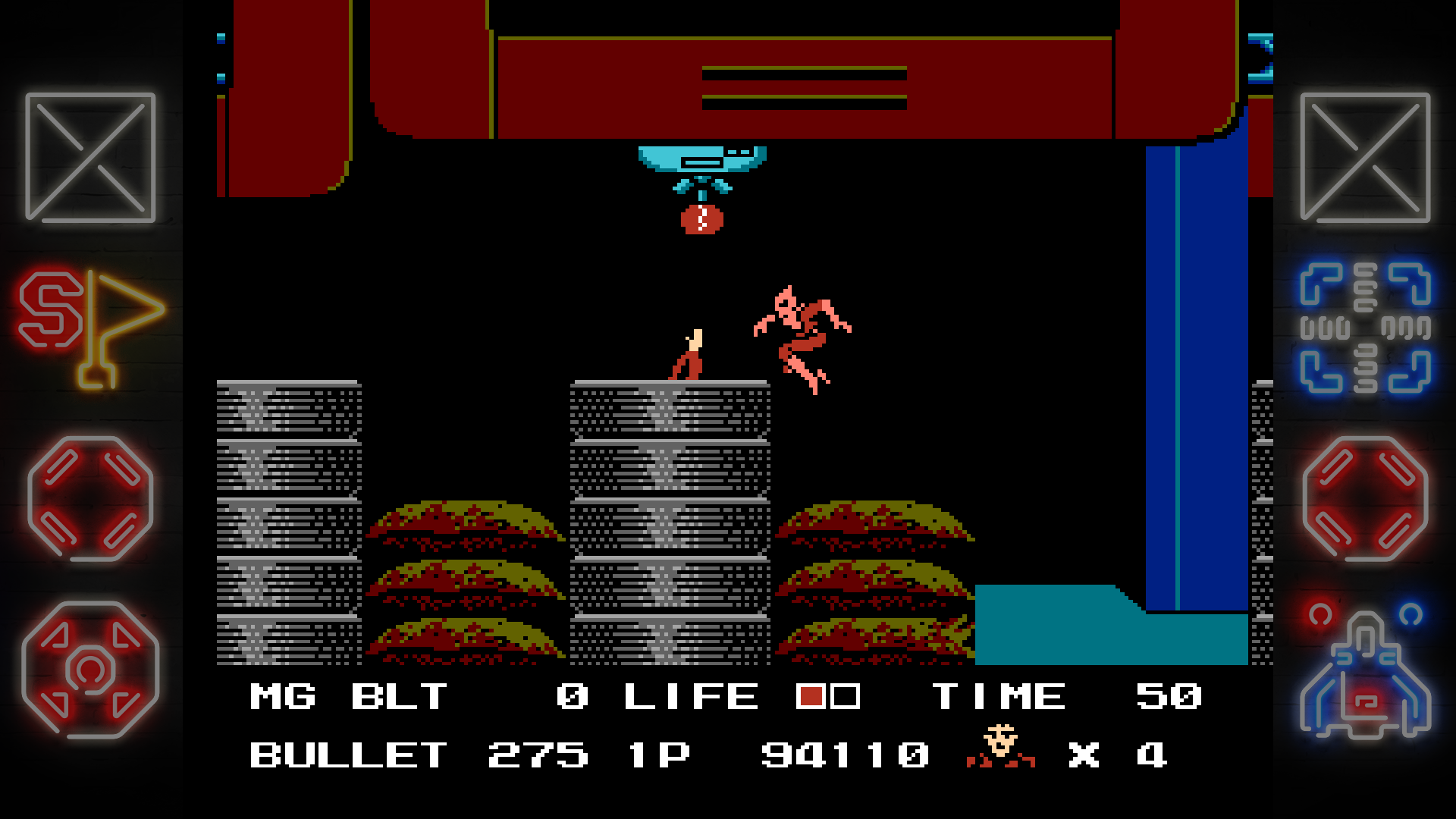
You must be logged in to post a comment.