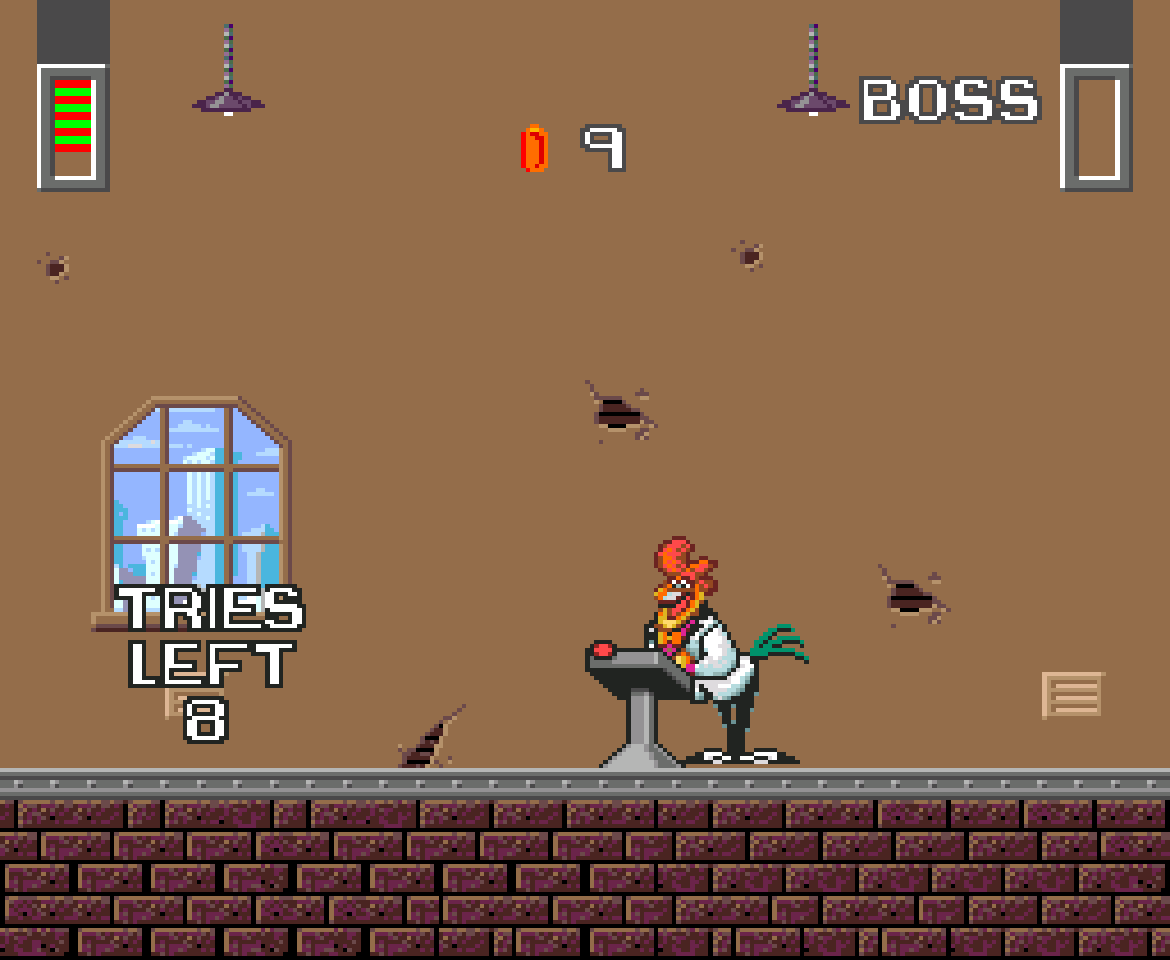
Popeye: Ijiwaru Majo Seahag no Maki (Super Famicom Review)

Popeye: Ijiwaru Majo Seahag no Maki
Platform: Super Famicom
Developed by Technos Japan Corp.
First Released August 12, 1994
Never Released in the United States
NEVER BEEN RE-RELEASED
Special Note
: I played the ROM Translation by KingMike

This is one of those “you want it to be so much better than it is” games. Well, actually I suppose that’s true of every bad game, but it really hurts here.

I’m currently on an “American media properties with Japanese-exclusive games” kick, having just finished reviewing New Ghostbusters II for the Famicom and Batman for the PC Engine. That’s not the only streak I’m on. Popeye: Ijiwaru Majo Seahag no Maki (“Tale of Seahag -The Wicked Witch”) is the third review in a row featuring a game I was sure after the first ten to fifteen minutes was heading towards an easy YES! and then it just stopped being fun. Hell, maybe it’s me. This Japanese exclusive Popeye is easily the best of the three games in this streak, and it’s still a mostly forgettable, mostly generic platform game starring the sailor man. There’s two things that stand out about it, the most prominent of which is the board game facade the game’s built around.

White spaces OFTEN do nothing, red spaces are always a negative thing, and blue spaces always are a positive thing. The levels each have their own themed icons. A few times, white spaces still led to a brief Bluto encounter where I had to jump over him three times before spinning again. It’s a complete waste of time.

Each of the game’s five worlds are giant board games. You spin a roulette wheel to decide how many spaces you move, anywhere between 1 and 6. The spinner is not random, and in fact, you can clock the timing of it. Even with my recent issues with reaction time, I was able to clock it, which tells me anyone should quickly be able to. You’ll need to get good at it, because you have to move the exact number of spaces you spin. Each time you move back to a previous space you already walked on, it re-adds the space to the amount of spaces you must move. Well, unless you go in a circle that includes spaces you already walked on. There are items that allow you to move around the map, but they don’t count towards landing on a space, nor do they allow you enter any encounters with the enemies that walk the map. In fact, they don’t allow you to take any shortcuts or enter caves that occupy the map, either. The object of the game is to land on all the spaces that have hearts, find the hearts within those levels, and also battle mini-bosses who may or may not have hearts. You actually don’t know until you fight then.

I really thought I’d soft-locked the game at this point. I had to knock out two more steps, but I didn’t have two new spaces to walk on, as boulders were blocking all the paths around me (and the above space would have added to my count instead of subtracting from it). But, the boulders were temporary, and if I waited a while.. quite a while.. they would eventually go away. It’s so badly handled. Stuff like that is constantly happening in Popeye SFC.

At first glance, the board game idea seems inspired, but the way navigation works is so inelegant. The above situation highlights the main problem: the board’s happenings aren’t directly tied to your own movement. Enemies move around the map whether you’re moving or not. The boats that appear as shortcuts in every level arrive and depart while you fumble through the cumbersome menu. You have to press a button to cue-up the spinner, then you have to spin it, then you have to press a button to remove the spinner from the screen before you start to move, and then you have to tuck the game in at night and read it a bedtime story. There’s also TONS of levels that have nothing to do with collecting hearts. They might have hidden shortcuts inside them that take you to a different part of the board. Sometimes, they might only move you a few spaces over. Sometimes they might take you to a level that normally has a heart, but the heart won’t be there until you land on the heart space properly, via a spin. Worst of all, the spaces stay “active” once you’ve finished them, with no actual way to tell which ones you’ve finished or if you’ve activated switches in them that change the board game map. The only exception is the HEART icons are removed from stages you collect hearts from, the hearts remain. I hope you’re paying close attention, because you’ll need to replay some levels multiple times just for the sake of progress.

I swear that, sometimes, it feels like the game is glitching out. The pathways are invisible here, and then you have to wait for time to pass if you want to exit this structure.

As for the actual level gameplay, SFC Popeye is as generic as platforming gets. Most enemies can be killed by jumping on their head, but you also use an anchor tied to a chain as a whip. It’s satisfying enough. Whips are fairly bulletproof as far as gaming weapons go. You have to really crap the bed for them to be dull. Popeye almost does that, as there’s no upgrades for the whip and ALL basic enemies that can be killed will die from only one shot anyway, be it jumping on them or hitting them with the anchor. There’s three items that temporarily change YOU that are tied to the anchor. One uses it as a helicopter and doubles as the item that lets you skip around the board. One turns you into a car, where you’re SUPPOSED to be invincible, but it’s hit and miss when it actually works. Both of these control so miserably that I found them to be more trouble than they’re worth for the platforming sections. Hell, as far as I can tell, there’s no attack at all for the helicopter, which controls like a cross between a shopping cart and a rock sitting on a medium-power air hockey table.

One of the few times I thought to use the helicopter was going backwards through a level that I knew had a heart. Only, there was no heart, because I didn’t “land” on the space. I got there via a warp from another level.

The third power-up is a frog that basically copies the Frog Suit from Super Mario Bros. 3 in that it makes swimming faster and easier, except in this case, it turns you into an actual frog. This works great for the underwater levels, of which there’s a lot. It also allows you to fit into small spaces, though most of those are in underwater levels. The downside is that, when you’re a frog, it’s one hit deaths no matter how much life you have left. Also, it seems glitchy as all hell, as sometimes the level would stop scrolling up or down while I was using the frog, and I had to turn it off (thus losing it) in order to proceed. This doesn’t seem like it was intentionally done, as there’s nothing in the level design that logically indicates I’ve reached any sort of cutoff point. It just sort of blocks you from continuing. The other power ups nuke the enemies that walk around the map, and I hate them because they TEASE a fun thing. Like one anchor says ZAP and has a lightning bolt. You think it’s going to be some kind of electric mega-charged whip that shoots sparks or something. Nope. When you activate it in a level, a little window opens up that shows a random mini-boss getting nuked. But they come back quickly, so, like, what’s the point?

Apparently in the roughly two trillion hours this game felt like it lasted, I never got a single screenshot of the frog using its tongue. Well, it uses its tongue as a weapon. It works too. What I find bonkers is the frog looks NOTHING like Popeye. Like, they couldn’t at least give it a corncob pipe? A butthole chin? SOMETHING that would have been charming?

Oh, and those mini-bosses don’t actually fight you unless you’ve already spun and removed the spinner from the screen. If you stand still on the game board, they’ll walk right by you. Since they sometimes have multiple hearts (and seriously, if you’re three or four hearts short of finishing the level, you might get them all from a single mini-boss battle) you’ll want to fight them. But, the thing is, there’s no way of telling which ones have hearts to give you and which ones are just going to drop a full health restore and a coin. Some of those mini-boss battles take FOREVER too. There’s a robot at one point who took so many hits to kill that I paused the game and loaded up a guide at GameFAQs to make sure I was actually doing damage to the damn thing. You’ll inevitably fight the same mini-bosses multiple times in a single world, and sometimes they have different attack patterns, but most of the time, it’s the same crap you’ve already done several times and it’s SO repetitive and boring.

The robot mini-boss was one of three times I actually lost a life, too, and it takes more hits to kill than any boss except the last boss. One of the most mind-numbingly dull boss fights I’ve seen.

And that’s the problem with Popeye SFC: after the first world, the game keeps repeating the same notes over and over, until the game becomes completely boring. Even the attack patterns of the bosses are variations of the same thing over and over, and the actual levels run out of ideas really quickly. There’s only a handful of tropey themes like forests, plains, houses, castles, etc, that repeat endlessly until the final credits roll. But even the specific levels start to feel repetitive and samey. There were times where I questioned if either they were recycling sections of previous levels or if the game had randomly generated stages. They’re so samey and generic, and I can’t remember a single point during any of them where I thought the layout was clever. MAYBE a section where you step on these gigantic switches that activate trap doors above you that rain enemies and/or items down, but even that gets repeated several times during the course of the game.

There’s no hidden pathways or breakable blocks. Some of the barrels take you to other places, but that’s it. Oh, and some of the levels might last as little as under ten seconds. I don’t mean in a “speed runner” type of way, but as in the start and exit are right by each other. Yes, really. I’m almost certain the developers gave up.

And it’s not even really effective as a treasure hunt game. The hearts are usually just laying around in a normal spot instead of being cleverly located. Every time I thought the game was about to do something fun, like shooting Popeye out of a cannon, it doesn’t really do anything. Using the cannon just takes you to a different spot on the map. When you take a pipe from the foreground to the background, the level isn’t cleverly designed to fully take advantage of it. Popeye SFC might have the least imaginative levels I’ve experienced on the Super NES/Super Famicom yet. The one novelty that does sort of almost work is the Seahag will occasionally curse you. This does one of two things: it either just automatically takes a hit point off you, which might be the laziest thing I’ve ever seen a game do. The other thing is the screen resolution will become heavily pixelated. It can even happen on the map screen and might be the only clever thing the game does.

This slideshow requires JavaScript.

At least, it would be clever if not for the fact that it happens completely randomly. It never once interfered with me making progress. If the game had built around these kinds of effects always happening during specific sections, they could have tailored the gameplay around it. In fact, they probably did that anyway, but in the worst way possible: they kept everything predictable so that the curses don’t completely screw you. Combine this grindy repetitiveness with some spotty controls and inconsistent collision detection and you’ve got a recipe for a game that feels like it never peaks. Take a look at these screens and, mind you, I took damage in them.

This slideshow requires JavaScript.

I should have comfortably been safe there. It didn’t even graze Popeye’s pixels. Now compare THAT to this moment from the final battle against Bluto, where I clipped him several times and I didn’t take any damage at all. Mind you, I didn’t even get screenshots showing my body completely covering his fists, where I couldn’t believe I didn’t get hit. The whole game is like this. You can’t use the character or enemy sprites to gauge the collision boxes at all. That lack of consistency is really frustrating. EVEN WITH THAT, I only lost three lives the entire time and finished with over sixty. I was winning prizes from the slot machine without even needing to match three. 100 coins nets you a free life, but it only takes 3 coins to bet, and I only needed to buy a health refill once. The levels are pretty generous with them.

This slideshow requires JavaScript.

It’s not that Popeye is necessarily a bad game. It has a ton of personality. When you finish pinging off enough damage on bosses, they drop a can of spinach, which allows you to grab them and perform a finishing move. There’s only three of them, but still, it’s right out of the cartoon. Actually, there’s one final thing each of the last three games I’ve reviewed have in common: they’d probably make great games for young children. Popeye SFC might even be ideal as a child’s first semi-complicated game, what with all the board game stuff. But honestly, I think even little kids might get bored with this one before the end. It just runs out of ideas so quickly that it can’t overcome its sloppy collision and repetitive level design. Long before even the second world is finished, besides a couple mini-bosses, you’ve experienced the whole game. The levels are as basic and bare bones as gaming got in this era and, even as you near the end of the game, they don’t feel like they escalate in difficulty. It’s just too dang easy and too dang simple for its own good. It really has one good idea: using the anchor as a whip, and even that novelty wears off quickly. Even with all its problems, I was this close to giving it a YES!, but then I realized I was in that “barely decent” territory for more than half the game, which is really a polite way of saying I was bored. In other words, Popeye wasn’t strong to the finish. Hell, he wasn’t strong to the halfway point.
Verdict: NO!
I’d rather have had a 16-bit update of the coin-op, frankly.

Batman (PC Engine Review)

Batman
Platform: PC Engine
Developed by Sunsoft
First Released October 12, 1990
Never Released in the United States
NEVER BEEN RE-RELEASED

“Gotcha nose!”

What Sunsoft-developed, Batman video game based on the 1989 Tim Burton movie were YOU expecting? Sunsoft actually made four completely different games based on the film, and I’m fascinated with how one company made four games that look and feel and play nothing like each-other, all based on one movie. Actually, it’s pretty smart when you think about it. If you make one core game, then mold it to fit each platform, gamers would probably be inclined to buy only the most “advanced” one, and MAYBE the handheld version. But, if you make unique games for each platform, each game is potentially bought four times by the parents of spoiled children. Score! Of course, that wouldn’t really work if the games aren’t all decent quality, and it really, really wouldn’t help if one of them doesn’t come out in America at all. As scorching hot as Batman was during this time frame, you have to wonder why this Batman didn’t come out on the TurboGrafx-16. Actually, yea, why didn’t it? It doesn’t suck, does it? Sigh.

You can only cross the roads using the crosswalk. Hey, the Dark Knight is many things, but a jaywalker isn’t one of them.

In this PC Engine exclusive, you guide Batman through 48 stages of mind-numbingly dull mazes searching for that specific stage’s MacGuffins. In level two, it’s actually Mario Sunshine a decade early, as Batman has to wipe the Joker’s paint off masterpieces at a museum. The actual things you’re picking up (or wiping off) don’t matter, as they don’t enhance the gameplay and you’re really doing the same thing in every level. While you do this, a small handful of enemies attack you, but you have a significant advantage over them: your batarangs. They don’t actually kill the enemies. Not because Batman doesn’t kill. Oh no, they stun the enemies so Batman can kill them with his bare.. well, his gloved hands. Actually, they fly off the screen like cartoons, but that’s better than poofing out of existence.

“Look, my hand’s a dog! Arf! Arf!”

You can upgrade the batarang via pick-ups that increase the distance and amount of batarangs you can throw at once. I hope you have fun with them, because Batman has one button gameplay. The batarang is your entire offense, with both buttons throwing it and no other usable inventory items. There’s a handful of other pick-ups, like bombs that clear the screen, speed-ups, timer increases, and invincibility. Oh, and a Joker icon that I only saw once that takes away all your upgrades. But, no other fun bat gadgets, unless you count the warp blocks in later stages as using a grappling hook, because that’s how they’re animated. Still, a Batman game where Batman doesn’t have tons of fun Bat-toys just sounds boring, doesn’t it? And while having just batarangs MIGHT have been okay, the problem is you have an unlimited supply of them. Part of me thinks just the act of significantly limiting the amount of ammo you have would have saved the game. It would have given Batman PCE a sense of strategy, and likely several exciting moments of having to flee from enemies instead of just mindlessly smacking them with a batarang and walking into them. You also don’t lose your upgrades when you die. Presumably you will if you game over, but that won’t happen, so don’t sweat it. As long as your timing is accurate, the PC Engine Batman is an absurdly easy game. I had so many lives that the counter was stuck at x9 for a while, even though I was losing lives.

Further cementing how easy this is, you can throw your batarangs through walls to stun enemies. You’re also given a very generous grace period to finish them off after this.

The Wikipedia page for this game describes it as “reminiscent of Pac-Man and Bomberman” because, presumably every top-down 8bit game that takes places in a maze must be called as such. But, you really shouldn’t mistake this for a maze chase game. There’s no tension at all. With enemies this outmatched and extra lives as plentiful as they are, Batman is a slog. Even when the enemies move faster, the maze structure of the game usually gives you plenty of time to turn around and wait for them to get you. The hardest of the chaser-type enemies, the ones that rush directly at you, still rarely got me. Players are at too much of an advantage. There’s no adjustable difficulty, mind you. As far as I can tell, there’s not even a second, harder quest. This is it. This is the whole game.

All the cool things you’d hope for in a Batman game, like the Batmobile, are relegated to cut scenes between worlds. Lame.

In the few times where I actually lost a life, it was usually because I spammed the attack button at the wrong time and was stuck in the throw animation waiting for my batarangs to return to me. Once I remembered to pace myself, I never lost another life until the finale. Some enemies have guns, but without hyperbole they have the slowest moving bullets I’ve ever seen in a game like this. Come to think of it, I’m pretty sure the bullets move slower than the slowest moving enemies walk. To the game’s credit, they did incorporate this into the level design with little spaces to duck into while you wait for bullets to pass, but even this doesn’t make things any better. When PCE Batman shows a rare example of being clever by putting the shooters on an island and thus possible to stun but impossible to kill, it wasn’t as exciting as I was hoping for. Their bullets are so slow and the batarangs stun enemies so long that those areas went by faster than when I had to fight enemies directly.

Batman claims the four Triforces and dominion over Hyrule. Hey wait a second.. there’s only THREE Triforces! IT’S RIGHT IN THE NAME! TRIforce. Then again, Four is in there too. Well, FOR is.

The level design feels pretty repetitive too. Whether the stage is set in buildings or city streets, the novelty of a rare Batman game never released in America wears off fairly quickly thanks to samey map logic. The 48 stages are divided into four game worlds of 12 levels, followed by one final boss wave. Maybe mixing and matching themes like in Bugs Bunny Crazy Castle/Roger Rabbit would have helped. Hell, worlds 1 and 4 are both labeled “Gotham City” which.. I mean, I took it for granted that was the case. Where else would we be? Metropolis? Coast City? Apokolips? Hell, worlds 2 and 3, despite being labeled as a museum and a chemical factory, were probably also in Gotham City, because, you know, Batman! Wherever you’re at, the idea is the same: find all the doohickeys. They’re not ever cleverly placed and they don’t do anything. They just lay around. Sometimes.. rarely, really.. more territory opens up if you clear-out an entire area, but that mostly happens at the start of the game and the concept is abandoned quickly. It’s not enough. We’re talking about a Batman game where he fights the Joker. They could have done something clever, like the Joker booby trapped the target items, so you need to find the matching item to disarm it first. Something to lend an actual puzzle element to this. I’m so frustrated by how unimaginative this is, and it came out nearly a year after the Batman movie was screened in Japan. It’s not like they had to rush to make a deadline.

I died the most fighting the first of three bosses the game ends on. He’s only vulnerable when he’s jump kicking you. Of course, you’re stun locked yourself when throwing your weapon. We basically had a series of draws and I came out on top by virtue of having more lives than it did. I lost a few lives to the Joker too. Second boss can be beaten in one or two hits if you play it right.

In some levels, there’s triangles that act as warp blocks, and sometimes they take you to different spots depending on which way you walk into them. That sounds fine, but it further interrupts an already sluggishly paced game by having you watch the animation of Batman firing off his grappling hook to leave the block, then fall gracefully at the next location. Also, when you land, you’re invincible as long as you don’t move. You can even throw batarangs and the enemies will still pass through you as long as you sit still. This was presumably done to prevent cheap deaths, but a tiny grace period would have been preferred. It might have even made the game exciting. I swear to god, it’s like the development team was gung-ho to make another game but got pissy when Sunsoft’s overlords said “no, not a platformer. The NES is getting one of those” and sabotaged the game.

The final battle with the Joker involves chattering teeth bombs and a big gun. Oddly, the game ends with three bosses in a row when there were no bosses up to this point. Why didn’t they spread them out over the course of the game?

I read a lot of lists of “best hidden gems/Japan exclusive” types of lists. It should have been a massive red flag that I don’t think I’ve seen the PC Engine build of Batman on any of them. You’d think a Japanese exclusive release of a definitively American property such as Batman would be one of those legendary lost classics, right? And it’s not even like this Batman does anything BAD, exactly. It controls fine, never does cheap shots, and would probably be much more enjoyable for young children who love the franchise. But, it’s just so uninspired and soulless. I didn’t like Sunsoft’s Gremlins 2 NES game, but I’d prefer something adventurous like that over this uninspired drivel. A game where Batman doesn’t punch and the Batmobile and Batwing only show up in cutscenes between levels? Seriously? That’s what annoys me most about Batman for the PC Engine: this could have been ANY property or a generic game with boomerangs as weapons and it would have changed absolutely nothing. Say what you will about the coin-op from Atari Games (I certainly have) but there’s no doubt about it that you’re playing a game based on the Tim Burton movie. I’d call it a soulless cash grab, but I suppose it can’t even be that if they never brought it to the US, so it’s even worse than that. It’s just soulless.
Verdict: NO!

I don’t know why, but this cracked me up.

New Ghostbusters II (NES Review) and Ghostbusters II (Game Boy Review)

New Ghostbusters II
Platform: NES/Famicom
Developed by HAL Laboratory 
First Released December 26, 1990
Never Released in the United States

NEVER BEEN RE-RELEASED

Ghostbusters II
Platform: Game Boy
Developed by HAL Laboratory
First Released October 16, 1990
NEVER BEEN RE-RELEASED

Slimers in this game look like their eyes have been sewn shut. It’s creepy.

There are three 8-bit versions of Ghostbusters II on Nintendo platforms. The one released by Activision and developed by Dan Kitchen is universally regarded as the inferior game, but because of licensing rights, that’s the one and only NES version that was released in the United States. HAL Laboratory had the global handheld rights to Ghostbusters II, but only the Japanese and European Ghostbusters II rights for the NES/Famicom console. In terms of long term reputation, it was probably the best possible thing to happen to title christened “NEW Ghostbusters II.” Being the one that never came out in America elevated it to the status of hidden gem. An out-of-reach treasure. A status it absolutely does not deserve, because folks, New Ghostbusters II isn’t really that good a game. Or much of a game at all, for that matter.

This slideshow requires JavaScript.

First thing’s first: the NES and Game Boy versions of Hal’s Ghostbusters II have a similar play style, but the Game Boy release isn’t a port. It’s an entirely different game and plays like a much more ambitious version of the Famicom release. Then again, there’s so little ambition in the Famicom game that it honestly feels incomplete. I’m not even kidding. It seriously plays exactly like a proof of concept or prototype that’s maybe 75% finished. One of those prototypes where all the action is there and (mostly) complete, but all the bells and whistles are still lingering on the drawing board, waiting for someone to add them to the code. You do one thing and one thing only on the Famicom’s Ghostbusters II: control a main Ghostbuster of your choosing who stunlocks ghosts with their proton pack, then you press a button for the AI-controlled NPC to throw the trap out. Clear a room of ghosts, then walk to the next room and do it again. Rinse and repeat until the credits roll. There are bosses, but the only difference with them is you have to hold the proton stream on them until they change color before throwing out the trap. The final boss doesn’t even have the trap part. All the normal baddies are done-in with a single zap and a trap.

For what little it’s worth, it actually does capture all the set pieces from the movie, like the two ghosts from the courtroom scene.

And.. that’s the whole game. There’s no items (except an occasional points bag that seems to happen in random rooms). There’s no upgrades. You have unlimited proton pack energy and unlimited traps. Despite adding tons of scenery that’s begging to be searched, like filing cabinets, chairs, etc, you don’t search for anything. Just zap, trap, and move on through five levels, four of which have bosses, then you fight Vigo and that’s the game. When you first fire-up New Ghostbusters II, it really does feel like you’ve found buried treasure. It is satisfying to catch a ghost in your beam and then suck it into the trap. But, that wears out very quickly. There’s nothing to break up the tedium. It’s not even a maze game, really. Even if the room has multiple doors, a gigantic arrow appears in the center of the screen and points you to the next room after you bust the current room’s final ghost. While there’s a nice variety of ghosts, some of which throw projectiles, the offensive game of New Ghostbusters II is just too limited. As far as action games go, New Ghostbusters II is one of the most tedious, mind-numbing grinds in the entire NES/Famicom library. It gets so boring doing the same thing over and over, in stages that feel like they’re taking forever.

The best level is probably the second one, where you fight ghosts in minecarts, but even this wears thin.

I first played New Ghostbusters II a while back, when I was sampling NES/Famicom games. It seemed like it would be decent. Who knew that I’d already, more or less, experienced everything the approximately hour-or-so runtime had to offer. From the second level onward, the only excitement I had was whenever a new enemy first appeared, excitement that lasted about as long as it took for me to perform the zap and trap on it. I figured “maybe this was made with co-op in mind. Everything is better in co-op, right? Then again, I don’t remember an option for two players..” Well, guess what? There’s no co-op. What an absolutely baffling oversight. Would it have saved the game? Maybe. It certainly would have helped. You’re stuck with an AI partner who can generously be described as “often confused.” With the exception of the second-to-last boss, the only challenge in New Ghostbusters II comes from those times where your partner can’t figure out how to walk through the narrow gap you just walked through. Other times, it might require wiggling back and forth with your beam before they get themselves in a position to accurately throw the trap. They might as well have one character do both. The only positive thing I can say about your partner is that, in the Famicom version, they’re completely invincible, and I didn’t appreciate how wise that decision was until I played the Game Boy version.

I mean god damn, Venkman,, it’s a wall. You, Peter Venkman; one of the most witty film characters in movie history, are being outwitted by a wall. A WALL! Not even a haunted wall!

Ghostbusters II on the Game Boy lost “New” in its title, but added basically everything the NES version desperately needed. Alternative weapons? Here. Being able to play as all four Ghostbusters in a single play session? It does that. Game worlds are also no longer gigantic maps that you zig zag through. Instead, they’re broken up into levels where you must find and catch a specific amount of ghosts. It sounds fantastic, especially since it retains the core zap-and-trap gameplay from the Famicom game that would have been so fun if it wasn’t literally the only thing you did, with no upgrades or alternatives. So, go figure that it’s one of the worst Game Boy games I’ve played so far, and it’s ALL on your NPC partner.

Well, mostly the partner. The enemy design is weak, too. There’s two types of enemies that are invincible while they’re spinning, a message they seem to have gotten loud and clear. Sometimes they spun so long I worried the game had glitched out. I have a feeling stuff like this might be possible, because when you run out of time, you actually don’t die. Instead, the enemies all turn into the Ghostbuster logo and become absurdly easy to zap and trap. So really, timing out is practically a reward for doing a terrible job. Ghostbusters II on the Game Boy was letting people fail upward before that was cool.

This time around, your partner is vulnerable. This would make things difficult enough by itself. But you also have to deal with the fact that the collision detection is also weirdly inconsistent. The majority of the times my player or especially AI partner got hit, it took me by surprise because they weren’t really that close to the enemy. Like, several times where I rewound the game trying to figure out what exactly caused me to take a hit. Usually, it happened when myself and the AI player had to double back and we crossed over each other, as if the act of doing that gave us both bigger collision boxes. Other times, I literally could have so much of my sprite on the enemy that there was more of me than there was of it on screen and nothing happened. I even went so far as to walk back and forth on the enemy, practically offering it a free hit, and all that happened was I did a little dance with it. I might as well have, since my attacks weren’t working either. It was like the most unintentional stalemate of my gaming life.

And the poor collision also combines with the fact that, unlike the Famicom game, you can’t push the trap through the wall, or most solid objects for that matter. The beam works fine, but the trap typically can’t have anything obstructing it. But hell, sometimes the AI had a wide open shot at the damn ghost and STILL couldn’t hit it unless I jiggled MY character around like I was trying not to let hot coals burn my feet. It’s so frustrating because this is the game doing what I so badly wanted the NES game to do. If you see a character hanging out on a wall, you can tag them in, an act that often grants you an item. Besides the invincibility shields, those are mostly all really fun to use. You get what I think is a Dust Buster that allows you to suck up ghosts for a few seconds without bothering with the AI partner. I was always happy to get that, and there’s also a gun that just vaporizes the ghosts, again circumventing the AI partner. There’s a pickaxe that lets you knock down a wall. I really wish they’d done more with that. The only item that’s missing is a radar that points you towards where the ghosts are. Sadly, Ghostbusters II overly relied on restocking rooms you’ve already cleared out, which reduces the game to a mindless grind by the end.

Uh.. hey wait a second.. is that a Suezo? By the way, enemies lingering in the walls, where your trap can’t reach, is so common an occurrence that you’re really better off just walking away and coming back later. So frustrating.

But, the worst part is so stunning that I honestly feel the game should have been cancelled if this is the best they could do, and that’s simply the act of the AI partner following you. Because, well, they can’t. They get stuck behind everything, and just getting them to follow you in and out of a room is a fight half the time. If anyone wants to make a list of the worst uses of an NPC partner in gaming history, the movement alone seals it for Ghostbusters II. Hell, about halfway through the game, I realized why the tag team-like “walk up to a Ghostbuster and swap places with them” is a feature in the game. It’s not really because it’s more fun to cycle through the full team. That’s just a bonus. No, the feature is really a band-aid to compensate for a situation that I think would have certainly been a soft-lock otherwise. This part.

Maybe if the ability to do a swap hadn’t been there, I could have come up with some other way to wiggle my partner out of the mind-bending jam of “being able to walk next to something” that’s right up there with the three body problem. But, I’m thinking there’s probably at least a couple swap locations in the game that were put in place to prevent soft locking. And, I can’t stress enough, your partner also takes damage, and can end your game. If they lose all their hits, YOU game over, regardless of how much health you have. Health refills are plentiful, but still, given how problematic the AI is in general, having them be vulnerable was a bad idea. Thankfully, they’re invincible against the bosses. In fact, during the battle with Vigo, I found hiding behind them to be a successful strategy. So, hey, you’re not totally useless, AI partner. You’re 99% useless.

While it doesn’t look different, this screenshot is from a nearly finished US prototype of the game, before Activision chose to go their own direction, presumably. Honestly, I could see an executive in 1990 playing this and saying “it’s boring. We’ll take our chances on something else.” I have much love for the Kitchens and Dan’s brother Garry is a good friend, so I take no pleasure in saying I’m not a fan of Dan’s version of Ghostbusters II, either. But, damnit, at least it tried to change things up instead of settling for a slog. And that’s what HAL did. They gave up and settled when it’s clear they had bigger plans.

Another thing neither game does that would have added some much needed depth is having the Ghostbusters each have unique abilities. The Famicom game even lets you play as Louis, but that version has no swapping. The two characters you pick are locked-in for the whole game, and in the same role, too. But, whether the game has four characters or five, they all play identically. This is where they really left a lot on the table, as they could have built around special traits or weapons for each Ghostbuster. While I greatly admire the ambition shown in the Game Boy release, both games could have done so much more. I really think a lot of the Game Boy version’s problems come down to having characters be too big for such a small screen. In a way, they probably got the two games mixed up. The console game should have been the more complex one and the Game Boy release should have kept things as basic and simple as humanly possible. As limited and dull as the Famicom game is, it would probably have been considered an elite-for-its-time handheld game. Meanwhile, all the problems on the Game Boy I’m guessing are largely due to the platform itself. The same mechanics would have probably worked better with the Famicom’s ability to take place on a bigger playfield.

You’re just going to have to take my word for it that there’s a guy in that little force field above my head. Also, during boss fights, items rain from the sky, including a very valuable one that allows the invincible AI to fire bullets. Oh, forgot to mention, you fire bullets in boss battles. No trapping or beam this time.

And that’s ultimately what the story of New Ghostbusters II was for me. Somewhere between the Game Boy and NES games is the perfect 8-bit version of Ghostbusters II. The NES version’s AI is touchy, but never completely worthless. The biggest problem is the game does one thing and one thing only. On the Game Boy, it feels more like a normal game instead of the most basic concept of a potential game. The biggest problem is, well, nothing really works right. Combine the AI of the NES game with the mechanics of the Game Boy release and you’d have a quality licensed video game. But, that’s never going to happen. Your options are a bare bones action game or a game that feels like trying to lead a drunk through a crowded shopping mall. I mean while fighting ghosts.
Verdicts: NO! and NO!

“I, VIGO, DUUUUUUUUHHHHHHH!!”

DuckTales 2 and Chip ‘n Dale: Rescue Rangers 2 (NES Review) BONUS – Disney Afternoon Collection Final Verdict + Rankings!

DuckTales 2
Platform: Nintendo Entertainment System
Developed by Capcom
First Released April 23, 1993
Included in Disney Afternoon Collection

Rescue Rangers 2
Platform: Nintendo Entertainment System
Developed by Capcom
First Released December 10, 1993
Included in Disney Afternoon Collection

In DuckTales 2, you can upgrade your cane. Remember the episode of House where he gets a cane with flames on it so that it looks like he’s “going fast?” It’s like that, only it actually works. Actually, DuckTales is basically exactly like House, what with all the racial stereotyping and verbal abuse of employees. Presumably a lot less pill-popping though. It’s a children’s television show, after all.

It’s not exactly Earth-shattering to call DuckTales and Rescue Rangers two of the best games on the NES and two of the best licensed games of all-time. Oddly, both games got sequels that nobody talks about. This is largely chalked up to the fact that both games were released late in the Nintendo Entertainment System’s life cycle. In the case of Rescue Rangers, very late, as in it and Bonk’s Adventure ushered in the final year of its active support. Now that we’re in the future and have access to the Information Super Highway, you’d think that wouldn’t matter anymore, but these sequels still get almost no attention. They don’t make “best of” lists, except the occasional “hidden gems” ranking. It felt a little bit like a red flag to me. Maybe fans of the originals know something I don’t. Since they used the same engine as the originals, appeared to use the same sprites, were made by the same developers, and feature the same gameplay (more or less), I was kind of figuring DuckTales 2 and Rescue Rangers 2 would feel more like expansion packs for the previous NES games.

In Rescue Rangers 2, the red ball is missing from the boss fights, having been demoted to “bonus game novelty.”

In the case of Rescue Rangers 2, it’s remarkable how much it feels like a modern DLC expansion pack made up of levels deleted from the original release. By that, I mean the levels deleted for a reason. These levels are bland, the enemies are placed in uninspired ways, and there’s an overall sense that the energy from the original is missing. There’s nine stages this time instead of eleven, but in the entire play through, there was only one single moment that made me sit up in my chair and say “okay, this is different!” It involves operating a mine cart. Even this was sloppy, as whether or not you’re “bound” to the controller of the cart was touch and go. I lost a life by walking right off the cart when I meant to use the brakes.

When this worked, it worked REALLY well, as far as 8-bit set pieces go. However, when it didn’t work, it meant death.

Meanwhile, DuckTales 2 feels like a legitimate sequel with level design that easily avoids having a “deleted scene” quality about it. A few new moves have been added. You can pull certain blocks with your cane by doing the golf swing into them, and speaking of that, you can do the golf club swing with your cane mid-jump. The jumping swing never feels “right” and was my least favorite aspect of the sequel, but at least one big hidden object requires you to do it. There’s also hoops and other assorted platforms your cane can hook onto, which is such an obvious idea that I’m kind of surprised it wasn’t in the original game. Like the original game, there’s only five main levels, one of which doubles as the setting for the final boss of the game. Really good levels, but they’ll leave you wanting a lot more. If Mega Man games can have 8 bosses PLUS Dr. Wily’s stage, why can’t a DuckTales game get over the five-main-stage hump?

You’re not just walking into walls to find secrets anymore, either.

Instead of finding the two expansions for your health capacity somewhere in the levels, you have to purchase them in a store that you visit between the levels. You can also buy 1ups, extra continues, cake that restores your health any time you want (which you use by pausing the game) and a safe that lets you keep all the gems you collect if you lose a life. While I miss finding the health upgrades in the levels, Capcom replaced them by hiding upgrades to your cane in three levels. The upgrades allow you to pull larger objects with the cane or break formerly indestructible blocks. It’s actually a cool idea that’s very underutilized here. I think it would have been better to have those upgrades be rewards for beating stages. Maybe they couldn’t come up with two more. That’s probably more likely, since they barely managed to create excuses to use the upgraded cane.

This slideshow requires JavaScript.

However, props to Capcom for going all-in on level exploration and hidden rooms. Remember the two “hidden treasures” in the first game, and how it was weird to only have two hidden treasures in a game with five levels? Well, there’s only two high-valued hidden treasures in the sequel too. HOWEVER, each level also has a hidden map piece somewhere in it. You start the game with one piece, and there’s a piece that must be purchased from the store. The other five are hidden in the levels. Upon grabbing the seventh and final piece, you are immediately teleported from whatever level you’re in to the hidden area under the castle. This is a sixth stage that has a repeat of the boss from the Scotland level, but the level getting there is an entirely new one. No having to go back and forth to Transylvania, like in the first game. Well actually, you do briefly return to the pirate ship for the final battle. Again, they could have done a Dr. Wily-like final trial, but no, just a return to the pirate ship and a relatively straight walk to the final boss. DuckTales 2 rights a lot of wrongs, but it still feels like Capcom left a LOT on the table with the franchise.

The bonus area is one of the best parts of the game, too. Nice.

Since the best aspect of DuckTales 1 was the level design and how exhilarating it was to find the hidden trinkets, I’m really happy that it plays such a big part in the sequel. I sort of wish it didn’t immediately kick you out of the level when you find the seventh one. Also, you actually do have to get the seven map pieces before fighting whatever is your fifth boss, since it would appear the game takes you immediately to the final battle against Glumgold after you get the five primary treasures from beating the bosses. It’s sloppy, especially for Capcom, but otherwise, there’s nothing about DuckTales 2 that makes it a lesser game than the original. The level design is stellar and, despite using the same engine as the original, it worked in a few puzzles and surprises along the way. Besides Little Samson, I can’t think of any NES game that got the shaft worse than DuckTales 2. Okay, so the soundtrack isn’t as good, but that shouldn’t matter when the gameplay is quantifiable better. This is probably the best “hidden gem” on the NES.

This slideshow requires JavaScript.

I wish I could say the same about Rescue Rangers 2, but it’s just not as good as the original. Besides being able to pick up stunned enemies and use them as weapons, the one and only added move (at least that I could find) is being able to power-throw the crates if you get a running start. That sounds like a fine idea, but in practice, the amount of times I found it useful were few and far between. You can’t jump and throw a power shot, nor can you angle it in any direction but straight forward, and any deviation besides walking straight forward takes away the power. Since most enemies, you know, move, moments where I was able to build up the momentum for a power shot without falling off a ledge, walking into another box (or an enemy), or having the enemy simply jump out of range were so rare that I spent the entire forty-or-so minute run time questioning why they even bothered with this move. Most enemies die from one normal hit anyway, and the ones who don’t? Well, it’s fun to pick up stunned enemies and throw them at the next baddie. There’s no point in the game where several enemies are in a row, either. It’s one of the most worthless video game moves ever invented.

The throwing of stunned enemies was, admittedly, very fun.

What’s most notable about Rescue Rangers 2 is all the stuff removed from the original formula. The map is gone. The salt and pepper shakers are gone, but then again, so are the apples and other heavy objects that the shakers make lighter for you. On the other hand, a positive removal was most of the indestructible metal boxes. They were so overpowered that they all but ended the challenge for the original game, but in Rescue Rangers 2, they’re a true rarity (and there’s even a gag where one gets taken from you via a magnet). It’s weird they made these changes but kept the “ducking into a crate and letting the enemies walk into you to kill them” thing that severely nerfed the first Rescue Rangers. Oh, and the red ball you fight the bosses with that was SO FUN to use is gone. You fight bosses with crates or other assorted debris. Decent bosses, mind you, but they all lack that feeling of BIGNESS or finality that the first game did better than just about any Capcom Disney game. Hell, maybe better than any NES game.

The best “set piece” isn’t really even a set piece. The most fun I had in Rescue Rangers 2 was using the baseball, which is thrown in a high arc, like a lawn dart. I almost wish they had eliminated the crates entirely and instead required players to carry a single item through the levels like this. THAT would have been cool and different and made up for the ho-hum level design. Some ROM hacker ought to get on this idea. Dear NES development community: I freely give you the idea of a Rescue Rangers game where you have to manage a single item across whole levels with no crates or other throwing objects. Make me proud!

Bosses were never DuckTales’ strong suit, so the fact that DuckTales 2 has a couple marginally decent bosses is actually a really big improvement. I even died fighting one of them (the pirate ship’s boss), as opposed to DuckTales 1, where I think I took two or three hits of damage total the first time I ever played it (this doesn’t count Remastered, where the boss fights were scaled-up to the level of OMG awesome!) I only died against one boss in Rescue Rangers 2, and like what happened with the mine cart, that was largely due to haphazard design. Rescue Rangers 2 is just a fundamentally forgettable game. The level design is much more conservative. The enemies aren’t as menacing. The themes for the levels are mostly a big step down. In the first game, there’s multiple unforgettable characters and moments. I’m having trouble remembering anything in the sequel AND I JUST PLAYED IT! Besides the mine cart, the biggest twist is one stage runs on a three minute timer., and I beat that level with over two minutes left on my first attempt. Admittedly, I figured the game would cut it close and so I bolted for the exit, ignoring enemies and items, but it turns out, there was no need to rush.

This slideshow requires JavaScript.

Only a complete hater would call Chip ‘n Dale: Rescue Rangers 2 a bad game. It’s not bad. It just feels like a step down from the first game. Actually, a really big step down. The levels aren’t exciting in the same way the original game’s were. I’m confident that nearly any player who experienced both Rescue Rangers titles for the first time back-to-back would rank most of the sequel’s levels on the bottom. It’s telling how fun the basic Rescue Rangers gameplay is that it’s still an okay game (see Mickey’s Dangerous Chase for an example of the formula being outright bad), but even hitting enemies with crates feels less thrilling this time EVEN THOUGH THE CRATES break on impact. The satisfying WOOOSH sound design of slaying baddies is replaced with an incredibly underwhelming “ppf” sound. Oh, the WOOSH is still there, but it’s limited to when you daze an enemy. Why’d they do that? Eh, Rescue Rangers 2 is fine, but I can totally understand why it never became a big deal.
Rescue Rangers 2 Verdict: YES!

For the first time, an NES version of a DuckTales boss got me. I lost a life fighting Quackbeard. I don’t know if that’s its name, but it’s DuckTales, so I’m guessing so. (Checks) Apparently no, it’s just called Cap’n. That’s lame.

The game that really got screwed historically was DuckTales 2. It’s just a better game than the original. Yep, I went there. It’s more bold with its level design. Its bosses are (marginally) more cunning. There’s a LOT more hidden stuff. Even the controls are improved. Transitioning to and from the pogo hopping is so much smoother this time around. It’s why the jumping golf swing stood out so much. It’s the only janky element left. Otherwise, DuckTales 2 is the superior DuckTales game and one of the biggest casualties of the 16-bit era. If this had come out a year after the original, I have no doubt in my mind it would be universally regarded as the best Disney game by Capcom on the NES. A lot of late NES games got done dirty by being ignored in the face of 16-bit gaming, but none got quacked-over quite like the sequel to DuckTales, a great game that nobody talks about.
DuckTales 2 Verdict: YES!

DISNEY AFTERNOON COLLECTION
BONUS FEATURES

I know they couldn’t use a picture of an NES controller, but wow, this looks like the bumper for a cartoon series in 1990 got drunk and threw up on your monitor.

Disney Afternoon Collection has TONS of bonus features. There’s a gallery that includes box art, concept art, advertisements (that usually feature the same art from other galleries) and even a few references to the Game Boy ports of these games. The Game Boy references are actually annoying since those versions of the games aren’t included. Hey, I didn’t like DuckTales at all on the Game Boy and I’m not even going to bother playing Darkwing Duck, TaleSpin, or DuckTales 2’s GB ports, but having them would have added value even as a curio. Disney Afternoon also allows you to listen to the full soundtracks for the games, and holy crap, I appreciate it because it confirmed to me how bad the soundtrack for DuckTales 2 is. It’s one of the worst soundtracks for a quality game ever, and you would NEVER expect that from Capcom. I have a tin ear so nobody should listen to me about anything music related, but seriously, this soundtrack is BAD. Awesome feature though.

I wish there was a lot more behind-the-scenes stuff for the games, but what’s here is, you know, fine.

Along with the absolutely essential button mapping, the two biggest features are a time attack mode and a boss rush mode for each game. Both features have online leaderboards that allow you to watch replays of any recorded run. Awesome. I’m not so much into speed running, but I’m left gobsmacked by how good some people get at cheesing games. If you’re not into speed running and just want to own the six Disney Afternoon NES games, you’ll have the option to rewind and use save states. It’s one of the best versions of rewind I’ve seen in a collection like this, too. Just hold the button down and you can go back as far as you want. That’s how it should be. Awesome. For all the special features, I’m crediting $10 in value to Disney Afternoon. I’d credit it more, but half the MSRP is the max value for a retro collection.

FINAL VERDICT ON DISNEY AFTERNOON

The full game is going to get a YES! either way, but I’ve set a value of $5 per quality game because that’s usually where I put NES games at. At $5 per quality game, it needed just two out of six games to get a YES! for me to recommend Disney Afternoon Collection. If you read this review, you already know it won, but for the record, the final tally was:

YES!: 4 – $20 in Value
NO!: 2
Bonus Value: $10
MSRP of Disney Afternoon Collection: $19.99
Final Value: $30
Final Verdict: YES!

DISNEY AFTERNOON RANKINGS!

It’s still a game about two billionaires fighting over $5,000,000 worth of stolen plunder.

  1. DuckTales 2
  2. Chip ‘n Dale: Rescue Rangers
  3. DuckTales
  4. Chip ‘n Dale: Rescue Rangers 2
    **TERMINATOR LINE**
  5. Darkwing Duck
  6. TaleSpin

Disney’s Aladdin (Sega Genesis Review)

Disney’s Aladdin
Platform: Sega Genesis
Developed by Virgin
Published by Sega

First Released November 11, 1993
Included in Disney Classic Games Collection
SPECIAL NOTE: This review is of the FINAL CUT version.
Read the Video Game History Foundation’s article.

This slideshow requires JavaScript.

If I was told I could only make one change to the Sega version of Aladdin, I think I’d have defeated enemies fall off the screen, like they do in the SNES game. Poofing them out of existence hurts the sword-based combat, which is the defining difference between the two 16-bit versions of Aladdin. I’m a big fan of Capcom’s version, while I’ve never really cared for the Sega Genesis version, and the combat is a big reason why. It’s some of the most inelegant and feathery sword combat I’ve experienced. My father enjoyed the game and told me I was expecting too much, but nuts to that. 2D games could do sword fighting pretty good by this point, and while it’s not Wizards & Warriors levels of bad, it’s nowhere near as swashbuckling as they were aiming for. Unlike the SNES game, apples are lethal in Aladdin for Genesis, so if I was facing a more aggressive enemy, I opted to use them. You also have to use apples to defeat the bosses. In a game that puts such a premium on sword combat, closing with the apples tells me they knew the sword was no good.

The final battle against Jafar is one of the worst in the entire history of 2D gaming. In the first phase, he sucks you in with his magic staff (kinky) and you have to scratch out distance and throw apples. Then, in his final form, you have to stand with the giant snake off-screen to be able to jump up and hit it until it says LEVEL COMPLETE. Oof. Horrible.

In general, I don’t like Virgin’s style of level design. It always has the feel of using a plug-and-play template of platforms and walls to create a zig-zaggy maze from point A to point B. That’s fine if the combat is fun enough to carry the workload, but if it’s not, you’re left with repetitive gameplay and no stand-out set pieces to make up for it. Which isn’t to say there were never moments where I wasn’t enjoying this alternate take on Aladdin. I liked the magic ropes that fly you up to different platforms. I liked the Abu mini-games. And uh.. that’s about it. The fast, flowing action of the SNES game is gone, and instead, Sega’s Aladdin’s level design is so basic, samey, and lacking in set pieces. Even something like hanging from ledges would have helped. Genesis Aladdin never feels spontaneous, which is why it never feels like an Aladdin game.

The escape from the Cave of Wonders scene might as well cut to Dragon’s Lair. The genie’s fingers point where the rock is coming. Well, unless it flashes a “?” and then it’s pure random chance if you live or die.

It’s not like they never got experimental. Actually, this version had better ideas for level themes than the SNES version did. Instead of a stage based around Ancient Egypt, there’s a stage based around Aladdin escaping the dungeon, which sort of happens in the movie. Capcom could have used that for a level and didn’t, and Capcom could have used the magic carpet for the actual platforming levels, another omission that Virgin was wise to include in their game. That said, the similarities are astonishing. Both companies had the same idea about setting the post-Cave of Wonders level inside the lamp. But, whereas the SNES version of this concept is surreal, colorful, and creative, the Genesis version is really drab, cold, and kind of janky. The main platform is this blue substance that’s functionally like quicksand that you sink through if you don’t keep jumping. Granted, I imagine the inside of his lamp would be more like the Genesis version, since it explains why he wouldn’t want to go back to it.

It’s basically magic quicksand. This is a reminder that original ideas aren’t necessarily good ideas.

I don’t really have much more to say about Disney’s Aladdin on the Genesis since I already sort of reviewed it once when I reviewed the original Disney Classics Collection. It’s pretty, I guess, but the much-touted hand drawn animation cost the game weighty combat and accurate collision detection. I’d rather have both those things than “cartoon” animation. Besides, the animation wasn’t on par with the film. It was more like a really cheap Saturday morning cartoon. Cutting edge for 1993, but fated to age badly. Ultimately, it’s just really boring. I have a whole list of Disney games I have to play for this marathon, and the ones I dread most are those by Virgin. Their games are all style and little substance, and certainly nothing worth celebrating. The most frustrating part of their involvement with Sega’s Disney games is that Sega produced one of the all-time greats in Castle of Illusion. Why did they turn to a third party for this, and especially why Virgin of all studios? Apparently it was because Global Gladiators impressed them. So, as with most things in life, blame the most overrated 16 bit game ever made on McDonald’s.
Verdict: NO!

Disney’s Aladdin (SNES Review)

Disney’s Aladdin
Platform: Super Nintendo Entertainment System
First Released November 21, 1993
Designed by Shinji Mikami

Developed by Capcom
Included in Disney Classic Games Collection

In a game loaded with entertaining hop ‘n bop action, there’s something about swinging off a peg and kicking a baddie that is SO satisfying. I put a lot of stock in combat that feels weighty.

I’m not a big fan of the Sega Genesis version of Aladdin. It’s not horrid or anything, but it ain’t all that. This is very much a minority opinion. Get this: even Shinji Mikami, certifiable legend of gaming and lead designer of the SNES version of Aladdin, says the Genesis version is superior, citing the animation and the sword. Seriously? Because the Genesis version of Aladdin also has GOTCHA cheap shots galore, boring level design, and the animation comes at the cost of having no OOMPH to the combat. Meanwhile, the acrobatic antics of Aladdin on the SNES makes for one of the best children’s games in the history of the medium. As close to perfection as a platform game gets. It’s actually one of the few games where the biggest problem is what’s missing, not what’s here. What’s here is nearly flawless.

There’s more “punch” in the act of springing off pegs than there is in the entire Genesis cart.

Make no mistake: Aladdin on the SNES is a children’s game. I’m a huge advocate for games aimed at young people, because, get this, I used to be young myself. But, being a game directly aimed at young children doesn’t have to mean “fun for only the target demographic.” I think the best family games are ones that nobody can be bored with. If you can cruise through a game designed with 9 year olds in mind without ever risking a game over and still have a good time, isn’t THAT the mark of a great game? And that’s Aladdin on the SNES. Unlike the Genesis game, combat here is traditional “jump on the bad guys” hop ‘n bop action. There’s no sword, and while you can throw apples, they don’t take out every enemy. For the human baddies, the apples daze them and open them up to attack. I prefer that to throwing apples that poof the enemies out of existence. You can also kick enemies if you’re swinging on pegs.

This slideshow requires JavaScript.

Combat isn’t the focus on the SNES. If there’s a pointy object sticking out of the ground, Aladdin can probably do a handstand-flip off it. On the Super Nintendo, Aladdin’s acrobatic gameplay feels more spontaneous than on the Genesis, and that’s why I think it feels like the better version of Aladdin. Unlike yesterday’s game, Mickey Mouse III, the level design in Aladdin is fully optimized for the handspring, and it’s awesome. This is probably the closest any 2D platformer of this era came to feeling like a genuine parkour-focused game. Aladdin can hang from ledges, swing from rings or pegs, and transition seamlessly from bouncing off pegs to bouncing off the heads of enemies. It really helps that the controls are smooth and responsive. When you miss a leap, it’s always on you. My one knock is that the parachute that allows you to glide is an item that must be found. Once you have it, you keep it until you die, but there’s always one lingering around near checkpoints. Making it a collectible was a mistake and they’d been better served adding replay value by hiding more trinkets to find.

The auto-scrolling area of the Cave of Wonders level is one of the best of its breed, and I say that HATING auto-scrolling in games.

For me, the biggest problem with Aladdin isn’t what the game does, but what it doesn’t do. There’s only seven “worlds” and one of those is a glorified bonus stage based around the iconic Whole New World scene. I’d say Aladdin on the SNES is one of the most true-to-movies video games ever made, but then you have an entire world that takes place inside the Genie’s lamp (it’s the highlight of the game, easily) and a stage set in what appears to be ancient Egypt. I checked my notes and I’m almost certain Egypt is not, in fact, close to Baghdad, the setting of Aladdin (technically it’s a fictional version of Baghdad, but that’s only because Disney changed it due to the Gulf War). Great levels, mind you, but the game is too short. After the first world’s boss, you don’t fight another until a two-part battle with Jafar at the end of the game. You mean to tell me they couldn’t come up with some wacky, creative boss for inside the Genie’s lamp, or the Cave of Wonders? Really, the only “extra effort” incentive is an alternate ending if you collect over half of the red gems scattered throughout the game. The whole thing takes under an hour to complete, and while it’s an hour of non-stop fun, it’s also such a massive let down when you reach the end of an area and it does the “here’s your password” thing without any pomp or circumstance for clearing an entire stage.

There’s two magic carpet sequences. One is the harrowing escape from the Cave of Wonders. The other is this, a non-level with no enemies and no way to fail. I really do think the way the gems are placed on the stage could have been more elegant.

The Genesis version of Aladdin is famous for being rushed, but I get the impression the SNES version probably was too. It would explain why the game is so short, and especially why levels end anticlimactically. Capcom, famous for their boss fights, could only do three bosses? Really? I don’t buy it. Then again, maybe they realized that the levels and gameplay that made the final cut was as close to perfection as platforming in this era got and walked away winners. Maybe. It’s also entirely possible that, knowing the Sega Genesis was marketed towards preteens and older, Capcom decided to hedge their bets on a game that was easier, less frustrating, and more conventional than what Virgin was coming up with for their take on Aladdin. For all the talk about Aladdin’s “superior, hand-drawn visuals/animation” on the Genesis, I really don’t think the Sega version looks better than the SNES game. It looks different, but I actually prefer the traditional sprite work of the SNES version to the hand-drawn animation of the Genny’s Aladdin. Ironically, it feels more alive, and it certainly aged better. Plus, the SNES Aladdin using sprites means it doesn’t have the issues with collision detection the Genesis version does.

Since the movie didn’t have enough action scenes, they had to add content. Oddly, both games had similar ideas, like literally traveling inside the lamp. The Super NES version leans heavily into the surreal and is easily the best level in the game. The Sega Genesis version of “inside the lamp” is a complete disaster.

I’m not a big fan of the “Virgin Interactive” level design style, where levels are sprawling and you zigzag up and down walled-off sections of a gigantic stage. They did it with Aladdin, Lion King, and Jungle Book. Those games feature much fewer stand-out moments or set pieces and it gets boring doing the same stuff from point A to point B. Virgin’s Disney output always feels so.. generic. Meanwhile, I’ve played the original Prince of Persia, and I really think Aladdin accomplishes what it was trying to pull off, only better. Quick paced platforming action that’s fast, fluid, and thrilling, and it certainly doesn’t outstay its welcome. I had to remind myself that there’s very few games I’ve played where being too short is a bad thing. This is one of the few where that’s frustrating largely because what’s here is sublime.

Seriously though, this could have used more bosses.

Maybe critics and players voted for the Genesis Aladdin with their wallets thirty years ago, but if the same two games were put head-to-head today, I think the Capcom game would win. So what if this is made for little kids? Isn’t that quintessentially Disney? And most importantly, would players today prefer Capcom or Virgin’s take on Aladdin now that the whole “hand animated” thing is no longer a technological marvel? I was curious, so I put Aladdin to the test with my nieces and nephew, ages 8 to 12. They unanimously voted for the SNES game and questioned how long the levels went on for in the Genesis game. By the time they found the lamp in the Sega version, they wanted to do anything else with their time. Having just replayed both myself, I can’t believe anyone picked the Genesis game over the SNES game. That’s why Capcom’s Aladdin is the winner of the only test that I care about: the test of time.
Verdict: YES!

Mickey Mouse III: Yume Fuusen/Kid Klown in Night Mayor World (Famicom/NES Review)

Mickey Mouse III: Yume Fuusen
aka Kid Klown in Night Mayor World
Platform: Famicom/Nintendo Entertainment System
Developed by Kemco
First Released September 30, 1992
NEVER BEEN RE-RELEASED

This slideshow requires JavaScript.

I’m pretty pissed about one specific moment in Mickey III. I’ve had a ripper of a headache ever since I fought the boss of the second world, which has the most extreme strobe effect I’ve experienced on the NES so far. The full screen violently strobes for three to five seconds per hit, and it takes several hits to get past that part. That’s shameful even by the standards of 1992. These days, thanks to the right balance of medications, it’s much, much rarer for me to have a seizure as a result of being “triggered.” Instead, I get pounding headaches, and I had a doozy of one while I waited for the Advil to kick-in following this. After just the first hit, I had to pass the controller off to Angela to beat the boss for me. Thankfully, this is the only part of the game that does that. I don’t think this factored into my final verdict, but in the interest of full disclosure, I’m kinda peeved about it.

This slideshow requires JavaScript.

With that out of the way, why exactly is this a number three? Well, because this is considered part of the Crazy Castle franchise. I’ve done the first two games in that franchise here, here, and here. I don’t get why they bothered with tying this specific Mickey game to that particular franchise. Those were puzzle games. This is a platformer through and through. You practically need a flow chart to keep up with this stuff, especially since this splintered off into yet ANOTHER franchise: Kid Klown. Now Kid Klown isn’t exactly the most beloved NES game, but honestly, I didn’t think this was THAT bad. It certainly stands out from most generic NES games thanks to the way the balloons work.

They’re like Swiss Army Balloons. There’s all kinds of uses for them.

The balloons do almost everything in this game. They act as a weapon that you throw at enemies. You can even aim them up and diagonally. If you hold the attack button down, instead of throwing the balloon, you can hold onto it and use it to glide across large gaps. Or, you can drop a balloon on the ground and use it to spring up to a high platform. That’s a lot of flexibility for a single weapon over the course of one NES game. Mind you, there’s no upgrades to the balloons. Everything I just said they could do is there from the start, and you can even throw a few at a time. Sometimes the levels are actually designed around them, too. The above picture? Holding onto the balloon in that current lifts you up to the next platform. For a game with such a bad reputation, this is a lot better than I thought it would be.

The treasure chests occasionally have ?s in them that have genuinely random items. The ? could also give you a whammy in the form of reversing the movement controls for about ten seconds. So annoying.

The balloons sound too good to be true. There’s gotta be a catch, right? Yep. Mickey III came out following Sonic The Hedgehog, and I get the impression the movement physics were changed after development started because someone panicked and said “kids want games with characters that run fast! Make Mickey move fast and control like Sonic!” So, after running in a straight line for a couple seconds, you’ll suddenly pick up a lot of speed, only the controls become pretty unresponsive once you build up momentum. When that happens, jumping becomes especially laggy. In a game where the level layouts occasionally require precision jumping, that’s hugely frustrating. To Kemco’s credit, there’s a set piece or two tailored around running really fast, but they feel so tacked-on and forced (the one I’m thinking of even places the temporary invincibility item right next to the door) that it’s not exciting at all.

They used up all their original ideas with the balloons, so at one point, the designers said “screw it” and just copied the beams that fly out of the wall from Quick Man’s stage in Mega Man 2.

I had my expectations for Mickey III/Kid Klown set really low, so imagine my surprise that, whether or not I liked the game wasn’t immediately obvious. The level design isn’t phoned-in, but there’s no set pieces that made me sit up in my chair, like the Genesis and SMS versions of Castle of Illusion both managed to pull off. What they needed to do was have more of the platforming utilize the balloons. For the most part, you don’t have to use them to reach higher platforms or clear gaps. I didn’t even realize you could use them for jumping boosts until I was about halfway through the game. That tells you how often you need them. Since they’re the only unique aspect of Mickey III, that was almost certainly a mistake.

The last level is one of those “figure it out” NES mazes where, without any clues or context, you have to take the correct path to find a boss. I’m honestly not even sure how I found it, since I seemed to have been repeating the same section of the game for a good twenty minutes. Thankfully, there’s no time limit.

On the other hand, using them to fight baddies was satisfying enough. A lot of NES games don’t have diagonal projectiles. Here, there’s a couple bosses where it sure feels like they were designed with angling your attacks in mind. I just wish bosses required more finesse. If you have full life, you can spam attacks on the bosses with little to no effort. Even though your life doesn’t restore between stages, there’s plenty of health refills and a very clockable bonus game. I lost two lives the entire time and ultimately finished with over two dozen lives, beating every single boss on my first try. Mickey III feels like a game for younger children. That’s fine, by the way. Little kids need games suitable for them too. I just question whether they’ll find this exciting or not. It’s telling to me that Angela didn’t come close to dying when she took over for me after one hit against the giant fish. The bosses are too easy.

This slideshow requires JavaScript.

There’s seven levels and eight boss fights, putting Mickey III at about an hour to complete. Maybe it doesn’t fit in with the Crazy Castle franchise, but really, I don’t think this was as bad as everyone made it out to be. I made it all the way to this paragraph before I rendered my final decision. Ultimately, I still was mostly bored playing Mickey III, which is why I’m leaning towards NO! If the basic enemies had been more dynamic or if the levels had made better use of the balloons, it probably would have been enough to save this. Sure, the unexpected sensory headache was annoying, but that’s not why I’m avoiding recommending Mickey III or Kid Klown or whatever the hell it wants to be called. There’s a lack of polish to the movement that I just can’t look past. Why on Earth did they do the movement the way they did? Without the strange momentum-based movement, I really think the whole balloon-based gameplay would have earned universal acclaim. Instead, Mickey III goes down in history as that weird Japanese Mickey Mouse game that was turned into a generic clown game that nobody likes.
Verdict: NO!

Minnie.. why are you bleeding from your eyes?!

Darkwing Duck (TurboGrafx-16 Review)

Darkwing Duck
Platform: TurboGrafx-16
Developed by Radiance Software & Interactive Designs
First Released June, 1992
NEVER BEEN RE-RELEASED

The only amusement I got from this game was standing still to snap this pic.

I don’t hate Darkwing Duck on the TurboGrafx-16 so much that I’m willing to take back everything I said about the NES game. But, I thought about it. This version of Darkwing Duck is notorious for being one of the worst Disney games ever and one of the worst games on the TurboGrafx-16/PC Engine. It’s a well-earned reputation, but I’m guessing most who name it as such haven’t played the other Disney Afternoon game on the TG16. Following TaleSpin, this is the second butchering of a beloved animated series by Radiance Software, and the best thing I can say about Darkwing Duck is that it’s better than that piece of crap. How did TaleSpin slip through so many “worst of” lists while Darkwing Duck factors so heavily onto them? Y’all got it wrong: TaleSpin is the really bad one, and Darkwing Duck is merely a badly coded children’s platformer with phoned-in level design. Oh, it’s horrible. One of the worst games I’ve ever reviewed, and certainly near the bottom of platformers. It’s especially damning of Radiance that this is their other bad Disney game.

On the NORMAL difficulty, if you don’t progress fast enough, you spontaneously combust. This wouldn’t be bad if not for the fact that moving platforms have no synchronization logic to them, and you might end up having to wait a while for them to work, which means automatic death no matter how much life you have. Okay, so maybe it is possibly the worst game I’ve ever played.

Like Fantasia before it, I started out unaware that there’s a butt stomp. There’s no extra animation for it, so when you perform the move, you can’t actually tell you’re doing it. When I first attempted a basic “jump on their head” hop-and-bop attack, I took damage. I really need to get into a habit of reading the instruction book for these types of games, because I didn’t figure out to hold DOWN to perform a butt stomp until I restarted the game on the easy difficulty. Oh, I did eventually go back and try to play this on normal, and during my first boss battle, the damn thing glitched right off the screen. This left me soft-locked. Suddenly, standing still wouldn’t kill me. I’ve got this uncanny knack for finding the strangest glitches in games, but holy crap, that’s a new one.

Stick to easy mode, where I can report that no bosses opted out of the fight and left me stuck in purgatory. Oh, and I never just died from standing around. Once I understood that I could butt-stomp enemies, I ignored using the gun and only died twice, actually. Once from running out of health during an extended stretch where these giant tank things with horrible collision boxes charged at me, and a single instakill death at the start of the fourth and final level. YES, Darkwing Duck TG16 only has four levels. Not even long levels, mind you. It’s not entirely a conventional point-A to point-B platformer. You have to find puzzle pieces in the stages, and if you don’t find them all, you have to replay the stage. This would have been fine if the stages were labyrinths, but they really aren’t. In one of them, you can fall underground, but all the puzzle pieces are along the top of the stage. I only know this because I had to go back and replay it to see what happened if you fell into a hole. I never did the first time around.

This is one of the times that I actually died. It would have been exciting if they hadn’t been a completely flat hallway where this giant tank thing attacks a couple dozen times.

Darkwing Duck on the TurboGrafx-16 has HORRIBLE, sluggish play control. This includes a delay in jumping to kneel down first. I guess that was done to “add realism” because, in real life, you have to bend your knees to jump. In practice, it just makes playing this miserable. Dee-Dubbya also proves that collision detection is something Radiance never got the hang of following TaleSpin. Like TaleSpin, it’s not consistent. Sometimes I’d take damage even though I wasn’t near an enemy, and sometimes my sprite would make contact with an enemy sprite and pass harmlessly right through it. On the plus side, the whole thing takes about thirty minutes to finish. If you’re going to be a terrible game, be a terrible game that’s over with quickly. Oh, and those puzzle pieces? You have to put together a puzzle with them. Actually that was a welcome break from playing the platforming part.

As I played this section, the theme song to Full House was running on loop in my head. Now it will run in your head too. You’re welcome.

Any time Darkwing Duck tried to change up the rudimentary platforming design, like a stage set on a slope, it repeats the same sequence of obstacles several times in a row. As badly developed as the game is, and it’s really bad, it would have been boring even if the gameplay wasn’t glitchy and broken. This feels like the type of game made by someone who rolled their eyes while watching children play an NES game. It fundamentally doesn’t understand basic level design, enemy placement, platforming, or boss battles. Moving platforms aren’t synced-up. You often take damage when performing the butt stomp. Sometimes the gas gun kills an enemy and sometimes it just.. does nothing. There’s a variety of bullet types, but since they all seem like they randomly work (or not work) I stuck to using my butt. There’s no OOMPH either way. That’s what happens when collision detection is crap.

The final boss, a battle against a giant robotic Darkwing Duck, had me legitimately LOLing. It has no animation at all, so when it moves around the room between attacks, the sprite just lifelessly glides around. Calling this amateur hour is too kind. I doubt the people who made this had any clue at all what they were doing. By the way, this boss was the only ALMOST moderately-decent part of the entire game and disqualifying of worst game ever status by itself.

I remember when I was a kid and grown-ups would call lives “tries.” I always found that annoying. They’re LIVES, old people. Well, guess what Darkwing Duck calls lives? Yep. That really says it all. I still think TaleSpin is worse. Darkwing Duck feels like the designers of that game were like “well, we better not try to get fancy again, like we did with TaleSpin. Let’s just make a basic game!” They didn’t have the talent to do that right, either. But hey, if their goal was to make a better game, Darkwing Duck on the TurboGrafx-16 is better than TaleSpin on the TurboGrafx-16, and all that required was to surgically remove anything resembling ambition. So, if you MUST play one of the two NEC Disney games, play this one. That’s like choosing between getting stung a thousand times by fire ants or struck by lightning. You’re getting hospitalized either way.
Verdict: NO!

This slideshow requires JavaScript.

Darkwing Duck (NES Review)

Darkwing Duck
Platform: Nintendo Entertainment System
Developed by Capcom
First Released June, 1992
Included in The Disney Afternoon Collection

You can hang from certain platforms and use your cape to block certain projectiles. Well, that totally makes up for being a bland Mega Man knock-off with mediocre-at-best level design and forgettable bosses.

I suppose I just spoiled my opinion of Darkwing Duck in its entirety in the very first caption. I didn’t grow up with the property, as it was off the air soon after I turned 3 years old. But hell, I didn’t grow up with DuckTales or Rescue Rangers either, and I liked those games just fine. The difference is those stand on their own AND hold up to the test of time. And then there’s Darkwing Duck, which is a low rent Mega Man, only without any of the elements that made Mega Man popular and timeless. Instead of collecting a variety of fun weapons from beating bosses, you can only carry one secondary weapon at a time, and they’re found just laying around the stages. They’re decent enough guns, I guess. One is a toilet plunger bullet that sticks to walls, creating a platform. One explodes on the ground into small projectiles, and the third fires two bullets diagonally. That last one I found to be nearly worthless in the stages themselves, and overpowered when dealing with bosses. Go figure.

The Mega Man comparison wasn’t just based on this being a platform-shooter with a generic pea shooter. Even the enemies are close to Mega Man in design. These guys are functionally identical to Mega Man’s Sniper Joe enemies, right down to requiring multiple cycles of standing around and waiting for them to shoot again so you can attack. You’ll encounter other familiar reskins along the way.

Darkwing Duck really does try hard to have clever set pieces and utilize the hanging mechanic as often as possible. But, this is completely negated by spongy basic enemies that either take FOREVER to open themselves up to attack or are placed in a way where the hanging platform shoots just over them. They combine to give Darkwing Duck the slowest pace of the Disney Afternoon games. I get the impression that this was trying to be harder than previous Disney platformers on the NES, but the way they went about doing it was just about the least exciting way possible. Instead of being “harder” it’s more about waiting around and dodging a lot. The enemies became so boring to engage that, if skipping past them was an option, I usually took it.

This slideshow requires JavaScript.

There’s seven levels in Darkwing Duck, but it feels like they ran out of ideas about three levels in. Levels one through three can be taken in any order, then the same goes for levels four through six. It doesn’t really help. Once you realize that, whether you’re hanging and shooting or running and shooting, the enemies are going to be placed in a way that assures you don’t have a clean shot at them, it doesn’t really matter what level you’re in. You might as well be fighting identical enemies for all the jumping and shooting you have to do. I don’t know a lot about Darkwing Duck, but the game needed more. Gadgets, a grappling hook, SOMETHING! None of that’s here. Do you know what is here? Banana peels, which temporarily stun you if you walk into one. This feels like a game that’s facepalming itself. When you have to use the hanging mechanic to avoid spikes, even that manages to be uninspired. I really walked away from Darkwing Duck feeling that Capcom was all gung-ho to make another awesome Disney Afternoon game, watched a season worth of episodes, and said “yea.. I’ve got nothing.”

You pretty much have to trial-and-error your way through figuring out which projectiles your cape actually blocks.

And then there’s the bosses, which are easily the most underwhelming in the Disney Afternoon. All but one utilize hanging from the platforms they jump around, and since that’s the primary mechanic that sets Darkwing Duck apart from most NES platformers, I suppose that should be a good thing. But, they’re dull encounters that lack the finality of a decent boss battle. They’re challenging enough, I guess. These were the only parts of the game I lost lives on. But all but one boil down to “use the platform/hook to hang and avoid projectiles.” Like with the placement of most basic enemies, the bosses are just short enough for your basic pea shooter bullets to fly over their heads while hanging, so you actually have to let go and put yourself in the line of fire to also get a viable shot off. That is, unless you have the double diagonal shot, which completely nerfs the fights. I started taking it for granted that was the weapon I wanted when I figured I was reaching the end of a stage. Then I got to the final boss, who is angled in a way that the gun I was used to working with isn’t that effective. After losing a pair of lives to him, I made a beeline for the upper left hook and ended his first phase in about five seconds with the basic pea shooter. His second phase was probably the easiest boss in the game. So easy, in fact, that I didn’t even bother getting the life refill he dropped.

This slideshow requires JavaScript.

Much like other games in the Disney Afternoon “franchise” I’m sure the enemies are references to characters from the TV series. I’m guessing this killed with fans of the TV series in 1992. But, it’s not 1992 anymore, and I’m not remotely a fan of Darkwing Duck. Maybe if I had been, I would have been charmed instead of bored for most of the experience. Like most Disney games from Capcom, it looks great. Nice sprite work. That’s all Dee-Dubbya has going for it. It’s easily the worst of the Disney Afternoon games. At least Talespin had some memorable boss encounters. Darkwing Duck doesn’t even have that going for it. The most memorable aspect of it for me was a basic enemy that seems to have been a satire of the Terminator, and even that gag is run into the ground by being too spongy and giving it a third form that was essentially an automatic point of damage against me. There’s a reason why nobody was clamoring for a remake of this from Wayforward. DARKWING SUCKS! Let’s get monotonous!
Verdict: NO!

Darkwing Duck later died of injuries sustained during his game’s ending.

Parodius! (MSX Review)

Parodius
aka Parodius: The Octopus Saves the Earth
Platform: MSX
Developed by Konami
First Released April 28, 1988
NO MODERN RE-RELEASE

I wish I had picked a different game to be the first MSX title I’ve done.

It’s not often I quit a game because it’s so physically painful to play that it’s not enjoyable, but that’s where I’ve been with Parodius for the MSX. It’s the first game in the Parodius series, and it ain’t very good. Parodius, for those new to the series, is a Konami shmup franchise that satirizes the genre and specifically Konami’s own titles like Gradius or Life Force. I’m a huge fan of the series, to the point that I might consider it the most underrated series in the industry, but I’d never played the MSX original. Now that I have, well, thank God they didn’t quit after one. Parodius in arcades or non-MSX consoles? Awesome. This? Not so awesome, but it actually isn’t due to the technical limitations. It’s just badly designed, with horrendous levels and the spongiest bosses I’ve ever seen in a shmup. And I had no autofire, which would have been so useful. I did end up finishing it, but I had to break-up the session throughout the day. A game that should have taken me a couple hours at most took almost ten hours to finish, all thanks to PAIN.

Sponge is a huge problem with this edition of Parodius. It’s absurd how much non-basic enemies take to kill even fully powered with two options.

The basic gameplay of Parodius as a franchise is functionally identical to Konami’s Gradius/Salamander titles. But, instead of fights with alien spaceships, gigantic eyeballs, the sarcophagus of King Tut, or fire breathing dragons, it’s a “cute ’em up” with silly bosses like giant penguins or, later in the series, boobies and the women attached to those boobies. I’m not even joking. The last game in the franchise that’s a space shooter is called “Sexy Parodius” which I’ve not yet played but I’m really looking forward to it. Despite the novelty of fighting enemies that mock the entire shmup premise, these Parodius games are among the best of their breed in the genre. In fact, all three Parodius releases on the Super Famicom are in my top 25 for the SNES. They’re better versions of Gradius or Life Force, right down to the item upgrade system, only with a high premium anarchist fun. That all started here, on the MSX in 1988, but really, the series didn’t get good until the second game in the franchise, which I have five ports of that to play this week.

This slideshow requires JavaScript.

Honestly, despite the lack of finer details for characters, Parodius looks good for a game subject to so many technical hurdles. But, the first problem with the game is that the five characters you can pick from are all functionally the same. In later games in the series, each hero has a different type of laser gun. The top guns this go around are always lasers, and while those lasers can be upgraded, it makes the whole “choose your character” aspect that I love about the series functionally useless. On the other hand, the game is pretty generous with collision detection. it sort of has to be, since tight squeezes are a large part of the level design. This is especially true in “bonus stages” of which I seemed to have found by accident.

Literally half my body is in the lethal breakaway wall. This section sucked, by the way, and if you lose in the bonus room, you lose your entire load out.

Given the lower detailed graphics, I figured the enemy design would be too bland, but actually, the variety of enemies is fine. It’s annoying that they often attack from behind, which is a pet peeve of mine, but that wouldn’t be a deal breaker. Actually, the set pieces have that proof of concept feel to them that I sort of expected from this first installment, but what I wasn’t expecting was how dazzling they can be. There’s gigantic encounters with Moai, moles that pop up and down, moving gravestones, and GOTCHA dead ends that kill you if you don’t have clairvoyance. Wait, what? Yea, that’s a thing in the last stage of Parodius, which has level design so audacious that I feel like the designers should be ashamed of themselves. Look at this.

Haha GIT GUD. Unreal. No, that’s not a “git gud” thing. That’s just the designer being a complete asshole thing.

So, in order to get past this, you have to collect a white bell. An enemy will drop a bell before this. You have to shoot that bell enough to turn it white. Doing this allows you to go through one side of the screen and out the other. But, the only way you can actually know this is coming is to encounter it and die. That’s not a challenge. I’m sorry, but it’s not. That’s turning a shmup into busy work. Gaming has come a long way and I don’t think anyone would be vile enough to make level design like this anymore, which takes away the potential for excitement and glory by just ending a player’s run so unceremoniously. Especially when the challenge leading up to this is a series of extremely tight squeezes. Like, seriously, this is what players had to deal with BEFORE this instakill wall, and what they then have to replay after the wall kills them (which it almost certainly will).

This slideshow requires JavaScript.

Now my buddy, pinball designer Dave Sanders, insists to me that it’s supposed to be a satire of Gradius/Life Force’s “final door” because you literally fight the last boss after that dead end and instead of being walled into fighting, a wall just straight-up blocks you. Well, that’s not funny. It’s just not. It’s just being a dickhead for the sake of it, and not remotely funny. None of this original Parodius is, frankly. It’s kind of amazing it ever got as many installments as it did, given how terrible a game this is. It’s practically a bullet hell at times, and unlike future editions of Parodius, it doesn’t have a whole lot of charm to negate the evil design. Putting a literal brick wall you have to gain a temporary power-up to pass would be enough to push this into a NO! verdict, but actually, Parodius had already earned a NO! from the boss fights.

This slideshow requires JavaScript.

The bosses in Parodius would be fun to do battle with if they didn’t suck up bullets like you’ve never seen any boss suck up bullets before. I’m not even exaggerating when I say I fought the first big boss (the penguin) without the lasers and, after five minutes of pumping it with bullets, it still hadn’t died. Oh, my hand did. It still hurts, actually, and that ain’t a bit I’m doing for laughs. It hurts. A lot. They’re pretty much all this way. Oddly enough, the last two bosses had the least sponginess about them, and that’s especially strange considering that I didn’t even have a full load out fighting them. I get that it’s supposed to be a satire, but the sheer amount of shots these things take only had me laughing in awkward disgust. And mind you, I missed the real boss for the graveyard scene because I entered the bonus room for that stage (which became the second one I found completely accidentally), and that’s frustrating. I wouldn’t want to ever play this again to experience it. I can’t stress enough: if they do a Parodius collection, this NEEDS to be included, if only to allow players to see a proof of concept for what might be the most underrated franchise in video game history. But, is it still fun to play today? Are you joking? It’s hard to tell with this game.
Verdict: NO!

Post Retro Review Fun Fact: The last game in the Parodius series came out in 1997, and it wasn’t even a shmup. Paro Wars is a turn-based strategy game that was released only in Japan.