Nintendo World Championships: NES Edition (Switch Review)

Nintendo World Championships: NES Edition
Platform: Nintendo Switch
Released July 18, 2024
Directed by Hirotaka Watanabe
Developed by Nintendo EPD and indiezero
Point of Sale: Nintendo Switch

This is one of those games where what’s missing stands out so much more than what’s included.

My brain can’t process that it’s been nearly a decade since I reviewed NES Remix. It feels much longer than ten years ago. Back in those days, I didn’t really review retro stuff a whole lot, and I still don’t review many modern AAA games. In the case of NES Remix, I didn’t grow up with any of the games in it, and I had a very anti-retro streak to me at the time. And yet, the WarioWare-like breakdown of them into micro games, for whatever reason, captured my imagination like few Wii U games did. NES Remix was legitimately one of my favorite games in a year that saw such releases as Grand Theft Auto V and The Last of Us. It just worked for me, even though I didn’t care at all about high scores back then and I’ve never been into speed running. I was totally stoked when NES Remix 2 was announced, but my excitement quickly vanished. It didn’t even do anything wrong, except maybe have a few games that didn’t lend themselves to the concept (Wario Woods, for example). But really, it just wasn’t fresh anymore. I don’t even remember playing Ultimate NES Remix and was actually completely shocked that I have it. But, enough time has passed and I’m old enough now to look back fondly on NES Remix as that big surprise 2013 game that just totally owned me for about a week or two. That’s why I was excited for Nintendo World Championships: NES Edition. Now that I’ve finished all the main game tasks, my final reaction is somewhere between my reactions to NES Remix 1 and 2.

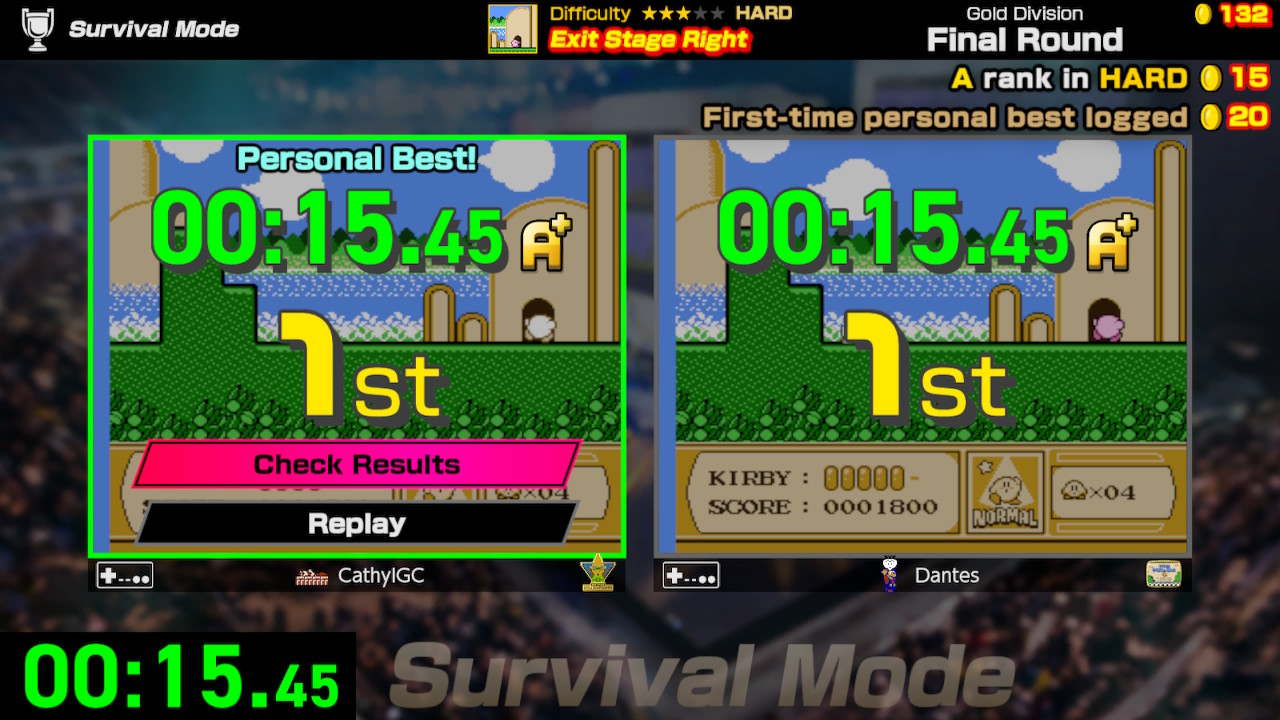
The “8 player” survival challenges are, in fact, single player. You’re competing against the ghosts of other players and not being paired live. In the Silver Cup, the ghosts play mediocre. In the Gold, they’re not too shabby, but I still won every time. This includes one instance where I tied my final opponent, but it gave me credit for the victory. The survival challenges can be played as many times as you want, but the games only change once a week, and you only get credit for one weekly win per cup.

Some people are saying Nintendo World Championships is only for speed runners, but I’m not into that scene at all and I enjoyed NWC enough that I wasn’t bored at all. It sure gave me a better appreciation for what world champion speed runners have to accomplish. I tried to imagine maintaining the tiny fractions of perfection NWC asks of players over the course of a whole game and I gave myself a headache. Nope, I could never do it. There’s a big difference between setting a pinball high score and setting a world record in speed running, where players regularly redefine what a “perfect game” is. I was reminded of that when I took a gander at the previous week of NWC’s online tournament. The big selling point of Nintendo World Championships is weekly competitions in five different micro-contests. I thought I put up some pretty good times. Hey, I got an “S” rating in all five! Then I saw that the winner in the Donkey Kong contest did it by glitching out the game and climbing ladders that weren’t there.

What is it with this game and cheaters? I kid. This person didn’t cheat, because apparently using glitches and tactics like this isn’t against the rules. Weirdly, the results aren’t posted for an hour after the deadline ends, which is Monday at 2AM California time. I figured moderators must have been weeding-out people who did tricks like this. Apparently not.

This wouldn’t bother me, except Nintendo World Championships put the screws to MY attempts to circumvent certain aspects of the game. For example, the big challenge in Super Mario Bros 3 is “finish world 1.” What the game doesn’t tell you is you have to do it the way they want you to. Now, I can understand if the challenge is laid out as “finish level 1 – 1” in Super Mario 1 and taking the pipe to skip the entire middle of the level isn’t allowed. Which, by the way, that’s one of the games. But, “finish World 1” is one of those things where players should be able to come up with their own strategies, something I’m a BIG fan of. I put so much stock in a game’s strategic flexibility that it’s often THE difference between a YES! and a NO! in many of my reviews of high score-driven coin-ops, and I highly prize flexibility in pinball as well. A challenge like “finish World 1” feels pretty open, doesn’t it? I figured “use both warp whistles to skip to level 8, thus TECHNICALLY finishing world 1” would probably have not been allowed. But you don’t have to play any of the optional levels that aren’t on the straightest path to the castle. That’s why, when I reached the dungeon, I decided to skip the fight with Boom Boom by grabbing the warp whistle. “Not so fast!” said the game, literally rewinding it because that was against the rules. Oh NOW you care about the integrity of the game and the spirit of the rules, huh? That’s rich, especially given how people are winning the online tournaments.

Booooooooooo!!

It took me a long time to figure out what my ultimate verdict for NWC would be, because it’s such a bare-bones concept. There’s no leaderboards, so besides finding out how YOU placed (including alternate standings based on your year of birth) and videos of the winning performances for each week’s games, you can’t learn how to do any of the tricks the pros are using. That sucks, since most of the winners involve the type of glitches that aren’t allowed in many speed running communities. Usually, for dedicated competitors in this field, there’s two categories: glitch and non-glitch. Nintendo could have used that kind of consideration, because it was really demoralizing for me to find out that not only were the scores I posted no good, but I wasn’t even close. Or hell, if you’re allowing the glitching, how about instructions on how to do it? Maybe it’d be fun to learn! Except, there are none.

If you’re interested in after-game unlockables, well, this should keep you busy for a while. There’s TONS of icons to purchase, one of which you can make your logo. I opted for Princess Zelda laying down from Zelda II as mine because I too enjoy sleeping and everyone else having to go to hell and back attempting to wake me up.

Advanced tips or instructions for each game would have been helpful, or hell, just more specific guidelines. Rules like “no pipes” or “no warp whistle” are not stated. The level 1-1 example in Super Mario I mentioned above? The rules in their entirety simply say “Grab the Goal Pole.” THAT IS IT, even though there are more rules that punish you for violating them, specifically “no using a pipe.” You’re telling me that they couldn’t have included the words “no using pipes?” Really? The game will automatically rewind any illegal move, but the scoreboard’s timer is still running. That’s not a big deal if the challenge only takes 30 seconds to beat, but in the case of Super Mario 3’s challenge, yea, it sucks to play for a few minutes only to discover that you just broke one of the literally unwritten rules, costing you valuable time.

I should note that, when you play the online feature, any time you post that beats your previous high in single player becomes your new high score. HOWEVER, any time you post in the single-player mode cannot be applied to the online Championships.

Sometimes, NWC isn’t consistent with its rules, especially when it comes to going off the intended pathway. Challenges like “beat Cerberus in Kid Icarus’s first dungeon” and “beat Mario 1” allow players to sometimes go the wrong directions without being rewound. For example, level Mario’s 8-4’s maze will not rewind you for taking the wrong pipe. That’s probably how it should be, right? Except that’s rarely the case. Challenges like getting to Level 1 in Zelda as fast as you can will literally stop you from going in any direction but the shortest route. For the most part, players are not allowed to explore and discover the best routes for themselves and have to follow the exact path taken by the sample video. Wait, really? Wouldn’t that, you know, DEFEAT THE WHOLE POINT OF A CHALLENGE LIKE THAT? I wish they had both ways. Have specific tactical instructions for those who want it, while also leaving it open for people who want to find out on their own. With how they have it, they’ve basically turned the exploration games into digital cross country running trials. While I’m on the subject, the sample videos would be helpful, but those videos show deliberately poor gameplay. So clearly they DO want players to figure some stuff out, but not big picture stuff. Besides the videos and a bluntly-stated goal, there ARE no instructions or even tips for 143 of the 156 challenges. Only the “big challenges” offer tips, though some others LITERALLY OVERLAY ARROWS on top of the gameplay telling you which way to go or for some other happening, like “a warp zone is near!”

Granted, the tips they DID provide are helpful. Like, I would have had to hit GameFAQs or StrategyWiki to know the shortest route in Kid Icarus, a game I’ve only beaten once. I’ll give them slight bonus points for using the same font and style as classic Nintendo Power. They even named the tabs “Classified Information” which is a nod to the tips section in the magazine.

I’m not even a little mad that people know how to cheese these games with glitches. That can be fun! Hell, I liked to get a rise out of family and friends by betting them I could beat Legend of Zelda: A Link to the Past in under an hour or two, then doing it in under five minutes. But, it’s just a parlor trick, right? Even if NWC taught players the glitches the winners are using, I don’t think I’d want an entire game based around learning video game parlor tricks. Now, assuming you’re deeply into that type of speed running, I still think you’ll probably be frustrated with how little competitive value you get with NWC. Out of a pool of 156 challenges, only five are played competitively every week, and then three of those five challenges are used for the two tiers of pseudo-online survival challenges. That’s it. That’s the entire extent of the online play. There’s no leaderboards for individual challenges or viewable ghosts of the record holders. There’s no challenging your friends or seeing ghosts of their games. No-brainer features are just not here.

Each player is supposed to pick their favorite NES or Famicom game from a list. You’d think such a list would only have Nintendo-published stuff, but you’d be wrong. The only games not listed are unlicensed games. Mike Tyson’s Punch-Out!! is listed. UK-only games like Virgin’s Aladdin are listed. Even ultra-rarities like the holy grail for Nintendo collectors, Stadium Events, are listed. I was impressed by it, until I found out all the features that weren’t included in Nintendo World Championships. So let me get this straight: you assigned someone to put a list of every NES cart, filtered out ALL the unlicensed games, but didn’t think players needed the ability to see their friends’ scores online? Good lord. Talk about having the wrong priorities.

There’s also no variety of challenge types in Nintendo World Championships. NES Remix had tasks like “don’t lose a life” or “stay alive for X amount of time.” Those are gone completely. Every challenge is a time attack. All 156 of them. It’s so limiting and uninspired. I imagine at some point a bigger pool of games will be added, but I wouldn’t bet on Nintendo getting creative beyond that. And while I’m on the subject, the game is called Nintendo World Championships, right? So, why is this NOTHING like the original Nintendo World Championships? That contest sandwiched three games together, requiring players to get 50 coins in Super Mario 1, complete a lap in Rad Racer, then with all the time remaining, score as much as you can in Tetris. There is NOTHING like that in the modern Nintendo World Championships! The only thing they have in common is the logo itself! The closest Switch’s NWC comes to that is when you complete all 156 timed challenges with a score of at least A or higher, you unlock “legendary trial.” It’s just a lazy thirteen round marathon of all the final challenges. Mind you, each final challenge is the longest one of that game. I’d be interested in playing shorter versions of such a marathon, but nothing like that is included. In fact, there’s no other mix-and-matching at all outside of survival mode. Oh, I forgot: when I said “five challenges a week” I mean five SEPARATE challenges. Do one or all five, but you only get ranked on each individual challenge and not the group as a whole. So weak.

It’s amazing how much bitching I was able to do before I even got to the games themselves. I’m not sure who outdid themselves: Nintendo or me.

For the purposes of this review, I’ll say that Speedrun Mode is the “main mode.” It’s a series of 156 timed challenges unevenly split between thirteen games. The challenge breakdown is as follows:

My final scorecard before publication.The only one I didn’t get at least an A+ in was the final Kirby challenge. I like the whole “total playtime” of all the scores added-up, even if it’s functionally useless. I wish it kept track of how many attempts you made at each game before reaching certain benchmarks.

  • 14 for Super Mario Bros.
  • 15 for Legend of Zelda
  • 13 for Metroid
  • 8 for Donkey Kong
  • 9 for Kid Icarus
  • 12 for Super Mario Bros. 2
  • 6 for Excitebike
  • 6 for Ice Climber
  • 7 for Balloon Fight
  • 24 for Super Mario Bros. 3
  • 15 for Zelda II: The Adventure of Link
  • 8 for The Lost Levels, aka Super Mario Bros. 2
  • 20 for Kirby’s Adventure
  • Of all the challenges that I worked to get an “S” in, the first challenge of Kid Icarus was by far the one that took me the most attempts. It wasn’t even close. It must have been 200 attempts.

Getting an “A” in every challenge isn’t too hard. Out of 156 games, less than 10 saw me get one of the B rankings on my first successful attempt. Now, getting an “S” is an entirely different story. Sometimes I literally couldn’t believe I got an “S” ranking as I played sloppily and made mistakes, and other times my jaw literally dropped when I didn’t get the perfect rating. I knocked out an “S” in every Zelda 1 challenge in three tries or less, except one where you had to kill three bats. That one took me probably 50 or so attempts. Meanwhile, I couldn’t get A++/S rankings in most Kirby tasks even if I tried, and I did! If the challenges were all short enough that they could be finished in 10 seconds, I’d probably keep playing until my scorecard was nothing but S rankings. But, some take a lot longer, and all the final challenges are the “big ones” of that game. Mario 1’s final challenge is just “beat the game from level 1-1, with warping.” Sure, it can be done in around 4 minutes if you know what to do. I don’t, and it sounds like a big time investment to learn how to get that good. NWC doesn’t tell you the target times for each grade. What’s an A+? Apparently under 8 minutes and 2 seconds, because that was my best time. What’s an S? You’ll know when you get it. A+ is actually the third highest grade, by the way. There’s A++, and I never saw less than a “B+” at any point. This is like one of those “teachers can’t use red ink to grade students anymore” things, isn’t it?

Beating a challenge doesn’t AUTOMATICALLY open the next. You earn coins from completing challenges. The more difficult the challenge and the higher rank you earn, the more coins you get for victory. You also get bonus coins for beating your previous best time. Winning the survival challenges also earns coins, including 500 for the first time you win each week’s gold survival challenge. Again, you only get CREDIT for each survival challenge per a week, but you can grind coins up, if you wish. You just won’t earn as many when you replay them. You also get a nominal bonus for competing in the week’s tournament. When I got sick of going for “S” rankings and started running through the challenges, I never had to grind to open anything, but most players apparently need to grind. The two quickest and easiest “S” rankings are the second Super Mario 2 challenge (pull up a vegetable) and the first Balloon Fight (pop one balloon in Balloon Trip). The challenge unlock system is stupid, but not a deal breaker.

Since the games are emulated, all the problems that come with the originals are here. Kirby’s Adventure has TONS of slowdown, only the clock keeping your time doesn’t slow down at all. Donkey Kong is missing the factory stage. Ice Climber is just the worst, and Nintendo’s continued insistence in celebrating it would be like having an incredible artist regularly hang out in your home, only they keep leaving upper-deckers in your toilet for no apparent reason. I only got all S-rankings for Zelda 1, Donkey Kong, Balloon Fight, and Ice Climber, but except for Zelda, that had more to do with how few challenges were involved. Mario 3 has the most challenges, and each of the seven Koopa Kids gets their own challenge. The only boss missing is Bowser. Come to think of it, the only “last boss” challenges are Mario 1’s “beat the game” finale and Metroid’s “escape the bomb” sequence, and even that is lacking the Mother Brain fight. It’s like Nintendo deliberately avoided spoilers for these literally three-to-four decade-old games. Boss fights work great in NWC, but there’s only three Legend of Zelda bosses, three Zelda II bosses, and three Kirby’s Adventure bosses. Super Mario 2 gets only Birdo and Mouser, and Kid Icarus only gets its first boss. Since boss fights were easily my favorite type of challenge, it sucks that Nintendo excluded so many that would have lent themselves perfectly to this game. I would love for nothing more than this review to be rendered outdated with updates that add more challenges, increase the variety of challenge-types and add more online features. Especially friend-based features (seriously how did THAT get left out?) or leaderboards.

This slideshow requires JavaScript.

Sigh. I sort of have to give Nintendo World Championships: NES Edition a YES! because I had enough fun playing it. The worst gameplay aspect is an exceptionally bad automatic-rewind that happens when you die or do one of the FORBIDDEN moves. In theory it resets you to just before whatever you just died from. In practice, in games like Mario 1 or Kid Icarus, I died more from the rewind dropping me off in the middle of a jump than I did from the original deaths. I’m not even exaggerating, it is THAT bad. The rest is, eh, you know, fine. Nintendo World Championships certainly doesn’t rise to the level of “very good.” The online component means absolutely nothing to me because it’s too limited and not very fun. Five challenges a week is not enough for a game focused on online play. I can’t even see myself booting this up every week to play the next five contests. As for local multiplayer, unless every person you get is in roughly the same skill range, you’re not going to have any fun, at least as a group. It only takes one player who is fairly better than the rest to wreck the entire session. I was dis-invited from playing with my nephew and his friends because I was that player, though I probably should note that they were equally matched, more or less, and seemed to have a lot of fun once they booted me. But, be warned: playing eight-player mode means using JoyCons turned on their side, which I personally think is the worst game controller configuration of my entire lifetime.

I’ve been asked “does the cart work?” by every visitor to my house since the game arrived the day after it was released. No, it doesn’t, but it does come with a nice display stand that isn’t pictured here. The kids fought over the pin sets, to the point that a second $59.99 set had to be bought. To Nintendo’s infinite credit, my nieces and nephew and all their friends, ages 8 to 13 or thereabouts, all wanted to compete in this, even though they’re normally not inclined to play retro games. My nephew has literally never opened his NES, SNES, Game Boy, or Genesis libraries that came with his Switch Online subscription. Some of my best friends have children that are in the same boat. But, all the kids REALLY wanted this game. I can’t make sense of it either.

All I had left to base this review on was the 156 challenges. I started them on Sunday. I finished all of them with at least an “A” or better after just a few hours on Monday, with no intent of sticking around long enough to unlock everything. I spent most of Tuesday writing this review and bumping the “easy” ones that I “should” have gotten to an S, while also verifying that some of the challenges are just really boring. Besides the boss fights, my favorites were all 10-seconds-or-less games. That’s when NWC becomes gaming crack. Beating whole levels? Eh, it’s fine, but I really don’t think any of them quite reached that “just one more try” sweet spot, and some of the challenges I enjoyed so little that I don’t think I’ll ever play them again, regardless of how bad my scores might be. In fact, I’m not even sure my NWC cart will ever go back inside my Switch. (UPDATE – August 10, 2024: In the interest of fairness, I did return to Nintendo World Championships even when I thought I wouldn’t. Initially to check my previous week’s results, but I ended up spending time on the week’s five new competitive challenges. This is a game that’s deceptively addictive, but I did have a good time.) Okay, maybe when the inevitable add-ons hit, I’ll reload it to at least play each new challenge enough to get an A ranking on them too. That has to happen, right? Like, I can’t believe Donkey Kong Jr., Wrecking Crew, StarTropics, Punch-Out!!, or none of those early sports games are represented here. No third party games, either, and Super Mario Bros. Lost Levels is the only (former) Japanese exclusive. Ten years after NES Remix, and what could be considered the fourth game in the series feels, well, kind of thin. It IS possible to have fun and still be let-down. Just ask anyone who has ever slept with me.
Verdict: YES! but if you’re on the fence, waiting for a sale wouldn’t be a bad idea.
$59.99 ($29.99 for the standard) was soundly defeated by Jimmy Woods in the making of this review.

The Fall of Elena Temple (Review)

The Fall of Elena Temple
aka Elena Temple 2.

Platform: Nintendo Switch, Xbox, Playdate
Released April 30, 2024
Developed by GrimTalin

This slideshow requires JavaScript.

Most games don’t require the most in-depth reviews. Take GrimTalin’s new indie sequel to their cult hit The Adventures of Elena Temple. That game was based on searching a fifty-screen map for treasure. This time around, Elena stars in a single-screen puzzler based mostly around the concept of falling. And it’s a really, really short game at only twenty stages. I don’t know exactly how much time I needed to finish them all, as I knocked out a few stages at a time, then did something else, then turned on the game and knocked out a few more, and so forth. The fact that I played The Fall of Elena Temple like that and still finished the whole experience in a single day says something. All in? It probably took me an hour-and-a-half. A really fun and perfectly acceptable ninety minutes, mind you. I can honestly say I was never bored. Unlike the previous Elena Temple adventure, this is 99% a puzzle game, with only the faintest hint of platforming, making this feel more like a spin-off than a proper sequel.

This slideshow requires JavaScript.

This is especially true thanks to the graphics looking a bit like Game Boy and a bit like Playdate. The previous Elena Temple was themed around a game by a hapless game developer who kept making their flagship game for the wrong platforms. This time around, it’s more like “hey, remember Game Boy?” You can zoom as far in or out as you wish. I needed to zoom all the way in, but your mileage may vary. The object is to collect all the coins and then get to the exit. The big twist is that most rooms have an item that grants you the ability to undo your previous fall from a platform, only you get to keep any progress you made towards the whole coin collecting. It’s actually a pretty good twist, but it’s also one that puzzle aficionados should be able to reverse-engineer with only a bit of trial and error. It’s intuitive to use, at least. The amount of falls you’re able to undo varies from room to room, and each fall is numbered so you know where the undo button is sending you. It works wonderfully and it does make for a fun gimmick. In fact, it’s so fun that I was sorry when it wasn’t in a room.

Probably the best thing I can say about Elena 2 is that it successfully creates “THE BIG OVERWHELM” which is my term for puzzle games where, at first, a level seems so vast and multi-dimensional that you initially think “okay, maybe time I’ve met my match.” The beauty of THE BIG OVERWHELM is that it doesn’t require a complex puzzle, but only the appearance of one. Look at Portal, where none of the puzzles are THAT hard, no matter how the scenario is presented. The payoff is, when you actually finish the stage that looked so overwhelming at first glance, it’s that much sweeter. The Fall of Elena Temple pulls that off, which is pretty impressive for a minimalist puzzler. Plus, Elena 2 keeps throwing twists at you the entire length of the game. Crumbling floors. Disappearing/reappearing floors. Boots that let you skip a space. Hearts that let you absorb one hit of damage. Keys. Snakes. Spiders. All of it paced out so that there’s something new in nearly every level, right to the bitter end. Actually, past the bitter end. I couldn’t believe my eyes when a never previously used magnet showed up in one of the three bonus stages, and then even more stuff is added after that. Hey, finally “bonus stages” that live up to the name. I can’t stress enough: this is GrimTalin’s best game and one of the absolute best puzzlers I’ve played in the last few years. The Fall of Elena Temple is really good.

Even with THE BIG OVERWHELM, Elena’s levels are rarely actually as overwhelming as they look. Oh, and it took me about half the game for my brain to stop needing to tell itself “you can’t climb the vines, stupid.”

But, there’s really two big problems with the whole “stay fresh until the end” design mentality. The first is that, when you only have twenty levels, by necessity, the learning curve is going to be more like a gentle slope. You need the difficulty to scale, so you can’t do simple tutorial levels with the new items, but you also can’t really go completely bonkers with them either. Which, don’t get me wrong: I prefer Elena’s scaling to something like Gateways, where the learning curve was more like a straight wall made out of middle fingers (and mind you, that’s a game I liked a lot). But, there were also maybe, at most, only three or four levels that really had me scratching my head, and one of them was a “bonus” stage. The other big problem is that most of the ideas for special items are fun, but with the exception of the undo mechanic, they all feel underutilized. The twenty-three levels combined absolutely does not feel like it stretches the limits of what this puzzle formula can do. I suppose GrimTalin could do DLC, or a special edition later on like they did with the first Elena Temple. Hell, I’d be fine if they released level packs at $1 a pop for, say, ten new stages and just kept releasing new ones for quick cash, since that initial $3 felt underpriced to begin with. $3 for ninety damn fine minutes of puzzle goodness? What else are you going to do with $3? For me, I had to decide on a large lime slushie or this. I’m sure I made the right choice. Pretty sure. No, wait.. yea, I’m sure.
Verdict: YES!
$2.99 was parched in the making of this review.

Atari 50: The Definitive Review – Part One – The Atari Reimagined Games & Yars’ Revenge

Hey, have you heard of Atari 50? Well, I started reviewing it in November of 2022, then I actually read what I’d done and it SUCKED. It was my worst work ever by far, because the joy I felt playing this collection didn’t come across at all in what I was writing. That was late 2022. Now, it’s mid 2024, and I’ve decided to give another crack at it. I really need to, especially since Atari 50: The Games They Couldn’t Include is one of my most popular features. For those games, read Parts One, Two, and Three, and E.T. got its own review! I figure before I do Part Four, I should really talk about the games Atari 50 DID include.

There’s a LOT of games in Atari 50. After a free expansion to the original collection hit, the total became 115, and there’s still a ton of games left they could add that require no license. Hell, they can even add Berzerk now that Atari owns it. Hopefully even more additions will arrive, especially the coin-op games. I’ve decided to break this up into four parts. Doing it this way allows me to take a break between parts if I get worn out.

Atari 50 costs $39.99. That means it has to generate $40 in value. Spoiler: it gets there easily. My usual compilation format is going to be anti-climatic, so let’s make it REALLY fun. Instead of setting a universal value on quality games, like say, $5 for a good game, any game that gets a YES! can be awarded any value. Besides, when I do the Atari 2600 section, I can’t very well say with a straight face that 3D Tic-Tac-Toe, a YES! game (yes, really) is worth $5. I need flexibility with Atari 50. So, any game can be awarded any value up to $40, the cost of Atari 50. And I’m going to start with the original games created by Digital Eclipse for this set.

I already reviewed LED memory tester Touch Me in LCD Games IX. It got a NO! Since it’s counted as one of the 115 games in Atari 50, I have to count it too. It’s just a typical memory game that isn’t remotely fun at all, though I’m happy it’s here to represent Atari’s attempts at handheld gaming before the Lynx. What would have been REALLY cool is if they could have included ports of unreleased Atari LCDs like the Cosmos system or the Super Breakout LCD that was designed by Tod “Pac-Man 2600” Frye. Digital Eclipse, I’m telling you: an LCD collection at $30 or under would probably do pretty good if the popularity of my LCD Games of the 1980s features are any indication. Verdict: NO! Scorecard: 0 YES! 1 NO!

In the interest of full disclosure, I’m friends with several people at Digital Eclipse and some of the designers of the games, old and new, included in Atari 50. That doesn’t factor into my reviews. They wouldn’t want to be my friend if it did.

We’re going alphabetically.

Haunted Houses
Platform: Atari Reimagined
Year: 2022
Designed by Dave Rees

This is cute and everything until you really stop and think about the fact that you’re playing as disembodied eyeballs.

When I review games, I dislike saying “it accomplished everything it set out to do.” It just seems wishy washy, doesn’t it? I’ve had people who are fans of a game I disliked ask me “did the developer accomplish everything they set out to do?” I usually fire back “I don’t know! I wasn’t there! Maybe they set out to make a totally different game and this was the best they could do?!” That’s not the case with Haunted Houses, where “the developer accomplished everything they set out to do” is spot-on. Well, presumably. If Dave Rees set out to climb Everest and this was the end result, fail. If he set out to remake the Atari 2600 classic Haunted House in 3D while retaining the gameplay and feel of the original, good job. It does just that. You’re a pair of eyeballs that can only pick up items if you’re actively using some kind of light. To win, you have to get the three randomly placed pieces of the urn to the front door.

For those not playing on Nintendo Switch, Haunted Houses offers a lot more meat. Stuff like finding all the radios, jump scares, etc, award you achievements. For people playing on Nintendo Switch, such as myself, the existence of all these things not only serve no point, but they actually create confusion. A sense that you’re missing something integral to finishing the game. It wasn’t until a couple hours of gameplay that I bothered looking up why all these things are there. It’s a massive oversight by Digital Eclipse to not include a checklist of all the hidden aspects of Haunted Mansions for Switch players. I have no objection to fake achievements in Nintendo games. You can’t just leave things in a game that make sense on other platforms without creating an alternative for everyone else, unless you want to generate a whole lot of confusion, FOMO, or both.

But, it’s not a one-to-one voxel remake, as there’s just enough modern gameplay mentality to prevent Haunted Houses from feeling like it’s shackled to gaming’s past. The biggest change is in the scoring system. The levels are set on a timer, but it’s not a “do or die” timer. If you run out of time, instead of dying, you just get paid less money at the end of the level. You lose more money if you run into the spiders and bats that knock your light out. Also, every single time you activate your light source, you lose $10. You have unlimited lights, but each one costs you. At the end of a stage, assuming you don’t run out of lives from getting caught by the ghosts, you’re assigned a letter grade based on how you did. The levels themselves are full of references to other Atari games and the occasional jump-scare. Old school, yet distinctly modern. THIS is how you pay tribute to classic games, folks.

Haunted Houses is full of references to all kinds of VCS games, including a few that aren’t in Atari 50. I don’t know if this is clever or cruel. I mean, hey, here’s the sprites from Space Invaders. Look, there they are! Enjoy them, because this is the closest you will come to playing Space Invaders in Atari 50. It’s not one of the 115 games included. I have thoughts on that, mostly based around how other game companies could admit that VCS ports hold little to no value outside a collection like Atari 50 and they could have done the gaming world a solid and come to terms on a cheap ass license for Atari and Digital Eclipse.

In a way, Haunted Houses feels like the type of oddball game that could have been a cult hit on the Nintendo 64. I just wish it had more levels. A dozen would be perfect. I’d settle for eight full-sized stages. How many levels does Haunted Houses actually have? Three. Four if you count the tutorial. Haunted Houses feels almost like a proof of concept (the glass half full point of view) or a novelty appetizer that’s set apart from the classic games main course of Atari 50 (the glass half empty point of view). Taking the glass half empty point of view, Haunted Houses is too married to abstract design. There’s moments where your torch goes out that are seemingly tied to jump scares that serve no purpose on Nintendo Switch, and it’s not always clear what you need to do to trigger them anyway!

For a voxel game, this is actually pretty eerie at times. I feel that deserves extra credit given the absurdity of this whole thing.

There’s also too many bats and spiders that tend to cluster-up with apparently no way to defend against them unless you’re holding the scroll, which causes them to ignore you. But, since you’re limited to carrying one item at a time like you are in the 2600 game, if you’re using the key or retrieving the urn pieces, the scroll doesn’t help you at all. It’s only after you beat the third stage that you gain access to a character that can attack the ghosts, but honestly this guy is so overpowered that it sort of nerfs the game. Level balance is an issue too. Assuming you count the tutorial as level one, I found the fourth and final level to be too easy. I beat it on my second attempt in a way that made it feel like pure luck. The third level is much bigger and more complex, and even level two took me a lot longer to finish. It’s even worse, because as the last stage, it assures that Haunted Houses ends on a massive let-down.

The ghosts are creepy, so mission accomplished there. You can even defeat them with the starting character if you have enough time to charge up your torch to create a temporary ring of magic. If you can lure the ghost into that ring, it dies. Well, I mean.. actually now that I think about it, it’s probably already dead. So you actually purgatorize the ghost.

If you take a glass half full view, Haunted Houses really does feel exactly like someone took Haunted House and cast a spell on it to make it a 3D game. A perfectly decent and quite entertaining 3D game. Nice camera. Good controls. Crisp graphics. It just works well. Not only does the formula feel authentically VCS-if-3D, but all the charm of the original game is retained. The premise is a little bit silly. The settings are a little bit spooky. The ghosts are a little bit frightening. This IS Haunted House, only 3D. And that’s funny because there’s been multiple attempts at creating follow-ups to Haunted House over the years. 2010 saw an Xbox Live version of Haunted House that’s still for sale that got middling-at-best reviews. Last year ANOTHER 3D remake of Haunted House that completely slipped under my radar, this time a roguelike, was unleashed upon the masses. Even indies have gotten in on the action, as 2005 saw a homebrewer create a sequel to Haunted House by doing a ROM hack of Adventure. That was apparently good enough to be included in Atari 50. I’ll be reviewing it when I get to the Atari 2600 games of the collection. I had no idea that Haunted House was so beloved that it would spawn that many remakes. That’s why it’s especially weird that the best remake of it is this throwaway gag game that’s part of a 100+ game collection.

Haunted Houses works really well as a co-op game. Well, assuming your partner remembers they can do something besides soiling themselves when they see a ghost.

I figured it was probably smart to keep Haunted Houses short, as there’s no way the novelty wouldn’t wear off by the time I finished the last level. Not only was I wrong, but I feel like Haunted Houses has so much left on the table that Atari really should commission a full $19.99 – $29.99 game based on this engine. It just works so well. That there’s only three real levels further hammers home the whole “proof of concept” vibe. It feels like there’s so much more you could do with this formula. Haunted hospitals, hedge mazes, schools, bunkers, etc. Increase the levels, make the set pieces just a little more interactive, and maybe add hidden trinkets to find to enhance the replay value, and Haunted Houses has potential to be a flagship game for the new era of Atari. It does one of the best jobs I’ve ever seen of replicating a specific 2D title’s gameplay in a 3D environment. The fact that it’s basically a +1 afterthought for a massive collection of games is heartbreaking enough, but the fact that it’s unlikely to advance beyond the three full levels we got is downright depressing. It would be like finding out the game that provided your favorite demo at E3 got cancelled. A painful punch in the gut. I suppose it’s fitting for a game where you play as a pair of eyeballs, because Haunted Houses has legs that we’re never going to see.
Verdict: YES! – $5 in value added to Atari 50
Scorecard: 1 YES!, 1 NO!
Total Value: $5

Neo Breakout
Platform: Atari Reimagined
Year: 2022
Designed by Jason Cirillo

Spoiler Alert: the classic Breakout games won’t be getting the most glowing of reviews. I respect the franchise’s contribution to gaming, but without authentic paddle controllers, they didn’t have a prayer of winning a YES! from me. That’s why I’m so completely shocked by Neo Breakout.

The first time I played Neo Breakout was the exact moment I couldn’t believe Atari didn’t sell the Reimagined games as their own collection. It runs neck-and-neck with Strikey Sisters as the best brick breaker I’ve ever played, and it does it without the aid of wacky power-ups. That alone is insanely impressive. Instead, the twists are mostly tied to the bricks themselves. The one that matters least to me is that you get bonus points by hitting identical colored bricks in a row. I just don’t have enough skill at aiming the ball to even think about utilizing that strategy deliberately. I will say that it’s really cool how the giant cube in the background changes colors to represent the active color you want to aim at in the chain. There’s also themed bricks. Some of them create new bricks if you hit them from the bottom, while another does the opposite and shatters bricks it shares a column with. There’s also crush bricks, which move in the opposite direction they’re struck and break any brick they run into. This includes the otherwise indestructible iron bricks. I’ll get to those in a little bit.

Playing the two player mode, alone or with family, was about the saddest thing I’ve ever seen. Nobody could keep a ball in play. In it, the object is to create enough bricks to reach the end zone of your opponent. Every time you miss the ball, the center line is moved closer to you, and hitting the center line creates new bricks on your opponent’s side. It’s a clever idea, but games of it tended to last FOREVER even when we did play well. Did I have fun? Not really, but thankfully this is a bonus mode to a bonus game. The single player stuff more than holds its own.

The other twist is that most of the levels in Neo Breakout have one of three kinds of game modifiers added to them. Speed modifiers only apply to rooms with a red ceiling. If the ball hits the ceiling, its speed increases dramatically. It only happens once per ball, but it lasts until the ball dies or you clear the room. Levels with a blue ceiling cause the paddle to shrink if the ball hits the ceiling. Again, it lasts until you die or the room is cleared. Finally, rooms where the wall gradually becomes yellow drop the blocks one row closer to you every time the yellow completely fills-in. Some of the rooms stack multiple modifiers. The concept of special rules for certain levels is well implemented and works to make Neo Breakout feel new and fresh in what should be a very tired genre. The restraint shown by designer Jason Cirillo to forgo even basic Arkanoid style power-ups, let alone the overpowered type of items typical for modern brick breakers, was astonishing. But, the end result is a game that’s better than any games that do.

Mostly fun room themes, too. There’s fifty-one levels, and only maybe three or four stink.

The closest Neo Breakout comes to having power-ups are the “whammy ball” and the “cavity balls.” The whammy ball is completely optional and activated entirely by the player. In fact, I beat Neo Breakout without knowing of its existence because I didn’t read the instructions. You’d think after Fantasia I’d have learned my lesson, but no. If you hit the left trigger just before the ball makes contact with the paddle, the ball becomes a fireball that travels at a very high velocity for the remainder of the stage, or the ball’s life. While the fireball is active, you score double the points. Meanwhile, only some levels feature cavity balls that can be released on the playfield. Once a ball stuck in a cavity enters a clearing where their trajectory is no longer trapped above their starting position, they become playable balls. The one time this failed, on the 41st stage, it was to my benefit. While the ball was technically free, I never once needed my paddle to play it, which I think technically means it should have remained an inactive ball that bounces harmlessly off the bricks. I don’t know what activated it, but it happened near the top of the screen. The downside was the ball kept bouncing at the same leisurely pace it would have if it had remained trapped. So yea, Neo Breakout is a bit glitchy, and I think most of the glitches are tied to the metal blocks. Call it a hunch, but every time something went wrong, they were there. The biggest offender of which was this:

This slideshow requires JavaScript.

The gimmick with the iron bricks is that they’re indestructible. In theory, a line of them is a solid line. Except that obviously isn’t the case, as the ball literally bounced itself right through a gap that sure looks smaller than the ball itself. Now, I really, really like Neo Breakout, but hooooo boy did I have a tantrum when this happened. Granted, that was mostly on account of me trying to playfully act like I was going to throw my controller, only my timing was so far off that I popped myself right in the chin with my own controller. And mind you, this wasn’t the only time the ball behaved in weird ways around the iron bricks. It wasn’t rare at all for the ball to ricochet downward off the side of one when it was on an upward trajectory. In fact, that one happened constantly. Also, sometimes I finished a couple levels without breaking every brick. I’m not even sure what happened in those stages. When it happened a second time is when I finally consulted the instruction manual and found out about the Whammy ball. Finishing stages even though there’s still bricks left? Sometimes more than one? I found nothing, so I’m just going to assume the stages surrendered to my awesomeness. Stop snickering.

My hunch tells me the whammy ball was really included as a sneaky.. and clever.. way of helping lessen “last mother f’n brick syndrome” that’s common to the genre. That’s because the activating hit travels upward in a straight angle, making it the easiest shot to aim in the game. It’s not an automatic way of eliminating an annoyingly-placed final brick, as you still have to get the rebound directly under it. But, just having it as an option I found worked well for eliminating the often sloggy end of stage moments that plague brick breakers. Gosh, how I wish I had read the book, as this would have come in handy in the later stages.

Okay, so Neo Breakout is slightly unstable, but hey, so am I and I’m doing pretty good, and so is Neo Breakout! Technically, it’s a bonus throw-in for a retro game collection anyway. But, it’s also my choice for the best of the Digital Eclipse originals in Atari 50. It even has hidden value in the form of Double Neo Breakout. On the second title screen, press the Y button (or presumably the square button on PlayStation) until you hear a chime, and you get a double paddle AND get to play two balls at once. It’s not even a throwaway extra, either. It’s a genuinely fun experience that plays just slightly different enough to be worth everyone checking out once. It’s seriously a lot of fun. All of Neo Breakout is a lot of fun.

This slideshow requires JavaScript.

The only part I didn’t enjoy was the versus mode, where my fun was muted by the fact that nobody in my family could keep the ball alive (including myself). Otherwise, Neo Breakout is one of my favorite games in Atari 50. It helps that the controls are some of the most intuitive non-dial controls the genre has ever seen. There’s even dual-stick gameplay, as the left stick moves the paddle at a normal speed while the right stick moves it at super sensitive high speed. If I have to complain about something, it’s that the right stick is too fast and there’s no option to adjust it. Unless I was using it to catch a rebound next to a wall, the right stick was too dangerous for me to use and led to overshooting more than it was actually helpful. Thankfully, all other options are available. You can adjust the main paddle’s sensitivity to find your comfort zone, and if you wish, you can set the paddle to return to the center of the playfield when you release the stick. So, yea, rough and glitchy as it can be, Neo Breakout feels like a true love letter to the Breakout franchise. It’s the rare franchise tribute that’s authentically, no doubt about it tied to the series, but in a way that feels totally new and modern. I literally can’t believe this is part of Atari 50. It could easily have been sold all on its own. Then again, that’s true of most of these Digital Eclipse games.
Verdict: YES! – $15 in value added to Atari 50.
Scorecard: 2 YES!, 1 NO!
Total Value: $20

Quadratank
Platform: Atari Reimagined
Year: 2022
Designed by Mike Mika

You can do any combination of AI or human players. You can even do four AI, but the instruction book says to please not use it for betting. Pssh, you ain’t the boss of me. $20 on ole’ bluey!

I didn’t get the best possible multiplayer experience out of Quadratank. It wasn’t a matter of finding players. I had my nieces and nephew, ages 8 to 12, along with my sister, a couple of her friends, and my parents. Everyone but my dad and I spent the entire game whining about how hard it was to control the tank. If you grew up with an Atari 2600 and put a lot of time into Combat, you probably won’t have any problem steering in Quadratank. For everyone else, yea, this is pretty tough to get the hang of. There’s even three control schemes that you can switch on the fly with the simple press of a button. While that sounds great in theory, when you’re playing with disinterested children or grown-ups who act like children, it’s inevitable they’ll accidentally press the “change controls” button when they don’t mean to and then whine even more about how tough the controls are. Quadratank is also pretty limited in terms of flexibility. Three maps, two gameplay modes (three if you count two-on-two combat and two-on-two capture the flag separately), and two types of terrain: normal and icy. The most important options are the starting weapons, which includes ricochet shots. I highly recommend that mode. In fact, I wish I had turned that on at the start. It was the final mode we tried for this review and it was closest the larger group came to having a good time. But, by that point everyone had already made up their minds that Quandratank wasn’t for them.

There’s only three arenas as far as I can tell, with only two modes. If there’s unlockables, besides being able to unlock Combat Two in the Atari 50 library through highly convoluted means, I ain’t found them.

Back in 2022, *I* had a good time playing Quadratank, but it’s worth noting that it was one of three party games my family played that month, along with indie hits Hidden in Plain Sight and Chompy Chomp Chomp Party. Since then, we’ve played HiPS a dozen or more times. We even broke it out for our Super Bowl party earlier this year, and Chompy has gotten a replay or two. The one Christmas 2022 game nobody wanted to touch again, including me, was Quadratank. In my case, it wasn’t because I disliked the game so much as it’s no fun to play a game where everyone else never stops bitching. When we busted out video games to pass the time this last Christmas Eve, when everyone was both excited and feeling festive, my mother and some of the kids specifically said “not the tank one!” So, you can imagine how everyone reacted on a Friday in 2024 when I all but begged for thirty minutes so that I could write a game review none of them care about for a blog they don’t read.

The only two games that even got the faintest hint of smiles from the heartless jerks I was playing with were ricocheting shots and rockets & lasers.. ON ICE. Of course, those two modes were pure chaos. That’s always fun even if it’s not exactly elegant gameplay. Congratulations are in order to Mike for creating a game where slippery ice improves the game.

Two years later and nothing changed. I enjoyed playing Quadratank. My father had a good time. Everyone else whined about how hard it was to control. It’s not that we didn’t have ANY fun. Again, I made the mistake of starting with the most basic default settings. Bad move on my part. But, even with the settings at their wackiness, the amusement came from the sheer chaos, and not the merits of the gameplay. Sixteen months after the game didn’t go over as well as I expected it would, and even with the kids being almost a year-and-a-half older, history repeated itself. I don’t think it’s entirely on the age group, either. Quadratank DOES have problems, the biggest of which is there’s a very sharp learning curve to the controls for anyone not used to tank games. Another issue is that it’s easy to lose your place in the mayhem. Despite that complaint, it’s a shame this couldn’t be an eight player game. My niece astutely pointed out that the arenas are too big for only four players, and she’s right! Sure, that prevents you from being spawn-killed, but it also causes the action to be too stop-and-go. Either way, *I* still like Quadratank, but it’s got a very specific audience and apparently I don’t have that audience to play with. More than any other Digital Eclipse original in Atari 50, Quadratank feels like a bonus extra instead of a legitimate featured game, and that’s perfectly fine in a set like this.
Verdict: YES! – $1 in value added to Atari 50.
Scorecard: 3 YES!, 1 NO!
Total Value: $21

Swordquest: Airworld
Platform: Atari 2600
Year: 2022
Designed by Dave Rees

For what it’s worth to Dave Rees, this is the hardest game to review in my nearly thirteen years of doing this blog. Remember the whole “achieved what it set out to do?” thing I talked about with Haunted Houses? This is the dark side of that.

Swordquest was meant to be the ultimate video game contest that combined the efforts of three Warner Bros. subsidiaries: Atari, DC Comics, and the newly acquired (as in 1980) Franklin Mint. The plan was to create four action-adventure-puzzle games in the Swordquest series, with each game getting bundled with a DC comic book. Players would find clues in the games that pointed to pages in the comic that contained different clues that players would use to solve an ultimate puzzle. The basic exploration is the same in all four games: a series of interconnected rooms based on mysticism themes. Some of the rooms had mini-games that needed to be completed once. BUT, the real gameplay was basically picking up junk from one room and dropping it in another room. If you dropped the junk in the right room, it would point you at a specific page in the comic book. The gameplay was as abstract as you can get, but if you could sort it all out and mail in the correct answer, you would be invited to come to Atari’s HQ to compete with other correct guessers in a specialized version of the game. The ultimate winner of each individual game’s final contest would win corporeal junk work $25,000. Then, the four winners would come together and compete for a jewel-encrusted, gold-handled sword worth $50,000. Still with me? Okay, here’s where it goes nuts.

Do you know what I think is the strangest part of all of this? The Swordquest comic books are actually pretty dang good. That’s especially surprising, given the fact that other Atari comics, like the one included with Yars’ Revenge, were TERRIBLE. For Swordquest, all three comics that were released are in Atari 50, inside each game’s instruction manual. The writing is on-par with DC’s output from this time, maybe even a little better, and the art is top notch. Even Waterworld (panels of which are pictured above), the one that you’d expect to be phoned-in, is really high quality for this time frame. Sadly, while we got the video game conclusion to this, we never will get the comic book conclusion, as DC comics apparently never even got to the writing/inking part, and creating a new comic from the ground up was a bridge too far for Digital Eclipse. I can’t say I blame them. Unless they hired actual comic artists, it would never live up to the expectations. Strangely, people can make convincing Atari games in the 2020s, but comics that feel distinctly “80s” are a bit of a lost art form.

For the first game, Earthworld, eight people got the correct answer and were flown to Atari. For the second game, Fireworld, so many people got it right that Atari had to issue homework as a tie breaker. I’m not even joking. The seventy-three players who got the right answer were told to write an essay on what they liked about Swordquest: Fireworld. From those essays, Atari selected the fifty entries most likely to be able to afford to lawyer-up who had the best essay on the game, scout’s honor. Then came Waterworld, and much like the Kevin Costner movie of the same name, everything went to hell. By this point, it was 1984, the video game industry had completely collapsed, and one of the guys who helped create the Marlboro Man was now in charge of Atari. That must have been quite the change for him, going from customers dying from his product to the company itself dying because of the product.

I’ll be reviewing the other three Swordquest games when I get to Atari 50’s 2600 games. God help me.

Warner Bros., who was looking to dump Atari, wanted to cancel the contest. But, their lawyers said the Waterworld contest had to go forward because they already advertised for the specific game’s release and accompanying contest. So, Atari sold Waterworld only via mail order to Atari Club members. That’s why it’s a sought-after rarity among collectors today that’s rated a 9 out of 10 in rarity by AtariAge, who will be proud to hear Google’s spell check knew that their name is one word: AtariAge. According to my Atari collector friends (hi Steve!), people whose entire hobby is seeking out finding games at yard sales and junk stores would be considered incredibly lucky to find one game rated a 9 out of 10 without using the internet.. well, ever. So, in the case of Swordquest: Waterworld, we’re talking VERY few copies circulating, then and now. And yet, it somehow got even worse. While the Waterworld contest was considered active, Atari was sold to Commodore founder Jack Tramiel, who again tried to get out of the contest. In fact, apparently people who entered the contest were told they were ineligible, but once again, the lawyers said “NO!” Allegedly, the Waterworld contest was held in secret and a winner secretly crowned.. literally. They won a crown. The remaining contest could legally be cancelled with each of the prior winners and the Waterworld finalists accepting cash buy-outs instead of competing for the grand prize sword. Of the five gaudy prizes created by the Franklin Mint for this epic disaster, only one is still believed to exist. What a fiasco.

If you want to learn more, including the ultimate fate of the prizes, go here or here.

I’m not a lawyer, but TECHNICALLY didn’t they advertise a four game contest? It sure seems like it. I know there were probably disclaimers up the wazoo. Not that it matters, for reasons I’m about to get into.

Apparently the fourth and final Swordquest game was something of an urban legend in Atari circles. Despite being probably the most sought-after prototype of all time, no Swordquest Airworld prototype has ever been found. Given the sheer volume of unreleased Atari 2600 games that have been discovered over the years, combined with all the work-in-progress builds of released games, if Airworld hasn’t been found yet, it’s likely that no prototype exists at all. While Tod Frye says he started work on it, not even so much as a screenshot exists. Only concept art for the box, and nothing more. Knowing Digital Eclipse, if they had anything to work with, they would have said so. They didn’t, so for Atari 50, they created a whole new Swordquest: Airworld from the ground up, keeping only the promised theme of the game. Each of the Swordquest games are based on mysticism. Airworld uses the I Ching, just like how Earthworld used the Zodiac, Fireworld the Tree of Life, and Waterworld chakras. The end result is a monster-sized version of Swordquest that dwarfs the other three combined, with a map that looks like this:

The biggest difference, besides the girth, is that there’s no comic book to reference clues this time. Instead, Airworld gives players a very detailed instruction manual that presents players with sixty-four riddles; one for each room, and fifty-six items, some of which there’s duplicates of. You’ll want a pen & paper when playing this game, or you can open up your phone and take notes like we did. Sometimes, the clues are outright spelled out for you. The clue for Room #25: Innocence is “let simple and natural forces guide you, like a kite on the wind.” One of the items is a kite, so obviously you’re not using the upper jaw bone in that room. To use the items, you really just pick them up when you find them and put them down in the corresponding room. You can hold five items at a time. If you drop the correct item(s) inside the correct room, instead of being told which comic book page to look up, you’re given the hexagram for a different room. It looks like this:

Like previous Swordquest games, sometimes rooms will have minigame challenges that must be completed in order to get all the junk in the room. If a room does have a minigame, once you’ve completed it (and gotten all the coins out of it if there are coins), you don’t have to play it again for that room. There’s four minigames in total, all of which repeat several times with varying degrees of difficulty, and three of which play and control a lot like the 2010s unfathomable fad hit Flappy Bird. In the case of one of the games, Tianma’s Flight, it really is Flappy Bird with what feels like a slightly oversized character sprite. In it, you move horizontally and have to continuously flap your wings while avoiding barriers. A couple of these levels are actually pretty dang tough. The hardest one took us probably close to twenty attempts to finish. If you fall or collide with a barrier, you have to start over.

Tianma’s Flight. Actually, it’s one of the better Flappy Bird-likes (please don’t use the term “clone”) I’ve played. It helps that, by being part of a larger game, this version of Flappy actually feels like it has stakes. Plus, each round of it is kept short.

Another game, Draconic Descent, has you flapping while moving downward, though this time you can drop pegasus pee underneath you. Barriers get in the way that you have to shoot to remove, all while stationary dragons shoot fireballs across the screen. While you can take out the dragons with a single dribble of pee pee, you don’t have to. In fact, many times I accidentally fell several stories, bypassing all the obstacles. Mind you, you actually do have to collect the coins (if there are any) in each stage, so there’s some incentive to keep flapping and not just dive blindly towards the unseen goal.  If you get shot, or if you miss the exit, you have to restart from the beginning.

Draconic Descent was the easiest of the four minigames in Airworld. It’s not even close.

The final of the Flappy-likes, and the bane of my existence, is Atmospheric Ascent. In it, you have to fly upward. If you touch anything, you temporarily lose your ability to flap. It’s really a cross-the-road style game where sometimes you get very little clearance to advance. On top of that, sometimes the channels of obstacles are so close together that it’s hard to keep a rhythm of flapping that keeps you between them while you wait for an opening. If you touch anything, you could get stun-locked by multiple rows of clouds or birds or whatever and end up falling all the way to the bottom. One round of this took me and my father THIRTY MINUTES to finish. That was totally our fault for having the wrong strategy, but by time it was over, my hands were sore and I was in a foul mood. A big part of the problem is that none of the games scale “naturally.” You repeat each of the games multiple times, BUT, the difficulty of each one is tied to the room it’s in, not the order you played it. Or maybe it’s tied to the numerical order of the rooms, which are scrambled up, and I didn’t notice. I could be wrong, but either way, I’d prefer if the first time you played a game, no matter which room it’s tied to, you played the easiest version, then the next one up, etc, etc. None of the three Flappy Bird-like games are particularly fun, but Swordquest isn’t exactly famous for fun minigames so at least it’s true to the source material.

Oh how I hated Atmospheric Ascent. You do want to sort of move along with the scrolling obstacles, but the timing is super hard. It’s akin to trying to thread a moving needle while pumping the fingers holding the thread up and down.

Storm Siege, the best of the four minigames, and indeed the best minigame ever in the Swordquest franchise, is a clever take on Space Invaders. It’s really just Space Invaders, but with a twist that actually works wonderfully for adding stakes and plenty of close calls. As you shoot the targets on the playfield, instead of UFOs scrolling across the top for bonus points, clouds drift from left to right. Every-other cloud is a rain cloud, and if you don’t shoot it fast enough, it shoots lightning. You have a protective barrier, but it can only take so many lightning strikes before it wears off. You have to clear the entire playfield of all the targets before the enemies reach the bottom OR before the lightning strikes the ground. This reminded me a lot of From Below, which is just plain old ordinary Tetris where a tentacle pokes the stacked blocks up sometimes. It’s the smallest of changes, yet that change yields massive gameplay dividends. The same goes for Storm Siege’s cloud/force field formula. That one change amplifies the excitement far beyond what such a small change should do. If Digital Eclipse does further expansions to Atari 50, they should consider expanding this to a full game with scoring.

Oh and you can only shoot one bullet at a time. It makes you kick yourself every time you miss.

So the minigames went 1 for 4, but the overall puzzle in Airworld isn’t bad. It’s also not as good as I remembered from my 2022 play session. I’ve now finished it twice, and by far my biggest complaint is all the red herrings in it. The majority of the items have no purpose, but all sixty-four rooms have riddles, and since we’re using fortune cookie logic, there’s really no way to tell what is a room that requires you to drop items in it and which are just there to distract you. In reality, only a little over a quarter of the sixty-four rooms are part of the item-dropping puzzle. Some of the “red herrings” have gameplay implications if you’re holding them when you enter a minigame, but if you play this blindly, it’s not like you can replay the minigames (I don’t think at least) to experiment. The only way to really do it is to purposely lose levels and fall back to the main puzzle, then swap the item you’re holding one at a time. There’s fifty-six items! It’s not practical.. though I can probably guess one of them in retrospect.

Dear Atari: I want my $25,000 Philosopher Stone. I mean, I did sort of write an essay on all the reasons I like Airworld AND Atari 50. So, do I win? No? Crud. Eh, it was worth a shot.

Like I said at the beginning, this is the hardest review I’ve ever had to do. At its best, Airworld offers the same type of “okay, I get it, ta-da” and high-fives all around enjoyment of escape rooms. But, the actual solution is such a fraction of the bigger game that it might be the least tight puzzle of this type ever made. Yes, the other Swordquest games had false clues and red herrings, but it’s taken to such an extreme here. Going back to the escape room analogy, which isn’t a perfect analogy in Airworld’s case as there’s no time limit, but, if I did an escape room where there were sixty-four puzzles but only sixteen were actually valuable for getting out of the room, me and my whole family would be f*cking furious. That’s not good puzzle design. That’s just dirty pool. Do you know how we beat the game? BOTH TIMES? While trying to find the rooms to drop the stuff in, we accidentally triggered a previously unheard audio cue that you’ve stepped in the room that’s the start of the final pathway to victory. That’s when we stopped trying to find what room the boomerang goes in and checked our notes, and victory happened about 15-20 minutes later. We stumbled upon the final sequence. Twice. At least we have the excuse of the two sessions taking place sixteen months apart, but I could have sworn there weren’t as many red herrings as there were. There’s too many.

UPDATE: So, the 64 riddles thing is legitimately part of the I Ching itself. So, while I still stay firm on the belief that it’s inevitable players will go on wild goose chase, Atari and Digital Eclipse stayed true to the nature of the theme itself. Commendable. Infuriating, but commendable.

For all my bitching, seriously, this was a surreal, almost magical experience. I can’t imagine what this would mean for fans of Swordquest. Airworld proves how much Digital Eclipse loves its audience, because folks, THIS is a love letter.

So, how the heck do I review this? First off, if you’re a genuine, no BS fan of the original Swordquest games.. not someone who played with them for like two minutes after watching the Angry Video Game Nerd’s episode but an actual FAN who got deeply into solving the puzzles.. ignore everything I’ve said. FOR YOU, putting hypothetical value on a priceless experience is pointless. If you really love Swordquest, Atari 50 is worth buying just for Swordquest: Airworld. Even without the comic book, it’s everything you’ve wanted for forty years now. There’s even an option to unsmoothen (I don’t care what my spell check says, because that’s a word, dagnabit) the HD graphics and add VCS jank if you so wish. For everyone else.. eh, it’s a lot better than any of the three Swordquest games Atari put out in the 80s, but beyond that, it’s give a little, take a little. GIVE: you actually can logic-out the riddles. TAKE: only 1 of the 4 minigames is fun. GIVE: that goes up if you’re a big Flappy Birds fan. TAKE: it goes down quite a lot if you hate Flappy Bird. GIVE: All the charm of an authentic Atari-developed VCS game is here and beautiful. TAKE: except there’s no DC comic tie-in. GIVE: My Atari-loving father and I had a good time. TAKE: my non-fan mother and sister thought we were out of our minds. It’s my blog, and while I’m not a fan of Swordquest at all, I enjoyed the experience a little more than the downtime that frustrated me. Airworld is a dream game. Just not my dream game.
Verdict: YES! – $5 in value added to Atari 50
Scorecard: 4 YES!, 1 NO!
Total Value: $26

VCTR-SCTR
Platform: Atari Reimagined
Year: 2022
Designed by Jeremy Williams

This is not a game that lends itself to screenshots.

I have a feeling this is going to be like Undertale, where even though I really like the game, fans of it will be livid with me for not liking it as much as them. VCTR-SCTR is a tribute to Atari’s vector graphics output. It’s also the most arcadey-game in the Atari Reimagined lineup, for better and for worse. The idea is you play a sequence of snippets of Atari vector classics. There’s four games that go in the following sequence: you have to clear a screen in Asteroids, land a Lunar Lander, clear out all the UFOs in a shooter that combines aspects of vector games not included in Atari 50 such as Speed Freaks and Battlezone, then finally clear out all the Flippers (the red x-shaped things) in Tempest. Once you complete a cycle, a new cycle at a higher difficulty immediately begins. Getting the biggest problem out of the way: making Lunar Lander part of this was incredibly misguided. Mind you, I’m a really big Lunar Lander fan. It’s one of my favorite coin-ops ever, but it does not fit-in at all with VCTR-SCTR.

And I’m not even factoring the tethered mode into that statement. VCTR-SCTR can be played two ways: a single ship or two ships tethered. In the solo mode, the sequence of games is spot-on in terms of difficulty: Asteroids first, Lunar second, VCTR-SHMP third, and Tempest fourth. That sequence makes NO sense for the tethered mode, where Lunar Lander is easily the hardest of the four games. The green ship has no thruster. You have to land the dead weight on a separate platform. In the tethered mode, Lunar Lander should have been the fourth game in the sequence. No doubt about it.

Sometimes having games feature a wildly-shifting tone works. It doesn’t work here at all. Having three very intense shooting sections broken up by a game that’s about finesse and conservation is akin to placing a braking section on a roller coaster after the initial 80 mph drop. Then, after thirty seconds doing 10 mph along the ground, following it with a launched 80 mph section to complete the rest of the track. Nobody would do that, because it wouldn’t be fun. The Lunar Lander segment is just plain not compatible with the other games. Even more problematic is that it doesn’t yield enough points to provide any stakes at all. It’s as close to dead air as I’ve seen in any action game. Again, Lunar Lander is one of my favs, but I wouldn’t want it to show up in the middle of a game of Asteroids or Tempest, which is exactly what this does. I’m certain that the huge fanbase of VCTR-SCTR is going to be furious with me for stating that, but sorry, they’re just plain wrong. The third segment, a new game designed just for this, proves that Jeremy has the chops to come up with something that fits-in with the other three games better.

There’s two co-op options, one of which tethers the players together. Ironic for a game that involves shackling players to each-other, it’s bound to drive people apart. Also, worth noting is that the children who I could barely get to play Quadratank *HATED* VCTR-SCTR because of the Lunar Lander section, which they never got past. Not once. I tried to calmly and gently explain the concept of easing on the gas, conserving fuel, and feathering the analog sticks. They didn’t care, got frustrated faster than I thought humanly possible and quit almost immediately. I asked one of them how on Earth he could recreate set pieces from Attack on Titan in Minecraft but he couldn’t grasp the concept of barely touching the analog stick. I’ve never feared for a coming generation more than I did after trying to explain Lunar Lander to kids. Good lord, the planet is so screwed in thirty to forty years.

The rest of the game is brilliant. It works as a homage to an era of gaming that never got its due. This is especially true of the third segment that I’ve dubbed VCTR-SHMP. The blistering speed it cuts, along with the close calls and near misses that comes from dodging enemy fire, made for one of the most exciting games I’ve ever played. So good is the third segment that I’m kind of bummed that it didn’t get further expanded into its own game. Fans of VCTR-SCTR will be REALLY pissed at me for saying that I almost wish it had been the whole game. Seriously! As much as I enjoyed the Asteroids and Tempest segments, I’ve played those games. They’re in Atari 50, along with Lunar Lander. The third segment is one of those “it’s like every arcade game you’ve played and no game you’ve ever played before” type of situations. I haven’t played a game like that since Donut Dodo, which I loved! If the third segment was ALL of VCTR-SCTR, I honestly don’t think I would have missed the other three segments at all. That’s why it’s kind of sad that it’s here in Atari 50, where the concept is likely to never be expanded upon. If you did this same game, with more enemies and obstacles, dare I say it could be an action game of the decade contender.

To be honest, I wasn’t in love with the Tempest or Asteroids segments either. Oh, they’re great here, but that’s because they’re great by themselves. Which anyone would know since they can play them by themselves in Atari 50. At this point, I’ve played Asteroids and Tempest to death, and I’m not even of the Golden Age of Arcades generation. I’m going to be 35 in three months. I missed the arcade era altogether. I imagine people older than me are going to have put even more time into VCTR-SCTR’s inspirations. Even though I love VCTR-SCTR, the only standout sequence is the one created just for it. I want a lot more of it.

As much as I’ll daydream about a game that will likely never exist, I really did have a blast with VCTR-SCTR. The only big thing missing from it is online leaderboards. Yea yea, they didn’t have those in the good ‘ole days. Well, they didn’t have the internet or consoles more powerful than all the world’s Atari 2600s combined, either. If it would have bumped the price of Atari 50 by $10 or even $20, hell, this is the greatest game collection ever, and I have a feeling such a price hike would not have affected the sales at all. Besides, challenging for high scores is the whole point, right? Then again, my best score was just under 100,000. I never got past the fifth wave. Oh, and do you know what else is missing that would be perfect for this type of game? A time attack mode. It’s such a no-brainer that I’m stunned that’s not an option. Not that it NEEDED it, obviously. The best thing I can say about VCTR-SCTR is I told myself I would play this one a couple hours at most. I ended up spending a whole day on it, dying and dying and dying, but trying and trying and trying. And, like so many of these Atari Reimagined games, the passion held by the developer for this type of game is loud and clear.
Verdict: YES! – $10 in value added to Atari 50
Scorecard: 5 YES! 1 NO!
Total Value: $36

Yars’ Revenge: Enhanced
Platform: Atari Reimagined
Year: 2022
Designed by Mike Mika

And hell, I might as well do the original while I’m at it since it’s (almost) the same game.

Yars’ Revenge
Platform: Atari 2600
Year: 1982
Designed by Howard Scott Warshaw

This is one of those situations where I had to merge two separate screenshots in order to make one that represents the appearance of the game. You see, Atari can’t run that many sprites at the same time, so it cheats by having one frame load half the objects and the next frame holding the other half. If an Atari game has flicker, that’s the reason why, and it makes taking screenshots of Atari games a pain in the ass that creates extra work for me to do the review. It’s even worse when you take clips on Nintendo Switch, as it skips every-other frame. That means a video of Atari gameplay taken on Switch looks like half the content is missing.

Atari fans might want to have a paper bag handy to breathe into. Ready? Yars’ Revenge is a teeny tiny bit overrated. STOP! Deep breaths. Calm. It’s okay! We’ll get through this! Listen, Yars’ Revenge is also a lot of fun and certainly one of the best.. if not THE best.. arcade-style games on the 2600. It’s possible to be both fun AND overrated. There’s no game that’s true of more than Yars’ Revenge. Fans talk about it like it arrived on our planet alongside baby Jesus, who was holding the polio vaccine in one hand and the first loaf of sliced bread in the other. Of all the games to get that kind of reverence, why this one? I like Yars’ Revenge a lot, but I also don’t get why it’s practically been deified. It’s a perfectly fine arcade-style shooter. Smack your bug against the force field of the enemy to charge up a cannon. Then, line-up with the enemy and fire the cannon, with the twist being you have to duck out of the way of your own projectile after firing it. It’s a good idea and it works wonderfully. It makes for a relatively intense experience, especially given the hardware limitations at play here. It almost feels like you’re playing a game of chicken with the enemy since you have to run up and dry hump the barrier around it.

The funny thing is, Yars’ Revenge wasn’t even going to exist. It started life as a licensed game based on the Cinematronics (of Dragon’s Lair fame) vector graphics hit Star Castle. The problem was, Howard Scott Warshaw determined the 2600 could never create a port that lived up to the arcade game. Some tinkering later, and a brand new hall of famer was born. Also, the name is a pun on then Atari president Ray Kassar. Y-A-R/R-A-Y, and the instruction manual says the game is set in the Razak system. R-A-Z-A-K/K-A-S-S-A-R. Ray Kassar’s Revenge.. on Activision’s designers. Yes, really, the name and storyline are petty in-jokes because some of Atari’s best game designers left to become millionaires instead of making $26K a year and getting no credit and heartless “bonuses” like a free frozen turkey because your game was a best seller. Let petty vindictiveness rule the day!

There’s only two levels that repeat on harder difficulties each cycle, which is a bit of a bummer, but this was the Atari 2600 era so it’s to be expected. The replay value comes in the form of a couple extra modes. I’d never played mode 6 before, aka Ultimate Yars’. I’m so happy I did, as this is easily the best way to play the game. In it, instead of charging up the cannon just by bouncing off (“eating”) the force field, now the cannon operates on a scoring system. You have to collect five units of power called TRONS by eating the shield (1 unit per cell), touching the enemy, aka the “Qotile” (2 units) or catching your own missed cannon blast when it ricochets off the shield (4 units). Oh, and yea, in this mode, your cannon ricochets off the shield. The fastest way to charge-up unwatchable Jeff Bridges sci-fi movies is by touching the enemy itself. If basic mode Yars’ feels like a game of chicken, Ultimate Yars’ feels like when Bugs Bunny or Daffy Duck plant a big, sloppy, sarcastic kiss on Elmer Fudd before hopping away, taunting him. Even better is you can bank more TRON points than the cannon needs, giving you multiple shots at the Qotile. Finally, to load up a cannon shot, you just have to touch the left border of the screen. I loved this mode. And I really like Yars’ Revenge. It’s fun. One the best ever? I’ll settle for one of the best games from this era, but even playing Ultimate Yars’ in the enhanced version, it got old quickly. In 2024, Yars’ is instead the type of game I’d play with a few minutes to kill. Hey, the world needs those games too.

Now here’s the part where the fans REALLY get angry..

As for the Enhanced edition, it’s literally the same game. No new levels. No new modes. It’s supposed to be a 1 to 1 remake of the 2600 game that even uses the same code. But, it doesn’t feel the same. Maybe it’s just the placebo effect and I’m imagining things, but Yars’ Enhanced sure feels like it plays faster, especially when it comes to the swirly attack of Qotile and your own cannon blasts. Because of this, the gameplay feels much more intense, and I loved it. And that’s hardly the only upgrade. For a game saturated in so much bloom that it’s like playing video games in the middle of a nuclear explosion, oddly enough, I ultimately prefer the enhanced edition to the 2600 original because I found it much easier to see what was happening. In the 2600 version, by far my most common reason for dying.. besides shooting myself in the ass with my own cannon.. was getting killed by the little dot that slowly stalks you. I was constantly losing it when it crawled into the neutral zone in the middle of the screen.

This slideshow requires JavaScript.

In Enhanced, the dot is replaced by a galactic space triops that’s just plain easier to track. Visibility matters, and being able to see what’s going to kill you makes games more fun. Plus, the score and your remaining lives are on the screen, and if you play Ultimate Yars’, the amount of cannon shots you have is displayed on the bottom. So, Enhanced is the clear winner for me. Besides, there’s nothing inherently sacred about the original Yars. It’s just the old version. It only looks the way it does not because of artistic merit but because that was the literal best the console was capable of doing in that era. If you like it more, hey, whatever floats your boat. Given that Atari recently put out another remake of Yars’ that offers 30 waves, I’m fine with this upgrade to the 2600 game staying true to the original. In fact, Mike did such a good job that the only real downside is that Atari 50 didn’t have more enhanced 2600 classics like this. Maybe Atari 100 will, and that’s assuming I live to be 83. Finally, an excuse to start doing CrossFit.
Verdict for Yars’ Revenge for the Atari 2600: YES! – $3 in value added to Atari 50.
Verdict for Yars’ Revenge Enhanced: YES! – $10 in value added to Atari 50.
Scorecard: 7 YES!, 1 NO!
Total Value: $49

As I suspected, the original games by themselves are worth more than the price of admission alone. And to think, we’re just getting started. Next time: the coin-ops of Atari 50!

We ♥ Katamari: REROLL (Review)

We Katamari: REROLL
aka We Love Katamari: REROLL
First Released June 2, 2023
We Katamari First Released July 6, 2005
Developed by Namco & Now Production
Published by Namco
Point of Sale: Nintendo Switch, Xbox, PlayStation, Steam
Version Played: Xbox Series X

I needed a break from pinball, saw this was on sale, and bought it. I didn’t expect to do this review, but I have a lot to say.

I think everyone said “I have to play that!” the first time they saw a picture or a video of Katamari Damacy. It wasn’t even originally going to come out in America. Too weird. Too Japanese. But, it got a lot of attention at a workshop at Game Developers Conference and the press was swooning over it, so Namco rolled the dice. The next thing you know, it’s a global hit that has spawned multiple sequels. Granted, sequels that have almost none of the charm of the first one, but as long as you avoided the handheld spin-offs, the sequels all played better and had more to do. So when I played Katamari Damacy REROLL a while back, I remember thinking it wasn’t very good as far as remasters go. I was also perplexed as to why they went with the original game when an HD remastering of Katamari Forever, an all-encompassing tribute to the franchise, would have made a LOT more sense. The first game felt like a proof of concept that was short and limited, while the series started to really get good with We Katamari. Yes, there’s more than just a graphic overhaul, but as a “remastering” that doesn’t remaster gameplay, whatever annoyances were left intact are now especially annoying because gaming has come a long way. It took a while, but the second Katamari game finally got its REROLL, and this one is much better, but only because it feels a tiny bit less lazy. Only a tiny bit, as the problems are still amplified by virtue of age.

We Katamari: REROLL is the first collectathon in forever that I 100%ed. I suppose that says more about its quality than any review I could write. Just make sure to put bandages on your thumbs BEFORE playing instead of waiting for after. Also, 100% doesn’t mean I collected a million roses or got 100% of the items, but rather I found all the cousins and the hidden Namco stickers.

If you’ve somehow never played a Katamari game, the concept is simple: you control a tiny prince who rolls a ball that everything sticks to.. eventually. The catch is that the ball can only roll-up things smaller than it, but as the ball grows, so does the range of stuff you can roll-up. In preset-benchmarks, the ball “levels-up” and the world becomes smaller, giving you all new junk to collect. You start by rolling up things like paperclips and eventually reach the point where you’re pulling up skyscrapers and landmasses (though that really only happens in the final basic level). Using dual stick tank controls, you have to cause the end of the world, more or less. Oh, the world will be fine, as the ball seems pain free. In the first game, the framing device was the King of All Cosmos got drunk and blew up all the stars in the sky, and every ball you rolled up became a replacement star or constellation. The King of All Cosmos is an overbearing asshole who mentally abuses the prince, but it ultimately gave the prince a sense of pluckiness that had a charm to it. That charm is completely gone in the sequels, because they’re far too meta and self-congratulatory, to the point that even staunch fans began to find it obnoxious.

The first game had this “we had to come up with SOME reason for this bananas concept to make sense” vibe that felt authentically kooky. This sequel, and in fact all Katamari sequels, feel like they’re trying too hard.

In this game, fans of the first game and the concept of Katamari Damacy in general essentially pray to the King of All Cosmos to make their Katamari dream scenarios come true. Much like how I’ve never found a person who brags about having a high IQ to be impressive, I’ve never once found a person or entity that fancies itself as charming to be the least bit charming at all. That’s especially true with all the Katamari sequels, where the characters are just annoying. Actually, the King might be the most annoying character in the history of video games. He never shuts up, ever. When you’re in the zone and trying to focus on beating your best times or your best scores, having the King’s dialog block the screen is ridiculous. You have to press A (or X on PlayStation) to make it quick scroll. If you don’t and just let it scroll on its own it could be quite a while before you have a clear screen again. It might be a funny gag if it happened once per a save file, but every time? Blech. There’s no method of turning it off, either. If you find one of the 39 cousins of the prince for the first time in a specific stage, the King will say the same lines every replay about finding that cousin.

My personal idea of Gaming Hell is a Katamari with only the Cowbear level where the King’s dialog can’t be removed from the screen and the catchy soundtracks are replaced with Baby Mario’s crying from Yoshi’s Island. I’d like to believe that’s what OJ Simpson is playing right now. Satan couldn’t give him a football based-hell since he already played for Buffalo.

We Katamari has only five basic stages, each of which has two variants based on making as big a ball as possible within a time limit, or reaching a target size as quickly as possible. Those stages are easily the best parts of the game, as each starts you small and in a confined space, but eventually you work your way up to the point that you’re struggling to find new things to grab onto. There’s a lot of smoke and mirrors involved, as set pieces constantly repeat, only redressed with new materials to roll up. This becomes especially true if you play the three “Eternal” modes of the game, which are a new addition to We Love Katamari REROLL that didn’t start until later games. Each of the Eternal stages has a hard cap in how big you can get and how much stuff there is to gather. By the time you reach the point where you’re rolling up both clouds and the ground underneath you, the game itself is no longer taking into account all the stuff on the ground. You can even get achievements, presents, cousins, and collectables you’ve missed in the Eternal modes. However, you can’t make new planets, so when you quit, your ball will be turned into stardust for the space level. I wish there were a LOT more themes and areas, but what’s here is fine. The themes are mostly fun locations. If I had to complain, I’d say I wish there were a lot more things specific to each stage.

The racing level is probably my favorite of the special modes. It controls like operating a rocket-powered shopping cart after you’ve slammed all the hard liquor in the world, but it’s crazy fun.

The special stages are what differentiate the Katamari games, and most are fun. In the racing mode, you can’t stop the ball, which has one speed: too fast. It crashes into everything and goes flying off even the slightest hill, but the out-of-control rocket vibe works for a game like this (though I can’t stress enough: I would NOT want a whole game like that). You’d also have to be trying to lose deliberately to actually fail at it. There’s three stages where you have to guess how big your ball is and try to get it as close to the target size as possible. Thankfully We Katamari isn’t operating under Price is Right rules, so going over is okay. The most memorable stage is probably the one where you have to roll around an oblong sumo wrestler, where the only items that count are food. It’s a shame rolling up people doesn’t count as edible, as a little implied cannibalism is the type of thing that can put a game on the map. The sumo is really tough to roll since he’s not fully round and has a bad wobble. That is, unless you can maneuver yourself so the sumo is completely horizontal. If you can do that, it’s so satisfying to get a long straightaway. Also, that last sumo level is tough. Easily the stage I lost the most on.

God, how I hated these levels. Also taking the extra 24 seconds here got me a whole mm bigger. Did I mention I hated these levels?

On the flip side, when the special stages are bad, they’re really bad. One of them has you collecting fireflies that just sort of linger without any real rhyme or reason besides a few sections where more than an average amount swarm. One has you build a snowman and it’s SO tedious. The above one has a fire that goes out if you don’t collect items fast enough. And there’s a big river right in the center of the stage with a sloped edge, and if the ball falls into the river, you get punished by the vengeful king, who REALLY never shuts up when you fail a stage. There’s a stage where the items have a numeric price placed on them which is really just the same thing you’ve been doing for several hours, only with items having often arbitrary values. Then there’s the end-game special levels where you have to roll up all the planets you’ve created over the course of the game, and one where you have to roll-up countries and then catch a comet that’s about to hit the earth. They both sound more fun than they are, which is not at all. But, by far the worst stage is the Cowbear stage, which has to be a contender for the worst level in a good game ever. So, of course THAT stage got brought back for Katamari Forever (the finale of the console franchise as of this writing).

You can’t see it, but I’m about to run over a teeny tiny statue of a bear. Trust me, that’s not a good thing.

In the Cowbear stage, the level ends as soon as you roll up your first bear or cow. You don’t get the option to keep rolling with your current ball. And also the game has a very odd definition of what is a cow or a bear. A road cone that has the marking of a dairy cow? That counts and the level is over. A vending machine with the markings of a dairy cow? That counts and the level is over. Teeny tiny little toy bears? Those count, and the level is over. It turns Katamari; one of the most fast paced, frantic, exciting game concepts, into a slow paced, unfriendly bore. You have to literally inch your way around a stage where things that are painted in a way vaguely resembling the patterns of hair on cows are scattered everywhere. Your starting positions in most stages are semi-randomized, and in the Bearcow stages, the designers usually surround your starting ball with the smallest (thus lowest-scoring) bear or cow objects. And mind you, it’s not like you have perfect visibility. Most of the time, the ending of the stage took me by surprise. I usually spent a minute or so staring at the screen while trying to figure out what exactly I touched that counted as a bear or a cow. Since your goal is to create a massive ball that blocks most of the visibility in front of you, this was a VERY dumb idea. So dumb that it should have been killed on the drawing board before development even began, and the person who proposed it should have been fired. By that, I mean they should have been loaded into a cannon and fired out of it, preferably into a brick wall. This is an example of taking the quirk too far.

What did my parents get me? MALIBU KAT-A-MARI!! I’m a ballerina! GRACEFUL!

Along for the ride in this REROLL are five “new” stages, or rather five new challenges that recycle We Katamari’s existing settings, that literally have no consequence: the Royal Reverie stages. While they keep high scores, you’re not creating new planets to roll-up or anything. In terms of quality, I’d rank all these new stages a couple Everests above the Cowbear level but several Matterhorns below the levels that are actually fun. All five, at best, feel like ideas that never made it past spitballing at the initial planning meeting. Besides hiding stickers in them (more on those next), the crappy reward for completing them is costumes for the Prince not good enough to be costumes in the original release. In the screenshot above, you have to find four ballerinas in the zoo. In another, you have to find five hidden musical instruments in the school, with the catch being that the school is full of ghosts that end your round if you touch them. One is a car stage that actually allows you to stop, where the only item that counts towards your score are any tires. One is a quick one minute sprint in the bedroom and HOLY CRAP were they ever stretching for ideas there. The final one recreates the firefly stage that’s already second-to-last in the terrible idea department, only the fireflies are replaced by actual fire that represents your FIGHTING SPIRIT to quickly drain an opponent’s health bar. These levels are AWFUL and not worth a new purchase if you still have your PS2 copy.

I chose to use this pic to show the sticker challenge because it can’t spoil the locations of them for you. Seriously, this was what kept me playing for four straight days.

Easily the coolest addition to We Katamari: REROLL is that nearly every level has between one to three stickers of classic Namco characters. They’re divided into one for each “challenge” in the game for a lack of a better term. Like how each of the five basic stages have a How Large challenge and a How Fast challenge? Well, each of THOSE has a sticker in a different location somewhere on the map. You don’t roll them up. Instead, you have to equip the camera present (it should be the first present you get) and, when you find one, you have to snap a photo of it, which removes it from the stage and adds it to your collection. This is a “just for funsies” thing that has no achievements or practical usage, but holy cowbear, did I ever have a good time finding them! The stickers turn the world of Katamari into a 3D version of a Where’s Waldo book, and I mean that in the most complementary way possible.

This totally makes up for the fact that they took the second worst level in the game, changed it from night to day and pretended it was a new level. The “Fighting Spirit” stage is even worse than the firefly original.

It’s such a thrill to find the stickers, especially in the bigger levels. They’re almost never in an arbitrary spot. By time I got to the bigger levels, I had an understanding for the “logic” of the type of the places they’d be hidden, so it wasn’t like a needle in a haystack. Actually, the difficulty was nearly perfectly balanced, to the point you’d think they were pros at it. Mind you, you have to operate within the rules of each stage while snapping the pictures, which is why the tutorial, car stage, and space levels have no stickers to find. Thankfully, unlike presents and cousins, you keep the stickers you snap pictures of win, lose, or quit. But, like with the fire stages, you have to keep your Katmari fire burning while you search. If there’s a time limit, you have to work with it. Cowbear? You still have to avoid touching cows and bears, which is probably good life advice in general. There is a problem with the sticker search: it seems to have inconsistent stability. I’m going to spoil ONE sticker location for you because it’s one a lot of people are having problems with. Not so much the “finding” part as the “getting credit for finding it” part. It’s this one:

This was the second-to-last sticker I found, in one of the “pick up a million roses” bonus stage that doesn’t actually expect you to pick up a million roses in a single setting. I’m only spoiling this because of how crappy it is to get it.

And yes, that’s the hockey mask from Splatterhouse. You’ll also note I took a picture and didn’t get the sticker. I have no idea why. Several times, I collected stickers from quite a distance away, partially obscured, off-center, and not completely in frame. I still got them. But, in this specific instance, the camera simply didn’t register that I had taken a pic of it and thus collected it. So, how did I get it? I honestly don’t know! The house was out-of-bounds, so I couldn’t get as close as I wanted to. No matter where I stood, it wouldn’t register. This had happened once before with a previous sticker, but then I quit the stage and restarted it and, the next time, the camera worked on the first try and the sticker was collected. Not this time. I was really worried that the game was glitched, and if it didn’t work a year after release, it was likely to never work at all. I know the camera is sensitive enough because on the cowbear level, I collected the sticker by accident when photographing something that turned out to be wrong, but the real sticker was in the frame and I got it anyway even though it wasn’t REALLY visible. Meanwhile, the Jason mask wouldn’t register even though I took several unobstructed photos. I kept bumping up and down against the fence over and over and over and even tried a selfie with it. Finally I found a gap between the fences and, after several attempts to bump myself as close to the invisible barrier as possible, the stupid thing actually registered and I collected it.

This is the tallest you get in this Katamari, or maybe one click higher. But future editions of the series had you transition from the Earth to rolling up continents to rolling up space. This one has the Earth stuff and space in separate levels, and the space one doesn’t tell you how big your Katamari ball is. Instead, it just tells you how many objects you’ve rolled up. Fun fact: in the EU versions of We Love Katamari, and ONLY the EU versions, each of the cousins you found got their own planet for the space section. REROLL is the first time the cousin planets get a global release.

My biggest complaint about the sticker concept besides mechanical issues is that there isn’t more of it. I would love for the photography to be a major part of the Katamari series. In keeping with the Where’s Waldo-like feel of the Namco sticker hunt, they could use the photography feature in the same way the checklists at the end of Waldo books add replay value. “Take a picture of a flying elephant! Of a bear playing the piano! Of a swordfish poking out of a life ring!” That type of stuff. I’d still be playing it, and having the time of my life. Seriously, I kind of want a 3D Waldo game now because of Katamari. It just works, and it’s such a tease that there’s not more of that in the game. Just the cousins and presents, of which there’s nothing new hidden in the stages. No new cousins, and all the new costumes are tied directly to completing the five Reverie stages. They’re not presents hidden inside them. If nothing else, it’d been nice if they changed all the locations of the cousins and presents, or just added more. I say that because they’re so fun to find. If I had just played the levels until they were beat, there’s only a couple hours of content in the game. With the cousins, presents, and especially the stickers, there’s several multiples more.

I came two milliseconds short of having the clock read all 2s and I was so proud I took a picture, even though it means nothing. I think I need help.

For all my whining, I have to admit that I couldn’t put We Katamari down, and I’ll regret it for days to come as the blisters all over my hands heal. Katamari is a fill-in-the-blanks game. Whatever you want out of it, be it a relaxing game to chill out with or a white knuckle high score challenge, this will do. When I wasn’t treating it like a 3D Waldo game, I was challenging my own best times and highest scores, and the only time I ever got bored was on the Cowbear level and the firefly level (and its Reverie rehash), both of which are glaring blemishes on an otherwise pretty dang addictive game. It even has a lame as f*ck versus mode if that’s your thing, but there’s something for everyone here. I didn’t like the remaster of the original game at all, but the additions of the stickers (there’s also two in each of the five new levels), significantly faster load times (at least on Xbox Series X) and less technical hiccups make this a solid $29.99 investment, or in my case, under $10 investment. At the same time, it’s still the same game from 2005.

My favorite of the “mop everything up” type of levels is the Hansel & Gretel level.

The thing about Katamari as a franchise is there’s really only been three console games and one all-star compilation. The handheld games were REALLY bad, which is probably to be expected since those had to make all kinds of concessions based on the hardware. The last console release, Katamari Forever from 2009, was made up almost entirely of older levels and challenges. Touch My Katamari, a game ruined by the rear touch panel on the Vita, was the last non-mobile game, and it was another game made up of older levels. And that was it! This blog is younger than the latest new console Katamari game, and this blog is thirteen years old this year.

The cloud stage is one of the stages that didn’t make the cut for Katamari Forever.

While the existing Katamari games are a ton of fun, this is a frustrating series because it feels like it hasn’t peaked yet. Fans of the franchise, I ask you this: doesn’t it feel like the perfect Katamari video game is still waiting to be released? What I think happened is Keita Takahashi and his team burned out after releasing three Katamari games in a three year span, the last of which had massive production issues. Beautiful Katamari, aka the one where critics started turning on the series, only released on Xbox 360 (it’s still for sale on the Xbox Store), but it was originally going to be on Wii and PS3 too. The PS3 version ran into “porting problems” and, because the PS3 had lower sales, they canned it and focused on a Wii version that also never saw the light of day. Also, the Xbox 360 version was SLAMMED for having DLC levels coded into the disc itself, where the DLC fee was really just to unlock content already on the disc. It felt cheap, because it was. That’s why the PS3 got Katamari Forever, which was mostly a retread of Beautiful Katamari with some content from the first two games sprinkled in.

2024 and I’m still playing new releases (or in this case, remasters) where the camera gets stuck behind a solid object that drowns out your entire field of view. This is a VERY common occurrence in We Love Katamari.

That’s why these re-releases really frustrate me. Games are just better now than they were in 2005. 3D games especially. Do you think a game like Katamari could benefit from, say, a better camera? How about better fluid simulations? Handling more moving objects at once? Being able to give moving objects more elaborate moving parameters? Well, that game doesn’t exist. Even with the visuals now having less jaggyness and real time shadows, this is a 2005 game, and it feels like it. Everything that moves does so using shallow, preset parameters. Objects are CONSTANTLY clipping through surfaces, and the camera is just plain bad at what it does, to the point that you often can’t see what you’re doing. Hey, I had a ton of fun with We Katamari, even if I can’t eat salty foods without searing pain in my fingertips for the next couple days. Needless to say, I’m happy with my purchase, especially since I got it on sale. I’m also happy the first two Katamari games got a modern re-release. I’m all about preservation and legal access to older games, and I have no objection to those older games getting quality of life mods and bonus content. BUT, I really hope they have something better planned for Katamari Damacy. I hope the next Katamari isn’t a REROLL, but a completely modern Katamari that feels modern. I say that because I can’t say I’ve played a game that maximizes the Katamari concept’s potential. I don’t think it exists yet.
Verdict: YES!
$9.89 (normally $29.99) got rolled up in the making of this review.

Colored Effects (Indie Review)

Colored Effects
Platforms: Nintendo Switch, Steam
Developed by TacSou
Published by Flynn’s Arcade

The graphics are nice, clean, and distinctive. TacSou never put the trees in locations that would be distracting. It’s a game that allows you to process everything quickly with no visual loudness.

I’ve had a bitch of a time trying to write this review for Colored Effects, an indie puzzler where you have to dip your character in superpower-granting paints in order to solve logic puzzles. I’ve not been struggling because Colored Effects is bad or boring or anything scandalous like that. Actually, it’s really good. I can’t stress enough how good the controls are. Colored Effects has accurate, intuitive movement physics, effortless jumping physics, and some of the best box-shoving mechanics I’ve seen (with one tiny but annoying exception, see the next caption). Seriously, I hope developer TacSou wrote down the recipe for this (I assume video games are made with recipes) because the controls are gosh darned perfect.

This is the one and only exception to the controls/movement being flawless. Here, a box I wanted to fall through a trapdoor when I activated a lever didn’t fall, instead defiantly balancing on a single pixel. Take that, Newton!

The color concept works great, and it’s largely because of those intuitive controls. You can only be one color at a time, and each color has unique special abilities. Green allows you to clone yourself and claim a carbon tax credit. Yellow gives you a dash move and grants you immunity from Green Lantern’s ring. Turning red lets you throw fireballs and gives you dictatorial authority over all other Power Rangers (unless it’s the Alien Rangers or Time Force squad, where you’re relegated to field command). Purple allows you to warp just far enough to pass through nearby walls and also will make televangelists speculate as to whether you’re supposed to be “the gay one” or not. Dipping yourself in blue gives you a double jump and also assures you’re a shoe-in to win California’s electoral votes. There’s almost no learning curve to any of the superpowers and their limitations. The clones of yourself are lifeless blocks that vanish if you leave the bubble surrounding them. The warping ability is the neatest, because when you’re choosing the direction to warp, the game doesn’t pause, so you can be hovering mid-air. Yes, this is worked into the level design, too! These are really basic platforming/puzzling tropes, but they’re used so cleverly.

There’s a few technical annoyances. There’s checkpoint billboards you can use. See the box with the little character below the two switches on the left of the picture? That’s it, and it’s 100% optional to activate. They’re much appreciated, but they also come with a monkey’s paw-like glitchy drawback. Sometimes I’d activate them only to realize I’d made the wrong move, so I’d pause the game and restart the whole level from scratch. Then I’d go about puzzling, realize I’d made another mistake and hit the quick restart button, which should start the whole level over, right? Only, it wouldn’t. The game would revert back to the previous checkpoint I’d already deliberately erased, which meant I had to pause the game and click the restart level option again. That happened constantly and it was so annoying.

And the puzzles are fun little test chambers that mostly accomplish what I call “The Big Overwhelm.” That’s my term for levels so big and vast and multifaceted that the first time you see the layout, you think “there’s no way I’ll ever make sense of it.” Which is awesome, by the way. The Big Overwhelm is the secret sauce that makes classic puzzlers Portal and Baba is You work. I dare say no logic puzzler can be great without it. Not every level of Colored Effects pulls it off. In general, any puzzle game can usually be sussed out by figuring out what the final move of a level is and reverse-engineering it from there. Well, quite a few stages in Colored Effects suffer from “First Move Syndrome” where a puzzle is too easy because the first move is so obvious that the rest of the design logic instantly reveals itself. Even late in the game this happens. Scaling is super hard to do in a puzzler. You can add extra steps or red herrings till the cows come home, but it’s just so hard to gauge what is going to throw someone off. Scratching your head is an entirely personal experience, and unless a developer is able to use something along the lines of focus testing to reorder levels based on average completion times, you’re going to end up with a difficulty curve that looks like the recordings of a seismograph. It’s kind of inevitable.

This was really the only boss I enjoyed fighting because it was the only one that felt like a PUZZLE in this PUZZLE GAME that ended when you solved the PUZZLE instead of having to redo certain steps because it’s a boss and bosses are supposed to have “hit points.” This boss requires you to actually stop and think. Good stuff.

TacSou’s concept was you’d earn new colors by fighting bosses. Solid idea if the boss battles are true to the rest of the game. But, only the one I pictured above accomplishes that, while the rest don’t feel right for this game at all. And the pacing is truly strange. Colored Effects has 40 levels. Which levels have the bosses? 2, 6, 10, 14, and 40. Yes, really! You go from three levels and a boss fight to a twenty-five level gap between them. And I’m not complaining, by the way, because the levels are fun and the bosses, well, aren’t. The final boss has roughly fifty-thousand goddamned different phases (but who’s counting?) and goes on FOREVER because each color has its own segment, and it never feels puzzley. Not for a single second. Mind you, there are no enemies in the puzzle stages, yet you have to fight airplanes shooting bullet hell-ish projectiles at you to finish the game, and it’s so out of place. None of the bosses are bad in the traditional sense. It’s only by virtue of how wrong they are for Colored Effects that they’re unwelcome speed bumps, with that one exception above. And that one exception is why I can’t overlook this, because TacSou proved they COULD make bosses that combined genuine logic puzzle goodness with traditional game bosses. The rest are so cookie cutter they feel like any generic platformer’s bosses. Shame, because this is NOT a generic game!

In the first few levels, you have to collect gems that open gates to the room exit. Then, Colored Effects adds a twist. Some of the levels require you to reach the exit once with each color available, at which point you come out the starting door and have to do it again as a different color. Once you’ve gone through the door in a color, it’s checked off, but you can’t go through the exit as that color again. It works and it’s unique, but these also tended to be the puzzles that were easiest because either the first move or the last move you’d make became too obvious. Oh, and if you’re curious what color blind mode looks like, here it is.

80% of the bosses being lame aside, Colored Effects is a very good puzzler. I really don’t have too many notes on the puzzle logic itself, because movement and the box shoving physics are so accurate that you don’t even stress them. There’s no pixel-perfect jumping required. I can only think of one single level where I felt the timing of activating switches and special moves at the correct moments was so precise that novice gamers might struggle with performing it even if they figure out the solution. No, this is actually nearly perfect as far as this genre goes because the movement/timing is so fine tuned that it really becomes your wits versus the puzzle design, and the controller isn’t a factor at all. And they’re really good puzzles too. You don’t have to be a brain surgeon to enjoy Colored Effects. In many ways, it’s the ideal Nintendo Switch puzzler. The toughest part of Colored Effects for me was writing this review, really. What can I say? It’s hard to write about a game that does so little wrong.
Verdict: YES!
Colored Effects is Chick-Approved and ranked on the Indie Gamer Chick Leaderboard.
$3.99 (Normally $4.99) were dipped in brown paint and rolled in bread crumbs in the making of this review.
A Review Copy of Colored Effects was supplied by Flynn’s Arcade. Upon release, a copy of it was purchased by a member of the Vice Family. Two, in fact! I bought my nephew one, too. Hopefully he can put down Fortnite long enough to try it.

Project Blue (Review)

If you play Project Blue on the Nintendo Switch or Xbox, there’s NO ability to save your progress. There are no save files, and despite being an NES game running on an emulator, there are no save states. That means if you want to play this on your Nintendo Switch and intend to finish the game, you can’t play anything else until you defeat the final boss. That might change eventually via a patch, but keep in mind that Project Blue is a fairly difficult game, even on its lowest difficulty setting. It’s also a game that features lengthy levels with two tiers of checkpoints: “lose a life” checkpoints that are much more generous and “game over” checkpoints that could potentially send you quite a ways back. While it’s a lot of fun, it also means you can’t knock out one stage at a time while playing other games. You can put your console on sleep mode, but once you turn off Project Blue, you have to start over from the beginning. If this was a twenty hour game, that’d obviously be a deal breaker. However, Project Blue thankfully only has four levels that I’d think an average player would need three to five hours to finish. At least on their first attempt. It’s still very annoying that a game in 2023 doesn’t use our space age technology to allow you to record your progress, but you could finish Project Blue on your first attempt during a screening of Avatar. You know, keeping with the blue theme.

What the Xbox/Switch package DOES come with is a damn good instruction book. Seriously, this thing is so NES authentic WHILE being kind of morbidly dark. Hey, it made me smile. I should also note that this is the ONLY WAY you can get the story of the game. While the graphics are good enough to immerse you in the in-game universe, you really don’t get a whole lot of story out of it. What story there is, well, just read the book. It’s all kinds of delightfully twisted.

I didn’t beat Project Blue on Switch. I swapped over to my PC and an NES emulator, because I wanted to play other games on my Switch too. Oh, and because I wanted to cheat. A lot, actually. With rewind and save states. Mostly save states, because those allow for SOME challenge. It’s how I maximize my own enjoyment, which is the whole point of playing games. Also, with a game like this, or any other “difficult” platformer, I normally prefer to knock out a few rooms at a time, then take a break. I probably should have played this more this week, because now it’s 1:19 in the morning and I’m rushing to get this out by time the game releases on Switch and Xbox, because Project Blue is really good and I want people to see this review as it launches. Take all my guesses on how much time you’ll need with a grain of salt. You’ll probably play Project Blue better than I did. It kicked my ass. And I kind of loved it for it.

I’m almost certain this would break your neck. By the way, there’s a handful of different colored borders if you get the Switch/Xbox version. I found the red one to be distracting, but the other two work really well AND took actual effort. Some of the best borders I’ve seen, and I play a lot of games that use borders. I just did Taito Milestones 2, which phones in the borders for 9 out of the 10 games. “Who does this bitch think she is? The border patrol?” Thank you! Don’t forget to tip your waiter!

Project Blue is maybe the most conventional NES game I’ve played as of yet that also pulls double duty as an elite-tier indie game. Despite being made within the last few years, there’s no modern strings attached. Which.. yea, come to think of it, the whole “you cannot save” thing tracks with that. But I’m speaking in terms of raw gameplay. You, me, and anyone else could believe that this is a genuine lost 1988-1991 NES release that somehow fell through a time warp. It didn’t succumb to the temptation of featuring gore or swearing like so many modern NES indies, nor does it use state-of-the-art (for NES at least) graphics chips to buff up the appearance. It passes the eye test, but it’s not just the presentation that makes it convincing. I’ve played four NES indies now (along with last year’s Garbage Pail Kids, micro-sized metroidvania Böbl, and Tetris tribute From Below) that are good enough to crack my top 100. Project Blue is probably the most believable as a genuine 80s/90s NES release. Defeating Garbage Pail Kids for that title is no small feat. It’s close, but I think the authenticity edge goes to Project Blue.

Even on the “normal” difficulty, this is a tough one.

Do you know what the secret sauce is? This is going to sound incredibly counter-intuitive, but the way to make your game perfectly NES-like is through imperfections, especially in movement and controls. Now, keep in mind that I don’t mean BAD controls. If you have unresponsive or sluggish inputs, your game is probably going to suck. Rather, I’m talking about good controls and movement physics that have a sharp learning curve to them. When that happens, it hearkens back to a time when developers (including Nintendo) hadn’t quite perfected the art of jumping around. In the case of Project Blue, it’s a game based around platforming and shooting your way through a series of interconnecting single-screen rooms. While enemies play a big role, I found the majority of the excitement came from the level layouts. The rooms are built around creating as many hold-your-breath jumps and close calls as any 8-bit game could possibly squeeze in. It’s nearly non-stop, even after you reach the point where the physics are intuitive. Project Blue is like an assembly line that turns out nail-biting platforming moments. And mind you, this isn’t a Super Meat Boy-like punisher. This is more like a Mega Man-style hop ‘n pop action game.

I confess that, after the first boss, I was worried that future boss encounters would be the low-point of Project Blue. But all the other bosses are an absolute blast to battle. Difficult, but clockable and fair. I really love this one, folks.

You don’t hold a button to run, but rather your movement speed builds automatically. Project Blue leans heavily on having to get a running start to make both high jumps AND long jumps. This premise, combined with movement that has a real sense of momentum and inertia, makes for a truly thrilling 8-bit experience. One that somehow feels totally unique while also feeling like dozens of other era-specific games. You get a little bit of Mega Man, but also a little bit of Blaster Master, or maybe Metroid or Journey to Silius, and probably tons of other NES games I’ve never even played. It feels like the developers set out to make each of the rooms feel unique from all other ones, but they didn’t stop there. Enemy placement is so measured and works in collaboration with the harrowing jumps that it feels practically scientific. Some rooms are optimized for combat, while others are optimized for jumping bits. Some combine the two, and some even have the enemies hopping off springs with you. But the bottom line is that nearly every single room offers some kind of unique challenge. Project Blue never feels repetitive. It never feels like they’re just recycling layouts. It never feels like they phoned it in and said “screw it, just shove a placeholder in here!” There’s nothing lazy about Project Blue. It really feels like it explored most everything the basic engine they created could do.

Project Blue also avoided the very worst NES platforming tropes. While I certainly won’t say there’s NO “gotchas” (I legitimately injured my throat trying to comically feign outrage at one death) there’s no invisible floors, no sliding on ice, no enemies that snipe you as soon as you enter a room, no invisible traps, and the bosses aren’t spongy. Project Blue’s challenge is as pure as the driven snow. I genuinely have no clue why driven snow is especially pure. I don’t know, folks. It’s the term. Work with me here.

And I swear, while the movement and the jumping physics are tough to learn, especially compared to modern 2D games, it DOES eventually become second nature thanks to stellar level design. Early on in the game, I struggled with measuring out which jumps I would need to build-up speed in order to clear. By the end of the game, I knew as soon as I entered a room “okay, that last platform I’m going to need a full running start for.” You typically have time to plot out a course. There’s only a couple “think fast” levels sprung on players, and they don’t really happen until the very end of Project Blue. The funny thing is, despite borrowing heavily from sci-fi run-n-jump shooters, the combat takes a back seat to the platforming. Honestly, I think I would have liked Project Blue equally as much if there was no shooting. It’s the rare action game where you could remove that element entirely and lose almost no excitement. It’s not as if the combat is crap, either. But, when I decided the safest strategy was to avoid enemies and leg it for the door, IT WAS STILL EXCITING! Holy cow, when does THAT ever happen? Where a game has good combat, but it could still do without it and be just as well? Almost never. That’s how special Project Blue is.

This slideshow requires JavaScript.

Sometimes the decision to make a run for my life was made for me. Not all enemies can be killed, and sometimes you have to weave your way around them while hopping over instakill cliffs AND keeping enough momentum to reach the final platform. Especially once you near the end of the game, the biggest gameplay theme becomes “try not to stop moving.” It’s almost Sonic-like in that regard. And hey, that’s yet another classic game this seems to take inspiration from. That’s the thing about Project Blue: it’s not just borrowing ANY bits from classic games. It’s taking their best parts AND maintaining a sense of originality. It’s really remarkable in that regard, and it also doesn’t feel like it cheated by doing things that modern games would take for granted. It has a minimum amount of enemy designs, like so many NES games do. But, it’s not about how many enemies there are, but rather what the developers could do with them. In Project Blue, their usage is stretched to their absolute limits. Just when you think you’ve seen every possible way the invincible tanks can put up a challenge, you’ll enter a room with a pair of them flying off springs and hitting walls in perfect synchronization. Wow. Project Blue pulls off situations like that all the time, and it always took my breath away.

It’s a looker, too. Lots of tiny little details that give the world a lived-in sense.

Okay, besides those opening paragraphs, this is a little too lovey-dovey of a review, so here’s what I didn’t like: what you see IS what you get with Project Blue. If there’s hidden rooms, breakaway walls, etc, I didn’t find them. There’s only one gun upgrade that has limited ammo. With no permanent weapon upgrades and a linear level design, Project Blue kind of feels a bit on the bare-bones side. It also looks like you’re navigating a series of mazes, but you really aren’t. I figured the game would feature Kid Icarus-style mazes along the lines of the temple levels in that game, but that isn’t the case at all. I never got lost once. For the most part, each room has one entrance and exit. Typically if there are multiple points of entry and exit, they’re blocked off until you zig-zag around in a very linear fashion before coming back to them from a different angle. There ARE moments where I know I could have gone in another direction, typically via some ultra-long jump. But, I didn’t hit those jumps, and I didn’t want to replay Project Blue until I did. I don’t know what I missed, but I’m not going to lose any sleep over it. When I finished the game, as much fun as I had, I was also ready for it to be done. At least with Project Blue 1. If they ever do a sequel, I’ll be first in line.

With rewind/save states, I needed about ninety minutes to beat Project Blue, but mind you, I had beaten the first world three times before. It takes about thirty minutes per world with cheating. Without? Probably an hour per world. Ninety minutes, max.

BUT, if they ever do a sequel, what my challenge to the development team would be is to turn the worlds into genuine labyrinths that require navigation and maps, and maybe even permanent upgrades. I’m not suggesting they do a full-blown Metroidvania. There’s so many of those nowadays that it’s exhausting. Stick with levels, BUT, make them mazes. Clearly the developers have the talent to pull that off. I can’t stress enough: I have NO nostalgia for the NES. I’m a child of the PlayStation/Nintendo 64/Dreamcast era. This isn’t my wheelhouse. The novelty of playing an era-authentic NES indie in 2023 doesn’t mean squat to me. I’m never going to play Project Blue on a cartridge. No, for as minimalist as Project Blue is, it really holds up on its own as a truly great video game experience. Project Blue is intense and exciting and white knuckle. The combat is solid, but the level design shines like few other back-to-basics action games can do. It doesn’t matter if Project Blue feels like it comes from a different time or not, because all its best qualities are timeless.

Project Blue is Chick-Approved
Leaderboard Ranking: #36 of 309 Indie Gamer Chick-Approved Indie Games*
Top 94.4 Percentile of All 640 IGC-Reviewed Indie Games
Top 88.4 Percentile of All 306 IGC-Approved Indie Games
*Rankings based on time of publication. Check the Leaderboard for updated standings.

Project Blue was developed by toggleswitch, FrankenGraphics, and M-Tee
Point of Sale: Nintendo Switch, Xbox, Itch.io

$9.99 sang the blues in the making of this review.

A review copy was supplied for Nintendo Switch. Either a second Switch copy or an Xbox copy will be paid for out of pocket by Indie Gamer Chick. Or, rather her father, who wants to play it too. He’s cool like that.

NEScape! (NES Indie Review)

“Oh GOD, she’s doing another escape game.” Yea, in case you haven’t noticed, my family is obsessed with escape rooms, including mail-order “escape crates” and board games that are functionally single-use mysteries that may or may not be destroyed in the process of playing them. Hell, they even make Clue-branded ones now. Of course, our favorites are the actual brick & mortar ones. They’re like real life video games. It’s you, your friends and/or family, and a room full of puzzles. The object is to just get out the door, typically within a one hour time limit. Taking an experience that’s supposed to replicate the feel of a video game IN REAL LIFE and putting it in, well, a video game, seems redundant, but I’m so happy they exist. Escape Rooms can be hell of expensive (we spend usually $100 to $150 per one hour session). Not only do video escape rooms let people test the waters to see if this is the type of thing they’d like to go try, but they’re cost-efficient too! But, they have to be done right. Escape Simulator has shown how (just stay away from the user rooms unless you like old-school adventure video games since that’s what users tend to do with the engine). And hell, they don’t even need to be truly 3D or “high tech” to do well. Look at Cape’s Escape Games on Nintendo Switch. We’ve enjoyed them all, along with the Japanese Escape Game series that uses basically the same interface but is apparently a different company. There’s also tons of 3D escape rooms of, shall we say, less than stable build quality. About the only thing the Vice Family has not attempted is an 8-bit escape room. Until now.

Even the title screen is a puzzle. Thankfully, you can skip it if.. likely WHEN.. you need to replay the game.

I wanted to like this so much. Going into NEScape, I figured it’d be a novelty-at-best experience. Hey, it’s the Escape Room phenomena, only as a Nintendo Entertainment System cartridge. But, my expectations were quickly tempered. There were a few warning signs, the first of which was the hideous cover art that looked like absolutely no thought or consideration was put into it. At the point of sale, your first impression is the cover/logo for your game. You’re not supposed to judge a book by its cover, but when the cover art looks like this:

.. yea, that’s a red flag. Why not have 8-bit pixel art showing escape room elements? That’s the point of the game, right? The only reason you’d want to play it: an 8-bit escape room on the NES. Not only that, but there are people who specifically like pixel art style games. I’m one of them. But, if I had seen this on the store page, I’m not entirely sure I’d of clicked the page to see what the graphics actually look like. Not with this cover. Just having “NES” in the name isn’t enough. Yes, that’s an incredibly nit-picky thing to whine about, but a pet peeve of mine is bad cover art. It bothers me even for games I don’t like. You went through all the effort of making a video game, and THIS is the first impression you want to make at the point of sale? NEScape actually has really good graphics as far as NES Indies go, but you wouldn’t know it from this.

So, that was ominous sign of the type of consideration that went into making this. But the real canary in the coalmine was the instruction book’s warning about time running out and how not to give up, because you’ll make it a little further every time. Oh dear. Yes, hour time limits are the primary challenge in real escape rooms. But, strict time limits should not carry over to video game escape rooms. Among other reasons, real rooms have a better user interface. It’s called reality. You don’t have to figure out the controls of reality. You just act. You can pick stuff up and examine it with your own hands. You can move about freely. You can focus on whatever you want to without having to move a cursor around to switch rooms or click on objects to get a close look. Escape Rooms also need the time limit because they’re a business that has to do multiple sessions every day to be economically viable. On days where they’re not jam-packed or have no walk-ins, most generally allow players to continue past the time limit if they fail (especially if they’re close to the end). Strict time limits only make sense in real rooms on busy days.

There’s four “rooms” to look at (hypothetically one room with four sides. This house wasn’t made by Thomas Jefferson). There’s a curve to figuring out where to click to advance to the next room.

In the non-corporeal world of video games, you DO have to fumble with interfaces. You DO have to fumble with a cursor. You DO have to fumble with navigation, like where exactly on the screen you click to change rooms. You DO have to fumble with item usage. You DO have to fumble with what’s clicklable and what isn’t. Video games are always going to be more clunky, and you have to take that into account. NEScape doesn’t at all. It seems to expect players to fail and then start over from the beginning. That’s why the instruction book says this:

By the way, that design logic is fine.. provided you make a game that’s fun to get back to the part you died on. An escape room is almost never going to be that, randomized puzzles or not. You already know what item you use on what thing, and that part doesn’t change. Even the random elements won’t matter because it’s not WHAT the solution is but how to come to that solution that’s the fun part. Staring over from the beginning and working your back to the part you lost on is just a chore, and it’s going to be a longer chore every single time you fail. Well, NEScape goes strictly by the timer. The moment it runs out, you return to the title screen. They didn’t even do an alarm or a gong or anything. I mean, come on! It’d be like a Mario game without the death animation and fail music. Have a little pomp to your game! I’m surprised they didn’t have a buzzer, because the one good thing I can say about NEScape, besides having good graphics, is that it has pretty good sound design too. I really liked that the game changes to a different chip tune every time the lights dramatically cut-out to signify a major turning point in the ultimate puzzle. That’s a great idea and I hope other video escape rooms do something similar. But, that’s where my complements end.

Ah, video game logic. There’s a piggy bank and you need to open it. In the wacky world of video games, you need to find a hammer. In real life, piggy banks have a cork in the bottom that you can use to get the money out. Everybody knows this. Also, the ground exists. Why bother with a hammer when you’re presumably a person and not ghost. Just pick it up and throw it against the ground, right?

Another red flag was that the press kit I got for this game also included a complete walk-through, along with the solutions to every puzzle. Uh.. seriously? You don’t have to use it. We didn’t, and in fact, full disclosure: we didn’t finish the room. We played the game earlier this week and quit on the sliding puzzle when we got into an argument over what moves to make (yes, the guide has literal step-by-step instructions on how to solve that part, too). We fired it up a second time last night, but timed out late into the game. Look, I’m not above using a guide to beat a game. I do all the time. But it’s really, really rare for a developer of a game to send a step-by-step guide on how to beat the game to the people they’re presumably asking to evaluate it. Especially when that game has no action. They’re just puzzles, and when you tell someone how to solve the puzzle, that defeats the whole point of it, right? One of the most common mistakes indie developers make is telling play-testers how to play the game. Especially if they see the players get stuck or confused, or if the design is too obtuse. The correct way to do it is to just stand and watch, and not offer assistance even if the players ask for it, and then making adjustments based on OBSERVATION. Many people consider Portal to be the greatest video game ever made, and it got there because they watched play testers but offered no help to them. If they had done play testing THAT way, it wouldn’t be the intuitive masterpiece it is today. Unfortunately, many developers tend to hover over players and basically Mommy-them through the game. In eleven-and-a-half years of doing Indie Gamer Chick, I can’t remember a puzzle game developer sending me the game AND the solution to the game. “Ooooh.. that doesn’t sound promising” I thought when I saw that. And I was right.

If you’re deaf, you’re going to need the guide (in fact, I think the game should have a disclaimer saying as much on the store page). Some of the puzzles are based around sound, including digital voice samples that tell you the password for certain things. I don’t think any of the “random” elements are musically based, so you should be good there. In fact, having now read the guide (since I’m never playing this again, so screw it, why not?) the only random element is apparently a Simon game near the end.

NEScape isn’t exactly the most original escape game. The classics are all here. A puzzle where you have to tap the right piano keys? Check. A puzzle where you have to move the hands on a grandfather clock? Check. A puzzle where the solution is based on assessing the correct order of picture frames? Check. That’s not a knock, by the way. The classics are classics for a reason: they work. Hell, they’re probably the best puzzles in the game. If NEScape stuck to these, it’d make for a neat novelty game. Because that was the ceiling here. The creativity begins and ends with “..only this time, it’s for the NES!” And it’s not a particularly strong game on its own merits. There’s no story besides “I woke up in a room” which, fine, whatever. The puzzle is the attraction. But, instead of focusing on typical escape room logic, you also have to solve mini-games, and this is where it really falls apart.

It’s never a good thing when a game causes my normally docile family to erupt into a screaming match. The magic of sliding puzzles.

Like, early on, you have to do a sliding puzzle. For me, the attraction of escape rooms is doing them with my family. We all have a notepad, and we cooperate to solve the puzzles. You can’t do that with a sliding puzzle. You also can’t do that with a ball-in-a-maze tilt puzzle (one that even the guide advises you go slowly on). There’s even a “spot the difference” puzzle in this, and it’s one of the dumbest things I’ve seen in any game. For god’s sake: it’s 8-bit graphics and collision boxes in tiny windows we’re dealing with here. It wasn’t exactly QuickSpot. Like the other non-escape room stuff, it just stinks of busy work made to shave time off the clock and force replays. We still might have beat the clock, but during the fourth chapter, we ended up spending too much time trying to solve frame-swapping puzzle. At more than one point, we knew we must have solved it, but nothing happened. The design of it was.. well.. 8-bit enough that we weren’t 100% sure, so we kept tweaking it over and over.

This is the swap puzzle in question, which should not have been clickable until it was the next puzzle in the sequence.

Well, it turns out, that wasn’t supposed to be the next thing we did. What happened was the lights went out, and when they came back on, there was this nonsensical gibberish on the typewriter. We knew there was a clue in it, so Mom and Angela took a pic on her phones to study it while I exited the screen to explore. Upon exiting the typewriter, the telegraph tile-swap puzzle was right there and opened in the same room we were already in, so we worked on that. Unknown to us, a hammer had spawned in another room during the last interval, and the puzzle associated with THAT was the next puzzle we were supposed to do, with the telegraph not working until that part was completed. It’s the type of design logic that’s there to deliberately mislead you and shave time, which is what bad escape rooms do. Granted, this was made in 2019, where what’s called “red herring design” was more common. It’s a design trope the industry has largely phased out, because they learned people are more likely to become repeat customers from winning and not timing-out and coming back to do the same room again. But, for us, it was the final straw. You can do this type of “not this puzzle YET” design in real escape rooms because your party can split up. Divide and conquer. In video escape rooms, everyone is tied to one screen. Should we have explored first before wasting time on the puzzle? Maybe. But, that’s the risk the developer took on when they designed it that way: that they’d piss off the players for deliberately wasting time with the obvious attempt of forcing a restart.

Well, it does.

Do you know what I’ve noticed? My friends who actually liked NEScape were not escape room fans. Indie Gamer Team’s Aki liked it. My friend Daria liked it so much she considers it one of her favorite NES Indies. If you’re a fan of games like Shadowgate or Uninvited or Deja Vu, where dying and starting over is expected, you might like this a lot more than we did. Meanwhile, my family hated this so much that we went to an actual escape room this morning just to get the nasty taste of NEScape out of our mouth. This is a terrible video escape room. There was no point in the strict time limit. Hey chaps: the game wasn’t very fun to begin with. Forcing a from-the-start replay was going to be especially annoying with all the busy-work you created between the puzzles. WE considered restarting. In fact, Angela worked out the game’s typewriter puzzle while we sat around bitching about the red-herring, time-eating sequence issue. She was going to get us back to the spot we were on, but when she got to the sliding puzzle, she said “oh right.. I forgot about this stuff. Yea, I don’t want to do this stuff again.” C’est la vie!

This isn’t a puzzle. It’s a time sink. One that you have to heeltoe your way through to avoid having to restart it. These mini-games are what ultimately sealed NEScape’s fate for us. I can deal with clunky interfaces, and I can even deal with having to redo puzzles (stupid and self-destructive as that idea is). One thing I can’t deal with is being bored, and the greatest sin of NEScape is the padding it chose is BORING!

So, that was that. If the thought of replaying the same puzzles over and over again until you finally open the ultimate door sounds like a good time to you, hey, you might enjoy this, ya weirdo. We didn’t. If it had just stuck to the puzzles, this would have been fine, I guess. Certainly not great. The interface was too clunky to rise to that level. Unfortunately, NEScape set itself up for failure with the strict time limit, which forces you to replay mini-games I didn’t even want to do one time, let alone multiple times. And FYI, a strict time limit would have likely sunk Escape Simulator or the Cape’s Escape Games as well. This is especially true of Escape Simulator, which has a short timer. But, that game doesn’t end when you time out, nor are you penalized for it. It’s more of a high score or time trial type of thing. The mini-games weren’t the deal breakers by themselves, but they did make me dread that replay. When Escape Simulator, Cape’s Escape Games, or Japanese Escape games do mini-games, I find them annoying too.. BUT I’M NOT FORCED TO REPLAY THEM! Escape Rooms require a different mentality from other games. They’re one-and-done. Replay value is not expected, and I’m not sure the developers understood that staple of the genre. BUT, if you want replay value, the way to do it is by adding hidden objects. It’s not by forcing you to redo the same puzzles with the same solutions over and over. That’s not fun, and NEScape isn’t fun. Lock this one in a room and throw away the key.

NEScape is not Chick-Approved

NEScape! was developed by KHAN Games
Point of Sale: Nintendo Switch, Xbox, NES Cartridge (Coming Soon?)

$4.99 timed out in the making of this review.

A review copy for Nintendo Switch was provided for this review. Upon the game’s release, an Xbox copy was purchased by Indie Gamer Chick.


Arcade Archives: Vs. Balloon Fight (1984 Arcade Review)

Owwww. Ow ow ow ow ow. Owwie. My hands. My beautiful, bony hands. What the hell were they thinking with this one? Look, I’ve never been the biggest Balloon Fight fan in the world. Admittedly, I’m not a fan of Joust, either. So here’s a warning to fans: maybe take this review with a grain of salt. Balloon Fight has never been for me. But, it could be with enough twists to the formula, which is why Vs. Balloon Fight got my attention. Of all the Nintendo Vs. System coin-ops, Balloon Fight has the most profound change to the NES counterpart. Well, besides Vs. Duck Hunt, where you can shoot the dog in bonus rounds (though you’re not supposed to). It’s the same concept: flap your arms to fly, and then come crashing down on top of enemies to pop their balloons. After that, you then can hit them a second time as they parachute down, or kick them off the ledge once they land, Mario Bros.-style. So, yea, in a nutshell, Balloon Fight is really just Joust with an extra hit-point and parachutes instead of eggs. The big difference over its NES counterpart, besides having a lot more levels, is that Vs. Balloon Fight is not a single-screen game. In the coin-op, the size of the playfield is doubled vertically and you have to scroll the screen upwards. It makes for a more exciting, intense experience. Enemies might come flying out of nowhere (especially when bumpers are added after six stages) creating a chaotic atmosphere that somehow never feels cheap because you ought to know better than to leave yourself wide open from the unseen menaces above. It should be great!

Sigh.

Here comes the “but..” Like the Starks say: nothing counts before the “but.”

Vs. Balloon Fight has absolutely brutal gravity. The amount of flapping it requires is completely unreasonable by any standard. The NES version allows you to maneuver with a steady pulse of tapping the button. But, for a game that you’re expected to pay two bits per session, that won’t do at all. You have to absolutely button-mash to maintain your flight, Track ‘n Field-style. I’m not having a pity-party for myself here, but I literally physically cannot button mash to this degree anymore. Thankfully, my family, including my 12-year-old sister, also couldn’t believe how furiously you had to tap the buttons to maintain your flight. Again, I’m not a fan of the NES version, but I think I’d remember if this was one of the reasons why. Just to make sure, I threw on the home version on Switch Online, and it took me only a few seconds to verify the gravity for the arcade version isn’t like the NES version at all. The worst part of this whole issue with Vs. Balloon Fight is, if you start to come down, the gravity seems to further intensify, requiring even faster flapping to regain your momentum. Maybe that’s more “realistic” but it’s a frick’n video game about a guy in a balloon dueling to the death with birds using balloons themselves. To hell with realism! And why the heck didn’t anyone care this much about realistic gravity when it was Pinball? The gravity especially affected me in the wide-open bonus stages, which require you to chase down balloons that rise out four chimneys. I would inevitably lose my strength, and any attempt at recovery was hopeless and I’d crash pathetically to the ground with balloons still rising.

In addition to the crushing gravity, the walls and ceilings seem to have a lot more bounce to them. This can be problematic near the water. The enemies tend to do what I call “ride the current” and drift across a straight line, going through one side of the screen and coming out the other, and this will likely include one that hovers just above the water line, where the big fish will jump up to snatch you. Since there’s often platforms right above you, I tended to bounce off them and make myself hover too close to the water. I lost more lives to falling in the drink than I did to the enemies, easily. Well, partial credit for the bumpers. Those things ought to have warning signs. And yes, the fish will eat the enemies too, and it’s ALWAYS hilarious when it happens!

On the NES, you can hold the B-Button to autoflap. Thankfully, Arcade Archives games almost always have an option on the button mapping menu to turn-on autofire. Even better is that you can set the speed, and this is one of those games where that matters greatly. In fact, I took advantage of it and set a different flap speed to each face button (kinky, right?). It works great! Hey, the game’s now completely playable, and you get to appreciate what is actually a massive improvement on the Joust formula. Fun characters. Lots of charm. The combat has weight and my beloved OOMPH and it feels impactful to crash a balloon, complete with satisfying POP sound! It always brought a smile to my face seeing the sad look of an enemy as it slowly drifted to its potential doom. Of course, they can turn the tables on you if you wait too long, pumping a new balloon and upgrading to a more aggressive level of AI. There were also moments I got sadistic glee out of. Like having a stage with lots of bumpers, and I’m at the top of the level and suddenly I hear the fish jumping up and down, and then a few seconds later a bonus bubble starts to rise onto the screen, meaning an enemy just got eaten off-screen. Side note: I’d like to think that the bubbles are the enemy souls going to Heaven and bursting them sends them straight to Hell. Or maybe it stops them from being resurrected. Either way is bliss!

I did NOT die from this. When you take too much time to finish a stage, the clouds tap three mountains and cast Ball Lightning at you. It bounces around the stage and is an instakill even if you have two balloons. But, right here, more than half of it hit my body and I survived. That might be the most generous collision box I’ve seen in an arcade game.

Now, here’s why the gravity should be a deal breaker: because in the two modes designed specifically to compete for online high scores, you can’t turn on autofire. Yes, there’s online leaderboards in the main mode too, but you can cheat like you’ve been made an honorary Houston Astro in those. In addition to all scores counting no matter what adjustments you make to the game’s default settings (including giving yourself extra lives), you can use the interrupt save state feature. Until you game over, you can keep returning to the main menu and restarting from where you last saved. I used this to put myself 4th on the all-time leaderboard, because screw it, why not? Meanwhile, if you so much as pause the game in Hi-Score or the five minute Caravan mode, the game is over. You can’t just continue and must restart the game. While future releases of Arcade Archives would allow autofire in Hi-Score/Caravan, since it makes no sense to ban them when everyone has the option to turn them on and thus it’s a level playfield, they’re disabled here. So, 66% of the game requires you to mash buttons more than any game not based around the Olympics should, and those are that have protection from cheating. I figured this was an easy NO! Well, no, because it’s not 66% of the package where autofire is disabled. It’s 50% of it.

Let’s talk about co-op.

My promise to my readers in 2023: I will make a good faith effort to take the multiplayer for a test drive in games more often.

Being a Nintendo Vs. System release, a real Vs. Balloon Fight has two screens, which allows for two separate games to be played at once OR for a two-screened co-op experience. On a single Nintendo Switch, this is represented by two side-by-side mini-screens. Or, if you each own a separate copy of Arcade Archives: Vs. Balloon Fight, each player can have their own screen with one of the players hosting a game. I wasn’t willing to spend $16 on this, so Angela and me played on one screen “cooperatively” in quotation marks that feel ashamed to be associated with such an obvious lie. The only cooperation we showed was our mutual understanding that the two of us would be spending the next hour trying to assassinate each-other. Oh sure, we were bound to kill a few enemies would die along the way too. You know, in the crossfire. But really, once the game started with me immediately making a beeline for her and popping one of her balloons, sh*t was on. And guess what? It was a lot of fun, but it also further exposed some obvious weaknesses in Vs. Balloon Fight.

YOU MURDERER!

If a player runs out of lives, they can’t just re-up without issue. When either player has a game over, the action pauses and goes to the continue screen. If a player continues, the level restarts from the beginning. Since the other player was likely to be on their last life, we took to just feeding ourselves to the fish as soon as the game restarted so that we’d both have full lives to continue the fratricide. I get that it was 1984 and jump-in continues weren’t the commonplace practice yet, but it really hurts the flow of the multiplayer mode, especially when you’re having a blast killing each-other. It also sort of renders competing for points completely pointless. If you’re losing, pull a Tonya Harding and whack the other player. Your score resets to zero if you die. If you got a high score, too bad. That’s fine though. We had a jolly good time playing aggressively against each-other while also dealing with the enemies. We came to appreciate a comically well-timed betrayal when one of us was actually dealing with the baddies.

We’d actually work together best during bonus stages. I credit the cheerful music. Also, just so we’re clear: there’s no Balloon Trip mode in this. With the gravity it has, it’d basically be impossible anyway.

Even my parents got in on the action, and watching my Mom avenge me by taking out Angela about three seconds after Angela respawned from the previous murder will go down as an early highlight of 2023 for me. So, was this multiplayer mode enough to save Vs. Balloon Fight? Surprisingly.. yea! Barely, but barely counts. While I’m still pretty peeved that the modes I cared most about going into this are basically unplayable by me, fun is fun, and with autofire and a second player, Vs. Balloon Fight is a lot of fun. It could be more fun with some adjustments, like letting players reload without the level restarting. Especially since you’ll be draining each-other’s lives. Or, if you want to legitimately cooperate, that’s also fun. Of course it is! Trying to make homicide look like an accident is always fun.

Angela: “I KNEW IT!” Oh, like you weren’t doing it too!

Arcade Archives: Vs. Balloon Fight is Chick-Approved

Arcade Archives: Vs. Balloon Fight was developed by Hamster
Point of Sale: Nintendo Switch

$7.99 burst your bubble in the making of this review.

Dragon’s Lair Trilogy: The Definitive Review (Complete 3 Game Review + Rankings)

2023 marks the 40th Anniversary of Dragon’s Lair, a pioneer of “more fun to watch than play” gaming. I was born in 1989, and while Dragon’s Lair II: Time Warp technically counts as “my lifetime” really, two-year-old me wasn’t playing anything besides peek-a-boo by that point. Fast forward to the 2000s, when we ended up owning Dragon’s Lair on DVD. “Have I got a game for you!” Dad said to teenage me. He threw it in and handed me the remote control (which was NOT a very good controller) and it was just about the worst thing I’d ever experienced in my life. Even Dad admitted that playing it with a DVD remote control was not the smartest idea. We tried it on a game console but it kept clicking-through to the DVD control menu. Fast forward to Christmas morning, 2010, and waiting for me under the Christmas tree, again from Dad, is Dragon’s Lair Trilogy for the Wii. The look on his face was so precious, a look that continued later in the day when I threw the disc in and proceeded to get totally demolished by the games.

Dragon’s Lair, Space Ace, and Dragon’s Lair II: Time Warp are games that never stood a chance against the test of time. They’re famous for three things: being beautiful to look at, being difficult, and barely qualifying as video games. They served as little more than novelties, or “attractions” for arcades. Well, Dragon’s Lair did. In my eleven years on social media, I have never once heard a single person trade a tale of Space Ace in arcades. Not once. On the other hand, I had one reader describe Dragon’s Lair’s reign as king of arcades like a bright, beautiful shooting star. Look away for a moment and you risk missing it completely, but if you saw it, you’ll never forget it. No game that has aged as badly is remembered so fondly by the generation that experienced it in-person in arcades. Sadly, it’s a phenomena I’ll never be able to fully understand no matter how hard I try. When Dragon’s Lair 3D: Return to the Lair released in 2002, to 13-year-old me, it was just another game, and not even a good one. The excitement of actually playing Dragon’s Lair was lost on me and my generation. A “you had to be there” we can’t understand.

Or, maybe not? The only way I can know for sure is to put these games through the wringer.

This is pretty much how my reviewing appears to developers.

Dragon’s Lair Trilogy retails for $19.99 on PlayStation, Nintendo Switch, and Xbox, with each individual game being sold separately on platforms like Steam for $9.99. Since that’s the sold-separately price, we’ll round it up and say a quality game in this set is worth $10 in value. I’ll round up the $19.99 price and say Dragon’s Lair Trilogy must get $20 in value to win my Seal of Approval. But, before I figure up the value of the games, I need to look at the slate of extra features in the set. Oh, before that, I have to mention the menus of Space Ace. Take a look at this screenshot from when you pause the game.

What option do you think is highlighted here? Believe it or not, “Continue” is the highlighted option, while nothing is highlighting the bright “quit” option that stands out a lot more in this screen. This is such an obviously bad choice that I’m convinced it’s an accident. That they MEANT for the brightened option to be the highlighted one, but whoever designed the menu accidentally crossed their 1s with their 0s and got it backwards. By the way, in every menu option where there are only two choices, this problem is there. Why not have an arrow? You know, that time-honored symbol you use to point at something and say THIS ONE! The other menus aren’t that much better. For Dragon’s Lair, is purple THIS ONE, or is it red? You would know from the front menu of the game since there’s more than two options to choose from and only one is a different color. But, if you weren’t paying that close of attention when you started the game, you wouldn’t know. Combined with the distinct lack of options for one of the extra features that I’ll get to and you can tell they just didn’t really care all that much about presentation. I would have looked past it and just called this lazy, but then I keep going back to the gold/faded gold highlighting decision. I’ve been playing games my entire life and that’s the absolute worst menu select choice I’ve ever seen. I’m fining Dragon’s Lair Trilogy $5 in value for this. From here out, this will be the standard Definitive Review fine for bad menu design in classic game collections.

EMULATION EXTRAS

This slideshow requires JavaScript.

Dragon’s Lair Trilogy provides a few options for playing the games, though the one I wanted most is notably absent. You can choose three or five lives for each game. It really sucks that there’s no option for unlimited lives and a modern-style death counter for these games. There is every possibility that such an option might have made the difference between winning and losing. The lives system only makes sense if this is trying to suck money from players in $0.50 intervals. These days, the fun is in seeing how many times you croak before reaching the ending. It’s been years since this released, but if Digital Leisure wanted to attempt to appeal to modern gamers (and why wouldn’t they? We spend money too!), you don’t have to lower the difficulty. You just have to, you know, make it fun to die.

This slideshow requires JavaScript.

There’s also adjustable difficulty for the first Dragon’s Lair and Space Ace and a cabinet mode for all three games that I didn’t like one bit. Having played a lot of retro collections, there’s something about how this set handled scan lines on a TV screen that I found unconvincing. Dragon’s Lair allows you to play either the “Arcade” or “Home” versions. In the arcade version, you move to another screen if you die, whereas in the home version you have to repeat the stage until you complete it. Also included is a “Director’s Cut” option to play Dragon’s Lair II that changes the second-to-last level, making it shorter and nowhere near as memorable. I’ll talk about that more in the review of that game.

This slideshow requires JavaScript.

The most important addition is the “move guide” that you can optionally add to the bottom of every game. This is not the same as the flashing-light indicators the games originally utilized to guide your actions. It’s a directional overlay that tells you the exact button press, and you simply have to be quick on the draw. The cabinet mode also has lights that tell you which direction to press located around the joystick. Unless you have the games memorized, you basically have to play with either the move guide or the cabinet mode turned-on. Especially the first Dragon’s Lair and Space Ace. Take, for example, the very first scene in the entire game. Dirk falls through the rotten wood on the drawbridge and a monster pops out of the moat. You’re supposed to swing your sword at it, but the sword doesn’t flash yellow. You’re just supposed to know to use your sword, I guess. In fact, both Dragon’s Lair and Space Ace don’t always use the yellow indicators for both the action and the movement, and sometimes you just plain have to make an educated guess. By the time Time Warp came around, they had included it with every move, but even with it, I found I couldn’t make progress at all without the move guide.

This slideshow requires JavaScript.

Of course, the downside is, they cover up the animation, which is the whole point of playing these. Instead of watching the whole screen, you’ll inevitably stare at the bottom of the screen waiting for the next prompt. I suppose you can think of this as a trainer to memorize which moves you do on what screen, but that’s assuming you actually want to get THAT good at forty-year-old games. Either way, the move guide is a welcome inclusion, but I’m not at all satisfied with the lack of options. Given how you can watch each scene bit by bit in the media extras, why not let people play and practice them? Why not have the option for a death-counter instead of lives? I would hope a modern re-release of a Dragon’s Lair collection (which would hopefully solve licensing issues and include more games) would do more in the future. As for this specific set, for all the emulation extras, I’m crediting no extra value to Dragon’s Lair Trilogy. If they gave you the option to replace the lives system with a death counter, I would award $5 in credit towards the set, and $2.50 for being able to practice individual scenes.

MEDIA EXTRAS

“The fish was about this big..” “That’s not how a big fish story is supposed to go, Rick!”

Dragon’s Lair Trilogy comes with a couple media extras, the highlight of which is an interview with Don Bluth, Gary Goldman, and Rick Dyer. It runs a little over twenty minutes and, if you’re a fan of this stuff like I am, it’ll leave you wanting a lot more. Not because this lacks the good stuff, but because the interview is so well done. Dyer especially comes across as a cool guy. The type of guy you want to see succeed. A mad scientist who, more or less, invented the FMV format as we think of it today. For better and for worse, I suppose. The problem with this interview is that there’s no option to rewind or fast forward. There’s volume issues, and if you mishear something, you have to restart the whole video and watch it again. That really sucks and I have to cut what I would reward this feature by half as a result. I wish it had been broken into separate segments. It makes no sense why they didn’t, especially since the actual feature does have title cards for each different part of the interview.

This slideshow requires JavaScript.

Dragon’s Lair Trilogy’s only other notable extra is a deleted scene for Dragon Lair II: Time Warp. It runs under a minute and is a partially voiced storyboard for a level set on a pirate ship, complete with what parts would flash yellow to indicate an action. The scene looks like it would have been dull. What’s frustrating is that the original Dragon’s Lair had many deleted scenes, including a full new “room” where one-eyed gargoyles hurl spears at Dirk. The scene is shown in the interview above, but you can’t watch it separately. Even more disheartening is the scene was apparently completed and colored by Digital Leisure, presumably with the intent of making it playable, but it’s nowhere to be found outside the interview. A quick glance at YouTube also makes it appear that there were multiple unused death animations that never made the game. It sure would have been swell to have all those. Space Ace gets no deleted scenes.

Dirk the Daring: the one hero in gaming who has irrefutable proof that he actually scootilypooped with the damsel he rescued. Of course, this leads into one of the great mysteries of video games: how the hell did Princess Daphne squirt out ten kids in what looks like a span of ten years and still maintain her figure? Clearly she messes around with the dark arts, which would explain why the forces of evil are always trying to kidnap her. They want to know her secret!

In fact, Space Ace feels pretty unloved by this set overall. Right before I finished this feature, I found out that a conversion kit for Dragon’s Lair II: Time Warp was created in 1991 that could turn it into a more difficult version of Space Ace that used diagonal moves. This is not included in this set. Space Ace’s only two “special features” are also included for the other two games: the attract screen and the ability to watch the full game without having to play it. That last one is the best feature, and it really says it all about this set, doesn’t it? The best part about Dragon’s Lair Trilogy is the ability to just watch it without playing it.

They never mentioned which drugs produced the concept for Dragon’s Lair II.

Also, they got the three main guys behind the trilogy together to do a really good interview. Why stop there? DO AN AUDIO COMMENTARY!! Like, duh, right! Angela, future Spielberg of her generation, has helped me to rediscover the greatness of a well done feature film audio commentary. Dragon’s Lair and Space Ace especially could have benefited from hearing how game designer Dyer and animation expert Bluth came together to make one of the most famous games of all time. At one point in the interview, they touch upon how Bluth would interpret Dyer’s storyboards and create animation that didn’t work from a video game perspective (suddenly I have a hunch what went wrong with Dragon’s Lair II). Which scenes? In which ways? We don’t find out, and an audio commentary could have corrected this. Maybe we’ll get one eventually. Anyway, for all the media extras, I’m crediting $2.50 in value to Dragon’s Lair Trilogy. Had they offered more flexibility with how to watch the interview, I’d have called it $5.

THE ULTIMATE VERDICT ON THE COLLECTION

For those not familiar with my way of thinking of how retro games should be reviewed, I take NO historical context into account. I don’t care how important a game was to the industry, because that doesn’t make a game worth playing today. The test of time is the cruelest test of all, but every video game must face it. I might not be here if not for Space Invaders’ success, but I wouldn’t want to play it today. Not when there’s better options. Therefore, when I review retro games, every game gets either a YES! or a NO!

YES! means the game is still fun and has actual gameplay value when played today and is worth seeking out.

NO! means the game didn’t age gracefully enough to merit playing today and is not worth seeking out, and certainly not worth spending money on.

For Dragon’s Lair Trilogy, the final score was as follows:

YES!: 1 ($10 in Value)
NO!: 2
$2.50 in Extra Value
$5.00 in Fines
TARGET VALUE: $20

TOTAL VALUE: $7.50

Dragon’s Lair Trilogy does not earn my Seal of Approval. With only one game worth playing today, and a game that you can buy separately on a few platforms, it’s not worth buying the whole set. Frankly, I’m still stunned that I could give any game in Dragon’s Lair Trilogy a YES! at all. I had previously planned to have “I HATE FMV GAMES” etched on my tombstone. But really, there’s no reason to own all three games, one of which isn’t THAT bad but not good enough and one of which is one of the worst coin-ops ever made. I suppose you can still feel free to grab this set REALLY cheap. Like, under $10 cheap. Even then, I’m sure you can get Dragon’s Lair by itself even cheaper.

GAME REVIEWS

Dragon’s Lair
Released June 19, 1983
Designed by Rick Dyer
Directed by Don Bluth

One of the problems with adapting Dragon’s Lair today, in the 2020s, is people would have a cow about a character like Princess Daphne. As if friendly but vapid airheads don’t exist anymore. Or perhaps they wouldn’t if not for portrayals in media, like this? I think that’s the argument. Frankly, I don’t care. Besides, Dirk himself is completely brain dead too. They are gaming’s most fit couple.

Man, did I ever get it wrong about Dragon’s Lair. I got fixated on the whole “it’s really just playing Simon Says with animated cues” aspect. Which, by the way, is still there. As far as elephants in the room go, this is an especially large one that’ll always be around, like a photo-bombing wooly mammoth. But, when you really stop and look at the set pieces and the timing and themes of Dragon’s Lair, you realize that, more than any FMV game ever made, Dragon’s Lair succeeds at creating the illusion of video game-like interactivity. Not only that, but it does so in a way that is practically clairvoyant. That read the tea leaves flawlessly on where video games would go eventually. It’s ironic that the sequel is called Time Warp, when really, it was the original game that saw the future. The type of boss fights and challenges in games that didn’t exist in 1983 but do now. Come to think of it, many were probably inspired by this!

I think one of the aspects that makes Dragon’s Lair stand out is that literally every single character is memorable. It’s such a shame that nobody has managed to make a truly great game based on this franchise in the forty years since the original. All the pieces are certainly in place.

You can’t talk about any of these games without talking about the Don Bluth animation. Before we start, I want to qualify myself: I am NOT an expert at animation. I just watch a lot of it. People talk about Dragon’s Lair like it’s right up there with The Secret of NIMH or An American Tail or The Land Before Time. But, it’s actually not that high of quality. It’s somewhere between a really expensive Saturday morning cartoon and a feature film. Whenever a corner could be cut, chances are it probably was. There’s a lot of reused animation throughout the game. People, including myself, overlook that, but when you’re paying attention, they stand out. Space Ace is worse about it, but it’s there throughout Dragon’s Lair. On the other hand, I love the use of color and I think the backgrounds are just beautiful. I think they went a long way towards making Dragon’s Lair work. It feels like an adventure because it looks like one.

The later Dragon’s Lair 3D tried to recreate set pieces like this to various success. Had Dragon’s Lair 3D featured the smooth controls and lightning-fast responsiveness of a game like Prince of Persia: Sands of Time, for all we know, it might have gone down as one of the all-time greats. But, Dragon’s Lair 3D had sluggish controls, a problematic camera, and this RIDICULOUS recoil whenever you ran into a wall or object. AND YET, it still managed to be just a little bit alright, but nothing special. For a game with that many problems to still step across the “alright” threshold makes me wonder what if? about it. What if it had good play control and didn’t have that absolutely stupid recoil? Would it have been an unprecedented hit and reignited the franchise? We’ll never know, I suppose. I’m sure eventually they’ll re-release it, but I hope they don’t in its present state. Dragon’s Lair 3D turned twenty-years-old in November, and gaming has come a long way. Scrap it and go again with modern technology and maybe, at long last, Dragon’s Lair will be the franchise it deserves to be.

Having said all that, I think the understated part of what makes Dragon’s Lair work, besides the beautiful use of color and the striking backgrounds, is that every room creates the illusion of an interactive video game. The last third of Space Ace and pretty-much all of Dragon’s Lair II come across like watching a movie that someone shoehorned button prompts into. That happens in Dragon’s Lair too, but it’s most rare in this game. The rooms are designed like video game challenges. Swinging left to right (or right to left if the room is mirrored) across flaming ropes. Dodging giant, rolling balls that are set to a pattern. You’re always acutely aware you’re not really controlling Dirk the Daring, but Dyer and Bluth did everything in their power to suspend your disbelief anyway. They even manage to succeed in some rooms, where the framing and directional options are unambiguous: the challenge is right, so move left. The beast is coming at you, so use your sword. It takes proper staging to pull off, but sometimes they did, and suddenly, Dragon’s Lair ain’t too bad a game at all.

The rafting sequence is one such area. The timing of when to press the prompts and the various hazards that take place during this sequence just plain work as a magic trick that makes you feel like you’re in control of an already animated cartoon. I love using the magic trick analogy with Dragon’s Lair, because you never forget what you’re doing isn’t real. It’s not immersive at all. Instead, it becomes okay to allow yourself to play along anyway. That’s what makes stage magic fun, and Dragon’s Lair is basically stage magic as a video game. We know the score, but we’ll pretend we don’t, because we want to have fun.

Dragon’s Lair has more moments like that than any FMV game I’ve ever played. But, that doesn’t always mean the results work. Some of the rooms don’t do enough visual cues to make it predictable what the move will be. Moments where, logically you would think you’re going to press one direction, but really, you’re supposed to press another. Take this moment:

Assuming you weren’t using the move guide, which tells exactly when to press a button and what to press, what way would you press in the above screen shot? The flashing thing is to the left of you, but also in front of you. Hell, in theory, it’s also lower than you, which could imply you have to jump downward towards it, right? Well, the correct answer is you’re supposed to press UP. Even though the flashing target is in the lower left hand of the screen. I can’t imagine how many quarters a person would have needed in 1983 to commit this to memory. One recurring story I keep hearing from people is gathering around to watch someone in an arcade who could run through the entire game effortlessly. I’d not had the patience to get that far at all. I did make a good faith effort to play without the guide, but I couldn’t figure out what moves to do, and frankly I didn’t have any fun trying to figure it out.

In some areas, there’s no way to anticipate what move could possibly be the next move. You have to wait for a cue, or just watch the guide. Well, at least with Dragon’s Lair, I found I could do both.

Oddly, Dragon’s Lair is the only game in the trilogy where you can play with the guide on and still watch the cartoon too. It’s not a visually complex story. There’s not a lot of screen clutter. You don’t have dozens of moving objects, or even if you do, they’re staged correctly to not distract from the point of PLAYING the game. It’s a “clean” presentation that remembers what it’s asking of players: enjoy the show, but also do things based on what the show does. That’s why Dragon’s Lair succeeds even forty years later while Space Ace and especially Dragon’s Lair II: Time Warp crash and burn. It IS an interactive movie, like few attempts at such a thing have been able to pull off. Even with the guide, you won’t miss anything with Dragon’s Lair. It’s something I didn’t appreciate until I played the other two games. How I tested this is I replayed each game a third time in three days and had my father and sister quiz me on details of the games. NOTHING unfair, and they understood what I was aiming for and went for details anyone playing the game should notice. For Dragon’s Lair, I answered six out of seven questions correctly. For Dragon’s Lair II, it was two out of seven. For Space Ace, it was only one out of seven, with the one that I got right being from early in the game.

This memorable scene is an example of “this would be so cool if you could actually play it!” that certainly was NOT cool to play when you really could in Dragon’s Lair 3D. And actually, the scene is a little overrated in the arcade game. The patterns the knight taps out on the floor don’t always seem to make logical sense in terms of which button you’re expected to press.

Let me be clear: Dragon’s Lair isn’t a great game by any stretch. Besides the occasional “why would you press that direction at that moment?” issues, the game also makes you eventually repeat each room, only with the animation mirrored so every left/right move is reversed. Of course, if they didn’t do this, a game of Dragon’s Lair would only take about six minutes to complete. The biggest knock I have is against the historically terrible finale sequence. The rooms are all relatively short, which serve as logical checkpoints if you lose a life. In fact, I consider the smallness of the rooms to be a highlight of the game. It makes it feel like a real castle you’re exploring.

That’s probably the most underrated aspect of what makes Dragon’s Lair work: some rooms can be as short as one action. None of that minute-and-thirty-second short film that you have to replay over and over crap from the sequel.

Except for the final room with Singe the Dragon, which has no checkpoints, and the game grinds to halt and becomes agony. First, Singe nearly wakes from his sleep, which takes a while of just waiting around and doing nothing. AND THEN, FOR NO REASON, Princess Daphne very slowly explains that you need to retrieve a magic sword that’s in the room and use it to get the key around Singe’s neck. And she’s doing stripper poses the entire spiel. Mind you, this explanation was totally unnecessary. If it was a new and unique gameplay method, FINE, but it wasn’t, so what the hell were they thinking? You’re not doing anything different than you were doing leading up to this. You’re still just pressing buttons based on prompts. If you die.. and you probably will since the timing of this room can be brutal.. you have to watch this whole sequence again, from Singe’s nearly waking up to Daphne’s striptease-instructional video. No means to skip it. It’s torturous to sit through even once since a game about constant action-reaction now suddenly has you just standing around waiting for the game part to start again. AND YOU HAVE TO REWATCH IT EVERY TIME YOU DIE! I get they probably wanted this room to feel climatic, but when you’re playing a game called DRAGON’S Lair and you slay a dragon and rescue the girl, that ought to be climatic enough. It’s one of the worst finales to a game I’ve ever seen. It ain’t a deal breaker, but it almost was. I had to think about it.

I actually didn’t kill Singe here. He died of old age after hearing the unskippable dialog for the three-dozenth time.

Okay, so Dragon’s Lair didn’t exactly stick the landing in its final act. But, everything up to that point is a lot better than I’ve ever given it credit for. It’s not fantastic or anything, but I enjoyed my time with it. Just think, all it took was basically creating the perfect FMV game to get me to finally say YES! to one of these things. And yet, I still wasn’t sure why the generation before me holds this up so fondly. Why they still get starry-eyed as they share tales of epic failure and sessions that lasted under a minute, or gathering around to watch that one weirdo who blew his life savings memorizing every sequence. Despite its relatively short window of fame, brutal difficulty, and all the truly-awful games in the franchise that followed, Dragon’s Lair is still a game you want to enjoy. Why is that? I have to believe it’s for more than just the Don Bluth animation, or the hilarious yelps and squeals of Dirk the Daring, or what is just alright gameplay that is ultimately probably the best the format is capable of. So, I again asked myself: what could have possibly made those memories of Dragon’s Lair echo so loudly across the decades?

These two would go on to have ten kids.

I think I have the answer. Because the set pieces and art and characters all came together to make what players in 1983 wanted games to be like, but they weren’t. Not yet. Although it wasn’t their intention, Dragon’s Lair feels like a promise to gamers: this is where the medium is going. One day, games will look and sound this good and have action this exciting, only it will be you in control. Well, we all know what happened over the next forty years. Dragon’s Lair survives through history because it represents the promise of gaming kept.
Verdict: YES! **FLIP**

Dragon’s Lair II: Time Warp
Released June 16, 1991
Designed by Rick Dyer
Directed by Don Bluth

Pictured: Cathy’s brain melting from peeling back all the layers of awfulness from Dragon’s Lair II: Time Warp.

If I was too hard on Dragon’s Lair before, I wasn’t hard enough on Dragon’s Lair II: Time Warp. Talk about losing the plot! This sequel forgot literally everything that made the original game (and some of Space Ace) work. Dragon’s Lair, for all of its FMV-based flaws, still does everything in its power to look like a video game adventure. Time Warp doesn’t at all. It’s a series of disconnected animated vignettes that completely fails in every imaginable way. In the annals of bad games, it’s astonishing that nobody ever brings this one up. Perhaps because it’s an FMV game and that’s too low of a low-hanging fruit. Perhaps because the Don Bluth animation is so beautiful and vibrant. Perhaps because the nine segments of the game are so memorably bonkers that you wonder if the game was co-written by cocaine. But, actually playing Dragon’s Lair II, it’s shocking how many different ways a simple FMV sequel to the FMV game of the Golden Age could be so bad. How could they get it so wrong?

Time Warp starts off with Dirk’s mother-in-law trying to murder the man who rescued her daughter in the first place and is likely the only person capable of rescuing her again. In terms of intelligence, the apple fell about two inches from the tree on that one.

The most obvious problem with Dragon’s Lair II: Time Warp is that it really doesn’t make any effort at all to feel like a video game. In Dragon’s Lair, the game randomized all but the first and last levels of the game. It worked there because they were all short and they all flowed seamlessly into each-other. Time Warp’s nine levels are longer, linear, and with the exception of the first level, have no checkpoints at all. They’re also all, more or less, self-contained animated shorts that don’t fit-in with each-other. The moments where it feels like they were trying to animate some form of a video game trope in order to invoke the expectations of what a game should be like are few and far between. In Dragon’s Lair or Space Ace, whether you were swinging across ropes, timing when to move between spikes, leaping across platforms, or fighting monsters, the designers created the illusion that you were controlling Dirk and Dexter (well, until they forgot to do that in Space Ace too). Time Warp feels like a totally disconnected animated short that someone surgically grafted button prompts onto.

This is Eve. As in Adam & Eve. As in the Garden of Eden, which is the fourth stage of the game. Whereas Dragon’s Lair felt like an actual video game where a knight searches a castle looking for a damsel in distress, Time Warp feels like a series of two-minute-long Silly Symphony clips that someone attached a video game to long after the fact. Which isn’t far off from the truth. The Alice in Wonderland sequence for Dragon’s Lair II debuted on television in 1984 and the game was apparently fully completed between 1984 and 1986. It never came out until 1991 thanks to the bankruptcy of Cinematronics.

They must have realized how poorly flowing this would work as a video game, so in Time Warp, every single move does the yellow flashing prompt. You’d think that would make this the most playable game, but often the actions are too brief and the visuals so loud that you might need a couple lives to see them. Of course, every time you die on a stage, even if it’s the very last move on that level before you finish it, you have to start all the way over at the beginning. These aren’t teeny tiny rooms, like in Dragon’s Lair. These levels last over a minute of basically non-stop quick-time events where one mistake means you have to start over from the beginning. What’s especially annoying is they seem to have animated each level with moments that were clearly meant to be checkpoints. In the first level, you go from being chased by your mother-in-law into entering the castle from the original game, and if you die after the dungeon, you restart from there. Makes sense! Well, even though there’s a moment like that in each of the animated segments that follows, like a turning point in the action, it’s not utilized and you have to start over if you die.

Dragon’s Lair has lots of beautiful art, but it also remembers that players are focused on the game itself. All the stuff happening on the screen is done in service to the gameplay. Dragon’s Lair II is filled with sight-gags and small details that you will die if you watch, because you’re not focusing on the next button prompt. I’m sure this was done in service to the days where people would gather around and watch someone play the game, but it’s a game that constantly forgets it’s game.

It stinks of a game that has no interest in giving players value. Instead, Dragon’s Lair II is completely focused on trying to squeeze as many quarters as possible. But, if you thought the lack of checkpoints was greedy, you ain’t seen nothing yet. Dragon’s Lair II: Time Warp gates players out of the final two levels unless they find all eleven magical items that are hidden throughout the first seven stages. It’s a sleazy move that made me feel unclean as I played it. Imagine playing through this in an arcade in 1991 and being interested in it enough that you spend enough money to GIT GUD and make it past the Ancient Egyptian level (ironically the only level in the entire game that feels remotely like the first game), and then suddenly the game just restarts from the beginning because you didn’t gather all items. In a game where you have a single second to make a decision, and ten times it will flash in two directions at once because one of the choices has the item, and you have to choose correctly, going ten for eleven, or else you.. keep going but actually will now have to replay the whole game from scratch eventually too. What a load of crap. Also, yes, ten times. For the playing card in stage three, they didn’t bother to animate the indicator that it’s one of the items you must get. Even worse: because of the Alice in Wonderland theme of that level, you wouldn’t even think that it’s THE item. It’s just right there and blended seamlessly with the rest of the design. Actually, some of the items that do flash do so in very visually-loud sections. The butterfly in the Beethoven stage is practically invisible!

This slideshow requires JavaScript.

I should also note that the arcade game had a scoring system that was removed completely from the home version. I didn’t even know that until I started researching whether the arcade game actually told players anywhere that they HAD to get the treasures to finish the game. It does.. at the bottom of a three-second long instruction screen that is briefly seen during the extended attract mode that runs on an over one-minute long cycle. It’s shamefully greedy on the same level that Ghosts ‘n Goblins forced full-replay was. Even worse: logically the way to not screw players is to make them only replay the levels where they missed an item, right? Well, Dragon Lair II has contempt for its players, so you have to replay the whole game from the start. Wow. Leland Corporation’s bankruptcy was well-deserved after pulling crap like that, and good riddance.

The best scene in the entire game is the eighth level, where Mordroc actually gets the Death Ring on Princess Daphne, who turns into Ganon if Ganon were a drag queen. BUT, if you play the Director’s Cut, this never happens. It starts exactly the same, with Mordroc clearly putting the Death Ring on Daphne and Dirk throwing his sword through his arm. Then, the scene changes from the original, and suddenly Daphne is out of the shot and the Death Ring isn’t on her. In a shorter, more plodding and less fun scene, you dodge Mordroc’s attacks before knocking the ring onto his finger. The one good call this game made was going with the Monster Daphne sequence. Too bad everything leading up to it was an unprecedented disaster.

So, that’s Dragon’s Lair II: Time Warp. I have nothing positive to say about it as a game. Dragon’s Lair wanted you to feel like you were in control of Dirk. Dragon’s Lair II feels like it wants you to appreciate the amazing art of Don Bluth while it shakes you down for quarters. We can do that without this button prompt stuff or the schoolyard bully robbing you of your lunch money routine this game pulls. The on-screen action feels completely disconnected from the controller. The item collecting system and lack of checkpoints practically makes Dragon’s Lair II a mugging. It’s astonishing to me that the same people who crapped all over the Sega CD’s Mighty Morphin Power Rangers game for having absolutely nothing to do with the on-screen prompts rewarded Dragon’s Lair II with raving reviews when it did the exact same thing. If you want to know whether a game critic is shallow or not, see if they did a review of Dragon’s Lair II, and if they did, see how much they focused on the incredible artwork and not on how it factors into video game logic. Because this is BAD. As in I literally can’t believe nobody brought this stuff up in 1991. Dragon’s Lair II: Time Warp should be listed among the worst arcade games ever made. Sure is pretty, though.
Verdict: NO!

Space Ace
Released December 21, 1983
Designed by Rick Dyer
Directed by Don Bluth

This slideshow requires JavaScript.

I spent the last three days going back and forth on whether Space Ace would get a YES! or a NO! On one hand, I think it’s the most beautiful game in the trilogy, with a fun theme, an awesome concept, and a white-knuckle pace. On the other hand, like Dragon’s Lair II, it forgets it’s a video game and not an animated short about two-thirds of the way through it. It’s also the most frustrating from a technical point of view, as with-or-without the move guide, the timing of Space Ace in certain aspects feels like it genuinely isn’t lined-up properly with the on-screen action. This game was rushed through production, and it shows.

Fun Fact: Don Bluth himself provides the voice of both the villainous Borf and Dark Dexter, while animator Will Finn (who later worked for Disney during the 90s on basically every one of their good movies from that time period) provides the voice of Ace. I’ve been playing video games my entire life and, trust me, I know how bad things can be when developers grab whoever is handy, be it Sally in Accounting or John from Human Resources to do voice work. For someone who is NOT a professional voice actor by trade, Finn does a dang good job voicing Dexter. I’d genuinely never guessed this wasn’t his actual profession.

As always, the animation is jaw-dropping gorgeous, and the characters are memorable. The story and gameplay also have a tiny bit more going for them. The heroic dude-bro Dexter, aka Space Ace, is emasculated by the villainous Borf and turned into a pathetic weakling. Borf then kidnaps Kimberly and you must go on a daring adventure to rescue her. The twist is that sometimes you can “energize” and turn back into the big, buff, cocky Ace. There are times where, if you don’t do this, you die. But, most of the time, energizing branches the game into different types of sequences. There’s also a lot more “choose a random direction” moments, but since you’ll have to play out every scene anyway, there’s no point in having these. It only creates the illusion of unseen areas. It’s fine, but the problem is that Space Ace doesn’t put it all together properly and sort of ruins the whole experience in the process.

When Space Ace tries to invoke video game tropes like patterns and timing, it might actually be better than Dragon’s Lair. Take this scene in the first “level.” I mean.. look at that! That looks exactly like something you would see in a video game, right? A 2D timing challenge. If you’re going to do a fully-animated FMV video game that aspires to create the illusion that you’re actually controlling the character, yep, that’s the way to do it. But, at some point, it forgot to do these parts.

Like Dragon’s Lair, you have to repeat every major set piece and room once. But, unlike Dragon’s Lair, instead of mixing up the order, in Space Ace (at least on the highest difficulty setting), every sequence that repeats is done back-to-back. You play a room once, and then the screen goes black for a split-second and then it just repeats, only mirrored. It’s so lazy and jarring and it takes the wind right out of Space Ace’s sails. I cringed every single time it happened. Honestly, in Dragon’s Lair, I came to appreciate the mirrored levels. “Alright, I’ve done this room! What was the order?” I’d ask myself. That excitement wasn’t there for Space Ace because I literally just did this section. And, unlike Dragon’s Lair, which is set in a castle that would have many rooms, in Space Ace the narrative doesn’t lend itself at all to the repeating rooms. Not one bit. It’s Dexter running down an identical corridor, being caught in an identical plastic bag, energizing at the exact same moment with the exact same pose.. it’s just so badly done. Not even comically bad, but just sadly bad.

The flashing that was used in Dragon’s Lair and especially Dragon’s Lair II occasionally happens in Space Ace, but sometimes it doesn’t. Like right here, it doesn’t at all. I can’t imagine playing without the move guide, where the timing is totally guesswork. In fact, I’ve heard Space Ace machines had the joysticks wear out a lot from people slamming them in the direction repeatedly. If you were wondering, here you would press LEFT.

And then you get to the areas where the on-screen action stops feeling like a video game and starts feeling like an animated short that someone just super-glued button prompts onto. This is the game I could make the least progress on without the guide. The game just plain quits helping sometimes, and guessing which direction was the correct direction, or WHEN to press the buttons for that matter, was purely luck-based. But, even when the indicator lights do flash, at some point a clear disconnect between controller actions and story narrative happens. The motorcycle sequence and the battle with Borf feel like just an ordinary cartoon where you have to press a button every couple seconds to make it play. It’s no longer directed like a video game. It’s just a cartoon by that point. Which.. I guess that’s what all three of these games are, but what I mean is that it no longer feels like you’re playing Space Ace. You’re just advancing it.

The end sequence sealed the NO! for this one. As an animated short, it’s satisfying, but as a video game, it’s a bit of a nonsensical disaster.

To Space Ace’s credit, it provided one final gaming highlight for me in 2022. I’d partially written these reviews for an abandoned article in 2021, and I needed to replay the games just to make sure I could. With my reaction time fading, it was basically now-or-never for this feature. While playing Space Ace, I game overed fairly quickly. Well, it turned out to be my only game over. To my absolute shock, I ran the table from there, losing a couple lives but still beating the game without needing another continue. What the fudge? ME? Are you kidding me? That felt really amazing. No joke. The lives I lost were of the “something about the button timing and the animation doesn’t seem to match-up at all” variety, but I didn’t mess-up after that. It felt great!

By the way, there’s both a Dragon’s Lair and Space Ace animated series by Ruby-Spears. In the Space Ace cartoon, which unlike Dragon’s Lair was done as part of the Saturday Supercade lineup, Kimberly is voiced by Nancy “Bart Simpson” Cartwright. I tried to watch these cartoons but I found them to be poison for the brain.

On the other hand, I pulled this monster final score off by not even watching the cartoon at all and instead focusing completely on the move guide. That’s what ultimately made the difference with these two games. With Dragon’s Lair, you can both enjoy the spectacle and play the game at the same time. It’s not a visually busy game. Space Ace always has a LOT going on, and if you take even a microsecond to appreciate that, you might find yourself losing a life. And now, it makes sense why nobody trades tales of Space Ace despite looking every bit as visually impressive as Dragon’s Lair. The fact that the first game proves you can get away with a visually nice animated game guided by a series of quick time events means I can’t excuse it for Space Ace. It needed to take a less-is-more approach, and it didn’t. Most telling of all: while I thought Dragon’s Lair II was more distracting, I actually scored lower on Space Ace in my quiz test. This was the game where Dyer and Booth lost their way.
Verdict: NO!

FINAL RANKINGS

How I determined the rankings is simple: I took the full list of games, then I said “I’m forced to play one game. Pick the one I could play the most and not get bored with.” That goes on top of the list. Then I repeat the question again with the remaining games over and over until the list is complete. Based on that simple criteria, here are the final rankings. Games above the Terminator Line received a YES! Games below it received a NO!

  1. Dragon’s Lair
    **TERMINATOR LINE**
  2. Space Ace
  3. Dragon’s Lair II: Time Warp

I seriously can’t believe I did that score though.

Chompy Chomp Chomp Party (Review)

Another day, another former Xbox Live Indie Game designed for parties that slipped through the cracks of time. In the case of Chompy Chomp Chomp by Utopian World of Sandwiches, since this is technically a new version that I haven’t played before, I can’t award it a YOU HEARTLESS BASTARDS award. Yet. The point of this review is to do my part to circumvent that. And actually, unlike many great XBLIGs that have since gone to oblivion, Chompy actually DID come back once before, in 2016, under the name Chompy Chomp Chomp Party for Wii U. I admit, I didn’t play it there. I never really liked the Wii U, which is what largely cemented my reputation as being “anti-Nintendo.” Which hardly seems fair or accurate. I don’t hate Nintendo. I just hated the Wii U. It hurt my hands to use it and it caused me to sink into whatever I was sitting on by several inches. Like, seriously, I weigh nothing, yet now my La-Z-Boy has a permanent groove of my ass embedded in it. Which actually is the only good thing to come out of the Wii U. Now, that chair only fits me and my bony ass.

Where was I?

La-Z-Boys. Good chairs.

No wait, Chompy Chomp Chomp. Good party game Chompy Chomp Chomp is.

Make sure to have everybody pick distinctive colors. When we let people pick ANY color, some were a little to close to each-other and it caused “confusion” which was code for “I’ll take any semi-valid excuse why *I’m* not winning right now.” While on the subject: yes, there’s a wide variety of colors to choose from, so if you have a player who is partially colorblind, there should be enough options to accommodate them without compromising gameplay. This includes an arrow too, if someone needs it.

Unlike yesterday’s review for Hidden in Plain Sight, where I had to make a case for the game being adaptable to all ages, there’s no question about Chompy being for everybody. Yes, this is one of the most frantic, unhinged party experiences in gaming, but it’s also one of the most simple to understand. It’s a cat and mouse chase where you are both the cat for one player and the mouse for someone else. In the main mode, you’ll have a ring under your feet that designates the color of the player you must eat. You score points for eating them, but while you do this, someone has YOUR color ring and is trying to eat you. After a few seconds, the rings will rotate around, often to the very person you’re chasing. The end result is chaos. Plain and simple. You can tell yourself you’re going to keep your wits about you, but you can’t. Games of Chompy Chomp Chomp turn on a dime. Leads vanish. The player in last can turn things around quickly. There’s absolutely no finesse. It’s madness. Out and out madness.

And it’s awesome.

Online play has been removed in favor of eight-player mode. I’m fine with that, even if we found eight players on screen at once to be too busy. You can also include bots, though I found the bots to be predictable and dumb even on harder difficulties.

It’s such a simple idea too. Keeping it real: I had planned to delay this review to much later this month, or even early 2023. In fact, I’d already warned the developers of this. But then, I played the first game I’ve played in ten years that I knew, beyond a shadow of a doubt, would have killed in an 80s arcade. It made me think of the only other game I’ve ever reviewed that I know in my heart would have been a major success if it had released in an arcade in 1982 – 1986. A game that, realistically, could have been done in that era, or any era, really. Coincidentally, after a long road getting there, that game had just re-released on Nintendo Switch last month. Then, fatefully, we had family visit us this last weekend. Family with game-loving little kids. When fate calls, you don’t even need to check the caller ID! My Dad says that, and it sounds wise so I’ll steal it here even though it makes less and less sense the more I think about it. Everybody agreed to help me out so I could do a couple party games for content. Like Hidden in Plain Sight, we had a rotation of eight players between the ages of 75 to 6. You literally couldn’t get a better variety of players to fully review party games with, since every possible age range and gaming background was represented here.

You would think the Pac-Man-themed maps would be perfect for a game based around eating. Where you don’t have to press any buttons and the act of eating is just touch-only, which essentially makes Chompy a glorified game of Tag (as in “you’re it!”). But, actually, we hated these maps. It’s nothing like playing Pac-Man. You’re not simply moving in four straight directions. You have too much range and movement. Cornering and sharp turns are too hard on these levels, and causes games to degenerate into contests decided by who gets hung-up on walls the least. Stick to levels with lots of room to run and large barriers that make it obvious where to turn at.

We were originally going to do eight player games. But, we actually found that the eight players all at the same time was a little TOO crazy and TOO frantic, and in some modes, almost impossible, really. Locating your Chompy in modes where players tended to cluster and keeping track of all the happenings was too much to handle. Also, some players couldn’t tell one color apart from another in the heat of battle (purple and pink especially caused issues, though it wasn’t alone in that), so we moved to four-player-only matches. Besides, most of us didn’t want to hold a single Joy-Con sideways. Does ANYBODY like using a single Joy-Con turned on its side? Maybe the worst controller Nintendo ever did, and that’s before you even factor in how quickly drift starts to overcome them. Anyway, once we focused on four-player play (and moved everybody onto distinctive colors), everybody had a blast. And, guess what? Over the course of a couple hours of playtime, everybody won at least once.

I was the sole person who liked ball mode the best. Everybody else voted for Zone Dash, but being a weirdo, I voted for this. Hold the ball to score points. For extra spicy chaos, pick an especially small map. Some of the maps are TOO big and too twisty-turny (such as the Pac-Man tribute maps that I talked about above). Really, we had the most fun with the small to medium-small maps.

I don’t mean to imply that skill won’t get you anywhere. It’s no coincidence that most games were won by me, Dad, or 9-year-old TJ, my God-Nephew who plays way too much Fortnite. Skill certainly does seem to matter. But, 6-year-old Sasha and 75-year-old non-gamer AJ also won matches too. When it comes to gaming, we don’t go easy on children or grouchy old fogeys in our house. It’s a long-standing policy of ours, because then when they actually do legitimately start to win games, it means something. It’s a rite of passage. So that one and only time I forced my Dad to lay down his king in a game of Chess was, frankly, a moment, and when the kids beat us at Chompy, it was their moment. Sasha’s several dead-last finishes where she became a kindred spirit of Inky, Pinky, Blinky, Clyde, and Sue probably didn’t feel great. Do you know what I’m sure felt great? When she beat us, straight-up, at the cupcake eating mode, which is like the main mode only there’s also cupcakes of your designated attack-color to score points with as well. It didn’t even take that long for Sasha to get good, either, and after that, she was always in the mix right at the end of games and sometimes it was her taking the match. The label “fun for all ages” has always been overused.. and often misused.. in gaming, but Chompy Chomp Chomp Party is fun for all ages and a cinch to get the hang of. Someone new to gaming can hang with seasoned pros in under an hour. Not a lot of multiplayer-only games can say that.

Spooky Party, the $2.50 DLC, gives you Ghost Mode, four new maps, and a new theme for the randomly-generated levels. Is it worth it? Not really. Death Match, where you don’t come back to life when eaten and the last person standing wins, was our universal choice for worst mode. Ghost Mode was the universal runner-up to that. Here, you’re sort of invisible, and can only get a kill when you phase-in. It’s not very fun and it’s not worth an extra 25% of the cost of the main game by itself, nor are the graveyard skin and maps. Really, the only reason to buy this is to support the developers by kicking them an additional couple bucks. Which is a good enough reason, I suppose. But, officially, Chompy Chomp Chomp Party: Spooky Party DLC is NOT Chick-Approved and doesn’t factor into the rankings of Chompy Chomp Chomp Party on the Indie Gamer Chick Leaderboard.

Plus, it really feels like they’ve wrung every possible variation of the formula out of it. There’s six modes if you buy the main package, plus the seventh reviewed in the above caption. Surprisingly, a couple of the modes that move-away-from the color-coded dynamic are very strong in their own right. Our favorite by far was Zone Dash. At the start of the match, players dash to be the first to touch a marker on the screen. Once a person touches it, Chompy becomes a game of Reverse Tag where being “it” means you have to run for your life. There’s two zones, and you have to dodge everybody else as you scurry between the two. You score points every time you reach one, but if you get eaten, that player becomes “it.” When you become “it” you receive a burst of speed to separate you from the pack of other players you’re no doubt a part of, plus just a hint of invincibility that wears off quickly. If the “it” player makes it to a zone, they get another burst of speed and are invincible as long as they stay in the zone, BUT, they can’t camp there. It’ll quickly disappear. This formula was just flat-out insanity, where making two full round trips between the zones was a very impressive accomplishment. More than likely, you’ll last only long enough to draw a single breath. I didn’t think anything Utopian World of Sandwiches could include would be better than the main game, but low and behold, Zone Dash was easily the best way to play. By itself, it’s one of the fifty most fun experiences I’ve ever had with an indie game. Everybody kept wanting to go back to it.

Make sure to experiment with different maps too. Use the built-in random generator, and actually write down the seeds that work. The only thing missing is the ability to design your own. Most of the maps included are pretty good. Some work better for some game types and not others. pictured above was our favorite map for Zone Dash.

So, what’s the catch? Well, I don’t think there is one. I worried that, eventually, someone would separate themselves and become too good for the game to be fun for anybody else. Now, I don’t think any one player could practice enough to become unbeatable at this. I think most games will ultimately become a mindless free-for-all. But, as long as you pick the right maps, it never stops being fun. I guess the one thing that’s missing is a map creator, or maybe the ability to customize your Chompys. Really though, Chompy Chomp Chomp Party is optimized for pick-up-and-play gaming. I reckon this will be busted-out at parties in the Vice household from now on. Especially if there’s a lot of kids or non-gamers. We were all hollering and cheering and yelling the whole time. The only things that I didn’t like about the gameplay can actually be adjusted. You can remove specific items from the game (including whammies that slow you down, or the over-powered speed boosts) or turn off items all together, or increase how frequently items are dropped. Actual effort and experience will be needed to figure out which maps make for the best gameplay, but once you have a feel for that, you can have someone jump in who doesn’t play video games at all. We actually had a ninth player, the too-mature-for-games Sarah, join us for a couple rounds after her kids pestered her into it. She reluctantly said “okay, yes, that was fun” when she handed the controller off a couple games later. She finished dead last every game, but still had a good time. It’s a game that refuses to be anything else.

You can save three maps, or you can write the seeds down. This was a lot of fun and we did use it, BUT, we also never did find a map where we were like “oh, we HAVE to keep that one.” I really think they should have included a map creator. Especially since Chompy lends itself to house-rules type of situations. The formula is versatile enough that you could probably invent an E-Sport within the game, ala Griffball in Halo, but without the ability to create a custom map for it, that’s not really an option yet.

Chompy Chomp Chomp Party is a game that could have happened in any era. It would have looked different in 1985, but the hectic gameplay would have fit right-in. In fact, the thing that’s always weirded me out about Chompy is that nobody else thought of this first. It’s so obviously fated to be an electrifying formula, much more than other arcade-like versus games, that it’s weird it didn’t exist until 2012. Seriously, what’s the definitive 80s arcade party game? Warlords? This is in an entirely different league. It’s the best indie party game I’ve played, and I’ve played a lot more than my review index suggests I have. The problem is, I’ve always had trouble getting players for them. That won’t be a problem with Chompy ever again. I’ll have my entire family saying “you HAVE to play this!” next time. That speaks volumes to me. I expected us to mess around with this for an hour, just enough for me to get one final review of it in. Instead, we played it twice over the course of two days, about four hours all-in, and would have kept playing if Sarah and her kids didn’t have a six hour drive in front of them. Do you know what the kids did on the way home? They played Chompy Chomp Chomp Party in the car, and when they get home, they knew they had a fourth player to join them if they pestered hard enough. Sarah called us Monday and said “what have you done to me?” We laughed. She said “oh, eat me!” I said “we can’t. There’s no online play!”

Chompy Chomp Chomp Party is Chick-Approved
Leaderboard Ranking: #33 of 306 Indie Gamer Chick-Approved Indie Games*
Top 94.8 Percentile of All 640 IGC-Reviewed Indie Games
Top 86.4 Percentile of All 306 IGC-Approved Indie Games
**Rankings based on time of publication. Check the Leaderboard for updated standings.
The original Chompy Chomp Chomp’s IGC Leaderboard position has been removed. Chompy Chomp Chomp Party is an updated version of the same game, not a sequel or a reboot, and is not considered a separate game. Please note, the original Chompy Chomp Chomp is for sale on Steam (link to sales page), but this review is not valid for it. For the original Chompy Chomp Chomp, read the original review here and the Second Chance with the Chick review here. Utopian World of Sandwiches declined to appeal this decision.

Chompy Chomp Chomp was developed by Utopian World of Sandwiches
Point of Sale: Nintendo Switch, Steam
$9.99 + $2.50 got chomped in the making of this review.