January 28, 2019
by Indie Gamer Chick
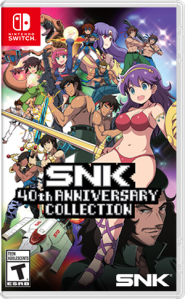
I really should have started off the IGC Retro Bowl concept with SNK 40th Anniversary Collection v Capcom Arcade Cabinet. The two companies are already linked through some fighting game crossovers. And both these sets are sort of unique among retro compilations because they specifically cover each company’s early efforts before they found real success and notoriety. Also, I’d never played any of these games before I got these sets. Just the NES port of Ghosts ‘N Goblins, which isn’t included. But the real reason I should have led with this match-up is because just how damn similar so many of these games are. It’s truly remarkable. It literally made me feel uncomfortable. Playing these two sets next to each-other was like watching someone actively peaking at a fellow student’s test answers, and you’re the only one who sees it and wonders if they should say something. So, sorry Sega Genesis Collection. You’re going to have to wait. We have a grudge match to settle.
 IN THIS CORNER
SNK 40th Anniversary Collection
$39.99 for Nintendo Switch (coming to PS4 in March)
23 Arcade Games and 9 NES games released between 1979 and 1990
Game purchased by me.
 IN THE OTHER CORNER
Capcom Arcade Cabinet
$4.99 for Starter Pack (required), $24.99 for “All-in-One” pack (all remaining games) $3.99 for each individual game, or $9.99 for packs of multiple games sorted by year for Xbox One via Xbox 360 backwards compatibility.
17 Arcade Games released between 1984 and 1987
Game supplied by fan.
Before getting started, I want to point out how stupidly convoluted getting some of these games for IGC Retro Bowl has been. To purchase backwards-compatible Xbox 360 games on your Xbox One, you can’t actually use your account’s existing balance. Xbox 360 games require you to have a credit card on record. That is so stupid. I understand it has to do with the agreements made with third-parties for how Microsoft would handle the transition from one console to the next. But I didn’t know that until after a fan had already attempted to purchase Capcom Arcade Cabinet for me while it was on sale. This will actually come into play for more upcoming IGC Retro Bowl games like Rare Replay (which features backwards compatible Xbox 360 ports of N64 games) and Midway Origins (another backwards compatible collection).
ORIGINALITY
Now look, I’m not naive. I know the game industry is a gigantic match of “monkey see, monkey do” done with a series of 1s and 0s. It’s been that way literally from Pong onward. But it’s sort of amazing how many games in SNK’s collection are eerily similar to stuff Capcom already made. Commando came out about seven months before Ikari Warriors. Street Fighter (not included in this set) came out two years before Street Smart. Ghosts N’ Goblins was a smash, and then Athena was shat out by SNK (which I pronounced as SINK for the longest time). But the truly amazing thing is how rare it is that the later SNK versions improve upon the stuff they were aping. Only Psycho Solider, which borrows heavily from Capcom’s SonSon, feels like lots of effort was made to ramp-up the formula. Of course, that came out three years after the game it was, ahem, inspired by. I hope it would be better after that long.

To be honest, even with Psycho Soldier putting in a bigger effort, I liked SonSon more. But, I didn’t enjoy either game so that’s damning praise. Most fans of Psycho Soldier.. that’s apparently a thing that exists.. remember it more for its music than it’s gameplay. I played both sets muted for the most part and no siren call is going to convince me that game of all games isn’t just fucking boring.
Not that Capcom are saints in this category. Pirate Ship Higemaru is basically their version of Sega’s 1982 arcade anti-classic Pengo. And there they somehow made a shitty game even worse with some of the most crappy, unresponsive controls I’ve seen in a game like it. The issue is more that at least some of the Capcom games feel like they were taking existing concepts and trying to evolve them. You don’t get that sense with any of SNK’s 23 primary games, with one exception: Crystalis. Which can be summed up as “SNK’s version of Zelda.” It retains the action-RPG concept of the original Legend of Zelda but throws in actual leveling-up mechanics and other role-playing conventions. Yes, Zelda II did that as well, but that’s a side-scroller. Crystalis feels like a sci-fi version of the game most Zelda fans were hoping Adventure of Link would be and wasn’t.
But that’s the lone exception, and even then, it feels like they’re playing follow-the-leader. All the games in SNK 40th Anniversary can be comfortably described as “SNK’s version of..” fill-in-the-blank. Fantasy is SNK’s version of Donkey Kong. Ozma Wars is SNK’s version of Space Invaders. Sasuke vs Commander is their version of Galaxian or Galaga. The most original game is Paddle Mania, and it really sucks. Capcom wasn’t exactly inventing new genres, but at least it feels like they were building onto them instead of just xeroxing them.
Edge: Capcom Arcade Cabinet
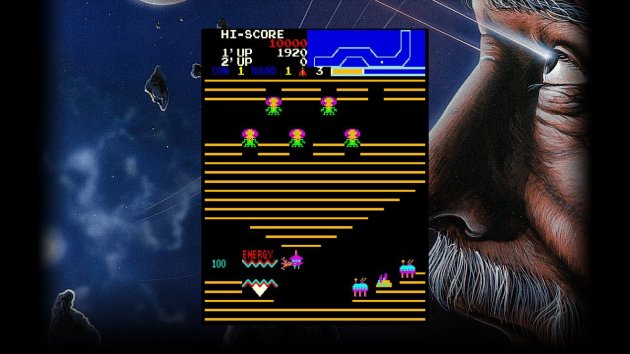
Vanguard is both an example of everything right and wrong with the SNK set. It’s actually one of the more fun games to play, but it’s so generic and so derivative that it’s no wonder it was completely lost to history.
EXTRAS
Gameplay is king. That has been my mantra at IGC since day one. But the special features for SNK 40th are so jaw-droppingly awesomeballs that it almost overrides the actual games. I’m such a hardliner for gameplay over bells and whistles that my friends and family literally can’t believe I’d even have to stop and think about it. SNK has a museum menu with tons of information, sort of like a guided tour. Tiny little factoids, even for dozens of games not included in the set. And there are cabinets and flyers and promotional art assets and concept art. It’s all well sourced, cleaned up, and easy to access. None of it is locked (though the museum stuff did seem to cause my game to crash a lot, like 20+ times since December). More than I can say about Capcom’s set, where everything is locked and what little I was able to get wasn’t remotely impressive. Some of the extra-extra features require putting in as much as 25 hours combined on the 17 games here. If they had aged particularly well, maybe they can justify that. They didn’t, and so Capcom can’t. My friend Garrett was supplying me with more factoids and trivia than they did. They should have just packaged him with every copy.
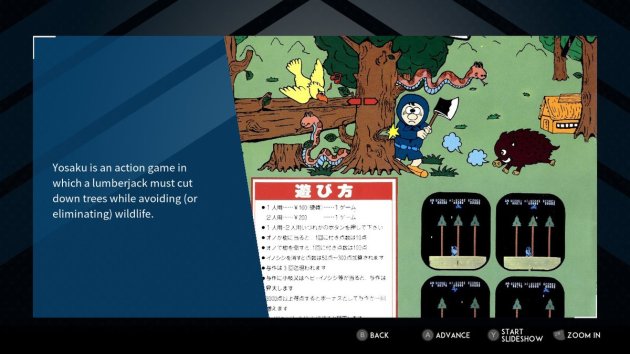
Apparently the files for Yosaku are mostly lost, and a good dump of it doesn’t exist, or so I’ve been told. As the collection notes, it’s one of the most rare arcade games out there. There’s not TONS of information for each game included with SNK 40th. It feels like a coffee table book in video game form.
That’s enough right there for SNK to win, but they spiked the ball by including the ability to rewind games so that you can undo your mistakes, an increasingly common feature I’d like to see more of in the future. But even that wasn’t enough. SNK 40th has the single coolest feature of any classic set ever made. All the arcade games (along with NES-exclusives Crystalis and Iron Tank) allow players to watch a video of someone (possibly tool-assisted AI) making a perfect run at each game. Now, are you ready to have your mind blown? You can actually stop the video at any time and take over the controls from there out, in the exact same spot the video was at. You really have to see it to believe how cool it is.
This, ladies and gentleman, better be a regular feature in classic collections going forward. If it’s not, I can’t be held responsible for my actions.
Major Edge: SNK 40th Anniversary Collection
BEST GAME
1943 Kai is probably the best overall game from either set. I can already hear Crystalis fans reaching for their keyboards to complain. Well, actually I think the best game in SNK is one I’d never even heard of before buying it. It’s called SAR: Search and Rescue. It’s an early blood-and-guts shooter. The original arcade machine, like several SNK shooters, used a special rotary joystick that allowed you to move in one direction and shoot in another without the need of a second stick (like Robotron used). Without that specialized input, SNK 40th converted the titles to twin-stick shooters for this collection. This is actually a positive, as fans of the era told me the twin stick step-up is less clunky and more intuitive. And SAR is genuinely riveting in a time capsule type of way. It’s just so.. gory. I wasn’t expecting that. Despite being a bit slower than I prefer such a game, it never got boring, plays great with two players, and really feels like they were trying to grab attention. If it had actually been given a decent name, maybe it would have taken off. Search and Rescue for a sci-fi game like this? Lesson learned, kiddies: put more than two seconds thought into your names.

That’s a lot of red stuff for a game that came into the world the same year I did.
Meanwhile, 1943 Kai is a moderately upgraded version of 1943, itself a sequel to 1942. The 19XX series is to gaming what the Fast and Furious franchise is to movies. It initially tried to stay somewhat grounded in reality, but by the third installment they were just out of fucks to give. Kai changes the plane and gives it lasers and other futuristic power-ups. Consequently, it feels more modern and, gasp, fun. Neither compilation has a particularly strong lineup, and I don’t know what it says that I wasn’t truly in love with anything from either set. But if I had to choose one game to play for the rest of my life, I think I’d rather play Kai.
Slight Edge: Capcom Arcade Cabinet
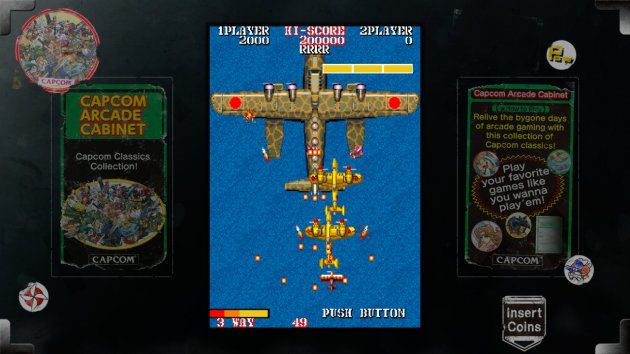
I don’t think this is historically accurate.
WHAT’S MISSING THE LEAST?
Both sets focus on the formative years of the respective companies and both are missing a lot of games. In the case of SNK, the initial release was missing a lot more, but an update added 11 titles. That still leaves several no-shows. Games like Atom Smasher, Satan of Saturn, Lasso, Marvin’s Maze, Vanguard II, Gladiator, Jumping Cross, Main Event, Canvas Croquis, Hal 21, Touch Down Fever, Fighting Golf, Fighting Soccer, Mechanized Attack, Baseball Stars, Sky Adventure, or Touch Down Fever II. Now, I won’t pretend like I’m some kind of SNK aficionado. I’d never heard about most of these games until I read about them. But I did just read about their existence.. in SNK 40th Anniversary Collection, where they are displayed prominently in the game’s museum. While I’m sure it would have been time and resource consuming to port all those as well, the fact that there’s so many of the games missing with no word of more DLC coming, free or otherwise, makes this set feel very incomplete.

None of the games listed in this screenshot from the complete SNK timeline included in the collection are present in the game. That kind of sucks. I thought Vanguard was interesting and now want to play the sequel. Game companies that put these sets out might inadvertently send gamers rushing to MAME to check out the stuff left on the table. It makes me wonder if they would have been better off waiting to release the collection in November of 2019 in order to include more games. But then again, SNK 41st Anniversary Collection doesn’t have quite the same ring to it.
Capcom’s heavy hitters can’t be satisfactorily explained away either. Yes, more complete Capcom sets (Capcom Classics Collection Vol 1 & 2) were released for the PS2 and original Xbox. Well, this isn’t those consoles. There’s no original Street Fighter. Or Final Fight. Or Bionic Commando. Or Mercs. Or Tiger Road. Or Forgotten Roads. And yea, some of the games did get a separate release in Capcom Beat-Em Up Bundle. But again, this is actually a backwards compatible game from a previous generation. They didn’t plan the Beat-Em Up set yet. So skipping those games here feels very lazy. What we did get feels like a dumping ground of games nobody in their right mind would actually want as anything but part of a collection. I don’t think that’s true of SNK. Even with so many missing games, I don’t feel anything that is definitively SNK is missing from that compilation. There’s no truly iconic Capcom game in a Capcom collection, and that’s just plain baffling.
Edge: SNK 40th Anniversary Collection
HISTORIC SIGNIFICANCE
The following is an indisputable fact: the Capcom that exists today is, for better or worse, the same linear company that made the games featured in this set. You can’t say the same about SNK. The SNK that published the games in this collection.. well.. died. And that makes perfect sense. I’m guessing diehard fans of the company that are older than me won’t want to hear it, but I always looked at SNK like a cover band that made inferior versions of more popular work. They were making the Dollar Store, off-brand also-ran fighters that didn’t sniff 1/10th the success or reverence Street Fighter II did. I’m sure there are people out there that will swear on a stack of Bibles that King of Fighters or Samurai Showdown were better games than Street Fighter II and its twenty-two billion special editions. But they weren’t making terrible movies with Jean-Claude Van Damme based on King of Fighters. For my generation, we mostly know SNK from generic, red arcade cabinets containing four generic games from franchises they don’t make new games for (mostly) today.
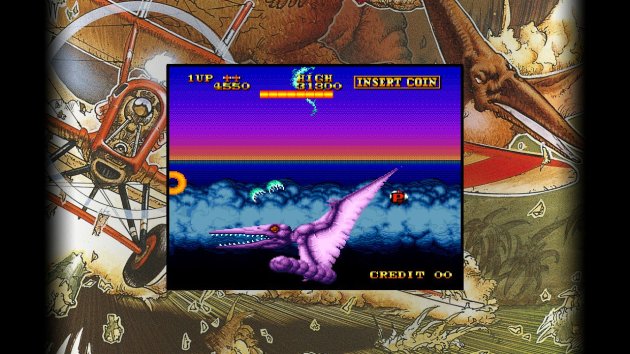
Before buying SNK 40th, the only time I heard of any of the games included in it were from people talking about how bad they were. Like the Angry Game Nerd riffing on the NES version of Ikari Warriors (included in this collection, and yes indeed, it’s truly horrible). Prehistoric Isle is probably the third best game of the set. Not great or anything, but genuinely fun. Good use of theme. But it’s not exactly the type of game that comes up often in casual conversations with Golden Agers. That’s the SNK set in a nutshell: okay games you’ve never heard of and probably will never play again once you finish them once.
But, the issue is none of either company’s truly iconic franchises are here. And trust me, while you’re sitting there stewing that some hateful millennial said tons of mean things about your favorite classic games, I’ve been sitting here for hours positively stumped about how I quantify the historic value of the games we actually have in the set. Ghosts ‘N Goblins is probably the most overall famous title of anything featured today. But it’s famous for all the wrong reasons. It’s not so much a “good ole days” game as much as it was a “games were harder back in the day” crowing point that blowhards point to. Almost none of whom actually beat these games on the developer’s terms. They needed save states or Game Genies or any other laundry list of help to make anything resembling progress. Ghosts ‘N Goblins is famous because it’s a terrible game that lots of kids really wanted to like and actually didn’t. Everything else in the Capcom set barely qualifies as a footnote in gaming history. And the one game that most gamers do remember and still talk about, they talk about in the same tone that they talk about their old high-school friend they reconnected with on Facebook only to find out he’s since become a holocaust denier.
Maybe you can say the same thing about the SNK set, but this is where the extra features provide an assist. Because the games in that collection are framed in a way where the hateful millennial you’re still pissed off at gets education on why these games mattered, and how they laid the groundwork for the company that SNK would become. I didn’t know their first arcade game had intended to use interchangeable cartridges, and even if that game isn’t present here, I think that shit is neat. Like, wow, they actually had something like Neo Geo in mind right from the very foundation of their existence in the 1970s. That’s swell. Maybe Capcom wouldn’t have lasted if they hadn’t found moderate successful with games like Side Arms or Vulgus, but what we do have feels almost unimportant. The games in SNK’s set are displayed with such care and love that it makes them feel more important to our community’s history than they probably are. Plus they included NES ports of the games, as if to say “well if you think Ikari Warriors was shitty in arcades, you should see what people at home had to suffer through.” Both sets feel light on importance, but..
Slight Edge: SNK 40th Anniversary Collection
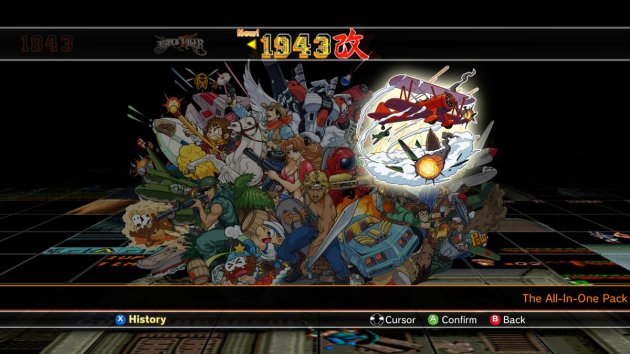
“Maybe if we just throw all the game artwork into a big pile and use that for a menu, nobody will notice the complete lack of star-power in our set.” Oh, and you can only get Vulgus and 1943 Kai if you buy every other game in the set. They can’t be purchased separately and are “bonus games.” Kai is the best game in the collection and Vulgus is at least decent enough to not be painful. You really dicked fans with this one, Capcom.
PLAY VALUE TODAY
Probably the biggest issue with Capcom Arcade Cabinet is just how maddening the games are. I adjusted every game’s difficulty to easy and I still was losing virtual quarters in under a minute to most of the games. Gun.Smoke I lasted 35 seconds my first attempt. Of course, for Fantasy on the SNK collection, my first play took me 2.3 seconds of actual game-time to lose all my lives. Yes, you read that right: 2.3 seconds. If I had been a teenager in 1981, I’d probably have been arrested for punching out the screen. It’d been my final Fantasy if you catch my drift.
But nothing else in the SNK set fucked me to the degree Fantasy did. And while most of the games underwhelmed me in both sets, the issue with Capcom Arcade Cabinet is how samey it is. Most of the games are some form of a shmup, and all the ones that aren’t I found to be terrible. Ghosts ‘N Goblins? Terrible. Gun.Smoke? Terrible. Avengers? No, not that Avengers. No, not one either. No, an original game called Avengers. It sucks. Trojan and Black Tiger seemed like they could be fun, but even on easy the enemies drained health too fast and the overall design seemed like it was based around taking quarters with little regard for giving players value. I started a life in Black Tiger and in under 30 seconds, I opened a treasure chest that caused an instakill. It’d be like if the old man in Zelda said “it’s dangerous to go alone, take this” and then pulled out a glock and capped Link. Game Over. I somehow doubt Zelda goes down in history as an all-timer if it pulls that stunt.
The most interesting game in Capcom by far was Speed Rumbler, a game so lost to history that it doesn’t even have its own Wikipedia page. It plays like a primitive form of the old 2D Grand Theft Auto games and might have been fun. But again, prohibitive difficulty and unresponsive controls sort of make it hard to appreciate that it might have been the unstated inspiration for one of the biggest franchises in gaming history. Or, as a friend pointed out, it might have inspired the NES Roger Rabbit game. (Hey, why not both?) Two games in Capcom’s set I could unambiguously say I enjoyed: Side Arms and 1943 Kai. Out of seventeen games. The rest are either broken, boring, or so underwhelming that my saying “it’s alright” would immediately be followed with a yawn.

Speed Rumbler also suffers from extreme difficulty. It makes me wonder if the “easy” options are purely decorative.
With SNK 40th Anniversary, nothing blew my mind. Both the games that had the highest potential to do so (Crystalis and SAR) have something so wrong with them that it mutes my enthusiasm for further playtime with them. Crystalis controls too loosely and the primary weapon feels weak and unsatisfying to stab stuff with. SAR simply plays too slow and lacks enough wacky weapons to make it truly the spectacle I suspect it was trying to be. The best game with the fewest problems, Prehistoric Isle, is really just another fucking shmup that happens to have an interesting theme and little more going for it. To be clear: these are good games. But, the rest of the set can say what Capcom can’t: the games are playable and never feel demoralizing. Maybe I was underwhelmed with Ikari Warriors 2, but it hardly sucks. Bermuda Triangle isn’t mind-blowing, but it wasn’t worthless either. The two best games in Capcom are probably better than anything in SNK’s set, but SNK has more stuff worth looking at. Gameplay is king, and you just plain get more with SNK.
Edge: SNK 40th Anniversary Collection
WINNER
SNK 40TH ANNIVERSARY COLLECTION
 And that makes me happy for one primary reason: Capcom’s set feels like a cynical cash-grab. I’m surprised the emulator isn’t constantly shitting the bed with it. It’s that half-assed and that rushed. It’s such a lazy, uninspired set of games. If they were excluded from a real Capcom’s greatest hits set, I don’t think anyone would actually miss 80% of them. The irony is that SNK’s games all felt about as original as an Asylum film, but there’s nothing about SNK 40th Anniversary Collection that feels soulless or like a cash grab. It’s a labor of love. I can’t imagine this particular collection of games would sell a lot. I’ve even seen people who came close to buying it only to change their minds when they found out Neo Geo era games weren’t along for the ride. Given that none of these games, even Crystalis, are exactly legends, it wouldn’t be reasonable to think a compilation like this would ever grace a top-sellers chart. This seems like a bad investment for SNK to make. And yet, it exists, and it’s actually really beautiful. SNK 40th Anniversary Collection was made as a way for SNK to tell their fans “you know what? We always did appreciate your support.” When do you ever seen that from a major game company anymore? I didn’t even like most of the games in it, but I’d recommend it in a heartbeat to anyone who wants to take a stroll down memory lane with someone who deserves to take that journey with you. And from what I’ve seen here, SNK absolutely should be that company.
 Abadox: The Deadly Inner War




 Indie Gamer Chick
You must be logged in to post a comment.