Wario Land: Super Mario Land 3 (Game Boy Review)

Wario Land: Super Mario Land 3
Platform: Game Boy
First Released January 21, 1994
Directed by Hiroji Kiyotake and Takehiko Hosokawa
Developed by Nintendo
NO MODERN RELEASE*
Listing on Mario Wiki

*I made a mistake when I first published this and said Wario Land is on Switch Online. It is not.

From here out, if there’s an option to do color versions of classic Game Boy titles (meaning more than just four Super Game Boy-like colors), I’m taking it. If home developers are going to go to all the trouble of colorizing these games, at least one person with a semi-big review platform should acknowledge them. All the color screenshots in this feature are from Wario Land: Super Mario Land 3 Color Edition by korxo, who did a very good job given the limitations.
Link to the Patch

The fire attack and the dash attacks don’t show up all too well in screenshots. Thankfully, I barely used the dragon hat.

Okay, I’m pretty sure this is the last game that’s officially part of the Super Mario franchise’s 8 bit and 16 bit era that I haven’t reviewed. Like Yoshi’s Island, it’s only technically part of the Super Mario franchise thanks to a subtitle and really exists to act as the starting point for its own spinoff franchise. As of this writing, there’s been eight Wario Land games (assuming you count Wario World for GameCube and Wario: Master of Disguise for Nintendo DS as “Wario Land” games, and I do), and it all started here with a game that built to the strengths of the Game Boy. It’s certainly not Mario-like. Wario Land is actually more of the spiritual successor to the legacy of Doki Doki Panic and later Super Mario Bros. 2. It’s a much, much slower action game with a focus on exploration. There’s no B-running and no fast reaction times required. Even when you’re being stalked by a killer Thwomp, the tempo is kept pretty low and the focus is on creating tension, not panic.

Actually, it does the “chase” gimmick twice, with the second time turning the Thwomp into a boat at the end.

Which isn’t to say there’s no action in Wario Land. Wario’s tackle is satisfying enough, and it’s always fun to pick up a downed enemy and throw them off their perch and to their death, hopefully involving lava. If it worked perfectly, the combat would be S-tier for 8-bits, but that’s not the case. Wario is one of the first 2D retro games I’ve reviewed where the physics are wonky to the point of being genuinely unpredictable, mostly thanks to the level layouts. If you attempt to pick up an enemy with any structure nearby, whatever you’re carrying will be knocked out of your hand, and the enemy might instead shuffle around like they’re square dancing upside-down around your sprite. There’s a roughness to Wario Land that’s obvious right from the start and sticks around until the bitter end.

This is not a traditional hop ‘n squash game. I took more damage fighting the most basic enemies than I did in all other Mario games in this marathon combined. I don’t know if a single goomba so much as nibbled at the tip of my boots in the Mario games, but these little things called Pirate Gooms got me several times. Usually because they recovered right as I was reaching them. I may or may not have lost lives to them as well. (cough) Hey, it wasn’t MY fault. It was the physics. I swear.

Thankfully, the combat takes a deep back seat to stellar level design, but even that has this undeniable roughness to it. Wario Land has one of the strangest progression structures I’ve encountered, as some early levels have multiple exits and branching paths, one of which leads to an entirely different game world that’s otherwise inaccessible. Hell, the very first level in the game takes place on a beach, and the level’s format changes after you beat the first game world and the tide comes in. It’s a great idea that had me so pumped-up to see what other wacky changes would happen to the game world.

And then, after the 23rd of 40 stages, the “multiple exits” concept is abandoned completely, never to return. In total, only five stages have hidden exits. Imagine if Super Mario World didn’t have any key holes after the halfway point. Well, Wario Land actually does that, and it’s so goddamn weird for it. The idea of changing world maps is also largely abandoned, as I’m pretty sure there’s only one instance of it with any consequence after the secret exits stop. A lot of games give off the impression of having more ambitious plans that were left on the drawing board, but with Wario Land, I really think that might be what happened. The only way I can make sense of the structure is that they ran out of time and had to delete multiple exits and possibly stages when the time came to code the game, only many earlier ones had to be left in because they stuck a game world off in the corner, where nothing else on the map can logically reach it, and there was nowhere else to hide the treasures within.

Unlike Mario World, the keys that unlock the fifteen hidden treasures are often placed away from the skull doors that hold them. Sometimes, they’re on the total opposite end of the level, and carrying the keys from Point A to Point B is a pain in the ass. In a good way, I mean. Thankfully, the keys don’t vanish if you scroll them off screen, and you can also use them to kill enemies.

The good news is that hidden doors aren’t the main thing you’re searching for in Wario Land. What you’re really trying to do is accumulate money to buy a bigger house than Mario lives in after Wario’s attempt to claim squatter’s rights in Super Mario Land 2 didn’t work out. The plan is to steal back a gold statue of Princess Peach that was stolen by Captain Syrup, the ruler of Brown Sugar Pirates (why is it always food-based names? Does Nintendo not feed their developers? It would explain a lot!). Surprisingly for a Nintendo game, Wario doesn’t intend to fetch the statue in order to court Peach. Oh no. Wario might be a greedy Mario doppelgänger, but he’s a greedy Mario doppelgänger who follows the golden rule: don’t stick your d*ck in crazy, and when the ruler of a country commissions a golden statue of themselves, it’s a safe bet they’re f*cking nuts. Go ahead and cringe, but Wario played Super Princess Peach. He knows what’s up. So he plans on ransoming the statue to raise funds to buy a castle. It’s the most petty reason to go on a harrowing adventure, and it ends with Mario stealing the statue anyway.

As luck would have it, the final boss is a genie and, once Wario has won the fight, he gets to make a wish. He probably should have made it “I hope that my action-adventure franchise doesn’t completely evaporate by the 2010s” but I’m getting ahead of myself. Because the absolute monarchy of the Mushroom Kingdom is so capitalist that even a genie needs to get a bag, to make Wario’s wish come true, you need to accumulate as much money as possible. The hidden treasures are given value in coins after you beat the genie, and I’m fairly certain that if you find all fifteen of them (and complete all forty courses as well), you will max out the coin bank and get the best ending, which is Wario getting his own planet.

Update: WRONG, you will need about 10K in coins plus the fifteen treasures plus have an all-clear for the forty courses to get Planet Wario.

Mario would later top this by getting his own galaxy. Always a bridesmaid, huh Wario?

Finding the treasures IS hugely satisfying because the game doesn’t tell you where they are. While the five stages with hidden exits are marked on the overworld map, there’s no indicators for which levels have treasures (something Virtual Boy Wario Land did). The only thing you can really use to help is the fact that the fifteen treasures have spots sequentially on the scoreboard. So if you’re missing the “G” treasure, it’s going to be found in one of the levels between where you found treasures “F” and “H.” I love this, and the only thing I wish for is that, once you found the treasures, the game told you what stages you found them in. I also wish Nintendo would build a much bigger game based around this idea. I found MOST of the treasures on my first playthrough, but the act of getting them was rarely a layup. In fact, the second-to-last one I could not find for the life of me.

When you do find the treasures, it’s a moment. It never feels anything short of great.

As a proof of concept first attempt at a new franchise, Wario Land holds up shockingly well. I don’t think it will be for everyone. The slow movement will be a major turnoff for a lot of players, as will be the clunky mechanics. It also has some exceptionally weak bosses. At one point during a boss fight, I was dodging attacks and hunkering down for a typical “three hits and your dead” type of battle. But after a few passes, nothing was happening, so I charged at the boss and it worked. When he was stunned, I picked him up and threw him in the lava and the fight was over. Curiosity got the better of me so I rewound the fight and this time, I charged as soon as I could. It worked.

Even with satisfying combat, I wouldn’t recommend playing Wario Land specifically for it. It’s just not polished enough for that. From an action perspective, it’s for sure the roughest 2D combat I can remember Nintendo doing, including Kid Icarus. But as a true treasure hunt game, I was constantly surprised by how much fun I was having. Wario Land has NO bad levels among the forty total courses, which is nothing short of remarkable given the limitations of the Game Boy. And, as I said, even the basic enemies can pose a threat, so you can’t sleepwalk through it like you can the Virtual Boy sequel that was the only Wario Land I really ever played through all the way. Okay, so the difficulty is largely thanks to the janky physics and stiff jumping, but it’s charming even when it feels like it doesn’t work the way the developers intended.

The later levels that take on maze-like characteristics are so strong that I wouldn’t have minded if EVERY level had been that way. They basically did have that mentality for the sequels.

I’m sure a lot of people will say Virtual Boy Wario Land is the superior game, but I’m not going there. Both games are vastly underrated, but once you stack the eagle helmet and dragon helmet in VB Wario Land, it’s all over but the shouting. The game becomes too damn easy, and that broke my immersion a lot more than the eye-melting red and black visuals did. While there’s a few pits that I feel are too touchy and the collision is never as good as you want it to be, Wario Land: Super Mario Land 3 never allows you to go on cruise control. It’s an imperfect build of the perfect 8-bit mix of platforming, action, and exploration. But even the imperfection feels like it fits Wario like a glove. What other character could get away with a game that feels this unfinished? I assume since it was 1994, they thought the Game Boy was near the end of its life cycle and they had to rush it out. Hah.
Verdict: YES!

Super Mario Land 2: 6 Golden Coins (Game Boy Review)

Super Mario Land 2: 6 Golden Coins
Platform: Game Boy
First Released October 21, 1992
Directed by Hiroji Kiyotake and Takehiko Hosokawa
Developed by Nintendo
Available with Switch Online Subscription (Standard)
Listing at Mario Wiki
Color screenshots are from Super Mario Land 2 DX by toruzz
Link to the Patch

I really don’t think it’s Mario or Zelda or Kirby or Samus Aran that prove Nintendo is the Death Star of video games. It’s Wario. You know, the throwaway final boss in a Super Mario Bros. spin-off that went on to star in twenty games where his name appears in the title, and that’s not even considering that he’s one of the most popular characters in Mario Kart. Hell, Wario can even lay claim to being the star of a killer app for an entire video game platform. Okay, so it’s Virtual Boy, but it still counts. Meanwhile, Wart is like “f*cking seriously?”

I can’t imagine how mind-blowing seeing Super Mario Land 2 must have been in 1992. Mario as a Game Boy franchise went from looking like this:

To looking like this:

Cool. Nintendo set out to give players the Super Mario World experience on the Game Boy. A task that was basically impossible, but they really did give it the old college try. I suppose that’s why Mario Land 2 is maybe the weirdest game in the entire “Super Mario” franchise. Most of the rogues gallery are one-off enemies that don’t really feel like Mario baddies. This even includes things like pigs with cannons for snouts, a Kid Dracula-like vampire that shoots bats at Mario, and Jason Voorhees-like evil hockey masks complete with a f*cking knife sticking out of them. Seriously, what?

6 Golden Coins feels like it has just enough Mario staples like the mushrooms and fire flowers, Goombas and Koopa Troopas, or the right kind of destructible blocks to pass as a Mario game and not some kind of weird ROM hack. I assume this was done because turning a popular colorized 16-bit game into an 8-bit black and white game was too tall an order. If they copied too many enemies, then all they would be making is a much, much lesser version of the game everyone really liked. Which is sort of what they ended up with anyway, but I do kind of understand why they created such a large roster of new enemies and locations. Probably the best thing I can say about Mario Land 2 is it still feels pretty fresh. Instead of the typical hill stages, fire stages, ice stages, etc, you go into outer space, a graveyard, or a giant mechanical statue that Mario built to honor himself, I guess.

For seemingly no reason, here’s a stage where the ground is shaped like LEGO. It doesn’t do anything different. It’s just a floor, but, look, it’s shaped like LEGO (or Nintendo’s LEGO knock-off)!

So, uh, this is the one that gets me assassinated but I didn’t really like Mario Land 2 at all. I didn’t hate it or anything. It controls fine and has decent jumping physics, but I was just really bored playing it. I imagine a child in 1992 would be more than satisfied with this brisk, easy-going Mario game that looks great but had its potential held back by the Game Boy’s hardware limitations. While the enemy sprites might look original, they couldn’t really do anything creative with their placement or have too many on screen at once. Hell, the hockey masks are just normal Goombas that look different when you get right down to it. Granted, most enemies in Super Mario games are cannon fodder, but these ones are especially easy to deal with. Some of the indestructible underwater ones had a tight squeeze to avoid, but otherwise, there’s just not enough threats in Mario Land 2. The bosses are all pretty weak too.

Tatanga, the final boss from Mario Land 1, was the second boss I faced and the first enemy that damaged me at all. About three seconds after he got me with one of his projectiles, I nailed all three hits against him in a row because they didn’t give him hardly any invincibility frames. He basically reverse-stomped himself into my feet.

If the level design was amazing, that wouldn’t be a problem. But despite the original backdrops, I found myself listless playing the stages. Even the ones structured like mazes are too basic for their own good, and the act of exploring isn’t very rewarding because so many of the unlockable bonus stages feel samey. Only one of them provides any reward besides just an extra stage for the sake of an extra stage, and that’s a shortcut in the Macro Zone that skips two of the levels and takes you straight to the zone’s final stage. Okay, so it was cute that the moon got pissed off at me for getting the Space Zone’s bonus level, but the novelty wore off when I had to actually play the stage and it was just more of the same. I don’t mind the level count, but the bonus levels need a reason to exist. Hell, there’s even a random level in the map, the “Scenic Course” that just sort of is there for no reason besides “why not?” It does nothing. It unlocks nothing. It’s pointless. I think Nintendo was capable of better than that by 1992.

Hey, don’t look at me like that! You’re the one that only has two levels.

So, yeah, I’m not a fan of Super Mario Land 2. The rabbit ears aren’t a very fun power-up (they’re basically the racoon tail without the soaring through the sky part), the game is far too easy, and things like how carrying a turtle shell is done by balancing it on your head because they couldn’t squeeze in an animation of Mario carrying the shell thanks to the hardware limits made me cringe instead of smirk. Really, the only purpose Mario Land 2 serves today is being a reminder that ALL games are a product of their time. Most of Nintendo’s catalog holds up remarkably well to the test of time. It’s their most astonishing achievement. But the Game Boy wasn’t ever really meant to do that. It was designed to provide a lower cost portable experience that was good enough for the standards of over three decades ago.

You know, having the Three Little Pigs would have been a cute idea if I hadn’t already fought a completely different species of pig that shoots cannonballs at me. Do YOU guys shoot cannonballs? No? Then how come that thing wasn’t the boss and you are?

I actually tried to do this review back in January, when I reviewed Super Mario Land, but I got bored pretty quickly and shut it off. I gave the original game a YES! because, rough as it is, it’s a unique Mario experience unlike any other Super Mario game before or since, something you can’t really say about Mario Land 2. The two games have a lot in common. Like 6 Golden Coins, Mario Land 1 has unique-to-it locations, enemies, and themes. I guess I just like the idea of Mario exploring Ancient Egypt, Easter Island, and a world based on Chinese folklore more than lock blocks or a graveyard. But it’s not just that. Mario Land 1 feels like a one-off Mario gameplay experience. Mario Land 2’s gameplay is just the best approximation of Mario World they could muster within the limits of the Game Boy. An impressive engineering feat? Sure.

The level design just never rises above being okay. I’m happy I waited until after playing every other 80s and 90s Super Mario game to do 6 Golden Coins, because it really aged the worst out of any other game in the series. It just offers so very little that holds up. All that it really has left is a lot of personality, but hell, every Mario game has that, don’t you think?

Fated to age well? Nope, and that’s okay, because it worked for the kids of 1992. I’m happy for them. It’s just not 1992 anymore, and from the moment I booted up Mario Land 2, I couldn’t wait to be done with it. God, I really hope they don’t remake this one. Oh, Nintendo will eventually, but when it happens, I hope it’s a full reimagining with new level design and power-ups that keeps the basic frame work. The idea of Mario Land 2 is fine, but it’s a product of its time, and that product is about thirty years past its expiration date. Thanks for giving us Wario, though. I do like Wario.
Verdict: NO!

Super Mario Bros. Wonder (Nintendo Switch Review)

Super Mario Bros. Wonder
Platform: Nintendo Switch
Released October 20, 2023
Directed by Shiro Mouri
Developed by Nintendo
Listing at Super Mario Wiki

$59.99 paid for Mario’s visit to the Betty Ford Clinic in the making of this review.

It took 38 years but Nintendo finally figured out to just run with the “Mario on Drugs” joke.

The above screenshot is from the second level in the game. During the first stage, I was worried that I was heading for another New Super Mario Bros. “I guess this just isn’t for me” experience. And then in the second level, I dropped acid and the piranha plants started singing and having a parade, and I was hooked. Oh they don’t call it “acid.” They’re called “Wonder Flowers” but they have a psychedelic glow to them and they do things like make the pipes come to life like they’re inchworms or cause missiles dropping rainbow smoke trails behind them, and yes, even make you see dragons. This isn’t symbolism, people. This is as on the nose as it gets, and I’m there for it.

The only proof this isn’t really drugs: Mario actually caught the dragon.

For a while, I really thought Mario Wonder was cruising to the title of “best 2D Mario game” with no if’s, and’s, or but’s about it. This was based largely on the stellar level design and batsh*t insane Wonder Effects. But some really head-scratching decisions made it an actual debate, which I’m grateful for because this would have been a pretty boring review for me otherwise. Which isn’t to say you can get bored playing Mario Wonder. Oh no. This is far and away better than any of the games in the New Super Mario Bros. franchise and a return to form for Mario as a 2D gaming stalwart. MOST of the levels are pretty damn amazing, and the three new power-ups are a lot of fun to use. I can’t really pretend this wasn’t the absolute best time I’ve ever had with a 2D Mario game, even with all the problems. Actually, the levels are so phenomenal that it’s kind of shocking the game did anything wrong at all, but it did.

The “Mario on Drugs” stuff really isn’t helped by the fact that the screen becomes trippy during the Wonder Effects. Again, this really isn’t winking. This is a drunk tapping you over and over saying “DO YOU GET IT?”

For one thing, the levels don’t scale right at all, nor are they ordered correctly. In the Magma World, there’s a level where evil popcorn kernels walk across giant rocks that heat up and cool down, and if they touch a hot surface (or are shot by a fireball) they pop and become evil popcorn. But, you can permanently deactivate the heating rocks by hitting them with water, either by throwing a pot of water at them or using Elephant Mario’s ability to store water in the trunk and spray it. It’s a fun stage, but then the stage you unlock is one of the “break time” stages. These are tiny micro levels that have a gimmick attached to them, some of which aren’t even real challenges and are just for funsies type of deals. Well, the break time stage in question is like a tutorial type of stage for the whole “get water on the heating/cooling rocks” concept. That’s not an exaggeration, either. It’s genuinely the type of brief micro stage that you would build to introduce a brand new gameplay concept, except you just finished a massive, difficult world built around the mechanic. What the hell?

This is the big stage in question. I had to beat it a third time to get the hidden exit, which a couple stages in each world has. Mario Wonder, from a pacing point of view, is heir-apparent to Super Mario World. They even have the same initials. Except they don’t because it’s not “Super Mario Wonder” but rather “Super Mario Bros. Wonder.”

I don’t want to imply that the “Break Time” or “Badge Challenge” micro stages are a complete disaster, because that’s not the case at all. Some of them had me smiling ear-to-ear. But the structure of the game, or rather the lack thereof, causes a lot of pacing problems. Sometimes the overworld maps are walled-off and sometimes you’re free to wander off the paved pathway and take a large cluster of levels, full-sized or micro, in any order you want. You also can’t rely on Wonder’s built-in quick travel to give you a proper level ordering either, because it always puts the full-sized levels ahead of the micro-levels. There is an attempt to tell you the scaling. The levels are given a one-through-five rating on their challenge, but I really didn’t feel they were accurate. I beat many four star levels on my first life and died a lot on plenty of two star stages.

Where you’re free to roam around the map, there’s lots of hidden stuff. Rarely a stage, and more typically Captain Toad who gives you 50 purple coins. Since you’re practically picking purple coins out of your ears, I don’t think the trade-off of a less logical level progression was worth it. I’d rather have the game follow a semi-strict linear progression with the occasional branching path. If 1991’s Super Mario World can do it brilliantly and still offer a sense of exploration and discovery even with paved pathways, then it’s proven that there is no need to suddenly allow players to walk around the map.

It feels like the developers just threw together the game’s courses and couldn’t decide on an order, so they gave up on the process almost entirely. But the example in the lava world I cited above was one of those pathway parts of the map. It wasn’t MY choice for how it played out. It was the development team’s choice. This isn’t a nothing-burger complaint, either. Pace and tempo matter a great deal. I put a very high premium on a game’s maintaining one consistent tempo of quality, and Wonder is all over the place. And some of the “break time” levels really are a complete waste of time, offering neither quirkiness nor challenge. It’s been a long, long time since I played a modern Nintendo game that had so many aspects of it that felt like placeholders for something bigger that just never got finished. They also should have probably somehow incentivized the badges that are outright handicaps. The one I hated the most sees you perpetually bouncing. I would never use it voluntarily, but they could have easily added some post-game content just by offering rewards for beating specific levels with specific badges. Without that, most badges will go completely unused outside of their micro-stages.

The new bubble power offers the same type of instakill satisfaction of the classic Super Mario fire flower (which is also in this game) but with the added benefit of being able to use the bubbles as boosts for your jumps. But, what really makes it work well is that it’s not effective enough to be able to use it to cheese stages. Its usefulness for platforming, even in multiplayer, is very situational, but in a good way. Actually, none of the power-ups are overpowered. There’s no p-wings or hammer bros. suits to wreck the difficulty curve. Probably a good thing, since Nintendo screwed the pooch on curve from the format alone. Also, since I couldn’t find a spot to talk about it, the drill power is one of the most satisfying Mario powers when you do a Bugs Bunny attack on enemies. Ain’t Mario a stinker?

And while I’m complaining about things, Mario Wonder has the typical mediocre 2D Mario bosses. Yeah, yeah, I know I’m deeply in the minority on that opinion, but I just never enjoy the traditional Mario “jump on the head” boss fight style. I can, and have, enjoyed it in other games, but for some reason, it’s always a letdown for me in a Mario game. Maybe it just doesn’t feel like it matches the epic scope and scale of the worlds themselves. But the fights with Bowser Jr. in Mario Wonder, even though it tries to change up the formula by giving the battles the “Wonder Effect” after the first hit, never felt big or climactic to me. I couldn’t wait for them to be over with and my motivation for them was purely “I don’t want to go through this again.” Hell, the “bosses” of the airships are a literal single button that must be pressed, and the act of getting to that button was so simple and easy to bypass the “logic” of the chamber, especially if you have a badge that boosts your jumping ability, that I was always startled that the fight was over when it was. I guess I just assume based on the enjoyment of the levels that they’re capable of better bosses.

I don’t think this was the wisest spell to cast, Bowser Jr. It’s right up there with Ralph Wiggum getting the first swing of the sword and stabbing himself through the heart. Holy crap, Bowser Jr. IS the Ralph Wiggum of Nintendo. I just spent five minutes staring off into space, imagining the implication of that. By the way, Mario Wonder’s co-op doesn’t have the old fashioned New Super Mario “bounce off each-other” mechanics, and so I actually had a really great time playing co-op with Sasha.

There’s fifty-six total Wonder Effects throughout the game, but a lot more levels than that, so many effects repeat, and not every effect is a winner. Some are typical video game stuff, like running away from the giant spiked ball, or even returning an old Mario item like Balloon Mario from Mario World. Others are more outlandish, like requiring you to jump in sync with a musical beat or answer trivia questions where, if you look closely, the things doing the trivia look kind of like the viruses from Dr. Mario. All of the Wonder Effects are fun, truly! Well, they’re fun ONCE, and if they were each unique to a specific stage, I wouldn’t even have this paragraph. But I grew bored with several effects. The most annoying repeat is “Wubba Mario” which they must have been really proud of because all four of its appearances happen around the same time and it’s even highlighted in a story-driven level where you rescue a bunch of trapped miners. But it’s really nothing special. I’ve played plenty of games where you’re a sticky mass that sticks to every surface. This has been done, and yet they gave this over to a not-unsubstantial portion of the game, and I kind of hate that they did that. The kids loved it, though.

And actually, I think the levels with Wubba Mario were some of the weaker ones in Mario Wonder. Between its four appearances, they could have constructed one ultimate level that took all the best bits of them and made a full stage out of it, and it would have been awesome and welcome. Or hell, spread it out! It’s a great big game. Nope. It really does kind of hit close to four in a row and it just kills the excitement of getting Wonder Flowers. By the way, you then have to repeat one of those levels, literally just play it one more time, to open the path to that world’s Special Stage level. It might be the best 2D Mario ever, but Super Mario Bros. Wonder is NOT perfect.

There’s also an “easy mode” in the form of the Yoshis or Nabbit, who only can die from things like lava and pits, but enemies don’t damage them and Nabbit doesn’t even get stun-locked. This is important, but first let me say that, like Super Mario World, there’s a bonus Special World where every stage is designed to be extra difficult. When I reviewed Super Mario World and didn’t struggle all that much with Special Stages (which, for the record, I did, the first time I played the game as a kid), someone said “have you considered that you’re just really good at video games?” Which is flattering, but if it were true I wouldn’t have needed over one-hundred combined lives over the course of three days just to beat this one level:

This is one of those levels where whole new swear words had to be invented. I think I got up to eleven syllables for one of them.

It’s called “Special Climb to the Beat” and allegedly jumping to the rhythm is the key to winning. Okay, so I’m tone deaf and I have shaky hands, so this was fated to be my mortal enemy anyway, but it also annihilated the kids too. I sincerely thought I would not be able to finish the game.  I actually finished this review, but that niggling little voice that says “come on, you’re so close to acing the game” started screaming in the head, and I did eventually get to the top. And by the way: I HATE that getting the top of the flagpole is one of the requirements for 100%ing the game, because when I had to replay a few levels to unlock the ultimate final challenge (which is just a marathon of using ten of the badges, though there are a few checkpoints so it’s not THAT bad), for a few of them, the only thing I was missing was touching the top of the flag. There’s nothing worse than replaying a full stage just to do one thing at the very end differently. Anyway, back to the problem with the Yoshis and Nabbit.

Finally!

After beating the wall-jumping stage from hell, Sasha hopped on for co-op, and in fact, we beat four of the Special World levels on our first attempt WITH the purple coins and flagpole. But this is not a +1 in the “maybe she’s just good at video games” pile because co-op made it kind of easy AND the Yoshis made it even easier. Sasha, playing as Yoshi, could not be killed by enemies, and if only one of us was dead, we could come back to life just by our ghost hitting the other within “five seconds” but it’s really closer to eight or nine seconds. So after that stage that killed me a ton, we sort of flew through the Special World. If it took us twenty minutes total, I’d be stunned. Solo? Oh, these stages are brutal. But in co-op? We both died a lot AND beat the stages on our first try. Also, the Special World really isn’t THAT special. What made the Special World stand out in Mario World is that the levels were weird, experimental, and crazy. Well, that’s sort of the whole game of Mario Wonder, isn’t it? Wonder’s Special World stages are harder, but they’re not creatively better because the whole game is this kind of weird, experimental, and crazy.

Now here’s the good news: when Mario Wonder is at its best, it’s pure gaming euphoria. Well, I’d hope so since that’s sort of the point of drugs. One of the many reasons it stands tall over the New Super Mario games is that those always felt like they used the original 8-bit/16-bit games as little more than a checklist. “These are the things we need to put into the games, because nostalgia.” Not Wonder, though. It feels like it used the original games for inspiration to do a game that feels modern and not like a throwback. Which isn’t to say that the games don’t fit with those. The jumping physics are as intuitive as Mario World’s. The cast of enemies is right up there with Super Mario 3’s. The effort made to give each stage its own personality also matches Mario 3’s, and that’s where Wonder really shines. It feels like a true evolution instead of a cash-grab homage.

There are multiple levels in Mario Wonder that are very obviously not designed with co-op in mind. I’m totally fine with that because, say it with me: CO-OP RUINS EVERYTHING. One of the reasons the New Super Mario series is so f*cking bland is because Nintendo put such a heavy premium on the co-op gameplay that came at the expense of the single player experience. Every single stage had to work with four players bouncing off each-other. They clearly didn’t give a crap about that with Wonder, because levels like this one, where you launch super high with each jump, caused more fatalities than a Mortal Kombat tournament. I’m all for it, too.

Like Mario 3, if any stage doesn’t “do it” for you, that’s fine because you’re one stage away from a completely unique experience. Even if the Wonder Effect is a repeat, how the stage is built, and the ebb and flow of it, will almost certainly feel like a one-off. It must be hard to do, because there’s not a lot of 2D platformers that can maintain that for the full length of the game. Even Mario World didn’t completely succeed there. With Mario Wonder, Nintendo has now done it twice in this franchise (probably three times since Yoshi’s Island kind of did it too).

Yes, yes, we all liked Limbo, Nintendo. I wonder if the elongated Mario being framed in silhouette like this was a joke against Limbo the indie game and limbo the thing drunk people throw their backs out doing. “Limbo under the bar when you’re stretched out like this, bitch!”

Super Mario Bros. Wonder is the polished, modern Super Mario Bros. 3, and to a lesser extent, Super Mario World. What stood out to me in Mario 3 is how, in retrospect, Nintendo did a pretty poor job of incentivizing exploration of the stages. They jammed plenty of content if you do explore, but didn’t effectively corral players into it. The most important question a game designer can ask is “why?” As in “why would players find this stuff?” And I don’t think “just because” is a good answer. I don’t think Nintendo knew that “WHY?” was the be-all, end-all design question in 1988, but they sure did by 2023. Mario Wonder is the most effective 2D Mario for convincing players to see everything through natural gameplay mechanics. They asked themselves “WHY?” and came up with answers, and as a result, for all of its glaring flaws, Mario Wonder is the best 2D Mario game. Sorry, Super Mario Bros. 2 and ROM hacks of Super Mario Bros. 3, but you’ve finally been beaten.

As I stated in my Super Mario Advance 4 review, Mario 3 was a game made in Nintendo’s adolescence. As amazing for its time as the game was, it was also still a game being made by people who were still learning how to develop “Nintendo” style games. Almost exactly thirty-five years to the day after Mario 3 released for the first time and Super Mario Bros. Wonder hit stores, and it’s a game made by Nintendo designers who have graduated as game designers. They know what they’re doing now. They ask “WHY?” a lot, and they understand how to maximize every gameplay mechanic. Mario Wonder IS Mario 3, all grown-up. The irony is, there’s still a lot of gamers out there, 50-somethings, who insist they will NEVER play “modern crap” because they just know in their heart the classics can never be beaten. They refuse to grow up, and I’m very happy the people designing games at Nintendo aren’t like them. Growing up ain’t so bad after all.
Verdict: YES!

They really did need better unlockables than this, though. Couldn’t they have given costumes for the characters?

Super Mario RPG (Switch Review)

Super Mario RPG
Platform: Nintendo Switch
Released November 17, 2023
Directed by Ayako Moriwaki
Developed by ArtePiazza
Published by Nintendo
Listing at Mario Wiki

$59.99 is never going to get 100 jumps in the making of this review.

SPOILERS AHEAD for a nearly three-decade-old video game. You’ve been warned.

This is going to be a largely whinny, negative review focused on the changes (and lack of changes) from the original, so I wanted to state right here and now: this is some of the most fun I’ve had in the last couple years playing a game. I loved this remake. I recommend even non-fans of RPGs who have held out on Mario RPG check it out. But, it’s a remake and I have a lot of opinions on it, and remakes in general.

If you think this looks bad for our heroes, you should see what happens when they say “I don’t know!”

I have a bonkers conspiracy theory about Super Mario RPG: Legend of the Seven Stars that is 100% for sure not what really happened (based on the concept art that you can see at Cutting Room Floor), but I’m sharing it anyway. I think the game was originally going to be Mario fighting a demented mechanical Santa Claus who, instead of making fun toys for good girls and boys, made weapons that caused kids to turn violent. The whole “machines want to take over the world” thing is a little too Power Rangers Zeo for me, but is it just me or do these weapons look a little.. toy-like? They crash into Bowser’s castle for no reason, and when you finally enter the thing that crashed into the castle, it turns out to be a factory of these toy-like weapons. A workshop, if you will. Perhaps the story was about saving Christmas and Santa Claus, or maybe even saving ALL the holidays. And what does the final boss look like? EXACTLY like an evil Santa Claus.

“MECHA-SANTA WANTS A HUG! HUUUUUUUUUUUUUUG ME!”

I’m telling you, I’m on to something. Or on something. Either/or.

Regardless, this is probably the first Mario game where the story matters. I really don’t want to play an RPG with a paper-thin story, but here we are with a story so thin it’s measured in atoms. I played Mario RPG for the first time when it debuted on Virtual Console in 2008, and writing in RPGs had come a long way from the 8-bit/16-bit era. *I* grew up on the PlayStation Final Fantasy games, which were essentially the bridge to the modern well-written/well-translated era of RPGs. Going back to play games with blunt, on-the-nose writing is something I struggle greatly with when I do these retro reviews. I’ve liked a couple old school RPGs, but that’s usually based on the gameplay merits. Like, Final Fantasy VI? AKA the one the generation before me was told was Final Fantasy III? It’s fine but it didn’t “move me” because, again, a different time and era.

“Okay, I found a scenic cliff. Now, according to Simon Belmont, if I just stare at the castle with triumphant satisfaction, it’ll crumble. Okay, HMMPH, there. Okay, crumble. Any second now..”

I won’t say the plot of Mario RPG is deep, and hell, most of the actual writing is just okay. It is somewhat cleaned up in limited areas, but most of the script carried over from the original game. When I first played it in 2008, even though the dialog often had me cringing, I thought it was one of the funniest games I’d ever played. They would NEVER call it a “comedy RPG” but it clearly is. Playing this now, in 2025, most of the jokes still hold-up. That’s why I’m kind of puzzled as to why they ruined the best gag in the game: the introduction of Geno. In the SNES game, when Mario is shot by the child with the Geno doll, it’s a really violent impact with a rocket. In the remake, Mario is shot with what looks like a few Nerf balls. It completely ruins the entire bit. Why’d they do that? Ugh, you just know someone said “we can’t have a child violently shoot Mario! Someone will say we’re being insensitive towards people who are shot by children who fish their daddy’s pistol out of his sock drawer.” YOU KNOW IT’S TRUE! That’s probably why they changed it and it’s stupid. On the other hand, there’s this:

Jesus mother of God. Okay, maybe I’m wrong.

Otherwise, most of the humor still lands. It is somewhat lacking the charm, because it no longer feels like it’s squeezing the most out of the limited technology. Like how the heroes change into other characters to act out the story for new characters? That was done that way because it was a novel and entertaining way to do expository dialog using the limited space of the SNES. They did add a few brief and context-limited cutscenes that are mostly used for major character introductions (and boss introductions). They look great! I mean, like this:

Christ, can you imagine the fan fiction this led to?

Actually, bad example because that was a cutscene in the original game. Okay, the part where Peach joins the team by jumping out the window. That’s a pre-rendered cutscene now.

That looks like it’s straight out of a modern Mario game! Fine with me, but there’s just not nearly enough of it, and the timing of when to use them isn’t exactly perfect. The above whining about ruining the Geno gun gag? Wouldn’t that have been an awesome time to cut to a pre-rendered cutscene? If my hunch is right they were really worried about the visual of a child accidentally no-scoping Mario, change the gag! Have the rocket knock a statue over that falls on Mario. I also found it annoying that they have to spell out that you’re not really joining Bowser’s minions. In fact, they continue to spell out that you’re only pretending to believe Bowser’s bravado basically every time the character is given dialog. It’s kind of condescending, but I assume that’s because the script was written in 1996. I’m surprised Square didn’t have the characters look into the camera and say “DO YOU GET IT?” So, while the humor still works, the writing typically doesn’t. Too on-the-nose, too clunky, and it really doesn’t have a lot of faith in people to get what the intent is.

“Sir, I keep trying to tell you that you can’t always get what you want.”

Okay, so the plot and writing wasn’t fated to age perfectly, but do you know what did? The combat. I re-played the SNES game back in 2021 and by that point, you’d think Mario RPG’s peppy timing-based combat system would have started to show its age. Well, it didn’t at all. Twenty-five years after the game’s original release and I found myself grinding XP just for fun because menu-based combat had never felt so impactful. If there was one aspect of the game that nobody could possibly complain about being copied and pasted as it was to the remake, it’s that battle system. Well, besides the graphics themselves, ArtePiazza barely changed any aspect of the main game. The dialog, script, mini-games, enemies, bosses, etc. are mostly unchanged, with the small exception of the names of a few basic enemies and items. If they’re leaving that much alone, why rock the boat by changing the most famous, celebrated, and evergreen aspect of the game?

Hell, for the Beetlemania game, they didn’t even change the graphics.

But they did change the combat system. The balls on them for doing that, too. The riskiest change to make, easily, and if it sucked, you could insert the Stan Lee “broke, or made better?” meme from the Simpsons and call it a day. Thankfully, that’s not the case at all. The combat is even faster paced and more rewarding, with attention to the little details. I really don’t think there’s any aspect of it that isn’t better in this version. Like, it didn’t bother me but the SNES game paused a little bit when enemies cast spells. In the remake, the pause is briefer and feels like it flows directly into the attack. A small change, but one with profound gameplay results. Most of the special effects for unblockable enemy spells are faster. They turned one of the speediest combat systems in RPG history into an even peppier one. It’s a pretty remarkable achievement.

In the remake, it’s a LOT easier to time the “LUCKY” shell game and double your earnings. Once I figured out the timing and how the game occasionally does a little sleight of hand at the climax of the shuffle, I never lost once. Combined with the Exp. Booster you can buy with frog coins in the back half of the game, I was basically maxed-out going into the final two game worlds.

By far the biggest change is the addition of splash damage. If you hit the timing perfectly on basic attacks, it creates a shock wave that has a high chance of damaging all other enemies. Not as much as if they were attacked directly, but it still made the basic battles and even a few boss fights fly by. This also made backtracking a lot less annoying. If you’re searching for stuff you missed in previous stages and have leveled-up enough, instead of having to fight every enemy, a single basic attack might wipe out the entire battlefield. If the splash damage isn’t the biggest change, it’s the combo system. There’s now a meter for stringing together both offensive and defensive timing. This not only buffs your characters but builds up a new triple-team special meter. The triple teams can be devastating attacks, create unbreakable shields, etc., and each three-character combination has their own unique move. Assuming one of the three characters is KOed, the special is replaced with Toad providing a roulette wheel to buff you in the battle. That roulette single-handedly saved me from defeat in the final-final battle of the game against the 3D Culex.

This is the “!” warning that helps players get the timing down. If you want, you can opt to play “breezy” mode, which gives you a much bigger grace period on the timing-based stuff. This can be toggled on and off any time.

There’s even more changes to the battle system. KOed/transformed characters are allowed to be swapped out mid-battle for a reserve character. And yes, if the situation provides, you can swap one KOed character for another KOed one. The game also now tells you what magic attacks from enemies can’t be blocked, something the original game never stated. There’s also a visual cue of when to hit the action button for both attacks and defense. BUT, here’s the thing about that cue: once the game is satisfied you have the timing down for the thing triggering the action, the game stops doing it, like training wheels. Later on, if your timing gets out of whack, the prompt returns. It’s SO SMART. The whole combat system is!

I think this might technically make Mario RPG the best Power Rangers game of the 90s.

The improved battle system is also the reason why I can’t overlook all the changes they didn’t make. Jeez, and I thought the Link’s Awakening remake was stubborn about fixing stuff. Like, the lame puzzles in the sunken ship or in Bowser’s Keep are copy and pasted wholesale from the original 1996 game, including the solutions to those puzzles. In the sunken ship, you’re trying to ascertain a six-letter secret word. The answer is the same in the 2023 version as it was in the 1996 version. Would it have really killed them to change it to something else? Some of the puzzles in the first version were just plain not very fun. Like this one:

This is a blind jumping maze. Behind those boxes, you have to randomly jump around until you find your way through it. No visual clues to help once you’re behind the stack. No real way to logic through it besides the abstract shape of the maze. It’s so inelegant, especially for such a rich and layered game. This is scraping the bottom of the barrel. So, like.. replace it! How the hell do you justify so many additions and enhancements to the BEST part of the game while leaving the gameplay elements that were kind of the f*cking pits the same? And I’m only bitching about it because they proved their bonafides with the battle system. The remake designers clearly could recognize areas where quality of life could be seamlessly applied. They’re just too talented to leave the bad parts bad. And by the way, there’s also parts that are significantly worse. Remember this mini-game:

I found it to be a lot more sensitive when turns are made. I never cared for this part to begin with, but I didn’t *hate* it. But in the remake, I really didn’t care for it at all. Or how about the Goomba Whack-a-Mole game with the pipes? I found it to be a lot less precise and I’d never want to play it again. That was actually true of most of the mini-games this time around. I remember grinding-up frog coins by doing the waterfall/river mini-game over and over. Something about it in the remake just didn’t “do it” for me. Very few areas where an improvement NEEDED to happen were actually improved, while the thing nobody would have expected to be overhauled was overhauled dramatically. It’s F*CKING WEIRD! It’d be like bringing your car into the shop because it has faulty brakes, and when you pick it up, the mechanic says “we decided not to fix your brakes, but hey, we installed heated seats and a sat-nav for you!”

They didn’t fix the Yoshi race, either. It’s still one of the most unnecessary and ultimately boring parts of the game.

Speaking of the frog coins, that’s another change to the battle system and overall game that wasn’t capitalized on. In the remake, 20% of enemies will now be “special enemies” that hit harder and have more HP, but when you defeat them, you get double the coins, double the experience points, AND a frog coin. Awesome, except one little problem: they didn’t really create more situations that require frog coins. They’re basically only good now for finishing your journal 100%. There’s a detailed list of monsters in the game that, when you use Mallow to read their mind, get a check mark on the list. Some of these are one-off beasts, and if you aren’t using Mallow, you have to pay a guy hidden in Booster’s Pass three frog coins, and you don’t even get to choose which one he checks off. I’m pretty sure it’s done randomly.

It IS a cool feature. You can watch every attack animation, spell animation, etc.

And, that’s basically it for the frog coins, other than the stuff that was already in the game. I never liked the items sold in the tadpole pond, so the frog that sells accessories like the Exp. Booster in Seaside Town is really the only legit use of frog coins, and in the new system, you’ll be able to buy out his full inventory pretty fast. That’s the extent of ways to spend this massive windfall of what had been a rare and desirable currency in the previous version. Sorry, but you just can’t do that! If you add more of a LOT more of a currency, logically you have to add a LOT more ways to spend it, and they didn’t. So, while I enjoyed the special enemy encounters quite a lot, all they ultimately do is take all the risk/reward out of how you spend frog coins.

If you’re into soundtracks, that also gets unlocked post-game. Not only that, but it comes with a fully decked-out player that also lets you listen to the original versions and even do random play.

I swear I’m done bitching. Well, mostly done, but now, here’s the good stuff. Super Mario RPG Remake is, no doubt about it, an easier game than the SNES one, so, I didn’t know what to expect from the post-game content. The framing device is that, once you restore the Star Road and wishes can be granted again, seven previous bosses had THEIR wishes granted. Now, getting this unlocked is busy work on top of busy work. Toad gives you a voucher for the honeymoon suite in Marrymore. When you use that, Geno looks longingly out the window. You have to go a couple screens into Star Road, and there you’ll discover the boss wishes. Unfortunately, instead of just clicking them and going to the new boss fights, you actually have to make your way to the original chambers where you fought them. Sigh. Okay, so that’s the bad news. Here’s the good news: most of these fights are legitimate RPG challenges, and lengthy battles to boot. The first one, a rematch with Belome, took me over twenty minutes to finish. In the second one against “Leveled-Up Punchinello”, the first thing that happened was he one-shotted Mario to death.

I guess he played Mike Tyson in Punch-Out!! before making his wish.

Actually, the Punch-Out!! comparison is pretty accurate, because the best way to describe these bonus fights is to think of the rematches from the Wii Punch-Out!! Only the final fight against 3D Culex is a normal punch-for-punch RPG battle. The other six all have some kind of twist to them, and for five of them, it’s a twist that makes them almost puzzle-like. Belome clones one of your party members, like in his previous fight. Only, this time you HAVE to fight the clone, because the clone’s first act is to cast a shield that deflects everything. Do you know how I won this fight? HE RAN OUT OF FIRE POINTS! I didn’t even realize enemies had FP, but the fight dragged out so long that he ran out of them.

You even fight Booster in the post-game quest, which never happens in the main game. He’s seen here, about to one-shot my entire party for the second and final time in this fight. Yep, I game overed against Booster, who is, for lack of a better term, a “special” individual. This is one of those “sit in the corner and think about what you’ve done” moments of my gaming life.

Now, these seven extra fights don’t scale correctly at all, at least in the order the page on the Wiki said to tackle them. The rematch against Johnny Jones, the 5th fight, is a one on one, no items allowed Mario v Johnny fight, and I won it on my first attempt when Johnny offered to let me swap my party members (who give you buffs even if they’re not part of this fight) and equipment. I put the best armor on Mario and just whittled him down. So that one kind of sucked. On the other hand, the final battle with Culex 3D took me a whopping 40+ minutes to finish. It has 9,999 health, and the crystals are beefer too AND killing them causes the crystal to buff whatever is still alive as it dies. And IT WAS AWESOME! Besides the Johnny Jones fight, all the bonus bosses were! The best part of the game for me, easily.

There’s still a hard cap on leveling-up. 30 is the max.

Two things annoy me about the bonus bosses. First is that there’s only seven of them. Seriously, they’re SO fun that I wish they had done one for EVERY boss. All-in, I spent about two hours locating them and fighting them. Two hours of additional content sounds like a lot, but this is a nearly three decade old game. Come on! The second annoyance is that this type of post-game beef is entirely limited to those seven boss fights. They didn’t enhance the overworld basic enemies post-game at all. Why not? Now granted, they added fast travel via the map, so it doesn’t take THAT long to reach them, but there’s also the emphasis on finding all the enemies you didn’t use Mallow to read the mind of. Post-game, those fights are spent having everyone else do nothing but defend while you wait for Mallow’s turn to read another mind. Had the developers added some muscle to the post-game overworld enemies, I honestly ain’t sure I’d be writing this review right now. I think I probably would have felt compelled to go out and fill out the whole monster checklist. So, I’m pretty frustrated with Mario RPG Remake. In fact, I don’t remember a game I liked that disappointed me off more. That KEPT disappointing me consistently.

Spent a solid 20 minutes trying to jump from the yellow vine to the green one, kept grazing it, but I couldn’t hold my grip on it. I was getting angrier and angrier, until my father asked “are you sure there’s not a platform there?” I said “I checked” and I truly believe I did, but yea, there was a platform there. So embarrassing.

But, even through all the disappointment, I never had to remind myself “this is one of the best video games ever made.” It never lets you forget that. It absolutely holds up to the test of time, changes or not. I guess that’s a big part of why I’m so frustrated by leaving so much of the game unchanged. Because there aren’t a lot of games out there that are honest-to-God contenders for the title of greatest of all-time. Mario RPG surely isn’t in that discussion. There’s just too many head-scratching decisions that were no doubt compromises based entirely around what could and couldn’t be done with the limitations of the Super NES. But, it feels like what’s already in the game could be tweaked slightly and transform Mario RPG into that legit GOAT contender. There’s a big difference between “one of the all-time greats” and “THE all-time greatest.” As much as I loved playing this remake, there’s something heartbreaking about a culture of development where “the greatest of all-time” is on the table and they don’t go for it,
Verdict: YES!

“You’re sure he said ‘triumphant satisfaction?’ Sounds like baloney to me! If this worked, why would he go through all the trouble of fighting Dracula? Logically, wouldn’t he just need to stare at the castle whenever Dracula resurrects? Okay, I’ll go back to staring. Just had a thought is all.”

Super Mario Land and Super Mario Land DX (Game Boy/Game Boy Color Reviews)

Super Mario Land
Platform: Game Boy
First Released April 21, 1989
Directed by Satoru Okada
Developed by Nintendo
Included with Switch Online Subscription (Standard)
Listing at Mario Wiki

I used the “Game Boy Pocket” screen filter in the NSO Game Boy app.

2025 is just starting and I’ve got Nintendo launch games on my brain. I can’t imagine why. Now that I’ve reviewed the Game Boy Tetris in Tetris Forever: The Definitive Review, I wanted to look at the road not traveled. The game that was developed to be the pack-in for the Game Boy, until Henk Rogers and Bullet-Proof Software convinced Nintendo that Mario Land would make Game Boy a children’s product, while Tetris would make Game Boy an EVERYONE product. The end result? Tetris became a global mega hit, Game Boy went from black and white curio to genuine gaming powerhouse, and Mario Land did okay. And by “okay” I mean it’s the #2 selling original black and white Game Boy title that wasn’t a pack-in (only Pokemon Red/Blue/Yellow’s combined sales are greater).

To the game’s credit, especially since the guys behind it weren’t exactly Nintendo’s varsity team, it looks great given the limitations. Nowhere near as silly as the Game Boy version of Batman: The Video Game looked.

In fact, Super Mario Land outsold Super Mario Bros. 3. Yep, really! It’s astonishing, isn’t it? This little, unassuming tech demo, the first Super Mario game made without Shiggy’s involvement, defeated a game that many would consider to have been the most anticipated sequel in gaming history, and certainly a game that actively reigns as one of the most cherished and beloved video games ever made. Is it really all those things just because it wasn’t packed-in with the Game Boy? I mean, duh, along with coming out the day Game Boy did as well. Mario Land is fine, but it’s not amazing. It’s not even so good that being one of the best selling games of all-time makes any sense outside the context of being a launch title for a relatively cheap, yet scorching-hot platform. I’d love to see what the attach rate was for the Game Boy and Mario Land through the first two years of Game Boy’s existence. It had to be in the high 90 percentile. It’s a strange game for someone of my era to look back on, because Mario Land is incredibly weak compared to other Super Mario games. Yet, I honestly don’t remember meeting anyone who was around for the Game Boy launch who had anything but glowing memories of it. Mario Land is as beloved as any other 80s Mario title. And it’s SO WEIRD.

I accidentally beat the third boss in about a second, before I even realized I was fighting a boss. Just one running jump, then walking off a platform onto a switch was all it took. I had been prepared to whine about this more, until I remembered that the Bowser encounters in the original Super Mario Bros. ended when you hit a switch at the end and weren’t exactly epics.

Mario Land is certainly the jankiest Super Mario game. It’s the movement physics that threw me off. There’s absolutely no sense of inertia at all. Whether running or landing from a jump, Mario stops on a dime. Hell, he stops on the rivets at the edge of the dime. You would think this would make platforming much easier, since it turns every jump from a calculated, athletic type of action that has to account for momentum into just a matter of raw distance. But, you do have to continue to hold the movement, because you can stop in mid-air too. My brain couldn’t adjust to this, I died just as much from screwing up otherwise basic jumps as I did misjudging enemies. I’m not trying to sound like an amazing gamer or anything, but I suffered the type of deaths playing Mario Land that I haven’t had playing a 2D platformer in a LONG time. I’m talking about screwing up some very basic stuff, and I felt so awkward when it happened. Like “jeez, I know that was on me, too. Yeesh.”

On the other hand, the lack of weight and momentum does make any interval-based enemies easier to get past. No worries about skidding INTO these fish. There’s no skidding! So, the physics engine isn’t totally challenge-creating. It’s just as often challenge reducing. Compare this game to the Cheep Cheep bridges in Super Mario 1, such as level 2-3. It’s not just that they fly out from the ground from underneath you, but it’s just as much your own momentum that makes those some of the hardest sections in Mario games. But, if the levels based around Cheep-Cheeps controlled like Mario Land does, I don’t think they’d be that hard at all.

Presumably, the lack of sliding was done to accommodate the motion blur issues in the early Game Boy screen. It’s also safe to assume that the length of the game was based around being a fraction of the OG Game Boy’s battery life, since there’s no means of saving. Not that you need it, as at only ten standard levels and two shmup levels, Super Mario Land is the shortest of any Super Mario game (at least when playing EVERY level, start-to-finish). Should take you 45 minutes, tops. When I first played Mario Land years ago, I didn’t like it at all. Now, eh, it’s fine. The ten normal Mario-style levels are decent enough. They’re a few steps above “basic” Super Mario gameplay, with things like hidden elevators or invisible floors that don’t really do all that much, but are fun to discover. And yet, outside of the question mark blocks and general hop ‘n bop gameplay, it never feels entirely like a Mario game. It feels like a Mario knock-off. But, like, a really decent, really flagrant knock-off.

You get to where I am by an invisible floor. If you’re not Little Mario, you have to deliberately take a hit, or you can’t go this way and have to fight the robots directly. There’s a couple areas like that in Mario Land.

I have two big problems with Mario Land. While I enjoyed the shmup stages well enough (hey, I like shmups!), ending the game on one was a massive downer. But, all credit where it’s due: this is the rare “let’s add a shmup to a platformer” game where the shump section doesn’t feel completely divorced from the rest of the game. They do a good job of making it feel like it’s the same character in the same world. The other big problem is the game is just too easy. Despite some pretty humiliating deaths, I never had to sweat a game over because there’s too many coins, extra lives, and short-cuts. I won’t say that it crosses the line or anything, because I did lose like six or seven lives along the way, including four to the final boss, but I still finished with around two dozen lives to spare. And when I threw on toruzz’s excellent Super Mario Land DX ROM (review up next), I finished the game with 58 lives. FIFTY-EIGHT! There’s only twelve levels, for Christ’s sake!

I don’t think ending a Mario game with a shmup boss is the wisest choice, but apparently this was the original intent by Miyamoto, who wanted something like this to be the finale for the original Super Mario Bros.

The best thing I can compare Mario Land to is watching the first season of The Simpsons. Everything is alright and certainly the product you’re familiar with, yet somehow also somehow so horribly wrong that it’s kind of a little spooky for it. Weirdly, it’s for the same reasons as the Simpsons, too: everything is off-model, including the locations, and very against the established canon. In the case of Mario Land, it’s full of one-off settings and enemies that never showed up in the franchise again and often feel like they belong to an entirely different franchise. Hell, the first three bosses can be defeated in the same way you beat Bowser in Super Mario 1, AND EVEN THEN, it never feels like they’re Mario villains, and the last boss sure as sh*t doesn’t. But ultimately, Mario Land doesn’t last long enough to bore, or even really to frustrate. I imagine a child in 1989 was probably thrilled that they had something that was a LOT better than the Super Mario Game & Watch for a portable Mario experience.

The most remarkable aspect of the game is it actually does make you feel like you’re in different worlds instead of against a static screen. It’s immersive, and in a way that holds up well in 2025. I didn’t expect that at all.

I played Mario Land twice in black & white and twice on DX (coming up), and I never shook the feeling that I was playing a glorified tech demo. That’s not necessarily a bad thing. It’s the reality of a launch title. When I look back on those Mario games that served as springboards for new platforms, most are pretty rough. Even Super Mario 64 feels like the whole engine could collapse at any time. Which makes sense, because they had to cut a ton of content from the game to make the release date, and even then, Miyamoto kept asking for more time to polish it, until Nintendo President Hiroshi Yamauchi told him the game was good enough. What strikes me most about Mario Land is, yea, it’s only twelve levels long, but there ain’t a stinker in the bunch. Every level is solid. Hell, you can’t even say that about every level in New Super Mario Bros. U Deluxe’s first world. So, maybe Super Mario Land hasn’t aged particularly gracefully in terms of its build. This is the roughest game in the entire franchise, and really there’s nothing even close to it in that regard. But, they still managed to show that the Mario formula is so airtight that it’s almost impossible to screw-up. Mario Land is solid, and as the Grand Marshal of the Game Boy, it’s hard to imagine getting the platform off to a better start.
Verdict: YES!

Super Mario Land DX
Platform: Game Boy Color
Latest Release: April 20, 2022
Unauthorized ROM Hack of Super Mario Land
Developed by toruzz

Link to Patch at ROMHacking.net
I use THIS tool to apply patches.

Super Mario Land DX isn’t merely a colorization of Mario Land, but that part certainly stands out the most. I’d previously played toruzz’s colored version of Super Mario Land 2 (which I will do a review for both the original and the DX version at some point in 2025), but Mario Land DX is equally impressive. The new sprites for Mario and enemies look great, and the whole game POPS as it never has before. It’s so visually pleasing that you really wish Nintendo would just buy this build and make it official. It’s beautiful, and Mario games should be beautiful, right? Plus the notorious slowdown in the hard mode (IE the replay of the game after you beat it) is gone too. I’m pretty sure the version on Nintendo Switch Online also corrects the slowdown issue but don’t quote me on that.

Yep, that’s Luigi. Yep, he controls kinda like you think he will. No, it’s not as cool as it sounds.

Mario Land DX’s big-big-big addition is Luigi, which is done in the same style as Luigi in the Japanese version of Super Mario Bros. 2 (aka The Lost Levels). He moves looser and jumps higher. However, it’s just not as fun as it sounds. I think it’s too loose. It’s probably best to think of Luigi as “Mario Land if the controls weren’t as good.” Unlike Mario, Luigi does have a little momentum. It makes lining up with the tiny blocks pretty hard. There’s a few sections in the game where you can smash a block between other blocks to reveal a hidden elevator. It’s insane how long it took me to line up Luigi to get that. I also went back to skidding off platforms. Yea, I wasn’t building up 50 lives in this run. Nope, not happening. With Mario’s platform games, for me, what makes them stand out in the genre is precision controls and precision movement. Mario took off as a franchise because, above all else, they control the best. Turn those controls rotten and Mario games wouldn’t be the biggest franchise in the genre. There’s a reason why Alex Kidd isn’t an icon, folks. 

This took FOREVER for me to get.

I’d only recommend the Luigi quest if you’re a REALLY big fan of Super Mario Land and want to experience it in a new way. I’ve never been a fan of games that use deliberately bad (or if not bad, difficult) controls for challenge. This is NOT made for me. But, it’s super easy to recommend Super Mario Land DX to anyone who wants to dip their toes in the wonderful world of ROM hacks because, golly, what an effort. And if you like color but really hate the new sprites (and some people do), you can toggle them off. There’s a few ROM hacks out there that change the levels, but I really sort of get the impression that the original design team already wrung every single drop of gameplay out of the limited Super Mario Land engine. I don’t really want to play more levels of it, especially when the only option left is to become trollish with the stage design. What toruzz has done here is EXACTLY what I want, and all I want, from a Mario Land ROM hack. Good job.
Verdict: YES!

Dungeon of Elements

Dungeon of Elements came across my desk early last week and I thought to myself, “A puzzle game? All right. I’ll play this real quick and have a review out by tomorrow.” Yeah… nope! That wasn’t going to happen. There is much more depth than a few short play-throughs can give you.

This looks familiar and that’s totally alright with me.

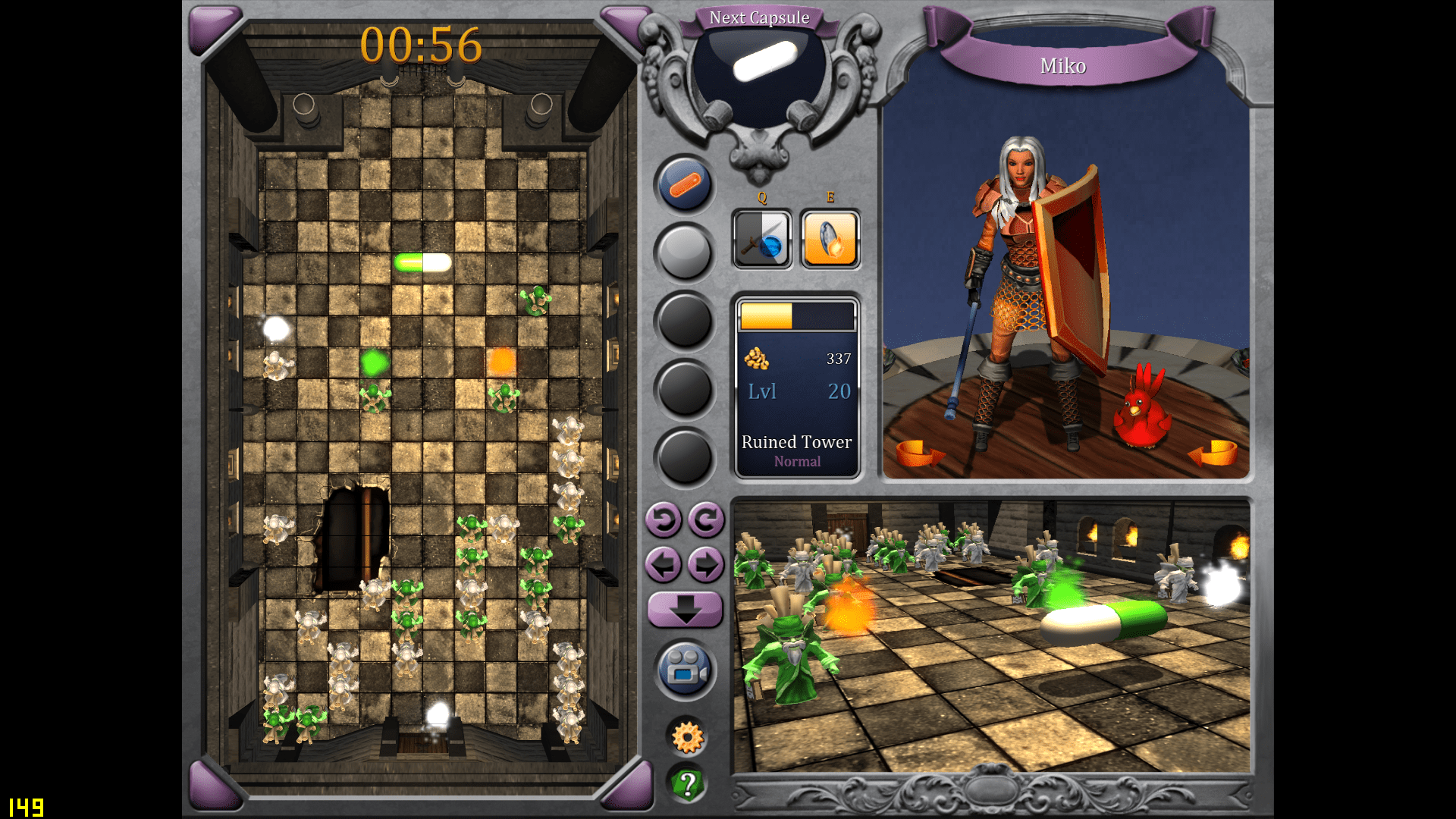
Main gameplay is heavily inspired by Dr. Mario. Drop multi-colored pills onto baddies, line things up, baddies are dead. The formula is very familiar and one that most puzzle game fans will be able to jump into right away. I think the game even goes one step further and improves on Dr. Mario a bit as you don’t need to line up pills in a straight line; just connect three like-colored pills in some sort of linked pattern and you’ll kill the baddies. Additionally, not only do you get to kill monsters, you also collect items that you can either equip or use in the game’s crafting system.

As you progress through the story (yes, a story!), you will encounter boss fights to mix things up a bit. For example, one of the first bosses was a giant rat whose rat army would quickly refill the stage as I cleared it out. Another boss was an orc king with an army of orcs that would slowly march toward the top of the screen. Occasionally he’d summon another orc exactly where my pill was falling, causing mayhem as the pill did not go where I had planned. This definitely added some excitement and was a nice change from the level grind. It also gave me a reason to invent more swear words and derogatory slang against orcs which I’m always excited about.

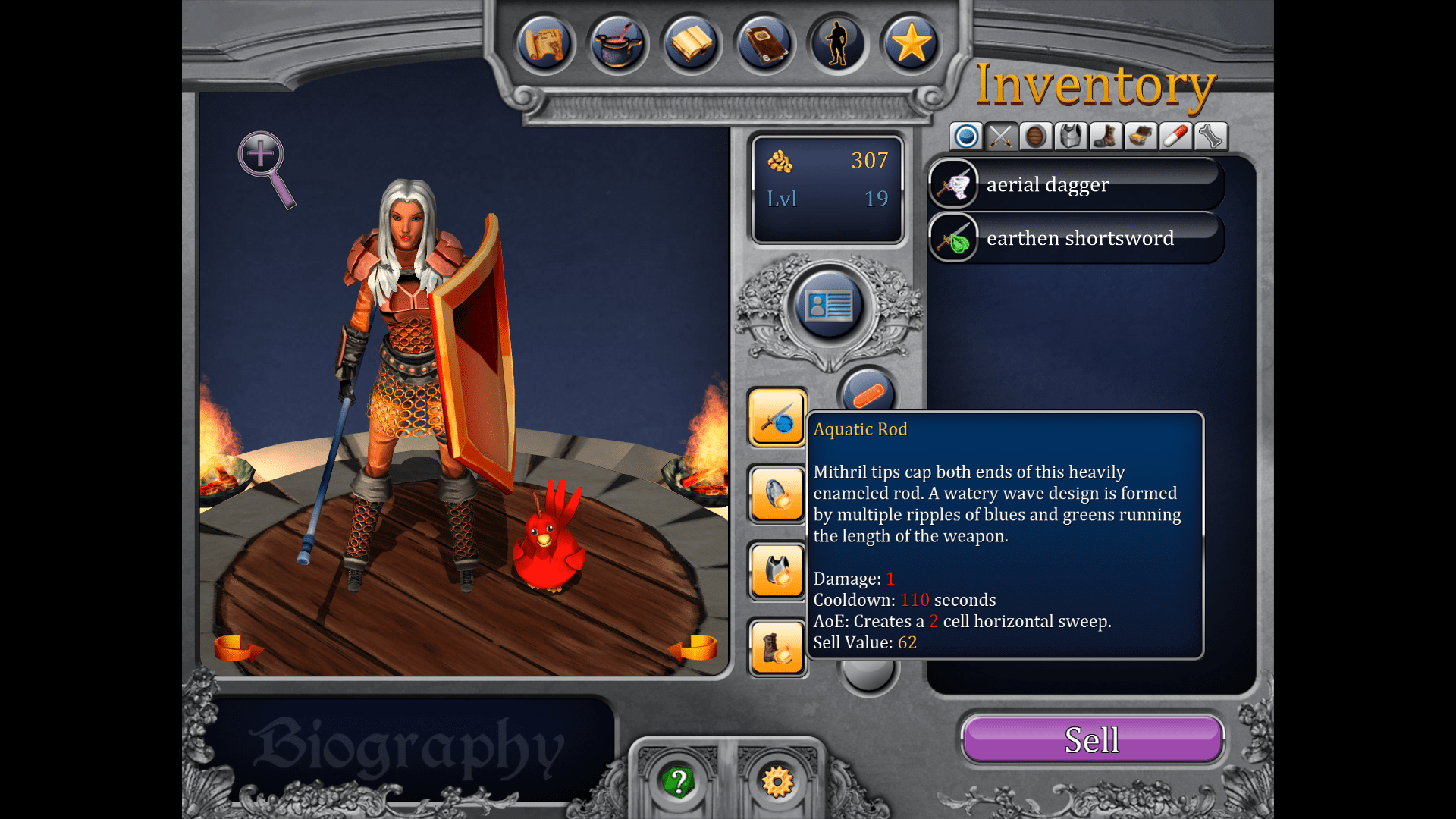
I have a water rod to dowse my fire armor if I get too hot.

I have a water rod to dowse my fire armor if I get too hot.

I mentioned earlier that you can pick up weaponry and armor; these are used to cast special attacks onto the playing field or slow down the fall of the pills. For example, the sweet bo staff skill I have at the moment is an AOE effect that blows up anything in a small area. This is particularly useful when monsters are effectively hiding behind objects on the playfield. Boots temporarily slow the fall of the pills to give you a moment to think about where you want to place them. Admittedly, one could also pause the game because it doesn’t black out the screen when paused, but that’s cheating, and you’d never do that, would you?

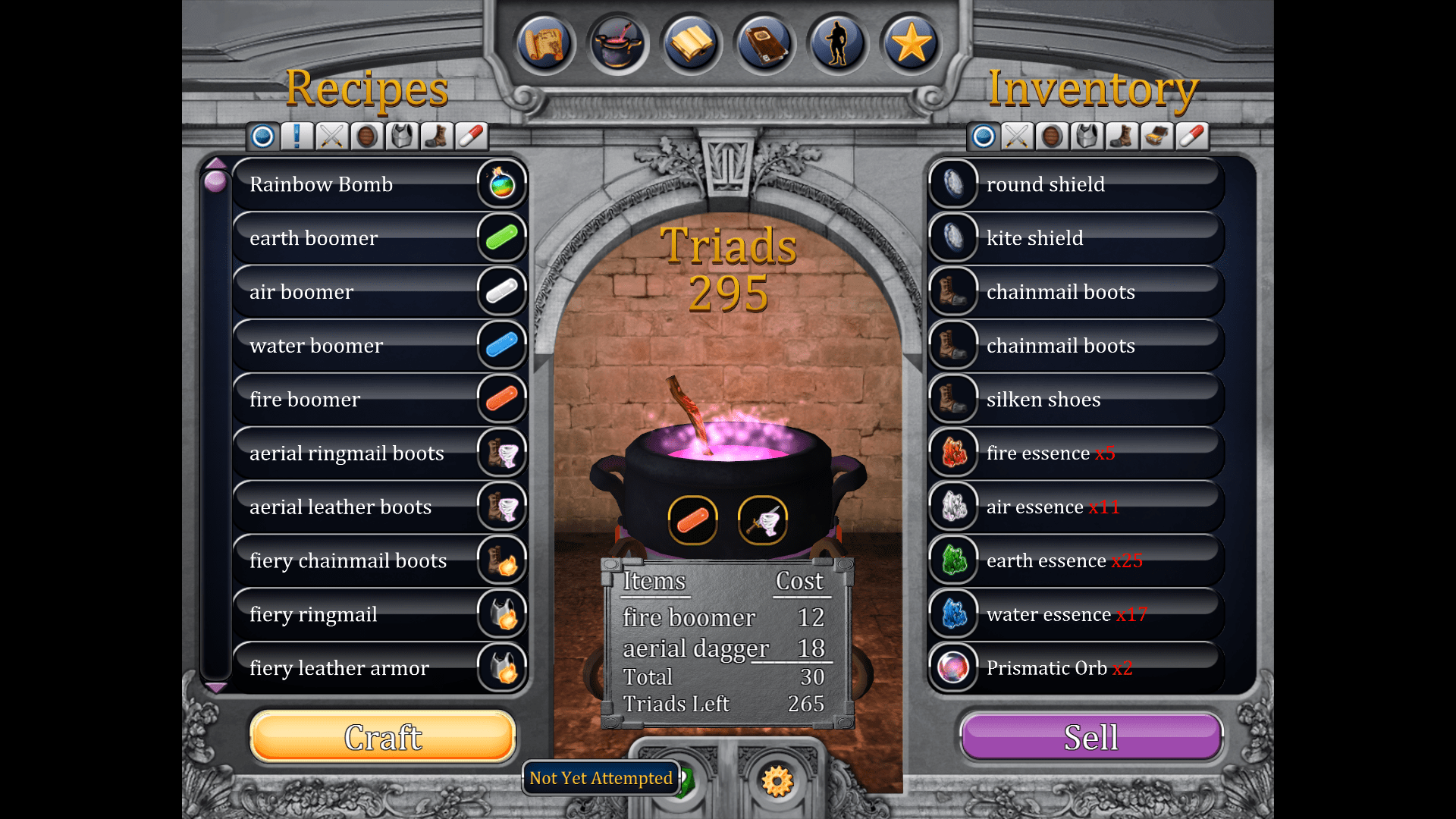
Crafting in the game is how you gather better gear and items. It’s an extremely simple system of THING 1 plus THING 2 equals ???. I really hoped you could do stupid things like Dagger + Shortsword = Shortdaggersword, but alas, no such luck; the game makes you do reasonable, logical things like element + weapon = useful thing. Crafting takes a little bit of time to get into because it also requires money that you really don’t have much of at the start. It’s a fun little thing to do during the downtime between rounds, and once you are able to make items, you can sell things you craft for more money than you put into them. Even better, the game actually keeps track of combinations you’ve tried so you don’t have to worry about failed repeats.

I try crafting something that's kind of logical-ish.

I try crafting something that’s kind of logical-ish.

Although there are a few things about the game that are shortcomings, I honestly do not think they take much away from the overall experience. It’s hard to describe without playing it for yourself, but when rotating the pills, they don’t always rotate as they “feel” like they should. As veterans of Dr. Mario will understand, the pills have a predictable way of rotating. The only time this potentially gets in the way is when you’re trying to expertly place a pill into a tight spot, heh heh, and it winds up doing something other than expected.

Item drops were a tad confusing at first because there were so many pieces of gear that had the same stats. I later figured out that there isn’t much of a difference between the items and that their main use is as crafting fodder, but this isn’t obvious for new players.

I wasn’t too keen on linking your Twitter account to the game in order to increase how much loot drops. I don’t like apps posting for me automatically. Thankfully there are some posting options such as “no more than once every 15 minutes” or “only post boss kills,” but it feels both a clever way to get some free advertising and an annoying way to get some free advertising. It’s probably not a bad idea, but irks me. I felt that enough loot dropped for me without linking my account.

Finally, there is one song that plays during the first few stages that is so repetitive, it drove me up the wall. I had to turn the music off and pull up Spotify until I reached a new area. Other than that one song, though, the music is pretty good.

This game is fun and I’m definitely going back to finish it up to try to open up hard mode.

A puzzle game that’s NOT on a mobile device that I’m coming back for? This doesn’t happen much anymore. If you like puzzle games, this one is worth your time.

doelogo

Dungeon of Elements was developed by Frogdice Games.

IGTlogo-01For $10 you, too, can relive the days when your dad wouldn’t let you play Mario 3 because he was addicted to some puzzle game starring Mario, a person I highly doubt has a medical degree.

My Ten Favorite Games Ever – Part 4

Continuing from Part 3, these are my personal ten favorite games ever.  Not the best games ever made, or even games I want to play again.  But the ten games I had the most fun playing the first time I played them.

Banjo-Kazooie

Age I was: 9

Last attempt at playing it: ten years later at age 19, when it was released on XBLA.

Would I ever play it again: No

Crash Bandicoot and Crash Bandicoot 2. Those were pretty much the definitive games of my formative years as a gamer.  Sure, there were lots of oddball games between those.   The original Rayman I enjoyed.  Bubsy 3D I did not.  At age 7, it was my first clue that not all games are created equal.  But while my experience playing a PlayStation kiosk lured me into asking Santa Claus for one for Christmas, I wasn’t quite to the point of tracking down every new release and having actual anticipation for upcoming titles.  And then I played Banjo-Kazooie at Toys R Us, and everything changed.

July 11, 1998.  My 9th birthday.  A brand new Nintendo 64, a controller that looked like a tumorous raptor-claw, and Banjo-Kazooie.  All mine.  How much did I love Banjo-Kazooie?  I didn’t even open the other game I got that day, Mario Kart 64, until a month later.  Banjo owned the rest of my summer.  I spent hours hunting down every music note, honeycomb, nook, cranny, and just being in awe of how much bigger this was than anything I had played before it.  This wasn’t a roped-off parade route, like Crash.  This was a full-fledged world that was alive and breathing, and it was mine to explore.

Banjo wasn’t the last game to wow me like that.  I had similar feelings the first time I explored Hyrule in Zelda: Ocarina of Time, or raced a Killer Whale in Sonic Adventure.  None of which I feel hold up today, but that first time through each will always hold a special place in my heart.  Platformers didn’t become special again for me until long after that.  Super Mario 64, which I played for the first time immediately after finishing Banjo-Kazooie, was hugely disappointing for me.  The world seemed less alive, less vibrant, and duller.  But that made sense.  It came out years before Banjo, and even Shigeru Miyamoto wasn’t totally satisfied with it.  He wanted to keep refining it, until Nintendo president Hiroshi Yamauchi outright told him “it’s good enough, we need to get this into manufacturing!”

Nuts & Bolts was just alright for me. Some of my readers are shocked that I didn’t like it more on account of my childhood love for Banjo. I don’t get the logic of that at all. It’s like saying I like peanuts, and therefore I’ll like peanuts even if they’re fifteen years past the expiration date.

Mario 64 not “doing it for me” was perfectly logical.  So how come Donkey Kong 64 or Banjo-Tooie didn’t “do it for me” either?  Or for that matter, Super Mario Sunshine or Sly Cooper or countless other very good platformers?  Even after experiencing a couple “holy shit, this is amazing!” moments in Sonic Adventure (a game I concede is an atrocious piece of shit, but I was blinded at the time by the shiny new hardware) or my first time playing the Game Boy Advance ports of stuff I missed like Super Mario Bros. 3 or Yoshi’s Island, nothing ever quite approached that month spent playing Banjo-Kazooie.

But let’s not kid ourselves: Isn’t that how it should be?  Those moments of pure gaming nirvana, where you know you’re playing something uniquely special that makes you feel different than all other games do, shouldn’t those be rare?  For you it might have been Mario 3 or Chrono Trigger or Link to the Past.  For me, it was Banjo-Kazooie, and that’s just because of the generation gap.  If I had felt the same way after Tooie, or Mario 64, or Donkey Kong 64, or Blinx, or Vexx, or Billy Hatcher, then that original moment isn’t as special.  I enjoyed all the games I just listed, some very much so.   But only Banjo-Kazooie made me feel awesome in ways that defy description.  And I can’t get that feeling back from playing it again.  I tried not too long after I finished Banjo the first time.  I tried again when Banjo got a nifty HD port to Xbox Live Arcade.  It’s just not the same game for me anymore.  Like Shadow of the Colossus, I have nothing left to get from it.  At one point, I chalked it up to platformers not meaning as much to me as they did when I was a kid.  I still enjoyed them, but my gaming palate had grown and I liked other genres now.  I figured nothing would ever make me feel like Banjo-Kazooie did.  And then I played this..

Super Mario Galaxy

Age I was: 18

Last attempt at playing it: I never went back and played the original again, but the sequel was a glorified expansion pack and it hit when I was 21, so there you go.

Would I ever play it again: No

Mario doesn’t mean the same to me as he does to you.  That doesn’t mean I think Mario games are somehow inferior to your perception of them.  In general, they’re pretty fucking awesome.  But my childhood wasn’t spent counting down the days until the next game with Mario would hit the shelves.  That’s why I can’t get even remotely nostalgic about Super Mario 3, nor can I stand hearing people try to justify The Wizard.  Super Mario World wasn’t a benchmark title for me.  It was just the second game in the series to be ported to Game Boy Advance, and it was really fun.  Mario 64 was that game that let me down after Banzo-Kazooie, but I didn’t hate it or anything.  I just don’t think it’s a game that transcends time.  New Super Mario Bros. was that weird title that felt like the gaming equivalent of a bunch of frat boys trying to recreate their glory days and coming across as sadly quaint and pathetic.  I guess I’m really weird, because my favorite Mario up to this point had been Super Mario Advance.  You know, the remake of Super Mario 2.  The strange one that only became a Mario game because Shigeru Miyamoto went on the rag and decided he wanted humanity to suffer, making the real Mario 2 so brutally difficult that nobody could possibly like it.  Yea, I’m talking about the vegetable pulling one where NOBODY actually used Mario.  They either used Luigi or the Princess, and they probably warped past the ice world because that shit was fucking horrid.

I didn’t have low expectations for Super Mario Galaxy.  I thought it would be fun, just like Mario Sunshine had been, and that I would enjoy it for a couple of days, finish it, and think nothing of it.  So imagine my surprise when I totally melted as I played it.  It was awesome.  And it did what no game had done for me since Banjo: it turned me into a nine-year-old again, and kept me that way the whole play-through.  It was magical.  It really was.

The amazing levels, crazy gravity, fun objectives, and that sense that everything you were experiencing was something new and unique.  You’ve seen stuff like Mario Galaxy before.  It borrowed elements from previous games in the series liberally.  But they had never felt quite like this did.  It was utterly amazing.  The goals were always short and focused, so that they never grew tiresome, and worlds had just enough objectives to feel like they knew exactly how long it would all take to get boring and stopped just short of it.  There were plenty of surprises, legitimate challenges, and moments where you had to sit back and admit that this is as close to perfect as a game can get.  I don’t put Nintendo on a pedestal.  Quite frankly, I think they’re pretty overrated.  That’s mostly because they weren’t single-handedly responsible for my entire catalog of childhood memories like they were for so many gamers.  And while I don’t think the Wii is the abomination that so many hold it to be, it certainly won’t go down as one of my favorite systems ever.

But Mario Galaxy?  It will be special to me forever.

I’m really not a big fan of Yoshi. I don’t see what it adds to a game besides unneeded complexity and annoyance. It doesn’t help that my first encounter with him was Yoshi’s Story for the Nintendo 64. Even at 9 years old, the game was so pitifully easy that I actually spent hours staring at the box trying to figure out where the fine print that says “For Ages 2 – 4” was at.

But let’s not kid ourselves: When Mario Galaxy 2 hit, it was a very good game that simply couldn’t recreate the magic of the original.  The uniqueness had worn off, and the sense of wonder was gone.  It was more of the same.  Which is fine, because the original was so good.  But once the magic is gone, it’s gone.  That happens so much with me.  Even if a sequel is clearly the better game, the originals always stick with me more.  I really enjoyed Arkham City, but my memories of Arkham Asylum are much stronger.  I’ll reminisce about God of War before I think back to that great time I had with God of War III.  And these aren’t even the games that I hold to be the best.  It’s rare when I say a sequel actually is better enough that I’m certain to remember it first.  After discussing it with friends, only two games stuck out: Uncharted 2 and Pikmin 2 (though Assassin’s Creed III might win a spot).  Being 23 years old contributes to that somewhat, because I didn’t play most of the great franchises in chronological order.

I think why Mario Galaxy means so much to me is because it ended the cynic in me who felt that gaming would never get as good as it was when I was 9.  Obviously if playing Banjo-Kazooie on XBLA at age 19 couldn’t make me feel the same way that playing Banjo-Kazooie on Nintendo 64 at age 9 did, nothing would.  That was wrong, and I should have known better.  Of course I could feel that way again.  It just wouldn’t come from the same source.  It came from Mario Galaxy.  And you know what?  Some day I’ll feel that way again.  A game will come along that reverts me back to a smiling, giggling nine-year-old.  Do you know what else I know?  It won’t be Mario Galaxy.

Final part coming next with my two favorite games ever!

Kairi on E3 2012: Nintendo Edition

Watch the conference at 9AM, start writing at 8PM.  Sounds fine, except I can’t remember a blasted thing that happened during the show.  Nintendo E3 events all have this problem.  Unless you’re a throbbing Nintendo fanboy, their press conferences all tend to bleed together.  It’s easy to understand why.  “Remember the year Nintendo talked about Mario?”  What Mario are you.. “Or that time that one year when Shigeru Miyamoto came out and pandered to us?”  Well actually that happens every.. “Or that time Reggie Fils-Aime looked like he couldn’t believe he’s 51 years old and trying to shill Let’s Dance?”  NO!  No I don’t remember that time!

Oh thank Christ we don’t have to go a whole fiscal quarter without a Mario game!

Of course, this is a hardware year, so we can call this the year they talked about Wii U.  Which could have been last year too I guess, but work with me here.  Nintendo fans in general seem a little disappointed this year, because Nintendo failed to say all the correct buzz words that cause a reaction in them.  They’re like dogs, conditioned to listen for only key terms.  “Mario!”  Woof!  “Pikmin!”  Woof!  “More Mario!”  WOOF WOOF! But then Nintendo left the poor pooches hanging by not saying other words, like “Smash Brothers” or “Zelda” or “Star Fox.”  Nintendo hounds are sad puppies tonight.  Yep, sorry, I have to cut to the picture.

The face of Nintendo fanboys following E3 2012.

Wii U is coming in 2012, which is ironic given that most Nintendo fanboys are doing the same in anticipation of it.  Most people are of two very different views on it.  They either think it’s brilliant, or that it’s a cumbersome looking piece of shit.  I lean for option two here.  I’m five-foot one-inch tall and I have tiny hands.  Nintendo wants people younger than me with even smaller hands to somehow not develop early-onset carpal tunnel using this.  I’m not saying kids are incapable of using it, but it’s very telling that many of the videos Nintendo showed involved grown adults handling the Wii U GamePad, not children.  Remind me, besides fanboys, what is Nintendo’s target audience again?  And no, it’s not the same as using an iPad.  I can use an iPad just fine, because it has no buttons to press, styluses to hold, or other screens to look at.

It’s weird because Nintendo is kind of famous for making comfortable controllers.  I know the Nintendo 64 bearclaw pad gets some flack, but at age 9 I felt it was just fine.  The Gamecube might have the most comfortable controller I’ve ever used in my life (never did like the Wave Bird as much), and I don’t hate the Wii Remote, even with a nunchuk attached.  It’s just bizarre to me that they could go from being the industry leaders in comfort to being the industry leaders in causing your hand to cramp up just by looking at picture of their next product.  I guess Nintendo wanted a piece of Playboy’s market share.

It doesn’t help that Nintendo showed me absolutely zero games that needed to have this, or more importantly, made me want to own a Wii U.  Yea, they showed a tech demo for a Luigi game that seemed like little more than an update to Pac-Man Vs., itself just a tech demo when you get down to it.  Otherwise, it was mostly used to look at a map.  Next year at E3, for you drinking game fans, just play one for Nintendo’s conference that uses the word “map.”  That’s it.  It’s probably not as potentially lethal to play as one where you take a drink every time someone says “Mario” but you’ll still be blitzed to the point that you won’t remember your own name.

Why do the baby Yoshis look drunk?

Ah yes, Mario.  We’re getting not one, but two games called “New Super Mario Bros.”  Hopefully this means they’ll retcon the previous games in the series to “Old New Super Mario Bros.”  The 3DS entry, called New Super Mario Bros. 2 (because Newer Super Mario Bros. sounded stupid I guess) brings back the leaf from Super Mario 3.  I’m sorry, but when you set out to make a game and call it “new”, maybe step one should be “include new shit in it!”  The Wii U version, called New Super Mario Bros. U (way to phone in the title, Nintendo) brings in Yoshis and the cape from Super Mario World, only this time it’s “new” because it looks like a flying squirrel suit.  It’s like asking your wife to dress up like a naughty nurse.  I don’t get why people do it, because at the end of the day you’re still getting sucked off by the same person.

I have a theory.  I think Nintendo games start off as a game of Mad Libs.  Picture it: a bunch of guys in Kyoto pass a joint around, sip some sake, and then try to name animals.  “Penguin!”  “Flying Squirrel!”  “Frog!”  “Bumble Bee!”  And this is where the power ups in Mario games come from.