December 24, 2023
by Indie Gamer Chick
Merry LChristmasD! Someone named Itizso put up a massive library of LCD games on Itch.io. And, it includes the ones everyone has been waiting for. For some reason. Let’s rip this band-aid off and review.. well, the whole thing. Hell, the guy worked hard. Someone ought to, because these aren’t merely ports. He also created enhanced versions that add color to them. All you have to do is press TAB, and they usually look great. It’s a nice touch. The games include controller support and ALL of them include the packaging and instruction books. In fact, he’s only adding games he can find complete packaging/instructions for, it would seem. For Part IX, I’m doing the non-Game & Watch titles. Part X is tomorrow, and I think it’ll have a Game & Watch title or two in it. Or all of them. Every single one. But, that’s tomorrow.

The addition of the authentic instruction books is just the bee’s knees. The effort here is awe-inspiring. I’m so delighted. Thank you to Aros Games & Stuff for pointing me towards this. And ruining my week.
If you enjoy this feature, how about donating your LCDs to him? Or, you can also provide him with high-resolution scans of instruction books/boxes so that he can add even more games and preserve them for generations untold. When you look at the Handheld Museum’s list of games, it’s staggering how many LCDs haven’t been preserved or converted online. This is my 9th LCD feature, and I’m closing in 200 games, and that barely skims the surface. The effort is certainly worth it. LCD Games of the 1980s is one of the most popular features at Indie Gamer Chick. The interest is out there. Another place I’ve been able to find games is Madrigal’s Simulators. And we’ve all seen Nintendo’s Game & Watch Gallery franchise, which has been popular enough to have multiple installments. LCD games are the junk food of video games, but hey, junk food is awesome!

Itizso is constantly adding even more games. He says at least one a week. Awesome. As of the time I type this, Zelda for Game & Watch is coming. Hell, he added Tetris Jr., an unreleased prototype of what would have been the final Game & Watch. Stay tuned for Part X, coming tomorrow, for more on that.
So, thanks to EVERYONE who has ever translated an LCD game digitally for giving me one of my most popular features. I want to thank my good friend Danny Lingman, who collects LCDs. He was more familiar with the original devices than I could ever hope to be. He took time out of his schedule to test for me to make extra sure that these played accurately to the originals. There were some minor appearance issues (especially with the cabinets) but gameplay is king and these were accurate. Thank you, future Dr. Danny! And, of course, thanks to Itizso, who worked his butt off and made this feature possible. I might not have loved every single game, but that’s not on Itizso. He didn’t design the games. What he did was an absolutely amazing job translating them for this format. Really, my only BIG complaint is that, as far as I can tell, you can’t map PAUSE to the controller, or even the keyboard. I could only pause with the mouse. Fingers crossed for a future update. I could remap buttons, and that’s what’s most important. Good job, Itizso! On with the reviews, and I included screenshots of the enhanced versions. I mean, he went to all the trouble of making them, so I might as well have!
REVIEWS
For those not familiar with my way of thinking of how retro games should be reviewed, I take NO historical context into account. I don’t care how important a game was to the industry, because that doesn’t make a game worth playing today. The test of time is the cruelest test of all, but every video game must face it. I might not be here if not for Pong’s success, but I wouldn’t want to play it today. Not when there’s better options. Therefore, when I review retro games, every game gets either a YES! or a NO!
YES! means the game is still fun and has actual gameplay value when played today and is worth seeking out.
NO! means the game didn’t age gracefully and is not worth seeking out, and certainly not worth spending money on.
 AIRPORT PANIC!!
Bandai Double Panel Series (1982)
Gameplay Type: Cross-the-Road/Gallery Shooter
Listing at Handheld Museum
This slideshow requires JavaScript.
Airport Panic is notable for two reasons. First off, it’s solar-powered, like pocket calculators of the era were. I’m kind of surprised more LCD games of the 1980s weren’t. You’d think Nintendo would be all over that. Second, it’s one of nine LCDs by Bandai that utilizes two LCD panels laid on top of each-other, which allows for two completely different scenes. If you played this on an actual LCD, it’d even have depth and simulate 3D. That’s lost in translation, and all that’s left is a cross-the-road game and one of the worst gallery shooters I’ve ever played. The first screen is a poor man’s Frogger where you avoid traffic and dynamite thrown by a hijacker as you shimmy from the lower-left corner to the upper-right corner. After you do this three times, you move to the inside of the plane, where shooting takes over. You and the hijacker fire the slowest bullets in video game history. It’s like shooting glaciers at each-other, but it’s so much worse than that. Between you and the bad guy are seated passengers who, seemingly at random, will stand-up and take the bullets, costing you points. Honestly, I think you should GET points for shooting them. First off, who would stand up in the middle of a gunfight? Clearly these people want to die. Second, even if they didn’t want to die, if you stand up while two people are shooting at each-other above where you’re seated, you’re officially too stupid to live. The cop should switch sides and agree that this is an airplane full of people in desperate need of culling. And you have to shoot the hijacker TEN TIMES. You only had to cross the road three times. The speedier Game 2 inches towards tolerable, but the passengers sink the game for me.
Verdict: NO!
This slideshow requires JavaScript.
A three-channel spinning plate game that quickly becomes seemingly impossible. Obelix throws what I’m almost certain is toupées at you, and you just walk into their channel. The impossibility comes from when the game gains speed and he drops one on the left side and then the right side, or vice-versa. I know my reaction time isn’t what it used to be, but the reaction time it’s asking for is literally a fraction of a second. And the problem happens regardless of which mode you play. It just happens faster in the B mode. If you could wrap-around the other side of the screen, Asterix would be playable. And also bland and uninspired, but playable nonetheless. And to think, this is a necklace? It’d be deliberately putting a “KICK ME” sign on. Only, it would presumably be on your front, and that seems like a bad idea. I wish this was competent but bland, because then I could have called this Asterix: Hunt for the BORES! Hey, the low hanging fruit is often the most delicious.
Verdict: NO!
This slideshow requires JavaScript.
Behold: HISTORY! The first ever fully electronic handheld video game. Well, the first one released commercially. Utilizing focus testing, Mattel created a variety of “blank” units that had what limited gameplay could be done using strips of LEDs, then asked those in the tests what sports the LED strips most resembled. A unit that played something vaguely resembling Football won out. Auto Racing came in second, but was chosen for the launch for unknown reasons. With Sears believing the primitive devices would flop, they only asked for a small initial order of Auto Racing and Football. Of course, these went on to sell so much that Mattel decided to create Mattel Electronics and enter the video game business. Auto Race has a whopping 512 bytes of programming code which took 18 months to finish. To put it in perspective, the photographs of that 512 byte game shown in the above slideshow each contain around 90,000 bytes of data. So, if you link 175 units of Auto Race together and perform space magic on them, you can display one picture of Auto Race! Does it play well? IT’S THE FIRST HANDHELD ELECTRONIC GAME! It ain’t gonna be awesome nearly fifty years later. The idea is you have to make your way to the top of the screen four times before the timer reaches 99. You get pushed down every time you collide with another dot. Reach the top four times and the timer stops. My best time was 67 seconds. It’s remarkable that I’ve played worse games, because this is as primitive as it gets.
Verdict: NO!
This slideshow requires JavaScript.
I put more time into Bartman this go-around, and I still didn’t enjoy it. You start at the top of the screen, where Nelson throws walnuts at you. You have to wait for three pieces of Bartman’s costume to appear next to him. When you get all three, the action automatically moves to the bottom of the screen, where Santa’s Little Helper occasionally hands you apples. You have to move up directly next to Nelson and hit him in the face with ten of them while jumping over the watermelons and apples he throws back at you. I’m pretty sure Bartman is genuinely random, since there were moments where Nelson threw both an apple and a watermelon. I’m not entirely sure the situation was survivable. On the other hand, one time I parked right next to Nelson on the top screen, and he never threw a walnut that would hit me. I just had to wait for the three items to spawn. It even took a while, but it was like the game was stuck in a “long throw” sequence. It’s as if there was no finesse programmed into Bartman, almost like it was rushed to the market to strike while the Simpsons iron was hot. It’s not like the show will still be on the air, making new episodes 32 years later or anything and someone will be reviewing games made to distract kids for 5 minutes at best.
Verdict: NO!

 BASEBALL!!
ENGINE ROOM!!
VTech Explorer Series (1984)
Gameplay Type: Spinning Plate – Catcher
Previously Featured in LCD Games VII
This slideshow requires JavaScript.
Sigh. Doing the entire RetroFab collection has drawbacks, as I don’t really have a lot to add to Baseball or Engine Room. These are as basic as games can get, and I’ve already f’n done them. Three channels of catching objects. Baseball throws curve balls, but it’s not like there’s complex animation to judge. There’s only three possible locations those balls can end up. In the B-Game, the curve balls can change at the last second, but it’s not hard to judge. Engine Room is slightly more complex than I gave credit to last time, as you can earn 50 bonus points in the B-Game by pressing RIGHT against the right wall when your friend shows up with a tray of food. There’s an actual risk/reward factor there, so it’s something. Otherwise, the hook of these LCDs was the built in compass and flashlight. Presumably, there’s some 45 year old out there who got lost in the woods and was saved because they kept their trusty Game & Watch knock-off on them at all times. THIS COULD HAVE ACTUALLY HAPPENED! It’s telling how bad VTech was at creating games that the best aspect of these releases was allowing users to see photons in the dark.
Verdict: NO! and NO!

Man, this feature is FULL of history. This is the very first handheld with interchangeable cartridges. Love the name, too.
I laughed my ass off reading about the creation of the Microvision. All the problems this thing encountered reads like a satire. The actual device had a small LCD screen but no microprocessor. Those are contained on the carts themselves, which also would have button overlays for the base unit’s 12-button keypad. They couldn’t get enough units of the microprocessors they intended to use, so they switched to a more primitive chip that required less batteries. Thus, some units have an empty battery chamber that’s supposed to be the “spare battery holder.” Not so funny is how badly these things break down. Because the LCD screens weren’t properly sealed, the liquid crystal is prone to leaking. They also didn’t build in any protection from static electricity, so even an amount of static so small a human wouldn’t feel it would be enough to short it out. The rubber membrane over the keypad would stretch and tear easily, as well. This thing was a disaster, folks. The sad thing is, it seemed like it had potential to make pretty decent (if primitive) games. Note that I didn’t say “it had decent but primitive games.” Just the potential.

One of the most common problems with LCD games is the lack of any sense of motion. Microvision has motion blur! I can’t stress enough how much I appreciate that.
Block Buster is a Breakout knock-off through and through. I was actually impressed that it included motion blurring, making it easier to get a feel for the speed and trajectory. Of course, movement accuracy is a big issue. I figured having the actual paddle controller that was built into the Microvision would make a difference, but according to a few reviewers (including this very comprehensive one.. golly, that Pinball game sounds awful) it wasn’t as precise as a game like this requires. What’s really interesting is you can volley the ball completely vertically by hitting the center of the paddle. Once you hit this shot, you can clear that entire stack of bricks by standing still. Logically, the paddle should always be an even number of segments, so that the ball is always ricocheting at an angle, which requires you to stay on your toes and move. There is a harder option that’s only two segments wide, but with it, accuracy is an even bigger issue. I’m sure this was cool to have in 1979.. before it started breaking, I mean.. but this was always fated to age badly. It’s worth playing for a minute or two as a historic curio, but in terms of gameplay, it’s just not fun.
Verdict: NO!
This slideshow requires JavaScript.
This is neat. Catch a Coke was not sold commercially. Instead, this was a prize for vendors who sold Coca-Cola products, with gameplay that copies previous Bandai games. It’s also one of the hardest LCDs of this type I’ve played. A monkey throws cans of delicious, refreshing Coca-Cola™ across four possible channels and you have to catch them. Instead of having a fixed number of misses, below you are a series of platforms that disappear when you suffer a miss. If a second miss happens over the now destroyed platform, the game ends. Even in the A-Mode, all my games ended in the 240 – 300 range, or roughly 24 – 30 catches. By that point, the monkey is throwing so many cans at once that I’m almost certain the game reaches the point where catching ALL of them is impossible. It’s not enough to reach the space the can is on before it hits the ground. You must actually get the can while it’s still where your hands are. Once it’s past that, it’s going to be a miss. Maybe the games were made deliberately short because, get this: some genius decided to market test installing a giant version of this exact game in Coca-Cola vending machines. You know, those machines where you put your money in and less than three seconds later, you get your soda? A person actually got paid to think that it would be a good idea to install a game that lasts longer than 3 seconds into such a machine, and they weren’t fired the moment they suggested it. It makes me wonder if there was more than one form of Coke in their boardroom.
Verdict: NO!
 CAVEMAN!!
Tomy Electronics (1983)
Gameplay Type: Cross-the-Road – Combative
Listing at Handheld Museum
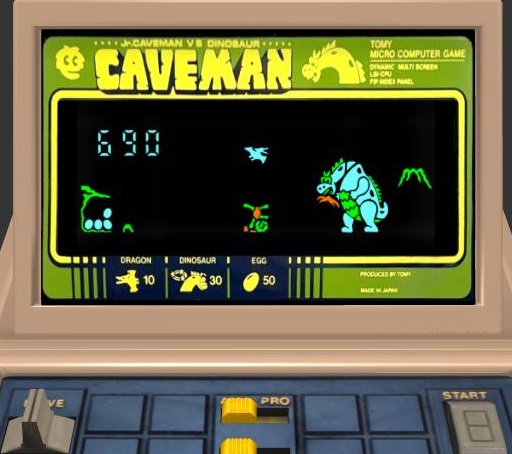
Is that blood? I think it’s blood! Is this the first video game with blood?
I’d heard of Caveman from a few of my readers, and they insisted it was among the best LCDs out there. Hell though, I’ve heard that about other LCDs and they didn’t live up to the hype. You can imagine my surprise that Caveman actually does. It’s one of the best of its breed, with deceptively complex gameplay. Playing as a caveman, you have to knock out a dinosaur by throwing an ax at its head. Then, while it’s loopy, you have to grab an egg from underneath its feet and bring it to a pedestal. BUT, you haven’t scored yet. That doesn’t happen until you bring another egg, at which point the previous egg is banked and scores 50 points. There’s actually a reason for the delay: a pterodactyl (called a “dragon” in the instruction manual) might swoop down and take the egg off the pedestal. The dragon won’t swoop down if you’re directly next to the egg, and you can also kill it for 10 points a pop. In the higher difficulty, you have to manually collect an ax every time you throw one, and there’s two dragons right from the start. In both modes, eventually, a volcano will start erupting rocks down on you.

This was also released by Tandy/Radio Shack.
It’s a lot to keep track of, but I’ll be damned if it isn’t one of the finest examples of LCD gameplay ever. It’s not one endless chain of walking back and forth. You have to make a move for the egg, or else it’ll hatch and you’ll miss your opportunity and have to wait for another egg to roll underneath the dinosaur. You don’t just instantly collect an egg when you touch it, either. You have to wait for it to start blinking, as if you’re handling it carefully. It’s kind of immersive! How many LCDs can claim that? It’s rare that any game from this era goes to so many lengths to have a sense of immersion about it. It’s unexpected, but in the case of Caveman, it’s also really fun. My one complaint is the A mode takes a while to ramp-up, while the B Mode is so challenging that scoring even a single egg feels like an accomplishment. The A mode, slow riser that it is, stands tall as one of the best of its breed in gaming history.
Verdict: YES!
 DENNIS THE MENACE!!
Tiger Electronics (1993)
Gameplay Type: Dodger

Well, on the plus side, this has some nice line art.
Dennis the Menace is a typical Tiger Electronics snoozer. You have to ride a bike while dodging various obstacles, and after scoring over 1,000 points doing this, a timed sequence starts where you have to pick up a slingshot and an aspirin into Mr. Wilson’s mouth. I had to use my PS5 controller since I had trouble with the keyboard on this one. Not that it would have mattered. The bike sequence takes FOREVER, and at one point, I was literally reaching down to pick up the slingshot and it was like the game refused to register it until I took a hit. Weird. This might actually be broken. I did manage to get to the second stage, where the teeter-totters on the side of the road are replaced by Margaret chasing you down. Logically, wouldn’t “catching you” mean you crashed your bike into her? You get six lives, which is the most I’ve ever seen in a game like this, but the lives become moot when you get to shooting sections. Those run on a 30 second timer and are an automatic all-lives-lost game over if you fail them. Are you f’n kidding me? In the history of bad Tiger LCDs, this is one of them.
Verdict: NO!
This slideshow requires JavaScript.
The second ever LCD I reviewed, and the first one that actually made me feel sorry for children of the 1980s. This version of Donkey Kong is housed in a gorgeous arcade cabinet, and it came packaged in a box that proclaimed “PLAYS AND SOUNDS LIKE THE DONKEY KONG ARCADE GAME!” Well, that’s a lie. The closest this comes to being true is a few of the bleeps and bloops sound like the victory/death noises from the coin-op. But, the gameplay is closer to one of those bad Donkey Kong knock-offs. The gravest inauthentic gameplay element: the hammer does nothing except earn points, like the umbrella/handbag/hat in the coin-op. You can’t smash the barrels or the fireballs. While it does include the rivet stage, there were times I died on that level where I’m not entirely sure how it happened unless you die from jumping when a fireball is on the platform above you. Jumping at an angle is a pain in the ass to begin with, since you have to hit the direction and then jump a split second afterwards, but the timing never feels consistent. And since fireballs tend to camp along the ladders/rivets, I often ended up losing via timing-out. It’s not like I expected an LCD from 1982 to be a very close approximation to Donkey Kong, but this isn’t even in the ballpark. At least I never have to play it again, now. Watch, Nintendo will end up putting this in a Game & Watch Gallery. Oof.
Verdict: NO!
 EXPLORERS OF SPACE!!
Elektronika (1989)
Gameplay Type: Spinning Plate
Previously Featured in LCD Games VII
This slideshow requires JavaScript.
This cold war era clone of Nintendo’s famous Egg (which itself was reskinned as Mickey Mouse, or was it vice-versa?) is one I couldn’t make any progress on. When two missiles would fire close to the same time, as soon as I stopped one, the other would immediately cause a miss. I thought “well, maybe I’m misjudging which is the closest one.” But, when I went against my instincts, I just suffered a miss faster. This was one of the few times where I drafted my family to attempt to play the game while I watched. They had the same thing happen, where even quick reflexes couldn’t possibly stop a miss from happening. I don’t recall every USSR clone of Egg being impossible to play, but this one sure seems like it is.
Verdict: NO!
This slideshow requires JavaScript.
Frogger is in the upper-echelon of LCD games. For a brief window of time, I even considered it to be the best LCD. In the time since, a small handful of games have moved in front of it, but that doesn’t change the fact that Frogger is the safest bet. Having now played and reviewed the Atari 2600 ports in-depth, really, the LCD version doesn’t have that much less animation than the VCS version has. Hell, on the Atari consoles, movement is instantaneous, with NO animation between the spaces. It’s very LCD-like. The Frogger formula just plain lends itself perfectly to LCD games. Oh, it’s so not perfect though. It’s that second row of turtles that are the turd in the punch bowl. Without any animation, there’s no cue when they’ll submerge. All you have to go off of is that the turtles tend to dive at about the halfway point of the screen. It’s best to hug the right wall and wait to time a quick double hop across. Otherwise, this IS Frogger. It’s only missing a single channel of car traffic, but all five river channels are present. Whoa! Coleco’s Frogger is a bonafide, genuine, certified contender for the greatest LCD ever made.
Verdict: YES!
This slideshow requires JavaScript.
I’m now convinced that it’s impossible to screw-up Frogger. Well, unless you’re the Atari 5200. Apparently, as long as you don’t need to press a button to confirm your intent to press another button, Frogger is bulletproof as a concept. This version, built into a wristwatch, is the most stripped-down port of Frogger I’ve ever played in my entire life. The arcade game has four channels of car traffic and five channels of river. This version has only two channels of car traffic, two channels of river, and three glory holes (that’s what you call them, right?) instead of five. And yet, even truncated by over half, it still feels like Frogger. That is absolutely beyond belief. Hell, when the turtles submerge, they even blink first as a warning, a kindness the superior Coleco version doesn’t offer. It comes dangerously close to being too chopped-up. Five channels of action isn’t much, but at the same time, it lends the game an almost bonus round quality. A faster pace that works for it. Further proof that Frogger was made for LCDs.
Verdict: YES!
This slideshow requires JavaScript.
I’d previously played Garfield last July, and I didn’t like it much. I’m flipping on that, as well. In Garfield, you have to dodge various debris being thrown at you and eat enough lasagna to power-up your super jump to leap up to Odie. The more progress you make, the more crap gets thrown at you. While it does become overwhelming, once I learned all the idiosyncrasies of the game, I found I really enjoyed it. Like the fact that you can jump the full length of the screen before landing made dodging so much easier. You can also quickly undo any damage you take by eating the various chicken pieces that Odie tosses down at you. Konami has proven to be one of the better makers of LCDs, having scored YES! verdicts with Blades of Steel and Double Dribble. Now, I find myself flipping on Garfield. It has nothing to do with the fact that, in addition to the typical Retrofab graphics, the extra EXTRA mile was taken by having a full 3D version that literally pops out of the screen. It was cool and unexpected, but it’s still the same gameplay and it has to survive on THOSE merits. And, I got it wrong. Garfield absolutely does.
Verdict: YES! **FLIP**
This slideshow requires JavaScript.
Las Vegas is another game that’s more complicated than I previously gave it credit for, but not by much. There’s three channels that have various degenerate gamblers letting money slip right past them that you have to catch. It’s the most basic, boring of spinning plate games, but there actually is a teeny tiny twist. Every 1,000 points, you get to play a slot machine for more points. You even control when the reels stop. If you match three numbers, you score bonus points. Three 1s nets you 100 points. Three 3s score 200 points, and three 7s score a jackpot of 500 points. The instructions say you get to spin again if you get a jackpot, but I only matched 1s once and I got to spin again. Maybe it was because I was playing Game B when I did it. I don’t know. The idea of earning spins at the slot could have been good if it actually was tied to the three channels you’re juggling, but it’s totally separate from theirs. Right idea. Wrong implementation.
Verdict: NO!
This slideshow requires JavaScript.
Mind Boggler is a variation of the classic code-breaking game Mastermind. The computer randomly generates a 3 to 5 digit code, and you have to try and decode what it is in as few attempts as possible. You enter a sequence of numbers (0 – 9) and the game will tell you how many are correct but in the wrong space (a hit), and how many are correct and in the right space (a sink), but you don’t know which numbers are which. This is one of the worst versions of Mastermind I’ve ever played, and one that feels incomplete. That speaker you see on it? It does NOTHING. There’s no noise or sound effects at all. I know that’s an odd complaint from someone who gets scorn for mostly playing games with the sound turned off, but I offer it as proof of the game’s unfinished and/or rushed nature. The most damning aspect of all is that the device doesn’t keep score of how many moves you need to win. YOU are expected to do that, manually. The original packaging even had a score pad for it. It could have just as easily displayed that in the hit/sink columns. I suppose that this technically accomplishes being Mastermind-like. As a reminder: in 1978, if you only owned the board game, you couldn’t play it by yourself. You could with Mind Boggler, but in the most dull and uninspired way possible.
Verdict: NO!

 MISSILE ATTACK!!
Mattel Electronics (1977)
Reskinned as BATTLESTAR GALACTICA: SPACE ALERT!! (1977)
Gameplay Type: Shooting
This slideshow requires JavaScript.
Compared to Missile Attack/Battlestar Galactica, Mattel’s Auto Race looks like Tears of the Kingdom. A very early three channel shooter with targets that move too fast for me. I know my reaction time isn’t what it used to be, but this is truly ridiculous. It’s made even more ridiculous by the scoring. The higher on the screen the LED strip representing your shot meets the LED strips representing incoming missile, the higher you score. But with missiles that come in this fast, with no area above the playfield or warning when or where a missile is coming in. Allegedly, there’s a pattern to the madness, but what does it matter? I’ve lined up shots and had the targets instead switch lanes. Other times, it fires two missiles at once. Folks, I’ve been doing these LCD reviews for a while now and this is the worst of these games I’ve ever played. I don’t know if it’s deliberate or not, but the Battlestar Galactica version is slower and more manageable. It doesn’t matter. When I die and go to hell, this is the game Satan is going to hand me, then he’s going to hover over me and tell me to git gud.
Verdict: NO!
This slideshow requires JavaScript.
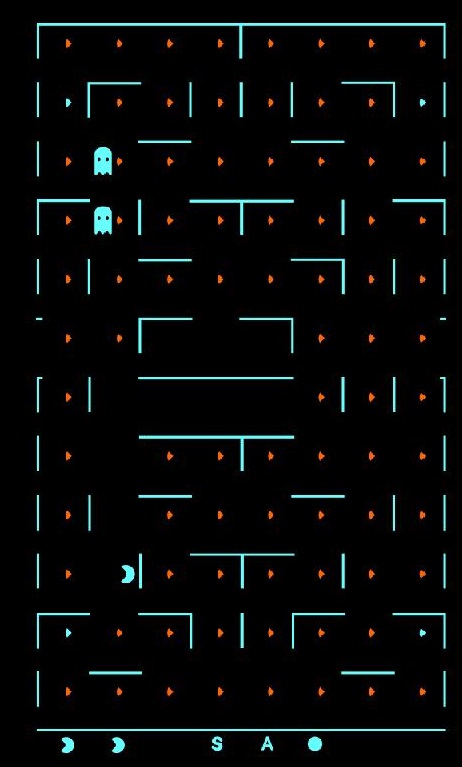
When I first did Pac-Man, it controlled badly, and now I think it’s safe to say it’s not just me. Even the best possible translation of it still is just not responsive. I tried using a controller. I tried using a keyboard. I tried sacrificing a virgin to the god of video games. None of them worked particularly well. In the above slideshow is a pic where I highlighted the four problematic points. Each are openings in the maze where I wanted to change directions and it was a coin flip as to whether the game would let me or not. It wasn’t just me and my increasingly crappy reaction times, either. I tested on everyone in my family, and they weren’t able to consistently corner, either. Such a shame, because Coleco’s take on Pac-Man offers what I believe is the first-of-its-kind co-op Pac-Man. But the maze is badly designed and not optimized for the capabilities of the technology.
Verdict: NO!
 PETER PAN & THE PIRATES!!
aka FOX’S PETER PAN & THE PIRATES!!
Tiger Electronics (1991)
Gameplay Type: Combative
This slideshow requires JavaScript.
What the hell kind of game is this? I’m not being a smart ass here: this is like a baby’s toy where it’s actually harder to die than it is to defeat the whole game. I played this a couple times and I was like “am I missing something?” Here’s what you do: clank swords upwards. Then clank swords downward. Repeat this until the pirate falls into the water. If there’s a pirate hanging from a rope above you, you press the fly button, then clank when the sword is up (it’s never down when they hang from the ropes) until the pirate disappears. If you fall into the water, don’t worry. Even if the crocodile is right there, you don’t die. Just press fly quickly, or at your own leisure. Either/or.
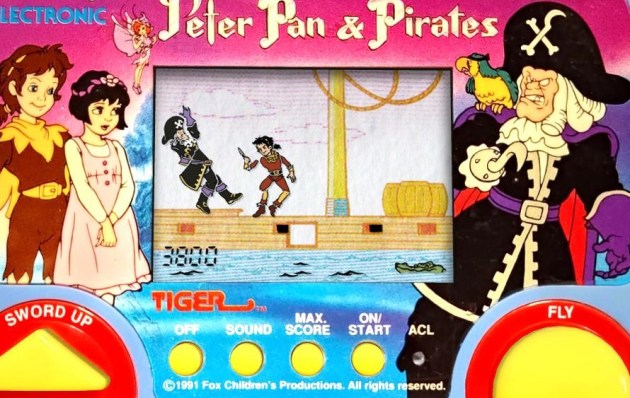
As bad as this is, if it had Tim Curry’s voice sample, I’d have flipped my vote to a YES! Everything’s better with Tim Curry! I’ve watched the movie Congo fifty times when most people haven’t sat through it once. Why? Tim Curry.
Eventually, Captain Hook will appear. Clank up, clank down, rinse, repeat until he falls in the water. There’s four “levels” which require additional clanks in order to win, but they don’t do anything different. Look, sword clashing is awesome, but you can’t have that be the whole game, even on an LCD. You need that one finishing move to make it work. Yes, I’m advocating for a stabbing move in a children’s LCD based on a children’s cartoon inspired by a children’s storybook. I vaguely remember Peter Pan & The Pirates from Fox Family reruns, and while it didn’t interest me (besides Tim M. F.’ing Curry as the voice of Captain Hook) I’m almost certain it’s not a toddler’s show, but this is a toddler’s game. Actually, no. This isn’t a handheld game. It’s an electronic fidget spinner.
Verdict: NO!
This slideshow requires JavaScript.
Huh. I really didn’t think I’d like any of the Simpsons LCDs, so you can imagine my surprise with this one. I’ve played a LOT of LCD games at this point, and I can’t think of any higher praise for one based on a licensed property than saying “this could have been a Nintendo Game & Watch.” Cupcake Crisis has that G&W vibe. Maggie throws cupcakes and Bart has to catch them. There’s a couple catches.. no pun intended. The first is he can only carry five cupcakes at a time. Marge pokes her head out the door to the left for you to bank the ones you’ve caught. The more cupcakes on the plate, the higher you score. As this happens, Homer will call for a couch gag. You must sit down before Lisa does, or you die. The faster you sit, the more points you score (400 points for sitting as soon as Homer does). Maggie will also throw her pacifier for bonus points. You get a free life and level up for scoring 10,000 points. I liked Cupcake Crisis, but it is a bit too easy, even the faster Game B. Really, as long as you’re not greedy, you could easily put up monster scores. It’ll just take a lot longer. But as a risk/reward type of juggler game, Cupcake Crisis is one of the best licensed LCDs I’ve played. Again, very Nintendo-like.
Verdict: YES!
This slideshow requires JavaScript.
“The charm is lost” has never applied more than to the two Tomy-Tronics 3D games adapted for Retrofab. There’s actual historical significance to these things. In real life, you’d stick your head into this paleolithic Virtual Boy and the graphics of this boring, uninspired game would look three-dimensional. This was the first ever dedicated 3D video game device. Weeeeee. This is a basic shooter with zero stakes because there’s no penalty for missing enemies. Well, as long as you don’t get shot, and it’s not that hard to avoid getting shot. There’s a bonus round after 100 points that goes too fast. The best thing I can say about Sky Attack is that there’s actual OOMPH to shooting baddies. Instead of just disappearing from the screen, they actually drew in very satisfactory explosion art. That’s nice. I just wish it had been done for a better game. Sky Attack is as basic and boring as LCD gaming gets. Though, let it be said, the Retrofab enhanced graphics are really nicely done.
Verdict: NO!
This slideshow requires JavaScript.
Oh my god. OH MY GOD. Wow. I’m beginning to think they might have started production on this Microvision thing without having any ideas for quality, worthwhile games to make for it. In Phaser Strike, targets float by and you shoot them. You can shoot from the sides, if you so wish, but I never found that preferable to shooting straight from the center. This doesn’t even feel like a real game. It feels like a 1950S proof of concept for a video game. Tying the Star Trek license to THIS feels cynical and sleazy. You can make the targets smaller, and you can make them go faster, and you can adjust how many targets there are (though only one appears at a time) but this is primitive even by the standards of the era. Sessions of Phaser Strike last, oh, about 10 seconds. This is the absolute bottom of the barrel and I feel so sorry for Microvision owners that this was the type of game they had to play. Pocket calculators have roughly as much gameplay.
Verdict: NO!
This slideshow requires JavaScript.
From the time I started doing these LCD reviews, two games came up more than any other. One is the Game & Watch version of Super Mario Bros. The other is this. Super Mario is coming tomorrow, and spoiler: it’s a NO! and Nintendo fans are weird for liking it. As for Ninja Turtles.. f’n really? This is the game that you insisted you knew was better than typical LCDs? It’s maybe more ambitious, but not by much. Like Bartman by Acclaim, this makes the mistake of trying to replicate the Nintendo Game & Watch feel on a single screen, leading to the action being too cramped. Granted, Konami had bigger screens and smaller sprites than Nintendo did, but not so much you can do two gameplay concepts on one screen. On the top half, you just jump over spiked balls while whacking at enemies to the left and right of you. Boring. But, after you score 100 points, you get to enter the LCD version of the damned dam stage from the NES Ninja Turtles. Kill me. What happens next depends on if you’re playing Game #1 or Games #2/#3. In Game #1, you just have to avoid one spinning trap and one electric beam, get a key, then avoid both things a second time on the return. Then you have to rescue April, and then you repeat it until.. no, wait, the game just ends.

Mode 2 and 3 is basically the same, only you have to make multiple laps to blow up the tube April is trapped in.
It’s funny that it was Super Mario and TMNT that my readers kept bringing up, because rotating sticks factor-in heavily for both games. It’s a classic game trope, but they sort of rely on the ability to see motion in order to work. Mario did the better job by having one stick that rotates four ways in a straight line. Turtles has a two-sided stick that rotates at an angle. Bad idea. There’s only three animation cells (made of six total segments). It’s just not enough, and the speed of rotation feels like a clock that has a broken seconds-hand. What a dumb idea for an LCD. I got to the point where I could beat Game 1 every time, but the one and only time I actually finished Game 2, it sort of felt like a fluke. And there’s a ten second underwater timer in Games 2 and 3. And the electric thing. And the timing for none of it makes logical sense. Maybe I suck at video games or something but I finished mode 2 exactly once and I’m not even sure how I did it. There has to be better Ninja Turtles LCDs than this. There’s several more, one of which is a basketball game. I’m going to guess it’s probably a re-themed version of Double Dribble’s LCD. If I’m right, the good news is at least one of these games will get a YES! Oh, not this one. I think this was horrible.
Verdict: NO!
This slideshow requires JavaScript.
I admit that, following Sky Attack, my expectations for Thundering Turbo were just about as low as they’ve ever been for any game I’ve ever reviewed. You can imagine my complete shock when Thundering Turbo turned out more than halfway decent. I’ve been doing these LCD reviews for a while now, and this is the first time I actually felt motivated to show off a game to friends and family. I did that for one simple reason: because I couldn’t believe it. I was so surprised by how much I enjoyed this that I was convinced I was misjudging it based on my low expectations. So, just to be extra sure, I went back and played it a second time before hitting publish on this very feature. I didn’t get it wrong: this is really good for an LCD. There’s strategy, timing, patience, risk/reward factors, and even a genuine sense of movement and speed.
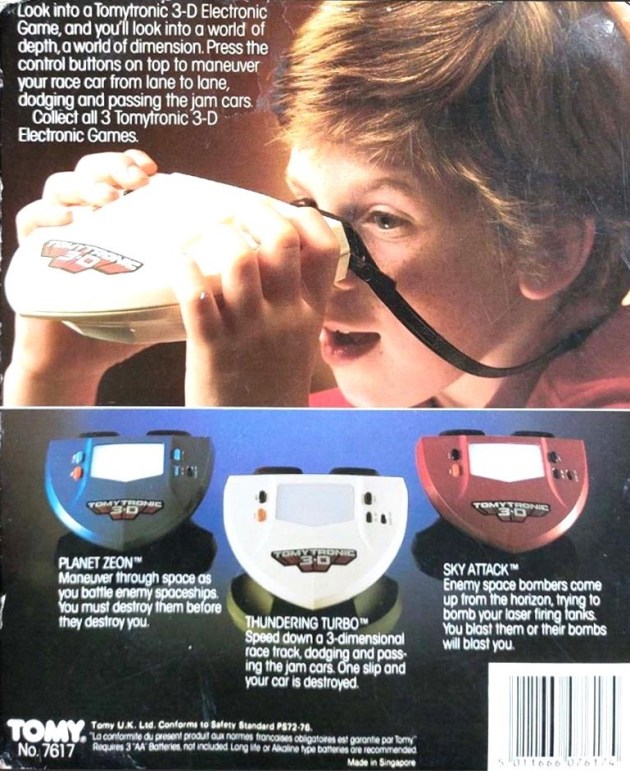
I searched high and low trying to find out how much these things cost in 1983 and eventually did find them via a Montgomery Ward Christmas catalog from 1983. The price? $29.99 (about $90 – $95 in today’s money).
Really, you can call this “Traffic Jam: The Game” and it works. Races last 100 seconds, and each lane has a specific speed for the enemy cars tied to it. The right lane is slow, the left lane is fast, and the center lane is somewhere between. You have to use this to open up a clearing for you to pass cars. You get three lives per race (it resets between each race) and I found myself actually caring about what my score was. Even without the 3D to lift it up, at least Thundering Turbo has an interesting scoring system. It’s one of the few LCDs where you lose points sometimes. The scoring system sees you get one point for every car you pass, but you LOSE a point if you get passed. This is also one of those rare times where I don’t feel bad for kids of the early 80s who got this from Santa Claus on Christmas morning. This is genuinely a very good game, and one that I sorta want to try in 3D. Even if I can’t imagine how uncomfortable it must be to play a video game built into a pair of cheap plastic binoculars.
Verdict: YES!
This slideshow requires JavaScript.
Okay, so Ninja Turtles stunk, but Konami is still an elite LCD developer. Top Gun is close to being pretty dang good. A shooting gallery with a 3 x 3 grid of channels where you have to shoot down a variety of targets. The instructions mention waiting for targets to “blink” but I noticed no such thing. It only takes a couple games to clock the trajectories of the various targets. I was really enjoying it, but I was also confused. Even as I got good enough to the point that I wasn’t missing any targets in the open two stages, I noticed my health was ticking down. Okay, that’s weird. Well, it turns out your health will tick away regardless of perfect play anyway, rendering all the combat worthless until the final stretch of 30 seconds or so of the 90 second long stages. Mind you, that last stage is pretty fast and brutal. I’m not entirely sure why they made it like that. So are the ticks of health fuel or damage to the plane? Both? Whatever. As annoying as it was, I had fun. Imagine that: a child in 1989 who got a cheap Top Gun LCD was better off than a child in 1989 who got Top Gun for their NES. God, I love LCD games sometimes.
Verdict: YES!

Simon looks very 70s. Say what you will about Touch Me’s handheld, but it looks much more modern.
I’m not so much into the memory test games, and really, Touch Me is as basic as it gets. The main “add one” mode has been done a million times. Follow a sequence of lights. One more light is added to the end of each sequence. There’s a two player game and a four player game. There’s even instructions for a three player game that you start by deliberately allowing the first “player” to fail. Okay, that’s funny that they spelled it out like that. The story behind this game is so much more fascinating, as Touch Me was originally a 1974 coin-op. Ralph Baer, inventor of the Magnavox Odyssey, had been involved in a few patent lawsuits against Atari. After Baer’s company sued Atari for patent infringement, Baer copied one of Nolan’s designs. Baer freely admitted this, a story I read in The Ultimate History of Video Games. Baer saw Touch Me at a trade show and thought it was a great idea, so he copied it. He made his own design as a game that started life under the title “Follow Me” but was ultimately named “Simon.” Baer, who again, had been involved in litigation against Atari for taking their inventions, justified it by saying Nolan Bushnell and Atari didn’t have a patent. That’s kind of awful, isn’t it? Now, to Baer’s credit, he created a digital bugle for Simon, choosing the bugle because it’s one of the few instruments where its four main notes sound harmonious no matter what order they’re played in. As he noted, many people play Simon by ear. Mind you, Touch Me’s buttons make different noises too and can also be played blindfolded, by ear. Sigh, even the story of Touch Me isn’t that fun. It’s just depressing. It sure beats playing Touch Me or Simon, though.
Verdict: NO!

Light Cycle Stage.
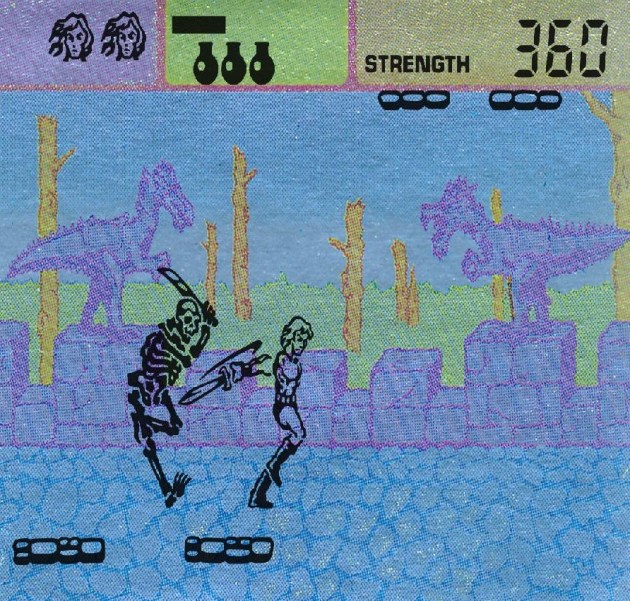
When I previously did Tron in the very first LCD games, I admit, I didn’t play very far into it. Not only did I have trouble controlling it, but the game kept crashing. Even when it didn’t, I couldn’t beat the AI opponent at all. The RetroFab version is more stable, and nowhere near as brutally difficult. Actually, it goes the opposite direction: the light cycle portion might be too easy. In fact, I found that if I just drove around in the light cycle portion of the stage and kept away, eventually the game would blink, indicating the computer opponent had crashed into me off-screen. And then I found out that Tron isn’t just a clone of Snake. This game has LEVELS and other gameplay types.
This slideshow requires JavaScript.
The second game is Discs of Tron. You and the computer opponent throw a disc back and forth. Each of you have four hit points. This took me a while to get the hang of because my instinct kept telling me the “catch point” where you intercept the disc is, you know, the spot where my character is physically standing. But, it’s not. It’s the spot in front of your guy. My brain refused to accept this and kept moving one extra space anticipating my guy was going to miss the disc, because logically he was going to. Eventually, I got the hang of this to the point that I could beat it every time, but it took a while. The final game is battling the MCP. You throw a disc to open up a hole, then you have to throw a second time and get the disc in the hole. Your “life” from the previous stage carries over to this level and acts as a timer. On the plus side, you only need one single disc to get in to win. Then, the game repeats. The Light Cycle and MCP stages are boring. They’d been better off focusing on making a better Discs of Tron game. I’m happy I redid Tron because it certainly was very ambitious for this era and it deserved better than what I gave it in the first LCD review. But, it’s still not fun.
Verdict: NO!

There’s only 41 ball positions, which IS a lot for the era, but for pinball? Not so much.
This was a very bad idea. This is basically what Mattel did with their electronic games and LED lights, only attempting to do pinball. Pinball requires motion and physics and this has none of them. Just getting the logical timing of when to hit the ball is counter-intuitive, but then predicting where the ball will go is a nightmare. Really, it’s not even pinball. It’s a LED light-reflex tester when the ball is over one of the “flipper” sections. You can’t flip too fast or be wrong, either. Flip twice in one second and you get a tilt. The more times you hit a ball in one turn, the faster it goes. The timing does seem to matter in affecting which direction the “ball” flies off, but because there’s only one ball light per flipper light, it’s not like you can deliberately aim it. I was most impressed that there was something resembling a plunger and it does matter how long you hold it down before releasing. They tried SO HARD with this, and I feel awful that I hated playing it. And now I’m truly dreading how bad Nintendo’s Game & Watch Pinball will be.
Verdict: NO!

 SPLATTERHOUSE!!

 BURGERTIME!!
 WESTERN BAR!!

 WESTERN SHERIFF!!
 BEAUTY SHOP!!
 CUPHEAD!!





 GARFIELD




 STAR TREK PHASER STRIKE
 TEENAGE MUTANT NINJA TURTLES
 TOP GUN
 TOUCH ME
 TRON
TRON WILDFIRE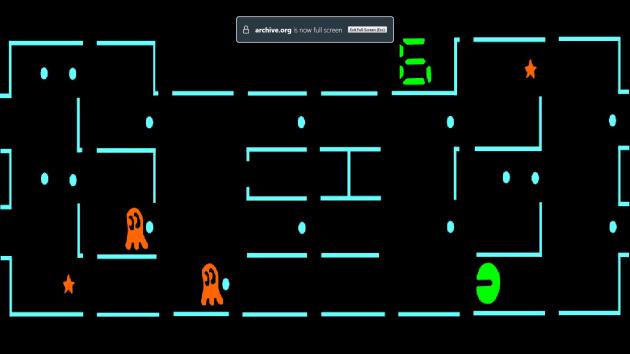


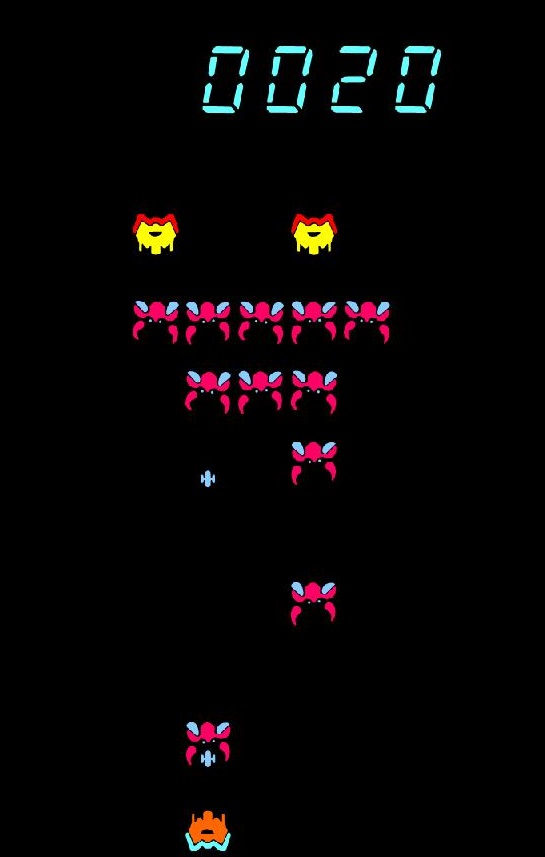



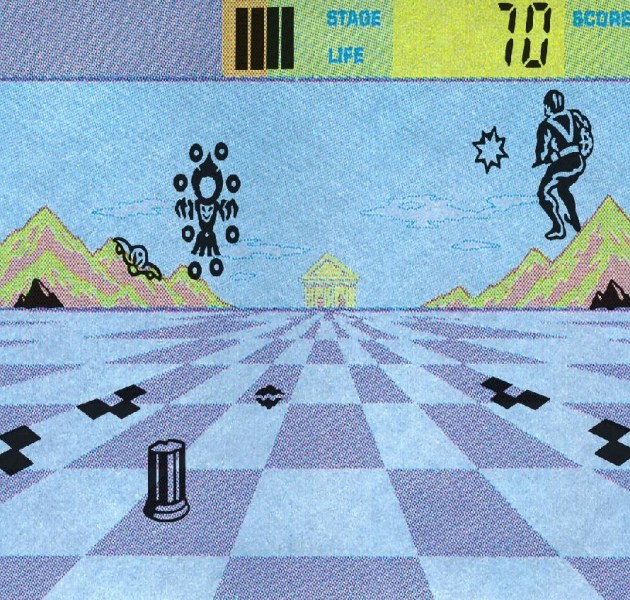
 Do you know what frustrates me most about Tiger’s lazy, shitty, effortless shovelware? They actually were capable of making decent games. Take Space Harrier II, which will now be given the distinct honor of being the first ever LCD game I wouldn’t rather be dead than be stuck with. And mind you, I don’t even like Space Harrier, but this LCD gallery shooter actually works. It feels vaguely like the arcade game and retains the fun. It even has boss fights! How about that? It’s not very exciting and the timing is a bit jank, but this isn’t awful by any stretch, and for kids from households who couldn’t afford a Game Boy, they wouldn’t have to be embarrassed playing this one. It’s fine. Hallelujah!



 Indie Gamer Chick
You must be logged in to post a comment.