Luna’s Wandering Stars

Lunas Wandering Stars - PlanetsMy nine-year-old crashed through the door one day excitedly demanding a piece of paper and pencil.

“Why do you need them?” asked my wife as she handed them over.

“SCIENCE!” And, off he went back outside writing down his observations.

I guess it doesn’t help that both my sons have been on a MythBuster’s binge on Netflix and have grown an incredible fascination with science. My eldest has been very interested in studying airplanes and flight, so when I heard about “Luna’s Wandering Stars”, it was the perfect opportunity to see what he thought of this educational game.

“Luna’s Wandering Stars” is a series of challenging physics puzzles staring our moon, “Luna.” Luna visits the nine planets* of the Solar System solving various physics puzzles. Each planet presents a unique set of challenges centered around a playable theme using Newtonian Physics. In the early levels, you launch Luna on various trajectories, much like “Angry Birds: Space.” In later levels, you are only given the ability to use thrusters to change your trajectory. And in another set of levels you can “change the gravitational constant of the universe”, with a flick of the mouse. And that is just for the starting planets! There are six more fun and interesting themes to discover.

To complete a level, you have to guide, launch, or boost Luna to collect asteroids. Once you collect enough asteroid mass, you pass the level. This can be easily accomplished, but the real challenge is collecting gold asteroids which unlock the other planets in the Solar System. To complicate matters, for every asteroid that is collected, Luna gains mass. This can affect the momentum and velocity of Luna in mid-flight, making it much more challenging than merely flinging birds in zero gravity.

*Kid's today aren't told the true story of Pluto, the missing planet

*Kid’s today aren’t told the true story of Pluto, the missing planet

The presentation is top-quality with beautiful space backgrounds and epic music encouraging you to step up to the challenge. To counter the almost overblown feeling of awesomeness is an ironic self-awareness: the game’s instructions and narration is loaded with dripping sarcastic humor. There are also a lot of quotes from all over geek-culture. I have to admit that I had to research the Shakespeare quote, but I laughed out loud when I saw a “Community” reference. It was hard explaining to my nine-year-old what was so funny with the commentary at the completion of each level and even with the narrator’s jabs for making epic failures.

Some of the levels are pretty challenging, and after about 30 minutes of deep concentrated play, my nine-year-old had to take a break. I continued to play, and there were even a few levels I had to skip or had to accept a less than perfect solution just to move onto the next challenge. Mileage may vary, but I thought that this game was perfect for teens to adults in terms of challenge.  However, one of the things I found missing was some sort of indicator that I had unlocked the next planet. An indicator for when the next planet unlocks is not only just for a good reference point, but for me it serves as a motivator to keep trying for more gold asteroids.

Even failing still looks spectacular.

Even failing still looks spectacular.

Just when I had thought that I had discovered everything the game had to offer, I noticed another button on the Start Menu that I hadn’t clicked before. I clicked the “Custom” button. I was entirely oblivious to what that meant. I thought it was just an “options” screen, but it turned out to be a full-fledged level editor! Here, I could recreate and expand on levels that I liked in the original game itself. And then my jaw dropped even further when I learned that I could also upload my levels and download levels created by other people to try. In fact, someone had already made and uploaded a “shooting” arcade-style survival game starring Luna.

Space FoundationIt made me wonder what else would be created if this game was given to a much larger audience, and I was very pleased to find out that “Luna’s Wandering Stars” is being featured at the Space Foundation Symposium later this week. I am certainly looking forward to seeing even more levels once more people start trying it out.

A week after our initial test run, my son was asking how gravity works. To help my son understand, I showed him a YouTube video of a professor using a spandex sheet to demonstrate what gravity fields look like. He watched as ball bearings made their little orbits on a warped surface representing “space-time.” Almost immediately, the lightbulbs in his head went off and he yelled, “That’s exactly like ‘Luna’s Wandering Stars’!” Suddenly, my nine-year-old son understood what the game was really all about: learning truths about science.

That’s what makes “Luna’s Wandering Stars” not just an excellent game with fun mechanics, a wicked sense of humor and a wide variety of levels and designs, but also a great educational experience.

Luna's IconLuna’s Wandering Stars was developed by Serenity Forge

IGTlogo-01$9.95 for not just a fun game, but for the lights going off in a curious child’s mind while learning about space and physics. It was worth infinitely more than the single CFL lightbulb I could get at the same price. (And less toxic for the environment!)

Luna’s Wandering Stars is Indie Gamer Team Approved.

Always Sometimes Monsters – Preview

Always Sometimes Monsters (“ASM”) is a game about the choices we make in our everyday lives that have a profound impact on us in ways we don’t notice. Here, you’re chasing after the one who got away, and you have one month to raise funds by helping people around town, picking up odd jobs, and networking to get across the country to stop their wedding.

ASM01ASM offers the player an experience that will be almost entirely distinct to them. Depending on whom you talk to, when you talk to them, and what you ultimately decide to do about them, the game plays out differently. Almost every action has a consequence (good, bad, or something in-between) that affects the outcome of your journey. Will you help a little old lady clean her apartment or help a friend set up for his concert? Will you blackmail a doctor to save your friend’s girlfriend, who you hate with a passion?

In my playthrough, I worked at a tofu factory, wrote some articles, walked in on a couple having sex, and met the devs of the game as they sat in a cafe. Something nailed here is that I felt bad whenever I discovered that I could no longer help someone out, like I let them down (sorry people who lost their homes to a development project).

With a storyline that molds to whatever you make of it, Always Sometimes Monsters toys with your morality along your journey to the end in ways that make you go happy or wretch with disappointment at yourself. It’s fun! (Oh, and you can finish the game in three minutes if you want. You’ll see!)ASM02

What Worked: I have never experienced a game quite like this before, and it was very memorable. ASM pulls at the heartstrings and allows you an enormous amount of freedom while still keeping you within the confines of the story it tells. Oh, and thank you to the devs from the bottom of my heart for not giving us an incredibly small inventory.

What Didn’t Quite Work: The in-game time flow of time can be confusing. You don’t know exactly how long each event you’re doing is going to last, so you don’t know if you have time for things you want to do that day. The clock, which resides inside your inventory, can also be difficult to read as it has a meter that fills once you do something story-related. It wasn’t until I understood that I’m not going to be able to go back and help both Friend A and Friend B that I finally felt better about advancing. Unlike Harvest Moon, you can’t squeeze out a bit more time to both harvest and talk to townspeople. You only get to do one or the other, and then it’s the next day.

About the Game From the Devs: The game was largely inspired by a cross-country backpacking trek called Gamer Unplugged where ASM’s writer and co-creator, Justin Amirkhani, traveled around America meeting game developers in an effort to figure out what made them satisfied and happy with their craft.

I did some digging and found this in-depth article on Polygon about the trek here: http://www.polygon.com/gaming/2012/7/23/3177525/a-unplugged-gamers-cross-country-journey-of-introspection. It’s a fascinating read.

ASMlogo

Developer: Vagabond Dog – http://www.vagabonddog.com/

Game Website: http://www.alwayssometimesmonsters.com/

Release Date: May 21, 2014

ReignMaker

You can watch me play some of the game here! https://www.youtube.com/watch?v=JFnSbog9PKg

In this latest installment from Frogdice, they take a tried-and-true puzzle concept and add to it by throwing in some magic and incorporating city management, which makes for a unique experience.

Building on the Bejeweled match-three (or more) system, your rune combinations send out a magical onslaught against invaders that slowly walk towards your castle walls as they try to destroy your defenses, thus ending the stage. Making a vertical match sends out a wave that attacks a spread of three lanes, whereas a horizontal match sends out a row of attacks that hits multiple targets in the same lane. Complete a series of waves of monsters, and you advance to the next stage until you reach a boss fight.

The boards that hold your runes come in a variety of shapes and sizes, each with its own challenges.

The boards that hold your runes come in a variety of shapes and sizes, each with its own challenges.

Not only is the game a puzzle game—it has some elements of city management as well. Between each stage, or battle, you are brought back to your town, which requires some administrative attention. While you’re off fighting, the citizenry either get themselves into trouble or quibble over disputes of various kinds and need your help in deciding what to do. Depending on the nature of your decisions over time, you may receive bonuses in the playfield.

The proud town of Mikoville.

The proud town of Mikoville.

The city also includes such areas as a farm, lumber mill, granary, and others to gather resources. You use these resources to build or research items that aid you while defending your towers such as explosives, weapons, and offensive and defensive magic. These items are key for the more difficult stages where there is wave after wave of attacking mobs, and there would be no way you could stop the sheer amount of monsters by using the runes of the puzzle alone. Using your spells to their maximum efficiency and saving them for just the right moment is fun and rewarding when you take out a number of foes in one blast.

While ReignMaker is a fun game, it isn’t without a few flaws. One of the issues I had was that when starting the game, you’re dropped into your mostly vacant city and told to build a few things. At this point you don’t truly understand why and say, “Okay, I guess I’ll build a farm. That sounds like a good thing. Lumber mill? Sure! I have money!” While there were some pop-ups describing some of the concepts to me, I didn’t feel like I actually understood the game without some trial and error on my part after playing a few rounds. That in itself isn’t necessarily a bad thing, and once I did get it, it was an easy concept; however, I felt as though I fell into it and didn’t actually learn it.

I rule!

I rule!

Some additional guidance on the benefits of using items would have been beneficial as well. I almost stopped playing the game out of frustration somewhere after the first boss because stages were getting too difficult. After a series of defeats, I turned off the game, only coming back hours later after telling myself, “There must be something I’m missing or forgetting.” Sure enough, I was right. With a bit more experimentation, I discovered that the frustration I felt was related to the fact that there were a number of situations in which there was no way I could make a match in the lane that a monster was using, and no amount of clearing runes was helping me. It turns out that I could craft a dagger that allowed me, as the player, to attack a particular monster. Later on, I figured out that some magic allows me to destroy a single rune which helps against tricky, out-of-the way monsters, and other magic helps me to restore the hit points of my castle.

These flaws, though, are minor. ReignMaker is a genuinely fun experience you shouldn’t miss if you are a fan of the genre. Frogdice has proven once again that they know how to make a well-crafted puzzle game.

ReignMakerlogoReignMaker was developed by Frogdice Games.

IGTlogo-01$15 is all it costs to have your own kingdom these days. It’s a pretty good deal for a game to play on a reigny day. OH COME ON! That’s comedy gold! Hey, don’t walk away. Come back!

David

I played the PC version of this game. It is out for Mac and iOS as well and I cannot speak for how it plays on those platforms.

I wasn’t quite sure what to expect with this one when I read the description. Hell, even after watching the trailer, I still wasn’t sure what to expect when I booted it up. What you see is a square flying around as it throws things at a number of other shapes. While it’s clear something is happening, it’s unclear exactly what until you try it for yourself.

The "Skittles" are what you shoot at enemies.

The “Skittles” are what you shoot at enemies.

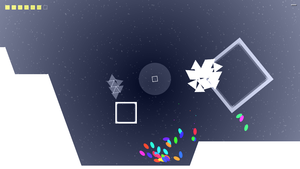
Playing the part of a square named David, you are on a quest to destroy a number of evil, polygonal figures with your “slingshot”. This slingshot is your only attack and uses a drag and release method of mouse control that requires a bit of precision in setting up and launching your attacks against the quadrilateral onslaught.

To avoid enemy fire, or the enemies themselves as they have a tendency to launch their entire bodies at you, you bounce around each stage with the WASD keys. It can be tricky at first and I’d be lying if I didn’t say my hand cramped up a bit, but once you get the hang of it, it’s easy to excel at. During the time that the game flows at its “normal” speed, movement itself feels similar to that of Super Meat Boy. The majority of your time, however, you are in a slowed down state as you charge up and aim your shots. In this altered state, you plot out where you’re going to move next and where you should attack next. The experience leaves you feeling like you’re a leaf on the wind after some practice.

Huh?

Huh?

The only thing in the game that had my head scratching is the use of confusing symbols used in some of the game over screens. Perhaps there are some universal meanings behind them but the only way I discovered what they meant was through trial and error. (Yes, the screenshot to the right was taken from my phone. Shush.)

This is a short game and it won’t take long to get through the “easy” version of the missions. Taunting you, however, is the fact that in order to truly beat the game, you need to run through the missions again on the hard difficulty in order to reach the final boss. The stages all play exactly the same except unlike in easy mode you have a fair amount of hit points, hard mode leaves you hanging with only one. Deaths in this mode are frequent but limitless and they rarely feel “cheap” and that you cannot improve upon what you tried before.

All of this may sound like a lot but by the time you complete the ninth mission and replay the missions at a harder difficulty, you discover that at some point along the way you got really good at this game. Completion only took me about an hour but at its price point, it’s well worth the cost and it’s fun and easy to pick up. The game sucks you in without you even noticing it and completing the more difficult missions feels satisfying.

davidlogo

David was developed by Fermenter.

IGTlogo-01For $2 (temporarily $1) you, too, can help me translate the glyphs in that menu system in this fun adventure.

PAX East 2014 Overview

PAX East 2014 is over and I’m beat. The four days of adrenaline kept me going without much food or sleep but now it’s time to recuperate. While I sniffle and hack away at my desk, recovering from PAX Plague, here are some previews and first impressions to a handful of the indie games that were there. I wish I could do a “Best of PAX” but there is no way that I was able to play everything that was shown. Maybe this time I’ll give out the, “Indie Gamer Chick: Not a Bad Build Out of the Relatively Few Games I Was Able to Play Because There Are So Many Here” Award.

Note, the following are not all-encompassing previews. They are synopses based on a very short amount of time with the games and there may be inaccuracies based on where the presenters decided to start the game or how much background to give me. (Case in point below, Flem would have appeared far different if I hadn’t asked for more info.)

Always Sometimes Monsters (by Vagabond Dog)

The feels, this game gave them to me. Here the player is asked to witness the results of their choices in life. In the demo I played, I played a man whose roommate wanted me to scope out his crush and see if there was any chance the guy he liked, liked him back. I don’t want to spoil what happens but what you decide to do once you do it changes how the game continues.

One of the more mentally deep games I played, this one promises to make you think.

Assault Android Cactus (by Witch Beam)

A dual-stick shooter that’s influenced by bullet hell games. In this 1-4 player game, you’re killing seemingly endless waves of monsters as you make your way through the end. You get to play as a number of cute androids, blasting the ever-living hell out of everything, trying to rack up combos and get the best grade you can. It’s fun and if you can get a few friends locally to play with you, it’s even more of a blast.

The three folks that I played this with kicked the crap out of it, allegedly the first folks of the con to beat the boss at the end.

Bik (by Zotnip Games)

A point-and-click adventure where you play a young boy who was abducted by aliens. Teaming up with some fellow mercenaries and other aliens met along the way, you go through a number of adventures before returning home. Inspired by the point-and-clicks of yore, their focus wasn’t on trying to make you wonder about all the ways you can’t Get Ye Flask and let you have fun experimenting different things. The game even auto-saves for you so you don’t have to worry about being unable to undo the horrible things you’ve accidentally done.

The demo had me set up in a spaceship as one of the aliens. There was a fire in the engine room and I had to save a crewman and stop the fire. It took me a few tries to complete the section for apparently turning off the air supply and killing us was not the immediate solution (I PUT THE FIRE OUT THOUGH!) and sticking a mop into the fire (don’t ask) didn’t do a thing.

Bounden (by Game Oven Studios)

While playing another game in the Indie Mini Booth, out of the corner of my eye I caught some folks making some strange motions while holding a phone between them. Intrigued, I dropped the controller and shoved everyone in my path out of my way.

This mobile game makes heavy use of the gyrometers within the phone to have you “dance” with a partner as you both hold onto the screen as you move together to move objects on the screen. It had us rocking the phone back and forth and even at one point, holding it overhead and twist in a ballet-like maneuver. It had me intrigued as a little party thing to share a fun experience with your friends.

Buddy and Me (by Sunbreak Games)

Adorable. You play a child who is racing through a dream world with his Never Ending Story-like pal named Buddy. It’s meant to be a non-stressful version of an endless runner where you can still “lose” easily but the pace isn’t too fast and you have the cutest imaginary friend to travel with you and help you out over some obstacles. I was able to play a preview of the new female character, which the dev says will be available soon to players in an upcoming update.

The dev tells me that the level generator determines your skill level as you play and makes things more or less difficult for you as you go (but still providing a challenge).

Darknet (by E McNeill)

I talked about this game a little in my “Oculus Rift: Second Impressions” article posted from the show floor (https://plus.google.com/115383603237792435980/posts/JttdvUQb8Pp).

This is a strategy/puzzler that makes use of the Oculus Rift to give you a virtual reality version of cyberspace akin to those of the 90s hacker movies. The goal is to hack into servers, break the security, and retrieve the data you’re after. Once you retrieve that data, your reward is money to buy various hacks (power-ups) to help you break into other systems.

It was one of two experiences I had with the Rift over the weekend and stood out as a one of the better examples of what it can do.

Delver’s Drop (by Pixelscopic)

This is a dungeon crawler which had its camera angle inspired by The Legend of Zelda: A Link to the Past. This build was a bit early and it was missing many of the game assets and enemies, leaving things a tad barren. The dev had to point me in the right direction a few times because I’m an explorer.

It has a number different characters, all which move and attack differently. I admit, in the short time I was able to devote to it, the “fluid” control and momentum felt clunky but it was by design as each character you can select plays with slight differences. I suspect that after a bit more time, the player gets used to it and it’s a non-issue.

Distance (by Refract Studios)

The only game on my list here that I didn’t get to play up front but I did get to chat with the dev at length while watching a few folks play. This is a survival racer heavily inspired by the racers of the late 90s (Rush, Extreme-G) where you speed through a high-tech city, avoiding obstacles on the track that trashes your car. The game is gorgeous and flashy and hits all the right buttons for this TRON-lover.

Interesting note, this game is based on another game of theirs they worked on while attending Digipen. Since it was a Digipen project, the school owns the game so they wanted to do with again under their own names.

Flem (by Henchman & Goon)

Walking by this display and seeing some folks play, my mind immediately went, “Super Meat Boy” clone and I almost kept walking. The crowd around the screen left and I was the only one there which inclined the presenters to ask if I wanted to play. I said sure and thought there may be there’s something here.

It started off just as I suspected. Difficult levels that try to kill you and you restart immediately to keep you going. The presenters (these gentlemen did not work on the game but were marketing students) were telling me about the game and it felt like they were describing Super Meat Boy. I don’t know if they hadn’t played it or not but I had the sense they didn’t know the comparison at all. It wasn’t until I had the chance to ask, “What makes this game differ from it? What makes it stand out?” That’s when I got it out of them.

A few stages in, you gain special powers that allow you such moves as to hover temporarily among a few other things. It requires a different kind of precision to finish a level than jumping, jumping, and more jumping. I asked if I could test out those special powers and they seemed surprised as if no one else had brought it up before me. They were right for at that point, the game changed and was much more fun.

I have a feeling that folks may pass this one up prematurely because of the initial few levels. Stick with it!

Future Unfolding (by Spaces of Play)

In a randomly created, gorgeously styled world, you are one person trying to find your way out of a forest. There are no weapons, no health bars, and no mana – you are one person who uses clues in the environment to find which way you need to go next. “Using” a pair of stones in the ground that don’t quite fit may open up a path in the forest. Connecting some unusual trees together may make bad creatures appear which give chase. You don’t know what’s going to happen until you experiment.

If you are one who loves exploration, keep your eye on this one.

Hand of Fate (by Defiant Dev)

This game weaves a tale like no other that I’ve seen before it. Using tarot cards, the story is told with randomized encounters and events based on your draw. Once a combat card is shown, your character slips into a battlefield in which you fight using a combat system that’s simple but fun as you get to not only punch and smash your way through enemies, but dodge their blows as well.

Over time and as you complete aspects of the game, you’re granted more cards that are shuffled into your deck. It all makes for a fun and random game each time you play.

This one is a bit on the expensive side for an indie game but it may very well be worth it once it’s released for PC and PS4.

High Strangeness (by Barnyard Intelligence Games)

Readers may soon be cluing in on a a weakness of mine. If your game reminds me of A Link to the Past, there’s a good chance I’m going to like the game. Harking back to the late 80s and early 90s, this game mixes up 8-bit and 16-bit, creating what they call a 12-bit experience. This adventure has players bouncing between the classic era and … slightly less classic era to solve puzzles and kill monsters. When you’re in the 8-bit world, enemies may not have complex attack patterns, but they hit harder. In the 16-bit world, game assets are more detailed so you can see where you need to place a certain object.

The Phantom P.I.: Mission Apparition (by Rocket5 Games)

Another game in the adorable category, you’re playing a ghost buster of sorts in a puzzle/adventure game which places you in a spooky, maze-like mansion to put an end to the chaos caused by the thief ghost, Baublebelly.

Along the way, you encounter traps and puzzles which you need to solve by collecting objects and using them at the right moment. You may need a fuse to activate a switch, or bucket of water to put out a fire.

All in all, it’s a cute little package that works well on a touch screen.

Revolution 60 (by Giant Spacekat)

Set in the future, our hero is tasked with trying to find out why a weapons platform has gone offline which sets you on a course of killing baddies and robots and all sorts of futuristic things. Combat is a mixture of quick-time events and tactics strategy and the narrative combines a choice system that determines the reactions your character has to certain situations. Our hero is this badass woman who stays calm under pressure and looks good doing it. Basically, it’s like playing a blonde version of me. Har. Har.

Normally, I hate quick-time events (QTE). I don’t find it enjoyable in the least when a game is prompting me to smash the hell out of X at just the right moment or move the joystick in just manner so sitting down to play Revolution 60, I was rather skeptical about what I was going to experience. It turns out that I now have an addendum to my hatred of QTE and that is, on touchscreen devices they make much more sense. Why is that? One thing I hate even more than QTE is trying to use controller-like controls on a touch screen and I’m so glad they didn’t do them here. QTEs fit well as they don’t require intense button smashing and still allowed me to enjoy the story.

I introduced myself at the Revolution 60 booth as Bri and the woman who I talked with made a comment about how great that was since their head was also named Bri (Brianna). Interesting fact, the team is entirely (or nearly so) women and I had the opportunity to see Brianna at a panel the shortly before playing the game (that’s me in the pink dress up front in a picture she took: https://twitter.com/Spacekatgal/status/455690195468554241/photo/1).

Rollers of the Realm (by Phantom Compass)

Obviously, these folks have some sort of randomizer for the folks behind Rollers of the Realm somehow got the combination of pinball and RPG. You know what? It’s fun! Set in a medieval world, the main character is a thief girl who is trying to make it on her own with her pet dog. The two, and lots of people you meet along the way, are represented in-game as pinballs, each with their own physics. The playfield is based on the location the storyline is in such as a village with people standing around, boxes to destroy, and more.

Sentris (by Timbre Interactive)

I suck at music. I have no rhythm and typically I couldn’t tell you who sings what. For example, if you know it, it took 20 years for me to be able to pass the Yoshi Island on Mario RPG before I finally “got” it. Always up for a challenge though, I walked up the Sentris booth and said, “Girl, I’m going to try your game. I’m going to suck and you’re going to pretend I’m doing well to help my ego.” (This conversation may have only taken place in my head.)

The playfield is sort of like an LP that spins constantly, playing a background song that you can affect by inserting colorful segments of different sizes into the playfield. Different beats and… other music words… (sorry, I told you I’m inept) begin with each additional segment, leaving you with a unique song that’s truly your own with each play.

Completing certain color matches, you “beat” each stage. That is a bit of a misnomer for you don’t actually beat anything, only move yourself to the next stage to create another musical wonder.

Vertiginous Golf (by Surprise Attack Games)

Long gone are the crazy golf games we used to have; Wicked 18, Kirby’s Dream Course, and so on. When I saw this steampunk-themed, mini golf game, I had to try it out. Given a steampunk controller to control the action, I was given a large number of obstacles to use and bounce off of and hazards to avoid in reaching the pin of each stage. The stages are large and have plenty of going on with plenty of ways to try to reach the end.

There was an Oculus Rift version of this game but it was not demo-ing when I had the opportunity to play.

We Are Doomed (by Caffeine Monster Software)

Another dual-stick shooter to add to the large volume of this type of game, but this one is really, really pretty with bright, vibrant colors that almost has a papercraft-type feel to it. It doesn’t add anything new to the genre but it is fun and doesn’t break the budget. Something about this title kept me interested longer than a lot of dual-stick shooters do.

Woah Dave! (by Gaijin Games)

I broke this game when I played it. Sorry Dant.

Unashamed to admit that it is heavily influenced by the classic Mario Bros. game and Joust, Woah Dave is a mash-up of the two where you are trying to destroy bat-like monsters that get really angry and when they touch the lava on the bottom of the screen. When they hit it, they jump back up to the top of the level, hoping to reach the lava so they can get more pissed. …or something. In any case, it’s fun. It doesn’t try to be anything more than a simple game that is enjoyable and it succeeds.

If you want to know any more about the above games, check out their pages in the associated links. PAX East was an amazing experience for me and if you haven’t been there before, I highly suggest going if you can. Thank you to everyone I got to talk with and meet. Our time was short but it was a blast.

Cubesis

Cubesis is one of the most challenging turn-based puzzlers out of the box that I’ve encountered.

You’re given a 2.5D view of a world in which you have to accomplish a few objectives for each level. Objectives typically involve collecting treasure but also can also include such things as, “gather X amount of food” or “build a thing”. Treasures are spread out across the map and to collect them, you need to figure out how you are going to terraform the world by appeasing or displeasing the gods with the use of churches and monoliths. You’ll also need to determine which buildings to build while you wait for the world-changing effects to take place. Being able to store more food, sometimes build a second city for more population, weather control devices, and so on are all important.

cubesis01

The concept of the game is simple but it takes a long time to master. Much of the difficulty lies in trying to figure out just which buildings you need to build, for if you waste your resources on the wrong one or too many of one, you may waste precious turns because the planet is often either heating up or cooling down. If it gets too hot your people burn or if the sea levels rise too high and flood the land, you’re done for and must start over.

As you progress through the game, restarting the level is very common as many of your actions are trial and error. “If I build this, that could happen and then… OH GOD NO MY CROPS ARE DRYING UP!” Game over. Fuck!

One of the more frustrating parts, but also rewarding, is the terraforming (disguised as swaying the gods). To raise the sea level or push it back, you must build a certain type of building to make them happy, the above-mentioned churches or monoliths. The annoying part is that you need the right balance, or lack thereof, to force the effects you desire but sometimes what you need to create that balance is confusing. Building one of the buildings doesn’t seem to have any effect so you overcompensate and build three. RESULT! Oh, I spent too many resources building them all? Fuddy.cubesis03

Now, is all of this fun? Yes and no. See, I had some fun with the title. There were times where I was really feeling it and into it and others where I was frustrated and didn’t want to play anymore. This IS a good game but for a certain type of person and I apparently am not that person. It is no fault of the devs as I feel it’s a quality product. If you like real thinkers and a challenge, not minding having to start from scratch when you mess up, yes. Get this game. For me folks like me who I’ve discovered are not that person, skip it.

cubesis_logo

Cubesis was developed by Ikkju.

For $5, this game will last you a while as you try to figure out how to pronounce it. “Cube-sis”? “Cube-eh-sis”?

Aqua Kitty: Milk Mine Defender (PC Version)

For new Indie Gamer Chick fans, meet Miko, aka Sabriel, the next Indie Gamer Chick. Heir to my throne. A passionate and talented gamer, and one of my dearest friends. Follow her on Twitter

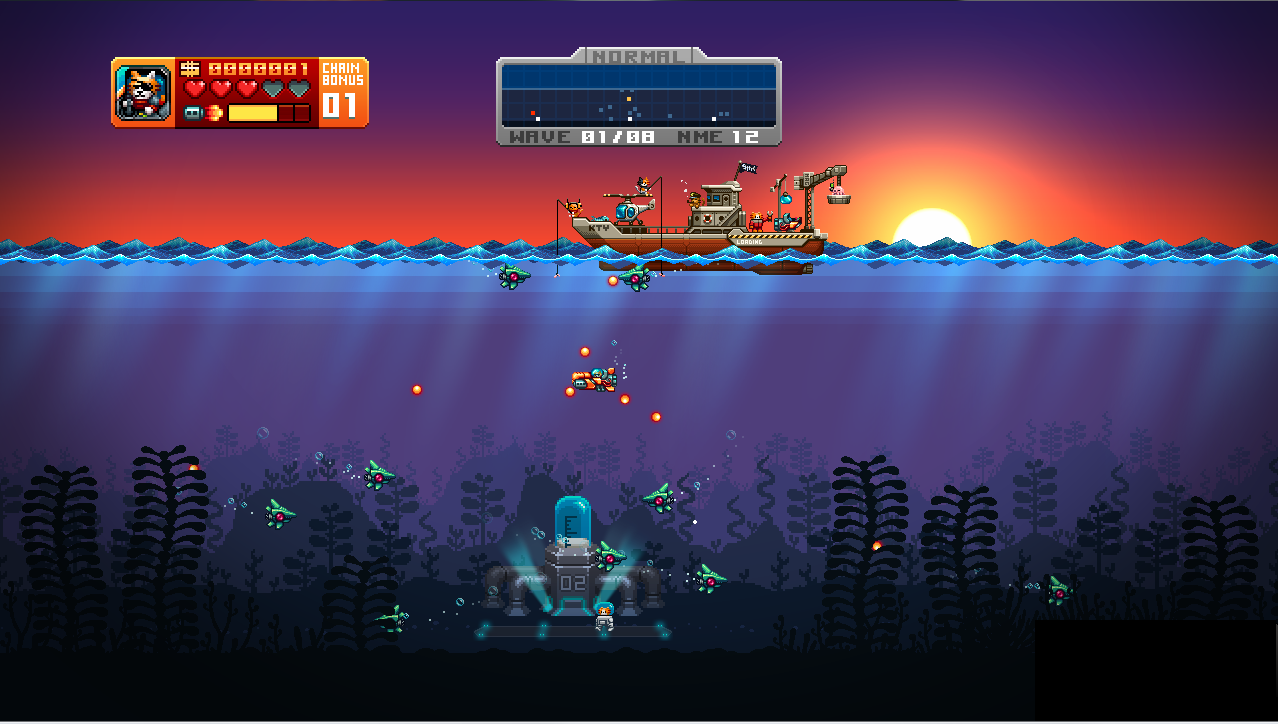
The world’s milk supplies are running out, and the cats must do something or suffer from the loss of their most precious resource. In a bold, some would say crazy, maneuver, they are taking to the depths of the ocean to mine for milk and save the world.

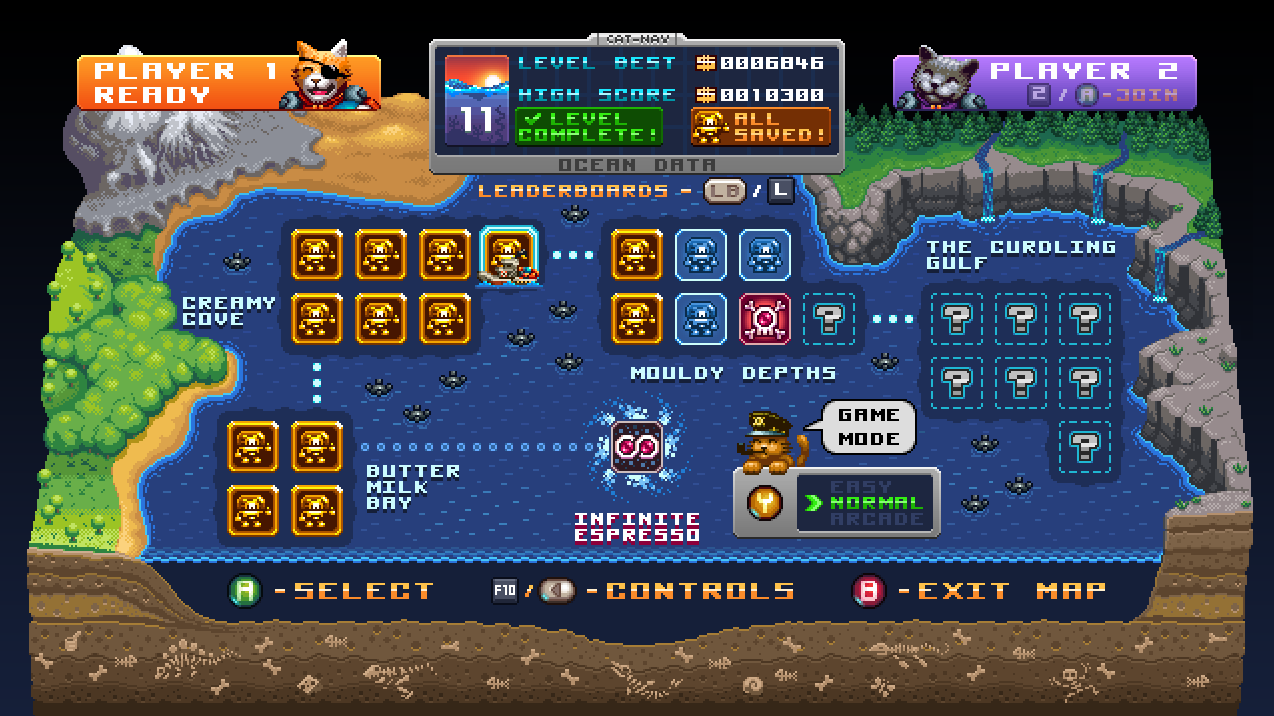
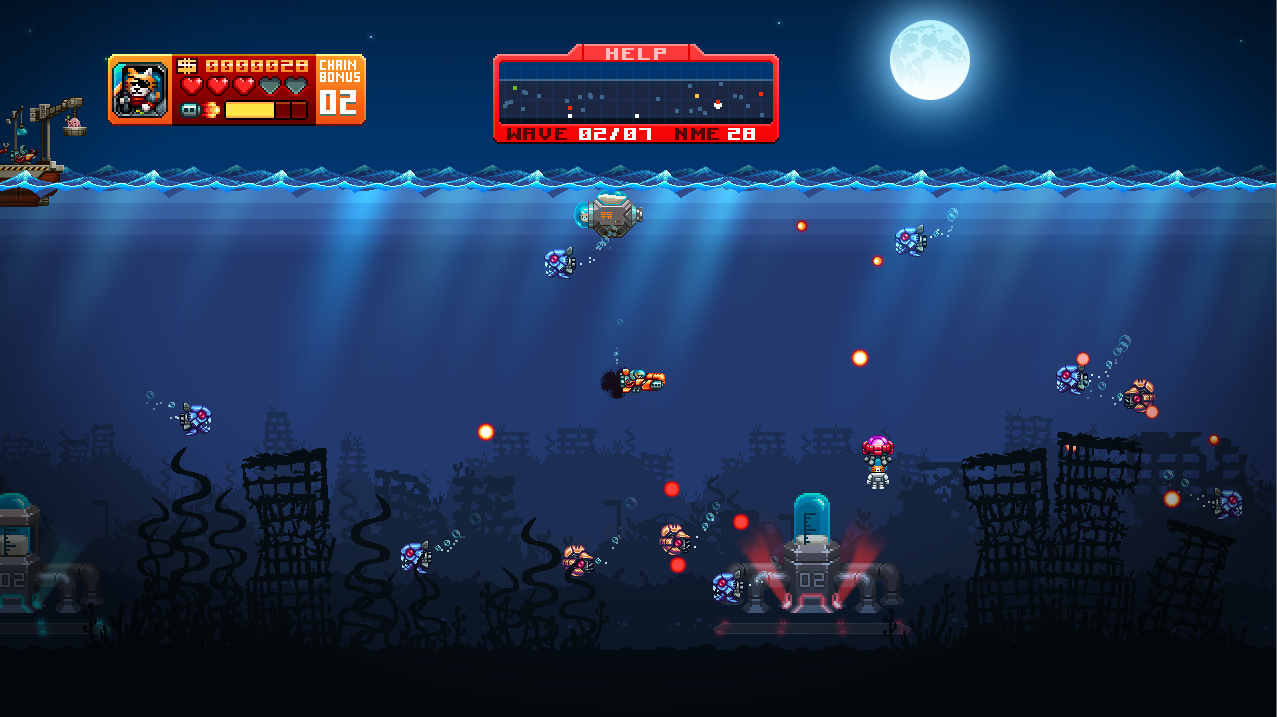
aquakitty01Ridiculous story, yes, but this arcade shooter is fun to play. Covered by the Indie Gamer Chick herself last July, she describes it perfectly in that it’s a Defender clone both in waves of enemies, a radar to show you where the action is off-camera. And protecting ur mans from being taken away. Here you’re attacked by waves of mechanical enemies who are trying to take you out and trying make off with kitties who are manning (kittying?) the milk pumps that lay at the bottom of the ocean. Once you complete a stage, you’ll head to the map screen which records your high scores and allows you some freedom as to which area you head to next.

aquakitty03There are two game modes: 1) one where your upgrades are automatic after each stage and can restart from the same stage if you die; and 2) one where you are able to choose your upgrade as you collect power-ups within stages but start over from the beginning if you die. I spent some time with both and discovered that I don’t prefer one over the other; each has its place and is fun in its own ways.

In later stages, enemies come at you at a very fast pace which leads to pure chaos. You are, however, rewarded if you can make combos with careful use of explosive fish to blow up enemies. The higher of a chain you can make, the more points you’re rewarded with, and larger chains have the added side effect of making your life easier as you take out massive amounts of enemies at once.

I really love the chiptune music in this game and have even been listening to it outside of the game. You can find the music on SoundCloud here if you’d like to have a listen: https://soundcloud.com/electriccafe/sets/aqua-kitty-milk-mine-defender

aquakitty02This is where I normally rail on some annoying, horrible mechanic that was designed purely to piss me off. I’ve got nothing, really. I like this game a lot, and it’s a great homage the SNES era. The graphics are pretty, the music is awesome, and it felt appropriately difficult on its own merit rather than me fighting the system. I’ve got little but praise for this game and felt it worth the price.

Time and game allowing, I’ve also decided to start recording and posting videos of me playing the games I review as well. If you’re so inclined, you can watch me playing here: Miko playing Aqua Kitty – Milk Mine Defender

Out for PC, 360, and PS Vita, Aqua Kitty—Milk Mine Defender is a cute little arcade shooter that is too good to pass up.

kittylogo

Aqua Kitty—Milk Mine Defender was developed by Tikipod.

IGTlogo-01The game costs $6 to $7 on a multitude of platforms, and I just wrote an article about milk pumps without talking about boobs.

Aqua Kitty is the first game to earn both a Seal of Quality from Miko and Cathy. Congratulations to Tikipod!

This is for Hypership. For Abduction Action! Plus, picture Sweetie with pock marks on her face, blood dripping out of her nose, the stench of death on her, with skulls and crossbones all around the edges saying "not approved for any use besides enhanced interrogation."

The first Miko-Cathy double sealed game!

Triviador fixed and Seal of Approval Reinstated

A quick update to Monday’s post about Triviador.  The developers of the game quickly got in touch with me and assured me that they would get to the bottom of the problem.  It would appear that they’ve fixed the majority of the problems and that Triviador is back to being the awesome Trivial Pursuit meets Risk game I fell in love with.  I re-award it my Seal of Approval and have re-ranked it on the Indie Gamer Chick Leaderboard.

IGC_ApprovedSee, the squeaky wheel gets the grease.

Triviador was developed by THX Games

Triviador stripped of Indie Gamer Chick Seal of Approval

Update: Triviador is fixed and the Seal of Approval has been reinstated.

Well, this is a first.  Last month, I reviewed a really fun Facebook game called Triviador, which I awarded the Indie Gamer Chick Seal of Approval to.  I’ve never had to retract my Seal of Approval from a game after it won it.  Unfortunately, I have no choice but to do so with Triviador.  In November, the game received an update, taking it from its beta stage into a more polished, final version.

Unfortunately, the updated graphics are the only positive thing that came from the change over (and they’re not really that much better).  Triviador is so full of glitches now that unfair losses or cheap wins earned when another player gets dumped out of the game are sometimes more prevalent than a fully functional round.  The chief problem is disconnects.  Triviador frequently hangs up and disconnects players.  At least once every four games I was disconnected.  On games where it didn’t happen to me, it would typically happen to one of the other players, which eliminates the thrill of victory and the entire point of the game all at once.  This only happens during the fastest-finger tie-breaker questions, but it happens constantly.  This problem also doesn’t seem to discriminate between different operating systems or web browsers.  Often, the disconnects seem to be tied to using the premium boosters that you can either acquire through gameplay or purchase with real money.  I spent $9 to buy a stockpile of parrot and telescope boosters, but the game most frequently locks up when attempting to use those.  At the time I bought them, Triviador was stable and playable.  I wouldn’t have bought them in the game’s current state.  Nobody would have.

Such a shame.  Triviador was a wonderful game.  But the latest update is unstable.  In a game where experience points are based around winning streaks, making sure wins and losses are achieved via fair means is very important.  Unfortunately, those streaks are impossible to maintain because you’re unlikely to be able to play too many games before getting taken out via a disconnect.  For this reason, I have to strip Triviador of its Indie Gamer Chick Seal of Approval and remove it from the Leaderboard.  I have never seen a game so thoroughly ruined by an attempt at improving it in my life.

Neurokult

I’m not certain if it’s a sign that I’m getting older, but there are plenty of games now where I can only play one stage or level and then need a break. It happened in Hotline Miami, a little bit in Rogue Legacy, and now again in Neurokult. I don’t feel it’s a bad thing, though—just something I don’t think I ever experienced growing up, and it feels strange. The intensity wears me out!

Neurokult is a cyberpunked-themed, fast action puzzler for iOS. Balls of three different colors stream across the screen and you must tap them to send them away before they reach the other side of the screen. In order to remove a ball of a certain color, you must tap a “selector” of sorts on the side of the screen that matches the color of the ball you want to remove. Match the color, press the ball, the ball goes away. To keep this from being too simple, the game is very fast-paced and there are bombs that roll across the screen which will cause a game over if you tap one.
neuro01

I should note that I played this on my iPhone 4S and found that there were a handful of times that I fat-fingered things and hit a bomb. I don’t know this if this is much of an issue on the iPhone 5 (and later) or iPad screens.

You receive bonuses for connecting chains of matching colors. Along with getting more points, completing chains builds up your life meter, something that is there to keep you alive when you miss a ball before it reaches the opposite side of the screen.

In its current form, this game is difficult. By the end of the very first stage you’re already experiencing the above-mentioned intensity as a great number of objects fly across the screen. The feeling was quite daunting at first, and I took a few days’ break from the game after finishing some stages. While discussing some things with the developers, they stated that they are aware of this and are already in the process of creating an easy mode to help players out and keep them coming back. Until that day comes, I’ll give you the same advice that they gave to me: “Stick with it.” It is rewarding, but damn, is it hard.

neuro02The game will change up some things from time to time to catch you off guard and make you think. For example in one stage, the ball that flies across the screen will change color just before you press it, making you go back to the color selector to select a new color to be able to remove it. It gets a bit hectic, but it’s nothing you can’t handle. The above advice about sticking with it worked for me until I reached Stage 9, Kinesthesia. It causes me to have an episode of rageful fury (unlike my normal, happy fury), and ultimately it’s where I had to quit the game for the time being. The change in this level is jarring. Stage 9 is where the colors in the color selector move around. Up until this point in the game, the colors in the color selector stay in the same spot. You come to rely upon on the sense of their location without needing to look where you press (not unlike learning a keyboard). You begin this stage and press where blue had been for eight stages, only to find out that it moved to where red had been the whole time except you didn’t notice because you didn’t think to look. It continues to change at a fairly fast pace, causing you to miss the ball you were going after and letting it fly off the screen, taking away your hit points. By this point in the game, the action is so crazy and fast that it’s a very quick death as you flail about trying to match things up.

Every few stages there are some boss fights. From what I’ve seen so far, these stages boil down to the boss (a larger sprite) bouncing around the screen as you try to clear the playing field. If you touch the boss more than a few times, you lose. The boss fights can be tricky as near the end of their respective stages, they try very hard to get in your way, making for some very close calls where you have to choose between waiting for the boss to move or taking the hit to your life. Once you finish the boss fight, you get a chance to slice and dice it like crazy by sliding your finger across the screen until it dies. It’s a nice little way to relieve the stress of it getting in the way moments before. Seizure warning: The game makes use of bright, flashing white effects against a black background at this point.

Would I recommend this game? Yes. I would. Play it now and muck around with it, and if you get stuck, keep it on your device until you see the update come down that introduces the easier mode. It can be a frustrating experience here and there for now, but it is a fun game.

neurologo

Neurokult was developed by Woodland-Barbarians.

IGTlogo-01Relive your cyberpunk days in the 90s of watching Hackers and Johnny Mnemonic for only $2.