LCD Games of the 1980s Part X – Nintendo Game & Watch: The Definitive Review + Rankings of EVERY Nintendo Game & Watch
December 26, 2023 10 Comments
Sorry this is a day late. This was a monster to edit, and we did the family thing all day Christmas. Still, I think an all-encompassing Game & Watch review is fitting for this time of year. I imagine many children of the 1980s were thrilled to have gotten a Game & Watch under the tree on Christmas morning. I’ve been wanting to do something like this since I started these LCD features, and thanks to the developers Itizso and whoever did all the MAME ports of these, I’m able to do a more in-depth look at Game & Watch’s library. All forty-eight official Game & Watch releases, along with each version of each game, plus one unreleased prototype. Once again, THANK YOU to every single person who has ever worked on LCD game conversions. You’re heroes to gaming, period. I want to thank my dear friend Aden, who helped me out with the artwork on a few titles in this review. Aden, you are a true friend. Follow him on Twitch!
REVIEWS IN ALPHABETICAL ORDER
For those not familiar with my way of thinking of how retro games should be reviewed, I take NO historical context into account. I don’t care how important a game was to the industry, because that doesn’t make a game worth playing today. The test of time is the cruelest test of all, but every video game must face it. I might not be here if not for Pong’s success, but I wouldn’t want to play it today. Not when there’s better options. Therefore, when I review retro games, every game gets either a YES! or a NO!
YES! means the game is still fun and has actual gameplay value when played today and is worth seeking out.
NO! means the game didn’t age gracefully and is not worth seeking out, and certainly not worth spending money on.
I’ve linked to the RetroFab versions of each game in their header. I hope you enjoy them as much as I did!
 BALL!!
Series: Silver
Release Date: April 28, 1980
Gameplay Type: Spinning Plate – Juggler
Listing at Nintendo Wiki
Behold: HISTORY! That worked out perfectly alphabetically. Ball was the very first Game & Watch game, and I admit that I probably didn’t put the proper time into it the first time. I think my mistake was not quitting the Game A fast enough on any previous LCD feature. I should be playing the faster Game B modes for games like this. Ones that put up a fight. That’s especially true of Ball, which works a LOT better as a three-ball game. In fact, skip Game A altogether, loading it only if you’ve got a very young child you’re trying to keep busy. Think toddler age. The 3-ball games escalate quickly, and while the “action” of defending the six channels isn’t exactly intense, you really do have to focus to get high scores. Ball is unique among Game & Watch games because you don’t have any extra lives, ever. One miss and it’s game over. I sh*t on the DSiWare version, but I stuck to Game B this time around, I ended up playing several rounds of this. At first, I thought my original NO! was correct, but then I sort of tuned-out when the game sped up, and I realized I wasn’t bored. Ball is certainly hypnotic. Oddly, I kept scoring in the same range: 950 – 1,050 points, and I’d probably keep going if I didn’t have nearly fifty more games to go. Ah, what the hell. I’m going soft, I guess, but since I couldn’t put it down..
Verdict: YES! **FLIP!!**
 BALLOON FIGHT!!
Series: New Wide Screen & Crystal Screen
Crystal Release Date: November 19, 1986
New Wide Screen Release Date: March 8, 1988
Gameplay Type: Cross-the-Road
Listing at Nintendo Wiki
Why is this called Balloon FIGHT? There’s literally no combat at all in this LCD. Game & Watch Balloon Fight is more of an adaptation of the “Balloon Trip” mode from the NES classic (that I reviewed the arcade version of). You have to tap the “eject” button to fire a jet pack. Yea, they replaced flapping your arms like wings with a jetpack. Presumably because Nintendo didn’t want children walking around at recess giggling about the fact that their handheld game has a FLAP button. Oh, and the up and down buttons don’t actually move you up and down. All vertical movement is handled by tapping the action button. The buttons you would think are up and down are exclusively used for “warping.” When you and the logs start to blink, landing on a log and pressing up or down warps you to a bonus stage. While the scoring system encourages not missing balloons by awarding a chain bonus, it takes too long to build-up. You need a ridiculous 20 straight for a +1, 40 straight for +2, and so forth. However, the bonus stage doesn’t contribute to the “chain.” Only the main stages. Thankfully, missing balloons (or dying) in the bonus rooms doesn’t count against the chain, either.

Canonically, this isn’t the same character from Balloon Fight the NES game. The lead character in Balloon FIGHT isn’t Balloon FIGHTER but rather Balloon MAN. Well, now when Balloon Fighter is announced as a playable character in the next Smash Bros., they’ll have an alternative costume. Also, for NO REASON since this has no connection to the Mario universe, the villain’s name is “Oiram Repus.” I wonder if he hangs out with Alucard?
What really hurts most is you start with ZERO extra lives. Zilch. While you can get extra lives, it takes 100 balloons. The phases are quite long, too, but they mostly repeat the same five or six patterns of spikes multiple times over. I mean, of course they do. There’s only three channels to navigate. It doesn’t exactly allow for complex patterns, you know? You don’t reach the boss, which is SUPER MARIO spelled backwards for.. reasons.. until the 8th phase. I wasn’t even close. I had to resort to cheating to experience it, and it wasn’t even worth the effort. I don’t get why they made the 0 extra lives decision. No, Balloon Trip doesn’t give you extra lives. But, you can’t claim this is an adaption, because Balloon Trip on the NES doesn’t allow you to WIN extra lives either, and the Game & Watch does. There’s no logic to the decision.
The boss fight is just surviving waves of spikes for a set amount of time. It’s really not that different from what you’ve experienced already, except the spikes scroll while the screen doesn’t. There’s still no combat, and “defeating Oiram Repus” isn’t exactly satisfying. Even worse is that the final sections leading up to it just repeated the same pattern of spikes over and over and over and over and holy crap, it’s just exhausting in how dull it is. I admire the ambition on display here, but at the end of the day, Balloon Fight forgets it’s an LCD. Eight stages to reach the boss? That’s kind of insane. It takes too long to build up a combo. It takes too long to collect free lives. And frankly, by time you reach that point, the game is kind of tedious. The best thing I can say about Balloon Fight is that, while the movement has a massive learning curve to it, eventually you will get a feel for how much time and left-to-right movement a single blast of the thruster gets you before you start to sink. But, playing Balloon Fight is just a miserable, repetitive grind. That’s going to be a running theme with the more ambitious Game & Watch titles.
Verdict: NO!
 BLACK JACK!!
Series: Vertical Multi Screen
Release Date: February 15, 1985
Gameplay Type: Gambling
Listing at Nintendo Wiki
Currently Not on RetroFab

Worst. Push. Ever.
It’s just blackjack. Max bet is $100. Hope for 21. Don’t bust. Nintendo’s LCD take on it features a decent presentation, I guess. “J” looks more like “C” but otherwise, it’s fine if you want make-believe gambling. It does have a little bit of personality. It even “shuffles” the deck every few hands. However, this is bare bones, as basic-as-it gets blackjack. There’s no insurance bets. Those are a mug’s game anyway, and so is surrendering, which is also not included here. But, the deal breaker for me was you can’t even split matching cards. The only player decision betting option is doubling down. So, yea. Black Jack is blackjack with fake money and most of the popular side bets missing. If you’re into that sort of thing, you certainly don’t need Game & Watch for it. A potentially more interesting game, at least for me, was Game B. It’s a timing-based slot machine where you stop the reels and match five numbers. Unfortunately, the reels spin too slowly to offer a real challenge. While the final two reels move a little faster than the others, it ain’t that much faster. This was the final Game & Watch to ever release in Japan. I feel a little sorry for them that they never got Squish. The only value I found in Black Jack is using it as a barometer for the truly putrid Nintendo LCDs. If a game is worse than fake, no stakes blackjack with no splitting or insurance bets, it must truly be awful.
Verdict: NO!
 BOMB SWEEPER!!
Series: Vertical Multi Screen
Release Date: June 15, 1987
Gameplay Type: Puzzle
Listing at Nintendo Wiki
Currently Not on RetroFab
Bomb Sweeper is sort of like Sokoban-lite. Instead of having to shove boxes onto specific spaces, you have to shove walls to clear a path to a bomb. The only rule is that you can’t push a wall into a space already occupied by another wall. If there’s more than one bomb, you only have to reach one to win the stage. The first time I played this, my brain short-circuited when I realized I’d blocked my access to one bomb. “Well, I screwed that up.” But then I touched the other bomb and won the stage. “Okay, that’s a weird choice. Seems like it might make the game too easy.” And I was sort of right. It’s still fun, though. In Game A, after so many levels, you enter an auto-scrolling sequence which is the de facto “boss stage.” Same format, only with scrolling and the fear of becoming crushed.

The hero’s name is John Solver (someone get Sakurai on the horn and tell him we know who can be the first new character for the sixth Smash Bros!) while the villain, who looks like a human dressed in a Press Your Luck Whammy costume, is named Jack. He uses bombs. They make him feel mighty.
In Game B, there’s no auto-scrolling stages. In fact, I thought Game B was the “easy mode” at first. That would be atypical for Game & Watch, but it was shocking to me how cinchy the levels were. And then I noticed that the timer was getting smaller with each passing level. It doesn’t help that much, as the levels are too easy even when the timer is down to under ten seconds. Game A isn’t exactly the hardest puzzle game ever, but I enjoyed it. The one missing ingredient that any console game of this type would have is a suicide button for when you screw up. That’s missing here, so when you fudge things up, you have to wait for the timer to go off. Slightly annoying. What bugs me about Bomb Sweeper is they could have made this a New Wide Screen series game with one screen. The second screen has no gameplay in it and is just there to add personality. Why waste a screen like that? Unoptimized use of space is a running theme with Game & Watch. In the case of Bomb Sweeper, it doesn’t cost it a YES! but it might have cost it the title of best game in the franchise. Imagine if they had made the puzzles occupy BOTH screens. Damn it all!
Verdict: YES!
 BOXING!!
aka Punch-Out!! (hey, I didn’t even need to add the !!)
Series: Micro Vs. System
Release Date: July 31, 1984
Gameplay Type: Combative
Listing at Nintendo Wiki
Do you know what the really strange thing is? It’s not just the fact that Boxing is called Punch-Out!! in the US, but they dropped that branding when this was released to Game & Watch Gallery 4. Oh no. It’s that this isn’t an adaptation of Punch-Out!! at all. Instead, this is a direct adaptation of Urban Champion. Or rather, since this released first, I suppose Urban Champion copied the Game & Watches Boxing and Popeye Table Top (Popeye is still to come and is the OG Urban Champion). Now, I’m the weird person that defends Urban Champion because it has good OOMPH and I like the rock-paper-scissors type of gameplay and the unique knock-out method. This is a pretty good port of it. Shockingly, it even has a sense of weight and inflicting injury when you throw a punch. It was as simple as just including one additional frame of “animation” that makes it look like the fighters pull their arms back before throwing a punch. This is really the only Nintendo Game & Watch with a form of combat that got OOMPH right. I had the Zelda-loving Aden check it out and say “see, OOMPH!” He was like “yes Cathy, but also bleh.” He didn’t say it like that, but that was the gist of it. Actually I feel bad, because he ended up putting a lot of time into Boxing while trying to see what I was seeing, since he knew what my verdict was and might have wondered if I’d lost my mind. A possibility I’m completely open to. The problem is, he didn’t have what I had: someone to play against.

Two-player “B-Game.”
Like Urban Champion, the object is to land enough punches to knock the other guy backwards. Each player starts a match with 50 stamina points. You reduce your opponent by 1 point per landed punch, 3 points for a knock-back, and 5 points for a knockdown against the ropes (+1 for every knockdown after the first). When you reduce your opponent to 0 stamina and score a knockdown against the ropes, you win the fight. You’re trying to score as many knockdowns as you can. The biggest problem is the single player game has no adjustable difficulty. The first five boxers only have two health bars, which increases by one every five victories. It takes forever for the game to get any sense of difficulty. It’s the two player mode that saves this. I tested it with my father, and we had a good time. It’s a button masher through-and-through, but the timing and the dodging did actually feel like a boxing match. If there was a move to hug each-other for several agonizing seconds before a referee separates you, they could air this on pay per view. Fun? Yes, but only if you have a human to play with.
Verdict: YES!
 CHEF!!
Series: Wide Screen
Release Date: September 4, 1981
Gameplay Type: Spinning Plate
Listing at Nintendo Wiki
Currently not on RetroFab
Chef is certainly one of the faster-paced spinning plate releases on Game & Watch. Regardless of whether you’re doing Game A, where you juggle three pieces of food, or Game B’s four pieces, you don’t get a moment of rest or downtime. I wish I could say it’s exciting, but it’s really a glorified parlor trick in video game form. Like, if this could play music, the soundtrack would be the Sabre Dance by Aram Khachaturian. Each of the objects has five total cels of animation, and the object is to just move the chef to the food before it lingers in the bottom cel too long. The only real twist is a cat will occasionally skewer the leftmost piece of food with a fork. Apparently it does this just for the sake of being a bastard, as any cat I’ve ever had would have eaten it. And then probably scratched me out of spite.

Hold on a second. There’s a mouse in this game? First off, this must not be a very sanitary kitchen. Second of all, WHAT ARE YOU DOING, CAT?! Stop screwing with me and go eat that mouse. Yeesh.
I’m convinced that I could probably last forever in Game A if I was capable of focusing on anything for more than five minutes. Even when the action speeds up, it’s just not that hard. Stick with Game B, which at least offers some challenge. It doesn’t offer entertainment, though. Oh no. And that really bothered me. Why did I like Ball but not Chef? It’s the same concept, only presented differently. Same with Mario The Juggler, which copies Chef’s object count from both Game A and B and Game B even copies the interference from an enemy aspect. I really don’t know why those games held my attention, but this doesn’t. It does bug me since I’m failing at my job to figure this stuff out, but Ball worked for me and Chef bored the hell out of me. Weird. Maybe it’s the fact that, in Ball and Mario The Juggler, you’re guarding two channels at once. That’s probably it. Also, Chef makes me want a steak, but I can’t have one right now. That might be it too.
Verdict: NO!
 CLIMBER!!
Series: New Wide Screen & Crystal Screen
Crystal Release Date: July 4, 1986
New Wide-Screen Release Date: March 8, 1988
Gameplay Type: Platformer
Listing at Nintendo Wiki
I’ll say this about Climber: it’s A LOT better than Ice Climber, the game that it shares a franchise connection with. Anyone who says this isn’t related to Ice Climber, like seriously, it’s one-word off and has the same “hit a block twice to break it, then jump up through the hole to the next platform” gameplay. Unlike Ice Climber, you don’t have to deal with skidding or clipping through blocks this time. Instead of enemies pushing blocks to plug the holes, the enemies ARE the blocks that plug the holes. That’s more than just the facade of a change, since you don’t have to watch out for enemies making the return trip. However, the biggest change to the gameplay is that ANY falling from the level you’re currently on is death. You can jump so high that you reach the top of the screen, but falling half-a-screen below your platform kills you. Oh and you have to watch yourself plummet several stories, and it takes FOREVER! Actually, that’s the big problem Climber: you have to wait around. A lot, actually. When you get to the point where you’re on a platform like this:

Then you have to wait for the block guys to slowly create a platform for you to jump on. The only saving grace is there’s screen-wrap, which also works with jumping. For example: if you’re on the left edge of the screen and you jump up and to the left, you come out the right side of the screen on the next level up. Helpful, I guess, but what Climber REALLY needed was the ability to jump two spaces instead of one single space. It would make the game so much faster and more exciting. This was the last game I went back and replayed one final time, as I’d run out of patience with it multiple times due to the long death animations and waiting around for enemies to create viable pathways. As a result, I’d not made it far enough to satisfy a Definitive Review. I wanted to see the whole “sword and boss” thing and I’d thrown in the towel again and again because it was so boring. BUT, this is a Definitive Review, and I never wanted to play this (or any of these, frankly) ever again. So, I fired Climber back up and intended to use Save States to get there. How many did I need? Only one. WHAT? How?

The platform I’m on is moving.
Do you know what happened? I started moving fast. Instead of getting a feel for the layout and the upcoming obstacles, I just plowed through with reckless abandon. And, it almost felt like the game was made to do that, because only once or twice in the first four mountains did I have to sit and wait for the block men to come out and make a platform so I could continue. It made me wonder if I had been wrong in my initial assessment. But then I reached the sword that I’d been waiting for this entire time, and “the boss.” I jumped up, grabbed the sword, and won in literally less than one second. It wasn’t even really a battle. You see, EVERY level ends with you jumping up from a platform on the bottom and grabbing onto a bird. This was functionally the same exact thing. Gold Cliff does the same thing later on: teasing a change in the formula only for it to be the same thing as before, only with different animation cels.
By the way, after you slay “the boss” after 0.7 seconds, the cel changes to a bird and you fly away like any other level. So, that was a letdown and hardly worth the effort. They might as well have ended every level with the sword and boss. As for the game as a whole, there’s something here that’s compelling. I’d say that it’s remarkable that Nintendo actually topped an NES counterpart in one of their Game & Watch releases, but let’s face it: topping Ice Climber isn’t exactly a tall task. I still can’t give it a YES! because once I beat that first boss, my ability to just blaze a path through the stages ended. Too much waiting. Too much down time. The moving platforms made it even more miserable, and spikey vines that further limit your pathway. Let it be said: if not for all the downtime, I’d flip this verdict. The gameplay is too stop-and-go, which is especially absurd for a handheld game. The ultra-annoying death animations were the final straw for me. But, of all the games in this feature, this one also has the highest potential to be made into a quality modern game. Otherwise, Climber really does belong with its NES big brother in the dustbin of history.
Verdict: NO!
 CRAB GRAB!!
Series: Super Color
Release Date: February 20, 1984
Gameplay Type: Spinning Plate – Cross-the-Road
Listing at Nintendo Wiki
Crab Grab does have a bit of a “black sheep” vibe to it. Along with Tropical Fish and fellow Super Color release Spitball Sparky, it’s probably the least “Nintendo-ish” of the titles besides generic stuff like Blackjack or Pinball. Playing as a generic round ball with eyes (maybe it’s Lolo?) you have to shove a stack of crabs up through the top of the screen. The object is to have the uppermost row be completely crab-free. Unlike most Game & Watch releases, the A and B Games play completely differently. In Game A, when you shove the stack, they come out the bottom screen immediately. After a brief pause (longer than brief, depending on the color) they’ll slowly make their way back to the top. In the Game B, it continuously reverse-rains crabs, but the ones you shove off the screen don’t return immediately. While you can walk in the same space as a crab for one brief moment, if the crab moves up while you’re in its space, you suffer a miss. Three misses and you’re out.

That’s TOTALLY Lolo. It’s better than the actual name of the hero: Mr. Grab. Yes, really. That’s its name. The crabs, meanwhile, are called “demon crabs” in the instruction book. They have a topical cream for that.
I didn’t like Crab Grab at first, but it grew on me. It successfully combines Frogger-like close calls with the timing and strategy of a block puzzler. I can’t stress enough how un-Nintendo like this is. One thing I’ve come to admire about the Game & Watch series is how Nintendo typically painted each cel of animation with a different pose. That’s gone here. Each frame of the crabs and hero Mr. Grab look identical. The other Super Color game is like that too. Part of me wonders if a third party developed these for Nintendo, since they’re so completely different in look and feel from other Game & Watch releases. The personality and charm of a normal Game & Watch is completely missing. But, gameplay is king. Despite the vague sense of familiarity, I’ve never played ANYTHING quite like Crab Grab. The formula is original and it works wonderfully. Games turn on a dime, too. You’ll think you’re about to clear a particularly hard level only to make one teeny tiny error in judgment and end up dead. But, that makes it an ideal quick burst session handheld game. It’s baffling they never ported this to the Gallery series. I guess Nintendo didn’t want to say their collection has crabs.
Verdict: YES!
 DONKEY KONG!!
Series: Vertical Multi Screen
Release Date: June 3, 1982
Gameplay Type: Cross-the-Road
Listing at Nintendo Wiki
This was the start of LCDs at Indie Gamer Chick. And, like Ball before it, I have to admit that I got this one wrong. Mind you, this was the first LCD I did for a review. 150 or so later and I can better appreciate what Donkey Kong Game & Watch has accomplished. This actually feels like it could be related to Donkey Kong the coin-op. It’s still an odd cat. Despite having two screens, the gameplay feels incredibly claustrophobic. Part of that is by design, since the whole point is preventing players from being able to jump over barrels in certain sections. But, the cramped feeling isn’t entirely positive. Despite having two screens, the gameplay is limited to just three platforms and five “stations” where you can actually jump. It takes quite the grind to get the barrels and girders to speed-up enough to be challenging, even on the Game B.

Sometimes the barrels are spaced out in a way where you might have to wait quite a while to take even a single step forward. Remember, where those girders are, you can’t jump. There’s something about how they did that I don’t like. It looks cheap.
Once again, there’s no hammer, fireballs, and hell, this one doesn’t even have rivets like the terrible tabletop Coleco DK had. But at least this time, they replaced seemingly essential Donkey Kong elements with an element that isn’t part of the established arcade games, but feels like it could be: the final jump. A crane hook swings back and forth that you must jump up and grab. Do it five times and you even get a DK fall animation. Thankfully, this one single angled-jump is done automatically. Well, the “angled” part is. You only have to time when to jump to grab the hook. You know what? I like this a lot more than removing the rivets from the coin-op. It just feels more heroic. Last time around, I gave Donkey Kong a NO! but this time around, I have to admit Donkey Kong has a zen-like quality about it once you get into a groove. It’s not deep, but I came to enjoy zoning-out while still challenging my own high score.
Verdict: YES! **FLIP**
 DONKEY KONG II!!
Series: Vertical Multi Screen
Release Date: March 7, 1983
Gameplay Type: Cross-the-Road
Listing on Nintendo Wiki
Previously Featured on LCD Games I
I flipped a lot more verdicts than I expected in this feature. I’ll admit that, in my old age (well, 34, which my kid sister insists isn’t that old) I’ve gone soft. That’s why I’m grateful for Donkey Kong II. Its only redeeming feature is the reassurance it gave me that I’m still capable of saying a beloved game sucks. I think Nintendo and Tose must hate it too, since it never got the “modern remake” treatment in Game & Watch Gallery, only being shoe-horned into the third installment of that franchise as an unlockable. Oddly enough, this is probably the closest any Game & Watch ever came to feeling like a close approximation of Nintendo’s early 80s coin-ops. Essentially a combination of Donkey Kong (with the barrels replaced by Snapjaws) and Donkey Kong Junior, you have to start by jumping up and touching a key, then you zig-zag up two floors while hopping over obstacles.

I know a critic isn’t supposed to feel guilty for not liking a game, but I feel a little guilty for not liking Donkey Kong II. It’s one of the more arcade-like arcade adaptions, and I just hate it and I’m not even sure my stated reason is 100% why. In-depth reviews of LCDs is tougher than you think.
On the second screen, you again have to jump up and touch a key, then climb a vine up to four randomly-assigned locks. The annoying part is having to make your way back to the bottom of the screen. You do score at both the top and bottom of the screen, but the journey down the hill isn’t as fun (or difficult, typically). Really, the key is what sank the game for me. I didn’t like it at all. I thought it was pointless. I think the game would have been a LOT better if you just zig-zagged your way to the top and then pushed in all four keys, then teleported to the bottom and did it again. The bottom screen is fine, I guess. Sometimes the patterns of enemies that come out are ridiculous, but that happens in Game & Watchberg. The top screen and the round trip are where the game lost me. Actually, no. I think the problem is that the whole game is just boring. It’s funny that Donkey Kong only has four “jump zones” while Donkey Kong II offers more than double that on the bottom screen alone, but DK 1 is fun, and DK 2 isn’t. Game & Watch: where nothing makes sense.
Verdict: NO!
 DONKEY KONG 3!!
Series: Micro Vs. System
Release Date: August 20, 1984
Gameplay Type: Sports
Listing at Nintendo Wiki
Don’t mistake this as an attempt at creating an LCD version of Donkey Kong 3. Which is odd, because you would think that’d be much easier to translate to the format than most of Nintendo’s arcade releases (it turns out, Green House is the actual Donkey Kong 3-based Game & Watch). Instead, this feels like a sports game where you have to fill your bug sprayer and, moving up and down along three different channels, use the spray to push one of two bugs into the other player’s side of the playfield. You can only hold three shots at a time, and only the center channel allows you to collect more fluid for the bug spray. As a single player experience, this is miserable. With only three channels and no real animation, matches can last forever as every bit of progress you make is immediately undone. In theory, having two bugs at once should lessen the blow. In practice, the moment you stop playing with an offensive mindset, the AI will inevitably push the other bug towards you, turning the game into a race where the player using the center channel will have the advantage since the refill for the sprayer is closest to you. Meanwhile, the multiplayer mode has the same issue, only games usually devolve into the race part immediately. While I appreciate trying something different, Donkey Kong 3 is one of the most ill-conceived LCDs I’ve played.
Verdict: NO!
 DONKEY KONG HOCKEY!!
Series: Micro Vs. System
Release Date: November 13, 1984
Gameplay Type: Sports
Listing at Nintendo Wiki
Apparently hockey, be it field or ice, works great with LCD games. I already gave Blades of Steel’s LCD a YES! In LCD Games V. This actually is more like genuine hockey, with a wide screen. It’s the closest I’ve seen to a Pong-like game in an LCD, and it actually plays well. Not great. It certainly works better as a two player game. To give the game a sense of sportiness, there’s two deflectors in the middle of the playfield that I think are supposed to represent other players. When the ball passes one of them, it fires off in a random direction. Defensively, just intercepting the ball reflects it back at a normal speed, but you can risk the ball going past you by attempting to use your stick for a high-speed return. First to ten points wins. Oh, and after six points are scored, the referee stays on the playfield and the ball will reflect back off him, especially creating a moving wall. I hate to admit it, but when I played single player, the referee scored more points for me than I did. Sometimes, the ball never even crossed the center line and I scored points just by not dying of a massive coronary and forfeiting the game. I also couldn’t beat the AI. Not once. I had volleys that lasted several minutes, but Donkey Kong not only beat me, but he completely annihilated me. However, as a two player game? This wasn’t bad at all. We enjoyed the chaotic mayhem of it. We also mostly scored on each-other when the other player botched the timing of swinging their stick. But, you know what? We had fun. That’s all I’ve ever cared about.
Verdict: YES!
 DONKEY KONG JR.!!
Series: New Wide Screen
Release Date: October 26, 1982
Gameplay Type: Cross-the-Road
Listing at Nintendo Wiki
Whereas Donkey Kong II is too full of gristle, this take on Junior optimizes avoiding the little chompers and the birds without having the mind-numbing grind of a round-trip. Donkey Kong Jr. New Wide is one of the fastest-paced games of its type I’ve played, and speed is very much rewarded. And the swinging crane from the first Donkey Kong Game & Watch makes its return, only this time, it’s a key instead of a hook. When you grab the key, the quicker you do it, the more points you score. Now, granted, you might not always get an arrangement that allows for a quick path to the goal through sheer rotten luck. Later in this feature, I’ll complain very hard about Turtle Bridge doing the same thing, but the big difference is that there’s other point opportunities along the road in DK Junior.

A point per leap-over (whether vine-assisted or not), 3 points for dropping a fruit on the Snapjaw on the top platform, 6 points for the bird right under the platform, and 9 points for hitting the Snapjaw on the bottom. Hit all three with one fruit for 18 points!
In fact, what sets Donkey Kong Jr. apart is the oh so satisfying fruit to drop on enemies for extra points. If the stars line-up right, or rather, if the enemies line-up right, you can score a chain as high as three with a single fruit. None of the Donkey Kong LCDs have the hammer, at least in a way that’s true the coin-op. Not a single one. Super Mario Bros. from years later doesn’t see Mario grow with the mushroom (or shrink when he takes damage). Donkey Kong Jr. (along with the next game, which is also Donkey Kong Jr.) stands alone for having the most memorable mechanic from the original game make the leap to the format, and it’s as good as the LCD is capable of doing. Donkey Kong Jr. was probably the closest I came to giving a Game & Watch a YES! and not being able to pull the trigger. I’m there now. The fast pace and rewarding scoring make for a fun LCD.
Verdict: YES! **FLIP**

 DONKEY KONG JR.!!
Series: Table Top and Panorama
Table Top Release Date: April 28, 1983
Panorama Screen Release Date: October 4, 1983
Gameplay Type: Cross-the-Road
Listing at Handheld Museum
If I could only pick one Game & Watch installment to be given the modern-remake treatment in a hypothetical new installment of Game & Watch Gallery, I’d pick Spitball Sparky and melt every other game in a bathtub of acid. If I could pick two games, this would be the second. Like the Donkey Kong Game & Watch before it, Jr.’s VFD adds elements to the formula that aren’t from the coin-op, but they feel like they could be. The level layout is strange and somewhat confusing at first, as you have to jump up and grab a key, then zig-zag through a closed-in staircase that looks like it might not be closed-in. Following this, you have to time scooting across a path of umbrellas and balloons that move in opposite directions. Because Donkey Kong is a complete moron who can’t sit still, you have to time when to attempt to connect the key to the lock. If you mistime it, you drop the key in the water and Mario will torture your father to death. No, wait. The key magically teleports back to the start of the level, but you don’t. Even if you make the connection, you still have to shimmy back across the umbrellas and through the staircase back to the start.

Making the connection from umbrella to balloon and vice-versa should be mundane, but I found it oddly satisfying. Take that, physics!
I hated the round trip aspect of Donkey Kong II, but it just works better here. It utilizes the zig-zaggy level layout better. Okay, so that little bush that blocks the path between the water and you is a little confusing. Like, it’s grass just, right? This is one of those early mistakes common to LCDs: being decorative even if it opens up the potential for ambiguity. By all rights, you ought to be able to walk past grass. It’s just grass, and you’re a gorilla. Don’t they eat grass? Or, wait, I’m thinking of cows. Well, they share about 80% of the same DNA so I think I should get a passing grade. Oh, and this version of DK Jr. also has the dropping fruits from the coin-op, though it’s not as exciting as the New Wide Screen version of DK Jr. It should be, since you can hit FIVE at once, scoring 30 points total. But, it just isn’t as satisfying in this game. I don’t know why, either. It’s not like either version has animation. For whatever reason, despite more potential targets, it just feels weaker. That’s part of the reason why I’d now consider the New Wide Screen Junior to be the superior Donkey Kong Jr. LCD, and this one a close runner-up.
Verdict: YES!
 FIRE!!
Series: Silver and Wide Screen
Silver Release Date: July 30, 1980
Wide-Screen Release Date: December 4, 1981
Gameplay Type: Spinning Plate
Listing at Nintendo Wiki
During the manufacturing of Fire, something went wrong and the playfield was reversed. The building was meant to be on the right side and the ambulance on the left. It didn’t really affect the gameplay, so Nintendo just ran with it. I guess that says it all: they botched the manufacturing and the creators were like “meh, whatever.” After I flipped my verdict on Ball, I figured Fire had a puncher’s chance of winning me over. I’d never actually played one of these unofficial translations of it before, but I had experienced Fire through Game & Watch Gallery in my experimental “Indie Gamer Chick versus” series. I didn’t like it then.. and I thought I didn’t like it now. Well, it turns out, which series the version of Fire you play matters a great deal. Let’s start with the Silver version from 1980. I can’t stress enough that Game A takes FOREVER to speed up, so anyone older than 5 who has a functioning brain should skip immediately to Game B or risk slipping into a coma. I figured maybe that was my problem, since in previous LCD sessions, I put the lion’s share of my gameplay time in the Game A modes. While Game B requires pristine focus, it’s a slow boring scoring system, as you only get points for a complete delivery cycle, not per bounce. “I could swear in Game & Watch Gallery, you scored every single bounce, not every delivery.”
Well, it turns out I wasn’t wrong, because that’s how the game scores in the Wide Screen series. That’s not the only difference. It really feels like in the Silver version, the grace period you get when two jumpers are in nearly identical positions is almost non-existent. The Wide Screen version scores for each bounce AND you get a more reasonable grace period. And what do you know? It makes all the difference in the world. It turns a boring, frustrating slog of a time waster into a satisfactory time waster. It’s not AMAZING or anything, but it was an enjoyable enough way to make a few minutes seamlessly go away.
Silver Series Verdict: NO!
Wide Screen Series Verdict: YES! **FLIP**
 FIRE ATTACK!!
Series: Wide Screen
Release Date: March 19, 1982
Gameplay Type: Spinning Plate
Listing at Nintendo Wiki
Non-politically correct subject matter aside, Fire Attack is actually just a rehash of Game & Watch staple Egg/Mickey Mouse with an additional action required. In Egg, you simply need the catcher in the matching position when the egg is in the final cel. In Fire Attack, you need to move into position and then press the button an additional time to clear the intruder. I honestly think I’d enjoy both this and Egg more if I were playing on an authentic piece of hardware with the four button layout instead of using my shift/ctrl keys on my keyboard, or even my controller. I tried a wide variety of button configurations and I really didn’t find any that were completely satisfying. The one that I found worked best was using my PS5 controller and mapping up and down on the left side to the D-Pad while up-right was triangle and down-right was X. I put up my highest scores using this, but it still just didn’t feel good. Otherwise, this really is just Egg with a slightly different layout. The four danger elements have the same amount of animation cels before you have to act: five. The only real difference is the cels aren’t in a straight line. I fully admit, this took more time for me to clock because I always thought the bottom guys were closer than they were. But, it’s still clockable, and these Egg-likes are just terminally boring to me.
Verdict: NO!
 FLAGMAN!!
Series: Silver
Release Date: June 5, 1980
Gameplay Type: Memory – Quick-Draw
Listing at Nintendo Wiki
I gave a snarky one-sentence review of this before, and that sucks of me. But, can you blame me? Flagman’s Game A is just an LCD version of Simon or Touch Me with prettier graphics, right? A little dude holds up one of four flags, then the next round he holds up the same flag and adds one, and the sequence gets longer and longer. Well, the B-Game is totally different. There’s no sequence this go around. The little dude holds up a flag, and you have to press the corresponding number before an increasingly zippy timer runs out. I have to admit, once I remapped the buttons to be the 1-2-3-4 keys, I ended up really enjoying challenging my high score for this mode. I’ve always thought Simon was really boring, but Game B? I couldn’t put it down. My high score is 35. Not bad for someone with reaction time that’s aging about as gracefully as 3D PlayStation 1 games. This is barely a game, but hey, it’ll make for a great “bottom of the top” of the leaderboard.
Verdict: YES! **FLIP**
 Gold Cliff
Series: Vertical Multi Screen
Release Date: October 19, 1988
Gameplay Type: Platformer
Listing at Nintendo Wiki
Currently Not on RetroFab
Along with Squish, Blackjack, and Pinball, Gold Cliff is one of the few Game & Watch games without a third party license that has no representation in any form in the Game & Watch Gallery franchise. While at least one of those games being ghosted is an outright travesty, in the case of Gold Cliff, it’s no loss. You know those sequences every Mega Man game has where the blocks appear and disappear and you have to hop across them? Yea, Gold Cliff is that as an LCD game. It’s exactly as fun as it sounds: not at all. The object is to jump up and reach a key or a sword, then get to the exit. Holding down the button down lets you jump higher, and unlike Climber, you can jump more than one space left or right in a jump. I’m guessing they were trying to have the jumping feel like a proper Mario-like bounce. If that’s the case, they didn’t even come close. Jumping has a learning curve to it. That’s fine though. That’s not why I’m unhappy. It’s because when the blocks you stand on eventually vanish, sometimes waiting for them to reappear is pure agony.

Instead of pressing a key upwards to unlock a door, you press the sword upward to unlock the monster’s death. But functionally, it’s just another door. It’s such a tease because it looks really cool.
You don’t die from falling, and in fact, sometimes you MUST allow yourself to fall and start over. This is because you have to jump away from the blocks you can land on in order to grab the out-of-the-way key/sword. Then, you get to start the climb all the way over again. After so much time, crabs start to waddle along the bottom of the screen, as if having to start over from the beginning isn’t punishment enough. The one kindness is that the game offers unlimited continues. I wish the sword changed up the gameplay, but you don’t do anything with it. Really, it’s a facade, as the “boss” is just a different kind of door. I might have thrown in the towel a little too soon on Gold Cliff, and in fact, I went back and played it a second time right before I published this. But, I would NEVER want to play a game like this. Ever. If you’re a big, BIG fan of those sections in Mega Man with the disappearing blocks, this game would be like manna from heaven for you. For anyone else, this is probably the eighth circle of hell.
Verdict: NO!
 GREEN HOUSE!!
Series: Vertical Multi Screen
Release Date: December 15, 1982
Gameplay Type: Spinning Plate – Shooter
Listing at Nintendo Wiki
Green House is basically Donkey Kong 3 without Donkey Kong. Although you might think it’s a shooting game, this is really oriented like a relentless spinning plate style game. There are four potted flowers you need to defend. To do this, you have to alternate between the two screens, shooting caterpillars along four channels on the top screen and spiders in only two channels on the bottom. The spiders don’t die when you spray them, but are instead pushed backwards UNLESS they’re right next to the flower. If you spray them when they first spawn, they’ll be removed from the screen, but you don’t get a kill bonus. Sandwiched between the shooting channels is a ladder that you have to shimmy up and down. There’s one final twist: you score more points if you wait until the last possible moment to kill the bugs.
Of all the many, many plate spinners in the Game & Watch series, this is easily the most complicated and layered. Yes, you can play it safely, but the game is going to speed up anyway and you’ll be left with a low score. I admit, at first, I didn’t like Green House. I thought they took it too far. This is a game where it’s not about YOUR movement. You have to get a feel for how fast the enemies move, and know how close they can get before you have to make your way to them. It’s something I initially had no feel for, even after about an hour of gameplay, so I gave Green House a NO! After completing my initial run of the forty-nine Game & Watch titles, I went back and double-checked every game at least once. And something weird happened: Green House’s timing suddenly just made sense to me. I was able to put up respectable scores. I knew that if I pushed a spider back a single space, then went upstairs and slayed two caterpillars, the spider would be in the position to be killed for max points afterwards. Either I discovered my inner-Jedi and wasted it on a 41-year-old LCD, or Green House is actually a pretty decent game that just takes more time than most to make sense. It’s one of the few Game & Watch titles that feels like it wouldn’t take a day or two at most to get so good you could max out the score, leaving players stuck with a game that has nothing left to offer them. I like that.
Verdict: YES! (Not a **FLIP** because this is my first review of it).
 HELMET!!
aka Headache (UK)
Series: Gold
Release Date: February 21, 1981
Gameplay Type: Cross-the-Road
Listing at Nintendo Wiki
In theory, I like Helmet. It’s like the worst possible idea for a frat house initiation in video game form. That or what happens when hard alcohol consumption at the construction site is mandatory. Various different tools rain from the sky and you must cross the road while dodging them. It’s really basic, but it’s also problematic. The door on the right opens and closes in random (at least I think it’s random) intervals. While you do score points for staying alive on the playfield, I’ve had numerous instances where the door closes just as an unsurvivable arrangement of tools is closing-in on the ground. Each of the tools falls at a different speed, and while I’m open to the possibility the pic with the caption “OH COME ON!!” above was probably survivable for a microsecond, it feels like luck factors in too much. Actually, the Game & Watch series as a whole really struggles with “the scoring mechanism is only briefly open” cross the road games, as we’ll see in a couple more titles still to come.
Verdict: NO!
 JUDGE!!
Series: Silver
Release Date: October 4, 1980
Gameplay Type: Quick Draw
Listing at Nintendo Wiki
I’ve flipped on a few different games in the last two features, so I was cautiously optimistic that even Judge could become a YES! No chance of that. This is really grasping at straws for a game concept. Just stupid beyond imagination. You and your opponent hold up a number. If your number is equal or higher, you hit attack. If it’s less, you hit dodge. As a single player game, I reached the point where I never lost a single time. Despite the fact that my reaction time isn’t what it used to be, I improved over what I did four years ago, where I comically gave up 27 points (first to 99 wins) every game. I wish it had adjustable difficulty, but it doesn’t. Much more interesting is the multiplayer mode. Over four years ago, I played against my father and the final score was 99 to 27. This year, the game was much closer. I don’t remember the score. No, I didn’t lose. Shut up. While the two player mode is clearly better, Judge screams that Nintendo had no clue at this point in their existence what to do with this LCD technology. They would get better. It makes for a memorable Smash Bros. attack, but this is one the worst games in the entire Game & Watch franchise.
Verdict: NO!
 LIFEBOAT!!
Series: Horizontal Multi Screen
Release Date: October 27, 1983
Gameplay Type: Spinning Plate
Listing at Nintendo Wiki
One of the few Game & Watch titles that I’ve previously approved of, Lifeboat really is one of the more compelling LCDs Nintendo ever made. The concept is simple: catch people jumping off a boat and deliver them to land on the far edges of the screen. Each boat can hold four people, and when you make a delivery, it takes time for them to file off the boats. And I do mean file. One passenger walks off, which takes a few frames of animation, then all the others move forward before the next person starts getting out of the boat. There’s six total movement channels but only four that involve catching people. This inherently lends itself to a crazy twist that radically changes how the two modes feel.

Every time I played Game B, I told myself “don’t let the boat fill up. Catch. Deliver.” But it’s really not practical.
In Game A, each screen has its own boat, but when you move one, you move them both. The two delivery channels don’t have jumpers, but you’ll inevitably end up catching on one screen and delivering on the other. Game A is kind of easy, BUT it’s also one of the more fast-paced of all the Game & Watch titles. In Game B, there’s only one boat that transfers between the screens. This is incredibly challenging because you are never going to be catching AND delivering at the same time. It makes for an intense experience, but a very fun and satisfying one. Lifeboat is the rare Game & Watch where both modes are fast-paced, and I sort of love it.
Verdict: YES!
 LION!!
Series: Gold
Release Date: April 29, 1981
Gameplay Type: Spinning Plate
Listing at Nintendo Wiki
Lion is Nintendo’s “rub your head and pat your belly” LCD game. You have three channels on each side of the playfield and simply have to block the lions from escaping. Each cage manager is moved independently, and there’s no action button. Simply being in front of each channel will result in a rejection that scores two points. That’s assuming the lions actually complete a charge. It’s nice that the Lions can do fake-outs, but it goes too far sometimes. In Game A, there’s two lions, while Game B has three. I decided the logical way to play in Game B was to just linger in the two center channels and only move if a lion charged. The game would go through absurdly long stretches where they never actually completed the charge, and that means I never actually scored any points during that entire stretch. This kept up for so long I started giggling. It felt like a joke. I don’t know if it was because the game was onto my strategy and didn’t like it. What I do know for sure: I didn’t like Lion at all. It’s very boring. A game where you fend off lions with a chair is boring. That shouldn’t even be physically possible.
Verdict: NO!

 MANHOLE!!
Series: Gold and New Wide Screen
Gold Release Date: January 29, 1981
New Wide Screen Release: August 23, 1983
Gameplay Type: Spinning Plate
Listing at Nintendo Wiki
Based on how the city of San Francisco maintains its manhole covers (they’ll deny it, but it’s true I tell you!), you are given one manhole cover to defend against four open sewer holes. It’s probably the definitive Game & Watch spinning plate style. I’d previously not enjoyed Manhole, but like several Game & Watch games, I’m flipping my verdict. Not for the Gold Series release. One thing that annoys me to no end is how little time you get to recover from a miss that version. The action restarts almost immediately after you eat a miss. That’s not the case for the New Wide Screen edition of the game. While the screen never resets no matter which version you’re using, you get time to process your screw up and get over it.

Fire, Manhole, and Mario’s Cement Factory are the reason why I played 49 games but the rankings feature 52 games. Not all versions are created equal.
Also, for New Wide Screen, Game B gets challenging faster. The Gold Series version of Game B gets off to such a slow start that, if not for the fact that it says GAME B right in the corner, I would have guessed I pressed the wrong button at the start. It’s one of those titles where the potential was there, but Nintendo was still figuring things out with LCDs. Remember that Manhole predates the release of the coin-op Donkey Kong, for goodness sake. Nintendo wasn’t exactly amazing at making video games yet. Nintendo must have recognized the potential in Manhole too, since they gave it a superior remake. I’d previously had issues with input lag or unresponsiveness with Manhole. I didn’t this time, and it went a long way towards making me appreciate why this was so popular in the franchise. While it’s maybe not the most exciting game, it’s almost hypnotic in the same way Ball is. I’ve noticed the best Game & Watch games tend to be simple and zen-like.
Gold Series Verdict: NO!
New Wide Screen Series Verdict: YES! **FLIP**
 MARIO BROS.!!
Series: Horizontal Multi Screen
Release Date: March 14, 1983
Gameplay Type: Spinning Plate
Listing at Nintendo Wiki
This was yet another game I featured in the very first LCD Games of the 1980s feature. In that feature, I whined how this was nothing like the coin-op Mario Bros. However, I have a fun fact for you: Mario Bros. the Game & Watch is the original Mario Bros. game. It’s true: the Game & Watch came out before the arcade game. So when people like me complain about the lack of turtle and crab flipping and kicking, it’s worth pointing out that it should be the other way around. This is also another game I got wrong. It’s basically like Manhole on steroids. The same concept of having to block the objects more then once per pass, but with an extra screen, three extra channels, one extra blocker, and a LOT more extra passes.

I made this joke the last time, but I really do think this was inspired by the famous I Love Lucy chocolate factory episode.
It’s a lot to keep track of, but unlike some games that have you having to pay attention to two different screens at once, it just works better here. Having no action button helps with that. Lion has the same three-channel blocking concept, but the tension is minimal. Here, after an agonizing slow start (at least in Game A), sometimes the arrangements had me holding my breath. I’m not sure if the truck pulling away and giving players a break when they complete six full circuits was the wisest decision. It screwed up my timing and it honestly feels like it only exists so they maximized both screens. While Mario and Luigi boxing and shipping cakes bottles (Edit: I thought they were cakes with birthday candles. DERP!) might not be what people would hope for in a game called Mario Bros., it’s certainly not boring.
Verdict: YES! **FLIP**
 MARIO’S BOMBS AWAY!!
Series: Panorama
Release Date: November 4, 1983
Gameplay Type: Cross-the-Road
Listing at Nintendo Wiki
I’ve gone back and forth on Mario’s Bombs Away. I originally didn’t like it, but then I edited the old review when I realized it was one of the few LCD games I played that I actually went back to in order to “git gud” at it. Now, I’m flipping one final time back to NO! now that I realized this is one of the more thoughtless Game & Watch releases. The gameplay is fairly intense, as far as cross-the-road games go. It’s like a cross between Helmet and Lion, where you have to move the bomb you carry up and down to avoid it becoming lit. The crossing lane is five channels wide, but the actual scoring mechanism only opens for an incredibly small window of time to complete the crossing. In the fifth channel, you have to wait for the world’s most incompetent bomber to reach his idiotic hands down and accept the delivery. At one point, it took him so long I actually screamed “DO YOU WANT TO WIN THE F*CKING WAR OR NOT?”

Do you know how many bombs I delivered in this, my highest scoring game? Zero.
Mind you, you’re right next to an idiot who is lounging on a spilled oil barrel WHILE CHAIN SMOKING and flicking his butts into the oil spill. A guy who I’m pretty sure is on your side since his shade of green matches both you and the bomber’s. This is a guy just begging to get a court martial. The whole subject matter of having Mario blowing up people in a war.. with bombs.. while avoiding a fire started by a littering chain smoker, makes this easily the most surreal LCD game by Nintendo, and possibly of all-time. It’s frustrating for sure, especially with the brief window to achieve a delivery that takes place in the same space the lower hazard starts in, AND there’s still a torch guy above you. But then, I realized I could forgo all that nonsense. You see, every single time you move right, you score a point. Even if you move backwards, once you step forward again, you get a point. Wait, what? Hold on: you mean to tell me I can just waddle back and forth between two channels, ignoring the other three, especially the one with the smoking moron right there, and run up the score? Yes, I could, and I did. A boring way to play? Sure. But then again, Mario’s Bombs Away has one of the most frustrating end zones in LCD gaming, and it only scores five points to make a delivery. Why risk it when it’s safer to just do the hokey pokey in channels 2 and 3, leaving me room to move to 1 or 4 if I get trapped by the fire? In the amount of time I would have spent waiting for the idiot to lower his hands, I scored twice as much. They didn’t think this through at all.
Verdict: NO! **FLIP**

 MARIO’S CEMENT FACTORY!!
Series: New Wide Screen and Table Top
Table Top Release Date: April 28, 1983
New Wide Screen Release Date: June 8, 1983
Gameplay Type: Spinning Plate
Listing at Nintendo Wiki
I totally understand why Mario’s Cement Factory is held up by many as THE icon of the Game & Watch franchise. It has absolutely nothing at all to do with the gameplay, but it just so happens to be Mario, who became THE icon of video games in general. It’s a cosmic fluke that Cement Factory is revered. Swap the other big star of the Game & Watch franchise, Mickey Mouse, with Mario and I wouldn’t be surprised if Egg or Donkey Kong Circus would instead be THE Game & Watch titles everyone puts on the pedestal. Mario’s Cement Factory is a tedious slog of spinning plate game with too many moving parts and far too much to keep track of. It’s the moving platforms that truly ruin this for me. I hate them, hate timing them, hate predicting them. They’re miserable to work with. If you replaced them with ladders, keeping the cement from overflowing would be challenging enough and Cement Factory might actually be as good as everyone wants it to be. Alas, the platforms move, and Mario’s Cement Factory is atrocious.
The two versions aren’t identical beyond the sprites or color. In the New Wide Screen version, Game A takes FOREVER to get going. Like seriously, I counted “one-one-thousand, two-one-thousand” at a normal speed and reached fifteen-one-thousand BEFORE THE FIRST LOAD OF CEMENT REACHED THE BIN! It’s agony waiting for the game to start. Even with a beepy version of “Another One Bites the Dust” from Queen (yes, really) playing before the Table Top version begins moving, it still doesn’t take as long for the cement to start flowing. The two versions have one other notable difference. In the New Wide Screen version, there’s carts full of cement at the top of the screen that run on a conveyor before automatically dumping the cement into the first bin. In the Table Top version, a machine squirts cement directly into the first bin. In theory, this gives you more of a warning that cement is coming. In practice, you’re completely at the mercy of the moving platforms, so it doesn’t matter anyway. You can’t make them go faster. If you CONTROLLED the moving platforms and their speed, that would be one thing. But, you don’t. For what it’s worth, I couldn’t get the timing down right for the platforms at all in the New Wide Screen version, whereas the timing felt logical and predictable in the Table Top. I don’t recommend either. This is a miserable, boring LCD. But hey, it has Mario, so it’s the best. I guess. Mario’s Cement Factory is dying for a remake. And I don’t mean a Game & Watch Gallery style one, either. I mean redo the same concept with ladders and see if it’s better. I bet it is.
Verdict: NO! and NO!
 Mario the Juggler
Series: New Wide Screen
Release Date: October 14, 1991
Gameplay Type: Spinning Plate
Listing at Nintendo Wiki
This is it. This is the final Game & Watch release. Fittingly, it’s a reimagining of Ball, the first Game & Watch release. Not a REMAKE or a RESKIN. I thought it was, because a lot of sites and sources say it’s just Ball with Mario. It’s not. It’s a spin-off. It’s a sequel. It’s NOT a one-to-one remake. The concept is the same: move Mario’s two hands back and forth to juggle the objects. Game A is actually Ball’s Game B where you juggle three objects. You score one point for every catch. Fine, THIS is a remake of Ball, only with the scoring normalized. But, Game B is an entirely new Game & Watch experience. There’s four objects to juggle. That doesn’t sound like a big deal, but there is a twist. Next to Mario is a Lakitu and a Hammer Bro who will catch the objects and hold onto them to screw up the juggling rhythm. It really doesn’t. Maybe if they had dropped the objects instead of tossing them in an arc back into circulation, it would have been challenging, but that didn’t happen. Oh, and points are scored in intervals of 10 for absolutely no reason. Okay, so it is still just Ball, but it’s a better version of ball. My biggest annoyance was how long it takes the game to speed-up. But, I gave Ball a YES! so I feel compelled to give Mario The Juggler one too since it’s a better version of Ball. RIP, Game & Watch. Well, unless you count Nintendo Mini Classics, which we probably should. Which means there’s Game & Watches out there featuring Captain Picard, Spider-Man, Harry Potter, and the Smurfs. Yes, really. Apparently these are impossible to emulate. I bet someone out there will create conversions of them anyway.
Verdict: YES!
 MICKEY & DONALD!!
Series: Vertical Multi Screen
Release Date: November 12, 1982
Gameplay Type:
Listing at Nintendo Wiki
The Nintendo-Disney partnership goes back to 1958, long before these newfangled electronic game doohickeys came into being. As always, Goofy ruins everything. On the top screen, Donald drips water down on fires. The hose has two possible leak spots that Mickey has to plug up. Okay, this sounds reasonable. But Goofy is the character who has to make the water run, and apparently he’s stoned. So, if Mickey isn’t literally right on top of him telling him to keep the water running, his mind will wander and he’ll let the fire spread, which not only costs people their home but also will lead to one of his best friends getting burned. How in the world did this become a Disney-approved product? It makes Goofy look morally reprehensible. It’s even worse than turning Goofy into a monster. The water transfer isn’t instant. Stereotypical cartoon bubbles travel up the hose, BUT, if a leak happens, they all vanish. While the leaks vanish just by touching Mickey to them, you have to start the process of having the bubbles of water travel up the hose again, and now it’s a race against the fire.

In Game A, only the lower part of the hose springs a leak. You absolutely need to play with the sound on because the effect of the leak is far too subtle. Game B has a second hole. Also, damn Goofy, you come across as a complete bastard in this game. It’s a fire! What are you doing? BAD DOG! Very bad dog!
It took me a while to get the hang of Mickey & Donald, but once I did, honestly this is one of the better licensed Game & Watch titles. It utilizes both screens, which isn’t always the case when it comes to Game & Watch’s vertical dual screen titles. Timing the fire transferring from one screen to the other is a little tricky, but not insurmountable. The gameplay concept just works. Not only is putting out the rising fire satisfying, but when you hit the base of the fire, it puts out that entire column. It’ll eventually reignite, but if you knock out all three sections of the main blaze, you clear the level and get a kiss from Minnie. Even though Donald is the one doing all the work and putting his life in danger. Mickey’s job is mostly to cuss out Goofy, who presumably was taken to the pound and euthanized following these events. It’s okay though, because all dogs go to heaven, even if this one deserves to go to hell.
Verdict: YES!
MICKEY MOUSE
 !! and EGG!!
Series: Wide Screen
Mickey Mouse Release Date: October 9, 1981
Egg Release Date: October 14, 1981
Gameplay Type: Spinning Plate
Listing at Nintendo Wiki: Mickey Mouse – Egg
Oh, how I hate Egg. I hate its guts. Thankfully, this is the very last time I ever have to play it. Well, unless I review the Game & Watch Gallery versions. I might. Crap. Yes, so this is a four channel spinning plate that stars either Mickey Mouse or the Big Bad Wolf (but not the Disney version of the Big Bad Wolf). It’s just a matter of paying attention to which eggs roll out at which time. Each of the channels have five animation cels, and since the speed doesn’t vary from spot to spot, it really is just a “keeping track of things” game. There’s another twist: half-lives. I don’t mean Gordon Freeman shows up, but it’s just as well he doesn’t. Even he couldn’t save this game. No, I mean Minnie Mouse/a rooster poke their heads out of the top of the screen, and if you happen to drop an egg while that’s happening, you only suffer half a miss. In theory, this gives you up to six misses. It’s like punishing you for failing by making you play more Egg. It’s not that the game is unplayable or anything. It’s just the most basic concept for a spinning plate game possible. The only source of amusement for me was that the missed eggs actually hatch into chicks. Wait, these are fertilized eggs? So you’re trying to prevent life from being born! This is Abortion: The Game!
Excuse me.. Abortion: The Game Starring Mickey Mouse™!
Verdict: NO!

 MICKEY MOUSE!! and DONKEY KONG CIRCUS!!
Series: Panorama Screen
Mickey Mouse: February 28, 1984
Donkey Kong Circus Release Date: March 2, 1984
Gameplay Type: Spinning-Plate – Juggler
Listing at Nintendo Wiki
Call it Donkey Kong Circus or call it Mickey Mouse. Either way, these are as bland and lazy as Nintendo was capable of being with Game & Watch. Hypothetically, it makes for an interesting twist on the spinning plate, since there’s five plate channels but only three coverage channels, sort of like Vermin (still to come). I think the problem is the limitations of Game & Watch and Nintendo’s insistence that no trickery is used to allow two different characters to occupy the same space (which only Crab Grab really violated). So, the plates (be it pineapples or batons) are in three of the five channels while the whammies (fireballs or flaming batons) are in the second and fourth channel. If each channel could randomly draw both the good and bad objects, it’d probably be exciting. But they can’t, and it’s not. Too many times you find yourself in what sure seems like a no-win situation, where avoiding the fire isn’t possible. This is the third time I’ve played these, and assuming they never include them in Game & Watch Gallery (and that’s assuming the franchise isn’t completely dead), I am NEVER playing them again.
Verdict: NO!
 OCTOPUS!!
aka Mysteries of the Sea or Mysteries of the Deep (UK)
Series: Wide Screen
Release Date: July 16, 1981
Gameplay Type: Cross-the-Road
Listing at Nintendo Wiki
Octopus is one of those games that always catches me by surprise in how much it bores me. I think the surprise comes from the Game & Watch Gallery remake being a quality mini-game that amplifies the risk/reward in a satisfying and logical way. The original LCD is nonsensical and bland in comparison. The object is to shimmy across a five-channel “road” and begin scooping treasure out of a chest. You have to avoid the tips of the Octopus’ tentacles. In the Game & Watch Gallery remake, the more treasure you scoop, the slower you start to move. And also, the more treasure you collect, the larger the bonus is when you return to the ship to bank what you collected.

“Alright, which one of you bastards hit me with a final smash?!”
That’s ALL missing in the original LCD Octopus game. No matter how much treasure you collect, the speed you move remains unchanged. Eventually, the Octopus will extend its arms faster, but that happens anyway. You also always collect 3 points when you return to the boat. You could scoop up 100 points at once in a single round trip, and you’ll still only score 3 points when you reach the ship after a complete round trip. Meanwhile, taking a single scoop of treasure also scores you 3 points on the boat. Dumb. What they could have done was utilized the theme a lot more. You’re in a diving suit, right? What if you had to come up for air, which would at least prevent you from just walking between channels 4 and 5 and scooping up treasure without trying to complete a circuit. Whatever. Octopus is so stupidly simple that it feels like a Game & Watch knock-off.
Verdict: NO!
 OIL PANIC!!
Series: Vertical Multi Screen
Release Date: May 28, 1982
Gameplay Type: Spinning Plate
Listing at Nintendo Wiki
The logic of Oil Panic is objectively hilarious. What catastrophe happened to this gas station where oil is leaking from the ceiling? How did the oil get there? Did they hire a drunk architect who just copied the layout from his best round of Pipe Dream and it just so happened to run through the roof of the gas station? And what gas station has three stories to begin with? Nintendo might want to think about making this next game adapted for film after Zelda. The story of how this happened will be fascinating. Also fascinating is this spinning plate Game & Watch, which utilizes the dual screen by giving you a separate set of three lives for each screen, hypothetically giving you five total lives. On the top screen, oil drips from the ceiling and you have to catch it in a bucket. You can fill your bucket with three drips, but then you have to dump it out the window. An idiot walks back and forth with an oil barrel to catch your dumping. It’d make much more sense for that guy to be on the same floor as you, but we all do nonsensical things when we’re in a panic, which I assume these guys are since it’s right in the title.

What a Karen.
I wish I could give Oil Panic a YES! since it’s one of the more thoughtful and deep spinning plate games. You can even use the lower misses for strategy. Let’s say you’ve eaten two misses on the top floor and you’ve found yourself in a position where you have no chance of dumping your full bucket out the right side before the third and final drip reaches the floor. You can dump it out the wrong window and eat the miss on the lower screen, but stay alive a little longer. This very situation happened to me when I was nearing 300 points, which restores all your lives. I mean, I didn’t actually do it. I totally crapped the bed and took that third miss. AND THEN I thought “I should have just thrown the crap out the wrong window.” Stupid me. So, there’s a little more depth here than a typical spinning plate game, but only a little. The best thing I can say about Oil Panic is its existence led to one of the very best Game & Watch Gallery remakes, which doubles the buckets and adds more tension and strategy. This is just really dull, even on the faster-paced B Game. Though, as far as the bad Game & Watch titles, this is one of those that are incredibly competent and perfectly executed, but the concept was boring from the start.
Verdict: NO!
 PARACHUTE!!
Series: Wide Screen
June 19, 1981
Gameplay Type: Spinning Plate
Listing at Nintendo Wiki
I’d previously called Parachute “probably the best plate spinner ever made” and “like popping LCD bubble-wrap.” Well, I’m willing to stand by one of those statements. The problem is, with previous LCD game features, I more or less sampled the games. Which means I messed around with them for fifteen minutes, or roughly three times the maximum amount of gameplay each has. This time around, I actually put them through the type of wringer I would a full fledged game. And honestly, this isn’t even in the top three spinning plate games in the Game & Watch franchise. Granted, compared to most off-brand, three-channel spinning plate LCDs, you’d rather have the name-brand Game & Watch. And it’s not as if you’re defending three channels from straight angles, like a lesser version of Egg. See, the people you’re catching only come in at curved angles. At least for me, that often screws with my ability to judge which channels I’ll be needing to park in soon. Also, in the B Game, the right channel might see the jumper get stuck in a tree for a random interval, which means you’re never quite sure when he’s going to fall out and need to be caught. Sometimes they get stuck for quite a while, and it messes with you.

What gave me trouble wasn’t the guy getting stuck in the tree. When I died, it was ALWAYS the guy in the far left channel.
Otherwise, this is pretty simple among Game & Watch games. I think they might have had more elaborate plans since they went to all the effort of animating a shark. Like maybe the shark would have leapt up over the boat and snatched Mr. Game & Watch out of the air. That’d be funny on so many levels. “Has your LCD jumped the shark? Buy Parachute: where the shark jumps YOU!” But, I guess the shark is there to incentivize you. You know, because jumping out of a plane with only a piece of fabric to save you isn’t life-and-death enough. I get it. Like, if I was in that boat, I’d be like “eh, screw this. They’re using a parachute. They’ll survive.”
Verdict: YES!
 Pinball
Series: Vertical Multi Screen
Release Date: December 5, 1983
Gameplay Type: Pinball
Listing at Nintendo Wiki
Currently Not on Retrofab
Along with video games and basketball, pinball is one of the great sources of joy in my life. And if you had asked me on the morning of December 23, 2023 if an LCD pinball could even rise to the level of decent, I would have said “nah. No way. Something will always be terribly wrong. Not enough animation. No physics. None of the intangibles that make the sport great.” If you asked me again later that same evening, and I would have replied “have you ever played Game & Watch: Pinball?” The first thing I always do with these LCD games is ask “can you trap?” For the unwashed, trapping is where you hold the ball with a flipper. It’s the most fundamental move in the game, and if you can’t trap, it ain’t pinball. With that in mind..

Voilà! The ball is indeed trapped in this picture.
However, I never once was able to successfully trap with the lower playfield’s flippers from any angle. Maybe you can, but if it’s possible, I never pulled it off. What I did manage to do was, gasp, have a decent enough time with Game & Watch Pinball. Look, it was NEVER going to feel like real pinball. But, it does the best job of any LCD pinball game I’ve ever played. In LCD IX, I looked at Parker Bros’ Wildfire LED Pinball. A big reason it failed was there just weren’t enough lights representing the ball’s location and trajectory to make it remotely pinball-like. Game & Watch Pinball has over twice as many lights on the playfield to represent ball motion. In terms of lights that represent a playable ball, there’s 69 total. Stop snickering and get your mind out of the gutter. There’s also 5 cels in the plunger/chute, 3 cels in the holding chamber for the unplayed balls, and 2 cels for dead balls (one in the outlane, one between the flipper gap). And that’s just for the ball, mind you. This might have the most cels of any Game & Watch.

Nice.
Game & Watch Pinball does its best to have physics, but there’s only so many different angles you can make a ball go in this format. However, it does squeeze the maximum potential out of it. Hell, there’s a two-ball multiball and the balls interacting will affect each other. My jaw dropped when the two balls met, clanked, and then ricocheted off each-other in opposite directions. Huh. I would have guessed they’d ghost through each-other. Now yes, there’s no TILT (or nudge, for that matter), so if you’re an unscrupulous type, you could just seal-clap the flippers like a maniac and probably keep the ball alive for quite a while. But, if you want to play it straight, I enjoyed getting the hang of this and even smiled contently when I attempted to do a back-handed shot.. and it worked and went exactly where I wanted it too. For just a split second, it felt real. Good scoring balance, too. Also, it’s an open-chute layout, so you can return the ball to the plunger. I also like the Add-a-Ball style Game B, where you only start with one ball and have to earn extras in 10,000 points intervals. Holy crap, I can’t believe I’m giving an LCD pinball game a YES! This whole feature has been weird. But, Game & Watch Pinball is genuinely fun and gets just enough things right to make this fun as an LCD experience, if not a pinball one.
Verdict: YES!
 POPEYE!!
Series: Wide Screen
Release Date: August 5, 1981
Gameplay Type: Spinning Plate
Listing at Nintendo Wiki
Popeye came out two months after Parachute, but it could very well be a direct sequel to it. Three channels? Check. On a boat in the middle of the sea? Check. Items thrown in from an angle? Check, except this time, the things you’re catching are thrown in from the left side of the screen. But, Popeye isn’t just Parachute thrown from the opposite side. This time, there’s a danger element besides gravity and a shark. Bluto swings a hammer at you when you try to grab things in the left channel. In Game B, he also swings at you in the right channel, only he uses his fist. There’s a learning curve to figuring out when to reach out and grab the garbage from malicious litterbug Olive Oyl. Seriously, couldn’t they have her throwing hearts like in the arcade game? There’s one other twist: if Bluto hits you, it’s a MISS. As it should be. BUT, you’re allowed to have one piece of garbage hit the water without losing a life. It’s TWO pieces of garbage and you lose a life. Nintendo: Now You’re Playing With Power: Pollution Power. Seriously, they could re-theme this as a Captain Planet game and it’d work. Is it fun? Yes. I recommend Game B over A, which is far too dull to exist. Game B? I like it more than I like Parachute, though not by as much as you’d think. As for Olive Oyl? Litterbug, litterbug, shame on you! Actually, yea, shouldn’t this have starred Donald Duck?
Verdict: YES!

 POPEYE!!
Series: Table Top and Panorama
Table Top Release Date: August 17, 1983
Panorama Release Date: August 30, 1983
Gameplay Type: Fighting
Listing at Nintendo Wiki
One of my highlights of 2023 was having Mortal Kombat creator Ed Boon endorse my review of Popeye, the Nintendo arcade classic. It’s not surprising. Oh, not because of my writing skills. Hah, right. No, it’s because people look back on Nintendo Popeye fondly. It’s warm and wholesome and has that rare universal appeal that reaches through the generations. Golly, how I wish the Game & Watch Popeye games were anything like it. Neither are, though weirdly, this version of Popeye is the second game in this feature that’s essentially Urban Champion before Urban Champion was even released. The object is even the same: knock your opponent off the stage. The liquid you’re knocking them into is the ocean and not raw sewage, but otherwise, same concept, except this time it’s a single-player only game. There’s four “stations” on the pier where you punch. If Bluto lands one single punch, you go backwards. You have to land multiple punches to knock Bluto back. Once you get Bluto to end and knock him off, you start over, only Olive Oyl kicks the spinach can closer to you. After you’ve knocked Bluto into the water three times, she’ll kick the spinach can off the edge. If you catch it, the Popeye theme hits and the sailor man automatically hits an uppercut and rescues Olive Oyl for 15 points. It IS possible to miss the spinach can, and if you do, you need to knock Bluto into the water three more times.

In the B Game, a swordfish prowls under the playfield and causes you to be knocked back. A perfectly decent extra challenge, BUT, it only attacks on the second platform. Granted, that’s the platform you catch the spinach, but it only really messed with my ability to catch the spinach after I ran the score up to around 200 points. And what the hell is that animation cel when the sword fish does spike your ass? Wait, is THIS the Popeye I’ve heard about that lives in a frying pan? Did Bluto turn up the gas and burn off his ass? Toot-toot?
If everything I wrote above sounds like a much better version of Urban Champion and too good to be true, you’re right. Table Top/Panorama Popeye just isn’t very fun. Unlike Boxing/Punch-Out!!, there’s no “animation” to the punches. When you press the button, your fist is automatically hitting Bluto, who is already in his “ow, my head is concussed and I’m seeing stars” animation cel. Boxing had that one extra frame where you pull your arm back. That one extra frame of animation was all it took to add a sense of weight and gravity to the punches. Not an AMAZING one, but at least it felt like there was some OOMPH to the violence. That’s completely gone here except for the big uppercut you throw. It’s also not very hard, even on Game B. Bluto’s punches are too telegraphed and moving backwards to dodge really costs you nothing. Once I realized that, the game was over. It was just too easy. Even on the far right edge of the pier, you can dodge Bluto’s attack by pressing backwards. Popeye won’t walk off the edge, but instead lean backwards, at which point you can counter attack. Popeye isn’t god awful, but it’s also just not fun.
Verdict: NO!
 RAIN SHOWER!!
Series: Horizontal Multi Screen
Release Date: August 9, 1983
Gameplay Type: Spinning Plate
Listing at Nintendo Wiki
It’s raining. It’s pouring. Rain Shower is pretty boring. That’s the review I would have used if I hated Rain Shower. But, I don’t. I almost did. It’s near the bottom of the YES! pile, but it’s in the right pile. It’s strange as far as spinning plate games go. You have to operate four clotheslines to avoid allowing raindrops to hit your six shirts. You can only move each line back or forth one spot, and despite the lines looking continuous between the screens, they’re not. It’s four separate lines you move. It seems simple, but the game is oriented in a way where moving one shirt out of the way might put the shirt under it in danger. Of course, you’ll also go on extended sequences where the shirts are already safe from the rainfall and you don’t have to do anything. I was kind of surprised by how long I might go without having to press a single button, especially in Game A. In Game B, crows interfere and tug the lines too, moving shirts into the path of the drops. And, yea, that’s the whole game.

The crows moving the shirts make them the O.G. Spiteful Crows. Rain Shower is an Earthbound prequel!
Unlike other four-corners style games, you don’t move via four separate buttons. Rain Shower uses a D-Pad, presumably because you need a separate button to move the clothesline. What they COULD have done is had it where you press a button once to move, then repeat that button press to move the clothesline, like Fire Attack did. Would that have worked better? Well, I hated Fire Attack so probably not. Really, of all the two-screen spinning plate games, this is one of the hardest to keep track of the action. Six shirts, multiple raindrops, your position, and in Game B, two crows. Game B I didn’t care for at all, as sometimes it felt like the crows put me into an impossible situation. Game A offers a strong enough challenge by itself, so much so that I wish Game B was just it, only faster. It’s not necessarily fun, especially when those long stretches where the computer pees out the rain right into the already-clear path. Also, I should whine that the death animation is one of the longest in the franchise and it kills the pace. Nowhere near as agonizing as the next game’s death animation, but annoying nonetheless. BUT, Rain Shower might be the most pure test of your ability to focus of any Game & Watch, and I admit, it absorbed me. Get it?
Verdict: YES!
 SAFEBUSTER!!
Series: Vertical Multi Screen
Release Date: January 12, 1988
Gameplay Type: Spinning Plate
Listing at Nintendo Wiki
Safebuster is a spiritual sequel to Oil Panic, only with the character you control on the bottom screen. It’s the same concept: things rain down upon you that you have to collect in a container limited to three slots, then dump them out the left or right side of the playfield. Hell, that sounds EXACTLY like Oil Panic, and really, it is. There’s three twists, the first of which is you don’t collect any points when you dump the bombs you catch. You only score points from catching. The second is, unlike Oil Panic, you don’t dump the bombs all at once. Instead, they roll out, and while it’s actually one of the more convincing animations in any LCD game, it also led to my initial belief that the third twist was impossible. On the left side of the screen is a fire that blows up the bombs and raises a spark. If you can raise a spark all the way up to the cache of bombs, you’ll blow up the bomber for fifteen whole bonus points. FIFTEEN.
I almost hit publish on this feature without having ever done it once. I was convinced the ports of this that exist messed up the timing, because it seemed like an impossible task. The bomber drops the bombs too fast, and you not only take too long to dump them out, but the spark falls back down too quickly. Screw the bank robbing theme. This should have been based on Sisyphus! I kept coming back to Safebuster again and again because I was ashamed that I couldn’t get it. I blew up the bomb stockpile today, though I had to score over 300 points to get there. I tried pacing myself by dumping out a bomb, then retracting before dumping another. That’s just not practical because the bomber doesn’t take a break, and every time I thought it might be working, he started dumping bombs exclusively down the right chute anyway. How did I finally get it? Luck. He dumped something like 9 out of 12 bombs in the left chute, and that’s the only way it happened. Plus, I think it’s not possible until the game speeds up enough.

If you started reading this feature the moment you lost a life in a game of Safebuster, the game would just now be getting ready to start again. Maybe it’s not THAT bad, but it takes FOREVER for gameplay to resume when you take a miss in Safebuster.
All that work, coming back to this several times over the course of weeks, only to realize you need to grind up the game speed AND have remarkable luck with the drops. Hell, Game B even adds a door element to the left window that blocks your ability to drop the bombs. It opens and closes at random, like Helmet or Mario’s Bombs Away. What were they thinking? Sigh. Safebuster is a crappier, less rewarding, lower scoring version of Oil Panic. And that death animation? You have to watch the bomb explode, the crook come down a ladder and start taking the gold, and it takes forever and it’s just the worst. This whole game is. Safebuster feels like it’s deliberately unfun in order to make gamers welcome the following year’s Game Boy with open arms. So, by the power vested in me by the LCD gods, I proclaim Safebuster the worst Game & Watch ever made. Absolutely terrible.
Verdict: NO!

 SNOOPY!!
Series: Table Top and Panorama
Table Top Release Date: July 5, 1983
Panorama Release Date: August 30, 1983
Gameplay Type: Spinning Plate
Listing at Nintendo Wiki
When I first played Snoopy back in July of 2022, I didn’t like it, but I’m not entirely sure I played a very good build of it. The version currently up on RetroLab isn’t sluggish. Only twice in my entire play session did I die via falling off the platform. That’s an upgrade over my previous session, which I spent maybe 1/10th the time with. I still thought I was going to agree with my initial assessment that Snoopy is a terrible game, but I’m not. It’s still not very fun. You have to hop to four platforms while Schroeder plays lines of music on the piano: three lines for Game A, four for Game B. He’s actually playing music too, though I’m clinically tone deaf and couldn’t recognize any of the pieces. Actually, wait.. Hot Cross Buns. I think one of the tunes was Hot Cross Buns. I’m probably wrong. Each note he plays is colored, and you have to stand on the matching platform and hammer the note before it reaches the Woodstocks above you.

Lucy is a dangerous, violent, short-tempered psychopath. And, like all abusers, she flips it around on you by having the gall to charge for psychotherapy for the trauma she inflicts. If these characters ever grew up, I imagine she’d either be on death row or a multi-term congresswoman. It’s one or the other with no middle ground.
Unless you’re 5 years old, avoid Game A. It’s one of the slowest-to-wake-up Game & Watch releases ever. So is Snoopy’s Tennis, up next. In a way, I kind of admire that Nintendo made a couple of these Game & Watch games that are suitable for very young children. Really, if I had to give a toddler an LCD they could play and probably do well at, it’d be this. Game B is much faster, though once you get the hang of the movement and the timing, it’s just not very fun. It’s neat that it’s one of the only Game & Watch games that penalizes you for moving too far, so you can’t just mindlessly slap the controller when you’re trying to rush across the screen, but that’s really all that stands out. That and the fact that Lucy wakes up and kicks the piano when you score 100 points, because Lucy is a bitch.
Verdict: NO!
 SNOOPY’S TENNIS!!
Series: Wide-Screen
Release Date: April 28, 1982
Gameplay Type: Spinning Plate
Listing at Nintendo Wiki
I’ve changed my mind about a handful of Game & Watch verdicts, and I was hopeful for Snoopy’s Tennis. But, I still can’t get into it. Despite the cartoonish graphics and simple gameplay of Game & Watch, very few of them you can say for certain were designed with younger kids in mind. Both Peanuts games, including Snoopy’s Tennis, are clearly made for children. It’s a spinning plate game that takes FOREVER to get into high gear, even in the B Game. As Snoopy, you move up and down three different channels and have to return tennis balls lobbed at you. Sometimes Lucy, being a bitch as previously established, will appear and block your returns, sending them back onto the playfield at twice the speed. Hitting Charlie Brown’s shots scores 2 points while Lucy’s scores 3.

At 32 playfield cels for the plates you’re spinning (35 if you count the misses), this is probably the most animated and easy to keep track of spinning plate Game & Watch game. That’s probably why it’s also the easiest of its breed not named “Vermin.”
I appreciate that both Peanuts games penalize you for being stab-happy with the controls. Hell, they sort of needed to unless Nintendo wanted to partner with obstetricians to market the Peanuts Game & Watch titles as the world’s first prenatal video games. A whiffed swing of the racket will cost you time, so if you’re going to swing, you better hit a ball. But, this is even more of a baby’s game than Snoopy was. At least there, Game B offered some challenge. Here, as long as you remember that 95% of the time, whatever ball Lucy hits is probably going to be the next ball you have to hit, you’re not going to have to do too much more thinking. Completely tuned out and playing on autopilot in the B Game, I easily scored 300 points without a miss. It didn’t even seem to really get faster until around 210 points. Snoopy Tennis isn’t awful by any stretch. If you have really little kids and you want them to play a Game & Watch game, you’re very weird. But the Peanut-themed Game & Watch releases were made specifically for them. For everyone else?
Verdict: NO!
 SPITBALL SPARKY!!
Series: Super Color
Release Date: February 6, 1984
Gameplay Type: Brick Breaker
Listing at Nintendo Wiki
Behold: the best Game & Watch game. The one where time seems to fly instead of slowing to a crawl. And nobody is more shocked about that than me. You’d think a brick breaker would require animation or a much, MUCH wider playfield than six channels. What can I tell you? Spitball Sparky just works. It helps that you’re not controlling a paddle. Spitball Sparky is the paddle, and you actually catch the ball and have a moment or two to launch it with a puff of air. You never shoot the ball at an angle. Every return shot is a straight shot. If that sounds like the game would be too easy, the challenge comes from moving blockers that can’t be broken. Also, sometimes the blocks appear and disappear. Once a ball makes contact, be it with a block or one of the blockers, it always ricochets in the opposite direction of Sparky’s last step.

Could be Q*Bert‘s cousin, no?
There’s never been brick breaker quite like Spitball Sparky. The “always a straight return” is a one-off twist, and it works. You also don’t even need to catch the ball. You can puff the ball in either of the two spaces above Spitball Sparky. Also, the upper red blocks need to be shot twice. The B Game isn’t as fun, with its disappearing blocks, BUT, I like its twist a lot. If you clear the highest row of blocks, the other blocks stop disappearing. My one and only knock is I wish there was an option to increase the speed right from the start. It takes too long for the game to warm-up, but it’s genuinely fun right from the start anyway. Not just for a Game & Watch, either. Spitball Sparky is one of my favorite hidden gems I’ve found in my entire retro run. VERY rare is the LCD that stands tall on its own, but Spitball Sparky does. BRING IT BACK, NINTENDO!
Verdict: YES!
 Squish
Series: Vertical Multi Screen
Release Date: April 17, 1986
Gameplay Type: Maze Chase
Listing at Nintendo Wiki
Currently Not on RetroFab
Devil World is one of my favorite NES/Famicom hidden gems and I’m so excited that it finally debuted in the United States via Switch Online. But, I was wrong about how the formula was never reused by Nintendo. It turns out, Devil World was adapted to Game & Watch, only it’s called Squish instead. It’s not a 100% adaptation, but it’s close. You have to avoid being crushed by walls guided by a nemesis in the top screen who will point which direction the maze scrolls. Game A is strictly a survival game. You score points every frame of scrolling. Sometimes you catch lucky stretches where you know you’re going to be safe for a while and it becomes a little dull. BUT, when you find yourself having the bob and weave through the maze, it’s one of the most genuinely thrilling LCD games I’ve ever played. Though, I admit, during those stretches of nothingness, I thought “surely they could have added some kind of collecting aspect.” Well, they did.
In Game B, there’s four critters in the corner you have to collect. This mode runs on a timer, and also the friendlies will respawn if you take too long collecting the others. It’s a nice change of pace from Game A and a decent enough LCD experience in its own right. But, I liked Game A more. I don’t know if the maze is different, or it’s because you have clear targets to move towards, but there were far fewer moments of “oh god, I’m in trouble!” excitement in the second game. However, as one combined package, Squish is one of my favorite LCDs ever. I wonder why it’s gotten no love from Nintendo? It’s one of the few G&W games that never got any port in Game & Watch Gallery. Not one. That’s absolutely criminal. What the heck is Nintendo’s problem with this gameplay concept that they’re so ashamed of?
Verdict: YES!

 SUPER MARIO BROS!!
Series: New Wide Screen – Crystal Screen – Special Edition
Crystal Screen Release Date: June 25, 1986
Special Edition Release Date: August 1, 1987
New Wide Screen Release Date: March 8, 1988
Gameplay Type: Platformer
Listing at Nintendo Wiki
Nintendo’s Game & Watch based on Super Mario Bros. is by far the LCD game of the 1980s I’ve gotten the most requests for. I figured this was based entirely around the property. With Nintendo fans, everything with Mario is elevated. If there was a Super Mario branded kitty litter, they’d start crapping in a box. You know I’m right. No, Super Mario Bros. is not the best Game & Watch. It’s not even in the top 30. MAYBE you could call it a competently constructed LCD auto-scrolling platformer. But, it’s an absolute slog of a game. Eight game worlds each consisting of eight levels. That sounds typical for Mario, but this is an LCD. You can’t do Mario stuff. There’s mushrooms, but you don’t get big from them. They only score points. There’s only TWO on-screen enemies. Three if you count the spinning obstacles, but since this is an LCD, they had to use the same sprites as the platforms you stand on to represent them. By far the most common way I died was walking into the spinning traps in the eighth stage in each world, where the auto-scrolling is turned off, because I didn’t even realize they were the goddamned traps. This is an auto-scroller with ANTI-URGENCY GAMEPLAY! That’s not a good thing, either.

I swear to God I didn’t doctor this. Mario is flipping Peach the bird here. It can’t be interpreted any other way. He flips the bird in other frames too. It’s such a weird choice. I know the people making this know what the bird is. The finger. Flipping off. I’d flip her off too if I had to rescue her IN THIS GAME.
I can’t say it never feels like Mario. The brief sections where you have to jump over the spinning platforms have a teeny tiny bit of a Super Mario Bros. vibe. But that is it. The jumping isn’t Mario-esq. There’s no question mark blocks (though Mushrooms appear out of completely arbitrary platforms). The two enemies, Bullet Bill and Lakitu, are really just projectiles to avoid. There’s no hop-and-bop gameplay or combat of any form. Allegedly there’s stars. I never found one in five separate play sessions. Bowser only shows up for a death animation when you beat the eighth stage in each world. Those eighth stages are the best. Instead of auto-scrolling, YOU scroll them one screen at a time, and each room features two spinning platforms that kill you if you walk into them. There is a “swimming” stage but since it uses the same animation cels as the platforming, it doesn’t really feel at all like swimming. There’s “warp zones” at the end of every level 7. Three different pipes. Pick either of the two wrong ones and you go back to the start of the stage. I absolutely detest this game for that.

Judging when and where the Lakitu will drop its hammer was annoying. This whole game is annoying.
I could put up with everything I wrote above if the level design was exciting or intense. It’s none of those. When you’re limited by what you can do with three channels formed by segments of four dashes representing platforms, you’re not going to get the most creative game. And it’s not. Actually, most of the formations used in each level repeat several times over. The stages are too long, except the third level in each world. Those were literally one single screen that consisted of spinning platforms or moving platforms before entering the “swimming” level. Otherwise, games of Super Mario LCD are going to inflict repetitive stress disorder on players. Just the same formations of platforms over and over. And mind you, you can’t even jump in the top channel. There’s no more screen left to jump! You can warp to level 3-1 by holding the jump button when you press start, but that only eats 16 levels. There’s 64 of these damn things. I got halfway through and I just couldn’t take it anymore. Super Mario is the best LCD? Are you people high?
Verdict: NO!
 TETRIS JR.!!
Series: Vertical Multi Screen
Unreleased Prototype
Gameplay Type: Puzzle
What a treat. No matter what else I say about Tetris Jr., wow, this is very cool. Thank you, Itizso! This would have been the final Game & Watch game, and it was fully completed as a prototype. Now, there’s been literally hundreds of official and unofficial LCD Tetris knock-offs, but Tetris Jr. isn’t just Tetris. It has a twist: you don’t move the blocks. You move the playfield itself back and forth. Neat. Novel. Compelling. Tantalizing. But, despite being 100% done and ready to be manufactured in 1989, Nintendo never put it into production. The most generous interpretation of that decision was Nintendo started developing Tetris Jr. at a time when the expectation was that Super Mario Land would be the bundled software with the Game Boy. But then Tetris came along and it was scorching hot AND it made the Game Boy a device suitable for everyone and not just kids. Besides, bundling Tetris meant making the highly desirable Super Mario Land cartridge a $30 up-sale that Nintendo probably expected to have a 99% attach rate. So, maybe it was thought that Tetris Jr. had to die so that Game Boy Tetris could live. Nah. If that was their attitude, Zelda Game & Watch would have never been released. In 1989, Tetris was a license to print money, and Nintendo had the right to develop, manufacture, and release this money printing mechanism. As far as red flags go, that’s a red flag that could blot out the sun.

The playfield is only a tiny bit larger than the screen. No notes. Now, the height? Well..
No, Tetris Jr. never came out because Tetris Jr. sucks. The moving the playfield thing SEEMS like a neat idea at first. Hey, that’s a completely different way of playing Tetris. Or is it? When you really stop and think about it, how is it different? It’s really not. It’s the same thing every video game does: you’re not really moving the sprite. You’re moving the background. It took me about fifteen seconds of playing this to realize it was just run of the mill Tetris that didn’t feel any different at all. The only way the “moving the playfield” matters is when it comes to losing. As long as you keep the stack out of the four spaces that make up the chute the blocks enter the playfield from, you stay alive. Having the chute be much smaller than the playfield does kind of help. But the part that wrecks Tetris is only having the playfield be seven segments tall. You can’t even fit two Tetris-makers stacked on top of each other on the playfield. That’s just not tall enough to play Tetris. Especially since, as sure as the sun sets in the west, when I had an opening to score a Tetris IT NEVER GAVE ME THE BLOCK TO DO IT! In multiple play sessions, I scored one single Tetris. Most of the time, I’d tread water hoping and praying for it. That’s not why I’m giving it a NO! It’s Tetris. That’s the status quo. I’m doing it because the playfield is too short to be fun. Do you know who doesn’t cancel games arbitrarily? Nintendo. When they kill a game in the cradle, it’s usually because the game is no fun, and Tetris Jr. isn’t fun at all. They made the right call.
Verdict: NO!
 TROPICAL FISH!!
Series: New Wide Screen
Release Date: July 8, 1985
Gameplay Type: Spinning Plate
Listing at Nintendo Wiki
I can’t quite put my finger on it, but there’s something about Tropical Fish that makes it the most un-Nintendo-like of all the standard, non-Super Color Game & Watch releases besides Black Jack and Pinball. You know those off-brand Game & Watch coattail riders from the early 80s, especially Vtech’s Time & Fun series? The ones that had logos and characters and branding so close to what Game & Watch looked like that you could almost believe they really were the official Nintendo-branded Game & Watch? Tropical Fish feels just like that. Like a Time & Fun game wished upon a star and became a real boy. I was surprised this was one of the later Game & Watch games. It’s the 39th of 48 total games released, sandwiched between Black Jack and Squish. But, it feels like a much earlier game. It’s a four-channel spinning plate game where suicidal fish leap from their tank and you have to catch them in bowl. Then, they’ll leap out of the bowl, and you have to transfer them to the other side of the room. At least in Game A. If you drop one of them, it’s the saddest damn thing. It looks dead and lifeless on the floor, then a cat comes and eats it. There’s an animation for this and everything, including seeing the bones of the fish YOU let die. You monster.

If Nintendo ever does a tribute to Game & Watch Gallery where you have to make your way through Flat Zone, I have one thing I must insist upon: the last boss MUST be a black cat. They’re evil. I mean, I love my little black cat, Balerion the Dread, but he’s evil. He plays a game called “Ambush” where he climbs to the highest thing he can find and jumps down on you or the dogs. His claws are out when he does this. It’s a game he invented to injure the people who feed him. For fun. He’s evil incarnate.
I enjoyed Game A just fine, but it was Game B that truly won me over. In it, the fish from both the left and right tanks have lost their will to live. Not only that, but when you catch fish in the bowl, they might jump left or they might jump right. The tiny turd in Tropical Fish’s bowl is that the scoring is a little nonsensical. In both games, if a fish returns to the tank, you get an extra point. Logically, that shouldn’t happen in Game B, since a fish might jump from one of the main tanks and then jump immediately back into it. You’re not trying to guide them from point A to point B, so the tank bonus makes no sense at all. Otherwise, it’s one of the more exciting and faster paced spinning plate games. I really enjoyed it. The randomness of Game B really makes it feel like you’re not just a glorified inventory clerk. Go figure that Tropical Fish, the most generic of all the spinning plate Game & Watch titles, is also the most rewarding of its breed Nintendo ever did. So, of course, they never bothered with a “modern” remake in Game & Watch Gallery. Nintendo really are bastards sometimes.
Verdict: YES!
 TURTLE BRIDGE!!
Series: Wide Screen
Release Date: February 1, 1982
Gameplay Type: Cross-the-Road
Listing at Nintendo Wiki
I wasn’t a very big fan of Turtle Bridge coming into this feature, and I’m still not coming out of it. You have to hop across five turtles representing the channels, jump up to deliver a package to the world’s most easily distracted postal worker, then return back to the original base. The catch is fish will appear under the water and tempt the turtles. If the fish linger to the highest point, they’ll submerge and you’ll drown. In Game A, the center turtle never submerges (unless you camp on it for two minutes, apparently). I uh.. have so many questions. First off, WHY?! If that many packages are delivered to that location, surely there should be a bridge there, right? Hopping across temperamental sea life seems like a very needlessly dangerous method of transportation, not to mention cruel. Second, do the five turtles hang out there all day, or do they show up when the UPS driver is there? Do they call them? And what happens when the turtles aren’t there? Clearly this is some kind of drug smuggling operation. This seems like something Noriega might have done, and it was 1982.

I’m in the air, handing off the package to the goalkeeper, who is THERE with arms outstretched. So, I scored in this pic, right? Nope. The scorekeeper vanished from the screen. Not like a millisecond after I delivered, either. The two cels were lit long enough that I really thought I’d scored and had started making my way back, only to become confused when I reached the other side. Why won’t it let me back on? It was only then I realized I realized I was still holding the package. And boy, did I lose my shit on that. This happens in every version of Turtle Bridge. It’s really awful.
Anyway, Turtle Bridge is one of the worst Game & Watch releases, and certainly the worst cross-the-road LCD Nintendo ever made. Not because orienting the game the same way it did with Helmet, where the end goal opens and closes in random intervals is actually broken (though it is). Not because the jumping is weirdly floaty. Like seriously, there’s no animation! How the hell did they still manage to have floaty jumping without animation? But no, it wears the crown of worst cross-the-road game for one reason: the scoring system is stupid. 3 points to deliver a package. Okay, so far that’s fine. Weird choice of increment but whatever. But then there’s a time bonus when you return to the other side. I know I asked this earlier, but I’m asking again: WHY?! Even with perfect play, the amount of time it takes to return is not entirely up to the player. That’s sort of the point of the game, right? Hell, the whole genre. That the path to the goal might occasionally not be open. Dumb. Stupid, stupid, dumb. And yea, luck factors in A LOT to high scores. I get that Frogger does the same thing, but you know what else Frogger has? TWO WHOLE OTHER DIRECTIONS! You can plot a course in Frogger as you move. That ain’t option here. You’re either going left or you’re going right, and sometimes those directions are just plain not an option, even if you need them to be. A nonsense scoring system for a terrible LCD game.
Verdict: NO!
 VERMIN!!
Series: Silver
Release Date: July 10, 1980
Gameplay Type: Spinning Plate
Listing at Nintendo Wiki
I didn’t used to do YES!/NO! rankings for LCD games. If I liked a game enough. I’d post my seal of approval next to it. Vermin wouldn’t have gotten one because it was “too easy.” And that’s true of the Game A, and to a lesser degree, Game B. However, I was still new to LCDs at that point and didn’t appreciate how incredibly fast-paced Vermin is. Of the first five members of the Game & Watch franchise, it’s easily the peppiest. Yes, it’s whack-a-mole as an LCD, but it’s a clever take on it. It’s not just one hammer, but two that you must use to defend against five channels. There’s no attack button and you can’t adjust or aim your arms. Five channels to defend, three channels of movement, and two blockers. It’s a one-off formula. While both games do take a little bit to get going, this is yet another flipped vote. Once Vermin gets going, it doesn’t let-up. It’s also unique as far as the MISSES go, because the screen is not cleared of the action and whatever moles are about to emerge are still about to emerge. HOWEVER, during the “you failed, allow the game to dance on your lifeless body” death animation, you can still move while the moles pause their burrowing. Vermin was the third Game & Watch title, but the first where it really feels like Nintendo’s creativity would start to show.
Verdict: YES! **FLIP**
 ZELDA!!
Series: Vertical Multi Screen
Release Date: August 26, 1989
Gameplay Type: Combative
Listing at Nintendo Wiki
I joke with Nintendo fans a lot, but trust me when I say I get no pleasure from tipping over their sacred cows. This feature gave a NO! to pretty much every NES-inspired Game & Watch title except Squish (and that one didn’t even promote that it was based on Devil World). Super Mario got a NO! Balloon Fight got a NO! Climber got a NO! but it was a NO! that hurt me so much I went back several times to make sure the game was crap, and it always was. My hopes were small for Zelda, which I’d already played and given a NO! to before. But hell, I’ve flipped verdicts many times in this feature, so I was cautiously optimistic. This time around, I consulted with my friend Aden, a big fan of Zelda Game & Watch and a world record holder on it, to make sure I was playing it right. I wanted to maximize my potential enjoyment. It’d been so nice to end this feature on a high note and say I was wrong about Zelda being bad when I first played it. But, sadly, Zelda is bad. Well, “bad” isn’t the right term. It’s competent, ambitious, and boring. It’s also the third game in this feature eerily close to Urban Champion. Some people call it an adventure game or RPG-like, or even Zelda-like. It’s none of those things. Well, I guess Game & Watch Zelda is a little like Zelda II: The Adventure of Link in terms of the combat.

This is Zelda G&W at its most complicated: four Stalfos stabbing your feet and a ghost shooting you in the ass while you fight a moblin. Six things on screen. One thing you can actually fight. I hate this game.
Zelda is so boring and when I thought it was starting to grow on me, it took about a minute before the mind-numbing tedium kicked back in. It just doesn’t do enough. In non-boss rooms, there’s a maximum of six enemies on screen at once. You always only fight one of them: the moblin on the right side of the bottom screen. The other five are glorified cross-the-road hazards dressed-up like Zelda nuisances. The skeletons are just gaming’s most space-consuming version of a spiked floor. The ghost fires arrows that you have to block with your shield. Blocking to your left is done by pressing the attack button, which also happens to attack to the right. The moblin’s projectile is blocked by doing nothing at all since your shield is already held towards it. So, when I had the sword beam, I decided to try cheesing the game by mashing the attack button. Guess it? Worked. I never took damage from the projectiles of the enemies to the left and right of me while I was pumping the button mindlessly. When I had full health and the sword beam, it reduced the main rooms down to just watching where the skeletons were stabbing. Even when you don’t have the beam, the combat has no OOMPH at all. There’s no cels of animation for a wind-up or any sense of motion. And sometimes the moblin spends a lot of time “dodging” your attacks by standing back.

It does look a little like the NES game’s inventory screen. Also, you get unlimited continues. Of course, this lowers your incentive to dodge things.
So, the combat isn’t really Zelda-like. But, there’s items and a map, right? Yea, like that famous Zelda weapon: the tomahawk. Yep, a goddamned tomahawk. Which isn’t used at all in the lower screen. All it really does is do extra damage on the dragon. Don’t get me wrong: that is valuable, but it’s not enough. The map seems fundamentally useless since every room has the same baddies in differing quantities and you’re going to be fighting a moblin and watching your feet no matter what way you choose. BUT, I actually found it useful. The dragon is quite spongy without the tomahawk, so I really wanted it. On a couple of the later stages, I was able to play the meta-game of sussing out the probable location of it by saying “why would this path be longer than this one? I bet the tomahawk is on the longer path.” And it was. So, I’ll give the map credit. The water of life is equally as valuable because it makes the main gameplay more tolerable. Press DOWN when you have it and you get full life, and most importantly, the sword beam that allows you to attack the moblin from any of the four channels instead of having to be on the right most one. I hated fighting the moblin directly, being forced to watch the skeleton in that specific channel and waiting for the moblin to actually step forward and take his sword to the face like a man.
Every level culminates with a fight with a dragon that feels like a separate game. The playfield is VERY cramped with only two channels. Your sword beam doesn’t carry-over here, so you have to be in the channel directly next to the dragon to damage it. While you do this, it rains fireballs down both channels that you have to bob between. It’s decent enough, but it feels like an off-brand Game & Watch too. It’s just too cramped and too limited to be fun. That’s really the problem with Zelda in general. It makes the worst use of space of any Game & Watch. What they could have done was not have the items on-screen at all and instead had LED lights on the side of the console to represent them. That would have opened up the screen and allowed for a more dynamic dragon fight. They also could have eliminated the Stalfos and replaced them with generic spikes that had much smaller warning-cels, then had the bottom screen consist of two floors where you have much more combat. They COULD have done a lot more than having you fight one guy on the bottom screen and one guy on the top. Zelda is a repetitive grind that technically does nothing wrong, but all this talk of Nintendo creating a much more advanced Game & Watch just isn’t true. Zelda might be Game & Watch at its least optimized.
Verdict: NO!
RANKINGS
- Spitball Sparky
- Squish
- Tropical Fish
- Lifeboat
- Bomb Sweeper
- Crab Grab
- Mickey & Donald
- Donkey Kong Jr. (New Wide Screen)
- Donkey Kong Hockey
- Vermin
- Donkey Kong Jr. (Panorama/Table Top)
- Manhole (New Wide Screen)
- Popeye (Wide Screen)
- Parachute
- Fire (Wide Screen)
- Mario Bros.
- Donkey Kong
- Pinball
- Green House
- Rain Shower
- Mario The Juggler
- Ball
- Boxing -Punch-Out!!
- Flagman
**TERMINATOR LINE** - Zelda
- Oil Panic
- Snoopy’s Tennis
- Helmet
- Tetris Jr.
- Climber
- Popeye (Table Top/Panorama)
- Mario’s Bombs Away
- Octopus
- Snoopy
- Chef
- Donkey Kong II
- Balloon Fight
- Fire Attack
- Lion
- Super Mario Bros.
- Mario’s Cement Factory (Table Top)
- Mario’s Cement Factory (New Wide Screen)
- Manhole (Gold)
- Fire (Silver)
- Gold Cliff
- Donkey Kong 3
- Mickey Mouse (Wide Screen) – Egg
- Black Jack
- Turtle Bridge
- Mickey Mouse (Table Top) – Donkey Kong Circus
- Judge
- Safebuster


 Rollin Eggz was developed by Square Head Games


 Anyway, this is one of the better LCD games I’ve played so far. You have to raise and lower the bomb you carry to avoid the enemy’s torches and the flame started by one of your own guys chain smoking and tossing the butts into a leaky canister of gasoline that causes a flame to go across the ground. It’s actually pretty intense. While it’s hard to get the timing down of when the torches will light the bomb fuse without being able to see motion, I’m


 This is an odd cat. Unlike the Donkey Kong tabletop that was developed by Coleco, this one was made by Nintendo, presumably to show Coleco how to make a decent LCD game. Not that Nintendo’s Game & Watch games were amazing or anything, but compared to the shit Coleco seemed to have been vomiting up, they were incredible. And this is actually one of the better games. You grab a key and zig-zag Junior to the right of the screen, where you ride umbrellas downward and balloons upward to free your Daddy. It’s weird that you don’t have to locate the key and you start every level by jumping up to get it, but the twist there is, if you miss hitting the lock that Donkey Kong swings up and down, you drop the key and have to make your way back to the start to get another. I’d still rather play anything else, but if.. okay WHEN.. I go to Hell, if Satan tells me my only options are to play LCD games, if this is on the menu it won’t be so bad.



 RSS - Posts
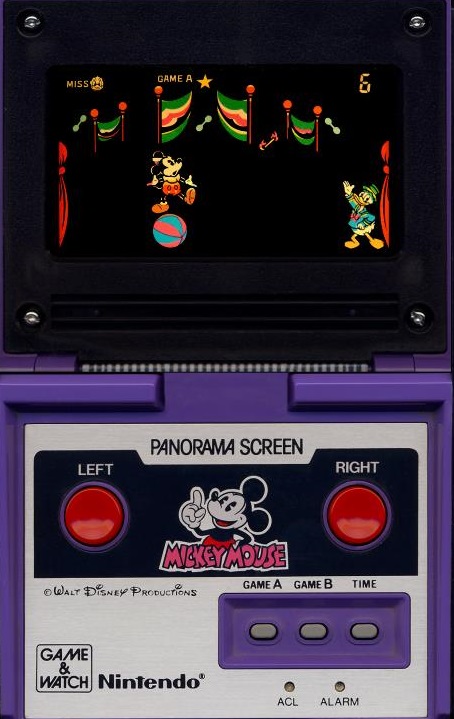
You must be logged in to post a comment.