The Fall of Elena Temple (Review)

The Fall of Elena Temple
aka Elena Temple 2.

Platform: Nintendo Switch, Xbox, Playdate
Released April 30, 2024
Developed by GrimTalin

This slideshow requires JavaScript.

Most games don’t require the most in-depth reviews. Take GrimTalin’s new indie sequel to their cult hit The Adventures of Elena Temple. That game was based on searching a fifty-screen map for treasure. This time around, Elena stars in a single-screen puzzler based mostly around the concept of falling. And it’s a really, really short game at only twenty stages. I don’t know exactly how much time I needed to finish them all, as I knocked out a few stages at a time, then did something else, then turned on the game and knocked out a few more, and so forth. The fact that I played The Fall of Elena Temple like that and still finished the whole experience in a single day says something. All in? It probably took me an hour-and-a-half. A really fun and perfectly acceptable ninety minutes, mind you. I can honestly say I was never bored. Unlike the previous Elena Temple adventure, this is 99% a puzzle game, with only the faintest hint of platforming, making this feel more like a spin-off than a proper sequel.

This slideshow requires JavaScript.

This is especially true thanks to the graphics looking a bit like Game Boy and a bit like Playdate. The previous Elena Temple was themed around a game by a hapless game developer who kept making their flagship game for the wrong platforms. This time around, it’s more like “hey, remember Game Boy?” You can zoom as far in or out as you wish. I needed to zoom all the way in, but your mileage may vary. The object is to collect all the coins and then get to the exit. The big twist is that most rooms have an item that grants you the ability to undo your previous fall from a platform, only you get to keep any progress you made towards the whole coin collecting. It’s actually a pretty good twist, but it’s also one that puzzle aficionados should be able to reverse-engineer with only a bit of trial and error. It’s intuitive to use, at least. The amount of falls you’re able to undo varies from room to room, and each fall is numbered so you know where the undo button is sending you. It works wonderfully and it does make for a fun gimmick. In fact, it’s so fun that I was sorry when it wasn’t in a room.
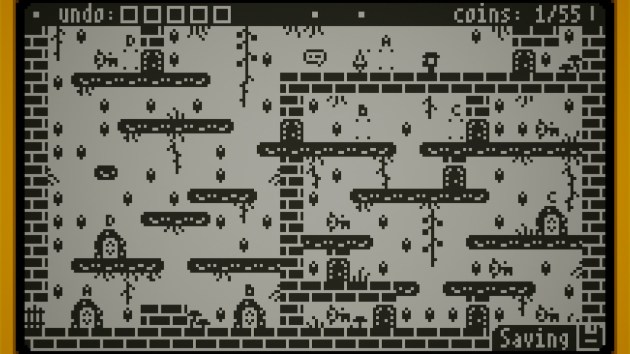
Probably the best thing I can say about Elena 2 is that it successfully creates “THE BIG OVERWHELM” which is my term for puzzle games where, at first, a level seems so vast and multi-dimensional that you initially think “okay, maybe time I’ve met my match.” The beauty of THE BIG OVERWHELM is that it doesn’t require a complex puzzle, but only the appearance of one. Look at Portal, where none of the puzzles are THAT hard, no matter how the scenario is presented. The payoff is, when you actually finish the stage that looked so overwhelming at first glance, it’s that much sweeter. The Fall of Elena Temple pulls that off, which is pretty impressive for a minimalist puzzler. Plus, Elena 2 keeps throwing twists at you the entire length of the game. Crumbling floors. Disappearing/reappearing floors. Boots that let you skip a space. Hearts that let you absorb one hit of damage. Keys. Snakes. Spiders. All of it paced out so that there’s something new in nearly every level, right to the bitter end. Actually, past the bitter end. I couldn’t believe my eyes when a never previously used magnet showed up in one of the three bonus stages, and then even more stuff is added after that. Hey, finally “bonus stages” that live up to the name. I can’t stress enough: this is GrimTalin’s best game and one of the absolute best puzzlers I’ve played in the last few years. The Fall of Elena Temple is really good.
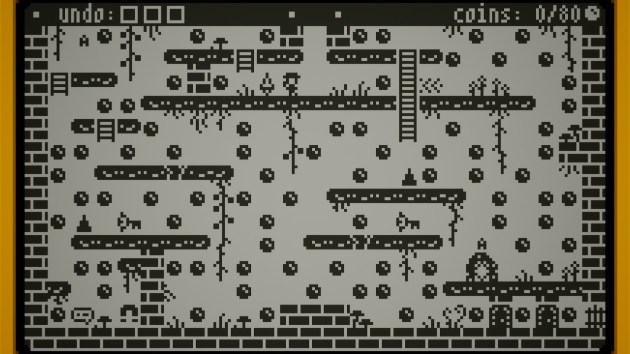
Even with THE BIG OVERWHELM, Elena’s levels are rarely actually as overwhelming as they look. Oh, and it took me about half the game for my brain to stop needing to tell itself “you can’t climb the vines, stupid.”

But, there’s really two big problems with the whole “stay fresh until the end” design mentality. The first is that, when you only have twenty levels, by necessity, the learning curve is going to be more like a gentle slope. You need the difficulty to scale, so you can’t do simple tutorial levels with the new items, but you also can’t really go completely bonkers with them either. Which, don’t get me wrong: I prefer Elena’s scaling to something like Gateways, where the learning curve was more like a straight wall made out of middle fingers (and mind you, that’s a game I liked a lot). But, there were also maybe, at most, only three or four levels that really had me scratching my head, and one of them was a “bonus” stage. The other big problem is that most of the ideas for special items are fun, but with the exception of the undo mechanic, they all feel underutilized. The twenty-three levels combined absolutely does not feel like it stretches the limits of what this puzzle formula can do. I suppose GrimTalin could do DLC, or a special edition later on like they did with the first Elena Temple. Hell, I’d be fine if they released level packs at $1 a pop for, say, ten new stages and just kept releasing new ones for quick cash, since that initial $3 felt underpriced to begin with. $3 for ninety damn fine minutes of puzzle goodness? What else are you going to do with $3? For me, I had to decide on a large lime slushie or this. I’m sure I made the right choice. Pretty sure. No, wait.. yea, I’m sure.
Verdict: YES!
$2.99 was parched in the making of this review.

The Adventures of Elena Temple

The Indie Gamer Chick Paradox: not being nostalgic for older games, but being drawn to neo-retro games. It’s a strange phenomena, but one I’ve noticed in myself, especially lately. When browsing console or PC marketplaces, if a game is all pixel-arty in a convincing way, I’m much more likely to want to try it. I find that strange, because I’m not exactly telling kids about the glory days when all Mario needed was two buttons, a D-Pad, fireballs, and a flagpole at the end of each stage. Frankly, some of those type of gamers are kind of creepy. Like the ones who say they won’t let their kids play any modern games until they play the games of their childhood and learn to like them, or else. That’s not teaching your kids appreciation. That’s brainwashing. Really unnerving shit that turns what should be a beautiful event into something more like indoctrination into a cult.

Still, if I see something that looks like a lost older game that’s been rediscovered and released again for a new audience, it sticks out to me. The Adventure of Elena Temple takes that a step further: it’s presented to us like it really is a lost game from 1982. One that never found its audience because the hapless developer kept porting their work to generic, off-brand game consoles and personal computers nobody owned (like the Nintengo Some Toy or the Maple Computer, a Canadian Macintosh clone that sold 31 units), thus screwing themselves out ever getting recognition (or payment) for what is actually a decent little game.

I wish I was joking when I say I played XBLIGs that didn’t sell that well.

It’s a cute idea, but one that doesn’t factor into the gameplay at all besides changing the shading of the graphics. That’s a shame, because the meta-joke has legs and probably could have been worked into the concept. Like maybe each port of Elena is busted by era-specific limitations or something along those lines. What could have been a truly inspired gag becomes little more than flavor text for different color palettes of the same game. You can’t even change schemes on the fly. You have to exit out to the main menu, which is frankly inconvenient if you’re someone genuinely looking for what style is the most comfortable to use. And to be honest, because of the comedic framing with the dense creator getting conned into releasing on the wrong platforms, I actually thought each different graphics style was going to be a completely different map or even version of the game. They’re not. There is exactly one map and one map only for Elena Temple that plays the same no matter which version you use. That’s fine, but I wish it had been a bit less ambiguous. Sort of like my last home pregnancy test. It’s surprisingly difficult to interpret whether a tiny line is blue or not when you’re stressing over the effectiveness of condoms.

Also, I had to fixate on that stuff because I really don’t have very much to say about the actual content of Elena Temple. It’s fine. There’s only fifty rooms to explore and gameplay is kept very limited in order to stay true to the 1982-developed-game theme. Exploring is limited to hoping around on platforms, occasionally hitting a button or firing a gun to break jars or knock down walls. I asked myself why she had to shoot jars instead of, you know, just kicking them or picking them up and dropping them or anything really besides busting a cap in them? Who shoots a jar unless you’re a Branch Davidian or something? In fact, guns are the solution to almost everything in Elena Temple. It’s like the NRA’s wet dream. Nearly every puzzle requires shooting it, and sometimes I found myself shooting buttons I could have pressed, but you only get two bullets at a time. There’s refills scattered around the map, some of which respawn without having to leave the room and come back in it. It does work, but it never gets more involved than base-level puzzle elements. You can shoot enemies too, but there’s seriously only two types: snakes and bats, both of which can be plugged with a single bullet. It contributes to the consistent theme of Elena Temple: everything works but there’s not enough of it.

You can zoom in for a closer view if you wish, but then you can’t admire the off-brand equipment you’re playing the game on. Come to think of it, maybe Elena Temple is a scathing commentary on cheapskates buying generic brands. Fair enough, though my father insists that Soni televisions are just as good as the real thing.

To developer GrimTalin’s credit, everything that’s actually here is fun. Each room is over and done with so quickly that you don’t have time to ever get bored despite many of the rooms feeling kind of samey having very little in the way of actual content. It wouldn’t be out of the question for a first-timer to knock the game out in an under-an-hour with a 100% completion. It controls good enough to never be annoying. Jumping takes a bit to get the hang of, especially with the rooms being as claustrophobic as they are, but after ten minutes it becomes instinctive. There’s a few hidden secrets that shows the location of the eight diamonds you need to finish the game, or whether a room is finished (never found that one) or secret passages (never found that one either) but otherwise what you see is what you get. The framing device actually covers for the generic setting, traps, and enemies, which does work in the same way Microsoft claiming bugs are actually features does.

But, what’s here is actually so well made that I can’t help but think almost anyone will walk away feeling a bit unsatisfied. Elena Temple is one of those games that strives for authenticity, achieves it, and it’s not entirely to the game’s betterment. It’s too simple and too straight-forward and doesn’t have enough going for it. And clearly GrimTalin understands that gaming has come a long ways, because without the one modern concession it does make (unlimited lives and thus no game-overing), Elena Temple would have certainly been too frustrating. You know, like 99% of all the games it’s paying homage to. Maybe that’s as far as GrimTalin could take it without betraying the theme, but I don’t know. The most randomly strange thing I could “complain” about in the game is that the Elena character is perhaps too tall. Hear me out: she’s roughly 1/5 the size of the playfield, with the spikes, coins, snakes, etc being half-as-tall as she is. If she was shorter, along with things like the spikes and coins and traps and enemies being smaller, rooms could have been bigger and thus been made more elaborate. I don’t know why, but it’s something that was in the back of mind nearly my entire session with it. Or maybe I’m off my rocker and it just needed more rooms. Probably just more rooms would work. And enemies. And traps. And weapons. And.. really it just needed more.

This is what a sucker I am: I actually found a blue/yellow color scheme to be the easiest on my eyes, but played in the gross Game Boy mock-up because my fans liked the authenticity of it. That’s how it starts. Next thing you know I’ll be dancing on command.

But it doesn’t need more to be fun. Elena Temple already is fun. The stuff I’m suggesting is merely to push it to a higher level. And, while the stages are basic, they’re not exactly crap either. Elena Temple never bores, and is inexpensive enough that you don’t feel ripped-off by the length. Unlike some other shorter titles that have little in the way of innovation, like Sigi, it feels like what we do have here is fully fleshed out. Like a gourmet chef took bland ingredients and made something very delicious with them without resorting to seasoning or other culinary trickery. When I went to determine Elena’s leaderboard position, I was actually taken off guard by how high it ended up. So if I came across like I didn’t like it, it’s only because what was here was so good that I realized Catalin Marcu’s only sin was not aiming higher. Hardly a sin at all, really. What do you call something that is close to a sin but not? I was going to say “a blowjob”, but I looked into it and it turns out that actually is a sin. I didn’t know that! Well, my next confession on Sunday just got awkward.

The Adventures of Elena Temple was developed by GrimTalin

Point of Sale: Switch, Steam

$2.99 (normally $4.99, really $2.99 should be the permanent price) asked why explorers in all these games break the priceless antique vases instead of, you know, gathering them to donate them to a museum in the making of this review?

Elena Temple is Chick-Approved and ranked on the Indie Gamer Chick Leaderboard