Super Contra (Arcade Review)

Super Contra
Platform: Arcade
Released January 28, 1988
Directed by Hideyuki Tsujimoto
Developed by Konami
Included in Contra Anniversary Collection
Sold Separately via Arcade Archives

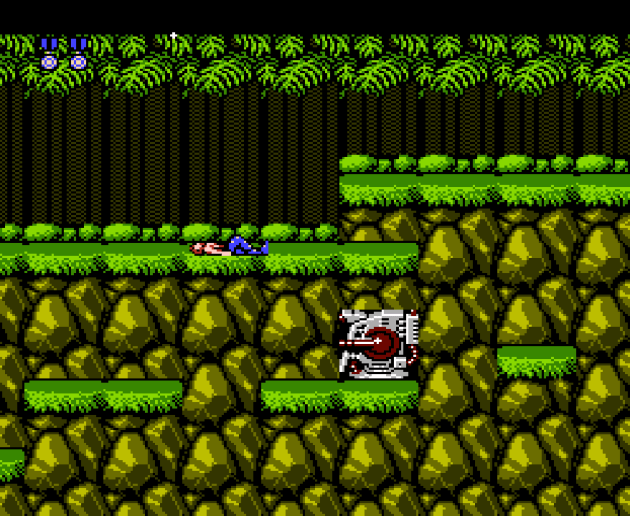
Well, it looks the part. But, it doesn’t do a good job of playing the part. At least on a full-time basis.

I get it now. I get why Super Contra didn’t reach the legendary status the original did, and I get it before I even reach the NES game. It’s not the Konami code. It really is the top-down sections. In what has to be one of the most historically bad decisions in game design history, Contra’s sequel, released just under a  year after the original, dropped the third person base segments and replaced them with generic top-down sections. What a stupid move. War-themed action games were smoking hot in gaming at the time, but there were a LOT of top-down shooting games that feel exactly the same as Super Contra’s top-down levels, surrendering the original game’s uniqueness.

Real subtle, guys.

I assume that’s why they used third person areas instead of top-down in the first place. How do you stand out in a crowded field in 1987? Mix genres. Side scrollers are popular, and top-down shooters are. Why not do both? Great idea, but top-down is too commonplace, from Front Line to Commando to Ikari Warriors. Hell, Ikari Warriors’ sequel, Victory Road, came out in 1986. You don’t want people to think you’re playing follow the leader with SNK or Capcom, do you? So instead, you mix a side-scroller with unique third-person levels that shift the focus from run & gun platforming to intense bullet-dodging in a tight space, but in a way that retains the acrobatic movement and jumping from the side-scrolling levels. Neat. Novel. Original. Tantalizing. And ALL YOURS. Now you’re the one doing the innovating! Anyone that follows is eating your dust, not the other way around. So, why move away from that? I honestly don’t know. Maybe they got bad focus testing or early reviews specifically on the third-person stages. I hope that’s not it. If you’re a game critic or participated in a focus group and sh*t on the base levels in Contra, thanks so much for ruining the sequel. You’re a bad person, and you’re going to gaming hell, where you will be forced to play Super Contra. I kid, because it’s Konami’s fault. What a truly stupid decision.

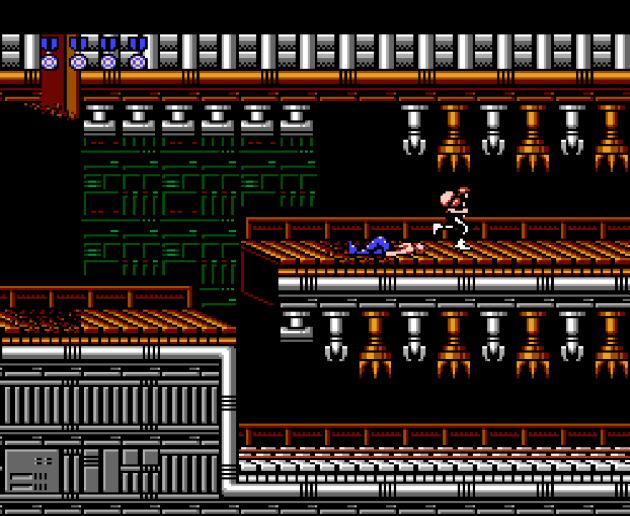
Okay, this IS kind of funny. See the two probes with the electricity running between them? They don’t kill you, or damage you, or anything. They do nothing. You stand right over them. Not even the energy hurts you. Cutting Room Floor, aka my favorite gaming site in the whole wide world, generously describes this as an “oversight.” Yes. Yes, “oversight.” I don’t think they just forgot to program that as a lethal element. It feels like an adjustment made by play testers, because I genuinely think if they hadn’t done this, Super Contra’s reputation would have gone from “meh” to outright scathing on account of extreme difficulty. There’s just not enough room to fight it without those being nerfed. Once again, the coin-op feels like it fails to make the best use of the vertical screen.

And it’s not like the top-down sections of Super Contra stand out in any way. They’re short, unmemorable, and generic. When Super Contra drifts aimlessly away from its bread & butter, hell, it could be ANY top-down game. The level design is so basic that, all by itself, it turns Contra as a franchise from coattail wearer to coattail rider. Like the previous game has to catch up to sh*t like Ikari Warriors. I’m not slamming Ikari Warriors. I’m saying Konami had a good thing going and threw the brakes on for no good reason. Those top-down levels feel like you’re running through hollow boxes and only occasionally have to change directions, but otherwise, they make for boring set-pieces. It doesn’t matter if you’re fighting aliens. They don’t feel alien. It’s especially jarring because the side-scrolling levels do a good job of that even when things like a normal helicopter shows up that you have to blow up. At only five levels, the game is pitifully small, but only three of those levels offer the type of action that feels like the sequel you want Super Contra to be. The word “super” was overused in gaming, probably thanks in large part to Super Mario Bros. In the case of Super Contra, it does such a bad job of feeling like an evolution of the Contra concept that calling it “super” feels like a lie. It also doesn’t help that this is also the owner of the first bad level in Contra. Or, more accurately, the first bad side-scrolling level. This level:

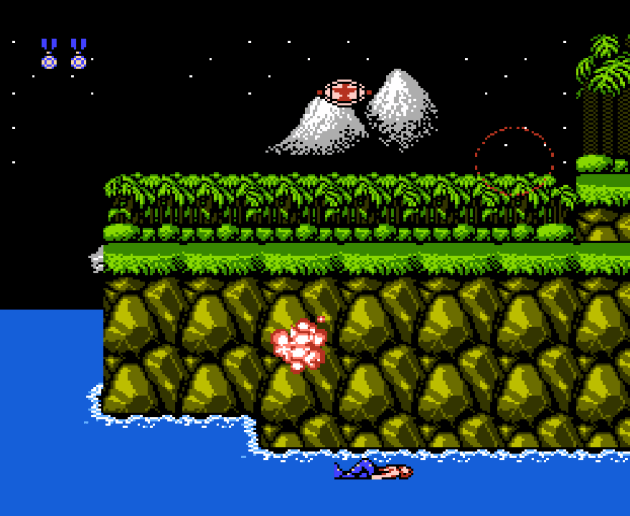
You can’t see it, but that guy is shooting me.

Hey, let’s make visibility a major challenge factor! Trees in the foreground that block your view. What a desperate move for a game that feels like, after a solid first level, it just lost faith in the formula. The first level is rock-solid. The fourth level is rock-solid. Levels 2, 3, and 5 stink. Super Contra is just fundamentally not fun 60% of the time. It’s not even the case of the NES version out-classing it (though that’s absolutely the case yet again). On its own, the set-pieces are much less memorable. The bosses are. The level design feels uninspired and arbitrary. I literally can’t believe Electronic Gaming Monthly named this the 9th greatest arcade game of all time. Apparently they did in 1997. So.. what you’re telling me is they only played 9 arcade games, right? Was the first Contra one of them? Because I’d rather play that. Nothing blocks me from seeing bullets in that game, and there’s no dull, far-too-basic top-down sections in that one. Was it a typo? Did they mean Contra? Because this is a cookie cutter action game that briefly becomes a Contra sequel. But it doesn’t last. EDIT: Come to think of it, it doesn’t have as much jumping as the first game did. Even the side-scrolling stages usually only offer one path and no options or flexibility.

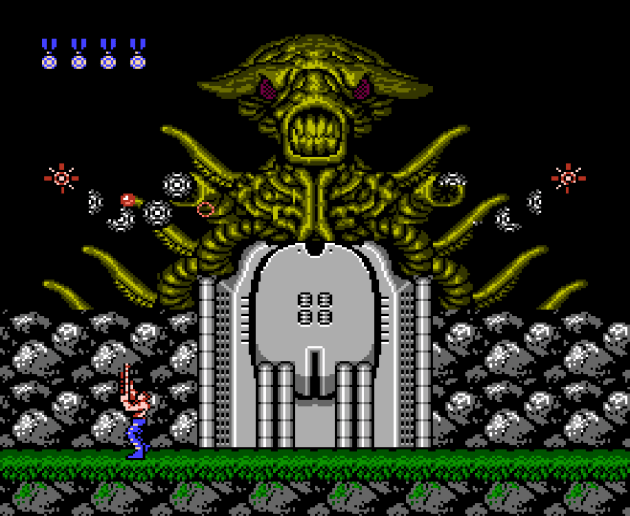
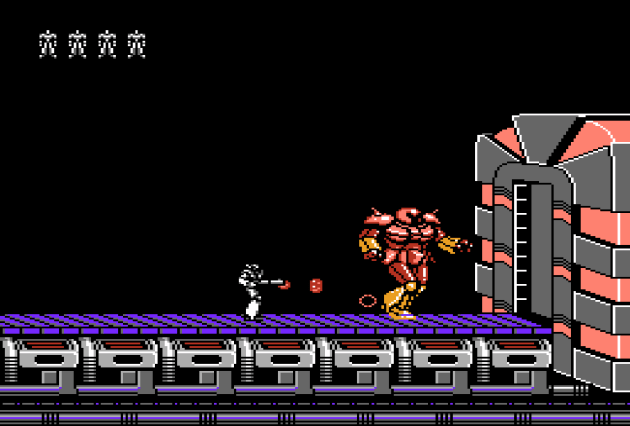
Okay, FINE, the last boss is pretty damn cool looking. But, the giant heart was unforgettable. I’m not sure I’ll remember this next week. I’ve beaten this before.. sober.. and for the life of me I couldn’t remember what the hell the last boss was. Also, the game ends on the lame-ass top down sections. So deflating.

Easily the most fascinating aspect of the arcade version of Super Contra is that, completely unprompted, it feels like a game that’s grasping at straws. As if it’s some kind of knock-off game instead of the sequel to a bonafide milestone in gaming. I’ve never seen anything like this, but actually, it totally makes perfect sense. They didn’t wait long enough to make a sequel, and since this came out a month before the NES/Famicom Contra released, they had no way of knowing what Contra was about to become. Hell, they didn’t even know that after it came out. Contra on the NES did good, but it wasn’t even one of the seventy-five NES/Famicom games verified to have sold a million units. That’s something even I didn’t realize when I wrote the previous reviews: at the time, Contra was something of a cult hit, not a hit-hit. I assumed it was a massive hit, but Konami alone had at least six NES/Famicom games outsell it. At least, and likely even a couple more. Contra was a sleeper that, in the decades since, woke up as a giant. But that took time. And that’s why Super Contra turned out so bland. Konami didn’t have enough time to observe the type of reaction and feedback Contra, as a coin-op or a home game, would have. You need that to make a GREAT sequel. All sequels are fan service, after all.
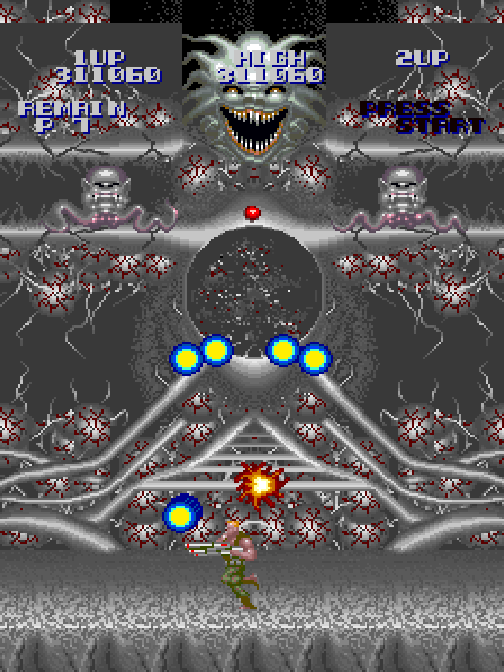
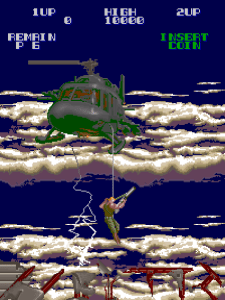
It’s a f’n vertical screen, and they still screwed up everything. Look at this! THE SCORE COVERS THE BOSS! Did you guys even care? This isn’t a nit-picky thing. It’s immersion you’re messing up. In an action game, if you don’t have immersion, you don’t have sh*t!

It’s taken three decades and a lot of historical reevaluations for NES Contra to reach the phase it’s at, where it’s mostly agreed upon that it’s one of the greatest video games of all-time. As recently as Contra Anniversary Collection five years ago, which is when I REALLY got into the original games, I didn’t realize what it accomplished. I just thought it was a really fun game. Safe bet Konami had no idea what they had either. It happens in gaming more than you would think. Namco didn’t realize what made Pac-Man work. Super Pac-Man and Pac & Pal proved that. Super Contra proves Konami didn’t have a clue either. Unlike the original, this can’t even fall back on “it’s only bad in comparison to the superior NES game.” I don’t think it’s actually a well-made game in general. This feels even more cramped than the first coin-op Contra. And, just like the first coin-op, that squeeze doesn’t come with a sense of tension. The jumping is not as good as before. You can’t even jump over a gun you don’t want, and there’s no jumping in the top-down sections. That button is used for the one screen-clearing bomb they give you per stage. Bosses and “event” enemies are spongy now, too, a genuine first for the franchise since the MSX game technically came after this. The only legit positive is the machine gun now fires rockets as bullets. Hey, that’s cool, but this is just not as fun as its own game or as a sequel. Super Contra is mostly boring, and that’s where it’s stuck, forever. At least we’ll always have the NES version.
Verdict: NO!

SoCalledSuperPART OF THE CONTRA REVIEW SERIES!
IGC Review of Contra (Arcade)
IGC Review of Contra (NES)
IGC Review of Contra (MSX)
IGC Review of Super C (NES)

What’s I’m Playing Right Now #06

I think my first post-Twitter week is going swimmingly. I’m pretty happy with the Contra reviews. They’re tougher to write-up than you’d think. Legendary games, bad or good, are tricky reviews. You don’t want to state the obvious too much. I assume people read me because they want to hear someone else’s perspective on games, and that’s why I try to at least look for little things that stand out that my readers might not have thought about. Like with Contra on the NES, the gap between weapons pick-ups might be the game’s secret sauce. Everyone loves the variety of guns. That’s the self-evident part. Nobody needs to hear that from me. My job is to figure out “why is it that way?” And after playing through it, I came to the conclusion that if the game wasn’t generous with them, I don’t think people would talk about Contra today. I think it’s the amount of opportunities for upgrades that made the game what it is. For all its flaws, even the coin-op is generous with guns, a semi-rarity in arcades.

Smash TV has some of the weirdest item drop pacing in gaming. Actually, change that. Smash TV is more stingy with its usage and not the drop rate itself. Speaking of which, I’m holding out on doing a Midway Arcade Treasures review. I really did think we’d have a release for current platforms by now. I was almost certain it was going to happen, and it hasn’t yet. The only one currently for sale is a previous-gen version called Midway Arcade Origins, which I found to have mediocre emulation and options. I’m really crossing my fingers for Atari and Digital Eclipse to secure the rights for a Midway version of the Gold Master Series. Digital Eclipse has worked on these licenses in the past and presumably has the contacts to do it again on the grandest scale of all. I think it’ll happen in 2025. I hope so. It would be one of the greatest collections of games in history.

This is something indie developers making action games should consider. In almost any arcade-like action game, the first level and/or the first life will always have upgrades early. That’s the hook of the game, not all that different from how slot machines are rigged to make players think they came close to winning. Even bad games tend to drop good power-ups early. But, once the player is hooked, a lot of games scale back the opportunities for those upgrades. Some do it far too much. Darius II had this problem (read Taito Milestones II: The Definitive Review for my full review on Darius II). And Darius II is a very good game. It’s also one of the rare novelty coin-ops that withstands the test of time (if you consider ultra-widescreen to be a novelty, which it certainly was in 1989). But Darius II was so stingy with power-ups that it’s practically miserly. That’s literally the only thing that held it back from all-timer status. Why are games like Gradius or Life Force/Salamander all-time classics but Darius is on the fringe as a very good and very popular B-lister? Item drops. I really think that’s all. Action movies don’t front-load all the action scenes at the start of the film, then do all the boring parts for the rest of the run time. When making your games, bring the goods early, and keep bringing ’em. Fun matters more than challenge, and if you need to be Scrooge-like with your items, you’re doing challenge wrong anyway.

So, what AM I playing?

Super Contra is coming later today or early Thursday, and the NES version will follow soon after. I have no clue why Super Contra’s reputation is buried to the degree it is. Actually, I do. No UP UP DOWN DOWN LEFT RIGHT LEFT RIGHT B A START for it. What if they had done that? Would Super C on the NES have been as big, or bigger, than Contra? Do you think anyone at Konami stares at the ceiling at night thinking “we could have been Call of Duty big if we hadn’t taken that code away?” Hell, it has a lives code. Just not THAT lives code. The famous one. The one that rolls off the tip of your tongue, and I think it hurt Super C. You can’t rule it out, because nobody really thinks Super Contra/Super C suck. If replacing the memorable third person stuff with top-down stuff isn’t the reason it slipped into oblivion, maybe it’s because gaming’s most famous code isn’t there. What a horrible thought.

Contra (MSX Review)

MSXContra
Platform: MSX
Released May 26, 1989
Developed by Konami
NO MODERN RE-RELEASE*

*For the purposes of this review, “modern” means “after Wii U”

The “lost” Contra, or in the case of American audiences, the “there’s another 80’s Contra?” Contra.

I really want to get on to Super C, but there was one last stop to make along the way. Instead of playing the DOS version of Contra, which apparently most everyone agrees is garbage, I decided to skip over to this Japanese exclusive. MSX appealed to me more, anyway. After all, the MSX was the closest we’ll ever come to Konami having their own platform. They were THE gaming face of the MSX, and in the not so distant future, I might be exploring their contributions further.

Some Konami MSX games I look forward to more than others. There’s an MSX version of Konami’s NES Teenage Mutant Ninja Turtles and it’s.. not going to be my favorite game ever. To say the least.

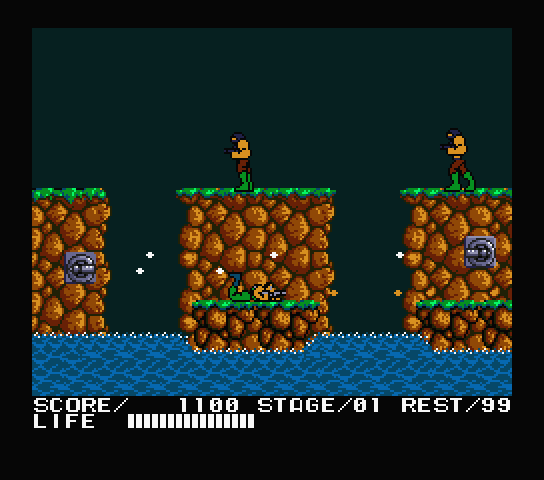
Contra on the MSX is a very different game from the Nintendo and arcade games. It might use those as a road map for what the game absolutely needs to pass for Contra, but it’s essentially an entirely new game that wears the Contra name. There’s no scrolling. There’s health, so a bullet doesn’t kill you, at least immediately. There’s no spread gun, aka my favorite gun. That one hurts, but at least the gun that replaced it is actually pretty helpful during boss battles: the “rear gun” which shoots behind you as well. Since one of the game’s go-to moves for challenge is having the grunts spawn on both sides of the screen during boss battles, it cuts down the busy work of shooting a guy on one side, then turning around and shooting again before you can go back to shooting the boss. This becomes very important thanks to the two worst additions to the Contra formula: sponge and small collision boxes.

It was actually kind of insane how many shots the final targets in the bases take to kill. Without hyperbole, these always took me over a minute of pinging them. They have a small collision box too.

I’m grateful for the MSX version of Contra because it validated my suspicion that speed and generosity play a big role in the success of Contra. On the NES, and even in arcades, Contra cuts a blistering pace. The MSX game isn’t “slow” for the most part. Instead, it’s too stop-and-go. When you’re making your way to a boss, it is a close approximation to Contra, only played one screen at a time. But then the bosses happen. They usually have small collision boxes. The best example of this is the jumping alien. In the NES game, you could shoot anywhere on its body and it registered damage. On the MSX, you HAVE to shoot it in the head, and it has a pretty tiny head. Everything is this way. The big ass tanks from the snow level? They’re here, but you have to shoot them in the gun. There’s an annoying little wrinkle that comes with all this: if you have muscle memory of Contra’s jumping from the NES or Arcade, it won’t help you with timing at all here. You jump a little higher and a little floatier on the MSX. I really struggled to aim, whether I was side-scrolling or shooting at the wall in third person mode. Speaking of which, you have to aim up in some levels in third person mode, but for most targets, that goes over them. But, your standard trajectory often doesn’t work either, so you have to jump and shoot as middle ground between angles. So annoying.

This slideshow requires JavaScript.

For these reasons, Contra on MSX has a reputation of being especially hard, and yea, it’s true. By the way, there’s NO continues. Yikes. After a couple hours, I opted to use a popular ROM hack that gives you virtually infinite health and I still managed to lose a couple lives. It’s really telling how tough the collision is (not bad, but tough) because with the addition of these challenging aspects also comes the addition of straight-up cheese. Contra MSX’s screen-based scrolling allows you to run past entire sections of the game. The lead-up to the battle with the giant alien heart? It’s here, with the alien turrets that spit  “spores” out that heat seeks you. Only, on the MSX, it’s a cinch! You can just run past them with no consequence. They get a fresh spawn every new screen and need time to fire their first bullets, which in turn need a few seconds before they pose a danger to you. If you don’t care about your score, you have more than enough time to just run across the screen. Nothing chases you to the next screen. Not enemies. Not bullets. They cease to exist. This is almost certainly why they beefed-up the bosses. They had to, because this is a Contra that rewards cowardice. Thanks to that health bar that they chose to go with in addition to a life system, getting shot once doesn’t cost you a gun. But not getting shot at all costs you nothing. Why engage if you don’t have to? You know the bosses are going to be tough, so just leg it past enemies when you can and save your strength for the battle ahead.

“Hey.. HEY.. you can’t do that! That’s cheating!” “Duh! I’m using the ‘cheat enabled’ ROM! How did you think I was going to play? With honor? Hah!”

So, that’s Contra on the MSX. You know the drill. Swap between side scrolling and third person gameplay. Kill a few aliens. Shoot an alien heart to death, then watch the credits..

Hey, wait a second..

Why’s the game still going?

This slideshow requires JavaScript.

Okay, okay, yea, I can dig it. When you kill the heart in Contra on MSX, there’s still a lot of game left. As in “you’re only about halfway done.” After the heart battle, Contra introduces more gameplay elements that are new to the series. Like vertical levels where you travel down instead of up. Okay, that’s different. Sure, the cheese issue from before applies even more here. It’s very easy to just drop down to the next screen without engaging anything. But, the highlight is easily a pair of third person bases that are, in fact, mazes. You don’t know which way leads to the final chamber and picking the wrong way takes you back. It’s not that hard to find your way around, but I was impressed nonetheless. The only truly new set piece is a lava stage, and then the final boss is called the “vital alien organ.” As opposed to what? Shooting the Appendix of Contra? The Spleen of Contra? Oh, oh, the Tonsils of Contra! No, that one wouldn’t work. What if they’re infected? You’d be doing the alien a favor. Yea, taking out vital organs probably makes more sense.

The Vital Alien Organ. I will not make the most obvious joke here. You’re welcome.

Keeping it real, Contra on MSX is one of the least popular games among fans of the franchise for a reason. There are certain benchmarks that make for a good Contra game, and this is missing a few. There’s no co-op. Single player only. The gunplay isn’t amazing. It’s pretty basic, especially compared to the more famous NES and Arcade games, and that’s assuming the guns worked at all. The flamethrower from the coin-op/NES is here. You know, the gun that shoots bullets that travel in circles. Circles bigger than the collision boxes are in this version of Contra. You see where this is going.

Yea, the flamethrower bullets circled around the tiny collision box on the UFO. Every single bullet missed when I stood right underneath it. The flamethrower is WORTHLESS against bosses. I think it might be the worst video game gun invented before Goldeneye’s Klobb.

And I didn’t find the laser very satisfactory either. Not worthless. Don’t get me wrong, but just not as fun to use. It’s too subdued. Weirdly, the basic machine gun or the rear gun are the most satisfying and useful weapons. Oh, and this time around, the capsules that fly onto the screen don’t drop guns. They instead drop items that boost your movement speed and firing speed. They’re also much harder to hit. Again, tiny collision boxes. I have no idea why Konami’s team (it’s hard to find credits for a lot of MSX games) made the choices they did, but few of them are in service to the game’s enjoyment. Ultimately, Contra for MSX never feels like Contra. Even with replicated set-pieces and bosses, it doesn’t even come close. I make “dollar store knock-off” jokes all the time, but in the case of Contra, that really is the closest I can come to saying how it feels. If there were such a thing as a dollar store gaming knock-off, Contra on MSX would be the dollar store Contra.

Another change, and this is a very big one: you can’t destroy primary targets until you’ve taken out all secondary guns. Take the first boss, for example. Want to blow up the main target? Gotta take out the top two guns first. Even though it makes the damage noise, the main target won’t blow up no matter how long you pump bullets into it. I actually like this change. It adds stakes, and in fact, would be a positive addition to the NES version. Like the “Final Gate” boss before the alien lair, where you can just run up and hit the target before it even gets one shot off at you? That would be out the window. You’d have to take out the two cannons first. Contra MSX is full of those kinds of ideas that COULD work, but they don’t help this specific game for other reasons.

On the other hand, I genuinely enjoyed the extra levels and effort that went into coming up with replacements for the hardware’s shortcomings. No spread gun? That sucks, but the gun that replaced, while nowhere near as fun, got a LOT of use from this chick. That should count for something, right? And then there’s ideas that are totally out of left field, like how picking up new guns work. Once you pick up a gun, you have THAT gun, and every time you get to another spot where you can pick-up a gun, even if it’s an old one you already have, you can choose to equip any gun you’ve previously found via a menu. I don’t think I’d like that for NES Contra, but it certainly works here. I used it too, to swap between the laser and the rear gun a few times. There’s a lot of novelty here to make MSX Contra interesting beyond the raw gameplay. But, gameplay is king. The best thing I can say about MSX Contra is that it took the skeleton of Contra and boiled a perfectly fine gaming broth both out of it that might make for a lousy game of Contra, but it’s perfectly decent as a bland action game. Contra on MSX might not deserve to wear the Contra name, but it does, and it should be included in any collection of classic Contra games. This deserved a spot on Contra Anniversary Collection, even if it doesn’t feel like the Contra we all love.
Verdict: YES!

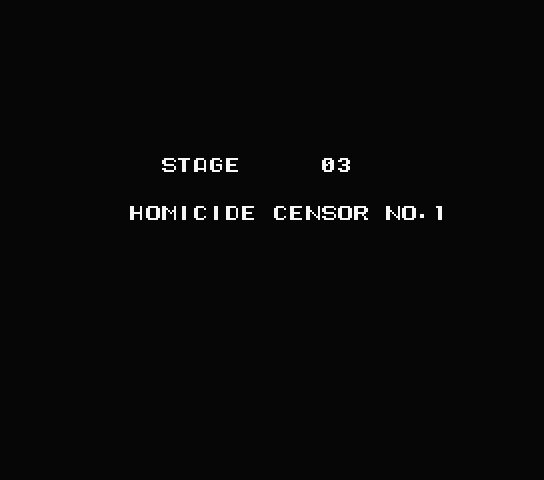
The names of levels are hilarious. The boss of the first base is called “Homicide Censor No. 1.” That’s hardcore. Meanwhile, the first stage is called “Asphalt Jungle.” WTF? Do you even know what an asphalt jungle is, Konami? Your game takes place in a LITERAL jungle, not an asphalt one.

Contra (3)PART OF THE CONTRA REVIEW SERIES!
IGC Review of Contra (Arcade)
IGC Review of Contra (NES)
IGC Review of Super Contra (Arcade)
IGC Review of Super C (NES)

Contra (Arcade Review)

Contra
aka Gryzor 
Platform: Arcade
Released February 20, 1987
Directed by Koji Hiroshita 
Published by Konami
Included in Contra Anniversary Collection
Sold Separately via Arcade Archives

This slideshow requires JavaScript.

When I reviewed Contra for the NES yesterday, I didn’t mention the arcade game at all. That’s because I think the conversation belongs here, in the arcade review. I don’t know if the fact that the NES game is superior to the coin-op is impressive or shameful. Maybe a little from column A and a little from column B. By any metric, the NES has the better game of Contra. Yes, that includes the graphics. I think Contra in arcades is pretty ugly. The graphics look washed-out, but not in a cool, stylized type of way. It’s just so drab looking, especially compared to the NES. But, who cares about looks? Gameplay matters, and I’ll still take Contra on the NES. Despite being a coin-op, Contra Arcade feels like a smaller game. Which is technically true because the NES game has more levels, but what I specifically mean is probably more related to the use of a vertical monitor. The game doesn’t benefit from a taller playfield, even on the waterfall stage where you climb upward. All the vertical screen does is subtract from the playfield without adding any benefits like a sense of claustrophobia or heightened urgency. It’s just cramped, period. The whole game is. By all rights, the arcade game should feel more grand and epic, but here’s the third boss in the NES game that came out a year after the coin-op:

Giant alien monster with two tentacle arms that shoot fireballs.

And here’s the original arcade version:

Two normal turrets, a five-gun turret, and a target.

One is unforgettable, and the other is so pedestrian that it could be any game. The NES version is a gigantic alien. In arcades, it really is just a base, and not even as grand a base as the first boss. It doesn’t even have to be an alien base. It could be a G.I. Joe‘s Cobra-like terrorist organization you’re fighting that has a bad H. R. Giger fetish. It’s just so generic and forgettable. The funny thing is, most of the bosses are almost identical in appearance and gameplay to the NES game, except they feel less important, and others genuinely are. By that I mean they’re bosses on the NES, but not in the arcade. The jumping alien isn’t. The giant UFO that drops smaller UFOs isn’t. Hell, you fight two of each of those in the arcade version. And the base boss before the final level from the NES game? It’s not even in the coin-op. In fact, after you beat the second base, the rest of the game kind of plays out as one large, continuous level. It’s strange, and it doesn’t work. I’ve always felt that bosses are a game’s metronome. They set the tempo, and build a player’s anticipation. Levels are always a little more exciting when you know you’re inching closer to a boss. Contra gives up on that design mentality early on, and it’s not better for it.

This slideshow requires JavaScript.

I had a developer friend once half-jokingly tell me something to the effect of, “thank god we started with transistor–transistor logic. If they had access to today’s computing power in 1972, we might still be waiting for the first great video game in the 2020s. They would have had so many options that they wouldn’t have known what to do with themselves!” In essence, great games wouldn’t have happened because the steps that created great games happened due to limitations and not despite them. He was kidding, but I’m not. He was right! Look no further than the arcade Contra. It’s the first game. Not based on anything (well, any video game). Much more powerful hardware than home consoles had at the time. And, when home releases did happen, such as the NES game, it’s pretty dang close. All the set pieces from the arcade game are on the NES, and in fact whole sections of some levels are. The NES game is a faithful adaptation, all things considered. But even with all the potential advantages in terms of hardware and resources the coin-op had, the NES just totally outclasses it. Remember how the vertical screen didn’t improve the waterfall? The one vertical-scrolling stage? Well, it did even less for the bases. They’re much smaller in scope and scale on the arcade version, with the only exception being the illusion of moving left and right at the end of them.

This slideshow requires JavaScript.

Some people really don’t like Arcade Contra, but it’s fine. It’s not amazing. It’s alright. If it seems like a bad game, it’s only by virtue of how amazing the NES game was. The arcade port has less personality and none of the charm. It has fewer levels. But, it’s still an okay game. Harder for sure, and there’s limited continues (the NES has this too, but the arcade has no 30 lives code). Except the laser is especially valuable now, and probably crosses the line into overpowered territory. It cuts through enemies like butter, but admittedly in a fun way. But, otherwise, it’s just a lesser game. I once said the SNES version of Teenage Mutant Ninja Turtles IV: Turtles in Time was perhaps the first coin-op action game outclassed by the home version, but I was clearly wrong. Contra on the NES completely blasts its arcade counterpart. And yet, what has the arcade version done so wrong? It controls fine. The action is good. Bosses are fun. Co-op is decent. The finale is memorable. It is Contra, only if Contra was okay instead of phenomenal. I’ve played hundreds of bad versions of great games. This isn’t bad. It’s just not as good.

Golly, this review sounded like a eulogy.

Don’t get me wrong. Even if the NES game didn’t happen, Contra would not be an elite arcade game. It would be a B-lister Konami coin-op, and there’s a lot more of those than I realized when I started my retro adventures. Yet, none of those are vilified to the degree Contra is. I kind of feel sorry for it. History will continue to look back more and more kindly on NES Contra. Its reputation is not done growing. Ironically, that’s why the arcade game’s fate is sealed. There will be no historic reevaluation. Contra Arcade is what it is: an okay game, and nothing more. Except, it does get credit for being a proof of concept for a superior game. The blueprints to one of the greatest video games EVER made. That has to count for something.
Verdict: YES!

PART OF THE CONTRA REVIEW SERIES!
IGC Review of Contra (NES)
IGC Review of Contra (MSX)
IGC Review of Super Contra (Arcade)
IGC Review of Super C (NES)

Contra (NES Review)

Contra
aka Probotector
Platform: Nintendo Entertainment System
Released February 9, 1988
Directed by Shigeharu Umezaki & Shinji Kitamoto
Developed by Konami
Included in Contra Anniversary Collection

I imagine the Konami NES NO! streak is about to end.

Ever shut down an account with 18,600 followers? It doesn’t feel great. I need something to cheer me up. I think it speaks volumes that, when I was asking myself “what classic game can I play that I know is guaranteed to be a good time no matter how many times I play it?” Contra sprang to mind. Come on, it’s Contra! What can I possibly say that hasn’t been said by everyone who loves games? “It’s a very fun game, but when do we get to the part where we trade arms to Iran?” Thanks, Dad. I’m sure nobody has ever made THAT joke before. So, I did something a little different with this review. In addition to playing through it, I watched my father and niece Sasha play a round. I just wanted to see if they had fun. No help from me, except I told them the Konami Code, which Dad had heard of but Sasha, all of age 9, hadn’t. Took them a couple tries but they got it right. Dad had played this a little bit before with me, but we’d never really finished it. And, they had a great time! They really liked Contra a lot, both declaring it one of the best games they’ve ever played, and that made me feel awesome. That could be the whole review there, but WHY is Contra fun? Why is it so beloved? Has any game that’s so small and unassuming left a bigger footprint? Arguably, it’s more famous for the Konami Code than the game itself. Plenty of people can’t recite their own driver’s license number by heart, but they can recite how to get 30 lives in Contra, even if they haven’t played it in decades. I HAVE to know: what makes Contra.. well, Contra?

This is arguably the game that introduced the concept of “epic” to gaming.

The obvious answer is “everything.” The music. The sound effects. The guns. The bosses. The two gameplay styles, side scrolling stages and third-person stages, being completely compatible in a way that changes the pace in a fun and inventive way? Something a different Contra game proved matters a great deal, by the way. Super C’s top-down sections are nowhere near as fun as Contra’s third-person stages. Top down? Pssh, what is this? Ikari Warriors? Commando? Top-down is far too common-place on the NES, unlike the third-person stuff. Even the mythology around Contra elevates it above other games. I’m not just talking about the most famous cheat code in gaming history. It certainly played a big role, but it’s not even really Contra’s code. It’s Konami’s code, and it started in the game Gradius because play testers weren’t able to finish the game and needed help. It was a series of inputs nobody could do by accident. Then, they just forgot to delete it before publication, and the code became an icon of gaming. Hell, it’s in the Tengen version of Tetris. Sort of. The “UP UP” part isn’t, but if you pause that game and press “DOWN DOWN LEFT RIGHT LEFT RIGHT B A” it changes any block into the Tetris-making long block.

This slideshow requires JavaScript.

And that’s just the start of Contra’s mythology. How about the fact that, in Europe, they replaced humans with robots? That’s one of those things that’s just so weird, but in a charming way. There’s no doubt about it: Contra for the NES is in the discussion for the greatest video game of all-time, but I suspect the secret to its success goes deeper. I think Contra is one of the most interesting games ever made. On the surface, it doesn’t really seem like it would make for an interesting review, either. Well, at least my style of review, because Contra doesn’t do very much wrong. What can I possibly complain about? There’s no cheap shots. There’s no gotchas. The jumping is damn near perfect. The levels are flawlessly paced. There’s not one placement of platforms I would consider to be an unfair or bad jump. There’s no trollish enemy placement. If anything, Contra handles all those elements so precisely and thoughtfully that you’d swear a super computer chose their locations based on some kind of scientific formula. The one sort of “dirty pool” part are these hooks, which don’t use a timed interval like previous ones had:

And.. you can just jump over them. There’s enough clearance. Took me a while to figure that one out. Even the weapons are equally fun. While I know what gun *I* like (the spread gun), there’s practical arguments that the flamethrower, laser, and even the machine gun are equally balanced. Hell, did Contra even make a mistake at all, or is this that rare game that’s absolutely perfect?

In Japan, there’s some special effects that don’t happen in the US. There’s also a Ghosts ‘n Goblins-like Map Screen and “cut scenes” like the one above.

It might actually be perfect. Except the co-op, which has scrolling that can double-kill you or worse if you die and then respawn right over a pit without your partner moving the screen far enough over. You can also scroll-kill on the Waterfall stage too. Except, that sort of feels like the type of communication-based challenge that co-op SHOULD have, doesn’t it? So, great, back to “is it perfect?” And the answer to that is “no.” There’s one flaw that I would come down on like a ton of bricks if it were any other game, and fair is fair. So, here is the one and only genuine problem with Contra: visibility issues. And it’s not nothing. Assuming you have a non-standard gun, your bullets are big and highly visible. But, basic grunt enemies and the turrets shoot white dots at you, and sometimes they vanish in the fog of war. Depending on your screen, it can be very easy to lose track of the enemy shots. As a precaution I have to take with my photosensitivity, I have to play my games in a room that’s brightly lit. It sucks, but it beats having a seizure, a headache, or whatever else might happen. Some games it’s not even a big deal, but it absolutely is with Contra. I’m good enough now that, when I die, it’s usually a total surprise because of a stray bullet that blended a little too perfectly with the rest of the screen. Once I was absolutely certain that there was nothing about the graphics or effects of Contra that was dangerous for my photosensitivity, I turned the lighting down a little bit. Visibility was still an issue. So, it’s a thing.

The visibility thing is especially annoying in the third-person levels. The little electric beam that keeps you from running forward is white and bounces up and down. It’s visually noisy and white, while the bullets are visually small, subtle, and white. There’s also white lines to create the illusion of depth, and enemies have white shoes. Hell, the seams of your pants are white. It’s not a coincidence most of my deaths in this feature came during these base stages.

That one flaw is certainly not enough to take Contra out of the contention for the title of best NES game. I obviously don’t think it is (that honor goes to another Konami game: Castlevania III: Dracula’s Curse), but it’s no-doubt-about-it in the discussion. Even people not inclined to enjoy pew-pew beefy dudes shooting guns type of games love Contra. I think a big part of that is it’s one of the most clockable games of this type out there. In recent years, one of my proudest gaming achievements was successfully beating the original Castlevania without dying. But, a no-hit run seems so far out of my league that it’s practically off the table. When I had that no-death run, a few people mentioned trying a no-death run on Contra. HAH. That feels well out of reach. Then I played it for this review. Actually, I played it multiple times, but that wasn’t my intention. I was going to play it once single, and once co-op. In the first game, I put the 30 lives code in as a precaution, but I didn’t need it. I ended up making it over half-way through the game on my first attempt before I lost my first life. WTF? Really? In fact, yea, I made it to the “energy zone” before I died right here:

This prickish fire beam that behaves differently than other fire beams is where my no-death streak ended in my first game in this review.

Am I just fantastic at games? Nah. If you want to completely trivialize Contra’s difficulty, all you need is a controller with autofire, the spread gun, and enough experience playing Contra that you know what to expect. It’s not even that much experience, either. I hadn’t played Contra in a long time when I made that first run during this review, and I finished the entire game with only two deaths thanks to cautious gameplay and the autofire. On its own, with a regular controller, Contra is genuinely pretty tough, right? Maybe the first time, but if you know what to expect, it’s really not that hard. I know this because I just created a challenge for myself: Contra, with no thirty lives code and no autofire. Can I beat the game without needing a continue?

That was a warm-up, everyone. Warm-up.

Let’s try that again.

Oh for f*ck’s sake, Cathy.

Alright, seriously, starting over, and this time I’m going to remind my brain there’s no autofire and I can’t just barge through the game like I want to talk to the game’s manager. No BS, how far can I make it in Contra with zero extra help? No thirty lives code. No autofire, no rewinding, no save states. Go!

Death #1 happened during the last room before the boss of the second level. I tried to get too many shots off at the primary target before smartening-up and taking out at least one of the turrets. The worst part was losing my spread gun. I basically traded it and one of my lives for the flamethrower, which is my least favorite of the four non-basic weapons. I didn’t get the spread gun back until over halfway through level three, which is where I also scored my first free life (CORRECTION – IT WAS MY SECOND FREE LIFE).

This slideshow requires JavaScript.

Death #2 happened during the third boss, which is one of the few bosses that shoots large projectiles you can’t blow-up with your own bullets. I think I just died from a bullet that spawned in the same space I was occupying. Death #3 happened in the first room of level four. Yep, I’m in trouble. I got a flamethrower (sigh, why do the third-person things give me that POS first?), then ended up with the laser, and soon after, another free life. Made it to the final room which has three turrets, tons of barrels that come at you, and enemies that never stop shooting. Death #4, but I got a machine gun for the first time since the start of the game and got out of the boss fight with two lives left. Without any third-person levels left, for a moment, I thought I had a shot at it. I got ANOTHER free life soon into the next stage, and I got my spread gun back. And then I remembered the big f’n tanks in the next level.. which I defeated easily. In fact, I had my first level since level one where I didn’t die! I also didn’t die in the 6th level and got ANOTHER free life.

This slideshow requires JavaScript.

This was my Homer Simpson moment. “I’M GONNA MAKE IT! I’M GONNA MAKE IT! THIS IS THE GREATEST THRILL OF MY LIFE! I’M QUEEN OF THE WORLD AND..”

Death #5

Are you kidding me? A pack of three guys had been running to the edge of the platform below me and then turning around. I shot two of them, but one jumped and got me. Goddammit so much. Except.. uh.. that was my last death. Holy crap, I just beat Contra without gaming-over, without the 30 lives code, without cheating, AND without autofire!

This slideshow requires JavaScript.

Granted, I had a two-death game with autofire already in the making of this review, but I literally squealed with joy. It just feels like it matters for some reason. So, now that I’m really warmed up, how far can I make it with autofire? How much does that completely neutralize the difficulty of Contra?

Warm up. WHAT? WARM UP! (I didn’t make my jumps across the exploding bridges).

After that false start, I did it. No death run on Contra. With autofire, but no cheating. The game continues afterwards with another cycle. I couldn’t find anything on if the second cycle is supposed to be harder. I didn’t think it was, but I wanted to see how far I could make it without dying. I wasn’t as cautious this time. The first cycle, I paced myself, especially with the turrets. I made sure to take them out as soon as I could to lessen the chances of a stray bullet. I didn’t the second time around and I made it..

This slideshow requires JavaScript.

Contra, like Castlevania, has a overstated difficulty. It’s tough, but not unclockable. Random elements are kept to a minimum, and enemies are predictable. Your bullets travel the full length of the screen, and it’s not like enemy fire is blanketing the playfield. This isn’t a bullet hell, or even remotely close to that. On top of all that, if you die, there’s never too much distance between you and the next opportunity to upgrade your gun. How many video games with a reputation for being difficult are there where the difficulty is based on the fact that you’re absolutely f*cked the very first time you lose your current loadout? That’s not the case at all with Contra. In my no autofire run, I only finished one boss without the default gun. Enemies are never too spongy. Bosses aren’t, even with your basic gun, but the odds are you won’t have your basic gun for long anyway. That was my revelation about Contra: as far as this type of game goes, it’s almost unprecedented in how generous it is with power-ups and extra lives. Mind you, there’s no extra life pick-up. Extra lives come from points only, yet, I was constantly hearing the pleasant chime of a +1 to my stockpile. I’ve played a lot of NES run & gun games way more intense than this. Compare Contra to something like Capcom titles Gun.Smoke or Commando. Contra is downright kind.

In Europe, the franchise is called Probotector. It sounds like a satire of a game name, doesn’t it? But, it’s the same game. Oddly enough, I didn’t find the difficulty better or worse on any of the three versions (including the Famicom). That’s rare. If there was any difference, it was so subtle that I didn’t feel it.

And I think I know now why Contra is so universally loved: challenge isn’t the point. Fun is. It’s generous with the special guns because they’re more fun than the basic gun. It’s not spongy with the bosses because that would make the novelty of fighting them wear off quickly. The developers have nothing to prove or gain by demoralizing players. Contra is tough to start, but it’s easy to memorize where enemies are going to be. It doesn’t even slow gameplay down that much to play conservatively. It’s the most doable of any “hard” game on the NES. It was A LOT harder for me to beat Castlevania without dying than it was to beat Contra without continuing or, with autofire, without losing a life.

It helps that not one single level qualifies as “the bad one” or even the “not as good one.” Contra is a masterpiece of level design. They’re all a lot of fun.

When people talk about “Nintendo Hard” it’s usually about games like Battletoads which are so prohibitively difficult that they just become boring after the first couple stages. Then there’s Contra, which thanks to the 30 lives code, anyone can finish with a continue or two. It’s a cinch. But, without that code, it’s a game hard enough that beating it without continuing is an accomplishment I’m proud of. At the same time, it wasn’t that hard. It just took a lot of replays over the years. And that’s where Contra’s credentials as a bonafide gaming legend are revealed. Hell, I could probably brute-force memorize any game and get myself to the point where I can beat it in a way that feels like a big deal. Some would just take longer than others. But, for 99.9% of all games, the process for getting to that point would be so boring. Not Contra. No matter how many replays, it’s as fun the last time as it was the first time. It might not be anyone’s #1 game of all-time, but it’s up there for EVERYONE, and there’s not a lot of games you can say that about. And THAT’S why Contra is one of the all-time greats. But, certainly not THE greatest.. right? RIGHT?! I don’t even know.
Verdict: YES
“What about the coin-op? What about Super C? What about..”

Contra SplashPART OF THE CONTRA REVIEW SERIES!
IGC Review of Contra (Arcade)
IGC Review of Contra (MSX)
IGC Review of Super Contra (Arcade)
IGC Review of Super C (NES)

The Difficulty Gateway

I usually say that I feel my reviews as Indie Gamer Chick represent the average gamer, but the truth is I’m probably above-average in skill-level for most genres. Some, like puzzlers, I chew through so easily that I usually hand games off to my family to make sure they’re not too easy for normies. But being a fairly hardcore gamer since the age of nine and being a game critic is a tough balancing act. One that doesn’t get discussed enough, because we’re all probably better at games than Fred and Ethel shopping for something on payday to kill a weekend with on their dusty Xbox One. When a game doesn’t have adjustable skill-levels, challenge is hard to quantify on your own. You’re playing the game based on decades of experience, and can only assume how others will take it. Even if you have friends or family to observe, it’s not like you’ve been studying them in a laboratory your entire life and can fully approximate the ceiling of their ability.

Of course, being a game critic, if I’m not being told that the only reason I didn’t like a game is because I wasn’t “objective enough”, the most common thing I’m told is that I just suck at games. I didn’t like Cuphead, ergo I suck at games. I didn’t like Hollow Knight, ergo I suck at games. I didn’t like Hotline Miami, ergo I suck at games.

Ah yes, Battletoads. A game so fondly remembered that it could go completely dormant for twenty years because it was so prohibitively difficult that very, very few would ever remember it as an all-time great.

I don’t think I suck at games. Maybe some games. Like fighting games aren’t my thing, and an early running gag at Indie Gamer Chick was me noting that I couldn’t ever get the hang of throwing a Dragon Punch with Ken or Ryu (I’m proud to report I can now, suck it Kris & Jesse). It doesn’t mean I don’t like fighting games though. I got Mortal Kombat XL for Christmas and took delight in violence so awesome that it would make even the most dead-inside grizzled veteran become physically ill. But something like Cuphead? I actually don’t think I was that bad at it. I got all the contracts (IE I beat all the bosses on the standard insanely crazy hard difficulty) for the first world and beat all the bosses on the lowest difficulty for the first three worlds, something nearly 90% of all Cuphead owners either couldn’t do or couldn’t be bothered to do. As for Hollow Knight, I’ve heard fans of the game tell me how hard a boss was that I downed without breaking a sweat. I wasn’t dying all that much while playing it and only once did I die without retrieving the shit I dropped, thus losing it.

By the way, I sucked at Spelunky. I really sucked at Kingdom. They’re both IGC all-timers. Trust me, if talent was required for me to enjoy something, I wouldn’t have any hobbies at all.

I’m not a fan of the notion that games are supposed to be hard to prevent undesirables from playing them, or any game. That the measure of a true gamer is being able to finish these hard games. What an absurd notion this is. It’s snobbery of the lowest order. For games like Cuphead, I’ve come up with the phrase “prohibitively difficult” to describe them. I think Cuphead crosses the line where even above-average players will be gated-off from large sections of content without any hope of ever being good enough to reach them. And for those who say “practice harder”, this isn’t an activity where increasing your skill level will lead to greater things in life. It’s a video game. I’m not going to put in eight hours of practice a day just so I can fight a giant animated stack of poker chips.

By the way, Cuphead wiki, this is based on Amarillo Slim. Only the Babe Ruth of Poker. “Duhhhh, we think it’s based on poker. You can tell by the chips.” Good lord, you people need to get out of the house sometime.

Far be it from me to tell anyone how to make their games. If you feel your dream project should only be able to be finished by 2% of all gamers, so be it. But, maybe you should consider telling your fans to stop calling those who can’t beat it a bunch of pussies. I’ve seen players far above my skill level who enjoy quality run-and-spray games walk away broken and shaken from Cuphead, wondering if their skills are depleting as they grow increasingly decrepit or if it’s the game. It’s the game.

And what’s the point of gating, anyway? Contra is an all-time classic, and one of my personal favorite NES games. It’s kind of a travesty that it wasn’t part of the NES Classic. Instead, we got inferior sequel Super C instead. Contra is hard, but it has the most famous means of overcoming that difficulty in the history of gaming: the Konami Code. If that wasn’t in the game, nobody would talk about Contra today. The Heart of Contra wouldn’t be one of the most legendary bosses of all time. It’d just be one of those NES games people say “cool, I remember it. It was hard” and then talk like blowhards about how games were better back in the day while reminiscing about all the titles they never got around to beating.

Has it ever been confirmed this is actually supposed to be a heart and not, you know, the Gonads of Contra?

So how is someone like me, an above average player, supposed to quantify the value of a game that didn’t just destroy me, but destroyed even better players I know? Indies are dependent on word of mouth, and “this game left me blistered and defeated” isn’t exactly a ringing endorsement to your average gamer. A critic isn’t an asshole for telling people the game is too hard to recommend, nor are they a pussy. You’re who gated the game off. And for what? So a small percentage of players who will never help you move a single unit outside their clubhouse can have a secret handshake “we’re the only real gamers” crowing moment? If they tell you that you’re selling out for including adjustable difficulty, you tell them to pony up a few hundred thousand dollars so your kids can go to college. I’m sure they’ll get right on that.

Heavy Recoil

Heavy Recoil harkens back to the good ‘ole days when games would kick your ass with a steel-toed boot.  This is also known as the period before I was born, so the nostalgic value of Heavy Recoil does absolutely nothing for me.  And yet, when I see a game that does a pretty convincing job of looking like an 8 or 16 bit era title, I usually get excited.  That’s typically because such games seem to go that extra mile towards having good level design and awesome play control.  So does Heavy Recoil succeed?  Yes, at least when it comes to looking like a Super Nintendo game.  If I hadn’t known it was on XBLIG and saw a trailer for it, I would have thought for sure it was an SNES title that I had never heard of.  And after playing it, I would have guessed I had never heard of it because it was shit.

Heavy Recoil really does look the part, which is commendable.  But the gameplay is boring, limited, and frustrating.  Retro doesn't have to mean shallow.

Heavy Recoil really does look the part, which is commendable. But the gameplay is boring, limited, and frustrating. Retro doesn’t have to mean shallow.

Heavy Recoil is a 2D platformer/shooter where you play as a robot that must shoot other robots.  While I’ve recently developed a love for robot-on-robot violence (courtesy of Brian introducing me to reruns of Robot Wars), I question the logic of building a weapon that is so damn limited or worse than what the enemy is using.  The protagonist robot can only shoot whatever is straight ahead of it.  I’ve had a lot of people say “some games were like that!  Would you call Mega Man shit?”  Apples and oranges, people.  Mega Man was more nimble than the robot you play as here, which wasn’t given a name or any back story at all so I’ll just call it “Phil” because that’s about the most boring name I could think of on five seconds notice.  Phil can barely jump, unless you get a power up that allows him to do it.  Given the fact that many valuable items are placed well above your normal jumping range (along with plenty of enemies), this was a bit of a dick move.

In order to get jumping, you have to pick it up in an item drop.  This in and of itself is a problem.  The item that has it rotates between it and a useless dash upgrade, requiring you to time when to pick it up.  Typically, that’s not too hard, but sometimes it’s obscured by something in the foreground and you can’t see it.  It’s frustrating enough that the game considers decent jumping to be a bonus that players have to pick up without having to deal with blind-man’s bluff.  I had the same problem with the secondary weapon upgrades.  There’s four: grenades, lasers, homing missiles, and rockets.  No matter which you have, they’re weak.  They can’t even break apart the barrels that you pluck them from.  Grenades are probably the most useless of the bunch.  They’re good at blowing up annoying landmines, but otherwise everything they can kill is already right in front of your gun anyway.  Of course, your bullets can only travel about four or five character-lengths in front of you.  Why?  I have no fucking clue.  I can fire rubber bands further with my thumb-and-index finger pistol than Phil can shoot ballistic weapons.  To fix this mistake which should have been corrected out of the fucking gate, you can pick up a laser that shoots all the way across the screen.  Well la dee dah!

Rockets and homing missiles are more useful, because they can attack things above you.  They still mostly suck on account of them doing about as much damage as popping an inflated paper-bag next to your target.  What really sucks is, like the jump-or-dash upgrade, you can only have one.  Why?  I don’t know.  Using these items doesn’t require a special button press.  They just fire when you shoot your gun, which has to be repeatedly mashed because holding down the button would be too convenient.

I get that games like this used to be a big deal and people long for the days when you had three lives and if you lost them you got to start all the way back at the beginning.  But even then, sometimes those games could be fun.  Contra for example.  I could never quite put my finger on what exactly made Contra fun, but now I’m guessing being able to shoot upwards might have something to do with it.  And mind you, Contra had that whole “shoot in directions other than straight forward” innovation down three fucking years before I was born, so Heavy Recoil can’t really claim the retro-mandate for pretending that upward mobility doesn’t exist.

The two boss fights that I encountered were downright easy.  I didn't encounter more because I got sick of single-hit deaths, no continues, bad jumping, lame items, and dick-move level layouts.  Over an hour put into Heavy Recoil and not once did I have any fun.  Unless the game has a magical "get better" section, I'm guessing that wouldn't have changed.

The two boss fights that I encountered were downright easy. I didn’t encounter more because I got sick of single-hit deaths that take away all your weapons, no continues, bad jumping, lame items, and dick-move level layouts. Over an hour put into Heavy Recoil and not once did I have any fun. Unless the game has a magical “get better” section, I’m guessing that wouldn’t have changed.

But even if you could, it wouldn’t be very fun.  Everything here is just so bland.  The levels, the enemy design, Phil.  That’s why I said Heavy Recoil would be remembered as a bad lost game from a bygone era.  I’m not saying I expect neo-retro games to be better than the classics they were inspired by.  What I’m saying is don’t make a retro game in a retro costume.  Make a modern game in a retro costume.  Take advantage of what we’ve learned over the last twenty-five years of consoles.  Some concepts are more popular than others.  Firing in more than one direction is such a concept.  Do you know what happens when you forgo technological innovations in favor of rehashing old shit that nobody cares about?  That’s right: you sell 400,000 units of your latest hardware on launch day.

Okay, bad example.

xboxboxartHeavy Recoil was developed by Wide Pixel Games

80 Microsoft Points admit Heavy Recoil is an awesome name for a game in the making of this review.