Sententia

As I noted in my review of qrth-phyl, I get called out a lot for picking on developers. I really try to avoid this and focus on the game, but sometimes my methodology on criticism can seem like I’m going after someone when I’m not. If I say a developer’s game sucks, it’s taken to mean I think the developer sucks. And if I’m especially harsh on a game, it’s thought that I need to lighten up and look for positive things to talk about and “quit being so personal.” It’s never personal. Ever. So hopefully I’ve cleared that all up and can now focus on writing a balanced review.

Sententia is the worst Xbox Live Indie Game of the year.

I spent a few hours slogging through it, including accidentally scrubbing my save file while attempting to show someone how the game began, which meant I got to start over. Of all the critics who are covering the Uprising, I’m pretty sure I made the least progress in the game. I know there are people who say that a review doesn’t count if you don’t finish the game. To that I say, unless it has a magical stop-being-crappy section, I don’t think there’s anything I can possibly miss discussing about it.
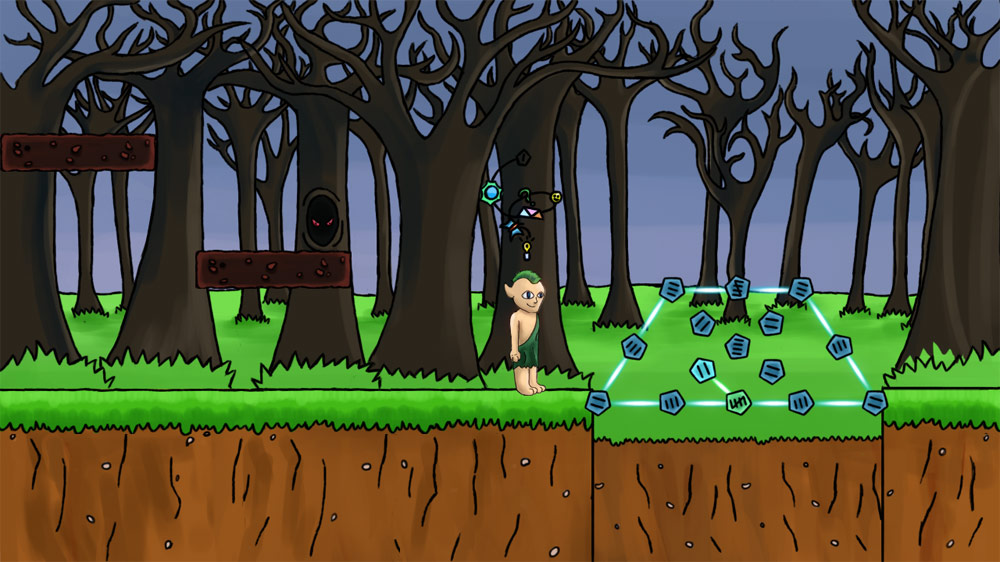
The idea is you’re some kind of demon monster thingie (I think) who is coming of age and learning to use magical connect-the-dots to um, do something. I honestly have no clue. Which is odd because there’s certainly enough writing that I would hope to grasp what is going on. Instead, a kid just kinda wanders off on the woods, sees giant-sized devil thingies, and doesn’t turn around and run home to his daddy.

Sententia describes itself as an art game in its marketplace blurb. I’m not a huge fan of games that label themselves as such, because most that do so use it as an all-purpose bullet-proof vest for criticism. It gives a developer or a game’s fans the ability to deflect any valid complaints by saying “it’s art house, it’s not for everyone.” I got this vibe when I interviewed Michael last month. I came away liking the guy and admiring his amazing effort in organizing the Uprising. I also looked at his game, compared it to the other eight games, and figured it didn’t belong. And it doesn’t.  I get no pleasure from saying that, but it’s true. It probably should have been the last game to release, so as to not taint the event.

Let’s picture non-regulars on the XBLIG scene catching wind of the Uprising through some of the big time coverage it has got. Sententia is the second game in the promotion, after the very good but also very weird qrth-phyl. Maybe qrth-phyl looked too weird to sample. Thus, Sententia becomes the first game that many people sample in this promotion that purports to show off the best XBLIG has to offer. Within fifteen minutes, everything wrong with Sententia becomes evident. Bad graphics. Annoying sound effects. Horrible play control. Sloppy interface. Bad writing. Cheap level design. Those people who think XBLIG is a joke and avoid the channel like the plague who decide to take a chance because of the hype say “this is the best Xbox Indies are capable of?” They don’t know that Sententia, and this will really sound harsh, only got in because it’s the game created by the guy who ran the promotion. So those people play this, are completely turned off by the scene, and they never come back.

And for the record, I feel like a total bitch for saying that.

Guys, next year I’m picking the order.  

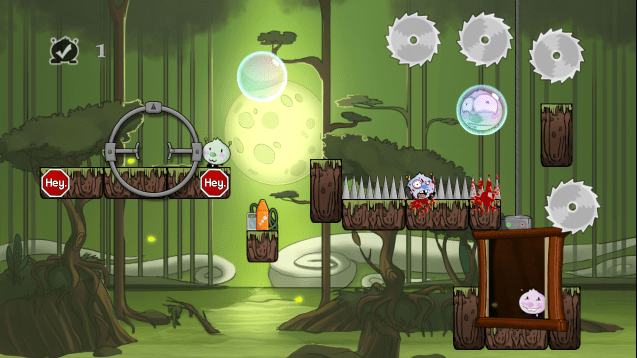
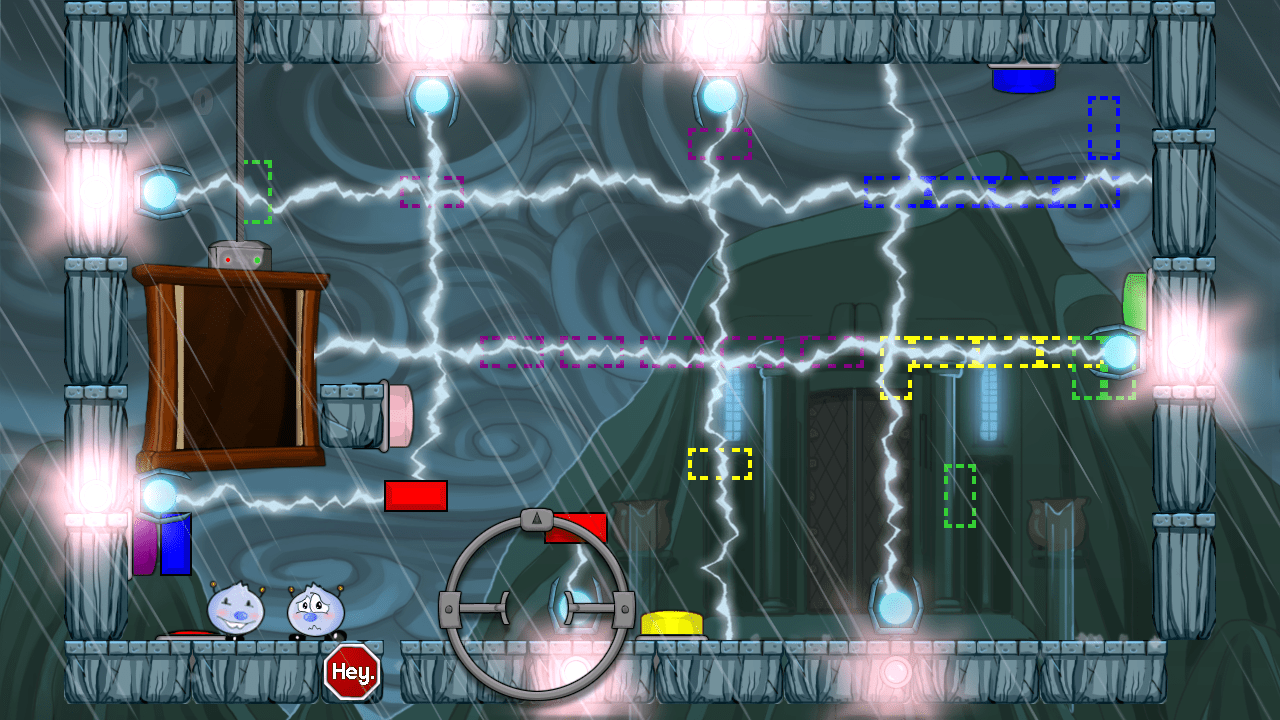
Sententia’s hook is that you occasionally have to pause the game and do a connect-the-dots puzzle. Every dot has little slash-marks on it, signifying how many lines will extend from it. This is actually a cool idea for a standalone game, assuming it’s done right.  Sententia doesn’t do it right, mostly owing to the clumsy building interface. It’s slow-moving, awkward, and accident-prone. If you make a mistake, deleting a line can be an exercise in frustration. There were times where the cursor simply refused to highlight the line I wanted to delete. I had to delete all the other lines that it wanted to highlight instead before I could correct the mistake. There’s also no “clear-all, start over” button. So if you’ve totally cocked-up a puzzle (and you will do that a bunch, trust me), your punishment is to slowly clean up before starting over. I asked Michael if anyone had pointed this stuff out to him, and he said no, the play testing went well. So going off that, good job play testers! Given the nearly universal negative reaction to Sententia I’ve seen today, I can’t believe none of you thought “maybe I should say something.”
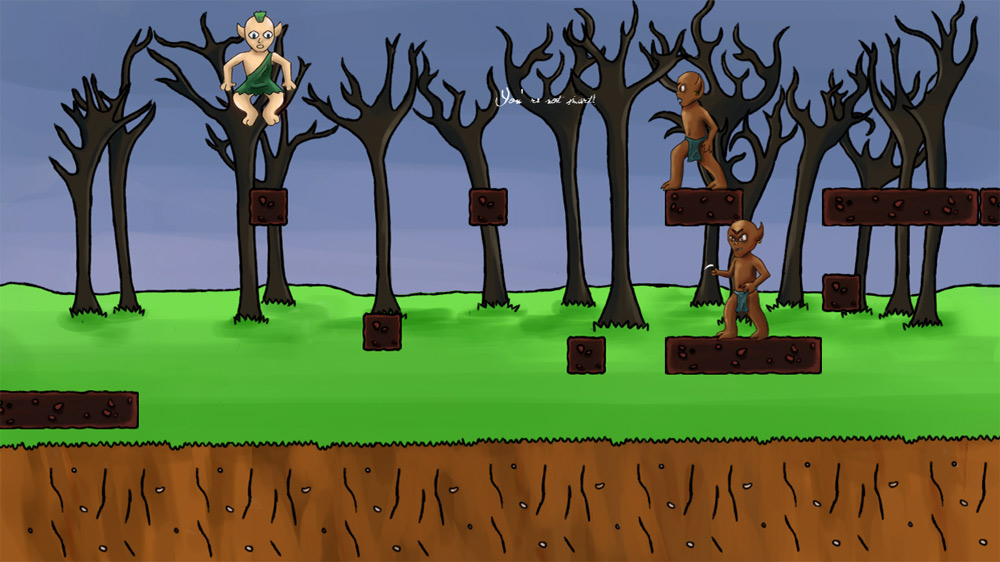
This is where I quit. The smaller, hard-to-see blocks in the center of the level drop quickly after you land on them. Because of the timing of the controls, you don’t have enough time to shoot the enemies or defend yourself in any way against them. It’s one of the most horribly conceived layouts I’ve ever seen in any game.

So the hook was botched. The rest of the game pretty much plays like a run-of-the-mill platformer, assuming the run was given to a recently lobotomized goldfish. The controls are horribly sluggish, with movement and jumping being slow. There’s a noticeable delay in responsiveness. So naturally the game has several sections that require timed-precision platforming with respawning enemies. The enemies are typically placed on narrow platforms, and will fire at you if you are on the same plane as them. Since you can’t jump and fire at the same time, you pretty much have no choice but to rely on luck and hope the game glitches out and the enemies get respawned on the wrong platform. That happens. And thankfully the enemies can’t possibly respawn on the wrong platform in a way that makes it impossible to proceed. Oh wait, that happens too. Don’t worry though, it won’t matter, because you’ll get stuck trying to walk past two respawning enemies on platforms that drop out from underneath you almost as soon as you step on them. Or “get as close to the edge as you can before jumping” platforms that are scattered all over the game. I honestly can’t come up with a single positive thing to say about the gameplay. It’s abysmal in every way a game can be.

I’m not sure how Sententia was released in the state it’s in, or how anyone, even the creator of the game, could be delusional enough to think this should have been included in an Xbox Live Indie Game showcase. A theory kicked to me on my Twitter feed is that Sententia made it in as a matter of convenience, because it was a game that was available and done. If that’s the case, I object to the use of the word “done.” Unless we’re using the “stick a fork in it, it’s done” context. Simply put, you don’t stick a game that is total and complete uncompromising and unapologetic garbage in a lineup of games designed to showcase the potential of a game platform on the grounds that there was nothing else available. It would be like not having enough food to cover a reception, so one lucky guest gets the honor of eating a plate full of shit. Again, not trying to pick on Michael Hicks. He’s a cool dude. But his game could very well be the worst game on the entire XBLIG platform, and should not have been used in a promotion designed to lure in new fans. Michael, I commend you for your efforts in the third Indie Games Uprising. You busted your ass hard for your fellow developers and you should be saluted for that. You spread the gospel of Xbox Live Indie Games like a modern-day John the Baptist. And, like John, your head ended up being served on a silver platter.
“Where the Mild Things Are”

Sententia was developed by MichaelArts

80 Microsoft Points had no fun writing any of the above in the making of this review. In fact, I feel pretty dang rotten about it. 

Also check out the reviews of Sententia from my associates at Indie Theory, Clearance Bin Review, TheXBLIG.com and more to come.

qrth-phyl

Last year’s Uprising started with Raventhorne.  It took me about fifteen minutes to realize that the promotion was in trouble.  When I played qrth-phyl, I took an instant dislike to it and thought “oh shit, here we go again.”  But, while the reality of Raventhorne’s badness slowly sunk in, I didn’t even begin process how entertained I was by qrth-phyl.  I’m not sure how many hours passed before I realized it was good.  It was probably around the time that I told my dog “oh just go on the carpet!  Can’t you see I’m busy here?”

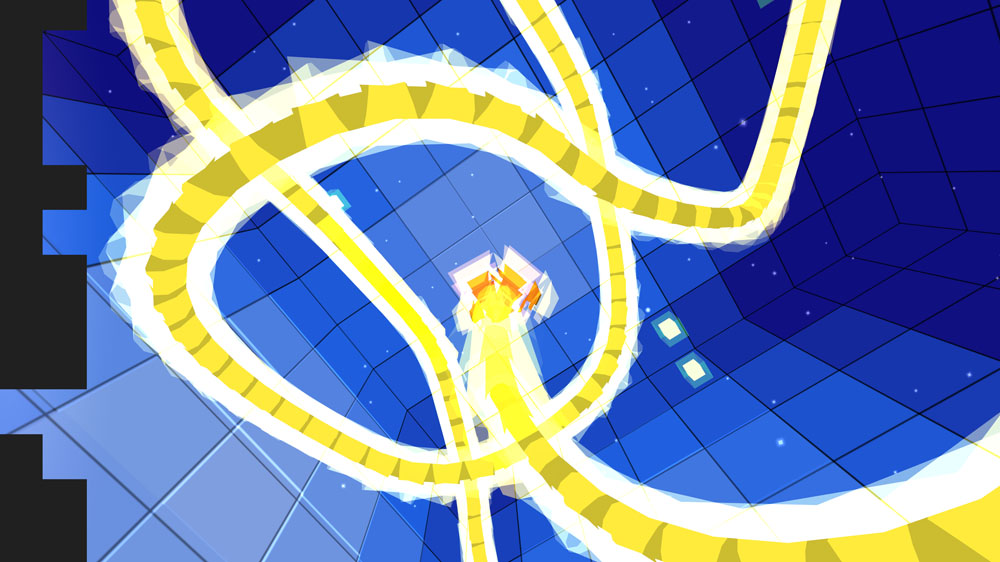
Speaking of dogs, doesn’t this look like an advertisement for worm medication?

qrth-phyl does a lot of things right.  Not the name though.  I’m not even sure how to pronounce it.  Probably just by clearing your throat.  No really though, come on.  qrth-phyl?  What is that?  Mr. Mxyzptlk’s pet snake?  Sure, it obeys the Google Rule in a major way.  But it doesn’t exactly lend itself to word-of-mouth advertising.  I could picture the following conversation taking place:

Gamer A: I just found this really cool version of Snake on Xbox Live Indie Games.  It’s in 3D and it has some of the most bizarrely hypnotic gameplay I’ve ever seen.

Gamer B: Really?  What’s it called?

Game A: It’s called, um, qarrrrr.. qerrrrrrth.. fuck it, have you ever heard of Dead Pixels?

It’s such a pretentious name, to the point of distraction.  I get flak for calling artsy games as such, but what else can you say about it?  If you give your game an unpronounceable name that doesn’t seem to connect to the actual gameplay at all, you probably smell like stale vaginal run-off on account of being a douchebag.

But, enough about the name.  Let’s talk about why qrth-phyl has set the perfect tone for the Uprising.  First off, the concept sounds ludicrous: Snake in 3D.  Insanity I tells ya.  Unless you account for the roughly six million (give or take) versions of Snake already on XBLIG.  Suddenly, a 3D, single-player version seems like the perfect way to say “see, we can be different” that the community so desperately needs.  Of course, that point would be lost if qrth-phyl sucked.  Thankfully, that’s not the case at all.  In fact, it’s pretty dang good.

Remember in the late 90s to early 2000s, back when every classic was getting a bastardized modern remake?  I had them all, from Robotron 64 to Centipede to Defender.  Well, qrth-phyl is probably better than any of those.  However, it’s not as strong as the reigning champion of retro classic re-imagination on XBLIG: Orbitron.  What qrth-phyl does right is the atmosphere.  The bright, colorful, trippy graphics and electric soundtrack make this feel like what someone in 1976 imagined games of the future would be like.

But gameplay is king, and qrth-phyl does this well too.  It reminded Brian of Rattler Race, a game that anyone who had early Windows computers probably wasted a little bit of time with.  Gameplay starts on flat playing surfaces set on a cube or rectangle, but shifts to a fully 3D environment once you meet certain scoring benchmarks.  You’ll continuously bounce between the two play styles, with the transition between the two typically a little rough around the edges.  Disorientation was the main problem I had with qrth-phyl, especially in the 3D environments.  The levels seem randomly generated, including the color schemes.  Depending on the layout, I couldn’t get a good feel for things like depth or scale.  Even playing on a TV large enough to double as the Stay Puff Marshmallow Man’s iPad, I was constantly braining on walls without realizing that I was close to them.

Raise your hands if this picture reminded you of Cubixx HD.

I’ve never been super comfortable endorsing any game where I can say “the controls take getting used to” and literally mean “it takes more than a couple of hours to really get the hang of them.”  However, in qrth-phyl’s case, it almost seems appropriate.  I went from being constantly frustrated to not even noticing that I was making hairpin turns and squeezing between tight spaces with honest-to-goodness ease.  I almost wish I had never realized I was doing it.  Once it stuck me that “hey, I’m doing bad ass at this!” my mojo went the way of the dodo and I could barely press start without losing a life.  I wish I was kidding.  I never did beat that cunt Hurley’s score either. 

Yea, I busted the developer’s ass for being a fart-sniffer, but I don’t deny that he’s created something very special here.  It’s not perfect, but qrth-phyl outranks all but one of the games from last year’s Uprising on my leaderboard.  I would say that’s a hell of a start to the promotion.  I don’t know if qrth-phyl will be the type of game you go back to.  Still, I got over three hours of playtime with qrth-phyl and was totally hypnotized by it.  It’s a perfect time waster, especially if you’re waiting for the carpet cleaners to come clean up the mess the, ahem, dog made on the carpet.  Yes, that was the dog.  I wouldn’t, say, just take a dump right on the floor because I’m too absorbed in a game to walk ten feet to the bathroom.  Come on now, I’m totally civilized.

qrth-phyl was developed by FUCK YOUR ACCUSING EYES, IT WAS THE DOG!  BAD DOG!  BAD BAD DOG!

*cough*

qrth-phyl was developed by Hermit Games

80 Microsoft Points ztkpty jqwbcv psld in the making of this review.

qrth-phyl is ranked on the Indie Gamer Chick Leaderboard.  Click here to see where it landed.

Check out these other qrth-phyl reviews from The Indie Ocean, Clearance Bin Review, The Indie Mine, TheXBLIG.com and Indie Theory.

An Open Letter to the Xbox Live Indie Game Community

Ours is the old, old story of every uprising race or class or order. The work of elevation must be wrought by ourselves or not at all.

Frances Power Cobbe was talking about women’s suffrage when she wrote the above quote, but her message can apply towards any movement that’s worthwhile.  Even something as trivial as Xbox Live Indie Games.  The third Indies Games Uprising has begun.  Over the next two weeks, nine games will be showcased in the promotion.  Now, while I can’t prematurely vouch for the quality of these games, we should all stand up and cheer for the potential they represent.  The XBLIG scene has struggled to gain an audience since its inception in 2008.  This has been a source of great frustration for some.  Personally, I feel like I’m witness to the beginning of something special.

Xbox Live Indie Games has potential without limits.  I have no doubt about that.  This is a scene that is waiting to explode.  And I feel privileged.  I’ve witnessed the raw enthusiasm of a new generation of game creators as their labors of love are unleashed on a world-wide audience of eager gamers.  Maybe sales figures or press or admiration don’t always live up to their highest dreams or expectations.  But, for the vast majority of them, the satisfaction of a journey completed is a reward they’ve found worth it all.

In my 437 days of being Indie Gamer Chick, I’ve encountered, chatted with, and even befriended dozens of developers.  They’ve all made a hypocrite out of me.  In the early days of my site, I used the slogan “She ain’t no cheerleader.”  But I am.  I cheer for your potential, just as I hurt when it goes unrealized.  Developers have claimed I inspire them to be better, but that’s true of them for me.  We’re on different sides of this community, but on the same page.  We’re in this together.

There is no ceiling in sight for Xbox Live Indie Games.  Our fullest of potential has not yet been realized.  But, like Frances Power Cobbe said, we’ll realize it ourselves or we won’t at all.  It’s up to us to grow together.  Developers, writers, and fans.  It’s all on us, but there’s nothing stopping us.  The time for our community is now.  Let’s come together and, as Alter Bridge said, rise today and change this world.

Follow me on Twitter and Facebook for updates on the Uprising.  You can also follow all my site partners: The Indie Ocean, Armless Octopus, Indie Theory, TheXBLIG.com, The Indie Mine, VVGTV, Clearance Bin Review, and Indie-Love.  If my partners don’t all get a ton of new followers, I’ll be forced to unleash the Puppy of Sadness upon you.  Don’t make me go there. 

Oozi: Earth Adventure Ep. 4

And that’s a wrap on Oozi.  One game.  Four chapters.  $4 spent.  Four boss fights that made me question the existence of evil on this Earth.  Zero attempts at originality.  But is the overall experience worth it?  Kind of.  Let’s start by recapping the previous chapters.

Part One: AGGGGGGGGHHHHHHHHHH!!  Well, that sucked.

Part Two: AGGGGGGGGHHHHHHHHHH!! Oh hey, wait a second, it stopped sucking.

Part Three: Not bad.

Part Four: Still not bad.  Oh wait, I have to feed this thing fruit?  AGGGGGGGGHHHHHHHHHH!!  This is boring.

Best as I can see, this fucking thing has legs, so why do I have to feed him? I think this is what the Republicans have been warning us about.

Oozi’s problem is and always has been how unambitious it is.  It does the graphics thing really well, but does everything else so much by the book that the book is now claiming royalties on the series.  Oozi is the poster child for generic 90s platforming mascot.  Like Serpentor, its creators borrowed the DNA from such soulless, design-by-committee, me-too cash-ins as Aero the Acro-Bat, Bubsy the Bobcat, or Crash Bandicoot.  I was going keep that going all the way to Z, but I figured you guys would hire ninjas to insert burrowing cockroaches into my ear canal after I listed Donkey Kong Country and Earthworm Jim as soulless.  Which they are, but I probably shouldn’t say it.  Fans of those games take it too personal.

I’ll grant Oozi this: it’s not original, but it does what it does well.  Paint-by-numbers levels, almost too easy platforming, hop-on-heads cruelty to animals, double jumps, butt stomps, and every other stand-by of the genre.  If the subject is anything but sound effects, Oozi is decent.  Not spectacular.  Not memorable.  Not something you’ll enthusiastically tell your friends to try.  Just a good solid waste of 90 minutes per chapter.  All four chapters are more or less the same, with the same scaling of difficulty, same principles of level design, and a hugely tedious boss fight to cap it off.

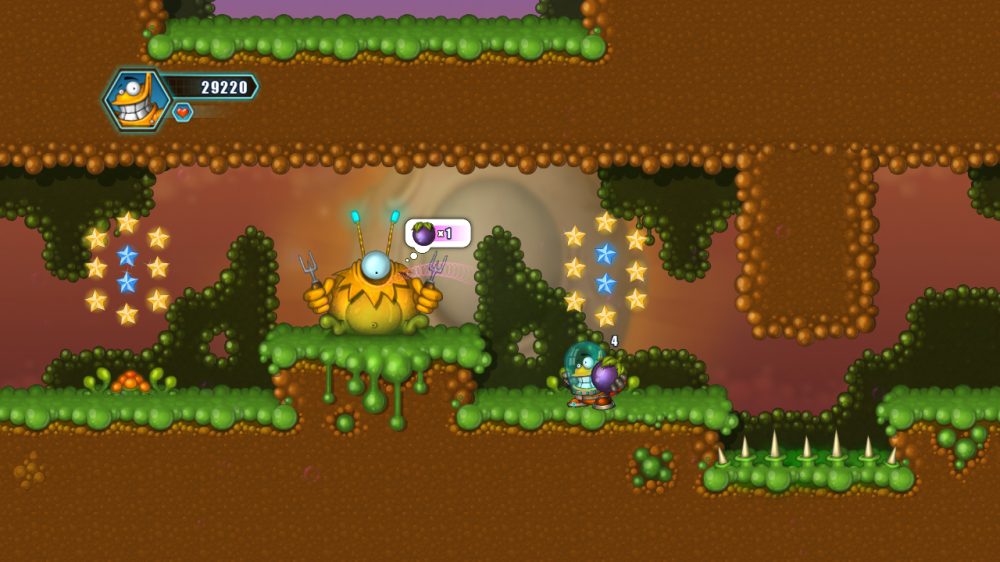
That’s probably the thing that pisses me off the most about Oozi: so many of the tasks of the game are busy work.  In chapter four, there’s a couple of sections where you have to feed fruit to a monster.  To get the fruit, you have to butt-stomp the ground by the fruit.  Then, you have to carry the fruit, tossing it between enemies, over gaps, and up platforms.  You move slow when carrying the fruit, and you can’t jump.  If anything touches the fruit, you get to start over.  It’s sooooooo boring, not at all difficult, and takes way too long to accomplish.  But, and this is the thing that almost drove me towards taking up genocide, these sections don’t immediately place checkpoints after completing them.  So let’s say you spend ten minutes getting this entitled mother fucking critter its food.  Then, a random volcano spits up a fire-ball and you die.  Guess what you get to do?  That’s right, start all the way fucking over.  And that happened to me.  Twice.  After the first time, I almost rage quit.  The second time, I seriously wanted to personally strangle a species into extinction.  I don’t care which one, but something fluffy and adorable would have been swell.

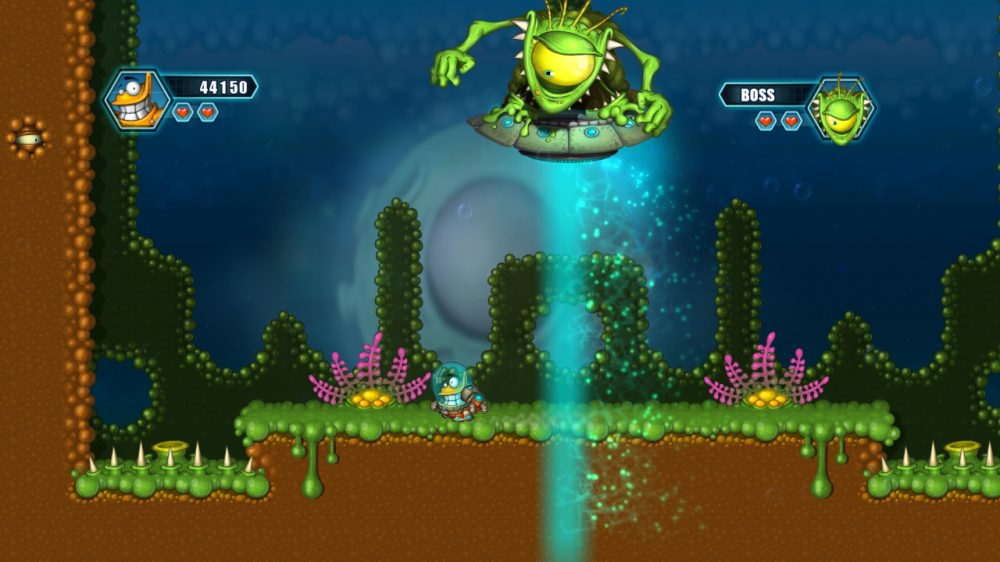
“So my agent says to me “Bob, baby, we have a part for you in the next Simpsons Halloween Special.”  But nooooooo, I have to take the starring villain role in some dry ass independent video game.  Way to go, Bob!”

Oozi did end on a bright note: the very final boss was probably the least annoying of the series.  As a result, Oozi 4 finds a spot on the leaderboard.  It’s not as good as parts two or three, but it’s way better than part one.  Then again, so is gonorrhea, so that’s not saying much.  Ultimately though, if Oozi is remembered for anything, it will be for being the ultimate uncanny valley of XBLIGs.  Oozi is a game you’ll swear you played on your SNES back in the day.  Depending on your level of gibbering nostalgia, that might be a better thing than I experienced.  As a child of a different era, I would like to put out this challenge to Awesome Games Studio: you guys are better than this and you know it.  You created a series that is amazing to look at, but when it came to gameplay you settled for functional.  I’ve seen artwork made out of feces that is more inspired.  So next time, try something new and weird.  Think of every fucked up thing you ever thought of doing with a platform game and give it a shot.  The best case is you’ll have a game that people talk about as something other than a lifeless 90s platforming clone.  The worst case is, well, you end up with a pile of shit.  But hey, your mascot already looks like the bastard offspring of the Great Mighty Poo, so the status quo remains intact!

Oozi: Earth Adventure Episode 4 was developed by Awesome Games Studio

80 Microsoft Points don’t really think the final chapter takes place on Earth in the making of this review.  Well, maybe in Oakland.

Three out of four games in the Oozi series are ranked on the Indie Gamer Chick Leaderboard.  Where do they fall

Volley

Xbox Live Indie games release in streaks.  Whole weeks will go by with nothing coming out.  Then Zeus will declare “unleash the Crapan!” and a flood of sewage-saturated indies will hit.  Honestly, it’s not that bad.  It’s just always a little overwhelming in a “where do I begin?” sort of way.  Starting with a game like Volley seems like a good warm-up act, until I remember that well-meaning, not at all horrible games that have little in the way of gameplay can be just as soul-crushing for me to write about as a terrible game is to play.

Volley is the second game I’ve played this week that was created by students, only these ones come from Munich.  Smart people they have in Munich.  They all speak German fluently.  Crazy impressive, huh?  Volley is similar to a previous XBLIG I encountered: Bug Ball, a game that both myself and Brian really enjoyed.  Volley tries to play like an evolved version of it.  There’s more power-ups and you’re given more control over the ball.  So how come I didn’t like it as much as Bug Ball?  Perhaps the games are too similar.  Both are 2D, arcade-oriented versions of volleyball.  Both are pretty heavy on the glitchy side.  Both can be played with up to four-players, although Volley skimps on online play in favor of not having online play.

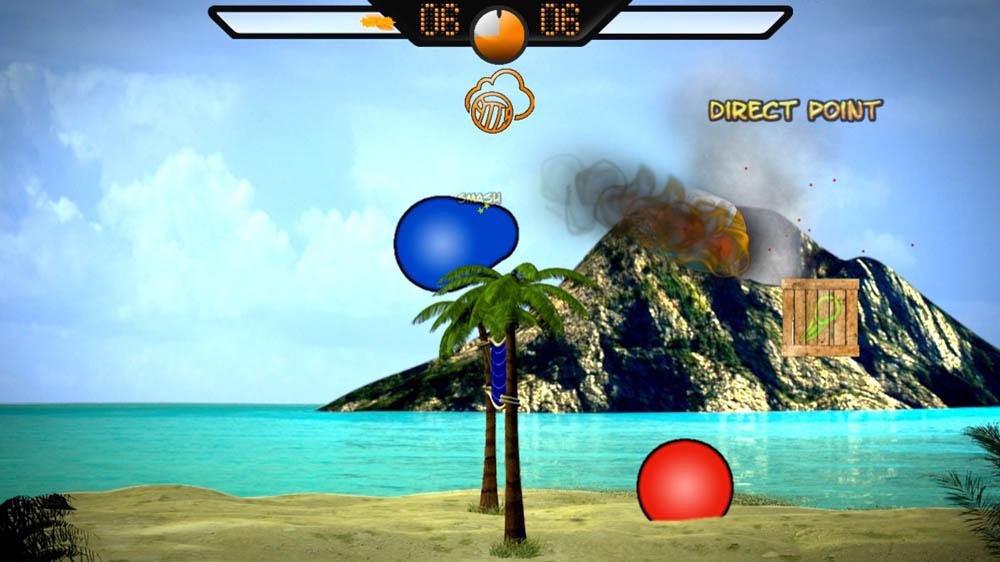
What makes Volley different is you play as a circle that grows a bulge in it when you fiddle with the stick.  And I just realized that did not come out right.  I meant to say that if you tug on the right stick, it grows an erect extension that can be used for smacking the balls that come at it.  I mean, you know what?  Fuck it, here’s the trailer.

Okay, see what I’m talking about?  It does that.  But honestly, that appendage thing isn’t that big a deal, as most of the time we just jumped up and bopped the ball without swinging at it.  You can use it to create  a power shot, but none of us could quite get the hang of it.  The physics of using the bulge seem to be lacking a bit of oomph.  Speaking of oomphless stuff, the power-ups are mostly worthless.  All one of them does is turn the lights out, which might make a difference if all the players and the ball didn’t suddenly light up like they were dipped in plutonium.  Other times, it will put up little water-fall blocks that you have to hit the ball over or under.  Or it will put a bomb on the table.  No clue what the point of that is, since it never once detonated anywhere near a player.  Finally, it will sometimes drop multiple balls onto the table.  This is fine for 2 v 2 play, but one-on-one it’s simply a dick move because you can’t possibly keep both balls alive.

Even with all the problems, Volley is perfectly decent waste of a one dollar, provided you haven’t already played Bug Ball.  Volley did make me wonder if I would have liked it more if I hadn’t already played such a similar game.  Nah, I don’t think that’s the case.  Bug Ball was also slightly more fast paced, had a bigger variety of courts, and the grab-mechanics were more fun than the appendage thing that Volley has.  Yea, this is really unfair.  Volley is a pretty fun and should be rated on its own.  But I can’t.  This is like trying to decide if Zack or Cody is hotter.  An absurd debate, by the way.  It’s clearly Cody.

Volley was developed by Glassbox Games

IGC_Approved80 Microsoft Points sprained their wrist twice trying to play volleyball in the making of this review. 

Volley is ranked on the Indie Gamer Chick Leaderboard.  Click here to see where it landed.

Tales from the Dev Side: Greenlight, Red Light by Alex Jordan

Although I’ve sworn many times that Xbox Live Indie Games have a bright future, developers are treating the platform like a freshly pruned-by-iceberg Titanic.  For many, the brass ring for distribution is now Steam.  The problem with that is Steam is a tough nut to crack.  And then hope came in the form of Steam Greenlight.  But is it really hope, or is it all smoke and mirrors?  Cute Things Dying Violently developer and Greenlight hopeful Alex Jordan  has a few thoughts.

Greenlight, Red Light

by Alex Jordan

The life of an up-and-coming indie game developer sure is a great one. I mean, think of the perks!  Scant management, vast amounts of creative control, and great appreciation for the finer things in life, e.g. ramen noodles.

And, hey, there’s also the disproportionately huge share of revenue you command!  Unfortunately, 70% or 100% of shit is still shit (roughly “shi” if you’re using the 70% model, including the dot above the i, greedy bastards), so pretty much every last indie developer has had one nagging thing on their to-do list for the past four or five years: beg for distribution on Steam.  Because, let’s face it, it’d be super nice if people had actually heard about your game and maybe would deign to buy it.  If that were the case, you could consider quitting your day job, or at least consider having something for lunch other than rehydrated noodles in sodium water.

And because the only thing out there more in abundance than ramen noodles is desperate indie developers, the guys and gals at Valve who run Steam have had to fend off these Morlocks with a stick.

Pictured: Cute Things Dying Violently creator Alex Jordan and his fiancée.

For every indie game that manages to pass through the Pearly Gates, 100 get denied or ignored. Enter: Steam Greenlight, Valve’s way of saying, “Here! You look at shitty MS Paint art.  We’ll just sit here and make decorative pants out of $100 bills.”

Having had Cute Things Dying Violently rejected by Valve back in July, Greenlight (which was announced roughly three days after I got my rejection email) seemed like a juicy consolation prize.  A community indie games voting site for a large captive audience of Steam users, designed by a developer as canny and talented as Valve? Sign me up!

And I did. Pretty much the moment it went live, back on August 30.  And that’s when the horrible truth set in: Greenlight was. . . decent.  It wasn’t great, it wasn’t terrible, it was just. . . a filter.  Pure, exhausted convenience distilled into a website.

What’s Going Right?

My first 20 minutes with Greenlight were pretty blissful.  It was streamlined and easy to use, and I managed to register CTDV with trailer, screenshots, and description inside of ten minutes.  And pretty much the moment my page went live, the unique page views started pouring in.  The “large captive audience” I mentioned earlier is nothing to sneeze at.  Just by virtue of being on the platform, my game and others like it were getting a degree of attention that was unprecedented just hours earlier.

It’s also marvelously easy to provide feedback on games.  For each game page there’s an upvote button, a downvote button, and a Favorite button.  Additionally, Collections make it easier for third parties like gaming websites to promote a series of games.

What’s Going Wrong?

I’m not going to harp much on the reviewer’s experience, since most gaming journalism outfits have already beat me to it.  The short version is that discoverability is still a problem; talented developers with attractive games are unavoidably lumped together with complete crap; trying to cast several votes efficiently is a navigational cul-de-sac; and, unfortunately, the Greenlight community is full of slack-jawed retards.

“Gameplay looks like iphone appstore level trash” said Cletus Gumtooth of Pine Knot, Kentucky. Jed Toomanytoes of Camden, TN noted “looks like a boring, bad, lazy game thats just like a multitude of other terrible and boring games. also i want to fuk my sistah.”

How obnoxious can they be? Well, many of them didn’t know what Greenlight was for.  They thought it was a way to request their favorite AAA games getting on Steam as opposed to indie games.  Plenty of people who knew what the deal actually was were scarcely better, and each game’s comments thread began racking up scattershot feedback that many YouTube vets would cringe at.  One man’s Cthulhu Saves the World is another man’s crappy RPG Maker clone, and one man’s Cute Things Dying Violently is another man’s “stupid Flash game.”  Ouch.

I’m sure the majority of Steam accounts are held by lovely people, but you can only read so many variations on “Your game sucks” or “Get fucked m8” before the scales fall from your eyes.  After all, these are the people whose votes you need.

Oh my God, I turned out to be a politician anyway.

The Developer’s Experience

Anyway, such delicate interaction proved to be a wee bit of an eye-opener.  The rest of the developer experience on Greenlight isn’t much better.

The most notable aspect of the developer’s experience is one of confusion and withheld information.  Putting a game on Greenlight, with its studied silence from Valve and its schizophrenic community, is like being asked to stand in one place and alternatively receiving either kisses or kicks to the genitalia.

And those are the only two forms of feedback.  Initially, developers (and only developers) got to privately see their game’s percentage of upvotes to downvotes, but that disappeared after a few days when it became apparent to Valve that downvoting – either legitimate downvotes or those by trolls – served no other cause than to drag down a game’s up/down ratio.  Downvotes don’t subtract from upvotes, but, initially, we didn’t know that.  For reviewers, a downvote got the game off their to-review screen.  For developers, it was a sign of dislike for the game and perhaps even a negated upvote, as Valve hadn’t told us otherwise.  We got to suffer in silence for a few days, watching our numbers degrade, before Valve put us out of our misery and yanked that wonderful feature.

And then there’s the “% of Calculated Ratings So Far” bar that shows how far along your game is on upvotes before it gets submitted to Valve.  Well, the fine folks at Valve don’t quite know yet what level of participation the Greenlight community will have, so they’ve erred on the side of caution and set the number pretty damn high.  Even standout games on Greenlight like Project Zomboid have only gotten about 20% of the votes they need, while the rest of us plebes get to hang on to single digit approval percentages.  (Granted, it’s been less than a week, so take my whining with a grain of salt.)  And since developers don’t get to see how many upvotes their games have actually gotten, there’s nothing for us to extrapolate from.  We just get to sit, and wait.  And get kicked in the balls.

Hey, I’ve Done This Before. . .

Despite its shortcomings, Greenlight still presents a big opportunity for indie developers.  Whereas previously Valve would almost certainly take a look at your game and flat-out reject it in the same split second, now we have an opportunity to land a game on their laps with some sort of critical consensus and the understanding that Valve employees will review it with the time and attention it deserves.  Gone will be the days of instantaneous judgment leading to rejection and developer misery.

Thus, Greenlight becomes a plausible shortcut.  Sure, it’s an extra step in the process (you used to be able to just fill out a form on Valve’s website and send your game in), but if your game emerges intact on the other side, odds are you’ll soon be sitting pretty.

Cute Things Dying Violently has seen modest success on various platforms. Which is probably a good thing. If it did any better, you know a certain Silicon Valley mobile company would be right there with their “completely original” physics puzzler “Adorable Creatures Perishing Disturbingly.” Then they would probably sue him for stealing their idea before they thought of it.

But here’s the thing… Greenlight’s voting threshold and discoverability shortcomings mean that the developers still need to do quite a bit of hustle to gain attention and upvotes.  Which is. . . hey! I recognize that feeling!  That’s exasperation, having just realized that this is what we’ve always had to do, and will always have to do.  I don’t think any of us developers were naïve enough to think that Greenlight would be a straight ticket to success, but what we got instead was another chapter in the same story we’ve been reading for years upon years: capitalism is hard, and you gotta work for it, and in the end you still might get shafted for no fault of your own.

That means instead of spamming Kickstarter solicitation emails, now you’ll be spamming Greenlight solicitation emails.  (I’m sure gaming journos will be just as eager to read the latter!)  Developers will still be struggling to worm their way into bundles and promotions, desperate to practically give their game away just to get a little bit more recognition.  Networking will still be paramount and journalists will still need to be schmoozed at bars, but last I checked, I really like beer and I really like talking about myself, so that’s not a problem.

In the end, Greenlight represents yet another dance routine on the never-ending popularity contest that all obscure indie developers have to participate in.  It’s certainly not bad, and dare I say the vetting process still represents a good opportunity, it’s just that it’s underwhelming.  Greenlight’s another queue, another procedure, another form that needs to be filled out on the road to possible opportunity.

It is, in short, the perfect microcosm of the indie developer experience.  Does that look like a raw deal to you?   It shouldn’t.  It may seem like deferred, somewhat unlikely success, but it’s worth a shot, isn’t it?  If it wasn’t, we would’ve given up.  And judging by the growing number of games on Greenlight, that ain’t gonna happen.

Warp Shooter

To make a game that is a local-only four player top-down 2D arena shooter on a market like Xbox Live Indie Games takes guts.  That’s because you’re making a game with the full knowledge that it will be a tougher sell than a steak house in the middle of Mumbai.  I’ve played a few multiplayer-only games on XBLIG and they tend to range from solid hit to complete miss.  Nothing so far has really found the middle ground.  Well that’s over with, because Warp Shooter stubbornly refuses to be either awesome or horrible.

Warp Shooter is the product of a group of students from Indiana.  Their story is a fascinating one that will be told in an upcoming edition of Tales from the Dev Side.  This is the third student project I’ve reviewed, following Mr. Gravity and Heroes of Hat, both out of the University of Utah.  The relatively simple puzzler Mr. Gravity, despite becoming impossibly difficult in later stages, was good enough to make the leaderboard.  Heroes of Hat, a more ambitious title, was plagued with various technical glitches, unfair level design, and bad control.  Obviously simpler works better for students.

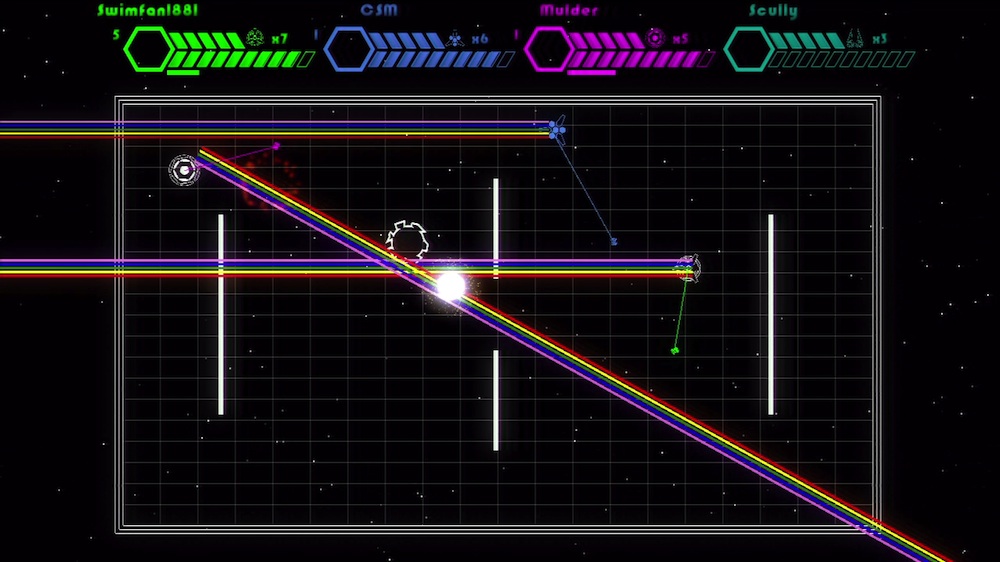
This is what happens when George Lucas runs out of ideas: Rainbow Brite joins the Rebel Alliance.

I guess that’s why it’s weird to see a relatively simple concept turned so overly complex.  Warp Shooter plays like a modernized version of Combat.  I gathered three amigos (sadly not THE Three Amigos, although I hear Martin Short is insatiable) and asked them kindly to help me with my latest review.  When they refused to do it out of kindness, I offered to bribe them.  Finally, I had my goons take their families hostage.  Hey, I have a duty here, and they were fucking with it.

Things got off to a slow start when nobody could figure out how to move.  There’s no tutorial, so the four of us fumbled around, doing our best to pretend like we knew what we were doing.  Most firing was done from a stationary position, until Chevy figured out that movement was done by pressing the right trigger while pointing the right stick in the direction you want to go.  Mind you, the right stick also controls your firing.  Thrust is limited, so you’re never in full control of your vehicle.  You do have the ability to aim a little dot thingy that causes damage to an opponent if it touches them, or you can warp to the spot the dot is on.  It’s supposed to provide an alternate means of movement, but it’s slow and clunky and it doesn’t provide the element of being unpredictable that other movement means has.  You can see where the person is warping to.  It’s like drawing a diagram for your enemies.  “I’ll be moving here.  Take aim and fire at your leisure.”  It would be like the army replacing fatigues with tee shirts supplied by Target.

The best party games tend to be self-explanatory.  Warp Shooter is regrettably missing that.  We never did get the hang of it, but after about twenty to thirty minutes, it did provide moderate fun.  The absurd amount of options provided assures that you would have to be actively trying to not have fun to, well, not have fun.  When we turned on three asteroids and death rays, we were whooping and laughing and high-fiving each other, even though we could barely move.  It was like watching the Narcoleptic Olympics.  I can barely squeeze out something resembling a recommendation for Warp Shooter, but chances are when it only makes the Leaderboard on the grounds that “well, it’s playable!” that’s a sign that maybe some aspects of the game should be rethought.  Starting with the movement controls.  I can’t imagine anything that is more awkward or dangerous to use.  Maybe a B-52 which has their weapons mapped to their intercom button.

Warp Shooter was developed by Hoosier Games

IGC_Approved80 Microsoft Points reserve the right to murder the next person from Indiana who uses a lame “Hoosier Daddy” joke in the making of this review.  I’m looking at you, Kenneth.

Warp Shooter is ranked on the Indie Gamer Chick Leaderboard.  Click here to see where it landed.

AvatAAAH!!!

I’m having trouble wrapping my head around how a game like AvatAAAH!!! comes into being.  It’s one of those games where the concept is too simplistic.  Don’t get me wrong: simplistic is good for gaming on a commercial scale.  It’s why Tetris was an international mega-hit the likes of which may never be seen again on this Earth, while Yoshi’s Cookie is all but forgotten.  My theory is the most successful games require the fewest words to explain.  Tetris can be summed up with “use blocks to build lines.”  Pong can be explained fully as “video table tennis.”  Angry Birds can be explained as “Knock over buildings to crush pigs.”

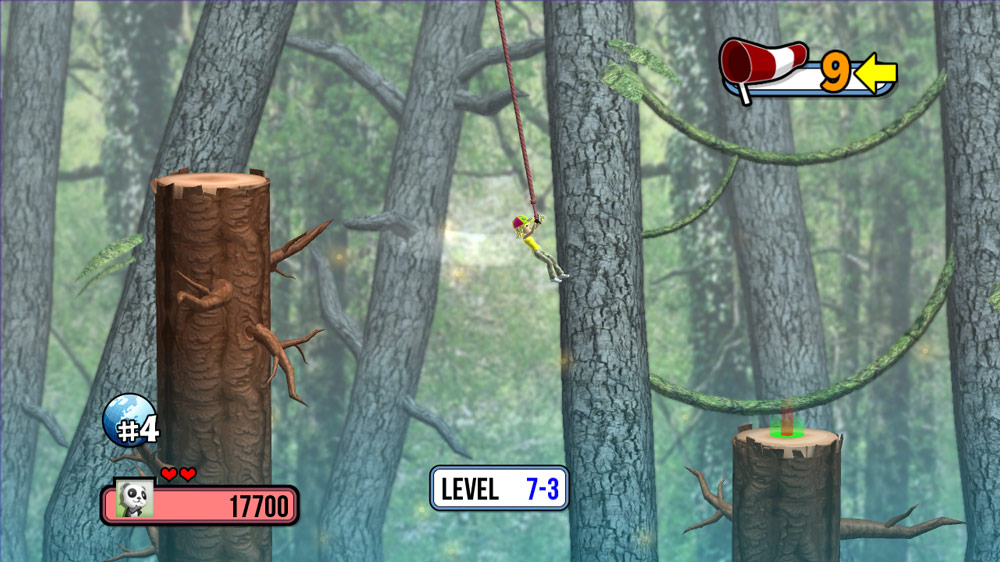
Get it?  Good.  Now watch as I burn down this theory and piss on its ashes.  AvatAAAH!!! can be explained as “let go of rope, land on platform.”  That fully explains the game, rules, and plot, and why the game sucks so hard that it could reverse the flow the of the tides with its sucking power.  You play as your avatar, you swing off a rope.  The rope sways back and forth without needing you to control it.  At the opportune time, you press A to let go of the rope in an attempt to land in the center of a stump below you.  Do this a few dozen times and that’s the game.

Really, a review of this is redundant. All you need is this screenshot and the trailer below to learn enough to know this game isn’t worth $1.

To be fair, AvatAAAH!!! throws twists at you in the form of altering the gravity physics or changing the size of the stump you’re landing on.  However, it doesn’t really make the game all that harder.  I was able to make it pretty dang far into the game and land a decent spot on the online leaderboard just by letting go of the rope at the very end of its swing.  I didn’t even need to wiggle the control stick to get “good” or “perfect” landings.  That’s really the problem here: AvatAAH!!! doesn’t ask enough of players.

But while the single player is minimalist, the multiplayer is just lazy.  All players swing at the same time, with the closest person to the bullseye getting points.  The only problem is it doesn’t really measure who is closest to the bullseye.  It just measures by zones.  Perfect, Good, OK, and Phew if you barely land on the stump are the only four scores.  That’s sooooo seven years ago.  The player who does the best gets a point, while the player who does the worst loses a point.  At least that’s how I think it goes.  But let’s say all players hit the large section that scores as “OK.”  And let’s say one player is clearly much more OK than everyone else on account of being closer to the center.  It doesn’t matter, because nobody gets a point.  Somehow, that just strikes me as lame.  It can also make games drag on and on, especially once players get the hang of the physics.  Even novice gamers can hit Good or Perfect with absurd consistency.  For what it’s worth, Brian didn’t have a problem with the scoring.  Brian also thinks Chronicles of Riddick was a good movie, so it shows how low his standards are.  Well, this is my obscure gaming blog and so I say that AvatAAAH! would have been better if it scored based on who actually got the closest to the bullseye, and that the game can feel free to tie the rope around its neck and swing away.

AvatAAAH! was developed by Milkstone Studios

80 Microsoft Points thought AvatAAAH! was the sound George Lucas made when he saw how much money Avatar grossed at the box office in the making of this review.

Developer Interview: Count to a Billion

Count to a Billion is a bit of an anomaly in modern gaming.  It’s a pure button masher without apology.  Stand-alone button mashers have been a dead genre for decades.  Bringing out a new one in 2012 seemed almost brazen.  Developer RAWR! Interactive took it as a challenge to resurrect this style of game.  I spoke with their co-founder Mario Wunderlich about what went into creating Count to a Billion.

And yes, Count to a Billion is the official sponsor of the Leaderboard.  It doesn’t mean they’re getting all softball questions.  I enjoyed Count to a Billion, but I do have a bone or two to pick with it.

By the way, if you Tweet this interview, you’re entered into a chance to win a free copy of Count to a Billion.  Valid tweets must include the hashtag #IGCbillion fuck it, just tweet the damn interview.  We’ll be giving away not one, not two, but three copies!  Even if you can’t count to a billion, you can count to three.  Winners will be drawn on Saturday, September 1, 2012.

Kairi:  Button mashers are games that studios dress up and try to pretend they’re something else.  You guys outright embraced being a button masher and flaunt it.  How did this come about?

Mario: Count to a Billion, as a concept, was born from the desire to use the iPhone’s screen capabilities to the max. Most games use but 1 finger, sparingly, for everything. We wanted ta have players use all fingers (5 on iPhone, 10 on iPad) and do it in an intense fashion.

We worked it up from there to a pure button masher. There is no need for deceit, no need for disguise. We believe button mashers can be fun if the incentives and mechanics are well designed. And the iPhone/iPad screen is a perfect medium for it.

It is so simple, and yet it really is a lot of fun.  And exhausting.

By the way, the game was originally called Count to a Million… but we just kept escalating the game in intensity, and soon realized that big numbers accurately reflected this – and that’s how Count to a Billion came to be.

Kairi: It’s such a rarity that a game, even a small indie game, centers completely around button mashing.  I asked some gamers what was the last button masher they liked.  Most answered Track & Field, an early 80s arcade game that later got some home ports.  So it’s been a long time since this type of game resonated with gamers.  Why take the risk?

Mario: As a company, RAWR! Interactive’s vision is to explore new game mechanics for mobile platforms. Because of our vision, all our games will be risky investments by nature – but we think it’s well worth it, we might find something that players really love. Maybe it’s Count to a Billion, maybe it’ll be another game. But our mission is to find new ways to play with an iOS device.

With Count to a Billion, we wanted to get away from the super laid-back game mechanics that have been used over and over in 99% of mobile games – and explore intense game mechanisms. It this case, the intensity is quite physical. Sore arms. Numb fingers. And players have kept coming for more!

Kairi: The majority of gamers I know are super apprehensive about the potential of a button masher.  Straight honesty on my part: I thought Count to a Billion was going to suck.  I really did.  And in fact it’s very enjoyable.  So how do you go about convincing people that your button masher is different from any other button masher ever created?  Because, well, it is!

Mario: Thank you. And you’re right about that too. People have a preconceived notion of what a button masher is – the last one most gamers saw, like you noted, was probably in the 80s… and left it at that. So our job now is to show gamers what a button masher can be. It can be as fun and as involved as any other game.

So for Count to a Billion, making the game was just 50% of the journey. The other 50% is all about PR and marketing. And to keep on innovating. So yeah, Count to a Billion’s release was just the start – we have great new things planned for it. And we’re working around the clock in the hopes that it’ll be seen as more than just another “button masher.”

Kairi: As I touched on earlier, your game has no theme to it.  It’s just about smacking numbers.  Was there ever a point where you had something other than the minimalist look it has now?

Mario: The idea was always minimal, but making a game out of button mashing took a lot of experimenting. We went through 7 versions getting a feel of how best to get the gameplay mechanics, getting the look and feel right, creating a set of goals and achievements to give the game a sense of progress and of winning – it’s the details that make a game, and with a game as drastically different and minimalist as Count to a Billion, we really had to discover them from scratch.

Kairi: I’m ranked 53rd on the leaderboard, and I would be ranked better if it wasn’t for some of those damn sliders.  Especially the “C” slider.  The game is critically acclaimed, but also everyone is complaining about these.  How did this slip by?

Mario: Initially, we wanted the game to be not only fun, but also a tough, challenging experience. The “C” Slider is probably the toughest challenge in the game. After working on it for so long, however, we made the mistake of forgetting just how difficult some of these where. We even got used to the “quirks.” But we’ve listened to our players, and our next update addresses these.  The challenge will still remain, but it will be focused more on getting that high score, less on trying to avoid errors.

God Damn this fucking shape!! I officially declare war on all things that begin with the letter C! Well, except for things named Cathy. I can’t declare war on myself obviously, unless you count all the smoking and late nights spent watching Dana Carvey movies.

Kairi: The YouTube integration was a stroke of genius.  How come you guys didn’t include feature for tweeting scores?

Mario: Thanks! To be honest, we wanted to limit the number of options in exchange for a smoother User Experience. As part of this trade-off, we thought about all the available social options, and concluded that Facebook and YouTube where better platforms to brag about your skills. Twitter is a fantastic social tool, but unless you’re constantly tweeting or have a huge following, singled-out tweets simply won’t get noticed.  However, we listen to our users. If twitter is a big wish-list item for many, we’ll make room for it and include it.

Kairi: So far the game is doing well, at least critically.  Other than addressing complaints, do you have any features planned for addition?

Mario: We have many new features planned. This first release was just the beginning. One particular feature will be the addition of a 30 second blitz play-mode, where you’ll be able to create your own “decks” with challenges in a particular order so you can maximize your game. These are possible game-changers – but the core will always remain: intense tapping and sliding action for billions of points!

Kairi: Anything else you have to say to potential players who remain skeptical?

Mario: If playing an intense, challenging game that is quite different from anything else you’ve ever played isn’t enough, then how about trying to earn all 68 achievements!? And coming soon, we’ll have an in-game “store” where you’ll be able to trade in billions of points for cool, new playable stuff!

Check out Count to a Billion for sale now in the App Store.

FAQ: Sponsoring the Indie Gamer Chick Leaderboard

It’s once again time for me to update my FAQ, and with that comes a question that needs a full-sized post to answer.  So here it goes.  Once my site starting picking up viewers, I started getting questions about putting paid advertisements on my site.  I wasn’t thrilled with the idea.  I’m not interested at all in trying to make money off my site, because once that happens it becomes a job.  I don’t want this to ever feel like work.  This is my hobby, and I plan to keep it feeling that way.  But I had so many people asking, I figured I could do something good with it.  Brian came up with the idea of donating the money to charity.  Once I decided to expand the leaderboard from ten members to “every game that I liked to some degree get ranked” we finally had the perfect item to sponsor.  Literally as soon as I confirmed “IndieGamerChick.com now is taking sponsors” I had the position through October snatched up within a day.  It went that quick.

As such, I haven’t really laid out what I require from potential future sponsors, nor have I explained fully what sponsorship gets, and what limitations it comes with, or what the cost is, or the duration of it, or several handfuls of inquires that I get constantly.  Frequently asked questions, if you will.  So, let’s lay it out here.  If you’re looking for typical Indie Gamer Chick snark, you won’t get it here.  Probably.

UPDATED February 13, 2013 to include more up-to-date stats.

Q: What does it cost?

A: Whatever you’re willing to pay, but I’ve set the minimum at $50 for a three-month period.

Q: Can I pay for more than three months?

A: I’ll work it out case by case, but as a bonus, if nobody claims sponsorship following you, your sponsorship stays on until someone else takes your place.

Q: What are the charities you’re looking to support?

A: That would be Autism Speaks and Epilepsy Foundation (also known as the EFA).  I know both of these charities are legitimate and worthy organizations because I have personally benefited from both.  I was diagnosed at age four with atypical autism and I developed epilepsy when I was sixteen.  Both have clear agendas that are relatively politics-free (as much as any medical-based foundation can be I suppose) and aim to learn more about these conditions, develop treatments for them (the optimistic point of view), but most importantly to me, improve the quality of life for those who live with these conditions.

Q: Of course you had to pick two.

A: That’s not a question.

Q: Well which one do you prefer?

A: Either/or is fine with me.  Or you could be an incredibly cool suck-up and donate to both!

Q: If I donate to one of those charities so that I can get sponsorship, does that still make it tax-deductible?

A: Absolutely.

Q: How do I pay you?

A: You don’t.  Instead, you donate directly to one of the two charities above.  All you do is send me a screenshot (or a picture of) the receipt confirming a donation was made.  Remove any credit card or banking information from that (I don’t believe they include those), leaving only a name (or e-mail) and the date, plus their “thank you for donating” statement.  A picture of you giving the thumbs up with a printout of the statement works too.  Once I have it, you’re good to go.  Each site keeps its own information on how you get your tax deduction from it.  DO NOT just make a donation with the intent of a sponsorship without discussing it with me first.

Q: What else do I need to provide Indie Gamer Chick for sponsorship?

A: You need to provide the banner for the Leaderboard.  The banner should have “Indie Gamer Chick Leaderboard sponsored by” on the top, large enough to clearly be visible and read.  The rest of the space can be used to promote your product.  You also can provide any promotional codes if you want to use me to run contests.

Q: What kind of stuff can I advertise with my sponsorship?

A: Independent video games or studios would probably be a good idea.

Q: What won’t you allow to be sponsored?

A: Non-gaming related businesses, Ebay retailers, etc.  You also can’t use my site to promote your Kickstarter.  This is mostly because the word “Kickstarter” makes me throw up.  I’m Kickstarter Bulimic.

Q: Can we promote our Xbox Live Indie Game with it?  I mean, you are an Xbox Live Indie Game site.

A: Brian and myself have debated this for months and we still have no definitive answer. We’ll have to go on a case-by-case basis.  It will have to be a game already released, and one that has received a positive review on my site, and made the leaderboard.  Remember, this is sponsorship, not an endorsement.

Q: I’m not a game developer, but I have a gaming site/blog.  Can I sponsor using that?

A: Again, we’ll go case by case on this.  I think this would be fine.  It depends on the site.

Q: What does my sponsorship get me, besides advertising on your leaderboard?

A: Catherine (aka Indie Gamer Chick) will promote your game’s release via Twitter and Facebook, assuming it happens after your sponsorship starts.  She will play your game, and tweet about her experience if it is a positive experience.  Indie Gamer Chick will run contests to promote your games (you must supply your own prizes and assume all legal responsibility for those contests).  Finally, if you wish she can do a developer interview with you that will be published on IndieGamerChick.com.  Plus, Cathy is known to just randomly tweet about games.  Who knows, she might plug your game long after your sponsorship has ended, especially if she liked it.

Q: What don’t I get from my sponsorship?

A: Again, this isn’t a paid endorsement.  Sponsorship at IndieGamerChick.com does not guarantee your game will receive positive press from Cathy.  Even if you are a sponsor, if she thinks your game sucks, she’ll say so.  She also won’t plug your Kickstarter or any other fundraising efforts.  This also means you can’t comment on your Kickstarter if she interviews you.  A sponsor also has no say in my site’s content.

Q: I want to make sure I get my money’s worth, so how much traffic does IndieGamerChick.com get?

A: The amount varies day by day, but on average IndieGamerChick.com receives between 1,100 and 2000 unique hits daily.  According to Alexa.com, this makes IndieGamerChick.com the most read Xbox Live Indie Game website in the world.  As of February of 2013, Indie Gamer Chick has drawn over 500,000 page views since opening on July 1, 2011.  Below is a screen grab of my views breakdown taken February 13, 2013.

Damn groundhog didn't see its shadow. That's my excuse for the slow month.

Damn groundhog didn’t see its shadow. That’s my excuse for the slow month.

The amount of views the leaderboard itself pulls in fluctuates wildly.  The leaderboard is updated with every new Xbox Live Indie Game review, regardless of whether the game makes the board or not.  If a game makes the leaderboard, the review directs the person to the board to see where it has landed.  We also direct attention to the board on Twitter if a milestone is reached, such as a game landing a high ranking on the board.  Hard numbers are deceptive (over the first sixty days, the board pulled in 3,482 views, for an average of 58 views a day.  However, some days the board pulls in several hundred views.  It just depends on whether a game makes the board or not.  As of August 29, 2012, only 43.93% of all games reviewed made the leaderboard.  Also, the strength of a game’s review makes a difference.  Games that only get mildly positive reviews generally don’t create a lot of traffic for the board.  Whereas a game like Spyleaks, which I tweeted had been the first game since the board’s creation to make the top 25, generated several hundred views to see where it ranked.  When a game doesn’t make the board, the percent of games ranked is still updated, for those dorks that would be interested in that type of thing.  Like me.

Q: Do you have information on your readership demographics?

A: I have location information.  Everything else is an educated guess.  My typical regular reader (someone who checks in at least weekly) is an adult male age 18 to 40, with the average age being around 30.  My readers are typically “hardcore” gamers, almost all of whom own an Xbox 360, and the majority of whom also own a PlayStation 3 and play PC games.  My readers are also enthusiastic buyers who are genuinely looking for inexpensive indie games across a wide variety of platforms they can spend spare change on.  Below is a screencap of the views-by-country breakdown, taken between February 25, 2012 (the furthest back it was counted) and February 13, 2013.

Country Stats

Q: My product is for a system other than Xbox Live Indie Games.  Can Indie Gamer Chick start to cover more games from that platform to make sure that my sponsorship reaches the right target?

A: I do limited coverage of iOS, Xbox Live Arcade, and PlayStation Network games.  Indie Gamer Chick is just my hobby, and I don’t have enough time to fully cover all systems.  However, all my reviews, no matter what platform they’re for, on average generate the same amount of page views.  It’s a pretty safe assumption that my readers are gamers looking for indie games in general, and you’ll find them receptive towards games across all platforms.

Q: In previous sponsorships, has the banner generated clicks to the sponsor’s website?

A: Unfortunately, getting readers to click links is difficult.  Most of my readers who purchase games off a recommendation do so from the system’s dashboard, not from the marketplace.  Thus, it’s impossible to calculate how much “awareness” of a product or total sales are generated from IndieGamerChick.com.  What you just read is me dancing around the hard numbers.  Pretty slick, eh?  In truth, the average is 1 in 60 views results in a marketplace click for an Xbox Live Indie Game review.  For the Sponsorship banner, between July 1, 2012 (the day it went up) and August 29, 2012, the banner was clicked only 45 times.  However, the developers of Count to a Billion have told me they are very happy with their sponsorship, which created product awareness and, in their belief, generated sales of their game.  I asked Mario Wunderlich, developer of Count to a Billion, if he would like to offer a testimonial of his experience as a sponsor.  Here’s what he sent.

Kairi’s been very supportive and great to work with. Since we sponsored Indie Gamer Chick’s Leaderboard with our latest game, Count to a Billion, we’ve seen more than just website traffic from the Indie Gamer Chick. She’s been very supportive in ways I’d never imagined. It’s been great working with The Chick, and I’d do it again without a second thought.

Q: If we sponsor the leaderboard, can we also do a Tales from the Dev Side editorial?

A: You do not need to sponsor me to do a Tales from the Dev Side editorial.  It’s an open platform for anyone with topical or motivational subject matter to talk about.

Q: Alright, I’m in!  How do we start?

A: You can e-mail me or contact me on Twitter or Facebook and we can talk about what your plans are and how best I can help you.