Ask the Chick (Issue #1)

So, I foolishly declared I’d post content every day at IGC in 2019. And then the bug zapper in my head went off for the first day in 2019. Yep.

But thankfully my fans were there to bail me out with a simple new feature: Ask the Chick. Where I’ll answer your gaming questions, indie or otherwise. And man, did they come through with some good ones. Like this one..

Basically, the new regime that took over Konami looked at their books for all outstanding projects and saw what Hideo was cooking up. It was Metal Gear Solid V (set to release very shortly when this all went down) and Silent Hills. Both were over-budget and behind schedule. So they looked into the books for the past few console generations and noticed all his games had gone over-budget. The Konami of old had essentially given him a blank-check to make games because he had a tendency to make hits. The new management didn’t give a fuck about any of that and decided they would hold him accountable to budgets for the first time in his career, and he didn’t like that.

You see, there’s this metric that many big businesses use called EBITDA. It stands for “Earnings Before Interest, Taxes, Depreciation and Amortization.” In layman’s terms: it’s the metric used to gauge how well an aspect or holding of a business performs. And many companies simply do not give a shit about anything BUT a holding’s EBITDA. If you looked at Hideo’s track record and saw one project after another going over-budget, some wildly over-budget, if you’re EBITDA-oriented, you’re going to shit in your pants a little. So the new regime basically said “you will stick to a budget or we will cancel your projects.” And he said “okay, fuck this, I’m out of here.” Had he not quit, he’d probably been fired or demoted and stripped of what control he did have over his projects if he had gone even a dime over-budget or fallen behind schedule.

Would *I* have done it? I don’t know how I would have handled it long-term. I personally see no problem holding someone to a budget. That’s what a responsible business does. That he had been in the industry for so long and had never once been held accountable for the budgets he should have been managing was straight-up irresponsible. Those in chargeΒ of him should never have let that go on as long as it did. I’ve always been of the belief that you can’t give a creative person a blank check. They’ll feed like a goldfish until they pop with it. Konami did with Kojima for decades, and sometimes that hurt them.

Having said that, if a person is used to one way of doing things for years, and that person is essentially the face of your company, the smart thing to do is EASE him into the new standard. Provide him with the tools and resources to become responsible for a budget. Kojima was loyal to the brand and so you give him a decade to adjust to the new reality. And then if it’s still not working, then you let him go for cause. I know people hate it when I talk about stuff like this and side with the companies, but sometimes you have to. Sometimes it’s the right call. Sometimes it’s the only call.

But short-term, you HAD to let him finish the shit he was already working on. Silent Hills was arguably the most-hyped Konami project since.. well.. probably since Metal Gear Solid way back on the original PlayStation. It was a sure-fire, can’t miss mega-hit in the making based on the buzz alone. Millions had already been spent on its production. And it probably had the most famous game teaser of all-time already creating a tsunami of anticipation. Letting that get cancelled.. even thinking about it.. given how far along it was, even if considerable delays were on tap, was stupid. If it had been a situation like Star Fox 2 or Mega Man Legends 3, where the game got shit-canned because they realized it wasn’t fun, that’d be one thing. But everything I’ve heard from insiders tells me this could have been an all-timer. It’s a shitty thing to have happened and it’s unreal that it played out the way it did. It was short-sighted and kind of power-trippy, and we all lost out because of it.

So, to answer your question: he was going to be held to a budget for the first time ever and didn’t like the idea of it. Konami was completely in the right to want to move in that direction but wrong in how they handled implementing it. I side with Kojima based on the fact that the most responsible thing for the company would have been to stay the course on the existing projects and begin the process of breaking him into working within a budget beginning with Survive, and they were unwilling to.

For many reasons..

-They’re direct competition. Let’s say an indie developer makes a free-to-play flash game with a popular IP that’s meaty, lengthy, and well produced. It’s a totally bullshit reason and I’ve never seen a shred of proof this has ever happened in the history of EVER, but it’s a stated reason. In theory, it might be harder to convince consumers aware of the game to buy future official installments of the franchise if there’s well made, free games that are so well done they could be mistaken as official games. Speaking of which..

-Sometimes they’re so well made that people could mistake them for official games by the company who owns the IP. This one is actually more valid than the idea of “competition” and is why you’ll see Paramount be very stingy with stuff like Star Trek Fan projects. Even with a disclaimer, it’s not kosher to make something so close to the authentic game that it creates market confusion as to whether or not it is an official release, free or not.

-The IP holders are responsible for maintaining the integrity of their characters. So if you have a game which features Mario doing unwholesome things, Nintendo aren’t being assholes by telling the creator to take it down. It’s their property. They have the right to tell you that.

I’ve played fan games that use popular IPs. Some of them are so well made that it breaks my heart because I know what’s eventually going to happen to them. Be smart, guys. Focus that talent on creating original characters and IPs of your own, and maybe you’ll find success instead of a giant foot coming down from the sky to squash you.

Are polygons? Pixel art is fine, and I’ve often told readers that authentic-feeling retro mimicry is harder to pull off than most people realize. I’d like to see devs take games in more original directions, but sometimes players do want a no-frills neo-retro platformer with authentic 8/16bit art. The only time I’m against it is when it’s used cynically, meaning it’s the hook of the game on its own. It’s true that it’s not special to have 80’s-looking games anymore, but I don’t get the outcry of “over-saturation” when it’s a form of art that’s quintessentially video-gamey. The same people complaining should actually take comfort in the fact that 10-year-olds today cherish games with that style of graphics in ways beyond ironically-so.

http://twitter.com/TheOriginalXbox/status/1080276764356763648

Well, I don’t think the platform people choose for #DiscoverIndies matters, and in fact we encourage people to use their personal favorite gaming platform’s marketplace because we want to maximize the potential for enjoyment. Just the process of browsing to choose your game should be enough to open any gamer’s eyes to just how vast the indie market is on each platform. This will be remembered as the Golden Age of Indie Gaming. We’re living in it right now. And this Friday, when gamers start to #DiscoverIndies, they’ll also discover just how many options there are they never knew existed. It’s exciting.

What is the hardest platform for indies? Steam. New games release on Steam at such a fast-paced clip that you could be knocked-off the first page of the new-release list within hours of your game’s debut. That first page used to be so important, and now it’s a crap shoot. A game would be lucky to be on it for 24 hours. I once heard that the average gamer spends 20 seconds on a Kickstarter game’s campaign page. Twenty seconds. I don’t have numbers for how long the average gamer browses marketplaces, but you probably have only a matter of seconds to get someone’s attention, and if your game releases at 10AM and is already on page four of the new releases by dinner time, you’re going to struggle. Steam needs reform. Desperately. And Nintendo should watch what’s happened to developers there, because by the middle of 2019, the Switch could be in such a position itself.

PROMOTE THEIR GAMES! Far too many developers rely on the hope that high-follower content creators will stumble upon their work. In seven years, I could count on one hand the amount of times I’ve seen that happen, and even then it might not make a difference. Once upon a time, I was considered a very big deal on the XBLIG scene, but I reviewed fantastic games and sang their praises at the top of my lungs and those devs still abandoned gaming because nobody bought their work.

Developers have got to be proactive in getting their games attention. “If you build it, they will come” is a shitty catchphrase from an overrated movie and not remotely based on reality. You have to seek out and find your audience. They’re unlikely to find you. There’s just too much competition, and you’re a needle in a haystack.

Developers can also oversell their games too much. Trailers should be under a minute and focus on the game’s unique gameplay mechanics. I can’t stress the “unique mechanics” part enough. They’re the selling point of your game. What makes you stand out in a very, very crowded field. Don’t hide it. Don’t be coy with it. Show it off, because without it you’ll just be one of thousands of nameless, faceless indies who never found their audiences.

#DiscoverIndies

On Friday, January 4th, a new concept for trying to help spread awareness of under-the-radar indie games will get its first run, and it has the full backing of IndieCade.

I call it #DiscoverIndies
DvoSiBsX0AAup73

#DiscoverIndies

The idea is simple: on first Friday of every month in 2019, gamers of all stripes will be encouraged to purchase a single indie game that they’ve never heard of before. It can be on any platform, any genre, or any price (including free-to-play), as long as they’ve never previously heard of it.

You then play that game and report back on how much (or how little) you enjoyed it on social media using the hashtag #DiscoverIndies, including screenshots and clips if possible. You can also stream the game, blog on it, do video essays on it, or review it. As long as you give the game a moment that it might otherwise have never gotten.

The hope is that people will see the activity from the event, see games that are enticing to them that they’ve also never heard of, and maybe inspire them to also purchase that game. While you are discovering games through the campaign, others will also get to share in your discovery, ultimately giving these games a chance to find their elusive audience.

I’ve been a member of the indie game community for seven years, and trust me when I say that most developers never find their audiences. Lack of fanbase should not be mistaken for lack of talent. I’ve played outstanding games from nameless, faceless developers who will never see their characters become Funko figures. If we, as a community, can make #DiscoverIndies a cool, trendy activity to participate in once a month, this could give them a shot at success on the level they’ve only dreamed of.

How do I participate?

On the first Friday of every month, go to the marketplace of your favorite gaming platform and just browse. You can use whatever filters you feel necessary to narrow your options. Just keep browsing until a game stands out to you that you’ve never heard of before that you would want to play. Buy it, play it, report back on it on social media using the hashtag #DiscoverIndies. It’s that simple.

A good idea is to start with the game’s title screen, include the platform you bought it on and the price you paid for it. If you have the time, check to see if you can find the developer’s handle and include it.

And then just play the game. Put a quality amount of time into it. When moments pop-out to you, take a screenshot or clip (these functions are built into all current game consoles and Steam) and then upload them to your social media (preferably Twitter). Make sure to include the #DiscoverIndies hashtag, so that others can see the game you played while browsing the tag.

Can I choose a game I already know about?

Then you’re not really discovering a game, are you? The discovery process is what makes this work and assures that the initiative doesn’t devolve into gamers promoting the same small handful of games. And so we ask participants to choose games they’ve never played so that they are the ones making the discovery, and let others share in your sense of discovery. While many of you feel that Undertale, Hollow Knight, Dead Cells, or Celeste deserve bigger audiences, the truth is they do have followings already. The goal of #DiscoverIndies is to help those games and developers that have little-to-no following.

But what if the game I already know about is under-the-radar?

We’re going to assume you’ve already been singing the praises of it and those who follow you should already have heard about the game from you, hence the need to pick a game you’ve never heard of before. If that’s not the case, why have you been keeping this hidden gem you’ve previously discovered to yourself? 99.99% of all indie games are fully dependent on word-of-mouth to find their audiences, so if you’ve already found a game and haven’t done your part to spread the word of the game, you can’t really call yourself a fan of it, can you?

How do I find the game?

You browse the marketplace pages of your favorite platforms and keep looking until a game catches your attention that you think you’ll have a good time on Friday with. Check to make sure it’s not published by a AAA studio, and if it’s not, grab it.

Use whatever criteria you need. To really make it fun, wait until the day of the event to shop for the game, and go off your first, visceral instinct.

What if I can’t afford to buy a game?

Steam has a WONDERFUL collection of free-to-play indie games by hungry developers looking to find their audiences. Check them out! There’s a very wide variety, including games that should be compatible with even low-end computers.

I’m gaming media. Can I do the #DiscoverIndies work before each Friday and then post the work on the day of the event?

Absolutely. If you’re going to go more in-depth with the game you select and need time to produce the content so that it’ll be ready for each #DiscoverIndies Friday, by all means do what you need to do to participate to the best of your ability.

Can the game be older or does it have to be a recent release?

You can choose any indie game released at any time. Every game deserves a chance to find its audience. As long as it’s under the radar and you’ve never heard of it, by all means choose it.

#DiscoverIndies Dates

January 4, 2019
February 1, 2019
March 1, 2019
April 5, 2019
May 3, 2019
June 7, 2019
July 5, 2019
August 2, 2019
September 6, 2019
October 4, 2019
November 1, 2019
December 6, 2019

Logo by Gordon Little

Arcade Archives: Punch-Out!! and Vs. Super Mario Bros (and NES Super Mario Bros)

Ugh. So yea, these aren’t indies. But I’m currently on a harrowing journey of self-discovery as I delve into the games that existed before my time. And it seems like the arcade is as good a place to start as any. You’ve probably seen those Arcade Archives releases on Switch and wondered if they were any good or not. I mean, for the price of $7.99 for old games, they probably should be, don’t you think? Hell, for that price you wouldn’t be out of line to expect the games to also suck you off. I selected one and chose Punch-Out because I’m such a fan of the series. Ready to have your mind blown? I think it’s probably my personal favorite Nintendo franchise. Yep, I went there.

For the second game, I narrowed it down to four options and let my readers choose. They chose Vs. Super Mario Bros.

What did I ever do to them?

Bull. Shit. There is *no way* someone can score that many points in five minutes in Super Mario 1.

First thing’s first: developer hamster has created a fairly minimal package here. Compared to other retro games I’ll be tackling over the rest of 2018, what you get when you purchase Arcade Archives leaves a lot to be desired. You get the main game and, in the two I bought, a “caravan mode” which is really just a five-minute scoring competition with online leaderboards. I was *blown away* by how far out of my reach the scores were. I’m guessing cheating was involved for the top scores because I can’t for the life of me imagine that you can legitimately score 1.7 million points in Super Mario in five minutes (and the timer doesn’t pause between levels or entering the pipe for level 1 -2). For Punch-Out, I didn’t even do particularly well and finished in the top 200. Oh yea, a top 200 finish for a game that is absolutely fucking shitty.

I don’t often get to use the term “disgusted” with how a game makes me feel, but I am fucking livid at how bad the arcade Punch-Out is on Switch. If I didn’t know this was the original Punch-Out that spawned the console franchise, I would swear it’s a bootleg. The dodge/counter mechanics I love barely seem to have showed up at all, replaced with a mostly mindless button masher. One that I couldn’t finish. Arcade Archives: Punch-Out!! is barely playable, with possibly the least responsive controls I’ve ever encountered. I’m not exaggerating when I say I would often press a button to punch four times before a punch was actually thrown. The lag is especially noticeable with the blocking move, which is done by raising your gloves up and down. Well, sometimes the gloves needed a couple of seconds before doing the moving. Same with dodging left and right. It’s safe to say Punch-Out!! is kinda busted.

There’s two screens because Punch-Out!! was created as a means to dump excess monitors. Anyway, this is Kid Quick, but really your toughest opponent will be “Button Slow.” Just take my word for it.

I can only review the version I paid for, and so I can’t find a better version and say the game is great. Having said that, I went to watch a YouTube video to figure out what I was doing wrong and noticed some major differences between the version I paid for on Switch and videos seemingly taken from MAME or via Direct-Feed from an authentic coin-op. Most noticeable was on the videos, the referee counted slowly, whereas on the version I was playing, the count was *really* fast no matter if I changed the game’s timer to slow or fast or whatever. I happen to have a pretty sick MAME machine, so I busted it out and booted up Punch-Out!!. It made me realize most of my struggles on Switch were probably the result of bad emulation. On Switch, I couldn’t get past Pizza Pasta, the fifth (of only six) fighters even with the game set to “easy”. On my MAME? Without changing any default settings, I beat the game on my first attempt. It was night-and-day how much more responsive the controls were, and it made beating the back-three fighters (Kid Quick, Pizza Pasta, and Mr. Sandman) kind of easy. On Switch, I most often lost to Kid Quick by running out of time, because it’s hard to beat a guy who moves quickly when button response time is slow.

By the way, if you’re curious, I wouldn’t give Punch-Out!! my Seal of Approval even with it working. All the stuff console fans associate with Punch-Out!!’s play mechanics are missing. It really just does feel like a button masher, nothing more. But it still sucks that the emulation is as crap as it is. And, given how short Punch-Out!! is in the arcade (six fighters? Are you shitting me?) it really wouldn’t have killed them to have included both the arcade version of Super Punch-Out!! (which includes five more opponents) and Nintendo’s Punch-Out!! spin-off Arm Wrestling (which includes a cameo by Bald Bull) to give players some value for their money. I’d call Punch-Out a rip-off, but then I played Vs. Super Mario Bros. and learned what having a bonfire with your cash is really like.

I never came remotely close to beating Pizza Pasta and I still put up a respectable score. Though I should point out that everyone is placed in the same rankings even if you change the setting to “easy” and the timer to “slow” which seems kinda weird to me.

Vs. Super Mario Bros. was designed to capitalize on the success of the NES game and starts off just like the home version does. But then it slowly starts to warp with remixed levels designed for absurd difficulty. I’ve been told to think of Vs. Super Mario as being somewhere between NES Mario 1 and the Japanese Super Mario 2, which became known as the Lost Levels in the US. And yea, that’s probably a good comparison. Vs. Mario isn’t as insanely unfair in its level design, but there are tons of blind jumps and single-space ledges you have to jump to and from. It’s ridiculous, almost as if it were a modified version of a classic game designed not to be fun but to steal quarters from children one by one. Oh wait..

And it actually controls like ass. Now I’ve always been of the opinion that the original Super Mario was slippery, but Vs. Super Mario Bros. takes that to a new level. Movement feels imprecise and unrefined. It’s very subtle but it’s there and noticeably different from the NES version. I know this because I booted up four different versions of it, for Wii U, for the NES Classic, from the Switch Online’s NES program, and from an actual, authentic NES that we even had to blow on the cartridge to get to work. In all four of those versions, movement was consistent (which actually shows just how good Nintendo can emulate the NES). For Vs. Super Mario? Movement was *this close* to being like the others, but just enough off to be directly tied to a few deaths, especially with precision jumping and those aforementioned single-space ledges. I had my family play it too just to make sure it wasn’t just me. It wasn’t just me. Though about half my family said they felt it played better on MAME, while myself and a few others felt the MAME version and the version on Switch using Hamster’s emulator felt identical. We all agreed that the NES versions control better though. And if you knew my family, you’d know we can barely agree on what time to eat dinner, let alone how accurately a game controls. So there’s that.

A lot of the tweaks are subtle in the early stages. In later stages, levels are lifted directly from Super Mario 2 in Japan. Levels made when Miyamoto was on his man-period or something because the game was so prohibitively hard that Nintendo of America asked for a different game.

By the way, while sitting to do this review, it came to my realization that I had never purchased any version of the original Super Mario Bros. before. I was born in 1989 and by the time I started playing games, Mario had come a long way. I think my first time actually sitting down and trying to play Super Mario 1 was on Animal Crossing for the GameCube. This apparently comes as something of a shock to my older readers who hold the title in reverence, but I didn’t like it. I had better Mario options by the time I started playing games. I already owned and finished Super Mario Advance 1 & 2 by the time I unlocked (via Action Replay cheatery) Super Mario for Animal Crossing. And I didn’t see what all the fuss was about. It didn’t hold my attention at all. Which, granted I have a short attention span. It took me four days just to finish this sentence.

So actually, Vs. Super Mario Bros was the first time I bought any version of Super Mario Bros. out-of-pocket (UPDATE: actually my parents bought me Super Mario Bros. Deluxe for the Game Boy Color but I had totally forgotten about it, and I never finished it until 2025). I think the one on my Wii U I just got somehow, because I never would have bought it. Not even for a dollar. Some of my fans are aghast that when I finished the Switch Online version of Mario 1 this morning, it was the first time I had ever beaten Super Mario Bros. (By the way, I did it without using save-states!) Some people can’t comprehend that I, a relatively famous indie gaming personality, had never finished what is probably the most iconic video game. But I hadn’t, because it was a “before my time” game. Over the last 72 hours, I’ve had people tell me they’ve legitimately lost respect for me and my opinions on games because I never beat Mario 1, or that all my previous reviews were now invalidated in their mind’s eye. Nobody I respected, thankfully. And besides, I can now say I’ve beaten Mario 1. And hell, I even did the Minus World trick afterwards for good measure. Oddly enough, I don’t feel like my gaming life has been altered now. I’m still the same person I was before. I just have beaten Super Mario Bros. now. I don’t feel particularly validated. Should I be glowing or something? Will I get a membership card in the mail? Will someone show up and teach me the secret gamer handshake?

I don’t get it. Because at no point did I ever say any of them were stupid for liking Mario 1, nor did I take away from what Super Mario Bros. accomplished in 1985. Like everyone else, I probably owe my gaming existence to it. What I’m am saying is that I can’t play the game under the context of it being a new, fresh idea. Because it wasn’t for me. Based on the games I played before I played this, Super Mario had no reverence to me from a gameplay perspective. Controls are sloppy. Level design is basic. Not a lot of strategy really. And those opinions in no way take away from how important the game was for history. But saying Super Mario Bros. is the best game ever or still as good today as it was in 1985 is every bit as absurd as the AFI naming Snow White the greatest animated film of all time. Which they did. That’s why they had to quit making those AFI 100 Years, 100 Films specials. Because nobody can take anyone who would say Snow White has never been topped and is still the best animated picture ever seriously or respect what they think about movies. And honestly, if you’ve played games for the last thirty years and still think Mario 1 is every single bit as fun today as it was when it first came out and the BEST GAME EVER MADE, I respect your belief as much as I respect a Flat-Earther’s belief. Which is to say, not at all.

And that’s basically how I feel about Super Mario Bros. Being important to gaming history isn’t the same as being fun to play in 2018. And Super Mario Bros. isn’t fun to play in 2018. At least for me.

Anyway, Vs. Super Mario Bros sucks and I think even the most drunk-on-nostalgia fanboy would be insane to shell out $7.99 for it or any Arcade Archive title. They might be the worst values in all of gaming. For an extra $12 you can subscribe to Nintendo’s online service for a year, get a better version of Super Mario and a lot of other games. Including Mario 3, which withstands the test of time better and is still genuinely fun today. I paid $8 a pop for these and honestly I might as well have wiped my ass with the bills instead.

Arcade Archives: Punch-Out!! and Arcade Archives: Vs. Super Mario Bros. were developed by Hamster
Point of Sale: Punch-Out!!, Vs. Super Mario Bros.

$7.99 each said “great bitching! You’re an up-and-coming critic!” in the making of this review.

Hollow Knight: Voidheart Edition

During my Cuphead re-review, I noted that nobody wants to be the one person not having fun at a party.

Taking that a step further, you especially don’t want to be that person because some assholes will swear you’re only not having fun for the sake of being contrarian. But that happens a lot. If you’re a moderately popular and influential critic and you’re not enjoying an overwhelmingly popular indie darling, fans of the game will believe the only rational explanation is you’re intentionally not liking it for the sake of being different. Trust me when I say, it’s not worth it. And besides, I bought Hollow Knight three times: twice for me (first on Steam, then on Xbox One), and once for my friend William. This wasn’t Press X to Not Die, which cost a couple of bucks and I could send it to friends as a sadistic joke. I wanted to like it. I wanted to love it. I didn’t want to be that person at the party.

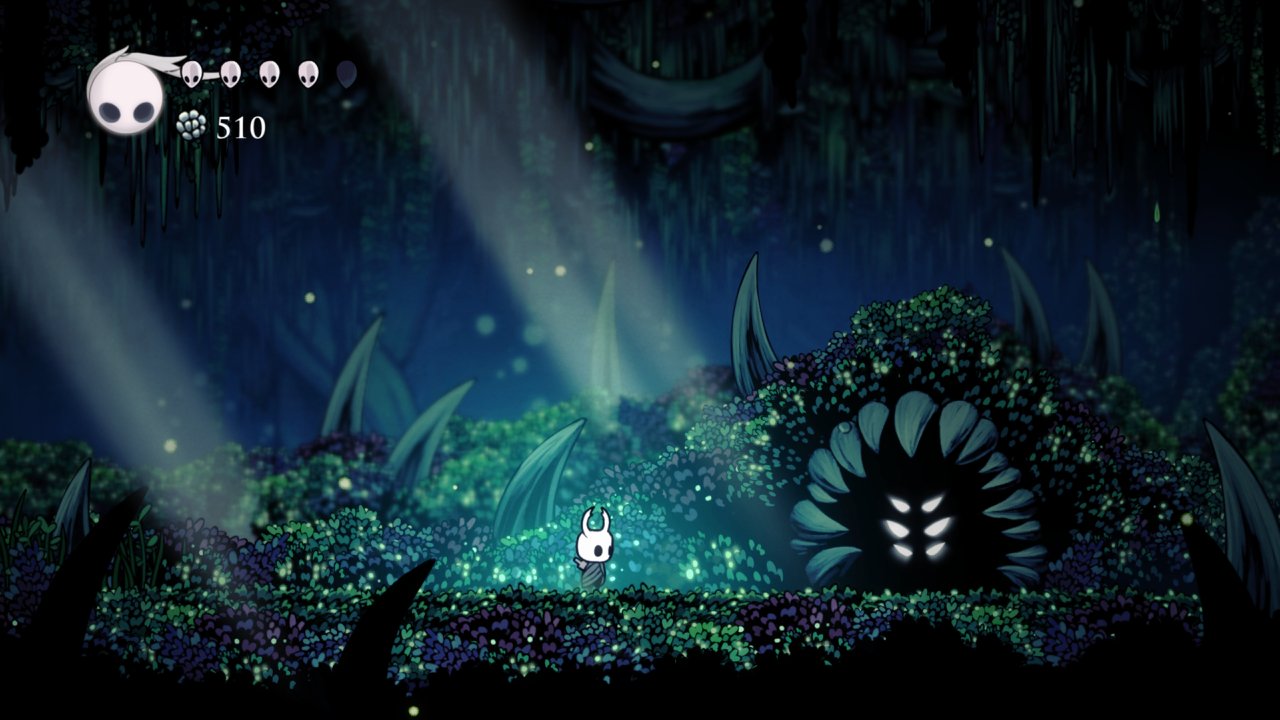
But I am yet again. I actually sort of hate Hollow Knight. And not just in a “not for me” type of way. I don’t think it’s a well made game.

I laughed far more at making this than anyone in their right mind should have. What can I say? When you sit on the bench to save, it kept making me think of that Klay Thompson meme. I love that meme. When we eventually build a Klay Thompson statue outside the Chase Center, I want him to be posed like he is in that meme.

Let’s strip out all the (insanely gorgeous) art and (not really all that clever) writing and talk about the thing that should matter most in a game: the gameplay. The thing I take issue with for Hollow Knight is how it seems to be made specifically to be less fun than it can be.. nay.. SHOULD be. As if the developer was given an option for every aspect: the fun way and the not fun way. And then chose the not fun way because that would be bold and dark. See though, I’ve always felt the graphics and character design should be the primary thing that sets the mood. If you need to make the gameplay less fun to make things feel bleak, you’re doing it wrong.

I’m curious if they mistook “bleak” for “slow”. Upgrades take so long to unlock that by time you get them, it’s no longer an exciting development. It feels like it’s overdue. I didn’t get the ability to wall-jump until over ten hours into the game, and I didn’t get my first upgrade to my standard weapon until eleven hours in. In that time I also added only one single hit point to the initial five you start with, and one “notch” (giving me four total) to apply “badges” which provide things like showing where the fuck you are on the map. Oh, and you can only switch between the badges at the save points. Why? How is that in keeping true to the atmosphere? What about applying a badge to your armor requires the specific act of sitting on a park bench? Maybe I’m spoiled by games that thrive on making the player feel like they’re getting stronger as the adventure unfolds, but I just felt like Hollow Knight deliberately kept me in purgatory.

Fans built this up acquiring this to me so much. I was like “what is this super magical item they keep hyping that will completely change how I feel about this pretentious piece of shit?” A wall jump? A FUCKING WALL JUMP!? You mean that thing that’s been in games for thirty fucking years?

Every aspect of the design is focused on maintaining the slow pace. The map is sprawling, but you don’t get it all at once. You have to locate this person in each different section of the game who will sell it to you and then separately buy from his wife the ability to see the things on the map that you’ve already passed by. In theory that means the guy making the map is better at adventuring than the hero is, since he’s ahead of you and apparently making progress without a hitch. That stuff always breaks my immersion. It’d be like if Sean Bean was giving his “one doesn’t simply walk into Mordor” speech when suddenly a traveling salesman walks by and says “oh actually, you do. Here, I made a map of it. Let me offer you travel tips..”

Thankfully you only have to buy the map icons once for each type of thing, but like everything else in Hollow Knight, it grounds the proceedings into a monotonous slog that feels more like a series of busy-work for the sake of busy-work chores rather than some kind of epic quest. “Slog” really is the perfect word for Hollow Knight. Save-stations are kept to a minimum and spread really far apart, but you’re forced to constantly dash back and forth to them in order to change your badge loadout. Items are relatively expensive while enemies drop relatively few coins to shop with, forcing you to grind if you want to get the stuff that should be for free anyway. Most of the other items offer no descriptions as to what exactly they do and players were reporting to me they were actually finishing Hollow Knight without ever using them or figuring out what exactly they did. There’s really not a lot of games where you can play for an hour and feel like you’ve accomplished nothing in them. Hollow Knight is uniquely like that. It’s the anti-exhilaration Metroidvania.

On the positive side of things, combat was kind of nice. I’m big on swinging a sword feeling like there’s a weight behind it and combat being more than just an animation of a stick moving out and an enemy blinking to indicate damage or vanishing to indicate death. It’s really cool that the dead husks of your vanquished foes remain (until you walk far enough away at least). But there’s not a whole lot of variety to the action. There’s only one weapon, a “nail” that is functionally a sword. When you upgrade it, you don’t get new moves or anything, at least at the point where I was too bored to press-on. There’s no secondary weapons for you to equip, and all the upgrade does is add one extra point of damage. When you’re playing a long game that feels even longer and you only get one real weapon to use with the only moves being swing it horizontally or swing it vertically if you’re attacking upward, it gets redundant no matter how meaty the hits feel. I did get a Ryu and Ken style fireball, but that takes magic points to use and can’t be aimed upward, making it less useful in general than the starting weapon. Variety is the spice of life. For Hollow Knight, all I was left with was lots and lots of salt.

All credit to Hollow Knight: it’s pretty. But it’s 2018. These days it’s more notable if a game is ugly.

Honestly, that was my whole problem with Hollow Knight: it’s boring. There’s just not enough stuff to do in it. It feels like it has all the ingredients to not bore, but then those were spread so thin for the sake of padding the length that all the fun was pushed out. It doesn’t help that the level design is overly basic, like something out of a first-generation Metroidvania. “Wait a second, didn’t you just like Chasm?” Yes I did. What’s the difference? In the time it took me to upgrade my weapon for the first time, add a single point of health, and a single notch for my badges, I had beaten Chasm. Plus, you know, it had a variety of weapons and items and stuff. It wasn’t just the same shit over and over again. It’s not just what a game is, but how that game plays out. Hollow Knight forces a ton of backtracking and grinding, but doesn’t make those things fun or easier. You mostly have the same stuff you started the game with. It gets old. And sorry if I keep harping on this, but it genuinely feels like the developers were more concerned with being emo or dark than they were with making a fun game. Would it really have ruined the bleakness if they gave the protagonist a slingshot or boomerang or something to make it so you’re not just doing the same sword strikes against the same enemies for 30 to 60 fucking hours? Or given more special moves that required less magic. Or let you get more magic. In 12 hours I got one piece of the “vase” or whatever that gives you more magic. That meant I still had to find two more before I got more magic. I got one-third of that upgrade in twelve hours. And the one I did get I bought in the shop. Part of the fun in Metroidvanias is finding stuff. The world of Hollow Knight feels like I did after 12 hours with it: empty inside.

I didn’t finish Hollow Knight. I probably didn’t come close. I did put twenty-hours combined into it with the best hopes and intentions. The first time was back in 2017 on Steam. I bought a copy for Will too, and with my best friend playing alongside me, we set out to see what the hype was all about. We were both excited to get on the Hollow Knight bandwagon. After a few hours, I felt weird. Because I wasn’t having fun at all. When I found out Will wasn’t either, I just found something else to play. I occasionally booted it up again thinking “maybe I was just having an off-day”, before finding myself quickly bored again by the same sword and same enemies and the same dull levels, eventually putting eight hours into the thing. Clearly it wasn’t an off-day thing. I figured maybe it was because a computer isn’t a good home for a Metroidvania, so when I saw Hollow Knight: Voidheart Edition discounted on Xbox One, I thought “okay, maybe I’ll finally see what all the fans see in it.”

Maybe the oh-so-subtle symbolism is why this game has so many people blown away who can’t exactly articulate what it is that has them sucked in to the experience. I’m just saying, there’s a LOT of it in Swallow Knight.. I mean Hollow Knight.

Nope, I didn’t. I still don’t. I tweeted basically the entire time, showing my progress. For the first hour or two, it was fine. It was almost fun in a tutorial type of way. But then I started to wonder out loud when the game would start to, you know, wow me. The entire time, fans of Hollow Knight were assuring me “you’re about to get to the good stuff” or “you’re about to open up the game.” And then it didn’t happen. They kept promising, I’d get to the spot they were talking about or get the upgrade that they swore would change how I felt about the game, and then it didn’t, and then they promised me the really good stuff was “still coming.” Finally I caught on that I’d never get to the “good stuff” because there is no good stuff. Hollow Knight is a very basic Metroidvania with its only remarkable hook being that if you die you lose all your money, but if you go back to where you died you can get the money back. You know, that thing other games have been doing all decade.

Otherwise, Hollow Knight is stuck in early 90s 2D adventure mentality, but people will give it a pass because it’s “deep”. And you know it’s “deep” because it has a pretty art-house decor. Who cares? The first time a stage made me sit up in my chair, I was ten hours in. And even that didn’t last. Maybe I quit right before I got to “the good stuff.” I don’t know. I don’t really care. It shouldn’t take that long to get to the part that’s entertaining in the entertainment product. And if someone still thinks I sought out to find things to dislike about Hollow Knight for the sake of being different, do you really think I needed over $30 and twenty-combined hours to do that? Because I didn’t.

I wanted to have fun at the party. It turns out the party kind of sucked. Like one of those ones where you find out it’s not really a party and they’re going to try to get you to buy a timeshare. They already fed you, so it seems rude to get up and walk out right away. You start checking your watch to make like you have something better to do later. But really, you’re trying to figure out if you should leave before he hands out the brochures or wait until afterwards so you can show it to your family and laugh with them. That’s what the Hollow Knight experience was for me: being trapped at a timeshare party. Hell, come to think of it, I think I’d like that party more anyway. At least I’d get fed.

Hollow Knight: Voidheart Edition was developed by Team Cherry
Point of Sale: Steam, Xbox One, Nintendo Switch, PlayStation 4

$9.89 (Steam) and $11.99 (Xbox One) (Normally $14.99) thinks Voidheart sounds like a Care Bears villain in the making of this review.

Three Fourths Home Extended Edition (Short Subject Saturdays)

I’m not really a text-based adventure type of chick. It’s one of those things I just don’t get. It doesn’t seem to take advantage of the medium. But I was really, really surprised to see one on the Switch marketplace that actually straight-up says it’s a short-subject game. I have a feature called Short Subject Saturdays.. cue the graphic..
And and the game was on sale so I figured “why not?”

Then I played it. Well, “play” is a generous term here. You’re a girl in a car driving home in a blinding rainstorm while talking on the phone to your family. That’s the entire game. And, presumably for the sake of immersion, you have to hold the right trigger down the entire.. fucking.. time. If you do not, the car stops and the dialog will not advance forward. Apparently Kelly’s cellphone is being powered directly by the gas pedal of the car. It has to be on the list of the dumbest ideas for a gameplay mechanic I’ve seen in my entire life. My amigo Brad Gallaway of GameCritics.com suggested I use the same rubber-band trick I used with Cuphead, but it’s harder to do so on the Nintendo Switch. So my right index finger (which is still sore, I’m not even exaggerating) and I are currently not on speaking terms, and that’s a shame because there’s a Parks & Rec marathon on and plump Chris Pratt gets me wet.

The main game is around 20 – 30 minutes long. The extra stuff is another 15 minutes or so. It feels longer.

A text-based game has to have sharp writing and something intriguing about it to make the experience worth your while. The point-of-view character is Kelly, a mid-20-something who just moved back home after some sort of falling out with her boyfriend. Her Mom is an overbearing bitch. Her Dad is an off-his-nut alcoholic who apparently had a leg amputated following some sort of farming accident. Her brother is a self-indulgent twat who writes sloggy fan-fiction (clearly this was the author insertion character). Unfortunately, the game is framed as being a casual phone call with your family. The one and only positive thing I can say about Three Fourths Home (I refuse to enable to their bad grammar by not capitalizing the title) is that the dialog often does feel like real inane banter between a daughter and her cunt mother, stumblefuck father, and douchebag brother. But, that’s kind of the problem: they’re fucking boring. The stuff that IS interesting, like why Kelly moved back home and what caused her family to leave the farm she was visiting for old time’s sake, is kept somewhere in the background. Instead, topics center around a swear jar and your brother reading his shitty short story to you (how meta). There’s a ton of filler that doesn’t seem to go anywhere. You don’t really get any closure on the family situation because, as you make your way home from a drive out in the boonies, a tornado warning hits. There’s also an epilogue that feels more like a prologue, but it doesn’t really help either.

Apparently the story unfolds differently depending on how you answer the questions, but the thing is I’m not really willing to go back and sit through this literally-physically-painful-to-play text adventure because (1) it was boring the first time and (2) I’d be afraid I’d answer the stuff wrong and get the same exact ending I already got which sucked and offers no closure. There’s no obvious spot where the story could branch, or why it would branch. It reminds me of #Wargames, where the challenge is entirely based around not nodding off and you have no clue where to press what to change the story you already snored through before. Really, Three Fourths Home would have made a better short film. As a video game, because of the R button requirement, it might be the worst game I’ve ever played. It’s that boring and that badly designed.

The extended stuff pushes the envelope by letting you walk left OR right. Thankfully moving is optional.

It’s also an epilepsy risk because the game takes place in a lightning storm (though I’ll defend the developer’s decision on this one since it’s sort of is necessary for some of the symbolism and disabling it would go against their creative vision). It’s not badly written. Again, it feels kind of real. But real-schmeal. Three Fourths Home is a fucking bore. I literally can’t believe in 2015 people were throwing this piece of shit Game of the Year nominations and 10 out of 10s. How? Why? Is this one of those “I better pretend I liked this or people will think I’m not indie enough” things like with Proteus? Lately people have accused me of being too wishy-washy with some of the games I haven’t liked. How’s this for wishy-washy: Three Fourths Home Extended Edition is overwrought pretentious tripe with all the depth of an evaporated puddle of piss.

Three Fourths Home was developed by Bracket Games
Point of Sale: Switch, Steam, Xbox One, PS4, Vita

$2.24 (normally $8.99.. FUCKING OUTRAGEOUS! I feel sorry for anyone who bought this thinking it would be something else) sent this game to the cornfield in the making of this review.

Chime Sharp

It’s nuts to think Chime is nearly a decade old. It came out so long ago that I can safely use the term “back in the day” to describe when I first purchased it on Xbox Live Arcade. At the time it had one of those feel-good “X amount of the purchase price will be donated to charity” attachments. Later, I somehow ended up with a copy on my PlayStation 3 as well, though for the life of me I’m not sure how it got there. Possibly it was a PlayStation Plus freebie or discount. It’s also on my iPhone. And iPad. And PlayStation 4. And my Xbox One. And now, with Chime Sharp, it’s on my Steam account as well. Seriously, where the fuck did I get all these? I’ve caught fewer colds over the last decade than I’ve acquired copies of Chime.

If you’re not familiar with the concept, the formula is basically Tetris + Luminies – tension = Chime. You get a grid to place various shapes of blocks on that you have to arrange in 3×3 or larger “quads”. When a quad is formed, a meter starts to fill up inside it. You can keep adding blocks around it to make it bigger. Once the meter is all filled up, the size is locked in and the blocks are deleted the next time the pace ticker scrolls by. It aims to be a kinder, gentler action-puzzler that’s more relaxing than its sweaty-palms forefathers. And it succeeds. Mostly.

In 2018, I must have made over a hundred attempts at beating the “Strike” mode for Steve Reich’s stage. I don’t think I could complete it if I had a thousand years.

For the sake of fairness, I went back and played the PS3 port, Chime Mega Super Deluxe 5000 HD Turbo Special Edition or some such shit. I would have tried the XBLA original, but I mean, come on. It’s 2018. My last Xbox 360 (I went through four of the fucking things) Red Ring of Deathed about two years ago. Possibly from old age, or possibly from an oscillating fan blowing mildly cooled air in its general direction. We may never know. Anyway, having already put a few hours into Chime Sharp, I was pretty impressed at how far along its come. The presentation for Sharp is so much sleeker and modern. Chime on PS3 isn’t that old, but it looks positively ancient compared to what the game is now. If you care about that sort of thing, and you really shouldn’t because it’s a block-puzzler for cripe’s sake, Chime Sharp is positively dazzling to watch.

Except when it’s not. Did you buy those special sunglasses to view last year’s eclipse? Well, I hope you didn’t throw them out. Go grab them, put them on, and take a look at this level.

I’m not sure what the fuck they were thinking with the color scheme here. I honestly can’t remember playing any game at IGC that literally made my eyes hurt until now. On my first play through of it, I didn’t get enough coverage to make it to the next stage and I might as well of cried because my eyes were already pouring tears. That’s not an exaggeration. By time I completed the second, thankfully more successful attempt, my eyes hurt. Badly. And the pain lingered quite a while afterwards. It felt like I had looked into the sun. Hey Chime developers, I like your game. But for fuck’s sake, change the color scheme of this stage. The next level was gaudy too, though that might have been my fault since I only waited an hour after finishing the nuclear explosion pictured above.

Take my word for it, turn on color blind mode, where all the blocks are orange and blue regardless of the level you’re on. It’s a really useful mode to have, because after playing it without it turned on, you might end up color-blind. And possibly blind-blind as well. But, even that’s not perfect, because the wrap-ups after each stage ignore the option and revert back to digitally pepper-spraying your retinas. Like so.

On the plus side, it makes it hard to see how badly I did. So, uh, I guess thanks Chime devs for sparing my ego?

I should probably point out that Chime is technically supposed to be a music-based game, where each block you put down somehow alters the soundtrack. The thing is, a quirk of my autism is a condition called Amusia. Which, despite what it sounds like, doesn’t mean I find stuff amusing that I shouldn’t. I don’t, for example, laugh at Big Bang Theory. Because Big Bang Theory is not funny. If you do laugh at it, consult your own doctor, because something is wrong with your brain. I’m not sure what it’s called, but it’s not Amusia. Amusia is clinical tone deafness, and in my case, music can even make me physically ill sometimes (though that usually only applies to pop music and not symphonic stuff). That’s why I rarely talk about it here at Indie Gamer Chick. Maybe that makes Chime an odd choice to review. But, maybe it speaks volumes to the core gameplay’s quality that I’m not a music person and was perfectly satisfied. Come to think of it, I was the same way with Lumines too. You people get too worked up over music anyway. Like when idiots refuse to watch Married with Children on syndication because it doesn’t have the Frank Sinatra theme during the opening credits. Even though literally nothing else about the show is different. I don’t get it.

I don’t have a ton to say about Chime Sharp. I appreciate the additional modes and challenges, all of which are just different scoring variations of the same core gameplay. I really only wanted to do this review to get Chime on the Leaderboard. It’s been one of my go-to “I desperately need to calm down” games for years. While I joke about not being sure how I came upon so many different versions of it, the truth is Chime is the closest any “action-puzzler” has come to reaching that Tetris-level “sure-fire bet” when you simply need to get your game on and need something that will draw you in. Chime is a peanut butter & jelly sandwich. It gets the job done, fills you up, and lets you go about your life. I’m not good enough at it to chase records. I’m not bad enough at it to have my blood pressure spike. It’s a spa-treatment of a game. Granted, one that might occasionally mace your eyeballs.

Chime Sharp was developed by ZoΓ« Mode
Point of Sale: Steam, PlayStation 4, Xbox One (No Vita version? Really?)

$9.99 actually started writing this review back in February and never finished it but wants to get content up daily so here we are in the making of this review.

Chime Sharp is Chick Approved and ranked on the Indie Gamer Chick Leaderboard. You can safely consider all ports of Chime to be covered by this review, but if possible, get Chime Sharp.

The Trouble with “Clone”

Pong wasn’t the first video game, or even the first arcade video game. It was the first commercially successful one, and the resulting popularity led to the most predictable consequence ever: it was copied. By everyone. In fact, this was so widespread that most people with only a passing interest in games who were around during the time assume Atari sold a lot more units than they actually did. Often, the competitors just straight-up directly copied every aspect of Pong component-for-component and slapped a generic name on the machine. Pong had no title screen and if you’d only heard of a newfangled electronic tennis TV game that cost a quarter to play, you wouldn’t know that Midway’s “Winner” wasn’t the original arcade video tennis machine. By the end of Pong’s market viability, there were over 25,000 “Pongs” installed in locations across the United States. But, around two-thirds of those were knock-offs with names like “Rally” or “Electronic Tennis” or “TV Ping Pong” made by companies besides Atari. Only about 8,000 actual Pong machines were built. The rest were eventually given the name “clones.”

Imagine living in a world before video games were everywhere and hearing about this “electronic tennis game you play on TV.” If you stumbled upon Rally, a Pong clone by Bally, would you have guessed or even cared that they had completely ripped-off Pong?

So it’s no surprise that the word “clone” is a major part of the gaming lexicon. The industry’s initial meteoric rise was built on a foundation of cloning. Unfortunately, we’ve stretched the definition of what is and isn’t a clone a little too thin. The word always has negative associations, yet we use it as a catch-all description for games similar to others. We do this even with games we like. I’ve heard gamers call Axiom Verge a “Metroid clone” or Bloodstained a “Castlevania clone.” That seems like a slap in the face to such games, which strive to replicate the look and feel of classics but in a way that feels new and fresh. These are not clones.

They’re tributes.

The word “tribute” doesn’t come with the baggage that “clone” has. Well, unless you’re a child about to be forced into combat for the sake of somehow repressing rebellion among overworked and underpaid civilians in a dystopian society. I’ve never understood how that was supposed to work. It seems like that’s actually the exact sort of thing that would eventually cause such a rebellion. I mean, I would understand it if it was used as a threat. “Rise up against us one more time and we’ll force your kids to battle to the death for our amusement.”

“Okay, now remember: in the event that these adorable, photogenic children from your district are the ones that die screaming in agony, absolutely no rioting and/or rebelling. If you do.. um.. I’m not entirely sure actually. Really, we’re already killing your offspring for our entertainment. That’s about as horrific as it gets, it would seem. You know, I need to bring this up during the next cabinet meeting and ask President Snow if we’ve really thought this whole thing through. I mean, I can see some of you are not on-board with our plans. I don’t know what people itching for an uprising look like, but if I had to venture a guess, I’d guess they look something like you people. You have that ‘overthrow the tyrannical government’ look about you. But don’t.”

Where was I?

Tributes. It just makes more sense to me to call a modern indie title inspired by the hits of gaming’s past a “tribute.” Because that’s what they are. And the word works whether the game is fun or not. Calling Yooka-Laylee a failed tribute to Banjo-Kazooie is more accurate than describing it as a clone. It’s not a clone. It does try to somewhat modernize Banjo’s concept with things like a physics engine that closely resembles games of the 21st century. The way they implemented the idea completely missed the mark to such a degree that the mark shot itself in despair, but that doesn’t change the fact that the intent was toΒ pay tribute.

I’m not saying actual clones don’t exist in the modern-day. Anyone who searched the mobile market during the Summer of 2013 will remember endless copy-cats of Flappy Bird, which itself wasn’t exactly the high-mark of game design. But it was popular, and it got knocked off. But there’s a big difference between that and being inspired by a 1988 game in 2018. And it’s especially irksome because gaming is the only medium where such things are called “clones.” Nobody called Superhuman Samurai Syber-Squad or Big Bad Beetleborgs a clone of Power Rangers. Hell, nobody even called the uber-cheap, so bad that it caused organ failure across the country Rangers knock-off Tattooed Teenage Alien Fighters from Beverly Hills a “clone.” What about Cloverfield? By the standards of the usage of “clone” in gaming, is it not a “clone” of Godzilla? If every mining game is essentially a clone of Minecraft, surely every disaster movie must be a clone of the Towering Inferno?

So why do people say Shovel Knight is essentially a clone of DuckTales? Or even Terraria being essentially a clone of Minecraft? Clone is such a dismissive term. There’s no positivity to it at all. And maybe this message sounds weird coming from someone who regularly boils games in oil, but y’all need to be more positive. It’s such a disservice to these games to simply brush them off and lazily describe them as clones. Tribute is much more versatile. It can apply to games not out yet (“attempts to pay tribute”), good games (“wonderful tribute!”) or bad games. (“tried to pay tribute”). No matter what modifier you use on clone, it still sounds bad. Even “good clone” makes a game sound derivative and uninspired. And what happens when something does get cloned? In the event you run into an actual knock-off that deserves the title of clone, the proper meaning of the word has less weight when people say, completely seriously, that Dead Cells is, more or less, a 2D “clone” of Dark Souls.

That wasn’t a joke. I spent about a month tweeting media from my Dead Cells play sessions and had multiple people shrug their shoulders and call it a 2D Dark Souls clone. If I could strike one word from the gaming lexicon, it’d be clone. Well, actually I’d like to strike the pejorative “gay” from it too, which would remove about 75% of your average Xbox Live player’s vocabulary.

The indie community struggles enough with finding and maintaining an audience. Writing-off every neo-retro game as a clone of some classic title isn’t helping with that. The real shame is the work that goes into the games is the part of the equation that is lost most when someone casually dismisses a new release as a clone of some all-time great. “Cloning” suggests a lack of effort. Yooka-Laylee was terrible, but actual effort was made regardless of its failure. If they had set out to simply copy it, that could have been done with a lot less effort and a much smaller budget. Cloning is easy. It’s simple reverse-engineering. Building a new game from the ground-up that aspires to invoke the spirit of a legendary classic takes work. Win or lose, the effort should be worthy of the title “tribute.” And maybe we owe developers that kind of consideration. Let’s pay tribute to their work and ditch “clone” for good.

And if you don’t, I’ll force your kids to battle to the death for my amusement. See, that’s how you make it work!

Bouncy Bob

Welcome to the very bottom of the barrel on Nintendo Switch. Bouncy Bob is currently #1 on the eShop sales chart for digital download exclusives and #4 overall, with only the new Pokemon Let’s Go games and Smash Bros. Ultimate’s pre-order outselling it. By the way, what kind of sad, sad person pre-orders a digital download if it’s not discounted or doesn’t come with some kind of pre-order bonus? Yes, you get Piranha Plant’s DLC for free with the digital copy, but you get that even if you pay for it any time before January 31, 2019. You don’t need to reserve your digital copy. It ain’t going to sell out, on release day, ya fricken morons. Hell, I wouldn’t be surprised if their servers fill up and you have to wait a long time for it to download, so the joke’s on you for being so excited that you need to preorder a fucking digital game. I don’t get gamers sometimes. I’ve had six people tell me Smash Bros. Ultimate is their game of the year of 2018 and they haven’t even played it yet. I can’t imagine why people think Nintendo fans are all overgrown children. Truly it is gaming’s greatest mystery.

Anyway, Bouncy Bob is selling like a hotcakes, if those hotcakes also dispensed blowjobs. If you’re fretting that you somehow missed the new hot-shit fad on the scene and are scrambling to establish your indie cred by fumbling through the eShop as we speak, don’t worry. The reason Bouncy Bob is #1 is because it cost a whopping fourteen cents for about a month, a discount price that ended yesterday. I decided to hold off on posting this review until today so nobody would stop at $0.14 and say “OH MY GOD, I GOTTA GO GET IT!” Going off the Mega Fruit Gum principle I established for Super Duper Flying Genocide 2017 (which you’ll remember as the game I scored 329 achievements in span of 43 minutes on Steam), Bouncy Bob costs 18.6% of a single Mega Fruit (assuming I find a machine that sells them for 75Β’ instead of a buck). After playing it for a few hours, I can honestly say I would have been better off scouring sidewalks looking for sixty-one dropped pennies so I could afford the gum. Bouncy Bob might be the worst game I’ve ever played.

Rare is it that I realize I’m in for a terrible day during the tutorial. For Bob, I knew it by time I attempted my third jump.

So the idea is you’re a shadow that looks more like the obese, homeless cousin of Mr. Game & Watch. You’re placed in an arena with various enemies that you must defeat by bouncing on their heads. But, instead of traditional hopping ‘n bopping, all movement is done with a meter that bounces left and right that you must time to sort of fling yourself around the stage, hopefully on top of the baddies. You can also flap your arms to help get a bit more height and distance. Everything is done with a single button, and that’s when I realized I was playing a quick cash-in port of a mobile game. The sense of dread that overcame me was almost shouted down by a faint voice that tried to remind me of how good Jack ‘N Jill DX was. It was a mobile port, priced to move, and it was pretty sweet. And then I started playing it, and the that voice was immediately curb stomped.

The mechanics are just not practical for the type of arcadey-action game it wants to be. The amount of super-obvious mistakes, all of which could easily be corrected with some patchwork, stick out like a sore thumb. Touching enemies causes damage, but you don’t blink. Enemies tend to bunch up, and since you have no direct movement over Bob, it takes time to let the meter fill up and point you in a safe direction. You take damage the entire time, and without the ability to move, you can go from full health to no health relatively fast. The enemies actually can interrupt your momentum too. You deflect off them, so once you get stuck in a group of them (and that’s basically all the enemies do: bunch-up), it’s not as simple as charging up your jump and escaping. It just doesn’t work the way I assume the developer wanted it to. Ironically, the cheapest non-free-to-play game I’ve ever reviewed at IGC is insanely cheap in pejorative sense as well.

I’d say the game looks fine at least, but the collision detection is a bit wonky and enemies and projectiles don’t stand out enough. Plus the dark graphics on some stages make overall visualization a chore. Man, Bouncy Bob really doesn’t do anything right. It’s kind of remarkable.

And that’s just the start of the problem. The enemies just sort of meander about, and if you go down to the lowest level to attempt to pounce on them, they’ll rain down on you from their spawn point. If you try to escape, you could bounce off their feet and get trapped below. If they throw projectiles, you REALLY don’t have enough time or room to escape almost any situation. Remember, you don’t get any temporary invincibility when you get hit, so even running away is likely to result in you dying. And the collision detection is so bad that, because the enemies cluster, you can be killing one while taking damage just by being next to another.

By the third stage, they start flinging bombs at you that have a pretty wide explosion range and are a one-shot instakill no matter how far you are you are from the detonation point, just so long as you’re “inside” the blast radius. Clearing stages requires you to kill X amount of enemies, but the enemies can also kill each other with their bombs. It removes a lot of the strategy involved and reduces victory down to dumb luck because the bombs have too short of fuses and when you swoop in to attack, the gang of enemies is just as likely to die at their own hands, which you don’t get credit for. The problem is there’s nothing fast-paced about movement, but Bouncy Bob wants to be a fast-paced action game. That’s like wanting your child to be a basketball star and going about it by cutting his feet off.

There is literally not a single aspect of Bouncy Bob that I found enjoyable. The physics tend to feel a bit light, and I often simply tumbled off a ledge that I really should have stuck the landing on. You can be killed by your own bombs if you touch the item box for them, which scatters three of them onto the playfield with zero ability to aim them. If you end up clustered with enemies AND bombs, you’re good as dead since grazing the enemies while attempting to jump screws your momentum up. I don’t know if I would say Bouncy Bob feels broken, because “lazy” or “unfinished” seem more accurate. The one brief glimmer of hope I had was that playing multiplayer would make the objective more doable, but multiplayer is an entirely different formula. A versus mode, where players have to jump on each other. I literally couldn’t convince a single member of my family to even finish one round of it with me. It’s that boring.

This is where I quit. It’s only the third level. To anyone who defends this tripe and says I didn’t put enough time into it, I’d like to point out that buying a game entitles me to have an opinion on that game. If you buy a product and it sucks, you are allowed to publicly bitch about that product, you know? Bouncy Bob sucks. Here, you have to deal with bombs that have a large damage range (in a game where movement is anything but quick), with spikes on walls next to portals (as if the game wasn’t unfair enough) and awful physics. I put over an hour into this level and couldn’t finish it. Call me unskilled all you want. It’s not my fault the game is crap.

I put in nearly two hours spread over three days trying to find something nice to say about Bouncy Bob, and I couldn’t. Hell, I couldn’t even beat the third stage. I tried every method, from playing conservative and waiting sometimes several minutes for what looked like I had a clearing to take out multiple enemies and escape to playing super aggressive and throwing caution to the wind. Nothing worked, because the game just plain is not designed in a sensible way. There’s really no defense against the bad guys or their projectiles. It makes me wonder how much time the developers needed to finish their own game, or if they ever stopped to ask themselves what exactly was fun about it? It has an air of cynicism about it. That someone felt this was a quality game worthy of the marketplace. It’s not at any price. It’s the worst game I’ve ever played on any Nintendo platform.

For anyone out there dense enough to say “what did you expect for fourteen cents?” I’ll remind you that there’s some incredible free to play games out there. Price shouldn’t change how much fun you’re having with a game. If it does, that says more about what you value than it does about the quality of a game. Bouncy Bob is back up to its $1 price tag, but it’s terrible at any price. If it was free, it wouldn’t be worth the time or space it would use up. So bad is Bouncy Bob that I had to make a new rule at IGC. From this point forward, I’m done playing no-effort ports of mobile games. My time would be better spent on games tailored for platforms. Bouncy Bob feels like a cash grab, and the fact that its $0.14 ploy worked to the degree it did actually makes me kind of mad. Because, for a lot of people, Bob will be the first impression of what a low-price indie game is. And those people might decide that it’s representative of all low-cost indies. What a horrible thing to do. It’d be like saying Kanye West is an example of what everyone with the last name “West” is like. That’d make Adam West spin in his grave to such a degree that you could connect a power generator to it and end our energy crisis.

Bouncy Bob was developed by All Those Moments
Point of Sale: Nintendo Switch

$0.14 (normally $1) said TOO MUCH in the making of this review.

Bleed 2

So, there’s this game that came out in 2017. It’s an old-school shooter where the developer, recognizing that most people remember boss battles and not stages, based the majority of the game around such encounters. It features a throw-back art style, clever boss designs and battles, and exhilarating white-knuckle bullet-spraying action.

Oh, and it has multiple difficulty options and is accessible to gamers of all skill levels. That’s how you know I’m not talking about Cuphead.

Back in February of 2017, the sequel to one of my favorite XBLIGs arrived on Steam. I got it. I played it. And then I apparently had writer’s block when I sat down to do the review.. and promptly forgot about it. Awesome. So here we are twenty-something months later and I just replayed Bleed 2, this time on my Xbox One. Now, I really, really loved playing Bleed 2 the first time around, so how on Earth I could let this one slip by? Well, not being dedicated to my game critic duties played a part. Another part might be that Bleed 2 is shorter than your average bout with hiccups.

Fan theory: Wryn is the daughter of Chintai, one of the bosses from Double Dragon. That explains the thirst for homicide.

In Bleed 2 you continue the adventures of Wryn, the girl who dreamed of becoming the biggest gaming icon in the world, and achieved that dream by violently murdering all the other stars in cold blood. Well, if it still counts as cold-blooded if done in the most upbeat, cheerful, “holy crap, I can’t believe how totally violent and deadly I am and that’s fucking awesome” type of way. I loved Wryn. She’s a go-getter. And I love her character design. Bleed 2 even has a taunt button so you can see her joyously raise a single arm triumphantly in celebration of her growing body count, and it makes her look like a Charlie Brown supporting character. Like Peppermint Patty if she completely lost her mind and started gunning down all the other Peanuts for fun.

Bleed 2, like the best sequels, is the evolutionary version of its XBLIG original. The run-and-spray twin-stick gameplay has been refined, along with the responsiveness of Wryn’s awesome triple-jump that feels like it belongs in a superhero game. The main hook this time around is you have a samurai sword that you can use to reflect any pink-colored projectiles or attacks. The sword is automatically used when you’re using the standard duel-pistols and press in a direction to shoot. While it works and offers remarkable precision, it also makes me worry about the health of my controller as proper usage requires a lot of stick-flicking. By time I finished a round of Bleed 2, a ring of white powder that hadn’t been there before (I always check with twin-stick games) had formed around my XB1 pad’s right stick. While it’s not Mario Party 1 levels of warranty-voiding abuse, by the half-way point of Bleed 2 I was questioning whether Ian Campbell was in league with the Mexican Controller Cartels. We’ve all been there. Hell, I used to make a enough money selling the powdered remains of my Nintendo 64 analog sticks post-Mario Party to teenagers as “cocaine” to fund my actual cocaine habit.

The reflect-the-bullets stuff is awesome and combines beautifully with the Max Payne like bullet-time effect. It makes Bleed 2 such a joy to experience. There’s no pretension on display here. This is just a stupid, mindless, white-knuckle action game. No bullshit. No sense of self-importance. With the indie scene trending more towards games that try to tell important “messages”, Bleed 2 is a breath of fresh air. Like Cuphead, it forgoes the notion that people want to play through levels and focuses on multiple boss encounters, each unique from the other and requiring different tactics to beat. They hit one after another, never giving you a moment to breathe. Even games that aspire to be balls-to-the-wall miss the mark with frequent breaks in the proceedings. Not Bleed 2. Often you beat one boss only to have another spawn within seconds. It never lets up, and it never gets boring.

Bleed 2 is such a strange game. You can unlock more weapons, but none of them are as fun or satisfying as the standard loadout. When does that ever happen in games anymore? Not since Painkiller that I can think of.

But, it’s not perfect. The basic enemies are total cannon-fodder, offering less challenge than your average pickle jar. And most of the levels are so uninspired that I wonder why they even bothered putting them in. Perhaps, like Cuphead, they felt like they had to. To all you indie devs out there: you don’t have to do shit. Funny enough, as much as I hated Cuphead, at least some of the actual levels were entertaining. Not with Bleed 2. They’re dull as dirt tofu-based appetizers and serve as distractions to the delicious, meaty main course of the boss battles. I’d love to see a third game in the series that fully transitions to just those parts. Everything about the stages, with the exception of one that removes gravity, feel uninspired, phoned in, and arbitrary. And if that’s not enough mean things to say, give me a few minutes and I’ll come up with more.

The main quest is short. A good player can probably knock it out comfortably in under two hours. Bleed 2 offers a ton of extras, but this is where the game stumbles. The main quest features hand-crafted levels, while the more attractive bonus mode, Endless, uses randomly generated stages in what I can only assume was an attempt to offer some justification for not removing the basic enemies entirely. Also, this is what all procedural generation in games like this should be: a throw-away extra. Unfortunately, while there’s still adjustable difficulty toggles, the endless mode gives you one life and one life only to complete all five stages. This is far out of reach for my ability as a gamer. Why not offer to have endless lives and count how many you need? Not for everyone. Just make it an option? I mean, the random levels are dull and you take on bosses you already fought and I can’t imagine anyone would actually voluntarily want to play this stuff, but gating it off so it’s only playable by the uber-talented seems odd.

This is “Challenge Mode” where you can take on three of the game’s bosses at the same time. Not a boss rush. THE SAME TIME. Even the on-screen menu admits this mode is unbalanced and just for lulz.

But I loved Bleed 2. I don’t really have too much to say about it. Stripping out the majority of useless stuff will do that. I like the way weapon pick-ups (or lack-thereof) work. I honestly had more fun just using the default loadout than I did during a second play-through with rocket launchers and laser beams. Maybe I wish the “main” bosses weren’t just other people the same size as my character, which was done in service to the story instead of the pace and atmosphere. The final boss fight against “the Rival” (who you then unlock as a playable character, only he can reflect yellow stuff instead of pink, essentially making him Sinestro) is so insanely anti-climatic that I didn’t realize he was the final boss until “GAME CLEAR” popped-up on-screen. It was a bit of a let-down, even though it was a pretty fun fight. You know what? Give me rock-solid controls and an hour or two of exhilarating action that leaves me sweating, cursing, in a bit of pain, and still wanting more over a ten-hour experience where I eventually reach the point that I just want it to be over. I’m talking about Bleed 2, by the way, not my sex life.

Bleed 2 was developed by BootDisk Revolution
Point of Sale: Steam, Xbox One, PlayStation 4, Nintendo Switch

$7.99 (Steam version, normally $9.99 or $14.99 on consoles) think the series isn’t as popular because the name is fucking lazy in the making of this review. Then again this review is like twenty months late.

Bleed 2 is Chick-Approved and ranked on the Indie Gamer Chick Leaderboard

Chasm

So, in the interest of full disclosure, I’ve been friends with James Petruzzi (developer of Chasm) and Dan Adelman (producer of Chasm) for years. Not hangout friends or anything, but I’m quite fond of both. Also, I quite like Metroidvanias, as my Leaderboard rankings have established. The friendship stuff never factors into my reviews. The genre favoritism probably does. Because, you know, unavoidable human nature. For what it’s worth, I met James when we got into a digital screaming match on Twitter, and although the hatchet has long since been buried, I’ve always suspected he secretly doesn’t like me very much (and if that’s the case, just wait until he reads this, which is probably my most scathing positive review ever). That’s fine. Neither does my new dog. Like her, you’re stuck with me James.

But, there’s one other factor that my fans should probably consider when reading my review of Chasm: this is the final new release I’ll ever review that started life as an Xbox Live Indie Game. Now granted, by 2012 (yea, 2012! This bun has been in the oven for a while), it was no-longer slated for XBLIG, but still, if you’re a life-begins-at-conception type, Chasm is the “last XBLIG.” For most people, that wouldn’t mean anything. For me? To say XBLIGs were an important part of my life is an understatement. Without them, I wouldn’t be Indie Gamer Chick today. I probably wouldn’t be doing game reviews at all. I truly in my heart-of-hearts feel that if I had started a blog that covered games from any community but XBLIG, I’d never caught on, and I’d probably have quit after a month or two. That was my track record with me and hobbies up to that point in my life. The one-and-a-half model airplanes hanging from my bedroom ceiling, the incomplete collection of 1999-2000 NBA cards, or my unfinished K’Nex Roller Coaster that I just knew I had to have are a testament to that.

So, I fully admit that my play session with Chasm had an air of sentimentality that nobody else will experience. My eyes welled-up and tears began flowing down my cheeks as the end credits rolled, because this was the end of an era specific only to me. This didn’t happen to me when XBLIG shut down last year. Maybe that was because I was so focused on trying to get XBLIG devs to preserve our community’s legacy and port their games to other platforms. For me, this had more of a feel of finality to it. Chasm was essentially the epilogue to the most important chapter of my gaming life. I believe after seven years and 575 indie games reviewed that I can evaluate Chasm without that perspective, but it seems like something my readers should know happened. It’s be like if it turned out Roger Ebert had at one point forced Robert De Niro and Christopher Walken to play Russian Roulette at gunpoint, then sometime later saw the Deer Hunter. Sure, it got four stars because it was great, but deep down maybe he really liked it because it reminded him of the good old days.

The character design is insanely clever because it’s completely gender neutral. It could be a dude, or maybe it could be a chick. It’s whatever you want it to be. It’s like a gaming hero Rorschach test.

Chasm is a Metroidvania with an ambitious hook: the entire interconnected world is randomly generated all at once upon starting your quest. In fact, players are given a seed code so that they can share their maps with everyone else (mine was 61OEC765). Doing this allows Chasm to be one of those games that claims to “never being the same game twice.” A claim that is, and always has been, complete and total bullshit. Randomly generated games are always the same game. No matter how many times you play Chasm, you’ll be interacting with the same NPCs, getting the same weapons, and completing the same worlds in the same order. Rearranging the ordering of the rooms will never change that fact. Claiming otherwise is like claiming Solitaire is never the same game twice. That might be factually true (there’s more combinations in a deck of 52 playing cards than there are atoms on Earth), but it’s still just Solitaire. And Chasm is going to be Chasm no matter how many seeds you experience.

While it’s commendable that Chasm can assemble the rooms in a way that always makes a playable map with all the quirks you would expect in a Metroidvania, the problem is this required some overly-bland design for it to work. Rooms are mostly very basic, no-frills rectangular hallways that you walk in a straight line to traverse. Maybe they’ll occasionally get bold and throw a hill in for variety’s sake, but really, it’s mostly rectangular rooms that you walk across. If not hallways, they’re vertical shafts with platforms that have enemies crawling around them, straight out of 1986’s Metroid. A few times these sections don’t even have enemies at all. While a small handful of areas are more involved, around 2/3rds of the rooms amount to the basic rectangles with slight variations. Although the level design is rarely bad (though it does happen, especially sections that rely on edge-of-ledge platform jumping), it never rises above being just really bland until one section late in the game that features an electric platforming maze. It’s heartbreaking because Chasm, like so many games before it, sacrifices creativity and inspiration for what is, when you get down to it, a marketing gimmick. This is as tragic as Space Jam, which I swear started out as something profound and moving until it became an extended ad for Nike and Big Macs.

Notice most of the pictures feature flat or semi-flat hallways. That’s no coincidence. It’s just what most of the game looks like.

And frankly, building around “endless replayability” is so misguided, because the type of people who replay games that much will do so whether stages are random or not. I meet gamers all the time who brag about how they play stuff like Super Metroid or Chrono Trigger every month and have since they came out. Twenty-plus years and hundreds of replays later and they STILL do it today. As someone who almost never replays most games, this shit baffles me, but it’s fairly common. These type of gamers don’t need procedural generation (actually what they need is to be sectioned). For everyone else, nobody reasonably expects a $20 game to be a permanent investment that never gets old and never runs out of steam. Honestly, I think Nintendo got it right with the original Legend of Zelda: beat the game once, get a second quest where everything is rearranged. After finishing that, anyone should be ready to move on to the next new gaming experience.

So who benefits from those randomly generated levels? I’d argue nobody does. Yes, I did just fall in love with Dead Cells, which also features randomly generated stages. But, unlike Chasm, Dead Cells never has to build one continuous map that all interconnects. Since nothing has to make sense, they could allow for some wacky level design. Spelunky does this too, for better and for worse. Chasm, being a full-blown Metroidvania, couldn’t risk something so off-the-wall that it could make an experience more frustrating, so it had to make levels overly conservative. It does work, and after generating a few new worlds and exploring the starting levels, it’s remarkable how normal these maps are. Bland, but normal. It’s neck-and-neck with SteamWorld Heist in the race for most intelligent procedural level algorithm in gaming history. Probably the best thing I can say about Chasm is if I didn’t know the stages were randomly generated, I’d guessed they were hand designed and cutting edge.. at least for a game from 1993.

Do you know why that sucks most of all? Chasm is really good. For all the whining I just did, it turned out to be one of the most satisfying Metroidvanias of 2018. One of the rare times where I actively sought-out filling-out the entire world map, collecting all the items, finishing all the side-quests, and completing the catalog of monsters. I have a lot of games to cover before 2018 is up, and if Chasm wasn’t such a joy to play, I would have tried to have finished it faster. I have shit to do. Stop snickering. Okay, fine, I don’t. But I still would have tried to finish this as quickly as possible. Instead, I ended up putting extra time into it before finishing the final boss just because I was enjoying it that much. That to me is the mark of a good game: stalling for time before beginning the end-sequence.

I have to admit: I didn’t see fighting a sentient cube of lethal jello coming.

I was totally dazzled by the settings and the variety of enemies. More specifically, murdering those enemies. I almost never pay attention to the actual artistic design of basic baddies anymore. Chasm commands that you take notice. The models stand out more than any 2D game I can remember in recent times. However, take my word for it and play Chasm on normal difficulty. For easy mode, you’re essentially an unkillable tank. Hell, in normal mode, you’re still likely to end up with so many health refills that it’s conceivable you could retire from adventuring and set up a lucrative Whole Foods next to the mine that the entire game takes place in. Who cares if this helps evil win? Bad guys still got to get their groceries from somewhere, right?

Actually, the items are a problem in general, and it probably goes back to the random nature of the game. After around the three-hour mark, I never once got a weapon or piece of armor out of a treasure chest that a defeated bad guy or the stores in the town hadn’t provided a better version of already. Even late in the game, I pulled a Silver Helm from a chest, when I was really four or five levels above its stats with the shit I already had. Hardly a deal breaker, but I have to admit that the sense of discovery was severely compromised by how many items I got from chests that were obsolete. Hell, the game builds up acquiring this mythical Sword of Light or something along those lines. You have to do a series of fetch-quests to get the magic orbs needed to open the gate that has the chest for it. When I finally did, I was so jazzed.. and then my brain let out one final, deafening “WOMP WOMP” as I looked at its attributes and saw that it did a lot less damage than the Gilded Hammer I had already forged several hours earlier. There was a reliable pattern of feeling brief excitement upon seeing a new thing for the first time, followed by disappointment when I saw the new thing’s stats. Which is also the same dilemma gamers experience every time a new Nintendo console is announced.

Behold, the worst part in the game. At one point you have to wall jump in the dark with saw blades moving up and down the walls that you can’t see. Yeah. James, I know you’re reading this. You owe me fifty push-ups for that one. I don’t have the authority to order any such thing but.. well.. seriously, fuck it. Drop and give me 50, maggot.

And I’m guessing the algorithm isn’t perfect, because twice I found a room where the enemies paid off so much XP that I was able to screw-grind myself up three or more levels in under five minutes. I was never in danger in dying in these rooms (or at any point, really. I don’t think I ever dipped under 20 health), but I also suspected I wasn’t supposed to be that far along yet. Even worse was when those XP-bleeding monsters would also drop weapons far-and-away more powerful than anything I had access to. Item drops seem to go in binges, and at one point I went a three-minute stretch where every-other enemy dropped a pricey sword that I could hock at the shop. Leveling-up was just icing on the cake. Hell, that one three-minute period where the enemies were essentially piΓ±atas left me with so much swag I could sell in the stores that I was able to clear out entire shop inventories (by this point, probably half the items they initially had) AND upgrade them in roughly the time it takes to cook a pizza. The strange thing is I never felt noticeably more powerful whenever I would gain a level. It makes the RPG elements feel so inconsequential that I can’t help but wonder if Chasm would have benefited from cutting them entirely and relying fully on items and weapons for the basis of gaining strength.

Thankfully, the combat is properly satisfactory. Most weapons feel weighty, and combined with the excellent sound design serve to make strikes feel authentic and cathartic. Chasm is never boring. Which is not to say it doesn’t have a bit of sloginess to it. Given how much backtracking factors into progress and completing side-quests, I wish enemies leveled-up alongside the character. The random design once again stymies the overall design, because you often have to venture back to out-of-the-way sections of levels just to grab a chest or a hidden area that you previously couldn’t access. In a hand-designed world, a developer could make sure to place these things along the backtracking paths, so as to make replaying them close to as exciting as it was the first time. Axiom Verge sets the high-marks for this. In that game, whenever you’re forced to go backwards, you’re almost certain to cross paths with an item you saw just out of reach before. For Chasm, the placement is in the hands of the game’s level-lottery, and the level-lottery doesn’t give a flying fuck if you’re having fun or not. But no matter where items are, you’re required to constantly go back to the earlier levels, where enemies no longer pose any risk. If the baddies got badder, perhaps Chasm’s pace wouldn’t feel so stop-and-go. Then again, if the stages didn’t feel so repetitive and samey, perhaps I wouldn’t have gotten lost as many times as I did trying to remember which corner of the map had which ledge I couldn’t get to before.

I looked all over trying to spot a cameo of myself or my mascot, as is tradition with former XBLIGers turned tentpole indie devs. It’s like paying tribute to the Gods by sacrificing a goat. Forget to do it and you end up struck by lightning or something. James presumably values his house and knows I’m nutty enough to burn it down, so there’s NO WAY he could forget. Well, he either forgot or this is supposed to be me. I mean.. it could be me. Not a very good likeness. My tail is green, among other things.

Really, everything wrong with Chasm will come back to the level design. Because in literally every other aspect, Chasm hits the mark. Above average or better in combat, graphic design (it could be the best looking 16bit-inspired game ever), enemy design, control design, weapon design, story design, (well, relative to the era of gaming it aims to invoke).. really, the thing that I’m most grateful for with Chasm is it’s now fated to be my go-to example of what a shitty idea procedural generation is. Chasm is a very good game that is never great, just because of one mechanic that was included with the best of intentions. They spent seven years making the perfect randomly generated Metroidvania and I feel they probably accomplished it. And it’s awesome, but not as much as it would have been if that time had been spent putting these same mechanics in a game with clever puzzles or innovative platforming. There’s nothing imaginative about Chasm’s gameplay. Really, it’s so conventional that I can’t blame those who feel it’s as forgettable as its level design. It is one of the best indies I’ve ever played. It’s in the top 98 percentile of all indies I’ve ever reviewed. And I’ll probably forget about most of it as soon as I finish this review. Levels are what stick with players more than any other part of a game. I know I’ll forget a lot of about Chasm because I couldn’t tell one room apart from another when I was actively playing the dang thing.

I really do hate to rag on Chasm, because it’s so much fun. It’s a blast to play. Really and truly. But, it feels like it doesn’t live up to its potential. It’s rare for me to play a game so mechanically right that it’s almost uninteresting to talk about. Hell, these mechanics deserved a better game. Maybe they should have tried more high-concept level designs and seen if they could make them work with the randomness. Sure, it could have failed, but with these gameplay mechanics, it’s still near-certain Chasm would have been just as fun. Think about it like this: in bowling, it’s way cooler to see someone pick up a split than throw a strike. Chasm scores strikes. One after another. It frustrates me so much because the people who made thatΒ have to be capable of making better levels than this.

This is the one spot I almost gave up on. The samey rooms and somewhat illogical map design had me running in circles while I searched all over looking for the solution to this puzzle. You can’t go to GameFAQs either because the solution is random too. It makes me wonder if the entire point of Chasm’s procedural generation is to prevent strategy guides from being useful. That would be the worst reason for doing anything in the history of humanity. Remember, as a species, we used to collectively agree that the best way to help sick people was to open up their veins and drain them of their blood. Even considering that, trolling guide users by having bland random stages is the worst idea ever. But presumably that’s not true and the levels are random for the “never the same game twice” bullcrap. God I hope that’s the reason.

Nah, actually they should have dropped the randomness altogether. The amazing thing is they spent so long trying to get the system for it working and stainless, when they’d been way better off critically if they’d made one single, hand-crafted map and went all out on cleverness. I’d love to get DLC for this that’s an entirely hand-designed area with the most outlandish adventure-platforming-puzzling they could come up with. That’s why Chasm is so strange. The thing that holds it back is the thing the entire game was developed around. A thing that raised nearly $200,000 on Kickstarter. And it sure seems like Chasm turned out as good as James could have dreamed of. I often joke about minimum indie badness. For Chasm, the germ of the idea was that badness. Everything that grew from that turned into a very good game. And yet I’m left frustrated and wanting the developer to aim higher. I suppose it’s a fitting conclusion to the legacy of Xbox Live Indie Games, where not all ambition was well-founded, but dreamers still managed to overachieve and leave me in awe. I’m just happy the final chapter of XBLIG had a happy ending. One that didn’t end with developers tarring-and-feathering me. At least not yet. Don’t even think about it James.

The name is every bit as bland and unmemorable as the levels are. I was going to accuse it of completely failing the Google Rule but then I punched in the word “Chasm” and the first several results were all tied to it. I’ll shut up now.

Chasm was developed by Bit Kid Games
Point of Sale: Xbox One, PlayStation 4, Vita, Nintendo Switch, Steam

$19.99 tearfully turned out the lights on this chapter of her life in the making of this review.

Chasm is Chick-Approved and ranked on the Indie Gamer Chick Leaderboard.

Review copies of Chasm were provided to members of Indie Gamer Team. The copy played by Indie Gamer Chick was paid for by Cathy.