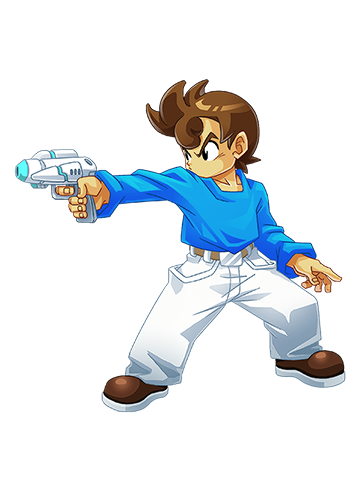
Venture Kid

I imagine many NES playing kids of the 80s drew or designed Mega Man characters and bosses. It’s probably the easiest thing in the world to do. Look around your room, find objects, and then turn them into _____ Man. Once you have eight of them, just take normal Mega Man villains, make them bigger so they can be bosses for the castle stages, then slightly redesign Wily’s skullship and BAM, you have a Mega Man sequel. So if Capcom comes to me and says “we need eight bosses for Mega Man 12” you can look forward to battling Keyboard Man, Couch Man, Ashtray Man, 5-Hour Energy Shot Man, Epilepsy Dog Man, Curtain Man, Door Man, and Hair-Tie Man. Well, we’ll make Curtain Man into Curtain Woman. Gotta remember equality.

So, it really shouldn’t be a surprise that so many indies pay tribute to the Blue Bomber. Of any iconic gaming franchise from that era, Mega Man probably lends itself most to adaption. That’s why any long-time indie watcher rolled their eyes as Mighty No. 9 was raking in a kagillion dollars in crowd funding. I know I did. Having played Vintage Hero, which actually held the #1 position on the IGC Leaderboard in the pre-multiplatform era of this blog, it occurred to me that you don’t exactly need four-million dollars to turn out a half-decent Mega Man homage. Frog The Door Games did Vintage Hero on a budget of Ramen Noodles and Basic Cable and the end result was roughly a four-million times better and more Mega Manish than the game so many rubes seeded. Even 20XX, which is based more on the Mega Man X series and did nothing for me (I never liked Mega Man X either) is infinitely more inspired than Mighty No. 9.

Honestly, if you’re more of a Mega Man X fan, you’d probably enjoy 20XX. It’s basically Mega Man X as done like a roguelike. For me, I tried multiple times to sit down and work myself into enjoying it. I just couldn’t get into it. I found everything about it to be boring. I think, above all, Mega Man style games need tight, creative level design or the formula gets dull quickly and the base concept of 20XX forbid such levels.

Do you know what other game is better? Venture Kid. Only this one has been slightly more controversial than I expected, with some people suspecting that they just took original Mega Man sprites and repainted them. If it’s true, “so what?” I say. Who cares? It’s supposed to be semi-satirical. It’s really not all that different than spoof films like Scary Movie casting actors that look like the stars of the flicks they’re lampooning, is it? It’s supposed to look like Mega Man, but not at all like Mega Man. Deliberately so. So, what’s the deal? It’s not like developer Snikkabo just changed a helmet or the shading of the armor. It’s an entirely new look. What difference does it make if they just took an outline of the original sprites or if they redesigned the whole thing but with the intent to still very, very closely invoke Mega Man without it being Mega Man? Because that happens a LOT in Indieland. I’ve had tons of people who I hold much respect for shit on Venture Kid, claiming that it’s “lazy” and a “rip-off.” Really? For fuck’s sake, less than a year ago I played Bloodstained: Curse of the Moon, which reskinned every aspect of Castlevania from the heroes to the enemies and nobody said “reskinning! BOOOOOO!” It stinks of a double standard. If Curse of the Moon can have the exact same enemies behaving the exact same way as they did in the 80s, only they look different, how is that different from what Venture Kid does?

Oh, it’s because it’s your chance to puff your chests out and shit on someone in no position to retaliate. Got it. Just so we’re clear: original game with mechanics taken verbatim from classic game with absolute no effort at all to differentiate those characters from the original characters besides base-level sprite repainting ala exactly what Bloodstained Curse of the Moon is: okay as long as the producer is a legend. Same circumstances but small, inexperienced indie dev ala Venture Kid: lazy ripoff. I’ll try to remember that in the future. Even if it makes no sense. I mean in theory, it should be the other way around and NOT okay for the experienced, legendary producer to do that but a great starting point for an inexperienced dev to pop their game making cherry, but what do I know?

If you wish, just tell yourself that Mega Man had to go off on an adventure but his suit was at the cleaner. Also the Venture Kid in the game looks significantly more rotund than the Venture Kid in the cover art and promos.

So yea, you’ll see a lot of familiar ideas in Venture Kid. Bosses that drop weapons you can then use. Eight levels followed by a handful of finale levels (actually, only two, which even I felt that was a bit lite). Enemies like the little helmet dudes that bullets bounce off of unless they rise up to shoot at you, only this time they’re crates instead of helmets. That’s fine. That’s sorta what you should expect in a tribute, right? I mean, y’all liked Shovel Knight, right? The game that played like DuckTales and even had enemies that behaved like other Capcom NES games. Again, what’s the difference? Is it that Shovel Knight and Curse of the Moon improved upon the NES originals or at least tired to feel modern and different? Because Venture Kid does that too.

Right away, you’ll notice the movement feels like you’d expect a Mega Man but not Mega Man game to feel like. And then you have to jump, and you’ll notice that feels completely different. The gravity is much lighter, but it doesn’t exactly feel floaty, either. It works. It seems like it won’t, but it was intuitive and adaptive, even if my brain doesn’t realize it. A lot of people complained about “last pixel jumps”, including me, where you had to get right to the edge of a ledge (I’m a poet and I didn’t know it) in order to clear a gap. BUT, I never once missed one of those jumps or ran into a pit attempting them, even if I was gulping when I tried them. So, was it really last pixel? Or was it my brain telling me “Mega Man can’t make that jump!” Mega Man couldn’t, but Venture Kid could.

Hell, there’s even a Castlevania stage. Venture Kid was a Kid Icarus stage away from being the Captain N: The Game Master release NES kids have been waiting almost 30 years for.

So they made not-Mega Man jump like Super Mario 2 Luigi without the floatiness. Big deal, right? And if that’s the only change that made me sit-up and take notice, that probably wouldn’t have been enough for Venture Kid to stand out. But then I noticed enemies were able to kill each-other with their bullets. It doesn’t factor into the game much, but it’s there and it’s a small touch that stood out to me and everyone else who sampled the Kid. That’s really Venture Kid in a nutshell: small changes that make the entire experience feel fresh. And really, Mega Man’s formula should absolutely NOT feel fresh after eleven primary games (twelve if you count Bass) and more spinoffs than Law & Order. Even the levels change things up with switches, locked doors, and a hidden item in every stage that unlocks the real last boss fight. There’s a store in the pause menu you can use to buy health refills, extra lives and stuff to help assure the item refills don’t go to waste. It’s like seeing someone you’ve known for years get a haircut. Sometimes it feels like they’re an entirely new person, even though really nothing has changed.

I’m not going to complain about the length. Some are. Some are saying the levels are too short and the finale sequence has less areas than a typical Mega Man game. Fine, I’ll complain about that part. Two finale stages is too little. But honestly, I prefer tributes to classic franchises to be a bit shorter. It’s so much more preferable to padding the length, which usually results in spotlighting flaws you otherwise missed while ogling the experience. If Venture Kid made any mistakes in this regard, it’d probably be with the bosses. They’re fine. They feel appropriately on-brand. BUT, then you encounter one that you fight while riding a mine cart that’s so insanely inspired that you wonder if they had that sort of potential for all the others and simply didn’t tap it. Now granted, I let Shovel Knight get away with less than stellar bosses so I have to for Venture Kid too, but I do so feeling like a judge letting an arsonist off on a technicality because the warrant was worded wrong. And now that arsonists is thanking me while ominously flicking their zippo.

I think I might be onto something with the whole Captain N joke.

In fact, up until the last two stages of Venture Kid, I figured this review would have to focus on the little things to complain about. Like how the opening menu has no clarification as to what difference there is between CLASSIC mode and ADVENTURE mode. Get this: classic mode has you play the first eight levels in sequential order while adventure mode lets you select which order to play them. Just like.. uh.. classic.. Mega Man? So why isn’t classic the one that lets you select the order and adventure the one that makes you go from point A to point B like an adventure? I don’t get it. Beyond that, I’d probably complained about how the inspired twisty-turny aspects of certain stages like the Egyptian one don’t factor into enough levels.

And then I got to the Dr. Wily’s Castle style end-game levels, and yeah, I now have something to complain about. Because these levels are a maddening torture chamber of design choices so poorly conceived that I’m convinced the developers are still stuck in the Mirror Universe and their goatee-wearing doppelgängers are causing mayhem. These stages are littered with instakill spikeballs with unforgiving collision detection, along with instakill “skull-balls” that orbit around a central point. That’s bad enough, but then you get to a section where the spikeballs blink in and out of existence with no graphical warning of them. When you encounter these, you’re almost guaranteed to die because the first time they appear. It happens like it was deliberately timed to happen at that point. That’s not challenge, people. That’s kicking someone in the nuts and then telling them you’re playing a game where you have to avoid getting kicked in the nuts and they just lost. You have to know a challenge is happening or else it’s just GOTCHA!

It really puckered my butthole when it happened because everything before this was so well-crafted. This moment was beneath the Venture Kid that I just played through. So was an auto-scrolling section leading to the true final boss that relied less on level design and more on the spikeballs. I think Venture Kid succumbed to relatively inexperienced developers not knowing how to make a game feel climatic. Another problem is they couldn’t decide if they wanted Venture Kid to feature linear levels or Mega Man style stage selecting. Including both sounds like a perfectly fine compromise, but when you think about it, having the option to do both still requires levels 1 – 8 to have little-to-no difficulty scaling. There’s a very small amount of sections that are made easier by using items acquired in other stages, but really you can beat the whole game with just the starting peashooter and it wouldn’t change all that much. Consequently, the final two levels feel like they’re the 9th and 10th levels of a game that scaled properly to get there, only without the scaling. You don’t do swimming lessons by teaching someone how to kick their feet for eight weeks, then strap a barbell to their feet and throw them into the deep end for week nine. I mean, I do that, but sane people don’t.

In fact, a lot of people on my timeline said those stages ruined the game for them. I’m not going there, because they didn’t for me. They were disappointing, but I still could beat them, and did. I just had to trial-and-error my way through them in a way that felt like it belonged to another, lesser game. It was unfortunate because you never want to finish any good game on a sour note, and Venture Kid ends with a degree of sourness normally restricted to laboratory conditions at the Warhead candy factory. But don’t let that distract from the fact that Venture Kid is a very good game. It’s sad to me that so many people are dismissing it as a clone of Mega Man or even a rip-off of someone else’s Mega Man tribute. This is the same community that gave four-million-dollars for a Mega Man tribute sitting on a 52% rating at metacritic. Nobody should be calling any indie a Mega Man tribute when you already gave more money to that steaming turd than you have to most charities.

The final levels do go a bit overboard on the instakill shit. Remember aspiring indie developer reading this: it DOES matter that people put the controller down, game beaten, in as good a mood as you put them in when you game was at its peak enjoyment. Otherwise they might be less likely to spread the word of it.

I hate to keep coming back to this, but the sheer amount of double standards on display from the blowback to Venture Kid is kind of shocking to me. I liked Venture Kid. There’s not a lot to it, but what is here is just plain fun from start to.. uh.. close enough to finish. It’s why I consider myself so lucky that I couldn’t give two shits about nostalgia. It keeps me from being weird about games and over-thinking whether they work or not. If I’d never played Mega Man, I know in my heart of hearts I’d liked Venture Kid every bit as much. That it set out to pay tribute to an iconic franchise is nothing more than trivia as far as I’m concerned. That being the case I probably shouldn’t have spent so much of the review talking about Mega Man. Hey, you have your double standards. I have mine!

Venture Kid was developed by Snikkabo
Point of Sale: Nintendo Switch, Steam

$7.50 (normally $10, but $7.50 if you own any other Switch games published by FDG Entertainment) thanked all their fans and the entire indie community for sticking with me through my first six-hundred indie game reviews in the making of this review!

Venture Kid is Chick-Approved and ranked on the Indie Gamer Chick Leaderboard!

Wonder Boy Returns Remix

2019 is truly the year of the pointless remake. First I had ToeJam & Earl: Back in the Groove, which did so little to improve the twenty-eight-year-old original that I wonder why they even bothered. And now I’m playing Wonder Boy Returns Remix, which does so little to improve the thirty-three-year-old original that I wonder why they even bothered. I don’t get it. Why would anyone remake a game from the 80s or even the 90s with the same exact levels? Why would fans of the original choose this version over the old one? Presumably, those fans would scoff at modern graphics. And the graphics of Wonder Boy Returns are not that great, to be honest. The style, animation, and even font used for the points when you kill enemies look like they belong to a free browser game designed to advertise car insurance.

I’m certain that Wonder Boy/Adventure Island was good back in the 1980s. The tropical theme is fun. You get to skateboard, and skateboards were big in the 1980s. And it was sort of like Super Mario Bros but not Super Mario Bros, and it was on Sega platforms where there was no Mario, but it was also on the NES where there was a Mario game but you were waiting for another Mario game and anything Mario-like will do. Give me a break, everyone. I’m trying really hard to get myself in the mindset where this game was ever good. Because my play session with it in 2019 was the drizzling shits. It’s so boring. And no matter what else I say after this paragraph, remember that there’s nothing worse a game can do than bore.

The timer is a hold-over from Wonder Boy’s life as an arcade game. It’s there to prevent you from sitting still, drains relatively quickly, and can only be replenished by fruit that spawn out of nowhere. Like the lives system, it no longer services the game.

If you played the 1986 Wonder Boy in arcades, the 1987 Wonder Boy for Sega Master System the 1988 Adventure Island for the NES, the 1990 Revenge of Drancon for Game Gear, and probably twenty thousand more remakes, you’ve played Wonder Boy Returns Remix. I should also probably note that you can play as Wonder Boy’s girlfriend. The girl is reserved exclusively for “practice mode.” Practice in this sense means you can’t take damage from anything (except falling in a pit, which costs you a life), never get off your Vespa, and basically get a free ride to the end of each stage. Because girls suck and they need their hands held. It’s slightly cringey. But what’s really weird is, it’s called “practice” and yet, if you’re really struggling to get past a level on normal, you can’t just jump straight to that level to “practice.” You have to do a full play through with the girl to get all the levels. Her unlocked levels are kept totally separate. Well hell, that’s not practice then. If I’m stuck on level 5 – 2 with the boy and want to “practice it” with the girl, I have to beat every between level 1 – 1 and level 5 – 1 with her. And given that you can’t just run as the girl and you apparently MUST use the Vespa (which is functionally the same as the skateboard), it’s ESPECIALLY not practice. There’s no bosses, so it’s REALLY REALLY REALLY not practice. It’s just patronizingly easy mode, starring a girl, because girls are helpless.

And yes, I’ve been abusing save states in the same way Kevin Spacey has abused age of consent laws while playing classic Castlevania games for the last week, but hey, I beat Cuphead, so suck my asshole.

(Also, I’ve been made aware that if you beat the game on hard mode, you find the girl chilling out. It would seem the whole kidnapping was staged and she was actually trying to trick Wonder Boy into rescuing her so that he could make babies with her. If my eyes rolled any more, I’d be able to cosplay as the Undertaker. I’m not offended or anything. It’s almost adorable in the same way being trapped in the a conversation with a senior citizen who casually states that he believes a woman’s place is in the home is. Now everyone, before freaking out, remember, it was a different time. May, 2019. Yea, the original basically has no ending at all.)

To the game’s credit, the only person I know named Tanya is sort of worthless. She locked her keys in her car, had a locksmith come to jimmy it open, got in the car, started the engine, remembered she left her purse or something on the sidewalk, got out of the car to get it, resulting in her locking herself out of her car AGAIN, this time with the engine on. Tanya, I’d worry that you’d see this and get mad at me, but I seriously doubt you can even read.

Now, in the interest of fairness, I fired up my MAME cabinet to give the original Wonder Boy a shot between the last paragraph and this sentence. I can attest that the controls are nominally fixed over the original. The biggest change seems to be in the skateboard. I was nailing some pretty hair-raising jumps with it. In the arcade version, the physics feel totally different and I was shorting the same jumps. So some effort was made. And Returns Remix also adds a charge shot, which can kill multiple enemies and also clear out rocks you trip over and other otherwise indestructible objects. Purists are crying foul, and it probably nerfed a lot of the challenge, but I used it, and I liked it. Given that I didn’t like a lot about the game, I’ll take whatever net-positive I can get.

There’s one more good addition, and it’s the best idea the new version offers by far: each stage is totally self-contained. There’s now a level select screen, and you start every stage with 5 lives. Honestly, it might as well of done away with the lives altogether. If you wish, you can play “one coin” mode. There’s no level select, and you have ten lives to beat all 32 stages. I stuck to normal mode, and honestly, the level select idea and implementation single-handedly kept me from going into full-blown scathing IGC mode. It’s a genuinely great improvement. If there’s Wonder Boy fans who never beat it, you can beat this one. It has the same levels from your childhood.

It probably could have used online leaderboards too. Otherwise scores are kind of pointless in 2019.

So what’s the problem? IT HAS THE SAME LEVELS AS YOUR CHILDHOOD! Wonder Boy came out three years before I was born. Games have come a long way over the past three decades. Wonder Boy runs out of ways to keep things fresh after just a small handful of levels, leaving worlds 2 through 7 and their twenty-eight stages a repetitive slog. Fighting the same enemies and clearing the same platforms, only rearranged in different orders. There’s a boss fight at the end of each world, but really they’re all the same and only the head changes. They all attack in the same way and only the speed they shuffle back and forth at changes. They remind me of the fights with Bowser in Super Mario 1, but hell, even those would do things like have him start spitting hammers or put blocks in your way to add to the challenge.

What Wonder Boy Returns Remix needed to do was, well, REMIX things. Add new challenges based on modern gameplay conventions. I’ve reviewed one other game with the word “remix” in the title: NES Remix. It stars some games even older than Wonder Boy. But it felt fresh and modern because it took the existing games, some of which were genuinely terrible games even in the mid 80s, and went full-on wackiness with them. Wonder Boy Returns Remix feels so safe and utterly devoted to faithful recreation that, while you do sorta have to tip your hat to how close it comes to feeling like the original, you also have to shake your head at what it accomplishes? Because I can track down Wonder Boy 1986 right now. Anyone can. I don’t think a level select is worth a remake. I don’t think starting each stage with five lives is worth a remake. The formula works. It’s beloved. I had so many people on Twitter saying “OMG ADVENTURE ISLAND!” even though this is Wonder Boy, but Wonder Boy is Adventure Island. My point is, people want more of it. But do they want more of the same?

I can’t tell if it’s supposed to be an axe or a hammer he’s throwing, so I’ll use both horrible puns. Pun #1: Hammer. “This boss must have been drinking last night, because now he’s hammered.” Pun #2: Axe. “Don’t feel sorry for this boss, he was axing for it.”

Hell, I even think the graphics of the original are better. They hold up pretty good for a 1986 game. The irony is the remade graphics of the new one feel more tired than the 1986 graphics. So who is this made for? I let my 12 year old nephew play it. He thought it was fine at first, but got bored after fifteen minutes. Scoff if you will, old school gamers, but he pretty much saw everything the game has to offer in those fifteen minutes. And that’s really the story of Wonder Boy to me. It seems like it’ll be decent, but it just runs out of steam too quickly. And Wonder Boy doesn’t even have all the hidden goodies that Adventure Island apparently has to keep it fresh. Just the same handful of enemies, set pieces, and jumps in different arrangements. Maybe that’s what a lot of old school games were, but maybe those games that held up are just.. I dunno.. better? Maybe Wonder Boy was limited all along. Maybe that’s why the series had to evolve as radically as it did. Can you believe that IGC Seal of Approval winner Wonder Boy III: The Dragon’s Trap was a direct sequel to this? If they were any different, there would be a horrible sitcom made about them being roommates.

Wonder Boy Returns Remix was developed CFK
Point of Sale: Nintendo Switch

$14.99 said “yes, this counts as an indie. It’s review #599 in fact” in the making of this review.

SteamWorld Quest: Hand of Gilgamech

Disclosure time: Image & Form top dog Brjann Sigurgeirsson (a name that sounds like someone began to sneeze mid-pronunciation) is a friend of mine. But I’m not sure what that does for a developer besides giving me a direct line to let them know all the numerous ways they fuck up their games. Brjann and I have an understanding: he makes the games, I review the games. No matter my opinion, our friendship remains unchanged. And since I take my critic duties seriously, I don’t talk about their projects still in development with him. I think it’s sort of unethical for a critic to get too hyped for a game that they’re going to cover. It’s not fair to the game. So I didn’t know all that much about today’s game until very recently. I think maybe he might have told me they’d be following SteamWorld Dig 2 with an RPG, but if he did I forgot. When I saw SteamWorld Quest unveiled, I was like “oh, well that’ll be different.” But I didn’t find out about the card-based attack system until right before I started playing it. When I heard about that, my first visceral thought was “well, they were due to have a game suck anyway.”

Nostradamus I ain’t. SteamWorld Quest is the most fun I’ve had playing an indie RPG. You know Brjann, it’s hard to test the legitimacy of our friendship if you don’t make a game I can dislike.

My cynicism was based their chosen combat scheme. I hate card-based attack systems in games. I loved Kingdom Hearts, but hated Chain of Memories. As a teenager who had just gotten hugely into RPGs and was starving for games for it, I couldn’t even like Baten Kaitos. I think I was the only one who didn’t. Before it, I tried Lost Kingdoms on the GameCube, was bored sick, gave the “improved” sequel a try and thought they made it worse. I even tried Eye of Judgement (the gimmicky PlayStation AR game) because, hey look, real cards! It sucked. If any card-based game had potential to hook me, it was the Metal Gear Acid games, but it turns out I was hoodwinked and they’re actually a series of load screens interrupted by a brief card-based tactical RPG snippets. The series was actually fine. Clunky, but fine. But seriously, I think the second level of Ac!d is still stuck loading.

And yes, for those who follow me on Twitter, I play Magic: The Gathering and enjoyed the Steam version of it. Do you know what the difference is? It’s based on the actual physical card game. That does make a difference, ya know?

It doesn’t help that SteamWorld Quest gets off to a start so slow that the jump from prokaryotes to eukaryotes looks tame in comparison. Part of that has to do with the writing, which I’ll get to in a bit. But first, those card mechanics. The idea is you construct a deck of eight cards for each hero you have. When a battle begins, you’re randomly dealt a mixture of six cards from all the heroes. Each turn, you pick three of them to use. They might be attacks, or defensive maneuvers, or special moves that will come into play later in the fight. The real novelty is that each card either comes free or at a cost. If the card has no cost, it adds a counter to a charge meter that you spend on the priced, more powerful cards. It’s clever and works well, but SteamWorld Quest goes the extra mile by including cards that cooperate tag team-style with each-other. Or, if you use three of a single hero’s cards, you get a bonus 4th card separate from the ones included in your deck with a desirable special effect or attack. It’s a rich, satisfying combat system that never gets boring and can be adapted to anyone’s play style. Well, at least after an hour or so.

See the blue bars in my health meters above? That’s probably the most over-powered tactic in the game. See the chick in the witch’s hat in the center? That’s her special combo card when you use three of her cards when she’s equipped with certain weapons. It essentially renders damage to all your characters null and void for a few turns. In fact, she was, to me, the true star of the game. I stacked her with no-cost cards, including one that allowed me to draw extra cards my next turn, and absolutely annihilated battles. I had to voluntarily nerf her by switching to a different weapon (which changes the bonus combo card you get) just to create my own challenge on normal difficulty.

The truth is, I was bored at the start of Quest. The combat system’s eventual wealth of complexity is nowhere to be seen at the start of the game, and what you do start with gives no sign of the greatness to come. You don’t even get a taste of the potential until you open the third and especially the fourth character of the game, at which point you can dump main character Armilly and her boring ass moves. You’ll also have acquired more cards by this point and the ability to create even more. It turns what feels like a gimmicky system into the world’s most entertaining combat laboratory. I remember when playing Hollow Knight that fans kept assuring me that I’d be “opening up the game any minute now.” Well, that really does happen in SteamWorld Quest.

I don’t know if the slow start could have been fixed. Maybe if you started with three characters instead of two (and really, there’s no reason why Galleo coudln’t have been part of your party at the start of the game instead of about thirty or so minutes in). In truth, you can probably “open the game up” in an hour, give or take fifteen minutes. Once you do, you’ll find a combat system that is deceptively deep, allowing for multiple strategies and mad-scientist levels of experimenting. I had just as much fun tinkering with loadouts one card or one accessory at a time as I did opening up new levels. That’s no joke. I’d change a single card in a deck and get positively giddy at the thought of seeing how it worked with the other twenty-three cards. And it’s super easy to grind because you can use save stations to refill your health at a “cost” of respawning all the enemies (besides sub-bosses) in a stage. SteamWorld Quest is a rare game that I enjoyed that feels like it’s going to bore for the first hour or so, warms up, and takes about three hours truly hit its stride. Once it does, I honestly can’t remember the last time I had so much fun with a no-action-prompt, turn-based RPG’s combat system. It might be my favorite ever, indie or otherwise.

If there’s a problem with Quest’s combat, it’s the rewards for beating enemies just aren’t plentiful enough. Leveling up is not the issue. You’ll do it a couple times a chapter. There’s safeguards in place to prevent screw-grinding. The issue comes from enemies not dropping enough resources to craft or upgrade cards. Especially the upgrade part, which requires tons of materials to go all the way with. My strategy for upgrading was to start by focusing on the common, cost-free attacks that most of decks consisted of. But, once I had those beefed up, I realized that I had to go get more materials for the rest of the cards, but getting enough to make meaningful upgrades took forever. It requires you to replay previous chapters, now with a presumably overpowered party, hoping against hope the enemies will drop the stuff you need. Not until very late into the game do resources seem to start to become abundant. I don’t know if I was upgrading cards ahead of schedule or not. Probably not, since some of those upgrades require you to get rare materials that don’t appear until the late game. So you do have to grind, but in the mid-late game, it sort of becomes a chore. Though even flattening enemies doesn’t completely bore. Just remember to hold the right trigger down to fast forward though attack animations.

Balance isn’t too much of an issue (besides Cope’s team-shield thing she does). Really, that they had so many cards without screwing up the balance is remarkable, especially given the rock-scissors-paper nature of enemy types.

What they should have done was had the enemies upgrade alongside with you. Quest is broken up into four acts with a few chapters in each. You’re not exploring big, open worlds. You’re playing relatively tiny levels, most of which you should be able to comfortably knock out in under 20 minutes. The bite-sized stages works, but comes at a cost of having to replay entire chapters, with all the original dialog, cut scenes, and boss fights intact, in order to do the grinding and find the treasure chests that could contain new, valuable cards that you missed before. There’s a “skip” option during cut scenes, but our definitions of “skip” seem to differ greatly. When I press “skip” I expect the cut scene to end and the action to start. For Image & Form, “skip” means “end this sentence, begin the next.” It could take over a minute of slamming the B button to finally “skip” past all dialog you’ve presumably already heard once and thus want to, you know, skip, and start playing the game. I hate it when games do this. I call it “Going Pony” because in some chapters, you’ll be screaming “SHUT THE FUCK UP!” until you’re a little hoarse. UPDATE: You apparently can skip all the dialog by pressing X. I wish I had known that. I would’ve prevented me from Going Pony 3 or 4 times. But honestly, this has no effect on the rest of the review so carry on.

The two self-evident fixes (maybe having the option of beefing up enemies when you replay chapters and being able to skip the cut-scenes entirely when you replay chapters) would have taken any sting out of grinding. Because the combat never gets boring once you start to build up your heroes and their card collections. I joke all the time about “minimum indie badness” but here that was potentially the difference between the best RPG combat system I’ve ever played and just a very, very good one.

I can’t stress enough: the combat is awesome. Eventually. But this is an RPG, the one genre where a game needs equal parts compelling story to go along with interesting and novel gameplay. SteamWorld Quest follows Armilly, lowly daughter of a grocer and fangirl of legendary hero Gilgamech. She wishes to join the hero’s guild, can’t, but ends up having a wacky adventure where she eventually teams up with a ragtag group of misfits and outcasts, including the former sidekick of her idol. It’s a good story. Suitable for all ages. There was even a nice twist that I genuinely didn’t see coming. There’s just one problem: Armilly is written horribly.

One last game design nitpick: I wish the levels felt less like glorified sidewalks. There is some hidden stuff, but it’s done via just covering chests or switches with foreground objects. It makes the environment feel like a facade or a set, instead of a big, thriving world. Like a bunch of kids LARPing at Disneyland.

Let me preface this section by noting I’m not some kind of student of literature or creative writing. I’m an investor by trade who dabbles in game criticism as a hobby. But, I’m familiar with the concept of the hero’s journey. SteamWorld Quest seems to want to take Armilly on a fairly standard hero’s journey path and checks all the boxes for it. But the dialog takes the oomph out of her adventure because she’s just too much of a smart ass with no reason to be. She also has this gee-golly-shucks way about her, especially when she goes all slobbering fandom on retired Gilgamech sidekick Orik when they meet up. The smart assery and the starstruck fangirl delivery of her dialog aren’t compatible. Usually when characters are wise asses in fiction, it’s to make up for an inadequacy. When Buffy gets smart-alecky with Giles, it’s a defensive mechanism. If Bart Simpson mouths off, it’s for attention. When Archie Bunker says something bigoted, it’s because he’s insecure. Unless you’re doing a full-on comedy, sarcasm should always be grounded as a coping mechanism. Backtalk or sass without foundation is sort of dull because instead of flavoring a character’s idiosyncrasies, the sarcasm becomes what defines the entire character. And Armilly, who is the center of attention, among friends, and the leader of her group, has no reason to be non-stop sarcasm and quips. It’s the same flaw I found with the Peter Venkman character in Ghostbusters. Perhaps the only flaw in the entire movie. He’s unlikable. And I’m sorry to say it, but Armilly is unlikable.

Plus it doesn’t help that her sarcasm isn’t remotely funny. It’s just kind of awkward.

I wasn’t sure if this direction was done because the game is meant to be lighthearted and semi-satirical. But, while it’s true that there’s a bit of Paper Mario-esq tomfoolery about SteamWorld Quest, the plot is simple and engaging, and Armilly is the only character that really feels like she betrays the gravity of the situation with her dialog. The “wannabe heroes become heroes in an unexpected way” trope usually works because you see them grow into the roles. I don’t feel a sense of growth in Armilly and wish she was written a bit more sympathetic. Imagine if Luke Skywalker had been a slobbering Jedi fanboy who fawned all over Obi-Won with bad sitcom quips when it was revealed he was a former Jedi Knight. Who could get behind someone like that? These traits need to be tempered with flaws and insecurities, or else they’re just someone who is the hero because they’re the main character. Thankfully, the other characters and even the villains have relatively sharp dialog and for me were the real stars of the game. Hey Image & Form: give us a spinoff or DLC with just the twins. Make it happen!

I complain because I love. And in the case of SteamWorld Quest, I truly love this game. But, the scary thing is that it could have been even better, and the ways it could have been better are so self-evident that a transcendent game is potentially in play for the sequel. I’d be curious how it might work in a more open, less linear format. And while I wish it had a stronger lead character, everything else is either good enough to satisfy or downright inspired. I keep going back to the balanced, joyful combat. It’s a game that relies on luck of the draw, and yet it never once felt like my battles were failing because of bad luck. It always felt like it was on me constructing bad decks. I don’t think I’ve ever had more fun tinkering in menus, outside the core gameplay than I had with Hand of Gilgamech. I’d scurry back and forth between looking at the cards I had for one character and then another and ask myself which ones complemented each other. I reverted back to being that ten year old whose parents went a little overboard getting her Magic cards in an attempt to get her to do social stuff, but the social stuff never happened because I was so busy constructing decks. For me, that’s the ultimate high a game can achieve: make me fee like a kid again. It gets off to a slow start, sure. You know who else got off to a slow start? Einstein. You’re in good company, SteamWorld Quest.

SteamWorld Quest was developed by Image & Form
Point of Sale: Nintendo Switch, Steam

$24.99 said seriously Image & Form: spinoff with Tarah & Thayne or I fart into an empty coffee can and mail it to you in the making of this review.

A review copy of SteamWorld Quest was supplied by Image & Form. Upon its release, a copy was purchased by me. All indie games reviewed at Indie Gamer Chick are paid for by me out of my own pocket. Even when friends pay for a copy for me when I tell them I have to buy my own copy because that’s how I roll. For more on this policy, check my FAQ.

SteamWorld Quest is Chick Approved and ranked on the Indie Gamer Chick Leaderboard.

Death Coming

Have you ever picked up a Where’s Waldo book and wanted to massacre all the extras? No? Just me? Scary? Okay. Well, Death Coming is basically that. You take the role of an assistant Grim Reaper, specifically targeting three people per a level. But hey, you also have quotas to fill, and look at all the fleshy people just walking around, being all quota-like. Each stage requires you to kill a certain amount before you can move on. On the Switch, you can use a cursor or a touch screen. My brain has bad wiring and for some reason I kept alternating between the two, but in a nutshell, you click objects and if you click them at the right time, people die. And if that’s all Death Coming had going for it, it’d be fine. Not memorable, but a decent little time waster.

You get to pull off such kills as locking someone in a room with radioactive material and let them die of radiation poisoning. It’s the feel good game of the year!

But, Death Coming has a lot more going on for it. It’s all the proof developers need that it’s not what you do, but how you do it. Developer NEXT Studios was smart enough to give the NPCs personality and character. Don’t get me wrong: the NPCs follow strict parameters and aren’t exactly subject to free will despite what the game says. But at least it feels like they were given enough heart to be a bit more than just a body count. An ongoing story during your reaping shenanigans is a series of heists that you inadvertently foil through your death-dealing duties. Some NPCs carry on torrid love affairs, complete with scootilypooping (censored behind giant hearts, aww isn’t that sweet). Even alien invasions go down while working. None of this has anything to do with you being a Grim Reaper, though your presence certainly can work out for and against them. You just simply take souls while these cannon-fodder go about the (last moments of their) lives. It makes Death Coming fun in a fly-on-the-wall kind of way. If that fly were armed and wanted you dead.

You don’t directly kill anyone in Death Coming. Rather, you click objects and hope they do the deed for you. At its most base level, this means waiting for an NPC to walk onto a single square of the playfield that a trap will catch them on, like having something fall and squash them, or having them fall down a manhole. The more puzzlely aspects involve using various objects as complex series of rube-goldberg antics in order to free the meatbags from the mortal coil. Like there might be a target character lounging by a swimming pool. You close the umbrella above his head, wait for him to get into the pool, then click an electrical wire above the pool, frying him and all the other NPCs in the pool with him. I don’t know what is says about me that I found the gameplay so satisfying. Nothing good. Or, according to my increasingly terrified family, surprising.

But, as cathartic as it is to resurrect a tyrannosaurus and send it on a rampage, I take issue with some of Death Coming’s design choices. In order to add “challenge”, the game employs “angel police” that feel you’re just a little too blood-lustful. In order to activate any trap, you have to click it twice. The angels only catch you if they spot you between the first and second clicks of an object. If they spot you three times.. I’m honestly not sure what happens since it never once happened to me. I mean, it’s a point and click game. There’s no avatar that has to avoid detection of the angels. The only time I got spotted was when the camera auto-zoomed in because I triggered some event and I forgot to zoom back out afterwards. Death Coming didn’t need this shit. All it does is slow the gameplay down, making me have to wait longer to kill NPCs because I had to watch an angel slowly fly by. And it’s not like Death Coming was fast paced to begin with. It’s one of those “minimum indie badness” decisions that seems so obviously unnecessary in retrospect and makes me wonder if there was anyone along the way who told the devs “no”. It gets really out of hand in the last level. You’re given a chance to activate weather-based events, but doing so spawns an angel. It’s not optional to do this, but the game also spawns even more angels as you go along. I don’t know if this was done to feel climatic or to pad the run time, but it grinds the level into something resembling a slog. The Indiana Jones theme is so fun for that level too. It doesn’t ruin it, but it comes close.

The angels spotting your finger does absolutely nothing. As long as you zoom out, you shouldn’t get spotted at all. It’s like someone spent a day with the world’s least threatening hall monitor and said “this pussy man would make a great video game antagonist!”

The bigger problem is how many replays you’ll need to get a feel for the traps. Sometimes they’re not so predictable, but once they’re used (or used X amount of times), they can’t be reused. If the word bubbles that appeared above the traps had been more descriptive, maybe you could more accurately predict what way they’ll fall or what part of the current rube-goldberg puzzle they’ll activate, and what path that will take once you do. In each of the six levels, I would find myself restarting them several times each, which I found necessary to figure out how the traps are used and how many characters you can take out in each. The only time I didn’t was in the sixth and final stage, where I put over an hour into it before realizing that it’d probably be in my best interest to start over. Once I did, I finished it in about fifteen minutes. In fact, I realized late in the game that you don’t even need to kill the three “target” NPCs featured on each stage to advance to the next level. You just need to fill your quota. I honestly don’t even know what the point of it was. Maybe it’d make sense if it were a different three characters every time you started each stage again and getting all three was necessary in addition to reaching your quota. But it’s not. Strange.

And I always hate to say this stuff, but the current Death Coming release is a bit unstable. The game skipped a bit sometimes when events would be triggered or when I scrolled around, or zoomed in or out. The skip never went away, but wasn’t a deal breaker or anything. I think one time it messed with my timing of activating a trap. A bigger worry is that I crashed the game a couple times in the final stage, once loading it, once when I went to take pics for this very review, uploaded them, then returned to the game only for me to code out to the Switch main menu. I’m sure it’ll get patched out eventually, but I hope the irony that a game about the Grim Reaper kept dying on me isn’t lost on anyone.

This is fun an all, but getting high scores would require keeping track of so many things that really you can probably chalk all the top people down to blowing lottery-levels of luck on a $7 Switch game instead of a lottery ticket. Only they know if it was worth it. Probably not.

Being a puzzler, once you finish Death Coming, in theory you should be done. Thankfully, NEXT came up a novel solution: a scoring system with online leaderboards. I figured there must be an absolute max score and the boards would be filled with multiple identical numbers. As of this writing, they’re not. None of the six levels feature the same person or same score in the top spots. That’s promising, and makes me think that the potential for higher scores might be on the table. So, Death Coming is more than your run-of-the-mill puzzler. But I wish it realized that. The angels and the arcadey scoring I think might have come at the cost of more of the more complex, multi-phase traps that made me giggle like an sadistic five year old who just discovered what you can do with ants and a magnifying glass. But hell, even a single-phase kill, like dropping an anchor on a boat, made me smile and feel warm inside. Death Coming isn’t perfect, but it’s a lot of fun. It’s the exact sort of pick-me-up you want to play when you’re suffering from the flu and have pondered whether you’d welcome the loving embrace of death. Can you tell what kind of week I’m having?

Death Coming was developed by NEXT Studios
Point of Sale: Nintendo Switch, PlayStation 4, Steam, iOS, Android

$6.99 didn’t fear the reaper in the making of this review.

Death Coming is Chick Approved and ranked on the Indie Gamer Chick Leaderboard

Cuphead: The (NOT SO) Final Review

UPDATE – DECEMBER 31, 2021: Um, yeah, so at the end of 2021, I did a four-part re-re-re-review of Cuphead, and flipped my opinion on it. Cuphead is Chick Approved now. I still worked very hard on all three original Cuphead reviews, so I hope you read them anyway, but seriously, read my FOR-REAL HONEST-TO-GOD FINAL *FINAL* THOUGHTS ON CUPHEAD (at least until the DLC hits) head over to part one of Cuphead: The Definitive Review!

I’ve already reviewed Cuphead twice, once when it first came out in 2017, and again in late October of last year. I didn’t like it. This is no secret. The problem is, a fairly large section of gamers that need people to like the games they like because they subconsciously look at it as affirmation for their own self-worth said my opinions didn’t count because I didn’t beat the game. Mind you, some of them.. most of them probably judging by the percentages.. didn’t beat it either. But they plan on it. It’s on their increasingly yellowed, tattered to-do list, right under games like Battletoads or Ghosts ‘N Goblins. Which they will get to any day now. When they get some free time and Netflix has nothing good on. And hey, since they say they’ll eventually find the time to beat these things, it’s totally cool that they white knight for them, while not cool that you point out the flaws in these games or their argument. It’s not a double standard at all. Apples and oranges. Totally different, as anyone can see.

I wasn’t sure what “gitting gud” or beating Cuphead would change about the stuff I primarily disliked about it. The cheap shots. The lack of checkpoints. The fact that there is a simple mode for the first seventeen bosses (though not for the Run ‘N Gun stages, which are technically optional as long as you don’t want to buy any upgrades), but using the Simple option gates you off the final two boss fights. Proponents of the Headed Cup say that the enjoyment and fun is when you finally triumph, and that getting to that point isn’t necessarily meant to be fun because the point is the challenge. By giving up on that challenge, they say my opinion is voided and nothing I say about the game counts because I played it wrong, I guess? By not failing enough? Or getting bored with failing? Even though they say the point is to fail? I think? Wait, what is their argument again? That it couldn’t have the easy modes that it already fucking has.. why? And my opinion doesn’t count until I beat it, why? I don’t get it. It’s like saying you can’t be grateful for airbags until you’ve hit a deer doing 80mph.

I mean, you can just say what you really want to say: “I can’t handle you not liking this game because I base all my self-esteem on the success of games by developers who would find me Steven Urkel levels of annoying if they knew me.” Whatever, my reviews for Cuphead don’t count unless I beat it.

Fine, I’ll play it their way.

I just beat Cuphead. Here’s a playlist of me beating all 19 boss stages. I also beat three Run ‘N Gun stages so I could get the 15 coins out of them plus all the hidden coins so I could buy all the guns.

My friends thought I’d lost my mind. Why would I subject myself to hours upon hours of a game I didn’t like? Because, out of fairness, the critics of my criticism might have had a point. While I was fairly certain, based on my nearly 23-years of gaming experience, that I wouldn’t have liked Cuphead even if I forced myself to sit down and beat it all the way through, I couldn’t know for sure.

I’m a moderately well-known indie game critic. But who am I to double-down on every single review I make and say that I know the stuff I’m guessing is right? Doing so makes me no better than the fans who sent me hate mail for these reviews. How can I expect anyone to try to see it my way when I myself am unwilling to try to see it their way? So, I decided to take that complaint off the table, permanently and put the ball in their court. And really, the only way to do that was to finish the game.

My goal was to get all seventeen “contracts” from the bosses of Cuphead’s first three worlds, giving me access to the final stages against antagonists King Dice and the Devil. And I took it very seriously. I spent over a week studying videos of “professional” Cuphead players, learning the tactics and strategies, then attempted to apply what I learned and see if I could watch the credits roll and add the finished game achievement points to my account. Originally I was going to do it one hour at a time once a day, but I shit canned that when I realized that I’d need at least that much time to warm-up every day. And some days, like Thursday evening to Friday early morning, I was doing insanely good.

At 6:50AM yesterday morning, I beat the Devil and rolled the credits. I can now say I’ve beaten Cuphead. Mic drop.

So, under my authority as someone who gitted gud at Cuphead: Cuphead still fucking sucks. Hell, if anything I have more stuff to complain about now. For those of you who can’t handle hearing people make valid complaints about your favorite games, do yourself a favor and leave now. I promise I’ll return to under-the-radar games you don’t base your self-esteem on in the coming days.

And the shit thing is, Cuphead didn’t have to suck. There is no reason why the game had to be this hard, or at times play as unfair as it did. Having now finished the whole thing (no I’m not playing it again on expert. This isn’t politics, assholes. You don’t get to keep moving the goalposts on me), I did manage to find more fun than either of my previous two sessions, though never to an astonishing degree. What limited fun I did have, we can’t rule out Stockholm Syndrome for either. But, I’m getting ahead of myself.

In 2017, I actually did get all the contracts for Inkwell Isle I. But, I decided to start over from scratch with my project (titled “Vice Versus” which isn’t as clever as I thought, in fact it doesn’t really sound as much like vice-versa as I was hoping when spoken out-loud) and re-collect the Inkwell Isle I contracts. Among other reasons, I knew that the key to success was getting the hang of the parry, something I never got the hang of it my first couple forays. I needed the practice.

And I got it in my first encounter where random elements play a significant role in the battle: a pair of frogs who Megazord-together to form a giant slot machine. Yeah. This was the point where I realized I was in big, big trouble. The slot machine has three primary, randomly chosen attack modes. Unlike most bosses, you at least have a warning of what random element you’re going to face-off with when the reels line up. The one that kept screwing me was a series of inner-tubes that would randomly (double the random!!) have a column of fire going up or down. I couldn’t get the hang of this attack in particular and got right to the end multiple times. Fatigue and nerves began to set in and I started taking damage on phases that I had previously got past with no sweat. I even got killed by the slow-moving coins that it launched at me. After 20 or so attempts, I did beat it with a perfect score. Was I overcome with happiness? No. Relief? Well, yeah. If you fail at something dozens of times and then succeed, you’ll be grateful when it’s over because that means you don’t need to do it again. That’s not exactly entertainment. Well, unless you count Joss Whedon’s career.

But, was any bit of it fun? Nope. Not even a little. BUT, I’m willing to concede that I had a little bit of fun with the other four bosses in Inkwell Isle I, and various other bosses in other worlds. Even the shmup bosses I didn’t hate nearly as much. Or at all, really. Truth be told, I found them nearly enjoyable this play-through, having studied-up on how to beat them. The Blimp Chick (she’s literally a blimp, not fat, please don’t accuse me of fat-shaming) along with the Genie and Giant Bird battles from Inkwell Isle II were actually pretty fucking sweet. I didn’t expect that. Especially since I found these stages so dull the first time. Alright, gentlemen: set your faces to “stun.”

I, Indie Gamer Chick, am willing to admit that I was wrong the first couple times I played Cuphead. The shmup stages, previously a sore spot for me, were probably the most consistently decent parts this time around, and yea, sorta fun. Kinda.

Hell, I even beat the giant robot in six attempts and didn’t hate the experience of fighting it. I only really got annoyed on the 4th lost life because the final phase is far too spongy, repetitive, and lasts so long that the tension is lost and it just sort of becomes boring. It’s simply spams the screen with bullets while electrified poles get in the way. Before this, you had a clever set up with three different body parts to attack, each of which has its own unique moves and patterns. I heard more fans of the game complain about this stage than any other, but I thought it was the most fun of the shmups. Then, suddenly, it became an uninspired, lazy bore. And sadly that section lasts half the fight. Half! One constant thing I noticed in the interviews with the developers is they always go back to using the difficulty as a crutch to preemptively reject complaints. But Dr. Kahl’s Robot, one of the most cool and memorable designs in Cuphead, with one of the best sequences in the entire game, goes down as being one of the least popular stages. Someone involved in the game should ask themselves how that can be? Because it’s mostly boring and the boring part ends the fight. It leaves a bad taste in people’s mouths. They don’t remember how clever that intro was. They don’t remember the fun when the head flew off. They remember a lazy, first-year game design bullet-hell effort that closed the fight. What a shame.

It shows that the overall difficulty is hardly the only mistake Cuphead makes. Scaling might be an issue. Yes, bosses can be tackled in different orders, but after needing over one-hundred attempts and three days to beat the Dragon, followed by another couple dozen attempts at beating a giant Queen Bee, something strange happened: I annihilated the remaining six bosses in Inkwell III, needing seven or less attempts to beat each. Did I “GiT GuD?” Perhaps. Or maybe the bosses were ordered wrong. Sally Stageplay I beat in just two attempts. Two! She clearly should have been a stage one boss. The pirate could have been a great intro to stage two. The frogs belonged in stage two, maybe stage three. The Dragon SHOULD have been stage three’s final boss and the gatekeeper of the final level. And God Damn, when I finally got to King Dice, he was a bit of a pussy. After making my way through his mini-bosses (all of which but one are thankfully simple, though in a good way that makes sense from a game design perspective), I beat King Dice in my very first direct fight with him despite completely shitting the bed. He was dead in barely half a minute. THAT was the boss that was hyped the entire game? Yeesh.

But, my main complaint is still with the difficulty. I realized by the end that the truly tough bosses were tough because of RNG. The Candy Bitch has an assortment of mini-bosses, three of which are chosen at random to do battle with. And during the second and third fights with those bosses, more elements are added to dodge. If I got the Flying Waffle as the third boss, it meant I was dodging its attacks PLUS little jelly bean things running along the ground PLUS the Candy Bitch shooting projectiles at me. In my successful run, the Waffle was the first of the three I encountered. Yea, I won that round, and did so without taking a hit. But I owe that just as much to good luck as I do any skills I picked up.

The same went for The Dragon the Queen Bee. Those fights have auto-scrolling platforms that come out in random patterns. Many times I found myself in a position where I had to jump, but the level stopped spitting out platforms for me to jump to. I won’t complain about needing over one-hundred attempts to beat the Dragon because my epilepsy came into play and the steps I needed to play it (drowning out my game room with lighting to offset the lightning storm strobe-effect) caused visibility issues for some of the obstacles. I mean, they could have included photosensitive options, but truthfully there’s more color-blind gamers than epileptic ones and they get no help with the pink-shaded parry objects. I sort of feel like colorblind gamers are told to get fucked here by a couple of pretentious “our way or the highway” brothers, but what can you do? I stand with the devs on it. I’m giving them bunny ears with my fingers while doing it, but I stand with them.

UPDATE: Colorblind readers alerted me that black & white mode wouldn’t help either. After sharing a full play-through video of that mode with me, they’re right: you couldn’t possibly know which stuff is a parry or not unless you already knew. The Two-Strip mode (which, like Black & White mode, is gated off unless you perform extra-difficult tasks in the game) I guess would work better for seeing the parryable objects, but at a cost of having other important aspects bleed into each-other. Their solution was to add some kind of shimmer, glow, or other subtle visual cue to the parry objects using an effect that is distinctive from other effects used in the game. This could have been an adjustable option, not something that is present for all players. “There’s plenty of design options that could have been used that are true to the vintage aesthetic.” I normally don’t get pissy about this type of stuff, but given this is such a tentpole indie, having visual accessibility options could have set new standards for the entire scene, and instead of the Moldenhauers seemingly gave no consideration at all. 

My question is, if the bosses are as well designed as fans of the game insist they are, why did it need so many random elements that have NOTHING to do with pattern recognition or defensive maneuvering? Of course, I can’t be 100% for sure. I’m not that good. But, I suspect the random elements led to situations where I couldn’t have possibly hoped to not take damage, based on nothing I did but rather on luck of the draw. I’m not the only person complaining about this, either. Players who do speed-runs complain about the Mermaid/Medusa shmup battle essentially requiring the luck of good RNG to get a perfect score on Expert. This came up constantly on videos from players much better than I, so I figure there must be something to it. So, are you going to tell those guys to shut up and “git gud” when they’re making world-record speed runs that are screwed not by their own skills but because the game’s lottery spit out an unwinnable situation? That fight sucks enough with stun-locking beams that you have to wiggle-the-stick to be able to move again. That wiggling happens in a narrow corridor with lethal coral, like the dam stage from the NES Ninja Turtles game. God damn, devs: stop copying bad levels from old games. Or, if you insist on doing so, try making them good at least, will ya?

Cuphead is well produced, but don’t mistake that for “well made.” McDonalds hamburgers are well produced. No joke. They’re designed by some of the most highly paid food scientists in the world. But that doesn’t mean their food will be up for Michelin Stars. With Cuphead, there’s just too many little things wrong, where someone should have told the Moldenhauers “have you guys considered that you’ve taken things a bit too far during this part?” Like during the King Dice fight, you might encounter a skeletal race horse that’s challenge comes not from enemy design, but by having a TON of objects in the foreground cover up the actual action. It’s an indefensible design decision. I’m sorry but if someone is playing a game and I stand in front of the TV, telling that person “isn’t this hard? Git gud!” isn’t going to fly. They’re going to ask me why I’m being a bitch. Apparently by that point they were so out of ideas that their only solution to add challenge was to make it hard for players to see. They could have added different enemies or basically anything else. It’s a video game. You’re limited only their imagination. But no, they went with blocking the screen. Does it look like a 1930s cartoon? Yea. But Cuphead, get this, isn’t really a 1930s cartoon. It’s a 2017 video game and that section is one you are expected to play. I was embarrassed for the Moldenhauers during that fight. It was so uninspired. Not the character design or the fight itself. Just the challenge. Let’s block the screen. Maybe they have fond memories of standing in front of the TV while each took turns playing Gradius as kids and this was an inside joke for them. Probably not. It was the best they could come up with to add difficulty. And it was fucking lazy.

So here I am, three reviews later, conqueror of Cuphead, and I still don’t like the game. I’m in the 7.19% of Xbox One Cuphead owners who have beaten the game. I got good. So why wasn’t it fun? Why couldn’t it be fun? I want Cuphead owners to take me down this road, where Cuphead exists with checkpoints or the ability to play the final bosses whether you beat the first seventeen on simple or not. Why is this game not as good? Because you lacked the self-restraint to beat the game on normal? That sort of makes it sound like you’re who needs to “git gud” if you can’t resist the siren call of optional difficulty. Like, people truly think that if these options existed, there wouldn’t be people playing on Expert difficulty (which is optional) and doing full 19 – 0 perfect boss runs. Or making up their own challenges, like beating every boss using just the pea-shooter or not parrying unless absolutely necessary to open up a gameplay mechanic. Because people are doing those things. They’re all over YouTube. Hell, this week, I saw someone who discovered you could beat Super Punch-Out!! without ducking, blocking, or dodging. The majority of gamers who want a challenge can find it whether forced by the game or not. Why should the rest of society be held back from having fun because you can’t control yourself? If you think Cuphead should only be played on normal, go play it on normal. If you need games to not have optional difficulty, who the fuck died and anointed you the gatekeeper of real gaming?

I can’t complain about Cuphead’s controls. I’ll vouch for them. They’re solid and responsive. I can’t complain about its concept. I like boss rushes and bullet-sprayers. I can’t complain about its soundtrack or appearance. It’s the best looking video game ever made. Cuphead is a game I want to love, because holy shit, has there ever been an indie this fun to watch? It’s in a league of its own in every single regard except being fun to play. Not that it’s never fun, but too many aspects of the game are based around being difficult just for the sake of doing so. It’s why I find the art almost obnoxious. Because fanboys of Cuphead, and even the developers themselves, use it as a deflect-all shield for why they couldn’t make the game easier. Even though they, you know, did include an easier mode. Those fucking sell-outs! What a weird choice for the Git Gud crowd to defend, no? Then again, I don’t recall hearing that Celeste is for pussies all that much.

I don’t feel good about having accomplished something that only 7% of owners did. This wasn’t some special challenge or rare event or extra difficult optional path. This is just beating the game. I know you can’t rely on achievement percentages because so many people (including me most of the time, guilty as charged) buy games and sit on them, but 7%? If that doesn’t hurt your heart, given how much work they put into the game, you need to check and make sure it’s still beating.

By far the worst argument for I’ve heard is “well, what about King Dice or the Devil? How were they supposed to make THOSE fights easier? So, as you can see, they HAVE to gate it off.” Hmmm.. here’s a thought: they don’t. They could have just left those two fights exactly as they are in the standard mode, unchanged. I have no objection to a game’s final bosses being harder than others. They’re the last bosses. Being harder is how final bosses are supposed to work. If they’re too hard for those who finished on simple, I don’t know what to say. Git gud?

Cuphead was developed by StudioMDHR Entertainment
Point of Sale: Xbox One, Nintendo Switch, Steam

$19.99 told the Moldenhauers “Git Fun” in the making of this review.

You Died But a Necromancer Revived You

You Died but a Necromancer revived you (the b in “but”, the r in “revived” and the y in “you” aren’t capitalized for no god damned reason) is proof that I’ll buy ANYTHING as long as the name is silly enough. I’m not even joking when I say the first time I ever bought a DVD for myself, my dad gave me $20 and I ended up picking out Killer Klowns from Outer Space. I had just turned 12 years-old and money didn’t just burn a hole in my pocket, but pretty much napalmed it. I saw Klowns. I saw they were killer. I saw they were from not just space, but outer space. I had to have it. Of course, we bought it at Suncoast at the Oakridge Mall in San Jose, which sold VHS tapes for $100 each (I’m not even kidding) and DVDs cost a multiple of what they cost anywhere else. (I’m sure you’ll be shocked to hear this, but they’ve since shut down. Who knew $100 for a VHS copy of Saving Private Ryan wouldn’t fly?) I’m guessing that $20 barely paid for the price tag, but Daddy covered the rest, bitching the entire time that I had terrible taste and probably wouldn’t even watch it. He was right. When we got home, I remembered I was scared of clowns and aliens, so the disc went unused for years.

But, come on, Killer Klowns! From Outer Space! What a name!

Seriously, no joke, it’s a lot of fun. Not really that scary, either. I only pissed myself twice.

That was in 2001. Here we are in 2019, and I still can’t resist an absurd name. Hell, my dream project is “Zombie Tyrannosaurus That Eats People and Shits Zombies.” We can change “shit” to “poop” if it becomes a made for SyFy film. Just start making it, whoever. Script? What script? Look at the name! That is the script! What’s Billy Zane doing these days?

The best part of You Died But a Necromancer Revived You (I’m not playing along with the lowercase stuff) is the name. Because, when you get down to it, the actual gameplay is very basic. You’re placed in a top-down 2D, retroy room. You have to make your way to the ladder in the center of it. There are tons of traps to kill you. If you die, you start over from whatever checkpoint you last reached (checkpoints are determined by the game’s difficulty). The primary challenge comes from the speed required to clear each stage. After a few seconds, the floor begins to cave-in behind you. Personally, I’d preferred to be chased by a giant boulder Indiana Jones style, but beggars can’t be choosers.

Interesting creative decision to not go wide-screen and instead have a bezel like an arcade machine. Also, while I have your attention: set the control stick’s deadzone in the options to 90%. I had a whole paragraph of control complaints I had to delete when I discovered the option. It was a sick paragraph too. It had a dynamite Tim Duncan joke I had to shitcan.

You Died is perfectly fine as a quickie time waster. And I do mean quick. My first successful play-through took 22 minutes to clear all the rooms and the boss. If you want to challenge yourself to play on difficulties that spread the checkpoints apart and add more stuff to avoid, you’ll certainly need a little more patience and time to invest. I tried it for an hour, cussed a blue streak, but still beat it on normal. This is actually one of the few games where randomly-generated stages work pretty well, switching up the order and placement of the traps and obstacles to assure you won’t be memorizing layouts. There’s not a whole lot of “gotcha” style deaths, though it does happen. In one stage, you reach the ladder only for the ladder to come alive and chase you towards the real exit. I can’t imagine anyone surviving that on their first encounter with it, but otherwise the cheapness is kept to a minimum.

The real issue is how little meat is on You Died’s bones. There’s a huge variety of characters, but I’m pretty sure they’re just skins without different attributes. Maybe. I swear, the character that looks like the ghost of Sweetie seems to move looser (even after I adjusted the controls), but I can’t be certain on that. But once you clear out the game’s 20 rooms and the boss, that’s really all there is. There’s not a big enough variety of traps, and once you have them clocked, you have them clocked no matter what order they’re placed in. Before typing this paragraph, I was on-board with the random level layouts, but I just realized having them probably limited the variety of obstacles that could be used since the game required them to work no matter what order the RNG spits them out. Maybe there needed to be an endless mode (which there is) alongside a hand-crafted tower with more elegantly, elaborately designed puzzles and traps. It certainly would have added to the value. And this is one of those rare times where the value is probably the biggest problem. But I’m getting ahead of myself..

There’s multiplayer modes, one of which is a co-op sort of deal where you all play together and if one person finishes the room, everyone does. The other is a versus mode where you race to the ladder. It sounds great in theory. In practice, You Died is one of those games where the owner of the copy will inevitably be unbeatable against friends and family since they’ll be familiar with all the ways you die. I won a match 8 to 2, with the two losses coming because the Joycon sucks as a stand-alone controller but I was too lazy to get off my ass and hook up my pro controllers. That’s not a joke, either. In my review of Not Not, the Joycons killed both myself and my Mother more than our own mistakes did. I have extremely tiny hands and even with them the Joycon turned on its side like an NES controller doesn’t work at all. That configuration might be the worst controller in gaming history. And I owned an Ouya. I wasn’t able to play the game with a room full of experienced players, and I couldn’t convince anyone to put the twenty minutes of time needed to GiT GuD needed into Necromancer. That’s more on my family than it is the game. Not holding that against it. It’d be like shaming a cat for shedding on your bed to the point that you have to change your sheets every night. It’s can’t help it. And my family can’t help indifference to retro multiplayer games.

This is the one and only boss in the game. It’s a fun fight with a clever mechanic to inflict damage on the Necromancer. But actually, it’s so good and so fun and so clever that it just left me wanting a lot more.

So, let’s talk value. You Died but a Necromancer Revived You is one of the few games that highlights the biggest flaw in my review system. My rule is that if I like a game 50.1% but dislike it 49.9%, it wins my seal of approval. Nothing else matters. Well, I like You Died a lot more than 50.1%. It’s short, but it’s fun while it lasts. It’s Slam dunk for my seal of approval. But the problem is, I approve of it but I can’t really recommend it either. At least at full price. Necromancer is so light in gameplay and content that I can’t in good conscience tell anyone to buy it for $8.99. It’s far too over-priced. Hell, it’s over-priced at $7.64, which is what I got it for. And no, I’m not advocating a “race to the bottom”, a term that gets abused more than Orange County breathalyzers. But there’s just too many games that offer more for less. Not that it’ll never go on sale. Switch is magnificent for indies going el-cheapo and tickling the impulse-buy sector of your brains. But, when You Died hits that $4.99 range that it should have been all along, it’ll still be competing head-to-head with beefier titles at cut-rate prices. You’re not racing to the bottom, fellas. Keeping it real: you’re a no-name indie game by a no-name developer. You are at the bottom. The race is to get attention and get people playing your games so you can make fans. A name like “You Died but a Necromancer Revived You” will get that attention. A price like $8.99 won’t get you players.

But seriously, it’s fun.

You Died But a Necromancer Revived You was developed by BolHut
Point of Sale: Nintendo Switch, Steam

$7.64 (normally $8.99) blue screened but a technomancer revived me in the making of this review.

You Died But a Necromancer Revived You is Chick-Approved and ranked on the Indie Chick Leaderboard.


Not Not – A Brain Buster

Well, this one is different. Because Not Not – A Brain Buster (which I was disappointed to learn isn’t a spinoff of BrainSmasher: A Love Story) is the first time in 594 indies played where the person who asked me to give it a try was my Mother. Now, that might not be significant to some, but my Mom isn’t exactly someone who I gamed a lot with growing up. Which is not to say we never played video games together in the Vice household. I’ve written previously about the time a brain parasite called Peggle had us under its thrall. And, like almost any family with a gaming child and non-gaming parents, when the Wii arrived there was a brief but potent Wii Sports period where we’d do the bowling (and sometimes the less fun golfing) every day. And then there was the month where we played Boom Blox for hours every night, usually until someone started complaining their shoulders were hurting. The classic “I’m getting my ass kicked and can’t hit the broad side of a barn today but I don’t want to seem like a total pussy so I’ll claim a non-existent injury” move. In the Bay, we call it “Pulling a Monta Ellis.”

Speaking of Boom Blox.. where the hell is it on Switch? I dare say the Joycons would be better for it than the Wiimotes. We need to bring this series back. It was just so god damned fun!

Beyond that, there was only one significant gaming moment I had with my Mother. A few years ago, we were playing Angry Birds Space on our phones. My Mom was, and still is, deeply into the series. I was stuck on a stage. Well, not stuck-stuck. More like I was casually exploring the nature of the level and searching for deeper meaning. But, before I achieved nirvana, she coldly snatched my phone from me, aced it on her first try, and handed my phone back to me with the most adorable/sickening look of pride on her face. No, I didn’t need her. It’s not like I’d spent twenty minutes on that stage, grinding my teeth and cussing under my breath. But I wanted her to feel like I needed her. I mean, she did give birth to me. Least I could do. I let her have it the moment. Really. No, I’m not willing to pinky swear. If that shit actually works, I’m fond of my pinkies so.. hey wait..

Okay, so gaming isn’t a Vice Family tradition. But my Mom, who spends roughly thirteen hours a day on her phone, found Not Not a while back and wanted me to review it for IGC. I told her “well, I don’t do mobile reviews” in the same tone of voice I have to use to tell her I don’t really want to watch vapid ignoramuses hock their shitty wares when she tells me the Kardashians are on. And then I made a grave mistake a few weeks ago when Not Not hit the Switch: I asked her if this was the game she was talking about. “No excuses now, Miss Indie Star.” D’oh!

It’s best to think of Not Not like it’s a mini-game from the Brain Age series. It’s basically a multiple-choice version of the Stroop Effect Test that is used to test reaction times of individuals. It’s not to be confused with the Schtoop Effect Test, which measures how long it takes for people to begin fucking when sex is offered. During a traditional Stroop Test, a labcoat with a stopwatch times how long it takes you to state the color the word is written in, which is difficult because the word says a completely different color. In Not Not, you’re placed on a cube and must choose to move up, down, left, right, or do nothing based on the directions given in a relatively short amount of time. There’s multiple tiers of levels that add increasingly more complex or roundabout directions to follow, with three levels of difficulty for each. It sounds fairly straight forward. And it is, until Not Not is not.

In fact, the name of the game comes from the fact that Not Not outright starts to fuck with you the further you progress. At first this comes from commands like “Not Up.” In response, you should move any direction but up. But then the game tells you to Not NOT move up. Meaning you should move up. And yes, it throws in Not NOT NOT commands eventually. If it sounds confusing, it is at first. But really, a decent brain should adjust to this quickly. Two nots = go the direction it says. Three nots = one not = don’t go the direction it says. “Ha, this shit is easy. Suck it, smug ass loser devs, bragging to me that only one person in the entire world beat the mobile version on the hardest difficulty. I’ll show them!”

And then, the directions just go completely into “humble this bitch” territory. Like here, for example.

Right and not Yellow. But wait, you can’t move right, because it’s yellow! Well, the game doesn’t really explain this (or, if it does, I missed it) but if it gives you a contradictory direction, you’re supposed to do nothing at all. It becomes really really confusing when it tells you to do things like to go up and down. Because I was used to the “not (direction)” commands earlier, my brain was wired to instead go left or right when these type of commands came up, resulting in a loss of life. And self-esteem. Seriously, you guys made me feel dumb when I was starting to feel smart. Not cool.

For what it’s worth, Not Not actually is fun. But I think the developers are wasting time targeting game critics with it. They should be sending it off to places that do cognitive testing. I like to go the extra mile so I checked around and found out that a testing kit that includes an instruction guide (like a teacher’s edition of a text-book) and Stroop Test flashcards can cost as much as $500. For a book and some cheap cards! A Nintendo Switch costs $300 and a copy of Not Not will run you $2. Gamers can enjoy it, but really, this belongs to academia.

So I guess that’s the only relevant stuff I have to say. Good day!

Not Not was devel..

Wait a second, missy..

Mom? How did you get into my review? And why are you typing in italics?

You skipped the part where I whooped your ass at the game. Tell them.

Really, I don’t think they’d be interested in hearing th..

TELL THEM!!

I.. uh.. yea she beat me at a few games of Not Not’s multiplayer mode, which is the same as the main game but racing against 2 to 4 players. Just a few. I let her win.

You let me win twenty-seven times?

Well, uh.. happy birthday Mom!

I wish that was a joke for the sake of this review, but she really did beat me 27 times to 0. Not fair! She’s been playing it longer!

It wasn’t my birthday.

But really Mom, I just love you so much that I feel like every day should be your birthday.

Also, you left out that the way you unlock more levels is a little out of whack. You have to beat the medium and hard difficulties of multiple levels to unlock the easiest mode on newer levels. Logically, beating the easiest level should unlock the next stage’s easiest level, and the medium for the next level’s medium, etc, etc.

Wow! Mom, that was actually an insightful point to make. Perhaps the one flaw of the game. And, well, the whole “so unforgivingly difficulty that one person in ten million has beaten the final stage” thing. You might want to rethink what you’re trying to accomplish there, devs.

Yea, that was me.

Um.. the developers told me it was an Italian Judge that beat it.

Well, I do have a life outside you and your father, you know.

……. Moonlighting as an Italian Judge?

Yeah.

And you guys thought your family was weird.

You’re just jealous that you couldn’t beat me.

Am not.

Hey Cathy..

Yes Mom?

GiT GuD!

Brian, I know it was you that taught her that phrase. I’m never blowing you again. Hope it was worth it.

Not Not – A Brain Buster was published by QubicGames
Point of Sale: Switch, iOS, Android

$0.99’s (normally $1.99’s) husband failed the Schtoop Effect in the making of this review.

Not Not is Not Not Chick Approved and Not Not ranked on the Indie Gamer Chick Leaderboard

Safety First (Review)

Alright everyone, pack it in. Cancel your ongoing projects. Indie gaming’s highest peak has been reached. There’s now a game on the Nintendo Switch marketplace where a stick figure pees on things. Including other stick figures. Everything that comes after this will pale in comparison on the grounds that it’s not a game about stick figures giving golden showers to each other. Meanwhile, that sound you hear coming from the east is Hiroshi Yamauchi spinning circles in his grave.

They’re trying to cover for the whole “it’s a guy peeing” thing by saying it’s a robot repairing electric cables using magical yellow repair liquid. Which is like a cop getting caught with prostitutes saying that he’s working undercover to bust them. Also I have to censor the dick. Sorry, rules are rules. I can talk about dicks until I’m blue in the face. I can describe the things I’ve done with dicks in ways that’ll assure my parents will never look at their little girl the same way again. But I can’t show them.

I’m normally not a fan of the whole rag-doll physics stuff. I never fell under the siren call of QWOP or Octodad. Games that offer all the fun of being drunk, only without the fun of being drunk. I’m almost positive that line came across the way I heard it in my head. What I mean is that I’m such a play-control supremacist that the thought of games that are based around unintuitive controls I find repulsive. In Safety First, an actual game for the Nintendo Switch, you control only the legs of a stick figure using the analog sticks, while the rest of the body is dead weight. Under this premise, your goal is to position your stick figure’s stick-cock to take aim and, well, pee on targets.

Never mind Yamauchi spinning in his grave. He’s doing full backflips in it.

It’s *so stupid* and so immature. But it’s also kind of fun. Of course, a lot of the humor is based around the console we’re playing on. If Safety First was on Xbox One, I honestly don’t know if I would have laughed as hard as I did. Probably not. I thought I was better than this, but I’d be lying if I said I didn’t find it funny that I was playing a game with stages that require you to pee on someone’s head between play sessions of wholesome Yoshi’s Crafted World. I mean, come on! That is objectively hilarious. The company that once willfully risked industry leadership by turning blood into sweat for Mortal Kombat now prominently has a game with stick figures peeing to solve puzzles on its marketplace. This is not a drill, people! The Bulletin of the Atomic Scientists played a round of Safety First and moved the Doomsday Clock to one minute before midnight!

I was going to use a pic of the golden shower stage, but honestly I’d have to cover all the fun stuff with Sweeties so here’s this pic where you can’t even see the dick instead.

But, a big part of why I was able to find Safety First humorous is because it’s at least playable and decent enough. If it’d been unplayable, I think I would have actually found it cynical and offensive. Like, the stick figure dick and piss stuff would have been a crutch to hide faulty, lazy game design. That’s not exactly the case, but almost. Just enough to make me wonder if they didn’t phone it in a bit. A big problem is the stick figure is so fragile that the Knicks are planning to offer it a max contract. If you pull the legs too far apart, or if the limp upper-body sways the wrong way, the appendages get severed and you have to start the stage over. The physics seem a bit unstable, and there were times where I would barely lift a leg to aim my stick dick at one of the targets only to have the leg suddenly go flying off for a death. Or sometimes while moving, the torso would tip over and completely snap with a spurt of red blood (oh yes, it’s TOTALLY a robot), like watching a horrible limbo bar accident. Sure, I giggled like a childish twat almost every single time it happened, but it got less funny on stages where I needed twenty or more tries. The physics are just too unforgiving too often. Plus, there’s limited drips of pee per stage and no quick reset button. You’re forced to rip your legs apart in order to start over. Also, congratulations to me for using the word “limp” earlier without tying it to the stick figure dick. I’m glad I’m here.

Safety First has a “drunken, swearing German” mode where the ground sways and your piss is brown. Oh and I’m pretty sure they replaced the normal stick figure head with a silhouette of David Hasselhoff’s head. I have no words.

But, it’s fun regardless. The stages have enough variety that Safety First never gets boring. Similar to puzzle games like SpellKeeper (of which I’m sure its developer will just LOVE being mentioned in the same breath as this dandy), Safety First is best to whip out when you have a few minutes to kill. There’s no commitment really needed. Hell, it’s even fun in failure, which is rare for a puzzler. AND it has novelty value. Tell someone you’re playing a game on your Nintendo where you pee on targets, or possible go the full urolagnia monty, and soak in the faces of those listening. I did it. It’s priceless. Of course, there’s the lingering fear that someone in Kyoto will find out about Safety First and get pissed about it. We’re laughing now, but if that comes to pass, urine trouble, indies!

Safety First was developed by JCO (published by Headup Games)
Point of Sale: Switch, Steam

$2.99 said it’s probably not as funny on Steam in the making of this review.

Safety First is Chick Approved and ranked on the Indie Gamer Chick Leaderboard. Yeah this is my jump the shark moment.

Vice Versus: Cuphead Diary (Day 2)

In Vice Versus, I’ll be returning to games I never previously beat. I will play them one hour at most a day until I’ve reached my goal. For Cuphead, that goal is to get the contracts for all the bosses, then defeat King Dice and The Devil. I’m keeping a daily diary of this project. The following is done out of the Indie Gamer Chick character.

My Cuphead journey got off to a pretty decent start. I made a lot more progress on day one than I figured I would. Of course, I pretty much only cleared out the two easiest bosses. The ones that I never struggled all that much with the first time around. Now, all that was left for Inkwell Isle I were bosses that I needed dozens of attempts to get the contracts for during my original Cuphead session. And once I get past these, I move on to Inkwell II, where I’ve not gotten any of the contracts. Ever. Today felt like my last attempt to get “study” in before the test begins. And it didn’t start so good.

I decided to start against Ribby and Croaks because I’d struggled the most with them during my first play-session with Cuphead back in 2017. And last year, while working on my Cuphead re-review, I publicly failed to put them away while streaming my playtime. It seemed like these guys would be ideal to get in practice time. And then I actually started playing, and it was like a splash of ice water to the face. My struggles to get the timing of the parry down are still apparent. Actually, for the first ten minutes my timing wasn’t there at all. I also somehow, in my research, didn’t realize that the fireballs Ribby shoots during phase 1 change the order of which one you can parry on. A complete failure to prepare on my part.

Regardless, clearing the first two phases was no issue for me. The final phase, however, I failed, failed, failed. The frogs merge to form a giant slot machine that has three primary attack patterns. The one that specifically screwed me was the Bison pattern, which features spiked platforms that have fire shooting either above or below it. I could (mostly) get the timing for the Tiger and Snake patterns. For the Bison, I took more damage hitting the sides of the platforms than I did from the fire. This is a world-one boss, and if this is a harbinger for things to come, I’m screwed. Several times in a row I got just seconds away from victory, more than once with more than a single hit-point left, only to squander it. It was genuinely heart-wrenching to see how bad I was croaking.. I mean choking.

And then, something that didn’t affect me at all during my first day started to mess with my game: nerves. Even if I could keep myself calm during the first two phases, inevitably that hot-cold nerve moment hit as soon as the animation of the frogs merging to form the slot machine began. My hands started sweating, which really didn’t help considering that they were already starting to cramp up as well. Mistakes started to pile up over and over. Soon, I was taking damage even during the Snake pattern, which I had previously found to be the most tolerable. Hell, I even took damage from one of the coins being launched at me, which is probably the easiest projectile to dodge in the entire fight.

I was coming so close to winning and coming up short, replay after replay. There was one run specifically that I was so disgusted with myself after dying that I forgot to save the replay. I had made it through phase one in what had to have been close to a world record time, hitting all the parries along the way. Then, during the second phase, I’d somehow timed the damage in such a way where Croaks (the one that becomes a giant fan) was stun-locked while Ribby went into his attack animation. This meant I’d caused enough damage to end phase 2 just a split second after Ribby began his attack. All the damage from here would carry over to the third and final phase: the slot machine. And I had all three hit points. Not only would I be on track to have less attack waves for the final phase but I might set a time actual Cuphead experts would find impressive. I was actually calm too. That was the weird part. Maybe I would have played better if the nerves were flowing, because during the very first attack pattern, which was Snake, my BEST ONE, I got three-quarters of the way through the attack before mistiming a jump and taking damage, then immediately took another hit on the very last platform of the attack. I was so stunned and knocked out of my senses by this that I ended up jumping right into one of the easy to dodge coins the slot machine spits out before you can open it up for attack. Dead again, with a meter showing me that I was probably less than one second work of bullets away from winning. I felt like I was going to throw-up.


What an absolute disaster. I probably should have taken a break, because following that, the next few runs had me making mistakes in phases 1 and 2 far worse than I had been making earlier. Before I knew it, over half the time I allotted for myself for this project (one hour of actual playtime at most per day) was gone. The clock element that I added myself just made things worse. I realized that there’s probably going to be days where I won’t make any progress at all. That’s a thought so sickening that I might change the rules so that I can keep playing after an hour if I haven’t beaten the boss I started on for the day. This was a world one boss and I couldn’t get past it.

OVER FORTY MINUTES LATER I finally made a breakthrough. My nerves were pretty much shot and my hands were now actively starting to hurt. But, on my nineteenth attempt, I beat Clip Joint Calamity, and had a perfect score too.

This whole battle really reinforced to me the problem with Cuphead. The time investment I had to make to get this contract and the anguish I felt playing it wasn’t worth the end result. I kept playing it because I simply HAD to beat this boss in order to get its contract so I can eventually be given access to the final level of the game. If I had switched to “simple mode” I’d won on my first attempt. Yes, I got a sense of relief, but gaming should be more than a sense of relief I think. I do admit, I was a little proud that the round that I finally won on ended with two straight waves of the toughest attack pattern for me and I still finished with a perfect score. But no, I don’t feel better for having beaten it. I feel stupid for having taken so long to do so.

And then this happened. On my very first attempt, I took down Cagney Carnation. Going into Vice Versus, I figured there was a chance I might have one or two “eye of the tiger” moments and get a perfect score on bosses, at least early in the game. I also had planned to beat the Forest Follies stage on my first attempt and knew with the Seeker gun I could do it. But this? It was so unexpected that I literally started screaming in elation. It was 3AM. I woke up the entire house. Fireball and Laika, my dogs, hid under the bed while I jumped around the room. This is not a joke. I was so happy.

Let me make something clear: the joy I felt in taking down Floral Fury without losing a life in no way negates all the suffering I had just been through with Clip Joint Calamity, or all the misery yet to come. But for one shining moment, Cuphead made me feel like a superhero. Even if, according to a couple of Cuphead experts, I can partially thank incredibly lucky RNG from the attack patterns Cagney used. I’m NEVER lucky with RNG, so if that’s the case, I’ll take it. Also, this was hardly a perfect boss fight. I forgot to switch guns more than once, and as a result I wasn’t doing damage when I should have been. I still won the fight, but I should have won it sooner than I did. I need to work on that.

I’m not a shmup person. The only one I’ve ever put significant time into was Ikaruga on the GameCube when I was 13 (surprise, I did beat it). In my post-epilepsy life, it’s the genre that poses the most risk to me. Consequently, it was these stages I struggled the most on, even in simple mode, during my first few Cuphead play-sessions. Even Hilda here took me over an hour to get the contract for the first time. The infamous dragon boss put up less of a fight than these stages did. I had about 15 minutes of playtime left and didn’t expect a victory before time was up. Then, on my first run, I got to phase three. I didn’t expect that.

In both of my first two attempts, I got to phase three only to die due to the UFOs. In my third run, I took damage against a tornado I should have been able to avoid, then botched the timing of using the super bomb while Hilda was in the animation to change into the moon, taking me down to my last health. I figured I was toast and decided I’d use the life to try and get the timing of the UFOs down. It didn’t work out that way, because I ended up getting it right and scoring a knockout using a missile. It took me over an hour to get the contract the first time around. On this day, it took me three attempts. Not bad.

I still had a couple of minutes left but decided to call it quits. I had planned to need three to four days for Inkwell Isle I. Instead, I got all five contracts and all the coins in the run & guns in just two days. Of course, I’d already accomplished everything up to this point before. The real challenge begins now. I’ve not gotten a single contract from any boss in Inkwell II or III. I don’t think I got the practice I needed in, but there’s no turning back now.

Super Mario Bros. 2: Outlasting the Test of Time

I have a reputation for being “anti-Nintendo” and “anti-Retro.” Neither is true. The reality is Nintendo was as important to my gaming upbringing as it was to any slobbering fanboy. The Nintendo 64 I got on my 9th birthday in July, 1998 is what solidified gaming as my passion. I think that’s a bit profound, especially given that it wasn’t the first game console I wanted for an important holiday. The first time I asked for anything gaming related, it was the original PlayStation over a year earlier. I loved my PlayStation, but I didn’t truly love gaming until Nintendo became part of my life. What a hater I am.

As for retro-gaming, fine, I’ve probably earned the “anti” perception, even if it’s not true of me. But, in my defense, I’m 29-years-old. I grew up in the 32 bit/64 bit era. The games of the past were just old games to me, nothing more. By the time I took interest in gaming’s history, I had developed epilepsy. Those older games relied heavily on strobe effects, which is my specific trigger. But, that really has nothing to do with my opinions on classic games. It’s more about how people from generations before me tend to put them on a pedestal based not on gameplay merit but on what the titles meant to their childhood. It’s something my generation doesn’t really do. Then again, I grew up in the early 3D era. It was a time full of games destined to age as badly as Lindsay Lohan.

Before we continue, shout out to Nintendo. They removed the dangerous strobe effects from the games in the Switch Online NES library. Now, when you die in Zelda II, the screen turns pink instead of trying to give players a seizure as punishment for not surviving their shitty, unplayable, prohibitively difficult Zelda sequel. Why pink you ask? Well, I can explain. You see, when you’re making love to your husband and then hear the horrifying sound of a “snap” commonly associated with a broken condom, you have to pee on a stick to find out whether or not you have to pay a visit to Dr. Coathanger. If the strip on the stick turns pink instead of blue, it means you’re not pregnant. Not pregnant means no life. See, it makes perfect sense!

I’ve always done my best to separate games I consider the best ever with games that are my personal favorites. I would never argue that WarioWare Inc.: Mega MicroGame$ for the Game Boy Advance is the best game of all-time. It’s not. If pinned into a corner, I’d probably say Tetris or Portal have to be up there because I can literally find no fault with them and they happen to be insanely fun. I think the drama mostly comes from people who truly believe that their childhood favorites like Super Mario 1 or the original Legend of Zelda are still the best games of all time and have never been topped. Which is just absurd. They’ve been topped many times. What hasn’t been topped is the blood-dopamine levels your prepubescent body generated when you played these for the first time. Your adult body isn’t even capable of naturally creating that much dopamine now. Hence, no game can ever match-up to how those games made you feel. I’m not making that up. That’s the actual science behind it. Well, unless you’re self-aware enough to realize that gaming is better now than it was during your childhood. For all the bitching we do about microtransactions and pay-to-win or too much DLC, gaming today is better than it was then. There is something for everyone now, at affordable prices to boot.

Take a deep breath, classic gamers: it’s alright for some of your childhood favorites to have aged badly. Almost all of mine did! Crash Bandicoot? Unplayable today. My entire 3D Nintendo 64 library? How did I never notice how shitty this frame rate was? Like seriously, who replaced my copy of Goldeneye, a game that gave me hundreds of hours of top-rate multiplayer mayhem with this slow, buggy, low-frame-rate, unbalanced biowaste dumpster fire?

Oh wait, nobody did. Goldeneye was cutting-edge back then. That’s why we never noticed. Games didn’t get more advanced at the time. They’re way more advanced now. That’s why those technical hitches stick out so much more today.

While playing Kid Icarus on Switch Online, I triggered slowdown as the result of having too many characters on-screen no less than five times during the first stage alone. To hell with “true to the originals” emulation. Can’t they patch this shit out?

Here’s the thing about the test of time: it’s gaming’s most unfair testing standard. Developers of the 70s, 80s, 90s, 2000s, or 2010s mostly didn’t have it in mind. They wanted to sell products and make money then. Most major tentpole releases were based on the tastes and trends of the moment. The test of time is the game industry’s version of a pop quiz. Nobody prepares for it, and yet we should have all known it was coming eventually.

Here’s another thing about the test of time: it’s gaming’s most cruel testing standard. You can factor in historical context or popularity or importance to culture all you want. It won’t change a single thing about how good a game is today.

One more thing about the test of time: whether you like it or not, it does exist and surviving it should be rare. It wouldn’t be special otherwise. And really, the vast majority of games don’t do it. Some games that are considered all-timers are just plain not fun today. It’s a major issue for retro gamers to come to terms with: that their childhood favorites aren’t fun anymore.

I don’t really think Super Mario 1 is fun at all. The same exact formula has been done better so many times. I didn’t like New Super Mario Bros. on the Nintendo DS either, and I got that the day it came out. I thought it was really boring. But I’d much rather play that installment in the franchise than the 1985 Super Mario. It controls better, has more stuff to do, has better level design, more replay value, and just is better on its own merit than Super Mario Bros. 1. It’s not even close, really. For those 80s gamers reading this and feeling their blood pressure spiking, I don’t know what else to tell you. It’s true. Old games were not made to be good thirty years later. Yes, it’s unfair to think they could hold up, but it’s downright delusional to think they should hold up.

Here’s one that retro fans SWEAR holds up. Well, change that. They swear Tecmo SUPER Bowl holds up. But we won’t see that one again anytime soon because it costs something like two trillion dollars to license the term “Super Bowl.” That’s why so many people call it “The Big Game” in advertising or other works. But, let’s face it, “Tecmo Big Game” sounds lame as fuck. My suggestion: Tecmo can just change the S to a D and re-release it on Switch online. Seriously, would anyone care if they called it “Tecmo Duper Bowl” instead. Wait.. really? You would? It’s literally the same game with a different name. Oh wait, I forgot you retro types lose your shit over having Mr. Dream in Punch-Out!! instead of Mike Tyson.

But there are some exceptions.

Take Super Mario Bros. 2. It’s still, to this day, my favorite 2D Mario game. Kind of. You see, up until this last week, I’d never played the NES port of it. I first played it in 2001 when a steroided up version of it, Super Mario Advance, was a launch title for the Game Boy Advance. And really, that version of it is the version that I hold up as my personal favorite 2D installment in the Mario franchise. Now cue the inevitable know-it-all fanboys who want to show off how deeply knowledgeable they are by pointing out that it’s not a real Mario game. Yes, yes, we all know about Doki Doki Panic. Yes, we all know there’s a different Super Mario 2 in Japan. Well, Japan sent the real Super Mario 2 to Nintendo of America. NOA said “this sucks, give us a better game.” Case closed: US Super Mario 2 is the real Super Mario 2. You fanboys can have your unplayable, anti-fun ROM hack of Mario 1. It’s all yours.

Super Mario 2 is a genuine gaming rarity: it’s every bit as fun today as it was in 1988. No matter your gaming background. No matter what order you play the Mario series in. Age does not factor in at all. Maybe the port you play does matter, but having just played the vastly inferior NES version, a major step backwards from the remake I played when I was 12, yeah, no, it’s still fun regardless. Besides, Mario Advance is actually just as much a port itself from the Mario 2 in Super Mario All-Stars. And ideas like having more hidden stuff or the bosses taunting you was borrowed from BS Super Mario USA Power Challenge, a game for the Super Famicom Satellaview. Have a look.

The step backwards from Mario Advance to Mario 2 isn’t merely graphical. There’s no score. There’s no super coins to find. There’s no Yoshi eggs. Instead of a Robo-Birdo for the boss of World 3, it’s just a pallet-swapped Mouser (in fact, Doki Doki has a third Mouser as the boss of world 5 instead of Clawgrip the crab). The most consequential change is if you die on a stage, you’re committed to using the character you just failed with instead of getting to re-pick. That’s brutal. I had buyer’s remorse selecting Luigi in level 5 – 1, but I was stuck. And finally, you can actually see the reels of the slot machines and use timing to win the lives. In the NES version it really is just luck. But using the Switch Online platform, I didn’t need luck. Just save states. I’m guessing that strategy wouldn’t work at a real casino. “Uh.. hey guys. Pause. Load state. I want to try that hand again. Let’s start at the flop. I checked when I should have raised. Give everyone the same hands as before. Now remember everyone, pretend like what just happened after the flop didn’t happen. Why are you calling security?”

There’s no point in doing a traditional review of Super Mario Bros. 2. It’s older than I am. It’s gotten its feedback. But, I’ve been a bit obsessed with it as of late. It seemed like a game that defied conventional wisdom. It should have aged as badly as every other NES game, because it has a lot wrong with it. There’s blind jumps that are completely unfair. Luigi is grossly overpowered to the point that you can bypass large sections of stages just by using his charge jump. Peach is nearly as bad, though at the cost of her being significantly slower at picking things up. A running Luigi jump clears as many blocks. A big part of why these balance issues exist is because Doki Doki Panic didn’t have a run button. Levels weren’t designed around running jumps. That’s why you can circumvent large sections of the game. So why did they add such a feature? Because you could hold B to run in Super Mario 1, and they wanted at least one mechanic from the original Super Mario Bros to carry over to the not-sequel that became the sequel. B-Running was chosen, and in doing so, they inadvertently nerfed nearly half the game.

The flash from the bombs is gone in Super Mario 2 as well. Thankfully when I tweeted about this the majority of classic gaming fans were happy for me and didn’t go all Star Wars fandom “rape my childhood” for Nintendo having done a couple very minor graphical changes that most non-epileptics didn’t like anyway. I think one person complained about the “slippery slope” of changing graphics in a game that came into existence by changing a previous game’s graphics.

And yet, Mario 2 is still a masterpiece. I’m writing these words over thirty-years after the game released in the United States. How the fuck did Mario 2 escape Father Time? I spent over a week studying the levels and the history of the game. I talked with fans who were around at the time it came out. For most Mario fans, Mario World is the one they still hold in the highest esteem, with Mario 3 close by it and Mario 2 left completely in the dust. And I get that. Mario 1 was probably the game that made them want an NES in the first place, and Mario 3 was the first direct-sequel to it. It took the franchise back its roots with question mark blocks, power-ups, end-goals at the end of levels instead of killing a Birdo and walking through the door. It’s what they wanted Mario 2 to be. Mario World doesn’t have as wide a variety of power-ups, but it makes up for that with (mostly) superior level-design, better innovations (Yoshi and the idea of having an item on reserve), and better balancing.

I’m not hating on Mario 3 or Mario World like I do Mario 1. In fact, I’d put them in the pantheon on platformers. They’re so good that it’s a no-brainer, really. But both have felt the ravages of time a lot more than Mario 2 has. Mario 3 has a lot of cheap design, under-utilizes some of the more fun power-ups (especially the Hammer Bros. suit), and most damning: a few of the worlds are actively boring (especially world 2, the desert) or just plain crappy (world 6, where the ice stages are). Mario World is a lot better, but also gets interrupted somewhat frequently with more basic, bland stages that feel like filler. And I think the auto-scrolling areas of both Mario 3 & World can go fuck themselves. With the exception of one incredibly cheap blind fall in Mario 2, its flaws have a lot less impact. It didn’t just age better. It practically didn’t age at all.

Of all the memorable moments in Super Mario 2, this is my personal favorite. It was just so unexpected. “Holy shit, the door is trying to kill me now!” My personal choice for the best surprise boss fight in gaming history.

And I know why: because it was never done again. The original Mario formula has had multiple chances to be re-worked. Super Mario 3, World, New Super Mario, and so forth. Not to mention the countless games that Super Mario 1 inspired. On the other hand, Mario 2 was pretty much never done again. The closest any game apparently ever came to it was an unlicensed game based on Bible characters for the NES. Sure, it was remade, but that’s different from being completely rebuilt. We’ve seen lots of games built on the foundation Mario 1 poured. But, thirty years later, there’s still only one Mario 2. It never got a direct sequel. Its primary mechanics never carried over to another major game. It defies aging on the basis of never having been attempted again. And that’s strange, because we’re talking about one of the single most important games ever made. Even StarTropics got a sequel, for fuck’s sake. Kid Icarus got a couple! Excitebike got a 3D remake! Mario 2 outsold them all combined and was still a one-off. Some of its characters became Mario staples, but its gameplay never resurfaced again. Even though almost everyone likes it, if not loves it. Weird.

So actually, Mario 2 is even more exceptional than you first realized. Think about it: the NES was scorching hot in 1988, when it released. Fans were clamoring for the sequel to Super Mario Bros. As popular as the NES was, it wasn’t quite solidified yet. For all the world knew, it was a brief resurgence of an otherwise passed fad: video games. If Mario 2 had sucked, or had outright bombed, it absolutely could have cooled Nintendo’s jets and put a grinding halt to their momentum.

And then gamers get Mario 2, and it’s so fucking weird. A complete departure from the original. No question mark blocks. No fire flowers. No Goombas or Koopas or Bowser or any enemies from Mario 1. No flagpole. No killing enemies by jumping on them. The coins work completely differently and aren’t just scattered around stages. Everything is built around picking up and throwing stuff, with only a few cursory nods to the original, like the star or the mushroom. It’s a Mario game in name only, with westerners mostly oblivious to its origins as a reskinning of a completely unrelated game based on mascots for a glorified Japanese state fair being put on by a television station.

You kill Wart by feeding him vegetables. He hates vegetables. Which is why he placed a fucking vegetable generator in his throne room. Like, seriously, have we considered he never returned because he’s too dumb to sign the contract?

Everyone knows the story of Nintendo risking everything when they launched the NES in North America, offering an insane no-risk deal to stores in order to get them to carry the console. That move deserves the recognition it gets, but I wonder why nobody looks at Super Mario Bros. 2 in the same light. Because it certainly was a huge risk for Nintendo. If fans had rejected Super Mario 2, imagine what a catastrophe it would have been. Especially considering that Zelda II: The Adventure of Link released around the same time and was an even more polarizing departure from the original game in its series. Early Nintendo adopters could very easily have decided that Nintendo wasn’t giving them the type of games they were asking for and moved on to other things. It seems absurd now, but it was definitely on the table back then.

Thankfully, Super Mario 2 was so good on its own merit that it continued to sell even after word-of-mouth that it was nothing like Super Mario 1 had a chance to take hold. Ten million copies on the NES were sold. You don’t get sales like that on name value alone. And Super Mario 2 as an entity unto itself was so viable that a remake of it was chosen to be the Mario launch game for the Game Boy Advance. It was thirteen years later. Thirteen! Thirteen years ago today, George W. Bush was still President and nobody knew who Barack Obama was. That’s how fast the world changes, and yet, Super Mario 2, thirteen years-old, was still good enough to be a flagship launch game for a major platform. I’d never argue against Super Mario Bros. being the reason there were so many Nintendo Entertainment Systems in households in the 80s. But in a major way, Super Mario Bros. 2 is what assured there would continue to be Nintendo devices in American households into the 90s and beyond. Yes, it’s the “weird one” in the series. But it’s the one that I most tip my hat to. Against all odds, it holds up better than any “real” Mario game. To paraphrase an old adage: man fears time. But time fears Super Mario 2.

Super Mario Bros. 2 was developed by Nintendo
Free to Play with a Switch Online Subscription

Interested in Super Mario Bros 2? Boss Fight Books has a book detailing its history by Jon Irwin. Check it out here for $4.99.

indie-gamer-chick-approvedSuper Mario Bros 2. is Chick-Approved, but as a non-indie is not ranked on the IGC Leaderboard.