August 7, 2023
by Indie Gamer Chick
I had basically no experience with the Atari Lynx before Atari 50. I can also say I didn’t really enjoy the Lynx games Atari 50 offered. The best one was a two-in-one port of Asteroids and Missile Command. Not very inspiring. But, the Lynx community is pretty die-hard as far as niche retro communities go, and they seemed pretty cross about the selection of Lynx games in that set. I heard plenty of things along the lines of “all the good stuff was missing” which I found hard to believe. Based on what Lynx games were there, I figured there wasn’t any good stuff.
I was wrong. So, I’m doing this feature to explore the entire Lynx library. Or rather, as much of it as one person can reasonably be expected to explore.
A Lynx to the Past
So, what exactly is the Atari Lynx? Well, it started development as Handy Game. Designers Robert J. Mical and Dave Needle (who sadly passed away in 2016) sketched the Lynx out on a cocktail napkin after Epyx, the company behind the California Games franchise (and defendants in the most important video game lawsuit of all-time), asked them to design a portable game console. This was in 1986, and by the time Handy Game had completed its three year development cycle, Epyx was so strapped for cash that they offered Nintendo the device. They weren’t aware that Nintendo had already finished work on the platform that would destroy them: the Game Boy. Sega also declined, but they found a willing customer in Atari. Handy Game was rechristened THE ATARI LYNX to highlight the console’s ability to link eight units together for multiplayer. Only one such game was ever made that maximizes the player count: Todd’s Adventures in Slime World. Spoiler: I won’t be playing that in eight player mode.

In screenshots, the Lynx games can look VERY impressive, and emulators will not have the issues with blurring that the actual device has. However, the games tend to run a bit on the slow side. Game Gear games felt similar, in my opinion, and so did early Game Boy games. However, Game Boy developers seemed to have figured out how to optimize software for it, a milestone I’m not sure Lynx or Game Gear ever seemed to reach.
The plan had been for Atari to handle the promotion and Epyx to handle the software. The Atari Lynx released September 1, 1989, exactly fifty-two days after I was born. By the time the year was over, Epyx was out of money and Atari was stuck with a project they seemed to have little faith in. The Lynx wasn’t the complete flop people think it was. It sold two million units at a price equal to about $400 in today’s money. However, that two million units was less than half the sales of Sega’s Game Gear, and barely 1% of the combined sales of every variation of the Game Boy sold over the years. The Lynx was too expensive, too cumbersome, had too small of a screen, too much blurring, and a poor battery life. The blurring and screen size made it difficult to create fun software, and ultimately, Nintendo immediately ran away with the market using desirable titles like Tetris or Super Mario Land, and that was all she wrote for the Lynx.
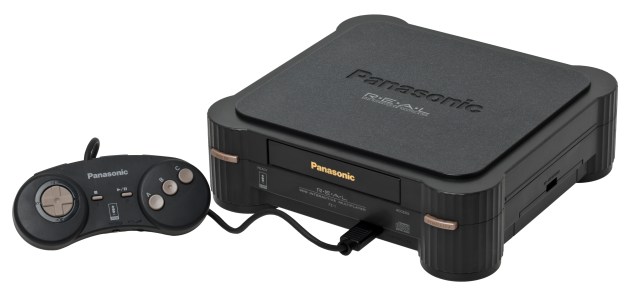
The Mical/Needle duo would later sketch out another console on a cocktail napkin that would be turned down by Nintendo and Sega. That console? Yep.. the 3DO. Those poor guys just had no luck. BTW, that’s another beautiful Evan Amos picture.
I’ve never physically seen an Atari Lynx. I’ve never held one. None of this matters for this review, since today you can play these titles on emulators or even buy them in collections on devices like Evercade or Antstream. There’s 71 officially released games and 56 “unlicensed” games, along with various indie projects that have come out in the years since. I can’t possibly play EVERYTHING that came out for the Lynx, but, I’m going to endeavor to cover all 71 official games and as many of the unlicensed games as possible, along with unreleased prototypes and a handful of indies over the coming months. I hope everybody enjoys it!
Huge thanks to the website Atari Gamer for their incredible database that made researching these games a breeze. Atari Age, as always, is a great resource as well. Oh, and I’m going alphabetically this time around.
THE EVERCADE FACTOR

Despite having half the games of Vol 1, I think Vol 2 is the clear winner.
As of this writing, there are a whopping twenty-five Atari Lynx games available and spread across two collections on the Evercade. Now, while the screenshots in this feature were taken with an emulator on my computer, everybody should support commercial emulation when it’s available. So, for the games that are Evercade-supported, I played the Evercade builds. I think I only paid $19.99 on Amazon for each set, which ain’t too shabby, but they currently go for $29.99 on Amazon. The first collection features seventeen games, and the second collection features eight. Eventually, I’ll total-up the value of these games. However, BOTH Evercade Lynx Collections are projected to win the Indie Gamer Chick Seal of Approval.
Check out Volume 1 and Volume 2.
GAME REVIEWS
For those not familiar with my way of thinking of how retro games should be reviewed, I take NO historical context into account. I don’t care how important a game was to the industry, because that doesn’t make a game worth playing today. The test of time is the cruelest test of all, but every video game must face it. I might not be here if not for Pong’s success, but I wouldn’t want to play it today. Not when there’s better options. Therefore, when I review retro games, every game gets either a YES! or a NO!
YES! means the game is still fun and has actual gameplay value when played today and is worth seeking out.
NO! means the game didn’t age gracefully and is not worth seeking out, and certainly not worth spending money on.
Unfinished prototypes are exempt from the system, and indie games are eligible for my full seal of approval.
 Alien vs. Predator
Unreleased Prototype
Developed by Images Software
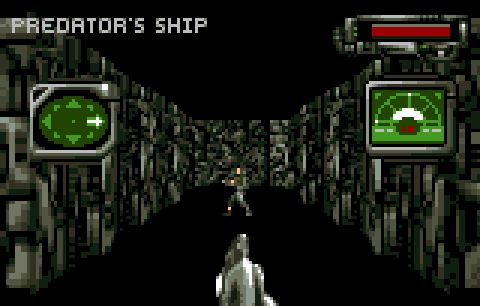
It looks the part, but it’s nowhere near finished.
Hey, starting with a prototype! Not one finished enough for me to issue a rating on, sadly. Atari Lynx has 71 officially released games, and the list of prototypes and unfinished/unreleased games for it is quite hefty. Some of them never even made it past the drawing board stage, but some did and have never surfaced. The clock is ticking. See, computer files actually aren’t FOREVER, especially when they’re transferred to carts for play testing. The data rots. If you’re a collector who has managed to score a one-of-a-kind prototype, after enough time, you’ll really only own a one-of-a-kind piece of plastic that once contained a game but now just has the gaming equivalent of static on an old TV. But, if you give it to someone to “dump” now, you preserve the game FOREVER, for the whole world. It’s probably the most selfless gaming act of them all. Besides letting your sister think she’s pwning you at Balloon Fight.
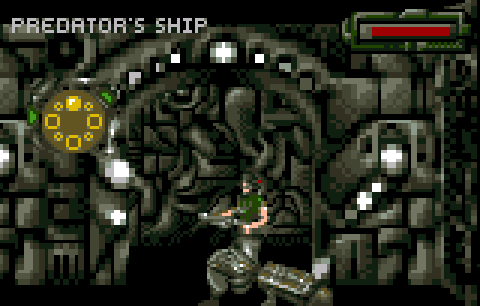
It’s actually impressive, or at least, the 33% that exists is impressive. It’s much faster and smoother scrolling than most Lynx games.
As for Alien vs. Predator, this was to be a port of the Jaguar killer app, not the awesome Capcom arcade brawler. This is the type of game where, had it launched with the platform, it would have really given it a massive competitive edge over the Game Boy and Game Gear. Of course, by time this started development, Game Boy owned the market, Game Gear was a distant straggler, and Atari was begging networks to accept their underbidding for late night/early morning Atari Lynx infomercials. It’s still awesome that they decided to give this a try, but the cancellation of it feels like the final shovel of dirt over the Lynx’s grave. That last shovelful is always the most tragic. Personal experience talking.
Worth a Look
 APB
APB
Year: 1991
Developed by Quicksilver Software

Another rare Lynx game where it’s smoother than average. Just wish the game was good.
I’m not the biggest fan of APB in general, so there wasn’t a lot of hope I’d like the Atari Lynx port. To its credit, even with the ultra-cramped screen and issues inherent to the device, it does a very admirable job of converting a relatively complex driving game to the Lynx. The primary mechanics of pulling people over are here and work, and movement didn’t take me that long to get the hang of. I also can’t imagine anyone who owned this on Lynx would have enjoyed playing it. It took me going through MANY controllers to find one that didn’t physically hurt my hand to hold both buttons down (required full operating your siren and pulling someone over) while maneuvering. I kept looking back and forth at a picture of the two real Atari Lynx handhelds that released and the game of APB I was playing and saying “HOW?” There’s no way anyone enjoyed this. It’s Kid Icarus DS levels of ow, my hand.
Verdict: NO!
 Asteroid Chasers
Year: 2021
Developed by Yastuna Games

Once you get a feel for the rules and the controls, this is actually kind of crazy insanely addictive. Which makes it the ideal handheld puzzle experience.
A sort of cross between dominoes (the game, not the tomato-sauce-covered slop someone might mistake as pizza) and Minesweeper, Asteroids Chasers would have been the perfect Lynx experience if it had actually come out during the console’s “natural lifecycle” which is my term for “when the console makers were actually trying to make money on it.” Though the Lynx was so badly marketed that you’d be forgiven if you assumed the Lynx’s natural lifecycle was a weekend in 1989 before some hungover executive at Atari woke up from a bender and said “we licensed, manufactured, and released a handheld WHAT?” In Asteroid Chasers, you have to place a series of tiles on a grid, limited to touching one of eight sides of the previous tile you placed. The object is to surround asteroids with probes. And by surround, I mean the four primary sides, because diagonal would just be ridiculous. The whammies are mines that you have to surround with probes, because if three active ones are on the board, you lose. The other whammies are pirates, and if a pirate is placed directly next to a probe, the probe stops working (even if it already deactivated a mine). It’s a game of luck and strategy and it works really well. The rare “Solitaire” type of game that actually is as fun to play as.. well, Solitaire!

The running gag that RNG in games hates me is alive and well. You’re at the mercy of the draw. I wasn’t very good at this. It took me over an hour to have a game this good. Honestly, with all due respect to Lynx & Game Boy owners, Yastuna should be looking for wider console releases on this. It’s pretty good.
 While Asteroid Chasers isn’t MIND BLOWING or anything, it’s addictive. Very addictive. It also lends itself perfectly to handheld gaming, since rounds of it only last between five to ten minutes, give or take. I do wish it showed you what available moves there are (the Game Boy version does), but that’s basically my only knock on it. Well, that and my historically bad RNG luck really went into overdrive here. Rounds can change on a dime, from thinking you’re heading towards your new high score to dead in an instant because you start drawing the mines in clusters instead of spread out over the course of the game. Any game that can make me scream in agony, then immediately start another round must be pretty good. And evil. But good. A good kind of evil. Like, George R.R. Martin, the patron saint of awesomely evil.
Verdict: YES!
Leaderboard Rank: #137 (Top 79% of all-indies, Top 56% of IGC-Approved indies)
Available in Standard Edition, Deluxe Edition, and Name Your Own Price for the ROM on Itch.io
 Awesome Golf
Year: 1991
Developed by Hand Made Software
EVERCADE: Atari Lynx Collection Vol 1

The first Evercade game in this review is a golf game that nobody probably gives two squirts about. But, people shouldn’t skip it. It’s probably the best of its breed I’ve played.
See, THIS is why I do my best to play everything. You’d think it’d be a massive waste of time to play a thirty year old version of video golf for a platform very few people owned. But, actually, Awesome Golf sort of lives up to its name. It’s not just the best sports game on the Lynx, but probably one of the better games on the platform overall. It still uses the standard triple-click swing method, but it dresses it up like no other video golf game did. The meter physically scrolls as it moves and has visual representations of slicing and hooking, making this very approachable to newbies and quick to adjust for golfing veterans, while also giving the sport the personality it often lacks.

Even just watching your shots is given dignity and pomp. I really enjoyed this game a lot.
So, that put me in a good mood, and it just kept up. If I have a knock on Awesome Golf, it’s that there’s no topography. You don’t have hills or slopes to deal with. The greens are perfectly flat. I get it. It’s an eight bit game and coding that stuff in would have probably been a pain in the ass. Besides, it’s supposed to be a quick to play, easy to grasp video golf on the go. My other knock is there seems to be a caddie system in place, yet, when I tried to activate it, it didn’t help me with shot selection. Like so many other versions of video golf (such as the Nintendo-developed one for the NES known as Stroke & Match Play Golf in arcades) Awesome Golf expects you to know what a scratch golfer can reasonably expect to hit with each club in the bag. It doesn’t tell you how many yards a well-struck 7 iron will give you. So, that’s annoying, but you could suss it out with time.
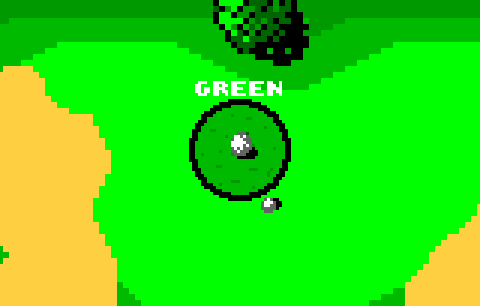
Another knock is how often the ball would come to rest right on the lip of the hole when putting. It happened so much that I questioned whether this was totally on the up-and-up.
Of course, the problems that Awesome Golf has are common for the time period. Not QUITE universal, but close. So, it can’t be accused of making any mistake that wasn’t typical for the 80s and 90s, with the horsepower and conventional design that was prevalent. And, the truth is, I don’t really care if they had limitations to deal with or not. It doesn’t make playing a game any more or less fun today. So, you can imagine my complete shock that I really enjoyed Awesome Golf. I’ve played a lot of retro golfing games and I think I’ve found the best of the pre-3D era. If you give yourself a name like “Awesome Golf” you have to live up to that, and this does. Awesome course design. Awesome swing mechanics. Lots of customization options. The best 8 bit round of links you can play is on the Lynx. I should have guessed! It’s right in the name and everything!
Verdict: YES!
$5 in Value added to Evercade‘s Atari Lynx Collection Volume 1
 Baseball Heroes
Year: 1992
Developed by Atari Games
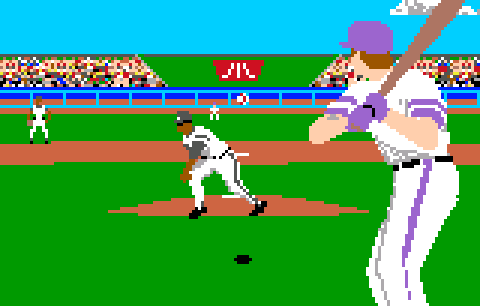
I’m frustrated when retro games sacrifice gameplay for appearance. If they were an athlete, they’d be one of those athletes who doesn’t care if they win or lose but rather how good they look. Think “Russell Westbrook”. However, sometimes the dazzling graphics pay off. That’s the case here.
Baseball Heroes is probably the most ambitious 8-bit baseball game ever made. What the hell is with Atari and all these high-concept takes on boilerplate sports games? So weird. The pitcher/batter animations look rotoscoped, and the fielding is done from multiple different camera angles. Like a 3D game. THIS IS THE ATARI LYNX! WHAT THE HELL? It’s playable and perhaps feels closer to baseball than most games from the time would. They tried to create a really fancy look and appearance for it, presumably because it would seem “high tech” when viewed in advertisements. And, yea, this looks really good compared to the Game Boy version of Baseball that was a launch window title.

While I know my baseball well enough, it’s my father who would be considered the “expert.” He watched this and said “this kind of looks like.. that.. sci-fi game.” I was like “uh.. Out of this World?” and he screamed “YEA! THAT!” It was funny that we were on the same wavelength. Indeed, the pitching and batting animation does have this weird “rotoscope” vibe to it. If this had good base running, it might be the best baseball game ever made. Alas.
To their credit, pitching and batting look and feel totally different. You’re not just playing from the same angle and simply controlling the other sprite. Before you hurl, it even has a close-up of the catcher showing his fingers to call the pitch, which you either shake your head at or accept before throwing the pitch. Again, it’s ambitious, and I do appreciate the effort. So much so that I actually had a good time. Again. Yea, this is why I play everything. And now I’m wondering why Digital Eclipse and Atari picked the volleyball game they did for the lineup when there’s a really fun golf and a really fun baseball game as an option. There’s only four teams and they don’t seem to be based on any real players, but who cares? It’s handheld baseball. I seriously doubt anyone finishes a single game.

I literally LOLed at how the fielding/base-runners work. Cutting edge, giant sprites for the pitcher/batter duels. Primitive stick fingers straight out of the Intellivision for the fielding/base-running. Then I stopped laughing when I was like.. damn.. multiple camera angles in a 1992 8-bit handheld video baseball that nobody played. Kind of makes me feel sad that nobody bought this.
Like Awesome Golf, problems inherent to the era’s video baseball are here and on full display. Base-running really sucks. Really, REALLY sucks, and almost cost this the YES! I’m about to give it. I was raised on Ken Griffey Jr.’s Nintendo 64 games, where there’s buttons assigned specifically to bases. The two-button design that 8-bit games use just doesn’t do it for me. Also, unique to this specific game is judging the distance of fly balls when you field. These are most certainly not minor league problems, but they’re not deal breakers, either. Sports games are why I can’t use “would I play it today, in 2023?” as the standard I judge retro games by. I would never choose to play these for any reason but as a special feature like this one. Instead, my standard is “did I have fun with them, on their own merit, without historical context?” In the case of Baseball Heroes, yes I did, though a lot of that was probably based on the novelty of a very bold design for a baseball game nobody played on a platform most people never owned.
Verdict: YES!
 Basketbrawl
Year: 1992
Developed by Hamilton and Associates
Included in Atari 50
EVERCADE: Atari Lynx Collection Vol. 1
Available on Antstream

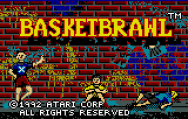
The referees will run in and start attacking players. I get the “wouldn’t it be funny if Double Dragon broke out in the middle of a basketball game” joke. The problem is, like a bad SNL sketch, there’s just not a lot of mileage in that gag. Your brain pictures what it would be like, laughs, and the joke has run its course by time you get past the title screen. That means the game has to stand on its own gameplay merit, and this doesn’t. It’s actually horrible as both a brawler AND a sports game.
To paraphrase the movie The Aviator, “I care very much about the sport of basketball. It has been the great joy of my life.” I might feel differently if every game played out like the Malice at the Palace. The idea with Basketbrawl is simple: no rules, to the point that the referee might run onto the court and start attacking players (which doesn’t seem to happen on the Atari 7800 version that’s also included in Atari 50). You can punch, kick, use weapons, and you don’t have to take the ball out and pass it in after a basket. If the other team is out cold, you can sit and shoot under the hoop till your heart’s content. You can keep scoring until the other team wakes from their coma to stop you. Sounds great, right? Yea, no. This is so janky in its frame rate that it comes close to feeling like an LCD game.

You can grab a knife and stab players. You can also just keep shooting baskets without the other team getting the ball back. Of course, I bricked more two-foot bunnies than Harrison Barnes bricked.. well.. everything in the 2016 Finals, but, whatever. We got Durant out of it so thanks Harrison.
The violence is so comically over-the-top that, as bad as the animation is, I couldn’t help but giggle. You can literally grab a knife, stab your opponents, then park yourself under the basket and just make one basket after another while they lay motionless. Of course, the shooting is just random chance it would seem. Passing and shooting are mapped to one button. That would be bad enough, but they made it worse. Logically, holding down the button would be shoot and you’d tap it to pass, right? Well, they did it backwards. When you shoot, there’s seemingly no way to help with accuracy, and even layups will rim-out again and again. At one point, I missed seven uncontested bunnies in a row. Video basketball HAS to get the scoring right, and this failed worse than any digital hoops I’ve ever played. Yes, I would go so far as to say this is the worst basketball video game ever made. Sure, you’ll smirk in disbelief when the referee runs onto the court and you give him the ole’ Draymond treatment, but dude, Basketbrawl is maybe the most misguided sports game ever made. THIS wants SO BADLY to be an even more violent version of Arch Rivals, but honestly, I’d rather play the Alan Miller Atari 2600 game, both for gameplay and comedy. Oddly, it’s not included in Atari 50. What the heck, Atari?
Verdict: NO!
 Batman Returns
Year: 1992
Developed by Atari Corporation
At the end of Batman Returns’ first level, this happens..
This slideshow requires JavaScript.
Oh, and Batman Returns is one of those games where you only get one life, so that bomb going off means you have to start over. Screw that. I rewound it and tried again. I ended up spending twenty minutes trying to run past it, duck past it, and jumping over it. I tried to duck behind the mailbox three or four times, since that seemed to be the only logical way to survive, but it didn’t work. The solution was.. ducking behind the mailbox. I guess I wasn’t doing it on the precise, specific footprint that would have allowed me to survive. Welp, so much for the good mood the surprisingly fun sports games put me in. Between Batman Returns and Basketbrawl, yea, that’s gone. Wait, maybe not..
Yea, no, the moment has passed. Shame.

If Zack Snyder directed a Batman video game.
Batman Returns on the Lynx is an atrocious game. Frankly, a brawler where the violence feels weightless is doomed anyway, but it’s so much worse than that. It’s a very close cousin to the arcade classic Kung-Fu Master, only without the ability to kick, and with gingers hugging the energy out of you replaced by clowns hugging the energy of your one and only life The collision sucks, so lining up to punch them while they suck the life out of you is a chore. Then, you have to deal with explosions that apparently don’t have proper means to defend again. Sticks of dynamite fly at you, and from what I can tell, you can’t punch them out of air. There’s sections where sewer grates spray sticks of dynamite like Old Faithful AND enemies walk in from the left side and throw more at you. Oh, and those enemies also have bombs attached to them and explode upon dying. This isn’t Batman. It’s Suicide Squad. The bad one, I mean.

I don’t know what to make of Batman Returns, the film. Penguin being a literal mutant penguin? That’s.. yea.. weird. What a weird choice for a weird movie.
I really did intend to play Batman Returns from start to finish, but I quit making a good faith effort after beating the first boss. Get this: you don’t get your life back when you beat levels. No continues. So, screw it.. I went and used an old-timey cheat code, listed in the caption below. A cheat code so comically massive that I actively wondered as I imputed it if someone had edited the GameFAQs page for this game and was screwing with people. They weren’t. It worked. EVEN THEN, I quit on the second boss, Catwoman, who will knock you down and then kick you over and over and not let you get up. The “git gud” crowd can blow it out their ass. Batman Returns is absolutely terrible and chalked full of dickhead game design. No lives, but instakills everywhere, be it bombs or pits that you can be shot into mid-jump when an enemy scrolls onto the screen. One thing is clear: making a fun game was not the objective here.

On the title screen.. and I’m not making-up how many button presses this requires.. you have to press UP eight times, DOWN twelve times, LEFT fifteen times, RIGHT nineteen times, and OPTION 1 twenty-seven times, followed by A. From here, you can pause the game and skip levels by pressing option 1 (which I didn’t do) or turn on invincibility by pressing option 2 (which I did as needed to assure I wouldn’t game over). If I hadn’t done it right the very first try, I’d have quit. Also, did I miss the part in Batman Returns where a Joan Rivers looking thing in a Native American headdress does battle with the Caped Crusader? Oh god, now I have to watch the movie again. Sigh.
I’m not even sure what I expected out of a licensed game for a platform that was about as popular as Oakland Coliseum is to visit these days, but hell, even some of the laziest, most cash-grabbingly soulless licensed games at least try to present the guise of being fun. You can’t even say that about Batman Returns. It probably looks okay in screenshots, but any Lynx fans who missed out on this, you dodged a beauty queen being thrown from the roof of a skyscraper onto a Christmas Tree-lighting plunger on this one.
Verdict: NO!
 BattleWheels
Year: 1993
Developed by Beyond Games
This slideshow requires JavaScript.
As a kid, I really dug EA’s Cel Damage. Quite a bit, actually. I even squeezed a surprising amount of playtime out of its Switch re-release twenty years later, showing it had unexpected staying power. BattleWheels is kinda a precursor to Cel Damage, mixed with Battlezone. But, even when viewed through the lens of a proof of concept, BattleWheels just plain isn’t fun. Enemy cars are bullet sponges, and you have to switch between weapons that shoot out the left and right sides of the car AND the rear of it. While it’s impressive that you can attack from all sides.. in a 1993 8-bit car combat, mind you.. the controls and the clumsiness of it all just saps the entertainment from it. It’s just not smooth enough to pull-off what it’s trying for, and it just ends up being a sloppy mess. Good try, I guess, but it makes me just want to play Battlezone.
Verdict: NO!
Well, alphabetically, that was convenient.
 Battlezone 2000
Year: 1995
Developed by Hand Made Software, Ltd

Oh, thank god it’s not trying to look “better” than the original. Precious wire frames. How I love thee.
Yep, this is good. Shame about it not coming out until 1995, of course. Maybe some kid who got a Lynx from a yard sale could have gotten a copy. Unlikely, but you never know. Even sadder is that, when you really stop and think about it, the Battlezone formula kind of lends itself perfectly to handheld gaming, doesn’t it? It’s the type of no-commitment-needed time wasting formula that is perfect for a $0.25 per play arcade experience, but also perfect as the type of game you throw on for a short car ride, or if you have ten minutes to kill in a waiting room. A simple arena where you use a radar to ping tanks to death, one at a time. And hey, the “improvements” are actually.. get this.. IMPROVEMENTS over the original arcade formula. You get a secondary weapon, a heat-seeking missile that can help take out especially annoying enemies. There’s also item pick-ups, and you’ll need them. Ammo is limited, and so is your fuel. While it did get aggravating that I’d find tons of fuel but not as much ammo as I needed, you know what? I still had a great time! Battlezone 2000 proves that the formula is timeless and not really that hard to tinker with.
Verdict: YES!
 Bill & Ted’s Excellent Adventure
Year: 1991
Developed by Al Baker & Associates

I got an item that is supposed to help with these scarabs, but it just seems to make them sort of wander randomly.
You know those overhead, RPG-like areas in StarTropics? Yea, Bill & Ted for the Lynx is sort of like those, only without the promise of a kick ass action sequence to follow. It’s one of the worst games on Lynx, because of course it is. One of those abstract games where I can’t imagine how anyone ever figured this stuff out in the days before GameFAQs. Controls that are slow and unresponsive and I was CONSTANTLY getting hung-up on the boundaries of pathways. Bill & Ted Lynx is basically a fetch quest mixed with.. a maze chase? It’s sort of how it feels. It’s just a complete dissonance of gameplay styles, and even the platform they’ve chosen for this makes no sense. The notoriously battery-sucking Lynx has a walking simulator this slow? Why?

I didn’t finish this one either. I tried, folks. Holy crap, what a slog of a game.
Bill & Ted Lynx basically fails in every imaginable way. There’s no humor, or really any personality at all, so it doesn’t fit in with the charming and adorable film series. Then again, maybe it’s based on the cartoon series since that’s what the title screen implies. Except the box art is from the movie. Well, that’s a mixed message. You know what? It’s clear this was thrown together and I wouldn’t even be shocked if this started life as something else and was changed in development. Wandering around boring maps with endless identical NPCs who all trigger the same dialog while looking for items that have no explanation on how to activate them. This was bad. Just a bogus idea.
Verdict: NO!
 Blockout
Year: 1991
Developed by P.Z.Karen Co. Development Group

I could swear I played this on Virtual Boy.
I loves me a good block puzzler, but, 3D Tetris-type games usually play not-so-great. My favorite, Tetrisphere, really isn’t anything like Tetris. Oh, and fun fact: Tetrisphere started development as an Atari Jaguar game called Phear. Ain’t that neat? I used to figure that, if that’s as good as it gets, maybe the subgenre just doesn’t work. So, if you told me that I’d finally find a 3D well puzzler that was.. if not good, tolerable, I wouldn’t have expected it to be on Lynx. Not just Lynx, but from a studio with a library of games I’ve never heard of (and by a director with only one credit, and it’s a backgammon game for god’s sake). Yet, Blockout is fine. It’s not exactly exciting, even when I increased the levels. But, it is shockingly intuitive, in a way that no other game in the genre has pulled-off. I didn’t think I’d reach the point at all where determining depth and position in the grid became instinctive. Instead, it actually happened really quick. Within fifteen minutes of playing, I wasn’t having to move the blocks up against the wall before moving them into the position. Well hey, that’s just swell. Didn’t see that coming.
This slideshow requires JavaScript.
Is Blockout fun? Eh, well.. it’s an acceptable way to pass time. There’s plenty of customization options and a massive variety of block shapes which you can adjust to your liking. In theory, this is great, but the Lynx wasn’t quite advanced enough to achieve the ambition on display. In the more advanced levels, the wire-frames of the blocks just don’t look clear enough. The tech wasn’t there, and the lack of shading forces you to rotate the blocks a lot just to figure out their basic structure. Of course, on the lowest speed level, you do have plenty of time before you have to commit to laying a block down. If you stick to the basic shaped blocks and pump the speed up to level 5 or so, I think even non-fans will find an experience that may not be entertaining in the strictest sense, but certainly is mentally stimulating enough to keep you from being bored if you have fifteen minutes to spare. Sorry. That’s as much enthusiasm as I could muster.
Verdict: YES!
 Blue Lightning
Year: 1989
Developed by Epyx, Inc.
EVERCADE: Atari Lynx Collection Vol. 2

The reason I’ve stuck to my guns on playing everything in these retro runs I do and not just the quote-unquote “big name” games is because you never know, right? Blue Lightning is a great example of that, because I really didn’t think there was any chance I’d like it. Instead..
Well I’ll be damned. I WILL BE DAMNED! Wow! Yea, I didn’t expect.. this. Blue Lightning was meant to be more of a tech demo for the Lynx, back when it was called Handy Game. This started development before Atari’s involvement in Lynx, with the intent of creating a game that would look really sharp and snazzy in promotional photos. It’s a jet combat game that tries to ape the look and feel of After Burner, only within the physical limitations of the Lynx. Which turned out as well as you would expect: the game scrolls about as smooth as triple-grit sandpaper. It makes Star Fox look like a 4K experience. Also, it’s pretty dang fun. I am NOT joking. Like.. huh? This is not how it’s supposed to work. This was supposed to have aged miserably and be nearly unplayable today. But that wasn’t the case.

I shouldn’t be impressed by technology that released fifty-two days after I was born, but despite the slowwwwww gameplay and crappy frame rate, I really was genuinely, no bullcrap, impressed by Blue Thunder for creating authentic thrills and some of the most satisfying dogfights in gaming.
Now, let me be clear: the limitations rear their ugly, ugly head again and again. For one thing: the character sprite itself is too big for the relatively small Lynx screen, and not in service to the gameplay. Then, there’s the game design. The levels aren’t always thrilling, because sometimes Blue Lightning goes too long between action beats. The ground-based enemies really lack any grit, and frankly barely look like more than little black or gray blobs on the ground. While it’s technically impressive for a 1989 game to allow a player to either hug the Earth or fly high into the clouds, there’s a lack of focus that comes with that that was completely avoidable. Speaking of which, the somewhat choppy play controls and highly choppy frame rate means you can’t always see the enemy projectiles coming at you. I found the best strategy was saving my heat-seeking missiles for defense and shooting down enemies with my gun.

As impressed as I was with the terrain and the fact that there’s something resembling Mode 7 like 3D topography, I’d rather had focused gameplay.
When the game focuses on fighting other jets and dodging or blowing up their projectiles, it’s really satisfying. Is it deep? Nah. It’s as shallow as a puddle of spit. But, shooting down enemies is just fun enough that it kept me going all the way through. I wouldn’t think this genre would lend itself to handheld gameplay, but alas, it does. Blue Lightning is one of those “slipped through the cracks of history” type of games that is pretty much the killer app of Lynx that nobody knows about. Imagine playing this in 1989 on a handheld. It must have been mind-blowing. None of that matters to me now, in 2023. All I care about is “did I have fun playing it today?” I sure did.
Verdict: YES!
$5 in Value added to Evercade’s Atari Lynx Collection Volume 2
 Bubble Trouble
Year: 1993
Developed by Lore Games Ltd.

It’s a free-range space shooter/fetch quest that replaces the spaceship with a grandmother in a giant soap bubble. Literally. That’s what it is. There’s a cut scene that shows how this happens and everything. Points for originality, I guess?
Well, to Bubble Trouble’s credit, I’ve not played too many games where you star as an old lady in her bathrobe trapped in a giant soap bubble. It’s as dumb and horrible as it sounds. The type of game where I look at the reviews posted on the Wikipedia page and remember that some game critics seem physically incapable of having a single critical thought in their heads. This is horrendous. The controls are so fast and so loose, on a screen that’s already too small, that you just bounce around aimlessly from wall to wall while hoping you don’t collide with the enemies. We can’t say a game sucks when it sucks. Golly, that might lead to the free review copy gravy train drying up!
This slideshow requires JavaScript.
Actually, a better theme would have been a sentient air hockey puck exploring a cavern made of trampolines. This is the type of gameplay that doesn’t work at all without analog controls. The squeezes are too tight and the amount of ricocheting you’ll experience trying to get through the narrow passages will drive you mad. Exploring in this exploration-based game is just plain miserable, and there’s nothing to soften the blow. The combat is god awful because you can’t aim and shoot without moving, and moving means you start sliding and bouncing off the walls like a hyperactive 6 year old who just mainlined a pixie stick factory. I really did want to finish the first stage but after exploring each far-end of the stage, I couldn’t find my way to the final dot and I really didn’t want to go on further. Horrible game.
Verdict: NO!
 California Games
Year: 1989
Developed by Epyx, Inc.
This slideshow requires JavaScript.
I’ve never liked California Games, and lord knows I’ve tried to overcome that. This is my third time playing it. I grew up in an era of WarioWare, Wii Sports, or even the generic Carnival Games. Mini-game collections that aspired to feature intuitive, user-friendly controls. California Games goes the opposite route: super steep learning curve. I genuinely think I could learn real skateboarding faster than I could learn the skateboarding featured here. And what’s the point? It’s not fun. None of it is. This might be the worst mini-game collection this side of Action 52. AND IT WAS THE PACK-IN GAME! I really can’t imagine why the Atari Lynx failed. It’s beyond me.

I WAS impressed by the fact that the camera does a close up. This is one of the earliest games I’ve seen that does that, so that was cool. But this replaces Mario Tennis on the Virtual Boy as the worst pack-in game I’ve ever played. Bundle your best software or don’t bother.
So, let’s get this over with. The Lynx version of California Games, which.. yes, again, this was the pack-in for the Lynx, features only four events. In BMX, you race down a hill while avoiding speed bumps and hay bales. You’re given two jumps to help with this: a wheelie and a flip jump. I found this to be too strict with the time limit and too unforgiving with mistakes. It’s also just not fun. I’ve never played a good surfing game, and the version of surfing in California Games is no different. The half-pipe, hell, even reading the instruction book or watching clips of it, I couldn’t figure out how to do anything. In case you haven’t noticed by the fact that I own a wildly popular gaming blog (humor me here, folks), this ain’t my first rodeo. This shouldn’t be so unintuitive. Hacky Sack.. excuse me.. foot bag, is basically just mashing the button. It’s really, really boring.. and it’s the only game in the entire collection that doesn’t require you to devote hours to getting the hang of the controls and timing. They should have packed Blue Lightning or Chip’s Challenge with the Lynx, because California Games sucks. Always has. Always will.
Verdict: NO!
 Centipede
Unreleased Prototype
Developed by Shadowsoft

At this point, I want to make arrangement for my tombstone to have an LCD screen, a trackball, and a copy of Centipede, just to say this will literally follow me to the grave.
I really can’t escape Centipede, can I? There’s apparently not a lot known about this unreleased prototype, except that it comes from the same studio that Atari hired to port Joust and Robotron to the platform. Well, canceling this was a good call. I can’t imagine even this bare framework of 1s and 0s resembling the arcade classic would have ever eventually become a decent port of Centipede. It’s so slow, and all the charm and personality is just gone. If this had been the game that came out in arcades in 1980, it wouldn’t have become the legend it is. Personality matters. If you can’t carry that over, don’t even bother with the port. It’s just common sense. Apparently someone at Atari had that, hence this lobotomized version of Centipede meeting a giant shoe.
NOT WORTH A LOOK
 Checkered Flag
Year: 1991
Developed by Atari
EVERCADE: Atari Lynx Collection Vol. 2

Credit where it’s due: I was sure this wouldn’t play smoothly at all. And it does. So, hey, not bad.
I fully admit I’m not the biggest Pole Position fan. I’ll always cherish those early memories of Dad operating the pedals for me at the pizzeria while I recklessly steered us into billboards while cackling like a maniac (“it was a bad omen of things to come” says my father) but it just doesn’t translate without a steering wheel, gear shift, and pedals. Checkered Flag is Pole Position in all but name, only with a lot more options than pretty much any Atari port I’ve previously played. It’s also one of the most critically acclaimed Atari Lynx games ever. Of course, these are the same critics that couldn’t work up the courage to say that Bubble Trouble sucked, so I took that with a grain of salt.
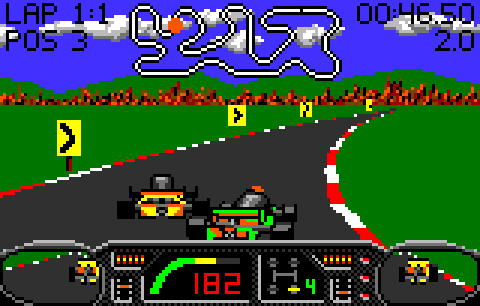
You can also choose to use a female racer. For the life of me I couldn’t figure out what that does, since you can’t see yourself in the car, and the announcer still says “GENTLEMEN.. START YOUR ENGINES!” instead of LADIES. Well, this WAS 1992 so that voice sample was probably like half the file size by itself. Still, what the hell was the point of that?
Well, sometimes popular consensus is right. I’m stunned by how much I enjoyed Checkered Flag. It has a pretty big variety of tracks. It controls pretty good for a d-pad-based racing game. It even has rear view mirrors at the bottom of the screen. How cool is that? And, to top it off, the amount of options is staggering. So, how do you want to race? Solo? Single lap? No drones? Nine drones? Somewhere in-between? It’s your call. They loaded this cart down with variables, and variables equal value. So, yea, Checkered Flag is one of the best Atari Lynx games. Go figure. Hell, it made me realize that the Pole Position formula, when it plays well enough, lends itself pretty amazing to a handheld device. No commitment needed. If you have ten minutes to kill, whip out your Evercade and do a quick lap. Now I’m thinking Namco are damn fools for not reviving the authentic Pole Position franchise on Switch.
Verdict: YES!
$5 in Value added to Evercade’s Atari Lynx Collection Volume 2
 Chip’s Challenge
Year: 1989
Developed by Epyx
EVERCADE: Atari Lynx Collection Vol. 2

I don’t know if I’d go so far as to call Chip’s Challenge a “classic” but, much like me, it was born in 1989, is the result an idle period in its creators life that got out of hand, it’s starting to show its age, and yet it manages to retain its charm thirty-four years later. We’re practically twins!
For you Gen Z-ers, Chip’s Challenge was a fairly common computer game in the old Windows 95 days. I’m almost certain every Windows 95 included at least the demo of it. We always had the full version, and as recent as 2010, I caught my father playing this at our office. Here’s what I didn’t know about Chip’s Challenge: it was designed for.. and debuted on.. the Atari Lynx. In fact, alongside Blue Lightning, this was one of two launch titles that were made to be “Killer Apps” for the Lynx. They should have packed THIS in instead of California Games. The Atari Lynx had massive problems with blurring and battery life and was widely predicted to be doomed from the start. BUT, who knows? Maybe a desirable game like Chip instead of a piece of crap that players could play on the NES anyway like California Games might have moved a few more units. I promise you that if the decision makers had it to do over again, they’d pick this.

It’s sort of like arcade-like Lolo mixed with a Sokoban game.
For those of you who have somehow never heard of Chip’s Challenge, or maybe you have but you didn’t play it, it’s a puzzler crossed with a mid-80s style avoider-type maze chase. But, you mostly have to focus on puzzling. You have to figure out how to pick up all the computer chips in the room (much like the heart frames in “Adventures of Lolo“), and the primary challenge will be determining the order you need to get them. There’s items that let you clear specific obstacles, or open doors, or cling to conveyor belts. Really, the most impressive aspect of Chip’s Challenge is just how much different stuff there is to do. So much stuff that it shouldn’t get boring. Except, it sort of does.

There’s 150 levels, some of which are real brain benders. Others are just busy work. The biggest flaw with Chip’s Challenge is, and has always been, that the difficulty curve is all over the place.
Chip’s Challenge is probably the most legendary of Atari Lynx games, though that reputation has very little to do with this specific version. It does work well as a handheld release. Most of the stages work in bite-sized chunks, and since there’s no items or score to carry-over, you really don’t need to commit to an extended session. It’s a shame this didn’t utilize battery back-up, though the passwords are only four characters, which helps. My main reason for not considering Chip’s Challenge to be a bona fide legend is that far too many of the stages are just slogs to get through. Busy work where one type of challenge is repeated too many times. Don’t get me wrong: Chip’s Challenge has aged so much better than it had any right to. But, it’s also forever fated to be a B-lister among gaming memories.
Verdict: YES!
$5 in Value added to Evercade’s Atari Lynx Collection Volume 2
 Crystal Mines II
Year: 1992
Developed by Color Dreams
EVERCADE: Atari Lynx Collection Vol. 1
Crystal Mines II is in a somewhat unique position among the games in this feature. The Evercade port has had additional levels added to it. 125 added levels, to be exact. That brings the total to.. 300. Jeez. In the interest of full disclosure, I didn’t touch those extra levels. Yea, I can’t imagine wanting to play 300 levels of this. Not because it’s bad or anything. In fact, I think Crystal Mines II is a lot more fun than Boulder Dash, the game is “rips off.” It’s faster-paced, more action-oriented, but also has much smarter puzzles. Things I’m into. But, there’s a shelf life that expires long before those 300 levels are finished. It lasted.. oh.. about 90 or so stages for me.

Crystal Mines II was later released on Nintendo DS, only the two was dropped. Also, it apparently never came out in America.
In early stages, players could mistake Crystal Mines II as a basic maze chase with gunfire type of action game where you have to collect all the treasure in the level. It’s quite arcadey, but that style of gameplay doesn’t last long into the experience. Crystal Mines II is really a fairly hardcore puzzler that fans of Lode Runner or Lolo would enjoy a lot more. The puzzles can be quite brain-bending, and sometimes quite time consuming. This is one of those games where modern techniques like save states and rewind help to remove most of the tedium out of the experience, since a lot of the levels are a one-mistake-and-you’re-dead type of deal. Much like Boulder Dash, I never got a feel for how the gravity works, either. I’m sure there’s some pattern to how the blocks fall, but I’m still kind of stumped as to how it works.

There’s some fairly clever level design here that makes you think on your feet. Like, in this level, a bomb with a live fuse is next to a necessary item, so you have to start running towards it and collect the item before the TNT explodes.
I’m not necessarily a fan of mind-breakers that also rely heavily on avoiding enemies like Pac-Man ghosts. Even if it’s grid-based, it’s just an annoyance that gets in the way of my thinking. It’s even worse, because not all enemies can be fired-upon. Some of them are immune to all but the dynamite. This isn’t Bomberman, and often, you might only have enough dynamite to finish the level. You’re also going to want an instruction book if you’re playing this for the first time, as it’s not always clear what certain items do, or the physical properties of some of the blocks. Oh hey, I found the book. OH HEY, it’s useless! It doesn’t even have pictures explaining the properties of.. anything. Well, ain’t that a kick in the ass? Eh, I figured it out. You can too. Crystal Mines II is actually, shockingly, one of the best games on the Lynx.
Verdict: YES!
$5 in Value added to Evercade’s Atari Lynx Collection Volume 1
 CSS Traffic Regulation
Year: 2022
Developed by Yastuna Games

This is one of those games where I was initially excited as I started it and saw what it was, but the more I played it, the less I liked it. Well, until I switched which mode I was on. Trust me: go straight to “Challenge.”
I don’t want this feature to be a celebration of Yastuna Games, but they seem to know what they’re doing with these twists on classic puzzle formulas. CSS Traffic Regulation sounds like some kind of bureaucratic infrastructure management simulator, but actually, it’s similar to Nintendo’s Panel De Pon series. AKA Tetris Attack. AKA Pokemon Puzzle League. AKA Nintendo Puzzle League. AKA.. you know what? They can’t settle on a theme for it. Traffic Regulation isn’t a direct copy cat of it. The most notable difference is a series of meters that fill up as you clear each of the blocks. The meters trigger special events, such as a square garbage block that has to be dealt with, or a rocket ship will fly over the screen and change the blocks.

This was a game over, despite the fact that there’s literally a match happening underneath it. CSS feels like it needs more development time, as stuff like this frustrates more than it entertains.
CSS notably changes how the garbage blocks are handled. Instead of linking them to blocks you clear, you break them by dropping them. After a few drops, they’ll shatter. It’s a small change that makes the whole experience feel fresh. However, I must admit, my enjoyment of CSS grew smaller and smaller the more time I put into it. When I first started it, I assumed I’d eventually get a feel for the physics and timing, but it never happened. There’s a training mode that I was hoping would help me to discover the timing, but all it seemed to do was keep the game at whatever level you chose, without increasing as you play. What this really needed was a tutorial to help give you a sense of the timing. Even worse is the game instantly ends when the blocks reach the top. I’ve always felt that one of the great parts of Puzzle League is that moment when the blocks squeeze the top BUT you still have a second to make the save. It’s exciting, and Traffic Regulation hurts for its loss. As shown in the picture above, you can actually link the blocks that WOULD make the save, but it doesn’t save you, and that just play sucks.
This slideshow requires JavaScript.
S o, a bust, right? Well, maybe the main modes are. They stop being fun really fast. But, then I swapped over to the “challenge” mode. This isn’t the same as the puzzle mode commonly found in Puzzle League. You’re not trying to clear all the blocks on the screen. Instead, there’s specific blocks marked by an outline. There’s no “maximum amount of moves” counter. Instead, the puzzle plays on a timer. Sometimes, it even scrolls. I enjoyed playing this a lot and will likely go back and finish it. Is it good enough to save CSS? Actually, yea. I’d still hope Yastuna goes back to CSS themselves and cleans up the actual action main gameplay elements. It’s really haphazard and the annoyances bury the fun eventually. But, the PUZZLE part of this puzzle game kept my attention, and that’s good enough for me.
Verdict: YES!
Leaderboard Rank: #217 (Top 66% of all-indies)
 Daemonsgate
Year: 1993 (Not Released until 2003?)
Developed by Imagitec Design
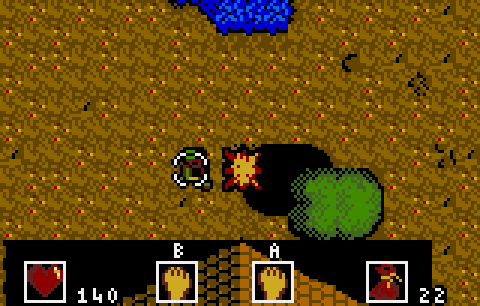
I spent an hour wandering around, trying to figure out what exactly I was supposed to be doing.
I didn’t really get very deep into Daemonsgate. I’m not entirely sure if the version I have is complete or not. It’s hard to tell with these old “lost” RPGs how finished they are. I never even figured out what the first objective was, as the game just begins. No story. No sign post. Nothing. Just “welcome to a town.” A town where all the doors are locked. You’re left to your own devices to figure out what to do. There’s a knife that you have to equip to one of your two hands. There’s guys who walk around with an L that you CAN attack, but they run away without fighting. I’m not sure whether or not I committed murder on them or played the game right. There’s also enemies walking around that you have to fight. Call me spoiled by modern games but, with an RPG, I prefer to at least want to have an idea of what I’m supposed to be doing to start the game. If you’re desperate for some RPG action, well.. I think there’s like ten thousand different options out there without turning to an obscure Atari Lynx non-release.
NOT WORTH A LOOK
 Desert Strike: Return to the Gulf
Year: 1993
Developed by Granite Bay Software
Published by Electronic Arts
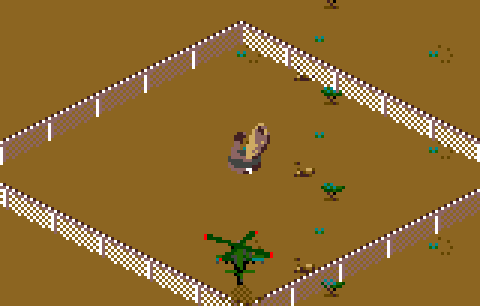
This actually doesn’t look too much worse than the SNES version. I wouldn’t want to ever play either. Good lord. Boring.
I’m not really that familiar with the EA “Strike” franchise. As in, I’m fairly sure this is my first time ever playing it. This probably wasn’t the best game to start with, as it’s too low resolution and lacks the buttons to do what the game asks. Or saw I thought. When I fired up the SNES version to compare it, I was stunned. Same map. Same objectives. Same control issues. Desert Strike for Lynx is actually a really good port, it would seem. Of course, the base game has to be good, and I don’t really think this is fun at all. And I don’t even think it was trying to be. Maybe it’s better on other consoles, but I doubt it. For example, there’s on-foot enemies that fire upon you from the ground. They’re green. There’s also friendly foot soldiers you have to pick-up with your helicopter. They’re.. also green. Really, you can only tell which is which by whether or not they fire upon you. Since you don’t exactly have quick reaction times in this clunky chopper, it’s not like dodging their gunfire is an option.
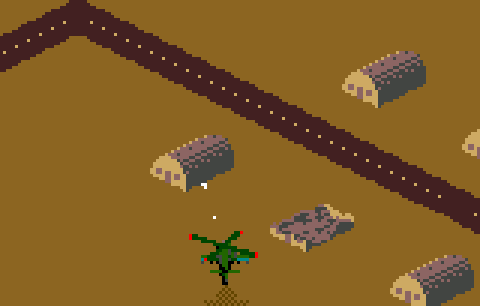
See these things? They have extra gas and extra missiles. You have sit and pump them with so many normal bullets that it’s just a miserable slog.
In fact, that’s a big problem with the game: with the cramped screen, you’re flying into danger constantly. Some kind of warning indicators would have been nice. Logical too, since you’re in a helicopter and should be able to see many things from it. The other big problem, and this is the one that made me quit: just how spongy everything is. You have limited missiles and limited fuel, and yet even the targets you have to shoot to refill these things just suck up all the bullets you fire like you’re shooting Tic Tacs at them. I mean seriously, it’s SIXTEEN BULLETS to open these things up, and they’re the only things that don’t shoot back. Kiss my ass, Desert Strike. You weren’t even trying to be fun, so I don’t feel really inclined to give you any further consideration. Next time, try to remember you’re f’n video game.
Verdict: NO!
 Dinolympics
Year: 1992
Developed by Imagitec Design

Folks, some games just aren’t for me, and that’s The Humans. Or Dinolympics or whatever it calls itself this time. I can’t really say it’s AWFUL or anything, but the day I actually spend my free time playing this slow, boring, clunky thing is the day I fill a turkey baster black market semen, spread my legs, and impale my waistband treble clef on it.
Man, I pictured this game totally different in my head, based on the name. But, Dinolympics is just another version of The Humans with yet another new moniker. Owners of Atari 50 will recall that it went by the name “Evolution Dino Dudes” on the Jaguar. Apparently here, it was meant to be called “Dino Dudes” and the Jaguar version was originally intended to be called “Dino World.” Now, I really hated Evolution Dino Dudes when I played it on Atari 50. It’s clunky and unintuitive. I suspect this would be solved on a PC, but that’s irrelevant to playing this on Jaguar, or especially Lynx, which really isn’t optimized for this.

To the game’s credit, I liked the throwing meter better on Lynx than Jaguar.
I’m really into puzzle games, so hypothetically, this should be right up my alley. Yet, I really can’t stress enough how boring I find The Humans formula to be, and how misguided including a timer is. The timer really ruins the experience. It’s a puzzler that penalizes you for.. you know.. thinking. Thinking about what to do next. Thinking about your different options. Thinking about whether you should delete the ROM from your computer and never play it again. With all the issues this formula has with the interface and movement of the characters, and having to be very precise on the decisions you make, adding a timer is like asking someone to put together a jigsaw puzzle inside a washing machine. Ultimately, I think Lemmings is where I draw the line. You must have at least that much pep in your step, and Lemmings has next to no pep. The Humans is somewhere behind it, and it can’t hold my interest. It’s not you, Humans. It’s me.
Verdict: NO!
 Dirty Larry: Renegade Cop
Year: 1992
Developed by Knight Technologies
This slideshow requires JavaScript.
See the above slideshow? Yes, that is a junkie lighting themselves on fire before suicide-attacking you. I know I play the role of a psychotic game critic, but holy crap.. my jaw literally dropped. Golly, do I wish the game lived up to the reaction I had. Instead, Dirty Larry is one of the worst games on Atari Lynx. And I use the term “game” in the loosest possible sense. There’s LCD games with more gameplay than this thing offers. A very, very rudimentary brawler/shooter hybrid where you walk right, shoot the enemy or two that walk onto the screen, and then walk to the right more. The action is incredibly repetitive and there’s basically nothing to do but fight the same handful of enemies over and over again. And.. that’s the whole game. And I’m not exaggerating. That’s literally the whole game.
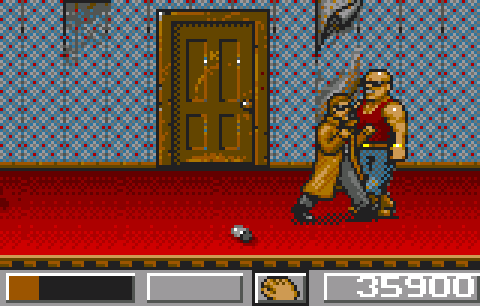
When a game goes the extra mile in personality and charm but plays THIS badly, I just find it obnoxious. Like.. you do get that the actual object is to make a FUN game, right? So, why are you wasting time working on jokes and visual gags? IS THE GAME FUN? No? Then go make fun!
Dirty Larry looks great! It sure seems like it’s going to be a fun time. It’s not. Personality is no substitute for gameplay, and Dirty Larry not only has dull gameplay, but then it actively takes steps towards being worse than it has to be. Fun weapons like machine guns? You don’t want them. They cause you to burn through your valuable ammo too quickly. You really don’t want to do that, because if you do run out of bullets, punching is basically worthless. Even the most basic enemies will knife you if you get too close. Which you have to, because.. you know.. it’s punching. There’s no OOMPH to the punches either. Even lowly, historically maligned Urban Champion has OOMPH. This feels like shadow puppets throwing punches. You can jump over bullets, but they fire at a rate where you’ll have to keep jumping and hope you have enough time to squeeze a round off. There’s no advanced hand-to-hand combat. You get one basic punch and whatever weapons you can get. Also, you only get one life. Frankly, one life for this game is one too many.
Verdict: NO!
 Double Dragon
Year: 1993
Developed by Technos

It looks great! Very impressive sprite size, and not just that, but sprites that look closer to the arcade version than even the NES pulled off. But, you don’t play screenshots. You play the games they come from. Very few “technical showcase” Lynx games are actually fun.
Speaking of OOMPH, here’s the original king of arcade punch-em-ups. On the surface, Double Dragon looks like a pretty good port of the arcade game. In screenshots, it can look really good. But, it can also look like this:
This slideshow requires JavaScript.
Those shots are unaltered. Huh. So, really, those large sprites aren’t worth all that much, are they? No matter how nice they look, when the action can take place in a literal gray void, it negates their value. And, frankly, the arcade-like large sprites didn’t lend themselves to good gameplay. My beloved OOMPH is completely gone. The violence in the Lynx port of Double Dragon is feathery and light. Jumping is basically worthless, except in those areas where you need to jump. I fully confess that, if I hadn’t been able to rewind, I’d probably not made it past those areas. Rewind also saved my bacon from falling to my death because the puny Lynx screen wasn’t big enough to let me know I was about to scroll myself directly into a pit.
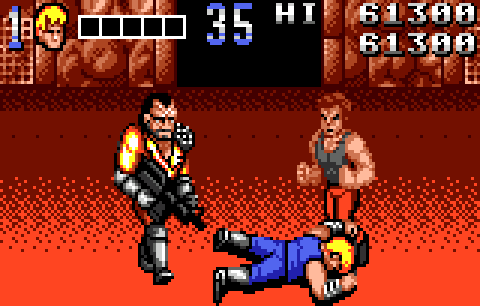
“Bruh.. you literally brought a gun to a fist fight? Party foul!”
I actually think brawlers aren’t a bad fit for a handheld. They’re low-commitment, pick-up-and-play experiences. But, they still need to bring the goods the genre is famous for in the first place, or what’s the point? I don’t think Double Dragon on Lynx even comes close. It’s so slow and clunky. I found myself, even on higher difficulties, just throwing guys by the hair willy-nilly, with no effort. The knife disappears after one use, but the bat or whip stays with you for the duration of the level if you can go without getting hit. The bat especially had timing that allowed me to not even allow enemies a single frame of recovery animation before I was Hank Aaronifying them back to the pavement. Ultimately, Double Dragon, despite the impressive sprites, feels SHOCKINGLY low-tech, and it makes for a dull port of an otherwise beloved game. I loves me some Double Dragon, but that doesn’t mean it belongs on every platform.
Verdict: NO!
 Dracula the Undead
Year: 1992
Developed by Hand Made Software, Ltd
EVERCADE: Atari Lynx Collection Vol. 1

Bram Stoker, in a bathrobe, flipping through pages of his own book with animation that makes it look like Bram is having a stoker.. in his pants.
WHY WOULD THIS EVEN BE ON THE ATARI LYNX?
Sorry. I’ll try to be more professARE YOU GODDAMNED F*CKING KIDDING ME?
Sorry again.
So, yea, this is a point and click adventure that aspires to closely follow the book by the bathrobe-wearing mofo pictured above, who.. fun fact.. also served two terms as President of the United States under his pen name “Ulysses S. Grant” and.. actual fact.. didn’t base Dracula on ANYONE. No, Dracula wasn’t Vlad the Impaler. Do you know why Stoker chose the name “Dracula?” Because he mistakenly thought it was the Romanian word for “devil.” Bram Stoker was a copious note taker, yet his notes didn’t mention one single historical figure. Literally none. Not Vlad III, Elizabeth Bathory, or even Ivan the Terrible. None. Zilch. Zero. Speaking of the book, in 2009, a sequel by Bram Stoker’s great-grandnephew Darce Stoker released. Its name? Dracula the Un-Dead. Really! Sarah, my god-sister, insists that it’s pretty good, too, though critics seem to disagree.

The interface is horribly clunky. Calling this a “point and click” isn’t accurate because you have to physically walk about the room. “Stagger and Click” adventure doesn’t have the same ring to it. “Lumber and Menu Examine” really is a mouthful, but it’s L.A.M.E. for short so I’ll go with it.
None of that has anything to do with this game, but I had to talk about something. The interface is so weirdly done. You have to walk around the room, press a button to scroll through a menu, and then another button to activate it. It tries so hard to help you out. The menu is divided into two halves, a verb on the left, a noun on the right, that are simple to switch between. But, try as they might, it just never feels intuitive. Worse yet: there was no way to save the game in 1991. That doesn’t matter here, where I can freely use save states, but still, that’s a dumb idea for a point and click game. In fairness, you can finish the whole thing in under an hour or two. Of course, you’ll spend most of that time stumbling around the rooms with one of the worst interfaces I’ve ever encountered and graphics not suitable for exploration.

Whenever anything significant happens, you have to manually input the options “USE – NOTEBOOK” in the menu. Some of these things are one-time only events that, if you miss making the note, you apparently can’t finish the game. What a STUPID concept.
There’s issues with the sense of depth, and the “collision boxes” for lack of a better term are often too small and make finding key aspects a chore. Hell, finding the doors just to navigate in and out of rooms is frustrating. Some elements, like windows, are literally up against the camera that you’re viewing the action. This is just a terrible game. Granted, this isn’t a genre I would ever voluntarily play.. well, obviously that’s not true because, well, I’m on my third paragraph now and about to go to a fourth.. but, point and click games came about because the technology at the time didn’t allow for full 3D environments. Dracula tries to be ahead of its time with 3D movement and exploration instead of a cursor. Instead of being ahead of its time, it makes an already tedious genre pretty miserable to play.
Oh, and then it becomes Crazy Climber.
This slideshow requires JavaScript.
Yea, I didn’t see that coming. So, to explore the castle, you climb out the windows and shimmy along the bricks. As far as I can tell, you can’t die and there’s no fail condition for this element. There’s invisible walls that prevent you from aimlessly wandering around. Does it make the game more fun? Not really. The thing that surprised me most of all is how abruptly it ends. This is like 5% of the Dracula book. Once you successfully escape the castle with Jonathan Harker, the game cuts back to Bram Stoker, who is like “and that was enough and someone staked Dracula. THE END!” Uh.. wait, really? Seriously? Okay. Yea, this sucked. Heh.. sucked. It’s funny because it’s Dracula.
Verdict: NO!
Part Two will eventually be released to Indie Gamer Chick!
Check out other Atari features at IGC!
Atari 50: The Games They Couldn’t Include!
Part One – Part Two – Part Three – E.T. – Planet of the Apes/Alligator People
The Making of Karateka: The Definitive Review
Atari 50: The Definitive Review – Part One
 Gangbusters was developed by Konami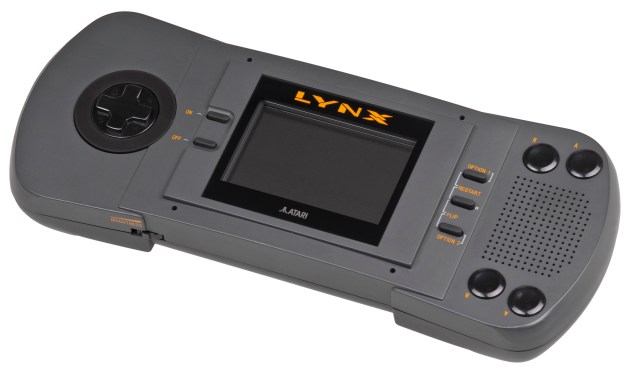




 Krull is Chick-Approved


 King & Balloon was developed by Namco


 Bucky O’Hare is


 The Little Mermaid is

 Indie Gamer Chick
You must be logged in to post a comment.