Jaws (NES Review)

Jaws
Platform: Nintendo Entertainment System
Developed by Westone (then known as Escape)
Published by LJN
First Released November, 1987
Scheduled for Re-Release in 2026
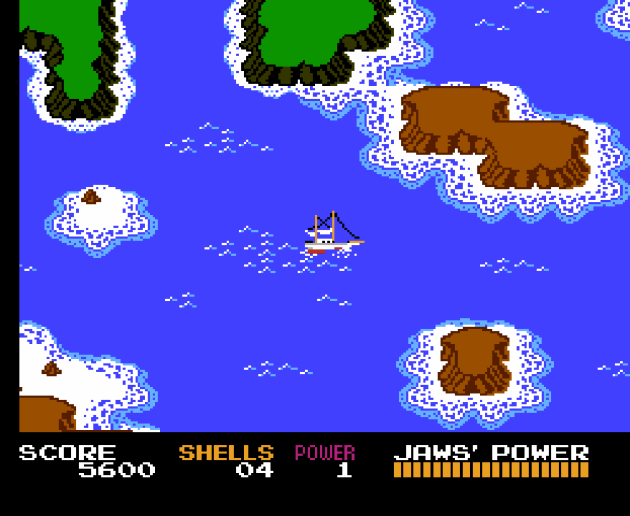
We actually don’t need a bigger boat. This boat is perfectly adequate. No notes.

Jaws is historically maligned, in large part because it was an early release by notorious NES publisher LJN. It’s also not exactly a thrilling game, and it was released around the time the really bad Jaws sequels had largely eroded the franchise’s potency. But, what if I told you that Jaws for the NES actually ain’t that bad. Or, even bad at all? It’s not amazing or anything. I originally had typed out the words “diamond in the rough” but quickly deleted them. Diamond is obviously too kind. It’s.. a half-dollar in the rough. You’re pleased as punch to find it lying around. Like, this isn’t a penny someone dropped and determined it wasn’t worth the effort of bending over to pick up. It’s.. a half-dollar! Whoa! Then, about ten seconds later you realize, wait, that’s really only fifty pennies, and you’ve probably passed by that many pennies and not bothered bending over to pick them up. You’re still oddly satisfied, yet bummed that it’s not as good as it seemed like ten seconds ago. That was rambling, but trust me,what I just described is the Jaws NES experience in a nutshell.

Jaws’ gets its first rectal exam.

Jaws is the rare NES game that feels like it still utilizes the type of abstract game design theory that ended with the Atari 2600. A short, very limited, very narrow-scope set of repetitive tasks that combines a couple different gameplay types loosely tied to the game’s theme. In the case of Jaws, the object of the game is to build up your attack power to be strong enough to overcome the humongous and initially ultra-spongy life bar of Jaws. You have an overhead map that has two ports. You have to sail back and forth between them, and as you do, RPG-like random encounters happen. Only, instead of turn-based combat, you play a very rudimentary shooter that lasts 30 to 60 seconds. There’s only four enemies in these encounters: stingrays, jellyfish, baby sharks, and Jaws itself. When you start the game, you basically cause no damage to Jaws at all, and any damage you do cause will heal itself four bars per random encounter. To build up your attack power, you have to rely on randomly-dropped seashells that you then cash in at the two ports for a progressively more costly +1 to your attack power. The only truly wise decision the developers made was forbidding players from going back to the same port twice in a row. You have to alternate between the two, and there’s no doubling-up. You can only collect one additional attack power point at a time.
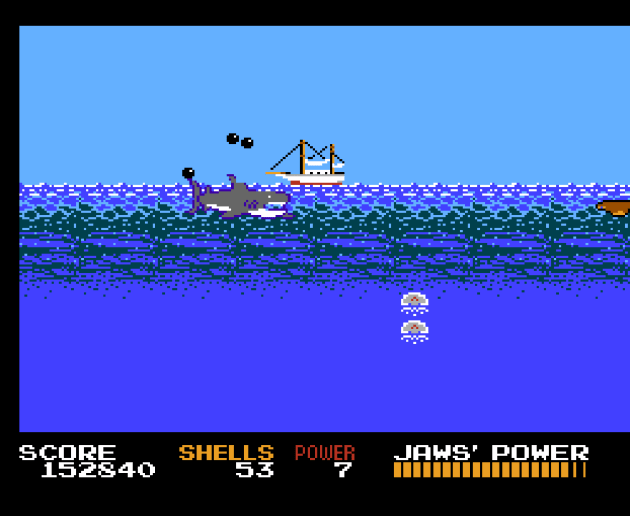
During random encounters not involving Jaws, the entire battle takes place as the diver (or the sub). BUT, if you hit Jaws on the map, the encounter starts on the boat, where you can lob cannonballs at it. You absolutely cannot avoid Jaws, but it’s like getting free shots in, since once it touches the boat, you become the SCUBA diver and are invincible for a few moments.

So yea, Jaws is a game about grinding, but you don’t need to clear your schedule if you want to try it out. I beat it without any cheating (unless auto-fire counts as cheating) three times this morning, each time in well under an hour, and the third time only required thirty minutes. Thankfully, what little sea combat it has was decently done. It’s not a bad little shooting game at all, but like I said before, it’s basic. Four enemies. Four whole god danged enemies. Really, only two that you frequently encounter. To the game’s very limited credit, they get progressively more aggressive as the game goes along, but come on. It’s so creatively dead. As the SCUBA diver, you only get one single form of attack, and while the Jellyfish eventually do become a genuine nuisance (they got me a couple times), there’s no variety. Also, your power doesn’t affect anything BUT Jaws. Even the baby sharks take the same amount of hits to kill regardless of whether you’re a 1 or a 9. Once you’ve encountered Jaws for the first time, you’ve seen 95% of the game.
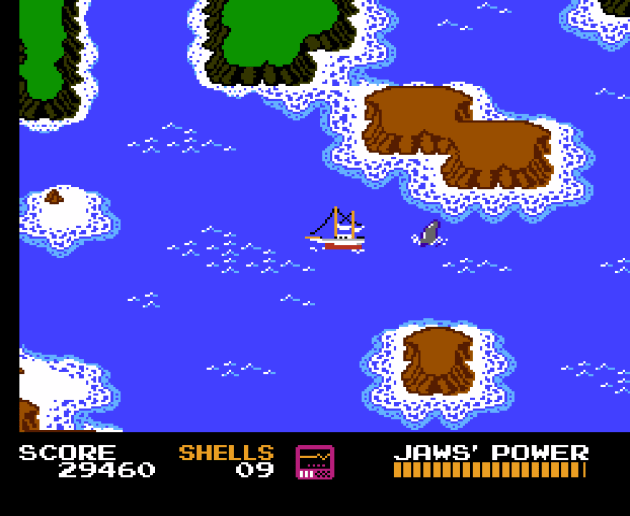
The random encounters I think must be based on a predetermined amount of “steps” taken. I noticed that if I rewound the game and changed direction, I’d have a random encounter regardless after the same amount of spots moved. However, I had one span where I crossed from one port to the other without a single encounter. Actually, I came VERY close to making two full passes. Also, it’s worth noting that if Jaws was close by (as pictured above) when a different random encounter happens, it’ll probably show up anyway.

The two ports aren’t even that far apart from each-other, either. That’s especially odd considering how big the map is. It’s not like you have to search to find the other port the first time, either. The game starts on the left port, and once you pull out of the harbor, a straight line to the right will bring you there. If you don’t suffer a random encounter, it takes under 10 seconds to get there. While it’s not a massive map, I get the distinct impression that they originally had bigger plans. Perhaps randomly placing the ports would have helped a lot. The only incentive to search is a randomly-placed submarine that, when you find it, provides you with more maneuverability and a second underwater weapon to use. I didn’t really like using the sub, though, and found its lob-style cannonball weapon to be kind of worthless. I didn’t really want to bother going out of my way for it, either. The task at hand was to build my power, which meant staying in that narrow space between the two ports, grinding out random encounters and hoping for seashell drops. Enemies also drop crabs (which make you go faster) and stars (worth points, which are worth getting since 30,000 points nets you an extra life). Oh, and don’t kill enemies too close to the screen, because your character can’t go all the way to the edge, and you might miss collecting their drops.

This slideshow requires JavaScript.

You’re not entirely at the mercy of randomness. When you kill Baby Jaws, it’ll ALWAYS drop a seashell, and killing three or four of them will earn you a visit to a terrible bonus game where you drop cannonballs on jellyfish that are dancing in formation. You earn a seashell for every three jellyfish you hit. As you progress in the game, more baby sharks will spawn. Eventually, it won’t be rare for you to have random encounters made up entirely of baby sharks. The crappy thing, there’s a very fun game buried in this mess. I like the idea of the finishing line not being set in stone, but rather based on when you’re strong enough to take down one single enemy that you keep encountering again and again. Jaws is the only enemy in the game that you can see on the map. After visiting the port for the first time, you get a receiver that warns you when Jaws is nearby. You want to avoid it at first, since it’s impossible to beat it. With each power level, it takes a little less hits to take a single bar off its life. You won’t be able to put any lasting damage into it because its health restores by four bars every random encounter, whether Jaws is part of it or not. It won’t be until around level 5 you can put damage into it. If you’ve got auto-fire turned on, you should be strong enough to beat it on level 7.
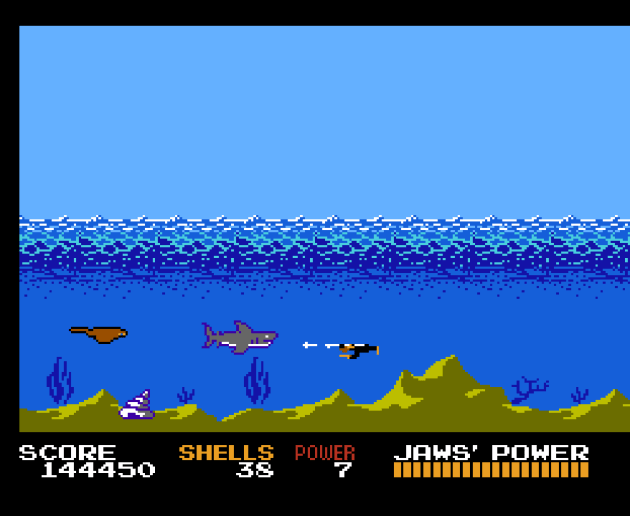
By far the most challenging levels in Jaws are those in the shallow waters. Random encounters close to a coastline will happen here. The jellyfish become VERY problematic, especially when they rise out of the bottom of the screen with no warning and start curving through the water. When you die, you lose a power level and your speed is reset to 0. Jaws is a one-hit-death game, which is really the REAL reason you’d want to get the submarine. It acts as an extra hit point that you lose if you touch an enemy. I strongly advise you to not hang out at the bottom of the screen.

When you’ve depleted all of Jaws’ health, the game enters a third-person mode where Jaws comes at you, bruh, but maybe not DIRECTLY at you. It’ll swim progressively closer to the boat, and it’s just a matter of following it and waiting for the right moment. You’re given three signal flares that you can use to make Jaws pop and spin out of the water. There’s a series of lines that acts as a grid of sorts. When Jaws is ON the final line, not between it or in front of it, but touching it, AND it’s lined up with the front of the boat, you use the flare to pop Jaws out of the water, then you spear it with the boat. One shot and it’s dead, and you’ve beaten the game.
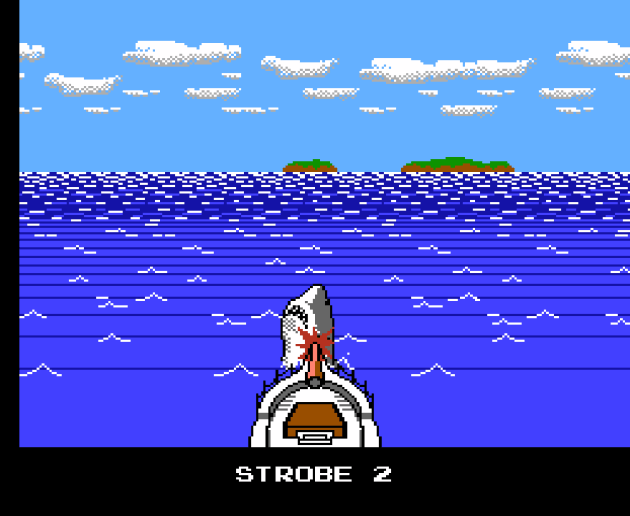
My description above might not be 100% accurate. Honestly, this is a pretty haphazardly done finale. Sometimes it feels like Jaws is aligned perfectly, and I still don’t score the kill. If you run out of flares, you have to go get more from the shops. After reaching level 9 in power, each visit to a port will net you an additional signal flare.
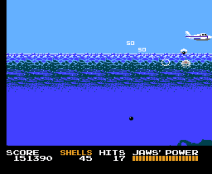
Once the baby sharks start appearing more frequently, the bonus stages interrupt the game too often. Sure, they’re 5 to 7 free seashells, depending on how accurately you shoot, but they interrupt the flow of the game and feel completely out of place. I also think a perfect score is impossible.

So, that’s Jaws. History has largely vilified it, but honest to god, folks, it’s not THAT bad. It just doesn’t come remotely close to having enough content. Variety is the spice of life, but Jaws is limited to four enemies, two battle arenas, a really bad bonus game, and a fairly poorly done mini-game finale. But, the concept of the game is enticing, what little gameplay is here is decent enough, and it’s over so quickly that you don’t really have time to get bored. The NES and especially LJN are responsible for some downright travesties of licensed video game shovelware, but Jaws isn’t among them. Given how shoddy most of LJN’s published library is, Jaws might be their finest movie tie-in. Golly, how sad is that fact? But, let it be said, the developers of Wonder Boy worked a miracle here. Do you know what the closest cousin of Jaws is? Sinistar, the arcade classic from Williams. Both are shooters based around building up the ability to kill one omnipresent big bad. It’s a genre that hasn’t really been explored all that much since Jaws, and I really wish someone would. In fact, I genuinely believe that everything presented in the existing game could serve as the framework for an all-time classic. If Westone had added more enemies, items, arenas, and locations on the map (and probably beef-up Jaws to accommodate all this new content) I can’t help but wonder if Jaws would be a celebrated classic. Someone at LJN should have looked at this and said “we’re going to need a bigger game!”

See that? I did a Jaws thing there. You got it.
Verdict: YES!

South Park: Butters’ Very Own Pinball Game (Pinball FX Table Review)

South Park: Butters Very Own Pinball Game
Platform: Pinball FX
Set: South Park Pinball ($9.99)
Included in Pinball Pass
Designed by Szucs “ndever” David
Originally Released October 14, 2014

This is a reminder that Butters made multiple earnest attempts at destroying the world, by drowning everyone and by destroying the o-zone layer. Oh sure, it was adorable how ill-conceived and childlike his attempts were, but they were good faith efforts at human extermination. He’s not THAT wholesome.

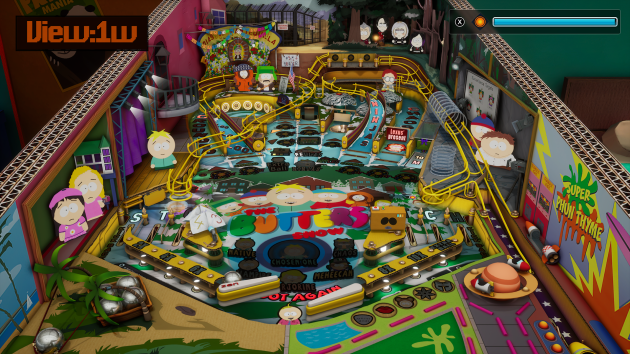
It’s probably best that pinball fans look at the Butters table as a throw-in bonus for South Park: Super-Sweet Pinball, where $10 nets you one really well done PG-rated South Park pin and one middle-of-the-road, mundane and average pin. Which isn’t to say that you should ignore Butters’ Very Own Pinball Game. I really did think it was completely decent. It’s just impossible to build-up any momentum thanks to Zen’s typically violent slingshots and over-indulgent modes. In this case, I think the slings are easily the worst part. Seriously, holy crap, those slingshots should be in a holding cell, staring at a clock as it inches closer to midnight with a priest reading them their last rites while a pair of three-drug cocktails, a gurney, and IVs await in the next room over. They’re silverball serial killers that, all by themselves, drop Butters from maybe as high as a GREAT table to barely GOOD. Well, actually the horrendous mini-field with physics so weirdly inconsistent that it’s practically broken doesn’t help, either.

Oof. Terrible.

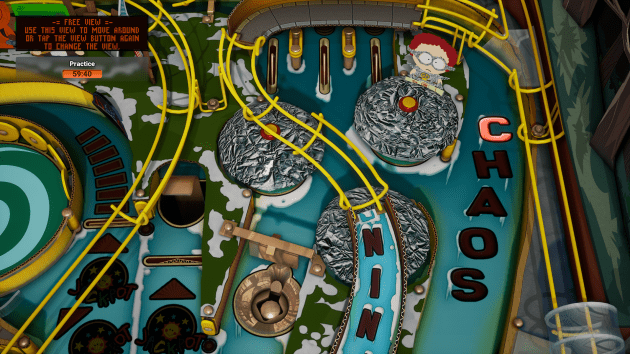
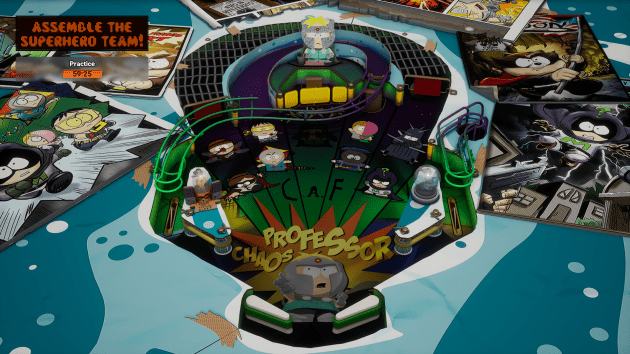
While they don’t look the part, the flippers for the Professor Chaos mini-table feel nubby. The physics for the mode are completely different than a normal table. The Vices all agree that the slope feels non-standard, but we disagree as to whether it’s too shallow or too steep. It kind of feels like it alternates between both, depending on where the ball is. Regardless of whether it’s too steep or shallow, flips on the mini-field have this weird shuffle-pass sensation. It’s as if you’re playing pinball with an air hockey puck that has fluctuating weight. As if that’s not bad enough, the four targets are boring AND that you have to shoot them twice each. Combine that with the fact that there’s no ball save, and thus rounds of this catastrophe could end in literally a second or two, and it quickly became my least favorite of the table’s modes. This might be the worst mini-field Zen has ever done. It really put a damper on the whole Butters experience, because I really don’t think their physics have ever been worse.

You absolutely MUST play the ball out of the saucer or risk a quick drain. While it’s not a 100% certainty, the drop from the saucer hangs right over the drain. If you’re not attempting to shoot the cellar or spin disc, what you can do safely is hold the bat flipper out, which should give you a gentle drop down to the primary flippers to gain control of the ball.

The rest of Butters is all about basic, nearly bare-bones light-shooting. Modes are started by putting the ball in the saucer in the center of the playfield, then converting the follow-up shot with the bat flipper into the spin disk. The disk is surrounded by several targets, and by total chance, you have to score 50 hits on the targets. It sounds like a lot, but you shouldn’t need more than two successful shots in the spin disc. Between the three members of my family, ONE TIME in an entire week of playing this table did one of us need three shots, whereas completing all 50 in a single shot wasn’t rare at all. In extremely rare cases, the ball gets launched out of the spin disk, though it should be playable even if this happens. After lighting the mode start, you’re given five options. The worst is Chaos vs Coon & Friends, which is entirely the mini-table I whined about above. By far the easiest mode is Marjorine, and the scoring is completely screwed-up on this one. You only need to complete three shots and return the ball to the mode start VUK. Each of the first three shots gives you two options. Besides the third shot, all four of the shots score in the millions of points. It’s a cinch.

I’ve heard of shooting bricks, but this is ridiculous.

Last of the Meheecans is indicative of everything Zen Studios does wrong pinball modes. The previous mode I talked about was four shots, all simple angles, and only one of which is an optional high-risk shot. This one is seven shots, all of them with much higher difficulty, all of them much more risky, and all but one of them score much less points. In this mode, you have to shoot five orbits, but the entrances to those orbits have rising-and-lowering walls. Once you clear four of the five orbits, the final one must be shot three times, and it’s only now you’re putting up million point scores. And you’re on a timer, on a table with long return times. Because hitting each shot once just plain wasn’t enough, I guess. How come Marjorine is four shots for more points and this is seven shots for less? It makes no sense.

Butters relies heavily on the bumpers for the AWESOM-O mini-mode and for the high-yielding dress-up Butters score. As long as I wasn’t on AWESOM-O the ball would bounce around like crazy in the bumpers. But, as sure as the sun will rise, whenever I was on the AWESOM-O mode, the ball would bounce out after a single goddamned bump. Two bumps at most. It was so uncanny that I’m convinced it’s rigged.

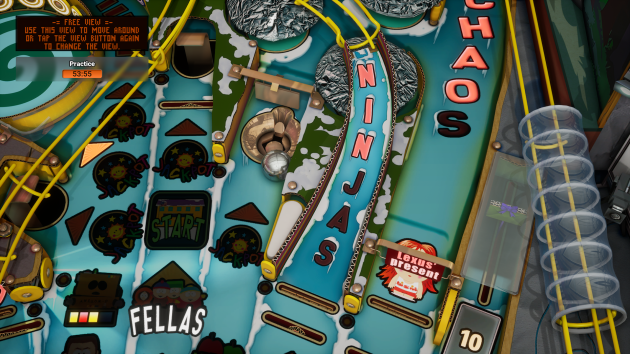
The other modes are under-paying and just totally average. Turn butters into a vampire by shooting three orbits and then the saucer three times. Put on a Hawaiian shirt and shoot fifteen orbits with a multiball. There’s also a couple side-quest multiball modes as well that are the same basic modes with fewer targets and an add-a-ball mapped to the generous vari-target. I normally hate vari-targets (they’re my least favorite pinball targets) but this one is clockable and relatively safe off a brick. Sadly, most of the mini-modes are quite dull. The only one we all universally enjoyed was the Ninjas side-mode. There’s four ninja targets and you have 60 seconds to shoot them for 150,000 points a hit. They respawn five seconds after being struck down, but if you can complete all four within five seconds, you score ten million points. Again, I can’t stress enough: none of us HATED Butters. We just hated that no amount of skill can overcome the slingshots, and the complete lack of balance. But, let it be said that the Williams-like layout and simple angles makes for a nice bonus to go along with the unforgettable Super-Sweet. Now then in the spirit of Butters, GO TO YOUR ROOM, ZEN! YOU’RE GROUNDED FOR THOSE SLINGSHOTS!
Cathy: GOOD (3/5)
Angela: GOOD (3/5)
Oscar: GREAT (4/5)
Jordi: GOOD (3/5)
Dash: BAD (2/5)
Dave: GOOD (3/5)

South Park: Super-Sweet Pinball (Pinball FX Table Review)

South Park: Super-Sweet Pinball
Platform: Pinball FX
Set: South Park Pinball ($9.99)
Included with Pinball Pass
Designed by Peter “Deep” Grafl
Originally Released October 14 2014
Awarded a Certificate of Excellence by The Pinball Chick Team

Keep in mind that our team’s fandom of South Park as a show is all over the place. Dad (Oscar) and Dash are 100% complete lifetime non-fans. Myself and Jordi are lapsed fans, while Dave is somewhere between the two groups. Only Angela is a modern “never misses an episode” fan of the show and even has viewing parties with friends. Some of us factored in the theme, others focused on the table. One odd note is that Zen is just weeks away from releasing Pinball M, their M-rated Pinball FX spin-off (oh.. hey, I get the name now), but this South Park is rated E 10+ by the ESRB. There’s not even bleeped cussing in here. Weird.

South Park’s tables being returned to Pinball FX after a six year absence is proof positive that all bets are off with Zen Studios. As if getting the World Cup and Indiana Jones licenses didn’t already prove that, now they’re bringing back their long-lost Pinball FX2 pins as well. South Park: Super-Sweet Pinball is probably their most famous pre-PinballFX3 pin (it’s either it or Plants v Zombies). It’s back, and it plays well with the new Pinball FX engine. Super-Sweet pinball is a smooth-flowing finesse table only somewhat held back by a brutal difficulty combined with modes that demand too much perfection in what is an imperfect art form.

The Vices (that would be myself, Angela, and Oscar for those keeping track at home) have put 30+ hours into Super Sweet Pinball. For all the whining you’re about to endure, we all really enjoyed it. However, some of the angles are too impossibly risky. Chef’s door is a whole other level of “WHY DID YOU STICK THAT THERE?” mind-f*ckery. Unlike Dash and Angela, I never considered moving off my GREAT rating. The risk/reward balance is too screwed-up for that.

Super-Sweet isn’t entirely an original table by Zen. Hold a mirror to the layout and it’s a close approximation to Stern’s Simpsons Pinball Party. I don’t know if that was meant to be a “Simpsons Already Did It” joke or not, but given that Ant-Man is a mirrored version of Theatre of Magic, probably not. The similarities are mostly superficial in nature, though South Park does take after Simpsons with multiple highly stackable modes. Unlike Simpsons, you can’t go into the settings to adjust the hurry-up times. The biggest problem with South Park is how damn unforgiving it is. It’s not enough to activate the modes. The modes have to be finished to achieve the S-O-U-T-H-P-A-R-K lights that are the ultimate object. That’s nine modes, with three additional modes (one of which is a grindy multiball). Finishing four of them lights an extra ball, but even on our third day, it wasn’t all that rare for each of us to finish games with only one light (typically it was the Kenny light, which is a lay-up). And, we really don’t suck at pinball. Hell, I’m the reigning Arcade mode world champion on this table at the time I’m writing this, and I finished that game barely halfway there. They’re a LOT of work just to get started, THEN you have to.. you know.. beat them!

The Stan and Kyle scoops are deceptively hard shots. For Kyle, if you have a gentle roll on the right flipper, a backhand is a relatively safe option. Stan? Not so much. If there’s a low risk angle for it, we haven’t found it. Annoyingly, despite being a very high-risk shot, Stan’s hurry-up is too short and very undervalued relative to its difficulty. Really, the only value it has is it gives you the S light. Lighting four of the S-O-U-T-H-P-A-R-K lights will light the extra ball target. My suggested order is Kenny, Sarcastaball (which has an additional extra ball attached to it), School Bus Multiball, and Manbearpig. You can sub Stan’s Hurry-Up (annoying as it is, once it starts, it’s one shot to complete) for any of those. The Vices NEVER successfully completed Kyle’s mode (Mr. Hankey Multiball) or Chef’s mode. Not once.

Let me pick an almost random example: the School Bus Multiball. To get it, you must shoot the school bus ramp NINE times. You must then lock four more balls shooting the same ramp. THEN, you must complete the shots for all four of the boys AND sink the balls back in the bus ramp you had to grind nine shots out of to begin with. I’m fairly sure that you need to only lock one of the balls to get the “R” letter, but either way, this is massive grindy time investment. I can’t stress enough: the most successful pinball tables of all time kept their “doors” lit whether or not you were successful in the mode or not. That’s the kind of pinball that generated the biggest success the medium has ever had BY FAR, so why wouldn’t you do that, Zen? You have 110+ tables on Pinball FX, and you expect HOW BIG a time commitment towards “git’n gud” at them?  Kyle’s requires you to get the K-Y-L-E lights, then 3 locks on the sarcastaball-ramp, THEN you have to get a super jackpot in multiball. AND IT’S ONLY WORTH A MILLION POINTS for that super jackpot.

The super skill shot is quite risky. I had a lot of shots go straight down the drain off it. You should have the ball save lit, but still, it’s a bitch. When this target isn’t standing, it’s replaced by a TV target that requires you to hit it.. I’m not making this up.. 247 times just to light an extra ball. Come on, Zen. Now you’re just straight-up trolling. It’s worth noting the “episodes” you get from hitting this add to your end-of-all bonus as well. If I shoot a target 247 times, I expect the table to gain sentience and eat me. Though actually, at one point, I had an EB light that I couldn’t figure out where it came from. It’s entirely possible it was from this.

Compare the relatively low scores of the other modes to the T-I-M-M-Y mode, which is NOT for one of the letters but yields the highest scores. By far! Timmy’s easy-to-get lights are along the flipper lanes. After lighting them, you have thirty seconds to go nuts on a single shot next to the Kenny loop. Use the left flipper and a cherry-bomb shot, and you’re gold, OR, you can use the bat flipper. Yep, the best target in the game can be shot from both the left primary and the bat flipper, and boy, does it score points. You only need to hit it once and you’ve got a cool million points, and it adds another million every time you repeat it. Do the TIMMY shot twice, and you’re made three million points. Three times? Six million. Four times? Ten million. And so forth. And so forth. You can grind that one shot, 30 seconds at a time, and still score hundreds of millions of points. You can use this as an excuse to light the C-A-R-T-M-A-N lights, since that shot feeds you a softball for the bat flipper to shoot the TIMMY shot. Oh, and if you miss it off the bat flipper? You’re either hitting the Kenny Loop, Randy Ramp, or if you’re way off, you’re hitting the J-I-M-M-Y lights for the kickbacks! It’s so badly balanced. My arcade world record right now is probably 40% to 50% made of that one shot. That’s not balanced. I should note my father disagreed with me all weekend about how low-risk it was, since the Timmy target is a cherry bomb shot straight over the drain. I almost never lost a ball from it. He’s just plain wrong.

Assuming the mini-table doesn’t glitch out on you and ruin your game (and it might), you’ll want to get good at it since the extra ball light is that cow up at the top of it. The biggest pinball mistake Angela will ever make is letting me see how she cracked the super skill shot. Here’s how: let the ball “settle down” on the right (lower) flipper before flicking. It should bounce off the target and roll around the goal post. Grind this up to a 10 million point level and then complete the super skill shot on the main playfield to light an extra ball. Takes practice but I can now do it almost every time. It’s HIGHLY clockable. The balloon part? Not so much. Another tip: don’t shoot the tethered balloon directly. Use the same strategy as I stated above and DO NOT shoot the balloon directly. ANY contact with the balloon will light the S-A-R-C-A-S-T-A-B-A-L-L lights, even if it’s on the return. Now, when the balloon is cut loose from the tether, sorry friend, but you’re on your own. I sucked at it.

Will someone in charge at Zen Studios tell their table designers to tone it the f*ck back, already? Because the tables aren’t better for demanding this much commitment out of them. The tables aren’t ever more fun because of the repetitive grinding. They’re less fun. Nobody is going to devote six months towards one table to get good enough to get the wizard mode. Look at how few people are posting wizard-level scores on Zen Originals versus Williams pins (that don’t require endless grinding with no forgiveness for failure) and ask yourselves which tables people are having more fun with? I know I’ve been whining about this a lot lately, but it’s an issue. People aren’t finishing these tables. GOOD PLAYERS aren’t. That’s not a virtue.

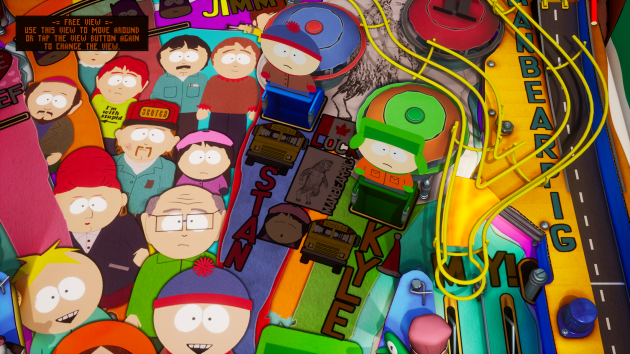
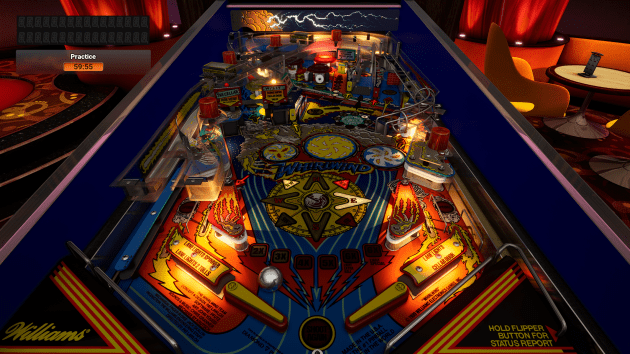
This screenshot alone is PACKED with incredible shots. Dad coined the Kenny loop a “shoelace loop” or “The Ritchie Shoelace” which is a close cousin of “The Ritchie” as seen in tables like Black Knight, High Speed, etc. Oh, and Kenny is probably the easiest letter on the entire table. Or, you can shoot the Randy loop, which is a bit tougher and activates the super-grindy Bat-Dad mode. Or, one shot on the Randy Loop also lowers the blimp to activate Sarcastaball and grant access to the mini-table (where an extra ball can be nabbed). OR, you can get the T-I-M-M-Y lights and then shoot the Timmy vertical target, which is potentially the most valuable shot on the table. Finally, the J-I-M-M-Y lights that activate the valuable kickbacks are just under the Randy shot, though it’s nearly a blind-angle off the bat flipper.

Now, with that whining out of the way, I should probably note that we all loved the layout for South Park. Of all the “super difficult” Zen originals, South Park is probably neck-and-neck with Clone Wars for having the best transitional flow. While South Park is absolutely packed with modes and mini-modes, the transitions from shot-to-shot are smooth regardless of what modes you’re aiming at. And, unlike Whirlwind, we could use post transfers to great effect this time. You’ll need passing for this one, as the key modes are timed. Cartman’s Anal Probe requires thirty spins of the spinner in sixty seconds (approximately four flush shots), and at that point, you’re only halfway there. You then have hit three UFOs in thirty seconds. Manbearpig is ten shots, then a straight-shot up the middle, THEN collect six piles of gold, THEN one final cherry bomb up the center. Bat-Dad is the hardest by far. You have to shoot a high risk cardboard target to “throw a jab” which ticks off a little bit of his health. To “throw a haymaker” and do extra damage, after hitting the cardboard target, you have to very quickly connect on a follow-up flashing light shot. I have no idea how many times you have to do this. We never came close to finishing it. We never finished the Chef’s mode. They were too high risk, and it made more sense to shoot the TIMMY lights for maximum yield.

The Terrance & Phillip themed bumpers are incredibly violent and, when their mode is charged-up, high-yielding. Angela at one point banked nearly ten million points off them in a single shot based solely on pure blind luck of getting the ball jammed between them. There’s also a Lawlor Path between them that acts as Stan’s Hurry-Up shot, as well as additional Canadian Multiball and Manbearpig shots. However, it’s a very high risk shot, and the bumpers, fun and profitable as they can be, may also murder your ball via the right outlane or even a drain plunge. I held my breath every time.. which feels oddly fitting for fart-themed bumpers.

The big question is “can non-fans enjoy South Park?” I actually think it might be true of both non-show fans and non-pinball fans. Don’t mistake my usage of “super difficult” for being “impossibly difficult.” It’s not that bad. Actually, South Park: Super-Sweet Pinball is an incredibly fun table. Strangely generous too. Take the Cheesy Poof bag, for example. It’s the score multiplier and it’s right next to two necessary shots: the left Manbearpig/Canada/Cartman orbit and the school bus ramp. If you brick either of those shots, you get rewarded with the Cheesy Poof bag, which is fairly low-risk to hit. In fact, the entire left side of the table is so tame and workable that it’s practically gentle. You’d never imagine that South Park is a steel ball serial killer. Oh, it is, and it can be maddening in how many different shots can kill you. But, while I still firmly protest how much work Zen expects people to do to earn wizard modes, all credit where it’s due: it never gets boring, at least with this table.

Cathy’s, who took the crown from Angela, who took it from Cathy.

Cathy: GREAT (4/5)
Angela: GREAT (4/5)
Oscar: MASTERPIECE (5/5)
Jordi: GREAT (4/5)
Dash: GREAT (4/5)
Dave: MASTERPIECE (5/5)
CERTIFIED EXCELLENT BY THE PINBALL CHICK TEAM

Star Wars Episode IV: A New Hope (Pinball FX Table Review)

A New Hope
aka Star Wars Episode IV: A New Hope
Set: Star Wars Pinball Collection 1 ($23.99)
Designed by Peter “Deep” Grafl
Originally Released April 29, 2014
Included in Arcade1Up’s Star Wars Table
Awarded a Clean Scorecard by The Pinball Chick Team

You have to wonder if they knew a decade ago they would some day make a My Little Pony table if they would have saved a horseshoe shaped table for that.

Our family nickname for A New Hope keeps getting more and more elaborate. It started as the “Big Horseshoe” then it became the “Great Horseshoe” and now it’s at “The Great and Powerful Horseshoe.” This is probably how religions get started up. By 2025 it’ll be “The Almighty Galactic Horseshoe of Divine Holiness” and we’ll still be unanimously stuck on rating it GOOD. It’s the definitive middle of the road Zen original that both delights us and breaks our hearts with its squandered potential. Still, there’s no doubt that A New Hope holds up in 2023, nearly a decade after its release. But, a decade later, all the warts that were inherent to it all along are more and more glaring. Despite the playfield being made almost entirely of orbital shots, you have incredible freedom in A New Hope. Each of the orbits is tied to a bonus mode, and the T-U-S-K-E-N orbit is also the mode start. Getting into a groove building combos is incredibly rewarding, especially since they were spot-on valuing combo shooting.

A New Hope jerks off with its animation too much. I’ve had multiple instances where I nail the Hidden Skillshot dead-on, only instead of, you know, GETTING POINTS, the ball explodes because the table is STILL loading the playfield because there’s so many useless animations. Sometimes modes take FOREVER to get going or to end because it takes forever for a stormtrooper or Obi-Wan to waddle their fat asses off the table. WHY WOULD YOU DO THIS, ZEN? Everything should be already in place, but Zen crammed so many masturbatory animations into this pin that sometimes the speeder is still positioning itself and the ball bounces off it, or sometimes a stormtrooper literally scratches their head looking around. I often have to hold a trap for 15 or more seconds waiting for everything to reset after a mode ends. That’s beyond ridiculous.

A New Hope’s biggest annoyance is a magnetic playfield in the dead-center of the playfield that randomly throws your ball, potentially down the already deadly outlanes. That magnet is such a weird decision. I guess it’s supposed to be the force field of the Death Star, but my question is: why does it fling? Just have the ball bounce off it like a wall. Also, several of the main modes (especially scene 6) and the hurry-up bonus mode require you to shoot ball onto a temporary mini-field in the center of the screen to fight enemies, but sometimes the physics and the ball don’t cooperate and the ball just plain explodes for a soft reset. The modes are NOT generous with their time, and since it takes too long for the ball to reset, it only really serves to create frustration. There’s also just too much reliance on luck in the bonus modes. It’s not really possible to guess (or react quickly enough) to the Tusken Raider, and the video mode (along with its ultra-valuable extra ball) is totally random.

Oscar on Mode Balance: Ideally, side modes in pinball, once you factor in the work to activate them and the risks of shooting them, have full parity. A New Hope’s side mode balance is completely out of whack. Both the Cantina shooting gallery and A New Hope’s Video Mode have the ability to light the valuable extra ball lamp within them. Lighting the video mode, where scoring and rewards are 100% luck-based, requires you to to light the letters A-L-L-I-A-N-C-E on the non-dominant left side of the table. A relatively higher risk shot for an unknown reward. Comparatively, the easier to play shooting gallery requires one fewer letter (C-A-N-T-I-N-A) across what is arguably the table’s primary orbit. Both orbits feed the R-E-B-E-L lights that drive the modes, but you’re incentivized to shoot A New Hope left-to-right due to the left outlane being much easier to defend against. It’s a tiny lack of risk/reward parity that throws the balance of A New Hope into the garbage disposal.

There’s lots of other annoyances. A New Hope has some of the most pathetic kick-backs ever. They sort of lightly volley the ball up and onto the playfield, but the gentle arc created often throws the ball right between the flippers. I’ve had multiple instances where a kickback sends the ball straight down the drain. Like, straight down it, and man alive, does it piss me off every time. I don’t know what Zen’s fetish is with this kind of weird “could only happen in video pinball” invisible force field kickbacks that don’t really help players and instead, just as often, are worse than trying to manually defend against the outlanes. I have to go back to what I’ve asked of them a million times: do you want to make good pinball tables or do you want to be a complete f*cking assholes and troll your customers? Because you can’t do both at the same time. A New Hope is a potentially great table that they took a sledge hammer to, and I don’t get it. Why would you do these things the way you did them when it doesn’t add challenge so much as it just trolls the players? I want to note that my sister is calling me a “cry baby” right now, as she likes the way this handles the kickbacks. She’s adopted, and I’m the reigning arcade mode World Champion of Star Wars: A New Hope as of this writing, so my word counts and her’s don’t. Thems the rules!

Then again, the Death Star modes are all pretty dang good. I can’t imagine it’s possible to better mimic the most iconic battle scene in sci-fi better than A New Hope does. It saves the table!

What frustrates me most of all is that A New Hope could be one of THE elite Star Wars tables with some modifications. Shortening-up the modes would be a good start. We’ve been playing these tables for four years now, and A New Hope is one of the tables we’ve played the most of any Zen table. It’s arguably THE signature table of Zen’s Star Wars pins. Yet I’ve personally never started the Wizard Mode, and Dad and Angela each only have reached the wizard once apiece. Ever. Going off the leaderboards, it would seem 99.99% of players never get that far. There’s just too much work getting there. The hurry-ups don’t offer enough time, especially on a table that wants to look good more than it wants to play good (this is known as Russell Westbrook Syndrome, or at least it should be) and thus it could take FOREVER to get the ball back to the flippers. I will never understand how Zen can see themselves get more attention for classic Williams announcements, but then go so overboard on creating their modes. You don’t need a mode to be a multi-tiered, almost no room-for-mistakes marathon. The most popular pins of all-time didn’t do that. What are you trying to compensate for, Zen?

I’ve had these blaster shots roll up the lane and down the outlane. Made shots should never have potential to die. Ever.

Most of our records are set by Angela these days, but I am the reigning Star Wars A New Hope Arcade Mode World Champion at the time of publication. Also, my father is A New Hope’s One Ball Challenge World Champion and Angela is the Distance Challenge World Champion and a former Flips Challenge record holder. VICE FAMILY DOMINATION!

For all my whining, there’s a reason why we keep coming back to A New Hope, and not just because it’s the first table alphabetically. Long as the modes are, they never feel like a grind, like some Zens get saddled with. It’s a good case study on how fun a Zen table can be even when they screw up so many things. The layout is iconic. It should feel gimmicky, right? It’s f’n giant horseshoe right in the middle of the table. That’s ALL it is. But it works. The multiballs are all exciting AND challenging. The rails are brutal, BUT, you’re giving enough nudge warnings to defend against them. Angela, our best player, credits A New Hope with learning how to defend the outlanes with Zen’s physics. We all agree the biggest problem isn’t the magnet or the long modes: it’s the lack of focus. A New Hope doesn’t do any one thing spectacularly. It tries to be all-encompassing of the video pinball experience. That’s the thing about being a jack of all trades: they’re masters of nothing. Apparently, that includes The Force too.
Cathy: GOOD (3/5)
Angela: GOOD (3/5)
Oscar: GOOD (3/5)
Jordi: GOOD (3/5)
**CLEAN SCORECARD**

Whirlwind and Pinball FX’s Physics (Pinball FX Table Review)

Whirlwind
Platform: Pinball FX
Stand Alone Release ($5.49)
Included with Pinball Pass
Designed by Pat Lawlor
Conversion by Zoltan Pataki
Released to Pinball FX June 8, 2023
Awarded a Clean Scorecard by The Pinball Chick Team

Real tables of Whirlwind are infamous for popping bricked ramp shots. Each of the Vices had MULTIPLE instances of triggering fly-overs in this digital pin, only instead of going into the chute, the fly-overs would get “captured” by the right habitrail, which almost always led to a drain. The ball returning to the playfield was nearly impossible to defend against when it happened. It would have no speed or momentum and limply fall straight between the flippers. At one point, it cost me a world record in the arcade mode. Well, you know.. missing the shot ALSO cost me it, if you want to be technical, BUT THE FLY-OVER DIDN’T HELP, and it’s made worse by the fact that Angela took that same world record the very next game.

Whirlwind feels like the last Pat Lawlor table that came out of his mad scientist laboratory that didn’t completely make logical sense, before whatever epiphany he had where he suddenly could do no wrong for a six year stretch. Funhouse? Now THERE’S a table that makes sense. Whirlwind has a roughness to it that makes you raise a skeptical eyebrow, as if to say “you thought this was going to be a lot better, didn’t you?” I think Lawlor thought this would be his magnum opus, and it’s not even close. In fact, it might actually be Lawlor’s least elegant table that doesn’t rhyme with “Chafe Whacker.” The three spin discs just don’t add as much anarchy as you’d assume they would. I feared the slingshots a LOT more than the discs. Thankfully, on the default settings, even an average player should be able to grind out an extra ball in a couple seconds just by shooting the right ramp a few times followed by one wide-open drop target. If you were an arcade patron in the late 80s/early 90s, I imagine Whirlwind seemed like an astonishingly generous pin, a rarity for this era. Of course, that’s lost in translation on the journey home, along with the famous fan topper that spins when the discs on the table do. You could do what I did and hold a portable fan to your father and sister’s face when the discs start spinning, but I don’t recommend it UNLESS you’re 100% certain your family’s threats to murder you in your sleep are empty.

Since Pinball FX’s physics seem to be tailored to block not-so-advanced advanced moves like post transfers, we were forced to use the cellars for right-to-left passing. I suppose it helps drill the shot into muscle memory, but it also brings into focus the problem with Pinball FX: it REALLY doesn’t want you to pass the damn ball from flipper to flipper. You know, like you can in real pinball. This is a table that NEEDS passing to work perfectly to maximize its playability.

Still, one has to cheer for the absolutely bonkers design. Two clusters of jet bumpers, each with its own “mode” attached to it (for lack of a better term). Three spin discs. One of the finest uses of a raising/lowering ramp. This is a really visually striking pin. Of course, the biggest issue with Whirlwind’s design is that it only requires you to drill three shots into muscle memory: the upper cellar, the ramp, and the bat flipper’s left ramp shot. Those three shots alone score all the jackpots, light all the “modes” and allow you to play around the spin discs, which were never really that big a risk in the first place. Well, provided you don’t hit the right slingshot. It’s a serial killer, that one. You can shoot the compass lights if you want, but completing the left ramp checks off those lights too. Not only that, but it relights the cellar lamp, which is the table’s driver that activates the modes. While the left ramp is a difficult shot, it’s also not as risky as some of those compass lights are. This was why my father refuses to go above GOOD for Whirlwind: it’s an overvalued shot that throws Whirlwind’s risk/reward balance off a cliff, and that’s even when it’s not the jackpot shot for multiball. It offers more bang for your buck to shoot it instead of touring the board, giving you the cellar light AND inching you closer to multiball. Remarkably, it never feels like a grind, though. Even if you only take those three shots, they offer enough variation and challenge to make this a fun experience.

Jordi on Table Effects: With Whirlwind, Zen did a great job of capturing the concept of getting caught in a storm. As the three disks spin, the effects get better and, crucially, they never block the view of the ball. This is how the special effects SHOULD work on all tables. Indiana Jones, I’m looking at your airplanes.

There’s been a recent patch that seems to have eliminated the ability to shoot the left ramp, aka the most difficult shot on the table, using the plunger. I was baffled when that was a thing before, because if that’s something you can do on a real Whirlwind, I must have never played on a properly maintained table. Well, that’s gone, and that’s a positive step. What isn’t good is Pinball FX’s physics, ever since the BIG physics update that Pinball FX3 did after I started covering digital pinball, seems to be tailored to prevent advanced pinball moves. Whirlwind is a table that absolutely requires being able to cleanly and efficiently do a post transfer. This is like the most fundamental “advanced” pinball move, so much so that my father had taught me how to do them by the time I was 5 years old. NONE OF US can do them consistently on Pinball FX. The ball gets too much weird, undefined spin. Where is that spin coming from? It makes no sense.

We nicknamed the right slingshot “Murder Inc.” This is arcade accurate, by the way. As big a problem as Zen has with overly-sensitive and violent slingshots in their original works, real Whirlwinds absolutely murderlize balls with the slings.

That’s what I think the most notable thing about Whirlwind is: it highlights why the current Pinball FX physics are even further apart from being lifelike than Pinball FX3’s were when I started covering pinball. Post transfers? Free catches? Alley transfers? Really basic “advanced” moves? SIGNIFICANTLY harder to do, if not impossible, and it seems to be tied to the ball’s rotation since it appears to have backspin and completely loses its momentum on a dime. This happens CONSTANTLY in Pinball FX and prevents even fundamental moves from being viable. The only possible explanation I could come up with was that it was done to beef-up the difficulty for professionals by taking away their “cheats” or something. Take that, Tarek Oberdieck! How else do you explain why, in 2023, Zen Studios keeps putting out tables with worse and worse physics when the technology running the simulations is getting better? Maybe they cut off their nose to spite their face (and pros) because someone saw the same handful of players on top of the leaderboards and panicked. Even if I’m wrong as to WHY they did it, they did it, and some tables suffer for it. Whirlwind certainly does, along with every Williams pin. But hey, I wish I could pass the ball in their recent Mandalorian table too, so even their original works suffer.

If you think the physics are murderous in Whirlwind, hoooo boy, just wait until we finish THIS review.

Meanwhile, they never updated the Star Wars Pinball collection on Switch, where I can literally feel the difference. I can pull off the same type of moves I do on a real table on there, despite the fact NONE OF THOSE WERE EVER REAL TABLES! It’s much more life-like! I switched back over to Pinball FX, tried fundamental passes, and the ball would just stop halfway and fall lifelessly down the drain. Another sign that they’ve tweaked the physics can be found in their Jurassic World build for Pinball FX, where the mode start sinkhole just lifelessly drops the ball literally right at the drain. I’m not talking about bad luck. I mean the mode start just sort of lets go of the ball AIMED directly between the flippers. It didn’t used to do this. Angela played three games of Jurassic World this week where, including ball saves, the mode start VUK threw an unplayable EVEN WITH NUDGE (and nobody seems to like Pinball FX’s nudge but they stubbornly refuse to improve it) in 75% of the times she hit it. This is what it looks like (sorry, we play in table mode).

Now, to be clear, Jurassic World is the only Pinball FX3 table that is so busted by the translation to Pinball FX that The Pinball Chick Team has no choice but to rate the table BROKEN. But, I still wish Zen Studios would completely overhaul their physics. We’ve all reached the point where we prefer Zaccaria, because we can actually pull-off the moves that you can really do in pinball. It’s 2023. Why is this not better? Why is Pinball FX’s physics REGRESSING towards feeling more like video pinball and less like a video pinball simulation. Is it to make it compatible with the (100% optional if you’re on a Williams table) enhanced graphics? Because in today’s Pinball FX, you can’t pass the ball. You can’t do live catches. Three physics modes and none of them feel right. That’d be impressive if not for the fact that it’s not as good as tiny upstart Magic Pixel’s physics? In fact, it’s not even really close anymore. Can I do a transfer pass? No? Then it’s not pinball. It’s video pinball. If Zen’s fine with that, cool. It’s not a deal breaker for us, obviously. The angles off the flippers and the ball speed MOSTLY are accurate. It’s just hugely disappointing given they were on the right track years ago, then the train went completely off the tracks. The ball behavior never feels right, and it used to. If their goal was to stop Tarek, fail. He still dominates the leaderboards for the Williams pins. He’s a good shooter, and that’s really the only aspect of pinball that Pinball FX is #1 with: shooting angles. My muscle memory from real tables works on Pinball FX. That’s 80% of the struggle in making realistic video pinball. But finesse? Do you know what the key to playing Whirlwind is? Passing. And what is ten times harder to do on Pinball FX today than the Pinball FX3 that I started playing video pinball with? Passing. You can do better physics, Zen, and I know you can BECAUSE YOU ALREADY HAVE!
Cathy: GOOD (3/5)
Angela: GREAT (4/5)
Oscar: GOOD (3/5)
Jordi: GREAT (4/5)

Project Blue (Review)

If you play Project Blue on the Nintendo Switch or Xbox, there’s NO ability to save your progress. There are no save files, and despite being an NES game running on an emulator, there are no save states. That means if you want to play this on your Nintendo Switch and intend to finish the game, you can’t play anything else until you defeat the final boss. That might change eventually via a patch, but keep in mind that Project Blue is a fairly difficult game, even on its lowest difficulty setting. It’s also a game that features lengthy levels with two tiers of checkpoints: “lose a life” checkpoints that are much more generous and “game over” checkpoints that could potentially send you quite a ways back. While it’s a lot of fun, it also means you can’t knock out one stage at a time while playing other games. You can put your console on sleep mode, but once you turn off Project Blue, you have to start over from the beginning. If this was a twenty hour game, that’d obviously be a deal breaker. However, Project Blue thankfully only has four levels that I’d think an average player would need three to five hours to finish. At least on their first attempt. It’s still very annoying that a game in 2023 doesn’t use our space age technology to allow you to record your progress, but you could finish Project Blue on your first attempt during a screening of Avatar. You know, keeping with the blue theme.

What the Xbox/Switch package DOES come with is a damn good instruction book. Seriously, this thing is so NES authentic WHILE being kind of morbidly dark. Hey, it made me smile. I should also note that this is the ONLY WAY you can get the story of the game. While the graphics are good enough to immerse you in the in-game universe, you really don’t get a whole lot of story out of it. What story there is, well, just read the book. It’s all kinds of delightfully twisted.

I didn’t beat Project Blue on Switch. I swapped over to my PC and an NES emulator, because I wanted to play other games on my Switch too. Oh, and because I wanted to cheat. A lot, actually. With rewind and save states. Mostly save states, because those allow for SOME challenge. It’s how I maximize my own enjoyment, which is the whole point of playing games. Also, with a game like this, or any other “difficult” platformer, I normally prefer to knock out a few rooms at a time, then take a break. I probably should have played this more this week, because now it’s 1:19 in the morning and I’m rushing to get this out by time the game releases on Switch and Xbox, because Project Blue is really good and I want people to see this review as it launches. Take all my guesses on how much time you’ll need with a grain of salt. You’ll probably play Project Blue better than I did. It kicked my ass. And I kind of loved it for it.

I’m almost certain this would break your neck. By the way, there’s a handful of different colored borders if you get the Switch/Xbox version. I found the red one to be distracting, but the other two work really well AND took actual effort. Some of the best borders I’ve seen, and I play a lot of games that use borders. I just did Taito Milestones 2, which phones in the borders for 9 out of the 10 games. “Who does this bitch think she is? The border patrol?” Thank you! Don’t forget to tip your waiter!

Project Blue is maybe the most conventional NES game I’ve played as of yet that also pulls double duty as an elite-tier indie game. Despite being made within the last few years, there’s no modern strings attached. Which.. yea, come to think of it, the whole “you cannot save” thing tracks with that. But I’m speaking in terms of raw gameplay. You, me, and anyone else could believe that this is a genuine lost 1988-1991 NES release that somehow fell through a time warp. It didn’t succumb to the temptation of featuring gore or swearing like so many modern NES indies, nor does it use state-of-the-art (for NES at least) graphics chips to buff up the appearance. It passes the eye test, but it’s not just the presentation that makes it convincing. I’ve played four NES indies now (along with last year’s Garbage Pail Kids, micro-sized metroidvania Böbl, and Tetris tribute From Below) that are good enough to crack my top 100. Project Blue is probably the most believable as a genuine 80s/90s NES release. Defeating Garbage Pail Kids for that title is no small feat. It’s close, but I think the authenticity edge goes to Project Blue.

Even on the “normal” difficulty, this is a tough one.

Do you know what the secret sauce is? This is going to sound incredibly counter-intuitive, but the way to make your game perfectly NES-like is through imperfections, especially in movement and controls. Now, keep in mind that I don’t mean BAD controls. If you have unresponsive or sluggish inputs, your game is probably going to suck. Rather, I’m talking about good controls and movement physics that have a sharp learning curve to them. When that happens, it hearkens back to a time when developers (including Nintendo) hadn’t quite perfected the art of jumping around. In the case of Project Blue, it’s a game based around platforming and shooting your way through a series of interconnecting single-screen rooms. While enemies play a big role, I found the majority of the excitement came from the level layouts. The rooms are built around creating as many hold-your-breath jumps and close calls as any 8-bit game could possibly squeeze in. It’s nearly non-stop, even after you reach the point where the physics are intuitive. Project Blue is like an assembly line that turns out nail-biting platforming moments. And mind you, this isn’t a Super Meat Boy-like punisher. This is more like a Mega Man-style hop ‘n pop action game.

I confess that, after the first boss, I was worried that future boss encounters would be the low-point of Project Blue. But all the other bosses are an absolute blast to battle. Difficult, but clockable and fair. I really love this one, folks.

You don’t hold a button to run, but rather your movement speed builds automatically. Project Blue leans heavily on having to get a running start to make both high jumps AND long jumps. This premise, combined with movement that has a real sense of momentum and inertia, makes for a truly thrilling 8-bit experience. One that somehow feels totally unique while also feeling like dozens of other era-specific games. You get a little bit of Mega Man, but also a little bit of Blaster Master, or maybe Metroid or Journey to Silius, and probably tons of other NES games I’ve never even played. It feels like the developers set out to make each of the rooms feel unique from all other ones, but they didn’t stop there. Enemy placement is so measured and works in collaboration with the harrowing jumps that it feels practically scientific. Some rooms are optimized for combat, while others are optimized for jumping bits. Some combine the two, and some even have the enemies hopping off springs with you. But the bottom line is that nearly every single room offers some kind of unique challenge. Project Blue never feels repetitive. It never feels like they’re just recycling layouts. It never feels like they phoned it in and said “screw it, just shove a placeholder in here!” There’s nothing lazy about Project Blue. It really feels like it explored most everything the basic engine they created could do.

Project Blue also avoided the very worst NES platforming tropes. While I certainly won’t say there’s NO “gotchas” (I legitimately injured my throat trying to comically feign outrage at one death) there’s no invisible floors, no sliding on ice, no enemies that snipe you as soon as you enter a room, no invisible traps, and the bosses aren’t spongy. Project Blue’s challenge is as pure as the driven snow. I genuinely have no clue why driven snow is especially pure. I don’t know, folks. It’s the term. Work with me here.

And I swear, while the movement and the jumping physics are tough to learn, especially compared to modern 2D games, it DOES eventually become second nature thanks to stellar level design. Early on in the game, I struggled with measuring out which jumps I would need to build-up speed in order to clear. By the end of the game, I knew as soon as I entered a room “okay, that last platform I’m going to need a full running start for.” You typically have time to plot out a course. There’s only a couple “think fast” levels sprung on players, and they don’t really happen until the very end of Project Blue. The funny thing is, despite borrowing heavily from sci-fi run-n-jump shooters, the combat takes a back seat to the platforming. Honestly, I think I would have liked Project Blue equally as much if there was no shooting. It’s the rare action game where you could remove that element entirely and lose almost no excitement. It’s not as if the combat is crap, either. But, when I decided the safest strategy was to avoid enemies and leg it for the door, IT WAS STILL EXCITING! Holy cow, when does THAT ever happen? Where a game has good combat, but it could still do without it and be just as well? Almost never. That’s how special Project Blue is.

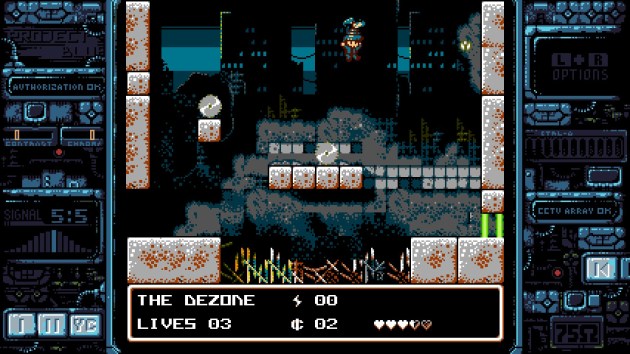
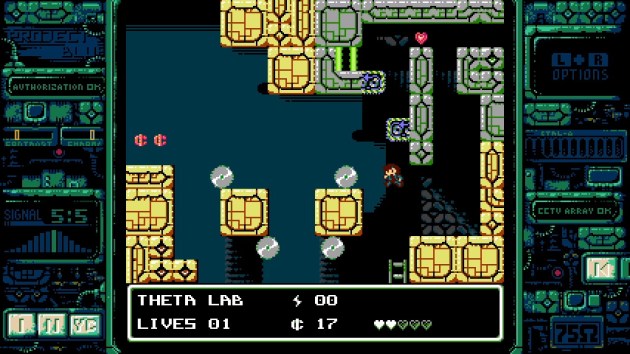
This slideshow requires JavaScript.

Sometimes the decision to make a run for my life was made for me. Not all enemies can be killed, and sometimes you have to weave your way around them while hopping over instakill cliffs AND keeping enough momentum to reach the final platform. Especially once you near the end of the game, the biggest gameplay theme becomes “try not to stop moving.” It’s almost Sonic-like in that regard. And hey, that’s yet another classic game this seems to take inspiration from. That’s the thing about Project Blue: it’s not just borrowing ANY bits from classic games. It’s taking their best parts AND maintaining a sense of originality. It’s really remarkable in that regard, and it also doesn’t feel like it cheated by doing things that modern games would take for granted. It has a minimum amount of enemy designs, like so many NES games do. But, it’s not about how many enemies there are, but rather what the developers could do with them. In Project Blue, their usage is stretched to their absolute limits. Just when you think you’ve seen every possible way the invincible tanks can put up a challenge, you’ll enter a room with a pair of them flying off springs and hitting walls in perfect synchronization. Wow. Project Blue pulls off situations like that all the time, and it always took my breath away.

It’s a looker, too. Lots of tiny little details that give the world a lived-in sense.

Okay, besides those opening paragraphs, this is a little too lovey-dovey of a review, so here’s what I didn’t like: what you see IS what you get with Project Blue. If there’s hidden rooms, breakaway walls, etc, I didn’t find them. There’s only one gun upgrade that has limited ammo. With no permanent weapon upgrades and a linear level design, Project Blue kind of feels a bit on the bare-bones side. It also looks like you’re navigating a series of mazes, but you really aren’t. I figured the game would feature Kid Icarus-style mazes along the lines of the temple levels in that game, but that isn’t the case at all. I never got lost once. For the most part, each room has one entrance and exit. Typically if there are multiple points of entry and exit, they’re blocked off until you zig-zag around in a very linear fashion before coming back to them from a different angle. There ARE moments where I know I could have gone in another direction, typically via some ultra-long jump. But, I didn’t hit those jumps, and I didn’t want to replay Project Blue until I did. I don’t know what I missed, but I’m not going to lose any sleep over it. When I finished the game, as much fun as I had, I was also ready for it to be done. At least with Project Blue 1. If they ever do a sequel, I’ll be first in line.

With rewind/save states, I needed about ninety minutes to beat Project Blue, but mind you, I had beaten the first world three times before. It takes about thirty minutes per world with cheating. Without? Probably an hour per world. Ninety minutes, max.

BUT, if they ever do a sequel, what my challenge to the development team would be is to turn the worlds into genuine labyrinths that require navigation and maps, and maybe even permanent upgrades. I’m not suggesting they do a full-blown Metroidvania. There’s so many of those nowadays that it’s exhausting. Stick with levels, BUT, make them mazes. Clearly the developers have the talent to pull that off. I can’t stress enough: I have NO nostalgia for the NES. I’m a child of the PlayStation/Nintendo 64/Dreamcast era. This isn’t my wheelhouse. The novelty of playing an era-authentic NES indie in 2023 doesn’t mean squat to me. I’m never going to play Project Blue on a cartridge. No, for as minimalist as Project Blue is, it really holds up on its own as a truly great video game experience. Project Blue is intense and exciting and white knuckle. The combat is solid, but the level design shines like few other back-to-basics action games can do. It doesn’t matter if Project Blue feels like it comes from a different time or not, because all its best qualities are timeless.

Project Blue is Chick-Approved
Leaderboard Ranking: #36 of 309 Indie Gamer Chick-Approved Indie Games*
Top 94.4 Percentile of All 640 IGC-Reviewed Indie Games
Top 88.4 Percentile of All 306 IGC-Approved Indie Games
*Rankings based on time of publication. Check the Leaderboard for updated standings.

Project Blue was developed by toggleswitch, FrankenGraphics, and M-Tee
Point of Sale: Nintendo Switch, Xbox, Itch.io

$9.99 sang the blues in the making of this review.

A review copy was supplied for Nintendo Switch. Either a second Switch copy or an Xbox copy will be paid for out of pocket by Indie Gamer Chick. Or, rather her father, who wants to play it too. He’s cool like that.

A Samurai’s Vengeance (Pinball FX Table Review)

A Samurai’s Vengeance
Platform: Pinball FX
Set: Honor and Legacy Pack ($9.99 MSRP)
Included with Pinball Pass
Designed by Zoltan “Hezol” Hegyi
Originally Released June 8, 2023
Awarded a Clean Scorecard by The Pinball Chick Team

For a newcomer’s first designed table, this really feels like it would earn a student an “A”. Really, it’s only compared to other original works in Pinball FX that a Samurai’s Vengeance falls a bit on the bland, conservative side. But, it falls HARD on that side, so much that it nearly missed out on a clean scorecard.

I hope new designer Zoltan Hegyi and Zen Studios don’t take this the wrong way, but A Samurai’s Vengeance felt sort of like a Zaccaria table. Which isn’t to knock Magic Pixel’s pinball stalwart either. They’ve put out many fantastic tables. What I mean is that Samurai’s Vengeance takes a generic theme, hits every single cliché to go with that theme, stretches the mileage one would expect you could get out of it to near breaking point while somehow not managing to include one single memorable shot, and yet the end result still ultimately ends up being a decent table. Sorry for the run-on sentence. Samurai is so by-the-books that it doesn’t feel like your typical non-licensed Pinball FX release. Maybe that’s a good thing, and for the record, I’m a-okay with busting out all the conventional themes and tropes. It’s pinball. If you can’t be unserious in a serious way, you’re doing it wrong.

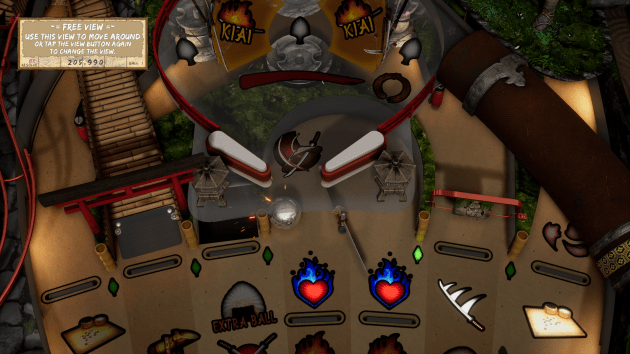
The lack of memorable modes or shots does sting quite a bit here. Like so many Zen tables, a lot of Samurai’s problems come down to modes feeling like a grind. In the course of our dueling, which usually involves dozens of games, we never once activated the Random Fortune. Not a single time. It requires you to shoot the Torii gate a whopping eight times. Why would we even do that when all the important shots for the modes are on the other side of the table? We can spend our time grinding up a random award that may or may not be worth the effort, or we can shoot the swinging door katana sword or the spinner to grind up our strength, and then try to start a mode. We know the modes have value. The other side is just a whole lot of busy work. The multiball requires four balls to be locked, and that’s if the ball lock is even lit. The risk/reward wasn’t balanced properly, because none of us wanted to shoot that side of the table at all. It was too risky when we know that completing the modes yields a final tally of ten million points plus all the scoring that leads up to it. If you’re going to grind, grind the modes, right?

A Samurai’s Vengeance is one of those tables that makes me wish, once again, that Zen would move away from these slow, multi-tiered modes and instead try to replicate the style of pinball’s most profitable and successful era of the 90s. There’s a reason why their most popular tables are recreations of arcade tables from that era: that’s what people like about pinball. A Samurai’s Vengeance has massive pacing issues beyond just requiring so much grinding. When you start a mode, there’s about a fifteen second delay between the mode start and the ball reaching the flippers to start playing again. Mind you, there’s no animation for this. It just takes that long to load. We’re NOT going to get invested in the characters of a pinball table. We’re invested in shooting targets. Now, having got all that out of the way, A Samurai’s Vengeance has good flow, no really offensive flaws, and even a couple gags that gave me a chuckle. I literally said “oh, you bastards” when they happened, but I also laughed. Will you remember it when you finish it? Not at all. Is it decent enough while you play it? Yep.
Cathy: GOOD
Angela: GOOD
Oscar: GOOD
Jordi: GOOD
Dash: GOOD

Bonk’s Adventure (NES Review)

Bonk’s Adventure
Platform: Nintendo Entertainment System
Developed by Atlus
Published by Hudson Soft
First Released July 30, 1993 (JP)
NEVER BEEN RE-RELEASED

Despite being very stripped down from the TG-16 original, Bonk NES is actually one of the best looking games the console ever had. There’s an alternate universe where Bonk never came out on the TG-16. Where THIS is the first Bonk, it came out in 1990 instead of 1994 (in the US at least). In that universe, I imagine Bonk is a certified NES legend.

NOTE FROM FUTURE CATHY TO CATHY IN THE PAST: STOP committing to theme months before knowing if you can muster up the enthusiasm to write a full review you dumb ass! So yea, no Bonktober. Maybe I’ll get to Revenge in October, 2024.
-Yours Truly.. well, Yours Truly.

You’ll note that I’m not going in chronological order for Bonktober. If I were, Bonk on the NES would be the fifth game I’d be reviewing this month. However, only the NES game (and some home PCs, but I’m not playing those) tries to be something resembling a direct port of the TurboGrafx-16 original, so I opted to play both back-to-back. It’s really the only true port of Bonk during that era, despite the coin-op and Game Boy titles having the same name. Along with Super Bonk, they’re all entirely original games. Meanwhile, the NES carries over as much of the level design, enemies, bosses, and set pieces from the first game as the Famicom could handle without catching fire. Imagine that: the entire PC Engine trilogy of Bonk released before this NES port of the original Bonk’s Adventure debuted. Incredibly, the game that was pegged as the killer app for the American side of NEC’s efforts ended up as one of the final globally released NES/Famicom games. That doesn’t really mean anything in the grand scheme of things, but I found that fact to be an oddly fitting historic quirk.

Remember that the Famicom/NES and the PC Engine/TurboGrafx-16 are very close cousins in terms of architecture, so it’s no surprise that the NES can come so admirably close to replicating the original’s striking looks.

Remarkably, NES Bonk is still Bonk. It looks the part, with some of the best graphics on the NES, especially for a platformer. Bonk was one of the most colorful games of the era, and I figured the NES would look drab. But, their choices of color palettes were especially wise, with various shades of brown and green that work with the prehistoric theme. I’m THIS CLOSE to saying it works just as well as the colorful TG-16 build. Bonk retains enough charm to count as.. well.. charming, and even managed to keep all the bosses, though a couple play slightly different. This is a really close approximation of what Bonk was on the TG-16. A very impressive effort. So, why isn’t Bonk more recognized on the NES? And don’t tell me it has to do with the late release.

Okay, the late release factored in for sure, but there’s more.

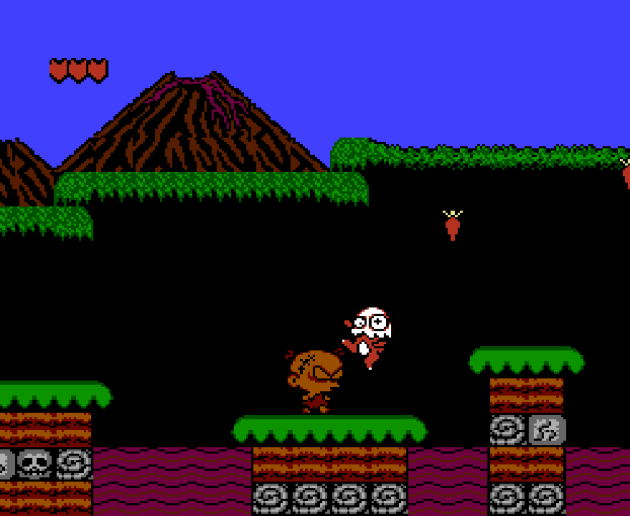
The climbing and swimming controls are, in my opinion, much better on the NES. Sadly, the creepy-ass flower whammies aren’t so much creepy as they are pitiful now. Yea, that’s one in the picture. Sad.

Bonk on the NES has a overall smaller feel to it. There’s levels that have been cut from the TG-16 version. The ice level that actually surprised me with its quality on the TG-16? It’s gone. There’s a memorable segment on the TG-16 where a level immediately starts with a collapsing bridge that leads directly to the level’s exit, but if you don’t make it across, you have to play a swimming stage. That’s gone too. While I mourn the ice stage’s loss.. I never thought I’d say those words.. it really feels like a lot of the gristle was cut from Bonk. On the other hand, the combat that I loved so much feels significantly muffled on the NES. Oddly, the OOMPH is retained, but it’s the enemies themselves that are less fun to fight. They’re smaller, come in lesser numbers, and easier to manage. When you’re powered-up, you can clear the entire screen of baddies just by performing a diving headbutt to the ground. The NES Bonk feeds into my notion that Bonk is meant to be baby’s first platformer.

Probably the best swimming controls on the NES. No button mashing. Just move, swim, and attack as needed. You can even jump underwater while you’re swimming. It’s very nice.

Oh, it’s still fun. I’m giving it a YES! and everything. But, while the three main methods of combat are still every bit as excellent on the NES as they were on the TG-16, the scaled down enemies lead to Bonk NES almost completely lacking in urgency. It’s not as if Bonk was white knuckle to begin with, so the fact that what little intensity it had has been further scaled back stings quite a lot. Oddly, the NES build does have some technical improvements over the original, but all those do is further simplify the game. The biggest positive change is that collision detection feels more accurate on the NES. It controls better, too! The swimming is faster paced, and the climbing is a cinch. Other “improvements” actually hurt. The “bonus stage” flowers stick out like a sore thumb on the NES, which meant I had racked-up over twenty extra lives that I didn’t need. I only died twice the entire time. Once against the third boss, and once against the second-to-last boss. All the bosses feel easier, though, and while the scale of them is shockingly retained, they are nerfed. The second boss doesn’t create a clone of itself, and the final boss seems to have a much more generous collision box.

This slideshow requires JavaScript.

I wouldn’t go so far as to call Bonk on the NES a lost classic. Even during those moments where you think to yourself “hey, this is slightly better than the more advanced TG-16 version” you’ll always wish you were playing the original build. I really don’t understand why they made the decision to attempt a port. Look: it’s hella impressive that the NES could even have a game that runs this closely to what is arguably the game that sold the most TurboGrafx-16s in America. But, at the point when this was released, I think it’s a safe bet that most people who REALLY wanted to play it probably found a way to do so. It’s not like this was an arcade port. The NES is not the TG-16 and Bonk’s Adventure on the NES, as good as it is, is also a reminder that paying tribute to the spirit of the original game is always preferable to attempting a port you can’t possibly run. With that said, when the inevitable Bonk Collection hits, I hope they include this, because it’s worth a look, even if only as a historical curio.
Verdict: YES!

Bonk’s Adventure (TurboGrafx-16 Review)

Bonk’s Adventure
aka PC Genjin (aka BC Kid in Europe)
Developed by Red Company Corporation & Atlus
Published by NEC
First Released December 15, 1989 (JP)
Included in the TurboGrafx-16 Mini
NO ACTIVE RE-RELEASE

Few first installments in a franchise hold up this well. Usually, they’re little more than a proof of concept. But, Bonk’s Adventure set the bar so high that future games in the Bonk franchise had to go wild right out of the gates.

Yesterday, I talked about NEC’s baffling choice for the TurboGrafx-16’s pack-in: Keith Courage in Alpha Zones. Here’s the game NEC wishes they could have had instead. In fact, I wouldn’t be surprised if they were counting on it, but the US translation got held-up, like everything else about the TG-16. My theory is that NEC didn’t expect the PC Engine to catch fire the way it did in Japan, to the point they even briefly held the title of Japan’s best selling game console (in terms of monthly sales, not lifetime). By the time they realized they had an actual hit product, they had no infrastructure in place for a US launch. Despite the fact that they sold 500,000 consoles in their first week, it took NEC a few months to say “gee, maybe we should try this out in the US.” Then, when they finally got around to it, NEC seems to have hired people who heard the expression “a camel is a horse designed by a committee” and said “gentlemen, we ARE that committee!” Unable to see the big picture, they wasted FOREVER redesigning the physical appearance of the PC Engine. See, focus testing told them that Americans cared most about having a physically large box that played games and looked futuristic. Apparently they’d never heard of the Atari 5200. So, instead of shoring-up software and US partnerships, they focused all their US operations on redesigning the actual look of the console, along with picking a new name for it. One of the biggest “can’t see the forest for the trees” situations in gaming history.

In the days before social media, too many games had alternate regional names that made global branding next to impossible. In Japan, Bonk is known as PC Genjin. In Europe, Bonk is BC Kid. Also, in my head canon, the bad guys are Dizzy’s racist relatives.

If you need proof of NEC’s ineptness, ask yourself “how come Bonk didn’t launch with the TG-16.” Yea, I know it didn’t come out until April of 1990 in the US, but why? When NEC saw Bonk’s Adventure coming along, they should have thrown all their resources towards making sure it was there for the nationwide US launch in November, 1989, and they should have based their entire marketing campaign around it. There’s no way it would have been ready in time for the August 1989 test marketing of the TG-16, but Bonk came out in Japan in December of 1989. That was only one month after the full US launch of the console. It feels like this is a situation where they could have got in under the wire and actually been able to compete with the Genesis and Altered Beast. Remember, there’s no Sonic The Hedgehog to bail Sega out in November of 1989. In fact, Super Mario Bros. 3 hadn’t even been released in the United States yet, and the Super NES is but a future dream. Bonk could have conceivably made kids say “instead of a Game Boy/Genesis, I want the system that plays Bonk!” Even head-to-head with the Genesis, Bonk should have given them the edge they needed. Altered Beast v Bonk? Come on! Bonk every time! Platform games were #1 genre, and Sega wouldn’t even have Castle of Illusion for another year. It IS the killer app the TG-16 desperately needed, but it wasn’t ready, and the TG-16 was steamrolled in the United States.

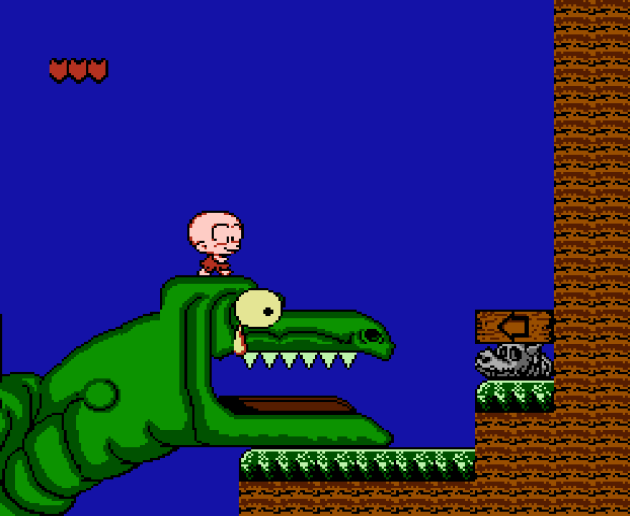
While I don’t think the level design is ALWAYS spectacular, all credit where it’s due for having several memorable sequences. Though, with how this dinosaur plays out, doesn’t that TECHNICALLY mean Bonk is poop from that point forward?

And the shame is, it really IS the killer-app the TurboGrafx-16 desperately needed. Bonk is a big step above a typical mascot platformer from the era. It came up with a novel idea: you play as a caveman with an enormous head who uses it for headbutting. That noggin of his is the basis for maybe the most satisfying combat of its type the platforming genre has seen. Instead of simply jumping on enemies, you can attack them three ways: a standing headbutt, a jumping headbutt (this one doesn’t even require the attack button!), and a diving headbutt. With just three attacks, Bonk’s Adventure gives you plenty of flexibility to do battle with a remarkably fun variety of enemies. The combat is a little deeper than you’d expect, too. The diving headbutt does more damage than the other two attacks, but if you miss, you’re left vulnerable from, you know, braining yourself on the earth below you. Regardless, the OOMPH from these attacks is cathartic and never gets boring. This is helped along with spot-on sound effects, including pinball-like chimes when the killing blow is struck. I love it.

Bonk uses his teeth to help him climb. I’d make a joke but I just found out that climbers actually do this (even if they’re not supposed to). Well, presumably mountain climbers probably don’t use their teeth on the mountain itself. Bonk is hardcore like that. Although if I ever get around to climbing Everest, I promise to use my teeth at some point.

The diving headbutt further has a twist in that you can cancel it mid-air. Do it fast enough and you can essentially glide slowly through the air. Back in the day, the original TurboGrafx controllers had auto fire. I discovered through my TG-16 Mini play session that you can positively cheese many sections of the game with this. As far as combat, it turns all interactions with enemies into a coin flip. Heads: you score the diving headbutt contact. Tails, you take damage, because you weren’t upside down when the contact was made. While the coin flip happens during boss fights as well, it also effectively cheeses them, since you essentially spin mid-air above their hit box and bounce upward with every hit. It also completely nerfs the minigames AND takes the difficulty away from nail-biting long jumps. When I played Bonk games on the Mini, I used autofire. This time around, I didn’t, and besides things like climbing, I had a better time without cheesing the game. The only time I was tempted to turn it on was fighting the very last boss, who is a bit of a bastard. But, fun to battle, like all the bosses are. They were also the only parts of Bonk where I actually died. It’s a pretty easy game that feels like it exists to say “hey everybody, LOOK WHAT THE PC ENGINE CAN DO!”

This slideshow requires JavaScript.

And boy does it do it. Bonk flies right on by with its excellent combat, fun set pieces, memorable characters, and pretty good level design. Even the swimming and ice stages are really well done. When do you ever hear me say THAT about any platformer? Jeez. The swimming is really smooth and doesn’t require button mashing. The ice stages have giant ice cubes that you basically ride, and it’s delightful when it happens. Bonk has charm without feeling like it’s trying too hard. Well, except the meat. That’s the game’s power-up, and it apparently makes Bonk angry. Two of them grant you invincibility. And, during the final level of the game, Bonk’s Adventure spit out so many pieces of meat that I basically got a free pass through the final stage. It kept giving them to me even as I was already blinking from the invincibility. It was such a strange decision to make on what is supposed to be the final challenge leading to the last boss. It’s even worse though because there’s an annoying-yet-unskippable animation that happens when you eat the meat. Now, imagine that happening every, oh, five seconds for a good chunk of the final level. Yea, that really put a damper on what should have been the moment where Bonk’s Adventure was spiking the football.

Is it just me or does Bonk look like Calvin from Calvin & Hobbes when he powers-up?

Another interesting decision that I think was probably a bad idea was to have the diving headbutt freeze all enemies on the screen in both powered-up forms. I’d been fine with it being an ability the maximum-powered-up Bonk can do. But, both powered-up forms? Really? At first I thought it was far too overpowered, but then I played the NES version of Bonk, where instead of freezing the enemies, it just automatically kills everything on the screen. Okay, fine, yes, THAT is far too overpowered and the “turn to stone” bit that this version of Bonk does is only marginally overpowered. Still, it feels like Bonk is designed to be baby’s first platformer. And that’s fine, by the way. It’s always preferable that a game be too easy than be too hard, because at least when it’s easy, everyone can enjoy a game to its fullest potential. The fact that Bonk is a joy to play even three-and-a-half decades later speaks volumes to its greatness. It really is something special.

There’s a child-like glee that comes from the combat. Bonk is proof that there’s no substitute for charm.

Okay, so the collision occasionally made me give the game the side-eye. Also, being a stickler for first levels in games standing out and grabbing my attention right out of the starting gate, I have to admit that Bonk’s Adventure has one of the worst first stages of a great game in the medium’s history. It’s really flat and uninteresting. I get that they had to make things simple so that players could get a feel for the rules. Bonk’s combat, especially for the era, was as non-traditional as it gets, and perhaps they didn’t want to overwhelm players. Still, I think they were too conservative and probably should have had a little more faith. And now I feel unclean, because I literally had to look for things to whine about. No, folks, Bonk’s Adventure is truly the forgotten killer app of the 8-bit/16-bit era. The definitive slipped-through-the-cracks-of-history mascot platformer that could have/would have/should have been bigger than it was. If it had come out just five months earlier, it might have been. Alas.
Verdict: YES!

Keith Courage in Alpha Zones (TurboGrafx-16 Review)

Keith Courage in Alpha Zones
aka Mashin Eiyuuden Wataru
Platform: TurboGrafx-16
Developed by Advance Communication Company
Published by NEC
Released August 29, 1989
NEVER BEEN RE-RELEASED

Keith Courage looks kind of like Pidge from Voltron, doesn’t he? Oh, and fun fact: Keith Courage, and the TurboGrafx-16, came out in the US exactly fifty days after I was born.

When NEC launched the PC Engine in the United States on August 29, 1989, many people didn’t know what they were thinking when they chose Keith Courage as the pack-in game. Well, *I* know what they were thinking. They were thinking “in thirty-four years, a girl named Cathy Vice will look back on this and think we were incredibly dumb idiots, bordering on blithering.” They were soothsayers, in case you didn’t know. Incredibly dumb idiots, but genuine clairvoyants. Indeed, one has to imagine that few companies kicked themselves as hard as NEC must have in the late 80s and early 90s. Released in 1987 in Japan, the PC Engine clobbered Sega’s Mega Drive and even briefly held industrial leadership over Nintendo’s Famicom. NEC seems to have been caught off-guard by their own success and bungled the global rollout of the console us westerners know as the TurboGrafx-16 every single step of the way. They squandered a potential two year head start on Sega, who beat them to US test marketing by two weeks. Sega also had Altered Beast packed-in with their console. I don’t like Altered Beast, but I also wasn’t around. It had arcade familiarity, massive character sprites, and looked cutting edge. The TG-16 was packed with Keith Courage in Alpha Zones. And it sucks.

It’s not even really called “Keith Courage.” This is based on a property in Japan known as Mashin Hero Wataru.

NEC’s test launch of the TG-16 only had four games. Along with Keith Courage, there was an arcade racer called Victory Run, a video pinball title called Alien Crush that’s often cited as among the best the genre had seen in that era, and a hugely critically acclaimed action platformer called Legendary Axe. That last one swept up several Game of the Year awards from major publications (undeservedly so, in my opinion). If we pretend they couldn’t have pooled from their massive Japanese library for more software and were limited to only the four launch games, it’s arguable they picked the worst one to bundle with the hardware. The only way I could logically spin it was NEC’s US team recognized it was the worst of the four and nobody would buy it on its own, so they said “screw it” and made it the free game. What’s really strange is the three games they didn’t choose look and sound better. When your only competitive edge is the graphics, picking a game that doesn’t look particularly advanced over the NES isn’t wise. It looks more colorful. That’s about it. Being more colorful isn’t a big advantage. Just ask Sega, since that was their edge with the Sega Master System.

For a pack-in game, NEC chose a game with 100% bland level design, 50% of which is extremely slow, plodding “action.” Oh, and the part that’s slow also requires grinding, since that’s the only part of the game that currency drops, and you absolutely NEED that currency to prevent enemies in the fast-paced sections from being spongy. Holy crap, what a boring game. Since you’re going to have to grind either way, grind several thousand bucks up on the stage that drops golden cats on you. They pay off the most. Of course, you might have to wait forever for one, but the non-gold ones pay off too.

You have to slog your way through seven levels, each of which is split into two segments. The first has you walking around as a human with a little nubby sword, killing a variety of enemies to grind up money. Money can ONLY be found in human stages, along with shops that refill your health, sell you ammo for the secondary weapon, and most importantly, upgrade your sword. The level design for these stages is total amateur hour crap. Things like having you hop across lava and just accept that you have to take damage. Do I even have to say why that’s stupid? There’s no actual challenge to it. It’s an automatic life drain that isn’t hard to make it across. It just forces you to refill your health with the nurse, who is right there on the other side. Normal coins are worth $50, and a health refill from the nurse costs $400. So it’s really just an excuse to make you grind up more money. That type of design is all over the human stages of the game. Enemies fall from the sky while your movement speed and the level layout mean there’s no way to climb up a building without taking damage.

Thankfully, I found a few spots where I barely had to move. Like this spot here? The enemies continuously respawn, even if I stand still. While not every kill results in a coin drop, this spot here went even faster than the golden cat section, and for less work, too. The grinding isn’t insufferable thanks to the currency being set high enough, and the most expensive weapon is only $4,800. Well, unless you wait to buy it on the final stage. I nearly crapped myself when I saw the last sword was over $9,000. However, I then realized it was the “Alpha Sword” which I had already gotten from level 6’s shop.

By the way, the swords you buy in the human stages aren’t used in them. You don’t need them to be, since every enemy dies from one hit on these sections. Once you clear the ultra-ultra bland human stages, you move on to stages that return blandness to normalcy. In them, you transform into what looks like a hyper-deformed Gundam character. The stages with these characters feel so different that it’s almost like two completely separate games were surgically attached to each-other. Despite the fact that you’re now a relatively bad-ass looking robot, you don’t really do any robot things. It’s still a hack ‘n slash platforming game, but the action is much more satisfying. The pace quickens by a significant factor and Keith Courage turns into an average-for-the-era action platformer.

There’s only a small handful of enemies in these stages.

Honestly, I think I would have liked Keith Courage better if it had just cut out the human stages. Maybe just re-balance the enemies and remove the “grind up new swords” aspect. Or hell, reward the player with a new sword for beating the boss. Maybe the game wouldn’t have lasted as long, but it would have been preferable to having deliberately slow, deliberately dull gameplay for the sake of contrast. In the robot stages, level design is maze-like and requires you to zig-zag your way underground until you eventually reach a boss. Instead of dropping coins, enemies will drop hearts or numbers. The numbers increase how many of the sub-weapon you throw at once, while the hearts fill up your health and, seemingly completely at random, give you an extra hit point. I couldn’t figure out any reason or even logic to how they give you extra health. It just happens.

It gets so bad that the game just recycles bosses as normal level enemies. Like seriously, the final level consists almost entirely of bosses filling in as normal enemies.

Despite the fact that Keith Courage has two vastly different feeling platform “engines” at play, I was stunned by how samey each of the levels feels. The action stages, especially. They’re very repetitive, with a lack of interesting visuals and only a small handful of enemies to deal with. It makes for an exhausting experience. When the “action” stages become more sprawling, they also introduce some cheapness in the form of blind jumps with instakill spikes in the vicinity. Combine this with very forgettable bosses, and now I’m wondering if I was right that NEC anticipated nobody would want Keith Courage, which is the only reason it was given away for free. It’s really haphazardly programmed too. When the time came to fight the final boss, the f’n thing didn’t move a single inch and just stood there while I hacked it to death. It didn’t even fire a projectile at me. I found out this is a known glitch, but the thing is, it’s not even a hard one to trigger. Just hold right when you fall into the boss arena, I guess. I don’t even think I did that. I think all I did was jump into the hole that I didn’t even know yet was the hole to the final boss arena. This is the type of bug that even basic play testing should have found, and they had a full year between the Japanese and US releases to squash it.

This is it. The final “boss” and I use boss in quotation marks because it literally didn’t move. Apparently, I inadvertently triggered a known glitch.

Keith Courage is proof positive that you only get one chance to make a good first impression. I really can’t justify how anyone in charge selected this of all games to be the title that would launch their console. Maybe they thought Nintendo’s lead was insurmountable and they were happy to scratch-out a decent profit, but I call BS on that. They had soundly beaten Sega in Japan by having superior software, and they had taken a huge chunk out of Nintendo’s market share. Even if it was under-powered compared to the Sega’s Genesis, NEC should have had a lot more confidence than they showed. Bundling Keith Courage feels like a white flag of surrender, because this game, at its absolute very best, would be a lower B-tier NES title. Not exactly a flagship piece of software that signals to consumers “see! We are taking the fight straight to Nintendo! You can trust us! We have confidence in our software!” Maybe they were counting on Bonk’s Adventure as probably the best chance the TG-16 had to dethrone Nintendo, but it wasn’t ready by launch. See though, neither was Sega’s Sonic, but they still bundled Altered Beast, a game people wanted, to hold the fort for the killer app. NEC could have done that, and they had a variety of options. TG-16 knowingly bundled mediocrity, and gamers responded accordingly. Meanwhile, in an alternate reality, the TG-16 was bundled with Legendary Axe and gamers today are fighting over what’s better: the Sony PlayStation or the NEC Xbox?
Verdict: NO!