The Blues Brothers (NES Review)

The Blues Brothers
Platform: Nintendo Entertainment System
Released September, 1992
Developed by Titus
NEVER BEEN RE-RELEASED

I will never know joy again.

I go through extended periods of melancholy. If my rate of game reviews slows down, that’s probably a sign that I’m currently having an extended case of the blues. I try to avoid reviewing games when that’s happening because it’s just plain not fair to the games. The bitch of it is, it’s never clear when it’s over. It’s the most quiet recovery phase imaginable, and it’s so frustrating. You can imagine how tough it is to play a bad game when this is happening because it’s never clear if it’s ME or the game. Thankfully, Blues Brothers on the NES is so bad that I don’t have to guess. I used my emulator to select a random game and it gave me Blues Brothers, making me believe the universe really is a simulator and the person playing the Cathy game is trolling me in the same way I did when I fenced in people while playing the Sims. It took about a minute of playtime with Blues Brothers before I said “even my emulator hates me.” Blues Brothers is absolutely abysmal. A series of cheap shots, GOTCHAs, unavoidable damage moments, last pixel jumps, and terrible level design.

This is one of those games that looks fine in screenshots. But playing it is the pits.

The problem is Blues Brothers wants to have sprawling, labyrinthine level design, but it doesn’t quite understand how to go about doing that. There’s so many sloppily-executed jumping puzzles that make no sense, with no semblance of elegance to their design. There’s far too many moments where it’s not even clear what direction you’re supposed to be going. In place of cleverness, Blues Brothers keeps going to the same handful of unimaginative tricks. There’s too many blind jumps, which is probably my least favorite type of bad design. Blues Brothers relies so heavily on blind jumps that eventually I don’t think you could consider the jumps blind anymore. I was able to anticipate when they were coming. Not so much with the other trope: last pixel jumps. It’s not unusual for both types of crap jumping segments to be combined: last pixel blind jumps. Oh, and don’t forget that they often end those necessary blind jumps with enemies placed at the end that you can’t see coming and that you can’t really avoid. Often, it’s possible those blind jumps, when missed, could result in you falling back to the beginning of the level and having to start all over. Thank god for save states and rewind. I’d never had the patience to finish this otherwise.

I think there were maybe two parts in the entire game where riding animals worked the way I think it was supposed to. Mind you, there’s a lot more of these creatures you can piggyback onto, but they didn’t do anything and often just dropped dead.

And it’s kind of glitchy, too. There’s a few animals you can “ride” but they don’t really do anything when it happens and just as often just immediately die and fall off screen. Sometimes the enemies seem like they get caught on a pixel and wiggle back and forth in place. None of the enemies feel specifically themed to the IP, though. The levels I think try to be as there’s a jailbreak scene, but they look so drab and plain. It’s not exactly an ugly game, but it often feels like this could have been anything. Oh, and moving platforms aren’t synced right, but this does contribute to the one semi-clever bit in the entire game. There’s a moment in the final level where there’s multiple moving platforms that all intersect with each-other, and you have to figure out which is the right one. Okay, that was cool, but the moment passes quickly and then it’s back to the same blind jumps and last pixel jumps. You have to use B-run/B-jumping, but you move too fast and the controls are too loose for a game that demands this much accuracy. Having the game end with moving platforms surrounded by spikes before the non-ending ending was the final slap in the face. This is one of the worst games I’ve ever reviewed.

This is how the final level of the game starts. Your minimum jumping height is more than enough to hit those spikes. I spent several minutes rewinding and replaying this, jumping from every angle trying to avoid the spikes, and I came to the conclusion this is just an automatic loss of a health point. It just sucks. This game is horrible.

I don’t have much more to say about Blues Brothers as a game. They weren’t even trying to be fun. They were being sadistic just for sadism’s sake. Five terrible levels of lifeless, boring blind/last pixel jumps, with pretty much nothing else. You can’t defeat enemies. There’s no trinkets to find. Just find the unmarked exit to the level and that’s it. It’s really lazy, actually. There’s no bosses, either. Levels and the game itself just end anticlimactically. I have nothing positive to say here. It doesn’t even really work as a Blues Brothers game. It feels like a completely generic template that an out of touch producer got the license for. “Guys, you won’t believe this, but we finally outbid Konami, Capcom, Nintendo, Sega, everyone, for a hot ticket license that kids will love!” “What is it? Disney? Nickelodeon? Disnelodeon?” “Blues Brothers!” “As in.. Blues Brothers? The Saturday Night Live sketch starring a guy who died before most NES owners were even born?” “Did I say kids will love it? Sorry, my dentures got caught in my throat. I mean their parents will recognize it as a thing they enjoyed when they were stoned on Saturday nights in college and buy it for their kids, because kids always love the outdated pop culture their parents enjoyed in their youth.” See also 20th Century Fox’s Atari 2600 output. That mentality lived well into the NES era.

This slideshow requires JavaScript.

My question is why would you get this license only to do a lazy platform game? If you’re going to make a game based on a comedy music act, shouldn’t that game be, you know, musical and funny? Why would you just make sprites based on the characters? Besides music notes restoring your health, there’s no music theme to this, nor are there any sight or sound gags. None at all. Maybe the bad design was meant to be ironically funny. Nah, that’s far too clever for this. I’m not going to say “this license deserved better” because I don’t know it all too well. I only recently saw the 1980 film for the first time, and I’ve never been able to make myself watch Saturday Night Live from before I was born. I feel like most of the sketches are “you had to be there” in nature. My experience was limited entirely to the sequel, which I saw once, when I was 8 years old. I was bored with Blues Brothers then. I was bored with it now. But, if you’re going to make a Blues Brothers game, I would think the first two steps were “be musical” and “be funny.” This is just generic template 385-B, with sprites made to look like John Belushi, who I imagine is spinning in his grave, though that could be residual from the speedball that killed him. So much for being out of my melancholy phase, but with a game this bad, how the hell can I tell?
Verdict: NO!

Panic Restaurant (NES Review)

Panic Restaurant
Platform: Nintendo Entertainment System
Released April 24, 1992 (JP) October, 1992 (US)
Designed by Kenji Eno
Developed by EIM Group
Published by Taito
NEVER (?) BEEN RE-RELEASED

It’s a looker, but those excellent (and large) sprites come at a steep cost.

A few months ago, I posted a fairly scathing review of Sunman, aka the Superman game by Sunsoft that lost the Superman license, then ultimately never released. I’ve wanted to review this game ever since because it’s probably the best 8-bit title developed by Kenji Eno. The man who would later go on to develop the landmark survival horror D games had tragically died in 2013 at only the age of 42. I didn’t want the only game of his covered in my little corner of the internet to be something I was so highly negative on. I want to celebrate the legacy of a man who devoted his life towards creating entertainment for others and who left gaming better than he found it. Maybe someday I’ll do a review of D, but today, I’m looking at his first unambiguously good game. Panic Restaurant isn’t important to the history of games. It’s just a short, solid hour-at-best hop ‘n smacker where you play as a chef who has to stop an evil Waluigi-looking chef. Which is strange because pop culture has taught me that all chefs are inherently evil.

You automatically lose weapons between each stage. Had this not been the case, I’m not entirely sure I’d have taken a hit in many areas. The spoon is the most common pick-up and is effectively a ranged longsword that I thought was the best weapon in the game.

Okay, so the premise is slightly generic, made even more so by the fact that, while the last boss is an evil chef, almost all the other bosses and basic enemies are food items. Because it’s a restaurant, you see. A gigantic one that has its own forest and ice caverns, I guess. It’s not the most inspired idea, but at least the action is good. Instead of jumping on enemies, you whack them with a weapon. You start with a skillet that has limited range, but alternatives are everywhere. The catch is you can only have one at a time, with no sub-weapons. In addition to the sword-like spoon, you can get unlimited plates that you can throw at enemies like freebees and a fork that works like a fairly hard to control pogo stick. The first time I went to use it, I took damage and reverted back to the frying immediately because I didn’t jump as high as I thought I would. It’s easily the worst weapon in the game. The combat in general is never as impactful as you would hope, and really is just barely decent enough to satisfy.

Getting a pot makes you invisible for a short amount of time, but you don’t move as fast as you’d want. There’s no run button, either.

While Panic Restaurant’s sprite work is charming, the limitations of the NES probably prevented better death animations or OOMPH to the various weapons. That sprite work also comes with a massive downside: massive amounts of slowdown. Panic Restaurant suffers from a ton of frame rate collapse, and unlike titles like, say, Mega Man 2 or 3, it never works in service to the action. It just causes an already somewhat slow game to come dangerous close to plodding. That was sort of the theme for my play sessions. Every bad element is just barely tolerable enough to not hurt the overall experience, while every good element is just barely good enough to carry the game over the finish line. It’s kind of remarkable how consistent that was. Five out of six levels were okay, but nothing special. The boss fights too, and the combat, as previously stated. This game is DECENT in gigantic capital letters, in a way few games really are.

The fifth level, set on slippery ice because that’s required for all platformers, was easily the worst part of the entire game.

Meanwhile, with the exception of the slowdown, most bad things only happen once. One cheap shot from an enemy placed just above a ladder you MUST climb, without being given enough room to avoid it, then it never happens again. One last pixel jump. One bad level. One bad boss fight. Sadly, that bad boss fight happened to be the last boss, where the game decided the only way to feel climatic was to give you a unique weapon (eggs) and have both you and not-Waluigi in the sky riding flying pans. It wasn’t very good, and then the game just ended. If not for the unskippable end-of-stage slot machines, segments that take FOREVER (and I barely ever won on them unless I was already maxed out on health) I think I could finish this in under thirty minutes.

Yet another game that has more McDonald’s menu items than all the McDonald’s games put together. This boss was the closest I came to dying, as I ultimately was down to my final heart.

I didn’t find any of the “hidden” mini-games fun.

It’s also one of the easier games I’ve reviewed in 2024. I never died this entire playthrough, even with a few cheap hits. This feels like a game with a much younger audience in mind, at least until the ice level, which has some brutally unforgiving timing-based sequences. Thankfully, the ship is righted for the final level, unlike Taito’s sequel to their first Flintstones game, where an excellent children’s game becomes insane in the final challenge. Otherwise, this kind of feels like it’s in the same boat as Surprise at Dino Peak, where I suspect that if Panic Restaurant had come out a year or two earlier than it did, it would be remembered as one of the better NES games. Even if I don’t necessarily think it is that good, it has broad appeal with lots of charm. Yea, so it’s not the most complicated game, but Panic Restaurant is solid thanks largely to level design that is just varied enough that it never gets boring and just challenging enough that you can’t play completely on cruise control. Besides the pogo-like fork, the collision is pretty good, enemy designs are mostly good, and it certainly doesn’t overstay its welcome. It’s a reminder that Kenji Eno was the real deal. Had he been alive today, you can’t help but wonder if he’d see a movie like The Menu or TV shows like The Bear or Hell’s Kitchen, then remember that weird NES platformer he once made about a chef fighting sentient food and say “hmmmm.. what if I turned that into a horror game?”
Verdict: YES!

“I’ve got to find a better agent. I wonder who Wario used?”

Streets of Rage 1 & 2 – Sometimes It’s Just Hard to Review Video Games

I intended for this to be a Definitive Review on the Streets of Rage series, but I pulled the plug after playing six games when I intended to review nine total (with Comix Zone and a Streets of Rage mod thrown in). I’m just here to have fun and find neat things about games to talk about. But, I also accept that not every game is worth reviewing because I might not have anything particularly interesting to say about it. This can apply to good games and bad games. Perhaps it was an ominous sign that the original Streets of Rage wasn’t included in any global version of Sega Genesis mini or its sequel mini-console, but that’s not a sign I got. After I played it on my computer, I dusted-off my mini-console and grabbed my nephew to play co-op with me. And then I was stunned and confused when it wasn’t on the Genesis Mini. Wait, there’s no way they left Streets of Rage off the lineup.. right? Yep, they did. The first one at least. Streets of Rage 2 is in the first Mini while Streets of Rage 3 is the Genesis Mini 2. The first game, which launched what is one of the most recognizable classic Sega franchises, didn’t make the cut. Now granted, Sonic the Hedgehog 3 isn’t in either mini, and Michael Jackson’s Moonwalker didn’t make it in for licensing reasons. But, really? No Streets of Rage 1? And then I played it, and I was just very, very bored. Including only Streets of Rage 2 in the first mini was probably a wise choice. It is the good one.

I’m still nothing short of flabbergasted that Streets of Rage isn’t included in either version of the Sega Genesis mini. I literally plugged mine in without checking the lineup first, CERTAIN it had to be in it. It’s Streets of Frick’n Rage! Even if it aged badly, so what? One of the most jaw-dropping snubs in the relatively recent mini-console fad.

I don’t have a lot to say about the first Streets of Rage. There’s just not a lot to it, you know? There’s three characters, each with a limited move set, traversing mostly bare-bones levels while mostly fighting the same handful of enemies in unmemorable settings. During levels, I counted a total of three extracurricular elements in the entire game: a brief series of gaps that you can throw or knock enemies into, a half-elevator that you can maybe throw your enemies off of but it’s hard to do without them simply hitting the rail, and a stage with hydraulic presses. All the stages are straight lines, too, unless an elevator is involved, and that’s functionally just a static room, right? I’d say the best part is that you can grab enemies from the front, flip over them, and suplex them, but all the characters have that move. This might have been better when it first came out, but today, in 2024, Streets of Rage feels like little more than a proof of concept for Streets of Rage 2. Solid violence, but done in the most boring and basic of ways. Really, that’s my review in its entirety. It’s just a nothing game. And one that I wasn’t done with yet, because I had two mediocre 8-bit ports of an already mediocre game to go, not to mention two sequels and the two 8-bit ports of the first sequel.

This slideshow requires JavaScript.

Of the six games I played, ONE was pretty dang good: Streets of Rage 2 for the Sega Genesis. Universally held-up as an all-timer, and it deserves it. Four characters instead of three, with a much larger variety of moves, and the ridiculous bomb is replaced by two health-draining special moves (one done while standing still and the other done by moving). By the way, Streets of Rage’s bomb is the most flow-killing bomb I’ve seen in a game. When you activate it, you summon a cop who drives a police car a distance behind you, who then steps out of the car and fires a rocket launcher from a distance to blow up the screen. Funny the first time because it’s just so corny, but less funny with each subsequent usage because it just stops an already sloggy game dead in its tracks. The smartest thing Sega did with the sequel was kick it to the curb, and with all the additional characters and moves (plus the fact that I could play it co-op on the TV with my nephew), I had fun with Streets of Rage 2.

I typically like using large guys in games like this, but they also tend to break my immersion when they’re able to use weapons like metal pipes or even goddamned swords. Max is twice as big as most enemies and built like the Incredible Hulk completed 95% of his transformation but the part where he turns green failed to load properly. By all rights, when he strikes an enemy with a gigantic metal pipe, it should reduce that enemy down to a puddle of sticky wet molecules. And the sword? It should cleave the poor SOB he hits in half.

But, the second Streets of Rage still suffers from being really generic. Don’t take it personally, Sega fans. I feel the same way about Violent Storm and Final Fight. All these games are kind of samey with enemies and set pieces that feel interchangeable. Streets of Rage is more famous for its soundtrack than its gameplay, and yea, the soundtrack is good. But, I don’t find the characters particularly memorable. I think if you gave a controller to someone who couldn’t see the title screens and had them play the Streets of Rage games, the Final Fight games, and Violent Storm, they could very well believe they’re all from the same series. My brain is already mixing them up, and I literally just played through six variations of two Streets of Rage games. I don’t think I could name every boss fight. Hell, the one character in the whole Streets of Rage series that stood out the most was a boss that literally looks exactly like the famous professional wrestler the Ultimate Warrior, face paint, tights, and all. I almost said “that’s really random and unexpected” but then I remembered that Final Fight had an Andre the Giant lookalike and Violent Storm had characters with face paint and spiked shoulder pads that looked exactly like the Road Warriors (aka The Legion of Doom). It feels almost like a running gag, except for the fact that none of these games are produced by the same company, and it ultimately just further serves to make all these games kind of blend together. The cities look the same. The bosses behave similarly. The destructible objects, weapons, and health refills are similar, if not the same.

Streets of Rage 2 even redoes the first game’s last boss fight, and it feels almost exactly the same: generic business guy with a machine gun. The sprites are bigger and enemies keep attacking during the battle this time, but otherwise, it feels like they just remade the climax. While I’m on the subject, didn’t Double Dragon have a guy with a machine gun at the end of the game?

Now, I like brawlers. When you absolutely NEED a cathartic game, nothing tops a side-scrolling beat-em-up, and they’re normally the easiest games to review, too. Is the violence good? Is there a decent variety of moves and/or weapons? Are the set pieces fun? Does the AI cheap shot you too much? The problem with Streets of Rage 2 is that it feels too close to other games, without any truly memorable characters or set pieces to make-up for it. That goes for both the first games in the series. Much like with the bosses, I can’t recall half the levels and I just played SIX of these games. I found settings to be really dull and forgettable. The only one that stood out was one from Streets of Rage 2 that had the strangest parallax scrolling I’ve seen, to the point that it made my sister and at least one reader of mine get a tiny bit of motion sickness. For what it’s worth, I’m not penalizing these games for being similar to Final Fight or Violent Storm. It’s the nature of the genre, and hey, I’m giving a very easy YES! to Streets of Rage 2 on the Genesis. I don’t think a game needs to be memorable to be recommendable. But, it does need stand-out moments to make for a compelling retro game review.

In the Master System version of the first game, Mr. X looks like Rudy from Funhouse turned into a real boy.

I tried to make this review work with funny anecdotes, like how I died more times from timing out in the Master System version of Streets of Rage than I did all other deaths I suffered from the Game Gear and Genesis versions combined. But after a few days of trying to write a normal review, I threw in the towel. Partially because myself and my entire family are really sick right now (as bad as I feel, I’m heartbroken for the kids, since this ruined their last two weeks of summer vacation) and I just want to sleep until I feel better, but mostly because I attempted to write multiple reviews and it became like a broken record. The four 8-bit Streets of Rage games all suffer from the same problem most bad Master System/Game Gear games have: trying to copy the 16-bit Genesis gameplay on 8-bit platforms. That mindset will always result in a lesser game, and I can’t stretch that critique into four different reviews. Back in my XBLIG days, for every game I reviewed, there were five more than I bought, played through to the end, and never wrote-up a review. I’m even worse with retro games. It’s why I have half-finished reviews for games like the Asterix coin-op, Virtual Boy’s Galactic Pinball, and Flintstones on the Sega Genesis. Sometimes a game being good or bad doesn’t matter at all because the words simply do not come to me. I shrug and move on.

The Game Gear version of Streets of Rage 1 is actually not a bad port, all things considered. But the Genesis original is such a mediocre game that it doesn’t even matter how good this port does at copying its gameplay. Even a perfect copy would still be a NO! And it’s not a perfect copy. The OOMPH is significantly dialed-back, it’s too easy to grab, and the collision on the hydraulic presses are awful.

I’d promised Streets of Rage for the Genesis’ 35th birthday, when I really should have just shrugged and moved on. Maybe someday Streets of Rage 3 will provide me with plenty to talk about (I might eventually do every Genesis Mini game), but after six games, only one of which I had fun with, I’m too burned out on Streets of Rage to play another. Even Streets of Rage 2 isn’t so interesting that I could do a typical review. Don’t mistake that for me saying it’s bad or overrated, because Streets of Rage 2 is actually really good, with my only major complaint being “the flying guy isn’t fun to fight. He’s just very annoying because he’s hard to line-up with.” At least I still had fun with it, because it’s one of the most polished and enjoyable 90s brawlers. Well, at least until the final boss fight with Mr. X on account of being a repeat of the first game. Hey, wasn’t Mr. X also the name of the final boss in Kung-Fu Master? GODDAMMIT, see what I mean? They’re all the same*.
YES! to Streets or Rage 2 for the Sega Genesis
NO! to Streets of Rage on Genesis
NO! to Streets of Rage on the Sega Master System
NO! to Streets of Rage on the Game Gear
NO! to Streets of Rage 2 on the Game Gear
NO! to Streets of Rage 2 on the Sega Master System
*They’re not.

“Is he dead this time? Get some gasoline just to be sure.”

The Ninja (Sega Master System Review)

The Ninja
Platform: Sega Master System
Released November 8, 1986
Developed by Sega
NEVER BEEN RE-RELEASED

This slideshow requires JavaScript.

The Ninja is one of the most generic titles a game could possibly have. It didn’t have to be that way. Based on the coin-op Sega Ninja, which was known in Japan as Ninja Princess, this port swaps a female protagonist for a male one, presumably because in the 80s, game consoles were primarily sold in toy stores and toy stores had distinct sections for boys and girls products. Even though video games should have logically been as gender-neutral as board games, manufacturers had no choice but to choose whether they wanted whatever it was you were selling to be mostly seen by boys or girls. Even when games got their own aisles, the marketing was always based around appealing to boys. In my own experience, I know that when I went to a place like Toys ‘R Us, the video games were always on one far end of the store, directly across from the board games, with action figures and “boys’ toys” on the next aisle, then there would usually be multiple aisles of buffer before you got to “girls’ toys” like Barbies or dolls. It is what it is, but in the case of The Ninja, retaining the female character sprite might have been the type of thing to stand out in an otherwise crowded field of ninja-based games. Mind you, this is before the TMNT craze.

It’s often said the Master System has better graphics than the NES. That might be true on a technical basis, but I find most of the early SMS games look really generic compared to big NES games. Something about the style just doesn’t appeal to me.

The Ninja is one of those games in the mold of Commando or Ikari Warriors, and in fact, the coin-op came out before either of those games. Just replace bullets with unlimited throwing knives and the lone power-up, unlimited shurikens and you’ll get the idea. It’s a very basic game for the most part. Just waves of enemies that act as cannon fodder. You have a relatively big character sprite for a relatively cramped playfield, making dodging enemy projectiles somewhat tricky. Thankfully, unlike Commando or Ikari Warrior, you have a very effective dodge move. By pressing buttons 1 & 2 at the same time, you vanish in a puff of smoke for a second or two. The offensive game is as savvy as the defensive one. Non twin-stick shooters struggle with aiming because you have to walk in the direction you’re facing, but The Ninja gives you a second option: button 2 always shoots upwards. That was smart, especially since most of the stages are strictly vertical scrolling. Since enemies don’t respawn, there’s no time limit, and you can scroll backwards, the logical strategy is to retreat downward while firing upward until you have a clear path to move on. This even works on bosses, none of whom are spongy. So, all is well and good, right? I got to the final level, beat the final boss, and had a decent if unspectacular time.

Oh.

Yea, The Ninja is one of those games that gates you from the true finale unless you collect all the hidden macguffins. In the case of The Ninja, it’s five green scrolls hidden in semi-abstract locations among the first nine levels of the game. In my first playthrough, I only found one, which is the first. It’s all but automatic, at least assuming you kill every enemy, and what’s the point of playing this style of game if you don’t want to kill all the enemies? The others are a little more tricky, but after I looked up how to find the second, I did manage to find the other three without the use of a guide. Once I got into the mindset of the logic of where the scrolls would be hidden, it wasn’t THAT hard to logic it out. Only the final scroll was a little bit more tricky and I wasn’t even entirely sure how I activated it until I looked it up in the guide and realized I didn’t really do anything except move into the right spot, which was the case with a couple other scrolls. The fifth scroll uniquely ends the stage immediately, without having to defeat the boss. The five scrolls provide you with the more complex instructions for how to locate and activate the passage to the true final stage of the game, instructions that would have otherwise been so specific that nobody could possibly do it by accident. All credit to Sega for this one. Usually, I hate it when games hide stuff arbitrarily (see my review of Vs. The Goonies) but it works here because it’s never THAT complicated and it actually was satisfying to find them.

The final level is TOUGH, but in a good way.

The Ninja isn’t spectacular or anything, but the combat is decent enough. I wish there was a bigger variety of weapons or power-ups. The only upgrades are one-at-a-time blue scrolls that speed you up and the red scroll, which turns your throwing knives into shurikens, which cut through all enemies instead of stopping at just the one you hit. All enemies AND YOU are one-hit kills, except for bosses, so a well-thrown shuriken is damn satisfying. There’s only two types of bosses (though their attack might change), but the strategy is the same: scratch-out a distance, then turn and shoot. While the game’s lack of fun stage themes is quite disappointing, with graphics and landscapes that are as bland as tofu, The Ninja is actually a decent overall game.

This is a pretty neat idea. You’re not exactly crossing the river. I think you just have to kill X amount of enemies to force the boss to spawn, then kill him. Still, it made for a nice change-up from the typical scroll upward level design.

It even utilizes three auto-scrolling set-pieces that work well. One has you dodging boulders, the next horses, and finally there’s one that’s basically Frogger with ninjas. Even with the changes of pace, and even though I was forced to replay and find the hidden scrolls, The Ninja is a short game. If you know the locations of the scrolls, it should take you a half-hour to finish, if that. But as someone who has never cared much for Commando or Ikari Warriors, yea, this is pretty dang okay. It’s okay for a game to be just “okay.” If not for the okay games, being great would be meaningless, right? Besides, after three straight NO!s for Sega Master System August, a game finally getting a YES! put a smile on my face. My only question is “if they had kept the Ninja Princess name, would this game be remembered more than it is now, which is barely at all?” I don’t know the answer to that. I know they needed to come up with something better than “THE NINJA.” It’s so uninspired. A generic name for a generic game, but hey, sometimes the generic items are better than the name brand.
Verdict: YES!

Bill, you will be missed. RIP my friend.

“Until she found out she was supposed to be the star of the game.”

Ninja Gaiden (Sega Master System Review)

Ninja Gaiden
Platform: Sega Master System
Released July, 1992
Directed by Kouji Inokuchi and Kanako Koyama
Developed by SIMS
Published by Sega
Only Released in Europe

NEVER BEEN RE-RELEASED

This is completely different from the NES series, except both games use unimaginative cheap shots instead of actual challenge.

Okay, so my plans for a Sega Master System themed month sort of blew up in my face. SMS fans, like nearly every classic gaming community, are f’n awesome and I wanted to reward them with a month dedicated to their platform since, for whatever reason, Sega ignores the SMS outside of endless Sonic collections. The problem is my choices of games have not been on point. After I gave the first two games, Asterix and Master of Darkness, a NO!, I was determined to find a YES! game. Ninja Gaiden on the Master System is one of the most critically acclaimed games on the platform, so I ignored the little voice in my head that said “yea? Didn’t critics say that Chariots of Fire was a better movie than Raiders of the Lost Ark?” and fired it up. It doesn’t really play all that much like the NES game that I recently reviewed a ROM hack of, Deadpool. It controls much better, for one thing, and it has a proper wall jump. A pretty good wall jump, too. One of the better 8-bit versions of that maneuver. The sword is slightly better. There’s also an absurd glitch that allows you to have unlimited sub-weapon points. Once you reach the max 999 sub-weapon points, it never again takes a point from you. It makes it much easier to fight the pregnant skeletons. Yes, you read that right: pregnant skeletons. This game is weird, yo.

Just try to imagine their baby showers.

There’s no doubt about it: Ninja Gaiden on the Master System is superior to the NES game. And it’s still not good, because by the halfway point of the game, its designers gave up on creating fun levels and thrilling platforming sequences and instead lowered themselves to the level of the world’s most unimaginative 12 year old playing Mario Maker. The first three or four levels are really good, and while they’re not devoid of cheap moments, there’s plenty of solid action and well-placed enemies. Then Ninja Gaiden completely changes its tone and instead becomes one GOTCHA after another designed to use the knock-back to one shot the player. Any idiot can design their platform game as a series of digital mousetraps. It takes no talent at all because all you have to do is create one specific path the player MUST traverse, then put the lethal element along that path in a way that nobody can possibly anticipate or react to fast enough the first go around. Something you have to already know is there and be in the process of defending against as you make your move towards the part of the screen that has it. Literal trial and error based around memorizing the timing on each element. When you think about it, doesn’t that type of design make your game, regardless of the genre or theme, nothing more than a fancy version of Simon?

On this part, you’re being blown backwards by a wind generator, and that fire wall damages you. It took me quite a while to get up onto the platform in the upper-left corner. As soon as I did, the game fired two projectiles, one high and one low, that knocked me back to where I was to do it over again. F*ck this game.

What started as a fun game becomes pretty terrible by the end. Very limited creativity. No finesse. Just one gotcha after another. Like, it does the rising/lowering lava trope, which became a clichéd gaming staple for a reason: it always works. Well, unless you lull players into thinking the timing is consistent, and then GOTCHA, THE TIMING JUST CHANGED! Ninja Gaiden pulls that trick a few times in its lava section. There’s even a point where I’m pretty sure it’s not even a true rising/lowering timing challenge and instead it’s a last-pixel jump, because the lava will always rise and knock you back into a pit unless you leap off the edge of one platform and land on another. The one annoying platforming trope Ninja Gaiden hadn’t used up to this point was last-pixel jumps. On one hand, hey, at least it’s an original GOTCHA that plays on player’s expectations, but it’s still a GOTCHA and I’ve never enjoyed that type of game design, even with perks like rewinding and save states to ease the pain.

I’m so frustrated, because those early levels had excellent level design, even if the combat still isn’t that amazing.

I should also note that the combat was no longer fun by this point, either. My immersion was already broken by having birds be significantly more threatening than the ninjas themselves, but it gets worse. There’s these sentient fireballs that chase you, and their attack pattern is simply to heat-seek you and stay on top of your sprite. Sure, they can be killed, but they always come in threes, and eventually in fours from multiple directions. When one inevitably gets through, it will knock you back, and while you’re blinking it’s already back on top of you and ready to hit you a second time. These enemies are always by pits, too. They’re not designed or placed to drain your health. They’re there to kill you via a knock-back into a pit. Okay, so kill them before they get to you, right? Yea, did I mention they take two hits to kill and enemies get almost as much blinking as you do? There’s no way you can kill all three or four because they move fast and have too much invulnerability after the first hit. To put it in perspective: I had a sub-weapon that shot four heat-seeking bullets out at once, and even with this AND anticipating they would appear, at least one, and usually multiple, will have enough time to reach me.

If not for the aforementioned infinite sub-weapon glitch, I don’t think I’d have bothered finishing this even with rewind/save states. It’s such a chore to get through.

For whatever reason, Tecmo was especially bad about difficulty scaling during this era. I like Solomon’s Key, or at least the core gameplay concept, but it becomes ridiculous by the end. Rygar on the NES seems like a great adventure game, but it heavily relies on cheap shots too. No studio from this era that made more fun engines and concepts only to then wreck the overall experience by upping the difficulty to ruinous levels as much as Tecmo. I can’t help but wonder if they fell prey to the same thing that plagues a lot of indie developers. There’s this phenomenon where devs play-testing their games forget that they’re the best player in the entire world at their own game because, you know, nobody else has played it.  So they keep upping the difficulty because they know what to do, forgetting that they’re creating a product for people who don’t know and haven’t invested their entire lives into its creation and thus know every tiny idiosyncrasy. I don’t know for sure that’s what happened at Tecmo, but clearly something was wrong with their play testing because, outside of their sports games, I don’t think I’ve played an 8-bit Tecmo game scaled right. They always end up more maddening than fun.

I thought the bosses were all bad. Repetitive, spongy, they blink too much, and they have very limited and basic attack patterns. They’re ALL a slog, and one of them has a near-instakill by turning the entire platform into a bottomless pit if you’re not standing in the right spot to fight it.

Going back to the Simon comparison, some people like Simon. I’m guessing the people who enjoy it are the people who like games where the words “trial and error” dominate the discussion as much as they do. I don’t like Simon at all. I think it’s boring, and I think games that devolve into pure trial and error are boring. Where it’s very unlikely you can reasonably be expected to overcome challenges on your first attempt. That’s just not fun to me. It stops being frustrating after a while and just becomes busy work. I could see how someone in 1991 who is starved for content on the Master System could shower Ninja Gaiden with praise. It’s one of the most celebrated European-exclusives on the console, and for the first few levels, it lives up to that. But it doesn’t last. Had it stayed the course with a game that was focused on platforming acrobatics and using enemies as something you think about and react to rather than just booby traps, I think Ninja Gaiden had a chance at being one of the best retro platforms I’ve reviewed. Instead, it’s just another game where I read the contemporary reviews and ask “did they even play past the first stage?”
Verdict: NO!

Contra had you fighting a heart. Life Force had you fighting an eyeball. Metroid had you fighting a brain. Ninja Gaiden has demonic uvulas. Nice.

Master of Darkness (Sega Master System and Game Gear Review)

Master of Darkness
aka Vampire: Master of Darkness
Platform: Sega Master System, Game Gear
Released October 23, 1992 (Game Gear), May, 1993 (SMS)
Developed by SIMS
Published by Sega
Published to 3DS Virtual Console
NO MODERN RE-RELEASE

Castlemockia? Crapslevania?

It’s been a long time since I played a game that so flagrantly ripped-off another game’s look, feel, theme, and gameplay so completely that I started laughing, but Master of Darkness did that to me. It’s just so shameless in stealing from Castlevania that I couldn’t help but laugh. Replace gothic horror with Victorian horror and you have Master of Darkness. Well, until the end of the game, when developers said “f*ck it! Dracula is in our game too!” Otherwise, this IS Castlevania. So uncomfortably close that I searched to see if this resulted in a lawsuit. Konami was probably laughing their ass off at this and said “why bother?” Master of Darkness actually makes for a fascinating experiment: how many good parts of Castlevania can you scale-back and still have a good game?

This slideshow requires JavaScript.

Step one: replace the whip with weapons dropped from the candles, which are replaced with masks. You’ll either have a knife, an axe, a cane, or a rapier. There’s no upgrades to the weapons and no swapping between them manually. You can only change weapons when one is dropped from a mask. Since they’re not created equally, I ended up rewinding several mask-cracks because I didn’t want to change my weapon. The rapier has the most range but does the least damage, while the axe has the shortest range and does the most. The axe also benefits from poor collision, as I swung and missed quite often but still got the kill. Of course, that comes at the cost of immersion. None of the four weapons are very satisfying, and the only one I could stand using was the rapier because at least it made contact with the enemy. Look how far away and off-angle I am from this enemy that I killed:

This slideshow requires JavaScript.

So, there’s no OOMPH to the combat. Castlevania usually had amazing OOMPH, and removing it entirely by itself radically changes the quality of the game. Step two is to stop attempting to create your own personality. If you’re going to rip-off Castlevania, their attitude seems to have been “in for a penny, in for a pound” because Castlevania set pieces begin showing up. Hey, look at the church in Castlevania III: Dracula’s Curse. What a fun, memorable set piece.

Let’s just copy it, only make it uglier and more incomprehensible.

I have no idea what they were thinking. If you’re going to just copy the gameplay of Castlevania, or any game, you want to at least freshen the experience up with different types of settings and enemies, right? So, a Castlevania wannabe should probably feature set pieces, locations, and enemies Castlevania never went to during this era. At least at the start of the game, I figured that’s what I should expect, especially since this is set in London. In level one, you walk along the River Thames and eventually fight Jack the Ripper. Okay, well, at least it’s different from Transylvania. Well, so much for that. Castlevania III had a spooky clock tower with gears in the background and a haunted forest where birds of prey attacked, and hey look, so does Master of Darkness!

What else can I say? Master of Darkness is literally generic Castlevania. The dollar store version of Dracula’s Curse, only with none of the extra characters, clever level design, thrilling combat, memorable bosses, and epic score that made Castlevania III the best 8-bit Vania of them all. Besides the primary weapon, the biggest change is being able to jump off the stairs. Not ON them, like in Super Castlevania IV. Only OFF them, which is still a positive change. Oh, and instead of hearts as ammo, each sub-weapon comes with X amount of shots, which increases if you pick-up another of the same weapon. But, the sub-weapons aren’t very fun to use, either. I won’t actually go so far as to say Master of Darkness is a bad game, because it’s really not. It controls fine and the level design isn’t ever outright bad. The final level is even a Bowser’s castle-like maze where the object is to find the exit. HEY, that’s different from what the NES Castlevanias did. Master of Darkness even tries to do some real-time world building. Cultists show up as baddies, then right before a boss fight, three of them leap to their deaths in a ritualistic suicide.

So I can’t really say no effort was made. That’s why it’s maddening that so many elements were copied wholesale from Castlevania. It’s like they wanted to do something that was different than just “defeat Dracula and save a European country from his reign of terror” before they just gave up. There’s a couple good ideas here, even if there’s absolutely no imagination. With that said, most of my entertainment came from laughing AT it when yet another Castlevania staple shows up. Master of Darkness doesn’t stand on its own at all and feels more like developers covertly passing their résumés to Konami. But, let’s pretend that I’ve never played Castlevania. Even then, I think the combat would have still been a deal breaker. By the end of the game, I was avoiding enemies rather than engaging them because it’s just not fun at all to fight baddies in this Master of Darkness. The greatest irony of this whole thing is this copied so many elements from Castlevania that it feels like digital kleptomania, but the one aspect of Castlevania that would have made the difference between a YES! and a NO!, satisfying combat, is the only aspect they didn’t steal. Master of Darkness was fated to be nothing more than a baffling historic curio either way, but at least decent combat would make it one worth experiencing.
Verdict: NO!

THE INDIE GAMER CHICK CASTLEVANIA REVIEW SERIES
 Castlevania (NES) Dracula’s Curse (NES) Adventure (GB) Belmont’s Revenge (GB)
Super Castlevania IV (SNES) Dracula X (SNES) Bloodlines (Gen)
Chronicles (PSX) Circle of the Moon (GBA)  Kid Dracula (NES) Kid Dracula (GB)
Rondo of Blood (SuperCD²)
ROM Hacks (NES) Master of Darkness (SMS)
Konami Wai Wai World (NES) Wai Wai World 2: SOS!! Parsley Jō (NES)

Astérix (Sega Master System Review)

Astérix
Platform: Sega Master System
Released in 1991
Directed by Tomozō Endō
Developed by Sega
Never Released in United States
NEVER BEEN RE-RELEASED

This is what I get for making assumptions.

I wanted to kick off a month focused on the Sega Master System with a game I thought had a pretty good chance of getting a YES! and Astérix seemed like a good choice. It came largely from the team that did the 8-bit version of Castle of Illusion. It even seems to have a similar engine. Well, it would seem my aim was a little off, because Astérix is all kinds of sloppy. Now, I’m not all that familiar with the Astérix media franchise, except that I know it’s been around for over six decades and it’s the second most-sold comic series after One Piece. Actually, the category it’s #2 in is “collected volumes” as it would drop to #4 if you factored-in “periodical single-issue floppy sales” which is what we call “comic books” in the US, with Superman and Batman moving ahead of it. But hey, that’s still a little ahead of Spider-Man! Of course, if you count comic magazines like Weekly Shōnen Jump, Astérix doesn’t even crack the top 15. My point is, it’s a very big deal. Naturally, there’s several video games based on Astérix, one of which I already reviewed in Atari 50: The Games They Couldn’t Include – Part Two. Most of them never saw a US release. This is one of them, and I imagine this would have been a solid game at the time of its release. It’s not so solid anymore.

Obélix can break the blocks without needing to bomb them with the potions.

Astérix features twenty stages spread unevenly over eight game worlds, the first level of which you have to play once with each character. After level 1-1, you can choose between playing as the smaller Asterix or the lumbering Obélix in each stage, which factors into that stage’s pathway to the goal. Astérix can’t break blocks just by punching them, headbutting them or butt-stomping them. Obélix can do all the above, but he’s bigger, slower, and some of the platforming is more dangerous for him. Astérix needs to use explosive potions to take out blocks. You can both drop them on what you’re standing on by pressing down and the button, or you can toss them by holding up. You can even do a running toss for extra distance. The problem is the potions don’t offer much of a splash, and that can be a problem when you build the whole game around this mechanic. At about the halfway point, the game requires you throw the bombs on moving platforms that collapse into bottomless pits the moment YOU step on them. It repeats this shtick for the rest of the game, and the lack of splash just hurts this concept so much. Since I never really came close to timing-out, it just felt like busy work. When this is incorporated into auto-scrolling stages, which Astérix utilizes a few times too many, well, it’s kind of a disaster.

This is actually an auto-scrolling bit. So far in 2024, I’ve been surprised by quality auto-scrolling segments in games. Astérix reminds me why I’ve always hated auto-scrolling with some of the most sloppily handled I’ve seen.

The bombs are almost useless as offensive tools against enemies too, which isn’t so big a deal most of the time. You can punch enemies and Astérix’s downward thrusting punch has a DuckTales-like pogo stick spring to it, at least when you hit an enemy. Meanwhile, Obélix’s downward thrust, a butt-stomp, crashes through every block. But again, auto-scrolling rears its ugly head. For whatever reason, they also thought it would be great to include moving platforms with the auto-scrolling, without any synchronization. Are you kidding me? It forces players to hug the right wall, because you often only get one brief chance at making the right moves, and it differs between Astérix and Obélix. In the case of Obélix, his butt-stomp breaks ALL blocks under him. So, the auto-scrolling gives you a moving platform and a stack of blocks. If you don’t break the blocks before the moving platform hits them, it’ll change directions and you’ll die via lethal scrolling. Sounds like a fine, fair challenge, except the collision is really fickle.

This slideshow requires JavaScript.

Not that it matters much. Extra lives are plentiful, and the enemies don’t pose much of a threat. I never once was killed from running out of health. It was always death by auto-scrolling or falling into a bottomless pit. Games like that need fun exploration and peppy platforming, but Astérix is really slow. You get bottles of what I assume is mud at some point, which creates platforms in the lava. Hey, that sounds awesome. But the way they did it is the least fun, least exciting way of doing it. You throw the bottle and it makes the BANG and splashes. THEN, you watch the chemicals rise to the surface, THEN FINALLY you have a platform you can stand on for a couple seconds before it blinks away. Presumably this was done to give the game a more cartoonish, comical vibe. In practice, it just turns the item and its usage into a slog. There’s water-based platforming that’s the same way, only you throw a rock, which causes a water spout that you can briefly stand on. I’m totally fine with slowing down the pace of a platformer if it stays exciting. Land of Illusion isn’t exactly fast-paced, but it sure is a fantastic game. Astérix is really just very boring.

This slideshow requires JavaScript.

And then the sloppiness kicks-in. There is something mechanically wrong with how they mapped the scrolling with Obélix. When you reach the end of a screen and have to exit vertically, you only have a fraction of a fraction of second before the game decides you’re going back down and changes back to the previous screen. It’s TERRIBLE. The worst switch-over to the next screen I’ve ever seen in platforming. Like in this screen:

This slideshow requires JavaScript.

I could not get out of the water because the game instantly decided I was trying to go back down and kept swapping me back to the previous screen immediately. Even mashing the button didn’t work. I actually had to use autofire to be able to get out of the water. Absolutely terrible, and it’s so much worse because Obélix is a LOT more fun to play as than the weaker, more generic-feeling Astérix. Obélix at least feels like a fresh take on platforming. It’s rare to use bigger, oafish type heroes in this genre, and in the case of Obélix, it doesn’t feel like a facade. He does feel like a different kind of platforming hero, in a good way. But, the problem with the scrolling happens with or without swimming every time you have to move immediately after the transition, and it kind of ruins the whole experience. The game has this great idea where you can punch a spring to move it over. Not only is this underutilized, but when you use Obélix, the screen swaps back to the previous screen before you even begin to fall downward. Did anyone play test this at all?

There ARE some nice set pieces, like this part. Climb into the cannon and drop one of the explosives and you get launched out. This was probably the highlight of the game and it comes early.

What little set pieces the game attempts are just not fun enough to make up for the really bad mechanics and mediocre level design. The object of the game is to find the keys that open the door in each stage. But they didn’t even bother with hiding the key in 80% of the levels. The pot that has the key that unlocks the door is usually just right next to the door. It took so long for the game to actually put the key away from the pathway you would take that I wondered why they even included this idea to begin with. There’s really only one level that I had to go looking for the key. One out of twenty. The game also stopped bothering to feature bosses after a while. The first couple levels have them, then the concept just vanishes. Apparently they took the fun with them.

After 19 levels of platforming, the game ends on an uninspired chariot race that has two types of obstacles to dodge. Sigh. Sorry, everyone. I thought this would be a better game.

I really did want to start Sega Master System August with a bang, and based on the pedigree, I thought this would be the best bet for that. Even though I know very little about Astérix as a property, I get the impression that the team that made this game weren’t fans themselves. There’s only tiny hints of comical violence and fisticuffs. When you punch an enemy hiding in a tree stump, everything flies off the enemy in layers, like a cartoon. That’s nice, I guess, but that’s as far as the humorous attitude gets. In the comic, they drink the potions, right? You don’t drink them in this. You throw an unlimited supply of them. Why even have them be potions at all? Just make them bombs, for god’s sake. They’re poorly implemented either way, with usually only one type of potion found in a level. There’s also a fire one that does the “light the dark room” trope, but once again, all it manages to do is slow down an already slow game. Astérix isn’t even a BAD game in all-caps. Instead, it feels like it had everything it needed to to be up there with the 8-bit Mickey Mouse games, and it just never really got going. You know how cars sound sad when their engine won’t start no matter how many times you turn the key? Astérix is the embodiment of that noise. It looks great, but it never gets out of the driveway.
Verdict: NO!

Nintendo World Championships: NES Edition (Switch Review)

Nintendo World Championships: NES Edition
Platform: Nintendo Switch
Released July 18, 2024
Directed by Hirotaka Watanabe
Developed by Nintendo EPD and indiezero
Point of Sale: Nintendo Switch

This is one of those games where what’s missing stands out so much more than what’s included.

My brain can’t process that it’s been nearly a decade since I reviewed NES Remix. It feels much longer than ten years ago. Back in those days, I didn’t really review retro stuff a whole lot, and I still don’t review many modern AAA games. In the case of NES Remix, I didn’t grow up with any of the games in it, and I had a very anti-retro streak to me at the time. And yet, the WarioWare-like breakdown of them into micro games, for whatever reason, captured my imagination like few Wii U games did. NES Remix was legitimately one of my favorite games in a year that saw such releases as Grand Theft Auto V and The Last of Us. It just worked for me, even though I didn’t care at all about high scores back then and I’ve never been into speed running. I was totally stoked when NES Remix 2 was announced, but my excitement quickly vanished. It didn’t even do anything wrong, except maybe have a few games that didn’t lend themselves to the concept (Wario Woods, for example). But really, it just wasn’t fresh anymore. I don’t even remember playing Ultimate NES Remix and was actually completely shocked that I have it. But, enough time has passed and I’m old enough now to look back fondly on NES Remix as that big surprise 2013 game that just totally owned me for about a week or two. That’s why I was excited for Nintendo World Championships: NES Edition. Now that I’ve finished all the main game tasks, my final reaction is somewhere between my reactions to NES Remix 1 and 2.

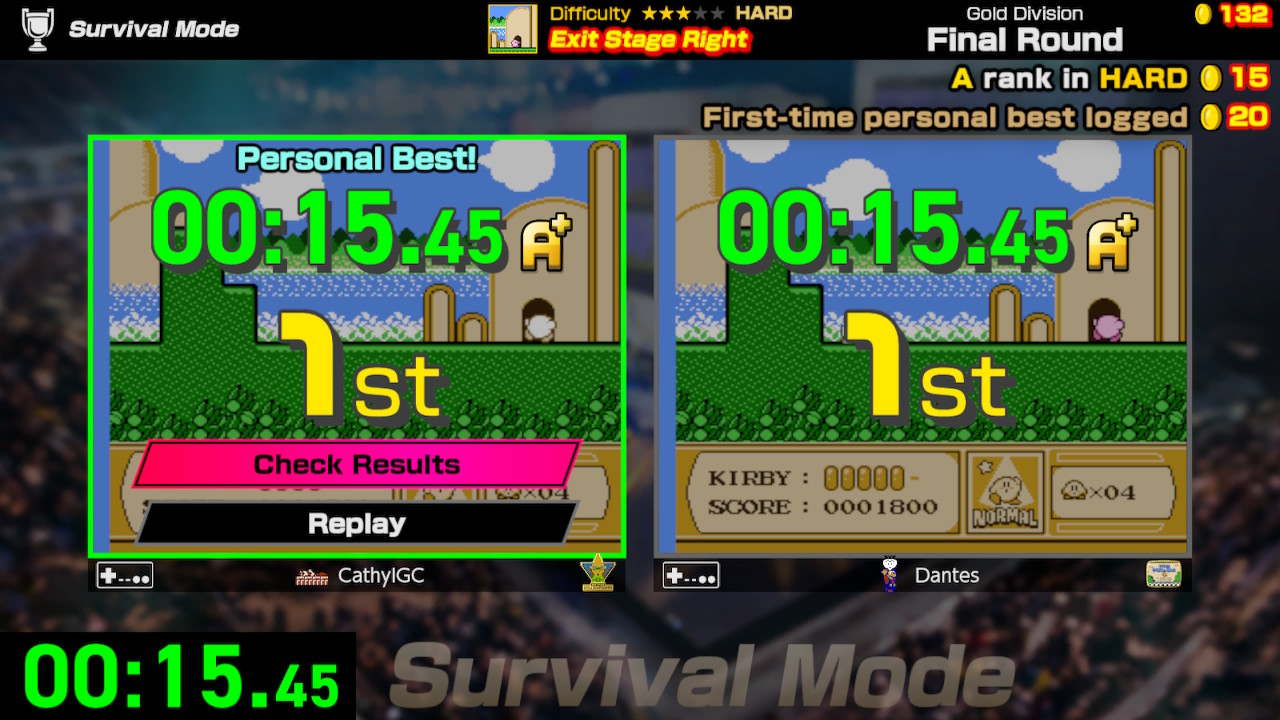
The “8 player” survival challenges are, in fact, single player. You’re competing against the ghosts of other players and not being paired live. In the Silver Cup, the ghosts play mediocre. In the Gold, they’re not too shabby, but I still won every time. This includes one instance where I tied my final opponent, but it gave me credit for the victory. The survival challenges can be played as many times as you want, but the games only change once a week, and you only get credit for one weekly win per cup.

Some people are saying Nintendo World Championships is only for speed runners, but I’m not into that scene at all and I enjoyed NWC enough that I wasn’t bored at all. It sure gave me a better appreciation for what world champion speed runners have to accomplish. I tried to imagine maintaining the tiny fractions of perfection NWC asks of players over the course of a whole game and I gave myself a headache. Nope, I could never do it. There’s a big difference between setting a pinball high score and setting a world record in speed running, where players regularly redefine what a “perfect game” is. I was reminded of that when I took a gander at the previous week of NWC’s online tournament. The big selling point of Nintendo World Championships is weekly competitions in five different micro-contests. I thought I put up some pretty good times. Hey, I got an “S” rating in all five! Then I saw that the winner in the Donkey Kong contest did it by glitching out the game and climbing ladders that weren’t there.

What is it with this game and cheaters? I kid. This person didn’t cheat, because apparently using glitches and tactics like this isn’t against the rules. Weirdly, the results aren’t posted for an hour after the deadline ends, which is Monday at 2AM California time. I figured moderators must have been weeding-out people who did tricks like this. Apparently not.

This wouldn’t bother me, except Nintendo World Championships put the screws to MY attempts to circumvent certain aspects of the game. For example, the big challenge in Super Mario Bros 3 is “finish world 1.” What the game doesn’t tell you is you have to do it the way they want you to. Now, I can understand if the challenge is laid out as “finish level 1 – 1” in Super Mario 1 and taking the pipe to skip the entire middle of the level isn’t allowed. Which, by the way, that’s one of the games. But, “finish World 1” is one of those things where players should be able to come up with their own strategies, something I’m a BIG fan of. I put so much stock in a game’s strategic flexibility that it’s often THE difference between a YES! and a NO! in many of my reviews of high score-driven coin-ops, and I highly prize flexibility in pinball as well. A challenge like “finish World 1” feels pretty open, doesn’t it? I figured “use both warp whistles to skip to level 8, thus TECHNICALLY finishing world 1” would probably have not been allowed. But you don’t have to play any of the optional levels that aren’t on the straightest path to the castle. That’s why, when I reached the dungeon, I decided to skip the fight with Boom Boom by grabbing the warp whistle. “Not so fast!” said the game, literally rewinding it because that was against the rules. Oh NOW you care about the integrity of the game and the spirit of the rules, huh? That’s rich, especially given how people are winning the online tournaments.

Booooooooooo!!

It took me a long time to figure out what my ultimate verdict for NWC would be, because it’s such a bare-bones concept. There’s no leaderboards, so besides finding out how YOU placed (including alternate standings based on your year of birth) and videos of the winning performances for each week’s games, you can’t learn how to do any of the tricks the pros are using. That sucks, since most of the winners involve the type of glitches that aren’t allowed in many speed running communities. Usually, for dedicated competitors in this field, there’s two categories: glitch and non-glitch. Nintendo could have used that kind of consideration, because it was really demoralizing for me to find out that not only were the scores I posted no good, but I wasn’t even close. Or hell, if you’re allowing the glitching, how about instructions on how to do it? Maybe it’d be fun to learn! Except, there are none.

If you’re interested in after-game unlockables, well, this should keep you busy for a while. There’s TONS of icons to purchase, one of which you can make your logo. I opted for Princess Zelda laying down from Zelda II as mine because I too enjoy sleeping and everyone else having to go to hell and back attempting to wake me up.

Advanced tips or instructions for each game would have been helpful, or hell, just more specific guidelines. Rules like “no pipes” or “no warp whistle” are not stated. The level 1-1 example in Super Mario I mentioned above? The rules in their entirety simply say “Grab the Goal Pole.” THAT IS IT, even though there are more rules that punish you for violating them, specifically “no using a pipe.” You’re telling me that they couldn’t have included the words “no using pipes?” Really? The game will automatically rewind any illegal move, but the scoreboard’s timer is still running. That’s not a big deal if the challenge only takes 30 seconds to beat, but in the case of Super Mario 3’s challenge, yea, it sucks to play for a few minutes only to discover that you just broke one of the literally unwritten rules, costing you valuable time.

I should note that, when you play the online feature, any time you post that beats your previous high in single player becomes your new high score. HOWEVER, any time you post in the single-player mode cannot be applied to the online Championships.

Sometimes, NWC isn’t consistent with its rules, especially when it comes to going off the intended pathway. Challenges like “beat Cerberus in Kid Icarus’s first dungeon” and “beat Mario 1” allow players to sometimes go the wrong directions without being rewound. For example, level Mario’s 8-4’s maze will not rewind you for taking the wrong pipe. That’s probably how it should be, right? Except that’s rarely the case. Challenges like getting to Level 1 in Zelda as fast as you can will literally stop you from going in any direction but the shortest route. For the most part, players are not allowed to explore and discover the best routes for themselves and have to follow the exact path taken by the sample video. Wait, really? Wouldn’t that, you know, DEFEAT THE WHOLE POINT OF A CHALLENGE LIKE THAT? I wish they had both ways. Have specific tactical instructions for those who want it, while also leaving it open for people who want to find out on their own. With how they have it, they’ve basically turned the exploration games into digital cross country running trials. While I’m on the subject, the sample videos would be helpful, but those videos show deliberately poor gameplay. So clearly they DO want players to figure some stuff out, but not big picture stuff. Besides the videos and a bluntly-stated goal, there ARE no instructions or even tips for 143 of the 156 challenges. Only the “big challenges” offer tips, though some others LITERALLY OVERLAY ARROWS on top of the gameplay telling you which way to go or for some other happening, like “a warp zone is near!”

Granted, the tips they DID provide are helpful. Like, I would have had to hit GameFAQs or StrategyWiki to know the shortest route in Kid Icarus, a game I’ve only beaten once. I’ll give them slight bonus points for using the same font and style as classic Nintendo Power. They even named the tabs “Classified Information” which is a nod to the tips section in the magazine.

I’m not even a little mad that people know how to cheese these games with glitches. That can be fun! Hell, I liked to get a rise out of family and friends by betting them I could beat Legend of Zelda: A Link to the Past in under an hour or two, then doing it in under five minutes. But, it’s just a parlor trick, right? Even if NWC taught players the glitches the winners are using, I don’t think I’d want an entire game based around learning video game parlor tricks. Now, assuming you’re deeply into that type of speed running, I still think you’ll probably be frustrated with how little competitive value you get with NWC. Out of a pool of 156 challenges, only five are played competitively every week, and then three of those five challenges are used for the two tiers of pseudo-online survival challenges. That’s it. That’s the entire extent of the online play. There’s no leaderboards for individual challenges or viewable ghosts of the record holders. There’s no challenging your friends or seeing ghosts of their games. No-brainer features are just not here.

Each player is supposed to pick their favorite NES or Famicom game from a list. You’d think such a list would only have Nintendo-published stuff, but you’d be wrong. The only games not listed are unlicensed games. Mike Tyson’s Punch-Out!! is listed. UK-only games like Virgin’s Aladdin are listed. Even ultra-rarities like the holy grail for Nintendo collectors, Stadium Events, are listed. I was impressed by it, until I found out all the features that weren’t included in Nintendo World Championships. So let me get this straight: you assigned someone to put a list of every NES cart, filtered out ALL the unlicensed games, but didn’t think players needed the ability to see their friends’ scores online? Good lord. Talk about having the wrong priorities.

There’s also no variety of challenge types in Nintendo World Championships. NES Remix had tasks like “don’t lose a life” or “stay alive for X amount of time.” Those are gone completely. Every challenge is a time attack. All 156 of them. It’s so limiting and uninspired. I imagine at some point a bigger pool of games will be added, but I wouldn’t bet on Nintendo getting creative beyond that. And while I’m on the subject, the game is called Nintendo World Championships, right? So, why is this NOTHING like the original Nintendo World Championships? That contest sandwiched three games together, requiring players to get 50 coins in Super Mario 1, complete a lap in Rad Racer, then with all the time remaining, score as much as you can in Tetris. There is NOTHING like that in the modern Nintendo World Championships! The only thing they have in common is the logo itself! The closest Switch’s NWC comes to that is when you complete all 156 timed challenges with a score of at least A or higher, you unlock “legendary trial.” It’s just a lazy thirteen round marathon of all the final challenges. Mind you, each final challenge is the longest one of that game. I’d be interested in playing shorter versions of such a marathon, but nothing like that is included. In fact, there’s no other mix-and-matching at all outside of survival mode. Oh, I forgot: when I said “five challenges a week” I mean five SEPARATE challenges. Do one or all five, but you only get ranked on each individual challenge and not the group as a whole. So weak.

It’s amazing how much bitching I was able to do before I even got to the games themselves. I’m not sure who outdid themselves: Nintendo or me.

For the purposes of this review, I’ll say that Speedrun Mode is the “main mode.” It’s a series of 156 timed challenges unevenly split between thirteen games. The challenge breakdown is as follows:

My final scorecard before publication.The only one I didn’t get at least an A+ in was the final Kirby challenge. I like the whole “total playtime” of all the scores added-up, even if it’s functionally useless. I wish it kept track of how many attempts you made at each game before reaching certain benchmarks.

  • 14 for Super Mario Bros.
  • 15 for Legend of Zelda
  • 13 for Metroid
  • 8 for Donkey Kong
  • 9 for Kid Icarus
  • 12 for Super Mario Bros. 2
  • 6 for Excitebike
  • 6 for Ice Climber
  • 7 for Balloon Fight
  • 24 for Super Mario Bros. 3
  • 15 for Zelda II: The Adventure of Link
  • 8 for The Lost Levels, aka Super Mario Bros. 2
  • 20 for Kirby’s Adventure
  • Of all the challenges that I worked to get an “S” in, the first challenge of Kid Icarus was by far the one that took me the most attempts. It wasn’t even close. It must have been 200 attempts.

Getting an “A” in every challenge isn’t too hard. Out of 156 games, less than 10 saw me get one of the B rankings on my first successful attempt. Now, getting an “S” is an entirely different story. Sometimes I literally couldn’t believe I got an “S” ranking as I played sloppily and made mistakes, and other times my jaw literally dropped when I didn’t get the perfect rating. I knocked out an “S” in every Zelda 1 challenge in three tries or less, except one where you had to kill three bats. That one took me probably 50 or so attempts. Meanwhile, I couldn’t get A++/S rankings in most Kirby tasks even if I tried, and I did! If the challenges were all short enough that they could be finished in 10 seconds, I’d probably keep playing until my scorecard was nothing but S rankings. But, some take a lot longer, and all the final challenges are the “big ones” of that game. Mario 1’s final challenge is just “beat the game from level 1-1, with warping.” Sure, it can be done in around 4 minutes if you know what to do. I don’t, and it sounds like a big time investment to learn how to get that good. NWC doesn’t tell you the target times for each grade. What’s an A+? Apparently under 8 minutes and 2 seconds, because that was my best time. What’s an S? You’ll know when you get it. A+ is actually the third highest grade, by the way. There’s A++, and I never saw less than a “B+” at any point. This is like one of those “teachers can’t use red ink to grade students anymore” things, isn’t it?

Beating a challenge doesn’t AUTOMATICALLY open the next. You earn coins from completing challenges. The more difficult the challenge and the higher rank you earn, the more coins you get for victory. You also get bonus coins for beating your previous best time. Winning the survival challenges also earns coins, including 500 for the first time you win each week’s gold survival challenge. Again, you only get CREDIT for each survival challenge per a week, but you can grind coins up, if you wish. You just won’t earn as many when you replay them. You also get a nominal bonus for competing in the week’s tournament. When I got sick of going for “S” rankings and started running through the challenges, I never had to grind to open anything, but most players apparently need to grind. The two quickest and easiest “S” rankings are the second Super Mario 2 challenge (pull up a vegetable) and the first Balloon Fight (pop one balloon in Balloon Trip). The challenge unlock system is stupid, but not a deal breaker.

Since the games are emulated, all the problems that come with the originals are here. Kirby’s Adventure has TONS of slowdown, only the clock keeping your time doesn’t slow down at all. Donkey Kong is missing the factory stage. Ice Climber is just the worst, and Nintendo’s continued insistence in celebrating it would be like having an incredible artist regularly hang out in your home, only they keep leaving upper-deckers in your toilet for no apparent reason. I only got all S-rankings for Zelda 1, Donkey Kong, Balloon Fight, and Ice Climber, but except for Zelda, that had more to do with how few challenges were involved. Mario 3 has the most challenges, and each of the seven Koopa Kids gets their own challenge. The only boss missing is Bowser. Come to think of it, the only “last boss” challenges are Mario 1’s “beat the game” finale and Metroid’s “escape the bomb” sequence, and even that is lacking the Mother Brain fight. It’s like Nintendo deliberately avoided spoilers for these literally three-to-four decade-old games. Boss fights work great in NWC, but there’s only three Legend of Zelda bosses, three Zelda II bosses, and three Kirby’s Adventure bosses. Super Mario 2 gets only Birdo and Mouser, and Kid Icarus only gets its first boss. Since boss fights were easily my favorite type of challenge, it sucks that Nintendo excluded so many that would have lent themselves perfectly to this game. I would love for nothing more than this review to be rendered outdated with updates that add more challenges, increase the variety of challenge-types and add more online features. Especially friend-based features (seriously how did THAT get left out?) or leaderboards.

This slideshow requires JavaScript.

Sigh. I sort of have to give Nintendo World Championships: NES Edition a YES! because I had enough fun playing it. The worst gameplay aspect is an exceptionally bad automatic-rewind that happens when you die or do one of the FORBIDDEN moves. In theory it resets you to just before whatever you just died from. In practice, in games like Mario 1 or Kid Icarus, I died more from the rewind dropping me off in the middle of a jump than I did from the original deaths. I’m not even exaggerating, it is THAT bad. The rest is, eh, you know, fine. Nintendo World Championships certainly doesn’t rise to the level of “very good.” The online component means absolutely nothing to me because it’s too limited and not very fun. Five challenges a week is not enough for a game focused on online play. I can’t even see myself booting this up every week to play the next five contests. As for local multiplayer, unless every person you get is in roughly the same skill range, you’re not going to have any fun, at least as a group. It only takes one player who is fairly better than the rest to wreck the entire session. I was dis-invited from playing with my nephew and his friends because I was that player, though I probably should note that they were equally matched, more or less, and seemed to have a lot of fun once they booted me. But, be warned: playing eight-player mode means using JoyCons turned on their side, which I personally think is the worst game controller configuration of my entire lifetime.

I’ve been asked “does the cart work?” by every visitor to my house since the game arrived the day after it was released. No, it doesn’t, but it does come with a nice display stand that isn’t pictured here. The kids fought over the pin sets, to the point that a second $59.99 set had to be bought. To Nintendo’s infinite credit, my nieces and nephew and all their friends, ages 8 to 13 or thereabouts, all wanted to compete in this, even though they’re normally not inclined to play retro games. My nephew has literally never opened his NES, SNES, Game Boy, or Genesis libraries that came with his Switch Online subscription. Some of my best friends have children that are in the same boat. But, all the kids REALLY wanted this game. I can’t make sense of it either.

All I had left to base this review on was the 156 challenges. I started them on Sunday. I finished all of them with at least an “A” or better after just a few hours on Monday, with no intent of sticking around long enough to unlock everything. I spent most of Tuesday writing this review and bumping the “easy” ones that I “should” have gotten to an S, while also verifying that some of the challenges are just really boring. Besides the boss fights, my favorites were all 10-seconds-or-less games. That’s when NWC becomes gaming crack. Beating whole levels? Eh, it’s fine, but I really don’t think any of them quite reached that “just one more try” sweet spot, and some of the challenges I enjoyed so little that I don’t think I’ll ever play them again, regardless of how bad my scores might be. In fact, I’m not even sure my NWC cart will ever go back inside my Switch. (UPDATE – August 10, 2024: In the interest of fairness, I did return to Nintendo World Championships even when I thought I wouldn’t. Initially to check my previous week’s results, but I ended up spending time on the week’s five new competitive challenges. This is a game that’s deceptively addictive, but I did have a good time.) Okay, maybe when the inevitable add-ons hit, I’ll reload it to at least play each new challenge enough to get an A ranking on them too. That has to happen, right? Like, I can’t believe Donkey Kong Jr., Wrecking Crew, StarTropics, Punch-Out!!, or none of those early sports games are represented here. No third party games, either, and Super Mario Bros. Lost Levels is the only (former) Japanese exclusive. Ten years after NES Remix, and what could be considered the fourth game in the series feels, well, kind of thin. It IS possible to have fun and still be let-down. Just ask anyone who has ever slept with me.
Verdict: YES! but if you’re on the fence, waiting for a sale wouldn’t be a bad idea.
$59.99 ($29.99 for the standard) was soundly defeated by Jimmy Woods in the making of this review.

Wolverine (NES Review)

Wolverine
Platform: Nintendo Entertainment System
Released October, 1991
Designed by Craig Houston and Kevin Edwards
Developed by Software Creations
Published by Acclaim as LJN
NEVER BEEN RE-RELEASED

Magneto, everyone.

Well, I did Deadpool so I might as well throw-in a review for Wolverine. Unlike Deadpool, this is an authentic 1991 NES game that’s authentically horrible. I literally have nothing nice to say about it. A truly pathetic effort that doesn’t feel like a Wolverine game, an X-Men game, or even a superhero game. Wolverine is an utterly generic platformer with some of the worst gameplay decisions I’ve seen. The biggest one is you don’t blink when you take damage. I mean, you change colors to gray, but there’s no invincibility afterwards. No grace period to recover at all. So, naturally your attacks are some of the most low range, low impact punches and kicks ever. I mean seriously, the kick you do after throwing a couple punches looks like someone gingerly kicking a tire to see if it’s flat or not. You have to get right on top of enemies to brawl, and as you do, your life slowly trickles away. But, that’s fine because Wolverine heals from injuries. Except, they left that part out. You need to pick up.. I swear to God I’m not making this up.. burgers or soft drinks to heal you. This NES game has more menu items from McDonald’s than the NES McDonald’s games.

I just pinched myself to make sure I hadn’t died and gone to gaming hell. Then I remembered that you pinch yourself to make sure you’re not dreaming and not to make sure you’ve passed on to the afterlife, so gaming hell is still in play. Especially since I intend to review more classic console X-Men games.

For a moment, I’ll ignore the absurdly tiny graphics, laughable enemy design, and ridiculous damage system. The one thing that you absolutely NEED in a Wolverine game is for the violence to be intense and impactful. Whatever is the polar opposite of intense and impact is how the combat feels here. It’s no impact, so naturally, you want to at least use your claws. That way, you can imagine that you’re slicing baddies so cleanly that it doesn’t even make them flinch. You activate the claws with SELECT for double the damage and.. they drain your health. Of course they do. They don’t even really add all that much range either, and even if you swing and miss, you still take damage. It’s a quarter-of-a-tick of a life bar for every use of the claws, in a game where you absolutely do not blink or knock-back or anything from damage. Any contact on anything lethal and your health begins to quickly drain. Since there’s no grace period, you never know how much damage something causes, or really how much you’re taking in general. You have to constantly glance down at the health bar.

Remember the dam stage in Teenage Mutant Ninja Turtles? Specifically the underwater section, complete with tight squeezes and stuff that damages you? This is like that, with even tighter squeezes. Only, remember, you don’t blink or knock-back this time, AND the swimming controls are so much worse than TMNT. This is one of the worst games on the NES.

This is a Wolverine game that doesn’t feel even a teeny tiny bit like Wolverine. It honestly feels like it’s outright antagonistic towards the character. There’s no way the creators of this could have been fans of the source material, because there’s nothing about controlling the Wolverine sprite that a fan would need to feel immersed, as if you really were Wolverine. That’s the whole point in doing a game based on a character, right? With this steamer, I suspect this wasn’t even meant to be Wolverine and they just took Generic Action Game Template 71189-C and added claws to it. There’s also this absurd “berzerker” meter you get for killing bad guys that gives you invincibility when it fills up. Oh, and the invincibility killed me more times than anything else in the game. Yep. You see, you can’t run and attack. This is important to note, because when you begin to BERZERK, you automatically do strikes almost continuously, making it very hard to move forward and especially build up your jumps. So, when I went to do a long jump over a pit, I didn’t get the lift I wanted because the hero was automatically swinging at NOTHING! Literally shadow boxing! What an epically stupid idea!

That’s how I died here. I think. There’s no way I shorted a jump THAT badly.

Wolverine has incredibly unimaginative level design, uninspired enemy attack patterns, and only two bosses in the entire experience that you fight back to back. The boss fights suck too. I lost a life fighting Magneto because I wasn’t sure how to hit him. I tried to kill these boulders this device was shooting at me and eventually died. I came back to life in the boss arena (the one positive thing I can say is respawn points were fine), and then the rematch ended in under 10 seconds when I stabbed the little laser barrier blocking me from Magneto, then punched him a few times until he ran away. Wow. Then the final battle with Sabretooth played out the same way. I lost a life, then I realized HE gets to be invincible. It turns out, you win by punching him off a cliff. Since it’s easy to catch him in a punching pattern, I won about fifteen seconds later, and I’ve never been happier to be done with a game.

See the purple platform I circled? For utterly no reason, it’s lethal to the touch. I guess it’s acid? Except, you don’t submerge in it. Okay, so stay away from purple platforms? Well, there’s OTHER purple platforms on the stage that act as treadmills, and you can touch those just fine. It’s a f*cking purple platform. What the everloving hell? Once more with feelings, team?

What an unlikable, lazy effort. Lots and lots and lots of last-pixel jumps. Lots and lots and lots of instakill elements like fire or spikes. Oh, and you drown in water too, but at one point in the swimming stage, you get a “device” that changes that. You’re told it. You don’t see it. It’s like the developers realized the rest of the stage had too much water and not enough places to come up for air, but instead of changing the whole layout, they just added a door in an arbitrary location where you get the “device” from Jubilee. It’s like players have to apply their own quality of life patch in real time. I don’t know what else to say about Wolverine. I made two full runs in under ninety minutes, with the second run taking probably a little under half an hour because I just ignored as many bad guys as I could and even accepted damage if I knew I was near the finish line for a stage. Wolverine does literally nothing right and isn’t even charming in failure. Fix any one problem and this would still be in the conversation for the worst NES platform game I’ve reviewed so far. Fix all the gameplay problems and it’d still be a NO! because the combat would be boring and the level design just very bland. Unlike Wolverine, there’s no healing this one. It’s just a bad game.
Verdict: NO!

Deadpool (NES Review)

Deadpool
Platform: Nintendo Entertainment System
Released in 2019
Unauthorized ROM Hack of Ninja Gaiden
Developed by Techmoon
Link to patch at RomHacking.net
I use THIS tool to apply patches.

This isn’t just a graphics hack, Jack.

Deadpool is a ROM hack of Ninja Gaiden, but don’t mistake this as simply a repaint. It’s actually kind of insane how much work went into this. Like the best ROM hacks, it treats the base game like a tool kit to create something more evolved. Now, don’t get me wrong: Deadpool still fundamentally feels like Ninja Gaiden. It doesn’t quite cross the threshold where it feels like something entirely new. Instead, it’s more like a sequel that adds new abilities, along with new headaches related to them. The biggest change is that you can climb any wall instead of being stuck in place like the game is sponsored by Gorilla Glue. You can also pull yourself up onto the platform you’re hanging on, and there’s a lot more surfaces that the wall cling works on. It opens up what I feel is an overly strict and not very fun engine. It sounds great, and in many ways it is. But, like so many wonderful ROM hacks, the changes create several new problems. For example, imagine there’s an enemy you want to jump and kill directly above you on a higher platform, like so:

Notice how I’m climbing and the thing I’m slashing at isn’t, you know, dead? Well, that’s because the binding mechanic is now TOO sensitive and you stick to everything, even if there’s no logical reason why you’d want to. So, half the time you want to kill something above you, you end up stuck on the wall just below it and taking damage from it. As far as problems with game mechanics go, few are as destructive and immersion-breaking as this. Just the act of jumping up onto a high ledge now sucks because you might stick to the top of it and have to pull yourself up. When platforms are clustered together, a screen that you should be hopping around and finishing in a second or two might take five or ten seconds just from the stop-and-go wall-clinging, and that’s before you factor in enemies getting free shots when the sticking happens. Maybe it wouldn’t have been so bad, but the one thing that could have been added that would have balanced this issue, the ability to attack while holding onto a wall, still isn’t an option. Maybe it’s just me, but I feel Deadpool would be able to hold onto a wall with one hand and attack with the other, and it sucks that you can’t.

Hey look! It’s Batman! Yep, he’s a basic enemy. So is the Flash. Even Wolverine is a basic character, and actually he’s the weakest so at least there’s a meta-gag there. But then Mario and Mega Man and various other gaming icons can be seen in backgrounds or posters or sometimes as enemies and instead of immersing me, it completely takes me out of the experience. When people do projects like this, whether it be a ROM hack or a game built from scratch, my favorite ones are always the ones that try to be “legit.” As in you could believe this is the type of game that would have been released during whatever era, looking and playing exactly like this. When a game does this well enough, it works as genuine wish-fulfillment because it’s a realistic wish. Look at the recent NES Garbage Pail Kids, which felt authentic for its time period. The developers of Deadpool were clearly talented enough to attempt this, and I hate that they didn’t because I never really got immersed. Every single aspect is dulled somewhat because it’s just so lame to have these random IPs show up in arbitrary locations with nothing clever about them, like any other dime-a-dozen ROM hack.

While I think the collision might have been tightened-up over Ninja Gaiden (which has REALLY piss poor collision detection), Deadpool’s collision boxes are still annoying enough to frustrate, and the knock-back when you take damage is still the primary source of Deadpool’s player body count. A few other aspects that I strongly dislike about Ninja Gaiden carry over. The basic attack is never quite as satisfying as you’d hope it would be, nor is it as reliable as it should be. It’s just not a very fun sword to use, is it? Well, it’s basically identical in Deadpool, except in those (far too rare) moments where you get a sword upgrade. Also, while the levels are laid out differently, basic enemies and bosses really do feel like they’re re-sprites of Ninja Gaiden’s, and if they behave differently, it’s subtle. Sometimes a ROM hack is so good you forget that it is a ROM hack. Deadpool doesn’t come remotely close to that. It’s a ROM hack of Ninja Gaiden. It plays like it. It feels like it. So, the real question is does Deadpool do enough to stand tall on its own?

If you find an icon with a sword, you get this gigantic Strider-like slash for the rest of the stage you’re on. It was the most fun and most enjoyable part of the entire game. Except for the fact that the game was too stingy with drops for it. In my first playthrough, I didn’t get one until very, very late in the game. As far as I could tell, only enemies drop the giant slash, and even though I’m pretty sure I killed every enemy I could reach, I just never got it enough. In my third playthrough, this time on the game’s easy difficulty, I still didn’t get one until the third stage and only got three overall. What should have been Deadpool’s defining gameplay mechanic instead barely ends up a net gain because the game is so miserly about dispensing it. Maybe the developers thought it would have made the game too easy. WHO GIVES A SH*T? It’s more fun! It certainly doesn’t trivialize the combat or the overall challenge, especially compared to the sub-weapons, which absolutely DO trivialize the combat and the overall challenge.

Deadpool is a character that regenerates from damage, and that factors into the NES game. A constant ten second countdown starts and restarts that’s unaffected by the gameplay. Whenever the countdown restarts, you gain some health back if you’ve taken damage. That seems awesome, but when Deadpool starts leaning more into swarming enemies late in the game, if you play the game like a complete coward (cough) it can lead to a lot of waiting around to heal. Whatever. It’s Deadpool, and Deadpool heals so I’ll call it a plus. Also, I found the level design in general is just better. Now granted, it was inevitable the stages would feel more open and free-flowing thanks to the additions to the wall clinging. But, for what it’s worth, I think the stages are just more exciting and better done, and the themes to those stages are certainly more interesting. Hell, Deadpool even pulls-off a pretty damn good slippy-slidey ice level. That’s hard to do, so kudos. There’s even some fun set-piece facades, like a Total Recall-like x-ray section where you see your skeleton. But, by far the best new elements are the items.

This slideshow requires JavaScript.

The cheap shots of Ninja Gaiden are largely here, but because of the thrilling new sub-weapon design, they’re only a problem if you play too conservatively. In Deadpool, ammo is more plentiful than Ninja Gaiden, item costs are more intelligently balanced, AND you can swap between different items by pressing SELECT, which opens up the game tremendously. Plus, they’re a lot more fun this time around. The spinning whirly blade attack and a basic throwing-star like attack (replaced with a gun, of course) return from Ninja Gaiden, but they’re joined by a fourth-wall breaking teleporting move where you hit whatever is furthest away from you that’s effective and awesome. Finding an Uzi icon gives you a gun separate from all-other sub-weapons that gives you 30 bullets at no cost to your standard ammo. The catch is that if you scroll through your other items before the Uzi runs out of ammo, you lose it prematurely. So fun to use and I only wish that I’d found more of them.

This slideshow requires JavaScript.

And then there’s the food. On its own, it does nothing, but if you eat enough food items, you begin to blink. When this happens, you start to flash, indicating that you can activate a screen-clearing bomb at any time. Works great, except it obviously doesn’t one-shot bosses. The game even wisely created events that might require a bomb. There’s blinking enemies that are impervious to your attacks and sub-weapons. The only way to kill them is to bomb them, and I was INCREDIBLY impressed by how well paced-out these types of enemies are and the pitch-perfect timing of when to insert one into a level. Weirdly, sometimes Deadpool feels unpolished and inelegant, what with all the unintentional wall-sticking, and at other times, Deadpool feels like a more professionally fine-tuned game than its base game. Hell, it even has adjustable difficulty with no gating, making this accessible to those who would avoid Ninja Gaiden due to the brutal challenge. Even if the game is too intense despite the more powerful sub-weapons (over-powered, frankly), you do have the option to tone it down. Very cool.

Free lives are plentiful, no matter the difficulty.

I’m frustrated by Deadpool because I can’t really say it’s amazing, and I should be able to. I never got bored, even if having Batman show up had me rolling my eyes. It’s that damn wall cling that I can’t ignore. I also can’t think of how it could be better on a two button controller. Maybe holding the button if you want to stick? It’d take getting used to, but, I dunno. Maybe it would work, or maybe it’d be unwieldy. But, for all the problems, fun is fun, and I had a lot of fun playing Deadpool. I didn’t have any fun with Ninja Gaiden, so that’s saying a lot. I usually beat these shorter retro games twice for a review. I beat Deadpool three times. Of course, I got eight total sword upgrades in that three game span, which sucks because it’s the best part of the game. Makes the combat feel different and better than Ninja Gaiden. Without it, and I was mostly without it, this is just a more flexible Ninja Gaiden with Deadpool sprites. And Batman. And Wolverine. And the ghost monsters. And Space Invaders. And the Flash. And..
Verdict: YES!