Gems N Rocks

Yesterday, I reviewed a Lode Runner clone.  Today, I review a Boulder Dash clone.  Both were early-80s computer titles that received dozens of remakes, re-skins, and ports over the years.  The difference?  I’ve never played Boulder Dash or any of its offspring.  It wasn’t even on my radar, mostly because I’ve never heard it described as a holy shit must-play industry altering super game.  It just sort of exists as one of those “did you ever play that one game” titles that gets brought up from time to time.  No matter the game, if the answer is “yes” the conversation likely ends on the spot.  If the answer is “no” the questioner usually follows up with “it was alright.”  Then the conversation ends.  Boulder Dash was one of those.

I’m kind of glad I’m going into Gems N Rocks with no experience of the franchise it’s bastardizing.  It means I’ll have no frame of reference for how the game should play and thus I’ll better be able to grasp if it can stand out on its own.

The idea is you’re a dude that has to mine for gems.  In each stage you must collect all the gems to win.  You excavate through stages like you’re Dig Dug, only instead of trying to drop rocks on dragons or balloons wearing goggles, you just have to avoid dropping them on yourself.  Whenever you dig around a boulder, it creates a cascade that takes it and all other boulders it’s holding in place with it.  This leads to hilarious situations where you can pin yourself in while collecting the last gem.  You still beat the stage, but if you’re like me and you dwell on these things, you realize your little miner dude is trapped and will slowly starve to death.  Life can be cruel.

There are forty stages here, unevenly divided into three categories.  There’s easy stages.  All you need to know about those is the very last one beats itself for you.  I guess for some developers “easy” is interpreted as “for the recently lobotomized.”  The medium and hard stages are often neither, with the solutions relatively straight forward and often based on some kind of “outrun the enemies” situation.  My favorite levels involved little heat-seeking robots that go all Terminator on your ass.  These are genuinely tense stages, made more so by how fucking horrible the controls in Gems N Rocks are.  Seriously, it’s as if the game comes bundled with an asshole that dips your controller in molasses between stages.  Movement is slow and sticky, and figuring out how to deal with it is literally the only thing that challenged me the entire game.

This is the stage that beats itself like a masochistic dominatrix.

I’m told that Gems N Rocks adds new concepts to the Boulder Dash formula like liquid puzzles based around water, bacteria, and mercury.  Again, I have no reference point to whether it’s an upgrade over the conventional design.  I will say that I would have probably enjoyed the game more if the controls were not so painfully unresponsive that my best strategy involved placing my control on a table and poking the direction I wanted to go on the D-Pad with my finger tip.  If the main challenge your game offers is fighting the controller, you should probably let it cook in development longer.

I never bothered with the included level editor, because I think those are for nerds, and I’m more of a dweeb.  Going off just the included levels, I honestly thought Gems N Rocks was mediocre, with the potential to be decent if the controls had been accurate.  When I brought up my concern to the developer, it took him by surprise, although he conceded that it was probably an example of him playing his own game so much that he never noticed there was a problem.  What he needed was a canary for his mine.  Someone like me, armed with a fork, sitting next to him while they played the game for the first time.  He would have known there was a problem when the fork became embedded in his temple.  Oddly enough, this is the absolute only way I would ever volunteer to test games myself, but nobody is willing to sign the liability waver.  Shame.  I think the Fork You method of testing could revolutionize Xbox Live Indie Games.

Gems N Rocks was developed by Fuzzy Duck Entertainment

80 Microsoft Points think Fuzzy Duck sounds like some kind of Kama Sutra thing in the making of this review.

Gameplay footage courtesy of

Gold Miner

Gold Miner is an attempt at cloning Lode Runner.  Fair enough.  Lode Runner is a cherished classic, although the reasons for that are completely lost on me.  I always  thought it was kind of dull.  It’s probably a generational thing.  Lode Runner came out approximately six years before I was born.  Maybe in those dark times, firing up Lode Runner on your Apple II beat adjusting the rabbit ears on your television set so that you could see the latest episode of A*Team.  I don’t know.  I do know that it’s one of those series that should be allowed a graceful retirement, instead of being dragged back out into a market it no longer has a place in.  Granted, I hear that all seven people who bought the Xbox Live Arcade remake of it thought it was just peachy.  And then there was the time they dressed it up in a costume and called it Panda Craze on DSi and PSP.  Same shit, different name, still fucking boring as hell.

Gold Miner plays like a Lode Runner clone that was made by someone who got all their information on the series second-hand.  And then programmed the game using just their feet.  While submerged underwater.  In a swimming pool filled with moonshine.  It’s bad.  You have to run around collecting gold while avoiding little bush monsters.  Once you get ten piles of it, the map restarts and you keep going.  You can cut a hole on a platform with the right trigger.  If an enemy falls in it, you can smack it three times to kill it.  You can jump with A, which is a much faster and easier way to avoid enemies.  There are no Lode Runner-style puzzles here.  Gold Miner is an endless arcade game.

And it’s terrible.  Really, truly awful.  The controls are slow, the jumping is floaty, there’s clipping issues, the sound effects sound like they were recorded using one of those teddy bears that you speak into, and it’s just soul-killingly boring.  I can sum up everything you need to know about how much testing went into Gold Miner with this: if you press the start button in the middle of a game, it takes you to a menu.  The menu has four options, including “new game” and “resume game.”  No matter which you choose, the game gets restarted.  Your score is lost, your lives are reset.  Disgraceful.  I only could stomach twenty minutes of Gold Miner, but with a fundamental mistake that big, I’m guessing that’s nineteen minutes longer than its own developer spent testing it.

Gold Miner was developed by Winsor Computing

80 Microsoft Points thought BurgerTime was the better game over Lode Runner in the making of this review.  I know, apples & oranges and all that. 

Gameplay footage courtesy of

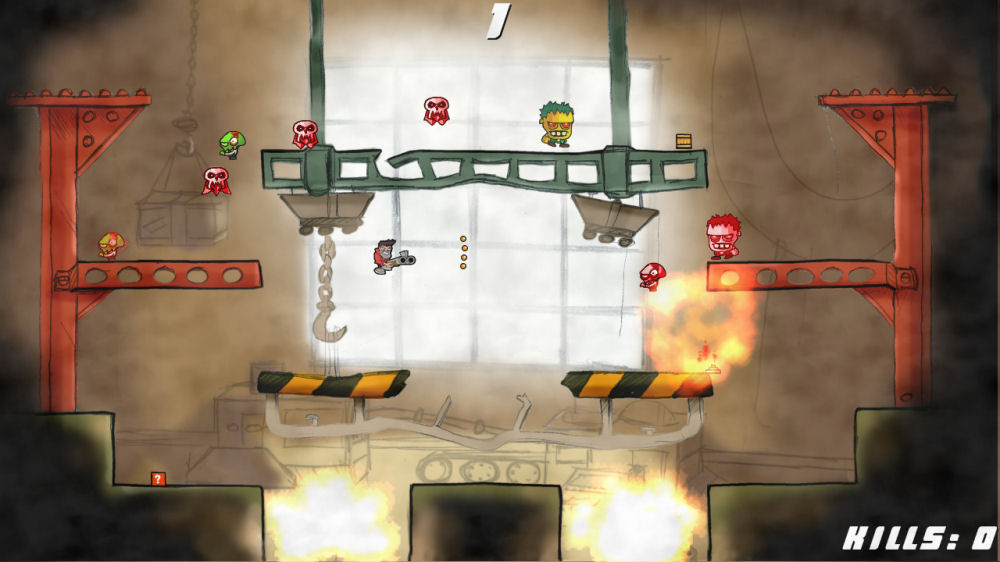
Insane Zombie Carnage

I don’t like to play iPhone or even iPad games with flimsy, fake control schemes.  I just can’t get the hang of virtual controls.  So I missed out on the Super Crate Box craze.  Well, if you can call it that.  Compared to other popular games like Draw Something, Cut the Rope, or Angry Birds, Super Crate Box is more like a mild rage than a craze.  I hadn’t given the game a second thought until Brian and I did Indies in Due Time a few weeks ago, where we previewed yet another fucking zombie game, Insane Zombie Carnage.  Several of my readers immediately recognized it as a Super Crate Box clone.  I didn’t, because I never played it.  So I went into Crazy Undead Bloodbath without any prejudice.  Except against people of all races and religions, but that’s unrelated to the game.

So the idea behind Super Zombie Box is zombies rain down and you have to shoot them while collecting crates.  Wooden crates contain weapons of varying usefulness while question mark crates alter the flow of the game.  Body count is irrelevant, and so are the question mark boxes.  The object of the game is to get as many of the wooden boxes as you can before dying.  You start with one stage and unlock alternative modes and levels based on how big a streak you can get.

So what did I think?  I played it for an hour and I would rather be dead than ever play it again.  What a boring concept.  Don’t get me wrong, if suicide was not an option, I would choose Insane Zombie Carnage over Super Crate Box, simply based on my hatred of iOS virtual controls.  Loony Brain-Muncher Brouhaha actually controls fairly decently, which shocked the fucking hell out of me.  Clones tend to skimp on such features as playability in favor of cha-chinging and rolling in the dough.  I do think it’s a touch on the sensitive side, and the collision detection seems a bit off as well.  I cut a few zombie encounters close but know I missed them and I still died.  If I had actually gave a shit about the game, I would have been pissed off about that.  But, by that point, I couldn’t have given two shits less about it.  Perhaps this was because of crates that spawn right under where the zombies drop in at, making them almost impossible to fetch.

I wasn’t a huge fan of Preposterous Poltergeist Pandemonium, but I’m sure there are some Super Crate Box fans out there who are happy to be able to play this on a console.  Even if it’s not even close to the same game.  It doesn’t have the same graphics style.  It doesn’t have that “world-wide community” feel that Super Crate Box has.  It doesn’t have the word “super” in it.  It seems more like it exists to rub in the fact that this is as close as you can get if you’re among the handful of losers out there that still haven’t been assimilated by the Apple Collective.  But again, I really liked this more than Super Crate Box.  Which is like saying I would prefer to have my head blown of with a bazooka than be slowly disembowed using a rusty, urine-soaked samurai sword.

EDIT: Super Crate Box apparently got its start as a PC game.  Um.  Yea.  Move along.  Please.  Pretty please.  With cherries on top?

Insane Zombie Carnage was developed by Geex

80 Microsoft Points says repetition is the heart of gaming, but that doesn’t mean it doesn’t suck 90% of the time in the making of this review.

Drive Fast Think Faster

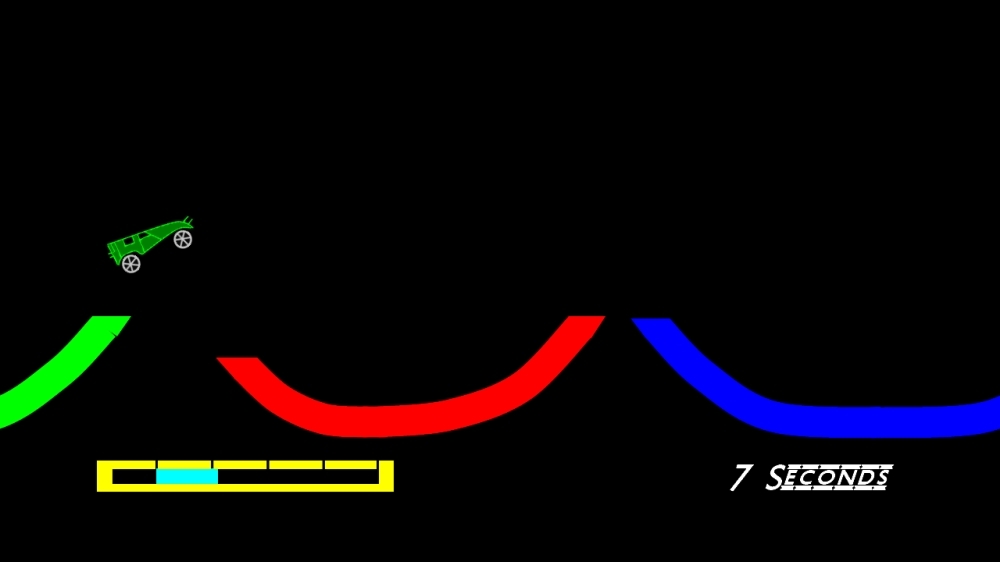
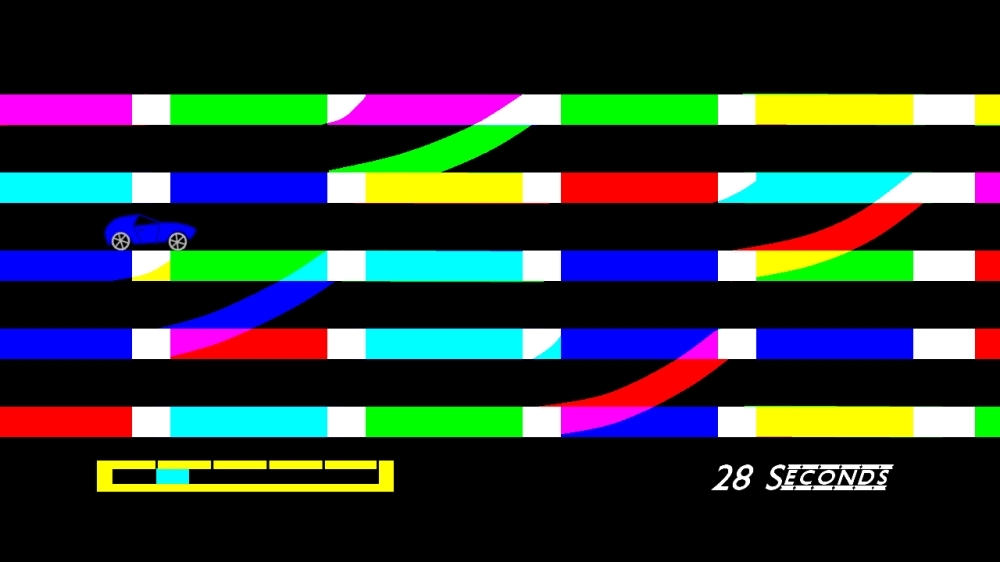
Drive Fast Think Faster was tragically born without a comma.  That’s just one of many birth defects that plague this reflex-tester.  The idea is you steer a car across a tie-dye stunt course, changing your car’s color to match whatever scheme the course is about to change to.  A changes it to green, B changes it to red, and X changes it to blue.  Y and Yellow is ignored, because fuck yellow.  Am I right?

Drive Fast is probably another example of a developer getting too good at their own game, because this thing is as hard as Jason Stackhouse after he overdosed on V.  On the first level, I got the fastest recorded time of anyone who has just finished one stage.  That’s pretty much as far as I’ll make it, because once I got to level two, the game required a level of reaction time that I simply don’t posses.  In theory, Think Faster is a color-matching game, like Guitar Hero.  In practice, you have to continuously hold the analog stick and fight the physics while matching colors.  I couldn’t do it.  I really did give it a shot, but the lack of checkpoints was too demoralizing.  If you fall through the course, you have to start the stage over from the beginning.  I have no clue how close I actually came to the finish line, but it might as well have been on the dark side of the moon.  After an hour of trying, I headed over to Xbox.com to grab the screenshots I would need for this review, saw the picture below, and decided to bail while I have some sanity left.

Annnnnnnnnnnnnnnnnnnnnnnnnnnnnnnnnnnnnnnnnnnnnnnnnnnnnnnnnnd fuck it, I quit.

I don’t know if Drive Fast Think Faster was intentionally designed to be a punisher.  Probably.  The second stage starts with a trial-and-errorish series of jumps that require more luck with the physics than actual skills, but this quickly changes to more high-speed color-matching crap that gets old fast.  So, no, I don’t like Drive Fast Think Faster.  I don’t want to make a cop-out “it just wasn’t for me” review, so I do declare that it can lock itself in a garage with the motor running and choke to death on its own multicolored exhaust.

Think Faster Drive Faster was developed by Zebra Games

80 Microsoft Points want to be able to buy just the lime-colored Skittles in the making of this review.

Hidden in Plain Sight

It’s still Thursday if you just woke up from a coma that you fell into on a Thursday. Or possibly a Wednesday if you think you just went to sleep for the night.

It’s taken me a while to get onto the Hidden in Plain Sight bandwagon. This can be attributed to the fact that I have no friends. Well, that’s not entirely true. I do have a limited number of chums and pals, but the problem is getting them to play an XBLIG with me.  Perhaps it has to do with my sales pitch. This usually consists of someone asking me what I think about XBLIGs, followed by me barely squeaking out “they’re alright.” Not exactly the most ringing endorsement, unless you know me. I can barely speak up when my clothes are on fire, so declaring something to be “alright” vocally might as well be myself writing the name of the game on a piece of paper and then dry humping it.

Local four-player is hard for me to put together. At least when it comes to XBLIGs. After months of waiting, I decided to resort of bribery. Thus, I took three interns at my office, promised them time off of work and pizza in exchange for playing a game with me. And wow, that didn’t sound so pitifully sad when I actually did it.

But really, three people who aren’t exactly buddies with me or with each-other seems like the perfect fit for a party game. I mean, if people can’t bond through video games, what the fuck can they bond through? Well, besides war, nuclear holocaust, and intense sexual lust. Having said that, you should have seen the looks on their faces when I told them the game we would be playing was an Xbox Live Indie Game. They didn’t know what that was, and all three guys do own Xbox 360s. I explained to them that it was a home-brew, made by a couple of novice game developers, and it costs $1 to purchase. I swear to God you could see them mentally calculating whether signing up for this was really better than spending the day filing papers.

Their worries were for not. We had a grand ole’ time playing Hidden in Plain Sight. Well, we did when we played the first of five modes on it. It was called Ninja Party. You’re placed in a room with dozens of identical ninjas, with each player randomly being assigned to one. The first you have to do is figure out which one you are. Doing this requires a level of smoothness that a couple of the thickies working for me couldn’t grasp. They would start by spinning their control sticks around, making it obvious which ones they were.  Stanford education at work, folks. There’s two ways to win. First is murder all other players. Thanks to the spinning morons, I found this to be the easiest method. Alternatively, the first player to touch all five statues in any order wins the round. Once the interns figured out that spinning was not the best idea, I moved onto touching the statues to gain victory. At first, the interns smacked everything that moved, giving up their position and typically thinning their ranks out while I made a bee line from statue to statue. I soon noticed that the NPC ninjas did not change directions while they were moving. They walked in a straight line, paused, and then walked someplace else. The interns never caught on to this, and I used it to my advantage in the coming games.

We forgot about the smoke bombs until several rounds in. My theory is this has to do with living in California, where a person can’t smoke in their own office in a building that they own. Let freedom ring.

The second mode is called Catch a Thief, and without sounding too much like I’m bragging, I was a fucking Goddess at this one. The interns, not so much. In this mode, one or more players takes the role of a sniper, while everyone else has to play as thieves that walk over coins. Because their ability to pretend to be NPCs was lacking, I could take them 3 on 1 and win every time if I was the sniper. You only get three bullets, but all I had to do was keep a close eye on the way they walked. A straight line is hard to maintain, and even the slightest curvature of it was enough proof for me to go Lee Harvey Oswald on their asses. However, unlike the previous game, there really doesn’t feel like there’s a point to this one. The thieves have to collect coins. The snipers have to shoot the thieves. However, the sniper can only get three points, while the thieves can rack up a bunch of coins. So how do you decide who wins? And more importantly, why doesn’t the score carry over? Why doesn’t the game have a method of automatically cycling the various combinations of teams so that you can find out who an overall winner is? I mean, it would have been me regardless, but some people care about that stuff.

The third mode is Knights vs Ninjas. It’s like Ninja Party mode, only this time it’s a team game of defend the VIP. We played 2-v-2. The knights have to protect the royal family. The ninjas have to commit regicide. That is to say, they have to kill the royal family, not people named Reggie. We all found this mode to be pretty boring. Anyone the knights strike down remain dead, while anyone the ninjas strike down are only temporarily stunned. Games of this devolved into the two knights letting two members of the family die and protecting just one. They won every time. Boring.

Mode four is Death Race. This is sort of like the Game of Statues (that’s Red-Light, Green-Light for you east-coasters or so I’m told, or maybe not because Brian grew up in California and says that’s what they called it too. Whatever. Statues are more culturally enlightened), where players have to race to a finish line without giving up the fact that they are not an NPC. In this mode, you hold the A button down to walk and the Y button down to run. While doing this, you have a cross-hair with a single bullet that you can use to gun down any player you think is a real player. I had a lot of fun with this, but the interns got hung up on Ninja Party and wanted to go back to it. We didn’t even get to the final game, Assassin, because nobody wanted to play it.

I can say that we played Ninja Party for two thirty-minute spurts and had a really good time doing it. I’ve never really played anything like it, or Hidden in Plain Sight on a whole. This is exactly the type of original idea I started Indie Gamer Chick for. I do wish there was some kind of ongoing scoring system, but otherwise the game is good enough to be properly stolen by a major studio any time now. It is local-multiplayer only, which is a pretty big strike against it. Not everyone is a party animal. I did fit in well with the interns and I had a good time. Mostly because I won every game of Ninja Party except one, which an accounting major named Gavin stole from me. Coincidentally, Gavin just spun cleaning the bathrooms on the job wheel for Monday, which should be fun following my planned Sunday dinner of bean burritos and cabbage.

Hidden in Plain Sight was developed by Adam Spragg Games
Point of Sale: Steam, Xbox Live Indie Games

igc_approved1$1 doesn’t actually have a job wheel or make interns clean the toilets at work, so you can start breathing again, Gavin in the making of this review.
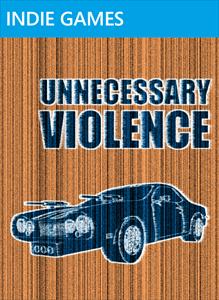
<— What the fuck is with that box art, Adam?

Unnecessary Violence

Unnecessary Violence is a car-combat game set on the largest stretch of straight road in the world, yet has the least diversity in vehicles.  I saw no ambulances, no motorcycles, no convertibles, and no buses.  Plenty of taxi cabs though.  Not sure why someone would be in a taxi on such a long stretch of road that has no turnoffs.  With the cost of taxis being what they are, you would think renting a car and taking it on this road would be cheaper.

I had a witty caption for this, but then I fell asleep while playing and forgot it.

The basic idea is you’re a car tricked out with various weapons.  You drive on a road, shooting at cars.  Then it tells you to shoot a specific car.  You shoot it, then shoot other cars until it tells you shoot a different specific car, rinse, repeat.  Sorry if that sounded unenthusiastic, but never before has an XBLIG with no major technical flaws gotten me so bored so quickly.  This is mostly on the fact that you’ve seen pretty much everything the game is about within the first five seconds of playtime.  The monotony wears thin quickly, and Unnecessary Violence does very little to change things up.

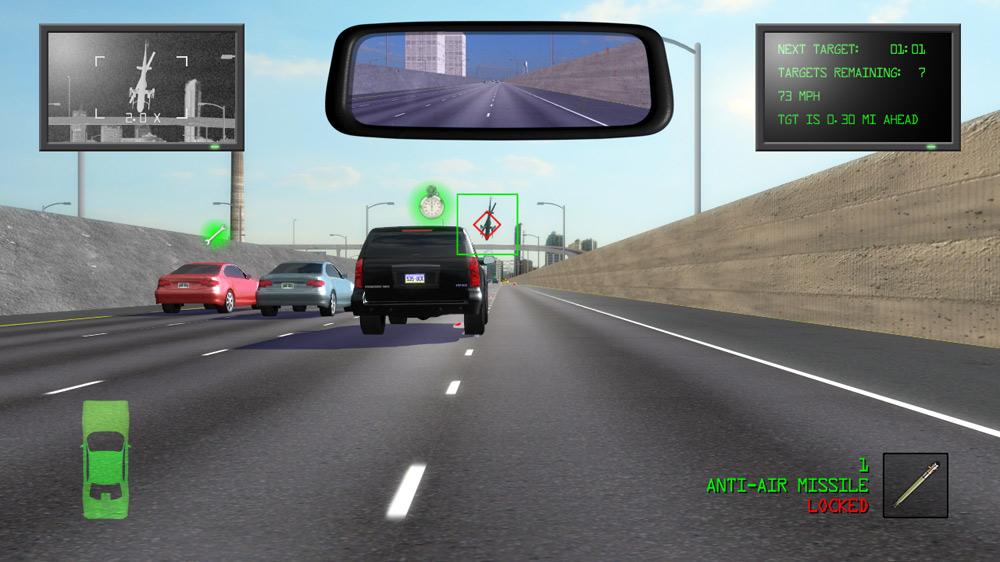
The weapon variety is lame.  You get a machine gun with no “oomph” to it that overheats if you use it for more than a few seconds.  You get rockets that take multiple shots to blow up a car.  If I have a rocket launcher and it takes two shots to blow up ANYTHING, I’m going to be oh so pissed at the asshole I bought it from.  Land mines are present.  I found them to be unsatisfactory, mostly because I want to actually see the shit I’m blowing up, not having to glance at the rear-view mirror.  Enemies have mines too, and they’re fucking impossible to avoid, because you’re traveling at high speeds.  There are anti-tank guns, which require you to carefully select your target, hard to do when you’re cruising at warp-speed and often rear-ending all other cars present.  There are anti-air missiles for helicopters that don’t show up until the third stage, at which point you’ll have quit and started a better game.  Finally, there’s nuclear weapons, which create a nifty explosion but otherwise I could not figure out what the fuck they’re useful for.  To activate them, you have to input a five-button code.  Again, this is while you’re in the middle of busy traffic, often pressed for time.  How could they fuck up the entire assortment of weapons in a car game?  Couldn’t they get just one right?

So bored. Please kill me. Make it stop.

By the end of the third stage, I decided I should either quit the game or kill myself.  I chose the former, obviously.  There’s just no variety in Unnecessary Violence.  Lots of weird stuff that I hated too.  Your car is able to set off a nuclear fucking explosion, but you can’t bump other cars off the road.  If you’re driving at 140 miles an hour and you bump into the back of a car, it doesn’t even nudge forward, yet it cuts your speed down to a snail’s pace.  You do have the ability to give yourself a nitrous boost, but it seems to do little more than give the appearance of moving faster.  The rate at which traffic appears while using it doesn’t seem significantly higher than it is when you’re just putting the regular pedal to the non-nitrous metal.

Despite having fairly decent graphics and control, Unnecessary Violence feels unfinished.  It’s one objective repeated in a loop in a way practically guaranteed to comatize anyone playing.  I almost wonder if the developers had more ambitious plans, but gave up once they had something vaguely resembling a decent video game running.  It needed something else to keep things fresh.  Instead, it just drags along like it’s got worms.

Unnecessary Violence was developed by Tackemon

80 Microsoft Points said you know the game is going to be bad when the FAQ is the most entertaining part of it in the making of this review.
Facebook, Twitter, Digg, and the rest.  Oh whom will be able to find me without my loyal readers forwarding me on them?  There be buttons below, and if you use them, a kingdom I shall grow. 

48 Chambers (Second Chance with the Chick)

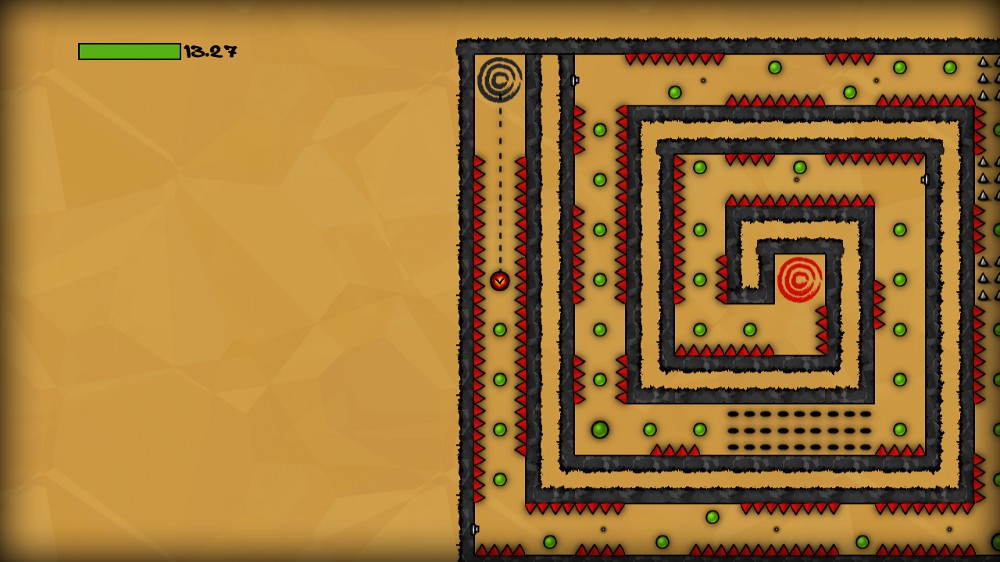
48 Chambers hasn’t even had a chance to fall off the first page of my site and it’s been updated to include more backgrounds.  Oh, and a casual mode with no limit on lives for the crybaby population among us, specifically me.  Well, at least now I can see what chambers 21 through 48 look like.  And they look swell.  Most of them at least.  Some of them are just reskinned previous chambers with extra traps added, but that’s fine.  At least 48 Chambers is now a game that can be played (and finished) by anyone, and that’s good enough for me to recommend it.

48 Chambers was deve-

HEY, wait, I still had some stuff to say.  Damn jumpy Microsoft Points joke.  Just wait your turn.  You’re not even funny this time around.

How I hated this fucking stage.

So I did enjoy playing 48 Chambers in casual mode, mostly because I was able to escape the sense of dread that it would take me weeks of getting good at this just to see the inevitably lame “Thanks for Playing” screen.  You see, just because I like something doesn’t mean I can’t nit pick it to shreds.  In the case of 48 Chambers, I don’t think the developer went far enough with it.  It feels more like a concept than a fully realized game.  Do you know what would have killed in this?  A multiplayer race mode.  Local or online, doesn’t matter.  Just racing the mazes would have beefed up the content.  Level select once you’ve cleared a stage or a time trial mode would have been swell as well.  I’m told level select is on the way.  Time Trial following that should be a no-brainer.

For you sadomasochists out there, Discord also added a hardcore mode where you get exactly one life to finish the game.  Yea, fuck that.  I was told by the developer that some people actually did manage to finish the game in its original incarnation.  Psssh, whatever.  Freaks.  Either way, I’m just glad that my suggestions thus far have been realized, so I figured I would chime in with a few others.  It’s nice to have the developer’s ear in a strictly metaphorical sense for a change.  I mean, like, it’s always a metaphor!  It’s not like I cut off ears and wear them as a necklace or anything.  I swear.  Quit staring at me!

48 Chambers was developed by Discord Games

IGC_Approved80 Microsoft Points watched a snail crawl along the edge of a straight razor. That’s my dream.  It’s my nightmare.  Crawling, slithering, along the edge of a straight razor, and surviving in the making of this review. 

I told you it wasn’t worth it.

Quiet, Please!

Quiet, Please! is pretty much a point and clicker set in 2D side-scrolling frame.  I’ve been lambasting the genre for a few weeks now, making it clear that I hate these games.  Quiet, Please! is better than most because it doesn’t use static screens and it feels like you’re actually doing stuff.  I will say that it makes me wonder if I’m starting to hate the genre because of what it’s doing to me.  Psychologically.

As I pointed out in my Without Escape review, these games usually involve a degree of logic so unglued that it’s probably dangerous to speak of it in the presence of others.  Following my play-through of Quiet, I’m now certain these games also rewire your brain.  The basic idea is you’re a girl who wants silence in her house so she can get some sleep, forcing you to figure out ways to shut off anything making noise.  The actual ways this is accomplished are as sane and valid as any P’n’C title I’ve come across.  However, the ways I hypothesized I would do it are probably enough to get me sectioned.

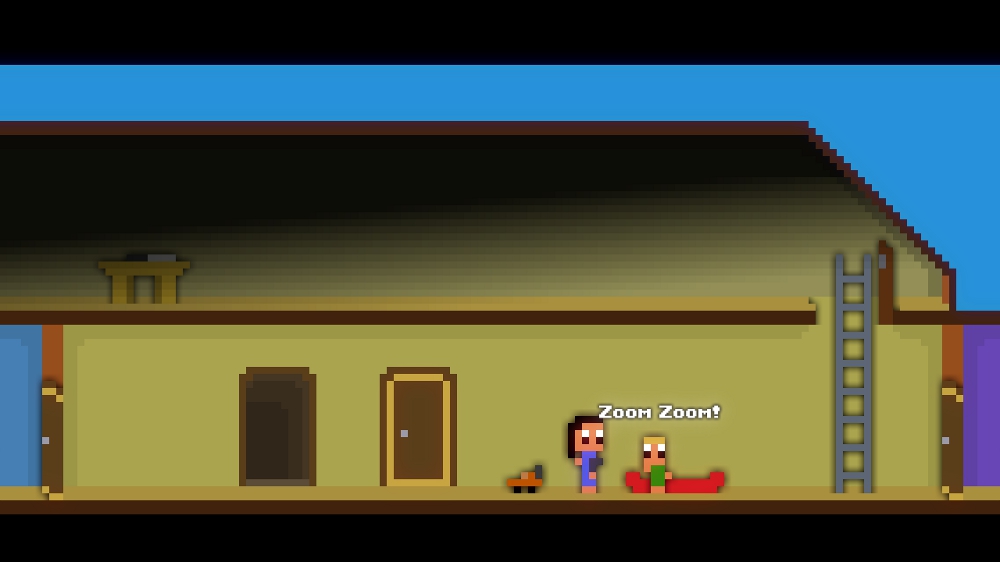
For example, you have a brother who chases you around and won’t stop bugging you.  I don’t have any siblings, so I can’t relate.  Among the items in the house are a remote control car and a comic book, both of which he seemed to be drawn to.  The game begins with you being dropped off on the sidewalk.  If there’s a sidewalk, there must be a street.  If there’s a street, there are moving cars.  So I theorized that I would use the remote control car to lure my brother onto the busy street, thus killing him, or at least maiming him into silence.

I wish I was making that up.

Hey little bro, do you want to go play with the big zoom zooms?

Oh come on, don’t look at me like that.  The first thing you do is distract your mother by plying her with wine.  I figured if that was copacetic, why wouldn’t splattering your brother be justifiable?  It still doesn’t excuse a later moment in Quiet, Please where you have to pacify three noisy kittens.  At the same time, there’s a neighbor who has a lawnmower going all day and all night.  I turned to Brian and plainly, calmly, and completely seriously said what is perhaps the worst sentence uttered out loud since the fall of Nazi Germany.  “I probably need to get him to run over the kittens with the lawnmower.”  And I meant every word of it.

As it turns out, you can deal with the kittens by giving them a ball of yarn, and the lawnmower thing is also handled in a rational (albeit totally illegal) way as well.  This is what playing these games has done to me.  I’ve gone from being grounded in reality to dealing with problems in the most roundabout way possible.  In a way, I should thank Quiet, Please! because it’s one of the first games that you deal with problems the way they should be dealt with.  Lull your brother to sleep with comic books and clean pajamas.  No murder.  Huh, makes sense.

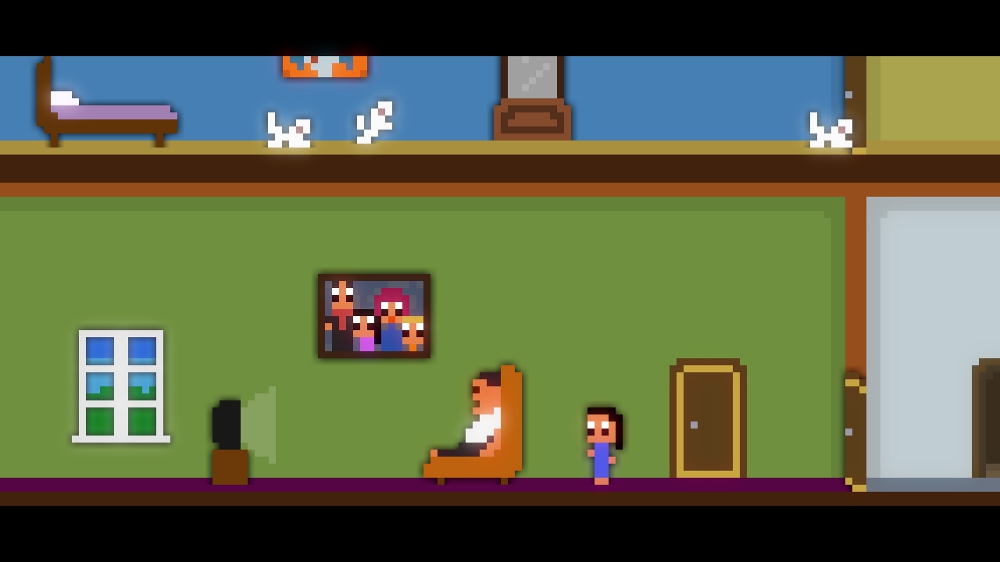
So I won't silence Daddy by smothering him with a pillow? Huh. Weird game.

So how is the actual game?  Well, it plays well enough and it’s a nice change of pace from how this type of crap is usually presented.  It only takes about thirty minutes to finish, if that, so you don’t have to clear your schedule or anything.  I guess I’m squeezing out a mild recommendation on it.  If nothing else, it won’t cause any further damage to your psyche.  It also won’t undo any damage already caused by point and click games, so if your first instinct when handed an object is to do something insane with it, sorry, you’re stuck that way.  There is no turning back.  Just do what I did and find someone like Brian to follow you around and remind you that if you pick up a stick, do with it things sticks are usually used for.  Apparently, this does not include waking up your friends by sticking it up their peeholes.

The name of the game is School? That doesn't sound very fun. Oh wait..

Quiet, Please was developed by Nostatic Software

80 Microsoft Points have a boyfriend have who is saying “that’s just wrong” at the moment this is being typed in the making of this review.  “You wouldn’t actually do that, would you?”  Christ, I don’t even know anymore. 

There’s some cool buttons right below this review that allow you to share my stuff on all kinds of social networking sites.  Help my site grow by taking twenty seconds to click one and share.  If you don’t, I will switch the Puppy of Sadness‘ food from his preferred Kibbles ‘N Bits to a generic, off brand food, causing his sadness to reach weaponized levels that I will then unleash upon the masses, ridding the world of joy forever.

Dark

It’s still Thursday in Alpha Centauri.

I think I would be hard pressed to come up with a game that’s a bigger violator of what I call the “Google Rule” than Dark.  Let’s put it this way.  I searched for “Dark” on Xbox.com and set the results per page to 90.  Dark falls all the way to 88th, the very bottom of the first page.  And once you get over to Google, good luck.  The word “Dark” alone brings up nearly two billion hits.  And then my point was lost as I typed this, because when I searched for “Dark Xbox” it was the second result.  Ah ha, but then I added “Indie” to “Xbox” and it somehow dropped Dark completely out of the top 100 results.  My point is, it needed something other than Dark.  May I suggest adding “Crap” to the title?

Dark is really, really awful.  It tries to mix Limbo-esq minimalistic presentation in platforming with Little Big Planet-style manipulable environments.  Well actually, this came out before Limbo, so another point is lost.  Meh.  Off my game tonight.

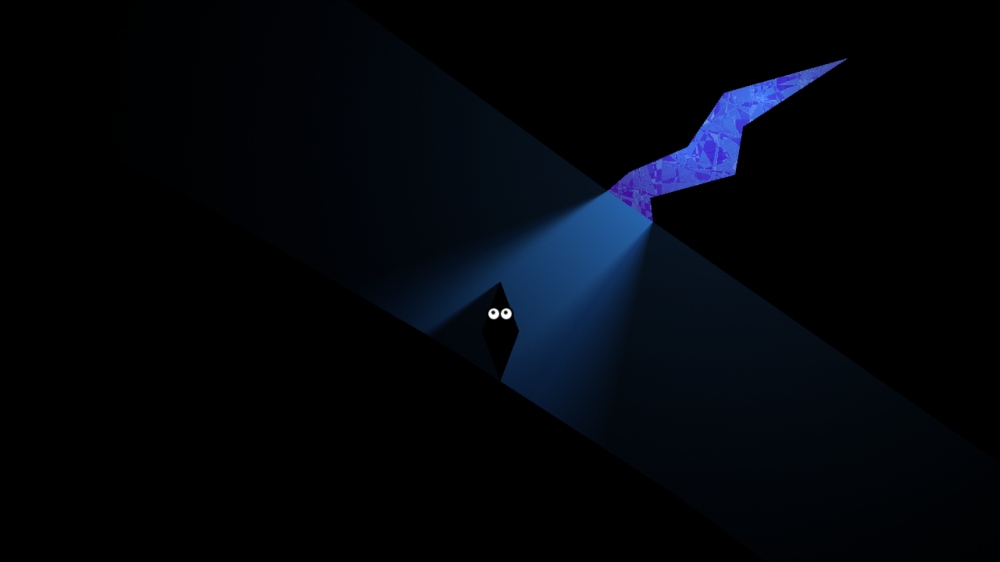
The problem with Dark is the physics are horrible enough that I couldn’t get the floor to correctly break apart the way it’s supposed to on the second stage, after multiple attempts.  With no direction given, I’m not entirely sure I was doing enough to accomplish this.  As best as I can tell, I was supposed to push a large rock off a cliff and let gravity take over.  The problem is, gravity didn’t put in enough effort and the flooring got sandwiched between the rock, then stopped moving.  I tried jumping on it to smooth things along, but my dude had no weight about him and I somehow got pinned between the two things, unable to move at all.

Given that each section of the game could take as little as a minute to finish, it seems odd that a chapter-skip option is included.  After three or four failed tries to break the floor properly, I realized why it’s there and skipped to chapter 3.  About five minutes later, I finished Dark, because the whole thing takes like ten minutes to beat.  So what did I think?  Didn’t find the graphics impressive despite what others would say.  Bad play control.  Unclear objectives.  Physics that don’t work.  A final puzzle that took me literally under ten seconds to solve on my first try.  It’s maybe the biggest waste of a dollar I spent this year.  It’s between this and some novelty chewing gum I bought for a buck that dyes your tongue black.  I gave it to an intern at work to screw with them and they didn’t care about being the butt of a joke because “whatever, it still tasted good.”

Screw it, I only played this because my buddy Mark at GRcade told me I could finish it quickly if I was short on time for a Katch-Up.  Which I was.  Now I can pretend this never happened and move on to Fez.  I would tell you not to play Dark, but actually this game came out three years ago and probably would have been totally forgotten if I had just left it alone.  What can I say?  Oops.

Dark was developed by Andrew Russell

80 Microsoft Points were absolutely shocked to read the critical praise this game got.  Well, different strokes for different folks I suppose in the making of this review. 

There’s some cool buttons right below this review that allow you to share my stuff on all kinds of social networking sites.  Help my site grow by taking twenty seconds to click one and share.  If you don’t, I will switch the Puppy of Sadness‘ food from his preferred Kibbles ‘N Bits to a generic, off brand food, causing his sadness to reach weaponized levels that I will then unleash upon the masses, ridding the world of joy forever.

Spoids

Spoids received a Second Chance with the Chick, which corrected many issues with the game, resulting in it getting the Indie Gamer Chick Seal of Approval.  For my continued thoughts on the game, read it as well

Update: Spoids now costs 80 Microsoft Points.

If someone asked me what my favorite genres are, I probably wouldn’t think of tower defense.  That’s kind of odd, because it’s not uncommon for me to like the tower defense games I play.  It’s actually funny.  When the time comes to rattle off my favorite games, stuff like Plants vs. Zombies, GemCraft, PixelJunk Monsters, Crystal Defenders, or Ninjatown probably wouldn’t warrant a mention.  Yet all the games I just listed have likely stolen more life from me than smoking has.  I can’t put my finger on why this niche genre doesn’t hold a special place in my heart.  Perhaps it has to do with these games having a drop-off point where they stop feeling fun and begin feeling more like a time sink.  It’s the same reason why MMOs like World of Warcraft or Phantasy Star Online also wouldn’t make the short list of most amazing games I ever played despite investing years of my life playing them.

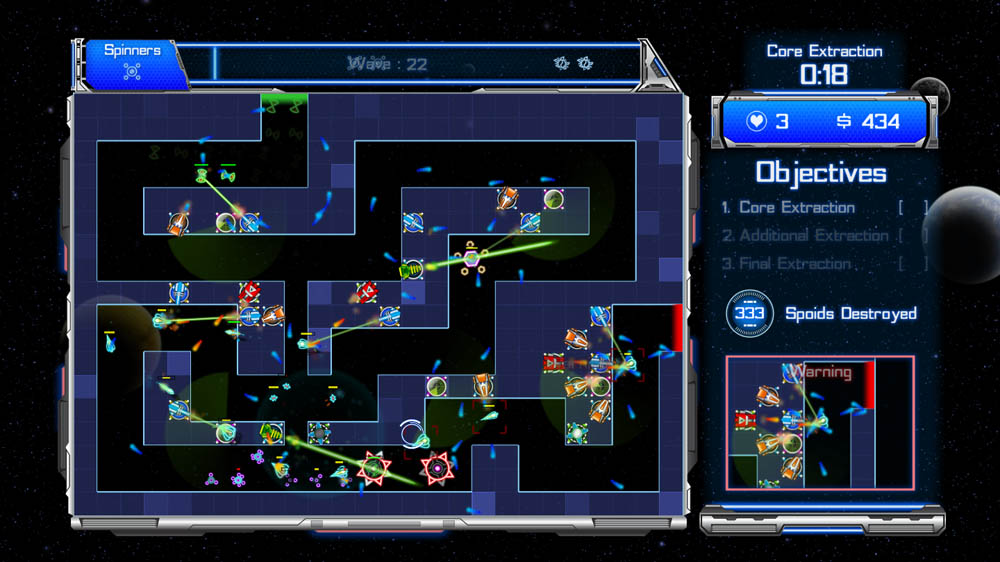
One of four screenshots chosen by AirWave Games to showcase their game on the Xbox Live Indie Game marketplace. And thank God. I was worried this would be one of those titlescreenless games for a second there.

I’m not sure that’s it though.  Because I’m typically satisfied when I finish a tower defense title.  And not just in a “thank God I don’t have to play any more of that” type of way.  Oh, that factors in a little bit.  Among other things, it’s typically around that time that my brain starts to remember to do important things like doing my job and taking a shower.  But it’s bizarre, don’t you think?  It’s almost like upon completion of a tower defense game, my brain immediately deletes any record of me having fun.  Some kind of survival mechanism, no doubt.

Spoids is the first traditional tower defense game I’ve reviewed thus far.  I’ve done hybrids like XBLA’s Dungeon Defenders, action-bent ones like Video Wars, and whatever the fuck you would classify The Cannon under.  Oddly enough, the two XBLIGs were leaderboard games and Dungeon Defenders was one of my favorite games of 2011.  I honestly don’t know why this isn’t one of my favorite genres.  I’m starting to think I might be unconsciously racist against it.  Maybe that’s why I was so apprehensive to review Spoids.  It’s one of those games.

Spoids has a nifty presentation and semi decent voice acting (which might be a problem for other reasons, more on that later), but this is really a plain-Jane, no frills, utterly generic tower defense game.  It’s kind of fun too.  Unfortunately, the balancing in difficulty is a bit off, and by “a bit” I really mean “there is no balance at all.”

There’s eight levels in Spoids, so the game is pretty short.  It’s single player only, so the only replay value comes in the form of medals.  Every stage is graded on the platinum-gold-silver-bronze scale and is based on various benchmarks the game sets for you.  Each objective is clearly spelled out, but usually comes down to staying alive for X amount of time and/or not taking damage.  This is a problem.  I totally aced the first stage and figured I was going to be gung-ho to rip Spoids to shreds in about an hour.  Nope.

It’s rare that I talk to my fellow critics about a game before I write my own review, but in the case of Spoids, I talked to my amigo Tim Hurley of Gear-Fish, who did a review of this a few days ago.  Like me, he didn’t score many medals outside of bronzes.  He also didn’t finish the game.  As it turns out, I actually made it further than he did.  What it comes down to is the speed of which enemies hit is much faster than you can reasonably be expected to build your defenses.  You only get extra money based on the enemies you kill, so you’re very limited in what you can do to defend yourself.  You can set turrets to attack specific enemy types, or fire on them based on parameters that you set, but otherwise the scope of what you can do is limited.  In later stages, where there are multiple enemy entrance points and various channels for them to deviate from, I tried and tried and tried to do anything to score better than a bronze medal and couldn’t do it.  I’m convinced that it’s probably impossible sans one specific method which the developers themselves figured out in development.

Spoids was the straw that broke the camel’s back and inspired my recent editorial on game difficulty.  As maddeningly tough as stages 4 through 7 were, at least I was able to beat them (after multiple attempts with each), albeit in the most minimum way possible.  Stage 8’s only goal is “fend off the entire attack.”  Couldn’t do it.  Spoids has several enemies that you have to build specific towers to fend off.  There’s invisible enemies that phase in and out.  You need to build radar towers to make them visible.  However, these have a limited range (I swear it seemed more limited by game’s end) and cost money that can’t be spent on things that actually attack.  Likewise, waves of flying enemies come in that are only vulnerable to missile towers, which don’t attack anything else.  The thing is, the missile towers kind of suck at their job, so you need to build a lot of them.  But, they cost way too much money given that they can only attack one enemy type that appears only sporadically.  Yet, even when caking half the screen in them on level 8, the flyers still got by.  I shit you not.

There’s also carrier enemies that are total bullet sponges.  Even when putting up the most powerful turrets, along with stuff to slow them down (which you can’t really afford on stage 8 given all the other shit you need to be doing), they take an absurd amount of hits to destroy.  And once they die, they unleash fast-as-hell enemies that skate right past your defense and lead to your failure.  You have to juggle all of this.  I never came remotely close, and I probably tried no less than fifty times using no less than fifty different combinations of defense.  Again, I’m sure someone on the development team beat this (at least I sure hope they did) but literally nobody I talked to this week about the game (six people, including Tim) could.

Despite having fun, I can’t recommend Spoids in its present state, because I believe in a fair fight and I don’t believe you get one with it.  I do have to note, before hitting the brick wall at the very end of the game, I did have fun.  I think.  Again, my brain deletes all memories of joy related to tower defense titles.  But I have found various post-it-notes scattered throughout my house saying “Spoids is fun.  Don’t forget.”  Yes, it is fun.  It’s also infuriating and maybe even impossible.  You know what?  I want them to fix the issues and I want to do a Second Chance With the Chick on this game.  It’s very rare I say that in a review, but it’s true.

Oh, and in closing, the Spoids is 240 Microsoft Points, which is overpriced in my opinion.  Of course, their hands were tied because it came in at 200MB.  The cut off for 80 Space Bucks is 150MB.  Which leads me to ask this question: where the fuck is all that 200MB going?  Maybe in voice overs.  It has those.  They’re nicely done, but totally unnecessary.  Otherwise, the graphics are kind of simple.  Not horrible, but not exactly cutting edge or anything.  I can’t tell you what I thought about the music because I typically play games with the sound muted.  I like to hear myself think.  But seriously, what happened to this game?  How did it balloon to 200MB?  Why is it so fucking hard?  And why am I tempted to go take another crack at it?  It’s got some Spoiding to do.

See, I did a Ricky Ricardo thing there.  He was Cuban, like me.  Also, not funny.

Spoids was developed by AirWave Games

IGC_Approved240 Microsoft Points have a father who thinks doing the Ricky Ricardo “Lucy, I’m Home” voice every single time he gets home never gets old and is WRONG in the making of this review. 
Spoids is also available on Desura for $2.99.  This version is unverified by Indie Gamer Chick.  The XBLIG version is Chick-Approved and ranked on the Indie Gamer Chick Leaderboard.