Mr. Gravity

Mr. Gravity was developed by students from the University of Utah, which leaves me with an overwhelming temptation to make fun of Mormons but I’ll bite my tongue and try to resist.  Actually the U of U has a rich history in gaming.  In the late 60s it had an early computer known as the PDP mainframe that played the very first computer game, known as Spacewar!  Although it was created at MIT, it made it’s way to Utah where an engineering major named Nolan Bushnell played it, fell in love with it, copied it as the first coin-op video game known as Computer Space and touched off the entire game industry.
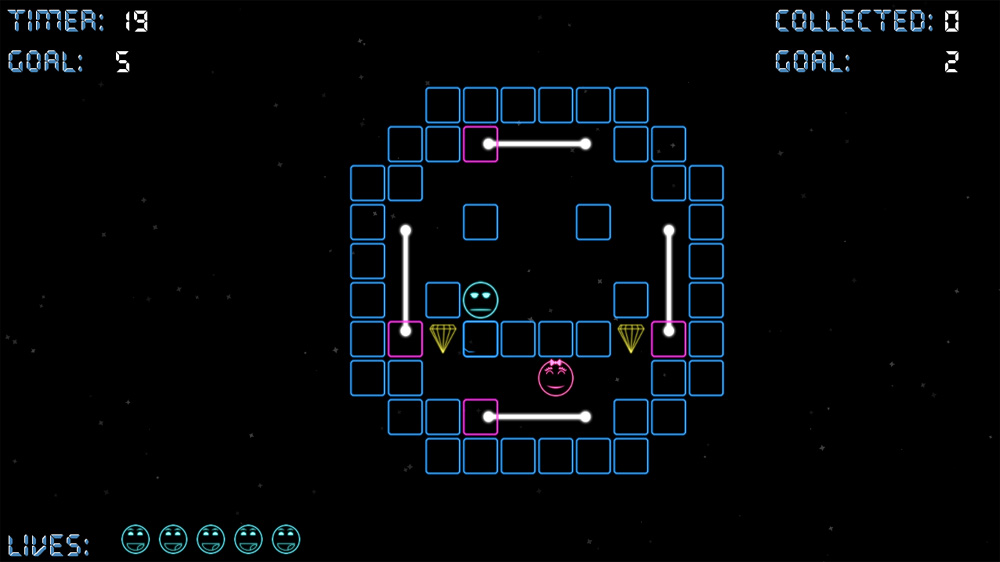
With this huge legacy towering over them, the students at U of U have given us Mr. Gravity.  It’s one part physics-based puzzler and one part dexterity tester.  You play as a blue circle named Mr. Gravity and you navigate a maze to find your wife, a pink circle named Mrs. Gravity.  The gimmick here is you don’t actually have control over Mr. Gravity himself.  Instead, you move him by completely shifting the pull of gravity in a level.   You can do this by using the pad, the stick, or the four face buttons.  I recommend the buttons myself.  There’s no sliding scale of gravitational force, so it’s always full steam ahead, and using the buttons feels quicker and more accurate.

In the mazes you must avoid anything that’s red, or you die and go back to the start of the maze.  In addition to traps and sliding blocks, the maze is filled with various amounts of gems that you can collect.  Mr. Gravity scores each round based on how many times you die, how many gems you collect, and how fast you reach Mrs. Gravity.  Each category has a maximum score of three stars, with a final tenth star awarded for three-starring all the challenges.  Thankfully you can beat each challenge one at a time by replaying the levels, likely because doing them simultaneously I’m pretty sure is not even doable.

Mr. Gravity features 80s-style vector graphics (like Battlezone or Tempest) that keeps the action on screen clean and distinctive.  This was a brilliant style choice in a world where a lot of developers would have been too caught up drowning out everything with crazy particle effects or blooming.  It gives the game a fantastic sense of charm.  A retro feel in a game that is utterly unique on the marketplace.  I totally would endorse buying it as there’s few opportunities to play something this unique on XBLIG.  It has no zombies, it doesn’t massage your back, and it doesn’t use your avatar.  It’s only 80 points too!

Oh that’s right, I forgot to talk about the difficulty.  I’ll chalk that up to post traumatic stress disorder.  You see, I have a policy on here to play every game I review to the bitter end, but in Mr. Gravity’s case the game is impossible.  Even if you can get past the insane difficulty spike about 20 boards in you’ll be bored to tears by that point and want to do ANYTHING else.  Resisting otherwise simply cannot be done.  Thus, yet again, we have a game that goes for the highest degree of difficulty possible and as a result Mr. Gravity runs out of fun before it runs out of game.  I guess I still recommend it, if only because it’s so original that it deserves to make money, but you guys at U of U are real bastards and I thought I should say something about it.

And no, I don’t care if someone uploaded a video of them beating the final level and getting it named after them.  I bet it was some kind of Mercury Rising style prodigy child who’s efforts would have been better spent doing something more productive, like disabling our enemies’ missile systems.  Yes, that must be it.  So thanks a lot, Mr. Gravity team.  You made me feel like a surrender monkey and you put our national security in danger.  See, this is why we don’t let you guys have multiple wives.

Mr. Gravity was developed Angry Newton

80 Microsoft Points left Kairi crying in the making of this review.

Wiki Read: Wikipedia for Xbox

Why?

Wiki Read: Wikipedia for Xbox was developed by Paul Fisch

240 Microsoft Points looked up the meaning of squandering money in the making of this review.

Creed Arena

I loves me some platformers but sometimes a girl has to get a break from them.  Besides, I’m a tough sort of chick, the kind who likes big guns and lots of blood on screen.  What I needed was a shooter.  What I found was Creed Arena, a release from early 2010.

If you were ever into Quake or Unreal mods, you’ll feel at home with this one.  It’s a pretty basic deathmatch shooter with the usual assortment of guns.  You can alternate between a third-person perspective or a bird’s-eye-view of the action, each one with it’s pros and cons.  In the over-the-shoulder view you’re able to aim high and low, whereas in the top-down view you seem to move faster, you’re able to turn quicker, and you can melee easier.  Come to think of it, I’m not sure why anyone would bother with the third-person stuff at all.

The gimmick here is that you’re a futuristic gladiator who’s more concerned with winning over fans then racking up kills.  Every frag, melee, and “big hit” causes more fans to cheer you on.  The object of the game is to become the most popular gladiator by racking up a little over 100,000 fans.  This took me well under an hour to accomplish, at which point I hadn’t even beaten most of the challenges.  Sometimes you have to get kills, sometimes you have to fetch beer kegs, sometimes you have to be the first player to get X amount of fans.

I actually found the single player stuff enjoyable but not always for the right reasons.  The AI is super glitchy and often enemies would be seen running in place, like a video game version of the Trepak from the Nutcracker.  It was very amusing.  Other times, they would just get stuck in walls.

The default rifle, the lightning gun, and the plasma gun were all basically worthless, while the rockets and shotty were as satisfying and fun as they are in any other shooter.  Creed Arena really doesn’t seem to distinguish between a shot to the head or a shot to the foot so there’s really no point in zooming in to the slower third-person mode.  You get more fans by using melee beatdowns so I just stayed with the overhead shot and ran around smacking people to death.  I was actually curious if I could play through the entire game without ever firing a single bullet.  Not only did I do it, but it was actually easier that way.  One of the reasons is that if you get multiple kills in short order you enter “crowd rage” mode where suddenly you become faster, stronger, and able to jump higher.  In this mode, most opponent types die after one melee, while the amount of fans you win over gets higher and higher.  “Surely this feature won’t in any way cripple multiple” I thought.

I didn’t have a chance to play co-op, but shock of shocks, I was able to get paired up with a few random people for some online matchmaking.  Sadly, it was two little kids who sounded like they’re still waiting to see if they passed 2nd grade.  Oh well, an opponent is an opponent.  In our first match, I quickly took possession of a rocket launcher and proceeded to blow the brats back to the their momma’s womb.  There’s no ammo in Creed Arena so once you have a weapon, it’s yours until you die or pick something else up.  This was obviously a problem because nobody regardless of age or skill would have been able to deal with whoever was the first person with the good weapon.  Thankfully it was their problem and not mine.

Having won that match 5,000 fans to zero to zero, we decided to change things up with a shotgun deathmatch to 20.  And things started off well enough.  One of the kids even got the first kill in on me.  Then I discovered that each player only had one spawn point.  So I tracked one of the kids down, shot him, then camped at his base and spawn killed the little bastard for the rest of the game.   Hey, I never said I was a good sport.

So at the end of the day I had fun with Creed Arena but have difficulty recommending it.  It’s got fine 3-D graphics comparable to stuff from the Sega Dreamcast and a decent music track.  The sound effects were quite awful, and I could swear the plasma gun was saying “error” repeatedly.  The theme is fun and some of the maps are fairly enjoyable but the mechanics are heavily flawed and there is absolutely no balance whatsoever.  There’s really no reason for Creed Arena to exist.  If you’re the average Xbox 360 owner you already have at least a dozen shooters that are fully functional, have better online support, and have plenty of little second graders who are more then eager annoy you with constant “BOOM OH YEA HEADSHOT YA FUCKIN NEWBZ!”

Creed Arena was developed by reedake2

240 Microsoft Points won over the hearts of the crowd in the making of this review.

Akane the Kunoichi

The Super Nintendo was the first game system I played with as a child, so I have a particular fondness for it’s brand of samey action-platforming.  Stuff like Earthworm Jim, Joe & Mac, or Pitfall: The Mayan Adventure.  Utterly generic titles that were so interchangeable that they might as well have been shipped without labels.  Would have saved a couple cents.  Anyway, I loved them.

Akane the Kunoichi serves as both a loving tribute to that era and a reminder of why it’s a good thing it came to an end.  You play as Akane (Japanese for “redhead”), a Kunoichi (female ninja) who has to rescue her boyfriend from some evil ninjas.  The gameplay is straight up 2-D platforming mixed with projectile shooting and couldn’t be more generic if it was sold at WalMart under the Great Value brand.  There’s fifteen levels, five of which are boss stages.  Every stage has a theme and the usual suspects of fire, water, and castle show up.

It plays like Contra with a little Ninja Gaiden thrown inYou jump from platform to platform shooting bad guys with your unlimited supply of throwing knives, collect power-ups that cause your attack to spread out, and climbing on walls.  The graphics are typical SNES stuff and look very colorful, but the backgrounds recycle and the music is about as inspiring as water-flavored ice cream.  In other words, it does fairly well drawing from it’s source material.

Staying true to generic 16-bit roots is ultimately Akane’s downfall.  The game is just plain boring.  You can count on one hand the number of bad guys you encounter (excluding bosses) and once you’ve seen them and have their patterns down there’s no surprises left.  There are encounters with giant bosses, but they’re of the cookie-cutter variety and leave a lot to be desired.  They also have enormous life bars and thus fighting them feels more like busy work then anything epic.  The second boss especially, because you can only get one or two shots in while his weak point is exposed.  Then, once he closes in on you then it’s time to wall jump to a platform over his head, run down it, and repeat.  I found it saved time just to take the damage and run through him.  This is the sign of a poorly made game.

The biggest flaw is the wall jump.  At first, it seemed to work, but after a while it became the only reason why I died.  You’ll jump to avoid a projectile, end up stuck to a wall, can’t get off the wall, and pffph, dead.  And then there’s the really annoying instances where I ended up hanging on a wall that wasn’t even fucking there.  I would try to climb down off a wall without jumping off, only for Akane to keep climbing, right in the middle of the screen and completely exposed to enemy fire while holding on to nothing.

At this point I’m sure people who think indie games are above criticism will point out that Akane the Kunoichi is charming, retro, and only 80 Microsoft Points, so why be such a killjoy?  It’s true that it’s priced to afford and mostly functional.  I’m sure people who start every game centered conversation with the words “back in my day…” will either enjoy Akane or at least convince themselves they’re having a good time even when they’re not.

Anyone else looking for a good nostalgic romp would be better suited going with something better produced like LaserCat or TIC.  You can even forgo the Xbox 360 altogether and dig your SNES out of the closet.  Go ahead and fire up your favorite generic, bland, “throw any licensed character into the same environment and you wouldn’t even notice the difference” 16-bit side-scroller.  Anyone up for a round of Donkey Kong Country?

Akane the Kunoichi was developed by Haruneko

80 Microsoft Points learned the 18 prinicples of the Ninjutsu in the making of this review.

Them Blockz

Them Blockz is a puzzler where you must get colored cubes into their designated holes on the map.  You have a starter cube that you move around each board.  Every colored block you touch sticks to your cube, along with any blocks that touch the one you’re holding.  Just find the matching colored holes and return the blocks to them.

This is actually one of the most broken puzzle games I’ve ever played.  The controls are very unresponsive, and sometimes the game just flat out refuses to acknowledge that you are moving the analog stick.  There’s no option to use the digital pad, and thus you’re going to have to deal with multiple instances of having the sluggish controls force you to restart a room.  This is especially annoying in later stages where you have to make precise movements and avoid bumping into other blocks.

I don’t even know if having the D-pad would have mattered anyway.  Them Blocks is really boring with or without proper control.  The concept simply doesn’t work as a console release.  Like most XBLIG puzzle games, this would have been better suited for the Android market.  It would have still been as bland as a bread-and-nothing sandwich but at least it could have been bland in smaller bites.

Them Blockz was developed by GLHF Games

80 Microsoft Points fell into a hole in the making of this review.

Urban Space Squirrels

I seem to find it harder to write about games that I don’t enjoy at all.  This is my sixth attempt at getting a review out for Urban Space Squirrels.  And I plan on it being the last, so I better get it right this time.  It’s a puzzle-platformer where you play as fluffy squirrel who can throw bombs to activate switches or launch himself in the air.

In theory, the bomb-jumping mechanic should work like the morphing ball bombs in Super Metroid.  That’s not the case at all here.  You control your squirrel with the left stick, control the bomb with the right stick, launch a bomb with the left trigger, and detonate it with the right one.   It’s way too complicated, the video game equivalent of rubbing your belly and patting your head while swinging a hula hoop and doing your taxes.

Later on,  you’re given even more bombs to manage and a broken wall-climbing function.  Allegedly you use the left stick along with the A button to do this, but the game was really fickle about when it would work.  More often then not I was forced to tap the A button to pull it off, and this is while I’m also supposed to be placing and detonating bombs mid-air.  This entire control scheme needed fine-tuning in a big way.

Urban Space Squirrels ultimately has nothing enjoyable about it.  The control is terrible, the graphics look like a cheap flash-based browser game, the music is awful, the sound effects are grating, and the entire concept of the game is hugely boring.  I can’t believe this showed up on a few “best of XBLIG” lists.  Did anyone who praised this shit actually play more then the tutorial on the demo?  No?  Well thanks a bunch guys!   Now someone out there might choose this over that swanky pair of denim jeans for their avatar.

Urban Space Squirrels was developed by DTA Entertainment

80 Microsoft Points were shot with a BB gun in the making of this review.

LaserCat

Update: This review now applies to the PC version of LaserCat following the great XBLIG purge. The PC port is verified to be functionally identical to the XBLIG original.

Last night I called TIC: Part 1 the best indie game I played thus far and said it “made all other indie games look bad by comparison.”  Well, that sure makes this next review quite awkward.

ss_7759eb2fcac75fb88d20335dfafee5e991a17c91.600x338

My cat looked the same way when she swallowed my mini-LED flashlight.

LaserCat is a Metroidvania-style platformer.  You play as a glowing cat who’s BFF owl gets kidnapped by an evil space frog and now you have to save her.  This stuff is every bit as insane as TIC, but here it’s all campy and retro and thus charming in a different way and ending any remaining similarities these two had.  Excluding my undying love for both, of course.

The object is to navigate a 225 room maze and locate 30 hidden keys.  Once you do, you have to find the room that contains your owl friend’s cell, at which point, spoiler alert, you have one last section where you must run to avoid various traps and the space frog’s bullets before finally saving your friend.  The whole experience should take about two to three hours to score a 100% completion. There are no bonus challenges or extra quests, and who needs them anyway?

Oddly enough, for a game called LaserCat at least, there’s no fire button or shooting to be done.  You can’t defeat the enemies, just avoid them.  I know the average gamer these days goes into a coma if the screen isn’t being spammed with bullets or having stuff get blown up, but here it works flawlessly and even creates a real sense of tension.  Once you retrieve a key, you have to return it to one of the many checkpoints scattered throughout the maze.  If you die, you lose the key.  You can hold as many keys at a time as you want, but if you die before you reach a checkpoint, you have to go back and get them.  It makes rooms that seemed so easy to clear before feel much more menacing, because if you die this time there’s a consequence to it.

ss_57e630523623440625ec83d2290a38095acc9ed0.600x338

Polar Bears are noted for being the fiercest killers in the animal kingdom. Except giant spiders.

I don’t mean to imply that LaserCat is difficult, because it’s not.  I breezed through the game in two hours thanks to the ability to warp from checkpoint to checkpoint.  A very useful map that can be brought up with the pause button helped assure me that I left no room unchecked and never was in danger of getting lost.  And that’s all fine, people.  Not every game has to kick you square in your self-hating ass and tell you what a pathetic bitch you are.  The guys at MonsterJail Games were clearly more interested in creating an enjoyable little experience instead of a sadomasochist exercise in futility.

The graphics are straight out of an early 80s arcade and look awesome.  I actually laughed out loud when I saw the animation of the cat, which hops around bobbing it’s head and front legs while the hind ones drag behind, as if it’s been paralyzed.  There’s also a neat bit where the rooms are a different color every time you re-enter them.  Perhaps this was done so you couldn’t get too familiar with the surrounding.  If that’s the case, it worked.

I’m a critic so I had to dig around to find a complaint or two, so here they are.  First, the music isn’t very good.  It’s not annoying, but it doesn’t seem to fit the game.  Something more along the lines of Metroid would have been more appropriate.  And second, when you find a key you have to answer a trivia question, some of which aren’t really questions at all.  And if you select the wrong answer, you die.  They’re not really that difficult, which meant the two times I got a question wrong I felt particularly stupid (a giraffe’s tongue is blue?  who knew?).  These feel incredibly out of place in a game like this.  It would be like touchdowns at the Superbowl only counting if the team can then solve a Jumble.

But these complaints are so tiny and petty that I feel dirty just for writing them down.  I really did enjoy every single minute I spent playing LaserCat.  And it only costs 80 Microsoft Points.  Seriously, what are you going to do with that many points?  Get a pair of sunglasses for your avatar?  Stop being a doofus and buy this game, or else the space frog wins.

I’m not going to be one of those wishy-washy types who says two games are equally as good, so here it is: TIC looks better, sounds better, and feels more like a big-studio game.  And LaserCat is the better game, period.   It has better play control and feels more like a complete game at a smaller price.  Ultimately, when future chapters of TIC are released it might prove to be the better overall experience, but right now the crown firmly belongs to the guys at MonsterJail.  LaserCat is one of the very best games on the marketplace, indie or otherwise.

But if that’s not good enough for RedCandy they can fight it out with MonsterJail for my affection.  Just give me a minute to find some popcorn and a swimming pool full of mud.

headerLaserCat was developed by MonsterJail Games

igc_approved1$0.99 can’t believe they might have otherwise gone towards a pair of denim jeans for my avatar in the making of this review.
TIC: Part 1

Update: TIC: Part 1 is no longer available following the great XBLIG purge. No port exists.

Damn you RedCandy Games!  How is it possible you guys could make one of the most polished, beautiful, and enjoyable games on the entire indie marketplace and leave us begging for more after only three levels?  That was very cruel of you.  I seriously considered ignoring how much fun I had with TIC: Part 1 over the past couple hours out of spite for having only given us what I’m guessing is 25% of the intended finished product, but I won’t.  I mean, if it’s good for Sega, it’s good for you.

The marketplace is over-saturated with games that want you to suffer while they giggle, but TIC feels more like a Nintendo platformer.  It’s comforting and whimsical and various other cutesy words.  It’s a game that cares about you and wants you to enjoy it, unlike games like Aban Hawkins & the 1000 Spikes where any accomplishment by the player has the game punching a hole through a wall.   It’s even got an ultra-liberal environmental message attached to it.  The world is being overrun by people drilling away all the natural resources, and you must stop them.  Just replace “Mole People” with “Democrats” and and “EvilCorp” with “Halliburton” and you’ve got the official game of Obama’s re-election campaign.

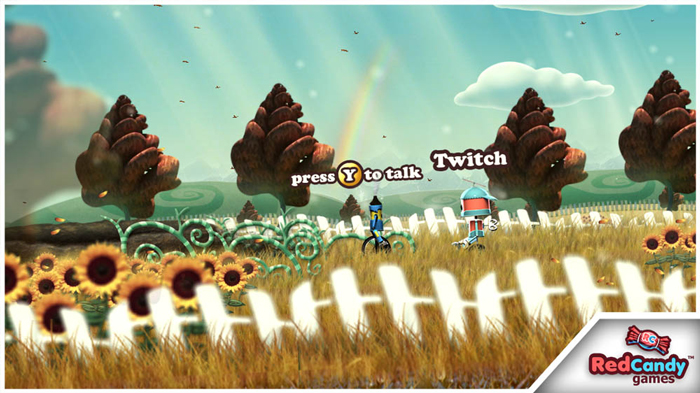
You play as something that looks like a disembodied steam whistle from a locomotive riding a unicycle.  And it hovers.  And you stay afloat by touching acorns. If this sounds too surreal I’ll remind everyone that the most popular game character of all time ate magic mushrooms to grow big and walked around killing turtles by stomping them to death.  Awesome games don’t have to make sense, which is good because TIC doesn’t make any sense at all.  But I still loved my time with it.

Prospective indie developers, take note on how a game is made.  TIC eases you gently into it’s world with a pair of opening levels that are light and breezy.  You learn the controls, which are simple and effective.  Move with the stick, hover with the A button, drill with the right trigger.  You only unlock the drill once you’ve found fifteen silver acorns hidden in each world.  To find them, you’ll have to take to the sky.  You can only hover for so long, unless you touch a red acorn, which refills your energy meter.  Once  you’ve got the drill, you head through some underground caverns in search of an engine.  Find the engine’s power source, destroy it, the engine dies and the giant drill it powers stops, completing the level.  It’s very smooth and easy, with nothing resembling difficulty until the third level.

The controls are very precise, and my only complaint is that when you land your energy meter doesn’t instantly fill back up.  Sometimes I wanted to land and immediately take off again, but the meter wasn’t full and I fell to my death.  I never really got used to this, but it’s hardly a deal breaker.  The music is very smooth, maybe even a little hypnotic, and the sound effects are well done.  Of course, everyone is talking about the graphics, and yes, they’re spectacular.   I feel that spending too much time talking about them might mislead people into believing that the only thing TIC has going for it is eye candy, and nothing could be further from the truth.  But really, it looks good.  Braid good.

TIC only has three levels, and that’s really a shame.  Thankfully Red Candy Games has thrown us a few bones in the realm of unlockable challenges.  You need 15 silver acorns to get the drill in each level, but there’s actually thirty hidden in each one, along with three giant golden acorns.  Finding all of these opens up some extra challenges, and getting them all doesn’t feel like busy work.  In a way, TIC channels the best scavenger-hunt sections of Banjo-Kazooie and places them within a 2-D world.  It works well, and stretches a download that could easily be completed in under an hour into a somewhat lengthy and hugely satisfying diversion.  The main game isn’t really all that difficult, but some of the stuff (such as the 100 purple acorn challenge) can have you ripping your hair out.  Once again, TIC serves as a “how it should be done” lesson for indie developers, building a playable and joyous main feature and putting the tough stuff off to the side as a bonus.

I’m new to indie games, so this doesn’t really mean all that much, but TIC: Part 1 is the best game I’ve yet played on the indie marketplace.  It’s well designed, original, and gorgeous.  Truth be known, Microsoft should have caught wind of this in development and thrown the guys at RedCandy a lifeboat in the form of a full-scale release as an Xbox Live Arcade Game, complete with all bells and whistles.  Simply put, TIC is so good it makes all other indie games look bad by comparison. I wasn’t sure how I felt about 240 Microsoft Points for what is in essence 25% of a game, but all the extra challenges helped to make this feel more complete.  You better not rest of your laurels RedCandy, because if Parts 2-4 suck we’ll storm your offices with torches, pitchforks, and a BFG 9000.

xboxboxartTIC: Part 1 was developed by RedCandy Games

igc_approved1240 Microsoft Points were drilled by a disembodied steam whistle from a locomotive riding a unicycle in the making of this review.

Starzzle

Update: Starzzle is no longer available following the great XBLIG purge. No port exists. 

Puzzle games are better suited for portable devices.  When you have a couple free minutes you can knock off a level or two and then quickly transition back to whatever you were doing before.  Putting them on a console isn’t such a hot idea because, more often than not, extended sessions can start to drag and get boring.  This is what I went through while playing Starzzle on my Xbox 360.

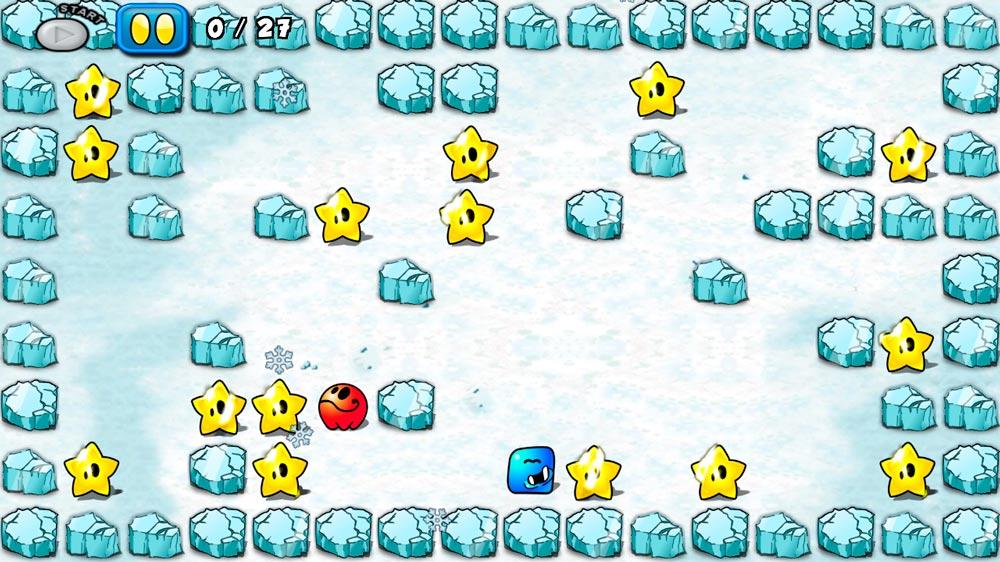
Crying shame I chose the wrong platform to purchase this on, because it’s actually a potentially good game.  The object is to collect all the stars using your on-screen character, a red blob thingy and his companion blue block that can’t eat stars himself.  Once you move, you can’t stop until you hit a wall, so you have to plot out which path is the best way to grab all the stars.  It’s a simple mechanic that has been used as a mini-game in some mainstream releases, only here it’s stretched out to a full length title.  There’s 84 levels to be had spread over four worlds, with the tease of two additional worlds left to be added by the developers.  Although I’m certainly not holding out any hope that they ever see the light of day, nor would I care.

I somewhat enjoyed Starzzle despite that fact that it has more flaws then a fifth generation inbred Kentuckian.  There’s four worlds to explore with 21 levels each, but once the blue companion block is introduced about ten levels in there’s no new gameplay twists to deal with.  Each world has a different theme that in no way changes  any of the mechanics, so it comes across as wasteful.   And I also found level progression to be off.  You don’t actually need to collect every star to unlock the next level, so it’s as if the game rewards you for finishing half of each puzzle.  You do need to collect stars to unlock worlds two through four, but getting the minimum amount of stars in each stage seems to do the trick.

The game attempts to make up for this by giving awards for each puzzle.  One of them is completing each stage using the minimum amount of moves possible.  That one makes sense.  But then the other two awards are based on the amount of stars you collect.  You get one award for 100% gathered.  Fair enough.  The other is if you only get 60%.  Again, this feels like having laziness rewarded.  There’s also an achievement system that begs the question of why Microsoft doesn’t allow indie games to at least use some form of it, even if it’s a separate score just for the XBLIG platform.

And then there’s the glitches.  I encountered quite a few with Starzzle.  The most annoying one started after I completed world one.  I was told I had unlocked world two.  Yeehaw!  High fives all around.  And then after completing level 2-1, I was told I had unlocked the next world.  Which I hadn’t.  This was repeated with every single level that followed.  I was actually worried that when the time came to really unlock world three, the game wouldn’t allow me to, but thankfully this wasn’t the case.  However, later when I completed world 3-5 the game refused to acknowledge it or reward me any medals despite the fact that I had gathered every star.  Thankfully the next level did open up, but I had to go back to the menu to get to it.  It was an annoying hiccup.  Other issues popped up related to the menu’s awkward layout and control scheme, sometimes not allowing me to back out of a level at all.  Clearly this baby was a bit premature.

I never encountered any stages that were unbeatable, which became a worry following all the other glitches early on, and thus I think I can kind of squeeze out a mild recommendation for Starzzle.   I’m actually going to advise players to skip the XBLIG version and download the equally priced iPhone version instead.  Despite it’s flaws, the guys at Bionic Thumbs clearly have talent and I don’t want to discourage them from making further games, or batshit insane trailers to go along with them.  Instead, I’ll remind them that Mussolini didn’t die trying to make the trains run on time just so you guys could release something this unfinished.

xboxboxartStarzzle was developed by Bionic Thumbs

igc_approved80 Microsoft Points made the trains run on time in the making of this review.

Platformance: Castle Pain and Platformance: Temple Death

Update: Platformance Castle Pain and Platformance: Temple Death are no longer available following the great XBLIG purge. PC ports might exist but we can’t find them.

xboxboxartAfter swearing to my friend that I wouldn’t touch another punishment platformer, I searched online to see if any of them were actually acclaimed, and found some reviews praising a game from 2010 called Platformance: Castle Pain.  It was only a dollar, so what the hell, right?

80 Microsoft points and ten minutes later, I had beaten the first stage on it’s easiest setting.  One of the many voices in my head said, “well, that wasn’t too bad at all.  The controls were a bit iffy but it was fun and challenging.  Bring on the next stage!”  Alas, no.  As it turns out, I had beaten the game.  Well, at least it avoided the Hard Game Without Zombies problem of running out of fun before running out of game.

I tried it on it’s harder settings and found that the map was the same with a few added traps.  Also, there’s a ghost that follows the same path you take and if it catches up to you, it’s game over.  Unlike Aban Hawkins & the 1000 Spikes there is no limit to the amount of lives you have.  It just keeps track of how much you’ll die, and you’ll die a lot.  Like 1000 Spikes the graphics in both Castle Pain and it’s sequel Temple Death feature NES-inspired 8-bitty graphics and sound, a style which works perfectly for this genre.

This is a little more straight forward then 1000 Spikes.  There’s no double jumping or weapon use.  Just walk from point A to point B and try not to die.  Most of the traps are of the spiky floor variety, but there’s some fireballs and bird shit to avoid too.  Also unlike 1000 Spikes, there’s checkpoints.  In fact, there’s dozens of them, and thus once you get past one trap you usually don’t have to worry about going through it again.  The controls were a bit rough, and I found that getting my little knight to jump the correct height could be occasionally challenging, but it never was too much of an issue, and overall I had a pretty good time playing this.  At $1 it was roughly the cost of a round of the latest crappy street racing coin-op at the grocery store, so why not?

Having enjoyed Castle Pain, I decided to give Temple Death a download too.  It was also 80 points and the theme switched from medieval castle where everything is trying to kill you to Indiana Jones style jungle adventure.  One where everything is trying to kill you.  Okay, so it’s basically the same game with a different coat of paint, but maybe that’s all fans of the first game would want.

xboxboxart1Actually one thing did change: the jumping physics were vastly improved and it makes a huge difference.  Now, every single death is unquestionably on you, and that serves to take the frustration factor out.  Because Microsoft are stubborn fuddy-duddies and don’t allow achievements, the guys at Magiko made their own, giving some added replay value.  And just to be smart-asses, they added negative achievements called Flopwards that honor your ineptitude.  It’s pretty clever and it did give me reason to play Temple Death for a couple of hours.  At $1 that’s a pretty good game-to-playtime ratio.

I still don’t care for the punishment platforming genre that is all over the indie marketplace like plague rats but I will concede that the Platformance series are the best of their breed and overall good video games.  They’re pretty to look at, sound wonderful, and are short enough to play through without getting bored.  They’re the only two indie games thus far I think I’ll likely fire up again after I finished them, because they offer a legitimate challenge without going out of their way to be unfair.  But don’t take this as an endorsement, punishment platforming, because the next time I play one of your games and it sucks I’m going to quit gaming all together and take up crocheting.

Platformance: Castle Pain and Platformance: Temple Death were developed by Magiko Gaming

igc_approved80 Microsoft Points apiece were impaled and/or shit on by birds in the making of this review.

Both games are IGC-Approved.