Dark Delve

I hate doing this review.  You know why?  Because I liked Dark Delve.  I don’t have a lot of bad things to say about it.  And when that happens, my reviews are usually boring.  Oh, there are some exceptions.  I really liked Wizorb, and the poor guys at Tribute Games ended up catching my wrath simply because it was years of pent-up Arkanoid frustration being dumped on them.  In the case of Dark Delve, I really don’t have any axes to grind with its style or its genre.  I’m pretty much fucked with this review as a result.

Dark Delve is a dungeon crawler where you take control of a group of up to four people and search a dungeon for treasure and items, fighting enemies and trying to save the world or some such bullshit.  Although the game is fairly linear, you get a lot of customization options.  For added difficulty, you can go in with only one character.  Being the coward that I am, I decided to go in with four chicks.  Thus I created the “Me Quadruplets.”  Fuck Me, Blow Me, Eat Me, and Lick Me.  Yep, I’m that immature.

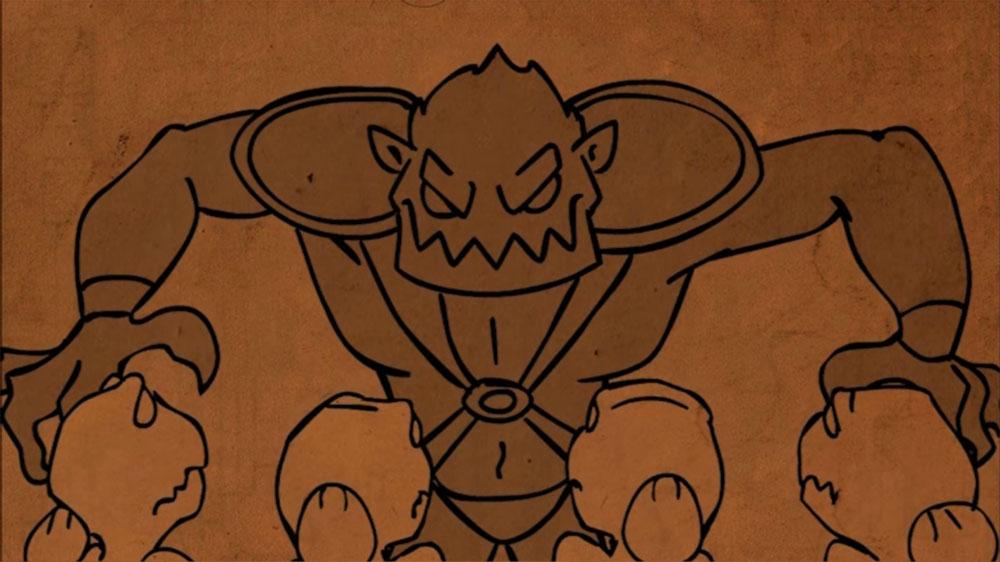
Exploration in Dark Delve is done from a first person perspective.  You walk around, searching for hidden rooms and occasionally encountering enemies.  The strange thing is the graphics in the dungeon are really, really well done, but all the characters are downright laughable.  These two contrasting visual styles kind of threw me out of the immersion I was initially feeling when I began the game.  The dungeon is so well designed and drawn that it has a foreboding creepiness to it.  And then there are the characters and enemies that look like they were drawn in KidPix by a 6-year-old.
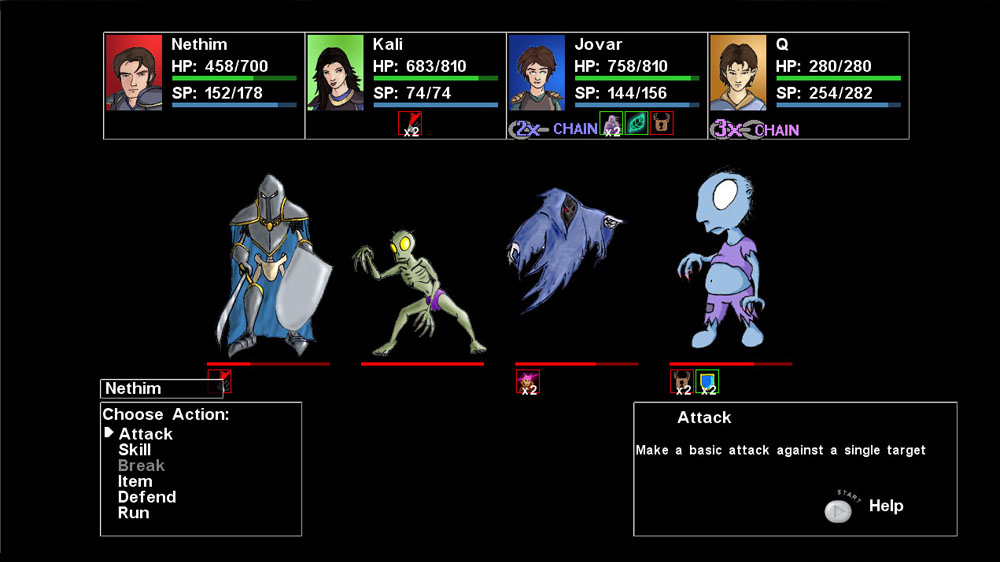
From left to right: Sleepy Knight, Gollum, Accusatory Ghost Thingie, and Bald Pregnant Alien Britney Spears

Combat is typical turn-based stuff, all driven by menus.  You do have a fairly wide option of attacks to choose from, and there’s a skill-upgrade system that adds more.  I will say that the game sure seems to allow your guys to miss their attacks a lot.  I can’t recall an RPG where your characters strike out as much as it happens in Dark Delve.  Even against low-level creatures, I went full rounds where my characters would whiff every time I went to hit them.  It got so annoying early on that I started over and switched the difficulty to easy.  It didn’t help at all.  And I don’t think its tied to the stamina system because it would happen with the first encounter after I spent a night in the inn to recharge all my stats.  Then again, it might just be that I’m the most unlucky RPG player ever, which was previously established in my review of Sequence.

Aside from the combat and crudely drawn characters, the game itself is quite engaging.  The dungeon is large and offers lots of interesting surprises.  I wasn’t in love with the stamina aspect, where you have limited amount of time to wander through the dungeon before you have to retreat to the exit and rest at an inn.  In essence, it’s punishment for wanting to explore the game, and that’s a horrible idea.  It never really added a sense of tension, which is what I think the developer was aiming for.  It just took away from the fun and gave nothing back.  So boo on that.

Funny enough, the main campaign was the low point of Dark Delve.  The storyline is clichéd, there’s too much backtracking involved, and too many items to juggle.  It’s still good, but it’s lacking a sense of restraint that continuously held it back.  I was about to write the whole game off as “good but in need of someone to filter out the bad ideas, of which there were many.”  And then I discovered the extra challenges.  The game has three of them.  All of them are separate quests with characters already created for you and a more clearly defined mission.  There’s no town to retreat to every time your stamina runs low, and the dungeons were all much more clever in design.  By the end of the main campaign, I was fatigued by a quest that had run out of fun long before it had run out of game.  The extra challenges not only renewed my interest in the game, but I was actually disappointed when I ran out of them.  As a general rule of thumb, any game that leaves you wanting more is usually worth it.
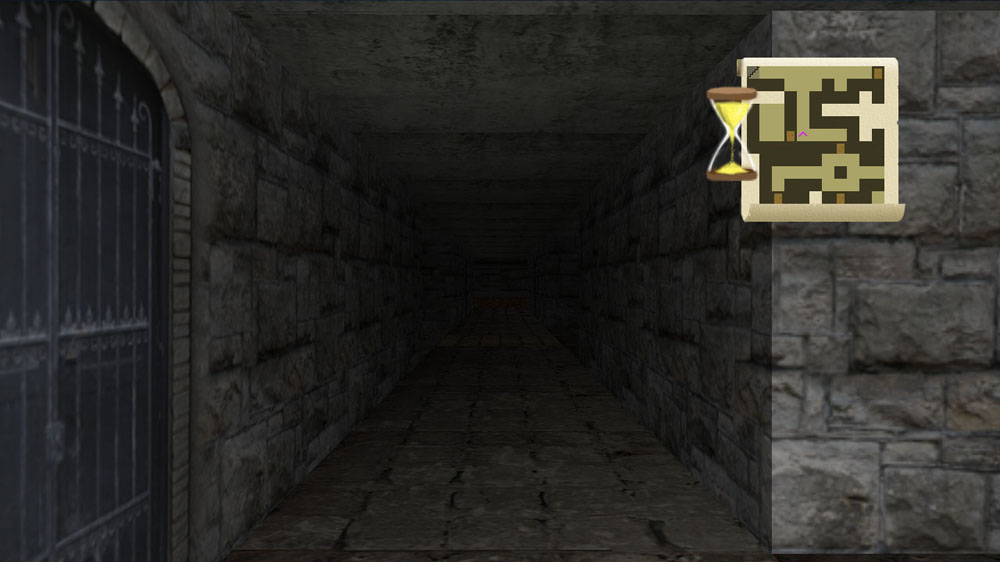
Likely not the most exciting screenshot of the dungeon. Choose your pictures more carefully, developers.

I haven’t reviewed a ton of RPGs since I founded Indie Gamer Chick, but Dark Delve is the best one thus far.  The dungeon exploration really is quite wonderful, even when it gets pissy at you for doing it too much.  Honestly, the main quest is such a colossal waste of time that I would play it only long enough to get a feel for the style.  Once you got it, drop the campaign like a hot rock and head to the challenge modes.  This is what the entire game should have been.  Even better, the developer is promising more, via DLC.  At 80MSP, Dark Delve is one of the better deals in terms of content out there, and it’s only going to get better.  Some really iffy design choices might have cost this a shot at the IndieGamerChick.com leaderboard, but it’s still a contender.

I think the stamina thing is part of the whole minimum shittiness quota for Xbox Live Indie Games.  I’m telling you guys, it’s a conspiracy.  Hear me out on this one.  Originally, Indie games were called “Community” games.  Community implies a large group of people, despite the fact that most of these games are made by one person.  Thus the Community thing to me says that it’s part of the New World Order, the secretive society that controls the world.  But the use of “community” was too obvious and so the slick devils behind this conspiracy changed it to “Indie Games.”  Now, I believe that “Indie” is in reality I.N.D.I.E., an acronym for “Illuminati’s New Dystopian Integrated Entertainment” which aims to slowly eradicate fun from this Earth, one small step at a time.  First video games, and then the world.  WAKE UP PEOPLE!
Dark Delve was developed by Checkmark Games

80 Microsoft Points think Kairi is off her meds again in the making of this review.

Hurley, whom I hear likes to sunbathe at night, also covered Dark Delve for Gear Fish.
Please donate to Extra Life, a promotional event that shows gaming geeks have heart, and help make a difference in the lives of the next generation of gamers. 

Kobold’s Quest

Update: Kolbold’s Quest is now 80 Microsoft Points.  It makes my overall opinion of it lean slightly more positive.  With three willing friends, it might be worth a purchase.

There’s nothing more boring than listening to people drone on and on about how adorable their children are.  Maybe after having the little parasite live inside you for nine months you grow attached to it, but to me and most of the world it’s just a little machine that turns food into shit and vomit.  Oh yes, that’s so adorable.  And then they want to show you pictures and talk about how they just cut their first teeth.  Meanwhile, I’m thinking “so you’re excited that your soulless shit’n’puke machine now has a permanent weapon inside it’s mouth?”  It makes me thankful that I long ago learned the value of a good old-fashioned coat hanger.

Naturally my, ahem, dislike for babies should lead to me loving a game where they are killed and eaten by a monster thingie.  Unfortunately, Kobold’s Quest is mired in some pretty horrible design choices that slow down its progress to a greater degree than fetal alcohol syndrome.

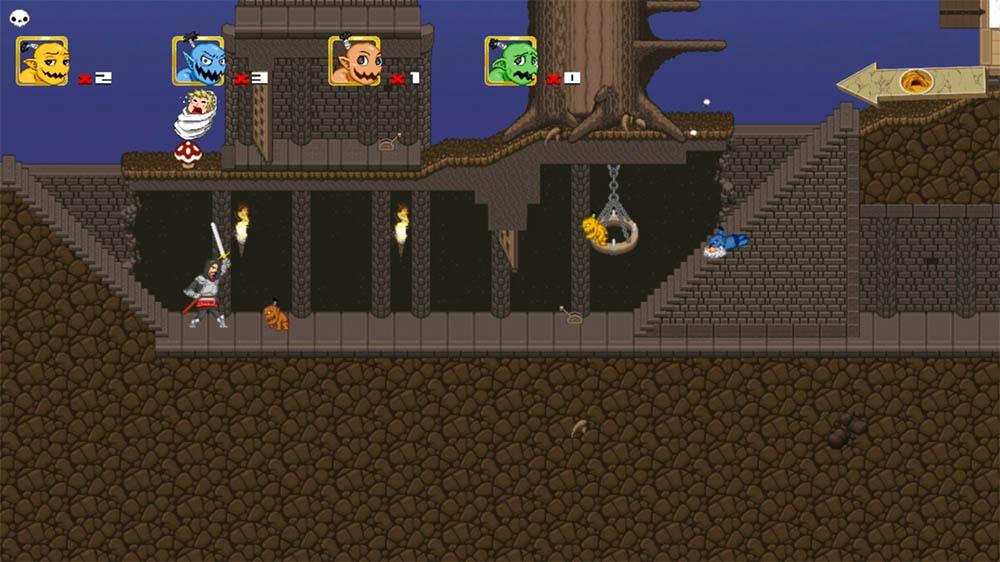
Kobold’s Quest is a local-only multiplayer platformer where you have to kidnap a baby and return it to the start of each level.  You’re armed only with a single attack button and the ability to jump.  When you throw more than one player into the mix, you can jump off of each other to reach higher platforms.  In a way, it’s kind of like New Super Mario Bros. Wii, only more sterile and with less things to do.

Kobold’s Quest is flawed right from the get-go.  Despite being a platformer, the focus seems to be on stealth-based gameplay.  You can confront human enemies with an attack button, but their attacks are almost always faster and get the job done in one shot.  Thus you’re encouraged to be a sneak, waiting until they’re walking away from you before progressing forward.  As a result, the game just plain isn’t any fun.  The level design is always Dullsville and even if it’s populated by three other players, having to wait for enemies to walk away before you can inch forward kind of sucks.

It also doesn’t help that the collision detection is way off the mark.  Often you can stand on a completely different platform from an enemy and still get diced up when they swing their weapon at you.  If the enemy was using an 80 inch sword that would embarrass Cloud Strife, that would be fine.  But when it’s a little old lady brandishing a meat cleaver and you’re several feet above her on an entirely different staircase, it gets a bit annoying.  You also barely jump high enough to leap over baddies, and they can easily kill you midair.  There’s no radar so you can’t see where enemies are located, and some of them move very fast and wield some pretty huge swords, leading to tons of cheap deaths.  Plus, there are crows.  Crows are supposed to be creepy things associated with death and evilness.  Why are they so hell-bent on helping the humans save their babies?  Fuck if I know.

Despite the focus on multiplayer, Kobold’s Quest works better as a single player experience.  With three other players, things get too crowded, it slows the pace down even further, and the whole “race to be the one who feeds the baby to the monster” feels way out-of-place given that the enemies are still around and you have stand still and wait for them to go away.  Only now you can’t even attack them because you’re holding the baby.  So it’s a race where you are still expected to be slow.  It’s a really boneheaded design choice, but at this point I’m used to those.

When you’re by yourself, the game works better.  The guys I suckered into playing this with me were quickly losing their patience with the boring levels and cheap enemies.  When I was all alone, I kind of had a bit more fun.  Not enough to recommend Kobold’s Quest.  God no.  It’s a boring, poorly designed mess of a game, but the controls work and the theme really strikes a chord with me since I’m all in favor of mandatory abortions.

This cutscene is the reason why Kobold's Quest cost two dollars more than it should.

I think my biggest gripe is that they charged three bucks for this game.  Granted, their hands were forced because it comes in at a whopping 150MB and thus they had no choice but to charge 240MSP.  But why did it cost that much?  The graphics are nothing special, except for some really elaborate (and well done) cut scenes and tons of well done and often hilarious voice acting.  The question is, are those features worth an extra two bucks?  Not by a long shot.  And it always kind of irks me when a developer spends so much time dolling up the presentation in a way that contributes nothing to the game play, when they should have spent that time focusing on improving level design or making sure the collision detection actually worked.  Don’t get me wrong, somewhere in here is a great game, but SuckerFree Games took the entirely wrong approach when deciding what Kobold’s Quest would be, and as a result it’s about as appealing as Afterbirth flavored Pepsi.

Kobold’s Quest was developed by SuckerFree Games

240 Microsoft Points said Pepsi Afterbirth likely would still taste better than Red Bull in the making of this review.

Nate, whom I hear shaves his own butt every spring, also reviewed this over at Gear Fish

Sherbet Thieves

Update: Sherbet Thieves received a Second Chance with the Chick.  Chick here for my continued thoughts on it.

I was bound to get challenged on a twin-stick shooter at some point, and it finally happened in the form of Sherbet Thieves.  There seems to be an undercurrent of bitterness towards these games among the Xbox Live Indie Game community.   If I hate on a game, fanboys and cheerleaders (not the developers mind you) usually fire back with “I suppose you would rather play yet another twin-stick shooter!”  Which is hilarious to me because twin-stick shooters have been on the receiving end of more digital blowjobs among the community than pretty much anything else.

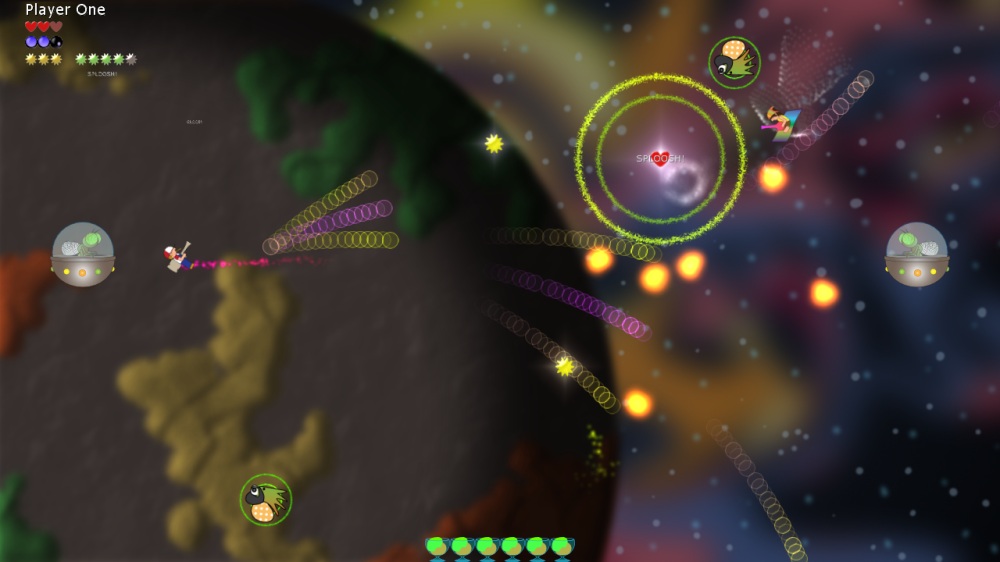
Maybe this is the perfect genre to get your feet wet with.  Maybe they take relatively little skill to put together.  I don’t give a shit what the reason is, because they’re around and I finally have to deal with one.  In Sherbet Thieves, enemies appear and you have to run around and shoot them.  The gimmick here is that there’s multiple suns scattered throughout the stage and you have to guard from enemies that include, and I swear I’m not making this up, “space hippies” that seem to be riding giant bongs that fire smoke rings at you.  Combine this with a spacey-acting farmer dude and I think I can see what the developer is trying to advocate here.

Either way, the game is perfectly competent, if not very exciting.  There’s fourteen stages which should take you about 45 minutes to get through.  You can purchase guns between stages and carry two into a level.  The ordering of the guns seemed kind of baffling.  The most expensive one is almost useless, while the second to last gun, which shoots bullets that bounce off the walls, was way overpowered and easily the best weapon in the game.  It only took me about three levels to save up to get it, and once I had it I had no reason to use any other gun, so the store thing is kind of a pointless distraction.

But, as I said, the game is functional and the gimmick of defending the suns from the enemies does work.  It’s sort of like Defender, because enemies will try to carry the suns to a U.F.O. and you have to keep track of all of them while running and shooting.  If you lose all of them, it’s game over.  You’re given gravity bombs that can suck the Suns towards them, so I went with the strategy of using the bombs right off the bat and centralizing the location of my suns.  Most of the time, it worked.  But then I would get to levels where there was one U.F.O. in the center of the map and suns all around it.  These levels had much more tension to them.  I don’t think the developer went as far as he could have in designing the levels, because the gimmick does lend itself to more creative options than he utilized.

I did enjoy my time with Sherbet Thieves, but it’s nothing special and I’ll likely forget about it as soon as I get done typing this review up.  Bang Zero Bang had a good idea going with this, but its potential is left unrealized.  With some more development time to add levels built around immediate danger, it could have been a real contender.  Sherbet Thieves is without question a game that could have used some more THC.  I mean TLC.  Sigh.

Sherbet Thieves was developed by Bang Zero Bang

80 Microsoft Points declared that winners don’t do drugs in the making of this review.

Hurley, whom I’m told has toenails made of cottage cheese, also covered this over at Gear-Fish

Convict Minigames

Wow.  I am rarely stunned by a game’s poor quality, but Convict Minigames has left me nearly speechless.  I saw the trailer for it a while back and shuttered at the thought of getting challenged on it.  So naturally I was challenged a few days ago.  Now the people at Convict Interactive are very nice and friendly people.  But this is about two things: quality of games and MONEY.  Real money that real people will spend.  And I can’t take into account how nice someone is when it comes time to review a game.  If I did, almost nothing I review would get slammed.  Developers tend to be nice.

I’m not going to beat around the bush here.  Convict Minigames is by far, BY FAR, the worst Xbox Live Indie Game I’ve played.  Cycloid is not even close.  As if that’s not bad enough, Convict Interactive had the unmitigated gull to charge $3 for this failed abortion of a title.  Of the five games presented here, four of them are completely and utterly useless as video games, which are, you know, things designed to entertain people.  The final one actually had good ideas, but the execution is so far off the mark that I don’t think it’s possible to offer it any praise.  Let’s take a look at each game one by one.

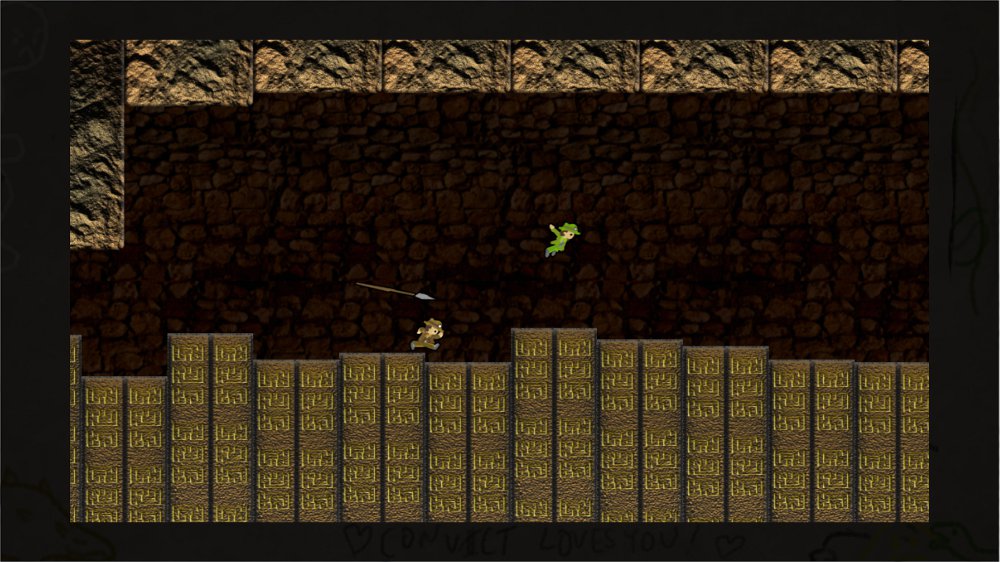
Cave In controls the best of the five, but it's still not any good.

Bop!

Bob is an alleged fighter where you pick one of three characters and try to defeat your opponent by repeatedly hoping on their head.  The controls are sluggish, the computer AI too smart, and the graphics are ugly.

High Hopes

The developers boasted that this game was made in 48 hours, as if that’s a point in its favor.  I could jab my eyeballs repeatedly with a shard of glass for 48 hours but that doesn’t mean doing so is a good idea.  This is one of those “climb high” titles.  You jump repeatedly up a beanstalk.  The same type of game has been done better for cheaper multiple times on the Xbox Live Indie Game marketplace.  Your $3 here buys you more sluggish controls, unfair random-level design, and piles and piles or boredom.

Jurassic Bar

You choose one of four barely mobile dinosaurs and then swat away at barely mobile cavemen.  The characters are badly animated and the controls are even more sluggish than any of the previous two games.  By the way, this is yet another 48 hour special.  While I concede that there’s a degree of difficulty in making a game in such a time frame, I could give two shits less about it.  I want to play a fun game, not a bag of digital vomit that happened to be semi-coherent within a two-day period.

Cave In

An auto-scrolling platformer where you have to jump from stone to stone, trying to avoid various pits and spikes.  Of the five games, this one might have been the best if any effort was done to give it a purpose.  You can play it with four players, which I suppose would make things interesting, but once you complete the run towards the gold-shitting monolith thingie, nothing happens.  You can’t collect the gold or anything.  Even better, there’s no “congratulations on making it!” screen.  Instead, the ceiling collapses, killing you, which was the only way they could think of to bring you back to the title screen.  This one actually controls the best of the five, but it’s still useless.

Triangle Man

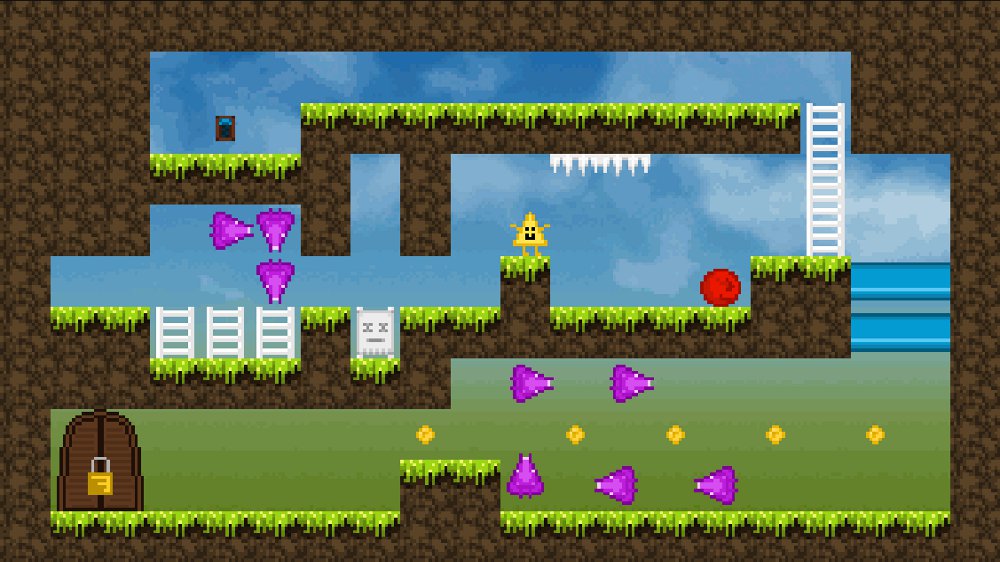
The highlight of the set, which is kind of like saying getting a morphine drip is the highlight of getting stabbed through the chest with a rusty samurai sword, Triangle Man is a punishment platformer mixed with some puzzle elements.  You play as a triangle thingie that has to run around, collect all the coins in a stage, and get to the door.  It actually works, albeit barely so.  Your dude moves too fast, jumping is too floaty, and the parameters for collision detection are too undefined to actually enjoy it.

Triangle Man has a couple good ideas that are ruined by horrible play control.

Now if the guys at Convict Interactive had tossed the other four games in the garbage where they belong and focused on refining Triangle Man, and then released it at a more reasonable price of 80MSP, it would have been easy to recommend.  I especially liked the later stages where you control as many as four dudes at the same time and have to keep an eye on all of them while trying to navigate four completely separate sections of  a room simultaneously.  This is what the entire game should have been about.  It’s an original and worthwhile gimmick for a game.  But nope, the use of this doesn’t come into play until much later on, and by time it started I had already started researching what would be the most peaceful way to kill myself using an Xbox controller.

Regardless of potential, Triangle Man is still a crap game, and anyone who tells you otherwise was merely suckered into believing it after slogging through the first four shitty games in this collection.  Thus you have five games at or very near the bottom tier of XBLIG titles, all packaged together, and all for triple the price of some really great games.  It’s absolutely shameful.  Convict Minigames sounds like a pretty accurate name, because playing it feels like punishment.  Upon completion of Triangle Man, I felt like I had finally finished serving my time and was ready to rejoin society.  Sure, I’ve now got a teardrop tattoo and I’m missing my black cherry, but I’m free!

Update: Minutes before this went up, Convict Interactive told me that they were unaware that they could charge $1 for the game, on the grounds that they believed it was too large.  Convict Minigames is 36.20 MB.  A simple Google search for “Xbox Live Indie Game Pricing” brought up the Wikipedia page for Xbox Live Indie Games, which states, quote:

“Games larger than 50 MB must be priced at least 240 Microsoft Points.”

Now this policy has been in place for quite a while, so it’s not like they can claim that it was just dropped on them out of nowhere.  If you can’t even bother to do 30 seconds worth of research on the marketplace that you’re putting your product on, you don’t deserve to earn any money off it.  They didn’t deserve that anyway on the grounds that their game is a festering piece of shit, but still, you guys couldn’t even do a Google search?  Disgraceful.  And just so I’m perfectly clear, even at $1 this game is simply not worth it.  It’s terrible at any price.  Maybe Triangle Man would be okay if it was FREE, but it’s not.  Do not pay any money for this game.  Put a $1 aside and give it to one of those bell-ringing Santa thingies at Christmas.  Buy a small order of fries from McDonalds.  Do anything but spend it on this.

Convict Minigames was developed by Convict Interactive

240 Microsoft Points were victims of a genocide against entertainment in the making of this review.

Hurley over at Gear-Fish also covered this turd.

Falling Blocks

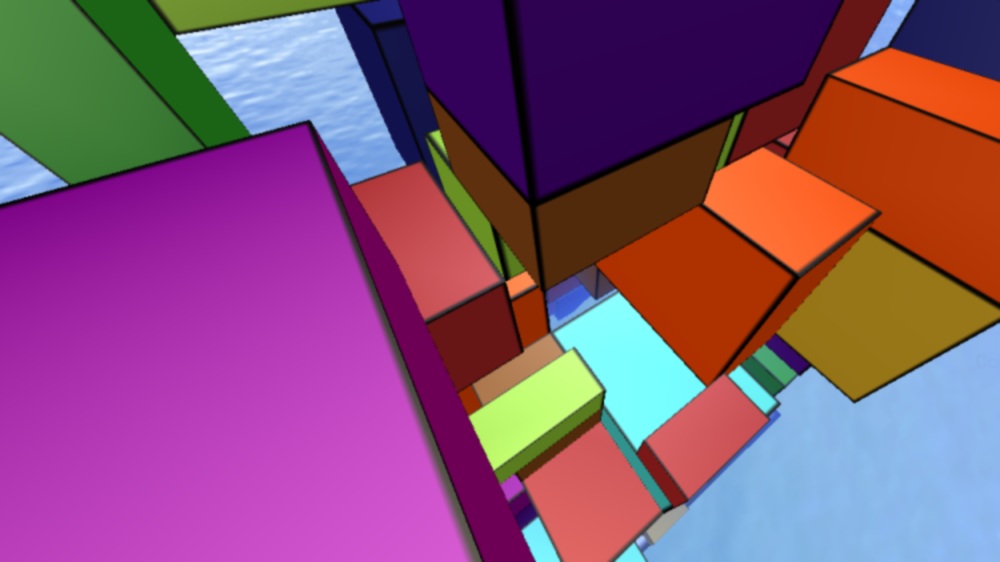
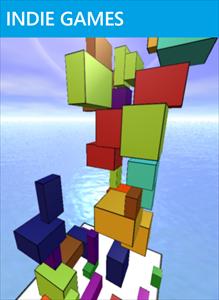
I really, really wanted to like Falling Blocks.  It’s one of those “climb as high as you can get” games, but with a twist: it’s a first-person platformer.  You can choose between trying to climb as high as you can get for local-only point leaderboards, or in a mode where every block you touch gets painted.  Being the fan of creativity that I am, I anxiously plunged into this one.  Unfortunately, the intriguing concept was failed by some very poor execution, leaving Falling Blocks as a barely playable disaster of a game.

The idea is, jump from block to block, using power-ups to remove any that get in the way or warp to a spot that’s out of reach, all while trying to avoid being crushed as the blocks continuously fall.  Sounds fine in theory.  And then the problems start piling up.  First and perhaps the biggest of all: the falling blocks don’t cast shadows on the playfield.  This is a humongous oversight on the developer’s part.  Without them, the warning that you’re in danger of being squashed is minimal.  There is a caution sign if you’re directly under a falling one, but the problem is you’re on the move, hoping from block to block, and sometimes you move into the path of one that is right above you.  The caution sign might as well say “oh, see, now you’re going to be squished.”  You can look up I suppose, but when you’re under a time constraint, having to constantly move the camera up and down is going to eat up precious seconds.

Another major problem is you can’t actually see anything about your own character.  No feet, no shadow, or nothing to give you any sense of perspective.  This makes platforming particularly hard.  I’ve never really been a big fan of first-person platforming, with only the Halo series and Metroid Prime really being close to perfect.  Since accurate jumping often requires you to be as close to the edge of a block as possible, you’ll find yourself falling as often as successfully jumping.  Your character also moves at a breakneck speed and there’s no true analog controls here, so slipping off the block your standing on is an all to common occurrence.  To the game’s credit, the jumping does feel right, without being floaty or too light.  There’s also a double-jump, but I think it’s an unnecessary design choice.  Just having a default higher jump makes a lot more sense, especially since I only needed the normal jump 1 out of every 10 times.

Falling Blocks really was a good idea, but the finished product is a disaster.  It really pisses me off because I actually want to play a game like this.  And because the jumping actually does work, it proves that the developer is capable of much better than what was presented to me here.  Of any bad game that I’ve played as the Chick, this is the one I want to give a second chance to the most.  I think if the developer added in shadows, it would make a huge difference.  As it stands, Falling Blocks is a slow-paced, directionless, depth perception-lacking mess, sort of like my mom behind the wheel of a car.

Falling Blocks was developed by Multimac

80 Microsoft Points are raining blocks, hallelujah in the making of this review.

Falling Blocks was also covered by my friends at Gear-Fish, so have a look.

Thanks to Indies.onPause.org for the video.

Antipole (Second Chance with the Chick)

UPDATE: Antipole is now 80 Microsoft Points.

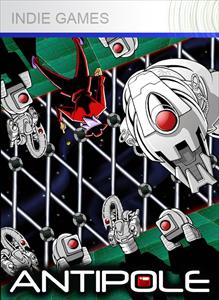
Hey, remember my review for Antipole?  Remember how I said it had slowdown?  They patched it.  It doesn’t anymore.  It’s now even more awesome.  You should buy it.

Still no explanation why the protagonist looks like Michael Jackson ran into a "Fur Is Murder" rally.

On a side note, I played the Nintendo DSiWare version as well.  It’s the same game, but it’s portable.  It’s also quite awesome.  I would rather play a game like this on a television screen, so the XBLIG version is the one to get.  It’s 400 Microsoft Points, and that can be a bit of a tough sell.  But if you’re looking for a truly unique platformer, this is the way to go.  It’s better than either of the Bionic Commando remakes that hit the scene, and hell, I actually liked it more than Castlevania: Harmony of Despair or Hard Corps: Uprising.  It’s not as polished as a big studio release, but it’s better designed than most, and for that reason it deserves your dollars.  Original games like Antipole remind me of why I started Indie Gamer Chick in the first place.  And now I look forward to the sequel to this game that will be set on a Grand-Prix circuit.  AntiPole Position is coming soon.

Antipole was developed by Saturnine Games

400 Microsoft Points noted that the last line was a joke in the making of this review. 

Wizorb

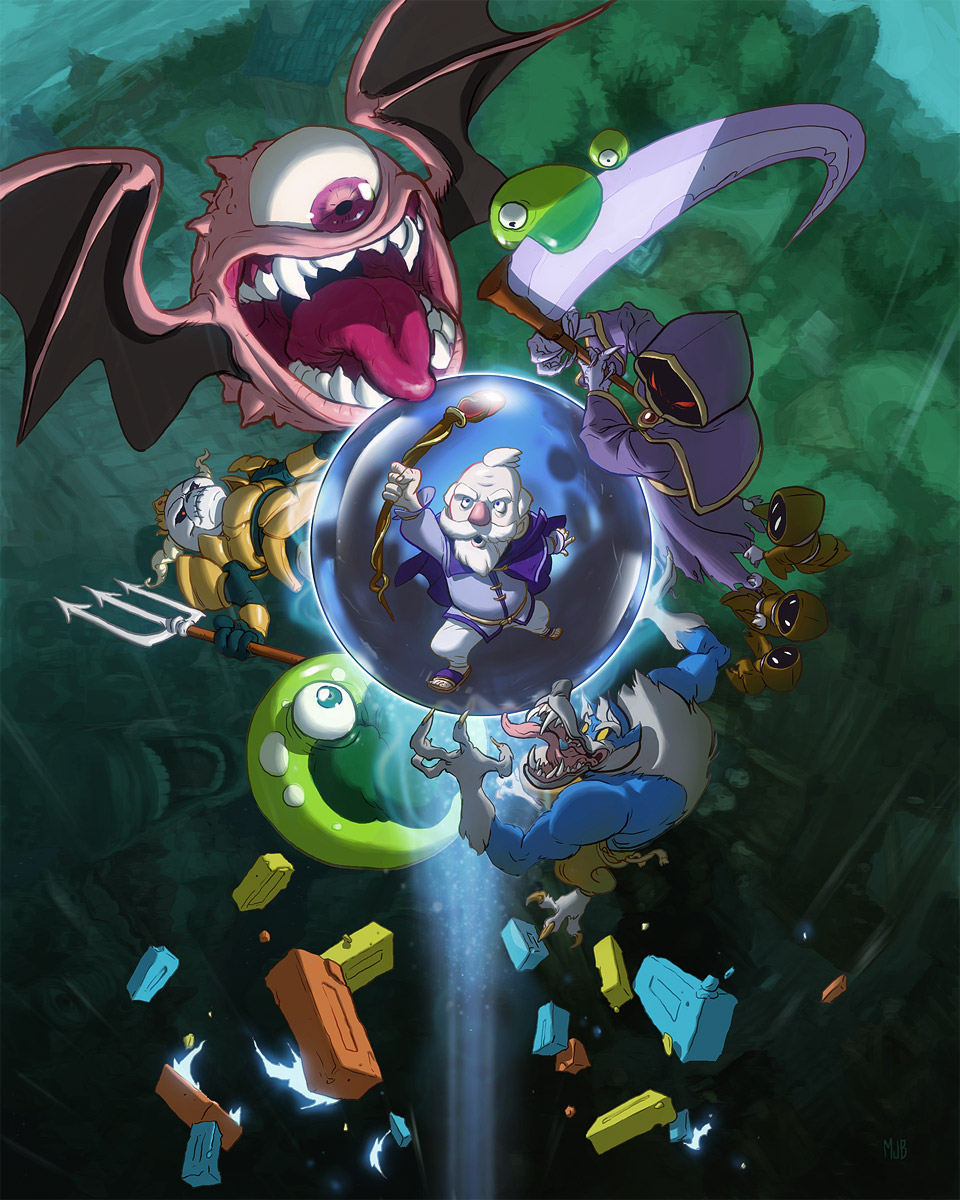
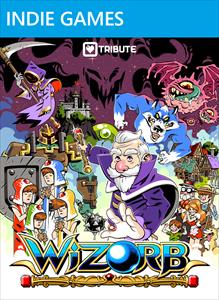
Wizorb has several things going for it. First, it has style to spare. It’s one of those rare retro games on the Xbox Live Indie Game marketplace that tries to look like an NES game and actually succeeds without in some way pulling back the curtain so that you can see we’re still on the Xbox 360. Second, it has an honest to God gaming pedigree, having been designed by Jonathan Lavigne, who worked on the Scott Pilgrim vs. The World game. And third, just look at this fucking promotional art by Michael James Brennan.

Wow. Who wouldn’t want to buy a game with flyers that look like that? That’s some sexy ass promotional art there. Of course, all the credentials, artwork, and prettiness can’t mask the fact that Wizorb is still a brick breaker. There’s really only so much you can do with that genre. Shatter on the Playstation Network stretched the limits of it, but otherwise this style of game hasn’t changed all that much since Arkanoid back in 1986. Still, for all the muck I’m about to rake up about Wizorb, it’s likely the best Breakout tribute on the Xbox 360. Not just for an Indie game, but the Xbox 360 in general. Are we clear on that? Good. Now watch me go all Lizzie Borden on this thing.

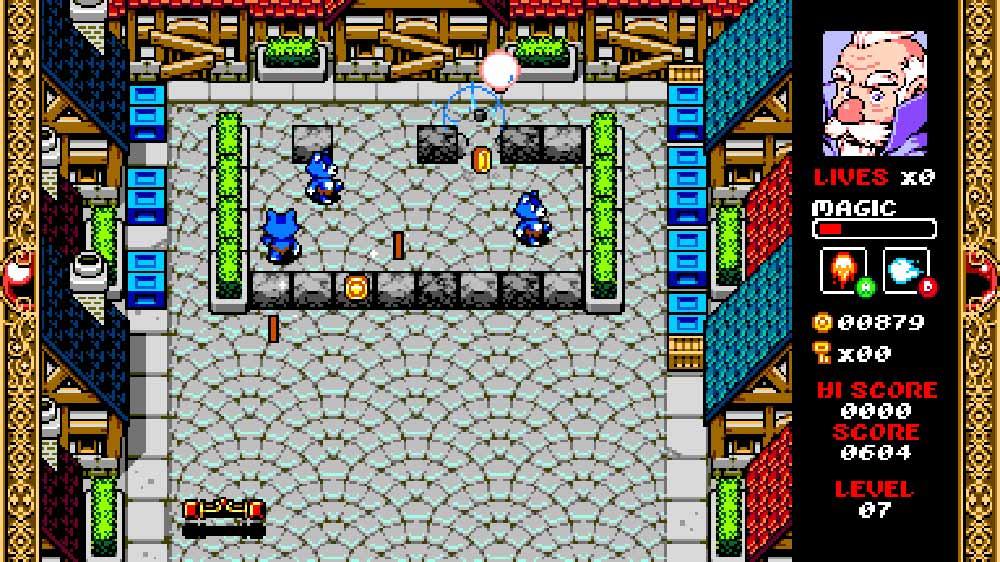
Wizorb does look good. Really good. And it looks like it tries to do new stuff with the Arkanoid formula. But it really doesn’t. A lot of people are throwing around terms like “it’s Arkanoid mixed with an RPG” or “it’s a whole new take on brick breakers.” It’s not. At all. It’s not an RPG in the slightest bit, nor is it innovative at all. It’s the same fucking game that has been around for twenty-five years now in a different coat of paint. It’s like saying painting a Pinto red makes it a Ferrari.

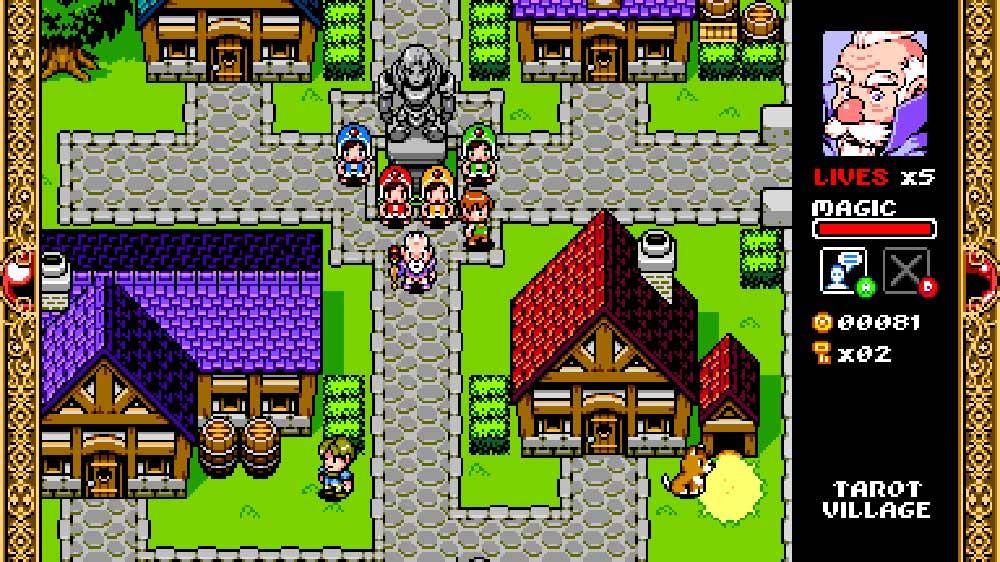
Staring at this picture is only slightly less interactive than actually playing in the village is.

Let’s talk about the RPG elements. Along the game’s 48 stages you can get cash that you can use to buy items, or alternatively give to the town’s citizens to help them rebuild their houses. That’s the entirety of the RPG experience. There’s no exploration, exposition, or any decision-making that has any consequence other than “give your money away, get a free life.” But it does have a shopping element, which is different from any Arkanoid clone. That doesn’t make it an RPG though, and if it does than perhaps you’ll like such other titles from the genre like Forza or Mario Party.

The whole town thing is completely underutilized. You give the townsfolk money to rebuild their houses that some evildoer thingie destroyed instead of telling them to get up off their asses and go find a job to pay for their own fucking repairs. See, this is always what happens when the democrats get the White House. If you give them a so-called “donation” you’ll come back to the town later and see that all the buildings that you donated for are fixed up and you can walk around inside them.  But what can you do in them? Not a God damned thing. They’re just there for decoration. Even if you see a treasure chest inside one, you can’t open it. There’s nothing more interactive about it than “go in building, leave building.” So what your hard-earned money got you was essentially parsley on a dinner plate and some arbitrary bonus item, like a free life or a key that you can use in a level to open up a door for a shop or bonus room. Big fucking whoop there. I figured something good would happen if I opened up most of the town stuff. Instead, I felt like a total idiot later on when I found out I could buy some crown-thingie for $10,000 and I didn’t have the money because I was busy acting like the chairman of Habitat for Humanity. I don’t know what it does, but I’m guessing I would have enjoyed wearing it a whole lot more than I would have enjoyed having some idiot I never met get to sleep under a roof while I’m off fighting monsters by way of ricocheting a ball off my wand.

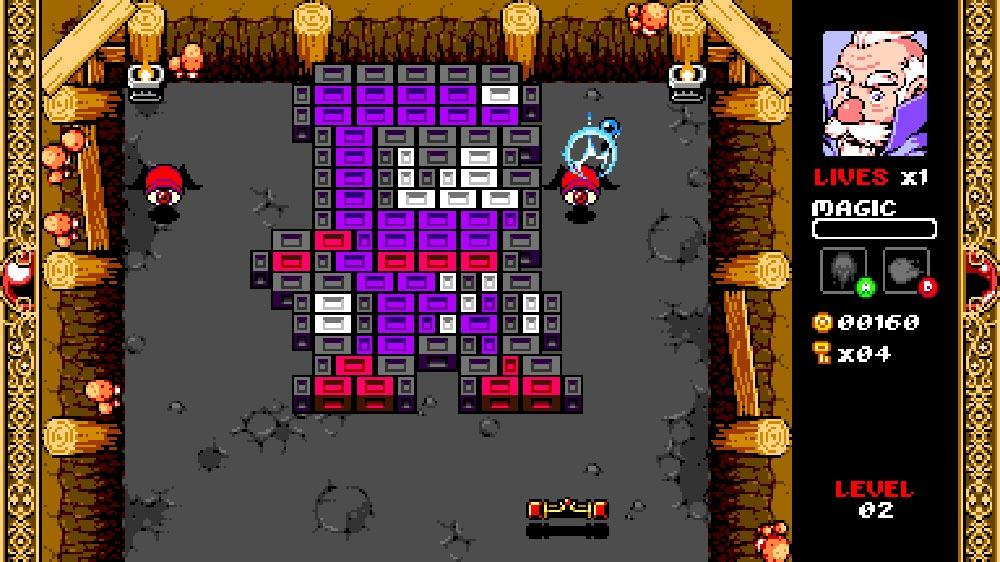
So Wizorb really is an Arkanoid-like and NOTHING ELSE! How does it fare as what it is? Not bad. There’s a paddle. There’s a ball. There’s bricks. Hit the ball with a paddle and break some bricks. You’ve played this game under different names a zillion times before, and they’re all the same thing. And that includes all inherit flaws, chief of which is what I like to call “Last Mother Fucking Brick Syndrome.” You know what I’m talking about. You clear out a whole level and all that’s left is one god damned brick that you can’t seem to kill no matter how carefully you try to. It just stays there, taunting you like a raven perched on a chamber door, leaving you swearing that you’ll play this genre of gaming nevermore.

Wizorb does try to help this, or at least it gives off the appearance of trying to do so, sort of like a Good Samaritan who saves you from a mugger only to run over your puppy with a steamroller afterwards. You get magic spells to help. Using the A button you can shoot a fireball at blocks or enemies, and this works fine. Or at least it does until you encounter a level where the breakable bricks are behind indestructible walls, at which point you might as well use it to light your own farts on fire. The alternative is using the B button to change the direction that the ball is going. It does help, but all this stuff drains your magic, and later in the game it’s hard to get it. Making a few volleys in a row without breaking anything gives you 10% of your magic back, but it won’t be much help. There’s also two power spells that can be used if you press the button at the same time the ball hits the paddle. The A button power shot turns the ball into a comet that instantly destroys any breakable bricks that it touches. Sounds awesome, but in reality it lasts for about one second and then the ball returns to normal. It doesn’t even make it to the ceiling before it wears off. Fuck that noise. The B button power shot gives you control over the ball and allows you to steer it any direction you want. Again, it sounds good, but you only have about two seconds to get it where you want it to go, and usually it’s not helpful with Last Mother Fucking Brick Syndrome. Both these spells are almost totally useless and take too much magic to use. So fuck them.

There was an effective method towards combating LMFB Syndrome: suicide. If you have enough magic and you lose a ball, instead of just launching off the paddle with your next life, you can place the ball anywhere you want on the play field that isn’t occupied by an enemy or a brick and let it go. So the lesson we can take away from Wizorb is that if things get tough in life, kill yourself and everything will sort itself out.

Wizorb has cruel level design, useless “RPG” stuff peppered in it, and some fun “what the fuck moments” like the fourth boss that I killed in less than five seconds when my ball somehow got pinned to it. Also, the guys behind this were just a little too married to the concept of making an NES game. The game has two-button controls. The triggers, bumpers, and Y button go completely unused, while the X button is used to adjust the speed of the paddle if you use the D-pad like a bitch. They could have used the other buttons to create more spells and really dial-up on the action. But no, they ran with the whole NES concept. Which doesn’t explain why the game has online leaderboards, but I like those so I’ll forgive it. At the end of the day, like any brick breaker, LMFB Syndrome swiftly turns fun into tedium and frustration. During the later stages, if the developer had been within stabbing distance of me he would have been on the receiving end of more pricks than the ticket booth at Yankee Stadium.

If you go into Wizorb with the right mindset, that you’re playing a really fancy NES version of an unreleased Arkanoid sequel, you’ll enjoy it. I did. I actually feel bad that the guys at Tribute Games just so happened to be on the receiving end of this extended rant when, in reality, the first competent Arkanoid game I came across on the Xbox Live Indie Game marketplace was doomed to get it. Wizorb is actually really good, if you’re into this sort of game. If you’re not, it’s not going to cause some kind of epiphany and convert you. Breakout has been around for thirty-five years now, and Arkanoid for twenty-five years. If, after twenty-five years, you can still enjoy playing a new version of the same tired game that offers absolutely nothing in the way of innovation, you’ve already spent your 240 Microsoft Points on this and you’re only reading this review hoping that I will reaffirm your taste in games. For everyone else, I’ll pose you this question: did you like Arkanoid? No? Don’t buy this. Yes? Go play the Arkanoid you already own. Don’t already own one? Well than, I guess you can feel free to buy this one. Just one more question: how did they get electricity and an internet connection in the cave that you’re living in?

igc_approved1Wizorb was developed by Tribute Games

240 Microsoft Points fired the guy who made bricks that can be shattered by a ball the size of a marble in the making of this review.

Wizorb is Chick-Approved and ranked on the Indie Gamer Chick Leaderboard.


High Gravity Wells

Well here it is, my 100th review.  Okay, so I didn’t do Fortress Craft or any legendary Xbox Live Indie Game like I thought I should to commemorate the occasion, but really, it’s not that big a deal.  Besides, I was challenged to do High Gravity Wells, and I pride myself on putting developer challenges first.  Oh, and to the guy who did Kobold’s Quest, I really am going to get to it as soon as I can round-up four players.  ETA for review: roughly 2013.  Anyway, my 100th review shall be High Gravity Wells, a space-physics puzzler-slash-reflex tester.  Well actually it’s my 101st if you count the two-in-one Platformance review, but fuck that.  Two-in-one still counts as one in my books, and if it doesn’t, um, go back to Russia or something, Pinko.

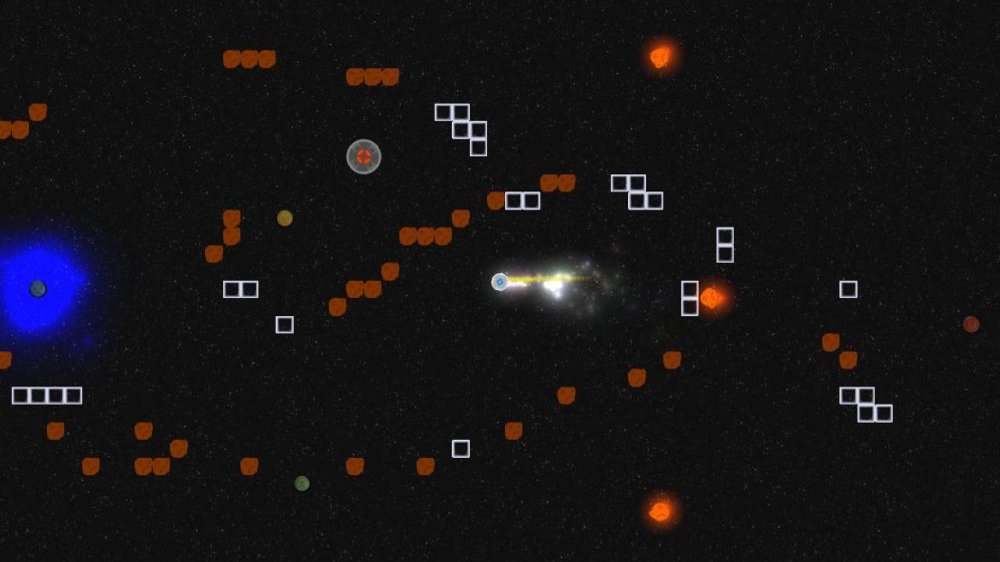
In High Gravity Wells, you try to steer a spaceship into an exit.  Like Mr. Gravity, you have no direct control over your character.  Instead, you have to activate as many as four different gravity wells and slingshot your ship towards the goal.  Each of the four face buttons corresponds to a well.  If you hold the button down, your ship will get sucked in and rocket back and forth in it until you let go.  You can also lightly tap the buttons to gently nudge gravity, although I really stunk at doing that.  Along the way, you’ll also encounter asteroids which blow you up if you run into them, black holes that suck you in (but oddly enough don’t kill you.. way to downplay the most destructive force in universe), and things that look kind of like semen geysers that repel you.

The controls are a huge pain in the ass, but actually that’s kind of the point so I can’t really bust on it.  Still, I think it’s kind of silly that you would have a spaceship without any form of a thruster on it.  It seems rather dumb that anyone would leave the job of safely getting the ship and it’s crew to port using this ridiculous system of slinging yourself back and forth using gravity wells that are so strong they can actually suck asteroids out of their orbits and possibly into the very vessel you’re trying to save.  And who do they leave in charge of these incredible devices?  Some idiotic spaz who operates them like a 90-year-old operates a Cadillac, in this case played by me.

Don't worry if this pic doesn't make any sense to you. Just watch the trailer or play the game.

I kind of like these sort of games, but they all have the same problem of having difficulty spikes so sharp that could poke your eye out even if you’re standing behind ten feet of concrete.  I cruised through the first twenty or so stages with minimal effort, when suddenly my Xbox fired a magical brain-thickening beam into me that resulted in increased blood pressure and swearing.  Breezing past levels was replaced with getting stuck for upwards of thirty minutes, multiple time-outs so I could go cool off, and even one or two rage quits.

Sometimes the level design is so unforgiving that it can bring you to tears.  Not being a sadomasochist, I don’t really get off on stuff that is not pleasurable.  I did have quite a bit of fun with High Gravity Well early on, but once you reach your 100th death on a single level, it stops being entertainment and starts being fucking detention.  I’ve played a lot of games on Indie Gamer Chick which run out of fun before they run out stages, and it always leaves me unsure of how to ultimately tilt my review.  I didn’t finish High Gravity Well, having given up on the fourth stage of the fourth galaxy.  I realized that I had been playing the game on and off throughout the course of the day and hadn’t had fun in a few hours.  I think I can still honestly say that there’s a buck worth of good times to be had here, so give it a whirl.  But beware, because once things start to go bad, you’ll want to quit and do something else with your life.  But you might not be able to.   You’ll be trapped, oddly compelled to press on even as your life becomes an increasingly bleak and futile attempt to regain the glory moments when you were actually enjoying yourself.  Also known as “Broken Condom Syndrome.”

High Gravity Wells was developed by Stockton

80 Microsoft Points can’t count to 100 in the making of this review.

Pigs Can’t Fly

I think Don’t Feed the Trolls proved my argument that online leader boards (even the ghettoized peer-to-peer ones that are the only option for XBLIGs) can make the difference between a game being worth a purchase and a game that will run out of fun before you run out of demo time. Pigs Can’t Fly is the poster child for the latter.  It’s a scoring-driven reflex tester that’s not unlike the iPhone hit Tiny Wings.  And when I say not-unlike, I mean it’s damn near the same fucking game.  Replace a plump bird with a pig and voilà, you have Pigs Can’t Fly.  Not that there’s anything wrong with that, but if you’re going to do this kind of clone, at least get the online scoring in it to give people a reason to keep playing.

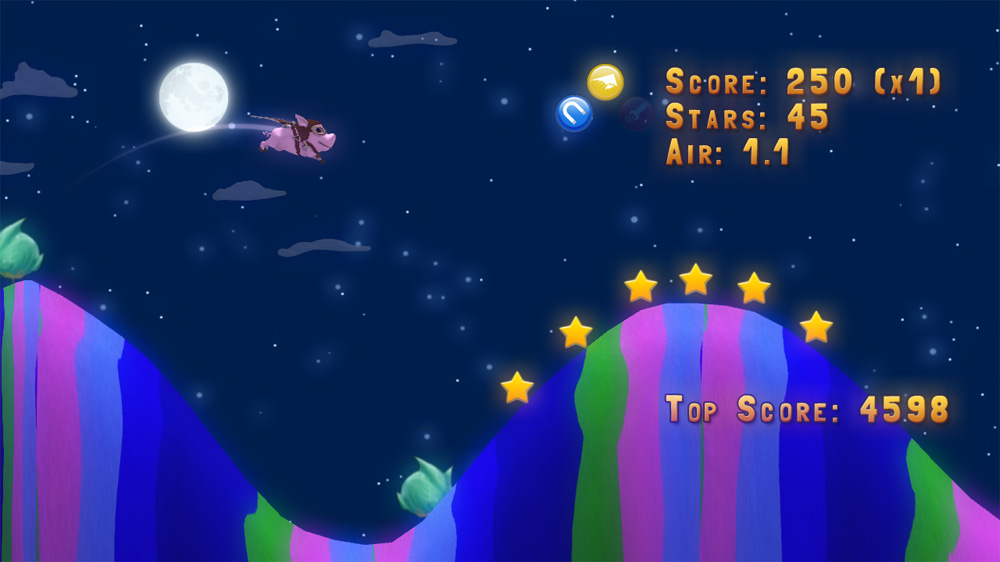
Pigs Can’t Fly is slightly different from its iOS inspiration.  It’s still based on sliding up and down hills while trying to build up momentum by going from a glide into a dive at just the right moment.  The big difference here is the inclusion of power-ups that you can buy once you’ve collected enough stars while playing the game.  There is a booster, which gives you a little extra nudge.  I found this to be almost worthless.  I figured this would be handy if you fuck up the timing on a dive and lose all your speed.  But it doesn’t help you get up a hill all that much faster.  Once you’re on the other side of a hill, you should be able to start regaining speed on your own, and all using the boost then will do is cause you to splatter your piggy and lose your speed again.

There’s also a glide, which assists in your ability to fly, and a magnet that helps you suck up stars.  These do work, and are a welcome addition to the formula.  Still, the game isn’t all that well made.  Pigs Can’t Fly is pretty unforgiving with its timing.  Sometimes you’ll dive in what sure seems like the perfect spot to do so and end up losing all your velocity because the game registered you hitting a flat piece of turf, even if you’re nowhere near it.  Because of this, my previous guess that Pigs Can’t Fly would be a good game, at least for the kiddie set, seems invalidated as well.  As it turns out, pigs can neither fly nor star in a decent clone of a popular iOS title.  If this was Charlotte’s Web the writing in the web would say “Mmmmm, Bacon” and Charlotte would be laughing her sick ass off while Fern ate her former best friend.

There’s a visual that won’t be leaving my head anytime soon.

Pigs Can’t Fly was developed by Matt Mitman

80 Microsoft Points childishly sung “birdie birdie in the sky, why did you poopie in my eye?  It’s okay, I won’t cry.  I thank the lord that pigs don’t fly” in the making of this review. 

Gameplay footage courtesy of http://Indies.onPause.org

Devil Blood

Devil Blood is a homebrew first-person-shooter for the Virtual Boy in which you must.. wait, what?  This was an XBLIG?  Get the fuck out.

Kairi looks up what platform Devil Blood is on.

Well I’ll be damned, it was an XBLIG!  Huh.  I must have played the wrong game then, because the game I played had nothing but red in it.  Hold on, let me see what game I just played on my Virtual Boy.

Kairi leaves and it takes her 36 minutes to remember she doesn’t even own a Virtual Boy.

Well, this is awkward.  Allow me to start over.

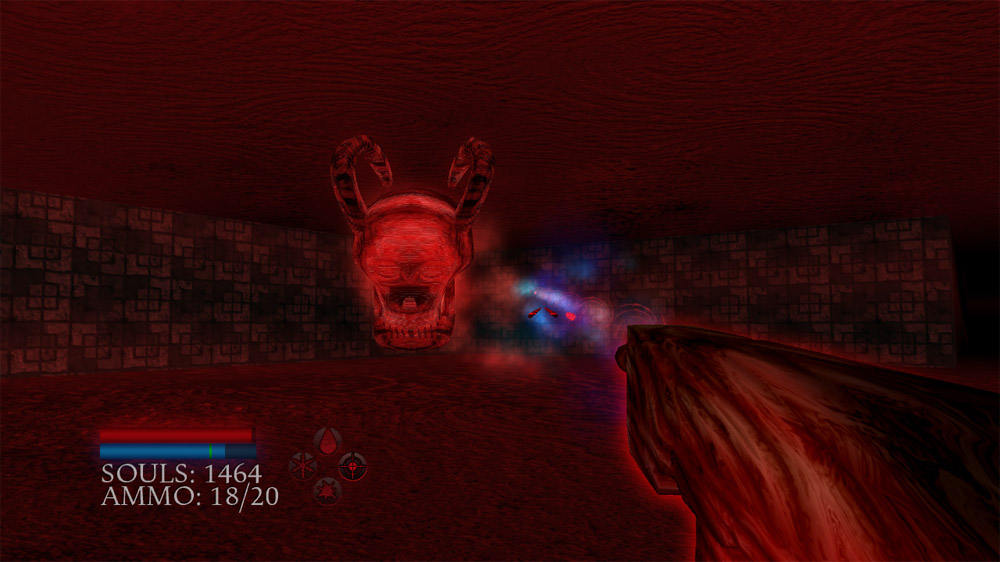
Devil Blood is a first-person-shooter for XBLIG (I think) in which you navigate ten levels shooting floating demon-skull-thingies and, um, that’s pretty much it.  Every stage you encounter stronger skulls.  There’s only one skull-type per stage, each of which becomes more and more bullet-sponge like as you progress.  You’re equipped with two guns.  One is an assault rifle type thing  and the other is some useless elephant gun thingie that I never used because I decided to pour all my upgrade points into the rifle.

When you kill a skull, it will either drop souls or it will drop runes.  You can equip four runes at one time that will alter defense, mana recharge rate, or various spell effects.  I really didn’t pay too much attention to those either, because early into the game I skipped straight to the final boss stage and managed to pick up the three way-overpowered runes that were in the room with him.  Using those along with a fourth rune that recharged my mana faster, I was pretty much unstoppable.  I also ignored all the spells but the snowflake spell (aka Stasis), because it was the only thing that slowed down the enemies.  The only way the skull thingies attack you is by running up and touching you like they’re trying to give you herpes, so anything that slowed them down was a good thing.

Most of the time, the skulls drop souls, which is the game’s upgrade currency.  Using these, you can increase the potency of your gun or spells.  I spent most of the souls on gun strength, but each increased level added fuck all to the actual game.  The damn gun never seemed to get better.  I swear to God it was slower than watching actual evolution take place.  Or, if certain Christian scientists are to be believed, watching it not take place.

If you look at this picture with 3D glasses on, well, you'll look like a huge knob.

There are ten levels, but you can play them in any order.  So after a while I decided to just grind out the third level for an hour, building up my souls and upgrading my gun.  Once I had a level 20 rifle that could carry 100 bullets at a time with a level-4 firing rate, I skipped levels four through nine and went straight to the final boss, which is, you guessed it, a giant skull that tries to touch you.  Ewwwww, cooties!  Deciding that the best strategy would be to fire the stasis spell at it and nothing else, I would simply shoot at it, keep it nice and slow, step back, recharge my gun, and keep firing.  It worked, and I beat the game after firing about 10,000 bullets into it.  Rasputin was easier to kill than this thing was.

I was being slightly sarcastic about the whole Virtual Boy thing earlier.  In fact, there are brief moments where you see colors like green and blue.  The green is for the one exit that begins every stage.  The blue is for the runes and the spells that you shoot.  Otherwise, you have ugly red corridors, red enemies, a red gun, red bullets, red floors, and red ceilings.  Just look at the game play footage below (courtesy of http://Indies.onPause.org) to see what I’ve had to deal with for the last couple hours.  You know, I never actually did play too much Virtual Boy.  I was six-years-old when it was released and the kiosk for it at Target had so many warning labels on it that my parents thought it would make my eyeballs explode.  But I have heard tales of it causing headaches, and I’m suddenly inclined to think that it wasn’t because of the 3D effects.  The reason being I got a nice one going while playing Devil Blood, along with the fact that my eyes really did start to hurt.  That’s no joke.

I’m not sure what the dude behind this game was thinking when he came up with this color scheme.  It’s not like the Virtual Boy did all that well, or was deserving of some kind of tribute.  I don’t even know if that was his intent at all, but it sure seemed like it.  Leaving the color scheme aside, Devil Blood is one stupidly brain-dead shooter.  The level design is poor, the enemy design is poor, the upgrade system is painfully slow, and it just plain fucking sucks.  AND YET, it grew on me, like a tumor.  Just like Send in Jimmy, I ended up finding Devil Blood oddly endearing.  Maybe its because I figured there would be more in the way of first-person-shooters on the Xbox Live Indie Game marketplace and almost anything that is functional will stimulate that trigger-happy little part of my brain that almost got me to enlist when I was 18, before the coward section of my brain regained it’s footing.  I don’t know why but I started with a four-alarm level of hatred for this game and after about three hours I was kind of disappointed by how easily I was able to beat it.  Maybe I’ll go back and play those levels I skipped over.  Not bloody likely, but it could happen.  When pigs fly!  Hahaha!

Oh fuck off.

Devil Blood was developed by The Lost One

80 Microsoft Points think some Red Faction fan took the name too literally in the making of this review.