Road Runner (Arcade, Atari 2600, and NES Reviews)

Road Runner
Platform: Arcade – Atari System 1
Released July, 1986
Directed by Mike Hally
Originally Designed by Ed Logg, Apparently

Developed by Atari Games
NEVER BEEN RE-RELEASED

This could have been an incredible maze chase if you just change.. well.. basically everything.

Atari Games’ Road Runner is the answer to the most useless trivia question in the entire history of video games: what game has Indie Gamer Chick attempted to review the most times? I started and stopped reviewing Road Runner three previous times before this fourth and final attempt that, if you’re reading this, must have taken. There’s very good reasons why I want to review Road Runner. It ticks every box for the type of retro reviews I seek out. (1) It’s a licensed game (2) that has no modern re-release and likely will not for the foreseeable future. (3) It has a very interesting behind the scenes story. (4) It’s a maze chase, which is a genre I’ve devoted a significant amount of my free time towards achieving a greater understanding of. (5) Finally, it’s topical in a modern conversation thanks to the recent fiasco regarding the almost fully completed motion picture Coyote vs. Acme that might never see the light of day. Road Runner might be one of the most fascinating bad arcade games I’ve played.
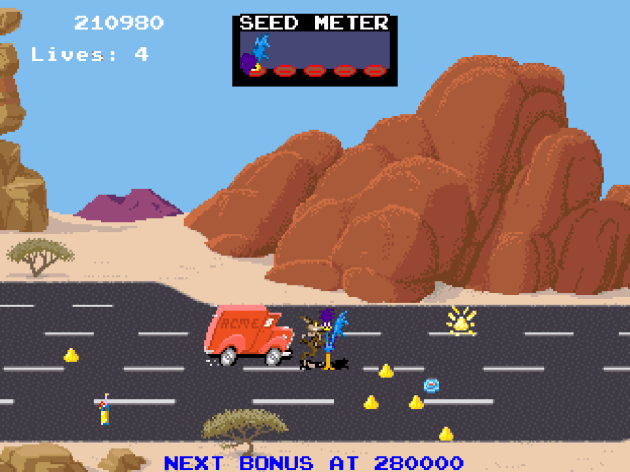
In the coin-op, I really struggled to get cars to hit Wile E. Coyote. I think his collision box is a lot smaller than in the two home ports I played. I guess that makes sense, since this is trying to suck quarters from players.

Road Runner was commissioned to be Atari’s answer to Dragon’s Lair and capitalize on the LaserDisc craze/fad of the early-to-mid 1980s. In fact, their intent had been to one-up Dragon’s Lair by making a hybrid game that didn’t create the illusion of interactivity, but rather gave players direct control over sprites, something LaserDisc games typically didn’t do. Only the backgrounds and death animations would utilize full motion video taken straight from Road Runner cartoons. The rest would be a normal video game. By the way, this HAPPENED, as FMV Road Runner was 100% completely finished and route tested, which means they placed cabinets in specially selected arcades to monitor the reaction to it. Usually route testing means ten-to-twenty units are produced, which was the case with the only verified “killed in route testing” video game I’ve reviewed: Nintendo’s Sky Skipper. Atari’s Akka Arrh seems to have also made it to route testing but the extent of it I haven’t been able to figure out. I have no idea how many copies of FMV Road Runner existed, but at least one unit survives to this day and is a mainstay on the California gaming convention circuit. What makes Road Runner unique is that it was killed in route testing, but was still eventually released to arcades in the time window of its development, albeit without the LaserDisc gimmick.

If they ever do figure out a way to re-release this to modern audiences, they might as well go all the way with it and release it as the FMV hybrid it was intended to be. It’s the only thing the game has going for it, frankly.

So what happened? It’s hard to know for sure, but I think I have a good guess. First, the obvious: LaserDisc video games had “fad” written all over them. A bubble certain to burst. Road Runner was NOT the type of game to bet heavily on if you expect it’s riding a fad. Road Runner, despite being a normal video game, would have still cost a LOT more than a standard upright coin-op for operators. Dragon’s Lair cost $4,000 in 1984 bucks, $1,000 to $1,500 more than the competition. Second, the technology was notoriously unreliable. I’ve heard so many stories of disappointed 80s gamers seeing LD games like Space Ace wearing OUT OF ORDER signs. They had heat problems. They had disc reading problems. LaserDisc cabinets are basically an arcade game made out of a bigger, bulkier, heavier, hotter DVD player with additional circuits attached. That’s a recipe for hardware failure if I ever saw one. But, above all that, I suspect Atari recognized that Road Runner just wasn’t a very good game to begin with. That’s why Road Runner was reworked to remove the FMV elements in favor of sprite backgrounds. The game that came out in 1986 really is the exact same game as the LaserDisc version would have been, and it was probably a very wise decision because Road Runner isn’t very fun no matter how much you dress it up.

UPDATE: Thanks to Dave Sanders, who found that the original designer of Road Runner was Asteroids/Centipede/Gauntlet/Dr. Muto (hey, I liked Dr. Muto) designer Ed Logg. It looks like “unreliable tech” is the declared reason why FMV Road Runner was canned.
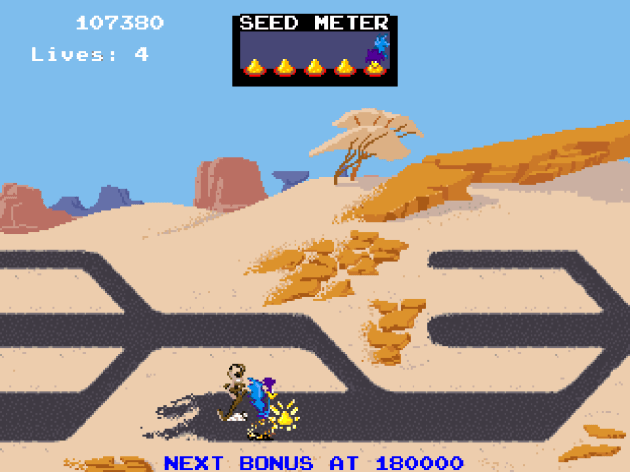
The third stage is where the level design drops all pretense of fairness and just counts on players getting hung-up on the road or placing bird seed in dead-ends so you have little-to-no room to run around the coyote. Just sh*tty design that isn’t meant to be fun. It’s meant to get players off the machine by any underhanded means necessary.

You have to run around collecting bird seed while avoiding Wile E. Coyote and his various ACME gadgets. You can miss up to four bird seed piles before you die. The movement is SUPER loose and very difficult (see after the verdict for an update on this, as we found out after the fact Road Runner uses useless analog controls). This is combined with narrow, twisty-turny roads that you must stay on. There’s no off-roading in Road Runner. The coyote chases you directly for the most part, and like most games where the chaser makes a beeline for you (not all, but most), it makes for a boring chase element. For the most part, you can only scratch-out distance by running a circle around him in one of the wider parts of the road. Sometimes the coyote uses gimmicks like spring shoes or riding a rocket, but for the most part, he just runs at you directly. A maze chase with a boring chaser is a fatal flaw to begin with, before you even factor in the awful movement physics. Sasha compared the NES version (coming up) to being like bootlegs of Pac-Man where the walls are removed, and that’s a spot-on comparison. Getting stuck trying to corner is the leading cause of death in this game, which doesn’t pretend to play fair. Like, look how low visibility this cannonball is:

Because of the fast movement speed and scrolling, it’s much harder to see in motion than in this screenshot. These are basically a GOTCHA that relies on memorizing levels.

I just found Road Runner to be a huge drag of a game. The collision boxes with the bird seed are quite unforgiving, unlike the landmines or other obstacles. Plus, Wile E. seems to have a smaller collision box than you, because I wasn’t very successful at luring him into traps, which is kind of a secondary object of the game. You score points based on how many times you cause the coyote to fail, both when an incident happens and as bonus points at the end of stages. It’s exactly what you want from a Road Runner game, but because the controls are so loose and unwieldy, it’s no fun to hit Wile E. Coyote. Plus, the coyote will injure himself just as often without you having to do anything, which hypothetically should work and fit the Looney Tunes theme. In practice, it takes the zing out of a maze chase. Imagine if the ghost monsters in Pac-Man practiced self-cannibalism. It’s MY job to eat you. What are you doing? And that’s why it doesn’t work here.
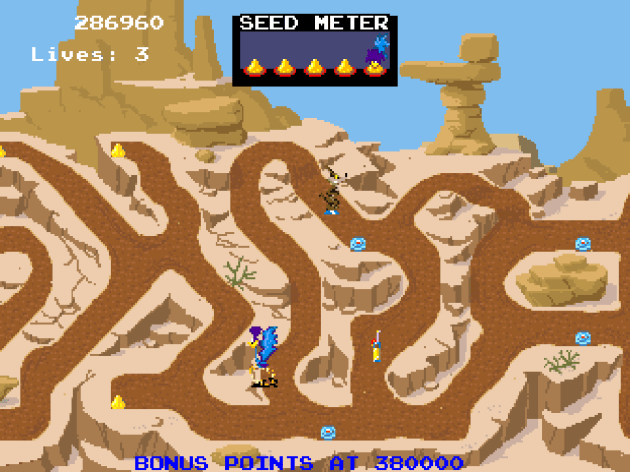
The main challenge isn’t the coyote, but getting hung-up on the edges of the road, and that’s just the worst idea for a video game challenge.

I didn’t get very deep into Road Runner. I made it to the seventh level when I realized concepts were starting to recycle, and I’d seen enough that I just had to give up and play something else. Road Runner is a maddening combination of frustration and boredom the likes of which I’ve rarely seen in a maze chase game. I honestly don’t think there’s any problem with a game I hate more than basing levels around precision movement, then giving you imprecise controls. It’s dirty pool, and if I want that experience in an arcade game, I’ll play a ticket redemption game. At least there I know I’m being cheated. But, let’s assume the controls were perfect. Would I be having fun then? I can’t say for certain, but I still don’t think so. I think the Coyote is a dull chaser. I think they were aiming for the Coyote to be more like Bluto from Nintendo’s Popeye: a singular, terminator-like pursuer. But, every turn-the-tables element is indirect at best, and incidental at worst. Road Runner’s base gameplay could be made perfect and it still wouldn’t be fun. This is a low point for the genre.
Verdict: NO!

UPDATE – Analog Controls
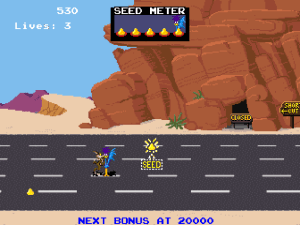
Used analog and died immediately because I wasn’t going fast enough. Like, the coyote immediately won. You HAVE to floor it.

Dave and Btribble clued me in to the fact that Road Runner used an ahead-of-its-time form of analog based around the Hall Effect that’s all the rage these days. But if you’re using MAME or other emulators, any analog controller works (you might want to adjust the settings though). Now, I swear to God I had no clue as the Wikipedia page doesn’t mention it and Sasha, who uses the analog stick instead of a D-Pad (which I prefer because then my hand tremors don’t really factor in), didn’t report anything. It wasn’t an oversight on her part, either. It simply does not make a difference. I just tried it and, because of the speed of the Coyote, you only get fractions of a second at most where it matters. Any precision gains are negated by how closely the coyote chases you. During straightaways you literally have to floor it anyway or he’ll get you almost immediately. During zig zag courses where he uses the rocket or spring shoes, again, there’s still no point in slowing down because you’ll immediately have to jerk the stick when the coyote makes his gains anyway. That’s INSANE! It would be like putting a pedal on a driving game then giving players only enough time to win if they have the pedal to the metal the entire race. Analog really doesn’t help Road Runner even a little bit and actually makes it kind of worse, as I think I got hung up on the edges even more when I tried to feather the stick. So in addition to the NO! I’m punting the Road Runner square its virtual ass for wasting innovation.
Follow-Up Verdict: BAM, right in the ass.

Road Runner
Platform: Atari 2600
Released in 1989
Designed by Bob Polaro
Developed by Atari Corporation
NEVER BEEN RE-RELEASED

This slideshow requires JavaScript.

Well, on the plus side, you don’t really get hung-up on the edges of the road in the Atari 2600 port of Road Runner. That’s because the twisty-turny level design isn’t really here. It’s mostly running in a straight line. The coyote doesn’t run quite as fast as he does in the coin-op, but he still gets the occasional burst of speed to catch you. When he gets that burst, the same strategy is used from the arcade version: run around him in a circle to scratch out distance. Which is pretty much the most boring way to escape a chaser, but it works. The Atari version is MUCH easier to lure the coyote into the landmines, which actually makes this game slightly better than the coin-op. It feels truer to the cartoon. But, the gameplay is just dull as dirt. I suppose on some level, this is an impressive technical achievement, but if the gameplay is boring, who cares? Road Runner on the Atari 2600 is a stripped-down but competent port of a terrible coin-op.
Verdict: NO!
I had planned to do more ports of Road Runner but I can’t take it, so I’m only doing one more.

Road Runner
Platform: Nintendo Entertainment System
Released November, 1989
Developed by Beam Software
Published by Tengen
NEVER BEEN RE-RELEASED

This slideshow requires JavaScript.

If there’s such a thing as “the best version of the arcade game Road Runner” then the NES port from Beam Software and published by Tengen is it. It controls the best. By far. Because the movement is nowhere near as loose, you don’t get hung-up on the fringes of the road as often. Oh, it still happens. In fact, it happens quite a bit, but that’s because the core design is just not very good. Sasha made a really good point. “Remember those Pac-Man bootlegs where they removed the walls? Road Runner is like that, only it scrolls!” (Read Pac Man Museum: The Games They Couldn’t or Wouldn’t Include for examples of such games.) She’s right, too, especially when it comes to the collecting aspect. The bird seed requires you to run on top of the pile. If any part of your sprite counted, the game would be much faster paced.

There’s not a lot of practical room to avoid the Coyote in sections like this, especially when he uses his rocket skates. Imagine if your only option to avoid the ghost monsters was to wiggle the joystick. That’s not in the spirit of a maze chase.

The smaller collision box on the seeds, in theory at least, seems like a solid game plan. If you miss one and want to keep your score perfect, you have to run backward and risk getting caught by the coyote. Sound logic, right? But, it all hinges on the coyote being an exciting antagonist, and he’s just not. It would have been far more exciting to make the bird seed easier to pick up via bigger collision boxes and lean more heavily into having the world’s fastest-paced maze chase. This should have been to that genre what Sonic The Hedgehog was to the platformer. I mean, why not? So, how sensitive are we talking, here? The shot on the left is to show you how small the pile of bird seed is, and the shot on the right is me standing literally on top of it, in a way where my sprite is blocking the seed but you can clearly see I’m not collecting it.

Screw that. If you want to give players loose controls and wide roads to navigate, being that strict with the seed is asking too much. This is every bit as bad as one of those brawlers where the main challenge comes from lining up on the exact right plane of existence as the enemies. I hate those, and I hate this. Instead of being that anal about it, presumably all for the sake of making players double back and put themselves in harm’s way, they could have made the seeds easier to collect and simply added more environmental hazards so that the coyote remains an ever-present threat, but not the MAIN threat. There’s a potentially great game buried in this crap, but the way they have Road Runner now, it makes me wish they had just shamelessly copied Pac-Man and set the game in an actual walled-off maze. To hell with suing ACME. The movie should have been Coyote vs. Atari Games.
Verdict: NO!
Dr. Seuss Pinball Reviews are up at The Pinball Chick!

The next IGC review will be up in the coming days as I continue to look at Mario games in celebration of Mario’s 40th birthday in 2025. While I work on Super Mario Bros. Wonder, thanks to Sasha the Kid’s hard work, we’re finally posting regular content to The Pinball Chick. Reviews of all seven Dr. Seuss tables for AtGames Legends Pinball are live at The Pinball Chick. We’ll no longer be posting reviews to both sites, mostly because we don’t need to. I know most of my readers are annoyed by the pinball stuff, but thankfully, the pinball audience is finding these reviews at the blog they truly belong to. A blog that will now be posting smaller, single table reviews like the ones found in the features for AtGames’ Dr. Seuss and Natural History pins. a couple times a week from here out. So, check out the Dr. Seuss reviews, which you hopefully enjoy reading a lot more than we enjoyed playing. These were mostly pretty awful.

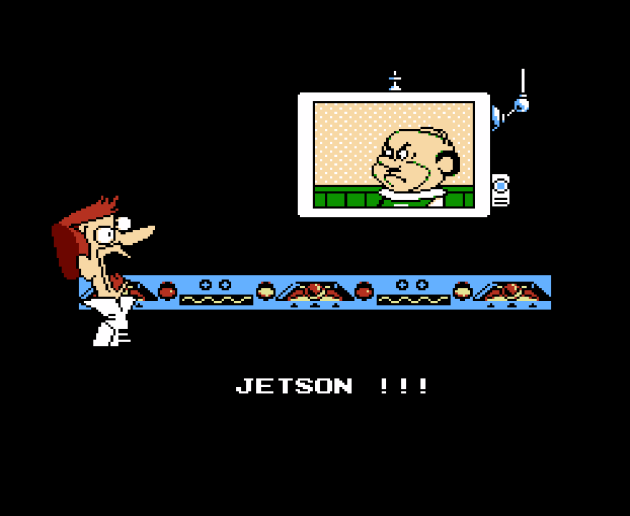
The Jetsons: Cogswell’s Caper! (NES Review)

The Jetsons: Cogswell’s Caper!
Platform: Nintendo Entertainment System
Released December, 1992
Directed by Isao Matono
Developed by Natsume
Published by Taito
NEVER BEEN RE-RELEASED

“Stop playing your own game on the job! You’re having another seizure!”

And yea, before I get to the review, I have to note that if you are photosensitive in any way, you probably should not play The Jetsons on the NES. Every boss has violent strobe effects when defeated, as does every instance of activating a switch that reverses gravity, which happens several times. There’s multiple other areas where the same violent flashing effect happens. These days, with my medications and the precautions I take, it’s rare that I have to stress about a game giving me a seizure. So, it’s pretty telling that my father felt compelled to literally yank the controller from my hand while physically blocking my view during the final boss fight. Because gravity-flipping factors in so much, the final stage has a LOT of strobes, but the moment you enter the boss chamber, the NES Jetsons starts to strobe continuously, to the point that it doesn’t stop until the credits start to roll. Literally, as you jump straight from that sequence to the end credits. It’s so excessive, unnecessary, and reckless even by 1993’s standards. I have never heard of any game that strobes contiguously for the entire final boss, a strobe that continues after it’s defeated, where you then have to make your Metroid-like escape. Had the Jetsons come out during the NES’ prime, I’m certain some child would have discovered their epilepsy directly from this game. It’s THAT bad. If this were to get a re-release, there’s no way even a disclaimer would be enough. The game would require alterations. No modern publisher would allow this much flashing. Here’s the video, and needless to say, BIG EPILEPSY WARNING! Thank you to my nephew T.J. who finished the game for Aunt Cathy.

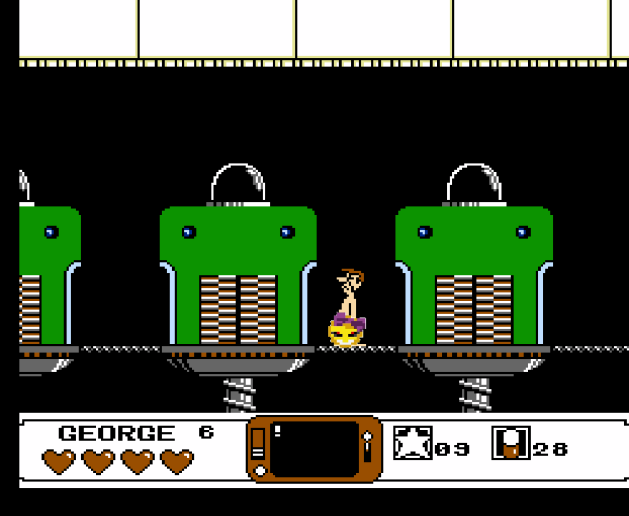
Now then, game review. Jetsons is one of many games that rode the coattails of Chip ‘n Dale: Rescue Rangers, building an entire platformer that’s based around picking up and throwing crates at enemies. As much as I love the first Rescue Ranger, those aren’t as strong of coattails as you would think. Look no further than the game I believe started life as the Game Boy version of Rescue Rangers, Mickey’s Dangerous Chase. Or, if we’re being honest, the second NES Rescue Rangers was kind of a disaster. If done right, crate-throwing will assure satisfying combat for the full length of an NES platformer that lasts an hour or two, but you still need fun level design and stand-out set pieces to make it over the finish line. You also have to assume that the game doesn’t have technical issues, and Jetsons does. As a post SNES holiday release, I’m guessing that Isao Matono, the man who led Flintstones: Rescue of Dino & Hoppy and the Jetsons’ Game Boy release, felt pressure to push the graphic capabilities of the NES so that it didn’t look too old fashioned now that the 16-bit era was well underway. The result is a game with a consistently chuggy frame rate, albeit one that never devolves into full-blown slowdown.

It looks great in still images.

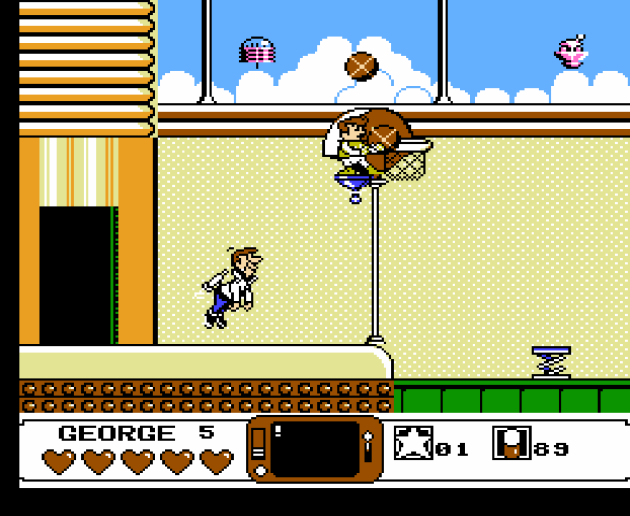
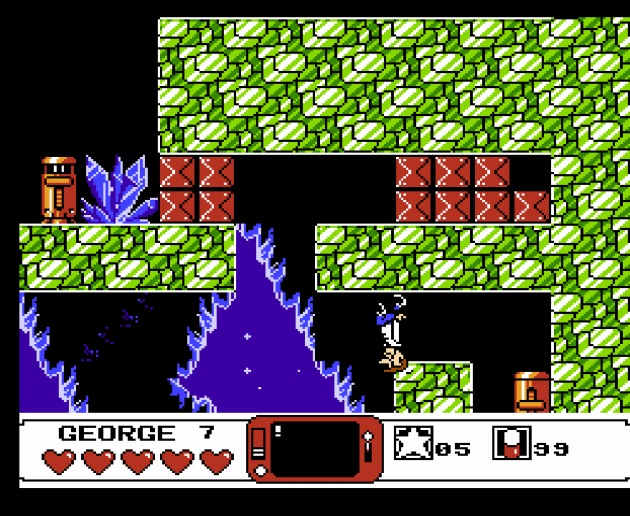
And Jetsons IS a looker, but it doesn’t remotely succeed in replicating the look of the show at all. Instead, Cogswell’s Caper has a rough hand-drawn appearance with so many sharp edges to the sprites that it looks more like the cartoons of my childhood from the 90s and early 2000s. That look, combined with the less-than-smooth frame rate gives Jetsons an almost homemade vibe, like a big fan of Rescue Rangers tried to make their own sequel to it. That said, the box combat isn’t a complete rip-off of Rescue Rangers. You only throw screen-length line-drives like Disney’s rodents when you jump up and throw the box. Otherwise, George Jetson sort of bowls the boxes along the ground. Thus, aiming in general takes much more effort in Jetsons. You also lob boxes in a way similar to Simon Belmont’s axe from Castlevania games. Several boss battles seem tailored to this style of throwing. Overall, the combat works, especially with the BAM graphic from the Flintstones NES game returning, only this time, the OOMPH is there.

Talk about extra effort. When you meet Elroy at his school, kids are playing basketball. If you get the ball and throw it at the hoop, the ball makes the same BANG that happens when you hit enemies and then falls down through the hoop. It doesn’t do anything, as far as I could tell, but it’s a nice touch. Meanwhile, the Detroit Pistons are going to see this review and be like “quick, when is this Jetson guy set to be born? Maybe we can pick him up in the second round!”

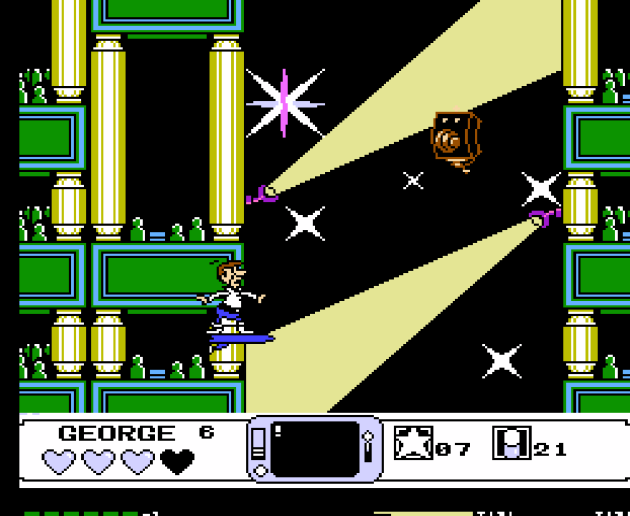
Jetsons features nine full levels, plus a handful of “event” type stages. While I’m the latest in what seems to be a long line of critics who compared Jetsons to Rescue Rangers, I actually think this does set pieces better. There’s several memorable sequences in Jetsons, including a flying sequence set during one of Judy Jetson’s rock concerts, and a race against giant gears that were both really exciting. Both these segments run out of gags really fast and go too long, but they still manage to be welcome changes of pace. At the same time, I’m disappointed that the Jetsons often forgets its supposed to be “futuristic.” Half of the stages are archetypal of the platforming genre with little in the way of Jetsons-like gags, with the exception of the occasional (and seizure-inducing) anti-gravity sections. Unlike the Game Boy release that did such a good job of incorporating the anti-gravity into the level design, I feel it’s just a gimmick here with little to justify having it at all.

Reverse-gravity boots are also one of five superpowers you get during the game, though it’s baffling why they decided to do that. Whenever the level design utilizes reverse-gravity, there’s always a switch to activate it first. Giving to players whenever they want is beyond stupid. It’s even worse because the sky is functionally a pit, and if you use the boots when there’s no ceiling, you die. I never felt a need to use them.

I suppose the argument could be made that the baddies being robotic or aliens fits in with the Jetsons setting, but those types of things aren’t that special in the land of video games. Not that the Jetsons couldn’t do the clichés like lava or gardens, but it doesn’t do enough to make it feel like you’re in the universe of the franchise. Like, for example, a giant spider fight happens, even though it really doesn’t thematically fit with the Jetsons. Thankfully, a couple factory-based stages feel quintessentially Jetsonian, and I can’t stress enough how much that rock concert scene really did feel almost like a music video on the NES. My gripe is that it just doesn’t consistently maintain the theme. At times, Cogswell’s Caper feels like it could have been based on any cartoon series. But, overall, Jetsons offers enough enjoyable settings and surprises to never be boring. I don’t know if I’d call it “clever” but the stages are well made and the enemy placement is spot-on, along with the placement of the crates that are used for the combat. The boss fights stand out as well, with that battle against Cogswell being pretty enjoyable. Really, this is a pretty underrated game. I’ve noticed a lot of post-SNES 8-bit games tend to be. Bonk’s Adventure got no love either. The NES seems to have had this low-key prime of life after the Super NES launched.

The flying stage goes about a minute too long, but it’s not bad.

The biggest flaw in the Jetsons involves the five “superpower” types of items that are accumulated over the course of the game. Four of them are completely useless, while the first one you collect is insanely overpowered. Using the powers requires you to collect pills (yes, really! Jetsons is basically a pharma-game) with each power taking a fixed amount of points to use. Except the previously mentioned gravity boots, which cost 1 point per second. They’re one of four useless items. There’s an invincibility shield that takes a whopping 20 points to use (pills are picked up 1 at a time, max 99) for a pitiful 3 to 4 seconds of invincibility. There’s a screen-clearing bomb for 10 points, and finally a platform that you can float on that vanishes as soon as it hits anything. It’s so clear they were taking a cue from Mega Man’s dog, only the powers all lack the NEED to use them. Well, except the first item you get. It’s a drone that, for 5 points, will kill any one enemy on screen. It works to do one damage per hit on the bosses and can nerf the challenge significantly. I’d have used it a lot more, but like the Game Boy release, SELECT goes unused, so you have to pause the game to activate your powers. Why not use SELECT, then hold UP and press B? I’ll never understand why so many developers from this era did that.

Speaking of Mega Man, the battle with Cogswell is remarkably similar to various NES battles with Dr. Wily. He even has three forms in his spaceship. AND, like the Mega Man games, it’s a fake-out, as there’s one final level and boss after this that I can’t comment on as I didn’t get a chance to play it due to epilepsy concerns.

As rough as it is, Jetsons is a far superior game to the Flintstones: Rescue of Dino & Hoppy. I don’t think it’s the best of the NES Hanna-Barbera games, as I think children would probably enjoy Wacky Races more, especially since that game seems tailored more for younger kids via its low difficulty. Jetsons requires much more precision platforming and has some pretty intense moments. It’s not an elegant game by any stretch, but it is a pretty dang fun game from start to finish. And yet, I can’t help but wish that the NES game was just a bigger version of the Game Boy release. That game felt like a truly inspired effort that built around the superpowers the different characters have. Jetsons NES gives you all these powers and no reason to use them. That could have been costly if not for the fact that the level design was solid enough and had just enough set pieces to allow the excellent combat to do the heavy lifting. It’s strange too, because Flintstones: Rescue of Dino & Hoppy had a much more professional appearance about it. It felt like a big tentpole release that didn’t quite live up to the effort. Jetsons feels sloppy as all hell, with graphics that look hand drawn in Mario Paint. Yet, it’s the better game of the two. In fact, it’s not even that close. I don’t know what it says that, as good a time as I had, I still wished this played more like its Game Boy counterpart. This whole Hanna-Barbera gaming franchise is weird. Anyway, fun game, but lose the strobe lights.
Verdict: YES!

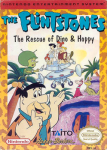
The Flintstones: The Rescue of Dino & Hoppy (NES Review)
The Flintstones: The Rescue of Dino & Hoppy
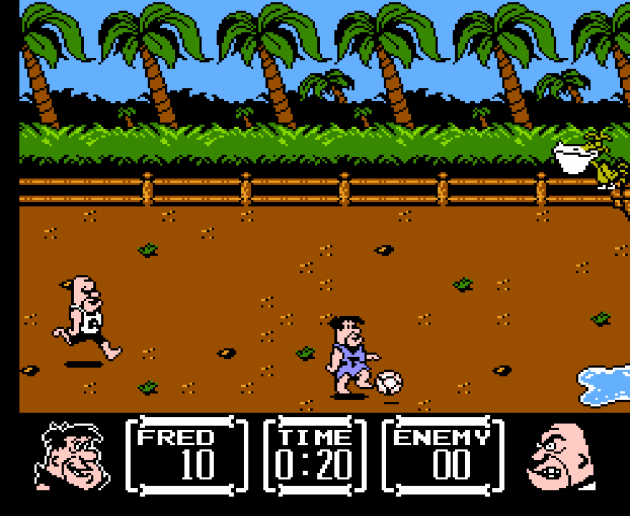
Platform: Nintendo Entertainment System
Released December, 1991
Developed by Taito
NEVER BEEN RE-RELEASED

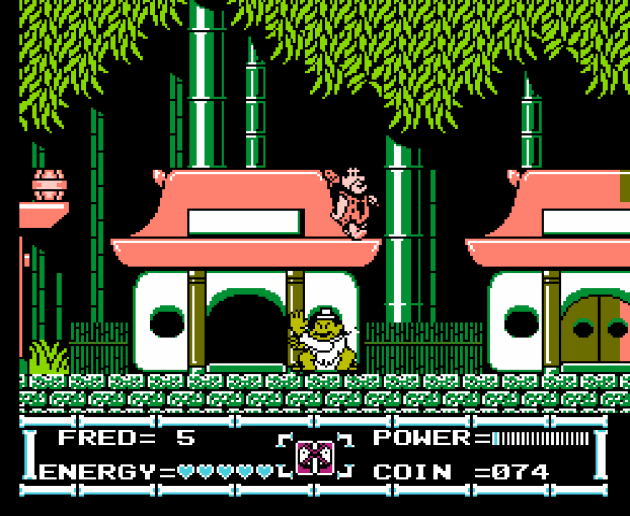
I’ll say this for Taito’s first crack at the Flintstones: there’s some damn gorgeous sprite work. I’m not entirely sure why they drew some of the Asian enemies in the Chinese themed stage to be literally yellow. Surely this was not cool even in 1991. If Rescue of Dino & Hoppy gets a re-release, it’s going to need someone to go in and change the appearance of the enemies.

The first Flintstones game didn’t release on the NES until a couple months after the Super NES launched in North America. In fact, it barely made it out in time for Christmas the year most NES children were probably hoping Santa brought them the upgraded Nintendo console. If not, Rescue of Dino & Hoppy isn’t the worst consolation prize. Actually, it’s not a bad game by any stretch. Over the course of its one hour or so playtime. There’s only one brief section I consider to be genuinely bad. A literal sliver of a single level that takes maybe fifteen, twenty seconds to complete. That’s pretty impressive for a platform game from this era. The problem is none of the rest of the game rises above being just alright. By golly, this really is an authentic Flintstones experience!

Even the name is bad. Given the heavy emphasis on the hanging mechanic, the name could have been “Fred Flintstone Hangs Around.” I haven’t really watched all that much of the show, so I thought Hoppy might be the name of the saber-toothed cat that throws Fred out of the house. No, it’s the family pet of the Rubbles. Why didn’t they make the game “The Rescue of Pebbles & Bamm-Bamm?” Hey, I like animals as much as the next person, but come on!

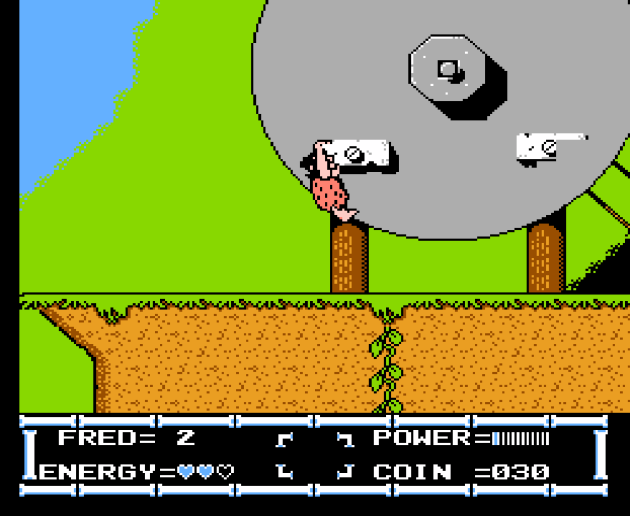
The big hook to the game is Fred’s ability to hang from and pull himself up most (but not) ledges. With the exception of moving platforms, all of which can be grabbed onto, the general rule is that a ledge that comes to a point is the one that can be held from. However, there are enough exceptions to that rule that it makes judging what can and can’t be hung onto a little frustrating. Also frustrating is pulling yourself up. You just hold the button and press up, but it doesn’t always work as fast as you’d want it to. This goes back to the “only bad section” I talked about, where you have to climb a vertical shaft that’s rapidly filling with instakill lava. For the life of me, I thought I was doing something wrong in this part and that there was some kind of “quick pull” technique I was unaware of. I wish I had looked it up, because I would have discovered there was a lot more to this Flintstones adventure than I realized.

Superpowers are won by playing three identical games of 1 on 1 basketball. I figured I was winning free lives or coins or something. I think I was half paying attention during my first play session. Oh, and I want to note that I was impressed that they actually worked in a jump shot mechanic AND that Fred flicks his wrist on the shot. I’m gushing over Fred Flintstone having good shooting form in a thirty-two year old NES title’s basketball minigame, and people think I’m some kind of ogre?

I didn’t know that there’s three superpowers I actually did unlock, but I didn’t know I had them. Hey, I never paused the game to discover them. Not that I was missing much. All three superpowers cost coins to use once you have them, so only one of the superpowers is generally useful: the high jump, which allows you to spring off a dinosaur high into the sky for five coins. The other two, a pair of wings and scuba diving equipment, are pretty much worthless because each flap of your arm besides the first one when you activate the powers costs you four coins. In the case of the wings, they’re theoretically useful to save you if you mistime a jump and aren’t falling to your doom, but the only time I tried using them, I died anyway because I didn’t have enough coins to get back up to the platform. In the case of the scuba gear, I never found a single situation where it was useful.

Cost to use the wings? Four coins per flap. Cost to Fred’s self esteem for dressing like a choad just to rescue the family pets? Incalculable.

To the Taito’s credit, they were all-in on the hanging from ledges mechanic. Every single level is built around using this for navigation, start to finish. If you’re going to use a movement gimmick to stand out, Flintstones is proof that you really ought to stick with it, through thick and thin. The hanging carries the game over the finish line, because god knows the combat doesn’t. You would think bludgeoning your enemies to death would be satisfying, especially since it has an accompanying POW! impact bubble with each landed strike. But, the combat in the first Flintstones NES game is kind of awful. The collision isn’t sprite-for-sprite accurate, and it’s not rare for your swings to go right through an enemy. Even worse is that they seem to be given a lot more latitude in hitting your collision box than you do with them. It’s never a deal breaker, but the club feels oddly feather-like and lacks the OOMPH that I desire from such a weapon.

This slideshow requires JavaScript.

Sticking with the sub-weapons makes more sense. There’s three, and all are useful at various times. The axe is straight out of Castlevania, thrown in a big arc that goes high in the air before coming down. The slingshot is a straight-forward long range weapon, and then there’s the egg. It’s a literal screen-clearing bomb, and yes, it works on bosses, though with them, it takes a few hits. In fact, I used it to beat all three forms of the final boss. The club can be charged up, but I never really found it all that useful. There’s a couple basic enemies that move slowly and are so ridiculously spongy that I genuinely, no joke, think they only exist to finally give the players an excuse to charge-up the club. Oh, and I used it on the ice level’s boss, but only because I ran out of coins. The bosses also suffer the same collision issues the basic enemies have. Usually, games like this need the bosses to be satisfying to fight. Flintstones is weirdly the opposite: the level design, set pieces, and the small handful of one-time special events carry the day, while the bosses nearly burn away all the goodwill. They’re boring at best, and far too spongy. The collision is mediocre and the movement is slightly sluggish, but it’s not bad, either. Flintstones NES is one of those games that is right in the middle, just above the divider line.

This slideshow requires JavaScript.

At only eight levels, one of which doesn’t even have a boss, Rescue doesn’t last long enough to wear out its welcome, and there’s a couple unexpected set pieces that put a smile on my face. The fact that they worked in some cartoon gags, like Fred ducking by his head retracting into his shirt? That’s cute. It’s a sweet-hearted game and it’s okay. The best thing I can say about the Flintstones is that kids who didn’t get to upgrade to the NES had one decent, visually spectacular (by NES standards) game for the 1991 holiday season. While playing Rescue of Dino & Hoppy, it was really clear that Taito wanted to do for Hanna-Barbera what Capcom had done for Disney with titles like DuckTales. In a way, they completely succeeded, since Hanna-Barbera has always been a poor man’s Disney. Sorry fans, but it’s true. Not that their product is bad, necessarily, but they’re always in Disney’s shadow. That’s the case with the Flintstones. It’s fine. It’ll do, but it’s not in the same league as the best 8-bit Disney games. Assuming this really were a Disney game, it’d be a B-Tier one, above Adventures in the Magic Kingdom but below Mickey Mousecapade. In a sense, the Flintstones is one of the most accurate licensed games ever. It’s a b-lister game for a b-lister media franchise.
Verdict: YES!

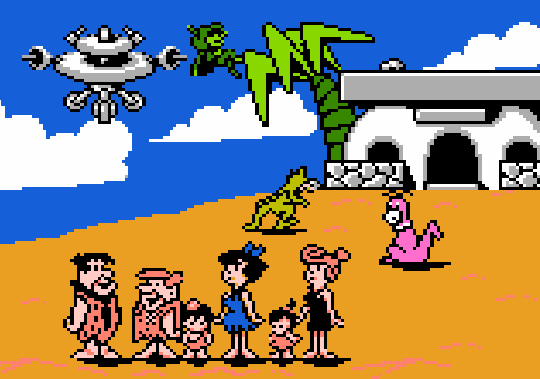
Flintstones, The - The Rescue of Dino & Hoppy (USA)-240522-141432

Barney Rubble is clearly high on peyote here. “I told you not to eat that cactus, dum-dum!” Oh and that’s NOT Pebbles & Bamm-Bamm. That must explain why Wilma is in her mourning dress. The kids were probably eaten by a dinosaur while Fred was having his adventure. That also explains Barney turning to drugs. Thank god the review is over, because this is starting to go to the dark place.

Michael Jackson’s Moonwalker: The Definitive Review (Arcade, Sega Genesis, and Sega Master System Reviews)

Of all the licensed games I’ve done up to this point, Moonwalker is by far the longest of long-shots for a modern re-release. Sega can’t even get the estate of Micheal Jackson to come to the table over Sonic The Hedgehog 3’s soundtrack. I thought maybe there was residual postmortem bad blood, since Jackson apparently wasn’t happy with how his arrangements for Sonic 3 sounded on the Genesis. But, that obviously isn’t the hold-up. Jackson later voiced himself in the Space Channel 5 franchise, so clearly no bridges were burned. The real question is “how much could his estate possibly want for chiptunes?” It’s not like this is a previously unreleased Beatles track we’re talking about. It’s a series of harmonious bloops and bleeps that sound sort of like his famous songs. If anything, people hearing them might be inclined to spend money on the real songs. The “arrangements” featured in the video games have zero value to the estate. Again, we’re talking about bloops and bleeps here.

Let me address the planet-sized elephant in the room. No, not that one. NO, not that one either. I’m talking about the lack of Thriller. Even deep into the production of Moonwalker, the designers were under the impression they could use the iconic song and created levels tailored to it. However, they were later informed that only songs personally written by Jackson himself were available. And thus, all three games have graveyard scenes without what is arguably the most popular Michael Jackson song backing the action. It is SO unavoidably awkward, especially since the fully-charged magic dance attack in the graveyard level clearly has the dance moves from Thriller. I don’t listen to Jackson’s songs and even I think this is lame as f*ck.

Good bloops and bleeps, mind you. My mother, a fan of Jackson’s work, could identify what each song was supposed to be in the arcade and Genesis versions. But, that also means they’re good enough to assure Moonwalker will likely never see the light of day again. The closest we came to a re-release was in 2011, when Sega submitted a version of Moonwalker for PEGI rating on the Wii’s Virtual Console, but nothing came of it (it’s unclear which version, but I’m guessing the Genesis one). Presumably it was done by mistake. It happens. No matter what you think of Michael Jackson, this much is clear: he loved video games and was proud of his work with Sega. It’s not like the games paint him in a bad light, and it’s also not like someone would buy this in lieu of a CD. Nobody on this planet is going to say “well, I was going to buy a collection of Michael Jackson songs, but I bought this video game that has electronic beeps arranged in a way that sounds kind of like his songs, so I’m covered!” Can we please do the right thing here and come to the table like grown-ups? Because these games are worth a look today, in 2023. Especially the arcade version. On with the reviews!

Michael Jackson’s Moonwalker
Platform: Arcade – Sega System 18
Developed by Sega and Triumph
First Released July 20, 1990
NEVER BEEN RE-RELEASED

This should be a joke. A borderline parody. But, it’s actually a very good game.

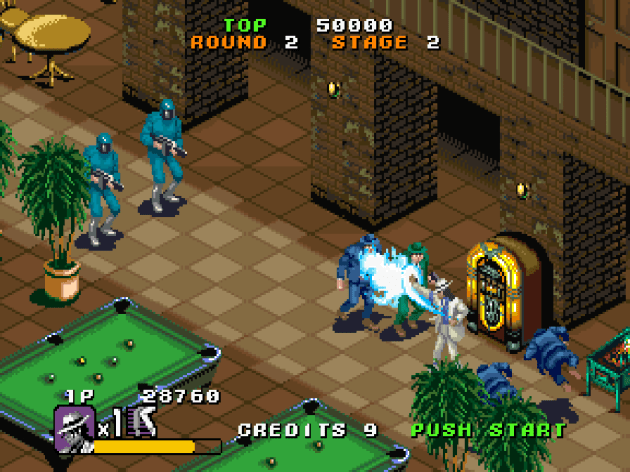
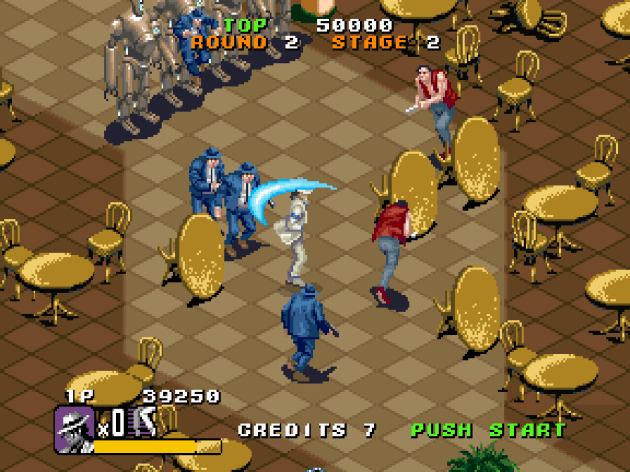
I played the arcade version of Moonwalker after playing the two console versions, but chronologically, this was released first. And now, I’m wondering if the more bland and basic Genesis/Master System versions soiled the reputation of the coin-op. Seriously, why does Moonwalker never come up in conversations about the best licensed arcaders? THIS IS GREAT! I don’t even normally like isometric games. In fact, I kind of hate them. I always get discombobulated trying to walk in a straight line when I play them, and that’s not even the most annoying aspect of the game. Moonwalker features this strange pseudo-auto-scrolling gameplay that makes it feel like you’re getting the bum’s rush through the set-pieces. But, actually, it’s about thirty to forty minutes of perfectly-paced non-stop action.

I have no clue why, but the first level of the game lasts roughly one minute and consists of a single street corner. It’s not as if the game is so complex it requires a tutorial stage, but that’s sort of what it feels like.

It’s probably best to think of Moonwalker as a close cousin to Altered Beast. The same type of slow-scrolling, hoard-smacking fisticuffs, only played from a different angle, with only one button for all striking moves. Gosh, that actually sounds like my idea of the fourth circle of hell. So, you can imagine my surprise that the smile never vanished from my face during my first session with Moonwalker. Part of that is that the enemies aren’t completely brainless. There’s a fairly nice variety of them to smash, and you’re always given enough room to dodge out of the way of their shockingly elegant attack formations. You can also charge-up your attack, though this was the one weakness of the game’s combat. It’s too hard to aim the charged up shots if you move around before unleashing them. In general, you’ll spend most of the time blasting enemies with energy directly with your hand. Most baddies only take two hits to kill, and the levels go by quickly. One or two of the robots were a bit spongy, but not in a deal breaker sort of way.

If you’re turning around while you attack, you do this little spin-attack. So the one-button aspect of the combat is deceptive, because there’s a little hint of nuance to it.

I know what you’re thinking. “Where the heck is she getting an Altered Beast comparison out of that?” It’s because you transform near the end of each stage. For you children of the 2000s, Michael Jackson famously had a chimpanzee named Bubbles that he took everywhere he went. Bubbles shows up where you’re next to the boss for each area. Touching him transforms you into MECHA JACKSON! (imagine a Godzilla roar here for full effect). At this point, you get projectiles and your charge-shot becomes a pair of missiles. This is where the run ‘n gun gameplay takes over, though the “run” part is misleading, since you still move around the screen at the same pace, and usually there’s not too many basic enemies to wax before you encounter the boss. As much as I enjoyed the shooting combat, the bosses are the game’s weak link. They’re generic robotic contraptions that feel like they belong to another game. Not boring to fight, mind you. But they often feel out of place with the set pieces.

This slideshow requires JavaScript.

The most memorable aspect of Moonwalker are the bombs. You get one per life and some of the children you rescue will grant you additional ones. When you activate them, all the enemies on the screen join you in a dance number. Even the robotic enemies (including the robotic dogs) do it, and when the dance ends, they all die. While it’s disappointing that you’ll briefly turn back into the human MJ when you activate a bomb as Mecha Jackson, it’s SO SATISFYING to use the dance move. It gives the whole game a music video vibe, and it does a better job of it than the more choreographed Genesis Moonwalker. In the arcade game, I found myself timing it when enemies were standing on the perfect spot to make it look like a performance. I wanted to do it that way. It made the experience more fun.

This slideshow requires JavaScript.

Okay, so Moonwalker isn’t the deepest game. But, it is the ideal early 90s arcade experience. A simple action concept with easy-to-understand combat that’s polished to a mirror shine. From a gameplay perspective, the only real “hole” is that the enemy themes don’t always feel like they belong. When your main gameplay issues are slight thematic inconsistencies, you probably have a very good title. You couldn’t make a game like Moonwalker today. It’s too simple. Too short. Too limited. People wouldn’t stand for it. Yet, it’s telling that I, a total non-fan of Michael Jackson, could walk away as satisfied as I ever have been by a game of this type. Even without the novelty of Michael Jackson being the star, Moonwalker is worth the forty-five minutes max it takes to play-through. A perfect example of how to do a licensed arcade game, and especially a game that is really a vehicle for one specific celebrity. I honestly can’t imagine any game could do better at that, really.
Verdict: YES!

Michael Jackson’s Moonwalker
Platform: Sega Genesis
Developed by Sega
First Released August 24, 1990
NEVER BEEN RE-RELEASED

And you thought the stairs in Castlevania games were frustrating. Holy crap, it’s INSANE how hard it is to just begin the process of walking up a flight of stairs in this game.

Going a completely different direction, the Genesis version of Moonwalker uses a heavily modified version of the engine that powered Genesis launch-window title Revenge of Shinobi. Whereas rescuing children is a side task in the coin-op, this time around, finding hidden children is the entire object. You play fifteen stages of opening every door, window, car trunk, etc, until you find X amount of kids. At this point, all enemies completely vanish and Bubbles the Chimp appears and points you in the direction of the “boss” encounter. It makes the Genesis take on Moonwalker a much slower experience, and one that’s absurdly repetitive.

This slideshow requires JavaScript.

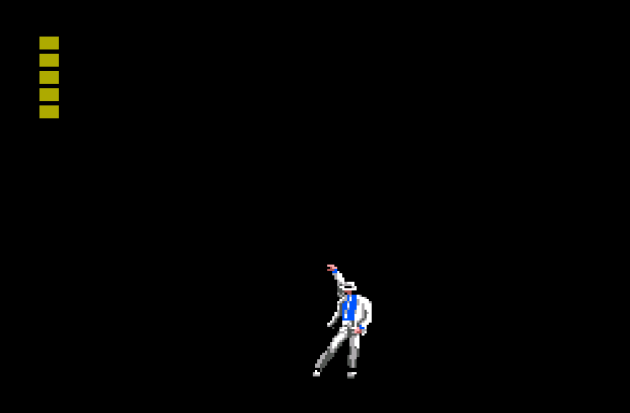
I know this is the oddest observation possible about Moonwalker, but the first thing that stuck out to me is the movement of the sprites. The tall, slender characters move around with this spooky fluidity to their locomotion. It’s both unnervingly unnatural and oddly hypnotic. It also looks remarkably like prime-era Michael Jackson’s dancing, which I guess is the point. It’s just a shame the actual combat doesn’t feel more dance-like. While the Genesis game retains the blue “energy” that Michael Jackson emits when he throws punches and kicks, this time around, there’s no OOMPH to it. His standard ground-based attack is the weakest-feeling kick this side of Taito’s Superman coin-op. Part of the lack of weight and gravity comes from the fact that the kick has incredible range, at least if you have enough health to give Michael his magic powers. The more health you have, the more range the fairy dust or whatever it is he sprays from his limbs reaches. In practice, it looks exactly like he stepped in a puddle and is kicking the water off his shoes. WELL, THAT’S WHAT IT LOOKS LIKE!

Actually, it looks more like snowflakes, and it spreads out, too. You can barely see it in this picture, but the fairy dust I kicked out is about to kill this dog. It’s quite a ways from me, too, so it’s pretty powerful.

There’s more than just kicking and punching, but it comes at a cost. Holding the A button down makes Michael spin, which causes damage to anything that touches you, but your health starts to drain. If you hold the spin move for a second or so before letting go, Michael throws his hat, which is an instakill on almost anything it touches. If this had a lot of range, or didn’t cost health, it’d be a fun attack. It has a bit more OOMPH than the fairy dust attacks have. Hell, this should have been the game’s basic attack, but it’s not. It costs health to use, it takes time to activate, AND, unlike the fairy dust, it doesn’t spread out. I never found a single usage for it where I wasn’t better off using the kick. Life is plentiful in Moonwalker. Every kid restores health, so you should always have close to a fully-charged magic kick. The hat is WORTHLESS! Here’s the exact same location from the above picture, only using the hat.

Not only is the hat going right over the damned pooch, but it ate-up health AND takes longer to perform. The guy above me had time to get away while I spun-up the attack. One of gaming’s most worthless moves.

Now, I made a major boo-boo the first time I played Moonwalker. I didn’t know about the all-powerful fully-charged magic attack. It takes literally half a full life bar to unleash and causes all the enemies on the screen to join you in a dance number, just like in the arcade game. My first time playing the Genny Moonwalker, I didn’t want to drain my health and I found the hat-toss to be worthless, so I stayed away from the magic attack. I only discovered the dance-off thanks to my play-through of the Master System game. The magic dance is especially useful for clearing the level “bosses.” They’re usually not bosses in the “big boss” sense, but rather massive waves of basic enemies. When you perform the move correctly and the screen is full enough of bad guys, it does succeed in making Moonwalker feel like a music-based action game. Unlike the arcade game, enemies actually line-up next to Michael to make the dance look more authentic. So, there’s that. Of course, it doesn’t always work, either. For example, the storm troopers in level 2-2 just run away when you begin to dance, and other bosses might be damaged, but not die.

This slideshow requires JavaScript.

Moonwalker’s main objective is also the game’s fatal flaw: finding the children in each stage becomes dull after a while. If there were visual clues or some kind of logical way of sussing-out their location, it would be one thing. OR, alternatively, if their locations were randomly generated. Then I could live with the mechanic. But, besides the near-certainty that the upper corners will be hiding spots for them, it’s really just blind searching the first time around, and it grows old quickly. There’s not a whole lot to break up the monotony. The level design doesn’t really become interesting until you reach a laboratory in the very last game world, where there’s teleporters that make the levels a maze. That’s so much better than the world before that, which features caves that you had to go inside of to rescue the kids. Since the majority of the caves are empty BUT you also have to make your way back to the door, it feels more like additional busy work. Moonwalker already suffers from too much busy work just by having to manually walk to the area of the map you fight the boss in. The Sega Master System version cuts that aspect from the game and is better off for it.

The labs are fun levels. Walking through empty stages while Bubbles points you towards the area of the map that doubles as the boss chamber? Not so much.

I really do think the “hide and go seek” gameplay could work if it was only used for one of the three levels in each world. If they had come up with some kind of other gimmick for the rest of the stages, I think Moonwalker would have been a much better game. Actually, they DID come up with a better gimmick. At the tail of my first play-through, I turned into a robot and had to clear dozens of enemies with laser beams. I thought “why wasn’t there more of THAT in the game?” Especially after I played the arcade game, where each level closes with MECHA MICHAEL. Well, it turns out, there’s actually a way to do that in other stages if you correctly pick the right child to rescue first. There’s no way of knowing without consulting a guide which child. I didn’t even know this was possible until my mother, a huge Michael Jackson fan, discovered it in level 3-3. Picking the completely arbitrary correct child makes a blue star fall from the sky, and you turn into a robot who can shoot lasers and missiles. It sounds delightful, but during the 30 or so seconds it lasts, you can’t perform the search behind graves or bushes for the kids. It brings the actual objective to a screeching halt. That’s NOT what I meant, game!

This slideshow requires JavaScript.

Then, after fifteen levels of side-scrolling, glorified item fetching gameplay, Moonwalker on the Genesis turns into a stripped-down Star Raiders knock-off for about a minute or two where you fight Joe f’n Pesci. HUH? What? And he doesn’t even have a baseball bat? Boooooo! Oh, and this whole sequence is jarring and terrible and should never have closed the game. Couldn’t they have just had one single normal boss fight? The game comes close a few times, especially in the graveyard. There’s a section where two zombies throw their torsos at you, and that was the only point where I actually died fighting a boss. The Star Raiders section provides no sense of closure. It doesn’t “feel” climatic. It’s so lame.

This slideshow requires JavaScript.

I don’t know what to make of Moonwalker. You can tell really quickly that the main reason it exists is to showcase the technical superiority of the Sega Genesis over Nintendo’s NES. And it is impressive for a 1990 game. Especially when the screen fills-up with enemies. Moonwalker just lacks the excitement or structure of a truly great action game. On the other hand, some of the set pieces are fun (especially the graveyard and lab stages) and it’s still a short game, overall. It should take the average gamer today under two hours to finish. What I found to be the most telling thing about Moonwalker is that my non-gamer mother, a huge Michael Jackson fan, preferred the Genesis version to the arcade one. She played through the whole thing and enjoyed it thoroughly (until she got to the spaceship finale, which I had to beat for her). Yep, that says it all: the Genesis game is made to be accessible to everyone, whereas the coin-op is clearly more tailored to what a hardcore gaming fan would enjoy.

Moonwalker’s biggest gameplay issue is the CONSTANT whammies you find in the search for the kids. Being the scoundrel that I am, I used the emulator to bypass a lot of them. Especially in the fourth level, where I’d rewind to avoid entering empty caves. This was probably the game I cheated most playing in 2023. Moonwalker fans, before you clutch your pearls, you might want to wait and see what the end result of that cheating was.

I can’t review from the perspective of my mother. I will say she was blown-away by Moonwalker on the Genesis. She had genuine regret she never played this before I did this review. The question for me is “did I have more fun than not?” The answer is yes, but there’s an asterisk attached to that. I confess that I used cheating to cut out a lot of the bad aspects of Moonwalker. I found it easier to rewind the whammies (or empty caves in the fourth level) than to live with the consequences. Had I not done that, I think I would have given up on Moonwalker during that god awful 4th level. Being able to undo the busy work of manually walking out of the cave saved it for me. So, I’m going to give Moonwalker a YES! because I do believe it’s worth looking at in the 2020s. Not just as a historical curio, either. There’s genuine gameplay merit to had. But, if I didn’t have rewind or save states, I’d likely have scored this a NO! since the emulator itself made the game more fun than it would have been playing on an authentic Genesis cartridge. Make no mistake: Moonwalker was never fated to age well. So, the fact that what’s still here is actually playable and even enjoyable in the 2020s is remarkable.
Verdict: YES!

Michael Jackson’s Moonwalker
Platform: Sega Master System
Developed by Arc System Works
Published by Sega
First Released August 24, 1990
NEVER BEEN RE-RELEASED

This slideshow requires JavaScript.

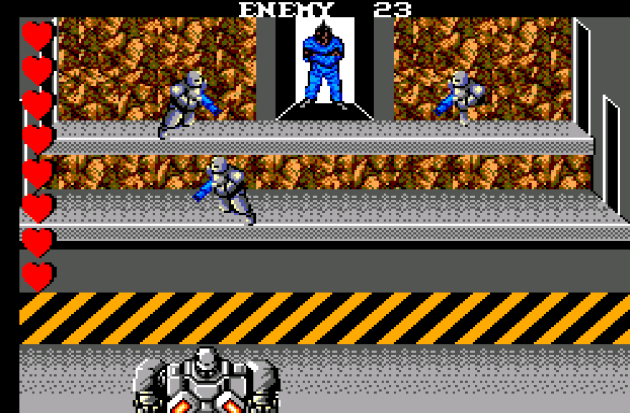
The 8bit Sega Master System Moonwalker was so close to defeating its Genesis big brother that it could taste victory. It features the same “glorified hide-and-go-seek” objective with finding children as the Genesis version and carries over all the set pieces from that game. However, to make up for the hardware limitations, there’s some big changes. Some are very positive. The fairy dust nonsense that took the OOMPH out of the combat? That’s gone. The biggest change is, this time, your kicks and punches have to physically connect to enemies to defeat them. As a fan of video game violence, I appreciated that very much, and Moonwalker SMS was just getting started. The hat throwing? That’s now a power-up you can use for the remainder of a level when you find a Michael Jackson doll while searching for the children. Oh, and it costs no health to use it. Nice. Last but not least: having to manually walk to the area of the map that’s meant to be the boss chamber? That’s thankfully gone. When you rescue the final kid, Joe Pesci taunts you, and you just magically teleport to the boss chamber. These are all positive changes.

Even the laboratory level feels a lot more maze-like. Easily the strongest level in any of the Moonwalker games. That includes the coin-op too. Yes, really! I know, right?

But, the downgrades let the air out of everything. The “boss” fights are limited by the power of the Master System’s hardware. So, at most, only two guys will fight you at any one time. I never had to use the magical dance-off move, since boss battles devolved into me walking left and smacking one guy, then walking right and smacking the next one, then repeating that process until the game told me I’d won the fight. It wasn’t fun to use the dance off move anyway, since the enemies don’t dance with you. Instead, the rest of the screen fades out while you dance all alone. Awful. Moonwalker makes the same mistake so many bad Sega Master System games did: trying to replicate gameplay done on superior hardware, instead of keeping true to the spirit of that gameplay in a way that plays to the system’s strengths, like Castle of Illusion did.

Womp womp.

Even with all those problems, I was so close to going YES! on 8bit Moonwalker. I can’t stress enough how well done the three lab levels were. The best levels in the entire franchise, easily. And then.. it happened. Remember how the Genesis game ends in a bad Star Raiders knock-off? Well, the Master System version ends differently too, but there’s no space battle. Instead, it ends with something that feels like the over-the-shoulder sequences in Contra. You transform into MECHA JACKSON and have to kill roughly four trillion soldiers, give or take. It feels out of place and wrong. I was like “okay, interesting way to end the game that has no connection to the previous fifteen levels of mind-numbing tedium, but whatever.” Honestly, this wasn’t god awful or anything. It just felt like it belonged to another game. BUT HEY, the 16bit version ended in a similar disconnected way, and I said YES! to it, right? Well, 8bit Moonwalker wasn’t done trolling me yet.

This one wasn’t TOO bad.

There is one final “boss” battle, and it might be the worst element of any retro game I’ve done up to this point. It’s yet another Contra-like sequence, only this time you take the form of a spaceship. There’s four cannons that open their hatches and fire at you, and you have to destroy them. That sounds reasonable, right? What if I told you the hatches open for only a split second? And what if I told you the projectiles they shoot lock onto you? Sometimes for the entire length of the screen. I have no idea how anyone could have ever finished this sequence without extreme amounts of cheating, because it took me FOREVER just to find an angle where the cannon lasers would barely miss me. Even when this happened, remember, the hatches only open for a fraction of a second. That meant I had to move off the safe spot I’d barely been able to find in order to cause damage to the cannons, which take multiple hits to kill and fire the most accurate heat-seeking shots in gaming history. This sequence burned through any good will the Sega Master System version of Moonwalker earned.

This slideshow requires JavaScript.

Not that it was AMAZING up to that point. I mean, it was good enough that I felt retroactively happy for children of 1990 who had the Masters System and couldn’t upgrade to the Genesis. It almost pulled off a convincing impression, too. Well, so much for that. It’s such a sloppy, nonsensical way to end the game. It feels completely unrelated to all the action that happened up to this point. I suppose I could say that SMS Moonwalker is worth playing if you quit as soon as you beat the last normal level, but then I remembered how bored I was making my way through the parking garage or the caves. Unlike the Genesis version, this barely held my attention, even with arguably better combat. The biggest problem is there’s just not enough combat. The hardware limitations mean that you usually only fight one person at a time. It’s not enough to be fun. 8bit Moonwalker is a blander version of a game that’s already toying with blandness.
Verdict: IT’S BAD! IT’S BAD! IT KNOWS IT (THAT’S A NO!)

ActRaiser (SNES Review)

ActRaiser
Platform: Super Nintendo Entertainment System
Developed by Quintet
Published by Enix
First Released December 16, 1990
NO MODERN RE-RELEASE
Terribly Remade as ActRaiser Renaissance in 2021

The last thing a person sees when their parachute doesn’t open.

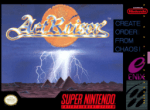
ActRaiser was one of those games that came up so often in gaming magazines that, when it was released to the Wii’s Virtual Console in 2007, I had to jump at it. The funny thing is, ActRaiser was just a little younger than me and sniffing its second decade by that point, and it was still a one-of-a-kind experience. Actually, it still kind of is. That includes the sequel, which decided to remove the God-like aspects of the original game. I can’t imagine why it isn’t as beloved as this original SNES launch-window game. Nobody learned their lesson, which is why a horrible remake came out in 2021 that added tower defense elements that nobody in their right mind wanted or asked for. And now, playing ActRaiser 33 years after its release, it’s now glaringly obvious it’s a glorified tech demo to show off the capabilities of the new console. That’s not a knock, by the way. Super Castlevania IV and Super Mario World are in the same boat. I like them just fine, and I like ActRaiser too. It’s also a little overrated. Sorry, but it is!

You have to admire God’s determination to follow the rules of etiquette and use both hands on His broadsword, even when He’s leaping. Makes sense why He’d follow such gentlemanly rules. He invented them, after all!

ActRaiser is a roughly 50-50 split of sword-and-sorcery platforming and a stripped-down SimCity/Populous-like world builder. Most people remember it for the action parts, which are sort of like Ghouls ‘n Ghosts, only much easier (unless you’re playing the INSANELY hard Japanese version) and with less stuff to do. This is the third time I’ve played ActRaiser, and one aspect of it that struck me is how fast the levels go. It always caught me off-guard when the boss’s health meter would appear. “Wait? Already?” And that’s fine, by the way, because the combat is as basic as it gets. There’s no finesse to it. None. Despite the controls being pretty good (if slightly stiff), there’s no pizazz to it. You can’t block. You can’t swing the sword upward. There’s no sub-weapons besides bomb-like magic spells, some of which aren’t all that effective. The SNES is a six button controller. Half those buttons go unused. The fact that nobody would accuse ActRaiser of being a button masher is impressive.. because it kind of is one. Especially the boss fights.

And actually, the bosses don’t really hide their mashy nature. They have huge lifebars, but you’re not expected to dodge their attacks, so you would think they have the advantage. Instead, the battles are about getting three or four licks in for every tick of damage they give you. For a legendary game, ActRaiser sure has inelegant combat.

On the other hand, the action stages contain no filler and it genuinely feels like, once they ran out of ideas for each set-piece, they wrapped it up. That’s always preferable to padding a stage for arbitrary reasons. As basic as the action is, it never lasts long enough to get boring. There’s also a hidden complexity, in that you’re incentivized to fully explore the levels and not ignore enemies. In fact, you should slay everything in sight. That’s because every 50 points you score in the action stages increases the potential population of the town by one citizen. Of course, since you score points by the amount of health and lives you have (and lives reset between levels even if you get 1ups), you might not want to just hack and slash with reckless regard on every boss.

The longest level is this climb up a frozen tree.. at least that’s what I think it is. You have to ride these bubbles up to the top. It reminded me of Wizards & Warriors. Say, there’s a review I ought to do one of these days.

I didn’t even know there was a connection between scoring and population until I’d already passed the first two stages, which are the hardest to achieve a maximum population for. Go figure. Since the RPG-like leveling-up system that grants you extra health and extra God-power points in the simulations is based on reaching population benchmarks, points actually matter. Hey, I appreciate that scoring isn’t just included because it’s 1990 and the grown-ups making the games know that kids like to get high scores. I also appreciate that the game is nonlinear. At least to a certain extent. Your ability to visit each land is tied to how leveled-up you are. This was the first time I played the stages in a mixed-up order. It didn’t really make that much of a difference, but I’m big on players having as much flexibility as possible to create their own strategies.

This slideshow requires JavaScript.

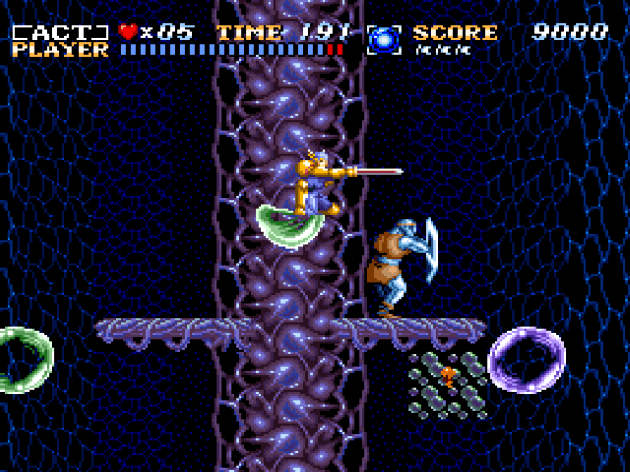
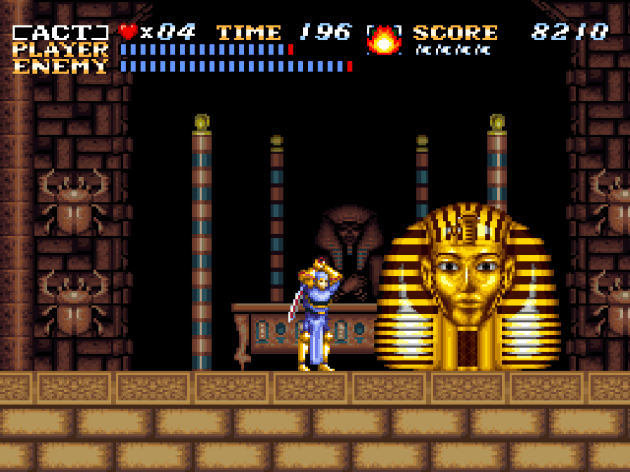
The main highlight of ActRaiser’s action scenes are the thirteen boss fights. They’re a fun hodgepodge of different world mythologies. A centaur. A minotaur. Dragons. King Tut.. for some reason. Come to think of it, that’s not really a myth. Just some poor kid who was so inbred he had a cleft palate, a clubbed foot, and a curved spine and lived a life of constant, agonizing pain (it’s not like they had Vicodin back then) before dying of malaria at the age of 18. Shit, no wonder he’s aligned himself with Satan to do battle with the personalization of God.

Hell, why bother with the sword? You could probably kill him by coughing in his direction.

While I enjoyed the bosses, they weren’t so good that I was happy when the game ends not with one final level, but with a boss rush. Not all twelve previous bosses, mind you. Just half of them. Specifically, the second bosses in each stage. Well, that sucks, especially since the back-bosses tend to be the least entertaining ones to do battle with. Again, the problem is, without any advanced moves, fights tend to devolve into just spamming attacks and counting on the fact that you’ll score more hits. That’s not just the way I played it, either. I don’t see how else you’re expected to do it. It’s almost comical how sloppy these encounters are. It’s odd that they work so well. Again, it’s the pacing. One or two bosses might take a while to beat (typically the ones that linger near the top of the screen), but otherwise, ActRaiser cuts a blistering pace.

This slideshow requires JavaScript.

For the final boss rush, you don’t get health refills OR bomb refills between battles. Thankfully, if you die, you get to continue from the last boss you were facing (but you don’t get your bombs back). It’s still a lazy and underwhelming way to end the game. I suspect this choice was made because the last boss is also the lamest one and someone at Quintet figured that part out. Dammit so much. I hate it when good games fall on their face at the end. Oh well, I had a good time regardless. Unrefined as the combat is, there’s no sword-swinging platformer that feels quite like ActRaiser, and the dazzling set-pieces filled with original enemies seals it. Imperfect, but a lot of fun.
VERDICT: Wait, ain’t I forgetting something?

Oh, right.

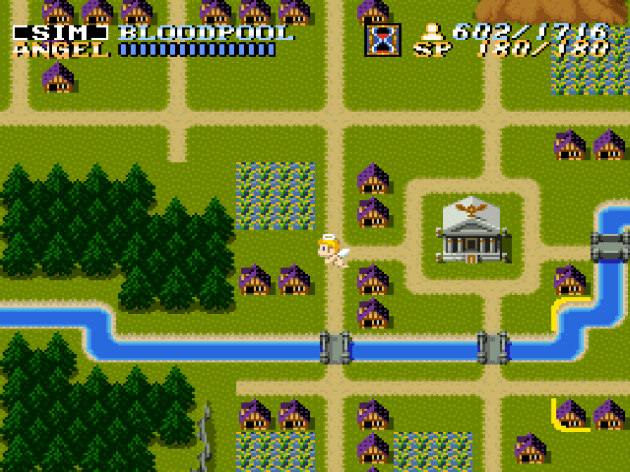
ActRaiser’s simulation side feels more like a cousin of Animal Crossing than it does SimCity. As God, your main job is really just to clear debris and point which direction you want people to build each town. Since this is supposed to be an action game, you still fight monsters in the simulation. You have a flimsy bow and arrow, and golly, does it feel out of place. The monsters, which only come in four different forms (bats, blue devils, red devils, and giant skulls) will kidnap village people or burn their houses down, and having to fight them when you’re trying to focus on clearing rocks or sand or marsh feels like busy work. Your ultimate goal is to aim the building paths in the direction of the four monster lairs and let the people seal them up for you. In the entire game, only one time are you given a tool that can seal-up a monster lair the people can’t possible hope to reach. I’d almost prefer if you gained the ability to destroy every lair manually. To the game’s credit, every single time the people reach another lair, it’s so satisfying to see them do their little ritual and make the thing vanish.

If the people can do this but the angel can’t, then really, what does GOD need you for?

Occasionally, the people will pray to you for a specific thing. The leaders of one village have an adventurous son, Teddy. You have to locate the little bastard on the map and bring a loaf of bread to him. LATER ON, when the village decides to draw lots to decide who will be sacrificed to a local monster, the leaders are fine with the concept. Well, until Teddy draws one of the short straws. Oh, THEN they pray to you to intervene. Of course that’s how they’d be. They’re religious! And this exposes the limitations of ActRaiser, because I personally knocked down every house in that village in response to this and they never once grasped that I was pissed at them. I’m GOD, you f’n morons! What are you doing sacrificing yourselves to anyone BUT ME? I didn’t want to save Teddy, but if I had to, I should have had the right to give him and his family the plague. I’m vengeful, angry God over here and I can’t even inflict a hangnail on them? What kind of sissified deity am I? I should have the ability to rain stones on them to show my displeasure. Have horrible boils erupt on their skin and.. you know, actually now I’m starting to see why they decided to take their chances with the monster.

You get the occasional mission, like this dead guy in the middle of the third stage. First, you have to clear the sand using rain. Then, you have to guide their construction in his direction. When they find the corpse, your civilization discovers music. In the town next to them, people are turning evil or something, and you have to take the music from this town over to them to get them to stop being hateful towards each-other. I was just burning their houses down.

The closest you can come to an old testament style God is the fact that you need to knock down the old homes so they have to rebuild new, higher capacity ones. See, every time you seal one of the first three monster lairs in an area, the “civilization level” for that town goes up. Which just means the buildings look more sophisticated and start containing more people. And yes, you’ll want to actively destroy the old houses, since there’s a limit to how many buildings can be on the screen. Once you get to a high enough level, you’ll want to use an earthquake, which breaks all the Level 1 – 2 houses while leaving the max level 3 homes standing. Oh, and you’ll want to be careful planning the paths. You want to minimize the bridges in the first two levels, since nobody lives on them, but they count as structures. I didn’t know this, and I ended up maxing-out twelve people short of reaching the highest possible level.

Not that I missed that last bar or two of life during the final boss battle, but I still wanted to get a 100% completion and came 12 people short. Maybe next time.

I actually really enjoyed the simulation side of ActRaiser. Simple and limited as it is, it’s just so dang charming. Just its existence alone is enough to make me giggle. Like seriously, who saw the potential to combine THOSE action stages with THIS God sim? It’s absurd. They don’t even pair that well together, either. I can totally understand why someone at Enix would be like “maybe lose the sim parts” for the sequel. Yet, I can’t think of a better example of complete gameplay dissonance working like ActRaiser manages to pull off. Two completely incompatible gameplay types that most certainly are NOT working together in harmony, and yet, the end result is the rare bonafide gaming legend that holds up to the test of time. It’s not as good as you remember. The action is even more rudimentary than the simulation side of things. But, ActRaiser’s two gameplay styles are incompatible, and it still works. A game oozing with religious themes made me a believer, because ActRaiser not being an unmitigated disaster is proof that miracles are real.
Verdict: YES!

South Park: Super-Sweet Pinball (Pinball FX Table Review)
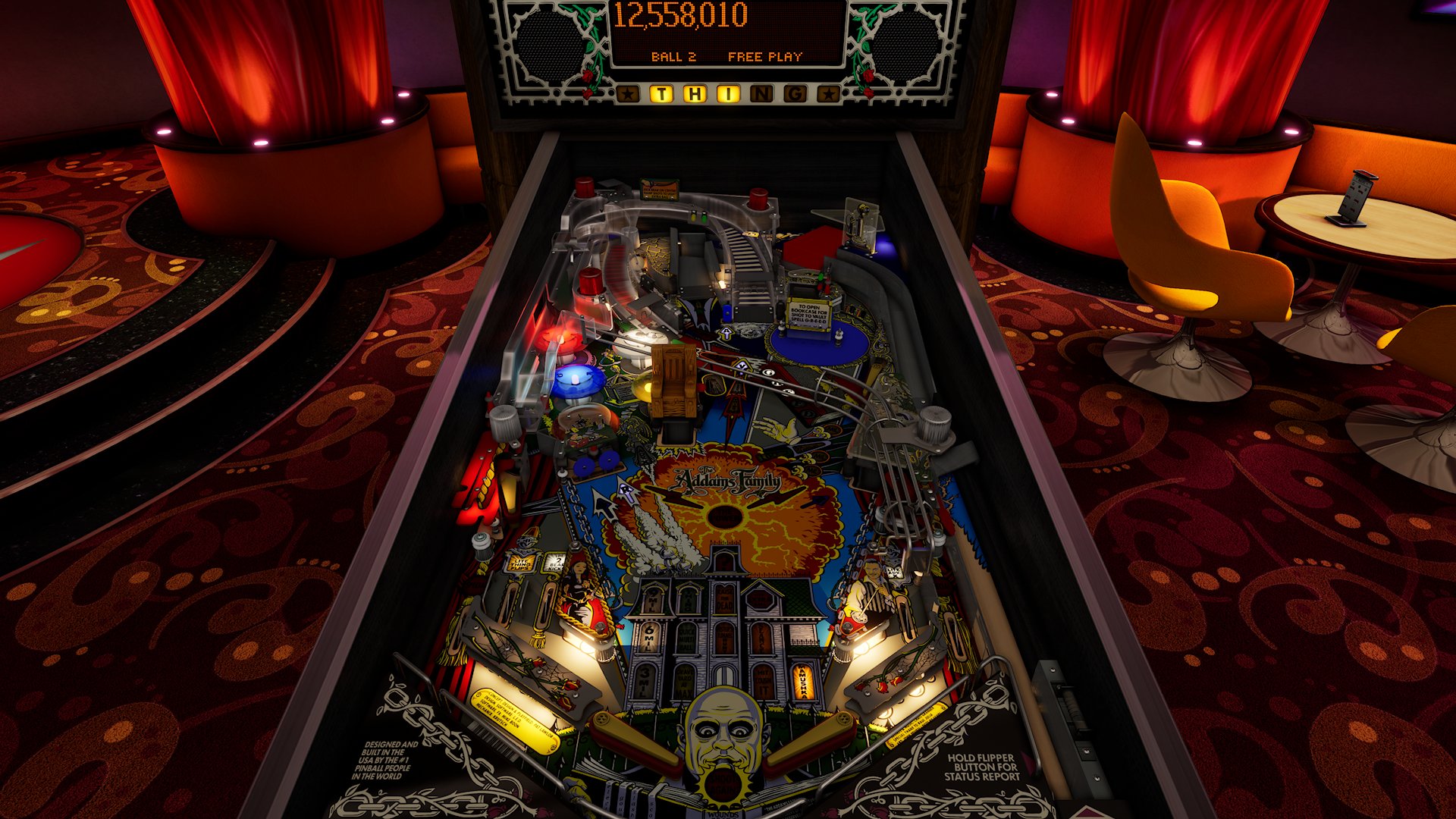
South Park: Super-Sweet Pinball
Platform: Pinball FX
Set: South Park Pinball ($9.99)
Included with Pinball Pass
Designed by Peter “Deep” Grafl
Originally Released October 14 2014
Awarded a Certificate of Excellence by The Pinball Chick Team

Keep in mind that our team’s fandom of South Park as a show is all over the place. Dad (Oscar) and Dash are 100% complete lifetime non-fans. Myself and Jordi are lapsed fans, while Dave is somewhere between the two groups. Only Angela is a modern “never misses an episode” fan of the show and even has viewing parties with friends. Some of us factored in the theme, others focused on the table. One odd note is that Zen is just weeks away from releasing Pinball M, their M-rated Pinball FX spin-off (oh.. hey, I get the name now), but this South Park is rated E 10+ by the ESRB. There’s not even bleeped cussing in here. Weird.

South Park’s tables being returned to Pinball FX after a six year absence is proof positive that all bets are off with Zen Studios. As if getting the World Cup and Indiana Jones licenses didn’t already prove that, now they’re bringing back their long-lost Pinball FX2 pins as well. South Park: Super-Sweet Pinball is probably their most famous pre-PinballFX3 pin (it’s either it or Plants v Zombies). It’s back, and it plays well with the new Pinball FX engine. Super-Sweet pinball is a smooth-flowing finesse table only somewhat held back by a brutal difficulty combined with modes that demand too much perfection in what is an imperfect art form.

The Vices (that would be myself, Angela, and Oscar for those keeping track at home) have put 30+ hours into Super Sweet Pinball. For all the whining you’re about to endure, we all really enjoyed it. However, some of the angles are too impossibly risky. Chef’s door is a whole other level of “WHY DID YOU STICK THAT THERE?” mind-f*ckery. Unlike Dash and Angela, I never considered moving off my GREAT rating. The risk/reward balance is too screwed-up for that.

Super-Sweet isn’t entirely an original table by Zen. Hold a mirror to the layout and it’s a close approximation to Stern’s Simpsons Pinball Party. I don’t know if that was meant to be a “Simpsons Already Did It” joke or not, but given that Ant-Man is a mirrored version of Theatre of Magic, probably not. The similarities are mostly superficial in nature, though South Park does take after Simpsons with multiple highly stackable modes. Unlike Simpsons, you can’t go into the settings to adjust the hurry-up times. The biggest problem with South Park is how damn unforgiving it is. It’s not enough to activate the modes. The modes have to be finished to achieve the S-O-U-T-H-P-A-R-K lights that are the ultimate object. That’s nine modes, with three additional modes (one of which is a grindy multiball). Finishing four of them lights an extra ball, but even on our third day, it wasn’t all that rare for each of us to finish games with only one light (typically it was the Kenny light, which is a lay-up). And, we really don’t suck at pinball. Hell, I’m the reigning Arcade mode world champion on this table at the time I’m writing this, and I finished that game barely halfway there. They’re a LOT of work just to get started, THEN you have to.. you know.. beat them!

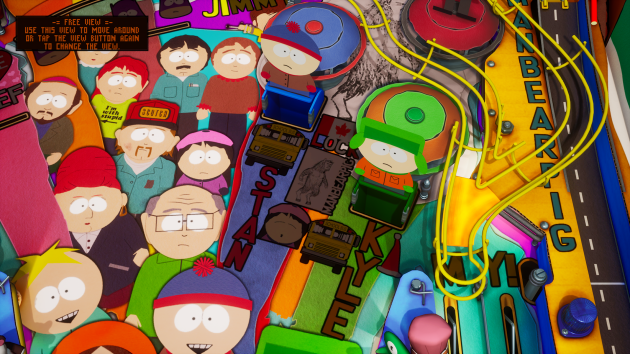
The Stan and Kyle scoops are deceptively hard shots. For Kyle, if you have a gentle roll on the right flipper, a backhand is a relatively safe option. Stan? Not so much. If there’s a low risk angle for it, we haven’t found it. Annoyingly, despite being a very high-risk shot, Stan’s hurry-up is too short and very undervalued relative to its difficulty. Really, the only value it has is it gives you the S light. Lighting four of the S-O-U-T-H-P-A-R-K lights will light the extra ball target. My suggested order is Kenny, Sarcastaball (which has an additional extra ball attached to it), School Bus Multiball, and Manbearpig. You can sub Stan’s Hurry-Up (annoying as it is, once it starts, it’s one shot to complete) for any of those. The Vices NEVER successfully completed Kyle’s mode (Mr. Hankey Multiball) or Chef’s mode. Not once.

Let me pick an almost random example: the School Bus Multiball. To get it, you must shoot the school bus ramp NINE times. You must then lock four more balls shooting the same ramp. THEN, you must complete the shots for all four of the boys AND sink the balls back in the bus ramp you had to grind nine shots out of to begin with. I’m fairly sure that you need to only lock one of the balls to get the “R” letter, but either way, this is massive grindy time investment. I can’t stress enough: the most successful pinball tables of all time kept their “doors” lit whether or not you were successful in the mode or not. That’s the kind of pinball that generated the biggest success the medium has ever had BY FAR, so why wouldn’t you do that, Zen? You have 110+ tables on Pinball FX, and you expect HOW BIG a time commitment towards “git’n gud” at them?  Kyle’s requires you to get the K-Y-L-E lights, then 3 locks on the sarcastaball-ramp, THEN you have to get a super jackpot in multiball. AND IT’S ONLY WORTH A MILLION POINTS for that super jackpot.

The super skill shot is quite risky. I had a lot of shots go straight down the drain off it. You should have the ball save lit, but still, it’s a bitch. When this target isn’t standing, it’s replaced by a TV target that requires you to hit it.. I’m not making this up.. 247 times just to light an extra ball. Come on, Zen. Now you’re just straight-up trolling. It’s worth noting the “episodes” you get from hitting this add to your end-of-all bonus as well. If I shoot a target 247 times, I expect the table to gain sentience and eat me. Though actually, at one point, I had an EB light that I couldn’t figure out where it came from. It’s entirely possible it was from this.

Compare the relatively low scores of the other modes to the T-I-M-M-Y mode, which is NOT for one of the letters but yields the highest scores. By far! Timmy’s easy-to-get lights are along the flipper lanes. After lighting them, you have thirty seconds to go nuts on a single shot next to the Kenny loop. Use the left flipper and a cherry-bomb shot, and you’re gold, OR, you can use the bat flipper. Yep, the best target in the game can be shot from both the left primary and the bat flipper, and boy, does it score points. You only need to hit it once and you’ve got a cool million points, and it adds another million every time you repeat it. Do the TIMMY shot twice, and you’re made three million points. Three times? Six million. Four times? Ten million. And so forth. And so forth. You can grind that one shot, 30 seconds at a time, and still score hundreds of millions of points. You can use this as an excuse to light the C-A-R-T-M-A-N lights, since that shot feeds you a softball for the bat flipper to shoot the TIMMY shot. Oh, and if you miss it off the bat flipper? You’re either hitting the Kenny Loop, Randy Ramp, or if you’re way off, you’re hitting the J-I-M-M-Y lights for the kickbacks! It’s so badly balanced. My arcade world record right now is probably 40% to 50% made of that one shot. That’s not balanced. I should note my father disagreed with me all weekend about how low-risk it was, since the Timmy target is a cherry bomb shot straight over the drain. I almost never lost a ball from it. He’s just plain wrong.

Assuming the mini-table doesn’t glitch out on you and ruin your game (and it might), you’ll want to get good at it since the extra ball light is that cow up at the top of it. The biggest pinball mistake Angela will ever make is letting me see how she cracked the super skill shot. Here’s how: let the ball “settle down” on the right (lower) flipper before flicking. It should bounce off the target and roll around the goal post. Grind this up to a 10 million point level and then complete the super skill shot on the main playfield to light an extra ball. Takes practice but I can now do it almost every time. It’s HIGHLY clockable. The balloon part? Not so much. Another tip: don’t shoot the tethered balloon directly. Use the same strategy as I stated above and DO NOT shoot the balloon directly. ANY contact with the balloon will light the S-A-R-C-A-S-T-A-B-A-L-L lights, even if it’s on the return. Now, when the balloon is cut loose from the tether, sorry friend, but you’re on your own. I sucked at it.

Will someone in charge at Zen Studios tell their table designers to tone it the f*ck back, already? Because the tables aren’t better for demanding this much commitment out of them. The tables aren’t ever more fun because of the repetitive grinding. They’re less fun. Nobody is going to devote six months towards one table to get good enough to get the wizard mode. Look at how few people are posting wizard-level scores on Zen Originals versus Williams pins (that don’t require endless grinding with no forgiveness for failure) and ask yourselves which tables people are having more fun with? I know I’ve been whining about this a lot lately, but it’s an issue. People aren’t finishing these tables. GOOD PLAYERS aren’t. That’s not a virtue.

This screenshot alone is PACKED with incredible shots. Dad coined the Kenny loop a “shoelace loop” or “The Ritchie Shoelace” which is a close cousin of “The Ritchie” as seen in tables like Black Knight, High Speed, etc. Oh, and Kenny is probably the easiest letter on the entire table. Or, you can shoot the Randy loop, which is a bit tougher and activates the super-grindy Bat-Dad mode. Or, one shot on the Randy Loop also lowers the blimp to activate Sarcastaball and grant access to the mini-table (where an extra ball can be nabbed). OR, you can get the T-I-M-M-Y lights and then shoot the Timmy vertical target, which is potentially the most valuable shot on the table. Finally, the J-I-M-M-Y lights that activate the valuable kickbacks are just under the Randy shot, though it’s nearly a blind-angle off the bat flipper.

Now, with that whining out of the way, I should probably note that we all loved the layout for South Park. Of all the “super difficult” Zen originals, South Park is probably neck-and-neck with Clone Wars for having the best transitional flow. While South Park is absolutely packed with modes and mini-modes, the transitions from shot-to-shot are smooth regardless of what modes you’re aiming at. And, unlike Whirlwind, we could use post transfers to great effect this time. You’ll need passing for this one, as the key modes are timed. Cartman’s Anal Probe requires thirty spins of the spinner in sixty seconds (approximately four flush shots), and at that point, you’re only halfway there. You then have hit three UFOs in thirty seconds. Manbearpig is ten shots, then a straight-shot up the middle, THEN collect six piles of gold, THEN one final cherry bomb up the center. Bat-Dad is the hardest by far. You have to shoot a high risk cardboard target to “throw a jab” which ticks off a little bit of his health. To “throw a haymaker” and do extra damage, after hitting the cardboard target, you have to very quickly connect on a follow-up flashing light shot. I have no idea how many times you have to do this. We never came close to finishing it. We never finished the Chef’s mode. They were too high risk, and it made more sense to shoot the TIMMY lights for maximum yield.

The Terrance & Phillip themed bumpers are incredibly violent and, when their mode is charged-up, high-yielding. Angela at one point banked nearly ten million points off them in a single shot based solely on pure blind luck of getting the ball jammed between them. There’s also a Lawlor Path between them that acts as Stan’s Hurry-Up shot, as well as additional Canadian Multiball and Manbearpig shots. However, it’s a very high risk shot, and the bumpers, fun and profitable as they can be, may also murder your ball via the right outlane or even a drain plunge. I held my breath every time.. which feels oddly fitting for fart-themed bumpers.

The big question is “can non-fans enjoy South Park?” I actually think it might be true of both non-show fans and non-pinball fans. Don’t mistake my usage of “super difficult” for being “impossibly difficult.” It’s not that bad. Actually, South Park: Super-Sweet Pinball is an incredibly fun table. Strangely generous too. Take the Cheesy Poof bag, for example. It’s the score multiplier and it’s right next to two necessary shots: the left Manbearpig/Canada/Cartman orbit and the school bus ramp. If you brick either of those shots, you get rewarded with the Cheesy Poof bag, which is fairly low-risk to hit. In fact, the entire left side of the table is so tame and workable that it’s practically gentle. You’d never imagine that South Park is a steel ball serial killer. Oh, it is, and it can be maddening in how many different shots can kill you. But, while I still firmly protest how much work Zen expects people to do to earn wizard modes, all credit where it’s due: it never gets boring, at least with this table.

Cathy’s, who took the crown from Angela, who took it from Cathy.

Cathy: GREAT (4/5)
Angela: GREAT (4/5)
Oscar: MASTERPIECE (5/5)
Jordi: GREAT (4/5)
Dash: GREAT (4/5)
Dave: MASTERPIECE (5/5)
CERTIFIED EXCELLENT BY THE PINBALL CHICK TEAM

Pinball FX: The Addams Family – The Pinball Chick Hurry-Up Review

Pinball FX is out now on PlayStation and Xbox. We have over 100 tables to do. A full look at Addams Family is coming, but I want to start getting content up for it and I’m experimenting with a new format for that. Check out our ratings for Addams Family now over at The Pinball Chick!

The Pinball Chick

With over one-hundred tables at launch, I have a lot of work to do to get Pinball FX’s content up. I also have to wait for my team to put their scores in. So, I’ve come up with the concept of a Hurry-Up Review. This is a quick look at the tables as the Vice Family plays them. And, what better table to experiment with this format than Addams Family? We’ve already reviewed the Arcooda version, which we awarded straight Masterpiece rankings for. Of course, that’s a premium priced build designed specifically for those with full-fledged digital tables. This is the version of Pinball FX that works on PlayStation, Xbox, and Epic Games (standard non-table view only), and will be updated when the full team’s scores are in.

We’ve also reviewed the standard Pinball Arcade build. The big news is that Angela and myself flipped our previous rankings from…

View original post 708 more words

Wizorb

Indie Gamer Chick turns 11 Years Old on July 1, and the big review posting that day is Teenage Mutant Ninja Turtles: Shredder’s Revenge. It’s been well over ten years since I last reviewed a new release by Tribute Games. The last time? September 29, 2011, just about three months after I started IGC. Check out my review of Wizorb! It’s still around and still fun.. if you’re into that sort of thing.

Indie Gamer Chick

Wizorb has several things going for it. First, it has style to spare. It’s one of those rare retro games on the Xbox Live Indie Game marketplace that tries to look like an NES game and actually succeeds without in some way pulling back the curtain so that you can see we’re still on the Xbox 360. Second, it has an honest to God gaming pedigree, having been designed by Jonathan Lavigne, who worked on the Scott Pilgrim vs. The World game. And third, just look at this fucking promotional art by Michael James Brennan.

Wow. Who wouldn’t want to buy a game with flyers that look like that? That’s some sexy ass promotional art there. Of course, all the credentials, artwork, and prettiness can’t mask the fact that Wizorb is still a brick breaker. There’s really only so much you can do with that genre. Shatter on the Playstation…

View original post 1,545 more words

Black Rose Sets Sail to the New Pinball FX

My team at The Pinball Chick was tasked with announcing the latest table that will be part of Pinball FX’s launch lineup. Head over to the Pinball Chick to read this special feature!

The Pinball Chick

The team at Zen Studios has chosen The Pinball Chick Team to announce to the world that Black Rose, the 1992 Williams piracy classic, will be part of Pinball FX‘s launch lineup! When they tapped the six of us for this task, we had a meeting to discuss what highlights of the table. In the debate that followed, we came to realize that Black Rose is one of the most deceptively loaded pinball tables of all-time. It has something for everyone. Thusly, all six of us have something different to talk about! Why should YOU be excited to experience Black Rose on Pinball FX?

A PIRATE’S LIFE FOR ME
by Dash

In the theme department Black Rose is a masterpiece.

But what makes a great theme?

Some might say “call-outs, toys, and artwork! Duh!”

But I would argue those are merely ingredients, and without the right recipe a great…

View original post 2,631 more words