Ninja Gaiden (Sega Master System Review)

Ninja Gaiden
Platform: Sega Master System
Released July, 1992
Directed by Kouji Inokuchi and Kanako Koyama
Developed by SIMS
Published by Sega
Only Released in Europe

NEVER BEEN RE-RELEASED

This is completely different from the NES series, except both games use unimaginative cheap shots instead of actual challenge.

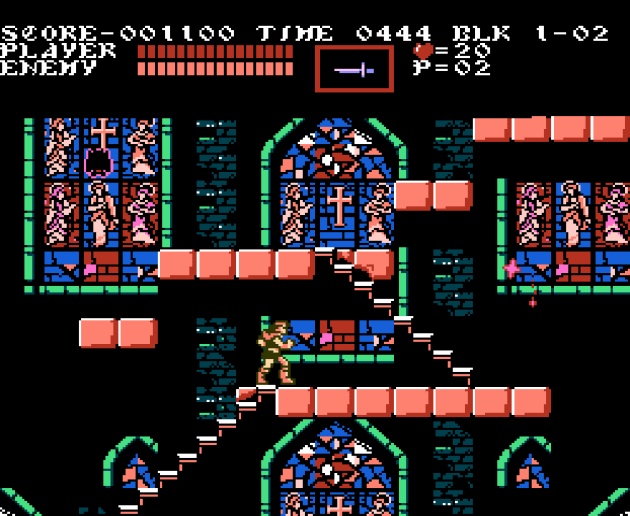
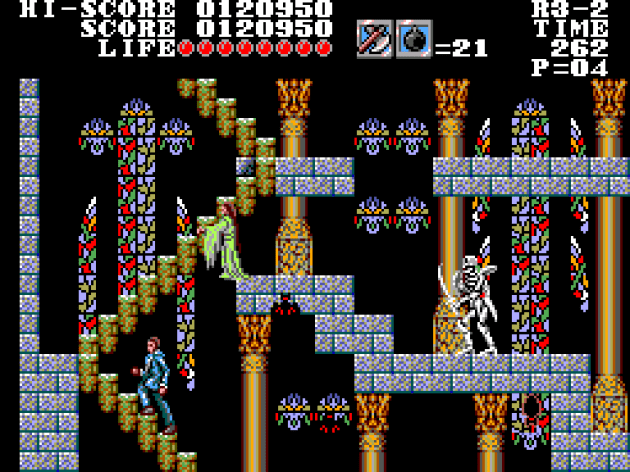
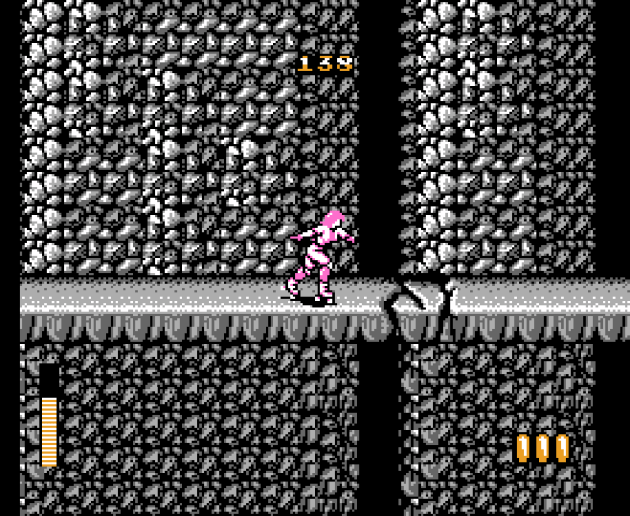
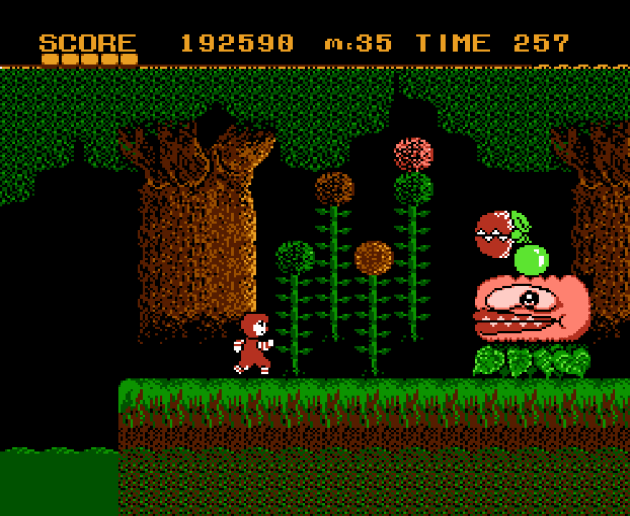
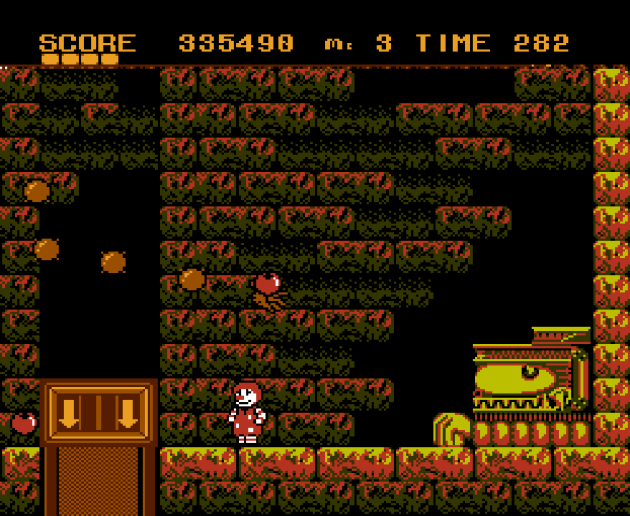
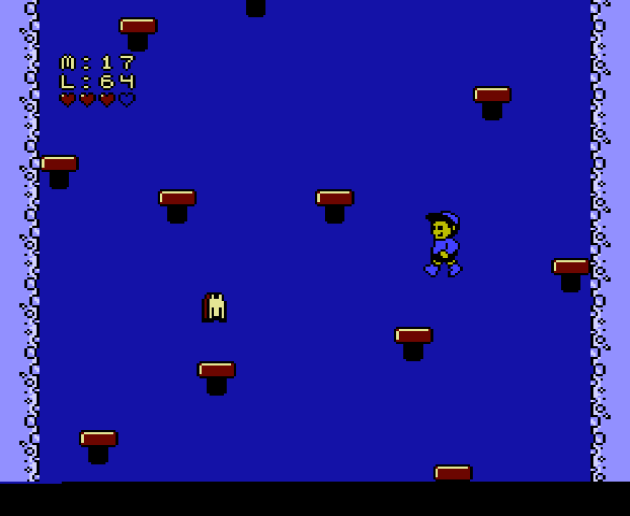
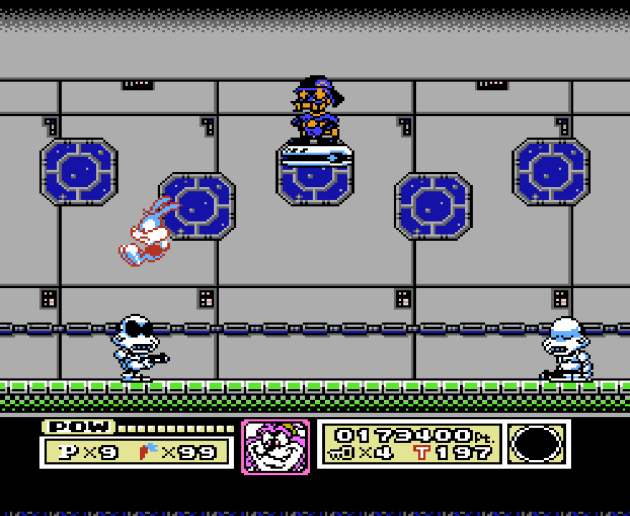
Okay, so my plans for a Sega Master System themed month sort of blew up in my face. SMS fans, like nearly every classic gaming community, are f’n awesome and I wanted to reward them with a month dedicated to their platform since, for whatever reason, Sega ignores the SMS outside of endless Sonic collections. The problem is my choices of games have not been on point. After I gave the first two games, Asterix and Master of Darkness, a NO!, I was determined to find a YES! game. Ninja Gaiden on the Master System is one of the most critically acclaimed games on the platform, so I ignored the little voice in my head that said “yea? Didn’t critics say that Chariots of Fire was a better movie than Raiders of the Lost Ark?” and fired it up. It doesn’t really play all that much like the NES game that I recently reviewed a ROM hack of, Deadpool. It controls much better, for one thing, and it has a proper wall jump. A pretty good wall jump, too. One of the better 8-bit versions of that maneuver. The sword is slightly better. There’s also an absurd glitch that allows you to have unlimited sub-weapon points. Once you reach the max 999 sub-weapon points, it never again takes a point from you. It makes it much easier to fight the pregnant skeletons. Yes, you read that right: pregnant skeletons. This game is weird, yo.

Just try to imagine their baby showers.

There’s no doubt about it: Ninja Gaiden on the Master System is superior to the NES game. And it’s still not good, because by the halfway point of the game, its designers gave up on creating fun levels and thrilling platforming sequences and instead lowered themselves to the level of the world’s most unimaginative 12 year old playing Mario Maker. The first three or four levels are really good, and while they’re not devoid of cheap moments, there’s plenty of solid action and well-placed enemies. Then Ninja Gaiden completely changes its tone and instead becomes one GOTCHA after another designed to use the knock-back to one shot the player. Any idiot can design their platform game as a series of digital mousetraps. It takes no talent at all because all you have to do is create one specific path the player MUST traverse, then put the lethal element along that path in a way that nobody can possibly anticipate or react to fast enough the first go around. Something you have to already know is there and be in the process of defending against as you make your move towards the part of the screen that has it. Literal trial and error based around memorizing the timing on each element. When you think about it, doesn’t that type of design make your game, regardless of the genre or theme, nothing more than a fancy version of Simon?

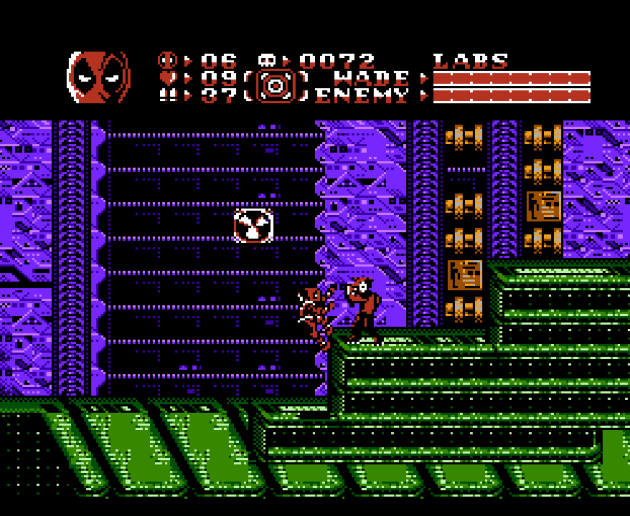
On this part, you’re being blown backwards by a wind generator, and that fire wall damages you. It took me quite a while to get up onto the platform in the upper-left corner. As soon as I did, the game fired two projectiles, one high and one low, that knocked me back to where I was to do it over again. F*ck this game.

What started as a fun game becomes pretty terrible by the end. Very limited creativity. No finesse. Just one gotcha after another. Like, it does the rising/lowering lava trope, which became a clichéd gaming staple for a reason: it always works. Well, unless you lull players into thinking the timing is consistent, and then GOTCHA, THE TIMING JUST CHANGED! Ninja Gaiden pulls that trick a few times in its lava section. There’s even a point where I’m pretty sure it’s not even a true rising/lowering timing challenge and instead it’s a last-pixel jump, because the lava will always rise and knock you back into a pit unless you leap off the edge of one platform and land on another. The one annoying platforming trope Ninja Gaiden hadn’t used up to this point was last-pixel jumps. On one hand, hey, at least it’s an original GOTCHA that plays on player’s expectations, but it’s still a GOTCHA and I’ve never enjoyed that type of game design, even with perks like rewinding and save states to ease the pain.

I’m so frustrated, because those early levels had excellent level design, even if the combat still isn’t that amazing.

I should also note that the combat was no longer fun by this point, either. My immersion was already broken by having birds be significantly more threatening than the ninjas themselves, but it gets worse. There’s these sentient fireballs that chase you, and their attack pattern is simply to heat-seek you and stay on top of your sprite. Sure, they can be killed, but they always come in threes, and eventually in fours from multiple directions. When one inevitably gets through, it will knock you back, and while you’re blinking it’s already back on top of you and ready to hit you a second time. These enemies are always by pits, too. They’re not designed or placed to drain your health. They’re there to kill you via a knock-back into a pit. Okay, so kill them before they get to you, right? Yea, did I mention they take two hits to kill and enemies get almost as much blinking as you do? There’s no way you can kill all three or four because they move fast and have too much invulnerability after the first hit. To put it in perspective: I had a sub-weapon that shot four heat-seeking bullets out at once, and even with this AND anticipating they would appear, at least one, and usually multiple, will have enough time to reach me.

If not for the aforementioned infinite sub-weapon glitch, I don’t think I’d have bothered finishing this even with rewind/save states. It’s such a chore to get through.

For whatever reason, Tecmo was especially bad about difficulty scaling during this era. I like Solomon’s Key, or at least the core gameplay concept, but it becomes ridiculous by the end. Rygar on the NES seems like a great adventure game, but it heavily relies on cheap shots too. No studio from this era that made more fun engines and concepts only to then wreck the overall experience by upping the difficulty to ruinous levels as much as Tecmo. I can’t help but wonder if they fell prey to the same thing that plagues a lot of indie developers. There’s this phenomenon where devs play-testing their games forget that they’re the best player in the entire world at their own game because, you know, nobody else has played it.  So they keep upping the difficulty because they know what to do, forgetting that they’re creating a product for people who don’t know and haven’t invested their entire lives into its creation and thus know every tiny idiosyncrasy. I don’t know for sure that’s what happened at Tecmo, but clearly something was wrong with their play testing because, outside of their sports games, I don’t think I’ve played an 8-bit Tecmo game scaled right. They always end up more maddening than fun.

I thought the bosses were all bad. Repetitive, spongy, they blink too much, and they have very limited and basic attack patterns. They’re ALL a slog, and one of them has a near-instakill by turning the entire platform into a bottomless pit if you’re not standing in the right spot to fight it.

Going back to the Simon comparison, some people like Simon. I’m guessing the people who enjoy it are the people who like games where the words “trial and error” dominate the discussion as much as they do. I don’t like Simon at all. I think it’s boring, and I think games that devolve into pure trial and error are boring. Where it’s very unlikely you can reasonably be expected to overcome challenges on your first attempt. That’s just not fun to me. It stops being frustrating after a while and just becomes busy work. I could see how someone in 1991 who is starved for content on the Master System could shower Ninja Gaiden with praise. It’s one of the most celebrated European-exclusives on the console, and for the first few levels, it lives up to that. But it doesn’t last. Had it stayed the course with a game that was focused on platforming acrobatics and using enemies as something you think about and react to rather than just booby traps, I think Ninja Gaiden had a chance at being one of the best retro platforms I’ve reviewed. Instead, it’s just another game where I read the contemporary reviews and ask “did they even play past the first stage?”
Verdict: NO!

Contra had you fighting a heart. Life Force had you fighting an eyeball. Metroid had you fighting a brain. Ninja Gaiden has demonic uvulas. Nice.

Master of Darkness (Sega Master System and Game Gear Review)

Master of Darkness
aka Vampire: Master of Darkness
Platform: Sega Master System, Game Gear
Released October 23, 1992 (Game Gear), May, 1993 (SMS)
Developed by SIMS
Published by Sega
Published to 3DS Virtual Console
NO MODERN RE-RELEASE

Castlemockia? Crapslevania?

It’s been a long time since I played a game that so flagrantly ripped-off another game’s look, feel, theme, and gameplay so completely that I started laughing, but Master of Darkness did that to me. It’s just so shameless in stealing from Castlevania that I couldn’t help but laugh. Replace gothic horror with Victorian horror and you have Master of Darkness. Well, until the end of the game, when developers said “f*ck it! Dracula is in our game too!” Otherwise, this IS Castlevania. So uncomfortably close that I searched to see if this resulted in a lawsuit. Konami was probably laughing their ass off at this and said “why bother?” Master of Darkness actually makes for a fascinating experiment: how many good parts of Castlevania can you scale-back and still have a good game?

This slideshow requires JavaScript.

Step one: replace the whip with weapons dropped from the candles, which are replaced with masks. You’ll either have a knife, an axe, a cane, or a rapier. There’s no upgrades to the weapons and no swapping between them manually. You can only change weapons when one is dropped from a mask. Since they’re not created equally, I ended up rewinding several mask-cracks because I didn’t want to change my weapon. The rapier has the most range but does the least damage, while the axe has the shortest range and does the most. The axe also benefits from poor collision, as I swung and missed quite often but still got the kill. Of course, that comes at the cost of immersion. None of the four weapons are very satisfying, and the only one I could stand using was the rapier because at least it made contact with the enemy. Look how far away and off-angle I am from this enemy that I killed:

This slideshow requires JavaScript.

So, there’s no OOMPH to the combat. Castlevania usually had amazing OOMPH, and removing it entirely by itself radically changes the quality of the game. Step two is to stop attempting to create your own personality. If you’re going to rip-off Castlevania, their attitude seems to have been “in for a penny, in for a pound” because Castlevania set pieces begin showing up. Hey, look at the church in Castlevania III: Dracula’s Curse. What a fun, memorable set piece.

Let’s just copy it, only make it uglier and more incomprehensible.

I have no idea what they were thinking. If you’re going to just copy the gameplay of Castlevania, or any game, you want to at least freshen the experience up with different types of settings and enemies, right? So, a Castlevania wannabe should probably feature set pieces, locations, and enemies Castlevania never went to during this era. At least at the start of the game, I figured that’s what I should expect, especially since this is set in London. In level one, you walk along the River Thames and eventually fight Jack the Ripper. Okay, well, at least it’s different from Transylvania. Well, so much for that. Castlevania III had a spooky clock tower with gears in the background and a haunted forest where birds of prey attacked, and hey look, so does Master of Darkness!

What else can I say? Master of Darkness is literally generic Castlevania. The dollar store version of Dracula’s Curse, only with none of the extra characters, clever level design, thrilling combat, memorable bosses, and epic score that made Castlevania III the best 8-bit Vania of them all. Besides the primary weapon, the biggest change is being able to jump off the stairs. Not ON them, like in Super Castlevania IV. Only OFF them, which is still a positive change. Oh, and instead of hearts as ammo, each sub-weapon comes with X amount of shots, which increases if you pick-up another of the same weapon. But, the sub-weapons aren’t very fun to use, either. I won’t actually go so far as to say Master of Darkness is a bad game, because it’s really not. It controls fine and the level design isn’t ever outright bad. The final level is even a Bowser’s castle-like maze where the object is to find the exit. HEY, that’s different from what the NES Castlevanias did. Master of Darkness even tries to do some real-time world building. Cultists show up as baddies, then right before a boss fight, three of them leap to their deaths in a ritualistic suicide.

So I can’t really say no effort was made. That’s why it’s maddening that so many elements were copied wholesale from Castlevania. It’s like they wanted to do something that was different than just “defeat Dracula and save a European country from his reign of terror” before they just gave up. There’s a couple good ideas here, even if there’s absolutely no imagination. With that said, most of my entertainment came from laughing AT it when yet another Castlevania staple shows up. Master of Darkness doesn’t stand on its own at all and feels more like developers covertly passing their résumés to Konami. But, let’s pretend that I’ve never played Castlevania. Even then, I think the combat would have still been a deal breaker. By the end of the game, I was avoiding enemies rather than engaging them because it’s just not fun at all to fight baddies in this Master of Darkness. The greatest irony of this whole thing is this copied so many elements from Castlevania that it feels like digital kleptomania, but the one aspect of Castlevania that would have made the difference between a YES! and a NO!, satisfying combat, is the only aspect they didn’t steal. Master of Darkness was fated to be nothing more than a baffling historic curio either way, but at least decent combat would make it one worth experiencing.
Verdict: NO!

THE INDIE GAMER CHICK CASTLEVANIA REVIEW SERIES
 Castlevania (NES) Dracula’s Curse (NES) Adventure (GB) Belmont’s Revenge (GB)
Super Castlevania IV (SNES) Dracula X (SNES) Bloodlines (Gen)
Chronicles (PSX) Circle of the Moon (GBA)  Kid Dracula (NES) Kid Dracula (GB)
Rondo of Blood (SuperCD²)
ROM Hacks (NES) Master of Darkness (SMS)
Konami Wai Wai World (NES) Wai Wai World 2: SOS!! Parsley Jō (NES)

Astérix (Sega Master System Review)

Astérix
Platform: Sega Master System
Released in 1991
Directed by Tomozō Endō
Developed by Sega
Never Released in United States
NEVER BEEN RE-RELEASED

This is what I get for making assumptions.

I wanted to kick off a month focused on the Sega Master System with a game I thought had a pretty good chance of getting a YES! and Astérix seemed like a good choice. It came largely from the team that did the 8-bit version of Castle of Illusion. It even seems to have a similar engine. Well, it would seem my aim was a little off, because Astérix is all kinds of sloppy. Now, I’m not all that familiar with the Astérix media franchise, except that I know it’s been around for over six decades and it’s the second most-sold comic series after One Piece. Actually, the category it’s #2 in is “collected volumes” as it would drop to #4 if you factored-in “periodical single-issue floppy sales” which is what we call “comic books” in the US, with Superman and Batman moving ahead of it. But hey, that’s still a little ahead of Spider-Man! Of course, if you count comic magazines like Weekly Shōnen Jump, Astérix doesn’t even crack the top 15. My point is, it’s a very big deal. Naturally, there’s several video games based on Astérix, one of which I already reviewed in Atari 50: The Games They Couldn’t Include – Part Two. Most of them never saw a US release. This is one of them, and I imagine this would have been a solid game at the time of its release. It’s not so solid anymore.

Obélix can break the blocks without needing to bomb them with the potions.

Astérix features twenty stages spread unevenly over eight game worlds, the first level of which you have to play once with each character. After level 1-1, you can choose between playing as the smaller Asterix or the lumbering Obélix in each stage, which factors into that stage’s pathway to the goal. Astérix can’t break blocks just by punching them, headbutting them or butt-stomping them. Obélix can do all the above, but he’s bigger, slower, and some of the platforming is more dangerous for him. Astérix needs to use explosive potions to take out blocks. You can both drop them on what you’re standing on by pressing down and the button, or you can toss them by holding up. You can even do a running toss for extra distance. The problem is the potions don’t offer much of a splash, and that can be a problem when you build the whole game around this mechanic. At about the halfway point, the game requires you throw the bombs on moving platforms that collapse into bottomless pits the moment YOU step on them. It repeats this shtick for the rest of the game, and the lack of splash just hurts this concept so much. Since I never really came close to timing-out, it just felt like busy work. When this is incorporated into auto-scrolling stages, which Astérix utilizes a few times too many, well, it’s kind of a disaster.

This is actually an auto-scrolling bit. So far in 2024, I’ve been surprised by quality auto-scrolling segments in games. Astérix reminds me why I’ve always hated auto-scrolling with some of the most sloppily handled I’ve seen.

The bombs are almost useless as offensive tools against enemies too, which isn’t so big a deal most of the time. You can punch enemies and Astérix’s downward thrusting punch has a DuckTales-like pogo stick spring to it, at least when you hit an enemy. Meanwhile, Obélix’s downward thrust, a butt-stomp, crashes through every block. But again, auto-scrolling rears its ugly head. For whatever reason, they also thought it would be great to include moving platforms with the auto-scrolling, without any synchronization. Are you kidding me? It forces players to hug the right wall, because you often only get one brief chance at making the right moves, and it differs between Astérix and Obélix. In the case of Obélix, his butt-stomp breaks ALL blocks under him. So, the auto-scrolling gives you a moving platform and a stack of blocks. If you don’t break the blocks before the moving platform hits them, it’ll change directions and you’ll die via lethal scrolling. Sounds like a fine, fair challenge, except the collision is really fickle.

This slideshow requires JavaScript.

Not that it matters much. Extra lives are plentiful, and the enemies don’t pose much of a threat. I never once was killed from running out of health. It was always death by auto-scrolling or falling into a bottomless pit. Games like that need fun exploration and peppy platforming, but Astérix is really slow. You get bottles of what I assume is mud at some point, which creates platforms in the lava. Hey, that sounds awesome. But the way they did it is the least fun, least exciting way of doing it. You throw the bottle and it makes the BANG and splashes. THEN, you watch the chemicals rise to the surface, THEN FINALLY you have a platform you can stand on for a couple seconds before it blinks away. Presumably this was done to give the game a more cartoonish, comical vibe. In practice, it just turns the item and its usage into a slog. There’s water-based platforming that’s the same way, only you throw a rock, which causes a water spout that you can briefly stand on. I’m totally fine with slowing down the pace of a platformer if it stays exciting. Land of Illusion isn’t exactly fast-paced, but it sure is a fantastic game. Astérix is really just very boring.

This slideshow requires JavaScript.

And then the sloppiness kicks-in. There is something mechanically wrong with how they mapped the scrolling with Obélix. When you reach the end of a screen and have to exit vertically, you only have a fraction of a fraction of second before the game decides you’re going back down and changes back to the previous screen. It’s TERRIBLE. The worst switch-over to the next screen I’ve ever seen in platforming. Like in this screen:

This slideshow requires JavaScript.

I could not get out of the water because the game instantly decided I was trying to go back down and kept swapping me back to the previous screen immediately. Even mashing the button didn’t work. I actually had to use autofire to be able to get out of the water. Absolutely terrible, and it’s so much worse because Obélix is a LOT more fun to play as than the weaker, more generic-feeling Astérix. Obélix at least feels like a fresh take on platforming. It’s rare to use bigger, oafish type heroes in this genre, and in the case of Obélix, it doesn’t feel like a facade. He does feel like a different kind of platforming hero, in a good way. But, the problem with the scrolling happens with or without swimming every time you have to move immediately after the transition, and it kind of ruins the whole experience. The game has this great idea where you can punch a spring to move it over. Not only is this underutilized, but when you use Obélix, the screen swaps back to the previous screen before you even begin to fall downward. Did anyone play test this at all?

There ARE some nice set pieces, like this part. Climb into the cannon and drop one of the explosives and you get launched out. This was probably the highlight of the game and it comes early.

What little set pieces the game attempts are just not fun enough to make up for the really bad mechanics and mediocre level design. The object of the game is to find the keys that open the door in each stage. But they didn’t even bother with hiding the key in 80% of the levels. The pot that has the key that unlocks the door is usually just right next to the door. It took so long for the game to actually put the key away from the pathway you would take that I wondered why they even included this idea to begin with. There’s really only one level that I had to go looking for the key. One out of twenty. The game also stopped bothering to feature bosses after a while. The first couple levels have them, then the concept just vanishes. Apparently they took the fun with them.

After 19 levels of platforming, the game ends on an uninspired chariot race that has two types of obstacles to dodge. Sigh. Sorry, everyone. I thought this would be a better game.

I really did want to start Sega Master System August with a bang, and based on the pedigree, I thought this would be the best bet for that. Even though I know very little about Astérix as a property, I get the impression that the team that made this game weren’t fans themselves. There’s only tiny hints of comical violence and fisticuffs. When you punch an enemy hiding in a tree stump, everything flies off the enemy in layers, like a cartoon. That’s nice, I guess, but that’s as far as the humorous attitude gets. In the comic, they drink the potions, right? You don’t drink them in this. You throw an unlimited supply of them. Why even have them be potions at all? Just make them bombs, for god’s sake. They’re poorly implemented either way, with usually only one type of potion found in a level. There’s also a fire one that does the “light the dark room” trope, but once again, all it manages to do is slow down an already slow game. Astérix isn’t even a BAD game in all-caps. Instead, it feels like it had everything it needed to to be up there with the 8-bit Mickey Mouse games, and it just never really got going. You know how cars sound sad when their engine won’t start no matter how many times you turn the key? Astérix is the embodiment of that noise. It looks great, but it never gets out of the driveway.
Verdict: NO!

Nintendo World Championships: NES Edition (Switch Review)

Nintendo World Championships: NES Edition
Platform: Nintendo Switch
Released July 18, 2024
Directed by Hirotaka Watanabe
Developed by Nintendo EPD and indiezero
Point of Sale: Nintendo Switch

This is one of those games where what’s missing stands out so much more than what’s included.

My brain can’t process that it’s been nearly a decade since I reviewed NES Remix. It feels much longer than ten years ago. Back in those days, I didn’t really review retro stuff a whole lot, and I still don’t review many modern AAA games. In the case of NES Remix, I didn’t grow up with any of the games in it, and I had a very anti-retro streak to me at the time. And yet, the WarioWare-like breakdown of them into micro games, for whatever reason, captured my imagination like few Wii U games did. NES Remix was legitimately one of my favorite games in a year that saw such releases as Grand Theft Auto V and The Last of Us. It just worked for me, even though I didn’t care at all about high scores back then and I’ve never been into speed running. I was totally stoked when NES Remix 2 was announced, but my excitement quickly vanished. It didn’t even do anything wrong, except maybe have a few games that didn’t lend themselves to the concept (Wario Woods, for example). But really, it just wasn’t fresh anymore. I don’t even remember playing Ultimate NES Remix and was actually completely shocked that I have it. But, enough time has passed and I’m old enough now to look back fondly on NES Remix as that big surprise 2013 game that just totally owned me for about a week or two. That’s why I was excited for Nintendo World Championships: NES Edition. Now that I’ve finished all the main game tasks, my final reaction is somewhere between my reactions to NES Remix 1 and 2.

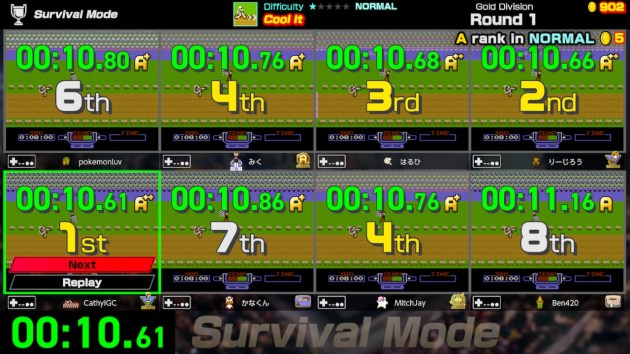
The “8 player” survival challenges are, in fact, single player. You’re competing against the ghosts of other players and not being paired live. In the Silver Cup, the ghosts play mediocre. In the Gold, they’re not too shabby, but I still won every time. This includes one instance where I tied my final opponent, but it gave me credit for the victory. The survival challenges can be played as many times as you want, but the games only change once a week, and you only get credit for one weekly win per cup.

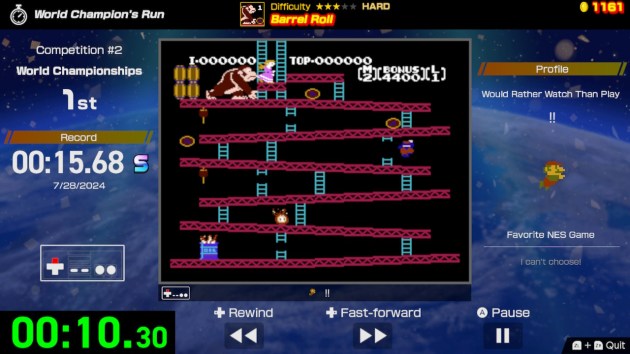
Some people are saying Nintendo World Championships is only for speed runners, but I’m not into that scene at all and I enjoyed NWC enough that I wasn’t bored at all. It sure gave me a better appreciation for what world champion speed runners have to accomplish. I tried to imagine maintaining the tiny fractions of perfection NWC asks of players over the course of a whole game and I gave myself a headache. Nope, I could never do it. There’s a big difference between setting a pinball high score and setting a world record in speed running, where players regularly redefine what a “perfect game” is. I was reminded of that when I took a gander at the previous week of NWC’s online tournament. The big selling point of Nintendo World Championships is weekly competitions in five different micro-contests. I thought I put up some pretty good times. Hey, I got an “S” rating in all five! Then I saw that the winner in the Donkey Kong contest did it by glitching out the game and climbing ladders that weren’t there.

What is it with this game and cheaters? I kid. This person didn’t cheat, because apparently using glitches and tactics like this isn’t against the rules. Weirdly, the results aren’t posted for an hour after the deadline ends, which is Monday at 2AM California time. I figured moderators must have been weeding-out people who did tricks like this. Apparently not.

This wouldn’t bother me, except Nintendo World Championships put the screws to MY attempts to circumvent certain aspects of the game. For example, the big challenge in Super Mario Bros 3 is “finish world 1.” What the game doesn’t tell you is you have to do it the way they want you to. Now, I can understand if the challenge is laid out as “finish level 1 – 1” in Super Mario 1 and taking the pipe to skip the entire middle of the level isn’t allowed. Which, by the way, that’s one of the games. But, “finish World 1” is one of those things where players should be able to come up with their own strategies, something I’m a BIG fan of. I put so much stock in a game’s strategic flexibility that it’s often THE difference between a YES! and a NO! in many of my reviews of high score-driven coin-ops, and I highly prize flexibility in pinball as well. A challenge like “finish World 1” feels pretty open, doesn’t it? I figured “use both warp whistles to skip to level 8, thus TECHNICALLY finishing world 1” would probably have not been allowed. But you don’t have to play any of the optional levels that aren’t on the straightest path to the castle. That’s why, when I reached the dungeon, I decided to skip the fight with Boom Boom by grabbing the warp whistle. “Not so fast!” said the game, literally rewinding it because that was against the rules. Oh NOW you care about the integrity of the game and the spirit of the rules, huh? That’s rich, especially given how people are winning the online tournaments.

Booooooooooo!!

It took me a long time to figure out what my ultimate verdict for NWC would be, because it’s such a bare-bones concept. There’s no leaderboards, so besides finding out how YOU placed (including alternate standings based on your year of birth) and videos of the winning performances for each week’s games, you can’t learn how to do any of the tricks the pros are using. That sucks, since most of the winners involve the type of glitches that aren’t allowed in many speed running communities. Usually, for dedicated competitors in this field, there’s two categories: glitch and non-glitch. Nintendo could have used that kind of consideration, because it was really demoralizing for me to find out that not only were the scores I posted no good, but I wasn’t even close. Or hell, if you’re allowing the glitching, how about instructions on how to do it? Maybe it’d be fun to learn! Except, there are none.

If you’re interested in after-game unlockables, well, this should keep you busy for a while. There’s TONS of icons to purchase, one of which you can make your logo. I opted for Princess Zelda laying down from Zelda II as mine because I too enjoy sleeping and everyone else having to go to hell and back attempting to wake me up.

Advanced tips or instructions for each game would have been helpful, or hell, just more specific guidelines. Rules like “no pipes” or “no warp whistle” are not stated. The level 1-1 example in Super Mario I mentioned above? The rules in their entirety simply say “Grab the Goal Pole.” THAT IS IT, even though there are more rules that punish you for violating them, specifically “no using a pipe.” You’re telling me that they couldn’t have included the words “no using pipes?” Really? The game will automatically rewind any illegal move, but the scoreboard’s timer is still running. That’s not a big deal if the challenge only takes 30 seconds to beat, but in the case of Super Mario 3’s challenge, yea, it sucks to play for a few minutes only to discover that you just broke one of the literally unwritten rules, costing you valuable time.

I should note that, when you play the online feature, any time you post that beats your previous high in single player becomes your new high score. HOWEVER, any time you post in the single-player mode cannot be applied to the online Championships.

Sometimes, NWC isn’t consistent with its rules, especially when it comes to going off the intended pathway. Challenges like “beat Cerberus in Kid Icarus’s first dungeon” and “beat Mario 1” allow players to sometimes go the wrong directions without being rewound. For example, level Mario’s 8-4’s maze will not rewind you for taking the wrong pipe. That’s probably how it should be, right? Except that’s rarely the case. Challenges like getting to Level 1 in Zelda as fast as you can will literally stop you from going in any direction but the shortest route. For the most part, players are not allowed to explore and discover the best routes for themselves and have to follow the exact path taken by the sample video. Wait, really? Wouldn’t that, you know, DEFEAT THE WHOLE POINT OF A CHALLENGE LIKE THAT? I wish they had both ways. Have specific tactical instructions for those who want it, while also leaving it open for people who want to find out on their own. With how they have it, they’ve basically turned the exploration games into digital cross country running trials. While I’m on the subject, the sample videos would be helpful, but those videos show deliberately poor gameplay. So clearly they DO want players to figure some stuff out, but not big picture stuff. Besides the videos and a bluntly-stated goal, there ARE no instructions or even tips for 143 of the 156 challenges. Only the “big challenges” offer tips, though some others LITERALLY OVERLAY ARROWS on top of the gameplay telling you which way to go or for some other happening, like “a warp zone is near!”

Granted, the tips they DID provide are helpful. Like, I would have had to hit GameFAQs or StrategyWiki to know the shortest route in Kid Icarus, a game I’ve only beaten once. I’ll give them slight bonus points for using the same font and style as classic Nintendo Power. They even named the tabs “Classified Information” which is a nod to the tips section in the magazine.

I’m not even a little mad that people know how to cheese these games with glitches. That can be fun! Hell, I liked to get a rise out of family and friends by betting them I could beat Legend of Zelda: A Link to the Past in under an hour or two, then doing it in under five minutes. But, it’s just a parlor trick, right? Even if NWC taught players the glitches the winners are using, I don’t think I’d want an entire game based around learning video game parlor tricks. Now, assuming you’re deeply into that type of speed running, I still think you’ll probably be frustrated with how little competitive value you get with NWC. Out of a pool of 156 challenges, only five are played competitively every week, and then three of those five challenges are used for the two tiers of pseudo-online survival challenges. That’s it. That’s the entire extent of the online play. There’s no leaderboards for individual challenges or viewable ghosts of the record holders. There’s no challenging your friends or seeing ghosts of their games. No-brainer features are just not here.

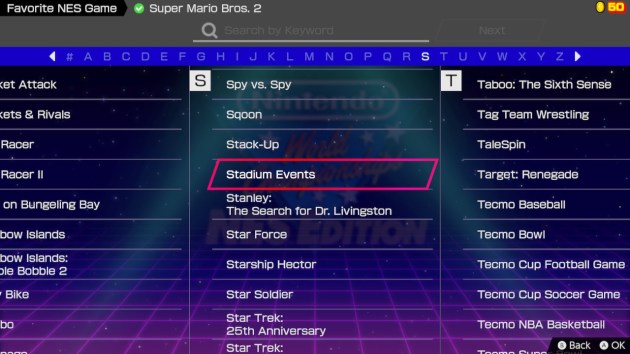
Each player is supposed to pick their favorite NES or Famicom game from a list. You’d think such a list would only have Nintendo-published stuff, but you’d be wrong. The only games not listed are unlicensed games. Mike Tyson’s Punch-Out!! is listed. UK-only games like Virgin’s Aladdin are listed. Even ultra-rarities like the holy grail for Nintendo collectors, Stadium Events, are listed. I was impressed by it, until I found out all the features that weren’t included in Nintendo World Championships. So let me get this straight: you assigned someone to put a list of every NES cart, filtered out ALL the unlicensed games, but didn’t think players needed the ability to see their friends’ scores online? Good lord. Talk about having the wrong priorities.

There’s also no variety of challenge types in Nintendo World Championships. NES Remix had tasks like “don’t lose a life” or “stay alive for X amount of time.” Those are gone completely. Every challenge is a time attack. All 156 of them. It’s so limiting and uninspired. I imagine at some point a bigger pool of games will be added, but I wouldn’t bet on Nintendo getting creative beyond that. And while I’m on the subject, the game is called Nintendo World Championships, right? So, why is this NOTHING like the original Nintendo World Championships? That contest sandwiched three games together, requiring players to get 50 coins in Super Mario 1, complete a lap in Rad Racer, then with all the time remaining, score as much as you can in Tetris. There is NOTHING like that in the modern Nintendo World Championships! The only thing they have in common is the logo itself! The closest Switch’s NWC comes to that is when you complete all 156 timed challenges with a score of at least A or higher, you unlock “legendary trial.” It’s just a lazy thirteen round marathon of all the final challenges. Mind you, each final challenge is the longest one of that game. I’d be interested in playing shorter versions of such a marathon, but nothing like that is included. In fact, there’s no other mix-and-matching at all outside of survival mode. Oh, I forgot: when I said “five challenges a week” I mean five SEPARATE challenges. Do one or all five, but you only get ranked on each individual challenge and not the group as a whole. So weak.

It’s amazing how much bitching I was able to do before I even got to the games themselves. I’m not sure who outdid themselves: Nintendo or me.

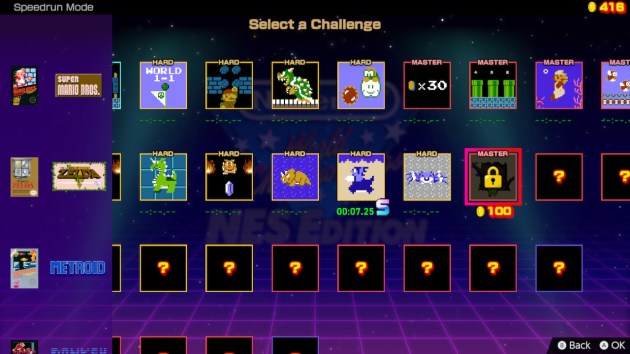
For the purposes of this review, I’ll say that Speedrun Mode is the “main mode.” It’s a series of 156 timed challenges unevenly split between thirteen games. The challenge breakdown is as follows:

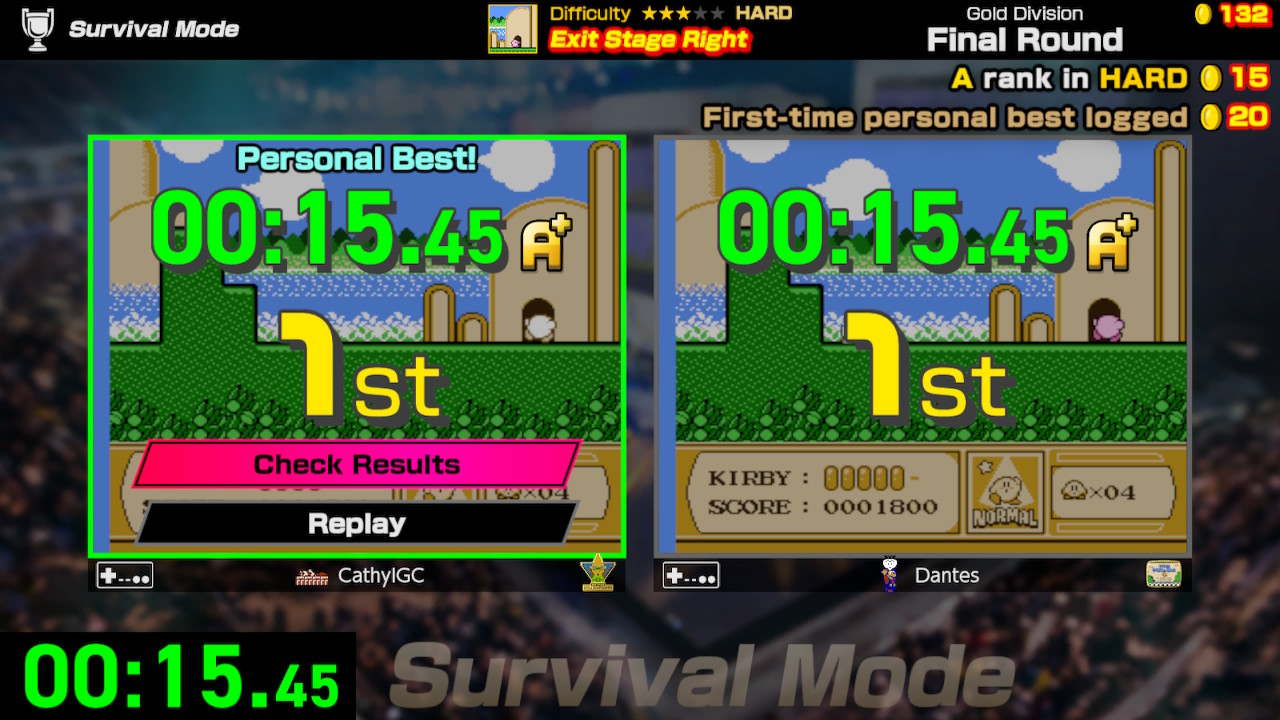
My final scorecard before publication.The only one I didn’t get at least an A+ in was the final Kirby challenge. I like the whole “total playtime” of all the scores added-up, even if it’s functionally useless. I wish it kept track of how many attempts you made at each game before reaching certain benchmarks.

  • 14 for Super Mario Bros.
  • 15 for Legend of Zelda
  • 13 for Metroid
  • 8 for Donkey Kong
  • 9 for Kid Icarus
  • 12 for Super Mario Bros. 2
  • 6 for Excitebike
  • 6 for Ice Climber
  • 7 for Balloon Fight
  • 24 for Super Mario Bros. 3
  • 15 for Zelda II: The Adventure of Link
  • 8 for The Lost Levels, aka Super Mario Bros. 2
  • 20 for Kirby’s Adventure
  • Of all the challenges that I worked to get an “S” in, the first challenge of Kid Icarus was by far the one that took me the most attempts. It wasn’t even close. It must have been 200 attempts.

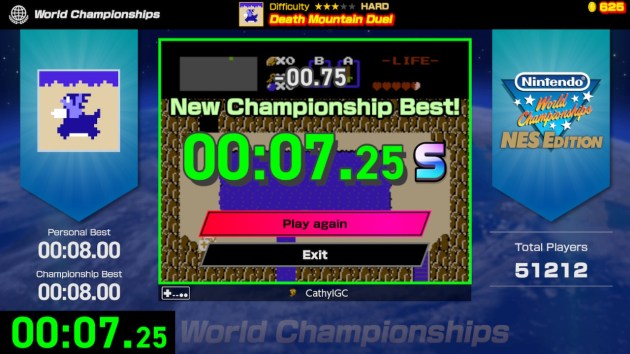
Getting an “A” in every challenge isn’t too hard. Out of 156 games, less than 10 saw me get one of the B rankings on my first successful attempt. Now, getting an “S” is an entirely different story. Sometimes I literally couldn’t believe I got an “S” ranking as I played sloppily and made mistakes, and other times my jaw literally dropped when I didn’t get the perfect rating. I knocked out an “S” in every Zelda 1 challenge in three tries or less, except one where you had to kill three bats. That one took me probably 50 or so attempts. Meanwhile, I couldn’t get A++/S rankings in most Kirby tasks even if I tried, and I did! If the challenges were all short enough that they could be finished in 10 seconds, I’d probably keep playing until my scorecard was nothing but S rankings. But, some take a lot longer, and all the final challenges are the “big ones” of that game. Mario 1’s final challenge is just “beat the game from level 1-1, with warping.” Sure, it can be done in around 4 minutes if you know what to do. I don’t, and it sounds like a big time investment to learn how to get that good. NWC doesn’t tell you the target times for each grade. What’s an A+? Apparently under 8 minutes and 2 seconds, because that was my best time. What’s an S? You’ll know when you get it. A+ is actually the third highest grade, by the way. There’s A++, and I never saw less than a “B+” at any point. This is like one of those “teachers can’t use red ink to grade students anymore” things, isn’t it?

Beating a challenge doesn’t AUTOMATICALLY open the next. You earn coins from completing challenges. The more difficult the challenge and the higher rank you earn, the more coins you get for victory. You also get bonus coins for beating your previous best time. Winning the survival challenges also earns coins, including 500 for the first time you win each week’s gold survival challenge. Again, you only get CREDIT for each survival challenge per a week, but you can grind coins up, if you wish. You just won’t earn as many when you replay them. You also get a nominal bonus for competing in the week’s tournament. When I got sick of going for “S” rankings and started running through the challenges, I never had to grind to open anything, but most players apparently need to grind. The two quickest and easiest “S” rankings are the second Super Mario 2 challenge (pull up a vegetable) and the first Balloon Fight (pop one balloon in Balloon Trip). The challenge unlock system is stupid, but not a deal breaker.

Since the games are emulated, all the problems that come with the originals are here. Kirby’s Adventure has TONS of slowdown, only the clock keeping your time doesn’t slow down at all. Donkey Kong is missing the factory stage. Ice Climber is just the worst, and Nintendo’s continued insistence in celebrating it would be like having an incredible artist regularly hang out in your home, only they keep leaving upper-deckers in your toilet for no apparent reason. I only got all S-rankings for Zelda 1, Donkey Kong, Balloon Fight, and Ice Climber, but except for Zelda, that had more to do with how few challenges were involved. Mario 3 has the most challenges, and each of the seven Koopa Kids gets their own challenge. The only boss missing is Bowser. Come to think of it, the only “last boss” challenges are Mario 1’s “beat the game” finale and Metroid’s “escape the bomb” sequence, and even that is lacking the Mother Brain fight. It’s like Nintendo deliberately avoided spoilers for these literally three-to-four decade-old games. Boss fights work great in NWC, but there’s only three Legend of Zelda bosses, three Zelda II bosses, and three Kirby’s Adventure bosses. Super Mario 2 gets only Birdo and Mouser, and Kid Icarus only gets its first boss. Since boss fights were easily my favorite type of challenge, it sucks that Nintendo excluded so many that would have lent themselves perfectly to this game. I would love for nothing more than this review to be rendered outdated with updates that add more challenges, increase the variety of challenge-types and add more online features. Especially friend-based features (seriously how did THAT get left out?) or leaderboards.

This slideshow requires JavaScript.

Sigh. I sort of have to give Nintendo World Championships: NES Edition a YES! because I had enough fun playing it. The worst gameplay aspect is an exceptionally bad automatic-rewind that happens when you die or do one of the FORBIDDEN moves. In theory it resets you to just before whatever you just died from. In practice, in games like Mario 1 or Kid Icarus, I died more from the rewind dropping me off in the middle of a jump than I did from the original deaths. I’m not even exaggerating, it is THAT bad. The rest is, eh, you know, fine. Nintendo World Championships certainly doesn’t rise to the level of “very good.” The online component means absolutely nothing to me because it’s too limited and not very fun. Five challenges a week is not enough for a game focused on online play. I can’t even see myself booting this up every week to play the next five contests. As for local multiplayer, unless every person you get is in roughly the same skill range, you’re not going to have any fun, at least as a group. It only takes one player who is fairly better than the rest to wreck the entire session. I was dis-invited from playing with my nephew and his friends because I was that player, though I probably should note that they were equally matched, more or less, and seemed to have a lot of fun once they booted me. But, be warned: playing eight-player mode means using JoyCons turned on their side, which I personally think is the worst game controller configuration of my entire lifetime.

I’ve been asked “does the cart work?” by every visitor to my house since the game arrived the day after it was released. No, it doesn’t, but it does come with a nice display stand that isn’t pictured here. The kids fought over the pin sets, to the point that a second $59.99 set had to be bought. To Nintendo’s infinite credit, my nieces and nephew and all their friends, ages 8 to 13 or thereabouts, all wanted to compete in this, even though they’re normally not inclined to play retro games. My nephew has literally never opened his NES, SNES, Game Boy, or Genesis libraries that came with his Switch Online subscription. Some of my best friends have children that are in the same boat. But, all the kids REALLY wanted this game. I can’t make sense of it either.

All I had left to base this review on was the 156 challenges. I started them on Sunday. I finished all of them with at least an “A” or better after just a few hours on Monday, with no intent of sticking around long enough to unlock everything. I spent most of Tuesday writing this review and bumping the “easy” ones that I “should” have gotten to an S, while also verifying that some of the challenges are just really boring. Besides the boss fights, my favorites were all 10-seconds-or-less games. That’s when NWC becomes gaming crack. Beating whole levels? Eh, it’s fine, but I really don’t think any of them quite reached that “just one more try” sweet spot, and some of the challenges I enjoyed so little that I don’t think I’ll ever play them again, regardless of how bad my scores might be. In fact, I’m not even sure my NWC cart will ever go back inside my Switch. (UPDATE – August 10, 2024: In the interest of fairness, I did return to Nintendo World Championships even when I thought I wouldn’t. Initially to check my previous week’s results, but I ended up spending time on the week’s five new competitive challenges. This is a game that’s deceptively addictive, but I did have a good time.) Okay, maybe when the inevitable add-ons hit, I’ll reload it to at least play each new challenge enough to get an A ranking on them too. That has to happen, right? Like, I can’t believe Donkey Kong Jr., Wrecking Crew, StarTropics, Punch-Out!!, or none of those early sports games are represented here. No third party games, either, and Super Mario Bros. Lost Levels is the only (former) Japanese exclusive. Ten years after NES Remix, and what could be considered the fourth game in the series feels, well, kind of thin. It IS possible to have fun and still be let-down. Just ask anyone who has ever slept with me.
Verdict: YES! but if you’re on the fence, waiting for a sale wouldn’t be a bad idea.
$59.99 ($29.99 for the standard) was soundly defeated by Jimmy Woods in the making of this review.

Wolverine (NES Review)

Wolverine
Platform: Nintendo Entertainment System
Released October, 1991
Designed by Craig Houston and Kevin Edwards
Developed by Software Creations
Published by Acclaim as LJN
NEVER BEEN RE-RELEASED

Magneto, everyone.

Well, I did Deadpool so I might as well throw-in a review for Wolverine. Unlike Deadpool, this is an authentic 1991 NES game that’s authentically horrible. I literally have nothing nice to say about it. A truly pathetic effort that doesn’t feel like a Wolverine game, an X-Men game, or even a superhero game. Wolverine is an utterly generic platformer with some of the worst gameplay decisions I’ve seen. The biggest one is you don’t blink when you take damage. I mean, you change colors to gray, but there’s no invincibility afterwards. No grace period to recover at all. So, naturally your attacks are some of the most low range, low impact punches and kicks ever. I mean seriously, the kick you do after throwing a couple punches looks like someone gingerly kicking a tire to see if it’s flat or not. You have to get right on top of enemies to brawl, and as you do, your life slowly trickles away. But, that’s fine because Wolverine heals from injuries. Except, they left that part out. You need to pick up.. I swear to God I’m not making this up.. burgers or soft drinks to heal you. This NES game has more menu items from McDonald’s than the NES McDonald’s games.

I just pinched myself to make sure I hadn’t died and gone to gaming hell. Then I remembered that you pinch yourself to make sure you’re not dreaming and not to make sure you’ve passed on to the afterlife, so gaming hell is still in play. Especially since I intend to review more classic console X-Men games.

For a moment, I’ll ignore the absurdly tiny graphics, laughable enemy design, and ridiculous damage system. The one thing that you absolutely NEED in a Wolverine game is for the violence to be intense and impactful. Whatever is the polar opposite of intense and impact is how the combat feels here. It’s no impact, so naturally, you want to at least use your claws. That way, you can imagine that you’re slicing baddies so cleanly that it doesn’t even make them flinch. You activate the claws with SELECT for double the damage and.. they drain your health. Of course they do. They don’t even really add all that much range either, and even if you swing and miss, you still take damage. It’s a quarter-of-a-tick of a life bar for every use of the claws, in a game where you absolutely do not blink or knock-back or anything from damage. Any contact on anything lethal and your health begins to quickly drain. Since there’s no grace period, you never know how much damage something causes, or really how much you’re taking in general. You have to constantly glance down at the health bar.

Remember the dam stage in Teenage Mutant Ninja Turtles? Specifically the underwater section, complete with tight squeezes and stuff that damages you? This is like that, with even tighter squeezes. Only, remember, you don’t blink or knock-back this time, AND the swimming controls are so much worse than TMNT. This is one of the worst games on the NES.

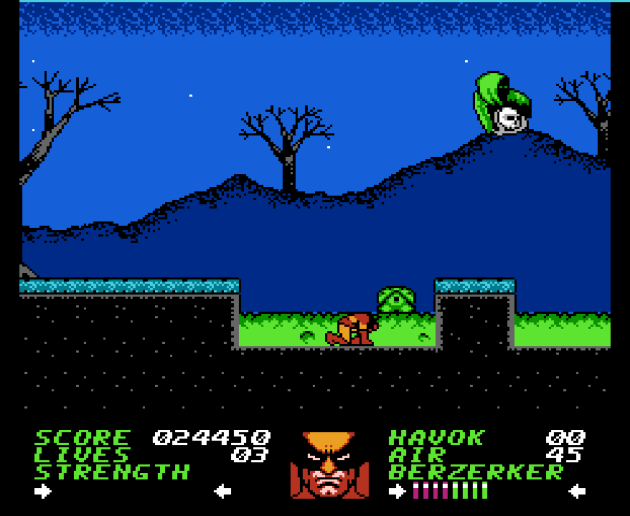
This is a Wolverine game that doesn’t feel even a teeny tiny bit like Wolverine. It honestly feels like it’s outright antagonistic towards the character. There’s no way the creators of this could have been fans of the source material, because there’s nothing about controlling the Wolverine sprite that a fan would need to feel immersed, as if you really were Wolverine. That’s the whole point in doing a game based on a character, right? With this steamer, I suspect this wasn’t even meant to be Wolverine and they just took Generic Action Game Template 71189-C and added claws to it. There’s also this absurd “berzerker” meter you get for killing bad guys that gives you invincibility when it fills up. Oh, and the invincibility killed me more times than anything else in the game. Yep. You see, you can’t run and attack. This is important to note, because when you begin to BERZERK, you automatically do strikes almost continuously, making it very hard to move forward and especially build up your jumps. So, when I went to do a long jump over a pit, I didn’t get the lift I wanted because the hero was automatically swinging at NOTHING! Literally shadow boxing! What an epically stupid idea!

That’s how I died here. I think. There’s no way I shorted a jump THAT badly.

Wolverine has incredibly unimaginative level design, uninspired enemy attack patterns, and only two bosses in the entire experience that you fight back to back. The boss fights suck too. I lost a life fighting Magneto because I wasn’t sure how to hit him. I tried to kill these boulders this device was shooting at me and eventually died. I came back to life in the boss arena (the one positive thing I can say is respawn points were fine), and then the rematch ended in under 10 seconds when I stabbed the little laser barrier blocking me from Magneto, then punched him a few times until he ran away. Wow. Then the final battle with Sabretooth played out the same way. I lost a life, then I realized HE gets to be invincible. It turns out, you win by punching him off a cliff. Since it’s easy to catch him in a punching pattern, I won about fifteen seconds later, and I’ve never been happier to be done with a game.

See the purple platform I circled? For utterly no reason, it’s lethal to the touch. I guess it’s acid? Except, you don’t submerge in it. Okay, so stay away from purple platforms? Well, there’s OTHER purple platforms on the stage that act as treadmills, and you can touch those just fine. It’s a f*cking purple platform. What the everloving hell? Once more with feelings, team?

What an unlikable, lazy effort. Lots and lots and lots of last-pixel jumps. Lots and lots and lots of instakill elements like fire or spikes. Oh, and you drown in water too, but at one point in the swimming stage, you get a “device” that changes that. You’re told it. You don’t see it. It’s like the developers realized the rest of the stage had too much water and not enough places to come up for air, but instead of changing the whole layout, they just added a door in an arbitrary location where you get the “device” from Jubilee. It’s like players have to apply their own quality of life patch in real time. I don’t know what else to say about Wolverine. I made two full runs in under ninety minutes, with the second run taking probably a little under half an hour because I just ignored as many bad guys as I could and even accepted damage if I knew I was near the finish line for a stage. Wolverine does literally nothing right and isn’t even charming in failure. Fix any one problem and this would still be in the conversation for the worst NES platform game I’ve reviewed so far. Fix all the gameplay problems and it’d still be a NO! because the combat would be boring and the level design just very bland. Unlike Wolverine, there’s no healing this one. It’s just a bad game.
Verdict: NO!

Deadpool (NES Review)

Deadpool
Platform: Nintendo Entertainment System
Released in 2019
Unauthorized ROM Hack of Ninja Gaiden
Developed by Techmoon
Link to patch at RomHacking.net
I use THIS tool to apply patches.

This isn’t just a graphics hack, Jack.

Deadpool is a ROM hack of Ninja Gaiden, but don’t mistake this as simply a repaint. It’s actually kind of insane how much work went into this. Like the best ROM hacks, it treats the base game like a tool kit to create something more evolved. Now, don’t get me wrong: Deadpool still fundamentally feels like Ninja Gaiden. It doesn’t quite cross the threshold where it feels like something entirely new. Instead, it’s more like a sequel that adds new abilities, along with new headaches related to them. The biggest change is that you can climb any wall instead of being stuck in place like the game is sponsored by Gorilla Glue. You can also pull yourself up onto the platform you’re hanging on, and there’s a lot more surfaces that the wall cling works on. It opens up what I feel is an overly strict and not very fun engine. It sounds great, and in many ways it is. But, like so many wonderful ROM hacks, the changes create several new problems. For example, imagine there’s an enemy you want to jump and kill directly above you on a higher platform, like so:

Notice how I’m climbing and the thing I’m slashing at isn’t, you know, dead? Well, that’s because the binding mechanic is now TOO sensitive and you stick to everything, even if there’s no logical reason why you’d want to. So, half the time you want to kill something above you, you end up stuck on the wall just below it and taking damage from it. As far as problems with game mechanics go, few are as destructive and immersion-breaking as this. Just the act of jumping up onto a high ledge now sucks because you might stick to the top of it and have to pull yourself up. When platforms are clustered together, a screen that you should be hopping around and finishing in a second or two might take five or ten seconds just from the stop-and-go wall-clinging, and that’s before you factor in enemies getting free shots when the sticking happens. Maybe it wouldn’t have been so bad, but the one thing that could have been added that would have balanced this issue, the ability to attack while holding onto a wall, still isn’t an option. Maybe it’s just me, but I feel Deadpool would be able to hold onto a wall with one hand and attack with the other, and it sucks that you can’t.

Hey look! It’s Batman! Yep, he’s a basic enemy. So is the Flash. Even Wolverine is a basic character, and actually he’s the weakest so at least there’s a meta-gag there. But then Mario and Mega Man and various other gaming icons can be seen in backgrounds or posters or sometimes as enemies and instead of immersing me, it completely takes me out of the experience. When people do projects like this, whether it be a ROM hack or a game built from scratch, my favorite ones are always the ones that try to be “legit.” As in you could believe this is the type of game that would have been released during whatever era, looking and playing exactly like this. When a game does this well enough, it works as genuine wish-fulfillment because it’s a realistic wish. Look at the recent NES Garbage Pail Kids, which felt authentic for its time period. The developers of Deadpool were clearly talented enough to attempt this, and I hate that they didn’t because I never really got immersed. Every single aspect is dulled somewhat because it’s just so lame to have these random IPs show up in arbitrary locations with nothing clever about them, like any other dime-a-dozen ROM hack.

While I think the collision might have been tightened-up over Ninja Gaiden (which has REALLY piss poor collision detection), Deadpool’s collision boxes are still annoying enough to frustrate, and the knock-back when you take damage is still the primary source of Deadpool’s player body count. A few other aspects that I strongly dislike about Ninja Gaiden carry over. The basic attack is never quite as satisfying as you’d hope it would be, nor is it as reliable as it should be. It’s just not a very fun sword to use, is it? Well, it’s basically identical in Deadpool, except in those (far too rare) moments where you get a sword upgrade. Also, while the levels are laid out differently, basic enemies and bosses really do feel like they’re re-sprites of Ninja Gaiden’s, and if they behave differently, it’s subtle. Sometimes a ROM hack is so good you forget that it is a ROM hack. Deadpool doesn’t come remotely close to that. It’s a ROM hack of Ninja Gaiden. It plays like it. It feels like it. So, the real question is does Deadpool do enough to stand tall on its own?

If you find an icon with a sword, you get this gigantic Strider-like slash for the rest of the stage you’re on. It was the most fun and most enjoyable part of the entire game. Except for the fact that the game was too stingy with drops for it. In my first playthrough, I didn’t get one until very, very late in the game. As far as I could tell, only enemies drop the giant slash, and even though I’m pretty sure I killed every enemy I could reach, I just never got it enough. In my third playthrough, this time on the game’s easy difficulty, I still didn’t get one until the third stage and only got three overall. What should have been Deadpool’s defining gameplay mechanic instead barely ends up a net gain because the game is so miserly about dispensing it. Maybe the developers thought it would have made the game too easy. WHO GIVES A SH*T? It’s more fun! It certainly doesn’t trivialize the combat or the overall challenge, especially compared to the sub-weapons, which absolutely DO trivialize the combat and the overall challenge.

Deadpool is a character that regenerates from damage, and that factors into the NES game. A constant ten second countdown starts and restarts that’s unaffected by the gameplay. Whenever the countdown restarts, you gain some health back if you’ve taken damage. That seems awesome, but when Deadpool starts leaning more into swarming enemies late in the game, if you play the game like a complete coward (cough) it can lead to a lot of waiting around to heal. Whatever. It’s Deadpool, and Deadpool heals so I’ll call it a plus. Also, I found the level design in general is just better. Now granted, it was inevitable the stages would feel more open and free-flowing thanks to the additions to the wall clinging. But, for what it’s worth, I think the stages are just more exciting and better done, and the themes to those stages are certainly more interesting. Hell, Deadpool even pulls-off a pretty damn good slippy-slidey ice level. That’s hard to do, so kudos. There’s even some fun set-piece facades, like a Total Recall-like x-ray section where you see your skeleton. But, by far the best new elements are the items.

This slideshow requires JavaScript.

The cheap shots of Ninja Gaiden are largely here, but because of the thrilling new sub-weapon design, they’re only a problem if you play too conservatively. In Deadpool, ammo is more plentiful than Ninja Gaiden, item costs are more intelligently balanced, AND you can swap between different items by pressing SELECT, which opens up the game tremendously. Plus, they’re a lot more fun this time around. The spinning whirly blade attack and a basic throwing-star like attack (replaced with a gun, of course) return from Ninja Gaiden, but they’re joined by a fourth-wall breaking teleporting move where you hit whatever is furthest away from you that’s effective and awesome. Finding an Uzi icon gives you a gun separate from all-other sub-weapons that gives you 30 bullets at no cost to your standard ammo. The catch is that if you scroll through your other items before the Uzi runs out of ammo, you lose it prematurely. So fun to use and I only wish that I’d found more of them.

This slideshow requires JavaScript.

And then there’s the food. On its own, it does nothing, but if you eat enough food items, you begin to blink. When this happens, you start to flash, indicating that you can activate a screen-clearing bomb at any time. Works great, except it obviously doesn’t one-shot bosses. The game even wisely created events that might require a bomb. There’s blinking enemies that are impervious to your attacks and sub-weapons. The only way to kill them is to bomb them, and I was INCREDIBLY impressed by how well paced-out these types of enemies are and the pitch-perfect timing of when to insert one into a level. Weirdly, sometimes Deadpool feels unpolished and inelegant, what with all the unintentional wall-sticking, and at other times, Deadpool feels like a more professionally fine-tuned game than its base game. Hell, it even has adjustable difficulty with no gating, making this accessible to those who would avoid Ninja Gaiden due to the brutal challenge. Even if the game is too intense despite the more powerful sub-weapons (over-powered, frankly), you do have the option to tone it down. Very cool.

Free lives are plentiful, no matter the difficulty.

I’m frustrated by Deadpool because I can’t really say it’s amazing, and I should be able to. I never got bored, even if having Batman show up had me rolling my eyes. It’s that damn wall cling that I can’t ignore. I also can’t think of how it could be better on a two button controller. Maybe holding the button if you want to stick? It’d take getting used to, but, I dunno. Maybe it would work, or maybe it’d be unwieldy. But, for all the problems, fun is fun, and I had a lot of fun playing Deadpool. I didn’t have any fun with Ninja Gaiden, so that’s saying a lot. I usually beat these shorter retro games twice for a review. I beat Deadpool three times. Of course, I got eight total sword upgrades in that three game span, which sucks because it’s the best part of the game. Makes the combat feel different and better than Ninja Gaiden. Without it, and I was mostly without it, this is just a more flexible Ninja Gaiden with Deadpool sprites. And Batman. And Wolverine. And the ghost monsters. And Space Invaders. And the Flash. And..
Verdict: YES!

Rollergames (NES and Arcade Review)

Rollergames
Platform: Nintendo Entertainment System
Released September, 1990
Designed by Kōichi Kimura and Nobuya Nakazato 
Developed by Konami
Listing at Konami Wiki

NEVER BEEN RE-RELEASED

Rollergames
Platform: Arcade
Released February, 1991
Developed by Konami
Listing at Konami Wiki

NEVER BEEN RE-RELEASED

I’d totally watch roller derby if it had bottomless pits. Actually, I’d watch basically any sport, real or fake, if it had bottomless pits. “Here’s the 2-1 pitch. Clifton swings and it’s a long drive to center field. Johnson is running towards it! Uh oh, he’s not looking down! Is he.. will he.. yes, Johnson has fallen into the bottomless pit! Another life has been needlessly lost in an attempt to prevent a groundless-rule double! Oh the humanity! And they’re replacing him with right-handed batter Bob Smith. The slumping Smith has batted only .215 over the last three games..”

Rollergames is based on the 1989/90 syndicated roller derby program. For the unwashed masses, while roller derby today is typically a legitimate sport, most of the more famous televised roller derby shows of the 20th century were staged. Athletic performers artfully creating the illusion of a real sporting event. Contests had predetermined outcomes and consisted of a handful of planned-out key moments blended with largely improvised action between over-the-top heroes who play by the rules and villains who break them with glee. They even had managers who interfered and referees who never seem to be looking in the right direction while the heels cheat. The opening of the pilot episode of Rollergames literally promises the audience “good guys and bad” in those words. If that sounds like pro wrestling on skates, well, that’s exactly what it was. Rollergames especially, which aspired to turn roller derby into a WWE-like spectacle. This includes a pit full of alligators. I’m not joking. There’s a pit full of alligators where you either have to do five laps around it OR throw your opponent into the pit. Why is this not on TV right now? One other question: why are there no alligators in the coin-op or NES games? Come on, Konami! A PIT FULL OF ALLIGATORS! HOW COULD LEAVE THAT OUT?! You can practically hear the people who came up with Rollergames say “this will be great in the video game!” and you didn’t even use it?

I supposed there MIGHT be alligators in there.

What’s most astonishing is, whoever got this show off the ground sure did a good job of hiring the right people for the tie-in games. There’s even a pinball table by the G.O.A.T. of pinball designers: Steve Ritchie. Hey, Zen Studios: it’s supposed to be REALLY good, and it can’t be that expensive of a license! As for the video games, if YOU had something like Rollergames, you’d want Konami to do the games, right? Of course, I thought that about Monster in my Pocket too, and look how that turned out. I’m more surprised this even got a game at all. I just watched the pilot, and given the look and production style, I figured Rollergames must have been trying to ride American Gladiators’ coattails. I was wrong. Rollergames debuted only one week after the first ever episode of Gladiators aired. According to the show’s Wiki, it even beat American Gladiators in TV ratings, and by a big number at that. But, the collapse of several syndication outfits led to Rollergames having no distributor and the show was cancelled after only thirteen episodes. Konami sure had rotten luck with some of their license choices, just like I’m having rotten luck picking quality Konami games to review in 2024. These probably aren’t ending the NO! streak.

Every “cycle” starts with a hill climb followed by a jump that’s a simple button mash. You can get up to three points for this. Easily the worst part of the game, which sucks because it’s the only part that skating factors into this skating game.

I’ll start with the coin-op, but first, I’ll do my best to simplify the rules of roller derby. In a nutshell, one player is designated the “jammer” (though it’s called a “jetter” in Rollergames) and it’s their job to score the points for the team. The defenders are called the “blockers” and it’s their job to cluster up in a “pack” and then try to prevent the jammer from passing them. In real life, every blocker the jammer passes earns one point for their whole team. More complex rules don’t matter for the arcade game, since you only control the jammer and play offense, and scoring is slightly different. Instead of simply passing players to score, you have to knock them out with attacks. Every enemy you knockout scores a point. The result is a strange, very chaotic sports-brawler hybrid, though the emphasis is clearly on the brawling. Actually, other than a brief segment at the start of every round that involves button mashing, skating doesn’t factor in at all. Movement speed is normal street-brawling type of movement, except it’s kind of hard to turn around.

I’m the one in yellow. When you swing an opponent by their feet, it instantly takes out all other enemies you can swing them into. It’s the quickest way to score points, though for the life of me I couldn’t figure out how to do it consistently.

I don’t really think Rollergames as Konami imagined it works all that well as a video game. Don’t mistake this as a racer, because it’s not at all. The tracks don’t matter. The skating doesn’t matter. Being out in front doesn’t matter. It’s just a basic, bare bones brawler that takes place on a roller derby track. Rollergames features two-button combat, one of which is a jump button. All punches, kicks, and grappling is done with a single button. It just gets too repetitive too quickly. The presentation is great! The background zips along and does an admirable job of creating a convincing sense of speed. Maybe too convincing, because it looks like you’re doing 75mph, even when you get knocked down. But, the action is just mindless button mashing. Knock down one person, then move to the next and knock them out. Rinse and repeat until time is up. Occasionally, instead of throwing a punch, you’ll do a grapple, but I went through a few full games and I couldn’t figure out how to consistently make it happen. I couldn’t find instructions anywhere for it.

This slideshow requires JavaScript.

The Japanese build, which was released first, changes up the gameplay somewhat. Items fly into the screen that only the jammers can get. This includes the CPU jammer, and since items emerge slowly from the sides of the screen, usually away from the pack, I almost never beat the CPU to them. The yellow item is especially valuable because you do a spinning kick that instantly knocks out everyone else. The green one, which freezes players, can also cause wild point swings. Oddly, the game is just better without them, in both single and versus. When I tried this in multiplayer, the action would inevitably halt whenever an item showed up, and the whole game became a mad dash for them.

At one point, and one point only, the Japanese version of Rollergames cut this simplified one v one fighter. No clue why. It never happened again until I played the two player versus mode. It wasn’t good, so it wouldn’t make a difference. It happened so rarely that I forgot about it entirely while I wrote the coin-op review. I’m baffled.

The US version ignores all the item malarkey and is just the sport, and it’s probably as competently made as any bad game I’ve ever played. It’s just such a nothingburger. Seemingly no ambition at all. The fisticuffs would be fine in a real street brawler, I guess. The OOMPH is decent enough, but the nature of the game’s sports structure assures it’s just the same thing over and over. Brawlers require convincing set pieces, imaginative enemies, and memorable boss fights to work. Rollergames has none of that. At first, I didn’t think it was half-bad, until I realized this was the whole game, with only the backgrounds changing. It’s also too easy to lose your place. The CPU teammates and ALL the opponents have a washed out color, and since there’s so many characters on screen throwing hands, it just becomes totally a mindless cluster of sprites. UPDATE: Actually, the CPU jammer has brighter colors, like you do. BUT, they’re also the spongiest to knockout. Strip away everything that makes beat-em-ups work except the violence and that violence becomes boring.
Rollergames Arcade Verdict: NO!

Thankfully, the NES game is a lot more interesting.

Not that I’m complaining, but almost all Konami NES games look similar, don’t they?

The 8-bit game is also a hybrid, but it doesn’t even attempt to be a sports game. It’s an action game through-and-through that feels like a stripped-down version of the NES Double Dragon, only with a little R.C. Pro-Am or even Battletoads blended-in. There’s no sports venue here. It’s structured like any other action game, with levels and set-pieces. Unlike the coin-op, you can’t pick the villainous heel teams. Between each stage, you can choose one of three fighters based on the heroic teams, which changes your special move. The game alternates between distinct sections where precision movement around tracks are the focus and sections where the game is reduced to the beat-em-up stuff. The hero sprites have animations that let you know when you’ve transitioned between modes.

No, throwing an enemy into another enemy doesn’t do anything.

The brawling parts feel like they’re lifted straight out of Double Dragon. You can even grab a person in a headlock, punch them multiple times, then throw them behind you into a pit or water. SO satisfying. You also get a jumping attack and a limited-use special move. My favorite was the one that belonged to the “Hot Flash” team. A quick, unstoppable flipping attack. Even with the specials, the amount of attacks you can do is limited. Rollergames really isn’t really made for the street brawling aspect. That stuff takes a backseat to the skating elements, which is why it’s so weird the game’s more climatic boss battles take place in the beat-em-up sections. But, for what it’s worth, brawling sections are always short, ensuring that even with the limited move set, you can’t get bored. Well, except for a boss who rides a jet ski, which was one of the most tedious bosses in any Konami game. It took me a couple minutes to defeat it since sometimes it doesn’t even attack, but instead just slowly scrolls across the screen. It took so long that I was worried about timing-out. It’s so boring.

This slideshow requires JavaScript.

The skating in Rollergames is the clear highlight of the game. When it works, it actually does feel like a SKATING game, which isn’t that really the only reason to play a roller derby game? And it feels great! I’d compare it to how the ice skating in Konami’s Blades of Steel on the NES feels, only more responsive. This could have been a total disaster, but the movement is fast, graceful, and exhilarating. When the levels feel like racetracks, you can tell they were fine-tuned specifically to make this a joy to play. That’s where Rollergames succeeds most. When the focus is simply zipping around a track, just the act of moving is so much fun. So are the basic jumps off ramps and over pits. There was one point in the game where you bank over a sloped curve, and it was delightful. I really wish they had stuck to the basics, because this could have been an all-timer with the foundation they laid here.

This is the banked hill I was talking about. Of course, the first time I did it, I didn’t know it was a banked hill and I jumped right off it to my doom. Which is sort of the big problem with Rollergames.

But, the skating is also where all the worst parts of Rollergames are. First, enemies show up that you can punch for one-hit kills. Hey, that sounds great, and it’s absolutely necessary to give the track-sections something to do besides make turns and jump. Sadly, it’s not as good as it sounds. When you land a punch, there’s no animation for the enemies. They go from standing to blinking-dead instantly. Even a single frame of animation between the two parts would have worked wonders here, but alas, the OOMPH is very unsatisfactory, at least in the skating parts. Konami certainly knew how to do video game violence right during this era, so I’m not entirely sure how nobody realized this was some weak-ass punches. What should be the highlight of the game doesn’t register as a positive at all. That was my first “uh oh.”

This slideshow requires JavaScript.

I wish that was as bad as it gets, but some aspects of the skating are just awful. After the first level, I was wondering why this never makes “underrated” lists. It was great! Nothing quite like it! But, it quickly became apparent that this might be one of Konami’s roughest NES games. The “bosses” for the skating-only levels involve simply avoiding things being thrown at you from various vehicles until they leave, which is anti-climatic. Maybe it would be too silly to be able to jump up and punch a helicopter, but I think we missed the exit ramp to avoid silliness a while back. They should have figured out better ways to end those levels. Worse than the bosses are the pits or spikes. Any fall into any pit or a bed of spikes is an instakill. That’s fine when you’re on a great big track and it’s easy to avoid them. But, sometimes it’s hard to judge what angle is safe and which one isn’t. sometimes you don’t even know ahead of time, for example, this part. For example, this:

This slideshow requires JavaScript.

Too high or low on the ramp is death. But you have no way of knowing this before you’re already committed to the jump. Nor would know about something like, say, this barrel. It doesn’t even get drawn until after you jump, and you can’t punch it:

This slideshow requires JavaScript.

Rollergames does this type of thing too much for its own good. That’s why a really interesting concept never comes close to reaching its highest potential. I almost wish the track parts played awful, because at least the collision and terrible platforming bits wouldn’t be such a letdown. It’s even worse too, because you also don’t come straight to life if you die. You might end up going quite a long ways back if you die or fall into a pit. Konami should have known better. The difference between Contra being an all-time classic and a game with little to no reverence today might have something to do with the fact that you come back to life instantly upon dying, in the spot you were in. For as many bullcrap blind jumps and cheap shots as the game dishes out, it sure picked the wrong type of kindness to make up for it. Your health resets every time you change to a new screen. Hey, that’s great, but I think I’d prefer for lives to restart in the same place and instead have health refill items. Speaking of which, there’s NO items in Rollergames. What you see is what you get.. Well, unless you can’t see it before making the move, like many of the jumps and obstacles. And then, it gets even worse.

It even looks like the final stage of Double Dragon.

In the last few levels, there’s obstacles that might trip you right before a pit, and since you slide forward when this happens, well, you die. Or, perhaps there will be two pits back-to-back that are spaced out in a way where you can’t do a full-speed jump over the first one without dying from the second. So, you have to stop and go, right? Well, that’s a problem, because the length of your jumping ability is based on how much momentum you build up first, and that gets hard when the platforming layout starts giving you tighter squeezes and less room to pull off those jumps. In the final levels, I mostly died from shorting jumps. When it happened, I usually barely moved forward at all during the jump. The distance you get might not feel completely correct for your speed. Sometimes it does! Other times it doesn’t, and that inconsistency is a really bad thing for a platforming-style game to have. I never got a comfortable feel for the platforming side of the game. Or for dodging the various obstacles, for that matter. The collision is quite hard to judge. In fact, it’s kind of terrible. You can’t even really eyeball it because depth just plain doesn’t even matter. Only that your pixel and its pixel never touch.

This slideshow requires JavaScript.

Do you see what happened? Even though the graphics show a slope, the barrel is moving in a completely straight line, so when the ramp slopes, it doesn’t “stay in its lane” and continues to go in a completely straight line, as if it’s hovering above the surface. My brain refused to adjust to it. Well, at least it’s only that one part. It’s not like there’s, say, a semi truck that throws barrels that practically cover the whole screen for a solid minute of gameplay, leaving you little to no room to dodge them. You know what’s coming, don’t you?

Goddamnit so much.

I think it speaks to Rollergames’ potential that, for all the bad stuff it does, I still had to take my time and think about whether I was going to give it a YES! or not. When it’s fun, it’s really fun. But, when it’s not, it’s practically broken. I suspect this is one of those victims of rental-proofing. It was released in 1990, and by that point, Konami habitually beefed-up difficulty levels so that a relatively short game couldn’t be beaten in a single day. Often, the games were made so difficult that the final product played almost nothing like the designers intended. This was done to.. uh.. increase sales? I’ll never understand the logic in that. If doing so wrecks the fun-factor in the game, isn’t it more likely a person would be turned off from a potential purchase? Maybe that’s what happened here, or maybe the skate stuff was just really haphazardly coded. Even the worst levels have moments where the good parts of the skating take over. It just never seems to last. Too many instakills. Too poor of collision detection. I think the foundation for a fantastic game is here, but this really didn’t come as close to getting a YES! as a game with such dazzling highs should have. As much as I love the absolutely bonkers concept, the game just isn’t consistently good enough.
Rollergames NES Verdict: NO!

“Does anyone know the score? This IS still roller derby, right?”

McDonald’s Classic Video Games: The Definitive Review – Full Reviews of 8 McGames for NES, Game Boy, Sega Master System, Sega Genesis, and Game Boy Color

There’s a surprising number of McDonald’s-based games out there, and none of them have gotten a modern re-release. What would an all-encompassing McDonald’s compilation look like? Well, it would require multiple acquisitions or licenses from publishers. I think it’s much more likely we’ll see a couple of these games get a modern solo re-release in the near future. But, where’s the fun in that? So, I’m creating an imaginary compilation called McDonald’s Classic Games and setting an imaginary MSRP of $29.99 for that set. That seems like the hypothetical price if this set were to really happen. These eight games have to equal $30 or more in total value for this nonexistent collection to get an overall YES! Is McDonald’s secretly one of the great classic gaming franchises? Let’s find out!

GAME REVIEWS

As far as I could tell, the only non-PC game missing from this feature is McDonald’s Story, a Japanese-exclusive RPG for the Game Boy Color. I thought about it, and I can read SOME Japanese, but I’m too rusty to suss through an entire RPG.

For those not familiar with my way of thinking of how retro games should be reviewed, I take NO historical context into account. I don’t care how important a game was to the industry, because that doesn’t make a game worth playing today. The test of time is the cruelest test of all, but every video game must face it. I might not be here if not for Pong’s success, but I wouldn’t want to play it today. Not when there’s better options. Therefore, when I review retro games, every game gets either a YES! or a NO!

YES! means the game is still fun and has actual gameplay value when played today and is worth seeking out.

NO! means the game didn’t age gracefully and is not worth seeking out, and certainly not worth spending money on.

Donald Land
Platform: Famicom
Released January 29, 1988
Directed by Hiromichi Nakamoto
Developed by Data East
Japanese-Exclusive

NEVER BEEN RE-RELEASED

This slideshow requires JavaScript.

In Japan, Ronald McDonald is called “Donald McDonald” because of quirks related to Japanese pronunciation. Thus, a game that would have probably been called “Ronald Land” in the US is “Donald Land” in Japan. This was never released in the United States, and I’m baffled as to why. Mind you, the first McDonald’s game Americans got, M.C. Kids (up next) is pretty good, but McDonald’s brass apparently was under the mistaken belief it was mediocre at best and limited their own promotion of it. Maybe they felt the same way about Donald Land? There has to be some reason why a trendy game like this didn’t come out in the US. During this time period, Nintendo of America had a strict limit of five games per publisher per year (this is why Konami published games like Teenage Mutant Ninja Turtles under the Ultra Games label. It was their workaround for the limit) and I figured maybe Data East was over the limit. Nope. They had plenty of chances to release it between 1988 to 1990. I also considered whether McDonald’s wasn’t comfortable with their famous mascot playfully tossing bombs at enemies. But, nah, I think the deal breaker for them was the spooky imagery in the game. There’s some nightmare fuel in this one.

Jeez.

The shame is, had this come out in America in 1988, Donald Land would have been a lock for “most underrated NES game” and “best licensed NES game” discussions. Or it would have been paired with Yo! Noid in articles highlighting games starring fast food mascots. I can’t see it being a big hit, necessarily, but Donald Land could probably make a compelling case for consideration for being the best licensed Nintendo 8-bit game up to this point, alongside something like Goonies II, before Capcom took that crown with their Disney games. It’s actually a solid platformer. One that completely shirks the type of abstract design that a lot of games from this period got muddled-in. There’s none of that crap here. This is very much a “move right, jump over pits, avoid and/or kill enemies” platformer with nothing hidden, as far as I can tell. You don’t have to lap the game four times and find the mysterious objects that require you to walk into a wall when the timer reads 222 during the winter solstice to get the true ending. Just finish it before running out of lives. These guys knew they were making a Nintendo game in 1988, right?

This level was one of two stages, along with the required-by-law swimming stage, that changed the traditional platforming formula. I wish I could say they were welcome changes of pace, but these were the lowlights of the game, easily. The swimming stage has the worst swimming movement I’ve seen in a long time. The balloon stage just has too high of gravity. It should ideally control like a shmup where you just move around freely, but it doesn’t. It’s even weirder, because Donald Land has B-run, like so many platform games. BUT, it’s A to move faster with the balloon. It’s just a slog of a stage. Then the swimming is even worse, as sometimes I could mash the buttons and not move forward at all. I’d hope a re-release would clean up the play control of those two levels.

With most enemies, including bosses, you can stand on their heads and escape damage-free, at least for a second or two. There’s sections of the game built around this, where the enemies act as de-facto platforms, BUT, touch them from any angle but the top and they damage you. For bosses, you might only have a window of under a second to make your move and plant a bomb on their noggin before a hit happens. And you do want to avoid taking hits, because if you get the power-up that allows you to throw up to two bombs at once, you lose that power when you get hit. While the double-bomb item can be found all over the levels (two at a time is the limit), there’s never one on the boss’s screen. Being able to throw two at a time makes a BIG difference during those battles. The bombs stick to all enemies, including bosses, but the game is fickle about when the bombs stick. The collision box seems especially small for some bosses. Like, for example this:

As I was making my final edits for this feature, my sister proposed another possible reason why this didn’t get a US release: it doesn’t look much like Ronald McDonald. The build and color are all wrong. It’s not inconceivable that, if this had the serial numbers filed off and was re-sprited as a generic platform game, you wouldn’t even have to alter the hero sprite at all.

It looks like it should be a direct-hit, but actually, this bomb passed right through the hand EVEN THOUGH the boss’s sticking point, the thumb, is literally engulfed by the sprite for the bomb. Being able to throw two at a time turns an otherwise potentially long and frustrating battle into a quicker, easier one. My biggest criticism of Donald Land is easily the throwing of the bombs. It’s not intuitive, and even after the full twelve levels, I never got the hang of it. You sort of lob the bomb underhanded, and it matters if you’re moving or jumping when you do it. Of course, enemies move, and so do you, so it’s not the most reliable means to attack. You can also jump and aim downwards so as to rain a bomb on the enemy, which I found to be the only consistently reliable way to do it.

The first boss takes one hit to kill and becomes a basic enemy the very next stage. I was like “oh, this is going to have crappy boss fights.” Nope. Donald Land eventually brings the goods with huge big bosses and even a couple large-sprite enemy set-pieces. Sure, this is a facade, as the arm and face don’t move. But, the mouth does close, and best of all, this dragon-like monster has GOOGLY EYES! Everything’s better with googly eyes!

Either way, these are some of the worst bombs in gaming. They have NO splash damage, so anything that isn’t a direct hit doesn’t work. Assuming you don’t stick the bomb to an enemy, their sprite has to be touching the explosion, which is basically as big as the bomb itself, to kill it. Even though the basic enemies typically are easy enough to stick the bombs to, they’re pretty flimsy and unsatisfying to use. They have no BOOM to them. Ideally, I’m thinking along the lines of Mario 2‘s bombs, only without the strobey flash. Nah, these aren’t even a firecracker, and it just is so frustrating because this was right on the verge of being an elite NES game and it has one of the least satisfactory primary attacks I’ve seen in a good game. Not quite as bad as Wizards & Warriors‘ pathetic sword, but close. Very close, actually. I wish this had come out three or four years later, because they would have wised up and included a butt-stomp. Butt stomps are shockingly effective towards fixing OOMPH issues. Oh, and one other thing about the bombs: they are also the game’s double jump. Kinda. You can throw a bomb high in the air, then spring off of it when it’s coming down. They only require you to do this twice. The first time is in the game’s sixth level, and there’s nothing really that builds to it. It’s out of the blue. This is what it looks like.

UPDATE: There is a b-run and apparently if you time it right, you can clear this gap using that. I couldn’t pull it off, but what’s seen in this video is apparently not the only way to get past this.

Sorry for the rewind, but the controls are spotty. Much like using the bomb, I never quite got completely confident in my movement and usually slammed the brakes before any jump to make sure I was ready for it. As much as I enjoyed Donald Land, at least some of that was the “ooh, a Japanese exclusive!” factor. In reality, this is barely a little better than an average late-80s platformer. One that does often struggle to keep its head above the water. Take that bomb-assisted jumping section. The only clue anything like that is coming is a single out-of-reach 1up in the game’s second stage, which isn’t much of a trainer for that challenging of a jump. Then, after you make that one big jump, I think you only NEED to use that trick once more, and maybe a third time if you get lost in the final stage, which does the “climatic maze” trope. It’s just baffling to go through the effort of such a design, only to under-utilize it as much as Donald Land does. I wouldn’t be surprised if this was their big, ambitious idea and it just kind of fizzled in development when THIS is the best they could get it to work, so the developers largely cut its usage from the level logic. The rest of the game, sans the two extracurricular levels, is fine. Decent jumping. Decent level design. Decent bosses. It ends with a decent enough two-in-one final boss fight involving the Hamburglar and an evil clown. No, not you. A different one.

Between each stage, you visit a McDonalds where you can buy chances to win free lives and items. OR, you can buy the same things for slightly more than random chance. It’s not the worst idea I’ve heard of for adding risk/reward, but there’s no point in it for this specific game. There’s 1ups and the bomb-boost literally just laying around all over the stages.

Okay, so Donald Land is a little bit on the generic side. It does ALL of platforming’s greatest hits. Fire stage. Ice stage. Haunted House stage. Sky stage. Cave Stage. Underwater stage. Forest stage. Castle stage. But, while the platforms are arranged differently, it never really feels like set-pieces. They might dress the basic baddies differently, but they don’t behave differently. The only REAL set pieces were balloon and swimming stages, and those turned out to be the worst parts of the game. Don’t get me wrong: Donald Land is drop-dead gorgeous, especially for January of 1988 on the NES. And, it’s, you know, fine. Should it have come out in the US? Yep. Is it a major loss that it didn’t? Nope. It’s okay. As far as Famicom-exclusive platforms go, I liked it better than, say, Splatterhouse: Wanpaku Graffiti. Donald Land offers more gameplay and a lot less cheap shots. But, they’re in the same boat: basic, low-frills platforming with disappointing combat that never got a US release. Donald Land gets the edge, but not by much.
Verdict: YES!
$5 in value added to McDonald’s Classic Games

M.C. Kids
aka McDonaldland
Platform: Nintendo Entertainment System
Released February, 1992
Designed by Darren Bartlett and Gregg Tavares
Developed by Virgin Games
NEVER BEEN RE-RELEASED

Enemies are using sparingly. This is a PLATFORM game in all caps.

Ask nearly any NES fan what one of the biggest surprises or most underrated games on the platform is, and M.C. Kids is almost certain to come up. It sounds like a joke, right? It’s a game based on McDonald’s, only there’s no food anywhere to be seen. It’s strange, isn’t it? It’s the most obvious thing to do in a game like this, and yet, there isn’t a burger or soft drink to be found anywhere. Instead, standing in for Mario-like coins is the McDonald’s arches, and you’re rescuing the various Muppet-like characters from McDonald’s advertising. Otherwise, M.C. Kids could have been any game. Nothing about it screams McDonald’s, and apparently this was by design, as they didn’t want the game to be “too obvious an advertisement for McDonald’s.” Uh, fellas, I’m pretty sure that ship sailed the moment you based a game around helping Ronald McDonald. At the same time, as a reader of mine speculated, maybe they’d learned their lesson from the infamously bad McDonald’s-sponsored film Mac and Me and decided these types of mass media advertising required something a little less in-your-face. I could never have imagined as I bemoaned the lack of food or menu items featured in the game that the decision to not include them came straight from McDonald’s themselves.

The goals at the end of each stage are like a finish line’s tape with a twist: there’s an M that goes back and forth on them. It’s sort of like Mario World’s end goals, only laid on their side. The further to the right you hit it on, the more bonus arches you get. Hitting the M actually DOES matter, too. During the final boss fight, there’s a stack of blocks that makes the fight easier. You get one block for every M you hit on every level goal throughout the game (limit one per level) regardless of where you hit it. I like that. It gives the act of hitting the goal stakes and risk/reward factors. What a good idea. No notes.

Their remarkable restraint is both a positive and a negative. M.C. Kids as a product feels like it took on a sponsorship more than it was specifically created to advertise McDonald’s, even if that’s not the case at all. But, for what it’s worth, it doesn’t feel like a soulless corporate product. It feels like someone took the base concept to McDonald’s, who said “here’s 50% of the budget. Put some arches in that f*cker.” But, the downside is the game might be too conservative. There’s no power-ups, or even health refills. You get hit points back by killing enemies, which isn’t as satisfying as you’d hope. The combat cribs from Rescue Rangers‘ notes and is entirely box-throwing based. The game limits the number of enemies and mostly avoids cheap placement of them, but the combat is never emphasized or highlighted. With the exception of the last “boss” (really a sequence of enemies), it never once feels like any situation was specifically designed around defeating enemies. Actually, the enemies often feel like they’re only there because video games need enemies. M.C. Kids’ isn’t built around them. It’s built around the level design.

This picture encompasses everything you really need to know about M.C. Kids.

Merely finishing a stage in M.C. Kids doesn’t do anything to advance the game. Instead, you have to find a specific number of cards that are hidden in the levels. Each level has at least one card, but there’s no guarantee each card you find is tied to the specific world you’re in. A card found in the first world, Ronald McDonald’s, might actually belong to the Professor’s world, which is world #4. It feels like an ahead-of-its-time concept. Like the type of design Rare Ltd. would refine with Banjo-Kazooie or Donkey Kong 64 later in the decade. M.C. Kids’ emphasis on exploration was wise, as the cards aren’t too obscurely hidden (assuming they’re hidden at all and not in plain sight) but it always feels good to grab one. The game doesn’t have a whole lot of twists from its base formula, and instead, it squeezes all the potential out of what little they created. The most notable gameplay feature is the upside-down sections. They’re done by running off the edge of a platform with what looks like the end of a clothesline. The concept works and M.C. Kids probably does upside-down gameplay more intuitively than any other game from this era. Hey, I liked the upside stuff in the Game Boy Jetsons, but M.C. Kids does it in a much more exciting way.

Good thing it’s intuitive, too. In the final game world, you’re introduced to these tracks where you control the direction and speed of their movement by walking on them. They’re so simple, but again, their controls were refined to be intuitive, so when you have to do them upside down, and the final card in the game must be gotten upside down, it’s AWESOME! Seriously, M.C. Kids delivers highlights at a consistent clip from start to finish.

When I saw this was a Virgin Games production and it was based on level exploration, I admit, I was nervous. I’m not a fan of their Disney games at all. I think they’re pretty much all boring, with sloggy level design that feels arbitrary and inelegant. Well, the two guys who led the design efforts of M.C. Kids weren’t involved in any of those, and it shows because the level design is stellar. They really did get every drop of potential out of the mechanics they built. Okay, so the set pieces aren’t very creative at all. Most of the classics are here: forest stages, lava stages, and cloud stages, with nothing unique or special to make them stand out. Thankfully, there’s no swimming section.  Instead, water is perhaps the most dangerous obstacle in the game, as an instakill piranha stalks you as soon as you come close to the edge of the water. Thank god for rapid fire, which I used to cheese these sections and barely avoid getting chomped.

Mario 2-like digging factors in, but again, CLEVER use of it, as you have to create a pathway that works when you flip yourself.

Basing the game around finding the hidden cards instead of traditional level-beating was inspired, but there’s an annoying oversight based around it. As far as I could tell, the stage select screen has no indicator that you found all the cards in any given level. By this point, Super Mario World had been released, and it shows you whether or not you got everything out of each stage. M.C. Kids doesn’t offer that, which became a major pain in the ass for me late in the game when I was missing a single card to open up the special world. It contains three extra stages that are similar to Mario World’s “SPECIAL” zone. I nearly skipped them, except someone had told me they were the best stages in the game. And they totally were. They also gave credibility to my suspicion that M.C. Kids was meant to have no enemies at all and instead be an entirely exploration-based platformer, because the three special levels have zero enemies. And they are genuinely some of the best designed levels on the NES. Special 1 made me sit-up, gobsmacked by its originality. The entire stage is based around false-finish lines that lack the bouncing “M.” Breaking the tape on any “beats” the stage, but really it doesn’t. You just have to start over. It made for some intense, hold-your-breath jumping, and I loved it.

Such a great concept.

Sure, it’s a lot of effort to unlock a measly three stages, but as far as rewards go? Yea, do this type of thing, game developers. Take your base mechanics and lose your f’n mind with them. The stuff you’d NEVER put in the main game. Really, I would have been good for another ten stages like the three special ones. The one gameplay knock I have on M.C. Kids is that high jumping can be hard to pull off. There’s many jumps in the game where I struggled to build-up the momentum needed to get the maximum height. Sometimes I was in the zone and clearing multiple tricky leaps in a row, and sometimes I was just stuck in one spot leaping and re-leaping while trying to get over a single platform. You can’t stack blocks like Super Mario 2 to aid yourself in these sections, nor can you use the space-filling block. That the other relatively novel mechanic the game brings. It can’t just be any block. There’s a space-filling block that creates a moving platform, like so:

This slideshow requires JavaScript.

It works great, but like the upside-down gameplay, I think it’s underutilized. That would be my other big knock on M.C. Kids. The upside-down stuff is the highlight of the game, and clearly the team at Virgin Games grasped this since, even up to late in development, the first level didn’t exactly showcase it in a rewarding way. The sky functions as a pit when you’re upside-down, and even in a late-cycle prototype, there’s nothing to catch you when you flip in the first stage. They added the ceiling so players wouldn’t be killing themselves with it right off the bat, setting it up as M.C. Kids’ most enjoyable feature. The designers fundamentally understood this was fated to be the game’s signature gameplay mechanic. But then, there’s a couple large stretches where it completely vanishes. Should it have been in every level? Maybe. Or, maybe they decided to not push the limits too hard. That might be the case. A near-finished prototype of M.C. Kids exists, and via the always helpful Cutting Room Floor, you can see that the development team eliminated what would have been some maddening level design. This is a game that showed remarkable restraint for the era.

The most under-utilized mechanic is actually the Ronald McDonald platforms shown here. They only appear in the Special stages. I suppose functionally they do what the moving blocks do and are just a fancier sprite for an existing mechanic. Still, you’d think they’d want to show off the McDonald’s connection more.

The controls aren’t exactly perfect, but they’re not difficult to work with, either. I just never got completely comfortable with movement. But, that doesn’t matter as much as it normally would, because I wouldn’t describe any moment as “intense” except maybe a couple sprints in the Hamburglar stages. Otherwise, it’s fairly low on urgency as far as hoppy platformers go. Yet, it’s never a slog either. The levels are mostly small, with lots of really well-planned jumps. And it’s not totally devoid of set pieces. The lunar stages feature one of my favorite underrated gaming tropes: low gravity. It always puts a smile on my face when this shows up in a platform game. M.C. Kids’ various springboards and moving platforms lend themselves perfectly to it, as well. The one and only knock I have is, for some reason, they decided to litter the lunar landscape with these instakill tentacles that can stretch further than the screen can see. It’s a cheap shot, but by this point, I’d built up so many lives that a game over was never in play.

The low-gravity in this section should have been annoying, but I couldn’t stop smiling. HOWEVER, I have no clue how anyone is supposed to get the “M” at the bottom of this tunnel. It’s under a row of trampolines, and even just a tap of the jump button sends you flying.

As a smaller criticism, the game has kind of an anti-climatic finish with the Magic Bag, which sends a series of smaller enemies at you instead of having a traditional “big boss.” As for the test of time, I’d describe this as “solidly well-aged.” Again, I wish the combat either was handled differently or removed altogether. It wasn’t until the end of the game that I died via enemies. It was almost always an errand jump that did me in, and that’s fine. This feels like one of the most pure platforming experiences on the 8-bit Nintendo. Underrated? No, actually I think history has caught up to M.C. Kids and everyone at this point kind of knows it’s a quality game. It still sucks that it never found its audience upon release. Someone asked me if it would have been better off without the McDonald’s license, and I said “depends!” M.C. Kids on the Game Boy (up next) became a 7-Up game in America, and how’d that work out for it? I’d never even heard of it or a GB M.C. Kids until I started this project. Actually, M.C. Kids was shunned thanks to the association with McDonald’s, but not in the way you’d think. Apparently McDonald’s decision makers believed the game was no good, so they didn’t throw their weight behind it. I mean, it’s only in the upper echelon of licensed NES games. Unbelievable. If this gets a re-release, I hope they at least make Happy Meal toys to go with it.
Verdict: YES!
$10 in Value added to McDonald’s Classic Games

McDonaldland
aka Spot: The Cool Adventure
Platform: Game Boy
Released in 1992
Designed by Cary Hammer
Developed by Visual Concepts
Published by Ocean (EU) Virgin (US)
NEVER BEEN RE-RELEASED

This slideshow requires JavaScript.

While McDonaldland features the stars of M.C. Kids, this isn’t a port of the NES game. The box-throwing mechanic carries over, but otherwise, this is an entirely new experience. And, frankly, not a very good one. Every concept that stood out about M.C. Kids has been removed from the Game Boy version. There’s no upside-down sections. There’s no breaking through the tape at the end of levels. There’s no hidden cards to find. In fact, there is ZERO exploration at all. The object is simply to reach the exit of each stage. In a way, I get it. Movement and jumping in McDonaldland is much more sluggish than M.C. Kids. The gravity feels much heavier (well, except in a single high-jumping lunar level) and there’s an unresponsiveness to it. Thus, they couldn’t get too ambitious with the platforming, which allowed for the fantastic level design of the original game. But, the search for the cards is what kept me interested in M.C. Kids. Losing the exploration immediately sucked all the wind out of my excitement for the Game Boy version.

I couldn’t get up onto that middle platform for a while. It turns out, if you duck before jumping, you jump a little bit higher, allowing you to get up onto this ledge. This is the only stage I had to do that on.

Bless its heart, it does try to make-up for the lost mechanics with a bigger emphasis on quick reaction times and precision platforming. So, it’s not a total wash, as GB McDonaldland adds a few moving platform gimmicks that are at least interesting enough that I kind of wish the NES game had them. There’s several platforms that can be lifted and placed wherever you want them. Awesome idea, but it’s underutilized. In fact, there’s several sections where such a platform shows up, only with no apparent use of it beyond maybe getting a couple extra arches. The only new concept that feels like it got used properly is having switch tracks for some of the moving platforms. It works, and once or twice you even have to pick up the platform that runs along the track. But, there’s no tension to this. I opted to play the game on hard mode, which starts you with only three hearts and adds a timer to the stages, but I never came close to timing-out. Levels are relatively short, and even on stages where I had to take my time and carefully align my jumps, I don’t think I used even half the clock.

This slideshow requires JavaScript.

Whether it’s called Spot: The Cool Adventure or McDonaldland, the whole game should only take even a new player around a half-an-hour to finish. The “hard mode” is hard in name only, as I died twice the entire time, from falling in a pit. But I’d built up plenty of lives. So devoid of tension is McDonaldland that I stopped caring about getting pinged by enemies halfway through. I had built-up so many hit points that I could have super glued an enemy to me and still not die. The best thing I can say about McDonaldland is that, up until the final level, it’s not outright boring. It maintained a consistent clip of interesting jumps and arrangements of platforms. It does a good enough job that I imagine this probably would have felt better in 1990 than it does in 2024. There’s a surprising amount of one-off gimmicks too. There’s one single shmup stage. There’s one stage with an umbrella you use to float across a long gap. These all worked well enough that I’m not sure why they didn’t bother trying to squeeze as much gameplay out of them as they could. But, McDonaldland certainly doesn’t phone it in, even if I think it ultimately failed. Hell, it doesn’t really last long enough to bore. At least until the last stage.

This slideshow requires JavaScript.

Few games crater as spectacularly as the Game Boy McDonaldland. The last level starts with the most toothless, boring speed tunnel section in gaming history. If you hit any of the barriers, you don’t die or even take damage. Again, I played on HARD. This tunnel goes on FOREVER before you finally reach the final (and only) boss, all while a cold and dead disembodied head of Ronald McDonald watches. The boss takes 11 hits to kill, but when you use up the one and only box, you have to wait around quite a while for another to appear. To put it in perspective, I reached the boss chamber with a little over 9 minutes left on the timer. I struck the killing blow with 6 minutes and 32 seconds left. I never missed once and never had any significant delay in picking up the next box that appeared. The boss has no complex attack pattern. He just wanders and hops around aimlessly. If you added-up all the time I spent waiting for a box to appear, that combined time was probably more than any individual level, most of which give you 4 minutes and most of which I finished at around 2 minutes, 30 seconds. I have no clue what they were thinking. So, the Game Boy McDonaldland isn’t what you’re hoping for: a portable M.C. Kids. It just never really comes together. While it might not bore, there’s no excitement either. It’s middle of the road, and sometimes games like that end up barely a YES! This one ends up barely a NO!
Verdict: NO!

Mick & Mack as the Global Gladiators
Platform: Sega Genesis
Released November, 1992
Designed by Dave Bishop
Developed by Virgin Games USA
NEVER BEEN RE-RELEASED

This slideshow requires JavaScript.

Despite starring the M.C. Kids, Global Gladiators has nothing in common with that title in terms of gameplay. Take any of Virgin Games’ eventual Disney output and add a gun with unlimited ammo and you essentially have Global Gladiators. In fact, this is the game that got them the job on Sega’s version of Aladdin, which I hated. This game is arguably the birthplace of what I’ve termed the “Virgin Style” of level design. Levels that feel samey, zig-zagging through a series of highly repetitive platforming segments where slight alterations are made to change things up, but with no real design logic or stand-out moments. They’re also usually littered with cheap enemy placement and blind jumps galore. Level layouts that feel completely arbitrary, with no ebb and flow to them. Empty calories level design. All style and no substance. Is that the case Global Gladiators? Yes, and also no. It’s more complicated than a typical Virgin Games release.

Again, pretty.

What stands out about Global Gladiators is this isn’t purely a platformer. The environmental message reads more like Captain Planet with the serial number filed off, but in terms of gameplay, It shares more DNA with something like Contra or Metal Slug. The emphasis isn’t on the hopping around so much as it’s on generic run-and-spray combat. It also seems to be built for speed, as the heroes eventually gain a lot of velocity without holding down any run button, ala a certain blue rodent’s recently released Sega Genesis game. I didn’t even pick-up on this until the third of four worlds, and I only discovered it because I was so bored that I just wanted the game to be over with. Up to this point, I’d been taking my sweet time setting-up my jumps and pacing myself, worrying about taking damage trying to get a good shot off at enemies. Apparently, this was the wrong attitude. Score one for those people who scream “YOU’RE PLAYING IT WRONG!”

This is the only boss in the game, because Global Gladiators is creatively bankrupt. Well, technically there’s another boss literally below this one. You have to kill two ice faces and then the game ends with Ronald implying the kids imagined the whole thing.

During the third world, I decided to just ignore finesse and sprint for the finish line. Then, it happened: the true gameplay value of Global Gladiators revealed itself. It’s basically Sonic the Hedgehog with a gun. (No, not that one. Though you could file the serial numbers off and turn this into a 2D Shadow game, easily!) The level layouts provide plenty of straightaways to build up speed, and you have unlimited ammo. Once I started to hold right on the D-pad and mashed the attack button, it was like I’d booted-up an entirely different game. It was exhilarating sprinting right through massive waves of enemies while occasionally glancing down at my health bar and saying “wait, I didn’t get hit at all there? Holy cow, this is awesome!” You get a lot of hit points and health refills are spaced out just right, so even though I was plowing through levels with reckless abandon, I never died once I started doing this. I’ve always said my mission in these reviews is to “find the fun” and once I started trying to floor-it through Global Gladiator’s levels, I had a really good time, actually. Then I went to replay it to see if the first two worlds were better playing it this way. They were, until this happened:

In order to beat the stages, you have to grab X amount of the arches in each stage. I didn’t even know this was a thing until my second play-through. I never once had this happen the first time, even when I gave up on exploration and sprinted through the game’s third and fourth worlds.

So basically, play at a faster pace, but not so fast that you don’t pick-up any of the arches, and Global Gladiators is fun. In a guilty pleasure sense, because what’s here certainly isn’t amazing or anything. The enemies are some of the most poorly designed I’ve ever encountered. There’s no grace or nuance to them at all. Any of the ones that fire projectiles, which seems to be most of them, shoot those projectiles too fast. It’s a literal continuous pulse of enemy fire that you can’t physically avoid via jumping or acrobatics. Try jumping over a bullet and the next one is already on its way before you land, so you’ll have to jump again right away. Despite there being a variety of different looking enemies, all the projectile-spitting ones do this same thing right from the start. Boring. Lazy. Awful. And then, most of the non-projectile-spewing enemies just make a brain-dead beeline for you. This becomes VERY annoying if they can fly, like the ice bats can in the final level. Boring. Lazy. Awful. The message is clear: mash that attack button and spray bullets as fast as you can since they intercept projectiles, because the enemies in Global Gladiators are cannon fodder, and nothing more. This game might be a looker, but it’s one of the more inelegant “big deal” games I’ve played.

And actually, I don’t even think it’s THAT impressive, visually. Sure, the animation is great, but look at all those backgrounds. It’s a f’n downer of a game with constantly murky, drab, practically dystopian settings. It’s so bleak looking that it’s exhausting.

The funny thing about Virgin Games’ library is they usually get off to a hot start. No matter the title, I’m always taken back by the ahead-of-their-time graphics and the highly-animated character sprites. Virgin could do some damn pretty games, but once you get over how beautiful they are, you’re stuck with a repetitive, cheap-ass slog through levels that all feel samey. I don’t know what it says about Global Gladiators that, once I ignored the level layout and enemy placement and just ran like a bat out of hell for the finish line, I finally had a good time. It’s one of the sloppier games from this era that I’d still be inclined to give a YES! to. But, I did have fun. Certainly not as much fun as I had with M.C. Kids or even Donald Land. I would have preferred a 16-bit version of M.C. Kids to this, easily. Global Gladiators is pretty overrated. It’s NOT an all-timer. It’s fine, and that’s fine, by the way. Especially in a collection where it’s not alone.
Verdict: YES!
$5 of Value added to McDonald’s Classic Games

McDonald’s Global Gladiators
Platform: Sega Master System, Game Gear
Released June, 1993
Developed by Virgin Games
NEVER BEEN RE-RELEASED

Thank you Dave for this comparison pic showing how hard they tried to replicate the Genesis game in 8-bits. This was NOT a wise decision.

Do you like blind jumps? Well, you’ll love the 8-bit version of Global Gladiators, which is basically all blind jumps, all the time. Even if that wasn’t the intention. While the level design, enemy design, action, and core gameplay remain the same, movement now feels sluggish as all hell regardless of whether you choose Master System or Game Gear. But, that’s nothing compared to the change in the jumping. Your ability to leap is practically superhero-like in the 8-bit port. So high that, consequently, you can’t see what’s above you or to your sides, making every single leap a leap of faith. It’s awful. Global Gladiators makes the same mistake so many Sega Master System games do: trying to keep more technologically advanced gameplay in-tact, no matter how lost that gameplay gets in translation. Is it any wonder the best Master System games, Castle of Illusion and Land of Illusion, gave 16-bit gameplay the middle finger and opted to go an entirely different route? They should have ported M.C. Kids and called it “Global Gladiators. I mean, why not? But no, they wanted the 16-bit stuff. Hell, they even wanted to keep the speed. So, how’d that work out?

This slideshow requires JavaScript.

See, the problem is you can’t shoot anywhere near as fast as you could on the Genesis. You move so fast.. even faster than the Genesis game, mind you.. that you’re practically outrunning your own bullets. In this build, the kids’ already slow bullet spray from their Super Soakers is now especially slow, and enemy bullets are faster AND smaller than your own. They’d be harder to intercept just from that, but since they kept the boring, lazy, awful “enemies shoot like they’re machine guns” thing from the Genesis that begins firing the moment you’re in range, you’re constantly just running into their bullets, or the enemies themselves. Oh, and the game has the world’s slowest and most agonizing knock-back. Awesome. So, you jump too high and run too fast while firing too slow and recovering too slow. We’re starting to enter “contender for worst port ever” territory, here.

In the third world, there’s these moving platforms that go up and down chains. There’s only one to each chain, which pretty much runs the height of the entire stage, so you might end up waiting a long time for it to show up to go in the direction you want it.

It begs the question “did anyone bother to fine tune Global Gladiators 8-bit” or was this after fine tuning? Or is this a ploy to sell more 16-bit consoles? After a while, when you play these 8-bit games that fail so spectacularly at 16-bit gameplay, the cynic in me wonders if they were made this way to shame people into upgrading their hardware. Of course that’s not the case, but still, insanity is trying the same thing over and over and expecting a different result. So many of these 8-bit Sega games are just lesser, crappier, clunkier copies of 16-bit games. There’s no upside to this for gamers. It’s just a very bad version of the other game. In the case of Global Gladiators on the Master System/Game Gear, it’s a game that literally does nothing right. Nothing! You can’t even call it charming. The glorious animation and personality of the baddies and heroes can’t be done in 8-bits. Virgin Games rely heavily on that charm to make up for a lot of gameplay shortcomings. It’s why I dread playing the 8-bit versions of Lion King, Aladdin, and Jungle Book. I don’t see a happy ending for them.

This is the end of the game. It doesn’t even have the bosses 16-bit version ended on. It just stops. By the way, both versions end on the ice-covered levels. It’s one of the very worst settings you could end a game on. It feels like a mid-game setting, not a climatic one.

On top of all the major gameplay failures, the 8-bit Global Gladiators does a lot of little things wrong. Like, you take falling damage, just like in the 16-bit game. But in this version, for whatever reason, they decided to not make the character blink while you recover from the fall, so you’re vulnerable to attack when you land, meaning you’re going to get knocked-back. This is a game with more blind-jumps than any game I’ve ever played in my entire life. If it’s a stage with a lot of climbing.. and most stages involve a lot of climbing.. you’re certainly going to fall even further, either via direct contact with an enemy or from their projectiles. Most of the deaths I suffered in this game were not from the first fall but from being knocked-back into a pit from something afterwards. Sega Master System’s Global Gladiators is remarkable for all the wrong reasons. The rare game that I have nothing positive to say about. The only value this version offers to gaming is as a lesson in how not to do a platforming-based shooter.
Verdict: NO!

Real quick on the Game Gear version: it seems to avoid the cramped-screen problem that plagues so many handheld games, both Nintendo and Sega, from this era. It might be slightly less sluggish, but it’s still Blind Jumps: The Game and would never get a YES! from me in a million years. I’m not counting it as a separate game, but since it seems to have the same layout, my verdict would be a NO!

McDonald’s Treasure Land Adventure
Platform: Sega Genesis
Released September 23, 1993
Directed by Koichi Kimura
Developed by Treasure
Published by Sega
NEVER BEEN RE-RELEASED

It looks like Ronald McDonald got lost in Sonic’s game.

Talk about a miscarriage of justice. Treasure Land Adventure is the other Genesis game based on McDonald’s. The one that isn’t Global Gladiators. Unlike many historically underrated games, it’s not hard to figure out why this one has slipped under so many radars. Ronald McDonald is a character designed to appeal to young children, which was not who most of Sega’s marketing was aimed at. The box art alone makes this seem like it’s going to be a game for the under 8 set. A 1st grader’s game. Ignore all that, and it’s still a McDonald’s game. Has any licensed game had a taller mountain to climb? I figured the same thing affected M.C. Kids’ sales and historic standing. The reason it has that “hidden gem” quality is because a game based around the world’s largest fast food company feels like it’s going to be soulless, cynical, and half-assed. The type of game that has to be discovered, because no matter how good it looks in screenshots, it can’t possibly be halfway decent, right? A McDonald’s game? Nah. Not likely. It’s the type of game only a clueless parent buys for their kid. Except, if that game is M.C. Kids, the child lucked out, because it ain’t bad at all. And if that game is McDonald’s Treasure Land Adventure, the child is very lucky indeed, because folks, Treasure Island Adventure is absolutely phenomenal!

The best part is, if you actually do want this to be a children’s game, it can be. It has three difficulty settings and NO GATING! One of my unstated rules for IGC is I usually play whatever the default setting is, but the default setting for Treasure Land is “Beginners” which someone clued me into not playing. So, for my first play session, I bumped it up to Normal, which I still felt was very mild up until the final level. I didn’t even lose a life until the final boss. If you’re reading this review and want to give this a try, I’d recommend going straight to Expert. It bumps the enemy count significantly and gives enemies more complex attack patterns. Even then, it feels like this would be the “normal” mode in any other game. I also tested this on my nieces and nephew, and Normal was too easy for the older kids. While nobody in my immediate circle is the right age range for Beginner difficulty, it seems like it be great for a young child’s first complicated jumping game.

Alongside Gunstar Heroes, this was the world’s introduction to legendary game developer Treasure. Gunstar Heroes might be the game that solidified their reputation, but this is where they really proved they weren’t f*cking around. A fantastic 2D platformer with non-stop memorable set-pieces. Compare this to Global Gladiators. In that game, after about, oh, thirty seconds into the first stage of any of the game’s four worlds, you’ve seen almost everything that world has to offer. Then there’s Treasure Land Adventure, which is also limited to four worlds, but where no two stages feel alike. In the hour to ninety minutes it takes to play through, I never got bored. I almost can’t believe it, because the gameplay is relatively slow and simple. You can’t even run! It’s astonishing that the Sega Genesis, birthplace of Sonic The Hedgehog and its BLAST PROCESSING™, has blown-me away with two slower-moving platform games. First Castle of Illusion Starring Mickey Mouse, and now this. Is this Mickey’s cousin? No, actually Treasure Land Adventure’s closest DNA match is Bionic Commando. Yes, really!

It’s not that big a stretch, actually.

The big hook of the game is, well, a hook! Ronald has a scarf that functions as a grappling hook when thrown at designated latch points. This isn’t a sideshow gimmick. The entire game is built around this, and it works wonderfully. In fact, it wouldn’t be absurd to call this Bionic Commando with a jump button and a simplified hook mechanic. There’s shooting and everything, only instead of a gun, it’s a beam of magic stardust. But, functionally, it’s the same thing, ain’t it? The shooting combat is as simplified as it gets. Straight ahead of you, Mega Man-style. No aiming. Nothing. The range of your magic can be upgraded three times, and the scarf is basic. There’s no swinging with it. It doesn’t double as a weapon. It can’t be aimed. It can be only thrown directly upward. But, once you’re attached to the hook, you can move up and down on it, which is utilized in the level design a few times. More importantly, when you reach the top of the hook, you spring upward onto the platform it’s attached to. Combined with some of the most well-measured platform placement in 16-bit gaming, it makes the act of playing the game an absolute joy. Who needs a run button with level design this good?

These things chase you down this short hill and then never show up again. The sheer amount of one-off moments is staggering for a game from this era.

If I had to complain, and I do, it’s that there’s a few blind jumps here and there. Hey, I called Global Gladiators out for its blind jumps, and fair is fair. Treasure Land does it too, though there’s no falling damage this time. Also, I can only think of one instance late in the game where the jump was near a bottomless pit. At the same time, Treasure Land even covers its ass, and yours, with its blind jumps. Let me first say that I’m not excusing Treasure Land. I don’t think genuine blind jumps, IE ones with no architecture or clues that a blind jump is actually safe, are ever justified. With that said, you’ll occasionally find balloon icons. As long as you have one of these, if you fall into a pit, you’re saved and have a few seconds to lift yourself out and find a platform to land on. I only used it once before the final world. That’s when the platforming/grappling hook gameplay really shows its teeth. I went through several balloons, including one instance where I used up two in a single mistimed jump.

It’s not that rare an item in gaming. Kid Icarus introduced the idea of a safety net for bottomless pits in 1986. But, this is probably the easiest-to-use version of the idea I’ve seen, as it has the right speed, with no drag towards movement. It might actually be too easy to use.

But, when the credits rolled, I still had 15 balloons in reserve, along with 23 lives and 7 continues. Keeping it real, anyone who wants a challenge in a game probably won’t like Treasure Land Adventure anywhere near as much as I did. Take those balloons, for instance. They aren’t just found in levels. There’s also shops within the levels that you can purchase them, along with the jewels that represent hit points, jewel containers that increase your max health, extra lives, extra continues, and the flowers that refill your health. Occasionally, you’ll also find a room where you can earn items by playing.. no joke.. Columns, the puzzle game. So, you can quickly accumulate TONS of hit points in any level, and on top of that, there’s tons of ways to reload your health. A set of three white flowers or two orangish-yellow flowers will restore one point. Oh, you already have full health? Don’t sweat it! The game banks up to one full set of each type of flower, functionally turning a complete set into two additional health points, for a total of nine hits. I think every enemy drops flowers, and the jewels themselves, jewel containers, extra lives, and even the extra continues are found in the stages. It wasn’t until the last boss that I even came close to dying, where he was hard enough that I gave up one life learning his attack pattern. When I played the game on Expert afterwards, now that I knew what to expect from the last boss, I didn’t even lose one life.

This slideshow requires JavaScript.

So, even on its hardest difficulty, Treasure Land is a really easy game, and a very forgiving one at that. It’s almost hard to believe these guys would go on to make Ikaruga. Treasure was founded by Konami vets who got sick of endless sequels or Ninja Turtle games, so really, it’s not like they were a bunch of nobodies who built this game on a wing and a prayer. They knew what they were doing, which is why I feel comfortable saying not every decision Treasure made was wise. The balloons, for example. They could have differentiated the modes by capping how many you could stockpile, limiting you to one balloon max in Expert. But they didn’t. There were opportunities to buff up the game that weren’t taken, perhaps because they knew in their heart of hearts that 95% of Treasure Land owners would be young children. I can’t imagine teenagers of the 1990s who discovered the greatness of this game saying “do you know what’s a really great game? This one starring Ronald McDonald on the Sega Genesis!” So, I’m assuming ALL the difficulty levels are aimed at young children. Gaming veterans should be able to shred Treasure Land with little to no resistance. It controls great, and it has one of the most overpowered-yet-satisfying abstract attacks I’ve seen. This might be the easiest to beat 16-bit platformer I’ve reviewed so far.

How the bosses work is kind of genius. They’re all invulnerable at first. How do you lower their shields? Well, you need Jeff Goldblum and a laptop. Actually, you have to let them damage you. All four fire this tractor beam that steals one of your jewels. When the beam ends and they start chewing on the jewel, you can hit them with your magic stardust beam that acts as your one and only offensive move. Each boss also has basic enemies that drop flowers that restore health, and each boss chamber has health refills, even on expert.

So, the question is, what do you look for in a video game? I can’t speak for anyone else, but *I* don’t need to be stressed out by a game in order to enjoy it. From day one, my stance has been that it’s always better for a game to be too easy than it is to be too hard, because at least an easy game can be experienced by anyone. It’s revealing about what I cherish most: the experience. An easy game I enjoy in the same way I do a Disneyland dark ride. It’s not a challenge to get on a ride and experience it. It’s only there for the sake of having fun. And McDonald’s Treasure Land Adventure is a LOT of fun. It packs so many memorable sequences into such a relatively short play time that it feels like one of the more recent Mario games. Mario Odyssey moved into my #1 spot for my favorite game ever by virtue of dazzling me with one original set piece and gameplay concept after another, with pitch-perfect control, for several days. This is like a much shorter version of that, in 2D, and with McDonald’s branding. It’s a game so good that it actually kind of sucks that this is a McDonald’s game, because I think there’s people who would be inclined to skip it just for that. And it’s one of the best 2D platformers I’ve ever played.

This slideshow requires JavaScript.

Yea, I’d go that far. I was actually disappointed when I saw this wasn’t on either version of the Sega Genesis Mini. That’s the other reason that it sucks that this is a McDonald’s game: it’s a licensed product, and that means jumping through hoops for a modern re-release. If Sega were to release a third and final Genesis Mini consisting of everything important that’s been left out of the previous two, I genuinely believe this would be good enough to win best game in that collection. It’d probably run away with it, in fact. Hell, I’d put this game up against any in the first or second Genesis Mini. McDonald’s Treasure Land Adventure might not be THE best Genesis game, but it at least makes it into the discussion, along with such lists as “most underrated” and “best licensed game.” If a collection of Treasure’s works ever gets made, I hope they remember this one and do whatever needs to be done to include it. This includes filing off the serial numbers if it comes to that. The funniest part of this whole game is that there’s nothing inherently McDonalds about it. Like M.C. Kids and Global Gladiators, this could have been any property. There’s no hamburgers or menu items in it. Hell, the only arches you collect are the ones that represent extra continues, which is the rarest item in the game. So, I say re-sprite this as Earl from Toejam & Earl, and re-release it as an Earl game. Earl’s Treasure Land Adventure. Whatever it takes, because this is a masterpiece. Maybe the most underrated 16-bit game ever made.
Verdict: YES!
$15 in Value Added to McDonald’s Classic Games. If such a set is ever made that includes at least M.C. Kids and 16-bit Global Gladiators, this is worth 50% the price of whatever that set costs by itself, which is the highest I go. If a $100 Genesis Mini 3 comes out that includes this game, I’d cap Treasure Land Adventure at $30 in Value.

Donald no Magical World
aka Ronald in the Magical World
Platform: Sega Game Gear
Released March 4, 1994
Directed by Tsukasa Hiroshi
Developed by SIMS
Published by Sega
Japanese-Exclusive
NEVER BEEN RE-RELEASED

This is supposed to be the 8-bit tie-in with Treasure Land Adventure, but the two games have little in common.

Magical World feels like the stereotypical smaller, low-frills, Game Boy-style platforming game I’ve been reviewing a lot of in 2024. And it’s fine, really. Utilizing smaller character sprites is probably the wisest decision any handheld from this era makes. Sometimes Game Boy and Game Gear titles feel cramped. That’s not the case at all here. SIMS maximized the area available and made the adventure feel bigger than it actually is. The game itself is a very basic platformer. Instead of firing magical stardust at enemies, you whack them with your umbrella. Even though it can be upgraded three times, this doesn’t change the visual at all. It’s essentially a sword that doubles as, well, an umbrella that lets you glide. It even allows you to open the umbrella first, before jumping, which should make jumping a breeze. But then you have a handful of situations like this:

You can’t see it, but there’s a hard surface above me that causes the umbrella to collapse.

Donald no Magical World has fixed jumping, and late in the game, it leans a little too heavily into last pixel jumps onto first-pixel landing zones. If your open umbrella hits a hard surface or an enemy, it collapses. You can let go of the button and draw it out again in a single jump, but the timing is very tricky. There were a couple jumps near the end that took me so many tries that I quit attempting them under the mistaken belief I must be jumping from the wrong spot. I wasn’t. The jump above was onto a treadmill-like platform too, and one pushing the opposite direction I was coming from. So, it wasn’t enough to hit the jump, but I also had to be able to immediately move forward, or I’d fall off and have to start over. Mind you, this is literally the only challenging aspect of the game. This is even breezier than Treasure Land Adventure. At least I died in that one. I never did once in Magical World. The closest I came was losing three of five hearts.

This slideshow requires JavaScript.

Unlike other games in this feature, there’s really not a lot to talk about with Donald no Magical World. There’s quite a bit of slowdown, especially in the final lead-up to the last boss. Go figure this doubles as the game’s most memorable set-piece, where you open your umbrella and let the air carry you up the sides of a castle. Other attempts at set pieces mostly whiff because the overall level design is decent but unspectacular. It’s often nonsensical too. You’ll encounter a locked door, so you have to go find a key, but the path to the key might be relatively straightforward and devoid of enemies. It’s padding, plain and simple. They might have done a good job towards building around the Game Gear’s screen size, but what they filled that screen with often isn’t that interesting. Hell, I circumvented one locked door entirely late in the game, and not even intentionally. The path I took led me past it. Don’t get me wrong: I wouldn’t call this boring, but this is clearly a game designed for younger children. I suspect even they might find it too easy, except for a tiny amount of jumps. Health refills are everywhere. Bosses are very simple. This is the prototypical competent licensed game, with no bells and whistles. FINALLY this feature has a McDonald’s game that matches up to the expectations.
Verdict: YES!
$3 in Value added to McDonald’s Classic Games

Grimace’s Birthday
Platform: Browser, Game Boy Color
Released June 12, 2023
Designed by Tom Lockwood
Developed by Krool Toys
Play For Free HERE

This slideshow requires JavaScript.

I don’t know what I expected when I heard of Grimace’s Birthday, a 2023 platforming game built using Game Boy Color development tools. It has its own Wikipedia page where critics at major websites said it was good. I certainly wouldn’t go THAT far. For starters, it’s not a full-sized game. There’s only four normal platforming-length stages total, then the game ends with you blowing out candles for bonus points. Second, what little game is here would pass for a run of the mill 1998 – 2000 licensed Game Boy Color game: competent but bland. The first two levels feature you skateboarding, but the theme is mostly limited to automatically sliding across some platforms. You can do a kick-flip too. There’s no reason to besides points. Then there’s a basic platforming section and finally one where you’re trapped in a bubble. Fifteen minutes tops, with a little more if you want to do the time attack mode that’s just repeating the very limited selection of skateboard tricks for points. I didn’t enjoy that at all. (shrug) I spent most of the main game’s run time assuming it would keep up at a steady but bland pace. Then, it ended with your choice of facades for a final brief “blow out the candles” birthday cake. I had to ask myself if I even had fun at all, and honestly, I didn’t. Too basic. Too bland. Grimace’s Birthday feels like an unfinished proof of concept that wouldn’t be missed in this hypothetical set.
Verdict: NO!

FINAL VERDICT

Value Target: $30
Three NO! Games

Five YES! Games Totaling $38 in Value

It turns out, McDonald’s might be one of gaming’s most underrated franchises. My imaginary McDonald’s Classic Game would actually be a pretty dang good collection. Realistically, getting the Famicom’s Donald Land would probably be the hardest one, but subtract it and the set still wins. If I brought down the collection to only three games: M.C. Kids, 16-bit Global Gladiators, and McDonald’s Treasure Land Adventure, and kept the price at $30, the set still wins again. I can’t stress enough how much I enjoyed Treasure Land. But, if that game is missing, then things get sketchy. A two pack that contains M.C. Kids and Global Gladiators wouldn’t be worth $20, at least in my opinion. But, it’d be one to at least keep an eye on for inevitable sales and discounts. If this were to ever happen, they absolutely should try to work things out with Sega and score both their games. Treasure Land is the quintessential anchor game, and Donald no Magical World would be a fitting bonus throw-in. Donald Land would be the game you get to show you really cared about an all-encompassing effort. Should this set happen? Absolutely! Will it? Actually, I think so, though I’d be stunned if it looked like the eight game set I presented here. Actually, I wouldn’t be shocked if digital downloads of these games were included as Happy Meal toys at some point. Maybe that would be the best means to finally get these wonderful games the historic clout they deserve.

Chicken nuggets, or poo emojis?

Tiny Toon Adventures (NES Review)

Tiny Toon Adventures
Platform: Nintendo Entertainment System
Released December, 1991
Directed by Kazuyuki Yamashita
Developed by Konami
NEVER BEEN RE-RELEASED

This had so much promise.

I’ve not had the best of luck with Konami games in 2024 so far. I love Parodius, but the original did nothing for me. I didn’t care for their DOS port of Simpsons Arcade. I reviewed Monster in my Pocket a little less than two months ago and was stunned by how lazy of a game it was. You expect better from Konami, right? The thing was, literally nobody requested I review Monster in my Pocket, so it’s not like it was a surprise. On the other hand, Tiny Toon Adventures is one of my most requested NES reviews. A licensed game that was beloved by children of the early 90s. And in a way, I get that. While I don’t think the overall graphics are anything special, the character sprites are some of the best, and most animated, on the NES. Buster especially has a fairly decent variety of jumping sprites, and most of the characters in the game, heroes and enemies, look just like the cartoon. The game controls well and has some decent chiptunes. THIS is the Konami licensed game that lives up the franchise.. right? Maybe in a sense that Tiny Toons is overrated, and so is the game based on it.

Oh joy! Slow-ass, paint-by-numbers swimming stages. What frustrates me about swimming stages in 2D platformers is that they mostly all play the same. Avoid enemies while slowly inching your way through a stage by tapping the jump button to paddle, and there’s always the pits that have the currents that either push you up or suck you down. There’s nothing particularly original about Tiny Toons’ take. It’s nearly identical in tone and gameplay to the 2D Mario games of this era, especially Super Mario Bros. 3, with the only minor twist that once in a while you can throw a projectile if your power meter is charged all the way. But even Mario had underwater projectiles if you had gotten a fire flower before then. This is such an uninspired game.

Since today is my 35th birthday, I figured I’d give myself a birthday present by reviewing a game that was sure to appeal to my retro-loving readers. And then I played Tiny Toons, and I stopped getting what all the fuss was about after a while. It’s a pretty bland experience, and one that feels like it gets rushed to the finale during the final stretch of the game. The first handful of worlds have three levels to a stage. But then world fifth and sixth “worlds” are each only single level. The whole structure is off, as at one point, after fighting a boss, you fight another boss, Darth Duck or something, for three extra lives. I don’t know why that happened. I never watched reruns of the show as a kid. It’s a very typical hop ‘n bop platformer where you jump on most baddies to slay them. The biggest twist is you can select an alternative character at the start of each world. Buster has no special ability, but the three helpers can either break blocks, float, or run straight up walls. Okay, that sounds neat.

This slideshow requires JavaScript.

Sadly, the concept is wrecked by how it works. First off, there’s really no reason to play as Buster. Everything he can do, as far as I could tell, the other characters can do too. They can all jump reasonably high, swim reasonably well, and hop on enemy heads. Maybe he’s faster, but there’s really not a whole lot of fast-running sections. The other three characters all have desirable, consistently useful superpowers. Buster is the star of the game because he’s the star of the show, but he comes off as particularly under-powered and useless. But, you can’t just ditch him immediately. Instead of swapping characters on the fly, you have to find an item that trades you for your chosen partner. When you find it, it lasts until you find another item that swaps you back. How stupid, and why on earth would you ever want to change back? The other three characters, especially Furball the cat, nerf the game’s difficulty. Weirdly, it feels like the levels were tailored specifically to be circumvented. When you run up walls, or jump high in the air and hover across entire sections of the game, it never feels like you’re cheesing it. It feels like the directors are saying “yep, that’s why we put that there.” Consequently, the levels are all samey and boring.

I have no idea why this boss fight happens. It occurs after the 4th world’s boss fight, like it’s crashing the party. Is this a running gag or something? Does Darth Duck interrupt cartoons?

And it’s actually not as well-coded as the graphics or decent combat suggest. First off, the collision isn’t that good. Take a look at this screen and note that I’m taking damage.

What?

This slideshow requires JavaScript.

Okay, well, I didn’t touch a thing, but bullsh*t as that might be, at least there’s an enemy there to indicate the presence of danger. That’s not always the case when you take damage. Throughout a few stages of the game, there’s barrels arranged like platforms, and if you walk on some of them, you take damage and maybe even die. Not all of them, but some of them, with no giveaway sprites to tell the safe barrels from the unsafe ones. There’s no enemy sprites or any warning of danger at all. They’re not blowing fire out the top. They’re not marked with a skull and crossbones. You just get hurt. I think maybe they meant to draw an enemy sprite because, if you hold down the jump button when you leap onto them, while you’re still very likely to take damage, you can also neutralize the barrel by.. um.. damaging it? I did safely “defeat” it a couple times, but most contact with the top is deadly no matter where you land. It happens in both the US and Japanese ROMs, and it happens regardless of which character you choose.

This slideshow requires JavaScript.

What the f*ck is happening? Are they twisting their ankles on the barrel? Did they blow out a knee? I have never seen the likes of this. There is nothing there! I get this game had fans in the 90s, but come on! If this didn’t star your favorite cartoon’s characters you’d be completely furious at a game with this type of crap happening. And no, there’s not an enemy hiding in them. I waited to see if one ever popped out and it didn’t. I don’t know if this is sloppy coding or something went amiss but this is just bad. I’ve chewed out well-meaning indie developers for a lot less than that crap, and it’s not an indie studio. It’s Konami at their absolute 8-bit peak. It’s beyond the pale. I’ve been reviewing games for thirteen years now, and playing games since I was 7 years old, and I’ve never seen anything like this! How can anyone justify this and say “I still think it’s a good game” with a straight face?!

I actively wondered if there was some running gag on the show, like a tongue-in-cheek public service announcement about the danger of playing with empty barrels. Possibly a satire on playing with empty refrigerators, and this is a reference to it. Then, I thought about it, and even if it were true, it would still be inexcusable. Every single person who plays this game would have had to watch the show AND remember every single gag from it on the off chance the game pays homage to it. I can’t figure out any way to spin this as acceptable. This couldn’t have been a coding accident. There’s just too many barrels that do this. The one above isn’t even the first or second one sequentially. It’s the third. Here’s the first two.

There’s no justifying this, and in order for a game that pulls a stunt like that to get a YES!, the rest of the game better be f*cking immaculate! Well, Tiny Toons certainly isn’t. The collision is spotty, the set pieces are too conservative and lack showmanship, the level design ranges from average to boring, and the boss fights are very dull. There’s a level that has the balls to call itself “Wacky Land” that doesn’t NOTHING wacky. I get that it’s the name of a theme park on the TV show, but have something like a roller coaster or a Ferris Wheel to signal to players “this is a theme park.” It doesn’t feel like one. (UPDATE: I was confusing Wacky Land with the park “HappyWorldLand” from the direct-to-video Tiny Toons movie How I Spent my Summer Vacation. Wackyland is the home of the Do-Do characters you must find in the stage, based on a 1938 Porky Pig cartoon. Watch that here. It does somewhat resemble that, I guess? In the background? Barely? But in terms of the level design, replacing an end-goal with finding the do-dos is lame and the level layout has a case for the second most basic in the game, besides the opening stage. So, I stand by my hate-filled tirade. There is NOTHING wacky about this!) It feels like a normal “jump the pits” stage. It might actually be the most conservative-looking stage in the entire game. It looks like this. Behold: a level that Babs in the cartoon describes as “wild, crazy, and completely out of control.” Then, she says, hand over my heart, “hope I’m not bored.” Well..

This slideshow requires JavaScript.

I can’t speak for Babs Bunny, but I sure am bored. It’s telling that the game’s structure abruptly abandons the three levels to a world format after the fourth world. They were completely out of ideas. Now, it’s not like Konami put the varsity team on Tiny Toons. This game’s director only has four credits to his name at MobyGames. That’s only two more credits than *I* have. So, maybe this wasn’t phoned-in. Maybe a mediocre-at-best Mario knock-off was the absolute maximum they could squeeze out of their talent. I think it probably speaks more to the popularity of the source material that Tiny Toons is remembered as one of the best post-SNES 8-bit games. I’m going to guess children of the NES era probably wanted to like this a lot more than they did. It rarely comes up in casual conversation and only pops up in specific discussions of Konami or licensed games or even the best graphics on the NES. I don’t happen to think the graphics are that good. The sprites are, sure. But the worlds they inhabit don’t feel alive. That’s 50% of the equation, because the settings and facades of the levels have to be immersive. I don’t think Tiny Toons comes close. These levels feel dead inside, like I do after playing this. I know this probably wasn’t the review fans wanted, but I didn’t want bricks thrown through my windows on my birthday either. Sigh. I knew I should have reviewed the G.I. Joe NES games instead. Nobody throws bricks over those.
Verdict: NO!

Oh, Acme Looniversity is one of THOSE types of schools. Well, it was the 90s.

Pac-Man Museum: The Games They Couldn’t (or Wouldn’t) Include – Reviews of 40 Classic Pac-Man Releases

I love Pac-Man. I didn’t as a kid. I completely missed the entire Pac-Man craze. The Pac-Man games of MY childhood were either generic platformers like Pac-Man World, or throwbacks like Ms. Pac-Man Maze Madness that weren’t necessarily aimed at me. These days, I would list the original alongside such titles as Portal and Tetris as a literally perfect game. I’ve spent a great deal of time during my 12th year as Indie Gamer Chick trying to find a better understanding of why Pac-Man stands head-and-shoulders above all other maze chase games. That’s why I’m celebrating my 13th Anniversary by going through the history of Pac-Man. My concept here was simple: “What if there was an Atari 50-like collection for Pac-Man and its various ports?” So, I went through as many versions of Pac-Man and its sequels and spin-offs from the Golden Age as I could find. If I’ve already reviewed them, I redid them. This is my 13th Anniversary feature, and I wanted to make it special. Thank YOU, all of you, for 13 awesome years. If you want to read my old Pac-Reviews, they’re listed below. For this feature, I’m reviewing the games Namco isn’t including, can’t include, or won’t include in their various compilations. This excludes Arcade1Up, who does include Ms. Pac-Man quite a bit. And make sure to also check out my past reviews of Pac-Man games:

GAME REVIEWS

Quickie Review – Sega Master System’s Ms. Pac-Man: While it has all the new levels that Tengen’s NES port has, I didn’t like the graphics or the action pausing for a second when you get a power pellet. I have no clue why they felt the need to be fancy, but this version didn’t “do it” for me. Verdict: NO!

For those not familiar with my way of thinking of how retro games should be reviewed, I take NO historical context into account. I don’t care how important a game was to the industry, because that doesn’t make a game worth playing today. The test of time is the cruelest test of all, but every video game must face it. I might not be here if not for Pong’s success, but I wouldn’t want to play it today. Not when there’s better options. Therefore, when I review retro games, every game gets either a YES! or a NO!

YES! means the game is still fun and has actual gameplay value when played today and is worth seeking out.

NO! means the game didn’t age gracefully and is not worth seeking out, and certainly not worth spending money on.

For the Pac-Man games with mazes bigger than the screen, I did my best to stitch together full maps for your viewing pleasure. Since the Wikis don’t have them, if y’all want to use mine for those resources, be my guest!

ARCADE REVIEWS

Ms. Pac-Man
Platform: Arcade
Released in February, 1982
Designed by Steve Golson
Developed by General Computer
Published by Midway
Available on Steam, Xbox, PlayStation

This slideshow requires JavaScript.

It goes without saying that Ms. Pac-Man is one of the most important games in the history of the medium. It’s arguably the benchmark by which all video game sequels are measured by, which is especially funny considering that it started life as an unauthorized ROM hack of Pac-Man. I’m going to avoid talking about all the legal stuff related to Ms. Pac-Man, except to say “how sad is it that there’s enough for it to get its own page at the Pac-Man Wiki?” I’d prefer to focus on the game itself. From the time I was a kid, I couldn’t believe that the original Pac-Man as a game held any relevance. One maze versus four? Then my sister pointed out that I wouldn’t say a pinball table playing that one specific game over and over was a negative, and she was right. So, these days, I appreciate Pac-Man’s accomplishments much more, but I figured I still preferred Ms. Pac-Man just because it has four mazes, all four of which are exciting in their own right. I think the greatest strength of General Computer was their uncanny knack for making levels that were optimized for close calls and hold-your-breath moments. The first maze is probably the weakest in terms of heart-pounding sections, and even it has one spot (the top center section) that always gets my adrenaline pumping.

This slideshow requires JavaScript.

The biggest strengths from the original Pac-Man maze return: there’s no unreasonable turns and plenty of nail-biting straightaways. With that said, after the first maze, the remaining three are some of the most intense in the maze chase genre. This is owed largely to the U-shaped bends in them that offer only one way of escaping and usually must be cleared all at once. The one in the second maze hangs over the ghost house, but the entrances are angled away from it. In the fourth maze, the bend is shorter, but the entrances are straight below the ghost house AND there’s two other pathways that feed them. You can’t rely on the tunnels to save your ass anymore. The most understated change from the original game is that, after only three levels (not cycles or mazes.. LEVELS), the ghosts no longer slow down once they enter the tunnels. Thus, you now have to rely on precision turns to shake your tails. Thankfully, General Computer seems to have understood that they had to make up for what they took away. Since the ghosts take corners slower than you do, the mazes are designed with cornering and turns in mind.
I don’t mean to imply the tunnels are completely worthless. Obviously you still have to use them, and if anything, they’re more exciting now.

It also doesn’t help that there’s no SCATTER and CHASE this go around. While the ghosts still retain their original attack methods, this time two of the ghosts (Blinky and Pinky) will just go off in random directions to start while Inky and Sue (replacing Clyde as the orange ghost) will go to a corner before permanently entering their attack formation. There’s no blind alleys in Ms. Pac-Man, so there’s no place to hide. Also, now the ghosts will just change directions on a dime, which is a dick move that I can’t justify. I’ve gotten pretty dang good at anticipating when Inky, Pinky, or Sue won’t simply turn a corner and catch me, but I just couldn’t get a feel for when the ghosts will all change direction. I think at this point, that accounts for 9 out of 10 of my lives lost, and it felt like rotten luck when it happened. That’s something I never could have appreciated before I took the time to become a halfway decent Pac-Man player: original Pac-Man, for all its disadvantages against Ms. Pac-Man, is a more precise game. Ms. Pac-Man leaves skilled players at the mercy of random chance. “Catherine, if this was a pinball table, you’d sh*t all over it for that” my father said, and he’s right. I might love Ms. Pac-Man’s gameplay, but this is a deeply flawed game in ways I never realized.
Weirdly, the hardest maze isn’t the 4th. I think it’s the 3rd, and that’s largely because of what I’ve dubbed the “killing cages.” This pattern is in both lower corners, and they’re vicious. What’s even worse is there’s a bigger trap in this stage, BUT, you start directly above it, so it makes sense to do that first. I really do think this maze should have come last. Swap three and four and the difficulty scales perfectly.

Once you’ve cycled through all seven fruits, the game randomly chooses which two you get each stage after, and I think that was a big mistake. The fruits are NOT balanced, and the gap between the 100 points you get for a cherry versus the 5,000 you get for a banana is pretty significant. By the point the bananas are an item, it’s a godsend when I’m able to chomp three out of four ghosts, scoring 1,400 points. The banana by itself scores 800 points more than chomping nine ghosts with three power pellets. The banana by itself scores 2,000 points more than a perfect 4-chomp power pellet. It scores more than double what getting TWO of the next highest-value fruit, the pear, nets you. Hell, if you play good enough, you’ll reach a point where you can’t even chomp ghosts anymore. They’re not even vulnerable for one-millionth of a second. All the power pellets do is make them reverse direction. When you reach that point, all that matters is your high score. When the game throws you only cherries or the 200 point strawberries, it’s maddening beyond imagination.
For its many issues, nothing quite beats the satisfaction of a four-ghost chomp in a Pac-Man game.

I never thought I would be good enough to care about any of this type of stuff. Well, now I’m pretty decent at Pac-Man games, and I found myself screaming in agony every time I saw a cherry, strawberry, orange, or pretzel start to hop out of the tunnel. Even the apple sucks. I mean, 1,000 points is nice, but a banana is five times that value. If they didn’t want to unbalance the scoring, perhaps they could have unleashed all seven fruits over the course of the stage? Eat one, the next one gets spit out. OR, create a chain. Eat the cherry, and the next fruit is a strawberry, then an orange, and a pretzel, and so forth. Miss one, and the cycle resets. THAT would have made logical sense, added stakes to the fruits, and increased the game’s overall excitement ten-fold. Alas, I can only review the product I have. Is Ms. Pac-Man a more fun game than the original? Yes and no. For gameplay, Ms. Pac-Man is often more intense. Those mazes are works of art and the chase is arguably more exciting than Pac-Man. But mechanically? I think the original game is the stronger test of your Pac-skills. Ironically, getting good at Ms. Pac-Man makes it a worse experience. Has any game EVER been in that position? Still fun? Sure. An all-time classic? Now I’m not so sure.
Verdict: YES!
Jr. Pac-Man
Platform: Arcade
Released in 1983
Designed by Tim Hoskins
Developed by General Computer
Published by Bally Midway
NO MODERN RE-RELEASE
Read the full Indie Gamer Chick Review

This slideshow requires JavaScript.

It’s been nearly a year since I gushed all over Jr. Pac-Man, but now that I’ve really put the time in to memorize the personalities of the ghost monsters and drill their behavior into my muscle memory, I was curious if my opinions on Junior’s maze layouts would change. Now that I have a full understanding of the gameplay beyond casual Pac-Man fandom, yea, I can see how purists wouldn’t dig Jr. Pac-Man’s mazes. Many feature very long walled-off sections that you can practically call “tunnels” because of how long you have to travel before reaching a junction. If you know how to manipulate the ghosts into entering those, it’s easy enough to avoid them. They mostly have enough bends that you can build up distance to win a foot race, but it’s never as fun or exciting as you would hope. The 4th, 6th, and 7th mazes suffer from that design. There’s also a haphazardness to it. Lucky me: during this play session, I chomped Blinky in the exact right spot on the 4th maze for his eyes to get caught in one of the roundabouts at the top. He circled it for so long I literally cleared out the entire right half of the maze without the toughest ghost following me.

That’s the earthly remains of Blinky. I chomped him quite early when I ventured to the right side of the maze, and he ended up getting lost spinning around that one post so much that I was able to empty the entire half before he unstuck himself. Which he eventually did when I scrolled left to begin the other half the maze. Screwing up Blinky also screws up Inky.

While I must concede that the mazes aren’t necessarily optimized for the most exciting gameplay Pac-Man can offer, Jr. Pac-Man does make up for it in other areas. I assumed the large straightaways and long “tunnels” the walls form are only intense depending on whether or not a toy has transformed the dots into mega dots. Unlike Pac-Man and Ms. Pac-Man, Jr. Pac-Man keeps spitting out toys until all the energizers are eaten. Remember: if the toy reaches its target power pellet, it destroys it. Those power pellets are pretty important in the last few stages. At first, I wasn’t sure if it really did “buy back” the lost intensity of the close calls. Maybe it doesn’t completely make-up for it, but it does add a different kind of excitement. In later levels you don’t necessarily want an entire area of the screen littered with mega dots, since they slow you down significantly. That’s where the hidden brilliance of Jr. Pac-Man revealed itself.
I still haven’t really found a strategy for the 7th maze’s “super killing cages” that works consistently, though I did survive this particular round.

Most of my complaints about the maze design happen after the first three levels. It just so happens those first three are the most “traditional” of the seven Jr. Pac-Man levels, and in my opinion, they’re very strongly designed. The mazes with longer straightaways, longer tunnels, or in the case of level five, the short walls with lots of access points for both you and the ghosts, happen around the time the game speeds up and the energizers start losing their potency. In other words, those are the mazes that are built around the effects of the toys on the dots, plus the prospect of the toys blowing up the valuable power pellets. All credit to General Computer: they were all-in for tailoring Jr. Pac-Man towards the new gameplay additions, and if they didn’t work out as planned, come what may.  Is it completely successful? Nah, which is why I can totally understand now why someone who loved Pac-Man and Ms. Pac-Man wouldn’t necessarily love Junior, along with the fact that the mazes take quite a while to clear out. Often the final few dots take quite a bit of work to get to. But, I still love Junior, warts and all, and consider it one of the golden age’s most underrated games. Will someone at Namco work this crap out so we can celebrate this game today?
Verdict: YES!

Professor Pac-Man
Platform: Arcade
Released August 12, 1983
Programmed by Rick Frankel
Developed by Dave Nutting Associates
Published by Bally Midway
NEVER BEEN RE-RELEASED
Read the full Indie Gamer Chick Review

This slideshow requires JavaScript.

Professor Pac-Man is the historic curio to end all historic curios. The rarest Pac-Man coin op at only 400 units produced, three-quarters of which were returned and converted into Pac-Land. I’ve already reviewed it, but any collection of Pac-Man that wants to be all-encompassing has to figure out a way to include this. If you think the Professor is weird, it could have ended up even weirder. Professor Pac-Man was the idea of legendary game magazine editor Ed Adlum and a guy named Johnny Lott who was the (checks notes) uh.. the world champion of Foosball? What the f*ck? And yea, that’s apparently all true, though their vision isn’t remotely close to the final product. The original concept was that players would navigate a Pac-Man maze and need to answer trivia questions when they reached the energizers, but Nutting didn’t incorporate that at all. Given how bad their own Pac-Man game was (Baby Pac-Man), that’s probably a good call, though they never told Adlum or Lott that they were axing the maze. Either way, Professor Pac-Man is a historically vilified game, but don’t listen to anyone who says it’s crap. It’s an ahead-of-its-time brain training type of game, and it’s wonderfully well done and a favorite in my house to play on a game night. If this ever shows up on a legit classic collection, you know that collection is going all-out.
Verdict:  YES!
Hangly-Man
aka Popeye-Man
Platform: Arcade
Unauthorized ROM Hack of Pac-Man
Designed by Igurekku
Released in 1981
NEVER BEEN RE-RELEASED

This slideshow requires JavaScript.

I can’t believe Namco sued anyone over this. They should have found the developers and sent them a fruit basket instead. Namco looks like geniuses compared to what the developers of Hangly-Man came up with. There’s two mazes in this famous unauthorized bootleg of Pac-Man, one of which isn’t a maze at all. Indeed, this is one of the first versions of Pac-Man that removed the walls from the game. The first maze offers free-roaming sections around the tunnels, while the second maze just plain removes all the walls completely. Pac-Man is not designed for wall-free gameplay. It becomes significantly harder to control, for one thing. But, on the other hand, the ghosts are a lot less threatening. Even the relentless Blinky doesn’t know what to do with himself. Removing the walls is one of those things that sounds good on paper, but in reality, it’s just not very fun. Also, on the level WITH the maze, the power pill might make the walls invisible. It’s so unimaginative. Hangly-Man isn’t exciting at all. The chase has no stakes. Playing this feels like playing a bad Pac-Man bootleg, because that’s exactly what this is.
Verdict: NO!

Piranha
Platform: Arcade
Unauthorized ROM Hack of Pac-Man
Released in 1981
Published by U.S. Billiards
NEVER BEEN RE-RELEASED*
(*Yes, multicades might have this. That’s not what I mean.)

This slideshow requires JavaScript.

Whereas Hangly-Man had one wall-free map, Piranha has only one map, and it’s wall-free and somehow even worse. I have no idea why so many would-be cash-ins of Pac-Man decided getting rid of walls was the key to standing out. It completely ruins the gameplay, since the chase element relies almost entirely on walls to, you know, WORK! Without walls, the ghosts in this (f*ck it, I’m not calling them squids) make a beeline for you and stay on your tail until you go through a tunnel or until the game switches between SCATTER and CHASE. The designers added a tunnel to the top and bottom, but apparently you can only use it once per stage. In the original build, where the ghosts look like the Pac-Man ghosts with tentacles, the scoring is more or less the same as Pac-Man. The values are significantly increased in the final build, but that’s not an improvement. It turns out, Pac-Man is actually really, really hard to control without walls. If there was a Pac-Man version of Mario Maker, it would be flooded with levels like this, made by unimaginative 5 year olds. I didn’t think it could get worse than Hangly-Man. I stand corrected.
Verdict: NO!
New Puck-X
Platform: Arcade
Unauthorized ROM Hack of Pac-Man
Released in the 1980s
NEVER BEEN RE-RELEASED

This slideshow requires JavaScript.

New Puck-X, AKA “Bumpy Six-Tunneled Pac-Man” is the first bootleg I’ve played so far with actual gameplay merits that need to be discussed, which is probably a positive thing since many bootlegs recycle this specific maze design. The developers opted for subtle changes. Probably the most notable is actually the scoring changes. Dots are worth double, at 20 points, while power pellets are 80. Chomping doesn’t score more, but the Cherry is 500 points, Strawberries 700, Oranges 1,000, Apples 2,000, and Grapes 3,000, and after that, everything scores 5,000. In other words, you’re scoring faster, which means the free life at 10,000 you have to be exceptionally bad to miss. And then there’s the changes to the layout. The most prominent feature is the addition of central bulges in the walls at the top and bottom of the maze.

This slideshow requires JavaScript.

The bulges require you to do a little shimmy to get past and remove two of the four long straightaways in the maze. The other two are still there, sorta, but they’re now physically closer to the ghost house. Real estate previously used by the tunnel on the far left and right sides is now part of the maze. To make up for the shorter tunnel, there’s now three tunnels on each side of the screen. I like that more thought was given to the new layout instead of lazily saying “let’s just remove the walls!” With that said, I’m not a fan of New Puck-X’s maze. It’s not a total wash, as the bump essentially “keeps you honest’ instead of allowing you to go on cruise control for entire sections. But the ghosts are easier to confuse with all the tunnels and there’s an overall inelegance to the whole thing. It’s certainly not harder. I put up 80K in my first game. I think this is getting on the right track, but it sacrifices too much tension.
Verdict: NO!
Joyman
Platform: Arcade
Unauthorized ROM Hack of Pac-Man
Released in the 1980s
NEVER BEEN RE-RELEASED

This slideshow requires JavaScript.

Joyman is yet another clone that changes the graphics, but to this one’s credit, it didn’t fundamentally wreck the entire concept by removing walls. In fact, it went the opposite direction: it has too many walls. Quick: what’s missing from Joyman’s maze? Turns. What do you need in order to scratch out distance between you and the ghosts in later rounds? Turns. You can see how this would be a problem. At first, I didn’t think Joyman was notable enough to merit inclusion in this feature, but it actually does have a totally unique gameplay quirk. A weird one, but one that made me sit up in my chair and pay attention. There’s five main “sticks” that run down the center of the stage that make up the maze, as each stick is broken-up by having dots in them. BUT, if you lose a life, the walls close in any gaps where you collected the dots. Yes, really! It looks like this:

This slideshow requires JavaScript.

Now THAT is an interesting twist I wouldn’t mind seeing explored more, as it creates an extra incentive to stay alive. Dying creates extra-long straightaways and makes eking-out distance that much tougher. That’s not the worst idea I’ve seen. The problem is, this specific shaped maze isn’t very good to begin with. It doesn’t inherently lend itself to close calls or near-misses, which is what this genre absolutely needs to thrive. So, while I’ll grant Joyman the title of “best bootleg I reviewed in Pac Man Museum: The Games They Couldn’t (or Wouldn’t) Include” (which doesn’t count Taxman since it eventually went legit), it’s still not a good game. Like, at all. This is a horrible maze. But, I wouldn’t mind seeing more of this idea if someone else wanted to tinker with it. I think it has legs.
Verdict: NO!

Streaking
Platform: Arcade
Unauthorized ROM Hack of Pac-Man
Developed by Shoei
Released in 1982-83
NEVER BEEN RE-RELEASED

This slideshow requires JavaScript.

Apparently (in)famous for appearing in the 1983 teen sex comedy Joysticks, Streaking isn’t a bootleg in the traditional sense. It took the code of Pac-Man and turned it into an entirely new game with new gameplay mechanics. Despite what the name implies, I don’t think there’s any scandalous nudity in Streaking. I didn’t even have to censor the game, like I figured I would. The object is actually to put your clothes on while four identical cops chase you. Twice a stage, an article of clothing will appear at the top of the screen which permanently changes your character sprite, as you put on every article you collect and eventually kind of look kind of like Princess Zelda. Shouldn’t a game called “Streaking” be the other way, with you progressively taking OFF your clothes? I’m not bothered at all by Streaking’s premise, but the gameplay is awful.

(Shrugs) It looks like she’s wearing underwear to me. BUT, just to be on the safe side, I did censor this picture, removing two dots from the character sprite that implied I was wrong. Hey, they could have been to create a sense of depth!

This is yet another Pac-Man knock-off that decided the way to stand out was to do away with those pesky walls, removing all semblance of movement accuracy. If that’s not bad enough, the chasers become too smart after a while, but it’s impossible to shake them without also collecting the dots. You lose a life if you go too long without picking anything up, a mechanic represented by an “endurance meter” at the top. There’s also no way to fight back in this one. The power pellets have been replaced by single-use warp dots that send you to the opposite corner. Of the three bootlegs I played that removed the walls, Streaking is probably the best. At least it feels original and incorporates the items into the gameplay. But this is a terrible game. And also not as naughty as it sounds. Unless that was a tan line. It might have been a tan line.
Verdict: NO!

Ms. Pac-Man Plus
Platform: Arcade
Released in 1983 (?)
ROM Hack of Unknown Origin
Possibly Developed by Bally Midway, or not.
NEVER BEEN RE-RELEASED

This slideshow requires JavaScript.

Nobody knows the story on Ms. Pac-Man Plus. Was it an official ROM hack, or a bootleg? Images of its gameplay have shown up in official Namco documentation, but that could have been a mistake (or an employee going out in a blaze of glory). If I had to guess, I’m betting on this being an unofficial ROM hack. It’s VERY glitchy, among other things. The fruit often goes right through the walls, and in the first three levels, I saw the ghosts slow down without entering the tunnel more than once. I also activated the “pass through the ghosts” glitch that exists in all versions of Pac-Man (it has to do with the tiles) on nearly every level. I think someone just changed the levels around for fun. There’s a million Super Mario ROM hacks out there, so why not arguably the most famous coin-op ever? Ms. Pac-Man Plus is really just a level hack, too, and not a very good one.

Notice the distance between Blinky (the red one) and me. I didn’t do anything special. He just can’t keep up on this map. There’s too many straightaways.

The only maze that feels true to the spirit of the original Pac-Man or General Computer’s efforts is the fourth one. With the exception of the entrance to the tunnel being gated to the point of being nearly worthless, it’s the only one that feels like it could be legit. The other three fundamentally don’t get what makes Pac-Man work. The second maze, especially. It’s so easy to lose Blinky in it, because it’s basically all straightaways, and since he’s targeting YOUR tile, by time he adjusts to you, he’s already committed to a path you might not necessarily be taking, one that leads him far away from you. Maze #3 feels like any generic Pac-Man rip-off, and the first maze is just awful. So, 25% of the mazes are worthwhile, but you have to play through the other 75% to reach it. That would be a NO! But, I think anyone making a maze chase should study this, because there’s actually valuable lessons in why Pac-Man and Ms. Pac-Man’s mazes work to be found in playing these mazes that absolutely do not work.
Verdict: NO!

CONSOLE AND HANDHELD REVIEWS

Pac-Man
Platform: Atari 2600
Released March 16, 1982
Designed by Todd Frye
Published by Atari
NEVER BEEN RE-RELEASED

This slideshow requires JavaScript.

I’ve already reviewed Pac-Man 2600 in Atari 50: The Games They Couldn’t Include, but I was curious if the year-and-a-half worth of experience playing Pac-Man games would have given me new appreciation for the VCS experience. It didn’t. This time, I tried Game 6, which has a fast-moving Pac-Man and fast-moving ghosts, with the difficulty toggled to “Difficulty A.” This is considered the maximum level, and all the problems were still there. The tunnel is almost worthless. The ghosts tend to cluster up. The flicker. The sound effects. The lack of personality. The boring layout. I will give the VCS port one nod, and one only: the scoring is more balanced, with the emphasis on getting chomps and not the “vitamin” that serves as the lone item. I like that, because it tilts the entire scoring flow towards aggression, instead of having this one item be the source of most points. The ghosts are worth 20, 40, 80, and 160 points. The vitamin is always 100, and the dots are only a single point each. It just works better, in my opinion.

Collision is so horrible in Pac-Man 2600. Here, my entire character was engulfing the power-pellet and I still died from a ghost that wasn’t even really above me yet. The whole engine that this runs on is sloppy and wrong. The feel doesn’t come close.

But the maze itself is just awful. The elegant layout of the arcade game is reduced to what feels like a hallway sandwiched between a series of chambers on each end. In fact, that’s exactly what they are: four identical chambers to each side, and that’s where the ghosts finally spread out when they exit the ghost houses. Since the ghosts don’t have their arcade personalities, their attacks are either “chase directly” or “wander aimlessly.” I think two are programmed to chase at all times but I couldn’t find confirmation on that. This is one of the worst maze chase engines ever made. The ghosts have much more “reach” than the ghosts in Pac-Man traditionally have. In the arcade, you can use turning corners to save you. Turning kills you in this version because you stick out too far and the collision is unforgiving. Pac-Man 2600 never had a chance to be good, but that’s mostly based on who was in charge at the time it was developed.
Verdict: NO!
Pac-Man
Platform: Apple ][
Released June 18, 1982
Designed by Brian Fitzgerald
Published by Atarisoft
NEVER BEEN RE-RELEASED

This slideshow requires JavaScript.

Admittedly, I had a LOT of trouble playing the Apple version of Pac-Man. At first, I was unable to remap it and was stuck using the left and right arrows to move left and right. So far, so good, but the problem came in vertical movement. A is UP and Z is DOWN. My brain just plain didn’t want to play along with that. I spent a lot of time trying to adjust to the controls, but I only cleared the first maze once. Eventually we got it (it literally gives you the option for “custom keyboard” at the start Cathy, you idiot), and I was able to appreciate what this port accomplished. Arcade-accurate maze? Check. SCATTER/CHASE? Check. Ghost personalities/attack formations? Check, though that one has an asterisk, as the colors aren’t remotely accurate, and once again, my brain had to adjust to this version. But hell, even the blind alleys are in this port. This is a truly remarkable effort. One of the best home ports of any game from this era I’ve played.

This slideshow requires JavaScript.

With that said, I’ve spent the last year wiring my brain to know how each color ghost behaves, and I could not rewire myself to adjust to these color ghosts. Still, I can’t stress enough how in awe I am of this port. You don’t expect so many idiosyncrasies to carry over from the coin-op. What’s really interesting is this game originally released as a Pac-Man bootleg called “Taxman.” Atari initially sued over it, and yea, I could see why. Taxman’s designer, Brian Fitzgerald, made all their efforts look like cheap imitators. With all their resources, they were completely stomped by just some guy. Atari wised-up and opted to just buy Taxman, change the title, character names, and cut scenes, then release it as their own product. Odds of that happening today? Anyway, I’m seriously happy for Apple owners that they had arguably the best home version of Pac-Man.
Verdict: YES!
Pac-Man
Platform: Atari 5200
Released in 1982
Designed by James Andreasen
Published by Atari
NEVER BEEN RE-RELEASED

This slideshow requires JavaScript.

I bet you think redoing all these old versions of Pac-Man was a waste of time, but I’m doing it for a reason. When I included the Atari 5200 version of Pac-Man in Atari 50: The Games They Couldn’t Include, I hadn’t put a solid year of gameplay into Pac-Man. Now that I know the idiosyncrasies, I have to concede I got it wrong. Granted, I would rather play Pac-Man using my feet than use the non-self-centering analog stick the Atari 5200 used, but that’s no concern today. Pac-Man 5200 is actually a fantastic effort. While the stretched maze looks silly, most of the idiosyncrasies from the coin-op are here. Both sets of blind alleys work, and ghost personalities are here, as is SCATTER/CHASE. Inky being a sickly green is weird, but the ghost behavior feels very arcade true. Even the timing of the power pellets is spot-on. After the second intermission, the pellets gain a little time before they start to dramatically shrink, just like in the arcade. I’m not saying the port is perfect. The actual movement timing always feels different than the coin-op, and even without the notorious 5200 joystick, the controls are probably the most problematic outside of the Atari 2600 version. Still, I’m not afraid to admit when I’m wrong about a game, and I got the 5200 port wrong.
Verdict: YES! **FLIP**
Ms. Pac-Man
Platform: Atari 2600
Released in 1983
Designed by Mike Horowitz and Josh Littlefield
Developed by General Computer
Published by Atari
NEVER BEEN RE-RELEASED

This slideshow requires JavaScript.

Originally, I wasn’t going to redo Ms. Pac-Man or Jr. Pac-Man since I gave both games a YES! the first time around. But then curiosity got the better of me when I realized the ghosts were color-coded and I didn’t know if they programmed in their arcade personalities. The answer is “sort of, eventually? I guess?” Blinky started chasing me directly on the first stage.. for about two seconds. Then, he just wandered off, along with the other ghosts. I did notice that Blinky started the next three stages VERY aggressive, to the point that I had to immediately grab a power pellet. If I didn’t know better, I’d swear he was starting the levels in his famous “Cruise Elroy” state because he was corning even faster than me. But after chomping him once, he’d return back to aimless wandering for most of the remaining stage. I was deliberately not getting the dots to see how they would react, but it was as if the ghosts were stuck in a permanent SCATTER mode. Mind you, arcade Ms. Pac-Man doesn’t have SCATTER/CHASE, but this 2600 version clearly does, and in fact, SCATTER seems to activate quite a lot.

The ghosts are apparently stoned or something because I’m over here, and they’re way the f*ck over there, doing victory laps or something.

For the first three or four boards, I was worried that I got it wrong about Ms. Pac-Man 2600. That it really only gave the appearance of a more arcade-like experience, but with none of the gameplay chops. Since the original Pac-Man set the bar so low, really, the look mattered a hell of a lot more than the gameplay, right? Well, good news: Ms. Pac-Man VCS is just a slow riser. It takes about five or six levels before the game really starts to show its teeth. Blinky gains a ton of speed and then the game seems to permanently attempt to run a “divide and conquer” strategy. I imagine the constant use of SCATTER is to make up for a smaller playfield with less turns and fewer dots. Without SCATTER, this would devolve into Baby Pac-Man’s busted gameplay of ghosts being too aggressive.
My best no-cheating game.

The other ghosts seem to have something resembling their personalities. Usually when Blinky “made his move” chances are it was in conjunction with Inky, which feels legit to the arcade, and so is Clyde/Sue being off in their own world. Pinky is the one I couldn’t figure out. It doesn’t feel like they captured its behavior at all. So, it’s not really Ms. Pac-Man, but it’s not exactly Pac-Man either. It’s somewhere between the two. Given the limitations of the hardware, the four mazes they conjured up mostly feel like they invoke the spirit of the Ms. Pac-Man coin op. Like, hey, the fourth maze’s T-shaped double tunnel is here and nearly as heart-pounding as the original. That’s very impressive! On the flip side, they didn’t even bother trying to replicate the third maze and instead came up with something original that feels like a better version of the maze used in Atari’s 2600 Pac-Man, with chambers moved to the top of the playfield. This time, it works wonderfully. So, while this might not be an accurate port of Ms. Pac-Man, I feel that Ms. Pac-Man 2600 stands tall and proud as its own separate game. Under the circumstances, with the pressure of having to save Atari’s reputation after the original Pac-Man, they did a very good job.
Verdict: YES!
Pac-Man
Platform: Intellivision
Released in 1983
Designed by Mike Winans 
Published by Atarisoft
NEVER BEEN RE-RELEASED

This slideshow requires JavaScript.

There’s three major problems with the Intellivision port of Pac-Man. The first is the game releases the ghosts one at a time on every stage. The second is that the power pellets take too long to shrink in duration, and the third is there’s just not enough dots on the screen. You see where this is going. It didn’t take me long to realize the duration of FRIGHTENED mode created a circuit of immunity where I could pretty much clear the board with minimal effort. Maybe I wasn’t scoring a ton of points, but even that didn’t last long once I got to the levels with the 5,000 key item. Don’t get me wrong: this is a better game than the Atari 2600 version of Pac-Man, but it’s the Intellivision. It’d be weird if that wasn’t the case. And there’s some impressive elements to this port. It has a form of SCATTER/CHASE and something resembling the arcade personalities of the ghost monsters. It even has the cut-scenes. But, this version of Pac-Man is ruined by the small maze, which is too toothless and too clockable. I imagine children of the 80s got bored quickly with this one.
Verdict: NO!

Ms. Pac-Man
Platform: Atari 5200
Released in 1983
Designed by Mike Horowitz
Developed by General Computer
Published by Atari
NEVER BEEN RE-RELEASED

This slideshow requires JavaScript.

This was the final review I wrote for this feature, and I can safely say no other version of Ms. Pac-Man hits the gas pedal quite like the Atari 5200 version does. On the fourth maze, it suddenly gains a massive speed boost, giving the game an entirely different feel. This version of Ms. Pac-Man is weird in general, as eating the dots slows you down in a way that reminded me more of Jr. Pac-Man’s mega dots. I didn’t necessarily like it before, but I have to admit, now that I understand the ghost behavior, I didn’t hate it as much as I did the first time. The 5200 Ms. Pac-Man is remarkably true to the arcade game and I can honestly say I liked this version more than the 7800 port made years later. And yet, I still don’t like 5200 Ms. Pac-Man. The speeds are all wrong. The ghost movement speed. YOUR movement speed. You slow down too much when eating. A few idiosyncrasies are wrong here, too. The ghosts continue to slow down in the tunnels after the third level (a lot of Ms. ports get this wrong) and the timing of the power-pellets feels off. So close, yet so far away.
Verdict: NO!

Ms. Pac-Man
Platform: MS DOS
Released in 1984
Published by Atarisoft
NEVER BEEN RE-RELEASED

This slideshow requires JavaScript.

It’s nothing short of breathtaking that, in a feature that includes a review of the Atari 2600 version of Pac-Man and a couple ports of Super Pac-Man, none of them have the title of “worst game.” That dishonor goes to the MS DOS build of Ms. Pac-Man. This is absolutely unplayable. You have to time when to make turns, because if you press UP before you get to the junction, you turn around instead. So, for example, if you’re moving left, and a ghost is behind you, and you want to escape at the junction that you’re about to reach and press UP in anticipation of it, you will in fact turn around and run into the ghost because your entire body hasn’t reached the intersection yet.

This was the end of my best game. It took me nearly an hour to get to the third f’n screen. For this, I was home free, only I pecked at the buttons too soon three times in a row and steered myself right into a pack of ghosts.

Now, I checked and made sure my fingers weren’t actually pressing the wrong keys, and they weren’t. I used the game’s option to remap the keys to other buttons just to make sure the gameplay was as bad as I thought it was and it wasn’t just my arrow keys taking an early retirement. It wasn’t. That’s really how the game plays. It’s actually kind of amazing how inept it is. EVERYONE plays Pac-Man by using the walls as guiders. Try that here, and you will u-turn. It makes no logical sense at all. Why would pressing UP to a character who is moving LEFT make them turn RIGHT? Pitiful. Absolutely pitiful. So, I played it the game’s way and kept my fingers far away from the keys, pecking at the buttons when the time came to move. While I died less quickly, the thing is, any Pac-Man game is a game of quick turns, and this game simply does not allow it. So, congratulations to Ms. Pac-Man for MS DOS. I bestow upon you the title of worst video game Pac-Man. Far worse than even the LCDs.
Verdict: NO!

Super Pac-Man
Platform: Atari 5200
Unreleased Completed (?) Prototype
Designed by Landon Dyer
Non Publisher: Atari

This slideshow requires JavaScript.

I now actively question whether this prototype is truly finished or not. There’s multiple signs that it’s not really ready for prime time. For starters, it has the most inaccurate ghost behavior of any game in this feature. The ghosts barely chase you at all and seem to wander aimlessly for the most part, as if they’re patrolling specific sections of the map. I watched as one circled the upper left power pellet’s chamber like it was a treadmill. And they look weird as they do it. Their movement in general has this spooky wobbliness to it. The ghosts also take FOREVER to leave the ghost house after being chomped. It was rare I was able to get a four-ghost chomp even with the turbo of Super Pac-Man. Speaking of which, you can’t use the super pellets to cheese this version. They wear off quickly after the first stage, and power pellets wear off even quicker right from the start. With them, you’re lucky if you get two or three seconds.

You’ll note that I chomped those ghosts when the map was half full.

Strangely, all these inconsistencies from the coin-op fail upwards to make this version of Super Pac-Man arguably the best version of a terrible game. I certainly can’t just phone-in a 100K game. Not with power-ups this flaccid. After just a few levels, the super pellets wear off so quickly that I don’t think they’re useful at all. Without them, I had to go around and get the keys like some kind of peasant, and it actually gave the game a sense of tension and difficulty. Oh, it’s still a NO!, but this totally wrong version of Super Pac-Man was challenging enough and tension-filled enough that I had to at least stop and think about it. If the ghosts didn’t linger in the ghost house as long as they did, I might have been inclined to give this the mildest YES! Maybe. I can’t know for sure. But that I even had to consider it really says how bad Super Pac-Man is. What is perhaps the best version of it fundamentally doesn’t play right.
Verdict: NO!

Jr. Pac-Man
Platform: Atari 5200
Unreleased Completed Prototype
Designed by Mike Horowitz
Non Publisher: Atari

This slideshow requires JavaScript.

Much like the coin-op, I’ve already publicly drooled all over this tragically cancelled port of Jr. Pac-Man. The title of best Atari 5200 game I’ve played comes down to one of two possible contenders, and since Jr. Pac-Man never came out and Gremlins did, Gremlins pretty much wins by default. Or does it? While I think the ghosts are mostly correct in this port (though Pinky chases directly quite a lot, too) and Jr. Pac-Man does an incredible job of mimicking the coin-op, the size of the maps don’t match. The squashed-for-television mazes have a lot fewer dots, which matters a great deal in the later stages. I don’t think the speed was perfectly adjusted to make up for it, and it leads to the Jr. Pac 5200 gaining significant challenge. I have a much tougher time clearing out final dots in the 5200 build than I do the coin-op, and I lost a LOT more power pellets too. It makes perfect sense! Less dots means less travel time for the toys, and again, the speed doesn’t feel right. This matters more than I realized. Good news, Gremlins: you’re now alone as the best 5200 game. Here’s why:

Do you know what that is? Well, I’ll tell you what it is: a soft-lock! If you die while a toy is blowing up a power-pellet, the game is over. The game will leave a scar of the power pellet on the screen as if it’s still there and needs to be collected. Except, you can’t collect it. It got blown up. You can pass over it all you want, or even throw another life away, and it’ll still be there. I can’t really complain about this in a never released prototype, and presumably this bug would have been squashed had the game finished production. But, it really sucks, and it’s so much worse than it sounds. This is a pretty hard game already. I think it’s much harder than the coin-op. When the toys reach the power pellets, the explosion animation goes on for quite a while in this version, and you MUST stay alive the whole time it’s happening, even if you have five lives to spare. Even though I’m a big fan of rewind and save states, I don’t use them in games like this. It sort of defeats the point of a score-driven game to cheat. So you can look at it two ways: either it adds additional tension to an already very intense game, or it’s broken. Oh, I still love it, but in the unlikely event this ever ends up in a collection, it will need some work first.
Verdict: YES!

Pac-Man
Platform: Colecovision
Unreleased Completed Prototype
Non-Publisher: Atari

This slideshow requires JavaScript.

Go figure the best Pac-Man of the pre-NES consoles never came out. It’s long rumored that Atari put the screws to this specific port because it was too good, making their own Atari 5200 look bad in comparison. I could believe it. What first jumped out at me is how smooth this version is. Pac-Man glides in it, and it’s kind of hypnotic to see. I assume the movement looks the way it does because the maze is stretched out. The maze is fairly close to the coin-op in terms of shape and spirit, and on the medium difficulty at least, the game suddenly goes bonkers at level three. The tempo steps-up, and the Colecovision port becomes one of the fastest versions of Pac-Man I’ve played. Best of all is I couldn’t clock the game instantly like I’ve been able to with other ports. SCATTER/CHASE is here, as are the ghost monster attack patterns. Unlike many ports, this one seems to scale correctly, at least if you play on the second of three difficulty levels. Also, this means absolutely nothing in the grand scheme of things, but when chomped ghosts return to the ghost house, you actually see their uniforms reappear before they return to the playfield. It looks like they’re beamed-on, Star Trek style. It’s really cool to watch. You know what? I loved this port. It’s a fun version of Pac-Man, and that’s all I really want. If we ever do get an all-encompassing history of Pac-Man collection (and Namco would probably need Atari and Digital Eclipse to put it together), I hope they remember this version.
Verdict: YES!
pcmsxcoverPac-Man
Platform: MSX
Released January 18, 1984
Published by Namco
NEVER BEEN RE-RELEASED

This slideshow requires JavaScript.

I almost skipped the MSX build of Pac-Man, but I’m happy I didn’t. It looks close to the famous NES build, but it doesn’t play the same. It’s notable that this is the first Pac-Man that uses the reduced-aspect ratio that has the proper maze shape and structure from the coin-op, only with fewer dots. That’s really the only positive thing I can say about this port. This is easily the slowest version of Pac-Man in this feature, and that saps all the enjoyment out of the game. This is especially noticeable when you eat a power pellet. The ghosts lose all their speed, as if you’ve kneecapped them. The ghosts also don’t seem to behave coin-op-accurate either. While SCATTER/CHASE is here, the ghosts seem to enter SCATTER more frequently. Maybe they kept the intervals without accounting for the slower speed? Since the Colecovision version was never released, I’d have to declare this the third best pre-NES version of Pac-Man I’ve played, but even with better graphics, the gameplay is light years behind how good the Apple II version or even the Atari 5200 version felt.
Verdict: NO!
Ms. Pac-Man
Platform: Atari 7800
Released May, 1986
Published by Atari
NEVER BEEN RE-RELEASED

This slideshow requires JavaScript.

Atari fans will hate me for this, but I wasn’t feeling the 7800 version of Ms. Pac-Man. I found the controls to generally be unresponsive and struggled to corner properly many times. On the plus side, I never just clipped right through a ghost without dying. I did once pass through the cherry without collecting it, but otherwise, this version seems like it works. It just takes a LOT longer to get used to the controls. This became especially pronounced when I was chomping following an energizer, as if the chomp happened at a junction, I often missed the turn I wanted to take. I assume the ghosts and the “randomizer” of the fruits are programmed differently too, as I died a lot less in the third maze’s “killing cages” and put up a shockingly high score thanks to getting more than the expected average of bananas. This is one of those situations where I’m sure owners at the time of release were happy with this build, which has arcade-accurate mazes with minimal stretch or squashing. But this is a build that also didn’t age as gracefully as others.
Verdict: NO!
Jr. Pac-Man
Platform: Atari 2600
Released October, 1986
Designed by Ava-Robin Cohen
Published by Atari
NEVER BEEN RE-RELEASED

This slideshow requires JavaScript.

Well, I redid Ms. Pac-Man 2600 to see if they got the ghost personalities right, so I suppose I have to redo Jr. too. Man, am I happy I did. Unlike Ms. Pac-Man, there’s no question the established ghost behaviors from the coin-ops are here. It gives Jr. Pac-Man an authentic Pac-Man feel that neither of the other two 2600 Pac-games have. On a console where maze chases became the dominant genre, Jr. Pac-Man is head and shoulders above the others for intense, exciting chasing with plenty of near-misses. It helps that the mazes are easily the best on the Atari 2600. Instead of scrolling horizontally, the 2600 version of Jr. Pac-Man opted to score vertically. I think this was a much wiser decision. The playfield feels more claustrophobic, lending itself better to the whole point of a maze chase: that closed-in feeling that the coin-op mostly lacks.

It does do a good job of replicating the mega dots, given the limitations.

What I found especially impressive is that, despite the mazes being vertical, they accurately replicate the type of challenges and design elements that the coin-op has. The 4th maze’s vertical slashes. The 6th maze’s goal posts. The 7th maze’s super killing cages. They’re ALL here, and they work almost as well as they do in the coin op, especially when you factor in the toys converting standard dots into mega dots. The only catch is that the speed isn’t the same. It’s much easier to outrun Blinky in a foot race, even if you’re eating standard dots, than in the coin-op. I don’t think that wrecks the game at all, as it remains fairly white-knuckle throughout. The only real downside is that the last few dots on each board might take even longer to squeeze out enough distance to collect than on the coin-op. It’s harder to shake your tails on the vertical mazes.

The real tragedy is this didn’t get released until well after the prime of the Atari 2600. The game itself was completed in 1984 but not released until 1986 thanks to Jack Tramiel ordering a halt to all video game production. This is one of many games that sat in a warehouse to die on the vine.

But, the brilliance of 2600 Jr. Pac-Man is that I never found any point where the scrolling caused me to be trapped when I committed to one pathway only for the ghost off-screen to choose that direction. As far as I can tell, everything is measured out perfectly to assure the game remains fair. I can’t say enough good things about Jr. Pac-Man. In many ways, it’s better than the coin-op. It proved to me that vertical scrolling clearly works better for all the things that make a maze chase great. Jr. Pac-Man stands tall as not only the best of the Atari 2600 Pac-Man games, but it actually has a legitimate case for “best Atari 2600 game.” It’s true, and I’m honestly struggling to think of any game that plays better on the VCS than it. Jr. Pac-Man has never gotten its due historically, but the 2600 version really deserves a better reputation than it has.
Verdict: YES!
Jr. Pac-Man
Platform: MS DOS
Released in 1988
Designed by Chris Graham
Developed by Beam Software
Published by Thunder Mountain
NEVER BEEN RE-RELEASED
Hmmph. Also note my father’s previous life was 10 points. Yes, he died after one dot. It happens a lot in Jr. Pac-Man on MS DOS if you’re not ready to start moving.

When you start any life or new maze of Jr. Pac-Man on the MS DOS, I suggest you move left. If you move right, you’ll immediately die from the four ghosts pouring out the ghost house. That’s one of many, MANY problems with this build. You’ll note that you can see the entire maze. The scrolling that defined the coin-op has been removed entirely from this build. Not that it would have extended the length of the game. You zip around really fast. So fast, actually, that eating the mega dots left behind from the items doesn’t factor in, as I don’t think you slow down at all. To the designer’s credit, something resembling the ghost personalities seems to have been included in this port, but I can’t tell which ghost is which. Partially because two of them are the same color, partially because you zoom around at ludicrous speed, and mostly because the ghosts take FOREVER to return to the ghost house and don’t enter FRIGHTENED mode when they’re inside of it. That last part is the worst, as I ended up losing the value for over half the power pellets because the ghosts were busy putting their clothes back on. On the fourth maze, I ate a ghost at the start, and when I almost had the entire maze cleared, it was still spinning around looking for the ghost house.

This slideshow requires JavaScript.

What sealed the NO! for me is the fact that you can eat a power pellet and still die via the ghost you’re racing with towards it. Yep. Multiple times I ate one, the ghost that’s next to the pellet turned into its FRIGHTENED sprite, and then I died because the game hadn’t registered that it was FRIGHTENED yet. I’m not talking about a coin-flip tie at the power pellet. I’m talking about CLEARLY beating the ghost to the power pellet, seeing it change modes, and still dying. Even worse is the fact that, when this happens (and it happens A LOT), since you, you know, ATE THE POWER PELLET, it’s gone for your next life. This completely ruins the game, especially in later levels. Think about it: eventually the power pellets wear off quickly, right? So, how do you maximize using them? Wait until the last moment to eat them. Well, that doesn’t work in this game, because if you grab one then immediately eat a ghost, you still die. I don’t expect a one-man project made for under-powered PCs to be arcade perfect, but I don’t think it’s asking for the world that they actually play logically. Oof. Horrible!
Verdict: NO!
Pac-Land
Platform: MSX
Released in 1988
Developed by Grandslam
NEVER BEEN RE-RELEASED

This slideshow requires JavaScript.

I take back every mean thing I said about Pac-Land on the Famicom. This game, which came out three years after that version, is one of the worst games I’ve ever played. ALL the charm from the arcade original is gone. The best thing I can say about it is that D-Pad controls are here. Good move. But, the levels are barren and boring. There’s no scrolling, so the stages load one screen at a time, even though you still have to account for what’s on the next screen. If there’s a hydrant close to the edge of the screen that you can’t see, you have to jump into the next screen. For the most part, you’re walking in a straight line, jumping over fire hydrants, and waiting for enemies to cheap shot you. Unlike the coin-op, you can’t touch enemies at all, so when the cars show up, you don’t survive when you jump on top of them. And this version of Pac-Land LOVES to have the cars spawn when you’re at the edge of the screen. The only way to see them coming is to play an already slow game slower and wait for them to spawn. Outstanding!
That “jumping onto the next screen” applies to the moving platforms. If you just walk onto a screen, you might die.

Sue, who acts as the pacemaker of the coin-op, is right on your tail at all times. She literally spawns within a half second of you entering the screen, and she trails close behind you throughout. If there’s anything hidden behind fire hydrants or stumps, I don’t see how she makes it possible to uncover them. I checked the ones near power pellets and they never moved, so I’m guessing there’s very little hidden stuff in the game, if anything is hidden at all. In addition to the ugly, UGLY graphics, the collision is pretty bad, as you can’t just hop over cars, but you have to comfortably clear them. Their collision boxes seem rectangular, so that’s a problem. The game’s go-to move for “challenge” is having both a car and an airplane come out, where you have to tightly jump between them. I didn’t get far in Pac-Land. I couldn’t figure out how to get past the springboard. I spent a solid fifteen minutes wiggling the control stick, pumping the jump button, and nothing worked. You jump high off power pellets, and there IS a power pellet there, but even grabbing it first, I couldn’t figure out how to do the “sky pump” move. It took me nearly an hour just to get to the third level with all the cheap deaths and crappy collision. Something tells me I’m not missing the “good parts.” MSX fans deserved better.
Verdict: NO!

Super Pac-Man
Platform: MS DOS
Released in 1989
Designed by Chris Graham
Developed by Beam Software
Published by Thunder Mountain
NEVER BEEN RE-RELEASED

This slideshow requires JavaScript.

If you had a personal computer in 1989 and really wanted to play Super Pac-Man for whatever weird reason, this port by Thunder Mountain does a much better job of replicating its gameplay than they did with Jr. Pac-Man. It features a completely accurate maze, which is rare enough in Pac-ports. It actually made me wonder if the reason Namco replaced the dots with gigantic fruits was to make it easier for home ports to not have to remove collectables from the game. Anyway, it’s here, along with the bonus stages and cut scenes. The yellow-green-red graphics are ugly, but it looks like Super Pac-Man. Sadly this is still a deeply flawed port. Like Jr. Pac-Man, it plays far too fast. You practically move in full character lengths with every frame of animation, so going from one side of the board to the other takes maybe two seconds.

Oh joy, I beat the bonus stage early. Now I get to watch the timer run out at its normal speed.

The super pellets last too long even as you get deeper into the game. Once I got the hang of the poor controls, the game became a race between me and the ghosts to the first super pellet. If I could get it, the level was over as long as I didn’t immediately eat the second super pellet. I never figured out if the turbo boost is in this port, not that you need it, as the gameplay speed is already set to “unwieldy”. I could barely steer at the normal speed. Also, this is a minor annoyance but when you complete the bonus stage, you have to wait for the timer to run out, at its normal countdown speed, before you continue. If you finish the bonus round really fast, that miserable timer takes a while for it to tick-off. I never figured out if there’s a way to speed it up. Super Pac-Man is a terrible game to begin with. My choice for the worst Namco-developed Pac-game of this era. Any port that aspires to be arcade-accurate has zero chance of getting a YES! anyway, but for what it’s worth, this port would have gotten a NO! even if I was a Super-Pac super-fan.
Verdict: NO!
Pac-Land
Platform: TurboGrafx-16
Released June 1, 1989
Designed by Yoshihiro Kishimoto
Published by Namco & NEC
NEVER BEEN RE-RELEASED

This slideshow requires JavaScript.

I boiled the Famicom version of Pac-Land in oil, and I’ve never been a fan of the game in general. Imagine my surprise that I enjoyed playing the TG16 port. It helps that you can choose to play it by either tapping buttons, like the coin-op, or using the D-Pad, like good boys and girls get to do if they go to heaven. If that was the only change, I don’t think I’d been inclined to give Pac-Land a YES! But, the difficulty and movement seems to have been re-balanced in general. I’ve played other versions with D-Pad control, including another port for the Atari Lynx (still to come), and there’s always a pronounced sluggishness to Pac-Land. While that’s not completely gone, this feels like the most responsive version of the game I’ve played. A lot of the cheap enemy placement has been removed too. There was only one moment in the entire game where I felt pushing back on a fire hydrant that unlocked that stage’s helmet was impossible due to having too much enemy interference. At no point was one of the springboards blocked by a ghost, and in general, this feels like a kinder, gentler Pac-Land.

Jumping and movement still has this weird momentum about it, but I was able to adjust to it without fumbling with the controller itself.

Don’t get me wrong: Pac-Land on the TurboGrafx/PC Engine isn’t amazing or anything, but this is my favorite version of the game, easily. Purists will say that the lack of parallax scrolling hurts. I say it’s a positive, because there’s no foreground to block the view. Fans of the Famicom game will say most of the hidden features that made that version stand out are missing. Again, I think that’s a positive. Pac-Land might be a little too difficult to serve as baby’s first platformer, but it was a big hit with the children in my house, who loved the cheerful personality. At the same time, it feels antiquated compared to other platformers from this era. The shame is, the level design has to remain simple and straightforward to accommodate a control scheme that nobody in their right mind would choose to use. They should have redone the entire game, adding more jumping challenges and power pellet moments. And the springboards can still go f*ck themselves.

Which isn’t to say there isn’t hidden stuff. At one  point, I got an item that.. uh.. turned me upside down AND allowed me to moonwalk? The f*ck? Earlier, I got an item that simply had me moonwalking, though it didn’t reverse the controls at all. Pac-Land is weird, yo.

By far my favorite levels were the castle stages, where you have to pick-up keys to unlock gates. But even those lack in pizazz. The great irony of Pac-Land is it beat Super Mario Bros. to the market (the coin-op, I mean), but by time a halfway decent home port of it was released, Super Mario Bros. 3 was about to come out in the United States, and hell, the original Super Mario Bros. offered a lot more fun and challenge than this did. Pac-Land’s only remaining advantage is the graphics. This looks and feels cartoony. But it’s far too subdued. There’s not enough power pellets to chomp the ghosts, which is, you know, the fun stuff! Hell, the power pellets most often show up when no ghosts are on screen. You have to scroll around to get them to spawn. More often than not, they’re right next to the stage’s goal, so you don’t even get to chomp all the ones around. It’s so frustrating. With that said, someone alert Myra, because it’s a miracle! I’m giving Pac-Land a YES!, because I played through the whole game and enjoyed the experience. It wasn’t amazing, but it was a perfectly fine way to burn an hour.
Verdict: YES!

Pac-Man
Ms. Pac-Man

Platform: Game Boy
Pac-Man Released November 16, 1990
Ms. Pac-Man Released in 1993

Published by Namco
Both Re-Released in “Special Color Editions” in 1999 for Game Boy Color

NO MODERN RE-RELEASE

This slideshow requires JavaScript.

I figured a black and white Pac-Man would use some form of shading to distinguish the ghost monsters from each-other. After all, their color-coding is sort of essential to playing Pac-Man at a high level. But, Game Boy Pac-Man doesn’t do that. You sort of have to guess which ghost is which. I held my breath many times hoping the ghost approaching me from one side was Pinky so I could do the whole “play chicken” thing with him. Also, the maze scrolls, so you never know exactly where the ghosts are, which can be frustrating when you’re eating a power pellet. Well, it turns out, after I wrote most of this review, I found out there IS a full-screen view, though you have to select it ahead of time and can’t swap between views once you choose.

This slideshow requires JavaScript.

Well, that sucks. I didn’t know that when I first played it, but honestly, I’d chosen to play the scrolling version after about five seconds of playing the full screen anyway. That version is unplayable, with unresponsiveness for tight turns and cornering. Stick with the scrolling, which is what interested me in this port to begin with. Weirdly, the scrolling doesn’t make the game more challenging. Actually, I scored higher on this one than any standard-scoring Pac-Man in this feature. All the tricks from the arcade are turbo-charged here. The SCATTER part of SCATTER/CHASE seems to last a lot longer, and it’s easier to out-run the ghosts in general. If you can lure them into the tunnels, they take FOREVER to get out, which becomes especially valuable in later stages. Most importantly, the power pellets last much, MUCH longer, allowing you to munch, MUNCH longer. Heh, sorry. My friends bet me I wouldn’t use that line.

This slideshow requires JavaScript.

The end result is the easiest version of Pac-Man I’ve ever played. On only my fourth game, I scored over 130K, more than I typically score in a five life version of the arcade game. It’s also one the glitchiest Pac-Men around. I passed right through ghosts on multiple occasions, including times when I’d eaten a power pellet and was attempting to devour one. While this hypothetically happens in all standard versions of Pac-Man, I set a new record for it playing this. The “Special Color Edition” seems to be more stable, but I still had moments of passing through the ghosts. I’m not so sure what’s so special about having color, but that version also includes Pac-Attack if you’re into that game. I’m not, nor am I into Super Pac-Man, which comes with the Special Color Edition of Ms. Pac-Man, but I do need to talk about it.

That’s adorable.

Super Pac-Man gets all the idiosyncrasies from the coin-op right, like the timing of movement, eyeballs turning into edible ghosts before they return to the ghost house, etc. The problem with this port is how jarring the camera shift when you take the tunnels is, and how it’s much more dangerous to take a tunnel in Super Pac-Man without being able to see the other side. You simply don’t have enough time to turn around. So, you have to play the mini-graphics version, which I have to concede plays better than the mini-screen versions of the other games, but you can barely see the gates. Super Pac-Man sucks either way, so it’s not like I was going to be happy either way, but I can’t imagine a Super Pac-Man fan loved this port, since the close-up graphics version has one big gameplay aspect that simply doesn’t work when you can’t see the whole screen. As for the other three games, I imagine if it was 1990 and you wanted a pretty decent version of Pac-Man for the Game Boy, you were more than satisfied with Namco’s efforts for both of these ports. They’re honestly not bad, even if they’re as slow as evaporation and lack color. I still can’t get over that. Hell, couldn’t they have slapped letters on the ghosts? Literally any solution BUT nothing? Anyway, these aren’t awful but they only have value today as historic curios.
Verdict: NO!
Ms. Pac-Man
Platform: Nintendo Entertainment System
Released in 1990
Designed by Franz Lanzinger
Developed by Tengen (Atari Games)
NEVER BEEN RE-RELEASED

I never once felt the scrolling got in the way of the action. This is SO well done.

Holy smokes! This is NOT a port of the coin-op. I mean, that’s there if you want it. All four mazes are faithfully recreated and require minimum vertical scrolling to work. The scrolling assures an accurate maze, and since it’s kept to a minimum, unlike the Game Boy version, I feel not seeing everything at once isn’t as much of a deal breaker now. The famous “boost” version of the game where Ms. Pac-Man moves at a bonkers speed is included as a toggle. It gets even better, as it can be on permanently, or mapped to a button as a situational boost. There’s even adjustable difficulty. The most noticeable difference is that the game ends. Once you’ve finished 32 mazes, you get an ending. It doesn’t just go on forever. This is a truly outstanding port that’s good enough to earn a solid YES! on its own. But, the four mazes are just the start of a monster-sized Ms. Pac-Man release. There’s three other game modes that have brand new maps. Because of scrolling, I had to stitch these screens together.

This slideshow requires JavaScript.

Tengen really did go all-out on their Ms. Pac-Man port, adding over two-dozen new mazes of varying quality. If you want to see most of them, choose STRANGE for the maze selection. Some are inspired. Most aren’t very good. It pains me to say this, but for all their effort, none of the new mazes really feel “professionally designed.” It always feels kind of like you’re playing a ROM hack. It basically is. Often, the designs are so haphazardly done that, when you chomp the ghosts, their eyeballs get stuck spinning in circles and never return to the ghost house. In other stages, there’s so many straightaways that it’s easy to gain distance from the ghosts. And frankly, those are some of the better traits. Like so many designers, Tengen threw in a few levels that are partially or even completely missing walls. If you play with the TURBO function permanently activated, the wall-free levels are nearly unplayable, so you’ll want to play it where that ability is button-controlled. Okay, so this wasn’t as cool as I hoped, but as a package, this is genuinely amazing. There’s a completely different NES version of Ms. Pac-Man, this one developed by Namco, that had the same idea. Beating this version will be a tall task.
Verdict: YES!

Ms. Pac-Man
Platform: Nintendo Entertainment System
Released October, 1993
Designed by Naoki Higashio
Published by Namco
NEVER BEEN RE-RELEASED

This slideshow requires JavaScript.

F*cking wow. Three years after Atari Games, under their Tengen label, created one of the greatest home-to-arcade ports on the NES, Namco decided they needed their own version. Why they didn’t just buy Atari Games’ is beyond me. Look at this sad, pitiful excuse for a port. Slow, clunky, and missing some of the key idiosyncrasies from the coin-op. The ghosts enter SCATTER/CHASE like in Pac-Man and still slow down when they go through tunnels after the third level. I threw on the HARD mode thinking the game would find its teeth, but it didn’t. The intense “killing cages” of the third level were completely nerfed on either difficulty. This feels like a bad clone of Ms. Pac-Man and not an official product. On the plus side, Namco did add four mazes, but you have to play through a full arcade level cycle to get to the new stages PLUS an additional cycle of the third maze before the four new maps show up. When one finally did, I let out a cheer. Then the stage was awful and I let out a groan. And then, after only one play of it, the game went back to recycling the fourth maze. I had to play that level three times to get another new level.

This slideshow requires JavaScript.

The sheer amount of work required to experience the new elements the Namco build of Ms. Pac-Man isn’t worth it. It’s ridiculous. Three of the four new mazes are typical ROM-hacky stuff I’ve come to expect, with the only surprise being they didn’t go for a wall-free level. However, I will concede the second new maze is actually a quality Pac-Man maze that offers plenty of exciting chase moments without being loaded with unreasonable turns or excruciating long straightaways. The first of the four reminds me of the map from Sega/Gremlin’s Head On, which I experienced on the Sega SG-1000. Wasn’t fun then. Isn’t fun now. So, this is one of the worst versions of Ms. Pac-Man out there. How could it get more insulting? What if I told you that Namco originally built thirteen new stages, but deleted nine of them from the final game? Because they totally did. The maps are actually still in the game code and accessible via a Game Genie. Or, I could just use a ROM hack called Ms. Pac-Man: The Lost Levels by samus12345. Sigh. I suppose I should play them as well. It turns out, I could have just played the new stages using this instead of working for them.

This slideshow requires JavaScript.

Apparently the thirteenth and final new maze, which isn’t included in the above slideshow as it’s not included in the ROM hack, is an empty room with no walls (because of f*cking course they would do that) with dots that spell out “MS. PAC MAN.” It’s also not hard to see why the 6th maze was deleted (yikes), but the others aren’t that good either. The one thing that I will concede I found interesting was these stages include the first asymmetrical Pac-Man mazes I’ve ever played. That’s something I wouldn’t mind seeing explored more. But the eight deleted mazes are too full of long straightaways. Instead of adding tension, they remove it, as it’s not that hard to give yourself a clear pathway through them. Alternatively, it’s too easy to fool the ghosts into taking them and increasing your distance. The Pac-Man formula requires precisely measured walls, turns, bends, and straightaways to create exciting chase scenarios. These had none of that. I suppose they fit. Namco should really be ashamed of this whole effort, deleted levels and all. An ugly, awful port of a wonderful game. PATHETIC!
Verdict: NO!

Ms. Pac-Man
Platform: Atari Lynx
Released in 1990
Designed by Jerome Strach & Eric Ginner
NEVER BEEN RE-RELEASED

This slideshow requires JavaScript.

The best thing I can say about the Atari Lynx port of Ms. Pac-Man is that it knows what it’s doing. Unlike the Game Boy builds of Pac-Man and Ms. Pac-Man, which have far too much scrolling, the Lynx just said “screw it! Micro Ms. Pac-Man ahoy!” It plays well enough, I guess. The weird addition is “lightning bolts” that are said to appear under the ghost house. Except, I never saw a single one the entire time I played, nor did an item ever become one. Oh, they’re in the game for sure. I know because you can use a cheat code to give them to you (simply pause the game and input OPTION ONE, A, then OPTION ONE). Would have been neat if they actually did spawn every round. There were also supposed to be extra stages, but I played through all four level’s cycles, then two full more cycles of levels 3 and 4 when they repeated. If new levels didn’t show up by that point, it ain’t worth getting them. In the Game Boy/Lynx war, I think I’d be inclined to give the edge to the Lynx, even though the graphics aren’t gorgeous. Both games play rather slow, but at least the Lynx has the color graphics. But, like the Game Boy releases, this really only has curiosity value these days.
Verdict: NO!

Pac-Man
Ms. Pac-Man

Platform: Game Gear
Pac-Man Released January 29, 1991
Ms. Pac-Man Released in 1993

Published by Namco
NEVER BEEN RE-RELEASED

This slideshow requires JavaScript.

Pac-Man on the Game Gear uses the same style of gameplay as the Game Boy, only it’s in color. It’s basically the same game, right down to having to choose which type of view you want: smooshed, or scrolling. I only played this port because I wanted to experience scrolling with color. Except, this version seems to have re-timed the power pellets so they don’t last forever. Actually, the scrolling version feels very arcade-true. All the idiosyncrasies of the coin-op are along for the ride, and while it does seem like power pellets last a tiny bit longer, it’s not so much more that it feels like a new version of Pac-Man, like the original Game Boy port does. Meanwhile, the 1993 Game Gear release of Ms. Pac-Man is the little sister of Namco’s NES port. The mazes are the wrong colors and the gameplay feels slower and clunkier. I wouldn’t recommend playing either game in the full-screen view, as I found the controls to be generally unresponsive. Especially when you’ve eaten a power pellet. I don’t think I missed more turns on any version I played than I did in the Game Gear Pac-Man’s full screen build. But, the scrolling version feels kind of perfect. Sadly, Ms. Pac-Man retains that “really lazy and badly made bootleg” vibe the NES version had.
Pac-Man Verdict: YES!
Ms. Pac-Man Verdict: NO!

Ms. Pac-Man
Platform: Sega Genesis, Super NES
Genesis Version Released July, 1991
SNES Version Released September, 1996
Designed by Stéphane Leblanc
Published by Tengen (Atari Games), Williams
NEVER BEEN RE-RELEASED

This slideshow requires JavaScript.

Take Tengen’s sublime NES Ms. Pac-Man, with all of its newly-designed maps, then spruce-up the graphics and you have the 16-bit builds of Ms. Pac-Man. The Sega Master System build did that too, but that version is an unmitigated disaster. Ugly graphics and a pause when the game transitions to FRIGHTENED mode for the ghosts when you eat a power pellet. I admit, I was worried about the Genesis port, but my fears were for naught. Ms. Pac-Man on the Genesis is every bit as good as the NES build. Actually, I think I might give the edge to the Genesis. Something about it feels fresh. I think the controls when you activate the turbo boost are more accurate on the Genesis. Okay, so the graphics are a bit tacky, but otherwise, Genesis owners who wanted some maze-chase goodness were in for a treat. They could lay claim to having the best version of Ms. Pac-Man. Well, maybe. I suppose the Super NES still has a chance to win that. (Plays the SNES version) It’s exactly the same. Well, that was easy. So, if you have the option, either 16-bit port of Ms. Pac-Man stands tall as the best game in this entire feature.
Verdict: YES!

Pac-Land
Platform: Atari Lynx
Released in 1991
Designed by Joel Seider
Published by Atari
NEVER BEEN RE-RELEASED
Hey look! Parallax scrolling! I wouldn’t consider that a good thing.

Whereas the TurboGrafx-16 version of Pac-Land just barely won me over, the Atari Lynx version didn’t even come close to a YES! Not even in the ballpark. Like the TG16 port, D-Pad controls are here. Unlike the TG16 build, movement is extremely sluggish. In areas where I had to plot out my jumping, I almost always needed multiple attempts to do it. The typical coin-op cheap enemy placement is back, even though it feels like there’s less enemies in general. Yet, when they do show up, they’re often positioned for maximum pain. If there’s a springboard, there’s probably an enemy lurking near it. Plus, there’s tons of little annoyances, like the view being blocked by trees in the foreground. Hey, it’s neat that the Lynx has parallax scrolling, but I want to be able to see what I’m doing.
Hey, speaking of which..

There were a couple twists, the first of which is I found a warp zone in the second level that skipped me several stages. I’m pretty sure I pushed on most of the objects in the TG-16 build, but I never warped. Later, one of the castle stages that I enjoy, with the lock and keys, went dark. You only can see a little bit in front of the direction Pac-Man’s facing. I don’t know if this is new to the Lynx build or if this was in the coin-op, but this didn’t happen on the TurboGrafx build. But, that’s it for the nice aspects. The rest of the game is, at best, a huge bore. Like the nearly completely empty return trip that made up Round 20, where the level went on FOREVER with an empty, flat walkway occasionally interrupted by a puddle. It was like three times the length of a normal level. I timed-out, and thank god that doesn’t kill you. I would have been furious.

This slideshow requires JavaScript.

In general, I think these versions of Pac-Land are vastly improved by having save states and rewind. But, I didn’t need those for the TurboGrafx-16 build. Besides, emulation cheating can’t fix a game that has large stretches of emptiness. While the graphics are admirably bright and colorful, Pac-Land on the Lynx just plain isn’t that fun. I can’t imagine anyone ever beat this in the days before emulation. Some of the jumps are insanely unforgiving, and the collision isn’t that good. There’s sections with longs that you have to hop across, but you basically have to aim for the dead center of them. Any other spot and you’re dead in the water. You can’t really try to turn around, either, because you’ll inevitably step off the log. So, while I admire the effort here, and seriously, this murders the Famicom version, Lynx Pac-Land isn’t very good.
Verdict: NO!

Pac-Mania
Platform: MSX
Released March 28, 1989
Designed by Shaun Hollingworth and Peter Harrap
Published by Namco
NEVER BEEN RE-RELEASED

It looks the part. When you don’t see it moving.

The MSX Pac-Mania is one of those situations where the spirit was willing but the flesh was weak. The scrolling is anything but smooth. Instead, it feels like the game loads in slices. It was almost heartbreaking to see, since the graphics are so well done. Even worse, the gameplay takes place in a tiny box surrounded by a gigantic border. So, there’s no way I had fun, right? Actually, as badly as the MSX version of Pac-Mania chugs, the gameplay is as solid as it gets. You’d think the controls would be unresponsive and the jumping would be hard to judge thanks to the stop-motion-like scrolling. But, that’s not the case at all. I felt all the movement and jumping was well done. I could even pull-off moves like jumping into a small gap between two ghosts, and it was nearly as exciting as in the coin-op. Realistically, there’s no reason to include the MSX build of Pac-Mania in a hypothetical future Pac-Collection. But, I think it’s worthy of inclusion because it’s proof that amazing gameplay and accurate movement can overcome severe hardware limitations. It might not play smoothly, but it plays well.
Verdict: YES!
Pac-Mania
Platform: Nintendo Entertainment System
Released in 1991
Designed by Marco Herrera
Published by Tengen (Atari Games)
NEVER BEEN RE-RELEASED
Oh baby! This is FANTASTIC!

OH MY GOD! When you beat the first wave of all four stages of Tengen’s Pac-Mania, something happens. The game loses its frickin mind and speeds up. I wondered if I had somehow gotten the green speed-up power pellet in the last level and not realized it. Nope, because soon after, I got a green pellet and I was moving even faster. “Did this happen in the coin-op and I somehow didn’t notice?” Needless to say, I was very happy playing the NES version of Pac-Mania. By the time this was developed, Atari Games and Nintendo were doing battle in court, so Pac-Mania saw limited distribution. That’s a crime against gaming. It’s one of the best controlling versions of the game, with some of the best graphics on the NES. In some ways, I like it even more than the coin-op.

This slideshow requires JavaScript.

In terms of gameplay, despite the technical limitations, very few sacrifices had to be made to gameplay. If anything, I think it’s easier to recognize the high-jumping ghosts, since they’re black in this version instead of a murky gray (on a game with washed-out graphics to begin with), while the lower-jumping green versions are brighter and stand out more. The biggest difference is in the difficulty. The NES version feels much easier. Ghosts tend to clump-up less, and because of the fast movement and responsive controls, the power pellets are much more effective on the NES. But, that’s a positive change in my opinion. While the faster speed combined with the green power pellet can lead to chaotic movement (the only time I lost a life was when I was green-pilled), it’s just a more fun experience. As much as I love the coin-op Pac-Mania, I think the NES version is better. There, I said it.
Verdict: YES!
Pac-Mania
Platform: Sega Master System
Released in 1991
Published by TecMagik
NEVER BEEN RE-RELEASED

This slideshow requires JavaScript.

Do you know how bad you have to be to be a bad version of Pac-Mania? After the MSX port, which felt like it was barely working and had scrolling about as smooth as Captain Crunch, I figured the gameplay was so good that it had to be bullet-proof. Screw up the speed and the gameplay is still good. Screw up the scale and the gameplay is still good. Well, the Sega Master System version of Pac-Mania screws up both the scale and the speed. The levels feel positively MASSIVE, which is probably owed to the movement speed. The gap between each dot feels too wide. At first, I thought it would lend a uniqueness to the game. It practically felt like Pac-Man taking place inside a canyon, and I’m not even kidding. But, I noticed that I was going huge gaps between seeing any ghosts. That was red flag number one. Then, after the first wave of four mazes, the difficulty scaled up. The game-changing speed boost of the NES doesn’t really happen here. The pace does go up, but the enemies start to cheat, and the gameplay completely craters.

This slideshow requires JavaScript.

So, how does one ruin one of the all-time great maze chases in Pac-Mania? Well, apparently whoever made Pac-Mania must have been really high on female empowerment, because Sue is insanely, game-breakingly overpowered. She’s allowed to do u-turns. Try to jump over her and she’ll just turn around, often being right underneath you. Yep, that’ll do it. Actually, most of the ghosts seem to also be able to do u-turns, but by time I reached this point in the game, the only ghosts I ever saw were Sue and the jumpers. Sue moves ultra-fast. MUCH faster than you do, even if you power-up. Chomp her as far away as you can get from the ghost house and she’ll still return to your position almost instantly. It completely ruins Pac-Mania, because while YOU’RE moving at a normal speed, she’s like Usain Bolt. Faster than any ghost I’ve seen in any Pac-Man game ever.
I tried to avoid cheating as much as I could in this feature, but curiosity got the better of me and I decided to try to rewind my way through this. Even with rewind, I don’t see any possibility for survival in this stage. The enemies ALL move faster than you, and when you try to jump over them, they do a u-turn and catch you when you land. This is broken.

Before this started, to be honest, I wasn’t loving Pac-Mania on the Master System. It cuts too slow a pace, and the jumping physics are nowhere near as useful. The enemy design sealed its fate in the NO! pile. It’s also probably the emptiest Pac-Man game. I never got a single max-value chomp, even when I tried to string combos together in the early stages. The ghosts just spread out too much in the early stages, before they absolutely swarm you at the speed of light in later stages. And then there’s little annoyances. The green power pellet wears off whether you eat a power pellet or not, and I’m pretty sure there’s only like three colors of ghosts. This doesn’t feel like an adaptation made by someone who had a lot of love for the coin-op original. However, I do think there’s value for game developers to see where a great game can go bad.
Verdict: NO!

Pac-Mania
Platform: Sega Genesis
Released in 1991
Designed by Arti Haroutunian
Published by Tengen (Atari Games)
NEVER BEEN RE-RELEASED

This slideshow requires JavaScript.

Weirdly, even the mighty Sega Genesis wasn’t able to defeat the NES version of Pac-Mania, even though it was published by Tengen. Don’t get me wrong: the Genny build of Pac-Mania is fine. Instead of waiting for a cycle of levels before speeding-up your movement, this allows you to turn it on from the start. In fact, it’s set up the same way as Tengen’s Ms. Pac-Man games, where you can turn it on permanently or make it a toggle. If you choose toggle, holding the C button sprints you, while pressing A turns it on/off without the need to hold. I love it. What I don’t love is how my favorite idiosyncrasy from the coin-op no longer works: the crush technique. On the coin-op and NES versions, jumping on a power pellet instantly puts the ghosts in FRIGHTENED mode, whether they’re standing on the power pellet or not. The old school yard “tie goes to the runner” rule. And like a know-it-all in the school yard, the Genesis version is like “um, wait, you’re in the air. The ghosts are the runners.” So, attempt the crush move and you die. “Hey, YOU said tie goes to the runner!” That I did. That’s not the sole reason I prefer the NES version, but it ranks. While it might not be my favorite Pac-Mania, it’s still Pac-Mania, and I really enjoyed it on the Genesis, warts and all.
Verdict: YES!
Pac-Man: Arcade Enhanced
Platform: Atari 2600
Released April, 2011
Unauthorized Remake
Developed by Rob Kudla

This slideshow requires JavaScript.

All props to Rob Kudla, the late Kurt Howe, and all other developers who put in the work for this fun project. “What if Atari had made a good version of Pac-Man for the Atari 2600?” It’d look something like this. All four ghost colors are represented here, and even though there’s often flicker, there isn’t always. That’s a treat by itself. I do admit frustration in what the options are. There’s a lot of them, but I couldn’t find anything resembling an instruction manual for what the various toggles do. The game at Internet Archive says there’s four mazes, but I didn’t find those either. So, I played through several modes (and several different versions of this game), and I found that the ghosts have SCATTER/CHASE modes and Blinky chases you well. There is a prominent exploit, at least in the version I played, where I could pass right through a ghost consistently when it and I were cornering. There’s also weirdly the ability to turbo-boost your movement by holding the button down. I’m not sure why that’s in there but it basically nerfs the difficulty and led to my father swatting at my hand when he caught me using it. In terms of gameplay value, of course there’s better versions of Pac-Man. But as a novelty, this actually makes a charming and wonderful “what if?” and an all-encompassing Pac-Collection absolutely needs it. This is a labor of love.
Verdict: YES!

Baby Pac-Man
Platform: Atari 7800

Released April, 2018 (?)
Designed by Bob Decrescenzo
Unauthorized Port of the 1982 Pinball-Game Hybrid

This slideshow requires JavaScript.

I feel like congratulations are in order here, because developer Bob Decrescenzo has done the unthinkable: made Baby Pac-Man fun. A big misnomer about this god awful piece of crap of a pinball-video game hybrid pin is that it was a big flop financially, or perhaps some kind of absurd rarity along the lines of Professor Pac-Man. Disregarding the quality of the game, Baby Pac-Man was neither a bust nor is it particularly rare. Ever heard of the pinball tables Attack From Mars? Theatre of Magic? Elvira and the Party Monsters? Black Knight 2000? Medieval Madness? Tales of the Arabian Nights? Sure you have. They’re all really famous pins, and Baby Pac-Man out-sold every single table I just listed. All of them. 7,000 units might not sound like a lot, but as far as coin-ops go, it’s not even in the neighborhood of scarce. While finding ones in working condition might require a little bit of time, if you have the money and really want to own this disaster, you should be able to find one.

This slideshow requires JavaScript.

Oh, I’m sure it lost money. General Computer, claiming they created the concept of a Pac-Family, sued Midway over Baby Pac-Man, and they won. Also, the game is terrible. I want you to keep in mind that all the horrible things I’m about to say about Baby Pac-Man don’t reflect Mr. Decrescenzo’s efforts. Seriously, this is a fantastic port of a terrible game. Baby Pac-Man is one of the worst pinball layouts ever made combined with the absolute worst arcade version of Pac-Man, where the ghosts have no intelligence, none of the grace of SCATTER/CHASE, and they can even do u-turns. They don’t even have unique personalities. They all have one attack pattern, and one only: you. The only difference is in their speed, but that varying speed and the fact that they hone-in on your current tile means they will always divide and conquer at every junction. Your only possible means of winning is to build up your tunnel-speed on the pinball playfield and swap between the two, working the dots very.. very.. slooooowly. It’s unplayable and absolutely shameful that it was allowed to be released in the state it’s in.
Right on!

How can it possibly get a YES!? “Fixing the AI ought to help.” Yep, he added a toggle that lets you change the brain dead ghosts to the traditional SCATTER/CHASE, Blinky-Pinky-Inky-Clyde attack pattern ghosts. It works great, and Dave Nutting seems to have fallen ass-backwards into having three decent (if unspectacular) mazes that work so much better with the ghosts fixed. Okay, so it’s a little extreme that two of the three mazes have the same corners as Ms. Pac-Man’s third maze, the elements I called “killing cages” but at least they’re more open in this version. Now, the big twist is that there’s no energizers at the start of the game. You have to earn them on the pinball half of the game, along with the ability to zoom through the tunnel super-fast. So, in order to be a successful port of Baby Pac-Man, the simulation of the real-life pinball aspect has to be good. On the Atari 7800. There’s no way, right?
Yes way.

Bob Decrescenzo should be especially proud of the pinball portion of his game. Given the limitations, he has created a very good 8-bit pinball simulator. Life-like? Of course not. But are you able to aim? Yep. Can you trap with both flippers? Yep. Do dead flips work? Yep. I’m insanely impressed. I’ve played a lot of 8-bit pinball simulators, and this is hands-down the best one. Actually, an upcoming review is going to cover 8-bit conversions of real life pinball tables such as the NES version of Pin⋅Bot and High Speed. I’d be happy if they were this accurate. Now, with that said, Baby Pac-Man’s pinball side of the equation is almost as bad as the original coin-op’s game of Pac-Man was. The playfield is too cramped and the most important targets are directly above the flipper gap: the drop targets that eventually activate the energizers. They’re just poorly placed, and besides them, all you really have to shoot is the two spinners. Shooting the left one increases the value of the bonus fruits, while shooting the right one increases how fast you go through the tunnel.
Yep, the scoop animations are here too.

For what it’s worth, I think the video version plays better than the real life one, which is designed for short balls. In fact, Baby Pac-Man in general is designed with very short games in mind. Kill players quickly, so that they have to get off the machine or put more money in. Clearly Bob Decrescenzo wanted players to actually enjoy Baby Pac-Man. I imagine he must love the game, because what he’s done here is truly special. While it’s not life-like, the ball bounces and doesn’t have that “living ball” feel that I normally hate about old timey video pinball. It even has an effective nudge. If Bob doesn’t make more video pinball, the world is missing out. He’s also a jerk for putting me in this position. How do I rate an amazing conversion of such a bad game? Well, I can’t justify the unbalanced scoring of Baby Pac-Man, but in terms of playability? WOW! This is one of the best “homebrews” (I hate that term) I’ve ever played. A truly astonishing effort that should be celebrated by gamers everywhere. You know what? I had fun. Lots of fun, actually. This doesn’t just have value as a novelty. It’s genuinely good. It feels like the right game to end this feature on.
Verdict: YES!
DO THE GOOGLE DOODLE!” Okay. The Google Doodle Pac-Man is a cute novelty, I guess, but as a Pac-Man maze? It’s pretty horrible, actually. It’s too big, for one thing, which makes maximizing the power pellets tricky. There’s not enough gaps or turns to be able to scratch out distance between you and the ghosts. The massive straightaways become problematic as you advance. It’s f’n glitchy too. I passed right through one of the ghosts at one point, and the turning bug couldn’t explain it. It was on one of the many extended straightaways. It’s awesome that Pac-Man is so iconic that it became one of the most famous Google Doodles of all time, but in terms of its gameplay merit? I’d give it a NO!