Teenage Mutant Ninja Turtles: The Cowabunga Collection – The Definitive Review (Complete 13 Game Review + Ranking)
September 9, 2022 26 Comments
Well, everyone liked the Capcom Arcade 2nd Stadium review, and the “definitive review” format has been getting praised. At long last, I finally got the retro collection review style correct. I’ve tried a few styles, but this one seems to be catching on. And what do you know? The perfect collection to test the format out just released.

Teenage Mutant Ninja Turtles: The Cowabunga Collection is a set of thirteen games released between 1989 and 1993. Well, actually, it’s nine different games. You get both the 1989 Konami coin-op Teenage Mutant Ninja Turtles and the NES conversion Teenage Mutant Ninja Turtles II: The Arcade Game. Turtles in Time includes both the SNES and Coin-Op versions, and then there’s THREE versions of Teenage Mutant Ninja Turtles: Tournament Fighters (NES, SNES, and Genesis). So, nine “base” games with four variations are part of this set, right? Actually, it’s even more complicated than that. Hyperstone Heist for the Sega Genesis is really more of a shortened remix of the two arcade games that eliminates the most satisfying attack (throwing the enemies at the screen) from Turtles in Time. And the three Tournament Fighters games are all made by different development teams and aren’t merely variations of one game. While the base concept, a Street Fighter type of game with Ninja Turtles characters remains the same, each of the three games were made by different teams at Konami. They use different engines. They have different rosters. It’s three completely different games that merit their own separate review. Thus, there’s really only two games that are truly variations of the same exact game, and that’s Turtles II for the NES and Turtles IV for the SNES. Like I said, this is a great game to test the Definitive Review format.

Look, Ma! No hands!
The set retails for $39.99. I feel that $4.99 is a fair price for a good retro game from this set, so the target is to score eight YES! verdicts, right? Well, not so fast. Unlike Capcom Arcade 2nd Stadium, The Cowabunga Collection features a wealth of bonus material. I don’t mean like instructions on how to play the games or a couple common emulation features. In my opinion, retro sets have no excuse to not have detailed instructions on how to play the games along with the ability to use save states or rewind. But, Cowabunga Collection goes above and beyond what you’d expect in this type of retro game collection, and thus, I have to put a value on the extras.
EMULATION EXTRAS
Cowabunga Collection features save states and rewind, which are such must-haves that I’m just as likely to penalize a retro collection these days for not including them. That alone would have been enough to satisfy me, even if you can only rewind 30 seconds of gameplay. In my opinion, a minute or longer is optimal. But, they did what they needed to do, and that should have been enough. But the masters of retro gaming, Digital Eclipse, took it a step further with the greatest feature in the history of emulation. Those who remember me drooling over SNK 40th Anniversary Collection’s “watch a full gameplay video that you can stop at any time and join the game at that exact moment” will be happy to hear that feature returns for Cowabunga Collection. I know that it’s actually not that big a deal because of how emulation works, but it’s not as common a feature as I wish it was. To me, it’s practically witchcraft.

Watch the video, which is a perfect no-hit run no matter which game you play. Hit the PLAY GAME button at any time and you take control from there. It’s awesome. I love it.
It came in handy when I played the 1989 NES Teenage Mutant Ninja Turtles and went to upload media right before I started the infamous underwater sequence. After I finished uploading, I was horrified to see that the game didn’t pause from me using the system guide button. Seriously, I was actually close to penalizing the set for that. Dear game makers: whenever the guide button on any console is hit, pausing the game should be a gimmie. Anyway, I put myself in a position where there wasn’t enough time left for me to beat the stage. But, I was able to use the video to return to that exact spot, like nothing happened. Actually, I was in better shape because the video is a perfect run of the game, with no damage taken. All thirteen games include the video play-through with jump-in ability, and that alone is worthy of a bonus, but we’re just getting started.
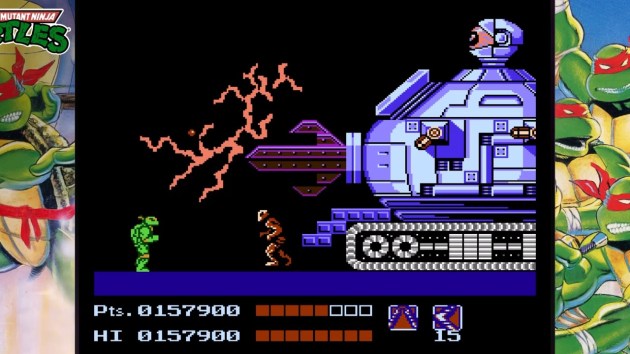
While the removal of flicker and slowdown doesn’t save the NES version of Teenage Mutant Ninja Turtles from the NO! pile, I’ll note that I played the Technodrome battle with the slowdown/flicker turned on and it was unplayable. I’m VERY happy Digital Eclipse did the right thing and gave people the ability to turn them off. Hell, in my opinion, THAT should have been the default setting and turning them back on should have been the thing that was optional.
In addition to having both the Japanese and US ROMs, all thirteen games have optional “enhancements” of various quality. They’re usually based around cheat codes that required button inputs, and how useful they are isn’t consistent. The NES TMNT offers flicker reduction and slowdown reduction. Neither are 100% perfect, but playing with them turned off, you can easily notice the difference. Turtles 1 is a game that spams the screen with enemies, and bosses like the Technodrome basically have slowdown going non-stop, which also makes the controls less responsive. You can eliminate those issues now in the first TMNT plus the other two NES games. Turtles 2 and 3 on the NES offer other options too, like extra or infinite lives and easier menu navigation. The arcade games offer both “God Mode” (invincibility and one-hit kills) and “Nightmare Mode” (lots more enemies). Turning both God Mode and Nightmare mode on DO make for quite the satisfying brawling experience. The Game Boy games are the least consistent. The first one offers only the ability to practice the bonus game. The second gives you the option for infinite lives and to change which level you start on. The third one offers you only the ability to turn-on a better map. Sure, I wish they had really amazing options for every game, but there’s something helpful that improves the overall quality of every game at least a little bit. Oh, and there’s online play for the two arcade games, Hyperstone Heist on the Genesis, and the SNES version of Tournament Fighters. For all the added emulation extras, I’m crediting $10 to Cowabunga Collection.
EXTRA MEDIA FEATURES
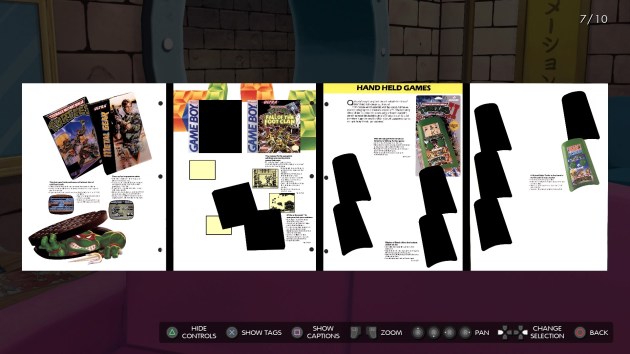
Any licensed game that’s not TMNT-related that appeared alongside a Ninja Turtles game in advertisements is treated like it’s in the witness protection program. Oh and since the LCD games are shown here, WHY DIDN’T WE GET THOSE AS A SUPER DUPER SPECIAL THROWN-IN BONUS? Would have been nice. I did a seven part LCD review series, 100+ games, but apparently nobody emulated the TMNT ones.
There’s a lot of extras in Cowabunga Collection. Hell, there’s so many that Digital Eclipse included the ability to search them in the menu. Dang. There’s boxes and manuals for all the home games from North America and Japan. Regardless of what console you’re on, you’ll see the Nintendo branding and seal of quality in all its glory, along with Sega’s branding on the Genesis game. They even have the arcade schematics too. There’s tons of ads from magazines and catalogs. Those can be weird, because if a Ninja Turtles game shared the space with another game from another IP, the other IP’s game is removed by blacking it out. Also included is every single cover for six different eras of Ninja Turtles comic books and still shots from four different Ninja Turtles TV shows (no Power Rangers crossover, sadly). There’s complete soundtracks and strategy guides for the games, and I actually did use it to help me finish the first NES game. There’s behind-the-scenes documents, and this is where the really good stuff is. Included in this section is stuff the IP’s “style guide” which is what IP holders send to licensees to show them how the characters MUST be drawn. Finally, there’s design documents for seven of the home games that show you concept art, portraits, sprites, storyboards, etc. If you can’t read Japanese, you’ll need to turn on the captions, and I’m not sure why translations weren’t set as a default but I’m happy they’re there. I spent over an hour sorting through the extras and never got bored. For all the media extra features, I’m crediting $10 to Cowabunga Collection.
THE ULTIMATE VERDICT ON THE COLLECTION
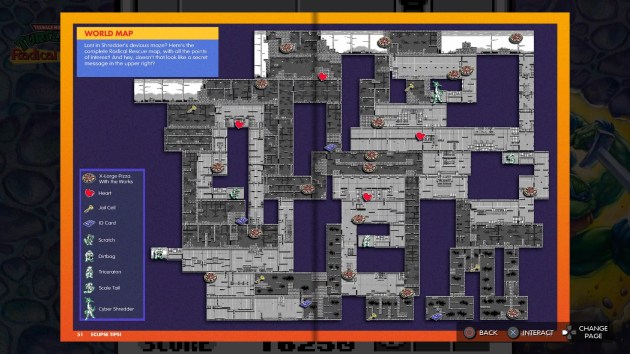
Really, only three of the games NEED the built-in strategy guide: Teenage Mutant Ninja Turtles (NES), Radical Rescue (Game Boy, map shown in pic) and the SNES Tournament Fighters (to learn the special moves). But, I’m happy the maps were there. They really went all-out on this set.
Even though I’ve played most of the games in this set before, and in some cases, had already given my complete thoughts on them, I gave all thirteen games a fully clean slate. Only the Cowabunga Collection version of the included games counts for this feature. For those not familiar with my way of thinking of how retro games should be reviewed, I take NO historical context into account. I don’t care how important a game was to the industry, because that doesn’t make a game worth playing today. The test of time is the cruelest test of all, but every video game must face it. I might not be here if not for Space Invaders’ success, but I wouldn’t want to play it today. Not when there’s better options. Therefore, when I review retro games, every game gets either a YES! or a NO!
YES! means the game is still fun and has actual gameplay value when played today and is worth seeking out.
NO! means the game didn’t age gracefully and is not worth seeking out, and certainly not worth spending money on.
With $20 in credit earned and the value of a good retro Ninja Turtles game fixed at $4.99, Teenage Mutant Ninja Turtles: The Cowabunga Collection needs to score four YES! votes to win my seal of approval.
YES!: 5
NO!: 8
 Teenage Mutant Ninja Turtles: The Cowabunga Collection is Chick-Approved. Having an official re-release of Turtles in Time for the SNES is a pretty amazing thing, but this collection has a few surprises as well. I didn’t expect to like the original arcade game, and in fact, I enjoyed my time with it a lot. I didn’t expect to like any of the Game Boy games, but two of them were acceptable time wasters. I certainly didn’t expect to enjoy the two hours I spent with Manhattan Project for the NES, yet here we are. Five totally solid Turtles games, emulated to perfection, plus a whole lot of bonus material, makes this a set worthy of purchase.
FINAL RANKINGS
How I determined the rankings is simple: I took the full list of games, then I said “I’m forced to play one game. Pick the one I could play the most and not get bored with.” That goes on top of the list. Then I repeat the question again with the remaining games over and over until the list is complete. Based on that simple criteria, here are the final rankings. Games above the Terminator Line received a YES! Games below it received a NO!
- Teenage Mutant Ninja Turtles IV: Turtles in Time (SNES)
- Teenage Mutant Ninja Turtles III: The Manhattan Project (NES)
- Teenage Mutant Ninja Turtles (Arcade)
- Teenage Mutant Ninja Turtles III: Radical Rescue (Game Boy)
- Teenage Mutant Ninja Turtles: Fall of the Foot Clan (Game Boy)
**TERMINATOR LINE** - Teenage Mutant Ninja Turtles: Tournament Fighters (SNES)
- Teenage Mutant Ninja Turtles II: The Arcade Game (NES)
- Teenage Mutant Ninja Turtles: Turtles in Time (Arcade)
- Teenage Mutant Ninja Turtles: The Hyperstone Heist (Genesis)
- Teenage Mutant Ninja Turtles (NES)
- Teenage Mutant Ninja Turtles: Tournament Fighters (NES)
- Teenage Mutant Ninja Turtles II: Back from the Sewers (Game Boy)
- Teenage Mutant Ninja Turtles: Tournament Fighters (Genesis)
GAME REVIEWS
Teenage Mutant Ninja Turtles
for Nintendo Entertainment System
Released June 25, 1989

One of my major annoyances with TMNT-NES is how enemies spawn. In this screen, you can see the playfield is spammed with enemies to such a degree that there’s basically no way you won’t take damage. Enemies respawn if you walk off the screen too, which is common on the NES, but TMNT-NES is really weird about how scrolling works, so backing up to have room to fight might scroll the screen more and cause the enemy to respawn before you’ve even killed the original.
By far the most interesting game in Cowabunga Collection is the very first Ninja Turtles game. Don’t mistake that for being “good.” It’s not. TMNT-NES is a complete disaster. But, it’s a compelling disaster. I’ll give it that. Basically, everything that can go wrong does go wrong here. The most important thing is that it feels nothing at all like a Ninja Turtles game. Even with the Turtles and their signature weapons. Even with Bebop, Rocksteady, the Technodrome, and Shredder. I first played Ninja Turtles a couple years ago when I ran through almost the entire NES library, and I walked away with a niggling suspicion that this started development as a completely different game that was converted into TMNT as soon as Konami got the license so they could strike while the IP was red-hot. Apparently, it’s not true. There was no asset flipping or sprites from unused games. They just rushed this through and came up with enemies as fast as possible on the assumption that the Ninja Turtles fad could burn out at any moment. The hurried development shows. The complete lack of polish and unrelenting swarms of enemies that would normally make the NES chug like a freshman at homecoming are things that should never have made it to the final product. The Cowabunga Collection version of TMNT can muffle the slowdown and non-stop flicker (there IS still a bit of both, but nowhere near as noticeable now) but that only makes the terrible design choices of TMNT stand out more.

The Giant Mouser and the Technodrome are the only two boss fights that feel “epic.” The rest feel like fights against normal enemies. If anything, the Mouser fight feels like it’s straight out of Contra.
What annoys me most about TMNT-NES is that there’s a great game buried within this dumpster fire. Not MISSING from the game, but already in the game. Well, actually, this could have used a lot better level design in general, but the basic concept of how the levels work is very solid. I like the idea of traversing an overworld and searching sewers and buildings for the correct pathway to the end of each stage. New York City is maze-like, after all, so why not take advantage of that? I like that part. It’s the only good idea the game had, and even then they bungled it by having too many dead-ends and “red herring” buildings. Sure, there’s pizzas or items in them, but the way enemies respawn often isn’t designed with moving forward and backwards through the levels in mind. Often, you’re better off just running for it and not engaging the enemies at all. If not for the abysmal collision detection.. which is seriously among the worst in the history of video games.. the combat would be pretty satisfying. At least when you use Donatello. His staff is slow but has the most reach and causes the most damage. That’s right: getting poked with a large wooden stick is more lethal in the world of Ninja Turtles than being stabbed or sliced with sharp, pointy metal. If you think of this as Donatello: The Video Game, it works a lot better. With practice, you can even use his unique striking style to damage enemies behind you. Donatello is the man, and I only used the other Turtles if I had acquired a subweapon using them or if I didn’t want to take damage with Donatello. Hell, unless you have the other three Turtles loaded down with sub-weapons, the second-to-last boss, the Technodrome, is pretty much impossible to beat without him. You can’t disable the electric fork in the front with anyone else’s weapon. They don’t have enough range. What was Konami thinking when they green-lit this?

Oh you bastard. You bastard. There’s nothing I can say that others haven’t already said about the infamous underwater sequence. It’s every bit as bad as its reputation suggests. For my money, it’s the worst level in the history of video games. Not even the Speed Bike stage on Battletoads is this bad, because at least there the controls and collision aren’t awful. When you finish this review, go watch this video that explains how the awful collision ruins this stage. It’s truly jaw-dropping how badly coded this game is. You didn’t expect that from Konami games of this era. They were only months away from releasing Castlevania III in Japan when this came out, a contender for the best game on the NES.
For a set that’s loaded with extras, I’m a little more than ticked off that it was never explained anywhere in the game (the original instruction manual or Cowabunga Collection’s built-in strategy guide) that each turtle actually has unique special attributes. Leonardo does the least damage, unless his health falls below four bars, at which point it doubles. Because that’s how swords would work, or something. Raphael has the fastest weapons in the game but can’t do a down-thrust. Michelangelo can’t attack downward either and he has poor range, but like Leonardo, his attack power doubles when he’s under four bars of health. I feel like this is one of the great missed opportunities of the NES era. This isn’t a side-scrolling beat-em-up. It’s a full-fledged platforming adventure with labyrinthine levels. Assigning more unique abilities to each Turtle could have made for a more strategic, enticing game. But that’s not what Konami did. There’s really never a point when you’ll want to use a Turtle besides Donny, and that’s especially damning. Honestly, it feels like everything was put into making level one good, so that kids would rent it and pester their parents to buy it. Pretty much the whole game from level two onward becomes so unfair that I actively wonder why Ghosts ‘n Goblins became the poster child for mean-spirited game design when TMNT outsold it 3 to 1 and is nearly as unfair. For all the crap the dam level gets, that final stretch before you get to Shredder is straight-up bullshit. Then again, most TMNT owners never made it past level three from what I can gather, and 99.9% certainly never made it past the Technodrome.
After level one, there’s just nothing really enjoyable left to do because TMNT-NES loses all semblance of balance. The enemies can be spongy, cheap, and too quick to respawn. Most of them have literally nothing to do with the Teenage Mutant Ninja Turtles franchise and feel like they’re unused character sprites from horror games or sci-fi games. Not badly designed or ugly character models, but I can’t imagine a child in 1989 understood at all why their TMNT game felt almost nothing like the show or movie or comic they fell in love with. I’m not even a Turtles fan myself, as it had already kind of dried out by time I was the right age for it, and even I’m like “what the hell are all these monsters from?” The answer is not from THE Ninja Turtles franchise. Hell, the Giant Mouser feels like a Contra boss. Speaking of bosses: after a couple hours worth of cheap enemy placement, swarming bosses, and unavoidable damage, I entered the final room with Shredder and beat him without cheating in ten seconds without taking a single hit of damage. If there had been someone in the room with me who had a trumpet, they would have played WOMP WOMP at that moment. Despite all the problems I have with Ninja Turtles, I feel like there really is a potentially great game here. While it never feels like a TMNT game, it always feels distinctly NES Konami-like. If you altered some jumps, tightened the collision detection, eliminated the time limit and changed how swimming works in the underwater area, adjusted the respawning, and gave the empty buildings an actual purpose besides being a wild goose chase for players, TMNT could have been one of THE greats on NES. Of course, what I just said is basically “if you change the whole game, it could have been a masterpiece!” By the way, this was the best-selling 3rd Party NES game of all-time. Go figure, right?
Verdict: NO!
Cowabunga Collection Ranking: #10 of 13
Teenage Mutant Ninja Turtles
for Arcades
Released October 11, 1989

This came out exactly two months after I was born. There’s actually no value to that useless fact, but I figured I would share it.
Being a weirdo, I played the NES port before playing the arcade game. I’m famously not a fan of the Simpsons arcade game, and I thought I wasn’t of the TMNT arcade game. It makes sense, right? Same development team. Same engine. Same sense that the game was rushed to the market to strike while the iron was hot. Now, I’m racking my brain trying to figure out if I ever played the arcade game before. I’m not entirely sure I have, because I had a pretty good time with it. In stark contrast to the slow, plodding, extremely stripped-down NES game that somehow earned a reputation as a really good port, I actually really enjoyed my time playing Teenage Mutant Ninja Turtles: The Arcade Game. A big part of that is that it breezes right on by at an astonishingly fast pace. Compared with the NES port, where after about twenty minutes, I felt like I was going to burst into tears every time I realized I wasn’t on the last level.
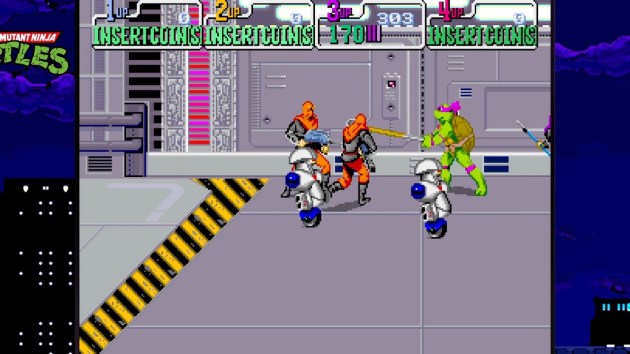
Yea yea, you’re supposed to play this multiplayer. Well, my family enjoyed doing the recent indie Shredder’s Revenge with me (yes, it’s an indie) getting them to play retro games is like pulling teeth.
The arcade game has only two major flaws. The first is that the handful of flying enemies feel like they have inaccurate collision boxes compared to the plane of existence you stand on. Lining yourself up to damage them is extremely frustrating. The fight with Baxter Stockman is particularly annoying, and after throwing drop kicks from every angle and hitting around one out of six times, the game gave me a mercy ruling and he just flew away. Wow. Thankfully, the issue with flyers isn’t a deal breaker. The bigger problem with TMNT Arcade is there’s very limited OOMPH! to the fight. Your attacks feel kind of weightless, and that drops this out of the realm of “best brawlers” because you need that sense of violence for immersion. So, it’s remarkable that I still had a good time.
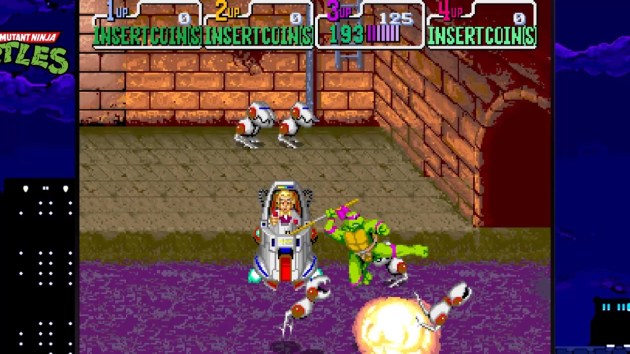
The only truly putrid element of TMNT Arcade is the Baxter Stockman fight. It’s not just lining up to score a hit that’s a pain in the ass. He drops too many mousers, which require you to button mash to escape. It’s a terrible arena for the battle too. I hated everything about this fight. The only thing the NES port did better was this part.
But, I never got bored with the gameplay. Konami stretched a lot satisfying combat out of two button gameplay. Satisfying enough, in fact, that I opted not to simply spam the special attack that kills foot soldiers in one hit. This is before those type of attacks came at the price of a sliver of health, but I enjoyed using my basic attacks, and often did. That’s something that’s completely gone from the NES game. The moments where the bad guys attack from every angle don’t even frustrate, because it feels true to the spirit of the property. As far as licensed games from this era go, the original arcade TMNT has to be among the best at making the game feel like the IP. The bosses, especially early ones, aren’t the total sponges. TMNT Arcade’s bosses are basically the prototype for the “Konami Style Brawler Boss” that I adore. The last couple do get borderline spongy, but it feels climatic. Shredder’s one-hit instakill felt a bit “quick! Wring every last quarter out of the little bastards” cynical, but otherwise, I had a lot of fun with the 1989 TMNT arcade game, and I didn’t expect to at all.
Verdict: YES!
Cowabunga Collection Ranking: #3 of 13
Teenage Mutant Ninja Turtles II: The Arcade Game
for the Nintendo Entertainment System
Released December 14, 1990
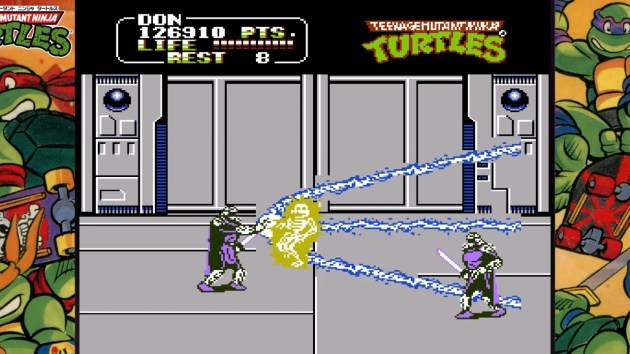
The Shredder fight is especially tedious. He clones himself, and you can only tell which is the real one by knocking his helmet off. At this point, the fake one usually hangs out close by the real one so that you accidently kill it, at which point another spawns. Oh and the instakill death ray is bullshit. At least here, it’s doesn’t feel like it’s trying to squeeze as many last-second quarters out of players as possible, I guess. Oh, and play the JP version if you insist on playing this, where the dropkick causes as much damage as the special attack, and the SP attack is easier to do.
Calling the NES port of the arcade Ninja Turtles “boring” is sacrilege to an entire generation that came before me, but I’ll proudly wear the blasphemer tag before I say anything nice about Teenage Mutant Ninja Turtles II: The Arcade Game. It’s boring. Like, really boring. This is NOT a good port of the arcade game. I was stunned when I played the arcade game after playing this and saw how many more moves just hitting the attack button could do. In addition to the normal attack, Donatello could lift enemies up over his head and throw them, a fairly satisfying move. That’s gone here. In fact, I didn’t want to use basic attacks at all because the enemies tended to counter attack them too quickly. That left only two other options: the lone type of drop kick you get (the arcade version gives multiple) and the power attack that kills all the foot soldiers in one hit. Levels take a lot longer to slog through, and to really add insult to injury, they added two more levels that have some fairly cheap GOTCHA! type of hits. They also changed the fight against both Bebop & Rocksteady to a fight against the fly version of Baxter. Okay, fine, there IS one positive thing I can say: it’s easier to kill flying enemies in this version, but that’s on account of some very generous collision with them. TMNT 2-NES has overall bad collision detection, spongier bosses, and levels so long they could be called eras. You kids from generations before were far too easy to impress, because they turned a fun, fast-paced romp into a slow, plodding, padded slog.
Verdict: NO!
Cowabunga Collection Ranking: #7 of 13
Teenage Mutant Ninja Turtles: Fall of the Foot Clan
for the Game Boy
Released August, 1990

I genuinely go into all these games with as open a mind as humanly possible. Having said that, I’m floored I gave a YES! to Fall of the Foot Clan. I figured the second and third Game Boy TMNT games had a shot, but that there was no way in hell a first-gen GB game that was likely rushed through development as fast as possible to cash-in on the Ninja Turtle craze before it stopped being profitable had any chance of being fun.
Fall of the Foot Clan is a pleasant surprise on the same level as when you put your pants on and find a dollar bill in one of the pockets that you didn’t know was there. It’s not exactly cause for celebration but it’ll put a smile on your face. This early Game Boy release is one of the stronger third party GB titles from that early period, easily out-classing Konami’s first attempt at a Castlevania for Game Boy. It’s not exactly the most ambitious title. In fact, it’s so generic that they could have made this any IP and it would have felt the same. The Turtles have no variation between them besides how their weapons look, at least from what I can tell, and it’s not like the Game Boy can show the different colored masks. The gameplay is as basic as it gets. You walk right and enemies jump onto the screen and you whack them with your weapon. Occasionally you have to jump, but mostly, you just walk right. There’s no power-ups besides life-restoring pizzas. There’s an awful lack of variety in both enemies and the way they attack. Fall of the Foot Clan’s gameplay is as shallow as a mud puddle. Honestly, the levels often feel like LCD type action games with better animation.

What gave me the LCD vibe is how the enemies tend to attack in the exact same way. Foot soldiers jump in from the left and the right, slightly out of sync, so that you can smack one, then turn around and smack the other. This attack pattern is repeated almost non-stop throughout the game. Little robot enemies will buzz across the top before lowering down so you can smack them. You’re moving right. You’re jumping over gaps. You’re changing levels. But, the same attack pattern with the same enemies repeats over and over. I’ve never seen a non-LCD action game that mimics the LCD spinning-plate-style like this before.
But, I never got bored with it! It helps that the action is pretty much non-stop, plus this became the first TMNT home game with accurate collision detection. Enemies drop pizza slices in regular intervals, and if you want a little variety, you have an unlimited supply of ninja stars to throw at enemies when you duck, though they do less damage than your sword and I never really needed them. Fall of the Foot Clan is super easy and goes by quick, barely taking thirty minutes to complete the five-level quest on your first play-through. I was stunned that I even lost one life, which happened when I fought Shredder at the end of level four, which was the literally the only part of the game that felt like there was any type of nuanced challenge besides just full-speed-ahead attack. Has Fall of the Foot Clan aged well? Oh god, no. Is it still somewhat fun? Yea. This might be the worst retro game I’ve ever given a YES! to, but I never got bored and wanted to finish it. That counts for something.
Verdict: YES!
Cowabunga Collection Ranking: #5 of 13
Teenage Mutant Ninja Turtles: Turtles in Time
for Arcades
Released March, 1991
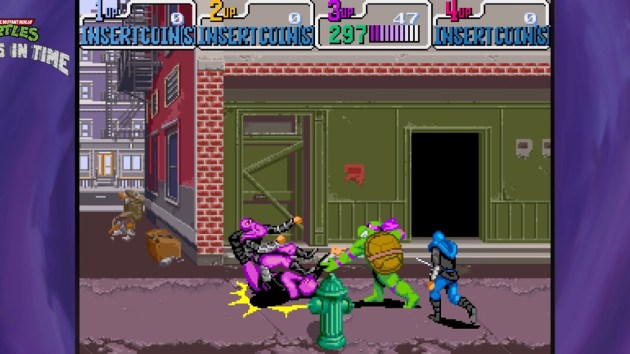
A major, game-defining aspect of Turtles in Time on the SNES is how easy it is to pull off the two special moves (throw at the camera and the repeating slam). The arcade game feels like it picks random times to work. Even the “hit both buttons to do a special attack that takes a tick of life off” move is SIGNIFICANTLY harder to do in the arcade version. It’s just not a fun game.
Before playing Cowabunga Collection, I’d already had plenty of experience with Turtles in Time. I had it when it was given a terrible facelift and called Re-Shelled back in the day. Years later, I ran through the SNES game during #IGCvSNES. There was this interesting phenomena while I did the SNES game: a lot of people noted that it far out-classed the arcade counterpart. Now, there’s people who insist the NES port of the original arcade game is better because it has (checks notes) two extra levels. Allow me to wave my hands around my head while saying OOOOOOH sarcastically. They couldn’t have been more wrong, of course. TMNT II: The Arcade Game on NES is terrible. But, when I started Cowabunga Collection, I once again started catching word that Turtles in Time was inferior in arcades. This time around, the buzz was spot-on. If anything, people understated just how bad Turtles in Time arcade is. It has better animation than the SNES game, and it’s also absolutely horrible.

When it comes to arcade games, there’s a difference between “fair hard” and “borderline scam hard.” Turtles in Time has so many cheap shots or enemies that interrupt your attacks that it feels like a scam. Yea, that’s the accurate term. If one of those redemption games that spits out ticket is rigged specifically to make players think they have a better chance to win than they really have, we call that a scam, right? Why not do the same for arcade video games, since the ultimate goal (trick players into paying real money to play) is the same? Turtles in Time has one goal and one only: suck quarters. The faster players die, the better. When you don’t have to put quarters into the game anymore, all it has left is to suck.
This might be Konami’s worst arcade game of the 90s. Talk about a major downgrade from the previous game. The play control often feels unresponsive. As a result, there’s NO oomph. Seriously, this might be the least OOMPHful 90s brawler. The violence feels like feathers doing karate moves on cotton balls. Pulling off the cool special moves is nearly impossible to clock. The swarming enemies interrupt your combos like it ain’t no thing. There is a slightly better variety in enemies in the arcade (and the annoying shield-wielding foot soldiers aren’t that bad here) but with combat that isn’t satisfying at all, what’s the point? The same issues with airborne enemies from the first arcade game return here, along with other issues with what plane you’re on. The out-of-sync enemy attacks that often don’t let you get-up was the final straw for me. Actually, it was the final straw twice, which shouldn’t even be possible! Cowabunga Collection’s “Nightmare Mode” stacked with “God Mode” made Turtles in Time fun. For a while. Then I got to the Neo Night Riders stage and the flying foot soldiers used their guns out of sync, so not only could I not fight back, but I couldn’t even get up. It’s amazing that they turned this piece of crap into what might be the best brawler on the SNES, but this feels like a prototype that wasn’t finished. It does have value as a case study for OOMPH, because the SNES version actually has it.
Verdict: NO!
Cowabunga Collection Ranking: #8 of 13
Teenage Mutant Ninja Turtles II: Back from the Sewers
for Game Boy
Released December 1, 1991

Apologists for the game note that the perfect no-hits run in the video shows you don’t have to heel-toe it. I am so sick of the speed run argument when I complain about a game with pacing issues. The argument is essentially “if you spend enough time to become an expert at a game that already bores you, you can beat it faster.” Well, yeah. That’s usually how it works. But why would anyone want to become an expert at a game they find boring in the first place? There’s like a million games out there. I have better options than a 1991 Game Boy product tie-in that zero effort was put into to actually be fun.
They had more than a year of extra time to work on Back from the Sewers. So, how is it so similar to Fall of the Foot Clan? Actually, change that. How come it’s worse than Fall of the Foot Clan? I’m not going to call Back from the Sewers unplayable. It’s even worse than that. You CAN beat it, but in order to do so, you’re forced to play the game in the most cautionary, plodding, opposite of fun manner I’ve ever seen in any “action” game. Take the same basic enemy attack patterns from the first Game Boy game.. and I mean the EXACT SAME ATTACK PATTERNS, only with different character sprites. Now, have that sequence of attacks happen every time you scroll the screen a half step forward. On “normal” difficulty, the game spawns an absolutely comical amount of enemies that you have to whack with your comically short weapon, then take a step forward and repeat the process. The first game felt like an LCD game that with the limited amount of attack patterns that repeated throughout the game. Well, if that was a Game & Watch, this would be the B mode. The same game, only with the patterns happening at a faster rate. More ambitious level design based on zig-zagging through buildings or aircraft is undermined by enemies or turrets that fire so fast you’re basically forced to take damage. Who on earth wants to play a game where the only way to play well is to essentially crawl your way through it? Back from the Sewers? I think not. This belongs back IN the sewers, because it’s crap.
Verdict: NO!
Cowabunga Collection Ranking: #12 of 13
Teenage Mutant Ninja Turtles III: The Manhattan Project
for the Nintendo Entertainment System
Released February 1, 1992
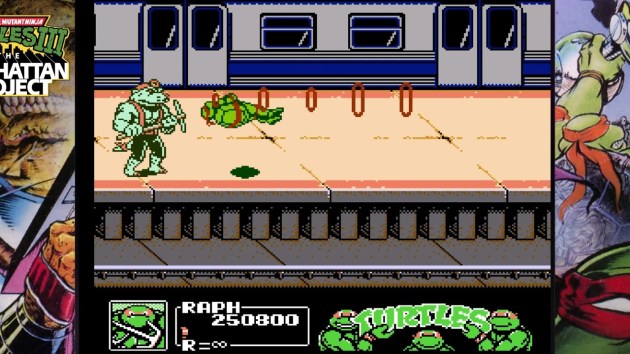
I’ll get my only knock with Manhattan Project’s controls out of the way: it’s too easy to do the life-draining special move. I know that in previous games I complained that it’s too hard, but here I often went to jump to do a drop kick and ended up doing my special move instead. If I hadn’t had infinite lives on, I’d of game-overed just from accidental special move usage alone.

Dinosaurs do not show up at any point at all in this game. Absolutely shameful cover art. Reprehensible, really. If this was a new release, I’d give this a NO! on principle.
To say that I was completely taken by surprise by Teenage Mutant Ninja Turtles III on the NES is an understatement. Here’s what I knew going into it. (1) It used a modified version of the Turtles II: The Arcade Game’s engine, and I hated that game. (2) It’s still the NES, so gameplay is limited to two buttons and stuff that can be done with 8 bits of horsepower. (3) The full-length gameplay video included was nearly two hours long. I could barely keep my eyes from glazing-over playing TMNT II: The Arcade Game and this was over twenty minutes longer. (4) It had a reputation for being insanely difficult. The most frequent thing I heard from players was that it starts fun but finishes with a thud because of prohibitive difficulty. Granted, they likely didn’t have access to the infinite lives that Cowabunga Collection allows you to apply. (5) Konami opted to save a few bucks by not going with the same special chip they used to make Dracula’s Curse possible. Of course, this set allows you to turn off flicker/slowdown inherit to the NES, but the point is TMNT 3 didn’t aspire to max-out the NES’s 1991/92 potential. That’s five completely valid red flags. For those reasons, I’d been dreading the time I’d have to spend with the Manhattan Project more than any other game in the set.
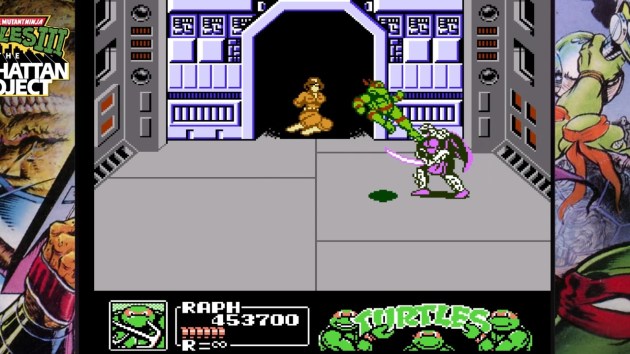
Given the limitations of the fighting engine and the 8-bit console, they kind of got the bosses perfect. This was especially surprising given how boring the bosses in TMNT II were. A big part of that is none of the bosses in Manhattan Project are too spongy. Just when you think they’re about to get boring, the blinking starts, meaning they’re almost dead. Each has a unique style and twist. Most importantly, they’re all fun to battle. Every single one, which is a feat no Turtles game, NOT EVEN SHREDDER’S REVENGE, has pulled off. Only this late-stage NES game. Well done! Outstanding! And one of the most unexpected, delightful surprises of my now five-year-long retro gaming adventures.
My fears were unfounded. Teenage Mutant Ninja Turtles III: The Manhattan Project was pretty awesome. It cleans up most of the things that killed TMNT II on the NES. Collision detection, first and foremost, is completely fixed. There was a couple weird instances involving Michelangelo where his weapon actually had more range than the graphics let on (specifically the “lift over head” move) but those were limited to him. Beyond that, this has some of the best combat collision of any game of this type on the NES. The controls are much more responsive too, and it makes the combat a lot more satisfactory. Plus, this time around, each turtle has their own unique special move. Raphael, who I usually avoid because of his teeny tiny weapons, actually has the best special move by far, a torpedo-like headbutt, and thus he became my primary character. Michelangelo, another turtle I usually avoid using, has a neat handspring kick that, with proper timing, can cause two hits for the price of one. Of course, they fixed the issue with the power moves coming at no cost. This time, whether you hit the move or not, using the special moves takes a tick of health off, and the game is ultra-stingy with the life-refilling pizza so you’ll want to space the special moves out. But, once you get down to your final sliver health, you get unlimited special moves, and with Raph especially, I was spamming them like crazy.
Manhattan Project feels like it squeezes as much content out of the formula as two button gameplay on an eight bit console allows. Right up to the eighth and final level, it’s still introducing new enemies. The variety of foot soldiers rivals Shredder’s Revenge, a game released 30 years later. This is a seriously impressive effort. There’s even some unique stage ideas, like an area taking place on a conveyor belt where you have to brawl while jumping over lasers (or not jumping sometimes). I think it went a bit too long. Six levels that had mid-bosses would have worked a lot better, and in fact, the best levels were the ones that had mid-bosses. Two hours is a lot of time to spend with a beat ’em up this limited, though it never becomes fully boring. That’s probably because, unlike Turtles II, TMNT III feels like a labor of love. As for the notorious difficulty, well, some people say that you’re not really beating a game if you cheat and use infinite lives or save states or rewinding. I say, if that’s the only way a game can be enjoyable, so be it. Besides, it’s a brawler and even with one added basic move and unique super moves, it’s still gameplay as shallow as your mother in law’s contempt for you. It’s supposed to be cathartic. Yea, I’m happy I can beat Double Dragon NES if I really put my heart in it, but that also kind of nullifies the fun. You have to buckle down and play efficiently, even if it’s not as fun that way. Without the pressure of playing the game well, I could enjoy TMNT 3 just fine. I could use the basic moves, which are actually FUN to use this time, something the first arcade adaption on the NES completely failed at. Seriously, it’s a chore using the basic moves in TMNT 2, and they don’t feel rewarding when they land. That’s fixed. It’s all fixed. This is as good as an arcade brawler on the NES can be, and kudos to them for pulling it off. Surprise: TMNT 3 is quite fun.
Verdict: YES!
Cowabunga Collection Ranking: #2 of 13
Winner: Biggest Surprise of the Set
Teenage Mutant Ninja Turtles IV: Turtles in Time
for the Super Nintendo Entertainment System
Released August 15, 1992
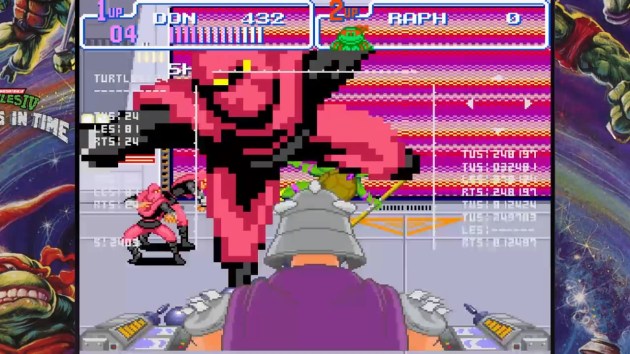
I think this is my favorite boss in any side-scrolling brawler ever made. Someone at Konami must have realized it was just so satisfying to throw foot soldiers at the screen, so they made it a lot easier to pull off on the SNES, then built a boss fight around it. It’ll take something spectacular to top this battle.
Now this is more like it. Despite the arcade game having more fluid animation and sharper graphics, the Super NES version is better in every imaginable way. It controls better. It sounds better (well, okay fine, it doesn’t have most of the arcade’s voice samples or the Pizza Power rap during the attract screen). It plays better. It’s a kinder, gentler lover, like I imagine Shredder really is deep down♥. Turtles in Time on the SNES is a nearly non-stop joy to experience. The feathery, weightless combat of the arcade is replaced with weighty crunches, bone-breaking slams, and weapons that feel like they would actually hurt to get struck by. Whereas the added levels were not to the benefit of the NES game, which was already thin on gameplay and terminally slow, the added content here is welcome. There’s four new bosses and all of them fun to battle. Levels have either been added or heavily altered, including turning the two “surfing” levels into bonus stages, but ones that still have bosses. The Super NES has a lot of great arcade ports, but few actually improve on the coin-op. Turtles in Time MURDERS its arcade counterpart and was likely the best home-to-arcade port until SoulCalibur in 1999.

A bizarre extra feature exclusive to this port is the time trial mode. There’s three “courses” that take bite-sized segments from the main game, called “laps” here and times how long you take to beat all the enemies. It’s weirdly slow, as you spend as much time waiting for the next lap to finally load as you do actually “racing” the timer. It’s not the worst idea but the execution is frustrating because of the agonizing wait between laps.
Do you know what my only semi-real problem with Turtles in Time is? I object to the name. Really, the “time travel” aspect barely works. Going back to fight foot soldiers in the dinosaur era? Nice. But the train you’re on could be a train from any time period. Same with the pirate ship. Same with the Technodrome, for that matter. Hell, you have to finish about a third of the game before you even start “traveling through time.” So, yea, the time travel stuff outside of the dinosaur stage and the hoverboard stage is weak sauce. Everything else is superb. A big part of that is the OOMPH (my pet term for violence in a video game feeling like it has real, impactful weight to it) is wonderful. When you hit a strike in Turtles in Time, it feels like it inflicts pain. Which it probably doesn’t because you’re mostly fighting robots but my point still stands. In the arcades, it’s like paper dolls fighting. On the SNES, when you grab an enemy by the limb and start slamming them back and forth on the concrete like Hulk does to Loki in Avengers, it might be my favorite brawling game move EVER. It’s just so damn cathartic, especially when you clear out a screen full of enemies while doing it.

Turning Neo Night Riders into a Mode 7 showcase was another smart move. You’ve already done one “Sewer Surfing” stage. In arcades, it’s just more of the same, and futuristic facade feels paper-thin. On the Super NES, the Mode 7 graphics make it feel fresh and kind of novel. The weird thing about Mode 7 is it shouldn’t impress at all in 2022, but it always makes me sit up and take notice whenever I’m playing any SNES game.
The sound design factors into it, but the controls being a lot more responsive than they are in arcades is the real difference maker. That fluid animation that does look so good in arcades seems to also be why doing combos, getting attacks interrupted, and general unresponsiveness is present. On the SNES, it feels like when you give the command to crush an enemy, it’s done. I could almost do the “slam on the concrete” move at will (which really helps in the time trial mode) and when I needed throw enemies at the screen, I could always do so with minimal effort. Of course, unlike the NES arcade game, just using basic attacks is actually satisfying as well. So is the running shoulder block that makes for the perfect set-up for the concrete slamming. Turtles in Time’s move-set is relatively limited, but what moves you have are very satisfying. My wish list would only include more satisfying/effective aerial attacks.

The OOMPH isn’t quite as good against bosses, but hell, even the best Capcom brawlers where you could practically feel the bones shatter also struggled with that too. Boss OOMPH is a tricky balancing act because if you get it wrong, you make the enemy look weak and it takes the stakes out of the fight. One thing Turtles does get right is having all the bosses feel like they’re different. They require different patterns to defeat. You can’t just spam attacks. I like that.
Well, if I’m going to get nit-picky, I guess I wish there was a bigger variety of enemies. It’s mostly just foot soldiers of various colors/weapons. The second most common enemies are these stone guys that aren’t as fun to fight, as when you try to slam them, you just sort of toss them like a sack of potatoes. Rarely, mousers or these giant alien-looking things show up. My hunch is the dev team focused all their energy on the bosses, which was probably wise. The variety of bosses is spectacular and they all feel different, but I’m bummed becuase Turtles in Time was maybe five or six basic enemies away from being the undisputed best brawler of its era. Of course, everything I feel is missing was actually done with the recent Shredder’s Revenge, and probably the best thing I can say about Turtles in Time on the SNES is it set the bar that game had to clear very high indeed. Turtles in Time might not be the best Ninja Turtles game anymore, but that it held that title for twenty years and barely showed any wear from the test of time is a testament to what Konami accomplished here. The SNES port is a truly amazing piece of software and I’m so happy I got to play through it a second time. Let’s leave it here and not re-re-remake it, please. I’d rather have Shredder’s Revenge 2.
Verdict: YES!
Ranking: #1 of 13 **BEST IN SET**
Teenage Mutant Ninja Turtles: The Hyperstone Heist
for Sega Genesis
Released December 11, 1992

They took the Krang Fight from Neo Night Riders in Turtles in Time, same attack patterns, and made him a boss without the cool futuristic facade or the hoverboards. Like so many things with Hyperstone Heist, it feels stripped-down.
I legitimately can’t believe there’s any debate on which is the superior 16-bit home TMNT arcade game. A lot of people seem to really like Hyperstone Heist. I’ve never seen a game this terrible that has so many people falling over to apologize or make excuses for it, or even call it good. I mean legitimate PASSION from fans who stand by Hyperstone Heist as one of the best, if not THE best, TMNT games ever made. YIKES! I’m not just talking fanboys either, but professional game critics! Hyperstone Heist has made lists like “The 20 Best Genesis Games.” I checked, there’s at least twenty-one Genesis games, which means they’re not awarding this by default. They’ll say “the graphics and sound are better!” Who cares? Turtles in Time in the arcade looks a LOT better than the SNES game, especially the fluid, cartoony animation. But, the gameplay is worse, so the SNES game is better. That’s just how it is. If you value a game having better animation or sound at the cost of gameplay, my reviews are not for you. And while we’re at it, what people consider “better” with Hyperstone Heist is very debatable.
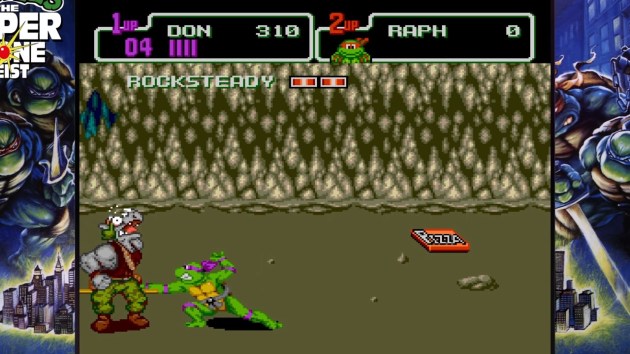
I was already miserable playing Hyperstone Heist for reasons I’m going to get into right about now, but at least I wasn’t completely demoralized. Then a boss showed up I already beat, and I was only on the fourth stage. “Uh oh” I thought, a chill coming over me. Then, after beating Leatherhead for the second time, Rocksteady showed up, and I just felt completely dejected. A goddamned boss rush. And since there had only been three bosses up to that point, it was one of the most pathetic boss rushes I’ve ever seen. Unbelievable. Then it ended with the Baxter Stockman fight from the original TMNT arcade game. Hey, wait.. Rocksteady is in the game but Bebop isn’t? That’s like Simon without Garfunkel! ♫GENESIS DOES! YOU CAN’T DO THIS ON NINTENDO (unless it involves a mutant warthog)!♫
A lot of people lead off with “the music is better!” I’ve never understood why anyone would go to music before gameplay, but fine, let’s start with the music. The Wikipedia page describes Hyperstone Heist as having the same music as other TMNT games, only faster. The faster part I’m not entirely sure was deliberate. It has the same music tracks from previous Turtles arcade games, only they’re sped-up. The thing is, the voices of the Turtles when they die (“ohh, shell-shocked!”) sound like Alvin and the Chipmunks, because they’re ALSO sped up. Then you realize the various bonks and baps from the combat also sound kinda similar, but weirdly so, and it’s because they’re the same sound effects sped-up too. Why would you speed up the sound effects too? That makes no sense at all, unless they just screwed up the soundtrack and sound effects and decided to call it a feature instead of a bug. It must work because people cite the soundtrack as a reason this is better than the SNES counterpart that has more levels, more bosses, more moves, more set-pieces, better play control that makes pulling off advanced moves easier, and has heroes that don’t sound like they’re on an all-helium diet.

The Sega Genesis version of TMNT has only five levels and six bosses, three of which you have to fight twice, BUT HEY, it has one boss.. ONE SINGLE, SOLITARY BOSS.. that’s not in any other Turtles game. You can practically see the Genesis fanboys showering themselves with confetti while singing “GENESIS DOES WHAT NINTENDON’T!”
But, it’s the claim that Hyperstone Heist has “more aggressive AI” that I object to the most. Apparently it was Konami’s “selling point” for the game. “More aggressive AI” in this case is the most meaningless buzzword on the Genesis since “Blast Processing™©™®™.” But, people fell for it. Reviewers at the time noted the AI was “more aggressive.” The Wikipedia page notes it. People telling me I’m wrong about Hyperstone Heist have said it to me. I don’t know where this “more aggressive” shit comes from, because when *I* played Hyperstone Heist on Normal Difficulty, the enemies kept backing away from me when I walked towards them. They would back all the way to the far-far-far edge of the screen, so much they often weren’t on the screen at all, before they finally stood still long enough for me to kill them. Of course, that means when I hit my strikes, I could only hear that I was doing it and didn’t get the satisfaction of seeing the enemies die. This was consistent from the start of the game until the end. One of my biggest issues with the beat ’em up genre in general is the action too often migrates to the edges of the playfield, but Hyperstone takes it to a new extreme. “Well Cathy, enemies in a real fight WOULD back away from you!” OH FOR THE LOVE OF GOD, IT’S A VIDEO GAME! In real life, a fire breathing, princess-kidnapping turtle dragon wouldn’t choose to make its final stand on a bridge with an axe that the hero could use to drop it into a lake of fire, either, but in the make-believe world of video games, it’d be weird if it didn’t! And it’s weird that so much action in Hyperstone Heist is against enemies you can’t see!

Might as well have put a giant Pizza Hut advertisement in the the center of the screen. It wouldn’t have blocked the action at all.
I think by “aggressive” fans of the game mean the enemies are complete back-fighting, sucker-punching cowards. The overwhelming majority of enemies don’t swarm you. They sort of fall back, and they only move in to attack when your back is turned to them and you start swinging your weapon to the other side. They also have pitch-perfect timing on counter-attacks. But, combat mostly consists of chasing enemies to the edge of the screen for the kill. Many of the enemies are straight-up programmed to just sit on those edges and throw their projectiles in preset intervals. For a game that’s allegedly “faster-paced”, you sure do take FOREVER to get up when you get knocked down. The dramatic knockdown-rolling-sit-up animation is agonizing every time it happens, and most of the time, the enemies begin their attack animation with perfect timing so that you’re going to get hit again at the very nanosecond you make it to your feet. I don’t care how much fans of this game regurgitate Konami’s 1992 marketing of Hyperstone Heist as “more aggressive” and “faster-paced” because the actual gameplay unfolds a lot slower. It’s stop-and-go gameplay on steroids, and thanks to Cowabunga Collection, you can play this side-by-side with Turtles in Time on the SNES and see that it’s actually the SNES game that’s “fast paced” and has more aggressive enemies, because they don’t run away from you like complete lilly-livered yellow-bellied scaredy-cats. Isn’t the point of a brawler being fed an army of cannon fodder to punch?

The only nice thing I can say about Hyperstone Heist is it had the most playable version of this Baxter Stockman battle. So hey, +1 for having the best version of my least favorite boss from the original arcade game.
While I’m at it, where is all this other “better gameplay” at? You can’t throw the enemies at the screen, which is one of the most satisfying moves from Turtles in Time. It’s much harder to pull off the “slam enemies into concrete” move, and the other foot soldiers you hit doing it take less damage. Your own life bar can be drained too quickly, as the amount of damage caused by environmental traps or even by random hits from bosses or foot soldiers often is several of your health points. The OOMPH isn’t as good as the SNES game. It has less than half the bosses the SNES game does at 13 to 6. If you object to me counting the fights against Bebop & Rocksteady as two different bosses, and the same for Tokka & Rahzar, the tally is still 11 to 6, a not unsubstantial gap, and the SNES game didn’t make you replay bosses you already beat. “The stages are longer!” Yea, but they don’t do anything. They’re not fun set-pieces at all. I was excited for a “haunted ship” because those can be cool, but it had nothing haunted about it. It was just decrepit. Going off this game’s definition of haunted, my Mom is becoming haunted. So, where’s this better game play? Oh, because the dash button is separate? Well dip me in shit and roll me in bread crumbs, Genesis wins! ♫GENESIS DOES! YOU CAN’T DO THIS ON NINTENDO! GENESIS DOES!♫
When presented side-by-side against the SNES Turtles in Time, I can’t understand why anyone would say Hyperstone Heist is the better game, unless they NEED Hyperstone Heist to be better because they still base their self-esteem on the fact that, thirty years ago, Sega successfully marketed their console to them better than Nintendo did (or their parents saved some money buying a Genesis instead of an SNES and then gaslit the kid into believing they really wanted a Genesis all along). Well, sorry Genny fans. The Genesis library beat the SNES library in many ways, but Hyperstone Heist isn’t just bad compared to Turtles in Time. In fact, on its own, compared to no other game, Hyperstone Heist is just boring. An already short game that feels very heavily padded, with bad enemy AI, a limited moveset, and dull set-pieces. But hey, you were told thirty years ago it was faster-paced than other Turtles games and had “more aggressive” AI, even though the AI clearly spends much of the time backing away from the fighting, and who are you going to believe? The best marketing teams money can buy or your lying eyes?
Verdict: NO!
Cowabunga Collection Ranking: #9 of 13
Teenage Mutant Ninja Turtles III: Radical Rescue
for Game Boy
Released November 25, 1993

Each of the Turtles has a super power that lets you access a previously unacceptable area. For some reason, Leonardo’s is turning into a drill.
Metroidvanias are my favorite genre, and I’m one of those people that has very little problem with short games. The next IGC review will be an indie NES Metroidvania that takes only a few minutes to complete, and I consider it a perfect game in the sense that the only complaint about it is its ultra-short length, which isn’t really a complaint. I’d rather play twenty to thirty minutes of absolute perfection than two hours of great or six hours of good. Perfection is so much rarer. So, I have no problem with the smallish map and brief runtime of Radical Rescue. Even if you get lost, it probably should only take you under two hours to finish, but that’s fine. I wouldn’t want to be stuck with this game longer. It’s a pretty decent, if basic, Metroidvania that has a major issue with enemy placement and boss fights. This is one of those games where the developers fine-tuned the enemy placement specifically for cheap-shots and unavoidable damage. It happens non-stop throughout the runtime, and it’s such a shame because otherwise Radical Rescue might have become my go-to game for baby’s first Metroidvania.

I have a big problem with the bosses. They don’t quite telegraph their moves enough to give you time to dodge, and man, do they blink a LONG time when you hit them.
The game only has a couple environments that are as bland and flavorless as it gets, and it doesn’t really do a great job of teasing “you’re in a place that you can’t access.. yet, hint hint” that Metroidvanias are ideally built around. But, they actually did a good job of building around starting with Michelangelo and needing to rescue the other turtles. The concept of beating bosses for keys to jail cells works wonderfully. Each of the Turtles has a unique ability required for exploration, which is exactly what I wanted TMNT-NES to do, and I’m gratified that I was right to say it needed it. The boss fights are super annoying. I’ve never seen a game of this type that had the bosses blink with invincibility after taking damage as painfully long as Radical Rescue does. Thankfully, with the glory of save states, you can replay them with no penalty (use the save states over rewinding. Each boss takes a minute or two to beat). Ultimately, the #1 thing I want from a Metroidvania is a good map, and Radical Rescue has a very good map with a nice path to victory that requires the exact right amount of backtracking (or lack thereof) that never becomes annoying. I just wish this had been on a platform like the NES, Genesis, or SNES instead.
Verdict: YES!
Cowabunga Collection Ranking: #4 of 13
Teenage Mutant Ninja Turtles: Tournament Fighters
for Sega Genesis, Super Nintendo Entertainment System, and Game Boy
Released September 4, 1993 (SNES/Genesis) February 1994 (NES)
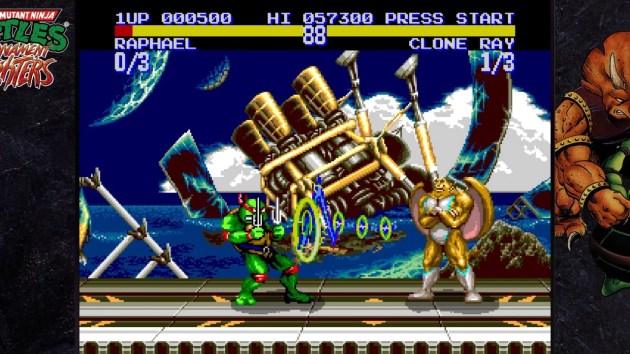
They all have such boring rosters. Oh, and the Genesis version (pictured here) is the only game in all of TMNT Cowabunga Collection that features Casey Jones. That’s an absolute travesty.
I don’t really have a ton to say about the three TMNT Tournament Fighter games. I’ll start by noting the Genesis game is basically unplayable. Of the three buttons they had available, one is used for taunting, which is just stupid. The fighting mechanics are extremely bland and even on the lowest setting, I couldn’t beat the enemy AI. It’s easily the worst game in Cowabunga Collection. If I gave a hypothetical “so bad that it occupies multiple spots in the rankings” for the Genesis version, Back from the Sewers on the Game Boy would be #12, then there would be five to six gaps and the Genesis Tournament Fighters would be #17 or #18. Absolutely abysmal. And you know that Digital Eclipse must have agreed. This is literally the only game in the entire collection that doesn’t have a section in the set’s built-in strategy guide.

It looks like Raph is kneeing Leo in his nardos here.
The NES game is actually better, but still not fun at all. It feels exactly like one of those modern “demakes” that you’ll see indie developers come up with as a cutesy novelty. You can only choose to use the Turtles in the one player mode, and once again, the AI is just too dang good. The big difference in this one is a dodgeball will occasionally be dropped onto the playfield for the players to use. The only nice thing I can say about the NES game is that I’d rather play it than Back from the Sewers on Game Boy.

I don’t understand the whole “Cyber Shredder” thing. That’s what he’s called in Radical Rescue too. Does he have online sex or something. Because I’d totally cyber with him. Damnit, I can change him!
Really, the SNES game is the only one of interest. Four button gameplay for heavy and light punches and kicks, so at least the action has substance and nuance to it besides button mashing. The OOMPH! is decent, there’s a nice variety of special moves, and the super move meter that penalizes usage of the block was ahead of its time and inspired. So, why didn’t I like it? Honestly, this felt to me like one of the more bland entries in SNK’s fighting game franchise. Besides Shredder and the Turtles, I didn’t recognize any of the characters, and the only fun character to play as is Shredder. The weird game show-like theme between stages threw me off, and frankly, I didn’t think the fighting was all that. It felt like they aimed for competent more than spectacular. I think a modern Turtles fighting game with cel-shaded graphics could be interesting, but for its time, this was just a wannabe Street Fighter that might have worked for kids in 1993 who recognized the characters. For a non-TMNT fan in 2022, this wasn’t for me.
Verdict: NO!, NO!, and NO!
Cowabunga Collection Rankings
SNES: #6 of 13 **BEST OF THE WORST**
NES: #11 of 13
Genesis: #13 of 13
A review copy for Teenage Mutant Ninja Turtles: The Cowabunga Collection was provided by Konami for this feature.





 Return of the Obra Dinn is Chick-Approved
 Return of the Obra Dinn was developed by Lucas Pope
 Vampire Savior: The Lord of Vampire
 Darkstalkers: The Night Warriors
 Street Fighter Alpha: Warriors’ Dreams
 Capcom Sports Club












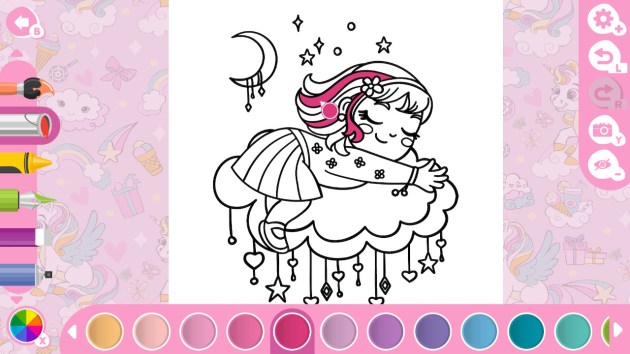


 My Cute Unicorns – Coloring Book was developed by Soroka Games

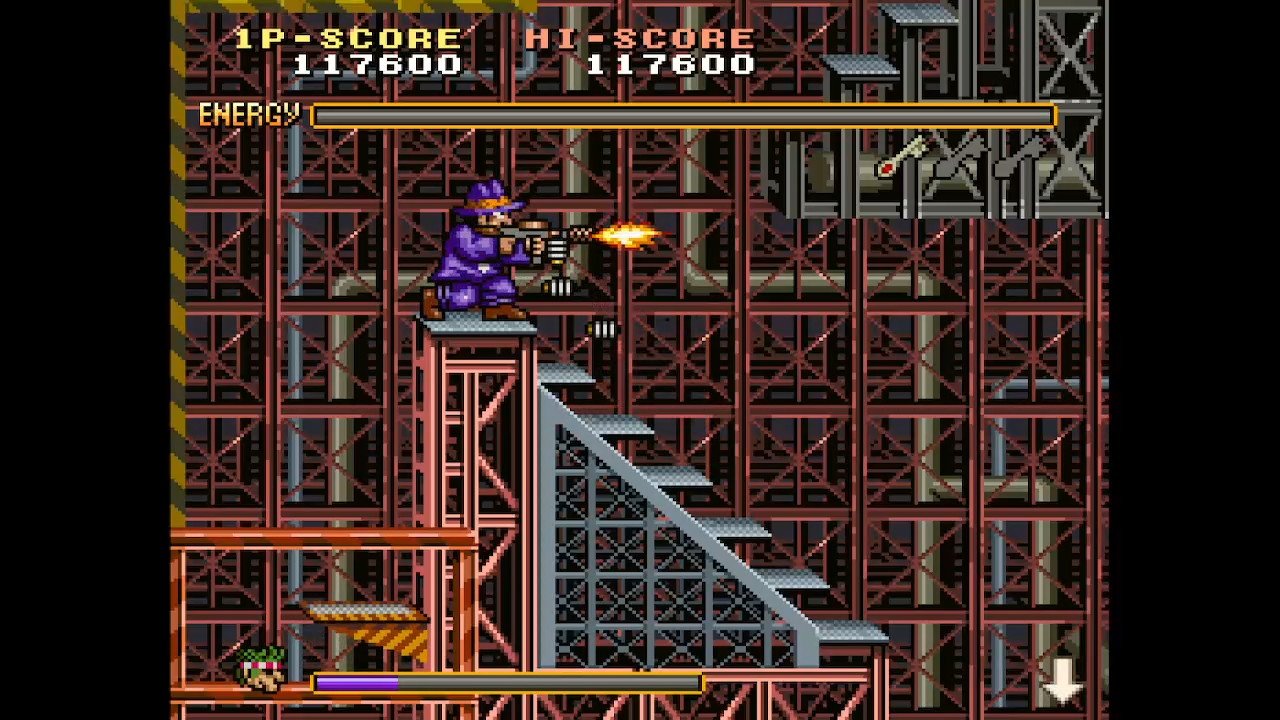


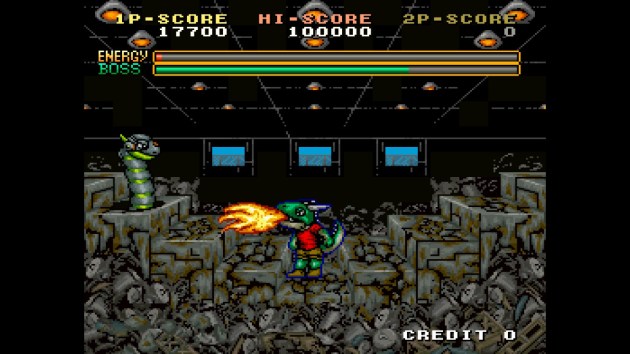

 Plus, Ratalaika Games (yes, the company that was going to do the Indie Gamer Chick Collection of XBLIG classics, which fell through because it just wasn’t going to be economically possible to scrunch that many games from that many developers together) has done a pretty good job packaging it. It costs $2 less than Hamster’s Arcade Archives releases and features save states and rewind, plus the US and Japanese ROMs. They even created an easier-to-use “home experience” if that’s the route you want to take, or you can play the unmodified arcade ROM, with dip switches and everything. Yea, I wish the Game Boy ROM had been included, but I’m still stoked Avenging Spirit has a place in modern gaming. Hell, maybe this will be a best seller and it can finally become a franchise with new releases. Wouldn’t that be sweet? Maybe they’ll even get the box art right this time. Sorry, I’m not letting that go. Putting that cover on this game is so stupid that it’d be like putting Alfred Molina on the cover of Raiders of the Lost Ark.







 Portal: Companion Collection was developed by Valve


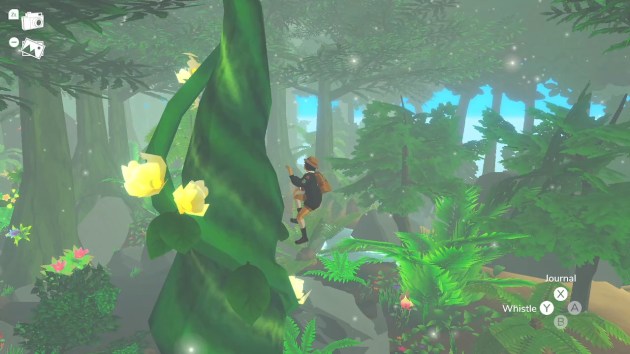
 Beasts of Maravilla Island was developed by Banana Bird Studios

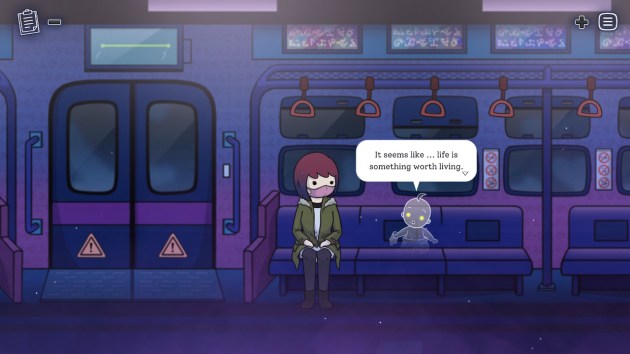
 What Comes After is not IGC Approved
 This isn’t going to come as an incredible shock to you, but Cuphead: The Delicious Last Course is worth $7.99. For that money, you get six new bosses, a King Dice style single-phase mini-boss, and five single-phase mini-bosses where your guns don’t work at all and you can only win via parrying. You also get new guns that are the most powerful in the game, new charms that actually made me move off the smoke dash for the final boss, a new character that comes with totally different skills than Cuphead or Mugman, and a secret item that, once you finish messing around with it, basically activates God Mode. It’s a lot of content for eight bucks. As much fun as I had.. and I had blast.. I’m still somehow a bit disappointed. For DLC that took almost five years to make, I guess I was hoping more. Maybe a couple new Run ‘n Gun stages. At least one, right? Nope. No new Run ‘n Gun stages. Maybe more than one new shmup stage? Nope, just one. The best.. and worst.. thing I can say about The Last Delicious Course (doesn’t that sound better than Delicious Last Course?) is that I wish Studio MDHR had spent the last five years just making a sequel, because the content we actually got is spectacular.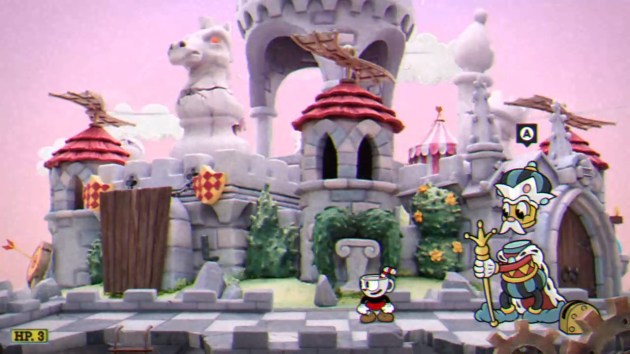
 I suspect they feel the same way and probably have buyer’s remorse that they announced DLC like four years ago. Maybe I’m wrong, but I get that vibe out of Cuphead D.L.C. All the heart from before is there. The bosses are creative (though the whole “you’ve never seen transformations like this” left me expecting much more grand set-pieces than what we got). Yet, after a certain point, I got the “we’re holding back a little” vibe out of it. But, at least you get a lot of value. Turning this $19.99 release into a $27.98 release basically gives you the easy mode-without-penalty everyone has wanted for five years now.
 After beating the DLC, I started a new file where I used only Ms. Chalice for everything I was allowed to use her on (only Cuphead/Mugman can do the Mausoleums). I figured I’d need about 200 lives to beat the entire game with her. I actually did it with only 98 lives. Why’s that? Well, Ms. Chalice gets one extra hit point. That’s huge. It can be even more than that with her Super Art II, which is a shield that doesn’t go away until you take a hit (well, unless the game glitches out, and this DLC is glitchy as all hell). She has a shorter standard jump, BUT, she also has a double jump. The double jump by itself nerfs multiple levels and bosses. In fact, multiple coins and challenges in the Run ‘n Gun stages are completely annihilated by just that double jump.
 The Delicious Last Course is glitchy as all hell. With the new charms and abilities that grant you extra life, I had planned on at long-last getting A+ scores on every boss. I worked hard to charge up the Cursed Relic into the Divine Relic and was all set to kick ass. Well, so much for that shit. My first match using the Divine Relic, the game said I scored a 0 in life, and like the careless manure farmer, I completely lost my shit. I replayed the level, did more or less as good, finished with three life again, and that time, it gave me credit for it. Huh? And that’s just one of many weird issues. During the very final boss of the DLC content, I used Ms. Chalice’s Super Art II for the extra shield. BUT, between phases, the shield stopped working. ONLY the animation for the shield was still there, as if it was working. But, it wasn’t. You can’t use Chalice’s Super Art II a second time until the first one breaks, yet, here it is.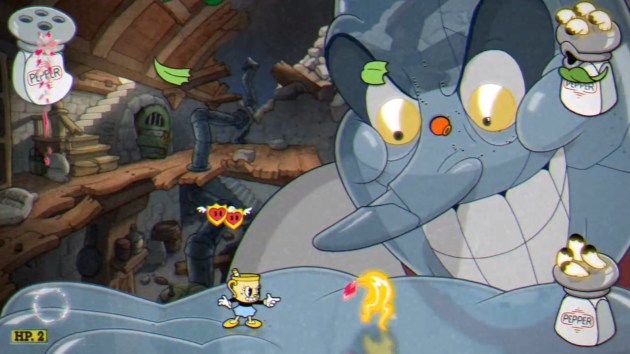
 The thing that royally frosts my ass about these glitches is Studio MDHR had five fucking years to get it right. FIVE! That’s over twice as long as the Dreamcast had in North America! That’s more than the entire lifespan of the Wii U. Think of all the games developed for those consoles, and remember this is just DLC.. a third of one game.. and yet I triggered these glitches on literally my very first attempt playing. So, these glitches, that myself and other players were constantly bumping into, somehow didn’t get noticed over a five year development cycle? Are you fucking shitting me? It’s so shameful. AND NO, I’m not advocating for crunch or angry that it took so long to come out. I’m angry that, even with all time, easy-to-trigger glitches were left in. Next time, Studio MDHR, hire people that suck and don’t tell them how to play the game. Just watch them play, and take notes.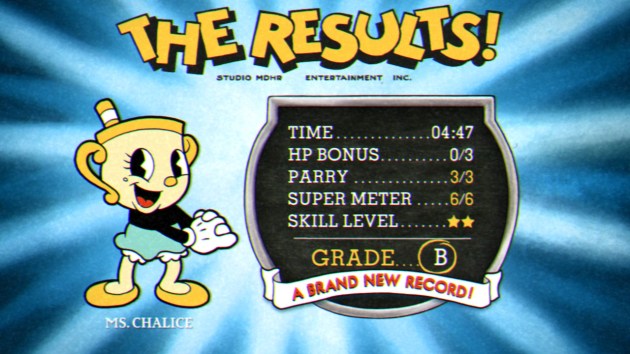
 What I figure must have happened was their play testers were just too good at Cuphead and didn’t take damage. The classic indie “I forgot that other people are going to play this and they will not have spent the last five years devoting their entire life to this and thus are likely to not play it as well” situation that I’ve seen over and over again for the last eleven years. Yea, games get glitchy, and yea, games get patches. But, these were not like some weird, obscure thing. They were right there, SO EASY to trigger, and yet in five years they never got found. It’s inexcusable.
 Assuming a Cuphead sequel ever hits, and they’ll probably need another decade at the rate they develop games, there’s a good chance I won’t be able to play it anymore. I have early onset Parkinson’s Disease, and on the table for me over the next decade, assuming I still have enough control over my fingers, is the loss of my reflexes. This could very well be my personal Cuphead finale. It’s been a long, strange, rambling journey. It was the announcement of this very DLC that made me realize that I never actually hated Cuphead. That I actually kind of loved it. Once I got over my anger at its snotty “git gud” attitude and the the fact that its studio is filled with douchebags who have no consideration for game accessibility, I realized that, when I beat Cuphead for the first time, it was one of the best times of my gaming life. And finally, the DLC is here.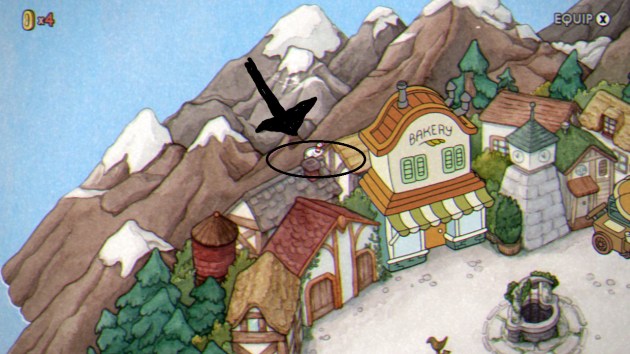

 The King of Games is what replaces the Run ‘n Gun Stages and especially the Mausoleums in Delicious Last Course. It’s a series of five boss battles where guns and charms don’t work (except Ms. Chalice’s charm) and you must parry to win. You can start the DLC here, if you wish (and you should since the coins are tied to these battles). The encounters happen between the full bosses.. maybe. Sometimes it lets you do more than one battle, or lets you even choose which battle you want to do, before kicking you off and disappearing for a while. This is also the only section of the DLC where content was cut from the game. There was to be a sixth battle featuring the King himself, and the code for this battle still exists within the game. While Studio MDHR annoys me with their shitty attitude towards accessibility and the fact that they released such a glitchy product even with five years to work on it, the one thing they have my full faith in is, if something gets cut, it got cut for a reason. I’m going to assume the King’s battle must have sucked, because the other five battles are pretty dang fun, even if some are super easy to beat.
 The battle against the pawns is the only part of the chess fights that doesn’t feel like a boss, which is fitting, I guess. They leap down at you, and you have to avoid making contact while hitting a parry on their head. Even the pieces you defeat will return to the top to continue jumping down, and if you miss one, you have to wait for the other seven to cycle through their leaps before you get another crack at it. All of the chess battles feel like they were made with Ms. Chalice’s parry dash specifically in mind. In fact, this is the only one of those battles I actually beat using Cuphead, and that was only because I was bound and determined to ONLY use him at first with the DLC, but I gave that shit up. When you play as Cuphead/Mugman, hitting a parry also means throwing yourself into the sky and exposing yourself to the pawns, but Chalice can hit her parries low to the ground. Studio MDHR should have gone to Hasbro and offered to have them sponsor Ms. Chalice, because she absolutely Nerfs™ these battles.
 FOOD FOR THOUGHT: While I mourn the loss of the Run ‘n Gun stages, I’ll be damned if the chess stages aren’t a fun idea and keep what should be a stale formula fresh. It really helps that this opening battle is surprisingly intense. The rate and angles that the pawns jump down at you made me have a few close calls, and I even had a “died on the last one” a couple times. Granted, once I realized the chess battles were made for the chick, I’m like 6 for 0 with Ms. Chalice in this battle, but still, a nice opening sequence. This is probably the weakest of the chess battles in terms of play value and it’s still pretty dang good. A lot more fun than any of the Mausoleum stages. Like, it’s not even close. Great idea this was.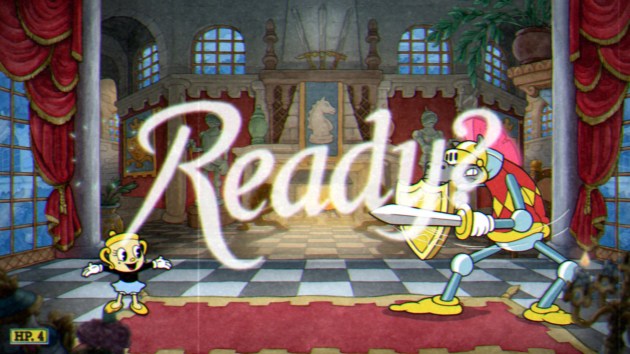
 By far.. BY FAR.. the chess piece that gave me the most trouble, the Knight is easily the deepest of the chess battles. First thing’s first: just use Chalice. The Knight battle feels like Nintendo’s Punch-Out!! franchise as a platformer, where counter-attacking is key, but most of those attacks are too high of a risk if you have to do the parry with an angled jump. The knight has three attacks that he telegraphs, and one that comes with no warning if you stand too far away for too long. Keep a medium distance. If he pokes his head out of his helmet, he’s going to do a big sweeping motion. If he kneels down low, he’s going to dart across the playfield. If he does an upper-cut, it’s a fake out. You can also score a hit when he taunts you, but it’s high risk. On the plus side, if you take damage, you have enough time to score two or three free hits before you stop blinking. You have to parry the pink plume to get him. Awesome battle!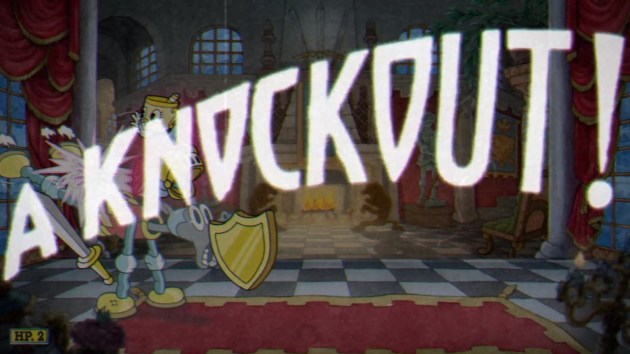
 Food For Thought: This is the last instance of “I wish this had been a full battle” I’ll have to deal with in a long time, but I’ll give credit to Studio MDHR: when they had a good single-phase concept, they ran with it. Most of the King Dice mini-bosses and all DLC the mini-bosses are really fun. Yea, I wish they’d been expanded into bigger rights (well, I could do without with the other Chess fights) but I’m happy we got what we got. Never pad anything out just because someone like me is going to bitch about it. Seriously. I know I’m sending mixed messages here, but excellent less is always better than uninspired more.
 The Bishop is a one-of-a-kind battle in Cuphead. While you do still have to directly attack him, the major mechanic of this fight is extinguishing the candles he lights. You just have to touch them instead of parrying them (surprised they didn’t work that out), and blowing them all out renders the Bishop vulnerable again. It’s a great idea, and it works. Maybe all this Cupheading has just made me awesome because I aced it on my first attempt. It wasn’t the only one I beat on my first attempt (I also totally lucked into beating the queen as well), but it’s not totally toothless as I died in my rematch with it the second time around. It’s a fight that’s tailor made for close encounters, and once I got over the shock of glorious victory, I have to admit, it’s quite fun.
 FOOD FOR THOUGHT: I don’t think Studio MDHR is lacking for good ideas. Each of the chess matches is memorable, and the creepy-ass Bishop is particularly memorable. You don’t expect to see religious iconography in games like this, but you really don’t expect it to be a boss, in a church setting, with crosses and everything around. I admire the guts of it. Just think: Nintendo would have demanded this be altered not even ten years ago. We’ve come far.
 While the Knight is probably the most well-rounded of all the chess matches, the Rook battle is my personal favorite. I love EVERYTHING about this fight. I love the character design. I love the heads. I love that he’s just ignoring you and sharpening his axe. I love the macabre vibe of it all. It’s also a satisfying battle. This is by far the most old school of all forty Cuphead bosses. Like someone took a spinning-plate/juggling-type LCD game (such as Nintendo’s Game & Watch Fire) and turned it into a boss fight. And it works wonderfully. This is as close to perfect as any mini-boss gets. Awesome death animation too.
 FOOD FOR THOUGHT: I’m not a game developer, but I’d think that there’s a lot of inspiration to be had from the Rook. It takes very old-school gameplay and makes it fresh and exciting in 2022. What makes it feel so epic is the sheer scope of it. Of course, it’s a bit of smoke and mirrors and not really that different from how old 8 bit games used to dress up the bosses to make them look larger. Unlike a lot of the larger-than-life Cuphead bosses, you can see the seams here. What you’re really fighting is just a wall that launches projectiles, and if you bounce the projectiles back at the wall, it counts as a hit. The Rook is just an animation happening in the background. But, it all comes together to make a fight that feels so much larger than it really is.
 Studio MDHR kind of sucks at mini-boss finales. Okay, that’s not totally fair. It’s not like the Queen here, or King Dice from the original build, are crappy to fight. They’re just underwhelming. Here, you have three cannons that sway back and forth, and you have to parry the fuses to shoot a cannon at the queen. She occasionally sends stacks of lions at you, but the real challenge is she has one of the hardest “make it rain” attack patterns in the game. Once you beat her, that’s it for the chess pieces. Beating the Bishop on my first try made me feel excellent. Here? I felt like I had lucked out. Like King Dice before her, I said “that’s it?” Well, there’s a boss rush for an achievement, but otherwise.. that’s it.
 FOOD FOR THOUGHT: Yea, they were out of ideas. Wait, wouldn’t it have made more sense for you to shoot cannonballs at the Rook, which is a castle? And wouldn’t it be more fitting as a tribute to the Queen of Hearts to have her send heads at you (“OFF WITH THEIR HEADS!”) that you have to bounce back at her? Now I’m wondering if I’m onto something. Granted, she wasn’t meant to be the final boss. You know, I pulled this out of my ass because these “Food for Thought” sections I pigeon-holed myself into doing can be tough to write after thirty-three bosses (and I’m writing this on my 33rd birthday. Meta!) but now I think I might be on to something. I’m pretty sure I’m not on something. Unless somebody put something in my water. Let’s not rule this out. Next!!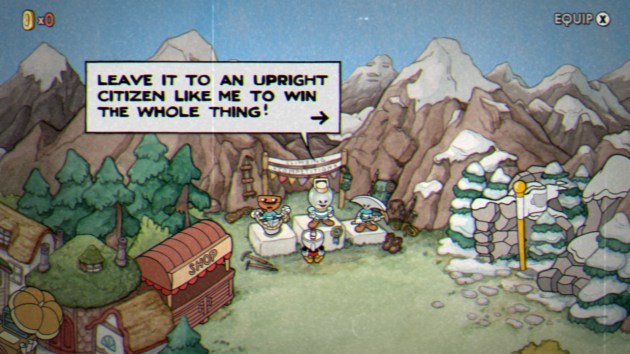
 What does this do? Well, you can buy an item called the “Broken Relic” from the DLC shop for one coin. Winning this fight.. and it’s no slouch, even for a mini-boss.. changes the Broken Relic into the “Cursed Relic” which is going to be a pain in the ass for you if you want to use it. If you equip it, you only get one hit point to beat bosses with, and it randomizes your guns. Every time you let go of the fire button, use an EX shot, or dash, your gun changes. It’s crazy hard at first, but, it slowly gains more power as you beat more bosses.
 Once you’ve beaten enough bosses (there’s a whole scoring system.
 IGC Dislikes: That I actually did this boss last, and also the achievement is a reference to Castlevania II, which means
  This is one of those “rub your belly and pat your head” bosses. I knew a guy who could do that while whistling, the freak. The idea here is, you will ALWAYS face the Demon, and if you turn around, the Demon and Angel will swap places. The Demon’s attacks will always hurt you. The Angel’s attacks will always pass harmlessly through you. It doesn’t sound very complicated, but holy crap, is this a balancing act. There’s also a platform that moves across the bottom that’s suspended by a lightning bolt that causes damage. Being an idiot, I didn’t notice the lightning bolt and thought the bottom caused damage depending on how you were facing. Once you get used to this, it’s fairly simple. I didn’t get used to it and only won by equipping the heart ring and parrying extra hearts and barely squeaking out wins. Awesome fight though. Fun fact: the Angel & Demon are, along with Goopy from Inkwell I, the only bosses that don’t attack you with minions.

 Glumstone is basically the icon of Cuphead’s DLC. He was part of a graphic novel released in 2020, and is even featured in
  PHASE ONE – VAPE MOUNTAINS (HEALTHIER ALTERNATIVE TO THE SMOKEY MOUNTAINS): Glumstone’s opening stage takes place on a series of platforms that move up and down, sometimes into the path of geese. You also have to watch out for gnomes that spit fireballs at you or climb up the platforms. The base is covered in spikes too, so stick to the platforms. Occasionally, he’ll also grab a bear and just bring it across the playfield, like the shark in Brineybeard’s fight, only it’s slower and a lot easier to dodge. Glumstone’s primary attack is opening his mouth and blowing clouds at you. If you’re not in close range, only Chalice will be able to reach all of them, as neither Cuphead nor Mugman can jump high enough to reach all of them. It’s a fun phase but easy compared to what’s coming next.
 PHASE TWO – HANDBALL: See, even giants play with themselves using hand puppets. Wait, I didn’t mean it like that. I mean they play with their balls. NO, STOP! I mean they toss their balls back and forth. I mean with puppets. I mean, with their hands. Oh Christ, this is coming out all wrong. What I’m trying to say is the giant bats its ball back and forth while you watch for bulges underneath you. I mean little men coming at you while a bigger guy keeps tossing to himself. It’s a phase and it’s really hard. I mean to beat.
 PHASE THREE – IT’S NOT A TUMOR!!: I guess it’s supposed to be an ulcer but it looks more like cancer to me. Maybe if you just wait Glumstone out long enough he’ll die of natural causes. It’s a nice idea, since there’s like a million cartoons that do this gag, but it’s kind of underwhelming as a finale because it goes from feeling epic in scale to kind of small. But, the Pitfall! tribute is nice, and the difficulty balance is spot on. It’s clear why Glumstone got the lion’s share of pre-release hype. It’s the best of the bosses, besides Chef Saltbaker himself. In short: fun boss. Kind of a meh ending.
 FOOD FOR THOUGHT: Glumstone was one of those “on the drawing board a long time” bosses that makes Cuphead work so well. The magic of the art style is there’s dozens of cartoons that use a gigantic character, and Glumstone looks like all of them while somehow also looking like none of them. The ability to borrow liberally from this era and come very close without directly copying any character make for a wonderful resource and it’s awesome someone did such a good job of paying homage to it all.
 Featuring not just one but two deleted concepts from the original build, the Moonshine Mob was the first boss I fought when I started up the DLC. Yet, it feels like a fight that could have been part of the base game, right up until a delightful (and for some, infuriating) twist at the end of the third phase. Bootlegger Boogie is the ideal DLC experience: it feels like it could have been there all along, yet it twists your expectations ever so slightly.
 PHASE ONE – SPIDER MOBSTER: This is one of the deleted ideas.. kind of. Originally there was a shmup level where you fought the “
 ♥Coppers using bug spray will occasionally walk out and shoot at you, some of which can be parried, though the angles to score one are quite tough.
 PHASE TWO – LIGHT BUG: The Light Bug is one of the earliest concepts for a stand-alone boss that didn’t happen. The attack pattern is, more or less, the same as it was as a prototype. The Light Bug dances back and forth on the second plane while six beams of “sound waves” circle around you. There’s a warning of when one set of three is going to change into an attack. Green is safe, yellow means “shit’s about to go down, yo” and red is dangerous. The attacks only happen briefly and once you get the hang of it, avoiding the attack is easy (and if you do it right, the Light Bug herself won’t be close to you when you switch between levels).
 This is where the crackshot becomes very valuable, as you don’t need to take aim and can focus on avoiding the beams. For the musically inclined, you can also use the music as a cue for when the attack will happen. There’s also cops and moonshine barrels running back and forth this whole time, and some of the barrels can be parried. I think I only scored one parry off a barrel the entire time. But, another fun phase!
 PHASE THREE – ANTEATER: Probably the most visually striking of all the DLC bosses, the Anteater’s arrival feels so damn epic. It’s a shame the actual battle becomes quite tedious. You get a chance to score some early damage on the real final boss at the start of the battle, but then the Anteater makes his move. He’s only vulnerable from his tongue. Ms. Chalice’s parry dash is almost worthless here, as the Anteater will take turns doing three to five trusts with his mouth on one side of the level, eventually sticking his tongue out across the screen. The tongue can be parried, and if you have the whetstone equipped, this battle goes a lot faster. In theory, you can time it with Ms. Chalice, but I never could.
 Eventually, he’ll retract his tongue and unleash a brawl between a cop and a hoodlum that bounces around the screen like the caterpillar from earlier, only it takes A LOT more bullets to kill. He’ll then switch to the other side and repeat the same attack. After two hours, give or take, he’ll finally die. This would be a fun phase, only it takes FOREVER to finally score the knockout. Only, it’s NOT the knockout.
 PHASE FOUR – SUDDENLY SNAIL: A banner drops down and the Snail declares KNOCKOUT sounding like Edward G. Robinson. The Anteater collapses and the final phase begins with the Snail shooting relatively quickly at you, though many of his shots can be parried. This is the fastest phase in all of Cuphead, and when the Snail dies after just a few shots, the real announcer clears his throat before declaring KNOCKOUT in a nice touch.
 FOOD FOR THOUGHT: I think this is pretty much it for the deleted content that got reworked into the game. It’s nice that they found a place for the “
 Oh, I get it.. they’re dogs in a dog fight. As in airplanes. They’re not owned by Michael Vick. Right before I finally started to type this section of the review, I was informed there’s a secret phase. I spent the next four hours trying to get it, gave up, and had a tantrum. Then, a friend’s kid told me “use the Lobber” and I got it on my first try. Grumble. After all that effort, the DLC’s lone secret phase wasn’t remotely worth the effort. What a waste of time. Stick to the main path, where an otherwise generic theme becomes an unforgettable encounter.
 PHASE ONE – UNLEASH THE DOGS OF WAR: Hughes Canteen, the NPC that taught you about the airplane in Inkwell I, is your pilot. You stand on a plane that will go left and right depending on how close to each edge you stand. It’s actually very intuitive. There’s an alternate control scheme just for this level, but stick to the default because it works wonderfully. Using this setup, a bulldog pilot will fire slow-moving heat-seeking fire hydrants at you while other dogs rain tennis balls down on you. Occasionally, the bulldog will bail to either shoot you with giant yarn balls or throw boomerang bones at you, some of which can be parried. A nice little phase, though keeping up with the tennis balls is a pain in the butt, and sometimes the timing of them and the yarn attack conspire to screw you.
 PHASE TWO – YANKEE YIPPERS: Four dogs circle around you and throw letters at you, many of which can be parried. If you take your time before picking them off, you can easily charge your cards up during this phase. The dogs don’t take many hits at all, and the crackshot is especially useful here. This whole phase is over and done with in a matter of moments and you move on to the ultra-memorable finale. That is, unless you want to open the secret phase and ruin the best part of this entire boss.
 PHASE THREE – SHINOOK PILOT SALUKI: One of the best phases of Delicious Last Course, the battle against the Persian Greyhound (clearly the snootiest of all dogs) is truly a spectacle. It starts with mad scentists type of lasers that reminds me of something that would be used to fight Mighty Mouse. After a couple shots of that, the screen will rotate 90 degrees, and the controls along with it, and the Saluki will drop dog dishes on you that you have to jump over. The screen will go upside down after that. Once you get the hang of it, it’s actually a fairly simple battle, and it can even end by shooting the lasers and not the dog itself. It’s not much of a boss, but the gravity effects stand out and turn the mundane into something special. Of course, you can shirk all that and do the pathetic secret phase.
 DOG FOOD FOR THOUGHT: Like the Rook battle, The Howling Aces take bland, basic attacks and make them exciting by adding unique ways of tackling them. The airplane following your movement works, and I’m a sucker for gravity effects in games. If not for those things, this would be a very boring boss, as the secret phase proves. I’m not in love with the theme, and honestly, I kind of wish what they had done was merged the shump and platform sections. That’s the one thing Cuphead hasn’t done yet with its own formula. It’s probably impossible due to how it loads, but it’s all that’s left.
 Of the six DLC bosses, Mortimer feels the most like he belonged in the original game. He’s also probably the most middle-of-the-road of the five non-shmup bosses. It’s not a bad fight by any means, and it has some wonderful sight gags, but this is also the battle that I found to be the dullest. Get ready for some temperature based puns that would make the writers of Batman & Robin blush with shame.
 PHASE ONE – CHRIST, WHAT AN ICEHOLE: Mortimer has three ways of attacking. Apparently he’s a flasher, as his most common method of attack is opening his cloak to unleash tiny little ice monsters that spike themselves into the ground before coming to life and giving chase. It’s really tough to judge their trajectory while in flight, but once they land they’re easy enough to take out. He’ll usually then just slam a giant whale into the ground. If it hits the ice monsters, it’ll knock them out of the game in an adorably hilarious gag. Finally, he’ll shoot cards at you, which can sometimes be parried. Dull phase, really.
 PHASE TWO – SNOW MORE MR. ICE GUY: One of the hardest middle phases in the entire game, the Snow Monster is fast, aggressive, and specializes in crowding you in. He has a wide range of attacks, and between those he might turn into a snowball and roll or leap back and forth across the screen. If the obstacles from his previous attack are still active, it’ll be difficult to dodge. He’ll also slam the ground and cause ice blades to poke up from the ground.
 By far his most common attack is turning into a fridge and shooting ice cubes at you. When the cubes land, they break into smaller cubes. If the starting cube is large, it’ll have two break sequences. They’re easy enough dodge, but it’s when he quickly transitions to the rolling attack that this phase becomes a pain in the butt. He’ll also close the fridge attack by launching evil popcicles at you, some of which can be parried. When you do enough damage, a series of platforms appears that takes you to the finale. The Snow Monster took me longer to complete than almost any second phase and probably should have been the last phase.
 PHASE THREE – OKAY, SNOWFLAKE: After climbing up the platforms, you reach a rotating set of five platforms for the final form of Mortimer. The giant snowflake finale has an attack that never once hit me. He shoots out.. like.. a ghost that circles around the outside. I don’t even know if it can damage you or if it’s just a few seconds of getting free attacks. His other attacks are more dangerous. He’ll launch buckets at you, some of which can be parried. After they hit the wall, the buckets turn into three moons that you have to dodge. He’ll also shoot ice cream cones from four directions at once, or launch his eyeball at you. The eyeball has beams that you must also avoid. A decent finale to an otherwise ho-hum battle.
 FOOD FOR THOUGHT: Mortimer is the only of the four traditional bosses that feels like he could only belong in Inkwell III. The other three would fit in more as Inkwell II battles, with Moonshine Mob being on the fringe only because of the Anteater section’s sponge. There’s something about this particular fight that feels climatic or end gamish. Then again, a lot of people insist to me that I’m crazy for thinking Brineybeard belongs in Inkwell I so take that with a grain of salt.
 I’m so disappointed that there’s only one shmup section in the DLC. I want an all-shmup Cuphead sequel more than I want to live into my 80s. While Esther isn’t among the best of the shmup encounters in the game, she’s still a ton of fun to do battle with. Fun fact: this was the boss that I needed the most lives and time to defeat in the DLC, and by a wide margin.
 PHASE ONE – REAL C.O.W. GIRL OF SHMUP MESA: In the first phase, you have to switch between and upper and lower area. Esther’s primary method of defeating you is by having one of the most visually busy sections of the game. She fires oil out of guns that crosses halfway across the screen before doubling back and coming back at you as snakes (wait, I get it.. snake oil! See, I thought it was ink). Her only other direct attack is to lasso a cactus that will block the entire channel she’s on.
 The real challenge comes from vultures that drop dynamite into the playfield. The dynamite explodes into five separate explosions of three, then two (four and then three on Expert). AND while all that’s happening, a horse will fly across the screen and spit cactus balls at you, some of which can be parried. You can shoot the horses down, but you give up parry chances. There’s just a ton of stuff to keep track of here and it becomes overwhelming.
 PHASE TWO – HEY NOW, THAT’S NOT THE CODE OF THE WEST: In a sort of opposite of one of Djimmi’s attacks, Esther pulls out a vacuum and beings sucking loot up, and you along with it. After dodging all the debris, she’ll then bend over and launch safes onto the playfield. When the safes hit the ground, they explode into the loot she previously collected, some of which can now be parried. It’s a basic dodging type of stage that goes quickly, and once you defeat it, this wholesome boss suddenly takes a turn at the corner of Dark and Macabre.
 PHASE THREE – 😶 : The cow gets sucked into the pressure cooker and turned into hot dogs.
 PHASE FOUR – A REAL SAUSAGE FEST: The final shmup phase of Cuphead has you now fighting an entire can of hot dogs (do hotdogs come in tins like that?) with two giant arms extending from it. The arms scissor back and forth, but there’s safe spots where no dog is that you can pass safely through. While this is going on, the can shoots waves of chili peppers at you, one of which can always be parried. Resist the temptation to chase one down if it’s not in front of you and focus on dodging the arms. It’s pretty spongy but a wonderful ending to my surprise favorite type of Cuphead levels.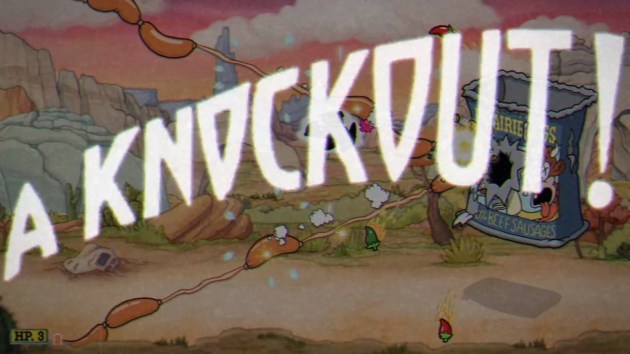

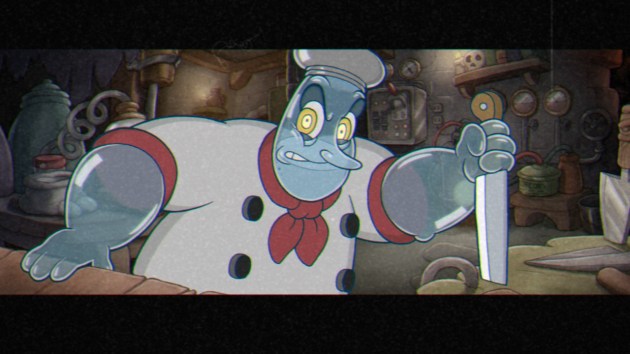
 In what is the least shocking twist ever, Chef Saltbaker was a bad guy all along, and the battle against him is so mean spirited and evil that the smile never left my face. This, ladies and gentlemen, is one of the most memorable last bosses in gaming history. Well, except that it gets easier as it goes along. Seriously, the first phase is a frantic dodge-a-thon, but while the visuals remain striking throughout, the actual battle gets kind cinchy.
 PHASE ONE – CASUAL CRUELTY: All the items are you’ve gathered from defeating the five primary DLC bosses? Yea, the Chef murders them in cold blood with a smile on his face. It’s violent and gruesome and FUCKING AWESOME! Like all professional chefs, this guy is just 100% pure evil. He has four attacks: shooting limes that hover over you, sugar cubes that bounce at you (some of which can be parried), cookies that bounce at you, and strawberries that rain down upon you. None of them are hard to dodge on their own, but the attacks can and do stack. And, while this happens, there’s a fire that jumps from the floor to the ceiling and is super easy to lose track of. One of the most intense and brutal phases in the game.
 PHASE TWO – SALTED NUKES: Yea, this is the most visually awesome sequence in the entire game. It’s so awesome. Here, you shoot four pepper shakers that crash into Chef Saltbaker and progressively crack him. The pepper shakers shoot projectiles, some of which can be parried, and leafs rain down from the ceiling from time to time. The fire from the previous stage is back as well. I highly recommend the crackshot for this battle. When you’ve done enough damage, you’ve earned a break with one of the easiest and quickest phases in any boss fight.
 PHASE THREE – WHAT SLUGS HAVE NIGHTMARES OF: This phase seriously lasts like ten seconds, if that. Two salt things that look kind of like the Stay Puff Marshmallow Man dance up and down. It’s an easy pattern that you can dash under. There’s a saw blade on the ground too but, yea, this is a layup and a break between the real finale of Cuphead. Take a breather, plug these guys with a couple shots, and move on.
 PHASE FOUR – TOO MUCH SALT IS KNOWN TO CAUSE HEART ATTACKS: This is it! After beating the salt dancers, the floor starts to break apart and two lethal-to-the-touch columns of salt spring up. Most importantly, a series of platforms start to appear. If you don’t have Ms. Chalice’s double jump, this section is so much harder. After a few seconds of jumping from platform to platform, the Chef’s heart will appear. You have to shoot it, and apparently it can be parried too though it doesn’t seem necessary to killing it. It’s a bit of a letdown for a finale, especially with how epic those first two phases were. But, that’s it. Unless there’s even more surprise DLC or a sequel coming, this was the final phase of Cuphead.

 To all my readers, thanks for the support over the last eleven years.
 Everyone at Indie Gamer Team, you’re all my friends and I love you so much.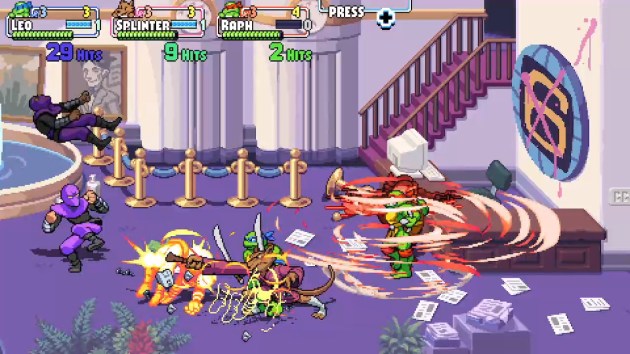


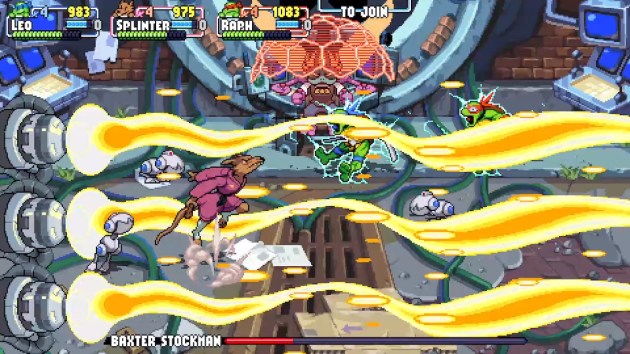
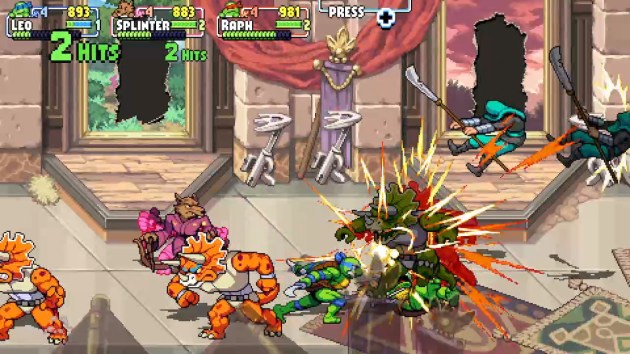
 Teenage Mutant Ninja Turtles: Shredder’s Revenge is Chick-Approved
 Teenage Mutant Ninja Turtles: Shredder’s Revenge was developed by Tribute Games
 Indie Gamer Chick
You must be logged in to post a comment.