The Simpsons Video Games: The Definitive Review Part One – The Five Simpsons Games of 1991 for Arcades, DOS, NES, Game Boy, Sega Master System, Sega Genesis, & Sega Game Gear
June 2, 2024 6 Comments

Simpsons Arcade for the.. NES. Yes, really. Oddly, it’s not a ROM hack of Ninja Turtles II, like you’d expect. It’s a “demake” completely built from scratch by NESRocks, the genius behind multiple of the best NES ROM Hacks, including IGC-Approved Goonies II: Revised. Simpsons Arcade NES is not close to ready yet, but if you want to support this project, he has a Patreon. He’s worth it. He really is one of the best makers of games in the world.
Ah, the Simpsons. I’ve never known a world where it doesn’t put out twenty new episodes a year. Its debut episode, Simpsons Roasting on An Open Fire, aired only 159 days after I was born. By the time I was 7 years old, the controversy about a crudely drawn cartoon family that cussed and fought and acted like fools had died down and the Simpsons was a bonafide institution. One so ingrained in pop culture that I don’t have a first memory of it. It’s practically been omnipresent in my lifetime, like how almost no child can cite any specific first memory of Sesame Street, Jeopardy, or the evening news. Bart Simpson saying “damn” wasn’t that big a deal and the show was now much more centered around the adventures of “Captain Wacky” Homer. In a post-Cosby Show world, they were America’s first family, animated or otherwise. It was hard to imagine why they were even controversial in the first place. After all, the Simpsons were the only family on television that went to church every Sunday. Lisa Simpson reminded us that intelligence is a virtue, and Bart almost always aspired to his better angels in the end, something many of the stuffed-shirts criticizing it didn’t do. That’s probably why it’s still chugging along nearly thirty-five years later. While the franchise has seen better days, there’s near universal consensus that the first seven or so seasons have no peer. In fact, there’s really only one aspect of the Simpsons’ early existence that most people agree wasn’t successful: its video game presence.
By my count, there’s sixteen Simpsons video games for classic gaming platforms, which for the purposes of my retro review exploits, covers Atari through SNES, with an exception made for Game Boy Color and Advance that are basically handheld versions of the NES and SNES anyway. So, no Simpsons Wrestling, and no Hit & Run. Of these sixteen games, only one is universally regarded as being good: the coin-op. I’ve already reviewed it once, but it’s been over twelve years, so I gave it a clean slate and a second chance. In fact, all sixteen games are getting that same clean slate. I’ve never attempted to play any of these games all the way through to the end (except the coin-op). Is the Simpsons really one of gaming’s worst licensed franchises? Let’s find out, starting with the first batch of releases when the Simpsons were still brand new to television. Believe it or not, each of these games came out in 1991, with one obvious exception that I had to include for reasons you’ll see.
GAME REVIEWS
For those not familiar with my way of thinking of how retro games should be reviewed, I take NO historical context into account. I don’t care how important a game was to the industry, because that doesn’t make a game worth playing today. The test of time is the cruelest test of all, but every video game must face it. I might not be here if not for Pong’s success, but I wouldn’t want to play it today. Not when there’s better options. Therefore, when I review retro games, every game gets either a YES! or a NO!
YES! means the game is still fun and has actual gameplay value when played today and is worth seeking out.
NO! means the game didn’t age gracefully and is not worth seeking out, and certainly not worth spending money on.
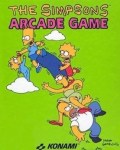 The Simpsons
Platform: Arcade
Released March 4, 1991
Directed by Kengo Nakamura
Developed by Konami
Included in Arcade1Up’s Simpsons Cabinet
DELISTED ON PSN/XBOX DECEMBER 20, 2013
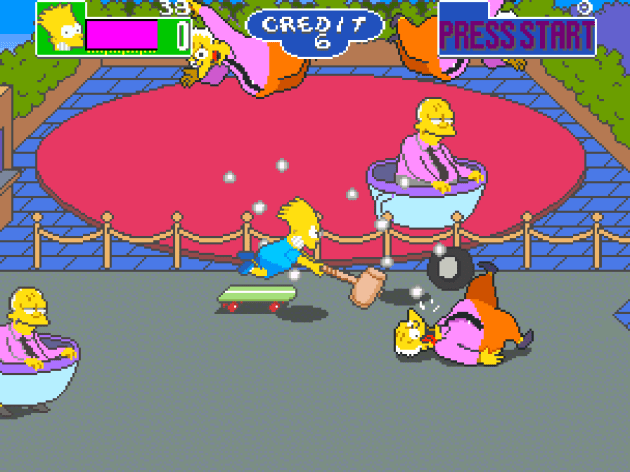
After replaying the coin-op I was certain I would lose 99% of the readers with this one. Thankfully, I checked Cutting Room Floor, found out the Japanese version was different, and booted it up. So stick around.
Nobody wants to be the one person who isn’t a fan of a famous game. Despite what people think, it’s actually not good for clicks. Given the fact that I worked really hard on this feature, I wasn’t looking forward to starting it off with a review certain to drive people away. I really did give a good faith effort to find the fun in Konami’s famous Simpsons beat-em-up. Besides, it’s been over twelve years since I reviewed it. I’ve changed my mind on a few games I didn’t like in my overzealous youth, so I figured, hey, maybe I’ll change my mind on this. Except, it hasn’t been twelve years since I played this. Actually, I played it with my family on our MAME cabinet less than a year ago. The kids enjoyed it, but most of my amusement came from them saying the same types of things I said when I first reviewed it. “Bart’s shirt is the wrong color! Sideshow Bob is a helper! Nothing looks quite right!” The biggest problem with the Simpsons Arcade Game is that it came out so early in the show’s life. They had very little to go on, and I couldn’t get into it. Well, it turns out, I was playing the wrong ROM. But, before I get to that, let’s talk about the “international” version. That’s the one us yankees got.

Mind you, they had no idea Treehouse of Horror was a thing when they did this.
I’m going to assume that a lot of these early Simpsons games were victims of studios rushing games through development under the assumption that the Simpsons craze was a fad that could end at any moment and they had to strike while the iron is hot. Hah. Can you imagine the show making it another 35 years on the air? Don’t be ridiculous. That’s why the arcade game shocks me. It should feel thin compared to the modern Simpsons, but it doesn’t. Instead, it features strong set pieces that feel true to the show, and a relatively decent variety of baddies that, while generic, feel like they COULD be characters. My problem has always been that the combat just isn’t that exciting. Besides the boss battles, Simpsons can be a repetitive slog to get through. The striking moves lack that satisfying rhythm to them that I feel carried the first Teenage Mutant Ninja Turtles arcade game over the finish line. I’m sure it can’t be easy to get that sensation right. Even Konami messed up the sequel to Ninja Turtles badly. At least in arcades, Turtles in Time lacked that graceful OOMPHfulness to the attacks. The Super NES port did better, but in arcades, the satisfaction of the first game’s combat was just gone, with no reasonable explanation of why. That has nothing to do with the Simpsons, but I thought about that horrible Turtles in Time coin-op a lot while playing this. Again, that oh so satisfying cadence to the button mashing must be harder to achieve than it seems.

I think the presentation is a big part of why the Simpsons is beloved. It was probably the first video game many people played that looked almost EXACTLY like the cartoon they watched. Even more than Ninja Turtles. And it IS a gorgeous game. Top notch, especially for this era. I just wish it was as fun to play as it is to look at.
SPLIT DECISION – US/INTERNATIONAL ROM
Sadly, I’d put the arcade Simpsons in the same boat as the arcade Turtles in Time. Combat lacks that sense of almost dance-like fluidity of the first Ninja Turtles game. Simpsons is a lot rougher, with no real flow to the combat. I know that fans will probably say “that’s the joke! They’re the Simpsons, not turtles that spent a lifetime studying ninja sh*t!” True as that might be, the joke is going to stop being funny long before the credits roll. To Konami’s credit, they included a lot of throwable scenery and even a few weapons. Yea, it’s funny that you can pick up Santa’s Little Helper and throw him like a lawn dart at enemies. But, by the midpoint of the game, I found the baddies tended to interrupt my attempt to use the background stuff. Even when I played with the kids this last Christmas season, I would guess two-thirds of the throwable items were lost during the act of picking them up. Well, it turns out, if I had played the Japanese version, a lot of my complaints would have been addressed. So let’s make it interesting and say VERDICT: NO! to the American version of The Simpsons Arcade. But, this review isn’t over.

Actually, I found out that The Simpsons was much closer to the YES! than most games that I give NO! to. It just needed the combat to be a little more seamless. And that happened.
SPLIT DECISION – JAPANESE ROM
The Japanese build of the Simpsons released five months after the US version, and man, did they make the most of that time. Cutting Room Floor has the details, but in short, the difficulty is toned down. I guess that explains why I just cut a blistering pace through the game. You can literally feel the difference, as even playing solo, the slog was almost non existent. Given the fact that I’d just played through the Simpsons Arcade not even three hours earlier and spent most of that play session being fairly unhappy, this should have been pure agony for me. It wasn’t at all. Part of me wonders if there’s more to it than the stuff Cutting Room Floor mentions. The combat felt a lot smoother, like my attacks had more weight and inertia to them. I can’t help but wonder if the faintest hint of tinkering to Simpsons’ collision detection happened. I just re-replayed the US version, and it was the same “this ain’t doing it for me” feeling, but the Japanese version felt fine. Maybe it’s the placebo effect, or maybe it’s a little more post-release polish working its magic. Either way, this go around, with enemies dying faster and the bosses 100% for certain having less invincible moments, I’m willing to say that Simpsons is alright.
With the faster pace, I was able to appreciate all the things Simpsons got right. I know I said this already, but for a game that was rushed through development, it sure has some wonderful set pieces. The first level looks exactly like the TV show, and the dream sequence is so bonkers that I kind of wish they’d done something like that for the whole game. As for the boss fights, they’re easily the highlight of the whole experience. Especially if you play the Japanese ROM, where they’re just more fair and more open to finesse and strategy. And thank god for it. I went from barely not liking the Simpsons to barely be fine with it. It turns out that it’s not a bad little brawler at all.
Even though I’m flipping my verdict, I do still think this game is crazy overrated. It’s fine, but one of the best games ever? I imagine this is one of those “you had to be there” situations that I literally cannot recreate. At the same time, I can’t believe we’ve gone thirty-three years without a sequel. There was a terrible mobile remake, but that doesn’t count. Imagine if something like Shredder’s Revenge, only the Simpsons, was released today. It’d be a license to print trillion dollar bills. If a Simpsons Collection comes out that’s based mostly around the Acclaim games, and that hypothetical compilation doesn’t include Simpsons: Hit & Run or the 2007 EA game, whoever has the Acclaim library needs to get Konami to the negotiating table and work things out. I might not be in love with the Simpsons coin-op, but a collection of Simpsons games probably needs it to anchor the set. Three decades later, and the first Simpsons video game is still everyone’s favorite. Except me, apparently.
The Simpsons – Japanese ROM Verdict: YES!
 The Simpsons Arcade Game
Platform: DOS
Released in 1991
Developed by Konami
NEVER BEEN RE-RELEASED

Look at that face. Homer Simpson, on PCP, begins his rampage.
When I played Teenage Mutant Ninja Turtles II: The Arcade Game on the NES, I heard from many older readers who said they were SO EXCITED that the NES was getting a port of the coin-op. It didn’t matter at all that the final product barely resembled the arcade game they loved so much. They were happy and content with the end result. By the time the Simpsons coin-op came around, what gamers wanted more than they wanted to live to see fifty was a home port of the Simpsons Arcade Game. But, apparently Acclaim and Konami couldn’t come to terms on a home port. I mean, it HAD to be discussed, right? Ports to the SNES and Genesis would have been a license to print money. Without question they would have been more successful than Bart’s Nightmare or Virtual Bart. But, the only home ports were to home computers. Those were the only rights Konami held. I did briefly try the Commodore 64 version of Simpsons, and..
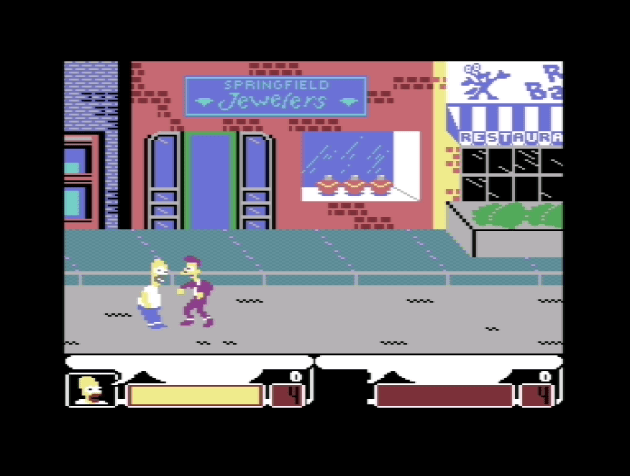
I couldn’t get the controller working anyway, but come on! I have sixteen games to play!
I stuck with the DOS version, even after it locked on me. A lock that I actually figured out the source for. Right before the boss fight with the bear on level five, after the battle with the lumberjacks, the game simply refused to continue. Homer’s jumping became much higher and now also included his “level beaten” dance animation. I was stuck, the boss wouldn’t load, and the game was over. I almost quit, but I’m sure there’s interest in this review so, screw it! I started over and chose Bart this time. I was also much more conservative with save states, and that helped me figure it out. What happened? Apparently I had scrolled past enemies that hadn’t yet been defeated, erasing them from the active game, but without giving me credit for having beaten them. Since you can’t scroll backwards, and since those enemies were no longer loaded into the game, the very next segment, the battle with the bear, didn’t load. I’m not sure why Homer’s celebration loaded into the game, but either way, I couldn’t rewind far enough back to undo it. Since I’d saved states after the enemy vanishing act, there was no possibility of unlocking the game. The second time around, I was able to deliberately lock myself, and actually, it’s stupid easy to do it. I imagine many players triggered it, especially since the final enemy of the waterfall area that caused the lock spawns much later than others. Despite the convincing graphics, you can tell Simpsons Arcade DOS is rushed and largely unpolished.
I’ll give this to the DOS version: it looks the part. Simpsons Arcade is one of the most visually impressive coin-op ports gaming had seen up to this point. If you were a fan of the arcade original and had a quality home computer in 1991, I imagine seeing screenshots of this made it a no-brainer of a purchase. It’s not a perfect one-to-one conversion, but it’s better than anything 8-bit consoles of the era were pushing out. Not to mention that 16-bit gaming had really just started, now that the Genesis was picking-up steam and the SNES was set to launch. Simpsons DOS had to look the part, or else it would look old fashioned and outdated as soon as the SNES hit stores. Konami, developers of this port, knew Turtles in Time was coming to the SNES and would set a new home arcade standard. Actually, given the fact that there was no Simpsons console port at all, I imagine there had to be people who bought a DOS computer just to play this. Even the cut scenes are there and, despite being compressed for a floppy disk, they look good. Well, except for the fact that the scene after the bear boss has coloration that makes it look like the Simpsons celebrated Whacking Day a little too hard. I swear to God, I didn’t doctor this photo.
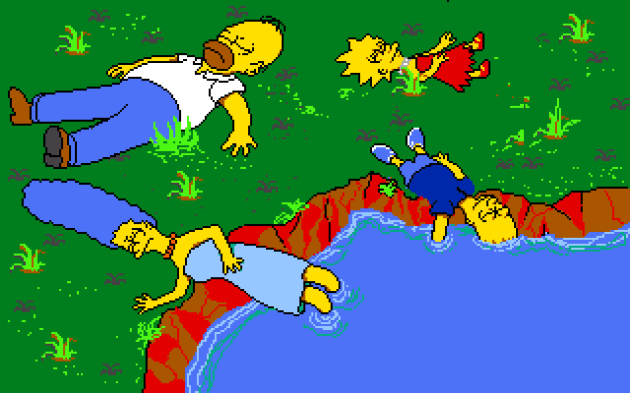
😶 Jesus Christ!! JESUS CHRIST!!!! IT LOOKS LIKE THEY’VE BEEN MASSACRED!
Unfortunate coloration aside, pretty much everything from the original is here. In fact, only one major set-piece is missing from the game: the elevator portion of level three, following the graveyard scene. Interestingly, the level ends when you jump into the hidden entrance in the graveyard, instead of having you fight the big and little goon boss. Instead, that boss OPENS level four, Moe’s Tavern. The stage then continues until you fight the barfly thug. So, even though the lead-up to the fight with the twin goons is gone, they left in the boss itself. I kind of admire that. The effort was there. All the weapons are here. The hammer? The slingshot? The mop? Yep. The fight with the robot mini-boss at the news station? It’s here. The letters M-A-G-G-I-E-! in the dream sequence, and the headless power plant workers? Yep, and now, the clouds that make up Marge’s head have to be slain. This, by all appearances, should be a great port!
The Simpsons talks the talk, but sadly, it doesn’t walk the walk. The gameplay is HORRIBLE. The DOS version of Simpsons Arcade features some of the worst side-scrolling brawling action I’ve seen. This is one of those games where lining up with enemies is the biggest challenge. Thankfully, once you’re occupying the same plane as them, your attacks don’t even have to connect. Enemies have ridiculously massive collision boxes, so hitting the air a half-a-character-length in front of them will connect. As far as I could tell, this only goes one way. While your own collision box isn’t perfect, the enemies have it much worse, so you don’t have to worry about cheap shots. Not that the combat would be satisfying anyway. The OOMPH is almost non-existent in this port. Most of the animation has been removed, so you really only have one attack animation for punching, and one animation for “becoming dizzy” when you mash buttons too much. The game might retain the cartoon look, but the cartoon animation is just gone. Hell, you can’t even do the attack+jump one-hit superkill move. They didn’t include it. All that’s left is the basic attacks and jump kicks. This alone would be a deal breaker, even before I factor in the god awful enemy attack patterns.

Honestly, this means nothing in the grand scheme of things, but the mini-games were not remotely responsive to my button presses, whether I used a keyboard or a controller. MAYBE this is an emulation issue, or maybe it’s just badly made.
Enemies in Simpsons Arcade DOS are completely brain dead. The only ones that pose a real risk are the weakest bad guys, since they keep a distance and aren’t as easy to confuse into a stuttering stun-lock. But, the fat businessmen guys? I think they must have misprogrammed their behavior, because if you close the distance on them, they mostly (not entirely, but mostly) stop attacking you and just sort of wiggle while staying behind you. Annoying, this does make them a little harder to hit, but then again, they’re really no longer a threat anyway. All the “advanced” enemies are here. The fire fighters, the donuts, the bigfoots, the saxophones, the Bart devils, etc. But, most are easily defeated by either spamming jump kicks or by using the layout.
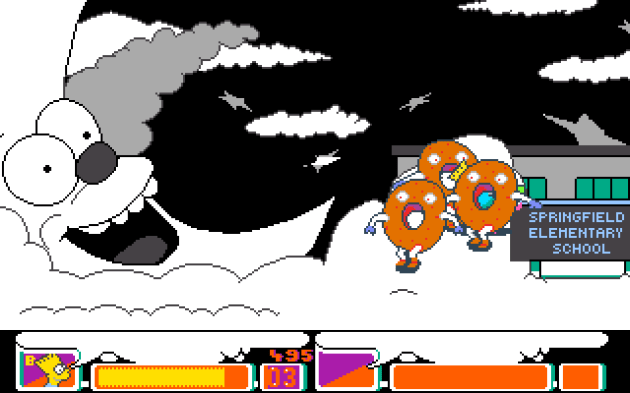
You can’t see Bart here, but that’s the point. The enemies are very easy to confuse and get easy shots on.
If there’s an enclosed area, like a wall with a corner, most enemies stop attacking AND dodging and start to just kind of wobble in their walking animation back and forth. I think what’s happening is the geometry messes with their preset attack pattern or something, since they’re TRYING to walk. I could see it in the donut section in the above picture. Since the Simpsons uses a lot of platforms and walls and buildings, there’s a lot of places you can use to trip-up the enemies. In fact, any corner seems to work, a tactic that applies to bosses as well. The third boss, most of the fifth boss, and almost the entire Mr. Burns fight saw me not take any damage at all while just teeing-off with basic attacks at the top of the screen. As a result, the bosses were some of the easiest I’ve ever seen in any brawler. They’re not as “smart” as in the arcades, so getting them stuck in a corner and going to town on them is a cinch. I never died once, on any of them. The ones that don’t go to corners can be slain by jump kicks. I could also swear that most, if not all, have had their health reduced significantly from the coin-op. As far as brawlers go, the DOS version of the Simpsons is just about as unsatisfying as any I’ve seen. It’s the pits, folks.
Normally, I’d feel heartbroken for my older readers. But actually, I suspect that the DOS port of Simpsons was probably convincing enough in 1991 to not feel like a total rip-off. It looks spectacular, instead of being a massive downgrade like gamers were used to with the NES. Seriously, I didn’t like this game at all, but I’d much rather play it than Konami’s NES port of the arcade Ninja Turtles. Both ports are in the same boat. They weren’t the deepest coin-ops, but they were loaded with personality, most of which didn’t make the journey home. But, in the case of Simpsons DOS, it’s not completely devoid of charm, like TMNT II: The Arcade Game for the NES was. Having said that, personality only gets you so far. Video games have to be fun to play, and this just isn’t. Not without any fluidity to the combat, or enough of variety in how the attacks look. Removing most of the animation to the attacks, along with the nuance to enemy behavior and boss strategy, has left the Simpsons Arcade a brainless button mashing snore. One that probably was good enough in 1991, but nobody in their right minds would convince themselves it’s a good port in the 2020s.
Verdict: NO!
 The Simpsons: Bart vs. The Space Mutants
Platforms: NES, Sega Master System, Game Gear, Genesis
Released April 25, 1991
Directed by Garry Kitchen
Developed by Imagineering
Published by Acclaim (Flying Edge on Sega Platforms)
NEVER BEEN RE-RELEASED
No matter what anyone thinks of Acclaim, you have to give them credit. CEO Greg Fischbach snatched-up the license for The Simpsons before the first episode even aired. A prime-time animated series hadn’t been a hit in nearly 30 years. Not since the Flintstones, in fact. But Fischbach read the tea leaves perfectly. Sadly, he followed the moment of clairvoyance with a moment of greedy stupidity when he offered directing duties to my dear friend Garry Kitchen. Oh, Garry wasn’t the stupid part. Actually, he was a good choice, especially considering how poorly received many Acclaim’s other licensed games had been up to this point. Nah, you’d want Garry, his brother Dan (even if he did make Double Dragon for the Atari 2600. *SHUDDER*) and Pitfall! creator David Crane along for the ride. They knew what they were doing. There was just one catch: Fischbach had already promised the Simpsons/Fox people that a Simpsons game would be out for the Christmas, 1990 season. The deadline was missed by a couple months. That’s why not one, not two, but three Simpsons games from the gang at Imagineering hit in 1991. I imagine any other studio would have just done a basic point-A to point-B platformer. Garry Kitchen came out of the golden age of Atari games, where the kookier the idea, the better. You cannot fault The Simpsons: Bart vs. The Space Mutants for ambition. I just wish it had polish.
Each of the levels in Bart vs. The Space Mutants is a different fetch quest, though only the fifth and final level requires you to collect every possible example of the target item. It’s also the only level that plays out in a non-linear fashion. The first stage is the most memorable, as the mission is to remove all the purple you can find. Instead of “collecting” you have to vandalize various purple objects. Most of this is done by spray-painting them red, but even this has several variations. Moe wears a purple smock, so you prank call him using one of your coins at a phone booth, and when he comes outside to kill you, you tag him with the paint. Other objects might require you to spill them, shoot them, or scare them off. I really wish the whole “vanish all the purple” gimmick had been the sole object for the entire game. Levels 2 – 5 see players simply collecting items, and the only real variation is level four has you shooting exit signs with a suction cup dart gun. Maybe the purple gimmick would have gotten repetitive, but I still wish they had rolled the dice on it, since what replaced it wasn’t that interesting. Also, that’s two paragraphs in a row that ended on “I wish..”
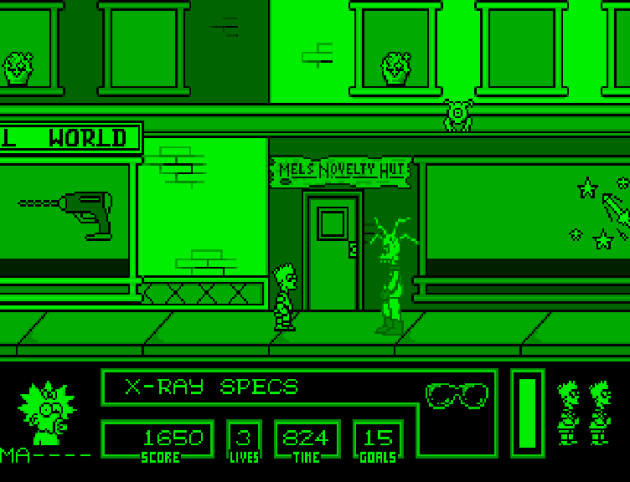
There’s only one item that carries over the entire length of the game: your x-ray glasses. You have to use them to tell human characters apart from the space mutants. Basically, Bart vs. The Space Mutants is the closest we’ve gotten to a THEY LIVE! game. Just replace Bart with Rowdy Roddy Piper, and don’t forget to take all his bubble gum away. If you jump on the head of a human, you lose one of your two hit points. If they’re a space mutant, jumping on their head kills them and gives you a letter of the name of the family member that acts as that stage’s boss assistant. It’s worth noting that, in the Sega versions of the game, I never once spelled L-I-S-A in the third stage. In fact, I usually only got the L. The game just plain didn’t spawn enough pedestrians, space mutants or otherwise, for me to come close. Thankfully I didn’t need her.
That’s the thing with Bart vs. The Space Mutants: it really had so much potential, but it also didn’t have time to go through the type of fine tuning that would weed out bad ideas. The post-NES games work a little better, but they all have different quirks. The Master System/Game Gear builds give players a lot more grace with the bottle rockets. The fickle accuracy of the rockets from the NES build returns in the Genesis build, but the enemies seem to have much better collision detection. They had four attempts to make the best version of Space Mutants and none of them came even close. While the collecting aspect is usually fun, it’s the level layouts that make this first console Simpsons game too brutal to be fun. I really thought emulation tomfoolery would make it fine. When I sampled the game years ago, having save states made those first couple levels alright. I didn’t play far enough to see how punishing the third and fourth levels were. This time, I did. I only finished the NES and Game Gear versions, and if I had to choose one to recommend, I’d probably give the nod to the Game Gear, where platforms are a lot more clearly marked than the NES, and items like the bottle rockets give you a LOT more wiggle room. But, the sad truth is Bart vs. The Space Mutants isn’t a good game. Don’t worry, because this story is going to have a happy ending. Just wait.

This was the part where the YES! was lost for good. See the part I’m standing on? That’s the only solid platform. The white skeleton just behind where Bart is standing is an instakill tar pit. So why draw that? This game has all kinds of problems that you can’t fix with basic emulation features like rewind or save states.
Originally, I planned to review each of the four versions individually. But then the Sega Master System version kept crashing in the third stage and the Genesis version was too flimsy with the long-jumps for me to even consider playing past the first stage. On the Genesis, even with the extra face buttons, running is mapped to the same button as jumping. OH COME ON, really? Do you know what’s the most telling thing about the Simpsons: Bart vs. The Space Mutants? Almost nobody likes it, but nobody calls it an E.T.-like disaster, either. EVERYONE loves the concept. Bart vs. the Space Mutants, more than any game I’ve ever played in my life, is failed by a complete lack of elegance. It’s also way too difficult for its own good, made even worse by a clunky interface. I was curious how the Master System would handle item selection with no START or SELECT buttons. It’s done by pressing DOWN, since Bart doesn’t duck. It works better than you’d expect, but it’s still a clunky game. The sad thing is, the three games that followed the rushed NES game still used it as a template. That’s why they’re all in the same boat: ambitious game design but ultimately unrealized potential.
Unanimous Verdict: NO!
But, what if that potential could be realized? Almost thirty years later, it was.
 Bart vs. The Space Mutants Redux
Platform: Sega Genesis
Fan-Developed ROM Hack
Originally Designed by Garry Kitchen
Remastering by BillyTime! Games
Link to Patch at RomHacking.Net

I’m very happy to include this ROM hack in this feature. I’m all about classic games reaching their fullest potential through the magic of emulation. Thanks to BillyTime! Games, I get to see all the potential Bart vs. The Space Mutants had.
Bart vs. The Space Mutants Redux is purely a quality of life ROM hack. BillyTime! Games opted not to change the level design, enemy placement, objectives, or graphics of the Genesis build of Bart vs. The Space Mutants. The only gameplay change is that levels 1 – 4 require less objects to clear the stages. I’m not a fan of that decision, but if you felt this game required too much collecting, you’ll be happy. BillyTime!’s primary focus was on revamping the controls. Redux utilizes the Genesis’ six button controller, giving it a much more slick and modern feel right out of the starting gate. Running is mapped to its own button, and you wouldn’t believe how much that changes things on its own. I really think they could have left it at that and Bart vs. The Space Mutants would have been largely fixed. But BillyTime! also completely revamped the jumping physics as well, and suddenly this is the Simpsons platforming game that everyone wanted in 1991.

Platforming-centric areas are now more along the lines of the type of physics you would expect in a Mario game.
The changes made in Space Mutants Redux don’t nerf the challenge entirely. Instead, it changes the challenge. It’s not as if the tricky jumps are eliminated. They’re just much more balanced. Last-pixel jumps are gone, and good riddance. But, you’re still forced to be mindful of the act of jumping. You skid a little upon landing, so you have to aim your jumps and be a part of the process from the approach to the lift off to the landing. Yes, the jumps are easier, but it’s not an easy game. In fact, the only reason I was able to defeat it without cheating is from all the extra lives that the original designers put in the game. So many that my reserve lives went higher than the counter itself. Also, giving players higher jumping might make hopping around buildings in the first level easier, but the payment comes due in the final level, where it’s much harder to jump under enemies. BUT, that’s not a bad thing, because it becomes the type of challenge that works within the boundaries of perfectly reasonable and logical difficulty scaling.

Indeed, the fifth level is a doozy of a stage. If BillyTime! continues to tinker with this hack, I’d say it’s actually okay to redo some of the graphics. Specifically, I think the uranium rods that you gather in the fifth and final level should glow a lot brighter. They’re easy to miss. And updating character models would be fine, too.
My expectations were Bart vs. The Space Mutants Redux would handle decently, be fun to play, but nothing special. That’s what I expected, and all I really dared to hope for. A satisfactory Simpsons game. I was wrong, because actually, Redux reveals that Bart vs. The Space Mutants had all the ingredients for a great game all along. It simply didn’t have the right movement physics or control scheme. All those platforms that annoyed me before are now breathtaking, so much that you’d swear that the designers intended the physics to be this way all along. I do think that lowering the amount of items required to beat each stage was a big mistake. I’d advise undoing that as soon as possible, and here’s why. I think if players found the collecting minimums were annoying before, it’s only by virtue of how punishing Bart vs. The Space Mutants was to play. With THESE movement physics, the collecting factor is no longer held back by demoralizing difficulty. Now, it’s a joy to explore and experience Space Mutant’s set pieces, the unique take on boss battles, and the whole They Live! x-ray specs concept.
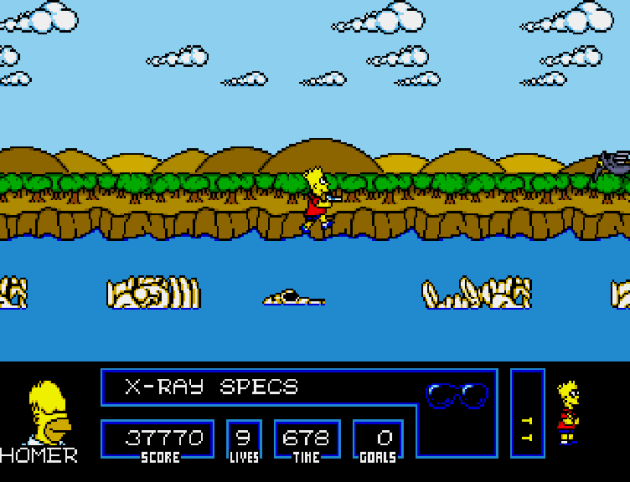
Oh, and let it be said, I’m happy it was the Genny version that’s patched. Things like what is and isn’t a platform being too ambiguous doesn’t factor in. I think an NES remake would require a slight overall in the graphics that the Genesis version doesn’t have to deal with.
And now, with this version, the flaws that are actually based around the game design come into a much sharper focus. Like the cleverness reducing significantly after the first level. The hunt for purple objects is easily the highlight of the game. While the middle stages do feature some thrilling moments, they lack the one-of-a-kind creativity the first stage had. In fact, that’s really the only level in the game that feels like you’re playing a no-doubt-about-it Simpsons game. From prank calling Moe to seeing the sights of Springfield to skateboarding with Bart, that first level really does feel straight out of the TV series. And frankly, the “get rid of the purple” feels like the type of off-beat mission that 3D platformers would utilize when the polygon generation started. The Simpsons is famous for predicting the future, and it turns out, even the game did it. It perfectly predicts the direction the platforming genre would take in the coming years. Level 2 has one creative bit where you have to knock hats off pedestrians. That feels true to the concept of the game: Bart’s mischievousness saving the world, but the cleverness ends there. While level 5’s non-linear maze layout was quite well done, it could have been any game. I still enjoyed the maze layout. In fact, I wish there had been a couple more stages like that. At least one more, set at the school, with Principal Skinner or Mrs. Krabappel (or both) as the boss.

A *huge* missed opportunity is the passkeys for the doors in Level 5. They’re the same combination in all four versions of the game. You “get” the codes from Lisa on each floor, but you don’t need to. In fact, you can brute force guess them. It’s what I did a couple times. What would have made a lot more sense is a 3 digit combo that’s random every time. I know they’re capable of being random, because Maggie’s location changes in each playthrough. She’s randomly assigned a room in the Power Plant, and is always the last “uranium rod” you pick up. In fact, after you get all but one rod, you just have to walk up to her to win the game. Making her random WORKS. But the combos should have been too. Oh, and the graphics don’t really show Maggie with the uranium rod in her mouth. It might not be clear to most players that she’s the final piece and can’t be collected until all the other rods are found and “banked.”
I also think that the coins go vastly underutilized. As far as I could tell, they served no point past the third stage, besides scoring points. I suspect that Garry and his team had a lot of plans that they had to cut because of the time crunch. I feel bad for Garry because, like with Donkey Kong for the Atari 2600 (see Atari 50: The Games They Couldn’t Include – Part Two), he actually did a pretty good job given the time limits. He could have done a basic platformer. It was the Simpsons! The hottest property on TV at the time. Easy money. But, he knew he was better than that. He would never have done a game like Monster in My Pocket. It was beneath him. The ambition was amazing, and unlike historically maligned games, Space Mutants had potential to be amazing. This ROM hack proves it. The development team didn’t have a reasonable development cycle to work with, nor did they have access to focus testing. If they’d gotten to see kids play Simpsons, I think most of the more famous drawbacks would have been fixed.
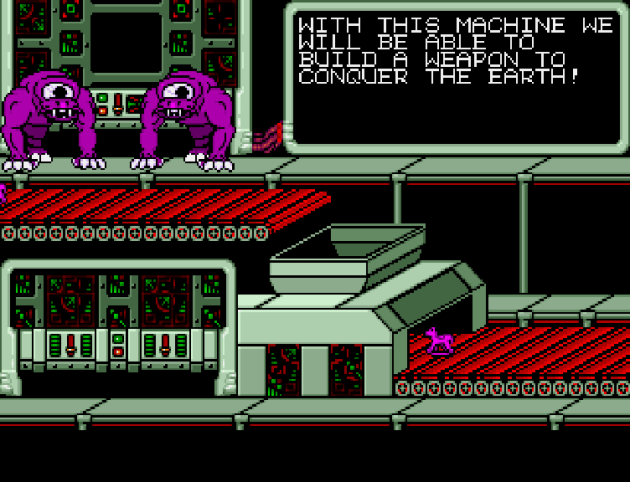
Like many games in this feature, I’d love to see a 2020s remake. Which of course would now star Kang & Kodos.
That’s why I’m happy I played this redone version of Bart vs. The Space Mutants. It doesn’t change the game. The game was fine. BETTER than fine, actually. It just didn’t play well. It reminds me of the history of basketball. When James Naismith first invented the sport, it was played with peach baskets that required a ladder to retrieve the ball when a goal was scored. It took them a while to cut a small hole in the bottom of the basket, so the ball could be poked-out with a stick. It took TEN YEARS for them to replace the basket with a hoop and a net, and then SIX MORE YEARS to cut the bottom of the net so the ball just fell through. Even if the first version was deeply flawed (it was also full contact, and very violent), the concept was unmistakably fantastic, with so much potential. That’s why I’m so happy for Garry Kitchen, who gets credit for inventing a great game. And credit where it’s due to BillyTime! for cutting the hole in the net. Redux is a fantastic effort by fans of the game who saw the same potential everyone else saw in Bart vs. The Space Mutants. They just took it one step further and said “let’s unlock it!” And they did, and it’s awesome. This, ladies and gentlemen, is why ROM hacks are real games.
Verdict: YES!
 Bart Simpson’s Escape from Camp Deadly
Platform: Game Boy
Released November 1, 1991
Designed by David Crane, Mark Klein, & Barry Marx
Developed by Imagineering
Published by Acclaim
NEVER BEEN RE-RELEASED
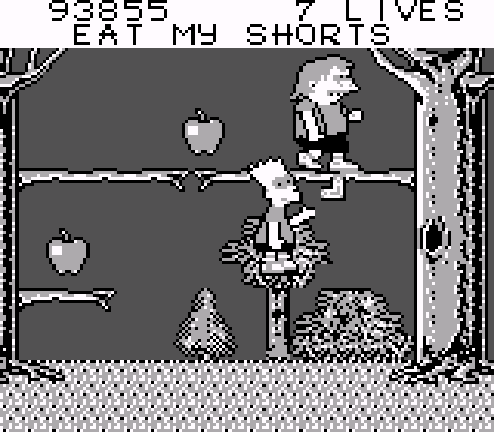
Excellent likeness of Nelson there. I’m not sure why everyone’s eyes are so bloodshot.
Do you know what’s weird? Escape from Camp Deadly came out almost a year before the famous Kamp Krusty episode. It even has the same basic plot: Bart has to deal with a summer camp that tortures kids. Isn’t that all summer camps? This take on the Simpsons is much more basic, with simplistic level design and repetitive action. For the most part, you walk in a straight line, jumping over pits or across logs on a river. You can climb trees, and occasionally a boss-like encounter is up in tree houses, but you’ll spend most of the game just walking right and occasionally turning around to throw a weapon. There’s a handful of caves that feature obstacles to dodge, but again, they’re as flat as a pancake. Variety is nice, but it doesn’t feel different enough because it’s just so straight-forward.

The caves are the best part, as they offer the most challenge. Not that Camp Deadly is a hard game. See those donuts in the status bar? That’s your health. I didn’t even need to bother with cheating in this one. I had so much health built up that I think I could have left the game unpaused and taken an extended bathroom break and not died.
Sometimes Lisa appears and gives you boomerangs, which work the way boomerangs ought to: -1 to your inventory when you throw one, then +1 if you catch them on the return. I just wish the level design was much more exciting. I think the problem stems from the decision to use large, cartoonish sprites. On one hand, it’s the Simpsons, and I’m sure there was pressure to look the part. On the other hand, when you factor in the floor, Bart is nearly 1/3 the height of the screen. It doesn’t leave a lot of room to create complicated levels. It makes me appreciate the Game Boy Batman‘s decision to use a much smaller character sprite. As silly as it looks, it allows for a lot more gameplay. You can see the problem play out in those limited instances where Camp Deadly does more than just walking right across the ground. It’s so cramped. They should have called this Cramp Deadly!
It’s not that Escape from Camp Deadly is bad. It really isn’t, because frankly, there’s not enough game here to actually fall to the level of bad. What’s here is limited and bland. Just the same series of enemies falling in from the sides that are little more than cannon fodder, with the same types of jumps or the same types of enemies to fight and/or dodge. And, thanks to an overpowered health bar, there’s no stakes at all. It’s not until the final stretch that it feels like you’re not just playing a glorified LCD game. The climb up Mt. Deadly was a very welcome change of pace, but it comes far too late. Which isn’t to say that there aren’t some clever bits. The food fight levels stand out, as you collect food and throw it at the bullies that run at you. But, you have to eat the food if you throw one in the presence of the cafeteria monitor. Of course, like much of the game, this area is one flat horizontal pathway. I thought it was fine the first time, because I’d never seen a challenge like it before. When it happened a second time, with the same flat, repetitive hallway, the novelty had worn off. I imagine a child in 1991 who was a big Simpsons fan would have enjoyed this during an otherwise boring car trip, but this never had a shot at surviving the test of time. Hell, I don’t think it could have survived the test of next year in 1991.
Verdict: NO!
 The Simpsons: Bart vs. The World
Platform: NES, Master System, Game Gear
Released December, 1991
Designed by Dan Kitchen, Roger Booth, & Barry Marx
Developed by Imagineering (NES) Arc Developments (SMS/Game Gear)
Published by Acclaim
NEVER BEEN RE-RELEASED
Bart vs. The World is a more traditional platformer than Bart vs. The Space Mutants. Which isn’t to say it’s unambitious. Whereas the first game was focused on trying to recreate Bart Simpson-like mischief in the 2D Nintendo space, Bart vs. The World is more about creating memorable set-pieces. It’s also yet another game that predates what would be a staple of the Simpsons TV show: globetrotting. Yes, Bart went to France in a season one episode, but the makers of this game had no idea the show would eventually feature over twenty more trips abroad for America’s first family. In fact, of the game’s four themed locations, the Simpsons have gone to three of them: China, the Arctic (the movie sent them to Alaska! IT COUNTS!), and Hollywood. The only one they haven’t visited is Egypt.. and yet, the episode with bible stories features ancient Egypt, making Bart vs. The World 4 for 4 in predicting future episodes.
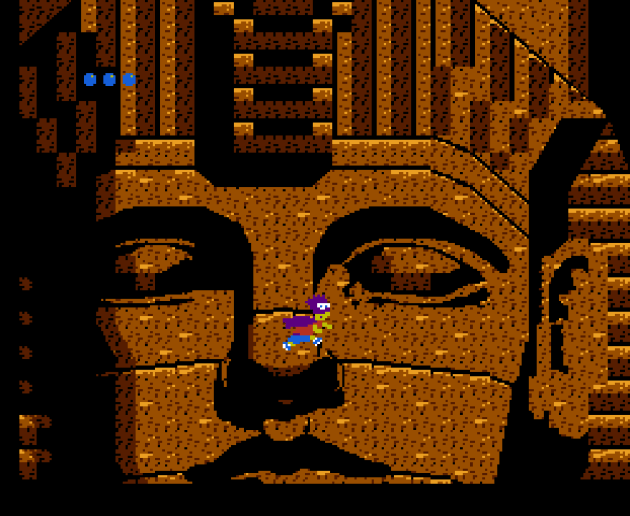
You would assume that the “Egypt” stages would be typical oasis-style sand and palm trees. Oh no. You’re going through pyramids and flying past the Great Sphinx as Bartman.
If you don’t care about getting the good ending, Bart vs. The World is simply about finding the exit in each stage. Instead of just being a “scroll right, jump over pits” type of platformer, World requires exploration to find the exit of each of the nine stages. A few are maze-like, and most require intense precision platforming. My biggest complaint with World is that the controls and jumping physics from Bart vs. The Space Mutants are back. It makes ZERO sense now that you don’t have to shuffle between items to complete the various tasks and mini-games. B button throws weapons while A button jumps. So far, so good. But then, holding A after jumping is the run button, and if you want to do long-fast jumps, you have to press A & B together. Come on, guys! No! Tradition states that B runs! Super Mario Bros did it, and it worked fine! If they did this to accommodate the weapons by not costing a player one piece of ammo, it didn’t work. You often accidentally throw your weapon anyway when attempting the long jump. Besides, there’s plenty of ammo just laying around. So much, in fact, that I’m pretty sure I finished every stage with a surplus. They might as well have done the Adventure Island thing where once you find the weapon, you keep it until you die, with unlimited ammo. It wouldn’t have hurt the game at all, but with the levels designed around precision movement, the A+B jumping hurts a great deal.

I mean, look at it! This would be tricky enough without fumbling between two buttons.
What’s most frustrating is that the levels are actually pretty fun. The sightseeing concept works wonderfully, with such highlights as skateboarding down the Great Wall of China, floating on icebergs that you speed-up by jumping up and down on them, or throwing on a cape and flying across the Great Sphinx as Bart’s superhero alter-ego, Bartman. The platforming is tricky, so, for this review, I used save states to effectively give myself infinite lives. By the time I reached an extended section in the ninth level where I had to jump across a series of RIP markers in a mausoleum, I was good enough to not need to cheat anymore. I got the hang of it by the third stage, which is the endless series of tiny ice platforms pictured above. Of course, I got the hang of it because that level overdoes the identical shafts of platforms that are all measured out the exact same distance. I called it “platform spamming” and my one and only complaint about the level design are those two sections. The same pattern of platforms is repeated, and it becomes so tiring after a while. There’s nothing remotely clever about it. I know the Kitchens are better than this. These two segments go on FOREVER, without any twists. It made me long for the climbing areas in Wizards & Warriors, because at least that varied-up the distance and angles of the jumps. Each of these segments just copy-and-pasted the same set of jumps, over and over and over and over and over and over and over..
If you want the good ending, you have to search for a hidden Krusty the Clown trinket in each stage. Even though the sprite is the same, Krusty heads aren’t 1-ups like the previous game. They’re also not the “trinkets” as I call them. The trinkets are more like trophies branded with the cantankerous clown’s likeness. Well, actually the 9th and final trinket is just the same Krusty head icon, only it’s green now. Pretty lame, Millhouse. Each of the nine hidden items are unlocked by a different means. Thankfully, there is some help, as each item is tied to finding a member of the Simpson family in the stage, so when you find them, the trinket is nearby. The only one that gave me trouble was the 7th one, where you have to fly up to the Great Krusty Sphinx and smash Homer’s fingers. Getting all the trinkets opens an extra stage in the Hollywood world that’s so memorable that I can’t believe they hid it behind a strict unlocking requirement. You literally leave the filmstrip at one point. It’s awesome!

It even works a sort of puzzle into the design, as this opens up one of three possible areas, only one of which has the exit.
SPLIT DECISION – NINTENDO ENTERTAINMENT SYSTEM
Really, if not for the rough jumping physics and awkward control scheme, I think Bart vs. The World would be remembered as one of all-time classic licensed games on the NES. Okay, so those two spam platforming sequences sucked. There’s no point in pussyfooting around it: those segments were terrible. But, that’s a small portion of what is an otherwise really enjoyable experience. The boss fights against various relatives of Mr. Burns are decent enough, at least on the NES, and the third one even features a clever bit where, instead of jumping on his head or throwing something at him, you pull the string on his flying carpet. That put a smile on my face. I won’t argue that Bart vs. The World is a masterpiece. It’s got problems. But, its reputation as being the best of the NES Simpsons trilogy shouldn’t be considered a default win. There’s a fun game here, and while it doesn’t reach its fullest potential, Bart vs. The World on the NES is certainly still worth a look today.
NES Verdict: YES!
SPLIT DECISION – SEGA MASTER SYSTEM
Bart vs. The World on Sega platforms has a LOT of issues. First off, I would have done the Game Gear version but the ROM wouldn’t load. I was fine with that after playing the SMS port. This version’s Krusty Trinkets unlock NOTHING. I think a big part of that is Sega’s ports of Bart vs. the World are missing entire levels. The games seemed identical at first, and I figured with Sega’s superior graphics, this version would be the clear winner. The first gameplay change happened in the iceberg level, where you no longer have to destroy the igloo to find the Krusty Brand Ice Cube. In fact, it’s just sitting there. There’s no secret to revealing it. Weird. Then came the pyramid stage. Or rather, didn’t come. The pyramid stage that I enjoyed so much in the NES game isn’t in the Sega versions at all. What? Of course, that meant no hidden trinket for that stage. And then, the Mausoleum platform-spam area of the second Hollywood level was also missing. Now, that section was ridiculously repetitive and overstayed its welcome by several factors. Deleting it SHOULD be a positive thing, except that’s where the trinket was hidden in the NES stage. I spent an hour searching both the game and the internet for the new location. Even Cutting Room Floor doesn’t mention the NES levels deleted in Sega’s ports, but several YouTube commenters seemed to confirm my findings: there was no trinket. Not that it matters, because there’s no unlockable third level to world four, either.

The ending to Bart vs. The World on the Sega Master System in its entirety.
Given the fact that the unlockable stage is easily worth the effort in the NES version, I was pretty peeved about the pointlessness to the Sega versions of the trinkets. It off-set any gains that were made by deleting the game’s most tedious section. What sealed the Master System’s fate is how badly two of the bosses play out. Both the first and fourth boss fights require you to jump up and throw your ammo at them. For whatever reason, on the Master System, the act of throwing mid-air is incredibly unresponsive specifically during these two fights. It seemed to be the only time that happened, too. After the first boss fight saw me jumping without the attack button registering, I found myself checking other games just to make sure my controller wasn’t worn out. When I found out it wasn’t, I made a point of jumping up and throwing my weapons at other points in the game, just to make sure it worked. Sometimes it wasn’t even deliberate and instead a side effect of the ridiculous A+B jumping. The game had no problem wasting ammo when I needed to make long jumps, but during those two boss fights, which REQUIRE you to jump up and throw to hit the bosses at all, it didn’t work most of the time. As a result, those boss fights each took me significantly longer than their NES counterpart, and were just frustrating more than fun. That was the final straw for me. Deleting levels on a “more powerful console” is ridiculous enough, but I draw the line at total input unresponsiveness.
Sega Master System Verdict: NO!
READ THE OTHER PARTS!

 Part Two– The five Simpsons games of 1992, including the first SNES Simpsons titles: Krusty’s Super Fun House and Bart’s Nightmare! Plus NES/Game Gear’s Bartman Meets Radioactive Man, Bart’s House of Weirdness for DOS, and Bart vs. The Juggernauts for the Game Boy. Part Three – Virtual Bart for the SNES, along with Itchy & Scratchy’s
 games for the SNES and Game Boy. In fact, Part Three will be Game Boy heavy, with Bart & The Beanstalk, Itchy & Scratchy’s underrated mini-golf game, and Game Boy Color’s Night of the Living Treehouse of Horrors.


 Indie Gamer Chick
You must be logged in to post a comment.