Adventure Island: The Definitive Review – 11 Full Reviews for NES, SNES, Game Boy, and MSX + 1 Bonus Review
June 26, 2025 13 Comments
I’m not trying to single out Konami. I mean, not maliciously, at least. But, they have an extensive library that’s mostly collecting dust. 99% of their catalog has no presence in modern gaming. So I’m going to keep doing these features until they start doing more compilations, and BETTER compilations. One franchise they own after their acquisition of Hudson Soft is Adventure Island. While they published a Japanese exclusive PS2/GameCube game and a WiiWare title (not included in this feature) along with several releases for Nintendo’s Virtual Console service, they haven’t really done a lot with it since. It’s been over a decade since the franchise’s last release, unless you count New Adventure Island’s appearance in the TurboGrafx-16 Mini. That doesn’t really work for me. So, like I did with Konami Shoot ’em Ups and McDonald’s video games, let’s make a pretend set!
Update: Technically Konami didn’t outright own Adventure Island until 2014, but Konami became the largest shareholder in Hudson in 2001 and had the controlling stake (55%) from 2005 onward.
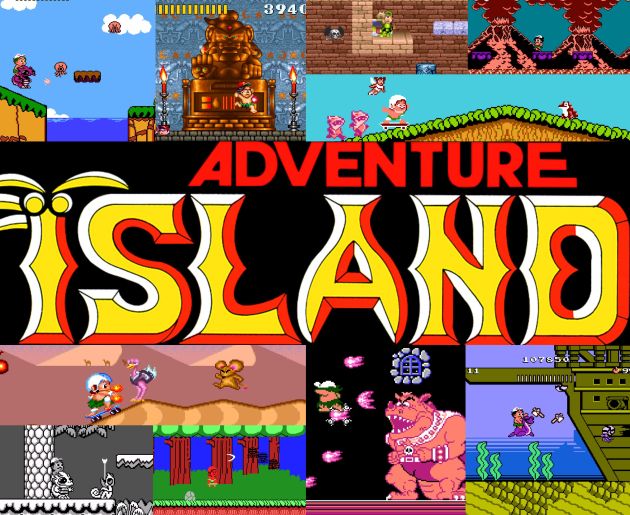
2026 will mark the 40th birthday of the series, so I want you to pretend that I’m reviewing a compilation called Adventure Island 40th Anniversary Collection. I think it would retail for between $29.99 to $39.99. Assuming the collection has all the expected emulation bells and whistles and earns my mandatory $10 in bonus value, the eleven games have to create $20 to $30 in total value to combine with the emulator and match the expected retail price range. I’m adding a bonus review of a ROM hack of Adventure Island that I think would be a great example of a bonus feature for such a collection that isn’t so far out of bounds that there’s no chance something like it would be included. Here’s the lineup:

Imagine what their kids will look like.
- Adventure Island (NES)
- Adventure Island (MSX)
- Takahashi Meijin no Bug-tte Honey (Famicom)
- Adventure Island II (NES)
- Super Adventure Island (SNES)
- Adventure Island (Game Boy)
- New Adventure Island (TurboGrafx-16)
- Adventure Island 3 (NES)
- Adventure Island II (Game Boy)
- Adventure Island IV (Famicom)
- Super Adventure Island II (SNES)
- Adventure Island Abridged (NES ROM Hack)
WONDER BOY vs. ADVENTURE ISLAND
Adventure Island is always on the left. Wonder Boy for arcades is always in the center. Wonder Boy for the Sega Master System is always on the right.


Before I get started, I suppose I should mention Wonder Boy, even though it really only matters for the first game in the franchise. What happened? Well, it’s really not THAT complicated. Sega already owned the rights to Wonder Boy by the time Hudson took a license. How is that possible? Well, because the gameplay was owned by Wonder Boy’s original developer, Westone. But, Westone could technically still license the formula, level design, and basically everything but the name and character sprites. It was wise of them to do so, as Adventure Island for the NES/Famicom is far and away the most successful version of Wonder Boy and the only member of either franchise verified to have sold a million copies.


Since I love to do food for thought bonkers conspiracy theories, here’s one for you: I wonder if Hudson took the license to keep their options open with the Mickey Mouse license they already had. If development on their own in-house Mickey Mouse title for the Famicom wasn’t coming along well, they could just parachute him into the Wonder Boy framework they now co-owned. Is it THAT hard to imagine putting a Mickey Mouse sprite into these settings? Anyway, Hudson removed the Wonder Boy characters and replaced them with a guy named Takahashi Meijin. Who is that? He basically became a spokesman for Hudson Soft and was famous for being able to mash buttons crazy fast. He was VERY popular in the 80s and early 90s in Japan, getting his own anime (which is basically based on Adventure Island), manga, and video game franchises. Adventure Island? That’s HIS franchise. For western releases, the character was given the more American sounding name “Master Higgins” but really, it’s Takahashi.


Thus, the great Wonder Boy/Adventure Island split was now set to happen. Despite the typical hand wave of the two games being identical, they’re actually not the same exact game. Wonder Boy doesn’t have the fireball upgrade for the axe. That’s a BIG deal. As challenging as Adventure Island is, the fireballs and their ability to remove the stones and large boulders actually makes it significantly less challenging than the coin-op. Well, provided you can hang onto it. There’s idiosyncrasies to the controls, too. I think Adventure Island has easier jumping, while I found the skateboard controlled better on the coin-op. In my full no-cheating playthrough of Adventure Island, I never managed to finish a stage while still riding the board even once. Wonder Boy has no bonus stages at all and is missing many of the invisible eggs from Adventure Island.

The Sega Master System version of Wonder Boy has to be one of the most overrated ports in gaming history. Of the three “major” versions of Wonder Boy, it controls the worst, EASILY. If you’re curious why I could match the NES and Arcade pics but not the SMS ones, it’s because there were no matches in the corresponding stages on SMS. In fact, level 1 – 4 has an extended stretch where there’s no enemies or anything. That’s what the picture above is. While the graphics are very impressive for the time frame and it adds warp zones and “bonus” worlds, seriously, who cares? Gameplay is king, and the gameplay of Wonder Boy SMS is not up to snuff. In 2025, that’s all that should matter. I’m already working on Wonder Boy Anniversary Collection: The Definitive Review but I’m spacing myself out since playing different versions of the same RPG over and over is exhausting.
Finally, the (terrible) Sega Master System port of Wonder Boy has a 9th world followed by a hidden 10th world if you collect all 36 dolls (aka the pots from the NES version). Besides the hidden eggs and bonus stages, there’s no hidden content on the NES game. I’ll be reviewing Wonder Boy Anniversary Collection in the near future, but I wanted to make it clear that Adventure Island, despite its status as a full re-spriting of Wonder Boy, has its own individual gameplay merits and detriments that are worthy of consideration.
GAME REVIEWS
For those not familiar with my way of thinking of how retro games should be reviewed, I take NO historical context into account. I don’t care how important a game was to the industry, because that doesn’t make a game worth playing today. The test of time is the cruelest test of all, but every video game must face it. I might not be here if not for Pong’s success, but I wouldn’t want to play it today. Not when there’s better options. Therefore, when I review retro games, every game gets either a YES! or a NO!
YES! means the game is still fun and has actual gameplay value when played today and is worth seeking out.
NO! means the game didn’t age gracefully and is not worth seeking out, and certainly not worth spending money on.
VALUE DISCLAIMER: The value I award any game in any collection, real or imaginary, should NOT be compared to the values I award games in other features. All value is relative to the games in the collection only, not to all games I’ve ever played or reviewed in other collections.
IN CHRONOLOGICAL ORDER
 Hudson’s Adventure Island
aka Takahashi Meijin no Bouken Jima
Reworking of Wonder Boy by Westone Bit Entertainment
Platform: Nintendo Entertainment System
Released September 12, 1986
Developed by Hudson Soft
NO MODERN RELEASE
Wikis: Wonder Boy – Strategy
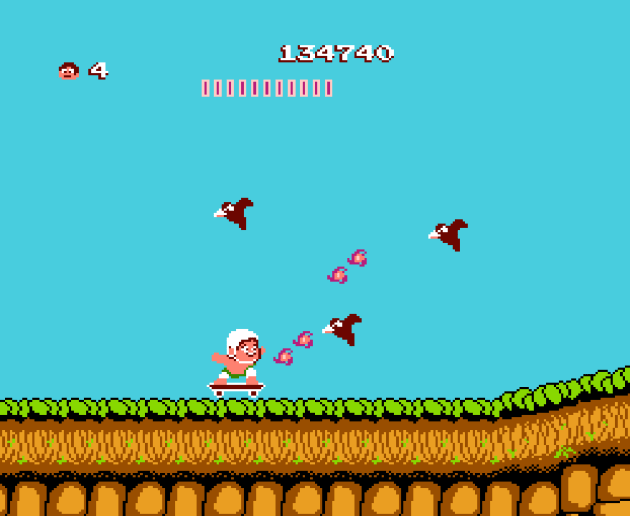
Seconds after this was taken, Master Higgins attempted to jump Springfield Gorge on his skateboard. Wait, wrong Definitive Review.
I’ve previously never liked Adventure Island. I’d also previously never really treated it like a raw video game challenge. Usually, I only try to ace a game if I have fun with the experience. Castlevania is a game I wanted to beat without losing a life. Same with Contra. A reason why is that those games offer set-pieces, unique settings, different bosses at the end of each stage, and a sense of grandeur. Adventure Island offers 32 levels, but you’ve seen every type of enemy, including the bosses (more or less) by the end of the first world and every setting once you reach level 4 – 2. It also has a big learning curve to the movement physics, especially the jumping. There’s two specific heights to your jumps, the highest of which requires you to either be holding B or jumping after already having jumped. Plus you have to factor-in momentum when you land. It’s safe to say that sliding into enemies is going to cause a lot of your deaths, maybe even more than death by pits. That’s why I was certain I’d be miserable reviewing this. I wasn’t.

The above screenshot had me literally scream with excitement and joy, but on a second or two delay. I didn’t get a good shot of it, but Master Higgins’ sprite passed right through that frog that’s left of the rock in that first pic, since were both mid-air at the time. This was after my practice sessions, during one of my runs where I disabled rewind. When it happened, I had to take a moment to process “no, I’m not in the death sprite.” Then came the hooting and hollering. It was exhilarating! I’ve never been so happy to have a collision detection f*ck-up. It wasn’t a one-off, either, as I had plenty of moments like that playing Adventure Island. That’s because this time I went in with a different attitude than I normally have playing games like this. Instead of looking for a gaming experience, I treated it like a gaming test. A challenge. Could I beat it, straight-up, no cheating? Actually, my challenge was “could I beat it, no cheating, without needing a continue?” That challenge I failed, and then failed again and again in subsequent attempts. But, in my best run, I only needed one continue to see the ending.

In order to continue, you have to collect Hudson’s logo, this bee, at the end of level 1 – 1. I never managed to come close to beating the game without it. While I reached the point that I could beat Abridged (the ROM hack that I review as a bonus at the end of this feature) without dying, my best run in normal Adventure Island saw me make it to 7 – 1 before eating a Game Over. By the way, even with the bee you need to do a code to continue. You have to hold a direction, apparently any direction, and press start. Why not just let people continue?
After beating the game with cheating, I knew I had two weaknesses. Well, really three if you count the climax of level 8 – 3, which is the only part of the level design I feel crossed the line into outright bullsh*t. It’s a series of spread-out dropping platforms with trollishly-placed bats. I needed to rewind and do it about three dozen times on my first playthrough just to finish it once. I never reached the point where I could do it twice in a row, either. You need pitch-perfect timing, alternating between holding B to run and pushing B to throw your weapon or else the bats will kill you. It’s harder than it sounds because of how the momentum of movement works. If this is part of the Sega Master System build, with THAT version’s physics? I honestly don’t know how I’ll be able to do it. Anyway, in my real playthrough? I needed four attempts but I got it. No problem (wipes sweat).

This is the only screenshot I got of the segment. I knew I could finish this without cheating. I’d practiced up and got the timing down. Still, it’s the hardest segment in the game, BY FAR, and when the time came, I wasn’t confident, and for good reason, as I dropped three lives on it. I had no lives to spare going into the final stage, but I did it! This is legitimately one of my proudest gaming accomplishments.
The reason why I wasn’t so confident is because the other challenge I’d practiced-up on didn’t go so well. Adventure Island has my old arch nemesis: ice levels. Actually, it wasn’t so much the levels themselves but rather one tactic they kept going to again and again: having you make a long jump that culminates with some form of a wall WITH an icicle hanging above the wall. These require very precise jumping because, if you hit the ground with any momentum, death is all but certain. So, how did I do? Well, in the first instance of this booby trap in level 4 – 3, I died twice in a row. Awesome, Cathy.


Later, the same trope got me again. So, I lost three total lives to that, but that wasn’t the bane of my existence. Before I explain what is, let me first state that the thing I was most wrong about with Wonder Boy/Adventure Island is the hunger system. It actually works really well to “keep you honest” by forcing you to constantly grab items. You CANNOT go into cruise control playing Adventure Island, but the hunger system also creates tons of risk/reward situations throughout the game. Even though I practiced up, I didn’t exactly memorize the locations of the food or what levels went stretches where the food drops become stingy. Sometimes, even low on health, it’s tempting to pass up a higher risk food item, or maybe one that you’d have to turn around to get. It’s REALLY well done and one of the best health mechanics in an 80s game, arcade, home, or otherwise.
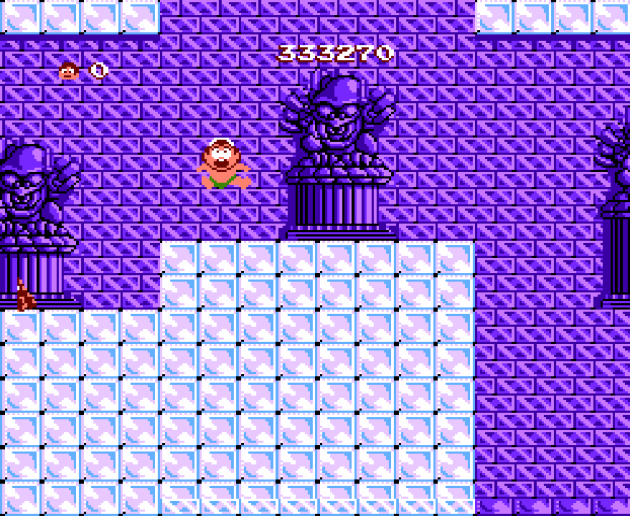
Level 7 – 1 was the end of my initial set of lives. What got me? The same thing that got me the most: the damn eggplant.
What especially makes the food work is the eggplant, which replaces the Grim Reaper from Wonder Boy. It’s worth noting that the eggplant goes away a lot faster than the Grim Reaper does, but I think Adventure Island’s eggplant drains health quicker. When you have it, you have to sprint and collect food fast, because you will run out of health in just a few seconds once the eggplant is activated. If I can get the damn eggplant locations memorized, I probably could do a no-continues run through the game. I had an uncanny knack for getting them when my health was already trickling away. Later in the game, they created multiple situations (sometimes twice in one level) where the eggplant is all but unavoidable. Maybe. I learned to jump over the bad one in 8 – 1.
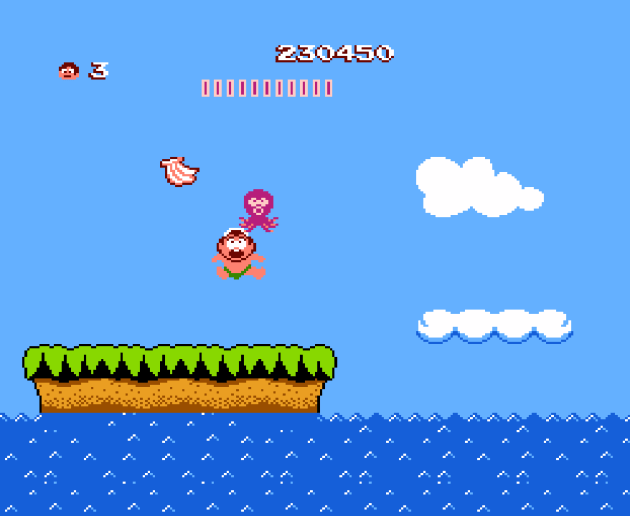
I went full pony on this one (I screamed until I was a little hoarse). This is NOT a life I should have lost. This was just stupidity.
For the most part, I did pretty damn good. More importantly, I had a ton of fun. I didn’t when I was practicing. While I still firmly believe that you need to include all emulator features with EVERY game (at least when it’s possible), this is certainly a game that doesn’t benefit from taking a full game tour just for the sake of it. Levels are too samey for that, and so are the bosses. Only the last one feels like it’s not just adding hit points, and really, it’s only because of the angle it throws fireballs. Otherwise, the bosses are arguably the weak link in the game. They’re not even as strong an end-of-level boss as Bowser is in the original Super Mario Bros. Bowser changes up tactics more than these eight bosses do.
So, if you just want to veg out and use an emulator to play a game from start to finish, consider this game a NO! because it’s just too limited. It can’t get away with the same thing, say, a Castlevania game can. The sights and sounds just aren’t that interesting. Once you’ve seen all the enemies, the game has nothing left to offer. Adventure Island’s sole value is as a well-developed, clockable, white-knuckle platforming challenge. What makes it work is how damn “pure” it is for a lack of a better term. There’s no twists or turns and no unexpected GOTCHA! moments. Well, except the eggplants but the placement of them always feels fine-tuned. Most notable of all: the game scales damn near perfectly. It’s a remarkable achievement given how few enemies, settings, items, and environmental hazards they had to rearrange. Even late in the game, Adventure Island will throw at you a new arrangement of the same enemies or hazards that’s ever so slightly tougher than the previous similar arrangement. I’m going to assume they didn’t just luck-out with it and this is a game made with full awareness of the why of gaming difficulty. As an experience, Adventure Island runs out of steam in 15 to 20 minutes, if that. As a test of your raw platforming skills? Adventure Island is actually immune to aging and, arguably, the perfect platformer.
Verdict: YES! **FLIP** – $5 in value added to Adventure Island 40th Anniversary Collection
 Takahashi Meijin no Bouken Jima
aka Adventure Island
aka Wonder Boy, apparently.
Platform: MSX
Released in 1986
Developed by Hudson Soft
NEVER BEEN RE-RELEASED
Listing at Generation-MSX

Death by rock is only acceptable when paired with “roll.” And cocaine.
Do you know why I died in the above picture? Because I had been on a skateboard and crashed into the rock, but that took away all my momentum, and then I couldn’t move myself off the rock and went from nearly full health to no health. Here’s the only other screenshot I got of it from a second before.

I assure you I *am* stuck on that rock. It literally juggled me to death even though I was trying to move off it and holding the direction pad the entire time.
It’s indicative of a larger problem with the MSX build of Adventure Island. The whole “momentum physics” of the coin-op Wonder Boy is taken to an extreme here. Like, if you jump on a spring and you don’t already have full momentum, there’s a very good chance you’ll land on the spring’s sprite. Directly in front of it at the most. Whatever. Don’t expect this to be a port of the NES game. Instead of having thirty-two levels, there’s.. ahem.. eight. Total. Takes maybe ten minutes to finish, even if you die. Fifteen minutes tops, and every second of that is awful. Sorry MSX fans. You know I love you and I love MSX, but this is a TERRIBLE port.
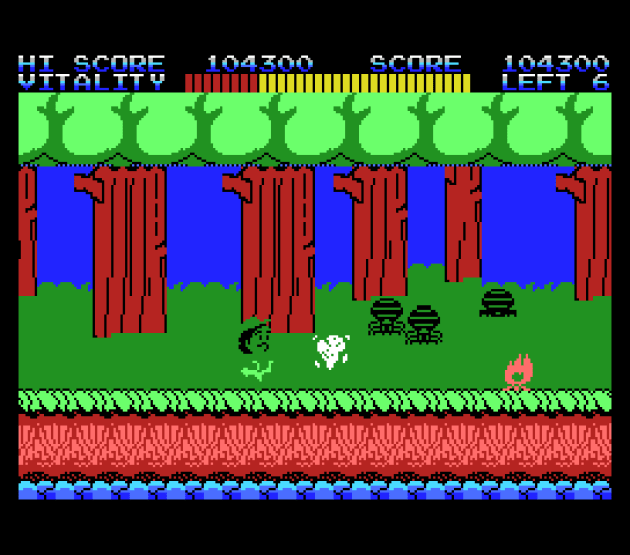
As if the game itself wanted the suffering to end as quickly as possible, the last level starts you with the MSX equivalent of the fairy to give you a free pass through the first third of the stage.
Despite the classic Adventure Island hero sprite, this is clearly more Wonder Boy. Hell, I looked for the ROM for a solid two or three minutes before my father asked “is it called Wonder Boy?” It was. Even the music is adapted from the coin-op instead of the NES game. But, it feels more like an Atari attempt at either. While the game has eggs, you automatically start every life with a weapon anyway. Only it looks more like a boomerang you’re throwing. All enemies, including the frogs, die in one hit and they’ve never been less of a threat. Except the wolves, which no longer have a warning flower. The game tries to squeeze a lot of challenge into a tiny package, but once I realized I had to hold B to jump even when it SEEMED like I didn’t need it, I was fine. Until the bosses at least.

No joke, that really is the last boss. It looks like a smug version of He-Man. Granted, there’s only two bosses, but the first one doesn’t look THAT dorky.
The bosses throw quick-moving fireballs that bounce across the screen. Because the act of turning around takes more time in this version than any other, the bosses are actually pretty dang hard to beat. That’s probably a good thing since Wonder Boy/Adventure Island/Takahashi would be completely toothless without them. The MSX has a lot of amazing games. Hell, the MSX library out-earned the NES library in Konami Shoot ‘Em Ups: The Definitive Review. But, the only value of Adventure Island on MSX would have for the Adventure Island set is as curio. They should still include it as a bonus, but I somehow doubt anyone would play it for more than a minute or two. It’s pretty dang bad. Short, broken, and miserable. Hell, if this had come out in 1989 I’d think it might be my long-lost twin.
Verdict: NO!
 Takahashi Meijin no Bug-tte Honey
Platform: Famicom
Released June 5, 1987
Developed by Hudson Soft
Never Released Outside of Japan
NEVER BEEN RE-RELEASED
Wikis: Wonder Boy – Strategy
The two screenshots below are from the same game, taken just about 10 seconds apart.


If you’re saying “what the f*ck?!” hey, I’m right there with you! Okay, so first off, THIS IS the second game in the Adventure Island franchise. It’s actually based on an anime that was loosely based on Adventure Island called Bug-tte Honey or “Honey Bee in Toycomland.” While you might consider it a spin-off, it has four worlds, three of which you play as Takahashi, aka Master Higgins. The object of the game is to collect the eight characters that make up the password of each stage. It’s not a password in the “input characters and return to the stage you were on” sense. It’s a macguffin that finishes the stage. To get the letters or numbers that form the passwords, you have to collect them from the brick breaker stages. Each stage’s overworld has ten hidden eggs, as in “they’re invisible until you shoot the spot they’re located.” It’s pretty much identical in that sense to another Hudson Soft game that was released three months before this: Mickey Mousecapade. You know how you shoot the wall with the stars in that game and it reveals life or fairies or hidden passageways? Like that, only with eggs. It looks like this:


One of the ten eggs flashes. It tells you what your progress is on the password but otherwise is only good to clear the screen of baddies. Eight of the ten eggs take you directly into a brick breaker stage, while the final one that’s indistinguishable from the “right” eggs is actually a whammy that sends you to brick breaker hell. And I do mean that literally.
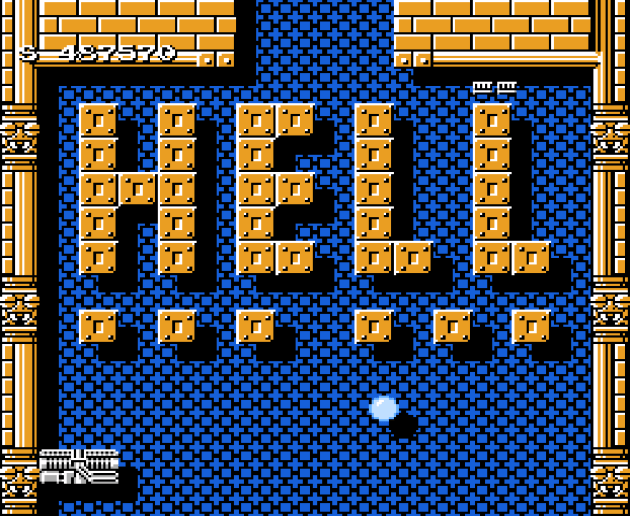
You can’t break any of the bricks in hell and just have to bounce the fast-moving ball around until it escapes through the top. In the overworld, the locations of some of the eggs and the order of which eggs take you to which brick breaker stage apparently changes from game to game, which is really the only major positive thing I can say about Bug-tte Honey. The overworld is four or five screens wide and contains buildings you can enter, each of which contains a single egg that’s also hidden somewhere within. This part of the game is essentially the Sega shmup classic Fantasy Zone (which I will be giving the Definitive Review treatment sometime in the near future), only as a platformer. Well, except for the first stage. Level One ignores the platforming bits and IS Fantasy Zone, since you play as a flying fairy and can move freely around the screen.
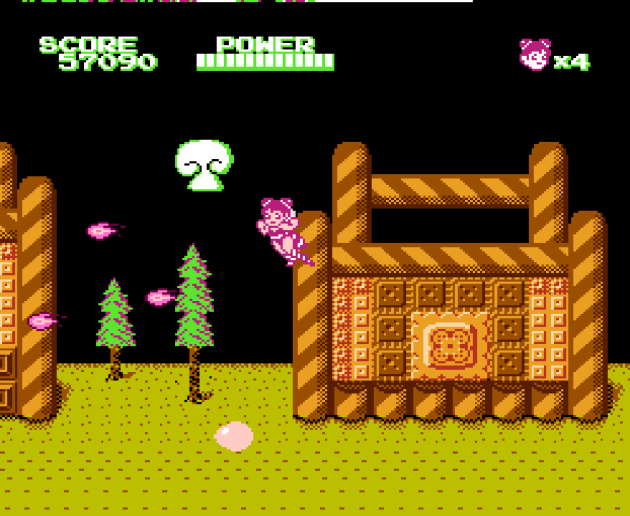
The interiors of the buildings are about two or three screens wide, but often the egg is just right there near the door. Every single one of these, throughout the entire game, feels like a complete waste of a mechanic. They’re mostly empty and offer nothing besides the act of finding that one egg.
The physics of the platforming bits are like a slightly warped version of Wonder Boy/Adventure Island. The problem is that those physics are made for a game that’s really about just moving right, jumping over gaps, and throwing axes. This isn’t like that. You have to explore, and having sluggish controls with enemies like these? Not fun. The enemies really are very shmup-like, often spamming the screen in all directions with projectiles. They can fire so many at once that I often just had to accept taking damage and hope a heart was underneath one of the destructible fixtures. I didn’t, say, rewind the structure over and over until I got a heart. Why would you think that?

Once most enemies start shooting, they don’t stop shooting. I’d kill this guy, but you can’t attack through those dark gray stones. You know, like he can! You can try scrolling them off the screen, but they’re just as likely to return with a friend as they are to vanish. If I want to move left here, I have to accept, at minimum, a single shot of damage. The life-bar is functionally pointless because you have three hits no matter how full it is, so really, you can only survive getting pinged twice before dying.
When you find the eggs, the game becomes a sort of Arkanoid-like brick breaker, only it’s two-screens tall. There’s an upper and lower screen, sort of like Nintendo’s Pinball. If the ball falls out of the bottom screen, you lose a paddle. Lose three paddles and you lose a life and you’re sent back to the overworld. If, while transitioning from the bottom to the top screen you hit the ball with the underneath side of the top paddle, the ball becomes pink and can break through multiple blocks. There’s one type of enemy who I never figured out what exactly they do. Even though they hit my paddle plenty of times, they never killed me. This isn’t a cheating thing, either. I honestly never figured out the point to them besides they sometimes cause your ball to ricochet off in another direction. I only just now learned they remove the red from your ball. Which wears off anyway. I mean, it’s so inconsequential that I literally have no clue why they’re there. I guess because Arkanoid has enemies.

See the letter? That’s the point. Or possibly a whammy.
Now, here’s where Bug-tte Honey lost me for good. Well, besides the Arkanoid layouts being pretty bad. My ball got caught in back-and-forth cycles so many times that it just made the whole thing agony. The first time it happened, I thought I’d soft-locked the game because it went on so long that it seemed like they had nothing in place to resolve this. Eventually the ball changed direction spontaneously, but only after what felt like an eternity passed. But, what makes it even worse is there’s fake letters hidden with the real one. Each of the eight Arkanoid puzzles in every stage has one, and only one, authentic letter. The other three will instantly kill your paddle. How do you know which is the real one and which isn’t? If you don’t look up the solutions (which never change, though there is a second quest with four new passwords), you’ll have to rely on pure blind luck for the first couple rooms.
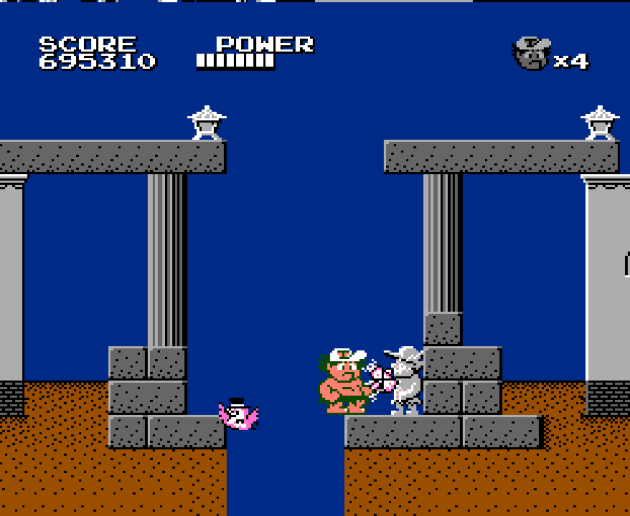
I’m going to spoil one egg location for you. In world four, this is the only hidden egg that has a special rule attached. You have to press the fire button 16 times in a single second in honor of Takahashi Meijin, who the statue is based on. I had to use the autofire function on my controller, cranked up higher than I normally have it set, and even then, it took me a while to figure out where to do it from. Actually, I spent over an hour looking for the egg before I gave up and looked it up in a guide, which explained the 16 shots a second thing, and instructed me to not stand directly on top of the statue but close to it. It didn’t work. How did I finally get it? Standing directly on top of it.
I didn’t understand the rules at first and so I did spoil the first world. I didn’t for worlds 2 – 4. Well, I did figure out the passwords for worlds two and three. World four’s was complicated because it introduced numbers to the equation and I ended up eating a ton of whammies. Anyway, I found this whole premise to be pretty dumb in general. I’m of the opinion you’re either in the mood for a brick breaker or you’re in the mood for anything else. It’s typically not compatible with other genres because it’s a genre that goes at its own pace.

The bombs blow-up entire rows, provided they aren’t interrupted by an unbreakable block. Oh, and the correct letters can be in either screen, so 32 brick breaker rooms is really 64.
“Last Mother F*ck’n Brick Syndrome” is in full effect here, and it murders the flow of the game. Even though there’s a couple Arkanoid-like boosts, including an unlimited ray gun (though it does take a couple seconds to charge between shots) and an item that allows you to knock the live ball back up in the air before it hits the paddle. But, most of the puzzles incorporate indestructible blocks that the gun can’t shoot through. You can’t leave a stage until all the bricks on the top section of the Arkanoid levels are cleared. If the item is falling in one direction and the ball another, you’re screwed! Enjoy replaying the stage. Is it at least an enjoyable brick breaker? Watch this and try to guess how I would answer:
And the paddle doesn’t seem to have the kind of segmented English you would expect. Hell, a few times the ball got caught in a vertical up and down volley, which makes no sense. The paddle should be divided into an even number of segments, with the first half knocking the ball to the left side and the second half the right side. Apparently, they didn’t program it like that. Finally, there’s three boss fights. They take maybe ten seconds each and are easy. So, while I admire that they did a highly experimental type of game, I really thought Takahashi Meijin no Bug-tte Honey was a horrible game. It wasn’t hard to figure out why this never was reworked for Americans. It’s too bad Hudson never tried the same thing as the overworld’s Easter Egg hunt, only with unique Mario Party-like mini-games. The egg hunt aspect I actually could see working with a variety of games, but not when every single egg sends you to a poor man’s Arkanoid after you just finished the platforming equivalent of a bullet hell.
Verdict: NO!
 Adventure Island II
aka Takahashi Meijin no Bouken Jima II
Platform: Nintendo Entertainment System
Released February, 1991
Developed by Now Production
Published by Hudson Soft
NO MODERN RELEASE
Wikis: Wonder Boy – Strategy


Well, Adventure Island II is just about the most perfect NES platformer from a mechanical point of view. It’s got the same basic jumping physics and momentum physics as the original game, only refined to the point that nobody would call it “unresponsive.” Besides a couple rare collision moments that made me raise an eyebrow, AI2 is clearly in an elite class. I mean seriously, as far as play control goes, it belongs with Super Mario Bros. 2 and 3. That’s why it pains me to say that Adventure Island II is f*cking boring. It’s one of the most joyless games I’ve ever played. It’s just so toothless and lazily designed that it almost feels like the team was hoping to apply the mechanics to any game but a sequel to Adventure Island. Like, in the first world there’s two completely flat straight-line levels that don’t even have a pit to jump over. Just walk right and throw a hammer sometimes. As if whoever is playing this has NEVER PLAYED A GAME BEFORE. It feels genuinely condescending. This is a sequel for f*ck’s sake!

Even the dreaded swimming stages control like butter, with or without the plesiosaur.
Now, I don’t really play video games specifically to be challenged. I’m an experience seeker. I play video games like this to become immersed in a fantasy experience. I’m a non-athlete and a coward. I’m pretty sure if I fired a machine gun there would be a me-shaped hole in the nearest wall behind me. But hand me a game controller and I’m a renegade combatant taking down an alien invasion, or the latest in lineage of vampire slayers, or, um, Fred Flintstone. Okay, so that last one sounds silly, but as long as the game is done well enough, I could believe it. But, I never got immersed in this game. Adventure Island II’s dev team went to all the trouble of creating pitch-perfect controlling mechanics and then dragged their feet to take them out for a spin.
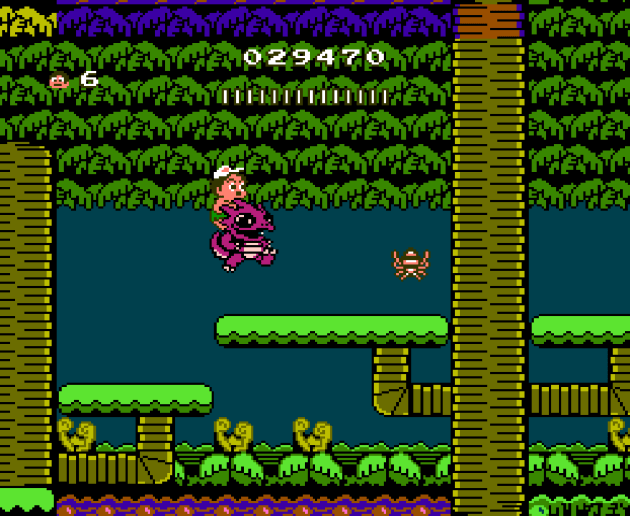
The level immediately following this is another totally flat straight line with no gaps to jump over. They needed to cut the levels by, oh, 40%. Maybe 50%.
Adventure Island II’s first three-to-four game worlds feel like they would be early world one levels, if not outright tutorial stages, in any other game. This game’s difficulty curve is as flat as its level design. I might not be seeking a challenge specifically, but I do expect to, you know, do stuff! Calling this uninspired is underplaying it. It’s like a baby’s game, honestly. I don’t know if they thought players would be overwhelmed with the four dinosaurs. Except three out of four control intuitively. The fourth, the pteranodon, is about as rough as the typical flying mechanics of any other platform game. It’s not a deal breaker. You also only get one weapon, the axe. No fireballs this time. Those are reserved for the red dinosaur. So I’m not entirely sure why the first twenty to thirty levels are so basic and bland. It’s not like they didn’t have the ability to make a tougher game. A couple of the later stages are pretty dang challenging and bold in design.

A level late in the game is based around the rushing wolves. Shockingly it was pretty well designed, with measured tension spots. They basically squeezed the wolf attack pattern for everything it could possibly do in this one level. I should also note that most of the stages are bite-sized. Maybe a quarter the size of Adventure Island 1’s stages.
But the fact that it took half the game to get to the good stuff, maybe even longer, sort of negates the value of everything good that eventually shows up. It shouldn’t take an hour or more of a 90 to 120 minute platformer to get to the good stuff. Hell, even then, the truly challenging levels are usually followed up with three or four more bland, basic, samey levels. I think a big part of the failure is they cut and pasted the enemies from the first game. But, those enemies only made sense in that game, with its less-than-perfect controls and difficult jumping physics.
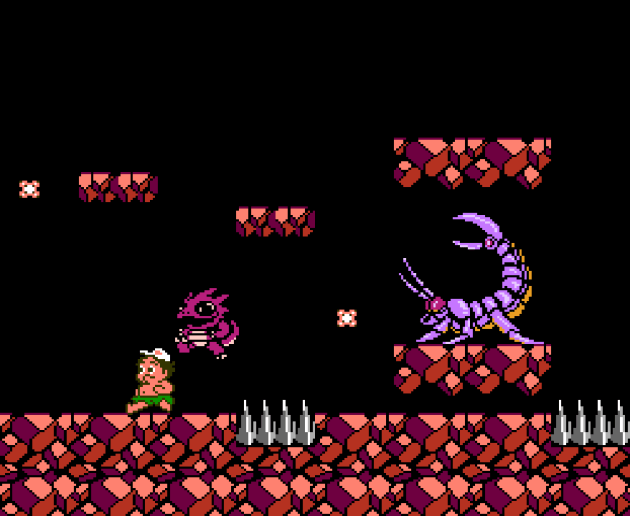
While the bosses might have different sprites, most of them feel samey, just like Adventure Island one. They appear in one spot, then teleport to a different spot.
Now the controls are next to perfect and players are riding overpowered dinosaurs. Given that, those old enemies don’t make a lot of sense anymore. There’s only a handful of new enemies, and at one point, a volcano that spits out three pieces of lava at once. But the overwhelming majority of enemies retain their exact attack patterns from AI1. Try to imagine if Nintendo cut and pasted the exact versions of Super Mario 1’s enemies into Super Mario 3 and put most of the new enemies in the swimming stages or in the ice stage in world 6. How fun does Super Mario 3 sound now? Not very fun, huh?
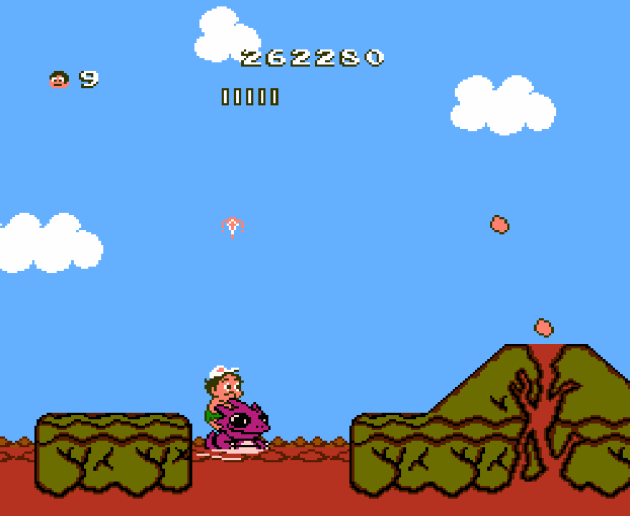
The volcanoes show up at the tail end of the game. You’ll also notice my dinosaur literally swimming in the lava. The red one is immune.
Actually, a bigger problem might be the new inventory system. You’re allowed to take any dinosaurs you finish a stage with or even the axe itself and bank them for use later. Since the first two or three dozen levels are completely gutless, you can quickly max out the inventory for the tougher stages. This idea was broken from the start and should never have been implemented. Hell, if I had actually used my stockpile EVERY stage, I wouldn’t have had any material at all to work with. I was playing the majority of the stages in the first few worlds without even an axe to start the stage and was still making minced meat out of them. The dinosaurs, especially the flying ones, make it too easy to circumvent the levels. So, most of my final inventory I’d accumulated at the start, until the game stopped spitting them out. This was what I had left going into the final level:

I know how many times I died. Nine total times. The first time wasn’t exactly the game’s fault. I swear to God I died because I was glancing at the NBA Finals Game 6. So that wasn’t a REAL death. That came in the ice stage in world four, then in that same world I died twice to the fourth boss (the only boss that killed me) and once trying to make my way to it. I also died once from a skateboard that you get at the start of a stage because what followed getting the board seemed like it would be damn near impossible to survive with the skateboard. I skid into three total things, two of them involving the snake.
I should note the sixth death was the worst one. At that point, they decided the best way to actually do a challenge was to just not spawn the fruits in some levels and let you starve to death if you don’t B-run the whole stage. How can you tell those levels from others? Well, you can’t. “I guess you better B-run every stage that comes after and not take a moment to enjoy anything at all.” That’s why you can’t do that type of thing. Oh, and you’ll notice my counter remains at 9 lives. It’s because you’re practically tripping over extra lives in this game. Literally once I got to 9 lives, every time I lost one I immediately got one back. Normally I do at least one play session with rewind/save states, but here, that wasn’t necessary.
The final really bad idea is that there’s alternative levels in every stage. How do you get to them? Well, you have to die while fighting a boss. Not even on the boss stage, either. Specifically you must be killed fighting the boss. I didn’t discover this until I died twice fighting the octopus.


Presumably this means there’s levels that no human being has ever played involuntarily because most of the bosses are such pushovers that I can’t imagine anyone ever lost a life to them. I just don’t understand any of this design mentality. Adventure Island II isn’t a total wash. With its excellent controls, it might make for a great introductory platform game for young children. Like, ages 5 to 8. I know that sounds like an insult but I swear it’s not meant to be. It’s colorful and it has decent combat and fun to ride dinosaurs. Kids might love it. Platforming veterans, on the other hand, should be able to chew this up and spit it out without breaking a sweat, and they’re likely to be bored the majority of the time. As a sequel to an infamously punishing game? It’s a stunning collapse. It wasn’t until I played Adventure Island 3 that I really appreciated how epic a failure Adventure Island II is. Do you know what it feels like? A game with AI-designed levels. No effort. No heart. No soul.
Verdict: NO!
 Super Adventure Island
aka Takahashi Meijin no Daibouken Jima
Platform: Super Nintendo Entertainment System
Released January 11, 1992
Developed by Produce!
Published by Hudson Soft
NO MODERN RELEASE
Listing at Wonder Boy Wiki
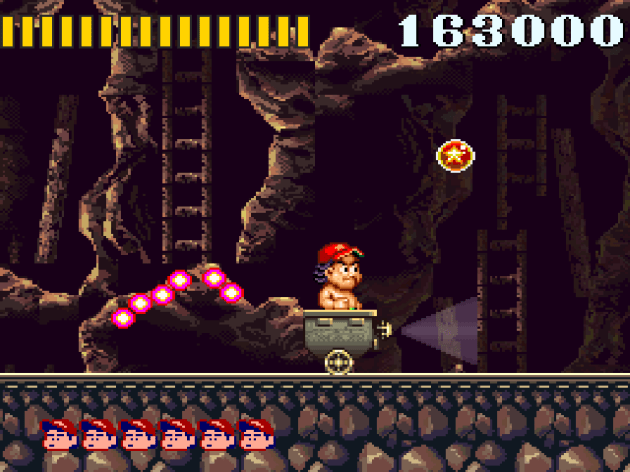
This is the closest the game comes to a set-piece. It lasts, oh, about two or three seconds, twice in the level it appears in.
I swear, a rebound in the Adventure Island franchise is coming. But, at the time I was playing Super Adventure Island, I was saying to myself “this whole feature was a bad bad bad bad bad idea.” Well, at least they took my advice from Adventure Island II and cut the levels. There’s only twenty total stages divided into five worlds. The problem is, of the twenty levels here, two of them offer any substance, and the rest are bland, basic world one/tutorial type levels. It’s plainly clear now that there was zero inspiration behind the last couple Adventure Island games. Flat levels? Those are back.
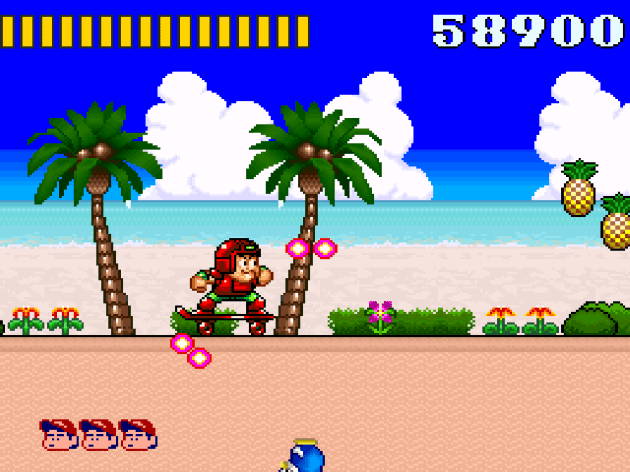
This entirely flat level is not an opening stage. This is immediately after the first boss. This is level 2 – 1. Wow.
How about the swimming stages? Those were kinda decent in Adventure Island II. Lots of stuff to dodge, plus their stages weren’t plain straight lines. Well, Super Adventure Island has two swimming stages. They’re literal straight-lines with no solid features to swim around. Just, scroll right, kill enemies or just avoid them. Either/or. Continue to swim right until the game says you won. Did the second swimming level add anything to change up the previous one? Nope. Not even a single new enemy or obstacle. Just swim right until the game says you won. This might be the laziest game by a major studio I’ve ever played. Here’s the first swimming level in its entirety:
And here’s the second:
Why even bother with two swimming stages if you’re that out of f*cks to give about what those swimming stages include? Not that the other levels are better. The only new gameplay additions are the ability to duck, a super jump that’s done from the ducking position, and a boomerang. The eggs are gone completely. Items are just laying around now. Often, the axes or boomerangs are placed in a way where it’s hard to avoid switching them. I quit trying after a while because once you gather four of any specific item, they become fireballs, then that carries over if you’re forced to swap weapons.
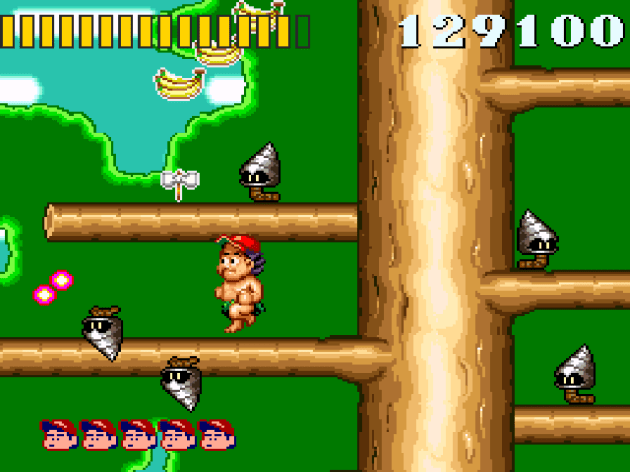
The only two levels in the entire game that I thought were decent were 3 – 1 and 5 – 4. This is 3 – 1, and it’s a run of the mill vertical climb, but it’s okay. I guess.
The first couple bosses each took just a couple seconds to kill. The third boss took maybe 10 seconds and I just barely didn’t die from lava dripping on me. The fourth boss I thought was going to require finesse, until I realized my super jump was high enough to cause damage even if it didn’t seem like it. Finally, for the final boss they just stole the “move out of the way and let the bad guy smash through the floor” gimmick that Nintendo used for the Bowser fight in Super Mario Bros. 3. “Well, if people loved it in Super Mario Bros. 3, they’ll love it in this game, right? Let’s not strain our brains over here trying to come up with something original!”

Paaaaaaaaaathetic.
Like Adventure Island II, they created nearly perfect controls and mechanics, but the actual level design is boring so it goes to waste. If you’re one of those types of people who like to invent your own challenges and try to beat the game without picking up weapons or not upgrading your loadout, I don’t even think that’ll be an option here because the choice is often forced on you. By the end of the first level, I was an unstoppable tank. My death count for Super Adventure Island was significantly lower. I died nine times in Adventure Island II. For SUPER Adventure Island, I died once. It happened in level 5 – 1. Of course it was an ice level. I got sniped from behind by a penguin.
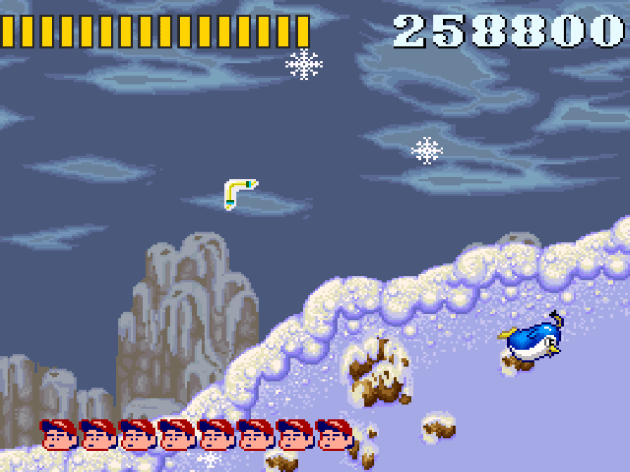
It’s ALWAYS the ice levels.
To the game’s limited credit, when I lost that one life, there was something resembling tension and excitement because it took me more than a full stage to get my tank-like loadout back. I didn’t need to be tense. I found out really fast that, with cautious play, the enemies aren’t that hard to avoid, at least for a minute or two while you build up your weapons. That’s when I realized that one of the biggest problems with Super Adventure Island is they just made the player too powerful. Being able to spam your weapons means not having to react to enemies with any sense of urgency. When I was capped at one boomerang or even two, the game was just better for it. Not by much, but by that point the mood had already been spoiled.
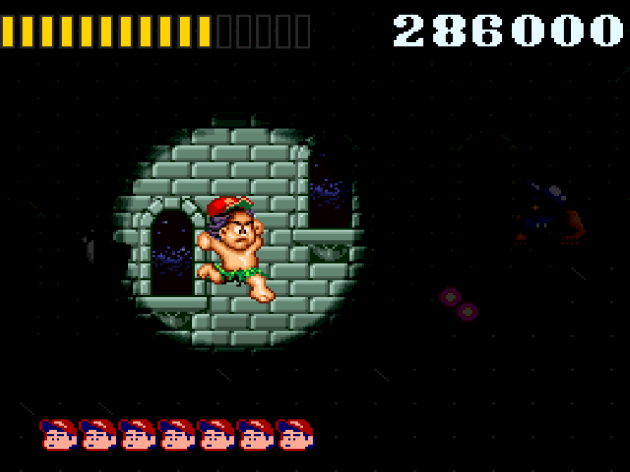
I wonder if this would have been tougher on an old CRT television? Because, like, I could see everything. This was more annoying than challenging.
Everything about the last two Adventure Island games has just been so arbitrary that you’d swear that they’re randomly generated. It’s like Hudson had a hit in Adventure Island 1 and the rights to make sequels, but nobody knew why the first Adventure Island (or Wonder Boy for that matter) resonated as much as they did. Apparently they determined it was the axe and the tropical setting. It wasn’t. What else is clear is nobody at Hudson knew what to do with it. They certainly weren’t at all curious about why other platform games were hits. What’s there to it? Just make a map, place a handful of enemies on it, you know, wherever, and maybe a jump or two and watch the money roll in, right? There’s no artfulness or logic to level design. That’s what’s missing from the first game. No sense that the enemies and jumps are very precisely measured. These sequels feel thrown-together. Consequently, the series was dead before 1995. But I swear, the losing streak will end soon.
Verdict: NO!
 Adventure Island
Takahashi Meijin no Bouken Jima II
Platform: Game Boy
Released February, 1992
Developed by Now Production
Published by Hudson Soft
NO MODERN RELEASE


I wish they were all this easy to review. Adventure Island 1 on the Game Boy is a stripped-down version of Adventure Island II for the NES. You’ll note from the Adventure Island II review that there really wasn’t all that much to strip-down. They basically kept cutting until they reached that game’s skeleton. The big differences include having less enemies to deal with, the level design is even simpler (though less of the flat design than the NES game, oddly enough), high jumping is much easier, and the dinosaurs no longer separately help out during the boss fights. Also, bosses that teleported around the room stay mostly stationary now. Maybe. In fairness, I was killing them in under three seconds on the Game Boy, so for all I know they could change spots.


I came into Adventure Island GB with the same “I have to actually play the levels” mentality I had for the NES game. For most stages, I banked my axe and dinosaur I’d acquired the previous stage and started the next level with nothing. I never flew past a stage with the flying dinosaur, unless I found one within the stage (I found two the entire game). Other than using autofire, I took no shortcuts (actually I never found the offer to skip an island like I found in the NES version multiple times) and used no emulator trickery. I didn’t need it. Even without those things, I never lost a single life in my first and only play session with this.
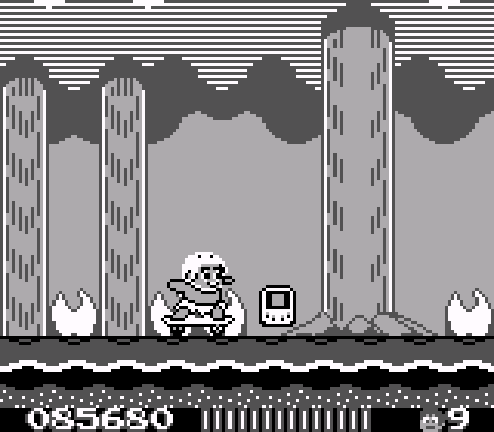
Can I play whatever game he just got instead?
In fact, Adventure Island GB was so easy that I only lost a single dinosaur throughout the entire game, and that happened when the final stage had a water segment and I wasn’t riding the water dinosaur. That means I never once even took a hit from a baddie. I’m not a pro gamer over here, so that should tell you how easy this is. If Adventure Island II is like a baby’s game, then the Game Boy version is like something for the recently lobotomized. But, that’s not why I’m giving this a NO! All I’ve ever cared about is having fun, and Adventure Island is a repetitive, uninspired, soulless slog.
Verdict: NO!
 New Adventure Island
aka Takahashi Meijin no Shin Bouken Jima
Platform: TurboGrafx-16
Released June 26, 1992
Developed by Now Production
Published by Hudson Soft
NO MODERN RELEASE*
Listing at Wonder Boy Wiki
*Included in all versions of the TurboGrafx-16 Mini/PC Engine Mini.
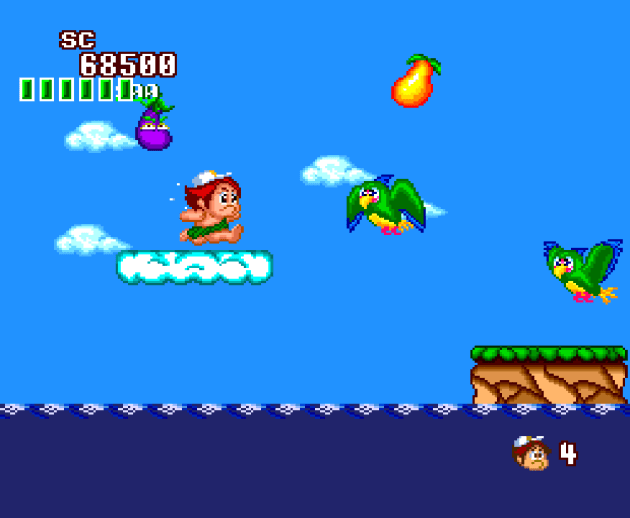
This is what I was kind of hoping for after the first Adventure Island.
It took a while but New Adventure Island is the first game after the original that actually feels like it’s attempting to be a sequel to the first. It adds a handful of new enemies, a handful of new settings, and a couple “new” items (though the SNES game had the boomerang already), BUT, it’s a no-doubt-about-it continuation of the original Wonder Boy’s formula. The level design mentality is the same. The controls and physics are largely the same. It’s certainly a little bit easier than Adventure Island. I was constantly dying playing New Adventure Island, but unlike AI2, I never came close to maxing-out the lives. It’s also nowhere near as repetitive as the first. They’ve subtracted seven levels total from the game. There’s twenty-five stages that are fairly fine-tuned to the same degree the first game is.

Even a straight-line skateboarding level isn’t REALLY a straight line, with excellent enemy placement and some tricky timing on moments where you have to dodge.
So, a total improvement on the original, then? Well, no. Unlike the first game, the challenge doesn’t scale as well as you’d hope. Per tradition, I lost a few lives on the ice levels. I was actually sweating that I might game over but then I started racking-up extra lives. In fact, the boss of those stages was the only one I lost a life against. But after the ice world, it was pretty clear sailing besides one or two mistimed jumps or the occasional GOTCHA death. It sure seems the ice boss, the finale of only the third world, who has an attack pattern that looks like this:


Should have been fought after the fire guy at the end of the fifth world, who has a very easy to dodge attack pattern that looks like this:


And while I’m on the subject, the sixth boss’ attack is so weak that you can even jump through the sprite at times.

You can see that I’m literally jumping through the ball. Apparently it’s not armed until it hits the ground.
Now granted, the levels are as poorly arranged as the bosses. Every single death I had after the ice level was pretty much a result of mistiming something in one of the castle stages. Every fourth level (plus the 25th level that is apparently world 7 all by itself) is a castle, and these do actually pose legitimate threats to your life count. The stages leading up to them? Not so much.
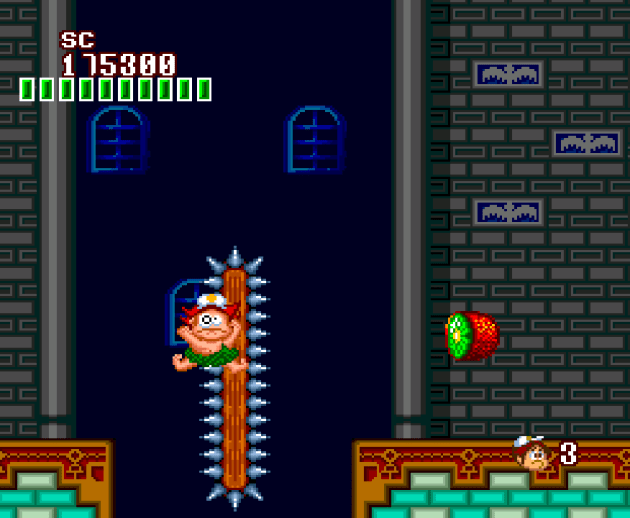
These things especially have some atypical timing about them. You certainly can’t just B-run your way through the castles. If I actually took my time, I probably could have aced the game after the 3rd world. I’m not amazing at taking my time in platforming games.
Actually, I never died outside of a castle after world three. Hell, when I got the eggplant, I realized I didn’t even need to worry about it. It doesn’t drain your hunger meter anywhere near as quickly as the original versions did. Maybe this is why I went into cruise control and paid the price for it in world seven, which is just a single castle stage where I lost all but my last life. The biggest adjustment I had to make was to the jumping. It took me a while to drum into my thick skull not to settle for landing on the edge of any platform, since I tended to clip through them. But there’s almost no edge-of-ledge jumps and every platform, even near the end of the game, is measured enough that you should be able to land in the center. Once I figured that out, I did enjoy New Adventure Island well enough. This is the direction the series should have gone all along.
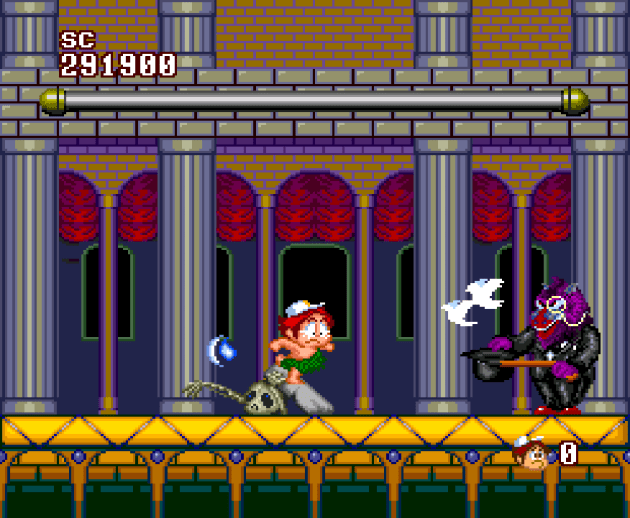
I was down to my last life but made it to the final boss. My heart skipped a beat when I tripped over this guy, but it’s just a trip. I beat him on my first try. Well, his first form at least. Not so much for the second form. I was sweating that I would need to rewind to “continue” since I never found a Hudson Soft bee, but this game doesn’t screw around with that. You can just continue.
The fact that I ate a GAME OVER is a positive, even if it took a while. After the NES sequel and the Game Boy game, I wasn’t sure if the series had lost its nerve to actually be difficult. This is the right kind of challenging, and I’m all for it. New Adventure Island isn’t going to blow you away, but if you want a TRUE follow-up to the original Wonder Boy/Adventure Island that’s still an old game and not a more modern remake, this is your best bet. It has a couple mild surprises that worked well and some unexciting but suitable new settings. It’s not a major leap forward, but New Adventure Island offers a meaty enough challenge without going overboard, like the first game did at times. Even though I dropped a ton of lives during the climax and ultimately game overed, it was 100% on me for being impatient. There’s no insane level 8 – 3 jumping sequences here. Just a good, solid, challenging action-platformer. Really, isn’t that what the series should be?
Verdict: YES! – $5 in value added to Adventure Island 40th Anniversary Collection
 Adventure Island 3
aka Takahashi Meijin no Bouken Jima III
Platform: Nintendo Entertainment System
Released July 31, 1992
Developed by Now Production
Published by Hudson Soft
NO MODERN RELEASE
Listing at Wonder Boy Wiki

Oh hey, what’s this? Memorable settings? An actual EXPERIENCE instead of levels that feel like they were generated by AI? This ain’t half bad!
After Adventure Island II, my expectations for the third NES game were right up there with my expectations that I could hit a ball out of Yankee Stadium. Like, maybe if Aaron Judge physically took me by the feet and swung me as a bat, but I don’t know if that technically counts as *me* hitting the ball out of the park or just Judge hitting one with an unusually shaped bat. Partial credit? No? Okay, well, either way Adventure Island 3 is actually a lot of fun. I know, right? And here’s the really weird thing: they didn’t change any of the mechanics of Adventure Island II. They just took those mechanics and built a better game around them. Since the difference between 2 and 3 is like night and day, that tells you how much developers need to focus on levels, huh?

This was my final load out in the life that finished the game.
Getting back to the mistakes: the item system is every bit as absurd now as it was in Adventure Island II. Let me explain this delicately: if every single item you picked up in a platform game was stored for later use, you could do a continent-wide domino rally because the genre would be full of push-overs. I might not seek a challenge specifically, but even people who play games because we’re experience seekers need some kind of push-back from the games. It’s good for immersion! I mean, unless you have a God complex. While I might have lost more lives playing Adventure Island 3, I was NEVER in danger of eating a game over. Let me show you just one more inventory screen.

Those crystals are prizes for perfect bonus rounds. They give you one extra hit. I never used one throughout the game.
That is my inventory after three levels. Not worlds. LEVELS. Go ahead and count it! There’s nine items on it. NINE! That means after only a couple minutes of playing Adventure Island 3, I had three times the amount of inventory than I had actual levels finished off. You just can’t do that sh*t and think it’s a net-positive for the game! This could easily be fixed, too: just limit players to banking only one of each item/dinosaur. That would add desirable risk/reward factors. Also, lose the pteranodon entirely, which is often just a free pass to a stage’s goal even if you skip the fruit. You know the P-Wing in Super Mario 3? The pteranodon is like that, only with you getting to keep it after using it. Also, if you switch to a different dinosaur while riding the pteranodon, don’t worry because you didn’t waste it. It’ll be waiting for you in the inventory screen between levels. Isn’t that kind of silly? It’s basically a cheat code without the code part.
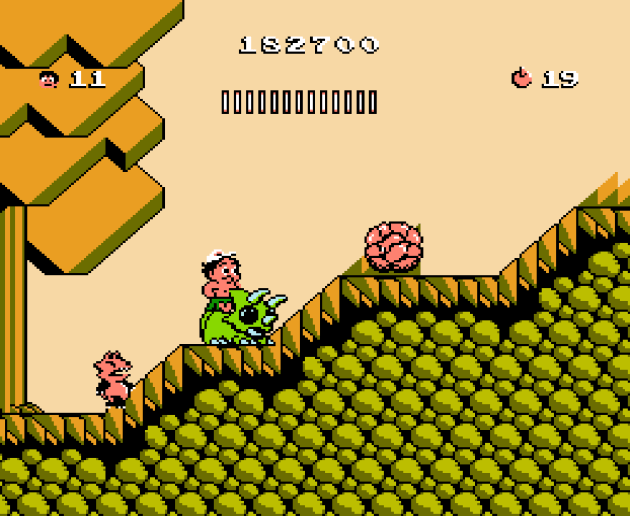
The new dinosaur is a triceratops that I nicknamed “Tricera the Hedgehog” since its gimmick is that it can do jumping spin attacks just like a certain blue mascot. Its only other advantage is that it can walk on quicksand without sinking, which is basically useless since there’s only a tiny handful of quicksand appearances in the game. Each of those are about as wide as your average jump over a pit, or maybe slightly bigger. Also you’d basically have to stand still in those spots for them to pose any danger, which literally nobody is going to do because, you know, it’s f*cking quicksand! Tricera is right up there with the Cloak of Invisibility from Wizards & Warriors in the “useless power-up hall of fame.” BUT, look at those beady-yet-adorable puppy dog eyes. So cute I could just pinch it.
So the inventory system and some of the items are overpowered. But, unlike Adventure Island II, I wasn’t miserable playing this. The levels have actual design logic, with enemies placed in a way to pose a threat instead of just someone seemingly inserting them because it’s been a screen or two since you had to throw the axe at something. The boomerang shows up in AI3 (no relation to Allen Iverson), but it actually isn’t overpowered, and in fact, cost me at least two lives from misuse. You can’t spam it and have to wait for it to return before you can throw it again, making it MUCH slower to use than the axe. But, in return for that, you can throw it above you. Now that’s how you balance a weapon. It just works better from a game design perspective.

This gag is used a couple times in the game. Two eggs are presented. One has the eggplant, the other the fairy. Naturally on my first attempt I always picked the eggplant. By the way, I died every single time from it.
While I’m on the subject, I died from timing-out more playing Adventure Island 3 than any game I can remember. But, it never really does the dickhead “there’s no food in this level” thing either. There was only one instance where there was something that was so calculated, yet so far-fetched that it seems hard to even imagine they thought they could implement it, that I kind of want to shake hands with whoever came up with it. Okay, so I’m running out of heath and have to jump out of the water, but one spider and a bat are there. So I try to throw my axe to stop them, only the axe stops. Huh. In other words, there’s a hidden egg right there, only the hidden egg is shielding the bat and I really need to get moving because I’m out of health but the bat will kill me if I try to go forward and…… I ran out of time.


Oh! OH! You….. stinky poo bastards! That was downright dastardly! And actually kind of brilliant. The amount of fine tuning required that would assure the player was short on health there (and it had to have been fine-tuned because the next life had the same thing happen) and needing to rush AND avoid not one but two enemies working in collaboration with each-other? Well played! I mean, sure, a little too “trial-and-error” for my tastes, but Adventure Island has always leaned heavily into that. If you’re going to have trial and error gameplay, you might as well be clever about it instead of just setting lazy instakill booby traps. Adventure Island 3 is pretty much always clever about it.


So Adventure Island 3 is really good. Damn pretty game too. Okay, so some of the settings repeat, but it’s the NES. For the limitations, they did manage to get a lot of different locations. Most enemies feel like they maximize their potential. Ironically the only one not like that is the wolf, which was the one clever enemy usage in Adventure Island II. But Adventure Island 3 hell, I died on at least half the bosses. They actually put up a fight, but always a fair fight. The last boss ran a little long, but otherwise, they were highlights. So were the levels that led to them. Adventure Island 3, for all intents and purposes, IS just an expansion pack for Adventure Island II, except, you know, better in every imaginable way. It actually makes the previous game’s lack of effort stand out. Play both back-to-back. No joke. It’s fascinating to experience.
Verdict: YES! – $6 in value added to Adventure Island 40th Anniversary Collection
 Adventure Island II: Aliens in Paradise
aka Takahashi Meijin no Boukenjima III
Platform: Game Boy
Released February 26, 1993
Developed by Now Production
Published by Hudson Soft
NO MODERN RELEASE


Like the previous Game Boy release, this is a stripped-down version of the previous NES game. And, much like the difference between Adventure Island 2 and 3, the Game Boy sequel is a vast improvement over the previous game. The whole “stripped-down” aspect is even more prominent this time around. Even when B-running, your movement feels slow. Jumping is high and sluggish, and momentum factors in a lot more. If it’s an ice level, it might take you two seconds to turn around and move off the space you’re on. That makes a BIG difference during the ice world’s boss stage, and especially when big boulders are rolling down a hill and you don’t have the right equipped weapon.

I didn’t mention the clock in the NES review, but it’s another dumb addition right up there with Tricera the Hedgehog. It’s like a Starman or Fairy, except you don’t actually kill anything. All hazards freeze and if you walk into them, you just kinda step up over them. This includes the little stones that you trip over, which somehow makes you hungry. Hey wait a second. IF you can just step over the rocks with the clock, why can’t you do it without the clock? The enemies are one thing, but they’re just stones for God’s sake!
Oh, and there’s one other thing I didn’t mention in the NES game, because I didn’t find it, because I wasn’t skipping levels. I can explain. There’s an overworld map that you go to before the inventory screen between stages. On the NES, it’s just a map with no icons or level markers. It looks like this:

On the Game Boy, it looks more like something from the Mario franchise, with pathways and icons for the levels. It looks like this:

Look how happy he is that you selected the next stage.
And I noticed on the Game Boy that there were pathways I wasn’t using. Something I never realized on the NES because it’s just an abstract map with nothing clearly defined in a “this is a level” sense. Well, it turns out, there’s branching paths. The rooms that have the fork have a very poor choice of word when they give you the branching path option. “EXIT” returns you to the stage, but the word for the branching path is “SKIP.” Well, since there are additional skip-like options, like the ability to SKIP straight to the current world’s boss, I never went the “SKIP” route. But near the end of the Game Boy title, curiosity got the better of me. So I gave it a try and:


Huh. Let me guess, the NES game had the same thing, right? Sorry it’s in Japanese but I figured I might as well see if that ROM felt any different while I was at it (it doesn’t, don’t bother). So, did I miss a bunch of stages?


Well……… crap. Okay, well, for what it’s worth, you’re not missing any amazing stages. For all the extra effort I made, hell, some of the levels felt nearly identical to ones I already played the first time around. No one-off set pieces or amazing hidden bosses you’re missing out on. I don’t even know why they bothered.

How is it these ice levels are still getting me so much more?
Anyway, the Game Boy title’s biggest changes are mostly to bosses, which all feel kind of smaller in scope. That’s due to having some of their more dynamic attack patterns removed due to hardware limitations. Plus the playfield is much more cramped as well. After playing the NES game, this felt so slow, small, and lacking. Don’t mistake this for being a bad game. It’s really not. I imagine a Game Boy owner in 1993 must have been VERY happy with this. But it’s not 1993 anymore. Unlike the Mario Land games which don’t have console counterparts, this is a port of an existing NES game that attempts nothing the console version didn’t, and it even retains the level ordering. Adventure Island II on the Game Boy was probably VERY good once, but for my 2026 set, it really only has value as a +1 bonus and a curio.
Verdict: YES! – $1 in value added to Adventure Island 40th Anniversary Collection
 Takahashi Meijin no Bōkenjima IV
Platform: Famicom
Released June 24, 1994
Developed by Now Production
Published by Hudson
Never Released Outside of Japan
NO MODERN RELEASE
Listing at Wonder Boy Wiki
Optional English Patch Developed by Demiforce
Link to Translation Patch at RomHacking.net
Use THIS tool to apply patches.

While you’re reading this review third-to-last, this is actually the last game I played for this feature and it was VERY CLOSE on whether or not I saved the best for last. I hadn’t decided at the time I typed this sentence. Or this one. Okay, now, I’ve decided. No, wait, I haven’t. Maybe I should write the review first.
The last two official Adventure Island two releases of the classic era are a shift in genre, as they now enter the Metroidvania phase of their existence. However, only the first one, a Famicom exclusive, actually feels like it belongs in the Adventure Island branch of the Wonder Boy/Adventure Island family tree. Super Adventure Island II is basically the worst game in the Wonder Boy franchise. THIS is Adventure Island as a Metroidvania, and it’s awesome. What a shame it never came out in the States. I say this a lot about late-era Japanese exclusives, but this would have been the ideal send-off for the NES.
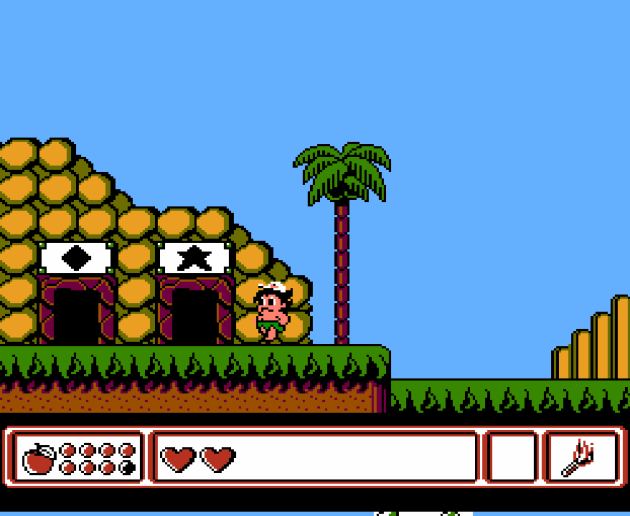
Near the starting house is Jurassic Park. Well, that’s what I called the homes of the dinosaurs you rescue, one of whom nerfs at least some of the heart room challenges. The designers were smart enough to only allow players to take out one dinosaur at a time, and actually, I’m pretty sure you can beat the game without ever mounting a single one. It would just be tougher.
Now, don’t get too excited. This isn’t exactly Super Metroid or Symphony of the Night over here. In fact, you never need to backtrack all that much. All the entrances to the game’s six distinct worlds are right near the starting house and open, one at a time, as you beat bosses. Exploration is such a cinch I didn’t even need to use a guide. It’s a very basic map with mostly basic platforming templates, but it just works. In fact, it works so well that I’m pretty pissed they didn’t build off THIS game for Super Adventure Island II. Adventure Island IV might be too basic. There’s not even that many roadblocks where you can’t get past a certain point until you get a certain item. Like this below, where you can’t make this jump on your own:


That’s a logical type of layout that you tease players with early, and then they return to it when they have the snowboard, right? Nope. Adventure Island IV doesn’t really do that type of thing. By the time you reach it, you already have the snowboard that allows you to build up momentum to jump higher. Think of this more as a six world, linear game that’s just structured differently. And not every level is fantastic. In fact, the only one that I think rises to the level of memorably excellent is the fifth stage, which is also the longest. It’s quite the trek up through clouds, then down to a desert, and finally through a gigantic pyramid. Inside the pyramid, it’s a maze with lots of false walls. That whole three-part segment was really well done. I wonder if they regret not making the rest of the game’s levels that big. The other worlds, including the finale, feel like two normal stages stitched together. Sometimes they’re so short that I was startled by reaching a boss when I did. For those stages, the level design is, you know, fine. Same with the combat. Same with the sense of exploration. It’s all fine. Even good, but nothing mind-blowing.
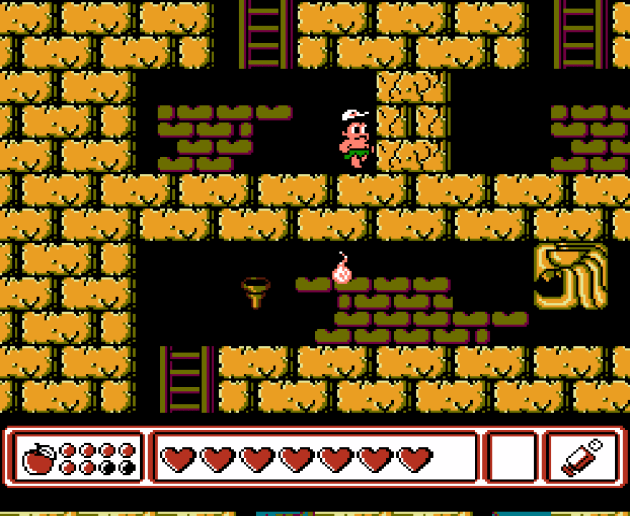
Seriously, fantastic level. Castlevania would be proud of this one.
There’s also a few head-scratching decisions. There’s rooms where the gimmick is you have to make your way across platforms to press a button that lowers another platform that allows you to reach an egg, which could contain something to increase your health capacity. One little problem though: if you have the flying dinosaur, you can circumvent all that and just grab the egg. Since those rooms were so fun that I could see a Game Boy title based solely around them earning a YES! and a buck or two in value, they really should have disabled the ability to use the dinosaurs in them. Also, they kept all the food around but now there the hunger meter is gone. What does the food do? Collecting eight refills a heart. The sense of urgency is gone, as a result. Part of me wonders if they had plans for the food to work the way it always had and they lost their nerve at some point.

If I had to choose the biggest problem with the game, it’s probably that they didn’t build enough stuff around the items you collect. I honestly think this right here is the last time you need to use the spear this way. I just got the damn thing.
It’s certainly a bizarre twist on the Adventure Island formula in other ways. You start out by throwing bones at enemies. What about the axe? What about the skateboard? They’re literally the last two things you collect! I didn’t even realize the game was building up to the axe. I get that the axe and skateboard are the icons of the franchise, but I wouldn’t think they’re “grand finale” iconic. I figured they just dropped them from the game. When you really stop and think about it, it makes no logical sense that they’re the big deal final items. They’re the literal basic items of the first game. It’d be like building a Zelda game around acquiring the most brittle sword in Hyrule. It also has a pretty damn lame map system. It looks like this:
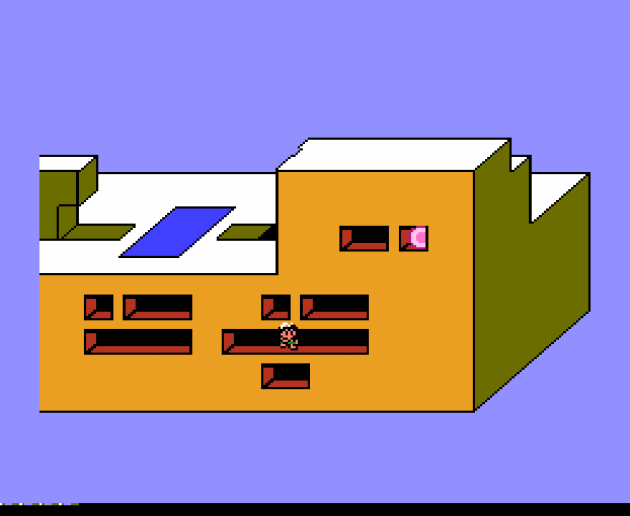
What the heck is that? Adventure Island or Crystal Castles?
And since I’m complaining, I should note that autofire is an absolute necessity for this game, since there’s a few moments where you have to compete in a button mashing race in order to earn a medal that allows you to pass deeper into the world you’re in. There’s also post-boss set-pieces designed to show off new items you acquire that never worked for me at all and felt like an excuse to fast-travel you back to the hub world. Like at one point you win a surfboard, but you never again need to use that surfboard after you finish that brief segment. Like I said in one of the above captions: they needed to create more item-specific segments for the inventory you collect. Most of it will get used once or twice at most. On the other hand, the variety of weapons are nice, and many enemies have specific weaknesses to encourage experimentation. It’s a short game too if you want a Metroidvania that can be beaten in a single sitting. I finished it without a guide or cheating in four hours, give or take.
As a spoiler warning, the next game, and the last official Adventure Island in this feature, really, really sucks, and I played it before this. I was pretty worried about Adventure Island IV after playing it. But I shouldn’t have been. Why this one works better (besides the obvious answer of being superior in every way, including graphics) is that this one remembered that it’s Adventure Island. From the movement physics to the combat to even the basic principles of level design, this still feels like it belongs to the Adventure Island franchise. They’re not suddenly trying to copy what Westone had been doing for over half-a-decade by the time this was released. Adventure Island did its own thing, and that’s the thing a Metroidvania based around it should keep doing. And hey, the end result is really fun, and that’s something the SNES sequel didn’t even come close to becoming. Better than Adventure Island 3? No, but I did have to think quite a while about it.
Verdict: YES! – $5 in value added to Adventure Island 40th Anniversary Collection
Add $1 in bonus value if a translation is included.
 Super Adventure Island II
aka Takahashi Meijin no Daibouken Jima II
Platform: Super Nintendo Entertainment System
Released October, 1994
Developed by Make Software, Inc.
Published by Hudson Soft
NO MODERN RELEASE
Listing at Wonder Boy Wiki
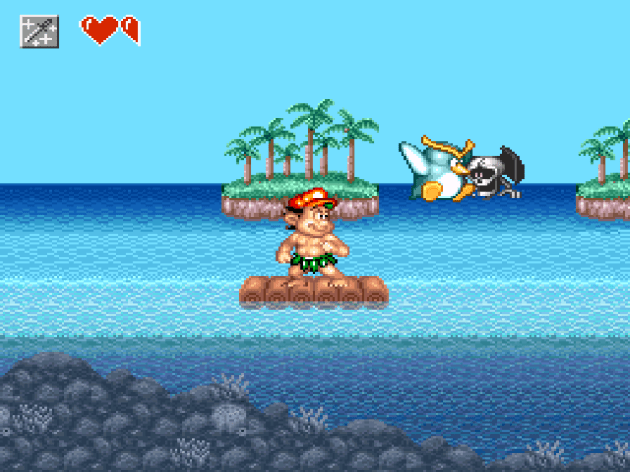
Random encounters didn’t earn this game its NO! all by themselves, but they certainly came close to that.
The reason I played this before Adventure Island IV is because I had completely forgotten that Super Adventure Island II was a Metroidvania. I’d previously sampled it when I ran through SNES games in 2021, gave that brief hour or two a NO! and kind of vaguely knew the SNES games would be pretty miserable for this feature. That’s why I saved IV for last. I actually love 2D Metroidvanias. Gun to my head, they’re my favorite genre. So it really gives me no pleasure at all to say that Super Adventure Island II is the worst Metroidvania made by a major AAA I’ve ever played. It’s really shockingly horrible.

The currency system seemed pretty useless to me. Enemies only drop coins worth one, and that’s if you’re lucky and they don’t drop health or magic refills you don’t need. You’re dependent on finding these chests, but finding one should be enough to buy all the techniques. You have to acquire the ability to push, do a downward thrust, and do an upward thrust.
It couldn’t be more obvious that this was a cynical attempt to take Adventure Island in the same direction Westone took Wonder Boy, but they didn’t seem to fundamentally understand how to make those kinds of games. You’re given a huge world map with islands that you have to paddle a raft to. During the rafting, random attacks can happen. Do you get experience points? Nope. There are no experience points. It’s like a stripped down version of Zelda II, with only one background that you see over and over. The only thing that changes is the enemies. And because you’re on the water, hell, you might not be able to catch all the loot they drop. It’s just busy work. It does seem to be random too, because sometimes I could go straight from one island to another with only one random encounter, and other times so many happened as I tried to raft towards an island that I started screaming. The amount of spaces you can move before the next encounter seems to be decided as soon as you reach the map, so you can’t rewind around it.

Speaking of not being able to cheat, here’s the one thing I *did* try to cheat at. Now mind you that I never ran away from any enemy in the game and, when the coins dropped in a way where they weren’t impossible to get, I did collect them. I should have been loaded with cash when I reached the Casino before world four (of six) where you finally get a shop with items. And mind you, I didn’t actually go there when it opened up. I went there after the fifth world. The shop has a sword, armor, shield, the boomerang, and a half-heart. I bought the half-heart because who doesn’t want more life? It cost 1,275. But I had like 8,000 gold so no problem. Then I went to get the sword next and…… it was nearly 50,000 gold. Are you kidding me? The light shield is nearly 10,000, while the Armor is nearly 30,000, and the boomerang is 15,000. I think this is one of the first games like this I’ve ever played where I didn’t get a single one of the top items. I hadn’t cheated a single aspect of the game up to this point, but I was growing listless so I decided it couldn’t hurt the integrity of this review to use save states to cheat at the casino games. Hah, so much for that. After ONE HOUR of trying to stop the last reel on “7” using save states and having a lot of ones where it looked like the 7 was going to stop in the center, only it kept going in a way no other spin ever looked, I’m going to guess that it’s probably rigged to pay out after only X amount of spins. And by the way, if you DO get all 7s, you’re still 20,000 short of the sword. Had I won, I still couldn’t have afforded it.
Super Adventure Island II is NOT an adventure. It’s BUSY WORK: THE GAME. It has so much fumbling through menus and items and so much backtracking that it’s exhausting, and that’s even before I get to the level design. Let me walk you through an ordinary puzzle from the fourth level of the game. On the other side of these tunnels of dirt is a switch that I have to press.
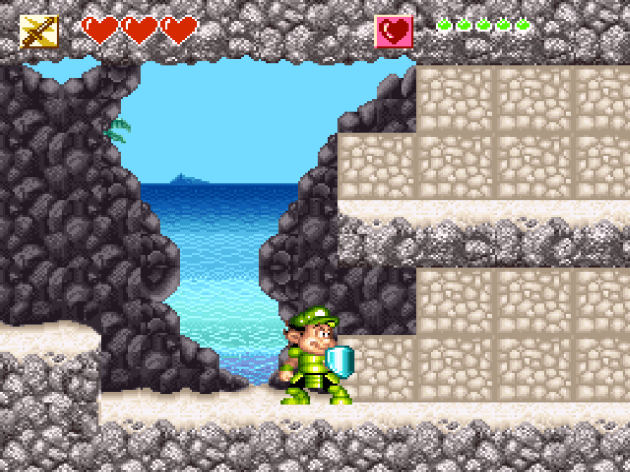
Thankfully, I have a shovel. Unfortunately, there’s multiple buttons that go unused on the SNES pad in this game. Specifically, L, R, Select, and Start. So, to get the shovel, STEP ONE, I need to pause the game.


STEP TWO is I have to go to the “WEAPON MENU” and STEP THREE is I have to select the shovel. STEP FOUR is return to the main menu and STEP FIVE is to return to the game, where you’ll note that you no longer have your armor or shield. So I hope there’s no enemies around you, because you’re defenseless now. You can use the shovel as a weapon but it’s not very effective. Also, when you hold the shovel, you duck automatically, but you don’t duck when you jump, meaning while you can go through the bottom tunnel, you can’t come back that way because you can’t crawl and there’s no mechanic to get you back through the tunnel you dug. That’s why a lot of dirt tunnels come in pairs, one high and one low. Also-also, you cannot use the shovel while jumping. Also-also-also, you can’t climb ropes while using the shovel.


STEP SIX is to dig the tunnel to the switch, which is activated just by pushing it. That’s step seven right? Well, no, because there’s one “also” I left out about the shovel above. You also-also-also-also cannot push switches while holding the shovel. You know, that item you’re holding that has the word SHOVE in it.


STEP SEVEN is you pause the game to go to the menu. STEP EIGHT is selecting the weapons menu. STEP NINE is equip any sword. STEP TEN is you exit to the previous menu and STEP ELEVEN is you exit the menu to return to the gameplay, where you’ll note that your armor and shield are back. How nice of the game designers to throw you that bone. Now you can push the switch. If you’re a complete moron like me and didn’t dig your way out while you had the shovel up, repeat steps two through five and then step six your way out of the tunnel, then repeat steps seven through eleven so you can have an actual sword and armor equipped for whatever comes next. The minimum is eleven steps to push a switch on a wall when there are four unused buttons on the controller, two of which are action buttons. Are we having fun yet?

In this picture, I’m actively damaging the boss. This swing of the sword landed a shot. Draw a box around the boss’ sprite that reaches as far as the tusk does and it still makes no sense at all. Now, in fairness, this is the only time that the collision detection stood out THIS badly. And no, there’s no future vulnerable spot here. Actually, in this boss’ second form, you go for the eyes and brow. I legitimately have no idea how this is landing a hit. The trunk is not vulnerable at all. In fact, it’s a shield in the second form. It’s one of the most baffling collision issues I’ve ever seen.
The best aspect could have been the level design. I’m not so stone-hearted to say Super Adventure Island II got NOTHING right. In fact, I’d say more than half the levels would have average level-layouts appropriate for the genre. Except, even the positives are turned into negatives. Each of the first five worlds has a section that’s gated off. If you’re stupid enough to not use a guide, they might drive you crazy. Well, I didn’t use a guide for my first day with SAI2. It turns out, those gated-off areas stay gated-off until you acquire an item. Then you have to go back to those stages, play a flute inside these little shrines, and they open up the rest of the stage for you to get the macguffins that you need to enter world six. There are shortcuts and fast travel spells, but they also liberally seasoned unreachable treasure chests, including valuable life boosts, throughout the stages that you can’t initially reach, so using those shortcuts makes little sense.
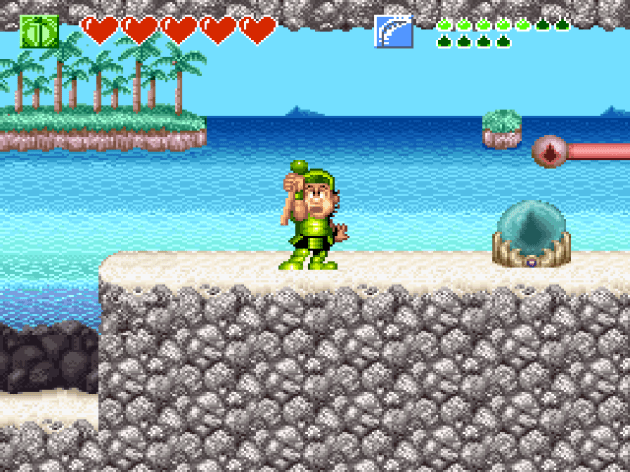
The thing on the right wall is what the block switches look like. You have to turn them off to beat most of the worlds, but when you try to beat world six, surprise: you need them back on, which meant I had to go back to the first five worlds AGAIN. Then I returned to world six only to discover I had forgotten the one pictured above, and I almost threw my controller. I’m stunned I actually finished the game. I wanted to quit several times.
Now, average (if somewhat bland) level layouts can also be helped by quality combat, but Super Adventure Island II’s combat is just kind of samey and boring. The sword-based combat has no OOMPH to it. It’s feathery and lacking in a satisfying crunch, which sucks because all those random encounters might not have been so bad. You can get items like daggers or axes, but they aren’t much better. They just give you range. The enemies don’t really have complex attack patterns or memorable sprites. The bosses aren’t much fun to fight either, and they tend to be a little spongy as well. More telling than all of that is when I finally activated key moments to push the progress along, I wasn’t happy so much as relieved. I couldn’t wait to be done with this game. Go figure it took me two morning-to-night days to finish it. I spent more time playing this than all the other games combined INCLUDING my practice sessions with the first Adventure Island. And it was never even a little bit fun.

This is the second-to-last boss. The final boss’ door is directly above this one. Just two or three jumps above it, actually. But, after beating this thing, you’re sent back to the starting spot in the overworld and have to raft back to the island (or use the quick travel spell and hope enough things drop magic refills) then go all the way back through World Six again to make those two or three final leaps. Like I said, BUSY WORK; THE GAME.
I can deal with moments of blandness in a Metroidvania. Hell, I liked Castlevania: Circle of the Moon just fine and it has tons of problems like having way too many flat hallways, illogical backtracking and “key moments” that don’t feel important enough. But you can get away with some blandness if the core mechanics are fun. Or, failing that, cool sightseeing or set-pieces can carry mediocrity over the finish line. Super Adventure Island II has none of that. The settings are as commonly generic as it gets and never go the extra mile from a graphical point of view. There’s no stand-out moments. This isn’t a launch title. This is pretty deep into the SNES’ existence for a game to have almost no artistic ambition.

You’re fighting a space crayfish. This is the big finale after all that?
Once again, excellent (if completely unoptimized) controls and movement physics go to complete waste. I feel bad for whoever coded the controls of the bad Adventure Island games. Usually when games are this big of a disaster, the controls are abysmal. This controls great! That really tells you how badly done the level design is that I’m ranking this dead last, even lower than the MSX game. At least that was over with quickly. Even the story is ridiculous, and this has the slowest unskippable text I’ve seen in a long time. At best, AT BEST, some of the level segments rise to the level of average-at-best. And I feel bad for saying even that because I’m afraid someone might mistake that for saying there’s something of value here. This is one of the worst games I’ve played because it’s boring to the point of sucking the life out of you.

This game was rigged too. I only spent 20 minutes trying it, but I never got the 20 box.
I said they were aiming for Wonder Boy in Monster World type of vibes, but clearly Zelda II was an inspiration too. They missed the mark on both, as it doesn’t feel like a Wonder Boy game or even a bad Zelda II knock-off. For that matter, it doesn’t even feel like it has any connection to Adventure Island. None at all, at least from a gameplay point of view. I don’t know why they took the franchise in this direction, but this was essentially the end of the series. Attempts at revivals were made for the GameCube and Wii, but they haven’t done anything with it since. THIS was the end of Adventure Island as a franchise with new releases in regular intervals. That tells you everything you need to know, doesn’t it? If you find yourself stuck on a desert island with only this game, swim for it.
Verdict: NO!
I think a bad ass prestige retro collection needs some nifty bonus features, and Adventure Island 1 specifically seems to be a speed runner’s dream, right? Apparently, Nesrocks thought so too. I don’t like doing anything but quality of life ROM hacks in these features, but this is the type of ROM hack where I think there is a chance something along these lines could be included in a set like Adventure Island: 40th Anniversary Collection. So, here’s a bonus review!
 Adventure Island Abridged
Platform: Nintendo Entertainment System
Unauthorized ROM Hack of Adventure Island
Released March 14, 2017
Developed by Nesrocks
Link to Patch at RomHacking.net
Use THIS tool to apply patches.
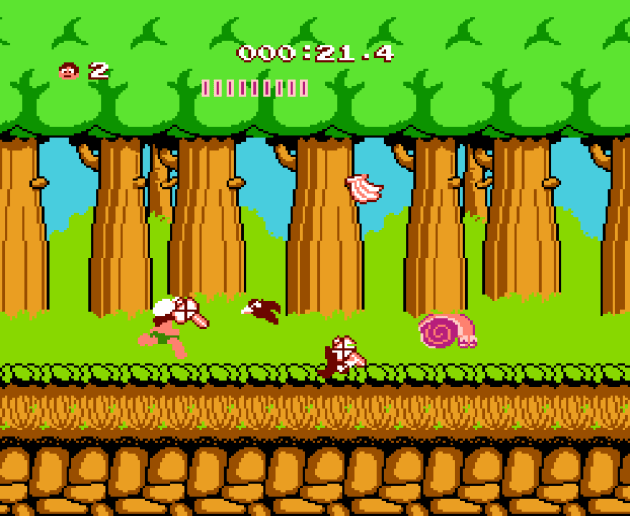
How’s this for a bonus review?
It’s long overdue that Nesrocks appeared in a Definitive Review. From the man I call “The Iron Chef of Gaming” comes this reimagining of Adventure Island that’s built specifically for the speed running community. Now, this is “Abridged” and not a remake. There’s no new levels in this. The thirty-two levels of the original have been condensed down into the nine that offer (1) maximum difficulty (2) specific types of challenges. The nine levels are shown in the slideshow below, along with what stage they originally were in Adventure Island.
Remember what I said about how you can play for fifteen to twenty minutes and see everything Adventure Island has to offer? Nesrocks took that to heart. This really is a sizzle reel of not only the level settings but the type of challenges offered by Adventure Island. It’s VERY hard, but in a good way. Well, except in one regard. I’m a big fan of Nesrocks, but the difficulty scaling, which was perfect before, is now all wrong. The hardest level in the game, 8 – 3, is now the sixth of nine stages. Okay, so he couldn’t put it last because it’d be weird to fight the boss and still need to play another stage. Fine. Put it eighth, not sixth. Meanwhile, once you know where the eggplants are in 8 – 1 and that there’s no hidden milks to save your life from the lack of food, it’s not THAT hard. I’d put 8 – 1 fourth or fifth in the ordering. It’s also worth noting that he beefed up the last boss, which now offers a legitimate challenge instead of just being more of the same. Though I’m insanely happy that, in my fastest run, I didn’t die on the 8 – 3 jumping sequence. Other times? Oh, I died. I even ate several game overs on it thanks to the lack of extra lives.

This was my best non-cheating run. I missed seven of the pots, BUT I didn’t die.
You also have to grab the bee and the hidden pots if you want an extra challenge. The game keeps a tally of what you collected. Also nice is the timer stops between each-stage. Now, if the main mode is too hard for you, Abridged is still something you should check out because it has a second mode called “Arranged.” It’s the same nine level game, only much easier. You start every life already possessing the axe and all hidden eggs are revealed. Oh yeah, and you only lose health from touching enemies instead of dying. All enemies, actually, and even the fire and boulders.


Okay, so Nesrocks didn’t exactly get the order of levels right. But, what he’s done here is actually an amazing idea. Adventure Island really is kind of perfect for this type of speed-running challenge already, but who wants to sit and play THIS game over and over? I put a lot of time into the NES game, and even though it was nowhere near as dull as I imagined, I was certainly ready to move on to the next game by the time I was ready to write the review. I was having fun, but not so much that it wasn’t getting exhausting. Shrinking the thirty-two levels into nine was actually brilliant. The order might be wrong, but he NAILED the choice of which nine levels to include. If Konami really does do a 40th Anniversary Collection, they should honestly just kick Nesrocks some money and use his hack as bonus modes.
Verdict: YES! – $3 in value added to Adventure Island 40th Anniversary Collection
Check out Nesrocks’ Patreon, and if you like his work, kick him some bucks!
FINAL TOTAL

They are cute together!
YES!: 6
NO!: 6
Total Value: $26
Total Value without ROM Hack/Translations: $22
Projected Price: $29.99 to $39.99
Final Value with Emulator/Bonuses: $32 to $36
It’s in the range, folks. If my hypothetical set releases at $39.99, even the most boilerplate special features would earn Adventure Island 40th Anniversary Collection an outright victory. Box art, ads, instruction books, concept art, a jukebox, etc? It probably makes it over the finish line. Of course, the opposite is true. If this comes with a featureless emulator, especially one missing the big three (button remapping, quick save/quick load, and rewind) there’s almost no chance any bonus features could make up for the missing bonus value of the emulator features. Not only that, but I’d probably drop the value of the first Adventure Island down a buck or two. Since I strongly suspect Konami has their eye on a set like this, hopefully whoever they partner with goes all-out on the emulator and special features. But, with half the Adventure Island games holding up pretty well to the ravages of age, a set like this seems to be worth doing. With the right package, at least.
FINAL RANKINGS
I normally don’t make a note like this, but I feel I should say that the drop off in quality between the #6 game and the #7 game is HUGE. Bigger than any gap between the worst good game and best bad game of any collection, real or imagined, I’ve ever reviewed.
 Adventure Island 3 (NES)
- Adventure Island IV (Famicom)
- Adventure Island (NES)
- New Adventure Island (TurboGrafx-16)
- Adventure Island Abridged (NES ROM Hack)
- Adventure Island II (Game Boy)
**TERMINATOR LINE** - Takahashi Meijin no Bug-tte Honey (Famicom)
- Adventure Island II (NES)
- Super Adventure Island (SNES)
- Adventure Island (Game Boy)
- Takahashi Meijin no Bouken Jima (MSX)
- Super Adventure Island II (SNES)
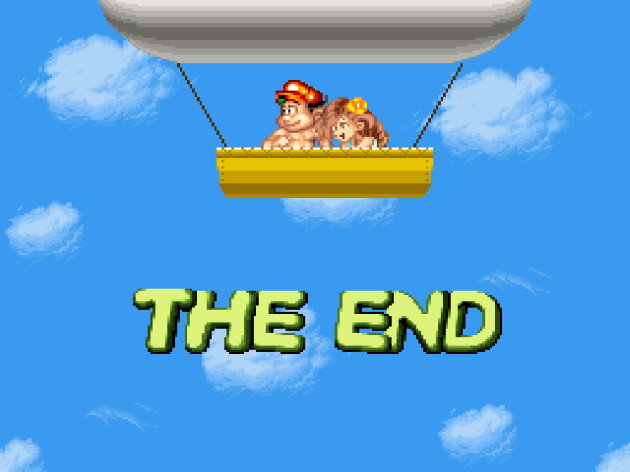
I know that look. She’s about to throw-up.

 Indie Gamer Chick


You must be logged in to post a comment.