Starship 1 (Arcade Review)
January 15, 2026 Leave a comment
 Starship 1
Platform: Arcade
Released July, 1977*
Designed by Steve Mayer, Dave Shepperd and Dennis Koble
Developed by Atari
Originally Utilized Yoke and Thruster Controls
NEVER BEEN RE-RELEASED (?)
*The Killer List of Video Games and other sources list 1976 as the date, but GameFAQs and Wikipedia list a July, 1977 release date so that’s what I went with. This is another game meant to be a bonus review for Atari 50: The Definitive Review – Part Two but since that might take a while to finish, I’m posting them separately. Besides, these games deserve to stand on their own.
So why am I reviewing Starship 1? Well, I saw the Japanese flyer for it in Atari 50 and my jaw literally dropped.
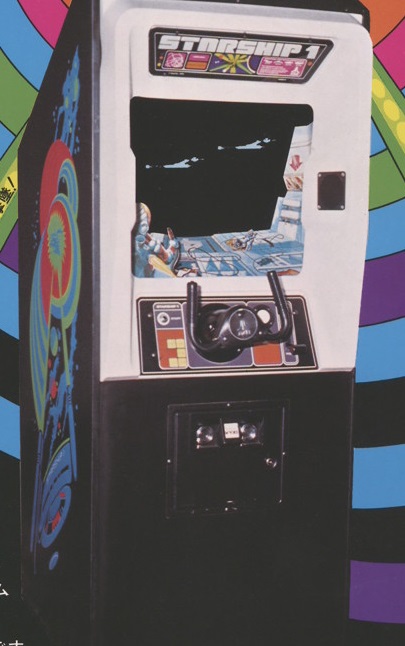
That is so f*cking cool looking, isn’t it? How can you not geek-out over that? It’s just so COOL! I can’t imagine how exciting it must have been to see that in an arcade in 1977. How could anyone pass up a chance to try it? Frankly, I’m stunned this isn’t considered a legendary game based on the cabinet alone. Yet, I’d never really heard of Starship 1 before seeing that flyer in Atari 50. That seems like an ominous sign that the game isn’t very good, right? Well, spoiler: Starship 1 actually isn’t a bad little game at all. It’s a little game for sure and one that I couldn’t put too much time into due to epilepsy concerns, but I enjoyed my time with it. So why the hell didn’t they include Starship 1 in Atari 50? It can’t just be because of the controller, right? They included steering wheel-based games like Fire Truck, Sprint 8, and Super Bug. There has to be a reason. Then I saw it in action.
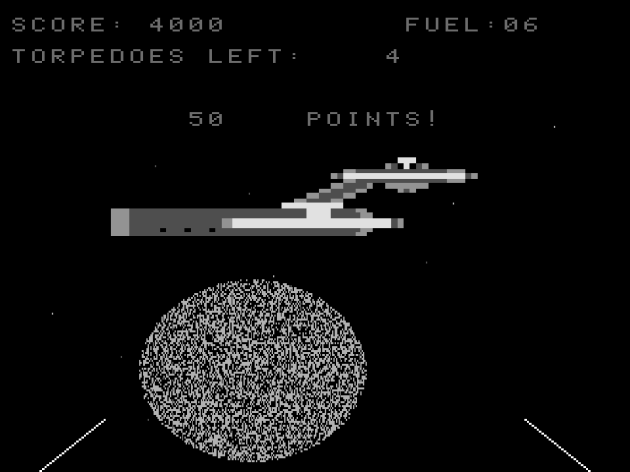
Oh. Yeah, now I get it. Fun fact: Apparently Starship 1 is the owner of the first “easter egg” (cheat code) in gaming history, though my father and I spent the better part of a half-hour trying to get it to work and couldn’t.
Yep, you’re shooting down ships that look exactly like the Enterprise from Star Trek, which was the inspiration for the game. And Starship 1 isn’t being coy about it, either. There’s also ships that look kind of like Klingon Birds of Prey plus the game literally mentions “The Federation.” It’s a reminder that Starship 1 was made in the wild west days of arcades, where Atari had the chutzpah to ride the wave of Jaws popularity with a game called Shark Jaws, with “Shark” in teeny tiny barely visible letters and “Jaws” in gigantic, all-encompassing letters. By the way, I intended to review Shark Jaws for Atari 50’s bonus reviews and couldn’t get it working, and it likely cannot work on MAME at all. There’s so many games that have no widespread presence for people like me that are interested in gaming history. It’s insane that in 2026, you can’t just play any old 50 year old game from the comfort of your home, even if you’re willing to pay for the privilege. And people used to think the Disney Vault was a nightmare. Yeesh.
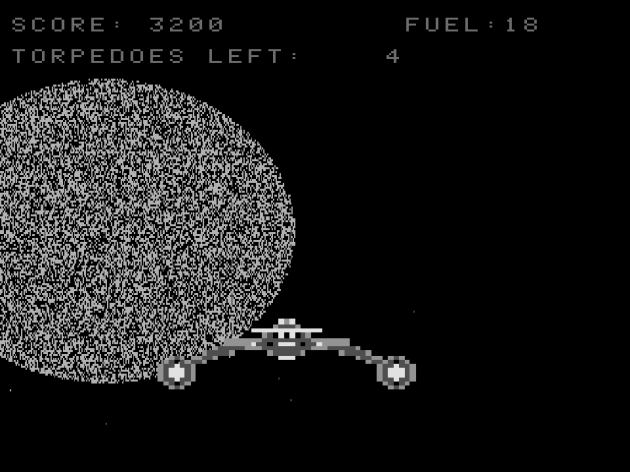
My father said “it’s amazing Atari didn’t get sued over this.” Indeed.
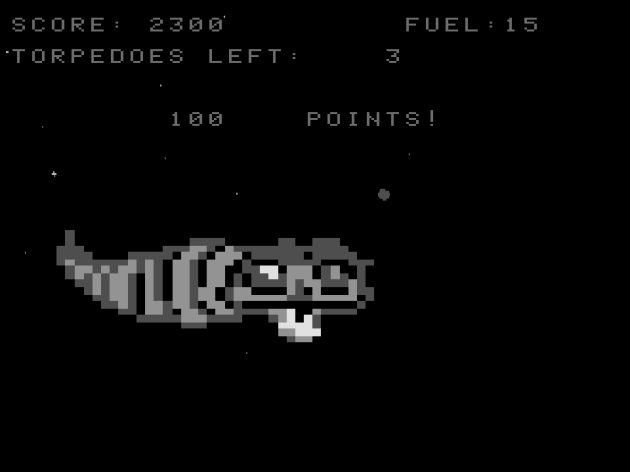
Anyway, unlike a lot of coin-ops, you can’t “win” at Starship 1. You’re paying a quarter for an immersive 60 second experience of getting to pilot the not-Enterprise, shooting at four types of baddies while dodging their blasts that look like little circles of static. The standard Enterprise-style spaceships score 50 points. These weird looking space cats score 100 points, while the fast moving saucers score 200 points. The Birds of Prey are rare enough that we didn’t encounter them EVERY game, but when you do manage to see them and shoot them down, they score a whopping 500 points. There’s an impressive-for-its-time sense of size and scale thanks to the sprites getting larger as they get closer to the screen. The effect looks similar to Wolfenstein 3D a full fifteen years before that came out. There’s no animation to the sprites besides the scaling-up, but it’s still impressive given the era and limitations. After sixty seconds are up, the game is over regardless of how well you played. If there’s a way to continue on, we never found it. Frankly, I don’t know why anyone would want to? Start over and go for a higher score. That’s the point.
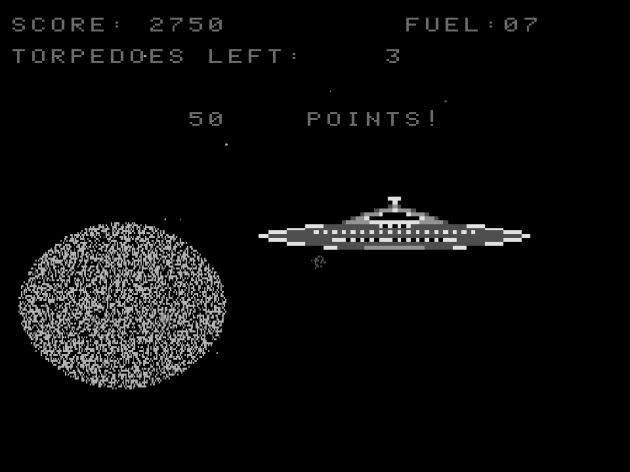
I get why they skipped this for legal reasons, but there’s also a lot of features that, simply put, can’t carry over.
Starship 1 isn’t a particularly difficult game, hence the strict 60 second timer. It’s one of the first games that was meant to be an experience more than a test. “It’s the Star Trek Experience before that was a thing,” my father said, though he never saw this game either. The actual coin-op used a state of the art yoke for analog controls with a thruster for speed. Starship 1 was also one of the first cabinets to use what’s called the “pepper’s ghost” effect to create the illusion that the image was floating in space. By having the monitor lay horizontally in the cabinet and using a mirror that’s half-silvered, it creates a convincing illusion of an image floating in the air. You’ve certainly seen it before, as it’s the same trick that was used by Atari in Asteroids, Taito in Space Invaders, and the famous Sega laserdisc game Time Traveler, not to mention all the “holographic” ghosts in the Haunted Mansion ride’s ballroom scene are really the world’s biggest use of the effect (though that record might have since fallen).

It almost looks like Nyan Cat, doesn’t it?
So, playing this on MAME or as a hypothetical Atari 50 release means losing a lot of the charm, and this on a game that relies a lot on charm. Again, I can’t imagine how exciting it must have been to see that in an arcade in 1977. I wouldn’t be around for another twelve years, but if I ever see this at a gaming museum, this is on my “must play” list because what I got out of this review is but a fraction of the intended Starship 1 experience. But ignoring all of that, there actually is still some satisfying gameplay to be had. Not a lot, obviously, but this is one of the rare historical curios that retains some satisfaction thanks to a well-designed primary weapon. Hitting your shots is exhilarating, period. I didn’t expect that.
I have no idea what that’s supposed to be. According to a video I found, on MAME planets show up a lot more frequently than they do on a real machine. Another example of “the charm is lost.”
So a home release of Starship 1 makes little sense because this was promising you that, for your quarter, you were going to get an experience unlike any other available in arcades. Except, well, I kinda liked playing this. So did my father. As limited and stripped of its selling points as it was, playing this with a PS5 controller with no holographic effect, hey, it controls great, the shooting is satisfying enough, and it doesn’t overstay its welcome. If anything, I think the game is a little too generous with the photon torpedo. When time is up, your score is your score and if you want to go again, you have to pony-up. “You having fun?” I asked my father, and he stared at the screen and said “yeah. You?” I nodded and said “yeah. Huh. Who’d have thought?” I get why, for legal reasons, they probably thought including this was a bad idea. But Starship 1 was a revolutionary first-person game worthy of historic consideration, both for its contributions to the first person shooter genre AND on its gameplay merits in the 2020s as a scoring-rush style mini-game. I guess the phasers must be set to “stun” because I’m stunned this got a YES!
Verdict: YES!
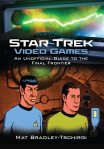 If you’re interested in the history of actual Star Trek video games, one of my best friends in the whole world, author Mat Bradley-Tschirgi, wrote a book on them! Star Trek Video Games: An Unofficial Guide to the Final Frontier is a fun coffee table-style read and, at the time of this review’s publication, you can get it on Amazon for 58% off! It’s also available on Kindle but, like, come on! It’s a coffee table book! You want to own THE BOOK, and $16.59, it’s a steal, folks! I’m not a paid shill, just a big fan.
If you got to play a real version of Starship 1, I want to read about it in the comments! Come on, arcade goers of the 1970s and 1980s! I need to live vicariously through you!

 Indie Gamer Chick
You must be logged in to post a comment.