Road Runner (Arcade, Atari 2600, and NES Reviews)
March 15, 2025 2 Comments
 Road Runner
Platform: Arcade – Atari System 1
Released July, 1986
Directed by Mike Hally
Originally Designed by Ed Logg, Apparently
Developed by Atari Games
NEVER BEEN RE-RELEASED

This could have been an incredible maze chase if you just change.. well.. basically everything.
Atari Games’ Road Runner is the answer to the most useless trivia question in the entire history of video games: what game has Indie Gamer Chick attempted to review the most times? I started and stopped reviewing Road Runner three previous times before this fourth and final attempt that, if you’re reading this, must have taken. There’s very good reasons why I want to review Road Runner. It ticks every box for the type of retro reviews I seek out. (1) It’s a licensed game (2) that has no modern re-release and likely will not for the foreseeable future. (3) It has a very interesting behind the scenes story. (4) It’s a maze chase, which is a genre I’ve devoted a significant amount of my free time towards achieving a greater understanding of. (5) Finally, it’s topical in a modern conversation thanks to the recent fiasco regarding the almost fully completed motion picture Coyote vs. Acme that might never see the light of day. Road Runner might be one of the most fascinating bad arcade games I’ve played.
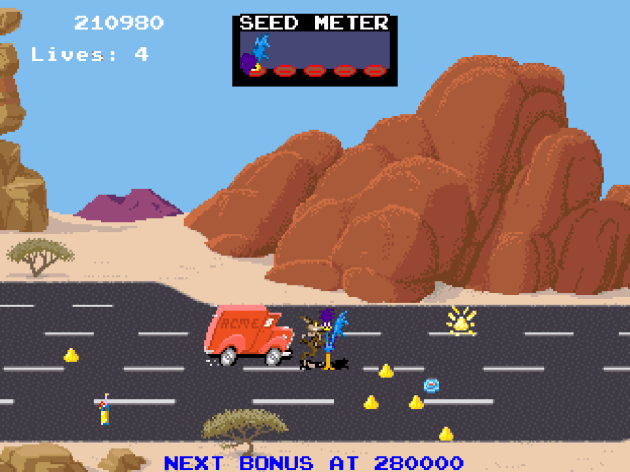
In the coin-op, I really struggled to get cars to hit Wile E. Coyote. I think his collision box is a lot smaller than in the two home ports I played. I guess that makes sense, since this is trying to suck quarters from players.
Road Runner was commissioned to be Atari’s answer to Dragon’s Lair and capitalize on the LaserDisc craze/fad of the early-to-mid 1980s. In fact, their intent had been to one-up Dragon’s Lair by making a hybrid game that didn’t create the illusion of interactivity, but rather gave players direct control over sprites, something LaserDisc games typically didn’t do. Only the backgrounds and death animations would utilize full motion video taken straight from Road Runner cartoons. The rest would be a normal video game. By the way, this HAPPENED, as FMV Road Runner was 100% completely finished and route tested, which means they placed cabinets in specially selected arcades to monitor the reaction to it. Usually route testing means ten-to-twenty units are produced, which was the case with the only verified “killed in route testing” video game I’ve reviewed: Nintendo’s Sky Skipper. Atari’s Akka Arrh seems to have also made it to route testing but the extent of it I haven’t been able to figure out. I have no idea how many copies of FMV Road Runner existed, but at least one unit survives to this day and is a mainstay on the California gaming convention circuit. What makes Road Runner unique is that it was killed in route testing, but was still eventually released to arcades in the time window of its development, albeit without the LaserDisc gimmick.

If they ever do figure out a way to re-release this to modern audiences, they might as well go all the way with it and release it as the FMV hybrid it was intended to be. It’s the only thing the game has going for it, frankly.
So what happened? It’s hard to know for sure, but I think I have a good guess. First, the obvious: LaserDisc video games had “fad” written all over them. A bubble certain to burst. Road Runner was NOT the type of game to bet heavily on if you expect it’s riding a fad. Road Runner, despite being a normal video game, would have still cost a LOT more than a standard upright coin-op for operators. Dragon’s Lair cost $4,000 in 1984 bucks, $1,000 to $1,500 more than the competition. Second, the technology was notoriously unreliable. I’ve heard so many stories of disappointed 80s gamers seeing LD games like Space Ace wearing OUT OF ORDER signs. They had heat problems. They had disc reading problems. LaserDisc cabinets are basically an arcade game made out of a bigger, bulkier, heavier, hotter DVD player with additional circuits attached. That’s a recipe for hardware failure if I ever saw one. But, above all that, I suspect Atari recognized that Road Runner just wasn’t a very good game to begin with. That’s why Road Runner was reworked to remove the FMV elements in favor of sprite backgrounds. The game that came out in 1986 really is the exact same game as the LaserDisc version would have been, and it was probably a very wise decision because Road Runner isn’t very fun no matter how much you dress it up.
UPDATE: Thanks to Dave Sanders, who found that the original designer of Road Runner was Asteroids/Centipede/Gauntlet/Dr. Muto (hey, I liked Dr. Muto) designer Ed Logg. It looks like “unreliable tech” is the declared reason why FMV Road Runner was canned.
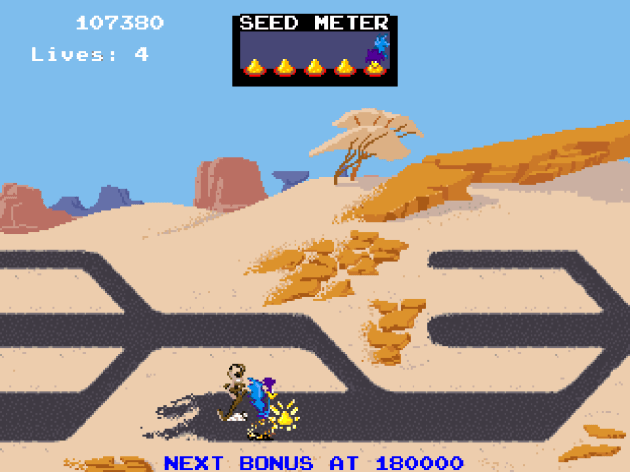
The third stage is where the level design drops all pretense of fairness and just counts on players getting hung-up on the road or placing bird seed in dead-ends so you have little-to-no room to run around the coyote. Just sh*tty design that isn’t meant to be fun. It’s meant to get players off the machine by any underhanded means necessary.
You have to run around collecting bird seed while avoiding Wile E. Coyote and his various ACME gadgets. You can miss up to four bird seed piles before you die. The movement is SUPER loose and very difficult (see after the verdict for an update on this, as we found out after the fact Road Runner uses useless analog controls). This is combined with narrow, twisty-turny roads that you must stay on. There’s no off-roading in Road Runner. The coyote chases you directly for the most part, and like most games where the chaser makes a beeline for you (not all, but most), it makes for a boring chase element. For the most part, you can only scratch-out distance by running a circle around him in one of the wider parts of the road. Sometimes the coyote uses gimmicks like spring shoes or riding a rocket, but for the most part, he just runs at you directly. A maze chase with a boring chaser is a fatal flaw to begin with, before you even factor in the awful movement physics. Sasha compared the NES version (coming up) to being like bootlegs of Pac-Man where the walls are removed, and that’s a spot-on comparison. Getting stuck trying to corner is the leading cause of death in this game, which doesn’t pretend to play fair. Like, look how low visibility this cannonball is:

Because of the fast movement speed and scrolling, it’s much harder to see in motion than in this screenshot. These are basically a GOTCHA that relies on memorizing levels.
I just found Road Runner to be a huge drag of a game. The collision boxes with the bird seed are quite unforgiving, unlike the landmines or other obstacles. Plus, Wile E. seems to have a smaller collision box than you, because I wasn’t very successful at luring him into traps, which is kind of a secondary object of the game. You score points based on how many times you cause the coyote to fail, both when an incident happens and as bonus points at the end of stages. It’s exactly what you want from a Road Runner game, but because the controls are so loose and unwieldy, it’s no fun to hit Wile E. Coyote. Plus, the coyote will injure himself just as often without you having to do anything, which hypothetically should work and fit the Looney Tunes theme. In practice, it takes the zing out of a maze chase. Imagine if the ghost monsters in Pac-Man practiced self-cannibalism. It’s MY job to eat you. What are you doing? And that’s why it doesn’t work here.
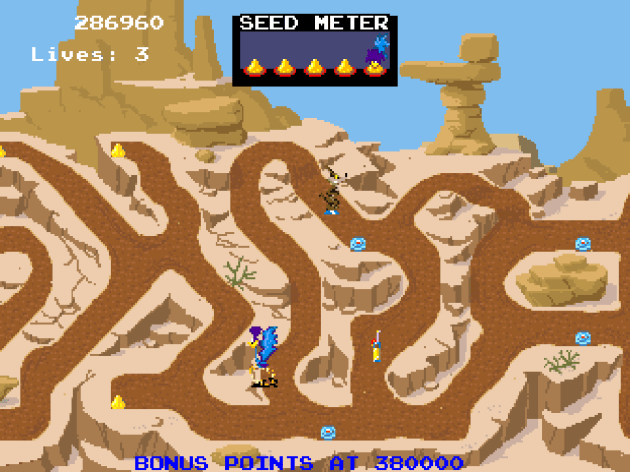
The main challenge isn’t the coyote, but getting hung-up on the edges of the road, and that’s just the worst idea for a video game challenge.
I didn’t get very deep into Road Runner. I made it to the seventh level when I realized concepts were starting to recycle, and I’d seen enough that I just had to give up and play something else. Road Runner is a maddening combination of frustration and boredom the likes of which I’ve rarely seen in a maze chase game. I honestly don’t think there’s any problem with a game I hate more than basing levels around precision movement, then giving you imprecise controls. It’s dirty pool, and if I want that experience in an arcade game, I’ll play a ticket redemption game. At least there I know I’m being cheated. But, let’s assume the controls were perfect. Would I be having fun then? I can’t say for certain, but I still don’t think so. I think the Coyote is a dull chaser. I think they were aiming for the Coyote to be more like Bluto from Nintendo’s Popeye: a singular, terminator-like pursuer. But, every turn-the-tables element is indirect at best, and incidental at worst. Road Runner’s base gameplay could be made perfect and it still wouldn’t be fun. This is a low point for the genre.
Verdict: NO!
UPDATE – Analog Controls
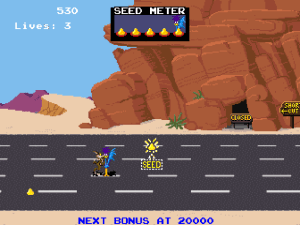
Used analog and died immediately because I wasn’t going fast enough. Like, the coyote immediately won. You HAVE to floor it.
Dave and Btribble clued me in to the fact that Road Runner used an ahead-of-its-time form of analog based around the Hall Effect that’s all the rage these days. But if you’re using MAME or other emulators, any analog controller works (you might want to adjust the settings though). Now, I swear to God I had no clue as the Wikipedia page doesn’t mention it and Sasha, who uses the analog stick instead of a D-Pad (which I prefer because then my hand tremors don’t really factor in), didn’t report anything. It wasn’t an oversight on her part, either. It simply does not make a difference. I just tried it and, because of the speed of the Coyote, you only get fractions of a second at most where it matters. Any precision gains are negated by how closely the coyote chases you. During straightaways you literally have to floor it anyway or he’ll get you almost immediately. During zig zag courses where he uses the rocket or spring shoes, again, there’s still no point in slowing down because you’ll immediately have to jerk the stick when the coyote makes his gains anyway. That’s INSANE! It would be like putting a pedal on a driving game then giving players only enough time to win if they have the pedal to the metal the entire race. Analog really doesn’t help Road Runner even a little bit and actually makes it kind of worse, as I think I got hung up on the edges even more when I tried to feather the stick. So in addition to the NO! I’m punting the Road Runner square its virtual ass for wasting innovation.
Follow-Up Verdict: BAM, right in the ass.
 Road Runner
Platform: Atari 2600
Released in 1989
Designed by Bob Polaro
Developed by Atari Corporation
NEVER BEEN RE-RELEASED
Well, on the plus side, you don’t really get hung-up on the edges of the road in the Atari 2600 port of Road Runner. That’s because the twisty-turny level design isn’t really here. It’s mostly running in a straight line. The coyote doesn’t run quite as fast as he does in the coin-op, but he still gets the occasional burst of speed to catch you. When he gets that burst, the same strategy is used from the arcade version: run around him in a circle to scratch out distance. Which is pretty much the most boring way to escape a chaser, but it works. The Atari version is MUCH easier to lure the coyote into the landmines, which actually makes this game slightly better than the coin-op. It feels truer to the cartoon. But, the gameplay is just dull as dirt. I suppose on some level, this is an impressive technical achievement, but if the gameplay is boring, who cares? Road Runner on the Atari 2600 is a stripped-down but competent port of a terrible coin-op.
Verdict: NO!
I had planned to do more ports of Road Runner but I can’t take it, so I’m only doing one more.
 Road Runner
Platform: Nintendo Entertainment System
Released November, 1989
Developed by Beam Software
Published by Tengen
NEVER BEEN RE-RELEASED
If there’s such a thing as “the best version of the arcade game Road Runner” then the NES port from Beam Software and published by Tengen is it. It controls the best. By far. Because the movement is nowhere near as loose, you don’t get hung-up on the fringes of the road as often. Oh, it still happens. In fact, it happens quite a bit, but that’s because the core design is just not very good. Sasha made a really good point. “Remember those Pac-Man bootlegs where they removed the walls? Road Runner is like that, only it scrolls!” (Read Pac Man Museum: The Games They Couldn’t or Wouldn’t Include for examples of such games.) She’s right, too, especially when it comes to the collecting aspect. The bird seed requires you to run on top of the pile. If any part of your sprite counted, the game would be much faster paced.

There’s not a lot of practical room to avoid the Coyote in sections like this, especially when he uses his rocket skates. Imagine if your only option to avoid the ghost monsters was to wiggle the joystick. That’s not in the spirit of a maze chase.
The smaller collision box on the seeds, in theory at least, seems like a solid game plan. If you miss one and want to keep your score perfect, you have to run backward and risk getting caught by the coyote. Sound logic, right? But, it all hinges on the coyote being an exciting antagonist, and he’s just not. It would have been far more exciting to make the bird seed easier to pick up via bigger collision boxes and lean more heavily into having the world’s fastest-paced maze chase. This should have been to that genre what Sonic The Hedgehog was to the platformer. I mean, why not? So, how sensitive are we talking, here? The shot on the left is to show you how small the pile of bird seed is, and the shot on the right is me standing literally on top of it, in a way where my sprite is blocking the seed but you can clearly see I’m not collecting it.


Screw that. If you want to give players loose controls and wide roads to navigate, being that strict with the seed is asking too much. This is every bit as bad as one of those brawlers where the main challenge comes from lining up on the exact right plane of existence as the enemies. I hate those, and I hate this. Instead of being that anal about it, presumably all for the sake of making players double back and put themselves in harm’s way, they could have made the seeds easier to collect and simply added more environmental hazards so that the coyote remains an ever-present threat, but not the MAIN threat. There’s a potentially great game buried in this crap, but the way they have Road Runner now, it makes me wish they had just shamelessly copied Pac-Man and set the game in an actual walled-off maze. To hell with suing ACME. The movie should have been Coyote vs. Atari Games.
Verdict: NO!
 Desert Demolition Starring Road Runner and Wile E. Coyote



 Indie Gamer Chick
You must be logged in to post a comment.