Tetris Forever: The Definitive Review – Full Reviews of All 19 Included Games + 45 Bonus Reviews of Tetris & Tetris-Inspired Games They Couldn’t (or Wouldn’t) Include
December 31, 2024 21 Comments
Tetris Forever: The Definitive Review took hundreds of hours of gameplay and writing. If you enjoy this and want to show your support, please consider a donation to your local food bank. If you’re in the United States, you can find your closest food bank using the tool provided by Feeding America. I’m also a big fan of Direct Relief and the Epilepsy Foundation. And just remember that there’s nothing that improves lives and costs nothing quite like kindness. Be kind to each-other.

Everything you need to know about Tetris can be summed up in the language used to describe its creation. Games are something that are usually “made” or “developed.” Super Mario was made. Minecraft was developed. But Tetris? It’s so ubiquitous that it was “invented” just like indoor plumbing or the light bulb. I’ve been really excited for this interactive documentary because I have much love for Tetris. What’s not to love? When the first chapter of Tetris Forever declares Tetris to be the “perfect game” it’s not hyperbole. It IS the perfect video game. Perfect for all ages, skill levels, and levels of interest or disinterest in video games. Even the shapes themselves are perfect. When other games (including ones that wear the Tetris label) try to tinker with the roster of seven blocks, the result is almost always disastrous. Not that the core gameplay by itself is perfect, as you’ll learn from my reviews of the actual games, including the bonus reviews of titles not included in Tetris Forever. But, the basics of Tetris are certainly the perfect foundation to build an amazing game on.

Tetris Plus might not be in Tetris Forever: The Definitive Review, but only because I found so many amazing Tetris games that I have to do a Part Two with around 45 more bonus games. Tetris Plus WILL be in Part Two, along with games like Tetrisphere, Tetris DS, and more.
There’s not very many games that I would consider to be absolutely perfect. Tetris, Pac-Man, Portal, a strange NES one-off indie called Böbl, the pinball table Attack From Mars……. and that’s the list. Well, at least MY list, and only two of those are really perfect for everyone. If you don’t love pinball, AFM isn’t going to “do it” for you. Böbl is a one-and-done 30 minute experience, and let’s face it: Portal is perfect for gamers, but if my mother tried to play it, it wouldn’t be pretty. Tetris is clearly the most perfect, because I’ve met plenty of non-gamers who love it. That’s why it’s the ideal game for the Gold Master Series, because it’s not just the perfect game, but also a perfectly fascinating game. Who needs an in-game story when no other game has a legend quite like it? Or, to put it another way, Pac-Man is awesome, but it didn’t signal the end of the Cold War. Of course, as I found out playing the nineteen games in the collection, and the slew of extra games I added for funsies, Tetris as a concept is inherently perfect, but the execution matters a great deal more than I realized. This was probably my favorite review process ever, because I think I walked away with an understanding of what makes Tetris great.
Tetris Forever retails for $34.99 and therefore needs to create $35 in value to win my seal of approval. After I finished reviewing the games, I assigned extra value for the emulation quality and the quality of what would be called “extra content” or “bonus content” in most other collections. For Tetris Forever, that content is equal to the games themselves, but I’m still going to treat the games like they’re the reason people would buy this. I’m not setting fixed value on any YES! game, but I’m limiting the max value to 50% of the goal.

The guided tour menu that Digital Eclipse created for Atari 50 returns, and that’s fine with me because it’s pretty much the greatest interface in gaming history. Someone had to say it, and it might as well be me. This is perfect. Perfect, perfect, perfect. Guys, it’s impossible to improve upon this. Don’t even try to. In 2094, when you do a Gold Master Series based around the first batch of games developed by heads in jars, so help me mother of God, you better be using the same menu or my jar is going to bubble so much at you.
PRESENTATION & FEATURES
Much like how The Making of Karateka should really have been called “Jordan Mechner and the Making of Karateka” this should absolutely have been called “Alexey & Henk: Tetris Forever.” It’s not just the story of seven blocks, but also the story of the men who brought those blocks to the world. Especially Pajitnov, who I’ve seen plenty of interviews with before and have always been charmed by. When I was kid there was this TV show on G4 called Icons, and when I was 14, Tetris was an episode. That was MY introduction to Pajitnov, and I think that was my favorite episode, because WHAT A STORY! It’s a great story. That’s why they made a movie about it. A movie that ends with a fictional car chase where the cars become pixelated and the song “I Need a Hero” plays in Russian. Seriously, why the hell did they do that? I get that the instinct is to spice-up real events to make them for film, but there’s a limit to that. What the Tetris movie did would be like if Braveheart ended in a dance off, and the real story is so much better than the fiction anyway. That’s why I liked Tetris Forever a whole lot more than I liked Apple’s Tetris movie.

What makes the story of Tetris so amazing is that these two are just about the most likable game developers out there. Alexey Pajitnov is like a big ‘ole friendly St. Bernard. This is shallow and superficial, but I’ve always thought that Pajitnov has the kindest eyes of any major gaming pioneer, and whenever he talks about the story of Tetris, even when I know his story and I know it has a happy ending, I find myself pulling for him as if it’s the first time I’ve heard it. His eyes are so soulful and deep, but above even that, his eyes are filled with gentle kindness. It’s in the eyes. It’s ALWAYS in the eyes. Then there’s Henk Rogers, who dresses like Willy Wonka crossed with Al Pacino, and I mean that in the most flattering way possible. He oozes charm and tells his story with such passion that I found myself saying “thank God the right guy found Pajitnov.” The story works because of them. Tetris will always be Tetris, but I don’t think the legend of Tetris would be what it is today without Rogers being the one who found it.
But, Tetris Forever isn’t just the Alexey Pajitnov story. It’s equally the story of Henk Rogers, who is also a fascinating character. He basically invented the JRPG with his bestseller The Black Onyx. Granted, the emergence of JRPGs was inevitable, but someone had to be first! Rogers transitioned to game producing, and proved to be a savvy, intelligent businessman with a keen eye for both talent and trends. He recognized the value in Tetris and he just so happened to have a direct pipeline to Nintendo thanks to his love of the game Go. Everything you need to know about how personable and friendly Rogers is can be summed up with his unlikely friendship and relationship with Nintendo’s famously private President, Hiroshi Yamauchi, which is touched upon in Tetris Forever. One important note that Rogers rarely got proper credit for before Tetris Forever: he’s basically the co-creator of Tetris as you and I know it, because the scoring system was totally different before Henk’s first builds. As you’ll see in the game review section, you originally didn’t score points for creating lines. Scoring was based entirely on speed (how fast you drop the blocks) and how high the stack was in the well. Tetris was a game based around efficiency, and consequently there was absolutely no risk/reward dynamic to it. The multipliers for doubles, triples, and Tetrises was Henk’s idea, and that’s what opens up Tetris as a proper video game. I honestly didn’t know that about Henk Rogers. So, there’s a lot new info to be found in Tetris Forever even for those familiar with the story.

When Henk Rogers says that Tetris is the video game that will outlast all other games, I believe it. It’s easy to imagine Mario, Link, etc. getting lost to time eventually, but people will still be playing Tetris in a thousand years.
Tetris Forever features more interviews than any previous Gold Master release, and, in my opinion, it has the BEST interviews they’ve ever done. Even if you lump-in Atari 50 (which isn’t TECHNICALLY a Gold Master Series release), the interactive documentary/museum aspect of Tetris Forever is far and away the best this emerging genre has seen. The full story is covered, from Tetris’ creation in Russia to the insane publishing rights fiasco up to the modern game of Tetris and how protective they are of what a Tetris game must be. The interviews are riveting, and I could honestly say that they make up nearly the entire value of Tetris Forever by themselves. Digital Eclipse has really figured out this format and realized their audience is made up of people like me, who want to hear the stories and not just get the broad picture of history.

I want to scream about that one damn hair that is so distracting. You’re very successful now, Digital Eclipse. Hire a mustache groomer for future Gold Master Series installments.
Tetris Forever discusses a LOT more than I thought it would, and I’m blown away by the pacing and the amount of people they get involved. Despite his heavy Russian accent, Pajitnov is a compelling speaker. We’re forty years removed from the creation of Tetris, but he still has this sincere humility, like he can’t believe that he made this thing that is so beloved the world over. Rogers and his daughter Maya are equally well spoken and clearly passionate about gaming and Tetris, and it just makes for a wonderful interactive museum. I found myself wiping tears frequently and at one point even openly weeping because this is the rare story where you can cheer almost every aspect of it.

I went bug-eyed when I saw that there were three versions of Hatris in this release, but then I found out each version plays differently enough that it really is like three different games. The PC Engine and Arcade versions of Hatris aren’t in Tetris Forever, but I reviewed them in the bonus section.
Tetris Forever features seemingly every single print advertisement of Tetris ever made, along with items like box art, instruction books, and more. To give you an idea of how far this went, among the treasure trove of box art and magazine ads, Tetris Forever includes the full instruction manual for a never-released Genesis port of Tetris. There’s also a video covering Tengen Tetris and the litigation surrounding it, which to be honest, I thought that would be so radioactive that Digital Eclipse, Atari, and the Tetris Company wouldn’t touch it. I’m happy to report I was wrong. As with Making of Karateka, if you have no interest in box art or advertisements, you can safely knock at least $5 off the value at the end of this section.

The Simpsons is nearly as old as Tetris. I’d be weird if they hadn’t mined it for a joke at some point.
What’s missing? The most obvious answer is “games” since the Game Boy version is cited in the feature itself as the most famous (and maybe the best) version of Tetris. This is one of those situations where you wish Nintendo would allow at least the Game Boy version of Tetris to appear in this, even if it’s going to be on PlayStation, Xbox, and PC. I’m pretty sure the Nintendo “brand” wouldn’t have been damaged if they allowed a 35 year old port of a game that has appeared on over a hundred platforms to appear in an interactive documentary that celebrates two of their most important partners. Hell, what a flex that would have been! “Our brand is so strong that we can put one of our catalog titles on PlayStation, Xbox, and Steam!” It would also do wonders towards building goodwill for a company that isn’t considered very fan-friendly at times. But, Nintendo stuff isn’t the only games missing. They have several Spectrum Holobyte games, but there’s no Faces, Super Tetris, etc. Hell, I would have wanted to try them, even if they sucked. I’m not deducting any value for missing games, but they’re the elephant in the room for sure.

Why didn’t Digital Eclipse/Atari include this? You cheap ass mother f*ckers! I paid my $30 and I want a twenty-nine story tall version of Tetris that has to be played a mile away from the site! I fine Tetris Forever one hundred bazillion dollars! Everyone bang their spoons on the table until they patch this is! Boooo! Boooooo! ATTICA! ATTICA!
Another aspect of the Tetris mythos that’s mostly ignored is Vladimir Pokhilko, for obvious reasons. I’m 100% totally fine with that part of the legend being left out. The story of Tetris is a feel-good story, and there’s nothing good about the ending of Vladimir Pokhilko, his wife and 12 year old son. I can tell you that I was 9 years old and lived just a few miles away from where those murders happened, and it was terrifying. People here still talk about it all the time. If it still leaves a scar on our community a quarter of a century later, yea, I don’t want it to scar the story of Tetris. Good call, Digital Eclipse/Atari. I would have also liked to have seen more games that Pajitnov designed that aren’t Tetris on here, which is why I opted for an extended bonus section for this review feature. He didn’t just make Tetris. He’s done a lot more games than people realized. Have you ever played Hexic on your Xbox 360? That was Pajitnov! Come on! Certainly Bullet-Proof Software, or “The Tetris Company” owns more than just Hatris. But, beyond that, this section is specifically about the feature, and I wish they had at least an interview on all the non-Tetris stuff he’s done. But, overall, Digital Eclipse really has outdone themselves with this format. For all the features of the interactive documentary, I’m awarding Tetris Forever $25 in value. If you’re really not into box art or old advertisements, knock $5 off that.

The Game Boy titles offer Super Game Boy enhancements, but you have to select it before starting the game. There’s also a variety of looks if you opt to play the Game Boy titles colorless.
EMULATION
Tetris Forever features a nearly full-powered Infinity Gauntlet of Emulation for most (but not all) games. Two gems are missing entirely from the gauntlet, though there’s a good reason for it. There’s no optional hardware enhancements, but this is Tetris we’re talking about. Overclocking would likely have unintended consequences, and it wasn’t ever really necessary anyway. There’s also no full gameplay videos with jump-in. Again, it’s Tetris, not a linear game, so that wouldn’t work even if they wanted to include it. All seventeen emulated games have screen filters and size options. Some of the games allow button remapping, including the infamous Famicom Tetris, though that’s a monkey’s paw “be careful what you wish for” type of deal that I’ll get to in that review. For all the emulation features, I’m awarding the max $10 in value to Tetris Forever. HOWEVER, The biggest problem with Tetris Forever is games that featured battery back-up, such as Tetris 2 + BomBliss/Super Tetris 2 + BomBliss, sometimes just plain didn’t save my progress. I thought it never did, but then I went back and played a couple games, and the save files were there. (Shrug) If you want to keep your progress, remember to use save states, and never hit “reset game” because I think that might have been my problem.

When the games have mapping, I appreciate that the menu is as clean as it gets. The menus are accessed by right-clicking, by the way. It took me a while to figure that out. My dear friend Elias didn’t tell me how to do it. Why would you think that? I found it all on my own.
GAME REVIEWS
For those not familiar with my way of thinking of how retro games should be reviewed, I take NO historical context into account, at least for the games themselves. I don’t care how important a game was to the industry, because that doesn’t make a game worth playing today. The test of time is the cruelest test of all, but every video game must face it. I might not be here if not for Pong’s success, but I wouldn’t want to play it today. Not when there’s better options. Therefore, when I review retro games, every game gets either a YES! or a NO!
YES! means the game is still fun and has actual gameplay value when played today and is worth seeking out.
NO! means the game didn’t age gracefully and is not worth seeking out, and certainly not worth spending money on.

Quick warning: there’s no translations for the Japanese games. Brush up on Japanese, or have a translator ready on your smart devices. Any games that have Japanese menus, there’s a walk-through in the menu (it’s titled “HOW TO PLAY”), so I don’t think you’ll ever need a translator outside of Tetris Battle Gaiden, which has some Japanese that appears in real time.
Special Note: I am NOT an expert at Tetris. Part of the reason this review took so long to finish wasn’t just the volume of games, but rather because I quickly realized that what makes or breaks Tetris isn’t the core gameplay. It’s the idiosyncrasies like rotation of blocks, whether you can perform “wall kicks” and the drop algorithm (literally called THE RANDOM GENERATOR or the 7-Bag, which is what I’ll call it from here out). I wanted to discover those things for myself through gameplay and not look them up. That takes time. I approached this feature the same way I did Pac-Man/maze chases or LCDs: I don’t know what I’m doing or what I’m looking for, but I want to know those things. I did the best I could to familiarize myself with what is and isn’t expected of a Tetris game or a falling block game in general, and I’m pretty happy with how this turned out. I hope you are too!
ALL 19 GAMES INCLUDED IN TETRIS FOREVER
- Tetris (Electronika 60 recreation, 1984)
- Tetris (MS-DOS Prototype, 1996)
- Igo: Kyū Roban Taikyoku (Famicom, 1987)
- Tetris (MS-DOS, 1988)
- Tetris (Apple II, 1988)
- Tetris (Famicom, 1988)
- Welltris (MS-DOS, 1989)
- Hatris (Famicom, 1990)
- Hatris (Game Boy, 1991)
- Hatris (NES, 1992)
- Tetris 2 + BomBliss (Famicom, 1991)
- Super Tetris 2 + BomBliss (Super Famicom, 1992)
- Tetris Battle Gaiden (Super Famicom, 1993)
- Super Tetris 2 + BomBliss Genteiban (Super Famicom, 1994)
- Super Tetris 3 (Super Famicom, 1994)
- Super BomBliss (Game Boy, 1995. Okay, I sort of skip this one.)
- Super BomBliss DX (Game Boy Color, 1999)
- Super BomBliss (Super Famicom, 1995)
- Tetris Time Warp (2024)
IN ORDER OF RELEASE
 Tetris
Platform: Simulation of Electronika 60
Recreation Developed for Tetris Forever
Originally Released June 6, 1984
Recreation Released November 12, 2024
Designed by Alexey Pajitnov
Developed by Digital Eclipse

Can you tell that I forgot “hard drop” means “HARD DROP” and not “speed-up the fall?”
Much like how there’s really no emulated version of Pong in any collection, it’s impossible to directly play the real version of the original Tetris that started it all. But, a perfect recreation works fine. While the core gameplay is still Tetris in all its glory, the scoring and rules will be unfamiliar to anyone who played the more famous wide release versions. The most obvious example is that the idea of doubles, triples, and Tetrises scoring more points wouldn’t be invented for another four years after this. All this version of Tetris does is keep track of how many lines you’ve cleared, while “scoring” is based on how many hard drops you make. The higher up in the well the block is when you press the hard-drop, the more points you score. And it makes a BIG difference, fundamentally changing the feel of Tetris as you or I know it. It practically swaps genres and becomes a quick-draw type of game.

This incoming Tetris is worth nothing but a +4 to my line count and whatever the hard-drop scores. Huh.
Tetris without dynamic scoring is a game with almost no risk/reward factor. There’s no incentive at all to stack the well in any way but the most efficient, line-for-line manner. The one exception is that, the taller the stack is in the well, the more points hard drops score. It’s a lousy risk/reward element because of the figurative low ceiling for strategy the literal low ceiling creates. Trust me when I say, it’s something you have to experience to appreciate, especially if you’ve played a lot of Tetris over the years. My instinct told me in my first game to play Tetris the way I always have. Create a “dam” leaving a single-segment gap between the pile and the wall to slide the Tetris Makers into. It took me a couple games for my brain to not go straight to my Tetris muscle memory, but I wanted to play along. Without dynamic scoring, why bother to try for a Tetris? Since the points are awarded by quick drops, I tried to stack as flat as humanly possible. I was convinced I’d be bored. I wasn’t. It speaks volumes to how addictive Tetris is that, even with a completely inferior scoring system, my brain still went into Tetris mode. I would never want to play this version again, but as the first game in the collection, this really warmed me up for the better stuff yet to come.
Verdict: YES! – $2 in Value added to Tetris Forever
 Tetris
Platform: MS-DOS
Developed in 1986
Unreleased Nearly-Completed Prototype
Designed by Alexey Pajitnov
Ported by Vadim Gerasimov
Developed by AcademySoft
Ironically, what will likely be the worst game included in Tetris Forever (Cathy from the Future: HAH, wrong!) is also the version of Tetris we wouldn’t be here without. This port, made in less than a week by a teenager, spread like wildfire through Moscow and ultimately throughout the Soviet Bloc, where a version in Budapest caught the attention of a western game developer. We owe EVERYTHING to this version of Tetris, but I don’t factor history into my game reviews. And, as far as Tetris goes, this is one of the weakest builds I’ve ever played. The scoring system from the Electronika version returns, which is fun once, but only once. I’m too spoiled by modern Tetris scoring to get excited for it a second time. But, it all comes down to the lack of responsiveness. I’m one of those people who likes to start on level 0 and build up from there. Level 0 on this version of Tetris is ultra-laggy. Tetris with lag is unplayable. It just is, and that’s enough to earn this a NO! by itself. That’s before I get into the tiny little idiosyncrasies common to the Tetris I grew up with that aren’t here. Like having the walls of the well block rotation is tough. I was raised on Tetris with “wall kicks.” I can adjust to the lack of that, but it combines with the lag and the hard drop to make Tetris so much less intuitive than I’m used to. The lag is better on higher levels, but it’s never perfect. I’m very happy this version is included, because it’s an important stepping stone to Tetris becoming the game we all know and love. But, I wouldn’t want to ever play it again.
Verdict: NO! But, I will be awarding bonus value following the Spectrum Holobyte version.
 Igo: Kyū Roban Taikyoku
Platform: Famicom
Released April 14, 1987
Designed by Henk Rogers
Developed by Bullet-Proof Software
Never Released Outside of Japan

What the hell just happened? Did I win? Did I violate one of the 103,719,406,297 rules and/or etiquette of the game of Go? I have no clue! You mean to tell me Digital Eclipse, the greatest retro game compilation studio in the entire world, couldn’t do an English ROM hack of this?
The game above was my first game of Igo. I won before a single piece was captured. The computer just surrendered to me. That was nice of it, especially since I lost the next dozen or so matches. Igo: Kyū Roban Taikyoku is a simplified version of the game Go. For those unfamiliar, Go is the oldest continuously played recreational game in human history. There are older games, and tools like dice easily predate Go, but no specific game has an unbroken link of continued popularity. By the time Jesus was born, there was twice as big a gap between his birth and the creation of Go than your birth and the creation of the United States. So, it’s a pretty old game. Even more astonishing is that, in its 2,500+ year history, Go’s basic rules appear to have remained, more or less, unchanged. Most ancient games we lost the rules to, but Go’s popularity and the fact that it wasn’t something played exclusively by the ruling class (which was common practice for ancient board games) creates an uninterrupted connection from the ancient game to the modern day. It’s only the standard size of the board that has verifiably changed. Most ancient Go boards and writings confirm that it was played on a 17 x 17 grid. Today, Go’s standard playfield is a 19 x 19 grid. This Famicom game is the first console version of Go, and the grid is 9 x 9 because Go is so complex that the Famicom, at least at the time, couldn’t have hoped to calculate a 19 x 19 board. It’s included in Tetris Forever because it was Bullet-Proof Software’s foot in the door for Nintendo. And here’s the English instructions in their entirety:
Even with the simplified 9 x 9 board, Digital Eclipse and Atari seem to be taking it on faith that anyone who boots up Igo will be familiar with Go, and there’s no logical reason to assume that. This is supposed to be an interactive museum, right? Educate us! I have no idea what the rules are, or if I’ve won or lost a game. Did I win this game?

I don’t know what a winning condition is. I don’t know how scoring works. Maybe Igo: Kyū Roban Taikyoku was an excellent teaching tool for a Japanese child in 1987. This is probably one of the best looking board game adaptations up to this point. The presentation is good. The ninjas are a fun touch, and the interface is clean and simple, but visually satisfying. I’m sure Henk Rogers, a competitive Go player, was very happy with this. But, I’m playing this on a collection of games in 2024. Not only do I have no clue what I’m doing, but there’s nothing in Tetris Forever that can help me to figure it out. If I want to learn this, I have to go somewhere else to figure out the rules. There’s a reason why people need teachers to learn Go! Because the written rules are so vast and complicated that, when I attempted to read them, my tear ducts started pouring blood. I expect better from Digital Eclipse.
Verdict: NO!
 Tetris
aka “DOS Tetris”
Platform: MS-DOS
Released January 29, 1988
Directed by R. Anton Widjaja
Developed by Spectrum Holobyte
For 1988, and for the types of games that could be popular on computers during this era, I’m sure the first commercial Tetris was fine. The presentation is fantastic. There’s no music, but hey, I’m notorious for playing most games muted anyway (I’m tone deaf, literally. It’s called amusia, which is funny because there’s nothing amusing about the isolation that comes from not hearing most music the same way everyone else does). It’s like this version was made for me! The decision by Spectrum Holobyte to lean heavily into the Russian theme was indeed a wise one. But, with all that said, I’m still not feeling this build of Tetris. It lacks dynamic scoring, as your points are only based on both hard drops and how high in the well the drop is made. Granted, scoring multipliers based on doubles, triples, and Tetrises wasn’t the original intent by Pajitnov, but it opens up Tetris as an actual video game instead of a glorified fidget spinner. I’m going to repeat myself a lot in this feature, but that’s the nature of the beast, so I’ll say it again: there’s no incentive to go for Tetrises, because you are not rewarded for them in any way. It turns an intense game of quick decisions and calculating risk/reward into a game of efficient stacking, and nothing more.

I was constantly finishing in the 90 to 95 range, but in probably fifty or more rounds, I never got over the hump and got 100 lines. This game looks like it’s going to happen, but I was dead not long after this screenshot. Tetris is famously a game where good games go south quickly. MS-DOS Tetris really exemplifies that more than most.
I could still get behind that because the core Tetris gameplay is as rock solid as any foundation in gaming history. But, the rebuild of the original Electronika that led off the feature is the only game so far with one-to-one movement accuracy we all want from a game of Tetris. DOS Tetris isn’t quite there yet. MS-DOS Tetris has a speed issue that greatly affects the long game. Once the stack reaches a certain height in the center, there’s simply not enough time to rotate AND move. The point of no return is lower in the well than you really need to maximize excitement. One of my favorite aspects about the modern game of Tetris is close calls and last second saves. Well, that’s not really possible in this build because movement isn’t fast enough. There’s no 7 bag generator in this version, which is the algorithm that assures even distribution of the seven blocks. Multiple times I got situations like four or five squares in a row, or even four Tetris Makers in a row. This game of Tetris was certainly good enough to launch the craze in 1988, but it doesn’t hold up today.
Verdict: NO! But, I’m awarding $1 in bonus value for including the MS-DOS games because of the extra effort (and headaches) I know Digital Eclipse and Atari had to jump through to get these games in the collection and make the story of Tetris as they are able to tell it that much more complete. Happy they’re here as bonus features. Doesn’t mean I want to play them.
 Tetris
aka “Apple Tetris”
Platform: Apple II
Released July, 1988
Programmed by Dan Geisler
Developed by Spectrum Holobyte
Jeez, and we think the Nintendo Switch has hung around for a spell. That’s nothing compared to the Apple ][, which was eleven years old when Tetris landed on it. Sadly, this port comes from the same company that did the MS-DOS version, and thus it has the same scoring as the previous game. No bonuses for lines, and no incentive to go for anything greater than a single. Scoring is based on hard drops and how high the stack is in the well. So, I hated Apple Tetris, right? Well, it’s a lot more complicated because the controls are much more responsive. You have more time to save a game at the top of the well. Even with graphics so blurry and bright that they made my eyes water (seriously, switch to the monochrome version), Apple II completely annihilates the MS-DOS build. I peaked at 90 to 96 lines in my best games on MS-DOS, but my scoring average was higher than that on the Apple II because I had enough time to cover for mistakes or make tight squeezes. I still think the scoring system is lame as all hell, but this is the best way to experience an authentic emulated (oxymoron) classic PC Tetris.
Verdict: YES! – $1 in Value added to Tetris Forever
 Tetris
aka “Famicom Tetris”
Platform: Famicom
Released December 22, 1988
Programmed by Bob Rutherford
Developed by Bullet-Proof Software
Never Released Outside of Japan

Dynamic scoring! WOOO! And.. lives? What the f*ck?
The first ever console version of Tetris (assuming you don’t count MSX as a console) is also one of the weirdest builds of Tetris I’ve ever played. First thing’s first: I love how Digital Eclipse felt compelled to put a warning that the controls are so stupid that players will want to change them. It doesn’t say it like that, but it’s not wrong. In this Tetris, pressing DOWN rotates the blocks, while the buttons do hard drops. I assume they did it this way because people hit DOWN accidentally. I sure have, but I’d prefer doing that sometimes to how the controls are set up. It’s worse because the only remapping is via the emulator itself, and while it is an option, remember that changing what button is the hard drop means that new button, presumably DOWN, is now “enter” for the menus, and now you can only scroll one way when you enter your name. So awkward, but the weirdness of Famicom Tetris is just getting started.

Dad called this “Christmas Tetris” because of the color scheme.
So yes, dynamic scoring is here and players FINALLY have some measure of risk/reward to deal with instead of just stacking for efficiency. But, there’s a catch: this Tetris is played in 25 line intervals. There’s no uninterrupted marathon mode, and also I might have a concussion for banging my head on the desk. It’s honestly incredible how many versions of this game needed to happen before the Tetris we all love emerged. I’m six games into this feature, five of which are Tetris games, and I’ve still not reached a Tetris that feels like my Tetris. And the weirdness keeps coming in the form of lives. You get to fail three times, and when you die, you still get all the points you earned for this 25-line interval, but then you restart with a new 25 line target. You also don’t get to know how well you’re doing until the breaks, as the score isn’t tallied until you die or reach 25 lines. It’s like Game Boy Tetris’ B-Mode as a solo game.

My motto of “find the fun” took a little longer with Famicom Tetris. The 25 line or bust gameplay engine put up a fight. But then I realized, screw it, embrace it by jacking up the handicap to the max. And lo, the fun was found.
Not strange enough for you? If you play with handicap and clear 25 lines, whatever progress you’ve made is retained for the next 25 line batch. But if you die, you start from scratch with a fresh pile of garbage blocks on the playfield. I don’t recommend playing on level 0, as it’s just not fun. Even if you use handicap, start on at least level 5 for speed. This is one of the rare Tetris games where the garbage blocks are the best part of the game. Without a marathon and a much slower sense of progression, challenging tall stacks of garbage is the best thing Famicom Tetris has going for it. What stood out to me the most about Famicom Tetris is how everyone involved still had no idea what they had with Tetris. I appreciate that they realized what they were doing, and what Spectrum Holobyte had done, was certainly not maximizing its potential. This was a big step, and while they had a ways to go, I did manage to “find the fun” by treating this as a hybrid of a logic puzzler and Tetris. BUT, if you just hate the standard Tetris B-Mode, feel free to imagine this verdict flipped, because this is ALL B-Mode.
Verdict: YES! – $2 in Value added to Tetris Forever
 Welltris
Platform: MS-DOS
Released November, 1989
Concept by Alexey Pajitnov & Andrei Sgenov
Designed by Dan KaufmanPublished by Spectrum Holobyte

It’s really hard to explain how the gravity works. The best way I can explain it is “imagine the bottom is a continuation of any wall.” So a block that enters the well from the left wall will slide all the way to the base of the right wall. It’s not intuitive and takes forever to get used to. Hey, maybe that’s why the set is called “Tetris Forever!”
It took me about ten seconds to figure out why Welltris didn’t “take” as heir to Tetris. Tetris conquered the world because it’s one of the few abstract game concepts that both offers instantly intuitive mechanics and instant gratification. Neither of those are true of Welltris. Movement, the drop mechanics, and how the well reacts to cleared lines? Not one single aspect of it is intuitive. It takes a long while to get the hang of Welltris, and even when you have it, jeez, this is one slow and clunky game. The idea is simple: the walls are where the blocks enter, but they’re not part of the playfield. The bottom is the only playfield. There’s no layers, and if a block is, ahem, blocked and gets stuck on the wall, you lose that wall for a few turns. Lose all four walls and it’s game over. Even after hours of playing, my brain refused to adjust to the transitions from wall-to-wall. I was constantly seeing blocks get hung-up on the corners. Of course, I was also doing things like changing the shapes of blocks in the corners as well, and the Digital Eclipse-provided “how to play” tab didn’t tell me why. I had to revert to prehistoric gaming and use the instruction manual like a savage, presumably read by whale blubber candlelight in my cave while the men hunt a woolly mammoth for supper. There, I learned how to use the corners to distort blocks. Like in this slide show, you can see me turn a “T” block into an “L” block.
How’d that happen? I didn’t have a clue at the time, but it wasn’t intentional. Truth be told, I panicked! I wanted to stick the block in one of the corners and accept that I was going to lose another wall. But then, as the block entered the playfield, it seemed to warp and distort, and by the time I was out of my panic attack, the block suddenly had a different shape and fit perfectly in the spaces around the corner. What the fudge? Well, the manual describes it as “its segments go in a direction appropriate for the wall” which now I think I understand.

In other words, since each wall has a different “bottom of the well” on the playfield, having the blocks fall in the corners, with pieces on both sides, creates two simultaneous bottoms that essentially divides a single block into two or more pieces. It’s something I never got a real feel for. Also, when the blocks enter the playfield properly, the wall is capable of creating an overlapping situation, and in such an event, the extra block is just deleted from existence. Again, none of this is intuitive and I never quite got the hang of it. To be perfectly frank, even after many, many hours spent trying, I never could DELIBERATELY make the corner move work out as well as it did that first time, which was an accident. Actually, when I was trying to use that technique, I mostly ended up screwing things up worse. By the way, is anyone else getting a “it’s not a bug! It’s a feature!” vibe out of the whole corner thing? Because I sure am! I have a sixth sense about these things.

To the best of my knowledge, this is the Tetris game that introduced the strange shapes (like the Plus Block, the Staircase Block, etc.) to the franchise. I hate all the non-standard seven blocks. But, they’re fully optional.
Welltris has other problems. It doesn’t control smoothly at all, which combined with the speed increases that come through the progress AND the latency inherent to MS-DOS emulation, makes Welltris’ mid-to-late game pretty miserable. There’s a noticeable unresponsiveness in movement and especially in rotating the blocks (in fairness, most MS-DOS games in any Gold Master Series thus far have lag). It’s always there and it’s very frustrating. I also found the score sheet to be too conservative. The scoring is a mix of the original Tetris’ emphasis on fast drops and the later games’ emphasis on lines and combos. I’d love to play this with a more logical, elegant scoring system. Oh, and like many early Tetris games, this one charges a semi-hefty tax for having the “NEXT BLOCK” feature turned on. I think Pajitnov’s heart was in the right place with that idea, but all forms of Tetris are better mental exercises with the next block feature. Is Welltris any good? I think it could potentially be. The roughness of this build, with the latency in movement is what ultimately pushed my opinion into the NO! column. But, Pajitnov did right the wrongs here with the coin-op version (reviewed in the bonus section down below). Welltris MS-DOS is boring, but as a proof of concept for a better game, I’ve seen a lot worse.
Verdict: NO!
 Hatris (JP Version)
Platform: Famicom
Released July 6, 1990
Designed by Alexey Pajitnov and Vladimir Pokhilko
Programmed by Akira Kobayashi
Developed by Bullet-Proof Software
If I didn’t know that Hatris was designed by Pajitnov, I’d have guessed it was one of the dozens of “gimme some of that cheddar” games that followed in Tetris’ wake. Jeez, can you imagine having to follow up Tetris? Whatever sequels followed in its immediate wake were certain to disappoint. In fact, the game is so different in every way but the well and gravity that they should have divorced it entirely from the franchise. “Hatris” sounds like a parody of Tetris, impossible to take seriously and certainly not a game one should expect to pay good money for. It’s an unfortunate name, because honestly, Hatris is decent as its own game. Well, actually some versions are, but not this one. The object is to create stacks of five hats. The hats enter the playfield in pairs and you have to sort them in a way where the pile doesn’t become too high. What complicates things is that, while matching hats take up minimal space, mismatches eat up space. The playfield is only six columns wide, so mismatches become inevitable. A final twist is that if one hat binds to any stack, the second hat can still be moved independently until it reaches another stack.

I tried to play on higher levels, with stacks of garbage blocks already on the playfield. I used this specific level ten times and the closest I got was six matches from the shop.
While the type of hats in the games changes in each separate version of Hatris, what really differentiates each port is how it handles special powers. The Famicom Hatris is the most conservative among the ports included in Tetris Forever. After collecting twenty five matches, you get to enter a shop and remove any one hat from the board entirely, but once a hat is chosen from the shop, you can never pick it again in future visits. While it does add a layer of strategy, it’s just not enough help. Once you reach the full variety of hats, there’s seemingly nothing resembling the modern Tetris’ “7 Bag” algorithm to assure that luck doesn’t completely screw you over. Six channels is not enough when you get no extra help until you pull-off 25 matches. And you know what? I think BPS and everyone involved agrees with me, because the Game Boy and American NES versions of Hatris give you many more options that open-up the gameplay beyond luck-based stacking. Good for them, too. Because what’s here isn’t completely abysmal, but you never shake the feeling that it’s entirely luck-based.
Verdict: NO!
 Hatris
Platform: Game Boy
Released May, 1991
Designed by Alexey Pajitnov & Vladimir Pokhilko
Developed by Bullet-Proof Software
Much like the trajectory of Tetris, Hatris needed time to figure out how to make the gameplay more dynamic and video-game-like instead of “Busy Work: The Game.” Game Boy Hatris’ addition of two gameplay mechanics opens-up a more arcade-like risk/reward feel. In the Famicom version, there’s no reward for creating two set matches from a single drop. On Game Boy, it earns you a fireball. The fireball can then be used to clear any one hat that’s on the top of a stack, with the exception of the fireproof crowns. If you build up a stockpile of three fireballs, they’re automatically used up to create a helmet that can crush an entire stack down to the bottom of the screen, with the exception of crowns. These two additions alone yank Hatris out of the cellar and make it a genuinely decent game.
However, there’s a big catch to the helmets: they remain on the playfield and require four additional helmets to clear. Logically this means that having to (1) create, at the barest minimum, fifteen total fireballs (2) crush the same pile five times, since there’s no diagonal matching. It’s too big of a commitment, and the shame is, there’s multiple ways they could have changed this to work. Make special rules for the helmet that make it three to clear instead of five. If it was three helmets, the temptation of clearing a stack versus getting rid of the dead weight of the used helmets would be agonizing, and awesome. If Digital Eclipse is reading, what you guys could do is create a new Hatris that has a bigger playfield to accommodate wide screen TVs, and then use our space age, futuristic computing power to allow different match requirements for different hats. Hatris has so much potential thanks to the unusual way pieces stack into each-other. The concept has legs, but unlike Tetris, Hatris was abandoned before it ever reached its fullest potential. Flawed and limited as Hatris for Game Boy is, I put a lot more time into it than I figured I would.
Verdict: YES! – $2 in Value added to Tetris Forever
I’m going to go out of order and wrap-up Hatris for Tetris Forever. There’s two more Hatris games in this feature but they’re in the bonus section.
 Hatris (US Version)
Platform: Nintendo Entertainment System
Released April, 1992
Programmed by Akira Kobayashi
Developed by Bullet-Proof Software
Unbelievably, Hatris for the NES regresses from the Game Boy version and goes back to the Famicom’s system of not giving bonuses for clearing matches with both pieces of a single drop. There’s no incentive at all to do anything besides stack and clear hats with as much efficiency as possible, and thus there’s no risk/reward. Which isn’t to say that this version of Hatris is the same as the Famicom, because it ain’t. The “clear all of one type of hat” bomb is replaced by the characters Alexey and Vladimir. Alexey allows you to remove any five hats from the playfield, with the only catch being the options are limited to the bottom of each stack. It’s still a very valuable power-up. Vladimir allows you to swap the positions of any two stacks, which is less valuable, but there’s one final bonus: if the current piece dropping is set to screw you thanks to the lack of matches, activating a helper removes it from the game. After the power is used, gameplay resumes with whatever was the next piece in line. I found myself using the helpers (especially Vladimir) just to junk the current piece as often as I was because I needed their powers.

My first game felt like it took hours to finish.
This is the Hatris that offers the most power-ups of any of the three Hatris games in Tetris Forever, and it’s not even close. Each character has specific hats that charge their meters. It only takes five matches of their hat types to score one use of a helper, and you can bank up to eight usages. Consequently, this is probably the easiest of the three versions of Hatris, as the long game is more survivable if you play your cards right and save-up your powers for the end game. Did I have fun? A little. More than enough to score a YES!, but I’m still pretty baffled by the lack of incentive to go for doubles. It’s such an obvious oversight, but oddly one that would be repeated in the coin-op and PC Engine ports. Without question there’s SOMETHING here with the Hatris formula. The varying sizes of the hats and how they interlock and stack is unique and novel. Yet, none of the versions I’ve played feel specifically optimized for maximum gaming pleasure. The same was true of early versions of Tetris, but lots of people kept working with it until they got it right. That ain’t happening with Hatris. I’ll still give the edge to the Game Boy version, even if the ideal Hatris is probably a mix of this version and it.
Verdict: YES! – $2 in value added to Tetris Forever
 Tetris 2 + BomBliss
Platform: Famicom
Released December 31, 1991
Directed by Koichi Nakamura
Developed by Chunsoft Co., Ltd.
Published by Bullet-Proof Software
Never Released Outside of Japan

The “C” Mode debuts in Tetris 2, where garbage blocks rise up out of the ground in regular intervals. I was constantly dying at 60 – 70 lines on it. Once you get too close to the top, you’re likely to lose your ability to rotate the block. Whenever I died, it was almost always from a situation I would have survived in a modern Tetris game.
The “Tetris 2” in this title is not related to the Nintendo-developed game we call “Tetris 2” in the west, which is called “Tetris Flash” in Japan (reviewed below, in the bonus section). This sequel is labeled “Tetris 2” specifically in terms of the Famicom’s Tetris, and it’s a marked improvement over the original. This is the first Tetris game in the collection with left and right rotation instead of single-direction rotation. That alone makes a huge difference. But, I still wasn’t in love with this version of Tetris. Last second saves are hard because your ability to rotate is limited. The block must be entirely on the screen to be able to turn, and it must have clearance to turn. So obviously advanced moves like t-spins wouldn’t be possible in this build. The biggest innovation here is that blocks make a noise when they land, but they’re not locked in yet. You still have a grace period of being able to move then until they settle. Tetris 2 is actually okay, but Tetris still had a long way to go. You really can’t appreciate how much the 7-bag algorithm transforms the game of Tetris until you get a string of four square blocks followed by three more after a break of one other block. So, the only reason to play this is BomBliss.

I sure hope you enjoy BomBliss as much as I do. Otherwise, Tetris Forever’s lineup might not “do it” for you.
In the west, we know BomBliss better as “Tetris Blast.” Classic Nintendo consoles only ever got one version of it in the West, so it’s a bit startling that there’s six total versions of BomBliss in Tetris Forever. Six!! For those not familiar, it’s basically Tetris, only some of the individual segments are bombs. If you make a line, it doesn’t necessarily clear that line. But, if there’s bombs in that line, the amount of lines you clear at once increases the explosive powers of the bombs. You really don’t want to get just singles, as a single might leave behind garbage in the line you cleared. Only bombs clear the blocks, so you have to cluster them up in 2 x 2 squares to create bigger bombs and/or strategically align all the bombs to maximize explosive power. After a while, the game starts utilizing new shapes of blocks besides the standard seven block roster. I couldn’t put BombBliss down. I don’t recall ever playing Tetris Blast, and I figured there had to be a reason why this was such an uncommon game today. I have to assume it vanished due to oversaturation (six versions?! That’s more than Hatris WITH THE BONUS REVIEWS), because actually, I really liked this. I’ll get more into it in the next review. I wasn’t going to issue a verdict because the next game is essentially the same game, only in 16-bits. HOWEVER, the next game’s Tetris I don’t feel is entirely on the up-and-up, so..
Verdict: YES! – $2 in value added to Tetris Forever
 Super Tetris 2 + BomBliss
Platform: Super Famicom
Released December 18, 1992
Directed by Masayoshi Takatori & Toshihiko Kitazawa
Developed by Tose Co. Ltd
Published by Bullet-Proof Software
Never Released Outside of Japan

This was my best game because I kept things nice and flat. But I was done after just one screw-up soon after this pic was taken. Once things start flying, the rotation begins to feel unresponsive, and without wall kicks, it’s too easy for a block to get jammed by the stack and be unable to rotate.
Let’s get this out of the way first: I have never in my life seen the likes of a game of Tetris like. One that just refuses to spawn Tetris Makers like this version does. I’m convinced that some kind of rigging is going on. This is a Tetris game made before 7-bag. Tetris Forever talks about how 7-bag is required if you want to become a Tetris licensee (one of the video segment subjects is essentially about how protective of “the brand” they are). You can feel the lack of 7-bag in many of these early Tetris games, but it’s taken to a whole new level here. I had multiple instances where the game started me with two or three Tetris Makers in a row, at a point when I couldn’t possibly have made a Tetris, then never gave me another one. Ever. Now sure, the odds are theoretically 1-in-7 that any given block will be a Tetris Maker, but over the course of a game, even random chance should level out. That almost never happened. It was specifically Tetris Makers the game would not give out. Okay, so rotten luck, right? I shouldn’t be surprised, because having historically bad RNG is probably the biggest running gag in Indie Gamer Chick history. But, I’m not entirely sure it’s really legit 1-in-7 RNG. I think Super Tetris 2 is cooking the numbers a little bit.

This was basically the highlight of Tetris 2/Super Tetris 2 for me. This was the only Tetris I ever got this high up the well. That’s partially because Tetris Makers become impossible to rotate after a certain height.
Please note that everything I’m about to say absolutely can be chalked up to rotten luck, and not EVERY game had me get hosed. But, it did happen consistently enough to talk about. First, there’s just the obvious observation that it’s specifically Tetris Makers the game often refused to spit out. If I had perfect L-shaped gaps, the game gave them to me about the rate you would expect. No unexpectedly long gaps between the necessary fit. Same with perfect gaps for any other shape. No, it was only the Tetris Makers, and it wasn’t just one game that I filled the well to the top and never got them. It was several games. But thanks to the magic of rewind, I noticed one really peculiar quirk with those games. As long as I kept the gap open, the odds that I got a Tetris Maker were very slim.
But, with UNCANNY consistency, if I opted to clog the hole, creating a layout where a Tetris Maker was the least-optimal block for the current stack, suddenly the RNG wasn’t stingy with the Tetris Makers. Rewound again to unclog, and the game would go back to not passing out Tetris Makers. It didn’t happen every game, but it did happen a lot. This is in addition to a bad “random generator” that tended to do things like start games with twelve-straight Z/Reverse-Z blocks, or four Tetris Makers in a row. And hell, that’s not even talking about Super Tetris’ uncanny ability to give you the worst block for any situation. No place to fit a Z block? HERE’S FIVE OF THEM IN A ROW! Combine that with the lack of a wall kick and how bad the top of the stack plays in the late game and I gotta say, I didn’t care for Super Tetris 2 at all. Also, this is nitpicky but there’s no wrap-ups telling you how many Tetrises/Triples/etc. you got each round.

I was nearly as addicted to BomBliss as I’ve ever been to Tetris. This is a seriously underrated game.
Once again, Bombliss carries the day. There’s two ways to play it, though games have the same object: clear the screen entirely. In Mode A, there’s a starting pattern, and you’re given 100 randomly-assigned blocks to clear the field. Scoring is based around how quickly you’re able to clear the screen. The second mode is a puzzle mode where you have a limited supply of specific blocks spit out in a specific order. Both modes I found to be every bit as addictive and satisfying as the main Tetris. BomBliss is no second banana, but it does have a sharp learning curve to it. It took me a while to be able to judge how much damage and range any bombs bigger than singles would get me. It’s worth getting good at though. Realistically, you can skip the Famicom game and just play this one. It’s the same game, more or less. Combined, they’re worth about five bucks, so I’ll say..
Verdict: YES! – $3 in value added to Tetris Forever
 Tetris Battle Gaiden
Platform: Super Famicom
Released December 24, 1993
Directed by Richard Rogers
Developed by Bullet-Proof Software
Never Released Outside of Japan

You’re going to have to trust me: this makes sense.
If I had to guess which review will be the most controversial among the Tetris Forever titles, it’s a sure-fire bet this is it. Because I really didn’t like Battle Gaiden at all. If you have people near you of roughly equal skill level, take this whole review with a grain of salt, because Tetris with local-only multiplayer isn’t worth much to me. Among other things, and this isn’t trying to sound like a flex but there’s nobody in my home who can possibly hope to take me. Dad and my nephew TJ, who have each both won exactly 0 games of Tetris 99, were told to practice specifically at this game. I annihilated both of them so fast their heads were spinning. Mind you, when they played each-other, it was exciting to watch as they were, more or less, evenly matched, and a couple of their bouts went pretty long. If one best of three series didn’t go fifteen minutes, I’d be stunned. That wasn’t the case with me, and although it gave me a tiny hit of self-esteem to hear my father mutter “holy crap” when I played the first match against TJ, the reality is I’m a 35 year old defeating an 11 year old who didn’t play his first game of Tetris until I basically paid him to last month. My best chance at giving Tetris Battle Gaiden a YES! was against the computer, but it quickly became clear a YES! was not happening.

At first, I thought if Tetris Battle Gaiden’s extracurricular ideas had a little more pep in their step, I’d probably have given it a YES! anyway. But the deeper I looked at the character roster, the more I realized where Tetris Gaiden REALLY goes wrong.
There’s four major problems with Tetris Battle Gaiden. The first is that the power-ups completely interrupt the gameplay. There’s too much non-gameplay graphics involved. If the powers worked with a quick, snappy effect, it would have been so much better. But the characters linger on the screen too long, and the effects they create can take too long to apply. This leads into the second problem: there’s just too many power crystals available. Instead of basing the power-ups on how well you play, the game comes down to waiting for blocks that have the crystals and entering into a series of staring contests with your opponent, trying to time it so you’re the one getting the blocks with the crystals. This is caused by the third problem: you both share one pool of blocks. Normally, this would be a good idea. Hell, a GREAT idea, but it doesn’t work with the crystal system. The superpowers they unleash are so potentially devastating that even a novice player knows to base their actions around trying to get blocks that have the crystals, which you get just by clearing single lines. You get them regardless of whether you create gaps in the stack. They’re far too common and far too easy to get, and their presence absolutely murders the flow of Tetris Battle Gaiden. The game never recovers. “Staring Contest” is wrong. It’s a game of chicken, but a slow one. Really slow.

Even on the default difficulty, I lost a lot of matches to the AI with some of the characters. But, with the Princess, I flew through the game undefeated, and never came close to losing a single match. I wouldn’t normally consider one overpowered character to be a deal breaker in a local-only multiplayer game, because anyone can make house rules (show of hands, who here has uttered the phrase “no Oddjob!” in their lives?). But Tetris Gaiden was already not a good game. This just seals it.
The three issues above would be enough to lock-in a NO! for Tetris Battle Gaiden. Where it becomes historically inept is in the characters themselves, and more specifically, their game-breaking superpowers. Each character has four unique powers that cost between 1 and 4 crystals to use, and the one good thing I can say about Tetris Gaiden is it doesn’t let you carry more than four crystals at a time. Hell, the actual Tetris playing would just stop if that were the case. I found one character specifically to be so overpowered that I told my family “you better ban me from using her.” It’s the Princess. Only her first power is balanced: clearing a 3-segment long column from the stack, basically creating a giant canyon in it. That’s fine. It’s the other three that are absurd. Her level 2 power is a shield that not only blocks the next use of a superpower by an opponent, but actually reverses it onto them. This was especially effective when playing humans, who might not glance over to your side of the screen to see you’ve used a power.

Hope you can read Japanese, because otherwise you won’t be able to read this curse by a boss. It randomized the buttons, so up might rotate, and left might use your superpower. There are NO English ROM hacks in Tetris Forever. Brush on your Japanese, folks. It’s fun!
Her third power is more useful than pretty much everyone else’s most expensive power. For the low cost of three crystals, you can prevent your opponent from being able to rotate pieces for the next three blocks. Her final power is the ability to turn your stack into an exact copy of your opponent’s stack. When a superpower is activated, both players lose their next block, and the player who activated the power gets whatever is the next piece in the chute. So if your opponent is about to hit a Tetris, not only do you block that from happening, but YOU GET THE TETRIS. It’s too much, but I already hated Tetris Battle Gaiden anyway. It takes away from Tetris gameplay instead of enhancing it, which makes it one of the worst versions of Tetris I’ve ever played. I take a lot of comfort from the fact that Alexey Pajitnov agreed, saying that they rushed this out without balancing it. Oh god, don’t tell me they were trying to beat the release before the Street Fighter II craze ended. Man, talk about misreading the moment. They completely misjudged who their market was on this. They were essentially creating a new genre, along with Puyo Puyo’s emergence as a multiplayer favorite. Crying shame.
Verdict: NO! But good job on the instruction screens, Digital Eclipse. The best ones in Tetris Forever, in my opinion.
 Super Tetris 2 + BomBliss Genteiban
Platform: Super Famicom
Released January 21, 1994
Directed by Shunichi Nanto & Shinichi Oguri
Developed by Tose Co. Ltd
Published by Bullet-Proof Software
Never Released Outside of Japan

Same old rigged game of Tetris. Bleh.
This is a limited edition reprint of Super Tetris 2 + BomBliss. It’s the exact same crappy version of Tetris and the sublime BomBliss, only there’s new puzzles for BomBliss. I chose a couple random puzzles and each time the puzzle was different from its Tetris 2 + BomBliss counterpart, so that’s a good thing. Hey, I like BomBliss’ puzzle mode. I like it a lot! However, no improvements were made to Super Tetris 2. In my one and only game of it, the game started with three square pieces, and the stack was well over halfway full before I got my first Tetris Maker, then I didn’t get another until my stack was practically reaching the ceiling. If Digital Eclipse had included a list of which puzzles had been changed or added to BomBliss, or more importantly, what puzzles in this game ONLY appear in this game and none of the three versions of BomBliss still remaining in this collection, I’d been more inclined to play it more. I suspect some of these “limited edition” puzzles will be recycled in the coming games.
Verdict: YES! – $1 in value added to Tetris Forever
 Super Tetris 3
Platform: Super Famicom
Released December 16, 1994
Directed by Shinichi Oguri & Tarou Matunaka
Developed by Tose Co. Ltd
Published by Bullet-Proof Software
Never Released Outside of Japan

Look how big the stack is. Look how many blocks are clustered together. Folks, that Tetris Maker is the first Tetris Maker I got in that round. It spit out doubles of identical blocks six times leading up to that, including three squares back-to-back-back.
For games with “super” in them, the Super Famicom versions of Tetris sure are middling versions of the game. I’m not even sure why they bothered with Super Tetris 2 or Super Tetris 3. Like the two previous Super Famicom “Super Tetris” games, the Tetris game is mediocre at best, at least in comparison to other Tetris games. Boring look. Boring backgrounds. No advance moves, or 7-bag algorithm. The best thing I can say about it is at least the B-Mode (called “classic mode”) has a wrap-up between stages telling you how many Tetrises you got. Of course, it’s all based 100% on luck, assuming the game isn’t outright rigged. There’s a four player game of Tetris called Familiss that I barely got to play. It, along with a Tetris variation and a BomBliss variation, would barely be noteworthy as modern DLC, let alone starring in a full release.
“Sparkliss” is just BomBliss, only if the bombs exploded very slightly differently. Instead of being explosions with a blast radius, the bomb blocks in Sparkliss explode more like bombs do in Bomberman games, in straight lines. In fairness, some of the stages and puzzles feature blocks that now require two blasts to destroy. I enjoyed this fine, but goddamn this is weird. A solo BomBliss game would release for the Super Famicom (and the Game Boy) almost exactly three months after this. Why wasn’t this game saved for that? It would have made sense in Super BomBliss. Magicaliss is probably the worst Tetris variation in Tetris Forever, or second worst, depending on how you feel about Tetris Battle Gaiden. The fact that anything can compete with that trash fire is sad, indeed. What an airball Magicaliss was.

Meh.
The idea is that there’s three colors of blocks: red, blue, and green. There’s also steel blocks that are made only of single, double, or triple segments instead of the standard seven blocks of Tetris. Steel blocks can contribute to a line, but they don’t shatter when you make a line. There’s also wildcard blocks, and the big twist is if you can make a line out of a solid color (including wildcards but excluding the steel blocks), that entire color is cleared from the board, then all the steel blocks are converted into the color that was vanished. It just doesn’t work, folks. It’s BORING. While the blocks come out random in colors, you can change them into the color you want by rotating them 360 degrees (or a single twist counter-clockwise). When I realized that, in my next game I cleared 300 lines. Even then, I never got a feel for the gravity. I’m pretty sure the stack falls after matching single-color lines, but I wasn’t 100% certain on that, and the English instructions Digital Eclipse included don’t mention cascading at all. Either way, this is a slow, boring version of Tetris. The standard 25-line B-Mode was closer to decent, keeping Battle Gaiden in Tetris Forever’s cellar, but it’s closer than it should be. Super Tetris 3 is the first game in Tetris Forever that screams “soulless cash grab.” I feel bad for people who bought this in 1994, but as a +1 to Tetris Forever, eh, at least Sparkliss has the same type of puzzle mode as BomBliss, with 100 unique puzzles to solve.
Verdict: YES! – $1 in value added to Tetris Forever
 Super BomBliss
aka Tetris Blast
Platform: Game Boy
Released March 17, 1995
Directed by Shinichi Oguri
Developed by Tose Co. Ltd
Published by Bullet-Proof Software
There really is no reason to play the original Game Boy build of Super BomBliss. The DX version is identical to it, only it has more colors (the original has an optional Super Game Boy-style four-color mode) and a puzzle mode that’s copied, puzzle-for-puzzle, from the Super Famicom game. I make a lot of jokes about sets like Tetris Forever having games for the sake of a +1, but this really is a case of this being a meaningless +1.
Verdict: NO!
And I’m going to go out of order again.
 Super BomBliss DX
Platform: Game Boy Color
Released December 10, 1999
Directed by Shunichi Nanto & Takashi Tanaka
Developed by Tose Co. Ltd
Published by Bullet-Proof Software
Never Released Outside of Japan
There IS a reason to play the Game Boy Color versions of Super BomBliss. And really, the only actual difference between it and the Super Famicom game, besides the graphics, is what’s called “Fight Mode.” It’s actually a very clever idea that should have been a slam dunk YES!, but haphazard coding and one really bad idea complicates that. Fight mode is essentially “what if there were boss fights?” You fight eight different characters who are physically on the stack, trying to either win by blowing them up enough times to eliminate their health bar OR to completely clear the entire stack, which is an automatic win. This is a GREAT idea I’d love to see explored more, but there are issues. Mostly based around this guy:

Each of the eight characters has a variety of moves and attacks that complicate the game. They might raise the stack, drill through existing blocks, or eat bombs. That’s in addition to the starting configurations of the stacks never being optimized for creating lines, so those moves are challenging enough. But, the 7th boss has one additional ability that was absolutely infuriating. He has the ability to stun-lock your movement for several seconds. ONE SECOND would be brutal enough, but having to wait four or five seconds before you can move again, when the drop speed is already pretty fast (probably level 7 speed), meant the move often gave the thing an automatic win. I couldn’t even cheat to beat this f*cking thing and lost multiple times. I had quit, and it was only when I went to grab a better screenshot of the “haha you lose” move that I finally won. When it happened, it feels like the only reason I was able to win was the game randomly spit out the right blocks for me to not get clogged up immediately. That should have been the last boss, because I beat the actual finale on only my second attempt.

I think this guy must be my mascot Sweetie’s ex. She refused to look at the screen.
A problem with the Fight Mode in general is that scoring hits never feels entirely accurate. I only ever scored a hit with singles if it happened at the bottom of the well. Anywhere else, singles almost always missed, even if the blast radius was (apparently) in the center of the enemy’s body. Hell, this happened a lot even with doubles that blew up with larger blasts. The bombs could explode and cover 90% of the baddie’s body and still not register a hit. For a while, I thought maybe it was required that you stun-lock the enemies before blasting them. This is done by dropping a piece on them, at which point this turns into Dig Dug, where the baddies become a pair of eyeballs that migrate through solid surfaces to the top of the stack. While they’re easier to hit this way, it turns out that it’s not necessary. It’s just sloppy coding and inconsistent collision detection, as sometimes I could damage anywhere, and other times I couldn’t. That, along with the unoptimized starting stacks makes Fight Mode an extremely frustrating experience. And yet, there’s something here. I’d love to see this explored more with better collision and more characters. Because this game is SO MUCH better than the god awful Super Famicom version of Super BomBliss, I’m giving it more value that I probably should.
Verdict: YES! – $2 in value added to Tetris Forever
If you’re REALLY nostalgic for Game Boy’s look, add $0.50 in Value for Super BomBliss
 Super BomBliss
Platform: Super Famicom
Released March 17, 1995
Developed by Tose Co. Ltd
Published by Bullet-Proof Software
Never Released Outside of Japan

Very funny.
Super BomBliss’ only unique feature over the Game Boy Color release is that it replaces Fight Mode with a versus mode, including one where you fight the computer. What ruins it is the starting positions. They would be bad enough in single player, but as a competitive game, it’s awful. The computer moves at superhuman speeds, so you can’t really use the “next piece” to plan ahead since both players share the bag. But, against the computer especially, the starting stacks are some of the most trollish, counter-intuitive arrangements, like something out of a sadistic ROM hack. These starting stacks would be difficult enough to work with if you had the standard seven Tetris blocks, but there’s multiple gigantic pieces, and since it’s totally random, I found even the computer was unable to make more than single lines in the Jason Voorhees level. LOOK AT IT!

Kiss my f*cking ass, game.
Why even bother with a versus COM mode if you want to be a complete c*nt about it? Games of it are slow, boring, and usually end when the computer tops out even if you never do anything. Which you really can’t in most of the stages because they didn’t build starting levels around exciting gameplay. They built them to be as obnoxious as possible. The only time I ever did well was when I got lucky with the blocks it gave me. Some levels, that’s not possible on. How did I beat the Jason Voorhees level? I dunno. I never made a single line. The computer died because it dropped blocks faster, but it never was able to arrange a bomb in the right position to drop the stack. HORRIBLE! This was not a game designed to be fun. Super Bombliss is a game that’s actively hostile towards players. It’s reprehensible. Since all the puzzles are in the Game Boy Color game, there’s really no reason to recommend playing a game that seems to loath itself like Super BomBliss SFC does. Okay, this time for real: THIS is the worst game in Tetris Forever, and I’ve never said this before about a retro collection, but Digital Eclipse should patch it out and leave the space that occupied it blank. Stick with Super BomBliss DX.
Verdict: NO!
 Tetris Time Warp
Exclusive to Tetris Forever
Released November 11, 2024
Designed by Jason Cirillo

I imagine I saw this right before I was born.
I have much, much love for Jason Cirillo, designer of the best reason to own Atari 50: Neo Breakout. Knowing Jason, I suspect that doing a Tetris game was on his bucket list and getting the call to make this was a dream come true for him. With that said, Tetris Time Warp, made with the best of intentions, was just sort of alright for me. Oh, it wins “best in set” easily. That seems like a tradition with the Gold Master Series. The Digital Eclipse originals show these old games what’s what. Time Warp is the only MODERN Tetris in this collection, IE holds, ghost pieces, wall kicks, T-Spins, etc, etc. And it’s a pretty good version in terms of play mechanics. There’s enough time for me to spend a solid minute sh*tting my pants and holding on for dear life near the top of the stack during the end game, which is my personal favorite aspect of modern Tetris. I wish someone could make a game that was ONLY that. Call it “Tetris Crush” or something. All yours, whoever wants it! If it makes you a billionaire, kick some bucks to epilepsy research or something. But, let’s say you really wanted the old version of Tetris for the Game Boy. Jason built a tribute to that build with a 150 line marathon mode. It’s very convincing, and while it’s not exactly the game everyone was hoping for, it’s pretty close, you know?

For everyone complaining about the lack of Game Boy Tetris, this is “1989 Marathon” mode. One of four single-player modes in Tetris Forever. It’s the physics of the Game Boy game, but the blocks aren’t exact matches (notably the Tetris Makers), and cleared lines are swiped out instead of blinking out. But the music and sound effects are mostly accurate. Also, the game ends after 150 lines. There’s no other modes, so it’s NOT the Game Boy Tetris, as there’s no “B Mode.” But, it’s pretty close, and more importantly, it’s pretty good. I’m awarding $2.50 in bonus value just for this.
Time Warp mode is sort of like Tetris meets WarioWare. It’s a mostly a standard modern game of Tetris, with the twist being “time warp blocks.” Every time you reach ten lines, the next block will be a time warp block. These blocks cannot be held, but otherwise they function exactly like Tetris blocks. However, when you clear any one part of them, you “time warp” to one of three different eras: Electronika, some bomb-based Tetris that’s kind of like BomBliss, and the Game Boy release. You’re not just playing those eras like normal Tetris, either. There’s one specific goal for each. The Electronika version is always “get four lines.” The Game Boy version is always “score a double.” The bomb Tetris that isn’t quite BomBliss is always “detonate a big bomb.” You have twenty seconds to finish each of these goals, and completing them scores a lot of points. It’s a fun idea, but the problem is that you only can play all three modes if you drop the time warp block when it’s in its Electronika configuration. Drop it in the Game Boy configuration, and you get to play two. In the bomb configuration, and it’s only that one mode. My gut feeling is that, with only three destinations, this was an ambitious idea that didn’t quite pan out as the developer hoped. It’s just too limited, to the point that I began opting to use the gold part of the time warp blocks, which doesn’t “send you back in time” and instead creates a cascade that, more importantly, erases all the gaps you’ve left.
Nearly every game I played of the marathon mode lasted roughly twenty minutes and ended around level 15. I just couldn’t get further than that. It becomes too hard to time the time warp blocks to get the gold side, but the crappy part is, the blocks go too fast to really play the Electronika version. By the time the game started, the first block had already dropped and screwed me up. A single half-second long grace period would probably fix this, and it would do wonders for the long game. It might very well save the endless version of the game. The best part of Tetris Time Warp for me was the three minute mode. With it, I found the potently addictive side of Time Warp that makes Tetris work. It’s not as fun to marathon the Time Warp mode as it should be. But, once everything became a race against the clock, suddenly Time Warp found its groove. Wisely, the primary timer pauses when you activate a time warp, so three minutes is really like four or five minutes, but that’s perfect for this format. I really hate to come across like I’m disappointed in Time Warp, because I really did enjoy it a lot. What a tall task Jason Cirillo had: not only paying tribute to Tetris’ past, but making a game that feels slick and modern while doing so. He certainly didn’t fail, but it’s not exactly a rousing success, either. Again, this is the best part of Tetris Forever’s game lineup. But I don’t think Time Warp will be a Tetris I come back to after this.
Verdict: YES! – $5 in value added + $2.50 Bonus for the Game Boy rebuild – $7.50 Total
 FINAL TALLY – NINETEEN GAMES (following 12-20-24 update)
YES!: 11 games totaling $26.50 in overall value (including bonus value).
NO!: 8 games.
+ $35 for Main Feature & Emulation
GOAL: $35 in Value
FINAL VALUE: $61.50
$29.74 (normally $34.99) fell down a well in the making of this review.
BONUS REVIEWS
THESE ARE NOT INCLUDED IN TETRIS FOREVER!
THESE DO NOT AFFECT THE FINAL VERDICT!
THIS IS JUST FOR FUNSIES!
IN ORDER OF RELEASE
And I want to thank my friend Dave Sanders who acted as my special consultant for the bonus reviews. Meaning he found roughly 25% of the games featured here and shot me puppy dog eyes until I agreed to review them.
BONUS REVIEWS OF GAMES NOT INCLUDED IN TETRIS FOREVER
- Tetris (MSX, 1988)
- Tetris (Atari Games – Arcade, 1988)
- Tetris (Sega – Arcade, 1988)
- Tetris (Sega Mega Drive, Unreleased)
- Tetris (Tengen – NES, 1989)
- Tetris (Game Boy, 1989)
- Flash Point (Arcade, 1989)
- BlockOut (Arcade, 1989)
- Tetris (Nintendo – NES, 1989)
- BlockOut (NES, Unreleased)
- Nintendo World Championships 1990 (NES, Competition Cartridge)
- Pyramid (NES, 1990)
- Tetris (Nintendo Game Watch, 1990)
- Pipe Dream (Arcade, 1990)
- Bloxeed (Arcade, 1990)
- Klax (Arcade, 1990)
- Klax (Atari Lynx, 1990)
- Columns (Arcade, 1990)
- Hatris (Arcade, 1990)
- Klax (Atari 2600, 1990)
- Knight Move (Famicom, 1990)
- Klax (NES, 1990)
- Dr. Mario (NES, 1990)
- Dr. Mario (Game Boy, 1990)
- Klax (TurboGrafx-16, 1990)
- Columns II: The Voyage Through Time (Arcade, 1990)
- Pipe Dream (NES, 1990)
- Klax (Tengen – Sega Genesis, 1990)
- Klax (Namco, Sega Genesis, 1990)
- Welltris (Arcade, 1991)
- Gorby no Pipeline Daisakusen (Famicom, 1991)
- Hatris (PC Engine, 1991)
- Puyo Puyo (Famicom, 1991)
- Yoshi (NES, 1991)
- Wordtris (SNES, 1992)
- Oh My God! (Arcade, 1992)
- Dr. Robotnik’s Mean Bean Machine/Kirby’s Avalanche (Sega Genesis, 1993/SNES, 1995)
- Poto Poto (Arcade, 1994)
- Tetris 2 (SNES, 1994)
- Tetris & Dr. Mario (SNES, 1994)
- Bust-a-Move (SNES, 1995)
- Baku Baku Animal (Arcade, 1995)
- V-Tetris (Virtual Boy, 1995)
- Virtual Lab (Virtual Boy, 1995)
- 3D-Tetris (Virtual Boy, 1996)
 Tetris
Platform: MSX2
Released in 1988
Developed by Rowan Software Ltd.
Published by Mirrorsoft
NEVER BEEN RE-RELEASED

THAT is a damn good looking game of Tetris right there.
UPDATE: I messed up and credited this as an original MSX game, but this is, in fact, the MSX2 version of Tetris. I will try to include the original MSX Tetris in Part Two.
Now that MSX is starting to get some modern love, hey Digital Eclipse, Atari, and The Tetris Company: if you keep updating Tetris Forever with more games, or even if you just want a +1 for DLC, this version is absolutely worth a look. Okay, it’s just Tetris and a close cousin to the Famicom version, but judging purely by the look, this is the better game. Annoyingly, it has a similar control scheme to the Famicom Tetris. You press DOWN to rotate while the face buttons (or space bar) are hard drop. My brain couldn’t make the adjustment and so I kept clogging up the damn playfield. This is basically a more colorful version of the Famicom game where the “B-Mode” is the only mode. You’re clearing 25 lines per a round and you have lives. One slight idiosyncrasy: MSX Tetris appears to be a 10×22 grid, but the blocks spawn at the 3rd segment from the top, making this a more common 10×20 grid. The first two rows are inaccessible and will lead to you dying. So the top of the well is NOT the top of the well. Otherwise, if Tetris worked for you on the Famicom, you might want to give this version a try, because it’s more or less the same game but more beautiful, in my opinion.
Verdict: YES!
 Tetris
Platform: Arcade
Released in 1988 (?) or February, 1989
Designed by Ed Logg
Distributed by Atari Games
NEVER BEEN RE-RELEASED

Don’t listen to anyone who says this is, more or less, the same as the NES game. It’s not. At all.
I almost skipped this, and in fact, I’m writing this review a few days after having played and reviewed Tengen Tetris for the NES (coming up soon). I barely liked Tengen Tetris and hung my YES! purely on its co-op mode. I decided, for the sake of thoroughness, I better boot-up Ed Logg’s coin-op original, just to make sure. Thank God I did. This thing has a lot more going for it, and in fact, is not just Tetris. The game is broken up into bite-sized chunks that end after X amount of lines. After just a few levels of normal Tetris B-Mode, twists start coming. Actually, one is there right from the start: this is the first Tetris to incentivize having the stack be as low to the floor as possible when you clear the final line, for bonus points and a celebratory Russian dance. Then, after a few levels, Atari Tetris becomes a more refined, quick and punchy version of Tetris’ B-Mode, with garbage blocks. Okay, so what? I’ve played that mode in over twenty different games now. Then, this happened:

I’ve circled the “magic garbage pixel.”
Brand new garbage pixels appear every few block drops. Just one at a time. Okay, THAT is a one-off twist that I’d like to see explored more. The placement of them does seem to be completely random. If I rewound and did it again, it would appear in a different spot, with the only rule seemingly being the pixel always appears on top of whatever is the highest block in a column. It’s a super small change, but as I learned when I reviewed From Below, tiny changes in Tetris can yield big gameplay results. What I liked about it was that the pixels can both help and hurt you, depending on blind luck. I might have had no “clean” area to place the Z block or even the square block that was next, but then the game randomly bailed me out by placing a pixel in a way that saves me from needing to create a gap. Sure, it screwed me sometimes, but I still totally dig this idea and would like to see more of it. In fact, that gimmick isn’t in this version of Tetris enough! It only happens in a few stages. Atari Arcade Tetris also has levels where the blocks rise up, and the garbage block patterns aren’t random. This is a strong, varied build of Tetris, and I really liked it.

FOUR Tetris Makers in a row. You absolute bastard.
Even the pace is better than most Tetris games. The Atari Games build gets some pep in its step much faster than its NES little brother. You’re going to see this regularly in this feature with arcade games. They need to make money, and players camping on them for hours on a single quarter isn’t a viable business strategy, so they have to kick you in the ass. My father and I placed bets on how long my average first game in arcades would be, no cheating allowed. I said twenty minutes. Dad said seven minutes. In this version of Tetris, I would have lost under Price is Right rules, as I lasted about thirteen minutes before the blocks started coming out too fast for me to work with. BUT, you can continue by ponying up another quarter. Good call that was. You’re reading this second in the bonus reviews, but I’m writing this part last: having gone through all these different Tetris games, Ed Logg’s arcade build scales the best of all the coin-ops, and maybe the best in all of Tetris. The only thing it’s missing is the usual stuff: missing 7-bag, left/right movement late in the game, shapes falling in clusters. At least the blocks are more colorful than the bland NES ones, and the cane coming out and grabbing the dancer cracked me up. I’m about to be pretty hard on the Tengen Tetris, or as hard on it as YES! games get. But for the coin-op, I didn’t even have to think about my verdict. All parties involved really need to figure out the rights situation with this, because this build deserves to be celebrated in the 2020s.
Verdict: YES!
 Tetris
Platform: Arcade – Sega System 16 & Sega System E
Released December, 1988
Developed by Esco Boueki
NO MODERN RELEASE*
*Included in Sega Ages 2500 Vol. 28 for the PlayStation 2 exclusively in Japan

31 lines. Goddamn, Cathy. Yikes.
Yep, this is a hard version of Tetris. It’s also practically deified by Japanese Tetris players. There’s a LOT of lore surrounding Sega’s Tetris. For example: it’s one of the few Tetris games that players can form a concrete strategy for. Why’s that? Because it will give you the same order of bricks every time you turn it on. It’s called the Power-On Pattern. They have a list of the first 1,000 blocks you’ll get! Whoa! It’s also probably the first Tetris with “lock delay” meaning you get a grace period to move a landed block around before it fuses to the stack. No lock-delay = no ceiling crush, which is my favorite part of Tetris. So, you know, thanks Sega for accidentally inventing the part of Tetris I like most! But, I really don’t get the worship of this version of Tetris. Sorry, fans. Yea, I’m resigned to the fact that this is the review that’s going to get me skinned alive.
SPLIT DECISION – Sega System 16
Again, this is the first version of Tetris that is basically “Tetris – Hard Mode.” Even on easy, the gravity feels heavy and sluggish with the lock delay, and the speed picks up very quickly. Too quickly, for my tastes, but then suddenly slows down, too. Weird. I like to start on level 0 and tapper-up gradually, but there’s none of that in Sega Tetris. Whether you’re using the legendary starting seed of blocks or not, I found this had one of the worst block algorithms. There’s just too many runs of nearly identical blocks, or large runs of only two types of blocks. Want to know why Tetris Time Warp scored $7.50 in value? In large part it’s due to the 7-bag algorithm. It quickly became apparent to me in the main Tetris Forever review that it was an invention almost equally as important as the game itself. Tetris before then could be pretty demoralizing, and I found Sega’s arcade Tetris, cherished and beloved by generations before me as perhaps THE iconic Tetris, to be not very fun.
Verdict: NO!
SPLIT DECISION – Sega System E

The Sega System E version has the same rhythm and similar whiplash-like speed, only with much older-looking graphics. And it’s a better game of Tetris.
Sigh. Yea, this is going to get people mad at me, since I know the reputation is this is the “inferior” version of Sega Arcade Tetris. But, whereas I barely didn’t like the System 16 build, the System E build is a little more kinder and thus I liked it just enough to push it over the threshold. The punishing gravity takes a bit longer to kick in. Whereas I was constantly being wiped-out in 60 lines or under on the System 16, I could get to 70 or 80 consistently on this one. The problem is, by that point the blocks won’t even turn most of the time. Not EVERY time, which is weird. It makes me wonder if I broke something. It’s certainly a blander presentation, but actually I think I prefer the stark, colorful presentation of Tetris – System E to the photographic backdrops of the System 16 version. In my heart, it feels like the two versions are neck-and-neck, but the reality is I wouldn’t hate playing the System E version again, whereas I’m never playing the System 16 version, and that’s about as clear a win as it gets.
Verdict: YES!
 Tetris
Platform: Sega Mega Drive
Completed Unreleased* Prototype
Intended for Release April 15, 1989
Programmed by Naoki Okabe
Developed by Sega
NEVER BEEN RE-RELEASED**
*Less than ten copies are known to exist of Tetris for the Mega Drive. The carts on the collector’s market were created for press/media to evaluate and review for magazines ahead of release. Carts manufactured and distributed to press/media should not count as “released.”
**The version of Tetris included in the Sega Genesis Mini is NOT the same game.

This was with “items turned on” though it doesn’t tell you what they do. It’s just a blinking block that randomly gives an effect if you make even a single line with it. By the time I got to around 260, I couldn’t really get full rotations. Thankfully this game gave me an absolute ton of reverse L blocks that I could lay down. Well, until I couldn’t rotate them even once.
Genesis/Mega Drive fans: if I were you, I’d save your $30,000. The holy grail for Sega collectors is this cancelled at the last possible moment version of Tetris that never got past the first push of the manufacturing button. I assume there’s a button and a machine with a speaker that plays Powerhouse. And if that’s not true, please don’t tell me. I need this to be true. Anyway, “under” ten copies are known to exist. The version that’s on the Sega Genesis Mini is NOT related to this. That version is basically a direct port of the System 16 coin-op I just reviewed. For all of this version’s problems, it IS a home port that scales properly instead of needing to knock you out in ten minutes or less. The only similarity that the holy grail version has to the Mini’s Tetris is that it uses the “Sega Rotation System.” That’s described on the Sega Retro page as “rigid” and I’d agree. MD Tetris has some of the most wildly imbalanced block drops I’ve experienced. One game I got so hosed on Tetris Makers that, even after 100 lines, the meter for it was nearly at the bottom. In the above game, the reverse-L blocks lapped the damn meter with plenty of room to spare. I found this Tetris to generally be unresponsive and poor with its rotation mechanics. Sega rushed this one through production, and it shows. The Tetris created for the Genny Mini is superior, for certain.
Verdict: NO!
 Tetris
Platform: Nintendo Entertainment System
Released May, 1989
Designed by Ed Logg
Developed by Tengen (Atari Games)
NEVER BEEN RE-RELEASED

In the game of Go, “Atari” roughly means “check” but my understanding is nobody actually says it except novices. I think it’s actually a social taboo to declare “Atari.” Rude, or something like that. Either way, Atari Games originally had been the arcade division of Nolan Bushnell’s Atari until Warner Bros. sold the company to Jack Tramiel. It’s really best to think of it as Warner split the company into two, selling the home video game and computer division to Tramiel while retaining the coin-op division, which was called “Atari Games” in arcades. But, they couldn’t call themselves that for home video games, so they needed a new label, and thus TENGEN was born. In keeping with the Go theme, Tengen is the center of the Go board. After he was fired from his own company, Nolan Bushnell started a new company named Sente, the equivalent of “checkmate” in Go.
Tengen Tetris is one of the most (in)famous games ever made, and one of the biggest casualties of the whole rights fiasco with Tetris. In a nutshell: Atari Games sure thought they had the rights to Tetris via a flow chart’s worth of sub-licensing. To this day, people who were at Atari Games at the time insist the Russians knowingly double-dipped, but the facts don’t back that up. It turned out, the guy who started this whole sub-licensing tragedy, Robert Stein, only *thought* he had the world-wide rights to Tetris. Why did he think that? Well, it’s because he had the “computer” rights. And, because technically all video games are computers, that essentially means Stein had all the rights, right? From there, Stein licensed the rights to Tetris to Mirrorsoft, who then sub-licensed portions of the rights all over the world. Often, those sub-licensors then ALSO sub-licensed their sub-license. For example, the Sega arcade Tetris came about from them getting the license from Atari, who believed they owned the worldwide arcade rights. The thing is, all Stein really had, in the most generous interpretation of it, is a letter of intent and not a contract like you or I would recognize as a standard contract. What he had, issued from Soviet Russia, would never have been considered legally binding in a million years. Whether or not Stein knew that isn’t entirely clear. Through all of this, the Russians had no idea about any sub-licensing or that Tetris was a hit, and possibly didn’t even realize that their royalties on Tetris were downright lousy. They needed more practice at capitalism. They were about to get it.

Stein comes across as a buffoon in the film, and even a villain if you just read the plain text of the story of Tetris. Like some kind of greedy miser who did nothing but sub-lease a game like a digital slumlord or something. From everything I’ve heard, nothing could be further from the truth. One of the best privileges I’ve had at Indie Gamer Chick is I’ve gotten to befriend a LOT of gaming legends, a few of whom crossed paths with Stein over the years, and they all really liked him. My friends who met him all said Robert Stein was a good man. And he did find Tetris.. for all of us. So, I’d like to ask everyone reading to take a moment and lift a glass to Robert Stein, who passed away in 2018. 🍺 Cheers to Robert Stein! Thank you for bringing Tetris to the world! 🍻
And then, Henk Rogers showed up in Russia to personally negotiate and secure the HANDHELD rights to Tetris for his partnership with Nintendo. See, Rogers had already been burned by Tetris, believing he had secured the arcade rights in Japan from Atari via Mirrorsoft via Stein (you really need a flow chart). But then Sega came in and, going over Atari’s head, undercut him with a bid to Mirrorsoft for Japanese arcade rights. Rogers had already started development of the arcade game, but it was dead. All he had was PC and console rights in Japan. Rogers wanted to ensure that couldn’t happen with Game Boy Tetris, so he would get the rights directly from the Soviets. By the way, you absolutely could NOT just go to Russia at the time to talk shop. You needed diplomatic permission and lots of other paperwork that he didn’t have. He knew he could have been arrested straight out of the airport and detained without trial, maybe even get accused of being a spy, but he went anyway. When Rogers dies, they’re going to need a forklift to stand-in as a pallbearer due to the weight of his massive balls. Once there, Rogers brought to the Soviets’ attention the existence of consoles and the differences between them and home computers.

YOU ABSOLUTE BASTARD OF A GAME! Seriously, how did it take Tetris so long for anyone to invent 7-bag?
This is where the story gets so insane that they made a movie about it: unknown to Rogers, Stein showed up the same day Rogers did in Russia, hoping to have the Russians clarify the terms of his contract, unaware Rogers was just a few rooms over. With help from Rogers, the Russians drew up a new contract on the fly that unambiguously defined the differences between computer, console, and arcade games, and then pressured Stein to sign it. They also changed a few of the numbers around, which is all Stein really focused on. He was pissed, but he needed this signed, sealed, and delivered. Everything depended on it, because he had already sub-licensed Tetris so many times, so he signed it. What Stein didn’t catch was the new definitions of what a computer game was, so when he signed the papers, he didn’t realize he’d essentially admitted the only rights he’d ever held were PC rights. With the stroke of his own pen, Stein invalidated nearly every sub-license he AND Mirrorsoft had ever sold. AND THEN, a third guy, Kevin Maxwell of Mirrorsoft, the #1 sub-licensor of Tetris, showed up AT THE SAME TIME, again without the other two being aware of it. He was trying to secure the handheld Tetris rights from Stein with the intent to then sub-license that sub-license to Atari for the Lynx. The Maxwells recognized Stein’s contract wasn’t legally binding, and Stein was already delinquent with the Russians on royalty payments because the Maxwells were broke and not making payments to him. Kevin Maxwell was there to grease the skids with the Soviets to make sure everything became official. Mirrorsoft was offering the Soviets $1,000,000 Maxwell didn’t have as their company was insolvent at the time and soon to be charged with massive fraud. The movie implies that the Soviets would understand the money would never come to them because capitalism = evil and it was really a trade of Tetris for the Russian publishing rights to Collier’s Encyclopedias. I mean, JESUS CHRIST, what a clusterf*ck!

How Tengen Tetris handles scoring is weird. You don’t get any consequential points during live gameplay for lines. But, in thirty-line intervals, you get a wrap-up bonus, then return to the stack you had. The problem is, as you level-up, the values for things like Tetrises don’t increase. It’s better than the old computer scoring systems, but not THAT much better.
When the Russians showed Maxwell a copy of Bullet-Proof Software’s Tetris for Famicom, he told them he didn’t authorize it or know about it and “it must be a bootleg!” With just that statement, Maxwell inadvertently proved to the Russians (1) that Mirrorsoft considered consoles separate from computers (2) that they had no clue what rights they or anyone else held to Tetris (3) had been offering licenses they never had in the first place (4) had very little product knowledge of the worldwide Tetris market and (5) were actively undercutting other good faith licensees, which even the Russians could grasp was bad for business. Because Henk Rogers brought this whole situation to Soviets’ attention and presented himself as an honest guy who genuinely knew and cared about the game, the Russians shocked him by offering him a chance to bid for the worldwide VIDEO GAME rights to Tetris, which he secured with an assist from Nintendo. And that was the end of the story. Oh, wait a second..

Uh oh.
Atari Games thought they already had the video game rights via Mirrorsoft via Stein, and had already essentially finished their own NES Tetris to be published under their Tengen label. Nintendo and Atari Games were already in court over Atari’s unauthorized NES carts when they had to go to court over Tetris as well. Nintendo wanted Atari to stop making their version, since they had the rights. One thing not mentioned in Tetris Forever is that Nintendo’s licensing agreement, straight from the Russians themselves, was so irrefutable that the judge took one look at the contract and immediately cancelled the entire trial, declaring Nintendo the sole owners of the Tetris license. Tengen Tetris had to be recalled, making it a cherished collectable today. The shame is, a lot of people considered Tengen’s build of Tetris to be superior to Nintendo’s.
I’m not among those people. In fact, I think this is one of the weaker console Tetris games. While it has a few bells and whistles, like telling you how many of each block you’ve gotten, there’s no 7-bag algorithm to keep it balanced. I was constantly getting clusters of the same blocks. It’s also one of the uglier games of Tetris. Just very bland on the presentation thanks to the limits of the NES forcing the stack to turn gray instead of the blocks remaining colorful after being locked, like in the coin-op. Worst of all, while this Tetris might offer more flexibility with its modes, the lack of progressive scoring hurts greatly in my opinion. A Tetris is worth 2,500 points whether the speed is at 1 or 9, and that just isn’t interesting for me. Neither is the versus mode. It’s really just two players doing their own games side-by-side, each interrupting the other whenever they reach the thirty line break period.

Now THIS got my attention.
Cooperative mode is the real treasure of Tengen Tetris. Both players control their own block as they place them in an extra-wide well. Actually, it’s 12 segments wide instead of 11, so one segment wider. I’m not sure if that counts as “extra wide” but it’s nice. You can play with the computer, but the AI is absolutely moronic, only going for singles and constantly getting in the way. But, with a second player? It’s an interesting experience to say the least, especially if you’re both game. If you don’t have a second player, I think Tengen Tetris is massively overrated. It comes with the pedigree of being made by the guy who made Asteroids and Centipede, but this is a very boring version of Tetris. Boring scoring. Boring presentation. It also takes FOREVER to get going. In my first game, I scored the most tedious 371 lines I’ve ever had in a game of Tetris. I genuinely can’t believe a lot of people consider this superior to Nintendo’s. I think people want to cheer for it, myself included, because of the story behind it. Everyone loves a plucky underdog, but gun to my head, I’d rather have the Nintendo version. Cooperative is the only aspect worth a look, but in fairness, it is worth a look so..
Verdict: YES!
 Tetris
Platform: Game Boy
Released June 14, 1989
Designed by Masao Yamamoto
Developed by Nintendo
Included with Nintendo Online Subscription (Standard)

7 Tetrises is enough for you. Die now.
It’s the most famous version of Tetris. It’s one of the most famous video games EVER. It’s likely the most played version of Tetris ever made. It’s Tetris creator Alexey Pajitnov’s favorite version of his own game. It’s also the last game in this feature that’s older than me, by only 27 days. For many people, THIS is Tetris. And it’s one of the most frustrating versions to review, based on that towering history. Is it good? Sure. If this had been Tengen Tetris, with its ultra-bland presentation, nah. We wouldn’t be here today, talking about Tetris as one of the all-time greats. I’d be reviewing Tetris for the Game Gear or Lynx, saying it’s fine but nothing special. Nintendo was really the first studio to bring out the best in Tetris. That said “yea, blocks can have personality!” That it’s not just the Russian angle, but the kinetic energy of Tetris that makes it work. With that said, this certainly isn’t a perfect game of Tetris.

My best game, and note that I started this one on Level 9. The T block on the bottom right side was the end. My highest total of lines was 212. It’s worth noting that the world record is 441. HOW?!
I tried to play as many games of as many versions of Tetris as humanly possible for this feature, and the Game Boy Tetris was one of the absolute worst for simply not giving enough Tetris Makers. There are versions of Tetris where I walked away convinced that the game was rigged, and GB Tetris was worse about distribution than they were. I don’t think it’s rigged, though, because when I used rewind, I noticed that it gave the same blocks. It just doesn’t evenly distribute the blocks. Regardless of the game, Tetris Makers are just distributed less. This combines with some of the hardest left-right movement in the franchise. In my best game, I was very happy to keep the stack low, and after a certain point, I just couldn’t get the blocks down into the right wall, even if the stack was nearly empty. I got good enough that, with conservative play, I could reach 200 lines or close enough every time. 202. 208. 205. But, I never got more than 212. I don’t remember the left side ever giving me problems, but my trick of flipping the block to get it to the right side of the board stopped working, and as soon as I got an assortment of blocks that I would need to eat more than a couple gaps, the game was over.
The first time I played the B-Mode on level 9-5, I thought “there’s no way I’m going to finish this.” I even wrote a note that I’d have a section in the review discussing it. But then I got both a favorable arrangement of garbage blocks AND the right assortment of blocks. Happened quickly too, on only my third game. But, make no mistake: I did get lucky. I’m convinced that 9-5 can spit out arrangements that are unbeatable. You just can’t move left/right fast enough. Really, that’s the Tetris Game Boy experience in a nutshell: you’re going to need luck. It brings all the best traits and worst traits for those early Tetris games. It has personality, with charming graphics and music, along with satisfying effects for line clears (my father says that the Tetris noise “sounds like an elephant stepping on a nail”). It’s also one of the few Tetris games in this feature that routinely saw me die at under 50 lines. I was convinced I’d never be that bad at Tetris again. If you only like the modern version of Tetris, you’ll probably hate this game. The blocks lock faster than any other version I’ve seen. It’s the cruelest of all those early versions. That’s why I think fans of modern Tetris should lift a glass to Game Boy Tetris. I have no doubt it inspired the modern game through the sheer volume of people whining about the same things I just did. That has to count for something!
Verdict: YES!
 Flash Point
Platform: Arcade – Sega System 16
Released July 28, 1989
Developed by Esco Boueki
Distributed by Sega
NO MODERN RELEASE*
*Included in Sega Ages 2500 Vol. 28 for the PlayStation 2 exclusively in Japan

I was excited to play Flash Point in multiplayer, but it’s actually not head-to-head multiplayer. It’s just two separate games played side-by-side. Smart, I guess. It means one machine can accommodate two separate single players at the same time, though I imagine that was crowded. With that said, I gave my father a five minute head start and said I’d race him to level 10. I forgot how damn hard level 9 is.
You know what’s neat? This has a 1 in 31 chance of having been released on the day I was born. So much for that. Missed my birthday by 17 days. Anyway. I didn’t enjoy Sega’s legendary Tetris arcade game, but this spin-off that uses the same engine? I enjoyed it well enough, warts and all. Flash Point (and its sibling Bloxeed) is certainly one of the most underrated games in the Tetris “franchise” for lack of a better term. It shares a lot of DNA with Nintendo’s Tetris 2, aka Tetris Flash (review coming up), but with smarter patterns and the standard roster of seven blocks. Each level has a starting stack with two “flash points” and the object is to knock them out as fast as possible via traditional Tetris mechanics. I’m pretty sure that each level gives you the same blocks in the same order every time, as even when I died, the next virtual quarter I inserted led to the same blocks being spit out in the same order. That’s fine with me. This is a Tetris game where the emphasis is on puzzles. It’s also got a lot more personality than many early Tetris games, featuring cameos from Alex Kidd, Opa-Opa (the ship from Fantasy Zone), Flicky, and Ninja Princess. Hey, this might be the best game Alex Kidd was ever in.

I had played this stage for over four-and-a-half minutes before winning. I literally cheered when I finally got it. The next level I beat in 24 seconds. Flash Point’s difficulty curve is all over the place.
What I wasn’t fine with is Flash Point’s tendency to spit out strings of similar blocks. It’s one of the most prone to “block parades” in Tetris history. Since each level has blocks that come out in specific orders, I have to imagine it’s intentional. With that said, the biggest issue is probably the up-and-down nature of the difficulty. Granted, I didn’t always make the best decisions, but some levels took me quite a bit of work to dig myself enough space to create a line that could clear the flash points. It was uncanny how I could spend four minutes on one level and beat the next stage in a few seconds. But, it was always exhilarating either way. I have one more game in the trilogy of Sega Tetris games to go in this feature, but seriously, Flash Point is good enough that I want to appeal to my friends at Atari and Sega: call each-other, sit down, and figure this sh*t out, because Flash Point (and Sega’s contributions to the legend of Tetris in general) deserves to be celebrated. If it takes doing a $9.99 or even $14.99 DLC set that only has the three arcade games and the unreleased Genesis game, plus a couple Sega-based interviews, I think it’s worth it. Please, figure it out.
Verdict: YES!
 BlockOut
Platform: Arcade
Released October, 1989
Designed by Aleksander Ustaszewski & Mirosław Zabłocki
Developed by California Dreams
Distributed by American Technos
Included in Technos Arcade 1 for Evercade

Man, the surprises keep coming with this feature. I would totally recommend anyone who’s skeptical that a Tetris/falling block marathon like I’m doing wouldn’t get old fast, try it for yourself! You’ll be stunned at how rewarding it is to feel the incremental evolution of not just Tetris, but all the games based around it. This is my favorite feature EVER in the history of Indie Gamer Chick. I’m just so happy I don’t know what to do with myself! There’s a reason why I kept adding games. It ain’t for you guys. It’s for me! I’m having the best time and I can’t believe it! LOOK AT ALL THE YES! VERDICTS IN THIS FEATURE! I’ve died and gone to gaming heaven.
At the beginning of this project, I was completely certain that no 3D Tetris would score a YES! And I’m not counting Tetrisphere as a 3D Tetris game. I mean this, Welltris, the Virtual Boy game, etc. Hey, I keep an open mind and give every game a clean slate, but my prior experiences with any attempts at 3D Tetris games was a total disaster of unintuitive controls and incomprehensible wire-frames. Well, here’s the first of its breed, beating even the first official 3D Tetris, Welltris, to the market. Barely, but barely counts. As both a high concept puzzler AND an early attempt at 3D gaming, I did not, would not, and could not believe that this could possibly hold up. And I was wrong, wrong, WRONG! BlockOut is fantastic, even with some of the more common problems of 3D falling block games. It’s hard to adjust to the controls. Even after a few hours, I *still* didn’t have an intuitive feel for the rotation, which is why I struggled on harder stages. The wire-frame problem also happens, and when BlockOut starts dishing-out twisty-turny blocks that poke in different directions in multiple dimensions, that’s when I really struggled. Tetris might be the perfect game, but BlockOut surely isn’t.

This is one of the twisty-turny blocks I’m talking about. I really think that if they had stuck to primary shapes and just increased the speed, BlockOut might be remembered as one of the all-time greats today.
Now, with that said, BlockOut is a very good video game. I think the secret sauce is in the wide variety of wells. Instead of one standardized playfield, there’s a huge variety of wells of different sizes and shapes, so any strategy you have doesn’t apply across the board. Despite being an arcade game, it doesn’t go for the throat immediately, like most of the coin-ops in this feature do. I wonder if this was unpopular among arcade operators, who tended not to like long plays, and I can’t imagine someone lasting under fifteen minutes once they get, at minimum, a feel for the controls. Hell, if the game becomes more instinctive for them than it does me, I could imagine a player lasting quite a while on a single quarter. Makes for a good game, but maybe not a good business model.

That’s nightmare fuel. My sister called it “The Lawnmower Man starring John Malkovich.”
BlockOut does bite off more than it can chew in later stages. A problem in general is that it’s hard to know where you’ve left gaps or not. Some kind of stain on the top block of a column to alert you of a gap would help. The limitations of the graphics are BlockOut’s weakness in general. They just aren’t detailed enough to pull off some of the more advanced shapes. The wire-frames are made of a single, solid color with no shading. A sense of depth only really happens via rotating, and it works fine when the blocks all have flat sides to them. When you remove those flat sides from the equation, it’s the death knell for BlockOut’s appeal. By the time those blocks are introduced to the game, the blocks are also dropping pretty dang fast, so rotating doesn’t help all that much. The best way to describe BlockOut’s place in history is “astonishing for its time, and tragically ahead of its time” Shading, almost by itself, would have fixed every problem with BlockOut, but the tech wasn’t there yet. It’s nothing short of miraculous that, for all its problems, it still manages to outclass many of the early 3D Tetris games that followed in its wake.
Verdict: YES!
 Tetris
Platform: Nintendo Entertainment System
Released December, 1989
Developed by Nintendo
Included with Nintendo Online Subscription (Standard)

I was happy to make it to 150 lines and astonished that I still got a Tetris. It would be my last one, as I was dead not long after this screen was taken. Looking at this screen, I realize I had remarkable luck with block balance.
The long game of NES Tetris is one of the shorter ones if you’re not using a classic NES controller and capable of doing one of the advanced controller methods, like “speed-tapping” or more recently “rolling” which is like using the controller as a reverse drum. See, Tetris on the NES is notorious for its slow left and right movement speed on the higher levels. Even a non-hardcore Tetris-head like me could literally feel the difference while playing it. I made it to 100 several times, but I didn’t get to 150 until I played very conservatively. Then I got bored with that and went back to trying to make Tetrises. Got one, but then I screwed up a single brick, and I did it in a way where I couldn’t possibly hope to get a brick over the right of it. The drop was faster than the horizontal movement speed, which was fine if I kept the stack low enough. This was no longer “low enough” and that was all she wrote. So, this is a tough cookie, especially compared to the wimpy Tengen version. I spent the better part of a day trying to get 25 lines in the notorious B-Mode’s level 9, height 5, and the biggest problem was simply getting the blocks against the walls when I needed it.

And this is why Nintendo would never in a million years let their version be on Tetris Forever. Though the Bowser, Link, and Donkey Kong in this look, well.. we’ll say “off-model.”
For a Tetris with no 7-bag, no wall kicks, and near instant brick locking, I’m surprised this is one of the most revered among Tetris fans. By the way, there IS a bag, but the bag has 224 pieces, an even mix of the seven blocks except for one less Tetris Maker. For the purposes of strategy, it’s like having no bag at all. I think it’s the stellar presentation combined with the necessity for unorthodox controller skills that makes this an elite game of Tetris for some. It’s probably the single most studied version of Tetris ever made. These days, it’s probably more famous for how the game begins to break on higher levels in ways the developers never intended, like turning the color contrast of the blocks down to being nearly invisible. This is one charming game of Tetris. But, I don’t think it’s the best 8-bit console game of Tetris out there. Hell, I think the Famicom sequel Tetris 2 + BomBliss is better. Not by much, and it’s certainly not as captivating, but it does ultimately play better, I think. It doesn’t matter much to me, because this isn’t my style of Tetris. But, even I admit this version oozes with charm, has one of the best Tetris themes on the planet (it’s Dance of the Sugar Plum Fairy!) and cameos by Nintendo stars for clearing the B levels on level 9. Everything is polished here except the gameplay, but at least it’s endearing for it.
Verdict: YES!
 BlockOut
Platform: Nintendo Entertainment System
Nearly Complete (?) Prototype
Targeted for release in Winter, 1990
Developed by Technos
BlockOut at Lost Levels
NEVER BEEN RELEASED

Well, it wouldn’t be a Definitive Review without at least one unreleased completed prototype.
A few years back, someone shopping at a Goodwill found this never released prototype of the surprise arcade gem BlockOut. Wow! It was actually the second known prototype of BlockOut for the NES, but the first one was not complete. This one appears to be. The Goodwill buyer sold this to a game collector for a cool $2,000, and that guy, Steve Lin, immediately dumped this ROM, preserving it forever. Class act, right there. Thank you, Mr. Lin! Unfortunately, it’s clear why BlockOut was never released. This is a case of an arcade game with a technology weakness suffering further technological downgrades in the journey home. The coin-op also had three face buttons to control rotation and a fourth button (located on top of the joystick itself) to activate a hard drop. For whatever reason, the designers opted not to utilize select for the third rotational axis. Too much is sacrificed, and it’s actually remarkable how much quality game is left intact. Shocking, really.

Underutilized buttons is one of the worst gaming problems of the 90s. I constantly encounter games that have multiple actions mapped to two buttons on even the Genesis and SNES, leaving one or more buttons completely unused. Not even START or SELECT. Face buttons! I know so many developers from that era and I’ve still never met anyone who can explain how this kept happening in a rational way. Developers of the era (or at least their bosses) seem to assume that gamers were idiots. Like they think their players would have panic attacks if they had to use more than two face buttons. “Studies show even monkeys can use three buttons, even without opposable thumbs!” “Yea? Well give them $50 and see if they spend it on Bill Laimbeer’s Combat Basketball.” “We already tried that, and they bought Super Metroid instead.” “I rest my case!”
BlockOut on the NES doesn’t scale remotely close to the coin-op, where the object is to get X amount of “faces” (completed floors). The game has two modes, each with three sets of maps and three block sets that the player chooses. Mode A is your typical marathon mode, while the object of Mode B is to have an all-clear, however long it takes. The A mode is fatally flawed thanks to the lack of buttons. It just takes too long to rotate the blocks using only two buttons, and once the stack gets to a certain height, that becomes impossible. Like in the arcade game, the blocks “clank” against the stack, and blocks that could be inserted into a gap in two rotations or less in the coin-op take a LOT of work on the NES. Why didn’t they just use select? Sigh.

The B-Mode works better.
It’s not a total wash, because I think the B-Mode is a little stronger. Trying to score an all-clear in this format is tougher than it sounds. Although I had a tiny bit of fun, I have to concede that it often comes down to luck of getting the right blocks when you need them. The best thing I can say about BlockOut in general is it’s easier to work with blocks you don’t need in a 3D space. There’s more room to stack and strategize to get rid of those blocks later. Honestly, I thought the two button set-up, even though it was slower, worked well to start. Strong enough that I thought “maybe they should have released this!” But as the game sped up, it became clear that this just wasn’t going to work. Good try.. really good try, actually. But cancelling BlockOut on the NES was the right call.
Verdict: NO!
 Nintendo World Championships 1990
aka “NWC 1990”
Platform: Nintendo Entertainment System
Released in 1990
Developed by Nintendo
NEVER BEEN RE-RELEASED

COME ON YOU F*CKER!
Got five-to-six figures in cash lying around to spare? The Nintendo World Championship cartridges are the holy grail of game collectors. Personally, for six figures I’d rather buy ten brand new Stern pinball tables, but to each their own. I think when the Nintendo World Championships: NES Edition launched earlier this year, based on the name, most people were hoping for something more like this than NES Remix with all the non-speed running stuff removed. The Nintendo World Championships was part of a traveling Nintendo-themed convention, and for extra money you could try your luck to become the World Champion of Nintendo. I’m friends with the guy who won it, who has the greatest name of any of my friends: Thor Aackerlund. You hear that name and you feel like you can punch through a safe. Which is funny because Thor’s a sweetheart. As for the game, what can I say? You have to speed run through three games, one of which is so random that I honestly can’t believe it’s part of this.

I finished Super Mario 1 on this screen almost every time, unless I screwed-up earlier in the run. I was pretty much hosed when that happened and reset the game.
First, you have to collect fifty coins in Super Mario Bros. After this, you jump to Rad Racer, which.. huh? It’s not exactly a game that makes you think “iconic Nintendo game.” It’s not even developed by Nintendo. It’s a Square game that was only published by Nintendo in North America. Square handled it themselves in Japan, where the game is known as Highway Star. After you complete the first course, you jump to Tetris, which is where all the points are really scored due to the imbalanced scoring rules. Your Mario scores are whatever you get. Rad Racer’s scores are multiplied by 5, while Tetris’ score is multiplied by a whopping 25. The carts had arcade-like dip switches that set the timers, with the standard challenge being 6 minutes, 21 seconds. I don’t know how they came to that number. I thought maybe 21 seconds burned up from the buffer-screens, but they’re a lot longer than 21 seconds combined. Also, I found out I initially didn’t have the correct 6:21 timer. It was five minutes and a couple seconds, which hey, my 500K game feels a lot better now. Regardless of which setting you use, the sheer amount of downtime is beyond annoying. It eats up roughly a minute by itself. Here’s the complete list of unskippable down time.
- The “GET READY” followed by the “PLAY SUPER MARIO” screens that start it.
- The title screen of Super Mario Bros.
- The “Level 1 – 1” title card.
- The level wrap-up and point accumulation when you get the flag in Super Mario Bros., including fireworks if you touch the flagpole at the right time (in this case, at the wrong time).
- The Level 1-2 title card.
- Entering the pipe to actually get back to gameplay in level 1-2.
- Playing the “Mario Victory Theme” when you reach 50 coins.
- A screen saying “GOOD JOB!” with your score.
- A screen that says “PLAY RAD RACER! COMPLETE THE COURSE!”
- Rad Racer’s title screen.
- Rad Racer’s course map.
- The red light/green light countdown before you can actually start racing in Rad Racer.
- The car slowly brakes and runs off all its momentum when you finish the course in Rad Racer.
- A screen saying “GREAT RACING” with your score for Rad Racer.
- A screen that says “PLAY TETRIS! (Type A) GET HIGH SCORE!”
- Tetris’ title screen.
That’s a hell of a lot of downtime. SIXTEEN separate stoppages that a player will encounter, and that’s not even factoring in how screwed you are if you lose a life playing Mario or crash the car in Rad Racer. I crashed so badly once in Rad Racer where it took about ten seconds for the car to finish tumbling, roll back over, then slowly move to the middle of the road. So agonizing. But, the biggest problem by far is how unoptimized NWC is. The first two segments are essentially a race, and then with all the time you have left, you have to score as much as you can on Tetris. Why not be more optimized? Have the game logos in the transition screens instead of showing them separately?

This was my best game. Not bad for five minutes instead of the standard 6:21.
I have two big issues. The first is that I found the version of Tetris on this specific build to not be as smooth as the normal Nintendo NES build. I thought something had gone wrong with my controller and swapped it a few times. I changed emulators. The problem was there every time: it was like there were invisible brakes being applied to the blocks. I have no clue what that’s about. A much bigger issue is that you’d think they’d rig it so everyone gets the same blocks, but it seems to change from game to game. I experimented with this, and I noticed the blocks came out the same every time as long as I rewound up to the Rad Racer-to-Tetris transition screens, but if I went to Rad Racer, the blocks would change. There’s no 7-bag, and during a few sessions, I simply didn’t get a favorable arrangement of blocks. There’s only once where I got hosed on Tetris Makers, but still, imagine paying money to compete in a world championship only to get hosed by the algorithm. Out of thousands upon thousands of participants, at least a few of them must have had bad luck. God, I can’t believe people pay six figures for this thing.
Verdict: NO!
 Pyramid
aka Pyramid II*
Platform: Nintendo Entertainment System
Both versions released in 1990
Designed by Ma Li-Cheang
Developed by Sachen
Pyramid Published by American Video Entertainment Inc.
Pyramid II released only Asia
NO MODERN RELEASE
*I’m not playing the adult-oriented “hacked” version. I still have SOME dignity.

Oh how I hated these C-shaped blocks. BUT, once I figured out how to build for them, it wasn’t THAT bad. Some dude on GameFAQs did an extensive mathematical theory based on this game, and it’s worth a read even if you’re not a math geek.
Pop quiz: which developer was the single most prolific maker of NES games during the natural lifetime of the Family Computer/Nintendo Entertainment System? Nintendo? Capcom? Konami? Well, obviously you can guess the answer based on why I’m asking it here. It’s Sachen, a company located in Taiwan that produced games at a high rate and sent them out into the market, often unfinished. While some games made it to the US, they were mostly either sold in flea markets or through non-traditional means, but others were published by companies who refused to cooperate with Nintendo. American Video Entertainment Inc. was one such company, and while Pyramid is not among their most famous games, it’s certainly the most interesting to me. This is a very original take on the Tetris concept, where all the blocks are, in some way, triangular. You’re still trying to make lines, but it’s significantly more complicated thanks to the wide variety of sizes and potential angles you can rotate each block.

This is Pyramid II, which I couldn’t figure out how to turn off the multiplayer for. The game doesn’t end when the other player tops out. It’s just a game two people can play, independent of each-other, on the same TV at the same time. It’s the same gameplay, but with more options and a couple more power-ups. Most importantly, it also seems to spit-out a lot less of the C-shaped blocks that annoyed the hell out of me.
I can’t give Pyramid a YES! because it’s such a sloppy mess. One of the most inelegant falling block games I’ve seen when it comes to how compatible the blocks are with one another. And yet, there’s something oddly satisfying when you do manage to fit the pieces together. You know how it feels when you carve out the perfect gap for an L-block in the stack on Tetris, and then you actually get the L-block? It’s SO SATISFYING! Well, Pyramid is full of moments like that. Seriously! Maybe it’s because, with all the different sizes and angles, actually finding the perfect spot for any given brick feels like a big moment. But, it takes quite a while to build up the lines (which are just normal Tetris-like lines even with the triangles). You do get a few missiles that can be used to break the stack if you leave a gap, which get refilled if you score the max amount of line clears possible with a single brick: two. In an hour of gameplay, I only pulled it off once, but thankfully the game starts you with five missiles. Once I figured out when to use them and when not to, I wasn’t bored with Pyramid. Don’t mistake that for liking it. It completely lacks excitement. Still, I think this game gets a bad rap, as most people talk about it like it’s one of the worst “Tetris Clones” (I hate that term) but I’ve played a lot worse. Clearly there’s SOMETHING here. Had this been a modern indie game, I would have begged the developers to keep working on it, because I think there’s not just a good game buried in this tomb, but maybe even a GREAT game. Shame that we’ll never know.
Verdict: NO!
 Tetris
Platform: Nintendo Game Watch
Released in 1990
Developed by Nelsonic Industries
Published in Partnership with Nintendo
Available to play at RetroFab

One of two Tetrises I got over the course of thirty minutes.
I’ve already reviewed one LCD Tetris, and a recreation of a never-released Game & Watch Tetris at that. Had that been released, a Tetris game with a clown theme would have been the final Game & Watch release, but Nintendo cancelled it. My hunch tells me it was because it was no good, with too short of a well. See Game & Watch: The Definitive Review for that review. This is the Nintendo-branded LCD Tetris that actually made it to shelves, and instead of having a wide but short well, this time it’s a tall well that’s narrow. In fact, you have to press a button in this wearable game of Tetris to see the top of the well. But, it’s a little more complicated than that. Even though the well is two screens tall, if you top-out on the bottom screen, you still game over, but it’s easy enough to swap screens.

Sigh.
Not that it matters. A six-segment-wide well is a very unplayable game of Tetris. The seven pieces work great, assuming you have 10 or 11 spaces to arrange them. Six spaces just isn’t enough. No 7-bag either, so runs of three or four Z blocks or square blocks are particularly destructive in such a narrow well. When I first booted this up, I thought “okay, well, I guess it’s kind of cool that kids could play Tetris on their wrists” but it became clear really quick this is one of the worst games of Tetris ever. It makes me appreciate the value of well width.
Verdict: NO!
 Pipe Dream
Platform: Arcade
Released in 1990
Directed by Jun-ichi Niwa
Developed by Video System
Distributed by LucasFilm Games
NEVER BEEN RE-RELEASED

I wish I could lay pipe faster, because the game climaxes too quickly for my tastes.
I liked the coin-op Pipe Dream more than I thought I would. Whether it’s called Pipe Dream or Pipe Mania, I’ve not enjoyed my previous (albeit limited) experience with the series. I’m wondering now if I even realized you could throw a block on top of another block, destroying it. It eats up time to do it, but you don’t have to perfectly place every block you get. For the unwashed masses, Pipe Dream’s object is to connect a starting pipe to a finishing pipe. The catch is that there’s a minimum number of pipes, but in this arcade version, it’s called NORM here instead of MINIMUM. At first, I was confused about that and was really proud of myself when I finished the level more efficiently than normal. Nope, I died. You must use the minimum number of blocks, and that usually means using the cross-shaped sections that allow you to double back and zig-zag around the playfield. You get bonus points for every cross-shaped piece that is fully used vertically and horizontally, and then get penalized for any blocks you place on the playfield that aren’t part of the network of pipes the sludge passes through.

I literally cheered when I finally beat this one. Sadly, the game kept going.
Pipe Dream isn’t a falling block game, but it has the same problem those have: you’re completely at the mercy of the random assortment of blocks you get. Nearly every time I died, I had constructed an elaborate arrangement of pipes, but it never fed me a piece that I could connect to the finishing piece, or anything that could have eventually led to that piece even in a roundabout type of way. There’s nothing to rig the drawing to assure an equal mixture of pipes that go up, down, or sideways. I was stunned at how far back I could rewind and see how many elbows I would get that pointed down or sideways pipes, but nothing that pointed upward.

I’ve been playing video games daily since I was 7 to 9 years old, and Pipe Dreams exposes my weaknesses as a gamer just about worse than any other game.
That type of thing sucks in Tetris, but it’s ruinous in Pipe Dream. The late game is especially broken once it introduces one-way pipes, which is where the upward block drought I was given happened. This adds more blocks to an already bloated block roster. Before the one-way pipes, I think Pipe Dream wasn’t half-bad. I also fully concede that Pipe Dream is a game that doesn’t play to my strengths. I have a poor visual imagination, and Pipe Dream is a game where your ability to imagine something before it’s there is an absolute requirement. My father is a big fan and he told me that this plays better with a mouse. Noted. This was a tough call for me to make. I think a similar algorithm to 7-bag would make Pipe Dream not just a good game, but a great one.
Verdict: NO!
 Bloxeed
Platform: Arcade – Sega System 18, Sega System E
Released January, 1990
Designed by Esco Boueki (?)
Distributed by Sega
NO MODERN RE-RELEASE*
*Included in Sega Ages 2500 Vol. 28 for the PlayStation 2 exclusively in Japan

Unlike Flash Point, the final game in the Segatris Trilogy features competitive head-to-head play. Sadly, as a coin-op, there’s no handicap to even the odds between two players of varying skill. Also worth noting is, unlike Sega’s Tetris, the different arcade models don’t make any game play difference. Or at least that I noticed.
Man, did Sega stretch their Tetris license to the absolute breaking point. Realistically, both Flash Point and Bloxeed would be separate modes in a normal game. This is Tetris meets Arkanoid, with a very heavy emphasis on power-ups to complement the standard seven block roster, and I’m there for it. This is also one of the better head-to-head Tetris games. Not only do you send garbage blocks to the other side, but scoring a Tetris costs the other player whatever their current dropping block is. Unlike Tetris Battle Gaiden, this doesn’t slow the pace to a crawl, but enhances it. Instead of a staring contest, it creates multiple moments that feel like a race. That’s in addition to the power-ups, which can wildly swing momentum in games, but never in a way that feels overpowered, like Battle Gaiden. The power-ups are assigned frequently within the blocks themselves, and come out in regular intervals regardless of what you do.
The sheer variety of power-ups surprised me, and they add so much excitement to Tetris’ mid-late game. The weakest is the bomb, which is still effective for digging to a gap that’s nearly the top of the stack. There’s a satellite that slowly falls towards the stack, but you can move it back and forth and shoot away any individual segments you want until it crashes. The opposite is a Flicky, star of the 1984 Sega coin-op, that behaves like the satellite, only it drops individual segments of blocks instead of shooting them. A sixteen ton anvil clears a three-column wide section of the playfield, while the final power-up just clears four lines in the stack at random. Again, it’s a Arknoid-meets-Tetris, and that’s a team-up I’m down for. Even with the power-ups, this is still Sega Tetris, which speeds up quickly, then weirdly slows down. The blocks are still a little too heavy, too. I’m giving the slight edge to Flash Point as the best of the Sega Tetris games, but Bloxeed is right behind it, and it’s EASILY the best competitive Tetris in this entire feature so far.
Verdict: YES!
 Klax
Klax
Platform: Arcade
Released February, 1990
Designed by Dave Akers & Mark Stephen Pierce
Developed by Atari Games
NO MODERN RELEASE

My God!!
Klax doesn’t get a lot of love, historically speaking, and part of me gets that and part of me doesn’t. It’s one of the best looking games of this breed in this era. It’s gorgeous. It’s also certainly the most intense of the games that followed in Tetris’ wake. It’s a coin-op and it’s the first of the arcade games on this list that feels like it doesn’t pretend like it’s just a kind-hearted little puzzle game. The arcade Tetris’ and Sega’s Trilogy do become intense. Like I noticed that I could last about ten minutes or so regularly on Sega’s games before the drop becomes super fast. But Klax? It goes for the throat sooner than I expected. You know the “next block” window in Tetris? Klax feels like the first game built around the concept of the next block. You watch the blocks flip down a conveyor belt, and you can hold five pieces at a time. In theory you can match three to five pieces vertically, horizontally, and diagonally. In practice, each level has specific conditions that must be met in order to move on. Some levels might be creating five diagonal matches. Others might be “deal with 50 blocks, by whatever means necessary.” That was probably wise, because that was the only thing that kept me going after the gameplay steps on the gas.

The scoring is incredibly imbalanced. You only get 50 points for a vertical match, 1,000 (20x the value) for a horizontal match, and 5,000 for a diagonal match (100x the value). Ridiculous, especially considering that you’re lucky to even get a vertical match in later rounds. If anything, vertical is the hardest to do. I was ACCIDENTALLY getting diagonal matches all the time, but you basically cannot accidentally get a vertical match. Klax, in my opinion, has the worst scoring of any “major” game in this genre.
I’m much more interested in the home versions of Klax, because the coin-up becomes out of control far too quickly. The paddle you move back and forth can store five blocks, and you drop them in reverse order from when you caught them, IE the latest block you caught is the first that you will drop off the stack. You really have to plan out moves ahead of time, and your only defensive option is the ability to throw the top most block halfway up the chute, but that’s just delaying a problem. I found that if I leaned too heavily on tossing blocks back, I almost certainly died from it. The blocks come out in a way where you can pretty much always catch them, but that ain’t the case with throwing one back. In fact, on later levels where the whole chute is covered in pieces, it all but assures two blocks will reach the end of the chute at the same time, forcing you to drop one. However, throwing blocks back was a highly effective way of making your final move. Plus, there’s only five channels that can be stacked five high. It’s just not a big enough playfield, especially since the game scales-up the amount of blocks to unimaginable levels. Klax coin-op has unlimited continues, and part of me thinks that the draw is rigged if you die and reload a quarter, because I noticed that I almost never needed more than one second chance to beat any level, no matter how badly I screwed the pooch in the first attempt. I think maybe only twice I died a second time. But, by the end, I was beating levels one at a time. But, the question isn’t “how hard is Klax” but “how much fun did I have?”

You’re kinda at the mercy of the random draw, but in the case of Klax, since you have so many options to clear the blocks, it doesn’t feel as luck-based as, say, getting a drought of Tetris Makers does.
And you know what? As crappy as Klax’s scoring system is (and it’s an F – people, as bad as scoring in a video game gets), the objectives were good enough to keep me interested. Klax is one of the most unsung games of the early 90s. Yea, the words “Klax” almost always appear alongside Tetris, but this bears little resemblance to Tetris. I talk a lot about “shared DNA” of games, and taking the analogy further, Klax shares DNA with Tetris in the same way humans do with shrews. It’s there, but pretty far down the line. Klax’s closest gaming relatives are actually the type of spinning plate games more commonly found in LCDs. It’s not enough to stack the blocks correctly. That’s actually the easy part. The challenge is that you’re managing the stack on your paddle while also keeping your options open in the playfield’s stack WHILE you also watch the blocks making their way down the chute. Again, no game in this field is more intense, but breaking Klax into bite-sized chunks makes it work. The funny thing is, Klax wasn’t even part of Midway Arcade Origins. In fact, it’s only gotten one official release since 2003, which was as part of Lego Dimensions of all things. Assuming that Digital Eclipse gets the Midway license, I would love for their Gold Master of Midway (which includes Williams and Atari Games) to focus on wide-screen remakes of classic games. I want to play Klax with a bigger playfield. I think it would be transformative.
Verdict: YES!
 Klax
Klax
Platform: Atari Lynx
Released in 1990
Designed by Greg Omi
Developed by the Atari Corporation
NEVER BEEN RE-RELEASED

This is played exclusively in the Lynx’s vertical configuration. I think, at least.
Atari Lynx fans, I haven’t forgotten about you, even if I really have no reason to include Lynx Klax in this feature. It doesn’t give me anything to complain about! It’s one of the best games on the Atari Lynx, and if it isn’t the platform’s single best coin-op port, I’d be floored. Klax is one of the most popular Lynx games, and for a good reason. The Lynx version of Klax is a remarkably arcade-accurate port, right down to the voice samples. It seems to have the same levels, the same scaling issues, and even the same phenomena of me only needing a single replay to beat most stages. Also, like the coin-op, you get unlimited continues. For the time and the platform, this is really well done. It’s colorful, controls well, and it shows off the vertical angle of the screen perfectly. What I really want to ask is “what if they could have packed the Lynx with this instead of California Games?” Not that I think Klax is as strong as Tetris. It’s just not, but it would make a hell of a pack-in. Of course, Klax came out about a year after Lynx, but the safe bet for Atari would have still been to swap out California Games for this, or even do what Sega did with Sonic The Hedgehog to great success: offer a free mail-in copy to Lynx owners who bought the Lynx before Klax. This was their best bet, and they didn’t take the bet. Now, the Lynx had a LOT of problems besides a weak pack-in, but still, it makes you wonder “what if?”
Verdict: YES!
 Columns
Platform: Arcade – Sega System C
Released March, 1990
Based on a Concept by Jay Geertsen
Designed by Takosuke
Developed by Sega
Included as bonus game with Sega Ages: Columns II ($7.99)

The cascades often felt like dumb luck.
Columns is Sega’s answer to Tetris, and it has its fans. When I was younger, I thought this formula was hella boring. Now that I’m decrepit, hey, it’s okay. Three-segment-tall blocks fall into the well and you can only change the order of the colors. There’s no rotation at all, which makes planning for moves tough. While matches can happen in any direction, including diagonally, there’s not a whole lot of flexibility to plan for complicated chain reactions. I’m not amazing at well puzzlers, but I can hold my own. With Columns, every big combo I got was unplanned. I basically tried to keep colors somewhat close to each-other and hope for the best. Whenever I attempted to make any kind of plan, it fell apart. Six colors is quite a lot, and since you’re completely at the mercy of the random drop, all the best moments in Columns happen incidentally. With that said, Columns is fine. When the big chains happen, planned or otherwise, it’s always a thrill. This is right on the border of being decent or bland, and sometimes that goes against a game. This time, I’m giving it the faintest hint of an edge. I’m curious to see where the franchise goes from here. There’s a LOT of Columns games. How much can they squeeze out of this formula? I guess I’m about to find out.
Verdict: YES!
 Hatris
Platform: Arcade
Released June, 1990
Developed by Video System
Distributed by LucasArts
NEVER BEEN RE-RELEASED

Blue fire makes all the difference.
I have no clue why the arcade and PC Engine builds of Hatris were left out of Tetris Forever. Weirdly, this is yet another version of the game with a tiny but profound change. Well, actually it just combines two power-ups from existing versions: the Game Boy’s fireball along with the Famicom’s “shop” that clears an entire type of hat every X amount of matches. Unlike with Game Boy Hatris, you don’t need to do something amazing to earn a fireball. They just appear randomly in the mix. Sometimes it’s stingy with them, and other times you get a run of having a heavy mix of them. The fireballs burn every matching hat in a stack until it reaches a new type of hat. But, there’s also now a blue fireball which is very rare. In my best game, I only got three of them. Again, I think it appears randomly, and it will burn the entire stack. Or, at least the stack until it reaches a crown, which is fireproof. Every problem inherent to the Hatris formula is still lingering, though you do get points for doubles. On the other hand, even after messing around with the dip switch settings, I struggled greatly with separating the dropping hats. I never got a feel for moving an individual hat after stacking the first. Honestly, Hatris is never going to be a fantastic game by any stretch, but this version was okay.
Verdict: YES!
 Klax
Klax
Platform: Atari 2600
Released June 4, 1990
Designed by Steve DeFrisco
Published by Atari
Never Released Outside of Europe
NEVER BEEN RE-RELEASED

Thank you, Atari 2600 for laying the foundation for one of the greatest passions in my life. Cheers!
Behold: history! Klax was the final game ever released for the Atari 2600 during the console’s “natural lifecycle.” Technically the 2600 wouldn’t be discontinued for another two years, but Klax was the last game developed and released, and hell, it never even made it out in America. That’s a damn shame, too. Some of the later arcade adaptations for the VCS are pretty painful. Double Dragon, Rampage, etc. That’s why I’m nothing short of astonished that Klax is a damn good effort. I’m flabbergasted, really. So very little concessions had to be made. This plays just like the arcade game, with the same waves in the same order as the arcade game. You can toss blocks back onto the chute. You have unlimited continues when you die, and hell, “easier after death” seems to be present too, assuming that’s even meant to be a thing and I’m not imagining it.

What a hell of a game to turn the lights out on one of the most important consoles of all time.
The only change is as positive a change as any game can get: the scoring is improved. 50 for a vertical match, 100 for a horizontal, and 500 for a diagonal. SO much more balanced, creating proper risk/reward metrics instead of the outlandishly unbalanced arcade scoring. Thus, if you’re anything like me and you put a lot of stock in scoring systems, then you’re looking at the best version of Klax, even with simplified graphics and sound (no voice samples). The graphics look exactly like I imagined they would in my head, BUT, I imagined that blocks would just poof out of existence instantly from a match. No, they blink out with different sound effects, depending on the type of match it is, just like in the arcade. What Steve DeFrisco achieved here belongs in game design school. I was literally wiping away tears thinking about how fitting an ending this was for the Atari 2600. A console that blew up based on quality, albeit stripped-down ports of coin-ops, and destroyed by poorly made ports of coin-ops, ended with one the most accurate and incredible ports on the entire console. It’s unfathomable that a game like Klax would be this good on this platform, but it is. The fact that it didn’t get a global release sours it somewhat, but Klax is the perfect series finale for THE Atari.
Verdict: YES!
 Knight Move
Platform: Famicom Disk System
Released June 5, 1990
Designed by Alexey Pajitnov
Developed by JV Dialog
Published by Nintendo
Never Released Outside of Japan
NEVER BEEN RE-RELEASED

“BOO!” indeed. I’m so frustrated right now I could spit nails.
If you’re curious which game I played the least in this feature, this is it. For all the wrong reasons. I’d never heard of Knight Move, a Famicom Disk exclusive by Alexey Pajitnov himself. When I was coming up with a pool of games for the bonus reviews, I thought “I have to include his non-Tetris games, and this one was published by Nintendo themselves!” But, it turns out this game is completely unplayable for me and probably anyone who is even a little photosensitive. That’s because this simple, otherwise charming high-concept puzzler is also possibly the single most strobe-heavy video game I’ve seen on the Famicom/NES, and that includes the Jetsons. I’m not exaggerating. If you play the game well, the flashing seen in this video (HUGE epilepsy warning) happens every.. single.. goddamned round.
That’s five uninterrupted seconds of an intense, violent strobe happening as often as every thirty or so seconds. This goes beyond epilepsy, because even people who don’t have seizures are at risk to get a headache or any number of side effects from this. The idea is, you’re a constantly hopping chess knight and you have to use the L-shaped movement of a knight to hop around a board until you land on a heart. If you land on a single tile on the floor three times, it breaks the tile and scores you points, but you die if you land on that space again in the same round. The knight has serious hang time, but its speed increases as you go along, and you have to aim the cursor to the right square. It seems like it’s going to be a really fun, quirky game. At first, I thought “oh my God! Now THIS is a hidden gem!” And then the strobes started, and they kept happening in increasingly faster intervals thanks to the game’s natural speed-up. I played this three or four minutes before my family yanked the controller away. My father played it for about ten and he complained about his eyes hurting. What were they thinking? Were they even thinking at all?

Whether you play the A-Mode or B-Mode, the insane strobing happens. It might happen a little less in the B mode, but it’s basically guaranteed that the strobes will happen every minute. Unreal.
Since breaking as many tiles as you can without dying is the object of the game and the only way to rack-up serious points (including combos for breaking two or more floor pieces in a row), you cannot avoid the strobe effects. It only takes breaking a single tile to trigger the end-of-round strobe effect. Rounds are short too, even in the B-Mode, so the strobing will repeat every few SECONDS, not minutes, and last a few seconds when it happens. The gameplay speeds up, but not the agonizingly slow and ultra-flashy round wrap-ups. Just, f*cking wow. I can’t believe Nintendo allowed this, even in 1990. I’ve never said this about any game, but in the case of Knight Move, I’m thrilled that it seems to have flopped in sales. It deserved it. Knight Move seems like the type of game I’d have a ton of fun with, and in case you can’t tell, I’m pretty angry that nobody put a stop to that insane strobe effect. Awesome job, developers. Just what everyone wants when they play simple, quirky little action puzzle games: a headache. And that’s at the very least. The best thing I can say about Knight Move is it reminded me how far we’ve come, because this sh*t wouldn’t fly today. Knight Move is beyond the f*cking pale and everyone involved in the production of it should be ashamed of themselves.
Verdict: NO! and had this been in Tetris Forever unaltered, I would have been furious.
Seriously, I’d love a remake of this that isn’t trying to kill me.
 Klax
Klax
Platform: Nintendo Entertainment System
Released July, 1990
Designed by David O’Riva
Developed by Tengen
NEVER BEEN RE-RELEASED

Wild how the Lynx version looks so much better than the NES one.
The NES version of Klax includes a game called “Blob Ball” for absolutely no reason. It’s a broken single player version of Pong, more or less. Not hidden or anything. It’s in the options menu. I’m not even sure why. Meanwhile, the version of Klax included is certainly one of the uglier versions of Klax I’ve played. I also found the timing of when to catch the blocks coming off the conveyor to be, for lack of a better term, off. I have no clue why I struggled in this specific version and not the coin-op or Lynx. Those had a learning curve, but I adjusted. I never got a feel for the NES drop. But, that one little niggling annoyance notwithstanding, this is still Klax. Klax is a good game. It was never a great game, but it’s enjoyable in spurts. What I find equal parts annoying and fascinating is that none of the home versions rebalanced the difficulty for the home game (except the 2600 build, go figure). It makes sense for the coin-op to become diamond-hard quickly. It’s trying to earn quarters. Why be so vicious with the home versions? A slower build-up would be preferable. Weirdly, you can disable difficulty ramping on the NES, but I think this takes it too far and nerfs the difficulty. Apparently, Klax is a hard game to balance.
Verdict: YES!
 Dr. Mario
Platform: Nintendo Entertainment System
Released July 27, 1990
Designed by Takahiro Harada
Developed by Nintendo
Included with Nintendo Online Subscription (Standard)

They make me jack up my handicap. They wouldn’t play against me otherwise. So unfair.
Dr. Mario is one of the greatest concepts of all time. Match four segments of the same color, be it a pill or a virus, to score a clearing. There’s three color pills that match three viruses. It’s so simple, but genuinely one of the most elegant game designs in this entire genre. Dr. Mario started as a game called “Virus.” While Mario was still the pitcher and dressed like a doctor, the game had a lot less personality. But, the three-color scheme was apparently there from the start. Blind luck on Nintendo’s part? Because it can’t be self-evident. My problem with Columns was there’s too many colors. Six is too much. Hell, five would have been pushing it. It’s amazing Nintendo settled on three right from the start. Three colors gives you the flexibility to form strategies, but is still barely enough to assure that the luck of the draw and having to think on your feet still factors into the gameplay. Apparently, three was just the magic number. “I don’t think it’s serendipity,” my father said, “I think it’s because they knew Game Boy was coming and they could only create three shades for it.” Crap, I didn’t think of that. Anyway, Dr. Mario is one of the all-time greats. I have three more games to explain why.
Verdict: YES!
 Dr. Mario
Platform: Game Boy
Released July 27, 1990
Designed by Takahiro Harada
Developed by Nintendo
Included with Nintendo Online Subscription (Standard)


I found Dr. Mario on the Game Boy to be a very impressive effort, at least in audio/visual terms. Oh, this is absolutely the worst game of Dr. Mario ever, period, end of story. Do not mistake this as being 100% identical to the NES game, because it’s certainly not. In addition to the timing feeling entirely different, there’s one tiny change that yields profound results: the playfield is shrunken. Barely, but that barely matters a great deal. Dr. Mario on the NES uses a 16×8 playfield. The Game Boy’s Dr. Mario is 15×8. I would never have even thought to count it out except I kept losing immediately on the high levels. Sometimes there’s not even enough room to fight the viruses at all. You absolutely feel the crunch, and for a good reason: despite having a smaller playfield, the game deals you the same amount of viruses as the NES on the max level, only you have one less row to fight them. Thank god, too. That justified my time put into this. Hooray, Dr. Mario on the Game Boy sucks, at least if you want the maximum possible challenge.
Verdict: NO!
 Klax
Klax
Platform: TurboGrafx-16
Released August 10, 1990
Programmed by Jun Amanai
Developed by Tengen
NEVER BEEN RE-RELEASED

I could swear this is the most rigged version of Klax.
In true-to-the-arcade fashion, the TG-16 build of Klax is really stingy with giving you the colors you need. Every time I attempted to build a five-across anything, diagonal or horizontal, the game would stop giving me that color. It was uncanny. After finishing Columns and now Dr. Mario too, it got me thinking about Klax. Would the game be better with fewer colors? Klax becomes so overwhelming, so quickly. The TG-16 version seems fine, but I still think the Lynx version looks better. This one’s graphics just don’t POP like the coin-op or Lynx builds. The colors almost look muffled. But, it’s fine. The timing issues that plagued me on the NES aren’t present, and the “throw back” was easier and more intuitive to clock than any console version except the Atari 2600 build. Another solid Klax release.
Verdict: YES!
 Columns II: The Voyage Through Time
Platform: Arcade – Sega System C
Released September, 1990
Designed by Hisaki Nimiya
Developed by Sega
Sold Separately on Nintendo Switch ($7.99)

The three missing gems in the stack are actually there. They’re the target blocks.
Sigh. I probably shouldn’t have included so many sequels in this feature. It would have been less work for me, but it’s also fascinating to witness and, more importantly, feel the progression, even if it really is only incremental. Columns II didn’t even get its first release outside of Japan until 2019 on the Nintendo Switch. It offers two games: a super boring competitive game of Columns, and “Flash Columns” which is just Columns where you only have to eliminate the blinking jewels already on the stack. I literally told my friends that using target blocks is “as bullet-proof a sub-genre as there is in gaming.” Impossible to screw up, or so I thought. Columns II proved me wrong. It’s just not fun, dammit. Like with this:
I wish I could claim some kind of meticulous master plan that set that up, but it’s Columns! As always, I got lucky. All the limitations of the original formula are in full force, and having a goal in the form of the flash gems doesn’t improve that. If anything, it sort of makes the situation worse, since that means creating levels, which means having starting stacks of increasing size, and of course, increasing numbers of target gems. You can smoothly, logically escalate a game like Dr. Mario, with its three colors in a 16×8 well. Columns is a 12×6 playfield. Significantly smaller, but with twice as many colors, and as if that’s not bad enough, the game added randomly generated skull blocks. When matched, accidentally or intentionally, the skull blocks shrink the height of the playfield by raising the stack one story. An already too cramped, too luck-based game has its cruelty amplified, not its difficulty. I barely tolerated the first Columns. This one? Too hard and too reliant on stupid, blind luck for its own good.
Verdict: NO!
 Pipe Dream
Platform: Nintendo Entertainment System
Released September, 1990
Developed by Distinctive Software, Inc.
Published by Bullet-Proof Software
NEVER BEEN RE-RELEASED
Pipe Dream on the NES really has no end point. It removes the goal entirely and instead challenges you to simply make as long a pipe as possible. As a (mostly) blank canvas game, I enjoyed it well enough. Even after the one-way pipes were introduced, which is where the arcade version started to lose me, I stuck it out with the NES. At the same time, it feels like a rudderless game concept that runs out of steam. Once you get the hang of the different pieces, all that’s left is being entirely at the mercy of the random draw. That’s because Pipe Dream really doesn’t give you a lot of time before the sludge starts flowing through the pipes. Even though you can see five pieces ahead of time, there’s really not enough time to move the pieces around the board, even if you have the type of visual imagination that Pipe Dream requires (and, as stated before, I do not). The NES version of Pipe Dream also includes this God awful drop-puzzle type of bonus round where you stack the pieces, but can’t destroy them. A dumb concept that fails in every imaginable way that’s thankfully just a bonus points thing. NES Pipe Dream is so stripped-down that I *want* to give a NO! to because it just doesn’t do anything. The same thing over and over again. But I also wanted to put an hour at most into Pipe Dream and I ended up playing a few hours. That blank slate-style of gameplay clearly works, dull as it sounds on paper.
Verdict: YES!

 Klax (Namco)
Klax (Tengen)
Platform: Sega Genesis
Released Sept. 6 (Tengen) Sept. 7 (Namco) 1990
Developed by Namco and Tengen
Namco Port Released Outside of Japan
NEVER BEEN RE-RELEASED


Goddammit, Klax!! You just had to go out of this feature being weird. This is one of the strangest cases I’ve come across since I started doing retro reviews. Two completely different versions of Klax, made completely independently from each-other, by two completely different companies, released on Sega Genesis in back-to-back days in 1990. What the f*ck?! It’s so weird! These are the final installments for Klax in this feature. While the fear that I’d run out of things to say pretty much came true, one other fear didn’t: I never got bored with Klax. Sure, the unbalanced scoring frustrated me. Something that Dave insisted I was just plain wrong about. “Klax’s scoring imbalance is entirely deliberate and there to prove a point. Go for the ‘safe’ option of nothing but verticals and you should get peanuts because you can’t achieve anything else with them, and can’t plan ahead to any real extent with a well only five tiles deep. This is especially true for the points stages; you should be dissuaded from trying or having to rely on verticals. It’s the default ‘ohcrapcrapcrapcrapcrap’ option when you’re in a panic, or refusing to play Street Fighter with anyone other than Ryu, you BORING BASTARD.”

Tengen’s version.
I absolutely don’t agree with him, because the game already incentivizes other match-options via the levels. Some levels force the diagonals. Some levels force you to simply deal with X amount of blocks. That’s all you need! Overloading the scoring system towards diagonals is overkill. My father offered a second theory: overvaluing the high-risk, harder-to-set-up diagonals provides insurance against skilled players. Klax is a coin-op, and coin-ops make no money if a professional parks on one too long. Forgoing balance and loading the points by several factors onto the diagonals goes a step beyond incentivizing high-risk gameplay. It makes it a virtual requirement. Fine, and I’ll accept that excuse for the coin-op. But for the home version? It’ll always irk me how unbalanced a scoresheet Klax has.

(Namco)
The strange case of Genesis Klax doesn’t have any weird twist of one version being lightyears ahead of the other. The Tengen version has more options. The Namco version has a versus mode that’s just a race, that nobody in my family could hope to touch me on even if we jacked-up the handicap. Personally, I thought the Tengen version’s timing was a little harder to clock than the Namco build’s, though it occurs to me that whether or not that’s a good thing or a bad thing is in the eye of the beholder. Some people might want it to be harder to juggle the tiles as they come off the conveyor. Others might want the challenge to be focused on the stack and not the coming blocks. It’s kind of neat that the Genesis is the only console that offers both. So, while *I* give the edge to the Namco version, I totally understand why classic gaming fans often consider the Tengen build to be superior. Really, the winner is Klax fans, because it just ran the table. Seven total versions of it. Seven YES! verdicts. That’s damn impressive.
Verdicts: YES! and YES!
 Welltris
Platform: Arcade
Released in 1991
Directed (?) by Alexey Pajitnov & Andrei Snegov
Developed Video System
Distributed by Bullet-Proof Software
NEVER BEEN RE-RELEASED

See, I knew Welltris had potential.
Unlike the MS-DOS original, the coin-operated Welltris is instantly, classically intuitive, just like Tetris should be. That’s why I totally recommend game design schools use Welltris in their courses. Show students the MS-DOS version, then show the coin-op. There is so much educational potential that can be learned from studying the two games. The coin-op retains nearly identical gameplay and objectives from the original build, yet it couldn’t feel more different. So, how did the coin-op pull off making Welltris an instantly understandable experience? The answer is so easy that I overthought it at first and needed my friend Andrew to set me straight. In the PC version, you cannot control the direction of the block once it leaves the wall and enters the playfield. However, you continue to steer the block in the coin-op even after the transition. It’s really that simple, and the reason it’s intuitive is because the player isn’t disconnected from the stack in the coin-op. They directly interact with it.

Hey hey! I scored a Tetris! I never came close on the MS-DOS build!
I could see this when I tested the MS-DOS and arcade versions on my family. I had them play games of both, with some playing the PC build first and others the arcade. The arcade players learned the game faster, and the PC players didn’t “get it” until they had their turn on the arcade. The only part that still made no sense to the new players was the corner warping/distorting. Which, as I stated in the MS-DOS review, gives me a “it’s not a bug! It’s a feature!” vibe. But, in Dad’s first game of Welltris on MS-DOS, he had seven lines. It was thirty-nine on the coin-op. Everyone enjoyed the arcade game. Nobody enjoyed the MS-DOS version.

As much fun as I had, it’s not hard to figure out why Welltris flopped in arcades. This really should have been on platforms like the SNES instead.
By the way, while the game does step on the gas a little too quickly, it’s one of the most shockingly generous coin-op puzzlers I’ve seen. There’s “bonus blocks” where making even a single line with them clears the entire playfield, essentially giving you a full reset, only with your score intact. The rules of screwing up are changed, as the segments that stay on the wall are deleted, and instead of losing whole walls when you screw up, you lose layers to the walls, giving you less room to maneuver blocks. It makes for an exciting, fast-paced game that’s IMMEDIATELY intuitive. Which is the literal complete opposite of the MS-DOS version. It’s FASCINATING!
Assuming it was Pajitnov who directed this, then Welltris coin-op is where his bonafides as a game designer and not a one-hit wonder are proven. Welltris for arcades is one of the best arcade drop-puzzlers ever made. After spending an entire day with a bad build of Welltris, it was such a joy to play a good version of it. I have no idea why Atari/Digital Eclipse and the Tetris Company couldn’t include the arcade build in Tetris Forever. My friends, you need to figure this out, because EVERYONE should get to celebrate Welltris. I was absolutely convinced that Tetris as a 3D experience could never be fast or fun. Welltris is both, and one of the best games to wear the “Tris” name I’ve played. I have no problem eating crow if it’s served to me deliciously.
Verdict: YES!
 Gorby no Pipeline Daisakusen
Platform: Famicom
Released April 12, 1991
Designed by Yukinori Taniguchi & Takashi Shibuya
Developed by Compile
Published by Tokuma Shoten
Never Released Outside of Japan
NEVER BEEN RE-RELEASED

This was recommended by Pinball Chick team member (and one of my best friends in the whole world) Dash, who collects games and especially likes weird ones. And Gorby is a weird one indeed.
Thanks, Dash! I had never heard of this game, and I almost didn’t include it in this feature. I’m really happy I did, because this is one of the strongest of the early high-concept falling block games that tried to ride Tetris’ coattails. Gorby no Pipeline Daisakusen (Gorby’s Pipeline Mission) actually got diplomatic permission from the Soviet Union’s embassy to use the likeness of Russian leader Mikhail Gorbachev. The USSR wasn’t long for this world by the time this was released, but if the story of Tetris is one of the power of video games as diplomatic tools, then this game deserves to be part of that story. And it helps that it’s a pretty dang great game, too! This hybrid of Tetris and Pipe Dream has players trying to simply connect a water supply from one side of the screen to the other, which is supposed to represent a pipeline from Japan to Russia. Two linked blocks fall at a time and can be rotated clockwise and counter-clockwise. There are no gaps allowed, so if you drop a block on the top of the stack in a way where the other block is hanging above the stack, it breaks free and you continue to control its descent and still rotate it. The right side only has one source of water which starts at the bottom corner. If at any point the pipe you’re working on is blocked, it becomes plugged and the next available source from the bottom becomes active. If the stack tops off, or if all available sources of water are lost, game over. To win, twice a level you have to do this:

It’s not just enough to make a line. You have to bring that line into one of the green pipes on the wall. There’s going to be a lot of garbage on the screen when you’re done. This is a game where I would be VERY impressed by anyone who can create pristine well conditions, like you can in Tetris. Good news is, you score a lot of points doing this. Any blocks that are underneath the pipe become blue blocks that score points after you finish the stage.
I don’t think Gorby does enough to help players clean up the playfield. I also think the game gives you too many elbows and not enough flat pieces. Based on rewinding, blocks are randomly generated, apparently including the valuable (and occasionally disastrous) items. The straight pieces (or the L/reverse L pipes) are more valuable but come out less frequently because there’s more ways to configure elbows. The items aren’t exactly balanced, either, nor is there any apparent way of triggering getting them. They just end up in the draw, every bit as randomly as the blocks do but with much less frequency. The drill allows you to remove one column from the stack. Mind you, if you choose a column that has your current pipe, that pipe will be cut in half and have to either be reconnected or abandoned for a new pipeline. A water bottle (which can only be used by smashing it directly in front of the front of the current pipe you’re building) fills the playfield under the pipe with water blocks that can’t be used and eats up a ton of the playfield. But, they score a lot of points when you complete the pipe. Finally, there’s what I call the “automatic win” item. It’s a drop of water, and if the pipeline is currently facing a wall with a pipe and you place the drop of water in front of the end of your pipeline, you not only get credit for a pipe but you get a mostly clean playfield. On the negative side, by using it, you don’t score as much as you could. But it will bail you out.. literally, and it saved me more than once. It’s too overpowered, in my opinion.
Even without balance to the block distribution and one ridiculously overpowered item, I was completely hooked on Gorby. If you want to know why this feature took so f’n long, lost treasures like Gorby no Pipeline Daisakusen are a big reason why. I didn’t originally have this as one of the 6, 20, 40, or 70+ games I had intended to cover in this review, but part way through my work, Dash really pushed hard for it to be included. Boy, I’m happy he did. This was fantastic! I intended to play Gorby for an hour or so and it cost me nearly an entire day. It’s almost every bit as potently addictive as Tetris is, and every bit as rewarding. It is such a thrill to see a particularly zig-zaggy pipe finally complete. Is it a bit janky? Sure, but not like Pyramid was. This is the “we’re onto something and we know it, we gotta get this out NOW” jank. They were trying to strike while the Tetris iron was hot, so it lacks the polish it would get today.

If you think this is a weird geopolitical game connection, just wait until you hear about Wordtris!
Also, had this come out today, Gorby would have no-doubt included some form of an algorithm and more balanced items, including more stuff to help clean up the playfield. With that said, wow, what a genuine hidden gem. If anyone from the Tetris Company is reading this feature, I would advise you to track down whoever owns the rights to this (presumably D4) and buy it. I’m sure you’re thinking “DLC” for Tetris Forever, and if you go the Atari 50 route for DLC, one of the bonus chapters has to be about all the wannabes that followed in Tetris’ wake. A lot of them were derivative and uninspired, and I expected that from Gorby. Hell, I LOVED this game, but even I concede the use of Gorbachev’s likeness feels like a desperate ploy to make the game more closely resemble Tetris’ heritage, as if being tied to Russia was the sweet sauce that made Tetris a global hit and not, you know, historically amazing gameplay. That’s cynical and I hate cynicism, but it’s so obviously true, too. Either way, Gorbachev isn’t the star of the game. Charming gameplay is, and I think it would be a great fit for a legitimate release in Tetris Forever’s DLC. I doubt it would be that expensive, and Pipeline could be a big franchise with today’s audiences. It never had a real chance, and that’s a bonafide gaming tragedy. Gorby no Pipeline Daisakusen isn’t just a great game, but one of the best games in this entire feature and it deserves a second chance on the perfect stage for it.
Verdict: YES!
 Hatris
Platform: PC Engine
Released May 24, 1991
Developed by Micro Cabin
Never Released Outside of Japan
NEVER BEEN RE-RELEASED

Thank God. I’m finally done with Hatris.
I’ve played enough Hatris to last a lifetime and I’m never playing it again after this. Ever. Hatris is the absolute middle of the road falling block puzzler. Five f’n games and not one of them has been an outright GOOD game. As a series, it’s barely okay at best. The PC Engine version is basically the arcade version I reviewed above, with both the shop element and the red and blue fireballs. But, this version also is much easier to separate the hats after dropping one, so this is probably the best version of Hatris. That’s like being the best slice of Wonder Bread in the loaf. Even though I’ve now played Hatris to death, I was never really good at it. But, I must have practiced enough to become okay at it, because for the first time, I actually saw something resembling an “ending” once the crowns were introduced. Look! Here it is!

As far as accomplishments go, I was about as excited as I normally am when I treat my garbage can like a basketball hoop and make whatever I’m throwing the first time. Not elated. Not even a sense of accomplishment. Content, but only because I don’t have to bend over and pick up whatever I threw now. That’s really the closest analogue.
And I’m not even really sure *I* did it so much as I got lucky with the random drops. Dave told me “keep the big hats on the sides” as if it’s THAT easy. My main strategy was “when the crowns are in the playfield, keep them together, even if you ruin a stack of four doing it.” Like all other versions that use fire, the crowns can’t be burned. Since crowns stack the thickest out of all the hats, whatever damage I do to myself by wrecking any other stack will be nothing compared to the damage the crowns do by becoming garbage. It helps that it takes a while for PCE Hatris to get going. Hell, if you start at level 0, it doesn’t even add the fourth hat (the top hat) to the assortment until two visits to the shop. That can be adjusted, but I’m one of those people who like to start at the bottom and build-up from there. From that sense, Hatris might be the slowest-building game in the entire genre.

The blue fire is probably over-powered, but the PC Engine version is as stingy with it as the arcade game is. It’s 100% totally random. The red fire is generous enough. I don’t know how I feel about having this stuff be random, but at least it helps with the tempo.
I’ve played five versions of Hatris now, and not one of them is in the least bit exciting. Relaxing? Maybe. I suppose I did “zone out” playing Hatris every time I booted it up. But it never stops feeling like Busy Work: The Game. Its only contribution to the genre, the ability to separate blocks by breaking one off at a higher point on the playfield, is nice. But, that sort of feels like an inevitable evolutionary step. Before Tetris Forever, Hatris had sort of slipped through the cracks of history, and it’s easy to see why. It’s not dynamic. It’s not fast-paced. If you crank-up the speed, it feels artificially quick, but not “up-tempo.” The most remarkable thing about Hatris’ entire existence is that it IS just a boring idea that, through sheer force of will, was turned into a passable game. On one hand, I’m bummed that Digital Eclipse didn’t take a pass at remaking it. On the other hand, what could anyone possibly do to make this better? It’s not my job to answer that. All I’m supposed to do is say if a game is good or not. With that, the PC Engine build is, by the tiniest fraction of a unit of enjoyment, the best game of Hatris I’ve played. And it’s not in Tetris Forever, go figure.
Verdict: YES!
 Puyo Puyo
Platform: Famicom Disk System
Released October 25, 1991
Directed by Masanobu Tsukamoto
Published by Compile
Never Released Outside of Japan
NEVER (?) BEEN RE-RELEASED

The personality was still being worked on.
Puyo Puyo is one of the most famous games in the entire genre, and that’s why I think its fans are going to have heart attacks when they find out I’m not the biggest fan. But, I wanted to include this original release because it’s such a neat story. In Japan, there was a magazine dedicated to the Famicom called “Famimaga” that periodically included free games. Famimaga published six total games between March of 1990 and December of 1992. I thought of including some of them in this, especially “Clocks.” Which is a drop puzzler with minute/hour hands.

I uh.. have no clue what I’m doing.
Clocks (or “Clox”, as it’s called both sometimes) was the 4th game in that series. Puyo Puyo was the fifth. Yep, one of the most famous puzzle franchises started life as a throw-in for a magazine. I still have a lot of indie developers who read IGC, and I tell them this: you never know. You can very much feel that this game is a prototype/low budget affair. Clearly Puyo Puyo was NEVER meant to be a big franchise, and to hammer that home, they weren’t even certain it was going to use slimes as blocks (taken from an RPG called Madō Monogatari) or humans who stood on shoulders and linked hands. Because, get this, that’s in this game!

Yikes!!
Now, Puyo Puyo is going to evolve A LOT over the coming years, with a heavy emphasis on the versus matches. Which I totally get after playing this Famicom Disk System game solo. I’m just not a fan. I think Puyo Puyo is really boring and I don’t get it at all. I think the well is too small, and I think the cascades aren’t as exciting as some people think. It’s not a total wash, because I really like how many options this comes with. You can change how many colors there are, and you can even change whether you want a giant slime as a bonus item (which crushes two columns) or if you want a Pikachu-looking thing that changes the colors in the stack to create a match. I also deeply admire the effort here. As a proof of concept that was never meant to be anything but an advertisement for your RPGs in a gaming magazine, jeez, this is a pretty amazing story, isn’t it? But it’s safe to say that the early versions of Puyo Puyo aren’t for me.
Verdict: NO!
 Yoshi
Yoshi
Platform: Nintendo Entertainment System
Released December 14, 1991
Directed by Satoshi Tajiri
Developed by Game Freak
Published by Nintendo
Included with Nintendo Online Subscription (Standard)

Do you know what strikes me most about Yoshi? This could have been the PERFECT falling block Game & Watch. I mean besides Tetris, which obviously was practically made for LCDs, but Yoshi isn’t too far behind. It requires very little animation (hell, the blocks here fall in a way that looks LCD-like) and not much in the way of graphics. It’d probably be a little hard to get four distinct characters + the eggs into cells, but see, I have faith someone could come up with it, and it’s basically idealized for the format.
I’ve reviewed two games already from Satoshi Tajiri and Game Freak. Mario & Wario, a Super Famicom-exclusive puzzler that used the SNES Mouse, was alright but certainly not some amazing hidden gem. His first game was his real masterpiece: Mendel Palace, a one-of-a-kind action arcade game, which I covered in Namco Museum Archives: Volume 2: The Definitive Review. I named it both “Best in Set” for Volume 2 and ranked it #1 among the twenty-two total games between the two collections. Plus, of course, Tajiri invented Pokémon. In fact, this is the game that bankrolled the development of Pokémon. Nintendo had passed on Mendel Palace, but they wanted to work with Tajiri and Game Freak, and they reached out saying “we need another puzzler, ASAP!” Sadly, the game isn’t as interesting as the story behind it.

It’s not a bad looking game, but I think I would have preferred a plain wall to a checkerboard one.
The concept, simply put, doesn’t work for the marathon mode. In Yoshi, players have to shuffle four different channels while icons featuring four enemies from the Mario franchise fall onto the playfield. Those are Goombas, Piranha Plants, Boos, and Bloopers, and while matches can only be made vertically, it only requires a pair to clear them from the stacks. The placement of where pieces fall is totally random, but there’s no limit to shuffling the stacks. The twist is that two halves of Yoshi eggs randomly fall alongside the blocks. The bottom halves will join the stacks (and can also be cleared with a simple match) while the top halves vanish if there’s no bottom half of an egg on the stack they land on. The object is essentially to make sandwiches with the eggs, and the more enemies you stack between the bottom and top pieces, the more points you score. The problem is, if the game doesn’t spit out the top halves of the eggs, you’re hosed. It’s totally random, and you’re at the mercy of pure random chance.
It makes for a frustrating marathon mode, and I thought this was going to be one of the easier NO! games in this feature. And then I played the B-Mode, and things got complicated. The B-Mode plays the same, only your goal is now to get an all-clear. It took a little while, but eventually it became clear to me that Yoshi works better as a level-based game. The same RNG problems plague B-Mode, but having a clear end-goal adds layers of strategy and, consequently, excitement. Especially on later levels, where it is genuinely thrilling to start with a large pile of debris on the playfield and whittle it down to nothing. I still found myself getting screwed by runs of non-matches or not spitting out the tops to the eggs. What I’d really like to see is this game redone as a widescreen game, with more channels. That could be said about a lot of games, but four just isn’t enough for Yoshi’s format. But either way, Yoshi still won me over. My motto is “find the fun” and I found the fun in the B-mode. Barely, but barely counts. What a turnaround, because I thought for sure after a couple marathons this was heading for a NO! See, it ain’t over till it’s over.
Verdict: YES!
 Wordtris
Platform: Super Nintendo Entertainment System
Released November, 1992
Designed by Sergei Utkin, Vyacheslav Tsoy, & Armen Sarkissian
Developed by Sphere
Published by Spectrum Holobyte
NEVER BEEN RE-RELEASED

I totally meant to do that. Planned it out and everything. I didn’t fall ass-backwards into it. Why would you think that? I use “EIO” in conversation every day. I bring up Old McDonald a LOT. (nods)
Wordtris has a unique distinction: it’s the only video game co-developed by someone who went on to become a head of state. Armen Sarkissian was elected President of Armenia in 2018. Presumably this was done to keep him from making another game. Wordtris is, simply put, a bad idea that should never have been released. First off, the playfield is too small, and even though this is the only game in this entire feature that goes “below the stack” it’s still not enough room. Especially when there’s blocks for every single letter (including Z, X, V, Q, etc), plus items like bombs and dynamite. Also, the game is a bit of a prick about certain things. Like, I spelled “ZEBRA” for 425 points. Awesome, right? But the game insisted on giving me more Zs, and what can you do with a Z? So I spelt ZEBRAS with an S for a measly 240 points. Oh, come on!

Presumably I scored less because I used a ? block, though once you place one of those, it doesn’t remind you which one was originally a ? block. This game B-L-O-W-S.
Another problem is that the game automatically scores words. This might sound like a weird complaint, but there’s so many three-letter words. Thousands of them, actually, and bigger words are typically made of smaller words. Anyone who plays Scrabble knows this. To counter this, the game uses combos that allow words to be created when you make a word and the under-stack raises up. The amount of luck, three-dimensional planning, and the sheer EFFORT required isn’t worth it. And then you have things like words not counting. RUM doesn’t count, because I guess alcohol is offensive? But there’s other forms of rum, you know? Butter rum? That’s one of my favorite flavors of Life Savers. You know, a candy eaten by children? Rum cake? Rum doesn’t have to be devil’s brew, you know?

Look at that board. At this point, I went a LONG time between vowels. It had given me something like four Ps in seven drops. Wordtris isn’t the worst drop puzzler ever made, but it’s close.
Of all the games in this feature, I think Wordtris has the lowest overall potential. I’ve reviewed some pretty bad Tetris-inspired games, but I think most of them could have been tinkered with and made fun, or at least tolerable. I don’t think Wordtris could have ever been fun. I think the concept is dead on arrival. Maybe a widescreen format with a bigger well could have helped. Maybe a more consistent, predictable dictionary. Maybe a 7-bag style algorithm (which I presume there IS a method to the madness since I didn’t get difficult-to-work-with letters very often) that assures the ability to make words, or maybe not scoring a word until you manually hit a “score all words” button. Hell, it’s not my job to figure out how to fix games. I just care whether old games stand up to the test of time, and in the case of Wordtris, I can’t imagine anyone ever had F-U-N with this. I think it’s a terrible game. A-W-F-U-L. In a universe where there’s no Virtual Lab, this is the worst falling block game ever made.
Verdict: NO!
 Oh My God!
Platform: Arcade
Released in 1993
Directed by Kazutoshi Ueda
Developed by Atlus
Never Released Outside of Japan
NEVER BEEN RE-RELEASED

Why did they pick that name? It’s a snake-based puzzler! They couldn’t come up with a name? Oh and that sign that’s displayed? If you slither the blocks like that, it activates a special move.
This is yet another Dave Sanders choice, and one of the rarest coin-ops out there. Only four copies are known to exist, all of them as circuit boards instead of dedicated units. There’s a reason for the rarity. Unlike a lot of the games Dave recommended, he knew this one was no good. Certainly not the trash fire I initially had it pegged as, but it’s pretty unintuitive, which is typically the death knell for any game like this, and Oh My God isn’t good enough to overcome that. Think of it as Puyo Puyo if the blocks had to be slithered across the screen, like a snake. Almost like a train of segments that you have to curve around. It’s also the puzzler that has the longest grace period before the blocks lock to the stack. Thank god for it, because there’s a HUGE learning curve to the movement. This is one of those games where managing the physical shape of the stack is every bit as important as matching the colors, since you can create a dead end that prevents you from being able to align the blocks.

My family didn’t want to play long enough to learn the movement. They just straight-up hated this game.
The biggest lesson I’ve taken away from Tetris Forever: The Definitive Review is that the quicker a game is able to be learned, the better it usually is. I had to play several games of Oh My God to get the hang of it, but once I did, I didn’t hate it as much as I initially did. I still didn’t like it, but I respected that they tried something better. I can also understand why some studios rolled the dice on anti-intuition games. How the hell do you stand out in THIS genre? Especially with these match three games! I mean, how many different ways can that be changed up? You have to create some kind of gimmick with the blocks, and you can’t really know if the gimmick works until the game is done. You don’t become one of the rarest games ever made by bombing in sales. You get there when the studio themselves recognizes that the game isn’t good. So, I admire that Atlus was willing to experiment. It didn’t work, but as far as failed experiments go, I’ve played a lot worse.
Verdict: NO!

 Dr. Robotnik’s Mean Bean Machine
aka Kirby’s Avalanche
aka Super Puyo Puyo
Platform: Super Nintendo Entertainment System
Genesis ver. Released December, 1993
SNES ver. Released February, 1995
SNES ver. Directed by Kazunori Ikeda
Developed by Compile and Banpresto
Published by Sega and Nintendo
Included with Nintendo Online Subscription (Standard)

(Kirby’s Avalanche)
The first American version of Puyo Puyo is one of those games I’ll never understand the appeal of. The playfield is too small for the amount of garbage blocks that combos drop. The playfield is only 12×6, making Puyo Puyo both too short and too narrow. The first moderate-sized combo you make is going to essentially end the other player. The chances for comebacks are slim, since you still (1) need the game to give you the right colors (2) need to create whatever matches you can get around the garbage blocks (3) do all this before the other player, who has a full playfield, makes even a single chain or combo to further plug-up your efforts.

(Dr. Robotnik’s Mean Bean Machine) I honestly think the SNES version looks better. More colorful. Sharper. It’s an overrated game either way.
Not that I think every single puzzle game needs the same ebb and flow, but whether it’s called Super Puyo Puyo, Kirby’s Avalanche or Mean Bean Machine, I find Puyo Puyo to be too small and too fast paced. The only way I can spin it in a way that makes sense is that the race to hit that knockout punch that’s nearly impossible to recover from holds appeal to some. I don’t get it, but I’m nowhere near a pro. I won my fair share of Tetris 99 games, but I’d get tuned by legit pros. With Kirby’s Avalanche (and later with Puyo Puyo Sun), I played with my family, just like I did with nearly every multiplayer game in this feature. To say the least, Puyo Puyo, in every form it took, was not among their favorite games. “Would you guys believe that, in Japan, this franchise is every bit as big as Tetris is?” Their reaction was universally “this?” I took some comfort from that. If you’re in disagreement, leave a comment and explain it, because I’m trying to figure it out. It can’t just be because it has Sonic characters, right?
Verdict: NO!
 Poto Poto
Platform: Arcade – Sega System C2
Released March, 1994
Designed by Makoto Yamamoto
Developed by Sega
Never Released Outside of Japan
NEVER BEEN RE-RELEASED

Sega could have sold a sponsorship to Spree. You know, the candy?
I’d never heard of this one. Chances are, if a game in this feature is really obscure, it was recommended to me by one of my best friends, pinball designer Dave Sanders. It’s almost a punch in the gut how many unique block puzzlers sit on the edge of oblivion. My instinct tells me to describe Poto Poto as a sort of reverse Bust-a-Move crossed with the Price is Right game Plinko, but that description doesn’t do the game justice. While the object is to match four same-colored hexagons, how you’re dealt the blocks is unlike pretty much any game ever. For better AND for worse. A character with a wheelbarrow walks back and forth and tosses the pieces onto the stack. You can slide a block across the stack, but as soon as it reaches an empty cell, it falls into the cell and locks into the stack, unless it’s part of a match-four, in which case it clears. If any other blocks aren’t attached to the stack or a wall, they collapse, attacking the opponent in a fashion that will feel very familiar to Bust-a-Move/Puzzle Bobble fans.

You’ll want to do standard, no-frills clears in order to spawn bombs that blow-up the cell they’re above plus all the cells around them, potentially dropping a massive part of the stack on your opponent.
The twist.. well, actually this whole game is so weird it practically is a twist, but regardless.. is that the person throwing the pieces doesn’t wait for you to position one before throwing the next. There’s a chance you’ll have multiple pieces sliding on the playfield, and you only control the lowest one. It’s pretty hard to get the hang of Poto Poto. The sliding-based movement is certainly not elegant, and it’s really easy to accidentally have the piece you’re guiding end up in a cell you weren’t aiming for. It’s also one the strangest tempos for a versus-style puzzler. While games can turn on a dime, it’s too dramatic. I went from “in complete command” to “instantly dead before I knew what hit me” more than once. Other times, games were over in under a minute and totally one-sided. The big problem with Poto Poto is that exciting, give-and-take matches were very, very rare. This was one of the few puzzlers where I didn’t have an insurmountable advantage over my family thanks to having the most experience. I lost as many games as I won. The lack of excitement had nothing to do with the ability gap. Playing against the AI was the same thing: one-sided until the victory, or one-sided until the surprise instant loss. Poto Poto’s formula just doesn’t inherently lend itself to exciting competitive gaming. It’s either total domination or a complete blind-siding. And now I know Poto Poto fell into obscurity for a reason.
Verdict: NO!
 Tetris 2
aka Tetris Flash
Platform: Super Nintendo Entertainment System
Released July 8, 1994
Directed by Masao Yamamoto & Hitoshi Yamagami
Developed by Tose
Published by Nintendo
NEVER BEEN RE-RELEASED


You know how I talk about gaming DNA? Well, Tetris 2 only shares DNA with Tetris in the same way a human being is technically a distant relative to the fungus that causes athlete’s foot. I originally put down that this is the bastard love child of Tetris and Dr. Mario, but that isn’t the case either. Tetris 2 is Dr. Mario’s offspring that he and Nurse Peach gave up for adoption to avoid triggering a scandal at the clinic. Lines do nothing for you here. You have to match three same-colored segments. Instead of taking out viruses, you have to take out personality-free target blocks. The catch is that, at the bottom of every stage, three of the target blocks, one of each color, shimmer. Breaking one of the shimmering blocks destroys all the blocks of that color. So in theory, the first to clear those three wins. In practice, it can be tough. Some of the blocks have disconnected segments that can be separated and moved independently. Depending on how congested the stack is, this can make even higher levels end in seconds. It should be hell of satisfying, but Tetris 2 is so subdued that this is the first Nintendo-published game that feels graphically comatose.

In the two player mode, in addition to matching blocks, you have to maintain a water level. In several games, only once did we feel the water level REALLY decided who won or lost. What a waste of a mechanic.
Nintendo really shot themselves in the foot by using the Tetris name and license for this, and why the hell would they invoke that game to begin with? Tetris 2 never feels like Tetris except only in the most vague sense. Like, a couple blocks are similar to Tetris blocks, but really, they should have just made this a Dr. Mario sequel. Dr. Mario was over three years old by the time the NES version of Tetris 2 came out. Just call it Dr. Mario 2! Granted, Dr. Mario is better than Tetris 2, but there’s legit value here. The multiplayer mode is a little misguided, especially with the water level concept. The instruction book promises it makes things “like a tug of war!” That’s code for “so back-and-forth that it’s basically useless.” But, Tetris 2 has quality puzzle mode to make up for the mediocre multiplayer game. It’s one of those BomBliss style puzzlers where you have X amount of blocks to clear the entire screen. I always dig those. Hell, they single-handedly carried BomBliss to a YES! more than once. Tetris 2 is fine. Nothing special, but still a damn shame about the Tetris license being a pair of concrete shoes weighing it down. Oh, and Debbie.. pastels?
Verdict: YES!
 Tetris & Dr. Mario
Platform: Super Nintendo Entertainment System
Released December 30, 1994
Developed by Nintendo
NEVER BEEN RE-RELEASED

This is the closest Nintendo has ever come to a commercial release of the Nintendo World Championships from 1990.
Tetris & Dr. Mario is Tetris and Dr. Mario. I mean, duh. In North America, this was the only way to get Dr. Mario for the SNES. It was a solo release in Japan, both as a cart and as the final ever game broadcast on the Satellaview accessory. And, you know, it’s a good version of Dr. Mario with the standard 16×8 well. The version of Tetris included is also decent but unspectacular. It doesn’t have 7-bag, that’s for sure. During a two player mixed-match, the game seemed almost deliberately trollish, giving us somewhere around seven Z-blocks. In a row. The same block. I mean, come on. But, that’s not a rarity. It CONSTANTLY identical blocks in clusters. Maybe more than any other game. Otherwise, eh, it’s fine. But the real main event is mixed matches. They’re structured like the NWC 1990 trio. First, you do the B-Mode in Tetris, setting the amount of lines required to anywhere between 1 and 30. Then, you do Dr. Mario, and with all the time remaining, you just score as much as you can in Tetris. Unlike NWC, there’s no multipliers for the stages, and winning/losing is decided by your raw combined point total. The only penalty for dying on any stage is losing all the points you had and having to start that stage over. I couldn’t really experience a good match. Even when I jacked up my family’s handicap, I still whooped them. But, the concept is fine. I mean, in theory.
Verdict: YES!
 Bust-a-Move
aka Puzzle Bobble
Platform: Super Nintendo Entertainment System
Released January 13, 1995
Directed by Shōji Takahashi
Developed by Taito
Sold Separately on Nintendo Switch


Whether it’s called Bust-a-Move or Puzzle Bobble, there’s so many different versions of it that it would put the overabundance of Klax ports to shame. So, I decided to focus on this first home port which is, you know, fine. Aim a pointer that fires bubbles that ricochet off walls. The bubbles stick to the stack, and a match-3 clears them. There’s a million sequels that are essentially the same game, only the developers slapped a progressively higher number on the title screen. Yea, yea, there’s more to it than that, which is why I have the sequel in coming in Part Two of this feature. But there’s not that much more to it. As a single player experience, there’s no doubt that there’s something serene about Bust-a-Move. It’s low-frills but satisfying enough. The special bubbles are what I found strange. Instead of matching them, you only have to shoot them. Something about that took the satisfaction away. Bust-a-Move is at its best when you have to twist the pointer to a really sharp angle to squeeze a matching shot in. Hitting those shots is gaming nirvana. It’s one of the most simple games on here, but in this genre, simple works.
Verdict: YES!
 Baku Baku Animal
Platform: Arcade – Sega Titan Video
Released April, 1995
Directed by Yasushi Watanabe & Yuri Usami (?)
Developed by Sega
NEVER BEEN RE-RELEASED

Hey! A gimmicky puzzler that actually works! By the way, Sega Titan is basically a cartridge-based Sega Saturn. Why carts instead of discs? My father guessed heating issues, which Dave confirmed. “Cooling is an unnecessary expense. Baku Baku doesn’t require CD-quality music. It doesn’t require streamlined cutscenes. The system wasn’t powerful enough to need fans, and optical drives fail. It’s a puzzle game, not a technology showcase.”
In this feature, I’ve played some pretty high-concept puzzlers that were simply too complicated to be enjoyable. Baku Baku is the rare high-concept game that keeps things so simple and so peppy that you can’t help but like it. Blocks are dropped in random pairs. The twist is that sometimes a block is food and sometimes it’s an animal, and if an animal is linked to its food source, it eats the entire cluster. Baku Baku shares DNA with Pac-Attack, but unlike Pac-Attack, the eating is less restrictive. The food source doesn’t need to be in a straight line to be collected, like Pac-Attack. If the animal is touching a misshapen-but-touching cluster of their food, the whole cluster gets eaten. Smart, especially since it opens the door for ultra-satisfying cascade-style combos. I just wish that kind of thoughtful design was all over Baku Baku, but it’s not.

My father said “it looks like a cardboard juice commercial from 30 years ago.”
As far as YES! games go, few are as problematic as Baku Baku. There’s seemingly no 7-bag-style algorithm. Sometimes it was astonishing how long the game would go spawning food blocks for a specific animal without spawning the animal to eat them. One time I had just about the most elegant stack of blocks I’d done in Baku Baku. A mountain of bananas that would have given Donkey Kong heart palpitations, and I ended up dying because it never gave me the monkey the entire game. It also speeds up faster than any coin-op I can remember. By the fourth stage, the blocks are almost instantaneously on the floor, assuming you haven’t lost a match. If you die, the speed resets. I’m frustrated by Baku Baku Animal, because it’s such a clever idea, but the end result is just okay. The concept is so much more fun than the execution. It is fun enough to get a YES!, but not as enthusiastic a YES! as it should be. Baku Baku desperately needs an algorithm. Fingers crossed for the Game Gear version coming up.
Verdict: YES!
blash
 V-Tetris
Platform: Virtual Boy
Released August 25, 1995
Directed by Norifumi Hara
Developed by Locomotive
Published by Bullet-Proof Software
Never Released Outside of Japan
NEVER BEEN RE-RELEASED

With this Tetris, I finally did what I never thought I’d be able to do.
Of all the versions of Tetris for me to check off one of my gaming bucket list moments, it would be the one that gave me bloodshot eyes. Indeed, the Japanese-exclusive V-Tetris became the first ever game of Tetris where I maxed the scoreboard out. All 9’s, including 999 lines. It helps that the game never became impossibly fast, capping-out long before I was finished. Now, my eyes are killing me. Worth it. What’s really strange is that V-Tetris really is just run-of-the-mill Tetris. I guess when you clear lines, they pop out of the screen. Who the f*ck would want a normal Tetris on the Virtual Boy? Well, there is one slight variation that’s basically Tetris wrapped in a cylinder. The gag with it is you can create full lines that don’t get cleared if you rotate them off the screen before the line “settles” to the stack. When you rotate already completed lines onto the screen, they don’t disappear until you make at least one line.


It’s actually not as interesting as it sounds. In fact, it’s pretty boring. There is a twist to keep players from treading water: the game penalizes you for making singles. If you clear only a single line at any point, it drops a block on the opposite side of the stack, where it will likely create a giant gap in the stack. Of course, thanks to the cylinder, clearing gaps has never been easier. There’s almost always a place for the next block, which completely neutralizes the challenge of Tetris. Technically, V-Tetris is fine. It’s a boilerplate, completely pedestrian form for the game that has absolutely no reason to exist. I should have saved this version for last because my eyes are just on fire right now. This isn’t a comedy bit I’m doing over here. My eyes are legitimately f*cking throbbing. What the everloving hell were they thinking with the Virtual Boy? Thanks for letting me pop my perfect game cherry, V-Tetris, but I didn’t need to pop my eyes while I was at it.
Verdict: NO!
 Virtual Lab
Platform: Virtual Boy
Released December 8, 1995
Developed by Nacoty
Published by J-Wing
NEVER BEEN RE-RELEASED

This MIGHT have been okay if not for how the drops work. Three blocks at once? THREE? Why?
Virtual Lab is largely considered the worst Virtual Boy game. Now there’s a truly pitiful title. Okay, so I haven’t played every Virtual Boy game, but I’m still guessing the title is accurate, since this is also the worst game in this entire feature. Granted this is one of the only games in this feature that is essentially an underdeveloped prototype made in eight days that was sent to manufacturing without bug testing. I want to say “hey, a playable game in 8 days isn’t bad” but, well, I’m not sure I’d call this “playable.” What I assume are intestines fall from the sky that have between one and three openings. You have to keep building off them until you’re able to cap every end with the single-opening blocks, at which point they clear from the stack. The only kindness the game offers is that the floor and walls count as “caps.”

You can see that I had multiple large structures, but you have to deal with the blocks you’re given. By the way, what the HECK is even remotely 3D about this game? What the heck is this doing as a Virtual Boy game?
It’s actually a neat idea. Really! At least it’s different, but the concept is ruined by the game dropping two or three blocks that are often incompatible at a time. Even though you have the ability to shuffle the order of the blocks and rotate them, you have to move them together until one of them settles, and that almost always means permanently ending the “match” potential for some part of the stack. See, any opening that faces a non-opening of another block becomes essentially impossible to get rid of. This means that even perfect play can see you hosed by having three blocks spawn at once, since it could inevitably lead to a single blocked pathway, which is all it takes to ruin an entire structure you’re working on with no hope of recovery. And again, that’s assuming you make all the right moves, because on top of all this, the controls are the absolute loosest I’ve ever experienced in this genre. Calling Virtual Lab “broken” feels too generous. The worst game in Tetris Forever: The Definitive Review? Yep, and it’s not even close, in fact. Could something be made from this idea? Well, yea. In fact, it already kind of happened. Gorby no Pipeline Daisakusen for the Famicom or hell, any version of Pipe Dream is basically the same idea done better. This is just those games without any sense of fine tuning.
Verdict: NO!
 3-D Tetris
Platform: Virtual Boy
Released March 22, 1996
Developed by T&E Soft
Published by Nintendo
NEVER BEEN RE-RELEASED

Those Tetris characters are nightmare fuel only made worse by the all-red color.
3D-Tetris is an eyesore, but it’s Virtual Boy so that goes without saying. It’s actually not all that different from BlockOut, to the point that it’s really best to think of 3D-Tetris as an evolution of that game. The only difference is this is a legit 3D game with a camera that automatically spins around the playfield. My big problem with Blockout was it wasn’t easy (if possible at all) to know where you screwed up and where the gaps were. The well itself had no sense of depth to it. That’s not the case here, as there’s five “maps” on the side of the screen that show the current stack’s layers. There’s also a wider variety of modes, including one where you have to build around the dead center of the well, because the stack is only cleared once you insert a block on top of that center square.

I’m pretty sure the absolute limit is a triple instead of a full Tetris. Which is fine because I never came close to it anyway.
My problem with 3D-Tetris is that it’s an unintuitive nightmare. Classical versions of Tetris work because it’s a concept that takes all of twenty seconds to “get.” Hell, if that! But, I played 3D-Tetris for several hours and still had no feel for rotation or block movement. And that’s before I get to the whole symmetry rule thing for the “center fill” version of the game, which is one of the most convoluted, confusing and overly complicated game mechanics in the history of video games. This is a prime example of developers who completely lose the plot. “Let’s take one of the most easy to understand video games ever created and give it rules that, when read out loud, makes it sound like the person is speaking in tongues.” Enjoy making sense of this sh*t:


I stuck to trying to simply craft lines. You know, that thing that people play Tetris for? On those terms, honestly it really is just a more complicated version of BlockOut. But, even with three different buttons to control the rotation (one of which would normally be a second D-pad, so you’ll want to tinker with your emulator mapping to find a comfy configuration), I never reached the point where manipulating the blocks felt natural. I don’t know if it’s because the camera is always slowly rotating around or because the blocks are wireframes, but it just felt like I was disconnected from the game. It doesn’t help that the blocks can take on some difficult-to-process shapes. This Tetris even has blocks that come out in pairs or even four small blocks at a time, but it’s really difficult to “separate them” like in games such as Hatris or Tetris 2. I wanted to break apart the single-blocks and slide them into the gaps, and I don’t think I pulled that off even once.

The closest 3D-Tetris comes to being “fun.”
Now, 3D-Tetris isn’t a total flop thanks to the “puzzle mode” which is the closest any Tetris game has come to mimicking the Tetromino Box-style puzzle that was Alexey Pajitnov’s direct inspiration for Tetris. The game presents you with a 3D shape and X amount of blocks to create that shape. There’s no easing players into it, either. It was a true brain-bender right from the start. Ironically for a game that was basically limited to one player shoving their face into an eyeball air-fryer, this was a game that I enjoyed playing with my family. We worked together to solve a few of the puzzles before everyone started complaining that the game was hurting their eyes. Jeez, if Virtual Boy games on a television cause eye strain, just imagine what it did to people who stuck the monitor next to their face. What were they thinking? I don’t think 3-D Tetris is worth playing in the 2020s, but there’s probably legs for the puzzle mode to be expanded upon. With colors besides red, hopefully.
Verdict: NO!
I’M NOT DONE YET!
PART TWO WILL INCLUDE THESE GAMES!
- Puzzle & Action: Tant-R (Arcade, 1993)
- Yoshi’s Cookie (SNES, 1992)
- Pac-Attack (SNES, 1993)
- BreakThru! (SNES, 1994)
- Puzzle & Action: Ichidant-R (Arcade, 1994)
- Taisen Puzzle-dama (Arcade, 1994)
- Wario’s Woods (SNES, 1994)
- Super Bomberman: Panic Bomber W (Super Famicom, 1995)
- Panic Bomber (Virtual Boy, 1995)
- Magical Drop (Super Famicom, 1995)
- Tetris Attack (SNES, 1995)
- Puzzle & Action: Treasure Hunt (Arcade, 1995)
- Tecmo Stackers (PlayStation, 1995)
- Baku Baku (Game Gear, 1996)
- Tetris Plus (PlayStation, 1996)
- Bust-a-Move 2: Arcade Edition (PlayStation, 1996)
- Super Puzzle Fighter II Turbo (PlayStation, 1996)
- Tetris Plus 2 (Arcade, 1997)
- Columns ’97 (Arcade, 1997)
- Money Puzzle Exchanger (Arcade, 1997)
- Tetrisphere (Nintendo 64, 1997)
- Puyo Puyo Sun (Nintendo 64, 1997)
- Star Sweep (PlayStation, 1997)
- Tetris: The Grand Master (Arcade, 1998)
- Wrecking Crew ’98 (Super Famicom, 1998)
- Kirby’s Super Star Stacker (Super Famicom, 1998)
- Wetrix (Nintendo 64, 1998)
- Tetris DX (Game Boy Color, 1998)
- Magical Tetris Challenge (Nintendo 64, 1998)
- Gunpey (Wonderswan, 1999)
- The New Tetris (Nintendo 64, 1999)
- The Next Tetris (PlayStation, 1999)
- Tetris: The Grand Master 2 – The Absolute PLUS (Arcade, 2000)
- Pokemon Puzzle League (Nintendo 64, 2000)
- Dr. Mario 64 (Nintendo 64, 2001)
- Cleopatra’s Fortune (PlayStation, 2001)
- Tetris Worlds (Game Boy Advance, 2001)
- Rampage Puzzle Attack (Game Boy Advance, 2001)
- Columns Crown (Game Boy Advance, 2001)
- Tetris Advance, (Game Boy Advance, 2001)
- Meteos (Nintendo DS, 2005)
- Hexic HD (Xbox 360, 2005)
- Tetris DS (Nintendo DS, 2006)
- Lumines Remastered (Modern Platforms, 2018)
- Tetris Effect: Connected (Modern Platforms, 2020)
- Puyo Puyo Tetris 2 (Modern Platforms, 2020)
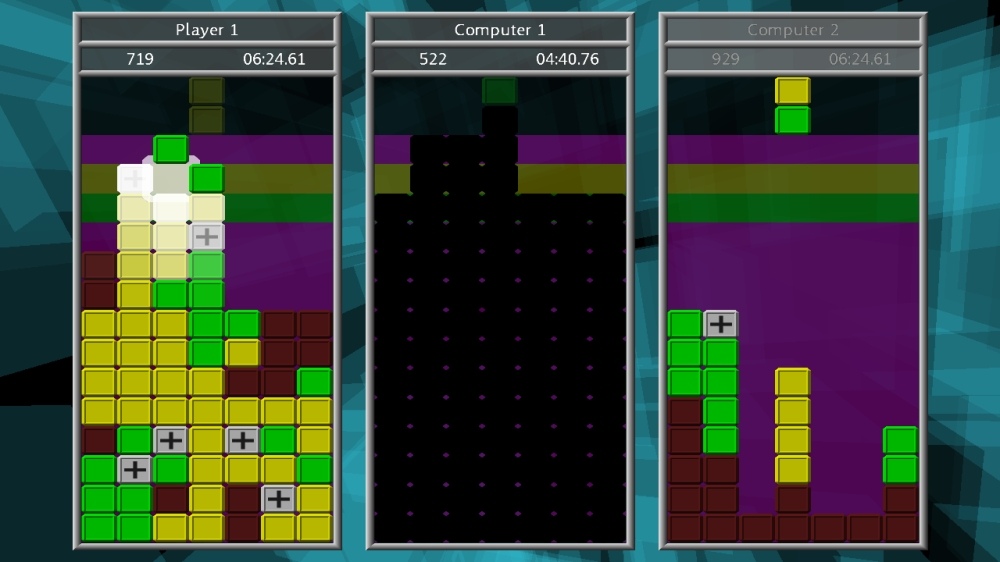

 RSS - Posts
You must be logged in to post a comment.