September 7, 2019
by Indie Gamer Chick
Another day, another Nintendo coin-op that’s damn-near identical to an NES launch counterpart that costs $7.99, which pretty much only nets you the same game that’ll inevitably be ported to Switch Online for free. Joy. (UPDATE May 25, 2022: it took two-and-two-thirds of a year, but the prophecy was fulfilled. Pinball is now part of the Switch Online lineup. Sucks here, sucks there, sucks everywhere). Today, it’s 1983’s Pinball by Satoru Iwata of all people. And it’s not good at all. It’s horrible. It’s one of Nintendo’s worst published games.
But Mario has a very brief cameo in it, so Nintendo fanboys of the past convinced themselves it was awesome. That’s par for the course on those Nintendo black box releases. Imagine if he’d made an appearance in Urban Champion. It wouldn’t have the unjust reputation as the worst game Nintendo ever made. While we’re on the subject, Pinball somehow managed to not be that either despite busted physics and some of the the most cheating gameplay ever. Of all time.
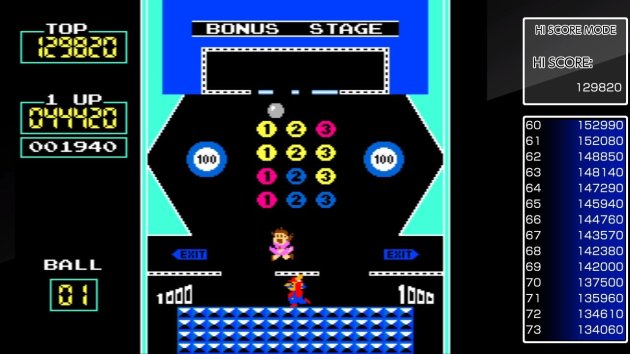
I see London. I see France. Pauline ain’t wearing underpants!
You can tell Pinball wasn’t made by someone with a deep understanding of what makes real pinball work. A lot of people describe the pastime as “controlled chaos.” But I grew up in a house with pinball machines (specifically the Williams classics Firepower and Black Knight, both from 1980 and both by the legendary Steve Ritchie, both of which my Dad bought in the mid 80s before I was even born. I got two things from my father: a love of pinball and a predisposition to high blood pressure. Thanks Daddy). Pinball, when played at its top level, is anything but chaos. With enough time and patience, anyone can clock a table, learning every angle, skill shot, and the risk/reward factors of each target. Pinball is a very precise sport. Yes, sport. Fuck you. If curling, golf, or League of Legends are sports, so is pinball. And pinball, which is one of the great joys of my life, has only recently been successfully recreated digitally. It took gaming less time to figure out proper online play than it did to get digital pinball right.
This isn’t the snobbish “real pinball is the only pinball” hot air that you get from many silver ball enthusiasts. A lot of people don’t have the money you need to truly get into it. A decent pin will typically run you $1,500 – $2,500 minimum, $4,000 for iconic tables, going as high as $10,000 for legendary tables. And that’s not even considering the amount of work you need to put into them to clean and maintain them. Turning pinball from a hobby to a passion is very expensive. The majority of people who do buck up and buy a table end up not liking it as much as they imagined they would. That’s why I like video pinball’s potential. If you don’t fall completely in love with the experience, you’re only out a couple bucks. As opposed to thousands.
And, in 1983, this is probably as close to looking like a real table as video pins got. But it’s also not pinball in the sense that you can play it like a real machine. You can’t, because you simply can’t clock Nintendo Pinball. For starters, the ball is alive and always vibrating. Because it’s always having a seizure, even if you hold the ball with a flipper to set up a shot, you can’t control what trajectory it’ll take or how the ball will react upon hitting walls and surfaces. It’s completely random and never consistent from one shot to the next. Nintendo Pinball’s reality lives up to the greatest misconception of real pinball: it’s governed by random chance. The ball also does weird things like somehow retaining inertia that it should have lost when you grab the ball for a tee shot. And the plunger is not easy to use either since there’s no analog way to fire it off. Probably 49 shots out of 50 had me getting the in one of the 500 point lanes instead of the 1,000 point one. Which also tells me that the game does more than just rely on its limited physics to dictate the ball’s path. It must be doing something more to pull the ball away from targets. Simple random chance odds tell me that the ball should be able to go down the center chute one out of three times, instead of once every fifty shots. So something is not on the up-and-up with Pinball. Other parts of the game make this even more clear.

Those slots where the cards are became the most maddening aspect of the game. Because the ball is so erratic and doesn’t have consistent weight or gravity, even if I slowed it down so that it should drop into one of the slots, it’d inevitably suddenly become a high-density rubber ball and bounce off. Also, this almost always happened to the left, leading me to believe there’s invisible suction that draws the ball away from targets.
It also doesn’t help that the table layout isn’t very good. The game is split into two screens. The upper one contains a slot machine that you activate by going down one chute. The numbers don’t stop on their own, and instead you must hit a moving target when it’s hovering above the reel that’s spinning. In over ten hours spent on this game, I only successfully pulled this off three times. This mostly owes to the upper level having three ways for players to be sent down to the lower level: the drain (the gap between the flippers), a portal that fires you past targets on the lower level, and finally a outlane on the left side. This outlane I genuinely believe is rigged with some kind of suction. It has to be. Too many times the ball bounced into it when it had none of the required momentum to even come close to the opening, let alone go through it. Inevitably, if the ball even came near the entrance to it, it was like crossing the event horizon of a black hole: no escape.
And then you have the lower level, where the majority of available points are (if you’re playing the five minute caravan mode, getting points in the upper level is so slow you practically have to let the ball fall down to it). Here, there’s five slots that reveal playing cards. Get all five cards revealed and you get a drain stopper and score points. You can also enter a bonus room here. This is where Mario shows up, and it’s possibly the most busted aspect of the game. Ironically, the BONUS room ruined my best runs of the five-minute mode because sometimes the ball’s momentum would just stop on a dime and it would proceed to very, very slowly roll towards a drain. It could eat up thirty seconds by itself. In the NES/Famicom version of Pinball, my understanding is you’re not guaranteed to be able to enter the bonus room. In the arcade version, you enter it every time you hit the portal to it. Assuming you’re actually trying to score points in it, you must reflect a ball with a paddle similar to Breakout. Mario holds the paddle, thus earning the game acclaim from slobbering Nintendo fanboys the world over. If you successfully do this, Pauline will fall from her holding chamber. You must then catch her and deliver her to an exit (which again, she walks VERY slowly to). If you successfully pull this off, you only get 5,000 points. It’s such a little amount of points for such a high-degree difficulty challenge. But, far too often, the ball will launch in a way where it’s unplayable from the start. And, since you only get the points earned in it after losing your last ball, it’s not desirable to enter this room at all in the Arcade Archives Caravan Mode. Even killing yourself to get those earned points isn’t worth it, because it takes forever for them to be added to your real score. Why is everything about Pinball so slow? Pinball ain’t slow!
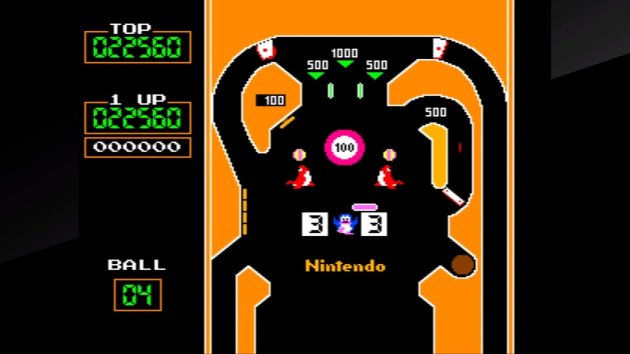
This is NOT exactly the NES version. In it, the flippers apparently don’t disappear as often, the physics are altered, and you have to unlock being able to successfully enter the bonus room. I guess. I have no means to play it. I suspect it’ll be coming to Switch Online soon. But the disappearing flippers becomes insanely annoying. They’re still there. You just can’t see them. You can cheat like I did and mark where the optimal spot on the screen they are.
In fairness, this bonus room wasn’t designed around a special mode of the game being surgically grafted to it 36 years later. But that doesn’t excuse why the bonus room is so miserable to begin with. Or why knocking down all the drop targets makes your flippers invisible. What in all the fuck is that? Why invisible? Why is the scoring balance so off? Why are the high degree difficulty shots in the upper level worth so little points, while the relatively easy to hit bumpers on the lower level worth so much? High scoring is as simple as getting the ball trapped in a cycle in them, having them knock around, and up through the card slots. I posted the fifth highest score in Caravan Mode’s global leaderboard doing this. It’s pretty much the only way you can do it. I also finished 28th in Hi-Score mode, where you must play with the machine’s default options. So nobody can accuse me of disliking Pinball because I sucked at it. I’m high up on all three global leaderboards.
Especially the normal mode, where high scores count no matter what options you use. I kept all the default options but gave myself five lives instead of three. And then I posted the second highest score ever recorded on the Arcade Archives Pinball original mode global leaderboard: 843,020. A pretty amazing achievement.
Too bad it’s fake.
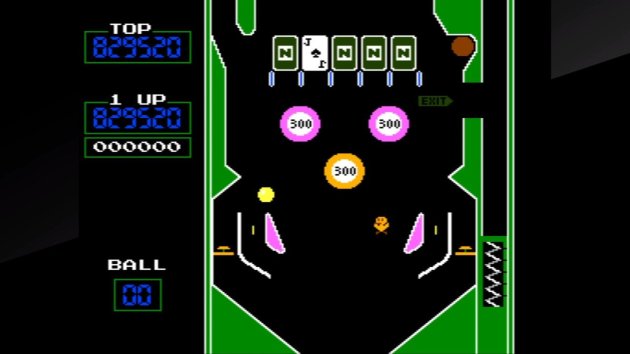
To my credit, the game kept cheating me. What’s good for the goose..
Yep, I cheated. It’s a bullshit score that I achieved by exploiting an absolutely galling oversight on developer Hamster’s part. Anyone can beat if they have enough time and patience, skill level be damned.
Here’s how I did it. Pay attention Hamster: I’m about to close a loophole in your games for you. You’re welcome.
Unlike Hi-Score and Caravan Modes, where pausing the game to the menu forfeits your score and session, original mode allows you to access a menu, where changing anything but the game’s dip switch options keeps your current session alive. Included in this is a Save State Interrupt feature. For most emulators, Save State Interrupt should only work to save a game if you need to power down the platform you’re on. When you resume the session, it erases the save state. Hamster forgot the erase part. Erasing the state only happens when you game over. Using the save state, I could quit to the game’s main menu if I died or the ball wasn’t where I wanted it to be. I would just replay sections bit by bit, creating a new state every 10,000 or so points and dropping balls occasionally to make it look like it was a believable score, finally laying my ball down once I cleared the 2nd place score to make it look realistic. In reality, I considered taking the top spot (which is over two-million points, significantly higher than the next highest scores) but it took me hours just to get to second using this trickery.
It’s absolutely fucking insane that Hamster didn’t think of this, and it puts a taint on every previous Arcade Archives release. I went back and checked them. All the ones I own have this exploit in their original modes. And yea, I feel bad about it (my apologies to everyone with real scores I beat out making this point). That’s why I put effort towards posting impressive real scores in the other two modes. But, ultimately, even my fifth play finish in Caravan Mode was via dumb luck. My ball at one point got stuck in a cycle in the middle of the bumpers and went through the queen’s slot a dozen times in a row. I also managed to avoid the bonus room and the ball, for literally the only time the entire time I was playing, seemed to bounce in my favor. But when my best accomplishment is based on dumb luck, it sort of mutes the point of being one of the top five scorers ever, does it not?

I’m going to guess the top score isn’t legit either. Looking back, all the Arcade Archives titles have massive gaps in the top scores. You can tell which ones are real and which ones aren’t just by noting those gaps and at which point on the list scores start to cluster closer together. This is also why the scores in Hi-Score Mode and Caravan Modes tend to be closer together. Still, I can’t believe the Vs. Super Mario score is legit. Meanwhile, I cheesed Kid Niki’s global board too in another way (that review is coming up).
So yea, I hated Pinball too. And I’m not even willing to give it kudos for ambition for its era. It’s a horrible layout. The scoring is all out of wack and not balanced to factor in risk/reward, it has a busted bonus room, and it’s almost entirely based on luck. It’s more pachinko than pinball, and since this was made for a primarily Japanese audience, that’s probably by design. I hate to bring back this old chestnut, but I’m sort of forced to: gaming has come a long ways. But the Atari 2600’s Video Pinball from 1980 did predictable, reliable physics better than this warped version of pinball on a more advanced platform three years after-the-fact did. I have to believe Nintendo’s version could have done it too and simply didn’t. Pinball isn’t the worst early Nintendo game. But it is maybe the most broken. We exist in a world that has Ice Climber, so that’s saying something.
 Arcade Archives: Pinball (despite this being a Vs. System game, it’s not called “Vs. Pinball”) was developed by Hamster
Point of Sale: Nintendo Switch
$7.99 studied under Rosie Ruiz in the making of this review.
A fan purchased this game for me. All indie games reviewed at this blog are purchased by me. Retro AAA games I accept fan donations on. I matched the purchase price of this with a contribution to the Epilepsy Foundation. And then I blistered my thumb playing it. Also, I think Iwata haunted my Switch.
 Brothers in Arms: Win the War

 Cathy: GOOD (3 out of 5)
 Indie Gamer Chick
You must be logged in to post a comment.