Xena: Warrior Princess (Pinball FX Table Review)

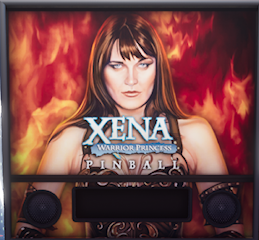
Xena: Warrior Princess
First Released May 16, 2024
Main Platform: Pinball FX
Switch Platform: Pinball FX
Designed by Anna Lengyel
Set: Universal TV Classics ($14.99)
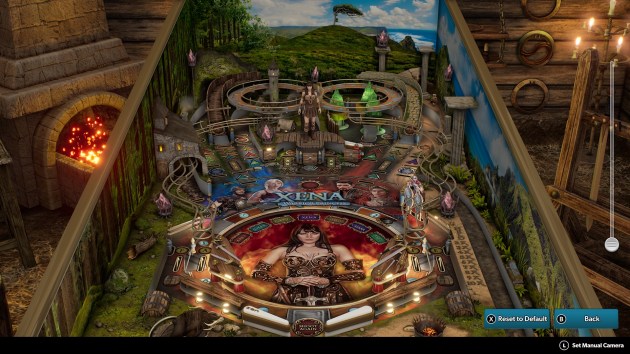
Special Consideration – Half-Broken Physics Options: Xena has a problem specifically limited to the “normal physics” setting in both the main modes (Classic & Arcade) and all four challenge modes. The left ramp (the third shot from the left, with the wooden bridge) has something horribly wrong with it. It’s one of the most reject-heavy ramps in Pinball FX and there’s no rhyme or reason when it will work, but it absolutely won’t work from a trapped ball shot dead solid perfect at full speed at it. The ball stops before getting to the top of the shot and is flung back down. The most basic, tried-and-true shot you can make in pinball, even if the shot literally can’t be more accurate, still doesn’t work. This is NOT affecting our overall rating of Xena, which we’re awarding our Certificate of Excellence to, but please note our review applies ONLY to “realistic physics” at this time. We consider “normal physics” played in any mode on Xena to be OUT OF ORDER. This should be an easy to spot and easy to fix patch for Zen Studios. But please be careful not to damage anything while fixing it, Zen, because right now this thing plays so good. Might want to give a longer grace period on the kickbacks, though. And tone them back too. And give Anna a high five, because she earned it with this one.

What a turnaround Xena made. Upon release, it was basically unplayable. Thanks to patchwork, the maddening difficulty was toned way the hell down, and the end result is Xena is now unquestionably one of 2024’s best pins. Let’s get the problematic aspects out of the way first. The kickbacks aren’t well done because of Zen’s continued insistence that they be violent, unpredictable trash fires. Go through all the trouble of lighting both kickbacks only to have the ball go down an outlane, be launched out and go down the OTHER outlane, be kicked back out and straight down the opposite outlane. Instances of both kickbacks being lost from a single triggering is high enough that it feels deliberate. The mini-table is, like so many Zen mini-tables, circular in shape and boring. It’s like they have a cookie-cutter template for these things, because they feel so samey and usually have similar objectives regardless of the theme of the pin.
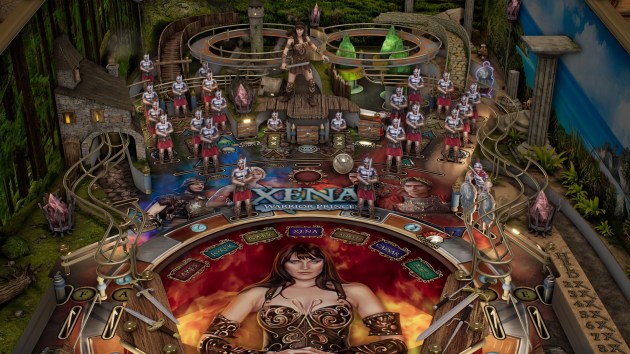
Signature Mode – Caesar Roman Assault: Holy crap! Look at all those cardboard targets! There’s no way this has any sense of grace to it, right? WRONG! The placement is as perfect as a spam-it-all target gets. Ironically, even though you’re shooting enough people to count as a “crowd” there’s absolutely no crowding! There’s also no blocking, so there’s multiple safe angles for each target. Instead, the challenge is from the sheer volume of targets and the fact that the offensive-oriented Xena temporarily becomes a pick ‘n flick-style defensive shooter. There are lethal angles to the targets, but in that good, pinball type of way. Really nice. We all really loved this mode.

Finally, and this is a weird one that my friends and family mostly disagreed with: I didn’t find the Chakram that exciting of a shot. I have no clue why that is, either, because by all rights this should be one of the stronger skillshots and gameplay elements in Pinball FX, but it just didn’t “do it” for me. Maybe because there’s a similar shot in Marvel’s Women of Power: A-Force that just does the same thing better. Sometimes these things are inexplicable. But, with all that said, whoa! Xena is packed-full of fantastic orbits, unique modes, thrilling shots, and some of the best uses of cardboard targets in Pinball FX. The sheer volume of cardboard targets in the above mode is jaw dropping, but the angles they take aren’t designed to ice your ball. In fact, this is one of the few modern Zen tables that doesn’t feel mostly defensive in nature. This is a SHOOTERS pin, and that’s such a breath of fresh air. Even the grind isn’t that bad, and when modes require a little too many shots, at least the payouts aren’t ridiculously back-loaded. In fact, I think Xena’s rule sheet might be its greatest triumph. The scoring is fine-tuned to scientific perfection in a way that would make Lyman Sheats proud. Anna Lengyel’s Homeworld is going to be lambasted by us, but it’s Xena that proves that she’s an elite pinball designer.
Cathy: MASTERPIECE (5 out of 5)
Angela: GREAT (4 out of 5)
Oscar: MASTERPIECE
Jordi: GREAT

Sasha: GREAT
Dash: GOOD (3 out of 5)
Elias: GOOD (Nintendo Switch)
Primary Pinball FX Scoring Average: 4.16 πŸ“œCERTIFIED EXCELLENTπŸ“œ
Nintendo Switch Scoring Average: 4.2 πŸ“œCERTIFIED EXCELLENTπŸ“œ

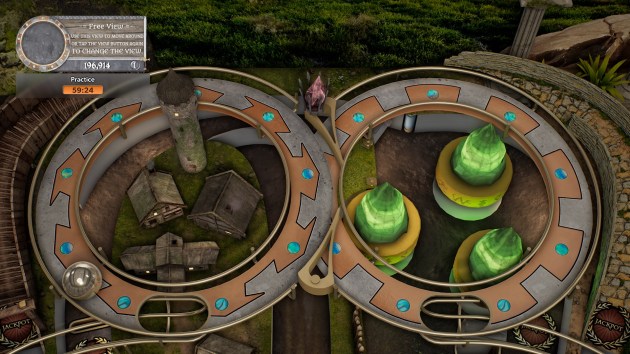
Pictured: something not as exciting as you would hope. Makes for a fun track toy, though. This is kin to Getaway’s supercharger, but not a SHOT that you have to factor in.
Deadpool (Pinball FX Table Review)

Deadpool
First Released June 24, 2014
Main Platform: Pinball FX
Switch Platform: Not Yet Released

Designed by Tamas “Ypok” Pokrocz
Set: Marvel Pinball Collection 2 ($29.99 MSRP)
Links: Strategy GuidePinball FX Wiki

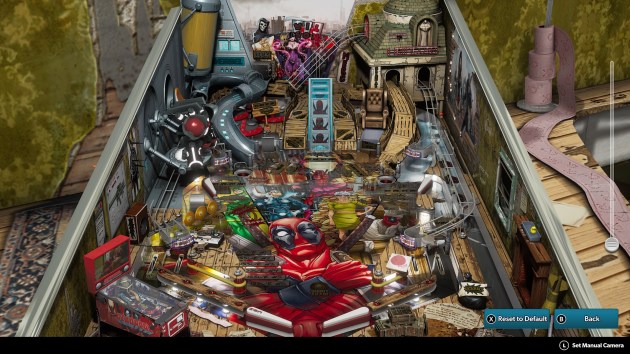
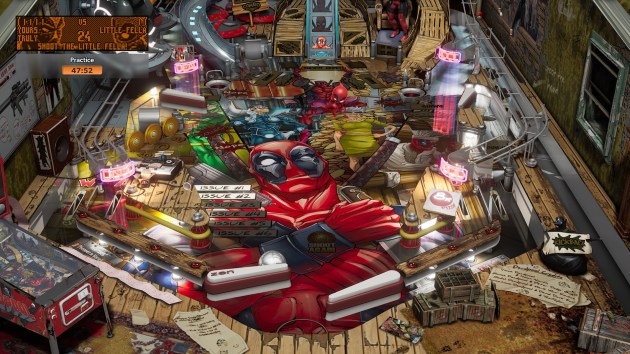
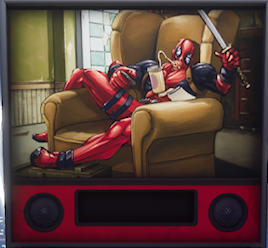
Deadpool looks the part. No doubt about it. There’s a ton of Easter Eggs and winks to the audience. But, it comes with a price: it can take FOREVER for the animations to wrap up, which means waiting around. Even holding the flippers, it can take a while. It can mess with your shooting stroke.

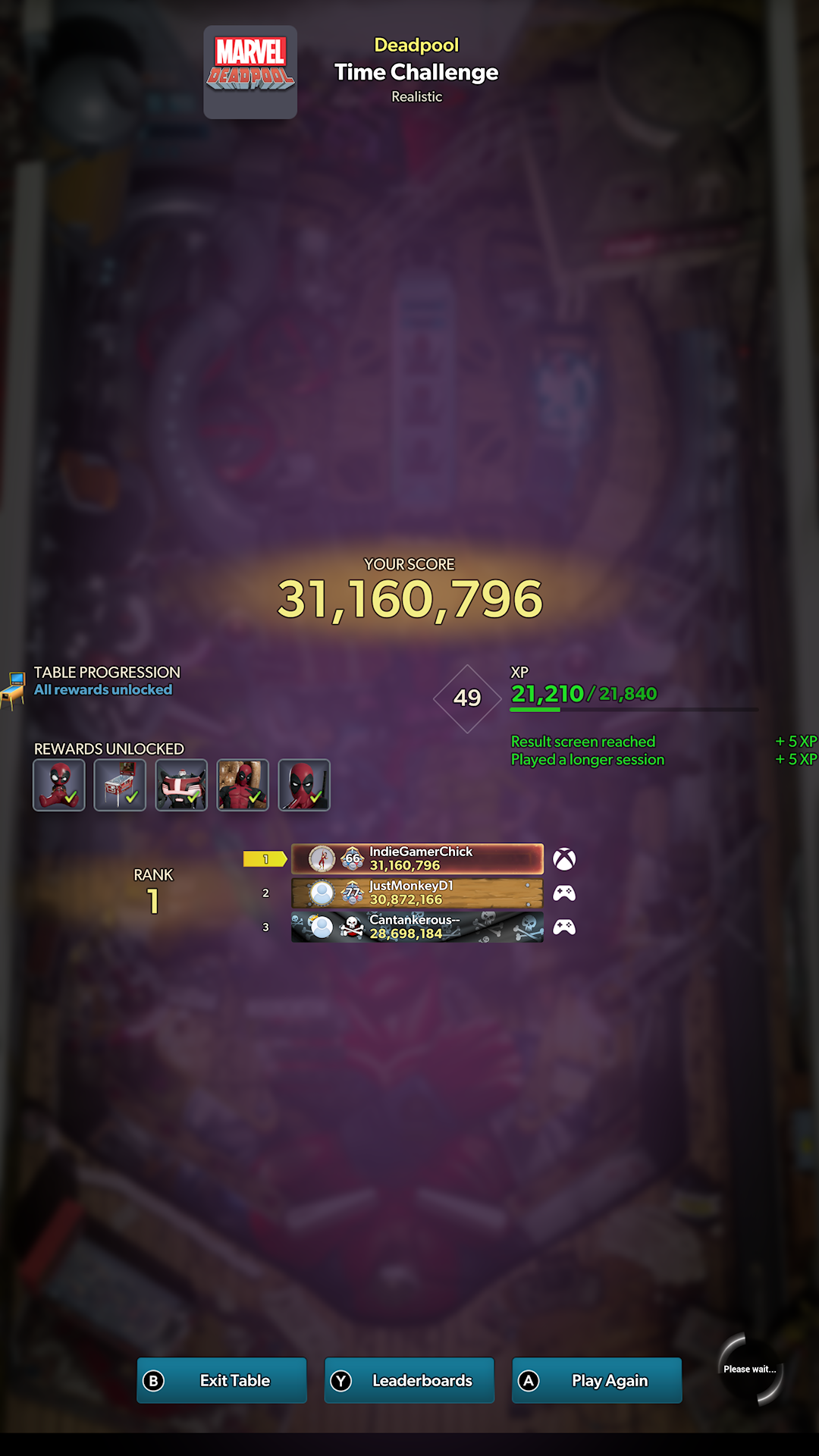
One of the call outs in Deadpool has him saying Zen Studios should make an M-rated pinball game, and his stated reason results in him being bleeped for the next ten seconds. Zen? Make an M-rated table? Nah, it’ll never happen. In Deadpool, if you make a skill shot, there’s a very good chance you’ll score 500,000 points and also watch the ball go straight down the outlane that’s directly next to the plunger and fed by the skill shot, losing your ball save. I’m sure this was done to be a troll, because I guess Deadpool could lazily be interpreted as a glorified troll. Cool. Yea, Deadpool the Pinball FX table is quite the frustrating pinball experience. For the record: that skill shot isn’t a “git gud” element that adds challenge. It’s just crap design. Mind you, there’s a super skillshot if you hit the first, which you might not even get a chance at because of this design. Why would you make a table like that? People pay money for these, and your first instinct is to troll? But the whole table is that way. The bumpers are of the Creature from the Black Lagoon variety, and it’s not rare for a ball to get caught in them for a long time. On a table where time is money. Want to experience Deadpool-based agony without watching X-Men Origins: Wolverine? Try playing this table in the five minute mode. (About an hour after typing that, 9 year old Sasha took that as a bet and shortly thereafter became Pinball FX’s Deadpool 5 Minute Challenge Undisputed World Champion).

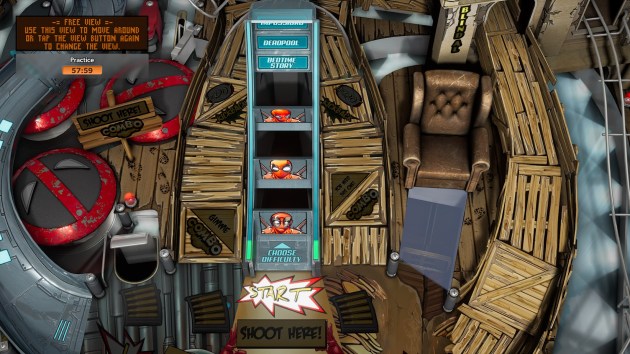
Signature Shot – Mode Start Filing Cabinet: The one ingenious aspect of Deadpool is how the mode start works. Once you hit the mode start lanes to light the cabinet, you can start the mode and play on EASY right away, or you can use the spinners to light other difficulties. Usually this means adding to the shot requirement or shrinking time limits. This is a great idea, and the modes are just good enough to carry Deadpool over the finish line. Even if it’s doing it one piece at a time. By the way, you’re not guaranteed to actually get the hardest difficulty even if you light it. You still have the ball into the top locker. In Sasha’s record-setting 5 minute challenge, her intent was to play on HARD, but after lighting it, the mode start shot fizzled off the jump and only went into the MEDIUM hole. And she still set the world record anyway. Go figure.

Deadpool has the same problem as Ant-Man: there’s something loose and inelegant about ball movement in this table. You can see it in the skill shot, when a tiny little bump with the plunger sends the ball flying. The bumpers and slingshots are the same way. This is what we call a “kinetic” table, though it feels more in terms of gravity than actual table mechanics. It feels like you’re shooting a marble instead of a steel ball. Maybe the table wouldn’t work without the lighter physics. I hope that’s not the reason, because if it is, that’s the point when a designer should tear the table down and start over, not slap a price tag on it and release it. So, I must have hated the table, right? Actually, it won me over thanks to the way the mode start is handled, plus the modes themselves are pretty good. From shooting garbage that rains from the sky to the miniature Deadpool. The only one I disliked was a button mashing arm wrestling sequence. Button mashing is one of those accessibility things that needs to be phased out unless it’s a specific button mashing genre (like Track & Field games).

Signature Shot – Lil’ Deadpool: Okay, so as far as digital targets go, this is slightly weak since he just wiggles there after completing other tasks. What makes it more interesting is that we started setting records once we began trying for medium difficulty. Instead of three sequences of hitting the spinners and shooting the lockers to set up Lil’ Deadpool, you have to do four. For much more points. Yea, that’s a fair trade.

Even with the physics problems, I have to give it up to Ypok. He did a fairly decent job of balancing the difficulty and risk/reward between EASY/MEDIUM/HARD difficulties. It also helps that the harp-shaped playfield inherently has good combo shooting that feels different from a typical “pick a lane, any lane” out and back again combo shooting. Do I think Deadpool lives up to its potential? Oh, not even close. This thing feels SO WEIRD in terms of speed and bounce. If this hadn’t been Deadpool, they could have just as easily based it on Sonic The Hedgehog with how fast it runs and how much punch you get off the slingshots or even the grenade that acts as a ball save. The story isn’t “Deadpool wins a Clean Scorecard” but instead “Deadpool’s physics prevented it from winning the Certificate of Excellence that the layout and modes deserved.” On the other hand, this is the rare IP that is so enticing that pretty much everyone wants to play it, and it’s actually good enough that everyone should at least enjoy it more than dislike it. That counts for something in my book.
Cathy: GOOD (3 out of 5)
Angela: GOOD
Oscar: GOOD
Jordi: GOOD
Dash: GREAT (4 out of 5)
Sasha: GREAT
Scoring Average: 3.33 – 🧹CLEAN SCORECARD🧹
Some review copies were provided in this review, others were paid for.
Read my review of the Deadpool NES game.

Creature From the Black Lagoon (Pinball FX Table Review)

Creature from the Black Lagoon BackglassCreature From the Black Lagoon
First Released December, 1992
Zen Build Released October 29, 2019
Main Platform: Pinball FX
Switch Platform: Pinball FX 3
Designed by John Trudeau
Conversion by Zoltan Vari
Set: Universal Monster Pack ($6.99)
Links: Internet Pinball Database ListingStrategy GuidePinball FX Wiki

Read the Full In-Depth Review at The Pinball Chick

In retrospect, the Creature sticker is a massive waste of real estate that could have been used on something more interactive, or just more lights and more “modes” for lack of a better term. At the end of the day, it’s just one of those 3D stickers that you see on the back of credit cards. I would have much rather had a movie screen target. It’s weird that this is a table themed around a drive-in theater and there’s no screen to shoot. If Zen ever starts to do sequels to Williams pins, they should start with a Creature table where you shoot a screen to FOCUS it.

The best thing Creature from the Black Lagoon has going for it is the near-certainty that it’ll spark a lively debate among silverball enthusiasts. While nobody HATES it, some people are just bored silly by it. Some people think it’s just alright but don’t get what all the hubbub is about. Its biggest fans REALLY like it, like my father for example. Oscar would normally hate a table with scoring as wildly imbalanced as Creature from the Black Lagoon, yet he’s given Creech the highest rating out of all of us. Dad fully admits this table is a guilty pleasure owed largely to an unforgettable theme. Yea, the drive-in concept is inspired, and so is tying it directly to a B-tier Universal Monster. It’s not a table about the Creature. It’s a table about teenagers watching the movie Creature from the Black Lagoon. That’s fantastic, but the shot selection is very limited, and the lack of scoring balance is especially damning. What’s far worse than the imbalance is the fact that risk/reward isn’t factored in at all. Take the jackpots for example. You shoot the snack bar scoop. That’s basically the lowest-risk shot on the board, but it scores the biggest points. What do you light the super jackpot with? The up-the-middle shot into the bumpers, which safely feed the right flipper the ball every single time. What flipper is used to shoot the jackpot? The right one.

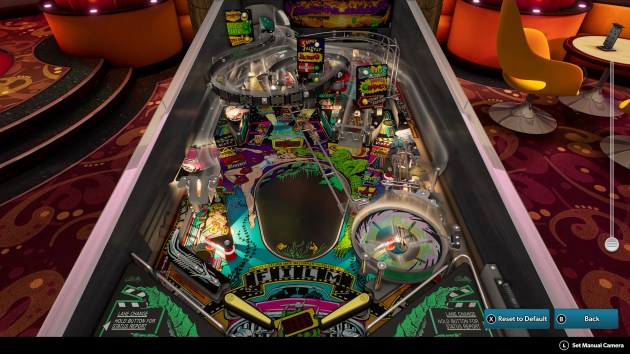
Signature Shots – The Snack Bar Targets: One of the most frustrating shots of the DMD era of pinball are these four stand-up targets. In Classic and Arcade modes, you can shoot the scoop located above the right side targets to score the lights instead of shooting them directly, but only until you’ve scored your first jackpot. After that, you have to figure out an angle to hit them directly. I’ve been playing Creech for years and I still haven’t found a safe way to shoot these. It seems like I’m better off shooting other targets and getting the snackbar lights off ricochets if I miss.

I would LOVE for someone to go into Creech and rework every single shot’s value and incentivize full touring of the table. Create a reason for players to not just stick to the four shots that activate multiball. Even though we’ve called Creech’s gameplay “anti-flow pinball” it actually does have good shot selection. Both ramps are quite satisfying to complete. But when they come at a multiple of the risk and a fraction of the reward, there’s really no reason to shoot them besides the fact that it’s more sporting. Even if you reworked the game’s score sheet and created whole new modes, Creech is going to be a stop-and-go table. It’s what we call a “pick ‘n flick” and nothing is going to change that. So be it. With the shot selection as solid as it is, maybe a new scoresheet could turn Creature of the Black Lagoon into the greatest pick ‘n flick table of all-time. The sad thing is, if this had been a modern Stern table, that’s exactly what would have happened by now. They would have released an update that refined the gameplay at no cost to the shots themselves. There’s no reason Zen can’t keep the existing version AND create a more nuanced and elegant ROM for Creech. If any table among their Williams pins needs it, it’s Creech. The Black Lagoon must be freezing, because Creech is one of THE most polarizing tables in pinball history. But, since I know Zen is reading this: if you want to try an experiment with any of the Williams pins, this is the one to do it on.
Creature from the Black Lagoon SmallCathy: GOOD (3 out of 5)
Angela: BAD (2 out of 5)
Oscar: GREAT (4 out of 5)
Jordi: GOOD
Dash: BAD
Dave: BAD
Elias: GOOD

Sasha: BAD
Scoring Average: 2.65OKAY
Some review copies were provided in this review, others were paid for.

Star Wars: Clone Wars (Pinball FX Table Review)

Clone Wars BackglassClone Wars
First Released February 27, 2013
Main Platform: Pinball FX
Switch Platform: Star Wars Pinball
Designed by Ivan “Mad_Boy” Nicoara
Set: Star Wars Pinball Collection 1 ($23.99)
Links: Strategy GuidePinball FX Wiki

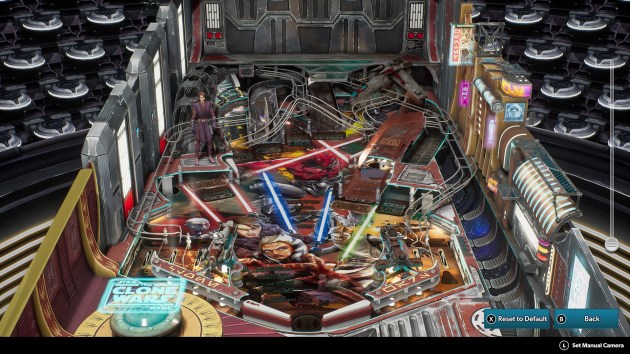
STOP! If you’re not able to play Clone Wars in the vertical table view mode, it will affect your enjoyment. You could probably drop our scoring average by a full point, if not more. Clone Wars already has massive visibility issues due to the loudly busy playfield, but in standard horizontal viewing angles, you just plain can’t see some of the shots. This NEEDS to be viewed like a standard table. It’s criminal that this wasn’t included in their Arcade1Up.

Ah. Clone Wars. You sweet, sweet thing, you. I was actually surprised to learn this is a more polarizing choice for the Pantheon. I mean, it was close for most of us. Myself, Angela, and Jordi would consider this the lowest of any of our MASTERPIECE votes, while only Oscar is tapping his wrist and saying “more of this. Put it in my veins. Nom nom!” Clone Wars features a layout that feels like a real, honest-to-God Stern table, probably more so than any other Zen original. Is it really that hard to imagine this sitting alongside their versions of Godzilla, Guardians of the Galaxy, Iron Maiden, etc? And it’s not that Clone Wars is hated outside of our circle. I’ve never seen anyone say it’s a bad pin. They just don’t think it’s as good as we do. When Elias joined our team and gave it a GOOD rating, we were disappointed, but not surprised. If you had told me “Elias is going to put the screws to one of our Pantheon pins” I would have said “is it Clone Wars?” Any of us would have guessed Clone Wars, but why? Maybe the loud visuals, or the fast running flipper zone, or maybe unforgiving rails and outlanes. Or, perhaps it’s too life-like, and those playing Pinball FX, or Star Wars Pinball on Switch are seeking a more video game-like experience. Well, no, that can be it. This thing has modes that cannot be done in real life. Really, really good modes, at that. There are plenty of other reasons to not rate this as an elite pin.

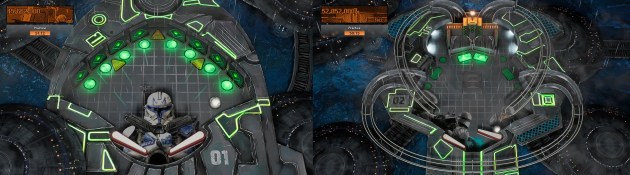
Signature Mode – War on Christophosis: You’ve never seen anything like this in pinball before. In this mode, a gigantic force field that you can’t penetrate from the outside covers the playfield, leaving only two entry points. You have to convert your ball into a bomb, then flick the bomb against the designated targets. A microcosm of Clone Wars in general, the mode is fun and intense, but far too visually loud. I think every player who genuinely wants to make a go at this one will want to experiment with the visual settings, because it’s too damn hard to see what’s going on. On a lesser table, we’d probably score against it. Elias, who didn’t love Clone Wars as much as we did and, in fact, seems to have barely tolerated it, for sure scored against the visuals. And you know what? We can’t argue with him. It’s totally fair.

So, why do most of us rate Clone Wars a MASTERPIECE? Because gameplay is king. Clone Wars is chock-full of unconventionally-angled orbits that are a joy to shoot combos on. And, unlike many Zen finesse pins, it doesn’t grossly overvalue basic orbital combos. Part of why the shots feel so rewarding is Clone Wars is one of Pinball FX’s fastest-running tables, especially around the flippers. Oh and for anyone who read the last several table reviews and thinks I can’t handle mean-spirited outlanes, hey, I think Clone Wars is a MASTERPIECE, and it has serial killers for outlanes. Clone Wars is probably the most difficult Zen original design to enter the Pantheon. I think that’s why a lot of people think we’re nuts for rating it this high. It can be quite unforgiving if you brick your shots, and snap-shots are harder to pull off here than on any other Star Wars table. You need Jedi-like reflexes for this one. On the other hand, this is one of the few Zen tables that awards extra balls automatically. It’s just a shame they didn’t go all the way with “this is a REAL table” concept and have a replay extra ball after a certain point threshold, like say, 60,000,000. Actually, Zen really needs to start adding replay EBs in general. They’re just fun.

Signature Mode – Clone Training: We’re not big fans of Zen’s mini-fields in general, but Clone Wars stands out for having one of the best ones. Or two of the best, really. Spelling TRAINING while shooting targets lights the sinkhole to the mini-fields, which have their own physics that feels more like a handheld novelty game. The flipper gap is huge, which is normally a problem, but even a grazing shot should be enough to save the ball. Like everything else with Clone Wars, there’s too many shots required, but at least it’s fun.

Admittedly, all the modes have the same problems common to Zen’s original pins, IE “why have a mode require six shots when it can require ten? Why ten when it can be twelve?” Like the force field mode above? That’s twelve total shots, assuming you shoot completely perfectly. Six shots to turn the ball into a bomb and six to deliver the payload. I’ve spent a lot of time pondering “what if Zen reduced the required shots in Clone Wars by 40% or so? Would that finally put Clone Wars in the discussion for Zen’s best table?” I honestly don’t know. You can’t know until you experience it firsthand. Clone Wars is in the 99th percentile of Zen pins, and also none of us feel that it’s even within sniffing distance of Mimban. Is Clone Wars an ELITE digital pinball table? Absolutely. It’s one of the best shooters in Pinball FX. Is it one of the best digital-only tables ever made? Now that’s a debate, and it shouldn’t be. Not with a layout THIS good. Not with scoring this balanced. Not with gameplay so elegant. *I* think it’s one of the best, but I can see why someone wouldn’t. Clone Wars might be the ugly duckling of the Pantheon.. but it belongs in the Pantheon.
Clone Wars SmallCathy: MASTERPIECE (5 out of 5)
Angela: MASTERPIECE
Oscar: MASTERPIECE
Jordi: MASTERPIECE
Sasha: MASTERPIECE
Elias: GOOD (3 out of 5, Star Wars Pinball)
Overall Scoring Average: 4.66 πŸ›οΈPANTHEON INDUCTEEπŸ›οΈ
Primary Scoring Average: 5.0 πŸ›οΈPANTHEON INDUCTEEπŸ›οΈ

The Avengers (Pinball FX Table Review)

The Avengers
First Released June 19, 2012

Main Platform: Pinball FX
Switch Platform: Not Yet Released
Designed by Thomas Crofts
Set: Marvel Pinball Collection 2 ($29.99)
Links: Strategy GuidePinball FX Wiki

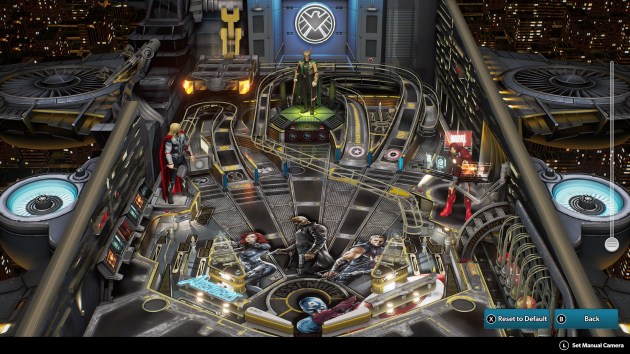
Kickback – Sasha: I can’t believe they don’t like Avengers more! I like that Thomas Crofts set the table on the Helicarrier from the film. They didn’t have Avengers Tower yet! This is their first adventure! Most importantly, I think Cathy is wrong about the color scheme. I think the gray-metal setting works because it’s the characters that are supposed to be colorful and stand out, not the setting. The modes follow the movie and the shots use the character logos to guide you. That wouldn’t look as good without the chain-link floor. Avengers has complex rules and six different balls, each with their own unique attributes (see the next caption), but having the lights and character logos contrast everything else makes it easier to find the shots. The slingshots are really bad, which is why I can’t give it MASTERPIECE, but I was very close. Come on, Zen! I want to play this on my Nintendo Switch!

Between this and Han Solo, I think Zen should avoid metal-grated settings. It just never works out for them. In fairness, Avengers is hardly a bad table. It’s just not really a remarkable one, either. Besides the balls being individually decorated to resemble the Avengers themselves, I found the setting here is so drab to the point that it’s exhausting. This wasn’t unanimous, as my niece’s kickback noted. In terms of themes and modes, it’s such a safe table, you know? That’s how I felt about the first Avengers movie, too. Given how the property has, again and again, produced predictable, boilerplate-type PRODUCTS, I have to believe there’s someone from Marvel with arms like tree trunks brandishing a wiffle bat who provides the one mandate from Disney overlords: don’t f*ck this up! Thomas Crofts didn’t. Zen’s first Avengers pin is FINE. Not great. Not bad. Fine. Kind of bonkers, really, since this is essentially Attack from Mars with a superhero theme. The funny thing is, one of our inside jokes is that if Zen Studios had made Attack from Mars, the saucers would have required more hits to open and more to kill, and the slingshots would have been aimed at the outlanes and the game would be anything but generous with extra balls. And that’s basically what Avengers is.

Signature Element – Custom Balls: You’re not just picking a load-out for the score display. In Avengers, the balls are painted to match their corresponding hero. The gameplay effect is tied to the grinding, as each character reaches one their corresponding mode and/or bonuses in fewer shots. I put a LOT of stock in tables having enough flexibility that it allows players to come up with their own strategy. By all rights, having six balls with unique abilities and perks should open that up in a way few tables can offer. But, Avengers load-outs are wildly imbalanced. One of the balls is so overpowered that it becomes a no-brainer. It’s Captain America’s ball. It grants you longer ball save and a longer grace period for combos AND it makes the Loki fight easier AND you get more time in the Repair the Engines mode AND if you manage to pull off an eight-way combo, it lights the extra ball. None of the other five come close to offering that much value. In fact, no other balls offer exclusive extra ball opportunities. Like so many Zen pins, this is begging for an update that balances the scoring. Come on, Zen. Stern updates the rules to their older pins. We’re talking about excellent layouts not reaching their full potential.

Oh, it could have been a lot better. A potentially great table driver, placed smack-dab in the center, had potential to one-up the saucer with three side-by-side targets and accommodating rows of lights. Easily the most satisfying shot on the table, but all it does is launch predictable, bland modes. It’s also got some maddening difficulty spikes. The slingshots spoon feed the outlanes too much. It’s not just the actual spring mechanism, either. The heads of the slingshots are actually more dangerous than the moving parts. That’s a weird one, right there. For whatever reason, if the ball bounces off the head of the structure, it’s likely to say “good bye, cruel world” and plunge straight down the outlane before you even get a chance to defend against it. This isn’t the Defenders, after all. It’s the Avengers. Also, the rails are practically bibs for the outlanes. Why would you make a table based on a movie that’s supposed to be for everyone be so focused on demoralization? If not for the razor-sharp scoring balance, probably the best of that era from Zen, I would have been inclined to give Avengers a rating of BAD. But the shot selection is top-notch and the tilt-table ball lock I personally like better than the one on Indiana Jones. It’s just too bad about the difficulty, which turns a solidly GREAT pin into one that’s just barely, BARELY okay.
Cathy: GOOD (3 out of 5)
Angela: GOOD
Oscar: GOOD
Jordi: GOOD
Sasha: GREAT (4 out of 5)
Overall Scoring Average: 3.2 🧹CLEAN SCORECARD🧹
Some review copies were provided in this review, others were paid for.

South Park: Butters’ Very Own Pinball Game (Pinball FX Table Review)

South Park: Butters Very Own Pinball Game
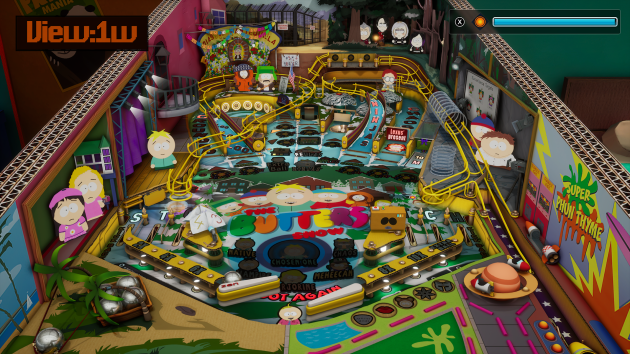
Platform: Pinball FX
Set: South Park Pinball ($9.99)
Included in Pinball Pass
Designed by Szucs “ndever” David
Originally Released October 14, 2014

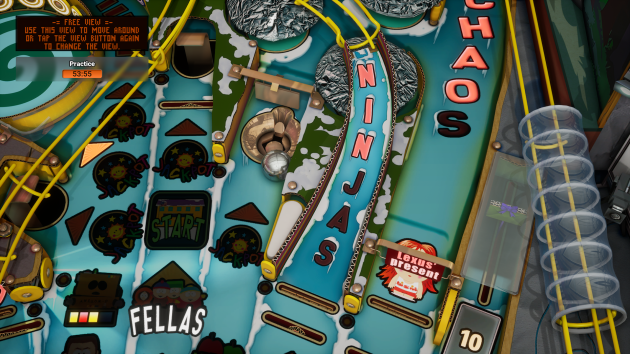
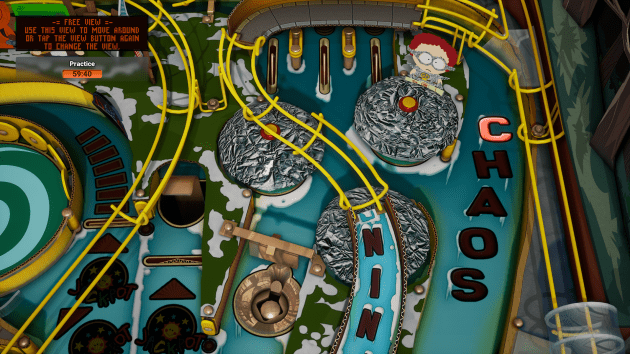
This is a reminder that Butters made multiple earnest attempts at destroying the world, by drowning everyone and by destroying the o-zone layer. Oh sure, it was adorable how ill-conceived and childlike his attempts were, but they were good faith efforts at human extermination. He’s not THAT wholesome.

It’s probably best that pinball fans look at the Butters table as a throw-in bonus for South Park: Super-Sweet Pinball, where $10 nets you one really well done PG-rated South Park pin and one middle-of-the-road, mundane and average pin. Which isn’t to say that you should ignore Butters’ Very Own Pinball Game. I really did think it was completely decent. It’s just impossible to build-up any momentum thanks to Zen’s typically violent slingshots and over-indulgent modes. In this case, I think the slings are easily the worst part. Seriously, holy crap, those slingshots should be in a holding cell, staring at a clock as it inches closer to midnight with a priest reading them their last rites while a pair of three-drug cocktails, a gurney, and IVs await in the next room over. They’re silverball serial killers that, all by themselves, drop Butters from maybe as high as a GREAT table to barely GOOD. Well, actually the horrendous mini-field with physics so weirdly inconsistent that it’s practically broken doesn’t help, either.

Oof. Terrible.

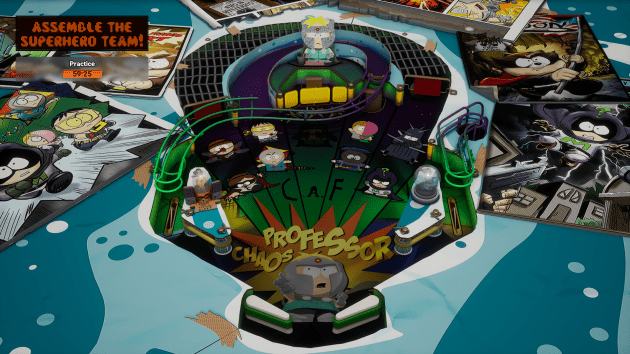
While they don’t look the part, the flippers for the Professor Chaos mini-table feel nubby. The physics for the mode are completely different than a normal table. The Vices all agree that the slope feels non-standard, but we disagree as to whether it’s too shallow or too steep. It kind of feels like it alternates between both, depending on where the ball is. Regardless of whether it’s too steep or shallow, flips on the mini-field have this weird shuffle-pass sensation. It’s as if you’re playing pinball with an air hockey puck that has fluctuating weight. As if that’s not bad enough, the four targets are boring AND that you have to shoot them twice each. Combine that with the fact that there’s no ball save, and thus rounds of this catastrophe could end in literally a second or two, and it quickly became my least favorite of the table’s modes. This might be the worst mini-field Zen has ever done. It really put a damper on the whole Butters experience, because I really don’t think their physics have ever been worse.

You absolutely MUST play the ball out of the saucer or risk a quick drain. While it’s not a 100% certainty, the drop from the saucer hangs right over the drain. If you’re not attempting to shoot the cellar or spin disc, what you can do safely is hold the bat flipper out, which should give you a gentle drop down to the primary flippers to gain control of the ball.

The rest of Butters is all about basic, nearly bare-bones light-shooting. Modes are started by putting the ball in the saucer in the center of the playfield, then converting the follow-up shot with the bat flipper into the spin disk. The disk is surrounded by several targets, and by total chance, you have to score 50 hits on the targets. It sounds like a lot, but you shouldn’t need more than two successful shots in the spin disc. Between the three members of my family, ONE TIME in an entire week of playing this table did one of us need three shots, whereas completing all 50 in a single shot wasn’t rare at all. In extremely rare cases, the ball gets launched out of the spin disk, though it should be playable even if this happens. After lighting the mode start, you’re given five options. The worst is Chaos vs Coon & Friends, which is entirely the mini-table I whined about above. By far the easiest mode is Marjorine, and the scoring is completely screwed-up on this one. You only need to complete three shots and return the ball to the mode start VUK. Each of the first three shots gives you two options. Besides the third shot, all four of the shots score in the millions of points. It’s a cinch.

I’ve heard of shooting bricks, but this is ridiculous.

Last of the Meheecans is indicative of everything Zen Studios does wrong pinball modes. The previous mode I talked about was four shots, all simple angles, and only one of which is an optional high-risk shot. This one is seven shots, all of them with much higher difficulty, all of them much more risky, and all but one of them score much less points. In this mode, you have to shoot five orbits, but the entrances to those orbits have rising-and-lowering walls. Once you clear four of the five orbits, the final one must be shot three times, and it’s only now you’re putting up million point scores. And you’re on a timer, on a table with long return times. Because hitting each shot once just plain wasn’t enough, I guess. How come Marjorine is four shots for more points and this is seven shots for less? It makes no sense.

Butters relies heavily on the bumpers for the AWESOM-O mini-mode and for the high-yielding dress-up Butters score. As long as I wasn’t on AWESOM-O the ball would bounce around like crazy in the bumpers. But, as sure as the sun will rise, whenever I was on the AWESOM-O mode, the ball would bounce out after a single goddamned bump. Two bumps at most. It was so uncanny that I’m convinced it’s rigged.

The other modes are under-paying and just totally average. Turn butters into a vampire by shooting three orbits and then the saucer three times. Put on a Hawaiian shirt and shoot fifteen orbits with a multiball. There’s also a couple side-quest multiball modes as well that are the same basic modes with fewer targets and an add-a-ball mapped to the generous vari-target. I normally hate vari-targets (they’re my least favorite pinball targets) but this one is clockable and relatively safe off a brick. Sadly, most of the mini-modes are quite dull. The only one we all universally enjoyed was the Ninjas side-mode. There’s four ninja targets and you have 60 seconds to shoot them for 150,000 points a hit. They respawn five seconds after being struck down, but if you can complete all four within five seconds, you score ten million points. Again, I can’t stress enough: none of us HATED Butters. We just hated that no amount of skill can overcome the slingshots, and the complete lack of balance. But, let it be said that the Williams-like layout and simple angles makes for a nice bonus to go along with the unforgettable Super-Sweet. Now then in the spirit of Butters, GO TO YOUR ROOM, ZEN! YOU’RE GROUNDED FOR THOSE SLINGSHOTS!
Cathy: GOOD (3/5)
Angela: GOOD (3/5)
Oscar: GREAT (4/5)
Jordi: GOOD (3/5)
Dash: BAD (2/5)
Dave: GOOD (3/5)

Star Wars Episode IV: A New Hope (Pinball FX Table Review)

A New Hope
aka Star Wars Episode IV: A New Hope
Set: Star Wars Pinball Collection 1 ($23.99)
Designed by Peter “Deep” Grafl
Originally Released April 29, 2014
Included in Arcade1Up’s Star Wars Table
Awarded a Clean Scorecard by The Pinball Chick Team

You have to wonder if they knew a decade ago they would some day make a My Little Pony table if they would have saved a horseshoe shaped table for that.

Our family nickname for A New Hope keeps getting more and more elaborate. It started as the “Big Horseshoe” then it became the “Great Horseshoe” and now it’s at “The Great and Powerful Horseshoe.” This is probably how religions get started up. By 2025 it’ll be “The Almighty Galactic Horseshoe of Divine Holiness” and we’ll still be unanimously stuck on rating it GOOD. It’s the definitive middle of the road Zen original that both delights us and breaks our hearts with its squandered potential. Still, there’s no doubt that A New Hope holds up in 2023, nearly a decade after its release. But, a decade later, all the warts that were inherent to it all along are more and more glaring. Despite the playfield being made almost entirely of orbital shots, you have incredible freedom in A New Hope. Each of the orbits is tied to a bonus mode, and the T-U-S-K-E-N orbit is also the mode start. Getting into a groove building combos is incredibly rewarding, especially since they were spot-on valuing combo shooting.

A New Hope jerks off with its animation too much. I’ve had multiple instances where I nail the Hidden Skillshot dead-on, only instead of, you know, GETTING POINTS, the ball explodes because the table is STILL loading the playfield because there’s so many useless animations. Sometimes modes take FOREVER to get going or to end because it takes forever for a stormtrooper or Obi-Wan to waddle their fat asses off the table. WHY WOULD YOU DO THIS, ZEN? Everything should be already in place, but Zen crammed so many masturbatory animations into this pin that sometimes the speeder is still positioning itself and the ball bounces off it, or sometimes a stormtrooper literally scratches their head looking around. I often have to hold a trap for 15 or more seconds waiting for everything to reset after a mode ends. That’s beyond ridiculous.

A New Hope’s biggest annoyance is a magnetic playfield in the dead-center of the playfield that randomly throws your ball, potentially down the already deadly outlanes. That magnet is such a weird decision. I guess it’s supposed to be the force field of the Death Star, but my question is: why does it fling? Just have the ball bounce off it like a wall. Also, several of the main modes (especially scene 6) and the hurry-up bonus mode require you to shoot ball onto a temporary mini-field in the center of the screen to fight enemies, but sometimes the physics and the ball don’t cooperate and the ball just plain explodes for a soft reset. The modes are NOT generous with their time, and since it takes too long for the ball to reset, it only really serves to create frustration. There’s also just too much reliance on luck in the bonus modes. It’s not really possible to guess (or react quickly enough) to the Tusken Raider, and the video mode (along with its ultra-valuable extra ball) is totally random.

Oscar on Mode Balance: Ideally, side modes in pinball, once you factor in the work to activate them and the risks of shooting them, have full parity. A New Hope’s side mode balance is completely out of whack. Both the Cantina shooting gallery and A New Hope’s Video Mode have the ability to light the valuable extra ball lamp within them. Lighting the video mode, where scoring and rewards are 100% luck-based, requires you to to light the letters A-L-L-I-A-N-C-E on the non-dominant left side of the table. A relatively higher risk shot for an unknown reward. Comparatively, the easier to play shooting gallery requires one fewer letter (C-A-N-T-I-N-A) across what is arguably the table’s primary orbit. Both orbits feed the R-E-B-E-L lights that drive the modes, but you’re incentivized to shoot A New Hope left-to-right due to the left outlane being much easier to defend against. It’s a tiny lack of risk/reward parity that throws the balance of A New Hope into the garbage disposal.

There’s lots of other annoyances. A New Hope has some of the most pathetic kick-backs ever. They sort of lightly volley the ball up and onto the playfield, but the gentle arc created often throws the ball right between the flippers. I’ve had multiple instances where a kickback sends the ball straight down the drain. Like, straight down it, and man alive, does it piss me off every time. I don’t know what Zen’s fetish is with this kind of weird “could only happen in video pinball” invisible force field kickbacks that don’t really help players and instead, just as often, are worse than trying to manually defend against the outlanes. I have to go back to what I’ve asked of them a million times: do you want to make good pinball tables or do you want to be a complete f*cking assholes and troll your customers? Because you can’t do both at the same time. A New Hope is a potentially great table that they took a sledge hammer to, and I don’t get it. Why would you do these things the way you did them when it doesn’t add challenge so much as it just trolls the players? I want to note that my sister is calling me a “cry baby” right now, as she likes the way this handles the kickbacks. She’s adopted, and I’m the reigning arcade mode World Champion of Star Wars: A New Hope as of this writing, so my word counts and her’s don’t. Thems the rules!

Then again, the Death Star modes are all pretty dang good. I can’t imagine it’s possible to better mimic the most iconic battle scene in sci-fi better than A New Hope does. It saves the table!

What frustrates me most of all is that A New Hope could be one of THE elite Star Wars tables with some modifications. Shortening-up the modes would be a good start. We’ve been playing these tables for four years now, and A New Hope is one of the tables we’ve played the most of any Zen table. It’s arguably THE signature table of Zen’s Star Wars pins. Yet I’ve personally never started the Wizard Mode, and Dad and Angela each only have reached the wizard once apiece. Ever. Going off the leaderboards, it would seem 99.99% of players never get that far. There’s just too much work getting there. The hurry-ups don’t offer enough time, especially on a table that wants to look good more than it wants to play good (this is known as Russell Westbrook Syndrome, or at least it should be) and thus it could take FOREVER to get the ball back to the flippers. I will never understand how Zen can see themselves get more attention for classic Williams announcements, but then go so overboard on creating their modes. You don’t need a mode to be a multi-tiered, almost no room-for-mistakes marathon. The most popular pins of all-time didn’t do that. What are you trying to compensate for, Zen?

I’ve had these blaster shots roll up the lane and down the outlane. Made shots should never have potential to die. Ever.

Most of our records are set by Angela these days, but I am the reigning Star Wars A New Hope Arcade Mode World Champion at the time of publication. Also, my father is A New Hope’s One Ball Challenge World Champion and Angela is the Distance Challenge World Champion and a former Flips Challenge record holder. VICE FAMILY DOMINATION!

For all my whining, there’s a reason why we keep coming back to A New Hope, and not just because it’s the first table alphabetically. Long as the modes are, they never feel like a grind, like some Zens get saddled with. It’s a good case study on how fun a Zen table can be even when they screw up so many things. The layout is iconic. It should feel gimmicky, right? It’s f’n giant horseshoe right in the middle of the table. That’s ALL it is. But it works. The multiballs are all exciting AND challenging. The rails are brutal, BUT, you’re giving enough nudge warnings to defend against them. Angela, our best player, credits A New Hope with learning how to defend the outlanes with Zen’s physics. We all agree the biggest problem isn’t the magnet or the long modes: it’s the lack of focus. A New Hope doesn’t do any one thing spectacularly. It tries to be all-encompassing of the video pinball experience. That’s the thing about being a jack of all trades: they’re masters of nothing. Apparently, that includes The Force too.
Cathy: GOOD (3/5)
Angela: GOOD (3/5)
Oscar: GOOD (3/5)
Jordi: GOOD (3/5)
**CLEAN SCORECARD**

A Samurai’s Vengeance (Pinball FX Table Review)

A Samurai’s Vengeance
Platform: Pinball FX
Set: Honor and Legacy Pack ($9.99 MSRP)
Included with Pinball Pass
Designed by Zoltan “Hezol” Hegyi
Originally Released June 8, 2023
Awarded a Clean Scorecard by The Pinball Chick Team

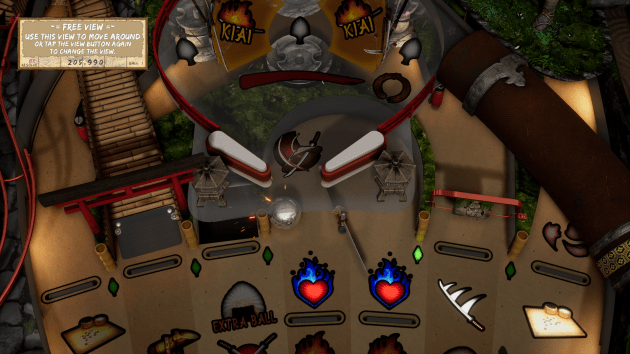
For a newcomer’s first designed table, this really feels like it would earn a student an “A”. Really, it’s only compared to other original works in Pinball FX that a Samurai’s Vengeance falls a bit on the bland, conservative side. But, it falls HARD on that side, so much that it nearly missed out on a clean scorecard.

I hope new designer Zoltan Hegyi and Zen Studios don’t take this the wrong way, but A Samurai’s Vengeance felt sort of like a Zaccaria table. Which isn’t to knock Magic Pixel’s pinball stalwart either. They’ve put out many fantastic tables. What I mean is that Samurai’s Vengeance takes a generic theme, hits every single clichΓ© to go with that theme, stretches the mileage one would expect you could get out of it to near breaking point while somehow not managing to include one single memorable shot, and yet the end result still ultimately ends up being a decent table. Sorry for the run-on sentence. Samurai is so by-the-books that it doesn’t feel like your typical non-licensed Pinball FX release. Maybe that’s a good thing, and for the record, I’m a-okay with busting out all the conventional themes and tropes. It’s pinball. If you can’t be unserious in a serious way, you’re doing it wrong.

The lack of memorable modes or shots does sting quite a bit here. Like so many Zen tables, a lot of Samurai’s problems come down to modes feeling like a grind. In the course of our dueling, which usually involves dozens of games, we never once activated the Random Fortune. Not a single time. It requires you to shoot the Torii gate a whopping eight times. Why would we even do that when all the important shots for the modes are on the other side of the table? We can spend our time grinding up a random award that may or may not be worth the effort, or we can shoot the swinging door katana sword or the spinner to grind up our strength, and then try to start a mode. We know the modes have value. The other side is just a whole lot of busy work. The multiball requires four balls to be locked, and that’s if the ball lock is even lit. The risk/reward wasn’t balanced properly, because none of us wanted to shoot that side of the table at all. It was too risky when we know that completing the modes yields a final tally of ten million points plus all the scoring that leads up to it. If you’re going to grind, grind the modes, right?

A Samurai’s Vengeance is one of those tables that makes me wish, once again, that Zen would move away from these slow, multi-tiered modes and instead try to replicate the style of pinball’s most profitable and successful era of the 90s. There’s a reason why their most popular tables are recreations of arcade tables from that era: that’s what people like about pinball. A Samurai’s Vengeance has massive pacing issues beyond just requiring so much grinding. When you start a mode, there’s about a fifteen second delay between the mode start and the ball reaching the flippers to start playing again. Mind you, there’s no animation for this. It just takes that long to load. We’re NOT going to get invested in the characters of a pinball table. We’re invested in shooting targets. Now, having got all that out of the way, A Samurai’s Vengeance has good flow, no really offensive flaws, and even a couple gags that gave me a chuckle. I literally said “oh, you bastards” when they happened, but I also laughed. Will you remember it when you finish it? Not at all. Is it decent enough while you play it? Yep.
Cathy: GOOD
Angela: GOOD
Oscar: GOOD
Jordi: GOOD
Dash: GOOD