Pac-Man and Pac-Man Plus (Arcade Reviews)
May 10, 2024 17 Comments
This review would not have been possible without Chad Birch’s excellent write-up on Pac-Man’s ghosts. A must-read that helped me to better appreciate what Pac-Man accomplished. And I’d like to also give a shout out to the inspiration of that post, the Pac-Man Dossier by Jamie Pittman. If you’ve never read about the ghost patterns in Pac-Man, do me a favor: read those, then play Pac-Man and tell me if the experience feels somehow changed to you. It’s the strangest thing but it feels transformative. I’ve never experienced that before with any game. It’s wild.
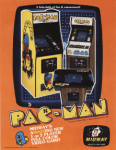 Pac-Man
Platform: Arcade
Released May 22, 1980
Designed by Toru Iwatani
Published by Namco
Arcade Archives Release
Included in Pac-Man Museum+
Included in Arcade1Up’s Pac-Man Deluxe Cabinet
I was born in 1989, and I started gaming regularly when I got a PlayStation for Christmas in 1996. Pac-Man had seen better days by that point. It wasn’t an important character to my childhood at all. Not even a little bit. I’m sure my older readers will have an aneurysm hearing that, but it’s true. I did play Pac-Man games, of course. Soon after I got that PlayStation, but before I got the Nintendo 64 for my 9th birthday in July, 1998 that changed my life and really made gaming my thing, my father got me a pair of the original Namco Museum releases for my PlayStation. Volumes 1 & 3, aka the ones that everyone had. I don’t remember playing most of the thirteen games in them, but I know for certain I only played Pac-Man once. Why on Earth would I want to play that boring old version when Ms. Pac-Man had four mazes and bonus fruits that hopped around the mazes instead of just sitting there lifelessly in the center? To 7 year old me, the original world-conquering Pac-Man held no appeal at all. I’m not proud to say that I stuck to my guns on that long after I had launched Indie Gamer Chick in 2011. Pac-Man? Boring! I didn’t change my tune on it until last summer, when my sister asked me pointedly “how is Pac-Man’s one maze any different from pinball? You wouldn’t complain that a pinball table plays the same game, and only that one game.” I couldn’t believe how ashamed of myself I was at that moment. She was completely right, and I had always been completely wrong about Pac-Man.
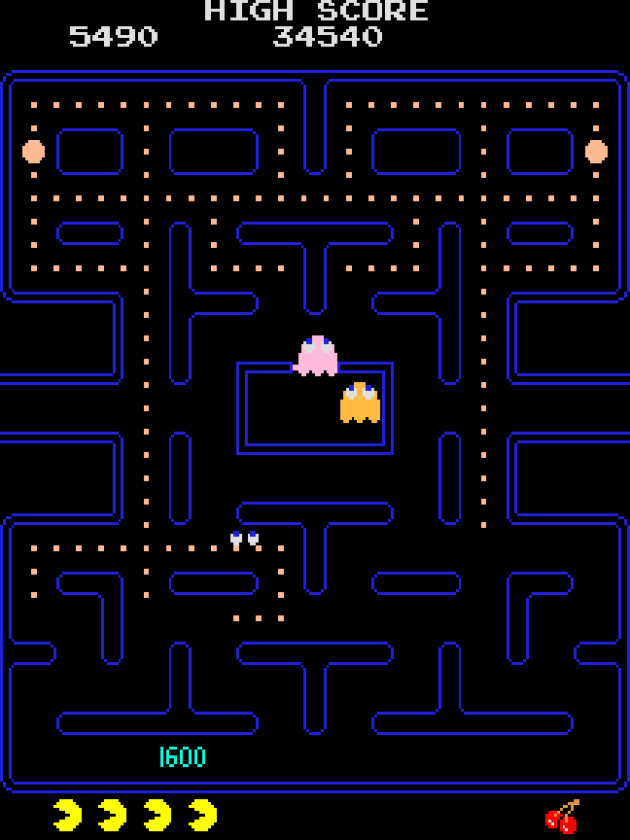
Few things in life are so satisfying as the 4th chomp of a single power pellet. And yes, I’m playing with five lives instead of three.
The weird thing is, I kept that bias against the original Pac-Man despite taking the time to better understand the maze chase genre as a whole. It was the Atari 2600 port (which is one of several Pac-Reviews in Atari 50: The Games They Couldn’t Include), along with my fandom of games like Popeye and Jr. Pac-Man that helped me to figure out why some games succeed and others fail. It’s all about the chase itself. Not the collecting, or the turning the tables on the enemies, or even the presentation and/or theme of the whole package. The entertainment comes mostly from the close calls and exhilaration you get from scratching out just enough distance to free yourself, or just barely beating out a chaser hot on your heels to win a level. Being charming, looking good, or having memorable characters is nice, but if the chase is no good, it doesn’t matter. I never understood why Pac-Man succeeded where so many others failed, but the really weird thing is neither did Namco, or the man who made Pac-Man to begin with.

There’s so many idiosyncrasies that make Pac-Man.. well, Pac-Man that I couldn’t possibly count them all. For example, the places where I’ve put the arrows are known as “blind alleys.” The ghosts can NEVER travel upward along those specific paths. They can go down, but never up. If you perform it right, you can even park in the lower right hand blind alley and remain safe. The ghosts will never find you. Pros use this to take potty breaks (though the use of this is controversial).
Look at many interviews with Toru Iwatani and he’s sure to conclude that people relate to Pac-Man.. especially women.. because Pac-Man, you know, eats. Eating! That’s a thing people do! Especially us women folk, whereas men are too busy for that, what with all the bread winning, and usually opt instead for good old fashioned photosynthesis. Of course, other games are about eating too, but only Pac-Man became a global icon. Or maybe it was the shape, serendipitously created (discovered?) when Iwatani took a single wedge from a piece of pizza? Or the name, which was originally “Puck-Man” until someone turned the P into an F and Namco had second thoughts. Or was it the ghosts? The colorful, menacing pursuers that were each programmed to have their own personalities? The sound effects? Sure, those all matter, but I think if you leave everything the same but have a crappy maze design and Pac-Man doesn’t blow up like it did. The straightaways at the bottom are the exact right length to make players hold their breaths. There’s no unreasonable twisty-turny moments. The ghosts slowing down in the tunnels lends an almost Hanna-Barbera vibe to the chase where you can imagine the ghosts shaking their fists at you in anger as the distance between you and them increases. The eating part is also only exciting because, YOU GUESSED IT, its effect on the chase. Eating dots slows you down, and there’s so many dots! That’s a lot of space where you aren’t going your max speed. The maze is, frankly, kind of perfect.


Namco figured everything was responsible for Pac-Man’s success, except the maze itself. There, their attitude seemed to be “any maze will do!” They went on to prove this twice in a row. The next Pac-Man game THEY made, Super Pac-Man, turned the abstract dots into the type of food us eating eaters eat. In theory, if eating is the appeal, it should have been a big hit, but it wasn’t. Maybe because the game itself sucked, mostly because the maze sucked. It didn’t lend itself perfectly to the best moments in maze chases. Scratching out distances, close calls, and nail-biting sections? Nope, just a mess of walls and dots with no rhyme or reason. Then they repeated the same folly with Pac & Pal. For all I know, the base concept of those games might be ingenious, but with the mazes they feature, there’s no way to know for sure. I kind of wish a ROM hack existed that changed the mazes. Weirdly, it was a rogue “enhancement board” developer named General Computer that fundamentally got it with Pac-Man and made the best of those early sequels: Ms. Pac-Man and Jr. Pac-Man.

Pac-Man is one of the first cases of the original Japanese script having helpful tips that were lost in translation. Specifically Pinky being “Speedy.” In fact, Pinky doesn’t move faster, but the word for what it meant didn’t have a perfect one-to-one English translation. In Japan, its name is “Machibuse” which roughly means “to ambush” or “being ambushed.” Unlike some bad translations, it’s not a stretch to see how they reached for a word that conveys the concept of an ambush and came up with “Speedy.” The “speedy one” is usually the one ahead, right? Pinky’s attack logic is to use the direction Pac-Man is facing and target an area roughly four lengths ahead of Pac-Man. Clyde (the orange one) is in the same boat. “Pokey” is his name in the US. WTF does that even mean? In Japan, his name translates to “feigning ignorance.”
If the maze design itself is the most important aspect, the chasers are a very close second. When I play a maze chase for the first time, sometimes I need time to figure out if a maze works or not. That’s rarely the case with chasers. If they just immediately make a beeline for you, it’s usually not a good sign. Pac-Man doesn’t do that, and I think that factored really big into why it took off. While the ghosts each have a unique personality and accompanying attack method, all four ghosts collectively run on three “modes” that apply at the same time to all four. The modes are called SCATTER, CHASE, and FRIGHTENED. The main two are SCATTER and CHASE, which run on a fixed timer, with SCATTER running much shorter. Sometimes astronomically shorter. CHASE can last seventeen minutes before giving players another SCATTER, though by that point, you’ll probably just finish the level or die. In SCATTER, each ghost goes to their own designated corner to wander on “patrol” for a few seconds. In CHASE, the ghosts each have a strategy based on using a “target” on the board that refreshes every step they take. The red one always targets the space Pac-Man is currently occupying and takes the shortest route to get there, leading to it feeling like it chases you the most directly. The pink one tries to anticipate your move by targeting four spaces in front of the direction you’re facing. You can use this to scare Pinky off. If you’re near a junction and you move straight at him, his target tile will be BEHIND HIM and cause him to change directions. It works every single time.


The blue ghost bases its position on Blinky (the red one) and Pac-Man’s position, and if Blinky closes in on you, it’s not rare for Inky to be close by. Finally, Clyde, the orange one, really is kind of a coward. If he’s far away from Pac-Man, he uses Blinky’s targeting system, but as soon as he gets within eight spaces of Pac-Man, he retreats to the left hand corner using the same target tile as his SCATTER mode target. While he’s not specifically dangerous as he doesn’t target you, what he’s really doing is cutting off a potential means of escape. There’s a LOT more complexity. Like seriously, read this and try committing it to memory. I made it to Chapter 3 and about two minutes later, as I tried making sense of which tile counted and how each frame of animation mattered a great deal, my ears started dripping blood. I took it as a sign to stop and just enjoy knowing that I could stare-down the pink ghost.
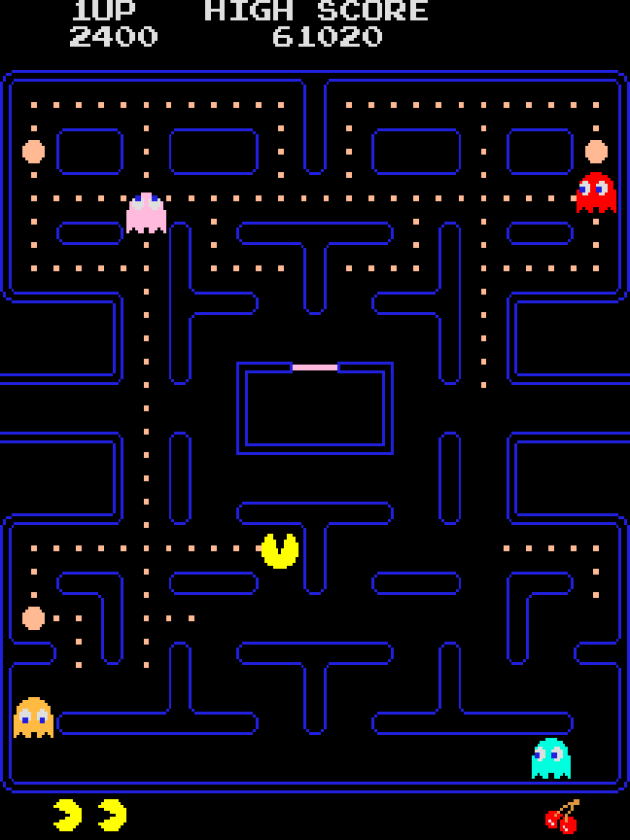
The ghosts in their “SCATTER” patrol zones.
I was wrong about Pac-Man being boring. Now that I approach it the same way I do a pinball table, knowing that I’m playing one specific maze that operates under one specific set of rules, I think I kind of love this game. Maybe someday, I’ll even commit the professional patterns to memory. Right now, I’m just content to practice and get better at anticipating the moves of the ghosts and utilizing it to make the type of moves I once thought were bold, but now I know are completely safe. Besides, I kind of like how good I am at it now, where scoring a 1,600 point 4th chomp is still a big deal to me. I don’t know if I ever want to cross that threshold where scoring 50,000 points isn’t a “good game” anymore. There’s something comforting about knowing just enough about Pac-Man to do alright, but not enough that I could play it for hours, completely zoned out. It’s a game I have to pay attention to, and that’s kind of what I want out of a maze chase anyway. If I reached the point where my brain is calculating what frame cycle I’m currently in so I can pinpoint exactly what direction the edible ghosts will turn, that doesn’t sound as fun for me. Hey, 50,000 is a good score for me. It’s a pitiful score for pros. But I bet I’m the one having more fun.
Verdict: YES!
 Pac-Man Plus
Platform: Arcade
Released March, 1983
Published by Bally Midway
Included in Arcade1Up’s Pac-Man Deluxe Cabinet
NO MODERN NON-ARCADE1UP RELEASE


Pac-Man Plus is the unofficial-official ROM hack that DIDN’T find its audience. It’s unclear how involved Namco was. MobyGames says it was completely unauthorized by Namco. The Pac-Man Wiki says it was actually made by Namco. Everyone seems to agree that Plus was commissioned by Bally Midway to compete with the prevalence of popular-but-unauthorized enhancement kits and ROM hacks (some of which I reviewed in Pac-Man Museum: The Games They Couldn’t or Wouldn’t Include), the most famous being one that just sped up the game significantly. While Plus retains the same maze as the original Pac-Man, the gameplay is fairly heavily modified. Oh, and the maze is teal now. My father speculated teal might be kinder on CRT monitors than the stark blue of the original. Real life Pac-Man cabinets are NOTORIOUS for permanently searing the maze’s shapes and features into the monitors themselves. By 1983, enough Pac-Man units were probably experiencing monitor-scaring that arcade operators requested that it, you know, not do that anymore. That’s just my pops’ speculation, though. Another cosmetic change is that the first item is a can of Coca-Cola, which is apparently one of the first examples of product placement in a video game. Also, when you eat a power pellet, the ghosts now have stems on their head. It seems like a needlessly cruel reminder that, yes, they’re food now. As if being dead isn’t bad enough. The cosmetic changes are fine and honestly, the stem-head thing is cute, but gameplay is king.

“Aww sh*t. We’re food. Wait, how did ole Pinky not change?”
There are three notable changes to the standard Pac-Man gameplay. (1) The ghosts are “more aggressive” now, by which it means they spend less time in the “Scatter” algorithm and more time in “Chase.” They also move faster, but then again, so do you. (2) The power pellets are now red kryptonite instead of green. In other words, you never know what will happen. Sometimes you’ll get the standard “all four ghosts can be eaten” from the first game, but sometimes the power pellets only work on three of the four ghosts. When this happens, one ghost seemingly chosen at random will not be affected. What the hell? Well, this is “professional-proofing.” You see, by 1983, the patterns that skilled players used to manipulate the ghosts and rack up high scores were widely known. Instead of creating new “marching orders” for the four ghosts, having one not become vulnerable completely wrecks the established patterns used by pros. Oh, you can still use patterns, but you will also always need to think on your feet. Other effects also include making the ghosts invisible, making the stage invisible, and making the stage AND the remaining dots/pellets invisible. Because OF COURSE that happens.
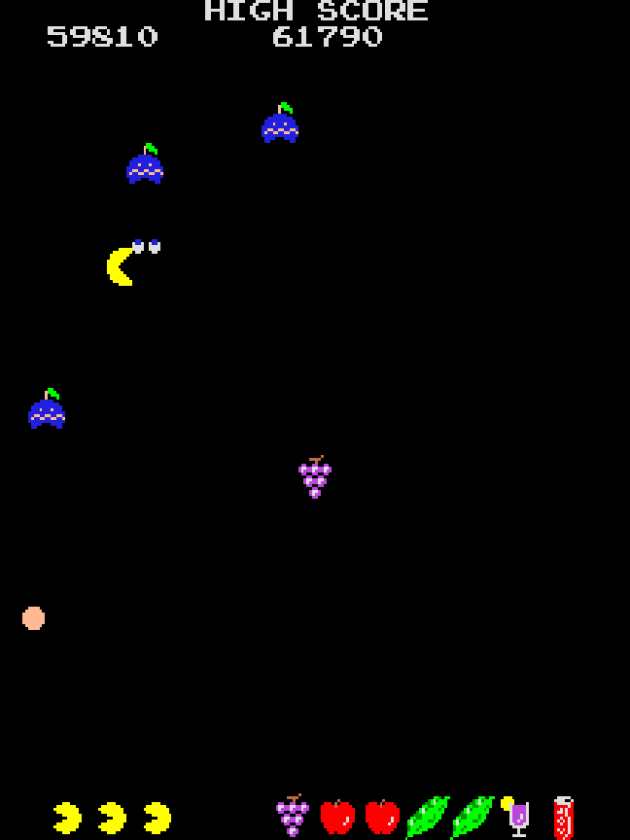
Well, it wouldn’t be a mod of an established game from the early 80s if “invisibility” wasn’t one of its tricks.
(3) The bonus items aren’t just for points anymore. They’re functionally extra power pellets. Not just power pellets, but SUPER INVISIBILITY Power Pellets! When you eat them, the ghosts become edible, but they turn invisible (facepalm) until the blinking starts. If you eat them, they score double the points they normally do: 400, 800, 1600, 3200. Being able to fully utilize this requires you to have a fairly good understanding of the behavior of the ghosts running the “FRIGHTENED” algorithm, since you won’t be able to eyeball which direction they take. Wait, how does FRIGHTENED work? Oh, the directions the ghosts turn are based on a pseudo-random number generator. Well crap. So unless you memorize the frame-by-frame gameplay to be able to predict the behaviors of the ghosts, chomping them with the item is pure luck. Anyway, I played Pac-Man Plus a few years ago and I didn’t really like it all that much, but now that I’ve taken the time to understand the idiosyncrasies of Pac-Man, actually.. it’s okay! It’s not an amazing upgrade. It’s fine, but it is something you have to be really into Pac-Man to appreciate. I can also understand why purists wouldn’t like it. I had a decent enough time messing around with it, but it’s no surprise why Ms. Pac-Man is the official-unofficial ROM hack that became a hit and Pac-Man Plus was relegated to the status of historic curio.
Verdict: YES!
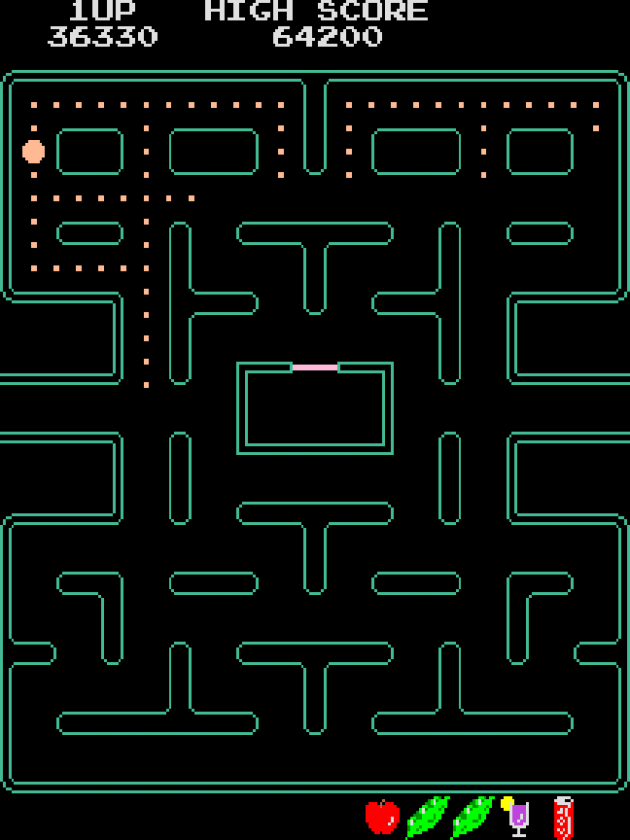
Ignore the “high score” which was done via cheating tomfoolery. This was my legitimate high score.

 Indie Gamer Chick
You must be logged in to post a comment.