Bases Loaded (NES Review) and Baseball (Famicom Disk System Review)
October 10, 2025 1 Comment
I had planned to do Baseball Games for NES & Famicom: The Definitive Review and made it ten reviews into a 40+ game feature when, frankly, it just became kind of exhausting. I do plan on finishing a lot of the games featured, but the reviews that are finished are going to be posted as normal reviews. I’ve already done the Nintendo version of Baseball, but all my Definitive Reviews have re-reviews, and Nintendo Baseball was no exception. And I was REALLY happy with the re-review, so why let it go to waste? So, following my review of Bases Loaded, be sure to check out that re-review. It’s all-new. I hope everyone enjoys!
 Bases Loaded
aka Moero!! Pro Yakyuu
Platform: Nintendo Entertainment System
First Released June 26, 1987
Designed by Nobukazu Ota
Developed by Tose
Published by Jaleco
Available in Bundle with Super Bases Loaded on Nintendo Switch

I laid down a sacrifice bunt here. You can CLEARLY see the runner beat the ball to second base with time to spare, but the umpire called this an out. And you can’t even coldcock them.
Golly, my decision on Bases Loaded was a tough one. I don’t even know why I’m surprised. There were a whopping FOUR games in the Bases Loaded series on the NES alone. You don’t get THAT many sequels unless the original game had a solid foundation to build off of, right? And Bases Loaded is solid. In fact, I thought it was a much better simulation of baseball than the more iconic RBI Baseball. It’s certainly smarter, at least from player behavior. Defensive is handled semi-automatically, so routine situations like most pop flies allow you to just sit back and enjoy seeing the fielder catch the ball. However, you can take control at any time, and fielders move faster if you directly control them. If it’s questionable whether or not a fly ball is playable, you probably should be proactive in going for it, and you HAVE to go for any balls hopping along the ground. I like that method for hybrid defense, though. It keeps you honest. The way defense is handled here will be the gold standard for all future baseball game reviews, actually.

It didn’t take me very long in RBI Baseball to realize how easy it was to manipulate the CPU into chasing down a runner instead of getting the automatic out. You can’t do that in Bases Loaded. Here, the third baseman and catcher have caught my runner in a routine trap play. It’s not EXACTLY like real life baseball since the two defenders don’t (can’t) close the gap. They just throw back and forth until they get you from a stationary position. But, if it’s possible to fool them or inch your way back to the safety of the base, I never got the timing of it right. I tried, too. The next logical evolution of this leap forward is the defenders closing the space, so I’ll be on the lookout for that.
Why I’m struggling with my verdict is because my stated rule for earning a YES! is “I have to like a game more than I dislike it.” For everyone who thinks I’m an ogre, I really think I have the lowest hurdle of any “major” publication to get over. I just want to have more fun than not! And I DID have more fun than not with Bases Loaded. I really enjoyed the pitcher/batter duel, which I know Jaleco took inspiration from Intellivision’s World Series Baseball (1983) and Accolade’s Hardball! (1985). The pitcher is essentially given an invisible tic-tac-toe grid to throw at, and the batter has to swing at the square the pitcher selects. It’s really well done. I loved it, except I wish there was a little less delay between the moment of impact and the transition to running/defense. But the system feels true to the psychology of the pitcher/batter dynamic. It also highlights the problem with Bases Loaded. In this screenshot, taken a single frame before the umpire makes his call, you can see the pitched ball is literally encompassing my stance. It looks like a white wristwatch on the batter.
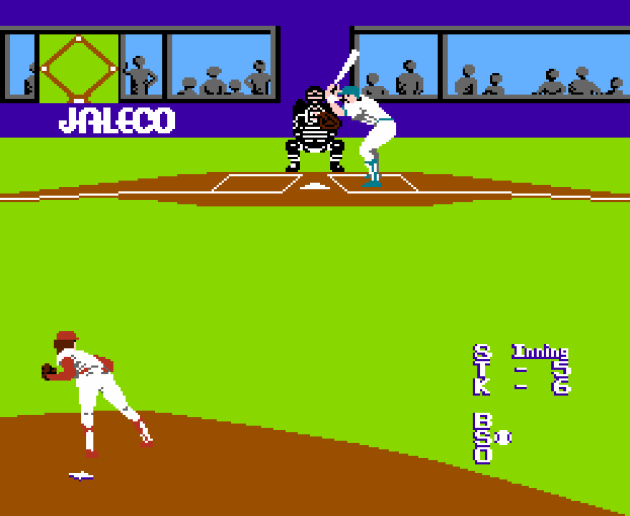
That was called a strike. So was this one:
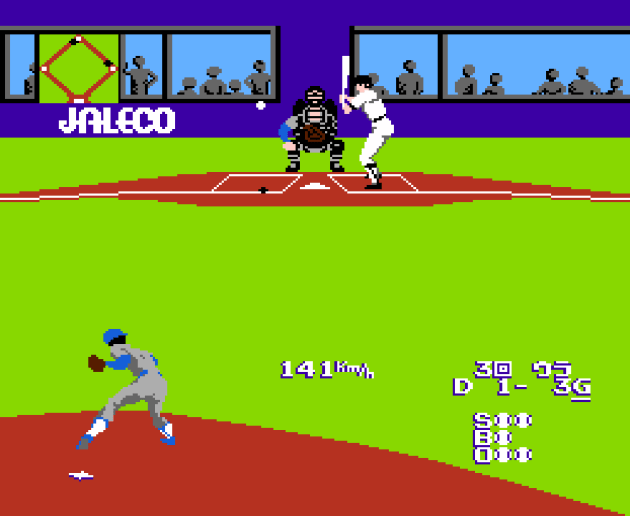
This is the first game in this feature where you can’t move around the batter’s box. The pitcher can adjust their position, but not the batter, and there were plenty of high pitches that were called strikes that were, ahem, suspect. I rewound and examined a few, and even attempted to swing at them, where I literally don’t think I could have done anything to hit them. I know that you’re supposed to actually watch the catcher’s mitt and not the ball (the mitt is actually just floating there like it’s being held by a g-g-g-ghost!), but even then, it still didn’t always seem to match. But that’s nowhere near as frustrating as some of the basic baseball rules that Bases Loaded doesn’t have right. In real baseball, if the ball bounces inside the diamond but clears first base OUTSIDE the diamond in foul territory, the hit is a foul ball and a strike. This is an INCREDIBLY important rule because hits down the foul line are almost always doubles or more, since defenders are not in position to make a play. The rules are rules for reasons. With that said, take a look:
That’s actually me hitting, but with these baseball games, bad programming works both ways. In my first game, a similar occurrence happened with me on defense. In the clip, you can clearly see this is a foul ball. There’s no doubt about it: the shadow is on the wrong side of first base. I didn’t even bother to run because I was waiting for the pitcher/batter duel to restart and was caught off guard when the fielder was chasing the ball down. Since it happened twice, it’s not a fluke. It’s a thing. Even worse is how much extra time defenders have to make outs when runners sure look like they’re safe. In fact, the act of a runner sliding into base seems to add more time to reaching base than it shaves off, which defeats the point of sliding at all, right? Over three games and a twenty minute warm-up, I never saw a single runner who slid into base actually be called safe when an attempt at a play was made even if they CLEARLY beat the throw. Again, this is me playing defense turning a fly-out into a double play. The runner on second had to return to second. They slide in and beat my throw but are called out. I rewind to show you what being called safe looks like.
Basically, the person sliding has to also then stand up on the base for it to count as safe. Which would, you know, negate the whole point of sliding into a base in the first place. This applies to home plate as well. This time, it’s me getting thrown out. You can see, without a shadow of a doubt, I’m scoring here. I beat the throw and touched home plate, then the person catches the ball, then I’m called out, then I’m given the electric chair for the murder of the umpire. Okay, not that last one, only because I suppose Jaleco had to save something for the sequel.
At first I thought “well, maybe they programmed umpires to make mistakes.” I hate it when sports games do that (unless they make it a toggle you can turn on and off), but that’s not the case in Bases Loaded anyway. This is what happens whenever a player slides. It’s very frustrating, and the only silver lining is that no advantage is given since this type of thing happens consistently. My anger is more about the loss of immersion. For all the sh*t we give umpires, none are THIS bad, and so these simple baseball rules and standards not being correctly implemented screws with my suspension of disbelief, thus breaking the golden rule: all sports games ARE fantasy games. The fantasy is you’re playing the sport at a professional level. For the fantasy to work, the rules and behavior have to resemble the real rules of the sport. I can’t make believe that if the game is calling foul balls as fair, balls as strikes, or calling players who beat the throw to a base “out.” The shame is, Bases Loaded gets more right than any baseball game before it.
SPLIT DECISION – Moero!! Pro Yakyuu (JP)
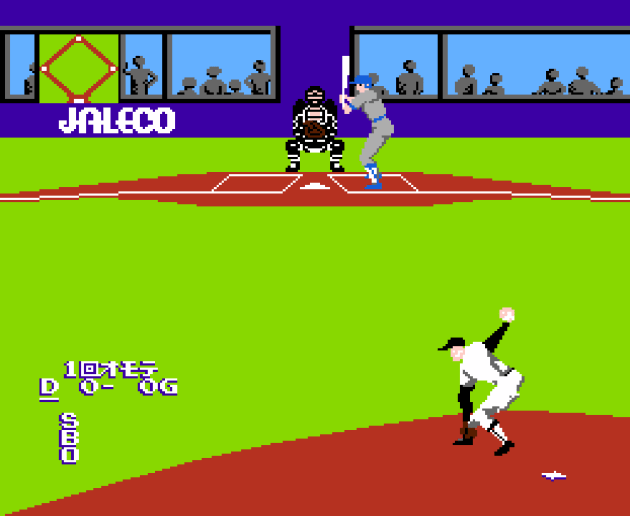
When I threw my first pitch in the Japanese version and saw that the pitcher I’d picked was throwing a SUBMARINE, I was so overjoyed that I was practically doing cartwheels. Non-baseball fans will recognize the submarine from the Brad Pitt flick Moneyball, where Pitcher Chad Bradford’s “defect” was that he “throws funny.” I don’t even remember if they identified “funny” as “the submarine” which literally every single baseball fan knows about, but that’s what it was. There’s nothing funny about the submarine though. Ask any player if they would want to face a submarine thrower who has a change-up in their arsenal and they’ll tell you “no way!” Especially if it’s a same-side batter (IE a right-handed pitcher going against a right-handed batter). The amazing thing about Bases Loaded is that they animated the delivery of the submarine nearly flawlessly, and it legitimately creates the timing-based optical illusion the pitch is intended to create. It’s not 100% perfect. I imagine it wasn’t possible to create the “sink” that the real life submarine relies on with these physics, but the illusion of the delivery is convincing.
Unlike RBI Baseball, these aren’t characters that look like Fisher-Price figures. They LOOK like human baseball players, and they even have personality. Bases Loaded features a wide variety of batting stances and pitching animations that make the roster look and feel like a team of ballplayers and not toys. The US version controls really well. So, I want to give Bases Loaded a YES!, but I kind of want to give it a NO! too. Why not both? I have a valid excuse to, as well. For the Japanese version, I couldn’t get base runners to retreat on fly balls, leading to double plays galore. The runners wanted to go and all my instruction to return to base did was make them freeze-up on the baseline. It happened EVERY SINGLE TIME, and I couldn’t figure out why. I checked my settings and nothing was wrong. This didn’t happen on the US build, so I’m giving the Japanese build a NO! Also, this is nitpicky but the Japanese version is missing a lot of key sound effects that make it feel unfinished.
Verdict: NO! but this review is not over.
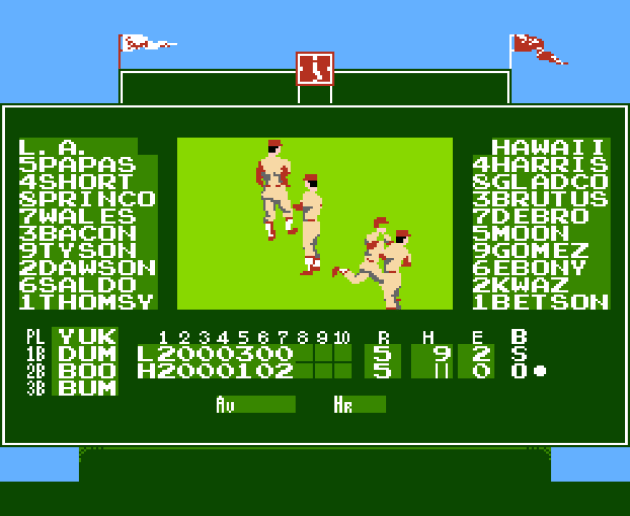
Interesting choice of uniform colors, Jaleco. What’s this team’s name? The Jaybirds?
SPLIT DECISION – BASES LOADED (US)
For the US version, there’s no getting around the issues with sliding into base or the rules not being correct. Bases Loaded’s numerous problems are unavoidable and maddening. But, I don’t think they ruin the experience. They’re blips on an otherwise pretty dang fun game of baseball. The battle/pitcher dynamic is much harder to clock than previous games. You have to work for runs in Bases Loaded. I even lost a game for the first time in this feature, and the games I won were all by a single run. In order to win, I had to use actual baseball tactics. I stole a base at one point. I sacrificed with a bunt. It DOES make the fantasy real, with the occasional sh*ting of the bed. If my review criteria were based only on games not needing a change of bed sheets, Bases Loaded would be a NO! and that would be all there is to it. But I don’t review that way. I just want to have fun, and Bases Loaded’s actual baseball mechanics are solid and the batting/pitching/running system is hard to clock and not so easy to learn to cheese that it can be done near-instantly. I had fun. I cursed a blue streak. Well goddammit, one of those things should be more important than the other, shouldn’t it?
Verdict: YES!
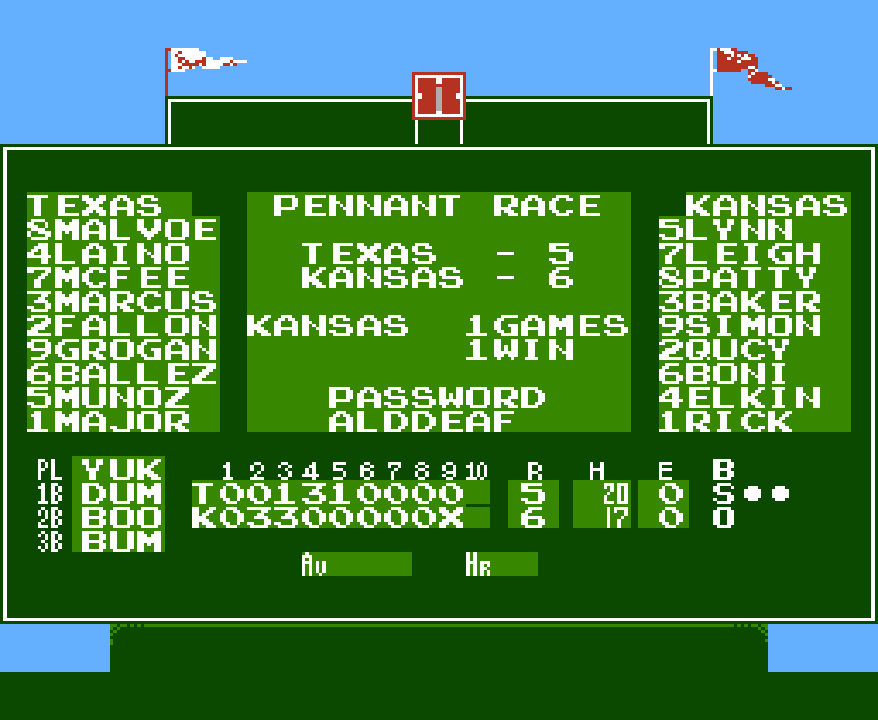
Final Score 1 (US): Cathy 5, CPU 6 (Home Runs: Cathy 1, CPU 3) BOX SCORE
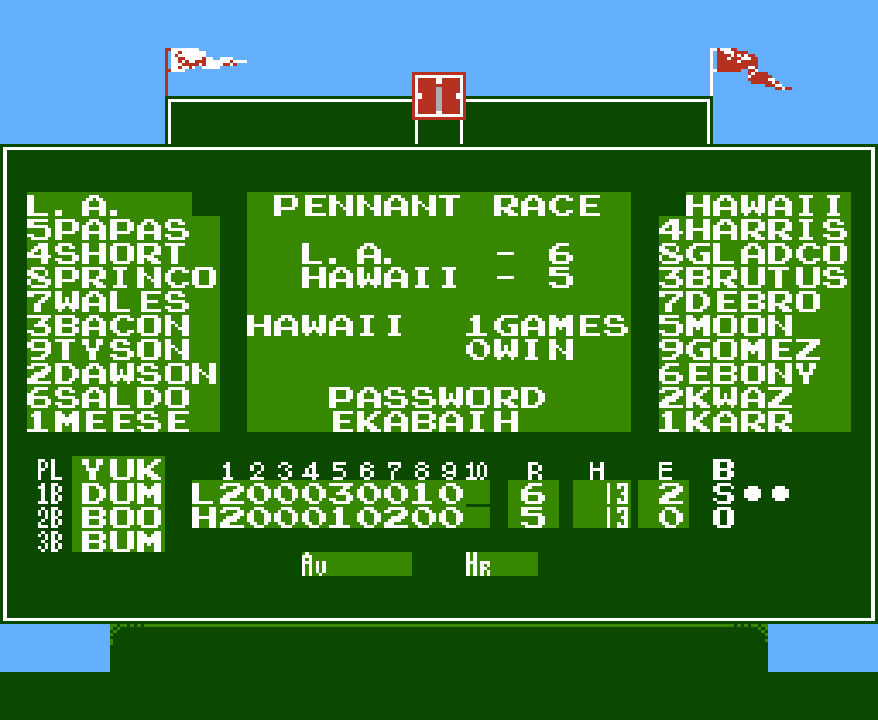
Final Score 2 (JP): Cathy 5, CPU 4 (Home Runs: Cathy 3, CPU 2) BOX SCORE
Final Score 3 (US): Cathy 6, CPU 5 (Home Runs: Cathy 3, CPU 2) BOX SCORE
 Baseball
Platform: Famicom Disk System (Famicom and NES)
Famicom Build Released December 7, 1983
Designed by Shigeru Miyamoto
Developed by Nintendo
Available with Switch Online Subscription (Standard)
Read the Original IGC Review


I just reviewed the Nintendo version of Baseball, which inspired this feature. But, as always with Definitive Reviews, every previously reviewed game gets a new play session for me to look for new talking points for a fresh review. So what if I cancelled the feature? I did this re-review and I’m posting it. This time, I played the FDS build and I swear the fielders had a full frontal lobotomy. In the first inning my defense let slow moving grounders go right between their legs. This culminated with the CPU hitting a three-run inside the park homer for what should have been a routine ground-out while I watched in stupefied awe. If you’re going to have automatic defense, it has to be good, you know?
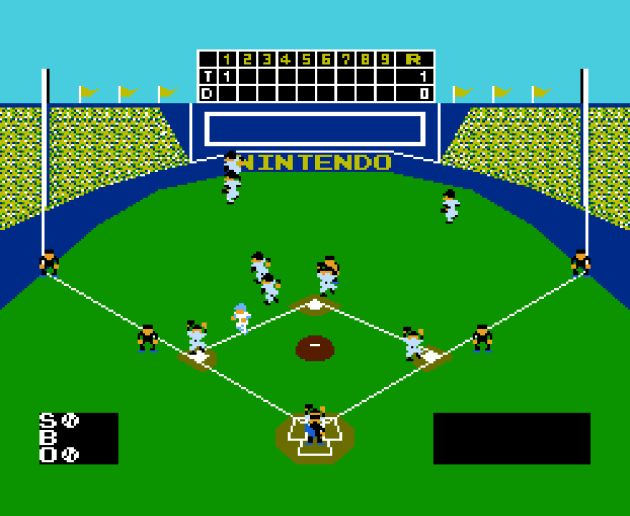
Nice hustle. Not.
Re-reading the first review, I don’t think I stressed enough how ineffective Baseball’s defense algorithm is. Fielders don’t really move diagonally and they rarely take the most efficient straight line path to the ball. Especially the outfielders, as sometimes two will run to one ball and then suddenly the closest one to the ball will stop chasing it and just sit there and stare at it like the thing just pulled a gun on them. In these three screenshots, pics 1 & 2 show the center fielder chasing the ball that’s clearly in his defensive territory. After the ball hits the wall (the ball originally touched down inside the diamond, mind you) he still goes for the play, but in pic 3, he’s now just watching while the right fielder runs for the ball even though he’s clearly not closer. There’s NOTHING you can do about this! It’s all automatic! All you do is wait to throw the ball.


Now that might have screwed me, but it works both ways. Here’s the CPU’s shortstop running away from a little blooper I hit to left field. If you’re not a baseball person (and if that’s the case, seriously, thanks for reading this) I can’t stress enough this is the most trained defensive angle in the sport, by far. If you watch practice at any level, little league to pros, this is the type of hit that fielders are given to warm-up with. It’s THAT routine. The shortstop had actually started in position to make the play, but it’s like their ability to predict where the ball is going for anything but a pop fly is broken. As if the players are running to where the ball will ultimately end up when it comes to a rest and not where it will be in a few frames relative to its position NOW, because it sure looks like the shortstop could have moved one direction, grabbed it, and prevented extra bases. Instead, he moved away from the ball’s trajectory (Pic 2). It then slowly rolled up into left field, including past the fielder until three f*cking players converged on it. Look where the ball lands (Pic 1), look where the shortstop was, and look where the play was ultimately made at (Pic 3). It’s like they based the AI on those children in little league who’re afraid of the ball. Again, players are totally helpless to prevent this. A semi-automatic scheme (like the upcoming Bases Loaded has) would have prevented this.


There’s no adjustable difficulty, either, and I have to assume there’s some kind of switch the CPU throws where they put on their rally caps and will light you up. BUT, even that works two ways. I noticed during this session and the session I put in for the original review that both myself and the CPU tended to get specific styles of hits in clusters. We’d trade the occasional one run inning, but then suddenly, BAM, one extra-bases shot after another for a massive scoring spurt. As soon as I noticed this phenomena, I even began to recognize rally innings were in progress as they were just starting, and I was almost always right. There’s also a few eye-opening quirks that don’t feel like a coincidence. In my full game, I hit six home runs. Four out of those six happened immediately after the pitcher threw a ball. In my sole grand slam hit during the original review, I remember it happened after watching a ball because my father said “see, the game rewarded you for a good eye.” (shrug) Maybe he was right.


Ultimately, I go back to what I seek out: just the basics. If the basics are good enough, I can make believe I’m playing real professional baseball. Sometimes there’s a moment that’ll make me tilt my head like I just saw something that looks borderline realistic. For example, pitchers can’t just throw smoke the entire game. There’s a noticeable cool down for the fastest fastballs, so you’ll lose them and regain them throughout the game. It almost feels like phantom calls to the bullpen are happening. As for play-making, both me and the CPU successfully sacrificed to get a runner from first base to second, and it looked just like the real thing when it happened. Too bad second base doesn’t feel like scoring position, which takes all the urgency out of trying to reach it and negates the value of bunts. Over both play sessions, none of my attempts at a sacrifice fly worked. The ball travels too quickly and base runners are too slow and too unresponsive to pull it off. Finally, the game doesn’t tell you how many hits you got in the box score. Nit picky, I know, but NOW I think I’ve covered everything. Hey, thanks for helping launch the NES in North America, Baseball. But I’m happy I never have to play you again.
Verdict: NO!
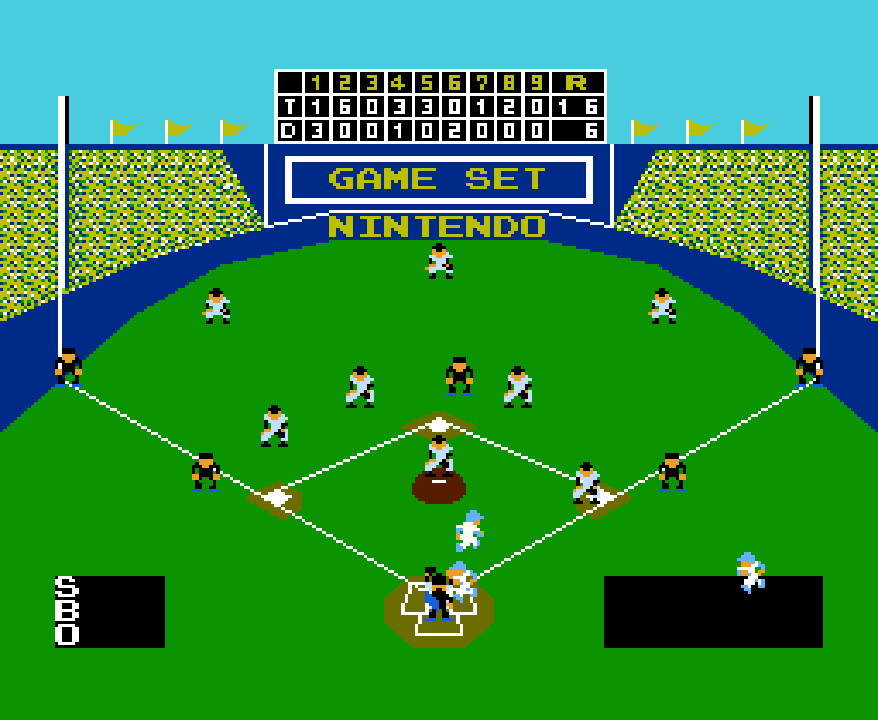
Final Score (Only Game): Cathy 16, CPU 6 (Home Runs: Cathy 6, CPU 2) BOX SCORE
 Baseball
 Arcade Archives: Vs. Baseball



 Indie Gamer Chick
You must be logged in to post a comment.