Super Real Baseball ’88 (Famicom Review)
November 20, 2025 6 Comments
 Super Real Baseball ’88
Platform: Famicom
Released July 30, 1988
Developed by Pax Softonica
Published by Vap
Never Released Outside of Japan
NEVER BEEN RE-RELEASED

The second baseman wasn’t at second base to turn this double play and I threw the ball into the outfield. This game tries SO HARD to be immersive, but it forgot to make the players, you know, know where to f*cking stand on defense!
Yep, this is an ambitious game of baseball that tries to earn the “real” in its name. Oh, it doesn’t, but I do admire the effort. I should probably note that this game comes from Pax Softonica. You might not recognize the name, but NES sports fans will recognize a game they worked on for Nintendo: Ice Hockey. Yea, the skinny/medium/fat one. That’s a really good game, as are games like the Game Boy Donkey Kong and Earthbound franchise launcher Mother for Famicom (if you’re into that sorta thing). Pax Softonica didn’t design those games but they helped build them. So Super Real Baseball comes with a legitimate pedigree. Part of me wonders if they pitched this to Nintendo and Nintendo was like “nah.” It does have the Nippon Professional Baseball license and, I assume, accurate rosters for the time period. It also is the first baseball game on the NES that feels like it’s trying to be a simulation of athletics and not a “video game.” What do I mean by that? Well, it’s an attempt at 3D gameplay where literally everything is done manually INCLUDING your batting stance.

Every batter who steps into the box already has their bat halfway through a swing and you have to manually complete the swing to take a normal stance in the two to three seconds before the pitch is thrown. This has to be done EVERY SINGLE PITCH! If you want to bunt, you just hold the A-button down without finishing the half swing you enter the batter’s box with.
Unlike other games where you just have to align a player sprite with the ball sprite and the player sprite takes possession of the ball, here, you have to press buttons to do everything. Buttons presses to pick up the ball. Button presses to throw the ball, and another button for the basemen to catch the ball. So throwing out a chopper to the shortstop requires you to (1) move towards the ball (2) press the A button when the ball is near you to catch the ball (3) hold left and press the A button to throw to first base (4) press the B button to catch the ball with the basemen. This is double the steps of any previous baseball game I’ve reviewed, which is normally just (1) move to the ball until it touches your player (2) hold left and press the throw button.
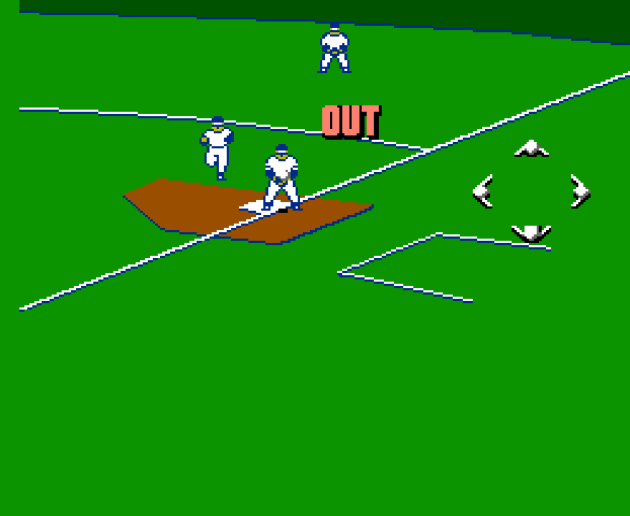
When you make a play, it sounds like an alarm. So far most of the NES baseball games I’ve reviewed have had terrible sound design, but this one is right up there with Major League Baseball in being outright annoying.
Okay, I get what they were aiming for and why they were trying it. I really do, and again, I tip my hat to them for trying to make it work. I assume the theory is that the more complicated the mechanics are, the more skill is required to master them, meaning the more it feels like a sport being played at the highest level, right? It’s not a terrible idea and, if they could have pulled it off, in theory it should enhance the immersion? Remember: sports games are fantasy games, the fantasy being you’re a real professional athlete. You’re not some lazy ass holding a game controller, or even someone pretending to be one ball player. Oh no, you’re every player having to actually work for your outs, gosh darn it! Too bad the batting is significantly easier than the fielding, so the immersion only works one-way and runs are too easy to get. In one game, I scored four runs on bean balls alone.
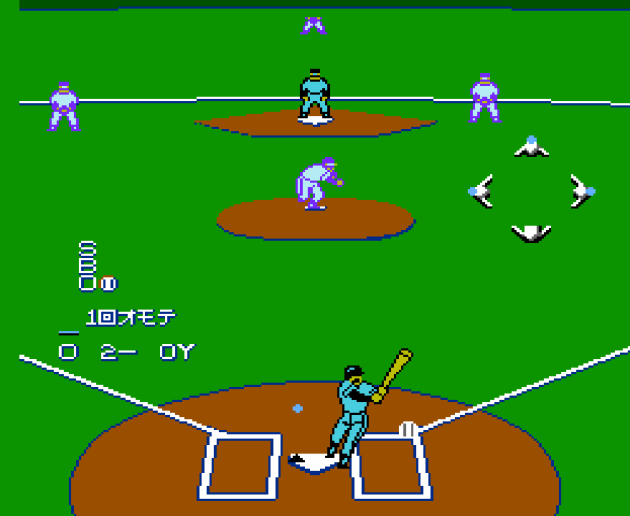
FOUR bases loaded plunks in a single game. Four. That’s not baseball. That’s a pitcher retiring in a blaze of glory.
But outs? THOSE you have to work for. Again, great.. if it works. It doesn’t. There’s an on-again/off-again pronounced lag between catching and throwing that I had to have my family test just to make sure it wasn’t something I was imagining. By the way, you can’t appreciate what a pain in the ass THAT was to set up. I had to wait for the ideal hit that could be thrown out, then use save states, teach them these relatively complex controls, then keep reloading the state for them to try to field the test. I did ALL of that for them to shrug and say “I dunno. Maybe?!” Thanks a ton, Fam. Very helpful.
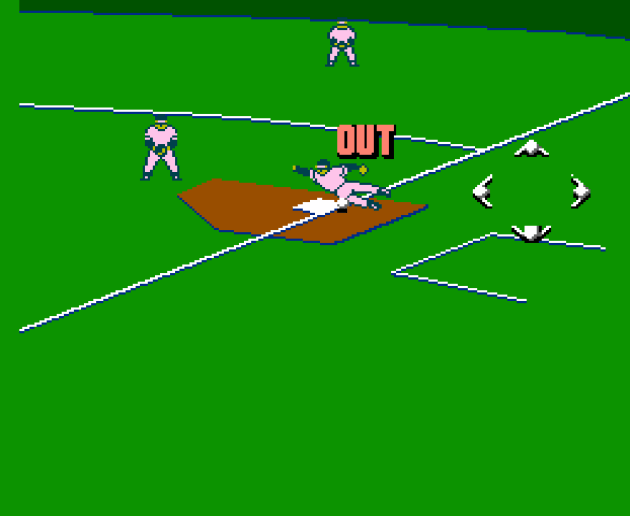
The B-Button does this weird diving catch that has a massive delay. When the CPU hit shots that I knew damn well hadn’t bounced off the ground first, I tried using save states to catch the ball using this. Not only did it not call it an out but there was a massive delay in being able to throw. Stick to the A Button.
Super Real’s most stand-out feature is the illusion of a truly 3D game. For 1988 on the Famicom, it’s actually much more convincing than you would expect. When a batter hits the ball, the camera stays as far back towards the plate as it can while doing a television-like zoom. I had to double check with my guru Dave to make sure I understood how this was accomplished. It’s actually done using a pair of classic NES illusions: reloading an entire new screen while changing sprite sizes (pay attention to second base in the below clip) and having the background act like a matte painting. “When it ‘zooms’, it simply snaps to a different point for the camera. And the player sprites, ball and boundary action sell it,” Dave explained. Old tricks, but the classics are classics for a reason: they work, and Super Real does successfully create a sense of depth within a wide ballpark (with playfield dimensions modeled after, I kid you not, the brand spanking new-at-the-time Tokyo Dome). Take a look!
This came out before I was even born! That’s pretty dang good looking given the time frame. This is no half-assed effort, folks, and that’s why it pains me so much that nothing is fun about Super Real Baseball ’88. Defense has too steep of a learning curve. The steepest of any game baseball game I’ve reviewed so far, with nothing even close. But it wasn’t worth the effort to learn it. Even in my first game, I managed to shut out the CPU. Want to know what’s REALLY remarkable about that? I didn’t catch a single fly ball. I didn’t in the second game either, or during my warm-up. Every out I made, with the exception of one or two tags and one or two strikeouts was a force-out at bases. There were some infield “catches” that sure seemed like they should have been a fly out that weren’t. Here’s my first ever fly ball catch, all the way in the bottom of the 5th in the third game I played.
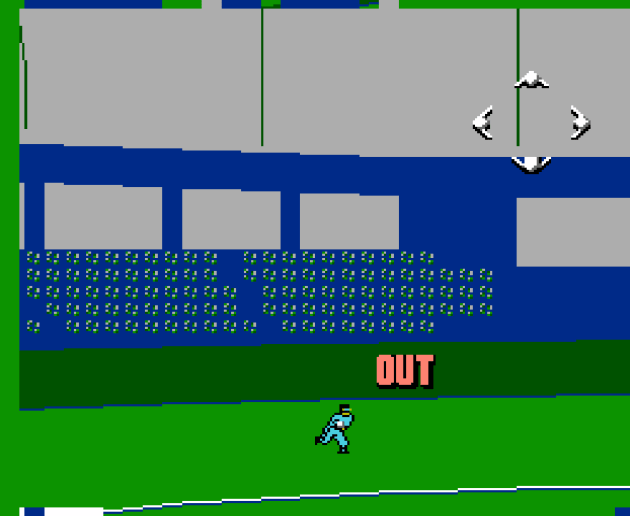
Same game where I’ve scored four total runs from getting hit by a pitch with the bases loaded.
How did I do it? You have to hold the button down. That.. makes sense, actually and I’m not sure how it took me three games to figure that out. Unlike the pitching, which is most certainly not intuitive. The normal D-pad assignments of “hold towards the plate for a fastball, away from the plate for a change up, or side-to-side for breaking balls” applies. But, in Super Real Baseball, you have to also tap the button while throwing the pitch. Do it too little and the ball will be low. Do it too much and you’ll throw too high. Again, their heart was in the right place and I appreciate that they didn’t just want players wiggling the D-pad. It just wanted to do too much for an NES game. I imagine this was probably better at the time it came out, but there’s also a reason why Super Real Baseball was one and done. It just doesn’t make for a fun game. For all its complexity, I had it clocked enough to win the third game 26 to nothing while holding the computer to only six hits. I respect ambition, but ambition isn’t fun all by itself.
Verdict: NO!
 R.B.I. Baseball


 Indie Gamer Chick


You must be logged in to post a comment.