Looney Tunes (Game Boy & Game Boy Color Review)
March 25, 2025 Leave a comment
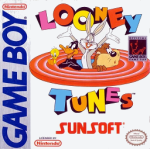
 Looney Tunes
Platform: Game Boy, Game Boy Color
Released October 2, 1992 (GB) September, 1999 (GBC)
Directed by Akito Takeuchi
Developed by Sunsoft
NO MODERN RELEASE


Early in my play session with Looney Tunes on the Game Boy/Game Boy Color, I thought this was going to turn out to be an underrated game. One of those “jack of all trades, master of nothing” affairs, but a decent one. The idea is neat: each of the seven levels sees players taking the role of a different heroic member of the Looney Tunes cast. In level one, you play as Daffy and make your way through a series of bite-sized platforming screens. There’s even a novel attack gimmick: you throw a frisbee that works like a mix between a boomerang and the Dagger of Throwing from Wizards & Warriors. The controls were a little loosey-goosey and the collision wasn’t amazing, but I loved the projectile and the level design seemed well above average. I thought “okay, this could be special.” Nope. The problem is, after the first stage, you don’t return to that style of platforming until the last stage. And, when it returns, the decent level design doesn’t return with it.
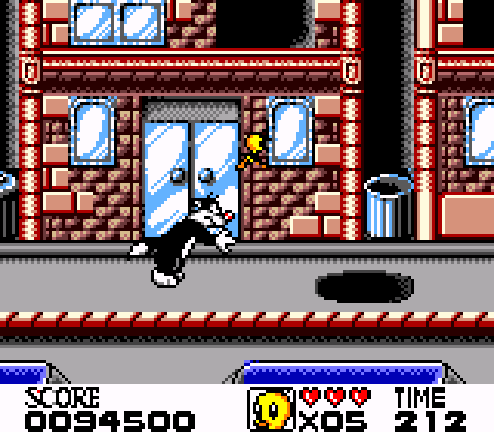
The graphics are fantastic, whether you use the Game Boy or Game Boy Color versions.
The second stage has you playing as Tweety. This is an avoider-style platformer where you’re simply trying to avoid Sylvester. Having just played one of the best avoiders I’ve experienced, ironically a Road Runner game for the Genesis, this really doesn’t cut it thanks to the lack of variety. You just repeat the same tiny handful of obstacles for several agonizing minutes (it feels longer), while the strategy to avoid the cat remains the same: just zig-zag. You don’t die if he catches you, instead only losing a single heart (and there’s plenty of refills). There’s also a variety of open sewers that the cat will blindly run into, and it’s not very hard to trick him into doing so: just stay low. This was completely brainless and one of the worst second stages I’ve ever played.
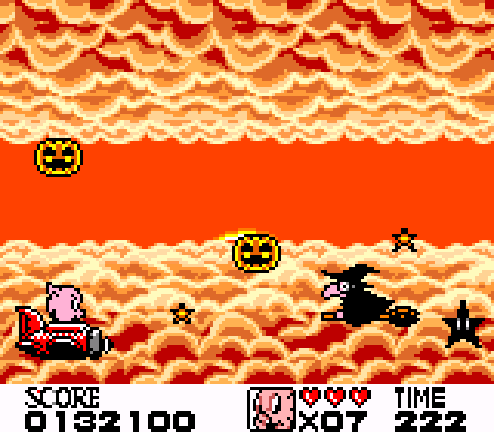
This isn’t even the “big boss” of the stage. The little star tailing the witch is.
The third stage is the typical and seemingly required-for-certification Game Boy shmup stage, just like Mario Land or the Game Boy Batman. This WOULD have been okay, but the collision is at its worst here. That’s a big problem because the stage’s last boss shoots a heat-seeking fork that’s sometimes seemingly impossible to avoid. It can be shot down, but it takes a lot of shots to do so, and if it’s shot close to the edge of the screen, you just won’t have time. I died twice fighting this boss alone, and all six hit points felt completely unavoidable. I’m not the biggest fan of Mario Land’s shmup stuff, but Looney Tunes made me appreciate what that game accomplished. In the case of this game, I think the sprites are too big for what they wanted to do. Compared to some of the other ideas in Looney Tunes, this wasn’t a disaster, but it certainly wasn’t good.
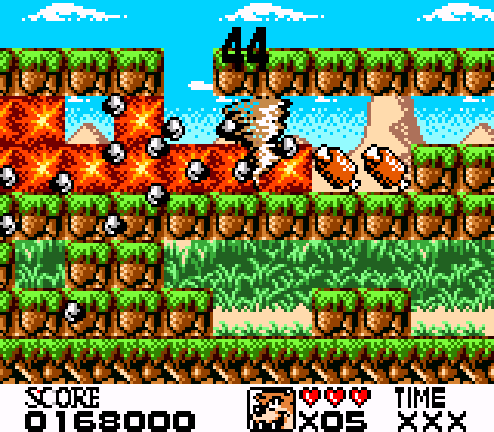
“Level” four is a waste of time.
Level four is basically a no-fail bonus stage where you have a minute to get as much meat as you can with the Tasmanian Devil. It’s not very good, as it’s too easy to get stuck at the top of the screen. The whole idea behind this bonus stage made more sense in the original black & white Game Boy game. In the Color version, each level has a bonus stage attached to the end, making a mid-game solo bonus stage redundant and a massive waste of time.
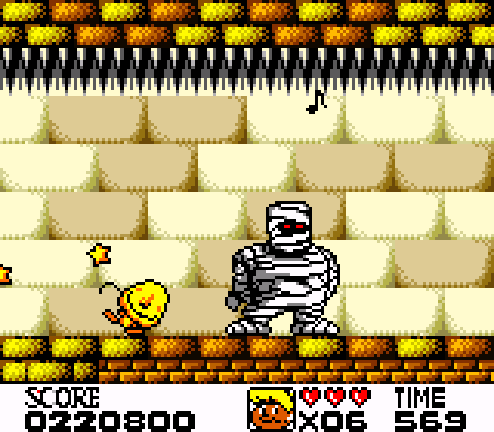
The worst attack in video game history? Maybe.
Speedy’s stage I would call a back-to-basics platformer. Like in levels one and seven, you can jump on enemies, or you can use a projectile. But, the Fastest Stereotype in All of Mexico doesn’t get the kick ass frisbee. Instead, a single press of the fire button causes him to dance in place and shoot stars in multiple directions, one star at a time. It’s HORRIBLE! What were they thinking with this attack? His gimmick is literally that he’s fast, and they give him a super duper slow projectile that leaves him more open to attack. This is also where the level design goes off the rails, as nothing is really done to make this feel tied in any way to Speedy Gonzales. I’m going to guess they decided that, since the Road Runner was up next, having two stages based around speed made little sense. So, here’s a thought: DON’T DO THEM BACK TO BACK, YOU IDIOTS!
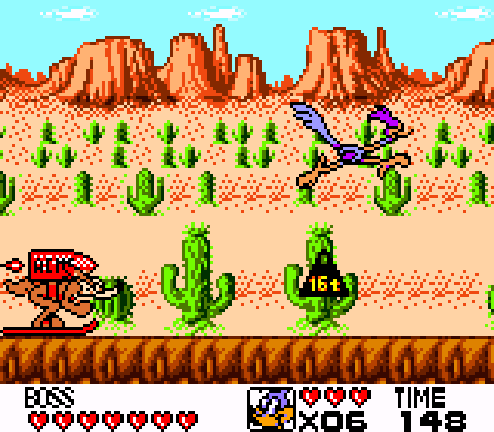
“We’re out of ideas. Have a couple rocks to jump over and then get the coyote in there.”
The Road Runner’s level is an auto-scroller where you have to dodge a handful of boulders and then the developers ran out of patience and just sent the coyote in almost immediately. He’s a boss that has to be jumped on, and weirdly, the same collision problems that plagued the shooting section are part of this stage, too. I died here in ways that felt completely unavoidable. The coyote certainly isn’t fun to fight, either. When I realized there was nothing to stop me from just going to the edge of the screen and jumping on him like a fleshy trampoline, the fight ended just seconds later. I get the impression that, at some point, everyone in the development side of things lost their will. Or they ran out of cart space.
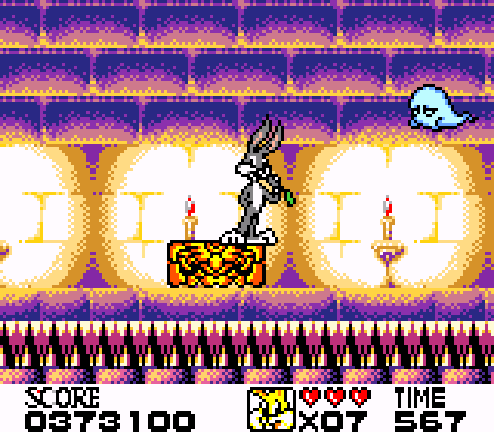
“Get me out of this game.”
The final stage with Bugs Bunny plays identically to Daffy’s stage, frisbee and all. The problem is that this level leans very heavily into two things: a cramped screen and mini-boss battles. The cramped screen problem is tied to the bad collision. Looney Tunes is counting on you taking damage from not being able to scratch out a safe attack distance from the enemies. After some mild platforming bits, you rematch with every mini-boss (except the shmup one) that appeared up to this point, plus a new one. Then, you have to avoid a boulder in an extended sprinting sequence that had one idea that ran out of both tension and fun long before the level ended, then there’s a final battle with Elmer. This ended when I caught him in a collision cycle and basically could let go of the controller and still win the game.
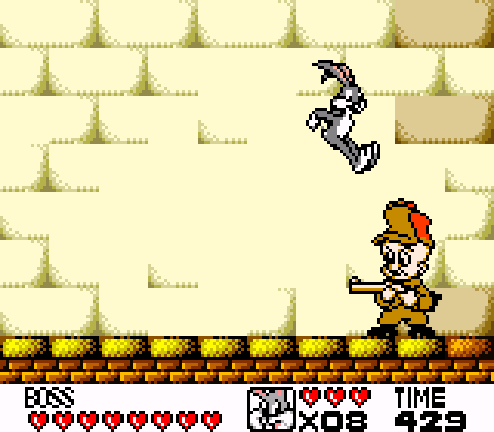
The final battle is against Elmer Fudd, which I guess makes SOME sense since he’s the only villain to provably beat Bugs, which happened in What’s Opera, Doc?
I’m certain that Looney Tunes was better in 1992 or even 1999 than it is today, in 2025. But, this is NOT a good game. Only the first level was fun, and to its credit, it really is pretty well made. The rest of the six levels range from bland to outright bad. They should have stuck with the Daffy play style and fine-tuned it to perfection, because they were on to something. Without exaggeration, they had the foundation for what could have been one of THE great Game Boy platformers, and it’s a dagger to the heart that nothing that follows comes even a little close to the enjoyment of that first stage. Looney Tunes is like watching one of those Ben Simmons-style pro athletes that has all the talent in the world but without the cutthroat focus you need to break through to elite status. You can’t make a level as good as the first level in Looney Tunes without talent. What they needed was someone on their staff to realize that’s where the money was and not this genre mash-up crap that so many Game Boy titles fell into the trap of. You blew it, Sunsoft. You blew it.
Verdict: NO!

 Indie Gamer Chick
You must be logged in to post a comment.