Kyuukyoku Harikiri Stadium (Famicom Review)
October 20, 2025 Leave a comment
 Kyuukyoku Harikiri Stadium*
Platform: Nintendo Entertainment System
Released June 28, 1988
Developed by Taito
Never Released Outside of Japan
NEVER BEEN RE-RELEASED
*This review includes ROM update Kyuukyoku Harikiri Stadium: ’88 Senshu Shin Data Version (Released Dec. 16, 1988 exclusively in Japan)

This is the home run derby and it’s, you know, bland. I don’t get video home run derbies. Home Run Derbies are fun to watch, and only exactly once a year and not a single derby more. I’d rather the players save it for the all-star game anyway, which are so fun that, to this day, my father bitches about missing the 1989 All-Star Game. Without fail, every summer when the All-Star Game comes around, he’ll look at me and say “you just HAD to be born right then!” Yep, I was born the day of the 1989 All-Star Game. A lot of All-Star games happen on my birthday, which is cool but still not as cool as the human resistance being set to achieve victory over Skynet on what will be my 40th birthday in the Terminator franchise.
The first Japanese baseball exclusive where I was legitimately perplexed as to why nobody licensed this for a US release. Kyuukyoku Harikiri Stadium, which I’ll refer to as KHS for my own sanity, is a quality baseball video game. What’s astonishing is that this was the launching point in the Harisuta franchise, which was probably the #2 baseball franchise (behind Namco’s Family Stadium) in Japan and certainly one of the bigger Japanese-exclusive Nintendo franchises. There are a LOT of these games, and there’s a reason for that. KHS has a very solid baseball engine, albeit a slower paced one. The slow pace isn’t GENUINELY slow, but rather calculated to accommodate the dimensions of the field or distance between bases. Like Nintendo’s Baseball, KHS attempts to account for things like the relative size of the playfield and the distance between bases when determining how fast players should move. This is NOT a high-energy game. Then again, it’s baseball so that should track, right?

Even with slow outfielder speed, the base runners don’t seem to move at the same speed, so making outfield throw-outs IS possible if the ball is hit where you could expect to be able to make a throw in real life baseball. The closer the ball is hit to the infield, the less 1-to-1 the scale accuracy feels. I’m guessing that Taito had to choose between fine tuning the infield or outfield and decided to go with outfield. If you have to do one or the other, I’d say they made the right call because if you flipped it around, you’d probably be able to run-up the score much, much more easily, which makes it feel less like real baseball.
However, unlike Nintendo’s game, Taito did a much better job with the timing. So while defenders and their throws are slow, the resulting game play feels accurate to how real baseball should work. IE balls hit to specific locations in the field should result in the same amount of bases you would expect real life baseballs hit at those angles to generate. It’s well done, but not perfect. I think batters can beat out just a little too many infield hits. And I mean just a little. Otherwise, this is the first game in this entire feature where it feels like consideration for fielding was given a premium over the pitcher/batter duel. My second game went all the way to the ninth inning without a single run scored by me or the CPU, and that was the result of well adjusted defensive gameplay. Trust me, it sure as hell wasn’t from the pitching!
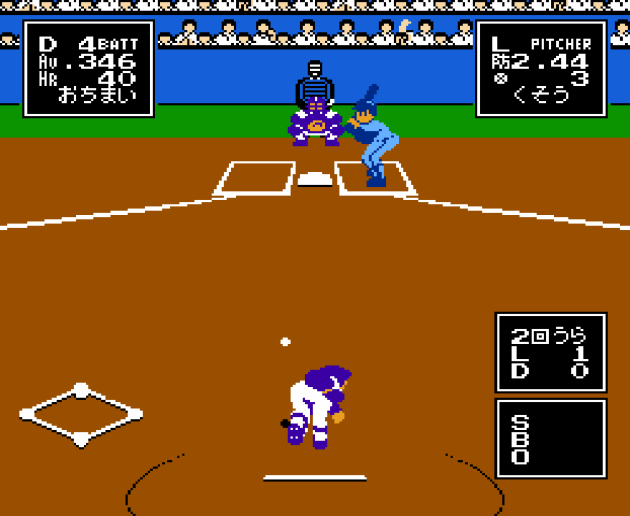
There’s no complicated pitches. Like so many early baseball games, you manually apply the curve yourself. Also fast balls are incredibly rare. I never quite learned how to do them.
So yeah, the pitching feels almost cricket-like in its delivery and, instead, the game relies on making most hits playable by the defense. This is a very true to baseball way of handling things, by the way. This is a sport where a player who fails only 66% of the time at the bat is likely to make an all-star team. I didn’t even hit my first in-game home run until the top of the 9th inning in my second full game. The defense uses a hybrid system similar to Bases Loaded, only without the speed boost when you take manual control. You WILL want to take manual control anyway. The system is more about getting defenders ready for the players, not about doing the heavy lifting for you. Most fly outs you’ll have to grab yourself. But, I mean, it works! After giving up two runs in my practice session, my first two real games were shut-outs and that was based entirely on how intuitive fielding is.
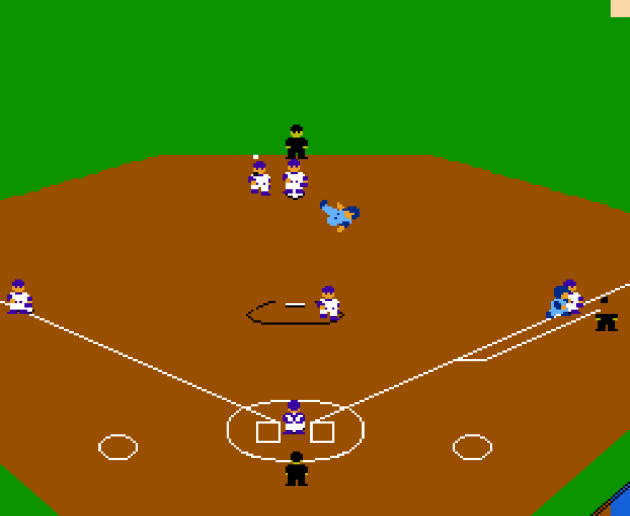
Okay, so there’s the occasional brain dead moment that would result in the summary execution of the player by their teammates and possibly fans if it were a home game. The left fielder gets the ball, throws to second to make the force out. It’s going to be close, but then the shortstop ends up inside the throwing angle and HE catches the ball instead right next to the base, preventing the out. If a shortstop did this in real life, he would be treated to the world’s first act of involuntary sodomy with a baseball bat committed on live television. You know who I would feel for in that situation? The stadium’s organ player. Do you play the theme to Jaws or Baby Elephant Walk? Do you start playing BEFORE the bat is inserted or after the tears start flowing?
Since I’m focusing on single player experiences, the key addition to Taito’s take on the sport is a smarter CPU. It knows how to turn double plays, hit relay men, and make the throw to prevent extra bases. It also occasionally does the RBI Baseball “protect home when there’s an easy out at first” thing. It’s rare, but it happens, and it kills the immersion. I’m going to guess that none of these early 8-bit games will be able to perfectly keep up the fantasy for an entire nine inning stretch, so all I can hope for is as few bumps in the road as possible. But for what it’s worth, this feels like a step-forward, and the only reason I’m not calling it the best NES baseball game yet is because Bases Loaded’s duel is just much more versatile.
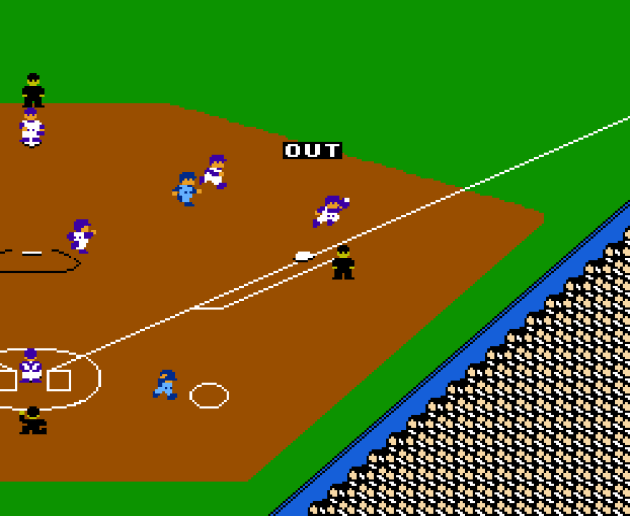
The sprites for snagging line-drives are great. I mean, if you imagine there’s angels in the outfield, and in the infield too!
Taito’s KHS isn’t amazing or anything. The pitcher/batter duel is very generic and uninspired while also likely being clockable. I played four full games (one of which was for the updated cart) and I think if I kept playing just a couple more games longer, I probably would have reached the point of being able to turn the offense into an unrealistic freak show. But, I did have fun with my time with it. Beware, though: the season mode has upgradable stats. In a game where I already held the CPU to an under one-run-a-game scoring average over four games, I think it might be possible to turn the game into a mockery of the sport. BUT, if you want to have fun for an hour playing an old timey video baseball game that you’ve probably never played before, I find it unlikely a baseball fan wouldn’t have fun playing this. I seriously can’t wait to play the rest of these and see where they take the franchise from here.
Verdict: YES!

 Indie Gamer Chick
You must be logged in to post a comment.