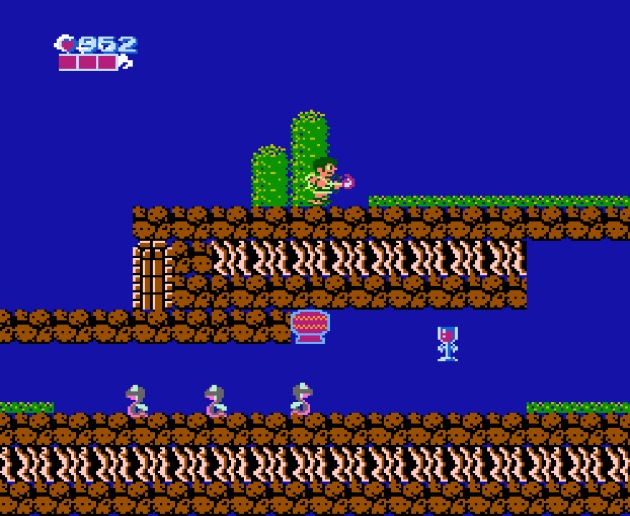
Kid Icarus: Of Myths and Monsters (Game Boy Review)

Kid Icarus: Of Myths and Monsters
Platform: Game Boy
First Released November, 1991
Designed by Masafumi Sakashita
Developed by Nintendo and Tose Co., Ltd
UPDATE: Now
Available with Switch Online Subscription (Standard)
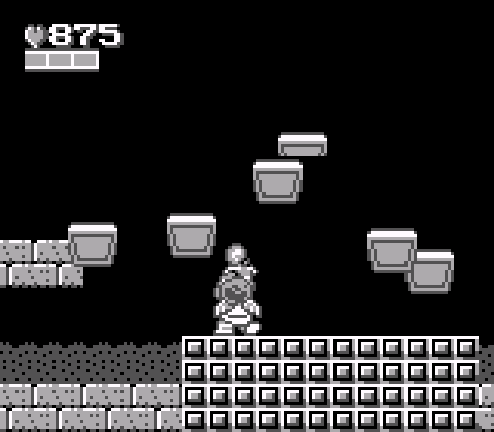
Déjà vu.

Alright, let’s make this one go quickly. I’m not really THAT interested in the sequel to Kid Icarus. I’m only doing this because of a niggling little voice in my head asking how the f*ck Kid Icarus as a gaming franchise was in the same boat as Metroid to the point that they were basically identical twins for the first, oh, eight years of their existence. I know that’s stating the obvious, but when you lay out the comparisons, it’s actually jaw-dropping.

  • Both are Famicom Disk games that debuted in 1986.
  • They were developed by the same team. I mean, eventually.
  • Both released in the United States in the Summer of 1987.
  • Nintendo opted to convert the save systems of the Famicom Disk System versions to a new password back-up system even though they had perfected the battery-backup format for Legend of Zelda (arguably their triplet since it was an FDS game released in 1986 which also debuted in the US in the Summer of 1987, but it had a different development team).
  • Both games are among the 40 top-selling games of the NES/Famicom. Metroid ranks #18 at 2.73 million copies while Kid Icarus finished #34 at 1.76 million units sold.
  • And both went on to get underwhelming Game Boy sequels made by literally the same lead designer, Masafumi Sakashita that fixed some problems but ended up much more bland than the original, as if they were afraid to experiment too much.
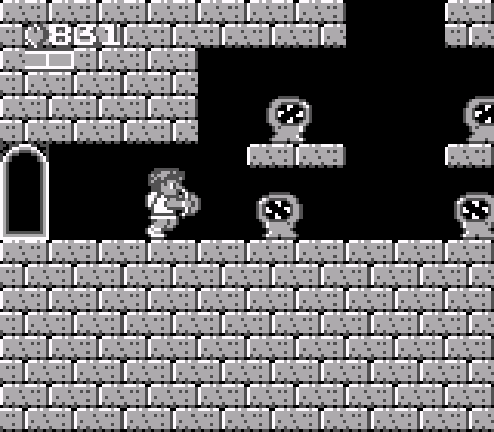
Kiss the memorable enemy sprites of the first game good bye. Myths’ enemy sprites suck. These things look like malicious portable electric fans.

It’s like the Kennedy/Lincoln comparison of Nintendo, only, you know, real. But Metroid went on to be one of the biggest franchises in Nintendo’s lineup while Kid Icarus apparently wandered off into the woods, never to be seen again. Oh, they say it had a game on 3DS but if it had basically no gameplay connection to Kid Icarus, is it really a sequel to Kid Icarus or a completely new game that just uses the name that was suddenly relevant again because Pit was in Super Smash Bros. You know, the famous fighting game franchise directed by the guy who did the Kid Icarus revival? I don’t really care if the 3DS game is good or not (I couldn’t play it without risking a live reenactment of the stoner film Idle Hands) because the actual Kid Icarus is just gone, like StarTropics, Wave Race, or Gyromite or modern stuff like Chibi Robo or Nintendogs. If I had to guess why, I’d say maybe Nintendo just realized Kid Icarus was never that good.
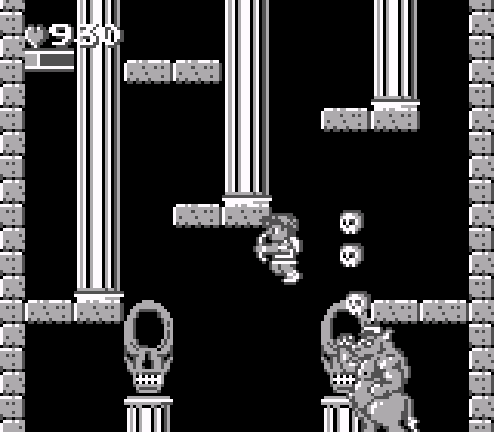
I thought the bosses of Kid Icarus were lame, but I’ll take them over these bosses that are so spongy and repetitive that all five boss battles become boring.

Kid Icarus on Game Boy is a much closer remake of the original than Return of Samus was for Metroid. If there was anything to salvage from Kid Icarus, this was the chance. And there are some improvements. There’s no falling deaths in this game, it controls MUCH better, and there’s also a much greater emphasis on exploration. The hammers that were only good for freeing NPCs to help you fight bosses now can uncover hidden doors. That’s a great idea. Zelda is basically based around how awesome hidden doors are. Well, except the stuff you uncover in Zelda helps you, and some of it is even essential to finishing the game. That’s not true of Kid Icarus GB, where I’m not sure I found a single hidden room that was actually worth seeking out.
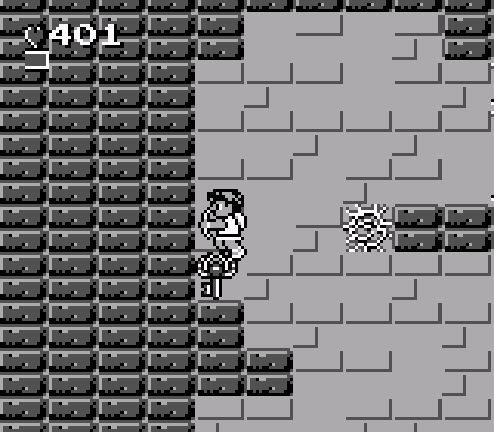
The only hidden items of substance are keys that allow you to go back to already-visited rooms. This is another idea that should have been killed on the drawing board. Nearly every major risk/reward factor of the original game didn’t carry-over to the sequel. This isn’t specifically why the game died a miserable death, but the autopsy certainly lists it as contributing factor.

Most, if not all, of the hidden rooms I found offered a hot-spring to refill your life. That would have been swell, but they also added life drops, including hiding them in the fixtures you smash to reveal the doors to the hot springs. So in order to uncover a thing that refills your life, you have to collect things that refill your life. It made me realize how well done the original game’s damage/healing system was and how destructive just adding the ability to find health refills sitting around is. Hell, at one point the game teased that there was a hidden door at the entrance to the level I was on, so I jumped down to the beginning of the stage and found out that the hidden door was, you guessed it, a life refill. Well, that was totally worth starting the level over again.
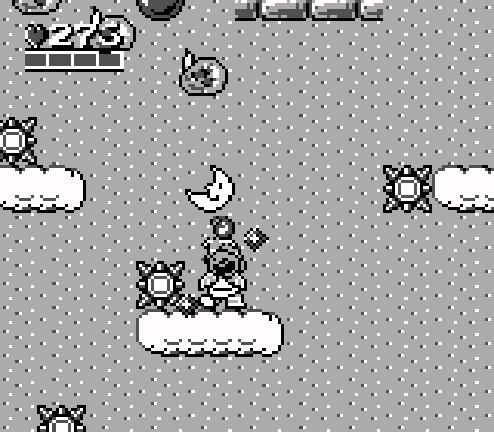
I was confused at first by the level design, because the wrap-around playfield from the original game returns for the vertical stages, except now the playfield is wider than the screen is, so instead of walking through one edge of the screen and popping out the other side, you now scroll the screen like a cylinder. I never quite adapted to it, either. It was still disorienting right up until I walked through the final door of the final vertical stage.

Kid Icarus: Of Myths and Monsters is one of the strangest cases of a failed sequel I’ve ever seen. It retains the three power-ups (with the same life-based requirements) and the exact level formula of the first game. Three vertical levels and a dungeon, then three side-scrolling stages and a dungeon, then three more vertical stages and a dungeon. The only change to the formula is that the shmup finale is replaced with an actual platforming level that features free-roaming flight. That part certainly works better and the stage is probably the highlight of the game because it’s the only part that doesn’t feel like it’s made by a game designer who keeps checking their watch. Even if, when you stop and think about it, it’s functionally identical to a swimming level in a Mario game. Pump a button to stay buoyant while you navigate tight squeezes. Okay, so you’re shooting arrows instead of fireballs, but it’s the same basic concept.

Whatever. At least the level design is okay here.

But while the finale might be tolerable, at least before you take on the slow, clunky final boss fight, nothing that happens before that final stage is worth anything. NONE of the vertical levels offer the same thrills as the highlights of the NES game’s climbing sequences. It’s not just because the stakes are removed, either. They’re just not that well designed. I thought Kid Icarus had some damn elegant enemy placement, especially considering the nightmarish development cycle. The Game Boy title’s enemies often feel arbitrary. Like “well, we have to put SOMETHING here” without having any logic of how that something relates to the landscape. They also somehow made the moving platforming even slower and more miserable to utilize.
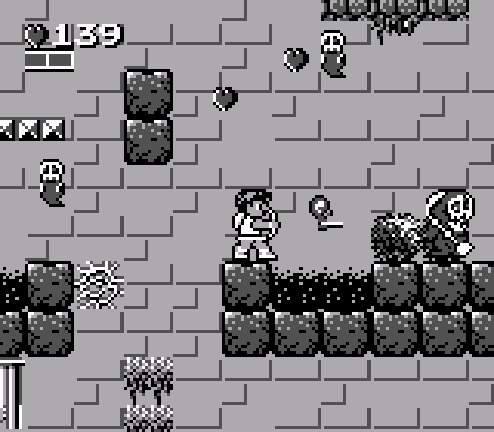
The Grim Reapers are significantly less threatening this time around.

And then there’s the side-scrolling levels, which are a complete disaster because they’re completely spammed with doors to explore. Even if you pretend there are no hidden doors, by the mid-point of the game, Kid Icarus is so completely bloated with shops, enemy chambers, test chambers, arrow upgrades, and assorted other doors that the game has no flow to it at all. When the rooms continuously offer the same stuff, that gets boring. “Just don’t go into the rooms!” But nobody is going to do that. It’s up to the designers to assure that the pace and spacing of their game isn’t interrupted by useless gameplay stoppages. You can’t put that sh*t on players. Even if they had given an actual reason to go inside every single room, I don’t want level design where the main stage has a door every few seconds. The gameplay I’m actually here for isn’t going to be inside them.
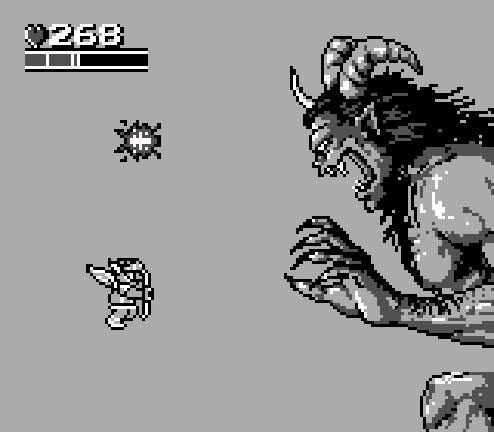
This boss looks fantastic, but it’s AWFUL. It pokes its head out for a second or two, then retracts and does the same attack pattern with no variation until one of you dies.

For all of its many, MANY problems, I was never bored with Kid Icarus on the NES, at least until the final stage. Frustrated? Sure. Annoyed? Of course. But never bored. I was SO BORED playing Kid Icarus: Of Myths and Monsters. Even the dungeons were complete letdowns. The only reason I really played the Game Boy game was to experience three more dungeons, but these ones were smaller in scope and much easier to navigate, with no real sense that they’re trying to trick you into getting lost. In the NES game, you might have to climb down a ladder, then fall to the side in order to continue towards the boss. That idea is removed completely. They never even really feel maze-like. They feel slapped-together, because they probably are. Kid Icarus often had the vibe of a game that nobody had confidence in, but this sequel is so much worse because it just doesn’t feel like it comes from a place of inspiration. It feels like Nintendo poking Kid Icarus with a stick to see if it’s really dead, and it is.
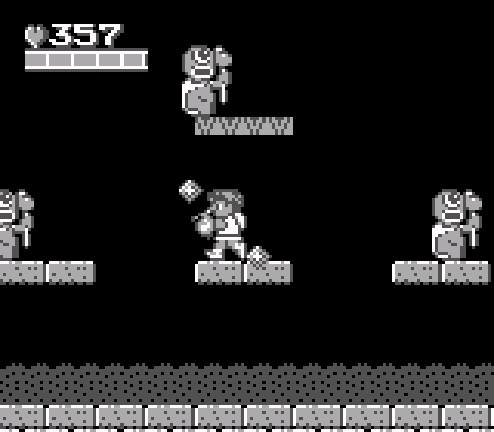
It really doesn’t help that, by the time I reached the end, I was killing the Eggplant Wizards in one shot. There’s too many arrow upgrades. What’s really remarkable is those upgrades don’t make the bosses any less spongy. I’m shuddering thinking about “what if I hadn’t gotten those?” I’d probably still be fighting the second and third bosses. Oh, and you’ll note the items work in the dungeons this time.

Now, in fairness, this wasn’t Kid Icarus’ shot at redemption any more than Return of Samus was for Metroid. The redemption would have been an SNES game made by a team that was bound and determined to turn Kid Icarus into a flagship franchise. That’s what Super Metroid was, and that series has been a pretty damn big deal ever since. I said it was unfair, but if I had been a decision maker at Nintendo and had to do a Sophie’s Choice between these two, I’d have chosen Metroid as well. The truth is, Kid Icarus’ vertical gameplay was already topped by Super Mario Bros. 2, and the shooting mechanics with a colorful cast of enemies was topped by Metroid itself, and even the potential for a game based around flying was taken over by Kirby. What really is left for Kid Icarus? The dungeons? That’s what Zelda is for. The humor that the original designer didn’t even want in the first place? Hell, that could be any Nintendo game.

The boss chambers are bigger than the screen. Don’t you just LOVE fighting super-spongy bosses who make the fight last even longer by weaving in and out of the visible playfield. No? Yeah, me neither.

It kind of hit me while making this review that Kid Icarus is just a hodgepodge of gameplay concepts that Nintendo already was building other games heavily around. Everything bad about Kid Icarus WAS improved. It just wasn’t done in a Kid Icarus game. So, my new theory is that Kid Icarus went to video game heaven because it just didn’t offer anything that you couldn’t already get elsewhere from Nintendo. Why put the resources into rescuing a franchise whose core gameplay is already found in more viable titles? The only reason to even try would be if the game’s main reputation is anything but being “the janky one.” But even fans of Kid Icarus will concede that, among famous Nintendo-developed games, it’s “the janky one.” That’s why it died, and that’s why the 3DS game was completely different. Because it kind of had to be, because Kid Icarus as a concept was already dead and forgotten before I was even born. It’s the video game equivalent of an organ donor. Of Myths and Monsters isn’t a sequel. It’s a eulogy for a potential series that died, but in doing so, it might have saved others just by providing a road map of what not to do.
Verdict: NO!

Kid Icarus (NES Review)

Kid Icarus
aka Hikari Shinwa: Palutena no Kagami
Platform: Nintendo Entertainment System
First Released December 19, 1986
Designed by Toru Osawa

Directed by Satoru Okada
Developed by Nintendo
Available with Switch Online Subscription (Standard)

This grim reaper is just so not cool. Sure, this is much better than being Dracula’s flunky, but nowhere near as righteous as teaming up with a pair of time traveling teenagers who are in the afterlife because they were murdered by evil robotic clones of themselves sent from the future by a gym teacher angry that the future is boring.

I’ve been a little too lovey-dovey with Nintendo this month, so how about a game that doesn’t get a YES!? Actually, Kid Icarus is a heartbreaker. The game is no good on its own, but it could have been an excellent first step. There’s something here that’s highly compelling that just doesn’t overcome some terrible design choices and really sloppy play control. I don’t really like the original Metroid either, but it’s in the same boat as Kid Icarus in that both games laid a foundation for something much, much better. But Metroid did get more chances to build upon the first game, and already fun games like Super Mario Bros. and Legend of Zelda got to grow out the base formula with the sequels that improved upon the core game design and especially the play control mechanics. Within just a few sequels, Nintendo had literally perfect jumping physics for Mario, combat mechanics for Zelda, and level design for Metroid. And then there’s Kid Icarus. The franchise that didn’t catch the bouquet so it gave up and became a nun. It’s not fair, really. It had just as much potential as any of their other tentpole IPs.

If you play Kid Icarus, have a second controller ready. In the American/Europe builds, pressing A+B on the second controller haggles with the shopkeepers, who may lower their prices or dramatically increase them. In the FDS version, you have to just blow into the microphone to trigger it. I’m pretty sure no FDS games actually require you to actually speak words to make the mic work. It’s like how I beat the mic games in WarioWare Touched by scratching the microphone. Also, you don’t want to ever max-out your money because you will not get enough credit for collecting money, thus failing to impress the Gods, thus not allowing you to get all four arrow strength upgrades, thus gating you out of the best ending.

Kid Icarus is among the jankiest Nintendo-developed games ever made. It’s sloppy in so many aspects that it’s tough to know where to begin. Play control is the obvious one. I should have saved “skid to my doom my darling” for this game because my most common method of dying was slipping off platforms. But, that could have been a non-factor if the levels were designed for these physics, and they clearly aren’t. Kid Icarus is riddled with things like slip-slide ice platforms, ultra-slow moving platforms, and single-block platforms. Each presents a problem on its own just based on how rough the platforming physics are, before you even take into account that you often have to perform combative maneuvers while navigating all this crap.

Son of a bitch! See, those evil mouths fly around in erratic patterns that make them hard to shoot, and then you have this spongy snowman thing that shoots projectiles at you. It seems like you can duck those projectiles, but if you duck on certain platforms, you almost instantly fall through them. That’s what I found out here, and I burned through a valuable feather.

And then there’s the ultra-jarring tonal shifts. Despite only having thirteen levels, Kid Icarus features a whopping four different styles of level design. The most famous of these is the vertical levels, which represent six of the thirteen stages, and they’re fairly notorious because, as you climb, you also create a bottomless pit, logic be damned. If a platform that had been right at the bottom of the screen is barely scrolled off it, you die if you fall where it had just been. The punishment for falling should be having to make all the jumps again and the risk of losing more health from enemies or hazards. Kid Icarus has too stiff a punishment for failure to stick the landing, and that’s especially true with the rough controls and sloppy coding. Like, look at this:

I’m not ON the platform in this picture. I’m IN the platform. I didn’t do anything special to get there except somehow short the jump without shorting it. It does matter too. Many times, while firing my bow without moving the direction pad at all, I fell off platforms. It’s so inelegant in basically every way movement in a 2D game can be. When there’s nothing under you to catch you, that’s a big problem. especially since the game leans extra-heavily into nail-biting platforming segments. MAYBE if you had the accuracy of Super Mario 1’s controls, this could have worked. But Kid Icarus instead is too floaty and has too unpredictable of momentum. So when the level design is like this:

Kid Icarus is kind of fantastic, at least in terms of the big picture. Navigating the stages, which includes a wrap-around playfield, is exhilarating. The levels look great too, so the game really shines brightly as a thoughtful, original action-adventure with solid combat and a memorable cast of baddies that are satisfying to shoot. BUT, when the level design is like this:

Kid Icarus becomes an unbearable slog and the platforming is NEVER exciting because it controls so poorly and the physics are so inconsistent that it never feels like YOU’RE failing. It feels like the game is screwing you, and it often is. And mind you, this is just one of FOUR play-styles in this game. There’s three more. Three of the thirteen levels are traditional side-scrollers. I guess I must be weird, but I think these levels are much, much stronger than the vertical levels.

The test chambers sadly don’t have you shooting portals. Rather you have to just stay alive until the game says “okay, you’re good” and gives you one of three really fun upgrades. One puts a shield around you, one adds a flame to your arrow that spins around it, and the other gives you additional range. They’re awesome, but the catches are ridiculous. The flame requires you to have two full bars of health, the added range three bars, and the shield four bars. The other catch really sucks: you can’t use these items in the dungeons.

Oh, they’re often still not good. Well, let me clarify: they’re haphazardly designed. For example, level 2 – 2 starts out with not one, not two, NOT three, but four goddamn doors before you encounter a single enemy. You’re supposed to use two of the doors to build up XP in order to get the arrow upgrade. This is where I learned that saving money makes no sense because the Gods get pissy if you’re stingy. But there’s nothing else like this section in the entire game. It’s total amateur hour game design.

Like this here. Kid Icarus utilizes low ceilings to cut off Pit’s ability to jump over enemies, and that COULD have been used to greater effect if they hadn’t put the most basic enemy as the “risk” side of the “risk/reward” scenario. Or if they had given you a way to logic-out which path is the best path to take.

The problem with the side-scrolling levels is they contain none of the exhilarating boldness of the vertical levels. For all the problems that those stages have, it feels like they come from a place of inspiration and there was careful consideration for enemy placement and how it relates to the jumps. I really don’t get that vibe from the side-scrolling stages at all. They certainly make fewer mistakes, nonsensical room placement aside. That’s why I think they’re stronger overall, but they also feel like they’re going through the motions. Hell, large stretches of the stages (like the aforementioned nonsense doors) feel like placeholders that got left in the final design. Don’t rule out that’s what really happened. If you don’t already know, you’ll soon find out why.

Yeah, yeah, I used a guide. The treasure rooms (pictured here) have a sequence to them where you can win every time. What I didn’t know is that the Gods frown upon breaking pots in the treasure rooms. So I didn’t get the final arrow upgrade and thus I didn’t get the best ending.

And then there’s the grand finale of Kid Icarus, where all the janky but memorable platforming action is dumped in favor of one of the worst shmups I’ve ever experienced, and I’ve been playing a whole lot of shmups in 2025. Hoo boy, what a dumpster fire Kid Icarus is at the end. In it, you have to shoot bland targets like falling tiles and an enemy that splits into three over and over and over until you reach a certain benchmark for “doing things.” After the game is satisfied you’re not on cruise control, it’ll let you fight Medusa, which has a safe zone so big that you could build a nursery in it. The level getting there is what drives a stake through Kid Icarus’ heart because suddenly the act of moving is hard. The controls are heavy and unresponsive for the finale, and even if that wasn’t the case, the last level would be a disaster anyway because this style of game is not at all compatible with all the gameplay that came before it. It’s one of the worst final levels and final bosses in any Nintendo game.

How did Kid Icarus turn out so janky when games like Mario, Zelda, and even Metroid, at the very least, control well? Actually, Metroid is kind of to blame, but really it was just bad corporate decisions. Metroid was considered a very high prospect game, so Nintendo devoted all their resources to it while one guy, the debuting Toru Osawa (who went on to direct games like Mario Clash and Legend of Zelda: Ocarina of Time) had to spec out Kid Icarus all by his lonesome. He had to design the world, the enemies, and most of the levels. He only got a full working team to help him once Metroid was mostly done, and then the team he got were exhausted from doing the already dead-serious space adventure so they usurped his concept of a dead-serious mythological adventure by inserting “humorous” things like the credit card and the Eggplant Wizard.

Kid Icarus was the first game released in North America with the revolutionary MMC1 chip that allowed the NES to do bigger, more detailed games. In screenshots, it looks amazing. But you actually have to play it.

But the thing is, while the staff liberally plied Kid Icarus with humor and stuff like the haggling with the shopkeepers, what nobody bothered to do was refine the actual gameplay. Then the release date was set for the end of 1986, well ahead of when the game could reasonably be completed, so everyone just hung around Nintendo HQ in the freezing cold (apparently the building wasn’t heated) to finish the game. They BARELY finished in time, and in fact, Kid Icarus was only sent to manufacturing three days before it was set to release. Consequently, it wasn’t subject to the same type of play testing and polishing that other games from this era got. Kid Icarus is Nintendo’s E.T.: The Extra-Terrestrial, and it speaks volumes to how talented they really were even back then that the final product is as good as it is. But what we got is a fraction of its potential. Nobody did the responsible thing and delayed it.

Yet another example of jank are these things. Touching them even once costs you the power items you won in the test chambers, which you either have to win back in another test chamber or buy back on the black market. MAYBE this could have worked if you could fight back and reclaim the item before they vanish off the screen. That would add proper risk/reward balance. Well, you can’t because they’re indestructible. What an overall terrible game. Well, except one aspect………

“Cathy, you left out one gameplay type.” I know, but I saved it for last for a reason. Because the one thing Kid Icarus unambiguously does well, it does it so well that I almost want to cry that it’s not the whole game. It’s the dungeons, which are kind of like side-view versions of Zelda’s dungeons. I mean much more than Adventures of Link’s dungeons. They’re designed like legitimate mazes, where you might think you’re plotting the right course only to find out the room you’re making your way to has no means to continue on the path you’re trying to take. Well, at least two out of three of them are like that. Because I enjoyed these levels so much, I put away the guide and it took me quite a while to beat levels 1 – 4 and 2 – 4. Then in the third dungeon (3 – 4), I found the boss so quickly that it took me a moment to process it. I literally couldn’t believe it was placed where it was, which was next to a shop.

The hammers you collect in the levels via the harps or treasure rooms can be used to smash these statues in the dungeons, which free the Centurions that were turned to stone by Medusa. You want to do this because they’ll help you fight the (relatively spongy) bosses. Too bad they have absolutely no survival instinct.

But the dungeon levels worked for me. Oh, did they ever. And that’s why it’s such a punch to the gut that there’s only three of them. I can’t help but wonder if Kid Icarus would have been better off being based entirely around this specific style. Instead of nine total vertical and side-scrolling stages and the lame-ass shmup finale, I would have preferred a game that had eight to ten dungeons. Had they gone that route, I honestly think Kid Icarus might be remembered as highly as Metroid or Zelda. I think the combat-focused maze explorer done in this style and with these themes, separate from Nintendo’s other flagship IPs, makes Kid Icarus stand tall in a crowded field. The problem is, in order to play these three amazing dungeons, you have to play nine mediocre-at-best levels that are really nothing like the dungeons.

There’s no happy ending here, because Kid Icarus is one of the few early Nintendo franchises that they never put a good faith effort into building upon that initial foundation. There’s a Game Boy sequel that I might take a look at soon (Update: the review is up) that apparently has most of the same problems, and then there’s the 3DS game which basically is nothing like the original game, changing the genre and gameplay. These days, Pit is more famous for his role in Smash Bros. than he is as the star of his own franchise. This despite the fact that Kid Icarus was big enough decades ago that it contributed a main character to the unwatchable animated series/Nintendo infomercial Captain N: The Game Master, and then was still memorable enough in the present era that it was one of the games featured in 2024’s Nintendo World Championships: NES Edition. Granted, Kid Icarus had the challenge that took me the most attempts to get an “S” rating and that outcome was largely the result of the sloppiness of the whole thing. But, nearly forty years later and Nintendo actually said “yeah, we better put Kid Icarus in this thing.” But the one thing they’ve never done is redeemed that original base concept.

Okay, so the boss graphics aren’t strong. That’s supposed to be Cerberus in the corner, but instead it looks like two dinosaurs humping. After having unforgettable sprites for the Eggplant Wizard, grim reaper, and even the basic enemies, having this thing look like someone sneezed while filling it in is such a let down.

What Nintendo should do is take all the space age technology they’ve since invented and do a true sequel to Kid Icarus. Not a third person shooter either, but a REAL sequel that builds much more heavily around the best part of the game: those dungeons. If you want, go ahead and make a few vertical levels as well. I’m fine with that because they would certainly have to apply everything that’s been learned in the fields of level design and play control. They could keep the humor or dump it like Osawa wanted. That doesn’t matter because gameplay is king. Kid Icarus is a bad video game, but not ALL bad. It just never got the redemption that Nintendo’s own game design evolution would have given it. Those amazing dungeons still feel fresh in 2025 because, really, there aren’t a lot of Nintendo-made games where their exploration feels like Kid Icarus’s three dungeons. It might not be a game worth playing in the 2020s, but the idea of Kid Icarus is an idea worth saving.
Verdict: NO!

Can’t be unseen. 🖕😶🖕You’re welcome.