Eternal Darkness: Sanity’s Requiem (Nintendo GameCube Review)

Eternal Darkness: Sanity’s Requiem
Platform: Nintendo GameCube
Released June 24, 2002
Directed by Denis Dyack
Developed by Silicon Knights
Published by Nintendo
NEVER BEEN RE-RELEASED

J. J. Abrams would cream himself with all the lens flares in this.

If you surveyed Nintendo fans about what GameCube titles they want to join the Switch Online service, I think there’s a good chance Eternal Darkness would win the vote. The top three would probably be it, Mario Kart: Double Dash, and Legend of Zelda: Twilight Princess. Hell, you can probably cross out the Zelda game. I’m guessing there’s a good portion of Twilight Princess fans who consider the Wii version to be the definitive version of it (I’m not among them but to each their own), so it’s Double Dash versus Eternal Darkness. Maybe my insanity meter is running on empty, but I think I’d put my money on Eternal Darkness. The most popular model of Switch 2 has Mario Kart World built into it, and most Switch 2 owners probably also have Mario Kart 8 in addition to an already nice selection of Mario Kart classics on Switch Online.

She kind of looks like a younger Jennifer Jason Leigh if she had been Buffy the Vampire Slayer. By the way, protagonist Alex is voiced by the great Jennifer Hale. The acting in Eternal Darkness, like most games of the period, is all over the place, but Hale’s performance stands out.

Meanwhile, it’s a safe bet that a lot of people who were interested in Eternal Darkness never actually played it. It might have been a critical darling, but it was a bust in sales and not the system mover Nintendo was hoping for. I think a big part of that was skepticism by consumers after the game jumped from a late Nintendo 64 release to an early GameCube one. Or maybe it just felt like Nintendo was trying too hard to court older audiences. Whatever the reason, I couldn’t find any global sales figures for it besides “it sold less than X units.” But, to give you some perspective, in Japan Eternal Darkness sold so poorly it didn’t even chart (Wikipedia calls it 18,000 units but I couldn’t verify that). That can’t be chalked-up to lack of interest in the genre or being on the “wrong platform” either. Resident Evil Zero, released almost exactly a month later, sold 400,000 units in Japan alone. OUCH. Canada reports similar numbers, and for a game designed in Canada no less.

Graphically, playing Eternal Darkness in 2026 makes for an interesting project. On one hand, with the character models and the way they move, you can totally tell this was meant to be a Nintendo 64 game that was haphazardly moved to GameCube. On the other hand, the settings are often awe-inspiring and the game does successfully build atmosphere. While I don’t think it comes that close to Silent Hill 2’s “this place is so evil that even the air itself feels sinister” vibe, I think a little bit of bonus credit has to be given for the circumstances with the platform switch.

Based on those figures and similar sales of other key games, my “pulled out of my ass, this is not an actual sales figure” guesstimate is that Eternal Darkness probably sold around 150,000 units globally, and that’s my most generous ballpark. That means there’s a LOT of people who missed out and have had to listen to two decades of glowing accolades and high placements on such lists as “best GameCube games of all-time” and “best horror games of all-time” and even “best video games of all-time.” So in my hypothetical fan vote, if Eternal Darkness didn’t get a plurality of the votes, it’d finish top-three for sure. That’s why I wanted to do this review. I figured there was no way it could possibly hold-up to THAT type of reputation. I wanted to know if Eternal Darkness is one of those games that had a finite window of relevance, and if that window has since slammed shut. And now that my introduction is out of the way, I have to give you the following warning:

⚠️THIS REVIEW CONTAINS SPOILERS⚠️

The final paragraph with the verdict is spoiler free.

My casual-at-best gaming family honestly thought I was playing a Resident Evil game. The main mansion the game takes place in does have a similar vibe.

Eternal Darkness’ is the story of the Nintendo funding middle school quality Lovecraft fanfic with the serial numbers filed off. The game centers around the Necronomicon Tome of Eternal Darkness, a book bound in human skin that chronicles the struggle of humanity against The Great Old Ones Ancients, a race of cosmic deities that want to, like, be evil and eat humanity and stuff. Full disclosure: I don’t know sh*t about the Cthulhu Mythos. I’ve never read it. It doesn’t interest me. So I’m not really concerned that Eternal Darkness’ story cribs so heavily off Lovecraft and was fine letting the narrative stand on its own. Okay, I think it’s really f*cking weird that the game actually acknowledges the existence of Lovecraft’s lore within its world. It reminded me of Alan Wake’s constant references to Stephen King. Like, you can’t just do that sh*t and expect even a non-fan like myself to not find it cringey.

Apparently a common trope in Lovecraft fan fiction is that all the lore was actually real and Lovecraft was writing about stuff he actually knew to be true. Eternal Darkness never outright comes out and says that, but I mean, come on, how else can you read into this reference in the game? Was H.P. Lovecraft the Doug Forcett of this universe? Does Pious have his picture hanging in his evil office with “CLOSEST GUESS” engraved in the frame?

So, the cosmic horror plot didn’t really do much for me. But, as was the case with basically every aspect of Eternal Darkness, every negative is also made positive and every positive is made negative. The lame story creates a compelling framing device for a sprawling epic that takes place in such far-distance time periods as 2000 AD. They didn’t even have iPhones back then! F*cking barbaric! The game is divided into twelve chapters that each takes place in a different time and stars a different character. This was probably Silicon Knight’s most unambiguously successful concept for the game, because each of the twelve different player characters feels completely different. They move at different speeds, have different weapons, and their life/health/sanity meters are all different sizes. Eternal Darkness screws up many good ideas, but they didn’t f*ck up actual gameplay spread over thousands of years through the eyes of twelve different characters INCLUDING the main villain. That would be a genuinely remarkable achievement for any era. No notes there.

Some of the characters have the Book of Evil Evilness nearby them. Others will be magically transported during a predetermined point early in their chapter to this alternate dimension to claim the book. Those faces on the floor scream, and the whole effect (especially the sound design) is so terrifying that the game was too intense for the younger kids to watch. Eternal Darkness is a genuinely scary game when it wants to be. Too bad most of the “sanity effects” went the other direction.

Each chapter is introduced by main character Alexandra “Alex” Roivas. Playing as her, you search the mansion using clues or abilities learned from the previous chapter to locate a page torn from the Notcronomicon. Sometimes the page is literally right there next to her (especially early in the game), and sometimes she has to do rudimentary “use object A on object B” puzzles. And clearly the developers had very little faith in people exploring because sometimes you’ll immediately get a letter that says something to the effect of “I left something for you in this room.” It’s like a horror game directed by a helicopter parent.

When an enemy is defeated, you’re given a chance to “FINISH IT!” (yes, it literally says FINISH IT) which will regain around 90% of the sanity you presumably got sucked from you. Sometimes, seemingly at random, the game will do a close-up of the finishing blow, even if there’s more enemies gathered around.

Selecting the pages in the menu starts the next chapter, and in all but the first chapter, you play as a character who comes into possession of the Notcronomicon. That first chapter sees you take the role of eventual antagonist Pious Augustus. Pious? Seriously? Okay. The first major problem with Eternal Darkness reveals itself here as this glorified tutorial level (1) lacks the trademark insanity effects and (2) presents players with three different relics that change the cosmic horror Baron Von Evil will pray to. One is green, one is red, and one is blue. Each of the three colors represents a different difficulty setting, but the problem is that those consequences aren’t told to players, nor is the game’s color-coated rock-papers-scissors mechanic explained before this. Well, unless you notice a context-free picture in the hallway of the house that shows it.

In my second playthrough that I swore up and down I wouldn’t do, I ended up choosing blue. Allegedly, green was supposed to be Eternal Darkness’ “easy mode” but I thought the blue difficulty was a lot easier. Since your magic refills just by walking around, logically THAT should be considered the easy mode.Then again, the room layouts don’t really change and I knew exactly what I was doing each level during my blue play playthrough. (shrug) Allegedly red is the hard mode but I didn’t play that. I did ultimately like Eternal Darkness more than I disliked it, but it’s not exactly a game most people would want to play three times in a row.

In Eternal Darkness, red beats green and also pisses off bulls. Green beats blue and also indicates a healthy diet high in fiber. Finally, blue beats red, which is really sad when you think about it. If the two colors could settle their differences and get along, together they could make movies appear to pop out of the screen. Eternal Darkness leans very heavily into the color rivalry. Pick the green item? You’ll be mostly fighting green monsters and casting red spells to solve puzzles or buff your weapons. It’s more than just the facade of a difference, too. The color you choose also decides what cutscenes you see, which versions of basic enemies you fight, an entire boss battle, and the order of which you gain the tools needed to cast specific colors of spells. Also, each color specifically ties to a different meter, which is how the difficulty is adjusted. Red is the hard mode because enemies directly target your health meter, while blue enemies target the magic meter and green the sanity meter. Also, major enemies change quite a bit. Like, the “horrors” in the green mode look like this:

While in blue mode, they look like this:

“You said we’re shamelessly ripping off H.R. Giger!” “No you idiot! We’re ripping off H.P. Lovecraft! P is a totally different letter from R!” “It’s only one slash mark different. Not even a full slash mark. A half slash mark.” “THEIR LAST NAMES ARE TOTALLY DIFFERENT! LOVECRAFT IS SPELLED NOTHING LIKE GIGER!” “I thought you were telling me you LOVED my CRAFT!” “I’m surrounded by morons. Well, thank god Epic Games is coming to the rescue with a foolproof game engine!” (flash) “THIS CAN’T BE HAPPENING!

By the way, the red one looks just like a three-headed Predator.

If this whole thing comes across like needless padding designed to turn fifteen hours worth of gameplay into a forty hour game, well, that’s exactly what it feels like. I wish I could have opted-in to JUST fighting the different bosses or maybe even unlocking the ability to replay each chapter with a different color after the credits rolled instead of having to play through the whole game two more times. There were some interesting differences. I was surprised by how different Skeletor behaved in each of the two quests I played. In the green quest, the evil dark god Xel’lotath (also voiced partially by Jennifer Hale) is a bit a of a smart ass and playfully knows Pious is planning to betray it (nothing comes of that) but kind of rolls with it and the two have a tit-for-tat partnership and come up with their evil plan together. In the blue quest, a galactic space jellyfish named Ulyaoth is the dark god and Emperor Skullface the Wicked is a total submissive bitch to it while Jelly the Doombringer does all the planning.

The character of Karim was a literal last-second addition. Originally his chapter was going to star a Templar Knight but this was changed following the attacks of September 11. Karim’s level ends with him acquiring what is probably the most fun to use weapon in the game: this gigantic f*ck you sword that made me feel like Ned Stark.

So at least there is SOME effort to make the three different modes feel different, but it’s just not enough to justify the things that had to be done to make it work. I would have much preferred a more optimized single quest that had a much bigger variety of enemies because there’s not enough creatures OR locations in Eternal Darkness. Despite having twelve distinct characters, the action only happens in four specific settings: the starting mansion in modern (well, 2000) Rhode Island, a temple that’s supposed to be part of the Angkor Thom area in Cambodia, a gigantic cathedral in France, and a temple in ancient Persia. I’ll be generous and count the gigantic underground area connected to the mansion as a fifth setting, but that’s still not enough to keep the sight-seeing fresh, and this in a game with a story that does things that I found to be frustrating as a viewer. Like, some chapters start with the heroes being chummy with guys who look like f*cking zombies and are clearly evil, but they don’t acknowledge it at all. They’re so polite about it that they don’t even look at these obviously demonic humanoids like they have a booger hanging out of their nose. It happens a lot, too. Chapter Three does it:

“I want you to deliver this scroll that most certainly isn’t booby trapped to Emperor Charlemagne. He’s DYING to read it! MUAHAHAHA! Oh, pardon my evil laugh and don’t worry. I swear to the dark gods I sacrifice virgins to that the scroll isn’t enchanted with a spell that will quickly turn him into a living corpse. Trust me, a purple-skinned, dead-eyed monster wearing a black cloak. Does this look like a face that would lie to you?”

Chapter Six does it.

“When I killed your brother, I talked just…… like…… THIS!”

Chapter seven REALLY does it.

“I can’t believe you would give the Inquisition a bad name!”

And there’s really no other way to look at it: either the heroic characters are polite and naive to a fault or they’re complete dumb f*cks. It’s another one of those things that gave me a “they didn’t have faith in the players” vibe. Visually, it’s telegraphing like you would expect from a Saturday morning cartoon, not a psychological horror game made for adults. Did the villains HAVE to look like demons right from the start in every chapter? Wouldn’t it have been so much scarier if they looked like normal people, at least at first? Then again, the bad guy in the last two pictures is Pious Augustus in disguise, using the names “Paul Augustine” and “Phillipe Augustine.” It’s just too stupid to take seriously and it’s not scary or even suspenseful storytelling. Scary and suspenseful would have been populating the game with more NPC characters and leaving an air of mystery as to who Pious was posing as in each chapter. You can’t do a big, sprawling multi-generational saga if you don’t have the patience to tell the story properly.

Yep, Chapter Eight does it too, but here Pious is disguised as Timur, aka Tamerlane, the Turco-Mongol conqueror who is revealed to be Pious immediately. Yikes.

So I thought Eternal Darkness’ story was f*cking lame. The idea is solid, really. The execution wasn’t good. It’s kind of telling that they could cut a playable character named Joseph De Molay at the eleventh hour, reduce his entire contribution to the narrative to a context-free cutscene between chapters, and then slot in a new character with no connection to the plot at all, literally never interacting with Pious or the evil gods, and nothing feels lost. Such a thing should have been heavily damaging to the flow of the story, but because all the portrayals of evil are so comically over the top, the heroes so completely clueless, and the writing so on-the-nose that you’d swear it’s being made for young children, it doesn’t make a lick of difference. But, as bad as the writing and character models are, the settings, enemy design, and architecture are genuinely spooky. Some of those enemies are absolute nightmare fuel.

Real shame about the plot, because the character designs are some truly spooky sh*t. Look at this f*cking thing! I want my mommy! You know, so it can eat her instead of me!

And the story isn’t even the worst problem. Having four levels is bad enough, but their layouts are especially awful. There’s too much backtracking, and sometimes there’s so much of it that I actually got angry about it. In the seventh chapter you take the role of a friar and a potential ally needs to see proof that the guys who have taken over the church are evil. I mean, they literally look like undead demons and are talking about absolute power and have unholy literature laying around the entire f*cking church, but this guy really believes in due process I guess. Just talking to him requires a lot of busy work and backtracking, but to get the evidence, you have to re-backtrack through areas you’ve already been into far away from where this guy is located to grab a single item that you then must return to him in the same room you last met him in located on the literal opposite side of the map. It’s not like enemies always respawn, so it’s mostly backtracking through empty rooms. It leads to a lot of dead air that’s made more tedious because you’ve already seen some of this location once already, and indeed, you’ll see the same location again later on. It’s horrible design, completely unoptimized for both horror and action.

By the way, the “proof” is basically a signed note by Pious affirming his commitment to all things evil and unholy. See, this is what I mean. The heroes are already dumb enough, but this guy? If his lying eyes weren’t proof enough, why would he trust this note? How would he know that Paul Luther (yep, that’s the friar’s name. Good f*cking God) didn’t just forge it? So let me get this straight: the other monks have blue f*cking skin and talk about their desire to rule the world with an iron fist. Other dialog in the level specifically says they don’t do church services, prayer, rituals, or anything else you would expect a Christian religious order to do. None of that is proof enough for this chucklef*ck, but a note handed to him by a guy who just arrived at the church that day is? I literally can’t believe anyone thinks the writing in Eternal Darkness is historically amazing. Hell, it’s not even decent. It’s bad, folks. No, not just bad. Eternal Darkness is a TERRIBLY written video game. But I’ll chalk that up to being a product of its time. The same game in 2026 would certainly be much smarter.

It didn’t have to be this way, either. Have the ally show up when you get the item. Have there be a passage that leads directly to the end of the level. What were they thinking with this? The only way I could spin it in a way that makes logical sense is that they wanted to leave open the potential to be hit with more sanity effects (assuming they played like I did and deliberately kept their sanity low), but by the seventh chapter you’ve probably seen most of them already anyway. Maybe if they had more settings they wouldn’t have needed to pad the game out to the degree they do here.

When a trapper gets you, you’re teleported every single time to this room, which is actually a good thing if you’re low on health or sanity because you get a free refill if you can time when to enter the right color of teleporter. This is one of many reasons why Eternal Darkness isn’t exactly the hardest game. If you play really conservatively, the only way I could see a player dying is if the instakill bonethieves possess you. In the event you do die, you have to go through all the opening credits in the main menu to restart from where you last saved. No auto-saving, nor can you save in any room that has monsters present. Again, a product of its time that would be different (and better) if the same game were made today.

The final third of the game is somehow even worse about it. At the end of Chapter Ten, you have to activate a device that looks an awful lot like the titular device from Stargate and then teleport to eight different locations to input a rune stone. Then, after each one, you don’t just teleport back to the Stargate chamber. You have to make your way through a room either fighting monsters or solving puzzles, then return to the room before the Stargate chamber, which is like the hub. Then, in the final chapter, you have to do the same thing again, only with different puzzles AND additional busy work, because this time, the floor in the main hub is covered with this:

The floor zaps you, requiring you to cast a fully-charged magic shield nearly every time you return to the hub. It’s the same thing you’ve already done eight times over, repeated an additional eight times, only with added steps that are little more than busy work. So not only is Eternal Darkness padded to all hell, but it’s overindulgent in how it goes about doing it. None of this is in service to a player’s ability to enjoy the game. The first time you do this sequence, there’s a mini-boss that has to be killed, but once it’s dead, it doesn’t come back. The mini-boss isn’t there the second time, and instead you have this electric piss stain you have to cast spells against. That’s boring. All this backtracking and all the repetitive crap that doesn’t involve slicing up enemies is boring. If you could cut all this gristle out of the game, it’d probably only be six to eight hours long, but that six to eight hours would have been edge-of-your-seat the entire time. Hell, maybe if they dropped the three-routes concept, they could have added a couple extra levels and squeezed ten AMAZING hours out of the narrative in a natural, satisfying way. Alas.

Needs more James Spader and Kurt Russell.

Re-reading everything above, it probably comes across like I completely hated Eternal Darkness, but I didn’t. The action is pretty fun. Clunky, but fun. Combat is based around locking-on to enemies and performing unlicensed amputations on them. Early on, you mostly just chop off their heads and both arms. Decapitation and dismemberment is always fun by itself, but the enemy behavior really puts it over the top. If a room has multiple zombies, it’s absolutely a valid strategy to lop off all their heads before you finish them off. Headless zombies stop chasing you and flail aimlessly when you’re close by. The non-humanoid enemies lack that charm. For them, targeting specific parts lacks the visceral thrill of tearing them limb from limb, but it’s still satisfying enough when they die, I guess. Oh, and Eternal Darkness is the rare game with both guns and edge weapons where the stabby things are more fun to use than the things that go boom.

One character gets a goddamned elephant gun that practically sends him through walls when he shoots it, while the second-to-last chapter loads you up with automatic rifles and grenades. That sounds great, but that level is full of big bads including these things, called “Gatekeepers.” They’re not so fun to shoot because they don’t really register damage until they die. The actual models look great. Like a cross between the grim reaper and a bug, but they’re not fun to actually battle. I think this might be a relic of the N64 build, as surely the GameCube could have handled their heads or wings flying off.

I’ve waited long enough to talk about the sanity effects. It’s the thing everyone talks about with Eternal Darkness, and they usually also note how Nintendo literally has a patent on the concept of a sanity meter. As I said above, I kept my sanity deliberately low in order to experience as many things as I could. Some of the effects work, especially when they’re tied directly to the live gameplay. Hearing footsteps, a banging door, or having the camera tilt into a dutch angle? That’s the stuff that worked for me. Pictures change from serene landscapes to hellish ones. The music changes and you hear unsettling sound effects. I can’t stress enough that the sound design of Eternal Darkness remains God Tier to this day. Worry not, dear readers. Unlike most games, I played this one with the volume turned the f*ck up, which hopefully makes up for my inability to play games in the dark.

Nothing says “you’ve lost your mind” quite like a dutch angle.

But ultimately, I found most of the effects to be more like a series of juvenile pranks that run out of steam well before the game is over. Like, I must have walked into a room turned upside-down at least a dozen times over my first playthrough, which is ALSO happening in addition to the camera tipping over in the above picture. Neat gag the first time. It took me a few seconds to realize what was happening, but then it kept repeating over the rest of the game and it just became a massive waste of time every time it was rerun. It got to the point where I immediately turned around and tried to open the door to end the hallucination. Same with walking into a room and being swarmed by enemies and the attack button doesn’t work, which happened, again, probably at least a dozen times. Taking a few steps only to have my head explode? Probably a half-dozen times, then add three times where the head fell off and recited poetry. Other times, whatever happened was so subtle that I never even figured out what happened. I’d walk into a room and would be making my way to the next door when the flash would happen and I’d be back at the previous door. The one off gags were much better, but they were VASTLY outnumbered by the sh*t that kept repeating.

This hallucination of Alex getting a visit from her creepy uncle happened multiple times. I thought this was one of the “predetermined location” effects like the famous “to be continued in Eternal Darkness: Sanity’s Redemption” gag, but no, because the dialog was identical to the previous one. In fact, I think I got an identical one three or four times.

In total, two effects REALLY “got me” and one was entirely situational because I had botched using the save/load menu a couple times, saving when I meant to load. So when the game asked me if I wanted to delete all my files, I was like “oh crap!” for about one second, until I realized it was probably a sanity effect. Had I not screwed up before, I don’t think I would have bought it. The other one that got me was walking into a room that was littered with shotgun shells. I was delighted because I knew the level had a boss fight and I figured it meant it was about to happen. But nope. After I picked up six or seven of them, the flash happened, the guy screamed out “THIS CAN’T BE HAPPENING” and I found out how aerodynamic my controller was (not very). That was a mean one, but then later in the game, it repeated and I didn’t buy it because I’D ALREADY F*CKING SEEN IT!

This is yet another one that repeated way too many times. Your head falls off, and then you pick it up and it’s reading Shakespeare. Got this one three times.

It’s ironic that Nintendo got that patent on the meter, because the meter IS the problem, along with not having enough gags. If they wanted to prank the players with tricks like resetting back to the opening screen or faking out like you’d finished the game and the story would be continued in the sequel, fine. I admit, I laughed a few times. Like when this happened:

*I* knew it was coming. It was one of the few sanity effects I remembered from my original 2002 playthrough that I now realize I never finished (I didn’t quit because I was only 13 and terrified of the game. WHY WOULD YOU SAY THAT?!). But my father didn’t know it was coming, and since I was using an emulator, he bought it. And we laughed at things like having the controller disconnect or the TV shut off. I don’t know how SCARY most of these pranks are. I mean, maybe if Ashton Kutcher had showed up afterwards to tell me I’d been Punk’d, and that’s only scary because it’s still the year 2002 and Danny Masterson can’t be far behind.

This was the scariest thing in the game. For a second, I thought I was going to have to playthrough one of the Nintendo 64 Castlevania games.

But it would have worked so much better if the designers had just designated areas to have context-sensitive gags and ditched the meter altogether. Then they could have tailored specific hallucinations to specific situations and incorporated it better into the gameplay. Later games that have sanity effects figured this out and feel much more psychological and less like you’re on the gaming version of the Candid Camera. Because they didn’t create enough gags to last the entire runtime, Eternal Darkness’ pranks stop being funny and start being annoying. Very, very annoying. For that reason, the effects feel more gimmicky than inspired to me. Like almost everything else about Eternal Darkness, it’s a good idea that’s run into the ground.

The final battle against Pious has one of the worst layouts for a boss battle I’ve seen, and even worse, there’s no sanity effects! The whole game is based around the idea of losing your mind and they couldn’t come up with a single gag to f*ck with players one last time? That sort of confirms to me the whole sanity thing, whether it’s true or not, is a gimmicky band-aid. They SO wanted this to do for the horror genre what Mortal Kombat’s fatalities did for fighting games, but they just aren’t good enough.

For all my bitching, I found playing Eternal Darkness in 2026 to be compelling enough to see it through to the end, then go back on my vow to not play through it a second time. In fairness, I needed that second playthrough to get a feel for the differences between each of the three opening choices. If not for the fact that I was writing this review, I would never have played it a second time, let alone twice in a row. I certainly can’t say the second time was better. I was SO BORED during that second playthrough. There’s a LOT of unavoidable downtime in Eternal Darkness, and replaying the game immediately and knowing all the stretches of backtracking I had to look forward to made shudder. I found myself leaving enemies alive just so I’d have something to do on the return trip. That’s NEVER a good sign. And yet, I was constantly reminded by several highlights in each chapter why this made so many best-of lists. There’s a terrific game buried somewhere in this corpse of a once-great game.

Sorry, kids: no sequel for you.

Is Eternal Darkness a masterpiece? Maybe once upon a time. It’s one of those games where I can see how players at the end of its console cycle could cite it as one of the greatest games ever, but time has not been kind to it. Every aspect of it, from the combat to the sanity effects and even the Cthulhu Mythos homage, have since been done better. Especially in areas like writing, where I think modern gamers would actually be embarrassed for Eternal Darkness because it’s SO badly written and produced from a cinematic point of view. There’s nothing original left that belongs only to it or where it’s still among the best representations of its genre, and that means the horrible level layouts, on-the-nose writing, and repetitive sanity effects stand out much more today, in 2026, than they did back in its day. The only element that can stand side-by-side with all the similar games that have hit in the two decades since its release is the sound design, and if that hasn’t aged one bit by this point, it never will. Oh, and the variety of characters, but that takes a major hit from how bad the actual levels they occupy are.

Well, he wanted proof they were evil! F*ck, who am I kidding? Right after the knife was brought down and the life was draining from his body, he was still probably like “I need to give these demon-looking mother f*ckers the benefit of the doubt.”

While I think a Switch Online release will happen, I hope for the sake of Eternal Darkness it’s sooner rather than later. The more time that passes, the worse this game will get. The gameplay, level design, and script are only going to continue to decay. In the state they’re in, I think people under thirty who weren’t raised on GameCube won’t get the appeal in Eternal Darkness at all. Hell, I think that’s true of people who wanted to play it in 2002 but never got around to it. The window for Eternal Darkness winning new “best of” fandom I think is closed and now the game sits firmly in the “you really had to be there” category, at least if you expect an all-time classic. Eternal Darkness is a tragic reminder that games aren’t made to be timeless. If that happens, it’s a bonus, but they’re designed to appeal to players by the standards of when they’re released. As a 2002 game, Eternal Darkness is a tantalizing glimpse into the potential of games. As a 2026 game? Eternal Darkness was NEVER going to completely stand-up to the test of time. It’s not reasonable to expect it to do so.

I didn’t beat the game three times and instead opted to look up the true ending on YouTube. For all your efforts, you’ll be treated to a tacked-on epilogue that tells you this blob of goo, Mantorok the Corpse God, was behind everything. It’s been trapped in Cambodia and is “dying” but was actually manipulating all the events and getting Alex and her ancestors the books, and that all the playthroughs were alternate realities. Now that each god has murdered its rival in all possible timelines, the blob is plotting for a sequel that will never happen. Whatever. The plot was terrible, the dialog added wrinkles to my face from all the cringing and I couldn’t have cared less what this thing was. Apparently the purple magic (that I didn’t even find in my first playthrough) is tied to it and was more powerful than the green/blue/red magic. Then why is this thing the one elder god that was already neutralized when the story starts? Again, f*cking dumb.

BUT, I also think there’s just enough meat left on the bones for Eternal Darkness to still stand on its raw gameplay merits. The combat, dodgy as it might be, can also be very satisfying. In the rare instances where the level design shines, there’s an Indiana Jones-like vibe to the action. Of course, since there was no IP they didn’t, ahem, liberally borrow from, at one point an Indiana Jones stand-in shows up that lends itself to the whole 9-year-old’s Cthulhu fan fiction feel of the whole thing. “And then the Alien shows up only it has three heads! And then Indiana Jones shows up and he gets the Necronomicon from Army of Darkness! And then there’s a Stargate!” It’s, at most times, silly. That sucks because when it goes for scary, it usually succeeds. I wish it went for scary a lot more.

In the Indiana Jones level (and it basically is just Indiana Jones) you have to go to the menu and use a brush to inspect where spider webs are. The whole item system feels like a point & click game that wished upon a star and turned into an action game.

As eye-rolling as it can be, I’ll be damned if the set dressings and sanity effects aren’t worth seeing once. I mean, you’ll see them a lot more than once, but you know what I mean. And the sound design really should be studied in game design school. It’s so well done. There’s also a sincerity to Eternal Darkness. For all of its lifting of the ideas of better writers and storytellers, it never feels cynical. So no, Eternal Darkness didn’t deserve to bomb. It didn’t deserve to age as badly as it did either, but that’s just how it works. Who knows? Had this same game been on PlayStation 2, maybe Silicon Knights survives to this day and Eternal Darkness becomes a major franchise. I’m sure there has to be at least one timeline where it happened.

For what it’s worth, I enjoyed Eternal Darkness’ fixed cameras a lot more than Resident Evil’s from this era.

My unofficial theme of 2026 seems to be “set your expectations accordingly.” I don’t think Eternal Darkness holds up enough that it should still be appearing on best-of lists. I think anyone who sees it on such a list who never played it during the GameCube’s lifespan and tries it today won’t see what all the fuss is about. Well, I’m guessing that’s because most of those list makers are basing their ranking of Eternal Darkness on how the game made them feel in 2002, but it ain’t 2002 anymore. Eternal Darkness is aging so badly that it’s barely holding onto relevance. If you still expect an all-time classic, you’re going to need a time machine and temporal amnesia to forget about all the games you’ve played over the last twenty-four years. It’s probably going to let you down.

(raises glass) Cheers to your father, Mr. Dyack.

But, if you temper your expectations and instead go into Eternal Darkness expecting a relic of its time that has elements that can still be fun today, it isn’t a waste of time. I also think there’s valuable lessons, good and bad, for game designers. The only thing I care about is that I had more fun than not, and I think I had just about the bare minimum that Eternal Darkness needed to still be worth a look in 2026. This was as close as any game I’ve ever rated and I went through several stretches believing Eternal Darkness was heading for a NO! The all-time great never emerged, but I did enjoy a solid early 2000’s style action-adventure game in a horror setting that desperately needed streamlining for its level design. Set your expectations accordingly. I think Switch Online subscribers will probably get that chance in the not too distant future. But I’d much rather prefer a remake or an extensive remastering to a re-release. Pushing this out as it is in 2026? I think most people will react the way I did: just barely satisfied and also hugely let down. With as far as gaming as come, I’d rather see Eternal Darkness rise from the dead with a brand new remake, and maybe this time, it’ll find its audience.
Verdict: YES!


Luigi’s Mansion (Nintendo GameCube on Switch 2 Review)

Luigi’s Mansion
Platform: Nintendo GameCube
Released September 14, 2001 (JP) November 18, 2001 (US)
Directed by Hideki Konno
Published by Nintendo
Available with Switch Online Expansion Pack EXCLUSIVELY on Switch 2

I ain’t going to win any friends with this review.

My first day one Nintendo console was the GameCube. I was SO excited, even though 2001 had already broken my heart twice with new game machines (and the early demise of Dreamcast). The Game Boy Advance’s screen was like playing video games with three pairs of sunglasses on and the Xbox’s controller was NOT made for the hands of an already-small-for-her-age 12 year old girl. But that’s okay because that GameCube controller felt custom built for me and there’s no way Nintendo would ever bungle a launch lineup. All I can say is THANK GOD for Super Monkey Ball and Star Wars: Rogue Leader. And then Super Smash Bros. Melee came out a few weeks after launch and THAT dominated my next couple months of playtime and was everything I wanted from a new game on a new machine and more. So my GameCube worked out just fine in the end, and so did the Xbox and GBA (just not THAT GBA). Eventually, I did finish all those 2001 day one launch games. All except one. I never got around to finishing Luigi’s Mansion until I did this review. I’m not even sure I beat the second boss.

This is either the first boss fight or how fans of Luigi’s Mansion will react to this review.

I remember Electronic Gaming Monthly had an Xbox versus GameCube issue and someone actually gave Luigi’s Mansion a 5.5, which was jaw-dropping for a Nintendo-published game. Literally shocking. But it only took me about an hour of playing Luigi’s Mansion to get where they were coming from and, actually, I thought a 5.5 was generous. As a 12 year old, I thought Luigi’s Mansion was a boring all around experience, and now as a 36 year old, I feel the same way. It feels like a ten second long proof of concept hardware trailer that was stretched into a full length game. Because that’s exactly what this is. They took the 10 seconds of Luigi in a haunted mansion footage from Spaceworld 2000’s GameCube tech demo (the same one that got people hyped for Zelda before the cel-shading) and turned it into a full-length game. It’s kind of stunning that Nintendo didn’t throw every resource they had at making sure a Mario game was ready for launch. Apparently Hiroshi Yamauchi’s last request before stepping down as president of Nintendo was “make a Mario game for our new game machine!” Presumably he also asked “why don’t you have one already? Are you f*cking stupid? Don’t you remember how Virtual Boy did with no (real) Mario game to send it off?”

I thought “Game Boy Horror” was trying to play a launch day Game Boy Advance.

But hey, I liked the idea of Luigi in a haunted house as a kid. I was as hyped for that Spaceworld footage as anyone else. I wasn’t expecting a Mario game, and good thing for that because there’s no running or jumping in Luigi’s Mansion and the primary method of combat is basically tug-of-war. So much tug-a-war. First, you have to stun-lock the ghost by pointing a flashlight at it, and when its heart dings, you have to suck it up with a vacuum by holding the opposite direction the ghost pulls. And, well, that’s basically the whole game. Just do that over and over and over and over and over again. If you don’t like the combat, you’re going to be bored with Luigi’s Mansion. If you like it, you won’t be. It’s really that simple. I thought it was boring as a kid and I still think it’s boring now.

God, the Nintendo fans are going to have aneurysms with this opinion, but, yeah, I think the character designers are really forgettable and generic. I just didn’t like anything about this at all. And before you burn down my house, remember that I’m not a Nintendo hater. Read some of my other Nintendo reviews. Try Mario Wonder, the Switch remake of Mario RPG, Yoshi’s Island (from the same director as this), and hell, just go to my retro review index. I even gave the lazy as all f*ck Nintendo World Championships: NES Edition a YES! because I had more fun with it than not. So I think Luigi’s Mansion has no redeeming qualities. So what? It’s okay to not like one Nintendo game, you know?

There’s just not enough twists on the ghost catching formula. The idea is supposed to be that the “portrait ghosts” take extra steps to expose their weak spot. Like the guy in the above chair? He’s not visible if you face him. You have to turn around and wait for him to yawn, and when he does, THEN you can stun lock him and suck him up the same way you do basic enemies. All the portrait ghosts have 100hp and could take multiple stun-locks and suckages to capture. And again, the actual combat is exactly the same as it is for the basic enemies. It just gets so old, so quickly, and that’s before you factor in things like poison mushrooms. They spawn spontaneously during boss fights (and are also hidden in some fixtures in the rooms) and shrink you in size. I don’t care so much about the health ping. It’s easy enough to get health back. But you can’t operate your vacuum while shrank. It’s not hard to avoid damage once shrank, but it takes too long to grow back. It’s one of many, many aspects of Luigi’s Mansion that feels like it only exists to pad out the run time.

Safe bet that the team behind this were gigantic fans of the Haunted Mansion rides at Disney theme parks. Many of the gags are straight from the ride, including this candle bit. There’s also the whole mansion setting and portrait theme, a fortune teller with a crystal ball, dancing ghosts, a graveyard, a music room, suits of armor, and ghosts seen through shadows. Really, all that’s missing are the busts and the stretching room. This isn’t a knock on Nintendo, BTW. So, in a way this is kinda the third game I’ve reviewed based on that ride, including Adventures in the Magic Kingdom for the NES and the Super Famicom exclusive Mickey no Tokyo Disneyland Daibouken. So does this mean in another twenty years we can look forward to Waluigi’s Pirate Adventure? Because that would slap. And if you’re a Nintendo fan who has never rode the Haunted Mansion and are rolling your eyes at me right now, Disney+ actually has the full Haunted Mansion ride point of view. Watch it and tell me I’m wrong. Yes, the Tokyo version of the ride is basically identical. Hell, even the music is kind of similar to Luigi’s Mansion at times.

Every ghost portrait ghost is caught by the vacuum and the sucking mechanic. No exceptions, not even the bosses, whether it makes sense or not. At one point, you meet a fortune teller and the object is to retrieve five of Mario’s personal items and bring them to her. When this is done, she asks you to use your vacuum and suck her up. “All right! At least with this one I won’t have to watch the number 100 tick off yet again.” Wrong. She still resists the vacuum and still has 100hp. Why? She literally instructs you to capture her. She’s going willingly. Shouldn’t the gag be that she has 1 hit point, or none? It makes no sense.

Maybe this is how ghosts do foreplay.

And that’s what my general problem with Luigi’s Mansion is. Anything potentially clever is kind of ruined by reverting back to the same, tired mechanic that’s used on all enemies great and small. Plus, on the Switch 2, I’m not entirely sure it worked as it’s supposed to. I was constantly getting the dings for stun-locking ghosts and then immediately cuing up the vacuum, only the ghosts vanished in the transition to the vacuum. Maybe that happened when I was 12 too and I forgot, but once I switched off a GameCube controller (a $70 accessory, mind you) and moved to the Joycons, it didn’t happen as much. Oh, it still happened. It happened a lot. This isn’t the “pulling back to suck them in” part but just initiating the combat itself. For whatever reason, the flashlight felt less effective than I remember it being.

I do have one nice thing to say: for such a darkly-lit game, it’s not as flashy as you would think.

And what I said about the flashlight above really only applied to the generic basic enemies. I don’t remember it ever being a problem for any of the “portrait ghosts” that are the main objective of the game. In general, I assume the combat is supposed to feel very frantic and wacky but I thought it was underwhelming and repetitive to the point of exhaustion. Eventually the basic enemies can be dealt with by using the different elements you can suck up into the vacuum: water, fire, and ice. Some enemies require one of those three things, but when it was optional, I preferred using the elements because it worked every time, unlike the vacuum. The problem with that is there’s no PUNCH to using those elements. No feeling of doing damage. You just watch a number count down and then the ghost dies when it reaches zero. They don’t even really react to it. They just kind of stop and fade out with no satisfying death animation.

I’ve jokingly called this “Luigi’s Tech Demo” for years but that’s really what it is. It’s meant to show off how cool the GameCube is. And this IS a massive upgrade over the jaggy Nintendo 64. I actually was surprised by how low resolution this looked. I hadn’t played a GameCube game in a long time. This certainly didn’t hold up as much as Wind Waker did. I mean, it’s not a deal breaker or anything. It looks fine.

And then there’s the Boos. One of the main objectives of the game is to unleash a cluster of fifty boos into the mansion, then find them and suck them up. They don’t put up fights as much as the other ghosts (some of the Boos don’t attack at all), but they can have as much as 300hp. That sounds like busy work by itself, and that’s before you get to what they CAN do: run away, leaving the room entirely. I was using save states to reload them, but eventually I gave up on that and started chasing them into hallways and other rooms. A ghost that has 300hp might require you to follow it back and forth into a room over a dozen times. It just creates more busy work, and again, it’s the same thing you’re already doing with basic enemies and portrait ghosts.

I think the vacuum could have been satisfying if they significantly dialed back the HP on the ghosts. If there was a quick, snappy pace to it, hell, for all I know this could have been one of the best games ever made. But the way they did it just makes it feel like a grindy slog, especially since the ghosts just reset if you don’t catch them in a single pass. The only positive thing I can say is “at least they don’t require you to repeat every single activation step.” Faint praise.

If the mansion offered anything but the combat, like a genuine sense of exploration or getting lost or hidden things, I’d have liked it more. But it doesn’t. The “puzzles” in Luigi’s Mansion are really rudimentary stuff, and there’s really no room puzzles at all in the “you’re locked, how do you get out?” sense. Everything is based around the ghosts. But haunted mansions are almost never JUST about the ghosts. There’s two “hidden” rooms. One of them you fall into from the roof and the other you enter by scanning a mouse hole with the Game Boy Horror, which is like the game’s radar.

Besides the “speedy ghosts” I did get everything in the game, including all 50 Boos. Initially I finished the game with 49 out of 50. There was a hidden room I missed and my OCD got to me while writing this review. Worth the effort? Not really, but at least I’ll have this to figure out how much the sequels improved the game. Which I assume they must have because it can’t get much more boring than this.

But activating the ghost battles isn’t exactly something that requires you to have a seat on your thinking couch. Move a curtain with the vacuum. Move an airplane on the ceiling with a vacuum. Spray a sleeping ghost with water. Spray a bathing ghost with ice. Spray a frozen ghost with fire. Even late in the game, there’s a ghost that you just have to wait for it to basically say “boo.” Activate all the musical instruments or clocks in a room by pressing the A button next to them. The engine is just too limited to do anything more complicated or clever. If you can’t manipulate it with the vacuum or with a single press of the A button, the game can’t handle it. That’s probably just as well. The most complicated enemies require you to clog the vacuum with a ball that you then can launch back at them, it’s pretty haphazard. The controls in general are. Even then, I wish each ghost had a unique capture method instead of vacuum.

Like, these guys WOULD be fun battles since they fight back and feel boss-like (but they ain’t bosses). Except the method of capture is the same for them as it is everyone else. It gets old.

I guess I pictured in my mind a Clue-like mansion (or maybe the Winchester House, which I totally recommend visiting at least once) with lots of hidden rooms, secret passages, booby traps, and puzzles. Instead, it’s the facade of a haunted house, with all the expecting trappings but barely any of the interactivity I would hope for. A lot of the rooms look interesting and have lots of furniture and fixtures, but you don’t really do anything with them but shake them (sometimes it looks like he’s dry-humping them. At least I hope it’s dry). If they have money or health refills in them, it flies out inelegantly. Maybe a drawer or door opens or a chandelier sways, but that’s basically the extent of what you can do with the setting. At one point, I had to walk on a treadmill to get a key and the moment stood out so much I couldn’t believe it because so much of it just sits there doing nothing.

Another weird thing, at least for me, is how the Boos are the central focus of the game, yet they don’t look like the portrait ghosts at all. The portrait ghosts are the only eventful parts of the game, so when you think about it, shouldn’t the portrait ghosts be Boos playing dress-up instead of being humanoid ghosts? Especially since the last boss is also just an ordinary looking Boo with a crown on his head. Maybe his expression is a little more sinister, but he’s just a Boo, right?

So, I thought Luigi’s Mansion was a mostly empty game with boring combat and a plodding pace. I literally didn’t like anything about it. Even the bosses were snoozies. The first one, a giant baby, was probably the most memorable. The second one I honestly thought looked just like the basic enemies, and the third one IS just a giant Boo that you have to lure into the spikes of unicorn statues. Then the last boss is also a Boo but he’s the last boss because he has a crown on his head. Well Boos are like 94% head anyway and it’s not like he’s going to wear the crown on one of his flippers, but at least he also operates a robotic Bowser so that the game can feel climatic.

That’s the second boss. Brought to you by AT&T because they phoned that sh*t in.

I was wrong though about Luigi’s Mansion being cynical. Hey, I can admit when I’m wrong. No, I think the problem is the game was rushed out because they didn’t have a Mario game or anything remotely Mario-like for the GameCube launch. Luigi’s Mansion is a very simple game. Simple combat. Simple puzzles. Nothing too complex. Nothing ambitious at all, really. Maybe the least ambitious Nintendo launch game ever made (well, besides Mario’s Tennis on Virtual Boy). One of the biggest general complaints about Luigi’s Mansion is that it’s too short. That’s kind of bonkers because it’s one of the most artificially padded games from Nintendo I’ve played. If not for the poison mushrooms or tedious life bars, this might have only taken a couple hours to finish.

Honest to God, this guy felt more boss-like than two out of the four big bosses. He also had one of the more involved “puzzles.” You had to suck up the foot he was eating, then capture the waiters who would bring him more food, and THEN dodge his attacks when he had a tantrum, and THEN he was ready to be captured. Hell, I thought he WAS that floor’s boss. It felt like an event.

I don’t happen to think the layout of the mansion was optimized in the way, say, a Zelda dungeon is. But even if I ignore that, the game does so many things that grind the tempo to a halt. After you beat the giant Boo boss, it takes you back to the lab to turn the portrait ghosts into paintings. The next thing that happens? You have to manually walk back to the spot where you just fought the giant Boo on the third floor, at which point lightning strikes the mansion and knocks the power out. This is done as an excuse to restore basic enemies to the floors you’ve already cleared (basic enemies stop appearing in any room with the power restored), at least temporarily. You can go to the basement and restore the power. Why couldn’t the lightning strike have been a cut scene after you beat the Boo? Or why couldn’t the circuit breaker to the house be somewhere else? I guess the reason I found Luigi’s Mansion to be so boring is because nothing about it feels optimized. If you enjoyed it, hey, it’s okay. I like plenty of things that people find to be boring. I watch competitive ballroom dancing and everything.
Verdict: NO!

They went to all the effort of programming these upside-down gravity swap panels that you can step on and then they totally underutilized them. I think like two rooms in the entire game use this. To me, this is the prime exhibit in “they had a lot more plans that had to stay on the drawing board.” And really, I think this is the only time that you use this to reach something. You have to drop down on a table to reach a chest. Wait, isn’t Luigi the better jumper of the two? You mean to tell me he can’t reach up and open a chest on a table? Yeah yeah, I know, because then it wouldn’t be a game. But this upside down mechanic could have made for some interesting maze-like design. There’s none of that type of thing in Luigi’s Mansion. Rooms are just boxes that you wander around in. There’s no sense of a labyrinth of mystery. It’s just a shell. I expect more from Nintendo by 2001. This came out after Mario 64, Ocarina of Time, Majora’s Mask, etc. And even 2D games had evolved past this by this point. (shrug)

The Legend of Zelda: The Wind Waker (Nintendo GameCube on Switch 2 Review)

The Legend of Zelda: The Wind Waker
Platform: Nintendo GameCube
Released December 13, 2002 (Japan) March 23, 2003 (US)
Directed by Eiji Aonuma
Developed by Nintendo
Available with Switch Online Expansion Pack EXCLUSIVELY on Switch 2
Listing at Zelda Wiki

I had my family convinced that was my mascot. They were VERY impressed, until I couldn’t stop giggling and they realized I was having fun. “I’ve been bitching this whole time about how it wouldn’t have killed them to fix this stuff and you think they went in and put Sweetie in a 2003 video game?”

Dear Nintendo fans: please put down your pitchforks and torches and rest assured I’m giving Wind Waker a YES! When it’s fun, it’s really fun. Okay?

I’m trying to preemptively calm down the superfans so that, when I say “I seem to remember Wind Waker being better than it actually is” they don’t tar and feather me. I like it. It’s fun. It’s just far from perfect. It’s definitely a noteworthy release, as Wind Waker ended up with more perfect scores than Nadia Comăneci (I promise you, that’s A LOT of perfect scores), including the fourth ever perfect score from Famitsu. It’s also probably Nintendo’s most controversial game ever, at least pre-release. For my younger fans who have no clue what I’m talking about, everything I’m about to tell you, as stupid and trivial as it sounds, I promise you is 100% real. It all started when the Nintendo GameCube’s graphics technology was first shown off in August of 2000 at an event called Space World. This sizzle reel included a very brief clip of Link fighting Ganon that looked like the logical evolution of the graphical style seen in Ocarina of Time and Majora’s Mask.

These days, we dismissively call a lot of games “tech demos” but what you’re seeing above is a legitimate industry tech demo, and nothing more. It wasn’t an announcement of a new Zelda game. It wasn’t even a real video game. It was a pre-rendered example of what graphics on GameCube would look like, but it got fans excited. I had just turned 11 the previous month and I was one of them. Ocarina of Time was one of my favorite games. In fact, I loved OOT so much that I was begging my parents to let me import a copy of Majora’s Mask from Japan because the thought of waiting six extra months to play it was agonizing (Majora’s Mask came out in April, 2000 in Japan and October, 2000 in the US). They said no, by the way. I was spoiled, but not to the point that they gave into my every whim. They wanted to teach me patience, but I think they just didn’t love me enough. (sniffle) Anyway, when I saw the Space World footage, I was chomping at the bit just like everyone else. Sure, I thought the GameCube was f*cking dumb looking, and I still do. Sorry, Nintendo fans. And then there was Nintendo’s decision not to use DVDs and instead go with these little baby-sized “optic discs.” You’d swear Nintendo had entered into some kind of Brewster’s Millions-like “lose money deliberately” pact. You think I’m joking. I’m not. At 2001’s Space World event, the first OFFICIAL trailer for the next Zelda game was shown. Did they announce a new Zelda game that looks like the tech demo above? Nope. They showed the world this trailer:

And the gaming community lost its f*cking mind. Infamously, the above trailer was mockingly called “Cel-Da” because it was one of the first games to use the new-at-the-time (well, to gaming at least) cel shading technique. I wasn’t one of the angry people. I was more baffled than anything else. The GameCube already looked so damn weird compared to the PS2 or the newly announced Microsoft Xbox, which also looked kind of dorky itself but the graphics and tech and the emphasis on out of the box online play (which didn’t end up happening until a year after it launched) was enough to get anyone hyped. My reaction to the above trailer was “jeez, Nintendo just has to be weird, don’t they?” The whole thing made it feel like they were pissy that they’d lost industrial leadership to Sony and their response was to lean even heavier into changing their core franchises. The big three for GameCube turned Metroid from a 2D Japanese game into a first person shooter developed by an American company, sent Mario on a quest to clean up toxic waste with a giant hose strapped to his back, and turned Zelda into a cartoon. Everyone groaned, then all three games turned out to be REALLY fun anyway. It’s almost like Nintendo is good at this game making thing. But in 2001? It kind of felt like they were self-destructing out of sheer spite.

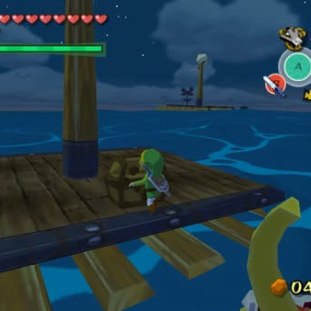
The Great Sea and the sailing mechanics were part of the plan long before Wind Waker utilized cel-shading. I can’t help but wonder if they switched the art style out of fear that previous experiences with water in a certain Ocarina of Time dungeon, ahem, traumatized their users.

Again, I wasn’t among the people who were angry, but I do admit it sucked the hype out of me to some degree. As a 12 to 13 year old kid, I wasn’t anti-cel shading, but it sure didn’t get me excited, either. Not like I had been for Majora’s Mask. Then I actually played the game, and now I kind of wish they did more games that look like this. I mean, ones that don’t see you controlling Link with a touch screen and a stylus. I think blowback on Wind Waker (hah, no pun intended) is the reason why cel-shading isn’t more common today, and I’ll never forgive the crybabies over it because I love cel-shading today. Too many games look samey, but cel-shaded graphics allow more personality and individualism without that creepy uncanny valley vibe that trying for realistic graphics causes. Imagine what a Zelda game developed from scratch using this style of art could look like today. Also, cel-shaded graphics hold up better to the ravages of time, which is why Wind Waker looks great for its age. The puzzle solving and combat holds up too, which is why it pains me to say that I had less fun than I figured I would have playing Wind Waker in 2025. I remembered it as my absolute favorite Zelda game. I certainly would not grant it that title today.

It’s okay, fanboys. We’ll get through this! Look at how much that Re-Dead loves Link! I love you THAT much!

And it’s not that I remembered Wind Waker as a flawless experience. I specifically remember being annoyed as a kid about how long it takes for the game to feel like it “gets going.” More specifically, I remember being so bored playing the Forsaken Fortress sequence that I was legitimately worried that the game would be no good. The structure of it doesn’t work at all, as you’re introduced to the sword, have to train with the old man using it, rescue Tetra from Bokoblins, leave on a pirate ship to the Fortress, train on swinging mechanics in the pirate ship, and after all that, the game has you drop your sword and play poorly-designed, sloppily implemented stealth mechanics that cause the game to slow to a crawl if that crawl was done by someone who had both hands freshly severed.

I think Wind Waker has the new record for the amount of times I said “what were they thinking?” about any one game. I know that I keep finding new record holders for that, but I expect Wind Waker to hold the record for a while. Sorry StarTropics, but you’re no longer the “absolute stupidest good game ever made.” Wind Waker is stupid to the point of being in a vegetative state, and not just at the start of the game. For all its virtues, Wind Waker is practically a parade of baffling, nonsensical design and/or outright bad ideas. Ignore how bad the stealth mechanics work: this whole level is BORING. Dull level layout, too.

I remembered ALL of that, and it was just as miserable to play in 2025 as it was in 2003. But, what I didn’t remember is that, even after suffering through all that, you still haven’t “opened up” the game and aren’t free to explore the Great Sea. When you sail, you’re given very strict limitations on where you can go, and you’re given the bum’s rush to Dragon Roost Island for the first proper level in the game, then the bum’s rush to the Forbidden Woods to play the second proper level in the game, and then the game tucks you in at night and reads you a bedtime story, and THEN you get to go out in to the world and explore. I often roll my eyes at people who whine about how games hold your hands too tight these days, but in retrospect, Wind Waker holds your hand until your hand is purple and has that annoying pins and needles feeling.

The whole sequence of getting the third and final pearl and opening up the Tower of the Gods is a massive letdown. Would an actual level for the third pearl have really been asking too much?

Annoyingly, after you do this, there’s only really three normal dungeons left in the entire game. Oh, there’s still lots to do, including a ton of repetitive “dungeons full of monsters that you clear out one room at a time with no puzzles or brain power needed” sequences. But the satisfying dungeons? There’s five. Hope you like them, because when they’re done, the peak fun is done too. Plus, your wallet is capped at a pitiful 200 bucks, which I had maxed out before I even reached the first proper dungeon with NOTHING to spend my money on. I found myself buying everything I could and still maxing-out my wallet in record time. They later increased the starting wallet capacity to 500 on Wii U, but again, that doesn’t help me or anyone playing on our Switch 2. Besides, I would have capped out the 500 starting wallet in just a few more minutes, anyway. You have to wait until later to increase to the 1,000 and 5,000 wallets, and that wait is maddening. I dare say they should have just started the game with the full 5,000 capacity or even higher. But that leads to an even bigger problem: Rupees are too abundant in Wind Waker while things to do with those rupees, well, aren’t.

These all went to waste. If this were real life, it’d be all the eShop sales where I loaded up on games that I never even boot up. I used to make fun of people who watched QVC or Home Shopping Network and ordered sh*t from home. Then I became old enough to have my own credit cards right around the time game consoles started having shops built right into them. I assure you, I’m ashamed of myself. Oh, I’m still going to keep buying games I never play and justifying it by saying I’m supporting devs.

Sail between any two islands and you’re bound to see enough light rings to dredge-up hundreds of bucks. It’s a mechanic that should have been killed on the drawing board and seems to only be there in order to make sure players are educated on how to use the grappling hook for the tedious task of fishing out the booty of forty-one treasure charts, eight Triforce pieces, the rewards from slaying six giant squids, and spoils of two specific warships out of dozens upon dozens in the Great Sea, both of which are located in arbitrary places, one of which leaves a Triforce Chart and one of which has a Piece of Heart. I was stunned to find out, just now, that 148 of the light rings are actually in preset locations and don’t come back. Because literally every trip between islands, it felt like I was passing by and hoisting up anywhere between two to six or seven new ones in each sector, every single time. A few of the ones at night respawn during full moons, but if there’s anything special about them, I never noticed. Except for the light rings caused by slaying giant squids or two specific warships, they always had either 20 or 50 bucks in them. In a game where you get money and supplies just for cutting grass, the light rings steal the uniqueness of the treasure charts. There’s just too much stuff to pull up from the ocean floor.

I only have one verified phobia: thalassophobia, or “fear of open water” which, despite being one of the most common phobias, the science is still out on. There’s multiple theories on it, the most common of which speculates that it’s likely connected to a broader “fear of the unknown” that’s the root of many phobias. The theory goes that, since you can’t visualize something unknown, our brains will latch onto the closest approximation of something we associate with the unknown as a visual reference and then install an intense sense of fear in it regardless of risk or rationality. For some people, that will create their fear of the dark, or others fear of strangers. For those with thalassophobia, it’s theorized that, thanks to folklore and religious iconography (like Noah’s Ark), history (like the sinking of the Titanic), urban legends (like the Bermuda Triangle) and pop culture (like Jaws) even those who aren’t close to an ocean or have no reason to fear water will still develop the phobia because we’ve been told the ocean is scary our whole lives. It makes for the easiest visual metaphor for the scariness of the unknown because a vast open ocean is where ships and planes disappear, never to be seen again, and besides, the water could have anything underneath it. Of all the theories, that sounds right to me, since one of my most common nightmares is being attacked by sea monsters. Despite playing video games in the comfort of my home, open water in games can f*ck with me pretty bad. Perhaps because of the cel shading, Wind Waker wasn’t as bad for me as, say, a couple of the bosses in Shadow of the Colossus, but there are some pants-wetting moments, specifically the giant squids. Wind Waker has six of them and, once they’re dead, they don’t come back. You can see where they are by using seagulls flying around in a circle. I intended to methodically stake them out, but instead, I hit not one, not two, but THREE giant squids by accident, startling the sh*t out of me when it happened. Funny enough, I won all six battles on my first attempt because the boomerang is too overpowered. The sharks were a lot more problematic than the squids were. If I could change one thing about the combat, it’d be eliminating every hit of damage you take on the boat being so violent it knocks you into the water. Seriously, EVERY TIME you have to climb back in, often just to get knocked right back into the sea. I think it has to be the “knock back” with the longest recovery time in gaming.

Granted, you won’t be able to do much with most islands until after you finish the Forsaken Fortress for the second time and have your first encounter with Ganon. Except, I thought the point of Zelda games was that you come across things that you know will make sense later, but you can’t do anything with them now so you put a pin in them. Wind Waker sets this up a lot, but because the game takes so damn long to open up, those moments feel like they still happen on an anal schedule instead of organically. In theory, Wind Waker should have a heavy emphasis on exploration of a vast, big sea. In practice, for the first several hours of gameplay, it feels like you’re shackled to a preset pathway. In fairness, it does feel like a defining moment when you realize the entire world is opened up to you. But that comes at the expense of a childlike sense of discovery and wonder. Compare this to my first Zelda, Ocarina of Time, where SO MUCH of the world opens up after the first level. Seriously, in 1998, I went several days between entering the first dungeon and the second. Well, that’s out of the question here.

You have to retrieve three pearls to raise the Tower of the Gods. The first two you earn from dungeons. The third one? Instead of a dungeon, you’re given the runaround on the great sea. This giant angler fish is supposed to be on one island but is instead hiding behind a solid rock wall on your native island. This whole sequence is how the game gives you bombs as an item instead of a plant that you pluck from the ground, and ultimately it’s Wind Waker’s way of letting you know that the map is now open for exploration. But it completely let the wind out of my sail to realize there was no dungeon and I just had the Macguffin now.

I also remembered Wind Waker as being much bigger than it is. As gigantic as the Great Sea is, there’s only five traditional Zelda-style dungeons: Dragon Roost Cavern, Forbidden Woods, Tower of the Gods, Earth Temple, and Wind Temple. Don’t get me wrong: they’re strong dungeons, with the Earth Temple being the best in the game. It’s just not enough. I suppose the Forsaken Fortress can be counted as a “dungeon” but by the time you actually get to play it properly with a sword, I was more than ready to be moving on to the next part of the game, and I groaned when I had to return to it later. Finally, I thought Ganon’s Tower had exceptionally uninspired design. It’s basically a boss rush of some of the previous bosses, where each boss chamber (which is done in black and white) is preceded by a short room that has the type of puzzle you would see from that stage. Imagine if every TV show’s season finale spent the first thirty minutes with a clip show and then the final ten minutes were the actual new content. That’s how Wind Waker actually ends, and Ganon is probably the dullest boss in the game, so the ending sucks just as much as the opening does.

Not only are the boss rush bosses now in black and white, but the game strips you of all items that you didn’t have up to the point when you first encountered them. When you enter the chambers, all the items (except bottles) are removed from your loadout and you have to reassign them. Then, after beating the bosses, when you return to the hub of the level, you have to re-reassign each item to each button again.

So the structure of Wind Waker is pretty weak, and so are many aspects of the open exploration. Players are incentivized to do battle against a series of platforms that are scattered throughout the Great Sea. A lot of these have cannons on the side, and taking out those cannons can be a chore, especially since getting the camera to even find an angle to see what you’re shooting at isn’t even always possible. Plus the seas might be choppy AND you’re being shot back at. For all the time and effort you have to put into taking these things out, the rewards are often a slap in the face. A golden feather, a skull necklace, or a joy pendant, all of which are things you can get by hitting an enemy one time with the grappling hook. There’s a single platform in the entire world that has a valuable Piece of Heart. It should be a joy to systematically take these things out, but instead, it’s reduced to busy work.

F*ck you, Wind Waker. F*CK YOU!

This is not an optimized world, and going off the list of fixes from the Wii U game that I never played, it would appear they didn’t fix that for the remaster. There’s so many things they could have done with the chests on the platforms that would have made them worth the effort. Here’s a thought: ditch the light rings that are so common that you’d swear they’re randomly generated and put that money on the platforms instead. Also, they could have had a lot fewer treasure charts that lead to the silver rupees worth 200 bucks. They overdid the silver rupees to such a degree that I stopped caring about recovering the items seen in the Treasure Charts altogether. I hit up a list of which charts pointed towards a Piece of Heart and went after them, and only them. Like so many other things about Wind Waker, mechanics that should have been a defining highlight are reduced to a commonplace chore long before the credits roll. What Wind Waker needed was someone above Aonuma to tell him “no. Don’t do that.”

I found myself massively over-bidding on the auction just to dump money.

What’s really f*cking infuriating about it all is there’s not enough ways to spend money until late in the game. But then, out of nowhere, there’s a dramatic spike in the need for money. The trading sequence Piece of the Heart takes around 600 to 700 rupees to complete and the Triforce charts take 3,184 rupees to translate. That sounds like a lot, but in this game, if you don’t stop every two seconds to pull up another light ring (which my father really wanted to do even if we had a maxed-out wallet), it really isn’t. At the point where I struck the killing blow on Ganon to end the game, I was holding 2,721 rupees that were functionally useless. It didn’t have to be this way. There’s a lot of stuff that they could have sold in stores like charts, bottles, etc. Only a single store in the entire game has high-priced items, and once they’re gone, that’s it. The three items being sold (a bottle, a Piece of Heart, and a treasure chart that leads you to another Piece of Heart) will run you 2,350 bucks. I’m fine with the price, but those types of prices SHOULD be a big deal that you work hard for, and they’re not. I haven’t even mentioned all the money you get out of pots or killing enemies. “Are you made of money?” In Wind Waker, yeah, you might be.

The first few “beams of light” that indicate the location of a treasure chart item had me excited. It’s damning that they lose their luster because money is so easy to come by that scooping up 200 dollars from the sea floor isn’t remotely a big deal. Out of the 41 treasure charts in the game, 11 point to a Piece of Heart and a f*cking insane 24 of them have the 200 value silver rupee. Others might have useless special charts that tell you, for example, how many Pieces of Heart each sector of the game has, except it doesn’t really act as a check list and doesn’t cross out if you found every one. There’s 44 total Pieces of Heart in the game, so having a built in checklist instead of having to use an online guide would have been nice. Same with the platform chart or submarine chart, which doesn’t tell you which ones you’ve cleared out. Meanwhile, I didn’t get the Octo Chart or the Great Fairy Chart until after I’d already found every one of those. You know, maybe you should have, I dunno, SOLD THEM IN A STORE?! The fact that it’s even possible to fish them out of the sea after they have any usefulness is just frustrating.

And while I’m whining about things I didn’t like, I encountered a ton of glitches playing Wind Waker, some of which are likely caused by an unstable GameCube emulator utilized by the Switch 2. The Link model vibrated in nearly every cutscene in the game, like he was experiencing a specifically vindictive and isolated earthquake localized entirely underneath his feet, and that was SO distracting and SO annoying, but at least it didn’t break the game, which I did more than once. I had multiple instances in treasure chambers or submarines where I had to exit and come back and start over because enemies that were supposed to spawn didn’t, thus ending the sequence before I could complete it. I’ve narrowed it down to two specific types of enemies as the likely culprits for why this kept happening. These things called Miniblins that are dead-ringers for Stitch and the infamous recurring Zelda baddies Wizzrobes, which now look like toucans for some reason, were ALWAYS involved in rooms where I was locked-out of being able to finish the stage. Of course, that was nothing compared to the soft lock that happened after I beat the second boss. Apparently I was in the exact wrong part of the room to strike the killing blow because the game would not load the dialog and was froze permanently on this screen:

I hadn’t been using the original save system and was relying on using save states to eliminate having to restart rooms with tricky jumps. Had I not laid down a save state about fifteen minutes before reaching the boss chamber, the game would have been over since I couldn’t even pause at this point. This was frozen-frozen, and that meant I had to replay the last few rooms and the second boss. Needless to say, I was laying down save states constantly after this boss. I recommend anyone else playing this on their $499.99 Switch 2 do the same and spread those save states out using all four save slots since it doesn’t seem out the realm of possibility that the “enemies fail to spawn” glitch I talked about above could happen in a locked room, leaving you with no possibility to unlock the room. Another glitch was this treasure chest next to a submarine was placed in a way that I could not open it. Had there not been a submarine there for me to enter and exit, I would have had to leave the entire sector and return to it in order to open the chest. Now granted, the chest was one of those nothingburger chests that I was whining about, but again, if it could happen in this spot, presumably it could happen anywhere.

On the left is the chest that didn’t open. On the right is the same chest, only now it was positioned further from the edge. I was able to open it now.

My final pet peeve with Wind Waker is that I feel the combat relies too heavily on the fog of war to create artificial difficulty. The Wizzrobes use this tactic constantly, because the main challenge in rooms where they team up with other enemies is just getting your targeting system to lock on to them. The Darknuts also use this when they appear in large groups. The giant worm that you fight in the Wind Temple had a similar structure, as my only issue with fighting it was, instead of locking onto its weak spot, which you have to shoot with the hookshot, the targeting system would instead lock-on to its babies, which spawn endlessly. Sometimes they really screw with you by adding the annoying-ass Miniblins into the battle, and since there’s an unlimited supply of them, it assures that you’ll lock onto them instead of the stuff that’s actually a danger to your health.

No, I don’t want to hit this thing. I want to hit the thing birthing that thing.

I’ve just done a LOT of bitching about Wind Waker. It’s safe to say that, following my 2003 play session of it, my brain deleted a lot more negative aspects of it than it did positive ones. I really always looked back on this as a mostly flawless game, at least once you get past the Forsaken Fortress at the start. Replaying it now over two decades later, jeez, Wind Waker is a deeply flawed experience, isn’t it? But, the thing is, all my positive memories of it were also accurate. Despite a problematic camera and the worthless “tornado spin” attack that leaves you dizzy for far too long, I enjoyed the sword combat of this Zelda more than any other game in the series, easily. I don’t care if the parry is overpowered (and it is). I liked using it! I liked snacking a Moblin in the noggin with a boomerang and then snagging its skull necklace with the grappling hook. I liked taking aim with my bow and shooting a Peahat out the air from the other side of a room. I never backed away from any fight because the fights were just so fun that I couldn’t say “no” to them.

Only a Zelda game could have a sequence where you briefly take control of a seagull that’s getting chased by a vulture and have it successfully be a heart-pounding moment.

I’m sure Nintendo fans will be furious at me for spending most of this review sh*ting on Wind Waker instead of showering it with praise, but I did actually 100% the game. Well, not counting the Nintendo Gallery which takes too long to open up and too much busy work to complete. Instead of figurines, why not just do something simpler, like a photo album? But in terms of ITEMS, I got everything, something I didn’t do in 2003. Yes, I even got the blue gels, though I think I did that one the first time too, or at least enough to craft the blue medicine. In my original playthrough when I was 13, there were two specific Pieces of Heart I know for sure I never got. I never finished the trading sequence, which is a lot different from other Zelda games. It’s confusing and clunky. This time, I did get every item out of it which culminates in a Piece of Heart. Finally, I never did the notorious “water every plant in twenty minutes” thing. I tried it once as a kid, but when I realized that you had to do all eight within the time limit, I said “I don’t need that last heart to beat the game.” This time, I did it, and I finished with plenty of time to spare, too. Worth the effort? Not really, but there’s a strong chance I’m never going to play Wind Waker again so I wanted to be able to say I did it.

On the Wii U version, the time limit is increased to thirty minutes AND you can get a faster sail. That’s great! Happy for you Wii U owners. But, say it with me: THAT DOESN’T HELP SWITCH 2 OWNERS!

There’s just so much to like about Wind Waker. Tetra is my favorite version of Zelda, and she’s so spunky that I kind of wish they’d give her a game. I don’t mean Navi Trackers, either, which we never got in the US anyway (and it required four players who each owned a Game Boy Advance and a Gamecube to GBA cord to play anyway). I mean give her a game where you go on treasure hunts! Speaking of which, how come, in a game with pirates, there’s no buried treasure on the islands? What could have been really interesting is pirate maps where X marks the spot and you have to suss out which map is to which island based on landmarks. Again, there’s so much left on the table that I hate that Wind Waker didn’t get a direct sequel. And no, the DS games don’t count. I tried them, besides the fact that they use touch controls, I thought the game structure with a central dungeon you have to continuously return to is lame. So in my book, Wind Waker was a one and done, and despite my whining, it will always hold a special place in my heart. Maybe a year from now, I won’t remember all the stuff I hated. It already happened to me once, so maybe I’ll still think of Wind Waker as the game where I was smiling ear-to-ear doing this:

I’ve noticed that, when it comes to key games of my youth, replaying them for the first time as an adult years later always makes the flaws stand out that much more. My sister got me the Metroid Prime remaster for my birthday last year. I started it and restarted it three times in the thirteen months that have followed and I still have never even finished the first level. It was a game I couldn’t put down at the age of 13, and now at 35 to 36, I can’t even pick the damn thing up. Maybe it speaks to the quality of Wind Waker that it wasn’t like that at all. Instead, I flew through the game in a week, whereas I think I spent close to a month with it the first time around. When I was in the dungeons, or exploring a new sector for the first time, I was having fun. The light-reflecting puzzles that a lot of people hate? I think they’re genius, especially that last one that takes a while to finish. Okay, so the ending where Link says “see ya, wouldn’t want to be ya” to his sister is a big downer. Maybe it was payback against the fans for the backlash to the graphics style. Or maybe they were just bitter that they ran out of memory to hide about five thousand more silver rupees.
Verdict: YES!

Apparently the entire ending is actually a video file that’s not rendered live in the game’s code, and they didn’t bother up-scaling it so it looks very blurry. The ending is a punch in the gut anyway so it’s probably best to just imagine that Link realized his little island was awesome and Tetra is an obvious sociopath. In my head canon, I assume her pirate crew actually know that she’s Princess Zelda and are just going along with her desire to be a pirate because it’s amusing.