Donkey Kong Country (SNES Review)
July 31, 2025 5 Comments
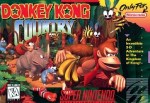 Donkey Kong Country
aka Super Donkey Kong (Japan)
Platform: Super Nintendo Entertainment System
First Released November 18, 1994
Directed by Tim Stamper and Chris Stamper
Developed by Rare Ltd.
Published by Nintendo
Available with Switch Online Subscription (Standard)
Listing at Mario Wiki
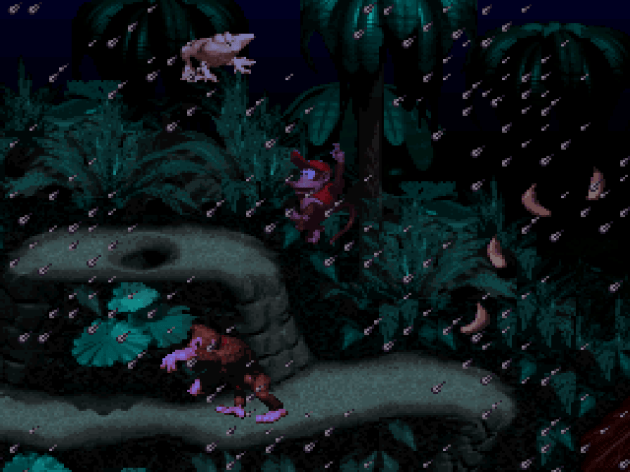
Well, um, the rain still looks like rain! Or oatmeal. It kind of looks like oatmeal. But RAINING oatmeal.
I swear to God that I didn’t deliberately review this back-to-back with Super Mario Land 2 because both games were more focused on looking pretty than being mind-blowing from a gameplay perspective. Actually, I thought Donkey Kong Country had a much better chance of scoring a YES! than Super Mario Land 2 because it would still have the horsepower to pull off clever level design. And sometimes it does! Like, take a look at this:
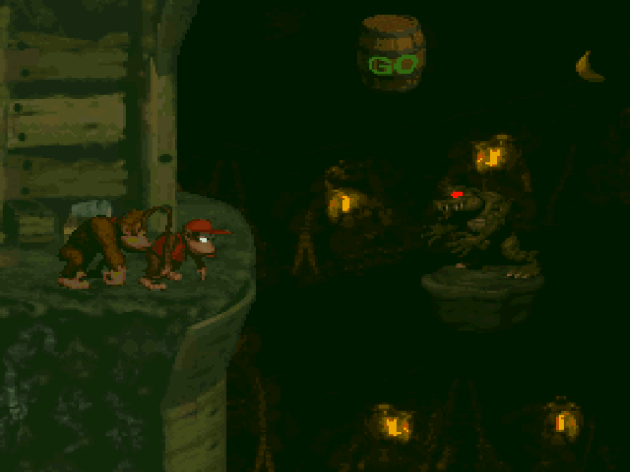
Oof, that does not look beautiful. I bet it did in 1994, and that’s literally the only time it had to. No matter what anyone thinks, even Nintendo games (or games Nintendo paid to have made, as is the case with DKC) are ONLY made to appeal to gamers at the time of release, and if they happen to be valuable as catalog titles later, that’s just a bonus. I know people want to believe the mighty Nintendo plays 4D chess and has this big roadmap of when catalog titles will be worth money again, but they don’t. Nobody does. That’s why gaming licensing planks are so very, very one-sided and sh*tty.
You have to hit those STOP/GO barrels to freeze the red-eyed enemies, which turn into stones. You never know how much time you get for each barrel, and they staged the level in a way where the last few only give you a split second. It’s quite exciting, and the enemies are creepy enough. I just wish there were more stages that made me sit-up like that, but that wasn’t the point of Donkey Kong Country. It was made only to be 1994’s big smash hit, and if it’s worth some scratch in the 2020s, hey, lucky us. So when people say “Donkey Kong Country doesn’t hold up” it’s okay to say “well duh!” It accomplished exactly what it set out to do in 1994: curb stomp the 3DO into oblivion while keeping Nintendo fans on the hook while they got the platform that would come to be known as Nintendo 64 ready. “Holding up to the test of time” was not on the agenda.
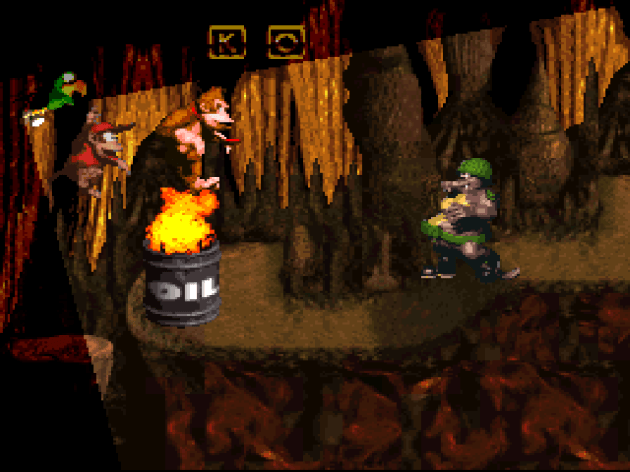
You can’t say that they overplayed level gimmicks. Despite the fact that the STOP/GO barrels had legs as a gimmick, they only show up in that one level. These parrots only show up once too, though they’ll be featured characters in the sequel.
So in a sense, it’s kind of remarkable that any aspect of DKC holds up at all. I think my frustration with Donkey Kong Country is that it doesn’t feel like it squeezed all the potential out of the gameplay concepts it has. Maybe they were saving-up for the inevitable sequel, but I dunno. I’m a big fan of leaving it all on the court, and Rare sure as hell didn’t do that. It’s actually one of the most conservative games I’ve reviewed lately. As a franchise builder, few first steps are rarely this enticing and leave you wanting more in a bad way. Maybe any more bold ideas were canned for being too difficult when they were trying to make a game to appeal to everyone, including very young gamers, whom I’m guessing will like DKC in 2025 more than I did. I hate to guess on these things, but Donkey Kong Country seems like a great starting title for introducing young children to platforming. From what I can remember about the sequels’ difficulty, I’m guessing I won’t be able to say that about them.
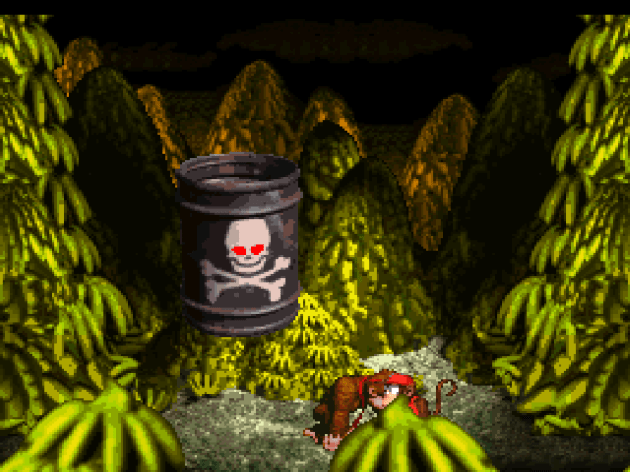
Then again, there’s moments that feel like the bottom of the barrel is being scrapped. No pun intended, but this evil barrel is my least favorite boss trope: fighting the same regular enemies you’ve been killing en masse this whole time.
Even the Stampers recognized the game was too easy, but I think that could have been fixed by adding a difficulty toggle. A hard mode wouldn’t have been too hard. Just remove a lot of the DK barrels from stages. I took plenty of damage playing DKC, but I never had to wait more than a few seconds to undo that, so there was no tension. Still, the addition of Diddy Kong was probably the smartest move. What Donkey Kong Country really does right is removing hit points in favor of having two different characters, and whoever you’re playing as is lost when you get hit, at least until you find the next DK barrel two seconds later. Being able to swap between two characters who have different skills was also inspired. Diddy Kong can cartwheel through enemies and seems to have more hangtime when you cartwheel off a ledge before he has to jump. Plus he carries barrels in front of him, which makes it easier to uncover hidden doors. Meanwhile, with Donkey Kong you can do such tactics as tagging Diddy so you can use him instead. Again, a great idea that would be utilized better in the sequels. Are you noticing a theme here?
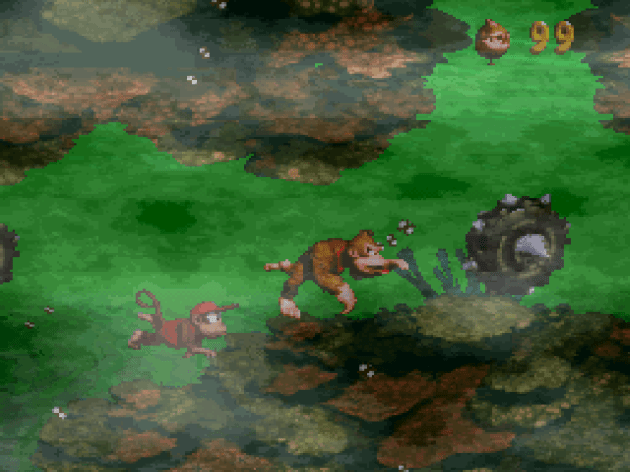
The only time I used Donkey Kong was when I was afraid of losing Diddy. It became clear really quickly why he’s not playable in the first two sequels.
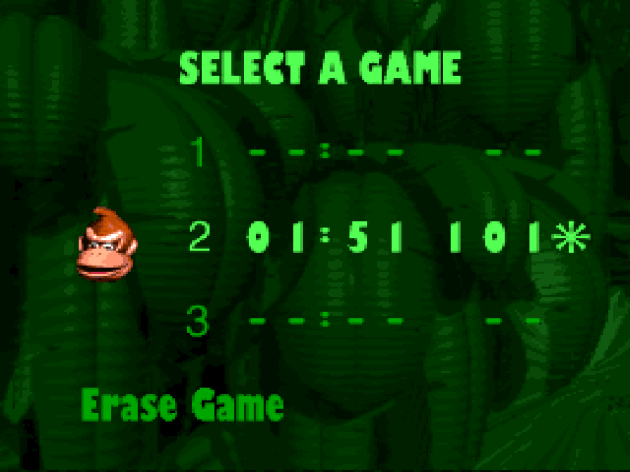
Unlike Super Mario Land 2 which, besides having a lot of pointless bonus levels, really did nothing wrong besides having too basic of level design, Donkey Kong Country did PLENTY to leave me terminally annoyed. The methodology of 100%ing the game (or 101%ing because ain’t that quirky?) is strange. Every level has K-O-N-G tokens to find, some of which are so well hidden that I couldn’t find them. Sounds great, except they don’t contribute to the final completion percentage. Instead, acing the game only requires finding every bonus room. Probably not the best way to do it since there’s too many of them and they completely bust the game’s flow. My favorite levels were usually the ones that back-loaded the bonus rooms near the end of the stages. Those tended to have above-average level design. Hell, I normally hate swimming stages, but at least none of those have bonus rooms, so they were some of the better levels.
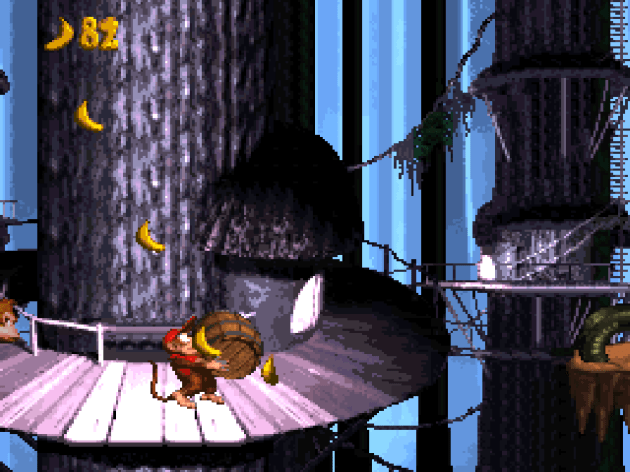
I found myself carrying barrels and walking up against walls because I was more focused on getting 100% than I was just enjoying the boilerplate, paint-by-numbers level design.
What wrecks the game’s tempo even worse than the bonus rooms are the animal tokens. No matter what you’re doing or where you are in a stage, once you collect the third and final token of any set, you drop what you’re doing and enter that specific animal’s bonus stage. It would make so much more sense to instead bank the reward until after you beat the level. That’s a time honored gaming tradition, right? But no, it’s an interruption, and not always (or ever) a welcome one. The levels take a while to finish, and it gets worse, because sometimes after the round is finished, it takes you quite far back in the level you were playing. Maybe even to the start of the stage.
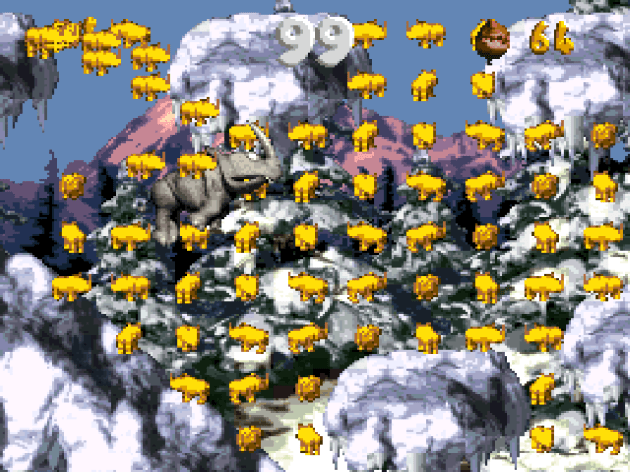
Okay, so the animal bonus rounds are fun. Well, until you have 99 lives. Then they become annoying.
I did end up 101%ing Donkey Kong Country, but the irony is, I probably would have enjoyed my time with the game a lot more if I hadn’t bothered. I mean, not enough to give Donkey Kong Country a YES!, but it would have been a lot closer. I found myself deliberately avoiding animal tokens and losing the bonus rounds as soon as they started just to make them go faster. When just the act of finding the rooms is all you need, why bother? DKC is a game where lives are so plentiful that you’ll almost certainly not game over even if you struggle with some later stages. That’s a big if, by the way. The only stage I died more than twice on was the second mine cart stage, which shows up pretty late in the game. And it’s not that I never enjoyed the exploration aspect. Actually, I was happy that, if you miss a bonus room and have to replay the level, you don’t have to finish it to get credit for the stuff you missed. As soon as you locate the bonus rooms you missed, you can pause the game and press select and return to the map with full credit.
If the game had required all the letters, I would still be playing DKC, but it didn’t, and instead I’m trying to finish up this review as fast as I can.
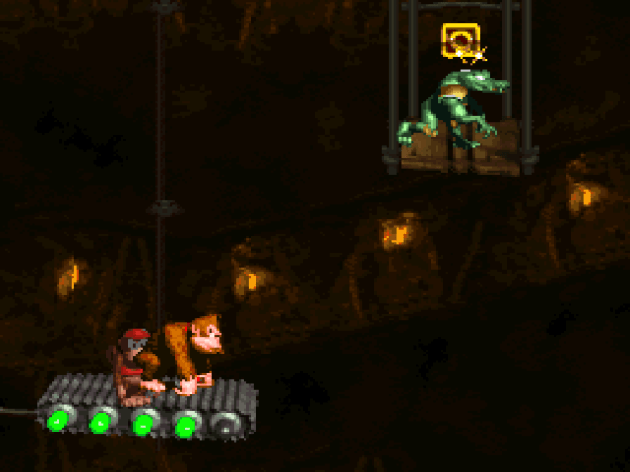
There are a handful of gimmicky levels to keep the experience somewhat fresh, like the above screenshot. That treadmill runs on fuel barrels that you have to collect, and it kept my attention for the full length of the stage. The mine cart stages are some of the stronger auto-scrolling types of levels I’ve experienced, and a stage where you slide up and down ropes automatically actually provided a solid, enjoyable challenge. I’d say around a third of Donkey Kong Country holds up and remains clever today. But two-thirds of the game is too basic to hold up to the test of time. You never quite shake the proof-of-concept feeling when playing it, and that makes sense because the gameplay isn’t what they had to get working. Nintendo paid for a game that looked high tech enough to buy them time for the Nintendo 64. Donkey Kong Country for the third best-selling SNES game, so they got it. But being more bold and experimental with the level design? That came later, with the sequels.
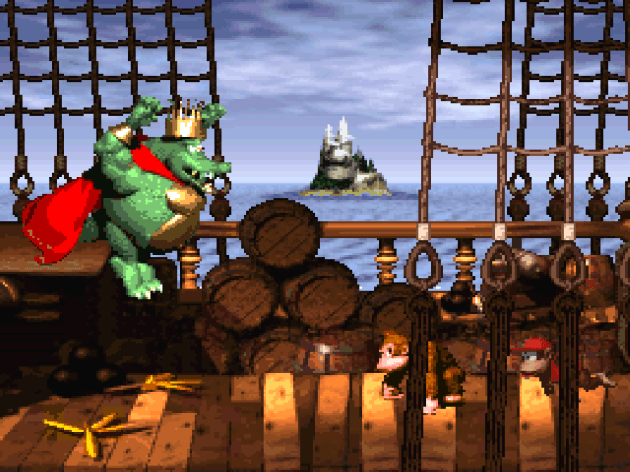
Donkey Kong Country’s bosses are all dull, but King K. Rool takes the cake. His arena is much bigger than the screen, and his attack pattern is basically adding one pass across the full length of the arena after every hit. So when he drops cannonballs across the screen, instead of an exciting pattern like dodging them for several seconds, the cannonballs drop one at a time across the length of the screen. It’s the most unimaginative way of handling any boss, let alone a final one.
As a prototype for better games to come, Donkey Kong Country is a good start. It’s never BAD from a level design point of view and the barrels that you fire out of are fun enough, though not quite barrels of fun. The controls are pretty good, and it’s easy to get a feel for how long you can roll or cartwheel off a platform and float in the air before you have to jump. But the level themes are basic and dull and there’s not a big enough cast of enemies. The bosses are REALLY bad, too, and since they take even longer to fight than enemies in Mario games, they come across as punishment for finishing a world instead of a reward.
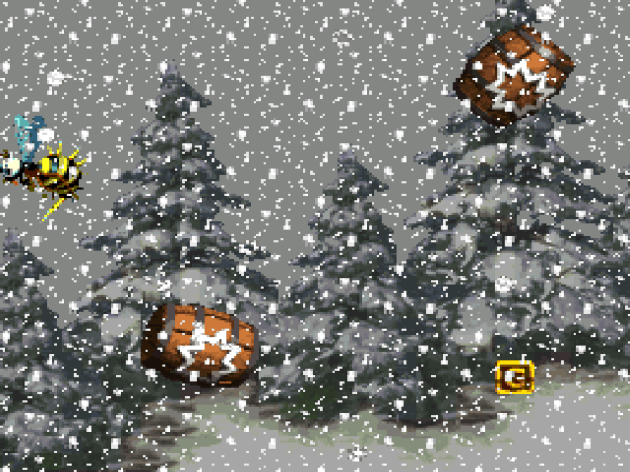
The barrels are certainly a great idea and probably the one aspect of Donkey Kong Country that I feel they didn’t hold back on. They got every molecule of gameplay out of them without being boring. I really think they’re why this ended up such a potent franchise.
The test of time is cruel, and no games have a tougher time facing that test than games based around cutting edge graphics first and gameplay second. Since the graphics were the main selling point, I figure I should mention I thought the game was pretty damn ugly. The character models are fine, I guess, but the architecture is really rough, with backgrounds often looking like Sega CD levels of splotchy. The funny thing is, after Donkey Kong Country became the last big mega hit for the SNES, Nintendo would have given anything to have Yoshi’s Island look like this game, and the only reason it didn’t happen is because it was too far in development to change the entire art direction. That’s kind of hilarious, because Yoshi’s Island still looks good in 2025 including all its cutting edge special effects. Donkey Kong Country, well, doesn’t. These days, DKC is just another middle of the road SNES platformer that looked better in 1994 than other middle of the road platformers, but it did leave a franchise with much better games in its wake, so it has that going for it. Take that, Plok.
Verdict: NO! But I want to talk about one last thing.
Donkey Kong Country: Competition Cartridge
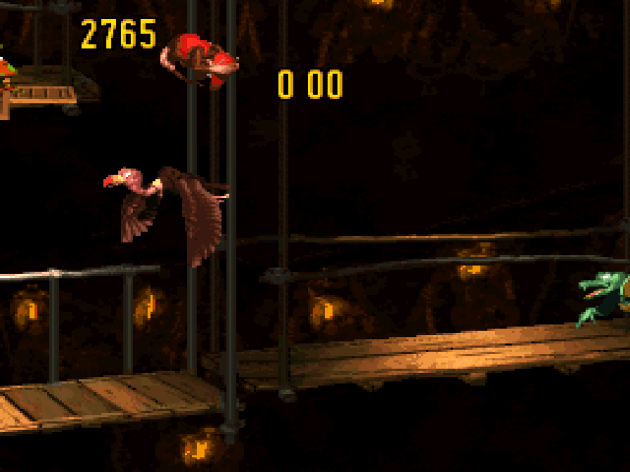
My best score for Competition Cartridge. I couldn’t find what the highest scores were but there’s people who have scores in the 3,000s. Most of my runs also ended around the same spot, too.
There’s a version of Donkey Kong Country that acts as a spiritual successor to the 1990 Nintendo World Championships cartridge (which I reviewed in Tetris Forever: The Definitive Review’s bonus section). It’s really well made, too and actually the one aspect of Donkey Kong Country that unambiguously holds up. The timer stops during all transitions. There’s no overworld map, so finishing one stage takes you automatically to the next. They even redid what’s inside the bonus rooms to make the scoring for entering those rooms more logical, and the scoring system is, you know, fine. I actually had a lot more fun playing this than I did in anything in Nintendo World Championships: NES Edition. It’s fast-paced and genuinely exciting. So, why isn’t THIS on Switch Online? Unless Blockbuster Video’s IP holders also hold the publishing rights (don’t rule this out) I can’t think of any good reason. If you get a chance it’s worth checking out, though it’s probably not worth the $5,000 it fetches on Ebay.
Verdict for Donkey Kong Country: Competition Edition: YES!
The math checks out.

 Indie Gamer Chick
You must be logged in to post a comment.